
Fintech South 2022 is a world-class summit with its nexus in Atlanta live and in-person, a global financial technology hub that is home to more than 200 fintech companies. The top 15 public fintech companies in Georgia alone generate more than $100 billion in revenues.
On June 14-15, 2022, we welcomed fintech leaders from around the world for 2 amazing days of content and experiences designed to help you make the most of the opportunities of the fintech revolution.
 Larry Williams, President, TAG
TRANSCRIPT
Intro: [00:00:07] Broadcasting live from the Georgia World Congress Center for Fintech South 2022, it’s time for Atlanta Business Radio. Brought to you by Atlanta Blockchain Center. Now, here’s your host.
Lee Kantor: [00:00:27] Lee Kantor here back at Fintech South 2022, right in the heart of Innovation Alley. So excited to be talking to Larry Williams, the president, CEO of TAG. Welcome, Larry.
Larry Williams: [00:00:39] Great. It’s great to be here. Thank you all for having me.
Lee Kantor: [00:00:41] So, what do you think? Fintech South back, live in person.
Larry Williams: [00:00:46] You know —
Lee Kantor: [00:00:46] People, humans everywhere.
Larry Williams: [00:00:47] You know, I get to see people’s teeth again. And I’m just delighted to see that everybody’s got the energy here. You can just feel it. It’s palpable. It’s just people are excited. The interactions, the businesses happening here. It’s really what this is all about. You know, in TAG, whenever we started producing Fintech South five years ago, this is our fifth annual, this is what we envisioned it would be. We did a great job with a virtual platform for the last two years, but it’s great to be back in person and great to make those human connections.
Lee Kantor: [00:01:18] So, when you’re planning around an event like Fintech South, it’s a combination, obviously, education, there’s panels, there’s networking. We also have the whole Innovation Challenge, folks. You got the startups and the matching with the enterprise. How do you even, kind of, begin an event like this to make sure that all of those constituents are getting what they need?
Larry Williams: [00:01:42] Well, if you think about it, this really does bring together all of the elements of the ecosystem. So, everything, as you mentioned, from the startup. So, we really work through our Fintech society at TAG. And so, they really help start us at a very early stage. And really it’s an all year — it’s a year-round process. So, if we start to think about the Innovation Challenge, getting those startups because there’s a whole mentorship program that goes along with this. It’s not just the award on stage that we see here.
Lee Kantor: [00:02:12] Right, that we see the end result.
Larry Williams: [00:02:14] Right, so this has been going —
Lee Kantor: [00:02:14] There has been weeks or months ahead of time
Larry Williams: [00:02:17] Yes, months ahead. Same with the Advanced Awards and thinking about who are those companies that have really been accelerating and moving the ecosystem. These are all important parts of what we’re doing. And then it’s the professional development, the trends, the knowledge, news you can use that people can really go back and say, hey, this is what the trends of Fintech are. This is what I can apply back to my business. Even the thought sharing and the thought leadership that goes into it.
Larry Williams: [00:02:44] Now, one thing you did mention is also the workforce. You know, we’ve had lots of students here. We’ve had over 30 students here that have really — that are going through the FinTech Academy and other things to prepare that next generation of leaders in our Fintech community.
Lee Kantor: [00:02:58] And that’s a big innovation to have an academy that is just has a curriculum around Fintech. There’s probably not a lot of those in other places in the country, right? That are so specific to fintech and to grow your own talent, because the need is so great. We have to do something. You can’t sit here and wait and hope that this solves itself.
Larry Williams: [00:03:18] You know, we were really pioneers in this and led the way. There’s a lot that has popped up around the country that like to say they — I’d like to say me too. But I can really say that we really started it here. Our companies, our University System of Georgia really got behind it. We move fast. We stood it up and it’s doing a great job.
Lee Kantor: [00:03:36] Right. And so, can you share a little bit about how that works? Like how did — you know, how does a student get involved with that to take their career to a new level?
Larry Williams: [00:03:47] Yes, it’s really about getting the main doorways through the University System of Georgia. So, any of the schools, although it’s based at Georgia State University, other students at other universities can access it. So, it’s really just, you know, look for the FinTech Academy, you know, and go to the website and it will direct you on how to get engaged.
Lee Kantor: [00:04:07] Now, you mentioned five years ago the event began, and even in the short period of time of five years, the Fintech kind of brand has expanded, right? And Fintech is touching so many more things than it did five years ago.
Larry Williams: [00:04:21] You know, Fintech touches everything. As I like to say, everybody likes to get paid on time, every time. And as we go more and more to a digital platform, Fintech is really at the center of it. And it really does touch every industry because there’s no industry that there’s not some type of financial transaction happening.
Lee Kantor: [00:04:41] Right.
Larry Williams: [00:04:42] So it’s been great because we’ve been talking about everything here at Fintech South on our breakouts and on main stage. We’ve been talking about diversity and inclusion, financial literacy. We’ve been talking about the fan experience and you know, what’s going on whenever you have a large event at Brave Stadium or over at Mercedes-Benz Stadium with MLS. All of these things and this financial transaction, this intersection with the point of sale all affects that fan experience or the customer experience if we’re talking about retail or others.
Lee Kantor: [00:05:15] Right.
Larry Williams: [00:05:15] So, all of this has been part of it. And so, what we’ve been seeing, especially, which was accelerated over the last two years, is this idea of frictionless payments.
Lee Kantor: [00:05:24] Right.
Larry Williams: [00:05:24] You know, how do you start to make it even easier? So, you know, Amazon makes it pretty easy, you know, hit the, you know, one click button. But you’ve got to think about now where we’re going with wearables, with your digital wallet. The adoption of these types of tools have accelerated greatly, and that’s what we’re going to consider — continue to see happen. And just more adoption. You know, the younger generation, they’re not carrying cash anymore.
Lee Kantor: [00:05:48] Right.
Larry Williams: [00:05:48] You know, they’re not doing it at all. They don’t want to.
Lee Kantor: [00:05:52] Yes, they don’t walk into banks.
Larry Williams: [00:05:53] They don’t walk into banks and they don’t want to. And, you know, and part of it is when you think of the brick and mortar side of it, a lot of people say that people don’t need banks, they need services. And so, you’ll see the banking models starting to evolve that it really is service focused about what is it that we can do and how people can access them in a very easy and convenient way.
Larry Williams: [00:06:19] Now, the big pond, the big opening right now, and the big opportunity is really we’ve done a lot with consumer payments, but it’s really moving to business to business. So business to business is still predominantly done by checks. So, remember a check? When was the last time you wrote a check?
Lee Kantor: [00:06:36] Right.
Larry Williams: [00:06:36] You know, but business is still done that way. And so, if we think about the evolution of where payments are going, Fintech is going to be able to facilitate more business-to-business interactions.
Lee Kantor: [00:06:47] So, now as the leader of TAG, TAG touches all these kind of technology special interests. How are you seeing that evolve over the years of your leadership in terms of there’s many more things that are falling under the umbrella of technology? Like at one point — like you just said, everybody’s a Fintech company now whether they want it or not. Everybody’s been a technology company, whether they want to be or not.
Larry Williams: [00:07:11] Yes, you know, that’s been an evolution that’s happened. You know, every company is a technology company even if it’s not something that’s, you know, a recognized brand. But, you know, Home Depot, UPS, Coca-Cola, all technology companies, because that’s how we do business and that’s how we connect with our customers and that’s how we grow our businesses in many, many different ways.
Larry Williams: [00:07:32] So, you know, I’m just proud of, you know, TAG of really being able to think about the things and the next, you know, what’s the next generation of innovation? What is the next thing that’s coming around, you know, whether it be blockchain or whether it be evolution in things about sales leadership? Because people we sell differently in the technical cells. The marketing of how you market and go to market’s very, very important now.
Larry Williams: [00:07:56] And you know — and so these things, marketing technology is a big core competency here in Georgia. If you think about what David Cummings has done, you know, with Pardot. What’s going on with Salesloft and lots of other companies that are really driving that, that’s an important part of it.
Larry Williams: [00:08:12] Blockchain, and really thinking about what Blockchain is doing, inclusive of but not exclusive to cryptocurrency. You know, right now, I think you’ve heard us say a million times, the 70% of all debit, credit, and reward card transactions are processed through Georgia. Today, we can say that 80% of global commercial cryptocurrency transactions are processed through Georgia.
Lee Kantor: [00:08:35] Wow.
Larry Williams: [00:08:36] And so, that’s us staying at the head of innovation. Now, the other thing that’s similar to this is cybersecurity. You know, cybersecurity, we’ve been in cybersecurity for decades and I’m going back to mainframes, to network, and to internet security. Things that we’ve done through Georgia Tech with the Department of Defense. And now we’ve been at the forefront.
Larry Williams: [00:08:59] We’ve been able to create great, great companies like ISS that became part of IBM. Secureworks that have been part of Dell. AirWatch, you know, that grew up and is now part of VMware, but is the company that — it was the first mobile security application that Apple led onto the iPhone platform that enabled people to choose an iPhone. And if you remember the BlackBerry.
Lee Kantor: [00:09:26] Right.
Larry Williams: [00:09:27] Blackberry didn’t make it. And that was all, you know, generated out of here. But that — it’s really to illustrate that we were able to go from, you know, the enterprise type of security all the way up to mobile phones and build it here. Because we built — we knew every iteration of the evolution of the technology.
Larry Williams: [00:09:48] And so, we’re seeing that with Fintech digital health. You know, we’ve got a broad portfolio here and that’s good for our economy.
Lee Kantor: [00:09:55] Right, that’s why I think that the Georgia economy is always so strong because of the diversity of the industries that allow us if there’s a downturn somewhere or something, there’s an upturn somewhere else. And a lot of times it’s here still in the State of Georgia.
Larry Williams: [00:10:08] You always want a balanced portfolio, right?
Lee Kantor: [00:10:11] Exactly.
Larry Williams: [00:10:11] You know, so that’s more resilient. And so, we’ve got a great portfolio here that makes us resilient. And so, it’s a great time to be here.
Lee Kantor: [00:10:18] And it’s important that folks like you that are leading a community of people in technology, that you’re a part of it. And we have the public and the private intersection where everybody is being so collaborative and everybody’s helping each other. This environment is what allows Georgia to be as successful as it is.
Larry Williams: [00:10:37] You know, it’s hard for new people to believe that this is true. But as people get into this market, they really do start to learn that people here want you to be successful.
Lee Kantor: [00:10:48] Right.
Larry Williams: [00:10:48] And people will help you. And many times —
Lee Kantor: [00:10:50] It’s collaborative.
Larry Williams: [00:10:50] It’s collaborative. And many times those are competitors. But they say — they know that your success is our success.
Lee Kantor: [00:10:57] Right.
Larry Williams: [00:10:57] And so, I think that’s a great community. And people are always amazed that there’s something like TAG. You mean, I can just, you know, get plugged in immediately? Yes, you can.
Lee Kantor: [00:11:07] Right, and it’s — and it doesn’t matter what niche you’re in, in technology. There’s a space for you.
Larry Williams: [00:11:13] That’s exactly right. And it opens the doors to many, many other organizations and other ways to get networked or get support.
Lee Kantor: [00:11:19] Well, Larry, thank you so much for sharing your story today. If somebody wants to connect on — at TAG, what’s a website?
Speaker3: [00:11:27] At tagonline.org.
Lee Kantor: [00:11:29] Good stuff. Well, Larry, thank you again for sharing your story. You’re doing important work and we appreciate you.
Larry Williams: [00:11:33] Appreciate all you all doing. Thanks for being here.
Lee Kantor: [00:11:35] All right. This is Lee Kantor. We’ll be back in a few at Fintech South 2022.
Outro: [00:11:47] This episode has been brought to you by Atlanta Blockchain Center, the catalyst for Atlanta’s emergence as the Premier Blockchain Innovation hub globally, through cultivating entrepreneurship, inclusivity, and education. To learn more, go to atlblockchaincenter.com.
 Amyn Sadruddin, Intellekt AI
TRANSCRIPT
Intro: [00:00:08] Broadcasting live from the Georgia World Congress Center for Fintech South 2022, it’s time for Atlanta Business Radio. Brought to you by Atlanta Blockchain Center. Now here’s your host.
Lee Kantor: [00:00:28] Lee Kantor here. Back at Fintech South 2022. I’m so excited to be talking to an old friend, Amyn Sadruddin with Intellekt. Welcome.
Amyn Sadruddin: [00:00:36] Hey, what’s up, man? Long time no talk.
Lee Kantor: [00:00:38] I know. So, what brings you to Fintech South?
Amyn Sadruddin: [00:00:41] So, we are a finalist for the Innovation Showcase.
Lee Kantor: [00:00:45] Oh, congrats.
Amyn Sadruddin: [00:00:45] Thank you so much. So, we pitched yesterday the investors, and today we’ll be pitching, I think, during the keynote hours. So, pretty excited and gotten a lot of great support from the tech folks and all the folks at Fintech South.
Lee Kantor: [00:00:57] So, tell us about Intellekt. How you serving folks?
Amyn Sadruddin: [00:00:59] Sure.
Lee Kantor: [00:00:59] What’s you’re — what’s the product service?
Amyn Sadruddin: [00:01:02] Yes. So we’re a platform, a SaaS platform. And what we do is we help Fintechs onboard their customers. It’s a self-onboarding tool. And basically, what we do is we offer compliance around the onboarding process and we offer the data to be cleaned during that process from their customers so that they can efficiently onboard them. And then they can also leverage the data to run, you know, cross-sell, up-sell as well. So, basically, what we do is at the inception point of how a Fintech onboards their customer. We basically enrich the data that they are processing so that they can be more intuitive with it. So, enhance the Intellekt.
Lee Kantor: [00:01:41] Now, what was the genesis of the idea had to come about?
Amyn Sadruddin: [00:01:44] So, I joined this company as co-founder and chief revenue officer about two years ago. The origin of the company was a managed services firm and we did a lot of data evolution projects for financial institutions, banks, neobanks, crypto. And we saw a high resonance that all Fintechs have an issue or have some gaps or pain points around the onboarding process. So, we basically came in and we were doing a lot of data aggregation work and found that you know, through the tools and technologies that we’ve built that we can, you know, transform this into a platform that could be a self-serve tool, so.
Lee Kantor: [00:02:19] And then what are some of the symptoms that, you know, your potential clients are having were Intellekts the solution? Like, what are the clues that they might have a problem that they may not even realize?
Amyn Sadruddin: [00:02:31] Sure. You know, folks in the Fintech space are, you know, it’s highly competitive now. It’s very digital in nature. And if you look at some of the bigger banks or bigger institutions, they’re trying to serve a very digital audience, millennials, Gen Zs. No one wants to go to a brick and mortar, but some of the items that need to be digested by a Fintech is sometimes very brick-and-mortar related, right? Submitting an ID, right?
Lee Kantor: [00:02:55] Right.
Amyn Sadruddin: [00:02:55] It has to be on point, right? It has to be scanned properly. You know my name, Amyn Sadruddin, as long as it is. But I sometimes shorten it and just do Amyn S. And depending on how that institution is collecting my profile information, whether it’s, you know, connecting to a Facebook account or whether it’s attaching to my e-mail. Those are a lot of data points that need to be aggregated and make sure that when you build the persona of an Amyn or a Lee, you know, that you do it at the most accurate level. So, that when you verify them to transact on your platform, that you’re doing it with accuracy. So, that you know that, hey, I know that if I give Lee a credit card in my platform or if I let him transact on my platform, that I know that he’s not going to commit fraud, so.
Lee Kantor: [00:03:35] And then it’s also — there’s opportunity because if you’re using different, you know, like Amyn, Amyn S,whatever the — whatever Amyn means, right?
Amyn Sadruddin: [00:03:44] Exactly.
Lee Kantor: [00:03:45] Then they want to make sure that there’s the right offer at the right time for you, that’s relevant to you rather than just not you.
Amyn Sadruddin: [00:03:54] Yes, I think the — you know, one of the pain points that we saw and, you know, we did a lot of customer discovery through Fintech CXOs in the market. And a lot of them, you know, always look at the data that they collect from their customer as like an after-effect that they want to then leverage that data afterwards to then do the cross-sell and upsell. But you know, the origination of when the customer submits their data is when you should tackle it, and clean it, and prep it. So that whenever you put it into your lead management system or your CRM system, or you want to do continuous monitoring on an individual, it all boils down to clean data.
Amyn Sadruddin: [00:04:30] So, that’s kind of what we provide is that, you know, we do a lot of shit cleaning on the front end and then provide a lot of intuitiveness on the back end so that when a Fintech wants to onboard a customer, they have a lot of confidence in who they’re onboarding. Because compliance is also an issue. I think in — yesterday the three tracks that I attended, including the main stage, compliance was touched on. And that you know, they’re —
Lee Kantor: [00:04:49] Each one of them?
Amyn Sadruddin: [00:04:50] Of them on each one of them.
Lee Kantor: [00:04:51] Right.
Amyn Sadruddin: [00:04:51] Yes, yes. So, that — they were trying to figure out is, how do we instill more accurate compliance? Because compliance, you know, kind of presents two issues for the Fintech, is one is that they’ll get penalized, right, for not doing it properly?
Lee Kantor: [00:05:04] Right.
Amyn Sadruddin: [00:05:04] And then you lose the customer, too. So, now you’re like double negative revenue, right?
Lee Kantor: [00:05:07] Right. And it’s table stakes now.
Amyn Sadruddin: [00:05:11] Correct.
Lee Kantor: [00:05:11] And then for you, do you have any examples of when you are that clean at the beginning, that the results are worth the effort to do that?
Amyn Sadruddin: [00:05:21] Absolutely. You know, I think a lot of companies now are using identity verification tools. And to make sure that they, you know, have fewer false positives.
Lee Kantor: [00:05:31] Right.
Amyn Sadruddin: [00:05:32] And, you know, an identity verification tool is only as strong as what you put into it. So, kind of as mentioned, you know, all of the — I think, we have six active customers right now. And each of them, you know, we basically reduced the cycle time for onboarding.
Amyn Sadruddin: [00:05:48] So, if you look at one of our customers, a crypto exchange, they were — they had a backlog of about 35 days to onboard a customer. So, this is —
Lee Kantor: [00:05:56] Really, 35?
Amyn Sadruddin: [00:05:56] 35 days, yes. And it’s because there’s, you know, crypto is a very wild, wild west —
Lee Kantor: [00:06:04] Sure.
Amyn Sadruddin: [00:06:04] — you know, industry. There’s different wallets that are available. Different wallets that need to be identified and connected to a persona. So, that presents a lot of problem in being able to really do a workflow that, you know, will give the company confidence and how they are servicing that individual coming on to their crypto exchange.
Amyn Sadruddin: [00:06:24] So, you know, all the verification needs and cleaning the data up front makes it easier for them to then have a better customer experience plan around that. Because you want to activate them and then serve them with who they are and how you can potentially, you know, engage them in other opportunities that the Fintech could have, right? So, if the crypto exchange says that, hey, you know, you are — you’re available for maybe a crypto line of credit. That boils down to you knowing who that person is and what he’s transacting with. So, one is that, you know, reducing the cycle time is, kind of, been our key, I would say secret sauce and slash like value prop is that, you know, we can reduce the cycle time and being able to onboard your customer and we’re more accurate with it because we’re cleaning the data and we’re giving clean data, the verification tool. So —
Lee Kantor: [00:07:04] So, in that case, it went from 35 days to what?
Amyn Sadruddin: [00:07:07] Four days?
Lee Kantor: [00:07:08] Wow. So, that’s dramatic.
Amyn Sadruddin: [00:07:10] It’s dramatic, yes. And, you know, creating those workflows has been a key piece of what we do is, you know, when data gets digested if any —
Lee Kantor: [00:07:18] Do they believe you when you tell them that because that seemed like really —
Amyn Sadruddin: [00:07:21] Well, we don’t — we just show them. I mean, we run a POC, you know.
Lee Kantor: [00:07:24] Right.
Amyn Sadruddin: [00:07:24] We take a set and we say — take a set of customers and we, you know, show them, here’s what — here’s how you’re ingesting your data about the individual. And here’s a better way to do it through our technology that will give you more insights. And because you’re cleaning the data upfront, you’re now able to enrich that for your cross-sell and upsell. Because now you actually have a holistic individual versus you trying to go back to say, OK, can we pull this — can we pull Lee from CRM? Can we pull them from our credit card system –.
Lee Kantor: [00:07:50] Right.
Amyn Sadruddin: [00:07:50] — and see like, what is he doing now? But when you clean the data upfront, it makes it — it empowers the Fintech by a lot because now the C-suite has a good viewpoint of where they are. And if there are gaps. So, let’s say there’s a — I’m going to just focus on crypto. Let’s say there’s a certain coin or token that is either being spent or, you know, being transacted on more, or there’s one that’s more volatile. Now, as a company, you have a good know of who that customer base is that’s transacting on that sort of crypto and how you can better service them because now you’re just aware.
Lee Kantor: [00:08:23] Now, for you at Fintech South, I know you’re in this competition —
Amyn Sadruddin: [00:08:28] Innovation challenge?
Lee Kantor: [00:08:28] Right. So, now you have that going for you. But you’re also getting — it sounds like a lot out of the education that’s happening here.
Amyn Sadruddin: [00:08:35] Well, of course. Yes, that’s been phenomenal. I think Fintech South and TAG did a really great job with getting industry experts to break down. I think I learned a lot about ethics today. That was one of the things that I think was touched on a lot. Like how do you, in Fintech ethics or, you know, ethics law, and how do you make sure that there’s no racial discrimination with data? And how do you assess someone getting a loan? That was the most insightful for me. I know there’s going to be some gaming conversation, NFT conversations today. So, I’m looking forward to those as well.
Lee Kantor: [00:09:06] And if somebody wants to learn more about Intellekt, what’s the website?
Amyn Sadruddin: [00:09:09] intellekt.ai.
Lee Kantor: [00:09:11] And then the ideal customer for you is who?
Amyn Sadruddin: [00:09:14] Pass, Neobank, Lender, LinTech.
Lee Kantor: [00:09:17] And then at the leadership level, that’s who you want to have more conversations with?
Amyn Sadruddin: [00:09:21] Yes. Yes, we were fortunate that we got — we were able to connect with Johnson Cook at Green Light. So, it’s definitely a connection make — you know it’s awesome about this stuff being in person is that all the folks that I reached out to on LinkedIn.
Lee Kantor: [00:09:35] Right.
Amyn Sadruddin: [00:09:36] Yes, they’re here. And I’m like, hey, Dave, open your LinkedIn messages box, man. Yes, you remember me reaching out? So, I think it’s, you know, having in-person event is always, you know, you get to feel energy, transfer energy.
Lee Kantor: [00:09:46] Sure.
Amyn Sadruddin: [00:09:46] And I think that holds a lot of value for business. But, you know, for me, it’s always, you know, building relationships so that, you know, these in-person events like this are always just so effective.
Lee Kantor: [00:09:56] Well, congratulations on all the success.
Amyn Sadruddin: [00:09:58] Thanks, Lee.
Lee Kantor: [00:09:58] All right, this is Lee Kantor. We’ll be back in a few at Fintech South 2022.
Outro: [00:10:10] This episode has been brought to you by Atlanta Blockchain Center. The catalyst for Atlanta’s emergence as the premier blockchain innovation hub globally through cultivating entrepreneurship, inclusivity, and education. To learn more, go to atl.blockchaincenter.com.
 Glen Sarvady and Don Campbell, GA Fintech Ecosystem Report
TRANSCRIPT
Intro: [00:00:00] Broadcasting live from the Georgia World Congress Center for Fintech South 2022, it’s time for Atlanta Business Radio. Brought to you by Atlanta Blockchain Center. Now, here’s your host.
Lee Kantor: [00:00:28] Lee Kantor here broadcasting live at the 2022 Fintech South Conference. I’m so excited to have with me right now two folks from TAG Fintech Society, Glen Sarvady and Don Campbell. Welcome.
Glen Sarvady: [00:00:42] Thanks for taking the time to talk to us.
Don Campbell: [00:00:43] Yes, thank you.
Lee Kantor: [00:00:44] Well, I know you just released your report, the TAG report 2022, Georgia FinTech Ecosystem Report. Tell us some of the key learnings. What’d you learn?
Don Campbell: [00:00:53] Well, this has been a labor of love for Glen and I for probably the last 10 or 12 years. We used to do one every two years. And now we’ve kind of updated it more on an annual basis. And the reason for that is the data about the ecosystem is changing so dynamically that we really kind of need to keep our fingers on the pulse of what’s going on.
Don Campbell: [00:01:16] Today, there’s over 210 Fintech companies that are either based in Georgia or have a large presence here in Georgia. And when we look at that presence, there’s over 42,000 employees that call themselves Fintechers. And so, our job is to kind of monitor what’s going on. Take a look at the recent trends and report on them.
Glen Sarvady: [00:01:42] And I’ll take that a step further. I mean, if you go back to when we started this, I believe our count of companies was in about the 75 range.
Don Campbell: [00:01:48] Correct.
Lee Kantor: [00:01:49] And when was that when you started counting?
Glen Sarvady: [00:01:51] I’m trying to recall, it’s 2010, maybe.
Don Campbell: [00:01:53] 2010.
Glen Sarvady: [00:01:53] Yes. And, you know, the thing is, I think two things have either, one, the ecosystem has just exploded here dramatically, and we’ve always had that strong foundation. But I think the, you know, the periphery in terms of outside those, kind of, key companies that have always been here as the foundation just continues to grow, which is wonderful. But there’s a lot of companies that were hiding in plain sight that just as we became, you know, more visible. This is a crowdsourced initiative. There’s no official source that we’re trying to make it as official as possible on what we do. But we’re trying to make sure that these companies get the attention they deserve.
Glen Sarvady: [00:02:25] And as Don mentioned, you know, we turned it into an annual thing. This literally just came off the presses on Monday. We already know of two more companies that we’ve added to the list. So, we’ve got an ongoing updated version on our georgiafintech.org side as well and encourage people to go there. And you can download the full report there, too.
Lee Kantor: [00:02:42] Now, you mentioned 210-ish firms that are, you know, in the fintech space. How has the pandemic, was that a dramatic shift? Did it go up dramatically from last year or the year before to now, or was it gradual?
Don Campbell: [00:02:58] It was probably gradual but somewhat exponential. If we go back into the history of the Fintech community here, it goes back to actually 1987 when the local government passed a law that enabled payment processors to come into Georgia and gain financial benefits from that. So, as Glen said, we had about — in 2010, we had about 75. And all of a sudden that began to ramp up as Fintech began to broaden out in terms of its scope. So, it may have started with payments, but then expanded into lending, into security software, identity software, and the like. So, that broadened the perspective a lot.
Glen Sarvady: [00:03:44] And you know, to the point about the number of companies, I wouldn’t say that the — I’d say the growth and the number of companies has been gradual. The activity within those companies probably was more exponential driven by the pandemic. Perfect example of that came yesterday. The Hall of Fame, the — our TAG FinTech Hall of Fame recipients, Kabbage, Kathryn Petralia and Rob Frohwein, talked about the fact that they provide small business funding. They’re now owned by American Express. They were bought toward the end of the pandemic, I shouldn’t say the end, but the latter stages of 2020.
Glen Sarvady: [00:04:15] But in the course of the pandemic, because they were in a position to really facilitate the PPP loans and helping get the funding out to small businesses, they extended as much funding in about a six-month period as they had in the prior five years or seven years combined. That just gives you a sense of the exponential growth that happened because of the pandemic and the need for this kind of service in the space.
Lee Kantor: [00:04:37] Now, are you seeing the, you know, larger firms, kind of — some of the executives spinning off their own firms? And you’re seeing kind of a cluster organically grow around, you know, kind of the — these larger entities and, you know, kind of spinning off this smaller startup?
Don Campbell: [00:04:55] Exactly. If you look at the large ones that, like, at First Data or a Thesis or Global Payments, all these companies recently have merged. Fiserv have acquired First Data. FIS acquired Worldpay, Thesis and Global Payments merged. And there was a, kind of, spin-out activity as executives or people within the organization simply had bright ideas, saw opportunities and invested either on a bootstrapping basis or went for outside capital to start making that happen.
Lee Kantor: [00:05:29] But they’re still staying in Georgia?
Glen Sarvady: [00:05:30] Yes.
Don Campbell: [00:05:30] Yes, yes.
Glen Sarvady: [00:05:31] Another great example, not to keep plugging Rob Frohwein at Kabbage, but Rob and Kathryn just started their new company, and they just kind of made themselves a little bit more publicly visible. Company called Keep Financial Technologies that deals with employee retention. They raised their first seed round from Andreessen Horowitz Capital. And their new fund — their new business, their partner began with this one is again based in Georgia.
Glen Sarvady: [00:05:53] There’s lots of examples like that. I can think of Greenlight. Fiserv, one of their two principals. Tim Sheehan was based out of Atlanta with Fiserv before he — that’s where he got the idea.
Don Campbell: [00:06:06] If we go back about five years, the ecosystem was growing very organically via these very large companies. And when we looked at where the activity was happening in the Fintech industry, a lot of people would say, well, it’s in San Francisco or it’s in New York or it’s in Boston or some other place. And we’ve been pushing, Glen and I have been personally pushing for a long time that this is somewhat of the epicenter of innovation, because a lot of those innovations have occurred there.
Don Campbell: [00:06:38] But more importantly, this is a point that Glenn and I have made over the years, is that if you were a young startup company, let’s say you were out of Denver and you invented something and you wanted to bring it to market, the best place to bring it to market was here in Georgia or specifically Atlanta. Because these larger companies had the footprint, not only in a national but an international basis. And they could make these products kind of successful, somewhat, overnight as long as they adopted the — that technology.
Lee Kantor: [00:07:11] And I think that’s part of Georgia’s secret sauce, is that there are so many enterprise-level companies that are willing to collaborate with these startups and that it’s very collaborative. It’s not kind of this zero-sum game that it may be other markets, it’s more cutthroat.
Glen Sarvady: [00:07:27] Yes, I think that’s absolutely true. I think, you know, San Francisco and Silicon Valley would take credit for taking that similar approach. But kind of, as Don said, a lot of the companies, when people think about places like San Francisco, you’ve got Uber and Lyft and PayPal and folks like that because they market to the end consumer. So, many of the businesses here in Georgia tend to be — not necessarily be to be, but they’re working behind the scenes helping the existing financial infrastructure work better.
Glen Sarvady: [00:07:54] So, I think that’s one of the reasons. And, you know, that’s why Greenlight, which is one of the success stories recently here, they’ve partnered with other places. They’ve got funding from Truist, they’ve got funding from TTV Capital, which is also local here. But one of the reasons that they’re a little bit better known is because they actually have an outbound marketing campaign that advertises on TV.
Glen Sarvady: [00:08:13] You don’t hear about a lot of the other companies like Kabbage didn’t advertise on TV. A lot of the other ones that are pretty prominent in the space. People don’t spend a lot of time — I find it interesting that Fiserv, you know, is probably best known now because they’ve got the branding rights on the Fiserv forum with the Miami Bucks, which gave them some more visibility. But they’ve got relationships with pretty much every bank, the vast majority of banks in the U.S. But there’s no reason the end-user consumer needs to know that.
Lee Kantor: [00:08:36] Now, from a standpoint of trends are looking ahead, are you seeing the — just the growth of the Georgia scene spilling over to other cities in the Southeast? Are you seeing that, you know, kind of this rising tide is lifting all boats?
Don Campbell: [00:08:52] I think in general it is lifting all boats, although I think we’d continue to remain the epicenter in terms of funding and in terms of innovation. So, we’re seeing some activity in Charlotte. We’re seeing activity in, you know, different parts of Florida, so.
Glen Sarvady: [00:09:09] A little bit in Birmingham as well. But I mean, again, it’s a little like you said, there’s you know, it’s collaborative. There’s no reason for us to be in competition. There’s plenty of, you know, opportunity for the rising tide to lift all boats.
Lee Kantor: [00:09:21] Now, any trends that you’re seeing in the Fintech space that we should keep our eye on in the year to coming?
Don Campbell: [00:09:29] There are tons of trends. So, if you look at, you know, the concept of the ecosystem was originally based around payments. There are now probably, you know, fairly a deep dive into probably 10 or 12 verticals and horizontally going out beyond that. So, everything from, you know, buy now, pay later to where Glen, don’t you —
Glen Sarvady: [00:09:56] Well, the one that comes to my mind is Insurtech. If you think about, kind of, going outside the general payment space, we did a sidebar within this report. We took kind of a different approach this year. And we’ve got contributions from a variety of different subject matter experts in the periphery of, you know, the different areas of where we’ve kind of branched out.
Glen Sarvady: [00:10:13] There’s a great report on the Insurtech space, which is really growing rapidly. That’s where a lot of the technology — if you think about one of the most established long-term industries that still is running a relatively traditional basis. And I guess some would say ripe for disruption would be insurance. So, that’s where a lot of the technology, you know, kind of thought leadership is going right now.
Lee Kantor: [00:10:34] So, if somebody wants to get their hands on the report, what’s the best way to do that?
Don Campbell: [00:10:38] Well, if you’re here at the conference, there are printed copies here available. Otherwise, you go to the TAG website, which is tagonline.org. And then go to the Fintech Society and you’ll find the PDF versions there.
Glen Sarvady: [00:10:56] And I’ll give you a shortcut too, georgiafintech.org will get you, kind of, without having to, kind of, navigate all those pages. But please, do check out the rest of the TAG site as well. Not only is the actual PDF of the report there, but that’s where you’ll find our ongoing listing of the companies, both broken up publicly and privately, and all the transactions. We had over a billion dollars in funding transactions that have taken place over the course of the last year and a half. And we continually update that list as well.
Lee Kantor: [00:11:21] And there’s so much opportunity in this space. And especially exciting is that Georgia Fintech Academy, where it’s part of, now, the university system so that they can get more, I’m sure, because they’re hungry for employees, right? You’ve got to train your own.
Don Campbell: [00:11:37] Right. And that’s something that TAG has been working with the major corporations here in Atlanta and throughout Georgia. There are so many universities, a lot of them have a technical orientation. And the key thing that the technology side of Fintech needs are the people who can take the business ideas and put them into technology, otherwise known as simply coding.
Lee Kantor: [00:12:01] Right. So, it’s important to kind of grow our own, right? And to keep them here.
Don Campbell: [00:12:05] Yes.
Glen Sarvady: [00:12:05] And that’s another one of those places where I’d say, to some extent, the secret’s out about Georgia, because, I mean, you see more and more companies coming here specifically because of the initiatives like the technology that Georgia Fintech Academy. Because we have this robust and diverse talent base. I mean, Visa, Capital One, Cash App which is part of Square, have all announced that they’re moving more people here to take advantage of that robust talent base.
Don Campbell: [00:12:29] In addition to that, it’s key technology companies like Microsoft and Intel are moving in. And obviously, the technical side of Fintech needs all that infrastructure to work with.
Glen Sarvady: [00:12:42] And. Yes, exactly, correct. There’s no reason to limit ourselves to the true Fintech companies and the line blurs all the time. That people say that at some point Fintech will stop being a relevant term because it’ll just be part of everything.
Lee Kantor: [00:12:53] Right. Same with — it’s just like technology, right? Like at first there were technology companies, now everybody is a technology company.
Glen Sarvady: [00:13:00] Exactly.
Don Campbell: [00:13:00] Yes. And what they’re saying, too, in the marketplace is that all companies will become Fintech companies one way or another.
Lee Kantor: [00:13:07] Right.
Don Campbell: [00:13:08] Because they’ll use electronic payments to conduct their business.
Lee Kantor: [00:13:11] Well, Glen and Don, thank you so much for sharing your story today. You’re doing important work and we appreciate you.
Don Campbell: [00:13:16] Thanks so much.
Glen Sarvady: [00:13:17] Thanks for giving us the chance.
Lee Kantor: [00:13:18] All right. This is Lee Kantor. We’ll be back in a few at Fintech South 2022.
Outro: [00:13:30] This episode has been brought to you by Atlanta Blockchain Center. The catalyst for Atlanta’s emergence as the premier blockchain innovation hub globally, through cultivating entrepreneurship, inclusivity, and education. To learn more, go to atlblockchaincenter.com.
 John Gordon, Ribbit.ai
TRANSCRIPT
Intro: [00:00:08] Broadcasting live from the Georgia World Congress Center. For Fintech South 2022, it’s time for Atlanta Business Radio. Brought to you by Atlanta Blockchain Center. Now, here’s your host.
Lee Kantor: [00:00:27] Lee Kantor here broadcasting live from Fintech South 2022. So, excited to be talking to John Gordon with RIBBIT.ai. Welcome, John.
John Gordon: [00:00:38] Hi. Thanks for having me.
Lee Kantor: [00:00:40] Well, I’m excited to learn what you’re up to. Tell us a little bit about RIBBIT. How are you serving folks?
John Gordon: [00:00:44] So, RIBBIT is a provider of bank behavior data. And what we do is help financial service providers have insights into consumers based on those consumers’ financial health. And we do that by accessing their bank accounts.
Lee Kantor: [00:01:00] And what’s the back story to the service? How did you get into this line of work?
John Gordon: [00:01:06] That’s a great question. So, RIBBIT is the result of a merger of two companies, one of which was Transaction Science, which is an analytics company built by two decision scientists. And they married that company to an ACH provider that had been in business for about 20 years called Cash Flow Solutions. So, that provided the data and the analytics piece that really gave us the start to our business.
Lee Kantor: [00:01:32] So, it kind of were two facets of something that kind of joined together to create this unique entity?
John Gordon: [00:01:38] Exactly. So, the data powered the analytics and the analytics really doesn’t do a whole lot without the bank.
Lee Kantor: [00:01:44] Right. So, you need both sides of the coin there.
John Gordon: [00:01:46] Exactly.
Lee Kantor: [00:01:47] So now, what some of the challenges are going to market with this?
John Gordon: [00:01:51] So, some of the challenges that we have is, this is relatively hot and becoming more crowded space. So, it’s a requirement for us that we separate ourselves. There are a lot of people who are tangentially playing in a space that’s adjacent to ours —
Lee Kantor: [00:02:08] Right.
John Gordon: [00:02:08] — whether it be instant bank verification. And what we’re doing, we’re doing differently. So, the ability to tell that story in a way that it resonates and differentiates us is a challenge.
Lee Kantor: [00:02:20] So, now as the revenue and growth person on the team, how are you going about having those conversations?
John Gordon: [00:02:26] So, most of what we do really is reliant upon the people that we talking to, validating that data through proof of concept. So, everything that we do has full retro capabilities. So, lenders, when we speak to them, it’s said — they say, that sounds great it.
Lee Kantor: [00:02:44] Sounds great on paper, let’s see what it is in real life.
John Gordon: [00:02:47] 100%. So, we’ve really made a lot of efforts to build our own infrastructure, to be able to do that, to do it quickly, to do it with insights. And to allow the lenders and the clients that we have the ability to sample that data against their own transactions.
Lee Kantor: [00:03:03] So, then once they do that and take that step, is it like an, aha, moment. Where if I go, I can see the value of this?
John Gordon: [00:03:09] I think everyone understands the value that, today, at no point in history have more consumers had bank accounts. And coming out of the pandemic, the ingrained behavior of logging into those bank accounts and they’re averaging 75 transactions a month that that data is hugely relevant, especially in the constant changing economy that we have where the cost of consumer goods is going higher. The ability to see and confirm a consumer’s income versus their spending habits and the affordability that comes out of that, it’s indisputable. So, it becomes — that’s the aha moment. The reality for each lender becomes, how does this operate in my underwriting strategies, in my account management strategies.
Lee Kantor: [00:03:58] And how can I, kind of, maximize the utility of that data and information?
John Gordon: [00:04:03] Exactly.
Lee Kantor: [00:04:03] And do you help them on that side as well?
John Gordon: [00:04:05] We do. So, part of what we do is to provide proactive analytics to those clients so that we’re helping see and deliver insights about changing things in consumer behavior. So, for example, buy now, pay later. I just left a session —
Lee Kantor: [00:04:22] Sure.
John Gordon: [00:04:22] — here at the conference. It’s not fully reported to bureaus now. So, the ability to see that and see how those payments are impacting consumers, it was recently suggested to us that seven in 10 consumers are transacting with buy now, pay later lenders. So, that is going to be a huge shift in a consumer’s ability to afford.
Lee Kantor: [00:04:44] Right. And if it’s not being reported yet, it’s going to be reported at some point.
John Gordon: [00:04:49] 100% or people will realize it once they see the impact when consumers stop or become unable to service all of the loans and debits they have.
Lee Kantor: [00:05:02] So, now this exciting time for you. What brings you to Fintech South?
John Gordon: [00:05:06] So, we are opening an office in Atlanta. And so, that gave us an opportunity to be here and it’s nice to have the opportunity to meet other folks. And we’re opening an office in Alpharetta, so, we look forward to being a part of that. I have worked for companies that have been a part of TAG previously.
Lee Kantor: [00:05:25] Right.
John Gordon: [00:05:25] And we look forward to having a relationship there again.
Lee Kantor: [00:05:27] So, you’re going to immerse yourself in the Fintech community here in Atlanta?
John Gordon: [00:05:31] Yes, very much. There’s a lot of people who’ve done what we’re trying to do, maybe not exactly, but done it successfully. So, great connections and great opportunities to meet others.
Lee Kantor: [00:05:40] And then what’s a win for you at the end of this conference? What are you going to look back to and say, you know what, let’s — you know the teams high fiving because that got done?
John Gordon: [00:05:48] Well, I think any time you have an opportunity to meet someone who might be a user of your service or to create a connection with someone who’s playing in the ecosystem, whether it be banking relationships with Fintechs or just learning something from competitors will be something that will be valuable to us.
Lee Kantor: [00:06:06] So, if somebody wants to learn more about RIBBIT, where should they go?
John Gordon: [00:06:11] Ribbit.ai.
Lee Kantor: [00:06:12] Good stuff. Well, congratulations on all the success, John. You’re doing important work, and we appreciate you.
John Gordon: [00:06:18] Thanks so much for your time.
Lee Kantor: [00:06:19] All right. This is Lee Kantor. We’ll be back in a few at Fintech South 2022.
Outro: [00:06:32] This episode has been brought to you by Atlanta Blockchain Center. The catalyst for Atlanta’s emergence as the Premier Blockchain Innovation Hub globally through cultivating entrepreneurship, inclusivity, and education. To learn more, go to atlblockchaincenter.com.
 Kristin Slink, Tech AF
TRANSCRIPT
Intro: [00:00:08] Broadcasting live from the Georgia World Congress Center for Fintech South 2022, it’s time for Atlanta Business Radio. Brought to you by Atlanta Blockchain Center. Now here’s your host.
Lee Kantor: [00:00:27] Lee Kantor here broadcasting live from FinTech South 2022. And I am so excited to be talking to Kristin Slink with Tech AF. Welcome, Kirstin.
Kristin Slink: [00:00:37] Thank you for having me today.
Lee Kantor: [00:00:38] Well, tell us about Tech AF. How are you serving folks?
Kristin Slink: [00:00:41] Absolutely. So, I have to start a little bit about me. So, I’m a former Fintech founder. I started in online lending about 12 years ago.
Lee Kantor: [00:00:49] Before it was cool.
Kristin Slink: [00:00:49] Before it was cool. So, buy now, pay later, before it was even a thing.
Lee Kantor: [00:00:54] Wow.
Kristin Slink: [00:00:54] I was in that space. I actually recognized an inefficiency at the time. And so, I set out to raise money and build a company around making it a better user experience for businesses that were offering loans to their customers at the point of sale. And so, I grew that as a non-technical founder, just came from the industry, made a lot of mistakes.
Lee Kantor: [00:01:14] Sure.
Kristin Slink: [00:01:14] Sold that company in 2018 to a company based here in Georgia. And so, I based that — that company was based in San Diego. Moved out here about four years ago. Worked with them for a little bit and then really wanted to give back. And so, since then, I was working at Georgia Tech at their incubator running the Fintech Vertical for the last three years.
Lee Kantor: [00:01:33] At ATDC?
Kristin Slink: [00:01:33] At ATDC.
Lee Kantor: [00:01:33] Uh-huh.
Kristin Slink: [00:01:34] Yes, and so, I just recently left to start Tech AF. And so, I am focused on early-stage entrepreneurs when they have an idea, particularly if they are non-technical, and are not sure how to get a product bill or get that company off the ground.
Lee Kantor: [00:01:49] So, how has the adjustment been from California to Georgia?
Kristin Slink: [00:01:53] It’s been really nice. I actually really dig Atlanta. If you were to ask me five years ago if I would see myself living in Atlanta, I would be like —
Lee Kantor: [00:02:02] No.
Kristin Slink: [00:02:02] — no way.
Lee Kantor: [00:02:02] Where is Atlanta? I travel through there, but I’ve never stayed there.
Kristin Slink: [00:02:07] Yes, I was in San Diego for 11 years. And so, it was time for a new adventure. And when I came out here, I just really fell in love with the city, especially the ecosystem and our Fintech community, which you can see from today.
Lee Kantor: [00:02:19] Now, talk a little bit about the difference, like, what’s the Fintech scene like in San Diego or California?
Kristin Slink: [00:02:26] At the time I was a Fintech founder, nonexistent.
Lee Kantor: [00:02:29] Really?
Kristin Slink: [00:02:30] Yes. So, it was really difficult to find people that understood the industry and could help connect you with businesses, mentors, and resources to take the business to the next level. Coming here to Atlanta and actually being one of those resources for founders was really eye-opening to the power of this community and how really Southern hospitality is a thing.
Lee Kantor: [00:02:50] It’s kind of, I think, the secret sauce, the level of collaboration is –.
Kristin Slink: [00:02:54] Yes.
Lee Kantor: [00:02:54] — is real. It seemed like people sincerely want to help each other out.
Kristin Slink: [00:02:57] Absolutely. And everyone’s coming together, too. So, it’s an ecosystem. We all specialize in different things. You know, I’m particularly focused on non-technical founders at that early ideation. There’s programs like ATDC that are there once they have that company.
Lee Kantor: [00:03:11] Right.
Kristin Slink: [00:03:11] And then we have funds and stuff for when they grow and become big like Green Light that we saw yesterday with Jason Cook on stage.
Lee Kantor: [00:03:17] So, now for you personally, when you have an exit, you could have left and gone anywhere. Why did you stay here? Was it because of the ecosystem? Now, you, kind of, are starting to have roots here.
Kristin Slink: [00:03:28] It was kind of like I already picked up and moved here, so I might as well see if I like it. And I really just fell in love with the city after I really got into the ecosystem meeting people. It just is really a vibrant community.
Lee Kantor: [00:03:40] So, that — so, Tech AF, how did that whole thing come about? So, you exited and now what is the vision of Tech AF?
Kristin Slink: [00:03:47] Yeah, it’s really to support founders where I wasn’t supported. And so, my own personal experience of trying to figure out how to build a tech company without knowing anything about tech and also helping early-stage founders. I really recognize a gap for those founders of a really easy way to learn how to create a business, solve a real problem, and tech is just the product.
Kristin Slink: [00:04:09] And so, it’s really demystifying a lot about the tech industry. You know, certain founders are celebrated, the tech bro, so to speak.
Lee Kantor: [00:04:17] Sure.
Kristin Slink: [00:04:17] And so, it’s really just shedding a light that founders can come from anywhere. They can look like anyone. And as long as they have those skills to move that business forward and know what to look for and know who to go to to get that tech built and surround themselves with a good team, you can make anything happen. It’s just putting that work in and understanding the steps to get there the quickest way.
Lee Kantor: [00:04:37] So, how does it work? Is, you know, it a physical location? Is it all online?
Kristin Slink: [00:04:42] Yes.
Lee Kantor: [00:04:42] What is the community?
Kristin Slink: [00:04:43] It’s a 16-week program that I do and I run cohorts. And so, I’m running one starting on July 6th. I already have a handful of people that are coming through, all from different industries that notice an inefficiency in their own day-to-day, that recognize, I think I have a solution to this problem, but they just never saw themselves as a tech founder.
Lee Kantor: [00:05:02] But it’s virtual?
Kristin Slink: [00:05:03] It’s virtual and then I also do some in-person activities here locally, but it’s really not specific to Atlanta. I really can help anyone, anywhere.
Lee Kantor: [00:05:11] But it’s a program that has a beginning and end and there’s a community within it. It’s not asynchronous where I can just jump in and —
Kristin Slink: [00:05:18] Yes, so we run it together. There’s five modules –.
Lee Kantor: [00:05:21] As a cohort.
Kristin Slink: [00:05:21] Correct? So we go through it together. We do weekly coaching calls. I also team the entrepreneurs up together. There’s a lot of group sharing and everyone has their different, you know, superpowers to help one another. And so, it’s really collaborative. We have an online community and it’s really just being there for one another. And then I also bring experts in to talk about their experiences or certain proficiencies that they have. Maybe they’re really great at customer service or they’re really great at setting up sales teams. Bringing in that level of knowledge from the community also helps these early-stage founders.
Lee Kantor: [00:05:53] And it’s industry agnostic as long as it touches technology in some way?
Kristin Slink: [00:05:57] Correct. So, not a service-based business. Although, if it is a service-based business and they’re looking for technology to put into their — to scale, that’s a perfect person to me, so.
Lee Kantor: [00:06:06] And then what level — like, what stage do they have to be — can they have just an idea on a napkin stage or do they have to have revenue like where do they —
Kristin Slink: [00:06:14] I specialize on the napkin stage? So, most resources for early-stage founders really want them to have a product revenue and customers. I’m before that stage. So, I help them get into those programs like ATDC or get ready for an investment.
Lee Kantor: [00:06:29] So, it could be a young person, like, a college student or it could be anybody at any stage? Like, if they have an idea —
Kristin Slink: [00:06:36] It could be anyone — it could be anyone at any stage. I have been really honing in on executives. So, someone who’s been in industry and recognizing something there, so.
Lee Kantor: [00:06:45] So, you’re looking specifically for that executive that maybe has backburner than an idea and is ready to take that next step —
Kristin Slink: [00:06:52] Exactly.
Lee Kantor: [00:06:52] — into making a real.
Kristin Slink: [00:06:54] I work in Fintech. I do customer service. I realize that there’s this big gap in what I’m doing. There’s no products out there that exist. I have this unique idea about how to fix it. I just don’t know how to get there.
Lee Kantor: [00:07:05] Right.
Kristin Slink: [00:07:05] So, I help people like that really recognize their potential and get them to the place where they can take advantage of a lot of the resources.
Lee Kantor: [00:07:12] So, now is this July cohort the first one or has there been one before this?
Kristin Slink: [00:07:18] There has been ones before this. So, I tested this out last year with five different women and they are all moving forward, building their products, and their companies, which is really exciting.
Lee Kantor: [00:07:27] And then — so, there are — obviously before they have revenue, before they have investment, it’s all self-funded most of these people?
Kristin Slink: [00:07:36] Yes, it’s all self-funded. And I actually help them after they graduate the program to figure out how much is going to cost for them to build the tech, how to focus on generating revenue, and also trying to find non-dilutive sources of capital.
Lee Kantor: [00:07:48] Right.
Kristin Slink: [00:07:48] Because they are so early stage. So, I don’t want to take equity and I don’t want them to give away equity unless they have to.
Lee Kantor: [00:07:54] Right.
Kristin Slink: [00:07:54] So, it’s really building that value of the business and the vision before they go out and they seek that external capital where someone’s going to want equity or want something from them early on.
Lee Kantor: [00:08:04] So, now for you, how — what are you looking to get out of Fintech South? Is it just a network and, kind of, meet more people or are you speaking? What’s your role here at Fintech South?
Kristin Slink: [00:08:13] I spoke yesterday during the innovation showcase. And so, I was on a panel. It was an entrepreneur me, a VC, Dan Drechsel from Panoramic Ventures, and an executive from Pfizer. And so, we were talking about innovation within Fintech. And I always say that I am the advocate for early-stage founders.
Lee Kantor: [00:08:30] And then, so what do you need more of now? How can we help?
Kristin Slink: [00:08:33] Awareness. So, letting everyone know what Tech AF is and that we exist here for founders at the ideation stage before they get into all the programs. Because what happens, a lot of times, is you think you can get funding with an idea on a napkin. And so, those founders go out and they start to try to raise money and get turned down and it really —
Lee Kantor: [00:08:52] And they get frustrated or they quit and then —
Kristin Slink: [00:08:53] It defeats it, right?
Lee Kantor: [00:08:55] Right.
Kristin Slink: [00:08:55] It feels defeating. And so, I’m trying to get to them before that point to help them.
Lee Kantor: [00:08:58] So, they can get a win to help them be ready –.
Kristin Slink: [00:09:01] Yes.
Lee Kantor: [00:09:01] — for that first step almost.
Kristin Slink: [00:09:02] We have a lot of losses as entrepreneurs. And so, it’s really just.
Lee Kantor: [00:09:04] Right, it’s really it’s hard.
Kristin Slink: [00:09:06] It is.
Lee Kantor: [00:09:06] It’s hard. It’s there’s no easy way to do it.
Kristin Slink: [00:09:09] It’s not.
Lee Kantor: [00:09:09] I mean, unless you’re lucky or super-connected.
Kristin Slink: [00:09:12] Yes.
Lee Kantor: [00:09:13] You know, otherwise, you’re in a grind. So, you better get as many resources and have as much community around you to support you.
Kristin Slink: [00:09:19] Yes, so community mentorship, guidance, even confidence.
Lee Kantor: [00:09:24] Right.
Kristin Slink: [00:09:24] Leadership building on some things —
Lee Kantor: [00:09:24] And hard truths.
Kristin Slink: [00:09:25] Yes.
Lee Kantor: [00:09:25] So, I’m sure that’s what a lot of it is, too, is to manage their expectations.
Kristin Slink: [00:09:29] And very authentic. So, I’ll tell the truth of how it is. Some things aren’t fun. Selling a company isn’t fun, for example, you know, and I’ll talk about that. But it’s really understanding the reality and knowing what you’re going to get into. And there’s just so many people out there that are so resilient and they just need a chance to shine.
Lee Kantor: [00:09:46] Right. And opportunity.
Kristin Slink: [00:09:48] Exactly. So, I’m trying to help level the playing field, so to speak.
Lee Kantor: [00:09:52] So, if somebody wants to connect with you or get involved in the community, what is the website?
Kristin Slink: [00:09:56] It is www.iamtechaf.com.
Lee Kantor: [00:10:01] Good stuff. Well, thank you so much for sharing your story. You’re doing important work and we appreciate you.
Kristin Slink: [00:10:05] Thank you so much for having me today.
Lee Kantor: [00:10:06] All right. This is Lee Kantor. We’ll be back in a few at FinTech South 2022.
Outro: [00:10:18] This episode has been brought to you by Atlanta Blockchain Center, the catalyst for Atlanta’s emergence as the Premier Blockchain Innovation Hub globally. Through cultivating entrepreneurship, inclusivity, and education. To learn more, go to atl.blockchaincenter.com.
 Qazi Haq, EY-Parthenon
TRANSCRIPT
Intro: [00:00:08] Broadcasting live from the Georgia World Congress Center for Fintech South 2022. it’s time for Atlanta Business Radio. Brought to you by Atlanta Blockchain Center. Now, here’s your host.
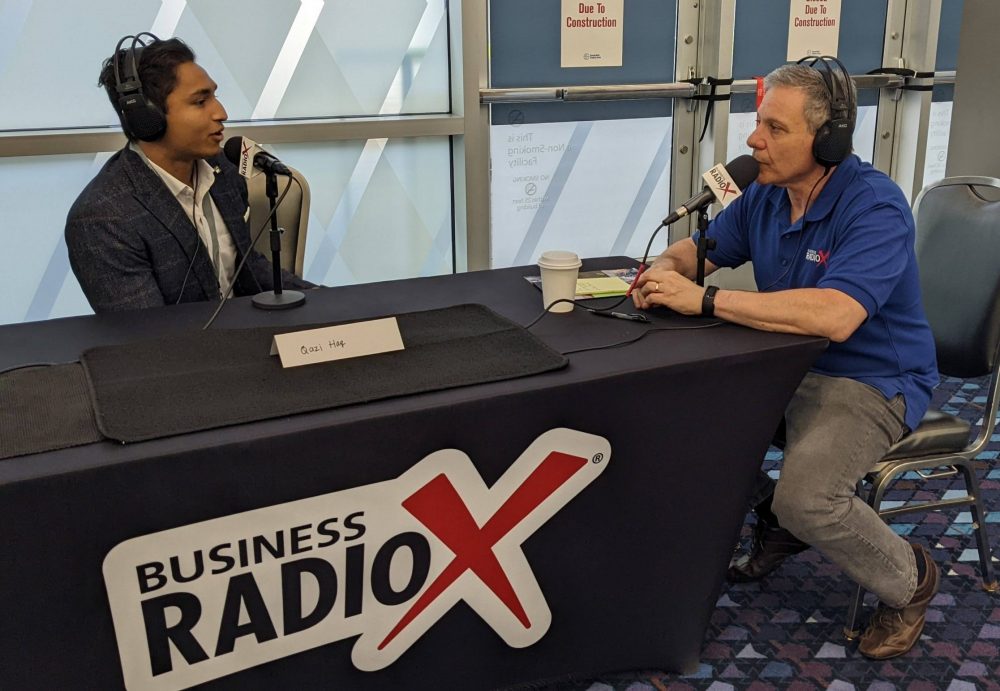
Lee Kantor: [00:00:27] Lee Kantor here, broadcasting live for Fintech South 2022 in the Georgia World Congress Center. I’m excited to be talking to Qazi Haq with EY-Parthenon. He is the co-chair of the Innovation Challenge here at Fintech South. Welcome, Qazi.
Qazi Haq: [00:00:41] Thank you. Thank you for having me.
Lee Kantor: [00:00:43] Well, before we get too far into things, let’s talk about this Innovation Challenge. What’s the vision there and what are you trying to accomplish with it?
Qazi Haq: [00:00:50] Yes, absolutely. Just at a high level, every year during Fintech South, we have the Innovation Challenge. It’s an accelerator for early-stage Fintech companies based in Georgia. And we have certain criteria.
Qazi Haq: [00:00:59] For example, they have to be based in Georgia. Have to be in the Fintech realm broadly. Maybe they’re not a Fintech, but they serve Fintechs. As well to have a cap of $1,000,000 in funding. And what happens in this challenge is before Fintech South, four to six weeks prior, we recruit the companies, we have them go through an accelerator program. So, we give mentors as well as speakers, train them on the pitch. And before a Fintech South, right before or a week before we select the top three.
Lee Kantor: [00:01:25] Right.
Qazi Haq: [00:01:25] So, those top three companies will be on the main stage today to pitch for a $25,000 prize.
Lee Kantor: [00:01:30] And then just for being part of it, do they get anything other than the mentorship and, kind of, the connections?
Qazi Haq: [00:01:36] Yes, so, PR is a huge, huge component of that. We make sure that they have spotlights during the conference, part of the conference. In addition, they get free access to Fintech South for them and their teams. And that can be a very major lift for an early-stage company.
Lee Kantor: [00:01:49] So, now when you say it’s Fintech or Fintech adjacent, they have to be touching Fintech in some way?
Qazi Haq: [00:01:55] In some form or fashion. For example, we have a company in this year that’s more of an EdTech platform, but they serve Fintechs. So, that has that tie to it.
Lee Kantor: [00:02:04] So, it doesn’t have to be a super direct tie?
Qazi Haq: [00:02:07] No.
Lee Kantor: [00:02:07] It just can be really adjacent?.
Qazi Haq: [00:02:09] Exactly, their customers can be Fintechs, for example, right?
Lee Kantor: [00:02:12] Right.
Qazi Haq: [00:02:12] They can have some component of Fintech tied to it. For example, a payments platform within their broader system.
Lee Kantor: [00:02:18] So, now walk me through. I’m a startup. I meet all that criteria. What happens on day one? I get accepted. I’m one of the — I guess, top ten people that are in there. So, what happens now?
Qazi Haq: [00:02:29] So, day one, we’re going to give you a mentor, a group of mentors. These individuals are usually leaders or experts in the Fintech space based in here in Georgia.
Lee Kantor: [00:02:38] And then you’re — trying to match me up with somebody that’s at least —
Qazi Haq: [00:02:41] Correct.
Lee Kantor: [00:02:41] — in the neighborhood —
Qazi Haq: [00:02:41] Exactly.
Lee Kantor: [00:02:41] — of what I do, right?
Qazi Haq: [00:02:42] Exactly, that’s the goal. Because they have been there, the journey they’re going through, so they can guide you better.
Lee Kantor: [00:02:47] And they can also make — help me make connections?
Qazi Haq: [00:02:51] 100%. And in addition, during the conference itself, we make sure the companies are meeting the right VCs, their partners, et cetera.
Lee Kantor: [00:02:58] And is there a fee to me as the startup founder?
Qazi Haq: [00:03:01] There is no fee, whatsoever. It’s a completely fee-free program. The only fee is filling out the application. So, your time commitment there.
Lee Kantor: [00:03:08] It’s time.
Qazi Haq: [00:03:09] Yes.
Lee Kantor: [00:03:09] But not money?
Qazi Haq: [00:03:09] Not money.
Lee Kantor: [00:03:10] And then so, this is definitely a journey worth taking?
Qazi Haq: [00:03:14] 100%. I highly recommend it. If I was a fintech founder and this opportunity came up —
Lee Kantor: [00:03:17] It’s not too late for you.
Qazi Haq: [00:03:18] Oh, I don’t know. If I can — be doing that yet, but maybe. We’ll see.
Lee Kantor: [00:03:21] So, now they come on the stage. You get to the top three. Now, who are the judges? Who are the people that are deciding the whittled it down to three?
Qazi Haq: [00:03:29] Yes, This is the most exciting part. So, during the conference, everyone judges. So, whoever is in the audience —
Lee Kantor: [00:03:35] Oh, the audience —
Qazi Haq: [00:03:35] — gets to pick the winner.
Lee Kantor: [00:03:36] — as one of the voters?
Qazi Haq: [00:03:36] Yes.
Lee Kantor: [00:03:36] And then it’s all voting online.
Qazi Haq: [00:03:40] It’s all on voting online.
Lee Kantor: [00:03:40] On the app, probably.
Qazi Haq: [00:03:41] Yes, very easy.
Lee Kantor: [00:03:43] And then, so you vote and then somebody is going to win. And then the other two, sorry. Thanks for playing?
Qazi Haq: [00:03:48] Sorry, but —
Lee Kantor: [00:03:48] So, winner take all?
Qazi Haq: [00:03:48] Hey, they got the PR, right?
Lee Kantor: [00:03:50] They get the PR.
Qazi Haq: [00:03:50] So, in the past, actually, we’ve seen the runners-up, “Get funding afterward”.
Lee Kantor: [00:03:56] Right.
Qazi Haq: [00:03:56] So, that presentation, the pitch on stage really —
Lee Kantor: [00:03:59] Because you’re still getting in front of lot and lots of people.
Qazi Haq: [00:04:00] Exactly, exactly.
Lee Kantor: [00:04:02] And then have you been involved in this challenge before in the previous Fintechs?
Qazi Haq: [00:04:06] Yes, so for the past two years I was supporting the co-chairs. And this year, the co-chairs got tired of doing it, so they passed it on to me.
Lee Kantor: [00:04:13] So, you had the short straw?
Qazi Haq: [00:04:15] Yes. No, but it’s been a great experience.
Lee Kantor: [00:04:16] Now, of the previous winners, any kind of success stories for them?
Qazi Haq: [00:04:20] So, Trust Stamp. So, Trust Stamp was one of the winners for the TAG report yesterday.
Lee Kantor: [00:04:26] Wow.
Qazi Haq: [00:04:26] So, they started for the Innovation Challenge. Won that, raised money grew, and now they won the advance award as a mature company.
Lee Kantor: [00:04:34] Wow.
Qazi Haq: [00:04:34] A great success story.
Lee Kantor: [00:04:35] So, that’s a great success story. And then your vision for this in the future.
Qazi Haq: [00:04:38] In the future, we want to go bigger. We want more companies to participate and apply. This year, we only had seven. In the future, we would love to see 15 because this is a free resource that these companies can benefit from. And as I mentioned, Trust Stamp is an example, went through the program, raised money because of Fintech South. Now, they’re putting all the awards.
Lee Kantor: [00:04:57] And then this is something — are you partnering with like ATDC and then some of the universities around the State.
Qazi Haq: [00:05:04] Absolutely.
Lee Kantor: [00:05:04] Because it’s so easy to be Atlanta-centric and forget about the rest of Georgia.
Qazi Haq: [00:05:09] Yes.
Lee Kantor: [00:05:09] So, how are you getting —
Qazi Haq: [00:05:10] We are — definitely broader Georgia. So, we partnered with the Georgia Fintech Academy, ATDC, ATV, Valor Panoramic. Any venture fund you can think of.
Lee Kantor: [00:05:19] Good stuff. So, if somebody wants to learn more about this challenge, what’s the way to do it?
Qazi Haq: [00:05:22] Easiest way, go on the website, Fintech South. There’s an Innovation Challenge portion of it, so look through that. And over time, TAG will send out more materials and information on their LinkedIn page or website on when you can apply next year.
Lee Kantor: [00:05:33] And then when typically is the application?
Qazi Haq: [00:05:36] Yes, so depending on when Fintech South takes place. Let’s assume it’s the same time period in June.
Lee Kantor: [00:05:41] Right.
Qazi Haq: [00:05:41] Applications generally open, end of March, early April.
Lee Kantor: [00:05:43] So, it’s like three —
Qazi Haq: [00:05:45] Correct.
Lee Kantor: [00:05:45] — 90 days prior?
Qazi Haq: [00:05:45] Correct.
Lee Kantor: [00:05:46] Good stuff. Well, thank you so much for doing the work you do.
Qazi Haq: [00:05:49] Absolutely.
Lee Kantor: [00:05:49] It’s important and we appreciate you.
Qazi Haq: [00:05:51] My pleasure. Thanks for having me on.
Lee Kantor: [00:05:52] All right. This is Lee Kantor. We’ll be back in a few at Fintech South 2022.
Outro: [00:06:04] This episode has been brought to you by Atlanta Blockchain Center, the catalyst for Atlanta’s emergence as the Premier Blockchain Innovation Hub globally, through cultivating entrepreneurship, inclusivity, and education. To learn more, go to atlblockchaincenter.com.
 Sanjay Ahuja, Intellekt AI
TRANSCRIPT
Intro: [00:00:07] Broadcasting live from the Georgia World Congress Center for Fintech South 2022, it’s time for Atlanta Business Radio. Brought to you by Atlanta Blockchain Center. Now, here’s your host.
Lee Kantor: [00:00:27] Lee Kantor here broadcasting live from Fintech South 2022. So excited to be talking to Sanjay Ahuja with Intellekt. Welcome.
Sanjay Ahuja: [00:00:37] Thank you. Thank you. Thank you for inviting me.
Lee Kantor: [00:00:39] Well, I’m excited to learn what you’re up to. Tell us a little bit about Intellekt.
Sanjay Ahuja: [00:00:44] Sure. Intellekt is basically a self-onboarding platform for Fintechs. As you know that a lot of companies in the digital age are onboarding merchants, consumers, businesses. And most of them typically are taking about 60 to 70 days to onboard.
Lee Kantor: [00:01:00] Right.
Sanjay Ahuja: [00:01:00] And that’s a big problem in the market. So, we’re creating a platform which will allow them for self-onboarding in a few weeks. So, that’s the key thing.
Lee Kantor: [00:01:08] So, what’s your background? Have you always been involved in Fintech?
Sanjay Ahuja: [00:01:12] Yes, not primarily Fintech, but in the tech industry. But mostly in Fintech, e-commerce, health care. So, that’s been my background over 28 years. We work with various organizations. So, I know quite a bit about the process.
Lee Kantor: [00:01:27] Now, how do you find the Fintech community here in Georgia?
Sanjay Ahuja: [00:01:32] Well, I think — I would say this is the Fintech capital of the U.S., right? Because most of the payment industries are out here. The New Age, Neobanks are coming out of here. There’s a huge amount of talent pool which is there. And I think the big thing is that the education system is getting improved by the day, right? The Georgia FinTech Academy is helping new engineers to kind of train themselves on the Fintech processes. So, I think the whole ecosystem is coming together to support.
Lee Kantor: [00:02:01] Is that really a challenge in terms of when you have a startup and you’re really trying to grow to have the right talent?
Sanjay Ahuja: [00:02:10] Often — fundamentally, it’s all about people, at the end of the day, right? Because we are developing a software, and software is made by people, right? But the good part is that we are part of the ATDC which is a part of the Georgia Tech community. So, we’re getting a lot of support from the community in terms of engineers, as well as other ecosystem players.
Lee Kantor: [00:02:28] Now, you mentioned the FinTech Academy. That’s where the University System is training up and that has curriculum around Fintech, right?
Sanjay Ahuja: [00:02:37] That’s right, yes.
Lee Kantor: [00:02:37] That’s critically important and it’s kind of unique to Georgia, right? This isn’t something that’s in every city.
Sanjay Ahuja: [00:02:43] It is not. And it’s curated towards the new generation. Technologies coming in like — Fintech is broad, right? It’s just not banks. So, it’s about knowledge about NFT’s, knowledge about crypto, and these are new things coming up in the market. And new jobs are being created.
Lee Kantor: [00:02:59] It’s changing every day.
Sanjay Ahuja: [00:03:01] Every day.
Lee Kantor: [00:03:01] There’s a new one, right?
Sanjay Ahuja: [00:03:01] Exactly, yes. So, I think the community is doing a great job in training these young engineers or people who are students coming in from these universities. So, I think we’ll have probably a large talent pool in the next couple of years to be able to fulfill all these jobs.
Lee Kantor: [00:03:18] Right. Because right now, it’s like negative unemployment, right? The only way you’re finding somebody is that they’re leaving another opportunity somewhere.
Sanjay Ahuja: [00:03:24] Exactly, yes. I think you’re right on that. So — and I think we are also seeing a lot of skills moving from other cities to Georgia because of this ecosystem we’ve developed. So, I think that’s going to be good for us.
Lee Kantor: [00:03:35] Now, are you seeing that, nationwide, that a lot of folks are moving to Georgia for these opportunities because, like you said, this is the Fintech capital of, at least, the United States or maybe the world?
Sanjay Ahuja: [00:03:46] It is. And I can clearly see that. I think the three reasons why people are moving here. One is, you know, there’s a lot of new companies coming in. So, there’s a lot of new jobs, you know. The whole startup ecosystem is really coming up and they need a lot of people.
Sanjay Ahuja: [00:03:59] Number two, I think the cost of living is much cheaper than many of these big cities. And third is the climate, obviously, right? Because it’s much more warmer as compared to what’s going to happen in the global warming cities.
Lee Kantor: [00:04:09] Sure.
Sanjay Ahuja: [00:04:09] So, I think, yes.
Lee Kantor: [00:04:09] Now, are you finding that there’s good collaboration with enterprise-level organizations and startups? Is there a good, kind of, give and take in the sense that the enterprise level, organization or public company might be open to more taking shots and working with startups and earlier stage companies?
Sanjay Ahuja: [00:04:28] I would say yes and no. I think there’s a lot of work which has been done, but there’s a lot more needs to be done. Because I think the big boys have agreed and understood the value which we’re bringing in. But I don’t think the mass is doing it right now.
Sanjay Ahuja: [00:04:40] So, I think a lot more has to be done to be able to get to that stage, but it’s in the right direction. So, we’re seeing a lot of education being done on companies of the value they’re bringing into the ecosystem. So, yes, definitely it is the right direction.
Lee Kantor: [00:04:56] Now, is that something that Intellekt is looking to partner with more enterprise-level organizations?
Sanjay Ahuja: [00:05:01] Yes, definitely. So, we’re doing a couple of things to be able to get to these enterprises. One is, we are actually doing a series of education, you know, through our blogs, through our videos on our platform. The second is we are looking at interns to be able to, you know, get to these companies and kind of provide some good entry-level talent.
Lee Kantor: [00:05:22] Right.
Sanjay Ahuja: [00:05:22] And third is, we are actually doing some free proof of concepts for them to feel how a startup can do it. Because the big boys can do things, but they just take a lot of time, right? We can be more agile and that’s the advantage we bring to the table.
Lee Kantor: [00:05:37] Right. So, you can take action faster and demonstrate actual work being done as opposed to them whiteboarding something for months on, you know —
Sanjay Ahuja: [00:05:46] Exactly.
Lee Kantor: [00:05:46] — and thinking about it and being on the back burner where you can just make something happen almost instantly in their world.
Sanjay Ahuja: [00:05:52] Exactly. And you’ve seen that big companies are actually losing market share because they’re just not agile,
Lee Kantor: [00:05:57] Right.
Sanjay Ahuja: [00:05:57] Because they’re just waiting for six months, nine-month projects.
Lee Kantor: [00:06:00] And the world changes.
Sanjay Ahuja: [00:06:02] Every week.
Lee Kantor: [00:06:04] So, what do you need more of — how can we help you?
Sanjay Ahuja: [00:06:07] So, I think what is definitely needed is more catalysts who are talking to these enterprises and looking at talent pool, number one. Number two, I think we need more of the local universities making Fintech programs for the talent pool to be aware of what the opportunities are.
Lee Kantor: [00:06:28] And create that curriculum so that these younger people are ready to go, rather than you’re going to have to retrain them anyway after they get out of college.
Sanjay Ahuja: [00:06:36] Exactly. Like you see this program, too, right. Fintech South is good for corporates and businesses. But if you can create a program for the kids just for education, right?
Lee Kantor: [00:06:46] Right.
Sanjay Ahuja: [00:06:46] Like a fair or Fintech fair. Now, they’ll be like — thousands of kids wanting to learn what’s going on. So, that’s the kind of exposure which we need to give because then everybody will feel that — you see, because traditionally what everybody wants to do is get into computer science or get into medicine, right. That’s been the traditional old-school thinking.
Lee Kantor: [00:07:07] Right.
Sanjay Ahuja: [00:07:07] Is Fintech a big career opportunity? It is, but not many people are aware of it. So, that’s where I think it’s our joint responsibility to be able to make them aware. So, we should have a big Fintech career fair or Fintech exhibition regularly so that the kids can get more knowledgeable about what’s going on.
Lee Kantor: [00:07:29] Right, and understand the career path that’s in that space. And they might not be realizing the opportunity is so great and people are so hungry for those — that kind of talent.
Sanjay Ahuja: [00:07:39] Exactly. Exactly, yes, I’m with you on that.
Lee Kantor: [00:07:41] So, be the change you want the world. Do you want to start working on this or work with TAG to get something like this to happen?
Sanjay Ahuja: [00:07:47] Absolutely. And I think we are already hobnobbing with most of the catalysts and we’re talking about it. So, I think you will see something coming up definitely before the end of the year.
Lee Kantor: [00:07:56] Exciting time. So, if somebody wants to connect with you or learn more about Intellekt, what’s a website?
Sanjay Ahuja: [00:08:01] intellekt.ai with a K.
Lee Kantor: [00:08:03] All right. Well, thank you so much for sharing your story. You’re doing important work and we appreciate you.
Sanjay Ahuja: [00:08:07] Thank you very much for giving me the opportunity.
Lee Kantor: [00:08:09] All right. This is Lee Kantor. We’ll be back in a few at Fintech South 2022.
Outro: [00:08:21] This episode has been brought to you by Atlanta Blockchain Center, the catalyst for Atlanta’s emergence as the Premier Blockchain Innovation Hub globally through cultivating entrepreneurship, inclusivity, and education. To learn more, go to atlblockchaincenter.com.
 Damian Tanenbaum, Blankfactor
TRANSCRIPT
Intro: [00:00:08] Broadcasting live from the Georgia World Congress Center for Fintech South 2022, it’s time for Atlanta Business Radio. Brought to you by Atlanta Blockchain Center. Now, here’s your host.
Lee Kantor: [00:00:27] Lee Kantor here broadcasting live from Fintech South 2022. I’m so excited to be talking to Damian Tanenbaum with Blankfactor and it’s not just because he brought gifts. Damian, welcome.
Damian Tanenbaum: [00:00:41] Well, thank you very much. Pleasure to be here.
Lee Kantor: [00:00:43] How did you guys come up with socks as the giveaway?
Damian Tanenbaum: [00:00:46] Oh, man. They’re sexy, man. You got to look good. Socks are incredible. They go with everything. Everybody has to wear them, so mind as well give them away.
Damian Tanenbaum: [00:00:53] Good choice. Good choice. Well, tell us a little bit about Blankfactor. How are you serving folks?
Damian Tanenbaum: [00:00:58] We are engineering the future. So, we offer software engineers in both near-shore and offshore, and of course local and the U.S.
Lee Kantor: [00:01:07] So, how did you get into this line of work?
Damian Tanenbaum: [00:01:09] Oh, man. Well, I’ve been in Fintech for almost 30 years, so I understand everything that both the banks and the Fintech companies need.
Lee Kantor: [00:01:15] Right.
Damian Tanenbaum: [00:01:16] And so, our job at Blankfactor is to offer engineers that can help connect the two, whether it’s integrations, front ends, back end developers, user interface, you know, whatever it is from a design side. We offer project managers, people that can get involved and understand the industry, which is key, right? So, it’s not just being great at being a software engineer.
Lee Kantor: [00:01:35] Right.
Damian Tanenbaum: [00:01:35] But it’s understanding the Fintech space.
Lee Kantor: [00:01:37] And then the talent shortage that’s everywhere in this field. How do you find the talent?
Damian Tanenbaum: [00:01:45] Well, we have different sites.
Lee Kantor: [00:01:45] Because they have jobs, right?
Damian Tanenbaum: [00:01:46] Oh, yes.
Lee Kantor: [00:01:46] They’re already working.
Damian Tanenbaum: [00:01:47] Oh, yes. So, it’s a challenge, obviously. But because we have multiple sites, we’re able to kind of balance. So, we have folks in Bulgaria, Costa Rica, Colombia, Argentina, Peru.
Damian Tanenbaum: [00:02:00] So, if we’re having a challenge in one site, we’ll go ahead and, you know, try to shift the work to one of the other sites. And then we’ll focus on our social benefits and, of course, our financial benefits within each site. Figure out what it is to engage the employees to get, you know, do employee referrals. Figuring out what it is, what benefits we have to offer so that we can kind of catch up on the hiring.
Lee Kantor: [00:02:19] Now, if I’m talent, what do I do to stand out so that Damian calls me.
Damian Tanenbaum: [00:02:25] Well, first of all, have a great LinkedIn.
Lee Kantor: [00:02:28] OK.
Damian Tanenbaum: [00:02:29] Be active in your community of software developers, you know, kind of keep an eye out for positions. And then when we call you, answer the phone, be available, respond to LinkedIn messages, respond to our messages and then ask for more information. Right? We want people to be engaged with us. So, it can be as, you know, ask us the right questions. Do I have to come to work each day? What benefits do you offer? Will you pay for my gym membership, right? Because we want to employ for the part of this.
Lee Kantor: [00:02:56] So, there’s no dumb questions when it comes to this because you want to get as best fit as you possibly can. And you want to make sure the match is good, right?
Damian Tanenbaum: [00:03:04] Oh, for sure. For sure. I mean, my job as chief operating and people officer is to make sure we hire the right people first. Second, I got to make sure we keep them engaged, happy, working for us on a long-term, everlasting relationship. And then third, if we do those two things, our customers are going to be happy.
Lee Kantor: [00:03:21] So, now the people who are hiring, what are you doing to coach them to be attractive, to get the right folks?
Damian Tanenbaum: [00:03:28] So, a few things. They have regular meetings with our tech leads. They understand Fintech because we’ve given them training in the Fintech space. And then they’re trained on the use of tools, right? LinkedIn, the job sites, how to find the right talent. And then they get feedback after they bring new and potential employees to us. And we do the tech interview, and we do the tech assessments. Those recruiters get direct feedback as to whether those employees — potential employees, were the right fit.
Lee Kantor: [00:03:55] Because it’s important to work — so you’re working both sides of the marketplace, right? You have to have, you know, the employer and the employee. So, there must be ways to help them from a culture standpoint, because people don’t quit jobs. They quit bosses. So, how do you — is there things you do to kind of help them keep the people that you — you know, that you spend all this time and energy to get the right person in there. You want them to stick?
Damian Tanenbaum: [00:04:21] Yes. So, one thing that’s good. Luckily, I don’t have a product to sell. I’ve got no brick-and-mortar. No hard product to sell.
Lee Kantor: [00:04:27] Right.
Damian Tanenbaum: [00:04:27] So, what I have is people.
Lee Kantor: [00:04:28] Right.
Damian Tanenbaum: [00:04:28] So, I can focus all my energy on one, getting them. Two, keeping them. And as part of keeping them, what we have to do is we have to make sure within each of the sites. So, first, you have local culture, making sure that there’s a match, right?
Lee Kantor: [00:04:41] Right.
Damian Tanenbaum: [00:04:41] Whatever the social benefits are, the financial benefits are that they care about locally. Second, they need attraction. They need to feel like they’re part of Blankfactor, the corporation. Because they want to know that there’s bigger things that they can be part of.
Lee Kantor: [00:04:52] Right.
Damian Tanenbaum: [00:04:52] Third, the customers we go after have to be sexy. They have to be something for the future, right? Futuristic, future-proof, whatever it is. So that the employees that we hire, they want to work for a company that they know is going places.
Lee Kantor: [00:05:05] Right. And they want to make a mark, right? They want to, you know, have their kind of picture on the wall. They want to feel like they’re part of something bigger than themselves.
Damian Tanenbaum: [00:05:14] Exactly. So, in that — and again, so you can’t — I can’t say it enough. It’s that local culture, the company culture, and then the customer culture, that all has to come together for the right employee.
Lee Kantor: [00:05:23] So, now it’s — it sounds like super rewarding work. Like, you’re really making a difference in these people’s lives, right?
Damian Tanenbaum: [00:05:30] Yes.
Lee Kantor: [00:05:30] You’re helping them get opportunities they couldn’t get on their own, really, without you.
Damian Tanenbaum: [00:05:34] Yes. And you got to understand, too, we’re dealing with some smart people.
Lee Kantor: [00:05:38] Sure.
Damian Tanenbaum: [00:05:39] Right. And these are some, you know, these are guys who understand how to build technology. Guys — and understand how to use facial recognition to make payments. I mean, these are some smart people. So, keeping them engaged takes a lot of creativity.
Lee Kantor: [00:05:53] Right. It sounds like it’s a job that on paper it seemed like, oh, this supply and demand, this should be easy. But it’s not. I mean, there’s a lot of nuance to this and there’s a lot of kind of soft skills needed in order to really get the most out of this.
Damian Tanenbaum: [00:06:05] Yes, so we engineer the future with technology, but it’s all based on the people.
Lee Kantor: [00:06:10] People, right. It’s a people business at the end of the day.
Damian Tanenbaum: [00:06:12] At the end of the day, that’s exactly what it is. And it’s people that you don’t even know, right. And the recruiting process, they have to trust you. You have to build that relationship during the recruiting process, the onboarding, right. It has to be organized.
Lee Kantor: [00:06:24] Yes, you can’t sleep on the onboarding, right? Because you’ll lose people there.
Damian Tanenbaum: [00:06:27] Yes.
Lee Kantor: [00:06:27] If it’s not, you can blow up the whole deal right on that — in that part.
Damian Tanenbaum: [00:06:30] That’s exactly right. And then once they’re on board, they have to like the customer that they’re partnering with. They still have to love Blankfactor, and they have to love coming to work every day in the office culturally.
Lee Kantor: [00:06:40] Right. So, are the expectations changing, like, through the pandemic? Now you have people that are a little more picky. A little more — have a little more needs that maybe they didn’t have prior to the pandemic?
Damian Tanenbaum: [00:06:54] Yes, depending on location, you have different needs in a sense of, you know, whether they do or don’t want to come to the office. How often they want to come to the office. The time of day they want to work, and what benefits they expect when they come to the office.
Lee Kantor: [00:07:05] So, now when you’re working with folks that are maybe now doing a — they’re trying to do hybrid, right?
Damian Tanenbaum: [00:07:10] Yes.
Lee Kantor: [00:07:10] That’s super popular now. But hybrid, to me, means you’re no longer — kind of, can live anywhere. I still now, I have to live in the city for this — because I can’t come in if I’m, you know, six-hour flight away from where I’m working.
Damian Tanenbaum: [00:07:25] I think there’s flexible hybrid situation. So, the answer is, yes. Where hybrid is kind of the ideal situation. Come to the office three or four days a week and we’ll let you pick what days you come to the office. Maybe even pick what hours. We do want to have that center culture and teamwork where you are working with your project manager —
Lee Kantor: [00:07:41] Where there’s — right. And it’s in person and you’re seeing each other and shaking their hands and seeing eye to eye.
Damian Tanenbaum: [00:07:48] Exactly. At the same time, we have to be flexible to the people we’ve hired during the pandemic that work thee to five hours away from the office.
Lee Kantor: [00:07:55] Right.
Damian Tanenbaum: [00:07:55] And maybe in that situation, we’ll pay for your ride to the office. Maybe it’s only every other week until you come in.
Lee Kantor: [00:08:01] Right.
Damian Tanenbaum: [00:08:01] And we have different types of team meetings.
Lee Kantor: [00:08:03] So, if somebody wants to learn more about Blankfactor on both sides of this marketplace, whether they’re talent or whether they need talent, how do they find you?
Damian Tanenbaum: [00:08:11] So, first, everybody needs talent
Lee Kantor: [00:08:13] Right, they should be. That’s the first bit of advice, right?
Damian Tanenbaum: [00:08:16] Especially in this world. I mean, look at what’s happening. I mean, when you look at the technology on your phone, the technology on the computers, the — how fast payments are moving. Everybody needs talent. And most people can’t find them for — within their shop or they don’t have the budget to hire so they need to outsource to a company like us. And they need to use us as kind of a partner to build what they need because they may not even have the in-house expertise for what they want so they can go to blinkfactor.com and get information.
Lee Kantor: [00:08:41] It’s that simple?
Damian Tanenbaum: [00:08:42] Yes.
Lee Kantor: [00:08:43] Good stuff, Damian. Thank you so much for sharing your story. You’re doing important work and we appreciate you.
Damian Tanenbaum: [00:08:48] Thank you for your time.
Lee Kantor: [00:08:48] All right. This is Lee Kantor. We’ll be back in a few at Fintech South 2022.
Outro: [00:09:01] This episode has been brought to you by Atlanta Blockchain Center, the catalyst for Atlanta’s emergence as the Premier Blockchain Innovation Hub globally, through cultivating entrepreneurship, inclusivity, and education. To learn more, go to atlblockchaincenter.com.
 Farrukh Siddiqui, Defynance
TRANSCRIPT
Intro: [00:00:08] Broadcasting live from the Georgia World Congress Center for Fintech South 2022, it’s time for Atlanta Business Radio. Brought to you by Atlanta Blockchain Center. Now, here’s your host.
Lee Kantor: [00:00:27] Lee Kantor here broadcasting live from Fintech South 2022. So, excited to be talking to my guests right now. Farrukh Siddiqui with Defynance. Welcome.
Farrukh Siddiqui: [00:00:38] Thank you, Lee. Thank you for having me on.
Lee Kantor: [00:00:40] Well, I’m excited to learn what you’re up to. Tell us about Defynance. How are you serving folks?
Farrukh Siddiqui: [00:00:45] Well, we’re tackling a huge problem, which is the student debt crisis here in the United States. So, we’re able to actually refinance student loans with an income-sharing solution. So, we actually take students or ex-students, actually, people who have left school, who have existing student debt, out of debt into a more favorable income sharing solution, which means we’re able to pay off their student loans. Giving them an immediate credit boost. Tie their payments to their income.
Farrukh Siddiqui: [00:01:13] So, they’re always protected, especially in a downturn where if their income goes down or they become unemployed. We actually pause their payments. We don’t ding their credit or chase after them or charge late fees. We actually do the opposite. We help them find a job through our curated resources for career, such as career counselors, recruiters, upskilled resources, et cetera.
Farrukh Siddiqui: [00:01:33] And then we also have a fund for investors who deploy capital. We use that money to refinance these student loans. And give investors a fixed income type of return with low volatility, passive income quarterly. But investors also make a great impact by getting people out of debt.
Lee Kantor: [00:01:50] So, what was the genesis of the idea? How did this come about?
Farrukh Siddiqui: [00:01:54] Well, I kind of experienced the financial crisis in many different levels.
Lee Kantor: [00:01:58] So, you had a student loan?
Farrukh Siddiqui: [00:01:58] No, I had a business at that time, tied to Wall Street. So, it basically crashed and burned. And I quickly discovered, as an insider, how much of this was caused by our own, you know, self-inflicted wounds, essentially, right.
Lee Kantor: [00:02:13] Right.
Farrukh Siddiqui: [00:02:13] So, it really became a passion to work on, you know, like with Defynance, our goal is to beautify finances, to make it better, and to level the playing field. Aligns the goals of the consumer with the financial companies. And that’s what we’re trying to do now with Defynance and with the solution.
Lee Kantor: [00:02:30] So, how did you connect the dots between and say, OK. I’m going to go with student loans. I’m going to throw investors in the loop here. I got — there’s a few moving parts here that aren’t usually connected together.
Farrukh Siddiqui: [00:02:41] It took some time. Things, you know, they take the time to evolve. But after the financial crisis, I have to recover from that. I worked with Lexington Insurance Company for a few years. Working on like a different type of an insurance product.
Farrukh Siddiqui: [00:02:53] And then eventually about three years ago, I really wanted to kind of get back into — in the startup scene again and really focus on the next big problem. And I started researching various aspects of financial services. And this thing just — all of a sudden I’m like, student debt has been around forever.
Lee Kantor: [00:03:09] Right.
Farrukh Siddiqui: [00:03:09] But what has it become now? And then, you know, how it is, right? When you find something and all of a sudden it starts popping up all around you.
Lee Kantor: [00:03:16] Right, now you see it.
Farrukh Siddiqui: [00:03:16] You see it everywhere. So, I’m looking at my family, my friends, and so many people struggling with this issue, and it just became this huge passion to try to solve this. And I didn’t really see — even now, I don’t see how the situation is getting better. We’re talking about debt forgiveness, this and that. But the underlying problems have to be dealt with.
Lee Kantor: [00:03:33] Right. That’s one — forgiving the debt is great for the people you’re forgiving the debt for. But in five or 10 years, like you haven’t fixed anything.
Farrukh Siddiqui: [00:03:41] Exactly.
Lee Kantor: [00:03:41] The problem is going to bubble up again. So, but — you’re — it sounds like you’re connecting dots in a way that haven’t been connected before. You’re putting people together or groups together that maybe hadn’t necessarily thought to combine forces and join forces to help kind of the greater good here.
Farrukh Siddiqui: [00:03:56] Yes, yes. Let’s talk about investors, right? Like we’ve basically turned income into an investable asset. So, for the first time, an investor can actually invest in the American workforce and the earning power of the great American workforce.
Lee Kantor: [00:04:09] Right.
Farrukh Siddiqui: [00:04:09] And that’s something that, at least, to my knowledge has not been done before. So, yes, I think like you’re saying, we are connecting some dots that we feel it’s a very new concept. But it’s a much-needed concept. And it makes a lot of sense because, you know, growing up in the ’80s, right, the greed is good, Wall Street culture —
Lee Kantor: [00:04:27] Right.
Farrukh Siddiqui: [00:04:27] — that we had in those days. Where now it’s so much different. And I really commend the younger generations for really focusing on social responsibility, on finding purpose, living with purpose. And now we want to work with purpose, too, right? So that’s what we’re trying to do.
Lee Kantor: [00:04:40] And then what is the biggest challenge of when you have these disparate groups with their own kind of objectives? How are you kind of focusing them all on this true north?
Farrukh Siddiqui: [00:04:52] Well, because ultimately what you have to — it has to make sense for both sides. So, we have to have a competitive product for the person that’s refinancing. So, we need to make sure that, you know, we’re competing with the refinancing lenders and all those. And for the investors, the same thing, right. We have to offer them something that ultimately we want to prove that this is an investable asset and our fund makes sense to an investor whether they care about making an impact or not, right.
Lee Kantor: [00:05:17] Right, it has to —
Farrukh Siddiqui: [00:05:18] Because if that —
Lee Kantor: [00:05:18] — has to check that box.
Farrukh Siddiqui: [00:05:20] — yes, it has to stand up on.
Lee Kantor: [00:05:20] For sure.
Farrukh Siddiqui: [00:05:20] Yes, exactly, for the first and foremost. So, for us, impact is icing on the cake. It is not the cake.
Lee Kantor: [00:05:25] Right.
Farrukh Siddiqui: [00:05:25] Right.
Lee Kantor: [00:05:26] Yes, so the why and the mission that is — it’s not relevant for everybody, but it is relevant for some people.
Farrukh Siddiqui: [00:05:34] But, hopefully, if you do it right, you know, people are contributing to that mission.
Lee Kantor: [00:05:37] Right, everybody wins. It doesn’t matter.
Farrukh Siddiqui: [00:05:39] Yes, exactly.
Lee Kantor: [00:05:39] It’s helping anyway. So, how are you attacking Fintech South? Like, what’s your objective here? Are you a sponsor? Are you listening to the panelists? Are you going to these things, networking? Like, what was your intention of coming here?
Farrukh Siddiqui: [00:05:51] We were fortunate enough to be one of the innovation challenge companies, seven companies that got a chance to sort of pitch. So, that’s how we — I mean, I’ve known of the conference, of course. But — so, we — we’ve — we’re here as one of those seven companies. So, we were able to kind of do a pitch last — yesterday for investors downstairs.
Farrukh Siddiqui: [00:06:08] And then now we’re just here networking, meeting people, getting the word out. Our solution is fully live. As of about a month ago, the fund was the last thing that we launched.
Lee Kantor: [00:06:19] Right.
Farrukh Siddiqui: [00:06:19] So, now, you know, we’re in go-to-market mode and sales mode.
Lee Kantor: [00:06:22] So, what do you need more of? How can we help?
Farrukh Siddiqui: [00:06:24] Well, obviously, we need investors for — we have a pipeline of $12 million of people that have already applied to refinance student loans. So, we feel — obviously, there’s a big need there. People that are —
Lee Kantor: [00:06:33] Obviously. Right.
Farrukh Siddiqui: [00:06:34] — already going outside. But now we need investors to become aware of what’s going on with us and the great opportunity. And we also feel like with the way the investment climate has changed this year, right, the stock market, kind of, going into this bear territory. Crypto coming off its run that’s been going on for a while. Interest rates going up, so bond yields are decreasing.
Farrukh Siddiqui: [00:06:55] Well, imagine, you know, what we’re doing is not pegged to any of those things.
Lee Kantor: [00:06:59] Right.
Farrukh Siddiqui: [00:06:59] People are, like, unemployment is so low right now, we’re investing in people’s earning potential.
Lee Kantor: [00:07:03] In people, right.
Farrukh Siddiqui: [00:07:03] People are working. And data shows that even during recessionary times, incomes are still stable and growing. So — and our core expertise is we’re underwriters, we’re risk people. We know how to underwrite people and assess someone’s individual risk. And we’ve developed our own algorithm and underwriting criteria for doing that.
Farrukh Siddiqui: [00:07:21] So, I think investors can rest assured that we know how to do that part of it. And the more we can get capital into our fund, we can create diversity — in our fund as well, diversification fund, different types of people. And really, over time, build a scalable solution that can withstand different economic climates.
Lee Kantor: [00:07:40] So, now walk me through from that student, you know, former student, what they go on the website, what happens?
Farrukh Siddiqui: [00:07:47] Yes, they go to our website. There’s an apply option there. They go, sign up to our portal, fill out their application, apply. We give them a quote, so they can decide between a five-year income sharing versus — up to 15 years, whatever goal they want to accomplish. Whether they want to end it soon or they want to lower their payments for a longer period of time. So, they select the option that they want then they get prequalified. And as we’re getting investor capital in, we’re going to start doing more and more deals.
Lee Kantor: [00:08:15] So, now when the student comes through, you’re vetting them, like if they’re a computer science major, then that’s — everybody’s like, oh, this one for sure, right? But what if they’re like a marketing major, you know, or like something that their future isn’t as stable. Maybe as somebody that is in a kind of a sure thing. Like if you’re a computer science, the unemployment rate for that is negative.
Farrukh Siddiqui: [00:08:41] Yes. I mean, we want to find people — I’m going to give you a general statement, with stable, growing income streams, right. With — even if unemployment may be high, as long as we’re able to predict it and sort of price it in, it’s OK.
Lee Kantor: [00:08:58] Right.
Farrukh Siddiqui: [00:08:59] It’s going to happen as part of life. Unemployment is going to happen.
Lee Kantor: [00:09:02] Sure.
Farrukh Siddiqui: [00:09:02] So, it’s about being able to predict future income and having that data to do that effectively. So, we can fund a marketing major, we can fund a teacher, we can fund a psychologist, a doctor, a lawyer. But, yes, somebody who’s just starting in a sales job with high commissions, that’s tough.
Lee Kantor: [00:09:16] Right, exactly.
Farrukh Siddiqui: [00:09:17] Because of that, the income is volatile. We have to be careful with that.
Lee Kantor: [00:09:19] Right.
Farrukh Siddiqui: [00:09:20] But if the income is like W-2 income, 1099 income, they have a work history that shows how they’ve done in their career. So, it’s not — we don’t even have to rely on their education background as much. If they worked for five, six years, we can see how they’ve done. What role they’re in in the company.
Lee Kantor: [00:09:34] Right
Farrukh Siddiqui: [00:09:34] All of that goes into our algorithm to help calculate that. So, you’d be surprised how many people we can fund if we have the right kind of information and data to go off of.
Lee Kantor: [00:09:42] Well, it sounds exciting, and congratulations on the momentum that you have thus far.
Farrukh Siddiqui: [00:09:47] Thank you so much, Lee. Appreciate it.
Lee Kantor: [00:09:48] And if somebody wants to learn more on both sides of, I guess, the marketplace, where should they go? What’s the website?
Farrukh Siddiqui: [00:09:53] Simple, deynance.com, D-E-F-Y-N-A-N-C-E.com, they can actually go to apply there. There’s also an investor tab there which takes them to the separate website for investors because this is dedicated site. And that site is called ISA Credit Fund, isacreditfund.com.
Lee Kantor: [00:10:12] All right. Well, thank you again for sharing your story. You’re doing important work, and we appreciate you.
Speaker3: [00:10:16] Thank you for having me.
Lee Kantor: [00:10:17] All right. This is Lee Kantor. We’ll be back in a few at Fintech South 2022.
Outro: [00:10:29] This episode has been brought to you by Atlanta Blockchain Center, the catalyst for Atlanta’s emergence as the premier blockchain innovation hub globally, through cultivating entrepreneurship, inclusivity, and education. To learn more, go to atlblockchaincenter.com.
 Peter Cresse, RightData
TRANSCRIPT
Intro: [00:00:08] Broadcasting live from the Georgia World Congress Center for Fintech South 2022. It’s time for Atlanta Business Radio. Brought to you by Atlanta Blockchain Center. Now, here’s your host.
Lee Kantor: [00:00:28] Lee Kantor here back at Fintech South 2022. So, excited to be talking to Peter Cresse with RightData. Welcome, Peter.
Peter Cresse: [00:00:36] Hey, thanks, Lee. Nice to be here.
Lee Kantor: [00:00:37] Well, before we get too far into things, tell us a little bit about RightData. How are you serving folks?
Peter Cresse: [00:00:42] Well, we’re in the exciting area of data infrastructure, and I say that lightly. But data infrastructure people are behind the scenes, making data available for applications and machine learning. So, it’s exciting area.
Lee Kantor: [00:00:54] So, what’s the genesis of the idea? How did it come about?
Peter Cresse: [00:00:58] Well, the senior vice president of Bank of America had an idea and a vision when he was managing a massive organization, and that was to make data more accessible and trustable. And then, he evolve that into a deeper workflow for the modern data stack. A lot of buzzwords to say, can my data be better and faster so I can learn from it? And he quit his job, started this. And now, we’re on our way with a bigger startup, with our funding.
Lee Kantor: [00:01:23] So, now, you got funding? That’s what you’re at right now, you got some funding?
Peter Cresse: [00:01:27] Yeah. So, we just received our Series A from a top company in the United States called Level Equity. And with the Series A Money, we’re going to be investing in huge development as well as, of course, sales and marketing to bring our message to market.
Lee Kantor: [00:01:40] So, now, what’s — the who hires you? Who uses your service?
Peter Cresse: [00:01:46] Well, the – any person that wants to improve and trust their data or get better data workflow. So, any — it’s really not vertical specific, but it’s very applicable to banks, retail, marketing, anybody that really wants to learn on their data and get an edge. By the way, you can organize your data.
Lee Kantor: [00:02:04] So, what are they using now if they’re not using RightData? Are they just kind of winging it?
Peter Cresse: [00:02:08] No, there’s like a history. So, traditionally, we would use a data warehouse, which would bring structured data into a data warehouse. And then, we move to a data lake idea, which would basically put all types of data into a repository. But today, the hottest thing in modern data stack is the data lakehouse. And data lakehouse means is that you can actually bring any data anywhere, process it and manage it and learn at the same place. That’s the new concept.
Lee Kantor: [00:02:37] And that’s the kind of the structure behind RightData? That’s what you’re trying to accomplish?
Peter Cresse: [00:02:41] Yes, we really want to conquer the space in the area of data lakehouse and something called data mesh. It means putting together operational data, transactional data, together with learning data at the same place. And then, you can send it on to a data outcome.
Lee Kantor: [00:02:57] So, now, if I’m a company and I’m using RightData, what kind of new information am I getting? What kind of new insights am I getting?
Peter Cresse: [00:03:04] Exactly. You move your data down the line from just raw data ingestion on a layer. And once it’s ingested, you actually create greater value as you improve it and clean it and then, make it more quality data. And then, you send it on, actually, to the learning or the outcome. That’s why it gets better and better as it moves down the workflow line.
Lee Kantor: [00:03:25] And then, so, I’m able to get these insights faster? I’m able to get more insights than I was previously?
Peter Cresse: [00:03:31] Yes. Because where we’re doing is we’re conquering an area called — it’s kind of esoteric, but it’s called domain-specific learning. So, instead of putting data in a big bucket and learning from it, you actually put it in domains of activity, say customer inventory, customer names, operational names, vendor names. And the domains themself represent the data teams that are trying to learn in those areas. So instead of trying to reach in a big bucket and for the data which is slower, you can actually have the domains do their work, which is faster.
Lee Kantor: [00:04:04] So, it’s the right information and the right place at the right time?
Peter Cresse: [00:04:07] RightData. Yes, exactly. And what’s really cool, Lee, is that you’re able to now collaborate with stakeholders in each domain. So, one team may say, hey, we saw this learning with customer inventory of a product. And another one said, oh, we saw the customer behaviors. Now, they can dialog using the same data set. The biggest problem today is that there’s data duplication. The average duplication is seven times of the same data set is created seven different versions. Today, if we can have one version and people participating, it makes it faster and better collaboration.
Lee Kantor: [00:04:44] And then, is this out in the wild anywhere or is this kind of where — or what stage are you in the evolution of the product?
Peter Cresse: [00:04:50] Oh, we’re ready to go with our dextrose product. And we’re building off the data lakehouse idea, which has been introduced as a framework on the project. So, we aim to conquer that space and the data mesh where we’re learning and processing and managing at the same time. That’s really the inflection point.
Lee Kantor: [00:05:08] So, what do you need more of right now? How can we help?
Peter Cresse: [00:05:11] Well, I think people that should obviously reach out and talk to RightData and just shameless mention of our website, which is getrightdata.com. But we like to dialog with our customers to be, say, what is it that you’re trying to do? And most customers are saying, faster data as we scale and learn better against the data that I have.
Lee Kantor: [00:05:35] So, if they’re having a problem in that area, they can have a conversation with you and kind of explore ways that you can work together?
Peter Cresse: [00:05:42] Yes, specific for them. So, it’s not a custom software, but it’s customizable for their needs. And we’re not a consulting company, we’re a software-based company that were automating this whole process. So, if you want to be faster and learn better and quicker with your data, get RightData is the way to go.
Lee Kantor: [00:05:58] So, now, you’re here at Fintech South. Are you on a panel? Are you exhibiting? What are you trying to get out of Fintech South, networking?
Peter Cresse: [00:06:07] Well, really talking to real-life users and customers and consulting customers here that says, OK, what problems are you trying to solve? And what we’ve learned here is one big thing is that there’s a huge growth in APIs. We work with APIs, Application Programming Interface, in the Fintech area. There’s a lot of overlays on that, but we can do better with the APIs by organizing the data as it feeds back and forth, the APIs. Fintech, to me, is all about the API revolution that’s happening is, we want to participate at that data layer. Again, not super interesting to some, but for data infrastructure people, we’re the people doing the potatoes in the kitchen behind the scenes.
Lee Kantor: [00:06:48] So, now, one more time, the website?
Peter Cresse: [00:06:50] The website is RightData, but it’s called getrightdata.com. And it basically gives tons of information and insight into where we’re going for the future.
Lee Kantor: [00:06:59] Now, if somebody wants to connect with you, is there a LinkedIn? What’s the best way to get a hold of you?
Peter Cresse: [00:07:04] Probably LinkedIn’s OK. Peter Cresse, C-R-E-S-S-E. But there’s plenty of contacts on the website.
Lee Kantor: [00:07:05] On the website?
Peter Cresse: [00:07:05] And quite honestly, we’re a pretty high-tech company that makes it easier for the business user or the data scientists or any stakeholder. So, anybody that really wants to know more, this is kind of the place to go because we’re at the forefront. That’s why Level Equity provided the money because they see a great future in this area for growth.
Lee Kantor: [00:07:29] Good stuff. Well, thank you so much for sharing your story today.
Peter Cresse: [00:07:31] OK. Thanks, Lee.
Lee Kantor: [00:07:33] All right. This is Lee Kantor. We’ll be back in a few at Fintech South 2022.
Outro: [00:07:45] This episode has been brought to you by Atlanta Blockchain Center. The catalyst for Atlanta’s emergence as the Premier Blockchain Innovation Hub globally, through cultivating entrepreneurship, inclusivity, and education. To learn more, go to atlblockchaincenter.com.
 Robert Daniel, Advanced Technology Development Center (ATDC)
TRANSCRIPT
Intro: [00:00:07] Broadcasting live from the Georgia World Congress Center for Fintech South 2022. It’s time for Atlanta Business Radio. Brought to you by Atlanta Blockchain Center. Now, here’s your host.
Lee Kantor: [00:00:27] Lee Kantor here back at Fintech South 2022. So excited to be talking to Robert Daniel with ATDC. He’s the FinTech Catalyst. Welcome, Robert.
Robert Daniel: [00:00:36] Welcome. It’s great to be here.
Lee Kantor: [00:00:38] Well, tell us — for the people who don’t know, tell us a little bit about ATDC and your role as FinTech Catalyst.
Robert Daniel: [00:00:48] Yes, I’d love to. ATDC has been around for 40 years. We’re an incubator in Atlanta, state funded. So, our goal is to really produce some fantastic startups that are coming out of ATDC, the incubator that really impact the Georgia economy. So, we’re looking for companies anywhere from, hey, I have an idea and I’m trying to figure out how to get this off the ground, all the way up to, hey, I need to raise Series A and find that next growth trajectory.
Lee Kantor: [00:01:16] And then, do you mind sharing, if you know, some of the kind of superstar companies that have come out of ATDC? I think this is one of those best kept secrets. Unless you are kind of in the know, you may not be aware of how important ATDC has been to some of the biggest startups here in Georgia.
Robert Daniel: [00:01:35] I think that’s the key. There’s a lot of unicorns that have popped up. We’ve had 13 unicorns over the past eight years. We’ve been fortunate to see Rob from Kabbage. He was up on stage earlier. He’s one of the unicorns, green light, green sky flocked — flock safety. There’s just some phenomenal companies that are coming out of there, and we’d love to hear more of those successes. I think 90% of our signature’s companies graduate with a certain amount of success. Obviously, we’d love to see more unicorns, but they really feed the Atlanta economic — or ecosystem a little better that way because that money keeps pouring back into talent and you have some more startups, just like Rob is starting to keep now. So, you have follow-on companies just like that.
Lee Kantor: [00:02:22] Right. They have a successful exit and then, they — fortunately, for the folks here in Georgia, they decide to stay here in Georgia instead of going to some island somewhere and, you know, going to the beach all day.
Robert Daniel: [00:02:34] And that’s what we need to see more of. And that’s what I’m excited about. We’re starting to see more and more of that in the ecosystem here. And that’s going to create more opportunity all around.
Lee Kantor: [00:02:44] Now, at ATDC, like you said, you can be a student, you can be young. It’s for any part of kind of the life cycle of a startup, right? It’s not just for people who are funded. It’s not just for super technologists. You can be a non-technical founder. There’s a place for you to learn to kind of just educate yourself about how to be a leader or how to get involved in the startup community. It is — you don’t have to have this fully baked to participate at some of the work that’s happening at ATDC.
Robert Daniel: [00:03:20] That’s correct. We have a staff of about 30 people. I’m one of them. I’m the FinTech Catalyst. So, my job is to focus on the Fintech vertical. We’ve got a program for that. We’ve also got a supply chain vertical. We’ve got robotics. We’ve got health tech. We’ve got kind of the ESG focus and sustainability. So, the coaches are there to help get you through that, you know, product market fit, customer discovery, all the way up to how do you find partnerships? We’ll help you try to connect into people and leverage our connections as well as who are the angel investors or who are the venture capitalists we need to talk to. That’s our role to kind of connect the dots there and make those opportunities happen.
Lee Kantor: [00:04:03] So, it doesn’t matter what stage you’re at, there’s a place for you at ATDC. And that’s important for people to understand. And the fees there are minimal and sometimes nothing.
Robert Daniel: [00:04:15] That’s exactly correct. Our lowest membership is — our lowest dollar denominated membership is the Educate platform, which is fantastic because there’s a lot of training and around — especially customer discovery, which you need to know to get off the ground. And then, there’s other opportunities to connect with how do you leverage grants for some of our startups there? So, having that education platform is so critical for a lot of people who have never gone through this program before. They’re interested in startups. They have an interesting idea, but they might not be either technically savvy with a lot of the coding, or they might not be able to understand what goes into being a great entrepreneur. We’ll help teach that. We’ll help get you off the ground, and then we’ll make those connections as you progress through the various different memberships.
Lee Kantor: [00:05:02] So, what’s your back story? Did you come from a startup? Did you come from technology into the — you’ve been in Fintech your career and decided to get involved with a ATDC to give back? Like, what’s your back story?
Robert Daniel: [00:05:15] Yes, my back story is a bit interesting. I don’t have a startup behind me. When I originally graduated from Georgia Tech in 2001, wanted to get into startups. Not the best time during the recession. And at that point in time, you saw a lot of companies being pulled away from Georgia. I went into more of a traditional finance. I went into hedge funds until 2008, which was a different time.
Lee Kantor: [00:05:38] Timing is everything for you.
Robert Daniel: [00:05:39] Timing is everything. And then, for the past six years, I’ve been working in New York at a company that was kind of consulting and also producing events. We’d talk about best practices in the banking and payments and Fintech space. So, really learn what the best operations were and wanted to leverage that when the pandemic hit to really come back to Atlanta and make an impact here. I was looking for purpose in my life. I saw that the startups were actually now staying in Atlanta and the ecosystem here was amazing. Got involved with TAG, the TAG FinTech society. And just the support kind of pulled me back in and said, I need to be here. I want to be part of this. And the growth that we’re — we’ve yet to see in Atlanta. I mean, it’s phenomenal, but there’s a lot more coming and you just want to be a part of it.
Lee Kantor: [00:06:27] Now, for folks who, you know, maybe haven’t worked in the New York environment that you did for the years, can you kind of just shed a little light on what it’s like there as opposed to here? Like, what are some of the — you know, there’s obviously trade-offs. What are some of the good and the bad and the ugly of the difference between New York and Atlanta?
Robert Daniel: [00:06:49] Wow. There’s — that’s — I think about that quite often. New York is very fast. It’s fast paced. You have to get the things going very quickly, especially when you’re in finance. Hedge funds, you’re trading down to the second. In a way, I feel like that sometimes happens in the in the startup ecosystem. You have to get things moving. You have to build a product —
Lee Kantor: [00:07:13] Action first, right? You got to take action.
Robert Daniel: [00:07:16] Yes, action. And you see that. But I think in New York, it’s a bit different. We were moving so quickly and sometimes it’s a little more gruff. The hospitality down in Atlanta is amazing. The networks that I see down here, you say, I need help, and people are like, oh, you need to talk to this person or you need to get involved —
Lee Kantor: [00:07:34] It’s very collaborative?
Robert Daniel: [00:07:35] Oh, yes. I had somebody who was saying, you need to be part of the technology executive roundtable. You need to get involved with TAG. You need to get involved with Fintech Atlanta. So, all of a sudden, it just weaves together a lot quicker. So, you have that support system. And I think that is — that’s the really power of Atlanta.
Lee Kantor: [00:07:55] That’s a secret sauce?
Robert Daniel: [00:07:56] It is the secret sauce. It’s the Southern hospitality.
Lee Kantor: [00:07:59] Right. And the relationships, to me, it’s very collaborative. Everybody’s kind of trying to help everybody. It’s not as — they don’t treat every relationship as precious, and I’m going to keep this from you because I need this information for myself.
Robert Daniel: [00:08:13] It’s all about the ecosystem and how can we build that up? You know, I was at Atlanta Blockchain Center and somebody said, well, you know, you have at ATDC, ATV, you know, Atlanta Blockchain Center and Ali over at ATV, she said, but we’re all here to support the ecosystem. We’re all here to see how we can work together and build that.
Lee Kantor: [00:08:33] Right.
Robert Daniel: [00:08:33] Because it’s —
Lee Kantor: [00:08:33] It’s not a zero-sum game?
Robert Daniel: [00:08:35] It’s not. And it’s more important to help everybody around us and produce more of those unicorns.
Lee Kantor: [00:08:53] Right.
Robert Daniel: [00:08:53] Because it gives back to the community in a way that affects our culture, it affects diversity, it affects education and our economic viability.
Lee Kantor: [00:08:53] Well, if somebody wants to get involved with a ATDC, what is the coordinates? What’s the best way to get a hold of you or somebody on your team?
Robert Daniel: [00:09:00] I’m available on LinkedIn or you, R. E. Daniel. Just look for R.E.D. That’s my initials. So, everybody usually calls me Red. I’m available on Twitter and, you know, just reach out to me.
Lee Kantor: [00:09:12] And ATDC.org? Is that the website?
Robert Daniel: [00:09:15] It’s at ATDC.org. You can’t miss it.
Lee Kantor: [00:09:17] All right. Well, thank you so much for doing what you do. It’s important and we appreciate you.
Robert Daniel: [00:09:22] It’s my pleasure.
Lee Kantor: [00:09:23] All right. This is Lee Kantor. We’ll be back in a few at Fintech South 2022.
Outro: [00:09:35] This episode has been brought to you by Atlanta Blockchain Center. The catalyst for Atlanta’s emergence as the Premier Blockchain Innovation Hub globally, through cultivating entrepreneurship, inclusivity and education. To learn more, go to atlblockchaincenter.com.
 Rodrigo Dantas E Silva, EY
TRANSCRIPT
Intro: [00:00:08] Broadcasting live from the Georgia World Congress Center for Fintech South 2022. It’s time for Atlanta Business Radio. Brought to you by Atlanta Blockchain Center. Now, here’s your host.
Lee Kantor: [00:00:28] Lee Kantor here back at Fintech South 2022. So excited to be talking to Rodrigo Dantas who is the chair of Fintech South. Welcome, Rodrigo.
Rodrigo Dantas e Silva: [00:00:39] Thank you. How are you, Lee?
Lee Kantor: [00:00:40] I am doing well. So excited to be back in person at Fintech South. I remember the days at the stadium just across the way, so it’s great to see all these folks in person. It must be a joy for you too to leave the Zoom’s little boxes and into the real world.
Rodrigo Dantas e Silva: [00:00:57] It definitely is. So, we can see some of the happiest faces ever, right, and just by walking the halls and talking to people.
Lee Kantor: [00:01:05] Yes, I haven’t shaken this many hands in a long time.
Rodrigo Dantas e Silva: [00:01:08] That’s great. Yes, it’s a good feeling.
Lee Kantor: [00:01:10] So, now, tell us a little bit about Fintech South. What’s kind of the State of the Union?
Rodrigo Dantas e Silva: [00:01:16] Yes, I think this year, we not only wanted to do the Fintech conference, but we wanted to try to touch what we believe are some of the most strategic issues and matters in the industry. So, we’ve been able to define the three major tracks, our pillars, if you want, of themes for the conference and being able to touch on one side all of the digital transformations related to the metaverse, the revolution of the Web 3 and all the opportunities that come out of that. Then, the other sea level conversation that’s very relevant has to do with everything related to inclusion, and it comes from diversity, but it also goes to financial inclusion and how the Fintechs play a role in that. And then, not forgetting the traditional discussion on, you know, disrupting or changing or, you know, molding the financial services industry through Fintechs. So, I think we were able to organize a conference around these three major themes, and it’s been a really high-quality dialog around all of those.
Lee Kantor: [00:02:19] So, now, you have the education component, obviously, in the panels and all the stuff that’s going on. And then, you have the innovation challenges where you have, you know, the startups and seeing that come together. Are you seeing the level of collaboration and cooperation between the enterprise level folks and the startup and the younger folks? Are you seeing some of that come together and seeing some of the fruits of that effort?
Rodrigo Dantas e Silva: [00:02:42] DDefinitely, indeed. So, as you know, I’m chairing the conference this year, but I’m a partner with UI. And it’s interesting because we have been working a lot exactly on that matter. And people ask me, OK, why are you working with Fintech? And then, what’s your UI’s interest in the Fintech space? So, there are many angles for that. But definitely, one of the angles is exactly to be building that bridge. Many of our larger corporations, they want to know more of what’s going on in the Fintech world and they want to know who are the cool ones, the most innovative ones, and who are the ones that better fit their strategies. So, allowing or enabling that connection to be made is definitely an important component in the conference. Like this one is a speed dating opportunity to build those bridges, right?
Lee Kantor: [00:03:37] This is a linchpin event when it comes to that type of a bridge, right? Because this is where you have that combination of folks all in one place.
Rodrigo Dantas e Silva: [00:03:45] That’s very true. And TAG, the Technology Association of Georgia, has that as an important component of its mission, right? And it’s funny, just by looking at the banner of the sponsors here and you see that, right, from the platinum level to the bronze level, you see exactly that. You know, bigger corporations up there, smaller corporations on the other levels. But everybody wants to — wanting to be part of it.
Lee Kantor: [00:04:13] Right. Now, coming from Atlanta, where there are so many different types of industry. And Fintech is an important component of that economic ecosystem that we have here. Some industries seem a little faster to be partnering with startups and creating kind of an ecosystem where they can share information, get to know each other, do deals, maybe, you know, invest a little bit in smaller companies so they have a chance to see what they can be or not be, right? In the Fintech world, we want to be the capital of Fintech, obviously, in the US and the globe, but I think we need more of that. I’m getting a lot of — I’m hearing it from the folks that I’m interviewing here, that a lot of the smaller folks are saying, I wish there was more from the enterprise level. Is there more that can be done in order to create that level of collaboration so that, you know, the rising tide lifts all the boats?
Rodrigo Dantas e Silva: [00:05:08] Definitely, indeed. And that’s a great question, Lee, because it opens up another component. And I do think that Atlanta is uniquely — and Georgia, but it’s uniquely positioned to drive that collaboration to the next level because of the relevance of the payment’s industry here in this region. I do believe that payments is the conduit through which the traditional financial services industry’s boarders are being redefined and —
Lee Kantor: [00:05:38] And it is being redefined because this is an old industry. You know, finance has been around for a minute, you know. But now, finance means so many different things. It’s expanded. Like, at one point, technology — you know, being a tech firm was something. Now, everybody’s a tech firm. And somebody earlier said, now, soon everyone’s going to be a Fintech firm.
Rodrigo Dantas e Silva: [00:05:58] But think about it, when the big tech companies say that they are entering into financial services. If you think of Apple, Google, Amazon, whomever, or even not only technology companies, but when companies say that they are entering financial services, they are not really stepping into right away lending. You know, they are firstly stepping into payments.
Lee Kantor: [00:06:18] Right. I’ll take payment.
Rodrigo Dantas e Silva: [00:06:19] Exactly. So, the payments is that conduit. And that’s why I believe Atlanta being the payments hub that it is and in Georgia being the payments hub that it is and having, you know, a more intentional focus on driving that transformation is where the opportunity really is.
Lee Kantor: [00:06:37] Right. There has to be kind of an opening of the eyes and a widening of the perspective of what this Fintech means and how there’s different ways to touch it and the opportunity that comes with that.
Rodrigo Dantas e Silva: [00:06:50] I definitely agree.
Lee Kantor: [00:06:52] So, now, how — like what are the conversations you’re having? I’m sure you’re having conversations with the companies that the largest level, the largest companies here in town. Are they seeing that or are they still hesitant? Because, you know, it’s a risk averse industry. I mean, it has to be in some ways.
Rodrigo Dantas e Silva: [00:07:06] I think everybody’s seen that this despite of the fact that some are saying and some are not.
Lee Kantor: [00:07:12] Right.
Rodrigo Dantas e Silva: [00:07:12] Everyone has seen the transformation going on. And to some of them, this is a madness. To some of them, there’s an opportunity. And, you know, everybody is seeing, and some are saying some or not, but definitely wanting to weigh in and double down on the understanding so that you can position yourself to be the winner of the new dynamics. Because whatever is the recipe that brought you here is definitely not the one that will take you there.
Lee Kantor: [00:07:40] Right. And you have to kind of lean into this because you don’t know what’s next.
Rodrigo Dantas e Silva: [00:07:45] Indeed. So, there are a few there are few things. I mean, no one knows what’s next, right. But there’s definitely some transformative elements being dropped down out there. And I do believe, you know, that the more pervasive dynamics of instant payments, that’s starting to happen and that will happen even further as Fed now is launched, enabling all the community banks and all of the — you know, the players in the ecosystem to participate in that. This will unleash a whole new number of products and applications and needs of transformation. So, I think we might not know exactly what’s next.
Lee Kantor: [00:08:28] There are some breadcrumbs.
Rodrigo Dantas e Silva: [00:08:29] But there are some — exactly. There are some hints.
Lee Kantor: [00:08:31] So, now, are you like — I think there’s around 400-ish Fintech companies in Georgia now.
Rodrigo Dantas e Silva: [00:08:38] Yes, around there.
Lee Kantor: [00:08:39] And are you bullish on this? Are you seeing more and more? Is it a combination of people coming from other areas saying, oh, I’m going to plant a flag here in Georgia? Or is it just some of these larger companies spinning off smaller companies and a lot of these people who are working in those larger entities going, hey, I’m going to do my own thing here?
Rodrigo Dantas e Silva: [00:09:00] I see some of that. You know, the spinoff from larger. I don’t think that that specifically is going to increase too much. I do think, though, there are two other movements that we can already feel. One, you’ve mentioned, you know, people or companies or startups coming from other geographies to Georgia because of many reasons, right. But, you know, the logistics, the environment, you know, and actually, you know, the amazing work that’s been done on the talent side here in Georgia by my friend, Tommy, and some others. But definitely, you know, having the talent pool here, it’s very competitive, but maybe not as dramatically fierce as some other places. That’s one of the components. But also, I believe, as people start to realize that, that this is an important hub of transformation and can become an even more important hub for a startup environment, we also are — we are also seeing a flow and/or a convergence of the venture capital firms and all of that dynamics also picking up. So, I do believe that there’s no there’s no venture capitalist today in this country that would think of Fintech without having Atlanta as an important part of its strategy.
Lee Kantor: [00:10:26] Right. I remember doing the Fintech South a few years ago and there were people from all over the world were coming in and they were saying, oh, I’m going to a big Fintech conference in America. And they were like, oh, where’s it at, New York or California? And they’re like, no, it’s in Atlanta. And it’s like —
Rodrigo Dantas e Silva: [00:10:44] Yes. Atlanta is a reality for that already. And, you know, I am — you might have already figured from my accent, right? I’m not a native.
Lee Kantor: [00:10:52] It sound like Smyrna. Right? Not Smyrna?
Rodrigo Dantas e Silva: [00:10:55] It’s almost like that, just a little further south, right? I’m originally from Brazil. I moved — UI moved me here five years ago because of the relevance of Atlanta for the payments industry and the Fintech industry. So, they got me, you know, from 1,000 miles south.
Lee Kantor: [00:11:16] South, right.
Rodrigo Dantas e Silva: [00:11:16] And brought to this place, not New York, not San Francisco, not everywhere else. I mean, Atlanta. That was the ask. And I think it was the right move. And it’s been a great journey.
Lee Kantor: [00:11:28] A great journey for you. And thank you so much for your leadership when it comes to this event. It’s so important to this city. It’s so important to the state to have an event like this, to celebrate the work that’s being done and to educate the folks that are in the community of all that can be.
Rodrigo Dantas e Silva: [00:11:45] No, my pleasure. And thank you for the opportunity to be here.
Lee Kantor: [00:11:48] Now, if somebody wants to learn more about Fintech South, obviously, they’re going to learn more about what’s happening here currently, but if in the future they want to attend a future Fintech South, is there a central website for Fintech South?
Rodrigo Dantas e Silva: [00:12:00] It couldn’t be easier than fintechsouth.com. That’s it.
Lee Kantor: [00:12:04] Well, Rodrigo, thank you again for sharing your story. You’re doing important work and we appreciate you.
Rodrigo Dantas e Silva: [00:12:08] Oh, my pleasure. Thank you for the opportunity.
Lee Kantor: [00:12:09] All right. This is Lee Kantor. We’ll be back in a few at Fintech South 2022.
Outro: [00:12:21] This episode has been brought to you by Atlanta Blockchain Center, the catalyst for Atlanta’s emergence as the Premier Blockchain Innovation Hub globally, through cultivating entrepreneurship, inclusivity, and education. To learn more, go to atlblockchaincenter.com.
 Saurav Bhandari, ArboHQ
TRANSCRIPT
Intro: [00:00:07] Broadcasting live from the Georgia World Congress Center. For Fintech South 2022, it’s time for Atlanta Business Radio. Brought to you by Atlanta Blockchain Center. Now here is your host.
Lee Kantor: [00:00:27] Lee Kantor here. Broadcasting live from FinTech South 2022 in the Georgia World Congress Center. So excited to be talking to our next guest, Saurav Bhandari with ArboHQ. Welcome.
Saurav Bhandari: [00:00:39] Thank you. Thank you for having me here.
Lee Kantor: [00:00:42] Well, I’m so excited to learn what you’re up to. Tell us a little bit about ArboHQ. How are you serving folks?
Saurav Bhandari: [00:00:47] So, we are an accounting software and finance software for tech companies.
Lee Kantor: [00:00:54] So, what are these tech companies using if they don’t have ArboHQ?
Saurav Bhandari: [00:00:58] They are using maybe QuickBooks or Xero or whatever their accountant shoves them into.
Lee Kantor: [00:01:04] And why is that a mistake? Why should they be using ArboHQ instead?
Saurav Bhandari: [00:01:08] So, just like any other thing, not everything is created equal. So, all CPAs do not focus on tech companies. And we are a Saas platform. So, we have CPAs on our team, and I’m a CPA myself who focus on tech companies.
Lee Kantor: [00:01:26] So, the unique challenges a tech company is facing –.
Saurav Bhandari: [00:01:29] Yes.
Lee Kantor: [00:01:30] — and their unique needs?
Saurav Bhandari: [00:01:31] Yes, from fundraising to getting their financials on time, ensuring they don’t have shady stuff on their balance sheet or income statement. So, all of that. Because there are certain things that investors look for when they’re analyzing whether to invest you — in you or not.
Lee Kantor: [00:01:53] Right.
Saurav Bhandari: [00:01:53] So, we ensure, like, their financials are up to date, they’re reflected the right way. All of their cap tables are reflected the right way on the balance sheet. So that reduces a lot of the headache on the client-side. And also, if you think — I’m going to talk to you about a story with one of our users.
Lee Kantor: [00:02:16] OK. So, they were a startup.
Saurav Bhandari: [00:02:18] They were a startup.
Lee Kantor: [00:02:19] And then they went with ArboHQ.
Saurav Bhandari: [00:02:22] They went with ArboHQ, yes.
Lee Kantor: [00:02:23] So, did they have a bad experience with the previous — another one of these other or they —
Saurav Bhandari: [00:02:28] No.
Lee Kantor: [00:02:29] — or you got to you got them early before they had any bad habits?
[00:02:33] Before — well, we can say that, yes. And also, like when they presented during the due diligence phase, when they presented their financials there. And this is the e-mail that I got from the investor. We’ve not seen a financial statement like this before because —
Lee Kantor: [00:02:50] In a good way.
Saurav Bhandari: [00:02:50] In a good way. Because you get your general ledger, you get all the way to the transactions, the cap tables, everything in one Excel file or a PDF.
Lee Kantor: [00:02:59] And it’s clean.
Saurav Bhandari: [00:03:00] It’s clean.
Lee Kantor: [00:03:00] It’s up to date.
Saurav Bhandari: [00:03:01] Yes.
Lee Kantor: [00:03:01] And it’s accurate.
Saurav Bhandari: [00:03:02] Yes, and it’s accurate. And the best of that is just not the accounting side, because when you talk to investors, you have to talk to them about your burn rate. You have to talk to them about your cash runway, right? What are your top ten expenses, revenue trending, the growth, right? So, all of that is readily available in the dashboard, in the executive summary that we have.
Lee Kantor: [00:03:26] Because you’ve reverse-engineered it for a startup —
Saurav Bhandari: [00:03:30] Yes.
Lee Kantor: [00:03:30] — to get investors, to show investors. So, it’s built for that environment. It’s not something that you’re taking something that was maybe an old school way of doing an accounting. And then now I got to take that data and then put it in this other thing to give to an investor?
Saurav Bhandari: [00:03:45] Right. So, this is the opposite way where you just sign up –.
Lee Kantor: [00:03:49] Right. You built this elegantly just to —
Saurav Bhandari: [00:03:51] Yes.
Lee Kantor: [00:03:51] So, they just have to input the information the — one time cleanly then it’s going to take care of itself?
Saurav Bhandari: [00:03:57] Not even input. All you got to do is connect your bank accounts.
Lee Kantor: [00:04:01] Yes.
Saurav Bhandari: [00:04:01] And just hands-off.
Lee Kantor: [00:04:03] Hands-off, it’s going to —
Saurav Bhandari: [00:04:03] Hands-off. It’s completely hands-off.
Lee Kantor: [00:04:03] It’s going to do all the heavy lifting?
Saurav Bhandari: [00:04:06] Yes, sir. Yes, it’s 90% automation that we have right now. And the 10% is more like tweaking around by the bookkeeper. So, you get dedicated bookkeeping team and tax team for you. And we also have outsourced CFO services in case you grow.
Lee Kantor: [00:04:25] And you need that, right.
Saurav Bhandari: [00:04:26] If you need that. Yes, so.
Lee Kantor: [00:04:27] But you don’t have to start with that. You can —
Saurav Bhandari: [00:04:30] You don’t have to start with that.
Lee Kantor: [00:04:30] You can do it through a bookkeeper, just kind of basics.
Saurav Bhandari: [00:04:34] Yes, basic and it’s free.
Lee Kantor: [00:04:34] Free?
Saurav Bhandari: [00:04:36] Free until you raise or until you start making revenue. So, there’s a precursor to it. So, you can use the platform for free, because we built it.
Lee Kantor: [00:04:46] Right.
Saurav Bhandari: [00:04:46] Now, we built it the right way, the best way. And it’s out there for free. So, we’re launching our mobile apps today, like today, today.
Lee Kantor: [00:04:57] Today.
Saurav Bhandari: [00:04:57] On both App Store and Android — Play Store.
Lee Kantor: [00:05:01] So, it’s in Google and Apple?
Saurav Bhandari: [00:05:04] Yes.
Lee Kantor: [00:05:04] Both ecosystems.
Saurav Bhandari: [00:05:06] Yes.
Lee Kantor: [00:05:06] And it’s ready to go today. If you are a pre-revenue startup, you can just sign up and then you can use this as you move — moving forward?
Saurav Bhandari: [00:05:13] Yes. So, you can sign up. So, the sign-up happens on the web app. So, the phone apps, it’s more like after you sign up. It’s to get your dashboard and stuff and everything.
Lee Kantor: [00:05:24] Right, right, right.
Saurav Bhandari: [00:05:24] There’s still some capabilities that we need to. At the end of the day, we’re a startup ourselves.
Lee Kantor: [00:05:30] Sure.
Saurav Bhandari: [00:05:30] So, we got to take it slow. Whatever we can bite off, right?.
Lee Kantor: [00:05:32] Right. So, this exciting time. So, were you the technologists that put the code together or you were kind of the subject matter expert as a CPA or both?
Saurav Bhandari: [00:05:41] So, the beauty of it is I was both. So, my previous background is with Home Depot on finance, accounting, and analytics. So, I’ve been on the FP&A, so it’s a decade worth of experience of mine as a CPA and in supply chain, all of this analytic stuff that I did for Home Depot and HCA combined into the platform. So, it’s just not an accounting platform, it’s also an FP&A tool. So, it has a built-in plan manager where they can review the budget and plans with their investors. And what that does, it just keeps you in check.
Lee Kantor: [00:06:17] Sure.
Saurav Bhandari: [00:06:17] So, you don’t have to lay off 20% of your workforce next year.
Lee Kantor: [00:06:20] Like surprise.
Saurav Bhandari: [00:06:22] Yes.
Lee Kantor: [00:06:22] Now, how has it been? Are you still at Home Depot now or in this side hustle or are you all in on this now?
Saurav Bhandari: [00:06:28] Oh, I’m like all in and more of it. So my life, everything is in it already.
Lee Kantor: [00:06:35] So, what was that transition like going from a big corporate entity, like at Home Depot for so long, and then now this is your own thing? This is — you’re in charge. The buck stops with you.
Saurav Bhandari: [00:06:45] Yes, it was — so with Home Depot, I was on a leadership position as well. So, I had all of the responsibilities. But I — it was that itch. I would — I’ve always wanted to build a software. And there were bigger problems that I could solve but when I started getting into Atlanta Tech Village. And — because I started — as a side hustle, I started CPA firm, which I — as soon as I got in, I realized, alright, there are issues with this industry. And it’s a century-old industry. $140 billion industry that has not been disrupted. It’s currently going through disruption but not a disruption that ArboHQ can bring.
Lee Kantor: [00:07:25] Right, like — and QuickBooks isn’t really a disruption.
Saurav Bhandari: [00:07:28] Quickbooks is the —
Lee Kantor: [00:07:31] It’s a tool that you know, maybe is an updated tool.
Saurav Bhandari: [00:07:34] Yes.
Lee Kantor: [00:07:34] But it’s still kind of the same system, right?
Saurav Bhandari: [00:07:36] Yes, it’s the same system that’s very slow. So, one of the biggest thing that got me started on building the accounting software myself is because Amazon has been in existence since a long time now.
Lee Kantor: [00:07:51] Right.
Saurav Bhandari: [00:07:52] And you could not integrate Amazon Marketplace with QuickBooks until 2021. Can you believe that?.
Lee Kantor: [00:07:58] And that’s probably over 20 years —
Saurav Bhandari: [00:08:00] Yes.
Lee Kantor: [00:08:00] — that Amazon was in business –.
Saurav Bhandari: [00:08:01] Yes.
Lee Kantor: [00:08:02] — before that happened.
Saurav Bhandari: [00:08:02] Exactly. Now, they’ve figured it out and started, like, doing things a little differently, but it’s a pain point for the CPAs themselves to use. But they don’t have any other options. They have — the second option is Xero, which is the UI is — I’m not a big fan of their UI. So, there’s no hands-off approach.
Saurav Bhandari: [00:08:24] There’s one approach which is Bench. So, Bench is our closest competition because it’s — so instead of DIY, they focus on DIFM.
Lee Kantor: [00:08:33] Right.
Saurav Bhandari: [00:08:33] Which is, do it for me. So, we’re taking the similar approach with our software. But Bench is, again, it’s just like QuickBooks, it’s for small business, it’s for, like, Mom and Pop shops.
Lee Kantor: [00:08:44] Right, it’s not specializing the startups.
Saurav Bhandari: [00:08:47] Yes, it’s — it does not specialize on tech startups. And if once — and it does not do accrual accounting. And you have — another closest competition is Pilot. But Pilot is super expensive because they’ve already grown. They don’t care about startups.
Lee Kantor: [00:09:02] Yes, and I’m sure you can’t start for free.
Saurav Bhandari: [00:09:05] Exactly. You cannot start with Pilot for free. It cost an arm and a leg. And they do not have their own software. They just have a fancy UI on top of QuickBooks, which isn’t actually disrupting the company or disrupting the industry.
Lee Kantor: [00:09:20] So, now if somebody wants to learn more about ArboHQ, where do they go?
Saurav Bhandari: [00:09:25] They can go to arboHQ.com. See for themselves. We have a screenshot of what the dashboard is going to look like. It’s going to look like the same, or even better once you log in because it takes time for us to update the front manning page. And — or they can check us out in Apps Store, hopefully, by end of this week because we launched it. It takes some time for it to go through the app stores.
Saurav Bhandari: [00:09:48] But web app is completely functional. It’s fully functional, secure, no issues there. And they can also reach out to me on LinkedIn — connect with me on LinkedIn, on Instagram. No Facebook, because we clearly realize at first, like, our market is not in Facebook.
Lee Kantor: [00:10:08] Sure, and look —
Saurav Bhandari: [00:10:08] So, we’re not Facebook.
Lee Kantor: [00:10:09] — if you’re a pre-revenue startup, there’s no reason not to check you out, right?
Saurav Bhandari: [00:10:15] Yes, exactly.
Lee Kantor: [00:10:15] Like every pre-revenue startup should be checking out ArboHQ.
Saurav Bhandari: [00:10:17] Exactly. Exactly. And it’s for free.
Lee Kantor: [00:10:20] Right.
Saurav Bhandari: [00:10:20] You cannot beat that. Nobody in this world can beat that.
Lee Kantor: [00:10:24] Right. All right. So, that’s arbohq.com to learn more.
Saurav Bhandari: [00:10:29] Yes, it’s A-R-B-O-H-Q which stands for Arbo Headquarters.
Lee Kantor: [00:10:34] All right. Well, thank you so much for sharing your story today.
Saurav Bhandari: [00:10:37] Thank you so much.
Lee Kantor: [00:10:39] All right.
Saurav Bhandari: [00:10:39] Thank you for having me here.
Lee Kantor: [00:10:40] We’ll be back in a few with — at Fintech South 2022.
Outro: [00:10:52] This episode has been brought to you by Atlanta Blockchain Center, the catalyst for Atlanta’s emergence as the premier blockchain innovation hub globally through cultivating entrepreneurship, inclusivity, and education. To learn more, go to atlblockchaincenter.com.
 Ted Westhelle, Mambu
TRANSCRIPT
Intro: [00:00:07] Broadcasting live from the Georgia World Congress Center for Fintech South 2022, it’s time for Atlanta Business Radio. Brought to you by Atlanta Blockchain Center. Now, here’s your host.
Lee Kantor: [00:00:28] Lee Kantor here, broadcasting live at Fintech South, once again, it’s been a minute since we’ve been back here, but I’m excited to see all the folks again. Right now, we have Ted Westhelle with Mambu. Welcome, Ted.
Ted Westhelle: [00:00:42] Thank you, Lee. Thanks for having me on a short notice. Appreciate it.
Lee Kantor: [00:00:44] Sure. Tell us a little bit about Mambu. How are you serving, folks?
Ted Westhelle: [00:00:48] Yes, absolutely. So, at Mambu — first and foremost, you know, we really think that there’s a problem out there with a lot of technology, right? And this applies not only to financial services industry, but to many different industries, right? And most technology out there, while it’s really necessary, it doesn’t really allow the companies to be agile, to change, to add new products, to move into new markets quickly, right?
Ted Westhelle: [00:00:48] And so, Mambu really addresses that big problem with its existing technology out there by putting a lot of control back in the hands of the business owners. Letting them manage the technology and Mambu specifically lets them offer deposit and lending products.
Lee Kantor: [00:01:30] So, what’s the pain that your prospects are having? Where Mambo is the right answer?
Ted Westhelle: [00:01:36] A couple of things –.
Lee Kantor: [00:01:36] Symptoms, we just need some symptoms.
Ted Westhelle: [00:01:38] Yes. So, one of the big pains is, you know, whether you’re a Fintech or, you know, a regulated bank, they — you typically will get locked into an end-to-end core product, maybe a five, 10, even maybe 15-year contract, right. And they really become dependent on that core provider.
Lee Kantor: [00:01:59] Right.
Ted Westhelle: [00:01:59] Right. And it makes it difficult for them, like I said, to maybe add a new product that may be a nine-month process where they have to pay an additional $100,000.
Lee Kantor: [00:02:07] Right, because they bought this thing because they thought that was going to solve all their problems.
Ted Westhelle: [00:02:10] Right, right. And it does, sort of, initially, right. Because the way that those end-to-end solutions, they get customized for the specific needs of the company at that time.
Lee Kantor: [00:02:21] Right.
Ted Westhelle: [00:02:21] But every company is constantly evolving and changing, right?
Lee Kantor: [00:02:23] Right.
Ted Westhelle: [00:02:23] And so, it doesn’t allow them to quickly evolve over time.
Lee Kantor: [00:02:26] So, it doesn’t allow them to be as nimble as they need to be as things shift?
Ted Westhelle: [00:02:31] Exactly, and to that point, with a solution like Mambu, every single customer actually has their own dashboard into a Mambu product factory. It’s a zero-code environment where in the space of minutes, they can whip up a new product that they want to offer during the next few weeks.
Lee Kantor: [00:02:48] And then it’s in the market at that point, like it’s off and running or now it’s going to go through its testing and all the stuff that has to do?
Ted Westhelle: [00:02:56] Right. Exactly. I mean, theoretically, yes. If you were super risk-averse, you could offer it the next day. Typically, what our customers will do, they will test it in a Sandbox environment, make sure everything is —
Lee Kantor: [00:03:06] But it can be implemented —
Ted Westhelle: [00:03:08] Absolutely.
Lee Kantor: [00:03:09] — as quickly as they want it to be?
Ted Westhelle: [00:03:10] In a few weeks, absolutely.
Lee Kantor: [00:03:11] Right. As opposed to, you know.
Ted Westhelle: [00:03:12] As opposed to waiting nine months. Right. And so, if you think about that from the point of view of being able to react to new demands you’re seeing from your existing customer base. Being able to take advantage of opportunities you see in the marketplace, it’s huge.
Lee Kantor: [00:03:25] Yes. So, what’s the back story? How did this kind of get invented and started?
Ted Westhelle: [00:03:32] It’s actually a really great story. Our co-founders were at Carnegie Mellon, getting their grad degree in computer engineering. They then started off Mambu, it’s headquartered, initially, was in Germany. It’s now moved to Amsterdam. And they started it off purely on the lending engine side with a focus on actually micro-lending and microservices, right. And so, they did that in a lot of emerging markets.
Ted Westhelle: [00:04:00] And then found as it evolved, they expanded over to the deposit side as well. Started to sign some big customers, like in Oaknorth Bank was an initial big win for them in the European markets. And so, we grew gradually over the last 11 years. We now have 250 customers around the world and 65 markets around the world. Roughly, half of them are now in AMEA. And then we went to LatAm, APAC. And then three years ago we entered the North American market.
Lee Kantor: [00:04:25] So, what brings you to Fintech South?
Ted Westhelle: [00:04:27] A great environment. A great chance to get the Mambu brand out there. But most importantly to meet partners, ecosystem partners, different system integrators, and potential buyers.
Lee Kantor: [00:04:39] And if somebody wants to learn more about Mambu, what’s the coordinates, website?
Ted Westhelle: [00:04:44] Yes, just go to mambu.com. There’s tons of information on our website or reach out to me, Ted Westhelle.
Lee Kantor: [00:04:49] And it’s M-A-M-B-U?
Ted Westhelle: [00:04:52] M-A-M-B-U, Correct.
Lee Kantor: [00:04:54] Well, Ted, thank you so much for sharing your story today.
Ted Westhelle: [00:04:56] All right. Thank you. Thanks for having me on.
Lee Kantor: [00:04:58] All right. This is Lee Kantor. We’ll be back in a few at fintech South 2022.
Outro: [00:05:09] This episode has been brought to you by Atlanta Blockchain Center, the catalyst for Atlanta’s emergence as the Premier Blockchain Innovation Hub globally, through cultivating entrepreneurship, inclusivity, and education. To learn more, go to atlblockchaincenter.com.