Business RadioX ®

  • Home
  • Business RadioX ® Communities
    • Southeast
      • Alabama
        • Birmingham
      • Florida
        • Orlando
        • Pensacola
        • South Florida
        • Tampa
        • Tallahassee
      • Georgia
        • Atlanta
        • Cherokee
        • Forsyth
        • Greater Perimeter
        • Gwinnett
        • North Fulton
        • North Georgia
        • Northeast Georgia
        • Rome
        • Savannah
      • Louisiana
        • New Orleans
      • North Carolina
        • Charlotte
        • Raleigh
      • Tennessee
        • Chattanooga
        • Nashville
      • Virginia
        • Richmond
    • South Central
      • Arkansas
        • Northwest Arkansas
    • Midwest
      • Illinois
        • Chicago
      • Michigan
        • Detroit
      • Minnesota
        • Minneapolis St. Paul
      • Missouri
        • St. Louis
      • Ohio
        • Cleveland
        • Columbus
        • Dayton
    • Southwest
      • Arizona
        • Phoenix
        • Tucson
        • Valley
      • Texas
        • Austin
        • Dallas
        • Houston
    • West
      • California
        • Bay Area
        • LA
        • Pasadena
      • Colorado
        • Denver
      • Hawaii
        • Oahu
  • FAQs
  • About Us
    • Our Mission
    • Our Audience
    • Why It Works
    • What People Are Saying
    • BRX in the News
  • Resources
    • BRX Pro Tips
    • B2B Marketing: The 4Rs
    • High Velocity Selling Habits
    • Why Most B2B Media Strategies Fail
    • 9 Reasons To Sponsor A Business RadioX ® Show
  • Partner With Us
  • Veteran Business RadioX ®

Search Results for: regions business radio

Stabilizing Revenue and Operations in a Challenging Environment

January 4, 2022 by Mike

Gwinnett Studio
Gwinnett Studio
Stabilizing Revenue and Operations in a Challenging Environment
Loading
00:00 /
RSS Feed
Share
Link
Embed

Download file

Every health system leader has unprecedented executive management challenges facing their organization in the wake of the pandemic. During a recent virtual executive roundtable session hosted by the Healthcare Management Academy (HMA), which included the Baldrige Foundation co-hosts Dr. Roger Spoelman and Dr. Charles Peck as panelists, the discussion clarified the top challenges to overcome for health systems to “future proof” their organizations.

On this episode of “Leader Dialogue Radio“, the panel is joined by highly-accomplished senior physician executive Scott Wolf to discuss how hospital systems can stabilize revenue and operations during today’s challenging environment.

Charles (Chuck) Peck, MD, FACS

Charles (Chuck) Peck is an internist and rheumatologist with more than 35 years of healthcare experience as a clinician, scientist, medical school faculty member, administrator, medical director, CEO, and partner in the global healthcare advisory company Guidehouse.

Chuck’s most recent projects include a $108M financial turnaround of a $2B integrated health system in the northeast leading to their affiliation with a leading academic health system. He was a member of President Joe Biden’s Health and Human Services transition team. Prior to joining Guidehouse, Chuck served as CEO of Piedmont Athens Regional Health System, on the board of Vizient Southern States, partner at a global healthcare consulting firm responsible for the clinical operations practice; CEO of a 150 physician group multi-specialty practice; president of the southeast and northeast regions of a large national health insurance carrier; chief medical officer of a start-up retail health clinic operator; chief medical officer/chief operations officer of a national disease management company; and CEO of an ambulatory surgery center and physician services company.

Chuck is a co-host of the Baldrige Foundation Leader Dialogue program and provides mentoring and thought leadership insights to numerous organizations and leaders across the country on a variety of operational, financial, and leadership topics.

Dr. Darin Vercillo, MD

Darin Vercillo co-founded ABOUT, drawing upon his expertise in developing and implementing medical information systems specifically designed to manage complex patient needs, medical education, and faculty and staff logistics. Darin provides clinical oversite and direction across all facets of ABOUT.

A board-certified hospitalist practicing in the Salt Lake City area, Darin also served as a clinical advisor and technical developer at the University of Utah Health Sciences Center. Previously to his work at ABOUT, Darin served as a physician knowledge engineer and interim Chief Medical Officer at TheraDoc.

Ben Sawyer, MBA, PT, OCS, LBB

Ben Sawyer is an ABOUT executive. He has more than 35 years of industry experience, most recently serving as CEO of SOAR Vision Group, and EVP of Care Logistics.

Ben started his healthcare career in 1985 as a Physical Therapist, focusing on sports medicine and orthopedics, and received his specialist certification as an Orthopedic Clinical Specialist (OCS) in 1997 from the American Board of Physical Therapy Specialties.

After securing his MBA, he moved into hospital administration, overseeing rehab, wellness, cardiac therapy, and occupational medicine services, specializing in team development and performance optimization. This expanded into a system leadership role overseeing performance and quality improvement. During that time Ben achieved his Lean Black Belt certification (LBB)

Ben has a gift for recognizing strategic gaps that can be turned into opportunities. For example, during the COVID-19 crisis he initiated national executive roundtables with the Baldrige Foundation via the Leader Dialogue program to help executives turn the pandemic disruption into an opportunity for improved collaboration and performance towards true Community Health beyond the walls of hospitals and to prioritize and coordinate action and resources.

Scott Wolf, DO, MPH, FACP

Scott is a dynamic and highly-accomplished senior physician executive with extensive achievements leading strategic growth and service delivery initiatives as President, CEO, CMO, COO, and earlier medical director and practitioner roles. Scott exhibits cross-functional knowledge to strategic planning and process optimization, leveraging extensive healthcare industry expertise developed in leadership and consultative/advisory roles at health systems and Fortune 100 pharmaceutical and insurance companies. He has direct healthcare and vendor experience in strategic, financial, operational and quality improvements, as well as community and board engagement. He has successfully managed organizations to financial and operational performance targets, leading organic growth and M&A initiatives.
Tagged With: about healthcare, baldrige foundation, baldrige leadership, ben sawyer, charles peck, chuck peck, darin vercillo, Guidehouse, Healthcare, healthcare challenges, healthcare leadership, hospital operations, hospital revenue, leader dialogue, leader dialogue podcast, leader dialogue radio, Leadership, leading people, scott wolf

Decision Vision Episode 149: Should I Become More Extroverted? – An Interview with Ray Abram, TechCXO and author of Connect Like a Boss

December 30, 2021 by John Ray

Ray Abram
Decision Vision
Decision Vision Episode 149: Should I Become More Extroverted? - An Interview with Ray Abram, TechCXO and author of Connect Like a Boss
Loading
00:00 /
RSS Feed
Share
Link
Embed

Download file

Ray Abram

Decision Vision Episode 149:  Should I Become More Extroverted? – An Interview with Ray Abram, TechCXO and author of Connect Like a Boss

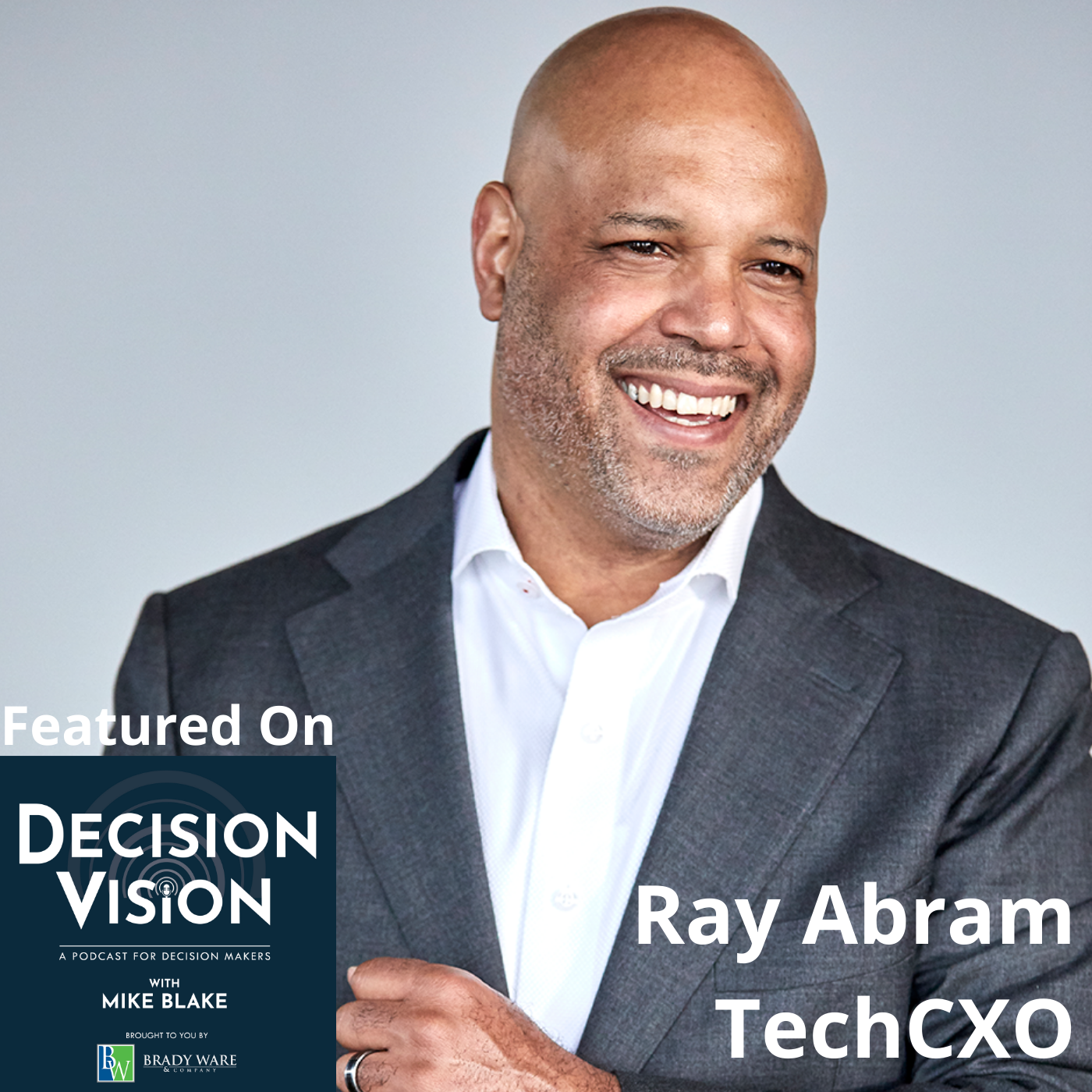
If connections and the quality of one’s network are a vital aspect of success in business, then how do introverts succeed? Should they become more extroverted? Joining host Mike Blake, Ray Abram of TechCXO and author of Connect Like a Boss discussed misconceptions about introverts, what it means to be an introvert in business, the impact of a digitally transformed world, managing introverts, and much more. Decision Vision is presented by Brady Ware & Company.

Ray Abram, CISSP, PMP, CSM, Senior Consultant at TechCXO

Ray Abram, CISSP, PMP, CSM, Senior Consultant at TechCXO

TechCXO provides companies with on-demand executives. TechCXO was founded on the premise that high potential companies can greatly benefit from proven, interim executives who they otherwise may not be able to access due to cost, availability, or because they do not necessarily need them full time. Our purpose is to provide the best executive talent available… on demand.

Ray Abrams knows what it’s like to overcome introversion and lack of confidence. As a self-proclaimed super-shy kid, he has risen out of mediocrity to find the success he previously only dreamed about.

For decades, Ray, a graduate of Hampton University in Virginia moved from job to job never finding the level of success he sought. Until one day he read an article on LinkedIn that said over 80% of jobs and opportunities come through people that we know. Eureka! Ray then began amassing a wealth of knowledge on how to build what he calls a “Circle of Success”.

He has since used that knowledge to not only change his life, but put countless others on the path to realizing their dreams through the people that they are connected with.

In his first book, Connect Like a Boss, Ray shares his fascinating experience on the strategies he used to become the best version of himself and fill his contact list with the people who could help him get what he wanted out of life. He is uniquely qualified in the fundamentals of identifying goals, working a room, and building long-term connections with intention. His mastery of these fundamentals can help your group triumph in this time-crunched, disconnected world.

Ray Abram’s message about the Seven Steps to Building Lasting Business Relationships, based on the science of building intentional friendships, resonates with diverse audiences at every level. He helps executives and entrepreneurs learn the art of prioritizing, categorizing, aligning, and pinging their contacts to maximize the value of their personal relationships in an efficient. effective way. Ray has delivered his networking and relationship strategy experience to such companies as Viacom, AT&T, Coca-Cola, and Cox Media, to name a few.

Personal website | Company website | LinkedIn

Mike Blake, Brady Ware & Company

Mike Blake, Host of the “Decision Vision” podcast series

Michael Blake is the host of the Decision Vision podcast series and a Director of Brady Ware & Company. Mike specializes in the valuation of intellectual property-driven firms, such as software firms, aerospace firms, and professional services firms, most frequently in the capacity as a transaction advisor, helping clients obtain great outcomes from complex transaction opportunities. He is also a specialist in the appraisal of intellectual properties as stand-alone assets, such as software, trade secrets, and patents.

Mike has been a full-time business appraiser for 13 years with public accounting firms, boutique business appraisal firms, and an owner of his own firm. Prior to that, he spent 8 years in venture capital and investment banking, including transactions in the U.S., Israel, Russia, Ukraine, and Belarus.

LinkedIn | Facebook | Twitter | Instagram

Brady Ware & Company

Brady Ware & Company is a regional full-service accounting and advisory firm which helps businesses and entrepreneurs make visions a reality. Brady Ware services clients nationally from its offices in Alpharetta, GA; Columbus and Dayton, OH; and Richmond, IN. The firm is growth-minded, committed to the regions in which they operate, and most importantly, they make significant investments in their people and service offerings to meet the changing financial needs of those they are privileged to serve. The firm is dedicated to providing results that make a difference for its clients.

Decision Vision Podcast Series

Decision Vision is a podcast covering topics and issues facing small business owners and connecting them with solutions from leading experts. This series is presented by Brady Ware & Company. If you are a decision-maker for a small business, we’d love to hear from you. Contact us at decisionvision@bradyware.com and make sure to listen to every Thursday to the Decision Vision podcast.

Past episodes of Decision Vision can be found at decisionvisionpodcast.com. Decision Vision is produced and broadcast by the North Fulton studio of Business RadioX®.

Connect with Brady Ware & Company:

Website | LinkedIn | Facebook | Twitter | Instagram

TRANSCRIPT

Intro: [00:00:02] Welcome to Decision Vision, a podcast series focusing on critical business decisions. Brought to you by Brady Ware & Company. Brady Ware is a regional full-service accounting and advisory firm that helps businesses and entrepreneurs make visions a reality.

Mike Blake: [00:00:21] Welcome to Decision Vision, a podcast giving you, the listener, clear vision to make great decisions. In each episode, we discuss the process of decision making on a different topic from the business owners’ or executives’ perspective. We aren’t necessarily telling you what to do, but we can put you in a position to make an informed decision on your own and understand when you might need help along the way.

Mike Blake: [00:00:44] My name is Mike Blake, and I’m your host for today’s program. I’m a director at Brady Ware & Company, a full-service accounting firm based in Dayton, Ohio, with offices in Dayton; Columbus, Ohio; Richmond, Indiana; and Alpharetta, Georgia. My practice specializes in providing fact-based strategic and risk management advice to clients that are buying, selling, or growing the value of companies and intellectual property.

Mike Blake: [00:01:08] And by the way, as an aside, now that the new college football rankings have come out, it looks like at some point the University of Georgia and University of Cincinnati will be playing in football. So, that’s going to be an interesting clash between our two offices.

Mike Blake: [00:01:21] Brady Ware is sponsoring this podcast, which is being recorded in Atlanta per social distancing protocols. If you would like to engage with me on social media with my Chart of the Day and other content, I’m on LinkedIn as myself and @unblakeable on Facebook, Twitter, Clubhouse, and Instagram. I also recently launched a new LinkedIn Group called A Group That Doesn’t Suck, so please join that as well if you would like to engage. If you like this podcast, please subscribe on your favorite podcast aggregator and please consider leaving a review of the podcast as well.

Mike Blake: [00:01:55] Today’s topic is, Should I become more extroverted? The reputation of introverts is that they or we are aloof, or awkward, or loners, nerdy, unfriendly, shy, strange, withdrawn, probably other things. And an academic study found that extroverts are 25 percent more likely to be in a high earning job than those who are less outgoing. According to elegantthemes.com, high profile introverts include Bill Gates, Elon Musk, and Warren Buffett.

Mike Blake: [00:02:29] And it’s estimated that introverts make up between 25 to 40 percent of the population. I wonder if that’s even understating the number of introverts, because I’ll bet you a lot of introverts don’t respond to the surveys. They probably don’t answer the phone. But anyway, I guess that’s the sort of selection of survivorship bias there.

Mike Blake: [00:02:50] And I’m interested in this topic because I’m an introvert. I’m not the big outgoing guy, for sure. And I work in a pretty introverted industry in accounting. And the joke is, you can tell if an accountant is extroverted because they’re looking at your shoes when they talk to you.

Mike Blake: [00:03:13] And I can tell you for sure that my wife’s biggest fear with me is not that I’ll cheat on her or anything like that. First of all, I don’t have the time management skills. She knows that for sure. There’s no way I could lead a second life. But her biggest fear is that I’ll be selected for the Mars mission because being put into a spaceship by myself for two years and there’s no real time communication, there’s 20 minutes in between transmissions, I’m like, “In, baby. Sign me up.” Except they don’t need an old fat guys to the Mars mission, so it’s unfortunate. I’m not likely to be a candidate for that.

Mike Blake: [00:03:48] So, this should be an interesting conversation. Joining us today to help us with this is Ray Abram of TechCXO. Ray knows what it’s like to overcome introversion and lack of confidence. As a self-proclaimed super shy kid, he has risen out of mediocrity to find the success he previously only dreamed about. For decades, Ray, a graduate of Hampton University in Virginia, moved from job to job, never finding the level of success he sought. Until one day, he read an article on LinkedIn that said over 80 percent of jobs and opportunities came through people that we know.

Mike Blake: [00:04:23] Eureka. Ray then began amassing a wealth of knowledge on how to build – what he calls – a circle of success. He has since used that knowledge to, not only change his life, but put countless others on the path to realizing their dreams through the people that they are connected with. In his first book, Connect Like a Boss, Ray shares his fascinating experience and the strategies he used to become the best version of himself and fill his contact list with the people who could help him get what he wanted out of life.

Mike Blake: [00:04:52] He is uniquely qualified in the fundamentals of identifying goals, working a room, and building long term connections with intention. His mastery of these fundamentals can help your group triumph in this time crunched disconnected world. Ray’s message about the seven steps to building lasting business relationships based on the science of building intentional friendships resonates with diverse audiences at every level. He helps executives and entrepreneurs learn the art of prioritizing, categorizing, aligning, and pinging their contexts to maximize the value of their personal relationships in an efficient, effective way.

Mike Blake: [00:05:29] Ray has delivered his networking and relationship strategy experience to such companies as Viacom, AT&T, Coca-Cola and Cox Media, to name a few. Ray, welcome to the program.

Ray Abram: [00:05:40] Thank you. Thank you very much, Michael.

Mike Blake: [00:05:43] So, I mean, doesn’t this sort of set up for some kind of bar joke? Two introverts are going to talk to each other over a podcast? I wonder if our listeners are thinking that there’s just going to be 30 minutes of dead air or the occasional cough. So, we have some work to do. But I think a lot of people misunderstand introverts. And so, I’m going to actually start with that.

Mike Blake: [00:06:10] You know, I am an introvert. My passions tend to be introverted. You’re not going to see me posting pictures on social media with me at a party of, like, 20 people. Never going to happen. Not intentionally, anyway. How are introverts like us most misunderstood?

Ray Abram: [00:06:29] Well, I think the biggest thing that people misunderstand about introverts is – you actually summed it up. I wish I could have had some of that preview because I think you summed it up – people think introverts are nerdy and arrogant. I think that’s really kind of the biggest misunderstanding. I’ve had that all my life as an introvert, is, people assume because I’m kind of standoffish or I’m standing to myself that I don’t want to be involved with them, that I think I’m better than them. And that’s a huge misunderstanding that limits introverts.

Mike Blake: [00:07:10] So, what was that moment that said, “You know what? I’m too much of an introvert.” Or maybe that’s not a fair question, we’re going to come back to that. But you decided that that was being a barrier to your own success.

Ray Abram: [00:07:26] Yeah. It was that last layoff. Part of being in technology and consulting, particularly, or contracting, every year or so, the company says, “Okay. It’s October, it’s fourth quarter, we got to let some people go.” And I always seem to be on the let go side. And we know we have to keep some people and let some people go. And then, it would always take me, you know, months to find something new.

Ray Abram: [00:07:55] And it occurred to me that in all these times it happened, I could always blame somebody else. But it occurred to me that I was the common denominator. And so, once that it happened that one last time I said, “I do not want this to happen again and so I need to fix my ability to connect with people.”

Mike Blake: [00:08:18] Now, I wish I had that excuse. The last time I got fired from a job was about 25 years ago. I was fired because I flat out sucked at it. It didn’t matter if I was an introvert or extrovert, I sucked at it and I was glad when they fired me. It was a bad match from day one. We could go off on a tangent, but I won’t.

Mike Blake: [00:08:39] So, when you were fired from that job, why do you think it was because you’re an introvert that led to that? What was it about being an introvert that puts you in the firing line do you think?

Ray Abram: [00:08:49] It’s just the connection. I think people hire and keep people that they like. It’s unfortunate. I mean, it would be great if the world was fair. But people look out for their friends. And I wasn’t good at making friends. I wasn’t seen as a guy that, “But we can’t let Ray go. Everybody loves Ray.” While I’m a very nice guy and very personable, I do my job, I wasn’t good at building that connection that would make a manager as they’re going through the list, “I got to let 20 people go. I can’t let Ray go.” So, I wasn’t good at that.

Mike Blake: [00:09:30] I wonder if there’s a demographic that people who are introverts are more likely to listen to podcasts? I’ll bet you they are. But let’s say for a second that somebody listening to this podcast and they’re trying to self-diagnose, am I an introvert? And more importantly, am I an introvert to the degree that it’s starting to get in the way of my success? What are some signs that I can make as a self-diagnosis to start taking stock and say, “Hey, this is something that maybe I need to take a look at changing or adapting my environment to?”

Ray Abram: [00:10:10] It really comes down to happiness. There’s nothing wrong with being an introvert if you’re happy. I think you mentioned, if they put you on a space capsule for two years, you never have to talk to anybody, you’d be ecstatic. However, if you’re suffering because you’re not getting invited, I think the thing, too, with introverts is that we crave to be invited. We just don’t want to go. So, as a human being, you crave connection.

Ray Abram: [00:10:42] And so, that kind of feeling like you’re not fitting in, feeling like you’re in bad relationships because you feel like nobody else will even be bothered with you. And so, you become unhappy and it feeds on itself. And then, that unhappiness kind of you get the schleprock effect, then you start to push people away. So, you don’t get what you want in life because you aren’t good at connecting with people. And that leads to unhappiness, if that makes sense.

Mike Blake: [00:11:20] And you bring up kind of you want to be invited, but you don’t want to go. There’s a certain level of empowerment that comes with that, too, isn’t there? I mean, you’d rather be in the position of saying, “I appreciate it, but I’m going to sort of hang back.” As opposed to not being invited at all. You wind up in exactly the same space, but the path by which you get there makes the difference, doesn’t it?

Ray Abram: [00:11:46] It absolutely does. Because when you look at social media, that made it even worse. It was already that FOMO was a thing back when we were kids. However, now, it’s really in your face and you look and you see your “friends” are out having a good time and enjoying themselves and nobody thought to call you. Or it was the event of the year and you didn’t even know about it. And that can lead to FOMO, for lack of a better word. But you still may not go even if you knew. But that feeling of not being invited is hurtful.

Mike Blake: [00:12:24] And it’s not just FOMO, it’s actually just MO, right? You’re missing out. It’s not just fear of missing out, you’re actually missing out because you’re not plugged into the network that makes you aware of those things. And there’s only a certain amount by which people will go that far out of their way to make sure that you’re plugged in. You got to kind of meet people part of the way, if not halfway, maybe at least a quarter of the way.

Mike Blake: [00:12:52] So, your personal experience was about losing jobs, but now you’re sort of more on the top of the org chart, if you will. So, you’re not going to lose jobs anymore because of your introversion. From where you sit now, where does the introversion/extroversion divide kind of play into how you conduct yourself and how you gain success in your professional life?

Ray Abram: [00:13:18] Wow. This question comes up a lot, how do I become more extroverted? And so, that’s the one thing I do want to clear up is that, it’s not about becoming extroverted. It’s about understanding your natural tendencies. Like, I’m lefthanded. When I was little, everybody wanted me to write righthanded. There’s just certain things we have natural tendencies to, but you adapt and you say – for me, it’s about understanding – “I don’t like large crowds. I don’t like speaking up when I’m in a group of 20 or 30 people. But I do very well with one-on-one.” So, it’s about staying in touch with people one-on-one or two-on-one, you know, having lunches, calling, coffees.

Ray Abram: [00:14:08] So, I just had to do different things that helped me leverage my introversion. But I just have to do it differently. I can’t get 20 people together because then I feel uncomfortable.

Mike Blake: [00:14:20] So, you bring up a point I want to make sure that I hit today, and this is as good a time as any because it’s a nice segue. I don’t think that you’re saying like introverts need help per se. This term is used elsewhere in life, but you’re born that way. That doesn’t necessarily mean you need to change fundamentally who you are. But I think what you’re saying is that you need to recognize that about yourself. And then, kind of like a coach, put yourself in a position to be successful.

Ray Abram: [00:14:50] Yes. That’s absolutely right. So, you have to train differently. Use a sports analogy, you just have to exercise differently to work on the parts that you need to work on. And so, being an introvert, I know that I don’t like a lot of crowds, but I do very well in small groups and have good conversations.

Ray Abram: [00:15:16] And, also, there’s another thing I want to make sure we touch on, too, is that there’s a difference between introversion and shyness. And those two terms get conflated quite a bit. Introversion is about you live in your head, you have conversations with yourself. Shyness is more a fear. It’s more about fear and shame. I’m afraid of what’s going to happen if people find this secret out about me. Or you have this feeling, “I’m going to trip over my feet or my trip over my words.” And so, the shyness is something that you can fix. But introversion is something that you cannot and it doesn’t need to be fixed.

Mike Blake: [00:15:59] Talk to me about how digital transformation has changed the world of the introvert. My personal experience is, I think it’s been great. We’re now in a situation where I can politely turn down a hug because I can plausibly say that it may lead to a lethal disease being transmitted. But I think it might be a two edged sword, talk about how digital transformation may be helping, but also maybe hurting introverts.

Ray Abram: [00:16:36] Yeah. To your point, it’s a crutch. It’s a crutch. And as you know with crutches, they help you walk. However, they don’t do anything for strengthening your legs. You have to have the PT. You have to have that physical training to strengthen that muscle. If you use this digital world, it’s easy. However, it doesn’t help you because it’s a physical world and you do have to be around people at some point.

Ray Abram: [00:17:14] And hiding behind a screen, just to me, doesn’t lead to a fulfilled life. There’s pieces that are missing. The senses that we have that are greater than our eyes and our ears, I mean, when you are with someone, you actually experience them physically, electrically. And that electrical charge, you need that. And so, if you’re just in here behind the screen all the time, it doesn’t help you live a fulfilled life. If that makes sense.

Mike Blake: [00:17:51] You know, I’m curious how you’d react to this. I think that the most important concept that is coming out of coronavirus and the digitally transformed world that it’s created is intentionality. You can’t manage by walking around anymore. You can’t bump into the water – I think the water cooler is a little overrated. I’m kind of like, “What are you standing around the water cooler for? Get back to work.”

Mike Blake: [00:18:24] But in the same token, to manage our teams to develop relationships, when people say you can’t develop relationships digitally, I think that goes too far. But where I do agree is that it needs to be more intentional. There needs to be more process to it because the default setting now is everybody’s a hermit. And so, now, you have to make a special effort to kind of come out of your cave, come out of your shell a little bit. And I think that’s maybe the other edge of the sword that’s working against introverts.

Mike Blake: [00:19:01] It was bad enough when I had to make the effort to wade into the lunchroom and sit down with ten other people. Or it was bad enough when I had to go to networking meetings of 58 people. But, now, I’ve got to go out of my way to set up Zooms and to call people. And go out of my way to make that contact. And people aren’t going to come to me. Out of sight, out of mind, I do think is a very real thing. I do think that’s the price that introverts are paying and we really have to be mindful of because, otherwise, we can truly fall off the face of the Earth as far as people are concerned.

Ray Abram: [00:19:37] You’re absolutely right. And, no, if you don’t call people to just say hello, very few people will call you. When you think about it, every call you get is somebody wanting something or it’s business. Very few people in today’s world just call each other just to say hello. And so, you as an introvert, have to do that intentionally. Schedule it and say, “I need to call three people.” What I recommend to my clients is call three people every day just to say hello. It keeps you in the loop.

Ray Abram: [00:20:15] I want to make a point about the digital transformation – and I think this is going to be helpful for introverts – kind of where our worlds are going to merge is this concept of the metaverse. It’s this always on goggles, avatars, people walking around in digital real estate. I don’t know how that’s going to look. I know it’ll be weird, but it will be that place where you just put your goggles on and you can physically or mentally walk into a room full of people and have discussions.

Mike Blake: [00:20:51] You talked about doing three phone calls a day, I want to follow up on that. What are other tools have you incorporated in your own life to, maybe, minimize the negative effects of introversion?

Ray Abram: [00:21:07] Yeah. So, one of the challenges or one of the things that kind of makes you introverted is, you believe things that aren’t true. You know, sometimes we suffer from mind reading, like, already thinking about what the person is going to think. So, the one question I ask myself – this helped me a lot – was, why do I believe that to be true? And so, instead of seeing the worst thing possible scenario, by asking why do I believe it’s true, when I ask myself that, the answer comes back usually it’s probably not true. And so, it frees me. That’s been a big help for me.

Mike Blake: [00:21:49] We tend to idolize extroverts for some reason. Why do you think that is?

Ray Abram: [00:21:59] It’s interesting, we actually had a shift and society did that to us. I was reading this a book called Quiet by Susan Cain, and she talks about a study that was done – well, not even a study, but just historically, introverts used to be revered.

Mike Blake: [00:22:19] Scholars.

Ray Abram: [00:22:19] Right. It was the Andy Griffiths of the world, the Abraham Lincolns, who were introverted thinkers. That was the ideal man who’s quiet and strong. But when people started moving into the cities, they called it the cult of personality, where having a outgoing personality became important. And so, schools were encouraged to teach kids, if you didn’t play with others well or you didn’t like to play with others, your parents were called into the office. You know, “There’s a problem with Ray. He doesn’t like to stand in front of the class and write on the board.” So, society has kind of put it on us to be the extroverted ideal, but it’s not anything that is natural.

Mike Blake: [00:23:15] You know, that’s interesting. I’m going to put that on my reading list. Actually, I’ve got new Kindle credits I got to spend. I’m curious, did they mention whether or not the advent of television has anything to do with that as well? I’ll bet you that it does.

Ray Abram: [00:23:32] Oh, I’m sure it does. Television has a lot to do with everything. There’s a YouTube video, I think it’s the history of America or the American era, and they kind of talk about how Sigmund Freud’s nephew kind of helped create society with advertising campaigns, and got women to smoke, and created eating bacon and eggs for breakfast. It’s amazing. And they used television to push a lot of this stuff to us. And so, society is largely influenced by television.

Mike Blake: [00:24:13] You know, I think back to the 1960 election, that was the first one that have televised debates. And neither you or I are old enough to remember that, but we know the story behind it. And John Kennedy prevailed in that election when Nixon was clearly the more qualified person to be president, right? And I would even argue if John Kennedy had Dwight Eisenhower’s personality – I think Eisenhower is kind of an introvert – I’m not sure Kennedy wins that election, necessarily. And I think that’s an illustration of how TV kind of elevated the sense of this extroverted, effervescent kind of charisma that we seem to gravitate to because I think it just makes it more ubiquitous and more visible, I guess.

Ray Abram: [00:25:01] Yeah. Yeah. Those people are seen as winners. They’re people who are extroverted. Again, it’s the cult of personality that people who have outgoing personality. This is the thing, I think before the cult of personality, a quiet man was seen as very trustworthy and somebody that you want to work with and do business with. But after the cult of personality, the quiet man is seen as something suspicious. Why is he so quiet? What’s he hiding? And so, it’s just a mind shift against quiet people.

Mike Blake: [00:25:37] And that brings up a question I want to talk to you about, because I want to talk sales a little bit. And we think of the stereotypical salesperson as a slap on the back, shake your hand, bro hug kind of person, whatever the younger salespeople do. I don’t know. I’m a million years old now. But that’s sort of the quintessential salesperson, right? And I know when I grew up, when I had my first job in finance, I was the number cruncher. They’re never putting me in front of, like, real people that might have paid us money or not. Just crunch the numbers, we’re good.

Mike Blake: [00:26:25] But I kind of wonder now if the pendulum is kind of swinging back towards introverts, because we’re just so bombarded now with being sold to all the damn time. And now YouTube influencers have become a thing, and YouTube influencers are, basically – let’s face it – they’re selling 24/7. They’re selling themselves, but they’re selling.

Mike Blake: [00:26:49] And I wonder if the pendulum is sort of swinging back to the introvert that’s just saying, “You know, here’s what I got. Love to tell you more about it. But that’s it. I’m not going to chase you down. I’m not going to hunt you down. Maybe I’ll do one follow up phone call. I’m not going to try to take you on a three day Bahama vacation or anything.” Do you agree, is the pendulum kind of swinging back our way in terms of preferred sales style?

Ray Abram: [00:27:17] Yeah. It’s swinging back to authenticity. So, I don’t know if it’s an introvert/extrovert thing, but it’s about authenticity and trust, and being trustworthy. And so, people are, to your point, inundated. And everybody’s lying and extra in marketing. And marketing have gotten so good at selling you stuff that when you see someone who is just authentic, and to your point, not trying to overdo it or overstate what they’re selling, then it’s moving more toward authenticity, as opposed to whether it’s introverted or extroverted.

Mike Blake: [00:27:59] You know, that’s a great point. I’m glad you corrected me on that because – and this shows my own bias – as an introvert, I will admit that I have an inherent distrust and bias against people who are extroverted. It doesn’t mean I don’t get along with them – and I want to get back to that in a second. It doesn’t mean that I discriminate against them, or maybe I do. But people who are extroverted, to me, seem a little not normal, because they operate in a mental space that I cannot conceive living in.

Mike Blake: [00:28:42] And so, I do think that now that we have this discussion, we’re uncovering, I guess, a deep and ugly part of myself. One of many we discover on the Decision Vision podcast. But I wonder if other introverts sort of maybe distrust extroverts? Maybe it’s jealousy. Maybe we see extroverts that get all the good stuff.

Ray Abram: [00:29:02] That’s part of it.

Mike Blake: [00:29:03] Maybe that’s part of it, too.

Ray Abram: [00:29:05] That is part of it. There is a jealousy. It goes back to I want to be invited. I want to be included. I want to be accepted. All human beings want love. We crave love. I think introverts are afraid of too much love. It’s just like hunger. You need to be accepted, and extroverts appear to be accepted wherever they go as soon as they walk in the room. And introverts stand back and go, “Oh, I wish everybody wanted my -” you know what I mean? It’s just an interesting dynamic with introversion.

Mike Blake: [00:29:48] So, we touched on this before, but I want to come back to it explicitly because I think it’s very important. And that’s how social media impacts introverts and impacts kind of the dynamic, if you will, between introversion and extroversion. Do you have an opinion as to whether or not social media is more helpful or more harmful to introverts and extroverts? Isn’t it a mixed bag? Is it even a fair question to ask?

Ray Abram: [00:30:15] Yes. It’s a good question. I think it’s a fair question. I don’t know if it’s more harmful to one personality type than the other. I do think it comes down to what you’re using it for. There’s risk of addiction. And I think we’ve mentioned it before, just kind of instead of going out and experiencing life, I will just look at my screen and let life happen around me. And so, you kind of miss out on having a full life just by watching as opposed to ever participating.

Mike Blake: [00:31:02] I think in my view – and, again, feel free to disagree. I’m probably wrong – one of the things that makes introverts introverts is that we’re inside our heads. And we’re really good at creating narratives inside our heads. It goes back to what you said, “Wait a second. What evidence do I have that any of this that I’m inventing for myself is true?” But social media, I do think, is sort of a conveyor belt that’s just constantly feeding stuff that feeds our internal narrative that may not necessarily be positive or helpful.

Ray Abram: [00:31:40] You’re right. And, also, I think introverts tend to observe social media. One of the challenges I’ve had, even as I try to promote my business, is doing videos, the lives and the reels, and I put that camera on. If you only knew how many times I’ve held my phone up ready to do my live and I just can’t do it. I can’t. I don’t know what to say. And so, I just turn it off. But the whole conversation is here, I just can’t get it out.

Ray Abram: [00:32:13] Well, extroverts, I think, are the opposite, always they’re live. You see it on your phone all the time. Such and such is live, such and such is live. And I’m like, I can’t do that. So, I don’t know if it’s harmful to answer your question, but I think there is a different way in the way introverts and extroverts experience social media.

Mike Blake: [00:32:33] Yeah. I’m right there with you. I have broken so many promises to do video. I really could run for office. I’d be a great politician. Because I know it’d be great for my business, but I can’t bring myself to do it. The few times I’ve done it, I sound like I’m in a hostage tape. I swear to God. And, you know, it’s going to do more harm than good.

Mike Blake: [00:32:59] On the other hand, my wife, she looks to me like, “Why can’t you just do this?” And like, “Well, why can’t you just fly a 747?” That’s what a pilot would say. But she can sit down behind her computer, turn the camera on, and just start talking. And I’m working off some questions here, but you and I are having a recorded conversation by microphone, I can do that. But, man, there’s just something about video and talking into the camera that is just so different. Maybe it’s the absence of feedback or something. But even if I have a script, again, hostage tape kind of thing. I blink three times if you want to be freed, sort of thing.

Ray Abram: [00:33:37] It is because we’re inside of our head. You’re already having a whole conversation inside of your head. And, also, there’s this fear of saying the wrong thing or saying something stupid. That’s what happens to me. I know that as soon as I start talking, I’m going to say something stupid or something not right. And introverts do have kind of more of a need to be right. We’d rather be right. We don’t like to trial and error. We sit back and think about things for a while and then do it. And you probably experienced this, if somebody says something rude to you and you get the perfect response, like, ten minutes later or after you get in the car.

Mike Blake: [00:34:21] It’s like that Seinfeld episode.

Ray Abram: [00:34:24] Exactly. You get in the car and you go, “Mama,” you know. So, that’s part of just our personality.

Mike Blake: [00:34:36] So, now, you’re in a position of business leadership. You must have given some thought to this. You know, if you’re leading a team, running a shop or company that’s got a bunch of introverts in it, what can you do to give introverts a platform to unlock their full potential? How can a company, how can a leader, meet them halfway or more than halfway so they get a chance to fully contribute?

Ray Abram: [00:35:04] Yeah. I think that’s really just making people feel accepted. But it is tricky. It’s tricky because introverts do like to be on their own. So, you have to – how can I say it? – encourage. You have to encourage participation without insisting on it. It is kind of a fine line because, as introverts, even on a conference call, even on a Zoom call, I hate when I’m called out. “Ray, what do you think about that?”

Mike Blake: [00:35:41] Right. If I knew what to say, I already would have told you.

Ray Abram: [00:35:43] I would have told you.

Mike Blake: [00:35:44] I wasn’t holding back.

Ray Abram: [00:35:47] Right. I don’t have anything to say. So, it comes down to just making sure that people feel that they’re safe. Because that’s really what limits you, is you don’t feel safe to talk in this open forum. Because, again, to your point, you’re already imagining somebody is going to start laughing or they’re going to say, “What a jerk?” And why is that true? So, you have to make sure people feel safe, and included, and encouraged to participate.

Mike Blake: [00:36:19] I’m talking with Ray Abram. And the topic is, Should I become more extroverted? We’re running out of time. I know you got another place to be. But I want to come back to what you just said because I think, again, it really just gets back to intentionality. I think one of the things I’m learning from this conversation, is, extroverts benefit and like bumping into each other. Things happen because they bump into each other.

Mike Blake: [00:36:47] Introverts still have contributions to make. But introverts have to be much more intentional about making them and probably their peers who are less introverted need to be a bit more intentional about drawing it out of them or giving them the platform, or, as you call it, the safe space in order to do so.

Ray Abram: [00:37:08] Yes. That’s absolutely right. And it’s not easy. Introverts and extroverts in a team together, they need to work together, but it is challenging just because of the way people communicate. But as a manager, understanding the types of, “If I could, I would give everybody a psychological test,” so you know where people are. Because many people that you think are introverted are not and vice versa. And so, you kind of got to understand this personality type in order to manage it effectively.

Mike Blake: [00:37:45] Does it surprise you at all when people put out the names of introverts who are big time leaders, the Bill Gates of the world, the Warren Buffetts of the world? I don’t know where they get Elon Musk. Calling Elon Musk an introvert is a little bit of a stretch to me. But I don’t know him, so maybe he’s totally different. But the guy smoking a joint on a video, to me, is not an introvert.

Ray Abram: [00:38:07] He’s not shy. He’s not shy.

Mike Blake: [00:38:09] He’s not shy, and maybe that’s it. So, does it surprise you at all that the founder of Microsoft, the founder of Berkshire Hathaway is, in fact, an introvert?

Ray Abram: [00:38:22] Not at all. Because you spend quiet time thinking, you know, thinking before you act, thinking before you speak. So, just the fact that these guys are successful, and particularly when you think about what they’re doing in technology and managing money, Warren Buffett talks about he reads four hours a day or something. I think Bill Gates takes a week away, locks himself in a room with books and notebooks. So, they’ve learned how to make it work for them.

Ray Abram: [00:38:58] And so, I think if we take anything away from this interview is, understand your personality type and figure out how to make it work for you. Not try to become another type of personality because that’s very difficult, if not impossible.

Mike Blake: [00:39:16] Yeah. That, to me, sounds like a recipe for disaster.

Ray Abram: [00:39:19] Yeah, yeah, yeah. Because you’ll be uncomfortable. You’ll be miserable. And you’ll put yourself into a box. It’s like trying to write righthanded or change the hand to write with. It’s just very difficult and you’re going to feel uncomfortable. The key to introversion or overcoming it – if that’s the right word – is being comfortable in your own skin. And so, when you understand this is my personality, it’s not anything wrong with me. This is not limiting. I’m not sick. It’s just this is the type of personality I have. I can still be very successful, I think, is the empowering lesson.

Mike Blake: [00:40:05] Ray, this has been a great conversation, but we’re running out of time. If there are questions that I either didn’t ask and our audience wish I had or wish that we would have talked more or gone into more depth about a particular question, can they emerge from their introversion and reach out to you for more information? And if so, what’s the best way to do that?

Ray Abram: [00:40:27] Yeah. So, you can follow me on Instagram at ray_abram. You know, feel free to DM me. On Facebook, I’m Coach Ray Abram. And my website is rayabram.com. You know, there’s a contact form, we can set up a call if you want to just jump on a quick call, and I’ll help you out.

Mike Blake: [00:40:49] Well, that’s going to wrap it up for today’s program. And I’d like to thank Ray Abrams so much for sharing his expertise with us.

Mike Blake: [00:40:55] We’ll be exploring a new topic each week, so please tune in so that when you’re faced with your next business decision, you have clear vision when making it. If you enjoy these podcasts, please consider leaving a review with your favorite podcast aggregator. It helps people find us so that we can help them. If you would like to engage with me on social media with my Chart of the Day and other content, I’m on LinkedIn as myself and @unblakeable on Facebook, Twitter, Clubhouse, and Instagram. Also, check out my new LinkedIn Group called A Group That Doesn’t Suck. Once again, this is Mike Blake. Our sponsor is Brady Ware & Company. And this has been the Decision Vision podcast.


Tagged With: Brady Ware & Company, Connect Like a Boss, Decision Vision, extroversion, introversion, introverts, Mike Blake, networking, networking for introverts, Ray Abram, self confidence, spray and pray, Tech CXO

Austin Samuelson With Tacos 4 Life

December 23, 2021 by Jacob Lapera

Franchise Marketing Radio
Austin Samuelson With Tacos 4 Life
Loading
00:00 /
RSS Feed
Share
Link
Embed

Download file

Brought To You By SeoSamba . . . Comprehensive, High Performing Marketing Solutions For Mature And Emerging Franchise Brands . . . To Supercharge Your Franchise Marketing, Go To seosamba.com.

AustinSamuelsonAustin Samuelson is the co-founder and CEO of Tacos 4 Life, a restaurant that donates one meal to starving children around the world for every meal purchased at its locations. Austin founded Tacos 4 Life in 2014 with his wife, Ashton because they were inspired and driven by the need to help eliminate world hunger.

Prior to opening Tacos 4 Life, Austin graduated from Ouachita Baptist University with a degree in Finance. After college, Austin moved to California and worked in commercial real estate before joining the restaurant industry.

With Austin’s leadership, drive and vision, Tacos 4 Life has grown to 16 locations in five states across the United States. In partnership with Feed My Starving Children, Tacos 4 Life has donated over 13 million meals to starving children in third world countries. Austin and his team know that their jobs do not end in the kitchen or the office and travel to third world countries to deliver the meals guests raise to children in need.

Connect with Austin on LinkedIn and follow Tacos 4 Life on Facebook and Twitter.

What You’ll Learn In This Episode

  • About Tacos 4 Life and its mission
  • What makes this taco restaurant different from other restaurants?
  • What does the brand have planned for 2022?

This transcript is machine transcribed by Sonix

TRANSCRIPT

Intro: [00:00:07] Welcome to Franchise Marketing Radio, brought to you by SeoSamba Comprehensive, high performing marketing solutions for mature and emerging franchise brands to supercharge your franchise marketing. Go to SeoSamba.com. That’s SeoSamba.com.

Lee Kantor: [00:00:32] Lee Kantor here, another episode of Franchise Marketing Radio, and this is going to be a fun one today on the show we have Austin Samuelsson and he is with tacos 4 life. Welcome.

Austin Samuelson: [00:00:44] Hey, Lee. Thanks for having me on.

Lee Kantor: [00:00:45] Well, I am excited to learn what you’re up to. Tell us a little bit about tacos for life. How are you serving, folks?

Austin Samuelson: [00:00:52] Yeah. So tacos for life. We’re a restaurant. But really, what we are is we’re an organization that fights hunger. We we do that by serving really great tacos. We have over 14 chef inspired tacos on the menu. Everything from your traditional, you know, fajita chicken tacos, beef tacos, steak tacos, all those things to, you know, more fun and adventurous versions of tacos like a Korean barbecue, barbeque steak taco or a Hawaiian shrimp tacos. So we we sell great tacos, but we do that so that we can help be a part of fighting world hunger. Every taco salad rice bowl quesadilla that we sell, we donate a meal to a child in need to a third party organization called Feed My Starving Children. So that is that’s what we’re all about here at Tacos for life and what gets us excited every day.

Lee Kantor: [00:01:45] Now, how did that like? What’s the genesis of the idea of not only just selling great food, but also partnering where you can help other people in the manner that you do?

Austin Samuelson: [00:01:56] Yeah, absolutely. So really, it’s you know, if you if you rewound our story 12 years ago, my wife and I, Ashton, we we had 12 years ago, we had never worked in a restaurant, never, never had aspirations to own a restaurant, you know, just wasn’t on our radar. You know, we were living life. I was working in commercial real estate. She was teaching school, but we heard something one day back in two thousand nine. We heard a statistic then that 18000 children die every day from starvation. And you know, we knew hunger is a problem. We knew starvation as a problem. But for some reason when we heard that it just both struck a chord with us and we also heard. Rich Stearns was the CEO of World Vision, a very large organization. Does relief work all over the world? He was sharing these statistics at a church that we were attending. And he said two other things. He said, You know, our planet produces enough food to feed everyone. And then the third thing he said was this number of eighteen thousand children dying every day from starvation. It can be zero, but it’s going to take us doing something about it. And that’s really what started Ashton and I on this journey.

Austin Samuelson: [00:03:19] It didn’t happen immediately, but it started over the next couple of years, us really questioning, OK, how could we be a part of helping feed kids? How can we be a part of seeing a day when no child has to die from starvation? And it led us down this path to opening a restaurant? And really, it came about because at that time and still they’re very popular, but Toms shoes was was really taken off. We had a pair of shoes asking it to everybody, you know, seeing everybody’s talking about them, you know? And so here’s the funny part having never worked in a restaurant before we both we thought, Hey, if if a shoe company can donate a pair of shoes for every shoe they sell, how hard could it be for a restaurant to do that? You know, it can’t be that hard, right? And that’s that that whole question is what sparked this journey. We’ve since learned now, 10 years later, that it is a little bit hard to do, but it’s possible and and and it’s totally worth it. And we’re getting to be a part of helping feed kids all over the world. Take us for life now now.

Lee Kantor: [00:04:27] But what brought you to tacos like it could have been, you know, a fine dining and doing this like, well, how did you choose the kind of the the route you’ve chosen regarding this type of a restaurant and specifically tacos?

Austin Samuelson: [00:04:40] Yeah. So the the simplest answer is we love to eat tacos. We we we lived in Southern California for a time. We’re both from Arkansas. That’s where we’re based out of now. But we just love Mexican food. We love tacos. We love that with tacos. You can you can really. You can go any direction you want from a culinary flavor profile standpoint. You can do your traditional stuff, but then you can you can get pretty creative. And my wife, she’s a she’s a chef and she says, you know, hey, the tortilla is just a blank canvas, you know, and you can do a lot of fun things with it. And you know, we love tacos and tacos are popular. They’re a crowd pleaser, you know, so it’s worked really well. We did. Just to note, we did actually start with a pizza restaurant before tacos for life. That’s where we first tested the mission out and. And we transitioned over to tacos, really just trying to continue to tweak the model and see what would work, and we found that with with the taco concept, with tacos for life, there was just an excitement. It really met a need in Arkansas. There wasn’t a lot of taco concepts at the time when we first started in 2014 with tacos for life. And so those those kind of things all coming together is what brought us here.

Lee Kantor: [00:05:57] Now what was kind of the clue that you were on to something?

Austin Samuelson: [00:06:01] Oh my gosh. Well, you know, with the pizza restaurant, we had just a lot of a lot of support in the community and even around the state, people loving the idea of being able to donate a meal or being able to help participate in doing good, but that people talked about that. Ok, and we’re a restaurant, right? So the first day I remember after we opened tacos for life, we had a line out the door could just it never stopped all day. It poured as a thunderstorm, lightning and storms all day long, and the line just never went away and people were really raving about the food along with the mission. And I think that’s when we closed the doors that that night. I remember looking at Ashton and saying, OK, we can do something with this mission, and tacos for life is going to be it. And it just there’s just something about it. After that first day, just the response we got from the guest who was unlike anything we’d experienced at the pizza restaurant. And it was this great combination of just an excitement for the food just doing something unique there, along with a really tangible mission of getting to help other people.

Lee Kantor: [00:07:12] Now did you build this to franchise it? Was that always the the thing or did it start out of, Hey, we’ll start this one, maybe grow a little bit and see where it takes us? Or were you always did you always have your eye on being a franchise or no?

Austin Samuelson: [00:07:26] Yeah, franchising really came about after a few years in and and we really. So yeah, we started early. We didn’t have a big grand plan of what we were going to do. We just it’s kind of one day at a time and seeing how we could feed more kids and we knew if we opened more restaurants, we could feed more children. You know, every restaurant provides about a thousand meals a day. So. So there was a motivation to grow and open more restaurants. But I didn’t know anything about franchising. And, you know, opening more company restaurants was simple. You know, from that standpoint, franchising was this big thing. We just we didn’t really understand not having any experience with it. So. But after a couple of years, we we got to know some folks and some people that had a lot of experience with franchising. And we we kind of we did our first round of franchising and back in twenty seventeen and we got our PhD and got all the documents together. And we franchised three locations and in two of them went really well and one of them didn’t it? And we learned a whole lot and we really kind of pause there. We stop franchising. We, you know, we still had all the documents, still had everything together. We worked really hard with the two franchisees that remained and got great relationships with them.

Austin Samuelson: [00:08:43] They’re still on the team and talk to them multiple times a week. And they’re they’re great folks and great partners to the organization and the mission. But what we really did is we kept opening company restaurants and really what the mindset of like, OK, we really for this to work with this mission, we’ve got to get just we’ve got to get the model really locked in and we’ve got to get it nailed down for this to be something that that works from a franchising standpoint. So we continue to kind of watch our franchisees continue to talk to them, get feedback. We continue to improve the model as we get more efficient on the company restaurants and spent about three years doing that. And then last year, in 2020, right before this whole pandemic started, we decided, Hey, we’re ready to franchise. So obviously got had different plans then in that moment. But but that’s that’s kind of the full circle, the whole franchising. It was we started out and we we learned a lot of great things. And but now we’re all in and we’ve got eight franchise locations open and quite a few more on the in the pipeline. And it’s really the way that we see the mission being furthered, having kind of watched and learned from our first couple of franchisees.

Lee Kantor: [00:09:58] Now any advice for other emerging franchise owners when it comes to doing your due diligence, building the right systems and knowing when it’s the right time to pull the trigger to, you know, really put on a different hat, right? Because Tacos for Life operator is different than the Tacos for Life franchise or that’s training people to be successful in their market. It’s a little different kind of mission and objective from that standpoint.

Austin Samuelson: [00:10:25] Yeah, absolutely. I think you said it, you know, it’s it’s all about the systems and the processes. And it’s all about what what I had to learn as a founder was, OK, what what are the, you know, we call them strategic anchors, OK, but what are those like sacred cows? These are these are we don’t compromise in these areas. And what are the things that we’re going to be willing to move on? And then how do we also create a relationship so that we can learn from our franchisees? And that’s what I love most about franchising is this element of like, Hey, we’re we’re in this together and we’re a team that’s working to improve tacos for live together so that we can feed more kids so that they can bring more profit down to their restaurants. So it’s we’re fully aligned in that. And I think understanding that relationship on, Hey, what are we not going to compromise on and what are we willing to move and do? And then and then what’s the right format in relationship to to have a full cycle kind of feedback loop? You know, those three things I just have been incredibly important to us

Lee Kantor: [00:11:31] Now is the ideal franchisee different today than it was, you know, the first time he took a bite of this apple?

Austin Samuelson: [00:11:41] Yeah, absolutely. So the here’s what we say today. We say it’s a two part. It’s a two part formula for us with our franchisees or prospective franchisees. They have to be here because of the mission. They have to want to be with us for life because we have this, this, this opportunity to help and starvation, that’s got to be while they’re here. That’s going to be their motivating factor. But quite honestly, it can’t outweigh their desire to run a profitable, successful restaurant. So those have to match up fully. Where we’ve gotten ourselves in trouble or where we found there’s misalignment is when one outweighs the other. So, you know, obviously it’s easy to look at the profit side and say, Well, if someone is only concerned about, you know, bringing as much profit to the bottom line as possible, then the mission is going to get in the way of that right. So it’s easy to pick on that side of the equation. But we’ve also learned that it’s just as easy to pick on the other side. If if you’re all about the mission and you’re not, you’re not running your business as efficiently as possible. If you’re not constantly working every day to improve and to get better and to serve the guests better, then the mission will sputter as well. So for us, it’s a two part formula. You’ve got to be here because of the mission and you’ve got to be here because you want to run a really great restaurant.

Lee Kantor: [00:13:04] So but those are two equal like those aren’t one doesn’t take precedent over the other.

Austin Samuelson: [00:13:10] Yeah, exactly. Maybe when we first started, you know, we would say, OK, we’re going to tilt a little heavier towards the mission, you know? But the reality of it is so that we can feed kids. We have to be we have to run a very efficient business because that’s it’s taking a hit. When we donate a meal, every time we sell a taco, that’s coming right off the top line. We treat that as a cost of good. So, you know, you could say we’re operating a bit of a disadvantage compared to the competitors because of that extra cost in our in our P&L.

Lee Kantor: [00:13:40] And and now that you kind of the model is is more baked and it seems to be growing well. Is it easier to kind of identify people, though, when they when you have a mission at the top of, you know, as the true north or as part of the true north of the organization, do those people kind of present themselves to you in a little more efficient fashion than just somebody saying, Oh, I have a taco restaurant will take anybody that can, you know, fog a mirror and write a check, right?

Austin Samuelson: [00:14:11] Yeah. No, I actually think it does. I think, you know, I don’t know what the, you know, would be normal for everybody else, but we get a ton of applications in and we we talk to a lot of people. And the ratio of those that come in for an interview is there’s a lot of applications and very few people that come in. And it’s not because we’re being ultra picky, it’s just we’re able to both see and people select out when when they understand the impact of the mission, you know, and they say, you know, Oh, that sounds nice, but that’s that’s more than what I’m willing to invest, you know, to to make this mission thing possible. And then for us as well, we’re able to understand, hey, now this person’s motivation isn’t right. Or maybe they don’t have the skill set to run a restaurant and operate more competitively than they would a normal taco restaurant that doesn’t have, you know, a mission involved. So yeah, I think I think we have to talk to more people, perhaps. But I do think it makes it a little easier for us to see, OK, who is in it for the right reason and who’s not, you know, it’s not just who’s got the biggest checkbook in our, you know, where others might fill that way.

Lee Kantor: [00:15:19] So now we’ve talked a lot about the mission and how integral that is to the brand. But can you talk also about just the food part like you have to have good product and. Tacos that people like, so it seemed like you’re doing that as well.

Austin Samuelson: [00:15:34] Yeah, absolutely. And that was one of the big learnings we took out of our first our first restaurant in town. You know, the the mission is great. But if the food and the service isn’t equally as great, if we’re not the best in each community that we’re in, then the mission won’t. It’ll just be a nicety, you know? So yeah, we work very hard. We’re a. We make everything from scratch in our kitchens. We make everything to order. We put a ton of pride in that and we put a lot of effort into, you know, the doing the little things right when it comes to the food and really teaching, you know, young guys and girls how to come in and cook and do things that a lot of places don’t do. You know, we’re, as you know, maybe the guys down the street or cutting a plastic bag open and, you know, dumping it on a steam table where we’re making we’re making that beef from scratch. And it’s a long process. And it’s it’s the way you would, the way you’d want to do it at home, you know. We have a fried chicken taco, which is probably my favorite Taco Lee, and that is Ashton’s grandma’s fried chicken recipe, you know? And so that’s not just near and dear to our heart, and that’s not just special, but we cook it the way her grandma cooked it.

Austin Samuelson: [00:16:43] You know, we go that extra step and we we fry it the right way. And so that’s that is just so important. And then on the service side, too, we really pride ourselves and having that extra level, I think we get a leg up on the competition because of our mission. You know, there’s a kind of an extra something we get to talk with our guests about. We’re kind of, you know, we’re on the same side of the table. Our team members are with us because they’re excited about helping and starvation, our guests that understand the mission. You know, hopefully they get it right away. Hopefully, they know about it before they walk in the door. But if they don’t, you know, we’re working hard to tell them about it. And so there’s an extra level of connection that we get to have and and we talk about, Hey, how are we building relationships and providing really friendly service as opposed to just moving people through a line and making it transactional?

Lee Kantor: [00:17:30] So now what’s next for you? Obviously continued growth, but do you have any plans you can share for twenty twenty two?

Austin Samuelson: [00:17:39] Yeah. So, you know, like I mentioned earlier, we really kind of got geared back up on the franchising side of things in 2020 and then got a little bit distracted, as did everybody else. Did you know, for much of the year? But fortunately, we still had some success. We sold some franchise, brought some new partners in and opened a few locations, opened a couple more this year. And then we’ve really just been filling up the pipeline. So we’ll probably see 10 or so locations open next year. And we’ve got about 12 or so, I guess, on the books for twenty twenty three at this point. And we’re just we’re, you know, the thing for us, Lee, is we’re we still we still are taking it slow, you know, because we want we want each franchisee that we bring on board to. We want them to be successful and for them to this to be something that they’re proud of and that really makes sense for them and their families. So it’s a it’s a slower process, probably the most, but it’s a it’s a good process and and we work really hard to be intentional throughout. But yeah, for the next, we’re about to open location number 20 and then hopefully twenty four months from now, we’ve more than doubled that and we’re getting to feed a ton of kids every day. So this year will have provided a little over five million meals. So when you put that in perspective, it’s it’s just exciting to see every time we open a location, you know, every every three locations we open, we provide a million meals a year and that’s what that’s really what motivates us here.

Lee Kantor: [00:19:14] And have you kind of defined that ideal franchisee in terms of not only the mission, they have to obviously have a desire for the mission, but are they people who are transitioning out of a corporate job into this? Or are they, you know, owners of other complementary brands that are just adding tacos for life to their portfolio? Are you clear on who that ideal franchisee looks? You know what they look like?

Austin Samuelson: [00:19:41] Yeah, I think we’re we’re more of the folks that are transitioning in their careers into us. We don’t we don’t have a lot of other. We don’t have any franchisees or anybody that’s in the pipeline that has other concepts in their brand, in their portfolio, not because we’re not opposed to it, but because we’re we’re just a different animal than what you would get shopping on the franchise. You know, what else is out there franchising wise? So now our ideal person is someone that’s, you know, hey, they’re ready to either either they have been self-employed or they’re ready to take that leap and be their own boss and be in control of their future. But they also want to do something really meaningful with that through our mission and through the environment that they can create with. Their team, so we work hard on now we’re on the the SBA list for preferred partner with them, and so we work hard to, you know, if if someone needs some help on the funding side, but they have the the experience, they have the the passion. We work really hard to get them matched up from a banking and funding standpoint so that they can they can join and be part of this.

Lee Kantor: [00:20:55] And there are certain regions you’re targeting as you grow and kind of take over the world. Or are you? Is it kind of a free for all you’ll take anybody from wherever they are?

Austin Samuelson: [00:21:06] You know, right now we’re really focused on the southeast United States and a little bit into the lower Midwest. And what I mean by that is kind of Oklahoma to Kansas City, to St. Louis and then down throughout. We’re over in North Carolina and on down. So that’s that’s kind of our, of course, we’re in Arkansas here. So that’s kind of if you took a go across the United States from that standpoint, that’s that’s really where we’re focusing our efforts right now on growing

Lee Kantor: [00:21:35] Well, if somebody wants to learn more, is there a website for them to go and check you out?

Austin Samuelson: [00:21:40] Yeah, absolutely. So go to taco’s for life. We actually just updated the website a few months ago. It’s it is beautiful. A couple of fun things on there. You can learn all about our mission and understand really the dynamics of how it works. We work with a great organization called Feed My Starving Children. There’s they and us. We work really hard to provide really great transparency in how the giving works, so you can see all that there. You can track the milk counts per location. So all that is there. And then, of course, to learn about franchising. We have a great section there under the franchising tab, and you’re going to probably learn everything you need to know. And then we’re, of course, always available to talk so well.

Lee Kantor: [00:22:23] Thank you so much for sharing your story today. You’re doing such important work and we appreciate you.

Austin Samuelson: [00:22:29] Well, thanks for thanks for having me on.

Lee Kantor: [00:22:31] All right, this is Lee Kantor, we’ll see you all next time on Franchise Marketing Radio.

Tagged With: Austin Samuelson, Tacos 4 Life

Decision Vision Episode 148:  Should I Adopt Lean Management? – An Interview with Cedric Brown, CMB Global Partners

December 23, 2021 by John Ray

CMB Global Partners
Decision Vision
Decision Vision Episode 148:  Should I Adopt Lean Management? - An Interview with Cedric Brown, CMB Global Partners
Loading
00:00 /
RSS Feed
Share
Link
Embed

Download file

Lean Management

Decision Vision Episode 148:  Should I Adopt Lean Management? – An Interview with Cedric Brown, CMB Global Partners

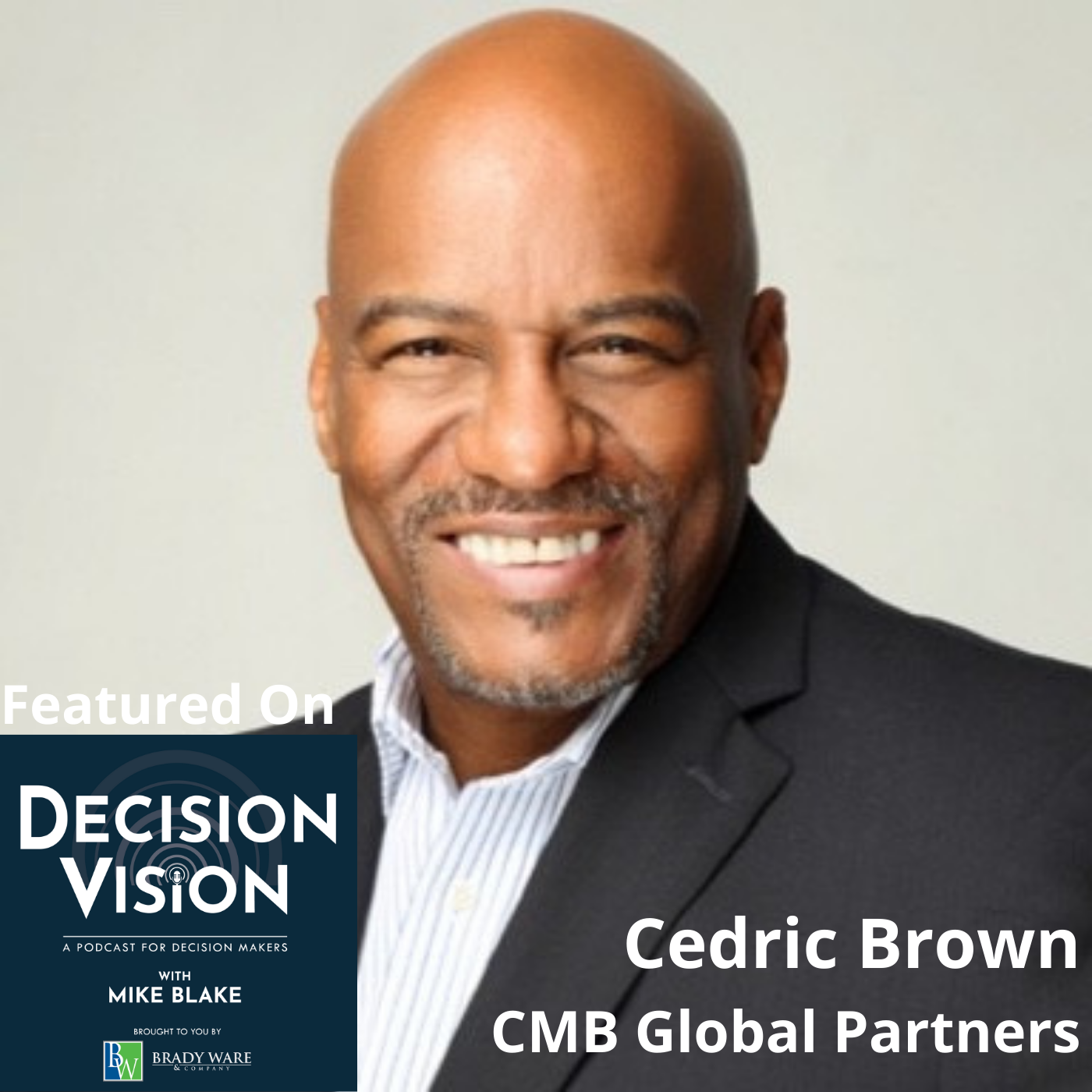
Cedric Brown, Founder and CEO of CMB Global Partners, is a leading expert in lean management. Cedric joined host Mike Blake to discuss the origins of lean management, its core principles, signs a company may benefit from lean management, why and how lean management engages every aspect of the organization, and much more. Decision Vision is presented by Brady Ware & Company.

CMB Global Partners

Founded in 2013, CMB Global Partners connects clients to the best Lean and Six Sigma experts in the world.

They offer a blended learning model including boot camps, simulations online roadmaps, and hands-on consulting proven to drive significant sustainable business impact. Whether you are starting the journey or need to accelerate your transformation contact them today to learn about exciting new products and services they are developing with their global partners to accelerate your Lean Journey.

Company website | LinkedIn

Cedric Brown, Founder and CEO, CMB Global Partners

Cedric Brown, Founder and CEO, CMB Global Partners

Cedric Brown is the Founder and CEO of CMB Global Partners. He is an experienced business transformation leader with a track record of transforming value streams, business units and companies utilizing Lean Six Sigma principles and methodologies.

Cedric was trained and mentored by the original team from Japan that worked directly with Taiichi Ohno, the architect of the Toyota Production System. He has proven experience in design and implementation of an enterprise-wide lean program including full employee engagement through lean boot camps and kaizens.

He was trained and mentored by George Eckes, the number one Six Sigma consultant who helped Jack Welch – GE implement six sigma. Cedric was featured best master black belt in his book “Making Six Sigma Last – Bridging the Cultural Gap.

Cedric has also provided consulting for clients in the automotive, health care, electronics, and clothing industries.

He learned the strategy deployment methodology directly from the architect of the Danaher Business System (DBS) and is fluent in the methodology responsible for driving industry-leading shareholder values.

Cedric has a degree from Georgia Tech and lives in Atlanta.

LinkedIn

Mike Blake, Brady Ware & Company

Mike Blake, Host of the “Decision Vision” podcast series

Michael Blake is the host of the Decision Vision podcast series and a Director of Brady Ware & Company. Mike specializes in the valuation of intellectual property-driven firms, such as software firms, aerospace firms, and professional services firms, most frequently in the capacity as a transaction advisor, helping clients obtain great outcomes from complex transaction opportunities. He is also a specialist in the appraisal of intellectual properties as stand-alone assets, such as software, trade secrets, and patents.

Mike has been a full-time business appraiser for 13 years with public accounting firms, boutique business appraisal firms, and an owner of his own firm. Prior to that, he spent 8 years in venture capital and investment banking, including transactions in the U.S., Israel, Russia, Ukraine, and Belarus.

LinkedIn | Facebook | Twitter | Instagram

Brady Ware & Company

Brady Ware & Company is a regional full-service accounting and advisory firm which helps businesses and entrepreneurs make visions a reality. Brady Ware services clients nationally from its offices in Alpharetta, GA; Columbus and Dayton, OH; and Richmond, IN. The firm is growth-minded, committed to the regions in which they operate, and most importantly, they make significant investments in their people and service offerings to meet the changing financial needs of those they are privileged to serve. The firm is dedicated to providing results that make a difference for its clients.

Decision Vision Podcast Series

Decision Vision is a podcast covering topics and issues facing small business owners and connecting them with solutions from leading experts. This series is presented by Brady Ware & Company. If you are a decision-maker for a small business, we’d love to hear from you. Contact us at decisionvision@bradyware.com and make sure to listen to every Thursday to the Decision Vision podcast.

Past episodes of Decision Vision can be found at decisionvisionpodcast.com. Decision Vision is produced and broadcast by the North Fulton studio of Business RadioX®.

Connect with Brady Ware & Company:

Website | LinkedIn | Facebook | Twitter | Instagram

TRANSCRIPT

Intro: [00:00:02] Welcome to Decision Vision, a podcast series focusing on critical business decisions. Brought to you by Brady Ware & Company. Brady Ware is a regional full-service accounting and advisory firm that helps businesses and entrepreneurs make visions a reality.

Mike Blake: [00:00:22] Welcome to Decision Vision, a podcast giving you, the listener, clear vision to make great decisions. In each episode, we discuss the process of decision making on a different topic from the business owners’ or executives’ perspective. We aren’t necessarily telling you what to do, but we can put you in a position to make an informed decision on your own and understand when you might need help along the way.

Mike Blake: [00:00:44] My name is Mike Blake, and I’m your host for today’s program. I’m a director at Brady Ware & Company, a full-service accounting firm based in Dayton, Ohio, with offices in Dayton; Columbus, Ohio; Richmond, Indiana; and Alpharetta, Georgia. My practice specializes in providing fact-based strategic and risk management advice to clients that are buying, selling, or growing the value of companies and their intellectual property. Brady Ware is sponsoring this podcast, which is being recorded in Atlanta per social distancing protocols.

Mike Blake: [00:01:15] If you would like to engage with me on social media with my Chart of the Day and other content, I’m on LinkedIn as myself and at @unblakeable on Facebook, Twitter, Clubhouse, and Instagram. I also recently launched a new LinkedIn group called A Group That Doesn’t Suck, so please join that as well if you would like to engage. If you like this podcast, please subscribe on your favorite podcast aggregator and please consider leaving a review of the podcast as well.

Mike Blake: [00:01:42] So, today’s topic is, Should I adopt lean management? And I find this topic so fascinating, because it’s so far afield from what I normally do. Although, I have a feeling it’s probably close and I think I just don’t know what I’m doing. But lean management is something that’s often associated with manufacturing. And at least as a close relative, if not the exact same thing, as GE’s famous Six Sigma program and so forth. And our guest is going to talk about exactly what it is.

Mike Blake: [00:02:18] But, you know, the concept of lean management, I think, is seductive in many ways. And that it’s a philosophy that suggests that the tools for one’s success as a profitable business and operation lie firmly within the grasp of the business and not necessarily hoping for a market to turn, or for a customer to suddenly like you, or to suddenly be mentioned by a YouTube influencer, or something like that. And, you know, for anybody that is successful and runs their business successfully, there’s something that’s intoxicating about the concept that you have the power to improve things on your own within kind of a closed system.

Mike Blake: [00:03:06] So, here are some statistics from a website called WingMen.com regarding the impact on companies that successfully implement lean management programs. They meet their delivery targets or increase their ability to meet their delivery targets by 26 percent. They improve their inventory turnover by 33 percent. They enjoy improved labor productivity by 25 percent. They reduce scrap by 26 percent. And they improve their space efficiency by 33 percent.

Mike Blake: [00:03:46] Now, those numbers may or may not seem like a lot, but when you think about how manufacturing tolerances are often made or broken by percentage points or fractions of a percent, those kinds of impacts are just out of this world. The lean management, as we’re going to discover, I think, is not easy. It’s much easier to say than do it. And like I said, I am wholly unqualified to talk about it beyond what I’ve just said over the last 90 seconds or so.

Mike Blake: [00:04:19] So, fortunately, we have a guest who is qualified to talk about it. And that guest today is Cedric Brown, who is Founder and CEO of CMB Lean Partners. CMB connects clients to the best Lean and Six Sigma experts in the world. They offer a blended learning model including boot camps, simulations, online roadmaps, and hands on consulting proven to drive significant sustainable business impact. Whether you are starting the journey or need to accelerate your transformation, contact them to learn about exciting new products and services they are developing with their global partners to accelerate your lean journey.

Mike Blake: [00:04:59] Cedric is an experienced business transformation leader with a track record of transforming value streams, business units, and companies utilizing Lean Six Sigma principles and methodologies. Now, here’s some of the cool stuff. Cedric was trained and mentored by the original team from Japan that worked directly with Taiichi Ohno, the architect of the Toyota production system, is proven experience and design and implementation of an enterprise wide lean program, including full employee engagement through lean boot camps and Kaizens.

Mike Blake: [00:05:35] Cedric is also a Six Sigma deployment expert and was trained and mentored by George Eckes, the number one Six Sigma consultant, who helped a guy named Jack Welch of GE implement Six Sigma, featured Best Master Black Belt in his book Making Six Sigma Last: Bridging the Cultural Gap. He also provided consulting for clients in the automotive, healthcare, electronics, and clothing industries. We could go on and on, but I think you get the story. Cedric knows what he’s talking about. Cedric, welcome to the Decision Vision podcast.

Cedric Brown: [00:06:10] Thank you, Mike.

Mike Blake: [00:06:14] So, lean, I think, can mean different things to a lot of people. To me, it means the fact that I’ve lost 45 pounds this year. But I don’t think that’s what we’re talking about from a business standpoint. So, when you’re talking about lean principles in business, how do you define that?

Cedric Brown: [00:06:36] Good question. To talk about that, I have to give you a little backstory about the origins of the word lean in a business context. In 1988, John Krafcik was an engineer who was working on his thesis, and it was a very interesting study that he was conducting. The name of his thesis was Comparative Analysis of Performance Indicators in World Auto Plants. And so, he was studying what was going on in the automotive industry in 1988. This is before the word lean was coined, before books about Toyota and things like that as part of his study.

Cedric Brown: [00:07:29] And he found some interesting things as he went about his study. He had to do something called a regression analysis, and this is where you have to set up different factors in order to test statistically to see what was really driving impact. So, it was of great interest to a lot of people.

Cedric Brown: [00:07:49] In one particular case, he set up a parameter that he recognized when he walked into the different facilities, and he worked with the 37 largest plants around the world, and with all of the suppliers of those plants, and all of the processes inside those plants. And what he noticed was something unique as soon as he walked in. Some of those plants were what he categorized in his study as buffered, which mean they had extra buffers of inventory parts, people, equipment to buffer against virtually anything that could happen. It’s the way plants run.

Cedric Brown: [00:08:33] How do you keep from shutting down? Well, you have buffers there just in case. In case of quality problems, let’s say you may have a production stoppage of some kind, or a supplier that didn’t deliver, or a setup that took too long, or somebody that didn’t show up for work. So, he recognized that they had buffers to cover all of those.

Cedric Brown: [00:08:59] Contrasting that, there were other plants that he would go into, and he didn’t see those buffers. So, he came up with those two categories as possible tests for one of the key factors or key performance indicators of the performance of these major plants. And what had happened recently was everybody was discussing how impactful the Japanese automotive manufacturers were and the progress they had made in competing with Chrysler, Ford, and GM over that past three decades, how they had made a lot of ground.

Cedric Brown: [00:09:44] And they ran a study where Toyota and GM did a joint venture – what they called the NUMMI experiment – where Toyota took one of GM’s plants with the UAW, the same equipment, the same processes, and they put in their system. So, this was a part of the research that John was doing also. Well, fast forward to the end of his study, and what he found was the main predictor of performance was whether it was a process plant that had buffered resources or one that had unbuffered resources.

Cedric Brown: [00:10:25] And so, he found that the plants that were unbuffered were 38.7 percent more productive. And this was in 1988 and this is measuring the hours that it takes to produce an automobile. That they were 38.7 percent more productive than the plants that had the buffer.

Cedric Brown: [00:10:47] Well, of course, unbuffered is not a good term, so he was looking for the right word. Hence, lean was coined at that point. And what it really stood for was describing these operations that could get more results with less resources. That’s the beginning of the term lean. So, when people say lean, when they’re informed, that’s what they’re talking about.

Cedric Brown: [00:11:16] Now, his thesis advisor, James Womack, went on to write two books about John’s paper. One of them was Toyota: The Machine That Changed the World. And the second one was Lean Thinking, where he really described this as a way of thinking as you get into businesses. And it’s evolved since then into being a total business transformation system. So, when you say what is lean, that’s my two minute answer. My 30 second answer is, it’s getting more done with less resources required.

Mike Blake: [00:11:55] And so, let’s kind of dive right into it. Are there a set of core guiding principles of lean management that kind of make up that thought system?

Cedric Brown: [00:12:09] Yes. Yeah. There is a set of principles. You know, John was doing a passage study, he was looking at the data to find what was driving performance. But transforming a company into a lean company requires a whole business system. So, there are some principles that underlie what we call the data lean business system. The first one is that it has to be strategic and led from the top. So, the CEO, the CFO, the executive team has to be involved because the beginning of becoming lean is to decide where do you want to use this new strategic advantage that you’re about to create. It needs to be focused on your strategy.

Cedric Brown: [00:12:56] The second key principle involves people. One of the things that’s been found in more studies of lean companies is really about the people that are doing the work that made the biggest difference, and that showed up in John’s study also. The best ideas come from those that are closest to the process is one of the key principles. And you’re really investing in your people and appreciating asset as opposed to a depreciating asset. And you’re transforming how they think as one of the key principles of lean.

Cedric Brown: [00:13:36] There’s two more principles. The third one involves process focus. Everything that happens in any business, Mike, happens through a process. Now, there are formal processes and there are informal processes, but nothing happens unless there’s a process involved. And what’s happened over time is, processes have evolved and lean starts to get back into what’s really going on inside that process and standardizing them by taking out the waste.

Cedric Brown: [00:14:12] And that brings me to the fourth principle, which is to create a performance culture that’s focused on continuous improvement. Now, the way lean goes about driving continuous improvement is really unique. And that Taiichi Ohno, the father of the Toyota Production System, categorized seven types of waste. One has been added since his death. But he categorized these types of waste, and the way he did that is he visited Ford. And at that time, Ford was nine times more productive than Toyota. But what he recognized is they weren’t working nine times faster. So, he determined that Toyota must be wasting something, and that was the genesis of these waste.

Cedric Brown: [00:15:06] And that principle around continuous improvement focuses on the way you improve is by removing the waste. It’s counterintuitive because, as an engineer early in my career, I focused on improving the value add process, make the machine run faster. But lean focuses on the nine value added activities the waste, the muda, the Japanese word for waste, and removing that. And when you do, everything else speeds up. So, those are the four principles of lean.

Mike Blake: [00:15:44] So, let me ask a question that, I think, to me, it’s a subtle point – it may not be but I think it’s very important. I think if we’re not educated about the lean philosophy, when we think of lean, we think of cost slashing. Slashing and burning, people got to get fired, slashing budgets, and telling people you have less resources to work with, figure out a way to make it happen anyway. And I think that’s actually unfair. And tell me if I’m wrong, my impression of lean to the extent that I’ve studied is more like, if you do things differently, you’re just going to find you’re not going to need those budgets to begin with.

Cedric Brown: [00:16:33] That’s what we find with lean. Lots of people think that’s what’s meant by lean. You know, it’s about being anorexic as opposed to having just what you need, having not enough. And that’s a misnomer. Actually, the benefits of lean comes in kind of many ways other than just the cost. Delighted customers, because lean is so focused on the processes that deliver the value for the customers, the customers end up delighted, whether it’s better quality, shorter lead times, better cost, better service. So, that delights the customers.

Cedric Brown: [00:17:14] Another byproduct is when we talked about those people and investing in the people that generate the ideas in the company, lean creates another benefit as engaged employees. Everybody’s trying to drive up their employee engagement scores, and they usually end up with something where the employees say, “Our department is great. That other departments not so good.” Well, lean cuts through that stuff. And it really breaks the mold when it comes to employee engagement and driving up those numbers.

Cedric Brown: [00:17:47] And then, I think one of the biggest things is rewarded shareholders. Lean generates like a super return on the investment in a way that the shareholders are rewarded and ready to invest in the company again. So, that’s a misnomer that lean is, you know, about cutting, cutting, cutting, getting to the cost. Some do it that way, but it’s not the way that it’s supposed to be done. That doesn’t really follow the lean principles.

Cedric Brown: [00:18:19] When you’re lead times go from weeks to days, when you improve your productivity by 50 percent the first year and then 50 percent the year after that, and then you see even more gains, you’re working capital requirements go down 80, 90 percent. Your scrap is cut 50 percent year one. Defects are cut 50 percent year one. Throughput is cut about 90 percent in year one. That gives you a very powerful competitive edge on your competition and really rewards your three key stakeholders: your employees, your customers, and your shareholders.

Mike Blake: [00:19:04] So, I’m really glad that you mentioned that because I think that this is an important part that’s overlooked by lean. And two philosophies I have in business, which have served me well. Nobody’s invited me to take over their Fortune 100 company, but nevertheless, I think two things that have served me well. One, you know, speed is a sneaky, powerful man. Customers like it if you deliver stuff on time or even faster than they are expecting it. And as long as you’re not sacrificing quality, it’s not shoddy. That really makes a big difference.

Mike Blake: [00:19:51] I can tell you, we win a lot of business just because of the fact that we can deliver faster. It might be the exact same pride. We may even charge more for it. But because we can get that report in their hands two weeks earlier than the other guy, that’s a major competitive driver.

Mike Blake: [00:20:11] And then, the other part you talked about in terms of employee engagement, employees aren’t dumb. They understand when their time and effort is being wasted. And workers generally want to work. They don’t want to sit around watching the paint dry or watching the clock move until lunch, until everything else. They want to be engaged in productive and prove their value. And waste, in many ways in my experience, can be very cancerous, especially if it feels like nobody else kind of who’s directing those employees cares about waste, cares about listening to suggestions on how to reduce it. It creates a toxic culture of its own, even at the micro level, when you send a message, often by accident, that waste is just okay.

Cedric Brown: [00:21:12] We see that a lot. And you’re right, the companies that can really compress that lead time have a competitive edge that they can use in more than one way. They could charge more for that premium service or they could put pressure on their competition and take market share away. And this is what we see over and over, regardless of the industry, regardless of the type of company, that’s what we see companies doing once they understand the competitive edge that they gain from lean deployments.

Mike Blake: [00:21:48] Now, are there other non-financial benefits or non-monetary, if you will, benefits that adopting a lean philosophy or successfully implementing a lean philosophy offers other than employee engagement and speed of delivery to customers?

Cedric Brown: [00:22:06] Well, when you start a lean process, you’re basically going to transform everything about the business. Every process is touched. Every employee is engaged in a lean deployment, in a lean company. For companies that are at the beginning of their journey, that doesn’t happen right away, but it spreads really, really fast. As they start to get involved in the culture, it really starts to shift.

Cedric Brown: [00:22:31] So, that’s the big change, is, once you start to change the culture, then everything else starts to move faster. The company gets in a position where it knows how to satisfy customers better than their competitors can.

Mike Blake: [00:22:54] Now, obviously, we’re still exiting – I’m not sure where we are in this pandemic. We’re in this pandemic thing, in your mind, has that changed company’s relationships with or perceptions of lean? Does lean become more important because of the way that the labor market has obviously changed, I think in a very secular way – in my own opinion. You may disagree and that’s fine. Or does lean take a backseat because there’s just so much disruption you don’t even know what lean looks like? Or maybe both those things are at play? Or maybe something else, right? But how does the pandemic impact our relationship or perception of lean philosophy?

Cedric Brown: [00:23:43] Well, one of the things that happens during the pandemic and things like that is, it creates an economic crisis. And when there’s an economic crisis, whether it’s local or global to the executives of a company, it creates really demand for a lean transformation.

Cedric Brown: [00:24:06] Let’s take the pandemic. What companies found when they weren’t able to come into the office was many companies didn’t have good solid processes. So, they had to start building those and putting those in place. You know, when you could walk over to somebody’s office and ask them something, that was the informal process. What they found was, all of those informal processes really didn’t function well when we were all working remote. So, it created a demand to start to build out some processes and figure out how are we going to flow these things around when we can’t walk around and talk to each other?

Cedric Brown: [00:24:50] It’s interesting, earlier I mentioned the book Lean Thinking, and copies and sales of that book increases any time there’s a big economic crisis. Actually, it was published during a period where the economy was roaring. Nobody was really interested in reading it. And as soon as it came upon a recession, it went on to the New York Times bestseller list. The authors and the publishers have kind of given up on it. They’re like, “Well, we thought people will be interested, but they’re not.” And without any publication, the publisher said it was unprecedented, “It hit the New York Times list because the demand that’s created whenever we have an economic crisis, whether it’s driven by natural sources or pandemics, it creates a heightened demand.”

Cedric Brown: [00:25:43] Specifically for us, what we found is, of course, we couldn’t do our boot camps. But the demand for our master classes peaked as people wanted to learn more and be able to work remote. And we were able to help some companies to keep their deployments going and help others to get started during that period.

Mike Blake: [00:26:05] You know, that’s so interesting about human psychology. And it makes you wonder – and maybe you may have an answer to this or at least some thoughts on this – why do we only care about lean when the outside environment is tough? Wouldn’t it be so much easier to adopt lean in a non-crisis footing when times are good, sales are coming through, are easy? Why do we wait until there’s a bad economy to really focus on lean?

Cedric Brown: [00:26:38] That’s very perplexing to me personally. Now, I have a unique perspective in that I learned lean early in my career. And, you know, I learned it by being the turnaround guy inside the companies I was working on, and I became seen as that, and people thought I had a magic formula. But I was just deploying lean and learning how to do it better and better.

Cedric Brown: [00:27:05] But it perplexes me because all of the studies, the study in 1988 said it was 38.7 percent more productive. And then, in 2018, McKinsey, they have access to new technologies now where they can look at the stock performance, the economic profit, the return, the shareholders of all of the companies in their portfolio and use their artificial intelligence models to determine what systems are winning and what are the companies doing. Similar to what John did in his first study, but on a much grander scale.

Cedric Brown: [00:27:47] And in 2018, this study came back and said the same thing, except the numbers and the gaps between the buffered and unbuffered, if I could use those terms, was even bigger this time around. Because the companies that are deploying lean have learned how to do it. And they’re not out telling their competition, “Hey, you should try this.” They’re actually taking market share.

Cedric Brown: [00:28:09] Now, it’s interesting, we’re seeing the demand for lean grow a lot. So, while a lot of companies don’t get it, more and more companies are starting to get it each year.

Mike Blake: [00:28:25] And as kind of a follow up, we have this environment that I have not seen in my lifetime – I’m 51 – where we have, in many industries, just flat out shortages of labor. For a lot of reasons, not the least of which is that overnight or almost overnight, our society has simply changed its relationship with work. That’s not something you can fix. I’m not even sure it’s a problem to be solved. It’s just an environmental condition. And I’m curious, does lean become more attractive, maybe even more compulsory, because it is just simply no longer realistic to go out and get some more bodies to do stuff? You just got to make do with what you have because it ain’t available. It’s not out there.

Cedric Brown: [00:29:18] Yeah. You know, they say necessity is the mother of invention, right? And I think that’s what we’re seeing. Actually, Taiichi Ohno will tell you that’s how he discovered lean himself. They didn’t use that term. They called it just in time and Toyota Production System, but it was out of need. They had a need and he had to go and search.

Cedric Brown: [00:29:45] So, you know, business leaders are really smart and what we’re finding is, it’s not that they don’t get it. It’s the logic of the systems they’re using. The mass production buffered systems, the logic that applies there is what’s losing, not their competence in how to execute it. So, as soon as they get it, they quickly start to look in a different direction. It’s kind of like cognitive dissonance or something like that where our minds are set up in a way that, especially in corporate America, where bigger batches just sounds like it’s going to be better. And working in departmental silos just sound like it’s going to give me scale.

Cedric Brown: [00:30:40] But what we find is, when we start breaking that down with the tools that we use, things like value stream maps, we start to find where those problems are and it kind of melts away that layer of doubt that people have and they start to buy in.

Cedric Brown: [00:31:00] One of the things we do is, you mentioned our boot camps earlier, and leaders asked me, “Well, what do we learn to change in the boot camps?” “Well, you learn to change your mind because we give you a real world scenario. And you can experiment.” And with me, when I’m leading it as your sensei, you can decide to make the batch bigger or smaller. Either way, you’re going to learn. And the object there is to gain knowledge.

Cedric Brown: [00:31:31] And so, I let them do it either way. I’ve got a baseline that they’re trying to hit and turn the business around. But if they want to experiment with larger batches, we’ll do that and they’ll learn from it. So, they get to do things they can’t do inside their company kind of practicing with live ammo, if you will. This is a way to come in experiment, try some things. And, typically, when they leave, I’ll get notes and, wow, that was mind changing.

Cedric Brown: [00:32:01] And so, we’ve been working on this boot camp for years to get it right where you can learn by doing, but not in your own process. So, we simulate the real world. And then, at the end of that, we assimilate it into your processes. And that’s the best tool I’ve found for leaders to really get it because these leaders are really smart. But somewhere along the way, we all learned that bigger batches and department silos can solve the problems, and they can’t.

Mike Blake: [00:32:38] Yeah. I mean, we can fool ourselves into thinking that economies of scale is always important. But you can create diseconomies of scope when you do that. That offsets it.

Cedric Brown: [00:32:55] Yeah. You know, John, in that first study I was talking about, he was really surprised that the economies of scale, with those buffered systems, that it could not perform the lean system. And I think just intuition tells you it won’t, but it does every time.

Mike Blake: [00:33:17] So, what are some signs that a company that is underperforming is underperforming because they’re not lean enough? What are some signs that a company kind of needs to really consider adopting lean as a way for it to to reach its full potential?

Cedric Brown: [00:33:34] Oh, good question. Usually, what will happen is, these processes we talked about earlier have evolved in companies. And companies are quick to automate. And so, what they end up doing is automating the waste. In lean, we have a simple philosophy, eliminate, then automate. And whether you’re automating the transfer of information or the product moving, it doesn’t matter. We should take out the waste when we first get started on that.

Cedric Brown: [00:34:11] So, one of the things that helps to identify a company that’s really primed and ready for lean is when the processes that they’ve relied on so much that’s got them to the point where they are today just can’t keep up anymore. The customer demands are going up. The shareholder demands are going up. The employee demands are going up. And these same processes, they’re overwhelmed. They can’t scale up to keep up anymore. So, we end up working harder and harder, faster and faster, without the results to show for it. That’s some of the indicators that it’s time for lean.

Cedric Brown: [00:34:55] The other thing is, all the performance numbers, they start to flatline. So, you get an organization that’s burnt out and the performance indicators that are flatlined, and that’s how you know, it’s time to do something different. And that usually creates the need to start looking for a better way.

Mike Blake: [00:35:16] So, I think it’s natural to associate adopting lean philosophy to manufacturing companies. That would be the natural association. Of course, it’s associated with Toyota and GE, really, the big Korean and Japanese manufacturers and so forth. But can it be applied to my industry? Can lean principles be applied to professional services, for example?

Cedric Brown: [00:35:46] Well, yes. Absolutely. Every company runs on processes. If there’s a process, there’s an opportunity to use lean. So, it doesn’t just go into manufacturing companies. And what happened, what drove some of that was, remember, John didn’t call it lean manufacturing. Matter of fact, he went out of his way not to call it that. And his mentor actually called it lean thinking. And Taiichi Ohno called it a lean production system. By the way, Deming also called it a system.

Cedric Brown: [00:36:27] But when it got branded as lean manufacturing, a couple of things happened. One, it broke one of the principles that it should be led from the top. Since it’s a manufacturing thing, the C-level suite started to delegate it, usually to somebody in operations and typically as far down in operations as they possibly could. So, that starts to cause a problem. And then, the other thing that happened there is, when you call it lean manufacturing and you’re not a manufacturer, of course, you’re wondering why somebody talking to me about lean manufacturing when I’m not a manufacturing company, I’m a service company.

Cedric Brown: [00:37:12] So, it would have had a better name if it had been called lean processes or lean thinking. And it’s evolved now into being called in most companies that are really transforming a business system – Danaher comes to mind. They call it the Danaher Business System. As in the Danaher Business Transformation System is kind of what I call it. So, it applies to service industries as much as it applies to manufacturing industries. And part of what drives people to not realize that is the name lean manufacturing. It should be something different.

Mike Blake: [00:37:52] So, what you’re saying is when I read the book, The Goal, about three years ago, even though I’m in professional services, I didn’t waste my time.

Cedric Brown: [00:38:00] No, you did not waste your time. Just substitute service everywhere they put manufacturing and you’ve got it. You know, service processes, what we find, have even greater opportunities than manufacturing processes. In manufacturing, they at least think about it in the context of a process. In services, in many cases, what we find is they’ve been patchworked together, super glued when you do M&A, and that’s what you get. And so, when we go in and we do a value stream on product innovation or order to delivery of a service, we find lots and lots of things that we’re doing that has no value to the customer. And that meets the definition of being waste at that point.

Mike Blake: [00:38:51] So, I’m glad you said that. I speculate that services are slow to adopt this because services don’t have the same constraints as manufacturing. With manufacturing, at some point, you’re constrained by your capital. And you can’t just build a new factory, right? Ask the semiconductor companies how long it takes to build a new factory, right? You can’t even necessarily buy a new machine and install it. At some point, the machines have a rated capacity and have only so many hours a year of operation, it got to be maintained, that sort of thing.

Mike Blake: [00:39:35] Services, I think, can be more forgiving of being un-lean because, one, they’re full of creative types like me that think we’re being really cool rebels by shunning process. And I will admit to having gone through that early in my career, and it was painful to change that. But also, second, that our response – and, I think, now we’re seeing the fruits of this – is, “Well, just work more hours.” We have lousy processes. We’ve still got to get this out to clients. So, just work 90 hours a week and we’ll pay you a big bonus.

Mike Blake: [00:40:13] And I think we’re now reaching a point in our economy where there are just a lot fewer people that are willing to do that. It doesn’t matter how much you pay them. And so, that safety valve that we’ve enjoyed and services where we’ve sold a culture that burnout is king, we’re starting to learn it on the labor side. We’re going to have the same constraints as people that have physical capital constraints.

Cedric Brown: [00:40:39] Yes. You’re spot on with that. A lean system, it really has three components. Mike, three distinct components. The first component is what we call working on the business. It’s where the vision and strategy and culture all kind of intersect to define where are we going, who do we want to be, and how do we win. And we have tools for that, strategy deployment comes to mind, value streams come to mind, QFD comes to mind. Then, there’s the in the business work that we do, and that’s the work that the customers are really showing up to pay for. That’s what they value. That’s what they want from us.

Cedric Brown: [00:41:33] And the transformation work we do there, whether it’s a service or a product is what the customer is willing to pay for, and that’s where the frontline work really happens. And then, there’s a whole set of work that’s all about how we improve. So, we’ve got on the business work, we’ve got in the business work, and we’ve got Kaizen work – Kaizen is a Japanese term that means good change, change for the better. And when you hear about all the tools we use, which are a lot of fun to use, especially in service processes, when creative types find out about these tools, they get really excited about them.

Cedric Brown: [00:42:14] But we have a portfolio, a whole set of tools that are designed for different kinds of challenges that we take on. It’s interesting that the tools we use in manufacturing, for example, we have one for quick changeovers. When we apply that to accounting, where they have to close the books, we use the exact same methodology and processes. We document the current state. We find out everything that needs to be, that could be external that’s currently internal and move them out. We lay out the internal processes in a way. We eliminate the things that the customer doesn’t really care about. So, we follow the exact same steps. And once the office personnel get a hold of that, it’s a catalyst for change at that point.

Cedric Brown: [00:43:09] So, I think we’re going to find that more and more service businesses as they get turned on the lean and start working on the business, in the business, and improve what we call their Kaizen cadence, the pace of good change, everybody gets excited and work is different at that point. The burnout goes away. These problems can be solved. And the tools are there to solve them. We just need to learn the tools.

Mike Blake: [00:43:38] I’m talking with Cedric Brown. And the topic is, Should I adopt lean management? One question I want to make sure that we cover is, I think companies do fail to go lean. Adopting lean is not easy. If it were, they would need people like you as much, right? When companies fail to really adopt lean, they fail to make that part of their company, what are the most typical reasons that a move to adopt lean fails?

Cedric Brown: [00:44:17] What are the typical reasons? Well, I’ll take you back to the principles. The number one reason is one of the first principles, it needs to be tied to the strategy and led from the top. And so, when we don’t do that, it will definitely fail.

Mike Blake: [00:44:34] So, you can’t just say, “You guys all be lean, but I’m going to do it and I’m doing it up here.”

Cedric Brown: [00:44:39] The resources and everything follow the leader. And so, you can say one thing and do another thing, and they’re going to follow what you do. So, it’s important that the leaders engage. And earlier, I was mentioning the three types of work. Well, the executive suite gets a whole new set of tools. The strategy of deployment is really a neat tool to organize all these things they’ve been trying to get done. And it’s like I said, that intersection between the mission, the vision, the strategy, and what we do day in and day out. So, they get a whole new set of tools to work with and they get excited when they get turned on to those.

Mike Blake: [00:45:22] Is there something a company needs to do to prepare itself for going lean? Let me be very granular here, somebody wants to go lean. They’re going to bring you or somebody from your network, your association, to help them do that. Is there a groundwork that a company needs to do, needs to put down, before somebody like you can come in and help them achieve that goal? Or can you just sort of walk in? Maybe it’s a disaster area. Maybe it’s not. And then, over time, you can eventually get where you need to go.

Cedric Brown: [00:46:01] Well, I’m glad you asked that question, because unlike other things where you’ve got to do a lot of groundwork to get started, what you really need to do with lean is you have to have a basic understanding of it. And then, you’ll get excited about what lean can do for you and how to deploy it. And so, that’s why our boot camp, it sells out because when you come in there, now, you can get the basis for what’s possible without practicing right away in your own process.

Cedric Brown: [00:46:39] But we’ve got a process that we walk through once the leaders understand what the big picture looks like. And so, we start with the strategy. We select what we call a strategic value stream. That’s really important that we identify those value streams and select a value stream, or two, or three, or four to transform, depending on the size and scale of the company. And so, the next step there would be to map that current state.

Cedric Brown: [00:47:11] Now, what you learn in the boot camp is what that map would look like in the process that we’re involved in. So, when you go into mapping it and everybody’s been through the boot camp, they’re really anxious to see their own current state map. And then, what we do as your sensei, we design the future state for you. Before we introduced the boot camp, people really couldn’t see what this future state would do or how it would work, so they would resist it.

Cedric Brown: [00:47:42] Now, what we find is, they want to move faster than they really should. So, we put a cadence on it. What kind of pace should we move at in order to move from that current state to the future state? And that’s a series of Kaizen events that are paced where you’re learning the tools, you’re driving the change, and you’re getting the benefit along the way. And so, that’s how we recommend companies that want to become lean. There is no report to prepare or clean it up before somebody comes over to clean it up. We just start right there at the front end. And from there, we follow the process.

Mike Blake: [00:48:27] Cedric, I’m afraid we’re out of time, and it’s really a shame because I’m really enjoying this conversation. I’m learning so much. This is not in my field of expertise. But I’m sure there are questions that our listeners wished that I would have asked or maybe I’d stayed on longer to probe more deeply. If somebody wants to contact you with a question to continue this conversation, get some advice, are they welcome to do so? And if so, what’s the best way for them to contact you?

Cedric Brown: [00:48:58] Absolutely. They’re welcome to contact me. I love talking about this, especially with people who are interested. My email, cedric – C-E-D-R-I-C – .brown – like the color – @leanjourney.com is the easiest way to contact me. I’m also on LinkedIn, and I’ll be glad to connect with anybody who would like to connect with me on LinkedIn. Or you can visit our website and find out about our portfolio of products that help you to learn faster, and engage deeper, and sustain longer.

Mike Blake: [00:49:35] That’s going to wrap it up for today’s program. I’d like to thank Cedric Brown so much for sharing his expertise with us.

Mike Blake: [00:49:42] We’ll be exploring a new topic each week, so please tune in so that when you’re faced with your next business decision, you have clear vision when making it. If you enjoy these podcasts, please consider leaving a review with your favorite podcast aggregator. It helps people find us that we can help them.

Mike Blake: [00:49:59] If you would like to engage with me on social media with my Chart of the Day and other content, I’m on LinkedIn as myself and @unblakeable on Facebook, Twitter, Clubhouse, and Instagram. Also, check out my new LinkedIn group called A Group That Doesn’t Suck. Once again, this is Mike Blake. Our sponsor is Brady Ware & Company. And this has been the Decision Vision podcast.


Tagged With: Brady Ware & Company, Cedric Brown, CMB Global Partners, Decision Vision, Lean culture, Lean Journey, Mike Blake, Six Sigma

How To Lead When You’re Not In Charge

December 21, 2021 by Mike

Gwinnett Studio
Gwinnett Studio
How To Lead When You're Not In Charge
Loading
00:00 /
RSS Feed
Share
Link
Embed

Download file

Every health system leader has unprecedented executive management challenges facing their organization in the wake of the pandemic. During a recent virtual executive roundtable session hosted by the Healthcare Management Academy (HMA), which included the Baldrige Foundation co-hosts Dr. Roger Spoelman and Dr. Charles Peck as panelists, the discussion clarified the top challenges to overcome for health systems to “future proof” their organizations.

On this episode of “Leader Dialogue Radio“, the panel is joined by pastor, speaker and author Clay Scroggins to discuss his book “How To Lead When You’re Not In Charge“ and how to leverage influence when one lacks authority, such as situations that may face leaders and providers in these disruptive COVID times.

Roger Spoelman, DBA, MBA

Roger is a healthcare executive with more than 38 years of industry experience. He most recently served as interim CEO at Trinity Health Regional Systems in New England, Ohio, and Illinois at Loyola University Health System.

His tenure at Trinity Health included leading several hospital mergers, and later as regional executive for the corporation’s Mercy Health operations. He also is founder and executive sponsor of the Trinity Health Innovation Hub. In 2018, Roger oversaw the merger of International Aid Inc. and CURE International Inc., two organizations where he served on the Board of Directors for over a decade. He recently served as the President and CEO for CURE International Inc., which operates eight charitable hospitals in developing nations, and focuses on faith-based care that restores quality of life to pediatric patients with surgically treatable disabilities. Roger was appointed Chair of the BAMF Health board of directors in 2019. He is working closely with the company to achieve their patent-focused mission of bringing intelligence-based precision medicine to the world.

Roger is a co-host of the Baldrige Foundation Leader Dialogue program, and mentors and coaches’ numerous executives and assists organizations and their boards of directors with succession, strategy, and innovation.

Charles (Chuck) Peck, MD, FACS

Charles (Chuck) Peck is an internist and rheumatologist with more than 35 years of healthcare experience as a clinician, scientist, medical school faculty member, administrator, medical director, CEO, and partner in the global healthcare advisory company Guidehouse.

Chuck’s most recent projects include a $108M financial turnaround of a $2B integrated health system in the northeast leading to their affiliation with a leading academic health system. He was a member of President Joe Biden’s Health and Human Services transition team. Prior to joining Guidehouse, Chuck served as CEO of Piedmont Athens Regional Health System, on the board of Vizient Southern States, partner at a global healthcare consulting firm responsible for the clinical operations practice; CEO of a 150 physician group multi-specialty practice; president of the southeast and northeast regions of a large national health insurance carrier; chief medical officer of a start-up retail health clinic operator; chief medical officer/chief operations officer of a national disease management company; and CEO of an ambulatory surgery center and physician services company.

Chuck is a co-host of the Baldrige Foundation Leader Dialogue program and provides mentoring and thought leadership insights to numerous organizations and leaders across the country on a variety of operational, financial, and leadership topics.

Dr. Darin Vercillo, MD

Darin Vercillo co-founded ABOUT, drawing upon his expertise in developing and implementing medical information systems specifically designed to manage complex patient needs, medical education, and faculty and staff logistics. Darin provides clinical oversite and direction across all facets of ABOUT.

A board-certified hospitalist practicing in the Salt Lake City area, Darin also served as a clinical advisor and technical developer at the University of Utah Health Sciences Center. Previously to his work at ABOUT, Darin served as a physician knowledge engineer and interim Chief Medical Officer at TheraDoc.

Ben Sawyer, MBA, PT, OCS, LBB

Ben Sawyer is an ABOUT executive. He has more than 35 years of industry experience, most recently serving as CEO of SOAR Vision Group, and EVP of Care Logistics.

Ben started his healthcare career in 1985 as a Physical Therapist, focusing on sports medicine and orthopedics, and received his specialist certification as an Orthopedic Clinical Specialist (OCS) in 1997 from the American Board of Physical Therapy Specialties.

After securing his MBA, he moved into hospital administration, overseeing rehab, wellness, cardiac therapy, and occupational medicine services, specializing in team development and performance optimization. This expanded into a system leadership role overseeing performance and quality improvement. During that time Ben achieved his Lean Black Belt certification (LBB)

Ben has a gift for recognizing strategic gaps that can be turned into opportunities. For example, during the COVID-19 crisis he initiated national executive roundtables with the Baldrige Foundation via the Leader Dialogue program to help executives turn the pandemic disruption into an opportunity for improved collaboration and performance towards true Community Health beyond the walls of hospitals and to prioritize and coordinate action and resources.

Clay Scroggins/Pastor, Speaker and Author

Clay Scroggins helps emerging leaders become better people and better employees. After writing a few modestly successful leadership books and working his way through many organizational levels, Clay learned a few things about the challenge of authority deprivation. The good news is that he found a lot of hope for the “not in charge” leaders out there in the world.


Tagged With: about healthcare, baldrige foundation, baldrige leadership, ben sawyer, charles peck, chuck peck, clay scroggins, darin vercillo, Guidehouse, Healthcare, healthcare challenges, healthcare leadership, how to lead when you're not in charge, leader dialogue, leader dialogue podcast, leader dialogue radio, Leadership, leading people, roger spoelman

Beth Martin with Georgia Gun Club and Jeremy Griffin with Revive Ketamine Centers

December 16, 2021 by Mike

Gwinnett Business Radio
Beth Martin with Georgia Gun Club and Jeremy Griffin with Revive Ketamine Centers
Loading
00:00 /
RSS Feed
Share
Link
Embed

Download file

Beth Martin and Jeremy Griffin

Beth Martin/Georgia Gun Club

The Georgia Gun Club is the Southeast’s premier shooting range and Georgia’s only 100-yard indoor rifle range offering recreational practice, state-of-the art training, and high-quality firearm products. They are located a short distance from I-85 in Buford near the Mall of Georgia, making it convenient for gun enthusiasts in metro Atlanta, the state of Georgia, and neighboring states.


Jeremy Griffin/Revive Ketamine Centers

Revive Ketamine Centers offers Ketamine Infusion Therapy for patients experiencing anxiety, depression, PTSD, neurological issues, and chronic pain. They also offer other wellness services including NAD in a relaxing and private setting. Since every client is unique, at Revive Ketamine Centers, you can be assured that their expert team will work together to provide you with personalized care from beginning to end.

Gwinnett Business Radio is presented by

Tagged With: Beth Martin, Business RadioX, Georgia Gun Club, gwinnett business, Gwinnett Business Radio, Jeremy Griffin, Revive Ketamine, steven julian

Decision Vision Episode 147:  Should I License My Intellectual Property? – An Interview with Andrew Innes, Anomia Press

December 16, 2021 by John Ray

Anomia Press
Decision Vision
Decision Vision Episode 147:  Should I License My Intellectual Property? - An Interview with Andrew Innes, Anomia Press
Loading
00:00 /
RSS Feed
Share
Link
Embed

Download file

Anomia Press

Decision Vision Episode 147:  Should I License My Intellectual Property? – An Interview with Andrew Innes, Anomia Press

Is licensing intellectual property “easy money” or is there more to it than that? How do you go about getting IP licensed? Andrew Innes, designer of the game ANOMIA and CEO of Anomia Press, joined host Mike Blake to discuss his journey to licensing his games, how and why one might decide to license, marketing and distribution, and much more. Decision Vision is presented by Brady Ware & Company.

Anomia Press

Anomia Press publishes the award-winning and highly-addictive card games Anomia and Duple which have sold over a million copies and have been translated into more than 15 languages around the world.

Company website | Facebook | Twitter

Andrew Innes, CEO & Founder, Anomia Press

Anomia Press
Andrew Innes, CEO & Founder, Anomia Press

Andrew started Anomia Press in May of 2009. However, a lot happened before that.

When he was 12 years old, Andrew came up with an idea for a game.  Mostly, the concept just rattled around in his head, nagging at him for years and years. Many years later, in his early 30’s, he decided to finally try and make a prototype of my idea. Five prototypes and many, many play-testing sessions later (not to mention a full-time job, a wedding, a baby, a move from Brooklyn to Boston, and another baby) Andrew realized his game, ANOMIA, was finally done.

In the spring of 2009, Andrew started Anomia Press and set out to raise enough money to pay for the first printing of ANOMIA. By the end of July 2009, he had pre-sold over 500 copies of ANOMIA and had succeeded in raising all the money needed to go into production.  The games arrived in mid-November and all 500+ copies were shipped out just in time for the Thanksgiving holidays. Word spread quickly, and Andrew sold an additional 500 copies between Thanksgiving and Christmas.

The momentum continued and by the end of 2010, ANOMIA had sold over 25,000 copies, won some major toy industry awards, and had been picked up by hundreds of stores across the United States, Canada, and Australia.

In December 2010, Andrew’s wife, Jody Burr, came on board to help with both marketing and design, not to mention Quickbooks. They have subjected their kids (and their friends) to tons of play-testing sessions, truly making Anomia Press a family business.

LinkedIn

Mike Blake, Brady Ware & Company

Mike Blake, Host of the “Decision Vision” podcast series

Michael Blake is the host of the Decision Vision podcast series and a Director of Brady Ware & Company. Mike specializes in the valuation of intellectual property-driven firms, such as software firms, aerospace firms, and professional services firms, most frequently in the capacity as a transaction advisor, helping clients obtain great outcomes from complex transaction opportunities. He is also a specialist in the appraisal of intellectual properties as stand-alone assets, such as software, trade secrets, and patents.

Mike has been a full-time business appraiser for 13 years with public accounting firms, boutique business appraisal firms, and an owner of his own firm. Prior to that, he spent 8 years in venture capital and investment banking, including transactions in the U.S., Israel, Russia, Ukraine, and Belarus.

LinkedIn | Facebook | Twitter | Instagram

Brady Ware & Company

Brady Ware & Company is a regional full-service accounting and advisory firm which helps businesses and entrepreneurs make visions a reality. Brady Ware services clients nationally from its offices in Alpharetta, GA; Columbus and Dayton, OH; and Richmond, IN. The firm is growth-minded, committed to the regions in which they operate, and most importantly, they make significant investments in their people and service offerings to meet the changing financial needs of those they are privileged to serve. The firm is dedicated to providing results that make a difference for its clients.

Decision Vision Podcast Series

Decision Vision is a podcast covering topics and issues facing small business owners and connecting them with solutions from leading experts. This series is presented by Brady Ware & Company. If you are a decision-maker for a small business, we’d love to hear from you. Contact us at decisionvision@bradyware.com and make sure to listen to every Thursday to the Decision Vision podcast.

Past episodes of Decision Vision can be found at decisionvisionpodcast.com. Decision Vision is produced and broadcast by the North Fulton studio of Business RadioX®.

Connect with Brady Ware & Company:

Website | LinkedIn | Facebook | Twitter | Instagram

TRANSCRIPT

Intro: [00:00:02] Welcome to Decision Vision, a podcast series focusing on critical business decisions. Brought to you by Brady Ware & Company. Brady Ware is a regional full-service accounting and advisory firm that helps businesses and entrepreneurs make visions a reality.

Mike Blake: [00:00:22] Welcome to Decision Vision, a podcast giving you, the listener, clear vision to make great decisions. In each episode, we discuss the process of decision-making on a different topic from the business owners’ or executives’ perspective. We aren’t necessarily telling you what to do, but we can put you in a position to make an informed decision on your own and understand when you might need help along the way.

Mike Blake: [00:00:44] My name is Mike Blake, and I’m your host for today’s program. I’m a director at Brady Ware and Company, a full-service accounting firm based in Dayton, Ohio, with offices in Dayton; Columbus, Ohio; Richmond, Indiana; and Alpharetta, Georgia. My practice specializes in providing fact-based strategic risk management advice to clients that are buying, selling, or growing the value of companies and their intellectual property. Brady Ware is sponsoring this podcast, which is being recorded in Atlanta per social distancing protocols.

Mike Blake: [00:01:14] If you would like to engage with me on social media with my Chart of the Day and other content, I’m on LinkedIn as myself and @unblakeable on Facebook, Twitter, Clubhouse, and Instagram. I also recently launched a new LinkedIn group called A Group That Doesn’t Suck. So, please join that as well so that if you would like to engage with me, that’s your opportunity to do so. If you like this podcast, please subscribe on your favorite podcast aggregator and please consider leaving a review of the podcast as well.

Mike Blake: [00:01:45] Today’s topic is, Should I license my intellectual property? And, as I look back on the history of this program and we’re now recording show number 140 something, I’m stunned that we have not covered this topic.

Mike Blake: [00:01:59] Intellectual property is such an important facet of our economy. There’s data that suggests that the value of our economy as a whole may be 90% to 95% comprised of intellectual property, certainly intangible assets. And, you know, conversely, the world in which I, at least partially, live, accounting does a terrible job of measuring the value of intellectual property gap. It’s just bad at measuring the value of intangible assets, intellectual property, which is why I so-called value investors, such as Warren Buffett, have not really done all that well the last few years because so much value just doesn’t fall into that bucket anymore.

Mike Blake: [00:01:59] And according to IBISWorld, intellectual property licensing is a 54-billion dollar industry in the United States, and this is a recent data point. This is actually as of their October 2021 report. Interestingly, the biggest player in this market is Disney. And, the most actively licensed form of intellectual property franchises at 39.8% of the market. But that doesn’t mean there isn’t a whole lot of active intellectual property licensing elsewhere.

Mike Blake: [00:03:25] And, here to join us to discuss this topic is Andrew Innes, who is a tabletop game designer based in my hometown of Boston, Massachusetts. He came up with the idea for his first game when he was 12 years old. Anomia Press, his company, publishes the award-winning and highly addictive card games, Anomia and Duple, which have sold over a million copies and have been translated into 15 languages around the world.

Mike Blake: [00:03:54] Now, I’m going to struggle very hard to maintain some sort of focus on this episode because I’m a gamer myself. I love games. I played Dungeons & Dragons with people last night, and I just freely admit that the nerd shall inherit the Earth. So, I love this. But I promise we’ll get around to a business topic at some point during this podcast.

Mike Blake: [00:04:15] Andrew, welcome to the Decision Vision podcast.

Andrew Innes: [00:04:19] Thank you, Mike. Thanks for having me. Pleasure to be here.

Mike Blake: [00:04:23] So, let’s start. When we talk about an intellectual property license, what does that mean to you? How would you define that?

Andrew Innes: [00:04:36] Well, I guess, you know, it can mean a lot of things, I suppose. I mean, in my case, it means that, you know, I came up with this idea for a game and initially I self-published it and was manufacturing it and distributing it myself. And then, after a while, you know, meanwhile, I was, you know, still had a full-time job and had two young kids and, you know, busy life.

Andrew Innes: [00:05:08] When I got an offer to license Anomia, it sort of came at a time where I was, you know, struggling to deal with the growth of Anomia Press and also faced with the issue of managing, you know, selling to retailers and trying to get paid by them and managing to have enough money to make my next batch of games and, you know, we grew kind of fast, so it was a little bit painful. And, you know, I had to borrow some money, et cetera.

Andrew Innes: [00:05:08] So, you know, in that moment, for me, licensing was a nice option because it took away a lot of the problems I had, which were, like, how to deal with the growth, how to deal with, you know, selling to retailers and maintain my career at the time and not just be like an insane person.

Andrew Innes: [00:06:04] So, you know, I guess in a nutshell, licensing means like, you know, taking – you know, putting some value on an idea you have typically in some kind of tangible form, like – and like in the form, in this case, of a game and then giving the rights to somebody else, another company to manufacture and distribute that.

Mike Blake: [00:06:27] Now, I think this is a commonly held perception of licensing IP that it’s so-called mailbox money, where you sign a licensing deal, somebody else does all the work. You put your feet up. You binge-watch Game of Thrones for the third time or something and you wait for the checks to roll in. Is that what happened to you or did you sign a couple of licensing deals and you’re just sort of living the good life and don’t have to work anymore? How does that work?

Andrew Innes: [00:06:53] Well, I did binge-watch Game of Thrones, so maybe. I don’t know. I mean, you know, your mileage may vary, I guess is the best way to put it. Like, Anomia has been very successful. And, you know, I think our situation may not be, you know, anybody else’s situation. It’s always going to vary, you know.

Andrew Innes: [00:07:26] So, I mean, on one hand, like the reason that I chose to license was, like I said, I was juggling a lot of stuff, young kids, another career, and I was sort of thinking like, well, what do I – you know, this is something I say to people when they’re considering this, I’m like, “What? You know, what do you want to do with your time? Like, what do you want to be spending your time on?” And for me, it was – I had this vision for Anomia. I wanted to see it grow to multiple products, the multiproduct line. And, I, you know, at the time, I was still, you know, focused on my other career. I mean, I’ve since left that career and I’m focused on this stuff full time.

Andrew Innes: [00:08:08] So, licensing for me in large part was about, like, making a decision about how I wanted to spend my days and what I wanted to do was grow the product line, and what I didn’t want to do was chase down 25 retailers who were past due.

Andrew Innes: [00:08:30] And, you know, also, a big, big part of this was my partner, my licensing partner. You know, they had a great distribution network, way bigger than what I had, and they had relationships with large chain stores and big box stores and the mid-tier stores and all the mom-and-pop shops. And so immediately, you know, I had already been working with them. They had been a distributor for me, you know, for I don’t know how long, maybe six to eight months or something like that. And then, they approached me with an offer to license. So I, you know, had an existing relationship with them.

Mike Blake: [00:09:14] But, yeah, so it was all about what I wanted to spend my time doing. I mean, if you want to, like, grow your business from the ground up and retain full control of everything, then you know, licensing may not be for you. If you want to take advantage of another business’s distribution network or other, you know, depending on what your product is, or, then it might make sense to consider licensing.

Mike Blake: [00:09:42] Now, I’m curious, you said when you licensed it first, you had another job. I’m curious what that was. You know, it’s well – if you’re in the roleplaying gaming community, for example, Gary Gygax, one of the founders of Dungeons & Dragons, was an insurance salesman until they got for enough for him. What was your primary hustle before you moved into gaming?

Andrew Innes: [00:10:06] Sure. So, well, at the time, my last full-time job was with the Harvard Business Review, and I did product development for them, mostly in the digital space. So, I did like app development and some mobile web development, mostly like as a sort of product manager and project and product manager type role. So, basically finding ways to take their content and then repackage it, repurpose it in a digital context.

Andrew Innes: [00:10:43] I mean, I started there right around the time the first iPhones were coming out. So, you know, we were getting into that. And prior to that, I had worked in publishing. I worked for a company called Source Media, which was a financial publisher in Manhattan. And, you know, I started there actually in print production, and that was kind of awesome because those skills were really helpful and I was first prototyping Anomia, like knowing my way around the desktop publishing software.

Andrew Innes: [00:11:16] But after a few years there, I worked there for about 10 years, and so I worked in print production like putting out a daily newspaper for a few years. And then, I moved over to their web group and I was editing, you know, an editor on the website. And then, I became a product manager there for one of their main websites. And then, over time, I took on. I think I had about five websites that were, you know, two daily papers, two monthly magazines, and, like, a weekly newspaper as well.

Andrew Innes: [00:11:47] So, just doing, basically, you know, interfacing between tech development, editorial, advertising, marketing, customer service and sort of, you know, helping all of those different parts of the business interact with and improve the website and things like that.

Mike Blake: [00:12:09] So, of the two games you have licensed, which is the one you developed first? Was it Anomia?

Andrew Innes: [00:12:15] Yeah. So, Anomia, and there’s four currently in the market. There’s four versions of Anomia app, but the original game was a small blue box with two decks, and that was the first one.

Mike Blake: [00:12:27] So, when you develop that, how did you – how developed was that game when you started to approach potential licensees? You must have had, I guess, at least a basic prototype. Was it highly polished? Was it kind of a rough prototype just to let people know generally where you were headed? How far did you have to have that product developed before you felt like you could take it to licensees and be taken seriously?

Andrew Innes: [00:12:55] Well, I mean, in my case, I actually had a product. You know Anomia was in the market. So, I had worked on it for a number of years refining it. Then, I sort of did my own version of – this was maybe, you know, right around the same time Kickstarter was beginning. But I did my own Kickstarter where I, you know, my own version of it. Like, I spammed everybody I knew and asked them to pre-purchase copies of the game, and I raised enough money to print my first print run. And then, I, you know, was able to fulfill, you know, all the orders for the people who had pre-purchase copies, and then I, you know, sold a bunch more right after that.

Andrew Innes: [00:13:39] But so, yeah, and then I started the sort of slow process of getting it out into stores and getting it, you know, learning more about the toy industry. But basically, you know, I had been sitting on this idea for so long. Like, I literally – I had had the idea for, you know, Anomia when I was a kid and then I kind of sat on the idea. I kept coming back to it over the years and then finally, I was like, “Maybe, maybe I should prototype this.” And so, I did. I started playing with friends and then I kind of playtested it for three or four years with a lot of different people and refined it further.

Andrew Innes: [00:14:13] And then, at a certain point, I was like, “Okay, it’s done. I don’t need to do anymore. Like, now what?” And so, the first thing was to just – I didn’t want to license it right away. I wanted to bring it to market first and see what happened and then go from there.

Andrew Innes: [00:14:28] So basically, I had a product in the market, you know, and it was selling well. Like, I mean, you know, we sold a thousand games our first year, but really, that was like the last two months of the first year. And then, we sold like 20 something thousand games the following year. And it was in that year that we were approached by another company saying like, “Hey, would you consider licensing this to us?”

Andrew Innes: [00:14:57] So, now there’s up and downsides to that approach. Like, one is if you’ve got an idea I mean, it’s very common in the toy industry and the tabletop game industry for an inventor to come up with an idea, make a rough prototype. It doesn’t need to have any, you know, like, fancy design or anything. It’ll be super basic, but enough so that you can show how does the game play, what are the components of the game, et cetera.

Andrew Innes: [00:15:28] And then, like, you know, part of what happens, say, at an industry event like Toy Fair, which is our big international trade event in February in New York City, where, you know, designer, game designers come and they booked meetings with different companies and they go around and they pitch their ideas to companies and people say, “Oh yeah, that looks cool. I’ll want to license that for you,” or “No, we’re going to pass on. That doesn’t really fit our product line or whatever.”

Andrew Innes: [00:15:56] So, I mean, I had actually gone to Toy Fair many times with my prototype in my bag, never showed it to anyone because I was terrified somebody would, like, steal my idea, you know.

Mike Blake: [00:16:06] Really?

Andrew Innes: [00:16:12] So, you know, so the upside of bringing your product to market first is that if you have some success, then when you’re, you know, negotiating your licensing deal, you often can get a better percentage for your royalties. If you have an –

Mike Blake: [00:16:32] I think that’s right.

Andrew Innes: [00:16:32] If you have an unproven product, like, you just have this cool idea and people like the idea, but they have no idea how it does in the market, you know, you’re going to get probably more of the standard licensing, like what’s standard for whatever industry you’re in, so.

Mike Blake: [00:16:47] If you even get that. I think that’s a really important point because –

Andrew Innes: [00:16:52] And, if you’re getting it at that rate.

Mike Blake: [00:16:53] The licensing – the most successful licensed stores I have met and worked with are ones that did bring their inventions to the market first in some fashion, proved market traction, right, proved that they could. Maybe they didn’t want you, right, but at least you theoretically could bring it to the market on your own. And that gives you a lot of leverage because you don’t have to just sort of take whatever a licensee is willing to pay. You do have at least the option. Even if in the back of your mind you’re saying, “God, I hope they take this deal because I don’t want to do this anymore.” Right?

Andrew Innes: [00:17:32] Right, right.

Mike Blake: [00:17:32] If you’re at least a modicum of a decent poker player and you cannot show that in the negotiation, then you do have this fallback position. “Okay. If you don’t like it, I’ll just keep selling it,” right, and you’ll just keep losing out on the income.

Mike Blake: [00:17:47] And so, as opposed to what I think many inventors and property, intellectual property developers romanticize about that you can put an idea down on a piece of paper, maybe even get something patented, trademarked, copyrighted, or whatever, there’s some sort of protection of something there. There’s a hope that, “Hey, if I just go to a deep-pocketed entity with a big idea, they’re just going to license it.” I think that is very much the exception rather than the rule at any price.

Andrew Innes: [00:18:22] Yeah. And, also, you know, licensing comes with some other challenges. Like, you know, when I was not licensing, you know, when it was all under my control, you know, for better or worse than I was, you know, [inaudible] the buck stopped with me and also any kind of marketing. Like, you know, I had more flexibility around marketing or where I could sell, et cetera.

Andrew Innes: [00:18:47] And now, I mean, I feel lucky with my current partner because I’ve actually maintained a lot of control over, you know, creative control over packaging, and also I do all the marketing. Like, they’re happy – you know, they’re super happy to be like the awesome distribution channel that they are and distributor, and, like, that’s what they do. They’re great at it and, like – and so I’ve, you know, over the years taken on more of a marketing role. And, basically what I do now is product development and marketing. So, I’m – and you may or may not be able to do that depending on your relationship with your license or, you know, or your licensee.

Andrew Innes: [00:19:36] So, you know, also going into it with them, I had to be really clear in my head. Like, they weren’t going to market it. You know, that’s not their job. They’re not marketing to consumers. They sell to stores, you know. They don’t sell to consumers.

Andrew Innes: [00:19:50] So, you know, when I talk to other people, I often consult with people in the game space because, you know, some friend of a friend, it’s like, “Oh, my friend made a game. Like, what should they do next?” And so, I often will meet with folks like that.

Andrew Innes: [00:20:06] And, you know, I’m always upfront about that. Like, you know, if you license your game to another company, depending on the company and their approach, you know, some game companies do market to consumers. They do have a social media presence. They do this and they do that, but some don’t. And so, you have to consider, and also know that, like, you know, my licensee, they have – they distribute, you know, for Hasbro and for Mattel. Like, my product is like one of thousands, you know. It’s one of thousands of other products and, you know, they love the game and all that. But, like, I’m not – you know, you got to go into it with your eyes open. Like, often if a larger company is taking on your product, they have other considerations. Like, they’re going to consider your product but it’s one small piece of their business, and it’s not going to get the personal attention that you may feel it needs. And so, you really need to make sure that you can deal with that or – and maybe you can deal with that by being a marketing voice for your product, you know.

Andrew Innes: [00:21:10] Like, I go to conventions. I, you know, exhibit at conventions and I’m sitting there demoing games all day, you know, to thousands of people. And, you know, I’ve got an email list I’m promoting too and websites and running contests on my website, et cetera. Like, I’m doing all of that stuff, you know, because no one else is going to do it, so.

Mike Blake: [00:21:31] And, you know, that’s exactly a point I wanted to kind of tease out of you in this conversation in that, again, I think there’s a widely held view that if you license your IP, you sign a license, you start watching TV and just let the royalty checks roll in. But the reality is that, you know, I think if you want to maximize your revenue or come close to maximizing your income from that relationship, you’ve got to help now your licensee be successful. You have to –

Andrew Innes: [00:22:04] Right.

Mike Blake: [00:22:04] You should – you need to, in some, if what you’re good at is marketing, you need to be out there and market it. Right? If you have – if you’re kind of an influencer, then you need to influence, right, whatever it is.

Andrew Innes: [00:22:15] Whatever you can do. Yeah. I mean, again, it’s going to vary from situation to situation and what your industry is, what your licensor is or what your licensee is, you know, interested in you doing.

Andrew Innes: [00:22:27] Some – you know, it’s pretty frequent that like a game designer, my license to a company and then the company doesn’t really want to deal with them. You know, they don’t – they don’t want to – they don’t want to deal with, you know, listening to all of your ideas about, you know, [inaudible] to do, so.

Mike Blake: [00:22:48] Inventors can be very hard to listen to because it’s their baby and –

Andrew Innes: [00:22:54] Yeah. They’re excited about their idea and they think it’s the best thing ever.

Mike Blake: [00:22:57] And, now they’ve been validated with one licensing agreement, and it can –

Andrew Innes: [00:23:01] Right.

Mike Blake: [00:23:02] It can be easy to fall into the trap then because you have that one agreement, you now think you have 38 other awesome ideas that everybody can be a fool not to listen to.

Andrew Innes: [00:23:10] Right. Exactly. Yeah, yeah.

Mike Blake: [00:23:14] And so, the point is, you know, you still have a business. The business model may be different, but you do still have a business when you’re licensing your IP.

Andrew Innes: [00:23:26] Yeah. I mean, it’s different in terms of the day-to-day. Like, you don’t – it’s not the same where I was, you know, shipping games and chasing down people for payment and, you know, trying to do this and trying to do that. Like, it’s a very different kind of business, you know.

Mike Blake: [00:23:46] When you started – when you took your game to market and they started appearing on retail shelves, were you hoping, were you positioning yourself in such a way that you are hoping to attract a licensee, or did that relationship kind of happen serendipitously?

Andrew Innes: [00:24:07] No, that was serendipitous. Like, I was distributing myself in the United States. I had been approached by a distributor in Canada and then I had been approached by a distributor in Australia. So, I had sort of set up – you know, I was taking care of the U.S., and then I was working with this Canadian distributor and an Australian distributor. And then – I mean, when I set out with Anomia like I didn’t, I didn’t – I think my vision was more about like, “Oh, I’ll sell a lot on Amazon and I’ll get it into some stores.” And, I didn’t really know what, you know – I didn’t know a ton about the toy industry. I didn’t – you know, there was a lot I didn’t know. So, I didn’t really have any sense of – I mean, I say it’s like after, you know, my first [inaudible] I did 2500 units and, you know, I pre-sold 500 of those, as you know, for the people who helped support that, that first printing. And then, those came – those went out right around, actually just this time in it was November 2009. And then, I sold another 500 copies, like, between November and December because of the holidays. Like, people were into the game. And, you know, some people [inaudible] for gifts and stuff.

Andrew Innes: [00:25:30] And then, in January of 2010, I had 1500 games left and they were sitting in my attic, and just above my – right above my bedroom. And, I was always worried, you know, they’d come crashing through the floor and kill me in my sleep. And, I was like, “What am I going to do with all of these games? I have so many games in my attic and I have no idea how to sell all of them. Am I going to sell them one by one? Am I going to sell them to a store?” I think I had gotten it into about three stores.

Andrew Innes: [00:26:08] And, yeah, so, I really didn’t know what I was going to do. Like, that was the next big problem. The first big thing was just getting the game made, you know. And then, the second big problem was, “All right. I made my game. Like, what do I do now?” And, I mean, I knew that I had wanted to just produce it myself initially before trying to license it.

Andrew Innes: [00:26:38] So, that’s where I was, you know, sitting there in January, going and scratching my head, trying to figure out what was next. So, I didn’t have a big vision for it and certainly not like the vision I have for it now.

Mike Blake: [00:26:52] So, what did that conversation look like? When ultimately some licensees approached you, what kind of questions did they ask? What kind of due diligence did they go through with you?

Andrew Innes: [00:27:06] I mean, they wanted to – they – I mean, they love the game, so they knew the product already and they saw, you know, they saw an opportunity there, and they asked me. You know, I had to provide them with details about, like, what I had sold, you know, basically how much I had sold over that time period.

Andrew Innes: [00:27:31] So, I think that was probably the bulk of their, you know, what they were – what they wanted to know. They wanted to know, you know, like, how many units I sold and where had I sold them and where was I getting it printed and that kind of thing. And, yeah, so those are the kinds of questions. I mean, it was a long time ago now, so.

Mike Blake: [00:27:56] Did it take – was it your impression – I mean, how quickly did those deals come together? Do you have – do you remember?

Andrew Innes: [00:28:04] I mean, pretty quickly. I think, you know, we went back and forth for a few months, like, you know, redlining the agreement. And, I worked with a lawyer and, you know, just trying to make sure that we are – you know, everything was covered on our end and that we got the percentage that we wanted, et cetera, so.

Mike Blake: [00:28:25] In those conversations, did it ever – did the topic ever come up of potentially simply selling your IP outright?

Andrew Innes: [00:28:36] No, no, not to my recollection. I mean, it’s something I think about now, but again, like, I have this vision for what I want the line to be. And so, I’m kind of working towards realizing that. And, I kind of, you know, I don’t – I’m not really sure what if my kids are going to be interested in this business down the road or they’re both just entering their eighth and ninth grade. So, you know, I could imagine it would be at least 10 to 15 years before if one of them was interested that they would potentially get involved, but like, you know.

Andrew Innes: [00:29:18] So, I think – I’m 52, so, you know, I’m starting to think about retirement in 12, 13 years and, you know, or not. I mean, like, if I can maintain this business as it is. Like, I can imagine doing this for quite a while past that point. But, you know – but I am thinking about like, “Okay, I want to have 15 products. I want to have x number of social media followers, x number on my email list. I want to have presence in these stores around the country and I want to translate it into, you know, five more languages or, you know, whatever.”

Andrew Innes: [00:29:57] So, you know, I kind of think about that stuff in terms of maybe one day selling off the IP. Like, I remember when I was just getting started around that time, Trivial Pursuit was sold to, I think, Hasbro for $80 million, and I was like, “Wow! That’s kind of amazing,” you know.

Andrew Innes: [00:30:24] So, you know – so, yeah, it’s definitely something to think about. I mean, it’s also, I feel like even though I’ve licensed it, it’s still kind of my baby and I’m – and I feel very much like the face of the game, you know, in terms of like a public marketing effort, so.

Andrew Innes: [00:30:45] When you negotiated the terms of these licensing deals, how difficult did you find it? You’d never – presumably you never negotiated a deal like this, how did you kind of come to a point where you thought the deal that was put in front of you was fair? How did you push back on certain terms? How did you know how to navigate that or did you?

Andrew Innes: [00:31:09] Yeah. Well, I mean, I had a good lawyer and that was very, very helpful and I wanted to – there were certain things I wanted. Like, I wanted to control – I saw already that there was an option, an opportunity to make more versions of the game, you know, different thematic extensions. So, I wanted to make sure that I had control over things like packaging, package design, and I wanted to be able to, you know, audit their books if I wanted to make sure that they were really doing what they said they were doing. And I wanted to – what was the other thing that was? Well, I want –

Mike Blake: [00:31:59] What about if they didn’t, weren’t successful, right? Sometimes [inaudible] rights.

Andrew Innes: [00:32:04] Right. We had a minimum – you know, they had to hit a minimum, you know, base – minimum units sold annually. And then, I also wanted – I wanted marketing stock. I wanted to be able to have games to use for marketing purposes. So, I wanted – like, we put that into the contract like I get x number of games every year and to use, you know, to use for marketing.

Andrew Innes: [00:32:36] So, you know, basically for me, like having the creative control on the packaging and the product development. You know, one thing I gave up at the time was like selling – was selling on, you know, somewhere like Amazon and which, you know, which I understood. And – but, you know, but I did have – I did maintain an e-commerce presence on my site, though it was fairly, you know, it wasn’t a big operation.

Mike Blake: [00:33:09] And, I’m curious. I may be stepping out of bounds here, but I’ll try to be as vague as I possibly can because I think the answer will be potentially of interest to our listeners. And that is, are your deals straight royalty? Are there any maintenance or milestone payments involved? Is it all just based on sales or is there any kind of fixed component to your deals?

Andrew Innes: [00:33:32] So, they’re all typically based on sales. In the case of – so I’ve been speaking mostly about my North American licensing so far, but, you know, we do have – you know, our games are in 15 languages, so we have licensing deals in many other countries. And, often those deals are sort of prefaced with a – what do you call it? You know, there’s an upfront fee which gets paid. I’m spacing on the name. An advance, sorry. Thank you. So, there’s an advance, and then typically, the licensee will then sell against that advance, or, you know, then you don’t really make any money until they’ve passed that number in sales, you know, so.

Andrew Innes: [00:34:33] So, it’s like a good faith, a token of good faith. Like, we’re going to give you x amount, and then after we’ve sold enough games to recoup that, we’ll then start paying you, you know, quarterly or annually or whatever the deal is, so.

Mike Blake: [00:34:50] And, you know, how did you ensure that your intellectual property was properly protected? Is it for what you do as copyright, as a trademark, or is it something else?

Andrew Innes: [00:35:03] It’s copyright and trademark.

Mike Blake: [00:35:04] Okay.

Andrew Innes: [00:35:05] Basically, so. And, even that, I mean, it’s goofy in the game industry because, you know, I mean, the classic example of this is Apples to Apples and Cards Against Humanity. Like, apples – you know, Cards Against Humanity is Apples to Apples. It’s the exact same game, exactly down to the nitty, fine detail and maybe nitty-gritty fine details. However, the content is very different. So, it can be its own game and obviously has a very different audience and a very different – you know, it’s sold – you know, they both have sold millions of copies. But, you know, they’re very different kinds of games.

Andrew Innes: [00:35:48] And similarly, now I see with Anomia, like there’s two knockoffs in the market now where people have taken the idea and, you know, tweaked it slightly. And, I get, you know – it’s really annoying to me. But it’s also, like, just that’s just what happens, you know. It’s why there’s McDonald’s and Burger King and, you know, so, Coke and Pepsi.

Mike Blake: [00:36:17] If – you’ve been licensing – you’ve been licensing your games for how long now?

Andrew Innes: [00:36:24] Not – licensing, about 10 years.

Mike Blake: [00:36:30] Okay. So, in that decade, what, if anything, has surprised you that you weren’t expecting from your licensing relationships?

Andrew Innes: [00:36:47] I mean – sometimes – well, I’m always really – I’m always really amused. You know, Anomia is a funny name. And so, in other countries, we often have to change the name of the game because they just are like, “We can’t deal with this name, it’s weird.” And so, I’m always, like, surprised at the names that people come up with. You know, they don’t always mean anything to me because I’m not a native language speaker of whatever the language is.

Andrew Innes: [00:37:23] Also, we had one licensee who wanted to change the game, you know, not in a huge way, but like they wanted to add this other element to it. And, you know, they were a big company and we let them do it because we thought, “Oh, they must know what they’re doing.” You know, like, they’re a big successful game company. And, you know, fast forward to now, like, we’ve ended our license with them and we’re looking for somebody else in that territory because the game didn’t do great and they didn’t – I think they screwed it up, frankly, so.

Andrew Innes: [00:37:56] You know, Anomia is a super simple, like, very elegant in its simplicity type of game. It’s not a complicated game. So, like, adding more elements, like, doesn’t really do anything to the gameplay or it doesn’t do anything for the gameplay, I should say.

Andrew Innes: [00:38:10] And so, yeah, I’m always surprised, like, you know, the names that people come up with or – and also, you know, one thing that’s super interesting is that like how the North American market is like the, you know, the massive, you know, juggernaut that it is. And then, when you add up all the sales from all the other languages, it’s like, you know, maybe equivalent to like what you’re doing in North America, but actually probably not even half as much. You know, it’s like the North American market is just this monstrous thing. And, yeah.

Mike Blake: [00:38:47] That makes sense. I mean, you know, when I’m doing – when I’m doing an intellectual property appraisal, I’ll absent specific data to the contrary. I’ll often assume that there’s the United States and then there’s sort of the rest of the world that equals the United States market. And, I’ve rarely, if ever, run into trouble with that assumption.

Andrew Innes: [00:39:14] Yeah. I’d say I don’t – I couldn’t really say exactly, but I don’t think what we sell across the rest of the world is, you know, dollars to dollars. Well, also our percentages are different in every territory, so it’s not Apples to Apples, but you know. But I should go look at that unit for unit and see how it compares. That would be pretty interesting.

Mike Blake: [00:39:40] Now, you touched on this a little bit, but it’s such an important point. I want to come back and make it explicit, even at the risk of sounding repetitive. And that is making sure that you’re paid what you’re owed. When you license a property to somebody else, you’re probably not gaining access to their internal accounting systems so you’re having to kind of rely on the kindness of strangers, if you will, or the integrity of the licensee to report revenue correctly and pay you what you’re actually owed.

Andrew Innes: [00:40:13] Yeah.

Mike Blake: [00:40:14] How do you make sure that that’s true? Or, can you, do you just sort of have to trust your partner and hope it works out?

Andrew Innes: [00:40:23] I mean, I think it’s a mixture of, like, you know, we have some language in our contract that says, you know, we can come and look at your books and see, you know, as best as possible. I mean, not to say that if they were really devious, they could probably cook up something to show us that, you know, but – I mean, you know, part of it is just good faith.

Andrew Innes: [00:40:45] In the case of the international licensing, it’s a little bit even trickier because, you know, we’ve certainly gone, you know, two, three or four quarters without getting paid from some companies, and we have to just hound them and, you know, I have a person that helps me with my international licensing. So, they’ve got – you know, one they know if this is a good company, if they’re trustworthy. Like, they’ve got the inside scoop on, like, who’s worth working with and who’s not. So, like, usually when I get a deal to license then I know going in like these people are worthy, you know, because these people that I work with to help me find the international licenses, like, they’re – I mean, the game industry and toy industries, it’s a – I mean, it’s a huge industry, but it’s also, like, it’s like everybody knows everybody, you know, so.

Mike Blake: [00:41:42] Especially in gaming.

Andrew Innes: [00:41:46] Yeah, in gaming. So, you can, you know, you can, as long as you have – like, I wouldn’t be able to do necessarily all these international deals without the folks that basically they’re like sales reps for me. Like, they go and they find and help me maintain those relationships. So, they’re plugged into that whole international network.

Mike Blake: [00:42:09] So, are your licenses exclusive? And, is that what the licensees ultimately wanted, or did you think about multi exclusivity? What’s your exclusivity situation [inaudible]?

Andrew Innes: [00:42:25] They’re typically exclusive. Like, in Europe, it’s a little funny because, like, you know, if you make the German version, then you can sell that across Europe. It’s not like you can only sell it in Germany, but you can only sell the German version, you know. You can’t go make a French version and sell that across Europe too. Like, that’s for the French licensee. So typically, they’re exclusive in a given territory, in a specific territory, and, yeah.

Mike Blake: [00:42:56] Now, have you ever had any kind of dispute with any of your licensees where, you know, it got serious?

Andrew Innes: [00:43:05] Nothing too – nothing too bad. We had – you know, we’ve had some, you know, some kind of gray area stuff, where one company kind of got into bed with another company, and then it wasn’t clear. Like, we’re we still with them or were we with this new company? You know, like, stuff like that. But nothing has gotten particularly bad, you know. Mostly, yeah, yeah, it’s been – we’ve been –

Mike Blake: [00:43:35] And what about the length of your licenses? Do they have a – do they have a finite length? Do they have automatic renewal or are they just perpetual? How does the time frame of your licenses work?

Andrew Innes: [00:43:45] They typically – they’re all different, but they often have some kind of like either a time, like a time frame in which will reconsider the license. I mean, always my approach with this stuff is to give a lot of benefit of the doubt to the business because they know their market and they know – so, like, if they want to – you know, things are going well, like I’m probably going to stay with them. You know, even if like you missed your numbers by a thousand units, but, you know, probably still going to stay with you at least for another term so that you have a chance to, you know – like, you know, I’m not going to pull the plug on someone because they didn’t sell all their units in, like, during COVID or something. You know, there’s like reality, you know. So, you know, there’s ups and there’s down.

Andrew Innes: [00:44:47] But typically there’s either a number. Like, you got to hit this many units. And, you know, you’re over here. If you’re really not hitting your numbers, then okay we’ll move on, but, you know, but we’ll work with you and give you that chance.

Mike Blake: [00:45:07] We’re talking with Andrew Innes and the topic is, Should I license my intellectual property?

Mike Blake: [00:45:14] This probably doesn’t apply to you. But on the other hand, they still have to have instructions on the side of a can of paint that you shouldn’t drink paint. So, I shouldn’t – I guess I shouldn’t assume anything. Are there any issues of liability in terms of somehow, somebody, I don’t know, injures their selves with a card cut or something? Probably, standard boilerplate, but –

Andrew Innes: [00:45:38] Not so far. I mean, you have to get your products tested in the toy industry, especially if they’re being manufactured elsewhere.

Mike Blake: [00:45:47] Right.

Andrew Innes: [00:45:47] You know, make sure there’s no lead. Make sure if they’re small parts, it’s got to have labels for, you know, little kids and, you know, there’s all that stuff. So, all that stuff’s got to happen and all the licensees have to do it, so.

Mike Blake: [00:46:00] And, who’s responsible for that? Do you do that or does the licensee do that? That test.

Andrew Innes: [00:46:07] The licensee typically does it, though – excuse me, I got a phone ringing in the background. Yeah, the licensee typically does it for their territory.

Mike Blake: [00:46:24] Got it. And, do your licenses have the right to sublicense? If they find somebody else who wants to license to them, can they do that, or do all new licenses have to come to you as kind of the mothership?

Andrew Innes: [00:46:37] Yeah. I know there’s no sublicense.

Mike Blake: [00:46:40] Okay. Andrew, we’re getting to the end of our time, and I want to be respectful of your time because I know you’ve got more games to develop. They’re going to be awesome.

Andrew Innes: [00:46:52] [Inaudible].

Mike Blake: [00:46:53] We probably have not covered everything that a listener would have wanted, or maybe we didn’t go into as much depth as they would have liked. If somebody wants to contact you, maybe for a little bit of additional advice to follow up after this podcast, would you be willing to talk to help them? And if so, what’s the best way for them to contact you?

Andrew Innes: [00:47:13] Yeah, sure. I’m always happy to talk about any of this stuff. I guess probably the best way is to just go to our website and use the contact us form. That’ll come to me which and the website is anomiapress.com. It’s A-N-O-M-I-A, P as in Paul, R-E-S-S, .com.

Mike Blake: [00:47:37] That’s going to wrap it up for today’s program. I’d like to thank Andrew Innes so much for sharing his expertise with us.

Mike Blake: [00:47:43] We’ll be exploring a new topic each week, so please tune in so that when you’re faced with your next business decision, you have clear vision when making it. If you enjoy these podcasts, please consider leaving a review with your favorite podcast aggregator. It helps people find us so that we can help them. If you’d like to engage with me on social media with my Chart of the Day and other content, I am on LinkedIn as myself and @unblakeable on Facebook, Twitter, Clubhouse, and Instagram. Also, check out my new LinkedIn Group, A Group That Doesn’t Suck. Once again, this is Mike Blake. Our sponsor is Brady Ware and company. And, this has been the Decision Vision podcast.


Tagged With: Andrew Innes, Anomia, Brady Ware & Company, Decision Vision podcast, Duple, game designer, gaming, intellectual property, Mike Blake

Seasonal Affective Disorder

December 9, 2021 by John Ray

Seasonal Affective Disorder
North Fulton Studio
Seasonal Affective Disorder
Loading
00:00 /
RSS Feed
Share
Link
Embed

Download file

Seasonal Affective DisorderSeasonal Affective Disorder (Episode 66, To Your Health with Dr. Jim Morrow)

Dr. Jim Morrow, Host of To Your Health, revisits Seasonal Affective Disorder (SAD). He discusses what causes it, how it is diagnosed, and how to treat it. He mentions light therapy, behavioral therapy, medication, and lifestyle changes, as well as advice for how to live with Seasonal Affective Disorder. To Your Health is brought to you by Morrow Family Medicine, a Member of Village Medical, which brings the care back to healthcare.

About Morrow Family Medicine, A Member of Village Medical

Morrow Family Medicine, a Member of Village Medical, is an award-winning, state-of-the-art family practice with offices in Cumming and Milton, Georgia. The practice combines healthcare information technology with old-fashioned care to provide the type of care that many are in search of today. Two physicians, three physician assistants and two nurse practitioners are supported by a knowledgeable and friendly staff to make your visit to Morrow Family Medicine, A Member of Village Medical one that will remind you of the way healthcare should be.  At Morrow Family Medicine, a Member of Village Medical, we like to say we are “bringing the care back to healthcare!”  The practice has been named the “Best of Forsyth” in Family Medicine in all five years of the award, is a three-time consecutive winner of the “Best of North Atlanta” by readers of Appen Media, and the 2019 winner of “Best of Life” in North Fulton County.

Village Medical offers a comprehensive suite of primary care services including preventative care, treatment for illness and injury, and management of chronic conditions such as diabetes, congestive heart failure, chronic obstructive pulmonary disease (COPD) and kidney disease. Atlanta-area patients can learn more about the practice here.

Dr. Jim Morrow, Morrow Family Medicine, and Host of To Your Health with Dr. Jim Morrow

Covid-19 misconceptionsDr. Jim Morrow is the founder and CEO of Morrow Family Medicine. He has been a trailblazer and evangelist in healthcare information technology, was named Physician IT Leader of the Year by HIMSS, a HIMSS Davies Award Winner, the Cumming-Forsyth Chamber of Commerce Steve Bloom Award Winner as Entrepreneur of the Year and he received a Phoenix Award as Community Leader of the Year from the Metro Atlanta Chamber of Commerce.  He is married to Peggie Morrow and together they founded the Forsyth BYOT Benefit, a charity in Forsyth County to support students in need of technology and devices. They have two Goldendoodles, a gaggle of grandchildren and enjoy life on and around Lake Lanier.

Facebook: https://www.facebook.com/MorrowFamMed/

LinkedIn: https://www.linkedin.com/company/7788088/admin/

Twitter: https://twitter.com/toyourhealthMD

The complete show archive of To Your Health with Dr. Jim Morrow addresses a wide range of health and wellness topics and can be found at www.toyourhealthradio.com.

Dr. Morrow’s Show Notes

What is Seasonal Affective Disorder?

  • Seasonal affective disorder (SAD) is a type of depression that is triggered by the seasons of the year
    • Symptoms usually begin in late fall or early winter
    • People with SAD usually feel better in the spring and summer
    • It is thought that SAD is related to changes in the amount of daylight during different times of the year
    • Some people have SAD with depressive episodes in the summer instead of winter
      • This is much less common


How common is SAD?

  • Between 4% and 6% of people in the United States suffer from SAD
  • Another 10% to 20% may experience it in a milder form
  • SAD is more common in women than in men
  • Some children and teenagers get SAD.  But it usually doesn’t start in people younger than 20 years of age.
  • The risk of SAD decreases for adults as they age
  • SAD is more common in northern regions of the United States
    • Winters are typically longer and harsher there
    • There is also less sunlight because they are farther away from the equator

Symptoms of SAD

  •  Not everyone who has SAD experiences the same symptoms
    • Common symptoms of winter-onset SAD include:
      • change in appetite, especially craving sweet or starchy foods
      • weight gain
      • fatigue
      • sleeping more than normal
      • difficulty concentrating
      • irritability and anxiety
      • increased sensitivity to rejection
      • avoidance of social situations
      • loss of interest in the activities you used to enjoy
      • feelings of guilt or hopelessness
      • physical problems, such as headaches


  • Symptoms of summer-onset SAD include:
  • loss of appetite
  • weight loss
  • insomnia
  • irritability and anxiety
  • agitation


  • Symptoms of SAD tend to come back year after
    • They usually come and go at about the same time every year
    • If you think this could be happening to you, call your family doctor.


What causes SAD?

  • In most cases, SAD seems to be related to the loss of sunlight in the fall and winter
  • Researchers have found that reduced sunlight can affect the body in ways that could contribute to SAD. These include:

o    Circadian rhythm (biological clock) –

  • The decrease in sunlight could disrupt your body’s natural rhythms
  • This could lead to feelings of depression

o    Serotonin levels –

  • Serotonin is a brain chemical that affects your mood
  • Reduced sunlight could cause serotonin levels to drop
  • This could trigger depression

o    Melatonin levels –

  • Melatonin is a brain chemical that regulates sleep
  • More darkness causes the body to produce more melatonin
  • More melatonin could make you feel more tired and lethargic
  • These are common symptoms of depression

o    Vitamin D levels –

  • It is believed that vitamin D plays a role in serotonin levels
  • Much of the vitamin D we get is from the sun
  • Less sunlight could lead to a deficiency in vitamin D
  • This can cause depression symptoms


Some people have a higher risk of developing SAD Factors that increase risk include:

o    Being female.

  • Four times as many women are diagnosed with SAD than men

o    Living far from the equator.

  • In the United States, living farther north increases your risk
  • These areas get less sunlight in fall and winter

o    Family history.

  • Having family members with SAD or other forms of depression increases your risk

o    Having depression or bipolar disorder.

  • If you have one of these conditions, your symptoms may worsen with the seasons

o    Young age.

  • SAD is more common among younger adults
  • It has been reported in teens and children
  • Your chances of getting it decrease as you get older


How is SAD diagnosed?

  • Your doctor will ask you about your symptoms, thoughts, feelings, and behavior
  • He or she may perform a physical exam
  • They may request lab tests to rule out other conditions that cause symptoms similar to SAD
  • They may refer you to a specialist to diagnose your condition
  • This could be a psychologist or a psychiatrist.


Can SAD be prevented or avoided?

  • There’s not much you can do to avoid getting SAD
    • But you can take steps to manage it so your symptoms don’t get worse
    • Some people start treatment before their symptoms start
    • They also continue treatment past the time that their symptoms normally go away
    • Others need continuous treatment to control their symptoms


SAD treatment

  • The three main ways SAD is treated are with light therapy, behavioral therapy, or medicine
  • Your doctor may want to combine therapies if using one does not work for you


ï      Light therapy

  • Light therapy is designed to make up for the lack of sunlight during the fall and winter
    • It has been used to treat SAD since the 1980s.
    • You will sit in front of a special light box every
    • The box emits a bright white light that mimics natural sunlight
  • It seems to make a change in brain chemicals that regulate your mood
  • The amount of time you sit in front of the light box depends on the strength of the light
  • It is usually between 20 and 60 minutes
  • There are other types of light therapy
    • Instead of sitting in front of a box, you can wear a visor that emits light
    • Another kind is a “dawn  simulator”
      • This light turns on early in the morning in your bedroom
      • It mimics a natural sunrise and gradually increases in brightness
      • This allows you to wake up naturally, without using an alarm
    • If light therapy helps, you’ll continue it until enough sunlight returns
      • This usually happens in spring
      • Stopping light therapy too soon can result in a return of symptoms
    • When used properly, light therapy seems to have very few side effects
    • Some side effects include eyestrain, headache, fatigue, and irritability
    • If you use it too late in the day, you could have trouble sleeping
    • Talk to your doctor before starting light therapy if you have:
      • bipolar disorder
      • skin that is sensitive to sunlight
      • conditions that make your eyes vulnerable to sunlight
    • Tanning beds should not be used to treat SAD
      • The light sources in tanning beds are high in ultraviolet (UV)
        • These harm your eyes and your skin
        • They also cause skin cancer


ï      Behavioral therapy

  • Talk therapy or behavioral therapy can help you identify negative thoughts
  • Then you replace those with more positive thoughts
  • Therapy can help you learn healthy ways to manage your symptoms of SAD
  • You can also learn how to manage stress


ï      Medicines

  • Your doctor might recommend you take medicine to help with your symptoms, especially if they are severe
  • Selective Serotonin Reuptake Inhibitors (SSRIs) are often used to treat depression
  • Some have been approved to treat SAD specifically
  • You may have to take the medicine for several weeks before you feel
  • You may have to try more than one medicine to find the one that works best for you
  • You can also make lifestyle changes that can help your symptoms
  • Let as much natural light as possible into your home or
    • Open blinds, sit close to windows, and keep your environments as bright as possible
    • Get outside when you
      • Even if it’s cold or cloudy, the light can still benefit
      • Keep physically active
        • Exercise and activity boost endorphins and relieve stress
        • Both of these can keep you feeling better


Living with SAD

The keys to living with SAD are to plan ahead and to manage your symptoms.

ï        Follow your treatment plan.

  • This includes going to appointments, taking medicines, and following up if things aren’t working

ï        Take care of your body.

  • Eat healthy foods and get enough sleep
  • Exercise has been shown to have the same effect on depression as antidepressants

ï        Have a plan.

  • Know what you will do when your depression symptoms start to get worse
  • Watch for early signs and take action before you feel bad

ï        Don’t turn to alcohol or drugs.

  • They make depression worse
  • They can also have negative reactions with antidepressants

ï        Manage stress.

  • You can’t avoid stress, so you have to learn to manage it
  • Talk to a counselor or read about ways to handle stress better

ï        Don’t isolate.

  • It’s harder to be social when you’re depressed
  • But being alone can make you feel worse
  • Try to reach out as much as you can

ï        Start treatment early.

  • If you know your symptoms usually start in October, start your treatments in September, before symptoms start
  • You might be able to prevent. them

ï        Plan ahead.

  • Some people purposely plan their lives to be very busy during the time they normally feel down
    • This helps prevent them from “hiding out” at home, because they have already made committments

ï        Take a trip.

  • Plan a trip to a warmer, sunnier climate during the winter
  • The positive feelings will extend before, during, and after your trip

Tagged With: Dr. Jim Morrow, Morrow Family Medicine, SAD, seasonal affective disorder, To Your Health, Village Medical

Decision Vision Episode 146:  Should I Hold a Corporate Retreat? – An Interview with Jared Kleinert, Offsite

December 9, 2021 by John Ray

Offsite
Decision Vision
Decision Vision Episode 146:  Should I Hold a Corporate Retreat? - An Interview with Jared Kleinert, Offsite
Loading
00:00 /
RSS Feed
Share
Link
Embed

Download file

Offsite

Decision Vision Episode 146:  Should I Hold a Corporate Retreat? – An Interview with Jared Kleinert, Offsite

Amid seismic shifts in the labor market and the ways people work, Jared Kleinert, Co-Founder and CEO of Offsite, joined host Mike Blake to consider what it means to have a corporate retreat in today’s world. Jared’s company, Offsite, creates retreats which engage employees and create measurable ROI for the companies they work for. Jared and Mike discuss what makes a great retreat, how often companies should have a retreat, work vs. fun retreats, and much more. Decision Vision is presented by Brady Ware & Company.

Offsite

With Offsite, you don’t need to be an event planner to execute a transformational retreat.

Whether you’re the Co-Founder, Chief of Staff, Head of People, Executive Assistant, or another leader at your company, Offsite is here to help you bring out the best in your team.

Planning a team retreat? Offsite saves you time, money, and stress. They help you choose the perfect venue, plan an agenda that engages your employees, and generate measurable ROI on your Offsites. All in one place.

Company website | LinkedIn

Jared Kleinert, Co-Founder and CEO, Offsite

Jared Kleinert, Co-Founder and CEO, Offsite

Jared Kleinert is the Co-Founder/CEO of Offsite, which helps you plan the perfect team retreat. Previously, he was one of the first 10 employees at 15Five, a leading B2B SaaS company powering over 40,000 teams to bring out the best in their people. Jared is also a TED speaker, award-winning author, and USA Today’s “Most Connected Millennial” who has personally facilitated Offsites for Fortune 1000 global executive teams, started companies ranging from a marketing consulting firm to a series of high-end summits for entrepreneurs, and more. To learn about Offsite, please visit www.joinoffsite.com.

LinkedIn

Mike Blake, Brady Ware & Company

Mike Blake, Host of the “Decision Vision” podcast series

Michael Blake is the host of the Decision Vision podcast series and a Director of Brady Ware & Company. Mike specializes in the valuation of intellectual property-driven firms, such as software firms, aerospace firms, and professional services firms, most frequently in the capacity as a transaction advisor, helping clients obtain great outcomes from complex transaction opportunities. He is also a specialist in the appraisal of intellectual properties as stand-alone assets, such as software, trade secrets, and patents.

Mike has been a full-time business appraiser for 13 years with public accounting firms, boutique business appraisal firms, and an owner of his own firm. Prior to that, he spent 8 years in venture capital and investment banking, including transactions in the U.S., Israel, Russia, Ukraine, and Belarus.

LinkedIn | Facebook | Twitter | Instagram

Brady Ware & Company

Brady Ware & Company is a regional full-service accounting and advisory firm which helps businesses and entrepreneurs make visions a reality. Brady Ware services clients nationally from its offices in Alpharetta, GA; Columbus and Dayton, OH; and Richmond, IN. The firm is growth-minded, committed to the regions in which they operate, and most importantly, they make significant investments in their people and service offerings to meet the changing financial needs of those they are privileged to serve. The firm is dedicated to providing results that make a difference for its clients.

Decision Vision Podcast Series

Decision Vision is a podcast covering topics and issues facing small business owners and connecting them with solutions from leading experts. This series is presented by Brady Ware & Company. If you are a decision-maker for a small business, we’d love to hear from you. Contact us at decisionvision@bradyware.com and make sure to listen to every Thursday to the Decision Vision podcast.

Past episodes of Decision Vision can be found at decisionvisionpodcast.com. Decision Vision is produced and broadcast by the North Fulton studio of Business RadioX®.

Connect with Brady Ware & Company:

Website | LinkedIn | Facebook | Twitter | Instagram

TRANSCRIPT

Intro: [00:00:02] Welcome to Decision Vision, a podcast series focusing on critical business decisions. Brought to you by Brady Ware & Company. Brady Ware is a regional full-service accounting and advisory firm that helps businesses and entrepreneurs make visions a reality.

Mike Blake: [00:00:22] Welcome to Decision Vision, a podcast giving you, the listener, clear vision to make great decisions. In each episode, we discuss the process of decision making on a different topic from the business owners’ or executives’ perspective. We aren’t necessarily telling you what to do, but we can put you in a position to make an informed decision on your own and understand when you might need help along the way.

Mike Blake: [00:00:44] My name is Mike Blake, and I’m your host for today’s program. I’m a director at Brady Ware and Company, a full-service accounting firm based in Dayton, Ohio, with offices in Dayton; Columbus, Ohio; Richmond, Indiana; and Alpharetta, Georgia. My practice specializes in providing fact-based strategic and risk management advice to clients that are buying, selling, or growing the value of companies and their intellectual property. Brady Ware is sponsoring this podcast, which is being recorded in Atlanta per social distancing protocols.

Mike Blake: [00:01:13] If you would like to engage with me on social media with my Chart of the Day and other content, I’m on LinkedIn as myself and @unblakeable on Facebook, Twitter, Clubhouse, and Instagram. I also recently launched a new LinkedIn group called A Group That Doesn’t Suck, so please join that as well if you would like to engage. If you like this podcast, please subscribe on your favorite podcast aggregator and please consider leaving a review of the podcast as well.

Mike Blake: [00:01:39] Today’s topic is, Should I hold a corporate retreat? And the timing of this is very interesting because, up until very recently for the last year-and-a-half, almost two years, having a corporate retreat was probably a preposterous question. Or if you did hold a corporate retreat, it would look pretty weird with a bunch of people on Zoom meetings, I’m guessing, or Zoom screens or whatnot. But, of course, now as the Delta variant subsides, and who knows what variant is coming past that in our trans-pandemic period, corporate retreats are back on the menu again.

Mike Blake: [00:02:15] And, boy, do companies have a lot to talk about. Since the last time companies have done their retreats, this thing called digital transformation has happened, we’ve seen a seismic, I think, fundamental shift in how labor and society relate to one another in our country and in our economy. And the very nature of leadership and the very nature of what we even think is productivity is being at least reevaluated, if not outright being called into question.

Mike Blake: [00:02:50] Interestingly, corporate retreats can have a bad rep. For example, there is a story in allbusiness.com that spoke of – and it’s in 2008 – while the Great Recession was underway and after immediately receiving bailout money, AIG executives spent over $400,000 on a corporate retreat hosted at the luxurious St. Regis Resort and Spa in Monarch Beach, California, it was reported that the executives treated themselves to over $150,000 in food alone in only one week. That’s a lot of avocado tacos, man.

Mike Blake: [00:03:27] And I do think that there’s a little bit of branding to overcome and, first of all, talk about. I don’t know that you could be much more tone deaf than that. But, nevertheless, I do think that, to some extent, corporate retreats do bear some of that stigma that they’re not necessarily as productive. They can be more of a boondoggle. And so, it’s important to get that right.

Mike Blake: [00:03:54] Now, in fairness, I’ve been on some corporate retreats which have been fantastic. And it’s something that I need to do for my group, I think, sooner rather than later. So, I plan to learn a lot from this conversation. And as I often do with the Decision Vision podcast, really, is simply disguised mooching to get some free advice under the auspices of giving somebody some publicity.

Mike Blake: [00:04:20] So, I like to welcome back to the podcast Jared Kleinert. He came back on, I think, he’s one of the first 30 or 40 people who came on the podcast, so it’s fun to have him back. And he has a new venture, he is Cofounder and CEO of a company called Offsite, which helps you plan the perfect team retreat. Previously, Jared was one of the first ten employees of 15Five, a leading B2B SaaS company, powering over 40,000 teams to bring out the best in their people.

Mike Blake: [00:04:52] Jared is also a TED speaker, award-winning author, and USA Today’s Most Connected Millennial, who has personally facilitated offsites for Fortune 1000 global executive teams, started companies ranging from a marketing consulting firm to a series of high end summits for entrepreneurs, and more. To learn about Offsite, visit www.joinoffsite.com. They are the easiest way to plan, manage, and follow up after team retreats and other offsite meetings. They help you choose the perfect venue, offer a detailed agenda that will increase employee engagement, and generate measurable return on investment from your offsites all in one place.

Mike Blake: [00:05:30] And their clients include some of the hottest seed and Series A venture backed startups, Inc. 5000 companies, Y Combinator backed teams, venture capital firms. They’re crushing it as we would expect from Jared because he’s a crush it kind of guy. He’s a power hitter. Jared Kleinert, welcome back to the program.

Jared Kleinert: [00:05:51] Thanks for having me back.

Mike Blake: [00:05:53] So, we talked a little bit before we started the program, I mean, you’re doing well, obviously. It seems like every day you’re posting about a new client and a new success story with offsite retreats – I presume offsite retreats. So, congratulations for your success there.

Jared Kleinert: [00:06:13] Thank you.

Mike Blake: [00:06:15] So, let’s start off, you know, and I do think this is important here. It probably seems obvious to a lot of people. But in light of the AIG anecdote that I spoke of at the start of this discussion, I don’t necessarily know that it’s obvious to everybody. So, what is exactly a corporate retreat?

Jared Kleinert: [00:06:34] The way I view it is, the future of work is changing very rapidly. I don’t think anyone would argue that the workforce is decentralizing, just like finance and many other industries, and this has been the trend for the last ten years. When I was at 15Five, I was one of the first ten employees and we were a remote-first company. I was an unpaid intern from South Florida working for this company in Silicon Valley, then I got on payroll. But, you know, team members were zooming in from all over the place and we got to reconnect once a quarter during these offsites.

Jared Kleinert: [00:07:19] And more and more companies have gone remote or hybrid since. The pandemic has pushed us five or ten years into the future, so much so that now Facebook is rebranded to Meta, and Dropbox is creating metaverse stuff now. And so, the future of work is changing very rapidly. And the companies over the last ten years that have built the best remote-first or hybrid company cultures have relied on these things called offsites or team retreats in order to bring their team together, build trust and intimacy, potentially do some strategic planning such as OKRs on a quarterly basis.

Jared Kleinert: [00:08:01] You know, there’s different types of offsites, even internally for your team. And regardless of how you run your offsites, it’s important more now than ever to get everyone together in-person when 330 plus days of the year we’re at home or we’re working from wherever we want, and we might be lonely, we might be disengaged, we might be looking for other job opportunities.

Jared Kleinert: [00:08:27] And so, what used to be something that the most well-funded startups in Silicon Valley are doing is now becoming essential for any remote-first company to do. And not just to do it once a year, but to do it, perhaps, quarterly, I would argue, to have different types of offsites for the entire team once a year and all-hands meeting, executive team meetings, a sales team meeting, perhaps some client facing offsites where you’re treating your most valuable clients to an overnight stay or two nights.

Jared Kleinert: [00:09:00] We haven’t gone into the corporate retreats that you started with as far as stereotyping, like golf outings and doing a lot of enterprise stuff quite yet. We’ve been working with fast growing startups and Inc. 5000, primarily. But there is a huge opportunity to go into corporate as well to take the offsites that are already happening and just make them more transformational, make them higher ROI than, maybe, what the tone deaf story you shared is.

Jared Kleinert: [00:09:31] So, yeah, it’s something that companies have been doing for a while. It’s only increasing in terms of urgency as systems are breaking when companies have been forced to go remote. And it was already hard to run a company now to run a remote-first company and keep people engaged and performing is really hard. So, offsites are one tool in the remote-first company toolkit that a CEO can bring out to re-engage their team.

Mike Blake: [00:10:00] So, I mean, I get the name of your company is Offsite, but companies have held retreats onsite. Let me rephrase the question this way, I mean, clearly you believe that offsite retreats are more effective, at least I think so or you wouldn’t be doing this. If that’s the case, why is it more effective to have retreats offsite versus on? Or am I putting words in your mouth? Maybe I’m saying that’s not true.

Jared Kleinert: [00:10:30] I don’t think it matters where you do your retreat, necessarily. The fact is that more companies are giving up their offices or their sites now more than ever. Or they’re giving up their big headquarters.

Mike Blake: [00:10:42] There’s no site to have it on.

Jared Kleinert: [00:10:44] Yeah. There are smaller regional sites, and so it may very well be that you need to actually bring everyone onsite. But, now, your workforce has left one city and they’ve gone to other cities, other countries. A lot of our clients that were signing on have team members that have been hired in the last two years and haven’t met their colleagues. And so, the place you have your offsite is less important.

Jared Kleinert: [00:11:09] To me, it’s more about having the intention to get everyone together, making the financial investment, but also really the investment of everyone’s time, collective billable hours, creating an agenda that engenders trust and intimacy, and then leveraging that trust and intimacy to accomplish your business goals. And, again, that could be learning and development, that could be simply getting some Facetime with each other if you haven’t seen each other ever, and that could lead to more trust or better cross department collaboration. It could be strategic planning. It could be thanking your clients. Again, there’s a million reasons to have an offsite, but it’s building trust and intimacy and then leveraging that for your business goals.

Jared Kleinert: [00:11:59] And the last time I was on your show, you know, we were talking about Meeting of the Minds, which is my other company. And it’s basically what we’re doing, is, we’re doing a meeting of the minds for other companies now. And so, I’ve been doing this for a while. My cofounder, Keir, owns a bunch of hotels, and so he’s approaching this from a hospitality angle, you know, taking care of the where we’re doing these offsites and making sure hotels can understand the needs of startups and other clients that we’re serving. And we’re just going for it because there’s a need of the market and, you know, we want to solve it.

Mike Blake: [00:12:33] So, sometimes everybody can go on the retreat. Sometimes everybody can’t because it’s just a matter of logistics and finances. In my case, my team is four people, soon to be six, when we have a retreat, we’re all going on. But if you have a company of 30 people, it may not be practical to have a 30 person retreat. It may not be desirable to have a 30 person retreat. But I can also see how that can be a very kind of delicate question to pick who gets on the retreat and who doesn’t, because somebody who’s not picked can read a lot of things into the fact they’re not being picked.

Mike Blake: [00:13:14] That’s a long preamble to the question being, how do you pick who’s going on the retreat? And then, to the extent that you can comment, how do you communicate that to the people that you’re not inviting on that retreat?

Jared Kleinert: [00:13:32] So, the way we think about it, we’re working with the person planning the offsite. And for the size companies and teams that we’re working with, typically, the teams are anywhere from 10 to 500 people right now. And the companies tend to, you know, 1,000 people right now, although we’re quickly exploring working with teams within larger enterprise companies. And the team leader is deciding the objective for the offsite. It could be an all-hands meeting, which means everyone at the company or as many people as possible. And we’re sort of actively planning all-hands meetings for 40 person companies, 100 person companies, and more.

Jared Kleinert: [00:14:23] Then, we’re looking at executive team meetings where it’s typically 8 to 12 people and that’s a C-suite. There is also team meetings for certain departments, so sales teams may want to have their own offsites, engineering teams may want to have their own offsites.

Jared Kleinert: [00:14:42] And so, that’s how we’ve approached it. As we’re evolving our company, we’re starting to talk to higher level people leaders within companies, people that are chief culture officers, chiefs of staff, maybe it’s a co-founder as well. But then, they’re establishing a cadence for offsites where they want to have a regular executive team meeting once a quarter. You know, give the ability for certain departments to have regular offsites and then also have an annual all-hands meeting. So, really the budget that was previously put towards offices, you could argue, being reinvested in these offsites, at least for a lot of VC funded tech companies. And that’s kind of where we’re starting. And so, it’s really up to whoever is planning the offsite.

Jared Kleinert: [00:15:39] One of the first things that we do when we bring on a new client is we give the planner of that offsite a customizable feedback form to actually send to the team. And in that feedback form, we’re getting the basics of travel preferences, blackout dates, if they have personal things like weddings or they’re going on maternity leave and they can’t attend. We ask for dietary preferences, other travel sensitivities. And so, you know, occasionally there are people that can’t make these offsites, but we do encourage the planners of these offsites to think inclusively about who’s attending.

Jared Kleinert: [00:16:19] And then, also, all the details that would make a more inclusive experience from your menu and catering to traveling to locations that are LGBTQ friendly, if you have members of your team that are part of that community. And just thinking holistically about your team, their needs, and what is the best environment for your team. That’s today.

Jared Kleinert: [00:16:43] We’ve also started exploring what hybrid offsites look like, where you have 80 percent of your staff in-person and 20 percent remote, and what are the AV needs that you’re going to need from your meeting space.

Jared Kleinert: [00:16:55] One of our investors is the co-founder and CEO of Convene, which is like a multibillion dollar Wheeler competitor, and they have hybrid solutions that they’re playing around with. I mean, I think in ten years we’ll be doing offsites in the Metaverse as well and doing virtual offsites. We’ll see.

Mike Blake: [00:17:15] So, what about timing? Is it better to hold a retreat during the work week or over a weekend?

Jared Kleinert: [00:17:23] Most of our clients are doing the work week, because to ask people to leave their families during weekends poses all sorts of challenges around child care, around their personal lives, and taking them away from family. And so, I would say 80 percent of our clients are during the week. And then, maybe some client facing offsites, like we have some consulting firms that are hiring us and then looking to do sort of high ticket conferences for a smaller group of clients, they may do a weekend. But some of the programming is inclusive of significant others and spouses and kids, so we can help with that too.

Mike Blake: [00:18:06] Now, do you have a view on whether or not you should hold a retreat in a place that is, I guess for lack of a better term, fun? A lot a lot of conferences, for example, happen in places like Vegas, Orlando, and so forth. Lots of fun things to do, but you can also make the argument there’s a lot of distractions. Versus a place that’s maybe more mundane, which might be a more dedicated conference center or event center that allows you to be more focused. But then, again, it’s not as fun to be in that place. What’s your view in terms of which kind of venue is more suitable for a productive retreat?

Jared Kleinert: [00:18:44] It could be another non-answer, but it really depends on the objectives of the offsite. And so, if you are doing strategic planning where you need everyone’s full undivided attention, perhaps you choose a more secluded environment where you are coming in to work, you get some flex time to workout, call family, take a nap, but otherwise you are there to get things done. Right now, a lot of companies are doing more team building oriented offsites, and so they want to do more “fun”. And then, you may choose cities, environments that lead to more fun.

Jared Kleinert: [00:19:31] There’s also an element of this that is employer marketing. And what I mean by that is, companies are looking to have offsites and capture photography, videography, increased employer net promoter scores from these offsites, and maybe use the offsites to then ask their team to introduce them to more high quality candidates for roles. And so, if you’re going to host an offsite with some of that intent, then you may want to choose a place like Miami, which is, notable, or Vegas, or something like that, or Austin. So, it really depends.

Jared Kleinert: [00:20:13] But we’re also learning, so at the end of the day, we’re building software to automate a lot of the offsite planning process. We are still in the early days, so we’re doing white glove concierge service. But in a matter of months – maybe by the time this comes out – we might have MVP software out there and then over time, we’ll be able to learn what people are really looking for. Are they looking for more secluded environments? Are they looking for more urban environments? And we’ll probably be able to track based on the type of offsite they’re planning, and the team size, what environment is best for them. So, who knows, maybe there’s like an AI component to this as well that we can build out.

Mike Blake: [00:20:55] I’m sure that there is.

Jared Kleinert: [00:20:55] I mean, this is like inning number one in terms of this company, I’m hoping. So, we can have another rendezvous in ten years and see how it turned out.

Mike Blake: [00:21:07] Yeah. Well, I don’t think we’ll need that long. So, in terms of best practices, how much runway do you need to give yourself? And I understand, I guess, it’s going to vary depending on the size of the organization. But assuming that’s not a huge retreat, mega conference kind of thing, how long does it take to plan a retreat? How much advanced planning or how much time lead time do you need to to put on a good retreat?

Jared Kleinert: [00:21:38] If you’re planning for six people, like yourself, you can do that in three weeks. If you’re looking to do more of what our clients are doing, you know, the 10 to 50 person offsites, I would ideally hope that you’re giving yourself 90 days. And part of it is the planning, you know, the farther out you plan, the better rates you’re going to get with hotels and other vendors, the better agenda you’ll be able to create because you’ll have more intention around it. You’ll be able to assign reading materials to your team and pre-work so that they show up to the offsite already thinking about what you want to discuss. And then, you can use the offsite for high level decision making, high level planning things like that, versus actually having to play catch up once you’re there.

Jared Kleinert: [00:22:30] But, also, there’s an element of giving your team or your clients something to look forward to. And just the anticipation of going to an offsite is valuable in it of itself. And so, in a perfect world, you’re giving yourself three to six months of runway. And by doing that, you’re saving money, you’re actually engaging your team, starting to have those back and forth conversations. Ideally, you’re creating a cadence of these offsites so that you’re building anticipation three to six months out. You have this peak transformational experience. And then, it starts to taper down, and right when it’s about to go back to normal, bam, you have another offsite that everyone’s invited to.

Jared Kleinert: [00:23:13] And, again, it goes back to inclusivity as well. You know, people are busy and so the more advanced notice you give people, especially if you’re looking at an executive team or sort of high level VPs, then the more likely you will get full attendance.

Mike Blake: [00:23:27] So, many retreats, not all – but I think many. I don’t know if it’s a majority or not, you can tell me – have an external facilitator for at least part of the retreat. What are the arguments for that? Why do companies hire external people to to kind of run the content portion of their retreats?

Jared Kleinert: [00:23:50] Yeah. So, I mean, we take the approach of not mandating external speakers or facilitators. I do personally think it’s a great idea. The benefits of outside facilitation are, (1) just being able to stay on time, (2) being able to stay on task, (3) there is an opportunity cost of having someone else on the team lead the session.

Jared Kleinert: [00:24:20] So, if it’s not an outside facilitator, then it’s probably the team leader, which could be a CEO, it could be a department head. And that person can certainly facilitate and also offer their opinions, help influence the decisions being made. But it requires a lot of skill to do that. And a lot of CEOs, a lot of department leaders, don’t necessarily have facilitative skills on par with their other decision making skills or team leadership or overall leadership skills. And so, those are some of the positives.

Jared Kleinert: [00:25:01] You know, another one would be that you don’t want any offsites to fall into a category of having negative experiences. And so, you want to have heated debates and conversations that lead to positive outcomes, but you don’t want to risk having those lead to negative outcomes. And so, a skillful facilitator can sense when the conversation is getting heated, sort of step in, reorient the room, refocus everyone. And if you’re looking at the biggest investment in these offsites, there is a financial investment that you’re making.

Jared Kleinert: [00:25:38] But I would argue the biggest investment is everyone’s time. Especially the larger the offsite, the larger the company, you’re looking at anywhere from 20 to 40 billable hours per person, if it’s like two to five days and then you multiply that times ten people or times 25, 50, 100, you’re talking about thousands of billable hours for these high tech startups that are paying premium salaries. You’re talking about hundreds of thousands of dollars of billable hours. And so, it makes sense to pay an outside facilitator a few thousand dollars a day to make sure everyone stays on track.

Jared Kleinert: [00:26:17] So, the negatives of outside facilitation could be the added cost. It could also be that you’re bringing in someone from outside of the team. And so, if you already have a team that hasn’t seen each other in two years and then you’re integrating this other person for your offsite, then that could take the energy that people should be investing in each other. And they may be sort of working with a facilitator a little more than they should with their other team members. And so, I think a skillful facilitator would know when to actually lead sessions and then when to go to their room and let the team have fun at dinner as opposed to going with the team and having dinner and enjoying nice tequila or something like that.

Mike Blake: [00:27:03] How do you choose the right facilitator? I got to imagine facilitators are differentiated. Each has a different skillset, different background, different capability set. How do you choose the right facilitator? What do you consider in making that choice?

Jared Kleinert: [00:27:25] So, many of our clients actually haven’t chosen facilitators yet, but I think it’s because we haven’t placed options in front of them. Part of this software that we’re building is a vetted marketplace of facilitators. And so, I think simply having a vetted group of facilitators and speakers versus the Wild West of the National Speakers Association or Google to go find anyone that says professional speaker or facilitator will be helpful right then and there.

Jared Kleinert: [00:28:03] Additionally, companies have different operating systems for how they run their business. So, there’s a book called Traction, and they have an EOS system that a lot of companies follow and there are facilitators specifically trained in that modality, you could say. And then, there’s other facilitators that are trained in the way that YPO runs their meetings or EO runs their meetings. So, that’s one way of looking at facilitation, is, how do you run your company and who has experience in that.

Jared Kleinert: [00:28:37] Two is a relationship oriented approach. And so, I’ve definitely heard of facilitators sticking with startups over the life cycle, especially with an executive team, where it’s more intimate because there’s already trust that’s there.

Mike Blake: [00:28:59] Right. And they’re going to build institutional knowledge too.

Jared Kleinert: [00:29:02] Correct. Third, could be to look at the specific objectives you have for your offsite and what facilitators match that. So, if you are doing something related to, like if you’re running a board meeting for a nonprofit or a Fortune 1000, are you bringing in someone with experience there?

Jared Kleinert: [00:29:25] For example, I used to work with Keith Frazee back in my teens. And before I worked with him, I got to shadow him for a few days in Los Angeles. And I got to sit in on a state board meeting for the March of Dimes, which is a nonprofit. And Keith was brought in as an outside facilitator. They brought him in because he had been an outside facilitator for a lot of Fortune 500 companies and was a C-suite executive himself previously. So, he had a lot of social proof and a lot of previous experience with similar stage and sized organizations.

Jared Kleinert: [00:30:05] So, it all comes down to a relationship and social proof. It’s the extent offsite can shorten that cycle of vetting someone, I think, we’ll be able to help our clients.

Mike Blake: [00:30:18] So, when you plan a retreat, in your mind, is there an optimal length of a retreat? Is there a minimum size or sort of a sweet spot of duration for a retreat to be effective?

Jared Kleinert: [00:30:33] It can be effective with two days, one night, if you’re mindful of your agenda. I would say the average that we’re working with is a three day, two night. And then, the longest I would recommend is a one week offsite. I’ve heard horror stories of companies bringing, like, an entire engineering team together for two weeks, keeping them away from family. But that’s only doable if you have a really young team that’s more college kids.

Mike Blake: [00:31:07] That’s bizarre.

Jared Kleinert: [00:31:07] There are some companies that have international teams that are only doing one all-hands a year, and they might stretch it to five, six days, and then have optional weekend stays that they’re willing to pay for. So, that is one strategy to have. Maybe five days of work time as your max and then have optional hangouts before or after, which would typically fall on a weekend. So, that would probably be the max I would recommend.

Mike Blake: [00:31:37] What are the most common goals that retreats are trying to accomplish? Or if you want, you could reframe this as one of the most realistic goals that a retreat can accomplish. Take your pick on how you want to answer that.

Jared Kleinert: [00:31:51] Yeah. At least right now, I mean, we’re recording this in late 2021, I imagine this will be true for early 2022 as well, is that, for a lot of the companies that we’re working with, they’re newly remote and/or they’re fast growing and they’ve doubled, tripled their headcount over the last two years during the pandemic. And so, their biggest need, they keep saying, is team building.

Jared Kleinert: [00:32:21] When they say team building, it could be as simple as making friends at work, and that will lead to actually retaining your top talent longer. Because on the days that they feel lonely or isolated, they’ll be able to reach out to a friend, maybe, in another department, or they’ll be able to make jokes and slack, and then that makes for a more fun organization.

Jared Kleinert: [00:32:46] Sometimes you have issues between departments because one group is getting more budget, or hiring more people, or the sales team is promising too much, and the customer success gets mad at them or engineering and gets mad at them, sales has a quota so they need the other teams to understand what they’re doing. So, cross department collaboration is a big hot button issue or a big place companies want to invest.

Jared Kleinert: [00:33:16] It could be that we’re just all in these Zoom screens, and even having two or three days in-person with someone gives you enough of a relationship if properly facilitated, where you can really trust the team leader, the CEO, with your career for the next six months to a year or possibly longer. And so, I would say team building is the word or phrase. But it really goes down to employee engagement, retention, also, innovation. You know, if you’re considering some of the benefits, potentially, of an office environment, it’s the water cooler talk, it’s people bumping into each other, having side conversations, going to lunch. And we lose a lot of that in Zoom. And you know, you could try and recreate it in Slack or in all the other myriads of virtual spaces that have been created.

Jared Kleinert: [00:34:11] But, now, offsites are your chance to really facilitate those environments and those conversations and, possibly, get some of those idea generating sessions or planning sessions where you can then go back home and get to work on the things that you came up with.

Mike Blake: [00:34:30] What about for post M&A integration? One of the most important reasons that, I think, mergers fail is because of the integration phase. Are retreats ever used to try to help mesh new teams from two different companies that suddenly need to work together? And if so, is that an effective way to address it?

Jared Kleinert: [00:34:51] It sounds like a great reason to use an offsite. And that’s why I’m excited about this company is because there are so many use cases for offsites and many that haven’t even been introduced to the market or haven’t been created, like a metaverse offsite. Or if you have a 1,000 person company and 20 people want to go work remotely because you can work from anywhere, and why not go work in Tulum on the beach, we can help you maybe facilitate that.

Jared Kleinert: [00:35:22] Anecdotally, my former employer, 15Five, did acquire a business during the pandemic and had to integrate about 50 employees, from my understanding. And almost all those people stayed at the company after the acquisition and many have been slotted into leadership roles. And so, I know that they’ve been desperately waiting to have an all-hands meeting to better integrate the team. And then, I believe they’ve had executive offsites to address sort of the highest level integrations. But, yeah, I mean that is a great use case for an offsite.

Mike Blake: [00:36:02] So, in your mind, has the pandemic changed or maybe even sharpened the use case for retreats? Are they more important now than maybe they had been previously?

Jared Kleinert: [00:36:14] Yeah. I wouldn’t have started this company or maybe not this soon had it not been for the pandemic. I mean, who knows? All the pieces were there with my 15Five experience, my Meeting of the Minds experience, being a facilitator occasionally for executive offsites, I already had the relationship with my cofounder. But, definitely, as the pandemic went on, I realized this would become more and more of an issue in that our way of working would never really be the same.

Jared Kleinert: [00:36:46] I was actually looking back to when our last recording was, and it was, it looks like, July 2020. And so, we were really only a few months into the pandemic. And, yeah, who knows, in an alternate universe, if we really did contain the pandemic in three to six months, maybe I wouldn’t have started Offsite. Maybe I would have started it in 2022. But because the whole playbook on work has been thrown out the window by force, we’ve all gone remote.

Jared Kleinert: [00:37:20] Now, tools like Notion to run your sort of internal documents, tools like Asana for project management, Slack for asynchronous communication, these have all become necessities, just like office space would be your in-person team necessity. And so, my hope is that Offsite becomes part of that tech stack for running a remote first company. And there’s a couple of competitors that have the same thesis, and we’ll see how we stack up.

Mike Blake: [00:37:52] Why do retreats go bad? You know, I don’t know if you’ve been on bad retreats, but I have. I’m sure you’ve heard horror stories of retreats with the best of intentions that wind up being disasters. Why do bad things happen to good people trying to do retreats?

Jared Kleinert: [00:38:09] Yeah. I think there’s only a few things you can truly control. The first is, who you bring to the offsite. So, in Meeting of the Minds, it would be curating a diverse group of high integrity entrepreneurs and individuals. If it’s a team retreat, then let’s assume you’ve already gotten high integrity individuals to work at your company. Now, it’s about making sure that they have advance notice to come to an offsite, that you’re thinking about all their travel needs. Some people might be anxious to be around others after the pandemic. Some people may have more travel sensitivities than others, or dietary preferences.

Jared Kleinert: [00:38:50] I mean, I show up to the Atlanta Airport an hour before my flight, and it’s like part of my personality to show up with as little extra time as possible.

Mike Blake: [00:38:59] You like to live dangerously, man.

Jared Kleinert: [00:39:00] Yeah. I’m 6’2″ and white, and I don’t feel a sense of danger when I travel. Typically, I travel pretty easily. But that’s not true of everyone. And so, we have to be mindful of that. We have to plan accordingly. And so, if you carry the right people, give them advance notice, and then you set up an agenda that’s intentional, that’s really all you can control. And so, high level agenda planning always start by building trust and intimacy upfront.

Jared Kleinert: [00:39:36] So, you have your travel in day, typically. Leave some flex time for if flights are delayed or there’s border issues right now. Have your first night be something that is welcoming, inviting, people can make friends quickly, get to know everyone. I would even continue building the trust and intimacy on the second day or your first full day with different icebreakers. There’s different activities. Some can be done with an outside facilitator. Some could be self- facilitated. Then, get into the business stuff, you know, day two afternoon, first full day, and that’s where you start doing your high level decision making, strategic planning, training.

Jared Kleinert: [00:40:24] And so, the way you structure your agenda is something you can control. And then, getting the basics right, like having enough breaks. If you need to do AV stuff, make sure ahead of time that your meeting space can accommodate that. Get your catering right. But there is a chance that the hotel can screw that up. There’s a chance caterers can screw that up. Airlines can screw up. COVID can make for all these wonky policies that are ever changing. So, really, you just got to get the people right and you got to get the agenda and facilitation right, in my personal opinion, and that’s all you can control.

Jared Kleinert: [00:41:06] And we’ve had clients, like Canadians coming into the U.S. and have had border issues. And so, they showed up six hours late and then they went to the this beautiful massive Airbnb, and then the power went out, and it took two or three hours to get on. But they still had an incredible time and, like, post on social media that it was the highlight of their year, because they had the right people there and they were able to do the right things with their time together.

Mike Blake: [00:41:33] When you started to answer that question, you started down a path which I thought was really interesting, so I want to push down that path a little bit, which was, you thought it was important that the participants have integrity. And I can see where that has a lot of meaning. There’s integrity in terms of how you interact with people. There’s integrity in terms of the seriousness with which you just take the exercise and you’re not getting drunk and you’re in your minibar and whatnot, and you’re you’re ready to sort of do your thing. And, you know, I think that’s really important.

Mike Blake: [00:42:14] And to that point – and correct me if I’m wrong – if that’s the case, then a lot of the ingredients that are required for a successful retreat are actually in place or not in place long before you ever even think of having one. The matter of culture, the matter even how you hire.

Jared Kleinert: [00:42:38] Correct. Yeah. And maybe we’re choosing clients that have great cultures already and that we’re just elevating those, and I’m sure there’s a case to be made for that. But you’re absolutely right, if you’re building an amazing remote-first company, you should start with how you hire, the diversity of your hiring pools, your ability to compensate those people, and your onboarding practices. And then, maybe part of onboarding is having an offsite, and that could be another use case. Or learning and development or training could also be, you know, added to offsites. But, yes, a lot of ingredients could or should be there already.

Jared Kleinert: [00:43:22] But then, if you’re planning an offsite, you don’t want to take any of these things at service level. You set the intention that we are here to work or we’re here to have fun. If you’re setting the intention to have fun, set some ground rules. Like, no sleeping with colleagues or don’t get crazy drunk, have some drinks, have a good time, but don’t do anything stupid.

Mike Blake: [00:43:47] We’d rather not have to bail you out.

Jared Kleinert: [00:43:49] Yeah. Maybe get some event insurance, and that’s something that we’re looking to help broker in the future through our marketplace, just for the what ifs. And then, you know, at the beginning of each day, remind people why you’re here and thank them for being here. You have an intention of gratitude, end each day on a high note. So that if things got testy during any given session that you remind them that we’re here for a positive reason and that we want to end on a high note. And sort of engineer ending on a high note by having awards or by having your sort of most spectacular, unique shared experience on, like, the last night. And then, everyone flies out the final day.

Jared Kleinert: [00:44:34] So, you’re right that, hopefully, you have a company already where you’ve hired great people and you just let the great people be great. But you can also go above and beyond for the specific purpose of an offsite and remind people to represent the company in the best way. If you’re going to a major city, you could set the ground rules of go see your friends, go see your family if they happen to be here. Or we’re here on company dollars for a specific purpose, so hang out with your colleagues, not with your friends. I would set the rules.

Mike Blake: [00:45:08] That actually segues nicely into my next question, which is, my experience is that most successful retreats have some mix of work and play. And the mixtures and formulas may be different, but it’s not 100 percent one or the other. And so, my question is this, is that, are you aware of any best practices that have evolved or are revolving around ensuring that the retreat doesn’t just become, basically, a boondoggle. And a boondoggle can be immensely damaging, not least of which in that it may be very hard to get budgeting for retreat number two if number one sort of declines into having to bail people out in a wet T-shirt contest, all that stuff. So, what are the best practices to ensure that the retreat stays on mission?

Jared Kleinert: [00:46:02] So, at least for us, we’re just not interested in serving any boondoggles as clients, and so that’s clearly outline on our website and our marketing materials. As we build software, essentially, you will have this onboarding click a few buttons to tell us team size, budget, objectives of your offsite. And then, based on your answers, you’ll be able to launch into a venue selection experience similar to Airbnb, a vetted marketplace of hotels, meeting spaces, places like convene that are equipped for your meetings and hybrid needs and AV needs, et cetera.

Jared Kleinert: [00:46:48] Then, we have an agenda builder we’re building, so you can start with one of our agenda templates. And at the beginning, we’re not going to even give you the opportunity to build your own agenda. Like, you have to choose one of our templates to start with, because we’ve done the hard work of thinking what is the best and optimal way to have different types of offsites. And so, based on how long you’re offsite is, based on your meeting type, maybe based on your facilitation type, if it’s EOS system versus YPO versus the Keith Frazee system – I’m kind of just making this up. But you pick a template and then you start from there, and you can customize like Squarespace or something else.

Jared Kleinert: [00:47:31] But we’re trying to do the hard work for clients that they never have a boondoggle. In the future, maybe some large company decides to have a boondoggle through offsite. But then, hopefully, at least we’re giving them quality vendors. We’re making it clear that here are the rules that your sort of team leader set for this offsite. They’ve also gotten insurance so that it doesn’t fall off the company if anyone does something stupid.

Jared Kleinert: [00:48:04] So, I’m sure if they fully run this company long enough and we become large enough that bad things will happen, just like Airbnb, there are horror stories of people staying in Airbnbs, and that’s probably going to happen if we are successful enough. But it’s definitely our goal to create the best offsites possible, and that will happen through how we create agendas, how we pre-vet and pre-negotiate with vendors through even having diverse vendors on our platform, like diverse speakers, and facilitators, and photographers, videographers. By educating team leaders on how to facilitate if they want to do it themselves. These are all the things that we’re going to be thinking about over the next decade plus so that, hopefully, the average offsite is just better.

Mike Blake: [00:48:57] We are talking with Jared Kleinert and the topic is, Should I host a company retreat? Is there an ideal time of year to have a retreat?

Jared Kleinert: [00:49:08] I would argue once a quarter is. I mean, there’s a lot of companies planning, like, January offsites to kick the year off. Certainly, a few December to celebrate the year. So, I would encourage companies to think about the lifecycle of their business and how they operate. And if you have a quarterly system of planning, then maybe you want to have your offsites mirror that, at least for your executive team or for department leaders. If you’re doing an all-hands, you may want to consider when you can have the most attendance.

Jared Kleinert: [00:49:48] I guess I don’t have a clear answer. And over time, our AI and our analytics will best determine that. I mean, we’re looking at a lot of all-hands meetings in Q2 2022. I guess probably avoiding summer, if kids are out of school is going to make some sense. And then, avoiding major holidays for an all-hands meeting. But it’s also going to come down to, like, where your team lives. And if we’re dealing with truly international teams, different places have different seasons, so if you say you want to go somewhere warm, what does that mean?

Jared Kleinert: [00:50:22] We’re going to come into all these geographical challenges as well, which I’m excited about. It’s really based on how you run your company, and what you want to celebrate, what you want to plan for. If you’re doing an offsite around integrating a new team from an M&A, then you probably want to do it right after the M&A stock. And that may happen in January or June, you know, we don’t know.

Mike Blake: [00:50:48] Should employees or should people who are going to participate in the retreat be involved in planning the retreat itself?

Jared Kleinert: [00:50:58] Yes, with a caveat. I think one route our clients are taking that we encourage is the top down approach, the team leader knows the dates, knows where they want to have the offsite because they have a certain vision for it. They know that everyone’s going to get a private room versus maybe shared accommodations to save on costs. And then, they are integrating their team in the planning process by asking, certainly, for their dietary preferences, sensitivities. And then, maybe select questions, like what would make this a great offsite for you? Or, what’s an idea you have to improve company? Or, can you give us an employer net promoter score rating now, and then after the offsite, we’ll do that again.

Jared Kleinert: [00:51:53] If team leaders don’t have strong opinions about where, when, and even some details, like should it just be team members or should it also be significant others and kids that are invited, then some of those questions we would roll into an intake form and invite the team to sort of vote on that or have a say in it. And so, yes, you should include your team with at least one pre-offsite feedback form. The specific questions you ask can lead to how much, say, they have, which could potentially influence where, when, and sort of how the offsite will happen. Or it could just simply be we’re going to get your travel needs right, we’re going to get your diet right. And then, maybe be inspired by something that someone says.

Mike Blake: [00:52:48] Jared, I know we’ve got a little bit of a hard stop with you, so I want to be respectful of your time. I know we didn’t get to all the questions that I had prepared, and there probably ones that our audience would have wished we would have covered or maybe ones we might have covered in more depth. If somebody wants to contact you to ask for advice or more information on whether or not to host a retreat, can they do so? And if so, what’s the best way to contact you?

Jared Kleinert: [00:53:17] Sure. You can go to joinoffsite.com. And then, jared@joinffsite.com is my email related to this business.

Mike Blake: [00:53:29] Well, that’s going to wrap it up for today’s program. I’d like to thank Jared Kleinert so much for sharing his expertise with us.

Mike Blake: [00:53:36] We’ll be exploring a new topic each week, so please tune in so that when you’re faced with your next business decision, you have clear vision when making it. If you enjoy these podcasts, please consider leaving a review with your favorite podcast aggregator. It helps people find us that we can help them. If you’d like to engage with me on social media with my Chart of the Day and other content, I’m on LinkedIn as myself and @unblakeable on Facebook, Twitter, Clubhouse, and Instagram. Also check out my new LinkedIn Group called A Group That Doesn’t Suck. Once again, this is Mike Blake. And our sponsor is Brady Ware and Company. And this has been the Decision Vision podcast.


Tagged With: Brady Ware & Company, corporate retreats, Decision Vision, Jared Kleinert, leadership retreats, Mike Blake, Offsite, retreats

  • « Previous Page
  • 1
  • …
  • 56
  • 57
  • 58
  • 59
  • 60
  • …
  • 81
  • Next Page »

Business RadioX ® Network


Our Most Recent Episode

CONNECT WITH US

  • Email
  • Facebook
  • LinkedIn
  • Twitter
  • YouTube

Our Mission

We help local business leaders get the word out about the important work they’re doing to serve their market, their community, and their profession.

We support and celebrate business by sharing positive business stories that traditional media ignores. Some media leans left. Some media leans right. We lean business.

Sponsor a Show

Build Relationships and Grow Your Business. Click here for more details.

Partner With Us

Discover More Here

Terms and Conditions
Privacy Policy

Connect with us

Want to keep up with the latest in pro-business news across the network? Follow us on social media for the latest stories!
  • Email
  • Facebook
  • Google+
  • LinkedIn
  • Twitter
  • YouTube

Business RadioX® Headquarters
1000 Abernathy Rd. NE
Building 400, Suite L-10
Sandy Springs, GA 30328

© 2025 Business RadioX ® · Rainmaker Platform

BRXStudioCoversLA

Wait! Don’t Miss an Episode of LA Business Radio

BRXStudioCoversDENVER

Wait! Don’t Miss an Episode of Denver Business Radio

BRXStudioCoversPENSACOLA

Wait! Don’t Miss an Episode of Pensacola Business Radio

BRXStudioCoversBIRMINGHAM

Wait! Don’t Miss an Episode of Birmingham Business Radio

BRXStudioCoversTALLAHASSEE

Wait! Don’t Miss an Episode of Tallahassee Business Radio

BRXStudioCoversRALEIGH

Wait! Don’t Miss an Episode of Raleigh Business Radio

BRXStudioCoversRICHMONDNoWhite

Wait! Don’t Miss an Episode of Richmond Business Radio

BRXStudioCoversNASHVILLENoWhite

Wait! Don’t Miss an Episode of Nashville Business Radio

BRXStudioCoversDETROIT

Wait! Don’t Miss an Episode of Detroit Business Radio

BRXStudioCoversSTLOUIS

Wait! Don’t Miss an Episode of St. Louis Business Radio

BRXStudioCoversCOLUMBUS-small

Wait! Don’t Miss an Episode of Columbus Business Radio

Coachthecoach-08-08

Wait! Don’t Miss an Episode of Coach the Coach

BRXStudioCoversBAYAREA

Wait! Don’t Miss an Episode of Bay Area Business Radio

BRXStudioCoversCHICAGO

Wait! Don’t Miss an Episode of Chicago Business Radio

Wait! Don’t Miss an Episode of Atlanta Business Radio