Business RadioX ®

  • Home
  • Business RadioX ® Communities
    • Southeast
      • Alabama
        • Birmingham
      • Florida
        • Orlando
        • Pensacola
        • South Florida
        • Tampa
        • Tallahassee
      • Georgia
        • Atlanta
        • Cherokee
        • Forsyth
        • Greater Perimeter
        • Gwinnett
        • North Fulton
        • North Georgia
        • Northeast Georgia
        • Rome
        • Savannah
      • Louisiana
        • New Orleans
      • North Carolina
        • Charlotte
        • Raleigh
      • Tennessee
        • Chattanooga
        • Nashville
      • Virginia
        • Richmond
    • South Central
      • Arkansas
        • Northwest Arkansas
    • Midwest
      • Illinois
        • Chicago
      • Michigan
        • Detroit
      • Minnesota
        • Minneapolis St. Paul
      • Missouri
        • St. Louis
      • Ohio
        • Cleveland
        • Columbus
        • Dayton
    • Southwest
      • Arizona
        • Phoenix
        • Tucson
        • Valley
      • Texas
        • Austin
        • Dallas
        • Houston
    • West
      • California
        • Bay Area
        • LA
        • Pasadena
      • Colorado
        • Denver
      • Hawaii
        • Oahu
  • FAQs
  • About Us
    • Our Mission
    • Our Audience
    • Why It Works
    • What People Are Saying
    • BRX in the News
  • Resources
    • BRX Pro Tips
    • B2B Marketing: The 4Rs
    • High Velocity Selling Habits
    • Why Most B2B Media Strategies Fail
    • 9 Reasons To Sponsor A Business RadioX ® Show
  • Partner With Us
  • Veteran Business RadioX ®

Search Results for: regions business radio

Angel Investors – An Interview with Brianna McDonald, Keiretsu Forum

November 10, 2021 by John Ray

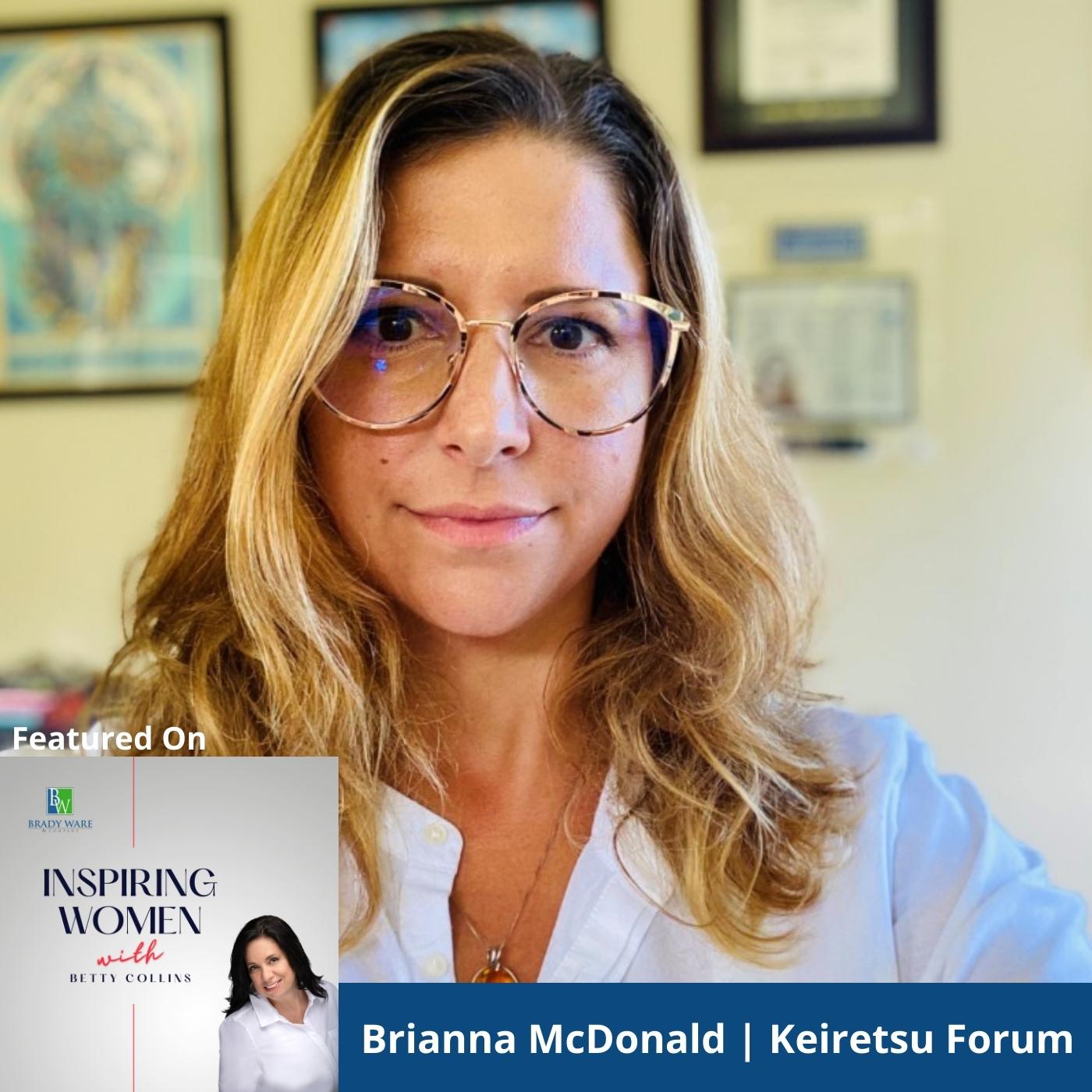
Brianna-McDonald-Keiretsu-Forum
Inspiring Women PodCast with Betty Collins
Angel Investors – An Interview with Brianna McDonald, Keiretsu Forum
Loading
00:00 /
RSS Feed
Share
Link
Embed

Download file

Brianna-McDonald-Keiretsu-Forum

Angel Investors – An Interview with Brianna McDonald, Keiretsu Forum (Inspiring Women, Episode 38)

It’s time for more women to become angel investors. That’s the message from Brianna McDonald of the Keiretsu Forum, one she offers in this interview with Betty Collins. Brianna discusses why the time is right for women to make angel investments, how to find angel investment groups, the importance of doing your research, diversification, and much more. Inspiring Women is presented by Brady Ware & Company.

Betty’s Show Notes

I have an amazing guest who is a top female investor. She offers a way to get started in angel investing and diversify your portfolio.

This is a smart way you can also help women.

Startups and entrepreneurs struggle. Because they lack capital a lot of the times.

They may have a lack of sense of how to run a business. But they have this passionate idea that they really want to get out there. And so capital is a huge issue.

An angel investor is someone who provides funding for small startups or entrepreneurs. The funding can be any amount, really, and sometimes the angels will get an ownership stake in the company for their investment, while other times there will be an agreement drawn up for getting your money back — plus profits — once the company gets off the ground.

You may sometimes hear angel investors referred to as “private investors,” “seed investors,” or “angel funders,” but one thing is clear — no matter what you call them, angels can make a huge difference in the life of an entrepreneur, and they can also make some serious money in the process.

With me on this episode is Brianna McDonald. She is the President of the Northwest Region of the Keiretsu Forum angel investment community, the largest and most active venture investor globally, comprising over 50 chapters with over 3,000 active members investing over $450 million annually into over 600 companies.

She’s an active leader and angel investor with Keiretsu Forum and has been a part of the organization since it launched in Seattle in 2005 and supporting its growth to become the largest and most active group globally.

She’s proven over time to be adept at screening companies for angel investment, coaching companies on presentation and investor relations, sales strategy execution, relationship management, and leading due diligence teams.

Listen in as Brianna McDonald gives us all a crash course in what angel investing really is, and breaks down how angel investing differs from crowdfunding and venture capital.

Brianna talks about how angel investors can find successful rates of return, and why now is a great time for women to consider becoming angel investors. Brianna also walks us through how she got started investing, how to find angel investing groups around the country and the importance of doing your research.

She offers up 7 tips.

  1. Is this something you want to do?
  2. Find female support
  3. Sit in on meetings (a great question to ask – rather than “how are things going?”, ask “what challenges are they going through?”)
  4. Pick the brains of the experts
  5. Find something that is interesting to you
  6. Stay active with the investment
  7. Reach your financial goals

This is THE podcast that advances women toward economic, social and political achievement. Hosted by Betty Collins, CPA, and Director at Brady Ware and Company. Betty also serves as the Committee Chair for Empowering Women, and Director of the Brady Ware Women Initiative. Each episode is presented by Brady Ware and Company, committed to empowering women to go their distance in the workplace and at home.

For more information, go to the Resources page at Brady Ware and Company.

Remember to follow this podcast on Apple Podcasts and Google Podcasts.  And forward our podcast along to other Inspiring Women in your life.

TRANSCRIPT

[00:00:00] Betty Collins
So, today, I want to talk about angel investing, and hopefully, you can learn how to be an angel investor or even use one. Hopefully, this will intrigue your attention. I have an amazing guest who is a top female investor, and offers a way to get started in angel investing, and diversify that portfolio. What a great thing to do. You should always be doing that, but this is a way you can also help women. So, startups and entrepreneurs struggle, not because of they have an idea or a passion, but it’s because they lack capital a lot of the times.

[00:00:38] Betty Collins
And there is that they have, maybe, a lack of sense of how to run a business, but they have this passionate idea that they really want to get out there. And so, capital is a huge issue, and you’ve got to get the right capital, though. I’ve heard plenty of people start businesses with credit cards, do not do that. You will never win, you will never get ahead. Or they get too much capital, or they don’t have enough, and they run out quickly. It’s all over the place. So, that’s why I like the angel investing, because they can help and guide you in a different way that maybe a bank can’t, or a private equity.

[00:01:14] Betty Collins
But you can get that right capital, and then diversify your portfolio by being an angel investor. So, startups and entrepreneurs, they struggle, but not because of a great idea or passion, but really it’s the lack of capital most of the time, and maybe some entrepreneurship skills. So, you got to get the right capital, and then you’ve got to get partners with you who can help you know how to navigate through your times. So, you could also be the capital, and get the capital, be the capital. And if you if you get to do that, you could diversify your portfolio.

[00:01:49] Betty Collins
So, what is it? Well, the dictionary says, an angel investor; it’s a private investor, maybe a seed investor, maybe that high-net worth person who’s providing financial backing. Sometimes we think of them as family and friends that come in, you always want to do that, for sure. But the funds that those angel investors provide is probably a one-time investment to help that business get off the ground, depends on how it goes. Or maybe it’s an injection to support and carry the company through it’s difficult, early stages. Or maybe you’re five, and you’re going to go to the next level, and it’s going to be some tough doing.

[00:02:30] Betty Collins
So, you know me if you’ve listen to my podcast, I’m passionate about the marketplace and its success, especially for women. Women are dominating the marketplace, but they don’t go as far faster. They have a longer uphill battle, sometimes. And I see women in business all the time struggle. It holds them back, and it slows down their progress when they don’t have that capital, or their frustration, and they can’t give any more, mentally and everything. I hate seeing that. And angel investing can be a way to solve that, whether starting up or investing, you can play a role in it. My guest today is Brianna McDonald.

[00:03:09] Betty Collins
She’s coming with this amazing experience, with an amazing company, and she has an amazing role in it. Their mission is very simple, I’m going to let her talk about what some of that is, but it’s to fund companies, and provide excellent investment opportunities for their members. And she’s going to talk a little bit about overview of investing, what it means to be an angel investor, or her experience as a woman investor in a very male-dominated industry. And then she’s going to drill down the seven tips. That’s something the accountants love, the steps, the numbers, seven tips.

[00:03:45] Betty Collins
So, I’m going to let her talk a little bit about her company, and introduce herself in that way. And then I want her just to really talk a little bit about her, not necessarily what we do. So, welcome, Brianna, to my podcast. Tell us about what you do, and your company.

[00:04:02] Brianna McDonald
Well, thank you so much, Betty, for having me on today to talk a little bit more about this topic. I’m super passionate about it. I’m currently the president for Keiretsu Forum, Northwestern Rockies region. I have been in this role now, four years, but I’ve been a part of the organization for 15 years. So, I participated a lot as an investor, as a member, learning, doing that for many years prior to stepping into the role that I’m in today. But where I really come from is a long line of entrepreneurs. My father had his own business, his father had his own business.

[00:04:41] Brianna McDonald
And I didn’t really realize that at the time, because in the ’90s you just didn’t talk a lot about entrepreneurship. It just wasn’t a word you heard very often. And I went into business for myself, I began selling real estate after I finished college, and worked with executive relocation, with Microsoft and all their Aqua hires that they were bringing on, and had a very successful business doing that, and thoroughly enjoyed it. I love to work hard and play hard. And my husband started Keiretsu Forum in Seattle in 2005.

[00:05:18] Brianna McDonald
And, essentially, when he started it here, we were the eighth chapter, we are, so we have the Northwest and the Rockies region. There’s over, now, 55 chapters globally, on four continents, and over 3000 investors in our network, which is really amazing, the work that everybody does. But when he started it here, we were number eight, and he said, “Come, come to a meeting.” And I was like, “Why would I go to this meeting? I’m busy. I’m busy doing other stuff.” And he’s like, “No, no, no, you’d be great. Come come to the meeting, come sit down.” And I was like, “Alright, fine.”

[00:05:52] Brianna McDonald
So, I wanted to be a supportive partner, and so, I went to the meeting, and I was 26 years old, and I sat at the table with a bunch of gray-haired men. And I listened to the company’s speech, and I thought, “What on earth am I doing here?” And I was trying to figure it out, and so, I am nice and friendly, I’m n the real estate business, I can just start- I’m personable, and can talk to people. And the first company goes, and I’m like, “What is this product, and what is this market, and what is your price point, and how do you make money? And I’m like, “Gosh, I don’t belong here.”

[00:06:34] Brianna McDonald
This is my internal thought process going on. All of us women, we have this internal critic that goes, “You don’t belong here. Why are you here?” So, I’m writing these questions down, but then these men started going, “Well, how do you make money, and what is your product, and what do you do?” And I’m like, “Oh, well, maybe I might be on to something.” And then the next company went, the next company went, and I sat and I listened, and it was really fascinating being part of it. And so, when the next meeting came up, I was like, “Hey, can I come to that meeting again? Can I come? That was interesting. I learned some things, and there were some cool people there, and I liked it.”

[00:07:15] Brianna McDonald
And Ethan was like, “Sure come along.” And it took me about a year. So, I sat and actually observed for a year, and I didn’t ask a single question in the room. Just being so young, and being the only woman at the table, I didn’t really feel like I fit. And one day, I finally mustered up the courage to ask a question. And the adrenaline was rushing, I was nervous, and it was just this tiny, little question, I don’t even know what it was. But what I do remember is, one of our investor members, who is still a member today, after I asked the question, leaned over to me and said, “That was a good question.”

[00:07:54] Brianna McDonald
And that was all the reinforcement that I needed to know, I was in the right place. I actually deserved to sit at this table, and I had something of value to bring. And over the course of my many years of being in this industry, and really being one of few women who participate, and really working to bring more women in, is that women are highly beneficial here. They understand markets, they understand pricing, we do most of the shopping. There is a lot of things that come into play with women, and how businesses get up and off the ground, how you pick your target market, how you pick your customers.

[00:08:34] Brianna McDonald
All of this is really important. We just think differently about it than men do. And it’s that togetherness that makes it really work. So, it took me over a year, and I wrote my first check in a company. I did receive a return, I can talk about that later, but I had some lessons I learned along the way of engagement and things. And so, even though I’ve been in this industry 15 years, the thing I love about it is, I’m still learning. You don’t know everything. And being able to be in an organization like Keiretsu Forum, we lean on each other. We don’t have to be experts in everything. We work together, the men and the women. But we need more women coming in.

[00:09:15] Betty Collins
And I think if there were more women coming in, there would be- it’s just a different perspective at the table. I know in Brady Ware, when I came there, there was about between 22 and 25 partners. And I came in, there were two of us there. And the discussion is different in the room, now that we have seven there. And it’s not because we’re maybe smarter, maybe we are, or it’s not because we’re better, maybe we are, we just think differently. And as women dominate starting businesses and getting them up, I know you see this every day, they get to a point, and men are going right past them because they have different skill sets, maybe, I don’t know.

[00:09:58] Betty Collins
Some of it is the type of businesses women go in, it’s hard to get lending. It’s hard to get that capital from a traditional bank, even private equity. So, I love your passion behind it because that’s what’s got to be there. And the marketplace is crucial in this country. If we don’t have the marketplace, it means employers don’t pay employees, and employees are families, and households, and communities. And when the US doesn’t work, the world doesn’t work. So, entrepreneurship has to work.

[00:10:31] Betty Collins
And this is just a way I wish more women who have had their success, they don’t have to have multimillion-dollar success, but when they have their success, they become that angel investor, and say, “I’m going to give someone a chance, because I’ve been there, I’ve done that.” So, obviously, you talked about your ‘why’, behind the passion behind that. Do you find yourself more attracted to the women-owned businesses that you’re hearing, or does it matter? It’s entrepreneurship, and business is business. Is there a difference for you?

[00:11:05] Brianna McDonald
So, every investor has their own investment thesis, and it’s really developed over time. It’s what moves you. And so, if any woman is thinking about getting into this space, I really encourage them to listen, to learn and to figure out what that is for them. For me, it’s team. And I need a good team. Now, team does not necessarily mean, for me, in my investment thesis, that it needs to be a female CEO, but the team better be diverse. I want to see diversity, and not just between men and women.

[00:11:38] Brianna McDonald
I want to see diversity across the board, across ethnicity, because that is going to be where the differences are made in terms of thoughts and opinions, and how they come together, and how that team culture works. Because at the end of the day, you can have the greatest product in the world with the best market, and if you have a team that fails to execute, the investment still goes to zero. That said, I’ve invested in some amazing women that lead teams, but I didn’t invest in them because they were a woman, I invested in them because they were awesome.

[00:12:12] Betty Collins
And as much as I am pro-business, pro-entrepreneurship, pro-woman for sure, it’s got to be the right mix. Everything, from the product to the execution. It can’t just be this passion idea, it has to all work together. Let me just follow up with one last question with what we’re discussing, and that is, would you commit as an angel investor, and you come in at 10 percent, or you come in at 50 percent depends on how much money you give, it depends on once you’re there. What generally happens? Is it more, you write the check and you wait and see, or is it, “No, we’re really hearing, we’re there, we’re on the ground, and we get to play a role.”? Because I think people think, “I’m writing a check and I’m done.”

[00:13:04] Brianna McDonald
So, I think that is something that is a big misconception about- if you want to be a passive investor, and you want to invest in early- stage companies, I would really recommend a fund vehicle, if that’s the direction you want to go. Because you’ll be able to diversify, and you’ll be able to take that passive role in what you’re doing. For me, what I love is, I love being engaged. I’m advisors to the businesses I invest in. I call them up, I text them, I ask them how things are going. And I usually ask them what challenges they’re having, because if I ask them how things are going, they’ll always tell me it’s great.

[00:13:40] Brianna McDonald
So, I’m like, “Hey, what challenges have you had the last month, and what can I do to support you in those challenges?” If you stop hearing from companies, that’s typically when things have gone south, and when the communication stops, and that’s when you need to reach out. And so, that was one of the big lessons I learned early on, was that the more you communicate, the more you understand, with what’s going on with your private investments, the better and safer you’re going to be. Lines of communication are super important, and I feel like, especially over the last five years, culturally, through the busyness, through all of the things that have gone on in our world, we just don’t communicate like we used to.

[00:14:18] Brianna McDonald
And we really should, we’re here to help and support one another. And when you get a private investor’s money, you also get their expertise. We’re here to help you figure out those problems. We’re alongside of you, we’re bought into you, we believe in you, let’s do this together. Let’s push forward innovation, and make the world a better place.

[00:14:43] Betty Collins
And I like how you talk about the advisory role. Because when I talk about small businesses having that hard time or they need capital, and they think everything’s about capital and lack of it, sometimes it’s just really, you’ve had bad advisors or lack of advising. So, when you, maybe, tap into an angel investor, or you become the angel investor, you have a role to play in that; of advising, and not controlling, but advising. Those are two different things.

[00:15:19] Brianna McDonald
Yeah, definitely not- it’s up to the CEO to make decisions. But knowing that you care, and that you’re engaged is good. It’s, definitely, also- through the due diligence process, we can get into that too, here, but through the due diligence process, prior to writing a check, you really get to know who that person is, how they operate, how they respond. And through that process, you’ll begin to understand what the rules of engagement are for you, as you go forward with that investment, if you choose to make that investment choice.

[00:15:54] Betty Collins
And I definitely want to get into the- let’s get to the seven tips, because now I have my steps, I have my tips, I love all that. I just went on a sales call with a company who just went through a purchase. And, boy, I wish they would have had advisors helping them get through the whole thing. And so, I took one of my senior people with me, and they said, “What are we going to do today?” I said, “We’re going to listen, we’re going to ask them who they are, and how many kids you have, and where do you like to travel, and we’re going to learn why they wanted to buy the business.” That’s a huge factor, I don’t think you can underestimate, especially when you’ve been in the marketplace and entrepreneurs for 20, 30 years, you have a lot to give to someone. But let’s get to the seven tips, let’s talk about that.

[00:16:43] Brianna McDonald
Well, so the first tip I have, tip number one, is getting started. So, the first thing you need to do is really think like, “Hey, is this something I really want to do?” And you have to start. If you don’t ever start, and take that first step, and that first leap, you’re not going to do anything with it. So, it is just something you’re interested in exploring, there’s lots of different investment groups. I would really encourage any woman who was thinking about doing this, to get involved in a group, so you don’t have to go into alone.

[00:17:15] Brianna McDonald
You can really lean on other people in the group, and the groups in your region all have different investment theses. So, it gives you some time to do some research, and as you sit in, and usually, if you just want to come sit in on a meeting or two, they’ll let you do that. They’ll let you come in, and try it on, and see. One thing, I just got off of a call today with a woman who was interested in becoming a member of my organization, and she’s like, “Well, I need to go fill out the accreditation form for the SEC.”

[00:17:46] Brianna McDonald
There is no accreditation application for the SEC. It is just, these are guidelines that are put in place by the Securities Exchange to make sure that you are qualified to lose money, because this is risky business and and that could happen. So, typically, you make more than $250,000 per year salary if you’re single, $300,000 if you’re married, or you have more than a million in assets. Last year, they expanded that out a bit to be able to include different areas of study. So, if you got your degree in biology, and you want to go invest in a biology company, you should know enough, that if you make a decision there, if you’re gonna lose your money or not.

[00:18:34] Brianna McDonald
So, they did expand that out a bit, so if you’re interested in looking into that, there is some information there. But go online, look at your regional groups, your local groups, they tend to invest locally. My organization’s a little bit different, we invested a little bit later- stage companies, not super-early. There’s more due diligence, and we are global. And so, wework together. So, we have our regional deal flow in our regions we work in, but we also work collectively with the other chapters, especially in North America, but across the world as well.

[00:19:07] Brianna McDonald
So, do your research, is the first step. The next one is tip number two, is find female support. Super, super important. Even reach out on LinkedIn, I have women reach out to me on LinkedIn, and they’re like, “Hey, I see we have similar backgrounds. Can we just have a call?” I love that. I will take those calls. I don’t usually take a lot of cool things off of LinkedIn, but if there’s women out there looking to get into angel investing, they want to chat with me, I’m always more than happy to do so. So, for any of the women who are listening in right now, and please don’t all bombard me at once, but reach out, I’m happy to.

[00:19:50] Brianna McDonald
Or find someone in your area, and they’ll share their experiences with you, and the things that they’ve learned, and how they got into it. But having a seat at this table is important, because we are driving forward innovation, and when things are cloudy and uncertain, that is the time when you actually have the greatest ability to make a lot of money, because you’re betting on the uncertainty. So, not everything- certainly, it’s a little uncomfortable for us ladies, sometimes. We like to be very pragmatic in our approach, and be very thoughtful about how we do things, which is also why I like investing in women entrepreneurs.

[00:20:31] Brianna McDonald
So, once you target those groups, reach out to them, talk to them, do some diligence on those groups, talk to some of the members, sit in on the meetings to see how they ask the questions. Are they nice? Are they kind? Are they mean? Is this a group that you want to be a part of? Do you find them engaging? And even online, it’s really opened up a whole new world of us being able to sit in on lots of different types of meetings. So, that’s been one silver lining of COVID. We had to pivot our entire business from in-person to to virtual, which was difficult last year, but I feel like we did it pretty well, and we’re able to- and we’ve created different programs to allow people to be heard.

[00:21:17] Betty Collins
Talk about- I had more people reach out to me this year to be on my podcast, because we don’t think about, “I got to go somewhere in Columbus. I could have a West Coast interview or an East Coast.” It’s been an amazing thing. And this is a great- I’m glad to hear you say that. It didn’t sound like it was maybe a hard pivot, you just had to pivot. You just had to do it, right?

[00:21:42] Brianna McDonald
Well, and we had to make sure it worked, because we are very professional organization, and the things that we do, and the steps, and the process. So, trying to recreate that was not easy, but anything that is worthwhile in this life shouldn’t be easy. But I feel like we’ve done a really good job keeping the professionalism, keeping it running on time, respecting people’s time, and respecting our processes, and how they all work. So, as you sit in on the meetings, my fourth tip is, to really pick the brains of the experts.

[00:22:18] Brianna McDonald
So, even if you’re on Zoom on a meeting, and you hear someone ask a really thoughtful question, message them say, “Hey, I really like that question, what’s your background? And I’m thinking about getting into angel investing, and I’d love to know a little bit more. Maybe we can have a quick call.” There’s so much we can learn from other people’s backgrounds and experiences. We do not need to be the experts in everything. And I firmly believe that in a collective-working together, and this is why a group is so important, being able to do that. Our members throughout Keiretsu Forum in our meetings message each other all the time, throughout the meetings, and they have private chats going, and things like that.

[00:23:01] Brianna McDonald
It’s our way to connect with one another, and talk about the deals that we’re seeing. My big one is, find something that’s interesting to you. And this comes back to the investment thesis that I mentioned earlier; what really perks your interest? I firmly believe in being able to diversify your portfolio. I do not believe in putting all of your eggs in one basket. So, at Keiretsu Forum, we look at a wide array of opportunities. We look at biotech, we look at technology, we look at medtech and medical devices. We look at consumer goods.

[00:23:35] Brianna McDonald
We even look at real estate, and being able to have a wide range of items in your portfolio is really important, because they offset the others in terms of the risk profile, and when you’re going to be able to see that return. Now, what works for you? And, really, figuring that out. And it’s not something you’re going to have the answers to overnight. It’s going to just take time, and sitting and learning.
Six, we already covered this, Betty, is staying active. So, if you do run through the diligence and choose to invest, staying active with that investment. Communicating with the CEO, even if you reach out every couple of months, just say, “Hey, how’s it going? What challenges do you have today?”

[00:24:19] Brianna McDonald
That should be a tip that we take, that’s a good question to start with; “What challenges do they have this month?” Because they will always tell you everything’s great, and when you approach it that way, it’s a little bit disarming. And then the final one is to be able to reach your financial goals. And there’s a lot of opportunity here. If you do the research right, if you mix up with the right groups that are good fit for you, and are thoughtful about how you go about diversifying, and even taking off, carving off 10 percent of your portfolio to these higher-risk investments, you can really do a lot of well and good, at the same time.

[00:25:03] Betty Collins
I like that. [CROSSTALK]. Well and good at the same time, I love that, because there’s nothing wrong with, “Here’s $100,000, and I want it back, and I’d like to get, actually, more than $100,000 back.” At the same time, probably, you’re injecting some energy in someone that needs it. And it’s all good. I was fortunate to be on a Shark Tank type of thing, I was a judge. And it was five young women who- and they had criteria to be there, so they weren’t completely startups. I was never so energized to do it. It was the fun, it was great. Now it’s an annual event, and I love doing it so. But I’d love for you to tell us a success story. End with a success story, and maybe then, we’ll talk about one take-away, because I would love to hear just where [INAUDIBLE] went so well.

[00:25:54] Brianna McDonald
Well, so, I will tell you, we’ve had a lot of success in life sciences. And life sciences is something that has been, it’s not easy to understand, and definitely having some good experts in the room for you to learn from is good. My first due diligence medtech device, I’ll never forget calling up one of my members who runs a medical device, he builds medical devices. And I was like, “Okay, they’re contract manufacturing in China, what are the 10 questions I need to ask, and what are the answers that I need to receive, if this is a good deal or not. So, being able to look at that, and see, and looking at the FDA process, it’s complicated, and it’s high risk, but it’s super rewarding.

[00:26:41] Brianna McDonald
We invested in the company Immunotherapeutics, and they worked on a vaccine for red cedar allergy in Japan. So, I guess the US went there during World War II, and they planted a whole bunch of red cedar trees, and it turns out Japanese are very allergic to red cedar, and it’s debilitating allergy. But they’ve also been able to work as a drug platforms, so they’ve been able to work in the multiple different allergies. And after a couple of years, they received $500 million purchase order. And we received our first return from that. And they didn’t divest us, they just gave us the return from that purchase order.

[00:27:25] Brianna McDonald
And then we kept our stock, and we got a second exit again last year, if we wanted it. There are opportunities, even with my first company, with my first investment, that I was able to get a 2X return out of, which isn’t awesome. It was a food company, and I probably would be more cautious investing in a food company again, lessons learned along the way. Because I do include some of the things that I have learned to be just as much success as the capital I received back. So, looking at food deals is hard; there’s a lot of competition, there’s a lot of things that go into the space.

[00:28:05] Brianna McDonald
I also thought it was going to be the most amazing thing in the world, and I put my my money in, and walked away, like what you talked about the beginning, Betty, and didn’t stay in touch. And they had an opportunity to exit in 2010, and if they would have done that, it would have been great. But they didn’t. And so, Idid receive a return later, that I was able to roll up into another investment that I’m super excited about. But there was lots of really good lessons along the way. And just as long as I’m not losing money, I consider it a win. And then my final company is the company, it’s called Vita Inclinata.

[00:28:43] Brianna McDonald
I’m an advisor, I’ve been an advisor for over three years now to this company. I invested at $8 million, they’re just closing $150 million-dollar round right now. And so, being able to be a part of that effort as they continue to grow, as they deal with their challenges, have a really good relationship with the CEO, it’s been so great to watch their success. You got Forbes 30 under 30 two years ago. It’s been so fun to watch them create this device that it just didn’t follow a formula for me, and that’s what made it exciting. It’s a system for helicopters, it’s a load stabilization system for helicopters.

[00:29:28] Brianna McDonald
I know diddly-squat about that, but I do know a lot about people, and about safety, and about our markets, and selling into that. So, pulling that expertise out, I know go-to market strategy has been really helpful. But they’ve been able to close some big military contracts, and really accelerate growth. So, I have a wide range of things that I invest in, but it’s exciting to be a part of. And then my last, my takeaway would be, if you are interested in learning, one, you can always come, reach out to me on LinkedIn, or you can go to my website, k4northwest.com.

[00:30:07] Brianna McDonald
You’re always welcome to come in, and sit in as a guest at one of my forum meetings. I do six per month, and you can see what goes on there. But if you are interested in learning more about angel investing, just go sit and learn. Just go join a group and learn for a year. We spend lots and lots of money on education, and it’s okay to spend this on your financial education, and be able to do that, and learn from others. And if it’s something that suits you after a year, then maybe think about writing a check. But there’s so much to learn.

[00:30:39] Betty Collins
And as you said from the beginning, tip one is, just get started. Just get going, do something, especially if it intrigued you. So, I would tell my audience today, if you want to get into angel investing, you’ve got your person. Or if you want to be, “Hey, I need an angel investor,” you probably got your person. So, I so appreciate you being here today. You just have been- I could talk to you for another hour, honestly. But I know your time is valuable, and, of course, you’re on the West Coast, and I’m in the Midwest, and I’ve never been, actually, to Oregon or Seattle, or let’s see, you’re in Idaho as well?

[00:31:20] Brianna McDonald
I’m in Seattle, yes, though I’m based in Seattle. Our region is Vancouver, B.C., Washington State, Oregon, Idaho, Montana, Utah, Colorado and New Mexico.

[00:31:33] Betty Collins
I’ve been to Montana, and I’ve done the whole California thing. I just needed to expand a little bit more, but it was great just having you on today. So, audience, if you want to be an angel investor, or you need an angel investor, don’t rule it out. Challenge yourself, and maybe get out there and get started, like we talked about today.

[00:31:53] Betty Collins
So, I’m Betty Collins, and so glad you joined me. Inspiring women, it’s what I do. And I’m going to leave you with this; being strong speaks of strength, but being courageous speaks to having a will to do more and overcome.

Automated transcription by Sonix www.sonix.ai

Betty CollinsIW8-2021square is the Office Lead for Brady Ware’s Columbus office and a Shareholder in the firm. Betty joined Brady Ware & Company in 2012 through a merger with Nipps, Brown, Collins & Associates. She started her career in public accounting in 1988.
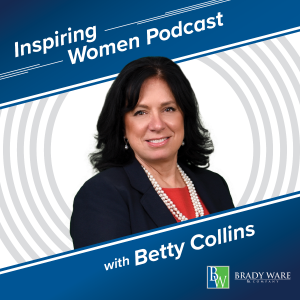
Betty is co-leader of the Long Term Care service team, which helps providers of services to Individuals with Intellectual and Developmental Disabilities and nursing centers establish effective operational models that also maximize available funding. She consults with other small businesses, helping them prosper with advice on general operations management, cash flow optimization, and tax minimization strategies.

In addition, Betty serves on the Board of Directors for Brady Ware and Company. She leads Brady Ware’s Women’s Initiative, a program designed to empower female employees, allowing them to tap into unique resources and unleash their full potential.  Betty helps her colleagues create a work/life balance while inspiring them to set and reach personal and professional goals.

The Women’s Initiative promotes women-to-women business relationships for clients and holds an annual conference that supports women business owners, women leaders, and other women who want to succeed. Betty actively participates in women-oriented conferences through speaking engagements and board activity.

Betty is a member of the National Association of Women Business Owners (NAWBO) and she is the President-elect for the Columbus Chapter. Brady Ware also partners with the Women’s Small Business Accelerator (WSBA), an organization designed to help female business owners develop and implement a strong business strategy through education and mentorship, and Betty participates in their mentor match program.

She is passionate about WSBA because she believes in their acceleration program and matching women with the right advisors to help them achieve their business ownership goals. Betty supports the WSBA and NAWBO because these organizations deliver resources that help other women-owned and managed businesses thrive.

Betty is a graduate of Mount Vernon Nazarene College, a member of the American Institute of Certified Public Accountants, and a member of the Ohio Society of Certified Public Accountants. Betty is also the Board Chairwoman for the Gahanna Area Chamber of Commerce, and she serves on the Board of the Community Improvement Corporation of Gahanna as Treasurer.

Inspiring Women Podcast Series

This is THE podcast that advances women toward economic, social and political achievement. The show is hosted by Betty Collins, CPA; Betty is a Director at Brady Ware & Company. Betty also serves as the Committee Chair for Empowering Women, and Director of the Brady Ware Women Initiative. Each episode is presented by Brady Ware & Company, committed to empowering women to go their distance in the workplace and at home. For more information, go to the Resources page at Brady Ware & Company.

Remember to follow this podcast on Apple Podcasts and Google Podcasts. And forward our podcast along to other Inspiring Women in your life.

The complete Inspiring Women show archive can be found here.
Tagged With: Angel Investing, angel investment, Betty Collins, Brady Ware, Brianna McDonald, Inspiring Women podcast, Inspiring Women with Betty Collins, Keiretsu Forum

Decision Vision Episode 141: Should I Hire a Copywriter? – An Interview with Maria Constantine, Mindmaven

November 4, 2021 by John Ray

Copywriter
Decision Vision
Decision Vision Episode 141: Should I Hire a Copywriter? - An Interview with Maria Constantine, Mindmaven
Loading
00:00 /
RSS Feed
Share
Link
Embed

Download file

Copywriter

Decision Vision Episode 141:  Should I Hire a Copywriter? – An Interview with Maria Constantine, Mindmaven

Knowing how a copywriter can help you, Maria Constantine notes, is the first step in deciding whether to hire one or not.  Copywriters make business communications easier, more effective, and build relationships through the emails and marketing pieces they write. Maria discussed with host Mike Blake how a copywriter enhances a brand presence, how they write in a client’s “voice,” how hiring one frees up the client’s time, when to hire a copywriter with a particular expertise, how to know whether they’re good at what they do, and much more.  Decision Vision is presented by Brady Ware & Company.

Mindmaven

Mindmaven is an executive coaching firm that’s spent the last 12+ years working with 100’s of leaders at companies like Reddit, Thumbtack, and Roblox, as well as heavy hitters in the tech startup world such as Sequoia Capital, Andreessen Horowitz, Benchmark, and First Round Capital.

Mindmaven helps leaders drive greatness by unleashing three key executive superpowers: Leverage, Intent, and Fellowship. With Leverage, you’ll free up 8-10 hours of your time each week by fundamentally changing how you work with your EA/Chief of Staff. With Intent, you can become more proactive and highly focused on growth, mastery, and the things that matter most. With Fellowship, you’ll learn how to build an irrationally loyal following of people (both within your company and greater network).

Company website | Twitter

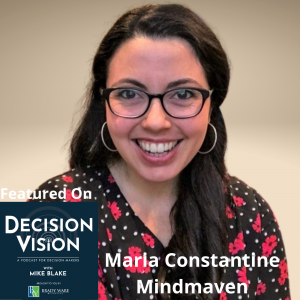
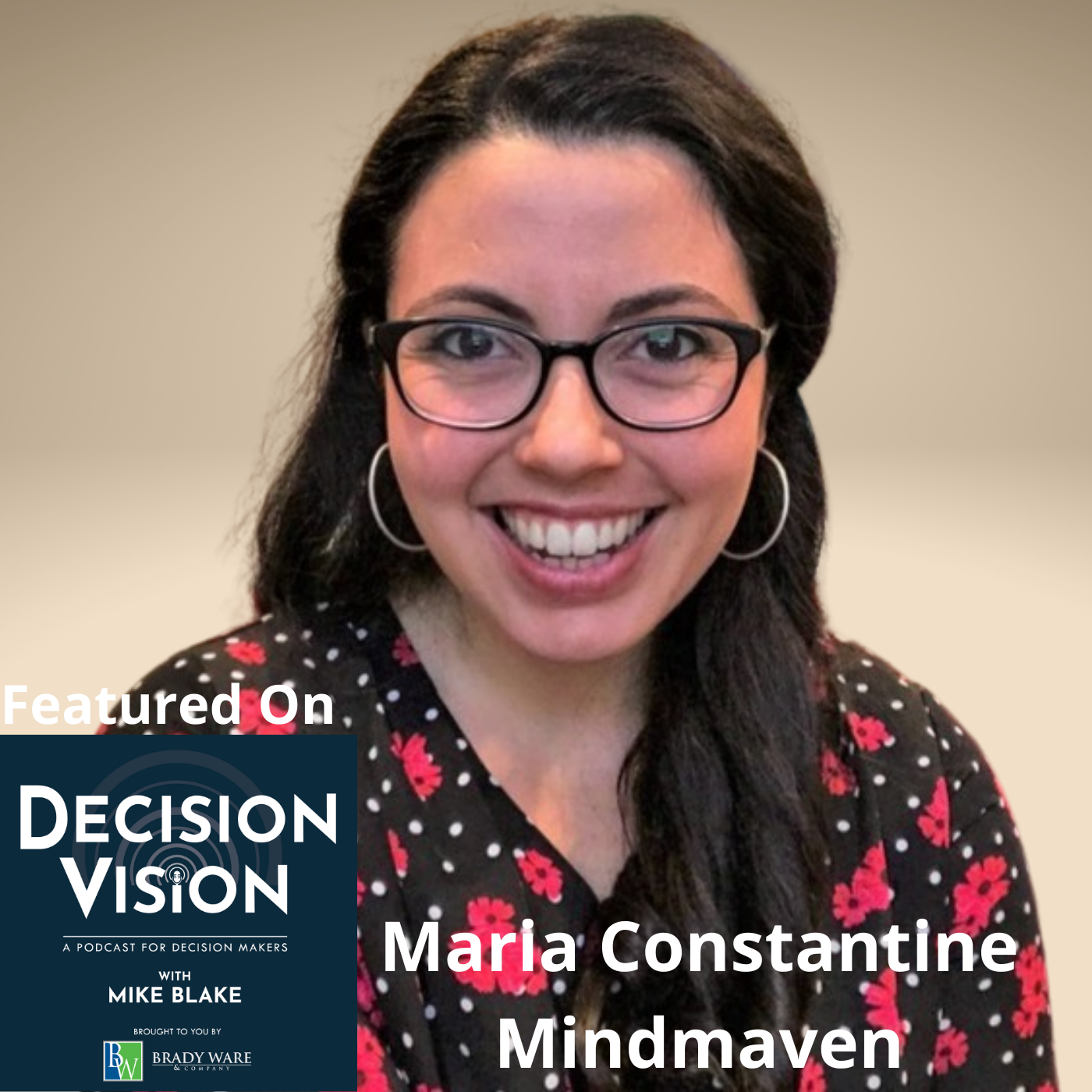
Maria Constantine, Head of Educational Partnerships & Programs, Mindmaven

Maria Constantine, Head of Educational Partnerships & Programs, Mindmaven

Maria Constantine is an educator turned marketing generalist with a background in ed tech, entrepreneurship, and copywriting. As the Head of Educational Partnerships & Programs for Mindmaven, Maria partners with CEO peer groups and organizations to host educational workshops on how to free up 8+ hours/week—through reimagining the role of an EA—and how to become a leader people are proud to follow.

LinkedIn


Mike Blake, Brady Ware & Company

Mike Blake, Host of the “Decision Vision” podcast series

Michael Blake is the host of the Decision Vision podcast series and a Director of Brady Ware & Company. Mike specializes in the valuation of intellectual property-driven firms, such as software firms, aerospace firms, and professional services firms, most frequently in the capacity as a transaction advisor, helping clients obtain great outcomes from complex transaction opportunities. He is also a specialist in the appraisal of intellectual properties as stand-alone assets, such as software, trade secrets, and patents.

Mike has been a full-time business appraiser for 13 years with public accounting firms, boutique business appraisal firms, and an owner of his own firm. Prior to that, he spent 8 years in venture capital and investment banking, including transactions in the U.S., Israel, Russia, Ukraine, and Belarus.

LinkedIn | Facebook | Twitter | Instagram

Brady Ware & Company

Brady Ware & Company is a regional full-service accounting and advisory firm which helps businesses and entrepreneurs make visions a reality. Brady Ware services clients nationally from its offices in Alpharetta, GA; Columbus and Dayton, OH; and Richmond, IN. The firm is growth-minded, committed to the regions in which they operate, and most importantly, they make significant investments in their people and service offerings to meet the changing financial needs of those they are privileged to serve. The firm is dedicated to providing results that make a difference for its clients.

Decision Vision Podcast Series

Decision Vision is a podcast covering topics and issues facing small business owners and connecting them with solutions from leading experts. This series is presented by Brady Ware & Company. If you are a decision-maker for a small business, we’d love to hear from you. Contact us at decisionvision@bradyware.com and make sure to listen to every Thursday to the Decision Vision podcast.

Past episodes of Decision Vision can be found at decisionvisionpodcast.com. Decision Vision is produced and broadcast by the North Fulton studio of Business RadioX®.

Connect with Brady Ware & Company:

Website | LinkedIn | Facebook | Twitter | Instagram

TRANSCRIPT

Intro: [00:00:01] Welcome to Decision Vision, a podcast series focusing on critical business decision. Brought to you by Brady Ware & Company. Brady Ware is a regional, full-service, accounting and advisory firm that helps businesses and entrepreneurs make visions a reality.

Mike Blake: [00:00:23] Welcome to Decision Vision, a podcast giving you, the listener, clear vision to make great decisions. In each episode, we discuss the process of decision making on a different topic from the business owners’ or executives’ perspective. We aren’t necessarily telling you what to do, but we can put you in a position to make an informed decision on your own and understand when you might need help along the way.

Mike Blake: [00:00:44] My name is Mike Blake, and I’m your host for today’s program. I’m a director at Brady Ware & Company, a full-service accounting firm based in Dayton, Ohio, with offices in Dayton; Columbus, Ohio; Richmond, Indiana; and Alpharetta, Georgia. My practice specializes in providing fact-based strategic and risk management advice to clients that are buying, selling, or growing the value of companies and intellectual property. Brady Ware is sponsoring this podcast, which is being recorded in Atlanta per social distancing protocols.

Mike Blake: [00:01:12] If you’d like to engage with me on social media with my Chart of the Day and other content, I’m on LinkedIn as myself and @unblakeable on Facebook, Twitter, Clubhouse, and Instagram. If you like this podcast, please subscribe on your favorite podcast aggregator and please consider leaving a review of the podcast as well.

Mike Blake: [00:01:31] Today’s topic is, Should I hire a copywriter? According to statistics published by Real Business – and I have no idea, by the way, how real Real Business is or not, but it sounds good. And it’s on the internet, so what could possibly go wrong? – 59 percent of people would actually avoid buying from a company who made obvious spelling or grammar mistakes in their copy. Which, I can understand. That sort of drives me crazy as well.

Mike Blake: [00:01:56] And I think many firms are faced with a decision as to whether or not they should hire a copywriter because writing has actually taken on a much greater level of importance. I think that it ever has in human history. And this is with all due respect to LinkedIn videos, and YouTube, and everything else, and videos out there, certainly, is an important platform.

Mike Blake: [00:02:25] But there’s so much written content out there and everybody now has connection and access to a global marketplace and a global audience that, you know, I’m old enough where I can remember my first emails were written on a digital emulated VT100 VAX terminal in the bottom of a computer science lab that I had to get special permission to use. And back then, email was pretty easy, right? Nobody is ever going to see it. We didn’t know yet that all caps meant that you were shouting at people. In fact, I think our terminal didn’t even have a caps button. Everything was all caps.

Mike Blake: [00:03:10] And, now, we’re in a world that has exploded where, whether we realize it or not, we’re writing all the time. We don’t do phone calls nearly as much as we do. We text. The only way I can communicate nowadays with my 19 year old son, I try to actually talk to him in a real conversation or have him pick up the phone. Forget it. He’s had a phone for five years. I don’t even think he’s set up his voicemail, so I know that that’s not a winning proposition. But if I send him a text, I’ll get something right back.

Mike Blake: [00:03:41] So, whether it’s texting, whether it’s social media, whether it’s newsletters – and we’ve had an episode not long ago about whether you should have a newsletter – writing is just so endemic now. And I think there’s some real questions as to whether we, as decision makers, should be writing as much as we are. Is it a good use of our time? Are we qualified to write on behalf of our companies our information ourselves?

Mike Blake: [00:04:14] And if you want to exhibit A as to the cautionary tale, look no further than the National Football League. We’re seeing ten-year-old emails that are being dug up, in really only tangentially related legal matter that have so far gotten a National Football League coach fired. And are now having Congress calling to potentially subpoena – I don’t know the legal grounds, I’m no lawyer – basically, years of emails involving the Washington Football Team.

Mike Blake: [00:04:45] And so, writing is just more important than I think, frankly, it’s ever been when you think about it. And because it’s so important, the question really boils down to, can we afford to to leave writing to amateurs like ourselves?

Mike Blake: [00:05:04] And joining us today to help us understand this question and talk about it is Maria Constantine, who’s head of Educational Partnerships and Programs for Mindmaven, and has also been a freelance copywriter for the past, nearly, seven years.

Mike Blake: [00:05:20] Maria is an educator turned marketing generalist with a background in educational technology, and entrepreneurship, and, of course, copywriting. Maria partners with chief executive officers, peer groups, and organizations to host educational workshops on how to free eight or more hours per week through reimagining the role of an executive assistant and how to become a leader people are proud to follow.

Mike Blake: [00:05:45] Mindmaven is an executive coaching firm that has spent the last 12 plus years working with hundreds of leaders at companies like Reddit, Thumbtack, and Roblox, as well as heavy hitters in the tech startup world such as Sequoia Capital, Andreessen Horowitz, Benchmark, and First Round Capital.

Mike Blake: [00:06:03] Mindmaven helps leaders drive greatness by unleashing three key executive superpowers: leverage, intent, and fellowship. With leverage, you’ll free up eight to ten hours of your time each week by fundamentally changing how you work with your chief of staff. With intent, you can become more proactive and highly focused on growth mastering the things that matter most. And with fellowship, you learn how to build an irrationally loyal following of people both within your company and greater network. Maria, welcome to the program.

Maria Constantine: [00:06:33] Thank you, Mike. It’s wonderful to be here.

Mike Blake: [00:06:36] So, let’s start off because it may not be obvious to everybody in the audience. What exactly is a copywriter? And what do people like you and your copywriting persona, what do you guys do?

Maria Constantine: [00:06:51] Yeah. The best way I can describe what a copywriter does is by giving you a little story. So, first of all, a copywriter, I would say, is to words, as a master painter is to paint. They can take the most basic, most regular, even most boring ideas and turn them into something that’s compelling, something that is a masterpiece.

Maria Constantine: [00:07:14] As I was thinking about this podcast, it’s really interesting, actually, just this week, I bought a bed frame from a company that I used a couple of years back, probably about six years ago now. And when I was looking for this bed frame that I just bought this week, I remembered this company from six years ago. Because when I ordered from them the first time, I got this welcome packet along with the bed frame. The bed frame was great, by the way.

Maria Constantine: [00:07:40] But what stuck out to me was the welcome packet, because the copywriter who created this welcome packet invited themselves into my life. They congratulated me on this piece that was turning a house into a home. They made me feel like they were a friend that knew me that was part of this journey with me. It was a little bit cheeky. There were some puns in there. I laughed. I took pictures of it and sent it to my friends.

Maria Constantine: [00:08:08] And this connection that I had with this person I’ll never meet and never know who wrote that is exactly why, six years later, when I was comparing models and I could go with the same company that I went with six years ago or a new company that had a cheaper bed frame – exactly the same, but cheaper – I went with the more expensive bed frame because I love these people. I feel like they’re part of my home buying journey. And that right there is the magic of a copywriter.

Mike Blake: [00:08:38] So, do copywriters only serve marketing needs? Or are there other needs that copywriters serve?

Maria Constantine: [00:08:45] That’s a great question. So, of course, typically they work in marketing but, especially in Mindmaven, we think about copywriting pretty uniquely. We have this role called an engagement manager, which is like an executive assistant, but upgraded, who works to support the office of the CEO, but also can work with a leadership team to actually increase how many opportunities come from the leadership’s network.

Maria Constantine: [00:09:16] So, if you think about it, every time you send an email, you’re building a relationship with someone, right? So, a copywriter can help actually craft that email for you – or with you, rather. We do something where we’ll have the executive dictate an email, so it’s still a genuine expression of what they’re doing, it’s still coming from them. But then, you have an engagement manager who often has some kind of copywriting experience come in and wordsmith that to really bring an extra level of intention and help the exact to really connect with people in a meaningful way. So, that’s another way that a copywriter can support a business.

Maria Constantine: [00:09:56] Also, copywriters can help sales teams. They can help you craft outreach emails or follow up emails. And even social media is under marketing, but it’s not. Sometimes there’s actually an overlap between customer service and social media. That was something I did in one of my jobs where my role was a social media manager. But a lot of times, I just spent a lot of time writing answers to customers. People would ask us questions, I would answer, but then also engage with them to, again, try to form that relationship with them. So, there’s a lot of different ways that a copywriter can support a business.

Mike Blake: [00:10:37] Yeah. You know, it occurred to me that we see, of course, the gaffe email that a company sends out. But I think the most damaging internal communications, not just emails, are ones that are internal because they don’t see the light of day, they aren’t intended to see the light of day. And, therefore, I wonder if sometimes the authors feel a little bit more careless about them. But that internal email or internal communication can be disastrous. It can be demoralizing. It can set you up for liability. It can undermine your brand. The wrong communication can send, like, five very valuable people over to indeed.com looking for their next job, right?

Maria Constantine: [00:11:35] Yeah. Absolutely.

Mike Blake: [00:11:38] And so, you know, it just gets back to at least my point – I want to pat myself in the back – it does go back to the point where we’re just writing so pervasive. And so pervasive, we don’t even think about it. And when you don’t think about it, that’s when you get killed.

Maria Constantine: [00:11:54] Yeah. Yeah. Absolutely. And actually this is the concept of good to great. That’s something that a lot of people are familiar with. One area where leaders can really shine is in their personal communications. When you send an email, you can be the person who sends two liners that are quick, short to the point, not a lot of fluff. Maybe as a follow up email to someone that you’ve met with, you want to just kind of quick grab the things that you both agreed on, you throw it into an email, you send that out.

Maria Constantine: [00:12:27] Or you can spend 30 extra seconds wordsmithing that with the support of a copywriter. And then, you leave this impact on the person you’ve met with where, again, it’s the relationship building. They’re going to feel like, “Wow. I really like this person. I’m walking away from this meeting feeling really good about this.” And a lot of that is because you took 30 extra seconds on the follow up email that you sent them.

Mike Blake: [00:12:55] So, what are some signs that a company could see that would lead them to the conversation or the question, “Hey, maybe you need to think about hiring a copywriter? What are the warning signs?”

Maria Constantine: [00:13:07] Yeah. I would say a big thing is, if your leadership team, if you are the CEO, or in the senior leadership team, and you spend more than 20 minutes wordsmithing one particular thing, I would say that is a sign that you should be hiring a copywriter. Because at the end of the day, that’s opportunity cost. As the leader of a company, you can outsource this, you can outsource copywriting. There are brilliant, talented people who do this. But there’s not a lot of people you can outsource the leadership of your company to. That is your role.

Maria Constantine: [00:13:43] And if your very valuable time is being taken up trying to figure out exactly what to say in an email or even on a newsletter or in a blog, those are things that you can do in a much more effective way while being supported by a copywriter. So, that’s a big thing.

Maria Constantine: [00:14:02] I would say, if you feel some hesitancy around this, I think it’s really common for leaders to feel like they have control over their messaging when they do the copywriting. If you are the one typing the words out, that gives you a sense of control over that, some ownership. And it feels good to have that. But if you feel yourself resisting, that you want to hold on to that for longer, that’s actually a sign. It’s probably time to let that go because that’s not your core objective as the leader.

Maria Constantine: [00:14:36] Again, there are so many other things that you can use your time for. And being able to bring in someone new is going to help you connect with your audience more, because you’re going to get some fresh perspective in there, you’re going to be able to pump out content in a much higher rate. And it’s just going to be better for you to be able to have that support to do so many more things that are really going to push the needle forward.

Mike Blake: [00:15:01] Now, of course, the name of the game with marketing is engagement. It’s one thing to write something. It’s another thing to have somebody actually care about what you wrote and read it. How can a copywriter improve engagement?

Maria Constantine: [00:15:18] Yeah. So, this, again, comes back to relationships. If a copywriter is good at what they do, they are going to give the reader the sense that you have a relationship with them. One of these funny things that we love to think that people are rational. We like to think that we make decisions based on facts and data. But we don’t. No one does. We make decisions based on how we feel, how someone else makes us feel.

Maria Constantine: [00:15:47] An example of this, actually, I subscribe to a lot of different tech newsletters. That’s a big part of our clientele. So, I’m on a bunch of newsletters, but I get busy, so I don’t read very many of them. I’ll admit I can’t keep up with all of them.

Mike Blake: [00:16:02] No, you can’t.

Maria Constantine: [00:16:02] But the one that I do keep up with is TechCrunch. And it’s not because it’s particularly better than the others – maybe some would argue it is – but it’s because the editor is a riot. Every time they write their newsletter, it starts with some personal note from the editor that has me cracking up. It is so fun and I feel like I have this connection with the editor who writes the TechCrunch weekly newsletter. And so, right there is an example of this very talented copywriter is bringing me back because of the relationship that I feel that I have with that writer on the other end of this newsletter.

Mike Blake: [00:16:44] So, it’s a very interesting theme that you’re kind of coming back to, which I hadn’t considered but it makes sense now that you bring it up, which is writing is relationships. If that’s where most of our communication is taking place and the thing about writing is that it is permanent. When we were kids who are always warned that something was going to go into our permanent record. And now that we’re adults, everything we write, it goes into our permanent record, whether we like it or not.

Maria Constantine: [00:17:09] Yeah. Exactly right. And the fun thing is that, unlike in-person communication where maybe there’s other emotions happening, of course, you want to communicate well in-person as well, but there’s not as much time, there’s not as much space to really craft the communication the way you want. In writing, the amazing thing about it, is that, you have as much time as you need. I mean, you have the opportunity, you have that space to really craft. It’s like a gift that you’re giving someone. That communication is an opportunity to make them feel good, to make them feel connected to you, to make them feel good about themselves. Every time you right something to someone else, you have that opportunity.

Mike Blake: [00:17:57] So, I think what we’re learning here is there can be an impression that you might hire a copywriter just because you don’t write well. And there is some of that, right? Not everybody can be a good writer. And I wonder if writing is kind of like driving, we all think we’re better at it than we actually are. But if you hire a copywriter, it’s not necessarily kind of admitting that you think you’re a bad writer. It’s not just for people that struggle with, you know, grammar and vocabulary.

Maria Constantine: [00:18:29] Yeah. Absolutely right. And, actually, I would say that if you have strong copywriting skills, if that’s just a natural skill of yours, it’s actually going to be easier for you to find and really leverage a copywriter. Because one skill that, at least, good copywriters will have is that they’re going to be able to emulate a tone, especially someone with agency background or who’s done freelancing similar to what I’ve done. They need to be able to switch hats really quickly and slip into the tone and the branding of whatever account that they’re working on.

Maria Constantine: [00:19:07] So, that means, if you have a really strong brand, if you have a really strong voice already, your copywriter is going to be able to hit the ground running because they don’t have to start from scratch creating a voice. They can just learn from what you’ve done that you really like. And then, again, increase the amount that they can output.

Mike Blake: [00:19:28] So, I’ve heard an argument – and please tell me if I’m wrong. Although, you’re welcome to tell me if I’m right, if I happen to be – there’s benefit to hiring a copywriter simply to gain some distance from the topic. You talked about, for example, in your answer to the first question about adding excitement. You know, if I’m working, I’ll just cop to this. I’ve been doing business appraisals and strategic advisor for 15 years. It sometimes can be hard to summon up the excitement for one more piece of collateral material, because I’ve been doing it for so long. Somebody who’s encountering it for the first time, I’ve been told, can bring a different energy, a different level of excitement that somebody who’s in the weeds every day isn’t necessarily going to be able to summon. Is that fair?

Maria Constantine: [00:20:21] Yeah. I think that’s totally fair. And thinking about this, you know, in terms of there are different sort of industries where I would say having someone with familiarity is really important. If you have a very technical business, if you have something very technical that you’re trying to communicate – because copywriters, again, you can do that outward facing like marketing copywriting, but you can also do product descriptions, technical instruction books, those kinds of things, all of that can be done by a copywriter.

Maria Constantine: [00:20:55] So, depending on what you’re looking for this copywriter to do, if it’s more technical, of course, having someone in the industry with experience is really essential, really important. But if you’re looking for that marketing spark, if you’re looking for someone to bring an excitement to reinvigorate the brand, and even to see your product from the perspective of an audience member who’s seeing it for the first time, if you think about that, if you’ve been doing this for so long, you have certain blinders because you know what to expect, you know this inside and out.

Maria Constantine: [00:21:35] But someone from the outside is coming at your product, coming at your service, the way your target client would for the first time. They’re going to find the things that make them excited, which is probably going to be similar to what’s going to get your audience excited.

Mike Blake: [00:21:52] So, is there a typical model in that? Let’s narrow this down. We’ll talk about for our audience. Most of our audience is comprised of owners or executives and businesses with, say, $100 million of annual revenue or less. For businesses like that, are they more likely to find it beneficial to hire somebody full-time? Or are they more likely to find a beneficial to outsource it?

Maria Constantine: [00:22:21] Yeah. That’s a great question. So, freelancers are amazing. You can get some incredible work from finding folks on places like Upwork or Fiverr. There’s a lot of talented copywriters out there. One thing that you want to know if you’re going to be doing a freelance position with a copywriter is that, every time you find someone new, every time you find a new freelancer, you are paying them to learn your brand. So, there’s a cost to that.

Maria Constantine: [00:22:51] A really good copywriter can do that quickly. But there is a learning time, where if you give them a deadline and say, “I need something by the end of today,” it might be a stretch for some freelancers where they say, “Well, you just brought me on. I need time to get to know your brand first, to get to know your product first.” If you have someone that’s on your team as a full time copywriter, you should definitely look for someone who can really help you in other areas of marketing as well.

Maria Constantine: [00:23:24] Most people who have in-house copywriters, especially for smaller businesses, they don’t only do copywriting. When I was a full-time marketing specialist, I was a copywriter, a social media manager, and I ran interviews, actually, for our sales and training team. So, they found areas where they could plug me in, where, “All right. You’re good at words. Here are the places where we need someone who’s good at words.”

Maria Constantine: [00:23:49] So, if you’re going to have someone full time, really think big. And when you hire that person, think about where your needs are and look for overlaps. Because there’s, like I said, a lot of copywriters who overlap with funnel building, copywriters who overlap with social media. So many different marketing channels that you can get out of someone who’s a copywriter, if you choose to do that, bring them on board full time.

Mike Blake: [00:24:16] So, if you are going to go the outsourced route – and I suspect many companies will do that if they’re using a copywriter for the first time to sort of try before they buy – where do you find them? Where do they hang out? How do you identify people that are identifying themselves as being capable in that area? How do you find them?

Maria Constantine: [00:24:36] You know, there’s a couple of different ways. Upwork is the obvious one. They’re a huge hub for copywriters. I would say, actually, maybe an unconventional one is Instagram. One thing about Upwork or even Fiverr, Elance, places like that, is that, the copywriter is going to be a little bit mad because part of their pay goes to Upwork, goes to the other platform. So, they have to charge you more, but you’re not actually paying them that much. So, there’s a disconnect there, where it doesn’t feel as good as a copywriter to know I’m worth this number, but I have to give part of that to this platform.

Maria Constantine: [00:25:19] But if you can go directly through Instagram or even Facebook, maybe LinkedIn, I would say Instagram is a big one where more and more copywriters are starting to create their branded profiles on there. I have a couple friends that I follow. A Cup of Copy is one example where she’ll just highlight some incredible freelance copywriters that are out there. I think she now doesn’t do freelance work. But she still will highlight freelancers.

Maria Constantine: [00:25:51] And if you can find someone directly, it’s better for you because you don’t have to pay them as much because they don’t have to bump up their rate to compensate for that charge from Upwork or whatever else. But then, Instagram is a great place to see their portfolio. A good copywriter will know how to market themselves as well and have a lot of great examples for you to look through.

Mike Blake: [00:26:17] Yeah. And that actually brings us back to what you touched on that I want to make sure that I addressed, are there copywriters that are industry specialists that tend to do most of their work in one or two verticals? And if so, is there a benefit to that? Is it worth looking for somebody that already has deep or at least deep-ish industry knowledge is somebody that you select for that role?

Maria Constantine: [00:26:43] Yeah. So, I would say, definitely, if you’re doing a freelance sort of set up, you should look for copywriters who have some experience in the industry where you’re working. The reason for that is, again, it’s going to shorten that learning curve.

Maria Constantine: [00:26:58] I remember I did a freelance arrangement once where I was writing for, it was like a scientific journal about fishing. And, you know, I’ve gone fishing with my dad a couple of times as a kid. But beyond that, my knowledge of fishing, technical tools, or even the type of fish, I had to do a lot of research to be able to talk about this as an expert. So, they were very happy with the product in the end, but they paid me for the research that I did. If you had someone who has a lot of experience in your technical field, then you’re able to pay more just for the actual writing and not so much for that research bit.

Mike Blake: [00:27:43] So, there’s a train of thought and I do think that there’s some value to it that suggests that companies, or individuals, executives, owners, should do as much writing as possible as they can themselves because that’s the only way to capture their authentic self. It’s got to sound like your voice, your hand, your fingers, your keyboard, whatever. How much weight do you place in that argument? How do you strike a balance? Or is it a non-issue? Maybe good copywriters are really good at capturing your voice. That’s a spurious argument. But what’s your take on that?

Maria Constantine: [00:28:27] Yeah. I would say, especially for smaller businesses where your relationship with your customers is a big part of your brand, where they feel like they’re connected with you, they feel like they’re working with you because of the ownership, because they know the owner, there is value in making sure your genius is captured whatever your authentic tone is. But the thing is, you do not have to type it up in order to do that.

Maria Constantine: [00:28:59] So, at Mindmaven, we teach people to use dictations for everything that you possibly can. We actually talk about rather than hiring a copywriter first, we tell people to hire an engagement manager first, that executive assistant plus. And all of our executives, all of our senior leadership team will dictate, whether it’s a blog or an email or anything, anything that you would have typed, you can dictate to your engagement manager. And then, they type it up and publish it for you. So, it’s still your voice, it’s still your authentic experience, and even just your personality will still come through. But you have a copywriter, especially who’s good at editing.

Maria Constantine: [00:29:42] If you’re going to go that direction, if you’re looking for an engagement manager and want someone with a copywriting experience, you look for someone who has some editing experience who really loves the details, very detail-oriented, so that they can polish that for you, so that when it goes out, you’re not worried about grammar mistakes or spelling mistakes. Also, it goes so much faster. You can talk like four times the speed you can type for most of us. And then, you have that ability, again, to leverage a copywriter but still capture your authentic contribution.

Mike Blake: [00:30:17] My question is this, is it reasonable to look for a copywriter that has the capability to write with SEO in mind?

Maria Constantine: [00:30:29] SEO is incredibly important for any business. I would say, you know, if you only are going to hire one person for SEO, if that’s all that you have in your budget, then, yes, your copywriter should have some experience with SEO. What you should know about SEO is that there are very, very technical bits of it that you have the writing side of it, which any copywriter should be able to do. But then, the technical side of SEO, really, it’s not quite fair to expect that from a copywriter. Those are like two very different skills.

Maria Constantine: [00:31:06] So, actually, as an example, here at Mindmaven, we work with an amazing firm called White Hat Ops, and they do our technical side of SEO. But then, our writing team, our copywriting team will implement the insights that we get from our technical SEO support. So, you don’t necessarily have to hire someone who has all of the magical SEO skills because it’s kind of a unicorn. That person doesn’t really exist. Either you have someone who’s an incredibly talented creative writer or you have someone who’s incredibly skilled at the technical side of things.

Maria Constantine: [00:31:41] Just starting with the writing is a great place to start. If you want to go really deep into SEO, it’s worth at least talking to an SEO expert and really considering all the bits that go into really making your website and your content optimized for search engines.

Mike Blake: [00:32:02] Okay. So, Maria, where do copywriters come from? I don’t know that people necessarily grow up saying, “Hey, I want to be a copywriter when I grow up.” I mean, I didn’t say I want to be a business appraiser when I grew up either. It’s not a criticism. It’s just the way it works. Is there a common path that people take to become copywriters?

Maria Constantine: [00:32:28] That’s a great question. I actually love that. It made me think back on my own journey getting into copywriting, and it’s fun. So, for me, personally, I always wanted to be a writer as a kid. But I had two accountants as parents. So, when I told them I wanted to be a writer, then like, “Oh yeah. That’s nice. Who’s going to feed you? Who’s going to pay for the heat in your home when you’re an adult?” Like, “Okay.” So, writing is not a career, I guess, that my parents encouraged. My parents are wonderful and encouraged all my dreams. But, you know, they like to keep me nice and pragmatic too.

Mike Blake: [00:33:04] Some dreams more than others.

Maria Constantine: [00:33:06] Exactly. Especially the dreams that pay the bills, you know? So, I went into teaching. I taught English. I taught writing, creative writing and drama. And that was a really fulfilling way to use my love of writing. But I found pretty quickly that it wasn’t enough. I wanted to do more. And somehow, I don’t even know, I think it was a friend who needed help ghostwriting their dissertation, it was something like that. That was my first freelance project. And, suddenly, I was making better money than I ever had before doing something that I loved.

Maria Constantine: [00:33:43] Freelancing can be tricky because it’s hard to be a full-time job. You’re just constantly spending a lot of time looking for jobs, which isn’t very fun, I’ll admit. So, for my copywriting journey, it’s something I enjoy on the side, but it wasn’t something I wanted to pursue full-time. I think a lot of people who end up in copywriting have a love of human behavior. People who notice things, who watch, who like to tell stories, there’s a lot of different tracks into copywriting. And I guess, I’m really focusing on the more creative copywriters because there are also, like I mentioned, more technical copywriters who will help.

Maria Constantine: [00:34:26] Actually, that dissertation project is a perfect example, a ghostwriter on a very technical dissertation. That would be a copywriter job, but someone with a very specific technical skillset. And they’re probably going to get into it because they’re just in the industry, because they have that expertise and they maybe want to make a little money on the side, they want to give back to this industry that they love. So, there’s a lot of different tracks into copywriting.

Maria Constantine: [00:34:53] I think the creative copywriters tend to be folks who love storytelling in one way or another and want to contribute to that connection that we feel when you read some good copy. Really thinking about how do I move people to action? You know, there’s a lot of power in that. That’s a really exciting thing to be able to inspire people or help people. And that drive, I think, is what is behind at least the best copywriters. I’ll say it that way.

Mike Blake: [00:35:27] An observation that I have is what you’re describing in terms of the mindset of the copyrighter very closely resembles how I’ve heard comedians describe.

Maria Constantine: [00:35:39] Hmm, interesting.

Mike Blake: [00:35:41] Because I mean, they observe the world, and they’re creative, and they have a story that they want to tell. Every comedian comes up with a series of stories that they’re trying to tell. And, you know, I wonder if there’s two sides really to the same coin. And maybe that’s why there are a lot of people who write for comedians that are effectively copywriters.

Maria Constantine: [00:36:04] Yeah. Yeah.

Mike Blake: [00:36:05] Jimmy Fallon doesn’t just show up and write jokes, right? He has a whole team of people that are writing content for him all day. So, I wonder if there’s a common thread there.

Maria Constantine: [00:36:14] Yeah. I think that makes a lot of sense. And we see humor is a huge tool in marketing. If you can get a copywriter who has the ability to write jokes, to write some good humor into your content. The amazing thing about humor is that it’s based in an understanding of the human condition. Humor is only funny because we all get it. We all recognize something in it. And that’s what the best marketing is, too, you read a piece of marketing and you say, “I see myself in that.” Or, “I didn’t even know there were words for this thing I was feeling. Now, I’m compelled to do something about it.” That’s what really good copywriting is at its core.

Mike Blake: [00:36:59] I’ll bet you’re funny. I don’t know you very well, but I’ll bet you can tell a joke or two and hold an audience. I’ll bet you got some funny stories. I’m not going to put you on the spot to say something funny. That’s idiotic. But I can tell that resonates with you because I’ll bet you in a social setting, you’re probably pretty funny. Your friends would say, if I ask them, that you’re funny.

Maria Constantine: [00:37:22] I do like making people laugh. That’s something my poor teachers in school didn’t love it because I was a bit of the class clown. But I worked hard, too, so, it was okay. I balanced it out.

Mike Blake: [00:37:36] So, I think I know the answer to this, but I don’t want to assume. Do copywriters get better over time by working for the same client or with the same company? Is there sort of like a break-in period? Maybe the first couple of pieces are good. But after developing a relationship with the company, the people, the brand, they internalize it, do they get better? So, is this sort of like a break in period or ramping up period with copywriters? Or should you expect them to just be awesome right off the bat?

Maria Constantine: [00:38:10] Yeah. I would say a really good copywriter will show you how good they are within the first week. So, a really good copywriter should be able to slip into your tone, into your brand, and produce excellent content within a week. Now, that being said, I think there’s a lot of benefit to having continuity with a copywriter because, of course, as they get to know you more, as they get to know your audience more, really, it’s almost like they build traditions with your audience, whether that’s through a specific type of spotlight content or maybe it’s the newsletter having a specific style of how you start the newsletter. You need continuity for that.

Maria Constantine: [00:38:59] It’s much harder, I should say. I won’t speak in absolutes there, but it’s much harder to do that if you have a different copywriter doing your newsletter every quarter or so. And building that long term relationship is something that is easier if you have someone there to really go deep with your audience.

Maria Constantine: [00:39:19] One thing really that comes out of that as well is kind of like what I mentioned with the social media, sometimes the copywriter is on the frontline to actually consume feedback from your customers. Maybe because your customers are responding to the emails that they wrote. Maybe it’s because they’re reaching out on social media or engaging in comments and your copywriter is responding. So, they’re really as a forward facing person to your audience. And having them around for a while allows you to have really valuable insights from your audience, but it also allows your copywriter to then write with that insight in mind.

Maria Constantine: [00:40:01] And a lot of what copywriters do is hard to translate or to, like, capture in a best practice. Sometimes it does come down to your copywriter generally feels they have a connection with your audience and so that comes out. There’s a little bit of magic there that’s – so let me backtrack. Because I said they’re going to write good content for you in the first week. They’re going to do great work for you there. But you’re not going to have that magic until they find their legs a little bit more. And that’s maybe a little bit of a difference here if we’re talking about, “Yeah. It’s okay to expect excellent things from them right off the bat.” But if you’re expecting magic right off the bat, give them a little bit of time to actually learn your audience and your product a little bit deeper.

Mike Blake: [00:40:52] We’re talking with Maria Constantine of Mindmaven. And the topic is, Should I hire a copywriter? Have you found that copywriters are more effective or less effective in certain industries? Do they work well in one particular industry versus another? Or can they work well across the board? Is there such a thing as an industry that doesn’t lend itself well to working with copywriters?

Maria Constantine: [00:41:19] No. I would say, if you are a business that sells a product, service, or experience, which is every business I have ever heard of, then you can benefit from a copywriter. Because your copywriter is going to take whatever you are selling, whatever you are giving back to the world, and connect it to your audience. Whether that’s super technical, whether it’s very emotional, relationship driven, your copywriter is your mouthpiece to the world. And getting an audience, getting more attention to what you are creating is the goal of any business. So, there’s no field that wouldn’t benefit from a copywriter.

Maria Constantine: [00:42:01] And like we were talking about earlier, even technical pieces, like your instruction books, sometimes people will kind of use those as a throwaway opportunity. They just get someone to write out something that’s basic, straightforward, no bells or whistles. And maybe that’s okay, you know, it doesn’t have to be shiny and fancy every time. But if you have a copywriter who takes care of any piece of writing that your company puts out, people are going to notice, people are going to feel connected to you.

Mike Blake: [00:42:38] I mentioned at the top of our program, videos are now sort of riding shotgun along with writing in terms of being the preferred communication. And as much as I love podcasts, I mean, podcasts are a little bit behind that. That’s fine. You know, I’m dabbling in video now and I’m predictably terrible at it. But the one thing that strikes me I wanted to ask you was, can copywriters help write scripts for people that are going on video?

Mike Blake: [00:43:14] My wife, has a skill that she doesn’t appreciate how good that is. She can turn the camera on, look in the camera, talk for several minutes and sound intelligent. Me, if I do that, I sound like I’m in the middle of a hostage tape, basically. And so, I’ve got to have a script or it’s going to be beyond terrible. And so, my question is, are copywriters now providing services to help people write scripts for their videos?

Maria Constantine: [00:43:43] Absolutely. Yeah. I did a freelance gig for a company that had only two products, if you will. They created SEO rich websites and they created videos sponsored by cities to attract tourists. That was all they did. And they had two teams of writers for both products. They had a team of writers that did SEO and they had a team of writers who created the scripts. And more than that, they created the storyline of the video. Because at the end of the day, a good video is a storytelling tool.

Maria Constantine: [00:44:18] If your video has a beginning that captures you, a middle that has some kind of conflict that you’re resolving, and an end that wraps up and makes you feel good or like you want to know more, then that video is successful. That is an amazing storytelling tool. So, to have a writer support you on creating scripts for videos makes so much sense.

Maria Constantine: [00:44:42] And even better, I’ve actually done some work in my freelance career where I wrote the storyline of the video. I wrote the copy that actually showed up on screen. And I created the video. I have a little bit of video experience, so I did the whole thing for them. So, you can find copywriters who have a really rich experience in video creation or even editing.

Mike Blake: [00:45:08] So, we’ve learned, ladies and gentlemen, that Maria is a triple threat here.

Maria Constantine: [00:45:13] I don’t know about that. I find problems and I solve them, you know?

Mike Blake: [00:45:19] So, Maria, this has been a great conversation. We’re running out of time and I’m sure there are questions that I might have asked and our listeners would have liked me to ask that we didn’t get two or maybe a question that they would have liked us to go into more depth with. If somebody wants to follow up with you on this conversation, can they? And if so, what’s the best way to contact you?

Maria Constantine: [00:45:39] Absolutely. You can find me on LinkedIn as myself, Maria Constantine. I’m also behind the Mindmaven Twitter, @mindmavenHQ. You can also email me, maria.c@mindmaven.com. And then, you can also always reach out on our website, mindmaven.com.

Mike Blake: [00:46:02] That’s going to wrap it up for today’s program. I’d like to thank Maria Constantine so much for sharing her expertise with us.

Mike Blake: [00:46:09] We’ll be exploring a new topic each week, so please tune in so that when you’re faced with your next business decision, you have clear vision when making it. If you enjoy these podcasts, please consider leaving a review with your favorite podcast aggregator. It helps people find us so that we can help them. If you would like to engage with me on social media with my Chart of the Day and other content, I’m on LinkedIn as myself and @unblakeable on Facebook, Twitter, Clubhouse, and Instagram. Once again, this is Mike Blake. Our sponsor is Brady Ware and Company. And this has been the Decision Vision podcast.


Tagged With: Brady Ware & Company, Content writing, copywriter, copywriting, Decision Vision podcast, Maria Constantine, marketing, Mike Blake, Mindmaven, writing

Ash Merchant With Lionheart Partners

November 3, 2021 by Jacob Lapera

AshMerchant
Coach The Coach
Ash Merchant With Lionheart Partners
Loading
00:00 /
RSS Feed
Share
Link
Embed

Download file

AshMerchantAsh Merchant is a business advisor, coach and senior executive fluent in a diverse range of topics in human capital, risk management, total rewards, workplace trends and diversity.

He currently serves as the Founder and President of Lionheart Partners, a firm specializing in Advisory Services, Leadership Development and Executive Coaching for clients in the US and around the world. Ash has developed a 27-year career through executive and partner-level leadership roles in the professional services sector.

He has served clients across a variety of industries with a main focus on serving C-level executives, various business unit leaders and their respective teams. Ash has successfully built a reputation of coaching and developing others while also taking exceptional care of client relationships.

His area of expertise is anchored in teaching clients how to effectively create, develop and maintain productive relationships in order to accomplish challenging business and personal growth results.

Ash has a proven track record in collaborating across domestic and international geographic regions to serve clients with excellence. He quickly assimilates into new environments and has keen understanding on how to mobilize teams and motivate others across multiple departments and functions.

Ash is a frequent collaborator with Leadership Foundry, a premier leadership and advisory consortium based in Atlanta, GA, to offer a variety of services including high potential leadership development and executive team development. A graduate of the University of Georgia- Terry College of Business, Ash also earned his Master of Business Administration degree from the Goizueta School of Business at Emory University.

He lives in Johns Creek, GA with his wife, Beth, and his sons, Will and Nate.

Connect with Ash on LinkedIn.

What You’ll Learn In This Episode

  • Career Risk Management
  • Developing Authentic Relationships

This transcript is machine transcribed by Sonix

TRANSCRIPT

Intro: [00:00:02] Broadcasting live from the Business RadioX Studios in Atlanta, Georgia. It’s time for Coach the Coach radio brought to you by the Business RadioX Ambassador Program, the no cost business development strategy for coaches who want to spend more time serving local business clients and less time selling them. Go to brxambassador.com To learn more. Now, here’s your host.

Lee Kantor: [00:00:33] Lee Kantor here, another episode of Coach the Coach Radio, and this is going to be a fun one. Tell you on the show we have Ash Merchant with Lionheart Partners. Welcome.

Ash Merchant: [00:00:42] Hi, Lee. Glad to be here!

Lee Kantor: [00:00:44] Well, I’m excited to learn what you’re up to. Tell us a little bit about Lionheart partners. How are you serving, folks?

Ash Merchant: [00:00:49] Sure. Thanks, Lee I Lionheart Partners is basically in the business of really two things, and that’s business advisory work and leadership development and executive coaching. So on the coaching and the leader development side, I work with mid to senior level executives and C-suite executives on helping them to get better, sharper, more effective with their teams in a corporate setting. And then on the business advisory. Part of my business, I serve as a brand ambassador to a couple of different companies where I help them grow their organizations.

Lee Kantor: [00:01:25] So what’s your backstory? How did you get into this line of work?

Ash Merchant: [00:01:29] So my back story is I spent a little over 20 years in the corporate world and worked for global companies, worked for Fortune 200 Company and really just built a traditional corporate career, had a couple of entrepreneurial detours along the way. And then in twenty eighteen, I left the corporate world, decided that I wanted to take my family and my family, and I decided to take a midlife gap year where we traveled the country and lived in an RV for a year. I was able to step out of the corporate world for that year and really get some definition and some clarity around the kind of work that I really love doing. And that was being with people and representing great brands and really coaching and guiding leaders. So upon our return is really when Lionheart partners started to grow and and really take off and I decided, you know what? I’m I’m OK with stepping away from the corporate world, but still serving the corporate world as an entrepreneur.

Lee Kantor: [00:02:37] Now what was that transition like for you? Just personally? Because going from being part of the large enterprise to being kind of your own boss in this kind of manner is risky for a lot of people and is not the smoothest transition for a lot of people. Was it smooth for you? Were you able to kind of navigate the waters from going from, you know, having a very deep bench of support to kind of being on your own and the kind of building as you went?

Ash Merchant: [00:03:06] Yeah, it’s a great question, Lee. And really the the things that I was used to in the corporate world where not only support but also frequent collaboration with a fair amount of people. And when you are a solopreneur or you start out on your own, it’s it can be very lonely feeling at times and at times. And what I found was I missed that and really have had to be a lot more thoughtful and intentional about creating opportunities where I’m able to collaborate with people, I’m able to work with groups and teams of folks to help replicate that. Of course, as an entrepreneur, there’s the risk-taking element to it. You’re basically going from some level of fixed salary or a fixed guarantee of income to the roller coaster ride of bootstrapping the company and getting it up off the ground. So that certainly from a pure timing standpoint, when we got back from our trip, it was the summer of nineteen and seven months later, we found ourselves in the middle of a global pandemic. So launching a business and growing a business in that environment certainly had its share of ups and downs and some uncertainty there.

Lee Kantor: [00:04:19] Now what does it look like when you’re dealing with your executives that are part of these larger organizations? What’s the temperature there? How are they feeling about what they’re seeing around them selves when it comes to the chaotic navigation of these kind of, you know, probably once in a lifetime time. So we’ve gone through over the last couple of years.

Ash Merchant: [00:04:41] You know, it’s interesting the the vast majority of the executives that I’m speaking with right now certainly have have gone through the just a strange and uncertain time that we had with regard to COVID. But even coming out of it, what has become front and center for many of my clients is this issue of retaining their best talent and continuing down the road of successful transition planning, succession planning. If you want to call it that and really getting this next generation ready to to take the reins. The recruiting market in many industries is hot right now. I would say that there’s a lot of a lot of folks that are back in the money truck up and they are poaching talent, and that’s pretty heavy on my executives minds right now and then.

Lee Kantor: [00:05:34] Are they seeing kind of a strategy that allows them to navigate this great resignation trend that we’re seeing in the marketplace, where lots of people are just pulling the rip cord and saying, you know, OK, life’s too short, you know, enough’s enough here. Let me take my break, and maybe they are going on their own version of your sabbatical, but they’re definitely pausing.

Ash Merchant: [00:05:58] There’s certainly some of that. I think what what we have to be careful of is that companies don’t actually lose sight of what the roots and the foundations were that actually kept people at those organizations. And I think it’s easy to it’s easy to throw down the card of, hey, we’re going to move to one hundred percent remote workforce or distributed workforce or the option of that. The reality is most companies are not suited for that 100 percent remote environment. And frankly, most employees, you know, unless you’re in a field that that’s the norm coming to an office, being in a location, maybe it’s not five days a week, but to but to go completely away from that. I don’t think that our economy is is going to be indicative of that. I think there are a portion of people that are going to take advantage of that in a good way. But I do believe that people still enjoy coming to work. People still enjoy the just even the informal banter or perhaps collaboration that takes five minutes versus, Hey, I need to go into somebody’s calendar. I need to schedule a 20 minute meeting on Zoom that just feels a bit sterile when it comes to relationship building and really just overall relationship management.

Lee Kantor: [00:07:22] Now, do you think that that’s generational? Do you think that the young people that have been born and raised on this kind of digital lifestyle and this kind of asynchronous conversations feel the same way?

Ash Merchant: [00:07:35] I think some do. I think what’s missing is, and I had this conversation with a client of mine is law firm, and we were talking about younger colleagues in the junior colleagues that are just sort of coming into the firm. And while they are used to a little bit more remote and perhaps more digital based work, what’s missing for junior colleagues is the ability to be coached and mentored and guided by perhaps senior level colleagues or even mid-level colleagues that there’s no substitute for doing that face to face. And I think it’s OK to have folks from a flexibility standpoint. But when it comes to really spending time and showing the ropes to our next generation, there’s only so much of that, in my opinion. And I’m a Generation X guy, and in my opinion, there’s only so much of that you can do in a remote setting.

Lee Kantor: [00:08:34] Now, part of your services are executive coaching. Are you finding that executive coaching is more and more prevalent throughout the organization rather than just at the highest levels nowadays?

Ash Merchant: [00:08:45] I think it’s starting to pick up speed at mid-tier levels. Certainly, it’s always been around for the senior most, you know, the C-suite and maybe one level below the C-suite. But what I’m finding is over the over the last few years, it’s that middle tier of of leaders that these are future officers of the company. These are future major decision makers within an organization and companies that are actually investing in that level right now. They really stand to benefit over the next decade or two as they prepare their leaders for bigger and better roles.

Lee Kantor: [00:09:22] Now, are you coming into organizations to help them kind of implement and set that up so that it can trickle down throughout the organization?

Ash Merchant: [00:09:31] We do, and we have conversations, and I also collaborate with other partners for these conversations. And you know, it’s funny when we talk about this type of work. Oftentimes the the phrase that’s thrown around as well, that’s that’s really soft skill development and and my biggest pushback on that is there’s nothing soft about these skills. I mean, these are these are tough and difficult skills to learn around emotional intelligence and executive presence and learning agility and resilience. I mean, these are these are not just loosey goosey terms that that we use. These are these are skills that oftentimes they might even trump somebody technical expertize. If you’re able to get work done because you have a high degree of emotional intelligence, or perhaps you’re just more savvy at dealing with executives.

Lee Kantor: [00:10:24] Now, do you think that those executives that are a little more skeptical about that feel that this is something that that budding leaders should be bringing to the table on their own? Or like, where do they think they should have gotten this kind of training?

Ash Merchant: [00:10:37] I think there’s a mix of it. You know, sometimes external candidates that come from other organizations that actually placed a higher priority on it. I think executives sometimes will expect that, you know, this is why we hired you. This is where you came from XYZ Corporation. That does this very well. But I do think that there’s there’s pretty widespread recognition right now that these are skills that do, in fact, not only need to be taught to some who’ve never been taught them, but reinforce to others who who maybe they have had it in the past, or maybe they have had exposure to it in the past. But like any training or development, it’s only as good as what gets reinforced on an ongoing basis after the training is done.

Lee Kantor: [00:11:20] So now in your work, you mentioned that you have a variety of kind of offerings advisory services, leadership development and executive coaching. What is usually the kind of the initial point of entry for you?

Ash Merchant: [00:11:34] So for the leadership development and the coaching work, it tends to be with business unit leaders, it tends to be with the heads of HR, it tends to be with what I would call anyone that sits in the C-suite that has recognized within their organization that there’s there’s a gap in terms of leadership or or some type of executive development. Types of folks that I’m dealing with tend to be presidents. Cfos rose in some of the larger companies. And then, of course, in the midsize or perhaps the private companies, it tends to be more the owners of the principals of the company.

Lee Kantor: [00:12:12] Now what are kind of some of the breadcrumbs that lead those executives to say, Hey, you know what, we should be calling the Lionheart, folks?

Ash Merchant: [00:12:21] Typically what what breadcrumbs I would say is, let’s say, for example, you have a leader that’s new in the role and somebody that’s probably been promoted a little bit, maybe a little bit ahead of schedule or maybe it’s their first time in that particular type of role. I tend to be brought in when it comes to helping leaders adjust and really get settled into a new role. I also tend to get brought in when there are situations where. We want to take leadership teams or senior level leaders to a next level. Maybe there’s a level of performance that has been historically good or maybe even very good, and leadership might bring me in to help get that leader to, OK, how do I take this up a notch? How do I take this up to the next level?

Lee Kantor: [00:13:13] Now, can you share a story of maybe one of your clients where you’ve had? I don’t want to say the largest impact, but maybe the most rewarding for you impact that you kind of move the needle in their business. Obviously, don’t name any names, but just maybe tell the back story that the challenge that we’re facing and how you came in and and kind of help them get to this new level.

Ash Merchant: [00:13:35] Yeah, happy to. I had really a wonderful opportunity over the last year to get to get to work with a medical device organization and then and was brought in to help a handful of their leaders to. And one in particular who just was very good on the technical side of things. I mean, nobody was going to beat this person in terms of technical acumen and and really understanding what that business was all about in the technical nuances to it. But as people skills were were sometimes rough or sometimes perceived as just not not as effective as you would want them to be. And so they’re they’re head of global manufacturing, brought me in and said, Hey, listen, you really do like this person a lot, and their contribution to the company is significant. We really need to help them really delegate more to their folks, really bring their bring their teams up in terms of performance and really help help this person not just be the superhero that puts on the Cape every time, but how do we amplify his his team leadership effectiveness? So over the last several months, I’ve had a chance to work with this particular gentleman, and in our sessions, you can just tell that over time, he’s starting to implement some of the ideas that we’re talking about. And they’re not my ideas. I’m asking any good coach will tell you that it’s never about the coach’s idea or the coach’s recommendation or consulting to that client. It’s about the coaches ability to ask the right kinds of questions to draw out the solution that the person most likely already has inside of them. They just need to find it. And it’s been incredibly rewarding, rewarding to see this person just sort of come into their own and uncover and unlock those solutions himself.

Lee Kantor: [00:15:38] Now, are you working primarily in a specific niche or is it kind of industry agnostic? Your work?

Ash Merchant: [00:15:45] I’m industry agnostic. I mean, my background professionally is in the professional services organizations, consulting organizations in that so as a as an industry area of expertize, that’s always an area that that I’m anchored in, and I could probably provide just some industry specific nuances around that. But outside of that, the beautiful thing about coaching and being an executive coach is many of the issues are in industry agnostic when it comes to how people are leading teams, how people are building executive presence, how they’re building their leadership brands, that that tends to not have leadership, it tends to not have industry requirements around it.

Lee Kantor: [00:16:33] Now any advice for the the budding coach out there that maybe isn’t an enterprise level role right now and is thinking of making the leap to being an entrepreneur, any kind of things you could share that might kind of smooth that transition.

Ash Merchant: [00:16:48] I think the biggest I think the biggest thing for folks is know what you’re good at. Know what kind of conversations you’re going to be good at. If you have particular areas of expertize within your organization right now, know I was having a conversation with a budding coach who’s coming out of the health care industry. And the comment that I made to her recently was, you have such domain expertize in this area, and health care tends to be one of those industries that really prizes that and really values people that are coming in with health care experience. And and I said, dig into that and really show people what kind of domain expertize you have and how that can, how that can benefit your client.

Lee Kantor: [00:17:32] Well, if somebody wants to learn more about your practice and maybe get it on your calendar, is there a website?

Ash Merchant: [00:17:39] Absolutely. Please visit me at lionhearted partners and I’m active on LinkedIn as ash merchant and happy to happy to respond via email as well. Ash at Lionheart Partners.

Lee Kantor: [00:17:55] Good stuff as well, thank you so much for sharing your story today, you’re doing important work and we appreciate you.

Ash Merchant: [00:18:00] Lee, thanks so much. It’s a pleasure being with you today.

Lee Kantor: [00:18:03] All right, this is Lee Kantor. We’ll see you next time on Coach the Coach radio.

Tagged With: Ash Merchant, Lionheart Partners

Tim Fagan With 1-800 WATER DAMAGE

November 2, 2021 by Jacob Lapera

1-800WATERDAMAGE
Franchise Marketing Radio
Tim Fagan With 1-800 WATER DAMAGE
Loading
00:00 /
RSS Feed
Share
Link
Embed

Download file

Brought To You By SeoSamba . . . Comprehensive, High Performing Marketing Solutions For Mature And Emerging Franchise Brands . . . To Supercharge Your Franchise Marketing, Go To seosamba.com.

TimFaganTim Fagan is the President of 1-800 WATER DAMAGE (a property restoration brand) and Blue Kangaroo Packoutz (a contents restoration brand), part of the BELFOR Franchise Group family of residential and commercial services franchise brands based in Ann Abor, Michigan.

He has been in the restoration industry for over 25 years, having been the CEO of a local water mitigation/contents company that was purchased by BELFOR Property Restoration, the world’s largest property restoration company, in 2010. He has managed emergency losses in residential, hospital, university, business, manufacturing, multi-family and K-12 school facilities.

Follow 1-800 WATER DAMAGE on Facebook.

What You’ll Learn In This Episode

  • The franchise culture for 1-800 WATER DAMAGE and Blue Kangaroo Packoutz
  • Types of franchisees are you looking for to grow the system
  • Difference of 1-800 WATER DAMAGE and Blue Kangaroo Packoutz from other restoration franchises
  • The training process for new franchisees
  • Advice to an aspiring franchisee looking to join a service brand

This transcript is machine transcribed by Sonix

TRANSCRIPT

Intro: [00:00:07] Welcome to Franchise Marketing Radio, brought to you by SeoSamba Comprehensive, high performing marketing solutions for mature and emerging franchise brands to supercharge your franchise marketing. Go to SeoSamba.com that’s SeoSamba.com.

Lee Kantor: [00:00:31] Lee Kantor here, another episode of Franchise Marketing Radio, and this is going to be a good one today on the show, we have Tim Fagan with 1-800 WATER DAMAGE and a blue kangaroo packoutz. Welcome,Tim.

Tim Fagan: [00:00:45] Thank you, Lee.

Lee Kantor: [00:00:46] Well, I’m excited to learn what you’re up to. Let’s start off with one eight hundred water damage. Tell us about that franchise.

Tim Fagan: [00:00:52] Well, that’s a franchise that primarily responds to residential and commercial water losses, and they dry out the play, they dry out the houses or dry out the buildings. And then many of the times we put them back to pre lost condition, depending how much damage is done. But most of the time the franchise can, can, can work with the homeowner or the business property manager to get the place back to pre lost condition.

Lee Kantor: [00:01:27] So now was this company developed as a mom and pop and then turned into a franchise? Or was it built to be a franchise all along?

Tim Fagan: [00:01:35] No. It started in in the nineties in Seattle as a as a mom pop, and they developed some marketing. Strategies, particularly among plumbers, marketing plumbers, because plumbers often are some of the first calls when water damage does take place, and then they developed a franchise and the franchise grew and then 20 15 fell for franchise group purchased one eight hundred water damage.

Lee Kantor: [00:02:09] And how many units are there?

Tim Fagan: [00:02:12] There’s ninety three units and about one hundred and seventy eight territories currently.

Lee Kantor: [00:02:20] Wow. So is the growth across the United States or is it in certain regions?

Tim Fagan: [00:02:27] I think it’s across the United States. I mean, I can’t point to one region of the U.S. and say, Hey, we’re growing in the southeast, but not in the northwest or et cetera. It’s all over the country.

Lee Kantor: [00:02:39] So is the water damage typically from flooding or like, like you mentioned, a plumbing problem?

Tim Fagan: [00:02:46] Yes, all the above. Sometimes cat events, catastrophe events where you have significant localized flooding. Sometimes you have like in the Texas Oklahoma area last year where they had or this year actually was, I think it was in March of this year where they had extensive cold and pipe freezes. And then you have, you know, any time there’s water that runs into a building and that’s almost every building we have now. It is an if the pipe is going to leak, it’s when whether that’s fire suppression systems or toilets or sinks or ice maker’s lines that go to refrigerators. They all release water at some point or another.

Lee Kantor: [00:03:41] And then is the franchisee? Typically, the plumber that this is another revenue stream for them, or it’s somebody that works with plumbers.

Tim Fagan: [00:03:49] No, it’s it’s rarely a plumber that’s that’s the franchise. Most of the time they will work with plumbers, they’ll work with insurance agents, they’ll work with property management companies to get referrals. Sometimes they get referrals online from people searching online so they they won’t get they won’t get all their referrals from one source.

Lee Kantor: [00:04:16] So what is their kind of background? Do they have to be? Is this like a hands on thing or this is somebody who hires the folks who go in and and deal with the damage?

Tim Fagan: [00:04:27] So the background of the franchise here all over the board, usually there’s a couple of things that we look for when we talk to them and they show interest and then we, we we interview them and recruit them. And and we look for a few things. One, because this is a twenty four seven business. It’s not like normal businesses, right?

Lee Kantor: [00:04:51] Like this isn’t if you only want to work in the mornings, this is right. This stuff happens when it happens,

Tim Fagan: [00:04:57] It happens when it happens. And the expectation is that you’re going to respond immediately to to people’s needs. So their ability to adapt. I mean, typically people that like working nine to five and that’s it, you know, and they hang the shingle and says. They don’t do real well.

Lee Kantor: [00:05:22] I’d imagine that it’s not conducive to that kind of it’s not a lifestyle business. This is like you’re on call all the time.

Tim Fagan: [00:05:30] Yeah, and it is a lifestyle and what drives? You know, you said what? What attracts people to it if if you have that help or heart that helper gene that you always wanted to to help people, you know, some of the same reasons people get into nursing or get into first responder being, you know, being a, you know, in an ambulance or law enforcement or. By your service, those kind of those kind of people, teachers, they love this kind of business because, you know, you get paid to respond and you get paid pretty well for making somebody’s worst day. Ok? Again, in a very in a fairly short amount of time.

Lee Kantor: [00:06:17] Right. That’s a great way to frame it because it’s probably best suited for the folks that kind of go into the who want to go into those situations and help and really, like you said, kind of make that person’s worst day, a good day, you know, to make it more manageable and to see a light at the end of the tunnel because every day I’m sure folks are just really appreciating them. And for the work they’re doing, how they just got them out of a bind.

Tim Fagan: [00:06:44] That’s right. And that’s what motivates them. And that’s why they get up at 2:00 a.m. on those cold winter nights and say, Hey, I got to go Honey, I, we got a water damage on the other side of town and and that really is that’s what what energizes them and gives them endorphin rushes.

Lee Kantor: [00:07:02] So now is it hard to find those folks or are they finding you because they’re searching for this kind of opportunity?

Tim Fagan: [00:07:10] Yeah. I mean, for the most part, they reach out to us. We have no idea if they’re interested at all. They find us online or they find us through a business broker and then we get a chance to talk to them about what are you looking for? And I can’t tell you how many guys we have in the system that were former corporate accountants or, you know, or owned franchisee franchises that that did tax accounting or something. But they want something that is a little more. The where they feel that they’re making a significant

Lee Kantor: [00:07:49] Difference, right, because it’ll have an impact like this is something that you see what it looks like today and then tomorrow it’s going to look a lot better and you and you can say, I did that.

Tim Fagan: [00:07:59] Yes, that’s right. Yeah, it’s a lot like we have six kids at home and my wife mows the lawn. And it’s because she says that in a short amount of time, it makes a big difference and it’ll stay that way for a little while. And that’s some of the same reasons that that our guys get into this business is that in a short amount of time, you’re right, you get it can go from chaos to order and put make a frown from a frown to a happy face on a customer’s smile.

Lee Kantor: [00:08:31] So now let’s talk a little bit about blue kangaroo pack outs. What does that franchise?

Tim Fagan: [00:08:36] So that is along the same lines on an insurance deck page, which is a cover page of an insurance policy and often talks about your structure, which is basically if you took a building or a house and it tipped it upside down and shook everything out of it, anything that fell out with the contents that’s called personal property in your insurance policy. And the stuff that didn’t fall out is called structure. And so we handle and move kangaroo pack outs. The personal property stuff that may get damaged in a in a claim in it, whether it be a fire or a flood or a sewer backup or a skunk, you know, ran through the house, they don’t happen. That doesn’t happen very often, but it happens often where a dog gets sprayed, a pet gets sprayed by a skunk and the dog runs to the house and and rubs on everything because he’s trying to get the mask off of them. And then ultimately, those are not very good days for those homeowners. But thank God, there’s there’s people like us so we can come in and and either clean it on site or remove that furniture and get it ozone treated and clean and then deliver it back to the homeowner.

Lee Kantor: [00:10:01] Now is that franchise, the franchisee, the similar kind of personality, the person that likes to go into a crisis and help and then really make a difference in a short period of time?

Tim Fagan: [00:10:11] Absolutely. And they do just in a different way. And while it’s a twenty four seven business, the occurrence of getting called outside of business hours is much less than it is at one eight hundred water damage.

Lee Kantor: [00:10:25] Right. So when you’re tired of waking up at 3:00 in the morning, you can go over to Blue Kangaroo and then, you know, that’s more of a normal kind of workday situation.

Tim Fagan: [00:10:35] Typically, it is. But disasters happen as we all know at all times, and you still need to have an on call crew that you can mobilize at a moment’s notice. Sure.

Lee Kantor: [00:10:48] Now talk about the training. Is the training similar? Obviously, there are different things that they have to do, but it sounds like you’re dealing with a same type of personality of an individual. Is the training kind of along the same lines?

Tim Fagan: [00:11:04] The training in both cases sort of share similarities first and then I’ll see your differences, so the similarities is that both of those trainings take place with a combination of hands-on and classroom. Bell four has a state of the art flood house that we built from the ground up and not only built for property restoration, but pack outs in one 800 water damage train in that house and that house has been flooded. Oh boy, I know upwards of 50 times. Each time with over twelve hundred gallons of water, so we work on a real house, both from a contents perspective and packing the house out, you know, and securing the furniture and getting into a secure environment or a stable environment as working on that. Working on the house and the water damage itself on the structure side, including. So these are all things that that kind of make this the training unique. So when they get out of our 13 day training, they’re ready to hit the road. Now they don’t have the relevant experience. They have some because they did, you know, a pack out or a water damage at our flood house.

Tim Fagan: [00:12:35] But they’re there ready to hit the road with the equipment that they need. And then with the support behind them, they just call for help if you need it. It seems to work out very well. And again, I mean, my background as a school administrator, I mean in a degree in teaching and two master’s degrees in educational leadership. I mean, I know that people are different kind of learners. Some do a great job in the classroom and they can learn a lot from a teacher in a classroom or from opening a book. But there’s a great population of people that are kinesthetic learners that learn hands on, and that’s how they best learn. And so the classroom, we kind of introduce them to the concepts, but then we we take them right from there to the flood house or to our store number one. It contents back out in Mount Clemens, Michigan, and then they get actual hands on guided practice training. So it it’s very effective and it works out real well.

Lee Kantor: [00:13:39] And then even if even if they just started and they had gone through your training, I’m sure if they ran into a situation, one of the the benefits of being part of a franchise network like this is that there’s someone to call that’s probably seen it and done it already.

Tim Fagan: [00:13:56] Well, and again, that’s back to the lifestyle. So the regional business coaches that we have. Guess what field they came out of the restoration field. So they know what it’s like to answer the call at 2:00 in the morning or 3:00 in the morning or during your kid’s birthday or a holiday. And yeah, that’s that’s an expectation that we have is that, you know, and including myself, you know, my phone never goes off because when they need help, it’s typically now it’s not like, Hey, call me on Monday morning, but I’m in the middle of a job and I need some support. And it’s also great thing about being part of the bell for family is that there is no job that we have to turn away from that is too big or too complex, or nobody in the company has ever done that or knows how to handle that. We have a tremendous network out there of the world’s largest property restoration company, largest by a lot, not by a little. And so that that network, they tap into that network and there’s there should be no jobs that we turn away from because of because we’re we’re a little bit intimidated by it.

Lee Kantor: [00:15:18] Now is there an incentive for potential franchisee to combine both of these brands?

Tim Fagan: [00:15:26] There there is. We rarely I can’t think of anybody who’s come in and tried to learn both at the same time. We do have franchisees that have started with one, and most of them are in the 800 water damage. They start with that and then they find out how much of the contents work. They’re referring out. And if I could do that myself, then they they end up buying into an eight hundred water or eight or blue kangaroo pack outs and combine that with their eight hundred water damage business. And those have been really successful.

Lee Kantor: [00:16:06] So now what is the trend for your firm the rest of the year? Are you kind of bullish with how this year is ending and how next year’s beginning in terms of growth?

Tim Fagan: [00:16:17] We’ve had tremendous growth, both growth in our average office and grow sales. I mean, if you were to look at our gross sales from 18 to today, you would not be able to see that there was a pandemic in the middle of it. You would think, Wow, that’s a that’s a heck of a hockey stick growth of that franchise. So. And that growth continues as we look in the franchise development or the sales funnel for more franchisees coming in, that funnels fairly full. And so, you know, and then at least foreseeable future, we’re going to continue to add franchisees to the system and and putting new owners through our training.

Lee Kantor: [00:17:08] Yeah, because these kind of issues, they don’t care if there’s a pandemic or not.

Tim Fagan: [00:17:13] No, I mean, they don’t care if there’s a recession exactly like this. This still happens. People typically will still buy insurance for their property because for the value that they get in the peace of mind, they get for having insurance to protect their property. So that will still be there regardless of what you know or irregardless of the of the economy out the window.

Lee Kantor: [00:17:46] So now, if somebody wants to learn more about either of these opportunities, is there one website or two websites?

Tim Fagan: [00:17:54] Well, they can go to the you can go to either one of the Blue Kangaroo Accounts website or the one 800 water damage website, or if they want to see what other options are available through Bell for Franchise Group, they can go to that website as well.

Lee Kantor: [00:18:13] Well, Tim, thank you so much for sharing your story today. You’re doing important work and we appreciate you.

Tim Fagan: [00:18:18] Well, thank you, Lee, and thanks for having me on.

Lee Kantor: [00:18:21] All right, this is Lee Kantor. We’ll see you all next time on Franchise Marketing Radio.


Tagged With: 1-800 WATER DAMAGE, Tim Fagan

Top Challenges to Overcome

November 1, 2021 by Mike

Gwinnett Studio
Gwinnett Studio
Top Challenges to Overcome
Loading
00:00 /
RSS Feed
Share
Link
Embed

Download file

Leader-Dialogue-Border

Every health system leader has unprecedented executive management challenges facing their organization in the wake of the pandemic. During a recent virtual executive roundtable session hosted by the Healthcare Management Academy (HMA), which included the Baldrige Foundation co-hosts Dr. Roger Spoelman and Dr. Charles Peck as panelists, the discussion clarified the top challenges to overcome for health systems to “future proof” their organizations.

On this episode of “Leader Dialogue Radio”, Dr. Spoelman and Dr. Peck will unpack the audience voting from the HMA interactive executive round table, providing keen insight as to the prioritized problems-to-solve and considerations for addressing the challenges.

Roger Spoelman, DBA, MBA
Senior Advisor, Strategy, Leadership, and Innovation

Roger is a healthcare executive with more than 38 years of industry experience. He most recently served as interim CEO at Trinity Health Regional Systems in New England, Ohio, and Illinois at Loyola University Health System.

His tenure at Trinity Health included leading several hospital mergers, and later as regional executive for the corporation’s Mercy Health operations. He also is founder and executive sponsor of the Trinity Health Innovation Hub. In 2018, Roger oversaw the merger of International Aid Inc. and CURE International Inc., two organizations where he served on the Board of Directors for over a decade. He recently served as the President and CEO for CURE International Inc., which operates eight charitable hospitals in developing nations, and focuses on faith-based care that restores quality of life to pediatric patients with surgically treatable disabilities. Roger was appointed Chair of the BAMF Health board of directors in 2019. He is working closely with the company to achieve their patent-focused mission of bringing intelligence-based precision medicine to the world.

Roger is a co-host of the Baldrige Foundation Leader Dialogue program, and mentors and coaches’ numerous executives and assists organizations and their boards of directors with succession, strategy, and innovation.

Charles (Chuck) Peck, MD, FACS

Charles (Chuck) Peck is an internist and rheumatologist with more than 35 years of healthcare experience as a clinician, scientist, medical school faculty member, administrator, medical director, CEO, and partner in the global healthcare advisory company Guidehouse.

Chuck’s most recent projects include a $108M financial turnaround of a $2B integrated health system in the northeast leading to their affiliation with a leading academic health system. He was a member of President Joe Biden’s Health and Human Services transition team. Prior to joining Guidehouse, Chuck served as CEO of Piedmont Athens Regional Health System, on the board of Vizient Southern States, partner at a global healthcare consulting firm responsible for the clinical operations practice; CEO of a 150 physician group multi-specialty practice; president of the southeast and northeast regions of a large national health insurance carrier; chief medical officer of a start-up retail health clinic operator; chief medical officer/chief operations officer of a national disease management company; and CEO of an ambulatory surgery center and physician services company.

Chuck is a co-host of the Baldrige Foundation Leader Dialogue program and provides mentoring and thought leadership insights to numerous organizations and leaders across the country on a variety of operational, financial, and leadership topics.

Dr. Darin Vercillo, MD
Darin Vercillo co-founded ABOUT, drawing upon his expertise in developing and implementing medical information systems specifically designed to manage complex patient needs, medical education, and faculty and staff logistics. Darin provides clinical oversite and direction across all facets of ABOUT.

A board-certified hospitalist practicing in the Salt Lake City area, Darin also served as a clinical advisor and technical developer at the University of Utah Health Sciences Center. Previously to his work at ABOUT, Darin served as a physician knowledge engineer and interim Chief Medical Officer at TheraDoc.

Ben Sawyer, MBA, PT, OCS, LBB

Ben Sawyer is an ABOUT executive. He has more than 35 years of industry experience, most recently serving as CEO of SOAR Vision Group, and EVP of Care Logistics.

Ben started his healthcare career in 1985 as a Physical Therapist, focusing on sports medicine and orthopedics, and received his specialist certification as an Orthopedic Clinical Specialist (OCS) in 1997 from the American Board of Physical Therapy Specialties.

After securing his MBA, he moved into hospital administration, overseeing rehab, wellness, cardiac therapy, and occupational medicine services, specializing in team development and performance optimization. This expanded into a system leadership role overseeing performance and quality improvement. During that time Ben achieved his Lean Black Belt certification (LBB)

Ben has a gift for recognizing strategic gaps that can be turned into opportunities. For example, during the COVID-19 crisis he initiated national executive roundtables with the Baldrige Foundation via the Leader Dialogue program to help executives turn the pandemic disruption into an opportunity for improved collaboration and performance towards true Community Health beyond the walls of hospitals and to prioritize and coordinate action and resources.

Tagged With: about healthcare, baldrige foundation, baldrige leadership, ben sawyer, charles peck, chuck peck, darin vercillo, Healthcare, healthcare challenges, healthcare leadership, leader dialogue, leader dialogue podcast, leader dialogue radio, roger spoelman

Decision Vision Episode 140: How Do I Select an Attorney? – An Interview with Juliana Neelbauer, Drew Eckl & Farnham, and Jackie Hutter, The Hutter Group

October 28, 2021 by John Ray

Attorney
Decision Vision
Decision Vision Episode 140: How Do I Select an Attorney? - An Interview with Juliana Neelbauer, Drew Eckl & Farnham, and Jackie Hutter, The Hutter Group
Loading
00:00 /
RSS Feed
Share
Link
Embed

Download file

Attorney

Decision Vision Episode 140:  How do I Select an Attorney? – An Interview with Juliana Neelbauer, Drew Eckl & Farnham, and Jackie Hutter, The Hutter Group

Two seasoned business attorneys joined host Mike Blake to discuss factors one should consider when choosing an attorney. Juliana Neelbauer and Jackie Hutter addressed how to find the right fit, setting expectations for the engagement, why the heavily promoted website ratings you see are misleading, why an Ivy League law degree doesn’t guarantee you’ll receive the counsel you’re looking for, and much more. Decision Vision is presented by Brady Ware & Company.

Juliana Neelbauer, Senior Attorney, Drew Eckl & Farnham

attorney
Juliana Neelbauer, Senior Attorney, Drew Eckl & Farnham

Juliana Neelbauer is a senior attorney who is the outside general counsel for companies that are product- or SaaS-centered, or IP-driven and that work with data and sensitive information in highly regulated industries. Her practice leverages her insights in cybersecurity, data management and analytics, government contracting, fintech, consumer-web, enterprise-software, health care delivery, medical products, supply chain, film, and political action sectors. She handles the full lifecycle of her clients’ needs including venture capital or private equity rounds, subsidiary formation, contract or governmental compliance, licensing, international transactions, and mergers and acquisitions. She is known as an attorney who brings an operator’s mindset, a technologist’s know-how, and an executive’s strategy to her client’s legal concerns.

Prior to joining Drew Eckl & Farnham’s Atlanta office, Juliana was the chief operating officer of Ad Hoc LLC. Ad Hoc is a Maryland-based mid-market federal contracting company that builds custom web portals that deliver government services to millions of Americans. Juliana oversaw the scaling of Ad Hoc from a 2-person small business to a 90-employee mid-market prime contractor with a 10x increase in revenues within a 14-month period.

Juliana started her career in software and business operations, founded two high-growth companies, and has overseen the scaling of many startups and mid-market companies in the tech industry before building a technology-focused law firm in the DC-metro area. She was born in Decatur and after more than 18 years away from the State, she was happy to return with her husband and daughter in 2017 to build the Drew Eckl & Farnham technology law practice in Georgia.

LinkedIn | Twitter

Drew Eckl & Farnham

Drew Eckl & Farnham is a full-service law firm that offers deep litigation experience, strategic corporate and transactional counsel, and practical legal advice to companies, individuals and families. Their approach to practicing law is to resolve each new legal matter as expeditiously and efficiently as possible. They strive to propose a legal strategy that directly correlates with the risks involved.

Powered by their diversity, innovation, and commitment to the communities in which they work, Drew Eckl & Farnham has grown to more than 100 attorneys in Atlanta, Albany and Brunswick, Georgia and serves local and national clients throughout the Southeast.

Company website

Jackie Hutter, Principal, The Hutter Group, LLC

Attorney
Jackie Hutter, Principal, The Hutter Group

Jackie Hutter has been recognized for each of the last 8 years for her innovative insights in creating value from IP Strategy with the peer-awarded Top Global IP Strategist by Intellectual Asset Magazine. Ms. Hutter’s IP Strategy clients have been varied, and include a Fortune 500 consumer hardware company, a large alternative energy company, several funded medical device ventures and dozens of startup companies with diverse technology offerings.

From 2011-2015, Ms. Hutter also served as the CEO of a startup battery-related company, which has provided her with a unique vantage point among her experienced colleagues about what it means to work with counsel to generate the critical IP necessary to prevent competitors from “knocking off” the innovator’s technology. Her experience extends beyond the IP realm: she frequently handles contracts and related matters for her clients, especially those relevant to clients’ IP rights.

LinkedIn

The Hutter Group, LLC

The Hutter Group, LLC is an IP and legal strategy consultancy. As Principal, Ms. Hutter advises C-Level executives on how to create and enhance return on innovation investment.

They apply decades of experience in IP and business to identify the right IP strategy for your company. They don’t just dive into the technical aspects of your innovative product or technology to generate a patent application for you. Instead, they start with understanding your customers and how your competitors will react to your success. Their goal is to make it cheaper for someone who desires access to your innovation and customers to go through you than around you.

As IP Strategy consultants, they make their living helping you attain your business goals by providing IP solutions that allow you to achieve your desired revenue or exit. Only then do they start down the patent path.

In short, they won’t tell you to spend money on IP just because you can, but because you should.

Company website

Mike Blake, Brady Ware & Company

Mike Blake, Host of the “Decision Vision” podcast series

Michael Blake is the host of the Decision Vision podcast series and a Director of Brady Ware & Company. Mike specializes in the valuation of intellectual property-driven firms, such as software firms, aerospace firms, and professional services firms, most frequently in the capacity as a transaction advisor, helping clients obtain great outcomes from complex transaction opportunities. He is also a specialist in the appraisal of intellectual properties as stand-alone assets, such as software, trade secrets, and patents.

Mike has been a full-time business appraiser for 13 years with public accounting firms, boutique business appraisal firms, and an owner of his own firm. Prior to that, he spent 8 years in venture capital and investment banking, including transactions in the U.S., Israel, Russia, Ukraine, and Belarus.

LinkedIn | Facebook | Twitter | Instagram

Brady Ware & Company

Brady Ware & Company is a regional full-service accounting and advisory firm which helps businesses and entrepreneurs make visions a reality. Brady Ware services clients nationally from its offices in Alpharetta, GA; Columbus and Dayton, OH; and Richmond, IN. The firm is growth-minded, committed to the regions in which they operate, and most importantly, they make significant investments in their people and service offerings to meet the changing financial needs of those they are privileged to serve. The firm is dedicated to providing results that make a difference for its clients.

Decision Vision Podcast Series

Decision Vision is a podcast covering topics and issues facing small business owners and connecting them with solutions from leading experts. This series is presented by Brady Ware & Company. If you are a decision-maker for a small business, we’d love to hear from you. Contact us at decisionvision@bradyware.com and make sure to listen to every Thursday to the Decision Vision podcast.

Past episodes of Decision Vision can be found at decisionvisionpodcast.com. Decision Vision is produced and broadcast by the North Fulton studio of Business RadioX®.

Connect with Brady Ware & Company:

Website | LinkedIn | Facebook | Twitter | Instagram

TRANSCRIPT

Intro: [00:00:03] Welcome to Decision Vision, a podcast series focusing on critical business decisions. Brought to you by Brady Ware and Company. Brady Ware is a regional, full-service, accounting and advisory firm that helps businesses and entrepreneurs make visions a reality.

Mike Blake: [00:00:22] Welcome to Decision Vision, a podcast giving you, the listener, clear vision to make great decisions. In each episode, we discuss the process of decision making on a different topic from the business owners’ or executives’ perspective. We aren’t necessarily telling you what to do, but we can put you in a position to make an informed decision on your own and understand where you might need help along the way.

Mike Blake: [00:00:43] My name is Mike Blake, and I’m your host for today’s program. I’m a director at Brady Ware & Company, a full- service accounting firm based in Dayton, Ohio, with offices in Dayton; Columbus, Ohio; Richmond, Indiana; and Alpharetta, Georgia. My practice specializes in providing fact-based strategic and risk management advice to clients that are buying, selling, or growing the value of companies and their intellectual property. Brady Ware is sponsoring this podcast, which is being recorded in Atlanta per social distancing protocols.

Mike Blake: [00:01:13] If you would like to engage with me on social media with my Chart of the Day and other content, I’m on LinkedIn as myself and @unblakeable on Facebook, Twitter, Clubhouse, and Instagram. If you like this podcast, please subscribe on your favorite podcast aggregator, and please consider leaving a review of the podcast as well.

Mike Blake: [00:01:33] So, with this podcast, we’re taking a little bit of a different take on Decision Vision. The overwhelming majority of the Decision Vision podcast topics are framed as a binary, should I do X or should I not do X? Or should I do X versus should I do Y? And some time ago, in an idle moment, it occurred to me that that’s not the only kind of decision that you, the audience, are faced with.

Mike Blake: [00:02:03] You may make a decision to proceed, but then there’s another kind of decision where you then must select. You make a decision that, yes, I’m going to eat out. You arrive at the restaurant and then you are generally presented with the menu. Although, now I guess a lot of them give you a QR code and you have to squint on your phone, which I hate, and I hope that goes away.

Mike Blake: [00:02:24] But I’m going to kind of test out a series of these topics because I do think there’s some value to them for, what I call, sort of a second order decision. You know, we’ve decided to do X, how do we proceed? Because that how do we proceed, typically, involves, again, a choice among various alternatives of how to proceed.

Mike Blake: [00:02:46] And so, today’s podcast topic is actually sort of going Back to the Future, if you will, and you’ll understand why in a second as I introduce our guests. But today’s topic is, How do I select an attorney? And most of us, at some point in our lives, are going to have interactions with and rely upon the advice provided by legal counsel. And that advice may be in a transaction, maybe in contract law, employment law, intellectual property law, you name it. There’s a law out there and there’s an attorney out there who wants to be your advisor and provide that advice.

Mike Blake: [00:03:27] And it occurs to me that it’s not all that easy to select an attorney, not for lack of them. There’s certainly an ample supply of attorneys in the United States who are, again, happy to become your advisor and counselor. But you can be overwhelmed with those choices. And unless you kind of have a legal background or you hang out in the legal community, how do you make an informed decision as to the right person, or the right firm, or some combination of the two to represent you?

Mike Blake: [00:04:05] And, you know, because attorneys provide such critical advice, it’s important that that’s a decision that you make correctly because bad advice or a bad relationship with an attorney that causes you, maybe, to not listen to their advice and not act on their advice can undermine what might have been a good decision to retain legal counsel in the first place.

Mike Blake: [00:04:30] So, we’re having sort of a panel discussion today or a tag team, if you will. And we have two guests today, both of whom are alumni of the Decision Vision podcast. In no particular order other than looking at them on the screen, first is Juliana Neelbauer, who is Senior Associate at Drew Eckl & Farnham, which is a law firm here in Atlanta. They’re a full-service law firm that offers deep litigation expertise, strategic corporate and transactional counsel, practical legal advice to companies, individuals, and families.

Mike Blake: [00:05:03] Juliana focuses her practice on virtual general counsel for for-profit, nonprofit, charitable trade organizations, and high net worth individuals and families, which hail from consumer technology, commercial technology, healthcare, industrial supply chain – boy, that’s a mess – finance, government contracting, and political action industries.

Mike Blake: [00:05:23] Also joining me today – talking about Back to the Future – is the host/victim from the Inaugural Podcast. I think back to, like, Star Trek when they had Christopher Pike as the captain, Jackie Hutter was the first guest ever on the podcast to talk about should I get a patent. And incredibly enough, she’s agreed to come back on.

Mike Blake: [00:05:48] And Jackie has been helping innovators capture the value of their ventures at the Hutter Group since 2008. During this time, and probably not coincidentally, Jackie has been named by her peers as a Top Global IP Strategist for I don’t know how many years now. I don’t know, it’s got to be at least a decade. Every time I open up LinkedIn, she’s named like another top IP something or other.

Mike Blake: [00:06:09] For several years, Jackie took a break from the law as CEO of a startup technology company where she experienced entrepreneurship from the inside, which gives her a unique perspective among patent experts. Prior to striking out on her own, Jackie was a senior intellectual property lawyer at Georgia Pacific and a shareholder at an Atlanta intellectual property law firm.

Mike Blake: [00:06:31] She started her non-legal career as a research scientist in the innovation group of a hair and skin product company. She lives in the Decatur area in a groovy mid-century house with her husband. Far too many pets, and we may hear one of the dogs barking in the background today for no extra charge. And she has two daughters in college. Juliana and Jackie, welcome back to the program.

Jackie Hutter: [00:06:52] Thank you.

Juliana Neelbauer: [00:06:54] So glad to be here.

Mike Blake: [00:06:59] So, here’s a question I want to jump in, and we could almost talk an hour on this one topic, but we’ll just sort of see how this goes. My question is, how do people end up with bad lawyers or at least lawyers that are a bad fit for them? As I said, there’s no shortage of lawyers out there. There’s no shortage of information. You can find out about them, whether they wanted to be found out or not. But, nevertheless, we all encounter scenarios in which we have clients, contacts, friends that are frankly unhappy with their legal counsel, and sometimes they feel trapped in that relationship. In your mind seeing it from the semi-inside, how does that happen?

Jackie Hutter: [00:07:42] Well, I thought about this on the way to drop my daughter’s really awful car at the car mechanic this morning. And the reason why people end up with bad lawyers is the same reason why so many people end up with bad mechanics. They just don’t know what they’re looking for. And, usually, you know, the good news is, it doesn’t really matter because it’s a pretty simple thing. It doesn’t take a whole lot of skill. It takes some skills. It take some expertise. But it doesn’t take a whole lot of expertise.

Jackie Hutter: [00:08:16] But in the case of my auto mechanic – who I adore, by the way – I learned about him from a very dear friend who was himself a car mechanic. And he doesn’t fix his own cars anymore and he happened upon this gentleman’s business. But, importantly, my good friend who introduced me to this car mechanic collects vintage cars. He has a Jensen, and he doesn’t take his Jensen to our car mechanic because he knows that our car mechanic is not qualified to fix a Jensen.

Jackie Hutter: [00:08:52] And my point there is that, sometimes you need a skillset that is really, really hard to find. And not only do you not know what the general skillset is for something but, again, it won’t matter. But if you need something very, very specialized and you don’t know, and you’re likely not going to know, you’re not going to know whether the guy on the other side of the counter knows how to fix that or not, because it’s probably pretty likely that they’re going to say, “Oh, yeah. I can fix this.”

Jackie Hutter: [00:09:24] And when you end up with a with a Jensen, if you will, that’s currently worth $100,000 and then they screw up the wiring on that, it is not worth $100,000 anymore. You’re going to be pretty upset but the damage done and did.

Jackie Hutter: [00:09:41] Now, I think it’s just the nature of the specialty. You could talk about that with any number of other specialties. Doctors, sometimes you just have a broken bone and it’s pretty easy. But sometimes it’s something more serious. And you hope and you should expect that the doctor, he or she, is going to recognize that they are really qualified to do what needs to be done. But a lot of times they don’t.

Mike Blake: [00:10:14] So, in your case, you benefited in your mechanic story. You benefited from the adage that if you want to catch a jewel thief, hire a jewel thief.

Jackie Hutter: [00:10:23] Yes.

Mike Blake: [00:10:24] And, actually, I’m going to come back to that because I do think there are resources that at least purport to sort of be that higher jewel thief to catch a jewel thief. We’ll get there. Juliana, anything that you want to add to that discussion?

Juliana Neelbauer: [00:10:37] Of course, I have something I want to add to that. I’m a lawyer, I love to talk. But, also, because, quite frankly, the reason why I am sitting in this seat and in this role in life, the reason why I went back to law school, was because I personally felt this pain of how do you find the right lawyer and then having a lawyer that you’re not really happy with. And after having that experience in my own businesses, I regretfully shared it with some other technology company owners and discovered, “Oh, I shouldn’t be embarrassed about this. We’re all suffering this fate or a large number of us are.”

Juliana Neelbauer: [00:11:16] And I thought at the time, “Well, this is just a market inefficiency or a gap that needs to be filled.” And so, perhaps foolishly, I left the tech industry, and went back to law school, and put up a shingle, and started serving my management consulting clients with legal services as an attorney in my own firm. And I’m still doing it, so I guess it’s a good sign. And I was trying to solve some of that problem.

Juliana Neelbauer: [00:11:45] But to Jackie’s point, being an industry specialist and who could also provide legal specialty for that industry so that I had deep understanding of your transactions, of your business models, but also of the law that you needed to then overlay on top of that.

Juliana Neelbauer: [00:12:02] But, in addition to all of that, I think it comes down to, now that I’ve been in the seat for a while and I see it from the other side, I think that the client has just given very limited education about the different types of lawyers that are out there, what they can actually do for you. And so, the expectations that they bring versus the expectations, quite frankly, that the lawyer has when you are starting an engagement, the time is rarely spent to truly vet that those are aligned because, yeah, you need a specialist.

Juliana Neelbauer: [00:12:42] But sometimes I find in my practice, half of my clients I would guess, come to me because of my IP/specifically technology industry or product driven experience. And so, they initially come to me with an IP related question, a licensing question, a commercialization question, and that’s all they really want. But then, very quickly, we discover that all of the other aspects of their business that an outside general counsel can provide maybe are even more of what I end up doing for them over time than what they initially came for me as a specialist for.

Juliana Neelbauer: [00:13:17] And so, I think we have to put it on the lawyers that we don’t do a great job of making sure that our clients understand what we really can do. And that’s also outcomes, to Jackie’s point, like, I think people expect that by hiring a lawyer and making that investment, there should be almost like a guarantee and an outcome that’s better than what they could have had on their own. And in many cases, that is the case. But, you know, what is that spectrum of possibility and then also what is the style of communication and working styles like every other human being.

Juliana Neelbauer: [00:13:55] Your lawyer is a part of your team. It’s like hiring a co-founder. And if you don’t think of it that way, if you think of your lawyer as just sort of another vendor that you’re plugging in and out, you’re probably not getting the most value out of them. But you could be. It’s an inefficient relationship. But, also, you’re much more likely to have that feeling of dissatisfaction because you’re not giving them as much information, they’re not giving you as much. And if your communication styles aren’t aligned, what you want delivered to you is not expressed clearly. And then, if they don’t express to you how they’re going to deliver the work so that it’s most useful to you, I think you’re going to be pretty unhappy or, at least, not thrilled.

Jackie Hutter: [00:14:37] And I just have a quick follow up to what Juliana said. The question is, is your lawyer solving a problem or is this lawyer solving your problems? And a lot of lawyers like to solve problems and get their joy, get their pay for solving problems. But they may have very little to do with what your real problems are as a business.

Juliana Neelbauer: [00:15:02] That’s an excellent point. I think Jackie, by the way, I mean, giving her a shoutout, I love sharing this time with her because I refer a lot of clients to her, because I know that she’s not just going to solve a patent problem, but the client specific one. And that is a huge distinction, and so I’m a better lawyer to my client and they’re happier with me when I refer them to someone like Jackie. And I had the gumption to do that as well.

Jackie Hutter: [00:15:29] Right back at you. Right back at you.

Mike Blake: [00:15:31] So, Juliana, you mentioned something in passing, I actually think it warrants a little bit of expansion. So, if you don’t mind, I’d like to pause a bit on that. And I’d love Jackie to comment as well. You talked about a scenario under which maybe an attorney is brought into the team for an initial task. And then, that task develops into a relationship. And, therefore, the spectrum of problems that the attorney is going to address will become broader and the relationship will become deeper.

Mike Blake: [00:16:06] And it strikes me that maybe that is perhaps an example of best practices of how to hire an attorney, to try to figure out a model of, instead of just sort of like a mail order bride kind of thing where you’re getting married sight unseen, can you have a date or two to see if you actually like each other before you really kind of dive in and commit to a massive relationship? Does that make any sense?

Juliana Neelbauer: [00:16:35] It does. And that is almost always the way it starts. Maybe two clients, three, who come to me and said, “You’re going to be our outside general counsel immediately and you’re going to handle everything.” It’s usually a discrete project. Now, the reason why I think that is, is partly fee fear. And that’s a whole another reason, which is the 800 pound gorilla in the room for why people are unhappy with their lawyers. And we definitely need to talk about that some more.

Juliana Neelbauer: [00:17:04] And I think in those cases where it was the case, it was because also critically, I was referred. Or in effect, they knew my work quality, and my work product was going to be good, and they had their expectations set as far as how that would be delivered from another attorney or another professional who could speak to that. Or they actually observed my work product because they saw me in action in a different context, either through mentoring at university or teaching at a university, collaborating with someone else’s project where I wasn’t their counsel and then they wanted me as their counsel.

Juliana Neelbauer: [00:17:38] And so, again, when we live in this world where it’s very difficult to evaluate lawyers or even just assemble the collection of those who are available in a specialty so that you can begin to search them properly, I think it’s really important that you look for folks who you can observe their skill, their expectation of how they want to work, how you want to work with them, and their working style. You know, how they deliver work and how they communicate ahead of time, if possible.

Juliana Neelbauer: [00:18:10] And I know most of the time you have an urgent fire and now we’ve actually got to hire a lawyer. And so, there’s a rush and you don’t have that. And so, in that case, even more, I would say if it’s an attorney who is referred by another attorney, that’s a very good sign, in my opinion.

Jackie Hutter: [00:18:26] What I’d like to say is, it’s just as important for me to love my clients. And I had spent a lot of time, and I’ve actually worked very hard at making sure that the folks who are going to work with me, it’s going to be a good fit. Because if it’s not a good fit, they’re not going to be happy and I’m not going to be happy.

Jackie Hutter: [00:18:46] So, I’ve created an intake system where I get to know people. I make sure that they’re the right people for my practice because I have a very bespoke, different type of practice. But the reason I learn that is through, you know, real, not very comfortable experiences. I woke up as an equity partner in a law firm where I was being paid hundreds of dollars an hour and more money than I’ve ever made in more than 15 years ago when I left that position.

Jackie Hutter: [00:19:18] And I woke up one day and I said, “I have nothing in common with my clients. We don’t really click. And yet they were paying me ridiculous amounts of money, and neither of us liked each other.” And that’s no shade on them, that’s no shade on me, but it was not a good fit from that standpoint. And, yet, because I was working at a law firm with massive overhead, associates reporting to me, all the stuff that goes along with that, my business model did not allow me to say, “You know what? You need to go somewhere else because this is not a good fit.” And that creates unhappy clients, unhappy lawyers, and it becomes a cycle that’s really, really difficult to extricate yourself from.

Mike Blake: [00:20:08] So, I want to stick on that point, too, because I think that’s really important. I don’t know if it’s right or wrong, but I can say as a matter of my practice, I do make clients in a way sell themselves to me. I make them jump through hoops to make sure that I think it’s a good fit. It’s sort of a life’s too short thing. And I also don’t want to have a bad outcome because there’s just a bad fit. I don’t want that on my record basically, right? And I suspect that both of you do the same thing in some fashion or another.

Mike Blake: [00:20:41] And to somebody listening now, going back to the topic how do you choose a lawyer, is it a red flag if I’m a client and I call an attorney up and I say, “Hey, I need this done. They say, “Ok, I’ll send over an engagement letter.” No conversation. No hoops to jump through. No prequalification. Not even any hint of a client acceptance process if you’re a larger firm. Is that in itself a red flag? Like, “Geez, really?”

Juliana Neelbauer: [00:21:10] Yeah, 100 percent. Like, I’m going to go back and say it again because I think it’s worth repeating, you know, it’s like hiring a co-founder. It’s like hiring another C-suite operator of your company. And so, to Jackie’s point, yeah, you got to get along. And in her case, love her clients, which is why I love referring mine to her. But, also, you’re going to be in the trenches.

Juliana Neelbauer: [00:21:33] By the way, my clients and I joke that when they hire me, they expect me not only to live a long time, but to outlive them, because they don’t want to have to go find another lawyer if I die before them. So, I’ve got to be a lawyer forever and I’ve got to do it longer than they’re going to be alive. And so, you know, as a result, like this is a long term relationship.

Juliana Neelbauer: [00:21:53] I have many clients now that has exits from companies. Some had companies that didn’t work out. And I will stick with those founders in different contexts for years and years and years. And so, is that worth an extra hour, an extra 30 minutes of discussion upfront? I think so. I don’t know about you. I wouldn’t want to get married to somebody – going back to your analogy, Mike – that I hadn’t had at least a 30 minute worthy conversation. When you don’t do that, both sides are treating this like a purely transactional relationship. And that is the fiction. This is a deep relationship over time.

Jackie Hutter: [00:22:32] So, to Juliana’s point, I tell clients and any potential new client, that contacts me, I make sure that in our initial call, I say, “You know what? You’re not going to hear this from any other lawyer I know.” Maybe Julianna, because I have done an intake with her. I say, “I will always tell you the truth, even though you don’t want to hear the truth. And I will always treat your money like it’s my money. And if that’s not, if that’s not something you want, if you want somebody to say yes to you all the time, somebody who makes you comfortable -” which is, effectively, what I was required to do when I was an equity partner at a law firm, I couldn’t make my clients uncomfortable because – oh, my gosh – if they’re uncomfortable, if I cause them any kind of like, “I think maybe we should try something different,” they might go down the street to another expensive law firm.

Jackie Hutter: [00:23:23] Because in actuality, there was really no competitive differentiation between what I was doing and any number of expensive law firms that also existed in the city – I have a federal practice. I’m a patent lawyer – but throughout the country.

Mike Blake: [00:23:39] So, let me change gears here. If you look at most law firm websites and the bios, this is changing a little bit, I think, to be fair. But it hasn’t changed enough, in my view. An attorney’s academic credentials are very much front and center. And I’d like to get both of your viewpoints, how important should the brand name of the school – you never know if that person graduated top or bottom of their class – how much should the name of the school matter in terms of selecting who an attorney is going to be?

Jackie Hutter: [00:24:17] You’re asking somebody who went to a fourth tier law school in another city that had the same name of a law school here in Atlanta that wasn’t accredited. My resume went into the circular file of every law firm that I applied to. And I was at the top of my class. I had all kinds of rewards or whatever. And bottom line is, I went to a really good school for where I lived in Chicago, but nobody knew it outside.

Jackie Hutter: [00:24:46] And I was fortunate enough to get brought in to a very prestigious law firm, working with a very prestigious lawyer/litigator at the time. And everything is history in that regard. But I can say that some of the least talented lawyers I have ever worked with and worked directly with went to some of the best law schools, unquestionably.

Jackie Hutter: [00:25:09] But how do you know that from the outside? At the end of the day, where you went school, often, is an infinity game. At least there’s some perspective. There’s some assumption that somebody else has done the filtering. And you have to worry about fewer things. But that requires you to have absolute confidence that the filtering was done correctly. And that’s irrational, if you ask me.

Juliana Neelbauer: [00:25:38] Thank you for saying that, Jackie. A hundred percent. Well, it’s a filter. But is that filter relevant to why you’re hiring the attorney? So, I went to, I’ll say, an upper mid-tier law school, University of Maryland School of Law. And I went to an Ivy League undergrad. And neither of those degrees are framed on my wall in my office because that’s how much I think they matter to my practice of law, by the way.

Juliana Neelbauer: [00:26:05] But I do agree that they do create an efficiency and a filter for those who need to quickly sort through a thousand lawyers. And it matters too. And why would that matter? If you are in the middle of a high stakes, a federal appeal, and the people who are going to determine the outcome of your issue, your problem, are people who care about that, it could be a useful tool to consider putting in the quiver or a useful arrow to put in the quiver to have an attorney who’s got a storied degree or background.

Juliana Neelbauer: [00:26:43] If you need someone to write your IP commercialization agreement for a specific type of software, I think a much better filter is whether that person understands that software or software in general, or commercialization of software in the world or commercialization at all in the jurisdictions where you’re looking at, or if they’ve ever had to think about the commercialization of a patent, in Jackie’s case, and how that actually plays into your business plan.

Juliana Neelbauer: [00:27:11] And so, I think it is perfectly relevant and reasonable if you’re looking to use the appellate system to change the law for your industry to try to get somebody who’s got the credentials that a federal judge would appreciate, who’s going to help adjudicate and determine the outcome of your appeal. But in most other cases, I think industry experience, I think the ability to mesh with you and your perspective as far as how legal services are going to be prioritized and delivered communicates well with you, has good rapport, and has just the raw skill to do the work is much more important.

Jackie Hutter: [00:27:49] And I would say from the standpoint of the business, you know, an entrepreneur that needs real world guidance in a way that somebody who’s a large corporation may not need that kind of guidance, you’re much more likely to find somebody with real world experience that went to a “lower tier law school” than went to one of the Ivies that may have had a job before, may have gone to school at night.

Jackie Hutter: [00:28:16] Because you’re not going to get somebody who went to GSU versus here in Atlanta if somebody went to Georgia State at night versus somebody who went to Emory. And you want them to to give you practical advice. And the reason why they went to GSU, Georgia State, at night was because they were working in a laboratory during the day to feed their family. In the patent world, that’s a big deal. Somebody who has actually got practical science experience so their law degree isn’t as “premier” as going to Emory. But the reasons they went to the lower tier school or indicative of their expertise as you need in context.

Mike Blake: [00:28:54] So, Juliana alluded to an image which I want to touch upon – so it’s great you’re basically doing my job for me – and that is starting off with a list of a thousand lawyers. And one way one might get a list of a thousand lawyers might be to look at the Martindale-Hubbell website ratings, that sort of thing. And I assume that’s still a thing. I actually didn’t look for this podcast, but I suspect it’s still out there. So, from people or industry insiders, definitionally industry insiders, how useful are those?

Juliana Neelbauer: [00:29:34] How many referrals have you gotten from those kind of sources, Jackie?

Jackie Hutter: [00:29:37] I don’t. A lot of them are business models of the folks that do the books. I was a Super Lawyer one year. I had no clue why I was named a Super Lawyer. But they sent me a solicitation, “Send us X number of dollars so you can have your pretty picture in the magazine that comes out every year.”

Mike Blake: [00:30:03] So, I want to come back to that.

Jackie Hutter: [00:30:06] There’s some criteria for reaching that point. But I actually don’t know what it is. Now, on my top IP global IP strategies or whatever, they do solicit an advertisement for me every year for several thousand dollars. I have never advertised and that has not affected my ability to be named every year. So, you know, it’s kind of a black box as far as I understand.

Juliana Neelbauer: [00:30:35] I would say I have the same experience. I mean, maybe I get like a spam email here, and I’m not sure if it’s a spam email with a referral from some of these places. But, honestly, that is not any part of my marketing or my business development pipeline at all. And so, if I was out in the world trying to find a lawyer – that’s either the Jackie or the Julianna or someone similar who I felt like would be a good fit – and I could bet they were quality, I think it’s kind of logical to go to your industry events. You could go to the legal committee or related industry events, but those are kind of adjacent. Those tend to be both people who care a lot about effecting legal protocol for your industry or are marketing themselves to other lawyers.

Juliana Neelbauer: [00:31:26] But if you go to the actual industry events or blogs and see which lawyers are actually engaged with your industry, and are present in it, and interacting with it, and accepted and embraced by it, I think you can get your hundred person list or even a five person list, and that five person list is going to probably be a lot more representative of who is doing the real work related to what you need done than the opposite.

Juliana Neelbauer: [00:31:52] I mean, if you just go to a podcast digest and put in patent law Georgia, Jackie Hutter’s podcast is going to come up and you’ll be able to listen to her work product, in effect, by listening to her talk about the specific issues that you care about. I think it’s a much better way to create a list.

Jackie Hutter: [00:32:12] And the neighborhood list serve, like so many of us have these days. And people ask, “I need an estate lawyer. Who would you hire?” I’m pretty sure that when I, as somebody who the neighbors know, is a senior lawyer says, “Yeah. I have used this person. And even though I’m not an estate lawyer, I like what they do.” I know nothing about estates and trust law, but I know somebody who’s handling my stuff, my things that are important to me, and I feel they’re doing a good job. The likelihood that they’re going to also do a good job for you is probably better. Not always the case, but I at least know who I would and wouldn’t recommend.

Jackie Hutter: [00:32:54] Because when I recommend somebody, my reputation is on the line. I consider my reputation to be on the line. Even though I don’t make any money from that but, still, people rely on me for my expertise, and it’s meaningful to me. So, I would ask people who are in the business who have gone farther along than you, and maybe had an exit or maybe had a situation, and they were happy with the result.

Jackie Hutter: [00:33:21] And, you know, Mike, you always like to say, what business result are you seeking to obtain from whatever decision you’re making? And so, look around for other people who have been through the entire process and see what their result was and whether or not they were happy with that.

Juliana Neelbauer: [00:33:40] Can we highlight that, what Jackie just said in particular. The part about it’s her reputation on the line, Mike, you said the same thing about taking in a client and that you want it to be a good relationship because, quite frankly, it’s going to hurt your reputation if it goes sideways. This is so important.

Juliana Neelbauer: [00:33:58] It’s not just, you know, reinforcing existing networks or cronyism to talk to other lawyers, or your accountants, or your wealth managers, or your community entity, or industry group leaders about who they like because they have that real world experience. And it’s their reputation on the line if they refer you to somebody who you’re going have a bad experience with.

Juliana Neelbauer: [00:34:21] And oh, by the way, for Jackie and I under certain jurisdiction interpretations of our ethical rules under the bar, when we refer someone to another service provider, particularly another lawyer, in some cases we can be liable for malpractice performed by that secondary attorney. Now, not in all cases, but in some cases you can. So, there’s that thin risk added on top of our reputational concern that all lawyers feel every time we make a referral to any other third party service provider for our clients. And I don’t know about you, I take that very seriously because you can’t control that other person’s actions. So, you’ve got to know from experience they’re going to do a good job.

Jackie Hutter: [00:35:03] I’m always very careful also telling somebody how I know somebody. I have worked with this person or they have actual knowledge of the work they’ve done or I met them and they seem like they know how to do it. But I’m not going to necessarily push into any real degree of knowledge about whether I know that they’re trustworthy or not.

Jackie Hutter: [00:35:27] And maybe that comes from the fact where I grew up. I’m from Miami, back in the bad old days, and everybody wanted to steal your money. So, what it was or do something else that was not good because, you know, it’s Miami watch Miami Vice, it’s actually worse in Miami Vice. It wasn’t as pretty. But in any event, you created your own networks and those weren’t who you went to church with or who you went to school with or anything, because you couldn’t trust anybody in an environment like that unless you really knew them.

Jackie Hutter: [00:36:01] And so, we created these very diverse networks of people, and the focal point of creating those networks was the canoe that they were trustworthy. And the reason they were part of your network is because they had been vetted by somebody else you trusted. And I treat every referral I have today like that. And I cannot attest to that. I’m absolutely honest and straightforward about that.

Mike Blake: [00:36:30] So, you touched on something that I need to make sure that I cover today. A big negligence for me as a podcaster if I don’t. And I’m probably going to put you ladies in the hot seat, but I know you can handle it. What is a Georgia Super Lawyer? What does that mean? If I’m a client and I see that somebody is a Georgia Super Lawyer or Super Lawyer someplace in their bio, and they shout it out on LinkedIn, I mean, does that say, “Man, I got to hire that person.” Do I have a cape?

Jackie Hutter: [00:37:03] This is a much funnier question than it was a year ago, because there’s now a guy who’s got a set of billboards – have you seen these, Juliana? At least they’re up on 85 on my way. Next time you’re going to go down the highway from your house, look at this. I’m sorry, we’re going sideways.

Jackie Hutter: [00:37:21] There’s a bunch of billboards by a lawyer who says he is the superlawyer.com, which is not a Super Lawyer, TM. Because a Super Lawyer is a trademark of the company. So, this guy, it’s like, how could he be the superlawyer.com but he’s not a Super Lawyer, TM. So, that’s indicative of the fact, it’s like, “You don’t know. I don’t know. Who knows?” It sounds like a trademark infringement suit to me.

Jackie Hutter: [00:37:56] But bottom line is, like I had alluded to before, I was a Super Lawyer. I have lots of friends who are Super Lawyers. You know, there’s some filtering mechanism that they get you. Juliana, you have more information on that.

Juliana Neelbauer: [00:38:12] Yeah. So, our firm looked into it, because there was, actually, a women’s law group said, “We should make sure that the women and the folks who are represented through the diversity committee are also participating in whatever it needs to be done to ensure that they can be nominated, if their own networks are not deep enough to nominate them.” And so, we looked into it.

Juliana Neelbauer: [00:38:34] And for Super Lawyers, unlike some others, you do have to create an account to nominate somebody so that you can get into their marketing pipeline as a lawyer. And it is only other lawyers nominate lawyers. You have to have multiple other lawyers nominate you and they can’t be from your firm. Maybe one or two, but you can’t. And as a nominator, you can’t just nominate everyone in your firm. For every person that you want to nominate in your firm, you have to nominate either one or two or two or three other lawyers.

Juliana Neelbauer: [00:39:04] And so, what is your motivation? I mean, there isn’t a lot of disincentive, again, to not just nominate a bunch of other people. Except for the fact that, again, if you do so, you’re on the record in some level and potentially there’s some liability there. But since this is through a pipeline and it’s not directly referring to a client, that’s less of a risk. I would say, there are some where it definitely feels much more pay to play.

Juliana Neelbauer: [00:39:28] Super Lawyers does, in fact, have a process where a certain number of other lawyers, more than two, have to nominate you and they can’t be from your firm. So, there’s less of an incentive to just nominate your own team. And so, that is not a perfect filter. It’s better. It is a filter, I think. I think it has some value.

Juliana Neelbauer: [00:39:50] Because, again, I just have a feeling from my experience that our jobs are hard. It’s very easy to make mistakes in the job that requires as a baseline you can perfect. Because think about it, if we aren’t perfect, that could lead to very bad outcomes for our client. And so, almost every lawyer could wince about thinking about moments in life and in practice where they haven’t been perfect. And often that happens in the context of performing in front of another lawyer who observed you being imperfect.

Juliana Neelbauer: [00:40:24] And so, to get another lawyer to want to say, “Yeah, this person is super” – and, oh, by the way, lawyers are very competitive – I think actually there’s some value to that. But beyond that, I think to my point, it is not a deep filter. It is a filter.

Jackie Hutter: [00:40:45] So, I don’t have a marketing budget and I haven’t been nominated for being a Super Lawyer since I was in a law firm. And the referrals that I get, typically, are from my own clients who are happy with what I do. So, presumably they think I’m a Super Lawyer, but it’s not in the context of some magazine that gets floated and it becomes marketing collateral that’s distributed, you know, in all kinds of press releases and stuff every year.

Jackie Hutter: [00:41:15] But more power to anybody whose name is Super Lawyer. Like, I have dear friends who were Super Lawyers. No shade on them. But if I was choosing a lawyer, you know, it wouldn’t be because they were a Super Lawyer.

Juliana Neelbauer: [00:41:26] That might be a great filter question when you’re interviewing a lawyer going to some of how do we workshop, your real question here, Mike. One of the questions that you could ask is, what percentage of your existing clients are referrals from your other clients?

Jackie Hutter: [00:41:42] That’s a good question.

Juliana Neelbauer: [00:41:43] And just even if they’re a young lawyer and they just haven’t had enough time to have it be that high of a percentage, it would be very informative for me as a potential client to hear that answer and how they address it.

Mike Blake: [00:41:54] I think that’s a fair question that probably has different degrees of relevance depending on what area of law. It’s probably okay if you’re seeking a personal injury attorney, it may be okay that you saw them on the side of a bus, because just the nature of that business or DUI kind of thing. I know that’s not your world. But you’re right, it does sound to me intuitive that a very fair question to ask is, where do most of your referrals come from?

Jackie Hutter: [00:42:25] So, Mike, you brought up the bus side, and this is something that’s very passionate about this. And I tend to drop a lot of criticisms to my fellow attorneys at times as you think you know. And this is not just buses, this is not just billboards, but this is any swag that you get. If your potential lawyer takes you to lunch, and gives you some swag, and takes you to baseball games or whatever, and you’re not a real client who’s delivering revenue to them now, recognize those billboards don’t pay for themselves. That swag doesn’t pay for themselves.

Jackie Hutter: [00:43:04] So, it’s a loss leader for them where they’re going to get that money back somehow, whether they’re going to beat it out of your hide or out of every client’s collective hide. But from my perspective, any time I see a law firm that is spending huge budgets on marketing in a way that does not result in substantive content for a client that lets them learn something to drive better decisions, that’s like a television commercial watching a primetime TV show.

Mike Blake: [00:43:43] Is it fair for a client to ask an attorney for specific references? Somebody that they could call and ask a client or previous client how happy they were with their work?

Jackie Hutter: [00:43:53] Absolutely. And a couple of years ago, there’s a very famous attorney – of course, I won’t say their name – who was a contact of mine. And asked that attorney for referrals, they were in the startup world and wanted to see whether they were a good patent expert, because they’re in all the startup shows. They’re everywhere. So, you know, it’s like you would think this would be the person that you would hire to do your startup patent work for you, very senior person in town.

Jackie Hutter: [00:44:22] And this patent person told my contact that it would be impossible to give the names of other clients that they had worked for because that would be a violation of attorney-client privilege. And I had never heard anything like that before. And I said, “Well, if they don’t want to introduce you to their existing clients and to satisfy clients, you, by then, can take a negative inference on that and assume that there are none.”

Mike Blake: [00:44:51] [Inaudible].

Juliana Neelbauer: [00:44:52] Oh, okay. Okay. Okay. I’m going to weigh in on that. So, I agree with everything Jackie said up to the very last inference there being such a broad brush. There are certain types of practice areas where the client that might be related to what you’re doing, in fact, might be needing some confidentiality because there’s an active litigation matter. And just the fact that they’ve hired this attorney, this fancy, well-known attorney could be very bad for their business

Jackie Hutter: [00:45:18] But in the patent world, your name is public record on the pad.

Juliana Neelbauer: [00:45:24] Yeah. So, I just don’t want that to be painted across all law. But not every single client, if they only have three clients or four in your industry, and they’re all new, and it’s a litigation attorney and a litigator, and so you need a reference. They should be able to give you some client reference or multiple, even if they can’t give you one that might be directly related your industry right now. And then, also, it’s information. You now know breaking into your industry is a more recent experience for that attorney because they aren’t currently in active litigation right now. And that usually means they’ve only had that kind of client for the last two-and-a-half years max. So, there are other attorneys that might have more experience in your industry. Maybe you should look around.

Mike Blake: [00:46:16] We are talking with Jackie Hutter and Julianna Neelbauer. And the topic is, How do I choose a lawyer? In the financial world, there’s often public record when people sort of have marks against them, whether it’s an official censure by an accrediting organization or a complaint filed with a regulatory agency. Is there anything similar that pertains to the legal profession where I could do my own background check and see if there have been any complaints filed, say, with the Bar Association or if there’s been a censure or anything just to at least do that that basic level of due diligence?

Juliana Neelbauer: [00:47:00] Yes. In fact, unlike other industries, there’s at least three places that you can search to see if your attorney has been subject to an unhappy client outcome. One of them is the the court system itself, where they can file a malpractice claim against the attorney. Another one is a grievance proceeding with the bar association. And if you’re not sure how to search for that, you can even call the bar association and they have clerks that will help you look that up. That’s a second resource for that.

Juliana Neelbauer: [00:47:28] And the bar one for the grievance is nice, because even if it doesn’t rise to a level where the client can afford to file a claim in court against their attorney, or it doesn’t rise level where they could show damages easily where they could file a claim in court, if they still have a legitimate ethical grievance with their attorney, they can file a grievance with the Bar Association.

Juliana Neelbauer: [00:47:48] And then, third is the Better Business Bureau. I mean, again, this is where I come back to, you know, we are vendors, we’re partners in your business, but we are running our own operations here. And so, you could certainly have consumers file unhappiness-es with the Better Business Bureau too. And Jackie are there others?

Jackie Hutter: [00:48:10] Yeah. But while practically speaking, however – and I have recent experience on this – we had an outside counsel for two of my clients. One was an entrepreneur, a small business. And another one is a fairly large company, well-known company. And outside counsel was doing work for us under my management. And who knows? Maybe he has a health issue, maybe he has a drinking problem, who knows? Because for a lot of lawyers, especially when you have time dependent things like litigation or you have dates, you expect your lawyer to report stuff to you and to give you the information, and, of course, respond, but also respond in a timely manner.

Jackie Hutter: [00:48:53] And in this case, we found out because no news was not good news in this case. And what ended up happening is, there was a clear pattern in retrospect that this lawyer was not maintaining ethical standards. Yeah, it was likely malpractice. But for both of these clients, the decision was just like, “Let’s just find somebody else and move on and mitigate the damage here.” Because I was managing things, we found that before there was real damage.

Jackie Hutter: [00:49:25] But what the effect was just, basically, let this guy off because he did things. It didn’t make sense for us to make a complaint, you know, because there really was no damage because we were able to stop that damage. But this guy is just going to go ahead and continue to whatever other health problem he has or drinking problem or whatever, whatever reason he’s not maintaining ethical standards.

Jackie Hutter: [00:49:51] And is he the equivalent of letting somebody drive a car without all his faculties? Maybe. But he’s not going to hit my client. He’s not going to hit me anymore. It’s an awful thing. But what do you do? And so, relatively speaking, just like with medical malpractice, there’s very few complaints made where there should be.

Juliana Neelbauer: [00:50:13] Although there are kind of legal industry gossip sources, too, that you could go to. Some of them are not very journalistic at all and potentially are defamatory. Others are, maybe, a little bit more balanced like Above the Law. Which, by the way, if you search for Jackie on Above the Law, all you’ll find is positive stuff about her.

Jackie Hutter: [00:50:40] Wait. Am I on Above the Law at all? I didn’t know I’m in Above the Law.

Juliana Neelbauer: [00:50:42] You are. You’re an IP Dealmaker listed on there in an article for winning an award as an IP dealmaker at the IP Dealmakers Forum.

Jackie Hutter: [00:50:51] That was a trivia contest.

Juliana Neelbauer: [00:50:54] Yeah. But you still get a plug. You get a plug on there. So, if you want to kind of see what might not have been filed, but it’s sort of like gossip – and it’s usually about a firm, not necessarily a specific attorney, unless a specific attorney does something very untoward – that is another source you could go to.

Juliana Neelbauer: [00:51:13] And Law 360 covers the industry, but it is more, I would say, always positive generally and not necessarily so much gossip. But it’s sort of like, again, dating and hiring anybody in your C-suite. It’s not always easy to know unless, again, you had this referred to you by one or more people in the field or people in your industry. And this is why I go back to, like, watch this person in action as much as you can, hear them in action, read them in action as much as you can.

Mike Blake: [00:51:45] We’re running overtime here, but if you can bear with me, I have a couple more questions I’d love to get through because I think they’re important. And one of them is, how would you advise somebody who’s retaining counsel but there’s a disconnect between either the reputation or just the general feeling between an attorney and the firm for whom they work? It could be a situation, maybe you like the attorney, but maybe you don’t love the firm so much. Or maybe it’s the opposite. Maybe you don’t love the attorney, but the firm has a reputation of being the “BEST FIRM IN TOWN, TM.” Do you try to reconcile those things? Do you run screaming if those two things are not aligned, you just sort of shuffle the deck and start over? Do you prioritize one or the other? How do you address that mentally?

Juliana Neelbauer: [00:52:41] Again, this relationship is really between you and the attorney for the long term. In my experience, the firm can make that relationship more or less fun based upon administratively, like how easy they make it to work without attorney or difficult. If that attorney is not empowered, unfortunately by their colleagues that they might work for, to work directly with you, and their colleagues are going to insert themselves in your work, and you don’t like those colleagues, you, as a client, have a lot of power to request who you want to work with and make that demand. And say, “I only want to work with so-and-so,” or “Not that person.”

Juliana Neelbauer: [00:53:21] And I had a client whose business model was in ESG space, and she was a female founder who was helping to fund other female founders. So, shoutout to EnrichHER and Dr. Roshawnna Novellus for what she has done and her success. And I’ve had clients in that space who come to me like her or others who have said, “I really want all of the attorneys who work on my project to meet diversity standards of the Mansfield Requirements -” which is a diversity standard, “-to represent my company.” And so, in some cases, “I want only female attorneys” or “I only want people who represent that on my case.” And in some cases, you can have quite a bit of power to get that outcome if the firm is willing to accommodate that and if it’s a legal request for you to make.

Jackie Hutter: [00:54:09] And then, also, if you’ve been assigned an attorney that you just don’t feel is the right fit for you, and if you like the managing attorney, I have no qualms with telling my primary IP or outside LP counsel, “No. I don’t want that person working on my stuff.” Or, “I just did not feel that they really were passionate about,” “They didn’t get me,” that kind of stuff, that’s not happening anymore and we need to find somebody else.

Juliana Neelbauer: [00:54:39] And, in fact, the bar rules make it very difficult, if not impossible, for a firm to place a non-compete so that the attorney can’t work with a specific client. Because it is so important in our judicial system and our justice system for the client to have that choice of who is going to represent them. And so, to Jackie’s point, you have the right to ask for counsel that you request, and need, and want. And if you don’t feel like you’ve got good representation, you have the right to request representation that you want.

Mike Blake: [00:55:17] So, ladies, we’re sort of out of time, but I know we didn’t get to all the questions that I wanted to. And there are probably other questions that we cover, but maybe somebody, a listener, would like to go into more depth or, hey, maybe somebody who listen to this wants to hire one or both of you guys, can they contact you for more information? And if so, what’s the best way to do that?

Jackie Hutter: [00:55:43] Well, for me, I’m at jackiehutter@gmail. And I also have a podcast, Winning with Patents (and IP), that’s now entering its second season. And I write a lot on LinkedIn, so look for me on LinkedIn. And if I sound like somebody you think might be fun and create value for you to work with, I’d love to hear from you.

Juliana Neelbauer: [00:56:05] Similar to Jackie, I’m pretty prolific on LinkedIn. I’m on Instagram. I’m on Twitter. I’m getting off of most of the Facebook products and may wind down my Instagram presence soon. But for the time being, I’m cemented there. So, you certainly can reach out to me there, neelbauerj – that last name is so long. You certainly are welcome to look at the show notes to get that email address. But neelbauerj@deflaw, D-E-F-L-A-W, .com is my email address. And I’m certainly always interested to talk to new potential clients, especially those that have heard me or seen me speak or write. And so, you know, seeing that work product, if this feels like a good communication style, I’m very interested in speaking with you.

Mike Blake: [00:56:53] That’s going to wrap it up for today’s program. I’d like to thank Jackie Hutter and Juliana Neelbauer so much for sharing their expertise with us.

Mike Blake: [00:57:01] We’ll be exploring a new topic each week, so please tune in so that when you’re faced with your next business decision, you have clear vision when making it. If you enjoy these podcasts, please consider leaving a review with your favorite podcasts aggregator. It helps people find us that we can help them. If you like to engage with me on social media with my Chart of the Day and other content, I’m on LinkedIn as myself and @unblakeable on Facebook, Twitter, Clubhouse, and Instagram. Once again, this is Mike Blake. Our sponsor is Brady Ware and Company. And this has been the Decision Vision podcast.


Tagged With: attorneys, Brady Ware & Company, business attorney, choosing an attorney, Decision Vision podcast, Drew Eckl & Farnham, Jackie Hutter, Juliana Neelbauer, Lawyers, Mike Blake, The Hutter Group

Decision Vision Episode 139: Should I Incorporate Virtual Reality into My Corporate Training? – An Interview with David Beck, Foundry 45

October 21, 2021 by John Ray

Foundry 45
Decision Vision
Decision Vision Episode 139: Should I Incorporate Virtual Reality into My Corporate Training? - An Interview with David Beck, Foundry 45
Loading
00:00 /
RSS Feed
Share
Link
Embed

Download file

Foundry 45

Decision Vision Episode 139:  Should I Incorporate Virtual Reality into My Corporate Training? – An Interview with David Beck, Foundry 45

David Beck, Founder of Foundry 45, and host Mike Blake discuss virtual and augmented reality and its potential for corporate training. They describe the technology, cover the difference between augmented and virtual reality, its use case for training, frontiers and limitations of the technology, the impact of the pandemic on the industry, and much more. Decision Vision is presented by Brady Ware & Company.

Foundry 45

Foundry 45 is passionate about using leading-edge technologies to create better process training outcomes for enterprise clients. We are a team of strategists, technologists, engineers, creatives, computer programmers, and project managers who are all driven to create powerful, immersive VR experiences.

By leveraging new, interactive content, we help organizations break the monotony of their current business training routines while providing safer, more efficient, and engaging employee training solutions.

We have deep expertise creating scalable, effective procedural training solutions that focus on the learning objectives and the needs of the trainees. Our innovative process and approach is rooted in the importance of integrating VR solutions into a holistic, manageable training initiative.

We embrace collaboration within our team and with our client partners. Being accessible, transparent, and honest is the approach that allows us to deliver great work through a nimble and iterative process.

Company website | LinkedIn | Facebook | Twitter

David Beck, Founder and Managing Partner, Foundry 45

David Beck, Founder and Managing Partner, Foundry 45

Dave Beck is a Founder and Managing Partner at Foundry 45, an immersive technology company that develops enterprise-level virtual reality training experiences. His company has built over 250 experiences for notable clients such as AT&T, Coca-Cola, Delta, and UPS.

A passionate advocate of his industry, Dave is a frequent speaker on topics related to technology and the future of learning.

Before starting Foundry 45, he held leadership positions in both training and technology. Dave also serves as a board member at Georgia Tech, where he earned his MBA, the Metro Atlanta Chamber of Commerce, and the MAK Historic District.

LinkedIn

Mike Blake, Brady Ware & Company

Mike Blake, Host of the “Decision Vision” podcast series

Michael Blake is the host of the Decision Vision podcast series and a Director of Brady Ware & Company. Mike specializes in the valuation of intellectual property-driven firms, such as software firms, aerospace firms, and professional services firms, most frequently in the capacity as a transaction advisor, helping clients obtain great outcomes from complex transaction opportunities. He is also a specialist in the appraisal of intellectual properties as stand-alone assets, such as software, trade secrets, and patents.

Mike has been a full-time business appraiser for 13 years with public accounting firms, boutique business appraisal firms, and an owner of his own firm. Prior to that, he spent 8 years in venture capital and investment banking, including transactions in the U.S., Israel, Russia, Ukraine, and Belarus.

LinkedIn | Facebook | Twitter | Instagram

Brady Ware & Company

Brady Ware & Company is a regional full-service accounting and advisory firm which helps businesses and entrepreneurs make visions a reality. Brady Ware services clients nationally from its offices in Alpharetta, GA; Columbus and Dayton, OH; and Richmond, IN. The firm is growth-minded, committed to the regions in which they operate, and most importantly, they make significant investments in their people and service offerings to meet the changing financial needs of those they are privileged to serve. The firm is dedicated to providing results that make a difference for its clients.

Decision Vision Podcast Series

Decision Vision is a podcast covering topics and issues facing small business owners and connecting them with solutions from leading experts. This series is presented by Brady Ware & Company. If you are a decision-maker for a small business, we’d love to hear from you. Contact us at decisionvision@bradyware.com and make sure to listen to every Thursday to the Decision Vision podcast.

Past episodes of Decision Vision can be found at decisionvisionpodcast.com. Decision Vision is produced and broadcast by the North Fulton studio of Business RadioX®.

Connect with Brady Ware & Company:

Website | LinkedIn | Facebook | Twitter | Instagram

Intro: [00:00:01] Welcome to Decision Vision, a podcast series focusing on critical business decisions. Brought to you by Brady Ware & Company. Brady Ware is a regional, full-service, accounting and advisory firm that helps businesses and entrepreneurs make visions a reality.Mike Blake: [00:00:21] Welcome to Decision Vision, a podcast giving you, the listener, clear vision to make great decisions. In each episode, we discuss the process of decision making on a different topic from the business owners’ or executives’ perspective. We aren’t necessarily telling you what to do, but we can put you in a position to make an informed decision on your own and understand where you might need help along the way.

Mike Blake: [00:00:42] My name is Mike Blake, and I’m your host for today’s program. I’m a director at Brady Ware & Company, a full-service accounting firm based in Dayton, Ohio, with offices in Dayton; Columbus, Ohio; Richmond, Indiana; and Alpharetta, Georgia. My practice specializes in providing fact-based strategic and risk management advice to clients that are buying, selling, or growing the value of companies and their intellectual property. Brady Ware is sponsoring this podcast, which is being recorded in Atlanta per social distancing protocols.

Mike Blake: [00:01:12] If you would like to engage with me on social media with my Chart of the Day and other content, I’m on LinkedIn as myself and @unblakeable on Facebook, Twitter, Clubhouse, and Instagram. If you like this podcast, please subscribe on your favorite podcast aggregator and please consider leaving a review of the podcast as well.

Mike Blake: [00:01:31] Our topic today is, Should I incorporate virtual reality into my corporate training? According to Statista, global shipments of virtual and augmented reality headset shipments in 2020 amounted to five-and-a-half million units and was projected to reach 11 million in 2021 and forty-three-and-a-half million by 2025.

Mike Blake: [00:01:51] As it turns out, I actually own two of those things. One is connected to my PlayStation 4 and another that is on Oculus Rift, which I’ve only recently got that, I’ve not tried it out yet. And, you know, I became really aware of augmented reality when we had the Pokemon GO craze, if you guys might remember. I remember I was on vacation up in Boston, actually, we had a Vrbo in the north end. And I didn’t realize what was going on, then all of a sudden you just saw people these days they’re walking along the streets looking into their phones because they’re trying to find these virtual Pokemon to battle. And it was the most bizarre thing I’ve ever seen.

Mike Blake: [00:02:35] But I think for many people, that was probably their first exposure to augmented reality. And I think one of the best examples of virtual reality, of course, we’re not there yet in terms of technology, but Star Trek: The Next Generation introduced the Holodeck, which is basically a big virtual reality simulator. And like so many things in technology that we have today, they appeared in some form of Star Trek first. So, it’s kind of interesting to see how we’re seeing that reach full circle.

Mike Blake: [00:03:08] And I became enamored of virtual reality in a training context when somebody came to one of my office hours years and years ago, and they showed me a demo of a VR platform that helps mechanics repair airplanes. And as most of you can appreciate, a passenger jet is an incredibly complex piece of equipment. There’s hundreds of miles of wire, heaven knows how many moving parts. And it’s amazing that the people who work on those aircraft, especially the engines, are able to keep things straight.

Mike Blake: [00:03:44] And I saw this fascinating demo of a platform where there’d be augmented reality, where the technician would wear a headset, they’d see into the jet. And then, for maintenance, it would show them step by step in real time what part they had to address, they had to remove, lubricate, replace, whatever it is that they had to do. I saw that and I said, “Man, this has got to be the future of training.”

Mike Blake: [00:04:12] And so, I think it’s a really neat topic. It’s one that I’ve wanted to do for a while because I suspect our guest will tell us if this is true or not. But I suspect that given where we are from a work relationship and a work paradigm in the current economy here as we’re in Q4 of 2021, I suspect that technologies like augmented reality and virtual reality are taking on maybe a more important role more quickly than we might have imagined.

Mike Blake: [00:04:43] So, joining us today is Dave Beck. Dave is Founder and Managing Partner of Foundry 45, an Atlanta based company that helps brands train their teams and tell their stories through virtual and augmented reality. His company has built over 200 experiences for notable clients such as AT&T, Coca-Cola, IBM ,and Delta.

Mike Blake: [00:05:04] Before starting Foundry 45, Dave served as a chief operating officer at EquipCodes, a mobile SAS and augmented reality company. Dave also serves on the boards for Georgia Tech, the Metro Atlanta Chamber of Commerce, and the MAK Historic District. He earned his Bachelor’s Degree in Marketing from Wake Forest University and his MBA in Technology Commercialization from Georgia Tech.

Mike Blake: [00:05:27] Foundry 45’s team works with global brands, as I said, like Delta UPS, IBM, and they also frequently partner with manufacturing companies and government entities. Dave, welcome to the program.

Dave Beck: [00:05:39] Hey, Mike. Thanks a lot for having me. You mentioned, you know, going to grad school at Georgia Tech. I think that’s actually when you and I met way, way back in the mid-2000s.

Mike Blake: [00:05:51] It might have been. Were you in TI:GER program at that time?

Dave Beck: [00:05:56] I was.

Mike Blake: [00:05:57] [Inaudible].

Dave Beck: [00:05:57] I was one of the first students that went through there. And I’m still pretty actively involved with the group there as well. It’s a really interesting program that combines PhD students and MBA students at Tech with law students from Emory. And I know you’ve been a big part of that group for a while too.

Mike Blake: [00:06:13] Yeah. I’ve been an adjunct or visiting instructor or special instructor in that group for a while. And you’re right, it’s a fascinating program that has actually produced some really interesting companies. You know, they are making an economic impact and not just an educational one.

Dave Beck: [00:06:32] Yeah. They were actually kind enough to let me start my first company from the fourth floor of the management building way back in 2005. So, yeah, I owe them a lot.

Mike Blake: [00:06:44] And I saw that company. I think, wasn’t it on Piedmont or Ponce de León that decrepit single floor building that could not have been more than 500 square feet? And it looked like something that the big bad wolf tried to blow down and failed. But the building itself must have been 100 years old, right? You remember that building?

Dave Beck: [00:07:05] Yeah. We were right next door to Eats on Ponce, basically, across the street from Ponce City Market. That was a great place. I think it’s actually a recording studio now.

Mike Blake: [00:07:19] That makes sense. I know there’s a lot of music that’s moved into that area. And, actually, I could see that being a very good recording studio spot.

Dave Beck: [00:07:27] Yeah. I mean, it’s in a pretty busy area. But it’s kind of off the beaten path.

Mike Blake: [00:07:32] Well, look, I think because the thing is made of solid brick, too, you don’t need that much soundproofing to make sure that you have a quiet spot too.

Dave Beck: [00:07:40] So, and the bones were great because they told us at one point it was actually a tortilla factory.

Mike Blake: [00:07:47] Oh, is that right? I didn’t know that. I mean, look, that building was run down. And no disrespect to you or anybody else, you may do with the resources you had. But that building is not going anywhere. I mean, you and I are going to be long gone and that building is still going to be there.

Dave Beck: [00:08:02] Yeah. Well, you know, the real estate there is probably worth a ridiculous amount of money right now, too.

Mike Blake: [00:08:08] Yeah. I suppose if anything’s going to get rid of that building, it’s going to be a developer, right? I think it’s not going to be time.

Dave Beck: [00:08:15] I think the Eats is the one that’s keeping developers out because I don’t know if they’ll ever move.

Mike Blake: [00:08:21] Yeah. Probably not willingly.

Dave Beck: [00:08:24] I hope they don’t move. I love that place.

Mike Blake: [00:08:26] So, Dave, tell our audience, because some of our audience may not have really experienced this, even with my background, they may not have a good handle. What is virtual reality?

Dave Beck: [00:08:39] So, virtual reality is a technology where you put on a headset and you’re basically transported to a new kind of completely digital world. You mentioned the Holodeck, I mean, it can be almost like teleportation device or a time machine. It could take you anywhere, any place. And the main thing that we use it for is training. I think that’s the killer application for VR today on the business side. And so, we do things like help UPS train their teams out sort packages or load trucks. And you mentioned Delta, we help them train people to work on the runways. You know, challenging environments to train in.

Mike Blake: [00:09:19] And I think about virtual reality, and you tell me this, one of my favorite games growing up was playing Microsoft Flight Simulator because my dad was a pilot, so I was kind of into that. And, to me, I think that was actually sort of the first widely commercially produced – I’ll call it – kind of Neanderthal virtual reality. It wasn’t an immersive environment, but it was a simulation of a flight environment that, actually even back in the ’90s, was sufficiently detailed that you could actually use that as flight training time as you prepared to kind of go solo.

Mike Blake: [00:10:00] And you know, it’s just fascinating to see where it’s come from that point now into this virtual reality now where the environments are just so detailed and the impact almost every sense as well.

Dave Beck: [00:10:16] Yeah. It’s really interesting. I’ve actually had a chance to try the $5 or $10 million flight sims at Delta. And the difference between doing that and doing something in a VR headset, they’re huge pieces of equipment with all kinds of hydraulics underneath them, big screens around you. So, it really does look like – I mean, the graphics might be a little bit Microsoft Flight Simulator from a few years back, but it’s pretty immersive.

Dave Beck: [00:10:48] And the thing there is that you get the actual feel and touch of everything that’s in the cockpit. And that’s pretty interesting from a VR standpoint, you can get a lot of the value out of that on a $1,000 headset as opposed to a $5 million sim. But what you’re not going to get is the same kind of tactile feel, at least not today.

Mike Blake: [00:11:12] And that’s where I’m kind of headed in a way. I mean, virtual reality, I think, is on the modern consciousness because you don’t have to have a $10 million dedicated flight simulator. But I would argue that those flight simulators, which have been around for 30 years, are effectively against sort of Neanderthal or Cro-Magnon virtual reality. They’re designed to create a virtual environment so that when you’re a pilot at 20,000 feet, if there’s a crisis or whatever situation, you’ve already been in that same exact environment. So, when the real thing happens, you know exactly what to do.

Dave Beck: [00:11:49] Yeah. Interestingly, the military is actually leading the way on using virtual reality in flight sim because they’re not actually beholden to quite the same regulations as the commercial airlines are through the FAA. That’s not to say that they don’t have really strong regulations.

Mike Blake: [00:12:11] But it’s different tolerances.

Dave Beck: [00:12:12] It’s different. And they’re able to be a little bit more agile with that. And the issue they have is twofold. One is that, you can’t get actual pilots on real jets nearly enough. And, two, the sims are backed up as well. And so, what they’re using VR for is to just give reps and reps and reps and reps. You know, you can have an entire room of people just sitting in a chair doing the same thing. And you’re probably getting 80 or 90 percent of the benefit that you would out of the much, much, much more expensive sim. But you can use it a hundred times more. And so, the hours rack up very quickly.

Mike Blake: [00:12:58] Yeah. I mean, for example, if I’m going to play Call of Duty with their zombie apocalypse scenario, who has the time to get, like, a whole bunch of real zombies and bullets to shoot them over and over again? It’s so much easier and cheaper if you’re doing it on a PS4 headset.

Dave Beck: [00:13:14] I mean, it’s funny you say that. But, yeah, that’s exactly right. The same thing kind of applies for things, like think about a hazard emergency response preparedness. We did an experience for the Centers for Disease Control a while back that was helping train first responders how they would deal with a crisis in a foreign country. You’ve never dealt with an Ebola outbreak in Sudan, how do you actually prepare somebody for doing that?

Dave Beck: [00:13:44] And for a lot of the disaster preparedness stuff they actually do, they really have real actors and they do a full reenactment. And that’s crazy expensive. It’s not repeatable. So, being able to do that in a virtual environment is a great use case.

Mike Blake: [00:14:04] You know, you just said something, remind me at the end of this podcast as an introduction, I need to make to you. I think if they’re using VR already, they may not. I think I may actually have a customer for you. Perfect.

Dave Beck: [00:14:16] All right. The podcast is over, let’s talk business.

Mike Blake: [00:14:20] So, now people are hearing the term augmented reality. And I describe sort of my first widespread encounter with Pokemon Go. And we’re seeing more and more of it now. Can you define for our audience what is the difference between augmented reality and virtual reality? Where do they overlap? Do they work together? Are they separate or parallel things? What’s the relationship between those two?

Dave Beck: [00:14:44] Yeah. It gets complicated. And it’s funny, there’s also the term XR, which is extended reality, which kind of covers everything. We actually have a – I don’t know – like a glossary or alphabet soup blogpost on our website, if anyone wants to really nerd out on what all the terms are.

Dave Beck: [00:15:05] But the thing is, augmented reality is augmenting your actual reality. So, it’s placing digital assets over top of the real world as opposed to, in VR, you’re completely immersed in a headset to be in a different place. Between you and me, I think it’s not binary or it’s one or the other, it’s a spectrum from if you completely include your vision, that’s VR. If you’re not included at all and there’s things out there, that’s AR. Pokemon Go is a great example, that was like the gateway drug for most people.

Dave Beck: [00:15:42] We started working in AR back in 2011, I think, and actually kind of went through a trough of disillusionment with it because there were all these just kind of cheesy marketing, gimmicky things that came out there. And then, all of a sudden, when Pokemon Go came out, it was just boom. Part of it was because, typically, you’re going to view augmented reality. Your example of Pokemon Go is you’re looking at your phone. Actually, really, what you’re doing is you’re looking at camera feed of your phone and seeing stuff superimposed there.

Dave Beck: [00:16:13] But there’s now a better hardware that are the HoloLens or Magic Leap. HoloLens is from Microsoft. People may have heard of Magic Leap. But they’re kind of goggles that actually allow you to see the real world, but superimposed things on top of it. For my money, those technologies are years behind where VR is. Because if you think of a VR headset, it’s a souped up phone, it’s a souped up smartphone. And so, all the screen, all the processor, all that stuff is actually very much just standing on the shoulders. The VR is standing on the shoulders of the whole mobile phone ecosystem.

Dave Beck: [00:16:57] It’s harder for augmented reality because if you want to make that seem real, you really need to sense depth. So, if you played Pokémon Go and if you’re standing there in your house and you look at it and Pikachu – well not that you’re ever going to find Pikachu – you’re in there, and –

Mike Blake: [00:17:15] Charizard. Call it a Charizard.

Dave Beck: [00:17:15] Charizard is actually in the table or in the sofa. It doesn’t register to actually set it on top of it. That’s why it gets to be a really hard problem. And when it’s not in the right place, you get that – have you ever heard the term uncanny valley?

Mike Blake: [00:17:32] No, I haven’t.

Dave Beck: [00:17:33] That’s when I think about a movie that has bad special effects. And you’re believing and you’re believing, but then something weird happens or glitches or Pikachu is in the middle of the floor or something, like actually under the floorboard, and it takes you out of it. So, you don’t want that uncanny valley because it totally kills the sense of immersion.

Mike Blake: [00:17:59] So, we’ve talked a little bit in a qualitative sense about the benefits of virtual reality training. Is there any data to support that it actually is more effective? It does enhance effectiveness of training?

Dave Beck: [00:18:14] Yeah. I mean, that’s actually one of the reasons why it’s such a great use case for training is because it’s a digital environment. And, therefore, you can pretty much measure anything you do. You can measure how long it took somebody. You can measure whether they did it correctly or not. And it’s not like you can’t measure those things on an e-learning, on a 2D screen, or whatever. But can you measure if you’re doing a chemistry experiment and you’re not supposed to take compound A over top of compound B. We can actually tell whether you did that or not.

Dave Beck: [00:18:48] And there’s a lot of research out there that says, you know, everything up to 80 percent more effective for things like retention. Partially, retention is so much more powerful because it really does feel like you’re actually doing it. So, basically, it’s experiential. So, you’re actually doing the thing you’re learning about. And people say do you learn more from reading a book about something or do you learn more from actually doing it? And for most people, it’s the latter.

Mike Blake: [00:19:16] It’s like Montessori School for grownups.

Dave Beck: [00:19:20] Yes. Maybe that’s all we need is like Montessori branded VR training.

Mike Blake: [00:19:25] So, what you said that I think is really interesting – and I had never thought of it, but when you say it, it makes perfect sense – is that because VR is a digital experience, which means that everything can be measured and recorded if you want to, it does lend itself to being a much more effective tool in terms of measuring performance and measuring the effectiveness of the training. And not just measuring the effectiveness but identifying, let’s say, you’re in a 20 step process.

Mike Blake: [00:19:55] I go back to the jet engine because this is the thing I have in my mind. And the person does great, except for step 16. With VR, it’s much more obvious I would imagine, because you can even play back the whole thing. It’s much more obvious to the trainer that step 16 then requires special attention and focus to get where you need to be from the entire training perspective.

Dave Beck: [00:20:21] Yeah. That’s interesting. I think you could actually think about it almost on three different levels. Actually, yeah, you can record it, and definitely a lot of people do that to be able to play it back for an instructor. Or you can even have an instructor be involved in it, kind of as the puppet master behind the scenes, controlling it on an iPad or on a laptop.

Dave Beck: [00:20:41] But then, second, you could have aggregate information where you don’t have to have personally identifiable info. But you could say, at an aggregate level, there’s 20 steps, everybody seems to be missing step 16. So, that’s the feedback that the trainers need to know, “Okay. What’s missing here?” You could drill down more and maybe find out everybody’s missing this one piece of it, or it’s not clear, or whatever. Or you can maybe test it and try two different 16s?

Dave Beck: [00:21:10] But then, if you want to get super granular – this is nerding out a little bit on training – real quick, there’s actually something called a learning management system, which is just like a content management system. And that’s where, if you go to work for IBM, Mike Blake signs in and they give you your laptop. And when you get online, it says, “Hey. Welcome, Mike. Take our sexual harassment training or diversity inclusion training. Oh, and you’re the airport -” I should have said Delta, “You’re the plane mechanic. The first thing you’re supposed to do is this.”

Dave Beck: [00:21:45] Well, you can actually have the VR training experiences live within that environment as well, so that anything you do gets put into that place. Because nobody at an enterprise level wants to actually keep the information separate. They don’t want a Foundry 45 system or a file cabinet in the corner or something that has the info on it.

Mike Blake: [00:22:06] So, I’m going to diverge because I think this is going to such a fascinating place, at least for me. It’s all old hat, too, but I’m learning as we go along. This is becoming my LMS now. VR brings in data analytics now to training that probably was not available before, doesn’t it?

Dave Beck: [00:22:24] Yeah. There’s all sorts of really cool stuff that you can do there. I was mentioning it before where, oftentimes, if you want to measure how someone does on a task, you have to have an observer, they would just sit there. And that’s kind of twofold. There’s a lot of times it’s just kind of tribal knowledge. And if Mike trains somebody versus Jim training somebody versus Sally training somebody, you know, it’s all a little bit different. So, the repeatability is there. But then, also, the repeatability on being able to tell whether they did it the way you want them to do it is also there as well.

Dave Beck: [00:23:02] I mean, there’s all sorts of biometrics stuff that’s coming out now. I mean, there’s eye tracking to see where you look. You can hook it up to a heart rate monitor. There’s actually a bunch of really interesting research that’s been done about kind of the optimal state of learning, where you don’t want it to be too easy and you don’t want it to be too hard. And if you try and keep somebody kind of in that band, if it’s getting too hard, you back off. If it’s getting too easy, you make it a little harder. It’s almost like an SAT or something that is adaptive.

Mike Blake: [00:23:40] So, what are the limitations? Let me ask this differently, what are the frontiers of VR learning and training? Where are the boundaries now that are being pushed in that area?

Dave Beck: [00:23:52] I mean, at the very highest level, everyone’s always working on better, smaller, cheaper, faster. And that sets have gone insane. I can talk more about that in a minute if you’d like. But the frontier is more on, like, haptic feedback, so bodysuits that actually you can feel the bullet hit you or they change temperature. Basically, if anyone saw Ready Player One, an omni track treadmill that allows you to actually run in any direction. And there are ones of those, and some of them work well, and most of them are a little cloudy right now.

Dave Beck: [00:24:34] But then, maybe the kind of furthest along, but is still a little ways out for me is haptic gloves. Because you’re first starting to ask is thinking, what’s one of the limitations? Well, getting forced feedback. Like, it’s hard to teach somebody – if you’re talking about that mechanic, it’s hard to teach them how to actually feel. You can’t feel the torque on the wrench. You can have a scale in the scene that shows, “You start at zero and now you’re at 70.” It stopped. Muscle memory.

Dave Beck: [00:25:04] We get to train people how to drive trains. We got some light rail training. A bunch of stuff for a bunch of different lines out in Portland recently. I mean, they have a throttle, it’s a feedback. You can feel it’s almost like you’re shifting gears in the car or something. You can feel when you get to the next one. And we spent a ton of time going back and forth about how they really wanted a physical throttle as part of the experience.

Dave Beck: [00:25:42] We could do that, but that adds additional cost upfront, just getting it to work. But more so, it’s like one more point of failure. These headsets now are super inexpensive. You can spend a $1,000 on a headset and do 20 different experiences, 100 different experiences on that same headset. Whereas, if you build a specialized thing with a throttle, you can only do that one thing.

Mike Blake: [00:26:10] So, in your experience, are there industries that lend themselves better to VR training than others? Are there industries where there’s a more natural fit?

Dave Beck: [00:26:21] You know, I think anything that’s procedural. We like to say when there’s one right way to do things. You know, if it’s A, B, C, D, E, F, G, that’s the most straightforward and it’s very easy for me to help somebody to rely on that. Because you can say, “This is exactly what you need to do.”

Dave Beck: [00:26:46] But it gets a little more interesting, maybe, even on kind of the branching narrative stuff. Think about Choose Your Own Adventure. You can do anything. If you make decision A, B, or C, it changes the way the experience ends up. That can get pretty complicated. But there’s a platform called Tailspin, for example, out there that’s doing a lot of work in that space that’s really interesting. But, basically, you can set it up and you can do anything.

Dave Beck: [00:27:18] So, softer skills type opportunities, they weren’t as easy to do. It was back to the Uncanny Valley, it was a little bit hard to have that interaction more with that person than with a piece of equipment. But that’s changed really fast. And everyday, it gets more and more immersive. There’s another one – real quick – called Varjo, V-A-R-J-O, that’s out of Europe that has a really high end one that’s super immersive.

Mike Blake: [00:27:49] Oh, yeah. That’s a Finnish company, I think.

Dave Beck: [00:27:51] Yeah. Yeah. Swedish. They have it set up so you can do pass through – I’ll try and explain this on podcast. Imagine that you’re in that digital environment, but you can actually see your hands that are in the digital environment. Because what it’s really doing is taking a video of your hands and just superimposing them over the digital. So, if you’re looking at the plane, you can actually touch the little dials in the plane and whatnot. It’s very cool.

Mike Blake: [00:28:25] So, how broad are the offerings for VR training off the shelf? And what I mean by that is – correct me if I’m wrong – my sense is that we’re at the point now where buying the headset is the easiest part. That’s sort of the easy entry point. But it doesn’t do any good unless you have software to kind of run it with. So, when we’re discussing VR based training programs, is there a wide range of off the shelf training that is available? Or do a lot of companies have to budget in, in effect, having a custom training program written for them?

Dave Beck: [00:29:07] It’s a little of column A and a little of column B. So, for things that are actually pretty common and available in 2D video format, for example, like diversity and inclusion, you know, your company doesn’t necessarily need a specialized one of those versus a different company. A lot of things that are happening in, you know, clean room manufacturing that have very similar kind of formats. Those are actually being productized a lot more now.

Dave Beck: [00:29:48] For things like the Delta aircraft engine, the question is, is Delta different enough or Boeing needs to be the one that’s actually providing that? And in the market, it’s interesting to see, whether the vendor or the actual purchaser is the one who has the need. Today, some of that’s getting pulled through from the vendor to the purchaser.

Dave Beck: [00:30:19] Oftentimes, we don’t even work with the training personnel at Fortune 500. So, oftentimes, we work with ops people because the ops people have a specific problem that’s costing them money. And they can say, “If I spend X on this virtual reality training thing, I’ll save Y. And that’s a net positive in six months.”

Mike Blake: [00:30:40] So, I’m curious as to your view on the following, in my view, my experience, I think the entry point for most people into virtual reality is some sort of entertainment function, some sort of entertainment activity. And in preparing for today’s conversation, that still seems to be the case. It seems like more people are still using VR sets for some sort of entertainment activity than they are for a work activity.

Mike Blake: [00:31:14] But my question is this, has the pandemic either forced or motivated a reckoning or reconciliation of the value of VR and AR because it’s made sort of old school analog kinds of training sort of taking them off the table? Or at least sharply reduced their availability? Does that make any sense to you?

Dave Beck: [00:31:37] Yeah. I mean, it’s interesting, I think like a lot of industries, when the pandemic first hit, the virtual reality training industry just kind of went on pause. People that were already doing work and we’re already getting value out of it, it was easy to say keep going. We do a lot of work in supply chain and transportation. Transportation, especially on the passenger side, not the cargo side, took a huge hit. So, those people all just kind of went into hibernation for a little bit. But on the other hand, supply chain went bonkers. I mean, that was pretty busy. So, it just kind of depended on the industry.

Dave Beck: [00:32:26] But I think what you’re also probably getting to is, you know, did the pandemic change how people want to actually consume technology and training? And I’d say, yes. I think everybody freaked out and said, “How do I put my normal training on Zoom?” That was kind of the first six months. And then, everybody said, “Oh, okay. Well, wait a minute.”

Dave Beck: [00:32:51] One of the cool things that we do is – you don’t have to be on the job to do on-the-job-training – we can bring the job to you. You don’t have to be on the tarmac to learn how to work on a plane. You don’t even have to be at Delta or United or JetBlue, you just have to have a headset. So, one of the challenges is getting people the headsets. Getting the headsets on their face. Because if it’s a mobile app, if it’s Pokémon Go, there’s billions of smartphones out there. So, distribution isn’t an issue.

Dave Beck: [00:33:23] The biggest friction point for a lot of folks is content distribution, because you can’t just put it on an app store and say download it. I mean, it’s getting further but I don’t think we’re anywhere close to that today. So, the companies have to manage it. And, oftentimes, that’s going to involve either you’re there in person doing it or they’re shipping them to you, which is super easy now because the vast majority of all VR that’s taking place now is on these all-in-one mobile headsets, like an Oculus Quest or HTC Vive Focus 3 or Pico. And those headsets weigh a pound, it take up a 6 by 12 box or something. I mean, it’s nothing.

Mike Blake: [00:34:07] Now, we talked about the need to customize software, potentially. What about the hardware part? I mean, you discussed the case study and train operators, for example, that trying to solve the problem of creating a realistic throttle assembly for that experience might have been prohibitively expensive and complicated. How often do you run into that? Do you find that most of the time you can just kind of use off the shelf hardware? Or should companies that are considering VR training also brace themselves to the fact that they may need purpose-built hardware as well?

Dave Beck: [00:34:48] So, we actively work to convince our partners not to use specialized hardware, just because, in my opinion, they get a lot more value by having a wide breadth. However, there are certain use cases where it does make a lot of sense. There’s a a company that we know pretty well called Serious Labs. I like their name. Serious Labs makes simulators, and a lot of what they do are for kind of bucket trucks and/or forklifts. And the forklift is pretty straightforward. But for bucket truck, that’s actually useful for scissor lifts and bucket trucks and all sorts of different excavators, whatever.

Dave Beck: [00:35:34] So, they have this purpose-built thing that you actually stand in and it’s got some hydraulics underneath it that move you around. And you have physical levers. It’s super immersive. But that same thing that you would use on a construction site is actually used on the back of a plane. You’ll see the next time you’re at the airport, you’ll get on the tarmac, a lot of times they’re back working on the planes with them. So, there are use cases for that.

Dave Beck: [00:36:05] The concern that you were bringing up, I think, is that there’s a huge cost associated with that. Well, they’re actually offering hardware service. So, you have a subscription, you might have to kind of cover the cost of the hardware, but basically it’s a hardware as a service model, HaaS.

Mike Blake: [00:36:31] Yeah. It’s not surprising it’s gone that way. We don’t know anything anymore. We’re always renting it now.

Dave Beck: [00:36:36] Just rent everything, man.

Mike Blake: [00:36:40] So, how far along do you think virtual reality is in terms of it being accepted as a serious business tool as opposed to a gaming technology?

Dave Beck: [00:36:54] I think we’re just scratching the surface right now. I mean, I don’t want to get all metaverse cheesy on you here.

Mike Blake: [00:37:02] Go metaverse.

Dave Beck: [00:37:03] But it’s interesting, when Zuckerberg came out and said that Facebook is going to be a metaverse company, and they’re actually talking about changing games now and whatnot, there’s a lot of interesting stuff going on there. I really do believe that there’s a lot to that.

Dave Beck: [00:37:23] You mentioned your Chart of the Day on LinkedIn, which I love and always check out. I do a vlog series every Tuesday at 2:00 on LinkedIn. You know, feel free to connect with me. I’m very promiscuous on there. But, basically, it’s called Foundry 45, and it’s 45 seconds-ish of quick soundbites about new technology, virtual reality, training, whatnot.

Dave Beck: [00:37:53] And my most recent one, that was yesterday, was actually with Elizabeth Strickler, who is a brilliant professor down at GSU. And she’s kind of an expert on all things metaverse. And it’s very interesting to hear what she has to say. And there’s a few other interviews we have coming up with her as well. So, I definitely encourage you to check that out. And I’m a believer, you know, I’m drinking the metaverse Kool-Aid.

Mike Blake: [00:38:21] In your experience, do people with a background of having been video game players have a greater affinity or greater ability to kind of absorb VR? And the reason I say that is because I read somewhere that, for example, in the U.S. Military, they find that video gamers tend to become very good drone operators. It makes sense, like joystick kind of environment.

Mike Blake: [00:38:47] Not that I’m trying to encourage people to let their kids become professional gamers to do VR. But I am kind of curious, does that skillset or that affinity for being in, let’s call them, light simulated environments, as a lot of games are now because they’re so immersive, do people with that kind of background have an easier time transitioning into VR?

Dave Beck: [00:39:13] I mean, anecdotally, I would say, yes. I haven’t actually seen any data around that. Maybe a slightly higher level is people that have an affinity for technology. It’s interesting because you have some folks that just don’t like new things. And I get it, we’re very conservative – I don’t mean that politically. I’m just saying in general – change is hard.

Mike Blake: [00:39:41] That’s why we have adoption curves.

Dave Beck: [00:39:43] Well, yeah. And we often find that the biggest challenge with implementing a VR training program isn’t creating the software or getting it set up. It’s change management. It’s getting people used to actually training in a different way, and realizing that it’s not scary. It’s actually fun. I mean, people like it so much sometimes.

Dave Beck: [00:40:07] Delta, the first experience we built for them out of Atlanta, they went up to the hub in Madison or the station in Madison. And the trainers just gave it to the people up in Madison to run. And they were just kind of blind to everyone else. And they were sitting in the break room at one point, and a bunch of people came in and were like, “When are we going to do that VR game? When are we going to do that game?” And they’re like, “No one has ever called training a game. No one’s ever asked to do training.” So, you know, I mean, I think that’s just an interesting kind of side effect.

Mike Blake: [00:40:39] And sort of to that point, I think one of the areas of resistance to VR, to be blunt, I think a lot of people feel silly putting one. They look awkward, right? They’re not quite at the point yet where they look like Terminator sunglasses. You got to wear sort of this helmet that looks like Luke Skywalker learning how to use a lightsaber. And it’s awkward. It’s gawky. You don’t necessarily want to have that be in your wedding photo. Are people starting to get over that? Or is part of what you do starting to condition people to realize, “Hey, this is a tool. You may look goofy.” How do you address that?

Dave Beck: [00:41:27] I mean, that’s been an issue. I can’t believe I’m giving Facebook props again here, but they own Oculus Quest and they have spent so much money on marketing. They’ve driven the all-in-one mobile headset market, which has been amazing because the other groups that are a lot easier to work with, actually, had to keep up. And so, it’s really driven innovation. It’s driven the prices down. It’s been a pretty exciting time, actually, for the last couple of years and on that front.

Dave Beck: [00:42:09] And so, when you see a bunch of commercials about it, that helps. Typically, if I’m in a corporate sales pitch or something, oftentimes, you don’t necessarily want to ask the senior most person in the room to put the headset on first because they don’t want to get all in, and not be able to see other people, and whether or not they’re laughing at him or making fun of him, or whatever. But if that person says they want to go first, you know you’re in a good place because they actually appreciate technology.

Dave Beck: [00:42:42] You know, you mentioned gaming. I mean, there’s so many cool, fun things. I don’t know, there’s something called Beat Saber, which is the most popular game ever.

Mike Blake: [00:42:51] I’ve played it. It’s a great workout.

Dave Beck: [00:42:54] You’re holding light sabers and you hit the shapes that come towards you to the beat of popular songs. And it is a great workout and it’s super fun. And so, more and more people are doing that and getting into it.

Dave Beck: [00:43:07] And back to your point before, I mean, obviously, if you’re a gamer, you’re going to be more predisposed to it. As far as getting any sort of motion sickness goes, the numbers are very similar. If you get motion sickness in a car, there’s a good chance you’re going to get motion sickness in a headset. It’s just if you have some sort of vertigo or vestibular condition, then that just might be a thing.

Dave Beck: [00:43:31] But part of the reason why it was such a talking point, there was a big disservice done to the VR movement a few years ago, when people were using smartphones and putting them in cardboard and letting people try and do these really crappy rollercoaster experiences. I mean, that stuff makes me nauseated, and I’m in it a lot.

Mike Blake: [00:43:56] I’m glad you brought that up because I was going to ask about that. And, candidly, there are parts of video games that I play, particularly ones that have you like dropping off a cliff and stuff, that they’re real enough but my body is expecting the movement, but it’s not moving. I have to close my eyes or I can’t sort of continue off of that. I think part of that is just age, where you get the thickening of the fluid in your inner ear and that’s part of the [inaudible].

Dave Beck: [00:44:26] Well, let me give a plug out, if anybody does own a Quest at home or something, there’s a game called Richie’s Plank Experience. There’s a few other things to it but, literally, the game is you’re in an elevator, you hit the top floor button, and when the doors open up, you’re looking out, like, 75th floor and there’s a two by four or two by eight or whatever out. From there, you have to walk out.

Mike Blake: [00:44:53] I couldn’t handle that.

Dave Beck: [00:44:54] And you know what? We have people that will do it barefoot so you could feel the carpet underneath your feet. And you walk out there, walk out there, walk out there, and then say “Okay. Step off,” and just will not do it. It’s like you can hear me talking, you know you’re in the living room, you feel the carpet on your feet. They will not do it.

Mike Blake: [00:45:18] I would probably be one of them.

Dave Beck: [00:45:20] That’s powerful.

Mike Blake: [00:45:20] Candidly, I do not do well with heights. If a third party doesn’t clean our gutter, the gutters doesn’t get cleaned, that’s just all there is to it.

Dave Beck: [00:45:28] You mentioned Star Trek earlier, there’s a Star Wars game that has two amazing pieces to it. One, you’re standing face to face or looking up at Darth Vader. That’s a pretty visceral reaction. And then, another one is, you’re on a cliff and it’s just –

Mike Blake: [00:45:48] Yeah. I mean, that’s some really cool stuff.

Dave Beck: [00:45:51] You might not want to do that one.

Mike Blake: [00:45:53] Yeah. That one, I’m not going to do. The one I’m really into is Star Trek: Bridge Crew, where you’re in a virtual Star Trek bridge simulator, that I really enjoyed.

Dave Beck: [00:46:03] And you don’t even have to be in a headset for that, right? You can have somebody on a headset, somebody on a computer, or whatever.

Mike Blake: [00:46:08] Yeah, you don’t. But it’s way better with the headset, in my opinion.

Dave Beck: [00:46:13] All right. All right.

Mike Blake: [00:46:14] We’re talking with David Beck of Foundry 45. And the topic is, Should I incorporate virtual reality into my corporate training? What’s the obsolescence cycle for VR? And to put it another way, let’s say somebody retains you to help them put in place a VR training system. What’s the shelf life for that? Does that have to get upgraded or replaced every three years, five years in your opinion? Can you even tell just because the state of the art is changing so quickly isn’t even a relevant question to ask?

Dave Beck: [00:46:53] I mean, it’s a great question. I think it’s actually pretty similar to a mobile app. Your mobile app has to be updated. You get downloads automatically from Apple or Google Play Store on the regular. Because any time they make a change in their operating system or when there’s a new phone or whatever, there’s new capabilities that are always better, you might want to update it for that.

Dave Beck: [00:47:23] But the good news is, for VR experience, typically, it’s going to be built on a software engine. And the main one that we use is called Unity. It’s a publicly traded company that just went public a year or two ago. And from building on that, we can deploy to any platform. And so, if HTC Vive comes out with a new platform next year, if you want to upgrade like you would upgrade to the latest greatest iPhone or whatever, then you can do that.

Dave Beck: [00:47:59] And the main thing that we would have to change, potentially, is the controllers look different and have different buttons or whatever. Then, we would have to remap to anything that was on those and/or change out pictures of those controllers. But that’s pretty much it. I mean, usually that’s like a day or two worth of work for us.

Mike Blake: [00:48:16] Okay. So, it is fairly scalable from that perspective, it sounds like.

Dave Beck: [00:48:20] Yeah. And I mean, a ton of work we’ve done over the last couple of years has been porting from these tethered, bigger, heavier headsets that are tethered to computers to these all-in-ones. And the all-in-ones don’t have nearly as much processing capability. But it’s gotten to the point where it’s a pretty easy process, that’s a week or two, probably, if you decide that you want to use a different platform completely from tethered to untethered. But going from one untethered to another is really pretty simple.

Mike Blake: [00:48:53] So, I’m going to ask you to step into your futurist hat here for a second, like that guy they always have in the History Channel, which doesn’t cover history anymore. But then, that’s a separate discussion.

Dave Beck: [00:49:04] UFOs, man.

Mike Blake: [00:49:06] UFO, I know. That’s a separate podcast. But I’m curious, how do you think VR technology is going to be different, better, more advanced in the next five to ten years?

Dave Beck: [00:49:24] You know, I really do think it’s going to get better, smaller, cheaper, faster. And overall, it will be a lot more immersive. The headsets right now, like you said, they’re pretty bulky. They can get hot. When you wear them for a long period of time, they get heavy.

Dave Beck: [00:49:41] So, there’s actually one that just came out that is called a Vive Flow, and it’s a much lighter, smaller, it’s more for watching movies, things like that in a virtual environment are really light gaming or something. And I think things like that are going to get a lot more easy, cheap, whatever.

Dave Beck: [00:50:08] And the thing that I’m really excited about – I don’t know, it’s been five years out for the last 10 or 15 years, so I don’t know if it’s really five years out now or ten or whatever – is Apple is about to put out their augmented reality glasses in 2023, I think. And you mentioned, when you have the Terminator glasses, that’s going to be a game changer, especially if they can go from completely opaque, which it would be more VR, to somewhat translucent, to being able to put cool stuff.

Dave Beck: [00:50:42] I mean, you don’t want to go too far and have too much of it, or whatever. There’s going to be a happy medium for it. Maybe it’ll be like a heads up display in a car or something. But there’s just a lot of excitement that’s happening on there, and some of that is just based on improvements in hardware, chipsets, and whatnot.

Mike Blake: [00:51:00] Dave, we’ve covered a lot of ground today. We could easily cover a lot more, but I know you’ve got to get to an Atlanta United game.

Dave Beck: [00:51:10] Vamos.

Mike Blake: [00:51:11] In case either we haven’t gone into as much depth in one particular question that a listener would like or maybe we didn’t cover something at all if they would have liked me to ask, can somebody reach out to contact you for more information about VR training? And if so, what’s the best way to do that?

Dave Beck: [00:51:28] Yeah. That’d be great. We’re always excited to talk to people that are interested in this technology. You can reach me at foundry45.com. dave@foundry45.com is my email. I am very active on LinkedIn, so please reach out to me, Dave Beck, Founder 45, LinkedIn. Every Tuesday at 2:00, we do the Foundry 45’s blog. And then, every Thursday at 10:00 a.m., we do Thursday things where we ask a question out there, is such and such a thing. And, actually, I get some great response and would love for people to join in with their thoughts as well.

Mike Blake: [00:52:11] That’s going to wrap it up for today’s program. I’d like to thank Dave Beck so much for sharing his expertise with us.

Mike Blake: [00:52:17] We’ll be exploring a new topic each week, so please tune so that when you’re faced with your next business decision, you have clear vision on making it. If you enjoy these podcasts, please consider leaving a review with your favorite podcast aggregator. It helps people find us that we can help them. If you’d like to engage with me on social media with my Chart of the Day and other content, I’m on LinkedIn as myself and @unblakeable on Facebook, Twitter, Clubhouse, and Instagram. Once again, this is Mike Blake. Our sponsor is Brady Ware and Company. And this has been the Decision Vision podcast.

TRANSCRIPT


Tagged With: Augmented reality, Brady Ware & Company, corporate training, David Beck, Decision Vision, Foundry 45, Mike Blake, training, Training and Development, virtual reality, VR Training

Decision Vision Episode 138: Should I Hire Refugees? – An Interview with Lauren Bowden, International Rescue Committee 

October 14, 2021 by John Ray

Refugees
Decision Vision
Decision Vision Episode 138: Should I Hire Refugees? - An Interview with Lauren Bowden, International Rescue Committee 
Loading
00:00 /
RSS Feed
Share
Link
Embed

Download file

RefugeesDecision Vision Episode 138: Should I Hire Refugees? – An Interview with Lauren Bowden, International Rescue Committee

Lauren Bowden, Career Development Coordinator with the International Rescue Committee, joins host Mike Blake in a conversation about hiring refugees. She discussed the plethora of highly skilled talent among refugees and the role of the resettlement agency in supporting both the employee and the hiring organization. Lauren also addressed misconceptions about the process of becoming a refugee, the particulars involved in hiring refugees, accommodations such as “language buddies,” and much more. Decision Vision is presented by Brady Ware & Company.

International Rescue Committee

The International Rescue Committee (IRC) in Atlanta creates opportunities for refugees and immigrants to integrate and thrive in Georgia communities.

Since opening in 1979, the IRC’s locally funded office in Atlanta has welcomed more than 27,000 refugees from over 60 countries to resettle in communities across the state. A committed staff of professionals and volunteers work together to assist families in reuniting and rebuilding their lives in the greater Atlanta area.

The IRC in Atlanta offers a broad range of programs including resettlement and case management services, adult education classes, youth programs covering age 5 to 24, employment assistance, asset-building resources, community health response programs, and immigration services, all of which serve close to 3,500 clients per year.

Lauren also mentioned a list of resettlement partners at the UNHCR website which you can find here.

Company website | LinkedIn

Lauren Bowden, Career Development Coordinator, International Rescue Committee

Lauren Bowden works as the International Rescue Committee of Atlanta’s Career Development Program Coordinator. She has over eight years of experience in the nonprofit field and over 4 years of experience in refugee and immigrant workforce development. Lauren has worked with Microsoft, Coca-Cola, Delta, Sodexo, and other large corporations to recruit, prepare, train, and upskill their local refugee and immigrant workforce and help these companies provide empowering culturally competent work environments. To date, she has assisted over 500 refugee program participants and helped them pursue education, training, job placement, and job upgrade goals.

Lauren Bowden serves as an advisor to the City of Atlanta’s Welcoming Atlanta program and is also a member of the Global Talent Study Commission. She is a Transition Specialist for the Technical College System of Georgia and was awarded the Young Nonprofit Professionals 30 under 30 award in 2019.

LinkedIn

Mike Blake, Brady Ware & Company

Mike Blake, Host of the “Decision Vision” podcast series

Michael Blake is the host of the Decision Vision podcast series and a Director of Brady Ware & Company. Mike specializes in the valuation of intellectual property-driven firms, such as software firms, aerospace firms, and professional services firms, most frequently in the capacity as a transaction advisor, helping clients obtain great outcomes from complex transaction opportunities. He is also a specialist in the appraisal of intellectual properties as stand-alone assets, such as software, trade secrets, and patents.

Mike has been a full-time business appraiser for 13 years with public accounting firms, boutique business appraisal firms, and an owner of his own firm. Prior to that, he spent 8 years in venture capital and investment banking, including transactions in the U.S., Israel, Russia, Ukraine, and Belarus.

LinkedIn | Facebook | Twitter | Instagram

Brady Ware & Company

Brady Ware & Company is a regional full-service accounting and advisory firm which helps businesses and entrepreneurs make visions a reality. Brady Ware services clients nationally from its offices in Alpharetta, GA; Columbus and Dayton, OH; and Richmond, IN. The firm is growth-minded, committed to the regions in which they operate, and most importantly, they make significant investments in their people and service offerings to meet the changing financial needs of those they are privileged to serve. The firm is dedicated to providing results that make a difference for its clients.

Decision Vision Podcast Series

Decision Vision is a podcast covering topics and issues facing small business owners and connecting them with solutions from leading experts. This series is presented by Brady Ware & Company. If you are a decision-maker for a small business, we’d love to hear from you. Contact us at decisionvision@bradyware.com and make sure to listen to every Thursday to the Decision Vision podcast.

Past episodes of Decision Vision can be found at decisionvisionpodcast.com. Decision Vision is produced and broadcast by the North Fulton studio of Business RadioX®.

Connect with Brady Ware & Company:

Website | LinkedIn | Facebook | Twitter | Instagram

TRANSCRIPT

Intro: [00:00:02] Welcome to Decision Vision, a podcast series focusing on critical business decisions. Brought to you by Brady Ware and Company. Brady Ware is a regional full-service accounting and advisory firm that helps businesses and entrepreneurs make visions a reality.

Mike Blake: [00:00:21] Welcome to Decision Vision, a podcast giving you, the listener, clear vision to make great decisions. In each episode, we discuss the process of decision making on a different topic from the business owners’ or executives’ perspective. We aren’t necessarily telling you what to do, but we can put you in a position to make an informed decision on your own and understand when you might need help along the way.

Mike Blake: [00:00:43] My name is Mike Blake, and I’m your host for today’s program. I’m a director at Brady Ware & Company, a full-service accounting firm based in Dayton, Ohio, with offices in Dayton; Columbus, Ohio; Richmond, Indiana; and Alpharetta, Georgia. My practice specializes in providing fact-based strategic and risk management advice to clients that are buying, selling, or growing the value of companies and intellectual property. Brady Ware is sponsoring this podcast, which is being recorded in Atlanta per social distancing protocols.

Mike Blake: [00:01:10] If you would like to engage with me on social media with my Chart of the Day and other content, I’m on LinkedIn as myself and @unblakeable on Facebook, Twitter, Clubhouse, and Instagram. If you like this podcast, please subscribe on your favorite podcast aggregator and please consider leaving a review of the podcast as well.

Mike Blake: [00:01:29] Today’s topic is, Should I hire refugees? According to the U.S. State Department, the United States has admitted 3.1 million refugees since 1980. President Biden lifted the refugee limit to 62,500 in 2021, and a raise of the limit to 125,000 in 2022 is expected. In addition, the United States admitted 46,500 people on asylum, latest data available is 2019. Sixty seven percent of refugees are aged 15 and older, making most of them working age.

Mike Blake: [00:02:02] So, I wanted to address this topic – and we’ve done something like this before where we’ve talked about hiring people with criminal records and hiring people with disabilities – because we remain in a labor shortage environment. Now, as we record this on October 6,2021, the Labor Department published a very encouraging report, U.S. companies added roughly 565,000 new jobs to payrolls. That’s the biggest jump in quite some time. But there are still a lot of help wanted signs out there. Still, a lot of positions to be filled.

Mike Blake: [00:02:42] And as we’ve talked about before, there are structural issues that are curtailing the size of the labor force. Our population is aging, so people are simply retiring. Coronavirus has killed something on the order of 300,000 working aged Americans since the virus was unleashed in the country.

Mike Blake: [00:03:05] And then, I’m not going to get into the discussion in terms of what impact government benefits have played and not played. I think, frankly, because economics is a slow science, the data is just out. We may very well find out that generous government benefits did keep people out of the labor force. Or we may find that there are more structural issues, as some commentators have indicated, in terms of daycare availability and people just simply reorganizing life priorities. But maybe we’ll address that at the end of the year once we actually have data, but I’m highly disinclined to speculate.

Mike Blake: [00:03:44] But in this market, that means that we can’t afford to leave any stone unturned. And there’s a lot of labor available if people and employers are willing to maybe expand their efforts to find labor beyond what they traditionally have done. And I posted on Chart of the Day that was, I’m guessing, about two or three weeks ago now, that had shocking data. And the activities that employers had not and said they would not explore in order to add staff are just remarkable.

Mike Blake: [00:04:23] Even adding veterans, something like 29 percent of those surveyed said that they weren’t looking necessarily at veterans. I cannot imagine why one wouldn’t go in that direction. We had a show on that. Jason Jones came on that early in the program’s life, I think in 2019, to talk about hiring veterans.

Mike Blake: [00:04:43] And so, again, if you’re looking for people, we may find out from our conversation that we’re going to have with our guest, whose name is Lauren Bowden, that refugees are a place where you may look. And in some cases, if the model is similar to what we’ve seen with veterans, the handicapped, and ex-convicts, that there are resources out there that are geared to making that process easier. In some cases may be easier than just going out to the large labor markets. But I don’t want to spoil it because we have an expert here who’s going to talk about it, and I’m just going to ask questions and listen and learn like the rest of you.

Mike Blake: [00:05:21] So, joining us today is Lauren Bowden, who is Career Development Coordinator for International Rescue Committee. The International Rescue Committee responds to the world’s worst humanitarian crises and helps people whose lives and livelihoods are shattered by conflict and disaster to survive, recover, and gain control of their future. In more than 40 countries in over 20 U.S. cities, their dedicated teams provide clean water, shelter, health care, education, and empowerment support to refugees and displaced people.

Mike Blake: [00:05:55] They have helped 31 million people with access to health services. They have assisted 410,000 children under the age of five with nutrition treatment. They’ve provided 2.6 million people with clean water, 1.1 million people with cash relief, and 819,500 children with schooling and education opportunities.

Mike Blake: [00:06:19] Lauren’s role in International Rescue Committee includes providing advanced work readiness training workshops to clients covering business writing, resume creation, networking, interview skills, and goal articulation. Offering soft skill training, including help with professional dress, time management, job search skills, LinkedIn, and professional communication. Strengthening employment opportunities by developing relationships with local employers and advocating for client interviews. Developing new career pathway opportunities by encouraging local trainer partners to provide accommodation and culturally sensitive training for immigrant students and job seekers. And assisting clients with resume creation and to provide tailored job search assistance and interview preparation. Lauren Bowden, welcome to the program.

Lauren Bowden: [00:07:06] Thank you so much. I appreciate it.

Mike Blake: [00:07:09] So, Lauren, let’s jump right into it. Make the case that hiring a refugee is something that a business should explore, and not just because it might be a socially conscientious or socially conscious thing to do, but it’s also a good business decision.

Lauren Bowden: [00:07:30] Yeah. Sure, Mike. So, it really is both. You know, we talk a lot about the fact that there is a lot of mutual benefit. Yes, you’re able to help empower and help somebody who’s newly arrived find a great job. But, also, there is a lot of strategy for a business.

Lauren Bowden: [00:07:52] Businesses often spend a lot of money working with recruiting agencies, staffing agencies, temp agencies to be able to find talent. As you said, there’s a huge labor shortage. And so, businesses are spending a lot of money advertising for people trying to find talent.

Lauren Bowden: [00:08:12] And the way that most businesses will end up working with refugee talent is that they’ll partner with an agency like mine, a resettlement agency. And that resettlement agency is going to have a vested interest in doing a lot of that work for them. A lot of the work that a staffing agency, a temp agency, et cetera, might do, a refugee resettlement agency is willing and able to do all of those services for free.

Lauren Bowden: [00:08:46] So, the International Rescue Committee, where I work, we will work with businesses to recruit talent. We will go out into the community. We will flyer for you. We will set up job interviews. We’ll help people apply. We’ll even come to, like, your orientation or your onboarding, help with onboarding paperwork. So, there’s a lot of administrative burden that we’re able to relieve. And we know that there is a cost or a value associated with that. That’s one thing.

Lauren Bowden: [00:09:18] The other thing is, we are able to create dedicated talent pipelines. So, at the International Rescue Committee in Atlanta, I am all the time looking in Atlanta to see, like, where is it that we have these labor shortages, which industries, which positions do we have a huge shortage. And I will go and talk to companies and help them create programs where we are training people specifically for those roles. So, that’s the other thing is that we know you spend even more money when you’re looking for roles where there’s not a lot of talent to fill those roles.

Mike Blake: [00:10:00] Another thing is we have research now that shows us that the turnover rate for businesses that employ a large number of refugees is actually a lot lower. So, turnover obviously has a cost associated for hourly employees. We think it’s about $1,500 a person is which a company is going to end up spending any time there is a single person who leaves their job. And refugees, in comparison with non-refugee counterparts, the turnover rate is about 15 percent better. In some industries, it’s even better than that.

Lauren Bowden: [00:10:40] So, in manufacturing, there was a study where manufacturing companies that have a large refugee workforce, their annual turnover rate was about 11 percent. For those who had a large refugee workforce, it dropped to four percent. So, that is the other thing, is that, if you have a reliable flow of talent coming in, if there’s less turnover happening, you’re able to not spend as much money.

Lauren Bowden: [00:11:15] Then, the final thing I would say is, companies who hire refugees often think initially that, “Oh, I want to partner with a refugee resettlement agency just for low skilled jobs.” Refugees who come into the United States have all different kinds of talents, and skills, and educational backgrounds. A lot of them were mid or late career professionals in their home countries. And so, when they arrive in the United States, because they don’t have well-developed professional networks, they are often willing to work at below market rate.

Lauren Bowden: [00:11:50] Although, I don’t encourage people to pay them significantly below market rate. But slightly below in order to get a foot in the door, in order to be able to return to the industry that they have decades of experience. So, you can often work with people who have lots of experience, they have language skills, et cetera, and not pay them at that same premium for decades of experience.

Mike Blake: [00:12:15] So, would it be too stupid a question to ask you to define exactly what a refugee is? Is that definition important to this conversation?

Lauren Bowden: [00:12:25] No. It’s not a stupid question at all. It’s a really good question. Because I have had employers say to me, “Why do you call them refugees?” The word refugee was very [inaudible]. We’ve heard a lot of questions about it. But refugee actually is this immigration status. And the definition of a refugee is a person who has fled war or conflict or persecution, and they’ve crossed an international border to get to safety.

Lauren Bowden: [00:12:57] So, what happens is there’s some kind of crisis, the person has to leave their home country. Something about their identity that they cannot change makes it unsafe for them to live in their home country. They go to a second country, and, there, they will connect with a nonprofit, UNHCR, and file for refugee. Of all, the people who apply, actually, are eligible for resettlement in the United States because there is so much extensive vetting that goes on. It takes many years for people to get through that process and then come into the United States.

Lauren Bowden: [00:13:34] So, to answer your question, that is what makes somebody a refugee, is that they fled their home country, went to another country, and applied for refugee status.

Mike Blake: [00:13:46] So, that’s interesting. I guess on some level, I knew that, but I hadn’t really put together that that’s an arduous process. It sounds silly to say it now, but I’m just going to confirm it. It doesn’t sound like you can just sort of walk up to any U.S. Embassy or Consulate and say, “Hey, I’m a refugee. Can I come?” The U.S. Government, to my understanding, does a pretty vigorous and rigorous vetting process to ensure that somebody actually qualifies as a refugee.

Lauren Bowden: [00:14:18] Yeah. It takes years. There are medical screenings that you have to go through and make sure you don’t have something like tuberculosis that might infect the U.S. population. There are background checks. The State Department does a check. The USCIS does a check. The FBI, you have interviews. So, it’s very difficult to be granted that status.

Lauren Bowden: [00:14:45] Something I didn’t mention but another benefit to employers is rarely, if ever, do refugees ever fail a background check. So, if that’s a problem where you’re getting these candidates but they keep failing, rarely, if ever, does that happen. They’ve already been through such scrutiny. I have never seen it happen in five years that I’ve been working at the IRC.

Mike Blake: [00:15:08] So, interestingly, a refugee may in fact have the most vetting of any candidate that an employer’s going to look at. Which is interesting, I never thought of that before. Does the U.S. Government or do any state governments offer any special incentives in addition to provide jobs to refugees?

Lauren Bowden: [00:15:31] So, most refugees when they first arrive, are put on to food stamps, SNAP benefits by the resettlement agency. Ninety something percent of refugees become self-sufficient within six months. But in that first few months, most refugees are on food stamps. And because of that, they are a targeted group for the workforce opportunity tax credit for that first year, because they or one member of their family was accessing food stamps within the last six months.

Mike Blake: [00:16:11] I’m not familiar with that. I probably should be. But I’m not a very good accountant. Do you have at least some broad sense what are the benefits of that program? Is that a tax credit or is it a subsidy? How does that work broadly?

Lauren Bowden: [00:16:26] It is a tax credit. I’ll be honest with you, I don’t know the exact amount. But, yes, it’s a tax credit rather than an incentive.

Mike Blake: [00:16:37] Now, my understanding is refugees can have a temporary status, which I assume means that they may then be repatriated or a permanent refugee status. One, am I accurate? Is that true? And if so, is that something that employers are allowed to inquire as to whether or not the person has a temporary or permanent refugee status?

Lauren Bowden: [00:17:03] Sure. Yeah. Just to answer that question, refugees are able to work indefinitely. So, you know, as I was saying, only one percent of people are chosen after all this vetting to actually move forward and become refugees in the United States. And with that is a pathway to citizenship. And so, the first day that a refugee walks off the plane into the United States, they are documented and eligible for hire in the United States indefinitely. So, employers don’t need to worry about whether or not they are able to legally hire refugees.

Lauren Bowden: [00:17:49] There is some confusion because there’s a difference between somebody who is a refugee and an asylum seeker. Someone who is an asylum seeker is often afforded a temporary status. An asylum seeker is a person who came to the U.S. border and asked for asylum. And people who have that immigration status often have the ability to work temporarily until they go before the judge. And the judge decides whether or not they can have permanent status in the United States.

Lauren Bowden: [00:18:24] To answer your larger question, yes, it’s fine for an employer to ask about status. What I recommend is working with a resettlement agency that are able to help walk you through how to hire and how to understand documentation. So, you can put a refugee’s information into E-Verify. It’s easy. But just a lot of hiring managers who are unfamiliar with the kind of documentation that people get when they first walk off the plane. So, yes, it’s fine to ask, but also people shouldn’t be overly nervous.

Mike Blake: [00:19:07] So, you know, a concern I think employers have – this may or may not be an educated concern – may be any time you hire somebody that has – for lack of a better term. I don’t know the term of art is – some sort of “special status” or maybe even “protected status,” do refugees have any special protections that would – let’s say, frankly, the refugee is hired. But for whatever reason, the employer is figuring or has determined that it’s not a good match, not working out. Is there any additional risk or exposure? Or are you taking on an additional commitment by hiring a refugee as opposed to somebody who doesn’t have that status?

Lauren Bowden: [00:20:00] There’s no additional risk. Of course, like all Americans, refugees as new Americans have workplace rights. So, employers need to make sure that they’re not infringing upon a person’s ability to maintain any protected status, like their religion, or their race, et cetera. So, you’re not able to, for example, ask a woman to not wear a headscarf to work. If you insist upon that, then, yes, you’re taking on additional liability by breaking the law.

Lauren Bowden: [00:20:38] But in the spirit of your question, no. There’s no additional concern or liability that a business is taking on. And, actually, we really want to work with businesses who are transparent about what kind of issues they may face. Of course, there’s going to be misconceptions. There’s going to be cultural misunderstandings in the workplace. And we want to help smooth those over.

Lauren Bowden: [00:21:05] I mean, frankly, as case managers, it’s a lot of work for us to continuously keep trying to help people find a job and then another job, et cetera. We want to make a really good fit. And so, we have conversations with the businesses about what it is exactly that they’re looking for and ask businesses to be really transparent when things aren’t working out so that we’re able to recruit better in the future. Prepare the candidates better with better and more specialized training for those roles.

Lauren Bowden: [00:21:41] And, also, just because we want to have good relationships. We don’t ask that you hire our candidates and work with them forever. We want there to be that mutual benefit. That is good for our candidates as for the business. Our candidates don’t want to be in places where they feel as though there is some kind of resentment, or there is some kind of discomfort, they’re not an inclusive, welcoming environment.

Lauren Bowden: [00:22:08] So, we’re able to do things like create apprenticeship programs, if that’s something that the business is interested in. A working interview, where a candidate will work with the business for three weeks so that the business can kind of try out the candidate and see if it’s a good fit, address any issues upfront. We have a lot of flexibility. And the major takeaway is that, it’s important that the the needs of the employer as well as the needs of the refugee candidate are both being met, so that it’s a good fit and there is sustainability in that role.

Mike Blake: [00:22:50] So, that segues nicely into the next question that I wanted to ask. And that is, should employers be prepared to make any kind of special accommodations for refugees that might not necessarily be obvious or might not have to be made for somebody who’s not a refugee? Are there any special programs, facilities, resources that employers might want to consider or maybe have to consider making available in order for that relationship to work well?

Lauren Bowden: [00:23:24] Yeah. Sure. So, there are a lot of different accommodations that businesses can make that help them have a more reliable refugee workforce. So, part of your question is, really, what are the barriers that refugees have to employment when they first arrive. The obvious ones are the fact that there is, in many areas in the United States, lack of good public transportation and refugees often don’t come with enough money to buy a vehicle.

Lauren Bowden: [00:24:03] And so, one of the things that a business can do that make it easier to hire a large number of refugees and really rely on the refugee workforce is figure out transportation solutions. And there are a number of those. Everything from some things super low cost, like they can help us identify a driver in the community where a lot of the refugees live, and that person just provides carpool service. All the way to we have a lot of companies who have found that it is actually a better model for them to just provide their own transportation. They have a van pool that goes into the community, picks everybody up at the same time, and drives to the company. So, that is something that would be hugely successful.

Lauren Bowden: [00:25:01] I mean, I’m cautious here of the fact that I don’t want to give the impression that all refugees are low skilled workers. Refugees are a diverse group of people. There are a lot of refugees that come in and are willing to do low skilled work to get their feet under them and get stable. But there are also a lot of refugee workers who are able to buy their own car or are able to access reliable private transportation. So, that is not always necessary. It depends on what you’re trying to do.

Lauren Bowden: [00:25:36] The other thing that’s helpful is, a lot of refugees are not native speakers of English, right? So, something that can be super helpful is a willingness to hire people with an intermediate or lower English level on the condition that the business also hire some people who are fluent both in that community’s native language and also in English. We call this language buddies.

Lauren Bowden: [00:26:07] So, we’ll have a company who makes windows or doors, for example. And they will assign a few people as language buddies. They’ll pay them a little bit more. And those people are there to provide more technical or detailed instructions to people who have an intermediate language level, but speak fluently that language buddy’s native language. So, that is another thing that is helpful.

Lauren Bowden: [00:26:39] Of course, none of these are strictly necessary. You don’t have to make any of these accommodations. But the more accommodations you’re willing to make, the more likely it is that you will be able to resolve your staffing woes by utilizing this talent and working with the resettlement agency. I mean, there are a lot of things that companies just take for granted and don’t think about even in their application process.

Lauren Bowden: [00:27:15] I encourage employers, look at your application. Are people able to, with your current online application, enter their references if those references do not have an American phone number? Can they put in their education history if that education history came from a different state? Or will an automated form lock them out so they can’t even get into your application to apply in the first place, because there’s a dropdown list and their school isn’t on that list? So, these sorts of things will allow you to provide additional support and really shore up your workforce.

Lauren Bowden: [00:27:59] You know, we’re able to get people staffed. And there is a reason that I am working with a lot of companies right now who are making all of these investments. It’s not just a social decision. They have decided to provide van pools. They have decided to translate some of their forms or provide, like, little cheat sheets with jargon in the person’s language, because they get such a benefit knowing that they have this pipeline of talent, really. When you provide a really good, supportive workplace, you don’t have problems because refugees tell their friends, “Hey, this is a good place to work.” And you have too many applicants is often what happens.

Lauren Bowden: [00:28:47] So, yeah, I hope that answers your question. There are number of accommodations that you can make. And I encourage companies to work to make those accommodations because they are competing for talent. A refugee resettlement agency like me, we don’t work for the company. We work for the job seeker. And so, if there is a better employment opportunity available for our job seeker, of course, we’re going to encourage them to be in a more supportive environment.

Mike Blake: [00:29:16] So, you said a couple of things that I want to pause on for a minute because I do think they’re really important. One, in terms of the language issue, I can attest to that from the other end. Early in my career, I moved over to Belarus. Even though I had some Russian in school, there’s a big difference between learning in a textbook and being thrown on the ground. And my own experience, it takes about three months to really get from remedial to, basically, not having any language barriers anymore. So, it really doesn’t take very long to adapt to the new language. So, you know, if you can provide those transitional language buddies, I think that’s a sensational idea.

Mike Blake: [00:30:05] But, also, I would just simply, from my own perspective, encourage employers, if you’re concerned about a language barrier, even if there is one today, a little bit, there will not be one within three months. I mean, people pick up languages very quickly when they’re immersed and they have to, as I did, learn it for survival purposes. Because where I was, Minsk is the Russian equivalent of Des Moines, Iowa. They were not English speakers in Minsk other than in the U.S. Embassy. So, they’re going to face that here and they’ll pick it up.

Mike Blake: [00:30:37] The second was, actually, you touched on a question I wanted to ask and you answered a little bit, but I want to make it explicit, which is, I suspect that there is a widely held stereotype that the overwhelming majority of refugees are low skilled labor. The tired, huddled masses kind of deal. And, you know, I’ll bet you that’s not necessarily the case.

Mike Blake: [00:31:04] And, again, just going back to my own experience with Russians, I used to do a little bit of work with Russian resettlement. You know, there are a lot of people coming over that have advanced degrees in engineering and mathematics, and even people that were physicians. I mean, they wouldn’t be able to get their license here right away, necessarily. But people that are actually quite skilled that were refugees from that part of the world, not just Russia, but from Central Asia and so forth.

Mike Blake: [00:31:35] And I’d love to give you an opportunity to kind of set the record straight – whether I’m right or wrong, it doesn’t matter – are the bulk of refugees going to be low skilled labor? Or is there a high skilled labor pool out there that employers can be looking for?

Lauren Bowden: [00:31:52] Yeah. Absolutely. And thank you for that question. It’s a question I want to answer. There are so many high skilled refugees. In my State of Georgia, there are more immigrants with graduate degrees than graduate degrees among the native born population. In my case load of refugees and immigrants, I have doctors, I have lawyers, I have mathematicians, engineers. Refugees are people who, in their home countries, their lives were interrupted because of some kind of crisis. This can happen to anyone. It doesn’t just happen to people who have not had a formal education or working in some kind of low skilled job.

Lauren Bowden: [00:32:46] The other thing to think about is that, a lot of refugees do speak good English. A lot of our refugees were working with the U.S. Military in Afghanistan and Iraq as interpreters, and also as mechanics, and drivers. The U.S. Military were trusting these folks because of how good their English is and how highly skilled they are. These folks are some of the most impressive people that you’ll ever meet. I work with people all the time who have such detailed professional and impressive resumes.

Lauren Bowden: [00:33:28] A lot of countries outside the United States are placing more of a premium on STEM education than the United States is. And because of that, I have a lot of people that I’m working with right now who have a lot of IT experience, who started a computer science emphasis before they were even out of high school, because that is the way their education system worked.

Lauren Bowden: [00:33:57] Similarly, there are people who have experience doing technical skills or skilled trades. In our country, we have not put as much emphasis on those skilled trades, on trade schools. But in other countries there has been that emphasis. And so, when I call sometimes a construction firm and say, “Hey, I’ve got an electrician who wants to be recertified.” They’ll tell me, “I need 300 more.” “Of course.”

Lauren Bowden: [00:34:30] So, yeah, there is a really harmful stereotype that immigrant or refugee means a person doesn’t speak English, and doesn’t come to this country with professional experience and valuable education. And that is just not the case. There is a lot of brain waste happening. And by that, I mean people who are underemployed within the refugee community. Because when refugees first arrive, they need to get self-sufficient as quickly as possible. They don’t have cars. They need to pay their rent. They need to take care of their families. And so, they are just taking any job available to them.

Lauren Bowden: [00:35:11] I have a person who was the senior communications adviser for his country right now, who is working as a valet. He has great English. He’s worked with political –

Mike Blake: [00:35:22] We got to talk. I know somebody that needs to hire that person. So, we need to talk after the show about that person.

Lauren Bowden: [00:35:27] Let’s absolutely talk about him. I love it. Everywhere I go, I’m trying to make these connections. So, there are a lot of people that get stuck in these entry wage jobs. And they have these kind of strange gaps in their resumes because they spent years in a refugee camp. They have transitioned kind of strangely. And then, also, there are people that were professionals in their home country, but they come here and they don’t have that professional network built out.

Lauren Bowden: [00:36:02] And so, to compete with people and that same level of professionalism would mean going up against people who do have an American professional network built out. That’s probably not going to work for them. And then, they’re also overqualified for a lot of positions.

Lauren Bowden: [00:36:23] So, there are so many misconceptions about refugees. But when you hear that word, please do not think that what that means is a person who isn’t a well-educated person. Refugees are people, and like all people, they have different skill levels, different interests, passions, backgrounds, skills, languages, et cetera.

Mike Blake: [00:36:53] So many ways to go here, but here’s here’s a question I will make sure that we get in here because I do think it’s important. I speculate – and you tell me if I’m right or wrong, especially if I’m wrong, please – that refugees kind of definitionally are here because of having suffered a traumatic event. To flee your home country to another place in that way, I would imagine more often than not some sort of trauma, physical and/or mental was involved. And so, my question is, should employers have concerns that refugees may be facing particular mental challenges, it could be PTSD, it could be other things, because of the event or events or environment that caused them to become refugees in the first place?

Lauren Bowden: [00:37:52] Yeah. For sure. Absolutely. Refugees, almost definitionally, are in the United States because of trauma. The resettlement process in and of itself, because of research, is a kind of trauma. It’s very difficult to leave your home country, to be separated. There is survivor’s guilt. And then, there’s also so much to learn when you first arrive, so much that you suddenly have to adjust to very quickly.

Lauren Bowden: [00:38:33] If the question is, should the fact that these people have experienced trauma suggest to the employer that this person is not a good hire, I would definitely push back against that. I think that people who have spent years now in limbo in refugee camps are very, very eager to restart their lives, very, very eager to have stability. And these are people who are extremely resilient, who have made it through tremendous obstacle to be able to be here and bring their family here. So, I think often they’re great employees.

Lauren Bowden: [00:39:18] There are things, though, that businesses could do to provide a more trauma informed approach when they go to hire somebody. So, some of the things that you can do is provide a more inclusive and welcoming environment by making some of the accommodations that I mentioned. By being willing to have language buddies there to provide assistance when needed. Having an H.R. rep or someone there to help guide people to where they need to be on the first day of work.

Lauren Bowden: [00:40:01] A lot of what we know about trauma is that there is a big concern about retraumatization when you force people to talk and think about past experiences. So, something that hiring managers can do is just be conscious of the fact that they do not need to ask why is it that you’re here. There are other questions that you can ask. You can ask, what do you like most about the U.S.? What is the most surprising, et cetera?

Lauren Bowden: [00:40:31] Another thing is there’s a lot of additional trauma that comes from feeling isolated from community members and feeling isolated from native born speakers. So, some companies have programs where they have conversation partners, and over lunch, people in the company who are native English speakers will volunteer to essentially just have lunch with somebody who’s not a native speaker, and help them practice their English, help them socialize and make friends. All of these things can lower the stress level, make the person feel more included, and also ensure that they’re not retraumatizing by othering, isolating, and then really kind of asking that person to to talk about, you know, the most difficult parts of their life, which really isn’t relevant to talk about in work for the most part for any of us.

Mike Blake: [00:41:31] Yeah. And some of that goes to the sensitivity that is required to hire any foreign-born – I got to be careful about this. Not just foreign-born – any employee that has a cultural background that is different from the majority at that company.

Mike Blake: [00:41:55] An example that may have nothing to do with refugees, take a theoretical employee who is a Hasidic Jew. There’s a separate culture there. There are Americans. They may very well have been born here. But they have they have certain cultural and religious practices that, if you’re going to put that person in a successful work environment, that it would be wise to just be aware of. You wouldn’t celebrate national pork and shrimp day for that individual, for example.



Mike Blake: [00:42:40] And so, even just moving beyond sort of the traumatizing event – and I do think that’s important – on the one hand, you want to be curious, maybe even sympathetic. On the other hand, if you’re not trained in that conversation, you’re doing more harm than good, potentially. But some of this just goes back to, “Hey, you’re hiring somebody from a foreign country.” And it’s one thing to say, “Well, we’re an American company, so you ought to be like an American.” You can have that attitude, but then be prepared for a failed hire if that’s going to be your attitude going into it, right?

Lauren Bowden: [00:43:15] Yes. Exactly. So, you saying that made me think about the fact that I worked with The Cheesecake Factory for a while. And they had a terrible time, just they couldn’t get the back of house kitchen staffed. And we were able to place a lot of people, Rohingya Muslims. They were all from Burmese. There was a group of guys who were all working there, and really figured out the system, were able to keep the restaurant very efficient.

Lauren Bowden: [00:43:50] When it came time for Ramadan, we had to have conversations about the fact that for these folks, it was very important to be able to break their fast. They hadn’t eaten or they hadn’t drank anything all day long, and they wanted to be able to eat something, to drink, to be able to pray.

Lauren Bowden: [00:44:12] And so, the The Cheesecake Factory talked to us about that and we work something out. Obviously, it would not work for everybody in your kitchen to all of a sudden just stop working and pray. But we’re creative. We’re able to do that. We’re able to be limber. We’re a nonprofit. So, we worked with them. Everybody had, like, a quick snack and then people took shifts where they took a 15 minute break and then kind of tagged in or tapped out the next person to go and pray so that you still have a kitchen staff there.

Lauren Bowden: [00:44:48] Going back to our trauma discussion, it was very important for these folks who had experienced religious trauma and were persecuted because of their religion to be able to practice their religion and a very important religious holiday. And so, we had conversations about what that would look like and also be able to still work the busy shift.

Mike Blake: [00:45:18] Right. And, again, for someone like The Cheesecake Factory, that question was going to come up at some point, whether they are hiring refugees or not. Now that we’re in October here, it’s baseball playoff season, there’s a very famous event that happened. I think it was in the ’64 or ’63 World Series where the Dodgers Sandy Koufax, Hall of Fame pitcher, refused to pitch because he was an Orthodox Jew, and because that game was going to take place on a Saturday, he just simply would not pitch. And he was American.

Mike Blake: [00:45:57] But the point is, is that, really in our society, some of these things are not new. They may become more in focus because working with your organization, you may be hiring many people with those needs at the same time, so it becomes a much sharper focus. But, really, if you’re a company in the United States of any size, you’re probably going to face those issues and have faced them already to some extent.

Lauren Bowden: [00:46:23] Yeah. Absolutely. These issues are not just particular to refugees, you’re absolutely right. I mean, we have a wonderfully diverse country with people who celebrate all different kinds of faiths, all different ethnicities, all different practices. And if your company does not allow people to bring integral parts of their identity into work, if they have to leave those at the door, then you’re going to miss out on a lot of great talent.

Lauren Bowden: [00:47:00] It does not have to be this huge loss for you to make these accommodations. It can be something that is a learning experience for the entire organization. I think that it’s kind of hard to measure, but I think there is absolutely a value for your organizational culture to feel as though, as a company, we have decided to make these small changes because we want to be able to support the wellbeing and the identity of all the people that work there.

Lauren Bowden: [00:47:39] And like I said, there are things that don’t cost very much money or things that don’t take very much time, but they allow people to feel respected. And we know that when people feel included and respected at work, they are more likely to stay at that job. So, there is a value to the company.

Mike Blake: [00:48:01] We’re talking with Lauren Bowden of the International Rescue Committee. And the topic is, Should I hire refugees? I know we’re running out of time here and we have so many more questions we could go through, but there are a couple I want to make sure that we hit.

Mike Blake: [00:48:19] You’ve talked a little bit about, you know, what things would probably not make a company a good candidate to hire a refugee? And as you said, you work for the refugee, so I think your perspective on this would be really interesting. In your mind, as you examine or analyze a company as a potential employer for one of your clients, what are red flags? In your mind when you look at a company and say, “I don’t know that they’re ready for hiring a refugee.” Or maybe they’re just not even doing it for the right reasons. What are red flags that you look for?

Lauren Bowden: [00:49:01] Yeah. That’s a great question. So, when we talk to our employer partners, we essentially interview them. We are asking them about what the environment is like. The number one red flag that comes to mind is, when I speak with the company, and it’s pretty obvious to me that the reason they want to work with a resettlement agency is because wages for whatever position they’re trying to fill, the market rate has gone up. And instead of trying to keep up with the market rate, they’re hoping that if they hire refugee talent, they’ll be able to just sort of not have to adjust and they can just pay people less.

Lauren Bowden: [00:49:50] And there is an attitude of we are doing these refugees a favor by hiring them rather than, as I mentioned before, there is mutual benefit. We want to help people. We want to hire people. We need people. But also we want to provide a good and inclusive environment.

Lauren Bowden: [00:50:13] Other things, there are a lot of great materials that the Tent Partnership for Refugees and others have created for how to employ an onboard refugee. So, there are guides that we can give employers about how to process refugee documents in E-Verify, et cetera. There’s some documents and resources and literature that will allow you to understand that just because somebody’s employment card has an expiration date, it’s just like a driver’s license, you just need to reapply. It doesn’t mean the person can’t work anymore.

Lauren Bowden: [00:50:57] So, if we give you all of this information and there is still so much suspicion that this person should not be processed in the system, that this person is dangerous, et cetera, that would be a huge red flag.

Lauren Bowden: [00:51:14] Other things, not providing health insurance. Not being willing to make any kind of accommodation is also much a red flag. It’s just that, as I mentioned, there are companies that are doing everything they can to be able to accommodate the talent. They are providing a living wage. They have insurance. They have upskilling programs that they have made in partnership with us to help people train in-house to move to better positions. There’s some opportunity both for the company and for the refugee. Sometimes they have onsite ESL classes after work. They’re providing shift work that allows for the fact that people might be taking public transportation. Or might have split shifts with a spouse or a family member.

Lauren Bowden: [00:52:11] So, really, it is not that there are all these red flags. It’s just that if you’re not willing to make any of those accommodations, the talent is going to go to places where there are accommodations. So, you’re really competing to be a place that is inclusive, et cetera. Because then you’ll be able to have a steady stream of applicants. You’ll have that less turnover. So, that is really the way that I think we ultimately think about who’s a good partner for us.

Lauren Bowden: [00:52:45] It’s who gets really freaked out with little requests, like, “Can you print out their schedule? They don’t have a computer at home and so they can’t just look it up online.” And who is like, “Yeah. That’s nothing to us. What’s a few sheets of computer paper?”

Mike Blake: [00:53:03] Lauren, this has been a great conversation. There are questions that that are probably out there that some of our listeners had, but we didn’t get to or ones that they wished we would have spent more time on. If somebody wants to contact you directly to follow up and ask about hiring refugees and how your organization can help them, can they do so? And if so, what’s the best way to do that?

Lauren Bowden: [00:53:27] Yeah. Absolutely. So, refugees are resettled in 49 U.S. States and they are resettlement agencies. In addition to the International Rescue Committee, there are eight other resettlement agencies that are also doing this work. Chances are, if you want to hire refugees, there is an agency near you that would provide you with a lot of these free employment placement and skill training services and help connect you to this talent.

Lauren Bowden: [00:53:54] In order to find us, our website is rescue.org. And if you want to contact me or the IRC Atlanta directly, our email address is atlanta@rescue.org. And our Facebook page is facebook.com/ircatlanta. So, those are all the ways. Oh, one other thing is that, the UNHCR actually has a search bar where you’re able to put in your location and see which resettlement agencies are near your location, so that you can contact them directly and ask about hiring refugee talent.

Mike Blake: [00:54:38] Well, thank you. That’s going to wrap it up for today’s program. I’d like to thank Lauren Bowden so much for sharing her expertise with us.

Lauren Bowden: [00:54:45] We’ll be exploring a new topic each week, so please tune in so that when you’re faced with your next business decision, you have clear vision when making it. If you enjoy these podcasts, please consider leaving a review with your favorite podcast aggregator. It helps people find us that we can help them. If you would like to engage with me on social media with my Chart of the Day and other content, I’m on LinkedIn as myself and @unblakeable on Facebook, Twitter, Clubhouse, and Instagram. Once again, this is Mike Blake. Our sponsor is Brady Ware & Company. And this has been the Decision Vision podcast.


Tagged With: Brady Ware & Company, Decision Vision, hiring refugees, International Rescue Committee, Lauren Bowden, Mike Blake, refugee resettlement, refugees

Nathan Nordstrom With Hand and Stone

October 13, 2021 by Jacob Lapera

Nathan Nordstrom
Franchise Marketing Radio
Nathan Nordstrom With Hand and Stone
Loading
00:00 /
RSS Feed
Share
Link
Embed

Download file

Brought To You By SeoSamba . . . Comprehensive, High Performing Marketing Solutions For Mature And Emerging Franchise Brands . . . To Supercharge Your Franchise Marketing, Go To seosamba.com.

Nathan NordstromNathan Nordstrom joined Hand & Stone Massage and Facial Spa in February 2018 and currently oversees the management of massage services including therapist training, and the introduction of new massage services and protocols.

He also serves as a liaison for Hand & Stone to professional massage and spa associations for the nationwide franchise of over 350 locations.

Connect with Nathan on LinkedIn.

What You’ll Learn In This Episode

  • An interstate compact application to massage therapy

This transcript is machine transcribed by Sonix

TRANSCRIPT

Intro: [00:00:07] Welcome to Franchise Marketing Radio, brought to you by SEO Samba Comprehensive, high performing marketing solutions for mature and emerging franchise brands to supercharge your franchise marketing. Go to SEOSamba.com that’s SEOsamba.com.

Lee Kantor: [00:00:32] Lee Kantor here, another episode of Franchise Marketing Radio, and this is going to be a fun one today on the show, we have Nathan Nordstrom with hand and stone massage and facial spa. Welcome, Nathan.

Nathan Nordstrom: [00:00:43] Well, thank you so much, Lee.

Lee Kantor: [00:00:45] Well, I’m excited to learn what you’re up to. Tell us a little bit about hand in stone. How are you serving, folks?

Nathan Nordstrom: [00:00:50] Wonderful. Hannah Stone is the second largest franchise massage therapy spa group. We go out and we try and bring massage therapy, which has always been considered a high end service to the standard population, making sure that everyone can afford to get good stress reduction and get their bodies feeling good and being able to go through a regular day without the aches and pains of life.

Lee Kantor: [00:01:15] Now what’s the back story? Did it start out always to be a franchise or did it start as kind of a mom and pop and just organically grew?

Nathan Nordstrom: [00:01:23] Well, John Marco was the original starter, and John was a physical therapist who realized the benefits of massage therapy and really trying to get massage therapists organized and structured. He did open his own spa and quickly decided that he knew that there were other people who wanted to really invest in this ability to expand the success of what massage therapy can bring to people. And so, yes, it did become a franchise fairly early and and spread over the years. And now we’re right at about five hundred in North America, including Canada.

Lee Kantor: [00:01:57] Now has the pandemic and just the kind of the the lay of the land in terms of the economy and attracting talent. Has that impacted your industry and your business?

Nathan Nordstrom: [00:02:11] Of pandemic definitely impacted everyone. But as a massage therapist, when you have to have a hands on service, we can’t digitally give a massage. And so being able to transition was quite difficult. We were very successful in the ability to connect with governing bodies and make sure that we could get in to talk with them and connect with them to demonstrate how successfully we how successful we were being with making sure to wear masks and sanitation and being able to do all the things we could to make sure that a session at a Hammond St. Spa would be completely safe for the general person. Other things that kind of have obviously been challenges is trying to find employees in general, but specifically for licensed massage therapists, that’s been a continuous issue that we continue to strive and focus on.

Lee Kantor: [00:03:05] So do you have any strategies that seem to be working in regards to attracting talent?

Nathan Nordstrom: [00:03:10] Oh, that’s part of our secret sauce, I think. No, we actually do. We’ve got several things that we connect with. We do connect with the massage therapy schools that are out there, many of them massage therapy schools have been limited, especially currently with COVID with education. And so that’s become more of a challenge. But we really want to make sure that everyone knows that working at hand in stone is going to be supportive of the massage therapist as a massage therapist myself. One of the big pieces that Shannon Stone has that’s a unique from other portions is that we have employees as massage therapists. So instead of being a independent contractor, we want to make sure that they’re taken care of not only for their taxes, but for other aspects as well. And we have great owners who are really supportive of the massage therapists to give them an appropriate pay with appropriate benefits and bonuses and other options that they have and are very excited to see the massage therapist be successful in our spouse.

Lee Kantor: [00:04:09] Now you mentioned that licensing is a component of massage. How does that impact the business in regards to a massage therapist? What if they have to like, say they’re in near different areas and they do. They need a new license for a different area? Like how does that work?

Nathan Nordstrom: [00:04:26] Yeah. So licensing is definitely one of those challenges myself I’ve been in. I’ve had six different massage therapy licenses in six different states, and that’s because when I find a job that I need to move for, I would have to get a massage therapy license in that state wherever I move at. And that has been quite a challenge over the years when we have a successful massage therapists say in New York and they decide to move to Florida, then they have to then get a massage therapy license when they get to Florida. And this is one of those restrictions that. As massage therapist, we look at it as a challenge, but we also look at it as a benefit, having a license to practice limits us and elevates the profession of massage therapy so that we’re not looked at as something inappropriate. We want to make sure that we’re elevating the profession, but in that process, there are better ways and we’re working on many of those to make a massage therapist like myself. Or a lot of times the military spouses or someone who does a lot of traveling for their family for work would be able to assess their practice no matter where they went.

Lee Kantor: [00:05:39] Now is that a component of this interstate compact?

Nathan Nordstrom: [00:05:43] Correct. The interstate compact is something that came up in the last year, and actually it’s been in the process for a little bit longer than that. But it has been supported by the military as a military spouses support because I have several students who I taught in massage school years ago who are related to or connected with a military home. And so they want to support this ability to have a interstate compact. So what that would mean is the massage therapy board in Oregon or Ohio or Kentucky or wherever else they might be, they would. We’d create a compact which would allow someone to work from who has a license in one state to work in multiple other states. For example, this is more known in the nursing field where if you have a license to practice in one state, you can practice in hospitals, in other states, and it’s something that is being very looked at as as a really good model for massage therapy as we do have a lot more transient aspect to make sure that we’re able to help people no matter where they are or when it is.

Lee Kantor: [00:06:50] Now is this something that the therapists are are clamoring for?

Nathan Nordstrom: [00:06:55] Um, the therapists who are claiming for it are clamoring for it loud. The ones who aren’t clamoring for it aren’t ones who probably move very often, don’t really have a lot of concern about this. There are some who don’t move a lot who are actually looking at as they get up closer to retirement age, the ability to work part time in one state. And then, for example, during the summer, they might go up to an Oregon or Washington state, but in the winter, when it gets cold, being able to go down to California. Same thing on the East Coast. New York during the summer is beautiful and away from the heat of Florida and then in the winter being able to go down to Florida. So this is something that many massage therapists do. And so currently they have to have multiple licenses and maintain those licenses to practice in multiple states.

Lee Kantor: [00:07:48] Now how is it like as my understanding of the interstate compact, that it doesn’t mean every state’s like in if if a handful are in that, it kind of grows organically among the states who who are interested in it?

Nathan Nordstrom: [00:08:03] Correct. So the first thing that they’re actually doing is they’re putting together the interstate compact language and they have a committee that’s coming together and that’s working together on this to make sure that the language is usable and appropriate for the majority of states. Not every state will be able to participate because of their certain models that they have. But what will end up happening is then after the language has been created, it will then go state by state for the different state licensing boards to implement into their into their governing bodies and making sure that they can participate in this process. I know that they’ve got several that are clamoring for it, several states that really are excited about this option. And so they’re striving to work quickly so that they can get it into these first few states. But as those states start accepting it, then it’ll be able to be presented through the Federation of State Massage Therapy Boards, which is one of the groups that is connecting with this and be able to present to all the state licensing boards so that they can have an opportunity to enter into this process as well.

Lee Kantor: [00:09:06] And then and if that’s the case and you mentioned like I live in one state and half the I live in another state, then I would just need one license and then I’d be able to practice in both states

Nathan Nordstrom: [00:09:16] As long as both are in the compact. That is correct, right?

Lee Kantor: [00:09:19] So they all everybody recognizes each other’s licensing.

Nathan Nordstrom: [00:09:23] And that’s part of the joys of having one language that they’re putting together independent of a state licensing board. They’re striving to create the language so that as everyone accepts it as it is, then it won’t be well. But you have to have this here and you have to have that there. It’ll just be the compact itself. So because it’s standing independent, it will create that uniform acceptance across the

Lee Kantor: [00:09:45] Country now because of the size of hand. And stone is is something that you have, you know, kind of influence over or you have encouraging certain kind of parts of the licensing.

Nathan Nordstrom: [00:09:58] Um, so I’m my history has been all in massage therapy, and so I’ve been the leadership in the American Massage Therapy Association, the National Certification Board of Therapeutic Massage and Body Works. I’ve been on the executive boards and teams, the president of AMP and others. And so being able to connect it that way has given me a lot more insight in kind of who’s in what and working with what. I have requested an ability to look at the language after the committee has completed it. They’ve been more than willing to participate and say, yes, we want to know the major contributors in the industry’s feedback and really want to make sure that as we look at it, we feel confident with it as well. And so I do get a little bit of connection in that direction. I don’t know several of the people on the committee as well. And so that’s it’s really exciting to see this kind of moving forward because massage therapy will be able to move forward and really change and be more successful. One of the things that I’ve seen so regularly as a massage therapist who does move from one state to another because the application of licensure takes three plus months, sometimes they can’t just sit around for three months and wait for their license, so they get up and end up getting another job and then exit the profession because they’re finding other things because they’re being distracted by other things instead of the profession that they loved and wanted to stay engaged in.

Lee Kantor: [00:11:24] And I would imagine with the aging of the population, this is something that more and more people are want and are going to take advantage of. And you need more of them, not less of them, right?

Nathan Nordstrom: [00:11:33] And it is not only the senior population that we would be looking at because we have a lot of people. We’re starting to see an uptick in the students who are graduating from high school and then they want to get a trade school degree. They want to take a six month or nine month course to become a licensed massage therapist and then they want to go to college and and extend their education. Well, in most cases, if you graduate from high school, get your degree. If you’re going out of state now, you can’t practice in that other state and unless you get your license in that other state. So this would be another benefit for for the massage therapists who are coming out of high school or those really young massage therapists because more likely, you’re going to be traveling and moving from two multiple different states. And so this gives us more ability to connect with people, really develop not only the massage professionals who are already in the field to maintain their practice and really even decide, Hey, you know what, instead of retiring, I want to be part time. I’m I’m a 60 or 70 year old person who only wants to do three or four massages a week. Well, Hannah Stone loves this model, and we’re always willing to engage people who are willing to work with their clients successfully and work with our brand because we love great quality massage therapists, no matter where they are in their professional career.

Lee Kantor: [00:12:52] Now are your franchisees typically massage therapists?

Nathan Nordstrom: [00:12:57] They aren’t we actually have a small percentage of massage therapists who are franchisees. A lot of the challenge that I, as a massage therapist see is when I look at the business side of massage therapy education, there is little to no business training. And so a lot of the massage therapists end up being a practicing massage therapist instead of really a business managing massage therapist. We’ve seen many different companies who are starting to build business education for massage therapists. But in that practice, a lot of the times the people that we see buying into a franchise are people who either a love receiving massage, they just know that it has helped them. The second one is people who have had great business experience in the past and have decided that maybe the business that they had wasn’t as supportive to health and wellness. And so they want to create a business that really aids and supports people in health and wellness and strengthening their own practice as as society, building and creating health. So I love to see when we do get a massage therapist or a spouse of a massage therapist who comes and buys in, but it’s not a normal thing, a regular thing that we see now.

Lee Kantor: [00:14:17] Can you talk a little bit about how Hindon stone encourages in the local market, maybe to partner with an existing spa that’s there and then transform it into a hand in stone?

Nathan Nordstrom: [00:14:30] Yeah, so this is something that we haven’t done a lot of a lot of the challenge that we have had in the past. Does that hand in stone has several unique aspects about it in what a hand in stone style looks like. Most of the time when you think of a hand in stone, you think of the hot stone massage, which is our signature service. And one of the best tools that we have for that is in a hand in stone build out. You actually have a sink in each of the rooms. Now this allows for sanitation and cleanliness and and for the ability to wash those stones in that room instead of having to pick them up and carrying them around the spa, which can cause not only problems with the massage therapists with having to carry things, but also causes more, more fuss around the spa. And so we kind of looked at that, and that was kind of one of the big challenges. And so just recently, we’ve actually done a large expansion of if there is a spa that has closed in the local environment, you can go in and look at the facility, see the floorplan and be able to implement the standards of hand in stone into the rooms that you can.

Nathan Nordstrom: [00:15:40] For example, if some of the rooms are more able to have plumbing, then great. We would expect that you would have plumbing in some of those rooms, and that’s where you would do hot stones. However, you may not need all of the rooms to have plumbing. And so the rebuild out is a lot less expensive. It’s a lot more inviting, and a lot of those spores that were there already had customer base that were coming to them. And so being able to come into a market that already knows massage therapy may not have a connection with our brand, but be able to gain an understanding of what the benefits of hot stones massage is for the client is really helpful, and it really opens up a lot more excitement when we show the quality and customer service that we have connected with for each of our customers.

Lee Kantor: [00:16:30] Yeah, I would imagine that, and it lowers the risk in the minds of these folks because there’s already, like you said, an existing facility, existing base of clients, and now you’re kind of up leveling it to hand in stone. That seems like a win win.

Nathan Nordstrom: [00:16:46] Absolutely.

Lee Kantor: [00:16:47] So what does growth look like going into next year?

Nathan Nordstrom: [00:16:52] Oh, you know, it’s it’s funny. When COVID hit, we were really concerned about our growth and development, and we were roughly at about one new spa a week before COVID and then the year of COVID. We still had 20 spots that opened and we started expanding. So this year, we’re definitely going to be quite a bit over that. And next year we’re planning 2022 to hopefully be right back to where we were pre-COVID. We’re striving and we continually have new investors who want to come in and open up their spas, and we’re excited to connect with them and give them an opportunity when things are slim and when they’re going to get more attention because we have less bars opening to be able to really engage them and develop a new spa in the developing world of hand in stone.

Lee Kantor: [00:17:41] Now are you penetrating new markets or are these existing markets just expanding within the markets they already are in?

Nathan Nordstrom: [00:17:48] Yes, both. We do have. We have a larger percentage of our stores on the East Coast from Florida, all the way up to New York and around. We have a big chunk in Texas, but the West Coast has actually shown what we’ve got several new, including Boise, Idaho. And so we’re getting into these other markets that are more spread out as the West Coast is being able to see new places. And even kind of in the Midwest, we’re seeing a good pull of new places that are opening up.

Lee Kantor: [00:18:20] Now are you targeting certain regions right now or is this kind of a free for all, wherever anybody has an interest, you’re, you know, in the market and the real estate makes sense.

Nathan Nordstrom: [00:18:30] I am excited to say that it’s not my expertize is the massage therapist training. I can see kind of where they’re at. And in the planning of that, I usually see it about after they start opening. So I’m not positive on how they’re going about that. I think they’re doing a great job of allowing the natural growth to happen, but they’re definitely working on kind of seeing the new markets that are needed and kind of figuring out where is going to be most beneficial for them. On more of the the real estate side, my side is kind of the hands on practice with the licensed massage therapist.

Lee Kantor: [00:19:08] Now any advice for emerging franchises on how to kind of get that escape velocity that they need in order to be successful?

Nathan Nordstrom: [00:19:18] You know, it’s been said so many times know your customer and know what they need in our industry as massage therapists. It is very focused towards kind of knowing their pains, knowing their dysfunction, knowing what’s going on in their body and being able to connect with your service providers as the owner being able to say, Hey, you know what? I have 10 massage therapists. I’ve got 15 massage therapists. Do you know what those massage therapists focus are what their skill set is? Because if you can maximize the skill set of your employees to really make the client have the best possible experience, they’re going to refer and they’re going to come back and then you’re going to need to expand because you’re going to have the number of clients really pounded down the door so that you can really expand to another market as well.

Lee Kantor: [00:20:13] Now how do you kind of as the owner of a franchise, how do you kind of keep the the client seeing the value of the brand rather than the value of an individual massage therapist? Because that seems to me would be tricky because it’s so personal and intimate in terms of the relationship, how do you kind of transfer the relationship to hand in stone and not, you know, build a massage therapist?

Nathan Nordstrom: [00:20:41] So you’ve got two major aspects one hand in stone, right? My job itself is continuing education for massage therapists. So hand in stone franchise, we want to make sure that each of the massage therapists, they come in to a hand in stone spa that they have access to understanding the best quality tools that we provide, the ability to really expand their practice and feel confident and comfortable. So when the as a franchisee, they’re looking at how to make that massage therapist really grow and thrive in their profession, really connecting with the hand and stone model and connecting with our continued education to really get them excited about what they’re doing is kind of a symbiotic relationship where it’s not just, OK, I’m investing in my employee, but I’m investing in my employee using the tool that is hand in stone because they’re providing great quality education with the massage therapists and getting them excited about new things. For example, next year, we’re actually looking at doing a showcase that goes across the country, which is a conference. For just the massage therapist and getting them excited about getting connected with each other in the local region, but really investing in the brand and feeling confident with what Hannan stone values are for the massage therapist and why we’re so successful with having massage therapists. Want to come back to and stone?

Lee Kantor: [00:22:07] Yeah, that’s an interesting. I interviewed the HR person a while ago and he said something to me that really struck me, he said. A lot of people are afraid that what if you train them and then they leave and he goes, Isn’t it worse if you don’t train them and they stay right?

Nathan Nordstrom: [00:22:26] Right, and that’s one of my my favorite pieces is that when I create a course for massage therapists, we’re continuing education. There’s there’s two major things. One is the quality of the tools that we’re providing, so we bring in some of the top brands. I’m going to use Theragun as a specific tool, and Theragun is one of those tools that is a percussive therapy device. And we don’t just say, OK, use the Theragun and have fun. We actually do the science, the concept behind. And we talk about the value of being in a hand in stone spa and the reasons why in a hammerstone spa. This is so successful and why Hanlan Stone supports the tool and being able to say yes, a massage therapist after we trained them. They might they might say, you know what? Ok? Six months later, I don’t want to work here anymore. However, they’re going to know the benefits of working at a hand in stone with that tool. So when they’re using a similar tool or the same tool at another place, they’re not going to see all the benefits that they had at a hand on stone. And so being able to connect that consciously in the training at the very beginning is something that we really want to focus on and make sure that the massage therapist says I got to go back to a hand in stone, right?

Lee Kantor: [00:23:41] And that probably attracts the right therapist to the brand. And it also is probably a better overall experience for the customer. So it’s a win win. It helps you attract the right folks, and it gives that kind of consistent quality that you’re looking for

Nathan Nordstrom: [00:23:56] And even the customer when it comes down to it, you want to have the right customer coming into any franchise that you’re looking at. And we all know that there are some bad apples not only in in the training or the employee side of things. There’s hopefully very few, but on the other side, there’s bad apples of customers. And so you want to make sure that you can give them the best quality experience and expect the best quality response from them. Because when the customer gets done, they should say, You know what? That was a great massage. I can’t argue with it. I may not have liked this or that. Or gosh, the the calming music was annoying to me, but you can’t please everyone every time, and so you can give them the best possible response response and let them know, Oh, I’m sorry that you didn’t like the music. We can definitely turn that down in the treatment room so that you don’t have to listen to it. And so really opportunities to make the customer know that we respect them and want them to have the best experience is always beneficial, right?

Lee Kantor: [00:24:56] Well, congratulations on all the success. If somebody wants to learn more about hand, some what’s the website?

Nathan Nordstrom: [00:25:02] It is hand and stone is the best direction to get a hold of us.

Lee Kantor: [00:25:07] Good stuff. Well, thank you so much for sharing your story today. You’re doing important work and we appreciate you.

Nathan Nordstrom: [00:25:12] Appreciate it, Lee. Thank you so much.

Lee Kantor: [00:25:14] All right, this is Lee Kantor. We’ll see you next time on Franchise Marketing Radio.

Tagged With: Hand & Stone Massage and Facial Spa, Nathan Nordstrom

  • « Previous Page
  • 1
  • …
  • 58
  • 59
  • 60
  • 61
  • 62
  • …
  • 81
  • Next Page »

Business RadioX ® Network


Our Most Recent Episode

CONNECT WITH US

  • Email
  • Facebook
  • LinkedIn
  • Twitter
  • YouTube

Our Mission

We help local business leaders get the word out about the important work they’re doing to serve their market, their community, and their profession.

We support and celebrate business by sharing positive business stories that traditional media ignores. Some media leans left. Some media leans right. We lean business.

Sponsor a Show

Build Relationships and Grow Your Business. Click here for more details.

Partner With Us

Discover More Here

Terms and Conditions
Privacy Policy

Connect with us

Want to keep up with the latest in pro-business news across the network? Follow us on social media for the latest stories!
  • Email
  • Facebook
  • Google+
  • LinkedIn
  • Twitter
  • YouTube

Business RadioX® Headquarters
1000 Abernathy Rd. NE
Building 400, Suite L-10
Sandy Springs, GA 30328

© 2025 Business RadioX ® · Rainmaker Platform

BRXStudioCoversLA

Wait! Don’t Miss an Episode of LA Business Radio

BRXStudioCoversDENVER

Wait! Don’t Miss an Episode of Denver Business Radio

BRXStudioCoversPENSACOLA

Wait! Don’t Miss an Episode of Pensacola Business Radio

BRXStudioCoversBIRMINGHAM

Wait! Don’t Miss an Episode of Birmingham Business Radio

BRXStudioCoversTALLAHASSEE

Wait! Don’t Miss an Episode of Tallahassee Business Radio

BRXStudioCoversRALEIGH

Wait! Don’t Miss an Episode of Raleigh Business Radio

BRXStudioCoversRICHMONDNoWhite

Wait! Don’t Miss an Episode of Richmond Business Radio

BRXStudioCoversNASHVILLENoWhite

Wait! Don’t Miss an Episode of Nashville Business Radio

BRXStudioCoversDETROIT

Wait! Don’t Miss an Episode of Detroit Business Radio

BRXStudioCoversSTLOUIS

Wait! Don’t Miss an Episode of St. Louis Business Radio

BRXStudioCoversCOLUMBUS-small

Wait! Don’t Miss an Episode of Columbus Business Radio

Coachthecoach-08-08

Wait! Don’t Miss an Episode of Coach the Coach

BRXStudioCoversBAYAREA

Wait! Don’t Miss an Episode of Bay Area Business Radio

BRXStudioCoversCHICAGO

Wait! Don’t Miss an Episode of Chicago Business Radio

Wait! Don’t Miss an Episode of Atlanta Business Radio