Business RadioX ®

  • Home
  • Business RadioX ® Communities
    • Southeast
      • Alabama
        • Birmingham
      • Florida
        • Orlando
        • Pensacola
        • South Florida
        • Tampa
        • Tallahassee
      • Georgia
        • Atlanta
        • Cherokee
        • Forsyth
        • Greater Perimeter
        • Gwinnett
        • North Fulton
        • North Georgia
        • Northeast Georgia
        • Rome
        • Savannah
      • Louisiana
        • New Orleans
      • North Carolina
        • Charlotte
        • Raleigh
      • Tennessee
        • Chattanooga
        • Nashville
      • Virginia
        • Richmond
    • South Central
      • Arkansas
        • Northwest Arkansas
    • Midwest
      • Illinois
        • Chicago
      • Michigan
        • Detroit
      • Minnesota
        • Minneapolis St. Paul
      • Missouri
        • St. Louis
      • Ohio
        • Cleveland
        • Columbus
        • Dayton
    • Southwest
      • Arizona
        • Phoenix
        • Tucson
        • Valley
      • Texas
        • Austin
        • Dallas
        • Houston
    • West
      • California
        • Bay Area
        • LA
        • Pasadena
      • Colorado
        • Denver
      • Hawaii
        • Oahu
  • FAQs
  • About Us
    • Our Mission
    • Our Audience
    • Why It Works
    • What People Are Saying
    • BRX in the News
  • Resources
    • BRX Pro Tips
    • B2B Marketing: The 4Rs
    • High Velocity Selling Habits
    • Why Most B2B Media Strategies Fail
    • 9 Reasons To Sponsor A Business RadioX ® Show
  • Partner With Us
  • Veteran Business RadioX ®

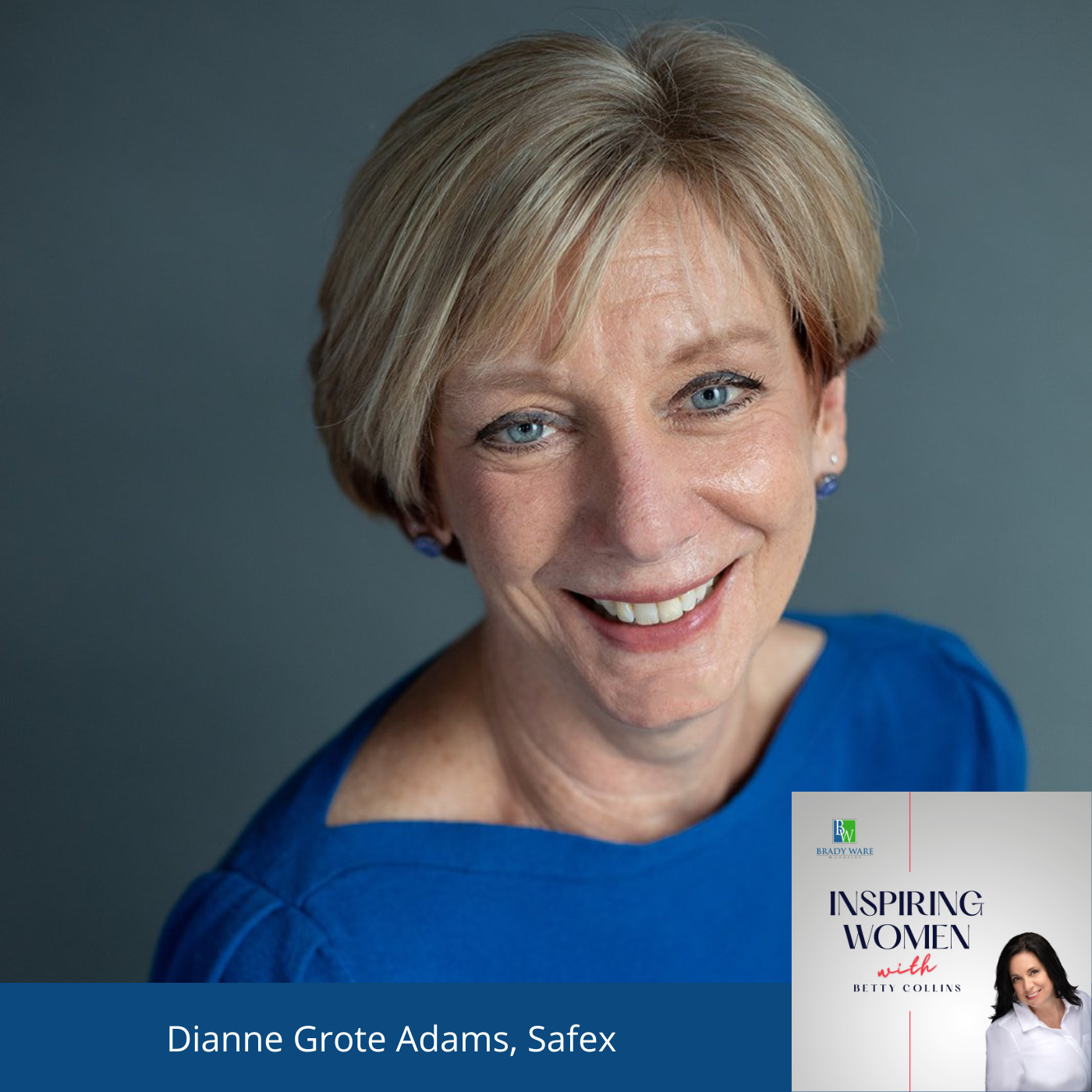
Work/Life Balance, with Dianne Grote Adams, Safex

September 19, 2022 by John Ray

Safex Dianne Grote Adams
Inspiring Women PodCast with Betty Collins
Work/Life Balance, with Dianne Grote Adams, Safex
Loading
00:00 /
RSS Feed
Share
Link
Embed

Download file

Safex Dianne Grote Adams

Work/Life Balance, with Dianne Grote Adams, Safex (Inspiring Women, Episode 50)

As a working mother juggling family and a career, Dianne Grote Adams felt a compulsion to start her company, Safex, with a core value of giving employees the opportunity to realize a better work/life balance. In this interview with Inspiring Women host Betty Collins, Dianne discussed the development of Safex, what role the focus on work/life balance has had in attracting and retaining talent, and much more.

The host of Inspiring Women is Betty Collins and the show is presented by Brady Ware & Company.

Betty’s Show Notes

Balancing your professional and personal life can be challenging, but it’s essential.

Often, work takes precedence over everything else in our lives. Our desire to succeed professionally can push us to set aside our own well-being.

Creating a harmonious work-life balance or work-life integration is critical, though, to improve not only our physical, emotional, and mental well-being, but it’s also important for our career.

My guest is Dianne Grote Adams. She is president of Safex, a health and safety consulting business, who started her company in 1992. As a working mom with a young family, she wanted to create a company that would respect the abilities of people in a technical career while also offering them some flexibility. From its beginning, Safex has offered flexible scheduling and benefits—vacation, insurance, and paid holidays—for anyone who works more than 25 hours.

Did you find that you attracted the right team around you because of that philosophy?

A lot of people, I think, have this myth that part-time workers aren’t committed.  And they say, well, they’re not really committed to their careers. And I found the opposite. They have time to do personal things. And guess what? They don’t make doctor’s appointments during work hours. They don’t make personal calls during work hours because they have other days to take care of that. So I find actually they are probably more committed because they knew they have a special opportunity that others might not have.

But there are people who maybe can’t handle flex time and flexibility. They need more structure. Do you find that sometimes that’s a challenge?

I think there are certain people who maybe need more guidance or more coaching to help them learn how to manage flex time. Many of us didn’t grow up with that as an option, right? Can everyone be successful? I don’t know. But you’ve got to be able to manage responsibility and accountability.

What would you tell employers who are starting businesses to get into this mindset today? How do you get started?

It has been a focus on what does that person. What is that person supposed to contribute, what are they supposed to do? And if you can put a good definition around that and they meet that, then why should you care what the exact hour is or whether they rode their bike for an hour at lunch or they left early to catch a concert?

So in your journey, what comes easy for you in the work-life balance?

For me, it’s really easy to tell someone else to go take the time off. I struggle still with that work ethic that I grew up with, that I need to be first in, last out, and yes, I need to on Sunday night to prepare for the upcoming week. I just don’t give myself that same grace.

Hosted by Betty Collins, CPA, and Director at Brady Ware and Company. Betty also serves as the Committee Chair for Empowering Women, and Director of the Brady Ware Women Initiative. Each episode is presented by Brady Ware and Company, committed to empowering women to go their distance in the workplace and at home.

For more information, go to the Resources page at Brady Ware and Company.

Remember to follow this podcast on Apple Podcasts and Google Podcasts.  And forward our podcast along to other Inspiring Women in your life.

TRANSCRIPT

[00:00:00] Betty Collins
I’m Betty Collins. And this is inspiring women. And today we’re going to go through a topic that all of us think about, all of us wish it were just easy. All of us some of us think it’s a it’s a myth. Some of us think it’s a lifetime journey of perfecting. But it really comes down to work life balance and knowing how to make that happen. And sometimes I do really well at it. Other times I’m like, okay, I’ve got to reset again and figure this out. So I think it’s a challenge. It’s all part of your journey. And then one day you figure out it’s probably is a little bit of a myth, but it’s something you can do if you’re intentional about it. It’s like everything intentionality makes it happen. So today I have a very special guest, Dianne Grody Adams, and she founded a company built this company for for quite a while and has and everything about it had in mind a work life balance. So we are just fortunate to have you today, Dianne. We are so glad that you are taking some time with us and the audience. And I know they’re going to be inspired by what you have to say. So the first thing I do want to do is just tell us a little bit about take a couple of minutes to tell us about Dianne Grote Adams.

[00:01:14] Dianne Grote Adams
Wow. Gosh, what is there to tell? So long time Columbus resident, born basically here and grew up here and started the company actually worth 30 years old this year. Very good. So but you’re right, work life balance was something that I aspired to when I was working and thus led me to start Safex. I started working back many years ago and obviously in the traditional workforce didn’t always have as much flexibility as I would have liked to have.

[00:01:49] Betty Collins
Correct. Today we’ve learned all about flexibility because you have a crisis come in and then everyone all of a sudden just went to flexibility. Right. But in 30 years ago, that wasn’t the case. So when you say you have something in mind for that, that you wanted to keep that at your forefront. Tell me just some specifics of what that would be back when you’re thinking through this has to happen, you know.

[00:02:14] Dianne Grote Adams
So I think the big part for me, the motivator for me was I had a professional career, I started a family and I couldn’t balance traveling full time and raising two sons and being a good wife and a good employee. Right. And I didn’t feel like I should have to sacrifice any of those things. So I looked for options and I found a part time job in my field, but it was not very fulfilling. The pay was terrible. There were no perks you got, as many of us probably have done. Hopefully it’s better now. But at that time, right. So as I started to start the business, I thought, well, why does it have to be that way? Why couldn’t I work less than 40 hours a week and still have benefits? Or why couldn’t other mothers or fathers that wanted to be caregivers? Or maybe they just were at a different point in their career and they didn’t want to work 40 or 50 hours a week. Right. Why couldn’t we model a company like that? So that was the intent.

[00:03:14] Betty Collins
Okay. Well, in those beginning stages was of of that and that was part of your culture, probably that was just part of the quote, the mission statement. That was part of how you thought. Did you find that you attracted the right team around you because of that?

[00:03:32] Dianne Grote Adams
That’s a great question, because a lot of people, I think, have this myth that part time workers aren’t committed.

[00:03:36] Betty Collins
Yeah.

And part time B, let’s define as less than 40 hours. And they say, well, they’re not really committed to their careers. And I found the opposite. Those of us who work there knew that we had something special, that we could come to work for three days a week, and then we could have time to do the personal things. And guess what? I didn’t make doctor’s appointments during my work hours. I didn’t make personal calls during my work hours because I had those other days to take care of that. So I found actually they were probably more committed because they knew they had a special opportunity that others might not have.

[00:04:13] Betty Collins
Right. And 30 years ago, this conversation would have been the extreme or it would have been on the out an outlier. It would have been like, okay, good. I’m good luck with that. Right? So you probably had a lot of critics at that point, but at the same time, you felt like you developed a great team that probably stayed with you a long time because of it. One of the things that I that I tell women is your seasons are different. So my twenties look nothing like my thirties. You know, my fifties weren’t my forties. I don’t know what 60 is, but it’s coming there. I’m going to find out pretty soon. Okay. And so sometimes when you look at work life balance, it’s just an easier time to make it happen versus other times. So as an employer and as that person that was building your team. That as far as the work life balance where you flexible as they tendered in came in and out of those seasons. So whether men or women it doesn’t matter.

[00:05:08] Dianne Grote Adams
Certainly and you’re right on and that we all have a different desire or need depending on where we are in our work journey. And sometimes it’s a young family that wants more flexibility. We’ve had other extreme where someone is in their sixties, wants to keep working, but they don’t want to be there five days a week. And so they would like the alternative as well. So I agree with you. It’s not limited to a certain demographic or a certain age group.

[00:05:37] Betty Collins
Right. And in today’s markets, completely different issues of the day. But I mean, people are really back to I want more flexibility. I got used to flexibility and now the things that in their seasons are become extremely important to them, which is not a bad thing. Right. So have you made we had this thing called COVID. You know, we had this thing called a pandemic. Have you made changes since COVID or, you know, as yet another generation is joining the workforce? How are you dealing in all of that? So 38 years ago, you were on the cutting edge. Now it’s like och post-COVID, millennials, all of that.

[00:06:14] Dianne Grote Adams
So actually what we’ve been saying to people is, you know, we’ve been doing this for 30 years. This for us isn’t something really new. But we did recently document our work, flex time, I guess for help for the younger people coming in. We actually got feedback from them is I like the thought here, but I think I need a better understanding and some. Boxes around what you want me to do and not do. Which I was kind of surprised because I was kind of like, Well, you got to take care of your customers and you’ve got to meet your client needs and your internal client needs. And other than that, if you need to run with the doctor under the doctor, but they wanted a little more structure around it. So we actually put it on paper and said, okay, here are your options and laid it out for them.

[00:07:03] Betty Collins
Right. So do you find that this model doesn’t, though, work for everyone? You know, because it’s like, oh, man, I get all this. But there are people who maybe can’t handle flex time and flexibility. They need more structure. Do you find that sometimes that’s a challenge?

[00:07:21] Dianne Grote Adams
I think there are certain people who maybe need more guidance or more coaching to help them learn how to manage flex time. Many of us didn’t grow up with that as an option, right? You went to school and you were expected to be there certain hours and you had homework and it was due a certain time in your first jobs if you’ve been working a while. We had very structured schedules, right? So I think some people need guidance on how do they manage that right now. Can everyone be successful? I don’t know. But you’ve got to be able to manage responsibility and accountability.

[00:07:59] Betty Collins
Right. And I think and I’m sure that you do this for Betty Collins. I do better when I’m in an office. I don’t know if it’s because I’ve always been in an office, but I know when I’m home, I’m like, I’ll just get one more thing done here and I’ll change one more laundry load and maybe I can just shop off to Kroger and then I’ll come back. So for me to go in and out like that, it’s not it’s not a good mindset. I need to stay focused and in there. But when I was raising my kids and that season of Sports and Youth Group and you name it, I could do it then. I can’t do it now. Like I could leave and go. I got to go to the game and then I’ll come back and fit and I was able to. So some of it has to do with the season, but for me, I know if I had I would have to still have a lot of structure around it. So but that’s just me. So when we’re balancing things, what do you find that people like to balance the most? I mean, for me, I look at my life and go, okay, this is the order. I have a spiritual life. I have a mental health life, a physical life. And then there’s this big category called The Routine of Life. And as long as I balance this first, I can handle routine fairly well. So when you’re finding people want that balance, is it that cut and dry? Because I’m a CPA and I’ve got four sections, you know, but when they talk about balance, what do you find your employees want to balance besides doctor appointments or or maybe that’s a lot of what it is.

I do think a lot of it is just life. Yeah. There are things you have to do, right? It’s part of that. Adulting. Yes. And it takes time. Yeah. And if all the people you need to make a phone call and appointments for work 8 to 5 and you work 8 to 5, that’s hard. So that is part of it. I think others I think it’s all over board depending on what their interests are. Right. I have some people who want to go use the gym for lunch or I have some people who want to go the grocery store before they pick a child up at childcare or somebody wants a long weekend to go hiking. So I think it’s really all over the board what those other things are, depending on what their personal interests are.

[00:10:01] Betty Collins
Yeah. So for you, you know, this is part of your culture. It’s been part of the why and the how, because it was personal to you 30 years ago that I need this in my life for people who still don’t grasp this, like maybe my older partners, they just don’t grasp it. What would you tell employers today or women who are starting businesses or anyone who’s starting a business, you know, to get this mindset, especially if it’s hard for them, like how do you really just get in there and go because this works? How do you get started? You know, how do you change that?

[00:10:40] Dianne Grote Adams
For us? I think it has been a focus on what does that person what is that person supposed to contribute, what do they is supposed to do? Right. And if you can put a good definition around that and they meet that, then why should you care what the exact hour is or whether they rode their bike for an hour at lunch or they left early to catch a concert? I mean, why should you care as long as you have our clearly communicating what the expectations are as consultants? I mean, it is a little easier. You have a certain amount of revenue you’re expected to generate and you have certain deadlines to meet with your clients. If you’re not meeting those, then it’s an obvious discussion that we have a problem. But if you are meeting those, should I really care?

[00:11:25] Betty Collins
Right. Right. And I mean so. So your company is very intentional about setting expectations. We are. Okay. So tell us a little bit about your company. So people kind of know that they might be going well, this is easy for her because. You know, what is it that Safex does?

[00:11:43] Dianne Grote Adams
So let me say first, I’m not going to say it’s easy. Well, and I grew up, as many of us did, with this work ethic that you’re in the office at seven, you’re the last to leave. And that’s what life is all about and that’s how you prove yourself. So that was the mindset I started with, and that is how I spent the first ten years of my career. So this was a mind shift for me, no question. And there were days I still have a little heartburn when I’m not sure that everybody has the client’s best interests at heart. But then you have to have a conversation, right? So that being said, because we are occupational safety and health partners with our customers, they often have a project and it has a known deadline. We have a budget. There are known hours to complete that project and each person knows how many hours of revenue they need to generate in a year. So you break that out month by month and then it’s easy, relatively easy to have a conversation about this is what you need to accomplish. And so if you have the open conversation and you share all that information and maybe that’s what helps us, we’re very transparent in our books, the revenue we generate, the hours that everybody is billing, the clients that are happy with us, the disappointments. And so that open communication perhaps reinforces the message of how much we trust you, but also the huge responsibility you have to maintain that trust.

[00:13:13] Betty Collins
So people really trying to to hear you today and go, I mean, I would love to get there. It all started with a Y and it was personal. But it also is your intentional. You’ve set expectations, communication being very open. So as I say in here, your flexibility cannot cause chaos to the overall client in your peer. Correct. And that’s just an expectation that has to be there from the beginning. So who have you seen do did you have a mentor or somebody that you saw in life that did this well or no? I was the mentor and I helped other people do this. It could be either way.

[00:13:56] Dianne Grote Adams
30 years ago, there weren’t a lot of people doing this right. I more went to This is not what we want to do. So how do we do this differently? Yeah, and it wasn’t just my desire for my life. My husband was working in consulting at the same time and he would often be out of town for ten straight days, back home for four gonn again ten. And he didn’t have a choice about that schedule. He was told, this is where you’re going. Yeah. And they expected him to figure out child care or whatever or they assumed he didn’t have to worry about it, that I would worry about it, whatever the case might have been 30 years ago. But then I also saw he came home. He was exhausted. Right. He didn’t have quality time at home. And then he still had to do his timecard and his marketing responsibilities and things. So those four days off really weren’t a four days off. Yeah. So I saw that as, okay, these are other things we can’t do, can’t dictate schedules. We can’t dictate. You have to go out of town this week. You’ve got to have a conversation with people on where they are in their life and who can we count on to travel this month or who can we travel on to next month? Or maybe you can travel next week, but the following weeks, not really good because your spouse is.

[00:15:09] Betty Collins
Gone, right?

[00:15:10] Dianne Grote Adams
And so those kind of conversations is what helped allow us to create that.

[00:15:15] Betty Collins
To create that. Yeah. Again, the flexibility can’t cause chaos, but let’s see what we can do to make it all work.

And there are days it doesn’t work. Yeah, we’re there more than we want to be or.

[00:15:27] Betty Collins
Right. Because if you.

[00:15:28] Dianne Grote Adams
Say we’re out of balance and we need to pull back and have a conversation about it, it happens.

[00:15:32] Betty Collins
Yeah. So. So for you, do you I mean I mean, you’ve had this incredible journey of a great company. You’re pretty known for it. Do you find that even though you’ve done this this long and I don’t like to make my podcast about about pandemics, but it was a pretty major thing. Was there any adjustment, though, even to that? Because now we can’t be maybe as flexible because clients we can’t be there when you know what I mean. There was definitely I know for us, for instance, auditors couldn’t just go on it, you know, and then all of our clients are doing these whole audits electronically, which they really didn’t want to do. And you’re doing safety. I mean, so was it Hey, we’ve been doing this, so we’re good to go. And the pandemic, or did you still find that challenging with with doing like everyone did?

[00:16:23] Dianne Grote Adams
There are certain things that we were probably more prepared for than others. Yeah, but no question, there are certain tasks that had never been done remotely that we either had to figure out, can this even be done remotely? Or is that something that’s going to have to wait? Yeah. So no, there’s still some adjustments that absolutely had to be made.

[00:16:45] Betty Collins
So this is a terrible question, but I’ll ask it anyway so you can say no. Edit this, take it out. So the question is so in your journey, what comes easy for you with work life and balance? But what comes hard? I mean, like, what’s the good and what’s the bad? And again, you don’t have to answer, but we’re waiting.

[00:17:03] Dianne Grote Adams
Oh, no, it’s okay. Yeah, there’s nothing to hide. Yeah, I struggle still with that work ethic that I grew up with, that I need to be first in, last out, and yes, I need to on Sunday night prepare for the upcoming week. I am so wired that way that I really struggle to not think about work on the weekend. Now that might be in part business owner and not just employee, a combination of the two. So that for me is still hard. Yeah, what is easy for me. A young man came to me yesterday and he said I got my work all caught up and I’m supposed to be here till the end of the day. But we have our new puppy and it has its first vet appointment. And I’m not a dog lover, so I didn’t really get it, but I’m like, okay, he’s all gushy about it, you know? And he says, I really want to go with my wife to see to the puppy’s first vet appointment. I said, So go. He goes, Really? I’m like, Yeah. Did you not read our flexible work policy? You can do that. You’ll work, you’ve met your needs. Go. So for me, it’s really easy to tell someone else to go do that. I just don’t give myself that same grace probably.

[00:18:18] Betty Collins
Well, it’s amazing to me and how I would answer is it’s the it’s the constant engagement that we have set ourselves up to be. And that first one is just the email, shut it down, quit having it on your watch, your phone everywhere round. That’s one that people you don’t really have your flexibility in my mind on the weekends if you’re getting emails from the person who wants to work all weekend and yet how you not you know and that one is the hardest for me and I’ve even learned I have ideas or emails that I draft and wait until Monday morning to send them all out. Good for you. You know, because you’re you may be wired to do this, but you’re your people maybe don’t want to do this or they don’t want to keep getting this stuff that engages them back in. And so as employers, we need to set a better example of that to me. But how did we ever do this? Because email, it’s hundreds a day. It can be where it wasn’t like I was on the phone all day in the eighties. But, you know, that’s one to me that’s a challenge for me and work life balance. Don’t answer email, shut it down. But then don’t send emails and think people will just come in on Monday and answer them. You put them in an anxious spot, right?

[00:19:39] Dianne Grote Adams
I agree. I resisted email on my phone long after. People are like, What do you mean you don’t check your email on your phone? I’m like, Because the minute I look at something, then my brain engages and I can’t disengage. But I don’t have a smartphone or a smartwatch because I don’t want email.

[00:20:00] Betty Collins
On my.

[00:20:01] Dianne Grote Adams
Wrist because I just will go nuts.

[00:20:04] Betty Collins
And I did turn off notifications because that does help at least. So then it is. If I don’t see a bunch of notifications on those two things, I’m not going to dig in to.

[00:20:14] Dianne Grote Adams
I have all my notifications off 100%.

Yeah.

[00:20:17] Dianne Grote Adams
Even in the office. Because if I’m focusing on something, I don’t need those little reminders that somebody has something to tell me. Right. Because sometimes what I’m. Doing is more important than whatever that person had to tell me at that moment. And if I’m engaging with a client, I need to be focused on what that client’s needs are. So I don’t use those at all. But you have a valid point.

[00:20:38] Betty Collins
It’s tough. It’s tough. So use the employer. If you’re really say you have work life balance and the weekend is yours, then don’t make it theirs. Don’t make it yours. I mean, you know, so the other thing I would ask, work life balance, we always think of it’s well, that’s the mom.

[00:20:53] Dianne Grote Adams
That’s for women, right?

[00:20:55] Betty Collins
It’s not for the dad or whatever. Maybe the dad is more of the caretaker or those type of things. How do your if you have a balance of men and women do men I mean, does it seem like it’s always geared to women and that’s what they think? Or are men going, no, I get this.

[00:21:14] Dianne Grote Adams
30 years ago when we started, we had some men who felt put out would probably be a good way to put it, that all of our women didn’t work full time and they worked like Monday through Friday every day, and that they had to take the really hard road. And we talked about it and got through it. But over time, no, it’s been men and women who have taken advantage of the part time at side effects. My husband joined us after a few years and he worked less than full time for a number of years because the our sons were in ball and it was perfect for him. Right. He got to leave at 230. When they got out of school, he went and helped coach. I mean, it was a great family environment and I would come later then and we’d have dinner together as a family. So for us, that worked great. I had he and another person came both men and at the end of their careers worked less than full time and we’re still able to mentor our young people, do productive work, feel good about themselves, but didn’t have to be there Monday through Friday. So I think it’s not just a woman’s issue, but it does take very strong men, I think, to be able to buck the tradition and be that less than full time person. And I think it’s more acceptable now than certainly 30 years ago.

[00:22:32] Betty Collins
Right.

[00:22:32] Dianne Grote Adams
And I’ll brag a little bit, my son is the primary caregiver of his two sons. And when right before he got married, he said, you know, Mom, what I would really like to do is be the stay at home dad. And I said, well, then talk to your wife to be about that. It may not happen for whatever reason, but that’s a conversation you two need to have. She’s an attorney. Her hours are not as flexible, and that’s a choice they’ve made. But he’s thrilled and he’s good at it. And so I think just giving all of our family members the option for whatever works for their family is what is that real work life balance.

[00:23:07] Betty Collins
What I really like is that your employees, your environment, your clients, whoever they solve from the top that it’s for, it’s for both. It’s for parents, not moms or it’s not the single dad who has to was you guys showed that example that this is how we want our work in life and balance to be. So then it gives people kind of the they see it and then they go, oh well maybe maybe I can do this right. So for women business owners who tend to go, everything is on me because it’s hard, right? And you’re and you take it all on. And one of the reasons I would say that women struggle in business more because men will start a business and it goes like this. Women are like this. You know, it’s the journey is a little bit longer. Doesn’t mean it’s wrong. It’s just they don’t and a lot of it is is because they think they have to do it all instead of you can have it all, you don’t have to do it all. So kind of our end today, I’d like to talk about how we inspire women to to think about that statement of you can have it all. You just don’t need to do it all. Can you kind of expand on that?

[00:24:27] Dianne Grote Adams
Sure. I think there’s two components to that, though. I’m not in business and this will upset some people. I’m not in business to see how much money I can make in a short period of time. I’m in business to provide a decent living for my family and for those that we work with. So my end game might be a little different than other business owners, so I didn’t need to go from 0 to 102 years. Right. So that being said, I might have a slightly different perspective, but it is hard, I think as a woman who was brought up, that you are the rock, right? I guess the core focus to be able to ask for help. And Betty knows I am a caregiver now and that is the hardest thing for me to do is to ask for help. And so I have been honest with our team that I can’t do what I use. To do, and it’s killing me in my soul because it’s still something I love. But I need other things for people to either pick up or if I ask you for help, it’s because I really need help. I’m not trying to quote unquote dump on you. Right. And I think, Ben, it’s back to that, just being honest and communicating. I don’t think anybody judges if you’re honest, I think we all think we’re being judged. Right. But if you have the conversation about it, I don’t really think people then are judging. It’s when you try to keep it a secret and they don’t understand that misconceptions maybe.

You’re guarding it close because oh my we can’t show that or but women business owners have a tendency to and not even the end game the end game they don’t see the full potential of who and what they could be because they’re wrapped up in in doing it all.
Because what you want to be and what you want to do might be completely different. At the end of the day. I mean, as a CPA, my goal is not to focus on your depreciation, and those things are all important. But the goal for me has always been if the marketplace is successful in this country, the world works, it just does. And when you get to be that employer you have, that means you have employees and you’re the provision, right? You’re the provision. And those are households and those households firm communities. And so how do I make sure that success happens and it’s not doing it all? Because, you know, there’s another balance and another world out there.

[00:26:57] Dianne Grote Adams
So one of our core values, we say, is equality. And that’s part of what we tell people when we first come is like, you have a different experience than me. You have a different skill set than me. None of us are better than the other. Without our collective skill set, we can’t be successful. Right. And so I think saying that does help a little bit and living that, not just saying it, but living that also helps you ask for help a little bit or say, you know what, your strength is really good in this area and I’m going to take 6 hours to do this because I am not good at this. I can do it, but I’m not good at it and being honest. And then that person picks it up, gets it done an hour, you’re like, Well, that was a much better use of time, right? And I’ll go do something that I’m better suited to do.

[00:27:43] Betty Collins
Yeah, well, today we’ve had Dianne Adams with Safex, and you have just been a delight. You have restored my. Maybe I don’t need to go through a big plan and reset. I just need to go know there is work life imbalance. It takes work, but it’s worth it. So we appreciate you coming with us today. We appreciate you talking to our audience and being part of this.

[00:28:06] Dianne Grote Adams
It’s my pleasure. I love to share our story and to hear from other women.

[00:28:11] Betty Collins
It’s a great story.

[00:28:12] Speaker1
It’s a wonderful part of being in business. Right. All right.

[00:28:16] Speaker1
Thank you very much.

Automated transcription by Sonix www.sonix.ai
Tagged With: Betty Collins, Brady Ware & Company, Dianne Grote Adams, Inspiring Women with Betty Collins, safety consulting, safex, work-life balance

Decision Vision Episode 178: Hitting Pause, with host Mike Blake

August 4, 2022 by John Ray

Mike Blake
Decision Vision
Decision Vision Episode 178: Hitting Pause, with host Mike Blake
Loading
00:00 /
RSS Feed
Share
Link
Embed

Download file

Mike Blake

Decision Vision Episode 178: Hitting Pause, with host Mike Blake

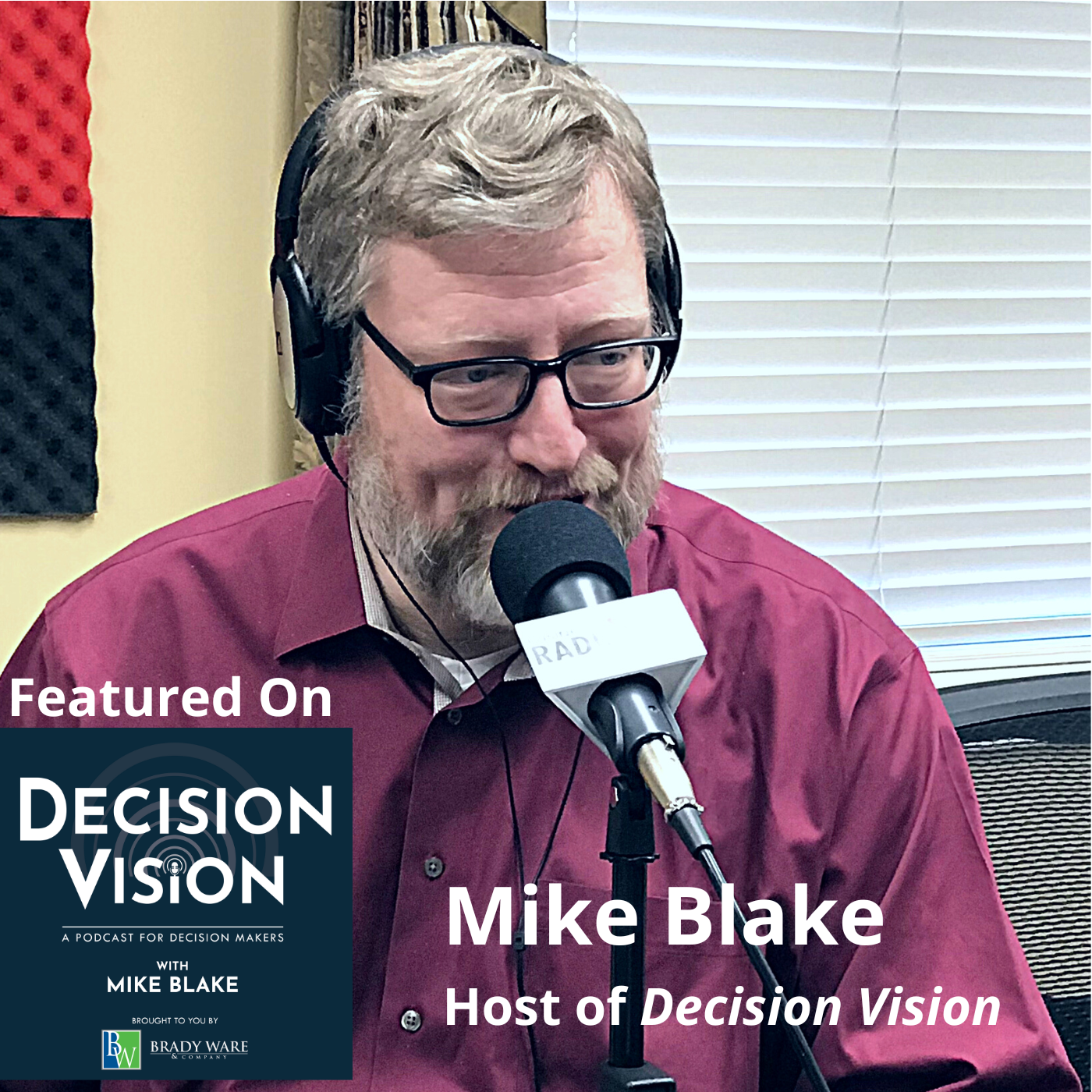
Mike Blake, the host of Decision Vision, announced that the show will pause for a bit. He mentioned several reasons, including wanting to revamp the format, the increasing time demands he’s experiencing heading up Brady Ware Arpeggio, and wanting to refocus the content in new directions.  Mike noted that the show will return with fresh content and format soon.

Decision Vision is presented by Brady Ware & Company and produced by the North Fulton studio of Business RadioX®.

Mike Blake, Brady Ware & Company

Mike Blake, Host of the “Decision Vision” podcast series

Michael Blake is the host of the Decision Vision podcast series and a Director of Brady Ware & Company. Mike specializes in the valuation of intellectual property-driven firms, such as software firms, aerospace firms, and professional services firms, most frequently in the capacity as a transaction advisor, helping clients obtain great outcomes from complex transaction opportunities. He is also a specialist in the appraisal of intellectual properties as stand-alone assets, such as software, trade secrets, and patents.

Mike has been a full-time business appraiser for 13 years with public accounting firms, boutique business appraisal firms, and an owner of his own firm. Prior to that, he spent 8 years in venture capital and investment banking, including transactions in the U.S., Israel, Russia, Ukraine, and Belarus.

LinkedIn | Facebook | Twitter | Instagram

Brady Ware & Company

Brady Ware & Company is a regional full-service accounting and advisory firm which helps businesses and entrepreneurs make visions a reality. Brady Ware services clients nationally from its offices in Alpharetta, GA; Columbus and Dayton, OH; and Richmond, IN. The firm is growth-minded, committed to the regions in which they operate, and most importantly, they make significant investments in their people and service offerings to meet the changing financial needs of those they are privileged to serve. The firm is dedicated to providing results that make a difference for its clients.

Decision Vision Podcast Series

Decision Vision is a podcast covering topics and issues facing small business owners and connecting them with solutions from leading experts. This series is presented by Brady Ware & Company. If you are a decision-maker for a small business, we’d love to hear from you. Contact us at decisionvision@bradyware.com and make sure to listen to every Thursday to the Decision Vision podcast.

Past episodes of Decision Vision can be found at decisionvisionpodcast.com. Decision Vision is produced by John Ray and the North Fulton studio of Business RadioX®.

Connect with Brady Ware & Company:

Website | LinkedIn | Facebook | Twitter | Instagram

TRANSCRIPT

Intro: [00:00:01] Welcome to Decision Vision, a podcast series focusing on critical business decisions. Brought to you by Brady Ware & Company. Brady Ware is a regional, full-service accounting and advisory firm that helps businesses and entrepreneurs make visions a reality.

Michael Blake: [00:00:22] And welcome to Decision Vision, a podcast, giving you, the listener, a clear vision to make great decisions. This is Michael Blake, your host, and I’m going to talk to you a bit, not as a podcast delivering content necessarily, but more news, I guess, is the way to put it. So, I wanted to put this episode out there to let you guys know that I’m putting this show on hiatus for a while.

Michael Blake: [00:00:49] I don’t think it will be too terribly long, but it’s probably going to be, I’m guessing, about a couple of months. And we’ve done 177 shows, I’m not going to consider this a show, but if we are going to put this on hiatus, I think a way to pause on top with Lee Ellis, in Should I Resist, I think, was about as good a way to do it as possibly could be imagined.

Michael Blake: [00:01:13] Certainly, again, pausing on a high note, I’m being very careful to say I’m not going out on a high note, because it is my intention that the show will be back, but we do need to pause it and for a couple of reasons. The first is that, to be candid, I need a break. We’ve been doing this show consistently for about three-and-a-half years now or close to it, not missing a week, and it’s difficult.

Michael Blake: [00:01:43] This is not my day job. It’s a hobby. It’s a side gig. And in my new role as managing partner of Brady Ware Arpeggio, frankly, my time demands have become less forgiving, not more. You think as you become promoted and you serve at the top of the pyramid, you like to think you work for fewer people, you actually work for more. That’s one of the lessons you learn as you kind of go through this journey, and I’m concerned that the quality of the show will suffer.

Michael Blake: [00:02:17] And there are lots of podcasts out there you can listen to. You’ve all been such loyal listeners over the years that I owe it to you, I owe it to our guests, I owe it to my firm to make sure that the product we put out is good. Second, I want to change things up a little bit. The show format has been, for the most part, me interviewing a guest, and I think that’s fine as far as it goes, but Brady Ware & Company and Brady Ware Arpeggio, the part that I’m in charge of, is so much more than just me, but you never really get much of a chance to see it or hear about it, except on the rare occasions that we bring in somebody from the Brady Ware ecosystem as a guest.

Michael Blake: [00:03:06] And frankly, it’s not fair to the firm, and I’m not comfortable with having the brand of the show be all about me. I thought that there was a chance that we might kind of rotate hosts, somebody might take over, shove me out of the chair, and say, I’m going to take this thing over for a while, that hasn’t happened. So, I do think that creating a little bit of space for somebody else to come in and do something that they want to do, I think it’s simply the right thing to do.

Michael Blake: [00:03:40] And third, I think that we need to take a step back and we have some decisions we have to make. We have to be a little bit more strategic and intentional about how we think about the content in terms of serving an audience well. And with 177 shows, we’ve covered a lot of ground, everything from show one, Should I Get a Patent, to show 177, Should I Resist, to one of our more fun shows, Should I Get Captive Insurance, to Should I Sell my Business, Should I Buy a Business, Should I Invest Venture Capital, Should I Raise Venture Capital, Should I sue my partner, that sort of thing.

Michael Blake: [00:04:30] We’ve covered a lot of ground, and there’s an extensive library for you to go back through, and I think most of those topics are still very much evergreen. And we also stepped up our—we also stepped up our production schedule for COVID to try to give people the best information we could to enable people to make the best decisions they could, and frankly, in an impossible environment.

Michael Blake: [00:04:55] And so, I’m proud of the show that we put together, but I would like it to be a little bit more focused, because I do think maybe we’ve run too far afield. And I really do enjoy talking about business. I’m very fortunate that I’m on a job that I love to get up and work at every day with people that I love and for clients that I love in a way that makes a difference.

Michael Blake: [00:05:25] And I want to take a step back, and make sure that our show reflects that and share with you the blessings that I have in terms of doing that and share with you in a more concrete way the impact that our clients have earned and have generated for themselves by becoming better decision makers. Now, that does not mean we’re going to become an infomercial. No way that’s going to happen as long as this guy is behind the microphone. Never going to happen. But I do think we’re missing opportunities because we’re going a little bit too broadly and not as deeply as we could.

Michael Blake: [00:06:03] And I do like to go deep, maybe even Aquaman deep. I do like to go deep in topics whenever I can, which is why we do long podcast shows, and I want to do that. And then, finally, I would like to expand this show to a new platform. Video is an important platform. Now, we’re all watching video. It’s remarkable how democratized video has become. I’m old enough to remember the days of three VHF channels, and if you’re lucky, three more UHF channels, and you sort of had to do ballet in front of the rabbit ears to get Channel 68 WQTV in Boston, where I was growing up, but, man, I sure do remember Candlepins for Cash, which is a great show at 4:30 PM every weekday, candlepin is a form of bowling, by the way, in New England, but that’ll be for a different show.

Michael Blake: [00:06:59] Maybe there’s a candlepin podcast out there. There probably is. But once you record an audio, it’s hard to kind of make that video. It’s a lot easier to start with video and make it audio. So, it just gives us an opportunity to reach a wider audience. And for people that aren’t into podcasting, there are plenty of people that don’t like podcasts, but will watch videos all day long. And so, we want to experiment with that.

Michael Blake: [00:07:27] So, those are the reasons that we’re going to put the show on pause. Like I said, I fully anticipate it will come back, but it will come back after I’ve had a chance to re-energize. It’ll come back after I figured out a way to make the show more inclusive. It will come back after we find a way to make the topics, I think, more focused and more consistent over time. And it’ll come back when we figured out a way to make the show more accessible across a wider variety of platforms so that we can impact more people.

Michael Blake: [00:08:02] And I fully expect that by next quarter, we’re going to be back at it again in some fashion. My guess is it will probably be a roundtable of some kind. You’re going to hear other perspectives than mine, and probably more fun, freewheeling conversations. Maybe we’ll introduce liquor into the conversation, I’m not sure if we’ll do that yet, but it will lead to some interesting content if we do that.

Michael Blake: [00:08:25] And I think we can get people to pour themselves a tumbler of scotch when we do that, but no promises, I don’t want to put them out there yet. So, this is not goodbye. This is simply until the next time we see or hear one another. I would like to thank Brady Ware, though, for the opportunity to have done this podcast for three-and-a-half years. It’s been a tremendous opportunity and I’m grateful for it and for the support of the partners of the show.

Michael Blake: [00:08:53] I’m grateful to the guests who have come on, and given freely of their time and their expertise to share it with me and our audiences. I’ve learned something in literally every podcast, and that’s one of the things that kept me doing it as long as we did. And I’d like to thank our business partners at Business RadioX and John Ray. They’ve been not good, they’ve been great. Without them, the show would have lasted maybe an episode-and-a-half.

Michael Blake: [00:09:17] And I say that half, because I probably would have just thrown the headphones off, and turned the microphone off, and said, This show is over, I’m going back to my trailer. So, if not for them, we would not have had the listenership we’d have had. We would not have had the discipline that we’ve had. We would not have had the overall show quality. So, I’m just going to give them a free plug, because it’s the right thing to do. If you’re thinking of publishing a podcast, and by the way, they’re experimenting with video, but I’m not supposed to say that, give John a call, give his Business RadioX a try.

Michael Blake: [00:09:53] They are a terrific partner. If you believe in the medium, as I do, you really can’t ask for any better. So, with that, as I’m recording this on 29th, July 2022, it is 4:05 on a Friday, and so I don’t know when you’re going to be listening to this, but I know that I’m about to start my weekend, and so is John. So, again, I’m going to say thank you very much for patronizing the program. I do hope you’ll go back and find other shows.

Michael Blake: [00:10:25] And I guess, the last thing, if you have any ideas of what you like us to cover, what you’d like us to do with the show, or maybe ways to get you engaged, because I think that’s a way that—that’s the thing we’re missing. The thing that I haven’t figured out with podcasting yet is how to create real engagement with an audience. So, I’d really like to do that. Send me an email to msblake@bradyware.com and no reasonable idea will be brushed off. This is your show, I just happen to be the steward of it. So, again, thank you, again, for everything. I’m so grateful for the opportunity and you will hear from me again in a couple of months. Take care.


Tagged With: Brady Ware & Company, Brady Ware Arpeggio, Business Radio X, Decision Vision, Mike Blake, podcast

Decision Vision Episode 177: Should I Resist? – An Interview with Lee Ellis, Leading with Honor

July 21, 2022 by John Ray

Lee Ellis
Decision Vision
Decision Vision Episode 177: Should I Resist? - An Interview with Lee Ellis, Leading with Honor
Loading
00:00 /
RSS Feed
Share
Link
Embed

Download file

Lee Ellis

Decision Vision Episode 177: Should I Resist? – An Interview with Lee Ellis, Leading with Honor

Lee Ellis, a decorated veteran of the Vietnam War and President of Leading with Honor, was Mike Blake’s guest on this episode of Decision Vision. From his harrowing experience as a prisoner of war and his military career, Lee brings a wealth of wisdom to the question of resistance. He and Mike talked about his POW experience, the code of honor he adheres to that guided his actions, how resistance looks in business, the role of resistance in effective leadership, ethical considerations, and much more.

Decision Vision is presented by Brady Ware & Company and produced by the North Fulton studio of Business RadioX®.

Leading with Honor, Leadership Freedom LLC

Leadership Freedom LLC is the original consulting, coaching, and training organization founded by Lee Ellis.

The goal isn’t perfect leadership, but it’s agreeing that we all want to authentically lead with honor. Leading With Honor helps leaders grow in character, courage, and commitment and learn new skills based on their natural behavior that will help them develop the next generation in the areas of responsibility, accountability, and resilience.

Their leadership development training methods are based on principles learned in some of the most challenging circumstances of POW life. They also have more than 25 years of experience in the research, development, and deployment of leadership resources including behavioral assessments.

In 2017, they made the transition from Leadership Freedom LLC to the new organizational name, Leading with Honor®, to further emphasize the importance of training leaders in character, courage, and commitment

Company website | LinkedIn | Facebook

Lee Ellis, Founder and President, Leading with Honor

Lee Ellis, President, Leading with Honor

Lee Ellis is President and founder of Leading with Honor®, a leadership and team development training and coaching company, and FreedomStar Media®, a publishing company that provides leadership resources and training. A popular media personality and high-profile human performance expert, Lee focuses on organizational integrity, operational effectiveness, and personal accountability for enterprise, government, and not-for-profit leaders.

His prior experience was as a founding partner and senior vice president of a leadership assessment and human capital management consulting company headquartered in Atlanta, GA. For over 20 years, he has served as an executive coach and a corporate coach in the areas of hiring, team building, leadership, human performance development, and succession planning. His approach to maximizing leadership performance has been implemented by Fortune 500 clients, senior executives, and C-Level leaders in telecommunications, healthcare, insurance, energy, IT, automotive, military, and not-for-profit sectors.

As the Director of Career/Life Pathways from 1990 – 1998, Lee led the development team that researched, developed, and validated Career Direct®, a vocational assessment package and two personality assessments with software applications. From 1998 – 2008, he was responsible for product development of three more behavioral and leadership assessments as well as the launch and Internet deployment of these resources. Most recently, he has developed and released his latest assessment tool, the Leadership Behavior DNA® Discovery Process (formerly N8Traits® Profile). In total, these assessments have been used worldwide by more than 200,000 individuals and are the instrument of choice in many organizations, including Fortune 500 companies and nationally recognized not-for-profits. Lee’s point of view on maximizing leadership performance and organizational leadership during crisis is framed by his extensive research and experience in the assessment of human behavior.

A prolific writer, blogger and thought leader, Lee’s latest book is entitled Leadership Behavior DNA: Discovering Natural Talent and Managing Differences. His last two award-winning books, Leading with Honor®: Leadership Lessons from the Hanoi Hilton and Engage with Honor™: Building a Culture of Courageous Accountability, share his POW experiences and the leadership principles that helped him and his compatriots resist, survive, and return with honor. Additionally, Lee co-authored three books and workbooks on career planning. He is a nationally-recognized Certified Speaking Professional* (CSP), Certified Virtual Presenter (CVP), and expert on the subjects of leadership and performance, team building, mentoring, and career planning. Some of his appearances include interviews on networks such as CNN, CBS This Morning, C-SPAN, ABC World News, Fox News Channel, plus hundreds of engagements in various industry sectors throughout the world.

Lee holds a B.A. degree in History from the University of Georgia and a M.S. degree in Counseling and Human Development from Troy University in Alabama. He is a graduate of the Armed Forces Staff College and the Air War College. Lee supervised, educated, and trained officers for the last 17 years of his Air Force career. He served as the Vice Commandant of the Squadron Officer School, the Air Force’s leadership school for captains. He completed his Air Force career as Professor of Aerospace Studies and Commander of Air Force ROTC at the University of Georgia. More recently he has developed and presented leadership curricula in numerous organizations including Fortune 500 companies, and major sectors of the Department of the Defense focusing on management performance, leadership accountability and principle-based management strategies.

A native of Commerce, Georgia, Lee graduated from the University of Georgia in 1965 and began a career in the Air Force. During the Vietnam War, Lee’s aircraft was shot down over enemy territory and he was held as a POW in various prisons in the Hanoi area for over five years. As a military officer, his experiences as a POW piqued his interest in leadership performance in difficult situations, leading to further research and academic pursuit in the area of measuring and optimizing human performance and leadership effectiveness.

After repatriation, he returned to flying duties with increasing positions of leadership. Rising to the rank of colonel before retirement, Lee’s assignments included duty as a pilot, flight instructor, staff officer, chief of flight standardization and evaluation, flying squadron commander, and supervisor in higher education. He was awarded two Silver Stars, the Legion of Merit, the Bronze Star with Valor device, the Purple Heart, the Air Medal with eight Oak Leaf Clusters, and the Prisoner of War Medal for his service in Vietnam. In addition, he was awarded four Air Force Commendation Medals and four Meritorious Service Medals for performance excellence. Lee is also a 2014 inductee into the Georgia Military Veterans Hall of Fame and the 2015 DAR Medal of Honor Recipient for a lifetime of patriotic service as a military officer and spokesman for leading with honor.

Lee and his wife Mary have four grown children and six grandchildren. They reside in the metro area of Atlanta, GA.

LinkedIn

Mike Blake, Brady Ware & Company

Mike Blake, Host of the “Decision Vision” podcast series

Michael Blake is the host of the Decision Vision podcast series and a Director of Brady Ware & Company. Mike specializes in the valuation of intellectual property-driven firms, such as software firms, aerospace firms, and professional services firms, most frequently in the capacity as a transaction advisor, helping clients obtain great outcomes from complex transaction opportunities. He is also a specialist in the appraisal of intellectual properties as stand-alone assets, such as software, trade secrets, and patents.

Mike has been a full-time business appraiser for 13 years with public accounting firms, boutique business appraisal firms, and an owner of his own firm. Prior to that, he spent 8 years in venture capital and investment banking, including transactions in the U.S., Israel, Russia, Ukraine, and Belarus.

LinkedIn | Facebook | Twitter | Instagram

Brady Ware & Company

Brady Ware & Company is a regional full-service accounting and advisory firm which helps businesses and entrepreneurs make visions a reality. Brady Ware services clients nationally from its offices in Alpharetta, GA; Columbus and Dayton, OH; and Richmond, IN. The firm is growth-minded, committed to the regions in which they operate, and most importantly, they make significant investments in their people and service offerings to meet the changing financial needs of those they are privileged to serve. The firm is dedicated to providing results that make a difference for its clients.

Decision Vision Podcast Series

Decision Vision is a podcast covering topics and issues facing small business owners and connecting them with solutions from leading experts. This series is presented by Brady Ware & Company. If you are a decision-maker for a small business, we’d love to hear from you. Contact us at decisionvision@bradyware.com and make sure to listen to every Thursday to the Decision Vision podcast.

Past episodes of Decision Vision can be found at decisionvisionpodcast.com. Decision Vision is produced by John Ray and the North Fulton studio of Business RadioX®.

Connect with Brady Ware & Company:

Website | LinkedIn | Facebook | Twitter | Instagram

TRANSCRIPT

Intro: [00:00:01] Welcome to Decision Vision, a podcast series focusing on critical business decisions. Brought to you by Brady Ware & Company. Brady Ware is a regional, full-service accounting and advisory firm that helps businesses and entrepreneurs make visions a reality.

Mike Blake: [00:00:21] Welcome to Decision Vision, a podcast giving you, the listener, clear vision to make great decisions. In each episode, we discuss the process of decision making on a different topic from the business owners’ or executives’ perspective. We aren’t necessarily telling you what to do, but we can put you in a position to make an informed decision on your own and understand when you might need help along the way.

Mike Blake: [00:00:43] My name is Mike Blake, and I’m your host for today’s program. I’m the managing partner of Brady Ware Arpeggio, a data-driven management consultancy which brings clarity to owners and managers of unique businesses facing unique strategic decisions. Our parent, Brady Ware & Company, is sponsoring this podcast. Brady Ware is a public accounting firm with offices in Dayton, Ohio; Alpharetta, Georgia; Columbus, Ohio; and Richmond, Indiana.

Mike Blake: [00:01:07] If you would like to engage with me on social media with my Chart of the Day and other content, I’m on LinkedIn as myself and @unblakeable on Facebook, Twitter, and Instagram. I also host a LinkedIn Group called Unblakeable’s Group That Doesn’t Suck, so please join that as well if you’d like to engage.

Mike Blake: [00:01:24] Today’s topic is, Should I resist? And what does that mean? Well, in my 52 trips around the sun, we are in an unprecedented time of social and economic upheaval. Certainly, I think you have to go back to the 1970s – and I was only a kid then and didn’t care about that stuff – to encounter anything like this. And interestingly enough, that’s going to be a recurring theme for today’s show, as a matter of fact.

Mike Blake: [00:02:01] But now we’re put in a position of resisting toxic relationships. We’re in a position of resisting toxic employers. We’re always in a position at some point of resisting people who want to manipulate us into doing or accepting bad things. And we could apply this, of course, to the political arena, which seems to be becoming more polarized by the day. And I don’t know what the solution is there. We’re certainly seeing it in business as people – as we have covered many times in the show – have redefined their relationship with work and, frankly, with a lot of the rest of the world.

Mike Blake: [00:02:55] And there’s even a decision as to whether or not we’re going to resist COVID or how we’re going to resist COVID. Are we going to resist it by being vaccinated? The resistance, are we going to resist vaccination mandates? And some people are doing that, in many cases at great personal cost to them, in some cases the cost of their lives. So, the resistance there, while some of us may disagree with it – I happen to disagree with it. I don’t think that that’s a trivial exercise – I think that one of the things, as I kind of reflect upon our society right now and our country, is not that it’s a good or bad place, but I do think it’s an angry place. It’s a much angrier place that I can ever remember.

Mike Blake: [00:03:51] And the first president that I can remember was Ronald Reagan. And whether you voted for him or not – and I’m certainly not one of these guys that lionizes him or really almost any president, every president that I’ve grown up with has been flawed in some way – and whether you agree with the politics or not, the one thing that he was, I think, always was a positive voice. And our political landscape has changed, where negative voices are being heard more. There’s an economic argument for negative voices. Negativity right now, I think you can argue, sells. And there’s a resistance that I think is required to just resist to avoid being overwhelmed by that sense of pervasive anger and negativity.

Mike Blake: [00:04:50] And so, I’ve wanted to do this show for a long time. This is not a new phenomenon. But not everybody can talk to this authoritatively. But I think I found the right guy who can talk about resistance authoritatively, and I think that you’re going to agree. This will probably be the longest introduction I’ve made of a guest, and too bad because he’s earned it.

Mike Blake: [00:05:16] Joining us today is Lee Ellis, who is President and Founder of Leading With Honor, a leadership and team development, training, and coaching company; and Freedom Star Media, a publishing company that provides leadership resources and training.

Mike Blake: [00:05:30] For over 20 years, Lee has served as an executive coach and a corporate coach in the areas of hiring, team building, leadership, human performance development, and succession planning. His approach to maximizing leadership performance has been implemented by Fortune 500 clients, senior executives, and C-level leaders in telecommunications, health care, insurance, energy, I.T., automotive, military, and not-for-profit sectors.

Mike Blake: [00:05:55] Lee and his wife, Mary, have four grown children and six grandchildren, and they reside in the Metro Area of Atlanta. During the Vietnam War, Lee’s aircraft was shot down over enemy territory, and he was held as a prisoner of war in various prisons in the Hanoi area for over five years. He was awarded two Silver Stars, the Legion of Merit, the Bronze Star with Valor Device, the Purple Heart, the Air Medal with eight oak leaf clusters, and the Prisoner of War Medal for his service in Vietnam. In addition, he was awarded four Air Force Commendation Medals and four Meritorious Service Medals for Performance Excellence. And by the way, after being released, he went back into active service.

Mike Blake: [00:06:34] Leadership Freedom is the original consulting, coaching, and training organization founded by Lee Ellis in 2017. Since then, they’re making the transition from Leadership Freedom to the new organizational name, which you now know as Leading With Honor. First, Lee Ellis, thank you for your service to our country and welcome to the Decision Vision podcast. It’s an honor to have you.

Lee Ellis: [00:06:55] Thank you, Mike. Great to be with you. And I always enjoy hearing what you have to say about things. I’ve seen you on several interviews on our CEO Netweavers, and I admire your wisdom. So, good to be with you.

Mike Blake: [00:07:09] Well, I appreciate that. So, you have, I think, the ultimate perspective of resistance. And we talked about you were in the same prison camp as the late Senator John McCain, correct?

Lee Ellis: [00:07:25] Yes.

Mike Blake: [00:07:26] Right. So, I just can’t imagine, it’s even hard to formulate the questions even though I have them written down. You’re shot down. You’re over enemy territory. You’re taken into custody. And you’re put in a position where you’re in prison as a hostile, as an enemy combatant. And my question, I guess, is, in that moment, how do you decide that it’s worth resisting?

Mike Blake: [00:07:58] Because your captors didn’t just want you to be there. They weren’t just feeding you for their health or, certainly, not even yours necessarily. But they wanted you to do things for them. And you had to make a conscious decision to resist that, decide it’s worth to do so at great personal suffering. How do you come to a point where it’s worth doing that, where it’s worth resisting?

Lee Ellis: [00:08:23] Well, we had memorized, actually, the code of conduct, which I think it’s about six articles in ROTC at the University of Georgia, it’s where I memorized that. And those six articles describe what is the role of a person who’s been captured as a prisoner of war. Basically, you commit to serving your country honorably, not sharing anything with the enemy that you shouldn’t other than your name, rank, service number, date of birth, and things that are very generic are okay. But anything that would have to do with military intelligence, and especially making oral or written comments that would be harmful to your country and its allies. That’s right there in there.

Lee Ellis: [00:09:09] So, those six articles were the foundation of what I really wanted to stand for and stand by. I had committed to that when I took the oath. So, my goal is to live up to that. And so, that’s how I resisted. I said no. They asked me to share this, I said no. They said fill out this, I said no. And of course, that was a battle. And sometimes I got tortured out of it.

Lee Ellis: [00:09:37] And, eventually, I did give them something, but it was nothing of value to them. I remember I had to fill out a three page biography one time and I resisted, and eventually I gave in and said, “Yes. I’ll do it.” And I want you to know that I was in leg irons and handcuffs and blindfolded on the filthy floor in the torture room, and I cried like a baby because I was so ashamed. I felt like the lowest scum that had ever worn the uniform of the United States. Well, I gave them nothing that was true of any value except my father’s first and last name. But I still felt like I wasn’t tough enough to beat them. And that was my disappointment.

Lee Ellis: [00:10:18] Well, when I get back to my cell, I found out the other guys had been through similar things, and some lasted longer than I did, and some didn’t last as long as I did. So, that helped. But it was still a pretty big shocker that I wasn’t tough enough. But that was our commitment right upfront, and that got reinforced by our leadership.

Mike Blake: [00:10:38] So, I’m curious, I want to kind of unpack some of this because I can see many angles in terms of determining that you’re going to resist. And I’m not saying this is true, but just one path to saying you’re going to resist is, “Well, they’re the enemy. And I don’t like these guys. They’re not treating me and my comrades very well, so I’m not going to help them.” Another path is, “Well, I signed an oath where I made a personal commitment to my country, to my government, to the people I’m trying to protect, and it says Lee Ellis on it, and, by golly, that’s going to be my path to resistance.”

Mike Blake: [00:11:18] Or it could be something entirely different. Maybe you’re just resisting because – I don’t want to say just – it could be as simple and as foundational that you’re with a group of other guys that are resisting as well, and you don’t want to be the guy, the weak bat in the lineup, so to speak. Was it any one of those things that dominated? Was it a combination of three? Am I totally missing it and there’s something else? What’s the calculus like?

Lee Ellis: [00:11:42] I think those are the main points that influence us all. First of all, because you might not be able to see another person for a week or a month, in some cases it was six months to a year, although we did have covert communication, but it might be weeks and months before you actually was able to talk to somebody and you might be that isolated. So, you had to stand on your own footing, so to speak, your own foundation. And that’s where that code of conduct came in and your commitment to it.

Lee Ellis: [00:12:15] And then, the other thing, I think, just generally knowing that you are up against an enemy, the Communists, and they were working with the Russians and the Chinese. Actually, they were almost the hand of the Russians and Chinese pushing against the U.S. And so, the Communists all kind of work together. So, wanting to resist them was a big part of it too. And then, some of it was just personal pride, “I’m the good guy. You’re the bad guy. I don’t want to give in to you.”

Mike Blake: [00:12:45] Well, and that’s what I want to ask you about next, when you were in the moment, did you think of yourself as a resister or did you think of yourself as something else, good guy versus bad guy or something else?

Lee Ellis: [00:13:00] We saw it as duty. Our duty is to resist the enemy. And so, yes, I saw myself as a resister. But it was a piece of pride that the line was drawn. And when they stepped over the line, I was going to push back.

Mike Blake: [00:13:23] So, in the movies, they talk about people being given training to resist torture, interrogation, and so forth. I mean, is that true? Is that a thing? Were you given that sort of training? And if so, did you find the training helpful in practice?

Lee Ellis: [00:13:39] Yeah, it was helpful. Absolutely, it was helpful. In fact, I was thinking about that this past week. I was thinking about I’ve been blessed with a nature that I can tolerate things without getting too panicky. And so, they put me in a little box about the size you put a pig in. And I was cramped up like this and left me in there for 30 or 40 minutes in the dark, where I couldn’t even move my elbows out or move my head up. Well, a lot of people would panic with that. And I just said, “Okay. I’m hanging in here.”

Mike Blake: [00:14:16] “I’m doing this now.”

Lee Ellis: [00:14:16] And then, they put me in another vertical, it was like a locker in a gym. You walk in, you hang up the clothes. Well, they locked me up in there for a day or so. And I had to stand up, it’s about a-day-and-a-half and I just think about things to think about. And I could hear there was a guy down the hall from me crying, and I’m thinking, “Well, I’m not going to cry yet.”

Lee Ellis: [00:14:45] So, you know, I think as an air crew member, you’ve gone through both psychological and physical screening and you have a pretty strong ego. It takes a lot of confidence to fly a fighter. And I think the average age and the POWs was [inaudible], the long term guys was like 30, 31. And I just turned 24, so that’s why I was a kid there. But, you know, we were not 18 year olds or 19 year olds. We’d been out on our own. We’d been to a lot of training. I’d been through survival school, the one you just mentioned. I’ve been through water survival training. I’ve been through jungle survival training. So, all that builds you up and prepares you to be ready for very difficult situations.

Mike Blake: [00:15:35] So, you know, if you haven’t been there, I just don’t think you can imagine it, obviously. But you’re in a scenario under which, I mean, at some level, it has to be terrifying. You just don’t know what they’re going to do.

Lee Ellis: [00:15:52] Oh, yeah. Oh, yeah.

Mike Blake: [00:15:53] And your power is limited, to put it mildly. That’s sort of the whole point.

Lee Ellis: [00:15:59] I got a story about being terrified, if I can jump in here.

Mike Blake: [00:16:03] Please. I want to hear you and they want to hear you. Go.

Lee Ellis: [00:16:05] When I got to the first English speaker on the way to Hanoi, it was a holding camp. It’s a bamboo prison. They put you in leg irons and handcuffs or rope tied until they got enough of you there, four or five or six in a truck, and then take you on to Hanoi. And so, they had this one arm interrogator there who spoke very broken English. And I can’t remember, we all have names for all these guys, and I can’t remember his name now.

Lee Ellis: [00:16:33] But he asked me a question about the kind of airplane I was flying and where I was based out of. Well, he asked me what kind of airplane I was flying, and I wouldn’t tell him. But I saw he had my checklist over there behind him on the table. They’d picked it up when I jumped out of the airplane. And I said, “I’ll give you name, rank, service number, date of birth, answer no more questions.” And he just started screaming at me and he yelled at the guard behind me.

Lee Ellis: [00:17:04] There were a couple of guards there. And that guard – I’ve shoot rifles and shotguns – I heard him crank in a bullet, and he yelled at the guy, and the guy put it right up to the side of my head. He said, “You answer or I kill you now.” Well, I just got captured. I didn’t know whether he was truthful and honest and would. Later, I learned he probably wouldn’t have. But then, I didn’t know.

Lee Ellis: [00:17:31] So, I told him I was flying an F-4 Phantom. Well, he had my checklist there, so I didn’t really give him any. So, I answered three or four questions but I didn’t give him anything that was not obvious already or that he didn’t already know. I didn’t give him anything else. And so, I really felt bad about that. But I really didn’t feel like I had a choice. I was scared, by the way.

Mike Blake: [00:17:55] I mean, there’d be something wrong with you if you weren’t. So, when you’re in that situation – and that’s really a perfect example – at any point, they can just decide to put a bullet in you. There’s no recourse. That’s just it. How do you conceive of ways to resist when the power dynamic is so against you?

Lee Ellis: [00:18:18] I think you have to evaluate that. I make these kind of decisions all the time. I have to evaluate, is this worth me resisting? I have business partners. I have friends. I have clients. And I have to decide if this is worth me taking a stand. And most of the time it’s not, but sometimes it is. And so, if they say, “Well, I’m out of here.” Well, okay.

Lee Ellis: [00:18:53] Once you’ve been a POW for five-and-a-half years, you don’t worry about a lot of things that most people worry about day to day. When I came home, I never worried about getting promoted again. I just said, “I’m going to do my job. I’m going to do the very best I can. I will be the person I want to be. And if I get promoted, fine. And if I don’t, hey, that’s okay. I’m home. I’m better off than I was locked up, up there.”

Mike Blake: [00:19:21] So, in the moment as you think about, I guess, we would now almost call them microaggressions, if you will, even resisting the simplest, it must have been very frustrating to your captors because you’re resisting to comply with, even what to them, must have seemed like the simplest comment, the simplest task. In that moment, do you think of the consequences of resisting or do you have to kind of put that aside to give you the mettle to resist?

Lee Ellis: [00:19:51] Well, I think, Mike, the biggest issue here that we’re talking around is really character, honor, integrity. I think that’s where we need to clarify is what is my character, what I believe has integrity, what I believe is honorable. And then, at what level I’m willing to sacrifice for that, and how much risk am I willing to take. I mean, I battle this all the time because I’m a pretty opinionated person. And I see stuff on social media that I just want to jump in there. And I have to coach myself it’s not worth it right now. You’ll have another time at another level. This is not going to matter to hill of beans what you say in that social media. And they’re just cranking you up to respond.

Lee Ellis: [00:20:43] And so, one approach to this issue, from the higher level of character and integrity where you can sit down and talk with others who are on the other side and let’s work through this. I mean, our country was founded basically with two parties, because I think we need two parties, we need accountability. So, if one party holds the other one accountable to our Constitution and our values, then I think that’s a good thing. It helps keep us in line.

Lee Ellis: [00:21:11] Just like my wife and I, we kind of help keep each other in line. My business partners, my managing director, we sit down and talk about it. And I’ll say, “Well, I think we should do this.” And he said, “Well, I think that’s not a good idea.” And I say, “Well, tell me why.” And we analyze it. And, really, it’s a day to day battle for honor and character and integrity. And you’ve got to evaluate what is the risk versus reward, and is there a better place for me to play this battle.

Mike Blake: [00:21:43] Let me ask you this and I’m going to go off script here, because I don’t know you that well, but I’ve interacted with you enough to know that you’re a very positive guy. And I don’t know if you were brought in to the Hanoi Hilton that way or not, but you certainly emerged that way, or at least that’s the finished product that I’ve seen. Does positivity make you a more effective resister? Does it make you more effective than negativity?

Lee Ellis: [00:22:09] Absolutely, man. Absolutely. It does. You got to focus on the positive and be able to identify the negatives that creep in around you and how are you going to handle them in a positive way. Because I can get very negative, by the way. My personality is I don’t mind arguing. Because if I’m off base, I want you to show me the logic and I’ll get on your side, so I don’t mind that, and I can get a little critical. But the reality is, that doesn’t work very well for very long. And so, for me, I have to coach myself how can I take a positive approach to this where I show respect for the other person.

Lee Ellis: [00:22:54] Here’s the bottom line, the truth is every human being wants to be loved and cared for. They want to be accepted. In coaching leaders, I talk about, yes, you have to accomplish the mission. You have to get results. But you also have to connect with your people. You have to acknowledge their existence. You have to accept them for who they are. You have to affirm them on specifics. And you have to show them that you appreciate having them on your team.

Lee Ellis: [00:23:22] And when you do that, you know what’s going to happen? They’re going to believe in themselves, and they’re going to perform better, and they’re going to stay with you longer, and they’re going to grow more. Because now they’re less insecure and they’re more secure and they’re going to perform more healthily and more effectively. So, as a leader, I coach myself, I coach other leaders. Men, it’s probably hard for you. It is for a lot of us. But when you do it and intentional about it, it builds the culture that you want to be in.

Mike Blake: [00:23:57] Does it make a difference that you’re resisting in a group versus an individual?

Lee Ellis: [00:24:03] Oh, yeah.

Mike Blake: [00:24:04] The guy standing in front of the tank in Tiananmen Square in ’89 versus a whole group of protesters. And I guess maybe that’s why they separated you in the prison system.

Lee Ellis: [00:24:13] Yeah, it does. Camaraderie and teamwork and collaboration, that feeling of I’m not in this alone, it’s huge. That’s why we would take great risks to have that covert communication. And I was a good risk taker, so I would reach out to guys in solitary confinement. Now, I had people protecting me by watching, we called it clearing. They’d be looking through the cracks in the doors and listen out the back for a guard coming. And when the guard came, [coughs], they do like that or they’d bump the wall with their elbow. And we’d all do like this and act like we’re just snoozing there.

Lee Ellis: [00:24:50] But, yeah, it’s critical to be connected to others. You don’t want to fight this battle alone. Fighter pilots, we don’t ever want to fight alone.

Mike Blake: [00:25:02] Now, one of the issues of resisting – and we see this unfolding in Russia and Ukraine right now – is that when you resist, it’s not necessarily just you that suffers the consequences of your resistance, but others around you that may not want you to resist necessarily, that they can suffer. We’re seeing in Russia and Ukraine, if you are resisting the propaganda, the party line, or if you’re a soldier and you refuse to fight, it’s not just you that gets shot, but your family’s going to suffer. And that’s how they maintain leverage. That’s their system, unfortunately. You must have recognized also that there were sort of consequences to others, and this happens in business too. How do you think about that? How do you reconcile those things? Can you reconcile them?

Lee Ellis: [00:25:56] Going back to what I said earlier, you always have to evaluate what is the gain versus the loss. And sometimes the gain is good, what you want, but the loss may be greater. And so, you just have to back up and keep your mouth shut and wait until another time and another situation, maybe more evidence builds up or more people see the world the way you do. So, I think you have to evaluate that all the time.

Lee Ellis: [00:26:25] And going back to the community and the group, you know, I feel like I’m very confident about myself. But I know myself well enough that sometimes what I think is right and wise, it’s off a step. So, you got to have mentors, friends. And my wife, for instance, is one of those, in certain areas she say, “I don’t really think about that.” But I have business mentors that I reach out to when I’m going to make a decision where I know I’m too emotionally connected that I’m afraid I can’t make a wise decision, and I’ll say, “Let me run this by you and you tell me how you see it.” And then, I’ll sit there and listen. I’m not giving up my decision to them. I just want to hear is there something I’m missing that I need to know. So, I think that’s so important.

Mike Blake: [00:27:17] So, I want to pivot a little bit more to a more direct connection with business here. And you’re not just a former POW, I mean, you’re a successful, highly influential leadership trainer. So, I’d like to switch and talk about that a little bit. I’d like to start with, first of all, have you seen cases where, in fact, there are employees that do try to resist things that are happening in a company? And if so, what do companies do to try to break that resistance? If I’m thinking of resisting something in my company, for example, what are some tactics you see that management tries to implement to break that resistance?

Lee Ellis: [00:28:06] Well, that’s a little bit of a difficult one for me, because here’s what happens, most of the time, really good leaders bring me in. Bad leaders don’t ever bring in a leadership consultant. And so, most of the leaders I’ve worked with have been really good leaders that would listen, and they cared about their people, they’re mission focused but they cared about their people. So, I don’t have a lot of experience, and I’m sure I’ll think of something here in a minute.

Lee Ellis: [00:28:34] But I think life is that way. You have to constantly evaluate the risk versus reward in light of your character and your life purpose and your mission. And that’s why I say sometimes you’ve got to be able to discuss that with somebody else. Don’t do that just by yourself in secret. You’ve got to have somebody who can look at it slightly different, give you some feedback and discuss it, and take it around. And then, you make your decision about what you’re going to do.

Lee Ellis: [00:29:10] I think that really good companies, they realize that people are important and they listen to them. I was saying about this the other day, creativity in the POW Camp came from the bottom up. It didn’t come from a top down. Strategy comes from the top down. Creativity and innovation and practical fixes and money savers come from the bottom up. And so, leaders have to learn to build a culture where you can set the boundaries and the culture, and then let your people operate, let them go after it. And you have to really re-communicate those boundaries periodically. But it’s so much better because you’re going to have people take ownership and responsibility and be accountable at the lower levels, and that makes for a much better organization and work environment.

Mike Blake: [00:30:05] So, let me phrase the question a different way, because your point about good leadership teams is well taken. But for most people we report to somebody else. It’s rare. There are some people that don’t report to anybody else. You’re a sole proprietor and maybe you’ve raised no outside capital. Maybe you have no obligations to anybody else. But that’s sort of rare. But even successful leadership of companies may have boards to which they need to report. And there’s a resistance that may need to arise against an aggressive board, for example. Or there’s a resistance against a market trend. Or maybe there’s a resistance, for example, to manage quarterly earnings. Or there’s a resistance to “cut costs” that’s going to hurt people in your organization.

Mike Blake: [00:31:05] So, I think my last question was phrased badly. That’s a long preamble to reconstitute the question, in that, would you agree that good leaders are actually good resisters because they often have a lot of things they need to resist?

Lee Ellis: [00:31:21] Yes. I think so. But I think listening is a powerful way to actually resist.

Mike Blake: [00:31:27] Tell me more about that.

Lee Ellis: [00:31:30] Instead of just stomping your fist and saying, “No. We’re not doing that. Get out of here.” It tells you if they’re resisting that there’s something they don’t see that you see. They don’t understand and so clarifying over and over. You know, for all his good and bad, Jack Welch at G.E. used to say, “Everywhere I go, I preach the same sermon.” And he was saying over and over again what their mission was from the high levels and that sort of thing.

Lee Ellis: [00:32:01] As a leader, you have to continually clarify and re-clarify your mission, the boundaries of it, what your expectations are, and those kind of things. And when you come out with a new idea or change or you’re meeting resistance, then you probably need to listen to them and hear their reasons for resisting and then help them see why we can’t do that. And I think they’ll respect that. And they’re much more likely to fold up and stay with you for a while and support you. And then, you may reach a point and say, “Well, this is what we’re going to do, so you have a choice. You can join us and work with us or you can go somewhere else.”

Mike Blake: [00:32:47] So, in a collective resistance – and you sort of hinted at this at the start of the conversation – some people seem to have an endless capacity for resistance and others don’t. And I would imagine a fact of life is that people who are initially committed to the resistance are simply going to get broken. It simply just becomes too difficult and that individual just cannot summon the wherewithal to continue the resistance against the adverse consequences, call it the pressure that they’re facing.

Mike Blake: [00:33:30] I have two questions based on that. The first question is, I think everybody sort of feels like they’re reaching their breaking point. I’m sure that must have happened to you at some point. You might have felt like you’re reaching a breaking point. How do you see yourself to saying, “I’m reaching a breaking point, but I’m going to bend and not break”? How do you do that?

Lee Ellis: [00:33:50] Well, I think you have to sort it out in your head. And so, I thought of something while you were talking there and then I’ll come back to that, this will fit into it. When you go to someone who’s putting something on you and they’re your boss and you don’t like it, then I think you owe it to them to go sit down and talk to them and tell them why you don’t like it, why you don’t think it’s good for the company, or if it’s unethical.

Lee Ellis: [00:34:19] See, this could be a big issue here if they want you to do something that’s unethical. And you’ve got to evaluate that and have that discussion with them. And they say, “No. This is okay. We have to do this. We have to tell a lie. We have to make up stuff and put it out there,” which that’s happening a lot nowadays. Then, you have to decide.

Lee Ellis: [00:34:41] For me, the decision is, is it ethical, is it honorable? And if it’s not dishonorable and it’s not unethical, then I’m probably going to say, “Hey, this is your decision. If it works, great. I’m going to do it. I’m going to give it all I got. But if it fails, you take ownership. I’m going to do my best, but I don’t think it’s going to work.” But I’m going to do my best, you might even have to say that. You just say, “It’s ethical. It is your responsibility. If you want to decide to do that, I will support you. I’ll do my best.”

Lee Ellis: [00:35:17] And then, you’ve helped them the best way you can and now it’s the leader’s responsibility. If it fails, they can come back to you and say, “Hey, this was your fault. I told you it wasn’t a good idea but I’ve done my best to make it happen and it didn’t work.”

Lee Ellis: [00:35:34] I think that’s very important, and I do that. I’ve gone to leaders and said, “I don’t think it’s a good idea. I think we ought to do this.” And they said, “Well, I think we ought to do this.” And I said, “Well, you’re the boss. Yes, sir. We’re going to go do it. I’m going to do it to the very best of my ability, because it’s not illegal, it’s not unethical. And you’re the boss and you own this decision.”

Mike Blake: [00:35:59] And I think what you’re really getting at is, everybody sort of has has a line, at least most people have a line that you’re not going to cross. And in many of our professions, we have rules, regulations, or just professional standards that try to give clarity to that line.

Mike Blake: [00:36:19] But what I want to get to – and this may be an unfair question. If it is, we’ll just move on – I’m close to the Ukraine situation because I lived there for a couple of years. I spent a lot of time in that part of the world. I still have friends that have either fled or they’re now serving in Ukrainian military. And one of the issues they’re now facing is collaborators. You know, the Russians have come in. There’s new management in town. And the Russians, as is widely known, when they say you’re under new management by the Russians, that is not good news. They’re not a kinder, gentler management.

Mike Blake: [00:37:01] And I think about the people that have chosen to collaborate, they’re faced with a horrible choice. And some people are breaking. Some people may be welcoming them. Maybe they want the Russians all along. But at least some subset of them just looked around and said, “You know what? My resistance makes no difference if I’m dead and my family’s dead, so I may as well play along. I may as well ‘work within the system.'” And I’m sure that sentiment must have come up among at least some POWs. How do you react to that? How do you combat that kind of mentality? Or is it unfair to call it a rationalization?

Lee Ellis: [00:37:49] Well, I think we did not have to face a decision where our family was going to be involved. But we did have faced decisions – the leaders did – where their people were going to be tortured or whatever. And so, I think we all knew what the effort was to do your very best. And some people are tougher than others. Some people could draw that. Some people could go five days. Some people could go five hours. And some people couldn’t go much more than five minutes. That’s just the way human beings are different.

Lee Ellis: [00:38:29] And so, our leaders learned to accept that. And they knew if the person had done their best and was committed to that, then whatever that came out, they were going to be okay with. So, there are some people, if you’re talking about killing your family, that would be a little bit different than other decisions. If I thought it’s going to kill my family, the first thing I’d do is I would retreat and get with some more people and get an army together and go back and defend and whatever, you know.

Lee Ellis: [00:38:59] But I think you’ve got to measure – I keep going back risk versus reward – what is at risk and what’s the reward if we come through this? What’s the right thing to do here? And how much risk do we have to take it?

Lee Ellis: [00:39:20] And going back to the one where I tell somebody I don’t think we ought to do this and they decide to do it, I’m going to support them 100 percent. But if that happens a lot, I’m probably going to start looking for a new job somewhere else. I’m going to be leaving. And I think good people are going to leave. I mean, it always showed, bad leaders, they run all the good people off. And the poor performers hang around because they’re afraid they can’t get a job somewhere else. Now, that may be changing with young people today because they don’t care. “Mom and dad will take care of me. If I don’t make it, I’ll just go home live with mom and dad for a while.”

Mike Blake: [00:39:57] Yeah. There may be some of that. So, I want to bring it back to sort of a different kind of discussion, but I had a thought and I’d love to hear your reaction to it. Is there a connection between resistance and radicalization? And I’m not even sure what I mean by that, but going back to my introductory remarks where America has become an angry place. And I have a theory that one of the reasons it’s become an angry place is that radicalization and resistance are being confused. They’re being confounded with one another. Do you have to be a radical to be a resister, I guess? Or when you’re a resister, does that automatically make you a radical?

Lee Ellis: [00:40:55] Well, I think that’s the natural reaction. Yes. I think what we need are people that can rise above that. You know, I’ve been thinking for five or six years because I pay attention to a lot of this stuff, how good it would be to get some senior leaders from all areas together – we changed our brand, our company is still Leadership Freedom, but we changed our brand to Leading With Honor in 2012 when the book came out – if we could have an honor group come together from all parties all around the country to talk about what does honor look like, and how does it serve our country right now, how can we disagree and work together, and sit down and listen to each other and focus on certain things.

Lee Ellis: [00:41:46] And that would be a great idea, I know a lot of people, CEOs and generals and admirals and these kind of people, but I hadn’t had time to do that. But what’s happening is that we’ve been radicalized primarily through social media. If we didn’t have social media – I don’t know if you’ve seen that movie about the social dilemma about the tech, Silicon Valley. And they’ve got a lot of these programmers on there who got paid to build programs that would make a lot of money. And they talk about when we did this, we did not write this to divide the country.

Lee Ellis: [00:42:26] But now, if we don’t change something, we’re going to be in a civil war within 30 years because this is going to continue to multiply and divide us, because the more we can separate people into groups, the more money we make. “You like this? I got other people coming in.” And so, the truth is, if we don’t somehow learn to sit down and work through the important issues, the radical is going to increase.

Lee Ellis: [00:42:56] Now, here’s the other truth. You know I can prove to you if I had to indirectly, that Russia and China appointed millions, if not billions, into social media and other places to divide us. They’re funding different organizations to. They don’t care. They just want to divide us. Obviously, they would like for the socialists to take over. But they just want to divide us and that opens it up for the socialists to take over. And whether it’s race, gender, politics, anything they can do to divide us.

Lee Ellis: [00:43:35] I have a friend here in Atlanta who was a KGB agent who defected. He’s a brilliant guy who grew up in East Germany. He said, “You know, growing up in East Germany, I just hated the West because they were so evil and the U.S. was the most evil because that’s what I was taught. That’s what I heard on the radio. That’s what I saw on T.V.”

Lee Ellis: [00:43:56] And that’s the people in Russia and Communist countries, they control the media and the message. In Hanoi, we had propaganda three times a day, morning, noon, and night. The people in Vietnam, even if you work in the rice field, they had a speaker that would blast the propaganda to you over the rice fields. It was incredible how propaganda is intended.

Lee Ellis: [00:44:22] In the schools, they were taught certain things. I was talking to a young fellow who’s a guard, English speaker though – most of them were English speaker – he spoke a little bit, and we were talking about something. He said, “Yeah. World War II, Japan surrendered when Russia declared war on them. Within five days, Russia saved us. Russia won World War II.” Because that’s what he’d been taught. Well, Russia didn’t join the war until after we dropped the big bombs over there. And Japan was ready to surrender. But he had never been taught that.

Lee Ellis: [00:44:56] See, it’s all how you share that information and get people over to your side. And the bottom line, all of this is power. What’s going on right now is all about power. I want to be more in charge politically, financially, whatever it is. I want to be more. I want more power.

Mike Blake: [00:45:18] You know, that reminds me of my first couple of apartments, my first one in Minsk, and then in Kiev a couple of years later, they are both Soviet built apartments. And in those old Soviet apartments, they always had a radio built into the kitchen. And you could not turn the radio off, you could turn the volume down. But the only way to turn it off is to rip the damn thing out of the wall.

Lee Ellis: [00:45:43] That’s what they do in Communist countries.

Mike Blake: [00:45:45] It was fascinating that it went even to that level.

Lee Ellis: [00:45:48] Yeah. Yeah.

Mike Blake: [00:45:50] I’m talking with Lee Ellis. And the topic is, Should I resist? So, you mentioned something that I think is maybe an interesting connection. I don’t know, maybe it’s totally dumb. But it seems to me there’s actually potentially a connection between communication and resistance. And I think there are two dimensions to that. One dimension is, as you talked about before with your fellow POWs, your ability to communicate to create sort of a cohesive strength –

Lee Ellis: [00:46:24] Essentials.

Mike Blake: [00:46:25] Yeah. But, also, I think the opportunity to communicate with your oppressor, for lack of a better term – there’s a better word than that, I just can’t think of it right now – the person who wants to make you resist, the opportunity to communicate with them and have some constructive communication of some kind probably tends to defuse resistance a little bit.

Lee Ellis: [00:46:51] Probably what?

Mike Blake: [00:46:52] It tends to defuse resistance a little bit, make it less, make you want to resist less if you can actually have a conversation. For example, you probably couldn’t even talk to most of your captors, at least not initially, unless you learn Vietnamese from them.

Lee Ellis: [00:47:06] Yeah, sometimes. But what it really was for us, they did not understand the subtleties of the English language. So, we would pull their chain a little bit if we could. We just tried to outsmart them. Even in those conversations, we were generally trying to outsmart them. Now, if you had just been tortured and you were suffering, they would use the good guy, bad guy.

Lee Ellis: [00:47:37] So, the bad guy is threatening you. You know, “We’ll do this and kill you. We’re going to wear you out. We’ll blah, blah, blah.” And then, the good guy comes in and said, “Oh, I’m so sorry they’re doing this to you. Just fill out these two pages, I’ll get them off your back,” you know, that kind of thing. And so, we were always alert for that sort of thing. And most of our communications were either we were telling them the way we saw the world or we were laying some groundwork to pull their chain later.

Mike Blake: [00:48:12] Lee, this has been a great conversation, but I got to be respectful of your time, even though I could do this for another three hours but that’s not fair to you. There’s a very good chance we didn’t get to questions that our listeners would have liked us to cover, or we didn’t stand up long enough. If somebody wants to contact you for more information about your leadership services or your perspectives on leadership, what’s the best way to do so?

Lee Ellis: [00:48:34] Just go to leadingwithhonor.com, and we have a place there where they can just check in and we’ll follow up directly right there.

Lee Ellis: [00:48:40] I want to say one more thing in closing out. We have an honor code we developed in 2014. It’s free. It’s a nice, colorful graphic, one page. It has seven articles on it. I’ll send you one, and you could put it out there on your website if you want to.

Lee Ellis: [00:49:01] But when you battle with that honor code to be the person that you think you ought to be and others ought to be, it’s probably one of the most helpful things. Like the code of conduct was for the POWs, the honor code can be that for us. And when we work to be the honorable person, then it takes away a lot. It gives us the ability to fight off a lot of this temptation to be sarcastic and demonizing of others, and helps us to see what’s a respectful, honorable thing to do here. I may not like you, but I need to be able to show you respect, because being disrespectful is probably not going to help at all, and it’s just not who I am. I need to fight to be the person I am to treat others with respect.

Mike Blake: [00:49:51] Well, I can’t any better than that, so I’m not going to try. That’s going to wrap it up for today’s program. And I’d like to thank Lee Ellis so much for sharing his expertise with us.

Mike Blake: [00:50:01] We will be exploring a new topic each week, so please tune in so that when you’re faced with your next business decision, you have clear vision when making it. If you enjoy these podcasts, please consider leaving a review with your favorite podcast aggregator. It helps people find us so that we can help them.

Mike Blake: [00:50:15] If you would like to engage with me on social media with my Chart of the Day and other content, I’m on LinkedIn as myself and @unblakeable on Facebook, Twitter, and Instagram. Also, check out my LinkedIn Group called Unblakeable’s Group That Doesn’t Suck. Once again, this is Mike Blake. Our sponsor is Brady Ware & Company. And this has been the Decision Vision podcast.


Tagged With: Brady Ware & Company, Brady Ware Arpeggio, Decision Vision, Leadership, Leadership Freedom, Leading With Honor, Lee Ellis, Mike Blake, prisoner of war, resist, resistance, survival training, Vietnam veterans

Decision Vision Episode 176: Should I Continue Investing in Sales and Marketing in a Recession?- An Interview with Amy Franko, Amy Franko Associates

July 7, 2022 by John Ray

Amy Franko
Decision Vision
Decision Vision Episode 176: Should I Continue Investing in Sales and Marketing in a Recession?- An Interview with Amy Franko, Amy Franko Associates
Loading
00:00 /
RSS Feed
Share
Link
Embed

Download file

Amy Franko

Decision Vision Episode 176: Should I Continue Investing in Sales and Marketing in a Recession?- An Interview with Amy Franko, Amy Franko Associates

Tempting as it may be to cut expenses such as sales and marketing when faced with the prospect of a recession, Amy Franko argues that is a mistake. Joining host Mike Blake on this episode of Decision Vision, Amy, the author of The Modern Seller, discussed sales and marketing as an investment, the ramifications of putting the brakes on it in an economic downturn, sensible strategies to prepare, the need for Sales and Marketing departments to be in alignment, and much more.

Decision Vision is presented by Brady Ware & Company and produced by the North Fulton studio of Business RadioX®.

In his introduction, Mike mentioned this 2020 Harvard Business Review article on marketing in a recession.

Amy Franko Associates

Amy Franko Associates works with mid-market and enterprise-level organizations to significantly grow their sales results. This includes consulting on sales strategy, and learning programs focused on growing sales team performance.

Company website | LinkedIn

Amy Franko, CEO, Amy Franko Associates

Amy Franko, CEO, Amy Franko Associates

Amy Franko is the leading sales strategist for growth-oriented mid-market organizations. She works with a variety of sectors to grow sales results, through both sales strategy and skill development programs. Her book, The Modern Seller, is an Amazon best seller and she is also recognized by LinkedIn as a Top Sales Voice.

Amy is the Chair of the Board of Directors for Girl Scouts of Ohio’s Heartland, a Top 25 non-profit in the Columbus, Ohio region. She resides in Columbus with her husband Dave and their very energetic black lab, Roxy. She loves all things fitness, enjoys travel, and is usually reading several books at once.

LinkedIn

Mike Blake, Brady Ware & Company

Mike Blake, Host of the “Decision Vision” podcast series

Michael Blake is the host of the Decision Vision podcast series and a Director of Brady Ware & Company. Mike specializes in the valuation of intellectual property-driven firms, such as software firms, aerospace firms, and professional services firms, most frequently in the capacity as a transaction advisor, helping clients obtain great outcomes from complex transaction opportunities. He is also a specialist in the appraisal of intellectual properties as stand-alone assets, such as software, trade secrets, and patents.

Mike has been a full-time business appraiser for 13 years with public accounting firms, boutique business appraisal firms, and an owner of his own firm. Prior to that, he spent 8 years in venture capital and investment banking, including transactions in the U.S., Israel, Russia, Ukraine, and Belarus.

LinkedIn | Facebook | Twitter | Instagram

Brady Ware & Company

Brady Ware & Company is a regional full-service accounting and advisory firm which helps businesses and entrepreneurs make visions a reality. Brady Ware services clients nationally from its offices in Alpharetta, GA; Columbus and Dayton, OH; and Richmond, IN. The firm is growth-minded, committed to the regions in which they operate, and most importantly, they make significant investments in their people and service offerings to meet the changing financial needs of those they are privileged to serve. The firm is dedicated to providing results that make a difference for its clients.

Decision Vision Podcast Series

Decision Vision is a podcast covering topics and issues facing small business owners and connecting them with solutions from leading experts. This series is presented by Brady Ware & Company. If you are a decision-maker for a small business, we’d love to hear from you. Contact us at decisionvision@bradyware.com and make sure to listen to every Thursday to the Decision Vision podcast.

Past episodes of Decision Vision can be found at decisionvisionpodcast.com. Decision Vision is produced by John Ray and the North Fulton studio of Business RadioX®.

Connect with Brady Ware & Company:

Website | LinkedIn | Facebook | Twitter | Instagram

TRANSCRIPT

Intro: [00:00:01] Welcome to Decision Vision, a podcast series focusing on critical business decisions. Brought to you by Brady Ware & Company. Brady Ware is a regional, full-service accounting and advisory firm that helps businesses and entrepreneurs make visions a reality.

Mike Blake: [00:00:21] Welcome to Decision Vision, a podcast giving you, the listener, a clear vision to make great decisions. In each episode, we discuss the process of decision making on a different topic from the business owners’ or executives’ perspective. We aren’t necessarily telling you what to do, but we can put you in a position to make an informed decision on your own and understand when you might need help along the way.

Mike Blake: [00:00:42] My name is Mike Blake, and I’m your host for today’s program. I’m the managing partner of Brady Ware Arpeggio, a data-driven management consultancy which brings clarity to owners and managers of unique businesses facing unique strategic decisions. Our parent, Brady Ware & Company, is sponsoring this podcast. Brady Ware is a public accounting firm with offices in Dayton, Ohio; Alpharetta, Georgia; Columbus, Ohio; and Richmond, Indiana.

Mike Blake: [00:01:06] If you would like to engage with me on social media with my Chart of the Day and other content, I’m on LinkedIn as myself and @unblakeable on Facebook, Twitter, and Instagram. I also host a LinkedIn group called Unblakeable’s Group That Doesn’t Suck, so please join that as well if you would like to engage.

Mike Blake: [00:01:23] Today’s topic is, Should I continue investing in sales and marketing in a recession?

Mike Blake: [00:01:27] So, as we record this on June 21st, literally the longest day, but I don’t think John Wayne’s making an appearance. I miss him. Speaking of Dayton, Ohio, by the way, I think he’s a native of Dayton, but anyway. It seems more likely than not certainly the people who claim to be in the know about these things, and I’m not, but I just read and pair it what other people who say they know what they’re talking about say that a recession seems more likely than not and maybe it’s even necessary. It may take a recession to sort of snap us out of this inflationary funk that our economy is currently in. And, who knows, maybe Paul Volcker is walking through that door.

Mike Blake: [00:02:10] So, I’m of the age where I do remember vaguely anyway the recession of 1980 and 81, where the Fed slammed on the brakes in a big time way. I remember having a CD that offered 18% interest, which is like credit card rates now. I don’t know if we’ll go that high. But it does seem like by hook or by crook in a recession, and if you don’t buy the Fed narrative, there’s always the Russia-Ukraine War and spiking oil prices, spiking food prices, and now monkeypox. Right? We’re not so afraid of murder hornets anymore, but thank God we have monkeypox coming to take its place. So, not necessarily a whole ton of optimism in the economy.

Mike Blake: [00:02:54] And so, given that a recession is at least forecasted by many, and let’s face it, we have pandemic aside from, and I realize it’s a bigger side, we have had a pretty long run, 2008 and ’09 to 2022 is a 13-year run without a recession. I don’t know exactly the history, but I’ll bet you that’s one of the longest runs in history. The only one that’s longer that I can remember is Reagan from ’82 to ’92 up until the Gulf War, the first Gulf War. So, we’ve had a long run. So, from a business cycle perspective, I guess we’re due.

Mike Blake: [00:03:34] And now, for good or ill, I’m old enough to have been through a few of these cycles now. I guess one of the benefits of having gray hair and two arthritic ankles is that companies now have to make a decision on how they’re going to allocate capital. Right? And, the ever-present Elon Musk, who apparently never misses an opportunity to say something inflammatory and he’s got the audience to do it, first announced that basically anybody who’s not in the office just isn’t working at all. And then, he decided to put an exclamation point on that by laying off 3.5% of Tesla, which really in the greater scheme of it, there have been much bigger layoffs, especially in the car industry.

Mike Blake: [00:04:20] So, not to minimize it but, frankly, if you’re in a recession, I want to be let go at the start, not in the middle of it. You have a chance to find a landing spot more quickly, but anyway. And having been through a couple of recessions, one of the things that has been a common theme that I have observed is many companies decide that they’re going to cut back on their sales and marketing under the guise. Well, nobody’s buying anyway, so why bother investing and selling? We’ll kind of come back and get them at another time.

Mike Blake: [00:04:51] And according to The Economist, advertising and marketing spend in the United States actually decreased by 13% in the first quarter of the 2008 recession; 13%. That is a massive number. I’ll bet it’s the largest that has ever been, sort of the Great Depression. But on the other hand, a 2020 Harvard Business Review article by – I hope I’m getting these names right, I’m probably not but we’ll have this in the show notes – Nirmalya Kumar and Koen Pauwels advise not to cut marketing expenditures during a recession. So, who is right? The people who are making the decisions or people who are writing to tell people about how to make the decisions? And I don’t know. I’m a finance guy, so I don’t know the first thing about marketing.

Mike Blake: [00:05:40] So, to help us with this conversation, I have brought in somebody who is an expert, and her name is Amy Franko, who is the leading sales strategist for growth-oriented and mid-market organizations. She works with a variety of sectors to grow sales results through both sales strategy and skill development programs. Her book, The Modern Seller, is an Amazon bestseller, and she is also recognized by LinkedIn as a top sales voice. You can learn more at amyfranko.com, with a K by the way.

Mike Blake: [00:06:10] Amy is the chair of the board of directors for Girl Scouts of Ohio’s Heartland, a top 25 nonprofit in the Columbus, Ohio region. She resides in Columbus with her husband, Dave, and their very energetic black lab. I think that’s redundant by the way. I have a black lab as well. Yeah, separate conversation. But if we ever have a power outage, we’re going to put it on a treadmill and a turbine because I think she can power air conditioning. She loves all things fitness. That’s Amy. I have no idea what the lab likes to do.

Mike Blake: [00:06:10] Amy loves all things fitness, enjoys travel, and is usually reading several books at once. Amy Franko Associates works with mid-market and enterprise-level organizations to significantly grow their sales results. This includes consulting on sales strategy and learning programs focused on growing sales team performance. Amy Franko, welcome to the Decision Division podcast.

Amy Franko: [00:07:01] Mike, it is so good to be here. Thank you for having me.

Mike Blake: [00:07:04] I want to talk about, from a very foundational standpoint, when we talk about investing in sales and marketing, what exactly does that mean? Because I think a lot of people don’t necessarily think of sales and marketing as an investment because that implies an asset. When we say that, what do you think it means?

Amy Franko: [00:07:24] So, before I answer that question, I just have to say, as I was listening to your opening monologue, as I was listening to that, I wrote down a phrase here and you talked about the funk. Sales and marketing can be one of your solutions for the funk. So, I want to open with that, and then share with you – I love that question about sales and marketing being an investment because that is what it is. Because when you make those investments and you being a finance guy, these things drop to the bottom line, the investments that you make in sales and marketing ideally should help improve the bottom line if you’re making the right investments.

Amy Franko: [00:08:07] But as I think about the elements of what it means to invest in sales and marketing, these are things like your sales and marketing strategy, the way that sales and marketing are integrated. And today, more than ever, sales functions and marketing functions are much more integrated, or they should be, if yours or not, in your organization. It’s also investment in talent and having a talent pipeline of sales professionals and marketing professionals. It’s investing in education. It’s investing in your key market segments. It’s innovation.

Amy Franko: [00:08:41] So, there are a lot of different things that we can kind of pick apart here when it comes to actually the investment in sales and marketing. But if you, as a leader, look at sales and marketing as an investment, that will guide your decisions differently than if you look at it as a liability or just something that you have to do, but not something that you want to do.

Mike Blake: [00:09:05] So, what about the argument that you’re in a recession, it’s too hard to sell anyway, got to conserve resources, let’s just sort of retrench a little bit and kind of ride this out. What do you think of that argument or that mindset?

Amy Franko: [00:09:20] I don’t love that mindset. As I was looking at, thinking about questions, I had a big no. Just one. A big no with an exclamation point. Sales is really your revenue and profit engine, and it should be your profit engine, not just your revenue engine. And, marketing is your awareness and your lead generation engines. And if you put those engines into idle or you turn them off completely, you’re not going to be able to move forward. At some point, you are going to be stuck and your competitors or the markets will pass you by. And not to say that you may not need to make some strategic adjustments to your investments.

Amy Franko: [00:10:08] So, for example, pandemic, live events during the pandemic is a really easy one. A lot of that stuff was cut. But if you’re going to be successful in the long run, if you are planning to be in business and successful five years from now, 10 years from now, you can’t turn off the marketing and sales engines today, you need to continue to invest, but you need to invest smart. And you may need to make some strategic adjustments here and there. But if you make wholesale cuts or you are not doing them with a strategic focus, you may not feel that today but you’re going to feel it down the road.

Mike Blake: [00:10:46] And, I wonder if a lot of this discussion has to do with a mindset, you know, and maybe this just means I’m a classical toxic male, but I like to be on offense. When I’m in business, I don’t like to be reactive and responsive. I like to be on offense. And, because life has taught me that when I’m on offense, better things happen, because at least you can force some of the action, right?

Mike Blake: [00:11:13] When you decide you’re going to kind of shut her up and shut down or step back, you’re kind of ceding control of the market, aren’t you, right? To me, that’s a much more defensive stance. And, you’re all about trying to prevent something bad from happening. And, to me, I would find it very difficult. And then, this recession coming up, it would be my first time running a company in a recession, but I would find it very difficult to stay on defense for very long. I find it very difficult to motivate my people to stay on defense for very long.

Amy Franko: [00:11:47] Yeah. And to probably use an overused sports analogy, successful teams have a combination of strong offense and strong defense. You absolutely need both in order to be successful. I personally take a similar viewpoint where the sales and marketing activities are offense-type activities. You may also be keeping your competitors out, which is more of a defensive type of play. But I do see sales and marketing as being offensive. It’s being market forward.

Amy Franko: [00:12:23] One of the mistakes I see organizations make is they shrink back during tough times. And that’s not a good posture in the marketplace. Your clients and prospective clients might start to question how healthy you are as an organization. So, it’s a matter of really thinking through if we make this decision here, what might be the cascading consequence, whether it’s tomorrow or a year from now.

Mike Blake: [00:12:51] So, in my view, we are in a period of measurement. We want to measure everything. We’ve figured out that we can measure a lot more things than we historically have. It’s been revolutionary in marketing, right? I don’t think many people are saying anymore that they’re wasting half their money on advertising. They don’t know which half. Right? That’s something that you’re fired now. But 10 to 15 years ago, that was the state of the art. Right?

Mike Blake: [00:13:18] And that’s a long preamble to the short question, which is this, that in a recession, now that everything is measured, it’s now putting quotas at risk, potentially compensation at risk for salespeople that are commission-based or marketing people or teams that have to meet certain targets on marketing that may or may not be realistic in a recession. So, as management, how do I react to that? And is there a balance you have to walk or establish between still trying to be aggressive and achieve goals, but at the same time not enabling and kind of letting people off the hook altogether because, oh, because recession?

Amy Franko: [00:14:04] Yeah. I think what makes the recession conversation interesting, some people don’t like to talk about recession because they think they’re going to bring it about by talking about it. But recession is often you’re looking out the rearview mirror. It’s, you know, GDP lowering over the course of I think it’s, what, two quarters in a row, so six months of time.

Amy Franko: [00:14:31] So, you realize that you’ve been in a recession when you’re looking in the rearview mirror, you can’t always anticipate what’s happening. And there are lots of companies that thrive during contracted periods of time in recessionary periods. So, just because the markets might be experiencing a recession, that doesn’t necessarily mean your organization is going to experience it if you are diversified, if you are smart about your product and solution mix, or where you happen to be.

Amy Franko: [00:15:05] But to directly answer your question about the quota piece of it, leaders do need to strike a balance, because what you don’t want to do is kill your sales culture. If you have something – I was thinking about this this morning and thinking about vulture culture, which means you might be going after the wrong customers to meet a bottom line. You might be changing compensation plans for your sales teams, which is a surefire way to have issues, let’s just say, you’re essentially creating an unhealthy culture.

Amy Franko: [00:15:44] So, as leaders, we have to really think about the decisions that we’re making when it comes to, you know, you might need to rightsize in the sales quota, you might need to rightsize some things, but to not do it in a vacuum and to think about how those changes could have cascading consequences, and to keep morale, you want to include your sales teams as much as possible in the conversations so that you could potentially come to some solutions together and, as leaders, you’re not just relying on one or two leaders making the decisions without input.

Mike Blake: [00:16:21] You know, in that part about culture, and I think by extension if I can put words in your mouth a little bit, almost a scarcity mentality.

Amy Franko: [00:16:30] Yeah.

Mike Blake: [00:16:31] Reminds me, actually, I watched – for the first time ever, I’m not a big movie guy, but on Friday for the first time ever, I actually watched the entirety of Glengarry Glen Ross, not just the coffees for closers thing. By the way, how Alec Baldwin gets third billing for about 5 minutes of dialogue, he must have had the best agent in the world. But anyway talk about a case study on a toxic culture where in effect most of those people felt like they were behind the 8 ball and frankly could not succeed and there was an absence of leadership and there was an absence of resources to at least make the salespeople feel like they could succeed in an ethical way. Right?

Mike Blake: [00:17:17] And I can’t help but think, as I was watching this – I didn’t do it to prepare for this podcast, just sort of worked out that way. But there is a risk I think even in 2022, so-called modern management, that a boiler room mentality can return, right, unless you adjust expectations and compensation structures.

Amy Franko: [00:17:41] Yeah. And there are plenty of tales of caution out there of those types of sales cultures that might work in the short term. But for the long term, you hurt your culture, which takes a long time to rebuild and probably would also mean a turnover in leadership to do that rebuild and you risk losing market share. So you might be chasing something for the short term, but for the long term, you lose out.

Mike Blake: [00:18:14] So, let’s talk a little bit about the disruption element of a recession. I think that sometimes people forget that some of the most interesting companies have actually been born during recessions, Apple being one during the first oil crisis. Can a recession be thought of perversely as an opportunity?

Amy Franko: [00:18:34] Yes, absolutely. I think there are a lot of opportunities that a recession can provide. You may have competitors that exit, that provide market share opportunities. To your point, you might create an entirely new business during a recession. You have the opportunity to maybe open a new market or find a new way of bringing an existing service to market. If you’re a company of strong cash reserves, you might be able to invest where others aren’t.

Amy Franko: [00:19:07] To prep for our conversation today, I was just doing a little bit of homework on the types of organizations that, or types of businesses I should say, that really thrived during the pandemic. So, these can be lessons for all of us even if we aren’t in these industries. So, like the cleaning industry, the delivery industry, the fitness industry, COVID remote testing, that type of industry. Those are examples of industries that really grew during the pandemic. And now the job of those companies is to continue to capitalize on that. And obviously, there are other challenges around supply chain and staffing shortages.

Amy Franko: [00:19:49] But just because we might be in the midst of a recession if we do look at it as an opportunity, and that comes back to your comment about mindset, we can choose how we look at it, and then if we choose to look at it as an opportunity and we use our actions and behaviors as leaders to look at it as opportunity, then we’re going to be in a much better position to actually find the opportunity versus just shutting our minds and shutting our eyes to finding them.

Mike Blake: [00:20:17] Yeah. You know, and the thing about recessions, it brings to mind a writer that I’m fond of, Nicholas Taleb. He wrote The Black Swan in addition to other things. He also wrote another book called Antifragile, which is effectively a book about resilience. And he made a fascinating observation, which I think is so profound, which is the difference between organisms and mechanisms, is that mechanisms, as they are used, depreciate and deplete. Organisms as they are used actually become stronger. Right?

Mike Blake: [00:20:51] So, people, as we use muscles, for example, they become stronger. Under stress, they become stronger. But machines under stress become weaker, more fragile. They’ll have to be maintained and overhauled. Right? And, I wonder if there’s – as I think about this upcoming recession, I think about and wonder, is that an opportunity for us to become stronger because it is going to create stress, and stress actually can produce very useful things. What do you think about that?

Amy Franko: [00:21:19] That’s such an interesting observation. And it’s reminding me of a conversation that I had with another sales consultant. I was interviewed on his podcast. His name is Victor Antonio, and he has an excellent podcast called The Sales Influencer, for anybody who’s interested in those topics. And what we were talking about, the observation was that in the last year or so, with things like supply chain shortage, resource, human resource shortage like staff shortage, we’ve both talked to so many organizations where sales professionals were saying, “I have so many orders. I can’t even fulfill the orders that I have because we have supply chain problems. We are growing like crazy because there’s so much demand for our service or a product.” You know, fill in the blank.

Amy Franko: [00:22:13] Now, what you’re seeing, and this was his observation which ties to what you just shared, is what sales skill atrophy, if you will. The muscles have not been used because they haven’t had to be. And now we might be entering a period where we have to flex those muscles again, but it’s going to take a few more workouts to get that strength back.

Amy Franko: [00:22:37] So, it’s a really interesting scenario. The people that have continued to work out all through this and keep those skills, whether it’s a leader making the investments or an individual continuing to sell, they’re the ones that are going to thrive. Whereas you’re going to see a lot of organizations that have had that atrophy and they’re going to have to figure it out.

Mike Blake: [00:22:59] I think that’s fascinating. I think that’s a really smart observation, because in a boom time like we’ve had, I do think that it’s been a good time for order takers. Right? But in a recession is when you really appreciate the order makers. Right? And you’re right if you have not been flexing that. And COVID is a perfect example. Right?

Mike Blake: [00:23:25] I went to my first networking meeting about, I guess is, last month in about two and a half years, and I basically drooled on the floor most of the time. I didn’t know how to talk to people anymore. I couldn’t have found my business card if you’d given me 10 minutes and a magnifying glass. Right? I was not at my smoothest, and, you know, a sales – we’re so not used to scarcity right now when it comes to revenue for a lot of us, now that I say this I’m going to lose all my customers tomorrow, so I’ve got to be really careful; knock on wood. But there is a muscle that probably is going to need to exercise.

Mike Blake: [00:24:03] So, with that in mind, I’m going to go off script a little bit because this brings to mind a really interesting – in my mind, a really interesting question. Assuming that people believe the same as I do that some form of recession is coming in the next, let’s say, by the end of the year, how can companies start to prepare now to either at least not be terribly hurt by the recession from a sales and marketing perspective, if not actually position themselves to thrive? How do you – what’s the equivalent of sort of buying all the storm windows before the hurricane hits?

Amy Franko: [00:24:40] Yeah, right. So, where I would counsel my clients to start is you need to get out your sales strategy and you need to get out your marketing strategy, and hopefully those two things exist in your organization. So if they exist, you need to pull them out and this is the time to take a look at them and to determine where you are and where you want to go into the future. If you don’t have these things, it’s not necessarily time to hit the panic button, but you want to get those things in place as well as you can because those can be your North Star, if you will. So, that’s where I would counsel my clients to start.

Amy Franko: [00:25:33] The other thing I would counsel my clients on is to not pivot too hard because I’ve seen organizations chase unproven markets where either they don’t know, they haven’t done their research on what the outcomes could be, or they don’t have enough of their own market share or visibility in those unproven markets. You can squander resources without return.

Amy Franko: [00:26:00] So, you want to take a look at where those resources are being invested and you want to take a look at your numbers. Where are you investing in sales? Where are you investing in marketing? Do you have the return on those investments? So, those are a few places that I would counsel my clients to start.

Mike Blake: [00:26:19] So, what are the landmines? What are the most common mistakes that companies do make in terms of responding to a recession from a perspective of investing in sales and marketing?

Amy Franko: [00:26:31] Yeah. I think the word react really comes to mind. It’s being reactive instead of proactive and not staying the course with the strategy that you’ve designed and not to say that strategy should be stagnant. You know, I am working with clients who are working on strategy that’s maybe a year to 18 months. So, I will work with clients on their sales strategy. And you want to stay the course, but you also want to take a look at what are the returns on those different investments. So, I would say a mistake is to not know your numbers when it comes to sales and marketing return.

Amy Franko: [00:27:17] One of the things that I see organizations do pretty regularly and it doesn’t matter, it’s not necessarily a comment on the recession. It’s really easy to hang on to resources whether they are people resources or other types of investments that you know aren’t performing. They’re dragging on the organization in some way, shape or form, whether it’s organizational morale or dragging on the bottom line and not being proactive with that. That hurts more during a recession. But I see it regardless of what the economy happens to be doing, and that’s a very common mistake.

Mike Blake: [00:27:59] You know that’s interesting because one of the benefits of recessions is, it does sort of separate wheat from the chaff. Right? And though you can – sometimes you can put up with mediocre performers because the recession allows you to do it, but, boy, a recession tends to reveal people’s shortcomings, especially on the sales and marketing side pretty quickly, doesn’t it?

Amy Franko: [00:28:20] It can. And this is where, even – you know, even really high performers, elite performers, aren’t immune to things that happen during a recession. I have seen very elite performers just the industries that they are selling into have hit slumps and some industries were hit much more heavily than others during the pandemic.

Amy Franko: [00:28:44] So, again, that is to your point where you separate the elite high performers from the others. Because the elite high performers, whether it’s in a sales function or a marketing function, they’re the ones that are going to be more resilient and they’re the ones that are going to say, “All right, things do not look good right now. I might be at 50% of my number or maybe even less. But here’s what I’m doing. Here’s how I’m thinking. Here’s what I’m going to go into the market with.” And they aren’t letting it – they aren’t letting it stop them from thinking creatively and being strategic. They’re not just going to sit back.

Amy Franko: [00:29:20] So, in the absence of seeing hard performance numbers like reaching a quota or numbers of leads generated from a marketing campaign, this is where leaders have a great opportunity to really get to know what their individual folks are doing and what their thought processes are and how they’re approaching because that’s going to tell you a lot about how they’ll recover when we do come out of whatever the latest disruption is.

Mike Blake: [00:29:48] What’s an example of a company that got marketing and sales right during the last recession? Can you think of one?

Amy Franko: [00:29:55] Well, you know, this may not be a recession conversation, but I think it’s a unique and interesting story that just speaks to kind of staying the course with strategy. And it’s an Ohio company. It’s a Gojo Industries, which is up in the Northeast Ohio area. And having been a family-owned business, you may not know who Gojo is, but you probably know the brand Purell. You know, Purell is on par with brands like Kleenex and Coke. It’s not hand sanitizer. It’s Purell. Right? But there was a time where that was a market, not a market, it was a loss leader for them. And it took them about a decade to get that product to where it is today, to profitability.

Amy Franko: [00:30:50] And, as I was reading about this, what really struck me was the leadership choices that the organization made, the leaders in the organization to say, you know, if we were perhaps a publicly-traded organization, this is an example of something that would have been cut years ago. But we really believed in it and we wanted to continue to bring it to market even though it took the time that it did and that investment paid off.

Amy Franko: [00:31:14] Now, that’s not necessarily a recession story. It is a story of understanding what your company values are and where you want to invest your resources and those decisions that you make from there. But, again, some of those industries, we could take some real lessons from industries that have thrived during pandemics. And I mentioned a few of them, but a couple of others are health care, telehealth, behavioral health, things like that. What are the lessons we can take from those and apply to our own businesses?

Mike Blake: [00:31:50] Your observation draws me to an observation I love you to react. I wonder if from a purely strategic perspective, privately-held companies actually have more freedom to operate in terms of recession and making investments because they at least have the freedom. Maybe they do or don’t do this, but they have the freedom to think in five and ten-year increments. Whereas in the public company sector, right, when a recession happens, you are expected to slash and burn. That’s what Wall Street wants to see. That’s where people’s bonuses are going to come from in terms of stock price, right, and not necessarily financial performance directly. Could the case be made that private companies actually have an advantage over public companies during a recession?

Amy Franko: [00:32:39] I think you can make the case that there is an advantage there. I think there’s also an advantage to – I think smaller organizations could have an advantage. They may not have the deep pockets, if you will, of larger organizations, but they can often be more nimble and more creative because they’re not constrained by their own mechanisms. Right? They have that ability to be a bit more creative.

Amy Franko: [00:33:04] I agree. I think a privately-held company could absolutely have an advantage. And even in uptimes, publicly-traded organizations are often running quarter to quarter and making these adjustments and pivots to product mix, how they’re incentivizing sales teams, what focus they’re going, what product focus or solution focus they’re going to put their time and attention toward because external forces are pressing down on them to make those decisions. Whereas a privately held organization, they’re going to have internal pressure, but they can make those decisions from the inside out versus the outside in.

Mike Blake: [00:33:46] So, you’ve brought up a term a couple of times that I want to pause on for a second because I do think it’s really important, and that is about reallocating resources. So, when a recession hits, I want to talk about first marketing and then sales. So first, how do you see companies or how should companies think about potentially, if not, reducing the amount of resources in a recession, how those same resources are allocated?

Amy Franko: [00:34:16] So, probably a recent one that can we probably all wrap our heads around is with the pandemic and just the fallout from that, the lack of live events, whether it’s a networking event, it’s a conference, you know what have you. The conference industry, of course, was rocked really hard by the pandemic. And it’s going to take multiple years for them to, for that industry, to recover. But that’s probably a pretty top-of-mind type of example, where if you’re an organization that put a lot of your marketing dollars into things like tradeshows, all of a sudden you had a complete marketing channel that you relied on heavily, it just completely dried up.

Amy Franko: [00:35:04] So, now as a leader, marketing leader or otherwise, you are faced with, all right, here’s this bucket of dollars that we are putting into one channel. I now have some decisions to make on where to reallocate that to. And if you have not had any diversification in those channels, you’re a little bit behind in the game to figure out where to reallocate those dollars or those people to. The other part of that is the replacement mechanisms, which were virtual conferences, a lot of my clients, frankly, did not get ROI out of virtual conferences because of the way that they are structured and just the way that you meet people and cultivate opportunities. It just wasn’t there.

Amy Franko: [00:35:52] So, you have to think about the replacement. Is the replacement going to be as good or better? And if I have this bucket of dollars and I’m going to pull it away, am I going to pull it away permanently, or am I going to maybe put a portion of those dollars back as things start to come online? So, that’s an example of where leaders have decisions to make about where to allocate marketing dollars and do they want to put the pie back to where it was pre-pandemic or pre-recession, or did they make those changes permanent?

Mike Blake: [00:36:29] So, I’ve read that social media tends to be the weapon of choice during a recession now. Have you heard that? Is there any truth to that? Is there any validity to that, or is it maybe –

Amy Franko: [00:36:44] Yeah. You know, I have a bit of an opposite viewpoint. Social media absolutely has its place. And for anyone that connects with me, you will see my presence on social media and definitely more on the business platforms. I use LinkedIn. I mean, I would argue that all the platforms can be used for some type of business.

Amy Franko: [00:37:07] Social media absolutely has its place. Where I see mistakes being made is that companies swing the pendulum so far in that social media direction that it can become a lot of noise. And, I’m a big believer that you have to have a really smart, business-oriented sales force to complement what you might be doing on social media. So, I believe in diversifying. And if all of your eggs are in a social media basket, I believe that you’ll be challenged as an organization moving forward.

Mike Blake: [00:37:45] Now, what about reallocating personnel, particularly sales force, during a recession? Is there a way to do that? Are our salespeople capable, willing to contribute in some other way that they just have to change the way that they sell? Are cutbacks perhaps inevitable whether deliberately or people are just sort of leaving to find a better opportunity? How do you see – what do you think best practices are for companies confronting personnel decisions during a recession?

Amy Franko: [00:38:18] Yeah. So, a lot of the things that you just talked about kind of wrapped up in that question about reallocating resources to other functions or how do we, for lack of a better phrase, rightsize the sales function? I think it starts with as a leader and this is whether you have a small sales team or you have multiple sales teams and you’re a global organization, having the right structures in place really show themselves during recessionary times or in disruptive times. And I mentioned this before that a lot of organizations hang on to professionals that are not not performing.

Amy Franko: [00:39:04] So, as a leader, you do have some options. You may need to cut back on your sales force. You may have some low performers on your team, which every organization has them. I’ve yet to come across an organization that doesn’t. This is also a choice where if you have really savvy sales professionals are going to find a way to stay productive and to continue to build relationships and to set themselves up for moving out of the recession, you have to know who those people are as a sales leader.

Amy Franko: [00:39:45] Most sales organizations don’t have the right sales processes. They don’t have the right skill development, and they don’t understand the skills of their team. If you understand the skills of your team and where they have strengths and weaknesses, that’s going to put you in a lot better position to understand the changes that you might have to make if you hit a period of contraction or some other type of disruption.

Mike Blake: [00:40:13] And what about the balance, if you will, or maybe the relationship between sales and marketing? Does that change? Do you – would you – do you think that best practices would indicate that companies are going to maybe tip the balance in favor of marketing in terms of lead generation? Or are they going to tip in favor of sales in terms of trying to close more of the leads that they have?

Amy Franko: [00:40:38] Yes. The best organizations that I see and work with are working toward an integration of marketing and sales. Now, you may have a chief sales officer or a VP of sales, and you may have a chief marketing officer. You may have people that are sitting in those roles and they’re leading their respective teams. But that type of sort of separated approach, you need to have those leaders that are on the same page moving forward, which is why I will often advocate for a sales and marketing strategy together. Even though you might be doing different activities, your marketing efforts have to support your sales teams, and your sales teams need to take what is created, assuming its quality, and move it through your sales process and your sales pipeline.

Amy Franko: [00:41:35] So, I find the best practice to be an integrated approach to sales and marketing where those leaders are in lockstep, and then that message kind of cascades down to the teams. And if I’m a sales professional, if I’m smart, I want to learn about what’s new in marketing and what my marketing team is doing. If I’m a smart, savvy marketing professional, I want to understand what’s happening in the sales landscape and spend time with my sales teams.

Mike Blake: [00:42:05] Now, what about the choice or the decision on whether or not you’re going to focus on maybe doing more work, more business with your existing customers versus new customer acquisition? How does a recession change, if at all, that calculus?

Amy Franko: [00:42:25] My philosophy is retaining and growing your existing customers is one of your best methods of offense during any type of period of contraction, recession, pandemic, or otherwise. And, every organization is a little bit different. But understanding what the right balance is for your organization, I tend to see a 70-30 split between expanding your existing customers and finding net new logos to add.

Amy Franko: [00:43:00] So, I think professional services, Mike, is a great example of where there’s been a lot of addition to what professional services firms offer. And especially, I work with a lot of public accounting firms, so about half of my business is public accounting and consulting. And, the organizations that have added ancillary high-value services to their portfolio now are in a great position to be able to go to current clients and offer these new services, new ways of thinking that maybe the client didn’t realize, “Oh, my gosh. I didn’t even realize you consulted on this. I absolutely need you to help me with this.” That’s offensive and defensive because not only are you providing a new value, which is offensive, you are ideally keeping your competitors out, which is a great defensive play.

Mike Blake: [00:43:50] So, not all recessions are created equal. Of course, the one that we went through in ’08 was really bad. It was a balance sheet recession that required systemic realignment throughout the economy to sort of rebound from. Others have not been nearly as severe. And so, my question is, does the – and this one doesn’t look like it’s necessarily going to be as severe as ones we’ve had in the past. Does that change at all how one should react to a recession or address a recession or approach a recession from a sales and marketing perspective, if you believe that the recession, for lack of a better term, just frankly just won’t be that bad?

Amy Franko: [00:44:33] Yeah. Sometimes I think it’s kind of the equivalent of pulling out your magic 8 ball and trying to figure out is it going to be bad or is it not? As I was thinking about our conversation today and kind of reflecting on that 2007 to 2009 period, we often talk about it like it was last year, but it was 13 or 14 years ago now. And if you look at your workforce, there’s probably a good portion of your workforce that were in high school when that 2008 recession was here, right, and they’re in their late 20s, maybe early 30s at this point.

Amy Franko: [00:45:13] So, I share that just as a way to give us a little bit of perspective that, like you said, not all recessions or contractionary period, contractive periods are the same. And it’s important to take the lessons that we’ve learned but to know that you may have a portion of your workforce that wasn’t even in the workforce when the last one hit so they may not have a frame of reference and just to treat each thing like its own individual time period and how can I be successful in this time period and also look to the future.

Mike Blake: [00:45:54] I’m talking with Amy Franko and the topic is, Should I continue investing in sales and marketing in a recession. Should a recession alter a company’s risk posture? And in fact, could an argument be made that a recession might be actually a better time to take risks?

Amy Franko: [00:46:12] Yeah. I think every leader is looking at, how do I maximize my upside and minimize my downside, right? So if you are looking to do that throughout your company’s history, whether it is an uptime or we’re hitting a period where we may hit some downtime, if we are smart and doing scenario planning while times are good, then we can minimize our downside ideally in downturns.

Amy Franko: [00:46:50] So, yes, if you have been, if you have good cash reserves, you have maintained a healthy balance sheet, you have diversified products and services, you can absolutely maximize downside. And companies are doing that all the time. It’s whether or not you have put yourself in a position to be one of those companies.

Mike Blake: [00:47:14] You’ve used the term a couple of times in this conversation that I want to come back to, because it’s a very important term, and that’s pivot. How do you decide whether or not the things you need to do or should do in a recession are of a nature where you’re simply rebalancing and adjusting versus a wholesale pivot, which to me implies you’re just going to abandon something and do something else because the thing you were doing just isn’t making it.

Amy Franko: [00:47:44] Yeah. Pivot’s one of those words you could put on a buzzword bingo board.

Mike Blake: [00:47:49] Absolutely. We’ll take that bingo board to the next level with that one.

Amy Franko: [00:47:53] Right. Right. So, between the words pivots and nimble and agile, I feel like we have a whole new game of buzzword bingo. So, yeah, how do you decide whether to pivot strategy, tactics, products, all of that? I think your scenario planning ahead of time can help you with that. Personally, I think that there is a balance between capitalizing on a market opportunity that can present itself during a downtime versus you pivot so hard and you put so many resources into something that isn’t going to pan out. And then, you find that now you have these resources that you’ve wasted.

Amy Franko: [00:48:39] So, your scenario planning ahead of time can be really important. Like, hey, if we do hit a downturn, what are our options? Or you’re in an uptime, what are the markets telling us what we might be able to capitalize on something and then when there is a downturn, you’re in a position to do that? So, it’s continually scanning the environment. So, when I’m doing strategy work with clients’ sales strategy primarily, we’re looking 12 to 18 months out instead of, say, the traditional three to five-year plan that typically gathers a lot of digital dust. And your risk tolerance will determine how hard you take, how sharp is that pivot.

Mike Blake: [00:49:22] So, before we wrap up, there’s a question I want to ask you. And I’m going to admit the question is blatantly unfair. In fact, it’s so blatantly unfair. And I kid you not, there’s no hyperbole here. I think it’s the most difficult question I’ve ever asked in the podcast. And this is episode 173, I think, 170 something.

Amy Franko: [00:49:41] You saved this one for me.

Mike Blake: [00:49:43] Yep.

Amy Franko: [00:49:44] All right. Let’s do it.

Amy Franko: [00:49:44] Because I think you can handle it. So in a recession, the reality may be that even though you advised a client to continue financing their sales and marketing operations, they may not have the money to do so. Right? They may be losing money, right? And they just got a cut. So, my blatantly unfair, horrible question is this. Assuming that the company had a clean, fairly strong balance sheet and assuming that the business owner had fairly middle-of-the-road risk tolerance, would you go so far as to advise a client or to yourself, if you’re in that situation, to actually consider taking on external money from a bank or an investor to keep up your sales and marketing during that recession until operations can recover and pay for it on its own?

Amy Franko: [00:50:43] That’s a really good question. When I think about taking on outside money, outside money could be you’re dipping into your line of credits. Outside money can be you are taking on an external investor who is putting money into your organization and now you have another stakeholder. So, there are probably a lot of considerations for taking on outside investment.

Amy Franko: [00:51:12] So, my answer to that, it’s a conditional yes, and here’s why. I am not opposed to companies taking on or using their debt instruments or outside investment instruments if they have a really clear picture of how they want to use it. If there isn’t a clear picture on how to use it, that can start to become another stressor on the balance sheet and on you as a leader, quite frankly, that you want to consider.

Amy Franko: [00:51:49] So, this is where having outside perspectives, whether it’s my perspective or might even your perspective with your areas of expertise, and really thinking through whether or not that outside investment is going to pay off. If the outside investment, especially if it’s like a line of credit and it’s a low-interest rate on a line of credit and that is a fairly low risk, then that might be an easier decision than taking on an actual outside investor who now has a say in how your company is run.

Amy Franko: [00:52:23] So, a long answer to your question, I wouldn’t leave it off the table, just having very clear parameters on how that’s going to play out and what your exit points are if you see it not working out.

Mike Blake: [00:52:38] Very good. You rose to the occasion. You answered a very tough question. Thank you. Thank you for doing that.

Mike Blake: [00:52:46] Amy, this has been a great conversation but we are running out of time. I’m sure there are questions that our audience wished we would have talked about or maybe talked about longer. If someone wants to contact you for more information about this topic or something related, can they do so? And if so, what’s the best way for them to do that?

Amy Franko: [00:53:03] Yes, please. I would love to hear from you. Two ways. The first is LinkedIn. I’m Amy Franko on LinkedIn. And, please mention that you heard me on our podcast here and I’d be happy to connect with you there. And then, also you are welcome to go out to amyfranko.com and reach out to me that way.

Mike Blake: [00:53:21] That’s going to wrap it up for today’s program. I’d like to thank Amy Franko so much for sharing her expertise with us.

Mike Blake: [00:53:28] We’ll be exploring a new topic each week, so please tune in so that when you’re faced with your next business decision, you have clear vision when making it. If you enjoy these podcasts, please consider leaving a review with your favorite podcast aggregator. It helps people find us so that we can help them.

Mike Blake: [00:53:44] If you would like to engage with me on social media with my Chart of the Day and other content I’m on, LinkedIn as myself and @unblakeable on Facebook, Twitter, and Instagram. Also, check out my LinkedIn group called Unblakeable’s Group That Doesn’t Suck. Once again, this is Mike Blake. Our sponsor is Brady Ware & Company. And this has been the Decision Vision podcast.


Tagged With: Amy Franko, Brady Ware & Company, Decision Vision, Mike Blake, recession, Sales and Marketing, sales strategy, sales teams, The Modern Seller

Decision Vision Episode 175: Should I Overhaul My LinkedIn Profile? – An Interview with Angela Dunz, Cowgirl Creative Consulting

June 30, 2022 by John Ray

Angela Dunz
Decision Vision
Decision Vision Episode 175: Should I Overhaul My LinkedIn Profile? - An Interview with Angela Dunz, Cowgirl Creative Consulting
Loading
00:00 /
RSS Feed
Share
Link
Embed

Download file

Angela Dunz

Decision Vision Episode 175: Should I Overhaul My LinkedIn Profile? – An Interview with Angela Dunz, Cowgirl Creative Consulting

Angela Dunz of Cowgirl Creative Consulting says that even though LinkedIn is the smallest social platform, 72% of the time it’s the place a potential client will contact you. Given the efficacy of the platform, is it worth the work to overhaul your profile? Angela and host Mike Blake look at the effectiveness of LinkedIn, how to know if it is working for you, how to make the most of it, and much more.

Decision Vision is presented by Brady Ware & Company and produced by the North Fulton studio of Business RadioX®.

Cowgirl Creative Consulting

Cowgirl Creative Coaching is inspired by the spirit of adventure and grit that both cowgirls and entrepreneurs have.

It takes speed and agility to get your ideas to market.

Safety and success for horses is in the herd. More eyes, more wisdom. Small business is the same. Together we thrive and create rich communities of collaboration and innovation. Small business is the backbone of what carries great communities. Cowgirl Creative has the grit and spirit to shift quickly in response to changing needs and conditions. They have the boots on the ground ability to address short-term situations. And, the vision and creativity to shape the future. They help their clients see beyond what they think is possible.

Angela works with coaches, consultants, and small businesses building a personal brand and business development using LinkedIn. What does that mean? Establishing a strong brand, building your networks, expanding your influence, increasing opportunities, strengthening referral partnerships, and discovering new ways to reach your ideal audience with connection and content strategies that get results. Her personal mission is to change the awkwardness of “self-promotion” to an act of service.

Company website | LinkedIn | YouTube

Angela Dunz, Owner, Cowgirl Creative Consulting

Angela Dunz, Owner, Cowgirl Creative Consulting

Angela works with coaches, consultants, and small businesses, building a personal brand and business development using LinkedIn. What does that mean? Establishing a strong brand, building your networks, expanding your influence, increasing opportunities, strengthening referral partnerships, and discovering new ways to reach your ideal audience with connection and content strategies that get results.

Angela’s personal mission is to change the awkwardness of self-promotion to an act of service. Angela is a former high school rodeo champion. She is a rock climbing guide and a current NFL fan, and she’s a big fan of the Packers.

LinkedIn

Mike Blake, Brady Ware & Company

Mike Blake, Host of the “Decision Vision” podcast series

Michael Blake is the host of the Decision Vision podcast series and a Director of Brady Ware & Company. Mike specializes in the valuation of intellectual property-driven firms, such as software firms, aerospace firms, and professional services firms, most frequently in the capacity as a transaction advisor, helping clients obtain great outcomes from complex transaction opportunities. He is also a specialist in the appraisal of intellectual properties as stand-alone assets, such as software, trade secrets, and patents.

Mike has been a full-time business appraiser for 13 years with public accounting firms, boutique business appraisal firms, and an owner of his own firm. Prior to that, he spent 8 years in venture capital and investment banking, including transactions in the U.S., Israel, Russia, Ukraine, and Belarus.

LinkedIn | Facebook | Twitter | Instagram

Brady Ware & Company

Brady Ware & Company is a regional full-service accounting and advisory firm which helps businesses and entrepreneurs make visions a reality. Brady Ware services clients nationally from its offices in Alpharetta, GA; Columbus and Dayton, OH; and Richmond, IN. The firm is growth-minded, committed to the regions in which they operate, and most importantly, they make significant investments in their people and service offerings to meet the changing financial needs of those they are privileged to serve. The firm is dedicated to providing results that make a difference for its clients.

Decision Vision Podcast Series

Decision Vision is a podcast covering topics and issues facing small business owners and connecting them with solutions from leading experts. This series is presented by Brady Ware & Company. If you are a decision-maker for a small business, we’d love to hear from you. Contact us at decisionvision@bradyware.com and make sure to listen to every Thursday to the Decision Vision podcast.

Past episodes of Decision Vision can be found at decisionvisionpodcast.com. Decision Vision is produced by John Ray and the North Fulton studio of Business RadioX®.

Connect with Brady Ware & Company:

Website | LinkedIn | Facebook | Twitter | Instagram

TRANSCRIPT

Intro: [00:00:01] Welcome to Decision Vision, a podcast series focusing on critical business decisions. Brought to you by Brady Ware & Company. Brady Ware is a regional, full-service accounting and advisory firm that helps businesses and entrepreneurs make visions a reality.

Mike Blake: [00:00:21] Welcome to Decision Vision, a podcast giving you, the listener, clear vision to make great decisions. In each episode, we discuss the process of decision making on a different topic from the business owners’ or executives’ perspective. We aren’t necessarily telling you what to do, but we can put you in a position to make an informed decision on your own and understand when you might need help along the way.

Mike Blake: [00:00:44] My name is Mike Blake, and I’m your host for today’s program. I’m the managing partner of Brady Ware Arpeggio, a data-driven management consultancy which brings clarity to owners and managers of unique businesses facing unique strategic decisions. Our parent, Brady Ware & Company, is sponsoring this podcast. Brady Ware is a public accounting firm with offices in Dayton, Ohio; Alpharetta, Georgia; Columbus, Ohio; and Richmond, Indiana.

Mike Blake: [00:01:08] If you would like to engage with me on social media with my Chart of the Day and other content, I’m on LinkedIn as myself and @unblakeable on Facebook, Twitter, Clubhouse, and Instagram. I also host a LinkedIn Group called Unblakeabble’s Group That Doesn’t Suck, so please join that as well if you would like to engage.

Mike Blake: [00:01:25] So, today’s topic is, Should I overhaul my LinkedIn profile? And I’ll be very candid with you listeners. I wasn’t necessarily planning to do this topic. It’s not something that I sort of woke up and said three weeks ago, I got to do this topic. But then, last week I heard our guest speak and I attended her webinar, and I was just blown away by how good it is and how informative it is.

Mike Blake: [00:01:56] I say this in the perspective of somebody who’s been on LinkedIn for quite a long time. I actually generate a lot of business over LinkedIn, thankfully, and develop a lot of important relationships over LinkedIn. And, nevertheless, I thought I was pretty good at this stuff until I heard her speak. And then, I realized, “Oh my God. I’m probably leaving all this business on the table.” And I didn’t want to keep it to myself, frankly. And so, I wanted to bring her on and, thankfully, she agreed to do so.

Mike Blake: [00:02:29] And so, it is my pleasure to introduce Angela Dunz, who’s founder of Cowgirl Creative Consulting. And we’re going to learn why Cowgirl in a second. But they’re inspired by the spirit of adventure and grit that both cowgirls and entrepreneurs have. It takes speed and agility to get your ideas to market. Safety and success for horses is in the herd. More eyes, more wisdom. Small business is the same. Together, they thrive and create rich communities of collaboration and innovation.

Mike Blake: [00:02:59] Small business is the backbone of what carries great communities. They have the grit and spirit to shift quickly in response to changing needs and conditions. They have the boots in the ground ability to address short term situations and the vision and creativity to shape the future. Cowgirl Creative Coaching helps their clients see beyond what they think is possible.

Mike Blake: [00:03:19] Angela works with coaches, consultants, and small businesses, building a personal brand and business development using LinkedIn. What does that mean? Establishing a strong brand, building your networks, expanding your influence, increasing opportunities, strengthening referral partnerships, and discovering new ways to reach your ideal audience with connection and content strategies that get results.

Mike Blake: [00:03:39] Angela’s personal mission is to change the awkwardness of self-promotion to an act of service. Angela is a former high school rodeo champion. We have never had a rodeo champion on this program, and this is podcast number 174. She is a rock climbing guide and a current NFL fan, and she’s a big fan of the Packers – a team that broke my heart as a Patriots fan back in 1996. She is also the author of Conversations with Skunks #LinkedInBadAss, which I just love. LinkedIn Badass, Angela Dunz, welcome to the Decision Vision podcast.

Angela Dunz: [00:04:13] What an intro that was. And thank you so much for the comments about the webinar, Mike. I find that to be true about a lot of people. We don’t know what we don’t know if we don’t stay on top of things.

Mike Blake: [00:04:27] Well, it really was fantastic. Not good. Great. And LinkedIn is now such an important tool. I think the pandemic certainly underlined how important social selling is. And I’m going to use Brandon Lee’s term, he was a guest on our program about 20 weeks back. It’s such an important tool. And it starts with your profile, doesn’t it? I mean, that is sort of your shingle, that is sort of the doorway into the restaurant, so to speak.

Angela Dunz: [00:05:00] Yes. That is where you start to make an impression. So, if somebody Googles your name, the first thing that’s going to come up is your LinkedIn profile. So, often, their very first impression of you is whatever they see on your profile. And you only get five seconds before they decide “Yes. I want to look further” or “No. This isn’t the person.”

Mike Blake: [00:05:24] So, there are, of course, skeptics out there of social media. There are skeptics out there of LinkedIn. Make the case that LinkedIn is so important today.

Angela Dunz: [00:05:39] LinkedIn is the smallest social media platform out there. The smallest.

Mike Blake: [00:05:45] Huh? I didn’t know that.

Angela Dunz: [00:05:47] They are about 15 times smaller than YouTube. If you take all the traffic driven by social media put together, more is driven from LinkedIn, 52 percent of all social traffic to websites comes from LinkedIn, the smallest platform. HubSpot does not even include LinkedIn in their top ten platforms for social media. It’s too small.

Mike Blake: [00:06:17] And so, that enables you to stand out, I guess. And it truly is still fairly business focused, we’re going to get to that a little bit later if we have time. But it still is pretty business focused.

Angela Dunz: [00:06:27] It is. You know, personalization has definitely changed the way we look at professionalism. And communication has changed a lot in the newsfeed. But the reason why driving traffic to your website or a calendar link is so important is because, when we’re on LinkedIn, we have that “I will not be sold to” face on. And so, driving traffic to some place they’re more likely to make a purchasing decision is really what you want LinkedIn to do for you.

Mike Blake: [00:06:59] And I’d like to talk about what LinkedIn can do for me. And I know we’re talking about profiles, but I think we also have to make the case that LinkedIn is an exercise worth doing before we talk about investing in the profile. And I think LinkedIn sort of gets a bad rap, and I’m sure you’ve heard this a million times. I have. I’ve been on LinkedIn for six years. I’ve never gotten a bit of business on it. What have you actually done with it? Nothing. But I’ve never gotten any business, so therefore it’s a waste of time.

Mike Blake: [00:07:30] And I know you coach a lot of clients in this, so what is a realistic set of expectations for what LinkedIn can do as a business development tool? It’s not exactly just sort of set up your profile and then just sort of aggressively wait for the phone to ring or emails to pop-up, right?

Angela Dunz: [00:07:49] Right. Right. And that’s an excellent question. But statistics say that 72 percent of your potential referral partners and prospects look at your LinkedIn profile first. So, number one use is attraction. You want to make sure that you’re getting them to your profile. And once they’re there, your profile is not about you, but it’s client focused. It’s talking about what you can do for that client.

Angela Dunz: [00:08:18] Another thing that LinkedIn can help with is visibility. You know, there’s a lot of traffic in the newsfeed, but are you in the mix providing value and staying top of mind with your referral partners and your prospects?

Angela Dunz: [00:08:34] There’s quite a few things that LinkedIn can do for you. Thought leadership is definitely an entire strategy. And then, using influencers to expand your brand. So, find out who are the movers and shakers in your field, and then go to their posting, and comment and join the conversation. Definite credibility builder.

Mike Blake: [00:09:00] And so, there are so many ways we can go, we can go with this. I want to start with this because I think this is a really important point, that writing the LinkedIn profile from the clients’ or customers’ perspective, extremely important. But in my experience, also deceptively hard to do. And I hope you’re laughing because you agree. Maybe it’s –

Angela Dunz: [00:09:28] Yes.

Intro: [00:09:29] As I’ve tried to do that with my LinkedIn profile and copy in our website, it is painful to do, not because I don’t believe in client centrism, I do, but we’ve all been trained in sort of an egocentric method of, “Not here’s what you need, but here’s what I am. Do you want some?” Writing in that way from the second person – we’re not even trained in school to think about second person perspective. It’s first or third – it’s really hard. It’s a challenge to write in that client perspective, isn’t it?

Angela Dunz: [00:10:03] Yes, it is. And, you know, I’m an introvert and I’ve been a marketer forever. And I’m of the school of thought that you should never be allowed to write your own copy. Because sometimes we’re so close to it, it’s hard to be objective. And market research is just so critical. It’s like, “What is the problem that you’re really solving for your client?” Because it may not be obvious to you, it may be something altogether different. So, you really want to find out what are the things that keep your clients up at night, and how is it that you’re solving that problem for them?

Angela Dunz: [00:10:44] Your LinkedIn profile is not about you until you can communicate clearly to your client. Who is your client? Name that audience. And then, number two, tell them what results you can bring for them and what problem you’re going to solve for them. That’s really what it’s all about.

Mike Blake: [00:11:05] So, I mean, a LinkedIn profile, is it reasonable to even consider hiring somebody to write your LinkedIn profile for you? Because you’re suggesting that somebody trying to write their own collateral material, that’s just very difficult to do. Does a LinkedIn profile rise to the level of potentially even outsourcing that copy?

Angela Dunz: [00:11:30] Well, it really depends. That’s an awesome question. And it’s one of those things where it depends. I work jointly with my clients on writing that profile, so it’s something that we craft together. And I sort of trick them into the kind of copy that’s going to be client focused with a writing activity that I have them do. And they don’t even realize that it makes it easier for them to start talking about the problems that they solve. And then, we incorporate that into the About section.

Angela Dunz: [00:12:08] So, the About section, that very first paragraph really has to be client focused. And I have two ways I like to have people start that. You either use some qualifying questions so that they can say, “Oh, yes. That’s me.” Or you tell a story. What was the challenge that you solved for somebody, and what were the results that they were able to enjoy because of working with you. Anybody can read themselves into a story and stories are memorable.

Mike Blake: [00:12:39] And that’s sort of next level writing, right? I mean, frankly, not everybody can write a story to begin with.

Angela Dunz: [00:12:47] It’s a joint project.

Mike Blake: [00:12:50] Yeah. So, you’ve actually started to answer the next question, but I want to make that explicit. Is the name of the game on LinkedIn to position yourself as the best at what you do or simply differentiate it in some way?

Angela Dunz: [00:13:07] Great question. And I really think – I’m of the school of thought, again – that there is an unlimited number of people who want to work with you. You know, it’s not I’m not taking business away from somebody else by attracting business to me. What LinkedIn is really good for is what is your special something, something.

Angela Dunz: [00:13:29] Now, I belong to a networking group that has four immigration attorneys in it. And a lot of people would say, “That’s insane.” But they each work on different pieces of the pie. One of them works on people who want to get married. And that’s very different than people who are trying to get visas.

Angela Dunz: [00:13:48] So, there’s lots of LinkedIn consultants. One of my specialties is optimization. So, if what you’re looking for is more inbound inquiries and people finding you for the right thing, then I’m the person you want to talk to. Now, if you’re a job seeker, I’m not going to be your best bet. There are other people that are much better at that. So, it’s two pronged, Mike. You want to make sure that people are creating an emotional attachment to you that you’re a real person and you’re very clear about what your specialty is.

Mike Blake: [00:14:31] So, I want to switch tacks here, because one of the challenges of all social media platforms, LinkedIn is certainly no exception, is that their algorithms will change periodically. And some would even argue, just when you think you got the thing figured out, bam, they’re going to change it up on you. But at least LinkedIn is fairly good about announcing major changes to its algorithm. Places like Facebook/Meta will just sort of do it, then you got to figure it out. When LinkedIn makes an announcement like that, should that prompt all of us to run back to our profiles and make sure that it’s now consistent with what the algorithm is going to find?

Angela Dunz: [00:15:17] And that’s another question where the answer is it depends. So, they did a major shift on algorithms for the newsfeed about a year ago, and one of the things that they had been doing is if you re-shared third party articles, like Harvard Business Review or E Ink, it was not going to get as spread around as something that was original material.

Angela Dunz: [00:15:45] Now, Harvard Business Review and E Ink said, “Hey, you attracted us exclusively to post our content on your platform and now you’re penalizing us?” They said, “That’s not playing fair.” So, they evened the board. So, I told all my clients that are sharing content, “Go ahead and share third party articles now because you’re going to get the same juice that you do from original content.” So, yes, adapt to the changes with that.

Angela Dunz: [00:16:13] Now, the way profiles are served up in searches doesn’t change significantly. Where the algorithms change the most is definitely the way content is served up in the newsfeed. And that’s some place where you do want to anecdotally observe what’s going on and adapt to those changes. But I wouldn’t say every time something changes, run out and change your profile significantly.

Mike Blake: [00:16:40] Okay. So, LinkedIn in the last year, I believe – I think it was late last year – introduced something called Creator Mode. And has Creator Mode changed either the opportunities or at least best practices in terms of how we position our LinkedIn profiles? And if so, how?

Angela Dunz: [00:17:01] I don’t think it’s made that big of a difference, to tell you honestly. Because for all the people that I do social media posting for, I kept all kinds of KPIs on exactly what was happening with their profiles and I did not see a significant change. Now, where I think the advantage of Creator Mode is, is that when people read your headline, just below it, are your five quintessential hashtags. Now, if you read that, that should really tell me the flavor of who you are.

Angela Dunz: [00:17:36] So, for me, I don’t work with job seekers, and that’s not included in my Creator Mode hashtag. So, you’ll very quickly be able to differentiate me from another LinkedIn consultant and what they do. So, Creator Mode, I think it has given us an opportunity to be more clear about what it is that we do. And it definitely is a part of the optimization. If somebody uses one of those search terms to find you, you’re going to get served up preferentially for that specific hashtag or those keywords, either way.

Angela Dunz: [00:18:17] So, there are three places in the profile that are more heavily weighed for keywords, Headline, Creator Mode, and the Skill Section. So, that’s where you really want to focus your optimization efforts.

Mike Blake: [00:18:32] So, let’s sort of open the floodgates here. In your mind, what are the most important best practices for creating and maintaining a great LinkedIn profile?

Angela Dunz: [00:18:48] Get some wonderful optimization and use every single one of the pieces and parts of the optimization. That is going to increase your inbound. So, any keyword that’s anywhere in your profile for something that you don’t do any longer, find a way to change that, so that you’re found for the current things that you do by the right people. So, the optimization would be the number one thing that I would work on for someone.

Angela Dunz: [00:19:18] The second thing that I would think about is –

Mike Blake: [00:19:20] Can I pause you there? Can I pause you there because I want to ask a follow up question on that? Sorry to interrupt, but if I don’t ask you now, I’ll forget. When you describe optimization, it sounds a lot like web page optimization, SEO optimization, is that a fair statement?

Mike Blake: [00:19:39] And if so, is building an optimized LinkedIn profile – and I sort of touched this before, but I think it’s worth going back to – a sophistication around LinkedIn search engine now becoming such that there may be a cottage industry, just like there is for SEO and web page optimization of optimizing your LinkedIn profile? Because this is starting to seem like a lot of stuff that’s away from the pay grade of the typical outside of the realm of technical capability for the typical LinkedIn user.

Angela Dunz: [00:20:12] It is a fair analogy. I mean, I try to explain to people that LinkedIn is kind of like an internet, because they have their own formulas for how people are served up in searches. Now, just like SEO, it’s a very complex formula. Density, do you have media, and video, and photos, and infographics incorporated into your featured section and your work experience? Those are really big pieces.

Angela Dunz: [00:20:45] You know, if you imagine your LinkedIn profile is just words, texts, the crawlers don’t care about that so much. It’s looking for density. Do you have video there? Do you have chunky stuff that are going to be so much more attractive to the crawlers and you’re going to get served up more quickly? So, it is a complex formula, and you’re right.

Angela Dunz: [00:21:12] You know, I have a friend who schedules an appointment with herself once a quarter to work on her LinkedIn profile. And that’s one of the first things that she does. Now, for my social media clients, every single week I add more media to their featured section. I add something new. Because it’s very similar to a website, you add a blog, and Google is like, “Ooh, fresh content. We’re going to go get us some of that.” So, there are similar things. You just have to think about it from a different point of view on LinkedIn. It’s not the same as a website, but it’s very similar.

Mike Blake: [00:21:52] That’s interesting. I think that’s an important learning point. So, I did interrupt you. So, after optimization best practices, you’re about to start a number two.

Angela Dunz: [00:22:00] And there is professional branding. You know, if somebody looks at your profile, are they going to ghost you forever or are they going to actually be attracted and engaged by your profile? If you are winning this optimization game, once they arrive at your profile, you want to stay there. So, do you have a profile photo that is up to date, and friendly and approachable, and professional looking? Are you using that banner space in an appropriate way to really draw people in? And if it’s really just a logo or words, no one cares. You want to try to incorporate people in. It’s the biggest piece of real estate on LinkedIn, use it well.

Angela Dunz: [00:22:49] And then, your Headline. Are you speaking directly to your entry level ideal client and piercing them through the heart with the problem that they have? And then, the About section, are you talking to them about what their problems are and how you can fix that? So, that is definitely number two.

Angela Dunz: [00:23:11] And then, are you staying visible? Linkedin’s best use is as a relationship building tool. It is an extension of networking. And whatever you’re doing to attract prospects and referral partners, it’s an extension of that. It’s social. Are you using it in a personalized social way to stay top of mind? And a lot of people think, “Oh, I post every day.” Well, if it’s generic posting, no one’s paying any attention. If you’re not saying, “Hey, happy work anniversary” or “I saw that you just got an award for the chamber,” or whatever it is, that’s personal. Posting every day is not personal.

Mike Blake: [00:23:58] And, again, it’s also egocentric, right? So, when you post every day that’s transactional. But when you’re engaging with somebody else, that’s relationships.

Angela Dunz: [00:24:05] Yes. Yes.

Mike Blake: [00:24:08] So, we talked about the good. Let’s talk about the bad. What are some things that are just obvious Linkedin profile killers? Things you look at and you just say, “Oh, my gosh. That’s just a minute of my time I’m not getting back.”

Angela Dunz: [00:24:25] Well, my biggest pet peeve is the people who are extreme extroverts, and it’s just all about them. You know, you’ve got their profile photo and their banner has six more pictures of them. Those are usually pretty much a killer. Or, “I just won this award. And I just appeared on TEDx,” and all of that. The killers are really talking about yourself.

Angela Dunz: [00:24:55] I think that the pandemic has changed LinkedIn forever. You know, you never used to see really personal posting and really personal things on LinkedIn. And, now, it’s part of the hyper-personalization. So, you really want to be careful about how far you go into the compassion and empathy and speaking directly to your ideal client. But you also do not want to be egocentric and bragging about everything that you do.

Angela Dunz: [00:25:25] The focus is, are you adding value to that person or are you wasting that one minute that they spent looking at your profile? Is there a resource in the featured section that’s actually going to be something that either inspires them, or educates them, or causes them to take some sort of action? Those are rules of thumb that are really good for, Are you wasting people’s time or are you actually engaging with them?

Mike Blake: [00:25:54] And, you know, you bring up a really interesting point, and I’m intrigued by how you link that to the pandemic. That doesn’t mean that I’m arguing with you at all, just I hadn’t thought that through. But I have noticed in the last six months to a year, and it may be happening longer, but this is just my noticing it, that Linkedin is kind of becoming a little bit more Facebook-y. And you’re seeing people share things that border on TMI. You’re seeing people that are now more willing to share political views, which, to me, I think is putting a fork in a toaster while standing in a rain puddle, by the way.

Angela Dunz: [00:26:36] They have no place on LinkedIn, in my opinion.

Mike Blake: [00:26:38] But why do they do that? And I speculate they’re doing that because a lot of those people are being canceled on Facebook. Or they, themselves, are leaving Facebook because, for whatever reason, they can’t take it. Some people see LinkedIn as more of a captive audience, where you don’t want to shrink your network, you don’t want to abandon the platform because of the professional ramifications. Or is it something totally different? What do you think is going on there?

Angela Dunz: [00:27:07] I think it’s something totally different. And I’ll give you a couple of examples. Right after the pandemic started, one of my friends said, “Well, I guess we’re all going to be stuck at home for a while, I’m just going to give you a little video tour of my work from home desk. Here’s the birthday card I got from my mom last week. Here’s my plants.” I thought it was so endearing. And she had thousands of views. And people shared videos of their own. It was touching people in a way. Now, that is a very ephemeral thing. It only has a window of a couple of minutes. It was the beginning of the pandemic. But it was business people connecting with each other in a way that was real.

Angela Dunz: [00:27:55] Now, I’m going to give you another example, and I hope this will help. I post once a week video on LinkedIn, and some of them, I think, are like golden nuggets of LinkedIn tips. And I don’t get that many views. I just don’t. I wish it was a lot more. But the people that do watch actually look.

Angela Dunz: [00:28:18] Now, same week, I can post a pixelated picture of my sister and I snowboarding, and talk about passion and commitment and get 4,000 views on that post. It was me sharing something personal in a business context. And I got business from that post, which is shocking to me. It’s taken me a long time to be able to share on a personal basis.

Angela Dunz: [00:28:48] Now, the other day, I saw a post that really knocked me back in my seat. A woman had gone to a conference in Chicago from out here on the West Coast. And as soon as she got off the plane, they told her to go back home because her son had died. Now, she has not gone back to this specific conference in three years. So, she posted on LinkedIn what happened.

Mike Blake: [00:29:16] I read that. I read that exact post.

Angela Dunz: [00:29:19] And what she did was she said, “Please talk to me about this situation. I’m giving you permission to use my son’s name. I’m so excited to come back and reconnect with all the people that I miss.” She was informing people of what appropriate etiquette was for her in this situation. And for most of us, we don’t want to be wrong and we don’t want to be awkward, but invariably we are. And it was just a really good use of PMI, but in a way that was proactive and informative.

Mike Blake: [00:30:07] Yeah. I thought that was a very interesting post and it was so raw. And as a parent myself, I just think there but for the grace of God go I. So, you cannot imagine that. But I thought that was fascinating that rather than going to that conference and having people sort of stay away because I don’t even know how to start that conversation, like, “How are you doing?” “Terrible.” Or it’s a silly question.

Mike Blake: [00:30:41] By getting in front of that, that’s the opportunity to sort of basically have a virtual sandwich board saying, “Okay. We’re just getting this all out now. And now I’m trying to move on with my life, please help me do that, feel comfortable doing that.” Now, that post could have gone very wrong.

Angela Dunz: [00:31:03] In a hundred ways.

Mike Blake: [00:31:05] And that’s sort of the courage behind it. But as a LinkedIn expert, I’m curious, do you think that that individual had somebody reading it before they posted it? Do you think maybe they sat on it, marinade for two weeks before they did it? Or maybe it was just, “You know what? I’ve had a couple of glasses of wine, I’m getting on this thing at 11:00 at night. Because if I sober up tomorrow morning, I’ll never type this out.” What do you suspect went on there? And what do you think is best practices if somebody in the audience thinks they want to post something similar to that?

Angela Dunz: [00:31:40] All of the above. I would definitely write it out and probably have one of my besties look at it and give me a second opinion. I would probably sit on it for several days and not pull the trigger until I had a glass of wine or a good whiskey before I actually sent it out at midnight and went to bed.

Angela Dunz: [00:32:11] And I’ve done all of the above. And I’ve done all of the above on the same post. But I think it’s good to get opinions about things like that that are potentially oversharing, and vulnerable, and sensitive. But I’ll bet you, there are hundreds of parents that appreciated that share because it informed them about how they could possibly respond in similar awkward situations and not be isolated in whatever they were going through.

Mike Blake: [00:32:51] The topic here, Should I overhaul my LinkedIn profile, which presumes that we want to overhaul it because we think it’s not working very well. What are some signs that the LinkedIn profile is not working well, is not performing as well as it could be?

Angela Dunz: [00:33:09] Well, you know, the bottom line is, are you getting referrals? And, in marketing right now, we say that we don’t know anything. We really don’t. Because consumer behavior has changed so dramatically. We know nothing seriously. We just don’t know what is inspiring people and motivating people to purchase anything these days. We’ve gotten so much more discriminating and so much more sophisticated about all of that.

Angela Dunz: [00:33:37] But I would say, and we also say, it’s 12 to 20 touches before somebody picks up the phone to get a hold of you. Linkedin is one of those touches in many cases, 72 percent of the time it’s the number one place that they touch with you. So, you want to make sure that you’re asking people, How did you find out about me? Did you look at my LinkedIn profile?

Angela Dunz: [00:34:07] Now, sure indicators that LinkedIn is not working for you is you have very few profile views. So, the Who’s viewed your profile? is something that I look at all the time. And if nobody’s viewing your profile, then you haven’t been networking, you’re not adding new people, you’re not getting out and about. No one’s engaging with you. You’re not posting whatever it is. You have to stay visible in one way or another.

Angela Dunz: [00:34:33] Now, the second thing I like to look at is Search appearances. That tells me whether the optimization is working or not. If you’re coming up in a lot of searches and they’re the right searches, then your optimization is working fantastic. But if you’ve got just a few searches and they’re not the right people, you’ve got some work to do.

Angela Dunz: [00:34:56] Now, the other indicator that I like to look at is the social selling index. And it’s interesting because, today, I sent out my newsletter and I explained the importance of all three of those little KPIs that I use with clients. The social selling index is mostly for people who are in sales. But I find that solopreneurs and small firms, business development people, get a lot of great information from the four different categories in the SSI score.

Angela Dunz: [00:35:27] But at the end of the day, it’s, Are you getting inbound inquiries in some way, shape, or form? Is somebody picking up the phone? Is somebody sending you a message? Are they going to your website from LinkedIn? And Google gives us analytics for that.

Mike Blake: [00:35:47] You know, you brought something up here that I think I want to make sure that we hit because I think it’s important. The LinkedIn profile is a keystone to a larger strategy, right?

Angela Dunz: [00:36:02] I like to call it the centerpiece.

Mike Blake: [00:36:04] Okay. The centerpiece. Great. We’ll use your term because you know more about it than I do. So, it’s important to understand the limitations of a LinkedIn profile could be awesome. But if there’s no other activity behind it, it’s unlikely to generate a whole lot of results. It’s part of a broader commitment to the platform itself, right?

Angela Dunz: [00:36:26] Yes. And, you know, there are so many different ways to look at the LinkedIn profile. For attorneys, their end users, the client, usually don’t come to them directly. It’s usually a referral from another attorney. And so, for them, I have a different strategy than I do for coaches. Because they just need one that’s adequate that really lets people know, “Hey, I’m credible. I’m a leader in my field.” So, when the client actually looks at their profile, that they’re not being repelled, they’re being attracted, or they at least say, “Oh, he’s adequate. And he’s been recommended to me, so it’s going to be okay.”

Angela Dunz: [00:37:06] Now, a coach is a completely different situation. They have to establish immediate rapport. And have that person know, like, and trust them well enough to put their vulnerable self in a coach’s hand to solve a specific problem.

Mike Blake: [00:37:23] Well, let me rephrase this, my observation is I think LinkedIn as a platform is becoming a bit spammier than it has been in the past. I’m receiving more connection requests, more Inmail, more, frankly, people that I have to block. Because it’s okay if you want to sell to me, but at least be honest about it. Don’t tell me how interesting I am, connect, and then start to sell me whatever. Do you see the same thing? And is there anything that you can do to your LinkedIn profile that might deter spam?

Angela Dunz: [00:38:07] There isn’t a lot that you can do to deter it other than what you mentioned, the blocking. And I applaud you for doing that. They are repeat offenders. These are very aggressive people. Now, LinkedIn last year limited the number of invitations that can be sent in a week. It used to be 100 a day. It has been reduced to 100 per week per profile. And part of that was to eliminate third party automation and the spray and pray method of trying to get a hold of people.

Angela Dunz: [00:38:43] Now, I think that everyone should have a connection strategy. So, if you take five seconds and you look at who it is that sent you an invitation and you think that they’re going to tell you, “I’m going to make you a seven figure coach within the next nine weeks,” it’s an automatic no. But everybody should have a connection strategy. If they’re not a potential client or referral partner or just an influencer in your field, then it’s a no.

Angela Dunz: [00:39:13] And blocking them is very helpful because if somebody gets X number of blocks, and I believe it’s ten, they get their profile pulled for three days. They go in LinkedIn jail. So, by taking the time to actually block some of these repeat offenders, you’re doing all of us a favor.

Mike Blake: [00:39:35] Okay. I’m glad I’m contributing to the common good by doing that because I do like blocking people that annoy me. So, let me ask you this question, this is probably going to be it depends answer, but that’s okay. I found that one of the stronger features or more useful features of LinkedIn is a LinkedIn Navigator program, because I can see who’s visiting my profile. It ain’t cheap, 80 bucks a month is not an inexpensive investment. But on the other hand, for me, I find just knowing in terms of KPI, and then if there’s somebody that I could actually actively follow up on, it’s worth the price of admission. But I’m curious what you think of it as a true LinkedIn expert.

Angela Dunz: [00:40:26] Sales Navigator, if you are a sales professional, it’s an absolute must. There is no stronger tool for sorting through things on LinkedIn and really drilling into a specific industry, a specific type of relationship.

Angela Dunz: [00:40:44] You know, when I used to teach sales training, I would say, “Go back to anybody who lists some place that you used to work at as one of their former places that they worked, you’ve automatically got a connection. You have a permission to speak to that person sort of situation. There’s so many strategies that are so successful once you make the investment for Sales Navigator.

Angela Dunz: [00:41:15] Now, Sales Navigator is not a CRM. You want to use it in conjunction with something that really helps you sort through your different buckets of ideal clients, and where is that person at on the client journey. So, those are really helpful tags and things that you want to use to segment your lists. But there is no stronger tool than Sales Navigator.

Mike Blake: [00:41:42] Now, it’s my observation that LinkedIn, like almost every other social media platform, is increasingly promoting video content. For whatever reason, they’re doing that, and I’m not a social media expert. Tell our listeners, is there a way to actually integrate video into your profile. And if so, is that a worthwhile undertaking?

Angela Dunz: [00:42:10] Yes. And there are a number of ways that you can do that. Actually, I think it’s two years ago, you can actually add a video to your profile photo and you could say, “Welcome to my profile and I’m so glad that you’re here. And please make sure that you read my About section,” or something like that. It’s a 30 second – I think it’s actually 29 – and you can only do it on your phone. So, that is one excellent way to include video. It adds some chunkiness to your profile.

Angela Dunz: [00:42:46] The other way is I really encourage people to add video to their Featured section, and add it to your posting, add it to your work experience. You know, it’s just like a welcome video on YouTube. You want to let them know who you are, who you work with, what you’re all about, and what problems you solve. And video is the fastest way to know, like, and trust.

Angela Dunz: [00:43:14] I love it when clients come to me and they say, “I watched a couple of your videos,” because I know that that appointment is probably going to be a slam dunk. They already trust me. They’ve already decided that the way I think and the way I operate is going to resonate with them.

Mike Blake: [00:43:36] So, I want to switch gears here. I think my sense is that one of the most overlooked components of the LinkedIn profile is the background image. And I think part of it is that it’s actually not all that easy to put a background image in. There are licensing issues. You’ve got to have the exact dimensions of the photo correctly. It takes some effort. Is it worth the effort?

Angela Dunz: [00:44:05] It is more than worth the effort. It is one of the most converting pieces of your LinkedIn profile. And best practices for that is pictures of people. And interestingly enough, the SSI score, one piece of that is, are you using that banner and are you using it well? So, LinkedIn, themselves, thinks that that is important enough to put into their Social Selling Index. And it is the biggest piece of real estate that you have on LinkedIn. You know, that is your first opportunity to create an emotional connection with your ideal client. So, if you can incorporate the know, like, and trust factor, that is an excellent use of that banner space. It is a very odd size. It’s really hard to get that right. But when it’s well done, it’s amazing.

Mike Blake: [00:45:07] I’m talking with Angela Dunz. And the topic is, Should I overhaul my LinkedIn profile? What about putting your complete contact information on the LinkedIn profile, is that a safe thing to do? Should you put your cell phone on there or limit it to a generic work phone number, for example? What in your mind is best practices in terms of contact information on the LinkedIn profile?

Angela Dunz: [00:45:33] One of the things that I advise my clients is, if you don’t feel comfortable sharing your phone number, make sure that you keep it out of the contact information. It is the little extra box that you click. If you put it there, it is a little more likely to get scraped by people who are scraping LinkedIn. So, if you want to keep it more secure, I have clients that actually put their cell phone number in their headline, and put it in as a call to action in the About section. It’s a little safer place to put your contact information.

Angela Dunz: [00:46:11] But what I recommend to most of my clients is a call to action that’s appropriate is a calendar link. And if they don’t share enough information or answer your questions, that might be a red flag for you. So, a calendar link is sort of keeping things a little bit removed from actually getting a hold of your cell phone number.

Mike Blake: [00:46:33] Okay. And one of the question I want to get to is, one thing that LinkedIn makes very easy, and I’m not sure this is good or bad or not, it’s very easy to update and to edit most of your profile. And I know people, and I am probably one of them, I am a serial tweaker of my LinkedIn profile. Is that a healthy thing? Or how much tweaking or updating is too much, if there is such a thing?

Angela Dunz: [00:47:03] I don’t think there is such a thing. And tweaking your profile, changing things, fresh content refreshes the algorithms. So, I don’t think there’s a downside. And I think there’s a huge upside to that. Now, people that don’t update their profile for a year or two, they’re just not coming up in searches. When I start working with the client, that’s the first thing I do, is I do a search of their name or I do a search of what their main function for their job is. And if they don’t come up, we have some serious work to do together.

Mike Blake: [00:47:40] So, that’s interesting. I mean, that gets back to really just old fashioned SEO is that fresh content is content. Everything else is constant. That’s going to be what gets to the top of the list. So, it sounds like that even a fair amount of tweaking or updating is actually a healthy thing, potentially.

Angela Dunz: [00:47:59] Yes.

Mike Blake: [00:48:01] Well, that’s cool. I would not have guessed that, so I learned something today as I expected to do. Angela, this has been a great conversation, a deep conversation on a fairly narrow topic. But, nevertheless, one that I think applies to a very broad audience. I’m sure there are people that wish I would have asked different questions or maybe that we would have spent more time on a particular question. If somebody wants to follow up with you for advice on how to improve their LinkedIn profile, can they do so? And if so, what’s the best way to do that?

Angela Dunz: [00:48:35] Well, of course, I would love for them to connect with me on LinkedIn, and send me a personal message that they listened to this podcast and that they’d like to ask some further questions. And your URL on LinkedIn needs to be a clean URL. Mine is my name spelled exactly the way I say, no dots, no dashes, no spaces. So, that’s the easiest way for somebody to get a hold of me. The second easiest way is to go to my website, angeladunz.com.

Mike Blake: [00:49:09] That’s going to wrap it up for today’s program. And I’d like to thank Angela Dunz so much for sharing her expertise with us.

Mike Blake: [00:49:15] We’ll be exploring a new topic each week, so please tune in so that when you’re faced with your next business decision, you have clear vision when making it. If you enjoy these podcasts, please consider leaving a review with your favorite podcast aggregator. It helps people find us that we can help them.

Mike Blake: [00:49:31] If you would like to engage with me on social media with my Chart of the Day and other content, I’m on LinkedIn as myself and @unblakeable on Facebook, Twitter, and Instagram. Also, check out my LinkedIn group called Unblakeable’s Group That Doesn’t Suck. Once again, this is Mike Blake. Our sponsor is Brady Ware & Company. And this has been the Decision Vision podcast.


Tagged With: Angela Dunz, Brady Ware & Company, brand building, Decision Vision, LinkedIn Badass, linkedin marketing, marketing, Mike Blake, Social Media

Decision Vision Episode 174: Should I Fight the IRS? – An Interview with Bruce Wood, Brady Ware Arpeggio, LLC

June 23, 2022 by John Ray

Bruce Wood
Decision Vision
Decision Vision Episode 174: Should I Fight the IRS? - An Interview with Bruce Wood, Brady Ware Arpeggio, LLC
Loading
00:00 /
RSS Feed
Share
Link
Embed

Download file

Bruce Wood

Decision Vision Episode 174: Should I Fight the IRS? – An Interview with Bruce Wood, Brady Ware Arpeggio, LLC

The decision to dispute, negotiate or litigate with the IRS is a difficult one, given its reputation and power. Bruce Wood, a principal at Brady Ware Arpeggio, is a business appraiser specializing in tax issues and a former CPA tax advisor. He and host Mike Blake looked at many of the considerations surrounding a tax issue with the IRS, from how to avoid them in the first place through how your returns are prepared, to what to expect from an IRS agent, the importance of having a professional interface with the IRS for you, the appeals process, the costs of litigating, and much more.

Decision Vision is presented by Brady Ware & Company and produced by the North Fulton studio of Business RadioX®.

Brady Ware Arpeggio, LLC

At BWA, they value your business – literally. They recognize the gravity and complexities of decisions facing individuals and businesses, and that bad decisions are often consequential and difficult to repair. BWA’s evidence-based decision systems enable businesses and their owners & executives to avoid pitfalls and blunders and accordingly successfully capture value opportunities more effectively than via mundane approaches to decision making.

They ultimately deliver decision clarity and confidence in decision-making based on well-analyzed, relevant data. Brady Ware’s team consistently delivers decision clarity via our proven processes for evaluating critical decisions. This unique insight to help make decisions has a profound impact on the result. Incorporating this decision process creates an advantage from what used to be pain points and barriers.

Company website | LinkedIn

Bruce Wood, Principal, Brady Ware Arpeggio, LLC

Bruce Wood, Principal, Brady Ware Arpeggio, LLC

Bruce’s business appraisal practice focuses primarily on tax-specific areas such as: (1) Tax Controversy – executing business appraisals and litigation support in United States Tax Court cases, as well as settlement efforts between the IRS and taxpayer, under the direction of tax and estate litigation attorneys from national and local law firms. These cases most often arise out of IRS audits of estate, gift, and trust tax returns, as well as IRS challenges of C corporation reasonable officer compensation, etc. (2) Estate, Gift and Trust Tax & business transactions -planning and compliance. Closely held businesses (S corp, C corp, LLC, and family limited partnership issues), M&A, etc.

Bruce brings over 30 years of experience to the marketplace, spending the last 20 years in business appraisal after 12 years as a CPA/tax adviser. Often faced with decisions or situations impacting the value of a transaction or business, Bruce helps navigate the complexities of those situations. He has helped in industries such as meat processing, professional services, manufacturing, distribution, food service, mining, technology, retail, and other business sectors.

While he can assist clients nationwide, most of his career has been spent in and throughout the Atlanta metropolitan area including Atlanta’s southside. With an exceptional network of contacts, Bruce can also help clients connect with other areas of expertise such as within the legal community.

LinkedIn

Mike Blake, Brady Ware & Company

Mike Blake, Host of the “Decision Vision” podcast series

Michael Blake is the host of the Decision Vision podcast series and a Director of Brady Ware & Company. Mike specializes in the valuation of intellectual property-driven firms, such as software firms, aerospace firms, and professional services firms, most frequently in the capacity as a transaction advisor, helping clients obtain great outcomes from complex transaction opportunities. He is also a specialist in the appraisal of intellectual properties as stand-alone assets, such as software, trade secrets, and patents.

Mike has been a full-time business appraiser for 13 years with public accounting firms, boutique business appraisal firms, and an owner of his own firm. Prior to that, he spent 8 years in venture capital and investment banking, including transactions in the U.S., Israel, Russia, Ukraine, and Belarus.

LinkedIn | Facebook | Twitter | Instagram

Brady Ware & Company

Brady Ware & Company is a regional full-service accounting and advisory firm which helps businesses and entrepreneurs make visions a reality. Brady Ware services clients nationally from its offices in Alpharetta, GA; Columbus and Dayton, OH; and Richmond, IN. The firm is growth-minded, committed to the regions in which they operate, and most importantly, they make significant investments in their people and service offerings to meet the changing financial needs of those they are privileged to serve. The firm is dedicated to providing results that make a difference for its clients.

Decision Vision Podcast Series

Decision Vision is a podcast covering topics and issues facing small business owners and connecting them with solutions from leading experts. This series is presented by Brady Ware & Company. If you are a decision-maker for a small business, we’d love to hear from you. Contact us at decisionvision@bradyware.com and make sure to listen to every Thursday to the Decision Vision podcast.

Past episodes of Decision Vision can be found at decisionvisionpodcast.com. Decision Vision is produced by John Ray and the North Fulton studio of Business RadioX®.

Connect with Brady Ware & Company:

Website | LinkedIn | Facebook | Twitter | Instagram

TRANSCRIPT

Intro: [00:00:02] Welcome to Decision Vision, a podcast series focusing on critical business decisions brought to you by Brady Ware and Company. Brady Ware is a regional, full service accounting and advisory firm that helps businesses and entrepreneurs make visions a reality.

Mike Blake: [00:00:23] Welcome to Decision Vision. A podcast giving you, the listener, clear vision to make great decisions. In each episode, we discuss the process of decision-making in a different topic from the business owners or executives’ perspective. We aren’t necessarily telling you what to do, but we can put you in a position to make an informed decision on your own and understand when you might need help along the way.

Mike Blake: [00:00:43] My name is Mike Blake, and I’m your host for today’s program. I’m the managing partner of Brady Ware Arpeggio, a data driven management consultancy which brings clarity to owners and managers of unique businesses facing unique strategic decisions. Our parent, Brady Ware & Company, is sponsoring this podcast. Brady Ware is a public accounting firm with offices in Dayton, Ohio, Alpharetta, Georgia, Columbus, Ohio and Richmond, Indiana.

Mike Blake: [00:01:07] If you’d like to engage with me on social media with my Chart of the Day and other content, I’m on LinkedIn as myself and at #Unblakeable on Facebook, Twitter and Instagram. I also host a LinkedIn group called Unbreakable’s Group that doesn’t suck, so please join that as well if you would like to engage.

Mike Blake: [00:01:24] Today’s topic is, “Should I fight the IRS?” And I’m actually surprised at myself that we haven’t had this topic before because I think this is topical for everybody. It’s clearly an evergreen topic. I’m not sure that anybody is more feared in our government than the Internal Revenue Service.

Mike Blake: [00:01:47] You can make an argument that outside of the armed forces of the most powerful government agency. And, you know, the fact of the matter is that hundreds of thousands, if not millions of people have interactions or people and businesses have interactions with the Internal Revenue Service every year involving some dispute over the amount of taxes that they owe.

Mike Blake: [00:02:14] And I think for many of us, the goal if the IRS approaches us with any kind of controversy is we just, kind of, want to make them go away. Most of us don’t necessarily have an appetite to fight the IRS, but that calculus may change. You may not have the money to pay what the IRS wants you to pay, or it may be just an unreasonable demand, or it may be in effect if it goes in front of a court. It may wind up being an illegal demand.

Mike Blake: [00:02:50] But how do you know that? And I think that is difficult to know. And even CPAs will give you a nuanced answer here, because fighting the IRS is hard and fighting the IRS is scary and fighting the IRS has an uncertain outcome. Notice I didn’t say, should I beat the IRS? I said, “Should I fight the IRS”? There’s no guarantee of victory. And so, I think this will be a very interesting topic, even if you haven’t been the target of an IRS investigation or action or principle of an action.

Mike Blake: [00:03:25] You may be in the future and forewarned is, of course, forearmed. And so joining us today is my new colleague, actually, Bruce Wood, who is a principal at Brady Ware Arpeggio. He is a business appraiser whose practice focuses primarily on tax-specific areas, including tax controversy, which means executing business appraisals and litigation support in US tax court cases. As well as settlement offers between the IRS and taxpayer under the direction of tax and estate litigation attorneys from national and local law firms.

Mike Blake: [00:03:59] Bruce is also an expert in estate, gift, and trust, tax and business transactions, planning and compliance. He works with closely held businesses such as S-Corp, C-Corp analysis, family partners, and et cetera.

Mike Blake: [00:04:13] He brings over 30 years of experience to the marketplace. Spending the last 20 in business appraisal after 12 years as a CPA tax adviser. Often faced with decisions or situations impacting the value of a transaction or business, Bruce helps navigate the complexities of those situations. He has helped in industries such as meat processing, professional services, manufacturing, distribution, food service, mining technology, retail, and other business sectors. And I can’t tell you how delighted we are to have him join the team and I’m equally delighted to have him on the podcast. Bruce Wood welcome to the Decision Vision podcast.

Bruce Wood: [00:04:50] Thank you so much for having me, Mike. And I am equally thrilled, not only about being here, but about being with our company. It’s been a really good, really good match.

Mike Blake: [00:05:03] So, let’s start with the basics. The IRS doesn’t challenge every tax return that comes through. In your experience, what – why does the IRS challenge tax returns at all?

Bruce Wood: [00:05:17] Well, anything else out of estate and gift, as far as I know, they’re selected first by a computer scoring system that is set up to determine anomalies. And then managers go through those returns that are selected to see which ones are audit worthy. Then this – when it comes to estate tax returns, when somebody files one, it’s going to be looked at. And more automatically, it’s not random – if you have enough estate to file an estate tax return, they’ll look at it and they’ll either send a closing letter. Once you got the closing letter then that’s saying they’re going to leave you alone. Otherwise, if they think it’s audit worthy, you know, they’ll look at it more closely, may inquire, may do an audit.

Mike Blake: [00:06:24] Now, that’s interesting. I didn’t realize they sent the closing letter. So, no news is not necessarily good news. You either get an affirmative notification that your estate appraisal has been accepted or or there’s some sort of other action that will be taken.

Bruce Wood: [00:06:41] Right.

Mike Blake: [00:06:42] Interesting. Okay. And for purposes of this discussion, I think it’s important that our audience understand, and you and I have talked about this prior to the conversation, you know, you specialize in a specific area of tax controversy. You’re not necessarily challenging or working on income tax returns, that’s what more conventional CPAs do.

Bruce Wood: [00:07:03] That’s right.

Mike Blake: [00:07:03] But rather a fairly specialized area where wealth is being transferred from one party to another, whether it’s a gift or an estate or charitable contribution, things of that nature.

Bruce Wood: [00:07:15] That’s right.

Mike Blake: [00:07:17] So, you know, when the IRS decides they’re going to raise an issue. And then they send – they say, you owe us X number of dollars. What usually goes into that? How are those numbers of dollars calculated from the IRS perspective?

Bruce Wood: [00:07:40] What they’ll do is what’s called an adjustment or first will be a proposed adjustment. And so, for example, they may disallow a discount – well, you go to a background. In business appraisals, for non-controlling interests, especially there are control in marketability discounts because people wouldn’t pay for as much for us. A block of stock that’s non-controlling.

Bruce Wood: [00:08:09] And the IRS has a serious issue with that. It’s very common that they’ll make an adjustment to the discount. So, it may – we make a proposed adjustment. So, say it’s $10 million. So, that means you owe tax in their mind on an additional $10 million-plus interest and penalties for underpayment. It may be $40 million. But they may make several adjustments in one return so it can get expensive pretty quickly.

Mike Blake: [00:08:41] And how does the IRS decide on interest and penalties to those formulas? Do they get to make up what those things are? How do those work?

Bruce Wood: [00:08:50] No, those are in the – either in the code or statutory. They’re – I mean, I’m not using the right word but they’re predetermined. They don’t get to decide.

Mike Blake: [00:09:01] Okay. So, they’re rules-based. They’re not just —

Bruce Wood: [00:09:03] That’s right, rules-based

Mike Blake: [00:09:04] Not just the IRS says, well, we think you’re a jerk. So, you have to pay more dollars. That’s —

Bruce Wood: [00:09:09] Yes, you can pay credit card interest. It’s the same.

Mike Blake: [00:09:09] There’s a rule that has to be followed.

Bruce Wood: [00:09:11] That’s right.

Mike Blake: [00:09:12] Okay. So, if you’re in the unlucky group, for lack of a better term, that does not get that all-clear notification. Instead, they’re going to challenge and propose an adjustment. What does that look like procedurally? And then, how long does that – can that process takes in trying to resolve an IRS challenge?

Bruce Wood: [00:09:39] I’m not sure there’s a limit on how long it can take. They have – a there’s generally a three-year statute for them to make changes. But litigation can go on for years. I’m dealing with a 2018 case right now. So, it’s hard to put a cap on either the time or the professional fees that would be spent.

Mike Blake: [00:10:11] So, years of litigation, that sounds expensive.

Bruce Wood: [00:10:15] Very much so.

Mike Blake: [00:10:17] So, it’s safe to say that you’re probably looking at the hundreds of thousands of dollars. And if the matter is large enough, like, say, the Michael Jackson case that recently resolved maybe millions of dollars.

Bruce Wood: [00:10:30] Exactly.

Mike Blake: [00:10:33] So –.

Bruce Wood: [00:10:34] And there are —

Mike Blake: [00:10:34] Go ahead.

Bruce Wood: [00:10:35] There are situations where it’s the best thing to do but you really – but making the decision of what we’re talking about. Analyzing and making the decision is key. Are you going to fight this or not? What’s it worth in terms of losing sleep, stress, distracting you from other things you need to do whether it’s work or play. You know, what’s that worth to you?

Mike Blake: [00:11:08] Yeah. So, you know, in a way, I mean, the IRS does that cost of prosecuting or challenging does give the IRS a particular element of leverage, doesn’t it? And that, you know, if the IRS is asking you to pay another $10,000, for example, they probably wouldn’t do that, but just for an example. They’re making an adjustment of 10,000 on an estate. Probably, most of the time, you’re going to say, you know what, just write the check and move on.

Bruce Wood: [00:11:41] I would think so.

Mike Blake: [00:11:43] A boss of mine once said, you know, you cheated me fair and square.

Bruce Wood: [00:11:48] Right. Is it worth – right. In a situation like that, typically – maybe negotiate with the agents and see what you can get. But I wouldn’t go – get heavy into litigation hiring professionals for $10,000, no.

Mike Blake: [00:12:06] So, let’s talk about the negotiating with the agent, because I’d like our audience to understand, and candidly, I don’t fully understand kind of how it works. So, you know, from a day-to-day or practical perspective, when the IRS proposes an adjustment, you decide that, as a taxpayer, you want to challenge that adjustment. What happens then?

Bruce Wood: [00:12:31] Well, first thing to do is talk to the IRS agent on your case. And get him to explain why – or get him or her to explain why the adjustment. They’ll usually – they’ll document that usually. And then, make sure they have all the facts. They may be missing facts. Well, did you know this, this, and this?

Bruce Wood: [00:12:59] So, it’s good to talk with him. A good IRS agent will talk to you about the adjustment before they make it. And that way, if there’s a – if it’s based on a misunderstanding or something, you can catch it early. But if they do propose an adjustment, one thing to keep in mind is their manager has given them this case and say, go out to this taxpayer. You’ve got to make it easy for the IRS agent to take into account what you’re saying, whether it’s you personally or through your professional. Knowledge is power.

Bruce Wood: [00:13:43] A professional should be advising the taxpayer on what to do, giving the agent the relevant law. Keep in mind these agents are – the IRS is understaffed, according to them. And there are so many things they can’t get to. So, they’re going to go for the low-hanging fruit. Don’t give them low-hanging fruit to the extent possible.

Mike Blake: [00:14:10] And then, you know, there’s an – so, there’s an agent involved, right? And I think it’s important for the – for audience to know this. It’s not like you disagree with the IRS and bang, you’re in tax court. There’s likely going to be a lot of things that need to happen before appearing in tax court is even a realistic possibility. And that’s before we even entertain the discussion as to whether or not that’s even a desirable outcome, right?

Bruce Wood: [00:14:38] Right.

Mike Blake: [00:14:39] So, Where does that conversation with the agent go? If you’re not able to get a resolution with the agent, what happens then? Is there an escalation to a manager or something or how does that work?

Bruce Wood: [00:14:55] Yes, she can request to talk to the agent’s manager next. And if you exhaust it, if you exhaust that kind of option, there’s IRS appeals. And it takes at least several months to get on their calendar, but this is just what I’ve heard in several places, but appeals will give away about half of the cases or half of the issues, I should say. Because if the IRS agent hasn’t documented it property, the agent thinks they are or that appeals agent thinks the agent is wrong, they don’t have the bandwidths to redo it for them. They’ll just, typically, I think, decide right there. Okay, we’re going to throw this issue out. We’re going to fight for the IRS for this issue.

Bruce Wood: [00:15:53] And then even if – and then lawyers talk back and forth. And it is – and then, of course, getting it heard in tax court it takes, God only knows how long. So, you would be basically held hostage. If you were – if that was a big issue to you, waiting to go to tax court, they may or may not hear your case. It may take years. There’s a lot involved.

Mike Blake: [00:16:24] So, and it’s important to understand, I think in that process, the meter’s still running to an extent, right? You’re still accruing interest and potentially additional penalties while that process is playing out, right?

Bruce Wood: [00:16:40] It depends. There are cases where you – I don’t know, I’m right offhand, but there – this would be an attorney question. But there are cases where you have to pay the tax upfront and then seek a refund.

Mike Blake: [00:16:55] Interesting.

Bruce Wood: [00:16:55] Depending on the retort you’re going to. And so, that would stop the interest and penalties from accruing.

Mike Blake: [00:17:00] Right, but of course, the downside is the IRS already has your money.

Bruce Wood: [00:17:04] Right, and you may or may not get it back.

Mike Blake: [00:17:06] Right. I mean, this may or may not apply, but they say the possession is 9/10 of the law, right? It’s —

Bruce Wood: [00:17:14] Exactly.

Mike Blake: [00:17:14] You know, I don’t know if this is true with IRS matters, but it certainly feels like I have less leverage if I’ve already written the check.

Bruce Wood: [00:17:21] It does, that never helps.

Mike Blake: [00:17:22] I don’t know if it’s actually true. But it certainly feels uncomfortable. So —

Bruce Wood: [00:17:26] Sure.

Mike Blake: [00:17:28] So, in this conversation – and let’s kind of go back to the agent level. How does having a CPA and a business appraiser, like you, and specialized tax legal counsel, how does having a team like that impact the likelihood of getting the matter resolved in a way that’s positive for the taxpayer?

Bruce Wood: [00:17:52] Well, they have – these professionals know the law. They can – you know, when the agent proposes an adjustment, they can assess the validity of the adjustment. Check out the law and provide the agent more information. There may be something the agent missed. And they can say – they can communicate if they disagree with the agent on the issue.

Bruce Wood: [00:18:22] And another – and they’re not emotionally wrapped up in the case like a taxpayer is. That’s another key element. It’s – a lot of times it’s best for the taxpayer not to talk unless he’s directed to and let the professionals do the talking.

Mike Blake: [00:18:44] And that brings up, I think, a very important point in that. You know, not speaking at all to the dedication or professionalism of the IRS agent or individuals involved. But the fact of the matter is, it’s not their money they’re playing with –.

Bruce Wood: [00:19:02] Right.

Mike Blake: [00:19:03] — on any level, right? And so —

Bruce Wood: [00:19:04] That’s right.

Mike Blake: [00:19:06] You know, I do think that there’s an inherent negotiating advantage with the IRS that is in favor of the IRS because, you know, at the end of the day, the entire exercise is depersonalized, right?

Bruce Wood: [00:19:20] Right.

Mike Blake: [00:19:20] It’s not like an IRS agent gets a bonus if they collect more tax.

Bruce Wood: [00:19:25] They’re not on commission, you’re right.

Mike Blake: [00:19:27] They’re not on commission, exactly. And so, you know, just like in my practice and transactions, we do have clients say, you know, we’re we’re too close because we don’t want to negotiate our own sale and we’ll, sort of, be that buffer. It sounds like there actually is a parallel with an IRS negotiation.

Bruce Wood: [00:19:47] There is. And another value of having the professionals there is this is not unique to IRS agents. Lawyers do this. And gaining somebody’s trust, getting them to talk. The IRS agent may go, wow, this is a really cool business. How did you do this and how did you do that? Get the guy talking. Some people love to hear themselves talk, love to talk about themselves, and they can get all kinds of information that way. And they don’t even realize, you know, what’s happened until it’s too late.

Mike Blake: [00:20:27] Well – and you know, that’s negotiating 101, too, right?

Bruce Wood: [00:20:30] Right.

Mike Blake: [00:20:30] If you can build some sort of relationship with the other party, some way of connecting and make the relationship somewhat less adversarial.

Bruce Wood: [00:20:40] Right.

Mike Blake: [00:20:40] It’s more likely you’re going to achieve some kind of resolution.

Bruce Wood: [00:20:44] Right, I agree that people skills are important. And good professionals know how to do that because IRS agents are people, too. You know, they go home. They don’t want to be screamed at or told they’re idiots, you know, anymore than anybody else does. And they have families. They go home to their families or, you know, they – after a rough day, they get upset, that kind of thing. So, they want they want respect just like the rest of us. That doesn’t mean you have to agree with them.

Mike Blake: [00:21:27] So – you touch on a point that I want to actually ask is the next question, which is, I think some people are tempted to stereotype IRS agents, or really any government employee as as somebody that may or may not necessarily be competent because they’re working for the government, right? We hear about, I’m from the government, I’m here to help, et cetera, et cetera. You know, is that true or do you find a lot of IRS agents, in fact, are very competent professionals?

Bruce Wood: [00:22:05] Sometimes, what you’re saying is true. But other times, I’ve known some that left big for CPA firms to go to work there because they wanted the work life balance. And my guess would be that they love to be underestimated, you know, they probably have fun with that.

Mike Blake: [00:22:28] Interesting.

Bruce Wood: [00:22:31] So, it – and the agent may act like they’re from a sticks. They don’t know anything. But that’s always dangerous. Underestimating people is dangerous, including IRS agents.

Mike Blake: [00:22:48] Yeah, I think that’s right. Years ago, I used to be a fairly serious chess player, decades ago now. But one of the hardest things to do is to play somebody who is new to the tournament scene because you had to make sure to not underestimate them. And because they were new, you couldn’t exactly predict what they were going to do

Bruce Wood: [00:23:11] Hustlers, perhaps.

Mike Blake: [00:23:12] Yeah, yeah. Kind of, hustlers or just, you know, they weren’t indoctrinated with conventional thinking necessarily. So, you weren’t exactly sure, kind of, what the move sequence is going to be, even if you kind of thought that you had that all figured out. And, you know, I can see that. I can see people, sort of, liking the position of being underestimated and being the underdog because if, you know, from the other side of the table, if your counterparty is overconfident, right, maybe they’re going to make a mistake, right?

Bruce Wood: [00:23:49] Right.

Mike Blake: [00:23:49] And maybe they’re going to say something dumb or damaging or compromising that if I’m the agent, that’s going to make my life a little easier.

Bruce Wood: [00:23:59] Right, that’s exactly right.

Mike Blake: [00:24:00] And you know also, I’m curious, I have – I don’t have that much experience with the government, but I’ve read enough about, in particular, SEC actions. And one thing that strikes me about the SEC anyway, is that, for the most part, they really – for the most part, they’re going to give you a lot of ways out. They’re going to give you a lot of off-ramps. But if you’re a jerk and if you’re condescending and if you’re sort of deliberately confrontational and not listening to any kind of reason, the SEC will then turn around and make an example of you.

Bruce Wood: [00:24:46] Sure.

Mike Blake: [00:24:47] There’s a point at which the door to a resolution, sort of a peaceful solution sort of closes. And now you’re going – not only you’re going to court, but you’re probably going to jail if you lose. In your experience, is that the way with the IRS, too, that you can sort of, you know, sort of, get in the ref’s face for a little bit. But at a certain point, there’s a technical foul and you’re thrown out of the game.

Bruce Wood: [00:25:14] Right. And you – well, it’s a little different. You probably won’t go to jail, but it’s – it can make your financial life hell. So, it’s not a good idea.

Mike Blake: [00:25:29] So, you know, we talked about the agent level, the manager level, and then the appeals level, and then presumably after that, there’s tax court level. In your mind, where is the optimal stage to settle a tax controversy?

Bruce Wood: [00:25:45] Well, the IRS is under pressure. Some kind of pressure to settle things at the lowest possible level. So, and to the extent, you can best get advice to follow. Because every time you decide to go over the next step, it’s more time, more stress, or more meetings with your professionals, more strategizing, work produced, and less attention to other things in your life.

Bruce Wood: [00:26:27] So, if you can get something reasonable agreement with the actual agent, that’s certainly the easiest appeals, you have a 50/50 shot. So, if you think, you know, in certain cases where it’s a lot of money, the IRS agent is being unreasonable, you don’t think they did their homework or really have a leg to stand on, that might be a good option.

Mike Blake: [00:27:03] So, in your experience, how often do challenges on – and I’m just saying limit this to your world because I know that’s the place you know. How often do challenges happen on gift and estate tax returns? What would you estimate as a percentage of, you know, given, say, 100 or 1,000 gift or estate tax returns that are filed? What number of those are likely to face a challenge?

Bruce Wood: [00:27:31] We probably – I don’t know a number but it would probably – I can tell you the start where I think the starting point would be though. The larger estates would likely be able to be looked at more closely. And they’re looking for low-hanging fruit. They don’t have – I’ve heard IRS appraisers talk. They came to the TSCPA one time and gave us a presentation. They don’t have time to look at every report. They’re overwhelmed. We have fundamental disagreements about whether control and marketability discounts even apply at all, much less the amount. But they’re going to go after the low-hanging fruit.

Bruce Wood: [00:28:20] The reports that aren’t documented that take leaps of faith that say, based at marketability discount on an average of interest studies instead of what’s going on with that company. When there’s – in time their analysis where they have an analysis when they have a conclusion and they don’t tell you how they got from one to the other, when they leave holes like that, my goal is – in my report, is always to make it easy for the user to go through and duplicate my work.

Bruce Wood: [00:29:03] They could take the same information I had, you know, access to the same databases that I have referenced in the report. So, even if the IRS doesn’t agree with it, they can duplicate my report and see how I got my answers. When they can do that, when there’s not a leap of faith somewhere, well, there’s no patrol here. So, we think it should be 20% or something like that. So, document, document, document. Make it – you’d make their job easier by making the report easier to read. And give them less gray area to jump on.

Mike Blake: [00:29:47] And you know, I’m a big fan of that approach. It’s one of the reasons I think, you know, you and I worked so well together and that we’re of the same cloth there. You know, we don’t like those holes. And in fact, one thing I regret about our profession, you know, I’m sure you know this, but not everybody does. We used to have another credentialing body, the Institute of Business Appraisers.

Mike Blake: [00:30:13] And one thing that stood out in their series of professional standards, that I think was unique, and has not been adopted since. But under IBA professional standards that, you know, a business appraisal report should be replicable by a competent professional given the same information set, basically. And again, it doesn’t mean that they agree with it, but it should be able to be replicated.

Mike Blake: [00:30:43] And, you know, we can and I truly wish the Appraisal Foundation and the National Association of Certified Valuation Analysts. I truly wish they would both – and the NACPA, the third one, would adopt that into their set of professional standards because it really should not be exceptional that we do that. But unfortunately, it is. But it’s really high class, I think, to put a report that an IRS agent or one of their valuation analysts or called engineers, still to this day, you know, that they can actually reverse engineer the report. And I think that’s really important.

Bruce Wood: [00:31:26] It is. And there is no – in our recourse, there’s no ball to hide. So, why wouldn’t we be transparent about how we did it?

Mike Blake: [00:31:37] Yeah, well, and you and I could go down a different rabbit hole. Maybe we will, but not on this particular podcast. But yes, it does sometimes – I see some reports that sometimes make me think that the appraisers are intentionally trying to ensure that their report is just unreadable and taking their chances in the chaos.

Bruce Wood: [00:31:58] Some people fall asleep, you know. I’ve seen than.

Mike Blake: [00:31:59] But, you know, actually, you touched on the next question already. So, why don’t I just go ahead and slide into it which is, you know, when the IRS looks at a return. And the return basically is going to be based on a report like somebody would – you would do. What are the most common flags in your experience that the IRS looks for?

Bruce Wood: [00:32:25] Well, they want – if a report is not logical. If it contradicts yourself, make contradictory statements, for example. The company only pays distributions to cover tax liabilities and then you see something contrary to that. If the report looks, like it was – you know, if sections of the report, kind of, looked like they were copied and pasted from different sources. If it doesn’t flow. If it’s not logical. If there are holes in the analysis, there’s no segue from the analysis to the conclusion or there’s no analysis at all. The conclusions need to be based on something to show that the appraiser did his or her due diligence and follow through and came up with a reasonable conclusion.

Mike Blake: [00:33:31] So, you know, to me, the IRS seems like a different animal. Of course, we have lots of regulatory bodies the Securities Exchange Commission, Environmental Protection Agency, OSHA, Department of Justice, you name it, we’ve got it. But the IRS seems like a different animal to me. In particular in that I think I think more than any other agency, there is a, sort of, a presumption of guilt. You have to, kind of, prove to the IRS why you’ve paid the appropriate amount. Not to the IRS, what they’re suggesting you pay is inappropriate. Is that a fair observation or do you disagree with that?

Bruce Wood: [00:34:23] Well, yes and no. The IRS has to prove income. And you have to create your expenses. So if they think your income was –.

Mike Blake: [00:34:36] Interesting.

Bruce Wood: [00:34:36] Right, if they think your income was more than you reported, they’re obligated to prove that. And any expenses, you know, you’re obligated to show documentation of those.

Mike Blake: [00:34:48] But in your world where an appraisal for the estate or for the gift or has been filed, to me, it seems, again, like the burden of proof is actually on the estate of the gift or not the IRS.

Bruce Wood: [00:35:06] Right, and that’s why documentation, explanation is so key. And at the end of the day, they still have certain mandates, like, for one thing is tax affecting earnings and evaluation. Which means accruing, you know, pass through entity accruing taxes that will be paid at the shareholder level. Because the earnings that are capitalized or discounted should be what you keep, not what you make and they disallow tax affecting.

Bruce Wood: [00:35:47] There are several cases that came up and Michael Jackson, as you mentioned. And the IRS has a national mandate to disallow tax affecting. Regardless of all these court cases now. But most of them say, the tax code is not against tax affecting. But you’ve got to do a good job of it. You’ve got to do a reasonable analysis because they’re not there to recreate it. They’re going to throw it out if your analysis was not reasonable or you made assumptions that weren’t true.

Bruce Wood: [00:36:33] Like, for example, an assumption that the buyer would be a C corporation. Hanging your head on things like that will get it disallowed. But the IRS is starting to position, that’s a huge issue for them is that no tax affecting is allowed.

Bruce Wood: [00:36:51] And so, they probably have other mandates, too. Oh, and one of the IRS appraisers told me that to the IRS all discount evaluations, family and partnerships, LLCs, et cetera, all of them are abusive tax avoidance transactions. That’s their starting gate position. So, they prefer to start at zero. And discounts, generally speaking, unless you prove every percent.

Mike Blake: [00:37:20] So, that’s a very adversarial position to take. And just for our audience, when we say tax affecting, we mean that when you’re, in particular, appraising a business that you’re determining the value of the company on an after-tax basis in terms of profits rather than pre-tax basis. And there are technical reasons why that’s important when you get into things like pass-through entities. It can become very complex.

Mike Blake: [00:37:47] But it’s interesting that – I’m sort of vaguely aware of this. Again, you know, you do a lot more of this than I do. But I am vaguely aware of the fact the IRS, at least they’ve been trying to take this position of starting with zero discounts. They’ve been trying to take the position of assuming that no tax is paid by the company. That everything is a pass through entity.

Mike Blake: [00:37:47] How much have you actually seen that in practice? Because I have to say, knock on wood, I haven’t seen it a lot in my practice. But again, you do more of this and you do it deeper than I do. So, I’m curious how much the reputation is matching the practice on the road, in your experience.

Bruce Wood: [00:38:35] I just had a meeting this week where the agent actually said that. He said that it was a national mandate. They would not allow tax-affecting. And after you said that, I thought back to some other conversations in the past with IRS agents. It seems like sometimes they’re reluctant to say that if they’ve been told, they just can’t do it. And sometimes that comes out as, you know, I’m going to disallow that. And they won’t really explain. So, this is a theory, that maybe that’s why. That they’re uncomfortable saying they’ve been told not to.

Mike Blake: [00:39:17] Yeah. And I mean, it’d be interesting. If those actually get to tax court, I think the IRS is in trouble because when you take that position, you’re actually violating professional standards. You’re basically pre-determining to a large extent, in some cases, you’re actually pre-determining the appraisal outcome.

Bruce Wood: [00:39:40] That’s a good point.

Mike Blake: [00:39:40] And that may be why. Maybe there’s a national mandate, but they’re probably going to play soft with that because, you know, tax judges, generally speaking, know what they’re doing. I’ve actually been very impressed with their reasoning and how they articulate how they got to where they got. And they seem to understand complex financial discussions with actually a fair amount of fluency. Tax judges are going to pick up on that pretty quickly.

Bruce Wood: [00:40:10] Oh, sure. They don’t buy the smoke and mirrors, that’s for sure. They’ve seen enough of it.

Mike Blake: [00:40:20] And they understand, I mean, they get the professional standards. Of course, in every place there are good judges and bad judges. And every profession, there are good appraisers and bad appraisers. But there are enough good judges that, you know, they take the time to understand professional standards and amazing to see how that goes. But anyway, I can tell you about that stuff all day.

Bruce Wood: [00:40:45] Right, and they do. The tax court has disallowed tax-affecting but they make a point of saying but it’s not because they think tax-affecting is wrong, it’s because it wasn’t done correctly. And, you know, they think it’s not their job to recompute it for you.

Mike Blake: [00:41:04] Yes, that’s right. And I’ve seen the same thing that there’ve been a, you know, they’ll do what you’re supposed to do, which is rule and/or make a valued judgment based on the prevailing facts and circumstances. Not a blanket ideological statement, which is what you’re describing.

Bruce Wood: [00:41:27] Right.

Mike Blake: [00:41:28] A question I want to make sure we get to here is, there’s been a fair amount of press to this and you’ve indicated it yourself that the IRS is understaffed, or at least they say they are. I think they’re in the midst of a big hiring push right now. Good luck. But, you know, when the IRS is understaffed, how does that impact their reaction to tax controversies? Does that mean that taxpayer might be able to get away with more or they’re simply going to be a longer queue towards resolution or are there other ways in which understaffing by the IRS, kind of, impacts the the tax controversy conversation?

Bruce Wood: [00:42:14] Well, I think they certainly do have to pick and choose. You know, the IRS certainly has to pick their battles. Because of it – another theory I have is that taxpayers hear that news that the IRS is understaffed and that sometimes they get emboldened. Certain taxpayers will get emboldened to do to push the envelope and they might end up being the ones who stick out and get audited. I don’t have data to quantify that. It’s just a theory.

Mike Blake: [00:42:47] Yeah, and I suspect that is the case, right? A key distinction here that you’ve pointed out. I just want to come back to because I think it is critical, is that with income tax returns, there’s at least a semi-random element as to whether or not your return will be flagged for some sort of closer examination. But in terms of gift or estate, if you’re a taxable estate, i.e., roughly $11 to $12 million, I think the number range for a married couple. If you’re much more than that, it’s really a case-by-case basis where somebody actually is taking the time to carefully read your documentation.

Mike Blake: [00:43:28] And then if your documentation is dubious, then you’re probably going to get that call you don’t want. And if your documentation is solid, then they’re going to move on to that low-hanging fruit, as you said.

Bruce Wood: [00:43:38] Exactly.

Mike Blake: [00:43:41] Let me ask, in your experience, the other side of that coin is, one, picking sort of the lucky few of the returns that will ultimately be audited or more closely examined. But then the other part is, once you’re in that phase, what is the motivation to negotiate, right? We’ve talked about the motivation on the part of the taxpayer, cost time, distraction, lost sleep, et cetera. In your experience, has a short-staffed IRS made the IRS more motivated to dispense with matters?

Bruce Wood: [00:44:24] I would think they would be. Since they are overwhelmed, the agent will be getting more cases from their manager or the manager – again, I’m theorizing. The manager says, Have you finished the Smith case yet? No, I have these stacks worth of filing with me, no. And I would think that the manager would be under pressure from even above them to say, settle it. Give them more. See if you can work it out.

Bruce Wood: [00:44:53] So, I think the IRS is so overwhelmed that I would think that. And They do have some pressure from the top, at least to settle at the lowest level possible. Because at some point, if they litigate too much and ask for too much more money from Congress, the taxpayers are going to start to get irritated. I think that’s how it would play out.

Mike Blake: [00:45:18] OK. Now, when we think about the IRS, we’re most of us anyway. you’re different because you’re so close to it. But most of us think of the IRS. we think of it as a pretty powerful agency. And that means that there can be concerns as to whether or not there could be an abuse of that power.

Mike Blake: [00:45:42] And what I’m getting at is there a recourse? Does a taxpayer have any recourse? If they feel like, for whatever reason, the person they’re talking to at the IRS is biased or is being unreasonable as being is not negotiating effect, not bargaining in good faith. Do taxpayers have recourse or are they kind of just stuck, they get who they get?

Bruce Wood: [00:46:11] Well, there are – the taxpayer advocate is another arm of the Treasury. And I think that’s more on the individual side. Honestly, I’ve never seen them get involved in what I do or whether business. And there are three arms of the Treasury. There is the IRS, the Taxpayer Advocates Office, and there’s TIGTA, the Treasury Inspector General for Tax Administration.

Bruce Wood: [00:46:45] And what TIGTA does is they protect the others from each other. So, nothing strikes fear in the heart of an IRS agent like TIGTA. The IRS agents fear them, kind of, like other people fear IRS agents. Because if there is some kind of abuse, if an IRS agent does an offer – engages in unauthorized access to taxpayer information, one they weren’t assigned or unauthorized disclosure. Those are examples where they can get into a tigta investigation pretty quickly if they’re not careful.

Bruce Wood: [00:47:36] And on the other hand, if a taxpayer harasses an IRS agent, like, shows them their weapons collection or something like that, TIGTA will show up very quickly to defend the IRS agent. So.

Mike Blake: [00:47:59] Okay. I’m talking with Bruce Wood and the topic is, “Should I fight the IRS?” We’re running out of time, but there are a couple more questions I do want to make sure I get in. And one of them is, can you countersue the IRS? You know, in conventional civil litigation, you can countersue for damages or at least you can seek compensation for the cost of litigating a lawsuit that might have been improper, frivolous, or whatever. Does any kind of mechanism like that exist with respect to a controversy with the IRS?

Bruce Wood: [00:48:44] Yes, I’ve heard the tax attorneys I work with that they call those administrative expenses. They can add those on as additional damages and they can be professional fees and any other direct costs of the litigation or the dealing with the IRS.

Mike Blake: [00:49:10] OK. So, Bruce, as we sort of wrap up here, there may be questions that some of our listeners would wish that I would have asked, or maybe we might have spent more time on. If somebody wants to contact you about a potential IRS controversy, just want some advice. can they do so? And if so, what’s the best way to contact you?

Bruce Wood: [00:49:33] Absolutely, they can. My cellphone is 770-310-5347. And my e-mail address is bwood@bradyware.com.

Mike Blake: [00:49:54] And that’s going to wrap it up for today’s program. I’d like to thank Bruce Wood so much for sharing his expertise with us. We’ll be exploring any topic each week. So, please tune in so that when you’re faced with your next business decision, you have clear vision when making it.

Mike Blake: [00:50:08] If you enjoy this podcast, please consider leaving a review with your favorite podcast aggregator. It helps people find us that we can help them. If you would like to engage with me on social media with my “Chart of the Day” and other content, I’m on LinkedIn is myself and at Unbreakable on Facebook, Twitter, Clubhouse and Instagram.

Mike Blake: [00:50:26] Also, check out my LinkedIn group called Unbreakable Group that doesn’t suck. Once again, this is Mike Blake. Our sponsor is Brady Ware & Company and this has been the Decision Vision podcast.


Tagged With: Brady Ware & Company, Brady Ware Arpeggio, Bruce Wood, Decision Vision podcast, IRS, IRS Appeals, Mike Blake, tax issues, tax returns, Taxes

Decision Vision Episode 172: Should I Align My Company with a Political Position? – An Interview with Peter Baron, Carabiner Communications

June 9, 2022 by John Ray

Peter Baron
Decision Vision
Decision Vision Episode 172: Should I Align My Company with a Political Position? - An Interview with Peter Baron, Carabiner Communications
Loading
00:00 /
RSS Feed
Share
Link
Embed

Download file

Peter Baron

Decision Vision Episode 172: Should I Align My Company with a Political Position? – An Interview with Peter Baron, Carabiner Communications

If a company chooses to align with a political position, how does it impact revenue? Do consumers care more about their products than their politics? Peter Baron, CEO of Carabiner Communications, and host Mike Blake come to some interesting thoughts on this topic while considering examples of companies that have taken strong political positions such as Nike, Disney, and others. They discuss the kinds of influence companies engage in, what might factor into a board’s decision to take a position, the role of diversity on a board, the impact of “easy outrage,” and much more.

Decision Vision is presented by Brady Ware & Company and produced by the North Fulton studio of Business RadioX®.

Carabiner Communications

Carabiner Communications is a leading full-spectrum marketing and public relations firm. Founded in 2004, Carabiner Communications has a proven history of helping companies tell their most engaging stories and navigate a path to success. As their name implies, the agency helps B2B tech and healthcare organizations get connected to their targeted audiences and the influencers who have their ear.

The Carabiner team is comprised of experienced professionals whose services include messaging and branding, content development and marketing, public relations, lead generation, and more. They are known for being strategic, cost-effective, and always ready to partner with great companies to drive sales.

Company website | LinkedIn |Twitter

Peter Baron, CEO, Carabiner Communications

Peter Baron, CEO, Carabiner Communications

Although Peter began his career with a large PR agency in NYC, he ultimately found his way to the warm and sunny South and made it home. True to our agency name, he is one connected guy—some folks think he knows pretty much everyone in the Atlanta tech community. Peter is typically the Carabiner you’ll run into at conferences and networking events, where he’s friendly, open, and loves to talk about the latest technology trends or his large family.

While Peter drives agency direction and business development for Carabiner, he also consults frequently on accounts and offers high-level campaign strategy. He loves to brainstorm! Peter enjoys the great outdoors, including hiking, kayaking, and camping.

Fun fact: You may not realize it since he dropped the accent years ago, but Peter is from “across the pond”— he’s an expatriate of the U.K.

LinkedIn

Mike Blake, Brady Ware & Company

Mike Blake, Host of the “Decision Vision” podcast series

Michael Blake is the host of the Decision Vision podcast series and a Director of Brady Ware & Company. Mike specializes in the valuation of intellectual property-driven firms, such as software firms, aerospace firms, and professional services firms, most frequently in the capacity as a transaction advisor, helping clients obtain great outcomes from complex transaction opportunities. He is also a specialist in the appraisal of intellectual properties as stand-alone assets, such as software, trade secrets, and patents.

Mike has been a full-time business appraiser for 13 years with public accounting firms, boutique business appraisal firms, and an owner of his own firm. Prior to that, he spent 8 years in venture capital and investment banking, including transactions in the U.S., Israel, Russia, Ukraine, and Belarus.

LinkedIn | Facebook | Twitter | Instagram

Brady Ware & Company

Brady Ware & Company is a regional full-service accounting and advisory firm which helps businesses and entrepreneurs make visions a reality. Brady Ware services clients nationally from its offices in Alpharetta, GA; Columbus and Dayton, OH; and Richmond, IN. The firm is growth-minded, committed to the regions in which they operate, and most importantly, they make significant investments in their people and service offerings to meet the changing financial needs of those they are privileged to serve. The firm is dedicated to providing results that make a difference for its clients.

Decision Vision Podcast Series

Decision Vision is a podcast covering topics and issues facing small business owners and connecting them with solutions from leading experts. This series is presented by Brady Ware & Company. If you are a decision-maker for a small business, we’d love to hear from you. Contact us at decisionvision@bradyware.com and make sure to listen to every Thursday to the Decision Vision podcast.

Past episodes of Decision Vision can be found at decisionvisionpodcast.com. Decision Vision is produced by John Ray and the North Fulton studio of Business RadioX®.

Connect with Brady Ware & Company:

Website | LinkedIn | Facebook | Twitter | Instagram

TRANSCRIPT

Intro: [00:00:01] Welcome to Decision Vision, a podcast series focusing on critical business decisions. Brought to you by Brady Ware & Company. Brady Ware is a regional, full-service accounting and advisory firm that helps businesses and entrepreneurs make visions a reality.

Mike Blake: [00:00:22] Welcome to Decision Vision, a podcast giving you, the listener, clear vision to make great decisions. In each episode, we discuss the process of decision making in a different topic from the business owners’ or executives’ perspective. We aren’t necessarily telling you what to do, but we can put you in a position to make an informed decision on your own and understand when you might need help along the way.

Mike Blake: [00:00:44] My name is Mike Blake and I’m your host for today’s program. I am the managing partner of Brady Ware Arpeggio, a data-driven management consultancy which brings clarity to owners and managers of unique businesses facing unique strategic decisions. Our parent, Brady Ware & Company, is sponsoring this podcast. Brady Ware is a public accounting firm with offices in Dayton, Ohio; Alpharetta, Georgia; Columbus, Ohio; and Richmond, Indiana.

Mike Blake: [00:01:08] If you’d like to engage with me on social media with my Chart of the Day and other content, I’m on LinkedIn as myself and @unblakeable on Facebook, Twitter, Clubhouse, and Instagram. I also host a LinkedIn Group called Unblakeable’s Group That Doesn’t Suck, so please join that as well if you would like to engage.

Mike Blake: [00:01:26] Today’s topic feels extremely timely, and I wish I could tell you that on May 31st I had the foresight that the topic was going to be so timely as it is, but I can’t. Sometimes just things work out. I don’t want to use the word luck, because given where we are, that’s not a term I’m very comfortable with.

Mike Blake: [00:01:51] But the topic today is, Should I align my company with a political position? And whether you find yourself on the left or the right of the political spectrum, I think few people would argue that we are in an unusually fractured political environment, which is spilling over into the social environment. And as a result, competing ideologies are now competing for whatever power, influence, resources they can muster in order to ensure the outcome of a society that they deem ideal, or at least as close to ideal as is humanly possible.

Mike Blake: [00:02:43] And I’m old enough to remember apartheid in the movement against American companies, or rather the social movement that were protesting companies that would continue to do business with South Africa, because people felt that in doing so, you are propping up the apartheid government there. And, of course, in the late ’80s, early ’90s, the apartheid government went away. South Africa is now what it is today. But that’s an early example of social activism, at least in my memory. Social activism, putting pressure on companies to take a specific position.

Mike Blake: [00:03:24] And, now, in recent history and, frankly, as current events, we see quite a bit of that. There was a fairly extraordinary step of Nike deciding to go all in with Colin Kaepernick. A move that I thought was risky. I still think it was risky. But it did work out for them. It turns out the 100 people or so that burned Nike shoes on YouTube were probably about the only 100 customers they lost. And their stock price has gone through the roof ever since. And one of the object lessons there is you have to be careful just because you see somebody on the media saying something or doing something, that doesn’t mean that there’s a critical mass of support behind it.

Mike Blake: [00:04:11] And more recently, we have seen the fight between the government of the State of Georgia and Disney. And, now, and we’ve seen it with companies lining up on two sides of the Russia-Ukraine war. Most now, I think companies, some of them somewhat belatedly, and even perhaps begrudgingly, are choosing to withdraw from Russia as a show of support for the Ukrainians in that particular war.

Mike Blake: [00:04:43] And now that we find ourselves in the wake of the Texas school shootings and the Buffalo hate crime shootings, the next battleground clearly is going to be gun control. And then, later this year, it’s a drop dead certainty that abortion is going to be a position that consumers are, frankly, just going to demand that companies take a position on.

Mike Blake: [00:05:11] I remember in college, Peter Elich, a practicing Catholic, was very supportive of anti-abortion causes. And that did hurt for a long time Domino’s position in the college market, which tend to skew more liberal.

Mike Blake: [00:05:31] But the point is that, to my mind anyway, this notion of companies that are going to be asked to take a public political position, and not only take a public position, but actually act on it, possibly to the short term apparent detriment to their businesses, I think, is something that is likely here to stay, at least for the medium term. And that means that as business owners, as business decision makers, and advisors, we’re going to be in a position of making that decision, like it or not, and helping other people make that decision.

Mike Blake: [00:06:04] And so, joining us today to help us understand at least his perspective on this, and I think his perspective is quite valuable and learned, is Peter Baron, who is CEO of Carabiner Communications, which is a leading full-spectrum marketing and public relations firm.

Mike Blake: [00:06:19] Founded in 2004, they have a proven history of helping companies tell their most engaging stories and navigate a path to success. As their name implies, the agency helps B2B tech and health care organizations get connected to their targeted audiences and the influencers who have their ear. The Carabiner team is comprised of experienced professionals, whose services include messaging and branding, content development and marketing, public relations, lead generation and more. They are known for being strategic, cost effective and always ready to partner with great companies to drive sales.

Mike Blake: [00:06:50] Although Peter began his career with a large public relations agency in New York City, he ultimately found his way to the warm and sunny South and made it home. True to the agency name, he is one connected guy. Some folks think – and I’m one of them – he knows pretty much everyone in the Atlanta tech community. And as an aside, they like him. A lot of people like that, they don’t necessarily like them. That’s an important distinction. Peter is typically the Carabiner you run into at conferences and networking events where he’s friendly, open, and loves to talk about the latest technology trends or his large family.

Mike Blake: [00:07:24] While Peter drives agency direction and business development for Carabiner, he also consults frequently on accounts and offers high level campaign strategy. He loves to brainstorm – and I can attest to that. He also enjoys the great outdoors, including hiking, kayaking, and camping, great places for brainstorming. And fun fact, he may not realize it, since he dropped the accent years ago, but Peter is from across the pond and he’s an expatriate of the United Kingdom. Your Majesty, Peter Baron, welcome to the Decision Vision podcast – or Your Excellency.

Peter Baron: [00:07:54] Thank you. Thank you. It’s so good to be here. Thanks, Mike.

Mike Blake: [00:07:58] So, great to see you again. And thanks for coming on to talk about, frankly, what I think is a very difficult topic. And I imagine if you’re not getting questions about it now, you’re going to quite a bit. Businesses seem to be more willing to align themselves with political causes, I think, than they have in the past. Do you agree with that observation? If so, why do you think that is?

Peter Baron: [00:08:25] I think so. It’s certainly more visible than it has. But I think the thing to realize is not necessarily because of PR guys like me. And I’ve been doing this since 1985, so it’s been a few years. And I think back to my education and the things that we were taught. It led to sort of a discipline in the boardroom or at least in the corporate communications team where these kinds of things have been discussed and thrashed around for a long time because what, ultimately, I think you’re trying to do as a business is either try to control your business environment or operate well within an environment.

Peter Baron: [00:09:08] So, the fact that this topic has come up and the companies might be feeling more pressure is interesting. But over the arc of time, I think you see that companies have tried to stay ahead of this curve and you know that they’re working pretty hard right now to figure out what they want to do. And so, when the pressure comes publicly, it’s not unanticipated would be my thought.

Mike Blake: [00:09:37] So, one question I have is, just because we observe something doesn’t necessarily make it true. But are companies in actuality becoming more active in the political discourse in our country? Or have they been all along realistically and it’s simply becoming more visible than it has been?

Peter Baron: [00:10:00] I think they’ve probably been involved all along. I made a couple of notes in preparing for the show, and it’s interesting to quantify some things. But if you think about being aligned or involved with political causes, there are a number of ways to do that. One is publicly through your messaging and how you get involved. Another is what you do behind the scenes with your dollars.

Peter Baron: [00:10:24] So, lobbying, for instance. And when you look at lobbying, I wanted to see what was going on in terms of increasing dollars. So, in 2021, the total lobbying spending in the United States amounted to $3.73 billion. And this was an increase from the three-and-a-half billion the year before.

Peter Baron: [00:10:49] And the leaders in terms of spending were the National Association of Realtors, which is fascinating. I mean, this is kind of an interesting time to buy and sell homes. The next group was the U.S. Chamber of Commerce. The next is the Pharmaceutical Research and Manufacturers of America. And then, the last one was the American Hospital Association.

Peter Baron: [00:11:14] So, you know, spending a good bit of money. Pfizer spent 10.9 million on lobbying in 2020. I mean, you could argue at a time when companies that were producing a COVID vaccine didn’t really need to spend a lot of money. They were making a lot of money. But, yeah, they’re still applying their dollars in the halls of Congress or, perhaps, even on a state level. So, that’s, to me, evidence of how businesses really play in the political spectrum.

Peter Baron: [00:11:48] But I know our show is probably more about what we’re seeing in the news right now. So, the public pressure to play, I think, realistically they’re being pretty sophisticated players.

Mike Blake: [00:12:01] Well, you know, I do think those two things are linked. I agree with you, they’ve been playing all along through lobbying. And lobbying, to me, is kind of interesting. Nobody likes lobbyists unless they’re lobbying for something that you care about and agree with. And lobbying is also quite opaque. I’m sure it’s happened, I just can’t remember, but I can remember the last time a specific company – a trade association, yes, like the NRA, sure – has been taken to task over their lobbying activity. I don’t think, for whatever reason, it’s not considered a part of the brand or maybe it’s just simply on some level expected once your company achieves a certain critical mass.

Mike Blake: [00:12:53] But beyond that now, what are you seeing companies considering as actions they might take to go beyond simple lobbying? And I’ll put campaign donations in sort of the same bucket because they’re not quite as visible. What steps are they considering taking now?

Peter Baron: [00:13:11] Lobbying and donations, of course, are the first two things that you see. But activism and encouraging their workforce to do something. This is not a particularly charged example, but you’ve got a lot of companies that like to steer their employees into doing things. Like Habitat for Humanity, Home Depot, doing these crews where they go out and help build homes. I think that’s more of a grassroots effort. There are lots of companies doing that.

Peter Baron: [00:13:48] Many of them are forced into doing things with compliance. So, you look at environmental, social, and governmental ESG, compliance requirements in the construction space. And I’m not an expert there, but I read a little bit about it recently. But there were a lot of requirements for LEED buildings. These are buildings that are built using standards that indicate that the materials are sourced reasonably locally and that sustainable methods are being used. A lot of those things have been now encoded into regulation on the state level, county level, but also on the federal level too.

Peter Baron: [00:14:27] So, in terms of actions that companies are taking, some of them are not voluntary, they’re compliance oriented. And I guess if a company doesn’t like the requirements, then you have to circle back to the lobbying and say, “Well, what you’re asking for me to do here on a lawsuit is an opportunity.” And there are certainly a lot of actions taken into the legal sphere.

Peter Baron: [00:14:55] Boards, you do find board members being involved. It used to be that the board members were encouraged to be on the symphony board just to get some public exposure or to be good citizens in their communities. But, now, board members are bringing their influence to bear, and other organizations too. I’m not sure they’re on political campaign committees.

Peter Baron: [00:15:19] But I guess it was in 2010, the Supreme Court said the companies could make direct investments in presidential elections. When a company takes a decision like that, that’s going to be an interesting discussion in the boardroom, who do you decide to pick? And maybe there’s a majority owner, but can you imagine it as sort of a diversely held public corporation if one of those is going to endorse a political candidate or not. That’ll be a fascinating discussion.

Mike Blake: [00:15:55] Yeah. And I want to come back to that, because I do think that’s an interesting part of the discussion. But before I do, you used a word, which I think is critically important, I want to kind of go back to and drill down on, which is influence. I speculate, but I don’t know – I don’t have the data to support this. I don’t know the data exists – that at least some of these politically oriented activities are intended to simply gain influence in government rather than embrace, or espouse, or promote a particular political position.

Mike Blake: [00:16:31] Indeed, I think I’ve seen a number of instances where the same company has made campaign donations to the two opposing candidates in the same election. In some respect, that tells me that they don’t really care who wins. They just want to make sure that whoever wins is going to take their phone call.

Peter Baron: [00:16:51] Yeah. It’s kind of a funny fact now that Trump has come and gone. But prior to Trump running for president, 50 percent of his donations went to the Democrat Party and the other 52 Republican. I mean, that kind of underlines your point in kind of a highly public funny way. I do think that, yes, maintaining a business environment is one of the sort of top responsibilities for any of these big businesses.

Peter Baron: [00:17:24] But as you were reading the introduction to the show, you talked about unique businesses. And I think a lot of our discussion so far has involved big businesses, highly public. But when you talked about unique businesses, I thought, well, if I’m driving along the road going somewhere, I’m usually in traffic with vans that belong to plumbers, and electricians, and dry cleaners, and legitimate businesses that are beholden to their customers. And they wake up every day trying to find parts so they can fix things, or source products so they can sell them and install them, and trying to do good work and try to hire people. And, you know, we never know or ask what causes they’re supporting.

Peter Baron: [00:18:12] So, part of the discussion that’s interesting is, what part of our economy, which is mostly small businesses, even care about this and what level does it become? Do you have the luxury, for instance, of trying to be somebody that’s being a leader in this space?

Mike Blake: [00:18:30] Now, that circles back nicely, I think, to the question about the boardroom is that, how do you suppose – maybe you’ve been in those discussions. I have not – those discussions go? Is it a CEO, or is it a board member, or a member of the executive team and says, “Hey, our company has an obligation to take this particular stance.”

Mike Blake: [00:18:57] And it seems to me there are really two questions to be answered. Number one is, do we want to take and spend shareholder capital on any stance at all? And then, B, you’re going to pick a side. How do you do that? What are the implications? How do you even broach that? I mean, just that conversation internally, unless you’re really sure that everybody is just aligned, that has the capacity to destroy a management team in about a-half-an-hour, doesn’t it?

Peter Baron: [00:19:28] That does. And you should have a board that has diverse opinions where they can speak openly and debate with one another but, hopefully, reach a consensus at some point. One thing that I’ve observed over time is that, large corporations spend a good bit of time and money on risk evaluation. And this information is regularly discussed in board meetings. And so, this sort of climate – unless you’re brand new to a board – if you’ve been on a board for a number of years, every meeting, you’ve got this sort of evaluation of risk and the climate that they’re involved in. And so, their comments are always going to be made inside of that sort of soup mixture.

Peter Baron: [00:20:18] So, the question I would have is, given that you understand what the primary risk factors are for your business – let’s say you’re Georgia-Pacific and you’re still generating electricity from coal fired plants, or you’re Home Depot and you’re sourcing wood from places like the Amazon – all of these sort of hot button issues, you’re aware of these things from a risk standpoint, and you probably persist in doing them. So, the energy companies that are still getting oil out of fracking operations even though they’re highly unpopular.

Peter Baron: [00:20:55] So, it seems like the business’s persist in doing things the way that they’re currently set up until the point becomes not as big of a risk for them to make a change. Does that sound cynical? I think that’s part of the evaluation that the board is almost required to make, is, when is the right time for us to leave this sort of maybe older, dirtier way of doing things or a way that’s marginalizing a group of people? Is now the right time for us to do that without breaking the company? And there might be some people out there that say, “I don’t care if it breaks the company. Let’s go ahead and do it anyway.”

Mike Blake: [00:21:37] So, you mentioned something else in passing, I think is quite interesting, I want to come back to that. And you talked about wanting boards to be diverse and bring diverse opinions to the table. And I hadn’t thought of this angle before, but now I’m thinking about it. And that is that, I wonder if companies that are willing to take strong political positions – I’m going to use Disney for a moment because Disney is an example where they’re just flat out entering into open conflict with the Florida government. And they’ve basically said, “We’ll go toe to toe. We can match you dollar for dollar in court. And probably can out market you.”

Mike Blake: [00:22:24] I wonder if that suggests that Disney’s board may not be all that diverse. If they are able to take such a strong position that they’re willing to openly confront and, in some respects, I guess, really defy the wishes of the government of their host state, it seems implausible to me that it’s possible to get a truly independent and diverse board in full alignment over such a strong, risky position.

Peter Baron: [00:22:58] That’s interesting. As you were speaking, I wondered that it would be interesting to look at the composition of the Disney board. You can argue – and this is sort of coming from my perspective as an immigrant somewhat. I’ve lived in the United States for a long time. I lived in the West. I lived in the South – I wonder how many people on the Disney board are actually from the South? Do any of them have ties to Florida other than perhaps living there fairly recently?

Peter Baron: [00:23:32] But this is a complete guess on my part, but as a sort of leading entity in the entertainment business, that there are probably more folks from the West Coast generalities – so forgive me if I’m way off here – where positions that they have seen, and growing up with, and become accustomed to, and things that this is natural, everybody should think and feel this way, are not the thoughts and feelings in the positions of a board in Kissimmee, Florida.

Peter Baron: [00:24:12] You get up to that sort of northern part, I mean, Orlando is a big city, but it’s a long way from Miami. I don’t know how far it is from Tallahassee, but Florida is an interesting state as they’re finding out. So, I wonder from a diversity standpoint if the board isn’t more reflective of a non-Florida State mentality – that’s maybe an obvious thing, right? They’re obviously not.

Mike Blake: [00:24:43] I bet you a lot of them come from California. You know, a typical entertainment company.

Peter Baron: [00:24:48] Yeah. That’s kind of what I was implying there. And California does look at the world differently, but California is invading the rest of the country.

Mike Blake: [00:25:00] Well, that’s certainly one position, right? That some are interpreting that California’s, in fact, either they’re invading or they’re using their economic power to promulgate certain viewpoints, I guess. But the fact that they’ve taken the extraordinary step of openly defying a strong Florida Government that, right now, may very well be currently led by somebody who may be the Republican nominee in 2024. And I’m not advocating one way or the other. This isn’t the forum for it. But I do have a curiosity of what the process was and how hard it was to achieve the kind of consensus at the upper levels of that company required to take a combative stand out to that extent.

Peter Baron: [00:25:58] Like you said, I think that’s probably right. There probably was a unanimity – is that the right way to say that? – in terms of thought and philosophy with regards to wanting to take this on like they did.

Mike Blake: [00:26:13] So, I’m going to ask you a very unfair question, because you’re not a sociologist but I know this is something you think about. In your mind, do you have a view as to the social implications of corporations aligning themselves politically like this? Is it in your mind something that can be distorting to society, something that can be helpful, or maybe you haven’t even sorted it through yet. But what do you think are the implications?

Peter Baron: [00:26:44] Yeah. I do have a thought or two. They tend not to be political but social. So, like, I don’t have any TOMS shoes, but I like the fact that TOMS gives a pair of shoes away when somebody buys a pair of shoes. And I think that’s really cool. And there are others that do it with socks or other materials as well. And when you look and you read about some of these companies – I know Zappos is involved with social causes, too – you realize that they’re coming from places where the leadership of the company has genuine concerns and they tend to be apolitical, but wanting to address a broad need, sometimes overseas, sometimes domestically.

Peter Baron: [00:27:34] When you look at a political stance that a company has taken and does that have a social impact? I’ve done a little bit of reading and I’m sort of trying to remember myself, I can’t see that it’s had a sort of overly negative impact.

Peter Baron: [00:27:55] You look at companies, again, not political, but you look at somebody like Chick-fil-A who is probably making decisions from a religious philosophy. Opening their store six days a week instead of seven. They’re the number five fast food company rising in sales all the time. And yet there have been periods through the last few years where there have been boycotts because of the thoughts and beliefs and opinions, or perceived thoughts and opinions, of their leadership. It hasn’t seemed to have affected their growth.

Peter Baron: [00:28:37] There might be people that won’t eat there and never will. But to your point in the opening with Colin Kaepernick and Nike, maybe the 100 people that burned their shoes were the only people that stopped doing business with them. So, I wouldn’t imagine that companies taking political stances in terms of helping or entering their business tends not to be that dramatic.

Peter Baron: [00:29:05] And if you’ve got a second, I found a quote here, this is from a McKinsey report. It’s talking about this is a professor at Northwestern University, Kellogg School of Management noted that in 2019, taking a political stance can be good for business. However, to be successful, the key is for companies to know who they are, and who their core shareholders are, and what those stakeholders believe in. The article goes on to note that we live in an era of easy outrage. But King said that when consumers threaten to boycott a brand, the company’s reputation will generally be affected more than its finances. In that light, it also seems to evolve into an era of great forgiveness.

Peter Baron: [00:29:53] That’s the quote I was trying to find. It’s not only the quote, but it does seem interesting that when people are making decisions about where to spend their money, it doesn’t really seem to make that big of a difference.

Mike Blake: [00:30:03] Yeah. I’ve seen similar data. The Economist had a good article, I’m going to say about three years ago, that basically showed that, for the most part, boycotts don’t work. And the reason they don’t work – I’ll get into the finance geek part of this – it actually boils down to game theory. Because as someone who says they’re going to participate in a boycott, you gain the social approval as if you were actually behaving that way. But because there’s no way to actually check upon your actual behavior, you can still do as you did, but would you still achieve the same sort of social approval or social capital?

Mike Blake: [00:30:47] So, at that point, what is the cost of cheating? What is the likelihood of being caught and basically outed? And so, effectively, there isn’t really no evidence that boycotts impact a company one way or the other.

Mike Blake: [00:31:07] And I suspect, also, to the extent that people are so extreme, that they’ll modify their purchasing decisions. Let’s take Disney. Lots of people have gotten on T.V. and said, “Well, I’ll never go to Disney World again. I’m never going to watch Snow White,” everything else, “we’re boycotting.” But I think our political spectrum is a bell curve. For everybody who says they’re no longer going to do that again, there’s another person on the other side who says, “I’m going to make it a point to make sure that Disney gets all my money at every single opportunity to reward them for the position that they took.”

Mike Blake: [00:31:41] And then, there’s the 99.5 percent of the rest of the population that may express an opinion. But at the end of the day, as economists say, they express their reveal preferences, don’t believe what people say, believe what they spend their money on.

Peter Baron: [00:31:56] Right. Yeah. Those are great points. I mean, you made the Nike analogy earlier. I found a number, Nike’s overall brand value increased by $6 billion after its decision to feature Colin Kaepernick. And that’s an old number. So, businesses are in business to make money. And so, this climate that we’re in with this – what was the quote I used? – easy outrage. What’s making the easy outrage possible? People always had the same temperament or similar temperament to what we have now. But I think we’re in kind of a middle of a movement, almost, where we realize that things can be done for good.

Peter Baron: [00:32:45] Obviously, with the social changes that came in the early days of the pandemic with racial issues, movements were formed and noise made and good changes made. And I think people were encouraged by that. And sort of we’re told, you can’t be seen as being thoughtful about this. You have to be seen as making statements.

Mike Blake: [00:33:14] And the ones that were like, “Well, hold on a minute. I really need to think this through. I need to know how I feel about this.” Like, “Well, you’re part of the problem.” You really need to hurry and make up your mind. And if you’re not making up your mind, actually they tell you which side you’re on. That’s a little bit of the problem we have with this.

Mike Blake: [00:33:37] I really love that term easy outrage. I agree with you, it’s something that social media has enabled because, now, if you’re outraged about something, it used to be kind of hard to find somebody that was just as outraged about it as you are even more. Where, now, 1,000 people having the same outrage, and maybe the only 1,000 people that are truly outraged about it, are only a click away. And they’re an amplification chamber, basically.

Peter Baron: [00:34:08] I think in the climate we’re in, though, it’s going to have a season. Because I think being considerate and thoughtful is valued more highly. And because we’re on a timeline as things go forward and as you look back, you know, you try to learn the lessons of history. And it’s hard to be running at ten all the time.

Mike Blake: [00:34:39] Yeah. I mean, that’s not the topic of the conversation, but I’m going to interject it anyway. I know people that appear to have an endless capacity for outrage. I have the capacity to be outraged for about three things in any one given point in time. And one of those is usually being frustrated with one of my sports teams screwing something up. And it takes a lot of energy.

Mike Blake: [00:35:08] But, now, coming back to the actual topic, I do wonder – and maybe this is too cynical, but there’s data to back this up – if outrage sells.

Peter Baron: [00:35:20] Good question.

Mike Blake: [00:35:20] And my support for that is that The Economist, again – every time I mention that I should be getting some kind of royalty, but anyway – they published a great article about two years ago that outlined the case that the more outrage a media outlet generates, the more profitable they are. And they’re more profitable because people who are outraged are going to spend more time in the place that feeds their outrage, because, in fact, it’s a dopamine manipulation when somebody sort of satisfying your outrage, there’s a hormonal reaction.

Mike Blake: [00:36:01] And, second, when those people self-identify – this gets into your neck of the woods, Peter – is, what a great way to identify your customer avatar. They’re screaming at you all the time saying this is the one thing that I care about. As opposed to the olden days where 50 percent of advertising was wasted. In an outrage environment now, in the right kind of medium, you’re getting 90 percent efficiency in your advertising dollars now.

Peter Baron: [00:36:34] Yeah. I totally agree. I mean, if you look at some of the billionaires that make investments politically, several of them are from this industry that really makes a lot of money from fanning the outrage. So, you’ve got Rupert Murdoch with the Fox Group and you’ve got Michael Bloomberg. There’s a number that directly benefit from people tuning in and persisting to tune in.

Mike Blake: [00:37:14] Elon Musk is another.

Peter Baron: [00:37:17] Yeah. Yeah. The whole Twitter thing. I mean, it’s a platform for people to listen to thoughts and opinions all the time. And a confession, a number of years ago, probably – probably 20 years ago – I would be driving around a lot in the car to meetings and would listen to AM radio. And I found it very stimulating and interesting, but also enraging. And then, I realized that it was sort of coloring my thoughts and opinions of people. So, I couldn’t almost enter a room without trying to figure out who was what.

Peter Baron: [00:37:54] And I decided that that’s not the way I want to be. I like people and I want to sort of treat them for who they really are. And I stopped listening to it. And then, I realized, “Boy, my life is so much happier now.” Plus, I’m not listening to as many commercials. And then, I thought, “Okay. Yeah. That’s the whole deal, right?” They want to keep me on the line to have me listening to commercials. And so, that’s the moneymaker for all of this. Let me engage these people so that they’ll keep coming and I can keep putting commercials in front of them and making money.

Peter Baron: [00:38:32] But having said that, I think, for instance, if you look at the right hand side of the spectrum on the left, both of those, I think, have kind of shot all their bullets and they’re declining audiences. People are just sick of it. Especially when the war in Ukraine started, people wanted to find other sources for information. And I did. I’d be looking to the German, the French, the British streaming broadcasts. I even was looking at Al-Jazeera just to try and figure out where’s the real information here. Completely didn’t even consider the sort of two main U.S. sources of information. And I think a lot of people are either getting to that point or have gotten to that point.

Peter Baron: [00:39:23] What does that say for audience loss, losing customers? That too much of the same thing all the time, milking it, milking it until you’ve lost the trust of your customers. To me, that’s not doing your business a favor.

Mike Blake: [00:39:39] So, in your mind, when companies are choosing to align with some political position, do you think that that’s being led top down that the company executives are in effect thinking, “Because we have this resource, because we have this audience, and because we have this money, we have an obligation to do something.” Or do you think that it’s more being led, “Our customers who align with us expect us to do something and, therefore, we have to take a position where our customers will start to be confused with our why.”

Peter Baron: [00:40:20] I’ve got two answers. One of them is Koch Industries, and the other is a quote from Unilever. So, Koch Industries – that’s not Coca Cola – K-O-C-H, they own Georgia-Pacific and several others. I know they’re at least $15 billion, maybe be a lot more. Their political involvement is really driven by the ideology of the two brothers that own this immensely huge private company. I know there’s probably a lot of people that work at Georgia-Pacific that don’t side with the views of their owners.

Mike Blake: [00:41:05] I know someone who quit Georgia-Pacific over it.

Peter Baron: [00:41:07] Yeah. Yeah. And, actually, we were doing work for them when Koch bought them. And there were a lot of people that were not happy with sort of leanings of the Koch brothers and others that were. So, some corporations make their decisions based on the very top level. This is kind of their ideology and they’re going to use their resource pool to take care of it.

Peter Baron: [00:41:29] But then, you look at the other side of the coin, there’s a quote from Paul Polman, the CEO of Unilever. He said, “I go on a lot of home visits or I go around with shoppers, and I seldom met a consumer who buys our wonderful Knorr products, or Lipton, or OMO, or Skippy because they like our strategy. And so, our business is a very simple one of getting the right products to the right place and of the right quality and the right price all the time.” I thought it was fascinating given that this guy is kind of well-known for making comments about social causes that, really, what they’re about as a company. And he’s going on home visits. How many CEOs actually go to see somebody that buys Skippy Peanut Butter?

Mike Blake: [00:42:21] Well, I would argue that’s probably why they’ve enjoyed success. But, you know, that says a really interesting thing. And that at the end of the day, consumers have a problem they’ve got to solve. And if the company is solving that problem well and better than a readily available alternative, then perhaps a lot of customers will just sort of turn a blind eye or, frankly, just will override it, saying, “Yeah. I don’t love the fact that the Koch brothers presumably are contributing heavily to Republican candidates.”

Mike Blake: [00:43:03] But on the other hand, “They have the best flying at the best price, they can have it on my jobsite in two days. I have a business to run.” And I wonder if what we’re discovering here is that when businesses take a political position, they are expressing a high level of confidence in their market power that they aren’t going to alienate customers. Because it is hard for them to switch. It would be more painful for them to switch than it would be to continue to pay money that they know may ultimately be directed at a cause to which they are opposed.

Peter Baron: [00:43:43] I think that’s a good summation. In fact, if you were to try and look for an example of a company that really suffered because of taking the political position, it might be hard to find more.

Mike Blake: [00:43:55] And I was going to ask about that. I know that there are small companies that might have. There is a restaurant in town, I’m sure that you know it, over there near 285 and 75, and I’m not going to call them out by name, but they’re very well known in the business community. We’ve all had breakfast there.

Peter Baron: [00:44:18] Oh, okay.

Mike Blake: [00:44:19] And then, shortly before the 2020 election, they decided they were going to go all in for Donald Trump. And a lot of people, some people you and I both know that have been longtime patrons, long time cheerleaders just said – I’m going to assume for the moment they actually did what they said they did – “I’m never going back there again.” Again, did it hurt or did it also encourage people who were supporters of Donald Trump to say, “Okay. We got to rally around this restaurant and reward them for taking this position because it’s costing them business.”

Mike Blake: [00:44:55] And absent a very expensive survey, there’s really no practical way to know that. But I do know they’re still operating. And when you go there, there’s still a lot of people in the restaurant.

Peter Baron: [00:45:05] Okay. I was going to ask, are they still in business?

Mike Blake: [00:45:07] They are. They are in a state that voted blue last election.

Peter Baron: [00:45:15] Well, and hanging on through COVID, too, is pretty remarkable achievement.

Mike Blake: [00:45:20] Yep, very much so.

Peter Baron: [00:45:22] And especially a test when you’re taking a political statement like that.

Mike Blake: [00:45:26] Yep. Yeah.

Peter Baron: [00:45:27] So, the examples may be visible with smaller companies. But with bigger ones, take your Disney example, a global brand, nobody in France or England or Germany or Japan is going to even know about the stance that they’re taking with Florida. They’re just going to want to tune in and continue to enjoy the content. And they’re going to continue to pump out that’s why they have a relationship with Disney.

Mike Blake: [00:45:57] Well, you know, maybe something to this would be fun to research to see if anybody has done a paper on this. But I think Disney has a certain amount of monopoly power. You know, they’re the preeminent brand in amusement parks, with all due respect to Six Flags. I think the Disney brand has a greater mystique to it. And the fact that they own so many entertainment properties from Mickey Mouse to Star Wars. And I think they own Marvel. I think they do.

Peter Baron: [00:46:29] They do. Good for them, because Marvel has been a gold mine.

Mike Blake: [00:46:33] Yeah. Yeah. So, I do think that they own Marvel. And, of course, they own ESPN, which means they own a lot of the sports franchises. I wonder if part of that conversation – and this can be painful for some people here – Disney says, “You know what? They’re going to be mad. They’re going to go away for a while. But, eventually, their kids are going to say, ‘I want to watch Star Wars. I want to watch Marvel.'” And as a parent, there’s a limit to how long you’re willing to sort of allow that to go on for some people. I know I wouldn’t be that committed. I’m like, “Okay. Here’s Luke Skywalker. Go.”

Peter Baron: [00:47:16] Yeah. I totally agree. And when you watch that content, it doesn’t come with a warning. By the way, this is the stand that they took in 2022 in Florida. It’s just not going to linger. So, taking the long view is really important. I think some people wonder why, sort of jumping on the bandwagon too late on some issues.

Peter Baron: [00:47:47] When you think about Walmart – and this may date the show – but the last week or so, Walmart apologized because they were going to be selling merchandise around Juneteenth. And so, they took the merchandise away and apologized that they’d done this. And then, there’s a variety of comments that are made after the fact. Some of them saying, “Well, they should have kept it in there, because there’s probably a lot of people in the United States that don’t even know what Juneteenth is.” And they’re bringing visibility to this. And others saying, “Well, they’re kind of exploiting this opportunity to respectfully celebrate this day by commercializing it.”

Peter Baron: [00:48:32] So, they sort of damned if they did and if they didn’t. But, nonetheless, here’s this global corporation that felt like they made a misstep and had to pull back and apologize. It’s fascinating.

Mike Blake: [00:48:45] I’m glad you mentioned that, because I do wonder if in some cases, at least some cases, many companies, like it or not, are taking a political position. Even through an action, you’re taking a political position. And Walmart probably caused that problem. But you’re the PR expert. I’m not. If they never broached the topic at all, they probably would have been better off than had they done what they did, which is have a false start. Because nobody would have had the conversation. But now that they did, their position, either way they go, they’re going to be viewed as heroes by somebody and bad people by somebody else.

Peter Baron: [00:49:35] Right. And this is a company that probably worked really hard. And this probably wasn’t a board level decision. The apology was. But getting the items designed and manufactured, that was done at sort of product management level. They probably have a pretty reasonably diverse board now. And that discussion to pull the products and apologize went through that forum, I would think. And you can second guess it now, but they made the decision. It probably made clear sense.

Peter Baron: [00:50:11] And I think to err on the side – and probably this is where they went risk management – of being respectful and not seen as leveraging something, there are a lot of sensitivities about is probably the right place to be. The comments about, “Well, most people don’t know what it is. Thanks for helping us with publicizing this.” They could have hoped for that, but probably wouldn’t have gotten enough of that to make it worth it.

Mike Blake: [00:50:39] I’m talking with Peter Baron. And the topic is, Should I align my company with a political position? And by the way, Walmart, I’m sure if you want Peter’s help to resolve those issues in the future, he’d be glad to take your call or email. So, give him a shout if you’re listening out there in Bentonville, Arkansas.

Mike Blake: [00:50:59] You mentioned something in passing. I want to make sure that I didn’t skip over because I do think it’s important. And that is, in your view, is the timing of taking a political position an important factor in the decision? Being an early adopter, if you will, versus a latecomer. One’s a riskier position, the other possibly perceived as being a bandwagon jumper. What’s your view on that? If a client is asking you, “Hey, should we take this position early or late?” What do you think would be more likely to advise?

Peter Baron: [00:51:34] Yeah. I like that question. I think it’s really, really a tough one. So, through the lens of history, you know, people are buying Mercedes-Benz despite decisions they made during World War II. Same with Mitsubishi and other Japanese brands, we love them now, right?

Peter Baron: [00:51:55] So, you can make political decisions and throw your support in certain directions, and probably regret it, but do okay in the end if you can survive as a business. And I think what we’ve decided through our conversations are, many political decisions that are made that are existential for corporations, they may affect profit. But if you’re taking the long view, then it’s a different discussion.

Peter Baron: [00:52:29] I think that’s my advice is, take a long view. Have a hard look at your customers. Drive like the Unilever guy over to the customers and find out how they’re enjoying the Skippy Peanut Butter and what’s their life like. And realize your position with them. You’re a supplier of a vessel that you screw the top off of and they put a knife into and spread it on bread. That’s who you are. Don’t get ahead of yourself.

Peter Baron: [00:53:02] And, you know, don’t feel like you’ve got this right to change the world. So, you certainly have clout and the ability to do some things. But be careful about how you view yourself in the world. It’s a timeline that you should really be considering getting into early, getting into late. I have done enough research to know if that really hurts or helps. Publicity-wise, yeah, getting in early is obviously better for publicity.

Mike Blake: [00:53:38] Peter, this has been a great conversation. I have a bunch of questions that I could have asked, but we’ve had such a thoughtful conversation, we just don’t have the time. So, I’m sure there are questions that either our listeners wish we would have covered or wish we would have covered more than we did. If somebody wants to contact you for advice on this question, can they do so? And if so, what’s the best way for them to contact you?

Peter Baron: [00:53:59] Yeah. The best way is probably email, which is pbaron, B-A-R-O-N, @carabinercomms, which is C-A-R-A-B-I-N-E-R-C-O-M-M-S, .com.

Mike Blake: [00:54:14] That’s going to wrap it up for today’s program. I’d like to thank Peter Baron so much for sharing his expertise with us.

Mike Blake: [00:54:20] We will be exploring a new topic each week, so please tune in so that when you’re faced with your next business decision, you have clear vision when making it. If you enjoy these podcasts, please consider leaving a review with your favorite podcast aggregator. It helps people find us that we can help them.

Mike Blake: [00:54:37] If you would like to engage with me on social media with my Chart of the Day and other content, I’m on LinkedIn as myself and @unblakeable on Facebook, Twitter, Clubhouse, and Instagram. Also, check out my LinkedIn Group called Unblakeable’s Group That Doesn’t Suck. Once again, this is Mike Blake. Our sponsor is Brady Ware & Company. And this has been the Decision Vision podcast.


Tagged With: activism, board diversity, Brady Ware & Company, Carabiner Communications, Decision Vision, influence, Mike Blake, Peter Baron, political activism, political lobbying

Decision Vision Episode 171: Should I Allow My Company to Unionize? – An Interview with Jonathan Hyman, Wickens Herzer Panza

June 2, 2022 by John Ray

unionize
Decision Vision
Decision Vision Episode 171: Should I Allow My Company to Unionize? - An Interview with Jonathan Hyman, Wickens Herzer Panza
Loading
00:00 /
RSS Feed
Share
Link
Embed

Download file

unionize

Decision Vision Episode 171: Should I Allow My Company to Unionize? – An Interview with Jonathan Hyman, Wickens Herzer Panza

Jonathan Hyman revisits the Decision Vision podcast to talk with host Mike Blake about unions and how companies should navigate an attempt to unionize by their employees. Jonathan defined exactly what a union is, how it looks different than the established unions that peaked in the 1950s, why it’s on the rise again today, what is motivating today’s employees, the implications for companies today, and much more.

Decision Vision is presented by Brady Ware & Company and produced by the North Fulton studio of Business RadioX®.

Wickens Herzer Panza

Wickens Herzer Panza has been committed to providing sound legal guidance to businesses of Lorain & Cuyahoga Counties since 1932. Wickens Herzer Panza provides legal counsel to family- and privately-owned businesses in the areas of Business Organizations & Tax, Probate & Estate Planning, Elder Law, and Business Litigation.

They are more than legal counsel, too. They’re a business partnership, an advocate for their clients, and advisors who support, give advice and protect those they work with. They are their clients’​ trusted advisors and make it their mission to be responsive, accountable, proactive, and client-centered. They have offices in Avon, Ohio, and Sandusky, Ohio.

Company website | LinkedIn

Jonathan Hyman, Attorney, Wickens Herzer Panza

Jonathan Hyman, Attorney, Wickens Herzer Panza

Mr. Hyman is a member of the Firm’s Litigation Department and Employment & Labor practice group and serves on the Board of Directors. He focuses his practice on management-side labor and employment law, providing businesses proactive solutions to solve their workforce problems and reactive solutions when they find themselves litigating against an employee or group of employees.

Proactively, Mr. Hyman serves as outside in-house counsel for businesses. He is the voice on the other end of a phone when a business needs advice on firing an employee, a policy or agreement drafted, guidance on a leave of absence, disability accommodation, or internal complaint or investigation, or information on any number of other issues that plague human resources professionals and businesses daily. Mr. Hyman also has extensive experience on more specialized labor and employment law issues, such as wage and hour compliance, social media, cybersecurity, and other workplace technology concerns, affirmative action compliance, and union avoidance and labor relations.

Reactively, Mr. Hyman represents businesses in employment and labor litigation, including discrimination, retaliation, harassment, and claims, non-competition and trade-secret misappropriation disputes, wage-and-hour class and collective actions, and union certification and decertification matters.

He is also the author of the renowned and award-winning Ohio Employer Law Blog (www.ohioemployerlawblog.com, an American Bar Association Blawg Hall of Fame inductee), which he updates daily to provide businesses and human resources professionals breaking news and other updates on the ever-changing landscape of labor and employment law.

LinkedIn

Mike Blake, Brady Ware & Company

Mike Blake, Host of the “Decision Vision” podcast series

Michael Blake is the host of the Decision Vision podcast series and a Director of Brady Ware & Company. Mike specializes in the valuation of intellectual property-driven firms, such as software firms, aerospace firms, and professional services firms, most frequently in the capacity as a transaction advisor, helping clients obtain great outcomes from complex transaction opportunities. He is also a specialist in the appraisal of intellectual properties as stand-alone assets, such as software, trade secrets, and patents.

Mike has been a full-time business appraiser for 13 years with public accounting firms, boutique business appraisal firms, and an owner of his own firm. Prior to that, he spent 8 years in venture capital and investment banking, including transactions in the U.S., Israel, Russia, Ukraine, and Belarus.

LinkedIn | Facebook | Twitter | Instagram

Brady Ware & Company

Brady Ware & Company is a regional full-service accounting and advisory firm which helps businesses and entrepreneurs make visions a reality. Brady Ware services clients nationally from its offices in Alpharetta, GA; Columbus and Dayton, OH; and Richmond, IN. The firm is growth-minded, committed to the regions in which they operate, and most importantly, they make significant investments in their people and service offerings to meet the changing financial needs of those they are privileged to serve. The firm is dedicated to providing results that make a difference for its clients.

Decision Vision Podcast Series

Decision Vision is a podcast covering topics and issues facing small business owners and connecting them with solutions from leading experts. This series is presented by Brady Ware & Company. If you are a decision-maker for a small business, we’d love to hear from you. Contact us at decisionvision@bradyware.com and make sure to listen to every Thursday to the Decision Vision podcast.

Past episodes of Decision Vision can be found at decisionvisionpodcast.com. Decision Vision is produced by John Ray and the North Fulton studio of Business RadioX®.

Connect with Brady Ware & Company:

Website | LinkedIn | Facebook | Twitter | Instagram

TRANSCRIPT

Intro: [00:00:01] Welcome to Decision Vision, a podcast series focusing on critical business decisions. Brought to you by Brady Ware & Company. Brady Ware is a regional, full-service accounting and advisory firm that helps businesses and entrepreneurs make visions a reality.

Mike Blake: [00:00:21] Welcome to Decision Vision, a podcast giving you, the listener, clear vision to make great decisions. In each episode, we discuss the process of decision making on a different topic from the business owners or executives’ perspective. We aren’t necessarily telling you what to do, but we can put you in a position to make an informed decision on your own and understand when you might need help along the way.

Mike Blake: [00:00:42] My name is Mike Blake and I’m your host for today’s program. I’m the managing partner of Brady Ware Arpeggio, a data-driven management consultancy, which brings clarity to owners and managers of unique businesses facing unique strategic decisions. Our parent, Brady Ware & Company, is sponsoring this podcast. Brady Ware is a public accounting firm with offices in Dayton, Ohio; Alpharetta, Georgia; Columbus, Ohio; and Richmond, Indiana.

Mike Blake: [00:01:06] If you would like to engage with me on social media with my Chart of the Day and other content, I’m on LinkedIn as myself, and at @unblakeable on Facebook, Twitter, Clubhouse, and Instagram. I also host a LinkedIn group called Unblakeable’s Group That Doesn’t Suck, so please join that as well if you would like to engage.

Mike Blake: [00:01:22] Today’s topic is should I allow or gasp, even encourage, my company to unionize? And I think this is an important topic and a very timely topic. And as we have discussed at various points since the pandemic started 5,000 years ago, our relationship with work or our society’s relationship with work and labor, I think, has changed, and I think very few people debate that. I think the only debate is whether or not that change is a good one or a bad one, and we’re not going to debate that here. That’s not our role, and I’m not even sure that there’s a right answer to it.

Mike Blake: [00:02:10] But one of the ways in which the nature of work has changed is for the first time in a long time, maybe in my lifetime, and I’m 52 years old now, we are seeing an increased interest in unionization. For whatever reason, I suspect it has to do with a lot of things. I think it has to do with wage inequality. I think it has to do with a desire for people to self-actualize at work. I think it has to do with the fact that health care is tied to employment and other reasons as well, but there’s been an uptick in an interest to unionize.

Mike Blake: [00:03:02] One Amazon warehouse, I believe, in New York has successfully unionized or is on the verge of doing so, I’ve forgotten. Starbucks is, right now, fighting a mass unionization event, and the thought was that if they brought back their founder for a third time, Howard Schultz, that guy retires more than Brett Favre ever did, that they would be able to head off the unionization path, but that doesn’t seem to be cutting it.

Mike Blake: [00:03:29] And there does seem to be an uptick now in unionization, and for many of us, I think, particularly, if you’re under the age of 40 or maybe even 50, most of us don’t remember a world in which large parts of the economy were unionized. I’ve never worked in a union shop. I don’t think I’ve even had a client that has had a unionized labor force. Now, part of that is because I live in Georgia, so it’s a right to work state.

Mike Blake: [00:04:01] But the fact of the matter is—or at least just not the fact of that, my observation is that as unionization gains steam, I think we, as a society, are having to re-familiarize ourselves with unionization almost all over again. It’s been out there for government jobs, teacher’s unions, things like that. We encountered for good or ill with The Screen Actors Guild, oddly enough, Ronald Reagan was actually the chairman of The Screen Actors Guild for a while, and gosh, we sure do love it when professional sports leagues go on strike, and we just love their unions, and millionaires, and billionaires fighting over their vast sums of revenue.

Mike Blake: [00:04:43] But on a day-to-day basis, I think most of us don’t remember a world, and certainly, we’ve never had to manage a business in a world where unionization, for the most part, was a thing. And so, again, I’m not advocating for or against unionization, but I do think the topic is now timely, and we’re going to have to, as a society and as business people, come to grips with understanding what unionization is.

Mike Blake: [00:05:11] Is it fair to have a knee-jerk reaction, which many people do, that unions are automatically bad for business and they’re a disaster, or what does it actually mean? So, other than what I just told you, I don’t know very much about the topic, I’ve just spent the last five minutes basically revealing my ignorance.

Mike Blake: [00:07:24] So, joining us today and returning to the show, actually, is Jon Hyman, who’s a Partner at Wickens Herzer Panza. Jon is a nationally recognized author, speaker, blogger, and media source on employment and labor law. Jon’s legal practice provides proactive and results-driven solutions to employers’ workforce problems. He also works with businesses to help position them to best combat the ongoing risk of cyber crimes.

Mike Blake: [00:07:48] Jon serves as outside in-house counsel role for business. In this role, he drafts policies and handbooks, audits human resources and technology practices and procedures, advises companies on day-to-day human resource issues, and successfully litigate employee disputes. Jon has written two books, The Employer Bill of Rights and Manager’s Guide to Workplace Law, and Think Before You Click: Strategies for Managing Social Media in the Workplace.

Mike Blake: [00:08:14] Jon has appeared on the Fox Business Network, NPR, and locally on WEWS. He has also been quoted on workplace issues in publications such as the Wall Street Journal, NPR, msnbc.com, Business Insurance Magazine, Crain’s Cleveland Business, and The Cleveland Plain Dealer. Finally, Jon appeared on a November 1999 episode of Who Wants to Be a Millionaire, but sadly lacks the fastest fingers. Jon, welcome to the Decision Vision podcast.

Jon Hyman: [00:08:41] Thank you so much, Mike, both for the introduction and for the invite to have me back on. I really appreciate it.

Mike Blake: [00:08:47] So, we’re going to start really, really basic, because I don’t think this is necessarily obvious to everybody. What is a labor union?

Jon Hyman: [00:08:55] Yeah, it’s not obvious to everybody, and it’s a great starting question, because I think like you said in your intro, we live in a world where it’s something we haven’t thought about. Businesses haven’t thought about it. HR professionals haven’t thought about it. A lot of employees, frankly, haven’t thought about it. So, asking the very basic question like, what is a labor union? Great kind of foundational place to start.

Jon Hyman: [00:09:19] And at its most basic level, a labor union is an organization that a majority of employees in a unit within a business agree to join, and then on behalf of those employees, that organization engages in collective bargaining with those employees’ employer regarding their members’ wages, hours, benefits, other terms and conditions of their employment.

Jon Hyman: [00:09:57] But the key aspect of a union, a labor union, and their relationship with both the employees and the employer, is that the union, once they’re in, they are the exclusive representative of the employees that they’re representing for all those issues, wages, hours, benefits, terms, conditions of employment. They are exclusive. They speak on behalf of the employees, and they are, in almost all cases, the only entity that can speak on behalf of the employees on those issues.

Mike Blake: [00:10:33] So, at my age, I kind of remember unions being a thing growing up. There are strikes. The UAW is pretty powerful. The Teamsters are pretty powerful. But since then, unions have declined sharply to the point of being barely noticeable, in my opinion, anyway. Why did labor unions decline across the United States over the last four decades?

Jon Hyman: [00:11:00] Yeah, they peaked in the ’50s. The number that I see most often cited is around 35% of American workers were collectively bargained in the 1950s. By the early ’80s, that dropped to around 20%. And then, if you look for like a historical event that started the real decline of labor unions, it’s interesting that you mentioned Ronald Reagan in your opening, because in addition to being president of The Screen Actors Guild, he was also the president when the air traffic controllers went on strike in 1981, and he famously busted that strike by replacing all 11,500 and so on air traffic controllers.

Jon Hyman: [00:11:45] He just fired them all and permanently replaced them, which an employer can do during a labor stoppage. And I think if you look for kind of a historical snapshot in time as to what started the decline of organized labor, that’s probably the event that, at least I look at, is really starting organized labor’s decline in the US. But if you look at it, that’s kind of on the micro level.

Jon Hyman: [00:12:16] If you look at it more on the macro level, I think if you look at all of the kind of alphabet soup of employment laws that protect employees in the workplace on a day-to-day basis, Title VII, ADA, Americans with Disabilities Act, ADEA, Age Discrimination in Employment Act, FLSA, Fair Labor Standards Act, OSHA, Occupational Safety and Health Administration, plug in your kind of alphabet soup of letters that form some federal protection for employees, and there are dozens upon dozens of them.

Jon Hyman: [00:12:54] The question is, the question that I always come back to is like our unions, I mean, what purpose do they serve in today’s workplace? Are they relevant? Are they necessary to provide employees the same level of protections that employees needed when organized labor really started in the 1920s and people were working 80 hours a week in sweatshops for pittance wages? Do they still serve that purpose? And my answer is no. And I think by and large, I think employees, at least over the last three or four decades, have seen that as well, and have said to themselves, why pay a union dues, why bring someone else in to speak for us when we can do this for ourselves?

Jon Hyman: [00:13:44] We have all these protections. Whether inherently, implicitly, or explicitly, I think employees just feel that unions don’t serve the purpose that they’ve historically needed them to serve. And then, on top of that, employers have gotten in the last 30 or 40 years very, very aggressive in what they’ve done to combat unions when unions try to organize employees that have helped prevent unions from taking hold as well. So, I think unions are kind of getting it from both sides.

Mike Blake: [00:14:21] So, that’s really interesting. I hadn’t thought about how worker protections as legislated made labor feel that unions became somehow obsolete. I actually expected a different answer, but that’s fine, I learned something. So, why now? First of all, I guess do you agree with my observation that unions may be making a little bit of a comeback? I don’t want to overstate it, but I certainly hear more about union activity than I’m used to hearing. And if so, why now?

Jon Hyman: [00:14:55] Unions are definitely having their moment. I think it remains to be seen how much of a foothold they will ultimately grab as a result of the push and momentum that they have. Unions right now are, and I’m going to take public sector out of the equation, because it’s somewhat different set of rules and public sector unions never really declined the same way that private sector unions did.

Jon Hyman: [00:15:24] But in the private sector, unions sit at about 6% of American workers are organized in the private sector. It remains to see kind of where that goes, but they’re definitely having their moment. They are very high-publicity-organizing campaigns that have garnered a lot of headlines. The JFK facility in Staten Island, New York, the first Amazon facility to organize, grabbed huge headlines. Starbucks right now, as you said, at the outset is facing hundreds of organizing petitions and has had tremendous success in the elections that have been held so far in getting Starbucks stores organized.

Jon Hyman: [00:16:06] I think as to why now, I think there’s a couple of factors that have come together at once. I think the pandemic has really played into the types of union talking point issues, where union organizers start talking to employees, the issues they’re talking about are things like workplace safety, and does management listen to you, do you have a voice in how things occur in the workplace, culture, respect, all the issues that the pandemic really brought to the forefront in the workplace, and that led to employees feeling a tremendous amount of dissatisfaction with their employers over the last two years.

Jon Hyman: [00:16:58] That really plays into the hands of the talking points that unions often use to kind of get traction with employees. I think when you couple that with, and I always hate to make generational generalizations, it’s hard to say, generational generalizations, because stereotypes, I mean, they always have kind of some basis in reality, but they’re always often overexaggerated, but here, I think it is actually fairly instructive.

Jon Hyman: [00:17:32] A lot of what’s going on, if you look at Amazon, if you look at Starbucks, these are not your grandfathers, steel workers labor unions. These are organizing drives that are being led by and large by educated, younger workers. And you have Gen Z that, I think, largely skews, at least in their belief structure, take a look at like a Bernie Sanders rally, for example, like who’s in the crowd? It’s a lot of young people, right?

Jon Hyman: [00:18:05] Gen Z skews, by and large, a lot more socialist in their beliefs than capitalist, and you have a generation that, over the last couple of years, cut their teeth organizing not around workplace issues, but around societal issues, Black Lives Matter rallies, George Floyd protest, LGBTQ rights. You’re seeing it now around the Roe v. Wade issues as well. You have a generation that has really cut their teeth learning how to organize around societal issues and they are now focusing that lens inward on the workplace. So, when you put that generational attitude together with the issues that we’ve seen the pandemic highlight, it’s really made a perfect storm for the current wave in organizing that we’re seeing.

Mike Blake: [00:18:57] So, I think unions are often portrayed as being anti-business, maybe even anathema to business. Is that a fair characterization?

Jon Hyman: [00:19:10] I think so, but I’m also an advocate for business. I think union organizers might disagree with that, but I believe they are. I think when you look from management’s perspective, what happens when a union comes in, it definitely makes it more difficult to manage employees. You can’t talk directly to employees anymore. You have to go through a union rep. Oftentimes, kind of the lowest common denominator in the workplace from a performance standpoint is protected, because they have just cause protections and collective bargaining agreements, so you can’t just fire an employee without cause for doing so, and sometimes, that protects not always the best performers in the workplace.

Jon Hyman: [00:19:58] Things like seniority and longevity are often valued over things like merit in promotions, raises, transfers, and the like. And so, does it make it harder to manage your business and manage your workforce when it’s collectively bargained? I think objectively, the answer is yes, although I understand that if you had someone coming from the union side, I mean, they would certainly give you a much different answer to that question.

Mike Blake: [00:20:29] So, question I want to ask, because I think this is going to gain a lot more visibility, back in the early 20th century, the way that you prevented a union was you hired a bunch of guys that would come in and just beat up the labor, beat up the workers or shoot them outright, which has happened. Now, I don’t think we’re going to go back to that, but who knows the way society is going? But I’d love you to kind of just sort of be expositional in what are some common tactics that businesses will take to discourage unionization of their workplace? And then, I’d love to get into a discussion as to where is the line between—where is the ethical line, where maybe it’s legal to do that, but maybe it’s unethical?

Jon Hyman: [00:21:28] I mean, you can take a look at, for example, what Starbucks is doing. You talked about Howard Schultz being back in at Starbucks, and he is stridently anti-union, and they have taken a very aggressive stance to try to squash the campaign that’s going on across the country at all these various Starbucks stores, and I think their efforts have been largely unsuccessful, because they are doing things like—allegedly, right?

Jon Hyman: [00:21:55] And there are challenges filed at stores all over the country, retaliating against organizers, firing them, cutting their hours, and the like, holding what are called captive audience speeches that is putting everyone in a room, and you’re going to listen to us tell you why you shouldn’t join the union. These are all things that may have worked 40, 50, 60 years ago.

Jon Hyman: [00:22:21] They’re not working today, and they’re not working because they’re playing right into the hands of the reasons why these organizers are telling workers they need to form a union in the first place, right? You need job protections. Your management is out to get you. They don’t have your best interests at heart. You don’t have a voice at the table. They’re not listening to your concerns. As soon as you start firing organizers, cutting their hours, or trying to force them out the door, you’re playing right into the hands of why the unions are telling these people, you should vote for us in the first place.

Jon Hyman: [00:22:57] And so, in my view, this is a different type of organizing than what we’ve seen in the past because of the generational issues I talked about before. I think employers need to take a much different, much softer approach to how they’re opposing union organizing. And I’m not saying that softer approach means you need to open the door and welcome the labor unions in, some employers choose to do that. Fair State Brewing, for example, in Minneapolis was organized a number of years ago.

Jon Hyman: [00:23:36] They were one of the first craft breweries in the US to be organized by a union and they chose to voluntarily recognize the union. Their ownership saw it as their like obligation as a democratic business to promote fairness and equity across their workers, and they chose to voluntarily recognize the union. Most employers don’t do that. Most employers oppose organizing drives. They fight hard on first collective bargaining agreements, the first contract they’re going to reach with their employees.

Jon Hyman: [00:24:14] I just think that the retaliation, the heavy-handed tactics that have historically worked in the past, illegal, right? Some of them, right? You can’t retaliate, that’s illegal, but there have been—even though illegal have proved to be successful, because you scare employees off who don’t want to lose their jobs, those just aren’t working anymore. So, I think what is going to work for businesses is taking a more inward look at culture, why is the union here in the first place? What are we doing wrong? Where are we failing our workers?

Jon Hyman: [00:24:54] And you can’t—and again, there’s fine legal lines you have to walk here, you can’t make promises to employees to fix things during union organizing. That’s an illegal promise. But it doesn’t mean you can’t do it on your own without promising employees you’re going to do it. And so, you’ve got to figure out why employees are upset, and then striving to do better for your employees. Culture has always been kind of the best way to fight union organizing, and it’s even more important today, because it’s exactly the types of issues these organizers are hitting on.

Mike Blake: [00:25:34] So, with respect to unionization in companies, how can I put this? Yeah. My question is, how do companies sell to employees that they shouldn’t unionize? What are the arguments that the companies make? Because it seems on the surface of labor, it seems like—I’m surprised unionization sort of hasn’t come back. It seems like it’s so clearly in their self-interest, why don’t they? How are companies able to convince workers not to organize?

Jon Hyman: [00:26:12] Yeah. I mean, there’s a number of things you can do. And again, there’s a fine legal line you have to walk, because you can’t threaten workers. You can’t interrogate workers about their union beliefs or how they’re going to vote. You can’t make them promises, right? And you can’t spy on them or surveil them to figure out who’s meeting with whom, and what people are saying, and whatever.

Jon Hyman: [00:26:37] So, there is a fine line you have to walk in terms of what you can do legally, and what you can say legally, and what you can’t. But it is factual, for example, that if employees are telling you what—one of the union messages is that we need more money, it is factual to say, there is one pie that’s going to be divvied up and that pie is not going to get bigger just because of unions coming in.

Jon Hyman: [00:27:08] And in fact, your pie might get smaller, because in addition to the benefits that come out of your paycheck and other things, you’re paying union dues as well. You’re paying union dues whether you vote for the union, whether you support the union or not, right? And so, we just can’t magically create greater profits because a union comes in, and in fact, it’s reported to suggest that profits actually decrease when unions come in.

Jon Hyman: [00:27:41] There’s a number of reports, I was looking at one this morning by the National Bureau of Economic Research that suggests that share value, if you look at share value as a measure of profits, decreases 10 to 14% once a company is organized by labor. And so, if they’re coming in looking for money, for higher wages, for example, if our share value is going to decrease 10 to 14% if we organize, where is that extra money going to come from to pay wages?

Jon Hyman: [00:28:12] And on top of that, you’re going to be paying union dues on top of that to the union. And so, there are a number of talking points that you can’t threaten employees by saying we will decrease your wages if you organize, but there is an economic reality of the situation that employees need to understand as well. Telling employees that you’re not going to be able to talk to us anymore, you’re going to lose communication, because the labor union becomes your exclusive representatives, so we have to deal with the union.

Jon Hyman: [00:28:49] Now, Jennifer Abruzzo is the general counsel of the NLRB, is trying to take that talking point away from employers. She’s trying to make it illegal for employers to, among other things, tell employees, that they’ll lose the right to deal directly with an employer if a union comes in. Remains to be seen whether she’s able to prevail on the National Labor Relations Board to make that change in the law, but she’s at least making that argument.

Jon Hyman: [00:29:18] So, there are a number of talking points that prove successful, but employers are fighting an uphill battle here. Employees win, unions win a lot more elections than they lose. Annually, it’s anywhere between 60 and 70% of elections are won by the labor unions, not by employers. And we have historically the most pro-union National Labor Relations Board we’ve ever had.

Jon Hyman: [00:29:53] The NLRB, National Labor Relations Board, is the federal agency that governs union management relations. They are stridently, right now, pro-union. Jennifer Abruzzo, the general counsel, is trying to make a number of changes that would—a number of very aggressive pro-union changes that are going to make that number even higher. It’s going to make the union win percentage even higher. It’s going to make it that much more difficult for employers to oppose union organizing.

Mike Blake: [00:30:26] And one thing that has not come up in this conversation, and I’m a little surprised now that we’re about a half-an-hour into it is the threat of relocation. My misapprehension maybe or my understanding was I always kind of thought that management always had the nuclear option of saying, you know what, if unionization becomes a threat, we are simply going to move to, A, a right to work state, or we’re going to move out of the country to a low wage location. Am I overstating that threat or I’m not remembering, or for some reason, does that threat no longer carry the weight that it once did?

Jon Hyman: [00:31:08] You can’t make threats. So, a threat during union organizing is illegal. And so, you actually can’t—if you’re making a statement with the word will in it, we will do this, we will do that, the odds are pretty good the NLRB’s going to find that to be an unlawful or illegal threat and is going to find unfair labor practice. So, you can’t do that. One of the things that’s interesting, though, it’s interesting that you bring that up, and I think one of the things that’s fueling what’s going on in Starbucks, for example, is that’s not an—and the hospitality industry kind of at large is that you can’t relocate a Starbucks to China or to Mexico, right?

Jon Hyman: [00:31:56] Whether that threat is explicit and unlawful or implicit and somehow pass a scrutiny at the board, that threat carries no weight at a Starbucks at all, because that Starbucks that’s on that street corner, where is it going to move to, to the street corner across the street? It’s going to have the same issues, but it’s certainly not relocating to Mexico or to China, because that’s a long way to go for your morning coffee. So, when we talk about kind of what’s fueling the rise and organizing in industries like hospitality, where we’re seeing a lot of this push right now, that lack of an implied threat of relocation, I think, is fueling a lot of it, because there’s just nowhere else for these stores to go. They are where they are.

Mike Blake: [00:32:45] So, if a business interferes, I want to dive into this, because I think this is really interesting, getting really into brass tacks, and in some cases, brass knuckles, and that is, what are the penalties if the NLRB does find that a company has violated laws regarding impeding an organization effort? How are those fines calculated?

Jon Hyman: [00:33:11] Well, so if an employee is fired, for example, in retaliation, that’s going to be things like back pay and reinstatement for the terminated employee. If it’s something more systemic on the organizational level, like making an illegal threat to employees across the board, you might get a redo election where the board is going to say, we find—because the board requires that elections be held in what’s called laboratory conditions. So, think of a laboratory as sterile, clean, pristine. That has to be the conditions around which that election is held.

Jon Hyman: [00:33:47] And if the board finds those laboratory conditions did not exist because of unfair labor practices that took place during the campaign, the board could order a redo election. In the most egregious cases with egregious serial, repeat, unfair labor practices, the board could skip the election and could actually just order—can enter what’s called a bargaining order, and just say, you know what, we find that it’s impossible to reach laboratory conditions here, because these unfair labor practices were so severe, so pervasive, there’s nothing we can order that’s going to create those laboratory conditions on any redo election, so we’re just going to say union wins, employer, you must bargain with the union.

Mike Blake: [00:34:36] That’s fascinating, and I’m glad we touched upon this, because it strikes me that, taking Starbucks, for example, it would be hard to find Starbucks enough to make it worthwhile. And I kind of go back, when I lived in New York for a few years, I was struck by the fact that if you violated a traffic law, not only would there be a fine, but there would also be a court summons.

Mike Blake: [00:35:01] And the reason they do that is because there are enough rich people in Manhattan to say, you know what, 200 bucks, if I’m going to a meeting that may make me $1,000,000, I’ll double park and I’ll pay the 200-dollar fine, but you tell that person to show up in court and burn a day in court, that’s the deterrent, right? And I was curious if there is sort of an agent principle problem where you can sort of say, well, I’ll just take the flag, they can only find me once, but it sounds like that they actually have much stronger remedies, where in an egregious case, in effect, the government, by fiat, can just say, bam, you’re a union.

Jon Hyman: [00:35:38] They can, but the union’s just the first step. The second step is actually bargaining that first contract, and it’s the next arrow that an employer can pull out of its quiver if it wants to stay non-union, is that—I mean, you can’t bargain in bad faith, you have to bargain in good faith. But as long as you’re bargaining in good faith, you can bargain to an impasse. And if you bargain to a bona fide impasse, the employer can then take its last proposal and implement that as the terms and conditions of employment. And so, there’s always that kind of implied threat that hangs over the negotiations that we’re going to bargain to an impasse and the employer is going to do what it wants anyway.

Jon Hyman: [00:36:24] And so, there is a lot of—that’s where the employer’s ultimate leverage is in getting what it wants out of this, because the union’s making all these promises to employees, we’re going to get you a 10% raise, we’re going to get better benefits, we’re going to get better hours, better whatever, and the employer can just dig its heels in, and say, no, we can’t do that. And as long as they’re doing that in good faith, and we can talk about what good faith looks like and what it means, but as long as you’re doing it in good faith, there’s not a lot the union can do, because once you reach that impasse, then the employer can essentially do what it wants at that point.

Mike Blake: [00:37:05] So, in your opinion, or maybe a bit in your observation, are unions in the 21st century likely to look, act, behave differently than unions of the 20th century? And if so, how?

Jon Hyman: [00:37:18] Yes, they will, and we’re seeing that now, in that the unions that are driving the campaigns at Starbucks, the campaigns at Amazon, these are not your united steelworkers, united auto workers, your kind of legacy unions. These are unions that have been started by employees by and large. These are employee-started, employee-driven. Now, they’re being backed by large kind of legacy international corporate unions.

Jon Hyman: [00:37:59] And let’s not kid ourselves, I mean, unions are a business no differently than the businesses that are on the other side of the bargaining table with them are businesses. And these employee-driven campaigns are being backed by these legacy unions. They’re getting office space. They’re getting legal support. They’re getting business support. They’re definitely being helped. But these are not the unions that we’re used to seeing because these are largely started by, ran by, managed by the employees of these organizations, not by professional union business people.

Mike Blake: [00:38:49] So, I would suspect that union organizers and advocates for unionization in general will hold up the example of countries in Northern Europe, specifically Germany and the Nordic countries as examples of strong union involvement that has not been destructive to their economies. A, do you agree with that? And then, B, what is it about those unions or those relationships that allows those relationships to exist the way that they do, but still have economies that are still pretty productive, pretty competitive? And can that model realistically be replicated here?

Jon Hyman: [00:39:37] I’ll answer the last part first, which is no, and let me explain why. And it’s because the European unions are very different than the labor unions we have here in the States. In the States, we have, basically, enterprise-level labor unions. Unions organize business to business. Starbucks, obviously, it’s a coffee shop, but the employees that are organizing Starbucks, they’re not organizing Starbucks as a corporation. They’re organizing store by store.

Jon Hyman: [00:40:10] And so, we have hundreds of petitions filed at stores all over the country and there are individual elections that are being held on a store-by-store level. Europe doesn’t have—and depending on the business, a business might be organized by a union, but it might just be a piece of that business. You might have manufacturing employees in a facility that organized, but shipping and receiving, because they do different work, are not included in that bargaining unit and they remain non-union.

Jon Hyman: [00:40:44] So, you can have union workers working arm-in-arm with non-union workers in the exact same facility, just depends on how the units are divvied up. Europe doesn’t have these, by and large, doesn’t have these enterprise-level unions. Europe has sector-level unions. So, if it’s not, I’m going to use Starbucks as the example, because that’s what everyone’s talking about. It’s not Starbucks it’s organizing. It’s coffee shops that are organizing on the sector level.

Jon Hyman: [00:41:12] And so, they’re having one union that’s covering all employees in a particular sector. And so, when we say, why does it succeed in Europe, where it doesn’t succeed here? It succeeds because there’s no advantage or disadvantage to an individual business going union or non-union, because all the businesses in the same sector they’re competing against are also in the union once that sector unionizes. So, it’s just a very different model of how labor is organized in Europe versus how it’s organized here.

Mike Blake: [00:41:52] I’m talking with Jonathan Hyman, and the topic is, should I allow my company to unionize? If a union is successfully organized in a company, how does the company have to change? What changes are coming in store for management in terms of governance, how they operate, and so forth?

Jon Hyman: [00:42:16] You lose communication with employees. You can’t communicate directly with employees anymore. You have to go through the union. At least for the employees that are in the bargaining unit, you can’t give individual raises. All this needs to be bargained with the employer. Promotions, transfers, it’s all governed by the contract. The contract becomes the Bible for the employer-employee relationship.

Jon Hyman: [00:42:43] And you’ve got to follow what the contract says in terms of when raises are given, how raises are given, when and how employees can be disciplined, who gets promoted, who gets transferred, when, how, why, et cetera. You can’t make changes on anything that’s a mandatory subject of bargaining. It has to be bargained with the union. So, mandatory subject, anything that is essentially core to terms and conditions of employment, that has to be bargained with the employer or bargained with the employees through the union, an employer just can’t make a change to its employee handbook like it does in a non-union facility.

Jon Hyman: [00:43:28] And then, you better get used to sitting in grievance meetings with the union reps and possibly sitting in conference rooms with the arbitrators talking about discipline and termination decisions, because that’s what happens. When you discipline or fire someone, those decisions get challenged by the union, and as a manager, you oftentimes lose your ability to effectively control performance, discipline employees, because an arbitrator who live under their own rules of industrial justice might come in, and say, we find this decision was unfair, arbitrary, unreasonable, and we’re going to put this employee back to work. And so, it is a whole different way for employers as to how they choose to or how they’re able to manage their employees on a day-to-day basis.

Mike Blake: [00:44:31] Can you think of or imagine a scenario in which it would be to a company’s benefit to allow or even get on board with encouraging a unionization effort?

Jon Hyman: [00:44:44] I mean, we’re seeing it now with Starbucks. There are shareholders, large, large shareholders of Starbucks who are petitioning the board, saying, you’re hurting our share value by taking the aggressive anti-union stance that you are. You’re hurting the value of our investments, and so we’re urging you, maybe not necessarily to be pro-union, but at least adopt a union-neutral viewpoint, where you won’t welcome the union with open arms, but you’ll be stopped being aggressively anti-union and just let the vote happen or let employees have their choice without you actively trying to discourage employees from joining the union.

Jon Hyman: [00:45:31] And so, in a large, publicly traded company like Starbucks, where you have—I mean, these are shareholders with tens of millions of dollars of investment that’s on the line here, and they’re saying you are severely decreasing the value of our investment. I mentioned Fair State Brewing earlier, Minneapolis brewery, one of the first craft breweries in the country to organize, they said, their ownership said, we view this as essentially a social justice issue. And so, if the employees want to unionize, we’re going to welcome the union with open arms.

Jon Hyman: [00:46:12] We view that as part of our obligation to help further a fair and equitable society, right? So, they viewed it as a social justice issue. So, philosophically, there may be employers who think that way. Economically, there may be employers who potentially see being anti-union as significantly and materially diminishing the value of the company as maybe taking a less hostile position towards union. So, there are certainly situations where a company may decide either to welcome the union or at least be neutral with their position towards the union, but that’s largely going to be the minority view.

Mike Blake: [00:47:01] Jon, this has been a good conversation. I didn’t get through, I think, half the questions I’d hoped to ask, it’s just too big a topic, so there are likely questions that either our listeners would have wished that we’d spent more time on or just didn’t ask at all. If somebody wants to follow up with you and ask about addressing a unionization effort in their business, can they contact you? And if so, what’s the best way to do so?

Jon Hyman: [00:47:26] Absolutely. They can contact me. The best way is they can find me at my firm’s website, wickenslaw.com. They can contact me. They’ll find all my contact information there. I don’t hide online either, so if you just Google Jon Hyman, employment lawyer, you’ll find me, my blog, my LinkedIn, my Twitter, where I write about this stuff all the time. And then, in addition to my employment law practice, I also chair my firm’s craft beer practice. And so, you can also find me at ohiobeerlawyers.com, where you’ll find information about that practice, and that takes you to my contact information as well.

Mike Blake: [00:48:04] So, that’s going to wrap it up for today’s program. I’d like to thank Jonathan Hyman so much for sharing his expertise with us. We’ll be exploring a new topic each week, so please tune in, so that when you’re faced with your next business decision, you have clear vision when making it.

Mike Blake: [00:48:17] If you enjoy these podcasts, please consider leaving a review with your favorite podcast aggregator. It helps people find us that we can help them. If you would like to engage with me on social media with my Chart of the Day and other content, I’m on LinkedIn as myself, and @unblakeable on Facebook, Twitter, Clubhouse, and Instagram. Also, check out my LinkedIn group called Unblakeable’s Group That Doesn’t Suck. Once again, this is Mike Blake, our sponsor is Brady Ware & Company, and this has been the Decision Vision podcast.


Tagged With: Brady Ware & Company, collective bargaining agreements, Decision Vision, Jonathan Hyman, Labor Law, labor unions, Mike Blake, unionize, Wickens Herzer Panza

Decision Vision Episode 170: Should I Integrate Cryptocurrency into My Business? – An Interview with Daren Hebold, LUX Companies

May 26, 2022 by John Ray

cryptocurrency
Decision Vision
Decision Vision Episode 170: Should I Integrate Cryptocurrency into My Business? - An Interview with Daren Hebold, LUX Companies
Loading
00:00 /
RSS Feed
Share
Link
Embed

Download file

cryptocurrency

Decision Vision Episode 170: Should I Integrate Cryptocurrency into My Business? – An Interview with Daren Hebold, LUX Companies

Daren Hebold, CEO of LUX Companies, was Mike Blake’s guest on this episode of Decision Vision. He explained the basics of cryptocurrency and how it works, its history, apps for businesses to use cryptocurrency, use cases for crypto, the risks, and much more.

Decision Vision is presented by Brady Ware & Company and produced by the North Fulton studio of Business RadioX®.

LUXOLO Financial, a division of LUX Companies

LUXOLO is your best-in-class concierge cryptocurrency service, located on the beautiful coastline of Portland, Maine. Their team believes in “own your keys, own your coins”. At LUXOLO they advocate self-custody of your digital assets. They will guide you through the process of securely storing your private keys, granting you direct and sovereign control over your wealth.

Company website | LinkedIn

Daren Hebold, Founder and CEO, LUX Companies

Daren Hebold, Founder and CEO, LUX Companies

Mr. Hebold is the Founder and CEO of the LUX Companies, a regional commercial real estate asset management company as well as LUXOLO Financial, the innovative in-person cryptocurrency exchange and digital asset wealth management firm.

He has cultivated a broad reputation of trust within the industry and community given his command of confidentiality, fiduciary duty and financial skills in the handling of high value commercial real estate and digital assets. After getting financially thrashed by the Great Recession in 2008-09 and closely studying the US central bank and government responses, he began seriously questioning the composition, integrity and sustainability of our financial system which at its core includes a central bank that is privately owned, centralized and granted the outrageous right to unlimited emission of new currency at their sole discretion.

Needless to say, after critical analysis, research and discussions with friends, he stumbled upon bitcoin, blockchain and cryptocurrency. Seeing and participating in the extraordinary, freedom enabling benefits of this new parallel financial system together with its technological superiority, he founded LUXOLO Financial to broadly deliver cryptocurrencies and blockchain technology benefits to individuals and small businesses alike for everyday use in commerce.

LinkedIn

Mike Blake, Brady Ware & Company

Mike Blake, Host of the “Decision Vision” podcast series

Michael Blake is the host of the Decision Vision podcast series and a Director of Brady Ware & Company. Mike specializes in the valuation of intellectual property-driven firms, such as software firms, aerospace firms, and professional services firms, most frequently in the capacity as a transaction advisor, helping clients obtain great outcomes from complex transaction opportunities. He is also a specialist in the appraisal of intellectual properties as stand-alone assets, such as software, trade secrets, and patents.

Mike has been a full-time business appraiser for 13 years with public accounting firms, boutique business appraisal firms, and an owner of his own firm. Prior to that, he spent 8 years in venture capital and investment banking, including transactions in the U.S., Israel, Russia, Ukraine, and Belarus.

LinkedIn | Facebook | Twitter | Instagram

Brady Ware & Company

Brady Ware & Company is a regional full-service accounting and advisory firm which helps businesses and entrepreneurs make visions a reality. Brady Ware services clients nationally from its offices in Alpharetta, GA; Columbus and Dayton, OH; and Richmond, IN. The firm is growth-minded, committed to the regions in which they operate, and most importantly, they make significant investments in their people and service offerings to meet the changing financial needs of those they are privileged to serve. The firm is dedicated to providing results that make a difference for its clients.

Decision Vision Podcast Series

Decision Vision is a podcast covering topics and issues facing small business owners and connecting them with solutions from leading experts. This series is presented by Brady Ware & Company. If you are a decision-maker for a small business, we’d love to hear from you. Contact us at decisionvision@bradyware.com and make sure to listen to every Thursday to the Decision Vision podcast.

Past episodes of Decision Vision can be found at decisionvisionpodcast.com. Decision Vision is produced by John Ray and the North Fulton studio of Business RadioX®.

Connect with Brady Ware & Company:

Website | LinkedIn | Facebook | Twitter | Instagram


TRANSCRIPT

Intro: [00:00:02] Welcome to Decision Vision, a podcast series focusing on critical business decisions. Brought to you by Brady Ware & Company. Brady Ware is a regional, full-service accounting and advisory firm that helps businesses and entrepreneurs make visions a reality.

Mike Blake: [00:00:21] Welcome to Decision Vision, a podcast giving you, the listener, a clear vision to make great decisions. In each episode, we discuss the process of decision making on a different topic from the business owners or executives perspective. We aren’t necessarily telling you what to do, but we can put you in a position to make an informed decision on your own and understand when you might need help along the way.

Mike Blake: [00:00:43] My name is Mike Blake, and I’m your host for today’s program. I’m the Managing Partner of Brady Ware Arpeggio, a data-driven management consultancy which brings clarity to owners and managers of unique businesses facing unique strategic decisions. Our parent, Brady Ware & Company, is sponsoring this podcast. Brady Ware is a public accounting firm with offices in Dayton, Ohio; Alpharetta, Georgia; Columbus, Ohio; and Richmond, Indiana.

Mike Blake: [00:01:07] If you would like to engage with me on my social media with my Chart of the Day and other content, I’m on LinkedIn as myself and @unblakeable on Facebook, Twitter, Clubhouse, and Instagram. I also host a LinkedIn group called Unblakeable’s Group That Doesn’t Suck, so please join that as well if you would like to engage. Today’s topic is, should I integrate cryptocurrency into my business? And this is a topic I’ve wanted to do for a while.

Mike Blake: [00:01:35] Haven’t really been able to sync up with the right guest who, I just thought, would give us a great and in-depth perspective on it, and we can sort of make schedules sync up. And I feel almost apologetic about that, because this is a topic that’s long overdue, but that having been said, I think the timing is actually propitious. Cryptocurrency has always, of course, been a little bit of a roller coaster ride, and right now, as of late, cryptocurrencies, I think in a way that’s surprising to me anyway, have been retrenching quite a bit over the last several weeks, which frankly I find surprising, which probably reflects my own ignorance of the dynamics of cryptocurrency.

Mike Blake: [00:02:24] I would have bet a couple of months’ mortgage that cryptocurrencies would have become stronger after the Russian attack on Ukraine and suing financial sanctions that I think would have motivated a lot more activity to circumvent conventional and national banking systems. And maybe that is happening, but not enough to overcome other forces that are at play here. So, because of what’s going on in the crypto markets, I think this really, really as well timed a topic as any to talk about this, and I hope that you’ll agree.

Mike Blake: [00:03:00] I think it’s also important because I think everybody by now has heard the word or term, cryptocurrency, they have heard of Bitcoin, but it really is remarkable how few people actually know what it is. As it happens, I happen to do a lot of work in the cryptocurrency e-wallet exchange space, some work with crypto miners and valuing or appraising their businesses.

Mike Blake: [00:03:27] But many of my peers really still don’t have any idea how cryptocurrency works, what the value proposition is, et cetera. And I think that—I don’t think they’re an outlier. I think there are a lot of people that still need to be educated. And if you’re one of those people, I think you’re going to find this a very good use of your next 45 minutes or so.

Mike Blake: [00:03:49] And so, joining us today to help us out with this topic, who is an expert, because I’m not, is Daren Hebold, who is Founder and CEO of the LUX companies, which offer specialized asset management services for commercial real estate, together with financial asset management of cryptocurrency. He has cultivated a broad reputation of trust within the industry and community given his command of confidentiality, fiduciary duty and financial skills, and the handling of high value commercial real estate and digital assets.

Mike Blake: [00:04:20] After getting financially thrashed, his words, by the Great Recession of 2008 and ’09, and closely studying the US Central Bank and government responses, he began seriously questioning the composition, integrity, and sustainability of our financial system, which, at its core, includes a Central Bank that is privately owned, centralized and granted the right to unlimited admission of new currency at their sole discretion.

Mike Blake: [00:04:43] After critical analysis, research, and discussions with friends, he stumbled upon Bitcoin, blockchain, and cryptocurrency, seeing and participating in the extraordinary freedom-enabling benefits of this new parallel financial system together with its technological superiority. He founded LUXOLO Financial to broadly deliver cryptocurrencies and blockchain technology benefits to individuals and small businesses alike for everyday use in commerce. Daren, welcome to the Decision Vision podcast.

Daren Hebold: [00:05:12] Thank you, Mike, and great intro. I appreciate that.

Mike Blake: [00:05:16] So, as I said in my opening, a lot of people listening to this, I think, at this point ,don’t want to admit it, so what we’re going to do is we’re not going to crypto shame people and we’re going to let people address their lack of knowledge in a safe space, the privacy of their own headphones, their own car, whatever it is they’re listening to. What is cryptocurrency, and how does cryptocurrency come about?

Daren Hebold: [00:05:45] Great. Yeah, and we’ll keep it real simple to begin with, and then we’ll branch out. So, a Bitcoin, what is a Bitcoin? It’s electronic money. It is a peer-to-peer payment system. It’s a store of value. It’s a new financial system. It’s many things and it ticks many boxes. And this is something that we saw come out of the ashes of the last financial collapse after ’08. I think it was January 2009, the group, Satoshi Nakamoto, officially released Bitcoin and it’s just been branching out since then. I just wonder where we start, maybe, Mike, to keep it simple. I think-

Mike Blake: [00:06:45] Well, I think what people—I mean, the question I’m asked a lot, and I probably give a barely adequate answer, is how is cryptocurrency created? Right? We know about crypto miners. Most people have never seen a crypto mining rig. They don’t understand why people are buying PC gamer hardware to create this virtual or cyber currency. So, maybe talk a little about that. How does cryptocurrency get created, and why does that translate into a fungible value?

Daren Hebold: [00:07:15] Yes. Yeah. And yes, how is that valuable, and why do people recognize that great place? Okay. So, not all cryptocurrencies are created equal. So, Bitcoin was the very first one. And since then, I think, literally, there are over 17,000 cryptos out there.

Mike Blake: [00:07:34] Wow. I didn’t know that.

Daren Hebold: [00:07:34] Yeah, it’s just insane. And frankly, it’s a little bit of a junkyard out there. And I think we, in the industry, would probably agree that you could probably count literally on maybe one hand how many of those 17,000 cryptos could be reasonably considered money. The balance of them have other uses and utilities for smart contracts, and for programming, and for other functions, but probably aren’t considered money.

Daren Hebold: [00:08:06] Bitcoin is clearly the winner as far as recognition and global adoption, where people say, Yeah, that’s money and I’m going to use it as such and treat it as such. So, it’s unique because it requires a great expenditure of electricity to print or mint or mine, I guess we would call it, a Bitcoin. So, if you or I wanted to do it, we could do it tomorrow. You pop online, and for several thousand dollars, there’s an entry-level mining machine, and you don’t need any real skills, it’s a plug-and-play device.

Daren Hebold: [00:08:45] You plug it into your electricity and it juices it. Your bill goes through the roof and you start printing or mining Bitcoin rewards right away. So, anybody can do it. It just costs a lot of money. And we can talk about it later. We’ll unpack it. But the cost to mine one Bitcoin sort of sets the floor for the price, because it’s many thousands of dollars to mine one Bitcoin. Whereas, some of these other cryptocurrencies involve what’s called pre-mining or really just pressing a button and 10 billion units of some certain token appear.

Daren Hebold: [00:09:30] And so, there’s not a lot of intrinsic value in those projects, and the market determines that. No one person points and decrees which cryptos have value. The market decides, which I love. I love Mr. Market. And the market says [making sounds] that coin was pre-mined and it’s proof of stake, and I could create another one of those tomorrow morning, and that doesn’t have much value to me. That’s why that’s trading for a penny. Whereas, a Bitcoin is trading for $30,000 these days.

Mike Blake: [00:10:05] And what is the guts of how mining happens? Is it solving equations? Is it random number generator? Is it something else? I mean, how does that—and I understand we’re limited to Bitcoin, but I think Ethereum kind of works the same way. You can still mine Ethereum, and maybe Dogecoin, and others. How does that work that it proves that there’s an algorithm that effectively proves that you have produced somehow a piece of cryptocurrency?

Daren Hebold: [00:10:39] Sure, sure. I’ll keep it simple. So, Bitcoin was the first birth of a blockchain. And a blockchain simply means that there is a public ledger that everybody can pop online and view, and it just shows that I gave today here on May 18th, I gave Mike one Bitcoin from this wallet to that wallet, and that gets codified into a ledger. And what the mining does is it proves that. The mining network of all the global miners performs calculations and proves cryptographically that, yeah, Daren’s wallet gave Mike’s wallet one bitcoin on said date and time. It’s indisputable, it’s immutable, meaning nobody can go back in time and change it. It’s auditable. And everybody agrees that it happened.

Daren Hebold: [00:11:38] So, it’s a very crucial—it sounds trivial just to prove that I gave you money, but how else does a financial system work without a ledger that everybody can agree on? And mining is the way to secure that. And so, the people that have these rigs and spend not just thousands, but I mean, there are industrial scale mining facilities where people have invested $300 million, as you probably know, and they get paid to run those machines in the form of Bitcoin rewards. So, they run these machines. And then periodically over time, every 10 minutes, actually, the Bitcoin network kicks out some Bitcoin rewards to the miner who successfully hashed that particular transaction. And there’s an even distribution. So everybody gets their fair share of the Bitcoin rewards, everybody who is mining.

Mike Blake: [00:12:34] Okay. Now, I have to admit, and I’m supposed to know this, but I didn’t. 17,000 different cryptocurrencies, right? And most people do well if they can name one or more than one. How do they differ? We think of currencies, of course, national currency, the euro, the dollar, the yen, et cetera, but how do 17,000 different cryptocurrencies differentiate and how do you decide which one or ones is a business you want to trade in or deal in?

Daren Hebold: [00:13:05] Yeah, it’s a great question. Okay. I would say just broadly, I would call them coins and tokens, is kind of what the industry has settled upon. Coins generally refer to if something can be identified as money. And again, I think there’s probably five, maybe 10 tops that people would agree are coins/money. All the other ones are considered tokens and they each have their own separate blockchain.

Daren Hebold: [00:13:36] Again, they’re usually all free to use. Nobody owns them. Anybody can use them for the most part, and they just have different utilities, Mike. So, for example, Ethereum is a smart contract platform. It kind of straddles the fence. It’s the one unique one where Ethereum is kind of considered money right now and it’s trading for $2,000 per coin. But then, simultaneously, it’s a smart contract platform where you can program your Ethereum or your other tokens to do things that you want them to do.

Daren Hebold: [00:14:11] So, you can mirror legal contracts with a smart contract on a blockchain. So, that’s a huge, huge use case out there for crypto, is programmable money. And so, imagine every legal contract where a tenant has to pay a landlord, a supplier gets paid by a corporation, an employee gets paid by an employer, all these can get codified into a smart contract, and really, greatly simplify accounting, bookkeeping, auditing, payroll. Any number of industries are going to be certainly disintermediated by this.

Mike Blake: [00:14:57] So. We talked a little bit about this in your intro, but I’d really like to get your in-depth take on this, because I think it’s really important. And that is, why has cryptocurrency a currency that was invented, now, less than 15 years ago? Why has cryptocurrency found the market and the traction that it has? We’ve never seen anything like this in our lifetimes, have we?

Daren Hebold: [00:15:22] It’s a great point. Yeah. We have not seen new money, God, in centuries, right? I mean, way back there were several forms of money, coffee beans, large stones, wampum, parcels of real estate. You could probably name more. But no, we have not seen new money in a while. We’ve just been kind of going along with gold and silver up until it was made illegal by governments of the world, who, that did not fit their narrative, and they wanted to introduce central bank fiat debt currencies, and they have successfully run with that for quite some time now.

Daren Hebold: [00:16:09] But look what’s happening. Maybe they didn’t do such a great job. We had a great run with fiat currencies, but if you pop on the imf.org right now, it’s nothing short of a death procession of every single fiat currency out there that are experiencing hyperinflation as we speak. So, Central Banks invented these currencies, and then they got themselves into a pickle when they started printing more, and more, and more, almost without discretion. And in the last two years alone, the US dollar has printed—40% of the dollars in circulation were printed, meaning the Central Bank in the US pressed the button, and dollars, electronic dollars came out, and that comes with consequences.

Daren Hebold: [00:17:00] So, even our beloved dollar is now eight-and-a-half-plus percent inflation. And so, circling back to your question, the reason that we need to consider new forms of money is people are getting eaten alive with the fiat currencies that are tanking in value. Turkey, 54% inflation. If you have $1,000 in your bank account, by Christmas, it’ll be half of that. I mean, that’s catastrophic. I mean, can you imagine that? So, we, citizens in different countries in the world, that have been forced to use fiat currencies are being forced to come up with alternatives, and I think Bitcoin ticks a lot of boxes there.

Mike Blake: [00:17:47] Earlier in my life, I actually did live in a hyperinflationary environment. I lived in Belarus and Ukraine shortly after the fall of the Berlin Wall, and they were struggling to launch their own currencies as their currency just died, right? The Soviet ruble was just gone overnight. And the last time that I was over there for any length of time, the exchange rate was 200,000 Belarusian rubles to the dollar. And about 80,000—the currency that was existing, where it’s used to be called the karbovanets, 80,000 of them to the dollar.

Mike Blake: [00:18:21] And I remember paying for lunch with bags of money and the server would have to come over with one of those banknote counters to make sure that I paid the correct amount. And it was just so chaotic, because the prices couldn’t even keep up. You see a Snickers bar that would be for sale in the morning for 3,000 rubles, you come down at the end of the day, be 7,000. It was crazy, and I wonder if cryptocurrency could have helped those economies achieve some stability back then.

Daren Hebold: [00:18:56] Interesting. Well, I’ll tell you, another thing that’s important is just governance. So, I think part of the reason Bitcoin has floated to the top is just that. There’s only ever going to be 21 million Bitcoins. That is huge. So, we’re controlling. We, collectively, all the miners, have signaled that we want a cap on Bitcoin, and that tends to preserve its value, whereas governments have unlimited emission. So, we’ve got to have governance in place to govern emission, use, just kind of equity and the fact that it cannot be censored, or revised, or reversed.

Daren Hebold: [00:19:42] All these are important things. And and if we can keep those favorable attributes in place, which they are, for Bitcoin specifically, then absolutely. It’s a great use case. You touched on Belarus and Russia. Let me just read you something here. Granted, this statement’s a couple of weeks old, but with the advent of Russia being internationally sanctioned, where people cannot bank with any Russian. Not just the prime minister of Russia or the 2,000 oligarchs who have been tagged as being criminals, but everybody in Russia is being equally penalized. Here’s a statement here from CryptoSlate magazine.

Daren Hebold: [00:20:25] “Russian citizens are justifiably fearing the seizure of their retail deposits and naturally want to protect their capital. Purchasing digital assets is an effective means by which ordinary citizens can move savings out of the financial system in order to preserve capital.” What a powerful statement. I mean, that is quite a use case if I’ve ever heard one. Another one was the Canadian truckers who did not break any law, were never convicted of a crime, but their banks froze their accounts, just politically. They just didn’t appreciate truckers driving around talking about freedom. That’s a threat.

Daren Hebold: [00:21:09] So, they froze bank accounts left and right, and citizens were left without legal recourse other than accepting donations via cryptocurrency, so another use case. I guess more and more, we’re seeing that it’s become cool for governments to become tyrannical and sort of take matters into their own hands, including their Central Bank money policies. And it’s really not funny to the average person who has worked their whole life to establish some savings and is starting to see it just melt away via inflation and such.

Mike Blake: [00:21:47] So, a key feature of cryptocurrency, I think, and correct me if I’m wrong, please, is that there is no king or queen of Bitcoin. There is no Bitcoin chairperson, There is no czar. It’s just out there, right? And it’s self-regulating, self-trading, and that’s it.

Daren Hebold: [00:22:08] That’s it. No one owns it. Everyone can use it. Exactly. And it is literally free. You can be a dirt farmer in a foreign country, and you can download a wallet, and begin using it immediately. And no one can stop you, or ask you what you’re doing or why, and that’s just fantastic. There’s no intermediaries, too, or it’s direct peer-to-peer payments.

Mike Blake: [00:22:37] Are you familiar with FATCA, the relatively new regulation about disclosing international payments? It’s an acronym for something. I forget what it’s called, but you probably would know it.

Daren Hebold: [00:22:48] Yeah.

Mike Blake: [00:22:50] Is that driving cryptocurrency, too? Because, man, what a pain. What a pain that regulation is not. Not that it costs that much, but the burden of complying with that paperwork, I’ve ridden shotgun with people that are doing it when they’re buying or selling businesses, transferring assets. It is a monster.

Daren Hebold: [00:23:10] The notion of borders literally becomes foolish when you start working in cryptocurrency. You say, why? Why do I have to stop, get frisked, hassled, taxed, chipped, and tracked, just because I want to give Mike some money, because he’s over that border over there, be it a federal state or international border? It’s silly. And there are very few instances when I think it’s a legitimate hassle, to be honest with you. So, there are people that are going to violate laws, and no matter what type of money is in use at the contemporary time, yeah, certain number of people are going to violate laws. But just the fact that I’m sending money over a border, I’m not sure how that entitles all manner of authorities to hassle me, and possibly censor and resist my transaction.

Mike Blake: [00:24:12] Yeah. And for those of you scoring at home, FATCA, F-A-T-C-A, stands for Foreign Account Tax Compliance Act. Sorry, I didn’t have that prepared. That was an off-the-cuff question I thought of. But take a look at it. It is burdensome. Whether you agree with it or not, I don’t think anybody disagrees that it’s burdensome. So, Daren, this is a business podcast, what is the killer app for a business person to start using or expand the use of cryptocurrency in their business?

Daren Hebold: [00:24:49] Great. Awesome question. Let’s get right to it. So, okay, so here we are, we’re 12 years into Bitcoin. There are two killer apps right now for business, and I’m using them both. First one is hold bitcoin specifically on your balance sheet of your business. Okay. That serves several purposes. First of all, it’s balanced on your balance sheet. It’s owner’s equity that you can carry short, medium, or long term as just additional equity within your company that tends to grow over time.

Daren Hebold: [00:25:30] I mean, if you look at the long haul, it generally is going to appreciate over time passively, without doing anything. The second thing you can do with that Bitcoin on your balance sheet is it’s lending collateral. So, we and your listeners out there can become your own bank. So, you can post—for every bitcoin you post—well, let me back up. Okay. So, you’re holding a tranche of Bitcoins on your corporate balance sheet.

Daren Hebold: [00:26:03] Those are Bitcoins. You say, okay, great, but I need USD to operate my business, I need some working capital, I need a revolving line of credit. You usually go to the bank to get that. Now, crypto banks have emerged, where they say, Hey, Mike, post your bitcoins with us as collateral and we’ll give you up to a 50% loan in US dollars that you can use for whatever purpose you want, you don’t need underwriting, it’s just simply a balance sheet loan, and we can offer you a very competitive interest rate of about 4.95%.

Daren Hebold: [00:26:41] How’s that sound to you? Well, it sounds fantastic to me, and I use it all the time. So, we’ve taken a portion of our corporate treasury and post it as collateral in some of these trusted crypto banks who have lent us US dollars that we can use for working capital. It’s a fantastic instrument. And what happens is as time goes on, the value of my collateral goes up, and we say to ourselves, I look at my partner, and we say, alright, you know what, let’s retire that loan and go get a new 50% loan based on an increased value of our Bitcoins that we own.

Daren Hebold: [00:27:19] So, that’s the first killer use for businesses, Mike. The second one, we haven’t mentioned this phrase yet, but one cryptocurrency that we believe in is USDC. USDC is issued by Circle Financial in Boston. It is a digital version of a dollar. It’s pegged 1 to 1 with the dollar with audited reserves. And what you can do with that digital dollar is go to the same crypto banks that I was describing and earn a meaningful interest rate. So, the savings account is back. I mean, when’s the last time we were getting 4, 5, 6, 7% interest rate in a bank account, perhaps the early ’90s.

Mike Blake: [00:28:09] Ages ago.

Daren Hebold: [00:28:10] Ages ago. And now, it’s gone. Now, it’s a fraction of 1%, and with inflation, you lose. So, now, you can take your US dollars, convert them to USDC which we believe is the forerunner of stable coins, and post them on deposit with these crypto banks, and earn something in that range that I just said, 4 to 7% is kind of the prevailing rate, and you say, wow, how can they afford to pay depositors that much? That’s fantastic.

Daren Hebold: [00:28:46] I mean, how can they do that? They’re a lender. So, they turn around and lend that money out with about a 2% spread. And then, you say, well, how does that interest rate compute? Because a minute ago, you said you’re a borrower at about 5%, and then on the other hand, you’re a lender at about 6 or 7%. Well, the way they work it is small LTVs, so internal to their banks.

Daren Hebold: [00:29:15] They’re only lending out a very small percentage of their assets that they’re holding as collateral. And additionally, when you post collateral, you’re no longer earning interest. So, they’re only paying interest on a very small percentage of the assets they’re holding in custody. That’s how the math works out for them. But those are the two killer apps that I can bring to you guys today. There are going to be many more, and we can unpack those if you’d like.

Mike Blake: [00:29:49] One I’ve thought about, you tell me if I’m wrong, but I wonder if international payment settlement would also be a killer app, because moving money in between countries is still, amazingly enough, a 7 to 10-day exercise, and that’s just too long.

Daren Hebold: [00:30:08] Agreed. And I’m almost out of school in saying this, but I think this probably addresses your question. I believe BRICS, the BRICS consortium of Brazil, Russia, India, China, I believe when they conduct their international trade, they’re settling in gold, I believe, right? I don’t know if it’s physical or if it’s promissory notes of gold, but yeah, think about that. If they could settle in Bitcoin, you can send $20 billion and it cost you a mining fee of just over a dollar right now. So, it’s just a fantastic medium of exchange in that regard. And again, yes, borderless, to your point, and you don’t have to gain permission.

Daren Hebold: [00:31:02] It’s entirely up to the sender and the recipient to conduct their business as they will. So, I think that’s a great use case. You’re also going to see Bitcoin—perhaps, before you see it as an international settlement device, you’re going to see it—right now, it’s an individual settlement. You gave me a car, I gave you a Bitcoin. Then, you’re going to see it as an intercorporate settlement. I owe you $5 million, I’m going to settle in Bitcoin. Then, you’re going to see it governmental, and then international. So, it’s scaling up. It’s no longer a tool for geeks to trade on the web with and nobody else cares about it.

Mike Blake: [00:31:49] Now, I know you have a background in real estate as well, so I’m curious about your view on this question, is that, I wonder if cryptocurrency, in general, and Bitcoin, in particular, has a role to play for real estate, especially given the velocity of transactions, right? And my own personal story, we’re considering property in Portugal for retirement, but properties are going as fast, they’re just as fast as they are here, right? Telling somebody, hey, I want to buy the house, but you’ve got to wait 7 to 10 days before the money shows up, you’re going to lose real estate opportunities if you have to wait that long for the money to show up.

Daren Hebold: [00:32:27] Yeah, you got it. So, boy, there’s a lot of boxes that crypto ticks as far as real estate transactions. So, where do we start? Let’s see. I guess I would start by saying, yeah, it’s very fluid and liquid. If you find a property you like, you can escrow your deposit with a title company in 30 seconds. It’s done. Boom. And in the future I think you’re going to see, associated with that deposit, Mike, you’re going to see a smart contract replace title agencies.

Daren Hebold: [00:33:08] Like here’s a transaction, you log into a web-based console, and there are 14 steps required. And step one is sign a purchase agreement. Step two is here’s the Bitcoin address for your deposit. Step three is attorneys conduct title work and upload their results, et cetera, et cetera. So, there will be essentially an algorithmic title closing agency of the future. I’d love to do it. It’s another startup I don’t have time for right now. Maybe somebody else can do that.

Mike Blake: [00:33:40] Yeah, that’s plenty of room. So, we’ve talked about all the positives about cryptocurrency. What are the pitfalls or the risks? What is somebody somebody thinking about deepening their relationship with crypto in their business? What do they need to be aware of? What are the potential gotchas if you’re not careful?

Daren Hebold: [00:34:00] Sure, sure. Yeah. Okay. First of all, I would start with just like selection of coin. There’s just all too few cryptocurrencies that will be around five or 10 years from now. So, at our exchange, when we’re advising desk clients, we say, listen, just stick with this short list of five potential coins to put into your portfolio. So, number 1 would be selection and longevity. Number 2, everybody’s very focused on the price, and right now, it’s kind of a buzz saw.

Daren Hebold: [00:34:42] The prices of all cryptos, and frankly, even Wall Street and commodity assets are just all over the map, and there’s been a big drawdown in the last six months. It’s like a 35% drawdown across like all commodities, and securities, and cryptos in the last six months. And there’s a lot of forces at play and not everybody wants to see Bitcoin succeed. There’s just a lot of vested interests who would much rather that it be uninvented and go back where it came from, because they like earning 3% transaction fees.

Daren Hebold: [00:35:15] They like having unlimited Central Bank fiat emissions. They like having total control over everybody’s movements. And there are instruments to bring cryptos down, like derivatives and shorting. And so, there’s that. And then, thirdly, I would say storage. So, the beauty of cryptocurrency, one piece we haven’t touched on, is just custody. You no longer have to place your money in custody with someone else. You can engage in 100% self-custody, meaning you hold your wallet, or you can do what we have chosen after four years of careful planning, which is collaborative custody, which is Mike holds a key, and our firm, LUXOLO Financial holds the other key, and then we send you home with a backup key.

Daren Hebold: [00:36:07] So, you hold two of three keys to your crypto wallet and we hold one. And unless there’s unanimous consent across the key holders, no money can leave the wallet. So, it’s a fantastic method of enjoying the beauty of self-custody, but also having someone holding your hand, so you don’t lose your shirt when you forget your passcode or your private key. So, not having a custodian is a very, very large advantage, particularly, today, when we’re seeing banks and governments, again, go tyrannical and just decide that we’re going to seize your assets.

Daren Hebold: [00:36:47] If I’ve got time, I’ll read you one other thing. There’s a very large online exchange that I’m sure we’ve all heard of, and they just released in their latest 10-Q SEC filing the following statement. “Because custodially held crypto assets may be considered to be the property of a bankruptcy estate, in the event of bankruptcy, the crypto assets we hold in custody on behalf of you, our customer, could be subject to bankruptcy proceedings, and such customers could be treated as general unsecured creditors.” Wow. Think about that.

Daren Hebold: [00:37:26] That is called a bail-in, if you guys aren’t familiar with it. That’s when a bank or company becomes insolvent due to a run on withdrawals, and they say, well, we got to take 40% of your Bitcoins and you can probably have the rest. So, unbelievable, that that’s a statement made by a publicly traded cryptocurrency exchange. We might take your Bitcoins if we run into trouble. So, that’s why you don’t want custody. That is exactly why. So, consider holding your crypto in your own wallets or in a collaborative custody environment. You can set up your attorney, or your accountant, or your trustee with a key. There are many ways to mirror legal frameworks with the signatories on a wallet.

Mike Blake: [00:38:15] That custody question brings an idea that’s half-baked and maybe it’s totally stupid, so you can feel free to tell me that, it’s just the internet, and that is this, that for good or ill, I do a lot of work with partnerships that are not working out, and one partner’s going to buy the other out, and they just couldn’t agree on stuff. And one of the issues that comes up often is simple governance, right? Who has the right to sign that check? Who has the right to make a distribution? Who has the right to take out that loan or repay a loan? That sort of thing.

Mike Blake: [00:38:57] And historically, companies, just for expediency, have had to give one shareholder kind of the keys to the kingdom, and hope that obey the rules and do the right thing, because trying to put two or three signatures in the same check, and get everybody in the same room, and the technology is not there to do that in a very real way. But it occurs to me, of cryptocurrency, where, literally, all you have to do is everybody just kind of put their thumbprints on the phone to authorize a transaction or not authorize a transaction, could actually be a fantastic governance tool.

Daren Hebold: [00:39:34] Absolutely. You nailed it. So, you’re able to take what was an informal governance plan, like the two dudes have to both sign all checks over five grand, well, that’s not enforceable and it’s impossible to-

Mike Blake: [00:39:49] Hard to implement in practice, for sure.

Daren Hebold: [00:39:50] Yeah. Whereas, with cryptocurrency, you can strictly enforce all this with software. And that’s how I run my company. My partner and I require unanimous consent for all withdrawals, both fiat and crypto, and it’s just a fantastic advent. And yeah, and it applies not just to businesses, Mike, but I mean, I’m just thinking of, yeah, real estate transactions, with these lawyers, title agents, trustees, various adverse parties, just things where you need an absolutely objective and bulletproof governance, you can implement that without trouble. It’s built right in to the Bitcoin blockchain functionality. You don’t need to be a software programmer. That functionality is built in.

Mike Blake: [00:40:40] Can you think of a kind of business that shouldn’t be fooling with cryptocurrency? Is there somebody that, yeah, this isn’t for you?

Daren Hebold: [00:40:48] Yeah, it’s interesting. I mean, both individually and corporately, you probably have to have some risk tolerance. You probably have to have a longer view on your treasury assets. And you probably—yeah, I’d say those are the two major factors. And so, for a very, very conservative person or company, it might not tick the boxes. It might not work. I’d say that, and as I’m saying that, though, like mass mutual insurance, one of the most conservative companies I can think of, bought $100 million of Bitcoin to put on their balance sheet.

Daren Hebold: [00:41:31] And that news came out maybe a year-and-a-half ago, and you can see the transaction on bitcointreasuries.org. And so, I said, why would a hyper conservative insurance company do something like that? And it turns out they did it to buttress some of their negative yielding bonds, actually, so they saw it as a partial solution to bolster their profitability over time.

Mike Blake: [00:41:59] So, I’m going to ask you to put on your fortune teller costume for a minute, because I think the future of cryptocurrency is really interesting, and I would argue it’s sort of an inflection point. And one of the things I’d like you to opine on is, do you see cryptocurrency ultimately replacing conventional national currencies, or do they find a way to co-exist?

Daren Hebold: [00:42:26] Wow. That’s a fantastic question. Look no further than Central America, which is becoming the cradle of governments adopting Bitcoin as national legal tender, and look at the reasons for that. They are forced to either use the dollar, which is experiencing significant inflation, but they’re not experiencing any of the benefits of like the Joe Biden airdrop monies, the cheap debt, the COVID rent relief checks, the PPP, they don’t get any of those benefits, but they have to suffer the indignity of the high inflation of the dollar, and they say, no more.

Daren Hebold: [00:43:12] We’re adopting Bitcoin in El Salvador, and Panama, in Mexico. This is the roster of countries moving forward for that reason, and that train didn’t stop at any time soon. And I think absolutely, you’re going to see them coexist, much to the chagrin of the IMF, who comes out with heavy-handed penalizing statements each time a country decides to do this. And so, that tells you it’s good. It tells you that the country did the right thing by increasing their options for their citizens, which, that makes the IMF mad when citizens have options.

Mike Blake: [00:43:52] Well, Reggie Jackson is famous for saying, they don’t boo nobodies.

Daren Hebold: [00:43:57] Yeah, you got it. Yeah. So, crystal ball, yeah, you’re going to see it being a permissible legal tender in increasingly more countries. In so doing that, it’s no longer subject to capital gains tax in whatever country does that. You’re going to see retailers accepting cryptos. You’re going to see hybrid neobanks and financial service firms, such as mine, appearing. Legacy banks are just, in no way, going to adapt and build infrastructure for this.

Daren Hebold: [00:44:37] It’s just not happening and I don’t think it is going to happen. They will make desperate attempts to pay consultants to bolt things on, but I think you’re going to see a whole new industry of neobanks, cryptobanks, and crypto financial service providers, such as us, providing all financial services in the future, including allowing you to become your own bank, your own lender. You’ll be able to deposit your paycheck, invest in cryptos, take out a loan against those cryptos, convert back, all seamlessly within one app.

Mike Blake: [00:45:15] Some countries have said that they’re exploring launching digital currencies. The US has talked about it. I think Sweden, to my recollection, is probably the most advanced in their thinking on this. I think they’re beta-testing an e-krona at this point. I don’t know if you’re familiar with them, but if you are, are those in the cryptocurrency family, or are they kind of something different?

Daren Hebold: [00:45:44] Stay away from Central Bank digital currencies, yeah. They’re a tool of control and manipulation. They’re most popular among communist governments, namely People’s Republic of China has started the digital one program. And I can get into all of the very unfortunate attributes that the users of that currency suffer, but I will say this, it’s not a cryptocurrency. It’s a centralized database, and it is not a public ledger. It is not a consensus-based protocol, where people can democratically vote and get involved. Absolutely not. It’s an enhanced layer of control for central banks to administer their debt-based fiat currencies. So, that’s my stern warning against these, yeah.

Mike Blake: [00:46:47] Okay. I’m talking with Daren Hebold, and the topic is, should I integrate cryptocurrency into my business? Keeping you in your fortuneteller’s costume, what is it—and you may or may not agree with the premise, I don’t think cryptocurrency is quite mainstream yet. I think it’s close, but I’m not sure I would characterize it as mainstream yet, simply because I can’t go to Kroger yet and pay for groceries with cryptocurrency. So, that would be kind of cool. So, what do you think it’s going to take? Is it just gradual adoption? Is there a day of reckoning or an inflection point? What is it going to take when we’re going to recognize cryptocurrency as a mainstream medium of exchange and storage of wealth?

Daren Hebold: [00:47:34] Yeah, you got it. We’re not far. Money requires adoption, use, portability over time and space, durability, yeah, store of value, medium of exchange. And we are moving up that adoption curve rapidly as almost a one—I think it’s just over a $1 trillion market cap of all cryptos, the vast majority of that value being Bitcoin, specifically. More to the heart of your question, we, in the industry, believe that there could be a seminal moment coming, where as traditional assets classes continue to burn down in value, we strongly believe there’s a likelihood Bitcoin can serve as an ultimate hedge.

Daren Hebold: [00:48:30] Now, that’s yet to be proven, because everybody’s saying that’s correlated with the stock market, et cetera, but we see a seminal moment when there is the next Lehman Brothers moment of this era. We think Bitcoin is going to play a crucial role in preserving, enhancing value during said crisis, and that might not be that far away. We’ve got a lot of people out there talking about Lehman Brother-type analogies with modern day companies these days.

Mike Blake: [00:49:02] So, if someone listening to this podcast is on board, they believe the thesis that like, yeah, cryptocurrency got to start doing it, how does someone get started? How do you dip your toe? How do you open the door?

Daren Hebold: [00:49:16] You got it. Alright. Good question. So, we recommend starting small. So, anybody considering investing in Bitcoin, I would start with that coin. It’s probably the most reliable over time. Buy small amounts weekly, monthly, over time, recurring basis, you’ll be able to dollar cost average in that way. You can come to an exchange either online, but you’ll have to help yourself and figure it all out yourself in that regard, or you can come to an in-person, over-the-counter concierge exchange like my firm, for example.

Daren Hebold: [00:49:50] I’m one of just a handful in the country that does this, where you can walk or phone in LUXOLO Financial here in Portland, Maine, right on Marginal Way, or phone in, and we will walk you through the process of setting up a wallet, and funding your exchange transaction, either on a one-time or a recurring basis. And one of the wealthiest persons I know, you’re going to like this, in 2016, he started buying $21 a day of Bitcoin, and he hasn’t let up, and he’s a millionaire right now.

Daren Hebold: [00:50:28] So, I think that’s a pretty reasonable investment, and there are people who can afford to sink a lot more than that into it. So, give it a try. I think you’ll be thrilled with how it functions and how it can be used as collateral for lending, and money, for purchases. And there’s quite a lot of good people working in the industry. It’s a lot of fun.

Mike Blake: [00:50:54] Daren, it’s been a great conversation, but unfortunately, we’re running out of time. There are probably topics that our listeners would have wanted me to cover, but we didn’t or wish we would have spent more time on. If somebody wants to contact you for more information about how to integrate cryptocurrency into their business, can they contact you to follow up with questions, and if so, what’s the best way to do that?

Daren Hebold: [00:51:15] Thank you. Yes. Whether it’s me or one of my skillful team members, yeah, please do reach out to us with no obligation here at LUXOLO Financial. The website’s luxolo, L-U-X-O-L-O, .io, and you can either telephone us, email us, or chat with us on a little chat on our screen website there, and we’ll be happy to lay out some options, and see if it’s a match for you.

Mike Blake: [00:51:47] And that’s going to wrap it up for today’s program. I’d like to thank Daren Hebold so much for sharing his expertise with us. We’ll be exploring a new topic each week, so please tune in, so that when you’re faced with your next business decision, you have clear vision when making it.

Mike Blake: [00:52:00] If you enjoy these podcasts, please consider leaving a review with your favorite podcast aggregator. It helps people find us so that we can help them. If you would like to engage with me on social media with my Chart of the Day and other content, I’m on LinkedIn as myself and @unblakeable on Facebook, Twitter, Clubhouse, and Instagram. Also, check out my LinkedIn group called Unblakeable’s Group That Doesn’t Suck. Once again, this is Mike Blake, our sponsor is Brady Ware & Company, and this has been the Decision Vision podcast.


Tagged With: Bitcoin, Brady Ware & Company, Crypto, cryptocurrency, Daren Hebold, Decision Vision, Lux Companies, LUXOLO Financial, Mike Blake, mining bitcoin

  • 1
  • 2
  • 3
  • …
  • 15
  • Next Page »

Business RadioX ® Network


Our Most Recent Episode

CONNECT WITH US

  • Email
  • Facebook
  • LinkedIn
  • Twitter
  • YouTube

Our Mission

We help local business leaders get the word out about the important work they’re doing to serve their market, their community, and their profession.

We support and celebrate business by sharing positive business stories that traditional media ignores. Some media leans left. Some media leans right. We lean business.

Sponsor a Show

Build Relationships and Grow Your Business. Click here for more details.

Partner With Us

Discover More Here

Terms and Conditions
Privacy Policy

Connect with us

Want to keep up with the latest in pro-business news across the network? Follow us on social media for the latest stories!
  • Email
  • Facebook
  • Google+
  • LinkedIn
  • Twitter
  • YouTube

Business RadioX® Headquarters
1000 Abernathy Rd. NE
Building 400, Suite L-10
Sandy Springs, GA 30328

© 2025 Business RadioX ® · Rainmaker Platform

BRXStudioCoversLA

Wait! Don’t Miss an Episode of LA Business Radio

BRXStudioCoversDENVER

Wait! Don’t Miss an Episode of Denver Business Radio

BRXStudioCoversPENSACOLA

Wait! Don’t Miss an Episode of Pensacola Business Radio

BRXStudioCoversBIRMINGHAM

Wait! Don’t Miss an Episode of Birmingham Business Radio

BRXStudioCoversTALLAHASSEE

Wait! Don’t Miss an Episode of Tallahassee Business Radio

BRXStudioCoversRALEIGH

Wait! Don’t Miss an Episode of Raleigh Business Radio

BRXStudioCoversRICHMONDNoWhite

Wait! Don’t Miss an Episode of Richmond Business Radio

BRXStudioCoversNASHVILLENoWhite

Wait! Don’t Miss an Episode of Nashville Business Radio

BRXStudioCoversDETROIT

Wait! Don’t Miss an Episode of Detroit Business Radio

BRXStudioCoversSTLOUIS

Wait! Don’t Miss an Episode of St. Louis Business Radio

BRXStudioCoversCOLUMBUS-small

Wait! Don’t Miss an Episode of Columbus Business Radio

Coachthecoach-08-08

Wait! Don’t Miss an Episode of Coach the Coach

BRXStudioCoversBAYAREA

Wait! Don’t Miss an Episode of Bay Area Business Radio

BRXStudioCoversCHICAGO

Wait! Don’t Miss an Episode of Chicago Business Radio

Wait! Don’t Miss an Episode of Atlanta Business Radio