Business RadioX ®

  • Home
  • Business RadioX ® Communities
    • Southeast
      • Alabama
        • Birmingham
      • Florida
        • Orlando
        • Pensacola
        • South Florida
        • Tampa
        • Tallahassee
      • Georgia
        • Atlanta
        • Cherokee
        • Forsyth
        • Greater Perimeter
        • Gwinnett
        • North Fulton
        • North Georgia
        • Northeast Georgia
        • Rome
        • Savannah
      • Louisiana
        • New Orleans
      • North Carolina
        • Charlotte
        • Raleigh
      • Tennessee
        • Chattanooga
        • Nashville
      • Virginia
        • Richmond
    • South Central
      • Arkansas
        • Northwest Arkansas
    • Midwest
      • Illinois
        • Chicago
      • Michigan
        • Detroit
      • Minnesota
        • Minneapolis St. Paul
      • Missouri
        • St. Louis
      • Ohio
        • Cleveland
        • Columbus
        • Dayton
    • Southwest
      • Arizona
        • Phoenix
        • Tucson
        • Valley
      • Texas
        • Austin
        • Dallas
        • Houston
    • West
      • California
        • Bay Area
        • LA
        • Pasadena
      • Colorado
        • Denver
      • Hawaii
        • Oahu
  • FAQs
  • About Us
    • Our Mission
    • Our Audience
    • Why It Works
    • What People Are Saying
    • BRX in the News
  • Resources
    • BRX Pro Tips
    • B2B Marketing: The 4Rs
    • High Velocity Selling Habits
    • Why Most B2B Media Strategies Fail
    • 9 Reasons To Sponsor A Business RadioX ® Show
  • Partner With Us
  • Veteran Business RadioX ®

Decision Vision Episode 111: Should I Retire? – An Interview with Brian Falony, Director of Marketing, Brady Ware & Company

April 8, 2021 by John Ray

Brian Falony
Decision Vision
Decision Vision Episode 111: Should I Retire? - An Interview with Brian Falony, Director of Marketing, Brady Ware & Company
Loading
00:00 /
RSS Feed
Share
Link
Embed

Download file

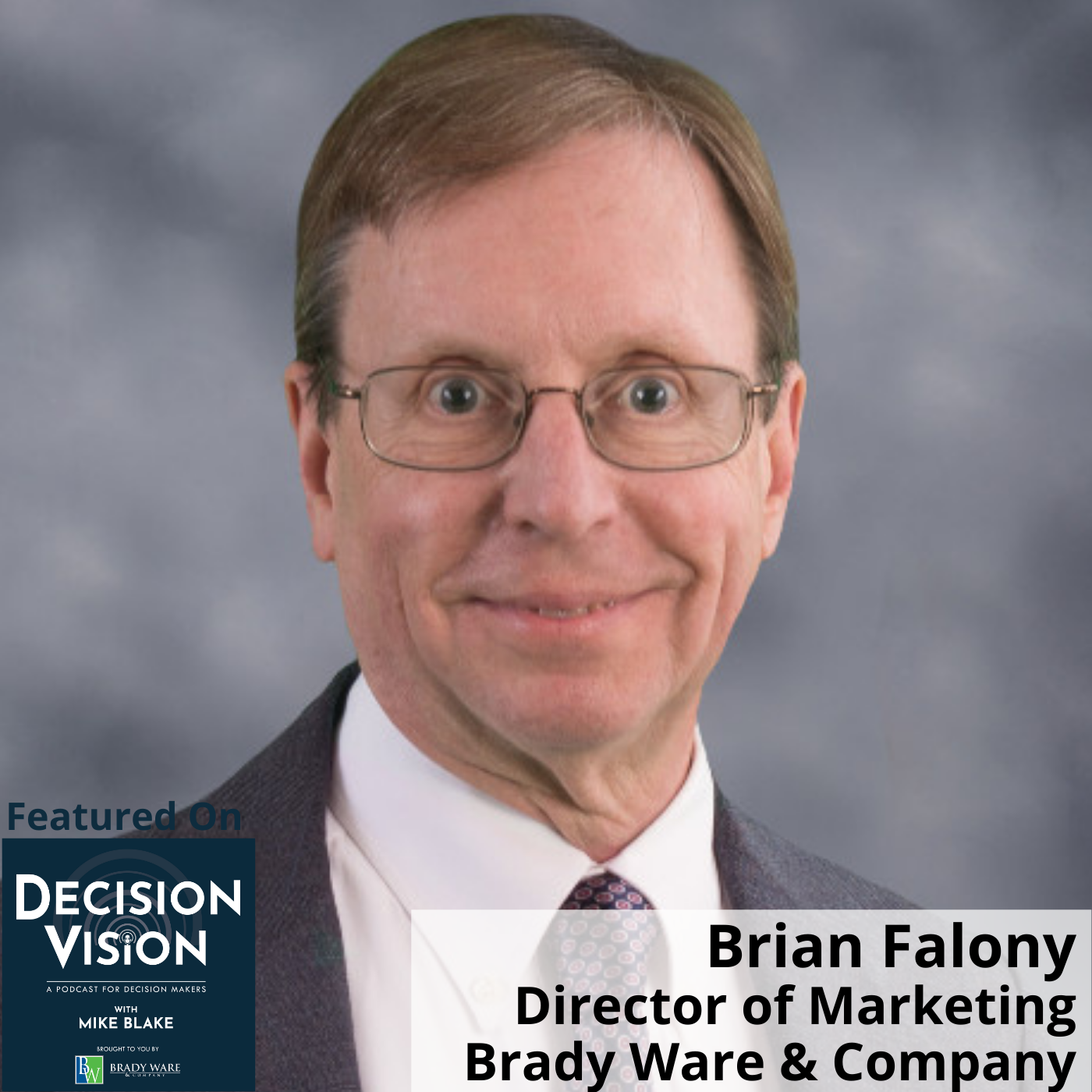
Brian Falony

Decision Vision Episode 111: Should I Retire? – An Interview with Brian Falony, Director of Marketing, Brady Ware & Company

On the eve of his retirement from Brady Ware & Company, Brian Falony joined host Mike Blake to discuss the considerations he weighed as he made the decision to retire from the workforce. “Decision Vision” is presented by Brady Ware & Company.

Brian Falony, Director of Marketing, Brady Ware & Company

Brian Falony
Brian Falony, Director of Marketing, Brady Ware & Company

Brian joined Brady Ware in 2017 and has more than 25 years of experience helping accounting firms grow their practices. He led the marketing functions for two of the top 50 CPA firms in the U.S. and has consulted with firms across North America on improving their marketing programs. Brian will lead the firm’s overall marketing efforts with a focus on growth.

Brian is a member of the Association for Accounting Marketing where he has served on several committees as well as the Board of Directors. He is also a member of the Association’s Hall of Fame.

LinkedIn

Mike Blake, Brady Ware & Company

Mike Blake, Host of the “Decision Vision” podcast series

Michael Blake is the host of the “Decision Vision” podcast series and a Director of Brady Ware & Company. Mike specializes in the valuation of intellectual property-driven firms, such as software firms, aerospace firms, and professional services firms, most frequently in the capacity as a transaction advisor, helping clients obtain great outcomes from complex transaction opportunities. He is also a specialist in the appraisal of intellectual properties as stand-alone assets, such as software, trade secrets, and patents.

Mike has been a full-time business appraiser for 13 years with public accounting firms, boutique business appraisal firms, and an owner of his own firm. Prior to that, he spent 8 years in venture capital and investment banking, including transactions in the U.S., Israel, Russia, Ukraine, and Belarus.

Brady Ware & Company

Brady Ware & Company is a regional full-service accounting and advisory firm which helps businesses and entrepreneurs make visions a reality. Brady Ware services clients nationally from its offices in Alpharetta, GA; Columbus and Dayton, OH; and Richmond, IN. The firm is growth-minded, committed to the regions in which they operate, and most importantly, they make significant investments in their people and service offerings to meet the changing financial needs of those they are privileged to serve. The firm is dedicated to providing results that make a difference for its clients.

Decision Vision Podcast Series

“Decision Vision” is a podcast covering topics and issues facing small business owners and connecting them with solutions from leading experts. This series is presented by Brady Ware & Company. If you are a decision-maker for a small business, we’d love to hear from you. Contact us at decisionvision@bradyware.com and make sure to listen to every Thursday to the “Decision Vision” podcast.

Past episodes of “Decision Vision” can be found at decisionvisionpodcast.com. “Decision Vision” is produced and broadcast by the North Fulton studio of Business RadioX®.

Connect with Brady Ware & Company:

Website | LinkedIn | Facebook | Twitter | Instagram

TRANSCRIPT

Intro: [00:00:01] Welcome to Decision Vision, a podcast series focusing on critical business decisions. Brought to you by Brady Ware & Company. Brady Ware is a regional full-service accounting and advisory firm that helps businesses and entrepreneurs make visions a reality.

Mike Blake: [00:00:21] Welcome to Decision Vision, a podcast giving you, the listener, clear vision to make great decisions. In each episode, we discuss the process of decision making on a different topic from the business owners’ or executives’ perspective. We aren’t necessarily telling you what to do, but we can put you in a position to make an informed decision on your own and understand when you might need help along the way.

Mike Blake: [00:00:41] My name is Mike Blake, and I’m your host for today’s program. I’m a director at Brady Ware & Company, a full service accounting firm based in Dayton, Ohio, with offices in Dayton; Columbus, Ohio; Richmond, Indiana; and Alpharetta, Georgia. Brady Ware is sponsoring this podcast, which is being recorded in Atlanta per social distancing protocols. If you would like to engage with me on social media with my Chart of the Day and other content, I’m on LinkedIn, and also @unblakeable on Facebook, Twitter, Clubhouse, and Instagram. If you like this podcast, please subscribe on your favorite podcast aggregator, and please consider leaving a review of the podcast as well.

Mike Blake: [00:01:17] Today’s topic is, Should I retire? And our guest – that I’m going to bring on in just a minute – is a dear friend, and professional colleague, and mentor of mine, who has reached the stage of his life where he is going to retire from our firm. I don’t know if it’s been formerly announced, so I’m not going to mention it right now, but soon. It’s a known quantity by the time this thing gets published, I’m sure it’s going to be more known.

Mike Blake: [00:01:51] But, you know, it occurs to me that retirement is one of the most consequential decisions that all of us, we hope, will make in our lives. It’s consequential from a business perspective. It’s, of course, consequential from a personal perspective. And a decision to retire is so weighty and is so complex and is intertwined with the hard material discussions and considerations as well as the emotional and profound personal considerations.

Mike Blake: [00:02:30] And, you know, we’ve been thinking about retirement as a society for a while. I remember ten years ago or 15 years ago that we thought for sure there was going to be this wave of businesses that was going to be up for sale, and this wave of executives that were going to have to retire. And interestingly, they, largely, didn’t. I mean, some did, of course. But, you know, first of all, with the profound financial implications of the financial correction of 2008 and 2009, simply for many people moved the goalposts for retirement back from a financial perspective and did so in a significant way.

Mike Blake: [00:03:17] But, also, sort of a funny thing happened is that, the human lifespan and the human useful lifespan has increased significantly since World War II. And I’m not going to get into a big discussion as to why that is. There are lots of theories. But you just can’t deny the fact that more people are living into their 90s. You know, renowned children’s author, Beverly Cleary, just passed away at 104. I didn’t even know she was still alive. But when I was in my single digits and in the 70s, I was reading her books right along with everybody else. And that’s just an example. But not only are people living longer, they’re living longer in a state of greater health and in a state of greater vibrancy. And in particular, if we ever really get a handle on Alzheimer’s, watch out, because, you know, I don’t know that 65 is going to be the bogey for retirement. I don’t know that it’s necessarily economically sustainable. And again, that’s a different podcast, so maybe the Chart of the Day.

Mike Blake: [00:04:19] But coming back to where we are, you know, regardless of the social implications and the economic implications, at the end of the day, our podcast is about making critical decisions. And usually ones that are hard to reverse. And when you really get down to it, it’s hard to think of many personal decisions that are much more impactful, that have much greater and far reaching implications than should I retire. So, that’s why I want to cover this today. And I hope many of you will find this of interest and helpful.

Mike Blake: [00:04:57] And joining us today is my longtime friend and mentor, Brian Falony, who is Director of Marketing for my firm, Brady Ware & Company. We actually met when we are working with another accounting firm. I went back and checked, it’s actually about 12 years ago. And I suspect that we grew a friendship quickly because I was an accountant that actually was interested in marketing. But, ha, the joke’s on you. I’m not really an accountant. I just have to work for an accounting firm so the record is unblemished.

Mike Blake: [00:05:28] But, you know, he and I have maintained a long relationship, a great relationship now across two firms. He actually recruited me into Brady Ware. And I hope that’s not one of the reasons he’s being put into retirement. It might be, we’ll get into that. And as I said, he’s retiring soon. So, I thought, what a cool idea to get into the head of somebody who is actually in retirement, not thinking about retirement, not did it a year ago, but is actually sort of in process, kind of like watching an eclipse as it’s happening.

Mike Blake: [00:06:05] Brian has more than 30 years of experience helping accounting firms grow their practices. He led the marketing functions for two of the top 50 CPA firms in the U.S., and has consulted with firms across North America on improving their marketing programs. Brian leads the firm’s overall marketing efforts with a focus on growth – at least he will until he retires. Brian is a member of the Association for Accounting Marketing, where he has served on several committees as well as the board of directors. He is also a member of the Association’s Hall of Fame – which I did not know. And, again, this is one of these things, just like last week, you get into somebody’s bio, you find some cool things about them you didn’t know in spite of how long you knew them.

Mike Blake: [00:06:45] And I think it’s worth saying that, also, Brian has been one of the thought leaders that helped put this podcast together. It was he, in a lot of ways, helped make this possible and rallied the support of the firm behind it. And it’s a fair statement to say, this podcast would not be here, I think, without Brian’s help. And to him, I’m very grateful for that. And I hope our listeners will acknowledge that. Brian, thank you so much for coming on the program.

Brian Falony: [00:07:13] Well, thanks, Mike. That was a great introduction. I’m not sure that I’ll live up to all of it, but I’m ready to talk about it.

Mike Blake: [00:07:22] Well, you are retiring. You are retiring, right? I mean, you are qualified to talk about that because you are, in fact, retiring. You don’t reverse that decision, right?

Brian Falony: [00:07:30] That is true. That is true.

Mike Blake: [00:07:32] So, you know, talk about your career as you kind of look back and you’re talking to somebody about what you have done over the course of your business life, how would you summarize it?

Brian Falony: [00:07:44] Well, actually, I had two careers. Right out of college, I started working for the office furniture industry. My dad was actually working in that industry. And he kind of got me an entree into it. And I worked for firms like Herman Miller and Haworth for about 17 years. And then, in, I think, 1989, Herman Miller, being a public corporation, had a big cutback. And, suddenly, there I was without a job and had a family and a house and all of that. So, I started searching around, landed a job, and had to move from West Michigan down to South Bend, Indiana, sold the house, moved the family. Six months into the new job, I decided I would have been better off staying unemployed. So then, I started searching again.

Brian Falony: [00:08:29] And there was a firm called Crowe Chizek down in South Bend, Indiana. And I had an opportunity, go in and talk to them about their marketing director position. They took a chance on me and I had no idea about working in accounting, but I took a chance on them. I found out that I absolutely loved working with accountants, working in a less hierarchical structure, and working in an area where I could make a meaningful impact on the growth of a firm. I worked for them for a few years.

Brian Falony: [00:09:04] I took another job which moved me to Atlanta, consulting. I worked for an association of accounting firms and consulted with them for a number of years. And then, had a great opportunity to go back into a firm. And so, I’ve been in firms. I’ve been consulting with firms. I’ve been with a company that’s no longer in existence, Peachtree Software. They were bought up. But for the last 30 years, I’ve been working with accounting firms and have just absolutely loved what I do, helping these firms grow and helping individual accountants find new clients and develop relationships with those clients.

Mike Blake: [00:09:45] So, you’ve done all that. You’ve enjoyed and produced, you know, the success that you have. What goes into the decision to decide you’re going to retire?

Brian Falony: [00:09:59] I think there are a couple of things, and I’m going to speak for me here. But I started over the last couple of years, I started to realize that there were parts of the job that I really, really liked. But then, there were other parts of it that it just wasn’t my main interest. And my interests were changing a bit. And so, when you start to get that feeling that – gosh – it’s just not exactly what you wanted to do. And that started me thinking about it.

Brian Falony: [00:10:35] And then, the other thing that went into that decision is, I’m a relatively older person. I did not grow up with the internet. I did not grow up with a lot of the technology that we have today. And I started to think, you know, the way marketing is going within CPA firms, it may require a different skillset than what I bring to the table. And maybe it’s time for the firm to start looking for somebody that has that skillset that can take them to the next level, can take them over the next few years, and really embrace the technology that is taking over our world.

Mike Blake: [00:11:21] You know, that’s interesting, and I think there’s a very visible analogy to that, and that is in sports coaching. I know you follow sports, at least, a little bit. And I’m sure you’re cognizant of the fact that many sports, particularly baseball but has spread to others, have gone deep into data analytics in terms of how they build teams on field, decision making, and so forth. And what we saw, about, starting ten years ago in baseball and maybe five to seven years ago in the other sports, were the old school coaches retiring. Not because they had lost the ability to coach a football game and select players and train players per se, but they started to recognize that in order to be successful or to get that next job, they were going to have to embrace analytics.

Mike Blake: [00:12:19] It means going back to school for computers, which means having to go back to school for some form of data science. Which, just is not the kind of thing that say, you know, Don Shula was going to do, right? It’s not what Joe Torre was ever going to do, right? And so, rather than retool – it didn’t mean they all of a sudden become bad coaches, but it simply was a scenario in which their industry evolved in a direction where you have to make a decision. (A) You don’t want to do it. And (B) is it worth doing, given the fact that I may not necessarily have that many working lives left. Does it even make sense to do that from an ROI perspective?

Brian Falony: [00:13:03] Yeah. And I think it’s not only the internal looking that you just described. But I think if an executive is really dedicated to the firm that they work for, I think they also have to, in their mind, ask that question, is the skillset that I have what is needed to take my firm to where it needs to go?

Mike Blake: [00:13:32] Yeah. But I guess, also, the other consideration, too, I mean, you could have simply left Brady Ware and moved to another accounting firm. So, it’s not just about the need for that firm, I imagine, but it’s also sort of the needs of the market generally. And that doesn’t mean that what you bring to the table is obsolete – I’ll just call it sort of old school, if you will, or OG marketing – it’s still very valuable. And it’s going to come back with a vengeance. So, say, I’ll get vaccinated and start meeting each other again. But it’s going to be one tool as opposed to the tool.

Brian Falony: [00:14:10] Yes. I agree totally.

Mike Blake: [00:14:14] And a tool that’s more relied upon, I think, by certain demographics, one versus the other. Again, as you mentioned, just based on how people grow up and what their comfort level is with different kinds of marketing platforms.

Brian Falony: [00:14:26] Absolutely.

Mike Blake: [00:14:28] So, I’m going to quasi-out you a little bit. I know that you’re not 65. I know that you’re older than 65. I’ll let you disclose your age if you choose to. But I know you didn’t retire exactly at 65, which is our firm’s ostensible mandatory retirement age. And that’s sort of a frequent finish line for many people’s careers, I’m not sure how long term sustainable that is given the economics. But, for now, it is what it is. Why didn’t you just retire at 65, kind of like everybody else? What kept you wanting to continue?

Brian Falony: [00:15:07] Well, at the time, I was working for a company called Thomson Reuters. And I had started out working for a company called BizActions, which was then bought by Thomson Reuters. And I had the opportunity to help CPA firms use a tool, an electronic newsletter tool, to help develop their business. And when Thomson Reuters bought it, my job changed significantly and became a little bit less fun. But I wasn’t ready to hang it up yet.

Brian Falony: [00:15:39] And so, one day, I was talking with one of my customers, Brady Ware & Company. I was talking to my contact with Brady Ware. And I’d seen on LinkedIn that they were looking for a marketing director, and I said, “Gee. I see you’re looking for a marketing director.” She says, “Yeah. Do you know anybody?” And I said, “Well, as a matter of fact, I do.” And because we had developed such a good relationship, I started working for Brady Ware.

Brian Falony: [00:16:08] But, really, at the time I was 65 years old, I wasn’t ready to hang it up at that point in time. I knew that I really loved going into an accounting firm and bringing my skills into their marketing program. And getting them to the part where they’re directed, and they’re growing, and everybody is being successful in growing the firm. So, I thought this was a great opportunity. I did, however, say to the managing partner who is doing the hiring, I said, “I want you to realize I am 65 years old. I plan on retiring at age 70. So, just understand that this is a five year maximum gig. And I’ll be happy to work with you in that transition when the time comes.”

Brian Falony: [00:16:54] Well, that was a number of years ago. And, now, that I am 70 years old, it is time to actually put that in place. And so, he and I started talking, probably, about a year ago on the transition. I let him know that 70 was coming up and that we had discussed this. And so, we’ve been working on the transition for about a year.

Mike Blake: [00:17:18] So, as you approach this decision, other than the financial peace – and financial, I think, concerns everybody to some extent. Maybe not. I don’t want to put words in your mouth – but what concerns you most about the decision to retire, if anything? Was there anything that worried you, concerned you, bothered you, made you hesitate in any way?

Brian Falony: [00:17:39] Well, it’s something that I’m still having to deal with in my head. And that is for, roughly, 47 years, ever since I graduated college, I have been in marketing. I have progressed through marketing up to the director level. I have been the breadwinner for my family. I can’t tell you the last time I took more than about two weeks off from work. And so, I think there is a little bit of a loss of identity. Like, “Who am I going to be in this new career?” And I’m still working on that. I think I’ve got a solution for it. And I’m hoping that it all works out well. But that is still a concern. And I think for a lot of people that have had a good long career and really loved what they’re doing, that loss of, “Well, this defines who I am. How do I get that new definition?” can be a pretty significant issue that needs to be considered.

Mike Blake: [00:18:49] Yeah. And, you know, I spoke with a friend, that you and I both know, last week. And she retired, actually, about a year or almost a year ago. And I’m going to have another conversation with her next week. But she wasn’t overly thrilled with her retirement either. And the thing that she told me that she’s really struggling with is building that identity. You know, there’s only so many books you can read, if you’re the most voracious reader in the world. And so, like I said, I got on the phone with her and helped her brainstorm and kind of think about what might be next. And, you know, I think it is jarring.

Mike Blake: [00:19:32] My dad, he retired, I guess, about eight, nine years ago. And he’s a very good retiree. He had no desire to go back to work. He’s a little bit a nonprofit. He’s a big time bridge player, that sort of thing. But, you know, I can appreciate for a lot of people that’s not easy, especially if you’ve been sort of in an intense environment where your whole day, your week, your month, your year is structured around work. You just have that become a vacuum. It’s almost an embarrassment of riches in terms of time. It’s a different kind of time management problem.

Brian Falony: [00:20:08] Yes, it is. And we’ll see how that goes.

Mike Blake: [00:20:12] So, how would you characterize your retirement planning process? When did you start to get serious about it? Was it phased? Was it consistent? Was it, “Oh, crap. I’m behind. I got to hurry up.” And it’s probably sort of different for different aspects of retirement. But how would you characterize it in your particular case?

Brian Falony: [00:20:38] Well, it was pretty well planned. And if you ever talk to my wife, she’ll tell you that I’m very annal about process and planning and all of that. So, you know, as I alluded to earlier, I had told the managing partner of Brady Ware when he hired me that there was a limit on this. So, I had already started thinking about what does this look like. And then, I kind of put off any kind of planning until about a year ago. And when I turned 69, I said, “You know, I really have to be in a position to make this a successful and a smooth transition, so I better start planning now.”

Mike Blake: [00:21:22] And so, I talked to the managing partner, like I said, a year ago. And then, we got serious about putting a plan together, probably, starting six months ago. And we have a structured plan that laid out dates for hiring a consultant to determine what kind of a transition we wanted to make in sourcing, hiring, putting up the ads for candidates, evaluating the candidates. So, there was a pretty good plan there.

Brian Falony: [00:22:01] On the personal side, I’ve also been planning and talking to a couple of my contacts within the industry about possible consulting work and things like this. So, there’s that other side of the plan, the personal side of the plan. But I’ve been working on that for probably about the last year just to make sure that it is a good, smooth transition.

Mike Blake: [00:22:28] So, you’ve been involved, you said, in helping to choose your successor. How much involvement have you had? And do you think that involvement is likely going to be best practices for many firms? Or maybe best practice is more or less involvement?

Brian Falony: [00:22:48] That’s a really interesting question. As you said, I have been involved. I have interviewed some of the candidates. I definitely interviewed the successful candidate. But I think part of that is going to depend on the personality of the of individual retiring. I went into this with an idea that within the accounting marketing profession, most times marketing directors don’t retire. They leave and get another job, they get fired, whatever. And it’s a very difficult transition. One of the things I wanted to do in this is, try to make a smooth transition to see what goes into making that happen. So, I had the mindset that I really wanted to help with that.

Brian Falony: [00:23:46] Other people that may have a different attitude, may have the attitude that I’m the best one that’s ever been in this position, it would be a little harder for them to step back and say, “All right. Who is going to be a great person to replace me? Do some of the things that I can’t do and take the firm to the next level.”

Brian Falony: [00:24:07] So, I think going back to your original question, how involved should the person be in bringing their successor, I think if they’ve got the attitude that, this is a process that I can significantly help move my firm to the next level by doing this, then they ought to be very involved. If it’s, on the other hand, a person who thinks that they can’t be replaced, they probably ought to not be terribly involved because they’re going to look for the negative sides of anybody that’s going to come in and replace them.

Mike Blake: [00:24:39] Right. There are, in fact, the process. So, I imagine the other piece of this, too, is the circumstances under which the retirement is occurring. In your case, you know, you’re managing an orderly retirement. You’re obviously departing from the firm or separating from the firm on very good terms. Not every retirement occurs in that direction that way, right?

Brian Falony: [00:25:01] That’s true. That is true.

Mike Blake: [00:25:03] You know, you don’t necessarily want to have the person that you’re effectively booting out, trying to be involved in the successor. It’s hard to see how that would be a constructive conversation and relationship.

Brian Falony: [00:25:15] Yeah. Yeah. The plan is to have my successor in place and for me to work with him for probably about four weeks. And I’ve given this some thought and I’m thinking that, like, the first week, I’m still going to be the marketing director and he’s going to be learning from me. The second week, it might be kind of half and half. And by the third week, he’s going to be the marketing director and I’m just going to be there as a resource to him for a couple of weeks.

Mike Blake: [00:25:42] Okay. Now, you really gave the firm five years notice, when you really get down to it, right? But then, you sort of reminded our managing partner – I don’t know if I should say his name, but I guess not. I don’t know if it matters or not. People can look it up – you gave him notice saying, “Hey, look. You know, we’re sort of at the fourth quarter here. You know, we need to start acting.” So, in effect, that was a year long runway. Do you think a year is best practice in your ideal world might you have started a transition process earlier? Is it perhaps too much that maybe a year just seems so far away in retrospect? What’s your view on that?

Brian Falony: [00:26:34] I think a year is probably good. I wouldn’t make it less than six months. But then, I wouldn’t make it longer than a year either. And one of the things that I’ve noticed particularly, probably, in the last couple of months, is that, in interactions with some of the folks in the firm, I get the feeling that they’re looking at me as a lame duck. And so, I think if you start this process too soon, like more than a year out, the person could find themselves in that lame duck position a lot earlier than they need to be. So, I would say probably somewhere in the six months to one year range, at least from my experiences, is a pretty good amount of time.

Mike Blake: [00:27:25] Right. Right. And, of course, we’re talking about an executive position too. A position that’s more of a staff position. You may not necessarily need that long a transition. But the bulk of our listeners are in that executive position, so I think that answer is most relevant to them.

Mike Blake: [00:27:47] The question I’d like to ask is, a lot of people – and I’m starting to get to this age now where people are very fixated on it – have sort of a magic financial number. Where their basis is, you know, if I hit this, I’m going to retire. In government, if I hit 20 years of service, I’m out. Or, you know, for the rest of us mere mortals, if I have this much in the bank, that said, I’m out. You know, how important was that to you in terms of the timing and decision to retire?

Brian Falony: [00:28:15] It was a factor, but I don’t think it was the major factor. One of the things that I considered is – and this may change, but for right now -you’ve maxed out your Social Security at age 70. So, I knew 70 was kind of where I wanted to be. What was more important to me was having zero debt going into it, so that was a goal. But, you know, I don’t think there was a specific financial number in mind.

Brian Falony: [00:28:58] I wanted to make sure that I had enough in between my retirement savings and my Social Security that we’re not going to have to significantly downsize our lifestyle. That’s probably the biggest consideration, just having enough to enjoy the time that I have left, and provide for my wife, and just do some of the things that we have not been able to do because I’ve been tied up with work for all these years. But there wasn’t a magic number out there. There was a lot of factors that went into it. I don’t know if that helps, but that was kind of what was going in my mind.

Mike Blake: [00:29:47] Well, I think it’s interesting. This is one of those answers that I think is going to differ person to person. I know some people that they look fanatically at their brokerage accounts or savings accounts, whatever it is, their total assets, and they say, “If I hit this number, then I can basically give the world a finger. And then, my whole world changes after that time.” And, you know, of course, we all hear about government employees that the saying is, they know to the day when they’re eligible to receive full retirement.

Mike Blake: [00:30:22] And I was just curious, in your perspective – it sounds like it’s not – it doesn’t sound like you’re fixated on a number that basically was your “freedom number”. Obviously, you want to retire at a time when you can provide for yourself. That doesn’t make any sense not to do if you can help it. But at the same token, it doesn’t sound like you hit a finish line. I’ve made the number. And, therefore, I’m just going to sort of hit a switch and go into retirement mode. It’s much more holistic than that.

Brian Falony: [00:30:52] Yeah. I think that’s a fair description, Mike.

Mike Blake: [00:30:57] So, I see retirement as falling into one or two buckets. And I think I know the answer to this question, but I don’t want to assume. And one of those buckets is, retirement just simply closes a book. It’s a big ending that transitions into something just entirely different. And, again, my father was this way, my grandfather was this way for sure, my mother was this way. They just retired and just never looked back in any way, at least as far as I could tell.

Mike Blake: [00:31:39] And then, there’s another school of thought that says, “Well, this is just a different chapter where I’m still going to be around. I’m still going to be doing stuff. I’m not going to necessarily have ‘being retired’ as my identity. It’s simply a financial status,” if you will. I’m curious as to which bucket you would like to see yourself in and what’s attractive about that to you?

Brian Falony: [00:32:03] I think I would up for bucket number two as opposed to bucket number one. As I said earlier, when I fell into this career of professional services, marketing, and particularly marketing for accounting firms, I found something I really loved. And you mentioned earlier that I’m a member of the Association for Accounting Marketing and I’ve served on the board of directors and a number of committees there. And that association has been critical to my career. And I love the people in the organization. I love the organization.

Brian Falony: [00:32:42] So, I plan to stay involved with that organization even after I retire. And through that organization, I’ve met a number of people, some of whom have gone out into the consulting world. And I’ve talked to a couple of them about possibly working with them on some part time consulting engagements, things like that. Because, like I said, I love this profession and I do have, I believe, some things that I can give back to some other firms. So, I plan to keep my hand in at least a bit, not full time, but at least a bit, and just give back a little bit to this profession that has been so good to me.

Mike Blake: [00:33:24] You know, one of the things that I’ve seen some organizations do, and this is something I believe they have borrowed from academia, is, they established an emeritus role. And I think that’s actually really smart because one of the things I think that firms make a mistake on, you know, we have these well-intentioned retirement ages. And the goal mainly of the retirement age is to make room for the next generation, basically. But hitting the ejector seat on people that have potentially a-half-a-century of experience – I don’t care how much technology has changed – there’s going to be value to that half century of experience, for sure. You know, to have a role for that emeritus, whether it’s in a firm, whether it’s in an organization – hopefully AAM has something like that available for you. If not, they should – what do you think about roles like that? I mean, is that a real thing or is it just window dressing or am I making something that really isn’t a big deal? How do you kind of react to that?

Brian Falony: [00:34:28] Actually, I hadn’t thought about that until you brought it up. But I think it’s a really good idea. It’s certainly not going to be for everybody. But I think there is a lot of experience that goes out the door, and firms and individuals could benefit from that. I think there’s a tremendous opportunity for mentorship relationships within firms that could be enhanced by that person not being in a direct reporting relationship.

Brian Falony: [00:35:05] That’s one of the things that I found interesting about CPA firms, is, most of them that are at the partnership type have a defined retirement date where people have to sell back their ownership, and it’s usually 65. And there’s a lot of experience that walks out the door when that 65 hits and they have to sell their shares back. It’s experience that the firms themselves, I think, could benefit from in some fashion if they had what you call an emeritus type position. So, in hearing you talk about that, I think that’s probably not a bad idea.

Mike Blake: [00:35:48] Yeah. And maybe it’s something I’ll bring up with the other partners in the firm. So, we’re talking with Brady – I’m sorry. We’re talking with Brian Falony of Brady Ware & Company. And the topic is, Should I retire? Did the pandemic impact your decision to retire at all? And if so, how?

Brian Falony: [00:36:07] Not really. I’m one of these people that I’ve never been particularly concerned about the pandemic per se. So, I haven’t altered my work style much because of it. Now, the big change for me when the pandemic hit was, I was flying up to Dayton, Ohio usually about once a month. And I don’t think I’ve been up there since January of 2020. So, I’m not getting those Delta miles anymore. But the pandemic really didn’t have a lot to do with it. In fact, if the pandemic had had any effect, the only effect I could see is I might have postponed it another year since I won’t be able to do some of the traveling I wanted to do in retirement. But the pandemic really has not affected my decision one way or the other.

Mike Blake: [00:37:02] And that’s interesting because in considering what you said at the outset of our conversation, you talked about the approach to marketing being much more technologically focused as one of the motivations to retire. And I would have anticipated you saying that, clearly, marketing as much as anything has been forced to undergo a massive digital transformation. Because we can’t go to the conferences, and trade shows, and networking meetings, and coffees, and after dinner drinks and happy hours, all that good stuff. And I was curious if the sudden reliance on that – and I may be putting words in your mouth, so feel free to tell me to go jump in the lake – knowing the kind of person you are, how much personal contact means to you, and how much relationships means to you, you know, I wonder if kind of just the pandemic and the digital transformation for somebody like you would just take a lot of the fun out of it.

Brian Falony: [00:38:13] Maybe. But I think one of the things that the pandemic did, going back to what you just said about the change and the greater use of technology, is, it really spurred me to dig in and learn better how to use this technology that I’m not a native to and have not grown up with. It reminds me of something I got from my old aunt who just passed away, she was 98 years old. I last saw her, probably, about five years ago. And she said, one of the things that kept her going at that point in time was when she got up every day, her goal was to read something and learn something new every day. And as long as she did that, then she felt she was living well.

Brian Falony: [00:39:08] And so, when I reflected back on that, I said, “Here’s an opportunity for me to really dig in and learn something new, and see if I can enhance my skillset with it.” And so, rather than being a turn off and losing that contact – yeah, I do miss the personal contact. I do miss the face to face. I miss sitting down in your office with you and talking over your huge screen – but on the other hand, it has also spurred me to really dig in and learn new things. And so, I think there’s pluses and there’s minuses.

Mike Blake: [00:39:44] What are you looking forward to most in retirement?

Brian Falony: [00:39:50] One of the things is, as I noted before, giving back somewhat to my profession and trying to help and mentor some younger folks in the accounting marketing profession, because it can be a tough profession. But I’m also looking forward to exploring some other interests. I have a strong interest in science, and particularly astronomy and things like that. And I plan to spend some time reading and learning about that. And I might even dust off my log book and go out and go back to flying a little bit. You know, get current back so that maybe I can take my grandkids up for a flight one of these days.

Mike Blake: [00:40:34] Well, I’m sure they love that. For somebody who went to pilot training myself for a while, the navigation is a lot easier now, so you might want play with that. Brian, this has been great. I really appreciate you taking some time to talk to us. And I think our conversation is going to help a lot of people who are thinking about retirement sometime in the short to medium term. If people want to follow up on a question I didn’t ask or maybe want to go deeper on something that we talked about, can they reach out to you? And if so, what’s the best way to do so?

Brian Falony: [00:41:07] Yes, they can. And Mike, thank you. This has been a fascinating discussion. But if people need to get a hold of me, probably, since I will not be at Brady Ware for more than another few weeks, best thing would be to email me. And my personal email is F as in Frank-A-L-O-N-Y-B@earthlink.net.

Mike Blake: [00:41:33] Well, thank you, Brian. And that’s going to wrap it up for today’s program. I’d like to thank Brian Falony so much for joining us and sharing his expertise with us.

Mike Blake: [00:41:41] We’ll be exploring a new topic each week, so please tune in so that when you’re faced with your next business decision, you have clear vision when making it. If you enjoy these podcasts, please consider leaving a review with your favorite podcast aggregator. It helps people find us that we can help them. If you like to engage with me on social media with my Chart of the Day and other content, I’m on LinkedIn, and @unblakeable on Facebook, Twitter, Clubhouse, and Instagram. Once again, this is Mike Blake. Our sponsor is Brady Ware & Company. And this has been the Decision Vision podcast.
 

Tagged With: accounting firm, Brady Ware, Brady Ware & Company, Brian Falony, career, marketing career, Michael Blake, Mike Blake, retirement, retirement planning

Decision Vision Episode 110: Should I Pivot my Company? – An Interview with Helene Lollis, Pathbuilders

April 1, 2021 by John Ray

Pathbuilders
Decision Vision
Decision Vision Episode 110: Should I Pivot my Company? - An Interview with Helene Lollis, Pathbuilders
Loading
00:00 /
RSS Feed
Share
Link
Embed

Download file

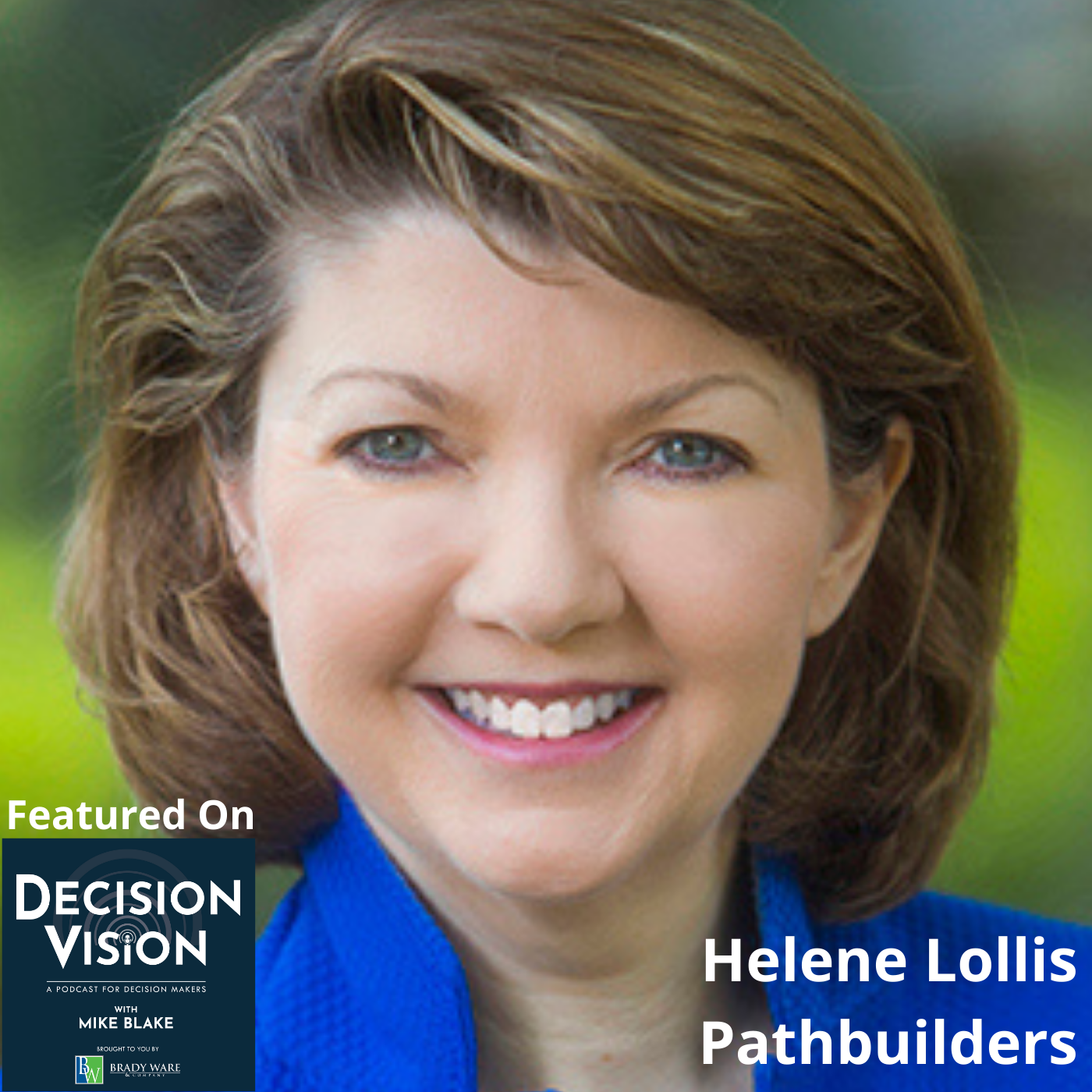
Pathbuilders

Decision Vision Episode 11o:  Should I Pivot my Company? – An Interview with Helene Lollis, Pathbuilders

As CEO of Pathbuilders, Helene Lollis started the year 2020 planning her company’s 25th anniversary celebrations. Those plans quickly faded, however, as a pandemic created an enormous challenge for a business based on in-person learning. Helene spoke with host Mike Blake on how she guided a pivot for Pathbuilders and how the company thrived because of it. “Decision Vision” is presented by Brady Ware & Company.

Pathbuilders

Pathbuilders is a professional mentoring and leadership development company. They offer cross-company mentoring programs for women at each phase of their careers, and custom programming for organizations focused on developing high-potential women and men, creating mentoring cultures, launching women’s initiatives, and retaining key talent.Pathbuilders

At Pathbuilders, they design and deliver high-impact mentoring programs for organizations using custom tools and proven methodologies that create formalized learning environments. It is the purposeful structure and practical nature of their content that make the learnings applicable and actionable, and we pride ourselves in creating lasting mentoring relationships for our clients that directly impact retention, promotion, and satisfaction.

Company website | LinkedIn

Helene Lollis, CEO, Pathbuilders

Helene Lollis, CEO, Pathbuilders

Helene Lollis is the chief executive officer of PATHBUILDERS, an organization focused on moving women forward and increasing gender diversity in leadership. For 25 years, Pathbuilders has focused on advancing top-tier talent through high-impact mentoring, professional development, and consulting with senior executives to create cultures where women thrive. Helene guides strategic direction and program development consults with key clients and represents Pathbuilders in the community. Trained as an engineer, Helene spent 12 years with Amoco and BP Corporations in plastics process design, product development, marketing, strategic planning, and company mergers and acquisitions.

Helene is frequently invited to speak on the topics of mentoring, women in the workplace, and career planning. She has been published in HR Magazine, Diversity Executive, and Talent Management and has been featured in The Wall Street Journal. Extremely active in the community, Helene is a past chair and on the executive board of Junior Achievement of Georgia and is a Trustee of the Woodruff Arts Center, where she is a chair of its Women’s Giving Circle. She serves on the Boards of the NC State University Engineering Foundation, the Rotary Club of Atlanta, and SHRM-Atlanta and has previous board service with the Metro Atlanta Chamber and Leadership Atlanta. She is also a member of the International Women’s Forum.

Helene was proud to be recognized as one of Atlanta’s Most Admired CEOs by the Atlanta Business Chronicle in 2020. She received the Gold Leadership Award from the Junior Achievement USA Board of Directors for her service to JA. She was inducted into the YWCA Academy of Women Achievers, and she was recognized as the Guiding Star by Emory’s Executive Women of Goizueta. Helene served as a subject matter expert at The Wall Street Journal Executive Task Force on Women in the Economy. She received her bachelor’s and master’s degrees in chemical engineering from NC State and Purdue Universities.

LinkedIn

Mike Blake, Brady Ware & Company

Mike Blake, Host of the “Decision Vision” podcast series

Michael Blake is the host of the “Decision Vision” podcast series and a Director of Brady Ware & Company. Mike specializes in the valuation of intellectual property-driven firms, such as software firms, aerospace firms, and professional services firms, most frequently in the capacity as a transaction advisor, helping clients obtain great outcomes from complex transaction opportunities. He is also a specialist in the appraisal of intellectual properties as stand-alone assets, such as software, trade secrets, and patents.

Mike has been a full-time business appraiser for 13 years with public accounting firms, boutique business appraisal firms, and an owner of his own firm. Prior to that, he spent 8 years in venture capital and investment banking, including transactions in the U.S., Israel, Russia, Ukraine, and Belarus.

Brady Ware & Company

Brady Ware & Company is a regional full-service accounting and advisory firm which helps businesses and entrepreneurs make visions a reality. Brady Ware services clients nationally from its offices in Alpharetta, GA; Columbus and Dayton, OH; and Richmond, IN. The firm is growth-minded, committed to the regions in which they operate, and most importantly, they make significant investments in their people and service offerings to meet the changing financial needs of those they are privileged to serve. The firm is dedicated to providing results that make a difference for its clients.

Decision Vision Podcast Series

“Decision Vision” is a podcast covering topics and issues facing small business owners and connecting them with solutions from leading experts. This series is presented by Brady Ware & Company. If you are a decision-maker for a small business, we’d love to hear from you. Contact us at decisionvision@bradyware.com and make sure to listen to every Thursday to the “Decision Vision” podcast.

Past episodes of “Decision Vision” can be found at decisionvisionpodcast.com. “Decision Vision” is produced and broadcast by the North Fulton studio of Business RadioX®.

Visit Brady Ware & Company on social media:

LinkedIn:  https://www.linkedin.com/company/brady-ware/

Facebook: https://www.facebook.com/bradywareCPAs/

Twitter: https://twitter.com/BradyWare

Instagram: https://www.instagram.com/bradywarecompany/</a

TRANSCRIPT

Intro: [00:00:03] Welcome to Decision Vision, a podcast series focusing on critical business decisions. Brought to you by Brady Ware & Company. Brady Ware is a regional, full service accounting and advisory firm that helps businesses and entrepreneurs make visions a reality.

Mike Blake: [00:00:23] Welcome to Decision Vision, a podcast giving you, the listener, clear vision to make great decisions. In each episode, we discuss the process of decision making on a different topic from the business owners’ or executives’ perspective. We aren’t necessarily telling you what to do, but we can put you in a position to make an informed decision on your own and understand when you might need help along the way.

Mike Blake: [00:00:44] My name is Mike Blake, and I’m your host for today’s program. I’m a director at Brady Ware & Company, a full service accounting firm based in Dayton, Ohio, with offices in Dayton; Columbus, Ohio; Richmond, Indiana; and Alpharetta, Georgia. Brady Ware is sponsoring this podcast, which is being recorded in Atlanta per social distancing protocols. If you like this podcast, please subscribe on your favorite podcast aggregator and please consider leaving a view of the podcast as well.

Mike Blake: [00:01:12] So, today’s topic is a topic that we’ve visited before. We had Brandon Cooper on talking about pivoting a company. And today’s topic is, Should I pivot my company? And as I mentioned when we crossed the 100th episode threshold that, I decided that I wasn’t going to be afraid to revisit topics, because, you know, a lot of people approach the same problem or decision with a different fact set with a different fact set, with a different set of priorities and with, frankly, a different set of circumstances.

Mike Blake: [00:01:50] And, therefore, I’ve decided and the listenership seems to agree given the rise of numbers we’ve had, that it’s okay to kind of revisit a problem again and again. We’re not going to make this the pivot our company podcast or it’s all pivots all the time. But, nevertheless, I do want to come back and revisit these conversations.

Mike Blake: [00:02:12] And, of course, we have this thing called coronavirus, which as of March 25th, when we are recording this podcast, it looks like we are at least in a position where we’re seeing a light at the end of the tunnel. We’re not there. We’re not post-pandemic. I call it trans-pandemic. But we’re certainly getting there. And as many of us know, COVID has presented us with decisions we would not have ever imagined we would have needed to make. And probably if we did make them, we had to make them in a way that would have been different in the pre-pandemic environment.

Mike Blake: [00:02:50] And Brandon’s conversation was more about – or was about a circumstance where a pivot was required in a pre-pandemic scenario. But our guest today is going to come in and talk to us about the decision to pivot a company during the pandemic as a result of the pandemic. And I think a lot of companies can recognize this.

Mike Blake: [00:03:16] And even though we are emerging from the pandemic at this point, it’s still going to be instructive because we don’t know when that next external shock is going to happen. We don’t know when the next pandemic is going to happen. I mean, frankly, you know, if we’re honest about it, we don’t necessarily know that we have COVID licked. I mean, I think right now we have the upper hand, but there are mutations out there. You know, we just don’t know. So, I do believe that this is going to be somewhat of an evergreen topic for good or ill.

Mike Blake: [00:03:46] And helping us with this is my long time friend, Helene Lollis, who is the Chief Executive Officer of Path Builders. An organization focused on moving women forward and increasing gender diversity in leadership. Extremely active in the community, Helene is a past chair and on the executive board of Junior Achievement of Georgia – she’s been doing that forever, I know – and as a trustee of the Woodruff Arts Center, where she is the chair of its Women’s Giving Circle. She serves on a bunch of other boards, too, it’d take out the program to list all of them. Just take my word for it, she does a lot of stuff.

Mike Blake: [00:04:21] Helene was also recognized as one of Atlanta’s Most Admired CEOs by the Atlanta Business Chronicle in 2020. She received the Gold Leadership Award from the Junior Achievement USA Board of Directors for her service to Junior Achievement. And she was inducted into the YWCA Academy of Women Achievers and was recognized as the Guiding Star by Emory’s Executive Women of Goizueta, which is their school of business. She was trained as an engineer – which I did not know. And I’m embarrassed that I did not know this. I never asked.

Helene Lollis: [00:04:49] Why don’t you know that?

Mike Blake: [00:04:49] But she was trained as an engineer and received her Bachelor’s and Master’s Degree in Chemical Engineering from North Carolina State and Purdue University. And spent 12 years at the Amoco and BP Corporations in plastics, process design, product development, marketing, strategic planning, and company mergers and acquisitions.

Mike Blake: [00:05:08] For 25 years, Path Builders has focused on advancing top tier talent through high impact mentoring, professional development and consulting with senior executives to create cultures where women thrive. Boy, do we need that today. And Helene guides strategic decision and program development, consults with key clients, and represents path builders in the community. Helene Lollis, welcome to the program.

Helene Lollis: [00:05:30] Welcome. I wish I sent you a shorter bio.

Mike Blake: [00:05:34] No, I’m glad that we got that out there. The cool thing is, I mean, I’ve had a lot of friend whom I’ve known for some time, and it’s uncanny how many things I learn about them when I actually have to go and do the homework and learn about the bio. Fortunately, I haven’t found that somebody was like a convicted felon or anything, that might be kind of awkward, or a traitor to the state. But, you know, I did not know that you have that long background in engineering and material science before you moved into this. And at some point, I hope our conversation will come around to how does that background give you, maybe, a different perspective on the things that you do, because I suspect that it does.

Helene Lollis: [00:06:19] It does. Yeah.

Mike Blake: [00:06:20] As opposed to what I would expect a more kind of human resource background, for example.

Helene Lollis: [00:06:25] Yeah. I would tell you, my team knows every single day that I’m an engineer. You know, it’s a way of thinking. It’s a way of framing. There’s no question. And even in the processes of the things that we do at Path Builders, there’s engineering all around.

Mike Blake: [00:06:40] So, before we get into this, I’d like you to describe Path Builders. I mean, you really have been, as your bio reads, a fixture in the community. What does Path Builders do and what is the origin story of Path Builders?

Helene Lollis: [00:06:56] Yeah. So, our focus is helping companies to move women forward and to elevate their best talent every single day. And we’re probably best known for large scale mentoring programs where we match women with mentors and peers, and take them through experiential learning to really equip them to be better able to move into leadership roles inside their organizations.

Helene Lollis: [00:07:21] But if the company was actually an Anderson incubator business back in the 90s, I was a mentee, actually, in one of the programs. So, I was working for Amoco at the time. They placed me in the program as a mentee. The gentleman with whom I was matched as my mentor is still my mentor. I talk with him on Saturday. So, it clearly was rather pivotal in my own career. So, we’re probably best known for those cross-company mentoring programs.

Helene Lollis: [00:07:53] But I bought the company in 2002 after leaving BP. And, initially, kept the dynamic that the previous owners had in place, this model of mentoring women. I felt right away a couple of things. One, they were starting too late. They were kind of starting with director level women who could be officers. And if you’re serious about building a pipeline of female talent, you got to start earlier than that. And, two, we’re exclusively working with women. And to create environments where women thrive, you’ve got to be working with both women and men. So, the nutshell is, we work with organizations to move women forward. We work to really develop talent and leadership benches with both women and men inside organizations.

Helene Lollis: [00:08:40] And then, I would say, the last few years, what we have added to complement all of that is consulting at the C-suite on how do you create an environment where women can thrive and women can move forward. How do you change the dialogue in the C- suite to be around how gender is strategic to really building a great company.

Mike Blake: [00:09:01] So, you are doing that. I know you had a lot of very high profile clients. But the thing that struck me is, you’ve been working with the U.S. Military for a long time now, at least you had been. I presume that’s still the case. And then, one year ago happens, right? It was just around St. Patrick’s Day or a little bit before then, when, frankly, our world changed. So, you know, coronavirus happens. The next thing you know by, I guess, April, a lot of us are told to “shelter in place”. And what happened to Path Builders at that point?

Helene Lollis: [00:09:36] Yeah. So, I said the company is 25 years old, actually, last March was the 25th anniversary. And we had this fantastic plan that it was going to be a year of parties. And my leadership team had actually built this fantastic idea. Instead of having one big event, we were going to have a whole year of pop-up parties. And one of our clients, WesTrac, had already signed on to be the first pop-up party. And we were going to be inside all of our clients, helping them to celebrate their commitment to women. And then, a week later, we decided we’re probably not going to have at least that first pop-up party.

Helene Lollis: [00:10:17] So, long story short, I had no idea that what started out as a year thinking it was going to be celebrating an anniversary, two enormous changes. So, one, completely reinventing how we deliver. But I will also say, overnight, we shifted from being a sales driven company to being a marketing driven company. You already highlighted how much I do in the community. My whole team is out and about and it was very much being with people talking about what we do. That was one of the primary drivers of really where our clients came from. And clearly those opportunities were gone. So, I mean, not only were we shifting how we do what we do, but we were even shifting how we built the pipeline for what we do.

Mike Blake: [00:11:00] So, as coronavirus hit – and I’m curious where you kind of fall with this – my own perspective was, you know, I knew it was serious, but my own reaction was kind of incremental. Things are changing, but do I have to necessarily blow everything up to survive? I’m not there yet. So, here are five or six things I think are going to be kind of small changes and maybe we can kind of ride it out. Was that your experience, too? And if so, what were the small changes that you tried and maybe worked or didn’t work?

Helene Lollis: [00:11:35] Yeah. So, I’m fully transparent that there were four [inaudible], and I lived in each of those stages for a period of time. I mean, number one was the very simple denial, “Helene, this can’t possibly be happening. This isn’t the way we do things.” And I remember initially having that moment of paralysis of, “Oh, my gosh. We can’t do what we do in this environment.” And the reality of it was, you couldn’t survive that way, right? So, we moved to the, “Okay. If we have to, for a few weeks, do whatever.”

Mike Blake: [00:12:14] Thus bargaining.

Helene Lollis: [00:12:17] Yeah. Exactly. I can hang right with Elisabeth Kubler Ross right through this whole dynamic. Absolutely. But then, we thought, “Okay. We’ll do a couple of webinars from the basement of my house and it’ll be okay.” And it was talking about things that worked and things that did not work. We pride ourselves on flawless execution, and that means there are a lot of people monitoring different aspects of things. And so, we were doing what we deemed to be interactive workshops, but literally two of us in a basement. The rest of the team we were communicating with through Teams. And so, here, I’m trying to deliver a workshop while communicating with my team on Teams, while silently communicating with my – bless his heart – husband trying to manage the technology.

Helene Lollis: [00:13:06] And I will tell you, the morning of a huge program launch, I will never forget when the people across the street from us had one of those chipper trucks drive up in front of their house. And my husband and I are literally, like, putting together our cash. Like, could we come up with 100 bucks to make these people go away? We can’t so much of a run.

Mike Blake: [00:13:24] Wow, what a story.

Helene Lollis: [00:13:26] So, I mean, recognizing those moments – unbelievably they finished before so we didn’t have to pay them. But then, we had a client who just said, “You know what? We’ve been waiting and we don’t want to wait anymore. We’re ready to go.” And it was a client where we were working with developing all of their newly promoted managers and directors. And we had designed it as opportunities where they would be convening in one of their offices, so either in Chicago or Atlanta or New York. And it was as much about developing managers and directors to be great leaders as it was about them building a leadership team.

Helene Lollis: [00:14:05] So, the way we had designed the program was about being in-person together and relationship building. And so, we just kept postponing. We kept saying, “Well, we’ll wait until we can do that.” And they came back and said, “You know what? We’re ready to go. Figure it out, make it happen.” And so, we said, “Okay. Will you give us the space to completely redesign the program?” Because we can’t just pick it up and and pretend it’s the same online. And so, absolutely fantastic working with them. But we went back to the drawing board and we said, “Okay. So, instead of a monthly gathering, this now needs to be two week touch points.” And there’ll be certain sorts of breakout groups we do when they’re in session with us. But then, certain learning teams that they’re going to be connected to and we’ll build discussion guides and threads through all of that.

Helene Lollis: [00:15:02] So, phase three for us was, we can make – I guess that’s really phase two, we can make something that’s meaningful. Phase three, for me, was the, “Oh, my gosh. This might have some legs.” We’re actually creating connectivity, and relationship, and trust building that is not only positively impacting these people as leaders, but now they’re actually able to extend their network more broadly than they might have been able to otherwise. And then, finally, stage four for me was, this is probably something we should have done a long time ago.

Helene Lollis: [00:15:43] In the fall, we launched a program, a cross-company program completely designed to be in the online world. And first time coming out of the blocks are amazing. Clients trusted us so much. We had women from 11 states the first time we set it up to go forward. And, now, it’s such an interesting time to be having this conversation because now we’re really trying to figure out who are we going to be after, when we’re no longer trans-pandemic, as you said, but when we are perhaps actually post.

Mike Blake: [00:16:17] So, I’m going to go off-script here, because what you said and the way that you said it brings something that is, I hope, an important observation. And that is that, in all those sort of stages of grief, the one that I don’t think that you had, or at least if you did, it lasted for probably about 18 seconds, was the depression part. I think it sounds to me and knowing you as well as I think that I do, I think that this is right is that, you quickly recognized that just sort of things had to change. And you can be frustrated with it all you want, but at some point you got to solve the problem.

Helene Lollis: [00:16:57] Yeah. And, I mean, I think some of that is just a bent to the eternally optimistic entrepreneur, right? But I’d be a liar. I mean, (A) Elisabeth Kubler Ross would tell you, you don’t get to skip stages. So, clearly, I had to be there, and maybe it was a short visit point. But there were certainly moments right before going live with big offerings where that inner voice does this, “This can’t be happening to us.” But I will tell you, again, unbelievably loyal clients. Suddenly, the feedback we were getting after we got out of the basement – the basement, the feedback wasn’t too great, to be completely honest.

Helene Lollis: [00:17:43] But we were back in the office and starting to build out a Zoom studio in April and May. And I will say, largely because we had not done a lot of this, it was a brand new world for us. So, we weren’t tied to any mindset of what online delivery was going to look like. And so, I think that the creativity – and I mean, I can’t say enough positive things about the team around me – we had and the way we were redesigning to create experiential learning, we started getting such great feedback so fast that it pulled us through that curve pretty quickly.

Mike Blake: [00:18:25] So, I’m curious. I think a lot of us have had to, on some level, become amateur video and audio engineers, like it or not. Otherwise, I mean, you just can’t communicate. And as much as sort of Zoom and other platforms are interesting, one, they don’t all work the same. And number two, they are not the realization of AT&T’s video phone. You don’t just simply pick up the handset and you’re talking to somebody on video.

Mike Blake: [00:18:57] What was it like? Were you energized about the opportunity to pick up an entirely different skillset? Was your team energized about that? Were they scared? Were they frustrated? Was it a cocktail of all three? What was that like?

Helene Lollis: [00:19:11] Yeah. I don’t know that any of us took the time to contemplate it as a wonderful learning opportunity. I don’t know that that one existed. I will tell you what the team says to me. The team says to me, there was just never a moment – and I guess they mean me – at which I wasn’t just saying we are going to do this. Like, it’s just we must, we will. The mission is too important, we’ve got to continue doing what we’re doing.

Helene Lollis: [00:19:48] I will say, though, you are absolutely right in terms of this team of people who were expert at making something happen in a big ballroom, suddenly becoming producers, and onscreen personalities, and learning so fast that, quite frankly, we were doing it before we even understood what we were doing because necessity drove us to do that. So, I don’t know, I mean, I think now in retrospect, it’s easy to look back and think, “Oh, my gosh. What a fantastic learning year it was”. In the moment, you just kind of feel like you’re living in the hell of, “Okay. I don’t know.” And I can remember any number of times where we would be getting ready to go live with a couple hundred people from all over the country coming on. And we would all just kind of look each other in the eye and say, “Here we go.” I lost you.

Mike Blake: [00:20:47] Yeah. We’re going to push this button and hopefully it works, right?

Helene Lollis: [00:20:50] Okay. Yeah, yeah. Crossed fingers.

Mike Blake: [00:20:53] So, I want to be clear, you know, comparing kind of pre-COVID Path Builders to post-COVID Path Builders, what are the big differences? Or if you had to describe the before and describe the after, what do those look like?

Helene Lollis: [00:21:08] Yeah. So, the bulk of our work was, literally, we have rented a tremendous amount of ballroom space in the Atlanta area and we have traveled to our clients. So, while we don’t have offices in other locations, we’ve always gone wherever clients are. And so, if I go back even just the year before the pandemic, I spent a lot of time in New York. I had clients in Texas, and California, and Chicago, and wherever clients needed us to be live.

Helene Lollis: [00:21:43] And we pride ourselves on part of the development experience is rich interactive peer exchange. So, what it looked like was, somebody facilitating a workshop, tabletop exercises, super thoughtful seating arrangements that propagated networking, teaching people how to have dialogue and conversation. But I will also say that much of our work is surrounding creating powerful mentoring partnerships. And so, we always met every single individual with whom we were working individually for what we used to call an hour long behind closed door interview.

Helene Lollis: [00:22:27] And so, Mike, I was skeptical if even the interview piece would be able to have the same integrity to it, to really understand what was making people tick, and what their opportunities were, and what their challenges were. But if I had to come down to one element that gave me the greatest pain, what we go through when we first introduced a mentee to a mentor, we have to be really focused on the fact that we don’t want people to have preconceived notions because we’re creating mentoring partnerships that would never happen on their own.

Helene Lollis: [00:23:02] And so, if people are prejudging their partner before they meet them, that works against us. And so, when mentee and mentor meet for the first time, the first couple of experiences that they have together was always pretty carefully planned in a live environment and recreating – I wouldn’t for a second dismiss how hard it was to get all the technology in place to do what we do. But when I think about the big lift, it was, how do we redesign moments of individuals interacting so that the same sort of trust building relationship can be there to create the vulnerability that we know has to be there or people just don’t grow.

Mike Blake: [00:23:42] So, as you say that, a thought occurs in that. I wonder if Path Builders in some respects is impacted even more than most because, not only is your service delivery impacted, but the downstream effects after your service delivery and how you’re training people to communicate and build relationships are now impacted, right? It’s not just that you have to deliver things over video, but, now, how do you be an effective mentor remotely? How do you build real relationships virtually? And that may or may not be the most desirable goal, but, you know, July of 2020 is all you got. And some of that is probably going to stay. I think most of us think that some of that’s going to stay. In what proportion? That remains to be seen. And so, I’m curious, is that also kind of a part of the calculus that makes that sort of extra challenging for you guys?

Helene Lollis: [00:24:52] Yeah. So, you’re absolutely right on that. The creation of a lasting relationship. I mean, I commented at the top of our time that I’m still connected to my mentor and that, 20 years later, is still my mentor. That emotion of, will we do enough for that to even be feasible? Again, I will tell you that what it took was being highly prescriptive. Like, where it used to be, we kind of celebrated how we put people together. But then, we gave them a little space to be natural. We couldn’t afford that anymore because, now, it’s the silence of before a conversation and after a conversation, which we all know creates a degree of awkwardness.

Helene Lollis: [00:25:35] And so, thinking about how we were using music and what were the first questions they would ask each other, I mean, all of that was so highly scripted to bring them to a point where we knew that they would go forward. But, now, in answer to the question that you closed with there, Mike, the thing that had us so getting out of bed in the morning right now is the more senior people we work with, we’re always going to be at a level where their companies would pay to put them on an airplane to go someplace. When I think of the work we’re doing with manager level individuals who now have an ability to build a national network, that was never going to happen without this.

Helene Lollis: [00:26:19] We launched a program in three weeks, it’s one of our programs for women new managers. It’s got women from 15 states in Canada. And the thought that those individuals, on a monthly basis, are building close trusting personal relationships with women from all across the country, that was never going to happen for them at the manager level before. So, it absolutely informs where do we go from here?

Mike Blake: [00:26:46] That’s fascinating. That went in a direction I did not anticipate. But you’re right, I mean, to me, what you’re really talking about is that, it enables you to scale your impact in a way that just simply would not have been possible in person. The benefit of digital today is scale.

Helene Lollis: [00:27:04] Yeah. Yeah. And I will tell you, I’m in a CEO peer group. We just, in the first quarter, did our go around the room and tell each other what we do well and what we suck at because we’re peers and that’s what we do for each other. And to a person, my whole group said, “Fantastic watching how you pivoted. Hate that it took a pandemic to make it happen.”

Mike Blake: [00:27:31] It’s that classic necessity being the mother of invention, right? But it also created the conditions, too. Because, you know, in the start of this thing, many of us are resistant. We really resisted Zoom. You know, we talk about Zoom fatigue and I got to do Zoom calls. And I can’t speak for other people, but for myself, I’ve gotten used to Zoom now. I’ve gotten used to seeing my mug on camera. And become more comfortable that it’s not nearly as emotionally and mentally draining as it once was. You know, the pandemic also created the conditions, I think, for a market that was receptive to this kind of delivery.

Helene Lollis: [00:28:13] Agreed. Yeah. I will tell you, though, you asked earlier around learnings and things that we extracted from things that were challenging. One of the things we never saw coming was, we need to be brokering very different conversations with our clients about the expectations that they are putting on their people. And so, what I mean by that is, like, we just assumed if we have an event, people show up and they listen. And the downside of what you just said with that comfort is, I have watched far too many people start to move into a mode of audit. That, quite frankly, the work that we do, where we’re focused on experiential learning, doesn’t play well in audit mode.

Helene Lollis: [00:29:03] And, quite frankly, it causes us to be very provocative with participants in our programs about, if you’re auditing today, how much of your career are you auditing? And, literally, recognizing now that when we go inside a client, we’re having to have conversations with the client around, “We need you saying to your folks this is a cameras on experience. This is a get into breakout groups and have dialogue.” Because one of the things we have learned looking over the past 12 months is, you having your camera off in a breakout room doesn’t only negatively impact you from the lack of exposure. It’s impacting the other people in the room.

Helene Lollis: [00:29:43] And I’ll tell you the quote one of the women shared with us. She go into a breakout room and somebody’s got their camera off, “It’s like there’s this big black creepy box sitting there. And I wonder if the big black creepy box is listening to me or if it’s going to speak.” And I think we’ve got to be really clear, especially as we start to move into hybrid mode now, we’re talking a lot with our clients around what are the norms that you’re putting in place so that folks don’t live in audit mode?

Mike Blake: [00:30:12] Yeah. That’s interesting. And the one thing, I think, the technology has not yet fixed in-person and maybe virtual reality will be the thing that crosses that. But, frankly, it’s just knowing that the people in the room are paying attention. The downside to virtual is that, it’s too easy to pretend that you’re paying attention when you’re not. And, yeah, I can imagine that. In particular, if a leader looks like they’re “in audit mode” what a disastrous message that sends to the rest of the group.

Helene Lollis: [00:30:50] Well, and as somebody who’s been accustomed to working with large groups in ballrooms, I always had the ability to walk over to a table and stand near someone and make them uncomfortable. I don’t have that ability any longer. And, you know, when you’re in the space of developing people, people have to want to be a part of that. But I’m also going to be super frank, one of our biggest challenges is, there’s a lot of really lousy online stuff out there. And if you’re entering with the mindset that this is going to be another lousy online thing. And then, we’re bringing you together, tossing you into a breakout, and telling you to go on a scavenger hunt in your house as a way to get to brainstorm what it’s like to work with people, and you’re in a mode of thinking you’re going to show up and have your camera off were a little bit of a surprise.

Mike Blake: [00:31:50] Yeah. So, I want to ask you a question that may be blatantly unfair, but I’m going to kick myself if I don’t ask the question. And your response to the last one sort of led into it. And that question is this, is a digital relationship perhaps even better for women with the challenges they face? And I mean two things. One is, for good or ill, women still bear primary responsibility for home management and child development. And that, in my view, unfortunately, has not changed materially. And you can’t fix that. But at least the digital world, I think, in some cases gives a woman a fighting chance to balance some of that or at least levels the playing field where you’re not present, where some of your other cohorts are also not present for certain things. And you know as well as I do, that lack of presence, whether consciously or unconsciously, can be a barrier to career development.

Mike Blake: [00:33:00] And the second – and I have to ask this question, because it just begs the asking – frankly, is it safer for women? We both know – you know, I’m sure, a hundred times more than I do – the workplace can be very predatory towards women in certain cases, right? We have a governor in New York that seems like every day has got another allegation. And I don’t know if they’re true or not, but it’s bad optics at the minimum. At least in the digital world, do women feel safer? Is the digital world potentially a leveler of the playing field for some of the women that you’re coaching?

Helene Lollis: [00:33:42] Yeah. I mean, it’s an interesting question and I think it’s going to be something that we’re all challenged with as we start to think about this whole return to work, back to work mindset, and what that is. I will tell you, we’re working pretty closely with women to get them today thinking about the strategy of what return to work looks like for them. Because you’re absolutely right, and I’ll add to your list that women, in addition to child care, it’s elder care as well. So, I mean, it’s on every side of the spectrum, right, that women take the challenges on.

Helene Lollis: [00:34:19] I mean, I will say, I agree that there is an access element that is probably positive. There are no question women that, because of getting kids on the bus, miss and choose not to participate in things if I have to drive an hour someplace to get to an experience. So, no question that access element is there.

Helene Lollis: [00:34:45] I will tell you, we have mentoring partnerships where both mentee and mentor, especially in an environment where we’ve got about 80 percent of our mentors repeat from year to year, mentors are telling us that in some cases they actually feel like they’re getting to a degree of depth faster than they did when there was a lot of we’re eating breakfast or lunch and we end up talking about a lot of random things. Part of that is the online world. Part of that is what you just said, the comfort we’re all building with Zoom.

Helene Lollis: [00:35:19] I hesitate to jump into your thread of safety only because, at the end of the day, there is a real world and we need to be in it. And I do not think that the answer is just extracting ourselves from that reality as a way to advance in that reality. And I feel that we absolutely have to be really strategically thinking. I mean, Wall Street Journal had a whole section last week around this whole idea of what return to work is going to look like, what hybrid is going to look like. And one of the huge challenges managers are facing right now is figuring out, “How do I make sure that I’m continuing to create exposure opportunities for individuals to have informal conversations?” This world is particularly challenged in creating informality.

Helene Lollis: [00:36:17] So, I totally see why the depth of a mentoring conversation actually might be there online. What we are hearing so loud and clear from women, Mike, is, they didn’t realize how much learning there was from the, “I’m in the middle of a meeting and the senior leader turns to me and says one quiet thing and that becomes a launch point for something.” Or,” I hang around five minutes after the meeting and get to express my interest in being on that new project.” And the loss of that informal interaction, I think, from a long term standpoint would exceed the benefit of what you’re talking about.

Mike Blake: [00:36:57] Interesting. Okay. So, getting back to the topic at hand, we’ve talked about your service delivery having changed as a result of the pandemic. Has it impacted your business model at all? For example, it occurs to me there might be an opportunity for more modular offerings or things that are prerecorded. I don’t know if you’re pursuing that, but it seems to me there might be opportunities to have a more diverse business model as a result of the pandemic. Is that something you’ve thought about? And if so, what are your thoughts on that?

Helene Lollis: [00:37:36] Yeah. So, you know, it’s interesting, the video thing comes up a lot. And our model is so interactive. Our model is so driven by scripting what the conversation is that you’re going to have in a breakout, and mixing you into a different breakout, and having that experience. So, I will say, yes, there are absolutely elements of the model that are changing. So, in addition to the large scale programs that we run and the custom programs that we do inside organizations, we also have public programming.

Helene Lollis: [00:38:12] And maybe a week ago, it became evident to us, “You know what? Public programming is never going back to a ballroom.” Like, that will forever be something that is all around reach and making sure we are getting more and more, in this case, women focused on great content, great ability to interact. I will also say that, clearly the business model has changed in terms of the ability to work with global clients. And so, we have organizations now where, you know, we do each workshop several times and we pick up the team in Israel at one time a day. We pick up the team in Asia at another time of day. And in a world where that used to mean jumping on an airplane and now, absolutely, we’re able to design series for global clients in a way that we’ve never been able to before.

Helene Lollis: [00:39:08] I will also just say that, as we look at this world of not only the program execution, but the consulting, we work with C-suite leaders to really help increase their awareness around gender diversity, change their dialogue around diversity, get them to think about their talent plans. And one of the biggest hurdles that has typically been in place for us to have a great session with a C-suite is their ability to be in the same place at the same time. And so, absolutely, that is an added opportunity that now we’ve got an ability to convene those individuals and, I think, be able to have at least more frequent touches. It would be like, “Okay. They’re going to be together this day, pack it all in. We’re going to do a four hour session.” Where, now, we’ve got the ability to really thoughtfully think how do we move an executive team’s awareness because I can work with them for individual hours instead of a four hour session. Does that make sense?

Mike Blake: [00:40:12] It does make sense. And it also, for me, raises the question then, has the pandemic with digitization or digital transformation, has that led to opportunities maybe for longer term times of engagements, too? Because I imagine in your world, you do a workshop and the way I’ve understood workshop – I’m not a workshop guy – you’ve had to basically get the unanimous consent of the UN General Assembly to get all the people at the same time. They’re going to commit. They’re going to be there in the same room, same time for four hours, go. And if you don’t do it in that four hours, it all blows up. And the plan is still in line for five years.

Mike Blake: [00:40:57] And on the one hand, I can see the value in the intensity of that. But on the other hand, it seems to me that it opens up now a vista or an opportunity of a different kind of instruction that can be delivered over time, which has some benefits over a one shot intense kind of workshop.

Helene Lollis: [00:41:20] Yes. So, we’ve never been one shot, intense kind of workshop people. But I will say, you’re absolutely correct in this environment aligning better with that. So, our model has always been those one shot things are great if you want to inspire people and charge them up. It’s not going to develop people. Development is a step-by-step process over time where you try some stuff and then you’ve got people you can talk about with what worked and what didn’t work. And then, you try some more stuff. And so, absolutely, this format allows us, I think, to be more impactful with that, because of what you said, it’s hard to get everybody to fly into the Chicago office to do that.

Helene Lollis: [00:42:04] My sense is where we will evolve to, is, there will be moments in programs that are like that. There will be a big kickoff where it is live and in-person. But then, the execution throughout the months that follow, the beginnings, endings, things like that. But, absolutely, this format lends itself to that ability to make sure we’re having that high touch connectedness that really allows development to happen.

Mike Blake: [00:42:36] Do you ever record any of those interactions?

Helene Lollis: [00:42:38] Yes. So, I will say that is different. It did used to be a world where, if you missed, you missed. And so, absolutely, now we’re recording so that if something does happen on that day or whatever happens, yeah. So, now, we’re writing into all of our contracts with clients that we will record and make that available for the term so that people can get up to speed. So, certainly, that’s a new add that wasn’t there before.

Mike Blake: [00:43:06] We’re talking with Helene Lollis of Path Builders. And the topic is, Should I pivot my company? Is there anything from pre-pandemic Path Builders that you’re still trying to figure out how to bring into trans and post-pandemic Path Builder? Something that still is a work in progress that you want to make sure carries over?

Helene Lollis: [00:43:27] Yeah. So, yes, and it’s funny because we were holding out and we weren’t going to do it. And folks came to us and said you need to do this. So, we’ve identified what we see as the four key stages in a woman’s career. And so, entry level women, women learning to manage, women learning to lead leaders, and then executive suite women. At the executive level, we have always hosted these intimate, small, invitation only dinners, where we bring together women that are all facing the same sort of issues. And it was always a lovely private club, nice dinner, nice wine opportunity to come together. But really to dive into really substantive issues that maybe you can’t talk about all the time. And almost in that vision of the officers club where you get to have some of those conversations. And we had just been avoiding it, Mike. We just were like, “Oh, we can’t do and bring you dinner.” And women came to us and said, “What’s up? Like, we’re ready to have one of these.”

Helene Lollis: [00:44:36] So, literally, a couple of weeks ago, we moved heaven and earth and worked with this fantastic little wine shop in Atlanta where they created these special little wine and cheese plates. And we had them TaskRabbit it all over the city. And then, oh, my gosh. Two people from Florida signed up. And, oh, my gosh. Somebody who just happened to be skiing in Colorado signed up and somebody in Richmond signed up. And so, suddenly, we were working with all of these different little shops, sending little bottles of wine and food.

Helene Lollis: [00:45:13] There’s still something so magical about creating those safe environments where we get to have conversation. And there’s a social element to it as well. And, you know, they loved the first one. I’m not so sure my team did. It was a little bit of a lift, maybe all of that happened. But, clearly, we’ve got to be able to come back to do something and maybe it evolves to where it travels from city to city.

Mike Blake: [00:45:42] So, as you look back at your transformation, are there any decisions you look back and said, “You know what? If I had to do that over again, I would have done it differently or sooner or later.”

Helene Lollis: [00:46:03] Wow. Yeah. You’d think I would have been prepared for that question.

Mike Blake: [00:46:09] I mean, maybe the answer is no. I mean, maybe you’re happy with everything the way turned out, and that’s fine.

Helene Lollis: [00:46:13] You know, I don’t know, that is not to make it sound like it was easy. That is not to make it sound like there weren’t things that we didn’t do particularly well. I’m just not one for regret much. I mean, things that didn’t go well, we fixed it the next time. Yeah. Now, if I think back to those first couple of webinars in our basement, I wouldn’t mind erasing that from my memory. I will tell you, the very first that we did out of the basement was a group mentoring program where there are three men. So, everybody’s from different companies, three mentees, one mentor. And I’m not going to remember, but maybe there were 40 or some odd groups. And I will never forget the first time we hit that button to go into breakout rooms. And I think it took us half-an-hour to get everyone in breakout groups, which now totally cracks me up since that’s now a 30 second activity.

Helene Lollis: [00:47:13] But, yeah, was there stuff we didn’t do well? Absolutely. I don’t have regret. I think everything we did, we learn from, and we may have changed it. But maybe we needed to screw that up to be able to figure out what it needed to look like going forward. And I hope that doesn’t sound too gratuitous. I’m not sure I would actually do it differently.

Mike Blake: [00:47:35] Well, look, I think if it’s true, it’s not gratuitous. So, you know, if you think it’s true, I’m sure that it is, so that’s fair. And you said yourself, the first few webinars, you know, that’s a learning curve. We’ve all had to learn how to present in this world. And, for me, you do much more presenting than I do because that’s what you do for a living. The first few webinars I’ve done over Zoom, where you have to generate all the energy yourself, there’s no audience to generate it from, they look like hostage tapes, man. Literally, it looked like I was kidnapped someplace and they just ripped the duct tape off of my mouth. And you’ve got to free some people out of a German prison somewhere or I’m not going to get let out by this people. They’re that bad.

Mike Blake: [00:48:29] Yeah. I will tell you, though, I mean, it’s caused us to think about – I mean, the bookends on a meeting are silent, which is such a different norm. One of the things we focused on a lot is sound and feeling and how there’s got to be music on the way in.

Helene Lollis: [00:48:47] And one of the things I was most struck by was, early in the pandemic, one of our participants said to us that she missed the energy of the room. And when we did a deep dive on that, what we really recognized was, when you’re surrounded by other people who care about what you care about, even if you aren’t hearing the words of the conversation, the energy of that conversation when everybody cares about the same thing, opens you up to listen in a way that isn’t there when it’s silent and you’re sitting at your home PC drinking a cup of coffee. And then, boom, it turns on and somebody is speaking.

Helene Lollis: [00:49:27] Like, none of that preparedness for embracing insight and knowledge is there. And you’re absolutely right, I mean, we’ve worked really hard how do we create mood and how do we really think about. So, I mean, this is perhaps a silly little thing. But now that we’ve done it, it’s another thing that we think we’ll probably never go back. We now create welcome kits for all of our participants, where a box comes and it’s a Path Builder’s box. And you’ve got your Path Builders pen, and your Path Builders coaster, and your Path Builders – now, we’re doing ring lights for their laptops. I mean, we need to do something for them to feel that sense of connectedness and togetherness that they might be getting if they were in a ballroom together. But, now, that I think of some of those elements, that’s some of the stuff that just won’t go away.

Mike Blake: [00:50:22] You know, it’s really interesting, that just gave me an idea I’m going to steal from my own practice. I mean, the move to virtual and digital does provide an opportunity to embrace a different kind of client onboarding. And who doesn’t love to receive a welcome kit? And it could be stupid. It could be one of those stress balls or whatever, and maybe a COVID mask or something – I don’t know. A little go on or some big ass mug or something like this. But, you know, it’s those those simple things. And even grown ups like to receive something in the mail that isn’t a bill. It’s something that they didn’t pay for. That just is never going to go away, right? I may steal that idea. That’s a great client onboarding idea.

Mike Blake: [00:51:10] Helene, you’ve been very generous with your time and I want to be respectful of that generosity. But I’ll close the question I always close with, which is, if one of our listeners or some of our listeners have a question that we didn’t cover, they like to go into more depth than we were able to today, can they contact you with questions about how you pivoted? And if so, what’s the best way to do that?

Helene Lollis: [00:51:32] Yeah. Absolutely. And thank you for asking. So, website, pathbuilders.com, I’m sure is the easiest. Not to be confused with Pathfinders because the car makes people think Pathfinders. We’re actually Path Builders. But I will say, not only about pivoting, but, Mike, I feel like we’ve gotten such insight into what could be holding women back right now in this – I’ll go with your phrase – trans-pandemic environment. And if that’s something people find value in talking about as well, I’d love to talk with folks about that.

Mike Blake: [00:52:05] Excellent. Well, that’s going to wrap it up for today’s program. I’d like to thank Helene Lollis so much for joining us and sharing her expertise with us. We’ll be exploring a new topic each week, so please tune in so that when you’re faced with your next business decision, you have clear vision when making it. If you enjoy these podcasts, please consider leaving a review of your favorite podcast aggregator. It helps people find us that we can help them. Once again, this is Mike Blake. Our sponsor is Brady Ware & Company. And this has been the Decision Vision podcast.

 

Tagged With: Brady Ware, Brady Ware & Company, gender diversity, Helene Lollis, mentoring, mentoring women, Michael Blake, Mike Blake, Pathbuilders, pivoting your business, Women in Leadership

Decision Vision Episode 109: Should I Become a Digital Nomad? – An Interview with Maria Joyner, FounderScale

March 25, 2021 by John Ray

FounderScale
Decision Vision
Decision Vision Episode 109: Should I Become a Digital Nomad? - An Interview with Maria Joyner, FounderScale
Loading
00:00 /
RSS Feed
Share
Link
Embed

Download file

FounderScale

Decision Vision Episode 109:  Should I Become a Digital Nomad? – An Interview with Maria Joyner, FounderScale

In a “trans-pandemic” environment, does becoming a digital nomad make sense? Maria Joyner, FounderScale, tells host Mike Blake her story of moving from Atlanta to Costa Rica and the well-being she has discovered as a “digital nomad.” “Decision Vision” is presented by Brady Ware & Company.

FounderScale

FounderScale helps founder-led B2B businesses increase sales by reducing friction in the sales and marketing process. As a founder and entrepreneur-led company, the team understands that business growth is tied directly to the ability to drive sales.

Maria Joyner, FounderScale

Maria Joyner is an entrepreneur and marketing technologist with a background in email deliverability, marketing automation, and scaling B2B startups. As the Marketing Automation Practice Lead, she brings years of Hubspot and marketing automation experience to help founders get the most out of their marketing technology stack. She works from the jungles of Costa Rica where she lives with her husband and son. Maria spends her free time trail running, hiking through the mountains, exploring hidden waterfalls, and learning how to surf.

Company website | LinkedIn | Joyner LinkedIn

Mike Blake, Brady Ware & Company

Mike Blake, Host of the “Decision Vision” podcast series

Michael Blake is the host of the “Decision Vision” podcast series and a Director of Brady Ware & Company. Mike specializes in the valuation of intellectual property-driven firms, such as software firms, aerospace firms, and professional services firms, most frequently in the capacity as a transaction advisor, helping clients obtain great outcomes from complex transaction opportunities. He is also a specialist in the appraisal of intellectual properties as stand-alone assets, such as software, trade secrets, and patents.

Mike has been a full-time business appraiser for 13 years with public accounting firms, boutique business appraisal firms, and an owner of his own firm. Prior to that, he spent 8 years in venture capital and investment banking, including transactions in the U.S., Israel, Russia, Ukraine, and Belarus.

Brady Ware & Company

Brady Ware & Company is a regional full-service accounting and advisory firm which helps businesses and entrepreneurs make visions a reality. Brady Ware services clients nationally from its offices in Alpharetta, GA; Columbus and Dayton, OH; and Richmond, IN. The firm is growth-minded, committed to the regions in which they operate, and most importantly, they make significant investments in their people and service offerings to meet the changing financial needs of those they are privileged to serve. The firm is dedicated to providing results that make a difference for its clients.

Decision Vision Podcast Series

“Decision Vision” is a podcast covering topics and issues facing small business owners and connecting them with solutions from leading experts. This series is presented by Brady Ware & Company. If you are a decision-maker for a small business, we’d love to hear from you. Contact us at decisionvision@bradyware.com and make sure to listen to every Thursday to the “Decision Vision” podcast.

Past episodes of “Decision Vision” can be found at decisionvisionpodcast.com. “Decision Vision” is produced and broadcast by the North Fulton studio of Business RadioX®.

Visit Brady Ware & Company on social media:

LinkedIn:  https://www.linkedin.com/company/brady-ware/

Facebook: https://www.facebook.com/bradywareCPAs/

Twitter: https://twitter.com/BradyWare

Instagram: https://www.instagram.com/bradywarecompany/

TRANSCRIPT

Intro: [00:00:01] Welcome to Decision Vision, a podcast series focusing on critical business decisions. Brought to you by Brady Ware & Company. Brady Ware is a regional full service accounting and advisory firm that helps businesses and entrepreneurs make visions a reality.

Mike Blake: [00:00:20] Welcome to Decision Vision, a podcast giving you, the listener, clear vision to make great decisions. In each episode, we discuss the process of decision making on a different topic from the business owners’ or executives’ perspective. We aren’t necessarily telling you what to do, but we can put you in a position to make an informed decision on your own and understand when you might need help along the way.

Mike Blake: [00:00:40] My name is Mike Blake, and I’m your host for today’s program. I’m a director at Brady Ware & Company, a full service accounting firm based in Dayton, Ohio, with offices in Dayton; Columbus, Ohio; Richmond, Indiana; and Alpharetta, Georgia. Brady Ware is sponsoring this podcast, which is being recorded in Atlanta per social distancing protocols. If you like this podcast, please subscribe on your favorite podcast aggregator, and please consider leaving a review of the podcast as well.

Mike Blake: [00:01:06] So, this week’s topic is, Should I become a digital nomad? And being a digital nomad, historically, has had a certain meaning. It’s now evolved, I think, particularly in the wake of the pandemic or during this – what I call – trans-pandemic period here. But, historically, a digital nomad refer to somebody who would wander usually from country to country – though not necessarily – but would wander from country to country doing their thing. Visiting spots wherever they felt like. And often would not stay long enough to run afoul of local immigration laws. And most countries let you stay in a place for about 90 days or so before they want you to either register for some sort of permanent residency or get the heck out of there.

Mike Blake: [00:02:03] And there are others that do it domestically. Rod Burkert, who was a guest on one of our early podcasts, has been living with his wife in a recreational vehicle for the last decade or so, I think. And so, they’re constantly moving about the country. I don’t know if they’ve ever crossed over to Canada or Mexico. I have to ask him about that. But, certainly, they would qualify as a digital nomad.

Mike Blake: [00:02:25] But, historically, being a digital nomad has been associated with somebody who has gone outside, who left the country, or is working from outside the country where their principal employment is at least nominally located. And, you know, a few things kind of bring this to the forefront. Number one, the pandemic has forcefully, I think, taught us a lesson that most of us, particularly in the professional services world, really can work from anywhere.

Mike Blake: [00:03:02] I’m going to tell you that I think I have met fewer than 50 percent of my clients in person. It may be down to 25 percent. They just don’t need to see me. Certainly, seeing me in person has no value on any level. And while people in my world will sometimes do site visits to an appraiser company, I don’t do a lot of those because I work with tech companies. And all I would do is I, basically, show up, I’d see some cubicles, and conference rooms, and maybe a ping pong table or something. So, there’s really not much use to doing a site visit. I mean, you wouldn’t even see servers anymore. Everything’s on the Cloud. So, I’m fortunate that, you know, I truly can work from anywhere and that’s been demonstrated.

Mike Blake: [00:03:49] But I think a lot of people are finding out that they truly can work from anywhere. Now, not everybody wants to do that. I know many people that are yearning to go back to the office. They like having their work set up separate. They like having sort of the permanency of a workspace. And, look, not everybody’s home is well set up to work from home. If you have kids and you’re trying to work in your kitchen table, boy, my hat is off to you. That is not easy.

Mike Blake: [00:04:18] But, you know, we’re finding out that we can do that. And, of course, you know, I think every time we have massive social upheaval, every time we have an election cycle, there’s somebody who is happy with the outcome, there’s somebody who is not happy with the outcome. And a lot of them say, “Well, I’m going to emigrate.” Which, in most cases, is madness because, frankly, most countries don’t want us there. It’s not that easy to immigrate to most countries, particularly ones that we would consider developed. Now, in other countries, it is easier. Some countries in Central America and Eastern Europe do make it easier to a certain extent, we’re going to talk about that. So, the option is there. But, you know, it’s not that easy to pick up and move.

Mike Blake: [00:05:05] But I do think there’s a certain romanticism about it. I’m seeing more articles about being a digital nomad. I’m seeing more articles about going to a place like the Republic of Georgia or to Estonia or to Portugal where a lot of American retirees are going. And, of course, there’s a lot of interest in Central America where, you know, the American cultural presence has been there for quite some time. And some of those countries even still use the U.S. dollar as their currency or at least have their currencies pegged to the U.S. dollar. And so, I think a lot of people are at least sort of thinking about it. You know, could we pack up and move? Maybe not for the rest of my life. But maybe we do it for a year. And we enjoy a beach on the Caribbean and we enjoy, you know, being in a different culture. And we enjoy maybe there’s some economic benefit to living a lower cost of living or in some cases simply a simpler lifestyle.

Mike Blake: [00:06:04] So, I think that’s an interesting topic. I certainly find it intriguing. And joining us today to talk about this is my friend Maria Joyner, who is co-founder of FounderScale. A B2B marketing and sales operations agency that helps B2B organizations drive revenue utilizing marketing technologies like HubSpot. She hails from one of my favorite cities in the planet, which is Savannah, Georgia. Well, Thunderbolt to be exact, and she’ll have to tell me what Thunderbolt is. I’ve lived in Georgia for 18 years, I have no clue where Thunderbolt is, except I gather it’s near Savannah.

Mike Blake: [00:06:40] Maria is an accomplished marketing technologist and entrepreneur that is living her dream in Costa Rica. And she and I go back to the old Startup Lounge day. She knew me before I had gray hair. Prior to moving to Central America, Maria spent ten years in Atlanta studying and growing technology startups. She took her previous company, Synapp.io – by the way, one of the first companies to do a dot io before everybody thought it was cool – an email deliverability startup from pre-revenue to $2 million in annual sales in less than 18 months. As founder and entrepreneur of this company, she’s leading a team that understands that business growth is tied directly to the ability to drive sales. Maria Joyner, welcome to the program.

Maria Joyner: [00:07:23] Thanks for having me.

Mike Blake: [00:07:25] So, Maria, you’re here – and then I remember – I mean, not in a way that’s like traumatic or anything, but I do remember because I looked at it with such admiration – when you left. And sort of one day, from my perspective – we’re not the best friends in the world, but we know each other – and, frankly, one day you were here and then it seemed like the next day you popped up and said, “Hey, I’ve moved to Central America. Adios”, or something like that. So, how long ago was that? And where exactly in Central America did you move to?

Maria Joyner: [00:08:01] Yes. So, it was about five years ago that I took the leap to leave the States and move to Costa Rica. So, I’m located in Costa Rica in the Guanacaste Region near Lake Arenal. So, a lot of people may be familiar with the Arenal Volcano. It’s the perfect pyramid shaped volcano in Costa Rica.

Mike Blake: [00:08:25] Is that volcano active? I hope not.

Maria Joyner: [00:08:27] It is an active volcano, but it is in a period of inactivity since, I think, 2011 or 2010. But it hasn’t had a huge explosion since 1968, when there was a very large explosion. They didn’t actually know it was a volcano in 1968.

Mike Blake: [00:08:48] So, how is it that you chose to move to Costa Rica as opposed to someplace else?

Maria Joyner: [00:08:54] So, when I was part of Synapp.io, I came to visit Costa Rica for a couple of days with – a friend of mine has a group travel company called Under 30 Experiences. So, it’s a small group travel, 8 to 12 people, and they focus on going to places that are locally owned, self-sustainable, that focuses on ecotourism. And so, I went with them to a Costa Rica rainforest retreat, which was located at a permaculture farm off the grid, self-sustainable, near La Fortuna, Costa Rica, near the Arenal Volcano.

Maria Joyner: [00:09:33] And I was there a few days. And I was really fascinated by how everything worked. Like, I wanted to see what was underneath the hood. It was like they grew everything they eat. They support guests who come through here. Their whole design works in unison with nature. And I was really fascinated by these natural systems that work together. We work with technology systems all the time and we create systems, but I was really fascinated how they can work in such unison with nature.

Maria Joyner: [00:10:02] So, after that visit, I decided to make it a company-wide part at Synapp.io that anybody in the whole company could work from wherever they wanted, it was June of 2015. And it was essentially so I could come back to Costa Rica and volunteer on the farm. So, it was really self-serving. And so, I came down here one month past, two months past, three months past, my co-founders were like, “Maria, what the hell is going on?” And I decided it was time to come home. I came back and tried to just fall back into my life, fall back into duties of a VP of marketing and growth, and all of that. And I just was somewhere else. And my co-founders sat me down and they were like, “Look, it’s all over your face. You’re somewhere else, just go.” And so, with that, I had the permission to make a big life change.

Mike Blake: [00:11:01] Now, when you did that, were you still able to retain your role with the company or did you have to exit the company at that point?

Maria Joyner: [00:11:08] Yes. So, yes, I exited the company. One of the challenges that we ran into at the off the grid self-sustainable farm was the internet. The internet is solar powered. So, you have solar powered internet in the middle of rainy season, which is, I mean, basically June through November, depending on where you are in the country. And there isn’t much internet. And so, I wasn’t necessarily able to perform my duties the last month I was there because it was peak rainy season. Which, it made that argument very difficult to make that, “Oh, yeah. I can move to Costa Rica and continue running the company.”

Mike Blake: [00:11:48] Interesting. And now that you’ve been there five years, is it any better? The internet, I mean.

Maria Joyner: [00:11:54] Yes. Yes. So, when I moved down here, I was able to get satellite, I think, maxed at five megs, and I thought that that was just awful. Then, I moved to another farm, and the internet maxed out at three megs, and I thought that was just awful. And where I’ve lived the past year-and-a-half, it maxes out at two megs. However, Costa Rica over the past years has been putting a lot of effort into building out the fiber optic infrastructure. And so, where I’m at right now, I actually rent an apartment really close to my house that gets fiber optic so we can have conversations like this and so I can have a productive work week. But locations that are more appealing to tourists have excellent internet here. Like, at the beaches, you’re looking 50 to 100 megs, sometimes 200 megs in places.

Mike Blake: [00:12:50] So, I didn’t know the full background of the story. So, you moved down – I’m sorry – you visited Costa Rica with the intent of learning about, basically, a way of life. And it sounded like you kind of accidentally fell in love with it. It doesn’t sound like it was your intent that you were necessarily intending to leave the country and live elsewhere at that time.

Maria Joyner: [00:13:16] Oh, my gosh. Absolutely not. I was so happy with my life in the States. I love the team. I was loving the journey that Synapp.io was on. I love the team we built. And I thought, I mean, in my mind, I couldn’t have – if you had asked me before I came to Costa Rica, what would you do in your life to make to make it better or happier? I would have said nothing. And I remember stepping off of the van, like out of the van, and onto this farm. And I almost felt like somebody grabbed my soul and shook it. Like, I had this just huge just, “Whoa. What is this place? And what is this? Just what is this?” And after seeing Costa Rica, there was just no going back. Like, I had seen just a whole different way of life. And that wasn’t my intention. And I wanted to go back and sort of just carry on with life how it was. But I guess once that whiplash is so strong, it just never goes back to being the same.

Mike Blake: [00:14:17] And, you know, to me, it sounds like you’re exposed to two things at once. And I’m curious if there’s a way to separate the two or not. You’re exposed to a permaculture way of life, which I guess, theoretically, could occur any place if you have the community to drive and sustain it. And, of course, you’re also in a foreign country, Costa Rica, which has its own culture, traditions, language, et cetera, et cetera. And I’m curious, did you give any thought to exploring whether or not – actually, I’m going to rephrase this question. Have you ever given thought to whether or not it was the permaculture that drew you, or the Costa Rican cultural experience that drew you, or were they so intermingled that you either can’t tell or it doesn’t matter?

Maria Joyner: [00:15:10] The permaculture is what drew me and the Costa Rican experience is what sold me. That was the Kool-Aid that I drink.

Mike Blake: [00:15:18] I’m curious. I’ve never been to Central America. What was it about the Costa Rican experience that that was the Kool-Aid?

Maria Joyner: [00:15:29] The people. And, obviously, we can’t be general and say the people, but people are happy here. The Costa Rican motto is Pura Vida, which means the pure life. And I mean, as a tourist, maybe it gets overused. But locals, “Good morning. Goodbye. How are you? I’m good.” Pura Vida is the two words that say it all. And it’s really evident in the way that people live their lives. For example, if you are in a bank waiting for two hours – because that’s normal here – to make a deposit, nobody is stressed out. Nobody is looking at their watch. Everybody is Pura Vida.

Maria Joyner: [00:16:15] And not just that, people who live here love this country. They love all the natural wonders it offers. They love to show tourists the country. And I guess with that being said, I think that the Costa Ricans don’t necessarily treat Americans in a way that isn’t welcoming. I’ve been to other countries that I have, like, been treated in a way that it was very obvious that I was not wanted there. And I think Costa Rica really embraces tourism and they love showing people their country.

Maria Joyner: [00:16:51] And so, I think that this just laid back, but not too laid back, way of life is, like, really what keeps me here. Because I’m a product of my environment. So, whatever environment I put myself in, that’s what the output is going to be. And so, if I can if I’m in a high paced, high stress environment, I’m going to be high paced, high stress. And so, one of the things I realized by doing the exact same things I was doing in the United States and moving them here to Costa Rica, from a work perspective, is, I was able to remove that high stress and continue the high pace – I don’t want to say no stress – but with low stress here just because of the environment around me.

Mike Blake: [00:17:36] So, you initially went down, you weren’t planning on staying, you fell in love with the place, came back. And then, it sounds like at that point you decided that when you were going, you were going for good. What was that process from sort of that day until you landed in Costa Rica with whatever belongings you had, what was that process like? How long did it take you to execute?

Maria Joyner: [00:18:01] All right. So, I remember it was October, maybe it was October 21, 2015, and I remember I had a boyfriend that time and I’m like, “We have to go. We have to move to Costa Rica. It has to happen.” And he was like, “Okay.” And so, that was October 21st. We landed here, I think, it was January 23, 2016. And so, once I made the decision at the end of October to make everything happen, I contacted two of the friends that I made when I was volunteering at the permaculture farm. I mean, everybody at the farm knew I wanted to move there. So, I just was like, “Yeah. I’m moving. It’s happening.” And I asked if they could help me find a place to live that has internet that could support what I needed to do marketing, technology work.

Maria Joyner: [00:18:52] And then, I just started the process of selling my stuff. I think the most helpful thing to me was having feet on the ground, was having somebody who was local, finding a house for me, talking to the telecommunication companies. Because if you think telecommunication companies are difficult in the United States, try coming down here. And so, that was a huge help to me. And I flew to Costa Rica December 11, 2015. All of this is so embedded in my mind. It was such an impactful time. And I came down here for about 11 days to look at the house that I was going to move into. But, essentially, it was just a trip to travel around the country and see more of the country. And so, I got everything in order in December. The house looked good. I talked to the owner. It was all great. And then, yeah, we flew back in January. We came back in January.

Maria Joyner: [00:19:46] So, a couple of things really helped us. The first thing is, is the home we were living in, the owner of the home told us to leave anything we don’t want to take or we don’t want to sell. So, I don’t know that we would have been able to pull this off if we had to sell and get rid of everything in our house. So, that was the first thing that was a huge benefit. The second thing was I actually paid a friend to fly down with us so we could bring four more suitcases.

Mike Blake: [00:20:14] Really?

Mike Blake: [00:20:15] Yeah. So, shipping is like $5 or 10 a pound. Think of a cast iron pan, like a cast iron pan to get that down here, we’re talking like 25 bucks. So, I actually paid a friend to fly down, so it’s cheaper to buy her plane ticket. And we flew Southwest because Southwest has two free checked bags. And it was cheaper for me to pay for her plane ticket. I think it was just one way and made a round trip than to ship everything. And that is kind of what we did. And I brought two dogs with with me, so they were emotional smart animals, so they sat under the seat in front of us. So, it was a super smooth trip once we got on the plane.

Maria Joyner: [00:20:59] However, two days before we were set to fly out, I got a phone call from my friend – because we were going to fly Atlanta to Baltimore, Baltimore to Houston, Houston to Costa Rica, because that was the Southwest route at the time. Well, I got a call from my friend. She’s like, “Did you not see that there’s been a huge blizzard in Baltimore and all the airports are closed down?” I was like, “What?”

Mike Blake: [00:21:22] No, I did not see that.

Maria Joyner: [00:21:23] Yeah. And in my mind, I thought there is nothing that’s going to keep me from flying out and going to Costa Rica in two days. And so, I changed all of our airline plans. There was actually not a blizzard in Atlanta, but all the roads were iced over in Atlanta. So, we actually rented a car, drove 11 hours to Houston so we could fly out of Houston direct to Costa Rica, and still end up making our original flights. So, it was a pretty smooth process until that last two days scramble at the end. And then, once we landed, it was just smooth sailing.

Mike Blake: [00:21:58] Now, how about getting a visa? Was it difficult to obtain a visa that would allow you to to stay there long term?

Maria Joyner: [00:22:06] So, for the past five years, basically, what I’ve had to do – well, the past four years, what I’ve had to do is cross the border every 90 days to get a renewed visa. So, in Costa Rica, they allow you to stay 90 days and then all you have to do to renew your visa is cross into another country and come back. Unless you’re purchasing things, you don’t have to stay, like, three days or anything. I mean, usually immigration makes you stay an hour on whichever side it is within Nicaragua or Panama. And you pay just a small fee to exit, a small fee to come back in, and then you’re good for another 90 days. They do require that you show an exit ticket with those. So, you can buy an airline – I mean, some people buy airline tickets and cancel them just so they have something to show immigration when they come back in the country.

Maria Joyner: [00:22:55] But after doing that for so many years, probably about a-year-and-a-half ago, two years ago, they started just being a little more difficult at immigration coming in to Costa Rica. They’re like, “You’ve been doing this for the past four years. You either need to file for permanent residency or we’re not going to give you your full 90 days.” And so, you know, I’ve never really had any issues they made some comments like that. And so, after that happened a couple of times, I decided it was time to start exploring permanent residency.

Mike Blake: [00:23:26] And once you decide to do that, how difficult was that to obtain?

Maria Joyner: [00:23:31] Well, I had a good friend of mine that I had known since we were working at the ranch and he had been working with me. And I’ve always been joking for years, like, “Why don’t we just get married so I don’t have to cross the border?” And in this time of us joking about this, I guess we fell in love and so we ended up getting married. I always tell people it was for residency, but we actually do love each other. So, I got married.

Maria Joyner: [00:23:56] And there are multiple ways to get permanent residency here. The first way is a rentee style, which is you rent here. And I think the process is something like you put 60 grand in a bank account, you don’t touch it for five years, and then you have residency. I think that’s one way.

Maria Joyner: [00:24:13] The other way is investing. So, if you make an investment of $250,000 or more, you can get residency. And I believe since COVID, they have lowered that number substantially. I think it’s either 200 or 175 now because they’re trying to encourage people to take a permanent residency. You can get it through marriage, you can get it through having a child, or you can get it through retiring here. So, like, a U.S. retiree can live here off of their Social Security. And Costa Rica offers a path for people to come down and retire here.

Maria Joyner: [00:24:47] So, I chose the marriage route because that made the most sense to me, and it is the least expensive. And so, we got married, let’s see, two years ago – maybe two years ago. So, coming up on the third year, I’m also able to file for naturalization, which would mean that I could get dual citizenship between Costa Rica and United States.

Mike Blake: [00:25:11] So, when you moved down, I mean, did you have any exposure to Latin America? Did you happen to speak Spanish? Was there anything that gave you a head start in terms of assimilating? You know, because most Americans don’t travel abroad, because we’re separated from a lot of countries by an ocean and all that. I think many Americans would find moving abroad daunting. How is that for you? Was the language an issue? Was cultural adaptation or homesickness ever an issue? Or how was that for you?

Maria Joyner: [00:25:45] So, when I told my dad that I was going to move to Costa Rica, I might as well have been telling him that I was going to move to the Middle East. It was a very, very large shock. However, after he’s done all of his research. I mean, Costa Rica, for Americans, is the only country in Central America that we can buy land. Any other country, Americans cannot buy land without a cosigner that is a local. Here in Costa Rica, you can buy land. So, Costa Rica does a good job of making it easy for Americans to come down here. And they also make it easy for the residency process.

Maria Joyner: [00:26:21] However, some of the things here that are huge culture shock is a total lack of inefficiency across practically everything. And I think that that’s why a lot of people, they get frustrated here. So, for example, the internet went out in the office – I feel like this happen anywhere – but, you know, it was out for a week and finally we found someone we knew. And the company who came and looked at it, unofficial visit. But things like that. I spent four months without internet at home. And I went to the office every single day. It was super polite, like, “Hi. I still don’t have internet. Can you please send someone to look at it?” And so, just a total lack of inefficiency can lead to extreme stress.

Maria Joyner: [00:27:12] And some other things here, if you have to make a deposit in the bank, you could be there two-and-a-half hours and that’s normal. So, that’s another thing that is extreme lack of inefficiency. Things like BillPay, PayPal, those things aren’t really common here. So, most of the contractors that come over and help us out or work for me or kind of help us out with our baby or at the house, it’s all cash. There’s not a lot of electronic transactions here, so that’s another challenge. I think, I guess the main theme of one of the big challenges here is just banking in itself.

Mike Blake: [00:27:47] That’s interesting. Now, in Costa Rica, my understanding is a fairly large American population, as you said, that they are deliberately trying to attract American retirees. Do you ever interact with them? Or have you decided to try and keep yourself as locally embedded as possible?

Maria Joyner: [00:28:07] So, when I first moved here, the first year-and-a-half I was here, I was in rural Costa Rica, and I was the only foreigner in the whole town. And so, I really enjoyed that. I intentionally didn’t want to move to the area I’m living now because I’m like, “Oh, it’s just a bunch of foreigners. I’m not here to live with foreigners, so I don’t want to live there.” And the reason I decided to move here is I saw it’s just beautiful. The Lake Arenal area is just stunning, totally gorgeous. And so, now, I’m in this area.

Maria Joyner: [00:28:41] I think I read a stat of it, around Lake Arenal, which is 88 square kilometers, there are over 5,000 houses owned by foreigners. That’s not total foreigners, and they’re just 5,000 houses owned by foreigners. Just to give you an idea of how large the population is in just this area. But you don’t really feel it. I mean, it’s all green as far as you can see. There’s not any high rise condos or anything like that.

Maria Joyner: [00:29:06] But because of where I live now, I do interact a lot more with with foreigners. And that’s always an interesting thing to see, because you’ll still see people who have down here 30 years and never tried to speak Spanish a day in their life. So, there’s just very interesting things that we’ll see with immigrants.

Mike Blake: [00:29:23] It is remarkable. You know, I lived in former Soviet Union for a number of years. And, you know, I took a similar approach. I didn’t live in the rural area. I lived in the city. But I definitely limited my access to Americans because I thought that it just would be too easy to go back to that as a crutch and not assimilate. And that was going to impact my experience and, frankly, my ability to work in the country. And you’re right, it’s amazing how many people, rather than try to learn the language, go through what I think is a much more difficult exercise of trying to get by without learning the local language. But I guess it can be done.

Mike Blake: [00:30:06] So, let me ask, you’ve been there for five years. Do you feel like a native? And if so, how long did it take you before you felt like Costa Rica was really your home and maybe America even feels more like the foreign country now?

Maria Joyner: [00:30:21] So, that’s an interesting question, because the moment that I talked about earlier when I stepped off the shuttle at that farm, at that moment, I really felt that I had come home. It was just a really incredible moment. And I think moving down here, you know, maybe after a couple of months, that’s when I really started to be comfortable. I spoke Spanish before I moved here, but not fluent. I mean, like everybody, I took it in high school. I took a little more advanced than most people in high school. I mean, I got up to like Advanced Placement classes, but I hadn’t spoken in 15 years.

Maria Joyner: [00:30:55] And so, I did have a little bit of a head start coming down here because it wasn’t just present tense. I mean, I think Spanish has 21 different tenses. So, I had some background, but it’s still like – for example, to be in a restaurant with somebody and be listening to a conversation passively, that took years to happen. You know, it took years for me to be able to sit down and listen to a conversation without having to actively listen to every word and process it in my mind and go through that.

Maria Joyner: [00:31:23] So, from a language perspective, it’s a couple of years to really feel completely comfortable. To feel comfortable calling the telecommunication companies. To feel comfortable talking to somebody about business ideas in Spanish instead of English. So, that took a couple of years. As far as feeling like whether I’m at home, I totally feel that I’m a foreigner in the United States when I go back now. I think the thing about Costa Rica that really is appealing to me, it’s the first place I’ve ever felt that I can be totally 100 percent myself. And it’s just an awesome feeling.

Mike Blake: [00:32:02] Well, it is. I mean, and that’s a great reason to move. You know, in America, we’re trained to think of people that come to the United States, because that’s our mythos. That’s sort of our thing. And then, there are people that don’t feel in place where they are. And so, they come or at least try to come to the United States to build that new life where they’re a better fit. But there are cases where, you know, Americans feel like they’re a better fit just in a different culture, a different environment. It certainly sounds like that’s been the case for you.

Maria Joyner: [00:32:34] Yeah. It’s funny, one of the times I went back to the United States a couple of years ago, we went over to visit some of my friends who have kids. And I was like, “Oh, my gosh. There is a tree in the backyard.” So, I climbed the tree and my boyfriend at the time came down, he was like, “Get down from that tree.” I’m like, “Why? It’s just a tree. I’m just climbing it.” He said, “You can’t do that here.” And it was just one of the first moments that I was like, “Wow.” Like, it’s just climbing a tree. Why is that such a big deal?

Maria Joyner: [00:33:01] But it just sort of made me realize that, you know, here, you can kind of just do what makes you happy. In the States, there is an image you have to maintain and certain things you do and certain things that you don’t that are expected by society. And I think those expectations are so much more embedded in us as a culture in the States. And I think that that is something that is really appealing to me here is, people are accepting of everybody.

Mike Blake: [00:33:29] So, you’re now with your new company, FounderScale. I’m curious, how has it mattered at all with your clients and prospects that you’re not inside the United States? That you are, in fact, located working out and just sit tight there in Costa Rica?

Maria Joyner: [00:33:53] So, when I first moved down here – so one of the clients I currently have, I have been working with since 2015. And he has been totally understanding of the internet problems. And it’s been a great working relationship. One of the clients that I had when I moved down here, they were fairly stressed with the internet issues. I got a lot of pressure from them to move to the city and try to find somewhere that had better internet. And I think that one of the benefits of consulting for so many years is, it becomes really easy to know the red flags and be aware of the questions that could cause friction after a contract sign and avoid that.

Maria Joyner: [00:34:36] So, you know, I’m very open and upfront with clients when I talk to them. Even though I do have great internet, I mean, there’s power outages here. I mean, there’s plenty of things that are out of control in a way that maybe wouldn’t be out of control in the States. And so, I’m very upfront with clients and I let them know, “Okay. I don’t always have great internet. Sometimes we may not be able to connect via video. Sometimes we may not be able to connect at all.” So, I allow those expectations, but then I kind of go a step further now and I’m like, “Hey, I may be out two hours a day going on a hike or may be out two hours a day surfing.” Just so there’s an expectation that I’m not always available. So, that’s just not an expectation. And so, living here has helped really identify, like, what my clients need to know to feel that they can always contact me.

Maria Joyner: [00:35:31] But more than all of that, accept you’re really freaking awesome work all the time. And then, my location is never an issue. Like, that’s really the secret. I think so many people come to Costa Rica and they ask me, “How do you make it work? Like, how do you get clients? How do you stay here?” And I mean, getting clients, fortunately, I have a great network in Atlanta that has just worked through referrals since I moved down here. So, that has been a blessing. But keeping clients is just doing awesome work. And if you do awesome work, no matter where you are, the client really isn’t going to care about your location.

Maria Joyner: [00:36:06] You know, I think that’s right. You know, I think, really, the big issue is not that your remote, it’s just you happen to be in a place where the internet is not all that – at least was not all that reliable. If you’d have that same issue saying – I’m doing a picking – let’s say, Fort Wayne, Indiana, you still have that same issue. Right? So, it was just the infrastructure. But what’s kind of interesting is that sounds like it – and maybe I’m putting words in your mouth, so feel free to tell me to fly a kite, but it sounds like in a way it forced you to confront what is the ideal client. And really force them and forcing yourself sort of a discipline of the right client to take. If it’s a client that just needs me to be available 24/7 with 99.9 percent of time, that’s just not the client that you’re going to serve. And I suspect you didn’t move to Costa Rica just so you could bring that stress level down there with you, right?

Maria Joyner: [00:37:03] Yeah. That’s absolutely right. And right now, I am working with a client that is the best line of workers in my entire career. And I look at this and I’m like, this is sort of pinnacle because, you know, it’s taken years to get here. And I think the other big thing, too, with working remote is overcommunication. And this is something that I’ve been working with for the past five years. So, over communicating everything.

Maria Joyner: [00:37:29] And, now, ever since COVID started, I’ve felt like I’ve been at a competitive advantage because I’ve already been doing this for five years. When COVID started, everyone’s like, “Oh, no. We’ve got to go work from home.” And they’re working through the issues of how to communicate. Because it’s a lot more difficult when you can’t just walk up to someone’s desk. Or someone is like, “Talk to me when I’m not busy.” We lose that now that we’re working remote. And so, I think that I’m kind of a competitive advantage from the communication perspective. But I think that any client you want to work with anywhere, I think it really comes down to communication, and clarity in communication, and clarity in expectations.

Mike Blake: [00:38:10] Yeah. I think that’s right. I mean, as it happens, I’ve effectively worked from home most of the time at least for ten years. And, at the end of the day, for most companies, if you’re performing – as I like to say, if you’re throwing up the numbers because I’m a finance guy – if you’re throwing out the numbers, nobody cares where you are. People are going to start to care about that if you’re not throwing out the numbers. Like the smart company says and one of the companies I work for, Arpeggio, was smart about this. They said, “Look, this is not what we would advise our other employees to do, but it seems to work for you and we’re not going to get in the way of it. So, you go, do you.”

Mike Blake: [00:38:48] And I think one thing that does give people, like you and me, that advantage, because we’ve been working remotely as a matter of course for so long is, we do have those more advanced sensibilities and communication skills. And we know what’s going wrong when our microphone doesn’t work, our camera doesn’t work, because we’ve had to do that when it wasn’t nearly as easy to fix, for one. And, you know, clients have come to accept that – you know, they’ve come to realize that the in-person contact doesn’t matter. And we’ve also had to build better management systems. A lot of managers can outwork their mistakes by “managing by walking around”. You go around, you fix things. That’s also micromanagement. You manage after the fact. Not before. You cannot do that now. If you try to manage that way now, you will get killed.

Maria Joyner: [00:39:48] Yeah. Yeah. That’s so true. And I think you bring up a really good point, too, when you were talking about identifying the right people to work with. That’s another factor that I always look out for, is the micromanager questions – or the micromanagement questions, because that’s another red flag for, I guess, for being an employee, too, not just the contractor.

Mike Blake: [00:40:13] Yeah. I think that’s right. I manage a team of three, and one is across town Atlanta, a couple of them are in Ohio. And, you know, I can’t go to their desk and look over their shoulder and make sure things are being done right. But at the end of the day, it’s about better management. So, I’m curious, you know, we’re working in Costa Rica, living in Costa Rica, have you picked up any local clients or is that even a realistic possibility where you are?

Maria Joyner: [00:40:42] So, that’s definitely on the roadmap. So, one of the technologies we heavily focus on is HubSpot. And we help companies better utilize that technology to generate revenue. And so, I’m in the process of building a team here right now. But as far as signing local clients, we haven’t started going down that road yet for a couple of reasons. One, the price point is very different for a client. I mean, this is actually an assumption. So, I should validate this before saying it. But my assumption would be that the price point a U.S. based client would pay would be very different to the price point a Costa Rica based client would pay. I could be wrong, but I think that would be my assumption.

Maria Joyner: [00:41:32] And then, two, one of the things that I’ve seen is most of the business in Costa Rica really does happen in the city. So, for example, there is chapter of entrepreneur’s organization down here that I was looking to get plugged into. And I mean, everybody who participates is really in the city. So, I think that, that in itself, could be a hindrance because I have no desire to travel to the city, not even for a quick trip. San Jose is about four hours from me. The last time I went, I went to go buy running shoes. Eight hour round trip to go buy running shoes. I would not want to do that trip on a monthly or even a bimonthly basis. So, I think that some of it is my reluctance to go to the city because I didn’t move down here to be in the city.

Maria Joyner: [00:42:16] And I guess the other side is just getting getting our team to a point where we can handle having international clients, because I would love to be able to work with Spanish versed clients versus English versed clients. So, that’s in the roadmap, but I don’t see that really manifesting for probably another year or so.

Mike Blake: [00:42:34] Okay. We’re talking with Maria Joyner of FounderScale, and the topic is, Should I become a digital nomad? So, a question I think that a lot of folks in your position must wrestle with is, how easy is it for you to get back to the United States if something happened that were a true emergency, maybe a family emergency or something? Is it hard to get back to the United States? Is that something that concerns you? Is that something you’ve had planned out? Where are you with that in your mind?

Maria Joyner: [00:43:04] So, fortunately, where I live, I’m an hour away from Liberia airport. So, there’s two airports in Costa Rica, there’s Liberia, which is in the North Pacific, and San Jose, which is in the central part of the country. And so, for COVID times, I mean, I’m sure things will be a little bit more complicated right now just because of the availability of flights. But in previous emergencies, for example, a couple of years ago, my grandfather, I found out he was being rushed to the hospital and I just had a feeling. And the next day I was on a plane. And so, it was very simple. I mean, if cost isn’t a problem, it’s pretty simple to get back to the United States. Right now with COVID, I know that the availability of flights is a concern. But, historically, it hasn’t been an issue to just drop and go.

Mike Blake: [00:43:54] Okay. What about access to health care? Have you had to use the local health care system? Has it been an issue for you?

Maria Joyner: [00:44:03] So, I had a child a year ago. And I live in an area where there are a lot of women with children. And most of them that were that are American immigrants, they opted to use a private hospital to have their child care birth, which you pay, I think, five grand for that. And so, I had the option of using free health care, because if you are a pregnant woman in Costa Rica, you’re protected by law. And you get taken care of, your baby is taken care of with no charge. And so, I used the public health care system and my experience was great.

Maria Joyner: [00:44:41] I look at things like giving birth. People have been doing that for thousands and thousands and thousands of years. It’s not like it’s some super specific surgery or something.

Maria Joyner: [00:44:51] Right. You’re not growing a new limb.

Maria Joyner: [00:44:52] Exactly. And so, I had a lot of faith in the system and I had a great experience. But some of the things that my American friends who are having children were asking did you get this test or did you get that test, or did they tell you this, did they tell you that. I think the availability of information, the availability of tests, and a lot of the things that we may have in the United States being a first world, that stuff is here, but not necessarily available in the public health care system.

Maria Joyner: [00:45:19] But, honestly, for me, I wasn’t bombarded with all the different things that were medically available to me and we just focus on the basics. So, I had a great experience. I mean, I found some of the check ups to be a little redundant. They’d ask the same questions in every checkup. So, I guess they did in the States, you know, that I’m thinking about it. They always ask the same questions.

Mike Blake: [00:45:40] Yeah. I don’t think that’s unique to Costa Rica.

Maria Joyner: [00:45:43] Yeah. No. But I’ve had good experiences with it. And I’ve also had emergency experiences with the health care system. And it’s all been great for me. So, I feel fairly confident that staying here long term that I’ll be taking care of.

Mike Blake: [00:46:04] What about taxes? I’m not trying to get into a specific situation, to your specific situation, of course. But I’m curious, do you have to pay taxes both in the U.S. and Costa Rica? Does one offset the other? How has that worked for you?

Maria Joyner: [00:46:18] So, my company is U.S based, my clients are U.S based, and I don’t own any land in Costa Rica right now, so all of my taxes I pay are in the United States as of right now. In the event that I open a bank account here or that I buy land here, I will – well, if I open a bank account here, I think legally I have to report that money to the United States and there is some foreign exclusion or foreign income exclusion. However, my income is in the United States, so I haven’t gone that route. And the other upcoming event that would require me to pay taxes in Costa Rica would be buying property here, because there are property taxes. So, right now, it’s just United States.

Mike Blake: [00:47:04] Okay. And that explains why you’re going to the bank a lot. I remember when I lived in Minsk and I’d be paid in dollars, and somebody have to wire it over a correspondence bank, and then actually physically go pick up my cash. I don’t know if that works exactly that way for you. But I’m familiar with those bank trips.

Maria Joyner: [00:47:21] Yeah. I think the big thing with the bank is, if I have to deposit money into a Costa Rican account here, the option is doing a wire transfer, it’s just a little too complicated to just do that for everyday transactions. And I guess that does add up. So, it’s just usually going in and making deposits in the bank. So, I still utilize all my U.S. Banks here. So, anybody who is listening to this that does want to be a digital nomad, there are two banks that I recommend.

Maria Joyner: [00:47:49] Charles Schwab has a high yield checking accounts that’s connected to a brokerage account and they refund all ATM fees. So, you’re going to be pulling out a lot of cash, at least, abroad. So, Charles Schwab refunds any fees charged by banks. And there are banks on here that charge $9. So, that really is a big help. And then, Capital One, they don’t refund the ATM fees, but their Capital One accounts, they don’t do foreign transaction fees. And it’s very simple to move money in between your accounts. And so, those are the two banks that I recommend people get before they come down here.

Maria Joyner: [00:48:26] I have friends who still use credit unions from the States who are living down here. And the monthly fees that they accumulate are in the thousands of dollars between foreign transaction fees and ATM fees.

Mike Blake: [00:48:38] We’re running out of time, but I want to sneak in a couple more questions before we let you go. And one, I’m curious now that you’ve been here for a good long time and, I mean, you’ve had such a life experience here from moving down here to getting married to having a baby. I mean, you’ve really been through it. If you had to do it all over again in terms of the process of moving down and getting yourself settled and integrated, is there anything that you’d do differently?

Maria Joyner: [00:49:03] So, I think that if I did anything differently, it would have drastically affected every part of my experience. But I will say that when I first moved down here, the first year-and-a-half, we tried doing a community style farm. So, we had two couples and then a couple other people living in one house, working on a farm together, growing our food, cooking meals together, and all of that. I would probably not do that again. That was a very challenging experience.

Maria Joyner: [00:49:37] But I really knew that I was down in Costa Rica for a reason. And because of that, because I felt like I knew that this is where I want to be, it was easy for me to go through very difficult experiences as part of that community living. Because I knew that these experiences were going to get me where I eventually needed to go. But that would be the big thing that I would change would be I probably wouldn’t have tried living doing the community living experiments.

Mike Blake: [00:50:05] Okay. Well, Maria, this has been great. And I think our listeners, if they’re thinking about the digital nomad life experience, I think there’s a lot they can learn from what you’ve described and discussed in this episode. If somebody has a question they want to follow up with that we haven’t touched on or didn’t go deep enough for them, is it oaky if they contact you? And if so, what’s the best way to do that?

Maria Joyner: [00:50:26] Yeah. For sure. I’d be happy to talk to anybody who is interested in Costa Rica or being a digital nomad, wven though I’m not too nomadic these days. I think the best way to contact me would be on Twitter, @mariajoyner is my handle, and that would be the best way to get a response.

Mike Blake: [00:50:44] Okay. Well, thank you so much. And that’s going to wrap it up for today’s program. I’d like to thank Maria Joyner so much for joining us and sharing her expertise with us.

Mike Blake: [00:50:54] We’ll be exploring a new topic each week, so please tune in so that when you’re faced with your next business decision, you have clear vision when making it. If you enjoy these podcasts, please consider leaving a review with your favorite podcast aggregator. It helps people find us so we can help them. Once again, this is Mike Blake. Our sponsor is Brady Ware & Company. And this has been the Decision Vision podcast.



Tagged With: atlanta, Brady Ware, Brady Ware & Company, Costa Rica, digital nomad, founderscale, hubspot, Maria Joyner, Marketing Automation, Mike Blake

Decision Vision Episode 107: Should I Actively Use LinkedIn? – An Interview with Adam Houlahan, Prominence Global

March 11, 2021 by John Ray

LinkedIn
Decision Vision
Decision Vision Episode 107: Should I Actively Use LinkedIn? - An Interview with Adam Houlahan, Prominence Global
Loading
00:00 /
RSS Feed
Share
Link
Embed

Download file

LinkedIn

Decision Vision Episode 107: Should I Actively Use LinkedIn? – An Interview with Adam Houlahan, Prominence Global

Adam Houlahan of Prominence Global joined host Mike Blake to discuss his journey to recognition as a LinkedIn authority, why using LinkedIn can be so rewarding for business owners and professionals, why so many users get LinkedIn wrong, how to effectively use LinkedIn to build relationships, and much more. “Decision Vision” is presented by Brady Ware & Company.

Prominence Global

Prominence Global is, you’ll find, very different. They help their clients position themselves as industry leaders who are the envy of their peers. Their mantra is authenticity. They create intelligent strategies that cut through the noise that is social media. They do that by being authentic, courageous, and committed to make a difference in their world too. They value transparency. More is learned from mistakes than successes, sharing both is their commitment to honesty and truth.

Ethics in marketing is in their DNA, they are not afraid to say ‘no’. They seek continuous improvement through innovation They are constantly curious in growing themselves, their team and the service they provide.

They understand there is no cookie-cutter program that suits every business. They develop solutions that are as individual as their clients are. They believe real and meaningful change comes through the world’s entrepreneurs.  They create a powerful on-line presence for each client that grows & accelerates their global footprint, so that together they really can make a huge impact.

Company website | LinkedIn | Twitter | Facebook

Adam Houlahan, CEO, Prominence Global

Adam Houlahan is an International Keynote Speaker specializing in LinkedIn strategies for entrepreneurs, and CEO of the highly successful LinkedIn agency, Prominence Global. He hosts arguably the world’s largest free on-line LinkedIn training event with thousands of people registering every 10-weeks and is considered to be one of Australia’s leading experts in harnessing the power of LinkedIn for business.

Adam is also the author of three Amazon best-selling books Social Media Secret Sauce, The LinkedIn Playbook, and Influencer. Adam co-authored a fourth international best-seller Better Business, Better Life, Better World. He believes real and meaningful change comes through the world’s entrepreneurs. His purpose is to positively impact 12 million people in need and has surpassed 4 million on the way to that target.

LinkedIn | Twitter

Mike Blake, Brady Ware & Company

Mike Blake, Host of the “Decision Vision” podcast series

Michael Blake is the host of the “Decision Vision” podcast series and a Director of Brady Ware & Company. Mike specializes in the valuation of intellectual property-driven firms, such as software firms, aerospace firms, and professional services firms, most frequently in the capacity as a transaction advisor, helping clients obtain great outcomes from complex transaction opportunities. He is also a specialist in the appraisal of intellectual properties as stand-alone assets, such as software, trade secrets, and patents.

Mike has been a full-time business appraiser for 13 years with public accounting firms, boutique business appraisal firms, and an owner of his own firm. Prior to that, he spent 8 years in venture capital and investment banking, including transactions in the U.S., Israel, Russia, Ukraine, and Belarus.

Brady Ware & Company

Brady Ware & Company is a regional full-service accounting and advisory firm which helps businesses and entrepreneurs make visions a reality. Brady Ware services clients nationally from its offices in Alpharetta, GA; Columbus and Dayton, OH; and Richmond, IN. The firm is growth-minded, committed to the regions in which they operate, and most importantly, they make significant investments in their people and service offerings to meet the changing financial needs of those they are privileged to serve. The firm is dedicated to providing results that make a difference for its clients.

Decision Vision Podcast Series

“Decision Vision” is a podcast covering topics and issues facing small business owners and connecting them with solutions from leading experts. This series is presented by Brady Ware & Company. If you are a decision-maker for a small business, we’d love to hear from you. Contact us at decisionvision@bradyware.com and make sure to listen to every Thursday to the “Decision Vision” podcast.

Past episodes of “Decision Vision” can be found at decisionvisionpodcast.com. “Decision Vision” is produced and broadcast by the North Fulton studio of Business RadioX®.

Visit Brady Ware & Company on social media:

LinkedIn:  https://www.linkedin.com/company/brady-ware/

Facebook: https://www.facebook.com/bradywareCPAs/

Twitter: https://twitter.com/BradyWare

Instagram: https://www.instagram.com/bradywarecompany/

TRANSCRIPT

Intro: [00:00:01] Welcome to Decision Vision, a podcast series focusing on critical business decisions. Brought to you by Brady Ware & Company. Brady Ware is a regional full service accounting and advisory firm that helps businesses and entrepreneurs make visions a reality.

Mike Blake: [00:00:22] Welcome to Decision Vision, a podcast giving you, the listener, clear vision to make great decisions. In each episode, we discuss the process of decision making on a different topic from the business owners’ or executives’ perspective. We aren’t necessarily telling you what to do, but we can put you in a position to make an informed decision on your own and understand when you might need help along the way.

Mike Blake: [00:00:40] My name is Mike Blake, and I’m your host for today’s program. I’m a director at Brady Ware & Company, a full service accounting firm based in Dayton, Ohio, with offices in Dayton; Columbus, Ohio; Richmond, Indiana; and Alpharetta, Georgia. Brady Ware is sponsoring this podcast, which is being recorded in Atlanta per social distancing protocols. If you like this podcast, please subscribe on your favorite podcast aggregator, and please consider leaving a review of the podcast as well.

Mike Blake: [00:01:06] So, today’s topic is, Should I actively use LinkedIn? And, you know, this is an interesting topic, I think, from so many levels. One, the pandemic has created opportunities and necessities that I think are far-ranging. And I don’t need to lecture people by now, at least here in the United States, it’s been a year since this thing has really hit. And we know what kinds of changes that it has created. And one of them has been that, you know, we’re just not selling and marketing the way that we once were. That will likely come back as we enter sort of a trans- pandemic and then a post-pandemic world. But for the time being, if you want to talk to people, for the most part, at least in the United States, it’s going to be in some digital virtual format.

Mike Blake: [00:02:01] And then, when we consider that there’s been massive displacement in our country and elsewhere with respect to employment, people are turning to LinkedIn once again in droves because that is, at least, one way that you’re going to get your next job, particularly if you’re in a technical or a professional field. And then, finally, it’s good to kind of touch base because, you know, the social media landscape is changing so rapidly and evolving that, you know, while LinkedIn has maintained its space and, of course, Facebook has maintained the space where it is, and YouTube, and so forth, yet we’re seeing new entrants such as Clubhouse, that is all the rage. We’re seeing the the ascent of TikTok and so forth, which is setting the world on fire. And, you know, that’s probably going to be the way the things are for a while, that we’re going to have to kind of touch base and take a look back and make sure the things we are using are as useful as we thought they were and that we’re achieving the same goal. And for a lot of people, I still think they need to be convinced candidly that LinkedIn is a viable platform.

Mike Blake: [00:03:24] And I had a conversation with somebody not that long ago, and I will not sell them out here online, but, you know, they did tell me sort of very dismissively, they thought that LinkedIn was basically a method by which we’re told by which their competitors could simply poach their employees. And that’s a pretty cynical view, but it’s not a uniquely held one. And so, I happen to be a LinkedIn fan. I’m an active user of it. I like to think that I’m a Power User, although I think our guest is going to find holes in the way that I use it because he’s the expert and not mine.

Mike Blake: [00:03:57] But we’re very fortunate that joining us today from Surfers Paradise, Queensland, Australia – and I’ve got to ask you about that – is Adam Houlahan, who is CEO of Prominence Global. Adam is an international keynote speaker, specializing in LinkedIn strategies for entrepreneurs and CEO of the highly successful LinkedIn agency, Prominence Global. He hosts arguably the world’s largest free online LinkedIn training event, with thousands of people registering every ten weeks. And is considered to be one of Australia’s leading experts in harnessing the power of LinkedIn for business. Adam is also the author of three Amazon bestselling books, Social Media Secret Sauce, which I’m reading right now; the LinkedIn Playbook, which I have read and led me to invite Adam to the program; and Influencer, which is on the queue. Adam co-authored a fourth international bestseller, Better Business, Better Life, Better World.

Mike Blake: [00:04:51] Prominence Global, as you’ll find, is very different. They help their clients position themselves as industry leaders who are the envy of their peers. They developed a range of support services to cater to every need. They host free web events. There are free community that you can join, a free Profile Optimization course, an Inner Circle Solo, Inner Circle Academy, Inner Circle Legends, and maybe Adam can tell us exactly what those mean. These programs are an intensive deep dive, a superb results producing methodology that creates a cutting edge lead generation sales funnel for almost any industry. The difference is simply how much support you need from their team of dedicated professionals. Adam, welcome to the program.

Adam Houlahan: [00:05:29] Thank you. And a very, very comprehensive introduction there. Well done. Thanks, Mike.

Mike Blake: [00:05:36] Well, thank you. That’s probably a very kind way of saying long winded, but I’m just going to take it at face value. So, I do want to ask you about Surfers Paradise. Are you a surfer yourself?

Adam Houlahan: [00:05:49] Interestingly, no, but where I live is a bit of a surfing mecca in the world. It’s kind of like the tourist capital of Australia, I suppose. And, fortunately, here in Australia, we can still travel around the beach, not so much international people. But I get to live right on about ten beaches within about a half-hour drive, which is fantastic.

Mike Blake: [00:06:16] So, I’m curious, so you are able to travel fairly freely within the country, but international travel, I guess, is shut down as it is in most places.

Adam Houlahan: [00:06:26] Yeah. So, it’s not easy to travel outside of Australia, but, fortunately, we seem to have the pandemic under control. There’s very few cases here in Australia. And they can still go on holidays and travel around. And our economy’s doing quite well, so we’re very blessed. I suppose it’s one of the advantages, Mike, of being an island nation in the middle of nowhere, it’s easy to close your borders.

Mike Blake: [00:06:51] I suppose that’s true. Well, well done and bravo. And, hopefully, we’ll catch up to you guys sooner rather than later. So, Adam, I’d love it if you could tell us your origin story. How did you become involved in LinkedIn? And then, could you sort of take us from that point to how you became one of the world’s leading experts on the platform?

Adam Houlahan: [00:07:15] Yeah. I’d love to. So, it all started about ten years ago now. And for the very first time in my life, I actually worked for somebody else. I was running a company based here in Australia that is a bit of a global player. And we’re exporting organic skincare products to about 64 countries around the world. At that time, I didn’t really know much about LinkedIn, or any other social media for that matter. But what I did notice was that, we were doing a little research on why other companies in that same space around the world were doing well. And it turned out to be that they were really good early adopters of social media from a business perspective. And that kind of piqued my interest on how that could be used for really high quality business.

Adam Houlahan: [00:08:03] And so, I just really immersed myself into learning about it, social media in general. But the more I did, the more I just personally resonated with LinkedIn. It seemed like a very difficult platform to master, and it is. Yet it just kind of made sense to me. And so, I just kept trying different things and learning. As I said, this is the only time I’ve ever worked for another company, and I got to the point where I really wanted to get back into my own thing. And I thought, I’m doing pretty well with LinkedIn myself. I can probably help other people do that.

Adam Houlahan: [00:08:41] So, I started really as just a consultant, just myself coaching a few people. And the interest in it was surprising. And we just kept growing and growing, and we had varying team members to sort of deliver that. And, now, we’re a global team of amazing people. We have a team in North America, in the Philippines, and UK, here in Australia, and we get to work with amazing, amazing people all over the world. And we just specialize in this base of a platform called LinkedIn.

Mike Blake: [00:09:15] So, what did it take to go from user to active user to an expert? Was it intense study? Was it a lot of trial and error? Do you know people who wrote code at LinkedIn? What did it take to develop that level of expertise that you now have?

Adam Houlahan: [00:09:32] I guess it’s that old saying, the ten thousand hours of putting in your time as well as funny things. I often get asked the question like, “How did you become an overnight expert?” Well, I didn’t. I mean, I did my time. It’s a lot of hard work. And as you said, a lot of trial and error, and it still is. We have people on our team, a data scientist, and all they do is kind of monitor algorithms and what’s working and what’s not, and find patterns and commonality and things. And as you’re aware, not only LinkedIn, no social platforms really share their algorithms. So, we spend a lot of time working this stuff out and, eventually, came up with a process that just worked. And we’re fortunate enough to work with over 200 people around the world. And so, it’s not just now, where it’s just what I see in what I’m doing, we get to see the results of what hundreds of accounts are doing. And, of course, that exponential sort of data capability is what helps us to really hone down on what actually is a methodology that works.

Mike Blake: [00:10:58] So, of course, LinkedIn is now one of many social networks. What made you choose to focus on LinkedIn? And I mean, are you active at all in other social networks as well?

Adam Houlahan: [00:11:13] I have other accounts like Twitter and LinkedIn – sorry – Facebook and Instagram. But to be honest, I spend 95 percent of my time on LinkedIn. And I think the differentiator there is that LinkedIn, it wasn’t the social platform. It’s very much a social platform from the business perspective as opposed to many others have a more social – they certainly have a business aspect to them. And there’s certainly industries and businesses that are better served by other platforms – but it’s the general SME, B2B market. There’s really no comparison, in my opinion, anyway.

Mike Blake: [00:12:00] And, you know, it’s interesting how LinkedIn has managed to more or less preserve its status as a network for professionals as opposed to personal purposes. And one example I have, as I’m sure you’re aware, in the United States, we have an unusually polarized political culture. I cannot remember in my 50 years seeing anything like it. And even so, when you see something spill over into the political on LinkedIn, it feels like nails on a chalkboard. I mean, it stands out right away. You can feel sort of the uncomfortableness of it being there. There’s something about LinkedIn, the culture of the users, I’m not sure, but they’ve managed to sort of keep it away. Whereas, with Facebook and Instagram and the others, it really is kind of a free for all.

Adam Houlahan: [00:12:51] You’re right. And interestingly enough, algorithmically, it’s one of the things that LinkedIn sort of manage well. So, I wouldn’t say you don’t see any of that type of content on LinkedIn. It’s certainly there. But the difference really is that they’re suppressing a lot of that out of their feeds. So, let’s be honest, there’s 750 million-plus users on LinkedIn, and probably 95 percent of them don’t really know exactly what is best practice and what works. And it’s not uncommon that it gets used like other platforms. The difference is that LinkedIn’s algorithms can spot a lot of that and actually cut it off before you see the high majority.

Mike Blake: [00:13:48] So, you said something I wanted to dive into a little bit. And you sort of answered the question and that is, it sounds like you think that most people are not using LinkedIn correctly or at least anything approaching the fullest capabilities of the platform.

Adam Houlahan: [00:14:03] Exactly. And I can give you a more specific number than that. In my opinion, it’s probably about the top 0.02 percent of people truly understand how to leverage it to its greatest capability and are rewarded by it. It’s interesting, you sort of mentioned earlier about someone you had a conversation with that had that view that it was just a place to poach team members and things like that. And I’m not saying that that type of thing doesn’t happen, it certainly does. But the real power of LinkedIn is – and I’m going to get some pushback on this one. But what I’m going to say is, it’s actually not a great sales platform and that’s what most people try and use it for. And the people who truly get the results from it truly understand its power are not actually trying to use it as a sales platform. However, because they know how to do it well, they enjoy more sales off the back of that process than 98 or 99 percent of people on the platform.

Mike Blake: [00:15:16] And I’m curious – you may not have specific insight, but I’m curious. Do you think that LinkedIn was designed to be as complex as it is, where there’s only a very small number of intelligency, if you will, or the Illuminati that really understand LinkedIn to its core? Is that the intent or is that something that simply evolved over time as new ideas, new functionality, new data has become available?

Adam Houlahan: [00:15:45] Mike, it’s a great question. And I think the reality is, I think, it’s just evolved over time. If you really go back to LinkedIn’s early days, it was a jobsite, to be honest. It’s a place where you pass your resume. And while it’s still used for job placement – and very, very well, some of them are successful clients, are recruitment agencies – but the reality is – and I think if you kind of put a line in the sand of where that really accelerated, it’s probably around the time Microsoft shelled out $26 billion dollars to buy it. Clearly, a company the size of Microsoft, again, have the resources and the capability to do whatever they wanted with the platform. And I think they’ve actually done more good than bad.

Adam Houlahan: [00:16:43] However, as you point out, in that process, it has become a little bit of a degree of complexity in how the algorithms treat different things that happened on there. And let’s be honest, the old platforms are algorithm-driven. Everything is algorithm-driven. LinkedIn just is what we call hyper-driven by their algorithms. So, the difference between really leveraging the platform well and not so well, it comes down to what we call algorithm intelligence.

Mike Blake: [00:17:20] Now, this may be an unfair question. And if it is, tell me and I’ll talk about something else, but I’m going to throw it out there anyway. Because of that, I wonder what your view is on that complexity of LinkedIn relative to other platforms. Let’s just say Facebook, for example. Facebook can be used to accomplish something similar, but an entirely different way about it, an entirely different business model in a lot of respects. You know, in your view, assuming that you sort of were at a flat footed start with knowledge of LinkedIn versus Facebook or other platforms, where do you think LinkedIn ranks in terms of complexity among the other platforms that are out there? Is it about average? Is it harder than most? Easier than most? Do you have an opinion on that?

Adam Houlahan: [00:18:07] Definitely. I’d say, definitely, it’s harder. Comparing to Facebook, it’s quite normal. Like you said, you have that flat foot stand and start. Really, the difference that I would suggest is that, with Facebook, even if you had a flat foot stand and start, yes, you can do some courses and educate yourself on how the ad platform works. And the reality is, the only way you can leverage real value from Facebook is through marketing budget. So, if you don’t have marketing budget, then you can have all the know how in the world. You’re just not going to get traction on Facebook.

Adam Houlahan: [00:18:53] Conversely, on LinkedIn, if you invest that time in that same education process, you can actually get around amazing results with no budget. You actually alluded to the reason, which you said, was a difference in business model. LinkedIn’s business model is incredibly different to Facebook. Facebook is a pay to play. It’s just that simple. It seems driven around the ad platform. With the LinkedIn, LinkedIn actually generates very high majority of their revenue through subscriptions. Meaning, that people have a subscription to the Premium platform sales navigator, the recruiter licenses, and there’s a whole bunch of other ones out there as well.

Adam Houlahan: [00:19:40] So, they have a, in my opinion, a much better model because it’s – what we call -a recurring profit model. They get paid every month regardless of the value event. They do have an end platform, as you know, but it’s really not the main driver of the revenue. So, what they really want is amazing content creators. So, if you want to dominate the platform, you’ve got to up your skill in content creation, and that’s what they really want. Because they want conversations that stay on the platform and want it to be a place where you come to it for.

Adam Houlahan: [00:20:18] If you think about why people go onto social platforms, in the simplest sense, it comes down to two things, they’re there to be entertained or educated or informed. So, LinkedIn wants to be that place for education and information. Not so much the entertainment part of the process. And it’s done a really good job at doing that. But, as we said, getting the traction on that is not simple.

Mike Blake: [00:20:46] So, you touched on something that I wanted to make sure to ask, of course, LinkedIn now does have fee-based services that do something. Each one kind of does something a little different, which is interesting. It’s not just a tier, but it’s a scope. What’s your view on the fee-based LinkedIn services? And do you think that the typical Power User would ought to at least strongly consider investing in one or more of those services?

Adam Houlahan: [00:21:12] Again, if you’re saying for Power User, then 100 percent you are going to have a Sales Navigator subscription. Now, in the U.S., I think that’s at around $65 a month. It’s around AUD 100, they’re kind of converts as the same thing, £50 in the UK. that sort of thing. So, it’s not a big investment. Realistically, if you’re really going to leverage a platform for high-level business use and success, $60 a month is not a big investment. As you said, there are other higher-level subscriptions. But the reality is the high majority user, you can do incredibly well with that subscription.

Mike Blake: [00:22:00] What do you think is the most understood thing about LinkedIn? What do a lot of people get wrong?

Adam Houlahan: [00:22:07] Most misunderstood, did you say?

Mike Blake: [00:22:08] Yeah. Most misunderstood.

Adam Houlahan: [00:22:10] Yeah. So, I think one of the most misunderstood thing is that, there’s this belief that it’s an amazing tool for sales. And reality is, it isn’t. What it is an amazing tool for is positioning yourself as a subject matter expert. And using that platform to reach out and educate and inform a marketplace that leads to having conversations off the platform. What the high majority of people are doing, as you mentioned with everything that went on in 2020, there was a massive amount of people that moved to LinkedIn. Some of them are already there, there’s a lot of people that would have a LinkedIn profile because someone just told them they should have but they never really used it. So, a lot of those people started using that account or they came across to set one up for the first time.

Adam Houlahan: [00:23:14] And through a mixture of not really understanding how the platform works, and desperation, or having to develop a new business model of how to get conversation, how to network, so to speak, they really missed the true value of what LinkedIn is all about. And interestingly enough, LinkedIn actually had to react. There was so much, let’s just say, low-quality activity that they actually introduced a spam filter into even – what’s called – messaging. So, you know, in the old days – when I say the old days, I mean about 2019 and even 2020 – a lot of people just thought that you connect with people and then you just kind of message and pitch them. And even these low-level programs around you’ve probably seen that say, “Oh, we can automate doing all this stuff.” And so, LinkedIn reacted to that and they introduced the spam filters, which again, algorithmically could detect a lot of this stuff. So, a lot of people are still punching at all these direct messages and not realizing that nobody’s actually even seen them because they’re just getting directed into the spam filters.

Mike Blake: [00:24:38] So, how much time does one have to invest to use LinkedIn in your mind properly? I know that’s a loaded question, because I imagine your answer might be that, theoretically, you can invest every minute, every day in it. But from sort of a typical Power User’s perspective that doesn’t have banks or armies of data analysts and personal assistants and so forth. But somebody just says, “Look, I want to become fluent in LinkedIn. I want to make it a big part of how I position myself in the market.” How much time do you think a typical person who wants to accomplish that needs to budget, say, on a weekly basis?

Adam Houlahan: [00:25:19] It’s a good question. And what I would suggest is, there’s a big difference between the terminology you’re using. The Power User is going to be a different level of use than to the majority of people that just want to get some good results. What I would say is, someone in that top 0.02 percent that we were talking about earlier are really doing this at a high level. On a monthly basis, it takes about 75 hours per month of work to make — happen. But the reality is that, you don’t necessarily need to be at that level to get results and you can certainly get results at a lower level. And the reality is, if you’re very strategic with your time and you sort of work to a plan, you can really get good results if you invest about an hour a day.

Mike Blake: [00:26:14] Okay. So, I mean, it is something that realistically somebody could embark on themselves and do something useful of, it sounds like.

Adam Houlahan: [00:26:24] Yeah, 100 percent. You don’t have to just be those Power Users to get results. It’s not like a deadline and saying you’re above it and you’re getting results and below it if you’re not. It’s a diminishing sort of level of result as you tee down to that. But we’ve proven it many, many times, so many people, as you mentioned, some of the programs, their solid programs, that’s what’s it designed for. Hence, the name. It means doing so. But if you follow the methodology and you diligently implement that hour or so a day, you can get very, very good results.

Mike Blake: [00:27:03] So, when you embrace LinkedIn and you’re moving towards expert level, what was it about your LinkedIn experience that made you feel like, “Okay. I’m on to something. I’m successful using this platform. I’m becoming a Power User.” What was the feedback, if you will, that LinkedIn was giving you that told you that you were really on to something and you’re getting good ROI on your time invested?

Adam Houlahan: [00:27:31] There’s probably two different versions of that. So, one part for me was, actually, being invited by Microsoft to become one of their Australian based ambassadors. So, obviously, that gave me a lot of insight, intel, into probably levels that many other people didn’t get. I still regularly get contacted by them for my thoughts on certain things. So, that certainly is at a different level. But in the more general sense, I think it was just the fact that I was able to take a company business events of around four or five companies prior to this. I wouldn’t say I’m a beginner as far as building a business. But I was certainly a beginner as far as building a LinkedIn business. But to how quickly we got traction and how quickly we were able to get growth, and then, clearly, we were using our own sort of IP, and we were using LinkedIn as the platform to generate all of that business. So, the success we had from me being a single sole consultant to a team of 18 people, that’s certainly a consistent journey. And that’s still a growing journey now, so that was really the validation for us, I suppose.

Mike Blake: [00:29:04] So, I’m going to steal one thing from your book, and I hope that you don’t mind, but I just think it’s a critical question for the podcast. And that is, for a LinkedIn user, what should be their KPIs or key performance indicators they’re looking at to ensure or track whether or not what they’re doing is a right thing so that, you know, they keep doing it if it’s doing well or they do something else if they’re not getting results? Realizing it’s not a sales platform, so judging it by the number of sales you generate is neither appropriate nor fair, what would be the appropriate KPIs to look at as a LinkedIn user?

Adam Houlahan: [00:29:42] It’s a great question. I would suggest that it’s still appropriately fair to track those sales conversations and conversions, albeit that they happen often – they should be happening off the platform. But the KPIs are what generates those conversations, and sales, the back side. So, it really boils down to a few key things. It’s not a lot of stuff that you don’t want to bog down in spending all your time on, either analyzing metrics or whatever.

Adam Houlahan: [00:30:17] But what you should be tracking on a regular basis is not only your growth in first degree connections, but more importantly, it’s the acceptance rate. So, how many connection or question you send are being accepted? If that’s below 30 percent, then there’s a problem there. It means that the market is not resonating with what you’re doing. It means that even your profile needs some work. Or, your messaging and connection strategy need some work. So, that’s the number one thing, you’ve got to maintain above 30 percent acceptance rate, whether you send ten connection requests or 100, it doesn’t matter. It’s the acceptance rate reaction that matter.

Adam Houlahan: [00:31:07] And then, the second thing is, you have to be creating content. If you want to get traction on LinkedIn, you’ve got to be a content creator. So, you need to be sort of across what level of tractions that a content is getting. So, how many views are you getting? Where are those views? LinkedIn is trying to make a connection between your profile, who you’re connecting with, and the content you’re creating. And if they can understand that, then they’re going to show it to the right type of people. So, you’ve got to look at some of the metrics, who is viewing your content and where they are, and is that aligned with the type of people who want seeing your content. So, they’re the two key ones in that area.

Adam Houlahan: [00:31:54] And then, of course, the final one, in my opinion, is how many people are willingly moving from LinkedIn into your database? Meaning, your CRM, your email list, whatever. And, again, I don’t mean these cheesy sort of platforms and bots and things that go and scrape a whole bunch of people’s information, apart from the ethical issue of that. There is no true credibility in what you’re doing if you do that. It’s how many people are willing to go from the interaction with you on LinkedIn into your CRM. And then, of course, the growth in your CRM that’s specifically attributed from LinkedIn. And, of course, how many sales conversations are you generating of that process? Because, clearly, you do need to have a sales process that is part of your LinkedIn sort of strategy. It’s just that it’s going to happen off LinkedIn, but you still need to know what it is. It’s still made world class and you still need to be able to track it.

Mike Blake: [00:33:07] So, you mentioned a couple of things I thought, for me, they’re extremely great takeaways from the book. And one of them is that, LinkedIn use is active. It’s not passive. And I imagine – and please correct me if you think I’m wrong – a common mistake made about LinkedIn is, you put up your profile and you aggressively wait for people to follow you and connect with you. And that’s probably not particularly effective. And then, the second is conversion – which I haven’t thought about until you mentioned it, until I read your book – which was, you need to then take a next step to get people to agree to get off of LinkedIn and onto something kind of more proprietary that you can control and have more direct communication with the user and with your network.

Adam Houlahan: [00:34:02] Well, yeah, exactly. I mean, at the end of the day, the only thing you truly are in control is your website and your database. All of your social platforms, whether it’s LinkedIn, Facebook, Instagram, Snapchat, Clubhouse, any of them, you actually rent access to those. You have no actual say on what happens. You may leverage it better than others, but you’re still at the mercy of those who control that as to what happens. And I can tell you, every week, we get contact by people who have lost their link access to their LinkedIn accounts for numerous reasons and said, “Oh, this is my main source of lead generation. I’ve just lost it. How do I fix that?”

Adam Houlahan: [00:34:46] One, to have lost it, you must have been kind of doing something bad anyway. But the reality is that, if you’ve been building your database off LinkedIn and you’ve got a lot of activity happening there, it should be a blip in the road. It shouldn’t be the detriment of your business.

Mike Blake: [00:35:09] So, how are a lot of people misusing LinkedIn? What are most people doing wrong that they think that they’re doing right and they should change right now?

Adam Houlahan: [00:35:19] How long have we got? Let’s look on the 80-20 rule. Let’s look at the 80% of the outcome. The first thing is, it’s in their messaging strategy. So, it’s that spray and pray approach. You’re connecting with everyone and everyone and then just pitching. I’m sure you’ve had it happen to you plenty times, you might be connected with somebody, then the very next day, you get some sales pitch about – I think your background is being an accountant, which in your world would be fine. But just recently I had somebody connect with me and then send me a message saying, “We got the most amazing program for accountants -” true story “- and we’d love to help your firm to generate new leads for a [inaudible].” “Well, great. Except we’re not accountants.”

Adam Houlahan: [00:36:28] So, it’s this sort of untargeted process. So, it’s a different course frame. You just punch it out to everyone, whether they’re interested or not, hoping that one percent of those people would engage on that. And the reality is that, if you got a one percent actual conversion on that, you’d be doing incredibly well. If you think that through, one percent, you sent out 100 messages tomorrow and one person engaged about that, I think you’d be happy. If you got a [inaudible]. That’s great. I’m going to do that everyday. So, that’s what I would do. But the reality is, it’s way, way, way lower than one percent. It’s, like, less than one in a thousand. And the point, though, is that if you got one in one thousand, you’ve also really annoyed 999 people. So, it doesn’t position you as someone with credibility and authority, that sort of thing. So, that’s the big one.

Adam Houlahan: [00:37:29] The secondary one is the content strategy. So, they’re using it like they probably got a buffer account, or Hootsuite, or one of those scheduling platforms, and they’re punching out the exact same content across multiple platforms because somebody said it was really cool to do that. The reality is that, LinkedIn doesn’t like content that has links to external content. So, if you’re sharing content that takes people off the LinkedIn platform, it doesn’t matter where you take them, whether on your website or landing page – I mean, you could write a post and link to an article on LinkedIn’s blog. And so, this is the greatest piece of content ever created and everybody should read it – LinkedIn will still suppress it because they’ve got some algorithms, are not looking at what the content is. Just if it doesn’t have a link there, yes, this is not quality content.

Adam Houlahan: [00:38:29] And I guarantee you right now, if you went and scrolled through your LinkedIn profile, you wouldn’t have to go past two or three before you’d see one with exactly that type of content. But the interesting part of that, Mike, is, even though you see that one, there’s a hundred for every one you see being suppressed that you don’t see because the algorithms are just torturing them out.

Mike Blake: [00:38:53] You know, that’s interesting. I tend to rely on outside information when I do my posts. I happen to have a chart of the day, and I don’t write these charts myself. So, I want to give due attribution to the people that created it. And I do link, and that probably is undermining my visibility. But at the same time, since I am, in effect, ripping off somebody else’s content, I feel like that’s a price I have to pay ethically to give credit where credit is due, frankly.

Adam Houlahan: [00:39:26] And you’re right. I mean, if it is someone else’s content, you should be attributing them or giving them the kudos for it. Probably the message here is, it’s not really the best use of content falling in. If you want to really get traction, you need to be the author. You need to be the creator of the content. You need to be the one with the opinion.

Adam Houlahan: [00:39:52] And, again, touching on something you said earlier about the political scene in the U.S. with the polarization, the very truth is that, actually, in some ways you can use your content for polarizing an audience in a positive way. And what I mean by that is that, at the end of the day, there’s thousands of people potentially viewing that content, not every one of them are going to be in alignment with it. So, by having a bit of an opinion about something, you can polarize an audience. And the ones who are not your tribe, so to speak, say so. And then, you know the ones who are, so you keep sort of interacting and engaging with those ones.

Adam Houlahan: [00:40:44] I’m sure your previous president, let’s just say, was very, very good at polarizing audiences. But he was also very, very good at then leveraging the part of that market that didn’t resonate with his message. He wouldn’t have been president if it hadn’t been. And the reality is that, your content strategy really has to be as you, the author, more so than someone else’s content. Because, basically, what you do is transfer that authority to the author of that content.

Mike Blake: [00:41:19] Right. We’re talking with Adam Houlahan, CEO of Prominence Global. And the topic is, Should I actively use LinkedIn? We just have time for a couple more questions then we have to let you finish your day and at least another work week. How do you keep up with all the LinkedIn algorithm changes? These algorithms change with some kind of periodicity. And if we don’t keep on top of them, you very quickly fall out of date. How do you stay on top of that?

Adam Houlahan: [00:41:51] Well, for us, it’s not difficult because we have a team of people, but that’s their job to do that. I’d be quite open and honest with you, it’s not me sitting there doing that all day. So, for us, the size of the company that we are, we have that ability to do that. For an individual to do that, I would suggest it’s near impossible. And I often see this modeling team. I shouldn’t laugh when I say this, but, often, people say, “I’ve tested this and it works.” And I would say, “Well, how many accounts did you test that across?” “Oh, mine.” “Great. You think that means it’s the same from all 750 million of us. I guarantee you, it isn’t.” And so, to really do that effectively, you need a much, much wider test base than one single account. So, be very, very careful of the information that you see that suggests that this is being well-tested and proven if it hasn’t been well-tested and proven across 50 plus LinkedIn accounts.

Mike Blake: [00:43:07] So, as we wrap up here, I suspect at least some of our listeners, they’re thinking very, I think, critically about their LinkedIn profile right now. What’s one thing you would suggest that people go look at first just on a LinkedIn profile to make it more attractive, to make it more impactful on the platform?

Adam Houlahan: [00:43:28] Mike, the easiest thing would be, go on our website. We have a free Profile Optimization course there. Over 17,000 people around the world have used that to improve their profile. But, again, we did the 80-20 rule. You’ve got to have a really good background image. You’ve got to have a good profile image. You’ve got to have written your About section and a thing that talks about yourself really, really well. But what is really well? It’s well-documented and outlined in that free course, and I highly recommend that. I guarantee you, you comment what’s in there, and it will put you in the top five percent of that 750 million profiles.

Mike Blake: [00:44:13] Adam, this has been wonderful, and I cannot thank you enough for being so generous with your time. If people want to contact you for more information or maybe your organization, what’s the best way for them to do that?

Adam Houlahan: [00:44:26] One, I spend a lot of time on LinkedIn, so if you’re going to connect with me, though, make sure you leave me a message and say, “Hey. I listened to Mike’s podcast and I want to connect.” Otherwise, I probably won’t accept it. But other than that, just go even to my personal website, adamhoulahan.com, and you can link off to our company site and everything there.

Mike Blake: [00:44:49] Well, very good. That’s going to wrap it up for today’s program. And I’d like to thank Adam Houlahan so much for joining us and sharing his expertise with us. We’ll be exploring a new topic each week, so please tune in so that when you’re faced with your next business decision, you have clear vision when making it. If you enjoy these podcasts, please consider leaving a review of your favorite podcast aggregator. It helps people find us that we can help them. Once again, this is Mike Blake. Our sponsor is Brady Ware & Company. And this has been the Decision Vision podcast.
 

Tagged With: Adam Houlahan, authenticity, Brady Ware, Brady Ware & Company, LinkedIn, linkedin coaching, Michael Blake, Mike Blake, networking on LinkedIn, Prominence Global, using LinkedIn

Decision Vision Episode 106: Should We Think Outside the Box for Our Next Chief Executive? – An Interview with Marc Fleischman and Eric Majchrzak, BeachFleischman

March 4, 2021 by John Ray

BeachFleischman
Decision Vision
Decision Vision Episode 106: Should We Think Outside the Box for Our Next Chief Executive? - An Interview with Marc Fleischman and Eric Majchrzak, BeachFleischman
Loading
00:00 /
RSS Feed
Share
Link
Embed

Download file

BeachFleischmanDecision Vision Episode 106:  Should We Think Outside the Box for Our Next Chief Executive? – An Interview with Marc Fleischman and Eric Majchrzak, BeachFleischman

When choosing a new CEO, should you consider unconventional options? How do you transition the CEO role to a non-founder? Marc Fleischman and Eric Majchrzak are in a management succession like this at their firm, BeachFleischman, and they joined host Mike Blake to discuss their own experience. “Decision Vision” is presented by Brady Ware & Company.

BeachFleischman PC

BeachFleischman PC is Arizona’s largest locally-owned CPA firm and a “Top 200” largest CPA firm in the U.S. The firm has over 200 client service and administrative professionals and provides accounting, assurance, tax, and strategic operations & advisory services to businesses (U.S. and foreign-based), organizations and individuals. The firm serves clients doing business domestically and internationally and specializes in a variety of Industry-related practice areas, including cannabis, construction, healthcare, real estate, manufacturing, hospitality, technology, nonprofit and professional service businesses. BeachFleischman has subsidiaries, including Pinnacle Plan Design LLC, a national provider of qualified retirement plan consulting, design, administration and actuarial services; MOD Ventures LLC, a virtual client accounting services and consulting firm; and Contempo HCM LLC, a payroll and human capital management company. Offices are in Tucson (headquarters) and Phoenix.

Company website | LinkedIn | Twitter

Marc Fleischman, CEO, BeachFleischman PC

BeachFleischman
Marc Fleischman, BeachFleischman PC

Marc Fleischman is a founding shareholder and current CEO of BeachFleischman PC, an accounting and consulting firm with offices in Tucson and Phoenix Arizona founded in 1990. The firm has approximately 200 office and remote employees. Marc retires at the end of 2021 and is currently mentoring his replacement to share knowledge and experience.

Eric Majchrzak, Chief Strategy Officer, BeachFleischman PC

Eric Majchrzak, BeachFleischman PC

Eric Majchrzak is a shareholder and chief strategy officer of BeachFleischman PC. He is also the firm’s appointed CEO-elect and will assume the role in 2022. He joined BeachFleischman in 2012 and is responsible for the firm’s overall strategic growth initiatives, including innovation, service line development, M&A, joint ventures, institutional firm branding, market alignment, and community outreach.


Mike Blake, Brady Ware & Company

Mike Blake, Host of the “Decision Vision” podcast series

Michael Blake is the host of the “Decision Vision” podcast series and a Director of Brady Ware & Company. Mike specializes in the valuation of intellectual property-driven firms, such as software firms, aerospace firms, and professional services firms, most frequently in the capacity as a transaction advisor, helping clients obtain great outcomes from complex transaction opportunities. He is also a specialist in the appraisal of intellectual properties as stand-alone assets, such as software, trade secrets, and patents.

Mike has been a full-time business appraiser for 13 years with public accounting firms, boutique business appraisal firms, and an owner of his own firm. Prior to that, he spent 8 years in venture capital and investment banking, including transactions in the U.S., Israel, Russia, Ukraine, and Belarus.

Brady Ware & Company

Brady Ware & Company is a regional full-service accounting and advisory firm which helps businesses and entrepreneurs make visions a reality. Brady Ware services clients nationally from its offices in Alpharetta, GA; Columbus and Dayton, OH; and Richmond, IN. The firm is growth-minded, committed to the regions in which they operate, and most importantly, they make significant investments in their people and service offerings to meet the changing financial needs of those they are privileged to serve. The firm is dedicated to providing results that make a difference for its clients.

Decision Vision Podcast Series

“Decision Vision” is a podcast covering topics and issues facing small business owners and connecting them with solutions from leading experts. This series is presented by Brady Ware & Company. If you are a decision-maker for a small business, we’d love to hear from you. Contact us at decisionvision@bradyware.com and make sure to listen to every Thursday to the “Decision Vision” podcast.

Past episodes of “Decision Vision” can be found at decisionvisionpodcast.com. “Decision Vision” is produced and broadcast by the North Fulton studio of Business RadioX®.

Visit Brady Ware & Company on social media:

LinkedIn:  https://www.linkedin.com/company/brady-ware/

Facebook: https://www.facebook.com/bradywareCPAs/

Twitter: https://twitter.com/BradyWare

Instagram: https://www.instagram.com/bradywarecompany/

TRANSCRIPT

Intro: [00:00:01] Welcome to Decision Vision, a podcast series focusing on critical business decisions. Brought to you by Brady Ware & Company. Brady Ware is a regional full service accounting and advisory firm that helps businesses and entrepreneurs make visions a reality.

Mike Blake: [00:00:20] Welcome to Decision Vision, a podcast giving you, the listener, clear vision to make great decisions. In each episode, we discuss the process of decision making on a different topic from the business owners’ or executives’ perspective. We aren’t necessarily telling you what to do, but we can put you in a position to make an informed decision on your own and understand when you might need help along the way.

Mike Blake: [00:00:39] My name is Mike Blake, and I’m your host for today’s program. I’m a director at Brady Ware & Company, a full service accounting firm based in Dayton, Ohio, with offices in Dayton; Columbus, Ohio; Richmond, Indiana; and Alpharetta, Georgia. Brady Ware is sponsoring this podcast, which is being recorded in Atlanta per social distancing protocols. If you like this podcast, please subscribe on your favorite podcast aggregator, and please consider leaving a review of the podcast as well.

Mike Blake: [00:01:08] Today’s topic is, Should we think outside the box for our next chief executive? And this is, I think in some respects, a hot topic, I think more companies are thinking outside the box in terms of retaining their next chief executive, because industries are finding that their markets are changing so rapidly. And this is even before we get into a coronavirus discussion, which has, basically, just yanked the tablecloth and everything sort of come crashing down wherever it’s going to come down. But, you know, we’re seeing this before.

Mike Blake: [00:01:46] And it’s an interesting conversation. If you look at Ford, right? They got rid of Mark Fields, he was a lifer inside the company and all he knew was making cars – I don’t mean to trivialize that. Knowing how to make cars is hard, just ask Elon Musk, especially doing it at scale. But they replaced him with a software guy – a woman, actually, from Silicon Valley – because they have decided that the future of driving is on autonomous vehicles. General Motors has done something similar because they are making a pretty all in bet on electrification.

Mike Blake: [00:02:32] Now, sometimes it doesn’t necessarily go as well. Those of us who are old enough may remember when Steve Jobs was forced out of Apple in the late 1980s. They hired a Pepsi executive to replace him. And they brought out products such as the Apple Newton, and if you’ve never heard of it, there’s probably a reason for that. But, basically, that was sort of the Neanderthal iPad and it was ten years too early before the the supporting technology was really ready to to support that kind of device.

Mike Blake: [00:03:08] So, it doesn’t necessarily all work out. But it is an interesting and a courageous decision and, I think, in particular as we’re in an interesting time where demographics are dictating turnover. And in my world where I live and I do a lot of transaction advisory, we tend to think that that is going to lead to a change in ownership, where people are going to be selling their companies because they feel like they’re too old to run them. Interestingly enough, we’ve thought that for the last ten years, we thought there was going be a massive turnover of companies. And that actually really hasn’t happened the way that we thought it was going to be, because it turns out that, you know, a lot of people still have their marbles at age 70 and can run their company. And there’s also a lot of data to suggest that the least healthy thing you can do is retire. But that’ll be a subject maybe for another podcast.

Mike Blake: [00:04:04] But it also brings to mind another issue, which is at the forefront even of Brady Ware, which is succession. That ownership is necessarily going to turn over at some point. And in professional services, one of the big tests of staying power and, frankly, whether the firm has value is, whether or not you’re able to have a successful transition of power, basically, and still retain the things about the firm that make it useful and valuable today while still positioning itself for the new challenges and opportunities that exist for that firm at the time that the succession is taking place.

Mike Blake: [00:04:51] And so, you know, for those reasons, I think this is an interesting topic. I think it will resonate with a lot of people, whether you’re in that succession plan yourself, whether you are maybe subject to that succession plan, or maybe you’re thinking that’s five to ten years away. And if there’s anything I’ve learned about succession, I’m not sure it’s ever too early to start thinking about it. Certainly, ten years is not too early because as Yogi Berra is famous for saying, it gets late early.

Mike Blake: [00:05:19] So, joining us today are Marc Fleischman and Eric Majchrzak, who are the current and future CEOs of BeachFleischman PC out in Arizona. So, we’re going to get a really interesting kind of perspective here of the full spectrum of transition, if you will.

Mike Blake: [00:05:40] Marc Fleischman is a founding shareholder and current CEO of BeachFleischman PC, an accounting and consulting firm with offices in Tucson and Phoenix, Arizona. Founded in 1990, the firm has approximately 200 office and remote employees. Marc is retiring at the end of 2021 – this year – and is currently mentoring his replacement to share knowledge and experience. And that replacement is Eric Majchrzak, who is a shareholder and chief strategy officer of BeachFleischman. He is also the firm’s appointed CEO-elect, and will assume that role at the start of 2022. He joined BeachFleischman in 2012, and is responsible for the firm’s overall strategic growth initiatives, including innovation, service line development, mergers and acquisitions, joint ventures, institutional firm branding, market alignment, and community outreach.

Mike Blake: [00:06:32] BeachFleischman PC is Arizona’s largest locally owned CPA firm and a top 200 largest CPA firm in the United States. The firm has over 200 client service and administrative professionals and provides accounting assurance, tax, and strategic operations and advisory services to business, U.S. and foreign based, organizations and individuals. The firm service clients doing business domestically and internationally and specializes in a variety of industry related practice areas, including cannabis, construction, health care, real estate, manufacturing, hospitality, technology, nonprofit, and professional service businesses. BeachFleischman has subsidiaries including Pinnacle Plan Design, LLC, a national provider of qualified retirement plan, consulting design administration and actuarial services; MOD Ventures, LLC, a client accounting services and consulting firm; and Contempo HCM, LLC, a payroll and human capital management company; offices are in Tucson and Phoenix. Marc and Eric, welcome to the program.

Marc Fleischman: [00:07:33] Thank you for having us.

Mike Blake: [00:07:35] So, lots of ground we can cover today. And although we have a general direction where we’re going to go, we’ll see if it stays that way. But the thing that I think is going to be helpful for the listener and myself to understand the context is, what are the circumstances leading to this transition? Marc, since you’re the one who’s currently in the seat and you’re leaving, I’ll ask you to kind of answer that first. What’s happening that’s leading to this change?

Marc Fleischman: [00:08:09] I’m happy to. Under our governance policy, at age 67 – which I’ll be this coming December – I need to sell my shares back. So, I will no longer be a shareholder in the corporation. As a result, we deemed it not appropriate for me to remain as CEO. And quite honestly, you mentioned earlier about retirement maybe not being good, I’m going to find out how good it is or how good it isn’t. And plan on, maybe, staying on as an advisor to the firm and helping where they need it, if they need it. But, basically, getting out of the way and allowing Eric and the team to lead into the future.

Mike Blake: [00:08:48] So, I’d like to pause on that for a moment, because, one, 67 is interesting to me because it’s a little older than I normally see accounting firms have. At Brady Ware, it’s 65. Other places I’ve worked, it’s 65. But can you answer for me – and Eric might be able to chime in too – why do a lot of professional services firms have a mandatory retirement age?

Marc Fleischman: [00:09:12] I think it relates primarily to succession and the ability to allow, number one, the relationships that have been fostered for a number of years. We have to transfer those relationships to new people, younger people. Otherwise, the client will no longer have a service provider that they feel comfortable working with. So, it’s necessary to start early. You talked about succession, maybe ten years is long enough or not long enough. Basically, here, we believe in continuous succession. Whereby, we are constantly attempting to – I’m going to use the term – pushdown client relationships, transferring them to younger people, giving them an opportunity so that there is a continuing success of the firm going forward.

Eric Majchrzak: [00:10:06] I would add, Marc just addressed the client side of things, which is very relevant. On the talent side of things, on the internal side, it creates more space for future leaders to step up. And it’s a great way to retain top talent is to have that succession plan in place so that others can step up and lead a practice, lead a division, become a future leader. And that’s always been part of our culture here. So, both on the client side and on the internal talent side, both very important.

Mike Blake: [00:10:40] So, I’d like to go back in time then to the point at which you decided or where you arrived at the point where you needed to name that successor. How long ago was that? Was that six months ago, a year ago, two years ago? How long has that transition practice been in place?

Marc Fleischman: [00:10:59] We started the process back in July of 2019, so we’re talking over a-year-and-a-half ago.

Mike Blake: [00:11:06] Okay. And then, how long has it been known that Eric is going to be the next person up?

Marc Fleischman: [00:11:13] Well, we made the announcement internally this November, but actually the selection was a full year before that. The shareholders and the committee that selected him knew of it, but everybody else did not.

Mike Blake: [00:11:28] Okay. So, it sounds like that it’s going to be 2020 or maybe even 2019 BC, before coronavirus. And think back to that time when you were deciding who was the right person to take on this role and this challenge, talk to me about about how you viewed your own firm. I love to hear about when you took inventory of its strengths and weaknesses. What did those kind of look like to you?

Marc Fleischman: [00:12:00] Well, from my standpoint, I think we were a successful firm, having been founded in 1990. We had a one long term CEO that that served that position almost 25 years. And then, I replaced him naturally. I mean his name was Beach. My name is Fleischman. It was a natural for me to take over after that. And I guess, I would say, that having been involved with my partner and my good friend since I got out of college many, many, many years ago, I was Avis to his Hertz. And I was always practicing to become number one.

Marc Fleischman: [00:12:42] So, in 2019, we were still in a growth mode as we are today. We were considering rolling out new opportunities, new service lines, and realized that it would probably would make sense to spend a fair amount of time with regards to being able to mentor our new CEO in that role. Because Mr. Beach and myself had been really co-drivers of this practice for a number of years as far as running it. And no one else had really had too much opportunity to fulfill those duties. And so, it was going to take a long time to transition, regardless of whether it was a practice partner or a nonpractice partner.

Mike Blake: [00:13:30] And so, it sounds like this is the first time that a nonpractice partner is really somebody not named Beach or Fleischman is going to be in that seat.

Marc Fleischman: [00:13:38] Exactly right.

Eric Majchrzak: [00:13:40] No pressure. No pressure, right, Mike?

Mike Blake: [00:13:42] Well, and that’s why I want to ask you about, you know, does that change your calculus about how you approach the job? Did it give you any pause in taking the job? Because, you know, as they say in coaching, you don’t want to be the guy that follows a guy. You want to be the guy that follows the guy that follows the guy. You know, did that give you any pause?

Eric Majchrzak: [00:14:05] You know, only to the extent that both Bruce and Marc are loved within the firm, significant shoes to fill, so the bar was set very high. And that’s never necessarily a position you want to walk into, where the bar is so high already to begin with, right? But I have to say, I think it’s a blessing because they have created a firm and a culture that’s committed to growth, that’s committed to clients, committed to our own people internally. And I can’t think of a better circumstance to step into this role than what we have here.

Eric Majchrzak: [00:14:45] During the time when we were going through the search process and the transition process back in the second half of 2019, there was significant change happening here. I mean, we have launched two of our new ventures, two brand new subsidiaries or two companies. We’re going through a lot of transformation on the technology side. We’re shifting our business model away from the hourly billing model. We’re entering new markets. So, there was just so much change happening. And, with change comes opportunity, of course. So, that was kind of the environment that we were looking at.

Eric Majchrzak: [00:15:29] And by the way, we’re no different than any other firm. Other firms are grappling with the same issues of innovation and disruption and that, so I just feel we’re in a really good spot to navigate through this.

Mike Blake: [00:15:45] Well, we certainly are. But what’s interesting in how you described the state of the firm, if you will, as the succession decision was taking place, everything you described to me was a business issue that could impact any business, whether it is an accounting or whether it was in manufacturing paper clips.

Eric Majchrzak: [00:16:07] Agree.

Mike Blake: [00:16:07] And I wonder and I suspect that that’s one of the reasons that may bring somebody in who’s not a practitioner of accountancy or one of the specific services as a viable, maybe even an optimal fit, because you weren’t trying to figure out how to get tax returns out more efficiently or figure out how to manage audit risk or whether you can take on public company audits or something. It is much more kind of – I hate to say garden variety – but really garden variety business stuff.

Eric Majchrzak: [00:16:38] Yeah. And in my case – and maybe the committee and Marc thought about this – the firm is my only client. I get to work on the business 100 percent of my time, because I don’t have a client list. I’m not serving clients externally. I get to work on the business. And I think because of the fast pace of change, that’s a good spot to be in where I can dedicate all of my time on anticipating change, anticipating our needs, and not being reactive.

Mike Blake: [00:17:14] I suspect – and I’d love you to comment – I think there are a lot of positives about that. One, you’re not distracted by a book of business. Two, you don’t have to worry about trying to regain that book of business if you then leave that role but want to stay in the firm, as can happen with CEOs. And, you know, something I talk about philosophically and it doesn’t always meet with a lot of receptivity, you know, I think partners should have the fewest billable hours in the firm anyway because you need that time to work on the business, and you’re set up in a way. So, I can’t fill out somebody’s tax returns anyway, so I may as well go work and make the firm more valuable.

Eric Majchrzak: [00:18:00] I know. That’s a great point. And Marc can, maybe, comment on the conversations that were happening internally at that time about just that, about wanting to have that person ultra focused on the business of the firm and where the accounting profession was headed. And what we need to do, the decisions today that we have to make that are going to align with the future exploration, and what that looks like.

Marc Fleischman: [00:18:31] It was kind of interesting the way we went about it. I mean, we created a committee of about eight shareholders from different disciplines, all of whom had decided that they didn’t want to put their name in the hat. We then asked for people to put their name in the hat. We had them go ahead and write us a little narrative about why they felt they were qualified. We went ahead and did some psychological testing to see how they matched up with myself and Mr. Beach, what their strengths and weaknesses might have looked like in comparison to ours. We went ahead and had an interview process with each one of them. And from my standpoint, it wasn’t even a question as to who was the most qualified and why.

Marc Fleischman: [00:19:25] Eric shined compared to my other partners, who I love very much. And they are my partners, so I am married to them from a financial sense. But I realized that Eric’s background and what he does every day made him uniquely qualified to take the position, number one. And number two, from the CPA firm standpoint, it wasn’t going to be we have to transition $1 million or 2 million book of business to somebody else to handle so that the next CEO would be able to have fewer billable hours and focus on running the business.

Mike Blake: [00:20:03] So, in those internal discussions with that committee, was there expressed any concern that, you know, “But Eric’s not a practitioner”. You know, was there any concern?

Marc Fleischman: [00:20:19] Oh, yes. Absolutely. I mean, we, as CPAs, we know everything and we know it best, right? And we work on our clients. We know how to do it better than anybody else. How could somebody who doesn’t do that understand what we do? But Eric’s been in the CPA profession, just not working on a multitude of clients, but one client, whether it’s with us or his predecessor firm, his whole accounting firm career. So, you know, he does understand what we do. We’ve developed a process here over the last – what will be – over two years of him learning more about what his partners do on a day-to-day basis, providing excellent quality service to clients and being involved with the community, and also training the new leaders of the firm that are going to come up behind him and everybody else.

Mike Blake: [00:21:21] So, if I understood you correctly, it sounds like you considered exclusively candidates that were already in the BeachFleischman house.

Marc Fleischman: [00:21:32] That is correct. We preferred to do that because we believe we have a culture that we want to be able to be easily sustained and built on. And feeling that if we brought an outsider in, we just don’t know what the ramifications might be. They could be great, but they could also be destructive. And to the extent we could find a qualified individual that’s already living under our roof, we were very happy with that possibility that being the decision.

Mike Blake: [00:22:02] And I think that’s an important point, because, you know, how far you go in terms of bringing in an “outsider” and Eric is kind of a tweener, sort of an inside outsider or an outside inner – I’m not sure which way I’d go with that. But, you know, as I mentioned a couple of examples in the intro, there are some firms that just decided they’ve got to go really outside. And I think what’s driving that is because they feel like there’s some massive trend upon which they must capitalize. Or there’s some massive existential threat that just cannot be handled with the internal firm culture. You know, with you, it seems like you prized quite a bit of continuity. And I want to be clear, some people may hear that and think that means complacent. I don’t think that’s what it means. It means exactly what it means, which is that continuity of culture is important.

Marc Fleischman: [00:22:55] Well, I think that, honestly, for success in a business like ours, culture is key. And if you disrupt it, you create earthquakes that you don’t know what buildings you may have built that are going to fall because of disrupting your culture.

Mike Blake: [00:23:15] So, I like both of you to kind of answer this next question if you can, because I think you both have different perspectives on the same thing. And that is, Marc, as the firm was considering Eric for this role and as Eric was considering taking it, was there a particular skill set or area of expertise that, Eric, you did have that made you sort of the right person for this role at this time?

Marc Fleischman: [00:23:45] Well, I’ll go first, and he may echo what I say. But, you know, marketing is key. We cannot live on our laurels. We have to be able to grow. And as a growth leader and a strategy leader, he had the the natural areas that we were looking at to be able to move the firm forward as we go into the unknown abyss of what the world is going to look like going forward, right? With all the transition and the fast growth that’s taking place in our particular world here of accounting firms, it’s necessary to be able to be a forward thinker and look towards what the future can bring before the future brings it to you. And so, I think he had this natural perspective being in the marketing area to be able to have those skills and traits and be able to exhibit it and lead the firm forward.

Eric Majchrzak: [00:24:50] Yeah. And I have a broad definition of marketing, which is perhaps even textbook, but there are 4Ps to the marketing mix. And so, it’s not just about promotion, and advertising, and social media, and lead generation, but there’s also product and service development, pricing, and business model. There is placement replace, which is about distribution channels and how you deliver that service. And, really, I’ve been working on all 4Ps of the marketing mix for my career.

Eric Majchrzak: [00:25:20] So, I think maybe some firms consider marketing just that fourth P, promotion. And along with that comes, you know, competitive pressures. You’re looking at disruption. You’re looking at trends in technology. I’ve done my best to stay in tune with where the profession is headed and what the risks are, and articulate that to the folks in my firm. So, I think that’s what I brought to the table, because everybody in our profession is talking about how firms now need to diversify, we need to get away from compliance, how we need to be consultants, how we need to be launching new practices and service lines and industry groups. And that stuff that I do every day working with my colleagues here, and so I have a level of comfort dealing with discomfort. Which I think is something that future leaders are going to have to get used to, is being uncomfortable a good amount of the time.

Mike Blake: [00:26:33] So, that’s a very interesting word, and a word with a lot of depth to it. So, I like to follow that up then with this question, do you agree with me, you are accepting a place that is not necessarily all that comfortable. There’s some comfort level, I get it, you have a history with the firm. You understand the firm. Obviously, you have the blessing of the leadership. But it’s not the same thing as, say, a lateral move to take another role that’s like yours, maybe let’s say, a bigger company. Is that fair to say?

Eric Majchrzak: [00:27:08] Yeah. I would say that’s fair, for sure.

Mike Blake: [00:27:11] So, how did you get comfortable as a candidate? As someone who is, obviously, a responsible steward of your own career that this was the right move? And in doing so – and I don’t want to be specific. I wouldn’t be that prying. It’s not necessarily be that specific – I’m curious, did that lead you to think about your terms of employment in a different way than you might have thought about your terms of employment had the move been more, you know, within the typical comfort zone?

Eric Majchrzak: [00:27:51] That’s a good question. I’ll address the earlier portion of your comment about being uncomfortable. I don’t know that even at this stage that I’m comfortable with the idea of being CEO. But I know it needs to happen. I know that the firm is going to be going through change that’s going to make a lot of people uncomfortable. I just feel it’s a job to do. I already felt the burden of a lot of these issues we’re talking about, about sustainability, about growth. So, it just seemed to be a natural transition for me to go from chief marketing and strategy officer to chief executive officer in terms of, you know, is it the right move for my career?

Eric Majchrzak: [00:28:45] You know, I feel like with a solid team in place, great people around me, a common vision, it’s going to make it that easier. In terms of having a special kind of agreement in your employment arrangement, I think that’s probably more relevant to, like we mentioned before, when you have an accountant or a partner that has a book of business with clients and they have to transition those clients away. I don’t have that. But what I do have, and I think there’s a general understanding, is, I am still going to be directing the strategic growth and marketing initiatives of the firm even as CEO. So, that is essentially my fallback where a lot of accountants would have some limited client where I’m still going to be working on guiding the firm where we need to be in the future, launching new growth initiatives, institutional branding, that kind of thing. So, I just gave you a lot to ponder there, but those are the things that kind of go through my head.

Mike Blake: [00:29:57] Yeah. I mean, that’s good. I mean, that’s exactly the kind of information we try to get on this podcast. So, I appreciate you giving us a lot. And I asked you a really hard question, so it’s fair that the answer is hard too. So, you’ve been in this transitional role, I’m guessing, for about 18 months, give or take. So, in that role, how have you found sort of the practical on the ground reception? Have people been wary? Have they been welcoming? Have there been areas of even obvious resistance? What has that looked like? What have you picked up either from direct cues or even informal body language, nonphysical cues? How’s that going?

Eric Majchrzak: [00:30:46] I mean, I feel I have been welcomed into the room. I certainly feel supported and I am being supported. I think there’s certainly no shortage of ideas and opinions, which I get a lot of those coming my way nowadays, maybe even more so than I did in my chief marketing and strategy role. And it’s good, because it’s all the things that – some of the things we need to be thinking about, having a holistic approach to governing the firm.

Eric Majchrzak: [00:31:21] You know, there’s a lot of folks commenting about how things aren’t so linear anymore and that competition is coming from all different angles. So, almost like an asymmetrical kind of approach to governing a firm. And I think that’s in our dialogue, we’re talking about it a lot. It’s in the language that we use. So, in that sense, I feel that the firm is identifying and my colleagues are identifying the issues at stake, which makes me feel pretty good. I don’t feel isolated in that sense. I do feel like we’re on the same page. Now, we may disagree with how to get there. But I think all in all, we have the same common vision, we have the same understanding of the issues at stake. And I think that’s important.

Mike Blake: [00:32:16] So, how are you two working together now, Eric and Mark? I mean, is it a de facto? I can see a lot of ways it’s working. Is it a de facto dual CEO role right now until the end of 2021? Is it still more of a master-apprentice kind of relationship? Something else that doesn’t come to mind that you describe differently? What does that look like between the two of you right now?

Marc Fleischman: [00:32:42] I would describe it as a mentor-mentee relationship, where I’m available to Eric 24/7, seven days a week, whenever he wants to reach out, whatever he wants to talk about, I’m there. I try to include him in in meetings where I think this is something maybe he hasn’t been exposed to, whether it’s dealing with insurance issues, banking issues, setting goals for partners. We had our goal setting session last month and he sat in all of the goal setting sessions that I would typically sit through with the partners, whether it’s the tax partner-in-charge or the A&A partner-in-charge also sitting in there.

Marc Fleischman: [00:33:29] So, he’s involved in everything I do other than a little bit of client work that I do, which no one wants to be involved in because it’s divorce work. So, you’ve got to be crazy to do what I do, and another reason that 67 is a good time to retire, because 65 probably would have been good, too, to get out of that type of work.

Marc Fleischman: [00:33:51] But in any case, I think that it is more mentor-mentee than anything else. I still sign the important stuff as necessary for the firm. But I think everybody is accepting that Eric is in his master’s degree program, and soon he’ll go through a quick doctorate, and then he’ll be ready to take on the world.

Eric Majchrzak: [00:34:16] And there is some structure behind that arrangement – and by the way, that’s a great place to be – and, Marc, literally, does have an open door policy. And I knock on his door several times a day to go in there and ask him his perspective on something, or ask him a question, or just to do an update. But we’ve had for a while now a standing recurring meeting where we meet on a regular basis, I did take the opportunity to kind of map out what I thought the transition should look like. Marc gave me his feedback on that. I attend an external managing partner, CEO Bootcamp, that I’m in right now. I am also making an effort to talk to CEOs and managing partners of other accounting firms and other businesses that are not related to accounting and just having a sounding board and a network of support and people that I can count on. And so, it’s all of that. And it’s been great. I couldn’t be happier with that process.

Mike Blake: [00:35:25] Eric, I think what you just said is interesting. And for it’s worth for me, I think it’s really smart, the fact you’re going outside and looking for different perspectives, both within the industry and outside. What is the most frequent question you find yourself asking? Or if that doesn’t jump to mind, what’s the most frequent piece of advice you’re hearing?

Eric Majchrzak: [00:35:49] Boy, that is a good question. You know, a lot of people are commenting and I agree with this, that, you know, you really have to govern with a shared set of core values and beliefs, so mission, vision, values. And I strongly believe in that. So, using those elements as the core tenets of who we are, the purpose of our firm, which will help us and help me make decisions in the future there’s a fork in the road and we’re not sure which way to go. I think part of that is going to be my job and part of that is going to be, you know, understanding what we’re all setting out to accomplish, and then choosing the path that gets us there. But the top down approach, the tone from the top is very important. So, I’ve been hearing a lot about that.

Eric Majchrzak: [00:36:49] I’ve also been getting some advice just about taking care of myself, making sure that I stay healthy, that I exercise, that I can have moments to clear my mind, and to think, and to do that kind of thing. So, I’ll have to work a little bit harder with that. And there’s a few other things in there. But, I would say, those are the main bits of advice that I’ve been receiving.

Mike Blake: [00:37:21] So, so far, you’re 18 months into this journey and, give or take, you’ve got about ten-and-a-half months left in the transitional part of the journey. What have both of you learned along the way that might be good advice to our listeners who may be thinking about a similar model to their executive succession?

Marc Fleischman: [00:37:40] Well, I would say to the CEOs out there that are going to be transitioning out, don’t be afraid of what the future is going to bring, embrace it. And be open to the ideas of your successor, because their ideas are extremely important to even your final education in your role. There’s nothing better, from my standpoint, to be able to say, “When I leave here, I have no fear of the success of this organization, because I’ve done everything I can and look forward to the next steps of whatever that brings for me.”

Marc Fleischman: [00:38:28] As far as Eric is concerned, I think what I’ve learned so far is we made the right choice. We’re lucky to have had an opportunity to have somebody like that internally in our organization. And I also would say that I never thought I’d be able to be a teacher. And, now, I’m finding that it comes easy and it’s fulfilling to be able to share ideas and then hear what comes back from Eric, because, obviously, his upbringing was different than mine as far as professional services are concerned. And I love hearing his perspective on things.

Eric Majchrzak: [00:39:08] Yeah. Thanks for those comments, Marc. I’ve learned a bunch of things. One is, that we have to give each other a lot of latitude on the pace and empathy during the transition process. So, just really identifying with each other, I think, is a challenging time for both of us, actually, maybe for different reasons. The other thing I learned, that by going through this process, it’s actually a bit of an opportunity to document and develop a transition process. You know, Marc mentioned, he was the likely and the logical successor to Bruce Beach. Me, being the first non-founder CEO, we got to map out what the transition process looked like. And I think we can leave it behind for the transition I’m going to go through in another 15 years down the road. So, there’ll be a framework there for people to follow.

Eric Majchrzak: [00:40:17] And I would also say, just looking at all the things that we’ve been covering in this process, it helps you identify opportunities. I mean, Marc, think about all the opportunities that we’ve identified just for things that we can be doing helps us address, maybe, some challenges. So, all in all, I just think it’s a great process to kind of redefine and agree upon what we want to be. And that’s always a good thing to go through.

Mike Blake: [00:40:49] We’re talking to Marc Fleischman and Eric Majchrzak of BeachFleischman PC. And the topic is, Should we think outside the box for our next chief executive? A question I want to get to, I’m curious, has anything about this process surprised you? Is there something that you thought this would be like going in and it turned out to be different than what you were expecting?

Marc Fleischman: [00:41:15] I guess, I didn’t have any preconceived notion of what this was going to look like going in. I think, maybe, what surprised me the most was how easy it’s going. You know, change is hard, always. Sometimes, you know, especially if it’s change you don’t want, it’s brought upon you. I won’t say that I don’t want to be able to move on to whatever life is going to look like post being the CEO of BeachFleischman. But it wasn’t something that I may have necessarily chosen to do, but it’s the right thing to do. So, here, I think that it’s been really quite a pleasure to be able to experience this with Eric and the rest of our management team, which we pretty much run our organization as a team. We have a leader, but many decisions are made collaboratively and collectively. So, I’m happy that it’s been so painless up until now.

Eric Majchrzak: [00:42:19] Yeah. I have to agree with that. Knowing a lot of firms out there and transitions that other firms have been through, doing a lot of reading, I know that these can be really trying times and they can be difficult transitions. And, you know, maybe I have that in the back of my head that there’s going to be much more friction than what there actually is. And so, I just think that would probably be the biggest surprise. But it’s been enjoyable. It’s been a great learning opportunity. And I think other people are excited, too. So, all in all, it’s been a great experience to go through this. And, gosh, but the documents kind of the process as we go along, I think is going to be helpful for a way that a future succeeding CEO can go through the process.

Mike Blake: [00:43:24] So, I’d like to offer an observation that I love your comment on, because one thing, this transition that you’re doing is a pretty long one, I think, by most standards, right? It’s not British royal throne long, I mean, Prince Charles has been waiting about 50 years or so to become King Charles III of England. I don’t know if they’ll ever do that. But to be sort of in the wings for two-and-a-half years when all is said and done, that’s a long time to kind of wait and kind of get that seat where you get to take the training wheels off and really run the job that you’re training for. And, to me, it speaks to a certain level of humility. It speaks to a certain level of, at least, being able to subordinate your ego, if not outright just not having a big one. And I wonder if that’s either explicitly or sort of backdoor implicitly part of the process as to why you have such a high level of confidence this is going to work. Or if I’m just playing amateur psychologist and I should just shut up and never say things like that again.

Marc Fleischman: [00:44:39] Well, I guess from my standpoint, you know, I think you’ve got to check your ego at the door. And this, I think, goes through being able to have a successful partnership or relationship in any professional services firm. Of my 45 years of observing law firms, accounting firms, architects and engineering firms, regardless of the leader, everybody thought they were a leader and everybody thought they were the most important person in the firm. And, often, that’s what breaks them up. That’s what we try to avoid here as much as we always can to make sure that your ego doesn’t get in the way of decision making. And so, although, it probably has in my past and probably will again maybe tomorrow, I try my best to not let that get in the way of anything we do here. And I think that is – you know, Eric is the one that’s waiting in the wings, so his comment is probably much more relevant than mine.

Eric Majchrzak: [00:45:43] Yeah. I think, definitely you have to be mindful of the trappings of ego. It’s not about me, it’s not about Marc, it’s about the future of the firm. And so, we just have to find a way to work together, to collaborate, to put our firm in the best position moving forward. And you know what? A two year transition is not going to work for every company and it’s certainly not going to work for every accounting firm. I’ve seen transitions that were, you know, six months out, a year out. I don’t know what the answer is, but, for us, this seems to be working and it’s a way to do it.

Mike Blake: [00:46:31] Guys, we’re running out of time, but there’s more ground that we could cover than we realistically have time for. And I realized that I’m taking up not just one, but two chief executive’s time here effectively. If people want to learn more about this topic, get your insight, ask a question I didn’t have a chance to ask, can they contact you to follow up? And if so, what’s the best way for them to do that?

Eric Majchrzak: [00:46:57] Sure. I mean, Marc and I are both on LinkedIn, they can definitely search us there. Beachfleischman.com has a Contact us form, you can request a conversation through that form. You can also message us on Twitter, we’re @BeachFleischman. And we have a Facebook page. So, really, there’s many ways you can get a hold of us. Marc, I don’t know if you want to add to that.

Marc Fleischman: [00:47:31] I’m very old fashioned, I still use a phone. My direct dial number, 520-618-7918. Call and leave a message if I don’t pick up.

Mike Blake: [00:47:43] That’s so retro. People actually use smartphones to make and receive telephone calls. That’s extraordinary.

Marc Fleischman: [00:47:49] I know. I haven’t learned not to do it.

Mike Blake: [00:47:52] I want to see if there’s an app that will let me convert my keypad to an old rotary dial phone, like a virtual rotary dial, just to mess with my kids.

Mike Blake: [00:48:04] Well, thanks, guys. That’s going to wrap it up for today’s program. I’d like to thank Marc Fleischman and Eric Majchrzak so much for joining us and sharing their expertise with us. We’ll be exploring a new topic each week, so please tune in so that when you’re faced with your next business decision, you have clear vision when making it. If you enjoy these podcast, please consider leaving a review with your favorite podcast aggregator. It helps people find us that we can help them. Once again, this is Mike Blake. Our sponsor is Brady Ware & Company. And this has been the Decision Vision podcast.
 

Tagged With: BeachFleischman, Brady Ware, Brady Ware & Company, CEO, Chief Executive Officer, CPA firm, Eric Majchrzak, management succession, Marc Fleischman, Michael Blake, Mike Blake

Decision Vision Episode 105: Should I Enter Into Mediation to Resolve a Dispute? – An Interview with Ellen Malow, Malow Mediation and Arbitration

February 25, 2021 by John Ray

Mediation
Decision Vision
Decision Vision Episode 105: Should I Enter Into Mediation to Resolve a Dispute? - An Interview with Ellen Malow, Malow Mediation and Arbitration
Loading
00:00 /
RSS Feed
Share
Link
Embed

Download file

Mediation

Decision Vision Episode 105: Should I Enter Into Mediation to Resolve a Dispute? – An Interview with Ellen Malow, Malow Mediation and Arbitration

Ellen Malow of Malow Mediation and Arbitration joins host Mike Blake to discuss how mediation and arbitration can be used to resolve business disputes. “Decision Vision” is presented by Brady Ware & Company.

Ellen Malow, President, Malow Mediation and Arbitration

Malow Mediation is an alternative dispute resolution company that assists companies and individuals in resolving conflicts. A wide range of cases is handled including complex business, employment, construction, personal injury, and other areas of the law. Arbitration matters are also handled where Ellen serves as the judge on similar matters.

Company website

Mike Blake, Brady Ware & Company

Mike Blake, Host of the “Decision Vision” podcast series

Michael Blake is the host of the “Decision Vision” podcast series and a Director of Brady Ware & Company. Mike specializes in the valuation of intellectual property-driven firms, such as software firms, aerospace firms, and professional services firms, most frequently in the capacity as a transaction advisor, helping clients obtain great outcomes from complex transaction opportunities. He is also a specialist in the appraisal of intellectual properties as stand-alone assets, such as software, trade secrets, and patents.

Mike has been a full-time business appraiser for 13 years with public accounting firms, boutique business appraisal firms, and an owner of his own firm. Prior to that, he spent 8 years in venture capital and investment banking, including transactions in the U.S., Israel, Russia, Ukraine, and Belarus.

Brady Ware & Company

Brady Ware & Company is a regional full-service accounting and advisory firm which helps businesses and entrepreneurs make visions a reality. Brady Ware services clients nationally from its offices in Alpharetta, GA; Columbus and Dayton, OH; and Richmond, IN. The firm is growth-minded, committed to the regions in which they operate, and most importantly, they make significant investments in their people and service offerings to meet the changing financial needs of those they are privileged to serve. The firm is dedicated to providing results that make a difference for its clients.

Decision Vision Podcast Series

“Decision Vision” is a podcast covering topics and issues facing small business owners and connecting them with solutions from leading experts. This series is presented by Brady Ware & Company. If you are a decision-maker for a small business, we’d love to hear from you. Contact us at decisionvision@bradyware.com and make sure to listen to every Thursday to the “Decision Vision” podcast.

Past episodes of “Decision Vision” can be found at decisionvisionpodcast.com. “Decision Vision” is produced and broadcast by the North Fulton studio of Business RadioX®.

Visit Brady Ware & Company on social media:

LinkedIn:  https://www.linkedin.com/company/brady-ware/

Facebook: https://www.facebook.com/bradywareCPAs/

Twitter: https://twitter.com/BradyWare

Instagram: https://www.instagram.com/bradywarecompany/

TRANSCRIPT

Intro: [00:00:01] Welcome to Decision Vision, a podcast series focusing on critical business decisions. Brought to you by Brady Ware & Company. Brady Ware is a regional, full service accounting and advisory firm that helps businesses and entrepreneurs make visions a reality.

Mike Blake: [00:00:20] Welcome to Decision Vision, a podcast giving you, the listener, clear vision to make great decisions. In each episode, we discuss the process of decision making on a different topic from the business owners’ or executives’ perspective. We aren’t necessarily telling you what to do, but we can put you in a position to make an informed decision on your own and understand when you might need help along the way.

Mike Blake: [00:00:41] My name is Mike Blake, and I’m your host for today’s program. I’m a director at Brady Ware & Company, a full-service accounting firm based in Dayton, Ohio, with offices in Dayton; Columbus, Ohio; Richmond, Indiana; and Alpharetta, Georgia. Brady Ware is sponsoring this podcast, which is being recorded in Atlanta per social distancing protocols. If you like this podcast, please subscribe on your favorite podcast aggregator, and please consider leaving a review of the podcast as well.

Mike Blake: [00:01:07] Today’s topic is, Should I enter into mediation? And, you know, this is a really interesting topic to me from a dispute resolution perspective, because, as we’re going to learn, it has a lot of layers to it. And as we record this podcast on February 9th, 2021, we’re still in the midst of this whole pandemic thing. And only a small fraction of us have been vaccinated. I have not because I’m too young. And at my age, it’s nice actually still to fall into a category where I’m too young for something. That does not happen often anymore. So, I’m going to take that as a silver lining.

Mike Blake: [00:01:48] But, you know, in this time, we’re in a period right now where if you’re in a legal dispute, it is difficult to get on a court calendar. And we had, very early on in the podcast, a couple of folks come on and talk about, you know, should I sue, how do I make a decision to sue somebody, and so forth. But a lot of that is now kind of warped. A lot of those, at least, advice kind of warped because, you know, the courts are not functioning the same way that they did. In some cases they’re not functioning at all. Can you imagine in a time of COVID, and now we have more virulent strains that have been unleashed upon us, you know, how do you sit 12 jurors for a multiday case and not, like, kill two of them, basically? It’s nearly impossible.

Mike Blake: [00:02:46] So, you know, I think alternative dispute resolution avenues, such as arbitration and mediation, and there may be others as well – hopefully, not dueling pistols at dawn. I like to think that one out with the 19th century – these methods, I think, they have to receive more attention than they once did. Maybe they’re being revisited by parties that had once rejected them, because, otherwise, frankly, you might be stuck in the mud. I’ve got a client that on the one hand, I think, is desperate to sue somebody. But on the other hand, you’re looking at a two to three year period before you’re going to get in front of a judge, if that. And that’s assuming no continuances and so forth.

Mike Blake: [00:03:35] So, I think there should be a lot more interest in this topic, and I think that there will be. And so, helping us out today as an expert is Ellen Malow, who is the President of Malow Mediation and Arbitration. She is a former trial attorney who practiced law for 13 years. She started her company 17 years ago and has been a full-time mediator and arbitrator since that time. She received her undergraduate and law degree from the University of Texas at Austin. She’s a member of several professional organizations. She has had numerous speaking engagements for many law firms and other groups. She has also authored several articles and serves as an arbitrator on certain matters. Malow Mediation is an alternative dispute resolution company that assists companies and individuals in resolving conflicts. A wide range of cases are handled, including the complex business – I’m sorry – complex business, employment, construction, personal injury, and other areas of law. Ellen Malow, welcome to the program.

Ellen Malow: [00:04:39] Thanks, Mike. I had myself on mute so as not to interfere with you.

Mike Blake: [00:04:44] Well, that’s all right. You know what? We’re just going to call that a dramatic pause and then move on from there. So, Ellen, thanks again for coming on the show. Great to see you. It’s been a long time. With the show, I like to start to make sure everybody understands kind of what we’re talking about. What is a mediation?

Ellen Malow: [00:05:07] A mediation is basically a facilitated negotiation where the mediator works with the parties to try to come up with some sort of solution to their issues. It basically comes up with ways to look at it that they may not have considered before.

Mike Blake: [00:05:24] And what does that process look like? If we’re considering mediation or maybe you’re consulting with somebody and they just want to know kind of what that process looks like, what is that?

Ellen Malow: [00:05:39] So, the format is awhat we call a general [indiscernible] where we all meet together and the mediator goes over the mediation agreement. And, really, the key thing there is confidentiality. And then, each lawyer on each side has the opportunity to give, basically, an opening statement. And if they want, their client can make comments as well. And then, I separate them and they have a caucus room. And then, my role is to go in between the caucus rooms for the whole process and try to get to a deal. So, there’s some fluidity to the process. So, sometimes I may take one of the lawyers aside away from his or her client and try to say, “Hey, what’s the roadblock here?” And maybe we can break through it. Sometimes I take all the lawyers in a separate caucus room. Sometimes we come back together. But as a practical matter, it’s really the way I describe it to begin with.

Mike Blake: [00:06:35] So, I’ve never been in a mediation, candidly. I’ve been in arbitration. I’ve been in trial. But it’s interesting, you know, this facilitated negotiation, it sounds like you start with a position of keeping the parties physically separate, is that accurate?

Ellen Malow: [00:06:53] So, there’s some controversy now as to if it makes more sense to start out separate. I think starting out together makes more sense. And sometimes when you’re mediating, you haven’t even met the other side, sometimes you haven’t even met your opposing counsel. You may be early on. So, it’s an opportunity to set the stage for that conversation.

Ellen Malow: [00:07:17] Some people, if it’s a highly contentious – like I have one on Friday, it’s a non-compete, non-solicit case where they’re accusing the former employee of stealing documents. They don’t want to be in the same room together. So, we will start out separately.

Mike Blake: [00:07:33] So, I guess some of that is reading the room, for lack of a better term. I guess you have to have some feeling as to how hostile, maybe even how emotional, the parties are and whether or not being in the room can be constructive or destructive.

Ellen Malow: [00:07:51] Exactly. The thing I try to do is talk to the lawyers in advance to find out what the dynamics are with their clients, with opposing counsel, with the opposing party. But like I mentioned, people want to skip this part completely. And when you’re trained in the process, it is a critical part, so I will encourage them. I mean, unless we’re talking about a sexual assault case or something that’s so outrageously emotional, I just think it makes sense to meet the other side, set the stage, let them hear your position without going into a full blown opening argument. Because if you skip it, you’re already polarized.

Mike Blake: [00:08:30] You know, I’m going to go off script here, but it reminds me of a practice that the litigation section of the Atlanta bar used to encourage, which was, take your opposing counsel out to lunch. And I’m not an expert. I’m a lousy expert witness, that was why I don’t do it. But I always thought that that practice, I think, is just constructive. You know, if you just get people talking and if you get two attorneys who are truly interested in resolving a dispute, you know, magical things can happen if you take them out of having the spotlight on them and the pressure of “performing” in front of their client in a certain way. You just let them kind of do their thing. Good things, I think, can happen from that.

Ellen Malow: [00:09:23] I totally agree. And I actually use that same example when I give speeches to law firms. I mean, that’s it. Like, you don’t have to be adversaries. You do have to be an advocate for your client. But it doesn’t have to be this butting heads scenario. It’s challenging because there’s that fine line between zealous advocacy and trying to come up with a compromise.

Mike Blake: [00:09:45] Yeah, for sure. So, you mentioned lawyers being in the room, but I wanted to clarify something because it’s an important point that I think is often overlooked, you don’t necessarily need to have legal counsel representing you in a mediation, do you?

Ellen Malow: [00:10:02] No. I mean, you can have a mediation before you even have a lawsuit. I’ve done some with a shopping center dispute where you’ve got kind of an urgent issue, where a landlord is trying to get a tenant out or whatever that might be, and so they can meet with a mediator without counsel. The challenge is sometimes you’ll have one side with counsel and the other side without and they feel like it’s not an even playing field. But I’ve definitely done cases with business people. I’ve actually done even divorce cases where the husband and wife don’t want to pay for lawyers. So, you can definitely do it.

Mike Blake: [00:10:37] That instance where one side brings legal counsel, the other side does not, that’s got to make it tricky, too, because of bar ethics rules, I would imagine, right? I mean, not that I’m a lawyer, but I work with them enough, you know, attorneys don’t necessarily like kind of going lawyer to layperson in a legal conversation, right?

Ellen Malow: [00:10:57] True. And I also don’t like to be put on the spot to be their lawyer because I am a lawyer. But my role as a neutral is to be just that. So, it’s difficult because they’ll lean on you to give some opinion or advice and you have to really be careful not to cross that line.

Mike Blake: [00:11:16] So, another alternative dispute resolution mechanic, arbitration, is often kind of set in the same breadth as mediation. If I’m not mistaken, I think you’re also a qualified arbitrator – and correct me if I’m wrong. What is the difference between those two? Or rhat are the differences? There’s probably not just one difference.

Ellen Malow: [00:11:36] Right. So, arbitration, as an arbitrator, I’m a judge. So, when people say arbitration, they don’t really necessarily understand that it’s the exact same thing as if you filed a case in State Court or Superior Court. So, I’m sitting in the role of a judge. I’m just not getting paid by the government, by the taxpayers. I’m privately being paid. And there are a lot of reasons why people want to select arbitration. Most of the time you’ll see, it’s in a lot of contracts between parties. If it’s a business dispute, it’ll say in the event of a dispute, this is what we’re doing. So, as the arbitrator, I’m making a ruling. Whereas, as a mediator, I’m trying to bring the parties to their own agreement. I can’t force an agreement on them as a mediator. But as an arbitrator, there’s evidence, it’s a trial, it’s a full blown deal.

Ellen Malow: [00:12:28] The difference between arbitration and a trial – the main difference is, an arbitration is totally confidential. So, if there’s a bad decision or good decision, whatever, it’s not public. And the other thing is, it’s binding and you can’t appeal it. So, if you think about trials that you hear about, they could go on forever because you could get a great result, and then the other side appeals it. Now, we’re two or three years later, then it’s kicked back for new trial, whatever happens. So, it’s much more streamlined. It takes way less time. There is a cost, too, because you’re paying this private arbitrator.

Ellen Malow: [00:13:05] And the other thing, Mike, that I think is the reason people really like it is, you can get an arbitrator that has subject matter expertise. Because you could go try a case and you might have a judge that’s well versed in criminal law but doesn’t really know much about this business dispute. So, it has a lot, a lot of advantages. People don’t like it because you could get stuck with a bad decision. It’s not a jury. So, there are downsides to it.

Mike Blake: [00:13:36] Now, my understanding is that you don’t necessarily need to have legal training to become a mediator or an arbitrator. Is that correct?

Ellen Malow: [00:13:46] It is. I mean, I have some certifications. But I think a lot of successful mediators and arbitrators have subject matter expertise and that is what enables them to get a lot of business.

Mike Blake: [00:13:59] Now, I’ve been in arbitrations where there have been multiple arbitrators, does that happen in mediation as well? Or is it typically just one mediator that’s running the show?

Ellen Malow: [00:14:10] In 30 years of both practice and mediation, I’ve only had one case that we had co- mediators, and it was a huge, massive, toxic tort case with thousands of plaintiffs. So, it’s rare. At least I have not experienced it. It may be nice because it’d be great to bounce something off of someone, but you just don’t have that luxury.

Mike Blake: [00:14:34] Interesting. So, when do most parties go to mediation? And then, I have sort of a twin question with that, when should they go to mediation? In other words, do people tend to go too early, too late? How do most people do it? And then, what would you recommend?

Ellen Malow: [00:15:00] Can I back up one step to the arbitration?

Mike Blake: [00:15:03] Please.

Ellen Malow: [00:15:03] Okay. The only thing I want to say is, so you can have either a three-person panel or a sole arbitrator, and there’s a benefit to each. The benefit to a three-person panel is that, you’re not stuck with one person’s decision. There has to be a consensus. Usually with an arbitration with a three-person panel, each sides picking one, so they’re sort of in their camp, potentially. And then, those two are picking the third one. So, that person may actually be a little bit more neutral. So, the sole arbitrator, you could have that risk of just that one person’s opinion not being the way you want to be.

Ellen Malow: [00:15:40] Okay. So, timing, that does have some layers to it. So, I would say more and more I’m doing what we call pre-suit mediations, where they haven’t even filed a lawsuit. I think the earlier the better. Because what happens is, the further along in the process, the more invested people become and the sunk costs are already there. And it becomes less likely for them to just say, “Okay. Let’s resolve it.” They’re so far down the road, they think, “Well, let’s just go ahead and try it.”

Ellen Malow: [00:16:11] So, at the outset, you don’t have all that yet. You haven’t spent the money on attorneys fees and court reporters and all that stuff. The downside of too, too early is you may not have all the information. So, I do a lot of employment cases, typically the employer has everything or most everything and the employee may have next to nothing. So, in that instance, it might be too early to do a pre-suit. But sometimes they still work there, so you’re trying to figure out almost a severance and it makes sense to try to mediate it early. So, I think probably, maybe, the best stages are right after they’ve exchanged documents – what we call written discovery – and before you get into depositions, because that’s when the expense really happens.

Mike Blake: [00:16:56] And I wonder, too, I mean, it’s not just the expense, but I wonder if kind of the longer you’re locked in battle, the more you emotionally invest in the notion of a victory, in particular an unconditional victory. And, you know, that may be achievable, but it’s typically difficult to achieve. Because if you’re trying to achieve unconditional surrender, then the party on the other side is going to fight like counsel. They have no other alternative to avoid that because there’s no upside to surrendering early. So, interestingly, somebody is going to do that.

Mike Blake: [00:17:34] Now, what about your cases where, you know, lawsuits have been filed. You’ve gotten through the discovery phase and you’re getting to the point now where the judge is now starting to get involved. It’s probably still pretrial, but you’re talking to the judge or filing motions more and more frequently. My understanding is, judges will often send cases into mediation in some fashion. Is that your experience as well? And why do they do that?

Ellen Malow: [00:18:06] Well, typically, at some point they’re going to order you to mediation. If they don’t order you, one side is going to ask the judge to order you. And the main reason they do it is because they’re flooded with cases, and now more so than ever. So, they’re trying to avoid – you know, I don’t mean wasting resources – using resources that will be taken up, whether it’s the time of the jurors or the time of the court.

Ellen Malow: [00:18:29] And I would also say, probably, 95 percent of all cases settle. It doesn’t seem that way because the papers or the news or social media will show things that are outrageous and happening as if it happens all the time. So, if it’s going to settle, their thought process is “Let’s get it settled”. So, I do know there are a couple of counties where I’m on the roster and I’ll hear the lawyers say, “We’re too early. This judge ordered us to mediation. We haven’t done X, Y and Z. This isn’t the best time to mediate.” So, some of those may not be as successful, but the courts want these off their dockets. And like you said at the beginning, with COVID, they are buried.

Mike Blake: [00:19:10] So, a mediation, to me, sounds like a complex animal because, as opposed to a trial or an arbitration, which is a trial that’s privately held, there’s no guarantee of an outcome in a mediation, is there?

Ellen Malow: [00:19:30] Well, no. The parties can decide to settle or not settle.

Mike Blake: [00:19:33] Yeah. Exactly. So, I think that’s an interesting distinction. And so, I have to imagine you see this a lot, but I don’t want to put words in your mouth. I mean, do you see parties that, you know, maybe are being ordered into time out, they’re being ordered to mediation, maybe, frankly, very much against their will. Even in that case, is there something constructive that can come out of a mediation that doesn’t have a resolution?

Ellen Malow: [00:20:01] So, I think a couple things can come out. One is just information, sharing things that may not have been disclosed yet that ultimately have to be disclosed. The other thing I think is beneficial is to have a neutral person give their impressions on the strengths and weaknesses of the case, because you’re now hearing from someone who has no investment in the case what they think could happen. I mean, my decisions is not binding, their opinions aren’t binding like they are as an arbitrator, but I think they’re informative. So, you know, you can also start engaging in negotiations that maybe you haven’t started and get the momentum going. So, even though that may not be the day it settles, it could resolve sooner than later.

Mike Blake: [00:20:49] Yeah. And, you know, the part you brought up about getting sort of what seems to be a sneak preview of how an independent legal expert kind of evaluates the case for both sides. You know, that seems to me to be extremely valuable so that it can inform kind of both parties, “Look, if you do kind of press this into the next step, you may be a favorite or you might be an underdog.” And I have to imagine that’s very important information.

Ellen Malow: [00:21:22] I think, so the challenge with the court ordered ones, like you said, Mike, is sometimes they’re closed minded just checking a box. I had one recently that was court ordered – so, there’s two different types of mediation styles. One is facilitative and one’s evaluative. And I’m more evaluative, so I’m not just shoveling numbers. Well, that lawyer on that case who was ordered to be there, her thing was, “Well, what’s her number?” “Well, don’t you want to hear anything else besides their number?” And she was just walled off.

Ellen Malow: [00:21:56] Courts say that when you mediate under a court order, you need to be there in good faith. You need to have all the people that are the decision makers. And you need to be there with an open mind, willing to listen. So, when you have someone who’s not doing that, I can’t be subpoenaed to testify, that’s one of the protections I have. So, I’m not going to go to the court and say, “This lawyer did X, Y and Z.” So, it’s a little challenging because then it means the other lawyer has to go complain to the judge.

Mike Blake: [00:22:25] So, I want to ask about that good faith part, because it strikes me that when you’re a mediator, you’re also part kind of therapist or counselor, I would imagine, right? There’s got to be some overlap there. And I kind of wonder how often do you encounter it, where the the party’s goal of the mediation is to, basically, show the other party just how wrong they’ve been the whole time, and that’s their primary goal. And if you see that often, in your mind, does that constitute bad faith? And if there’s bad faith – I know this is a long question – is there any recourse to take if somebody has kind of put you through the motions of mediation when there’s really no intent to even attempt to have a useful outcome?

Ellen Malow: [00:23:18] Well, I think the very last part ties into what I said, that probably the only recourse is to go back to the court. And what is the court going to do? The court may assess attorney’s fees. “Listen, you showed up, the other side had to show up. They spent X amount getting ready and attending.” So, it’s just a weird scenario because you’re typically going to come up against the same lawyers over and over and it’s a small community, even though we’re in Atlanta.

Ellen Malow: [00:23:44] The part about the emotions, it’s interesting because I do so many different areas, you would think the emotions would be in a personal injury case or a divorce case. I’ve had some nasty business disputes, where what I get throughout the process is it’s the principle of it. It’s right or wrong. I’m going to teach them a lesson. And so, I get so much emotion. I mean, construction cases, you’re criticizing the other side’s work. Employment cases, someone has worked there for 20 years and now they’re out on the street. So, the the level of emotion and sort of the therapist role, I think it’s there in all types of disputes.

Mike Blake: [00:24:24] So, does your training as a mediator include having to address those emotions to try to de-escalate a scenario? Or is that outside of your purview?

Ellen Malow: [00:24:37] So, I’m a psychology major, so I feel that helps me be a good mediator. One of the things they do teach you in training is about listening. So, so much is letting them vent and tell their story. And you’ll see the shift during the mediation, at some point during the day, they start letting that go enough to start considering a deal.

Mike Blake: [00:24:59] You talked about, you know, being qualified and your training and so forth, what is a typical or, even, is there a standardized qualification set or certification to become a mediator? Do you have to be licensed? Can anyone hang up their shingle and do it? What does that process look like?

Ellen Malow: [00:25:22] So, in Georgia, there is a Georgia Office of Dispute Resolution. And in order to get certified by the State, you have to have this coursework and get a certain number of hours. And what that entitles you to is the ability to be on court rosters. So, I’m on the Gwinnett Roster, the Cobb Roster. I had been on Fulton, but they don’t really pay anything, so I got off of that one. So, if I were not certified by the Georgia Office of Dispute Resolution, I could not be on those rosters. I could still be what we call a private mediator. So, there are mediators that have probably never taken training, but they’ve done a thousand mediations as an advocate.

Mike Blake: [00:26:01] So, you said something that was interesting I did not know. When you’re a mediator or, I guess, you’re a court appointed mediator, is it the court that pays your fee?

Ellen Malow: [00:26:11] Yes. It’s the county.

Mike Blake: [00:26:13] Interesting. I didn’t know that.

Ellen Malow: [00:26:14] Wait a minute. Sorry. That’s not the case in every county. So, on the counties I am on the roster, the parties are paying it. But like Fulton County, it’s a flat fee and the county pays it. It’s a free program, and Cobb is the same way. So, it is county to county.

Mike Blake: [00:26:36] Got it. Okay. So, in your particular case, what kind of certifications do you have to be a mediator? And what does that entail in terms of coursework, exams, continuing education, that sort of thing?

Ellen Malow: [00:26:52] So, when I started 17 years ago, what I was required to do is a 25 hour – what we call – civil training. I did a 40 hour domestic training and I did a six hour arbitration training, which is so bizarre to me because being an arbitrator is far harder than being a mediator. Anyway – and then I did some advanced training at the Pepperdine Institute – Pepperdine University Straus Institute many years ago. So, I have those certifications but, like I said, even if I didn’t re-up it, I could still mediate.

Mike Blake: [00:27:28] Sure. So, you talked about there are people that are subject matter experts, and I guess that ranges from the nature of the law, whether it’s family law or employment law, elder law, civil business disputes. Does it also help or should it matter if there’s a subject matter expert that maybe is a field expert? For example, if it’s a financial dispute, if somebody has a financial background, or if it involves fraud, somebody with forensic background, or if it involves some sort of engineering case, you should want an engineer. Does that factor into how a mediator is chosen and should it?

Ellen Malow: [00:28:11] I think it does and I think it should. What’s interesting is, you know, because I think you do a lot of expert witness work is, a lot of times you’ve already retained an expert who’s either issued a report or given a deposition. So, the lawyers have the benefit of that testimony or that expertise, so they’re not necessarily needed in their mediators. So, from my perspective, the benefit of a mediator is to look at risks and weaknesses, and why negotiation and settlement makes sense. And whenever you do that, I can do that analysis on any type of case. Now, certainly it helps if I can say I tried complex business cases, but I don’t have to be an expert-expert. I will say the one area I don’t do because I have no expertise is intellectual property. And I do think you’d want a mediator with that expertise because it really is very nuanced.

Mike Blake: [00:29:10] Well, yeah, I think that’s important. And, you know, in my practice, there are certain things that I don’t take on. You know, unless it’s really simple, I don’t take on health care, I don’t do extractive materials like mining rights or forestry rights. Those are such different animals that I’m like, “Man, I could do this but I’d probably do it badly. So, here’s three other people that actually know what they’re doing.”

Mike Blake: [00:29:32] As a mediator, I’m curious, can you call on outside resources as you’re mediating a case? Could you, in effect, phone a friend if you had a question? Or are you allowed to kind of Google things and look things up so you can mediate a case from a more informed perspective? Or are you limited to whatever is kind of contained within the the four physical walls of the mediation exercise?

Mike Blake: [00:29:59] I will say that one of the things I’ll do is research some laws. So, you say to me, “Here’s the case on point. This completely proves our position.” And while you’re then kicking me out of the room or when I’m doing something else or I’ve got a minute, I’ll pull up a case or I’ll look at the case they gave me or some statute. So, there are things like that. I can’t really phone a friend – I wish I could – because it’s all confidential. So, if I were to phone a friend, I would have to be really, really broad and not say anything that would reveal anything confidential.

Mike Blake: [00:30:33] Right. So, can a mediation process – I think I know the answer to this, but I want to make sure because I don’t want to assume. But can a mediation process impact – assuming that it fails to achieve a resolution – in any way a subsequent arbitration or trial?

Ellen Malow: [00:30:56] Well, I mean, it impacts if it settles, right? Because the others go away. If it doesn’t settle it, it shouldn’t because everything discussed in the mediation is confidential. So, it should protect, for example, the judge or the jury from knowing anything other than the judge would know it didn’t settle. And this may or may not go directly to your question, but I think it can impact the case. One thing that people say is, you can set a floor and a ceiling for future negotiations and so it could impact the ability to get it settled. I think, also, the other way could impact the ability to open up further discussions. But I don’t think it really impacts the trial or the arbitration other than, I mean, because of the confidentiality.

Mike Blake: [00:31:49] Right. So, one thing that you and I have in common is, I do find myself in an informal mediation of disputes, typically when there’s a buy-sell or some kind of built in dispute resolution, a shareholders, or an operating agreement where, you know, there’s a dueling appraiser issue. Two appraisers are going to do their own appraisals, the third is then going to decide which of the two they like more, that sort of thing. So, it’s a quasi mediation thing, which I enjoy. And in that scenario, one of the stickiest parts is, who do you pick to actually do that? Aside from a court appointed mediation where the parties don’t have a choice, presumably, or limited choice, how do parties come to pick you? And how do you convince them that, you know, you’re basically not working for the other side?

Ellen Malow: [00:32:49] Well, it’s interesting because some lawyers have the view that they just want the other lawyer to pick. And the reason they want that is because they think if the other side picks, that side is going to listen to what the mediator says when the mediator comes down hard on them. Typically, what will happen is, both sides have to agree to the mediator. And so, you would propose three names. I would propose three names. And then, someone in those list is going to overlap and that becomes our mediator, so it’s kind of like picking a jury. It’s a process of elimination, not selection. But at this stage in my career, after 17 years, people know me, you know, they’re going to say, “Oh, yeah. We used Ellen. We’re good with her.” And it goes back to the subject matter expertise because there are certain mediators that do employment law like I do. And then, there are others that do domestic. And you’re not going to pick a domestic mediator.

Mike Blake: [00:33:46] Does the timeline for mediation differ from the timeline for an arbitration or trial? I mean, for most matters it’s rare to see a trial last for more than a couple of days. It’s not like a murder trial. But you’re not going to mediate a murder matter. So, I’m curious, you know, do mediation’s last roughly as long, longer, or less long? What does that look like?

Ellen Malow: [00:34:13] So, most mediations are only one day. It’s rare to have a mediation that’s longer than a day. I will say that I recently did a case with three separate plaintiffs and we lined them up to have one at 9:00, and one at 12:00, and one at 3:00. And we were very unrealistic because the first one lasted 13 hours. So, in that instance, we’re really mediating three cases, but they arose out of the same facts. But, typically, it’s just a day. Like, a business dispute, it’s probably just a day.

Mike Blake: [00:34:43] I mean, that has to be so exhausting to do a mediation. I mean, I’m thinking about 13 hours, 13 hours doing anything is a long time. But the mental energy that is required to be spent, not just for the mechanics of the mediation of the case, but managing the emotions involved. After one of these things completes, I mean, you got to be ready for bed, I’m imagining.

Ellen Malow: [00:35:12] It is very draining. And a lot of it is because of the emotions. And it’s not necessarily just the party’s emotions, but it could be the lawyer’s emotions. So, I might be getting it from every direction. I’d like to think I’ve learned not to absorb other people’s emotions in that setting. I mean, obviously, in real life, it’s hard not to absorb someone’s emotions. But it’s tough. I mean, I think it’s very draining. But I like it. I love it. It’s fun.

Mike Blake: [00:35:43] Yeah. Well, you obviously do. You’re doing it for a long time and been successful. We’re talking with Ellen Malow of Malow Mediation. And the topic is, Should I enter a mediation? Let me switch gears here, are there scenarios under which mediation is not a good idea? Are there conditions where, you know, you just look at the matter, you look at the parties, you look at something and say, “You know what? I would love to help you, but this probably isn’t going to work the way that you like. And this may not be a good use of your time and fees.”

Ellen Malow: [00:36:17] Well, I always think it’s a good idea. There’s no instance where I don’t. But the the knock on it that I hear is, “We’re, potentially, too early. We need more information. We don’t want to show our cards. We don’t have to show our cards.” Like, there’s some cases that until you’re in the lawsuit and the court requires you to disclose – it could be an insurance policy, for example – they don’t want the other side to know that yet. So, it’s more about kind of playing poker from their side.

Mike Blake: [00:36:49] Interesting. Okay. So, have you run into any scenarios under which a matter is mediated more than once? Maybe they try mediation, they go away, and then more stuff happens. And then, they decide, “You know, let’s give this thing another try.” Can that happen?

Ellen Malow: [00:37:09] Yes. And sometimes what will happen is, they mediate with one mediator, it’s not successful. And then, they pick me later or they do come back. I will tell you what I do often is stay involved in what I would call an informal mediation process. So, if we don’t settle that day, I calendar two weeks from now. I call you up and say, “Where are we?” You say, “We’re not paying a nickel.” Then, I calendar another two weeks and you say, “Well, you know, we might pay a dime.” So, it can happen at different – it may not be a formal mediation.

Ellen Malow: [00:37:43] Interesting, the one with the three parties was kind of fascinating because I’ve never done this. As I told you, we had the three lined up. We couldn’t get to the other two. So, rather than doing two full blown mediations for the last two, we did – what I would call – a settlement conference where we didn’t even have the parties. So, I facilitated conversations between the lawyers in different breakout rooms and it worked.

Mike Blake: [00:38:07] So, we’re running up against our time limit here. But I do want to get a couple more questions. And before we take off, one question here is, is the decision to engage in mediation and has the process itself changed because of the pandemic? Is the thought process around in mediation, has that been changed because of the pandemic and its impact on the legal system?

Ellen Malow: [00:38:39] Absolutely. And it goes right back to what you said at the beginning, the opportunity to get in front of the judge or a jury is becoming more and more remote. I’ve had seminars I’ve attended where some of the judges have said maybe 2022, maybe 2023. And the real issue is, all the criminal cases come first because they have a right to a speedy trial. So, you’ve got all those people that need to be heard. Then, you’ve got the backlog from before the pandemic. And, now, you have this unknown answer as to when it’s going to happen. And like you said, you know, when are you going to put 12 people in a box? Well, they’re trying to come up with ways to be creative, but then you’ll have an outbreak at the court. And then, all of a sudden, that plan gets squashed.

Ellen Malow: [00:39:25] One of the things that judges are offering are bench trials. So, you just try it to the judge and you don’t get a jury. But a lot of people don’t want to try it to a judge. So, I think my business is busier. I mean, it’s hard to tell exactly but I’m seeing more and more cases now, I think, than I did two years ago. And I think it will get busier.

Mike Blake: [00:39:47] Are there any risks to entering into mediation that somebody listening to this program may need to know about? Are there things that can go wrong, haywire, unexpected, you know, that could materially impact their matter?

Ellen Malow: [00:40:02] I don’t see it at all just, again, because it’s confidential. But it goes back to some of the other things I mentioned about showing your hand, and maybe setting a floor and a ceiling, and maybe the other side saying the mediator said X, Y, Z. So, you should lower the value of your case. So, I see those types of things, which a lot of those are kind of psychological things.

Mike Blake: [00:40:30] Ellen, this has been a great conversation. I learned a lot. I’m confident our listeners have learned a lot. Would you be willing to let people ask you questions, send you an email or something to follow up? And if so, what’s the best way to do that?

Mike Blake: [00:40:44] Absolutely. So, my email address is Ellen, E-L-L-E-N, @malow, M-A-L-O-W, mediation.com. Only one Ellen Malow. And then, my website is malowmediation.com, there’s more information there. And I’m on LinkedIn. I’m trying to get really tech savvy, but I’m not quite there yet with Twitter and the other forms of social media.

Mike Blake: [00:41:11] Well, I don’t understand, if you don’t have social media, how do you know who to get mad at?

Ellen Malow: [00:41:17] I’ve got my head in the sand, Mike.

Mike Blake: [00:41:19] Well, that explains why you seem very well-balanced, so good for you. That’s going to wrap it up for today’s program. I’d like to thank Ellen Malow so much for joining us and sharing her expertise with us.

Mike Blake: [00:41:32] We’ll be exploring a new topic each week, so please tune in so that when you’re faced with your next business decision, you have a clear vision when making it. If you enjoy these podcasts, please consider leaving a review with your favorite podcast aggregator. It helps people find us that we can help them. Once again, this is Mike Blake. Our sponsor is Brady Ware & Company. And this has been the Decision Vision podcast.
 

Tagged With: alternative dispute resolution, Arbitration, arbitrator, Brady Ware, Brady Ware & Company, business dispute, dispute consulting, dispute resolution, Ellen Malow, Malow Mediation, mediation, mediator, Michael Blake, Mike Blake

Decision Vision Episode 104: Should I Layoff Employees? – An Interview with David Frame, HB NEXT

February 18, 2021 by John Ray

David Frame
Decision Vision
Decision Vision Episode 104: Should I Layoff Employees? - An Interview with David Frame, HB NEXT
Loading
00:00 /
RSS Feed
Share
Link
Embed

Download file

David Frame

Decision Vision Episode 104:  Should I Layoff Employees? – An Interview with David Frame, HB NEXT

Reflecting on an earlier career experience at Allconnect, David Frame, now CFO of HB NEXT, joined host Mike Blake to discuss decisions on layoffs he and his management colleagues had to confront during the 2007-2008 recession. “Decision Vision” is presented by Brady Ware & Company.

David Frame, HB NEXT

David Frame is Chief Financial Officer of HB NEXT. David’s focus has been on growing and scaling private equity-backed technology-enabled services companies in the $25 to 50 million range, and has held both financial and operational leadership roles. David’s passion is developing people and building high functioning teams to effectively execute growth strategies. Outside of work, he volunteers in the Boy Scouts of America, stays active with golf, basketball, and skiing when he can.

He has an MBA in Finance and Electronic Commerce from Vanderbilt.

HB NEXT is a technology-enabled services company servicing construction, industrial, and energy companies with a range of safety and environmental compliance and training solutions.  In business since 1999, the company constantly evolved with technology and now provides several SaaS platforms for clients including SafetyCloud and StormCloud for safety and environmental compliance.

HB NEXT is also proud to be a part of the Construction Ready program, providing training for individuals looking for careers in the commercial construction industry.  To date, the program has successfully placed over 1000 students in high-paying construction jobs in Georgia.

LinkedIn

Mike Blake, Brady Ware & Company

Mike Blake, Host of the “Decision Vision” podcast series

Michael Blake is the host of the “Decision Vision” podcast series and a Director of Brady Ware & Company. Mike specializes in the valuation of intellectual property-driven firms, such as software firms, aerospace firms, and professional services firms, most frequently in the capacity as a transaction advisor, helping clients obtain great outcomes from complex transaction opportunities. He is also a specialist in the appraisal of intellectual properties as stand-alone assets, such as software, trade secrets, and patents.

Mike has been a full-time business appraiser for 13 years with public accounting firms, boutique business appraisal firms, and an owner of his own firm. Prior to that, he spent 8 years in venture capital and investment banking, including transactions in the U.S., Israel, Russia, Ukraine, and Belarus.

Brady Ware & Company

Brady Ware & Company is a regional full-service accounting and advisory firm which helps businesses and entrepreneurs make visions a reality. Brady Ware services clients nationally from its offices in Alpharetta, GA; Columbus and Dayton, OH; and Richmond, IN. The firm is growth-minded, committed to the regions in which they operate, and most importantly, they make significant investments in their people and service offerings to meet the changing financial needs of those they are privileged to serve. The firm is dedicated to providing results that make a difference for its clients.

Decision Vision Podcast Series

“Decision Vision” is a podcast covering topics and issues facing small business owners and connecting them with solutions from leading experts. This series is presented by Brady Ware & Company. If you are a decision-maker for a small business, we’d love to hear from you. Contact us at decisionvision@bradyware.com and make sure to listen to every Thursday to the “Decision Vision” podcast.

Past episodes of “Decision Vision” can be found at decisionvisionpodcast.com. “Decision Vision” is produced and broadcast by the North Fulton studio of Business RadioX®.

Visit Brady Ware & Company on social media:

LinkedIn:  https://www.linkedin.com/company/brady-ware/

Facebook: https://www.facebook.com/bradywareCPAs/

Twitter: https://twitter.com/BradyWare

Instagram: https://www.instagram.com/bradywarecompany/

TRANSCRIPT

Intro: [00:00:01] Welcome to Decision Vision, a podcast series focusing on critical business decisions. Brought to you by Brady Ware & Company. Brady Ware is a regional, full service accounting and advisory firm that helps businesses and entrepreneurs make visions a reality.

Mike Blake: [00:00:20] Welcome to Decision Vision, a podcast giving you, the listener, clear vision to make great decisions. In each episode, we discuss the process of decision making on a different topic from the business owners’ or executives’ perspective. We aren’t necessarily telling you what to do, but we can put you in a position to make an informed decision on your own and understand when you might need help along the way.

Mike Blake: [00:00:41] My name is Mike Blake, and I’m your host for today’s program. I’m a director at Brady Ware & Company, a full service accounting firm based in Dayton, Ohio, with offices in Dayton; Columbus, Ohio; Richmond, Indiana; and Alpharetta, Georgia. Brady Ware is sponsoring this podcast, which is being recorded in Atlanta per social distancing protocols. If you like this podcast, please subscribe on your favorite podcast aggregator, and please consider leaving a review of the podcast as well.

Mike Blake: [00:01:08] Today’s topic is, Should I conduct layoffs? And we’ve touched on this topic before, mostly about alternatives to layoffs. But, you know, as I said in Episode 100 that I wasn’t going to be afraid to revisit topics that we have covered before because everybody’s experience is different. And we’re also focusing more on getting people from industry as opposed to advisors on the program. And, again, we’re not going to stop having advisors. We just had one from the previous episode. But, you know, there is a difference from somebody who’s actually had to go through it versus somebody who’s tried to help somebody go through it. You know, there’s empathy and there’s actually feeling the pain.

Mike Blake: [00:01:59] And I think you’re really going to enjoy the podcast that we have for you today or at least find it helpful. Layoffs are not a pleasant topic. Certainly, very few people have enjoyed being laid off. One time I did, because the job I hated and I sucked at and they laid me off. So, they gave me a severance before I quit. So, that was good.

Mike Blake: [00:02:21] But bosses, business owners, business executives, you know, it’s very unpleasant for them to conduct layoffs for many reasons. And I’m not saying that to try to get people to feel sorry for them. But I am trying to say that, you know, if you’re an executive and you’re in a position of either considering layoffs or you’ve had to pull the trigger on that, and if you’re wondering what it says about you, if it bothered you that you had to do that, the answer is that it says good things about you. I think where it says bad things about you, if you can sort of do that cavalierly and then, you know, 30 minutes later, you’re kind of going right back to what you’re doing without a thought. That I would find, frankly, far more disturbing than somebody who had find the topic self-disturbing.

Mike Blake: [00:03:16] And, you know, I’m not sure there’s a more traumatic experience in business than layoffs. You know, if it’s a large company, then the decision to execute a series of layoffs or a layoff program could very well impact the livelihoods of thousands of people. And in a smaller company, it may impact the livelihoods of hundreds or dozens of people. But that’s painful enough. And you probably know a lot of the people that you’re laying off, which just makes it all the more difficult. But at the end of the day, you do have a company to run. You have value that you have to protect for your shareholders. And, you know, one of the reasons that executives are paid as much as they’re paid, besides what they bring to the table in terms of intelligence, capability, willingness to work long hours, weekends, missing birthdays and so forth, but it’s also because they’re the ones who have to make that extremely hard decision.

Mike Blake: [00:04:24] And I’ve had to do it. And our next guest has had to do it more than once, unhappily I know. And I think you’re going to get a lot out of kind of getting inside his head, getting inside what was the mindset, what worked well, what has he learned over the years about doing it better. And so, if you’re an executive that is facing the decision of whether or not that you’re going to have to have layoffs at your company, then my hope is that some of the information we’re going to talk about today is going to help you make a better decision and execute that decision better than you otherwise might have.

Mike Blake: [00:05:08] Joining us today is David Frame, who is the Chief Financial Officer of HB Next, a software and services company providing safety and environmental compliance solutions to construction and industrial companies in the Southeast. David’s focus has been on growing and scaling private equity backed technology enabled services companies in the $25 to 50 million range, and has held both financial and operational leadership roles. David’s passion is developing people and building high functioning teams to effectively execute growth strategies. Outside of work, he volunteers in the Boy Scouts of America, stays active with golf, basketball, and skiing when he can. I think one of his sons is actually an Eagle Scout, if I’m not mistaken.

Mike Blake: [00:05:50] HB Next is a technology enabled services company, servicing construction, industrial, and energy companies with a range of safety and environmental compliance and training solutions. In business since 1999, the company constantly evolved with technology and now provides several software as a service platform for clients including Safety Cloud and Storm Cloud for safety and environmental compliance. HB Next is also proud to be a part of the construction ready program, providing training for individuals looking for careers in the commercial construction industry. To date, the program has successfully placed over 1,000 students in high paying construction jobs in Georgia. Dave Frame, welcome to the program.

David Frame: [00:06:30] Thank you. It’s nice to be here. And, yes, my oldest son did make Eagle and made it the third straight generation of Eagle Scout.

Mike Blake: [00:06:38] Well, good for you. And I assume you’re the second generation. And, you know, thank you all for your service to our community. My son is in scouts. My wife is actually the leader of the Cub Scout troop. And, you know, we’re big fans of the scouting program and what it provides, not just to the individuals, but to the country in terms of building good citizens. So, thank you for that dedication.

David Frame: [00:07:08] I enjoy it.

Mike Blake: [00:07:08] So, let’s dig in. I mean, everybody knows what layoff is. I don’t need to do what I often do in a podcast. You know, what is a layoff? We know what that is. So, what I like you to do is, think about a layoff that you’ve had to do. And I know, unfortunately, you’ve had to kind of go through that – you had to see that movie more than once. But talk about a time that you had to do layoffs. And how did that decision come about? What was involved in making that decision? What was it like to be in the conference room talking through that decision and arriving at the decision that that was the thing that was appropriate to do?

David Frame: [00:07:51] Yeah. Yeah. There’s one that comes to mind, and as you said, unfortunately, I’ve been through it a few times. And oftentimes, it’s really precipitated by a very drastic event. COVID, lots of people had to go through it most recently with the pandemic. But the time I’m going to talk to in this podcast or this moment is one where – and we’ll get into it – it wasn’t necessarily event driven. And I think sometimes these are the hardest ones because there’s not necessarily an excuse, if you will.

Mike Blake: [00:08:25] Yeah. There’s no external blame.

David Frame: [00:08:27] That’s right. There are no external blame. There’s no shock to the system per se. And so, it’s a little like boiling a frog, right? You just slowly end up in a position, and that’s where we were. So, this is a number of years ago – actually, it was 2008 – and we’ll get into that in a second. I’ve been working at Allconnect, which was a technology enabled services company in the digital marketing lead gen space, and venture back, we were growing. As we continue to grow, as you do, you’re adding headcount.

David Frame: [00:09:01] And, frankly, we got to the end of 2007 and we were looking at our results and realizing that we were not on path to be meeting the financial threshold that we need to do towards profitability, which our investors were looking for. And so, we really took the time in early 2008 to sit down and go through the organization, because we felt like we were doing well. We felt like we were on the trajectory. But that wasn’t turning into the bottom line results we were looking for. And we were cash flow positive at that point. And so, we were still – you know, cash burn was an issue. And the last thing you want to do is go back to your investors.

David Frame: [00:09:44] And so, we really sat down with the senior leadership team and took a hard look at our entire organization. We, at the time, had a sales team – like a call center sales team – that was operating pretty well. That was not the issue. We started to look at kind of the overhead, if you will, account management, technology, finance, all of the kind of fixed overhead costs that we had, and we started to really pick it apart and try to look at who is adding value, where are we spending more money than we should. And we went through that process and we realized that we had a lot of people well-intentioned and probably brought on at some point for the right reason. As we’ve evolved, we’ve created a lot of overlap and a lot of redundancy in what people were doing. And it got to the point where we’re just, quite frankly, bloated. Let’s call it a $35 million company is bloated. It shouldn’t be part of the $35 million company. That’s what billion dollar international companies do.

David Frame: [00:10:58] So, we really sat down and we went through kind of a full reorganization of how we aligned resources, how we aligned resources against our customers, against our vendors, and against our goals. And realized that we needed to layoff about 20 percent of our corporate staff. And it was a hard decision because, again, in a small growth company, these are people that many of them started with us early in the process, have been with the company for a while. It’s a small, closely-knit group and so you know all these people really well. And so, it was a hard decision and you really had to fall back to kind of objective measures of what needs to happen, how many people really need to be doing this function to do it the way we want to, and who’s the best suited to do it.

David Frame: [00:11:48] The other thing you find in growth companies like this is, sometimes there’s the saying, “The people that get you here won’t necessarily get you there.” The skillsets you need when you’re a very small startup growth company tend to be people that are a lot of jack of all trades, can pick up a lot of different things, but they may not be the people that also know how to put in systems and structures and process to scale. And I think that’s really what we found we had gotten to.

David Frame: [00:12:18] So, we had to make some hard decisions and let some people go that had been with the company for a long time, were part of the success. But, quite frankly, as much as we tried, they weren’t the right fit going forward. And so, fortunately, we were not up against the wall with a major event that was causing financial stress so we could do it in as fair and equitable way as possible, given everyone’s longevity with the company. But we had to go ahead and do it and reorganize and restructure. And, you know, it’s never easy, particularly in that. But I think we tried to be as honest and upfront about it as possible, and give the context, and go from there.

David Frame: [00:13:07] You know, I will say what’s interesting about the timing of that is, as we know, by the time we fast forward to the fall of 2008, all hell had broken loose. And we were very fortunate to have gotten ahead of this because of a culling process, rather than waiting for the event, that when that happened, we were not in a panic. We were able to do this by being proactive. We were able to do it in a much more rational, logical, and methodical way, which, frankly, is better for the entire organization.

David Frame: [00:13:44] And in that particular case – I’m familiar with the company of which you speak – you know, there’s a dynamic that is somewhat distinctive. You’re venture-backed, correct?

David Frame: [00:13:57] Yes.

Mike Blake: [00:13:57] And you are not yet profitable. So, you know, to a certain extent, you expect venture-backed companies to not be profitable for a period of time. But on the other hand, not everybody is an Uber or an Amazon and can carry unprofitability seemingly indefinitely, if they feel like it. You didn’t have that kind of venture capital, basically. And so, you know, that slow boiling frog is really an interesting and apt description. So, before you reached that point or as you’re reaching that point that layoffs were the right decision to make, even if it was a tough decision, did you consider other vehicles? Maybe some kind of compensation adjustment, work sharing, maybe dumping more money into growth to try to grow your way out of the problem, and trying to cover the costs, or something else. Were there other alternatives that you considered? Or was it very clear just right from the get-go, you just had too much overhead and had to go?

David Frame: [00:15:03] No. I mean, it was clear that our financials were not doing what they needed to do. But, again, I think what we started with in this situation – and this is why it’s nice and something I’ve carried forward in constantly testing this – but we started with aligning an organization that would best accomplish the goals we needed. And then, we started to fill the required boxes in there. And then, what you had was kind of a remainder. And so, it was not done – the goal was not to do layoffs when we started the exercise. The goal is to understand our profitability and really make sure that we’ve aligned the organization for future success.

David Frame: [00:15:50] Had we come to that conclusion and said, “Hey, look. We really need all of these resources because here’s the new structure, here’s what we need to accomplish in 2008, and here are the resources we need and those aligned.” Then, I think we would have been willing to, you know, keep toeing the line, continue on that course, because we did still have funding. We were not going to run out of money right away. But by the same token, what we did was, we had to align the organization. And then, when there were remainders and there were potentially people who didn’t fit the new organization from a skillset perspective or something else, then we realized we had to make those hard decisions and knew that they were right for the company because then we had a fresh start to build from.

Mike Blake: [00:16:38] So, in the process of then implementing the layoffs, what was that like? For example, were you able to give people notice that their jobs are going to end in a week or two weeks? Did you have to basically kind of inform and walk them out the door? Were you able to give them severance? Was there anything else you’re able to sort of do to try to ease the impact or help with the transition?

David Frame: [00:17:04] Yeah. I mean, we were fortunate to be able to give severance, not a lot of golden parachutes, but there was a fair severance for everybody. We were in a situation we felt like we walk people out the door. So, we gave them notice. And in fact, some of that, we needed to do transitions and so on. And so, again, while it was difficult -and you don’t prolong if you don’t have to kind of the people in the building, because at some point that becomes counterproductive. But it was able to be done, like I said, in kind of a methodical as far away as possible, again, partly because we didn’t have our back against the wall.

Mike Blake: [00:17:48] So, what risks were you looking at as you decided to move forward with the layoffs? What are the risks of doing that that concerned you the most?

David Frame: [00:17:59] So, in the company, we had a lot of relationships. We relied on relationships with some large companies on both investor-owned utilities as well as telecommunication companies, and those relationships were critical. And so, one of the things where we really had to focus was how do we maintain those relationships and support those relationships but in a way that doesn’t risk diminishing them or hurting those. But at the same token, doesn’t take as many resources to do so. And so, I think the handoff of those relationships was probably the biggest risk we had because people had formed some good personal relationships amidst the business relationships. And so, we really had to plan around that. We took a lot of time with the executives to make sure the executives were able to step in with some of those changes and kind of support those relationships as needed. And so, we really did have kind of a leadership led process to make sure that all of those remained stable and in good condition. We didn’t lose any business as a result.

Mike Blake: [00:19:11] So, where did the decision for layoffs initiated? You, at the time, I think you’re the senior vice-president of finance and you reported to a chief financial officer. Where did that decision come from? Did it come from you guys? Was it a mandate from the CEO? Is it from the board? Was it from investors who may have sat outside of the board? Where did the genesis of that decision sort of come from?

David Frame: [00:19:39] The genesis came from myself and the CFO. The impetus did, because, as I said, we kind of were looking at our financials and our profitability and understanding that, for lack of a better word, it wasn’t adding up. All right? It was not going on the path we needed to. And I don’t think we had a clear idea why per se. But we knew we were on that path. And the path we were on was not going to get us where we wanted to go. And so, kind of we started with that analysis and understanding and brought that up to the CEO.

David Frame: [00:20:16] It was not at the board level at this point. I mean, we were able to bring that to the board. And then, we sat down with the CEO and the finance team and really kind of went through the first pass of where we are. And then, we had to bring in other leaders, CIO, chief sales officer, those folks into the conversation to start fleshing out the new organization. But the fact that we were going to do it, the decision had been made before we brought in the broader executive team to actually start making the detailed decisions of who needed to go where.

Mike Blake: [00:20:53] You know, you’ve been talking about this in a certain way and it finally sort of hit me. There’s a subtle but very powerful point here in the way that you approached this from an intellectual level. And the way that you approached it was not, “Hey, we have too many people, let’s start swinging the ax.” But it rather was, “Here’s what the organization needs to look like. And of the pool of talent that we currently have within the boundaries of this company, here’s who has a role in that new organization. And here’s who doesn’t have a role in that organization.” Is that a fair way to characterize it? And do you agree that that’s a meaningful distinction?

David Frame: [00:21:34] Yeah. I do. I do for a couple of reasons. One, I think in any growth company – probably any company – as you’re growing, new things come up. It’s not clear where they land. So, it’s easy to start kind of building a Frankenstein’s monster, if you will, of different people. And until you have a comprehensive view now of all the new things that are going on and how to best handle those, you’re going to kind of naturally grow that way a little, you know, Frankenstein’s monster, if you will. And then, you get enough data and you can step back and say, “Hey, there’s a better way to do all of this stuff. Now, that we see all of the new things we’re doing, how are we going to do all those in a more efficient and better way?”

David Frame: [00:22:17] And so, I think that’s a process that needs to happen. In my experience, always has happened in growth companies because of the nature of the way growth comes. And so, on the one hand, it’s the necessity of reassessing what are we doing today that’s different and how are we handling that the best way. The other part, I’ll say, too, is a little bit selfish, which is, nobody wants to have to go through layoffs. It’s painful. I, as a manager, always feel somewhat responsible for having gotten the company into this situation. I know that’s maybe overexaggerating a little bit. But there is a personal responsibility as a manager to say, “Hey, look. If we had been perfect, we might have been able to avoid this.”

David Frame: [00:23:01] So, I think the other part that this does is it provides an objectivity that allows you to make decisions that are hard to make from an emotional perspective. And so, for me, it’s always better to drop back to kind of a process that is not about people and names, but about functions and business requirements, and then match those up with the other one. And then, it’s not personal. It’s about the needs of the business. And it’s a little blunt to cut off a part to save the whole. And that’s what this is all about, you’re saving a hundred jobs by eliminating 20 as opposed to going down this path where, suddenly, it is swinging an ax and it doesn’t matter who you hit. And no one wants to be part of that.

Mike Blake: [00:23:50] So, once the that decision was made, what were some of the key steps in preparing to then implement? And how long did it take you to do that?

David Frame: [00:24:05] So, I think number one, for me, is I believe you want to do it once. And even if you cut a little deeper than you need to, being decisive with a clear communication for the organization of what is happening and why. And this is easier for a small company, I mean, you get to big multinationals, it’s probably hard to manage that. But a mid company size, you have a very clear and honest conversation with your employees of where we are, why we’re doing this, and how we got here. Have that communication come out at once and then have a very clear execution plan of how you’re going to go about doing that, so that everything kind of as much as can be done happens in a very short timeframe. Because I think it makes it easier for the organization. Plus, it allows the remaining people to move forward confidently and not feel like they’re waiting for the other shoe to drop.

Mike Blake: [00:25:10] Okay. So, you want to be prepared to do it quickly, so in order to be able to do that quickly, what’s involved in that?

David Frame: [00:25:19] You know, it’s nailing your talking points – not talking points, but nailing your message, really focusing on what you want to communicate to whom, and having that fully baked with a communication plan when, who, how. It also involves orchestrating all the individual conversations that need to go both for the people that are moving out, but also for the people that are moving in. And sometimes, you know, you want to really prepare the people that are staying before you necessarily let the people know that they’re going. It’s a tight window. But I would rather not surprise the person that’s stepping into a new role. I prefer to let them know what’s going on so they’re prepared. So, when the news is delivered to the person who’s leaving, there’s someone ready to step into that breach.

Mike Blake: [00:26:16] Okay. And that messaging, did you have legal counsel review it?

David Frame: [00:26:20] Yes. Yeah. We did. That was relatively – a smaller company, it’s a little easier. But, yeah, I mean, through the whole process, you’ve got to – and even more so nowadays – be really crisp on understanding and documenting. And another reason we do the process is from a legal perspective, too – I would say I’m more appreciated about now than maybe 15, 20 years ago – but going through that objective process we talked about also is very helpful from a legal standpoint as well as we’re in a world where you’ve got to have your I’s dotted and T’s crossed on those items as well.

Mike Blake: [00:27:00] You know, I’m assuming you agree with me that a layoff is a traumatic event, individually as well as collectively. What was the impact upon the people left behind and how did you manage kind of the after effects left in the wake of the layoffs?

David Frame: [00:27:24] I think that’s a great point, because as you were talking, it occurred to me, the other part of this that I found important is the honesty and the openness that you do this is critical for, (A) the relationships that you’re leaving as they leave the company. But more so, you’ve got an entire organization watching how you choose to execute something like this. And the more that you come at it with an honesty, and an empathy, and an openness, I think you can actually use these opportunities. These opportunities are either going to build or destroy trust in your organization. And the more that you demonstrate to the remaining organization that you are being honest, and open, and forthright, and empathetic, then that is critical to keeping that trust and the people that are still here and getting them to rally behind the new organization as opposed to buck against it or be distrustful of it.

David Frame: [00:28:28] And so, I have seen situations where, you know, it was not done in a way that felt right to people that, again, been long time employees. And I think that really starts to set the new organization on the wrong path in terms of trust, and buy in, and all the things you need to be successful.

Mike Blake: [00:28:49] And, you know, talk about, say, the 24 to 48 hours after announcing the layoffs. Could you feel a difference in the office? I mean, was there a different atmosphere, if you will, or were people able to kind of go back to business as usual?

David Frame: [00:29:09] I think there were two things. I mean, there was a brief period of, what we call, mourning, where people or friends left the building. But I think quickly, frankly, that turned not into business as usual, which was good. It turned into kind of an energy that says, “Okay. We’re refocused. We’ve got the right people on the bus.” I mean, the fact is, when you get to those situations, other employees have the same sense that, “Hey, this isn’t working quite right.” And so, I think if you do this right, you really get a reenergized group of people that see the vision, see the new organization, what it can accomplish. And if you pick the leaders right for that stay, then they’re energized with their new opportunity, probably taking on some different and new responsibilities. And you can actually kind of slingshot your way forward a little bit.

Mike Blake: [00:30:05] You know, that’s an interesting point and I wanted to ask you about that, and I still will because I like to probe. And that is, you know, employees are smart, right? They know what’s going on, on the ground. They often know better than we do in the C-suite, because, I mean, they’re just they’re living it day to day. And I do think on some level, they do know kind of who has a cushy job, who doesn’t have a cushy job, who seems to have a clear role, who doesn’t. And, you know, I do wonder if there’s some appreciation on some level that management at least is knowledgeable enough and has the courage to take action.

David Frame: [00:30:46] Yeah. I think that’s dead on. And I think that’s why people know those that aren’t pulling their weight, either on purpose or not, and the ones that are really motivated can get resentful of that, right? And so, it can be counterproductive. So, when they do see you taking action – and, again, it’s not that there’s anything wrong with that individual. It could be the position they were put in the role. But the fact that you get to the point where, you know, some group is carrying more than their weight, and there’s a group that’s not carrying their weight, and they see that. And so, the fact that, again, in their honest, open way, management is willing to acknowledge that and move forward is a motivator to those folks. And those are the folks you want to motivate too, right? I mean, those are the ones that are chomping at the bit to do more.

Mike Blake: [00:31:33] Well, yeah. And I think to my mind – and tell me if I’m wrong – one of the concerns that comes in right after that is okay. How do you motivate the people you want to stay to stay? Because it’s a natural reaction, I think, that if you’re in a firm that is having layoffs and is faltering at achieving its goals and there’s no more concrete admission of that than layoffs, some people are going to think, “Well, you know, maybe I should get off before my number comes up. Maybe I ought to get my resume out in the street. Or I have to flip a switch in the LinkedIn and say I’m open to job offers,” that sort of thing. And so, how did you manage trying to make sure, in particular the people you really wanted to keep, those high performers continue to have confidence in the company and to sell them? Did you feel like you had to sell them a new on, “We did this, this sucked. I’m not going to sugarcoat it this is a setback. But here’s why you ought to double down.”

David Frame: [00:32:44] Yeah. I mean, again, I’ll keep going back to it, I think honesty and transparency is the key there. And you can’t just wait to this side. That has to be a culture that you’re building anyway. People have to believe they trust you anyway. But I think if you go through a difficult situation, and sometimes that transparency involves risk. And I can share another story of that. But I think if you are honest and transparent, they have to start by trusting you to begin with. But if you continue that honesty and that transparency, and even as a business, take a little risk, then I think you’re likely to – maybe not everybody – retain that trust and gain that backing that you’re looking for. But it’s not going to come unless you’re willing to give a little bit as a company or as a management team.

David Frame: [00:33:34] I’ll share one story that I think embodies that a little bit. Not too long ago, I was working for a company and we had a sizable call center sales force. And we found out we lost a piece of business with one of our biggest clients. And so, in 60 days or 30 days, we were going to lose this business. So, we very quickly put together a plan and it would have been very easy for us, for business continuity reasons or for any business, to wait until a week before and then let everyone know that we lost this business and it’s no longer here. “Sorry. Here’s two weeks. Good luck.” But we didn’t think that was the right thing to do.

David Frame: [00:34:22] So, what we did is, we let about 75 people know right away this is coming and we also explained why. We, also, at the same time, had a plan where we set up a process by which people could apply for internal jobs in the other areas. We also had already reached out to a couple of companies in the area that did similar things and let them know we had high quality people that were being let go. So, we brought them in for job fairs. We set up a job fair internally. And I got to tell you, at the end of that conversation, the appreciation from a bunch of people just being told they’re going to be laid off was tremendous.

David Frame: [00:35:08] And what we found was, most of them stayed around. Some of them looked for other jobs. But they didn’t feel like we were going to cut their legs out. And so, you know, they went through the process and we were able to have a very orderly transition. And we bought a lot of credibility with the rest of the organization because they saw how we treated those people. And so, they’re going to be more trusting going forward. So, I think in the long term, while we took some risk – because half of those people could have walked out the door the next day and we have been struggling and we missed – we chose to take the risk of honesty and transparency because we felt like that was the culture we wanted. Plus, the benefit for us is, we continued to build the trust with our employee base, which is what we really needed for the remaining 350 people versus that. And so, that is the type of thing you got to make some decisions on how you’re going to handle these things. And sometimes they go beyond X’s and O’s, if you will.

Mike Blake: [00:36:03] Well, I mean, that’s when you find out what a company’s integrity and what a company’s dedication to its workforce is. It’s easy to have integrity and dedicated when you’re not in crisis. And there’s sort of plenty of money for everybody. But when things get tight and you’ve got to take something off the table, and you really have constraints, that’s where you find out what price are you willing to pay or even potentially willing to pay in order to pursue that path of integrity. And, you know, you showed it. I’ve never heard of that before where you proactively, you know, invite your competitors to come in and start recruiting, I think that’s awesome. That was very vulnerable. And I can see why people were appreciative of it.

Mike Blake: [00:36:55] And, you know, the thing also is, there are a lot of things that make Americans different from other societies. And one of them, I think, frankly, is that Americans know the name of the game, right? Americans, for the most part, we know that we are at will employees and we generally do not have a culture of job entitlement. We certainly have not had that since the 1980s, because of the economic realities just don’t match that. And part of this, too, I think is kind of giving people some credit. I mean, there are cases, obviously, there are disastrous cases where an employee is really upset and then it becomes a crisis of a different kind. And we had a guest come on and talk about that in the first couple of months of the show, Bruce Blythe. But for the most part, we benefit from a culture where, you know, Americans kind of know the score that nothing is guaranteed to them. And I think because of that case, honesty and transparency and integrity, I actually think, worked better in that case.

David Frame: [00:38:08] I think so, too. And I’ll be honest with you, you don’t learn that right away. One of the interesting things about potentially being on the finance side is, in my history, even as a junior person, when these things happen and you’re not in the management side, you tend to get pulled in early. Because they’re running the models, you’re trying to see that. And so, I guess I was fortunate – or unfortunate – but fortunate to watch other people in management seats have to go through this and took my own personal learnings from that about watching it when it was done in a way that felt a little sneakier or whatever. And so, I think that gave me a little bit of opportunity to learn before I was actually responsible for it. But, yeah, I just made a personal decision, again, because it’s a personal thing that, for me, I just always err towards transparency and openness. And I found that from an ROI perspective, I would argue you almost always get paid back on that.

Mike Blake: [00:39:11] You know, from a personal perspective, one of the best lessons I got as a young analyst was, I had to do one of those analysis to help somebody run three numbers for potential layoffs. And as I handed in my first draft – this was back in the days when bosses still wanted things in paper and wanted them stapled – he said, “Before you give that to me -” he looked me right in the eye and said, “- you need to know that those numbers represent people and families. So, what I want you to do is I want you to go away for an hour and then look at that from that context. And then, if you still believe this is the right thing to do, then I’ll take a look at it. But if you want, putting that in your head, if you want to take some more time to look at this, you can go ahead and do that.” And I thought that was a great lesson. That’s one I’ve never forgotten. And when this comes up with my clients, it’s one that I teach my analysts as well.

David Frame: [00:40:08] Yeah. I mean, you can’t get away from personal connection. Again, particularly at small and mid-sized companies where you really know everybody so closely and so well.

Mike Blake: [00:40:19] But it is easy. I mean, you haven’t done it. I hope that I haven’t done it. But it is easy. And I certainly believe I know people who have. It’s easy to dehumanize these things when they’re numbers in a spreadsheet. A change of a formula here, two people are fired. A change from an assumption there, six people are fired. Or they’re not getting their bonus or whatever. And one of the reasons I want to have you specifically to talk about that on this program is because I know you don’t think that way. I know that when you’re looking at that spreadsheet, behind that, there’s a realization of the human cost of what you’re contemplating.

David Frame: [00:41:02] And I’m going tell you the other big lesson that I learned from that is, I am much more reticent to hire the next body until there’s a very proven need with a long term proven need with a very defined role. Because until you’ve been through it and have to lay those people off, and you realize that potentially you’ve got to make sure it’s not a zero sum game. Because I don’t want to go through that. And so, sometimes that means we’re a little late on hiring. I’d much rather do that and work with the team I’ve got, and suck it up for a little bit, and prove that we have the need, then you don’t have to go through a layoff. We could avoid it. And I think it really does make you a much more discerning hirer.

Mike Blake: [00:41:49] Yeah. I agree with that. And I’ve been in cases where I’ve been pushed to hire. And I’m like, “No. We can handle it.” But I mean, the nightmare scenario is that you hire somebody and then three months later, things don’t pan out. And then, you got tell them, “Look, I don’t have the money to pay anymore.” And, you know, that’s just not a responsibility I’m interested in taking.

David Frame: [00:42:13] So, just as a note, right in that same time, this happened in that time, and I probably blocked it from my side. We hired a guy and came to this whole realization I talked about in the period of which we hired him to when he showed up, and we had to tell him there’s no job for him. I mean, it was horrible. And we made it right. Like, we worked very hard – similar to what we did – to give him a soft landing and all that stuff because that was unfair to him. And I felt horrible because the CFO and I looked at each other and said, “We need this role.” And then, it was a long transition. When we got the end of it, we can’t lay these people off and bring this new person on. And I think that event, probably more than anything, exactly highlighted what you said in no uncertain terms. And I think that probably as much as anything has shaped my hiring and layoff decisions from there going forward.

Mike Blake: [00:43:15] We’re talking to Dave Frame, who is Chief Financial Officer of HB Next. And the topic is, Should my company conduct layoffs? We’re running up against time here, and I’m not surprised. But a couple more questions before we let you go. And one of them is that, you know, how do you handle the emotional impact of having to make that decision? First, in one role, I know that you are reporting to the CFO, so you’re supporting that decision. But the last two, you’ve been the CFO, you have been that person who the buck stop with you, period. I’m curious how you emotionally make peace with those decisions and the aftermath, and find a way to kind of heal yourself on that, and move on.

David Frame: [00:44:06] And I think some of it, for me, is through the process. I’m an empirical person. And so, going through the right process and feeling like we’ve done everything we could to turn over every stone to make sure this is the right decision is the first step. The second step, to me, is honesty and transparency. It’s a hard time for everybody. And we owe it to that person and the rest of the organization to be as honest and transparent as we can. And then, doing it personally. I think that, you know, lots of times there are people that defer this to other people in the organization. And I just feel like, when appropriate, as the executive, it’s my responsibility. As I said, part of my responsibility that we got here and so it’s my responsibility to look it through. And so, I try to, you know, without sugarcoating it, be involved in delivering the message, and the empathy, and transparency, and try to support them as best I can. And I guess that’s about all I can do to make myself feel like I understand that inevitability in business at some level. But at least I’ve handled it in the most fair, transparent, and empathetic way.

Mike Blake: [00:45:29] Dave, this is great. There’s lots of ground we could cover. And, of course, every situation is different. If somebody would like to reach out to you to maybe ask you a question or some advice about a similar situation they’re facing, can they do that? And if so, what’s the best way to connect with you?

David Frame: [00:45:45] Yeah. Probably the easiest way is just to email me at my work email address. It’s dframe, like a picture frame, D-F-R-A-M-E@hbnext.com. And I’m happy to – if I can help anyone through this, I’m happy to do it. Or bounce any ideas, I’m happy to do that as well.

Mike Blake: [00:46:03] Thank you. That’s going to wrap it up for today’s program. I’d like to thank Dave Frame so much for joining us and sharing his expertise with us.

Mike Blake: [00:46:11] We’ll be exploring a new topic each week, so please tune in so that when you’re faced with your next business decision, you have clear vision when making it. If you enjoy these podcasts, please consider leaving a review with your favorite podcast aggregator. It helps people find us that we can help them. Once again, this is Mike Blake. Our sponsor is Brady Ware & Company. And this has been the Decision Vision podcast.
Tagged With: Allconnect, Brady Ware, Brady Ware & Company, CFO, David Frame, employee layoffs, HB NEXT, layoffs, Michael Blake, Mike Blake, recession

It’s 2021. So What? (Inspiring Women, Episode 29)

February 12, 2021 by John Ray

Inspiring Women
Inspiring Women PodCast with Betty Collins
It's 2021. So What? (Inspiring Women, Episode 29)
Loading
00:00 /
RSS Feed
Share
Link
Embed

Download file

Inspiring Women

It’s 2021. So What? (Inspiring Women, Episode 29)

On this edition of “Inspiring Women with Betty Collins,” Betty discusses her 2021 life statement, the difference between strength and courage, and more. “Inspiring Women” is presented by Brady Ware & Company.

Betty’s Show Notes

It’s a new year and it’s a new day.

But it’s the same stuff right now. It’s just a new year.

In the past, a new year generally meant new beginnings.

You reset.

It was this big sigh of relief.

But I think right now, it’s different.

In my reading over the holidays, I came across something. I decided to have my first life statement.

And I even went so far as to get a customized wall hanging of this statement. It’s in a big frame in my home office, where I spend about half of my time now. It’s a focal point when you walk in.

Being strong speaks of strength, but being courageous speaks to having a will to do more.

Last year was hard and exhausting. It seemed like everything was exhausting. But being strong portrays that you are confident. And you’re resilient. It’s an instinct that just kicks during all of those circumstances.

So I look at being strong. It speaks of strength. But being courageous speaks to having a will to do more and overcome.

The reality of 2021, nothing is different. That’s why this episode is titled as it is.

It’s just a different day.

This episode explores more about my 2021 life statement.

Betty Collins, CPA, Brady Ware & Company and Host of the “Inspiring Women” Podcast

Betty Collins is the Office Lead for Brady Ware’s Columbus office and a Shareholder in the firm. Betty joined Brady Ware & Company in 2012 through a merger with Nipps, Brown, Collins & Associates. She started her career in public accounting in 1988. Betty is co-leader of the Long Term Care service team, which helps providers of services to Individuals with Intellectual and Developmental Disabilities and nursing centers establish effective operational models that also maximize available funding. She consults with other small businesses, helping them prosper with advice on general operations management, cash flow optimization, and tax minimization strategies.

In addition, Betty serves on the Board of Directors for Brady Ware and Company. She leads Brady Ware’s Women’s Initiative, a program designed to empower female employees, allowing them to tap into unique resources and unleash their full potential.  Betty helps her colleagues create a work/life balance while inspiring them to set and reach personal and professional goals. The Women’s Initiative promotes women-to-women business relationships for clients and holds an annual conference that supports women business owners, women leaders, and other women who want to succeed. Betty actively participates in women-oriented conferences through speaking engagements and board activity.

Betty is a member of the National Association of Women Business Owners (NAWBO) and she is the President-elect for the Columbus Chapter. Brady Ware also partners with the Women’s Small Business Accelerator (WSBA), an organization designed to help female business owners develop and implement a strong business strategy through education and mentorship, and Betty participates in their mentor match program. She is passionate about WSBA because she believes in their acceleration program and matching women with the right advisors to help them achieve their business ownership goals. Betty supports the WSBA and NAWBO because these organizations deliver resources that help other women-owned and managed businesses thrive.

Betty is a graduate of Mount Vernon Nazarene College, a member of the American Institute of Certified Public Accountants, and a member of the Ohio Society of Certified Public Accountants. Betty is also the Board Chairwoman for the Gahanna Area Chamber of Commerce, and she serves on the Board of the Community Improvement Corporation of Gahanna as Treasurer.

“Inspiring Women” Podcast Series

This is THE podcast that advances women toward economic, social and political achievement. The show is hosted by Betty Collins, CPA; Betty is a Director at Brady Ware & Company. Betty also serves as the Committee Chair for Empowering Women, and Director of the Brady Ware Women Initiative. Each episode is presented by Brady Ware & Company, committed to empowering women to go their distance in the workplace and at home. For more information, go to the Resources page at Brady Ware & Company.

TRANSCRIPT

[00:00:00] Betty Collins
So, here it is, it’s 2021. So what? It’s a new year, and it’s a new day, sure, but all I see is that we went from ’20 to ’21. It’s the same stuff, right now. It’s just a different time. To me, though, in the past, a new year generally meant new beginnings. You reset. It was this big sigh of relief. I think, right now, it’s a different time.
[00:00:28] Betty Collins
All the circumstances of life are the same, which we’re not going to talk a lot about today, so don’t worry, but COVID-19, and politics … I’m in tax season, and women are still not running the world. I mean, I could go on and on. I’m not a resolution person. They really don’t work, and I think they’re really irrelevant; even more now. Did you take all the time and energy to compile them, and execute a plan, and get excited. You’re all motivated, and it’s January 3rd, and you tell the world you’re doing it on all your social media. Let me ask you, have you already broken them, and given up? Probably so, because it’s February.
[00:01:08] Betty Collins
In my reading, I came across something between the holidays, where I could get away, that just really got hold of me. So, I decided to have my first life statement. I’ve always seen people do that around me. I thought, “Why do they have a life statement? That’s just too much for Betty Collins.” But, I said, “New tactics, results, and maybe some new good things.” I said, “Okay, I’m going to have a life statement.” I even went so far that I got a customized wall hanging, and made it. It’s big, framed, and it’s in my home office, where I spend about half of my time now. It’s the focal point when you walk in.
[00:01:51] Betty Collins
The first half of the statement is really about 2020, and then the second half is 2021. Here is the statement, and it’s not really mine. I stole it from someone else, and I don’t even know who I stole it from; it’s just somebody had it in their stuff … “Being strong speaks of strength, but being courageous speaks to having a will to do more.”
[00:02:14] Betty Collins
Strength, at some point, ends. We all get tired. It’s like the treadmill. We’re strong. We’re going. We’ve got it up on 4 to up a hill, but at some point, your strength runs out. I mean, you tire. But not your will. If you really want to finish the lap, the will’s what gets you through. So, strength was all about 2020, right? You had to have strength to get through that year. You had to be strong, but being courageous is going to go to a new level, and I think that’s what 2021 is all about. Again, your strength ends at some point, but your will does not.
[00:02:50] Betty Collins
As women, moms … We’re wives. Some of us are business owners, or in business; maybe you’re accountants, professionals. We all have to be strong. We all really had to be strong, again, to survive last year. It was hard and exhausting. It seemed like everything was exhausting. Being strong, though, portrays that you have this big competence, and you’re resilient. It’s an instinct that just kicks in under all of those circumstances. It speaks of your strength. Being courageous assumes also that you are strong, and confident, and resilient, and it’s about having the will.
[00:03:26] Betty Collins
So, an example – if you’re a shareholder, and you now became the business owner, you’re actually an owner, but now you’re on a board of directors making key decisions for your company. All that speaks of strength, and confidence, and resilience, and you made it there. But a courageous shareholder will vote no, when necessary. A courageous shareholder will talk about what nobody wants to talk about in the room, possibly.
[00:03:52] Betty Collins
I’m not going to get really political, but I will state this – in the midst of all the turmoil around this election, I’ll give two men credit about being courageous, and one of those was Mike Pence – one of the most loyal supporters of

President Trump – but when it came to certification day, he was courageous. He stood up; he did the certification. He probably didn’t want to do the certification. He probably didn’t want to say that Joe Biden had been certified, but he did it because that was what he was supposed to do as a vice president, and the president of the Senate.
[00:04:27] Betty Collins
On the same token, I look at Ted Cruz, who I don’t listen to a whole lot, and actually, my Bernie Sanders-loving son said, “You need to listen to this Ted Cruz speech,” because he also stood up courageously in the Senate. Somebody from the House, and the Senate said, “No, we need to have a debate.” That’s courageous. That’s courageous.
That’s not just being strong, and we’re here, and we’re in the Senate, and we do our job. So. I look at being strong speaks of strength, but being courageous speaks to having a will to do more and overcome.
[00:05:08] Betty Collins
The reality, nothing is different. That’s why this is called “It’s 2021. So What?” It’s just a different day. We’re going to talk about some of those things, about this life statement, about the things that I could spend my entire podcast on that life statement – and I may do one in the future for it because there’s a lot to that. How am I going to deal with 2021? What do I do with it? Well, it’s my story, and I’m going to control the content, and the narrative. That’s a definite. On 12-30-21, when I am having a really good dinner, probably at the Capital Grille. Somewhere having a really good steak. I’m going to say, “This was 2021. My story.”
[00:05:50] Betty Collins
I categorize my life like all good accountants, and hopefully, you do, too, because it’s a good thing. I usually do at the beginning of the year – I get it in order, but it’s a constant evolving document. It’s not just … These boxes change, and get bigger. Some get smaller – whatever you want to call it – these categories. I do it into four things. First is your spiritual life, your emotional life, your physical life. The fourth box is the routine of life. It just happens because the first three are done and thought through.
[00:06:22] Betty Collins
I choose a theme, and then I drill down because I want to accomplish each category and do it well, because they all balance my life. I keep it simple, believe it or not. It doesn’t have to all be done today, or by the end of tax season, even. It doesn’t have to be all in order and makes sense. It’s always certainly subject to change, especially in the environment we live today. You’re going to constantly pivot.
[00:06:50] Betty Collins
So, I’m looking at 2021 as my story. I control the content, and narrative. I’m going to box my life into these four categories. I’m not going to talk a lot about spiritual life. I think it’s very personal. In my spiritual life, I want- I’m a believer in God Almighty. The sun comes up every day, and it sets, and Betty Collins has nothing to do with that. I just want to turn chaos into order by doing that- let God do the super, and let Betty Collins do the natural. That’s enough. Done. It’s pretty easy, right?
[00:07:21] Betty Collins
Physical, my physical eating pie; eating bagels with cream cheese – all the things I want to do. I’m going to stop talking, and do the work. So, I’ve come up with different things. I did buy one of those [inaudible] for under my feet at work, so I can just keep moving, somehow, because, guess what? I don’t go to the gym. I have a membership, and I don’t go. I’m going to stop talking about it. It’s just time to take care of it. And I’m not going to get into a big plan, and write this, and have apps, and make it crazy. I’m just going to stop talking about it and do what I need to do.
[00:07:53] Betty Collins
Emotionally, and this is probably my biggest challenge, and I think it’s women’s biggest challenge, emotional … This is my theme: “Know the difference between branches, and sticks.” I am going to do a podcast on that. I made that decision because I’ve had more of people resonate to that line. What does that really mean? Well, I’ll give you the scenario small – the branches are connected to a tree, which is rooted. So, there is real life there. You’ve got to know what gives life to you and is something that will energize you. Sticks, they’re on the ground. I have them all over my yard because I love trees, and they’re good for firewood. That’s what they’re good for. They’re dead. They don’t have any more life in them. We have a ton of those twigs in our life. So, emotionally, I don’t need that.
[00:08:44] Betty Collins
Then, the routine of life. If the three things of spiritual, physical, and emotional are in order, it’s just the logistics. That’s all it is. So, when you are looking at your three things and you know that you’re successful, and routine of life is working, go back and look on your calendar for the last week, and it will show what you did. It’ll show how you were. What would a perfect day, or week look like? Write it down, and then work towards achieving it. Then again, look back on your calendar, because that’s going to tell you if you’re successful.
[00:09:21] Betty Collins
So, spiritual, physical, emotional, and then just routine of life – it all comes together. That’s how I’m going to deal with 2021, and that’s how I’m going to write my story. Hopefully, it will be a celebration at the end. What does this

have to do with business? Well, if Betty Collins is not in order, it has a lot to do with business. And I would tell you this – this podcast is to inspire women. It’s to keep learning, growing, and advancing, and it’s about enhancing your communication skills, building leadership, growing your business, and feeling inspired.
[00:09:50] Betty Collins
So, I would encourage you, as this podcast is called, “It’s 2021. So What?” I also have a podcast called “Now What?” It was two series, and it really breaks down your business life of getting that in order, and the things that you have to continue to do. The biggest thing, of course, is ask the question: Now what? It’s a question you’re always going to probably be asking and should be asking. My theory in life now is if you don’t ask questions, you will not have answers. That’s how I’m going to deal with this year.
[00:10:23] Betty Collins
When I go back to two things, just to give you a snippet of the branches, and the sticks, an example of that – in our environment, today, there’s a lot of twigs that you need to identify in your life. I will use this as an example. Again, I don’t mean to be political, but I think it’s good. There are people who truly have an adoration, and there are people who truly do not like, in fact, hate President Donald Trump. Do you understand the obsession either way is a twig? We’re going to talk more about that because if it’s taking from you, it’s dead on the ground, and needs to go in the fire. It’s great firewood. If it’s giving you life, great. Those are things that I think will be key to success in your challenging year that’s coming- that’s here.
[00:11:20] Betty Collins
So, challenges for all of you – two things to help you get through … Stretch goals, get them in your life. I just spent a two-day retreat with Brady Ware, and the guy kept saying, “Stretch goals.” I’m like, “Is he talking about, like, stretching, or is he talking about stretch goals?” It kind of speaks for itself. He made it very clear – only have two, or three, or maybe even just one, but something that is going to stretch you. It simply is a target that’s above what is expected to be accomplished.
[00:11:53] Betty Collins
There’s really a lot about stretch goals on the internet when you Google it, so when you’re trying to get the four components in your life together, and balanced, and defined, and all those things, I would also challenge you to get some stretch goals in your life. And it’s going to be about productive discomfort. It’s going to be about building confidence because you’re achieving things, so your confidence goes up. It’s helping to avoid the catastrophic, that unexpected. Then, it’s that sense of control, bringing that order into chaos, which I talked about.
[00:12:32] Betty Collins
The other thing, when I’m telling- when I’m challenging you to set some things in front of you and keep it simple – two to three stretch goals, maybe – small things can generate into big things. My goal this year is to not lose all my weight by tax season’s over, so I can just go have a fun vacation and eat all summer. That is not my goal. My goal is that if I take 52 weeks, and say 30 pounds – I want to talk about my 30-pound weight loss next December. That’s just small things, all year, that will accomplish a big.
[00:13:04] Betty Collins
Here’s another great example of the small things generate big things. Maybe that’s where you need to be, right now. I think of a really good example of that is Niagara Falls cable cars. There’s a car, if you’ve ever gone up there, that goes across Niagara Falls. Well, back in the 1800s, they decided – we’re going to build a cable. We’ve got to get something from one side of the Falls to the other. This is the late 1800s. They didn’t have the things we have today. So, they started with a very small concept.
[00:13:42] Betty Collins
I think it actually was a young person who said, “Let’s fly a kite across, and the wind will take it over, and let’s see if we can get it somehow across. We’ll be on the other side to catch the kite.” They mastered that – simple as flying a kite. They said, “Well, if we can get the kite to work like that, let’s modify the kite, and let’s add some cable to it; something that’s heavier than string.”
[00:14:08] Betty Collins
They kept modifying it til the right cable was going to be able to get across. Well, now we’ve got to have parts go across. So, then they had to have kites with the right cabling to get the part across. Slowly, over time, these little things all ended up being a cable across Niagara Falls, in the late 1800s. That was just taking some small things that, at the end of the day, generated some big things.
[00:14:35] Betty Collins
So, I would tell you, in doing all of your categorizing, and stretching, think of small things that can do it. Today it’s 2021. So what? It’s your story. Control the content. Control the narrative for the year by using these very simple, simple tactics. It’s one day at a time. I’m Betty Collins, and I’m so glad you joined me today. Inspiring women, it’s what I do. I leave you with this – “Being strong speaks of strength, but being courageous speaks to having a will to do more and overcome.”


Tagged With: Betty Collins, Brady Ware, Brady Ware & Company, Inspiring Women, Inspiring Women with Betty Collins

Decision Vision Episode 103: Should My Company Borrow Money? – An Interview with Bill McDermott, The Profitability Coach

February 11, 2021 by John Ray

Profitability Coach
Decision Vision
Decision Vision Episode 103: Should My Company Borrow Money? - An Interview with Bill McDermott, The Profitability Coach
Loading
00:00 /
RSS Feed
Share
Link
Embed

Download file

Decision Vision Episode 103:  Should My Company Borrow Money? – An Interview with Bill McDermott, The Profitability Coach

Bill McDermott, Profitability Coach and ex-banker, speaks with host Mike Blake on when and how business owners should borrow money for their business. Bill also breaks down how bankers assess business borrowers and make lending decisions, various types of debt, one type of business loan he considers predatory, and much more. “Decision Vision” is presented by Brady Ware & Company.

Bill McDermott, The Profitability Coach

Bill McDermott is the Founder and CEO of McDermott Financial Solutions, serving as a profitability coach to his clients. When business owners want to increase their profitability, they don’t have the expertise to know where to start or what to do. Bill leverages his knowledge and relationships from 32 years as a banker to identify the hurdles getting in the way and create a plan to deliver profitability they never thought possible.

Bill currently serves as Treasurer for the Atlanta Executive Forum and has held previous positions as a board member for the Kennesaw State University Entrepreneurship Center and Gwinnett Habitat for Humanity and Treasurer for CEO NetWeavers. Bill is a graduate of Wake Forest University and he and his wife, Martha have called Atlanta home for over 40 years. Outside of work, Bill enjoys golf, traveling, and gardening.

Connect with Bill on LinkedIn and Twitter and follow McDermott Financial Solutions on LinkedIn.

Mike Blake, Brady Ware & Company

Mike Blake, Host of the “Decision Vision” podcast series

Michael Blake is the host of the “Decision Vision” podcast series and a Director of Brady Ware & Company. Mike specializes in the valuation of intellectual property-driven firms, such as software firms, aerospace firms, and professional services firms, most frequently in the capacity as a transaction advisor, helping clients obtain great outcomes from complex transaction opportunities. He is also a specialist in the appraisal of intellectual properties as stand-alone assets, such as software, trade secrets, and patents.

Mike has been a full-time business appraiser for 13 years with public accounting firms, boutique business appraisal firms, and an owner of his own firm. Prior to that, he spent 8 years in venture capital and investment banking, including transactions in the U.S., Israel, Russia, Ukraine, and Belarus.

Brady Ware & Company

Brady Ware & Company is a regional full-service accounting and advisory firm which helps businesses and entrepreneurs make visions a reality. Brady Ware services clients nationally from its offices in Alpharetta, GA; Columbus and Dayton, OH; and Richmond, IN. The firm is growth-minded, committed to the regions in which they operate, and most importantly, they make significant investments in their people and service offerings to meet the changing financial needs of those they are privileged to serve. The firm is dedicated to providing results that make a difference for its clients.

Decision Vision Podcast Series

“Decision Vision” is a podcast covering topics and issues facing small business owners and connecting them with solutions from leading experts. This series is presented by Brady Ware & Company. If you are a decision-maker for a small business, we’d love to hear from you. Contact us at decisionvision@bradyware.com and make sure to listen to every Thursday to the “Decision Vision” podcast.

Past episodes of “Decision Vision” can be found at decisionvisionpodcast.com. “Decision Vision” is produced and broadcast by the North Fulton studio of Business RadioX®.

Visit Brady Ware & Company on social media:

LinkedIn:  https://www.linkedin.com/company/brady-ware/

Facebook: https://www.facebook.com/bradywareCPAs/

Twitter: https://twitter.com/BradyWare

Instagram: https://www.instagram.com/bradywarecompany/

TRANSCRIPT

Intro: [00:00:02] Welcome to Decision Vision, a podcast series focusing on critical business decisions. Brought to you by Brady Ware & Company. Brady Ware is a regional, full service accounting and advisory firm that helps businesses and entrepreneurs make visions a reality.

Mike Blake: [00:00:20] Welcome to Decision Vision, a podcast giving you, the listener, clear vision to make great decisions. In each episode, we discuss the process of decision making on a different topic from the business owners’ or executives’ perspective. We aren’t necessarily telling you what to do, but we can put you in a position to make an informed decision on your own and understand when you might need help along the way.

Mike Blake: [00:00:41] My name is Mike Blake, and I’m your host for today’s program. I’m a director at Brady Ware & Company, a full service accounting firm based in Dayton, Ohio, with offices in Dayton; Columbus, Ohio; Richmond, Indiana; and Alpharetta, Georgia. Brady Ware is sponsoring this podcast, which is being recorded in Atlanta per social distancing protocols. If you like this podcast, please subscribe on your favorite podcast aggregator, and please consider leaving a review of the podcast as well.

Mike Blake: [00:01:08] Today’s topic is, Should my company borrow money? And, you know, talk about borrowing and lending, it’s automatically a charged topic. And so much of our consciousness, I think, revolves around debt. And I don’t know if it’s always been that way. Certainly throughout history, people have talked about debt, usually from the dangers of debt. Of course, “neither a borrower nor a lender” attributed to Benjamin Franklin. And, of course, you know, there’s a whole ton of discussion around medical debt, student debt, the national debt. There are individuals that have made, frankly, fortunes and careers advising people against the dangers of debt, Dave Ramsey is probably the most important one, but there are several others, of course.

Mike Blake: [00:02:12] And I see that this mentality does bleed over into the corporate world to some extent. And there are a lot of funny things about debt, you know, one, it has a mystique to it. I think, because when debt works well, it works great. When it works badly or when the outcome is bad, the outcome is usually spectacular. And even our most recent past president – you know, there’s at least a lot of suspicion. We don’t know his full financial position – the prevailing suspicion or understanding or belief – I don’t want to use suspicion in a pejorative sense. That’s not the intent – but the belief that our own president has built an empire on debt and that he’s still very heavily leveraged. But in spite of that fact, he doesn’t appear to be financially hurting.

Mike Blake: [00:03:12] So, you know, debt can be somewhat paradoxical. And I think when debt fails, it fails badly, it fails in a lot of ways publicly. And who doesn’t love a good car crash, as long as you’re not in it. You know, I think that generates a lot of attention. And I’m not a debt expert at all. I have much more experience on the equity side than on the debt side, which is we have a guest coming up that does know what he’s talking about. But, you know, it’s understanding that debt is a power tool. And a power tool, you know, take a circular saw as a great example. If you know what you’re doing and you respect the power of the tool, the circular saw, you can build amazing things, right? You can build furniture. You can build a shelter, you know, effectively with a circular saw and a few other tools. Not that I’d ever do it. I’m incompetent. But I’ve seen people do it and this seems to be the way that it happens.

Mike Blake: [00:04:17] Conversely, if you don’t know what you’re doing, if you put your hand in the wrong place, the next thing you know, your name is Lefty or The Claw or whatever. But the saw itself isn’t bad. It’s simply a matter of the capability and the emotional intelligence of the person using it. And so, as a consequence, you know, I do think that, of course, there are companies that use debt irresponsibly. And we’ve had an interview on a podcast with Tom Rosseland of Bodker, Ramsey talking about, you know, should I enter into a workout? So, we’ve covered that part. And eventually we’ll cover bankruptcy as well. I just haven’t really found the right guest for that.

Mike Blake: [00:05:00] And we’ve talked about SBA lending in a very sort of particular finite discussion. But we haven’t had a far ranging strategic discussion about debt, how it works. You know, the world of debt is much more expansive than simply SBA lending. SBA is a great program. Don’t get me wrong. It’s one thing that I think our government actually has implemented pretty well with a lot of the desired effect. But there’s a lot more to it.

Mike Blake: [00:05:31] So, I want to give this topic, frankly, the amount of depth and breathing space that it is due. And helping us fill that breathing space is my friend Bill McDermott. Bill and I have known each other for over a decade. He is a graduate from Wake Forest University and launched a career in banking that spanned 32 years. And in spite of knowing Bill for a while, as I’ve said previously on this program, I’ll dig into some of his bio. And I learned something that I did not know. And I did not know that he first started out as the repo man for Wachovia Bank in their management training program. And he later moved to Peachtree Bank, which later became SunTrust. You all know the deal, SunTrust is something like the product of 9,000 mergers. And that’s how banking works, I guess.

Mike Blake: [00:06:22] You know, he was a great producer of both loans and deposits for the bank. Climbing the ranks to ultimately become a group vice-president for the commercial banking division. And in 2001, Bill’s group won the SunTrust Cup – the highly coveted, I imagine, SunTrust Cup – for being the highest performing commercial bank group in the company. He worked in community banking, becoming a top producer for Ironstone Bank, et cetera, et cetera. So, Bill really knows what he’s talking about. Over the last 11 years, Bill has been the profitability coach. A recovering commercial banker, he has served over 200 clients in the last year by delivering results – I don’t know if it’s last year or not. He’ll clarify it. I think it’s more than that – by delivering results oriented insights, helping them to make financial – to take them – sorry – from financial confusion to financial clarity.

Mike Blake: [00:07:15] Bill currently sits on the board of directors for Pinnacle Bank. He also hosts a monthly podcast, ProfitSense, which features stories of successful business owners and the professionals that advise them. When Bill is not working, you can find him on the golf course, gardening, spending time with his family, and leading a small group at his local church. Bill McDermott, welcome to the program.

Bill McDermott: [00:07:37] Mike, thanks so much for having me. I’m excited about talking about the topic. And, yes, the repo man spent time either collecting payments at the local furniture factory. I did move to Kinston, North Carolina, which is tobacco country. So, back in the day, I was known to collect past due car payments from some of the tobacco workers coming out of the field. I had a cash receipt book and collected those payments. Or I did have to repossess a car, too, in my day. So, back then, they thought you had to figure out a way to collect loans before you could make them. So, I did survive that, by the way, as proof of me being here, right?

Mike Blake: [00:08:26] Yeah. You know, otherwise, I have to say, this podcast is sponsored by Weegee. So, clearly you’re here to do it. But, you know, when we were talking off air, you told me something that I thought was fascinating that makes all the sense in the world to me. And that is, you said that before they let you lend money, you’d have to collect it.

Bill McDermott: [00:08:47] Yeah. And so, essentially as a banker, you have to know the characteristics of a good loan from a bad loan. And so, you learn the bad loans first. Unfortunately, you learn what not to do before you learn what to do. And the perspective of a banker in lending money from a banker’s point of view, everything is about risk. A lot of people don’t really understand that a bank really only makes about a 4 or a 5 percent gross margin. They’re leveraged about 10 to 1. So, they don’t really have much room to make mistakes given that margin and given that leverage position. So, it is risky to be in the money lending business. Plus, they’re not loaning their money. They’re loaning their depositor’s money. They have to be sure that they get that money back so that can take care of their depositors as well.

Mike Blake: [00:09:49] You know, I’m probably going to set a record here, I’m going to rip up the script before I even get to the first question. But that is, you know, I think what that would teach you, they talk about the C’s of borrowing. I can’t remember if it’s four or five C’s, but I recall that one of them as character. And that must teach you a lot about the character part. And I wonder if some of that is getting lost. You know, banking, like everybody else, is now in data analytics. But, you know, it’s hard to do that with character. And I’m curious if you have a view as to whether or not maybe that one of the C’s is now getting lost a little bit because, one, they’re not making people learn how to collect money and see borrowers face-to-face before they lend it. And, two, if they were so focused on analytics where, you know, maybe sometimes we go a little bit overboard.

Bill McDermott: [00:10:42] Yeah. And so, I think another point – so I think you’re spot on in what you’re saying – character, the average banker right now that is interfacing with a business owner client typically has not had any form of credit training. And I’m generalizing here, but most bankers below the age of 40 may not have had any formalized credit training. And so, they might be able to evaluate character, but they also may not. The other thing is, there was a time when the banker you met with face-to-face had the authority to approve the loan. Now, the approval process is the salesperson meets with that business owner, gets the financial information, takes it to the credit approver. Well, the credit approvers kind of like the Wizard of Oz behind the green curtain, pulling all the levers, but never himself or herself gets the opportunity to determine the character of that borrower.

Mike Blake: [00:11:53] And I mean, you know, you really can’t know it. We try to get a view of it, of course, with credit history, but that’s only one piece of the deal. But anyway, we do need to get through these questions. But, you know, I just love talking about this stuff, and I could for a long time, but we do need to get into it. So, I’d like to start at a very basic level. And that is, you know, talk about what you see currently as what is more or less a typical borrowing process. And does that vary a lot or can you generalize it fairly widely that most lending programs or lending entities, including banks, follow that?

Bill McDermott: [00:12:32] Yeah. At a high level, there are some commonalities. I think the first thing is, a business owner has to put together a loan package. That loan package is generally going to have three years worth of historical financial information. It may have the most recent interim financials. You know, we just finished January, so a January balance sheet and an income statement. It will include a personal financial statement of any owner that has more than 20 percent ownership. Because a bank looks at the people that make up the ownership of the business. Yes, they are loaning to the business. But, generally, that business is a reflection of the people that are running it.

Bill McDermott: [00:13:23] So, first part is the loan package, Mike. The second part, generally, a credit interview. Again, as I mentioned, banks are looking at everything in terms of risk. So, they will have analyzed those financials. They’re going to have some underwriting questions, what’s going on in the business. But, yeah, to your point about the C’s, there are 5C’s as they’re going through that interview. They’re going to be evaluating the character of the borrowers. They’re going to be looking at the cash flow. Does the business have the ability to pay it back? They’re going to be looking at credit score. Generally, the business owner’s personal credit score is the proxy for the business. They’re going to be looking at collateral. Do they have the ability to secure the loan?

Bill McDermott: [00:14:10] And then, the last thing has nothing to do with the business or the business owner. But they’re looking at conditions, specifically economic conditions. So, we just are, hopefully, on the tail end of a pandemic. But the economic conditions and the economic uncertainty have played a big role in bank’s willingness to loan money in the current economic environment. And so, credit has tightened because conditions of economic uncertainty have tightened. But that’s generally the process, one package, credit interview, evaluating the 5C’s. It’s really important for the business owner to have a clear request. And it’s also very important for the business owner to have a compelling case. Why should the bank loan them money? How does the company present itself in terms of risk? And if there are any risks, can those risks be mitigated to help the bank approve the loan?

Mike Blake: [00:15:14] So, I’m curious because you’ve talked about banks tightening lending standards. And a lot has been made around Fed policy, not just now, but really starting in 2008 when we entered the quantitative easing phase and, all of a sudden, quantitative easing entered the jargon. And as a person who’s a trained economist, that scared the living you know what out of me, because you’re not supposed to be able to do that. It turns out, at least for now, you are. But there’s a paradox that’s happened, I think, and I’d love you to comment on it, which is, things like quantitative easing, things like lowering the discount rate, i.e., the Fed rate, is supposed to make more money available for lending. But, you know, it’s one thing to make more money available. It’s another for the bank to feel comfortable. They’re going to actually get that money back, right? And those two things don’t always flow together and cooperate the way that, I think, policymakers would like.

Bill McDermott: [00:16:19] Yeah. And so, let’s go back to 2008, 2009. Quantitative easing was to make more money more available. But, frankly, banks had capital calls. They had liquidity calls. There was a huge devaluation of real estate. Banks had to actually reset their portfolios. And, frankly, Mike, there were a lot of bank failures because of that. They were undercapitalized. There were cease and desist orders. Banking is a highly regulated business to protect the depositors, of course. And so, you had to record bank failures. So, even though banks are supposed to always be healthy, the level of real estate lending caused a lot of banks to become undercapitalized. And so, the quantitative easing really didn’t help, primarily, because it was the banks that were in poor financial position at that moment, which created a huge consolidation during that phase.

Mike Blake: [00:17:25] So, I’m going to combine kind of two questions here, because I think it just flows better. And that is, you know – well, actually, let’s do it this way. So, my next question is, when you’re lending money, do banks care as to the reason – you know, are they going to ask what you want the money for? And if so, does the answer matter as long as, maybe, there’s enough collateral cash flow or whatever? And what are some good reasons to borrow money and what are some not so great reasons to borrow money?

Bill McDermott: [00:18:04] Yeah. So, that’s a great question. And the answer is, do banks care about what the money is being used for? Absolutely. Unequivocally, yes. As a matter of fact, banks have very specific lending policy that says, I will loan into these situations. I will not loan into these situations. So, for example – you know, appropriate reasons for borrowing money. And I’m going to go back to your circular saw, which I thought was a great example. Circular saw used well from a banking point of view, having a line of credit for a business eases the cash flow bumps. You know, all business owners have generally erratic cash flow. It can either be feast or famine. Having a line of credit helps those famine times by having cash available to insert into the business’s purchasing fixed assets, a business that may need equipment, may need vehicles.

Bill McDermott: [00:19:11] Fixed assets also include real estate, a lot of businesses will buy a building and lease it to their company. So, all of those things – one more, acquisition. You know, one company wants to buy another company. So, certainly those are things that banks would say yes to and are good reasons to borrow.

Bill McDermott: [00:19:34] Two things that come to mind reasons you wouldn’t want to borrow money – and banks would probably not look favorably on that – is, you don’t borrow money to fund losses. If your business is losing money, borrowing money to fund losses is like pouring gas on a fire. It’s an accelerant. The other thing is, there are business owners that like to look at their business as their own personal cookie jar. They take a lot of distributions. And so, banks are not really interested in loaning money to fund the business owner’s lifestyle. So, those would probably be two reasons why a bank wouldn’t lend money to either fund losses or fund distributions.

Bill McDermott: [00:20:23] Another thing would be, banks probably wouldn’t finance anything that they consider to be of speculative nature. And, again, coming from a very conservative point of view, based on the leverage and the gross margin that I mentioned, what I would define as speculative as an entrepreneur and what a banker defines as speculative are really two different things.

Mike Blake: [00:20:48] So, I imagine you have too, but you tell me, you do run into people that are just ideologically opposed or even borderline phobic of debt, right? And they’re proud of the fact that their balance sheet has no liabilities to it. And, you know, what do you think of that attitude? And is that a healthy attitude? Or is that attitude actually creating costs of its own?

Bill McDermott: [00:21:16] Yeah. So, I have a client who’s a professional services provider, she is totally opposed to borrowing money. As a matter of fact, now that I think of it, I have two clients. They don’t believe in using debt. If there is a capital call in the business, they’ll fund it out of their own pocket or fund it out of profits. And so, I’m not really sure. It’s kind of a choice. I would say it’s a little unhealthy and the reason is, primarily, there is a cost associated with that. All businesses need to have access to capital from time to time. And so, for a business to be opposed to debt, they’ve just taken one thing off the table in terms of having access to capital that they won’t use.

Bill McDermott: [00:22:12] And then, the other thing, I think, not having access to that capital, their ability to grow is going to be limited to how much internal cash that they can generate in order to accommodate that growth. So, yes, there is a cost to that attitude. I think it can be limiting. But as far as whether it’s healthy or not, I certainly respect people’s choices. But I think, as with anything else, choices have consequences.

Mike Blake: [00:22:40] So, a term you used earlier today that I want to make sure that we talk about, because you can’t really have a discussion about debt without it. What is the difference between a loan and a line of credit? And when is one more appropriate than the other?

Bill McDermott: [00:22:59] Yeah. So, a loan, in its purest sense, is really a sum of money that is put out there. And the structure of that loan really determines the difference between a loan and a line. So, there are actually three types of loans. The line of credit is one, you borrow, repay, reborrow. And it’s great for handling short term cash flow. The other two types, of course, there’s a term loan. Term loans you use to borrow for equipment. And then, the third is a mortgage loan, Mike, which are used primarily again to purchase real estate, which then is leased back to the company. So, loans fit into three categories really just depending on what the money is used for and then how it’s structured for, short term versus long term.

Mike Blake: [00:24:01] Okay. Now, banks aren’t the only lenders. I think, a lot of people, when they think loans, they think of banks. Or, you know, they think of the loan shark who has the big fur coat is going to break your kneecaps if you don’t pay back. But there’s a lot in between those two, isn’t there?

Bill McDermott: [00:24:22] Yeah. There really is. So, you know, if I’m going to walk down a balance sheet for a business owner, I’m always going to look at bank debt first. Because the accounts payable are a way of financing the business. But as far as actual bank financing or non-bank financing, it’s the cheapest source of capital, the interest rates are lower. But banks are basically loaning against the balance sheet and the income statement of that borrower. If they lost money last year or their balance sheet is leveraged generally more than about $3 of debt to every $1 of equity, they’re going to have a hard time. They can get a loan, but generally not beyond that.

Bill McDermott: [00:25:15] So, for somebody that lost money last year or has a leveraged balance sheet, there are asset-based lenders. Asset based lenders don’t care about the balance sheet. They don’t care about the income statement. All they care about is the collateral. And so, if you have $100,000 in accounts receivable, you should be able to loan or borrow about 75 to 80 percent of that. But it carries a high interest rate. Generally, there’s 1 to 1-1/2 percent per month service charge and then there’s money usually at about prime plus two, prime plus three on top of that. So, 1 percent a month for 12 months is 12 percent interest, prime plus three is another 6 or 6-1/2, so all of a sudden, it adds up quick. Mike, that’s an 18-1/2 percent loan you’re up to credit card rates.

Bill McDermott: [00:26:12] Also, I’m going to say there are some – what I’ll call – payday lenders. Honestly, I think they’re borderline predatory lenders. There are some people that will loan you money, but they ask you to pay a piece of it back every day. And sometimes the annual percentage rate on those loans can be in the 30s, even in the 40 percent. It’s absolutely borderline criminal, in my view. Not to say anything disparagingly about those lenders. I’m sure they serve a purpose. But at such high interest rates, it’s incredibly difficult for a business owner to sustain their business. Because a lot of times. those interest rates exceed the gross profit that the business is even generating.

Mike Blake: [00:27:02] Yeah. And, you know, payday loans and their ilk are kind of interesting. I mean, I’m generally a free market guy, but I also enjoy studying the psychology of decision making. It’s why I do this podcast. And one of the things I’ve learned about decision making in crisis – and it almost doesn’t matter if it’s a financial crisis or physical crisis or something else – I’ve seen empirical studies that show that when a person is in crisis, the average person has a functional IQ reduction of between 10 to 15 percent in the midst of that crisis.

Mike Blake: [00:27:44] So, in effect, when you’re in a crisis, most people become dumber because the nature of the crisis makes you tunnel visioned. It makes you focus on how do you solve the problem today the most painlessly, even though you’re creating a problem ten times bigger that you have to confront a week from now. But the psychology of crisis leads you into that decision. So, you know, whether that means that’s predatory, I’m not sure. And I’m not afraid to say, this in my view, it does call for some regulation because you’re selling to what is effectively an impaired market. It’s fine to say that people are free to make their own decisions, but when there’s data that shows that your market, by definition, is cognitively impaired by the very thing that’s leading it to come to you, there’s a clear conflict of interest.

Bill McDermott: [00:28:43] Yeah. And I think at that point, the business owner in crisis has ultimately a concern that his or her business is no longer viable. And so, they will go to almost any length in order to make sure that their business stays viable. And so, I’m a big believer in the good, fast, cheap – pick any two. If it’s good and if it’s fast, there is no way it’s going to be cheap. But I do think predatory lending goes to the end extreme. It’s not really good, it is fast, but you’re paying exorbitant interest rates for that speed.

Mike Blake: [00:29:29] Yeah. And, frankly, in that kind of scenario, you really should be looking at equity, right? And you talked about funding losses. It’s not as if there isn’t a financial vehicle out there to help you. It’s just that debt is the wrong tool. If we take the circular saw, if you’re in crisis, you’re basically trying to cut a ham sandwich with a circular saw. And all you’re going to do is get a messy kitchen if you try to do that. But on the other hand, if you’re using equity, you’re using a nice little Wusthof knife to cut that sandwich, yeah, it’s going to be more expensive, but it’s the right tool for the right job.

Bill McDermott: [00:30:09] Yeah. No question. So, the nice thing about debt, debt magnifies gains, but the downside is debt also magnifies losses. So, people that use debt are able to grow quicker. But people who use debt when they’re funding losses, it magnifies those losses as well, because you’re basically borrowing money that you can’t pay back and the interest expense pushes your breakeven point even higher. So, you’re, in effect, borrowing into your future when your future is actually trending negatively.

Mike Blake: [00:30:48] So, you know, there are nonbank lenders out there, and not just the asset based lenders, but there are mezzanine lenders. And maybe you’re talking about the same thing – if you are, feel free to correct me. But, you know, lenders for subprime borrowers, I think, if I’m not mistaken, there’s a group out there that they’re not payday lender types, but they’re also are credit that’s available at a higher interest rate that is not bankable from a banking standpoint. Right? So, you know, what are those groups like? And, you know, are they legit? Is interfacing with them similar or different from that with a bank? What does that world kind of look like?

Bill McDermott: [00:31:38] Well, necessity is the mother of invention. Access to capital for business owners has been critical. We went through a period of time where banks were somewhat unhealthy. I think banks are healthy now. But over the last ten years, quite a few nonbanks have entered the market. Possibly the benefit is, they don’t necessarily have to chin to the same regulatory environment that banks do. And so, yeah, I think there are some viable entities out there that can provide capital. They actually require sources of funding. They probably go to the public markets, borrow that money, and then loan it back out on a spread. But, no, I think there are viable options out there that nonbank lenders provide and have kind of helped give business owners access to capital that banks either can or can’t provide, given whatever the prevailing economic factors are.

Mike Blake: [00:32:51] So, once you get into the lending world and all the financial world at all, you’ll start to hear terms like senior debt, junior debt, subordinated debt, can you quickly give us a vocabulary lesson. What do those things mean relative to one another?

Bill McDermott: [00:33:05] Yeah. So, first, senior debt is in the senior position, so it’s the highest of the debt positions. Typically, senior debt is predominantly bank debt. There are a lot of growth companies out there that have lending requirements behind that. Then, generally, junior debt means that it is subordinate to the senior debt. That junior debt is also mixing terms here. But subordinated debt, it’s actually debt that exists under the senior debt. It accomplishes some great things. First, for that growth company, they get access to capital. The senior debt looking at that junior subordinated debt underwrites that debt as if it were equity.

Bill McDermott: [00:33:59] And so, for a senior lender’s point of view, that junior debt gives them extra comfort that there’s cash behind their debt that is also capitalizing the business. From the junior subordinated debt, they provide a very viable access to capital that the senior debt holder is unwilling to provide. But, yeah, all you’re really doing is looking at banks in the senior position. Junior debt and subordinated debt are those institutions that provide capital subordinate to that senior position.

Mike Blake: [00:34:42] So, I wonder if this is true or I’m speculating here, is there also kind of an emotional comfort component that if you’re a senior lender and you know that somebody who’s willing to come in and be a junior lender, that it just sort of validates your judgment?

Bill McDermott: [00:35:00] Yeah. Absolutely.

Mike Blake: [00:35:01] It’s not out there on a limb, right?

Bill McDermott: [00:35:03] Yeah. And the the other thing is, if for one reason or another, that senior debt holder decides that maybe they’re wanting to exit that credit, there is a junior position behind them who may be willing to take them out if they decide to exit. So, it really gives the senior debt holder an opportunity to be taken out, if needed, from the junior subordinate. It gives them the opportunity, potentially, by taking that out, they become the senior debt holder and then that allows other juniors to come in under them.

Mike Blake: [00:35:47] I want to switch gears here, you know, I’d like to talk about the intersection and interdependence, if there is any, on personal credit versus corporate credit. I mean, there must be at some point, I guess, but you tell me where it is. You know, where is the point where lenders make a distinction or stop making a distinction – maybe that’s easier – between the company as a borrower and the owner as a borrower? You know, is there a separation between the two? Or as far as lenders are concerned, are the buyer and the company the same thing? And so, you know, does the credit score of one impact the other? How are those two things linked, if at all?

Bill McDermott: [00:36:40] That’s another great question. So, generally speaking, a closely held business where the ownership is closely held, usually concentrated in anywhere from, maybe, one to three or four partners, the personal credit score of either that individual or individuals, in effect, is the business credit score by proxy. And so, the credit worthiness of that business is, frankly, dependent on the credit score of those individuals. When you get to businesses that aren’t closely held, the ownership is widely dispersed. Publicly held companies, for example, where the ownership is widely dispersed, they have access to sources of capital outside the market. Those businesses usually have their own credit score. If they’re publicly traded, they’re going to have a rating by S&P or Moody’s. They may have a rating by Dun and Bradstreet. So, in those cases, those businesses have developed their own credit score, no longer relying on the ownership because it’s so widely distributed. So, the intersection is, once a closely held business becomes publicly held, the owner’s credit score is no longer.

Mike Blake: [00:38:07] So, sometimes I hear from borrowers that they’ll say, “Well, you know, the bank wouldn’t lend me money if they didn’t think I can repay.” And, to me, that sounds like a little bit of a dangerous statement, because I think you’re kind of offloading too much responsibility to the bank to make the right decision for you. But I like you to respond to that. I mean, can you take some comfort even if you, yourself, have, maybe, misgivings? And maybe we’ll take that person that’s kind of debt-phobic as a good example. Is the very fact that a bank is willing to lend money to you, is that somehow self-validating for the company?

Bill McDermott: [00:38:48] Yeah. So, when I was in banking, the knock on bankers to your point was, “Oh, gosh. Banks just loaned money to businesses that don’t need it.” And so, that is a prevailing thought out there. However, the reality is 80 percent of a bank’s income comes from lending money, Mike. So, if banks don’t loan, they can’t. So, bottom line, I think someone who says that could be maybe that person that got declined, primarily because there was a factor within those 5C’s. You know, maybe they didn’t have sufficient cash flow. Maybe their balance sheet was a little too leveraged. Maybe they were wanting to borrow the money for a speculative purpose. And it just made the sum total of those things unbankable.

Bill McDermott: [00:39:53] Also, I will say, because of COVID, there are a lot of good businesses in a good economic environment were able to borrow money, but not able to borrow money in a COVID type environment. So, the economic conditions also play big into that decision.

Mike Blake: [00:40:15] I want to go back to kind of the personal versus company kind of debt profile, if you will. How do personal guarantees work? Are most business loans to a small business going to require personal guarantee? Can you talk a little bit about how they work? And if I’m a borrower, should I be expected to provide a personal guarantee and what that looks like?

Bill McDermott: [00:40:42] Yeah. So, I got to take you back to my Peachtree bank days. So, I graduated from being the repo man, just beginning to do small business lending. And so, my boss, because the subject to personal guarantees came up, his comment to me was, Mike – and it really resonated to me – he said, “Bill, if a business owner isn’t willing to stand behind his or her business, why should I?” And so, part of that personal guarantee is, yes, a closely held business, 9.9 times out of 10, it’s going to require a personal guarantee for that very reason. If the business owner won’t stand behind their business, then why should the bank stand behind it?

Bill McDermott: [00:41:38] Interestingly, though, just yesterday, I had an email from an owner that I worked with. So, he was offered a six figure line of credit. It was at four percent. There was a 2-1/2 percent origination fee, but it was unsecured and unguaranteed. Now, it was not a bank. It was a nonbank, but the rate was attractive, the fee was high, but unguaranteed. I mean, that really kind of caught me off guard. So, I guess it is out there, but I have not seen it at a bank.

Mike Blake: [00:42:23] So, bottom line, be pleasantly surprised if you’re not asked for a personal guarantee. And maybe a question to think about before you even start the borrowing process is, be prepared for that question, right? And if you’re not prepared to make that personal guarantee, it may not be a good use of your time or the banks to even pursue the discussion.

Bill McDermott: [00:42:43] Precisely. You’re spot on.

Mike Blake: [00:42:45] Okay. So, how can borrowers evaluate their own attractiveness to potential lenders? Are there any kind of self-assessment tool that the borrowers can use to understand where they might lie and maybe try to improve their profile or their attractiveness before they start this process?

Bill McDermott: [00:43:10] Yeah. Such a great question. So, a lot of times, I talk to my clients that I’m working with about what it means to be bankable. And so, the quick answer is, if you lost money last year, you’re going to have a hard time borrowing money this year, because banks believe the best indicator of the future is the past. And if you lost money last year, you’re going to lose money this year. They won’t believe you until you’ve gone through a full year and made a profit. So, self-assessment, profitability. Absolutely.

Bill McDermott: [00:43:47] The second thing is leverage. How much skin in the game do you have in your business versus how much skin in the game your creditors have? If you have more than $3 of debt to every dollar of equity, a bank will consider you highly leveraged and that could cause an issue with your ability to borrow.

Bill McDermott: [00:44:11] So, probably the other things in a different profitability and leverage, if you consistently have low liquidity, not much cash on hand, the bank is going to have some concerns. The other thing is, if you’re not good at collecting your receivables and, frankly, you’re borrowing money to replace receivables that you’re either unwilling or unable to collect, banks are going to have a hard time doing that.

Bill McDermott: [00:44:41] So, I have a little acronym that I call PALL, Profitability, Asset Quality, which is how are you turning your receivables in your inventory, Liquidity, and Leverage. And so, a self-assessment going through PALL, which I do for my clients, I provide a business financial checkup. You know, each one of us gets a physical every year, but often business owners don’t put their business through one. So, we provide that as a service so that they know once a year what’s going on in their business. And it also helps them understand whether they’re bankable or not.

Mike Blake: [00:45:20] We’re talking with Bill McDermott, the profitability coach. And the subject is, Should I borrow money for my company? And, Bill, I just had a couple more questions before we let you go. But a question I do want to get to is, you know, so much of the economy now is a service firm, which means that they’re unlikely to have the kind of collateral that a manufacturing firm has. And I think it’s something that the banking industry is really wrestling with quite a bit. Can service firms borrow money or are there certain conditions under which they can or can’t?

Bill McDermott: [00:45:56] Yeah. And I think that is something that, maybe, has evolved over time. Mike, historically, service firms versus firms that deliver a product, it is a little more nebulous to understand the delivery of a service versus a delivery of a product. You can actually determine when that product has been delivered versus service. I think that has changed over time. I worked with a lot of professional services firms, architects, engineers, I have an interior designer, I have a psychology practice. All of those are providing services, but yet banks are willing and able to loan them money. So, the risk from the bank’s point of view is it’s easier to determine delivery of a product than it is delivery of a service. But I do think the banking industry has gotten comfortable with loaning money to service firms over the years.

Mike Blake: [00:47:00] Are there times when you work with clients that are thinking about borrowing and you tell them, “You know what? Skip it. Just put it on a credit card.” And if so, what does those look like?

Bill McDermott: [00:47:11] Yeah. You know, I would say for a newer business, just getting started, there’s really no credit history. General rule of thumb is to get a bank line of credit. They like to see at least three years of history to loan money. So, yeah, for somebody who’s just getting started, I would suggest get a business credit card. I know when I started, I got a company card through American Express. I do think it’s a great idea. Don’t do it on a personal card, primarily, because when it comes to borrowing money, you want a clear audit trail as far as loaning money for your business versus – excuse me – borrowing money for your business versus borrowing money personally.

Mike Blake: [00:48:06] Bill, this has been a great conversation. There are more questions I could ask, but we have limited time. Would you be willing to answer questions of people that may have a question that we didn’t get a chance to cover here? And if so, what’s the best way for them to contact you?

Bill McDermott: [00:48:24] Sure. And I would love to. Probably the best way to do that is go to theprofitabilitycoach.net. There is a prompt in there if they want to contact me. The other way is phone number, 770-597-3136. I always pick up the phone and answer unless I’m in front of a client. But, Mike, I launched this business with the goal of helping business owners become better financial managers. And so, first, I want to applaud you for even bringing up the topic. There is a lot of mystique around it. But the goal is, I want to give business owners financial clarity out of all of the chaos of what the options are and which is best. So, I’m always happy to help any business owner that wants to contact me.

Mike Blake: [00:49:24] Well, thank you. That’s going to wrap it up for today’s program. I’d like to thank Bill McDermott so much for joining us and sharing his expertise with us.

Mike Blake: [00:49:32] We’ll be exploring a new topic each week, so please tune in so that when you’re faced with your next business decision, you have clear vision when making it. If you enjoy these podcasts, please consider leaving a review of your favorite podcast aggregator. It helps people find us that we can help them. Once again, this is Mike Blake. Our sponsor is Brady Ware & Company. And this has been the Decision Vision podcast.
Tagged With: access to capital, asset-based lenders, bank loan, Bill McDermott, borrow money, Brady Ware, Brady Ware & Company, junior debt, McDermott Financial, McDermott Financial Solutions, Michael Blake, Mike Blake, profitability coach, ProfitSense, recovering banker, SBA Lending, senior debt, subordinated debt

  • « Previous Page
  • 1
  • 2
  • 3
  • 4
  • 5
  • …
  • 9
  • Next Page »

Business RadioX ® Network


Our Most Recent Episode

CONNECT WITH US

  • Email
  • Facebook
  • LinkedIn
  • Twitter
  • YouTube

Our Mission

We help local business leaders get the word out about the important work they’re doing to serve their market, their community, and their profession.

We support and celebrate business by sharing positive business stories that traditional media ignores. Some media leans left. Some media leans right. We lean business.

Sponsor a Show

Build Relationships and Grow Your Business. Click here for more details.

Partner With Us

Discover More Here

Terms and Conditions
Privacy Policy

Connect with us

Want to keep up with the latest in pro-business news across the network? Follow us on social media for the latest stories!
  • Email
  • Facebook
  • Google+
  • LinkedIn
  • Twitter
  • YouTube

Business RadioX® Headquarters
1000 Abernathy Rd. NE
Building 400, Suite L-10
Sandy Springs, GA 30328

© 2025 Business RadioX ® · Rainmaker Platform

BRXStudioCoversLA

Wait! Don’t Miss an Episode of LA Business Radio

BRXStudioCoversDENVER

Wait! Don’t Miss an Episode of Denver Business Radio

BRXStudioCoversPENSACOLA

Wait! Don’t Miss an Episode of Pensacola Business Radio

BRXStudioCoversBIRMINGHAM

Wait! Don’t Miss an Episode of Birmingham Business Radio

BRXStudioCoversTALLAHASSEE

Wait! Don’t Miss an Episode of Tallahassee Business Radio

BRXStudioCoversRALEIGH

Wait! Don’t Miss an Episode of Raleigh Business Radio

BRXStudioCoversRICHMONDNoWhite

Wait! Don’t Miss an Episode of Richmond Business Radio

BRXStudioCoversNASHVILLENoWhite

Wait! Don’t Miss an Episode of Nashville Business Radio

BRXStudioCoversDETROIT

Wait! Don’t Miss an Episode of Detroit Business Radio

BRXStudioCoversSTLOUIS

Wait! Don’t Miss an Episode of St. Louis Business Radio

BRXStudioCoversCOLUMBUS-small

Wait! Don’t Miss an Episode of Columbus Business Radio

Coachthecoach-08-08

Wait! Don’t Miss an Episode of Coach the Coach

BRXStudioCoversBAYAREA

Wait! Don’t Miss an Episode of Bay Area Business Radio

BRXStudioCoversCHICAGO

Wait! Don’t Miss an Episode of Chicago Business Radio

Wait! Don’t Miss an Episode of Atlanta Business Radio