Business RadioX ®

  • Home
  • Business RadioX ® Communities
    • Southeast
      • Alabama
        • Birmingham
      • Florida
        • Orlando
        • Pensacola
        • South Florida
        • Tampa
        • Tallahassee
      • Georgia
        • Atlanta
        • Cherokee
        • Forsyth
        • Greater Perimeter
        • Gwinnett
        • North Fulton
        • North Georgia
        • Northeast Georgia
        • Rome
        • Savannah
      • Louisiana
        • New Orleans
      • North Carolina
        • Charlotte
        • Raleigh
      • Tennessee
        • Chattanooga
        • Nashville
      • Virginia
        • Richmond
    • South Central
      • Arkansas
        • Northwest Arkansas
    • Midwest
      • Illinois
        • Chicago
      • Michigan
        • Detroit
      • Minnesota
        • Minneapolis St. Paul
      • Missouri
        • St. Louis
      • Ohio
        • Cleveland
        • Columbus
        • Dayton
    • Southwest
      • Arizona
        • Phoenix
        • Tucson
        • Valley
      • Texas
        • Austin
        • Dallas
        • Houston
    • West
      • California
        • Bay Area
        • LA
        • Pasadena
      • Colorado
        • Denver
      • Hawaii
        • Oahu
  • FAQs
  • About Us
    • Our Mission
    • Our Audience
    • Why It Works
    • What People Are Saying
    • BRX in the News
  • Resources
    • BRX Pro Tips
    • B2B Marketing: The 4Rs
    • High Velocity Selling Habits
    • Why Most B2B Media Strategies Fail
    • 9 Reasons To Sponsor A Business RadioX ® Show
  • Partner With Us
  • Veteran Business RadioX ®

Passion and Connection E23

August 25, 2021 by Karen

Passion and Connection feature
Phoenix Business Radio
Passion and Connection E23
Loading
00:00 /
RSS Feed
Share
Link
Embed

Download file

Passion-and-Connection-E23

Passion and Connection E23

The guests on this month’s episode of Collaborative Connections Radio Show and Podcast shared inspiring and passionate stories of entrepreneurship, community, purpose, and connection.

Host, Kelly Lorenzen, was joined on-air by special guests Jennifer Burwell, owner of Mother & Founder Co, Lisa Heath co-owner of Intentional Foods, and Alyssa Leon, owner of Cherry Blossom Doula Services, LLC.

If you are a business owner, Arizona resident, parent, suffer from food allergies, or soon-to-be new parent, you won’t want to miss this episode. These amazing women-business owners tell all!

Collaborative Connections Radio Show and Podcast is sponsored by KLM Consulting, Marketing, and Project management.

Mother-and-Founder-co

Mother & Founder Co specializes in helping small business owners & busy women go from overwhelmed & stuck to focused & free. We offer business strategy, workshops, 1:1 coaching, and trauma integration services. Helping women own who they are and define all of their “ands” to build a life well lived is our passion.
Jen-Burwell-8Phoenix-Business-RadioXJennifer Burwell has been helping small business owners build healthy teams and create winning strategies for nearly a decade. As a mother to 3 kids under the age of 6, Jennifer knows the challenges that come with being a mother and an entrepreneur.

Her passion is helping women and small businesses thrive in order to create solutions to the world’s greatest challenges. She firmly believes that mothers possess an enormous amount of creativity, resilience and innovation…all the things that make up a great entrepreneur.

The challenge in tapping this potential is overcoming the obstacles that make balancing motherhood and a professional career so overwhelming and difficult.

Jennifer was awarded the Business Woman of the Year award in 2020 by the Tempe Chamber of Commerce. She also served proudly as the 2020-2021 Chair of the Women In Business Council. In addition, she volunteers as a PATHS Program Facilitator for the Televerde Foundation. A program for incarcerated women to gain professional skills to obtain employment upon release.

In her free time she enjoys running alongside a great audio book, spending time with her husband, 3 kids and 2 dogs and vacationing in warm & sandy beach locations.

Follow Mother & Founder Co on LinkedIn, Facebook and Instagram.

Cherry Blossom Doula Services was founded in 2013 and has supported thousands of families in the greater Phoenix area. CBD-Logo-Web

They are a collective of doulas that believe in empowering women by providing a balanced holistic and evidence based approach to support real, raw motherhood in all birth settings. They are dedicated to educating and caring for the families they support with exceptional service, communication and empathy so they have positive and empowering birth and postpartum experiences.

They offer personalized labor and ayurvedic postpartum doula support and care, placenta encapsulation, birth photography, maternity, fresh 48 and newborn lifestyle photography, curated postpartum boxes and products, postpartum meal support, free bi-weekly postpartum mom support group and bi-monthly group education meet ups.

Alyssa-Leon-Phoenix-Business-RadioXAlyssa Leon founded Cherry Blossom Doula Services in 2013 and has built her 6 figure business from the ground up.

Her solo adventure has evolved into a strong team of 10 and is continuing to grow!

Her favorite part of birth work and supporting others in her community is witnessing women stepping into their power! Releasing fear, tapping into their full potential and watching them thrive.

Building community and a strong support system for other birth workers makes her heart sing!

Alyssa is commited to making education, resources and support more accesible, regardless of financial abilities.

Connect with Alyssa on LinkedIn and follow Cherry Blossom Doula Services on Facebook and Instagram.

Intentional Foods Cafe and Market is a safe haven for those that struggle with life threatening food allergies. Intentional-Foods-logo

Founders Brendan and Lisa Heath created Intentional Foods after experiencing the need themselves for a place safe to eat with family and friends. IF Cafe and Market is located in Mesa, Az and is free from the top 9 most common allergens. Peanut, treenut, wheat, dairy, egg, soy, seafood, shellfish, and sesame.

Lisa-Heath-Phoenix-Business-RadioXLisa Heath, affectionately known as “Mama Lisa”, is the owner of Intentional Foods and was recently nominated by Spokin as one of the top 100 women in food allergies created the Intentional Foods Cafe and Market in December 2018. Lisa has been a force in the food allergy community since her daughter Sarah suffered her first life threatening reaction to nuts.

Prior to founding Intentional Foods, Lisa had spent many years in the restaurant business as well as creating Mission Beach Rentals and Real Estate , a successful vacation rental business in San Diego, Ca for the for the last 17 years.

Currently, Lisa and her husband focus on making safe food convenient and easily accessible and spreading food allergy awareness through various organizations, including their own Intentional Foods Foundation.

Mama Lisa and Chef Ned have three daughters; Madelyn, Sarah and Ruby, and live in Mesa, Az.

Follow Intentional Foods Cafe and Market on Facebook.

About Collaborative Connections

Kelly Lorenzen started the “Collaborative Connections” show to bring her clients and favorite charities together to meet each other, connect and collaborate in life and business.  She hopes to build a stronger community one show at a time. KLM Consulting
About Our Sponsor

KLM Consulting is a business concierge and project management firm. They help small business owners and non-profits build, brand and brag about their businesses.

About Your Host

Kelly-Lorenzen-on-Phoenix-Business-RadioXKelly Lorenzen, CEO of KLM Consulting, is an award-winning entrepreneur with over 15 years of business-ownership experience. She is also a certified project management professional.

Kelly’s expertise is in business development, customer service, marketing, and sales.

Connect with Kelly on LinkedIn, and follow KLM Consulting on Facebook.

Tagged With: ayurvedic postpartum doula, birth photography, business strategy, celiac disease, cherry blossom doulas, Clarity Course, dairy free, egg free, food allergy families, free from foods, gluten free, inclusive dining, labor coach, nut free, postpartum doula phoenix, sesame free, soy free, top 9 allergen free restaurant, Trauma Integration Practitioner, woman owned

Austin Netzley With 2X

June 22, 2021 by Jacob Lapera

2X
Coach The Coach
Austin Netzley With 2X
Loading
00:00 /
RSS Feed
Share
Link
Embed

Download file

Austin-NetzleyAustin Netzley is an author, investor, and business growth advisor.

He is the Founder and CEO of 2X, helping 6- and 7-figure entrepreneurs implement the systems and strategies for fast, predictable growth.

In less than three years, 2X has helped clients generate over $200 Million and counting while in the 2X one-on-one coaching programs. Austin is also the author of the new book ‘From 6 to 7 Figures’.

Austin is a former collegiate athlete and bestselling author who has been featured on many of the world’s largest business websites such as Forbes, Entrepreneur, Inc., Yahoo!, BusinessInsider, ABC, NBC, The Washington Post, and more.

For more information about Austin and 2X, please visit 2X.co.

Connect with Austin on Facebook, and LinkedIn.

What You’ll Learn In This Episode

  • Systems & Operations Scaling From 6 to 7 Figures
  • Getting Business Owners Free From The Day-to-Day
  • Fast Business Growth – How to 2X In 90 Days
  • Business Strategy
  • Elite Productivity & Time Management
  • 7-Figure CEO Mindset

This transcript is machine transcribed by Sonix

TRANSCRIPT

Intro: [00:00:02] Broadcasting live from the Business RadioX Studios in Atlanta, Georgia, it’s time for Coach the Coach Radio brought to you by the Business RadioX ambassador program, the no cost business development strategy for coaches who want to spend more time serving local business clients and less time selling them. Go to Barak’s Ambassador Dotcom to learn more. Now here’s your host.

Lee Kantor: [00:00:33] Lee Kantor here, another episode of Coach the Coach Radio, and this is going to be a fun one. Today we have with us Austin Netzley with to welcome Austin.

Austin Netzley: [00:00:42] Hello, Lee. Thank you so much for having me. I’m excited to give some big value today, so let’s get started.

Lee Kantor: [00:00:47] All right. Well, before we get too far in the things, tell us about 2x how you serve in folks.

Austin Netzley: [00:00:52] Yeah, what we do is one on one business coaching for six and seven figure entrepreneurs. So it’s all one on one in the trenches coaching to help people get free from the weeds, turn their business into a machine and start growing faster than ever. So we focus a lot on systems, operations, team and mindset and some of the things not directly related to growth. But at the end of the day, that mean everything for growth. So if we can people help people, like I said, get free from the weeds and turn their business to be a machine with their team running the show, then growth starts to become easy so we don’t scale one on one.

Lee Kantor: [00:01:25] So what’s your back story? How’d you get into this line of work?

Austin Netzley: [00:01:27] This is technically my fifth business, so I’ve been through a couple of different iterations to figure out some things that work, some things that don’t work. And one thing led to the next. I was in the oil industry originally as an engineer and I was like, you know what? I’m not really jealous of any of my mentors at the time of any of the executives. So I was like, there’s got to be another way. And I learned about this thing called entrepreneurship started my first business, my second business, my third business. The one one led to the next that led to a marketing agency that led to doing some more Hands-On coaching that led to what we do now. So it’s been a whole evolution. But through these businesses that we’re all really I knew at the time I wasn’t going to do those things for the rest of my life, but they were beautiful stepping stones to the next opportunity that led me to this opportunity where I was in a partnership and it was kind of a toxic partnership. I wanted to go and change the world. He wanted to be an Instagram influencer. So we decided to part ways. So I had this clean slate to say, OK, I’ve been doing these businesses things every two to three years. What do I want to do for the next 20 to 30 years? What I want to do for the rest of my life and really sink my teeth into. And that’s where I designed to excel in the way that we have it now.


Lee Kantor: [00:02:40] So now what was the methodology based on just kind of your the scar tissue of all your previous endeavors

Austin Netzley: [00:02:47] At this point in time? So but by my fourth business, we were teaching millennial entrepreneurs how to start and build their online business. And I saw that after working with hundreds of people there in our group programs, I saw that there was there was a formula for things so that there is some major gaps that a lot of people had. There was a reason why some were getting ahead and some weren’t. And what we started to do or what I started to do is put together what that formula is. And something I’ve learned again is that there’s not only what elements that you focus on matter, but the order matters so much. For instance, so many people think that are starting out or six figure entrepreneurs think I just need more leaves. They come to us and say, hey, I just need more leaves and you help me grow. And we ask them about, hey, how is your sales conversion or how is your LTV or do you even have time to be focusing on growth? You do these other things. So we realized very quickly is, hey, yes, you probably do need more leads and we can help you get a lot more leads.

Austin Netzley: [00:03:45] But there’s other things that we’ve got to focus on first. For instance, if we really, really nail your strategy and model to be set up to scale, if we have a much more differentiated and focused, if we have it be targeted for the perfect ideal target audience, you’re going to triple your conversions and have much less moving pieces just by doing that. Let’s do that first and then let’s work on the next thing and next thing. So long story short, through working with so many businesses, we started to realize there were certain puzzle pieces and most importantly, the order of those pieces made such a big difference. So that’s what we started to put together. And then we’ve optimized it over the past few years. We’ve now been in business over three years and clients while in our programs, have generated over two hundred and eleven million dollars. So it’s it’s proven and it works over and over again with our clients all across the globe.

Lee Kantor: [00:04:34] Now, when you’re working with a client, the framing is six figures to seven figures. That’s kind of your tagline.

Austin Netzley: [00:04:43] That’s so we have two audiences. We have some half of our audience is between two hundred and fifty and about seven hundred fifty thousand dollars in revenue when they start with us. And their goal is to get to that magic million dollar mark. They want to be a seven figure business owner. So we take people from six to seven figures. I’ve got a book called From Six to Seven Figures that we can give away and definitely recommend checking that out. But half of our audience that comes to us is already at that seven figure mark and they’re looking to get free more from the weeds or grow to the next level. Some of them have goals of getting to eight figures. We’ve helped several clients get to eight figures. So we work with people that are six and seven figure business owners.

Lee Kantor: [00:05:22] But the important component there is they’ve already have a semiprivate model in that they are selling something to somebody already.

Austin Netzley: [00:05:29] Exactly. Exactly. We work with people that have. Already had traction because what we found is is in my previous business, we worked with people starting out and with that, and there was just a lot more people that weren’t going to succeed necessarily. Like they they just weren’t going to go through what it took to to become like a true business owner in. The second thing is, is we can just make a much faster impact. So sometimes the journey of getting to that first couple of hundred thousand can take a long time because you have to get product market fit and you have to validate who we’re serving and to like what we’re selling and stuff. So we like to come in with businesses that already have traction and optimize what they’re doing because we can make a really immediate impact.

Lee Kantor: [00:06:15] So that was probably one of the key learnings to get to this point in your evolution, right? By focusing on folks that already have something, then you’re eliminating a lot of those aspirational people, the people that are just not going to really do the work it takes to move the needle for themselves. You know, that anybody you’re dealing with nowadays is somebody who has a business that has some level of success. There just might be frustrated or plateaued or whatever other thing. But it isn’t that their thing is marketable.

Austin Netzley: [00:06:47] Yeah, yeah, exactly. Exactly. And and the thing is, whether they’re at two hundred and fifty thousand in revenue per year or five million in revenue per year, all the businesses are broken. Right. And so much like there’s so much opportunity and so much, so many areas of improvement, even with our own business internally at two X like there’s always so much opportunity. And I think that’s the beautiful thing about business is like we can know so much and do so much and get so much better, but there’s always so much more that we can do. So if you can validate yourself and validate that you have a market and get to at least again a couple of hundred thousand, that shows us that you probably very likely have the potential to get to whatever your goals are, whether that’s a million dollars revenue, five million, 10 million, 20, 20 million, whatever. There’s a big opportunity out there if you can do it right.

Lee Kantor: [00:07:36] So now the folks that have, you know, kind of they’re grinding and they’re battling every day and they’re, you know, scratching and clawing their way up. And they got this to six figures. You can come in and implement some systems and maybe some automation and leverage some of the tools that you’ve already kind of gotten good at leveraging to help them just accelerate the growth. For in your mind, they’ve reached some level of escape velocity. They just don’t know how to go to the next level.

Austin Netzley: [00:08:04] Yeah, exactly. And that’s what I start my book with, is what got you here. Won’t get you there. So what gets you to two hundred fifty thousand dollars in revenue, for example, is in fact a lot of those things will hold you back from getting to two million dollars in revenue. For instance, to get to two hundred fifty thousand dollars in revenue. You can drive a lot of things yourself. You can still be the center of the business. You can be pulled in a hundred different directions. But what we then do is we come in and we’re like, hey, that work to get you here to get to the next level, we need you free from the weeds. We need to make this business and model scalable without you in the day to day grind. So let’s get you free. Let’s put in the proper systems. Let’s put in the operations. Let’s put in a couple of the key team members so that they’re running the day to day. And you can focus on your zone of genius and the things that you want to do. And if we do that, A, we have A, healthier business. B, we’ve got a more sustainable business. See, you have much more time. And not only are you having more fun, you’re actually focused on growth. And that leads us very quickly to, for instance, that seven figure mark.

Lee Kantor: [00:09:05] Now, when you’re working with folks, what is the process look like? Like, say, I raise my hand and go, you know, what do you got me? This is this sounds fantastic, Austin. I mean, what is my first step? What’s what’s going to happen once I kind of buy into this first step?

Austin Netzley: [00:09:22] So, yes, there’s a formula for business, but every business is so different that we have to customize a blueprint for you. So what we have to do is go in and fill in a deep dove survey. We want to understand inside now what is your business? Because they give you the best guidance. We need to really, again, understand your business in the intricate way. So it starts with a Deep Dove survey. From that, we’re doing a full behind the scenes evaluation. We hop on a 90 minute call to ask all these different questions, to, again, really understand the pieces at hand. From there, we can get together behind the scenes and say, hey, these are the big levers, these are the big changes. This is what we really need to know. And we put that together in a presentation to share with you the roadmap. All this happens in about a five day period. So you fill in the survey, have a 90 minute call, and then we have a 60 minute call to lay out. Here’s the successful here’s the roadmap for the next 90 days. We also talk about some of the key levers for for more than 90 days, like it’s really a 12 month roadmap. But specifically, hey, here’s the 90 days. Here’s the order of things. Here’s the leverage that we’re going to pull. Here’s how we’re going to lead to some really, really, really big changes. And the thing is, for us to really get to where you want to go in business, sometimes you have to focus on growth not being first it.

Austin Netzley: [00:10:41] So, again, a lot of people are working really hard and they’re too stuck in the business that in the first 60 days they may not grow. And that’s OK as long as people have a long term perspective. Right. But so many people who just want to I want to grow like leads instantly. I want I want leads right now. And we’re like, no, there’s an important process. If we can put in the operations and team and get you free and free up twenty hours a week and 60 days, but not necessarily grow your revenue by very much like and me, in my case, that’s a win because like the next 60 days are going to be where we’re going to really start to see. That growth, so one by one from that initial roadmap, then we’re implementing and executing that every single week. Now a lot of the systems we have so people can plug and play them. But if we can solve one important problem with you every single week and do so with the proper system or strategy that you can use for years to come in the 30 day period, your business in time is in a whole new spot, let alone after 60, 90 days, that six months, 12 months, it’s one week at a time.

Lee Kantor: [00:11:41] Now, is the are you just giving me like a to do list like here do these 15 things or is is somebody on your team helping me do these things? Because, like, sometimes in life you need help, but sometimes you need a helper.

Austin Netzley: [00:11:56] Great question is we don’t do the work, but we guide you and support you to make it as easy as possible. So every single week it’s a one hour call where in that week we are problem solving and helping you come up with solutions. We are giving you custom answers and in feedback and guidance and we’re giving you a specific system. So, for instance, let’s say that after after we work through a couple of things, we inject some revenue, we get you free, we clean up your strategy and model a little bit. Let’s say it’s like, all right, I now have the cash flow that I want to hire an assistant. Boom. All right. We’ve got all of the systems and templates that we can say, hey, here’s how you hire an assistant. This is what you need to do. This is where you go. These are like use this like copy and paste this. Have them do these couple of test tasks. So we have you instead of trying to go and just say, hey, this is what you need to do, go do it. We give you the tools to make it easy to do right. So it’s like, again, if we can do that one at a time. Now you have the system in place that you can go and only hire an assistant. You can hire other similar roles in the future. And in the next week, it’s like, OK, we’re ready to really, really take this referral or these referrals to the next level. Here’s the referral system. Let’s work on this. This is what you’re going to do. Let’s talk through that together. So we have a lot of the things started through proper systems, training and templates. And then from there, it’s a matter of working with you to help customize that. But it’s only the one hour coaching in addition to the systems and templates that we have.

Lee Kantor: [00:13:30] So a lot of it is kind of an accountability partner.

Austin Netzley: [00:13:33] A lot of it is that. But the big thing that we can do first is if we can help with the strategy, that is something that is going to make a monumental impact across the board. For instance, if we can help, just get your business set up to be much more specific and targeted and differentiated. We’re going to see just by working through that, that your conversions of your marketing and your sales are going to double. So what we’re trying to do is to pull these different levers and work you through these different methodologies and systems and strategies that we’ve proven over and over again that are going to lead to exponential impact. That, again, after three, six months, they start to stack on top of each other. So, yes, you do a lot of the work, but again, we’re going to guide you and help problem solve together. And then from there, there’s going to be some actions and then there’s going to be some accountability. And so we all need that accountability. And that’s one of the challenges as being out of business owners. Like oftentimes we don’t have others hold us accountable. It’s easy for us to hold people accountable, but not necessarily ourselves. So that value in and of itself is huge for us all that.

Lee Kantor: [00:14:40] So see, if I got this at this point, you have a portfolio of systems and operations that you kind of customize to the needs and desires of your clients. You have regular meetings or cadence of meetings and and calls to help them implement the appropriate one at the appropriate time. And then you have during those calls, you’re holding them accountable. Ultimately, it’s up to them to do the work, to implement them and to roll them out and deploy them. But you’re there to make sure that all of that goes well, because you’re there to help counsel them throughout the whole process.

Austin Netzley: [00:15:15] That’s exactly right. That’s exactly right. And one of the first things that we do leave before we start to give people, because we don’t give somebody fifteen tasks, like they don’t have time for 15 tasks. Right. So one of the first things that we do is we look at, hey, how can we free up ten to twenty hours per week? So before we give much of any tasks after the initial survey, it’s like, all right, how can we create capacity and then give you a couple of things that are working on the business, like all these things that would be task would be to drive the business forward. So it’s not like it’s homework. It’s not like this this outside thing. It’s literally working on your business in a much more strategic way. But we’ve got to create that time for. So that’s such an important differentiator because I’ve worked with coaches before in the past and they’re just like, oh, go do all these things. You have to figure it out yourself. B, they’re not creating any more capacity in time. And see, usually they’re telling me to spend a lot of money, like we don’t tell anybody to run ads or even hire people until we are producing. Ash, from the improvements that we make first, so it’s really about creating capacity, not only from a time standpoint, but from a financial standpoint before we start to add.

Lee Kantor: [00:16:24] And then that’s what you mean when you say the order of things, you’re aiming at the things that are going to generate revenue as fast as possible. So they get some quick wins and then they can use that revenue to fund these future things.

Austin Netzley: [00:16:37] Exactly. Exactly. So if we can get ahead from a time standpoint and get back control of our calendar in time, if we can get ahead financially and take the concerns of money out of the way, then we can work on the right things and be patient with the process of like, OK, we need to work on our strategy stuff. OK, we need to work on fullfillment, OK? We need to work on the sales and whatever. And then when we really start to focus on the growth levers in a bigger way, that we have capacity and we’re ready to handle those. But so many people are working out of order, so they’re just spinning them wheels and spinning their wheels and we call it staying on the hamster wheel.

Lee Kantor: [00:17:14] Now, can you share a story? Don’t name any names, but somebody that maybe was struggling or explain what their plateau or their challenge was and they connected with you and your team and then how you helped them get to a new level?

Austin Netzley: [00:17:26] Oh, yeah, we’ve got hundreds of them. So one is a guy named John. And John started with us at one hundred and ten hours per week, one hundred and ten hours per week. So he was stuck in the business as much as you could say. And he was red like he was obviously stressed out as can be. He didn’t know how burnt out he really was at the time, but his growth was limited and he had done really well from the outside. But it just flatlined and he was at sixty seven thousand dollars per month in revenue. So he was high six figures. And he came to us and he said, all right, I’m ready for a change. And within three months, he went from one hundred, ten hours a week down to 30 hours per week. So not only did he get his life back, he was able to start to shift some of that time towards working on the business. And then within a couple of months after that, he was at five hundred and three thousand dollars per month. So over a seven x increase while cutting his time and basically a third, actually less than a third. So that’s that’s the power of working on the right things in the right order. That’s the power of getting free. That’s the power of turning your business into a machine and building up your team so that you’re out of the day today and then starting to focus on growth. Like if you follow that exact process, you’re going to be in a beautiful spot to grow exponentially.

Lee Kantor: [00:18:46] So now, at this stage of your career, what brings you more joy? Is it seeing somebody like that kind of blow up their business and make it exceed their expectations? Or is it for you to sell one more client on the program?

Austin Netzley: [00:19:00] Oh, man. It’s so I mean, everybody on our team is very mission driven. Everybody. We have so many people from around the world that are super successful business owners themselves as coaches or could be doing 50 other things on our own, our team that everybody has to be mission focused. And what we’re trying to do is be the best in the world. At Skilling, six and seven figure businesses like we want to double the number of businesses that get to that magic seven figure mark. So seeing people not only do that, but seeing people like the impact that that makes. We talk about the ripple effect internally that to every single day. So if we can help people get their life back and grow their revenue, that’s amazing. Like the revenue piece, that’s always exciting, but like seeing the ripple effect of what that means for them to get their time back and to start making more money, how it impacts their family, how it impacts their team, how impacts their their mindset, their audience, like that ripple effect. That’s what fires us up all day.

Lee Kantor: [00:20:02] Now, is there any part of your roadmap and growth plan that includes helping maybe some entrepreneurs in these underserved markets help them get the escape velocity they need?

Austin Netzley: [00:20:15] Absolutely, right now we have one program and we we we we like to keep things really simple, we will be adding a second program that will actually probably be on the higher end. And then after that, we will go to the to to the lower end as well, because there’s a formula for that. Just like there is a formula for people to scale from six to seven figures that again, I think is super important for us to to get to and tap into and again, to make the impact that we want. It’s a huge market that we want to serve in a big way. So that is on the radar, just not in the next six months.

Lee Kantor: [00:20:52] Now, if somebody wants to learn more and get a hold of that book that you mentioned or get a hold of you or somebody on your team, they have more substantive conversation. What’s the website?

Austin Netzley: [00:21:03] Yeah, go to two X Dutko. That’s two X. So very simple. Again, we like to keep things nice and clear and simple so we help people double their business, double their freedom. So check out. We’ve got a ton of great resources. We’ve got the book that you mentioned from six to seven figures that right now we’re giving that away for free at six to seven Bookham. It’s also available on Audible and Amazon and everywhere. So definitely check those out. We’ve got a lot of great resources out there to talk about the important order to things, because it’s my belief that if you can start to approach business in the right order, then you just really get way more traction. And it all begins with the mindset. And then we get into some of the strategy stuff and then we get into some of the other elements. So many people want to go straight to marketing and keep doing more and more and more and more and more. Now, let’s take a step back. Let’s really get clear. Let’s really get strategic, be a true business owner. And I think with a couple tweaks, you can make a big impact so we can guide people on that. That makes me pretty happy.

Lee Kantor: [00:22:05] And that’s the number two ex that CEO for more information. Yep. Well, Austin, thank you so much for sharing your story today. You’re doing such important work and we appreciate you.

Austin Netzley: [00:22:16] Thank you. Love what you’re doing as well. Keep it going, man.

Lee Kantor: [00:22:19] All right. This is Lee Kantor. We’ll see you next time on Coach the Coach Radio.


Tagged With: 2X, Austin Netzley, business strategy

Brooke Lively with Cathedral Capital

December 14, 2020 by Karen

Cathedral-Capital
Phoenix Business Radio
Brooke Lively with Cathedral Capital
Loading
00:00 /
RSS Feed
Share
Link
Embed

Download file

Brooke-Lively-with-Cathedral-Capital

Brooke Lively with Cathedral Capital

Cathedral-Capital-logo

Cathedral Capital provides fractional CFO and strategic business consulting to small- and mid-size firms across the country. Cathedral Capital’s team of CFO’s and Profitability Strategists help entrepreneurs turn their companies into profitable businesses.

Brooke-Lively-Cathedral-CapitalBrooke Lively is the Founder and President of Cathedral Capital, a team of CFO’s and Profitability Strategists who help entrepreneurs turn their businesses into profitable companies. After earning her MBA in Investments and Corporate Finance, Brooke built a seven-figure company in under two years. As a Chartered Financial Analyst (CFA), she and her team work with Hall of Famers, INC 5000 businesses, CEO’s, and Small Business Owners.

With expertise in growth management, creative problem solving and profitability strategy, Brooke has been named 2016 – 2020 Diversity Journal ‘Women Worth Watching’ and ‘Fort Worth’s 2016 CFO’s of the Year.’ She is a highly regarded speaker and the author of several books including her 2020 International Best Seller, From Panic to Profit. Brooke has been featured in international media including CNBC, Forbes, US News and World Report, and on podcasts such as Mission Matters, The American Bar Association Modern Law Library, and The Entrepreneur Way.

Connect with Brooke on LinkedIn and follow Cathedral Capital on Facebook, Twitter and Instagram.

Tagged With: business strategy, CFO, financial strategy, profitability, small business

Strabo Founder Albert Loveland E4

July 9, 2020 by Karen

E4 Strabo Founder Albert Loveland
Phoenix Business Radio
Strabo Founder Albert Loveland E4
Loading
00:00 /
RSS Feed
Share
Link
Embed

Download file

E4 Strabo Founder Albert Loveland

Strabo Founder Albert Loveland E4

If you are a business leader, it is so critical to stay flexible and adapt to new information when setting your organization’s strategy.
A great quote to live by especially during these times is, “ You don’t know what you don’t know and sometimes what you know isn’t so”.

That is what Al Loveland, Founder of Strabo shared with listeners on the most recent episode of MAC6 Community Connection Radio Show and Podcast, hosted by Jennifer Burwell and Kyle McIntosh.

Kyle, Jennifer, and Al shared some great advice, tips and stories about leadership and business in today’s everchanging world.

They all agreed that to be a successful leader in today’s world you need to look back on the past, make changes as necessary, understand people, know how to motivate, be kind and also hold people accountable for their actions.

If you are a leader in business today, this episode is worth the listen…

Strabo works with small & medium-sized companies on the four Ps. Making sure the organization has the right positions, people, and processes to generate the desired performance of its business and strategic plans. strabo

Albert-Loveland-StraboAl Loveland has spent nearly a decade working with small businesses, non-profits, and entrepreneurs in maximizing the potential of their people and plans.

Al worked at a Fortune 500 company and currently serves on three boards and committees.

Connect with Al on LinkedIn.

ABOUT YOUR MAC6 COMMUNITY CONNECTIONS CO-HOSTS

KyleMcIntoshWith a background in marketing, in various for profit and not for profit companies, Kyle McIntosh wondered, “How can I pair the passion and commitment to community progress of a non-profit with the sustainability and reach of a for profit company?” From this question and perspective a mission evolved to tear down the false distinction between the two sectors and to promote companies with Conscious Capitalism® business models through MAC6.

Kyle is the President and Creative Excitant of MAC6.  Day to day, his main operational role is on the “spaces” side of the business, focusing on creating thriving communities in the commercial office buildings, the co-working space, and the co-manufacturing space.  The other role that he plays is that of EOS implementer, working with clients to bring the Entrepreneurial Operating System, from the book Traction® to their businesses.  Additionally, he sits on the boards of Conscious Capitalism Arizona, telling the stories of good businesses in Arizona, and The Tempe Chamber of Commerce, sustaining Tempe’s quality of life and keeping our community and economy vibrant.

Kyle loves Arizona and wants to see us all collectively find great success based on the awesome things that are happening here every day.

Follow MAC6 on Facebook and Twitter.

Jennifer-BurwellJennifer Burwell, joined MAC6 in 2013. Jennifer is their VP and Director of Programs. She uses her experience in real estate, team development and management to seamlessly integrate each of the MAC6 business units to assure they are all focused on the long-term company vision. She is also a student of human behavior.

As a Certified Professional Behavioral Analyst, she uses her knowledge to facilitate culture-focused leadership programs with organizations of all sizes to integrate the company’s values and create higher-performing teams.

To learn more about MAC6 Communities, call 480-293-4075 or find them on Facebook

ABOUT OUR SPONSOR

MAC6 offers flexible spaces and programs to help your team grow, and a community of thriving businesses, just like yours.  Advocating Capitalism as a Force for Good, MAC6 is Accelerating the shift to Conscious Capitalism (where Purpose and Profit Unite) through Creativity, Collaboration, Community and Change.


Tagged With: business strategy, Leadership, performance, Strabo

LEADER DIALOGUE: Physician Engagement Post COVID-19 (Part 2 of 2)

July 3, 2020 by Mike

Gwinnett Studio
Gwinnett Studio
LEADER DIALOGUE: Physician Engagement Post COVID-19 (Part 2 of 2)
Loading
00:00 /
RSS Feed
Share
Link
Embed

Download file

Dr. Michael Shabot/Executive VP & System Chief Clinical Officer of Relia Healthcare Advisors

Dr. Michael Shabot is a Founding Partner of Relia Healthcare Advisors, which provides services in the areas of high reliability safety and quality, executive leadership development, organizational culture assessment, medical staff governance and implementation of the Malcolm Baldrige Quality Framework.

Dr. Shabot formerly served as Executive Vice President and System Chief Clinical Officer of the Memorial Hermann Health System in Houston, Texas, which includes 17 hospitals, 20 ambulatory surgical centers and 300 other Ambulatory sites. Memorial Hermann has private, employed and academic medical groups totaling 6,500 physicians and an Accountable Care Organization (ACO). In 2013, 2014 and 2015, Memorial Hermann’s ACO generated the highest annual savings the CMS Medicare Shared Savings Program has ever recorded, totaling $200 million. Dr. Shabot served as chairman of Memorial Hermann’s ACO Board.

Under his leadership, Memorial Hermann embarked on a journey to high reliability safety. In 2013, Memorial Hermann received the John M. Eisenberg Award for Patient Safety and Quality, presented by the Joint Commission and National Quality Forum. In 2009, Memorial Hermann received both the National Quality Healthcare Award from the National Quality Forum and the National Patient Safety Leadership Award from the VHA Foundation and National Business Group on Health. In 2016, the Memorial Hermann Sugar Land Hospital received the Baldrige National Quality Award, and in 2017 and 2018 respectively, the Memorial Hermann’s Katy Hospital and Memorial City Medical Center received the Texas Award for Performance Excellence (TAPE), based on the Baldrige Award criteria. In 2019, Memorial Hermann received the International Hospital Federation’s Dr Kwang Tae Kim Grand Award, presented to Dr. Shabot at the IHF Congress in Muskat, Oman.

Chuck Stokes/Former President & CEO of Memorial Hermann Health System

Charles (Chuck) D. Stokes, former President and CEO of Memorial Hermann Health System, joined the system in 2008 as Chief Operating Officer (COO). In June 2017, he was named President and CEO of the System. In his role, Chuck was responsible for leading and overseeing the $5.6B System’s network of more than 17 hospitals and 300 delivery sites, with more than 27,000 employees and 6,400 affiliated physicians in the Greater Houston area. Chuck retired from Memorial Hermann effective December 2019.

Chuck has four decades of leadership experience in healthcare, and throughout his accomplished career has achieved success in service line leadership, employee engagement, leadership development, physician collaboration, and quality and patient safety improvement.

During his tenure with Memorial Hermann, Chuck worked tirelessly to establish a culture of high reliability, innovation, and clinical transformation throughout the organization. Under his visionary leadership, Memorial Hermann attained unprecedented national accolades in patient safety, high-quality care, and operational excellence all while serving as Houston’s “safety net” health system.

Chuck models servant leadership with an emphasis on coaching and team building while using Malcolm Baldrige criteria as a platform for driving operational excellence. His leadership was instrumental in helping Memorial Hermann Sugar Land Hospital secure the 2016 Malcolm Baldrige National Quality Award – the nation’s highest Presidential honor for performance excellence. In 2019, Chuck was named one of Modern Healthcare’s 100 Most Influential People in Healthcare.

Co-Host: Dr. Roger Spoelman

Dr. Roger Spoelman is an accomplished healthcare executive and coach, having served as President/CEO of Mercy Health, a regional network of hospitals, physician organizations, and health network operations in western and northern Michigan. He also served as a senior executive for Trinity Health, one of the largest health systems in the United States having been posted as President/CEO of several of Trinity Health’s largest regional health systems including Mount Carmel Health System in Columbus, Ohio; Trinity Health of New England; and Loyola University Health System in Chicago. Roger has extensive experience in mergers, acquisitions, community health improvement, leadership development, physician integration, physician groups, and governance. He is also a frequent speaker and facilitator, helping organizations develop a culture of innovation.

Co-Host: Lisa Counsell

Lisa Counsell comes to SOAR Vision Group with over two decades of clinical, leadership and clinical informatics experience. She has a proven leadership record – from start-ups to large Fortune 10 companies – generating strong customer engagement, leading high-performing teams, and driving profitable, sustainable business growth. She has a Bachelor of Science degree in Nursing with experience in critical care and is currently pursuing her MBA with a concentration in healthcare.

About SOAR Vision Group

The SOAR Vision Group mission is to: Align People with Purpose to Achieve Exceptional Results. SOAR provides best practice strategy execution, business process optimization services, and a structured organizational development approach for organizations to effectively implement the Baldrige Performance Excellence framework. For more information, contact SOAR Vision Group at (888) 294-3303 or visit soarvisiongroup.com.

About the Baldrige Foundation

The mission of the Baldrige Foundation is to ensure the long-term financial growth and viability of the Baldrige Performance Excellence Program, and to support organizational performance excellence in the United States and throughout the world. The Malcolm Baldrige National Quality Award is presented annually by the United States President to organizations that demonstrate quality and performance excellence. For more information, contact the Baldrige Foundation at (202) 559-9195 or visit baldrigefoundation.org.

Tagged With: baldrige core principles, baldrige excellence, baldrige foundation, business leadership, business podcast, business radio, Business RadioX, business strategy, chuck stokes, Healthcare, healthcare leadership, healthcare management, leader dialogue, leader dialogue podcast, leader dialogue radio, Leadership, lisa counsell, Memorial Hermann Health System, michael shabot, physician engagement, Radiox, Relia Healthcare Advisors, roger spoelman, soar vision, SOAR Vision Group

LEADER DIALOGUE: Physician Engagement Post COVID-19 (Part 1 of 2)

June 26, 2020 by Mike

Gwinnett Studio
Gwinnett Studio
LEADER DIALOGUE: Physician Engagement Post COVID-19 (Part 1 of 2)
Loading
00:00 /
RSS Feed
Share
Link
Embed

Download file

Dr. Michael Shabot/Executive VP & System Chief Clinical Officer of Relia Healthcare Advisors

Dr. Michael Shabot is a Founding Partner of Relia Healthcare Advisors, which provides services in the areas of high reliability safety and quality, executive leadership development, organizational culture assessment, medical staff governance and implementation of the Malcolm Baldrige Quality Framework.

Dr. Shabot formerly served as Executive Vice President and System Chief Clinical Officer of the Memorial Hermann Health System in Houston, Texas, which includes 17 hospitals, 20 ambulatory surgical centers and 300 other Ambulatory sites. Memorial Hermann has private, employed and academic medical groups totaling 6,500 physicians and an Accountable Care Organization (ACO). In 2013, 2014 and 2015, Memorial Hermann’s ACO generated the highest annual savings the CMS Medicare Shared Savings Program has ever recorded, totaling $200 million. Dr. Shabot served as chairman of Memorial Hermann’s ACO Board.

Under his leadership, Memorial Hermann embarked on a journey to high reliability safety. In 2013, Memorial Hermann received the John M. Eisenberg Award for Patient Safety and Quality, presented by the Joint Commission and National Quality Forum. In 2009, Memorial Hermann received both the National Quality Healthcare Award from the National Quality Forum and the National Patient Safety Leadership Award from the VHA Foundation and National Business Group on Health. In 2016, the Memorial Hermann Sugar Land Hospital received the Baldrige National Quality Award, and in 2017 and 2018 respectively, the Memorial Hermann’s Katy Hospital and Memorial City Medical Center received the Texas Award for Performance Excellence (TAPE), based on the Baldrige Award criteria. In 2019, Memorial Hermann received the International Hospital Federation’s Dr Kwang Tae Kim Grand Award, presented to Dr. Shabot at the IHF Congress in Muskat, Oman.

Chuck Stokes/Former President & CEO of Memorial Hermann Health System

Charles (Chuck) D. Stokes, former President and CEO of Memorial Hermann Health System, joined the system in 2008 as Chief Operating Officer (COO). In June 2017, he was named President and CEO of the System. In his role, Chuck was responsible for leading and overseeing the $5.6B System’s network of more than 17 hospitals and 300 delivery sites, with more than 27,000 employees and 6,400 affiliated physicians in the Greater Houston area. Chuck retired from Memorial Hermann effective December 2019.

Chuck has four decades of leadership experience in healthcare, and throughout his accomplished career has achieved success in service line leadership, employee engagement, leadership development, physician collaboration, and quality and patient safety improvement.

During his tenure with Memorial Hermann, Chuck worked tirelessly to establish a culture of high reliability, innovation, and clinical transformation throughout the organization. Under his visionary leadership, Memorial Hermann attained unprecedented national accolades in patient safety, high-quality care, and operational excellence all while serving as Houston’s “safety net” health system.

Chuck models servant leadership with an emphasis on coaching and team building while using Malcolm Baldrige criteria as a platform for driving operational excellence. His leadership was instrumental in helping Memorial Hermann Sugar Land Hospital secure the 2016 Malcolm Baldrige National Quality Award – the nation’s highest Presidential honor for performance excellence. In 2019, Chuck was named one of Modern Healthcare’s 100 Most Influential People in Healthcare.

Co-Host: Dr. Roger Spoelman

Dr. Roger Spoelman is an accomplished healthcare executive and coach, having served as President/CEO of Mercy Health, a regional network of hospitals, physician organizations, and health network operations in western and northern Michigan. He also served as a senior executive for Trinity Health, one of the largest health systems in the United States having been posted as President/CEO of several of Trinity Health’s largest regional health systems including Mount Carmel Health System in Columbus, Ohio; Trinity Health of New England; and Loyola University Health System in Chicago. Roger has extensive experience in mergers, acquisitions, community health improvement, leadership development, physician integration, physician groups, and governance. He is also a frequent speaker and facilitator, helping organizations develop a culture of innovation.

Co-Host: Lisa Counsell

Lisa Counsell comes to SOAR Vision Group with over two decades of clinical, leadership and clinical informatics experience. She has a proven leadership record – from start-ups to large Fortune 10 companies – generating strong customer engagement, leading high-performing teams, and driving profitable, sustainable business growth. She has a Bachelor of Science degree in Nursing with experience in critical care and is currently pursuing her MBA with a concentration in healthcare.

About SOAR Vision Group

The SOAR Vision Group mission is to: Align People with Purpose to Achieve Exceptional Results. SOAR provides best practice strategy execution, business process optimization services, and a structured organizational development approach for organizations to effectively implement the Baldrige Performance Excellence framework. For more information, contact SOAR Vision Group at (888) 294-3303 or visit soarvisiongroup.com.

About the Baldrige Foundation

The mission of the Baldrige Foundation is to ensure the long-term financial growth and viability of the Baldrige Performance Excellence Program, and to support organizational performance excellence in the United States and throughout the world. The Malcolm Baldrige National Quality Award is presented annually by the United States President to organizations that demonstrate quality and performance excellence. For more information, contact the Baldrige Foundation at (202) 559-9195 or visit baldrigefoundation.org.

Tagged With: baldrige core principles, baldrige excellence, baldrige foundation, business leadership, business podcast, business radio, Business RadioX, business strategy, chuck stokes, Healthcare, healthcare leadership, healthcare management, leader dialogue, leader dialogue podcast, leader dialogue radio, Leadership, lisa counsell, Memorial Hermann Health System, michael shabot, Radiox, Relia Healthcare Advisors, roger spoelman, soar vision, SOAR Vision Group

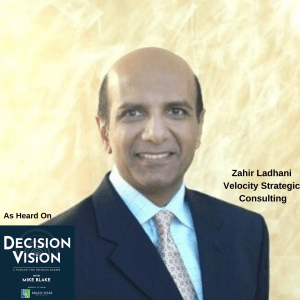
Decision Vision Episode 71: What Decisions Do I Have to Make For My Business to Survive Covid-19? – An Interview with Zahir Ladhani, Velocity Strategic Consulting

June 25, 2020 by John Ray

Brady Ware
Decision Vision
Decision Vision Episode 71: What Decisions Do I Have to Make For My Business to Survive Covid-19? - An Interview with Zahir Ladhani, Velocity Strategic Consulting
Loading
00:00 /
RSS Feed
Share
Link
Embed

Download file

Decision Vision Episode 71: What Decisions Do I Have to Make For My Business to Survive Covid-19? – An Interview with Zahir Ladhani, Velocity Strategic Consulting

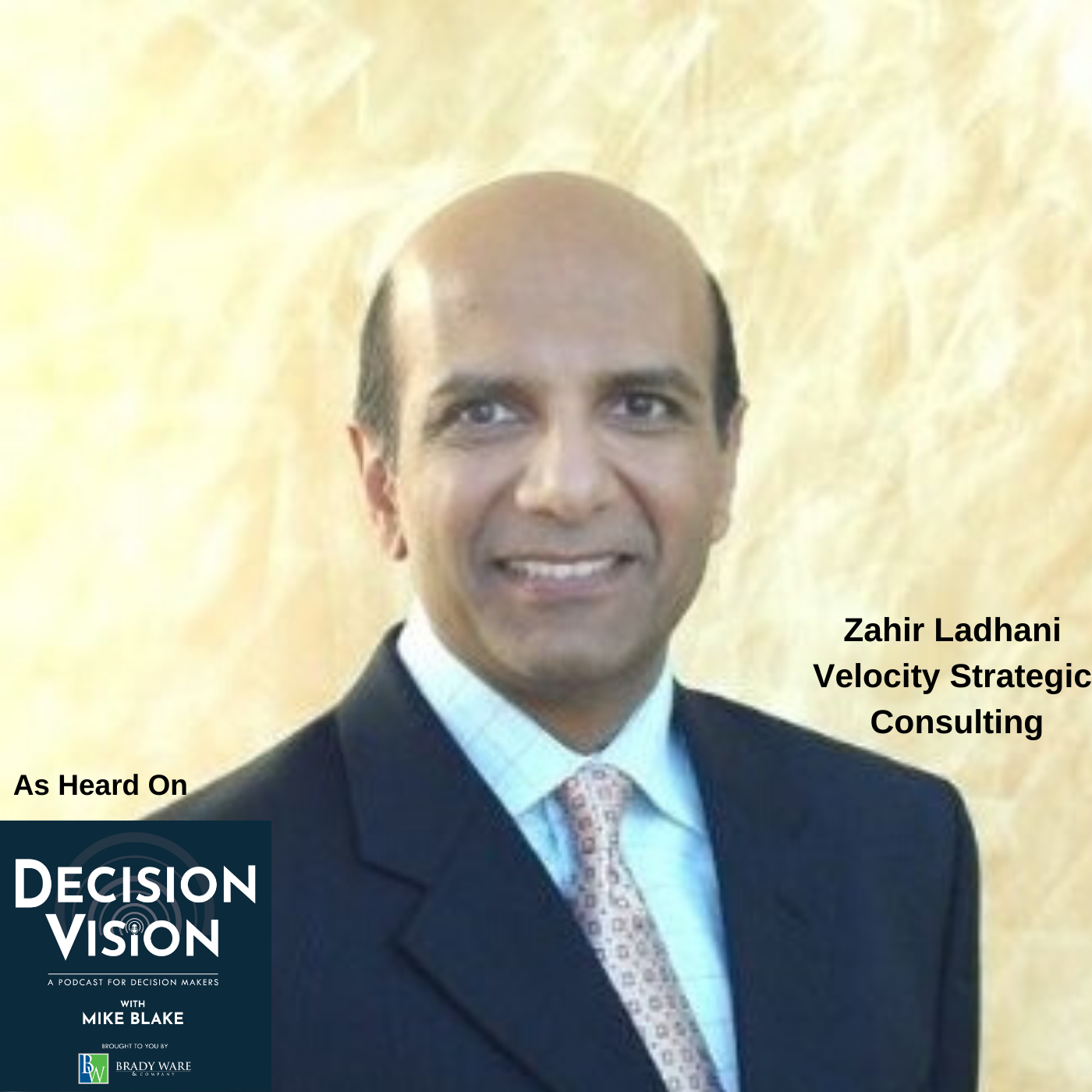
As the timing and shape of an economic recovery remains uncertain, many business owners are asking themselves what decisions they must make for their business to survive this Covid-19 environment. Host Mike Blake explores these issues with Zahir Ladhani, Velocity Strategic Consulting.  “Decision Vision” is presented by Brady Ware & Company.

Zahir Ladhani, Velocity Strategic Consulting

Zahir Ladhani

Zahir Ladhani is a seasoned executive with 30+ years of experience leading the growth of companies, products and teams. He played a crucial role on a senior executive team facilitating the $1.3 Billion sale of a company to a Fortune 50 Company. Additionally, he has overseen leadership teams in multiple publicly-traded organizations, in the capacity of President, Vice President of Sales, Vice President of Business Development, Marketing Director, and Director of Finance.

Zahir is a talented communicator and proven leader who understands corporate culture, the collaborative process, and how to assist organizations and their leadership teams optimize the balance between people, performance and profit.

Zahir Ladhani is currently the managing director of a business coaching firm, Velocity Strategic Consulting, and teaches Strategy at Kennesaw State University’s EMBA Program.

Michael Blake, Brady Ware & Company

Mike Blake, Host of the “Decision Vision” podcast series

Michael Blake is Host of the “Decision Vision” podcast series and a Director of Brady Ware & Company. Mike specializes in the valuation of intellectual property-driven firms, such as software firms, aerospace firms and professional services firms, most frequently in the capacity as a transaction advisor, helping clients obtain great outcomes from complex transaction opportunities. He is also a specialist in the appraisal of intellectual properties as stand-alone assets, such as software, trade secrets, and patents.

Mike has been a full-time business appraiser for 13 years with public accounting firms, boutique business appraisal firms, and an owner of his own firm. Prior to that, he spent 8 years in venture capital and investment banking, including transactions in the U.S., Israel, Russia, Ukraine, and Belarus.

Brady Ware & Company

Brady Ware & Company is a regional full-service accounting and advisory firm which helps businesses and entrepreneurs make visions a reality. Brady Ware services clients nationally from its offices in Alpharetta, GA; Columbus and Dayton, OH; and Richmond, IN. The firm is growth minded, committed to the regions in which they operate, and most importantly, they make significant investments in their people and service offerings to meet the changing financial needs of those they are privileged to serve. The firm is dedicated to providing results that make a difference for its clients.

Decision Vision Podcast Series

“Decision Vision” is a podcast covering topics and issues facing small business owners and connecting them with solutions from leading experts. This series is presented by Brady Ware & Company. If you are a decision maker for a small business, we’d love to hear from you. Contact us at decisionvision@bradyware.com and make sure to listen to every Thursday to the “Decision Vision” podcast.

Past episodes of “Decision Vision” can be found at decisionvisionpodcast.com. “Decision Vision” is produced and broadcast by the North Fulton studio of Business RadioX®.

Visit Brady Ware & Company on social media:

LinkedIn:  https://www.linkedin.com/company/brady-ware/

Facebook: https://www.facebook.com/bradywareCPAs/

Twitter: https://twitter.com/BradyWare

Instagram: https://www.instagram.com/bradywarecompany/

Show Transcript

Intro: [00:00:02] Welcome to Decision Vision, a podcast series focusing on critical business decisions. Brought to you by Brady Ware & Company. Brady Ware is a regional, full-service accounting and advisory firm that helps businesses and entrepreneurs make vision a reality.

Mike Blake: [00:00:21] And welcome to Decision Vision, a podcast giving you, the listener, clear vision to make great decisions. In each episode, we will discuss the process of decision making on a different topic from the business owner’s or executive’s perspective. We aren’t necessarily telling you what to do, but we can put you in a position to make an informed decision on your own and understand when you might need help along the way.

Mike Blake: [00:00:41] My name is Mike Blake, and I’m your host for today’s program. I’m a Director at Brady Ware & Company, a full-service accounting firm based in Dayton, Ohio, with offices in Dayton; Columbus, Ohio; Richmond, Indiana; and Alpharetta, Georgia. Brady Ware is sponsoring this podcast, which is being recorded in Atlanta per social distancing protocols. If you like this podcast, please subscribe on your favorite podcast aggregator, and please consider leaving a review of the podcast as well.

Mike Blake: [00:01:07] And so, today’s topic is another in our series of COVID survival topics. But this one is going to be a little bit different. And the question, really, is actually a number of questions all rolled up and mashed up into one. And so, the topic is, what are the decisions I have to make, so that my business survives COVID? And by now as we record this in early June and Happy Father’s Day in advance to everybody who is a father listening to this podcast, and as we record this, we are now, more or less, in something approximating recovery phase of this pandemic at a time, also, of tremendous social unrest and potentially change. We’re just in an environment now where there is no textbook, there is no wise man or woman to tell us exactly what to do based on experience. It’s all about kind of feeling our way through.

Mike Blake: [00:02:25] And so, whereas most of our topics do address a high-level strategic decision, the reality is that many businesses are not really in a strategic posture. As I was talking to our guest and our producer a little while ago as we were setting this thing up, and we talked about when you have a loaded gun pointed right to your head, your thought process at that point is not strategic. Your thought process at that point is not, “What is happening to my retirement plan and my 401(k)?” It’s, “How do I get out of this situation now? Get out of the building.” We’re going to figure everything else out at that point.

Mike Blake: [00:03:08] Now, I understand that’s a dramatic and it’s a graphic image, but I do think that there’s some truth and there is some relevance to that. But we are now, you know, after sort of huddling ourselves, at least certainly, I was, away from the pandemic to reaching a point where we are kind of have our hands wrapped around the bars and shaking them, being asked or asking to be let out of our mass house arrest, and now, all of a sudden, the doors open with differing speeds depending on what state you’re in. State, meaning geographic location.

Mike Blake: [00:03:58] And, you know, when that happens, I think to some extent, we’re sort of the dog that catches the car or what would happen if Wile E. Coyote actually captured the Road Runner? I’m not sure he’d know what to do with it. And so, now, this next phase is, okay, you know, what is this checklist? And you’ll read a lot of stuff that talk about, well, you know, let some of your employees continue to work from home and everybody’s going to walk around like they’ve got OCD and wash their hands all the time and creating distance between office and cubicles.

Mike Blake: [00:04:36] And that’s all well and good. It’s important. There’s plenty of information out there. There’s nothing that we’re going to do it. But then, you know, as a decision maker, you’re now going to be faced with many, many micro decisions if you are or even not so many micro decisions, but they’re all tactical decisions. And tactical decisions can take on equal or superior importance relative to a strategic decision.

Mike Blake: [00:05:07] And so, that’s a long preamble to saying that if this episode seems a little bit different, it is, and that’s by design. And the reason is because when you reopen your business and you expose yourself to the wide, weird world out there, it’s not about one decision anymore. It’s really about probably 92, at least. Well, we’re not going to go over 92 decisions, but we are going to go over probably about a dozen or so, and hopefully that this will be something that—or we hope is that, this will be something that you can you can take pieces from, and apply to your own situation as is, you know, what we try to do here are the Decision Vision podcast.

Mike Blake: [00:05:53] And helping us work through this is my friend, Zadhir Ladhani who is Managing Partner of Velocity Strategic Consulting. And Zadhir brings more than 30 years of, in the trenches, experience with software, the service companies, consumer companies, services and human capital companies, pharmaceutical companies, and management consulting. As you’ll hear, he’s a very talented communicator and he’s a proven leader whose drawn businesses and product lines and was a key member of an executive leadership team that led the sale of its company to a Fortune 100 acquirer.

Mike Blake: [00:06:34] Zadhir works with senior executives and leadership teams to scale up businesses by improving their discipline around people, strategy, execution, and accountability for sustainable growth. He has worked with numerous clients and using the complexity that growth often brings, allowing leaders to focus more time on building their businesses by leveraging transformative tools, processes, and principles. He holds a bachelor’s degree in mathematics and accounting from the University of Waterloo in Canada and a master of arts in international relations from the Fletcher School of Law and Diplomacy at Tufts University in Boston, Massachusetts. Zadhir, welcome to the program.

Zadhir Ladhani: [00:07:10] Thank you. Thanks, Mike.

Mike Blake: [00:07:12] So, I’m going to ask you the question that I have to ask or everybody has to ask, every guest ever who comes on any program in the world, which is, are we in a recovery now? If not, when do you think it’s going to happen? And are you on the V side recovery camp, or are you on the slow slogging recovery camp, or somewhere in between?

Zadhir Ladhani: [00:07:33] So, Mike, I appreciate the introduction, and I am on the slow recovery side. I’m not on the V recovery side and I actually don’t think we’re in the recovery phase yet. If you look through what we’ve gone through, and I look at this from a lens of three phases, we went through the lockdown phase where we were trying to flatten the curve. And some parts of the country never flattened the curve. We would continue to grow it. But we decided to get into the second phase, which is the recovery phase, as you called it, but I think I call it the fight phase, that we’re going to go fight this.

Zadhir Ladhani: [00:08:10] And then, when the vaccine or a therapeutic is available is when, potentially, the full final phase of this comes in. So, I think we’re in this middle phase, which I called the fight, where the infections and the number of people who interact with this disease will increase, decrease, increase, decrease. And we’re going to see spotty places in the country, spotty places around different states and different parts of the state in different phases.

Zadhir Ladhani: [00:08:45] So, they’re going to be brush fires we’re going to have to put up around the country. If you look at why I say that and why I think it’s a long U, until a vaccine is available, there is no surety of how we will fight this. There are so many unknowns about this COVID-19 that every other day, we’re hearing something new and we’re learning something new. And so, anything somebody is forecasting, it’s coming out to be different. And so, I would say, we plan for the worst, and then hope for a better one. And businesses work on that well. Look, people are saying there’s a vaccine coming up, right?

Zadhir Ladhani: [00:09:23] Normally, vaccines take 20 years, and now, we’ve got a prognosis that we’re going to have a vaccine by the end of this year. I really hope we do. And I know there were over 150 candidates in the work, and we’re taking every piece of red tape out, and we’re trying to shorten the cycle as much as possible, and we got the best scientists we’ve ever had around the world working on it. And globally, humanity has gained. But sometimes, things take time. And we hope we can get through this. But my view is it’s a long U with ups and downs as we go through it.

Mike Blake: [00:09:59] You know, I think your observation is very smart, that the fact of the matter is, we don’t understand everything there is about the coronavirus. And the knowledge is evolving. And, you know, it reminds me, I think coronavirus is sort of the eggs of the disease realm. What I mean by that is for years, I think it’s still going on, is that doctors are telling us eggs are terrible for us, but now, they have the right kind of cholesterol, so they’re great for us. But then, maybe that kind of cholesterol, it has a limit, so they’re bad for us again. And frankly, I don’t know. So, I just see the eggs now and I roll the dice, right? But I mean, COVID is kind of like that.

Zadhir Ladhani: [00:10:50] Yeah.

Mike Blake: [00:10:50] You know, there’s even some there’s even some real discussion as to whether or not, not just ideological, but medical as to, again, how necessary masks are.

Zadhir Ladhani: [00:11:04] Yeah.

Mike Blake: [00:11:04] And, you know, we just don’t know. And I’m not going to make a statement as to whether or not somebody should wear a mask or not, but the fact of the matter is that whichever position is out there, there’s plenty of information, and frankly, some good information that supports one way or the other, right?

Zadhir Ladhani: [00:11:22] Yeah.

Mike Blake: [00:11:22] So, I guess maybe I want to go right off the script here, and that is that maybe the first decision you have to make is, do I think it’s a V recovery or slow recovery, right? Because if I think it’s a V recovery, then the other things we’re going to talk about today may have a different answer or a different spin to them as opposed to if I think there’s going to be a two-year recovery, say, that, you know, the Fed thinks is out there. Is that fair too or am I making too much of it?

Zadhir Ladhani: [00:11:54] No, you’re not making too much of it, but my pushback would be, if you make a decision that it’s a V recovery, what are the decisions you’ll make in your business? And what if it’s a U recovery, what would happen to you? Plan that out and forecast. And then, do that if you work towards a U recovery, forecast out that, what if then it’s a V? Which one gives you the higher probability of survivability? And my supposition to you would be plan for a U, hope for a V, you have a better chance of success versus you plan and act on a V, And it becomes a U. You see where I’m going? And so-

Mike Blake: [00:12:35] I do. And then, to that end too, we’ll talk about this a bit later, we may very well have a W kind of recovery.

Zadhir Ladhani: [00:12:44] Yes. And if you look at the stock market in the day we’re recording this, the stock market was way up, and then yesterday, dropped. And this morning, it just started to go back up again. Like I think we’ve got to be cautious and not get carried away with the fad of people jumping up and down and most people starting to get out there and what you see in a very quick manner. Think of it a little bit of a longer term because of the unknowns. One of the biggest things of this is the unknowns that we have is the thing we need to keep in mind.

Mike Blake: [00:13:15] So, how to lie? And I am a business owner, I’m a shareholder in my company, so how do I assess my own company as to one that’s likely to recover as opposed to one maybe that isn’t likely to recover?

Zadhir Ladhani: [00:13:33] So, I think you’ve got to do the scenario planning around the U. And so, what I recommend to my clients is do a scenario planning that says you will have a 20%, a 50% or an 80% drop in revenue over the next year and a-year-and-a-half. And then, do your net income in a cash flow on those three scenarios. You put your expenses towards the 50 to 80 and run your business. And go forward with that planning phase, and that will give you as much opportunity to survive as possible.

Zadhir Ladhani: [00:14:15] The other thing you need to do is conserve cash as much as possible and reduce any frivolous expenses or even potentially some expenses that you just are nice to have versus need to have, and that will ensure. Now, the next key thing you need to do is what we’re seeing in COVID is a lot of trends that were happening pre-COVID have accelerated. And what you want to do is how do you evolve your business to get on those trends and make sure your business is essential in getting on those trends. And we can talk more, I’m sure, when you get to that level.

Mike Blake: [00:14:57] You know, that 80% drop in revenue, that’s a jarring number to me, right? I mean, I understand where you’re coming from, to me, that says an absolute catastrophic business scenario. I mean, realistically, how many businesses can survive an 80% drop in revenue for any period of time?

Zadhir Ladhani: [00:15:18] Depends on their cash reserves and depending on their things they have, right?

Mike Blake: [00:15:23] Okay.

Zadhir Ladhani: [00:15:23] So, I’m not suggesting that will happen, but would you rather do a premortem or a postmortem on your business? And so, we’re asking people to do a premortem which visualizes which it will be. So, therefore, before you get there, you can avoid that, right? If you know what will happen if you get to an 80%, then you start to think, what are some of the actions I do need to take today? And then, we start to talk about the customer. Who are our customers? How do we retain them? How do we become essential to them? How do we go after different other customers and go capture them? What is the evolution of our business we’re doing?

Zadhir Ladhani: [00:16:00] We have a client in Atlanta who has restaurants and they evolved from they were never a delivery, they were never a takeout service, and this is nothing new, but they figured out an interesting way of doing delivery and take out service because a lot of restaurants have done nothing shocking, but if they hadn’t been ahead of it, they could have been impacted by that thing. One—yeah.

Mike Blake: [00:16:25] So, we’ve talked about expense management and we talked about cash management. What are a couple of other specific things that businesses should be looking at to make sure that they’re in the survival group and not on the not survival group?

Zadhir Ladhani: [00:16:40] I think what you want to do is in your customers that you have today, you want to be close to your customers and understand what they are going through. And before they react to you, one, if you’re close to them, you will know where they’re going. So, because you’re starting to predict how your business is going to impact and you figure out how you become essential to them. As soon as you start to get hints and ideas that you may not be kept on, you need to start to see what businesses you need to evolve to. I’ve got a client who was in a particular business and they figured out there was an adjacent business that they could evolve to. They were never in that, but due to COVID, it was a revenue stream, and it was bringing in cash, and they added that onto it, and move that on. And it became a great revenue stream for them.

Mike Blake: [00:17:33] You know, that essential nature, I think, is a really important point. And a former guest on this program, Rod Burkert, has been preaching to people in my profession, business appraisal, to figure out how do they turn themselves from a vitamin into medicine, right? That nice to have, should have versus something that makes pain go away that is truly essential.

Zadhir Ladhani: [00:18:01] Right.

Mike Blake: [00:18:01] And, you know, candidly, that can be very painful thinking because what if what if you sort of look at your business in the cold-heart light of day, you’re just not medicine, right? Your business model has been built on selling vitamins, right? You’re GNC, for example, right? You cannot convert to a drugstore overnight. You are in the vitamin business, and that’s where you’re going to stay. And so, maybe one of the decision points then is not only, even before you get to, how do I make myself medicine, but is that even realistic, right? And maybe that gets to the premortem, the 80% drop in revenue.

Zadhir Ladhani: [00:18:46] Right.

Mike Blake: [00:18:47] I’ve yet to scale my business to a—you know, the world will still need vitamins. They still want some vitamins and vitamins don’t go away.

Zadhir Ladhani: [00:18:54] Right.

Mike Blake: [00:18:54] But clearly now, they’re taking a backseat to the medicine, I guess.

Zadhir Ladhani: [00:18:59] Exactly. And what you do also is look at the trends COVID is causing, do know that every time we’ve had a major event in the world, be it The Depression, be it the oil crisis in the ’70s, be it the 2008, we’ve never reverted back and there’s a new norm that happens. And what is the new norm that would happen post this? And we’re starting to see some trends of this. And can you evolve or pivot? I’m trying to resist using the word pivot, but can you pivot towards that addition to your business and move away from some of these businesses? Like I would say, look, if you’re a retailer, if you don’t have an e-commerce strategy or a digitization strategy, you’d better be thinking about this, right?

Zadhir Ladhani: [00:19:47] Because the demise of retail has been, and I’m not saying it’s going to go away, but I think it’s been precipitated. In every business, be it a doctor, or an accountant, or a lawyer should have and need strategy because whatever we’ve done in the last eight weeks or something, we’ve moved to telehealth in the fastest way possible when there was so much resistance from the hospitals and the doctors. And now, overnight, we’re speaking to our doctors and doing telehealth or teleappointments. Now, we’re going to be used to it as consumers. Now, my doctor better have that service available because I may not want to go and wait in the waiting room. I can get it done through my laptop.

Mike Blake: [00:20:25] And speaking of retail, you know, I got to tell you, I love the curbside service. You know, this microphone that I have now, that John, our producer, begged me to get because the other one made me sound so lousy, you know, I barely slowed my car down, and they just chucked the thing in the back, I lowered the window, and like in a football passing drill, they just sort of chucked it through, right?

Mike Blake: [00:20:53] I mean, that was great. I love that. I mean, even if we kill coronavirus tomorrow, I hope they don’t get rid of that because, you know, saving the time of even having to park, and get out of the car, walk in, yeah, I get it, I can walk in, I get it, I feel like I want to be treated like Cleopatra, and they sort of lift me up on one of those thrones that the servants carry around town and stuff, but I love that, right?

Mike Blake: [00:21:23] Frankly, I’d pay a premium for that. As somebody said, you know, if I bought us a 50-dollar item, we got to pay two more dollars to have the thing put in your car for you, yeah, I’m in. So, you’re right. I mean, I think there are some emerging business models and we’re not even close to being there yet. I cannot imagine what’s going to happen in education. You know, schools are not opening. And when they do, a lot of the students aren’t going back unless there’s no other choice, I think.

Zadhir Ladhani: [00:21:54] No, I hear you. I ask who is sending us information, saying, what will you do with your child? And my response back would be, you tell me what safety precautions you’re taking to make that decisions accordingly.

Mike Blake: [00:22:06] Yeah. So, you know, a fascinating thing has happened. A lot of this, I think, is now going away, but it could come back if we go into a W-shaped recovery, which I think there’s a good chance it will happen. I don’t think it’s drop dead, but I think there’s a good chance. How did businesses survive just not being able to operate for three months? And what lessons do you think businesses are taking from that so that if we do go into a second trough, that they can survive that second halt?

Zadhir Ladhani: [00:22:48] I think in the first instance, a lot of businesses were caught by thinking it’s going to be a short-term close. And I think the government acted very, very quickly in all the incentives and money that came through, and the speed that it came through helped the companies. I think businesses are learning to conserve their cash now even more than they were before. And even consumers are learning that. What we’re hearing in some reports that consumers are really not spending as much money as we were. Our bank account seems a little bit inflated because we’ve been sitting at home.

Zadhir Ladhani: [00:23:23] And so, we seem to have some extra dollars in our bank balances. And businesses are that. I think businesses have learned to conserve cash. Some businesses moved a little slow in cutting expenses. Now, I think they’re being cautious in increasing them back. So, I think businesses are learning from this and will not revert back to the old days. I’ve heard companies and CEOs tell me, I’m not bringing my travel budget back to the norm it was. I’m not bringing my people back yet to the offices, right? And so, I’m going to keep my nonessential expenses down.

Zadhir Ladhani: [00:23:58] Now, you go to how long can they survive? I think that’s a predicament on the business and in the amount of money. We’ve got rent abatement going on. That leaves in July. We’ve got many things that are issues about to drop in July, August, September, and we’ll have to watch what happens to those businesses then, and how effectively they work. We’ve seen very large chains send letters to their landlords, and saying, we need rent abatements and we need you to work with us, right?

Zadhir Ladhani: [00:24:31] One of the largest chains out there in the world has sent that letter and they’re asking for those for a long period of time, not just until now. And I think businesses need to do that. The other aspect is I love using this, is the old military strategist, Colonel John Boyd used the OODA, meaning is O-O-D-A, right? You observe what’s the situation around you, orient yourself, and then decide, and then act quickly. And when you act, you start observing again. You orient, decide, and act.

Zadhir Ladhani: [00:25:07] And it’s similar to Jim Collins’ view around, and I hate to use this, but Jim Collins, he wrote, before you act, throw some bullets before you fire your cannons. Meaning, find your target with a few bullets. And I would ask businesses as they’re evolving and trying to survive this, you need to evolve. You can’t just stand still. And as you evolve, you want to test and fail fast, to learn fast, and keep testing, and be a testing organization because this is an evolution, and we’re going to have to evolve. You can’t stay the same and you can’t stay stagnant.

Mike Blake: [00:25:42] You know, I need to ask another question. This is not one that we’ve really talked about. But I know you can catch up with a fastball here. And again, our producer, John, is going to love this question, and that is, how do you navigate pricing in this environment? And what I mean by that, you know, a friend of mine who also happens to be my dentist was talking to me about what it’s going to take to reopen his practice and start filling cavities, drilling, and doing whatever it is a dentist do, right?

Mike Blake: [00:26:24] You cannot deliver those services for the same price today that you could 90 days ago, right? My wife just went to the dentist, and then face shields and two masks on at the same time. And I’m sure they were also sterilizing the thing, like they’re using some sort of disinfectant like those old sorts of pump-operated DDT and insecticide things they used to have in the old-time cartoons, right? But at the same time, there are other businesses that are desperate—actually, let me go back.

Mike Blake: [00:27:03] You know, restaurants. You know, I ventured into a restaurant last week for some takeout and, you know, half the tables are gone. You know, so now, they’ve got half of their serving capacity, but they’ve got the exact same overhead they had 90 days ago, right? The way the math works is that their prices must go up, you would think, right? Maybe not. So, on the same token, you know, if you’re an attorney right now and a lot of some legal services are considered medicine, others are considered vitamins, right?

Mike Blake: [00:27:39] Maybe you considered lowering your prices for a minute because you just want to get work in the door, right? And I can’t even imagine what airlines must be doing. Their pricing mechanisms have been so Byzantine anyway, what they’re doing now has got to be some form of calculus. And I’m talking too long, but I’m thinking about this question kind of real time, I mean, how do you think about pricing in this kind of environment? And do you agree, that’s a really critical micro decision or decision that a business has to make as they reopen here?

Zadhir Ladhani: [00:28:14] It’s a very, very, very important decision. And I would first want to take something off the table when you talk about pricing. Most companies have very good core values of their business. And some of them call for integrity. Some of them call for, we’ll take care of our customers. Some of them call for, we do what’s right, et cetera, et cetera. So, number one thing I want to take off the table is this is not the time to price cap, right? And then, if you’re a leader who’s thinking, I’m going to take advantage of this, look, this is a time for your values to be in action. We, as human beings, are naturally good people, live those values, and be good human beings. So, take that part out of the question.

Mike Blake: [00:29:00] So, you’re saying, I should cancel that hundred-dollar for Lysol can auction off of eBay?

Zadhir Ladhani: [00:29:05] Absolutely.

Mike Blake: [00:29:05] Okay. I’ll do that as soon as we’re done.

Zadhir Ladhani: [00:29:09] Yeah. And so, next one I would come is at any time, how do you develop your price? You develop your costs, you look at your competitor, and you look at your market dynamics, right? And what the market’s willing to bear. However, if you just do it like the old way, and yes, you bring your costs in trying to make it, you need to decide in this world, will the consumer come? And is a competitor going to figure out a different way? As you rightly said, will a competitor figure out a very cheap way?

Zadhir Ladhani: [00:29:41] And this is the time for businesses to be disrupted. And especially if you’re an accountant or a lawyer, there’s an e-business. I’m sure there’s an e-business out there that’s about to disrupt all the accountants and lawyers out there and other service providers. And so, you increase your prices. You’ve got to figure out your strategy, how you manage the costs. If we go down to the dentist line, you’ve got to look at how you cut your other overheads and stuff, because sometimes, people may just say, I want to not do my cleaning in six months, I’m going to delay for 12 months, right?

Zadhir Ladhani: [00:30:13] And then, go down that way unless it’s hurting and I need really my filling done and it’s killing me, it becomes essential. Then, if you gouge me, you know I’m not coming back, right? I’m going to find somebody else because that trust will be broken forever. So, it’s a very dicey situation. And this may not be the time to increase your margins. It may be the time for your survivability to continue the revenue while not losing money, yet, not increasing the margin business is where I would be today.

Mike Blake: [00:30:45] So, when we talk about pricing, and we’re touching upon this now, this is a good segue to the next question, which is, you know, we’ve talked about expense management, let’s talk a little bit about the sales side. And I want to talk about observing what your competitors are doing. And one of the things that really interests me about this period of times, is I’m trained as an economist, and economists have a favorite term called revealed preferences, which means that people say whatever they want, but if you want to find out what people actually care about, look at how they act and look at how they spend their money, right? And the fascinating thing about this time from an economist’s perspective is the revealed preferences and people’s tolerance for risk, right? At the end of the day, you know, I think the decision of whether you wear a mask or not, I think, boils down to a revealed preference of risk, right?

Zadhir Ladhani: [00:31:56] Yeah.

Mike Blake: [00:31:56] And so, why does this relate to competitors? Because, you know, talking about pricing and talking about how you become more efficient, I think there’s another lever to that, which is, what if my competitors are comfortable taking more risk than I am, right? Maybe the restaurant down the street is going to cram people maybe six inches closer and get a couple more tables or they’re going to—I don’t know the business wound up, but I think you get my point, is that out of out of desperation or they think they’re being clever, but they’re not or that, you know, they just simply have a higher risk tolerance.

Mike Blake: [00:32:40] You know, competitors are going to do things. Some competitors will do things that other businesses wouldn’t necessarily feel comfortable with. But then, they’re going to have to make the decision, do I mimic the risk profile of my competitor because I don’t know or do I use that as an opportunity to differentiate myself somehow? And how do I do that in a way that is, you know, civil and appropriate?

Zadhir Ladhani: [00:33:12] So, I would answer it with a nuanced way, is one, it depends on the market you’re in and the risk tolerance of your consumer. And you let your consumer’s risk tolerance also help you make that decision because if you’re in a risk-tolerance level where the consumer is looking for the safety at the highest level, then you want to be careful, because then, you won’t get those. But if you’re in a market where the consumer is willing, now, do you go there and take that risk tolerance because of your competitor?

Zadhir Ladhani: [00:33:43] I would say also depends on what you’re looking for. Is it a short-term gain or a long-term gain? And I go back to your values. And as an organization’s values that, would you be willing—when big companies develop their core values, one of the questions I ask them is, are you willing to take a financial hit to live your core values? Then, only are you sure about your core values. Otherwise, they’re just words, right?

Mike Blake: [00:34:10] That’s revealed preferences right there.

Zadhir Ladhani: [00:34:12] There you go, right? And this is the time that that core value is being tested. If it is your core values to go with that risk tolerance, yes, go, but if you stated to your employees that this is how we’ll behave and this is who we are, and all of a sudden, at a time of crisis, you evolve, you think your employees are going to believe you as life goes on, right? And trust is broken. So, I would think be living true to who you are and don’t change is a very key thing. Now, do you evolve with the market? Absolutely. But you’ve got to decide on that mechanism in that.

Mike Blake: [00:34:51] So, we touched on this a little bit, but I want to come back and hit it explicitly, is that, let’s assume that this is, in fact, going to be some sort of W-shaped recovery. In fact, there is a possibility that COVID is just with us for a long time. There’s no guarantee that we’ll find a silver-bullet vaccine. It could be partially effective, like the flu. It could be completely effective against the or it could be something entirely different, right? How do you think a typical business or how are you advising your clients to prepare for a world that may very well be sort of on again, off again, on again, off again?

Zadhir Ladhani: [00:35:38] So, we’re continuing—you know, I initially said the postmortem, that idea, we’re continuing to do that. So, in the past, before COVID, we would develop a three-year strategy, and then develop a quarterly annual plan and the quarterly plan, and reassess it every quarter. Now, we’re actually going in and assessing our strategy every month because things are changing so fast. And sometimes, we do it more often or because there’s a necessity to do that and there’s a crisis coming.

Zadhir Ladhani: [00:36:08] So, we recommend to our clients have a monthly review of your strategy, monthly review of your forecasts, not just your profit and loss, but then, take it to a cash flow level. And actually, weekly or biweekly, let’s look at our cash levels. And we continue to evolve that. We don’t get exuberant when sales go up or revenues come up as this V, or W, or a squiggly line continues, we stay cautious. And you can see people start to say, okay, we’re back. Let’s bring these things back. And we always become the naysayers to the organization, said, let’s put the, what if we’re going to go down?

Zadhir Ladhani: [00:36:49] Until you see a major long-term trend, let’s keep to this level and continue to evolve because do know, we’re not going back. It will be a different world that we’re living in and it will continue. And especially, Mike, as you said, if this is going to be a long-term fight level, we’re going to be a whole different type of people in how we live. You know, it’s acceptable for me and you to meet and talk with masks on now, which, you know, eight weeks ago, we would have never done that, you know. We would have sat-

Mike Blake: [00:37:20] They wouldn’t let you into most places of business with a mask.

Zadhir Ladhani: [00:37:24] True.

Mike Blake: [00:37:24] I mean, can you imagine going into a bank right now? Right? I mean, really, 90 days ago, right? Now, it’s expected to go in with a mask, right? But if you do that 90 days ago, you would have been stopped at the door.

Zadhir Ladhani: [00:37:39] Exactly.

Mike Blake: [00:37:40] So, it would be interesting to see if there’s some sort of facial recognition technology that somehow accounts for masking.

Zadhir Ladhani: [00:37:49] Yeah.

Mike Blake: [00:37:49] So, we’ve talked mostly tactical, but I do want to draw back a little bit and get into a little bit of a strategic discussion.

Zadhir Ladhani: [00:37:58] Yeah.

Mike Blake: [00:37:58] And that is, you know, it could be tempting, I think, should be tempting to use the current environment as an opportunity to expand, right? Money is as close to free as it’s ever going to get. The government, by hook or by crook, and I’m not going to comment on what I think the soundness of the policy is, but the fact of the matter is that they’re knocking us over the head and stuffing our pockets full of cash, right?

Mike Blake: [00:38:33] They want us to have cash. And it would be tempting then to sort of take that cash or go after free or very close to free money and borrow maybe with the goal of expanding or maybe renewing your technology or production capabilities. What do you think about that? Is that a temptation that a lot of companies should give into or do you think most companies are going to resist that?

Zadhir Ladhani: [00:39:02] My gut says no. It’s counter-intuitive.

Mike Blake: [00:39:05] No, they’re going to resist it?

Zadhir Ladhani: [00:39:07] I’m telling my companies, don’t do CapEx right now. This is not the time to invest money in your business. Meaning, don’t take on more debt. Conserve cash, conserve your expenses. I may be an anomaly, but this is like no other time we’ve seen in recent history of businesses. The thing it is, we just don’t know what’s going to happen. You know, normal certain crisis, the short-term is known, the long-term is not known.

Zadhir Ladhani: [00:39:37] In this crisis, the short-term is not known, right? And so, it’s such anomaly time that, what will you do with that CapEx? So now, let me then nuance it for you. If your CapEx is for normal expansion, and you do your normal IRR, and all that, I would say no. If your CapEx is going to reduce your short-term expenses, which I know there’s a couple of business out there that are reinstalling their telephone systems from the copper wire telephone systems and their monthly system costs are much lower, now, that’s a different discussion, right?

Zadhir Ladhani: [00:40:13] So, it’s a nuanced answer. I had a very good friend last night called me, and said, I want to upgrade my software in my retail business. And we went through this analysis with him, actually. And the end decision was, yes, because now, this new software was enabling him to go do delivery, which his old system was not. And his staff was having to do manual work to do delivery. That cost benefit made sense. So, it really depends. It’s not the cheap money, it’s what the efficiency, and the new business opportunity you’re able to do, and the revenue increase you’re expecting from it, then it’s a big difference. Yeah?

Zadhir Ladhani: [00:40:50] So, it’s not, money is cheap, let’s invest because we have it. I would be very, very resistant. I’ll give you an answer, when COVID started, I had a luxury car. I actually took it back on the beginning of March just before the lock down happened. And as a personal business, I said, do I need to conserve cash? I had my cash reserves, but I felt that I need to even conserve more in case this is longer than I’m anticipating, right? And so, even a small business like myself, I kind of drank my own Kool-Aid.

Mike Blake: [00:41:23] Now, let me come back to you. One of the things that I think is going to increase that temptation is the capital equipment sellers, for the most part, computers are different. But I think just out in that machine or because they just need to get inventory out the door are going to make me coming back and saying, hey, look, we’re going to offer you a once-in-a-lifetime 40% discount or I’ll let you finance the thing over 19-and-a-half years. You know, you’re going to see some pricing, and I’ll bet you, when you return that car, they probably tried to entice you to keep it with some special financing one-time deal, right?

Zadhir Ladhani: [00:42:07] Right.

Mike Blake: [00:42:07] So, is there any point at which you might be talked into the CapEx of that commitment because that price is so attractive, and you think two years from now, you are going to have to make that expenditure anyway, so why not take advantage of it now?

Zadhir Ladhani: [00:42:27] If it’s for the same business I’m doing, I would resist it again. If you’re adding more services and opportunity of business that I don’t do now and it helps me add to the trends that I’m seeing and it gives me a new revenue opportunity, then I’m looking at it. But I would be very resistant on, if it’s the same business, it’s just a good deal right now. I’m very, very cautious and maybe I’m too conservative in that way, but I’m still very cautious on the short-term.

Mike Blake: [00:42:58] So, we don’t have much more time, unfortunately, but there’s a lot more we could talk about. But a question I want to work in here is about talent. And given what you said, I think I can anticipate your answer, but I don’t want to assume, you know, I’m guessing that probably goes the same for hiring talent, too. I’ll give you an example. A resumé was sent to me by a friend of mine for an individual in my industry that’s looking for a job, has fantastic qualifications.

Mike Blake: [00:43:33] You know, that person probably would not be available, but for this recession that’s going on. And it would be very tempting to try to hire somebody opportunistically, but the business case would be very thin, would be a very speculative hire. So, I don’t think that we’re going to proceed with that. But, you know, what do you think about that? Because I think a lot of companies are going to see opportunistic hiring opportunities where they may feel like they’re getting access to talent they would not ordinarily have. Do you think about that the same way as you think Cap Ex as well or is there a different thought process that goes on there?

Zadhir Ladhani: [00:44:16] This one is slightly different.

Mike Blake: [00:44:18] Okay.

Zadhir Ladhani: [00:44:18] When you’re doing your 80% and 50% scenario planning, one of the aspects I missed saying was your own talent. Identify your own key A players. And once you identify them, let them know you know they’re your A players. Even though they don’t have a place to go today, but the better the player, the more love they need. Give him the love, show them the love because they’re the ones who are going to come up with good ideas for you. So, that’s point one. Now, in your rest of your organization, if you have B, C players, and there’s A player talent available, I would swap it.

Mike Blake: [00:45:02] Okay. So, instead of adding, you’d upgrade.

Zadhir Ladhani: [00:45:05] I would upgrade. And I would say this is the time companies can upgrade because there’s going to be amazing A players available unfortunately for them. But as more and more companies have difficulty, as I think our fourth quarter is going to see many, many companies. And so, A players will be available, I would say upgrade. And when I say upgrade, I say your B, C players, when you swap them, do it with the most dignity and let them move on with dignity, living your core values. That’s also very important. But this is the time to upgrade. Absolutely.

Mike Blake: [00:45:42] Zadhir, this has been a great conversation. We’ve covered some really good nuggets and really specific nuggets too. It’s something I’m trying to do a better job of as I do the interviews of this podcast. I’ll bet you, listeners are writing down a lot of questions. How can people contact you for more information or if there’s a question we did not cover they’d like your insight on?

Zadhir Ladhani: [00:46:06] Sure. So, they can call me on my cellphone. And my contact number is 610-453-8461. Identify that they’ve heard, you’re in my podcast, and go from there, or look me up on LinkedIn, or email me, and we’ll put that on the podcast. Catch up and they can email me. And if they reference that they heard this and from our podcast, we’ll go from there. Happy to do that.

Mike Blake: [00:46:31] Well, why don’t you give us your email because somebody may not go to the show notes necessarily if they’re driving in their car, jogging, then they want to just hear it.

Zadhir Ladhani: [00:46:38] Sure. It’s zladhani, so Z-L-A-D-H-A-N-I, @velocitystrategicconsulting.com.

Mike Blake: [00:46:46] Very good. Well, that’s going to wrap it up for today’s program. I’d like to thank Zadhir Ladhani of the Velocity Strategic Consulting so much for joining us and sharing his expertise with us today. We’ll be exploring a new topic each week, so please tune in so that when you’re facing the next executive decision, you have clear vision when making it. If you enjoy this podcast, please consider leaving a review with your favorite podcast aggregator. That helps people find us so that we can help them. Once again, this is Mike Blake, our sponsor is Brady Ware & Company, and this has been the Decision Vision podcast.


Tagged With: Brady Ware, Brady Ware & Company, Business Development, business strategy, consulting, COVID-19, Decision Vision, Mike Blake, Velocity Strategic Consulting

LEADER DIALOGUE: Workforce Engagement in Healthcare during the COVID-19 Crisis

May 21, 2020 by Mike

Gwinnett Studio
Gwinnett Studio
LEADER DIALOGUE: Workforce Engagement in Healthcare during the COVID-19 Crisis
Loading
00:00 /
RSS Feed
Share
Link
Embed

Download file

Chuck Stokes/Former President & CEO of Memorial Hermann Health System

Charles (Chuck) D. Stokes, former President and CEO of Memorial Hermann Health System, joined the system in 2008 as Chief Operating Officer (COO). In June 2017, he was named President and CEO of the System. In his role, Chuck was responsible for leading and overseeing the $5.6B System’s network of more than 17 hospitals and 300 delivery sites, with more than 27,000 employees and 6,400 affiliated physicians in the Greater Houston area. Chuck retired from Memorial Hermann effective December 2019.

Chuck has four decades of leadership experience in healthcare, and throughout his accomplished career has achieved success in service line leadership, employee engagement, leadership development, physician collaboration, and quality and patient safety improvement.

During his tenure with Memorial Hermann, Chuck worked tirelessly to establish a culture of high reliability, innovation, and clinical transformation throughout the organization. Under his visionary leadership, Memorial Hermann attained unprecedented national accolades in patient safety, high-quality care, and operational excellence all while serving as Houston’s “safety net” health system.

Chuck models servant leadership with an emphasis on coaching and team building while using Malcolm Baldrige criteria as a platform for driving operational excellence. His leadership was instrumental in helping Memorial Hermann Sugar Land Hospital secure the 2016 Malcolm Baldrige National Quality Award – the nation’s highest Presidential honor for performance excellence. In 2019, Chuck was named one of Modern Healthcare’s 100 Most Influential People in Healthcare.

As part of his commitment to developing the next generation of healthcare leaders, Chuck has taught numerous leadership development programs for the American College of Healthcare Executives (ACHE), an organization of more than 48,000 healthcare executives working together to improve care delivery and population health. In 2017, Chuck was named Chairman of the ACHE Board of Governors.

Prior to his roles as COO and CEO with Memorial Hermann, Chuck served as President of North Mississippi Medical Center, a 650-bed tertiary hospital and also a 2006 Malcolm Baldrige National Quality Award recipient under his leadership. He has also previously served as COO for three other nationally recognized healthcare systems.

Co-Host: Dr. Roger Spoelman

Dr. Roger Spoelman is an accomplished healthcare executive and coach, having served as President/CEO of Mercy Health, a regional network of hospitals, physician organizations, and health network operations in western and northern Michigan. He also served as a senior executive for Trinity Health, one of the largest health systems in the United States having been posted as President/CEO of several of Trinity Health’s largest regional health systems including Mount Carmel Health System in Columbus, Ohio; Trinity Health of New England; and Loyola University Health System in Chicago. Roger has extensive experience in mergers, acquisitions, community health improvement, leadership development, physician integration, physician groups, and governance. He is also a frequent speaker and facilitator, helping organizations develop a culture of innovation.

Co-Host: Lisa Counsell

Lisa Counsell comes to SOAR Vision Group with over two decades of clinical, leadership and clinical informatics experience. She has a proven leadership record – from start-ups to large Fortune 10 companies – generating strong customer engagement, leading high-performing teams, and driving profitable, sustainable business growth. She has a Bachelor of Science degree in Nursing with experience in critical care and is currently pursuing her MBA with a concentration in healthcare.

About SOAR Vision Group

The SOAR Vision Group mission is to: Align People with Purpose to Achieve Exceptional Results. SOAR provides best practice strategy execution, business process optimization services, and a structured organizational development approach for organizations to effectively implement the Baldrige Performance Excellence framework. For more information, contact SOAR Vision Group at (888) 294-3303 or visit soarvisiongroup.com.

About the Baldrige Foundation

The mission of the Baldrige Foundation is to ensure the long-term financial growth and viability of the Baldrige Performance Excellence Program, and to support organizational performance excellence in the United States and throughout the world. The Malcolm Baldrige National Quality Award is presented annually by the United States President to organizations that demonstrate quality and performance excellence. For more information, contact the Baldrige Foundation at (202) 559-9195 or visit baldrigefoundation.org.

Tagged With: baldrige core principles, baldrige excellence, baldrige foundation, ben sawyer, business leadership, business podcast, business radio, Business RadioX, business strategy, charles stokes, chuck stokes, coronavirus, COVID-19, Employee Engagement, Healthcare, healthcare leadership, healthcare management, hospitals, jennifer strahan, leader dialogue, leader dialogue podcast, leader dialogue radio, Leadership, lisa counsell, Memorial Hermann, Memorial Hermann Health System, mercy health, Patient Care, Radiox, Relia Healthcare Advisors, roger spoelman, soar vision, SOAR Vision Group, trinity health, workforce engagement

LEADER DIALOGUE: Responding to Covid-19, Making it Real

April 17, 2020 by Mike

Gwinnett Studio
Gwinnett Studio
LEADER DIALOGUE: Responding to Covid-19, Making it Real
Loading
00:00 /
RSS Feed
Share
Link
Embed

Download file

The Community Foundation for Northeast Georgia presenting a donation check to the North Gwinnett Co-Op

On this special episode of “Leader Dialogue”, learn how pillar organizations within Gwinnett County have joined forces in the midst of the COVID-19 crisis to attack issues such as homelessness, diminished access to healthcare, and food insecurity. Hosts Ben Sawyer and Lisa Counsell of SOAR Vision Group are joined by two special guests serving on the front lines, Scott Mawdesley and Rachel Spain.

Scott Mawdesley is the Community Outreach Director for 12 Stone Church and also serves as the Chair for Gwinnett Coalition for Health & Human Services where he is also the facilitator of the Food Insecurity response for Gwinnett County.

Rachel Spain is the External Engagement Director for Gwinnett Church and also has responsibilities with the corporate Intersect Ministry at Northpoint Community Church. Intersect Ministry helps identify external organizations who have aligned missions and instead of duplicating efforts, the church “comes alongside” to help augment their functions.

The North Gwinnett Co-Op was formed in 1991 as a ministry that provides food, clothing, financial assistance, and spiritual support to those in need in the Buford, Suwanee, and Sugar Hill communities. Originally formed by Sugar Hill United Methodist Church in 1991, the ministry is now supported by additional congregations, area businesses, civic organizations, schools, and individuals who generously donate food, clothing, financial resources, and committed volunteer efforts. 12 Stone Church and Gwinnett Church are two of many partners in the North Gwinnett Co-Op.

About SOAR Vision Group

The SOAR Vision Group mission is to: Align People with Purpose to Achieve Exceptional Results. SOAR provides best practice strategy execution, business process optimization services, and a structured organizational development approach for organizations to effectively implement the Baldrige Performance Excellence framework. For more information, contact SOAR Vision Group at (888) 294-3303 or visit soarvisiongroup.com.

About the Baldrige Foundation

The mission of the Baldrige Foundation is to ensure the long-term financial growth and viability of the Baldrige Performance Excellence Program, and to support organizational performance excellence in the United States and throughout the world. The Malcolm Baldrige National Quality Award is presented annually by the United States President to organizations that demonstrate quality and performance excellence. For more information, contact the Baldrige Foundation at (202) 559-9195 or visit baldrigefoundation.org.

Tagged With: baldrige core principles, baldrige excellence, baldrige foundation, ben sawyer, business leadership, business podcast, business radio, Business RadioX, business strategy, convention center gwinnett, covid-19 crisis, gwinnett church, gwinnett coalition, gwinnett coalition for health & human services, Gwinnett ministries, Healthcare, healthcare leadership, healthcare management, intersect ministry, leader dialogue, leader dialogue podcast, leader dialogue radio, Leadership, lisa counsell, north gwinnett co-op, northpoint community church, Radiox, scott mawdesley, soar vision, SOAR Vision Group

  • « Previous Page
  • 1
  • 2
  • 3
  • Next Page »

Business RadioX ® Network


Our Most Recent Episode

CONNECT WITH US

  • Email
  • Facebook
  • LinkedIn
  • Twitter
  • YouTube

Our Mission

We help local business leaders get the word out about the important work they’re doing to serve their market, their community, and their profession.

We support and celebrate business by sharing positive business stories that traditional media ignores. Some media leans left. Some media leans right. We lean business.

Sponsor a Show

Build Relationships and Grow Your Business. Click here for more details.

Partner With Us

Discover More Here

Terms and Conditions
Privacy Policy

Connect with us

Want to keep up with the latest in pro-business news across the network? Follow us on social media for the latest stories!
  • Email
  • Facebook
  • Google+
  • LinkedIn
  • Twitter
  • YouTube

Business RadioX® Headquarters
1000 Abernathy Rd. NE
Building 400, Suite L-10
Sandy Springs, GA 30328

© 2025 Business RadioX ® · Rainmaker Platform

BRXStudioCoversLA

Wait! Don’t Miss an Episode of LA Business Radio

BRXStudioCoversDENVER

Wait! Don’t Miss an Episode of Denver Business Radio

BRXStudioCoversPENSACOLA

Wait! Don’t Miss an Episode of Pensacola Business Radio

BRXStudioCoversBIRMINGHAM

Wait! Don’t Miss an Episode of Birmingham Business Radio

BRXStudioCoversTALLAHASSEE

Wait! Don’t Miss an Episode of Tallahassee Business Radio

BRXStudioCoversRALEIGH

Wait! Don’t Miss an Episode of Raleigh Business Radio

BRXStudioCoversRICHMONDNoWhite

Wait! Don’t Miss an Episode of Richmond Business Radio

BRXStudioCoversNASHVILLENoWhite

Wait! Don’t Miss an Episode of Nashville Business Radio

BRXStudioCoversDETROIT

Wait! Don’t Miss an Episode of Detroit Business Radio

BRXStudioCoversSTLOUIS

Wait! Don’t Miss an Episode of St. Louis Business Radio

BRXStudioCoversCOLUMBUS-small

Wait! Don’t Miss an Episode of Columbus Business Radio

Coachthecoach-08-08

Wait! Don’t Miss an Episode of Coach the Coach

BRXStudioCoversBAYAREA

Wait! Don’t Miss an Episode of Bay Area Business Radio

BRXStudioCoversCHICAGO

Wait! Don’t Miss an Episode of Chicago Business Radio

Wait! Don’t Miss an Episode of Atlanta Business Radio