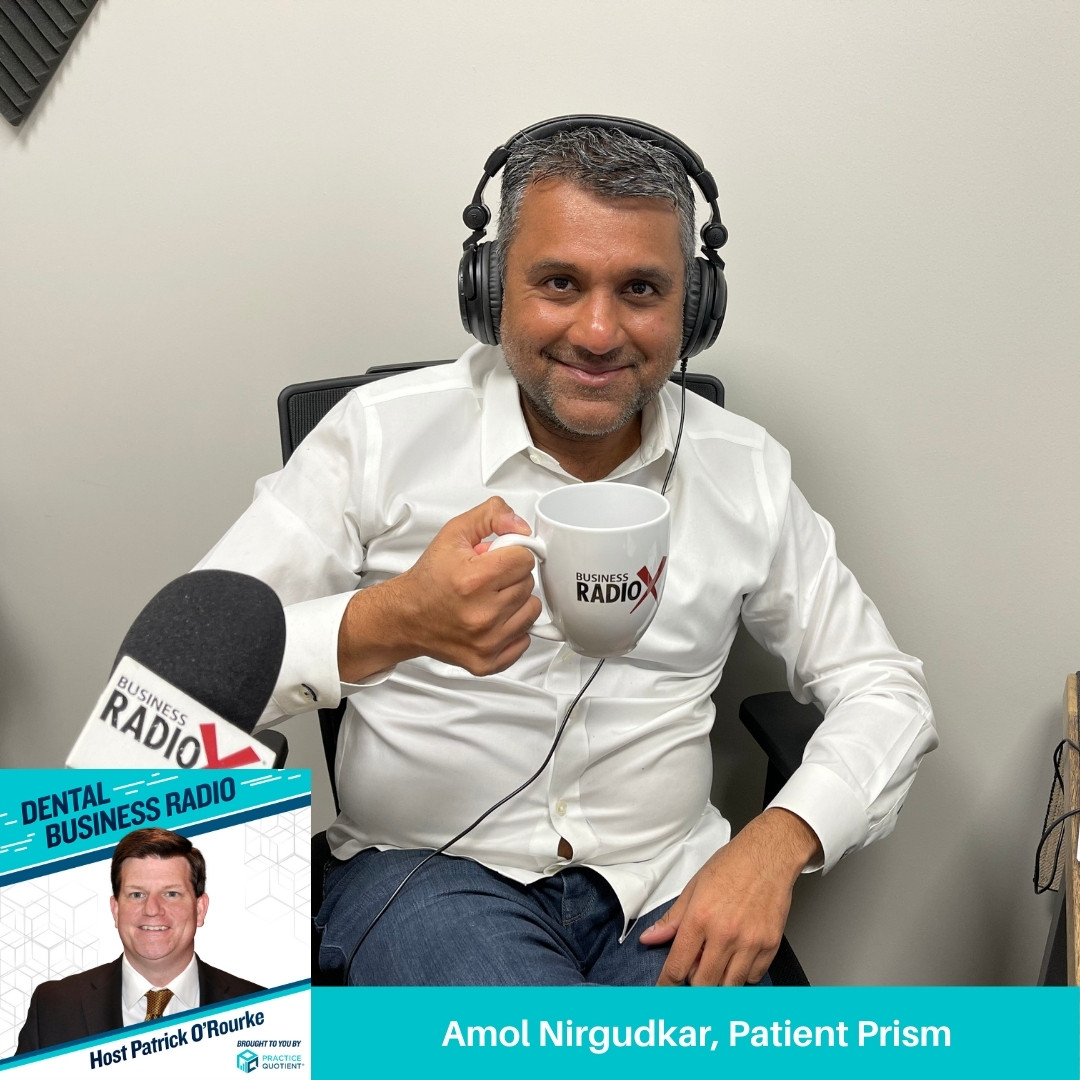

Amol Nirgudkar, Patient Prism (“Dental Business Radio,” Episode 14)
Amol Nirgudkar, CEO of Patient Prism, joins host Patrick O’Rourke to discuss how his firm uses AI to train and inspire patient-facing practice personnel, reengage lost sales opportunities for their dental practice clients, increase their revenue and bottom lines, and much more. “Dental Business Radio” is underwritten and presented by Practice Quotient: PPO Negotiations & Analysis and produced by the North Fulton studio of Business RadioX®.
Patient Prism
Patient Prism’s software shows which marketing investments generate the highest-value phone calls from potential new patients. The use of AI technology enables busy practices to convert more of these callers into patients. Dental offices can increase their revenue growth without necessarily spending more on marketing. Dentists and practice managers can do so without spending hours listening to recordings of entire phone calls.
Patient Prism holds five utility patents issued by the USPTO and is the only call tracking company that leverages artificial intelligence and human call coaching validation to deliver patients directly to dental practices.
Follow Patient Prism on LinkedIn and Facebook.
Amol Nirgudkar, CEO, Patient Prism
 Amol Nirgudkar helps dentists grow their practices and reach their goals.
He is in an unusual position to offer practical insights. As a certified public accountant, business consultant, author, entrepreneur, and former owner of several dental practices, he has 20 years of experience working with dental practices, both large and small.
Through the three companies he founded, Amol has served more than 1,000 dentists across the United States. Through his work, Amol saw firsthand a growth challenge that all dental practices face. No matter how successfully they may market their practice, almost 50% of new patient calls don’t end in a booked appointment.
To help solve that problem, he founded Patient Prism in 2015. The Patient Prism service uses both A.I. and American call coaches to evaluate the way dental offices handle phone calls, identify the callers that didn’t schedule, and teach the team how to win them back – all within 30 minutes of the failed call.
Amol co-invented the patented technologies used in Patient Prism. One eliminates the need to listen to recorded phone calls by providing the information visually. The other technology details specific words spoken by the patient during the call so dentists and managers know which services callers are requesting and the revenue opportunity associated with each call. Amol continues to 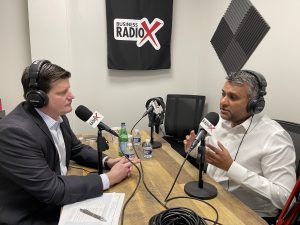 work with artificial intelligence and machine learning to empower dental teams to deliver a better patient experience and build even more successful practices.
Amol has also written several articles and e-books, and published a paperback book called Profitable Niches in General Dentistry (2014).
Connect with Amol on LinkedIn.
Questions/Topics Discussed Include:
- How is AI affecting our life and why it matters
- How Patient Prism uses AI to deliver new patients to dental offices
- Why speed matters
- What an average practice should expect when signing up with Patient Prism
- Additional insights Patient Prism provides to dental offices besides scheduling percentage
- The best way to learn more and sign up for Patient Prism
TRANSCRIPT
Intro: [00:00:03] Live from the Business RadioX Studio in Atlanta, it’s time for Dental Business Radio. Brought to you by Practice Quotient. Practice Quotient bridges the gap between the provider and payer communities. Now, here’s your host, Patrick O’Rourke.
Patrick O’Rourke: [00:00:20] Hi there, friends of Dental Business Radio. This is your host, Patrick O’Rourke, on a sunny day with my friend, Amol. Amol Nirgudkar.
Amol Nirgudkar: [00:00:32] You got it almost.
Patrick O’Rourke: [00:00:34] Well, we’ll try again later.
Amol Nirgudkar: [00:00:35] Yes, sir.
Patrick O’Rourke: [00:00:36] So, Amol, my friend that I met originally down in Tampa on Harbor Island one day for lunch, who is a generous and smart individual, a numbers guy with a CPA background. He’s also an author and the founder of Patient Prism. Patient Prism holds many different patents that we may or may not get into, I don’t know. But when somebody asks you on an elevator and they say, “What is Patient Prism?” What do you tell them?
Amol Nirgudkar: [00:01:07] Well, if it’s a short elevator ride then I’ll tell them, we taught a machine how to understand the nuance of dental conversations, so that we could understand what prevents a new patient from moving forward to schedule an appointment on the phone. And we help dental practices basically improve their sales ability to convert more of those leads into scheduled appointments. That’s a short elevator ride, depending what floor I’m coming from.
Patrick O’Rourke: [00:01:37] All right. So, now, we’re stuck on an elevator, our metaphorical elevator, and I go, “That is interesting. Tell me a little bit more.”
Amol Nirgudkar: [00:01:44] Yeah. I mean, what’s happening in dentistry is this, right? Over the last 10 to 15 years, dentistry has shifted from how dentists acquire new patients. In the past, in the 70s and 80s, even early 90s, patients used to show up from some referral source. There’s not a lot of advertising and marketing going on. In clear choice. dental implant centers came about in the early 2000s and they really changed the game, where, now, you are starting to advertise actively or became a B2C model where you’re actually actively advertising to get new patients.
Amol Nirgudkar: [00:02:20] Now, when you’re actively advertising to get new patients, one of the fundamental things that needs to happen, you get the phone to ring. You have to make sure that every time a phone rings, number one, you answer it – super important. You’re open for business.
Patrick O’Rourke: [00:02:37] Answering phone is important.
Amol Nirgudkar: [00:02:40] Answering the phone is important.
Patrick O’Rourke: [00:02:41] Okay. Hold on. I’m writing this down.
Amol Nirgudkar: [00:02:42] That’s right. Answer the damn phone. Number two, you’ve spent money driving that lead in, spending Google, Facebook, whatever, what not. You want to make sure that lead, that new patient – we call it prospect. They’re not a customer yet. They are prospect.
Patrick O’Rourke: [00:02:57] Sure. They’re thinking about it.
Amol Nirgudkar: [00:02:58] And they’re a pretty hot lead because they’ve called you. They’re not a warm lead or a cold lead. They’re a hot lead, because they called you. You want to make sure that patient feels comfortable booking that appointment on that first attempt. What was happening across dentistry since the 70s is that, that booking rate was around 60, 65 percent. So, we were missing so much of the opportunities right there on the phone because what happened in dentistry – we’re still in the elevator, probably in the 15th floor – was that, we hired people to work in dentistry, especially at the front office who are answering phones, to be order takers. We didn’t tell them to be salespeople. And sales, somehow, is considered a bad word. But it’s not as long as you’re moving people from a bad spot to a good spot. In most instances in dentistry, what we’re doing in dentistry is we’re taking patients with bad health, a suboptimal health and moving them to good health.
Amol Nirgudkar: [00:03:57] So, we have to really train our people to be salespeople at the front. And that is why Patient Prism was developed, is to enable better sales conversations between prospects that are coming from marketing – I mean, from all these different sources – and getting them scheduled by leveraging AI. AI, you know, is a buzzword these days.
Patrick O’Rourke: [00:04:20] Artificial intelligence is what that stands for, right?
Amol Nirgudkar: [00:04:24] It is. And so, we use this subset of our AI called Natural Language Processing, where we took spoken words and we analyze them really quickly. And if the patient decided not to move forward in that journey, on that phone call to schedule an appointment with you, we analyze that conversation really quickly and notify the office within 20 minutes now or 20 or 25 minutes saying that, “Hey, this is what went wrong.” You didn’t have to actually listen to the whole conversation. “This is what went wrong, you didn’t offer them financing.” Or, “You didn’t discuss the insurance options properly.” Or, “You diagnosed what the patient needed when you couldn’t have diagnosed it in the first place.” And so, here’s the information 20 minutes after a patient decides to hang up with you.
Amol Nirgudkar: [00:05:07] And, now, you have that second chance to make that first impression. You call the patient back and saying, “Sir, you called us earlier, you need a dental implant. You know what? I understand you had no insurance and we figured out to give you some important information about financing options we have available. So, come on back in. We’ll get you on our schedule. We have an appointment available for 9:30 tomorrow and we’ll get you free examine X-rays. Come on in. We love new patients. Our doctor is one of the best in the country, has placed over 5,000 implants.” Now, you’ve turned the conversation around. You’ve given that patient the ability to come back in your office. And what we’ve seen with Patient Prism is 25 percent of those patients actually come back on the second try.
Amol Nirgudkar: [00:05:53] So, Patient Prism basically leverages AI to understand the problem that occurred on the phone that prevented the patient from moving forward. Once you understand the problem, we communicate that problem within 20 minutes to the dental office. So, they can actually have that second chance of getting the patient back. And sometimes, you know, it’s one or two patients extra per month could make or break your office. Or it could make your office, right? I mean, you know after a certain point, you can make a big impact.
Patrick O’Rourke: [00:06:23] And it’s about the right kind of patients too. You know, anybody who’s a student of sales – which I think, you know, I would consider myself to be a student – follow up in sales is key. So, you have to follow up, follow up, follow up. One of the things that, frankly, my organization, I don’t have any sales people so we don’t do any follow up and we probably missed out on a lot of stuff. But we’re a little bit different type of business, we’re referral based. It’s 100 percent referral based. So, you’re only calling us if somebody said certain nice things.
Patrick O’Rourke: [00:07:02] And when you state, “Hey, this is sales and prospects,” I get that. But, to me, what you just described is an education process. And it’s a training process of helping the front lines or the face of these dental practices be more welcoming, use active listening techniques, and clearing the pathway making people comfortable and educating them, assuming that they are the best solution or they have the best solution, kind of like the implants we just described for that specific patient. Versus, being, “We don’t take Blue Cross.”
Patrick O’Rourke: [00:07:45] And then, you’re doing it – and I’m going to try to get into the numbers because I was kind of doing them in my head – in a way that’s quantifiable. And the dentist/ owners are not having to listen to phone calls or train people. It’s all done. It’s proven. And so, if, let’s say, we’re converting on a 65 percent ratio, that means we’re not converting on 35 percent. And so, you’re then able to get one quarter of that 35 percent back. I think that that’s really important to track, because in my conversations, still to this day, it seems to me that what’s tracked is how many new patients am I getting a month. Does that make sense?
Amol Nirgudkar: [00:08:36] And, you know, it’s easy to say, “I need to spend more money on marketing to drive new patients.” But sometimes, let’s understand, we might be getting enough leads in our offices. We just need to convert them. So, why spend more? The easy button to press is, let’s spend more money on marketing.
Patrick O’Rourke: [00:08:57] Well, I can tell you that outside of the larger groups, spending money on marketing is not something that’s high on the priority list of most dental practices and specialty practices. Let’s include in that category, you know, sometimes you talk to folks and you’re like, “Well, how much money do you spend on marketing?” They’re like, “Marketing? Nah. We did some mailers, like, back in 1994. It didn’t work.”
Amol Nirgudkar: [00:09:22] You know, as professional management comes into dental practices and private equity comes into DSOs, one of the things – and they’re super analytical, right? – that we talk about in our business, as well as any business you talk about, is, what does it cost to acquire a customer? It’s called a CAC, acquisition cost.
Patrick O’Rourke: [00:09:47] Client acquisition cost.
Amol Nirgudkar: [00:09:47] So, client acquisition cost or customer acquisition cost, whatever that is. And we have to really understand that concept really well if you want to run the practice of dentistry as a business – as we’re in Business Radio right now – we want to understand what does it cost to acquire a customer.
Amol Nirgudkar: [00:10:04] Now, you’re spending, let’s say, $2,000 in a Google Adwords campaign, let’s say, to attract Invisalign patients, and you want to do Invisalign. And, let’s say, from that Google AdWords, ten people actually call us. Now, if ten people call us and we only schedule five, that’s $400 cost of acquisition. But if we schedule all ten, that’s only $200 cost of acquisition. And that’s what Patient Prism really helps you understand and then compress that cost. Because if your $2,000 can get you, you know, five patients worth $4,000 a piece, that’s $20,000. Or if we can get you eight patients, that’s $32,000. That’s what we see the lift happen, right? Because we’re already spending the money to drive the leads in. We’re spending money upwards of a $100 a lead sometimes, some of them are $200 a lead – Google is expensive, Adwords are expensive – to drive those type of high value customers into your office.
Amol Nirgudkar: [00:11:07] And somehow our receptionist says, “By the way, we have nothing available for the next three weeks,” and the patient goes away. Or the receptionist says, “You know, it’s really going to cost you $5,000. But you might need a root canal before that, it’s going to cost you six grand.” And we’re driving people away from the offices to come in. Because at the end of the day – Patrick, you’ve been in dentistry for a very long time. And we’re not dentists. Both of us are not – but one thing we know for sure, nobody knows what you need inside your mouth unless you open your mouth and the dentist looks at it with their loops or whatever it is and examines the teeth. You can’t really diagnose that over the phone and tell the patient, “Oh, you might need this, that’s going to cost you a $1,000.” There’s two barriers – main barriers –
Patrick O’Rourke: [00:11:52] Does that happen a lot?
Amol Nirgudkar: [00:11:53] It happens a lot. It happens a lot. People start talking about, “Hey, what’s it going to cost me?” “Oh, well, the crown is $1,200 but the build up is going to be another $300. And then, we don’t know whether you might need a root canal, that can be another $1,000.” So, the patients here are looking at some special thinking that, you know, it’s maybe about a $1,000 and the insurance is going to cover whatever percentages is. And, now, they have this idea that, “Oh, my God. I have to spend another $1,500 on this?” You have no idea. How do you know the patient might need a build up or a root canal? But, somehow, our folks, they create all these barriers. Barriers for patients to make an appointment.
Patrick O’Rourke: [00:12:32] Right. And they think they’re trying to be helpful, probably, right? So, it’s sort of like you just said, we’re business folks. I’m from the insurance business, but I know more about – you know, I started in dental and the Lord knows this is where I’m still making my hay. So, I know more about it than I care to brag about. I know what an apicoectomy is and I know how to spell it. But can I do it? Now, sometimes, because people know that I do something in dentistry but they don’t know exactly what, then, they’re like, “Hey, Pat. Blah, blah, blah.” I’m like, “Look, I’m not a dentist. I don’t know. Don’t open your mouth over your dragon breath.”
Patrick O’Rourke: [00:13:13] And even though I probably do know more than, you know, most folks, well, I would never try to get out of my [indiscernible] much to diagnose. And it’s the same thing for the front desk, they know a lot about it. But you’re still not licensed to diagnose, right?
Amol Nirgudkar: [00:13:30] And it’s not physically possible to diagnose unless somebody opened their mouth and you’ve looked inside. Because somebody thinks they need a crown. How do you know they need a crown? And then, you’re quoting prices on that. And then, you’re not even – then on top of that, so there’s two barriers that patients face when they call a dental office. And nobody likes to call the dental office, we know that, right? There’s 40 percent of people actually only go to the dentist, 60 percent of America doesn’t even go to a dentist.
Patrick O’Rourke: [00:13:59] I like going to the dentist.
Amol Nirgudkar: [00:14:00] So, somebody who calls a dentist, they have overcome significant inertia to actually call the dental office. And they have called us. Now, they have two concerns, “How much is it going to hurt me physically?” Because there’s fear of dentistry, how much pain and all that stuff. And, “How much is it going to cost me?” So, fear and cost are two big barriers. And then, the third barrier also is that, “Have I called the right place? Are these the good people? Are they competent?”
Amol Nirgudkar: [00:14:30] And all we’ve got to do on the phone is, make them feel safe, make them feel that they have called the right place, make them feel that this is going to be an affordable treatment for them, and make them feel that it’s going to improve their life. And if we can communicate that, we don’t need to communicate a lot more. We have to actively listen, empathy. That’s just a couple of things we do at Patient Prism, we analyze things like active listening. Did you ask about discomfort? Did you mention financing? Did you discuss insurance options correctly? What if somebody was out of network? We look at that. How do you have the conversations around that?
Patrick O’Rourke: [00:15:05] So, have you ever seen the study? There’s multiple of them, actually, that said the number one reason why people don’t go to the dentist is because they don’t have dental insurance. Number two reason is, because they don’t know how much it’s going to cost, whether they have dental insurance or not. Because dental insurance is kind of a funky financial instrument, if you will.
Amol Nirgudkar: [00:15:26] Right. It is.
Patrick O’Rourke: [00:15:26] Right. Funky is a nice word.
Amol Nirgudkar: [00:15:28] But you’re right. Absolutely. And that all derives from the idea, how much is it going to cost? Can I afford it? And how much is it going to hurt me? And it’s simple things. It’s the soft skills. People do business with people, especially with doctors. And, obviously, we’re in health care. First and foremost, you’ve got to feel safe, that you’ve called the right play.
Patrick O’Rourke: [00:15:51] Especially these days.
Amol Nirgudkar: [00:15:52] Obviously. More so in COVID environment than ever before. But all of us desire safety. Any place we are in, we’re always looking for safety. And safety is a big part of what we need to impart to a prospective patient that, “Yes, you’re safe. You’ve called the right place. We care. We have empathy. We can make this affordable. It can change your life. We have an appointment available. You’re special.” So, those are some of the things.
Amol Nirgudkar: [00:16:24] Right now we’re so busy, right? Most dental offices you’ve been to, the front is super busy. They’re doing all sorts of things. They’re checking out patients. They’re doing insurance verifications. And sometimes they’re cleaning things. They’re doing all sorts of things. And sometimes what happens in that busy environment, we forget to talk. We forget to have time for the most important function, talking to our customer or our client, our patient. And if we forget that, no matter whether it’s an existing patient or new patient, you know, people don’t want to do business with you if you appear to be too busy and not caring about their concerns. Because people care what they care about. And you’ve got to care about what the patient’s care about. Your stuff can wait. Right. You’ve got to do stuff. I understand you got to do paperwork, you got to call the companies, all that stuff. That’s great. But the most important person in that dental office is the patient. And we’ve got to respect that, whether it’s on the phone, whether it’s in person, whether it’s anywhere else. Because that is what drives revenue, it’s the patient.
Patrick O’Rourke: [00:17:26] Right. It’s in my head. I like analogies and to use other things, it’s like walking into Macy’s or Nordstrom’s and you’re like, “I’m trying to buy a suit and, you know, I like to have help.” But when I buy a suit, I like to wear nice stuff. And then, somebody is like, “I’m too busy. I’m too busy folding the clothes over here. I can’t help you.” And I’m like, “Well, fine. I’ll find somebody who can help me then.”
Amol Nirgudkar: [00:17:50] That’s a great analogy. Actually, I’ve had situations, just two weeks ago, a patient called one of her clients – and sometimes we get these crazy alerts because if things go crazy wrong – and the patient called at 4:55 p.m. Eastern Time and said, “You know, I’ve been thinking about this for a long time. I really need a full mouth extraction and get those implants aborted dentures.” Pretty penny, $30,000 to 50,000 depending on where you go to. And at 4:55, the person at the front sounded very hurried and like, “Sir, we’re about to close in five minutes. Could you call back tomorrow?”
Amol Nirgudkar: [00:18:37] So, how do you do that? Like, how do you do that? And that call got elevated to my attention because, you know, it’s so egregious, right? You’re literally telling a patient who could potentially spend $40,000 in your office telling them, “Could you call me tomorrow because it’s 4:55?”
Patrick O’Rourke: [00:18:55] So, that brings an alarm on your phone?
Amol Nirgudkar: [00:18:59] It does brings the alarm on our side, we call it escalation call. Or somebody is really rude or racist or something like that, it escalates that because our AI listens too. Because we don’t think every human being needs to be treated with the utmost kindness and respect and compassion, regardless of what they sound like, regardless of how much money you think they have, or whatever their circumstance might be. But this was egregious because, obviously, $40,000 opportunity, 4:55, it’s not even 5:00. Even if it was 5:00 –
Patrick O’Rourke: [00:19:28] Is this almost like a drowning kid – though metaphorically, you know, not that serious – but this is where you go and save this drowning prospect that’s lost. It’s about to wash away with the tide. And you’re going to go in there and pull it right out. And this makes Patient Prism the hero that Patient Prism is.
Amol Nirgudkar: [00:19:49] And we got back. We sent that to the CEO of this group. They called the patient the next morning, offered them a free set of a CT scan and a free whitening kit. They just come in. And, you know, I’ve had situations where we have recommended to our DSO customers and dental customers that, “You know, if you have a case like that, send a Uber. Let them in. Let them in.” You know, there’s Uber Corporate, as long as you can figure out the insurance stuff.
Amol Nirgudkar: [00:20:21] We’ve got to figure out – and telling them, “We’re closed. Call tomorrow,” that’s not acceptable. And we had to have a conversation with the receptionist. I’m like, your number one job in dentistry is to improve people’s health. This procedure, yes, it would make us a lot of money. But at the end of the day, you’ve got to think about that patient has finally taken the step to call a dental office to get all their teeth removed and put nice shiny pearly whites in them. So, not only they will have a great smile, but they will have great health. And you’ve got to remember that’s a responsibility that we have in dentistry to improve, not only people’s oral health, but overall health, as we know that the connections obviously are established very well now.
Patrick O’Rourke: [00:21:09] Did you listen to the show with Marc Cooper, the dental business rating?
Amol Nirgudkar: [00:21:13] Marc’s amazing. It’s on my list to listen to. But the oral systemic connection is absolutely established. And so, one of the things we educate, as part of Patient Prism – and we’re a software company and people think, “Oh, my God. They just do AI and everything else.” But at the end of the day, we’re in the people business. We want to inspire our teams to be better. We want to inspire our teams in the front office to feel that they are making an impact on health care in America. We’re changing the lives of people by getting them in the office. It’s not about revenues. Revenues are a side effect of us treating people right. And so, our values are going to create value in our organization. Our value are, we care for patients. We know dentistry is going to change their life. We know dentistry, giving them the right teeth or whatever, fixing their stuff, a regular cleaning.
Amol Nirgudkar: [00:22:05] Today, there was a study done that I read that periodontal cleaning, periodontal disease, obviously, has a direct impact. But it has a direct impact, apparently, on people who got sick with COVID. People with high amounts of periodontal disease had a higher chance of dying from COVID-19.
Patrick O’Rourke: [00:22:27] Yeah. That’s true.
Amol Nirgudkar: [00:22:28] And so, we are in the business of changing and saving lives. And I think once we get that into the minds of the team members, whether they’re at the front or the middle of the back, it doesn’t matter, and once they believe that it’s a calling, dentistry as a calling. It’s a business, great. We’re in Business Radio, that’s great. At the end of the day –
Patrick O’Rourke: [00:22:47] Right. You serve their purpose. You know, I have to roll out of bed every day thinking I’m helping people. If I don’t think I’m actually helping people, I’m going to go fishing.
Amol Nirgudkar: [00:22:56] Correct. Correct. Or, you know, I’m going to do something else that I love to do. But I get up every morning and think about why I’m here working like a maniac and talking to people in dentistry. Because this is such a beautiful profession. It literally changes people’s lives in so many ways. And if we can improve access to care using this AI technology by allowing more patients to book an appointment, then we are getting America healthier. We’re getting more people to have this function and the aesthetics. It changes relationships too.
Patrick O’Rourke: [00:23:39] More confidence. At least, were more aesthetically pleasing. Please don’t tell me you’re trying to bring smiles to the universe though. That’s an insurance cover. They already got the trade. They already got that slogan, like, trademarked. And then, they told me that one time with a straight face. And I was like, “Really?”
Amol Nirgudkar: [00:23:57] Smiles to the universe.
Patrick O’Rourke: [00:23:57] “So, you want to bring golden small smiles to the entire country, is what you’re doing?” “Okay. Well, how about this? How about instead of dental insurance, here’s what we’ll do. We’ll have all the docs. We’ll work for free.” They’ll just go out there and they’ll do all the work and they’ll handle it and they’ll bring smiles to the whole country and the whole universe for free. And so, guess what we don’t need if that’s the case? A financial vehicle to pay for it. So, we don’t need insurance, so then you don’t have a job buddy. Is that going to make you happy? It’s not going to make you smile, is it? True story.
Amol Nirgudkar: [00:24:31] That comment sounds like one of those social media memes. They sound interesting, they sound funny, but they’re so simplistic. They don’t reflect reality. It sounds funny. You laugh at them, right?
Patrick O’Rourke: [00:24:46] Oh, yeah. You must never even ever worked in an insurance company before.
Amol Nirgudkar: [00:24:50] Yeah. I have not. I have not. I have not.
Patrick O’Rourke: [00:24:53] Yeah. The marketing department is very creative. They come up with all kinds of stuff and I’m like, “Listen guys, you can call it apple or bicycle all day long, but it’s still apple, you know.” You know, with all due respect to you guys, you have to get creative with the products that are not so creative. But, anyway, I digress into the insurance. But trust me, I bet you somebody has the copyright on, “We’re bringing smiles to the universe.”
Amol Nirgudkar: [00:25:18] Right. Bring smiles to the universe. Right.
Patrick O’Rourke: [00:25:20] If not trademarked.
Amol Nirgudkar: [00:25:22] We’re bringing smiles to Baby Yoda over there on – I don’t know what island he’s on right now. Tatooine? I don’t know. I’m not sure what planet is on. But Mandalorian, Star Wars –
Patrick O’Rourke: [00:25:34] I haven’t started that yet.
Amol Nirgudkar: [00:25:35] Mandalorian is good.
Patrick O’Rourke: [00:25:36] Yes?
Amol Nirgudkar: [00:25:36] You got to watch both.
Patrick O’Rourke: [00:25:38] So, are you Star Trek or Star Wars guy?
Patrick O’Rourke: [00:25:40] I’m a Star Wars guy. Star Wars guy. But Mandalorian is great. My son, who’s ten, got me into it.
Patrick O’Rourke: [00:25:47] My son’s ten.
Amol Nirgudkar: [00:25:48] And I’ve learned a lot about all the different galaxies and systems.
Patrick O’Rourke: [00:25:54] It seems like it’s gotten a lot more complicated than the first three.
Amol Nirgudkar: [00:25:59] Yeah. Absolutely, the side stories are interesting. This is right in between when Yoda is dead and, you know, it’s right in between before the other episodes that come out. But, anyway, that’s the –
Patrick O’Rourke: [00:26:13] Yeah. My son’s in Florida where it’s warm.
Amol Nirgudkar: [00:26:18] Mandalorian is excellent. But they’re bringing smiles to the –
Patrick O’Rourke: [00:26:23] So, Mandalorian, they’re not bringing smiles to the universe. But Amol and Patient Prism are bringing smiles to the universe. I’m not going to mention any names, I know you guys are listening to the show, so you know who you are. Hugs and kisses.
Patrick O’Rourke: [00:26:40] So, now, artificial intelligence, my wife says I have artificial intelligence because I think I’m smart, but I’m not. That’s what she says. But AI is a real thing that Patient Prism is moving. Now, how easy is it to plug this thing? The first time I met you, by the way, you were telling me about this, I’m like, “I’ve never heard of that. That sound pretty awesome. This sounds like it’s going to be hard to do. You got to do a bunch of stuff and plug in computers and, you know -” Walk me through the process.
Amol Nirgudkar: [00:27:11] It’s a simple thing. The process is, you’re a patient, you’re driving on I85.
Patrick O’Rourke: [00:27:17] No, no, I’m a doc. Let’s say, I’m a doc, you know, and I’m like, “Oh, that sounds interesting. All right. Go. Put that stuff in my system.”
Amol Nirgudkar: [00:27:27] Right. So, the process is simple. We insert ourselves directly in your phone system so that we are monitoring your phone calls. We record the phone calls, so what the AI does, it really understands who this person is. Is this a new patient?
Patrick O’Rourke: [00:27:46] So, like, if John Ray over here calls, it’s going to be like, John Ray, North Fulton. And it’s going to say everything about John. It’s going to have his age, his background. The fact that he likes purple Corvettes.
Amol Nirgudkar: [00:28:03] No. Not really. It’s not that creepy. It’s not that creepy. But John Ray, if John Ray calls and says, “You know, I’ve been thinking about getting some veneers and I’ve not been to a dentist in a long time, do you guys do veneers?” And they say, “Yes. We do the veneers and stuff.” So, the AI will actually listen to a transcript of John Ray’s recording and says, “You know, I think John Ray, the probability of him being a new patient in this office is about 95 percent.” Because John Ray said that, you know, I’m looking to get some veneers. He didn’t say I’m a brand new patient.
Amol Nirgudkar: [00:28:38] So, what AI does, really, is, it takes the audio conversation, transcribes it into text, and it looks at patterns in text. Not just in John Ray’s conversation, but it looks at millions of patterns and puts them together to understand, first, who John Ray is. John Ray worked for Henry Shine and says, “Hey, when can I deliver the cotton gauze or cotton balls?” And the AI is going to say, “You know what? John Ray, it looks like this is just a general call. This is not a patient.” And to be able to figure that out quickly, AI can do because it recognizes patterns. And it takes unstructured data, makes it structured data, and analyzes it. The first step is figuring out who John Ray is. And now we’ve determined he’s a new patient. Now, the conversation goes on and everything else. And if John reaches the end of the conversation, “I’m going to think about it. I’ll call you guys back.”
Amol Nirgudkar: [00:29:36] Based on those patterns, the AI has figured out that John Ray did not book that appointment. Now, we have identified very quickly, within ten minutes of him hanging up the phone, we’ve identified that John Ray wanted some veeners worth. $5,000, has decided not to schedule an appointment, and here’s what happens. That piece, AI sends it back to our Tampa call center, which they look, they confirm, where a human in the loop AI, which means the humans are there. And then, that information gets curated. Our human being sitting in Tampa says, “Okay. Let’s put some of the things in perspective of all the things that didn’t happen in that conversation.” And that information is packaged in a bow that, “Hey, maybe our receptionist did not give John Ray financing options to clear credit that could have made it cheaper for him. And they didn’t discuss that.”
Amol Nirgudkar: [00:30:32] And all that information goes to somebody’s phone and email within 20, 25 minutes to say that, “We just lost John Ray worth $5,000 of veneers or $10,000 of veneers. And let’s hear some training videos around it. Here’s how you talk when somebody calls and thinks it’s very expensive, and when somebody is really price shopping,” let’s say he was price shopping. So, AI has figured out that John Ray was a price shopper and he was concerned about cost. And there is a training video around that. So, all that goes back to the office, you look at it like, “Okay. Well, I should call John Ray back.” Now, the doctor’s office manager says, “All right. Well, let’s do this. So, we’ve understood Patient Prism has told us we’ve lost a $9,000 opportunity with John Ray. Let’s call them back and tell him, ‘John Ray, you called us earlier but we forgot to give you some important information. One, that we have an appointment available to see you tomorrow or the day after. We’ve got really creative financing available that can make this into, like, a couple hundred dollars a month.'”
Patrick O’Rourke: [00:31:40] You got to get creative with his finances, that’s for sure.
Amol Nirgudkar: [00:31:42] Exactly. “And why don’t you come in? We would love new patients. And, you know, we want to make sure that we’re treating this correctly and we want you to get the smile you deserve. Because our doctor is amazing at smile makeovers.”
Patrick O’Rourke: [00:31:59] At veneers.
Amol Nirgudkar: [00:32:00] Smile makeovers.
Patrick O’Rourke: [00:32:00] He is the Picasso of veneers. And so, if you want to veneer, you need to get in here.
Amol Nirgudkar: [00:32:07] Correct. Correct. And John Ray is like, “You know what? I am really pleasantly surprised that a health care practitioner provider cares enough to call me back.” And then, he’s like, “All right. I’m going to come in.” And that’s the process.
Patrick O’Rourke: [00:32:23] That’s it. That’s what I love about this. For the first time you explain it, because this is Dental Business Radio, I’m a numbers guy and you’re a numbers guy.
Amol Nirgudkar: [00:32:31] I’m a numbers guy.
Patrick O’Rourke: [00:32:32] I like numbers guys and girls. I like numbers people, data people. Because I’m always like, “All right. Well, how do you quantify that? Like, what does that mean and how much money?” And so, this seems like it’s very easy for you to go to any client and go, “Here’s what we just did. We just found you these – what? – ten, I don’t know, 20 different opportunities and they can easily run a report. Well, it’s $100,000 a year.”
Amol Nirgudkar: [00:33:01] At the minimum. At the minimum.
Patrick O’Rourke: [00:33:03] So, this is why you’re very popular.
Amol Nirgudkar: [00:33:06] We’re popular because we care, I think. We really believe that –
Patrick O’Rourke: [00:33:11] You can care all day, but if you don’t make me money –
Amol Nirgudkar: [00:33:14] Correct. Correct. Absolutely. Yeah. I mean, you don’t have to wait. That’s another reason, right? You don’t have to wait to find out. Within 30 days, you’re going to find out. We saved two patients and three patients, and those patients ended up spending 20 grand with us directly as a result of what Patient Prism did. If we had not found out, this patient, John Ray called and he needed $9,000 veneers, we had not known by the time – imagine we had to call a recording service and we had deployed people to listen to calls. Number one, who’s got the time? Number two, how do you figure out which calls to listen to? Let’s say you figured this out, it would take you hours and hours and hours of listening to find out. By that time, John Ray, his nimble fingers on the keyboard have already found five other doctors that he can call upon, so he’s already gone. The prospect is gone to one of your competitors who is going to, basically, treat them –
Patrick O’Rourke: [00:34:13] Right. Roll out the red carpet, right.
Amol Nirgudkar: [00:34:15] Correct. And that’s what we want to prevent, right? We want to prevent – you, you’ve driven that lead in. We want to make sure that that prospect, that patient, comes into your office and spends money with you guys and you get to impact his health.
Patrick O’Rourke: [00:34:29] Right. And you want to welcome them. You want to make them feel warm. And you want to give them the path of least resistance into the treatment that they are looking for and need. That’s pretty easy.
Amol Nirgudkar: [00:34:40] Correct. Absolutely.
Patrick O’Rourke: [00:34:42] The other cool thing about the platform is the education component. The education component in which, you know, as somebody who’s talked to – I don’t know – thousands of different owner doctors across this country, they don’t have the time and, certainly, they’ve never trained on a high level like Nordstrom training on how to answer calls appropriately. Maybe they took a weekend course or something, but maybe you know how to do it even. Maybe you know how to do it but how are you going to train it? I know I do a lot of stuff, but, you know, training, like, do I have time to train, I mean, personally? The answer is no.
Amol Nirgudkar: [00:35:24] It’s tough, right? It’s tough.
Patrick O’Rourke: [00:35:25] And so, the cool thing about it is that, you have this whole library of things that then pinpoint and go, “You need to do X.” And then, it’s like, what’s the average video?
Amol Nirgudkar: [00:35:37] Submitted? Two minutes long. It’s quick.
Patrick O’Rourke: [00:35:38] Right. Boom. Here you go. And so, it’s on the spot training. So, it’s like having a training team. And that’s how I got started my career in operations management, I’ve trained a lot of people in my time. It’s hard.
Amol Nirgudkar: [00:35:52] It is very hard. And you know what? Sometimes we’ve seen people learn better in chunks. You tell somebody who calls in – and let’s take an insurance example – and they’re like, “Well, we don’t take Blue Cross.” Well, you’re out of network. What kind of conversation do you need to have with the patient who’s out of network? We’ve got a video on that. And what happens to a patient who’s a price shopper? We have a video on that. What happens to somebody who is anxious, afraid, somebody who is really wanting all the details, somebody who wants all the information about what dental implants are like?
Amol Nirgudkar: [00:36:36] There’s all sorts of videos. We have almost 350 of them that relate to what questions patients may have in the phone that you can answer. And those are a minute or two minutes long recorded by some of the industry experts in the industry that we know of. And then, they get attached specifically to every problem that occurs. If a patient calls and doesn’t schedule an appointment because he was a price shopper, that alert that goes out will have the price shopper video right there, which is beautiful, right? Because now you’ve not only told these guys what they did wrong, but you’ve given them the tools to listen to that video before they called the patient back. And that’s powerful.
Amol Nirgudkar: [00:37:15] Now, You do that enough times over a period of 42 days – Charles Duhigg wrote the book The Power of Habit – what we’re doing is we’re changing habits one call at a time. And when you encounter these things and when you’re nudged in the right direction, we’re not Big Brother watching here. We’re not Big Brother watching. What we call ourselves are we’re coaches. Front office is a position. Hygienist is a position. Doctor is a position. The doctor is, let’s say, the quarterback. But there’s a position if you have the sports analogy. For an office position, every position has a coach. We are the front office coach, we want to make sure that we are going to facilitate your greatness by allowing you to understand the things that you’re doing that could make the patient experience better or the things that you’re doing that are making the patient experience worse. And we’re optimizing that journey for you.
Patrick O’Rourke: [00:38:08] I love that, actually. So, the front office coach –
Amol Nirgudkar: [00:38:12] It is a front office coach.
Patrick O’Rourke: [00:38:14] And as that they are the face of the franchise, so to speak. It’s pretty important. But I think that going back to our elevator thing, that’s what you guys do. You’re the front office coach, you know, if it’s a dental conference radio, right?
Amol Nirgudkar: [00:38:31] Although, we are accelerating your new patient acquisition rate. We’re accelerating your new patient growth. It’s important, right? It’s important. We’re accelerating a new patient growth without spending more money on marketing. It’s not about spending more money. It’s about really understanding, making sure that everybody who calls can get scheduled now after that happens. Sorry.
Patrick O’Rourke: [00:38:50] Yeah. You’re preserving your marketing investment.
Amol Nirgudkar: [00:38:54] Absolutely. We’re reducing your cost of customer acquisition. Your cost of customer acquisition and reducing that. And, obviously, by providing exceptional customer service on the phone. You know what happens, Patrick? It translates into the entire journey of the patient. If you feel good about somebody, when you go in, and that optimal Ritz-Carlton experience continues throughout the process. The front office gives you coffee, like John Ray offered me today. And then, the hygienist comes in, the system comes in, and everybody is delivering this exceptional care and compassionate service through communication. That, eventually, leads to higher case acceptance rates and then leads to higher referrals.
Amol Nirgudkar: [00:39:46] That’s what we want in dentistry to happen. We want that entire customer journey from the time they find you – when they have the need, they find you, they Google you, they find you on Google Maps, ads, whatever it is. The entire experience, we want to map that and make sure that every handoff that happens, every time a patient encounters your website or your people, the communication is so optimal that they feel that this is the right place. This is where I want to get my treatment done. This is who I want to refer my friends and family to. And we are just one of the pieces, which is on the phone, which is the first interaction with the doctor’s office is the phone.
Amol Nirgudkar: [00:40:28] And, now, people do it through chat and everything else, but on the phone. And if you can make them feel welcome, if you can make them feel safe, if you can empathize with them, you can alleviate their concerns about cost and fear, they are going to come in and you’re going to do, obviously –
Patrick O’Rourke: [00:40:48] So, it’s kind of a no brainer to me. So, you know, just frankly, I’m puzzled when people would say, “Why would somebody not do this?”
Amol Nirgudkar: [00:40:57] Well, for a variety of reasons. And I’ll tell you, I’m very open and candid about our failures as much as our successes.
Patrick O’Rourke: [00:41:05] I like candor.
Amol Nirgudkar: [00:41:06] And who does it fail with? If you’ve got a small office that just doesn’t receive any phone calls from new patients, it’s not going to work for you because you ain’t got nothing to analyze. Number two, if you have a reluctant team that, “Son, I have been doing dentistry since you’re wearing diapers. I don’t need any training.” Well, if you’ve got those kind of people, well, that’s not going to work for them. But, now more and more so, if you are a growth minded dentist who is actively looking for new patients, advertising, marketing through whatever means you’re doing, digital, non-digital, you’re driving leads in, it’s going to work for you. Or unless you have like Dale Carnegie’s at your front office that know exactly how to say everything perfectly, they never have a bad day, and every time they’re booking 100 percent, I haven’t seen yet. There are people who are great. So, it does work for those type of practices.
Patrick O’Rourke: [00:42:01] I don’t know if you remember what I told you the first time you told me about this, I was like, “Can I get that for my company?”
Amol Nirgudkar: [00:42:06] I wish we could.
Patrick O’Rourke: [00:42:07] Why would I not do that? That doesn’t make any sense. Because even me, even myself, I guess I’m the face of the franchise. I don’t know. I certainly talk to a lot of people. But, yeah, could I use coaching? Probably. My staff certainly won’t tell me anything. John Ray is over there chuckling. What are you chuckling about, Chucklehead?
Amol Nirgudkar: [00:42:29] You know, the new industry in Silicon Valley today is sales enablement. And sales enablement is, are we having the right conversation with our customers? And there’s lots of companies out there in other verticals that look at conversational intelligence. It’s what we’re talking about, conversational intelligence, right? At the end of the day, people don’t care about what you’re selling. People don’t care about how you’re selling it. People care about why you’re doing what you’re doing, as Simon Sinek says. People will buy stuff from you as long as they can trust you. And trust can be only established with optimal communication.
Patrick O’Rourke: [00:43:10] Right. You have to build rapport and you have to do so in a very short amount of time.
Amol Nirgudkar: [00:43:14] A very short amount of time. And you have, like, on the website, Google says you’ve got – what? – eight seconds to sometimes 12 seconds to impress somebody to make the next step, which is call you. And on the phone, a patient can tell if you’re having a bad day when you answer the phone. A patient can tell if you don’t care. One of the things, you know, a lot of these coaches advice, like, keep a mirror in front of you when you’re talking on the phone and make sure you’re smiling, because somebody can tell you’re smiling.
Patrick O’Rourke: [00:43:49] This is true actually. This is not just dentistry. This is corporate America. I tell my staff that and they’re like, “Why are you so corny?” And I’m like, “Look, I’m telling you, you can say, ‘Listen, you’re an effing a-hole.’ As long as you’re smiling, you know, then people are like, ‘Ah.'”
Amol Nirgudkar: [00:44:10] As human beings, we have an inherent tendency to relate. And you’ve got to be able to relate to the patient. Relating to the patient means you are putting yourself in their shoes. That’s the beautiful word in the English language, empathy. You’re putting yourself in their shoes and asking about, “Hey, did you watch the Super Bowl?” I don’t know if you’re in Tampa.
Patrick O’Rourke: [00:44:30] I did watch the Super Bowl, Tampa won. And you know what? Tampa, where your call center is, where they are doing the curating, Tampa, I’ve heard is a tiny little town, the championship city. Shoutout to everybody in Tampa.
Amol Nirgudkar: [00:44:43] That is correct. I mean, it’s been a wonderful year, a wonderful season, football, baseball, hockey. And even soccer, they went to the finals, the Rowdies. So, go, Tampa Bay.
Patrick O’Rourke: [00:44:55] That’s right. I recognized I might have to go down there, it’s a lot warmer right now. But I couldn’t walk out of this episode without giving a shoutout there. Now, going back, maybe I need more empathy. Maybe I need an empathy coach, because as you’re describing this and I’m like, well, if we have this filter, if we’re understanding that John Ray is a price shopper, and if we’re understanding that John Ray is maybe very fearful, he’s an anxious guy, he’s not comfortable with people putting fingers in his mouth, or John Ray wants to follow his insurance. We have all of this stuff. Is there something that can tell us that John Ray is an a-hole and we don’t want him in our office?
Amol Nirgudkar: [00:45:38] Well, in our view, every customer, regardless if they’re a-holes, you can unbook every single one of them. But 90 percent of people or 95 percent of people, you can absolutely. Even if they’re a-holes, it’s because it’s something going on in their life that’s making them be that way. You can absolutely get John Ray to calm down a little bit by talking about what’s important to John Ray.
Patrick O’Rourke: [00:46:04] I’ll just slap the bejesus out of them. That’s what I do.
Amol Nirgudkar: [00:46:07] Well, you cannot do that over the phone. You cannot do that over the phone. But you can. I mean, the thing is, there is situations where we have seen that very angry patient. We’ve seen the discourses that are really, really provocative. And you want to make sure that at the end of the day, we are a dental office, we’re a health care provider, we are doing everything in our power to make that patient feel welcome. If they disrespect us, obviously, it’s on them, it’s not on us. But to tell you the truth –
Patrick O’Rourke: [00:46:44] I’m only half kidding here, by the way.
Amol Nirgudkar: [00:46:47] I know you are. I know are.
Patrick O’Rourke: [00:46:49] Because the thing is, is that, my business a little bit different, but if you’re going to be difficult and challenging for me to deal with, and if I think you’re rude to me – and I think I’m fairly polite. You know, I’m a nice guy most of the time – then I know you’re going to be rude to my staff. And that’s not something I’m going to tolerate. And so, I’m half kidding. But because you probably don’t have something on there, because that’s really not what it’s geared to do. And then, internally, like, everybody has their own a-hole filter or they’re like, “Yeah. We don’t need that person in our office very likely.”
Amol Nirgudkar: [00:47:34] Absolutely not. I mean, but you know what? For the most part, people are nice. For the most part, people just are anxious. In our job, our job is to make sure that the patient who calls in is able to just come in. Come into the office and see the beautiful staff, and the hygienist, and assistants, and the doctor, and get the treatment they deserve. That’s it. We’re not trying to be anybody else.
Patrick O’Rourke: [00:48:02] Right. No, I get it. Why does speed matter?
Amol Nirgudkar: [00:48:06] Yeah.
Patrick O’Rourke: [00:48:07] Ricky Bobby.
Amol Nirgudkar: [00:48:08] Speed matters because, imagine knowing in real time what you did wrong and to be able to fix it, it’s like having the ability. And the quicker you know what you did wrong – and nobody wants to suck at anything. Nobody wants to suck at their job.
Patrick O’Rourke: [00:48:25] I agree with that. Right.
Amol Nirgudkar: [00:48:27] And imagine, like, you had a coach. Imagine some guy hovering over your head and watching everything you do, and kind of letting you know quickly that, “Hey, Patrick. That little proposal that you gave earlier, that presentation, I think you forgot to mention, like, two or three things that could have really sealed the deal.” And knowing that in 15 minutes, before you’ve even left that building, going back to the customer and saying, “By the way, I did forget to mention three other things that make me better than everybody else in the planet in the world of dental insurance. I forgot to give you about this. We’ve got a special deal with this. And we can negotiate this.” Imagine having that. Imagine how many deals could you close if you knew immediately. And somebody was actually looking at the stuff and figuring out what the best practices are.
Amol Nirgudkar: [00:49:19] So, speed matters, because now you have a second chance to make a first impression. You have a second chance. AI is giving you a second chance to revisit the customer, fix your mistakes, and try to get the deal back before it’s dead, before somebody else gets it who is less competent than you are. And you know what? You are one of the best and maybe the best in this business. So, that’s what it is. Speed matters because it allows us to fix what we just broke and do it again.
Patrick O’Rourke: [00:49:48] That’s critical.
Amol Nirgudkar: [00:49:49] And that’s what AI allows you to do. That’s why Patient Prism is the most innovative and powerful tool in dentistry, because the speed at which we get the information in an accurate way to the dental office, to be able to fix that problem that occurred 20 minutes ago or 25 minutes ago, allows us to bring back that customer and revive somebody that leave. They’ve already gone. And 25 percent of those people come back because of speed. All my competitors, I love them. I would never say anything bad about any of them. But they haven’t approached this as a sales problem. They’ve approached this as a marketing attribution problem. They just want where did their customer came from and let’s record the calls.
Amol Nirgudkar: [00:50:33] But at the end of the day, we have to know quickly why that patient didn’t move forward. And if we can know it and say, “Oh, my God. We forgot to offer them the financing option or we didn’t offer them the discount plan that we have.” And just quickly knowing that, “Yes, we should have offered that.” And that allows us to really, really optimize everything that we’re doing. That’s why speed matters. Speed matters. And the only thing, if AI didn’t exist, the way you would do this is, you would have a group of people listening to all these phone calls, it would take forever.
Patrick O’Rourke: [00:51:07] And they have to become subject matter experts and then they would have to do training sessions at least once a week over and over and over and over again with these folks.
Amol Nirgudkar: [00:51:17] By the time they get to it, they have listened to the calls, it’s too late.
Patrick O’Rourke: [00:51:21] Right. John Ray is in his purple Corvette, getting veneers in Mexico.
Amol Nirgudkar: [00:51:26] And gotten a speeding ticket already. He got a speeding ticket. He’s already driven past and he’s gone to San Diego and he’s gone into a Baha. And he’s getting the veneers right there on the corner – on the corner strip right there.
Patrick O’Rourke: [00:51:42] He just puts the top down or maybe his T-top. So, I like that. I think that it’s one of the coolest things I’ve heard about. And, you know, I get around. I know you get around too. You get around more than I do, actually. And I admire that about you. And you’re a numbers guy and you’re genuine. You know, I think people should use speed and call you guys up and, you know, access Patient Prism, assuming that you are open, to having your front office get new patients.
Patrick O’Rourke: [00:52:20] So, if somebody who’s listening to the show wanted to get a hold of Patient Prism and ask some questions, I’m sure that your front office is warm and welcoming and will guide them along the path that they need should this solution be in their interests. How would our listeners do that?
Amol Nirgudkar: [00:52:38] Well, all they would have to do is visit our website, www.patientprism.com. Go there and schedule a demo. There’s an orange button on the top right hand corner, it says Schedule a Demo. And somebody will call you that will give you a demo. And the one thing that I can guarantee you that they will do for you is, they will do an honest assessment whether you actually need us or not. If you don’t need us, we will tell you that maybe you need to fix something else. For example, “So, I get only three new patients a month.” “Well, Patient Prism is not the right solution for you. And we will be honest enough. One of the things I talk about is “people before profits”. I mean, you’ve seen my shirts everywhere. You’ve seen my hats and jacket.
Patrick O’Rourke: [00:53:15] Yeah. That’s why I like you.
Amol Nirgudkar: [00:53:17] We do believe that we’re not going to force the solution down your throat, but we can help most dental practices. Contact us, follow us on Facebook, LinkedIn, follow us on YouTube. We have lots of amazing content we’ve created with some of the best minds in dentistry. And schedule a demo. Our sales team will connect with you, schedule a demo. And diagnose, do you really need this? If you need it, then we can get you in and give you really immediate results within the first 30 days, sometimes within the first day.
Amol Nirgudkar: [00:53:53] We had a pediatric group last week came on board, first day on Patient Prism ,booked a family of four. First day, we recovered four patients day number one.
Patrick O’Rourke: [00:54:03] It feels good, doesn’t it?
Amol Nirgudkar: [00:54:05] It feels amazing. Amazing. And that guy sent us a video testimonial like, “Oh, my God. I got Patient Prism starting Monday, a family of four called. They couldn’t in the first time. We got the RELO alert.” We call it RELO, Reengage Lost Opportunity alerts. “We got the letter from Patient Prism. We called them back and got the whole family booked.”
Patrick O’Rourke: [00:54:22] That’s awesome.
Amol Nirgudkar: [00:54:23] And that was beautiful. And we have these stories, Patrick, every single day of the week. Every single day we found out, “Oh, this practice got this patient back. This practice got this all four case back. These practice got a whole family coming into this office because what of we did.” And it’s tremendously fulfilling to know that we’re adding patients to all our clients offices. New patients every single day by just by training people in how to become better communicators, and AI is helping us in that process.
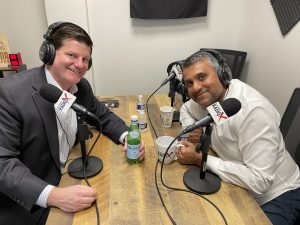
Patrick O’Rourke: [00:54:57] That’s awesome. That’s fantastic. Amol, I want to thank you for being on the show. It’s always a pleasure to see you. I’m glad you came up here. We are broadcasting live out of Atlanta, more specifically, Innovation in downtown Woodstock, where all the cool kids are. With the producer, the unofficial mayor of North Fulton, John Ray, who I’d also like to thank. And I want to give a special thank you to the show’s sponsor, Practice Quotient, PPO analysis and negotiation. It’s a top tier compensation, top tier representation for top tier providers. And so, if you are a top tier provider and are not being compensated as such, you may want to speak with Practice Quotient. And you can reach them at www.practicequotient.com. Not to be confused with Patient Prism. It’s Patient Prism and Practice Quotient. It’s not Practice Prism and Patient Quotient. That would be wrong.
Amol Nirgudkar, Patient Prism: [00:55:56] That is correct.
Patrick O’Rourke: [00:55:58] Practice Quotient. You know, everybody calls it PQ. I thought the name was very clever. My wife thinks it’s silly. But whatever.
Amol Nirgudkar, Patient Prism: [00:56:07] I like the name a lot. And you’re doing great work in this business. You’re super analytical. And, you know, people are leaving money on the table. And just like we are in the business of like, “Oh, my God. Don’t leave all this money on the table.” And you’re doing the same exact thing, you’re not leaving money on the table.
Patrick O’Rourke: [00:56:23] I have to say I’m a little jealous, because you’re able to do it in 30 days. Ours takes a little longer. But thank you to Practice Quotient and all the people at Practice Quotient who makes the organization as stellar as it is. So, from Florida all the way to Georgia, thanks to Practice Quotient. Thank you to Amol. Thank you to John Ray. And thank you to you, dear listener. If you like the show, please be sure to give it a five star rating and thumbs up, nice Google review, all of that stuff. I promise you good karma will come from it. All right. That’s a guarantee from your friend and host, Patrick O’Rourke. Until next time.
About Dental Business Radio
“Dental Business Radio” covers the business side of dentistry. Host Patrick O’Rourke and his guests cover industry trends, insights, success stories, and more in this wide-ranging show. The show’s guests will include successful doctors across the spectrum of dental practice providers, as well as trusted advisors and noted industry participants. “Dental Business Radio” is underwritten and presented by Practice Quotient and produced by John Ray and the North Fulton studio of Business RadioX®.
Practice Quotient
“Dental Business Radio” is sponsored by Practice Quotient. Practice Quotient, Inc. serves as a bridge between the payor and provider communities. Their clients include general dentist and dental specialty practices across the nation of all sizes, from completely fee-for-service-only to active network participation with every dental plan possible. They work with independent practices, emerging multi-practice entities, and various large ownership entities in the dental space. Their PPO negotiations and analysis projects evaluate the merits of the various in-network participation contract options specific to your Practice’s patient acquisition strategy. There is no one-size-fits-all solution.