Business RadioX ®

  • Home
  • Business RadioX ® Communities
    • Southeast
      • Alabama
        • Birmingham
      • Florida
        • Orlando
        • Pensacola
        • South Florida
        • Tampa
        • Tallahassee
      • Georgia
        • Atlanta
        • Cherokee
        • Forsyth
        • Greater Perimeter
        • Gwinnett
        • North Fulton
        • North Georgia
        • Northeast Georgia
        • Rome
        • Savannah
      • Louisiana
        • New Orleans
      • North Carolina
        • Charlotte
        • Raleigh
      • Tennessee
        • Chattanooga
        • Nashville
      • Virginia
        • Richmond
    • South Central
      • Arkansas
        • Northwest Arkansas
    • Midwest
      • Illinois
        • Chicago
      • Michigan
        • Detroit
      • Minnesota
        • Minneapolis St. Paul
      • Missouri
        • St. Louis
      • Ohio
        • Cleveland
        • Columbus
        • Dayton
    • Southwest
      • Arizona
        • Phoenix
        • Tucson
        • Valley
      • Texas
        • Austin
        • Dallas
        • Houston
    • West
      • California
        • Bay Area
        • LA
        • Pasadena
      • Colorado
        • Denver
      • Hawaii
        • Oahu
  • FAQs
  • About Us
    • Our Mission
    • Our Audience
    • Why It Works
    • What People Are Saying
    • BRX in the News
  • Resources
    • BRX Pro Tips
    • B2B Marketing: The 4Rs
    • High Velocity Selling Habits
    • Why Most B2B Media Strategies Fail
    • 9 Reasons To Sponsor A Business RadioX ® Show
  • Partner With Us
  • Veteran Business RadioX ®

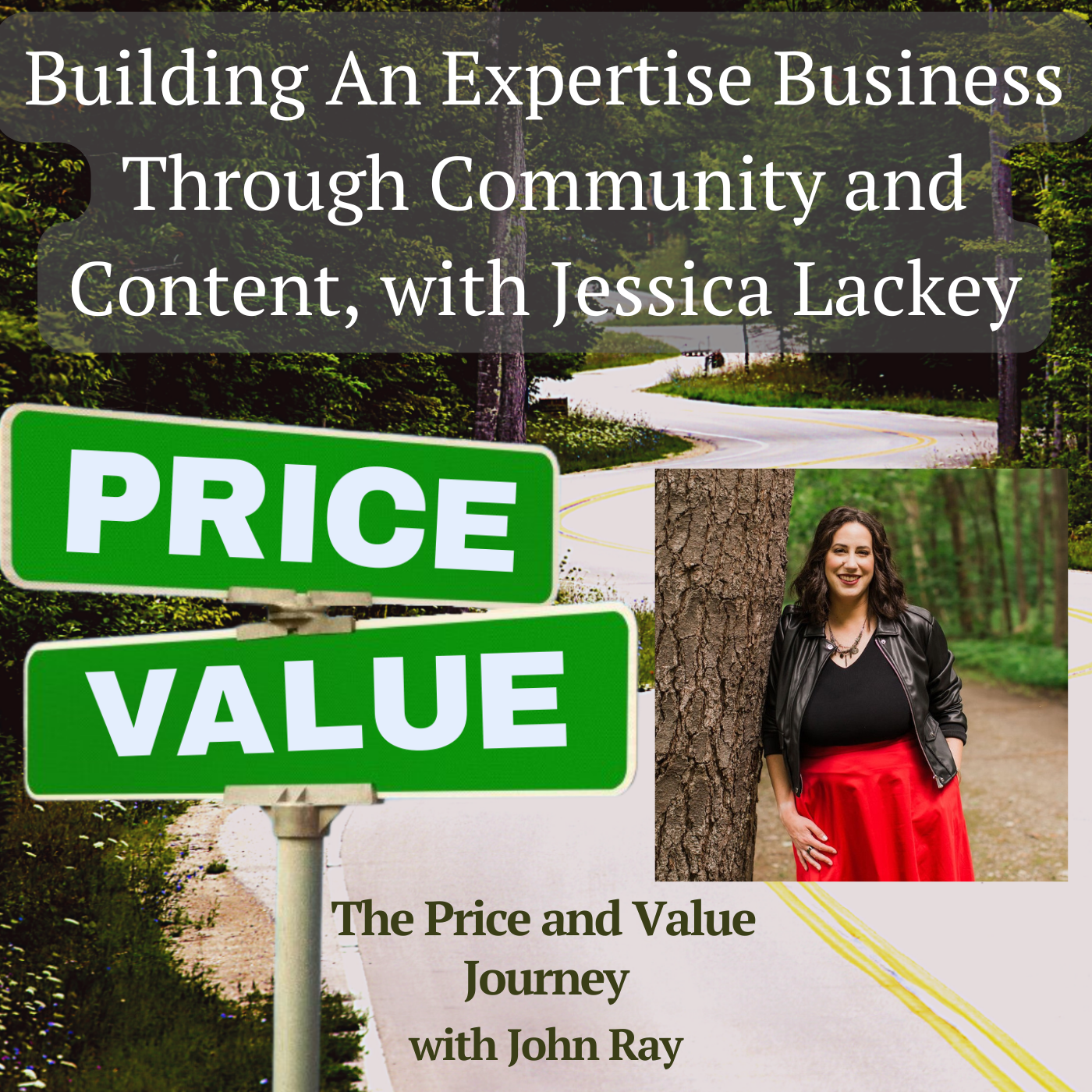
Building An Expertise Business Through Community and Content, with Jessica Lackey, Jessica Lackey Consulting

October 16, 2024 by John Ray

Building An Expertise Business Through Community and Content, with Jessica Lackey, on The Price and Value Journey podcast with host John Ray
North Fulton Studio
Building An Expertise Business Through Community and Content, with Jessica Lackey, Jessica Lackey Consulting
Loading
00:00 /
RSS Feed
Share
Link
Embed

Download file

Building An Expertise Business Through Community and Content, with Jessica Lackey, on The Price and Value Journey podcast with host John Ray

Building An Expertise Business Through Community and Content, with Jessica Lackey, Jessica Lackey Consulting (The Price and Value Journey, Episode 117)

In this episode of The Price and Value Journey, host John Ray welcomes Jessica Lackey, founder and CEO of Jessica Lackey Consulting, to discuss building an expertise business through generosity of content and building authentic community. She delves into creating relatable marketing content from real-life experiences and client interactions, emphasizing the significance of “writing to learn” and why creating authentic relationships and community is vital in business development. The discussion highlights the shift from the “era of followers” to the “for you era” in online content consumption, focusing on the need for genuine connections and impactful content. Practical advice on implementing systems for business success and fostering non-transactional community relationships is provided, showcasing how generosity and quality service can drive organic growth and referrals. Jessica also elaborates on her educational offerings, pricing philosophy, and the vital role of storytelling in creating meaningful engagement.

The Price and Value Journey is presented by John Ray and produced by the North Fulton affiliate of Business RadioX®.

Jessica Lackey, Jessica Lackey Consulting

Jessica Lackey, on The Price and Value Journey with host John Ray
Jessica Lackey

Jessica Lackey is a strategy and operations advisor who blends business strategy, practical application, and a human-centric approach to create sustainable businesses. With a background in corporate leadership, McKinsey & Company consulting, and a Harvard Business degree, Jessica knows a thing or two about hustle culture and what it feels like to judge success by the bottom line…at all costs.

Now, she combines her deep experience in consulting, Fortune 500 operations leadership, and coaching to help businesses grow without sacrificing the well-being of their clients, team, and community.

To connect with Jessica, take her free Radical and Rooted Business Lifecycle Assessment, and learn about her services, including next steps, visit this link.

LinkedIn | Instagram | X (Twitter)

Topics Discussed in this Episode

00:00 Welcome to The Price and Value Journey
01:03 Jessica Lackey’s Professional Journey
01:58 Principles and Strategies for Small Businesses
02:40 The Content Continuum: Long Form vs Short Form
05:06 The Power of Writing to Learn
06:19 Engaging Clients and Building Authority
09:53 Story-Driven Newsletters and Client Insights
14:43 Newsletter Strategy and Client Implementation
17:52 Introduction to Community Building
18:45 The Power of Peer Support
19:17 Creating Meaningful Connections
20:06 Challenges and Solutions in Community Building
21:27 Monetizing Community Without Losing Trust
22:00 The Importance of Generosity in Business
26:24 Navigating the ‘For You’ Era
29:05 Jessica’s Community and Resources
31:44 Conclusion and Contact Information

About The Price and Value Journey

The title of this show describes the journey all professional service providers are on:  building a services practice by seeking to convince the world of the value we offer, helping clients achieve the outcomes they desire, and trying to do all that at pricing that reflects the value we deliver.

If you feel like you’re working too hard for too little money in your solo or small firm practice, this show is for you. Even if you’re reasonably happy with your practice, you’ll hear ways to improve both your bottom line and the mindset you bring to your business.

The show is hosted and produced by John Ray and the North Fulton studio of Business RadioX®. The show can also be found on all the major podcast apps. The complete show archive is here.

John Ray, Host of The Price and Value Journey

John Ray, Author of The Generosity Mindset and Host of "The Price and Value Journey"
John Ray, Author of The Generosity Mindset and Host of The Price and Value Journey

John Ray is the host of The Price and Value Journey.

John owns Ray Business Advisors, a business advisory practice. John’s services include business coaching and advisory work, as well as advising solopreneurs and small professional services firms on their pricing. John is passionate about the power of pricing for business owners, as changing pricing is the fastest way to change the profitability of a business. His clients are professionals who are selling their expertise, such as attorneys, CPAs, accountants and bookkeepers, consultants, coaches, marketing professionals, and other professional services practitioners.

In his other business, John is a Show Host and Producer and owns the North Fulton (Georgia) studio of Business RadioX®. John and his team work with B2B professionals to create and conduct their own podcast using The Generosity Mindset™ Method:  building and deepening relationships in a non-salesy way that translates into revenue for their business.

John is also the host of North Fulton Business Radio. With over 780 shows and having featured over 1,200 guests, North Fulton Business Radio is the longest-running podcast in the North Fulton area, covering business in its region like no one else.

John’s book, The Generosity Mindset: A Journey to Business Success by Raising Your Confidence, Value, and Prices
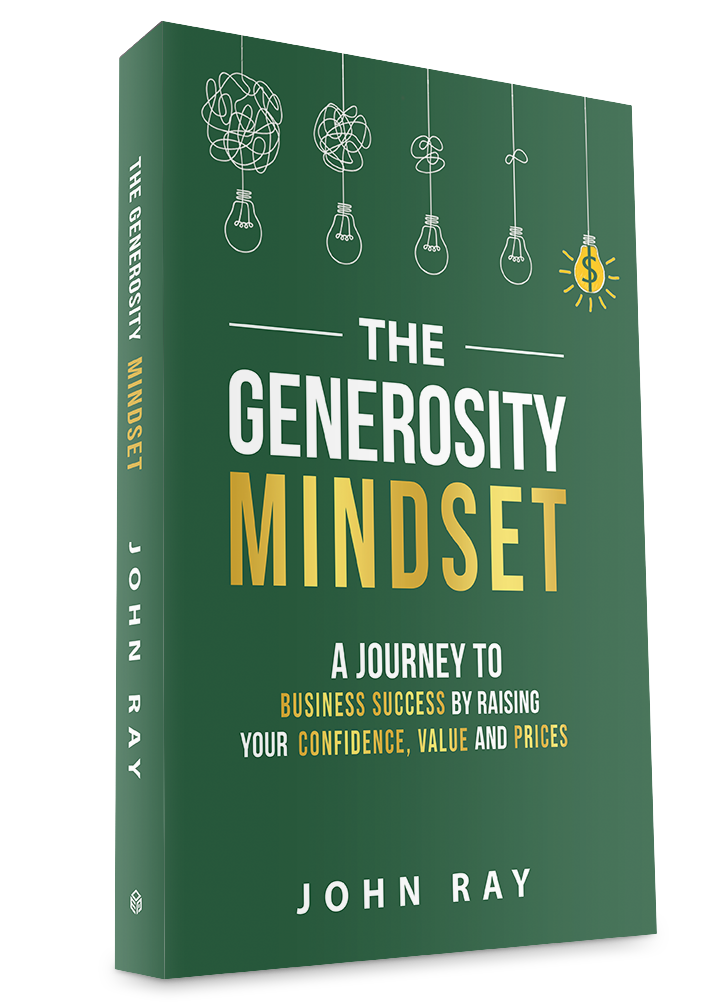
The Generosity Mindset, by John RayJohn is the #1 national best-selling author of The Generosity Mindset: A Journey to Business Success by Raising Your Confidence, Value, and Prices.

If you are a professional services provider, your goal is to do transformative work for clients you love working with and get paid commensurate with the value you deliver to those clients. While negative mindsets can inhibit your growth, adopting a different mindset, The Generosity Mindset™, can replace those self-limiting beliefs. The Generosity Mindset enables you to diagnose and communicate the value you deliver to clients and, in turn, more effectively price to receive a portion of that value.

Whether you’re a consultant, coach, marketing or branding professional, business advisor, attorney, CPA, or work in virtually any other professional services discipline, your content and technical expertise are not proprietary. What’s unique, though, is your experience and how you synthesize and deliver your knowledge. What’s special is your demeanor or the way you deal with your best-fit clients. What’s invaluable is how you deliver great value by guiding people through massive changes in their personal lives and in their businesses that bring them to a place they never thought possible.

The combination of all these elements is quite different for you compared to any other service provider in your industry. Therein lies your value, but it’s not the value you see. It’s the value your best-fit customers see in you.

If pricing your value feels uncomfortable or unfamiliar to you, this book will teach you why putting a price on the value your clients perceive and identify serves both them and you, and you’ll learn the factors involved in getting your price right.

The book is available at all major physical and online book retailers worldwide. Follow this link for further details.


Connect with John Ray:

Website | LinkedIn | Twitter

Business RadioX®:  LinkedIn | Twitter | Facebook | Instagram

Tagged With: community, community building, content, content creation, email newsletter, Jessica Lackey, Jessica Lackey Consulting, John Ray, Price and Value Journey, The Price and Value Journey

Decision Vision Episode 135: Should I Create an Email Newsletter? – An Interview with Michael Katz, Blue Penguin Development

September 23, 2021 by John Ray

Miichael Katz
Decision Vision
Decision Vision Episode 135: Should I Create an Email Newsletter? - An Interview with Michael Katz, Blue Penguin Development
Loading
00:00 /
RSS Feed
Share
Link
Embed

Download file

Miichael Katz

Decision Vision Episode 135:  Should I Create an Email Newsletter? – An Interview with Michael Katz, Blue Penguin Development

Do you need an email newsletter? How long should it be? What should you write about? Although written off quite a few times, email is still not dead. Mike Blake’s guest Michael Katz, email newsletter authority with Blue Penguin Development, discusses the strategy of email newsletters, how to make them effective, how to make the most of the content, and much more. Decision Vision is presented by Brady Ware & Company.

Michael Katz, Chief Penguin, Blue Penguin Development

Michael Katz, Chief Penguin, Blue Penguin Development

Blue Penguin Development Inc is a marketing and advertising company based out of Hopkinton, Massachusetts.

An award-winning humorist and former corporate marketer, Blue Penguin founder and Chief Penguin, Michael Katz, specializes in helping professional service firms and solos talk and write about their work in a way that is clear and compelling.

Since launching Blue Penguin in 2000, Michael has been quoted in The Wall Street Journal, The New York Times, Business Week Online, Bloomberg TV, Forbes.com, Inc.com, USA Today, and other national and local media.

He is the author of four books and over the past 20 years has published more than 500 issues of “The Likeable Expert Gazette,” a twice-monthly email newsletter and podcast with 6,000 passionate subscribers in over 40 countries around the world.

Michael has an MBA from Boston University and a BA in Psychology from McGill University in Montreal. He is a past winner of the New England Press Association award for “Best Humor Columnist.”

Company website | LinkedIn

Mike Blake, Brady Ware & Company

Mike Blake, Host of the “Decision Vision” podcast series

Michael Blake is the host of the Decision Vision podcast series and a Director of Brady Ware & Company. Mike specializes in the valuation of intellectual property-driven firms, such as software firms, aerospace firms, and professional services firms, most frequently in the capacity as a transaction advisor, helping clients obtain great outcomes from complex transaction opportunities. He is also a specialist in the appraisal of intellectual properties as stand-alone assets, such as software, trade secrets, and patents.

Mike has been a full-time business appraiser for 13 years with public accounting firms, boutique business appraisal firms, and an owner of his own firm. Prior to that, he spent 8 years in venture capital and investment banking, including transactions in the U.S., Israel, Russia, Ukraine, and Belarus.

LinkedIn | Facebook | Twitter | Instagram

Brady Ware & Company

Brady Ware & Company is a regional full-service accounting and advisory firm which helps businesses and entrepreneurs make visions a reality. Brady Ware services clients nationally from its offices in Alpharetta, GA; Columbus and Dayton, OH; and Richmond, IN. The firm is growth-minded, committed to the regions in which they operate, and most importantly, they make significant investments in their people and service offerings to meet the changing financial needs of those they are privileged to serve. The firm is dedicated to providing results that make a difference for its clients.

Decision Vision Podcast Series

Decision Vision is a podcast covering topics and issues facing small business owners and connecting them with solutions from leading experts. This series is presented by Brady Ware & Company. If you are a decision-maker for a small business, we’d love to hear from you. Contact us at decisionvision@bradyware.com and make sure to listen to every Thursday to the Decision Vision podcast.

Past episodes of Decision Vision can be found at decisionvisionpodcast.com. Decision Vision is produced and broadcast by the North Fulton studio of Business RadioX®.

Connect with Brady Ware & Company:

Website | LinkedIn | Facebook | Twitter | Instagram

TRANSCRIPT

Intro: [00:00:02] Welcome to Decision Vision, a podcast series focusing on critical business decisions. Brought to you by Brady Ware & Company. Brady Ware is a regional full-service accounting and advisory firm that helps businesses and entrepreneurs make visions a reality.

Mike Blake: [00:00:21] Welcome to Decision Vision, a podcast giving you, the listener, clear vision to make great decisions. In each episode, we discuss the process of decision making on a different topic from the business owners’ or executives’ perspective. We aren’t necessarily telling you what to do, but we can put you in a position to make an informed decision on your own and understand when you might need help along the way.

Mike Blake: [00:00:42] My name is Mike Blake, and I’m your host for today’s program. I’m a director at Brady Ware & Company, a full-service accounting firm based in Dayton, Ohio, with offices in Dayton; Columbus, Ohio; Richmond, Indiana; and Alpharetta, Georgia. My practice specializes in providing fact-based, strategic, and risk management advice to clients that are buying, selling, or growing the value of companies and intellectual property. Brady Ware is sponsoring this podcast, which is being recorded in Atlanta per social distancing protocols.

Mike Blake: [00:01:09] If you like to engage with me on social media with my Chart of the Day and other content, I’m on LinkedIn as myself and @unblakeable on Facebook, Twitter, Clubhouse, and Instagram. If you like this podcast, please subscribe on your favorite podcast aggregator and please consider leaving a review of the podcast as well.

Mike Blake: [00:01:27] Our topic today is, Should I create an email newsletter? And in doing this topic, I almost think like what’s old is new again, back to the future, retro, however you want to call it. Email newsletters, I think, have been declared dead more times than your typical cat or Rasputin, take either one.

Mike Blake: [00:01:52] First, it was spam blockers. And the next was social media. Of course, social media was going to obviate the need for email newsletters. And then, of course, everybody told us, if we don’t send people things in the analogue world and handwrite them, then nobody’s ever going to read it. And the list goes on and on.

Mike Blake: [00:02:12] And to coin a phrase from, about, five years ago, “And yet they persist”. And I think they persist for very good reason, is that, they’ve taken all kind of all comers. And in spite of that, in spite of many attempts and ongoing attempts to disrupt that world, email newsletters continue to thrive. And perhaps the best indicator of that is the fact that Atlanta’s own homegrown startup Mailchimp was just bought by Intuit for $12 billion. Mailchimp basically exists to help people and companies publish email newsletters.

Mike Blake: [00:02:53] Now, why does a tax company want a newsletter company? I’m not sure. I was going to say I’m not in that business. But I guess working for a CPA firm, I technically am, but I’m not. And I don’t even do my own taxes although I’m a CPA. And I don’t understand the strategic rationale for that deal or the price that they paid. But, you know, good for Ben Chesnut and his team, they’ve worked hard on that company for a very long time. They certainly deserve to see the fruits of that labor. And that’s a big feather in the cap for those of us who believe in the Atlanta startup ecosystem as I do.

Mike Blake: [00:03:33] And so, you know, I think that this is a topic that requires and I think many of us will benefit from this discussion. And helping us with this is is Michael Katz, who’s an award-winning humorist and former corporate marketer and Founder and Chief Penguin of Blue Penguin. And he specializes in helping professional services firms and solos talk and write about their work in a way that is clear and compelling.

Mike Blake: [00:04:01] Since launching Blue Penguin in 2000, Michael has been quoted in The Wall Street Journal, The New York Times, BusinessWeek Online, Bloomberg TV, Forbes.com, Inc.com, USA Today, and other national and local media. And you can tell that he had nothing to do with my introductory comments. He is the author of four books. And over the past 20 years has published more than 500 issues of The Likeable Expert Gazette, a twice monthly email newsletter and podcast with 6,000 passionate subscribers in over 40 countries around the world.

Mike Blake: [00:04:33] Michael has an MBA from Boston University – I grew up in Boston. A B.A. in Psychology from McGill University in Montreal – home of my favorite actor and yours, William Shatner, or at least birthplace. He is a past winner of the New England Press Association Award for Best Humor Columnists. Michael, welcome to the program.

Michael Katz: [00:04:52] Great to be here. Thanks for having me.

Mike Blake: [00:04:55] So, you know, there’s so many ways to communicate in the written word now with our intended audiences. And I actually think it is helpful, it may sound like the most inane question in the world, but I do think that the definitions have been blurred and it is important. In your mind what makes a newsletter a newsletter? And what separates it from other forms of written – I’m going to say – mass communication. I probably cringe at saying that, but it is sort of a one-to-many kind of communication model. What makes a newsletter a newsletter?

Michael Katz: [00:05:31] Well, I think it is pretty blurry. I mean, I always think of it, it’s just a glorified email sent to more than one person. Maybe the email that Target sends to you telling you you’ve got 30 percent off and the email that your accounting firm sends with useful information, they’re both technically newsletters and people pretty much use them interchangeably. So, you know, the definition really hasn’t gotten any clearer over the years. It sort of depends what business you’re in, but I think it applies when you send it by email to a number of people and generally not personalized beyond, you know, dear name.

Mike Blake: [00:06:12] You know, it’s interesting, even I would not have thought of the Target virtual flyer being a newsletter. But I guess it is, right? And that definition between advertisement, newsletter, blog post, something else, I think, has been blurred. And I guess I’ll follow up with this question, is that distinction even meaningful?

Michael Katz: [00:06:41] I think the distinction is, is this a thing that lands in your inbox or is it somewhere else, social media, video, all that? So, you know, I think as you were saying, Mike, earlier, it’s written and it shows up in your email. And so, that then becomes the question. So, is that still valuable or not? But I think all those things, I suppose, are the same species, email and newsletter.

Mike Blake: [00:07:05] Okay. So, those of us who are listening to this podcast, they may well be hearing newsletter and wondering, “Oh, my gosh. Do I have to basically now become a professional writer? I didn’t like writing five page essays in school. And, now, I got to do something every week or maybe more than that.” Is there an ideal length in your mind for a newsletter? Can newsletters be short? Do they need to be long form? They need be very long form? What’s best practices in determining just how much content goes into a newsletter?

Michael Katz: [00:07:41] Yeah. I always say one word is perfect. However, you have to get over two bars at least, again, in the world that I live in. So, again, I’m not doing the Target 30 percent off. I work exclusively with small professional service firms, financial planners, consultants, recruiters, coaches. So, these are all people who are selling themselves or their small firm, essentially. And so, those kind of newsletters are information-based. They’re not about an event. They’re not click to buy kinds of things, like click here and buy it. They’re really about – and we’ll talk more about it – getting in front of a group of people. So, yes, shorter is better because I can get your stuff sooner.

Michael Katz: [00:08:26] However, two things. One is, you have to tell me something that I will read it and have learned something. So, I’m always saying, you’re looking for me to read it and go, “Oh, there’s something I just learned about accounting, legal, management, consulting, whatever.” The second thing is, I think you want your newsletter to be long enough that you include some of your personal voice story experience. Because if it’s just information, well, I can get information by Googling it.

Michael Katz: [00:08:56] So, if you can say something that includes something useful and enough story – which I know we’ll talk about – then I think that’s good. I would say that for most people then, you’re talking 500 to 800 words to get that in there. But even among my own clients, there’s variations there.

Mike Blake: [00:09:18] So, how do you decide what goes in? And I’ll preface this with kind of my experience with this podcast, and you’ve done a lot more of these things than I have, so God bless you, I don’t know how you do it. But the question I’m asked most frequently is, how do you decide on the topics and how do you kind of keep it fresh? And my answer to them is, “Well, for me, I just keep a running note in every note. And every time something pops in my head, I write it down. And then, if I’m really stuck, I’m not afraid to revisit something if I think somebody else can bring a different voice to the same topic.” How do you decide what goes into your newsletter?

Michael Katz: [00:10:06] So, my point of view is, I’m trying to help my readers not need to hire me, which sounds counterintuitive. But what I mean is that – and this is true for any profession that I’m working with – help them learn not to need you. So, if you took a very simple example, suppose you’re a carpenter. Your newsletter should be about how to use a hammer, how to buy wood, how to climb a ladder. It’s very simple stuff. And, yes, if I got and received and retained a thousand newsletters like that, I suppose I would know as much as my carpenter.

Michael Katz: [00:10:42] But the truth is, you’ll never give away your business with those 500 or 700 word tidbits. But it has to be useful so that I read it like everybody thinks about what do I say to promote my business. Which is fine, that’s why we’re doing it. But your readers don’t care about your business. They are only going to read it, and stay with you, and tell other people about it if they find it useful.

Michael Katz: [00:11:06] So, that’s the sort of basis of it always, you have to match up to the audience that presumably would hire you by giving them something that will make them live their lives better or do their jobs better instead of running out of information. I mean, I’ve written 500 newsletters. I have, like, 30 ideas. So, it’s funny, I mean, I don’t republish them. And, by the way, that’s where stories come in.

Michael Katz: [00:11:30] But I’ll address a similar topic with a slightly different angle or something. Nobody says, “Wait a second. Four years ago in April, you said the same thing.” It’s sort of like, you know, if you have a personal trainer at the gym, the guys told you a thousand times to keep your back straight when you do pushups. You don’t say, “Wait a second. You already told me that.” So, people need repetition anyway. That’s fine.

Michael Katz: [00:11:56] The other thing is, even your most loyal readers will probably read every other one, so it’s fine. You’re trying to be out in front of a particular population over and over again with useful information and some personality because, again, your goal is that they refer you or maybe they hire you. So, it’s sort of easier than you think. I always say, if you know enough to be in a profession, you’ll never run out of content. My longest running client, an attorney, we’ve been doing a newsletter for 18 years and still publishing.

Mike Blake: [00:12:29] You know, you bring up that topic of what’s the likelihood that somebody’s going to remember a topic? I guess that’s right. In fact, I would love it if somebody has actually listened to this podcast with enough intentionality and frequency that they could spot any kind of repetitive material. And, frankly, I think I might actually buy a steak dinner if you sort of organically did that. Because I don’t think I have the kind of following like somebody, a dragon con, who shows up and questions one of the actors like, “In episode 192, how do the physics work when the spaceship went from galaxy to galaxy?” I don’t think I have that kind of following.

Mike Blake: [00:13:09] So, it probably is okay to kind of recycle stuff. And if you put a slant on it, so much the better. But you’re right, the portion of the population that’s going to have encyclopedic recall of all of your newsletters is a pretty small one. And if they are, you’ve probably already got them hooked anyway.

Michael Katz: [00:13:27] Right. I agree.

Mike Blake: [00:13:29] So, I’m going to go off script a little bit because your narrative brings to mind what I think is a really innocent question. And that is, can you recall the most memorable newsletter you either received or published? Either one you’re really proud of, or one you helped somebody publish because I know that’s what you do, or one that you received that maybe you said, “I really got something great out of that newsletter that I still use. I got it ten years ago. I still use that today.”

Michael Katz: [00:14:01] That’s a good question. And my answer is no, but here’s why. Because the value of a newsletter is a cumulative event. It’s like if I said to you, “Can you remember the best work you ever had?” You’re like, “How do I know?” Like, “Oh, yeah. It was like a Tuesday five years ago.” It’s the same thing. And I often have to talk people down from this, even people who are thinking of hiring me to say, “Look. It’s not a Super Bowl ad. You’re not going to publish a newsletter and have your phone ringing off the hook.”

Michael Katz: [00:14:34] And I do always use the exercise metaphor, that, exercising five times, you may as well not do it at all. But without question, if you exercise regularly for six months, you’ll get results. The same thing, it’s an ongoing event where people start to know you. They start to remember what you’re writing about. And then, one day, somebody needs what you’re selling. So, one important thing about a newsletter in its regularity is, it takes timing out of the equation.

Michael Katz: [00:15:04] So, the problem with advertising is you have to keep doing it. Because if you see a car ad today and you just bought a car last week, you have zero interest. Or if you’re planning to buy it in a year, zero interest. So, the reason that car people, for example, have to advertise constantly is because there’s always a slice of the population that’s ready to buy a car. So, they waste a ton of money on everyone else who isn’t.

Michael Katz: [00:15:26] Well, the newsletter, and particularly if you’re a small professional service firm, you don’t have advertising money, this is putting you in front of people over and over again. And so, one day they’re tired of their financial planner, their accountant doesn’t return their phone calls, whatever. They say, “Do you know anybody who could help me with this?” The newsletter acts as that constant prompt in front of them. So, visibility is a big part of what’s going on.

Mike Blake: [00:15:53] I think that’s really smart. And I actually kind of want to pause a little bit on that, because I’ve talked to many people, for example, in the podcast – I don’t have a newsletter. I eventually have to come out with one, but I don’t have one yet. But I think with the podcast it’s the same – I’m frequently asked, “How much business have you gotten out of it?” And my answer is, “Frankly, I have no earthly idea.” Because nobody is going to listen to my podcast and then pick up the phone and say, “Hey, I need you to do an appraisal of my company.” It’s just not going to happen. And podcasts, in particular, really don’t work that way.

Mike Blake: [00:16:32] But it’s the cumulative reminding people that you’re out there, that you have this expertise, you have that service so that it’s much more likely that that need is going to meet availability. And so, it’s about impact. It’s not so much about it’s important and it’s urgent. But there’s a third dimension out there about impact. And when you do a newsletter consistently, I think there’s a very similar philosophical ingredient to it or foundation to it that it’s not about the newsletter that you published today. It’s the aggregate of newsletters that you have published and continue to publish over an extended length of time.

Michael Katz: [00:17:13] Right. In fact, I’d even say, the person who calls you because they heard one podcast is suspect. That’s not a good client. That’s like, “What can I say to a woman in a bar to get her to marry me?” Nothing. Anyone who would say yes is bad. You want someone who’s listened to your podcast for a year. Because, first of all, you’ve screened out all the people who would actually hate you if they hired you. Because they’re like, “I like this guy.” And the people who don’t, go away.

Michael Katz: [00:17:46] Because my entire business is based on my own newsletter. No one ever gets in touch with me who isn’t kind of pre-qualified. So, it’s very effective in that way. And the best clients are the ones who’ve been listening for a while and finally say, “Hey, we’re ready to hire you.” I mean, it’s the easiest sales call you’ll ever get, an inbound call like that.

Mike Blake: [00:18:08] So, as I said in my introduction, newsletters, they’ve been declared dead a lot. And they’re still here and you’re still here. You don’t look dead to me. You don’t sound dead. So, why have they survived? Why do they continue to thrive? And I think they thrive, see if you agree with me. Why do they continue to thrive where there’s so much competition now for our attention?

Michael Katz: [00:18:38] Yeah. Well, you’re right. I mean, it’s so interesting how much it’s changed. So, I started doing newsletters in 2001. And the biggest objection I received from potential clients was that not enough of their clients and customers had email. And, like, blogs came out. That was going to kill it. Then, it was the whole spam thing. I mean, it’s amazing to think that Congress got together and passed a CAN-SPAM Act. That spam was so bad that there was a law passed about it. And then, social media came.

Michael Katz: [00:19:14] And I have to say about, maybe, whatever it was, ten years ago when social media sort of started, I was concerned. Like, you know, I don’t want to be so selling this thing that’s like a dinosaur. And so, paying very close attention what’s the next thing, looking around. And I think a couple of things. One is, nobody is in charge of email.

Michael Katz: [00:19:37] So, the problem with social media – and there have even been some very high profile examples – they can kick you off if they want. They run the whole thing. Like, nobody knows what the algorithm on LinkedIn is or Facebook to get you in front of different people. It’s a secret. So, you could be very popular on LinkedIn, and tomorrow they change the algorithm, and now it drops.

Michael Katz: [00:19:59] So, you don’t own the real estate if you build a business on any of the social media platforms. There’s somebody in between you and the recipient. Email is a completely distributed system. Nobody is in charge of email. So, the only people who decide whether my newsletter is read and opened are the people on the list. So, that’s very powerful.

Michael Katz: [00:20:21] Secondly, it shows up in your inbox. So, it’s funny, sometimes if I’m talking to you a live group, I’ll say, “Okay. Raise your hand if you’ve checked LinkedIn today.” And you get, like, half the group. “Raise your hand if you’ve checked email.” Everybody. So, as much as email is dead, it’s sort of like the day you can sign up for a social media account without an email address, I believe it’s dead. It still is the default in our life. It’s not even do you have email anymore. There’s things you can’t do. I can’t make a doctor’s appointment anymore without an email address. So, even though I’ve been wondering will it die, it still continues to be very compelling.

Michael Katz: [00:21:05] And, again, because my newsletter will sit in your inbox until you delete it, I think that’s also more powerful than a post on LinkedIn, which in the time we’ve been talking, if somebody posted, it’s already gone. You know, it’s pushed down. So, it’s funny, it’s like skinny ties – for no good reason, but if you wait long enough, I guess – I don’t know if something will replace it. But I’ve never found anything that says effective in all the ways we’ve been talking about is email, so still a lot.

Mike Blake: [00:21:39] Yeah. That’s a really interesting description. I hadn’t thought of either of those things. But it’s right to me. Social media, we don’t own the real estate. We don’t control who sees our thing, who sees our content. And we try to read the tea leaves in terms of what’s going to to gather the most, first of all, visibility, and then engagement, which is entirely a different animal. But then, this notion that, in a way, email has become like broadcast television. The way that you described it, I think that’s so smart.

Mike Blake: [00:22:26] And I guess it resonates to me because several years ago we cut the cord. No cable T.V. But we still do subscribe to the Netflix, Hulu. I have no idea if we’re saving money. We’re probably not, if I’m totally honest about it. But one of the the reason we still do that is because you can’t just sort of turn on Netflix and a program appears. You have to be with the modern television model. You have to be intentional about what you want to watch. Unless you do cable and then you can do that. That’s what we want to do.

Mike Blake: [00:23:02] Email is kind of the same thing, right? It’s so ingrained. Like you said, you cannot make a doctor’s appointment, you can’t do almost anything you want to do in life. The phone book has been replaced by email in some regard. And so, if you’re a functional adult in the society, you are actively managing and looking at an email account. And that’s the way in to everybody is through that channel. And I had not thought about that until you raised that before. That’s really interesting and that’s really important.

Michael Katz: [00:23:33] I think it does somewhat depend on the population, too. So, you know, everyone I work with is – I don’t know – 40 or older. Whereas, you know, I have a 22 year old son, I have to text him to tell him to check his email, even though he has an email account. It is possible if you’re talking to that audience – and who knows the sort of next generation that it moves on – at least for now, you know, my people are the middle aged and older, we’re still very much tied to email.

Mike Blake: [00:24:06] Yeah. I’m with you. I’m on the older side of Gen X myself. So, email is going to be my primary conduit. And I have a teenager and I kind of do the same thing. But what he’s finding is that texting amongst themselves and his friends is fine. But for the really important stuff, he misses a lot if he doesn’t check email. For what it’s worth for now, you and I are still controlling the world. In 20 years, it maybe different, but we still rule the world with an iron fist.

Mike Blake: [00:24:39] So, let me switch gears here, and it’s a little bit more the how. So, there are services out there, as you know, where you can send out a newsletter that’s basically canned content. Somebody writes it for you and then you put your name on it, you say that it’s yours. What do you think of those? Is there any value to those in your mind? Is there a value case to a certain kind of customer? Are they really valuable? What’s your view there?

Michael Katz: [00:25:08] I think there’s value there. I mean, again, because the option of not doing that is you’re invisible. So, even if I never open your email, but you show up once a month or whenever, and I, for whatever reason, don’t unsubscribe, at least I know you’re alive. So, that’s better than nothing.

Michael Katz: [00:25:33] There’s a few things missing, though. The problem is, you know, back in the day when it was print emails, and the insurance industry was famous for this, where you could get your photo and your contact information onto something they mailed. Well, back then, it was valuable to have someone give you some information about buying insurance, for example. Today, I can get any piece of information I want on anything in a minute with Google. So, if all you’re sending me is canned information, number one, it’s not unusual in any way. And number two, it’s not even your point of view.

Michael Katz: [00:26:10] So, this sort of funny thing going on, people sign up for your newsletter because they want the information. But what I’m trying to do is get them to know who I am or who my clients are. Because if you’re selling a professional service, the problem is the people who are your prospects and even your clients cannot tell how good you are relative to the other options.

Michael Katz: [00:26:31] It’s like you don’t have the slightest idea how medically capable your own doctor is. You don’t even know where he or she went to medical school. You’re like, “I don’t know.” And if I said, “Do you like your doctor?” So, again, I often will say to an audience, “Raise your hand if you like your doctor.” You get a lot of hands going up. “Keep your hand up if you know where your doctor went to medical school.” Nobody. So, why do you like your doctor then, or your accountant, or your auto mechanic? “I like the way they talk to me. I like their point of view. I like their personality.”

Michael Katz: [00:26:59] It has nothing to do with their capability. Yes, you have to be capable. But everybody who’s worth worrying about is capable. In fact, if you’re in an industry like yours, Mike, that’s where certification is required, CPA, medical school, you know, whatever. It’s actually harder to distinguish yourself because I know as long as I hire a CPA, I got somebody who’s over the bar. So, the differentiator is not capability. Again, you have to be good enough. It’s all this soft, squishy, non-professional business stuff.

Michael Katz: [00:27:35] And so, to me, what a newsletter ought to be is story and personality wrapped around useful information. Because over time, people get to know you. What’s funny is when I write a newsletter, let’s say, for myself, I’ll write about my family just took a trip to Colorado. Nine out of ten of the comments I get relates to someone else who went to Colorado. It’s not about the business thing. If I only wrote a newsletter and just told you about a family trip, you don’t subscribe.

Michael Katz: [00:28:05] But when I wrap this around the useful information, the soft stuff is what they notice. And, ultimately, I think that’s why you hire me versus somebody else or don’t hire me because you don’t like me. But again, I’m happy about that. You’re better off if we wouldn’t get along to go elsewhere.

Michael Katz: [00:28:24] So, it’s a really weird thing, but it’s extremely powerful because that’s really how word of mouth works anyway. People just passing other people around. And the newsletter done this way is just a very scalable way to do this, you know, to network, essentially.

Mike Blake: [00:28:43] And, you know, that’s interesting how you bring the individual voice into that, and I agree with that. And you’re right, it is in the accounting industry very challenging for people to separate themselves. And you ought to be really careful and say I’m the best accountant in the world. That’s a hard position to sustain or quantify. But you can always make yourself different. But you can’t make yourself different unless you’re actually communicating with somebody that they can see how you’re different. And I don’t think it’s all that effective to just say, “Well, I’m different.” You have to lead people to their own conclusion that you’re different by acting differently.

Mike Blake: [00:29:30] So, I want to get to creating a content in a second, but I do want to cover another model for newsletters, which is not a canned service per se, but maybe a newsletter that’s based on curating somebody else’s content. Like, you’re a big reader and you’re doing a service for your readers who don’t have as much time to read and gather information as much as you do. So, you’re going to kind of aggregate information on behalf of somebody else. In your mind, how effective is that kind of newsletter content strategy?

Michael Katz: [00:30:05] So, I think of it as a long a continuum. So, all the way to one side is, I never publish anything. As far as you know, I’m dead. Next step is, here’s a newsletter where it’s got my picture on it and my contact information, but it’s totally candid and I had nothing to do with it. But way better than nothing. I mean, because, I think half the game is showing up.

Michael Katz: [00:30:25] The curated one is one step further because, now, at least you’ve had input into what you decided is important. The downside is, you’re hosting other experts, essentially. So, I don’t know anything about how you think. I don’t know anything about your voice, your story, your personality. I just know, “Okay. He or she said these things matter.” What I want to get to is one step beyond that, which is, this is my point of view.

Michael Katz: [00:30:48] Again, if you’ve been a CPA for 20 years, you know a lot of stuff. And the other thing is people will think, “Oh, so I have to write something that’s never been said before in the world of accounting? I mean, we all have one or two things, maybe, and that’s it.” You got to remember your audience. If I’m a reader of your newsletter, I don’t know anything about accounting. I don’t want to know a lot about accounting. I just want a little insight that goes, “Blah, blah, blah. Here’s what you need to do.” It’s accounting 101. It’s embarrassingly simple.

Michael Katz: [00:31:21] Again, in that carpentry example, how to buy wood. Another carpenter would be like, “Well, no kidding.” But to me, as a homeowner, I don’t know. So, super simple. A little nugget that makes me go, “Oh. Okay. I just learned something. I’ll come back next month.” And, again, if you include that with some personal story, which, by the way, the only unique thing you have in terms of information is your story. Like, nobody can tell the story I told about going to Colorado with my family. I’m the only one on Earth who can do it. Anyone could have told the insight – whatever it was, I don’t really remember – that came with it.

Michael Katz: [00:31:56] So, it’s the more custom, I think, the better. Because, again, you’re trying to not just be known as an accountant. You’re trying to be known as that guy, Mike, that I like. And maybe one day I will hire him because I’m kind of sick of our accounting for whatever reason.

Mike Blake: [00:32:12] So, when I think of newsletters – this probably reveals my age. Again, I’m a Gen Xer. That’s the way it is – I think of newsletters that have maybe three or four articles in them and they have sort of a professional publishing format and so forth. Is that best practices now? Does a newsletter have to talk about three or four different things to kind of be worthy of the name? Or can you send out a newsletter that, in effect, is one message?

Michael Katz: [00:32:46] So, now, we’re getting into stuff where it’s like I don’t think there’s a must be this way or must be that way. As long as you satisfy useful information wrapped inside personality, I think you’re there. Because the other question is, should I make them click to read it or should I put the whole thing in the email? Pluses and minuses on both sides. It’s funny how in the same breath people will say, “Nobody has time to read anything. Should I have five articles?”

Michael Katz: [00:33:15] I mean, I wasn’t kidding when I said one word is the best. Because although I don’t think length equals quality, there’s reality that if your newsletter is too long, I think people stockpile them, which kind of adds up to never read them.

Michael Katz: [00:33:30] I have a friend/client, the only person I’ve ever met who can satisfy the useful information and personality in 300 words. I don’t know how he does it. But his newsletter is so short that when it arrives, I read it right away because I know it’s going to be short.

Michael Katz: [00:33:47] So, I think it’s okay to have the several stories. But, again, my goal isn’t to be a publisher. It’s to generate business. So, I just want to make sure I tick the box of useful and story. And so, I’m inclined towards the main article. There’ll be some tidbits like, “Hey, you know, we just won this award.” Or, you know, again, with my clients, that might be another section. Or I have someone who does, like, a book of the month that she reads, she’s an attorney. But there’s that one main article, and I find that works pretty well and it gets read as a result.

Mike Blake: [00:34:27] So, you talked about – and I agree – that it’s important for a newsletter, if possible, to reveal as much of the voice of the creator of the newsletter as possible. What do you do if you’re not a particularly good writer? Some people are good at math, some people are good at writing, some people want to be good at writing, and others couldn’t care less. Are newsletter just sort of closed off to you? Or is it a massively hard slog if you just don’t fancy yourself as a writer?

Michael Katz: [00:35:04] Okay. So, I’m going to use another exercise analogy.

Mike Blake: [00:35:09] Please.

Michael Katz: [00:35:09] So, like, ten years ago, I had knee surgery. I had my ACL replaced. And afterwards the physical therapist said, “Okay. You’ve got to go to the gym and get on an elliptical machine because you can’t run for a while.” And I never used an elliptical machine but I did belong to a gym. So, I go in there and I looked, and there’s, like, four different kinds of elliptical machines.

Michael Katz: [00:35:31] And so, I go up to the front desk and there’s the guy, and it’s huge muscle guy with just tiny little T-shirt reading a muscle magazine. He doesn’t even look up at me. And I go, “Hey. Which of these elliptical machines is the best one?” And he said what I believe is, like, the most wisdom I’ve ever heard, without looking up, he goes, “Whichever one you’ll stay on the longest.” The reason we have multiple machines is because some people like this one and some people like that one. The point of exercise is more of it too.

Michael Katz: [00:36:05] It’s sort of the same thing that you’re trying to do something you don’t hate. So, I can talk all day about why newsletters are great. But if you’re going to do it yourself without help and you hate writing, you’re not going to do it. So, find something else. Maybe you’re a good talker and so podcasts is better for you. Maybe you’re good on camera and video or social media, whatever. You have to pick marketing tactics that you, at least, can tolerate – the same thing, some people hate running, some people like swimming – or you’ll never do it.

Michael Katz: [00:36:41] Because the rest is really sort of nuance. Is a podcast better than a newsletter? I don’t know. The point is, keep showing up. Keep doing it. I don’t think you have to be a great writer, though, as long as you’re willing to do it. It’s funny, I’ve had so many people over the years say, “I’m a terrible writer.” No one has ever said to me, “I can’t talk to other people. What do I do?” It’s sort of the same thing. This isn’t like you’ve got to be Stephen King here.

Michael Katz: [00:37:08] In fact, I spent a lot of time unteaching people to stop writing like they’re writing marketing. Like, they get into this mode of it’s either a super formal or it’s like, “Hey, dude. Let’s kill it,” and the guy is, like, 60. I think your newsletter – because, again, it is an email – it’s inherently informal. So, your newsletter, I think, should sound like you speaking, as close as that as you can get. And since most people can speak coherently, if you do that, you’re good. Now, you may need an editor because you don’t want it to look unprofessional with punctuation or misused words, but that’s okay.

Michael Katz: [00:37:52] Most of my clients, the arrangement is some people I interviewed them and they never touched a keyboard, that’s fine. But I have other people where after we’ve figured out all this voice and, you know, it’s the design and the Mailchimp set up and all that, every month we talk about, “Okay. What’s the topic going to be?” We’ve already identified a bunch of areas. We go back and forth on, “Well, yeah, I think that sounds like three topics. What if you did this one?”

Michael Katz: [00:38:19] They write the first draft badly. I always say, “I don’t need you to write it well. I just need the raw material. Give me enough information that I can do it.” I don’t do any research. And, by the way, neither do they. Because, again, you don’t need to do accounting research. You could talk forever. And then, I fix it. So, I’m essentially a writer.

Michael Katz: [00:38:40] But as long as they just give me the blah, I then take it and fix it. But, again, whereas there’s other professionals I know who do the whole thing themselves. So, you can do it. But you’ve got to do it. It’s like you can’t go to the gym twice. You’ve got to keep going.

Mike Blake: [00:38:57] Has the advent of mobile devices changed at all how you do, or how you create, or think about newsletters as a medium?

Michael Katz: [00:39:05] Yeah. I mean, you know, when it starts to become a thing – I don’t know – five or six years ago, we had to get rid of the newsletters with the side column, which was sort of the standard, because it has to look good on a phone. And then, there’s this term responsive, meaning your newsletter response to whatever device it’s on. So, the same newsletter will work on a computer or a tablet or a phone. And, you know, the Mailchimps of the world have made that automatic, so you don’t have to worry about it.

Michael Katz: [00:39:35] But half of the world, at least, is opening email on a phone. I don’t know what percent will actually read it there. But you have to make sure you know the font is big enough, that you don’t have graphics that don’t work on a phone, so you just test it. But it’s not a problem, but you certainly have to account for it.

Mike Blake: [00:39:56] So, I want to switch gears here. An important driver of success in a newsletter, I would imagine, is having an audience to send it to. And it seems to me that building an email list – well, I’m getting ahead of myself. I’m sure there are listeners who are listening to this right now that think, “You know what? Newsletter sounds great. I don’t know who I’m going to send it to.” Is there a special order of operations? Or how do you come up with a mailing list? Or are there tips? Do you think about building a mailing list really quickly? And then, how you do that? Any content? I mean, is the newsletter only a game, I guess, for somebody that already has a big mailing list?

Michael Katz: [00:40:46] No. Because, again, I’m working with professional service providers. No. None of those people have mailing lists. But you’re mailing lists are the people you know. I define people you know as, if you call them up, you wouldn’t have to introduce yourself. So, it’s not everybody you went to college with. It’s not the membership list of your professional organization. That’s spam. But it’s the humans on Earth you know. I find like the average middle aged person knows, like, 400 or 500 people. They always say, “Oh, I only know 50”. But now we sit down, it’s your college roommate, it’s your brother-in- law, it’s former clients. We’ll talk about what’s the value of your brother-in-law here?

Michael Katz: [00:41:26] So, people make two mistakes. One is, they just get every email they can get and now they’re seen as a spammer. Don’t do that. The other is they think, “Who might hire me? They only have, like, 15 people.” It’s a word of mouth game. So, the way I get hired as a marketing consultant, yes, sometimes it’s a potential client. But more often than not, you know, four out of five, it’s somebody else. My brother-in-law who reads my newsletter and finally knows what I do for a living after how many years, and a friend.

Michael Katz: [00:41:58] If you think about how word of mouth works, it’s two people sitting in Starbucks and somebody goes, “I’m just so sick of my accountant. He never calls me back, blah, blah, blah.” And then, the other guy goes, “Look at this guy’s newsletter, call him.” What’s funny is when people refer professionals like that, they don’t even necessarily know how the professional works, what they charge, how good they are. If I said, “I need a guitar teacher,” your brain goes, “Who do I know? Call this guy.”

Michael Katz: [00:42:27] So, if you take those 500 people, your brother-in-law, your college roommate, colleagues, more business people, and you’re in front of them every month, talking, whatever it is you do, what happens is they refer you. So, when I start a newsletter with a new client, I’m like, “Give me those people. Again, only people you know.” The first time you publish, out of 500, 50 of those people are going to unsubscribe. And, yes, you’ll get one person maybe.

Michael Katz: [00:42:51] Although, it doesn’t even happen anymore, who’s angry that they’re on the list. It happened ten years ago and when everybody was like, “Spam. Don’t spam me.” Now, for whatever reason, like when was the last time you heard somebody complain about spam? It’s not even a thing anymore. But, now, you’re off and running with your 450 people. And, yes, it’s good to add people because it’s a leaky bucket. Every month, people move or whatever. But you don’t need to, like, aggressively grow your list. In fact, I don’t know a way to do that that isn’t spam.

Michael Katz: [00:43:19] But I practice what I call aggressive opt in. When I meet somebody, I go, “Hey, can I do my list?” And we connect. So, I’m adding onesies, twosies all the time. You will get some people who wandered over to your website and sign up. But not a lot if you’re the average professional person. So, you have to kind of work it intentionally. But what’s amazing is, you only need, like, 500 people you know. Yes, if you’re selling products, you need 50,000 people. If you’re selling professional services, I mean, if I get 20 new clients a year, it’s all I can handle.

Michael Katz: [00:43:54] So, the numbers are small. And, again, it works very well for this population, which is different than if your target needs to do all kinds of stuff like this. It’s really not a list size thing. It’s a quality thing. Quality of the list.

Mike Blake: [00:44:09] Is there an optimal frequency for publishing newsletters?

Michael Katz: [00:44:12] Everyday. I think, again, for a professional service newsletter – once again, just to say – it varies. If you owned a bar, it’s probably once a week on a Thursday afternoon. But in my world, almost everybody I work with, it’s once a month. So, it’s only 12 times a year. And I say only, because it has to be manageable. I publish my newsletter every two weeks, which I think is perfect in terms of effectiveness. But most people can’t sustain that because they have real jobs. Once a month is a nice rhythm to that. It gives you time to get it ready, publish it, and then get some breathing room for a couple of weeks and start again.

Michael Katz: [00:44:57] It’s funny, like, 18 years ago, I would say to people, “Once a month, and your troubles are over.” Now, I say, “The least you can do it, I think, is once a month because there’s so many other things out there that you’ll be invisible if you back up to the default, which is quarterly.” I don’t think that’s enough anymore. But it’s more than enough – well, it’s enough. I mean, again, all my clients do it that way, mostly. And they all regularly, because people share their success stories, like, “Hey, I just got a new client. They read some of my newsletter.” You know, it happens all the time. So, it’s a good pace.

Mike Blake: [00:45:30] So, we’ve talked a little bit about, in effect, a long tail of newsletters and how you measure performance. But it also seems to me that one of the benefits of newsletters is that, unlike podcasts, for example, there’s a lot of data out there that can give you insight in terms of who’s opening it and who’s reading it, that sort of thing. Are those metrics that you follow? Do they matter to you? And if so, what do you really pay attention to? What do you use? And maybe what’s overhyped too?

Michael Katz: [00:46:02] Well, I think newsletter data is overhyped, because the only thing you can measure is opens and clicks and bounces. So, because that’s the only thing you can measure, that’s what we measure. But the truth is, if I’m not selling sneakers or something, what’s the difference how many clicks there were? It doesn’t matter. What matters is, has anyone ever said, “I called you because of your newsletter”? And I’d say even there, yes, you get these direct connects, which are great. I love when a client tells me that or I get that. My favorite call is somebody goes, “Hi. We’ve been reading your newsletter for two years and want to talk to you.” That’s a client coming up right there.

Michael Katz: [00:46:47] But people like to measure stuff. The thing is, with opens is, first of all, it’s inaccurate in many ways. And, by the way, Apple just made a change to their privacy policy. So, every Apple device is going to look like it opened your newsletter, so everybody is going to become even more irrelevant. But we’re not in a click to buy world. We’re in a relationship building world. So, it’s almost like if you went to a networking event and measured how many hands you shook, it kind of relates to did you make your way around the room. But it’s not really what you’re measuring.

Michael Katz: [00:47:21] So, although I do provide data to my clients, and people ask about it often or usually before they hire me, I’m not even sure they even look at it after they’re up and running. There’s a certain leap of faith, though, because it’s relationship building. It’s hard to connect A to B.

Michael Katz: [00:47:40] Part of the reason I work only with small firms now – I used to work with big companies – is because I got tired of having to defend it. Because if you’re the marketing guy in a big company – because I used to be – you got to defend everything you spent to the CFO. If you owned the business, I don’t need to explain to you the value of relationship building. So, I’d much rather work with someone who goes, “Yeah, I get it.”

Mike Blake: [00:48:03] So, we’re talking with Michael Katz. And the topic is, Should I create an email newsletter? Does the time of day that you send an email newsletter out matter?

Michael Katz: [00:48:19] Not anymore. I mean, back in the day when we all closed our computers at 5:00 on Friday and didn’t look at them until Monday morning, I think so. But it’s very much a 7 by 24 thing now. I try and avoid the times people are in heavy delete mode. So, even though it’s 7/24, people do sleep. So, you wouldn’t want to send a newsletter overnight.

Michael Katz: [00:48:40] Like, my wife wakes up, reaches for her phone, and starts deleting. She’s trying to clear the day so when she gets in front of her desk, she’s got less stuff. You don’t want to be in that pile because the bar is higher. I also avoid Mondays, because even though, yes, it’s 7/24, we do sort of slow down.

Michael Katz: [00:48:57] So, to me, a newsletter, any time between, like, 9:00 in the morning or 8:00 in the morning, I try to do in the morning rather than in the afternoon. But I have no data for that. And then, you know, Tuesday through Friday, again, for a business newsletter. But I have never found a difference in any measurable way that says, you know, middle of the week, middle of the day is better. But this kind of stuff, I don’t think matters.

Mike Blake: [00:49:26] One piece of advice you hear pretty frequently when engaging in digital marketing is to reuse that content if you can. If you’ve got a newsletter article, make it into a YouTube video, podcast, whatever, do you – no pun intended – subscribe to that theory? Or do you think that content needs to be more kind of siloed?

Michael Katz: [00:49:49] I totally agree. In fact, the best thing that happened to email newsletters is social media. I mean, when I first started doing a newsletter, you’d send the thing out and then it evaporated, it was email. So, if you subscribed to my newsletter 30 seconds after I sent it out, not only did you not get that one, you didn’t get any of the other ones because it was in the days before WordPress, where you could easily put the thing on your website. So, initially ,it was just email, send it, gone.

Michael Katz: [00:50:18] Then, the blog is invented. Now, you could send it, but also post it on your website, same content, though. But the nice thing is it now lives on your website, Google likes it, people can check it out after the fact. So, that was the state of the world for another five or six years.

Michael Katz: [00:50:34] Now, in social media, for example, with my newsletter. I put it on my website before I send it, now it’s a blog. Then, I send it, then I record it, now it’s a podcast. I don’t interview people like you’re doing, I just record it. But there’s a lot of sight impaired people, people who prefer to listen. What do I care? It adds 30 minutes to the process. So, now, I have a podcast. It’s on my website. It’s on iTunes. Then, I take it and I chop up little pieces of it.

Michael Katz: [00:50:59] And for the next year, I cycle it through my social media – which, for me, is almost entirely LinkedIn – with all my other newsletters. And then, it expires in a year. It’s just a little bit of a segment of it, an image, and I link it back to the thing on my website. So, I’m getting people who missed the first one. I mean, even your best readers, you know, if you’re open rate is north of 35 percent, you’re doing well. So, that means two out of three people don’t read each one at best. So, they see it on social media. I published a book, it was just 29 slightly changed newsletters.

Michael Katz: [00:51:38] So, it’s great. The hard part is writing it once. Then, how many different ways can you just spray this around over and over again? And, yes, I suppose – as I was joking earlier – there are some people who are like, “Hey, wait a second. I read this before.” But most people don’t. And this way you get way more mileage for your hard work of writing it once.

Mike Blake: [00:52:01] Michael, this has been a great conversation. We’re running out of time and I want to be respectful of yours. There are probably questions that we didn’t cover that somebody would have asked or didn’t go as deeply as somebody would have liked. If someone wants to contact you for more information about this topic, can they do so? And if so, what’s the best way to do that?

Michael Katz: [00:52:19] My website is just michaelkatz.com, and they can subscribe to my newsletter or contact me there.

Mike Blake: [00:52:27] Well, great. That’s going to wrap it up for today’s program. I’d like to thank Michael Katz so much for sharing his expertise with us.

Mike Blake: [00:52:35] We’ll be exploring a new topic each week, so please tune in so that when you’re faced with your next business decision, you have clear vision when making it. If you enjoy these podcasts, please consider leaving a review with your favorite podcast aggregator. It helps people find us that we can help them. If you’d like to engage with me on social media, with my Chart of the Day and other content, I’m on, LinkedIn as myself and @unblakeable on Facebook, Twitter, Clubhouse, and Instagram. Once again, this is Mike Blake. Our sponsor is Brady Ware & Company. And this has been the Decision Vision podcast.


Tagged With: Blue Penguin Development, Brady Ware & Company, Decision Vision podcast, email marketing, email newsletter, marketing, Michael Katz, Mike Blake, professional services marketing

Social Media and Email Marketing That Sticks, with Ken Fehner, The Social Gloo

September 15, 2020 by John Ray

Ken Fehner Social Gloo
North Fulton Business Radio
Social Media and Email Marketing That Sticks, with Ken Fehner, The Social Gloo
Loading
00:00 /
RSS Feed
Share
Link
Embed

Download file

Social Media and Email Marketing That Sticks, with Ken Fehner, The Social Gloo (North Fulton Business Radio, Episode 283)

What makes for a great email newsletter? What’s the biggest mistake you can make when you put one together? Ken Fehner, The Social Gloo, joins host John Ray to discuss the ins and outs of effective email marketing and much more. “North Fulton Business Radio” is produced virtually by the North Fulton studio of Business RadioX® in Alpharetta.

The Social Gloo

The Social Gloo is an email marketing/social media marketing company.  They work with local businesses, start-ups, national and international companies supporting their email and social media needs. The scope of work includes email marketing, social media sites including Facebook management and design, Twitter management and design, LinkedIn management, YouTube video creation & more.

Ken Fehner, Owner, The Social Gloo

Ken Fehner has over 30 years of experience with traditional marketing channels.

Email/Social Media Strategy – Ken. avoids a cookie cutter approach to email and social media. Whether your needs are B2C or B2B he uses proven best practices to get results for  clients. He monitors social media engagement so that he can constantly improve social media interaction.

Speaker – Ken also speaks on a variety of topics including “How to Grow Your Business with Social Media and Email.” He has presented dozens of email/social media seminars including the very popular “Be A Facebook Rockstar,” which was an all-day hands-on class where students learn social media best practices for Facebook.

Previous businesses – Ken has worked with I.N. Marketing with almost $10 million in ad revenue generated between 1994 and 2009. He coordinated ad placement and ad creation in 20 key markets for 50+ retail stores. As Owner of Indie Store Radio,  he featured new music and music that was exclusive to independent retail stores.

Company Website

LinkedIn

Facebook

Twitter

Questions/Topics Discussed in this Show

  • What is the difference between traditional marketing and social media marketing?
  • Is email marketing dead?
  • You are a Constant Contact “Solution Provider.” Tell me more about that.
  • What is new at Constant Contact? Aren’t they just an email marketing program?
  • What are some of the common mistakes you see with people doing email marketing or social media?

North Fulton Business Radio” is hosted by John Ray and produced virtually from the North Fulton studio of Business RadioX® in Alpharetta. You can find the full archive of shows by following this link. The show is available on all the major podcast apps, including Apple Podcasts, Spotify, Google, iHeart Radio, Stitcher, TuneIn, and others.

Renasant Bank has humble roots, starting in 1904 as a $100,000 bank in a Lee County, Mississippi, bakery. Since then, Renasant has grown to become one of the Southeast’s strongest financial institutions with over $13 billion in assets and more than 190 banking, lending, wealth management and financial services offices in Mississippi, Alabama, Tennessee, Georgia and Florida. All of Renasant’s success stems from each of their banker’s commitment to investing in their communities as a way of better understanding the people they serve. At Renasant Bank, they understand you because they work and live alongside you every day.

Tagged With: Constant Contact, effective email marketing, email campaigns, email newsletter, Facebook, John Ray, Ken Fehner, North Fulton Business Radio, Social Media, The Social Gloo, Twitter

Decision Vision Episode 70: How Do I Build My Personal Brand? – An Interview with Jared Kleinert, Meeting of the Minds

June 18, 2020 by John Ray

How do I build my personal brand?
Decision Vision
Decision Vision Episode 70: How Do I Build My Personal Brand? - An Interview with Jared Kleinert, Meeting of the Minds
Loading
00:00 /
RSS Feed
Share
Link
Embed

Download file

How do I build my personal brand?

Decision Vision Episode 70: How Do I Build My Personal Brand? – An Interview with Jared Kleinert, Meeting of the Minds

“How do I build my personal brand?” is a question many are struggling with right now. If you’ve been successful at building relationships face to face, how do you pivot in an environment where relationships must be developed digitally? USA Today‘s “Most Connected Millennial,” Jared Kleinert of Meeting of the Minds, joins “Decision Vision” to discuss this issue with host Mike Blake. “Decision Vision” is presented by Brady Ware & Company.

Jared Kleinert, Meeting of the Minds

Jared Kleinert is the founder of Meeting of the Minds, as well as a TED speaker, 2x award-winning author, and USA Today‘s “Most Connected Millennial”.

His invite-only mastermind community, Meeting of the Minds, curates top entrepreneurs, CEOs, and business owners for quarterly summits in places like Napa Valley, Atlanta, Los Angeles, New York, and Bermuda. Members of this network, typically operating 7-figure businesses with no outside investors) enjoy more predictable revenue, increased profitability, and sustainable growth for their companies in addition to new life-long friendships and long-term business partnerships.

In the last two years, Jared has invited over 100 diverse “super-connectors” and subject matter experts into Meeting of the Minds, including CEOs of 7, 8, and 9-figure businesses, creators of globally-recognized brands and social movements, New York Times bestselling authors, founders of pre-IPO tech unicorns, former Fortune 500 c-suite execs, and others.

Jared’s career began at 15 years old when he started his first company, and took off at 16 while working as the first intern, and then one of the first 10 employees, for an enterprise SaaS company called 15Five, which today has raised over $40M and has almost 2000 forward-thinking companies as monthly recurring clients. 15Five is the market leader for software powering continuous employee feedback, high-performing cultures, objectives (OKR) tracking, etc.

Later, Jared would become a delegate to President Obama’s 2013 Global Entrepreneurship Summit in Malaysia, write multiple books including the #1 Entrepreneurship Book of 2015, 2 Billion Under 20: How Millennials are Breaking Down Age Barriers and Changing The World, and speak at TED@IBM the day before he turned 20.

As a highly-sought after keynote speaker and consultant on engaging Millennials in the workplace, Jared’s clients range from organizations like Facebook, Samsung, Bacardi, Estee Lauder, IBM, Cornell, Berkeley, AdAge, and the National Speakers Association. His insights on entrepreneurship and networking have been featured in major media such as Forbes, TIME, Harvard Business Review, Fortune, NPR, Entrepreneur, Mashable, Fox Business and more.

Join Jared’s private email newsletter group at motm.co/newsletter.

Michael Blake, Brady Ware & Company

Mike Blake, Host of the “Decision Vision” podcast series

Michael Blake is Host of the “Decision Vision” podcast series and a Director of Brady Ware & Company. Mike specializes in the valuation of intellectual property-driven firms, such as software firms, aerospace firms and professional services firms, most frequently in the capacity as a transaction advisor, helping clients obtain great outcomes from complex transaction opportunities. He is also a specialist in the appraisal of intellectual properties as stand-alone assets, such as software, trade secrets, and patents.

Mike has been a full-time business appraiser for 13 years with public accounting firms, boutique business appraisal firms, and an owner of his own firm. Prior to that, he spent 8 years in venture capital and investment banking, including transactions in the U.S., Israel, Russia, Ukraine, and Belarus.

Brady Ware & Company

Brady Ware & Company is a regional full-service accounting and advisory firm which helps businesses and entrepreneurs make visions a reality. Brady Ware services clients nationally from its offices in Alpharetta, GA; Columbus and Dayton, OH; and Richmond, IN. The firm is growth minded, committed to the regions in which they operate, and most importantly, they make significant investments in their people and service offerings to meet the changing financial needs of those they are privileged to serve. The firm is dedicated to providing results that make a difference for its clients.

Decision Vision Podcast Series

“Decision Vision” is a podcast covering topics and issues facing small business owners and connecting them with solutions from leading experts. This series is presented by Brady Ware & Company. If you are a decision maker for a small business, we’d love to hear from you. Contact us at decisionvision@bradyware.com and make sure to listen to every Thursday to the “Decision Vision” podcast. Past episodes of “Decision Vision” can be found here. “Decision Vision” is produced and broadcast by the North Fulton studio of Business RadioX®.

Visit Brady Ware & Company on social media:

LinkedIn:  https://www.linkedin.com/company/brady-ware/

Facebook: https://www.facebook.com/bradywareCPAs/

Twitter: https://twitter.com/BradyWare

Instagram: https://www.instagram.com/bradywarecompany/

Show Transcript

Intro: [00:00:02] Welcome to Decision Vision, a podcast series focusing on critical business decisions. Brought to you by Brady Ware & Company. Brady Ware is a regional, full-service accounting and advisory firm that helps businesses and entrepreneurs make visions a reality.

Mike Blake: [00:00:22] And welcome to Decision Vision, a podcast giving you, the listener, clear vision to make great decisions. In each episode, we discuss the process of decision making on a different topic for the business owner’s or executive’s perspective. We aren’t necessarily telling you what to do, but we can put you in a position to make informed decision on your own and understand we might need help along the way.

Mike Blake: [00:00:40] My name is Mike Blake, and I’m your host for today’s program. I’m a Director at Brady Ware & Company, a full=service accounting firm based in Dayton, Ohio, with offices in Dayton; Columbus, Ohio; Richmond, Indiana; and Alpharetta, Georgia. Brady Ware is sponsoring this podcast, which is being recorded in Atlanta per social distancing protocols. If you like this podcast, please subscribe on your favorite podcast aggregator, and please consider leaving a review of the podcast as well.

Mike Blake: [00:01:06] Today, we’re going to discuss the topic, do I need to go all in on building a personal brand? And ever since this coronavirus thing really hit home, and we’ve all been sent scattering to our homes and hastily building work-from-home workstations, complexes, turning dining room tables into corporate headquarters and so forth, I’ve been thinking a lot about this topic because I’m in very much an old-industry firm. Well, let’s face it. I think that some of our firms and us included are actively thinking about how to best adopt and adapt to modern business techniques, practices, methodologies.

Mike Blake: [00:02:00] But the fact of the matter is the world is and has changed. And I don’t think that it’s at all a guarantee that it’s going to go back to the way it was, say, February 1st of January 15th. And as I think about that, I think about my business partners, I think about my colleagues, I think about my clients, I think about people that are in my ecosystem whom I care about, and I wonder what is to become of them if their primary method for building a brand or buildings, not even a brand, but just sort of a circle of people that are helpful to them. I don’t know what the word for that would be, so I’m going to just use that very awkward terminology. But what’s going to become of them, right? What what becomes of you if your primary vehicle for initiating and developing relationships is networking, and exchanging physical business cards and shaking hands with people, or God forbid, hugging them? It’s just what becomes of you if that’s your world? And frankly, that’s how you have been successful for the last 35 years of your career.

Mike Blake: [00:03:23] And the honest, no-sugar-coating answer as I try to do on this podcast is an asteroid has hit. Now, it’s hit on the other side of the planet. So, the shockwave hasn’t really hit. It’s hit in Mexico, but we’re in Eastern Europe. And so, the shockwave hasn’t hit. The fragments of molten lava or volcanic rock haven’t rained down on us yet. So, there’s a little bit of time. But the fact of the matter is an asteroid has hit. And these conferences, these seminars, these professional meetings, trade associations, happy hours and so forth, at a minimum, I don’t know anybody that thinks they’re going to come back tomorrow. And I’m of the camp that I’m not sure they’re going to come back maybe ever, certainly not in the medium term.

Mike Blake: [00:04:21] And so, what do you do? As a company, I don’t care how many costs you cut, there’s not a single company out there that is viable long term if you don’t generate revenue. And I don’t care what ever sort of other things you do in terms of building infrastructure and trying to be else helpful to your company that you work for or that your own. And I’m on record of saying this, if you’re not a profit center, you are expendable. And as I’m recording this on May 8th, 2020, the most recent unemployment figure shows 14.5% unemployment, which is better than I thought it would be. I think we’ll see 20%. And you do not want to be in a position where somebody looks at you as a cost, and you’ve got to be a profit center. A profit center is somebody who, generally, there are exceptions to this, but somebody who is going to bring in revenue.

Mike Blake: [00:05:22] And because the world we’re in now, because that’s sort of active ping that we’re used to is just off the table, what do you do? And I think the answer is about building a personal brand where you don’t have to meet people directly. And I think I’ll say with as much modesty as I can muster, I’ve had some success doing that. And Exhibit A is that I have never met over half of my clients in person. And I think that’s a help. Showing them my face is not going to close deals, I promise. But the fact that my clients really don’t care if they ever meet me in person I think shows that there’s a personal brand out there that’s had some effectiveness. And it’s not because I’m great at it. It’s just because of something that I chose to do.

Mike Blake: [00:06:15] And so, I’m picking this topic and I’m picking this topic now because I think it’s something that everybody out there has to be thinking about, even if you’re not an executive. I received a LinkedIn message from a friend of mine yesterday who has a son that wants a business internship. I know very few people are handing out internships right now. They’re trying to figure out how to keep their 30-year or 20-year employees busy and paid. So, where’s that internship going to come from? And my answer was, if you want to stand out, start building that personal brand. I only came to this party 15 years ago. I wish I would have had the opportunity and the foresight at age 20 to start doing this. I’d be miles ahead. And that’s the way I think you’re going to stand out, even as somebody who’s looking for an internship, have a personal brand, have a reason for people to know you, to remember you, to identify you as a special individual that’s bringing something that’s unique and special to the table.

Mike Blake: [00:07:22] And happily, my thinking on this topic coincides with something that, for me, has been very fortunate. About a year ago, I made a new friend name named Jared Kleinert. And to be candid, I had never heard of him before, but he reached out to me and was introduced to me because at the time, he was planning to move to the ATL, which he has since done and we’re delighted for that, but it turns out that even in his teens, he has understood organically about the importance about building a personal brand. Literally, it’s not hyperbole to say that he’s a genius and a prodigy of doing that. And when I read off his bio, you’re going to see why.

Mike Blake: [00:08:12] He’s a guy that sort of has this in his DNA. And I’m delighted that he’s agreed to come on to talk about this because I cannot think of anybody better. You can have your Gary Vaynerchuks, you can have your Tim Ferris’s, and they’re all great. You can give me Jerry Kleinert every day of the week. So, I want to introduce Jared, whose current deal is he’s founder of Meeting of the Minds, as well as a TED speaker, as a multi-award winning author, and has been named as USA Today’s Most Connected Millennial. Okay. So, maybe maybe you’re kind of getting this now.

Mike Blake: [00:08:53] His invite-only mastermind community, Meeting of the Minds, curates top entrepreneurs, chief executive officers and business owners for quarterly summits. Members of this network, typically, operating seven-figure businesses with no outside investors enjoy more predictable revenue, increased profitability, and sustainable growth for their companies, in addition to new lifelong friendships and long term business partnerships. And we talked a little bit about this topic with Marc Borrelli in a previous episode, where he talked about professional and business peer groups such as Vistage and talked about the value of those sorts of things. What Jared does is the same thing, but I think it’s more exclusive and a little bit more amped up on steroids.

Mike Blake: [00:09:36] Jared’s career began at 15 years old when he started his first company and took off at 16 while working as the first intern, and then one of the first employees for an enterprise SaaS company called 15Five. And we had one of their founders, Shane Metcalf, come on to talk about how to be an effective remote worker. And I hope you enjoyed that podcast because it was terrific, and I’m still begging him to introduce me to Simon Sinek who, as everybody knows, I have a disturbingly high man crush on. And today, 15Five has raised over $40 million and has almost 2000 forward thinking companies as monthly recurring clients.

Mike Blake: [00:10:13] Jared is the author of multiple books, including the number one entrepreneurship book of 2015, 2 Billion Under 20, which I have read,  How Millennials Are Breaking Down Age Barriers and Changing the World. And he spoke at TED at IBM the day he turned before 20. Jared, thank you so much for for coming on.

Jared Kleinert: [00:10:34] Yeah, thanks for having me. And I appreciate the flattery. I’m going to have to take the quote of, “You can have your Gary Vaynerchucks, you can have your Tim Ferris, but I’ll take Jared any day.” I appreciate that.

Mike Blake: [00:10:48] Well, it’s open source. I mean, I’ve already gotten the podcasts. I have no incentive to suck up to you. What you’ve accomplished is remarkable. And you’ve done so in a way where I presume it’s basically self-taught, where there are people my age with gray hair and arthritic ankles and all that we would love to accomplish that in a lifetime. And now, you realize, boy, we really need to accomplish stuff like that in a lifetime. So, having you with your talents and your story here, it’s really, I think, a terrific resource for our listeners. And frankly, I’m going to nag all the partners in my firm to listen to this.

Jared Kleinert: [00:11:33] Yeah. And none of us are completely self-taught. I mean, I’ve benefited from meeting hundreds of the world’s smartest and most talented millennials, and consulting for people who have New York Times bestselling books, and who are Rhodes scholars, and who are really world class of what they do. So, I’ve been very fortunate over time to download as much as I can from the people around me, but I think that’s part of why we’re talking about this topic today is that you are know the average of the people you meet and how high of a quality time you spend with them.

Mike Blake: [00:12:11] So, let’s start at the very beginning. Who needs a personal brand? Why do you need one?

Jared Kleinert: [00:12:18] Yeah. I mean, I think everyone. I started my first business at 15 and didn’t know anyone and didn’t know anything. I really began my career with a series of cold e-mails that I was doing to individuals on the West Coast of the United States when I was living in South Florida where I was born and raised. And so, in a way, I’ve been practicing some of the reach-out methods to influential people in the hustle and the relationship-building efforts that we can all apply during this time of social distancing. And so, started my first business at 15, failed miserably. I didn’t know anything about the industry I was playing in. I didn’t know anything about my competitors. I didn’t have enough capital.

Jared Kleinert: [00:13:10] Biggest mistake I made was poor mentor selection. And I was spending six months hanging out with a guy who I later found out had served time in prison for securities fraud on Wall Street, which is definitely not who you want to associate with if you want a long, prosperous career as an entrepreneur.

Mike Blake: [00:13:29] Yeah, nowhere to go but up.

Jared Kleinert: [00:13:30] Yeah. So, at 16, I had negative connections and negative experience, but I realized that I needed to do a 180 and surround myself with not just high integrity individuals because I think you have to be around great people first and foremost, but also people that were real subject matter experts at what they’re working on. I think that part is really important as well. And so, that’s when I sent a cold email to David Hassell, the CEO and founder of 15Five, Shane’s co-founder. And I reached out because I read about him. He was called the most connected man you don’t know in Silicon Valley, according to Forbes. And when I was thinking about reaching out, I had to think about what I could offer him, why would he give me his time of day. He was a serial entrepreneur, he had a successful business going, and he had a great network and a great brand, or another word we could use for brand is maybe reputation in this conversation. And I was just a 16-year-old kid in Florida who had spent six months learning under a former white collar convict and had a failed startup.

Jared Kleinert: [00:14:45] So, nevertheless, I sent him an email, basically offered to work for free in exchange for his mentorship. And that led to an internship in his company, which led to me being one of the first 10 employees at his company. And from there, that single super connector in David snowballed into a whole network of people that I’m still in touch with today, Advisors of 15Five, some of their clients. In fact, one of their former clients is now speaking at a camp or at an event I’m hosting in about a week at time of recording. And you also build the skillset of reaching out to more people like David.

Jared Kleinert: [00:15:30] You also pick up social proof along the way. Like I reached out to David. I’ve now established some experience in working for 15Five. I can leverage that in a tasteful manner, of course, but I can leverage the fact that he took a chance on me. I can leverage the trust that he’s built with other people in his network when I’m starting to build a relationship with those people off of his introduction or recommendation. When I called and emailed other people, I can leverage the work that I did at 15Five and anything else that I accomplished in the two years I was there, which I’ve done a TEDx talk, I got a book deal for my first book when I was 17.

Jared Kleinert: [00:16:12] And so, I replicated this model. I reached out to Keith Ferrazzi, who’s the author of Never Eat Alone, when I was 18. I sent another cold email. This time, I was able to better leverage some social proof I’d built up, which I think opened the conversation much more easily, but I still was looking to provide value to him as the first matter of business. And that effort turned into him becoming my first ever client of a marketing consulting firm that I ran. Again, I got to meet a ton of new people through him and with that case study.

Jared Kleinert: [00:16:46] So, I think what I’ve been able to do, which is definitely needed now more than ever, is find ways to meet influential people, build deep, meaningful relationships, and do so without relying necessarily on an in-person interaction at first; although, of course, that’s an important part of deepening relationships whenever you can do that. And I think at some point, we’ll go back to normal and we’ll have events. In my company, Meeting the Minds, it is driven by these three-day in-person experiences; although we’re figuring out how we do things virtual in the time being. So, I hope we go back to normal at some point. Yeah, even just the origin story of who I am and who I’ve been able to learn from and work with, it was all through a connections made virtually.

Mike Blake: [00:17:37] So, I want to ask you about the cold emails because I think that’s fascinating. Many people are reluctant to send cold e-mails. And I’m not sure why. The worst that could happen realistically is they’re just not going to respond. Unless you just say something completely just bad, they’re not going to bother to denigrate you with a response and they’ll just say … you might get an autoresponder, whatever it is. But what got you to start sending out cold e-mails because you’re too young to be scared of doing that, or did somebody advise you to doing out, or how did you get to that?

Jared Kleinert: [00:18:22] I think part of it was the pain that I had in having a really terrible mentor at first. So, I hope that you don’t need to have pain before you start cold e-mailing or sending more cold e-mails. And of course, the best cold e-mail is not having to send one at all. It’s to have a mutual connection where there is trust between you and that mutual connection, and then that mutual connection and whoever you’re trying to reach out to, be it a potential client, or mentor, or joint venture partner, vendor, et cetera, potential podcast guests. But if you are resorting to sending a cold e-mail, then how do we do that in the best fashion possible? Because even if you send the perfect cold e-mail, you may not get a response, as you were saying. It may take two, three follow-ups. Maybe they just are awful at e-mail or, perhaps, other things are going on like global pandemics that they have to deal with.

Mike Blake: [00:19:20] Oh, yeah, that.

Jared Kleinert: [00:19:21] Yeah. So, if you are going to send a cold e-mail, I think it’s a great strategy for potentially meeting some new people. And I don’t think there’s a huge barrier to doing it. It’s finding their e-mail address and sending a worthy message. And so, for me, I always start with the social proof that I have to offer. So, nowadays, it’s easy. I met Ted and TEDx speaker, award-winning author. I got this USA Today’s Most Connected Millennial thing. I have a lot of social proof that I can leverage. And then, specifically, for certain industries or individuals I’m reaching out to, I can reference a mutual friend in my subject line or I can reference something that we have in common.

Jared Kleinert: [00:20:07] But if you’re just starting out, then think about in the subject line of an email … before we even write the email, we’re just talking about the subject line. Think about social proof that you can offer, whether it’s awards that your company has won, or that you’ve won, or it’s a mutual connection that you see on LinkedIn. And if you can’t find some social proof, then, at least, try and spark intrigue, so that the other person opens your email. And you could do that by having something mysterious. Like one of my favorite subject lines is, “Quick question …” Or you can find a way to offer your value in the subject line of your email. “Hey, Mike, I have three podcast recommendations for you or three guests that I’d like to introduce you to.” You’re probably going to open up that email even if you had no idea who I was because it’s personal and it’s related to how I might be able to offer you value.

Jared Kleinert: [00:21:04] And so, then in the subject line or in the body of the email, quickly introduce yourself, but do it in a sentence or two. “Hi, I’m Jerry Kleinert,” and insert that social proof that you have or insert what you do. Then, the bulk of that e-mail should really be how you can help someone. And so, to send a proper cold email, you should be doing your research in advance. And that’s where the power of the internet comes into play and where you could actually start better initial conversations potentially than if you met someone randomly at a conference because you have the luxury of stepping back, doing a lot of research on what that person may want or need, what they care about.

Jared Kleinert: [00:21:50] And then, you can craft the perfect pitch or the perfect email to them to show them how you can be valuable, how you can be valuable right now, and what the next step should be, which is, “Hey, let’s …” You should end your email with a call to action like, “Let’s get on a call,” or “When are you available?” or “Let’s hop on Zoom,” something like that. So, I do think the cold email or the art of reaching out to new people digitally does pose some benefits from being able to think about what you can offer as valuable, what the other party is going to find as a trustworthy source of credibility, your social proof, and then the value you can offer them, which is why they’re going to pay attention to you and your message right now when there may be other competing priorities or other people reaching out, other salespeople trying to get money from them, et cetera.

Mike Blake: [00:22:51] So, you’ve built, obviously, a personal brand. I think, for good or ill, I hope this is accurate, but I do think of your personal brand as the millennial who really gets it and has figured out a lot of the secret sauce, secret formula to digital media, to digital relationship building, and so forth. And my question is this, is that at what point did you go from trying to find a mentor that was better than the train wreck that you initially had to becoming a cohesive plan around building a personal brand where you going to be known for X? How did that evolve?

Jared Kleinert: [00:23:39] Yeah. I think the biggest strength of my brand, as you call it, is the quality of my network. And I’ve certainly taken steps to not just build a great network, but then to amass social proof, to let it be known to the world that I am a quality person to connect with. And so, in terms of thinking about that social proof curation process, as we can call it, I would start with what your ideal customers, or what your ideal friends, or mentors would find to be trustworthy. So, things like Ted and TEDx are trustworthy.

Jared Kleinert: [00:24:20] I’m really clear about saying I’m an award-winning author as opposed to a bestselling author because I know that there is a lot of people that can write a book post on Amazon and be a bestselling author with three book buys and an esoteric category in an hour from their friends for 99 cents. I’m really salty about that. So, I say award-winning because it’s a lot harder to win awards. And if I was a New York Times bestselling author, I’d put on I’m a New York Times bestselling author, but I’m not. So, I’ve found different ways to leverage the assets I have and to go acquire those as quickly as possible.

Jared Kleinert: [00:24:57] If you’re part of my business as I’m a keynote speaker and I’m a consultant for major companies occasionally. And so, you have a potential speaking client is looking at me and my body of work, what are going to be the other companies that they’re gonna look at and sort of deem trustworthy? What are the news sources they’re going to look at and deemed trustworthy, the podcasts they’re going to look at, et cetera. So, I even if it’s working for free or taking a reduced fee, I went and tried to get Facebook, Samsung, Bacardi, Estée Lauder, IBM, you know, National Speakers Association, you could you can go to associations as well, those are all groups that I worked with because, in part, I wanted to shine a light on the quality of my work for other people who were interested in connecting with me.

Jared Kleinert: [00:25:48] So, there’s that aspect to it in terms of building my network because I think the quality of my network and the diversity of my network is where my brand and reputation really shine and why people connect with me. I think, again, there was a snowball effect at first with building my network. So, being a good person, looking to provide value up front, and then focusing my efforts on connecting with one super connector in David or in Keith Ferrazzi a couple years later.

Jared Kleinert: [00:26:21] And then, from there, it’s leveraging that connection to connect with more super connectors. And the dirty secret is someone like Keith Ferrazzi or someone like David has dozens, if not hundreds, of friends who are also very well connected, very well regarded in their fields. And so, I, in turn, can meet those people. And when I’m connecting with those individuals, we’re starting at a much deeper level of our relationship because we’re both leveraging the trust of David or whoever that connector is in that situation.

Jared Kleinert: [00:26:56] And so, it’s important to keep your quality of work high. And when I say be a good person, it’s not just Mother Teresa type doing good deeds, but it’s also having high quality products and services, and showing up on time, and working hard, and some of those basic statements. But as long as you’re continually a good person, and you’re continually looking to provide value, then your network is going to grow exponentially when you focus on these super connectors. And you can focus on super connectors in your industry. I’ve made it a particular point of interest to focus on super connectors from diverse industries and fields because that is my leverage in the marketplace as I have perspective across hundreds of industries and access to hundreds of other communities if and when I need it.

Jared Kleinert: [00:27:48] So, hopefully, that’s answering your question, but I think it’s being mindful about who you’re connecting with. And then, it’s also thinking about what’s it going to take for that other person to trust me. And so, that’s going to be a mutual connection. Or if you don’t have the luxury of a mutual connection and/or you want to bolster that mutual connection’s introduction, then you can go and amass social proof in the form of press, and podcast interviews, and all this stuff that you might say is your brand online. And then, make sure you put it in places where people are going to see it, your LinkedIn bio, your email signature, going on different shows that have a decent audience. So, I’ve been interviewed by Larry King and and New York Times bestselling authors like Neil Strauss with a big following in the entrepreneurial community, or have been referenced on James Altucher Show, even though I haven’t done a full interview with him. So, then it’s thinking about from a distribution standpoint, like where are my ideal clients, partners, friends going to hear about me in a one to many fashion, if it’s not through a mutual intro or it’s not through a cold email.

Mike Blake: [00:29:02] So, let me ask you this. So, you’ve done, I mean, the TED talks. And I realize I gotta go back and actually watch. I’m embarrassed I’ve not, but I will. Did did those come before you are in the process of building a personal brand, or did you look back to say, “Hey, I did these TED talks and I wrote this book. That’s pretty cool. I, now, have a personal brand that’s kind of evolving, and I’ve got to figure out a way to be a good steward of it or be a good caretaker”? What was the order of operations there?

Jared Kleinert: [00:29:41] For me, I think it was pretty the personal brand building exercises were centric around book launches and around sort of getting a certain mission out into the world. I think it’s cyclical too. I’m now thinking about how we grow Meeting of the Minds and what are the new assets in my brand that I need to build to better reach more of our ideal clients. And so, I can look back at what I’ve done, and comb through what I have, and maybe pick some of the top interviews, or pick some of the top places I’ve spoken at, or individuals that I’ve worked with, and then reference those.

Jared Kleinert: [00:30:29] I would recommend, if you’re listening to this and you don’t have a lot of social proof built up, I would build that as quickly as possible, so that you can go back to revenue-generating activities and some of the other stuff. I think that the main thing here is you want to spend as much time as possible leveraging your social proof and building your network and your business instead of what some of my peers do, and they spend a lot of time chasing press opportunities and chasing “fame,” for lack of a better word. I’m not really interested in doing too many paid or doing too many speaking gigs right now unless they’re paid. I don’t need more social proof in terms of stages I’ve been on. But at the beginning, when I was looking to build out part of my business or leverage stages I’ve spoken on for Meeting of the Minds or for book launches, it was very important for me to get as many high quality speaking gigs as possible, and get as many names or logos I could reference on my speaking pager or wherever.

Jared Kleinert: [00:31:33] So, it depends on where you’re at. If you’re starting out with a new business, or new industry, or you’re earlier in your career, then I would build that social proof as quickly as possible, so you could spend more time leveraging it. But it also makes sense to view it or look back at it cyclically and make sure that the assets that you’ve had reflects how you can be helpful in the marketplace right now because, a lot of times, even today, I get a lot of references to my books. And while it’s great that people are reading, I want more people to know more about Meeting of the Minds. And so, I need to adjust for that. I need to make sure that what I’m putting out in the world accurately reflects how it would help our ideal member there. So, that’s a good way to think about it.

Mike Blake: [00:32:24] So, I’m going to tear up the script up a little bit here. And I want to focus on-

Jared Kleinert: [00:32:30] Oh no!

Mike Blake: [00:32:32] Such as the script is, but I want to drill down into building social proof, right?

Jared Kleinert: [00:32:37] Sure.

Mike Blake: [00:32:37] That’s dominated this conversation so far. And I get it, it’s important. I’m [indiscernible], but, now, I’m somebody that I know I need to become intentional about building this personal brand, and digital is going to be likely a big part of that. What are the things I should be thinking about now if I feel like I don’t really have a lot of social proof? What can I do that’s intentional to try to build credible social proof relatively quickly?

Jared Kleinert: [00:33:09] Yes. So, for you, we can use you as the guinea pig, you’re-

Mike Blake: [00:33:14] Good.

Jared Kleinert: [00:33:15] You’re at Brady Ware, and you have to think about how to generate new clients, especially now more than ever. But in general, part of your work is is revenue generation. It’s upselling clients that the lifetime value of those clients is higher and higher. And that once you have clients, they need to trust you to do work with them. And then, they should also be excited about referring you and so on and so forth. So, for you, it’s looking at who is your ideal clients, and then thinking about where do those people get their ongoing education. What industry news sources would they regularly read; and therefore, they may trust those sources. It’s thinking about associations that your ideal client might be part of. It can be credentials. I never went to college, so I don’t have the college credential that many people use. But I found other credentials in terms of things I’ve done that showcase. That is hard to do that; and therefore, I had to get skills, and connections, and whatnot. But it’s thinking about your ideal client and all the different things around that person that are important to know.

Jared Kleinert: [00:34:46] And so, you can probably write this down if you took half an hour or an hour to think about it. You can also ask your ideal clients and be like, “Hey, where do you go to get your ongoing education?” or “What podcast you listen to other than mine?” or “Where are you hanging out virtually right now because you can’t go to conferences.” And so, then, it’s how do you … that gives you some of the information that you’re gonna need. And yes, social proof could be being featured in Forbes, New York Times. Those are sort of the wide ranging ones. But then, it’s also getting really specific as to what are the exact places that your ideal audience needs to to hear you and see you in order to trust you and know that you’re like the perfect person for them. If you’re focusing on some sort of book launch or product launch, then you could go even crazier with this and try and book 20-30 podcast episodes. And then, wherever your ideal client is turning, they’re hearing, and seeing you, and you’re sort of a surround sound influencer for them, I think that’s a great strategy as well for a launch of sorts.

Jared Kleinert: [00:34:46] And then, you become just a trusted source. And so, when you finally do reach out with a cold email or get that mutual or get that introduction, you’re going to start your relationship on a much better footing. And then, it’s also reference material. So, it’s when you are reaching out, someone’s gonna Google you, or look on LinkedIn, or see the email signature that you have. And at first, they’re going to be like, “Who the heck is this?” And then, they’re gonna be like, “Oh, they’re actually pretty cool,” or “I could really use their product or services,” or “They’re worth chatting with,” at minimum. So, there’s benefits there from a reference standpoint, but also sort of a marketing standpoint. And I would start with, you know, who you’re trying to influence, which is probably your ideal clients as one of the main buckets of people. And then, thinking what matters to them, where are they going to get their education, and try and be in those places.

Mike Blake: [00:37:02] So interesting. So, to sum up with your advice is to get connected with wherever your target audience gets their education, gets their information because that’s all they’ll be looking and you’ll happen to be there. Interestingly, you did not say go out and write a book. You did not say go out and become a TED speaker. And you didn’t say go get an award from a national publication. So, I’m curious why that is.

Jared Kleinert: [00:37:43] I think those could be indicators of social proof, and they could also be ways that you can offer value to people. But I think the best bang for your buck is is starting with any sort of blog posts, or guest blog posts, or being interviewed on a podcast, or getting featured in some press because those are also quick and easy. And that’s more of a marketing and positioning challenge or exercise; whereas, writing a book is two years minimum of absolute torture before you get something out into the world. And most books are not good. And I think you could use that two years in other ways. So, by all means, go write a book if you are going to dedicate the time and resources to it to make it fantastic and to really serve the needs of your ideal listener. By all means, start a podcast if you think you can put the necessary investment of time, and money, and effort into it, and you’re gonna be able to get interesting guests on a regular basis that are going to serve your ideal listeners’ needs.

Jared Kleinert: [00:38:55] But you also have a business to run for most people listening to this, or you’re running a business within a business, and sort of you’re an intrapreneur. And so, again, I think if this is a conversation about networking, then it’s how do I acquire the social group as quickly as possible, so that I can go on with my life and leverage that social proof. Most of my time is not spent talking to the Ted organization, or it’s not spent talking to Forbes where I used to have a column. It’s talking to potential clients. It’s serving their needs. It’s networking with other peers, and learning from them, and discovering how I’m going to pivot my primarily in-person events business to a virtual format for the next six to nine months and how I can do my pivot in a way that maybe integrates with our long-term strategies that we can do a virtual part of our Meeting of the Minds and also an in-person part.

Jared Kleinert: [00:39:59] I think there’s a lot going on, and your network is is one big part of that, and your social proof for how you find other people in your network should become an increasingly smaller part of that. The ultimate goal is when you reach out to people, they listen. When you get introduced from someone, you immediately get a response. So, over time, you should need less and less social proof or need less to get that connection going and get to the fun stuff.

Mike Blake: [00:40:33] So, anybody who sits down on Google’s personal branding online influencer is going to run into the term “authenticity” early and often. Can you explain to our audience what authenticity means, and why is it important, and how do you project or make sure that your brand does come from a place of authenticity?

Jared Kleinert: [00:41:01] I can share what it means to me. So, it goes back to that being a good person aspect. It’s doing the work required to both have good intentions, and then to reflect that in your work. So, it always starts with the quality of your product, the quality of your service. Being authentic also means if I’m going to then start marketing or broadcasting who I am and what I do, I’m doing it in a way that reflects my values. And sure, occasionally, you may say something that is risque, or unique, or different, but it’s not to put anyone else down. It’s only to reflect who you are and what you’re working on. It’s apologizing when you mess up and providing even more value to deepen that relationship or mend that relationship.

Jared Kleinert: [00:42:04] So, for me, it starts with the work that you’re doing before you ever talk to anyone, and building great products, services, and then getting that out into the world. When you talk about networking, or marketing, or sales, I fully believe that if you have the best solution in the marketplace, then it’s a disservice if your ideal clients aren’t using your or your product or service. But if you’re selling snake oil, and then you’re trying to run a bunch of ads or leverage these social proof tactics that we’ve been talking about, I don’t think that’s authentic. I think that’s when you risk influencing people in a way that’s not in their best needs. Can you really sleep with yourself a night selling a low-quality or detrimental product or service to someone?

Jared Kleinert: [00:43:03] So, I think that’s where authenticity comes in. And I’ve never personally been too afraid of wearing what I want when I’m speaking or talking how I’d like to talk. I mean, those parts can be authentic too if you’re in a more corporate environment, being able to just be you. There’s no difference, really, in how I am sharing with you now versus how I am at home. I’m an open book. So, I guess there’s a version of authenticity there that could be debated or could be implemented or not. I mean, I respect privacy as well. I do have parts of my life that are private, but I’m pretty much the same person 9:00 to 5:00 that I am 6:00 to 9:00 or whenever.

Mike Blake: [00:43:52] So, one thing you’ve done now or you’re doing now as well, I would consider, the advanced classes that you’re evolving from Jared kind of the personal brand of the network building wonder kid into building now online communities. And so, why is that desirable to you? And how do you go about doing that?

Jared Kleinert: [00:44:21] Yes. As I was building what some have called a world-class network in record time, you have a limited amount of time. And so, you have to think about how to help as many influential people as possible with the limited time that you have. You also have to think about how you can offer value to people. And many times, I’ve found that one of the best ways to offer value to other people is by connecting them to other great people. And so, pretty early on, maybe 17 or so, I was actively creating Facebook groups and creating spaces where I was curating, which I think is a really important word and exercise. I was curating great groups of people and giving them an opportunity to meet each other and provide value to one another. And then, that becomes one-to-many networking.

Jared Kleinert: [00:45:20] And you’re also creating an environment where it’s sort of like a neural network of a brain. When two people in your online community connect with each other, they’re going to sort of think back to you as the person who connected them, even if you did nothing other than create the setting for them to connect and maybe put some guardrails in place for who’s in there, how they’re supposed to interact with one another and things like that. So, I’ve been building, I guess, online communities since 17. Nothing massive, like not tens of thousands of people, but hundreds of the perfect people.

Jared Kleinert: [00:45:55] When we were writing Two Billion Under 20 and Three Billion Under 30, we were building online communities of some of the world’s smartest and most talented millennials, so that the same people that were contributing to our book could meet each other. And that was one of the ways that we convinced these book contributors to partake as we said, “Hey, we’re asking you to contribute three to five pages of your formative life experiences to our book. And we’re going to give you access to this entire community of other world-class millennials. And then, of course, we’re going to give you exposure via the book sales and people reading your story. And I, personally, will connect you to as many people as possible or be your cheerleader. However, I can help you, I’m there. And that’s how you convince, like the founder of WordPress, or the co-founder of Duolingo, or champion athletes, or social media influencers to all partake in that work of yours.

Jared Kleinert: [00:46:51] And so, there’s all my communities. I saw it in different lenses when I was, I guess, 22 or so. So, after a few years of writing these books, building a readership, getting to speak at some great places, also building that consulting firm, which started with that connection with Keith Ferrazzi. And then, I had a marketing consulting firm where I worked with other top thought leaders. There’s only so far. You can only scale a consulting business to such capacity. And while the work I was doing with my clients I thought was very valuable, I realized that the most valuable thing I could offer was to take my clients, and to take my book contributors and readers, and bring them together, so they could meet each other because, then, they’re working with me and they’re also working with each other to grow their businesses.

Jared Kleinert: [00:47:43] And so, that’s where we started Meeting of the Minds. I do truly believe in the power of online or the power of in-person connections, even though most this conversation has been about virtual connections. So, the Meeting of the Minds, our core businesses running three-day summits where these people are flying from all over the country, sometimes, even internationally, to hang out in Napa for three days, or Bermuda for three days, or Upstate New York, or Atlanta, and they’re building deep, meaningful relationships with one another where they’re not talking about work. They’re talking about personal hobbies and things that they’re doing to better themselves. Then, they’re talking about pressing problems in their business, or exciting opportunities and projects, and helping one another, and masterminding. But that can be done digitally as well. And we’re doing that now as a way to sort of deal with the pandemic.

Jared Kleinert: [00:48:41] But ultimately, that is one of the best ways I can offer people value is by creating these spaces where someone can get a connection with me and value from me, and they can also meet all these other people that I’ve deemed trustworthy and awesome. And so, I’m now taking the social proof that I’ve built over time and extending it to my clients and extending it to my friends, and creating the space where two new strangers who I’ve curated can leverage my social proof and my relationship with each of them individually, and start a relationship with each other, and do all the things that we’ve talked about, whether it’s work together, partner, support each other, mastermind, things like that.

Jared Kleinert: [00:49:26] So, if you’re listening to this, I think you have to start with how you can best influence your ideal clients or your ideal boss if you’re looking for a dream job. Start with that like first set of connections. Then, you might think about what are all these diverse advisors, mentors, peers I’m going to need to educate me along the way and hold me accountable, make sure I don’t go off the beaten path. And then, after you’ve accomplished that, and you’ve built a great network for yourself, then it’s how do I offer this network and how do I offer what I know to others in a way that will allow my network to grow exponentially but it’ll also provide exponential value. And so, that’s where the online communities come into play. That’s where the in-person event series come into play. And anything where it’s a one-to-many communication channel. Even a podcast, I have an email newsletter that I’ve been pouring a lot of effort and energy into. That’s where the groups come into play and could be extremely valuable.

Mike Blake: [00:50:37] So, you touched upon one issue I want to make sure that we cover. I think a lot of people, even people who are experienced, frankly, can be easily discouraged because you go on YouTube, you see something that’s got 250,000 followers. If somebody’s got a LinkedIn, and they’ve got thousands of followers and so forth. You know what I’m talking about. I’m starting up, I turn on my laptop, I’ve got eight followers. And so, the question is, am I so far behind that I just can’t catch up. Is number of followers even the right metric to be looking at your opinion in most cases?

Jared Kleinert: [00:51:23] I don’t think so, no. I also struggle with the same feelings sometimes. I think it’s all about your goals. I mean, for me, I would rather have a network and a following of very influential people. So, if I have a thousand email list subscribers but they’re all serial entrepreneurs, they’re all community leaders, podcasters, authors and can influence millions of people collectively or tens of millions of people, to me, that’s success. And that’s what I was trying to accomplish with our book series. And we had 75 book contributors to both books. And so, I had a network or a community of 150 of the world’s smartest, most talented millennials. And through them, if I had something that was very compelling and worthy of the masses, we could reach 50 million plus social media followers and we could reach half a million to a million people on their various email lists.

Jared Kleinert: [00:52:21] Such as my personal goal is to be an influencer of influencers in the humblest way possible, I want to work with the the entrepreneurs, business owners, the CEOs who have a vision for how the world should work or how their industry should evolve. And I want to help them get that vision out into the world, grow their company, reach more people. Some other people have business models that are predicated on total amount of viewers or total amount of listeners. And so, then, it should be your goal to get as many people as possible to listen to your stuff. So, it’s all depending on your goals, but I’ve personally focused on the quality of my connections.

Jared Kleinert: [00:53:05] It’s also a lot of people that will take in content that may not sort of raise their hand and tell you that they’re raised or listening to the content. You may have 1000 or 5000 regular podcast listeners, and maybe five of them have told you that your show’s awesome in a review or maybe they’ve reached out on social media, but they’re still influenced by you, and they’re still coming to you every single week. And so, I’ve had countless stories of friends who have seen a Facebook post that I had about like my weight loss journey; and yet, they never liked it, they never commented, they never told me about him. Then, six months later, they’re like, “Oh, yeah. By the way, you made a post on Facebook about how you lost 20 pounds, and I started doing that. And now, I’ve lost 20 pounds.”

Jared Kleinert: [00:53:55] And so, I think it’s important to keep in mind who’s absorbing your content and information, who’s watching you from afar, and just how you’re building your career, and how you’re working who will never raise their hand and tell you that they’re doing that. And that, I guess, is truly your reputation. It precedes you before you ever meet someone. It will allow you to start new conversations with sales prospects much more easily or more difficultly depending on how you’ve built your reputation. So, I wouldn’t be fooled by subscriber counts or lack thereof. I’d really focus on just the quality of your work and the quality of the people taking in your work as you define who is an ideal customer, listener, friend for you.

Mike Blake: [00:54:51] Jared, you were very generous with your time. And I know you’ve got to go because you have a packed schedule today. I want to scratch the surface of what I had hoped to ask. How can people contact you for more information about this? If they have something we haven’t gotten to today, can they reach out to you?

Jared Kleinert: [00:55:08] Yeah.

Mike Blake: [00:55:09] How do they do that?

Jared Kleinert: [00:55:09] Jaredkleinert@gmail.com. You can find me on on social media. I have a private e-mail newsletter that I keep, which for the last 18 months I have not had an opt-in page for, and I’ve added everyone one by one because I want to keep in touch. But now, you can go to MOTM.co/newsletter and join that. I’m not going to tempt you with a free e-book or anything like that but you can see some of the past newsletter updates I’ve sent out before you subscribe. So, that’s that’s the place I’d love people to go to, reach out to me just directly through email. And seriously, I’d love to chat with you. I’ve been on a ton of podcasts, and you’d be surprised even the shows like 250,000, there’ll be two people that would reach out. So, don’t be afraid to reach out to me. You could send me a cold email, “Quick Question …” or “Mike’s podcast,” and let’s start a conversation.

Mike Blake: [00:56:12] So, I actually talked over you. Can you repeat the email address, please?

Jared Kleinert: [00:56:16] Yes. Jaredkleinert@gmail.com. So, just my name.

Mike Blake: [00:56:20] So, K-L-E-I-N-E-R-T.

Jared Kleinert: [00:56:20] Yes, sir.

Mike Blake: [00:56:24] Good. Well, Jared, thanks so much for joining us. I learned a lot, and I know our listeners have too. That’s going to wrap it up for today’s program. I’d like to thank Jared Kleinert of Meeting of the Minds so much for joining us and sharing his expertise with us today. We’ll be exploring a new topic each week, so please tune in, so that when you’re facing your next executive decision, you have clear vision when making it. If you enjoy this podcast, please consider leaving a review with your favorite podcast aggregator. It helps people find us, so that we can help them. Once again, this is Mike Blake. Our sponsor is Brady Ware & Company. And this has been the Decision Vision Podcast.

Tagged With: authenticity, Brady Ware, Brady Ware & Company, build a personal brand, building online communities, email newsletter, influencer, Jared Kleinert, Meeting of the Minds, Michael Blake, Mike Blake, millennials, personal brand, social proof

Business RadioX ® Network


Our Most Recent Episode

CONNECT WITH US

  • Email
  • Facebook
  • LinkedIn
  • Twitter
  • YouTube

Our Mission

We help local business leaders get the word out about the important work they’re doing to serve their market, their community, and their profession.

We support and celebrate business by sharing positive business stories that traditional media ignores. Some media leans left. Some media leans right. We lean business.

Sponsor a Show

Build Relationships and Grow Your Business. Click here for more details.

Partner With Us

Discover More Here

Terms and Conditions
Privacy Policy

Connect with us

Want to keep up with the latest in pro-business news across the network? Follow us on social media for the latest stories!
  • Email
  • Facebook
  • Google+
  • LinkedIn
  • Twitter
  • YouTube

Business RadioX® Headquarters
1000 Abernathy Rd. NE
Building 400, Suite L-10
Sandy Springs, GA 30328

© 2025 Business RadioX ® · Rainmaker Platform

BRXStudioCoversLA

Wait! Don’t Miss an Episode of LA Business Radio

BRXStudioCoversDENVER

Wait! Don’t Miss an Episode of Denver Business Radio

BRXStudioCoversPENSACOLA

Wait! Don’t Miss an Episode of Pensacola Business Radio

BRXStudioCoversBIRMINGHAM

Wait! Don’t Miss an Episode of Birmingham Business Radio

BRXStudioCoversTALLAHASSEE

Wait! Don’t Miss an Episode of Tallahassee Business Radio

BRXStudioCoversRALEIGH

Wait! Don’t Miss an Episode of Raleigh Business Radio

BRXStudioCoversRICHMONDNoWhite

Wait! Don’t Miss an Episode of Richmond Business Radio

BRXStudioCoversNASHVILLENoWhite

Wait! Don’t Miss an Episode of Nashville Business Radio

BRXStudioCoversDETROIT

Wait! Don’t Miss an Episode of Detroit Business Radio

BRXStudioCoversSTLOUIS

Wait! Don’t Miss an Episode of St. Louis Business Radio

BRXStudioCoversCOLUMBUS-small

Wait! Don’t Miss an Episode of Columbus Business Radio

Coachthecoach-08-08

Wait! Don’t Miss an Episode of Coach the Coach

BRXStudioCoversBAYAREA

Wait! Don’t Miss an Episode of Bay Area Business Radio

BRXStudioCoversCHICAGO

Wait! Don’t Miss an Episode of Chicago Business Radio

Wait! Don’t Miss an Episode of Atlanta Business Radio