
Business RadioX ®

  • Home
  • Business RadioX ® Communities
    • Southeast
      • Alabama
        • Birmingham
      • Florida
        • Orlando
        • Pensacola
        • South Florida
        • Tampa
        • Tallahassee
      • Georgia
        • Atlanta
        • Cherokee
        • Forsyth
        • Greater Perimeter
        • Gwinnett
        • North Fulton
        • North Georgia
        • Northeast Georgia
        • Rome
        • Savannah
      • Louisiana
        • New Orleans
      • North Carolina
        • Charlotte
        • Raleigh
      • Tennessee
        • Chattanooga
        • Nashville
      • Virginia
        • Richmond
    • South Central
      • Arkansas
        • Northwest Arkansas
    • Midwest
      • Illinois
        • Chicago
      • Michigan
        • Detroit
      • Minnesota
        • Minneapolis St. Paul
      • Missouri
        • St. Louis
      • Ohio
        • Cleveland
        • Columbus
        • Dayton
    • Southwest
      • Arizona
        • Phoenix
        • Tucson
        • Valley
      • Texas
        • Austin
        • Dallas
        • Houston
    • West
      • California
        • Bay Area
        • LA
        • Pasadena
      • Colorado
        • Denver
      • Hawaii
        • Oahu
  • FAQs
  • About Us
    • Our Mission
    • Our Audience
    • Why It Works
    • What People Are Saying
    • BRX in the News
  • Resources
    • BRX Pro Tips
    • B2B Marketing: The 4Rs
    • High Velocity Selling Habits
    • Why Most B2B Media Strategies Fail
    • 9 Reasons To Sponsor A Business RadioX ® Show
  • Partner With Us
  • Veteran Business RadioX ®

Bill Cates on How Your Money Story Shapes Your Pricing

December 3, 2025 by John Ray

How Your Money Story Shapes Your Pricing: Bill Cates on The Hidden Heist, on The Price and Value Journey podcast with host John Ray
North Fulton Studio
Bill Cates on How Your Money Story Shapes Your Pricing
Loading
00:00 /
RSS Feed
Share
Link
Embed

Download file

How Your Money Story Shapes Your Pricing: Bill Cates on The Hidden Heist, on The Price and Value Journey podcast with host John Ray

How Your Money Story Shapes Your Pricing: Bill Cates on The Hidden Heist (The Price and Value Journey, Episode 154)

Many expert-service pros quietly carry money worries into every pricing decision they make. They undercharge, hesitate to raise fees, or avoid looking too closely at their finances, even while they help clients make sound business decisions. In this episode of The Price and Value Journey, John Ray talks with referral and money-story expert Bill Cates about how the stories you absorbed about money early in life still shape your business today.

Bill shares ideas from his new parable, The Hidden Heist: Stop Robbing Yourself of Lasting Wealth, and explains why so many professionals operate from scarcity, money anxiety, and what he calls “money denial.” He and John connect those mindsets to common pricing traps, like discounting by reflex, staying in “satisfied” territory instead of becoming truly remarkable, and quietly resenting clients while never asking for referrals.

Listeners will hear how to think of money as something that flows toward value, why you cannot become someone you secretly resent, and how inherited beliefs about “people with money” can cap your earning potential. Bill also talks about building “business friendships” that lead to advocacy and why curiosity and empathy are the best tools you have to uncover a client’s own money story.

If you want to strengthen your pricing, feel more grounded talking about fees, and stop letting old money narratives run your firm from the shadows, this conversation will help you start that work.

The Price and Value Journey is presented by John Ray and produced by North Fulton Business Radio, LLC, an affiliate of the Business RadioX® podcast network.

Key Takeaways You Can Use from This Episode

  • Notice the money messages you grew up with and how they still show up in your pricing, discounting, and growth decisions.
  • Shift from a fixed-pie view of money to seeing it as something that flows toward genuine value and outcomes.
  • Move from “my clients are satisfied” to “my clients love me” and then to being truly remarkable and referable.
  • Build “business friendships” with clients, where strong results and genuine personal connection sit side by side.
  • Use curiosity and follow-up questions to surface a client’s hidden money beliefs so you can serve them better and avoid false assumptions.
  • Stop money denial by taking responsibility for your own financial clarity instead of abdicating everything to advisers.

Topics Discussed in this Episode

00:00 Welcome and Introduction to Bill Cates
01:59 Bill Cates’ Background and Adventures
03:05 The Hidden Heist: A Unique Approach to Financial Literacy
04:56 Understanding Money Stories and Limiting Beliefs
07:31 The Scarcity Mindset and Its Impact
10:47 Getting into the Flow of Money
17:41 Inherited Money Stories and Their Effects
22:32 The Power of Awareness and Money Stories
22:45 Basic Financial Principles
22:59 Working with Financial Professionals
23:16 Understanding Money Mindsets
24:53 The Importance of Masterminds and Advisory Boards
27:05 Money Denial and Its Impact
32:17 The Role of Financial Advisors
37:04 Empathy and Client Relationships
41:15 Conclusion and Resources

Bill Cates, Referral Coach International

Bill Cates, Referral Coach International

Bill Cates is an internationally recognized expert in relationship marketing and referrals, serving as the president of Referral Coach International and the founder of The Cates Academy for Relationship Marketing, where he assists financial advisors and other professionals in achieving exponential growth by multiplying their best clients through warm introductions rather than traditional prospecting.  He is a Hall of Fame keynote speaker and bestselling author of books such as Get More Referrals Now, Beyond Referrals, Radical Relevance, and The Language of Referrals. Additionally, he hosts the Top Advisor Podcast, interviewing top performers about client acquisition and growth strategies.

Referral Coach International is Bill Cates’ consulting and training firm dedicated to helping advisors, teams, and organizations build a referral‑driven, relationship marketing culture based on how clients actually prefer to meet new advisors: through recommendations and introductions from people they already trust.  The firm’s unique Bill Cates Relationship Marketing System and the “3 R’s of Relationship Marketing” focus on identifying a specific target market, clearly communicating valuable information, building a strong reputation in a niche area, and then using that reputation to generate a steady stream of suitable client referrals and introductions.

RCI delivers its work through video-based training, one‑on‑one and team coaching, live workshops, and consulting, with a particular emphasis on financial advisors and advisory firms that want to increase revenue without increasing their marketing budget.  Across these programs, the aim is to help professionals become “super referrable,” systematize how they ask for and receive introductions, and create a business where high-trust, high-conversion referral opportunities are a primary engine of growth.

Website | LinkedIn | YouTube

John Ray, Host of The Price and Value Journey

John Ray, Author of The Generosity Mindset and Host of The Price and Value Journey

John Ray is the host of The Price and Value Journey.

John owns Ray Business Advisors, a business advisory practice. John’s services include business coaching and advisory work, as well as advising solopreneurs and small professional services firms on their pricing. John is passionate about the power of pricing for business owners, as changing pricing is the fastest way to change the profitability of a business. His clients are professionals who are selling their expertise, such as attorneys, CPAs, accountants and bookkeepers, consultants, coaches, marketing professionals, and other professional services practitioners.

John is a podcast show host and the owner of North Fulton Business Radio, LLC, an affiliate of Business RadioX®. John and his team work with B2B professionals to create and conduct their podcast using The Generosity Mindset® Method: building and deepening relationships in a non-salesy way that translates into revenue for their business.

John is also the host of North Fulton Business Radio. With over 900 shows and having featured over 1,300 guests, North Fulton Business Radio is the longest-running podcast in the North Fulton area, covering business in its region like no one else.

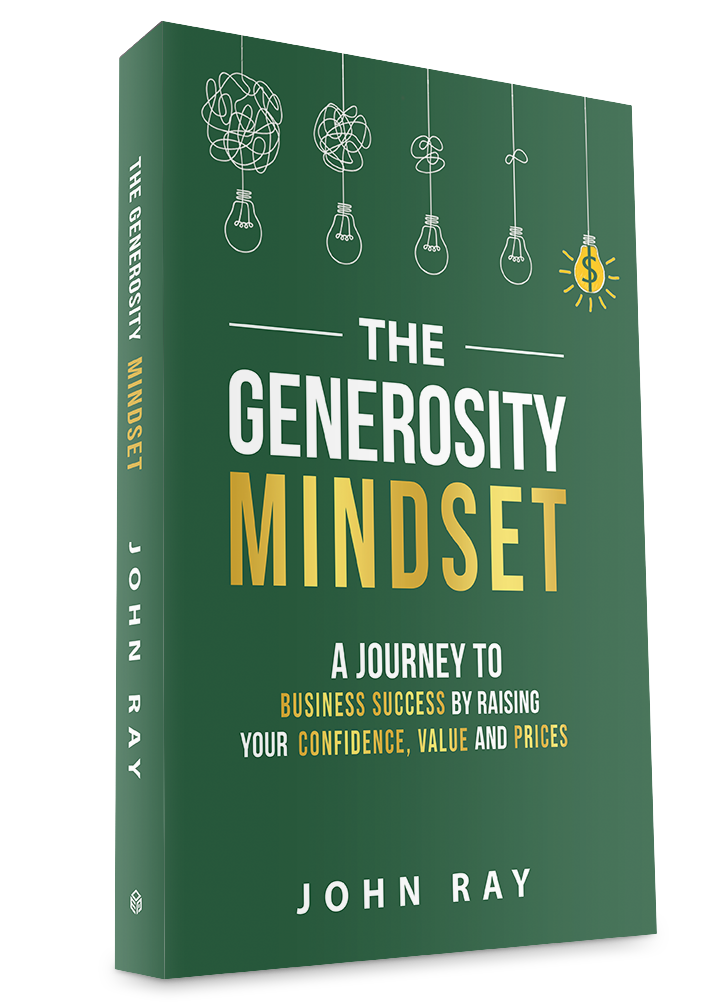
John’s book, The Generosity Mindset: A Journey to Business Success by Raising Your Confidence, Value, and Prices

John Ray at Barnes & Noble with his book, The Generosity MindsetJohn Ray is the author of the five-star rated book The Generosity Mindset: A Journey to Business Success by Raising Your Confidence, Value, and Prices, praised by readers for its practical insights on raising confidence, value, and prices.

If you are a professional services provider, your goal is to do transformative work for clients you love working with and get paid commensurate with the value you deliver to them. While negative mindsets can inhibit your growth, adopting a different mindset, The Generosity Mindset®, can replace those self-limiting beliefs. The Generosity Mindset enables you to diagnose and communicate the value you deliver to clients and, in turn, more effectively price to receive a portion of that value.

Whether you’re a consultant, coach, marketing or branding professional, business advisor, attorney, CPA, or work in virtually any other professional services discipline, your content and technical expertise are not proprietary. What’s unique, though, is your experience and how you synthesize and deliver your knowledge. What’s special is your demeanor or the way you deal with your best-fit clients. What’s invaluable is how you deliver outstanding value by guiding people through massive changes in their personal lives and in their businesses that bring them to a place they never thought possible.

Your combination of these elements is unique in your industry. There lies your value, but it’s not the value you see. It’s the value your best-fit customers see in you.

If pricing your value feels uncomfortable or unfamiliar to you, this book will teach you why putting a price on the value your clients perceive and identify serves both them and you, and you’ll learn the factors involved in getting your price right.

The book is available at all major physical and online book retailers worldwide. Follow this link for further details.
Connect with John Ray:

Website | LinkedIn | Email

Business RadioX®:  LinkedIn | Twitter | Facebook | Instagram

Tagged With: abundance mindset, Beyond Referrals, Bill Cates, business friendships, business growth, client perceived value, coaches, consultants, cpa's, Entrepreneurs, expert service providers, Financial Advisors, Financial Literacy, Jeff C. West, John Ray, limiting beliefs, money denial, money mindset, money story, personal finance, pricing confidence, professional services pricing, Radical Relevance, referrals, scarcity mindset, small business owners, The Hidden Heist, The Price and Value Journey, Top Advisor Podcast, value based pricing, wealth managers

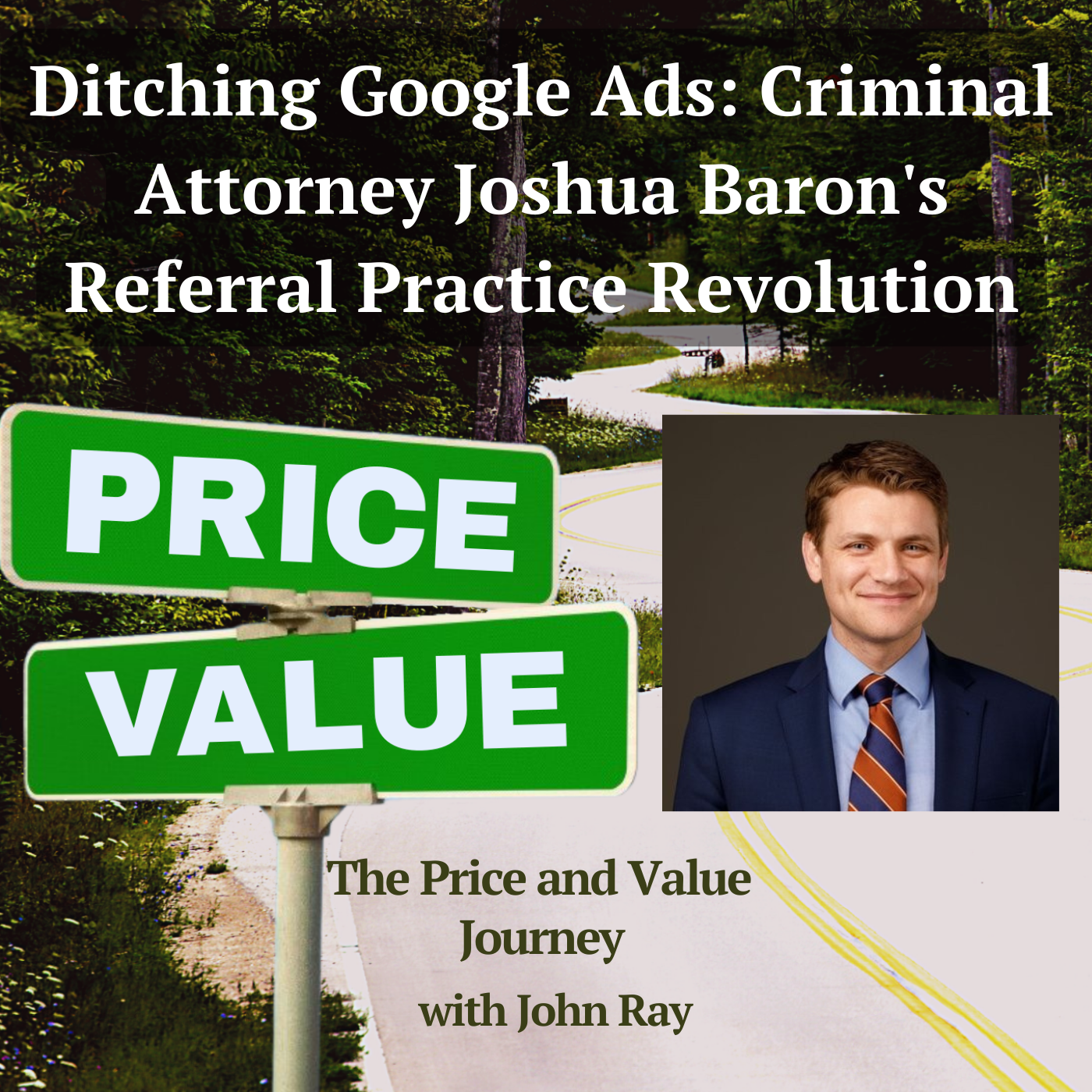
Ditching Google Ads: Criminal Attorney Joshua Baron’s Referral Practice Revolution

July 2, 2025 by John Ray

Ditching Google Ads: Criminal Attorney Joshua Baron's Referral Practice Revolution, on The Price and Value Journey podcast with host John Ray
North Fulton Studio
Ditching Google Ads: Criminal Attorney Joshua Baron's Referral Practice Revolution
Loading
00:00 /
RSS Feed
Share
Link
Embed

Download file

Ditching Google Ads: Criminal Attorney Joshua Baron's Referral Practice Revolution, on The Price and Value Journey podcast with host John Ray

Ditching Google Ads: Criminal Attorney Joshua Baron’s Referral Practice Revolution (The Price and Value Journey, Episode 137)

In this compelling first part of a two-part series, host John Ray sits down with Joshua Baron, founding partner of SB Legal and author of The Business of Criminal Law and Criminal Defense Referrals. Josh shares his remarkable transformation from a high-volume, Google Ads-dependent practice to a thriving referral-based firm that prioritizes client relationships and sustainable growth.

This conversation reveals the hidden costs of digital marketing dependency and explores how professional service providers can build meaningful, profitable practices through authentic relationship-building rather than paid advertising. Josh’s journey from spending $35,000 a month on Google Ads to eliminating them entirely contains important lessons for any professional looking to create a more sustainable and fulfilling practice.

Whether you’re a lawyer, consultant, accountant, coach, or fractional executive, this episode offers practical advice about building authority, understanding what clients truly want, and creating referral systems that work naturally with your personality rather than against it.

The Price and Value Journey is presented by John Ray and produced by North Fulton Business Radio, LLC, an affiliate of the Business RadioX® podcast network.

Key Takeaways from this Episode

  • Google Ads create “golden handcuffs.” They’re expensive, create cash flow problems for smaller firms, and become scary to turn off once you’re dependent on them
  • Clients don’t want lawyers; they want relief. People hire professionals when stress and anxiety spike, not because they love having advisors
  • Ask “why now?” to uncover real motivations. Understanding the trigger that made them call today (vs. six months ago) reveals what they’re truly buying
  • You don’t need to ask for referrals. Other professionals are willing to refer work that they prefer not to handle. You’re doing them a favor by accepting it
  • Match relationship-building to your personality. Find your “love language” for professional relationships (words, time, gifts, service) and stick with what energizes you
  • Provide clients with a “draft” rather than posing open-ended questions. Reduce their cognitive load by sharing what most people in their situation want, then let them edit it
  • Regular post-consultation reflection improves results. Professional services exist in “wicked learning environments” where deliberate reflection is key to improvement

Topics Discussed in this Episode

00:00 Introduction to The Price and Value Journey
00:12 Joshua Baron: Background and Firm Overview
02:24 The Shift from Google Ads to Referral-Based Practice
04:52 Challenges and Benefits of Referral-Based Practice
09:39 Transforming Client Experience and Building Relationships
15:26 Philosophy on Pricing and Professional Growth
18:47 Effective Referral Strategies and Personal Insights
25:26 The Power of Relationship Building
26:25 Finding Your Unique Networking Style
26:47 The Importance of Authenticity in Networking
29:13 Understanding Client Needs and Building Trust
45:07 The Role of Reflection in Professional Growth
49:43 Conclusion and Thanks to Joshua Baron

Joshua Baron

Joshua Baron
Joshua Baron

Joshua Baron is a criminal defense attorney and the founder of SB Legal, based in Utah. He graduated summa cum laude with a Bachelor of Arts in History from Cal Poly, Pomona at age 18, then served an LDS mission in Viña del Mar, Chile, where he became fluent in Spanish. In 2007, he earned his J.D. cum laude from Brigham Young University’s J. Reuben Clark Law School, serving as Executive Editor of the Journal of Public Law and Associate Editor of the Education Law Journal. After law school, Baron began his career as a civil litigator in Park City, representing developers and real estate companies. Seeking more trial experience, he joined the Salt Lake City Prosecutor’s Office in 2008, handling over 1,500 criminal cases per year and leading more than thirty jury trials.

In 2009, Baron co-founded Sharifi & Baron, PLLC, which later became SB Legal. He has since represented hundreds of clients in nearly every court in Utah, covering a wide range of criminal and immigration matters. Baron is licensed to practice before both federal and state courts in Utah. His practice areas include criminal defense—such as violent crimes, drug offenses, white-collar crimes, domestic violence, and sex crimes—and immigration law, including deportation defense and appeals. He has achieved not guilty verdicts and dismissals in serious criminal cases, including aggravated burglary, sexual assault, and drug distribution.

Baron is recognized for his professionalism, client-focused approach, and responsiveness. He has been selected as a Super Lawyer by Mountain States Super Lawyers from 2020 to 2025 and previously as a Rising Star. He has also been named a Top Lawyer by the Global Directory of Who’s Who and included in Utah Business Magazine’s Utah Legal Elite.

In addition to his legal practice, Baron is an author and educator, having written books such as Criminal Defense Referrals and The Business of Criminal Law, and taught criminal law and procedure as adjunct faculty at Ensign College.

Website | LinkedIn

About The Price and Value Journey Podcast

The Price and Value Journey is a show for expert-service professionals who want more than formulas and quick fixes. If you’re a solo or small-firm provider—consultant, coach, attorney, CPA, or fractional executive—you know the real work of building a practice goes far beyond pricing. It’s about finding clarity, showing up with confidence, and learning how to express the full value of what you do in ways that clients understand and appreciate.

The Price and Value Journey Podcast with host John RayHosted by John Ray, business advisor and author of The Generosity Mindset, this podcast explores the deeper journey behind running a services business: how you think about your work, how you relate to clients, and how you sustain a business that’s not only profitable but deeply fulfilling. Yes, we talk pricing, but we also talk mindset, business development, trust, empathy, positioning, and all the intangible ingredients that make a practice thrive.

With solo episodes and conversations featuring thoughtful guests, The Price and Value Journey is a companion for professionals who are building something meaningful. Produced in partnership with North Fulton Business Radio, LLC, an affiliate of Business RadioX®, the podcast is accessible on all major podcast platforms. The complete show archive is here.

John Ray, Host of The Price and Value Journey

John Ray, Author of The Generosity Mindset and Host of The Price and Value Journey

John Ray is the host of The Price and Value Journey.

John owns Ray Business Advisors, a business advisory practice. John’s services include business coaching and advisory work, as well as advising solopreneurs and small professional services firms on their pricing. John is passionate about the power of pricing for business owners, as changing pricing is the fastest way to change the profitability of a business. His clients are professionals who are selling their expertise, such as attorneys, CPAs, accountants and bookkeepers, consultants, coaches, marketing professionals, and other professional services practitioners.

In his other business, John is a podcast show host, strategist, and the owner of North Fulton Business Radio, LLC, an affiliate of Business RadioX®. John and his team work with B2B professionals to create and conduct their podcast using The Generosity Mindset® Method: building and deepening relationships in a non-salesy way that translates into revenue for their business.

John is also the host of North Fulton Business Radio. With over 870 shows and having featured over 1,300 guests, North Fulton Business Radio is the longest-running podcast in the North Fulton area, covering business in its region like no one else.

John’s book, The Generosity Mindset: A Journey to Business Success by Raising Your Confidence, Value, and Prices

The Generosity Mindset, by John RayJohn is the #1 national best-selling author of The Generosity Mindset: A Journey to Business Success by Raising Your Confidence, Value, and Prices.

If you are a professional services provider, your goal is to do transformative work for clients you love working with and get paid commensurate with the value you deliver to them. While negative mindsets can inhibit your growth, adopting a different mindset, The Generosity Mindset™, can replace those self-limiting beliefs. The Generosity Mindset enables you to diagnose and communicate the value you deliver to clients and, in turn, more effectively price to receive a portion of that value.

Whether you’re a consultant, coach, marketing or branding professional, business advisor, attorney, CPA, or work in virtually any other professional services discipline, your content and technical expertise are not proprietary. What’s unique, though, is your experience and how you synthesize and deliver your knowledge. What’s special is your demeanor or the way you deal with your best-fit clients. What’s invaluable is how you deliver outstanding value by guiding people through massive changes in their personal lives and in their businesses that bring them to a place they never thought possible.

Your combination of these elements is unique in your industry. There lies your value, but it’s not the value you see. It’s the value your best-fit customers see in you.

If pricing your value feels uncomfortable or unfamiliar to you, this book will teach you why putting a price on the value your clients perceive and identify serves both them and you, and you’ll learn the factors involved in getting your price right.

The book is available at all major physical and online book retailers worldwide. Follow this link for further details.

Connect with John Ray:

Website | LinkedIn | Twitter

Business RadioX®:  LinkedIn | Twitter | Facebook | Instagram

Tagged With: attorney, building trust, Criminal Defense, criminal defense attorney, criminal defense lawyer, google ads, John Ray, Joshua Baron, networking, pricing, referral-based practice, referrals, SB Legal, The Price and Value Journey

Referrals and Pricing

April 20, 2022 by John Ray

Referrals and Pricing
North Fulton Studio
Referrals and Pricing
Loading
00:00 /
RSS Feed
Share
Link
Embed

Download file

Referrals and Pricing

Referrals and Pricing

A story on referrals and pricing, and how best to refer your fellow professional services providers.

The Price and Value Journey is presented by John Ray and produced by the North Fulton studio of Business RadioX®.

TRANSCRIPT

John Ray: [00:00:00] Hello again. I’m John Ray on the Price and Value Journey.

John Ray: [00:00:04] Referrals and pricing. Recently, a friend, I’ll call her Elizabeth, she asked me to recommend two or three professionals in a particular services segment. I gave her three names of individuals who I know do outstanding work. One of them was a professional I’ve known for a long time. I’ll call him William. I’ve worked with William on his pricing, and I disclosed that fact to Elizabeth when I included him on the list of names that I gave her.

John Ray: [00:00:36] Elizabeth also asked someone else, and I’ll call him Bob, the same question, and I found this out because Elizabeth forwarded me what Bob had written about his recommendations. She was confused because Bob had commented that William was probably “less expensive” than the other professionals Bob had recommended. What Elizabeth naturally wanted to know was how William was less expensive if I’d been working with him.

John Ray: [00:01:09] Now, I had to smile at that comment. I told her that Bob, frankly, had no idea what he was talking about, and I wouldn’t have either, for that matter, I told her, if I’d made any comments about William, or anyone else on my list, or Bob’s list, for that matter. Because he recommended him, I assume Bob was trying to help William, but that help came at a cost that Bob didn’t grasp, however. Bob could have hampered William’s ability to land the business because he placed a potentially unfair preconception in the mind of the prospect.

John Ray: [00:01:50] Now, here’s the point. When you refer someone, assuming you really care about them and want to see them succeed, never reference the level of their pricing. Unless you’re sending out their invoices for them, you have no idea where they are on their pricing journey, and it’s unfair to prejudice the mind of the potential client with any of your value judgments about their pricing.

John Ray: [00:02:17] Further, it’s highly unlikely you know the scope of the project the person asking for the referral has in mind. In this case, I had little information on the specifics of what Elizabeth wanted. Finally, I had no sense of how Elizabeth might value the outcomes that William or the others I’d recommended could deliver. I’m 99.9% certain that if I didn’t, Bob didn’t either, yet Bob was providing editorial comment on William’s pricing. If you make any sort of comment on someone you recommend, couch that recommendation solely in the value they provide, reference their quality, their timeliness, their insightly advice, whatever, but just don’t get into their pricing. If you’re really trying to help, don’t be Bob.

John Ray: [00:03:12] I’m John Ray on the Price and Value Journey. If you’d like to connect with me directly, you can send me a note, john@johnray.co. And past episodes of this series can be found at pricevaluejourney.com. Thank you for joining me.


About The Price and Value Journey

The title of this show describes the journey all professional services providers are on:  building a services practice by seeking to convince the world of the value we offer, helping clients achieve the outcomes they desire and trying to do all that at pricing which reflects the value we deliver.

If you feel like you’re working too hard for too little money in your solo or small firm practice, this show is for you. Even if you’re reasonably happy with your practice, you’ll hear ways to improve both your bottom line as well as the mindset you bring to your business.

The show is produced by the North Fulton studio of Business RadioX® and can be found on all the major podcast apps. The complete show archive is here.

John Ray, Host of The Price and Value Journey

John Ray The Price and Value Journey
John Ray, Host of “The Price and Value Journey”

John Ray is the host of The Price and Value Journey.

John owns Ray Business Advisors, a business advisory practice. John’s services include advising solopreneur and small professional services firms on their pricing. John is passionate about the power of pricing for business owners, as changing pricing is the fastest way to change the profitability of a business. His clients are professionals who are selling their “grey matter,” such as attorneys, CPAs, accountants and bookkeepers, consultants, marketing professionals, and other professional services practitioners.

In his other business, John is a Studio Owner, Producer, and Show Host with Business RadioX®, and works with business owners who want to do their own podcast. As a veteran B2B services provider, John’s special sauce is coaching B2B professionals to use a podcast to build relationships in a non-salesy way which translate into revenue.

John is the host of North Fulton Business Radio, Minneapolis-St. Paul Business Radio, Nashville Business Radio, Alpharetta Tech Talk, and Business Leaders Radio. house shows which feature a wide range of business leaders and companies. John has hosted and/or produced over 1,100 podcast episodes.

Connect with John Ray:

Website | LinkedIn | Twitter

Business RadioX®:  LinkedIn | Twitter | Facebook | Instagram

Tagged With: B2B services, John Ray, Price and Value Journey, pricing, professional services providers, referrals, relationships, solopreneurs, The Price and Value Journey, value

How to Get Great Referrals

March 21, 2022 by John Ray

How to Get Great Referrals
North Fulton Studio
How to Get Great Referrals
Loading
00:00 /
RSS Feed
Share
Link
Embed

Download file

How to Get Great Referrals

How to Get Great Referrals

For us as professional services providers, the answer to the question of how to get great referrals lies in the clients we already have. The Price and Value Journey is presented by John Ray and produced by the North Fulton studio of Business RadioX®.

TRANSCRIPT

John Ray: [00:00:00] Hello. I’m John Ray on The Price and Value Journey. How do you get great referrals? I don’t mean referrals which are average or marginal. I mean referrals to clients who are the best fit for your practice.

John Ray: [00:00:17] For professional services providers, there’s a simple answer. The answer starts with the clients you take on, to begin with. You only accept clients who are the best fit for you and your practice. Best fit clients are those clients whom you deliver stellar results for, who see the value in what you deliver, the transformation that you give them. They’re happy to pay for that value and they’re clients you enjoy working with.

John Ray: [00:00:47] Great clients know other great clients for you. And your best clients want you to succeed. And they’ll go out of their way to refer that kind of business to you. They do this in part because they feel invested in you. That’s the way great clients react to their services providers whose work they value. That’s part of what makes them great.

John Ray: [00:01:13] Your best fit clients are invariably grateful. They appreciate you and the substantial and positive changes you’ve brought about for them. It might even be years after the engagement, but your best fit clients still refer other superb clients to you because they’re still basking in the glow of the work you did, and they remember.

John Ray: [00:01:37] Now, conversely, how do you get poor quality referrals? Well, you guessed it, if you compromise or stretch and you accept clients who aren’t the best fit, then guess what profile of client they’ll send your way. A client that looks just like them. A client who is not an ideal fit for your practice.

John Ray: [00:02:02] Roses prefer roses and thorns refer thorns. That’s another reason why it’s vital that you take good care in the clients you take on. Focus on clients who are the best fit. Who you can do a great job for, who willingly write checks which are commensurate with the value that you deliver, and who you enjoy working with.

John Ray: [00:02:27] I’m John Ray on The Price and Value Journey. I’m honored that you’d spend time listening to this episode. If you’d like to hear more of the series, you can find it at pricevaluejourney.com. If you’d like to connect with me directly, you can email me, john@johnray.co. Thank you for joining me.


About The Price and Value Journey

The title of this show describes the journey all professional services providers are on:  building a services practice by seeking to convince the world of the value we offer, helping clients achieve the outcomes they desire and trying to do all that at pricing which reflects the value we deliver.

If you feel like you’re working too hard for too little money in your solo or small firm practice, this show is for you. Even if you’re reasonably happy with your practice, you’ll hear ways to improve both your bottom line as well as the mindset you bring to your business.

The show is produced by the North Fulton studio of Business RadioX® and can be found on all the major podcast apps. The complete show archive is here.

John Ray, Host of The Price and Value Journey

John Ray The Price and Value Journey
John Ray, Host of “The Price and Value Journey”

John Ray is the host of The Price and Value Journey.

John owns Ray Business Advisors, a business advisory practice. John’s services include advising solopreneur and small professional services firms on their pricing. John is passionate about the power of pricing for business owners, as changing pricing is the fastest way to change the profitability of a business. His clients are professionals who are selling their “grey matter,” such as attorneys, CPAs, accountants and bookkeepers, consultants, marketing professionals, and other professional services practitioners.

In his other business, John is a Studio Owner, Producer, and Show Host with Business RadioX®, and works with business owners who want to do their own podcast. As a veteran B2B services provider, John’s special sauce is coaching B2B professionals to use a podcast to build relationships in a non-salesy way which translate into revenue.

John is the host of North Fulton Business Radio, Minneapolis-St. Paul Business Radio, Nashville Business Radio, Alpharetta Tech Talk, and Business Leaders Radio. house shows which feature a wide range of business leaders and companies. John has hosted and/or produced over 1,100 podcast episodes.

Connect with John Ray:

Website | LinkedIn | Twitter

Business RadioX®:  LinkedIn | Twitter | Facebook | Instagram

Tagged With: clients, generating referrals, John Ray, Price and Value Journey, pricing, professional services, professional services providers, referrals, solopreneurs, The Price and Value Journey, value

King of Referrals E60

July 1, 2021 by Karen

King-of-Referrals-feature
Phoenix Business Radio
King of Referrals E60
Loading
00:00 /
RSS Feed
Share
Link
Embed

Download file

King-of-Referrals-top

King of Referrals E60

In this episode on Tycoons of Small Biz, Austin and Landon interview Brandon Barnum, CEO of HOA.com. HOA.com is the #1 referral network for professionals who serve homeowners. They help homeowners connect to professionals they can trust while helping home service pros attract more clients and grow their business.

Tune in to hear Brandon Barnum, THE KING OF REFERRALS, educate us on the importance of referrals. Get empowered and equipped to successfully obtain referrals with Brandon’s 21 cross-marketing campaign. Find out how to give, enroll and enlist when it comes to referrals. Overcome the biggest challenges of gaining referrals which is asking for referrals. In this episode Brandon explains how you must set the stage, identify triggers and ASK TO GET in order to grow your business.

HOA.com is the #1 referral network for professionals who serve homeowners. They help homeowners connect to professionals they can trust while helping home service pros attract more clients and grow their business. HOA.com_

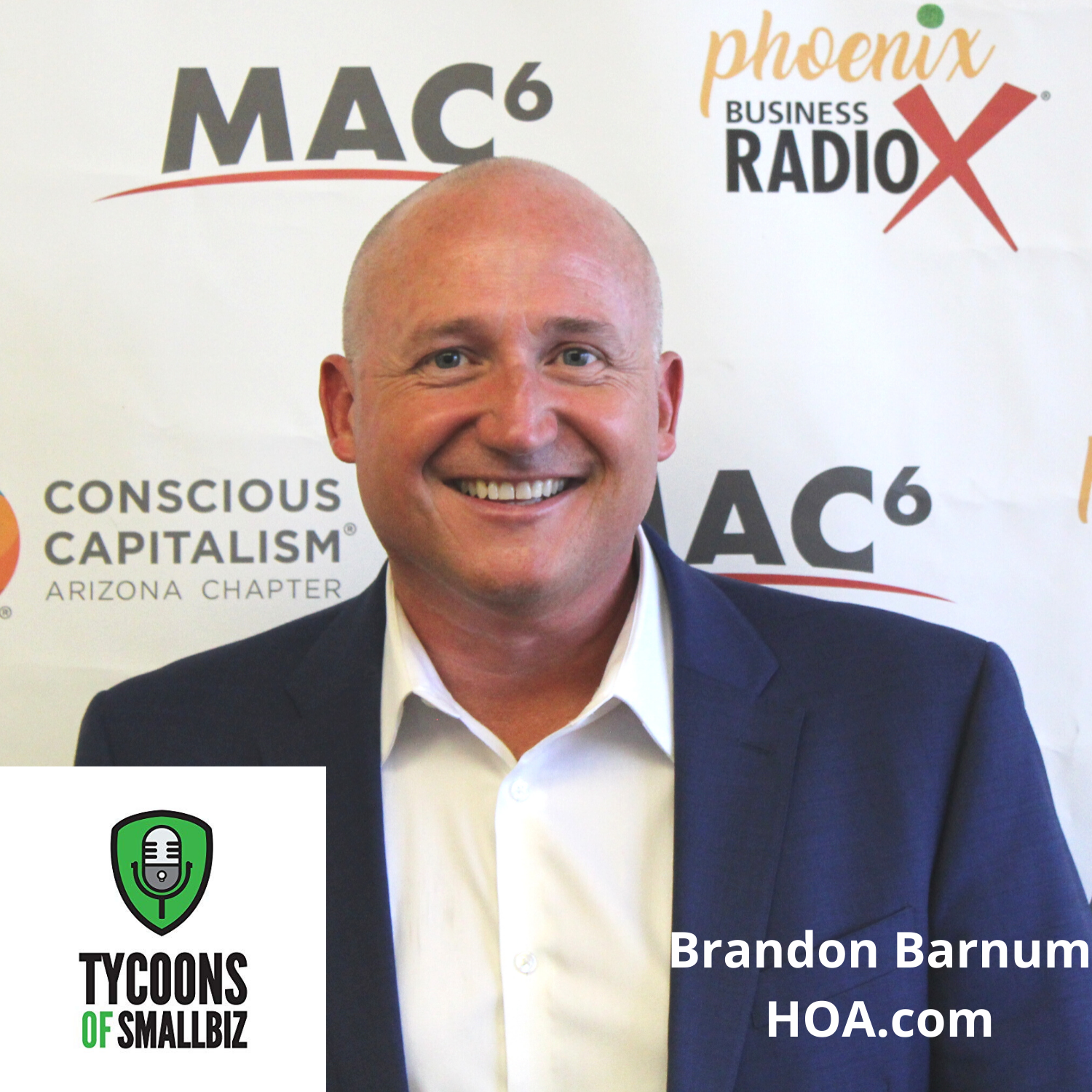
Brandon-Barnum-Tycoons-of-Small-Biz-1Brandon Barnum, often referred to as the “King of Referrals” is an award-winning serial entrepreneur, coach, consultant, speaker, trainer, and workshop leader. He serves as CEO of HOA.com – the #1 Referral Network for Home Service Professionals, and as Chairman of the Board of The Champions Institute and Strategic Marketing 360. He is a highly sought-after expert in referrals, marketing, sales, joint ventures, business development and business growth strategies.

While a single dad in 1997, Brandon was an early technology innovator featuring real estate property listings from Realtors he partnered with and promoted. After learning the art and science of referrals, he increased his annual income 10X from $20K to $200K in just 18 months. Brandon has since closed over $500 million in transactions by referral and has founded multiple local and online referral platforms and networks connecting more than 5 million members in 195 countries.

After learning the BANK sales methodology, Brandon helped launch and served as CEO of Codebreaker Technologies building Codebreaker AI, the world’s first personality-based AI for sales. He now helps businesses close more sales in less time training the BANK sales methodology through his training and coaching company, The Champions Institute.

Brandon Barnum has been featured internationally on TV, radio, several books including Cracking The Millionaire Code and Zero to Hero, and in magazines including The Wall Street Journal, Business Journal and Newsweek to name a few. Brandon is passionate about empowering business owners and professionals with a step-by-step system for attracting profitable prospects and expanding their income, influence and impact.

Connect with Brandon on LinkedIn and follow HOA.com on Facebook.

About the Show

Tycoons of Small Biz spotlights the true backbone of the American economy, the true tycoons of business in America… the owners, founders and CEO’s of small businesses. Join hosts,  Austin L Peterson, Landon Mance and the featured tycoons LIVE every Tuesday at 1 pm, right here on Business RadioX and your favorite podcast platform.

About Your Hosts

Autsin-Peterson-on-Phoenix-Business-RadioX

Austin Peterson is a Comprehensive Financial Planner and co-founder of Backbone Planning Partners in Scottsdale, AZ. Austin is a registered rep and investment advisor representative with Lincoln Financial Advisors. Prior to joining Lincoln Financial Advisors, Austin worked in a variety of roles in the financial services industry.

He began his career in financial services in the year 2000 as a personal financial advisor with Independent Capital Management in Santa Ana, CA. Austin then joined Pacific Life Insurance Company as an internal wholesaler for their variable annuity and mutual fund products. After Pacific Life, Austin formed his own financial planning company in Southern California that he built and ran for 6 years and eventually sold when he moved his family to Salt Lake City to pursue his MBA.

After he completed his MBA, Austin joined Crump Life Insurance where he filled a couple of different sales roles and eventually a management role throughout the five years he was with Crump. Most recently before joining Lincoln Financial Advisors in February 2015, Austin spent 2 years as a life insurance field wholesaler with Symetra Life Insurance Company. Austin is a Certified Financial Planner Professional and Chartered Life Underwriter. In 2021, Austin became a Certified Business Exit Consultant® (CBEC®) to help entrepreneurs plan to exit their businesses.

Austin and his wife of 23 years, Robin, have two children, AJ (21) and Ella (18) and they reside in Gilbert, Arizona. He is a graduate of California State University, Fullerton with a Bachelor of Arts in French and of Brigham Young University’s Marriott School of Management with a Master of Business Administration with an emphasis in sales and entrepreneurship.backbone-New-Logo

Connect with Austin on LinkedIn, Facebook, Twitter, and Instagram.

LandonHeadshot01

Landon Mance is a Financial Planner and co-founder of Backbone Planning Partners out of Las Vegas, Nevada. He rebranded his practice in 2020 to focus on serving small business owners after operating as Mance Wealth Management since 2015 when Landon broke off from a major bank and started his own “shop.”

Landon comes from a family of successful entrepreneurs and has a passion and excitement for serving the business community. This passion is what brought about the growth of Backbone Planning Partners to help business owners and their families. At Backbone Planning, we believe small business owners’ personal and business goals are intertwined, so we work with our clients to design a financial plan to support all aspects of their lives.

In 2019, Landon obtained the Certified Exit Planning Advisor (CEPA) designation through the Exit Planning Institute. With this certification, Backbone Planning Partners assists business owners through an ownership transition while focusing on a positive outcome for their employees and meeting the business owner’s goals. Landon is also a member of the Business Intelligence Institute (BII) which is a collaborative group that shares tools, resources and personnel, and offers advanced level training and technical support to specifically serve business owners. In 2021, Landon became a Certified Business Exit Consultant® (CBEC®) to help entrepreneurs plan to exit their businesses by counseling owners about exit options, estimating the value of the business, preparing the business for exit and tax considerations.

Landon enjoys spending time with his beautiful wife, stepson, and new baby twins. He grew up in sunny San Diego and loves visiting his family, playing a round of golf with friends, and many other outdoor activities. Landon tries to make a difference in the lives of children in Las Vegas as a part of the leadership team for a local non-profit. He regularly visits the children that we work with to remind himself of why it’s so important to, “be the change that you wish to see in the world.”

Landon received his B.S. from California State University Long Beach in business marketing and gets the rest of his education through the school of hard knocks via his business owner clients.

Connect with Landon on LinkedIn.

Austin Peterson and Landon Mance are registered representatives of Lincoln Financial Advisors Corp. Securities and investment advisory services offered through Lincoln Financial Advisors Corp., a broker/dealer (member SIPC) and registered investment advisor. Insurance offered through Lincoln affiliates and other fine companies. Backbone Planning Partners is a marketing name for registered representatives of Lincoln Financial Advisors. CRN-3644998-062321

Lincoln Financial Advisors Corp. and its representatives do not provide legal or tax advice. You may want to consult a legal or tax advisor regarding any legal or tax information as it relates to your personal circumstances.

The content presented is for informational and educational purposes. The information covered and posted are views and opinions of the guests and not necessarily those of Lincoln Financial Advisors Corp.

Business RadioX® is a separate entity not affiliated with Lincoln Financial Advisors Corp.

Tagged With: Home services, realtors, referral network, referrals

Decision Vision Episode 29: Should I Cooperate with a Competitor? – An Interview with Tom Brooks, Windham Brannon

August 22, 2019 by John Ray

Decision Vision
Decision Vision
Decision Vision Episode 29: Should I Cooperate with a Competitor? – An Interview with Tom Brooks, Windham Brannon
Loading
00:00 /
RSS Feed
Share
Link
Embed

Download file

Mike Blake and Tom Brooks

Should I Cooperate with a Competitor?

Why would you collaborate with a competitor? How do you establish and maintain trust with a competitor you cooperate with?  Host Mike Blake, Head of the Valuation Practice at Brady Ware, discusses these questions and more with Tom Brooks, Director of the Valuation Practice at Windham Brannon. “Decision Vision” is presented by Brady Ware & Company.

Tom Brooks, Windham Brannon

Tom Brooks, Windham Brannon

Tom Brooks is a Principal and Director of the Valuation Practice at Windham Brannon. Tom has over 20 years of experience handling valuation and litigation support matters. He specializes in guiding clients with the valuation of their businesses, business interests, and intangible assets for mergers and acquisitions, gift and estate planning, financial and tax reporting, charitable giving, strategic planning, shareholder disputes, commercial litigation, and marital dissolution. Tom has worked with businesses of all sizes, including start-up companies to larger companies with over $1 billion in revenues. He is effective at communicating complex valuation issues and collaborating with his clients in building successful relationships.

Prior to joining Windham Brannon, he was a Senior Manager in the Valuation practice of a leading tax and advisory firm. As a licensed CPA in Georgia, Accredited in Business Valuation (ABV) and as an Accredited Senior Appraiser (ASA), Tom often speaks for organizations such as the Atlanta National Association of Certified Valuation Analysts (NACVA) chapter, the Georgia Society of Certified Public Accountants and Atlanta Alumni of Retired Revenue Agents. He has also presented for Georgia Tech and LaGrange College accounting students and at Merrill Lynch seminars.

Michael Blake, Brady Ware & Company

Mike Blake, Host of “Decision Vision”

Michael Blake is Host of the “Decision Vision” podcast series and a Director of Brady Ware & Company. Mike specializes in the valuation of intellectual property-driven firms, such as software firms, aerospace firms and professional services firms, most frequently in the capacity as a transaction advisor, helping clients obtain great outcomes from complex transaction opportunities. He is also a specialist in the appraisal of intellectual properties as stand-alone assets, such as software, trade secrets, and patents.

Mike has been a full-time business appraiser for 13 years with public accounting firms, boutique business appraisal firms, and an owner of his own firm. Prior to that, he spent 8 years in venture capital and investment banking, including transactions in the U.S., Israel, Russia, Ukraine, and Belarus.

Brady Ware & Company

Brady Ware & Company is a regional full-service accounting and advisory firm which helps businesses and entrepreneurs make visions a reality. Brady Ware services clients nationally from its offices in Alpharetta, GA; Columbus and Dayton, OH; and Richmond, IN. The firm is growth minded, committed to the regions in which they operate, and most importantly, they make significant investments in their people and service offerings to meet the changing financial needs of those they are privileged to serve. The firm is dedicated to providing results that make a difference for its clients.

Decision Vision Podcast Series

“Decision Vision” is a podcast covering topics and issues facing small business owners and connecting them with solutions from leading experts. This series is presented by Brady Ware & Company. If you are a decision maker for a small business, we’d love to hear from you. Contact us at decisionvision@bradyware.com and make sure to listen to every Thursday to the “Decision Vision” podcast. Past episodes of “Decision Vision” can be found here. “Decision Vision” is produced and broadcast by the North Fulton studio of Business RadioX®.

Visit Brady Ware & Company on social media:

LinkedIn:  https://www.linkedin.com/company/brady-ware/

Facebook: https://www.facebook.com/bradywareCPAs/

Twitter: https://twitter.com/BradyWare

Instagram: https://www.instagram.com/bradywarecompany/

Show Transcript

Intro: [00:00:01] Welcome to Decision Vision, a podcast series focusing on critical business decisions, brought to you by Brady Ware & Company. Brady Ware is a regional, full-service, accounting and advisory firm that helps businesses and entrepreneurs make vision a reality.

Michael Blake: [00:00:20] And welcome to Decision Vision, a podcast giving you, the listener, clear vision to make great decisions. In each episode, we discuss the process of decision making on a different topic. Rather than making recommendations because everyone’s circumstances are different, we talk to subject matter experts about how they would recommend thinking about that decision.

Michael Blake: [00:00:37] My name is Mike Blake, and I’m your host for today’s program. I’m a Director at Brady Ware & Company, a full-service accounting firm based in Dayton, Ohio, with offices in Dayton; Columbus, Ohio; Richmond, Indiana; and Alpharetta, Georgia, which is where we are recording today. Brady Ware is sponsoring this podcast. If you like this podcast, please subscribe on your favorite podcast aggregator. And please also consider leaving a review of the podcast as well.

Michael Blake: [00:01:01] So, our topic today is cooperating with competitors. And this is a a ticklish topic. We think of competitors in the marketplace, regardless of our industry, it could be public accounting, it could be advisory, it could be manufacturing cars, it could be airlines. Very few businesses are not in a competitive scenario in some case. And by the way, if you are in a business that isn’t in one, please write me. I’d like to know what that is, so I can then compete with you because that sounds great.

Michael Blake: [00:01:38] And what I’ve learned over the last 15 years or so that I’ve been in business is that some industries just can’t get along. Like years and years ago, I did a project for Coca-Cola Enterprises. And I was a contractor there doing some financial analysis. And at the time, you walk into their office, and everything is Coca-Cola red. They got polar bears all over the place, and bottles of Coke, and everything else. And it’s definitely rah-rah, sort of, company branding is at the forefront. And if—I did not do this, but somebody else I knew did, went off premises, and then came back with a bag full of Taco Bell, which at the time was owned by Pepsi Co. Now, Yum! Brands, I don’t know if Pepsi is owned by them or not, but that was a big no-no. Like even having food from the competing beverage was not a fireable offense, but boy, you’ve got the Coca-Cola stink eye, and then some when you did that.

Michael Blake: [00:02:39] I imagine there was a time when you had that kind of rivalry at Microsoft and Apple. I don’t think that’s the case today. And we think of of competition as something that, frankly, we have to destroy, that they are enemies, that they are opposing us, that they are taking food out of our mouths, and that they are something to be feared and disliked. But I think in modern business, that’s not necessarily always the case. And you see industries where, in certain cases, competitors do band together. The auto industry, as competitive as they are, they do band together in order to promote safety in their industry. They band together to make sure that regulations aren’t too constraining.

Michael Blake: [00:03:27] In the airline industry, I think the same thing. I think the same thing is true. You see partnerships all over the place where maybe companies are cross-selling each other’s services. And maybe, I’ll go back to airlines, they’re actually a really good example too because of your quote sharing. So, my family and I are going to take a trip to Scandinavia later this year, and our plane ticket says Delta. But at some point, we’re probably going to be put on an SAS plane, or a Norwegian airplane, or something. We don’t know that, but because those are competitors that are cooperating, right, that’s the kind of customer experience that we’re going to have. And because they cooperate, we don’t have to get out at Paris, and then walk the rest of the way to Copenhagen, which would be a real pain in the neck.

Michael Blake: [00:04:12] And so, I wanted to explore this because in my particular practice—and I don’t know if I’m exceptional in either direction or right about the average, but I can tell you in my practice in business valuation, about somewhere between 20% and 30% of my business actually comes from competing firms. And I don’t necessarily know that I’m exceptional, but on the off chance that is exceptional some way, that means that there’s a lesson to learn. I want to talk about what if your competitors aren’t your mortal enemies? What if you’re not just always locked in a life-and-death struggle with your competitors? And not in a way where you’re forming a cartel. I mean, our firm is not a big enough firm. I’m not going to cartel anything. But there’s a long—there’s a big gap between cartel and cutthroat, winner-take-all competition.

Michael Blake: [00:05:10] And so, that’s what I want to talk about today because if you’re not thinking about competitors in terms of if there’s a potential partnership and a potential cooperation and opportunity, you may be leaving money on the table. You may be leaving business value on the table. And maybe, also, you’re living a more stressful life than you have to. And so, I’ve brought in a guest today that, I think, this will be a little bit of a different conversation because I’m going to be more of an active participant rather than an interviewer.

Michael Blake: [00:05:38] But I brought in my friend Tom Brooks today, who is a competitor with whom that I cooperate quite a bit. Tom is a Director in the Valuation of Litigation Services Group of Windham Brannon PC, a midsized certified public accounting firm in Atlanta. I think about the same size as Brady Ware. I haven’t measured it, but I get the sense we’re about roughly the same size. Tom has over 20 years of experience handling valuation and litigation support matters. He specializes in guiding clients at the valuation of their businesses, business interests, and intangible assets for mergers and acquisitions, gift and estate planning, financial and tax reporting, charitable giving, strategic planning, shareholder disputes, commercial litigation, and marital dissolution. Tom has worked with businesses of all sizes, including startup companies to larger companies with over $1 billion in revenues. He is effective at communicating complex valuation issues, and collaborating with his clients, and building successful relationships.

Michael Blake: [00:06:35] Prior to joining Windham Brannon, he was a Senior Manager in the Valuation Practice of a leading tax advisory firm. As a licensed CPA in Georgia, accredited in business valuation, and as an accredited senior appraiser, Tom often speaks for organizations such as the Atlanta National Association for Certified Valuation Analysts or NACVA – that has got to be the weirdest, most awkward acronym in the history of mankind. And I’m a NACVA member, so I can speak to that internally – the Georgia Society of Certified Public Accountants and Atlanta Alumni of Retired Revenue Agents. He has also presented for Georgia Tech, and LaGrange College Accounting Students, and at Merrill Lynch seminars. And Tom and I used to work together. And he won’t admit this, but I actually worked for him technically, at least, 15 years ago. And we have tracked each other’s careers and have been good friends ever since. And it’s a terrific pleasure to have Tom Brooks in the program. Tom, thanks for coming on.

Tom Brooks: [00:07:32] It’s great to be on. Mike, I appreciate it. That’s quite an intro, and I think it makes me sound a little better than I really am. And yeah, you really didn’t work for me, Mike. That wasn’t really the case.

Michael Blake: [00:07:43] So, you see. I mean, he’s only saying that, so that if I do something bad, he doesn’t want the blame for it. So, talk to us a little bit about your practice in Windham Brannon. How big is that practice, generally speaking? I’m not looking for a number of terms or anything. And what do you focus on within that practice?

Tom Brooks: [00:08:01] Yeah. Our practice highlights a lot of what you highlighted in my bio, which is a mouthful, but traditional business valuation of privately held entities. A number of reasons that clients may perform those. You’ve probably talked about those a lot on your program and on the podcast here. But we do a lot of work around exit planning for our clients, management planning, which can be very broad, to keeping a scorecard.

Tom Brooks: [00:08:28] What’s my business worth? Why am I—the investments that I’m making, the growth that I’m achieving, why is that happening and how does it impact value? We do a lot of work as a firm in Windham Brannon. We’ve got a large high-net worth practice. So, we do a lot of work with our high-net worth clients that have their businesses. And they may be looking at transition planning. How do we transition the business to the next generation? If there’s no next generation, what’s the next—how do we exit? And then, financial reporting. And for accounting purposes, valuation for purchase price allocations, goodwill impairment, stock compensation. And then, finally, probably the last piece to our puzzle in terms of our jigsaw puzzle of our practice would be litigation support in terms of commercial litigation cases and where valuation comes into play in those.

Tom Brooks: [00:09:20] Our practice has been in existence now for 18 months. And we have within—we practice as a litigation and valuation group together. We’ve got two partners and a senior manager in that group. So, I will say that I’ve been announced as a new principal in the firm, Mike, so-

Michael Blake: [00:09:42] Oh, Congratulations! We heard it here first.

Tom Brooks: [00:09:46] So, it’s a great—it’s been a good—we’ve had a good, very successful start in the 18 months that I’ve been in Windham Brannon.

Michael Blake: [00:09:51] That is great. That is great to hear. I know that was kind of the plan when you joined, but I know you never take anything for granted. And that road to principle can be a bumpy one too. So, we’ll amend that bio. You’re a principal now at Windham Brannon. Your Excellency.

Tom Brooks: [00:10:08] Don’t go there, Mike.

Michael Blake: [00:10:12] So, you have chosen, I think, in your career, really, to be pretty open about cooperating with competing firm, not just ours, but others. We don’t need to be exclusive, so. But why is that? Why do you have that outlook and that philosophy?

Tom Brooks: [00:10:30] I think it all comes back to—and this may hit—this may be a recurring theme this afternoon. It comes back to trust. I mean, it’s not—I’m not an open book that no matter who I sit down with in terms of my competitors, but I’m not afraid to ask questions when you develop that level of trust with somebody to say, “Am I handling this client situation right?” And it’s not like we’re sitting here sharing our Rolodex or client names and revealing that. It’s talking more about issues that we may face as practitioners. And again, I’m sure these are topics that you’ve talked about. If we were to talk about technical topics and valuation, you and I could have two—there could be two very different approaches. And they may not be or they could be similar.

Tom Brooks: [00:11:13] So, so much of our—and in the career field of valuation, frequently, it said that it may be more science or more art than science, rather. And so, why wouldn’t you—in my case, I think it’s just kind of how I’m wired as well. Why wouldn’t you open yourself up and be trustworthy of some other folks potentially? Again, it’s not everybody but those, that over time, you developed a relationship like that with. You’ve just got to develop that high level of trust before you can get to where you’re going to kind of be a friendly, friendly competitor.

Michael Blake: [00:11:49] And I’ll interject to that. I think another ingredient to that is ego. I think in the valuation profession, more than most other areas of accounting, ego is more prominent and more pronounced, right? And we both know practitioners that what other faults they have, healthy self-esteem is not one of them.

Tom Brooks: [00:12:09] Right.

Michael Blake: [00:12:09] Right? And I do think that our profession, sometimes, encourages or discourages that. I think our profession, sometimes, a little bit more water coolery. Nobody is either sort of is good or maybe good in a certain area. But what we tend to put people in the bucket. They’re either a genius or an idiot, right? Not learning, not trending, whatever, right?

Tom Brooks: [00:12:35] Right.

Michael Blake: [00:12:36] And I think part of the willingness to cooperate is a willingness to be vulnerable, right?

Tom Brooks: [00:12:43] Right.

Michael Blake: [00:12:43] And say, “Look, I don’t know everything about this. I don’t.” We do some estate and gift tax work, but you do 10 times more work there. And that’s okay, I’m willing to say, “Look, I don’t think I need to necessarily give up the engagement, but I do need to sort of phone a friend,” right?

Tom Brooks: [00:13:02] And like you, I’ve got other—and you and I probably just talked about issues like that. And there have been issues that I’ve raised around technology that I’ve phoned you about. And I have other former co-workers and, now, competitors that, again, have very good relationships with. The same thing, you referenced the gift and estate. They’ll call and say, “Hey, I’m dealing with this issue. I don’t deal with it that often. Can you…”  Usually, most of the time even, you or somebody else are going to call and say, “Here’s the way I’m thinking about it.” They’re not asking you to solve their problem. They’re asking you to help them. And you may take them in a completely different direction. But that does speak yet of that vulnerability to be willing to listen, and ask somebody, and say, “Okay, there’s a better way to do it than the way I’m thinking about it. And I want to go find the right way,” because that’s the best answer for your client.

Michael Blake: [00:13:48] Yeah. And you’ll learn something, right?

Tom Brooks: [00:13:49] Right.

Michael Blake: [00:13:49] And one question you have to ask later. And you mentioned something I didn’t thought of. I think it’s a really important point. My father was in this industry too, but he had two jobs over the course of his career. I think I’m on number eight now, and I’ve got, at least, 17 or 18 years of work left in me, give or take health. So, will this be my last job? I don’t know. I think we all hope it is. That’s why I’m a director. But we’re, now, building networks of people that we worked with in our generation and subsequent generations much more rapidly than I think generations before us, aren’t we? And that probably contributes to this, doesn’t it?

Tom Brooks: [00:14:29] I think that’s the case. And again, this is not—there’s no, I guess, poll data to back it up. But I think you’re right. I think especially—and I can’t speak to any other platform other than accounting firms. That’s where I’ve spent most of my career. But you do, at times, get that hesitancy and sense. And maybe it is from some of the older partners or the generation before us. And it’s not to say all of them are that way, but there can be a very strong hesitancy. “Well, Tom, you want to refer our client that we can’t do work for to another accounting firm?” And that is one reason I would say our success has been great at Windham Brannon because my partners aren’t thinking that way. It’s just—but I’ve seen it throughout life in terms of my career, and I’ve seen it. Other practitioners will tell me the same thing that they experience some of those same roadblocks when you do want to have this healthy, friendly, competitive nature to your relationship.

Michael Blake: [00:15:32] Well, and we’ve had—you and I have had that because the firm I used to work for before Brady Ware was of that mind was that just referring stuff to another CPA firm, that was just not on the table.

Tom Brooks: [00:15:44] Right.

Michael Blake: [00:15:44] And it killed me that I had to basically tell you that because I didn’t want you to refer stuff thinking of those stuff coming back because it was not, and it did not. So, that was a very liberating thing about sort of planting my flag. And I think now, that other firm has sort of started to loosen up a little bit in terms of sharing. But that can be a real issue. And I’ll admit, maybe 10 years ago, I might have had—10-12 years ago, I might have had that same mindset. You’ve just got to hold on to every client like they’re the last life vest on the Titanic.

Tom Brooks: [00:16:15] Right.

Michael Blake: [00:16:17] Right? But then, with us, especially, we can get into something, what I call a valuation Vietnam, where you think you’re getting into something that’s going to turn out fine. And then, you get in, and you’re not, and it’s not. And maybe—and you look back, you think, “Boy, I’m not sure I should have taken that on.” But halfway through, you’re, kind of, committed. You just got to figure it out. And you learn that I don’t know that I even did myself a favor by taking every seat. If Tom were here doing this, he would have been done three weeks ago. And here I am, here I am tearing my hair out at 2:00 a.m. trying to figure out this problem. And I think there’s a maturity element to that.

Tom Brooks: [00:16:56] No, time teaches you a lot in any form no matter what your career choice is. I believe that especially when you listen to business owners and entrepreneurs. We’ve all failed probably in some capacity somewhere, and it’s how do you learn from that. And, again, it’s taking the ego out of it, and being willing to learn, and being open. It’s not—I think it’s along the same lines that when we’re told no, or we don’t win an assignment, probably when I first started, that would hurt me a lot more than it does now. You have to lose some engagements to figure some things out and to learn a little bit more about how people view you in the marketplace.

Tom Brooks: [00:17:38] And so, I think it just goes to some humility along the way too that you learn, and you make some mistakes, and being willing to learn from those. And so, again, as you age and mature in your business career, hopefully, you become more open to these types of concepts.

Michael Blake: [00:17:57] And I think it helps to have definition in terms of what you just know. You just know in your heart of hearts, you’re not very good at doing. I’ve been very open with you and anybody who’ll listen, I don’t do litigation. I’m not very good at it, and I’m not willing or interested to make the investment required to become even mediocre at it. So, being a mediocre expert witness, that’s a bad day, being deposed when you know you’re not that great.

Michael Blake: [00:18:29] And that is maturity, but I think it’s also liberating. And I think in a certain way to it, it actually helps your brand, right? I don’t get a lot of litigation referrals anymore, either now, because the market has known like, “Blake, he’s just not going to do it.” But I think that tends to lead to more projects that you are good at being sent your way. And I think the market respects you more when you’ll turn them down, right?

Tom Brooks: [00:18:58] I agree. I mean, what you and I do is professional services. This isn’t just about being a CPA. And for listeners out there, especially in professional services arena, this is really what it gets back to. It’s your firm’s reputation. And some people may have their own firm. So, the name may go—your individual name may go with the firm name. But at the end of the day, as a practicing valuation specialist at Windham Brannon, it’s both my reputation and the firm’s reputation every day that are on the line. And that’s a risk that I have to manage as a practice leader. And with firm leadership, when you have questions about engagements that you may or may not want to take on.

Tom Brooks: [00:19:36] But like you said, it’s kind of one of those, “Maybe I would have been better off.” But thinking ahead and as you encounter something that’s going to be considered maybe outside your comfort zone, it doesn’t mean that we don’t take all assignments outside our comfort zone because, sometimes, it relates to something we’ve done before, and you just got to stretch yourself and learn, like you said earlier in the podcast. And that’s what we—many times, that’s the way we take new tasks on or responsibilities is we learn. And some of it for us is on the job. And we don’t have all the answers, as you said, but, sometimes, it’s almost like phone a friend, right?

Michael Blake: [00:20:13] Yeah.

Tom Brooks: [00:20:13] I mean that’s what you just talked about. And sometimes, those things will help you kind of navigate those challenging situations. But, again, having those open relationships that you can do that, to use your word, it’s liberating to be able to know that in the event that I’m struggling with something, I’ve got a lifeline out there to help me make sure that I’m doing the right thing for my client.

Michael Blake: [00:20:36] So, I’d like to revisit the trust discussion because I think so much of that, ultimately, comes down to that. And there are two areas I want to explore. One is, what are some of those dimensions of trust? It’s obvious, part of it is going to be just, are you competent, right? I’ll give you the fine China, don’t drop it, please. But there are kind of other elements of trust that belong there too, right? So, talk a little bit about what those trust features look like.

Tom Brooks: [00:21:05] Yeah, I think that’s one of the things in thinking about what we’re going to talk about today as I went through in my head. It’s kind of, like you said, the opposite, potentially, of trust. Like you, you get to see a lot of work product come across your desk of your competitors, whether it’d be just one of your partners is asking you to review something because they had a valuation done by an outside firm, or maybe it’s the on the accounting side that our audit team needs something reviewed, and I’m looking at it. So, the first element is kind of that competency. It’s just kind of that, does the expert that we may send this out to, do they have the competency, and will they be taken care of? The way I think of it as well is, will my client or the firm’s client be taken care of as well as they would have been taken care of by me?

Tom Brooks: [00:22:03] So, it really does come down to that trust. Some of it is just years and years. In my case, it’s years. I mean we, I think, have trusted each other a lot longer probably than just the 10-15 years, and we departed the firm that we worked with together, but it’s also developed over time. And so, I think it’s time. So, there’s a time element to it because you got to get to know the person.

Tom Brooks: [00:22:25] I think you have to also understand – and I think maybe this is an element of trust is – are they motivated to do the right thing? Again, I think that’s something that you’ve got to gage. There’s a high level—in doing this, there’s nothing that we can grab at and grasp. There’s nothing tangible. All this is intangible, and there’s risk associated with that when you do that, when you’re putting yourself out there, and potentially handing another name off. So, I think it’s that, again, at the end of the day, these are all elements of trust. But really, that is the key element, at the end of the day, the kind of that you got to come back to.

Michael Blake: [00:23:05] And in the second point I want to ask about trust is, trust between the two direct participants, such as between you and me is great, but it’s not enough, right? We also have to have organizational trust. And unless you have another announcement to make, you’re not the managing partner of your firm.

Tom Brooks: [00:23:26] No.

Michael Blake: [00:23:26] And I’m not the managing partner of my firm. And there is no danger of that announcement ever being made. I can promise you that.

Tom Brooks: [00:23:32] This side as well.

Michael Blake: [00:23:32] So, in our case, in the case of many people, we also had to help build organizational trust, right?

Tom Brooks: [00:23:43] Absolutely. That was—when you and I first landed between Brady Ware and Windham Brannon, it was one of the first things that we did because our moves kind of coincided with each other.

Michael Blake: [00:23:51] We’re a month apart.

Tom Brooks: [00:23:52] Yeah. It was we got together for breakfast with our managing partners and some of our other key senior partners. And you just did begin to develop that rapport, and that openness, and, again, those lines of communication. Maybe this is the word I was looking for in the prior answer but transparency. And, again, it doesn’t mean that we’re coming with a client roster list and go, “And here’s ours. Where’s yours? Here’s yours.” And we’re just exchanging names like that.

Michael Blake: [00:24:17] Like lineup cards.

Tom Brooks: [00:24:18] Right. Client confidentiality still trumps all these and precedes all of these. So, that’s the utmost important thing that we have is to maintain. And again, in that confidence, that’s where your trust comes in. But it does take, in our case, where you’re with a larger firm organizationally, you’ve got to have that confidence because many times for you and I, it’s not just something that comes across my desk that comes through, say, a referral to me from one of my outside sources outside the firm. It’s something inside the firm. So, my partners have to trust that again and have that confidence that Mike Blake and Brady Ware are going to take care of them. And so, you’re right, organizational trust on top of the individual relational trust that exists is really critical as well.

Michael Blake: [00:25:05] And take care of them and not try to exploit the opportunity too, right?

Tom Brooks: [00:25:11] Yeah, right. That becomes an underlying element. And I think that goes back to when we talked about some of the distrust that occurs within many firms and across probably every professional service line there is that you would have in terms of thinking about sending a potential client out to a competitor is right. Are they going to poach them completely? Are they going to be looking to market other service lines in there? And you’ve got to have those conversations, and they’re just really open and direct. Those who are not, I would share when we had ours, those were not difficult conversations. It was just, “Well, here’s how we conduct ourselves.” And I guess it’s kind of like dating. I mean, it’s kind of like we were just figuring each other out, so to speak. And in our case, it’s worked really well that, again, between us and the relationship we already had and our partners, it’s just gone. We’re able to do that.

Michael Blake: [00:26:10] So, sometimes there can be speed bumps in a partnership, right? And these are—by definition, they’re sensitive relationships. No matter how long the trust is, there’s always going to be a speed bump. And to my mind, I’m always kind of worried that, “Oh, boy.”

Tom Brooks: [00:26:28] What did Tom do now?

Michael Blake: [00:26:29] Well, anybody, right?

Tom Brooks: [00:26:31] Right. No.

Michael Blake: [00:26:31] And I’ll tell you that I kind of tell our people, “This is a Windham Brannon referral. This has got to be red as red carpets on this one, because I don’t want to go back and tell—I don’t want to face him if it’s not great.” But there can be speed bumps. And how do you—what do you think is the best way to kind of handle those speed bumps, so that they don’t jeopardize the broader relationship?

Tom Brooks: [00:27:01] I think it goes back to what we kind of just articulated and spoke about in our last answer was that it’s got to be open lines of communication and transparency. You’re right. I mean, even if I had never handed that client off and, I could have done the work for whatever reason, clients are complex in terms of the issues that we face, and the demands that we face, the time, whether it’d be—the demands are just numerous. And it’s what we signed up for. We love serving our clients, but that hiccup could have occurred with anybody.

Tom Brooks: [00:27:39] So, I think it’s just important to know that, again, take the ego out of it. None of us are perfect. None of us has—again, these are intangible issues that we’re dealing with typically with clients. The technical issues, yes, but relational, this is all soft skills. These aren’t hard, tangible skills. So, I think, it’s, again, having that open line of communication and transparency.

Tom Brooks: [00:28:04] And if there was a hiccup, I think, first, come up with an action plan to solve the problem if you’re the firm that received kind of the referral. And then, obviously, if there was something that was significant enough, you need to reach back out across the aisle to the firm that referred the work to you, and say, “Hey, here’s what happened. Here’s what we did.” And if there is anything, potentially, they can help you with to get over that hump, then that’s it. I mean, the client has to come first, and their interests have to come first, and serving them, and making sure you get to the finish line. So, I think it’s just what has to happen to do that.

Michael Blake: [00:28:42] Now, one area that is most common that leads to competitor cooperation in our industry is a conflict, right?

Tom Brooks: [00:28:51] Right.

Michael Blake: [00:28:51] We can just get conflict. I tried to send you a piece of work, you got conflicted out of it. I know that was very painful, but you have to do the right thing for an existing client, right? But talk to our audience, what does a conflict look like? Is a conflict always black and white or the sort of shades of gray we have to make a judgment call? What is that conflict thought process look like?

Tom Brooks: [00:29:17] Yeah, I think there can be shades of gray. I mean, some are very obvious.  Let’s just—to use an example, litigation that if we were working for the plaintiff in some capacity, obviously, we’re probably hired by their legal counsel, and we’ve got an underlying client. But if we had been on—and then you look at the defendant, and go, “Oh, they’re an audit client of Windham Brannon. We’re not going to take that on. I mean, that’s just a conflict for us. It’s not something that where we would want to go. And I think there’s a direct conflict anyways.”

Tom Brooks: [00:29:50] Some of them can be a little more gray. I mean, this is more of an independence issue that we face as well. It’s not gray, but I’ll highlight it. So, for our auditors, our audit clients that have financial reporting issues that have valuation embedded in them, Windham Brannon can’t do that valuation work. So, we call it independence, but it’s really a conflict. We can’t produce a valuation, then, that one of my audit or that our audit teams goes and audits and signs off on it because we’re all under the same house of Windham Brannon. So, those are obvious.

Tom Brooks: [00:30:22] I think, sometimes, it can be—maybe it’s going back to the litigation scenario to paint just kind of a grey issue is you may not have a direct or a perceived direct conflict, but it may be that, in this case, again, let’s just say we were potentially representing the plaintiff. The defendant, somehow, isn’t a client of Windham Brannon, but they’re close to Windham Brannon. They have maybe referred some work to Windham Brannon. That’s just not a position. Potentially, again, it’s not that we couldn’t take the assignment, but you also may not take it because you’d say, “Well, that’s just not a position we want to put ourselves in with that defendant that the spigot may turn off or it may create, as you described before, one of those speed bumps. We really don’t want to have to navigate that speed bump.”

Michael Blake: [00:31:13] There are no speed bumps by accident. You don’t want to go making them on your own, right?

Tom Brooks: [00:31:16] Right, exactly. Well said, yeah.

Michael Blake: [00:31:17] So, another conflict I run to on occasion, which is not strictly one, but I get very uncomfortable with and, usually, we’ll try to try to sidestep it is maybe it’s not a litigation but a partner buyout, right? So, the client will come to us and say, “I want to buy out my partner,” or their service partner will come to me and say, “We have a client that want to buy the partner. Can we do an appraisal?” I said, “Well, we could do an appraisal.” And strictly speaking, there’s no conflict there, right? But let me ask you this question, if we come up with an answer that the client doesn’t like, right, is it going to make them mad at you?” They said yes. So, I don’t think we want to do this then, right?

Tom Brooks: [00:32:00] Right.

Michael Blake: [00:32:01] That’s not a conflict with a capital C.

Tom Brooks: [00:32:03] Right.

Michael Blake: [00:32:03] But it’s a conflict with a small C with a lot of underlines underneath it.

Tom Brooks: [00:32:07] Yeah. It’s kind of managing your firm risk at the end of the day. It comes back to, just like I said, just assessing, is that a place or a client relationship that we want to be in and take on? Sometimes, I laugh at it. You turn something away, or what you perceive is to do the right thing in some capacity, or you lose an engagement for whatever reason. Well, probably within, it may not be 24 hours, but within a week, there’s a better opportunity that turns around that you like better than the last one that had some hair on it, so.

Michael Blake: [00:32:43] Yeah, that’s called maturity. I like to think that in exchange for my gray hair and two arthritic ankles, I get some benefit out of that. In fact, to that point, I can think of a few assignments that I wish I had not taken. I can’t think of a single one that I turned down, and I wished I’d hung on to.

Tom Brooks: [00:33:04] Right.

Michael Blake: [00:33:04] Not a single one. Oh man, it never happened.

Tom Brooks: [00:33:06] Right.

Michael Blake: [00:33:08] So, talk about the sort of cooperation. In your mind, do you think you need to have sort of a written agreement? Does everything have to be kind of a papered over joint venture, or can these relationships be sustained on an informal basis?

Tom Brooks: [00:33:26] I think they can. I think it’s situational-dependent. So, we’ll go with it depends, which is always a good answer, right?

Michael Blake: [00:33:36] Jim would not like that one, right?

Tom Brooks: [00:33:38] That’s right, exactly. So, I think there’s—I can think back to 20 years ago at a prior firm where I had gone to work with. And I was a manager at that time, but was brought on to help kind of manage the valuation practice day to day that it wasn’t all the way up to a day-to-day practice. And before I got there, there were two tax partners. They had a retainer agreement with one of the more nationally known valuation experts. Then, it was the same thing like we talked about earlier, “Hey, I got this question,” or “Can you review this for us?” And that was padded with an agreement and a retainer that the experts, so to speak, just stayed out in front of.

Tom Brooks: [00:34:24] And I’ve had it as well where it’s not necessarily padded. You just, “Hey, I need another set of eyes to see this,” almost like a QC capacity, helping me review a project, and there’s no agreement in place, but a bill comes, and we pay it, and that is what it is. And then, there’s a larger—then, you may have a larger project maybe where it’s more of a subcontracting nature. Maybe you’re in a spot that you can’t produce all the volume of work, but at the same time, you certainly can manage it if you’re able to subcontract that. And that probably gets memorialized with an agreement with rates, and everything else, and protective language, “Yes, we’re not going to solicit your client,” those types of things.

Tom Brooks: [00:35:17] So, it may be a little bit of a long answer, but it depends. On each three of those scenarios or two of the three, you had an agreement. The other one, you don’t, I think some of it, then, comes back to that trust level as well. Again, we’ll keep harping on that as to the nature of that relationship that you have, whether you need to have it written or not. And then, it’s really up to both firms or individuals to figure out, how do we cement that?

Michael Blake: [00:35:47] So, one area that some of our listeners are probably thinking about is – boy, I’m not sure I like this one – when competitors start to cooperate, that sounds like they’re forming some kind of cartel, right. This is how it got started or whatnot. But in most cases, that really isn’t what happens. When we do this, we’re not price fixing or anything like that, are we?

Tom Brooks: [00:36:11] No, not at all. It’s, “Hey, here’s an opportunity.” Again, there’s no expected, “I’m going to get this back in return,” or no price fixing. It’s what’s best for our client. So, there’s just no, I’d say, illicit concepts in the background, lurking in the background that’s in either of our minds and what we’ve done. And I would never associate myself with somebody that would have that. To me, the world is too big, and there’s too many valuation assignments out there that even though, sometimes, you’re going, “Oh, man. I wish I had another one,” or whatever, but there’s plenty of opportunities for all of us to be efficient in the same pond. The pond is actually really big. And I actually think it’s really deep.

Tom Brooks: [00:36:57] So, many times, for the people even that I know and meet with as competitors, I can say that I’m very friendly with. It’s frequent that I don’t come up against them even in—whether it’s through RFP or there’s an opportunity, and somebody is reaching out to two or three valuation firms. Now, I don’t come across them. So, it’s just the concept, I think, of – again, I’ll repeat it – doing the right thing for your client, and who is that most trusted source, then, that you need to send him to for the situation you have?

Tom Brooks: [00:37:31] And I wouldn’t expect you to send me every assignment. You may say, “This isn’t right for Tom and Windham Brannon. It’s not something that—it doesn’t fit Tom’s bailiwick on what he does.” And I know that you’ve got other folks that you work with or that you spend time with in terms of opportunity. So, that’s not offensive to me.

Michael Blake: [00:37:50] Right. We’re seeing other people.

Tom Brooks: [00:37:51] Right. Yes.

Michael Blake: [00:37:52] And we know that. We don’t have each other’s varsity jacket, or a letter ring, or anything like that, right?

Tom Brooks: [00:37:57] You don’t have my class ring?

Michael Blake: [00:37:57] So, I want to draw this out. We’ve talked a lot about the valuation world, but I want to draw this out a little bit sort of higher level. So, one thing I’ve observed, and I’m curious about your experience, is that one way where competitors may cooperate is on an exit, right? If you’re a company that you’re getting to that point where you’re looking for a sale or for a strategic expansion either way, right, one of the most logical targets is going to be a competitor because they understand your business. They probably understand you.

Tom Brooks: [00:38:33] Right.

Michael Blake: [00:38:33] You may have some relationship with them. And down the road, that may be a very important value-building relationship. Have you seen something similar?

Tom Brooks: [00:38:45] I can’t say that I’ve necessarily seen it, but what I hear from the business owners I talk to, and I think you talked about it as well, and I’m not going to say that it’s generational, but I am amazed that when you do talk to clients and, again, business owners, entrepreneurs, how much they do know and how much time they do spend frequently with their competitors. And I don’t think it’s always just at a conference, like an industry conference. And maybe that is where a lot of these conversations occur, but I do get the impression that, again, it’s not sharing everything about whether it’d be their cost structure, if they’re a manufacturing client. “Well, we’ve got this technology now in place and this is setting us apart.” You’re not going to share that, but very much, many, I find, of my clients do know a lot about their competitors, or if they are looking at an exit, why certain competitors, they would prefer them to be a potential buyer versus others.

Michael Blake: [00:39:46] So, I want to be respectful of your time here. We’re going to wrap things up, but I do have a couple of other questions. If we can kind of sum up here ingredients that go into a good cooperative competitive relationship. We’ve talked about trust. That’s clearly one. Are there one or two other ingredients you can think of that help make relationships like that be mutually lucrative and sustainable?

Tom Brooks: [00:40:10] I think, I’ve used—the other word that I used is transparency and communication. It will probably be the other two words that I think if you summed it up. Again, transparency, to repeat, it isn’t just, “I’m going to tell you everything about my practice.” It’s, “Here’s a little bit about my practice. Here’s about our clients.” And obviously, when it comes to a specific referral, yes, you’re going to probably have a name at that point. But even when you’re meeting with people, whether it’d be over launch, or coffee, or a meeting at somebody’s office as a competitor, again, you’ve got to—if you want to, I’ll say, kind of be on the receiving end, probably, then you need to be, again, talking openly about your own business. So, that’s transparency.

Tom Brooks: [00:40:52] And then, that open line of communication is just be willing to—the other word, I guess, we’d say for it as vulnerable, as you talked about. And so, that’s just kind of just as a—I think you’ve got to get comfortable with that. And if you’re not, then you may struggle getting to that point. And the folks that you’re trying to be more friendly with may pick up on that.

Tom Brooks: [00:41:17] But the other thing that I’ve said frequently is that I’m willing to be the first one to extend the olive branch in a case because you don’t know how it’s going to go. Many times, probably—I don’t know if anybody else’s lunches are like mine, but sometimes it just becomes more of a social lunch. You have a great lunch, but you kind of go, “Well, that was great. And I really got to know somebody. And I think we could work together,” but does the phone ever ring for the work?

Michael Blake: [00:41:45] Right.

Tom Brooks: [00:41:45] So, I think that happens to all of us. But, now, now it becomes, how do you become more purposeful? And then, translating that to a relationship. So, it’s kind of that same thing. Be willing to be vulnerable and extend that olive branch to be the first one because, sometimes, it’s, “Well, are they in the boat with me or out? I have one foot in. Are we all in the boat?” So, that comfort level of knowing that I could extend it one time, and I may not ever get anything that comes back to me or an opportunity that I see come my way.

Michael Blake: [00:42:21] And alongside that notion of vulnerability, I think it’s also differentiation and defining yourself, right? I think if you’re in a business where you truly feel or think that it’s important that you handle every opportunity that comes through, no matter what, it’s much harder to find grounds for cooperating with a competitor.

Tom Brooks: [00:42:48] Right.

Michael Blake: [00:42:48] Right? And maybe that’s right, maybe that’s wrong for your practice. For mine, it’s not right. But on the other hand, if you tend towards more specialization, as I certainly believe. I’m a big fan of Rod Burkhardt. In this regard, he is a strong advocate of specialization and differentiating yourself that way. Then, the opportunities for cooperation, I think, become much more obvious-

Tom Brooks: [00:43:13] Right.

Michael Blake: [00:43:14] … and they become much more natural.

Tom Brooks: [00:43:16] Agree.

Michael Blake: [00:43:16] Right? This is in the wrong box. I know Tom’s got this box. So, we’re just going to do this. It really just sort of becomes a system.

Tom Brooks: [00:43:23] Right.

Michael Blake: [00:43:24] I don’t have to think about it.

Tom Brooks: [00:43:25] Right. No, absolutely. You got to know your own strengths and weaknesses. And again, maybe we’ll call that maturity. It does take some time to figure that out and as you’re building a practice. What do you want to be when you grow up? And we’re always refining that. But it just is that time teaches you a lot, and I still have a lot to learn.

Michael Blake: [00:43:50] And I will say this, a way that I benefit from cooperating with competitors is one of my marketing points that I use with prospects is that we get about 25% of our referrals from our competitors, right?

Tom Brooks: [00:44:08] That’s a good point. I mean, we’ve touched on it. I think it suggests that you know what you’re doing, and that you are qualified because in our world, Mike, as you know, and, again, maybe some of your listeners know in your podcast is that, you don’t have to have any credentials to sign a valuation report.

Michael Blake: [00:44:25] No.

Tom Brooks: [00:44:26] There’s nothing that you have to do. I mean, you could just hang a shingle and you could be mister, “Hey, I can appraise your business.” And it’s not all about the credentials behind your name. That’s part of it. So, that’s the first thing you potentially want to look at or consider when you’re thinking about looking at a friendly competitor, but then it becomes that reputation, and do they have the ability to do it? And so, yeah, if you can sit there and tell your prospect, “Yeah, 25%-30% of my work comes from my competitors,” that shines a pretty bright light on you. I think, it sets the bar pretty high for you as that specialist in that space.

Michael Blake: [00:44:59] I found that, I mean, especially since I don’t do litigation, they don’t even care about the letters after my name, right? I mean, they don’t know what they are.

Tom Brooks: [00:45:07] Right.

Michael Blake: [00:45:07] Sometimes, they ask and get bored about halfway through. But that part, because when your competitors are validating you, because ostensibly you know how to evaluate me much better than the prospect, well, that carries a lot of weight.

Tom Brooks: [00:45:21] Well, that’s right. And I’ve kind of figured out some math. And I don’t know if this is right, but I’ve probably reviewed several hundred appraisals of other firms, and I get to see their work. So, again, you begin to get to see-

Michael Blake: [00:45:35] That’s a lot.

Tom Brooks: [00:45:35] You get to see what your competitors and what their work product looks like. And so, you can begin to, in your mind, go, “Okay. Just even from a technical perspective, I can trust them,” or “I can’t trust them,” or they’re doing some things technically that you go, “I couldn’t agree with or sign off on. I don’t want our client to have to potentially get to a wrong answer because their provider is not doing the right thing technically for them.”

Michael Blake: [00:46:05] Right. So, we’re coming up to the end of our time here, but can people contact you if they have a question about a coopetition or cooperating with a competitor?

Tom Brooks: [00:46:15] Sure. Always be glad to chat with folks or email correspondence. Email is tbrooks@windhambrannon.com. And direct dial 678-510-2748 at the office.

Michael Blake: [00:46:40] All right. And there you have it. That’s going to wrap it up for today’s program on Cooperating with Competitors. I’d like to thank my pal, Tom Brooks, very much for joining us and sharing his expertise with us today. We’ll be exploring a new topic each week. So, please tune in, so that when you’re faced with your next business decision, you have clear vision when making it. If you enjoy this podcast, please consider leaving a review with your favorite podcast aggregator. It helps people find us, so that we can help them. Once again, this is Mike Blake. Our sponsor is Brady Ware & Company. And this has been the Decision Vision Podcast.

Tagged With: CPa, CPA firm, Dayton accounting, Dayton business advisory, Dayton CPA, Dayton CPA firm, Decision Vision, litigation, Michael Blake, Mike Blake, referral, referrals, referrals to competitors, Tom Brooks, Transparency, trust, valuations, Windham Brannon

David Livingston with the Atlanta Legends and Joel Peskin with Big Event Productions

January 22, 2019 by John Ray

North Fulton Business Radio
David Livingston with the Atlanta Legends and Joel Peskin with Big Event Productions
Loading
00:00 /
RSS Feed
Share
Link
Embed

Download file

David Livingston, John Ray, Joel Peskin

David Livingston, Atlanta Legends

David Livingston is President of the Atlanta Legends. The Atlanta Legends are one of eight teams in the new Alliance of American Football, playing professional football in a spring (February – April) season at Georgia State Stadium. Head Coach Kevin Coyle will lead a staff with Offensive Coordinator Michael Vick and Quarterback Aaron Murray. The Alliance features a ten-game regular season, two playoff games, and a championship game in Las Vegas in late April 2019. More information on the Atlanta Legends is available at atlantalegends.com.

Joel Peskin, Big Event Productions

Joel Peskin is the Founder and CEO of Big Event Productions. Joel publishes an email networking newsletter, Joel’s List, which has a subscriber base of 13,500 business professionals in the Metro Atlanta area. Joel also operates the Greater Atlanta Business Expo, held twice a year. Joel’s company conducts monthly networking events called the “The Big Event” around the Metro Atlanta region. Joel is also Co-Founder and CEO of the Metro Atlanta Business Association, which connects business professionals throughout the metro Atlanta area rather than just one county, city or town.  Joel also owns and operates a carpet cleaning company which services the Metro Atlanta Area.

Tagged With: David Livingston, extend football season, football fans, Georgia State Stadium, Greater Atlanta Business Expo, Head Coach Kevin Coyle, Kevin Coyle, local connections, meetup, Metro Atlanta, Metro Atlanta Business Association, Michael Vick, Milton High School, National Football League, networking, networking meetup, NFL, Offensive Coordinator Michael Vick, player roster, professional football, professional football fans, QB Aaron Murray, Quarterback Aaron Murray, referrals, The Alliance

Justin Knott and Kelley Durfee with INTREPY

August 22, 2014 by Mike

Gwinnett Business Radio
Justin Knott and Kelley Durfee with INTREPY
Loading
00:00 /
RSS Feed
Share
Link
Embed

Download file

Mike Sammond, Justin Knott, Kelley Durfee, Trey Odum

Justin Knott & Kelley Durfee/INTREPY

???????????????????????????????With the changing landscape of marketing, especially in the health care industry, many believe a more adaptive approach is necessary to generate new revenues for practices. INTREPY effectively harnesses a combination of referral marketing, social media, PR and philanthropy to improve on existing revenue streams in addition to creating new ones.

INTREPY varies from traditional healthcare marketing companies because they established relationships with general practice physicians to increase their client’s referral networks. When a family practice or internal medicine doctor choses a specialist in your field to refer to, they make sure you are the one they choose.

???????????????????????????????INTREPY offers its clients effective social media strategies to fit their needs and goals, not only increasing brand awareness and organic Google search results, but allowing providers to strategically target the perfect demographic for their practice in a highly interactive way.

While INTREPY is focused in the healthcare field, they offer their services to other facets of the business world. They believe their skills translate well to varying businesses/industries and social media is universal. They look forward to building a stronger, more lucrative business for you!

Tagged With: family practice, Gwinnett Business Radio, health care industry, Healthcare, healthcare industry, healthcare marketing, internal medicine, intrepy, kelley durfee, marketing, physicians, PR, referral marketing, referrals, SEO, Social Media, trey odum

Business RadioX ® Network


Our Most Recent Episode

CONNECT WITH US

  • Email
  • Facebook
  • LinkedIn
  • Twitter
  • YouTube

Our Mission

We help local business leaders get the word out about the important work they’re doing to serve their market, their community, and their profession.

We support and celebrate business by sharing positive business stories that traditional media ignores. Some media leans left. Some media leans right. We lean business.

Sponsor a Show

Build Relationships and Grow Your Business. Click here for more details.

Partner With Us

Discover More Here

Terms and Conditions
Privacy Policy

Connect with us

Want to keep up with the latest in pro-business news across the network? Follow us on social media for the latest stories!
  • Email
  • Facebook
  • Google+
  • LinkedIn
  • Twitter
  • YouTube

Business RadioX® Headquarters
1000 Abernathy Rd. NE

Building 400, Suite L-10
Sandy Springs, GA 30328

© 2025 Business RadioX ® · Rainmaker Platform

BRXStudioCoversLA

Wait! Don’t Miss an Episode of LA Business Radio

BRXStudioCoversDENVER

Wait! Don’t Miss an Episode of Denver Business Radio

BRXStudioCoversPENSACOLA

Wait! Don’t Miss an Episode of Pensacola Business Radio

BRXStudioCoversBIRMINGHAM

Wait! Don’t Miss an Episode of Birmingham Business Radio

BRXStudioCoversTALLAHASSEE

Wait! Don’t Miss an Episode of Tallahassee Business Radio

BRXStudioCoversRALEIGH

Wait! Don’t Miss an Episode of Raleigh Business Radio

BRXStudioCoversRICHMONDNoWhite

Wait! Don’t Miss an Episode of Richmond Business Radio

BRXStudioCoversNASHVILLENoWhite

Wait! Don’t Miss an Episode of Nashville Business Radio

BRXStudioCoversDETROIT

Wait! Don’t Miss an Episode of Detroit Business Radio

BRXStudioCoversSTLOUIS

Wait! Don’t Miss an Episode of St. Louis Business Radio

BRXStudioCoversCOLUMBUS-small

Wait! Don’t Miss an Episode of Columbus Business Radio

Coachthecoach-08-08

Wait! Don’t Miss an Episode of Coach the Coach

BRXStudioCoversBAYAREA

Wait! Don’t Miss an Episode of Bay Area Business Radio

BRXStudioCoversCHICAGO

Wait! Don’t Miss an Episode of Chicago Business Radio

Wait! Don’t Miss an Episode of Atlanta Business Radio