Business RadioX ®

  • Home
  • Business RadioX ® Communities
    • Southeast
      • Alabama
        • Birmingham
      • Florida
        • Orlando
        • Pensacola
        • South Florida
        • Tampa
        • Tallahassee
      • Georgia
        • Atlanta
        • Cherokee
        • Forsyth
        • Greater Perimeter
        • Gwinnett
        • North Fulton
        • North Georgia
        • Northeast Georgia
        • Rome
        • Savannah
      • Louisiana
        • New Orleans
      • North Carolina
        • Charlotte
        • Raleigh
      • Tennessee
        • Chattanooga
        • Nashville
      • Virginia
        • Richmond
    • South Central
      • Arkansas
        • Northwest Arkansas
    • Midwest
      • Illinois
        • Chicago
      • Michigan
        • Detroit
      • Minnesota
        • Minneapolis St. Paul
      • Missouri
        • St. Louis
      • Ohio
        • Cleveland
        • Columbus
        • Dayton
    • Southwest
      • Arizona
        • Phoenix
        • Tucson
        • Valley
      • Texas
        • Austin
        • Dallas
        • Houston
    • West
      • California
        • Bay Area
        • LA
        • Pasadena
      • Colorado
        • Denver
      • Hawaii
        • Oahu
  • FAQs
  • About Us
    • Our Mission
    • Our Audience
    • Why It Works
    • What People Are Saying
    • BRX in the News
  • Resources
    • BRX Pro Tips
    • B2B Marketing: The 4Rs
    • High Velocity Selling Habits
    • Why Most B2B Media Strategies Fail
    • 9 Reasons To Sponsor A Business RadioX ® Show
  • Partner With Us
  • Veteran Business RadioX ®

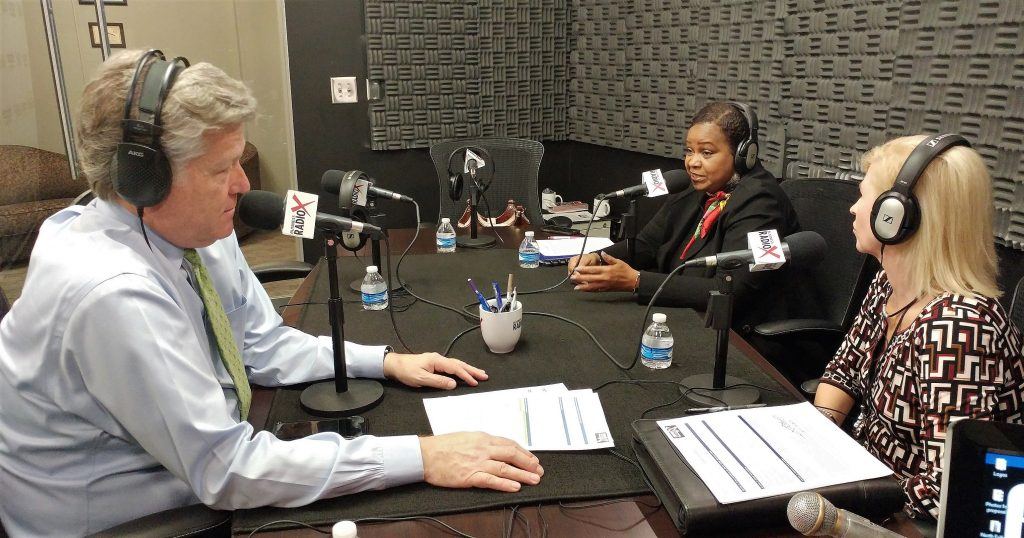
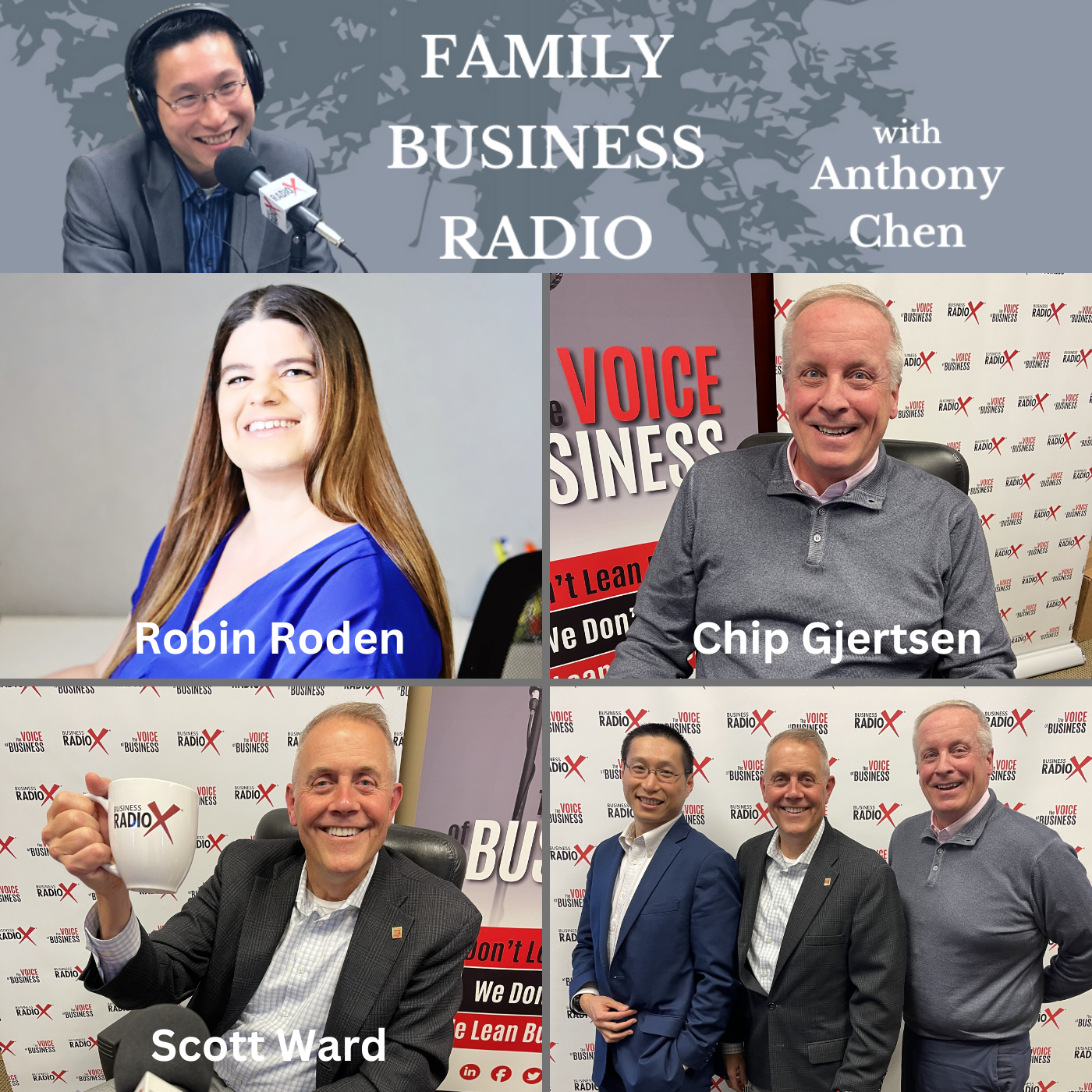
Robin Roden, K & J Mechanical, Chip Gjertsen, Renasant Bank, and Scott Ward, ITRA Global Atlanta

February 26, 2024 by John Ray

Robin Roden, K & J Mechanical, Chip Gjertsen, Renasant Bank, and Scott Ward, ITRA Global Atlanta
Family Business Radio
Robin Roden, K & J Mechanical, Chip Gjertsen, Renasant Bank, and Scott Ward, ITRA Global Atlanta
Loading
00:00 /
RSS Feed
Share
Link
Embed

Download file

Robin Roden, K & J Mechanical, Chip Gjertsen, Renasant Bank, and Scott Ward, ITRA Global Atlanta

Robin Roden, K & J Mechanical, Chip Gjertsen, Renasant Bank, and Scott Ward, ITRA Global Atlanta (Family Business Radio, Episode 53)

On this episode of Family Business Radio, host Anthony Chen welcomed three outstanding business leaders to discuss their professional journeys and their respective areas of expertise. The first guest, Robin Roden, K & J Mechanical, shared her experiences of managing a business together with her husband, including the transition from Chicago to Florida and setting up a new division. Further discussion revolved around managing family pressure while running a business. Chip Gjertsen, Renasant Bank, discussed his experiences in banking and finance and how changes in the Small Business Administration have opened new opportunities, particularly for younger businesses. Former business owner turned commercial real estate professional Scott Ward, ITRA Global Atlanta, emphasized the importance of accurate and clear communication in real estate transactions and the added value of having a tenant-only representative to advocate for clients.

Anthony closed the show with thoughts on asking questions of your advisors.

Family Business Radio is underwritten and brought to you by Anthony Chen with Lighthouse Financial Network.

Robin Roden, K & J Mechanical

Robin Roden, K & J Mechanical

Robin Roden is President of K & J Mechanical, Inc. She is MWBE-certified and certified in firestopping. She started her journey into the construction field back in 2012 in the Chicagoland area, before relocating to Florida in 2018. Robin’s responsibilities include accounting tasks, payroll, company insurance coordination, and office management. Robin gained her knowledge of the construction industry by working alongside her husband, James, who has over 20 years of experience in the trade. She self-taught herself when it came to the accounting end of the business and gained her knowledge of managing the business through repetition. Robin plans to further her education in January by working on her master’s degree in business management with a focus on construction. This will only help her grow her business with her husband and allow her to gain even more knowledge in the industry.

K & J Mechanical is a family-owned mechanical, plumbing, and firestop construction company. K & J Mechanical started back in Chicago, Illinois, before incorporating in Florida in 2018. K & J is certified in firestopping and MWBE certified as well. The company services areas from Gainsville all the way down to Naples, Florida. All of their employees have extensive experience in the trade, which makes K & J the business they are. They have grown their reputation by providing top notch service and clean work. Their employees are not just employees to them; they are like family. Their employees are also what make this company go and reach the success level it has gotten to today.

K&J Mechanical, 5320 Lena Rd., Suite 109, Bradenton, FL 34211. Serving Pinellas County, FL; Bradenton, FL; Lee County, FL; Sarasota County, FL; Hillsborough County, FL; and Gainesville, FL.

Company Website | Company Instagram | Company Facebook
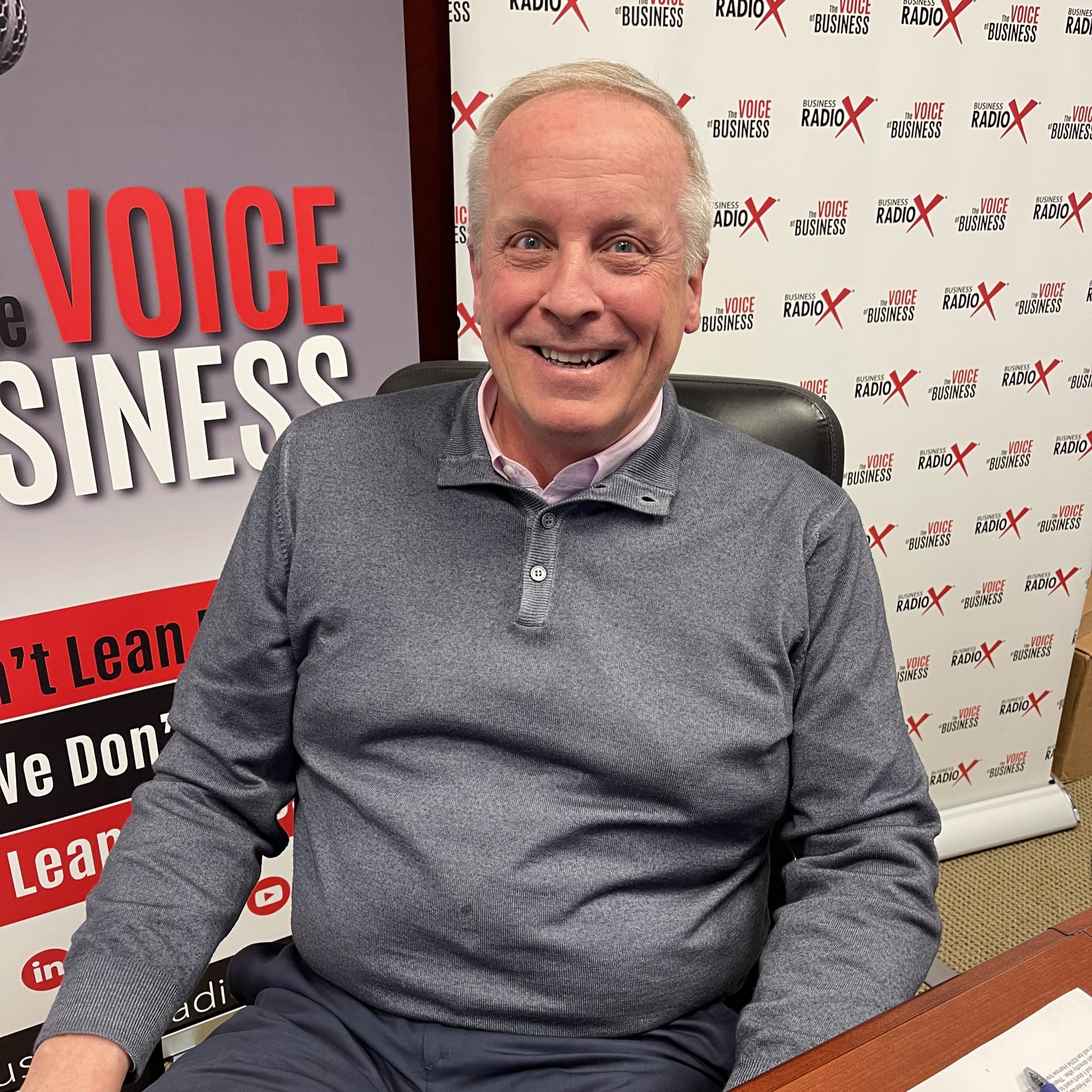
Chip Gjertsen, Senior Vice President and SBA Senior Banker, Renasant Bank

Chip Gjertsen, Renasant Bank

Chip Gjertsen is a Senior Vice President and SBA Senior Banker with Renasant Bank. He has been an SBA lender for two decades.

As a Small Business Administration (SBA) Preferred Lender, Renasant Bank can process and approve SBA loans, expediting the application process. SBA loans typically come with competitive interest rates, lower down payments, and longer repayment terms, making them more affordable and manageable for borrowers.

Renasant Bank has humble roots, starting in 1904 as a $100,000 bank in a Lee County, Mississippi, bakery. Since then, we have grown to become one of the Southeast’s strongest financial institutions, with approximately $17.5 billion in assets and 196 banking, lending, wealth management, and financial services offices in Mississippi, Alabama, Tennessee, Georgia, and Florida.

Renasant’s success stems from each of our teammates’ commitment to diversity and inclusion, and investing in their communities as a way of better understanding the people we serve. At Renasant Bank, we understand you because we work and live alongside you every day.

Website | Renasant SBA website | Renasant LinkedIn | Renasant Instagram | Renasant Facebook | Chip Gjertsen LinkedIn

Scott Ward, Vice President, ITRA Global Atlanta
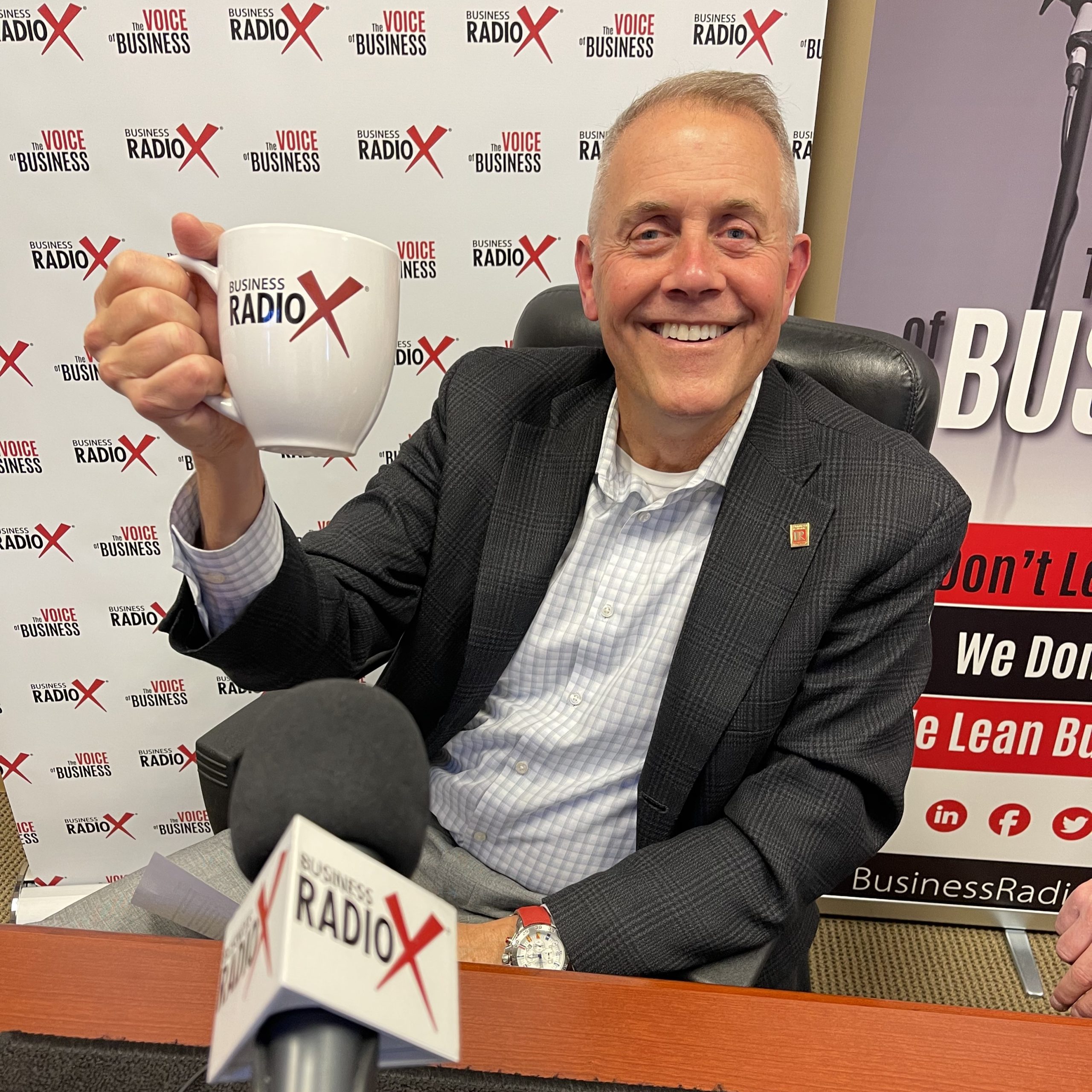
Scott Ward, ITRA Global Atlanta

Scott Ward is a veteran of over 25 years of owning businesses. Successfully representing and consulting other business owners in lease negotiations in the technology, creative media, retail, and manufacturing industries, Scott’s unique perspective keeps in mind the owner/tenant’s long-term cash flow needs as a catalyst for the future health of his client’s company.

Examples of Scott’s work include a young tech company expanding for the first time and helping to enable its current growth to include private and government clients worldwide. An industrial cabinet manufacturer successfully expanded to handle over 40 percent growth. Media agencies that need flexibility in their space to address the demands of sudden surges or shrinkage in client needs. And retail/franchise situations that come with issues of territory, visibility, and access.  Scott has mentored five former employees to own their own businesses and applies these techniques in formulating winning space solutions for his clients.

Scott’s contacts and involvement in citywide groups give him an innovative perspective on trends in traffic, population, education, and economics. He is part of enabling organizations throughout metro Atlanta to realize their missions by serving on boards or as an officer in Rotary International (Treasurer/International Director), The Chattahoochee Nature Center Board, The North Fulton Chamber of Commerce, Scouts BSA (adult training), Toastmasters International, The Georgia Production Partnership (membership, industry relations, and governmental relations), and the Atlanta Theatre to Go Board. He is also a member of the Atlanta Commercial Board of Realtors.

Scott is a graduate of the University of Florida. Scott is also a public speaker and presentation coach. He loves fly fishing and sailing, and he has been known to swing a golf club or two! His family’s accomplishments overwhelm him with pride. If you would like to share a coffee, please reach out!

Company Website | Company LinkedIn   Scott Ward LinkedIn

Topics Discussed in this Episode

00:00 Introduction and Welcoming Remarks
00:44 Interview with Robin Roden: Origin Story of K&J Mechanical
01:54 The Journey of Starting a Family Business
04:40 Balancing Family and Business
11:34 The Importance of Quality Work in Construction
14:09 Contact Information and Closing Remarks
14:34 Interview with Chip Gersten: His Journey into Banking
18:36 Changes in the SBA World and New Opportunities
26:06 Understanding Business Real Estate
27:43 The Role of Estate Planning in Business
28:19 Reaching Out to Professionals
29:40 Introduction to Scott Ward: Commercial Real Estate
31:20 The Importance of Tenant Representation
37:30 Navigating Commercial Real Estate Contracts
41:11 Advice for New Business Owners
47:41 Closing Remarks and Contact Information


Anthony Chen, Host of Family Business Radio

Anthony Chen, Host of Family Business Radio

This show is sponsored and brought to you by Anthony Chen with Lighthouse Financial Network. Securities and advisory services are offered through OSAIC, member FINRA/SIPC. RAA is separately owned, and other entities and/or marketing names, products, or services referenced here are independent of OSAIC. The main office address is 575 Broadhollow Rd., Melville, NY 11747. You can reach Anthony at 631-465-9090, ext. 5075, or by email at anthonychen@lfnllc.com.

Anthony Chen started his career in financial services with MetLife in Buffalo, NY, in 2008. Born and raised in Elmhurst, Queens, he considers himself a full-blooded New Yorker while now enjoying his Atlanta, GA, home. Specializing in family businesses and their owners, Anthony works to protect what is most important to them. From preserving to creating wealth, Anthony partners with CPAs and attorneys to help address all of the concerns and help clients achieve their goals. By using a combination of financial products ranging from life, disability, and long-term care insurance to many investment options through Royal Alliance, Anthony looks to be the eyes and ears for his client’s financial foundation. In his spare time, Anthony is an avid long-distance runner.

The complete show archive of Family Business Radio can be found by following this link.

Tagged With: Anthony Chen, Chip Gjertsen, commercial real estate, financial advisor, firestopping, ITRA Global Atlanta, K & J Mechanical, Lighthouse Financial, renasant bank, Robin Roden, SBA Lending, Scott Ward

SBA Lending, with Chip Gjertsen, Renasant Bank

June 5, 2023 by John Ray

SBA Lending
North Fulton Business Radio
SBA Lending, with Chip Gjertsen, Renasant Bank
Loading
00:00 /
RSS Feed
Share
Link
Embed

Download file

SBA Lending

SBA Lending, with Chip Gjertsen, Renasant Bank (North Fulton Business Radio, Episode 669)

Renasant Bank Senior Vice President and SBA Senior Banker Chip Gjertsen joined host John Ray to discuss SBA lending. Chip shared how he got hooked on business lending as a career, defined what an SBA loan is, described what kinds of businesses might benefit from an SBA loan, discussed recent changes that benefit business owners in transition, Renasant’s status as a Preferred Lender, success stories, and much more.

North Fulton Business Radio is broadcast from the North Fulton studio of Business RadioX® inside Renasant Bank in Alpharetta.

Chip Gjertsen, Senior Vice President and SBA Senior Banker, Renasant Bank

Chip Gjertsen, Senior Vice President and SBA Senior Banker, Renasant Bank

Chip Gjertsen is a Senior Vice President and SBA Senior Banker. He has been an SBA Lender for two decades.

Renasant Bank has humble roots, starting in 1904 as a $100,000 bank in a Lee County, Mississippi, bakery. Since then, we have grown to become one of the Southeast’s strongest financial institutions with approximately $17.5 billion in assets and 196 banking, lending, wealth management and financial services offices in Mississippi, Alabama, Tennessee, Georgia and Florida.

Renasant’s success stems from each of our teammates’ commitment to diversity and inclusion, and investing in their communities as a way of better understanding the people we serve. At Renasant Bank, we understand you because we work and live alongside you every day.

Website | Renasant SBA website  | Chip Gjertsen LinkedIn

Questions and Topics in this Interview:

  • How Chip got into SBA lending
  • What is an SBA loan
  • The UGA Small Business Development Center
  • New revisions that impact exit planning
  • Renasant as a Preferred Lender
  • The kinds of businesses ideal for an SBA loan

North Fulton Business Radio is hosted by John Ray and broadcast and produced from the North Fulton studio of Business RadioX® inside Renasant Bank in Alpharetta. You can find the full archive of shows by following this link. The show is available on all the major podcast apps, including Apple Podcasts, Spotify, Google, Amazon, iHeart Radio, Stitcher, TuneIn, and others.

RenasantBank

Renasant Bank has humble roots, starting in 1904 as a $100,000 bank in a Lee County, Mississippi, bakery. Since then, Renasant has become one of the Southeast’s strongest financial institutions with over $13 billion in assets and more than 190 banking, lending, wealth management, and financial services offices in Mississippi, Alabama, Tennessee, Georgia, and Florida. All of Renasant’s success stems from each of their banker’s commitment to investing in their communities as a way of better understanding the people they serve. At Renasant Bank, they understand you because they work and live alongside you every day.

Since 2000, Office Angels® has been restoring joy to the life of small business owners, enabling them to focus on what they do best. At the same time, we honor and support at-home experts who wish to continue working on an as-needed basis. Not a temp firm or a placement service, Office Angels matches a business owner’s support needs with Angels who have the talent and experience necessary to handle work that is essential to creating and maintaining a successful small business. Need help with administrative tasks, bookkeeping, marketing, presentations, workshops, speaking engagements, and more? Visit us at https://officeangels.us/.

Tagged With: banking, Chip Gjertsen, Manufacturing, Office Angels, professional services provider, renasant bank, SBA Lending, SBA Preferred Lender, service provider, small business, uga sbdc

Decision Vision Episode 103: Should My Company Borrow Money? – An Interview with Bill McDermott, The Profitability Coach

February 11, 2021 by John Ray

Profitability Coach
Decision Vision
Decision Vision Episode 103: Should My Company Borrow Money? - An Interview with Bill McDermott, The Profitability Coach
Loading
00:00 /
RSS Feed
Share
Link
Embed

Download file

Decision Vision Episode 103:  Should My Company Borrow Money? – An Interview with Bill McDermott, The Profitability Coach

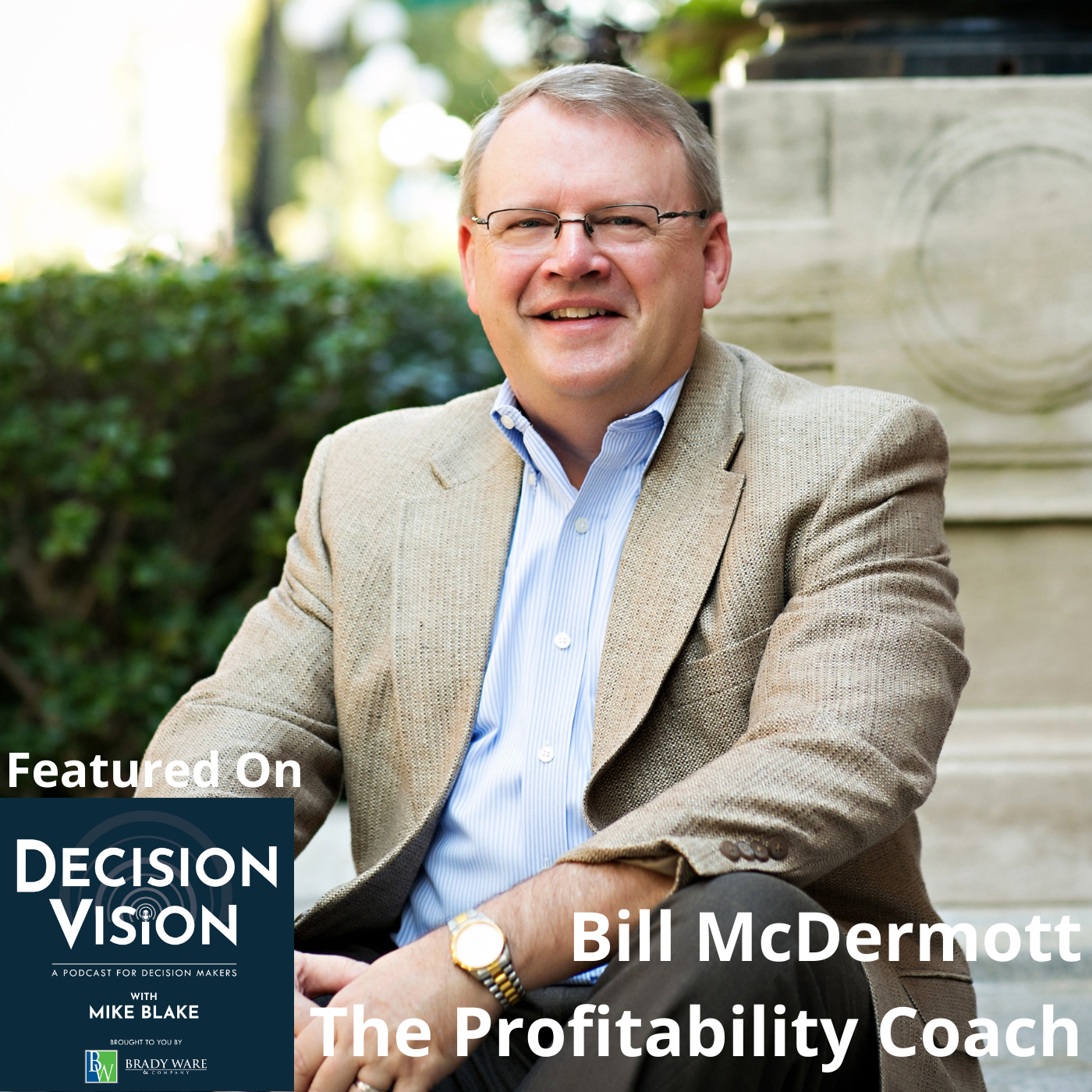
Bill McDermott, Profitability Coach and ex-banker, speaks with host Mike Blake on when and how business owners should borrow money for their business. Bill also breaks down how bankers assess business borrowers and make lending decisions, various types of debt, one type of business loan he considers predatory, and much more. “Decision Vision” is presented by Brady Ware & Company.

Bill McDermott, The Profitability Coach

Bill McDermott is the Founder and CEO of McDermott Financial Solutions, serving as a profitability coach to his clients. When business owners want to increase their profitability, they don’t have the expertise to know where to start or what to do. Bill leverages his knowledge and relationships from 32 years as a banker to identify the hurdles getting in the way and create a plan to deliver profitability they never thought possible.

Bill currently serves as Treasurer for the Atlanta Executive Forum and has held previous positions as a board member for the Kennesaw State University Entrepreneurship Center and Gwinnett Habitat for Humanity and Treasurer for CEO NetWeavers. Bill is a graduate of Wake Forest University and he and his wife, Martha have called Atlanta home for over 40 years. Outside of work, Bill enjoys golf, traveling, and gardening.

Connect with Bill on LinkedIn and Twitter and follow McDermott Financial Solutions on LinkedIn.

Mike Blake, Brady Ware & Company

Mike Blake, Host of the “Decision Vision” podcast series

Michael Blake is the host of the “Decision Vision” podcast series and a Director of Brady Ware & Company. Mike specializes in the valuation of intellectual property-driven firms, such as software firms, aerospace firms, and professional services firms, most frequently in the capacity as a transaction advisor, helping clients obtain great outcomes from complex transaction opportunities. He is also a specialist in the appraisal of intellectual properties as stand-alone assets, such as software, trade secrets, and patents.

Mike has been a full-time business appraiser for 13 years with public accounting firms, boutique business appraisal firms, and an owner of his own firm. Prior to that, he spent 8 years in venture capital and investment banking, including transactions in the U.S., Israel, Russia, Ukraine, and Belarus.

Brady Ware & Company

Brady Ware & Company is a regional full-service accounting and advisory firm which helps businesses and entrepreneurs make visions a reality. Brady Ware services clients nationally from its offices in Alpharetta, GA; Columbus and Dayton, OH; and Richmond, IN. The firm is growth-minded, committed to the regions in which they operate, and most importantly, they make significant investments in their people and service offerings to meet the changing financial needs of those they are privileged to serve. The firm is dedicated to providing results that make a difference for its clients.

Decision Vision Podcast Series

“Decision Vision” is a podcast covering topics and issues facing small business owners and connecting them with solutions from leading experts. This series is presented by Brady Ware & Company. If you are a decision-maker for a small business, we’d love to hear from you. Contact us at decisionvision@bradyware.com and make sure to listen to every Thursday to the “Decision Vision” podcast.

Past episodes of “Decision Vision” can be found at decisionvisionpodcast.com. “Decision Vision” is produced and broadcast by the North Fulton studio of Business RadioX®.

Visit Brady Ware & Company on social media:

LinkedIn:  https://www.linkedin.com/company/brady-ware/

Facebook: https://www.facebook.com/bradywareCPAs/

Twitter: https://twitter.com/BradyWare

Instagram: https://www.instagram.com/bradywarecompany/

TRANSCRIPT

Intro: [00:00:02] Welcome to Decision Vision, a podcast series focusing on critical business decisions. Brought to you by Brady Ware & Company. Brady Ware is a regional, full service accounting and advisory firm that helps businesses and entrepreneurs make visions a reality.

Mike Blake: [00:00:20] Welcome to Decision Vision, a podcast giving you, the listener, clear vision to make great decisions. In each episode, we discuss the process of decision making on a different topic from the business owners’ or executives’ perspective. We aren’t necessarily telling you what to do, but we can put you in a position to make an informed decision on your own and understand when you might need help along the way.

Mike Blake: [00:00:41] My name is Mike Blake, and I’m your host for today’s program. I’m a director at Brady Ware & Company, a full service accounting firm based in Dayton, Ohio, with offices in Dayton; Columbus, Ohio; Richmond, Indiana; and Alpharetta, Georgia. Brady Ware is sponsoring this podcast, which is being recorded in Atlanta per social distancing protocols. If you like this podcast, please subscribe on your favorite podcast aggregator, and please consider leaving a review of the podcast as well.

Mike Blake: [00:01:08] Today’s topic is, Should my company borrow money? And, you know, talk about borrowing and lending, it’s automatically a charged topic. And so much of our consciousness, I think, revolves around debt. And I don’t know if it’s always been that way. Certainly throughout history, people have talked about debt, usually from the dangers of debt. Of course, “neither a borrower nor a lender” attributed to Benjamin Franklin. And, of course, you know, there’s a whole ton of discussion around medical debt, student debt, the national debt. There are individuals that have made, frankly, fortunes and careers advising people against the dangers of debt, Dave Ramsey is probably the most important one, but there are several others, of course.

Mike Blake: [00:02:12] And I see that this mentality does bleed over into the corporate world to some extent. And there are a lot of funny things about debt, you know, one, it has a mystique to it. I think, because when debt works well, it works great. When it works badly or when the outcome is bad, the outcome is usually spectacular. And even our most recent past president – you know, there’s at least a lot of suspicion. We don’t know his full financial position – the prevailing suspicion or understanding or belief – I don’t want to use suspicion in a pejorative sense. That’s not the intent – but the belief that our own president has built an empire on debt and that he’s still very heavily leveraged. But in spite of that fact, he doesn’t appear to be financially hurting.

Mike Blake: [00:03:12] So, you know, debt can be somewhat paradoxical. And I think when debt fails, it fails badly, it fails in a lot of ways publicly. And who doesn’t love a good car crash, as long as you’re not in it. You know, I think that generates a lot of attention. And I’m not a debt expert at all. I have much more experience on the equity side than on the debt side, which is we have a guest coming up that does know what he’s talking about. But, you know, it’s understanding that debt is a power tool. And a power tool, you know, take a circular saw as a great example. If you know what you’re doing and you respect the power of the tool, the circular saw, you can build amazing things, right? You can build furniture. You can build a shelter, you know, effectively with a circular saw and a few other tools. Not that I’d ever do it. I’m incompetent. But I’ve seen people do it and this seems to be the way that it happens.

Mike Blake: [00:04:17] Conversely, if you don’t know what you’re doing, if you put your hand in the wrong place, the next thing you know, your name is Lefty or The Claw or whatever. But the saw itself isn’t bad. It’s simply a matter of the capability and the emotional intelligence of the person using it. And so, as a consequence, you know, I do think that, of course, there are companies that use debt irresponsibly. And we’ve had an interview on a podcast with Tom Rosseland of Bodker, Ramsey talking about, you know, should I enter into a workout? So, we’ve covered that part. And eventually we’ll cover bankruptcy as well. I just haven’t really found the right guest for that.

Mike Blake: [00:05:00] And we’ve talked about SBA lending in a very sort of particular finite discussion. But we haven’t had a far ranging strategic discussion about debt, how it works. You know, the world of debt is much more expansive than simply SBA lending. SBA is a great program. Don’t get me wrong. It’s one thing that I think our government actually has implemented pretty well with a lot of the desired effect. But there’s a lot more to it.

Mike Blake: [00:05:31] So, I want to give this topic, frankly, the amount of depth and breathing space that it is due. And helping us fill that breathing space is my friend Bill McDermott. Bill and I have known each other for over a decade. He is a graduate from Wake Forest University and launched a career in banking that spanned 32 years. And in spite of knowing Bill for a while, as I’ve said previously on this program, I’ll dig into some of his bio. And I learned something that I did not know. And I did not know that he first started out as the repo man for Wachovia Bank in their management training program. And he later moved to Peachtree Bank, which later became SunTrust. You all know the deal, SunTrust is something like the product of 9,000 mergers. And that’s how banking works, I guess.

Mike Blake: [00:06:22] You know, he was a great producer of both loans and deposits for the bank. Climbing the ranks to ultimately become a group vice-president for the commercial banking division. And in 2001, Bill’s group won the SunTrust Cup – the highly coveted, I imagine, SunTrust Cup – for being the highest performing commercial bank group in the company. He worked in community banking, becoming a top producer for Ironstone Bank, et cetera, et cetera. So, Bill really knows what he’s talking about. Over the last 11 years, Bill has been the profitability coach. A recovering commercial banker, he has served over 200 clients in the last year by delivering results – I don’t know if it’s last year or not. He’ll clarify it. I think it’s more than that – by delivering results oriented insights, helping them to make financial – to take them – sorry – from financial confusion to financial clarity.

Mike Blake: [00:07:15] Bill currently sits on the board of directors for Pinnacle Bank. He also hosts a monthly podcast, ProfitSense, which features stories of successful business owners and the professionals that advise them. When Bill is not working, you can find him on the golf course, gardening, spending time with his family, and leading a small group at his local church. Bill McDermott, welcome to the program.


Bill McDermott: [00:07:37] Mike, thanks so much for having me. I’m excited about talking about the topic. And, yes, the repo man spent time either collecting payments at the local furniture factory. I did move to Kinston, North Carolina, which is tobacco country. So, back in the day, I was known to collect past due car payments from some of the tobacco workers coming out of the field. I had a cash receipt book and collected those payments. Or I did have to repossess a car, too, in my day. So, back then, they thought you had to figure out a way to collect loans before you could make them. So, I did survive that, by the way, as proof of me being here, right?

Mike Blake: [00:08:26] Yeah. You know, otherwise, I have to say, this podcast is sponsored by Weegee. So, clearly you’re here to do it. But, you know, when we were talking off air, you told me something that I thought was fascinating that makes all the sense in the world to me. And that is, you said that before they let you lend money, you’d have to collect it.

Bill McDermott: [00:08:47] Yeah. And so, essentially as a banker, you have to know the characteristics of a good loan from a bad loan. And so, you learn the bad loans first. Unfortunately, you learn what not to do before you learn what to do. And the perspective of a banker in lending money from a banker’s point of view, everything is about risk. A lot of people don’t really understand that a bank really only makes about a 4 or a 5 percent gross margin. They’re leveraged about 10 to 1. So, they don’t really have much room to make mistakes given that margin and given that leverage position. So, it is risky to be in the money lending business. Plus, they’re not loaning their money. They’re loaning their depositor’s money. They have to be sure that they get that money back so that can take care of their depositors as well.

Mike Blake: [00:09:49] You know, I’m probably going to set a record here, I’m going to rip up the script before I even get to the first question. But that is, you know, I think what that would teach you, they talk about the C’s of borrowing. I can’t remember if it’s four or five C’s, but I recall that one of them as character. And that must teach you a lot about the character part. And I wonder if some of that is getting lost. You know, banking, like everybody else, is now in data analytics. But, you know, it’s hard to do that with character. And I’m curious if you have a view as to whether or not maybe that one of the C’s is now getting lost a little bit because, one, they’re not making people learn how to collect money and see borrowers face-to-face before they lend it. And, two, if they were so focused on analytics where, you know, maybe sometimes we go a little bit overboard.

Bill McDermott: [00:10:42] Yeah. And so, I think another point – so I think you’re spot on in what you’re saying – character, the average banker right now that is interfacing with a business owner client typically has not had any form of credit training. And I’m generalizing here, but most bankers below the age of 40 may not have had any formalized credit training. And so, they might be able to evaluate character, but they also may not. The other thing is, there was a time when the banker you met with face-to-face had the authority to approve the loan. Now, the approval process is the salesperson meets with that business owner, gets the financial information, takes it to the credit approver. Well, the credit approvers kind of like the Wizard of Oz behind the green curtain, pulling all the levers, but never himself or herself gets the opportunity to determine the character of that borrower.

Mike Blake: [00:11:53] And I mean, you know, you really can’t know it. We try to get a view of it, of course, with credit history, but that’s only one piece of the deal. But anyway, we do need to get through these questions. But, you know, I just love talking about this stuff, and I could for a long time, but we do need to get into it. So, I’d like to start at a very basic level. And that is, you know, talk about what you see currently as what is more or less a typical borrowing process. And does that vary a lot or can you generalize it fairly widely that most lending programs or lending entities, including banks, follow that?

Bill McDermott: [00:12:32] Yeah. At a high level, there are some commonalities. I think the first thing is, a business owner has to put together a loan package. That loan package is generally going to have three years worth of historical financial information. It may have the most recent interim financials. You know, we just finished January, so a January balance sheet and an income statement. It will include a personal financial statement of any owner that has more than 20 percent ownership. Because a bank looks at the people that make up the ownership of the business. Yes, they are loaning to the business. But, generally, that business is a reflection of the people that are running it.

Bill McDermott: [00:13:23] So, first part is the loan package, Mike. The second part, generally, a credit interview. Again, as I mentioned, banks are looking at everything in terms of risk. So, they will have analyzed those financials. They’re going to have some underwriting questions, what’s going on in the business. But, yeah, to your point about the C’s, there are 5C’s as they’re going through that interview. They’re going to be evaluating the character of the borrowers. They’re going to be looking at the cash flow. Does the business have the ability to pay it back? They’re going to be looking at credit score. Generally, the business owner’s personal credit score is the proxy for the business. They’re going to be looking at collateral. Do they have the ability to secure the loan?

Bill McDermott: [00:14:10] And then, the last thing has nothing to do with the business or the business owner. But they’re looking at conditions, specifically economic conditions. So, we just are, hopefully, on the tail end of a pandemic. But the economic conditions and the economic uncertainty have played a big role in bank’s willingness to loan money in the current economic environment. And so, credit has tightened because conditions of economic uncertainty have tightened. But that’s generally the process, one package, credit interview, evaluating the 5C’s. It’s really important for the business owner to have a clear request. And it’s also very important for the business owner to have a compelling case. Why should the bank loan them money? How does the company present itself in terms of risk? And if there are any risks, can those risks be mitigated to help the bank approve the loan?

Mike Blake: [00:15:14] So, I’m curious because you’ve talked about banks tightening lending standards. And a lot has been made around Fed policy, not just now, but really starting in 2008 when we entered the quantitative easing phase and, all of a sudden, quantitative easing entered the jargon. And as a person who’s a trained economist, that scared the living you know what out of me, because you’re not supposed to be able to do that. It turns out, at least for now, you are. But there’s a paradox that’s happened, I think, and I’d love you to comment on it, which is, things like quantitative easing, things like lowering the discount rate, i.e., the Fed rate, is supposed to make more money available for lending. But, you know, it’s one thing to make more money available. It’s another for the bank to feel comfortable. They’re going to actually get that money back, right? And those two things don’t always flow together and cooperate the way that, I think, policymakers would like.

Bill McDermott: [00:16:19] Yeah. And so, let’s go back to 2008, 2009. Quantitative easing was to make more money more available. But, frankly, banks had capital calls. They had liquidity calls. There was a huge devaluation of real estate. Banks had to actually reset their portfolios. And, frankly, Mike, there were a lot of bank failures because of that. They were undercapitalized. There were cease and desist orders. Banking is a highly regulated business to protect the depositors, of course. And so, you had to record bank failures. So, even though banks are supposed to always be healthy, the level of real estate lending caused a lot of banks to become undercapitalized. And so, the quantitative easing really didn’t help, primarily, because it was the banks that were in poor financial position at that moment, which created a huge consolidation during that phase.

Mike Blake: [00:17:25] So, I’m going to combine kind of two questions here, because I think it just flows better. And that is, you know – well, actually, let’s do it this way. So, my next question is, when you’re lending money, do banks care as to the reason – you know, are they going to ask what you want the money for? And if so, does the answer matter as long as, maybe, there’s enough collateral cash flow or whatever? And what are some good reasons to borrow money and what are some not so great reasons to borrow money?

Bill McDermott: [00:18:04] Yeah. So, that’s a great question. And the answer is, do banks care about what the money is being used for? Absolutely. Unequivocally, yes. As a matter of fact, banks have very specific lending policy that says, I will loan into these situations. I will not loan into these situations. So, for example – you know, appropriate reasons for borrowing money. And I’m going to go back to your circular saw, which I thought was a great example. Circular saw used well from a banking point of view, having a line of credit for a business eases the cash flow bumps. You know, all business owners have generally erratic cash flow. It can either be feast or famine. Having a line of credit helps those famine times by having cash available to insert into the business’s purchasing fixed assets, a business that may need equipment, may need vehicles.

Bill McDermott: [00:19:11] Fixed assets also include real estate, a lot of businesses will buy a building and lease it to their company. So, all of those things – one more, acquisition. You know, one company wants to buy another company. So, certainly those are things that banks would say yes to and are good reasons to borrow.

Bill McDermott: [00:19:34] Two things that come to mind reasons you wouldn’t want to borrow money – and banks would probably not look favorably on that – is, you don’t borrow money to fund losses. If your business is losing money, borrowing money to fund losses is like pouring gas on a fire. It’s an accelerant. The other thing is, there are business owners that like to look at their business as their own personal cookie jar. They take a lot of distributions. And so, banks are not really interested in loaning money to fund the business owner’s lifestyle. So, those would probably be two reasons why a bank wouldn’t lend money to either fund losses or fund distributions.

Bill McDermott: [00:20:23] Another thing would be, banks probably wouldn’t finance anything that they consider to be of speculative nature. And, again, coming from a very conservative point of view, based on the leverage and the gross margin that I mentioned, what I would define as speculative as an entrepreneur and what a banker defines as speculative are really two different things.

Mike Blake: [00:20:48] So, I imagine you have too, but you tell me, you do run into people that are just ideologically opposed or even borderline phobic of debt, right? And they’re proud of the fact that their balance sheet has no liabilities to it. And, you know, what do you think of that attitude? And is that a healthy attitude? Or is that attitude actually creating costs of its own?

Bill McDermott: [00:21:16] Yeah. So, I have a client who’s a professional services provider, she is totally opposed to borrowing money. As a matter of fact, now that I think of it, I have two clients. They don’t believe in using debt. If there is a capital call in the business, they’ll fund it out of their own pocket or fund it out of profits. And so, I’m not really sure. It’s kind of a choice. I would say it’s a little unhealthy and the reason is, primarily, there is a cost associated with that. All businesses need to have access to capital from time to time. And so, for a business to be opposed to debt, they’ve just taken one thing off the table in terms of having access to capital that they won’t use.

Bill McDermott: [00:22:12] And then, the other thing, I think, not having access to that capital, their ability to grow is going to be limited to how much internal cash that they can generate in order to accommodate that growth. So, yes, there is a cost to that attitude. I think it can be limiting. But as far as whether it’s healthy or not, I certainly respect people’s choices. But I think, as with anything else, choices have consequences.

Mike Blake: [00:22:40] So, a term you used earlier today that I want to make sure that we talk about, because you can’t really have a discussion about debt without it. What is the difference between a loan and a line of credit? And when is one more appropriate than the other?

Bill McDermott: [00:22:59] Yeah. So, a loan, in its purest sense, is really a sum of money that is put out there. And the structure of that loan really determines the difference between a loan and a line. So, there are actually three types of loans. The line of credit is one, you borrow, repay, reborrow. And it’s great for handling short term cash flow. The other two types, of course, there’s a term loan. Term loans you use to borrow for equipment. And then, the third is a mortgage loan, Mike, which are used primarily again to purchase real estate, which then is leased back to the company. So, loans fit into three categories really just depending on what the money is used for and then how it’s structured for, short term versus long term.

Mike Blake: [00:24:01] Okay. Now, banks aren’t the only lenders. I think, a lot of people, when they think loans, they think of banks. Or, you know, they think of the loan shark who has the big fur coat is going to break your kneecaps if you don’t pay back. But there’s a lot in between those two, isn’t there?

Bill McDermott: [00:24:22] Yeah. There really is. So, you know, if I’m going to walk down a balance sheet for a business owner, I’m always going to look at bank debt first. Because the accounts payable are a way of financing the business. But as far as actual bank financing or non-bank financing, it’s the cheapest source of capital, the interest rates are lower. But banks are basically loaning against the balance sheet and the income statement of that borrower. If they lost money last year or their balance sheet is leveraged generally more than about $3 of debt to every $1 of equity, they’re going to have a hard time. They can get a loan, but generally not beyond that.

Bill McDermott: [00:25:15] So, for somebody that lost money last year or has a leveraged balance sheet, there are asset-based lenders. Asset based lenders don’t care about the balance sheet. They don’t care about the income statement. All they care about is the collateral. And so, if you have $100,000 in accounts receivable, you should be able to loan or borrow about 75 to 80 percent of that. But it carries a high interest rate. Generally, there’s 1 to 1-1/2 percent per month service charge and then there’s money usually at about prime plus two, prime plus three on top of that. So, 1 percent a month for 12 months is 12 percent interest, prime plus three is another 6 or 6-1/2, so all of a sudden, it adds up quick. Mike, that’s an 18-1/2 percent loan you’re up to credit card rates.

Bill McDermott: [00:26:12] Also, I’m going to say there are some – what I’ll call – payday lenders. Honestly, I think they’re borderline predatory lenders. There are some people that will loan you money, but they ask you to pay a piece of it back every day. And sometimes the annual percentage rate on those loans can be in the 30s, even in the 40 percent. It’s absolutely borderline criminal, in my view. Not to say anything disparagingly about those lenders. I’m sure they serve a purpose. But at such high interest rates, it’s incredibly difficult for a business owner to sustain their business. Because a lot of times. those interest rates exceed the gross profit that the business is even generating.

Mike Blake: [00:27:02] Yeah. And, you know, payday loans and their ilk are kind of interesting. I mean, I’m generally a free market guy, but I also enjoy studying the psychology of decision making. It’s why I do this podcast. And one of the things I’ve learned about decision making in crisis – and it almost doesn’t matter if it’s a financial crisis or physical crisis or something else – I’ve seen empirical studies that show that when a person is in crisis, the average person has a functional IQ reduction of between 10 to 15 percent in the midst of that crisis.

Mike Blake: [00:27:44] So, in effect, when you’re in a crisis, most people become dumber because the nature of the crisis makes you tunnel visioned. It makes you focus on how do you solve the problem today the most painlessly, even though you’re creating a problem ten times bigger that you have to confront a week from now. But the psychology of crisis leads you into that decision. So, you know, whether that means that’s predatory, I’m not sure. And I’m not afraid to say, this in my view, it does call for some regulation because you’re selling to what is effectively an impaired market. It’s fine to say that people are free to make their own decisions, but when there’s data that shows that your market, by definition, is cognitively impaired by the very thing that’s leading it to come to you, there’s a clear conflict of interest.

Bill McDermott: [00:28:43] Yeah. And I think at that point, the business owner in crisis has ultimately a concern that his or her business is no longer viable. And so, they will go to almost any length in order to make sure that their business stays viable. And so, I’m a big believer in the good, fast, cheap – pick any two. If it’s good and if it’s fast, there is no way it’s going to be cheap. But I do think predatory lending goes to the end extreme. It’s not really good, it is fast, but you’re paying exorbitant interest rates for that speed.

Mike Blake: [00:29:29] Yeah. And, frankly, in that kind of scenario, you really should be looking at equity, right? And you talked about funding losses. It’s not as if there isn’t a financial vehicle out there to help you. It’s just that debt is the wrong tool. If we take the circular saw, if you’re in crisis, you’re basically trying to cut a ham sandwich with a circular saw. And all you’re going to do is get a messy kitchen if you try to do that. But on the other hand, if you’re using equity, you’re using a nice little Wusthof knife to cut that sandwich, yeah, it’s going to be more expensive, but it’s the right tool for the right job.

Bill McDermott: [00:30:09] Yeah. No question. So, the nice thing about debt, debt magnifies gains, but the downside is debt also magnifies losses. So, people that use debt are able to grow quicker. But people who use debt when they’re funding losses, it magnifies those losses as well, because you’re basically borrowing money that you can’t pay back and the interest expense pushes your breakeven point even higher. So, you’re, in effect, borrowing into your future when your future is actually trending negatively.

Mike Blake: [00:30:48] So, you know, there are nonbank lenders out there, and not just the asset based lenders, but there are mezzanine lenders. And maybe you’re talking about the same thing – if you are, feel free to correct me. But, you know, lenders for subprime borrowers, I think, if I’m not mistaken, there’s a group out there that they’re not payday lender types, but they’re also are credit that’s available at a higher interest rate that is not bankable from a banking standpoint. Right? So, you know, what are those groups like? And, you know, are they legit? Is interfacing with them similar or different from that with a bank? What does that world kind of look like?

Bill McDermott: [00:31:38] Well, necessity is the mother of invention. Access to capital for business owners has been critical. We went through a period of time where banks were somewhat unhealthy. I think banks are healthy now. But over the last ten years, quite a few nonbanks have entered the market. Possibly the benefit is, they don’t necessarily have to chin to the same regulatory environment that banks do. And so, yeah, I think there are some viable entities out there that can provide capital. They actually require sources of funding. They probably go to the public markets, borrow that money, and then loan it back out on a spread. But, no, I think there are viable options out there that nonbank lenders provide and have kind of helped give business owners access to capital that banks either can or can’t provide, given whatever the prevailing economic factors are.

Mike Blake: [00:32:51] So, once you get into the lending world and all the financial world at all, you’ll start to hear terms like senior debt, junior debt, subordinated debt, can you quickly give us a vocabulary lesson. What do those things mean relative to one another?

Bill McDermott: [00:33:05] Yeah. So, first, senior debt is in the senior position, so it’s the highest of the debt positions. Typically, senior debt is predominantly bank debt. There are a lot of growth companies out there that have lending requirements behind that. Then, generally, junior debt means that it is subordinate to the senior debt. That junior debt is also mixing terms here. But subordinated debt, it’s actually debt that exists under the senior debt. It accomplishes some great things. First, for that growth company, they get access to capital. The senior debt looking at that junior subordinated debt underwrites that debt as if it were equity.

Bill McDermott: [00:33:59] And so, for a senior lender’s point of view, that junior debt gives them extra comfort that there’s cash behind their debt that is also capitalizing the business. From the junior subordinated debt, they provide a very viable access to capital that the senior debt holder is unwilling to provide. But, yeah, all you’re really doing is looking at banks in the senior position. Junior debt and subordinated debt are those institutions that provide capital subordinate to that senior position.

Mike Blake: [00:34:42] So, I wonder if this is true or I’m speculating here, is there also kind of an emotional comfort component that if you’re a senior lender and you know that somebody who’s willing to come in and be a junior lender, that it just sort of validates your judgment?

Bill McDermott: [00:35:00] Yeah. Absolutely.

Mike Blake: [00:35:01] It’s not out there on a limb, right?

Bill McDermott: [00:35:03] Yeah. And the the other thing is, if for one reason or another, that senior debt holder decides that maybe they’re wanting to exit that credit, there is a junior position behind them who may be willing to take them out if they decide to exit. So, it really gives the senior debt holder an opportunity to be taken out, if needed, from the junior subordinate. It gives them the opportunity, potentially, by taking that out, they become the senior debt holder and then that allows other juniors to come in under them.

Mike Blake: [00:35:47] I want to switch gears here, you know, I’d like to talk about the intersection and interdependence, if there is any, on personal credit versus corporate credit. I mean, there must be at some point, I guess, but you tell me where it is. You know, where is the point where lenders make a distinction or stop making a distinction – maybe that’s easier – between the company as a borrower and the owner as a borrower? You know, is there a separation between the two? Or as far as lenders are concerned, are the buyer and the company the same thing? And so, you know, does the credit score of one impact the other? How are those two things linked, if at all?

Bill McDermott: [00:36:40] That’s another great question. So, generally speaking, a closely held business where the ownership is closely held, usually concentrated in anywhere from, maybe, one to three or four partners, the personal credit score of either that individual or individuals, in effect, is the business credit score by proxy. And so, the credit worthiness of that business is, frankly, dependent on the credit score of those individuals. When you get to businesses that aren’t closely held, the ownership is widely dispersed. Publicly held companies, for example, where the ownership is widely dispersed, they have access to sources of capital outside the market. Those businesses usually have their own credit score. If they’re publicly traded, they’re going to have a rating by S&P or Moody’s. They may have a rating by Dun and Bradstreet. So, in those cases, those businesses have developed their own credit score, no longer relying on the ownership because it’s so widely distributed. So, the intersection is, once a closely held business becomes publicly held, the owner’s credit score is no longer.

Mike Blake: [00:38:07] So, sometimes I hear from borrowers that they’ll say, “Well, you know, the bank wouldn’t lend me money if they didn’t think I can repay.” And, to me, that sounds like a little bit of a dangerous statement, because I think you’re kind of offloading too much responsibility to the bank to make the right decision for you. But I like you to respond to that. I mean, can you take some comfort even if you, yourself, have, maybe, misgivings? And maybe we’ll take that person that’s kind of debt-phobic as a good example. Is the very fact that a bank is willing to lend money to you, is that somehow self-validating for the company?

Bill McDermott: [00:38:48] Yeah. So, when I was in banking, the knock on bankers to your point was, “Oh, gosh. Banks just loaned money to businesses that don’t need it.” And so, that is a prevailing thought out there. However, the reality is 80 percent of a bank’s income comes from lending money, Mike. So, if banks don’t loan, they can’t. So, bottom line, I think someone who says that could be maybe that person that got declined, primarily because there was a factor within those 5C’s. You know, maybe they didn’t have sufficient cash flow. Maybe their balance sheet was a little too leveraged. Maybe they were wanting to borrow the money for a speculative purpose. And it just made the sum total of those things unbankable.

Bill McDermott: [00:39:53] Also, I will say, because of COVID, there are a lot of good businesses in a good economic environment were able to borrow money, but not able to borrow money in a COVID type environment. So, the economic conditions also play big into that decision.

Mike Blake: [00:40:15] I want to go back to kind of the personal versus company kind of debt profile, if you will. How do personal guarantees work? Are most business loans to a small business going to require personal guarantee? Can you talk a little bit about how they work? And if I’m a borrower, should I be expected to provide a personal guarantee and what that looks like?

Bill McDermott: [00:40:42] Yeah. So, I got to take you back to my Peachtree bank days. So, I graduated from being the repo man, just beginning to do small business lending. And so, my boss, because the subject to personal guarantees came up, his comment to me was, Mike – and it really resonated to me – he said, “Bill, if a business owner isn’t willing to stand behind his or her business, why should I?” And so, part of that personal guarantee is, yes, a closely held business, 9.9 times out of 10, it’s going to require a personal guarantee for that very reason. If the business owner won’t stand behind their business, then why should the bank stand behind it?

Bill McDermott: [00:41:38] Interestingly, though, just yesterday, I had an email from an owner that I worked with. So, he was offered a six figure line of credit. It was at four percent. There was a 2-1/2 percent origination fee, but it was unsecured and unguaranteed. Now, it was not a bank. It was a nonbank, but the rate was attractive, the fee was high, but unguaranteed. I mean, that really kind of caught me off guard. So, I guess it is out there, but I have not seen it at a bank.

Mike Blake: [00:42:23] So, bottom line, be pleasantly surprised if you’re not asked for a personal guarantee. And maybe a question to think about before you even start the borrowing process is, be prepared for that question, right? And if you’re not prepared to make that personal guarantee, it may not be a good use of your time or the banks to even pursue the discussion.

Bill McDermott: [00:42:43] Precisely. You’re spot on.

Mike Blake: [00:42:45] Okay. So, how can borrowers evaluate their own attractiveness to potential lenders? Are there any kind of self-assessment tool that the borrowers can use to understand where they might lie and maybe try to improve their profile or their attractiveness before they start this process?

Bill McDermott: [00:43:10] Yeah. Such a great question. So, a lot of times, I talk to my clients that I’m working with about what it means to be bankable. And so, the quick answer is, if you lost money last year, you’re going to have a hard time borrowing money this year, because banks believe the best indicator of the future is the past. And if you lost money last year, you’re going to lose money this year. They won’t believe you until you’ve gone through a full year and made a profit. So, self-assessment, profitability. Absolutely.

Bill McDermott: [00:43:47] The second thing is leverage. How much skin in the game do you have in your business versus how much skin in the game your creditors have? If you have more than $3 of debt to every dollar of equity, a bank will consider you highly leveraged and that could cause an issue with your ability to borrow.

Bill McDermott: [00:44:11] So, probably the other things in a different profitability and leverage, if you consistently have low liquidity, not much cash on hand, the bank is going to have some concerns. The other thing is, if you’re not good at collecting your receivables and, frankly, you’re borrowing money to replace receivables that you’re either unwilling or unable to collect, banks are going to have a hard time doing that.

Bill McDermott: [00:44:41] So, I have a little acronym that I call PALL, Profitability, Asset Quality, which is how are you turning your receivables in your inventory, Liquidity, and Leverage. And so, a self-assessment going through PALL, which I do for my clients, I provide a business financial checkup. You know, each one of us gets a physical every year, but often business owners don’t put their business through one. So, we provide that as a service so that they know once a year what’s going on in their business. And it also helps them understand whether they’re bankable or not.

Mike Blake: [00:45:20] We’re talking with Bill McDermott, the profitability coach. And the subject is, Should I borrow money for my company? And, Bill, I just had a couple more questions before we let you go. But a question I do want to get to is, you know, so much of the economy now is a service firm, which means that they’re unlikely to have the kind of collateral that a manufacturing firm has. And I think it’s something that the banking industry is really wrestling with quite a bit. Can service firms borrow money or are there certain conditions under which they can or can’t?

Bill McDermott: [00:45:56] Yeah. And I think that is something that, maybe, has evolved over time. Mike, historically, service firms versus firms that deliver a product, it is a little more nebulous to understand the delivery of a service versus a delivery of a product. You can actually determine when that product has been delivered versus service. I think that has changed over time. I worked with a lot of professional services firms, architects, engineers, I have an interior designer, I have a psychology practice. All of those are providing services, but yet banks are willing and able to loan them money. So, the risk from the bank’s point of view is it’s easier to determine delivery of a product than it is delivery of a service. But I do think the banking industry has gotten comfortable with loaning money to service firms over the years.

Mike Blake: [00:47:00] Are there times when you work with clients that are thinking about borrowing and you tell them, “You know what? Skip it. Just put it on a credit card.” And if so, what does those look like?

Bill McDermott: [00:47:11] Yeah. You know, I would say for a newer business, just getting started, there’s really no credit history. General rule of thumb is to get a bank line of credit. They like to see at least three years of history to loan money. So, yeah, for somebody who’s just getting started, I would suggest get a business credit card. I know when I started, I got a company card through American Express. I do think it’s a great idea. Don’t do it on a personal card, primarily, because when it comes to borrowing money, you want a clear audit trail as far as loaning money for your business versus – excuse me – borrowing money for your business versus borrowing money personally.

Mike Blake: [00:48:06] Bill, this has been a great conversation. There are more questions I could ask, but we have limited time. Would you be willing to answer questions of people that may have a question that we didn’t get a chance to cover here? And if so, what’s the best way for them to contact you?

Bill McDermott: [00:48:24] Sure. And I would love to. Probably the best way to do that is go to theprofitabilitycoach.net. There is a prompt in there if they want to contact me. The other way is phone number, 770-597-3136. I always pick up the phone and answer unless I’m in front of a client. But, Mike, I launched this business with the goal of helping business owners become better financial managers. And so, first, I want to applaud you for even bringing up the topic. There is a lot of mystique around it. But the goal is, I want to give business owners financial clarity out of all of the chaos of what the options are and which is best. So, I’m always happy to help any business owner that wants to contact me.

Mike Blake: [00:49:24] Well, thank you. That’s going to wrap it up for today’s program. I’d like to thank Bill McDermott so much for joining us and sharing his expertise with us.

Mike Blake: [00:49:32] We’ll be exploring a new topic each week, so please tune in so that when you’re faced with your next business decision, you have clear vision when making it. If you enjoy these podcasts, please consider leaving a review of your favorite podcast aggregator. It helps people find us that we can help them. Once again, this is Mike Blake. Our sponsor is Brady Ware & Company. And this has been the Decision Vision podcast.

Tagged With: access to capital, asset-based lenders, bank loan, Bill McDermott, borrow money, Brady Ware, Brady Ware & Company, junior debt, McDermott Financial, McDermott Financial Solutions, Michael Blake, Mike Blake, profitability coach, ProfitSense, recovering banker, SBA Lending, senior debt, subordinated debt

Decision Vision Episode 34: How Do I Get an SBA Loan? – An Interview with Joy Manbeck, Vinings Bank

October 3, 2019 by John Ray

Decision Vision
Decision Vision
Decision Vision Episode 34: How Do I Get an SBA Loan? – An Interview with Joy Manbeck, Vinings Bank
Loading
00:00 /
RSS Feed
Share
Link
Embed

Download file

Mike Blake and Joy Manbeck

Decision Vision Episode 34:  How Do I Get an SBA Loan? – An Interview with Joy Manbeck, Vinings Bank

What are the different loan options in the SBA loan program? How do I qualify? Joy Manbeck, a banking veteran with particular expertise in SBA lending, joins “Decision Vision” host Mike Blake to answer these questions and much more. “Decision Vision” is presented by Brady Ware & Company.

Joy Manbeck, Vinings Bank

Joy Manbeck

Joy C. Manbeck is a Senior Vice President and Director of SBA Lending with Vinings Bank. Joy is an Atlanta native who has been in banking for over 35 years. For most of her career she has been in commercial and small business lending with several different Atlanta-based banking institutions. Her community and civic roles include 2019-2020 President of the Rotary Club of North Fulton, alumnus of Leadership North Fulton, board member of Capital Partners Certified Development Corporation, member of the Board of Trustees of Alpharetta First United Methodist Church, and volunteer youth leader at Alpharetta First United Methodist Church. Joy is a graduate of Georgia State University with a degree in Finance, and her hobbies include fitness, gardening and violin.

Vinings Bank was established in 2007 to offer something unique by combining community-based banking expertise with services that create an environment that encourages both growth and prosperity. They offer a full range of financial products and services including specialized deposit solutions for business checking, sophisticated lending options, and outstanding cash management services to help businesses thrive.

To contact Joy, you can email her directly or call (678) 710-2820.

Michael Blake, Brady Ware & Company

Mike Blake, Host of “Decision Vision”

Michael Blake is Host of the “Decision Vision” podcast series and a Director of Brady Ware & Company. Mike specializes in the valuation of intellectual property-driven firms, such as software firms, aerospace firms and professional services firms, most frequently in the capacity as a transaction advisor, helping clients obtain great outcomes from complex transaction opportunities. He is also a specialist in the appraisal of intellectual properties as stand-alone assets, such as software, trade secrets, and patents.

Mike has been a full-time business appraiser for 13 years with public accounting firms, boutique business appraisal firms, and an owner of his own firm. Prior to that, he spent 8 years in venture capital and investment banking, including transactions in the U.S., Israel, Russia, Ukraine, and Belarus.

Brady Ware & Company

Brady Ware & Company is a regional full-service accounting and advisory firm which helps businesses and entrepreneurs make visions a reality. Brady Ware services clients nationally from its offices in Alpharetta, GA; Columbus and Dayton, OH; and Richmond, IN. The firm is growth minded, committed to the regions in which they operate, and most importantly, they make significant investments in their people and service offerings to meet the changing financial needs of those they are privileged to serve. The firm is dedicated to providing results that make a difference for its clients.

Decision Vision Podcast Series

“Decision Vision” is a podcast covering topics and issues facing small business owners and connecting them with solutions from leading experts. This series is presented by Brady Ware & Company. If you are a decision maker for a small business, we’d love to hear from you. Contact us at decisionvision@bradyware.com and make sure to listen to every Thursday to the “Decision Vision” podcast. Past episodes of “Decision Vision” can be found here. “Decision Vision” is produced and broadcast by the North Fulton studio of Business RadioX®.

Visit Brady Ware & Company on social media:

LinkedIn:  https://www.linkedin.com/company/brady-ware/

Facebook: https://www.facebook.com/bradywareCPAs/

Twitter: https://twitter.com/BradyWare

Instagram: https://www.instagram.com/bradywarecompany/

Show Transcript

Intro: [00:00:02] Welcome to Decision Vision, a podcast series focusing on critical business decisions, brought to you by Brady Ware & Company. Brady Ware is a regional, full-service, accounting and advisory firm that helps businesses and entrepreneurs make vision a reality.

Michael Blake: [00:00:21] And welcome to Decision Vision, a podcast giving you, the listener, clear vision to make great decisions. In each episode, we discuss the process of decision making on a different topic. Rather than making recommendations because everyone’s circumstances are different, we talk to subject matter experts about how they would recommend thinking about that decision.

Michael Blake: [00:00:39] My name is Mike Blake, and I’m your host for today’s program. I’m a Director at Brady Ware & Company, a full service accounting firm based in Dayton, Ohio, with offices in Dayton; Columbus, Ohio; Richmond, Indiana; and Alpharetta, Georgia, which is where we are recording today. Brady Ware is sponsoring this podcast. If you like this podcast, please subscribe on your favorite podcast aggregator, and please also consider leaving a review of the podcast as well.

Michael Blake: [00:01:04] Our topic today is, should I consider taking out an SBA loan? And I’m excited to cover this topic because although I don’t do a lot of stuff with banks, frankly, my skill set is more on the the equity side as a recovering venture capitalist and so forth, but I do—it is my belief that the SBA loan program is one of the least understood or most commonly misunderstood opportunities for small business finance out there. And frankly, it’s also—in spite of the fact that there are many outlets and many venues that are promoting the SBA program, it’s a program that not many people even know about. And if you’re a small business, and you’re looking at financing, if you’re looking at acquiring a small business, it might even be a franchise, if you don’t know about the SBA program, you really are leaving important options available to you off the table.

Michael Blake: [00:02:05] And like I said, I’m really not qualified to talk more than a very superficial level about the SBA program. So, if you’re a listener to the show, you know what’s coming next. I’ve brought in an expert who does know about the SBA program quite a bit. And here joining me is my pal, Joy Manbeck, who is a Senior Vice President and Director of SBA Lending with Vinings Bank.

Michael Blake: [00:02:32] And sort of funny story. Joy and I have known each other, I think, for 10-12 years or so, and we haven’t been in contact. We sort of all do our various things. Joy was off taking over corporate America, and I was probably in a gutter somewhere. But we happened to run into each other at an event where we had both recently joined our new companies as a mixer to my firm, Brady Ware, and her bank, Vinings Bank. And it turns out now that we are about 500 yards away from each other in terms of where our offices are; though, neither of us is actually ever there because are always on the road. But at least, theoretically, now, we’ve come together. And that’s kind of what got my wheels spinning about this particular topic.

Michael Blake: [00:03:14] So, Vinings Bank was established in 2007 to offer something unique by combining community-based banking expertise with services that create an environment that encourages both growth and prosperity. They offer a full range of financial products and services, including specialized deposit solutions for business checking, sophisticated lending options and outstanding cash management services to help businesses thrive.

Michael Blake: [00:03:36] Joining is an Atlanta native. Haven’t heard of any Atlanta natives left anymore. Has been in banking for over 35 years. She graduated from Georgia State University with a degree in Finance. And her hobbies include fitness, gardening, and violin. I did not know that. We’re going to have you on our band.

Joy Manbeck: [00:03:52] I would not at all.

Michael Blake: [00:03:53] We’ll do a Dexy’s Midnight Runner kind of cover situation there. She has a number of community and civic roles. She is a 2019-2020 President of the Rotary Club of North Fulton. She is an Alumnus of Leadership North Fulton. She is a Board Member of Capital Partners Certified Development Corporation, is on the board of trustees of Alpharetta United Methodist Church, and is a volunteer youth leader, also, with the Alpharetta United Methodist Church. Joy, thanks for coming on the program and somehow making time because you do a lot.

Joy Manbeck: [00:04:27] Well, thank you for having me. It’s an honor to be here.

Michael Blake: [00:04:29] People talk about banker’s hours, man. They have not met you. So, let’s get started. Let’s start with the very basics. What is a small business administration loan?

Joy Manbeck: [00:04:42] Well, an SBA loan, SBA was started in the 1950s to help businesses who were struggling with getting loans to help incent banks to make loans by guaranteeing a portion of the loan. So, 7-day loan, that’s the seven day program, it has a 75% SBA guarantee. And then, the bank takes the risk of the 25%, and then the SBA guarantees the 75. The bank makes the whole loan. And then, the government guarantees it.

Michael Blake: [00:05:15] So, why do companies consider taking out an SBA loan versus a more conventional financing instrument?

Joy Manbeck: [00:05:21] Well, several reasons. One is the longer terms. Financing equipment, usually, is over a 10-year period. No balloon payments. Real estate, we can finance over a 25-year period. Again, no balloon payments. And then, the amount down can be as little as 10%. Also, businesses that are special use like a daycare, gas station, car wash, they have a little bit more trouble in the conventional world getting financing. And so, SBA is, usually, a partner with those type businesses.

Michael Blake: [00:05:54] And so, you say, for example, a 10-year repayment period. In a more conventional loan, what do those repayment periods look like? Is it like a three to five-year or maybe even quicker?

Joy Manbeck: [00:06:05] Typically, usually three. At least, they’ll amortize them sometimes over 20 years if it’s real estate. 20-year amortization, three, five or seven-year call feature typically on those.

Michael Blake: [00:06:17] So, my understanding is that not all SBA loans are created equal. There’s actually a number of programs out there. So, can you highlight a few of those specific programs?

Joy Manbeck: [00:06:25] Certainly. As I mentioned, the seven day program a few minutes ago, these are eligible for any most small for-profit businesses. And it’s for a myriad of things. It could be to purchase real estate, construction, buying fixed assets, purchasing another business, starting a business, or working capital purposes. Seven day covers all of that. Then, you’ve got the SBA, what’s called a 504 program. And that’s only to buy real estate or fixed assets. And then, another one that’s become very popular is something called the cap line, C-A-P L-I-N-E. And that’s another 75% guarantee program up to $5 million, but it is an in an out line of credit.

Michael Blake: [00:07:09] Now, in the past, I think the SBA has also had so-called express loans. Is that right? Like for veterans, things of that nature. Do they still exist? Am I right? And if so, can you tell us about those?

Joy Manbeck: [00:07:20] They do. This is not something I have a lot of expertise in, but it’s a—an express loan would also be a line of credit. It would be a shorter term. And those loans are usually $350,000 and under.

Michael Blake: [00:07:31] Okay.

Joy Manbeck: [00:07:33] You have 50% guarantee on those.

Michael Blake: [00:07:35] So, for your needs, as long as you’re not trying to buy Apple, sounds like there’s potentially an SBA loan out there for somebody.

Joy Manbeck: [00:07:43] Absolutely.

Michael Blake: [00:07:44] So, what kinds of companies are good candidates for SBA loans? I assume there must be some that are kind of better than others.

Joy Manbeck: [00:07:53] Again, it’s for for-profit businesses. And basically, I mean, there are certain industries. Gambling, we can’t loan to. We can’t lend to finance companies. But pretty much anything, any for-profit business professionals. As I mentioned, car washes, restaurants, daycares, funeral homes, you name it.

Michael Blake: [00:08:15] And the SBA is actually a big source of franchise financing, right-

Joy Manbeck: [00:08:18] Absolutely.

Michael Blake: [00:08:18] Because it, actually, maintain—I think, it’s a pretty interesting list of the most successful franchise in terms of low failure rates, and then ones that are a little bit dicier-

Joy Manbeck: [00:08:27] Correct, yeah.

Michael Blake: [00:08:29] … for lack of a better term.

Joy Manbeck: [00:08:30] Right.

Michael Blake: [00:08:31] So, what about—the world I play in, as you know, is a lot of technology companies. Now, I presume that SBA is not a replacement for venture capital. There’s just not that kind of financing. But are there scenarios in which a technology or technology-driven company might also consider an SBA loan?

Joy Manbeck: [00:08:50] Oh, absolutely. And we loan to technology-driven companies quite a bit. So, they are totally eligible. Their terms are usually going to be—it’s usually for working capital purposes. So, if it’s permanent working capital, like a 10-year term, but the lines of credit are also good for those.

Michael Blake: [00:09:08] Okay. And then. you talked about companies that are not good candidates for SBA loans. You talked about casinos, I guess. Gaming is not going to be a good candidate.

Joy Manbeck: [00:09:18] That’s right.

Michael Blake: [00:09:21] I would assume a marijuana company is not going be a good candidate yet. That may change. But right now, we’re not there.

Joy Manbeck: [00:09:26] You’re right.

Michael Blake: [00:09:28] Finance companies. So, you don’t want people borrowing money from the SBA to, then, lend it out to somebody else. That’s not-

Joy Manbeck: [00:09:33] That’s absolutely right.

Michael Blake: [00:09:34] That’s not the goal of the program. Any other companies that, probably, come to your mind that they may not be great fits.

Joy Manbeck: [00:09:41] Not that are for-profit. Pretty much—I mean, if it’s legal, and if it’s not a finance company or a gambling company, typically it’s eligible.

Michael Blake: [00:09:53] Okay. So, I’d like to spend our time on the seven day loans because, I think, one, I’m not knowledgeable about real estate at all. I’m not even very good at monopolies. The 504 things have been great to me. But I think most of our listeners are more likely to be interested and candidates for the seven-day program. So, can you dive a little bit deeper into that? What does a seven-day loan look like? We talked about a 10-year term. Was it look like in terms of typical collateral coverage, interest rates, things of that nature?

Joy Manbeck: [00:10:23] Okay. Very good question. First of all, SBA gives us a set of regulations that we have to follow. But then, banks can use their own, I guess, credit guidelines. So, SBA is not a collateral lender. So, if the loan is not completely collateralized, andmost conventional lenders want their loans completely collateralized. So, that’s up to the lender if they want to make the loan with an SBA guarantee on it. However, if the loan is not fully collateralized, and the borrower has outside collateral, personal collateral, SBA does expect them to pledge it. So, that’s one advantage of getting an SBA loan. It does not have to be fully collateralized, but we are required to take available collateral. The other thing is cash flow. We’re gonna look at debt serviceability. SBA’s minimum debt serviceability is 1.15:1. We, as a bank, like to see 1.25:1.

Michael Blake: [00:11:22] And that, what’s that? What does that ratio mean?

Joy Manbeck: [00:11:24] That means that your cash flow available to cover the proposed debt service on-

Michael Blake: [00:11:29] Principal and interest.

Joy Manbeck: [00:11:30] Principal and interest.

Michael Blake: [00:11:30] Okay.

Joy Manbeck: [00:11:32] Absolutely. But again, that is up to the bank. That’s a guideline with SBA on the 1.15. So-

Michael Blake: [00:11:38] Okay.

Joy Manbeck: [00:11:38] … we can—our bank looks at loans globally. We’ll look at all the components and make a decision from there.

Michael Blake: [00:11:46] And what about interest rates? My understanding is, at least, the one point that used to be fixed to the prime rate, usually, 1% to 2% over prime. Is that accurate? Is that still true? What does that kind of look like?

Joy Manbeck: [00:11:58] Well, we offer—Vinings offer is a couple of options. And most banks don’t offer fixed rates. We occasionally do, especially on our real estate loans. They’re going to be probably in the mid to high sevens. And they’ll be fixed for the full 25-year term. Typically, most SBA lenders are going to loan over prime. It’s gonna be typically around prime and two. You can loan up to prime plus 2.75. And then, it’s adjustable usually on the calendar quarter.

Michael Blake: [00:12:27] Okay, which makes sense cause that’s usually when the Fed adjusts anyway. So, you’re kind of on the Fed’s calendar.

Joy Manbeck: [00:12:35] Absolutely.

Michael Blake: [00:12:36] So, the question I think a lot of people will ask and where I find that the greatest misunderstanding about the SBA program is that you hear SBA, you hear that it’s got the eagle on, it’s got the federal logo, and everything; and therefore, you think like Donald Trump is writing your check or a Washington-based loan.

Joy Manbeck: [00:12:58] Right.

Michael Blake: [00:13:00] That’s not actually the case, is it?

Joy Manbeck: [00:13:01] Not on seven days. On seven days, the bank makes the loan, and SBA guarantees it. So, your funds come from the bank. They’re guaranteed by SBA. And then, the borrower makes the payments directly to the bank, and the borrower communicates directly with the bank.

Michael Blake: [00:13:17] Now, you at Vinings Bank are preferred lender.

Joy Manbeck: [00:13:20] We are

Michael Blake: [00:13:20] As are other banks, but not all banks are. So, what does it take to become a preferred lender. And if I’m a borrower, why should that matter to me?

Joy Manbeck: [00:13:28] Well, it’s huge for the borrower. First of all, to be able to qualify, you have to, in a 24-month period, have five loans that are approved by SBA on a direct basis. That means your bank approves them in our loan committee, and then we submit them to SBA, they underwrite them, and they are proven. So, once you’ve gotten to that five-limit approval of loans, then you can apply for preferred lender status, which means that you have the choice of once you approve the loan at the bank level, you can go ahead and just say it’s approved, and get your SBA loan number, and go move forward with closing.

Michael Blake: [00:14:02] And if you’re not a preferred lender, how does that differ?

Joy Manbeck: [00:14:05] It could take up to two to three weeks to get your loan approved with SBA, a lot longer.

Michael Blake: [00:14:10] And that point, I want to zero in on that a little bit-

Joy Manbeck: [00:14:14] Sure.

Michael Blake: [00:14:14] … because, again, one of the one reason that people, I think, shy away from SBA loans, when I say, “Think about the SBA,” they say, “How long is the government going to take to make a decision?” But in fact, the government, especially if it’s a preferred lender, is not making the decision at all, right? They’ve empowered the bank to do that.

Joy Manbeck: [00:14:32] That’s correct. I mean, and we do have to make sure that we do everything according to their regulations because we’re going to get audited eventually. And then, we’ve got to have everything as instructed. But we take care of that on our end. We do all the underwriting, but we underwrite them completely with SBA guidelines or regulations.

Michael Blake: [00:14:50] And so, the relationship is that the bank is lending the money and the US government is basically a guarantor-

Joy Manbeck: [00:14:56] That is correct.

Michael Blake: [00:14:56] … in case it doesn’t work out, basically.

Joy Manbeck: [00:14:58] Absolutely correct.

Michael Blake: [00:14:59] So, this may not be a fair question, but I just have to ask you. I mean, what happens if a loan does go bad?

Joy Manbeck: [00:15:07] Well, the first thing we do is try to work with the borrower. We try to get with them, find out what’s going on. Do they just need a payment deferment for a while, or are things turning around, or is this a case where the loan is just defaulting, and there’s nothing to be done? So, then, we begin to foreclose. We foreclose on whatever collateral is available. Then, if there’s a gap, then there’s always a guarantor on the loan, personal guarantor, at least, one, anybody, 20% and over as far as shareholder. They’re required to fully guarantee the loan. So, we will go to them, work with them, and try to resolve that gap. But if not, then we take further steps legally.

Michael Blake: [00:15:51] So, another point, one of the things I advise my clients who are asking about the SBA or talking about the SBA is that I think the SBA lenders do as good a job as any in trying to prevent a default, right?

Joy Manbeck: [00:16:07] Absolutely.

Michael Blake: [00:16:08] I think you get a lot more flexibility from an SBA lender than you do most conventional lenders because you really have no interest in foreclosing, unless there’s a gun to your head, basically, right?

Joy Manbeck: [00:16:18] That is absolutely—that’s the last thing we want to see.

Michael Blake: [00:16:20] And in that respect, it strikes a lot like student loans. I mean, you have to work hard-

Joy Manbeck: [00:16:25] Yes.

Michael Blake: [00:16:25] … to default on a student loan on an SBA. Is that—if your business has any chance at all of becoming solvent and repaying this thing in the future, there’s a lot of rope there, isn’t there?

Joy Manbeck: [00:16:38] There’s some. I mean, we can do it three payment principal and interest or principal deferment twice during the loan. But if the borrower defaults and is just not paying, then we have no choice-

Michael Blake: [00:16:52] Sure.

Joy Manbeck: [00:16:52] … but to foreclose.

Michael Blake: [00:16:52] That’s the way the world works, right?

Joy Manbeck: [00:16:55] Yeah, absolutely.

Michael Blake: [00:16:55] It’s not a grant. It’s not free money.

Joy Manbeck: [00:16:56] That’s right.

Michael Blake: [00:16:58] So, let’s say somebody now in earshot is interested, and wants to learn, and wants to maybe take a shot at SBA loan or pursue that, what does the application process look like?

Joy Manbeck: [00:17:08] Basically, we’re going to send them a list of the items we need. We’ll ask for always three years personal tax returns, three years business tax returns, current personal financial statement, current interim profit and loss statement balance sheet. If it’s a startup, we’re going to want two years of monthly cash projections and a good business plan, solid business plan. And then, depending on the company, whether we’ll ask for things like accounts payable aging, accounts receivable aging, just depends on the structure of the company. We’ll get things like resumes from the borrower, history of the company. We’ll go out and do site visits, meet with the borrower, and we do a lot of handholding with our borrowers.

Michael Blake: [00:17:50] I imagine because a lot of your borrowers aren’t necessarily financially sophisticated in the way they’re putting those projections, and you have to teach them the language of banking, I would imagine.

Joy Manbeck: [00:18:01] Sometimes, we do. Most times, I’ll encourage them to work with their CPAs. If they’re a startup business, and they haven’t had a lot of financial experience in the past, I will strongly suggest they sit down with their CPA and go through that projection process.

Michael Blake: [00:18:16] Okay, good. Now, I’ve seen cases where, also, on rare occasion, an SBA requires a third-party appraisal or valuation of the company to be done. When does that get triggered?

Joy Manbeck: [00:18:28] On a real estate appraisal, if the loan is over $250,000, then we’re going to require a real estate appraisal if that’s our collateral. And then, if you’re buying a business, then if the amount that you’re financing, that the bank is financing is over $250,000, we’re going to acquire a third-party business valuation.

Michael Blake: [00:18:49] Okay. And how long does that application process usually take?

Joy Manbeck: [00:18:56] If we’re gonna send a preferred lender, we’re gonna do it without having to submit it to SBA, typically—and I underwrite my—all of us at Vinings underwrite our own loans. And it takes me, usually, two to three days to underwrite a loan. Our committee meet once a week. And then, from there, we issue a commitment letter. Once the borrower accepts that, then we start ordering appraisals, we engage a closing attorney, and I tell people from start to finish, usually 45 to 60 days to close.

Michael Blake: [00:19:26] Okay. And that’s a lot faster. I think most people will appreciate it. Again, I think they’re used to certain kind of banking stereotypes, and they’re used to government stereotypes as well. But in reality, you most likely will receive funding through the SBA much more quicker than you will from a venture capitalist, right?

Joy Manbeck: [00:19:44] Absolutely.

Michael Blake: [00:19:45] VC is going to be a four to six-month exercise if it’s fast tracked.

Joy Manbeck: [00:19:49] Right, sure.

Michael Blake: [00:19:52] So, are there certain—are there any restrictions on what SBA funds borrowed can be used for?

Joy Manbeck: [00:20:02] There are—we can’t loan money to pay a borrower—give money back to a borrower. Say that they’ve bought a piece of property, and they contributed a certain amount into that property, we can’t loan money to give that money back to them. We can’t loan money to have somebody invest in a business. They can buy the business if they’re going to buy at 100%, but it can’t be for a partial investment. I’m trying to think of some other scenarios that go outside the realm.

Michael Blake: [00:20:33] Well, there’s one part that I think that I didn’t know. I knew you couldn’t borrow in order to buy minority interest, but I did not realize you couldn’t borrow if it’s a majority interest, only if you’re buying 100% percent.

Joy Manbeck: [00:20:45] That is correct. You can’t just buy in.

Michael Blake: [00:20:51] In your experience, where do you think most the funds get used?

Joy Manbeck: [00:20:55] Real estate.

Michael Blake: [00:20:57] Yeah.

Joy Manbeck: [00:20:57] Yeah, because those are gonna be those bigger loans. SBA goes up to—the loan can be up to $5 million. With their guarantee, $3.750 would be their portion. So, those are always, typically, going to be bigger loans, the real estate loans.

Michael Blake: [00:21:10] So, not all SBA loans are approved.

Joy Manbeck: [00:21:17] Correct.

Michael Blake: [00:21:17] Of course, you’d love to get them all through. Especially you, you would love to get them all through. But the reality is that there’s not 100% guaranteed promising.

Joy Manbeck: [00:21:22] Sure.

Michael Blake: [00:21:23] So, one, in your experience, what percentage of applications you think make it through where the loan is actually approved?

Joy Manbeck: [00:21:31] Most of mine, if they’re not going to make it, it’s gonna be a desk turned down. Meaning, I’m going to look at it and realize it’s not going to work. Most of them we take to loan committee are approved. And then, since we’re preferred lenders, we approve it at our bank, and we just get our SBA number. So, we don’t have a lot of turn-down scenarios.

Michael Blake: [00:21:53] Yeah. You make sure it doesn’t get to that process. I’m sure-

Joy Manbeck: [00:21:56] Try to.

Michael Blake: [00:21:56] I’m sure the borrowers appreciate that too, right?

Joy Manbeck: [00:21:58] Right.

Michael Blake: [00:21:59] Much rather a quick no-

Joy Manbeck: [00:22:00] Exactly.

Michael Blake: [00:22:00] … than a long maybe.

Joy Manbeck: [00:22:01] And we try to do that.

Michael Blake: [00:22:04] What are the most frequent reasons you find yourself at that desk level saying, “We have to take a pass on this for now?”

Joy Manbeck: [00:22:12] That’s a very good question. One would be inexperience of the borrower. Somebody wants to start a restaurant, but they’ve never even worked in a restaurant, or daycare, or whatever it’s gonna be. Another is cash flow. The cash flow, the historical cash flow of the company doesn’t show that it can service the loan. And sometimes, we’ll do a projection base. They they’re going to add another city to their company, or they’re going to add people, or whatever, then we’ll look at projections. Another would be that it’s way under-collateralized, and we’re taking too big a risk there. And then, another would be trends. Maybe the companies showed some negative trends over the past few years.

Michael Blake: [00:22:53] But the good news, I think, some of those can kind of be fixed, and they can be addressed proactively. You can’t necessarily fix your history, but you certainly can kind of rework the business, right?

Joy Manbeck: [00:23:04] Absolutely.

Michael Blake: [00:23:04] So, in a way, that can actually be a very educational process because you may be—you may, for a lot of these businesses, be the first kind of professional finance person that has looked at the business in that way. And that feedback can be very helpful, right?

Joy Manbeck: [00:23:18] Sure, absolutely.

Michael Blake: [00:23:18] So, have you ever had boomerangs where you’ve said, “Look, this isn’t ready to go now,” but maybe six months or a year later, they are ready, and you wind up being able to approve them?

Joy Manbeck: [00:23:26] We have. I’ve had a few of those in my history. But usually, they tend to go another avenue. But sometimes, they’ll be back.

Michael Blake: [00:23:36] So, you hinted this before, but it’s worth kind of focusing on. If if I’m an SBA borrower, particularly, I’ve never done something like that before, is it worth hiring an accountant or an attorney? Maybe both? Maybe somebody else that can to help me through that process?

Joy Manbeck: [00:23:53] I totally would. I mean, I mentioned earlier, a CPA to help you with the numbers, with your projections, and see what’s reasonable. Also, an attorney to walk you through getting your business opened with the State of Georgia and just advice. As far as contracts, they need to have someone look at a contract with them who has legal knowledge.

Michael Blake: [00:24:18] So, one—I’m going to get to a piece of advice I often tell my clients. Boy, I hope it’s right. And that piece of advice is that if you’re declined by one bank for an SBA loan, that doesn’t necessarily mean that every single bank’s going to decline it. Is there truth to that? If bank A declined it, maybe they might come to you, and you might view that differently. Is that a valid piece of—is that a valid thought?

Joy Manbeck: [00:24:49] It absolutely is. All lenders have their own guidelines. We all have to go by SBA regulations. But different lenders have different priorities, like where—we look at a loan globally. I mean, we’re going to look at all aspects of it. Other SBA lenders only want real estate, and they want coverage of 85% or whatever. And we—most of the SBA lenders in Atlanta know each other, and we know what each other will do that maybe our bank won’t do. And I referred a number of times somebody to another bank that might look at a loan that’s gotten low cash flow to debt service coverage or collateral is way off. But yes, I mean, those are bank guidelines, as long as you’re following SBA regs.

Michael Blake: [00:25:32] And it doesn’t mean somebody is right or wrong. It can just be a comfort level of the kind of business you’re in, right?

Joy Manbeck: [00:25:37] Exactly, absolutely.

Michael Blake: [00:25:38] So, let’s take you, for example. Are there certain kinds of businesses that you just feel like you just know really well and you can really get into them?

Joy Manbeck: [00:25:46] I do. Yeah, I become a car wash lender for one.

Michael Blake: [00:25:50] You mentioned that a couple of times, yeah?

Joy Manbeck: [00:25:52] Yeah. And restaurants, I’ve done a lot of restaurant lending, daycares. So, those are industries that are sort of my area of expertise. But we do really so many different industries. So, we don’t want to limit it-

Michael Blake: [00:26:04] Sure.

Joy Manbeck: [00:26:05] … ever, so.

Michael Blake: [00:26:06] Sure. Well, what do you—besides what we’ve talked about, are there any kind of other kind of misconceptions about SBA loans that you think that the audience ought to know about?

Joy Manbeck: [00:26:19] In addition to the timing, if you work with the preferred lender, and there are other lenders that are what’s called GP, general participant, that can get the loans done efficiently. So, it’s not only at PLP lenders, but we can certainly get them done faster than the ones that aren’t PLP preferred lenders. The other thing is paperwork. Well, like I say, we do a lot of handholding. We try to complete as much of the paperwork as we can, our processing department. So, a lot of people shy away from it because they think it’s just gonna be tons of paperwork. So, that part, I think, in the past was more true than it is now.

Michael Blake: [00:26:57] I’m gonna go off the script a little bit because I thought of a question I can’t resist asking. You might not be able to answer. If you can’t, that’s fine. We’ll move on. But I’m curious, is there a favorite borrower that you’ve had that just took an SBA loan and just did fantastic things that sort of stands out? Maybe built a car wash empire or something like that?

Joy Manbeck: [00:27:18] It’s funny you should mention that because I learned—I did a 504 loan. That’s the loan that you can only do real estate and fixed assets. It was probably three years ago. He probably had 2.5 into the whole thing. Two years later, one of the big car wash franchises came and offered him $7.5 million for it. And so, now, we’re doing another one for him.

Michael Blake: [00:27:41] Wow!

Joy Manbeck: [00:27:42] Yeah.

Michael Blake: [00:27:42] I’d say he’s a good risk.

Joy Manbeck: [00:27:43] He is. They did everything right. So, good borrowers.

Michael Blake: [00:27:47] Well, this has been great. There’s a whole lot more knowledge that I know that you have. And if someone wants to think about working with you, and they’re getting the sense that I already know. I mean, you’re just a great person to work with.

Joy Manbeck: [00:27:58] Thank you.

Michael Blake: [00:27:59] So, if somebody wants to contact you to learn more about if an SBA loan is right for them or not right for them, how can they do that?

Joy Manbeck: [00:28:07] Probably the best thing is the e-mail address, which would just be jmanbeck@viningsbank.com. And I can spell that out if you’d like me to o-.

Michael Blake: [00:28:16] No, I think Vinings Bank, I think, is fairly self-explanatory.

Joy Manbeck: [00:28:20] Okay.

Michael Blake: [00:28:20] And if they can go the website, they’ll see the spelling. So-

Joy Manbeck: [00:28:22] Absolutely.

Michael Blake: [00:28:23] Okay. Well, that’s going to wrap it up for today’s program. I’d like to thank Joy Manbeck so much for joining us and sharing her expertise with us. We’ll be exploring a new topic each week. So, please tune in, so that when you’re faced with your next business decision, you have clear vision when making it. If you enjoy this podcast, please consider leaving a review with your favorite podcasts aggregator. It helps people find us, so that we can help them. Once again, this is Mike Blake. Our sponsor is Brady Ware & Company. And this has been the Decision Vision Podcast.

Tagged With: CPa, CPA firm, Dayton accounting, Dayton business advisory, Dayton CPA, Dayton CPA firm, Decision Vision, franchise loans, Michael Blake, Mike Blake, Preferred SBA Lender, SBA CAPLine Program, SBA Express, SBA Lending, SBA Loan, sba loan program, sba loans, Vinings Bank

Anita Davis with Business2Banker Connection and Melanie Brown with Seacoast Commerce Bank

November 6, 2018 by Mike

North Fulton Business Radio
Anita Davis with Business2Banker Connection and Melanie Brown with Seacoast Commerce Bank
Loading
00:00 /
RSS Feed
Share
Link
Embed

Download file

Melanie Brown, John Ray, Anita Davis

Anita Davis/Business2Banker Connection

Business2Banker Connection is a funding strategy consulting firm. They Educate | Rehabilitate | Navigate & Matchmake clients into safe funding solutions with safe partners. Using twenty plus years in banking and lending experience the firm knows the Inside Scoop on Funding options and resources.

Anita Davis has said too many companies are declined for Access to Capital because they simply don’t understand how to properly position themselves for a funding solution. The second reasons they are not successful is they don’t realize that every source has different risk criteria. There needs to be a match between the customer and the source.

Melanie Brown/Seacoast Commerce Bank

Seacoast Commerce Bank is a $1 Billion-dollar boutique National SBA lending institution out of San Diego CA. The company is currently #15 out of 3,000 participating SBA lending banks in the US funding over $276 million as of FYE 2017 and is on track to exceed that amount in 2018. They have loan officers in multiple states across the country and Melanie Brown is the first hire east of the Mississippi River, having joined the bank in September 2018.

Tagged With: consulting, Funding, funding solutions, funding strategy consulting, lending, loans, Melanie Brown, SBA Lending, Seacoast Commerce Bank

Steve Filmer with Oconee State Bank

April 12, 2018 by Mike

Beyond The Cupola
Beyond The Cupola
Steve Filmer with Oconee State Bank
Loading
00:00 /
RSS Feed
Share
Link
Embed

Download file

Steve Filmer

“Beyond the Cupola” allows invited customers, community, and team members of Oconee State Bank to have an opportunity to share their stories of success and inspiration, and/or how the Remarkable culture of Oconee State Bank has inspired them to mark lives in their own right

Steve Filmer/Oconee State Bank

In the early 1900s, there were banks in all the small towns of Oconee County… Bishop, Bogart, Eastville, Farmington and Watkinsville. When the Depression came along in 1929, all the banks went broke and Oconee County was without a bank for the next 30 years. Farmers and small merchants had to travel to Athens for their banking needs.

In 1958, a group of community leaders recognized the need for a bank in Oconee County and started a process of getting the necessary approval for a state chartered community bank. In 1959, the FDIC approved a community bank and Oconee State Bank opened its doors for business on February 1, 1960 with 3 employees and a small corner office on Main Street in downtown Watkinsville.

Today, Oconee State Bank has 3 full-service financial centers located in Oconee County, GA as well as a website which serves as an “Internet Branch.” The vision of the founders continues today. Oconee State Bank is proud to provide an unparalleled commitment to personalized service, value-added products, and a deep sense of responsibility to the communities they serve.

Tagged With: Mike Sammond, Oconee State Bank, Oconee State Bank in Gwinnett County, SBA Lending, Steve Filmer

THE HOTEL INDUSTRY AND SBA LENDING: Nitin Shah with Imperial Investments Group and Bobby Goff with Embassy National Bank

March 12, 2014 by Mike

On the Money
On the Money
THE HOTEL INDUSTRY AND SBA LENDING: Nitin Shah with Imperial Investments Group and Bobby Goff with Embassy National Bank
Loading
00:00 /
RSS Feed
Share
Link
Embed

Download file

Joe Moss, Nitin Shah, Robert T. Goff
Joe Moss, Nitin Shah, Robert Goff

Nitin Shah with Imperial Investments Group and Bobby Goff with Embassy National Bank join Joe Moss to discuss the hotel industry and SBA lending.

Nitin Shah/Imperial Investments Group

Nitin Shah serves as president of Imperial Investments Group Inc., a Georgia-based hospitality company he founded in 1984 which currently has assets approaching $100 million, including 15 hotels plus a variety of commercial real estate projects. He is also chairman and CEO of Embassy National Bank, an Atlanta-based community bank he helped establish in 2007 which has grown to $100 million in assets and is a leading lender to small businesses in the southeastern United States.

Bobby Goff/Embassy National Bank

Bobby Goff has been a small business real estate lender for most of his career. Specifically, he is experienced in the use of the guaranty program from the U.S. Small Business Administration and has used it for the benefit of small business borrowers since the early 80s, first with savings and loan associations, then with non-bank lenders, and for the last 12 years with banks. During this time he has financed well over $200 million in transactions. He grew up in Savannah, has been married for 25 years, and has a son who is a student at Ole Miss. In his spare time Bobby enjoys being outside, especially on the water or the golf course.

——————————————————————————-

On the Money focuses on topics and issues allowing small businesses to better navigate the financial services minefield, with analysis and opinions from today’s industry experts on banking and loans. On the Money also introduces you to some of the top small business leaders in the Atlanta market. Hosted by Joe Moss, the president of Embassy National Bank, On the Money airs live every Wednesday at 3:00 PM EST from the Business RadioX studio in Gwinnett.

Tagged With: Embassy National Bank, Gwinnett Business RadioX, imperial investments group, Nitin Shah, Nitin Shah Chairman and CEO of Embassy National Bank and Robert T. Goff of Senior Vice President of SBA Lending Embassy National Bank, Radiox, Robert R. Goff, SBA Lending

Business RadioX ® Network


Our Most Recent Episode

CONNECT WITH US

  • Email
  • Facebook
  • LinkedIn
  • Twitter
  • YouTube

Our Mission

We help local business leaders get the word out about the important work they’re doing to serve their market, their community, and their profession.

We support and celebrate business by sharing positive business stories that traditional media ignores. Some media leans left. Some media leans right. We lean business.

Sponsor a Show

Build Relationships and Grow Your Business. Click here for more details.

Partner With Us

Discover More Here

Terms and Conditions
Privacy Policy

Connect with us

Want to keep up with the latest in pro-business news across the network? Follow us on social media for the latest stories!
  • Email
  • Facebook
  • Google+
  • LinkedIn
  • Twitter
  • YouTube

Business RadioX® Headquarters
1000 Abernathy Rd. NE
Building 400, Suite L-10
Sandy Springs, GA 30328

© 2025 Business RadioX ® · Rainmaker Platform

BRXStudioCoversLA

Wait! Don’t Miss an Episode of LA Business Radio

BRXStudioCoversDENVER

Wait! Don’t Miss an Episode of Denver Business Radio

BRXStudioCoversPENSACOLA

Wait! Don’t Miss an Episode of Pensacola Business Radio

BRXStudioCoversBIRMINGHAM

Wait! Don’t Miss an Episode of Birmingham Business Radio

BRXStudioCoversTALLAHASSEE

Wait! Don’t Miss an Episode of Tallahassee Business Radio

BRXStudioCoversRALEIGH

Wait! Don’t Miss an Episode of Raleigh Business Radio

BRXStudioCoversRICHMONDNoWhite

Wait! Don’t Miss an Episode of Richmond Business Radio

BRXStudioCoversNASHVILLENoWhite

Wait! Don’t Miss an Episode of Nashville Business Radio

BRXStudioCoversDETROIT

Wait! Don’t Miss an Episode of Detroit Business Radio

BRXStudioCoversSTLOUIS

Wait! Don’t Miss an Episode of St. Louis Business Radio

BRXStudioCoversCOLUMBUS-small

Wait! Don’t Miss an Episode of Columbus Business Radio

Coachthecoach-08-08

Wait! Don’t Miss an Episode of Coach the Coach

BRXStudioCoversBAYAREA

Wait! Don’t Miss an Episode of Bay Area Business Radio

BRXStudioCoversCHICAGO

Wait! Don’t Miss an Episode of Chicago Business Radio

Wait! Don’t Miss an Episode of Atlanta Business Radio