Business RadioX ®

  • Home
  • Business RadioX ® Communities
    • Southeast
      • Alabama
        • Birmingham
      • Florida
        • Orlando
        • Pensacola
        • South Florida
        • Tampa
        • Tallahassee
      • Georgia
        • Atlanta
        • Cherokee
        • Forsyth
        • Greater Perimeter
        • Gwinnett
        • North Fulton
        • North Georgia
        • Northeast Georgia
        • Rome
        • Savannah
      • Louisiana
        • New Orleans
      • North Carolina
        • Charlotte
        • Raleigh
      • Tennessee
        • Chattanooga
        • Nashville
      • Virginia
        • Richmond
    • South Central
      • Arkansas
        • Northwest Arkansas
    • Midwest
      • Illinois
        • Chicago
      • Michigan
        • Detroit
      • Minnesota
        • Minneapolis St. Paul
      • Missouri
        • St. Louis
      • Ohio
        • Cleveland
        • Columbus
        • Dayton
    • Southwest
      • Arizona
        • Phoenix
        • Tucson
        • Valley
      • Texas
        • Austin
        • Dallas
        • Houston
    • West
      • California
        • Bay Area
        • LA
        • Pasadena
      • Colorado
        • Denver
      • Hawaii
        • Oahu
  • FAQs
  • About Us
    • Our Mission
    • Our Audience
    • Why It Works
    • What People Are Saying
    • BRX in the News
  • Resources
    • BRX Pro Tips
    • B2B Marketing: The 4Rs
    • High Velocity Selling Habits
    • Why Most B2B Media Strategies Fail
    • 9 Reasons To Sponsor A Business RadioX ® Show
  • Partner With Us
  • Veteran Business RadioX ®

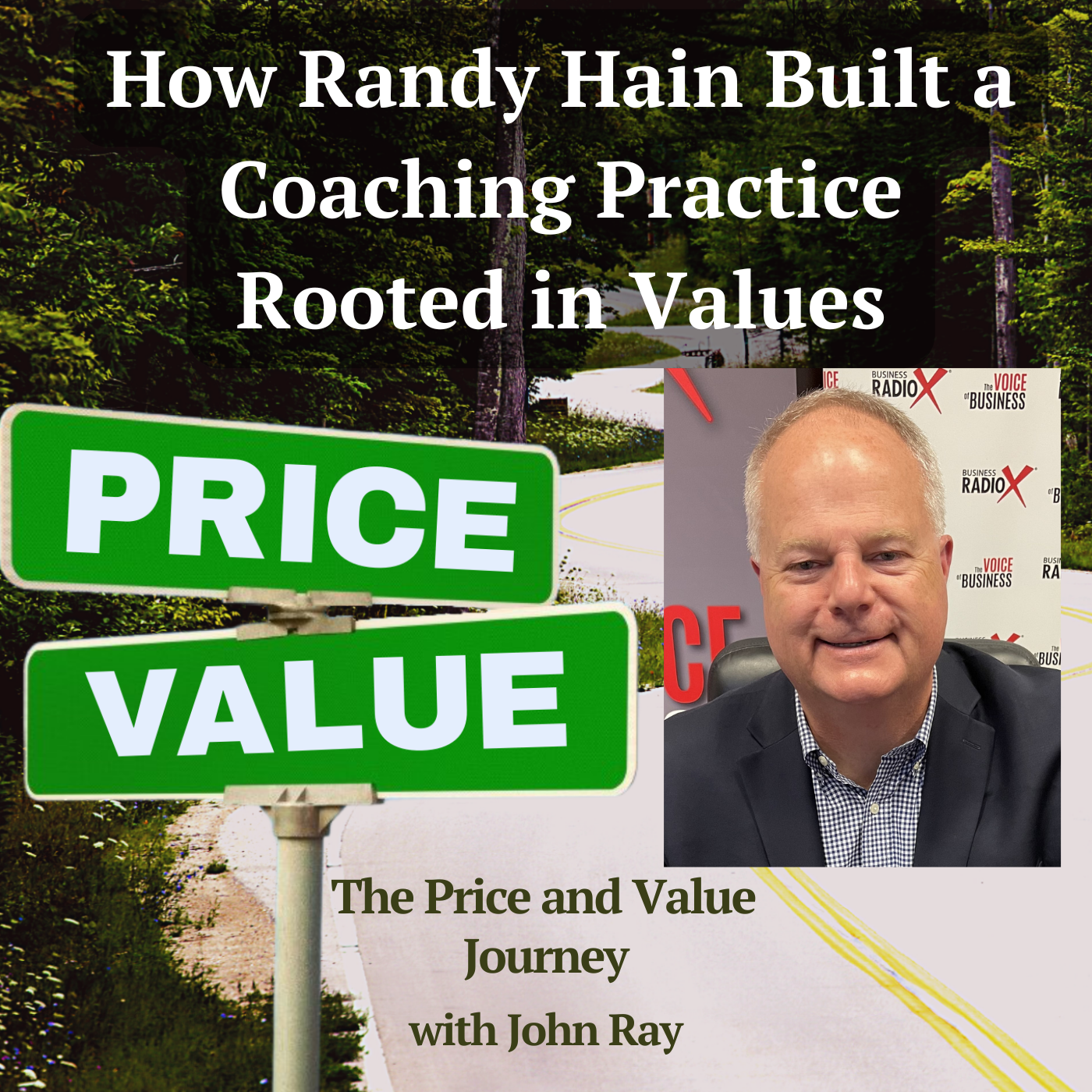
How Randy Hain Built a Coaching Practice Rooted in Values

October 8, 2025 by John Ray

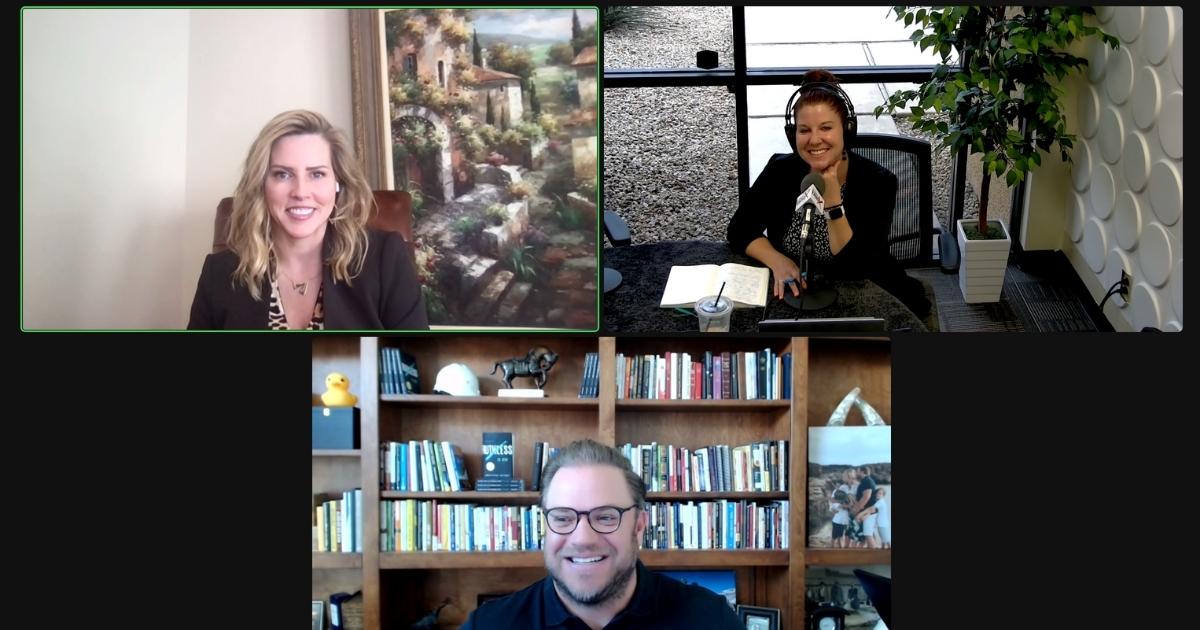
How Randy Hain Built a Coaching Practice Rooted in Values, on The Price and Value Journey podcast with host John Ray
North Fulton Studio
How Randy Hain Built a Coaching Practice Rooted in Values
Loading
00:00 /
RSS Feed
Share
Link
Embed

Download file

How Randy Hain Built a Coaching Practice Rooted in Values, on The Price and Value Journey podcast with host John Ray

How Randy Hain Built a Coaching Practice Rooted in Values (The Price and Value Journey, Episode 150)

What does it take to build a thriving executive coaching and leadership firm that reflects your values as much as your ambition?

In this episode of The Price and Value Journey podcast, host John Ray talks with Randy Hain, founder of Serviam Partners, about how he built his coaching practice from the ground up after decades as a senior executive. Randy shares how his corporate career at companies like Waffle House and a national search firm prepared him to launch Serviam, what he learned about risk, client trust, and discernment, and why his guiding principle is to create independence, not dependence, in every coaching relationship.

The discussion covers everything from building a values-based business, forming a long-term partnership with Brandon Smith at The Leadership Foundry, writing twelve books, managing time intentionally, and integrating faith, family, and work.

For anyone building a service-based business, Randy’s story offers a clear model for doing meaningful work without losing yourself in the process.

The Price and Value Journey is presented by John Ray and produced by North Fulton Business Radio, LLC, an affiliate of the Business RadioX® podcast network.

Key Takeaways You Can Use from This Episode

  • You don’t need a certification to start if you have experience, credibility, and a track record of results.
  • The best marketing is client advocacy; Randy’s 285 LinkedIn recommendations drive his business.
  • Clarity, candor, and customization build lasting client trust.
  • True coaching helps clients become independent, not reliant on you.
  • Partnerships work when they’re built on shared values, clear structure, and mutual respect.
  • Time management is a leadership discipline—intentional scheduling makes balance possible.
  • Writing sharpens thinking; journaling fuels content that attracts ideal clients.
  • Legacy isn’t built with resume lines. It’s the ripple of impact you leave in others.

Topics Discussed in this Episode

00:00 Welcome to The Price and Value Journey podcast
00:48 Introducing Randy Hain: Founder of Serviam Partners
02:27 Randy’s Career Journey: From Retail to Executive Coaching
04:39 The Decision to Pursue Coaching Full-Time
05:59 The Importance of Experience Over Certifications
09:52 The Secret Sauce of Effective Coaching
16:21 The Leadership Foundry: A Unique Partnership
23:09 The Role of Great Virtual Assistants
24:46 Randy’s Writing Journey
28:53 Reflecting on Assumptions and Writing Process
30:03 Journaling and Stimulating Creativity
31:34 Prolific Writing and Publishing Strategies
32:23 Challenges with Traditional Publishing
33:02 Reverse Engineering Content for Books
36:38 The Role of an Editor
38:19 Concerns and Uses of AI in Writing
42:59 Intersection of Faith and Business
46:07 Advice for Younger Professionals
49:22 Legacy and Eulogy Virtues
53:31 Final Thoughts and Closing Remarks

Randy Hain, Serviam Partners and the Leadership Foundry

Randy Hain, on The Price and Value Journey podcsat with host John Ray
Randy Hain

Randy Hain is the founder and president of Serviam Partners and the co-founder of the Leadership Foundry.

With a successful 30-plus-year career in senior leadership roles, corporate talent, and executive search, Randy is a sought-after executive coach for senior leaders at some of the best-known companies in the U.S. and globally who are seeking candid and expert guidance on how to overcome obstacles to their success or develop new leadership skills.

Randy is also an expert at onboarding senior executives, as well as coaching senior leadership teams to improve trust, alignment, collaboration, and candid communication. His deep expertise as a former senior executive and his years as a proven and successful executive coach for leaders around the world are true areas of differentiation for him and Serviam Partners.

Randy is a husband, father, and active community leader and serves on the boards of the causes he cares about most. He is particularly passionate about elevating autism awareness and investing in the next generation of leaders.

Randy has earned a reputation as a creative business partner and a generous thought leader through his books, articles, and speaking engagements. Randy is the award-winning author of 12 books, including the brand new Practical Virtue: An Actionable Guide to Help You Become a Leader Worth Following.

LinkedIn

John Ray, Host of The Price and Value Journey
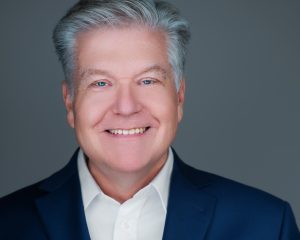
John Ray, Author of The Generosity Mindset and Host of The Price and Value Journey

John Ray is the host of The Price and Value Journey.

John owns Ray Business Advisors, a business advisory practice. John’s services include business coaching and advisory work, as well as advising solopreneurs and small professional services firms on their pricing. John is passionate about the power of pricing for business owners, as changing pricing is the fastest way to change the profitability of a business. His clients are professionals who are selling their expertise, such as attorneys, CPAs, accountants and bookkeepers, consultants, coaches, marketing professionals, and other professional services practitioners.

John is a podcast show host and the owner of North Fulton Business Radio, LLC, an affiliate of Business RadioX®. John and his team work with B2B professionals to create and conduct their podcast using The Generosity Mindset® Method: building and deepening relationships in a non-salesy way that translates into revenue for their business.

John is also the host of North Fulton Business Radio. With over 900 shows and having featured over 1,300 guests, North Fulton Business Radio is the longest-running podcast in the North Fulton area, covering business in its region like no one else.

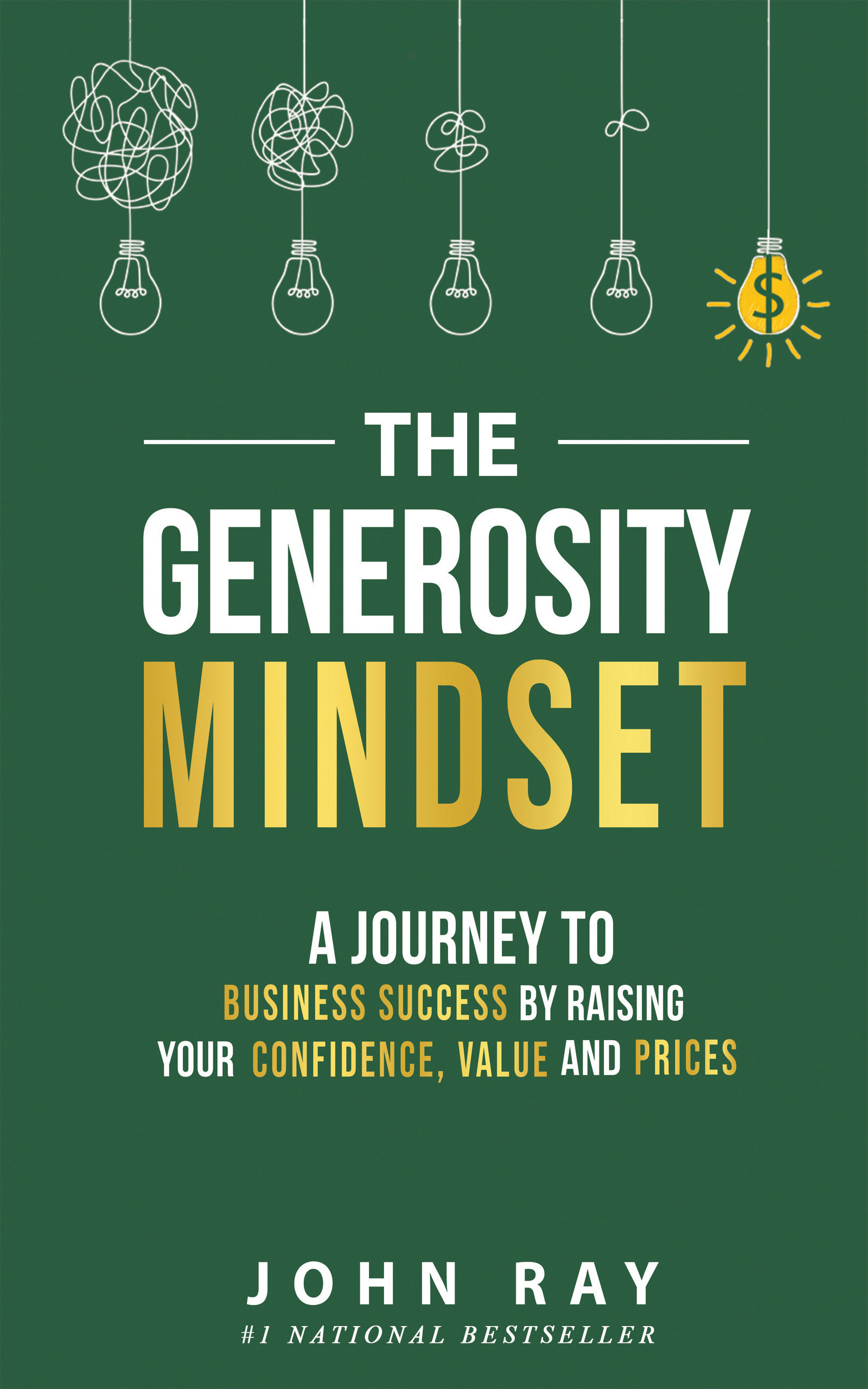
John’s book, The Generosity Mindset: A Journey to Business Success by Raising Your Confidence, Value, and Prices

John Ray at Barnes & Noble with his book, The Generosity MindsetJohn Ray is the author of the five-star rated book The Generosity Mindset: A Journey to Business Success by Raising Your Confidence, Value, and Prices, praised by readers for its practical insights on raising confidence, value, and prices.

If you are a professional services provider, your goal is to do transformative work for clients you love working with and get paid commensurate with the value you deliver to them. While negative mindsets can inhibit your growth, adopting a different mindset, The Generosity Mindset®, can replace those self-limiting beliefs. The Generosity Mindset enables you to diagnose and communicate the value you deliver to clients and, in turn, more effectively price to receive a portion of that value.

Whether you’re a consultant, coach, marketing or branding professional, business advisor, attorney, CPA, or work in virtually any other professional services discipline, your content and technical expertise are not proprietary. What’s unique, though, is your experience and how you synthesize and deliver your knowledge. What’s special is your demeanor or the way you deal with your best-fit clients. What’s invaluable is how you deliver outstanding value by guiding people through massive changes in their personal lives and in their businesses that bring them to a place they never thought possible.

Your combination of these elements is unique in your industry. There lies your value, but it’s not the value you see. It’s the value your best-fit customers see in you.

If pricing your value feels uncomfortable or unfamiliar to you, this book will teach you why putting a price on the value your clients perceive and identify serves both them and you, and you’ll learn the factors involved in getting your price right.

The book is available at all major physical and online book retailers worldwide. Follow this link for further details.


Connect with John Ray:

Website | LinkedIn | Twitter

Business RadioX®:  LinkedIn | Twitter | Facebook | Instagram

Tagged With: building a coaching practice, business of coaching, client relationships, Entrepreneurship, eulogy virtues, executive coaching, intentional leadership, John Ray, Leadership consulting, legacy, partnership strategy, professional services, Randy Hain, resume virtues, Servant Leadership, Serviam Partners, The Leadership Foundry, The Price and Value Journey, values-based business, work-life integration, writing for impact

Embracing Ally Leadership, with Becky Berry, Becky Berry Coaching

August 21, 2024 by John Ray

Embracing Ally Leadership, with Becky Berry, Becky Berry Coaching, on North Fulton Business Radio with host John Ray
North Fulton Business Radio
Embracing Ally Leadership, with Becky Berry, Becky Berry Coaching
Loading
00:00 /
RSS Feed
Share
Link
Embed

Download file

Embracing Ally Leadership, with Becky Berry, Becky Berry Coaching, on North Fulton Business Radio with host John Ray

Embracing Ally Leadership, with Becky Berry, Becky Berry Coaching (North Fulton Business Radio, Episode 797)

In this episode of North Fulton Business Radio, host John Ray welcomes leadership coach Becky Berry. Becky shares insights on ally leadership, contrasting it with mentorship and servant leadership. She discusses the importance of agency, promoting inclusivity, and supporting underrepresented employees. Becky also outlines her “Seven Commitments of Female Leadership” and shares a compelling success story. This episode offers valuable advice for emerging women leaders and emphasizes the significance of allies in fostering a thriving work environment.

John Ray is the host of North Fulton Business Radio. The show is recorded and produced from the North Fulton studio of Business RadioX® inside Renasant Bank in Alpharetta.

Becky Berry, Becky Berry Coaching

Becky Berry, Becky Berry Coaching

Becky Berry is an Executive Career Coach coach whose mission is to help women reach the potential they’re afraid to admit that they have.

To do that, she empowers women to own their personal impact and the impact of their work. She facilitates their ability to speak fluently, without hesitation, about both. Her specialty is using language to gift clients with a clear understanding of their own gifts and power. She supports women as they create rich, meaningful work and home lives on their own terms.

Becky has experienced several crossroads in her life, including careers as magazine publisher, software entrepreneur, stay-at-home mom, special education teacher, social entrepreneur, and widowhood. Her life and work experiences allow her to provide uniquely empowering and supportive coaching to women at all stages of their lives.

Becky also produces and cohosts She’s Not Done Yet: Conversations with Women Over 50, available wherever you listen to podcasts, including Apple Podcasts and Spotify. She lives in the northern suburbs of Atlanta, GA.

Website | LinkedIn | Instagram | Facebook

Topics Discussed in this Episode

00:00 Introduction and Welcome
01:33 Meet Becky Berry: Executive and Career Coach Extraordinaire
02:29 The Evolution of Becky’s Coaching Practice
04:45 Leadership Coaching: Becky’s Sweet Spot
08:42 The Concept of Ally Leadership
22:18 Commitments of Female Leadership
24:29 Survey on Women’s Leadership Preferences
24:57 The Importance of Agency and Authenticity
25:33 Role Models and Vulnerability in Leadership
27:13 Recognizing and Elevating Unrecognized Talent
28:02 Promoting Diversity for Business Success
29:30 The Business Case for Diversity
33:11 Personal Leadership Coaching Success Stories
34:35 How to Engage with Becky Berry’s Services
41:08 Conclusion and Contact Information

Renasant Bank and Casa Nuova Italian Restaurant support North Fulton Business Radio

Renasant BankRenasant Bank has humble roots, starting in 1904 as a $100,000 bank in a Lee County, Mississippi, bakery. Since then, Renasant has become one of the Southeast’s strongest financial institutions, with over $13 billion in assets and more than 190 banking, lending, wealth management, and financial services offices in Mississippi, Alabama, Tennessee, Georgia, and Florida. All of Renasant’s success stems from each of their banker’s commitment to investing in their communities as a way of better understanding the people they serve. At Renasant Bank, they understand you because they work and live alongside you every day.

Casa Nuova Italian RestaurantCasa Nuova is a proud family-owned and operated restaurant, serving classic, authentic and traditional Italian cuisine and top tier hospitality since 1998.

Casa Nuova is a cook-to-order kitchen, serving traditional fare including pasta, chicken, seafood, veal, vegetarian and gluten-free options, plus daily specials. They are a farm-to-table establishment, meaning that in the summertime, they cultivate their own vegetables in their garden, steps away from the restaurant, including tomatoes, corn, peppers, zucchini, sunflowers and more!

Celebrating more than 25 years, Casa Nuova has become a true staple in the Alpharetta area, serving more than three generations of families, including friends old and new, visiting near and far from all over the metro Atlanta area and beyond.

Website | LinkedIn | Facebook | Instagram

About North Fulton Business Radio and host John Ray

With over 790 shows and having featured over 1,200 guests, North Fulton Business Radio is the longest-running podcast in the North Fulton area, covering business in our community like no one else. We are the undisputed “Voice of Business” in North Fulton!

The show welcomes a wide variety of business, non-profit, and community leaders to get the word out about the important work they’re doing to serve their market, their community, and their profession. There’s no discrimination based on company size, and there’s never any “pay to play.” North Fulton Business Radio supports and celebrates business by sharing positive business stories that traditional media ignore. Some media leans left. Some media leans right. We lean business.

John Ray, Business RadioX - North Fulton, and Owner, Ray Business Advisors
John Ray, Business RadioX – North Fulton, and Owner, Ray Business Advisors

John Ray is the host of North Fulton Business Radio. The show is recorded and produced from the North Fulton studio of Business RadioX® inside Renasant Bank in Alpharetta. You can find the full archive of shows by following this link. The show is available on all the major podcast apps, including Apple Podcasts, Spotify, Google, Amazon, iHeart Radio, and many others.

The studio address is 275 South Main Street, Alpharetta, GA 30009.

John Ray, The Generosity MindsetJohn Ray also operates his own business advisory practice. John’s services include advising solopreneurs and small professional services firms on their value, their positioning and business development, and their pricing. His clients are professionals who are selling their expertise, such as consultants, coaches, attorneys, CPAs, accountants and bookkeepers, marketing professionals, and other professional services practitioners.

John is the national bestselling author of The Generosity Mindset: A Journey to Business Success by Raising Your Confidence, Value, and Prices.

Tagged With: agency, ally leadership, authenticity, Becky Berry, Becky Berry Coaching, diversity, John Ray, Leadership, leadership coaching, North Fulton Business Radio, Servant Leadership

Angela Alea, LASSO

September 20, 2023 by John Ray

LASSO
Executive Perspective
Angela Alea, LASSO
Loading
00:00 /
RSS Feed
Share
Link
Embed

Download file

LASSO

Angela Alea, LASSO

Angela Alea, President and Chief Revenue Officer at LASSO, joined Danny Vander Maten to talk sales, leadership, and business. Angela discussed how she’s spent her career in sales despite her initial wariness of the field, how LASSO serves event companies, the impact of the pandemic on their industry, how LASSO survived and deepened client relationships during that difficult period, how she practices servant-leadership, and much more.

Executive Perspective is broadcast and produced by the North Fulton studio of Business RadioX® inside Renasant Bank in Alpharetta.

LASSO

LASSO is the all-in-one platform where event companies work.

They provide project management, inventory, logistics, proposals, and workforce management software that helps event companies:

⇢ Grow revenue ⇢ Streamline operations ⇢ Control costs ⇢ Minimize risk ⇢ Get real-time insights ⇢ Attract AV talent ⇢ Produce successful events.

Their mission is to inspire change for forward-thinking companies in the event and entertainment industry by bringing transformative solutions to the people that make exceptional performances happen.

Company website

Angela Alea, President & Chief Revenue Officer, LASSO

Angela Alea, President & Chief Revenue Officer, LASSO

Angela Alea is the president and chief revenue officer of LASSO, the platform where event companies work. LASSO has been recognized on Inc 5000 for the last two years, has been named Best & Brightest Place to work 5 years in a row, and was celebrated as a Technology Fast 500 company by Deloitte.

Although she swore she would never do sales, she has spent the last 20 years in revenue producing roles doing everything from sales, sales training, sales operations, and revenue management.

When she isn’t redefining what sales is, and more importantly what it isn’t, you can find her hanging with her husband, two kids, and their dogs in Alpharetta, a suburb of Atlanta.

LinkedIn

About Executive Perspective

Executive Perspective features executives and business leaders from a wide variety of sectors. Host Danny Vander Maten and his guests cover industry trends, insights, challenges, success strategies and lessons learned.  Executive Perspective is underwritten and presented by Cresa. The show series is produced by the North Fulton studio of Business RadioX® and can be found on all the major podcast apps. A complete show archive can be found here.

Danny Vander Maten, Host of Executive Perspective

Danny Vander Maten, Vice President – Tenant Representation, Cresa, and Host of Executive Perspective

Danny joined Cresa in the Spring of 2016 and brought a diverse background with nearly 10 years of experience in finance, business operations, and strategy to his client’s real estate transactions.

At Cresa, Danny’s primary responsibilities include strategic planning, lease analysis, negotiations, and cost mitigation. As a registered Certified Public Accountant with an active license in the state of Georgia, Danny provides unique financial insight into every critical aspect of the transaction.

Cresa is the world’s most trusted occupier-centric commercial real estate firm. They strategize for the best possible results for occupiers everywhere. Cresa thinks beyond space. Partner without conflict. And apply their integrated expertise to make your business better.

Connect with Danny: LinkedIn | Twitter

Connect with Cresa: Website | LinkedIn | Facebook | Instagram | Twitter

Tagged With: Angela Alea, commercial real estate, Danny Vander Maten, Entertainment Industry, Event Management, Executive Perspective, Lasso, Leadership, pandemic, project management, Servant Leadership

Selfless Leading to Improve Culture E28

October 7, 2022 by Karen

OctoberJonathanandApril
Phoenix Business Radio
Selfless Leading to Improve Culture E28
Loading
00:00 /
RSS Feed
Share
Link
Embed

Download file

E28-Selfless-Leading-to-Improve-Culture

Selfless Leading to Improve Culture E28

From first glance and the start to the podcast, you may not see the amazing alignment and similarities between Jonathan and April. We see them though!

Jonathan and April are both very aligned with growing conscious businesses and supporting people in a very selfless manner. What they do helps people and companies grow; Whether it is Jonathan giving advice to other business leaders about how to grow a business and not being ruthless, or April going into the company to guide and coach them to growing their business through the principles of Generosity Culture. They are both supporting the growth of great conscious and caring leaders.

It was great to hear about their backgrounds getting them to this point where they are now. Jonathan grew up and went into the Real Estate business thinking that he had to be ruthless to make money. April gained experience and knowledge from her time in the military that she is now able to put into place with the work that she does helping companies and leaders.

When asked about the favorite part of her own company’s culture, April said, “My favorite part of my company’s culture is it’s all about helping and empowering others. Everything we do is in service to others’ success.”

When Jonathan was asked about his company culture he told us, “Keyser was built off of 15 core operating principles. We are very clear about that during the hiring process, and because of that, I am confident that each of my team members buys into those beliefs. In fact, many of the current members have joined Keyser because they believed in the principles. This bleeds into how we interact with one another and how we serve our clients.”

If you are looking for a podcast with a few passionate individuals that have a strong stance on improving company culture, being selfless, supporting others- then this is it. The two of them discuss the passion to lead selflessly, the importance of being forthcoming and honest, and building a workplace that is safe and provides courage to disagree. There are stories and examples to listen to in this podcast that are great for all levels of leaders to learn from. Driven-Outcomes-logo

Driven Outcomes is a consulting firm that helps accelerate the revenue growth and culture creation of businesses across industries using the principles of The Generosity Culture.

Working with company CEO’s, Leaders and Entrepreneurs, Driven Outcomes drives unprecedented success by modeling the power of pouring into people, clients and the community.

April-Shprintz-Culture-CrushApril Shprintz is a Business Accelerator, Speaker, host of the Winning Mindset Mastery Podcast and the Author of Magic Blue Rocks, the Secret to Doing Anything, a book about the life changing impact of a winning mindset.

After spending 20 great years in a variety of industries solving problems, driving growth, and accelerating companies, April realized helping people is who she is, not just what she does. Generating over $1 Billion dollars in combined revenue, April left corporate America after her highest earning 7-figure year to form her own company and expand her impact.

The creator of The Generosity Culture®, April lives her dream helping innovators and leaders grow their businesses through a combination of pouring into their people, their clients, and their community.

A proud veteran, April served for nearly 7 years in the Air Force as a Television News Anchor and Executive Producer. She’s a graduate of the University of Maryland and holds an MBA from the University of Texas.

Connect with April on LinkedIn, Facebook, Twitter and Instagram.

Keyser-logo

Keyser is one of the country’s most innovative and trustworthy technology-enabled occupier services commercial real estate firms. Keyser’s advisors assist occupiers of space with their commercial real estate needs, including leasing, purchasing, constructing, or disposing of facilities.

Keyser specializes in helping tenants leverage A.I. and market expertise to secure commercial real estate incentives and attract today’s workforce while reducing cost & risk. Whether it’s managing, negotiating, or assisting with commercial real estate strategy, our advisors take pride in serving our clients.

Jonathan-KeyserJonathan Keyser is the founder of Keyser (http://www.keyser.com/), one of the most innovative and trustworthy technology-enabled occupier services commercial real estate firms in the country. Along with their international partners, they have over 560 people worldwide.

Jonathan is a #1 Wall Street Journal Best Selling Author for his book, “You Don’t Have to be Ruthless to Win”, and he was named “The Commercial Real Estate Disruptor” by USA Today. He has also been named a “Top Social Capital CEO” by the International Business Times, is a highly sought after keynote speaker, a thought leader featured in over 150 articles, publications, and podcasts, and during the pandemic was recognized as one of the “Top 20 Virtual Keynote Speakers” in the country.

As an entrepreneur himself, Jonathan has built Keyser into an eight-figure firm named recently as one of the Top 50 Most Trustworthy Companies in America by The Silicon Review.

Today through his 6,7,8 Selfless Leadership workshop series, he helps other business leaders activate the three levels of reinvention to boost profits while increasing client and employee retention. Jonathan’s efforts to change the business world through selfless service manifest in his content, thought leadership, and the level of excellence he holds his team to within Keyser.

Connect with Jonathan on LinkedIn, Facebook, Twitter and Instagram.

About Culture Crush

Culture is not just a tag word to be thrown around. It is not something you throw in job descriptions to draw people to applying for jobs within a company.

According to Marcus Buckingham and Ashely Goodall in their book Nine Lies About Work, “Culture is the tenants of how we behave. It’s like a family creed. This is how we operate and treat each other in the family.”CultaureCrushKindraBanner2

As a growing company- Culture Crush Business Podcast is THE culture improvement resource that supports companies and leaders.  Our Mission is to improve company cultures so people WANT to go to work. Employees and leaders should like where they work and we think this is possible.

Within the company: Culture Crush has Vetted Resources and Partnerships with the right people and resources that can help improve your company culture.

On this podcast:  We focus on everything surrounding businesses with good company culture. We will talk with company leaders to learn about real-life experiences, tips, and best practices for creating a healthy work environment where employees are finding joy and satisfaction in their work while also striving and growing within the company.  We also find the companies that offer resources to help improve company culture and showcase them on the show to share their tips and tricks for growing culture.

About the Host

ABHOUTHOSTHEADSHOT

Kindra Maples  is spartan racer, past animal trainer, previous magician’s assistant, and has a weakness for Oreo cookie shakes. Her journey working with people actually started working with animals as a teenager (don’t worry we won’t go that far back for her bio).

She worked for over 15 years in the zoo industry working with animals and the public. Her passion of working with animals shifted into working with people in education, operations and leadership roles. From there her passion of leadership and helping people develop has continued to grow.

Then came the opportunity for leading  the Culture Crush Business Podcast and she jumped on it. Leadership, growth, and strong company cultures are all areas that Kindra is interested in diving into further.

Shout Outs

We want to thank a few people for their behind the scenes effort in helping this relaunch to come to life. James Johnson with Tailored Penguin Media Company LLC.– It is a small, but powerful video production company with a goal to deliver the very best by articulating the vision of your brand in a visually creative way. Gordon Murray with Flash PhotoVideo, LLC. -Flash Gordon has been photographing since high school and evolving since then with new products that will equip, encourage, engage, and enable. Renee Blundon with Renee Blundon Design – She is not only one of the best free divers (that’s not how she helped with the podcast) but she is great with graphics design and taking the direction for the vision that you have while also adding creative ideas to bring to your vision to life.

These are just a few of the folks that supported the relaunch of the podcast. If you would like to be part of the Culture Crush team or would like to support underwriting the show- please reach out: info@culturecrushbusiness.com

Tagged With: business accelerator, coachability, commercial real estate, commercial real estate brokerage, leadership development, scottsdale commercial real estate, selfless service, Servant Leadership, The Generosity Culture, Winning Mindset

E98 Getting (Sh)It Done with Bruno Morgante

March 9, 2022 by Karen

E98-Getting-ShIt-Done-with-Bruno-Morgante-feature
Phoenix Business Radio
E98 Getting (Sh)It Done with Bruno Morgante
Loading
00:00 / 51:21
RSS Feed
Share
Link
Embed

Download fileDuration: 51:21

E98-Getting-ShIt-Done-with-Bruno-Morgante

E98 Getting (Sh)It Done with Bruno Morgante

In this episode of Project Management Office Hours, Bruno Morgante and PMO Joe discussed Bruno’s career in the PMO space, PM Training, and the powerful impact of Mentoring.

Bruno’s unique story and path to PMO leadership started not within the Project Management field rather promoting concerts back in his home country of Italy. Those early career experiences were setting the stage for a distinguished Project Management career as he learned the importance of Stakeholder Management, Negotiation, Influence, Budgeting, Planning, and Teamwork.

Bruno shared that he enjoys solving problems, inspiring others, and accomplishing his goals. He is an outcomes driven leader who solves problems and delivers results. Bruno is also deeply invested in mentoring. As a Mentor, he helps young individuals and people in need by providing ‘pro bono’ guidance, support and advice about Leadership, Personal Development, Career Development, PMO, Portfolio, Program and Project Management.

The mutual growth Bruno and the mentees have is a truly enriching experience. It’s a conversation where you get with somebody that has been where you are going. It’s an opportunity for you to be able to listen to what they have done in their career. “That was when I decided that I absolutely wanted to give back to society. So, I decided to carve out a lot of my free time to support people. Then, I started doing much more mentoring, Pro-Bono mentoring online on different platforms, of course, like the mentoring club being the biggest one, which is a nonprofit organization based here in Berlin.” -Bruno

As a #IamRemarkable Certified Facilitator, Bruno is part of a global community of people who are passionate about helping women and underrepresented groups promote themselves in the workplace and beyond.

Connect with Bruno:

LinkedIn https://www.linkedin.com/in/brunomorgante/

To catch up on previous episodes or see the guest list for upcoming shows visit the Project Management Office Hours website – https://www.thepmosquad.com/podcast

Thank you to THE PMO SQUAD and The PMO Leader for sponsoring this show.

The PMO Squad is a leading provider of PMO and Project Management services in the US. They assist clients building and improving PMOs, provide Project Management Consulting services, deliver custom Project Management Training and provide Project Management staffing services.

Learn more about The PMO Squad – www.thepmosquad.com

Where do PMO Leaders go for Information, Learning, Networking and Services? The PMO Leader community has “Everything You Need to Become a Great PMO Leader”. One PMO World, One Community!

Learn more about The PMO Leader – www.thepmoleader.com

The-Adecco-Group-BrandMarkLandRGBHorizontal

The Adecco Group is the world’s leading talent advisory and solutions company. They are driven by a powerful purpose – making the future work for everyone. Their services help people fulfil – and exceed – their potential, building employability and connecting people with opportunities. Their solutions enable their clients to optimise their talent needs and organisational models to achieve their goals. While their advocacy and firm commitment to operating responsibly aims to build a better world of work for all.

Every year, their 30,000+ colleagues worldwide enable millions of people to succeed in the world of work, and support more than 100,000 organisations with their human capital needs. The Adecco Group upskill and reskill more than half a million people annually, enhancing employability and accelerating careers. They build and incubate capabilities in areas where persistent skills shortages exist and connect that talent to organisations to power their success.

As a leader in the world of work, they have taken a leadership role in advancing the HR sector. From ensuring responsible and ethical business practices, to advocating for a new social contract that protects all workers, and all forms of work – permanent, temporary or freelance. These are just a few of the ways The Adecco Group is proud to be leading the industry forward.

Across the world, The Adecco Group help businesses optimise their talent and transform their workforces, and build the employability of people. This is making the future work.

Bruno-Morgante-Project-Management-Office-HoursYou can find Bruno Morgante somewhere in between solving problems, inspiring others, working on himself, dodging negativity and crushing his goals. In everything he does, he believes in challenging the status quo, to improve processes, get better results and set things in order.

He listens carefully, he works with people, he communicates clearly and he believes in the power of positive attitude. He solves problems and deliver results. He leads an amazing team of Project Managers, Portfolio Managers and PMO Specialists focused on delivering projects on target, on time and on costs.

He has over 16 years of experience in large multinational conglomerates, consistently delivering business results, improving processes, building and leading successful teams and managing multiple projects simultaneously.

He is an entrepreneur in his core and the years spent organizing live concerts while in parallel graduating in Engineering, are a vivid picture in his mind and an unforgettable experience that marked Bruno forever. Bruno believes that if you are doing well enough, it is your responsibility to help others.

As a Mentor, he helps young brilliant individuals and people in need, by providing pro bono guidance, support and advices about Leadership, Personal Development, Career Development, PMO, Portfolio, Program and Project Management. The mutual growth Bruno and the mentees have, is a truly enriching experience.

As a #IamRemarkable Certified Facilitator, Bruno is part of a global community of people who are passionate about helping women and underrepresented groups promote themselves in the workplace and beyond.

ABOUT PROJECT MANAGEMENT OFFICE HOURS SERIES

Project Management Office Hours is intended to provide Project Management professionals a place to drop in and discuss Success Stories, Best Practices, and Lessons Learned.  Project Management Consultant Joy Gumz has shared with us, “Operations keep the lights on, strategy provides the light at the end of the tunnel, but project management is the train engine that moves the organization forward.”

Each of us has a unique story to tell, but collectively we share a message that organizations who embrace Project Management Best Practices perform better than those which don’t.  Organizations which align Projects to Strategy perform better.  Organizations with Engage Executive Sponsors deliver better results.  Organizations which measure Project Management performance outperform those which don’t.

During our Project Management Office Hours, we hear directly from Industry leaders how to make an impact in our profession. How we, collectively, will Advance Project Management Best Practices, One Listener at a time! 

ABOUT YOUR HOST

Joe Pusz started THE PMO SQUAD to bring real world PMO Leadership experience to the consulting space and to advocate for Project Management through his blog PMOJOE.com. The old saying is “Do what you love and you’ll never work a day in your life.” Following this mindset Joe left Corporate America in 2013 to start THE PMO SQUAD and work with fellow Natural Born Project Managers to advance Project Management Best Practices.

ABOUT OUR SPONSOR

THE PMO SQUAD focuses exclusively on PMO and Project Management consulting. Corporate America is full of Accidental Project Managers running projects who haven’t been trained to be PMs. To help solve this problem THE PMO SQUAD is on the Leading Edge with PMO As a Service. PMO As a Service allows our clients to focus on their respective core competencies while THE PMO SQUAD delivers Project Management expertise. Contact Joe at 678-591-7868. Follow The PMO Squad on LinkedIn, Twitter and Facebook.

Where do PMO Leaders go for Information, Learning, Networking and Services? The PMO Leader community has “Everything You Need to Become a Great PMO Leader”. One PMO World, One Community! Learn more about The PMO Leader – www.thepmoleader.com

Tagged With: make it happen, mentoring, PMO, project management, Servant Leadership

Decision Vision Episode 80: Should I Become a Servant Leader? – An Interview with Mark Bachmann, McCracken Alliance Partners

August 27, 2020 by John Ray

servant leader
Decision Vision
Decision Vision Episode 80: Should I Become a Servant Leader? - An Interview with Mark Bachmann, McCracken Alliance Partners
Loading
00:00 /
RSS Feed
Share
Link
Embed

Download file

Decision Vision Episode 80: Should I Become a Servant Leader? – An Interview with Mark Bachmann, McCracken Alliance Partners

What does being a servant leader mean? How does servant leadership really work in managing an organization? Mark Bachmann joins host Mike Blake to discuss these questions and much more. “Decision Vision” is presented by Brady Ware & Company.

Mark Bachmann, McCracken Alliance Partners

McCracken Alliance Partners (MAP) is focused on providing financial leadership services including full time or interim CFO’s as well as experienced professionals to lead critical strategic initiatives or transactions. MAP is comprised of experienced public and private company CFO’s whose skills and knowledge can create immediate value. Additionally, some of the partners are experienced executive coaches providing relevant, actionable counsel to existing CFO’s.

Mark R. Bachmann has a broad business background including both Division President and CFO of a public company. Currently, Mr. Bachmann is a Partner with McCracken Alliance Partners, providing financial leadership services as well as President of The Bachmann Group where he is an Executive Coach to CFOs to help them to accelerate their performance.

Previously, Mr. Bachmann was Executive Vice President and Chief Financial Officer of Zep Inc. ($700 million publicly traded chemical company) from 2005 until 2015 and retired when Zep was sold to a private equity firm.

During his tenure as CFO for Zep, Mr. Bachmann was instrumental in the spin-off of Zep from its parent, (Acuity Brands, Inc. NYSE:AYI) and prepared the Company to go public in the fall of 2007. After the spin-off, Mr. Bachmann played a critical role in restructuring the business post-recession and developing its growth strategy. Beginning in 2010, Mr. Bachmann led the company through seven acquisitions with total revenues of $235 million that reshaped the portfolio. He refinanced the business twice ensuring liquidity to support its strategies. Mr. Bachmann was also critical in selling the company in 2015 by supporting the marketing, due diligence and financing processes. He led the company through crisis communications and business continuity plan following a fire at a major production facility and was the primary individual negotiating a $50+ million settlement with the insurance companies.

Prior to becoming CFO at Zep, Mr. Bachmann held a number of other executive leadership positions in Operations and Finance within the Company or its predecessor parent companies.

Earlier in his career, Mr. Bachmann was associated with The Quaker Oats Company ($6 billion publicly-traded Consumer Packaged Goods Company) where he held nine different financial management positions of increasing responsibility including both domestic and international assignments. He began his career as an auditor at Deloitte.

Mr. Bachmann is currently serving on the Board of Trustees, Treasurer and on the Development and Endowment Committees of his religious institution. He is serves on the Operating Committee as the immediate Past President of CEO Netweavers, a not-for-profit professional organization in Atlanta, as well as on the Leadership Council for Junior Achievement of Atlanta.

Mr. Bachmann has invested significant time and effort in leadership development and strengthening the finance function within the companies he has led, as well as in the community. He was Executive in Residence at Georgia State University and on their Board of Advisors for the Master of Science in Finance Program as well as previously served as Co-Chairman of its CFO Council. Mr. Bachmann is a frequent lecturer at universities and professional organizations. He has and continues to mentor and coach a number of finance professionals.

Mr. Bachmann received his Bachelor of Science degree in accounting from the University of Illinois and his MBA from Northwestern University.

Michael Blake, Brady Ware & Company

Mike Blake, Host of the “Decision Vision” podcast series

Michael Blake is Host of the “Decision Vision” podcast series and a Director of Brady Ware & Company. Mike specializes in the valuation of intellectual property-driven firms, such as software firms, aerospace firms and professional services firms, most frequently in the capacity as a transaction advisor, helping clients obtain great outcomes from complex transaction opportunities. He is also a specialist in the appraisal of intellectual properties as stand-alone assets, such as software, trade secrets, and patents.

Mike has been a full-time business appraiser for 13 years with public accounting firms, boutique business appraisal firms, and an owner of his own firm. Prior to that, he spent 8 years in venture capital and investment banking, including transactions in the U.S., Israel, Russia, Ukraine, and Belarus.

Brady Ware & Company

Brady Ware & Company is a regional full-service accounting and advisory firm which helps businesses and entrepreneurs make visions a reality. Brady Ware services clients nationally from its offices in Alpharetta, GA; Columbus and Dayton, OH; and Richmond, IN. The firm is growth minded, committed to the regions in which they operate, and most importantly, they make significant investments in their people and service offerings to meet the changing financial needs of those they are privileged to serve. The firm is dedicated to providing results that make a difference for its clients.

Decision Vision Podcast Series

“Decision Vision” is a podcast covering topics and issues facing small business owners and connecting them with solutions from leading experts. This series is presented by Brady Ware & Company. If you are a decision maker for a small business, we’d love to hear from you. Contact us at decisionvision@bradyware.com and make sure to listen to every Thursday to the “Decision Vision” podcast.

Past episodes of “Decision Vision” can be found at decisionvisionpodcast.com. “Decision Vision” is produced and broadcast by the North Fulton studio of Business RadioX®.

Visit Brady Ware & Company on social media:

LinkedIn:  https://www.linkedin.com/company/brady-ware/

Facebook: https://www.facebook.com/bradywareCPAs/

Twitter: https://twitter.com/BradyWare

Instagram: https://www.instagram.com/bradywarecompany/

Show Transcript

Intro: [00:00:01] Welcome to Decision Vision, a podcast series focusing on critical business decisions. Brought to you by Brady Ware & Company. Brady Ware is a regional full service accounting and advisory firm that helps businesses and entrepreneurs make visions a reality.

Mike Blake: [00:00:21] And welcome to Decision Vision, a podcast giving you, the listener, clear vision to make great decisions. In each episode, we discuss the process of decision making on a different topic from the business owner’s or executive’s perspective. We aren’t necessarily telling you what to do, but we can put you in a position to make an informed decision on your own and understand when you might need help along the way.

Mike Blake: [00:00:39] My name is Mike Blake and I’m your host for today’s program. I’m a director at Brady Ware & Company, a full service accounting firm based in Dayton, Ohio. With offices in Dayton, Columbus, Ohio, Richmond, Indiana, and Alpharetta, Georgia. Brady Ware is sponsoring this podcast, which is being recorded in Atlanta for social distancing protocols. If you like this podcast, please subscribe on your favorite podcast aggregator. And please consider leaving a review of the podcast as well.

Mike Blake: [00:01:05] Today’s topic is, should I become a servant leader? And we’ll get into definitions in a moment. But, you know, as we record this on July 31st, which means it’ll probably show up sometime around Labor Day if our current publishing schedule holds, I think we’re being confronted right now with the notion of servant leadership every day. And I don’t want to make this a political discussion. It’s not going to be a political discussion, if I have anything to say about it.

Mike Blake: [00:01:44] But nevertheless, we’re being confronted right now, in particular in the private sector, so what is the role of the company in society? And, you know, the notion of shareholder primacy in the company, the thesis of why a company should exist. Meaning that, companies exist to provide return for shareholders – financial return to shareholders, full stop, period, end of discussion is now, I think, being widely challenged. And there’s been a challenge to it, I think, that’s been bubbling up the last ten years as millennials come of age and start to become not only highly sought after employees and contributors to companies and organizations, but now are becoming executives and owners of organizations.

Mike Blake: [00:02:41] By the way, if you want to feel old, have the kid of one of your friends ask to connect with you on LinkedIn. I don’t think anything has made me feel older. And I turned 50 a couple of months ago. That was not as devastating as the kid of one of my peers connected with me on LinkedIn. Not Facebook, not Instagram, but on LinkedIn. That was jarring.

Mike Blake: [00:03:04] But anyway, the notion of what leadership is right now, I think, is being redefined in real time or at least is being re-examined on a society and an economy wide level in real time. Now, does that mean that everybody’s going to change? No, I don’t think so. Does that mean, I think, our entire society is going to be upended and we’re going to move from whatever dominant leadership style we think we have. I think it’s actually fragmented. But whatever leadership style you think prevails in society, is that going to be converted wholesale into something else? No, I don’t.

Mike Blake: [00:03:46] But I do think what’s happening is that alternative leadership approaches are necessarily being given a second look, for no other reason, because with the exception of close family and friends, this is assuming that you’re in the camp that thinks that social distancing is important. And again, if it’s not important to you, okay. But be safe. But for those of us for whom it is important, it means that almost every relationship we have, especially business relationship, has been disrupted. It is harder to sell. It is harder to hire, to recruit, to train, to motivate, to inspire. And the one thing that, I think, we know for certain is that what worked and what we were comfortable with on January 31st, 2020 is not going to be the same thing that we’re going to be – we need to be comfortable with and effective on July 31st, 2020. And so, that’s why I think this topic is of particular interest and is timely today.

Mike Blake: [00:05:04] And joining us today is a person that I think is a terrific example of a servant leader and is a person who’s going to tell you through his own story. It didn’t necessarily come out of the chute as it certainly is. There’s an origin story there that, I think, we’re all going to benefit from. Because if we didn’t consider ourselves servant leaders or maybe we’re not even familiar with the term until very recently, it’s not too late to become that if that resonates with the kind of leader that you want to be and you need to be, given the new environment that may or may not return to what we enjoyed, again, about a-half-a-year ago.

Mike Blake: [00:05:51] So, joining us today is Mark Bachmann, who is a partner at MacCracken Alliance Partners. And they are focused on providing financial leadership services, including full time or interim CFOs, as well as experienced professionals to lead critical strategic initiatives or transactions. MAP is comprised of experienced public and private company CFOs, whose skills and knowledge can create immediate value. Additionally, some of the partners are experienced executive coaches providing relevant, actionable counsel to existing chief financial officers.

Mike Blake: [00:06:20] Mark has a broad business background, including both division president and CFO of a public company. He’s currently, as I said, a partner with MacCracken Alliance Partners. And he’s also an executive coach to chief financial officers to help them accelerate their performance. Mark demonstrates strong business acumen with solid conceptual and analytical thinking to lead enterprise critical initiatives. He is a highly effective, trusted advisor in working with CEOs, boards, senior management teams, and strategic partners with a collaborative and participatory management style, common stable influence, and sharp focus on value creation and organizational integrity.

Mike Blake: [00:06:58] Mark is currently serving on the Board of Trustees as treasurer and on the Development Endowment Committees of his religious institution. He serves on the operating committee and is the immediate past president of CEO Netweavers – of which I’m a member and how we know each other – a not-for-profit professional organization in Atlanta as well as on the Leadership Council for Junior Achievement of Atlanta. Mark earned his Bachelor of Science degree in accounting from the University of Illinois and his MBA from Northwestern University. Mark, welcome to the program.

Mark Bachmann: [00:07:29] Thank you, Mike. You did a nice job there. I appreciate it.

Mike Blake: [00:07:33] Thanks. I hope I got the right bio. Because, otherwise, we’ll have to record this again. Given the accounting industry, I’d be remiss. You don’t want a job as a tax accountant right now, do you?

Mark Bachmann: [00:07:45] I did that for one busy season – and that was enough – many years ago.

Mike Blake: [00:07:51] That’s enough for a lot of people. I thank goodness that I’m not an accountant, even though I work for an accounting firm. That, you know, seeing how people went through or go through a busy season and then this year where it, basically, got dragged out through July. They are better people than I am. I’ll just leave it at that.

Mark Bachmann: [00:08:10] Yeah, yeah, yeah. I don’t even do my own taxes anymore.

Mike Blake: [00:08:14] There you go. And neither do I, so I’m not in jail. So, Mark, let’s start with a basic definition, because I don’t think everybody necessarily knows what the term servant leadership means. How would you define it?

Mark Bachmann: [00:08:30] So, I think the phrase servant leadership probably goes back to the early 1970s when a gentleman by the name of Robert Greenleaf wrote an essay entitled The Servant as Leader. I think he goes on to say that as a philosophy and a set of practices that enriches the lives of individuals and build better organizations. But it’s really the focus that the servant leader is servant first, and they want to serve, and serve first.

Mark Bachmann: [00:09:04] And that’s sharply different than a leader who considers them a leader first. Perhaps maybe a need to, you know, meet a power drive or to acquire material possessions. You know, it’s not quite the same, but I’ve also sort of thought of it as being similar as paying it forward. I mean, where you’re doing good for someone else without the expectation of anything in return.

Mike Blake: [00:09:35] So, how would you characterize servant leadership in contrast to other kinds of leadership? That’s a semi-unfair question. But assuming you even can put names in other kinds of leadership, how does that differ?

Mark Bachmann: [00:09:54] Well, I mean, as you said there, Mike, there are a lot of different styles of leadership, whether you’re someone who might be considered an autocratic type of leader, and we can think of people like that, or authoritarian in their approach. But I think, you know, it depends sort of on how you think about sharing of power and how decisions are made and whether you’re thinking yourself of being that leader first or servant first. And sort of, I think, the servant leader shares power and puts the needs of others first and helps people develop and perform as highly as possible. As opposed to, maybe, other forms of leadership where, you know, you’re thinking you’re the most important person in the room and you’re driven by that power or that ego.

Mike Blake: [00:10:49] And why is servant leadership effective? Why is that mentality of kind of working outside in, if you will, if you think of an egocentric thought process? What are the benefits of that kind of approach?

Mark Bachmann: [00:11:08] Well, I mean, I think some would say that you’re getting greater engagement of the people who are in your organization, whether it’s a for-profit or not-for-profit, that if you’re thinking of them first and trying to serve them first. That you’re getting a greater engagement, you’re getting then, you know, greater creativity, enthusiasm. You know, you probably are going to end up with lower turnover.

Mark Bachmann: [00:11:44] And so, the thought is if you have an engaged group as opposed to, you know, maybe a style where you’re telling and dictating what shall be done and not giving a lot of leeway for ideas or voices to be heard, you know, once again, I think different situations also call for different leadership. I don’t necessarily think that one style is necessarily right for all situations either.

Mike Blake: [00:12:15] You know, that’s an interesting point. I’m going to think about that. That’s a very thought provoking comment, but I think you’re right that servant leadership may not necessarily be the optimal in every situation.

Mark Bachmann: [00:12:31] Well think about it this way, I mean, you know, would you say that the military is a servant leadership organization?

Mike Blake: [00:12:40] I would say only partially, and I say that because one of my favorite leadership books is a book called It’s Your Ship by a former Navy Captain named Michael Abramoff. And I thought there were instances of servant leadership in terms of team building and loyalty and unit cohesion. But I think I see what you’re getting at. In a combat scenario, you can only throw yourself on a grenade once, right? And so, it may not be practical in a combat scenario to embrace a servant leadership kind of mentality.

Mike Blake: [00:13:18] So, I’d like to hear your origin story. We’ve sort of chatted about it in passing, but even I don’t know the details. But tell us about what led you to a servant leadership mentality?

Mark Bachmann: [00:13:40] Well, honestly, I went through the majority of my career without ever hearing the word servant leadership or really knowing what it was. You know, if I look back over my 35 plus years of being in business and, primarily, in large public corporations, I worked for probably over 20 different managers. Some were pretty good. Others, frankly, were pretty bad. Through that, I developed my own leadership style, probably more closely aligned with what might be referred to as a democratic style. I would frequently ask people, “What do you think?” And seek people’s opinions before reaching a final decision.

Mark Bachmann: [00:14:24] And I enjoyed, as I went up through the ranks, the increased responsibility. But honestly, I don’t think I was personally driven by power or ego. I was just trying to do what was best for the organization. And as I became a manager of people, I wanted to help them become the best they could be. I was interested in their development and providing feedback and mentoring them as they progressed. And what were their goals and how could I help achieve them. And, honestly, when I have conversations with people and if they want to pursue and sort of leave my group and go to another part of the organization or even leave the organization, I would say fine. Helping them be their best, if you will. So, that was sort of always at the core of sort of what I thought was right.

Mark Bachmann: [00:15:12] But it’s really been since I’ve retired from a full time position that I’ve increased my focus and, frankly, became aware of servant leadership. I really felt blessed to have achieved both the personal and professional success and accomplishments that I wanted to give back. I mean, really help others. And I found this organization that you mentioned that we’re both members of, CEO Netweavers. And for our listeners, it’s a group of current and former CEOs, along with a select group of trusted advisers and C-suite executives. And the organization is based on the principles of servant leadership. And we provide service to our members by trying to help them achieve their goals and aspirations, as well as serving the community through a few of the outreach programs.

Mark Bachmann: [00:16:03] And so, you know, as I got to know this organization – and we both know Jim Dupree and I want to thank him. He’s one of the founders of the group and he encouraged me to get involved. And so, I first got involved by leading the mentoring program there. And then, he asked if I would become treasurer and so I became treasurer. And then, I had the privilege of, last year, being its president. And now, I lead the Governance Nominating Committee. So, I really saw that as a great vehicle to be with other like-minded professionals who really want to give and really not having an expectation of anything in return. And so, really, that was my introduction to servant leadership and, really, has been very rewarding.

Mike Blake: [00:17:00] Well, you mentioned CEO Netweavers, I don’t mind giving them a shameless plug. It is the only civic organization to which I belong. And there’s good reason for that. You learn so much there and there is a camaraderie. And the agenda of every meeting is how can we help somebody else in some form or another. And if you’re into that, you know, we also have a chapter in Houston. But it is a terrific organization. It’s a focus for that. And hopefully, over time, there’ll be more of them because it is such a great focus, not just to exercise servant leadership, but how to become better at it.

Mike Blake: [00:17:53] So, you know, you mentioned you came to serve in leadership, kind of as you retire. But let’s take a listener that is not retired. Let’s take a listener that’s in the middle of their career, is doing what they’re doing. You know, a cynic might say, “Well, you can’t afford to be a servant leadership. You’ve got to grab what you can when you can, because once that opportunity is over, it’s over.” And my question to you is, in your experience, you know, for somebody that is, again, at that stage of their career, are they potentially giving something up in exchange for adopting a servant leadership mentality, maybe just because they feel it’s spiritually rewarding or it just makes their life feel more purposeful, whatever it is, or is that a false choice?

Mark Bachmann: [00:18:51] Well, you know, I’m not sure that it’s a false choice and that you’re giving things up. I mean, I think once again, it’s how are you choosing to lead and whose interests are you motivated by? And while trying to – you know, and you lead in and I’m sure we’ll probably get to it around shareholder value and the role of the corporation. I mean, in business, you know, you have a set of objectives, the organization has a set of objectives. And there’s many ways in how do you try to align people to accomplish those objectives. And I think servant leadership is just trying to shift the power or shift the focus a little bit on how you try to execute.

Mark Bachmann: [00:19:50] And so, you know, if people are unable to drive success through that or feel like they have to have a more command and control to ensure success, they’ll fight with, you know, letting go a bit and and shifting the focus, I’m sure. But I don’t know that it’s necessarily a tradeoff for everyone.

Mike Blake: [00:20:20] Well, you know, I did want to cover exactly that question as how servant leadership and shareholder value creation, whether they can coexist. And if so, what does that look like? So, you know, you’re a finance guy. You’re a guy that is used to making hard-nosed decisions. You’ve been in a leadership role in a public company. I’m sure you’ve had your compensation tied very clearly to stock performance. So, I think you’re in a great position to offer an informed point of view on this. You know, can servant leadership and a shareholder value mentality coexist?

Mark Bachmann: [00:21:04] Oh, absolutely. Absolutely. I mean, being a servant leader doesn’t mean you don’t care about creating shareholder value. You know, last year, I think it was the Business Roundtable announced a new statement of what the purpose of a corporation was. And previously, it was solely to maximize shareholder value. But, you know, I think they got over 150 or 170 CEOs who committed to lead their companies for the benefit of all stakeholders. And so, they include customers, employees, suppliers, communities, and shareholders.

Mark Bachmann: [00:21:42] And they had a section I was reading about the employee where they’re talking about investing in our employees. And they say it starts with compensating them fairly and providing them important benefits. It also includes supporting them through training and education, so they develop new skills and that they foster diversity, inclusion, dignity, and respect.

Mark Bachmann: [00:22:06] Now, you know, when I take it to my own perspective, having to make those trade offs, I learned an incredibly valuable lesson when I was the division president of Zep’s retail business. We had a huge opportunity to launch a whole new product line at Walmart. And we had 40 days to do it. And as a result, I pushed the organization really hard. And I placed so much focus on the customer that I lost sight of the employee. You know, you’re talking about the largest retailer in the world. You have this opportunity and you have 40 days to get it done.

Mark Bachmann: [00:22:51] As a result, our employees launched a union organizing campaign. And so, I invested a considerable amount of time to listen to our employee’s concerns and was able to build trust with them. You know, they thought I would have learned from this and would address it. And so, we ended up defeating the union two to one, which was fabulous. And I made a lot of changes. And ever since I consciously needed to have balance. The need of multiple stakeholders that being skewed towards the customer or the shareholder at the expense of the employee wasn’t the right formula for success.

Mark Bachmann: [00:23:40] And I guess the last thing I’d say, Mike, is I know that there have been studies out there that have shown a positive correlation between employee engagement and shareholder returns. And, you know, when you had engaged employees, you will improve retention, thereby reducing turnover. And, you know, it doesn’t necessarily mean you have a whole bunch – an organization has a whole bunch of servant leaders, you know, in there. But clearly if you have an engaged workforce, you know, if you think about these surveys, like, great places to work or whatever, I’m sure there’s a much greater understanding of the needs of the employees than just the shareholders.

Mike Blake: [00:24:35] You know, I wonder if that scenario that you described matches up with one of the concepts in the seven habits of highly effective people, where there’s this notion of, in effect, an emotional bank account. You have a particular goal where in order to accomplish a goal – in your case, in 40 days – you just have to go into a flat out sprint with your knees hurt, you’re out of breath, your feet hurt too bad. You just got to figure it out.

Mike Blake: [00:25:04] Failure, if it’s a non-option, it’s certainly a bad option. You know, if there have been, maybe, some sort of capital in the emotional bank account before that, then maybe driving for that sprint then becomes a little bit easier. So, it’s not just about kind of doing the right thing in the moment. But, also, I think it’s building capital where, you know, you’re kind of the first to give, so that when you’re asking somebody to give in return, they have a sense that it’s a relationship with some semblance of equity, too.

Mark Bachmann: [00:25:49] I absolutely believe that you need to build goodwill. You know, you need to have – as a leader, you need to have emotional intelligence, EQ as well as IQ in terms of being able to motivate your workforce, understand what their needs are. So that, you know, in these times, you could tap on them and ask them to go, you know, sort of all out.

Mike Blake: [00:26:28] So, as you decided that you wanted to embrace servant leadership, were there any new skills that you felt like you had to either acquire or develop further in order to be effective in that kind of mode?

Mark Bachmann: [00:26:48] Well, I mean, I think I’m not sure that there are new skills per se. But if I think about some of the key skills that are important in servant leadership, so you might then tune them up or continue to be more aware. I mean, you really – you know, first and foremost, it’s all about listening. You know, you really need to understand that you’re going to need to understand what the needs of others are, what are they truly saying, what are they truly needing in that.

Mark Bachmann: [00:27:26] I think also, you know, a healthy understanding of yourself, self-awareness, to really understand how you are managing your emotions, your behaviors, and how what you do might impact others. And then, you know, having a commitment that you want to help other people grow and develop. I think those are all sort of important. And, you know, sort of checking in on your ability to persuade rather than sort of using authority to get that.

Mark Bachmann: [00:28:10] And, you know, I will tell you, that’s been a really key learning for me working in non-profit and volunteer organizations, on the operating committee of the CEO Netweavers, or on my synagogue board. You know, I don’t necessarily have the authority, but I need to encourage people. And I’m trying to sell an idea or whatever and having other people, you know, follow. Leadership is also creating followership, right? And so, aspiring to those people’s interests and inclinations.

Mike Blake: [00:29:03] So, I’d like to share with you, at least, a couple of things I think I’ve had to develop to become a more effective servant leader. And one of those two things is proactivity. I think a lot of leadership – and even your description of the 40 day dash and unionization, I think, is actually somewhat illustrative of this – is, I think, a major characteristic of servant leadership is being proactive and addressing or trying to address people’s needs or wants before they’re ever even articulated to you.

Mike Blake: [00:29:46] And I have a feeling anybody who’s been married understands the value of this, that a bouquet of flowers before your spouse gets mad at you is often much more effective than a bouquet of flowers afterwards, right? And I think that’s sort of human nature. And something that I have – a skill that I am not naturally good at. I tend to be a reactive person. But being a – I think it’s very hard to be an effective servant leader if you’re purely reactive, because that misses so many opportunities to exhibit that kind of leadership.

Mark Bachmann: [00:30:26] Right. I agree.

Mike Blake: [00:30:28] And I think the other mentality is I had to give up an external need for validation. That servant leadership, I think, often is best applied when it’s not noticed. In a way, I kind of think of it like being an umpire in a baseball game. The best umpire in a baseball game is when you don’t even notice he’s there. But you just know that the game went well. You think the right team won the game and that’s it. But you never say, “You know what? That guy did a really great job calling balls and strikes that day. Good on him.”

Mike Blake: [00:31:08] And I think servant leadership requires that. And that requires, I think, subverting your ego a little bit and requires developing an inner source of validation. We say, “You know what? I did good today. I don’t need to have a thank you note, I don’t need to have a trophy or anything like that. I’m just going to open a nice bottle of Cabernet at the end of the day and just enjoy the fact that somebody else had a positive impact because of something that I did.”

Mark Bachmann: [00:31:43] I absolutely agree with that.

Mike Blake: [00:31:49] So, let me ask this, I’m curious, is there somebody that you look up to as an example of servant leadership? And if so, what is it about them that makes you put them in the position of sort of serving as a good example for you?

Mark Bachmann: [00:32:08] You know, I don’t know that I have one example or whatever of being a servant leader. I mean, I think, you know, there’s been certainly a lot of footage and coverage over the last couple of weeks about John Lewis. You know, a civil rights leader and what he was trying to do. And he seemed like he was a servant leader, really trying to, you know, meet the needs of others than himself. But I don’t know, you know, when I look at others out there, I mean, I can’t say I have a role model that I’m following.

Mike Blake: [00:33:01] Okay. Well, that’s fair, I mean, you know, you don’t necessarily have to. I think in the mainstream, the concept of servant leadership is still relatively new. And I think there are lots of people that behave as servant leaders, even though I don’t think they would necessarily characterize themselves that way. But you certainly see it kind of out there.

Mark Bachmann: [00:33:30] Yeah. I mean, I think we both know – I don’t know if he’s been on your show or not – but Tom Berger, who is a member of CEO Netweavers, I mean, talk about selflessness and just the amount of knowledge and what he’s willing to do to share with people and help others. I mean, you know, I’m inspired by a lot of our other members in CEO Netweavers.

Mike Blake: [00:34:08] Let me ask you this, a person who’s often held up as the archetypal servant leader is Martin Luther King Jr. And, you know, we know who he is because he was effective at promoting a grand cause. You could easily argue maybe the grandest at least domestic cause in the United States in the 20th Century. But, you know, do you have to be promoting a grand cause to be a servant leader? I don’t want to put words in your mouth. But as I observe you in the way that you carry yourself every day, you know, it’s not obvious to me that you necessarily have a grand cause other than to serve.

Mike Blake: [00:34:57] But maybe I’m wrong. So, I’d love you to tell me either right or wrong. And the question is, do I have to have some grand cause, some grand vision to be a servant leader? Or can that mentality be effective as simply as saying, “I’m going to try to do what I can to make my corner of existence a little bit better one day at a time.”

Mark Bachmann: [00:35:25] Yeah. No. I mean, I don’t have a grand cause. And, you know, as I said, now, I’m in the enviable position of largely being able to decide how I spend my time and with whom and doing what. But I believe servant leadership can be done on a one-on-one basis. And once again, you know, the more people you can affect in a positive way and help them, you know, the hope is that they will pay it forward and adopt some of those same behaviors and traits and help others. And so, I do think there’s some merit to what Greenleaf wrote about some 50 years ago, about a more just and caring world. And so, you know, let’s do it one at a time.

Mike Blake: [00:36:27] We’ll switch gears here, because I think it’s an important question. And that is, I think there may be a tendency for somebody to hear about servant leadership and think that it’s effectively the same thing as philanthropy. And I’d love to get your observation on that. Is, in fact, servant leadership different from philanthropy? Or if they’re not the same, are they linked? What view, if any, do you have in the relationship between those two kind of conceptual frameworks?

Mark Bachmann: [00:37:04] Well, most often when I think of philanthropy, I think about, you know, the big donors who are giving money to the various causes out there and so forth. And I guess, you could also say that there’s – you know, giving up one’s time is philanthropic as well. But I think largely it’s thought about as money. But if you include time or volunteering and then you say, “Well, okay.” Then I think there are some crossover or some things that cross over into being a servant leader because you truly are serving and giving or helping others. But I don’t think of servant leadership of giving money.

Mike Blake: [00:38:00] Now, you and I are both, as we’ve talked about, we’re in a group that promotes and, for lack of a better term, I think in a way aggregates servant leadership. And there are others like that, Knights of Columbus and Kiwanis and, even to an extent, Rotary Club, things of that nature. What do you think is the benefit of creating groups that are servant leaders as opposed to individuals kind of doing it alone?

Mark Bachmann: [00:38:33] Well, I mean, I think, first of all, it’s nice when you’re with other like-minded people. And I think that you learn from each other. I think there’s inspiration that is shared, absorbed. When you hear stories and see actions that, you know, question, “Okay. Can I up my game? What else can I do? How can I be better?” And then, I think it also sort of channels our energies or our focus for some of the initiatives.

Mark Bachmann: [00:39:13] So, you know, as you’re aware, but the organization has an initiative called Inflection Point, where we are pulling a group of executives together to create an advisory board for a CEO on a short term basis. While you’re getting four or five people together to help that organization as opposed to just one-on-one. And there’s so much learning in one of those sessions. And I know you light it for a while as well. But I think there’s just so much that you take away as well as you give in those sessions. So, you know, I think that’s the benefit of being in a group.

Mike Blake: [00:40:01] And we’re talking to Mark Bachmann on the discussion of becoming a servant leader or the decision of whether to become a servant leader. Do you ever kind of think about or wonder about how do you measure or how do you know that you’re being effective? I mean, do you just sort of have a gut instinct? Is there anything that you monitor? I mean, I know your finance – you’re a quantitative kind of guy. Have you ever given any thought to kind of measuring your effectiveness as a servant leader? And if so, you know, what might your key performance indicators or KPIs look like?

Mark Bachmann: [00:40:45] Yeah. Great question. And I haven’t really gone to measure it other than sort of – and you mentioned this earlier about where you can get the self-validation because you don’t necessarily get it externally. But how do you feel after you’ve worked with someone or helped someone out? So, it’s a lot of that, you know, self-reflection and feeling of “Oh, I’ve done it.” You know, you do get some positive accolades from time to time.

Mark Bachmann: [00:41:26] And I think, you know, when I look back in the mentoring program that we have with Casal State University, in particular, I had a student a couple of years ago who we still stay in contact with. And to me, that’s a validation that I’ve really helped him, that he’s been wanting and willing to continue. You know, he’s reaching out to me and we built a nice relationship as a result of that. So, I know I’ve done some good and helped in that regard.

Mike Blake: [00:42:13] So, we’re running up against our time limit, but I’m going to squeeze a couple more questions in. And one of those kind of parting shots I want to get your thoughts on is how has servant leadership changed, if at all, in this current coronavirus massive social upheaval/murder hornets environment? Has it limited your ability to express it? Has it enhanced it? Has it put it on hold? Exposed a need? How is this environment kind of reframed your relationship with a servant leadership posture, if any?

Mark Bachmann: [00:42:58] Well, I mean, there’s certainly a growing need for that. I think that, you know, in a crisis, depending on how severe and what the circumstances are, I mean, some people may sort of gravitate back to whatever their natural tendencies are. And, you know, if they were a servant leader before, they’ll likely still think that way first. But, I think there’s clearly people who are in need. And so, you know, to the extent that some people have time and I’ve had some time, so I’ve been able to do some things with some folks, you know, not face to face, but through Zoom and through other means to try to help them get through or counsel them.

Mike Blake: [00:44:02] Mark, this has been a great discussion. And as is often the case with these interviews, I learned a ton, which is what makes them so rewarding. I’m sure, at least, some of our listeners have questions about servant leadership and what it might mean in their particular situation or circumstances. Would you be willing to entertain a question from them if they wanted to contact you? And and if so, what would be the best way for them to do that?

Mark Bachmann: [00:44:30] Yeah. So, they certainly can reach out to me through LinkedIn is fine. And I have contact information out there. It’s probably the best way to do it. And I’m certainly willing to have a conversation with them. And you know, if you really want to dive deeply into servant leadership, there is an organization called the Greenleaf Center for Servant Leadership that they could also follow up with.

Mike Blake: [00:45:09] Very good. That’s going to wrap it up for today’s program. I’d like to thank Mark Bachmann so much for joining us and sharing his expertise with us.

Mike Blake: [00:45:16] We’ll be exploring a new topic each week. So, please tune in so that when you’re faced with your next executive decision, you have clear vision when making it. If you enjoy these podcast, please consider leaving a review with your favorite podcast aggregator. It helps people find us that we can help them. Once again, this is Mike Blake. Our sponsor is Brady Ware & Company. And this has been the Decision Vision podcast.

Tagged With: Brady Ware, Brady Ware & Company, Leadership, Michael Blake, Mike Blake, Netweavers, servant leader, Servant Leadership

Servant Leadership in a Pandemic, with Joe Iarocci, Cairnway Coaching

May 9, 2020 by John Ray

servant leadership in a pandemic
North Fulton Business Radio
Servant Leadership in a Pandemic, with Joe Iarocci, Cairnway Coaching
Loading
00:00 /
RSS Feed
Share
Link
Embed

Download file

servant leadership in a pandemic

Servant Leadership in a Pandemic, with Joe Iarocci, Cairnway Coaching (North Fulton Business Radio, Episode 232)

Joe Iarocci of Cairnway Coaching joins the show to discuss servant leadership in a pandemic, examples of both stellar and mediocre leadership in this environment, a leader’s “Covid-19 mindset,” and much more. The host of “North Fulton Business Radio” is John Ray and the show is produced virtually by the North Fulton studio of Business RadioX® in Alpharetta.

Joe Iarocci, Founder,  Cairnway Coaching

servant leadership in a pandemic
Joe Iarocci, Cairnway Coaching

Joe Iarocci is the Founder of Cairnway Coaching. Joe founded Cairnway after serving as CEO of the Robert K. Greenleaf Center for Servant Leadership. Before joining the Greenleaf Center, Joe spent thirteen years with CARE USA, one of the world’s largest international nongovernmental organizations dedicated to ending extreme poverty. Joe served CARE as General Counsel, Chief Financial Officer and Chief of Staff. Joe practiced business law prior to joining CARE, representing individual entrepreneurs as well as multinational corporations. Joe currently serves on the boards of Social Accountability International, the Georgia Center for Nonprofits and the Foundation Center-Atlanta. Joe is uniquely passionate about spreading awareness and increasing implementation of servant leadership practices organizations and individuals.

Cairnway is a firm that coaches executives, teams and boards of directors, taking a servant leadership approach. The firm promotes servant leadership in the workplace through speaking, teaching and corporate events.

The evidence shows that organizations applying servant leadership have exceptional employee engagement, customer experience and team effectiveness. Servant leadership improves performance on more than one bottom line.

Joe and the Cairnway team bring a servant leadership approach to their coaching work. That means we measure our success by the success of those they serve.

Find out more on Cairnway’s website, serveleadnow.com, or email Joe directly.

Questions and Topics in this Interview:

  • Joe’s background and Cairnway’s philosophy of leadership
  • What exactly is servant leadership?
  • Where servant leadership is being modeled in this pandemic
  • The example of Dr. Anthony Fauci
  • A leader’s “Covid-19 mindset”
  • Joe’s essay, “What’s Your COVID-19 Leadership Mindset?”
  • Abundance mindset vs. scarcity mindset
  • Asset-based mindset vs. liability-based mindset
  • Fragile mindset or “antifragile” mindset

North Fulton Business Radio” is produced virtually from the North Fulton studio of Business RadioX® in Alpharetta. You can find the full archive of shows by following this link. The show is available on all the major podcast apps, including Apple Podcasts, Spotify, Google, iHeart Radio, Stitcher, TuneIn, and others.

Renasant Bank has humble roots, starting in 1904 as a $100,000 bank in a Lee County, Mississippi, bakery. Since then, Renasant has grown to become one of the Southeast’s strongest financial institutions with over $13 billion in assets and more than 190 banking, lending, wealth management and financial services offices in Mississippi, Alabama, Tennessee, Georgia and Florida. All of Renasant’s success stems from each of their banker’s commitment to investing in their communities as a way of better understanding the people they serve. At Renasant Bank, they understand you because they work and live alongside you every day.

Tagged With: abundance mindset, antifragile, antifragile mindset, asset-based mindset, Cairnway, Cairnway Coaching, COVID-19, Covid-19 mindset, Dr. Anthony Fauci, fragile mindset, Joe Iarocci, Leadership, liability-based mindset, renasant bank, scarcity mindset, servant leader, Servant Leadership

Cindy Taylor and Frank X. Perissi, Kettering Executive Network

September 3, 2019 by John Ray

North Fulton Business Radio
Cindy Taylor and Frank X. Perissi, Kettering Executive Network
Loading
00:00 /
RSS Feed
Share
Link
Embed

Download file

John Ray, Cindy Taylor, and Frank X. Perissi

“North Fulton Business Radio,” Episode 160:  Cindy Taylor and Frank X. Perissi, Kettering Executive Network

On this edition of “North Fulton Business Radio,” we discussed peer to peer executive networking and other opportunities offered by Kettering Executive Network for C-level executives. Kettering’s President, Cindy Taylor, and Director of Marketing, Frank X. Perissi joined host John Ray in the Business RadioX studio inside Renasant Bank in Alpharetta.

Cindy Taylor and Frank X. Perissi, Kettering Executive Network

Cindy Taylor
Frank X. Perissi

Cindy Taylor is President and Frank X. Perissi is Director of Marketing at Kettering Executive Network. Kettering Executive Network welcomes senior level executives across all functions and industries including Corporate, Non-Profit and Not-for-Profit. Kettering Members are servant leaders committed to a “Pay it Forward” principle, actively helping each other with business ideas, opportunities, mentoring and introductions, and the community at large through service activities. We are a volunteer, member-run and member-sponsored professional organization that enables, inspires and mentors the next generation of executive leaders in the Metro Atlanta business community. Through peer-to-peer networking, special interest groups (SIGs), motivational speakers, and personal relationships, we empower our members with the readiness, business ideas, and opportunities to thrive and build a better future for ourselves and those we lead. Our culture is rooted in servant leadership, relationships and sense of family.

For more information on Year Up, the mentoring organization supported by Kettering and mentioned during the show, visit their website.

To find our more on Kettering Executive Network, go to their website or email info@ketteringexecutivenetwork.org.

“North Fulton Business Radio” is broadcast from the North Fulton studio of Business RadioX®, located inside Renasant Bank in Alpharetta. Renasant Bank has humble roots, starting in 1904 as a $100,000 bank in a Lee County, Mississippi, bakery. Since then, Renasant has grown to become one of the Southeast’s strongest financial institutions with approximately $12.9 billion in assets and more than 190 banking, lending, wealth management and financial services offices in Mississippi, Alabama, Tennessee, Georgia and Florida. All of Renasant’s success stems from each of their banker’s commitment to investing in their communities as a way of better understanding the people they serve. At Renasant Bank, they understand you because they work and live alongside you every day.

Tagged With: executive learning, executive networking, Find Your Franchise, Frank X. Perissi, Intellinet, Kettering Executive Network, North Fulton Business Radio, pay it forward, peer executive group, peer to peer executive group, servant leaders, Servant Leadership, special interest groups, UHY Advisors

LEADER DIALOGUE: Georgia Lt. Governor Geoff Duncan

August 16, 2019 by Mike

Gwinnett Studio
Gwinnett Studio
LEADER DIALOGUE: Georgia Lt. Governor Geoff Duncan
Loading
00:00 /
RSS Feed
Share
Link
Embed

Download file

Duffie Dixon, Jennifer Strahan, Lt. Gov. Geoff Duncan, Ben Sawyer, Lisa Counsell

Georgia Lt. Governor Geoff Duncan joins Ben, Jennifer, Lisa and Duffie to discuss leadership, education, healthcare, technology and more on “Leader Dialogue”.

Lt. Governor Geoff Duncan

A former professional baseball player and successful entrepreneur, Geoff Duncan was elected Georgia’s Lieutenant Governor in November of 2018. Geoff’s faith inspired him to a life of leadership and prompted his upstart run for political office. He was elected to the Georgia House of Representatives in 2012. During his time in office he authored several important pieces of legislation. These include HB 749 – The Cargo Theft Act, HB152 – Michael’s Law, and most recently SB258 – the Rural Hospital Tax Credit.

About SOAR Vision Group

The SOAR Vision Group mission is to: Align People with Purpose to Achieve Exceptional Results. SOAR provides best practice strategy execution, business process optimization services, and a structured organizational development approach for organizations to effectively implement the Baldrige Performance Excellence framework. For more information, contact SOAR Vision Group at (888) 294-3303 or visit soarvisiongroup.com.

About the Baldrige Foundation

The mission of the Baldrige Foundation is to ensure the long-term financial growth and viability of the Baldrige Performance Excellence Program, and to support organizational performance excellence in the United States and throughout the world. The Malcolm Baldrige National Quality Award is presented annually by the United States President to organizations that demonstrate quality and performance excellence. For more information, contact the Baldrige Foundation at (202) 559-9195 or visit baldrigefoundation.org.

Tagged With: duffie dixon, Geoff Duncan, Georgia's Lt. Governor, leader dialogue, Leadership, lisa counsell, Lt. Governor Geoff Duncan, Malcolm Baldrige National Quality Award, Organizational Hierarchy of Needs, performance excellence, Servant Leadership, SOAR Vision Group, strategy execution, visual Baldrige

  • 1
  • 2
  • 3
  • Next Page »

Business RadioX ® Network


Our Most Recent Episode

CONNECT WITH US

  • Email
  • Facebook
  • LinkedIn
  • Twitter
  • YouTube

Our Mission

We help local business leaders get the word out about the important work they’re doing to serve their market, their community, and their profession.

We support and celebrate business by sharing positive business stories that traditional media ignores. Some media leans left. Some media leans right. We lean business.

Sponsor a Show

Build Relationships and Grow Your Business. Click here for more details.

Partner With Us

Discover More Here

Terms and Conditions
Privacy Policy

Connect with us

Want to keep up with the latest in pro-business news across the network? Follow us on social media for the latest stories!
  • Email
  • Facebook
  • Google+
  • LinkedIn
  • Twitter
  • YouTube

Business RadioX® Headquarters
1000 Abernathy Rd. NE
Building 400, Suite L-10
Sandy Springs, GA 30328

© 2025 Business RadioX ® · Rainmaker Platform

BRXStudioCoversLA

Wait! Don’t Miss an Episode of LA Business Radio

BRXStudioCoversDENVER

Wait! Don’t Miss an Episode of Denver Business Radio

BRXStudioCoversPENSACOLA

Wait! Don’t Miss an Episode of Pensacola Business Radio

BRXStudioCoversBIRMINGHAM

Wait! Don’t Miss an Episode of Birmingham Business Radio

BRXStudioCoversTALLAHASSEE

Wait! Don’t Miss an Episode of Tallahassee Business Radio

BRXStudioCoversRALEIGH

Wait! Don’t Miss an Episode of Raleigh Business Radio

BRXStudioCoversRICHMONDNoWhite

Wait! Don’t Miss an Episode of Richmond Business Radio

BRXStudioCoversNASHVILLENoWhite

Wait! Don’t Miss an Episode of Nashville Business Radio

BRXStudioCoversDETROIT

Wait! Don’t Miss an Episode of Detroit Business Radio

BRXStudioCoversSTLOUIS

Wait! Don’t Miss an Episode of St. Louis Business Radio

BRXStudioCoversCOLUMBUS-small

Wait! Don’t Miss an Episode of Columbus Business Radio

Coachthecoach-08-08

Wait! Don’t Miss an Episode of Coach the Coach

BRXStudioCoversBAYAREA

Wait! Don’t Miss an Episode of Bay Area Business Radio

BRXStudioCoversCHICAGO

Wait! Don’t Miss an Episode of Chicago Business Radio

Wait! Don’t Miss an Episode of Atlanta Business Radio