Business RadioX ®

  • Home
  • Business RadioX ® Communities
    • Southeast
      • Alabama
        • Birmingham
      • Florida
        • Orlando
        • Pensacola
        • South Florida
        • Tampa
        • Tallahassee
      • Georgia
        • Atlanta
        • Cherokee
        • Forsyth
        • Greater Perimeter
        • Gwinnett
        • North Fulton
        • North Georgia
        • Northeast Georgia
        • Rome
        • Savannah
      • Louisiana
        • New Orleans
      • North Carolina
        • Charlotte
        • Raleigh
      • Tennessee
        • Chattanooga
        • Nashville
      • Virginia
        • Richmond
    • South Central
      • Arkansas
        • Northwest Arkansas
    • Midwest
      • Illinois
        • Chicago
      • Michigan
        • Detroit
      • Minnesota
        • Minneapolis St. Paul
      • Missouri
        • St. Louis
      • Ohio
        • Cleveland
        • Columbus
        • Dayton
    • Southwest
      • Arizona
        • Phoenix
        • Tucson
        • Valley
      • Texas
        • Austin
        • Dallas
        • Houston
    • West
      • California
        • Bay Area
        • LA
        • Pasadena
      • Colorado
        • Denver
      • Hawaii
        • Oahu
  • FAQs
  • About Us
    • Our Mission
    • Our Audience
    • Why It Works
    • What People Are Saying
    • BRX in the News
  • Resources
    • BRX Pro Tips
    • B2B Marketing: The 4Rs
    • High Velocity Selling Habits
    • Why Most B2B Media Strategies Fail
    • 9 Reasons To Sponsor A Business RadioX ® Show
  • Partner With Us
  • Veteran Business RadioX ®

Decision Vision Episode 151: Should I Rebrand My Company? – An Interview with Stephanie Stuckey, Stuckey’s Corporation

January 13, 2022 by John Ray

Stuckey's
Decision Vision
Decision Vision Episode 151: Should I Rebrand My Company? - An Interview with Stephanie Stuckey, Stuckey's Corporation
Loading
00:00 /
RSS Feed
Share
Link
Embed

Download file

Stuckey's

Decision Vision Episode 151:  Should I Rebrand My Company? – An Interview with Stephanie Stuckey, Stuckey’s Corporation

When Stephanie Stuckey bought Stuckey’s Corporation in 2019, she knew it was a struggling brand, but she was determined to reclaim the business with the trademark family name. She got to work rebuilding the company, drawing on all her legal, political and leadership experience. In this conversation with host Mike Blake, Stephanie shares the challenges of rebranding her company, updating its focus while maintaining the founder’s vision, why she calls Stuckey’s a startup, and much more. Decision Vision is presented by Brady Ware & Company.

Stuckey’s Corporation

W.S. “Sylvester” Stuckey, Sr. founded Stuckey’s as a roadside pecan stand along Highway 23 in Eastman, GA in 1937. With a truck and the loan (from his grandmother), W.S. drove around the countryside and bought pecans from local farmers to sell at his stand, along with local honey and souvenirs. His wife, Ethel, added her delicious homemade candies – southern delicacies like pralines, Divinities, and our iconic Pecan Log Rolls.

Through grit and determination, the Stuckeys grew the stores from these humble beginnings to a roadside empire. At its peak in the 1960s, the little pecan company had become an integral part of the American road trip. It boasted 368 stores in over 30 states, each offering kitschy souvenirs, clean restrooms, Texaco gas, and of course, our famous candies.

The company was sold in 1964 but is now back in family hands and poised for a comeback.

Billy Stuckey, son of the founder and former U.S. Congressman, reacquired Stuckey’s in 1985. Stephanie took over in November of 2019 and, under her leadership, Stuckey’s has purchased a healthy pecan snack company, undergone a rebranding, added three new franchised stores, expanded its B2B retail customer base, ramped up its online sales with a new website and will soon acquire a pecan processing and candy manufacturing plant.

Company website | Facebook | Instagram | LinkedIn

Stephanie Stuckey, CEO, Stuckey’s Corporation

Stuckey's
Stephanie Stuckey, CEO, Stuckey’s Corporation

Stephanie Stuckey is CEO of Stuckey’s, the roadside oasis famous for its pecan log rolls.  Stephanie aims to continue the legacy started by her grandparents by providing a fun and quality experience for the roadside traveler through our brick-and-mortar locations, as well as expanding markets for Stuckey’s pecan products via e-commerce and other outlets.

Stephanie received both her undergraduate and law degrees from the University of Georgia. She has worked as a trial lawyer, elected to seven terms as a state representative, run an environmental nonprofit law firm that settled the largest Clean Water Act case in Georgia history, served as Director of Sustainability and Resilience for the City of Atlanta, and taught as an Adjunct Professor at the University of Georgia School of Law.

Stephanie’s achievements include being named one of the 100 Most Influential Georgians by Georgia Trend Magazine and a graduate of Leadership Atlanta. She is active in her community and serves on many nonprofit boards, including the National Sierra Club Foundation, EarthShare of Georgia, and her local zoning review board.

LinkedIn

Mike Blake, Brady Ware & Company

Mike Blake, Host of the “Decision Vision” podcast series

Michael Blake is the host of the Decision Vision podcast series and a Director of Brady Ware & Company. Mike specializes in the valuation of intellectual property-driven firms, such as software firms, aerospace firms, and professional services firms, most frequently in the capacity as a transaction advisor, helping clients obtain great outcomes from complex transaction opportunities. He is also a specialist in the appraisal of intellectual properties as stand-alone assets, such as software, trade secrets, and patents.

Mike has been a full-time business appraiser for 13 years with public accounting firms, boutique business appraisal firms, and an owner of his own firm. Prior to that, he spent 8 years in venture capital and investment banking, including transactions in the U.S., Israel, Russia, Ukraine, and Belarus.

LinkedIn | Facebook | Twitter | Instagram

Brady Ware & Company

Brady Ware & Company is a regional full-service accounting and advisory firm which helps businesses and entrepreneurs make visions a reality. Brady Ware services clients nationally from its offices in Alpharetta, GA; Columbus and Dayton, OH; and Richmond, IN. The firm is growth-minded, committed to the regions in which they operate, and most importantly, they make significant investments in their people and service offerings to meet the changing financial needs of those they are privileged to serve. The firm is dedicated to providing results that make a difference for its clients.

Decision Vision Podcast Series

Decision Vision is a podcast covering topics and issues facing small business owners and connecting them with solutions from leading experts. This series is presented by Brady Ware & Company. If you are a decision-maker for a small business, we’d love to hear from you. Contact us at decisionvision@bradyware.com and make sure to listen to every Thursday to the Decision Vision podcast.

Past episodes of Decision Vision can be found at decisionvisionpodcast.com. Decision Vision is produced and broadcast by the North Fulton studio of Business RadioX®.

Connect with Brady Ware & Company:

Website | LinkedIn | Facebook | Twitter | Instagram

TRANSCRIPT

Intro: [00:00:02] Welcome to Decision Vision, a podcast series focusing on critical business decisions. Brought to you by Brady Ware & Company. Brady Ware is a regional, full-service, accounting and advisory firm that helps businesses and entrepreneurs make visions a reality.

Mike Blake: [00:00:22] Welcome to Decision Vision, a podcast giving you, the listener, clear vision to make great decisions. In each episode, we discuss the process of decision making on a different topic from the business owners’ or executives’ perspective. We aren’t necessarily telling you what to do, but we can put you in a position to make an informed decision on your own and understand when you might need help along the way.

Mike Blake: [00:00:43] My name is Mike Blake, and I’m your host for today’s program. I’m a director at Brady Ware & Company, a full-service accounting firm based in Dayton, Ohio, with offices in Dayton; Columbus, Ohio; Richmond, Indiana; and Alpharetta, Georgia. My practice specializes in providing fact-based strategic and risk management advice to clients that are buying, selling or growing the value of companies and intellectual property. Brady Ware is sponsoring this podcast, which is being recorded in Atlanta per social distancing protocols. If you’d like to engage with me on social media, with my chart of the day and other content, I’m on LinkedIn as myself and @unblakeable on Facebook, Twitter, Clubhouse and Instagram. I also recently launched a new LinkedIn group called A Group That Doesn’t Suck, so please join that as well if you’d like to engage. If you like this podcast, please subscribe on your favorite podcast aggregator, and please consider leaving a review of the podcast as well.

Mike Blake: [00:01:41] So, the topic today is “Should I Rebrand My Company?” And I think this is probably on people’s consciousness because we’ve had one of the biggest rebranding, certainly in my memory, which is the company formerly known as Facebook now would like to be known as Meta. I think that’s going to be a tough rebrand until they actually change their platform to something other than Facebook, but they didn’t ask me for advice. And what do I know, I’m just a finance guy anyway.

Mike Blake: [00:02:13] But branding is extremely important. And according to Forbes, presenting a brand consistently across all platforms can increase company revenue by 23 percent. And there’s a HubSpot statistic out there that suggests that 86 percent of consumers prefer an authentic and honest brand personality of social networks. And our guest today, I think, does that frankly exceptionally. And according to Facebook, the aforementioned now Meta, the top four qualities people use to describe why they are loyal to a brand are cost, quality, experience, and consistency.

Mike Blake: [00:02:52] And joining us today, and I’m very grateful because I have some idea of how busy she is because I suspect we only see on social media the tip of the iceberg, but joining us today is Stephanie Stuckey, who is the third generation CEO of Stuckey’s Corporation. She started her career as a lawyer building her own practice before serving in the Georgia House of Representatives from 1999 through 2013. I did not know that. She and I served on a board together years and years ago, and I never knew that she was in the Georgia House of Representatives.

Mike Blake: [00:03:25] After that, Stephanie became the Executive Director of Green Law, an environmentally-focused law resource center. In 2015, she was appointed the City of Atlanta’s Director of Sustainability, and then to the position of Chief Resilience Officer, which is something near and dear to my heart. She’s a Georgia bulldog, having earned a degree in French, just like I did, as an undergraduate and then earning her law degree there as well, too. I’m deeply disappointed that Cincinnati did not beat Alabama, nothing against Alabama, but since we have an office in Dayton, it would have been really cool to have a Cincinnati UGA College Football Championship, but there you have it.

Mike Blake: [00:04:01] Stuckey’s was founded by W.S. “Sylvester” Stuckey Sr. As a pecan stand along Highway 1 in Eastman, Georgia in 1937. Through hard work and grit, Stuckey’s grew into a roadside empire that numbered over 300 stores in the 1970s with the familiar teal sloped roof and Refresh, Relax, Refuel billboards dotting the nation’s highways. The stores fell out of family hands for decades, but were reacquired by Billy Stuckey, son of the founder and former US Congressman in 1980 — I’m sorry, in 1985. Stephanie took over in November of 2019 after a career in public service that we already discussed. And under Stephanie’s leadership, Stuckey’s has undergone a rebranding, added three new franchise stores, expanded B2B retail customer base, and ramped up its online sales with a brand new website. Stephanie Stuckey, thank you for joining the program.

Stephanie Stuckey: [00:04:54] Thank you. Wow, what an amazing intro! I didn’t know Facebook was switching to Meta.

Mike Blake: [00:05:01] Well, you’ve been busy doing other stuff.

Stephanie Stuckey: [00:05:03] That’s crazy. They should consult us on that because I have an opinion.

Mike Blake: [00:05:09] Well, that’s good. We like people on the show who have opinions. Otherwise, it’s a very boring show. But yeah, they’ve decided to really jump into this thing that some people are calling the metaverse; others are calling Web 3.0. Not sure what that means, but yeah, they felt that a rebranding was appropriate. So, they are in the process of doing that. But I want to talk about your rebranding. I want to talk about your rebranding because you’re here and Mark Zuckerberg’s not.

Stephanie Stuckey: [00:05:38] He is not.

Mike Blake: [00:05:38] You’re probably more interesting anyway, so-

Stephanie Stuckey: [00:05:39] He’s not consulting us. And also, let me just say go Dogs!

Mike Blake: [00:05:44] There. There you go.

Stephanie Stuckey: [00:05:46] I’m kind of looking forward to us playing Bama.

Mike Blake: [00:05:52] Why is that? I mean, obviously, you’re playing for the national championship. But Alabama, they’ve done well against the Bulldogs.

Stephanie Stuckey: [00:05:59] Exactly. It’s been this psychological block for us at this point. And I think you really have to conquer the 800-pound gorilla in the room if you’re going to move forward. I don’t think that Georgia will feel like a true national champs unless we get the Championship by beating Bama. I know you didn’t have me on the show to talk football, but take [crosstalk] away.

Mike Blake: [00:06:26] Well. look, you can’t avoid it in Georgia, especially this time of year.

Stephanie Stuckey: [00:06:31] I am just obsessed right now, yeah.

Mike Blake: [00:06:31] And I think what — I’ll go ahead and continue that. We’ll go off script, tThat’s fine. I mean, it’s our show, it’s the internet. Like, what the heck? So-

Stephanie Stuckey: [00:06:38] Hey, we can brand football too. That’s a big brand.

Mike Blake: [00:06:42] It certainly is.

Stephanie Stuckey: [00:06:44] Big brand. There’s lots of [crosstalk].

Mike Blake: [00:06:44] I grew up in Boston, so I’ve been a lifelong Red Sox fan. And if you follow baseball, if you followed it for any amount of time, they had something called the Curse of the Bambino, which stems from a Red Sox selling Babe Ruths to New York Yankees, and they had not won a World Series since. And they wound up winning the series by a historic comeback over the Yankees, which wasn’t even possible because of the way divisions were aligned for so long. But it was only after beating the Yankees that they then broke through and won the World Series. They’ve won three cents. And I think there’s something to what you said. I think the only way the Red Sox could really win the World Series was to drive a stake through the heart of the vampire New York Yankee.

Stephanie Stuckey: [00:07:29] Exactly.

Mike Blake: [00:07:29] Any other way, just God wasn’t going to allow that to happen.

Stephanie Stuckey: [00:07:33] And since we’re talking branding, there are so many great branding lessons to learn from sports. And especially that whole comeback idea, to me, the greatest story ever told was the comeback. And you see that quite often in sports, not only real life, but some of the best movies that we love like Rocky, they’re all about a comeback. And so, that translates into business as well. People love to root for the underdog. They want to see the underdog come out on top and win. I think coming into this national championship, Georgia is the underdog because we have consistently been wooped by Bama. So, I would like to think there’s a lot of people out there who haven’t been following either one of these teams, but they’re going to root for the Bulldogs because we’re the underdog. So, that translates to Stuckey’s. We’re an underdog.

Mike Blake: [00:08:28] I think that’s right. And there is a comeback story there, isn’t it?

Stephanie Stuckey: [00:08:31] Absolutely. We are a comeback brand. I like to say that all the time, not only because it’s true, but psychologically, we want to see people come from all sorts of adversity and persevere, come out on top.

Mike Blake: [00:08:47] So, yeah. And frankly, I think that’s why I reached out to you, because I do follow you on social media. You do a fantastic job of transmitting your story on social media. Again, finance guy, what do I know?

Stephanie Stuckey: [00:09:01] Thank you.

Mike Blake: [00:09:01] But I do think it’s helping your brand. I do think it’s bringing your brand into a sense of awareness to the younger generations.

Stephanie Stuckey: [00:09:11] Yeah.

Mike Blake: [00:09:11] Right? Because they’re not watching billboards, and half of them don’t even drive anymore, right?

Stephanie Stuckey: [00:09:14] I know, it’s crazy. So many don’t drive.

Mike Blake: [00:09:19] Yeah. Well, yeah. It’s the new world out there, right? So, I’ve been fascinated to kind of watch your brand. And interestingly, I follow. I think you know that my wife, who does e-commerce for a long time, she carried Stuckey’s for catalogs as a flagship brand in her e-commerce site and really only stopped because Amazon-

Stephanie Stuckey: [00:09:43] Yeah. Billy and I caught up on that.

Mike Blake: [00:09:43] Really only stopped because Amazon made the rules for selling food just so draconian that she couldn’t — as a small business person, that just wasn’t worth it anymore, unfortunately, but they’re a great seller for her. So, I’ve been following the brand actually from afar for quite some time and in a way, was sort of invested in it.

Stephanie Stuckey: [00:10:01] Thank you.

Mike Blake: [00:10:01] Tell us at a high level — we’ll get into the details of the rebranding, but tell us at the high level kind of — you walked in at 2019, and I want to hear about the origin story, but before we even hear about how you got there, what did you walk into? November 2019, you walked into Stuckey’s, you take the CEO’s office or wherever you worked, what did you walk into?

Stephanie Stuckey: [00:10:24] The office was a rundown, double wide trailer that we were renting.

Mike Blake: [00:10:29] Okay.

Stephanie Stuckey: [00:10:29] I swear to God.

Mike Blake: [00:10:31] All right, keep going. So-.

Stephanie Stuckey: [00:10:33] If I did not have the last name Stuckey, I not only would not have bought the company, I would have run screaming from the prospect of buying the company. So, I bought a struggling business. What I bought was a trademark, which I think was the most valuable thing I purchased and a rented warehouse in Eastman, Georgia, with a lot of dead inventory that hadn’t moved in years. And I knew nothing about business. I knew something about budgets having worked in government, which you may or may not think is valuable budgeting lessons, but-

Mike Blake: [00:11:17] I think it’s very valuable.

Stephanie Stuckey: [00:11:19] … the one thing the Georgia Legislature constitutionally had to accomplish every single session was to pass a balanced budget. So, I did know about budgeting. I had a budget running a nonprofit and a law firm, and I had the budget running the Office of Sustainability for the City of Atlanta. So, I understood base level finances. So, I did have that understanding, but I had never run a warehouse or, now, we’re in the manufacturing world that was all new to me. But I did know innately that if you have inventory that’s sitting around for several years, that’s not good. You should be having a turn rate of a lot faster than that. So, I inherited a lot of dead inventory like Britney Spears t-shirts and ashtrays shaped like toilets and say, “Put your butts here.” We had some John Wayne bobbleheads. We just had all sorts of random shtick.

Mike Blake: [00:12:05] John Wayne bobbleheads?

Stephanie Stuckey: [00:12:07] Yeah.

Mike Blake: [00:12:08] Wow!

Stephanie Stuckey: [00:12:09] Yeah, but random. Like they were miscounts and slotted wrong, and there were three out of a case of 10. So, no store is going to buy three random items.

Mike Blake: [00:12:23] Yeah.

Stephanie Stuckey: [00:12:24] And it just — the company had, frankly, just gone somewhat on autopilot and had a very small skeleton crew. We had two main people running it and they are terrific. We’ve kept them on. They’re fabulous. This is no fault of theirs. But if you don’t have financing, if you don’t have a structural support, if you don’t have all the basics to run a successful company, it doesn’t matter how hardworking or smart you are, you can’t turn it around. And so, we had a company that had been on autopilot for about a decade.

Stephanie Stuckey: [00:13:00] My dad and his business partners had sold off the most profitable part of their business. We don’t need to get into all that, but they owned a profitable business, Interstate Dairy Queen corporation. That had largely propped up Stuckey’s. And then, when they sold Interstate Dairy Queen Corporation, they retired, they left a skeleton crew in charge managing what was left of Stuckey’s. And what was left was a rented warehouse that is a distribution facility and the trademark. But none of the stores are owned or operated by us. They’re not even franchised at this point. They’re all licensed. So, very little revenue generated from the stores, very little control over the store. So, that revenue is slowly declining and we started losing some accounts.

Stephanie Stuckey: [00:13:44] So, yeah, it was a double wide trailer, run down. And I remember, I visited the stores, and I sat in the parking lot of one store, and it looked so bad, it was completely rundown, I could not even bring myself to walk in, and I started to cry. Now, I do cry pretty easily. I cry with Hallmark commercials and-

Mike Blake: [00:14:08] Okay.

Stephanie Stuckey: [00:14:09] … when I see college fund ads, I always cry, but I’m an easy crier. But I am in the parking lot crying, and I call my vice president, and I said, “This is just horrible.” He didn’t skip a beat, he said, “Welcome to your kingdom.”

Mike Blake: [00:14:25] Interesting. Interesting response.

Stephanie Stuckey: [00:14:28] Welcome to your kingdom. Like this is your roadside mess. So, you have to have a sense of humor, you have to laugh, and you have to be able to see the potential. And I saw the potential because not only do I have the last name Stuckey, but I was around when the business was profitable, when my grandfather was still involved. He had sold the company the year before I was born, but he remained involved on the board of the company that acquired it for some years after he sold. So, I knew what it could be, I knew what it was capable of, and I believed in my heart that we could bring that back.

Mike Blake: [00:15:01] So, we didn’t come on to talk about this, but I’m so curious, I think it will come back to the topic, and that is, what do you remember that your grandfather did with the business that seemed to have stopped going on when he left? What was missing?

Stephanie Stuckey: [00:15:20] So, I didn’t remember anything about him actually running the company directly. I just remember being around the company.

Mike Blake: [00:15:27] Yeah.

Stephanie Stuckey: [00:15:28] Well, being around the stores, visiting the stores because we road trip just like everyone else. What was interesting to me was one of the most important things I acquired when I bought the company was not only the trademark but his papers. My mother gave me several boxes of his archives that no one had even touched since the 1960s. It was like opening a time capsule. So, I spent those first couple of months after acquiring the company reading through all his papers. Every single night, I would just sit down, and I just start reading, and I took notes. And he went from being my grandfather, who I call Big Daddy, he went from being Big Daddy, and I had these warm, fuzzy memories of of a granddaughter-grandfather relationship. He was not a businessman to me, but he became Stuckey. He became the businessman. I learned about how he ran the company, and that made all the difference.

Stephanie Stuckey: [00:16:29] Honestly, so much of what I’m doing is following his basic business principles. And he didn’t get an MBA. He had to drop out of the University of Georgia because it was during the Great Depression, but he had a strong understanding of people. He was a gifted salesperson, just naturally gifted, and he really firmly believed in the power of branding. He put 20 percent of everything he made into branding and marketing, even during the tough times.

Mike Blake: [00:17:04] Interesting and-

Stephanie Stuckey: [00:17:05] Especially the tough times. I realized, that’s what you need to do. You have to brand. And I’ve learned that from him, but not until many, many years later, when I got his papers did I learn that.

Mike Blake: [00:17:17] So, you bought a virtual memoir, basically. Or you bought a virtual mentor, actually, is the best way to put it.

Stephanie Stuckey: [00:17:23] Yeah. If I can only get some sort of psychic to channel him for me, that would be awesome. But unfortunately, I’ve got his papers, not him.

Mike Blake: [00:17:31] I have a feeling somebody’s going to listen to this podcast, they’re going to come to you and ask if they could publish them because if they’ve been that valuable to you, given the progress that you’ve made with the company, they’re going to be valuable to somebody else too.

Stephanie Stuckey: [00:17:44] Yeah, it’s been fascinating. But the interesting thing, there’s not a lot of his personal correspondence, it’s mostly interviews and magazine articles, original articles. A lot of these are small town papers. They’re not really going to exist anywhere else. So, it’s a lot of hard copies of original firsthand accounts. And Mercer University Press actually did a self-publish. My aunt, to her credit, got a lot of first-person narratives recorded and publish this book called Stuckey. I think five people have read it and they’re all family members, but I read that book three times, and took notes in the margins and really studied that. It’s kind of dry and clunky as far as like reading, but just the material was so helpful to me. So, I felt like an archivist.

Mike Blake: [00:18:34] Well, that’s — I’ve got to be careful because I do so much work with multigenerational businesses, it’s such a treasure trove, but I want to get back on topic the. So, from what I’m from what I’m inferring, and you tell me if I’m wrong, please, because you’re the expert, I’m not, but it sounds like maybe when you walked in, Stuckey’s didn’t necessarily have a brand at all. Or did it? I mean, how would you characterize it?

Stephanie Stuckey: [00:19:03] It did.

Mike Blake: [00:19:03] Okay. What was the brand?

Stephanie Stuckey: [00:19:04] So, that’s the great thing. I firmly believe I started on first base or second base, how far along you want to say I am, to continue with this sports theme, but there are still a lot of people out there in 2019 when I bought the company and they’re, albeit older forties, fifties, sixties and up, who rode tripped in the ’50s, ’60s, ’70s, early ’80s, and remember stopping at Stuckey’s. They remember us when we had 368 teal stores with the slope roofs, and these exact carports, and the red and yellow beautiful, iconic billboards that dotted the nation’s highways. They remember that. They remember stopping at our stores and the wonderful memories.

Stephanie Stuckey: [00:19:50] And I kid you not, I get easily ten or more messages a day from people sharing very personal stories about our business, about their road trips. When I say “about our business,” it’s not; it’s about them, it’s about their families, it’s about their road trips, and their vacations, and their memories and how we are entwined with that. So, I tapped into that, and I hunkered down on the people who knew us already. And I pulled on my experience in politics, which is you go to your base first. Don’t go chasing out after these — if you’re a Democrat, don’t go chasing after a bunch of Republican voters who are probably not going to support you. Those aren’t your people. And you go after your base, you shore up your base, and then you target those undecideds who could be persuadable.

Stephanie Stuckey: [00:20:52] So, you figure out like, who are those people? So, for us, our peeps initially were the people who actually remembered the brand. So, that was 40 and up, and I was totally okay focusing on that. I wasn’t going to start chasing after millennials right out the bat because we needed to get the people who remembered us to know we were still alive. And then, you start looking beyond that, and you look at what are the things that really define us as a brand. And that’s road tripping. And to me, road tripping defies age categorization. It defies sex or ethnicity, anything, I mean, nationality, people all over the world like to road trip. And so, I’ve expanded to talking more about the road trip, but initially it was just drawing on, “Hey, remember us? We’re still around. Here’s our story. Let’s tell you what happened to us, but we’re still here. Where’ve you been? Come back.”

Mike Blake: [00:21:49] So, that’s a very interesting, I think, distinction because some brands rebrand to get away from something or to move to something new, right? The aforementioned Facebook is trying to get away from the bad reputation they’ve accumulated over the last couple of years because of social media basically. And so, they need a reboot. In your case, you’re going the other way. You’re doubling down on what you already had.

Stephanie Stuckey: [00:22:19] Yes, exactly.

Mike Blake: [00:22:20] Almost going retro. But I think that’s maybe unfair and that sounds old fashioned, but you’re definitely doubling down on the base, as you said.

Stephanie Stuckey: [00:22:28] Exactly. And I think where you modernize, or at least for our brand, is how you communicate. What are the mediums that you use? So, we started with Facebook because that’s where the older demographic is. And then, we added Linkedin. It has been incredible for us, especially if you’re looking in the B2B space, which is how we’re growing the brand with more retail partners. So, I started with the obvious, the traditional social media forums and Twitter. Twitter’s a little harder. It’s kind of sarcastic and has an attitude, a lot of the brands that do well on Twitter. So, Twitter has not been as strong a platform for us. And Pinterest, but we’re on Instagram. And now, we’re on Tik Tok. And I’m trying to get more on YouTube and Clubhouse. You mentioned Clubhouse. I need to get more into Clubhouse, but I am on Clubhouse. So, it’s not so much the message to me that’s modernizing. It’s how we approach people, how we meet people, how we communicate in a language that they can connect with us, but the core authentic what our brand is, which is about the road trip, that’s not changed.

Mike Blake: [00:23:54] And it’s interesting, you mentioned sort of the teal roof, and that kind of reminds me of Howard Johnson’s. And I wonder if this was deliberate, right? Howard Johnson’s always had that hunter orange roof that you could see from a mile and a half away driving 70 miles an hour, right? And I wonder if-

Stephanie Stuckey: [00:24:12] What a simple sign in [crosstalk]-

Mike Blake: [00:24:15] Yeah.

Stephanie Stuckey: [00:24:17] When?

Mike Blake: [00:24:17] Yeah, and it was that part-

Stephanie Stuckey: [00:24:17] [Crosstalk].

Mike Blake: [00:24:17] Was that the thinking behind the teal roof for Stuckey’s as well?

Stephanie Stuckey: [00:24:24] So, I don’t know if my grandfather was inspired by Howard Johnson’s or not. I do know the genesis of the teal roof was when the interstate highway system came in; and suddenly, the roads that we had been located on, we were on Route 66, and the Lincoln Highway, and the Old Dixie Highway, and some of these older interstate roads, and then the National Interstate Highway System, Eisenhower starts that initiative in 1956. And so, we’re bypassing these state roads and these other roads that we are on, and we had to make a very strategic decision to survive. I say we like I was around then.

Stephanie Stuckey: [00:25:04] But to survive, my grandfather had to make a move, and he had to literally not only move how his strategy was, but he had to move his stores. And so, he used that as an opportunity to brand. And before, his stores had been sort of a mishmash of architectural styles, and there was no consistency in the color. He did have a consistent logo, but he used the move as an opportunity to get a consistent color, to get a consistent store design, to get consistent motifs.

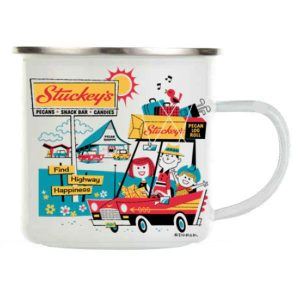
Stephanie Stuckey: [00:25:41] So, my father for some reason came up with a carriage design. I’ve told him I’ve never been a fan of the carriage design because it does not speak to our brand. To me, it’s kind of like this old South notation. So, that, I did dismiss with, and I called my dad and I said, “No disrespect, but I’m doing away with carriage.” And we put a we put a cool little — I call it the happy car family image, which is an original advertising image of Stuckey’s from the ’60s. So, it was a retro image, but it was more aligned with our brand. But he had all these distinctive elements, and that’s when he put that blue teal color in.

Stephanie Stuckey: [00:26:18] I do know he was friends with Howard Johnson’s. No, I’m sorry he was friends with Kemmons Wilson, the founder of Holiday Inn. They were contemporaries, they were friends, they were on the interstate. It’s quite possible that he knew Howard Johnson. I don’t know that, though. I did not find that in any of his paperwork.

Mike Blake: [00:26:38] Yeah. Well, and Holiday Inn also has a trademark color scheme that makes it easy to see, right?

Stephanie Stuckey: [00:26:43] Yeah.

Mike Blake: [00:26:43] You can’t miss that yellow and green.

Stephanie Stuckey: [00:26:45] Yeah, I think he was definitely inspired by them. I’ve not found any paperwork to confirm that. And I think he just came up with the blue because it was different, nobody else was using it and you could see it from far off. And then, a lot of people did the yellow and red and their signage because of the visibility.

Mike Blake: [00:27:06] So, you touched on something that I didn’t think we’d be going in today. I hadn’t thought of it. But now that you bring it up, I think it’s really important. The south, I think, is undergoing a difficult cultural and identity transition, right?

Stephanie Stuckey: [00:27:26] Yeah.

Mike Blake: [00:27:28] As the country comes to terms with reacquainting itself with its history, how we teach it, race relations, I think, are changing, certainly in the most radical way that I can remember, I was born in 1970, so I was after the Civil Rights Movement, was Stuckey’s being sort of an old school old South brand? Is that something that you’ve had to confront and really think about? How does it fit into the millennial or post-millennium vision of the South while still staying true to the core values? Is that something you’ve had to kind of wrestle with? And if so, how have you done that?

Stephanie Stuckey: [00:28:10] Certainly. I think any southern brand that’s been around as long as we have has some racial history that you have to come to terms with and you have to address. And our history, just like our region, is messy and complicated when it comes to race.

Mike Blake: [00:28:29] Yeah.

Stephanie Stuckey: [00:28:30] Stuckey’s has an interesting story in that we were never segregated in a time when many places were-

Mike Blake: [00:28:41] Interesting

Stephanie Stuckey: [00:28:41] … especially in the south. We never had a whites only sign on anything. We were always opening.

Mike Blake: [00:28:46] Good for you.

Stephanie Stuckey: [00:28:46] My grandfather had a saying, “Every traveler is a friend.” And so, he wanted Stuckey’s to be known as a hospitality brand, as a welcoming place, and that really reflected his core values. He was a Christian, he was very philanthropic, he was a quiet donor, he was not very flashy in how he contributed to different charities he supported. And in fact, I have yet to track down the actual people, but I do know from my aunt that my grandfather actually paid to have several African-Americans from our hometown go to college. But I don’t have any specific records. I don’t have names. He did it quietly. But I say that to reflect that’s who he was. He was just a a caring person.

Stephanie Stuckey: [00:29:41] And so, we were never segregated. And if you’ve seen the movie The Green Book, there’s actually a scene in the movie where they shop at a Stuckey’s for that very reason that we were not segregated. And I do have a lot of African-Americans of a certain age who told me that they remember stopping at Stuckey’s, and they also remember driving for long stretches and needing to stop, and their parents would say, “We’ve got to wait for Stuckey’s. We’ve got to wait for Stuckey’s.” And they said, “Well, we just thought our parents loved Stuckey’s, and they did,” but one of the people told me they realized many years later they had to stop at Stuckey’s, that was the only place they could stop.

Stephanie Stuckey: [00:30:27] So, we’ve got that part of our history, but we also have a history where, frankly, we have sold Confederate flag memorabilia. We’ve sold — I’m not proud of it, but it’s part of our past, we’ve sold some of those black mammy’s little figurines. I’ve seen them in pictures of the stores. So, I know that is part of our past. I would like to think my grandfather didn’t mean any ill by that, but that is what he sold. We don’t sell it anymore.

Mike Blake: [00:31:07] Yeah, of course, you don’t sell them anymore. And look-

Stephanie Stuckey: [00:31:08] But I will say, when I took over the company, there were two stores that were selling Confederate flag stuff, and I stopped that. I said we will de-brand you, take that out of the store, that is not what we represent this day and age.

Mike Blake: [00:31:28] Yeah.

Stephanie Stuckey: [00:31:28] And I just don’t want to get in the whole debate. I recognize there are people out there who feel very strongly that this is heritage, and I respect that, but that doesn’t mean we have to sell it in our souvenir store. You can buy that in a museum shop. So, I felt very strongly that we needed to really be a — For me, it comes down to being hospitable. Are we offering products, are we recreating an experience that is going to be welcoming to everyone? So, if there is a product that we sell that is going to alienate people, that is going to make people feel divided, I don’t want to sell it.

Stephanie Stuckey: [00:32:10] And I get upset when I find out that our stores are selling Trump stuff. Frankly, that’s what I’ve heard. It’s not the other party, but Trump stuff. And I’m like, “I don’t want you selling Biden or Trump. Don’t sell it. Don’t sell anything that divides people. Don’t sell anything that antagonizes people.” Even with my background in politics, I always struggled with being a consensus builder. Like that’s what I wanted to be, and it was hard doing that in a highly charged partisan environment like Georgia politics.

Mike Blake: [00:32:46] Yeah. And someday, you’ll never have time for me to do this, but I would love to get your take on on politics generally because I’m sure you have such an informed view, but-

Stephanie Stuckey: [00:32:56] Yeah, I mean, I [crosstalk]-

Mike Blake: [00:32:58] … it makes no sense to align — Sorry?

Stephanie Stuckey: [00:33:00] I walked away. I said I will not run again. This was not — I mean, no shame if you ran and got defeated, but I didn’t get defeated. I left.

Mike Blake: [00:33:09] Yeah.

Stephanie Stuckey: [00:33:10] I did not seek re-election. I said, I’m done.

Mike Blake: [00:33:14] Yeah. Well, I think there are a lot of people that are doing that. But it’s interesting how you bring that up because you really are sort of sticking your fork in a toaster if you’re going to turn your company into a political platform, aren’t you?

Stephanie Stuckey: [00:33:32] Yeah

Mike Blake: [00:33:32] Right? And especially now where things are so volatile, you can easily see a scenario where you have customers in your parking lot fighting each other under the right — Right? Because we see that in our society. And that sounds very antithetical to the brand that you have, right? So, why even approach it, right?

Stephanie Stuckey: [00:33:57] Exactly. But I will say, I think there were some brands where that is entirely consistent with what they represent. And so, some brands-

Mike Blake: [00:34:06] For sure.

Stephanie Stuckey: [00:34:07] … it’s good to be edgy, it’s good to be out there. I think of Nike doing the whole Colin Kaepernick commercial. I think that was a hundred percent aligned with what they represent. And so, it works for them. That’s not so much political, but it is something that was highly charged, right? I mean, they’re [crosstalk]-

Mike Blake: [00:34:29] For sure. I thought it was very risky for Nike to do that.

Stephanie Stuckey: [00:34:32] It was risky and it wasn’t risky because when it came out, I thought not only was it just a beautiful ad, it’s so well done. But to me, it was just embracing their brand. And these people who were out there burning Nike sneakers, I thought, “Well, Nike’s making money off of that because people are out burning Nike sneakers for people who weren’t wearing Nike.” Those weren’t their peeps. So, they probably went out and bought some. They didn’t have them.

Mike Blake: [00:35:00] Well, and the data suggests you’re right because their stock price did go up, so.

Stephanie Stuckey: [00:35:04] Yeah, it worked for their brand. So, just know what your brand is, and your brand may be political. That may be a hundred percent where you want to be. So, go in on it. That’s not us. And you also have to accept you cannot – and it’s hard sometimes, especially like me having been in politics, a lot of times, if you’re in politics, you’re a pleaser or you’re a people pleaser, you can’t be a people pleaser in branding. You cannot be all things to all people. What is your brand? We’re a road trip brand.

Stephanie Stuckey: [00:35:40] I talked to this guy about six months ago and he said, “I’m not a road tripper. Tell me why I should stop at Stuckey’s.” I said, “You shouldn’t stop at Stuckey’s. You’re not our person. You’re not-”

Mike Blake: [00:35:50] Right.

Stephanie Stuckey: [00:35:51] I mean, I would love for you to try our product, but if you don’t enjoy road tripping, we’re really not your brand.

Mike Blake: [00:35:59] Right, you have to drive 30 miles to get to our store, right, which is-

Stephanie Stuckey: [00:36:02] We’re on the interstate. And yes, we are branching out, we are getting in more venues, but even though we’re pushing the product, and we’re promoting the delicious pecan snacks and candies that we make, it’s all wrapped up in the story of the road trip. So, know what your brand is, and hunker down on that, and don’t try to be something that you’re not, don’t try to appeal to people that really aren’t going to connect with your brand. Not everyone’s going to like your brand. If you hate sugar, if you hate candy, then I would never try to sell you a pecan log roll.

Mike Blake: [00:36:42] Sure. Yeah. Well, I mean, a brand is about — push brands don’t work, right?

Stephanie Stuckey: [00:36:48] Yes.

Mike Blake: [00:36:48] And brand is a poll asset, and you’re rallying people towards your banner for something, right? People who believe what you believe. I’m crazy a fan of Simon Sinek and all his thing about Star Wars.

Stephanie Stuckey: [00:37:03] Oh, my gosh. Yes, I love Simon Sinek.

Mike Blake: [00:37:06] Yeah. Well, if you know him, tell him I want him on the program, but nobody’s been able to provide that yet, but-

Stephanie Stuckey: [00:37:13] I don’t know him. No, I’m just a total fan girl. I watch his YouTube videos every morning. I’ve got a cynic for video on Simon Sinek, Gary Vee.

Mike Blake: [00:37:22] Yeah.

Stephanie Stuckey: [00:37:23] I’m a big Oprah fan. They all have just such great content that they put out. I listen to sort of an eclectic mix. I like Russell Brand. He’s got some philosophical side to him. But there’s some really great people out there that give wonderful perspectives, but Simon, yeah, Simon Sinek, like the whole getting to the why? Businesses know what they do. A lot of times, you may know how you do it, what your formula is, what your process is, but why are you doing it?

Mike Blake: [00:37:57] So, you walked in, you walked into that double wide trailer, realized that you had maybe not a brand change, but certainly a brand rehabilitation or reinforcement to do.

Stephanie Stuckey: [00:38:08] Yeah.

Mike Blake: [00:38:08] Maybe that’s a better way to put it.

Stephanie Stuckey: [00:38:12] That’s the patient.

Mike Blake: [00:38:13] What did that to-do list ultimately look like? If you could boil it down, what are some of the key steps you had to take in order to do that?

Stephanie Stuckey: [00:38:20] Well, you said it in the very beginning, in the intro, the quote from Forbes about consistency. Branding is consistency. And I knew something about branding because I’ve been in politics. And so, you have to brand yourself, and I had a brand that was my family. So, in a way, it was easier for me because the brand was so personal to me. It was tied in with my own brand, so I had a good sense of what my brand was, and I understood the company, I understood my grandfather, and I knew the stories. I had great stories. And I had even more stories than I thought I have had having read all my grandfather’s papers. So, my playbook was really watching what Gary Vee advises you to do, which is every single day, you get out there and post on social media. It’s just that consistency, and it’s the storytelling.

Stephanie Stuckey: [00:39:24] And it’s not just posting for post’s sake. It’s not just like, “All right, I’ve got to get something out there.” It’s got to have sticking power, and it’s got to have a higher purpose. It’s not about selling a pecan log roll; it’s about building a community. And you’re building a community around people that share an interest that you share. They care passionately about what you care about. I would rather have a small group of rabid fans that absolutely love our brand. There are a ton of people who buy our product because it’s cheap or easy to get, and they’re not loyal. There’s no sticking power there. So, the way you get that rabid fan base is you share something in common.

Stephanie Stuckey: [00:40:15] So, I just started putting out their content that was long-form narrative storytelling about what we believed in. And I wrote down our brand attributes, and I made sure every time I did a post, it touched on those attributes. And the attributes are family-friendly, hospitable, pecans because we’re all about the pecan, Georgia-grown pecans, that sense of place, small-town America, road trips, vintage/retro, Americana, celebrating all things, small-town America. So, I kind of knew those themes. I had them written down. Sort of, I have this sheet, I have a visual. It’s a diamond. And the different facets of the diamond have different words on them for the brand attributes. It’s my brand diamond. You can use whatever works for you, but I look at that all the time and I think, “Am I being brand-forward? Is this family-friendly? Is this promoting the road trip?” It’s got to hit on some of those brand’s attributes.

Stephanie Stuckey: [00:41:23] And it’s a slog. It is a slog. Every single person out there who’s got a million followers, they started with one. And you just keep at it. Somebody asked me yesterday because I didn’t know I was up this high, but it’s very gratifying, they said I had 72,000 LinkedIn followers. And when I started on LinkedIn, I think I had a thousand, which is a very respectable number to begin with, and that was from being a state rep and being head of sustainability for City of Atlanta, but I didn’t have 72,000. and I didn’t get 72,000 overnight. I got maybe a dozen a day, but you get a dozen a day over a couple of years, it adds up.

Mike Blake: [00:42:09] And this gets to a point that I think is important, I want to make sure that we get to because I think a common perception of changing or, in your case, rehabilitating a brand, but in this case, the difference is not material, and that is that, well, all you have to do is change your name, or a logo, or something; and therefore, you have a brain change, right? And to me, what you’re describing is exemplary of, at least, my view, and I may be completely wrong, but in a way, those are the two least important things. The brand is who you are every day, and the brand is what you will do every day. And most importantly, and this is why I think it’s so important, we go back to phasing out or wiping out kind of the Dixie, if you will, type memorabilia, Dixie type products in your product line, you define yourself by what you won’t do, right? You draw a line someplace.

Stephanie Stuckey: [00:43:11] Sure.

Mike Blake: [00:43:12] And I think that’s why there’s a lot of cynicism – at least I sense cynicism and I have cynicism about Facebook/Meta’s brand change is that it occurred only after Mark Zuckerberg had his rear end hauled before Congress to testify. And there started to be some talk about antitrust action, et cetera that it doesn’t seem like there’s a genuine change in the mission of the company, but rather it’s really just sort of a coat of paint; whereas, what you’re doing is by getting out there and being the lead cheerleader from the brand. And I remember the stories, I didn’t do the homework for this when I had you on the program, I love the story about you going out to Arkansas and seeing a hole in the roof of one of your stores. As a CEO, I cannot imagine how that must have impacted you. Or on the Christmas rush, you’re there with a picture of yourself on the line packaging stuff, right?

Stephanie Stuckey: [00:44:13] I got so much grief from some of my team, though. They’re like, “Do you know how much it’s costing us for these boxes to have the CEO on the line?”

Mike Blake: [00:44:21] Well, you know what, it costs you a lot more for people to want to buy Stuckey’s products and they can’t get it.

Stephanie Stuckey: [00:44:26] I’m like, “It’s branding too. It’s like showing that we are rolling up our sleeves and is all hands on deck.” And I absolutely needed to be there because we had to build a hundred boxes in a day, and we did 120.

Mike Blake: [00:44:41] Yeah. I mean, don’t we all want to work for somebody that will get down in the trenches with us?

Stephanie Stuckey: [00:44:51] Yeah, [crosstalk].

Mike Blake: [00:44:51] Not just telling us what to do from from the corner office, but geez, I just got to get in there and do it, right? And I think that, what a boost for morale. I’ll bet you probably got a lot of resumes from people after that of people just want to work for you because of that.

Stephanie Stuckey: [00:45:09] I did actually. And we can’t hire anyone because we don’t have enough money.

Mike Blake: [00:45:13] Right.

Stephanie Stuckey: [00:45:15] We are scrappy. We are still a scrappy startup. I joke, we’re an 85-year-old startup. We are. And I think it’s really good to have that edge to be in that hungry space, that startup space. I think there’s something about it that really keeps you on your toes. But you’re right about the logo. You can’t just slap on a fresh coat of paint and say, “That’s a new brand.” But I do think one of the first things I did was bring the logo back to our original logo. But for me, that was an outward manifestation of an interchange.

Mike Blake: [00:45:56] Yeah.

Stephanie Stuckey: [00:45:57] So, I think as long as what you’re doing externally is reflective of an internal shift, then it makes sense to have that name change, it makes sense to have that new design work done, but like you said, it has to be authentic and there has to be this message from the top that this is more than just we’re changing the logo.

Mike Blake: [00:46:24] So, a lot of companies doing what you’re doing, they bring in outside help – consultants and PR firms and branding experts and such. Did you avail yourself of that expertise as well? Or did you primarily make this an internal project?

Stephanie Stuckey: [00:46:38] Both. So, initially — and this is just me, and I don’t want to give consultants a hard time because there’s a lot of really good ones out there, but there are also a lot that frankly will take your money.

Mike Blake: [00:46:52] Yeah.

Stephanie Stuckey: [00:46:53] And rack up those billable hours.

Mike Blake: [00:46:56] They don’t have clients, they have victims.

Stephanie Stuckey: [00:46:59] Yeah. So, I’m not trying to say I didn’t have good consultants because I think I did have some good help, but it did not make financial sense for us. We had a very small budget when I bought the company. Like I said, we were six figures in debt. And a little bit of money we had available was money that I frankly had invested. When I bought the company, I negotiated to invest a very small amount in the company to have some upfront capital to brand and to also work on a strategic plan. And so, I paid some consultants for that. And they were good. But we had such limited dollars, and we ran through that money in a matter of months. And so, then, I had to figure out how to do it myself. And that’s when I started watching Gary Vee and some of these other resources.

Stephanie Stuckey: [00:47:58] And I think the lesson here is if you’re small, if you are scrappy, don’t think that you can’t try it yourself because a lot of the stuff, you really can do yourself, especially if you know your brand. Nobody knows the Stuckey’s story better than I do except my father and my aunt. No one. And so, that puts me in a unique position. And so, a lot of the stuff, you can do yourself. I just think too often we think, “Oh, we’ve got to hire this digital firm to run these digital ads.” And Lord knows I spent money on digital ads. And then, I went online and watched a couple of YouTube videos, and I do the ads myself.

Stephanie Stuckey: [00:48:45] What I can’t do is the creative design work, and I do have an excellent — I have two graphic designers who are amazing, and I use them. And I do have a guy who helps me with copy who’s really, really good at helping me do the e-blast, and he helps with speechwriting. So, I do have a very good writer who supports me, and we work really well together, we have similar styles. But I cut back dramatically because I just didn’t have the funding for it. So, I still do it myself. We don’t have a marketing firm.

Mike Blake: [00:49:19] I’m talking with Stephanie Stuckey, and the topic is, Should I Rebrand My Company? I have so many questions. We’re not going to get to them all, and that’s my loss. But a couple I want to get to before we let you get back to – hopefully you’re not in a double wide trailer anymore, but if you are, that’s fine, but get back to your work day.

Stephanie Stuckey: [00:49:38] That’s my home. I’m recovering from COVID.

Mike Blake: [00:49:40] Yeah, okay. Oh, really? Okay. Well, you sound great.

Stephanie Stuckey: [00:49:44] Yeah, I got [crosstalk] cases. I think Atlanta is super spiking right now, and that’s [crosstalk].

Mike Blake: [00:49:48] Yeah, for sure.

Stephanie Stuckey: [00:49:49] Yeah.

Mike Blake: [00:49:50] So, how would you describe your your brand resurrection or resuscitation effort? Do you think it’s been successful? Is it still a work in process? How do you evaluate it at this point?

Stephanie Stuckey: [00:50:04] Work in progress.

Mike Blake: [00:50:06] Okay.

Stephanie Stuckey: [00:50:06] And I’m still figuring out how to evaluate it because, obviously, you want metrics. My board especially wants metrics. So, I’m doing my best to hunker down and try to figure out what is the return on the investment that we have made with branding. And I think sometimes, that’s hard, because there’s too — I mean, generating sales comes from branding and in part. And there’s also just brand awareness. And it’s hard to measure, sometimes, that brand awareness piece if you don’t have the budget to go out and do some sort of market survey to say, “What’s your name recognition?” We don’t have that. We don’t have that budget.

Mike Blake: [00:50:54] So, it’s a work in progress, and I’m still trying to — I think for me, what I really hope moving forward is, can I figure out better ways to measure. And we are measuring conversion rate, and click rates and all the typical things that people measure. But it’s just, what is the value of people knowing your story? What is the value of people recognizing your name? But to me, that’s really hard to put in a spreadsheet.

Mike Blake: [00:51:28] It is. Stephanie, you’ve been so not only generous with your time, but really generous with your with your authenticity and revealing sort of the thought processes and emotional processes you’ve had to go through during this journey of yours. I’m sure there are questions that our listeners wish that I would have asked or wish that we would have spent more time on. We just didn’t have the time. If one of our listeners wants to follow up with you, would you be willing to share with them maybe some of your brand knowledge? And if so, what’s the best way to do that?

Stephanie Stuckey: [00:52:06] The best way is to send me an email. Linkedin messages are sporadic for me. I do my best to answer them, but I get a lot of LinkedIn messages and quite a fair amount of it is just out and out solicitation. So, sorting through all of the clutter to find the real genuine request to reach out to me is, sometimes, daunting when I’m running a company. But email, I get, and I look at, and I respond. If it’s a pure solicitation as a service that is not aligned with me, I’ll be honest, I started hitting just the delete button because I used to write polite replies, and I realize I was literally spending 40 minutes a day writing polite replies to people who are offering services that we didn’t need.

Mike Blake: [00:53:00] Okay.

Stephanie Stuckey: [00:53:00] If it’s something aligned with our brand, I will forward along to the appropriate person. But if you’re asking for advice, yes, I will respond. And it’s sstuckey@stuckeys.com. So, it’s sstuckey@stuckeys.com. And I can give that to you to put in your show notes.

Mike Blake: [00:53:17] Great, that’d be terrific. And you’re also on social media, and I would encourage our listeners, before you reach out to Stephanie, just simply watch what she does. She’s probably just going to tell you about what she’s doing anyway, but she sets a great example for how to reposition a brand, how to modernize a brand. And then, if you still have questions, go ahead and use it. And Stephanie is very generous with giving back to the community. But I would encourage you to do that homework first.

Mike Blake: [00:53:47] That’s going to wrap it up for today’s program. And I’d like to thank Stephanie Stuckey so much for sharing her expertise with us today. We’ll be exploring a new topic each week, so please tune in, so that when you’re faced with your next business decision, you have clear vision when making it. If you enjoy this podcasts, please consider leaving a review with your favorite podcast aggregator. It helps people find us, so that we can help them. If you would like to engage with me on social media with my chart of the day and other content, I’m on LinkedIn is myself and at @unblakeable on Facebook, Twitter, Clubhouse and Instagram. Also check out my new LinkedIn group called A Group That Doesn’t Suck. Once again, this is Mike Blake. Our sponsor is Brady Ware & Company. And this has been the Decision Vision Podcast.
 

Tagged With: Brady Ware & Company, Branding, Decision Vision podcast, Mike Blake, rebrand, rebranding, Stephanie Stuckey, Stuckey's

Reviving a Legacy Brand: An Interview with Stephanie Stuckey, Stuckey’s Corporation

July 30, 2021 by John Ray

Stephanie-Stuckey-DLR-Album
Dental Law Radio
Reviving a Legacy Brand: An Interview with Stephanie Stuckey, Stuckey's Corporation
Loading
00:00 /
RSS Feed
Share
Link
Embed

Download file

Stephanie-Stuckey-DLR-Album

Reviving a Legacy Brand: An Interview with Stephanie Stuckey, Stuckey’s Corporation (Dental Law Radio, Episode 14)

How do you revive a brand name which the world has left for dead? CEO Stephanie Stuckey joined host Stuart Oberman to share the compelling story of how she and her team are resurrecting Stuckey’s Corp. Stephanie discusses why she plunged into this rebuild even when she was discouraged by others, the importance of having a management team which balances each other’s skills, the power of sharing not just victories but setbacks, and much more. It’s must listening, not just for dentists thinking of acquiring practices, but any entrepreneur considering a brand reconstruction of their own. Dental Law Radio is underwritten and presented by Oberman Law Firm and produced by the North Fulton studio of Business RadioX®.

Stephanie Stuckey, CEO, Stuckey’s Corporation

Stephanie Stuckey is CEO of Stuckey’s, the roadside oasis famous for its pecan log rolls. The Company was founded by Stephanie’s grandfather, W.S. Stuckey, Sr. as a pecan stand in Eastman, Georgia in 1937 and grew into over 350 stores by the 1970’s. The company was sold in 1964 but is now back in family hands and poised for a comeback.

Billy Stuckey, son of the founder and former U.S. Congressman, reacquired Stuckey’s in 1985. Stephanie took over in November of 2019 and, under her leadership, Stuckey’s has purchased a healthy pecan snack company, undergone a rebranding, added three new franchised stores, expanded its B2B retail customer base, ramped up its online sales with a new website and will soon acquire a pecan processing and candy manufacturing plant.

Stephanie received both her undergraduate and law degrees from the University of Georgia. She has worked as a trial lawyer, elected to seven terms as a state representative, run an environmental nonprofit law firm that settled the largest Clean Water Act case in Georgia history, served as Director of Sustainability and Resilience for the City of Atlanta, and taught as an Adjunct Professor at the University of Georgia School of Law.

Stephanie’s achievements include being named one of the 100 Most Influential Georgians by Georgia Trend Magazine and a graduate of Leadership Atlanta. She is active in her community and serves on many nonprofit boards, including the National Sierra Club Foundation, EarthShare of Georgia, and her local zoning review board.

Connect with Stephanie on LinkedIn and follow Stuckey’s on Facebook, Twitter and Instagram.

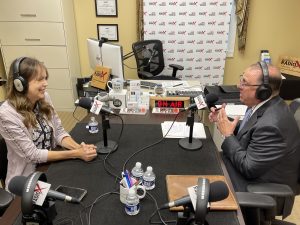
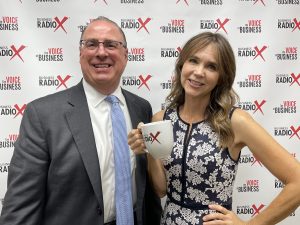
Stephanie Stuckey and Stuart ObermanStuart Oberman and Stephanie Stuckey


TRANSCRIPT

Intro: [00:00:01] Broadcasting from the Business RadioX Studios in Atlanta, it’s time for Dental Law Radio. Dental Law Radio is brought to you by Oberman Law Firm, a leading dental-centric law firm serving dental clients on a local, regional, and national basis. Now, here’s your host, Stuart Oberman.

Stuart Oberman: [00:00:26] Welcome everyone to Dental Law Radio. I know usually we’re talking about dental law, and employment law, and compliance. But, today, we have an absolute amazing guest in-studio, Stephanie Stuckey, the CEO of the famous world-renowned Stuckey’s Corporation. Stephanie, it is an honor, honor, to have you in here.

Stephanie Stuckey: [00:00:48] Well, thank you. The honor is all mine. I’m delighted.

Stuart Oberman: [00:00:51] You know, being the CEO of Stuckey’s, you have now reached the pinnacle of your career being on Dental Law Radio, right?

Stephanie Stuckey: [00:00:57] I absolutely think so. And the irony is not lost on me that a candy company is being featured on a dental radio show. I think it actually makes a lot of sense because we have sent you a lot of customers over the years.

Stuart Oberman: [00:01:12] Our clients love that. Thank you.

Stephanie Stuckey: [00:01:14] Right. You should be serving pecan log rolls in every dental office in this country because we are giving you a fair amount of clientele.

Stuart Oberman: [00:01:22] I appreciate that. It sort of keeps us paying the rent. So, you know, you are amazingly busy, amazingly. First of all, thank you. I know we scheduled this about two months ago to get you into studio here. So, I know how busy you are and your schedule. But, you know, the interesting part is, I think this says a lot about you and what you’re doing with Stuckey’s.

Stuart Oberman: [00:01:45] So, I remember one Saturday, I’m just playing around on LinkedIn and I pinged you. And I was going to introduce you to a client of ours that is in the industry that you’re in, in the pecan industry. And then, you, almost immediately, sent me a message back like, “You know, hey. [Inaudible].” And then, we’ve kept in touch a little bit. And then, you know, I’ve watched you take this brand, this iconic brand, that was almost on the brink of failure, I guess would be a good word.

Stephanie Stuckey: [00:02:19] Oh, yeah. Absolutely. I thought it’s generous.

Stuart Oberman: [00:02:21] Yeah. It was not doing well.

Stephanie Stuckey: [00:02:25] Not well.

Stuart Oberman: [00:02:26] And then, you know, this sort of American dream is you became CEO – and I want you to get into this little bit later – but you’ve taken this brand to a whole another level. This not only applies to our dental guys, but in the podcast, we have construction companies, all the way from a $1,000 a year to 500 million, that are listening to the podcast. And we’re very fortunate we have clients in about 35 states. I thought, “You know what? Really, this is a story that anyone who has any ups and downs in business that wants to rebrand can really benefit from hearing your story.” So, I’m just very, very grateful that you’re on the show.

Stephanie Stuckey: [00:03:11] Well, thank you.

Stuart Oberman: [00:03:12] And then, you know, Stuckey’s is a roadside iconic brand. I mean, I just stopped at one from Florida. You know, I bought a pecan roll and got a picture, and I’ll send that to you.

Stephanie Stuckey: [00:03:23] So appreciate that. Yes. Please stop.

Stuart Oberman: [00:03:26] And that’s what’s it really all about. So, we wanted to bring you in and talk to you really about a few things of what you’re doing. You got an amazing background, what I want you to get into a little bit. And then, how you got to rebrand and bring this company back. You’re a CEO, you graduated from UGA Law School, and House of Representatives, and you were recently named 100 Most Influential Georgians by Georgia Trend Magazine. That is an amazing, amazing accomplishment.

Stephanie Stuckey: [00:03:57] You know, that was actually not for Stuckey’s. That was related to my work with Sustainability.

Stuart Oberman: [00:04:03] Really?

Stephanie Stuckey: [00:04:04] Yes. So, that was only a couple of years ago. But I’ve only been running Stuckey’s for a-year-and-a-half. But prior to this, I was Head of Sustainability for City of Atlanta, and got that acknowledgment as part of my work with the City of Atlanta. So, I feel like I share that honor also with all the work that we were doing in Sustainability and Resilience. My position was actually Chief Resilience Officer. By the time I left the city, it had advanced to include a lot more functionality. But, anyway, it was a fun ride working for the City of Atlanta.

Stuart Oberman: [00:04:37] So, tell us a little bit about you and then how you became the CEO of Stuckey’s.

Stephanie Stuckey: [00:04:43] That’s a crazy journey. Yes.

Stuart Oberman: [00:04:45] I know. We can talk about it for like five days. I assure that –

Stephanie Stuckey: [00:04:49] I’ll condense it. Yeah. Yeah. So, I think the important takeaway – and I’m very mindful that this is a diverse group of people listening, so I’m going to try to make sure my comments are relevant – I was literally sitting at my desk one day happily in Sustainability world, which is what I had been doing for two decades, practicing environmental law and working on sustainability initiatives not only with Atlanta, but had advanced to working with cities throughout the southeast.

Stephanie Stuckey: [00:05:19] And I was at my desk and I got an email from one of my dad’s former business partners asking me if I wanted to buy their shares of Stuckey’s stock. And that’s how it began. It was initially just a financial transaction, “Do you want to buy stock?” And I asked to look at the financials, which is what any of us would do if you’re given an opportunity to add to your business portfolio. Or, in my case, I had no business portfolio.

Stuart Oberman: [00:05:50] Now, what did you think when you saw that message? What was your initial reaction? Did you fall off the chair? Or you thought, “No way.”

Stephanie Stuckey: [00:05:57] I was not surprised. And I’ll give a very quick recap of the Stuckey’s history, because it puts this into context. Stuckey’s was founded by my grandfather in 1937 as a roadside pecan stand in Eastman, Georgia. And from those incredibly humble beginnings, he grew it with my grandmother to 368 stores and 40 states, all over the nation’s Interstate Highway System.

Stephanie Stuckey: [00:06:22] We owned a candy plant. He owned a trucking company. Had a sign company. And he built that and sold it in 1964, which is not uncommon for a lot of entrepreneurs of that era. Howard Johnson’s, Holiday, and Kentucky Fried Chicken, all these entrepreneurs that we know that were household names, they sold. And that was sort of what you did, you build this company and you sold it and you made a lot of money. And he was a product of the depression, so he sold.

Stephanie Stuckey: [00:06:50] It was out of family hands for decades. There was a series of corporate takeovers. The company was really floundering. My father got the company back in 1985. He was already running several other companies at the time. So, Stuckey’s was a bit of a side hustle for my dad. He owned and operated Dairy Queen franchises on the Interstate Highway System. He had the exclusive rights to Dairy Queens within a half mile radius of a highway exit.

Stuart Oberman: [00:07:19] That’s a heck of a side hustle.

Stephanie Stuckey: [00:07:20] Heck of a side hustle. So, dentists should totally love my family because we are sending you all sorts of patients.

Stuart Oberman: [00:07:27] That is one side hustle.

Stephanie Stuckey: [00:07:27] Right? So, no, no. Stuckey’s was his side hustle.

Stuart Oberman: [00:07:31] Yeah. That’s what I mean.

Stephanie Stuckey: [00:07:31] His main business was Dairy Queen. And when he got Stuckey’s, it was in bad shape. And it was a little over 100 stores at that time. So, he just combined the Stuckey’s with the Dairy Queen, and so built on the Dairy Queen. And he also started putting Stuckey’s in other travel plazas, a store within a store cobranding concept, and that proved to work for decades.

Stephanie Stuckey: [00:07:59] And then, my dad and his business partners sold their Dairy Queen business to Warren Buffett – some of the listeners may have heard of him – in 2014 – 2012 – I should know the exact date – like, about a decade ago. And they all retired. So, they went home. They left only a very small skeleton crew, basically two people running Stuckey’s. It didn’t have a CEO. It didn’t have a marketing budget. There was really no franchise system to speak of. Most of the remaining locations were the store within a store concept. We had a rented distribution facility and that’s it.

Stephanie Stuckey: [00:08:43] So, I knew that the business had been floundering. What I didn’t know was how much it had been floundering. And so, when I pulled these financials, and I consulted some financial experts, and they were looking at the books. And I talked to three experts, two said, “Do not do this. The company had been losing money steadily for several years.” And the third person said – and I kept the third person because I kept shopping it around. I wanted a different answer, right?

Stuart Oberman: [00:09:13] You want the right answer. My clients do that.

Stephanie Stuckey: [00:09:14] They’re like economists, they have a different opinion. So, you keep going until you get the one who will tell you, “Yes. You should do this. It’s a good idea.” The one who said do it said, “I know what’s not on the balance sheet, which is the value of the brand,” which is what I knew, too.

Stephanie Stuckey: [00:09:30] And even though my entire childhood, Stuckey’s was no longer owned by our family, I knew and loved my grandfather. I vacation like everyone else and stopped at Stuckey’s. I knew innately that this was something really special. And that it would take a Stuckey, frankly, to bring it back. It needed that special touch. And with a little love, I figured we could bring it back.

Stephanie Stuckey: [00:09:53] The fact that it was not bankrupt, despite all the ups and downs over the year also told me it had some sticking power. So, you know, that’s what I thought. Like, I wasn’t surprised. I immediately also knew that I was not the first choice. I’m number four of five kids, they went through the roster and I was the only one. I’m like Mikey in the Life cereal commercial. The one kid who will try it. I was the only one who said yes.

Stuart Oberman: [00:10:19] So, here’s a key point, because as a firm, we do a lot of mergers and acquisitions in our dental clients and all those things. So, who did you consult with before you made the decision to go, the CPAs, the lawyers? Who were your advisors? Because that’s key in any transaction. And our guys have got to know that.

Stephanie Stuckey: [00:10:39] I went with people I knew and trusted. So, I think often what’s overlooked in business is the value of relationships and relationship building. And throughout my career, even though I never worked in business, I served on boards and I had colleagues on the nonprofit boards that I served on who had financial backgrounds. So, I went to some CPAs who served on boards with me, and I really respected their opinions.

Stuart Oberman: [00:11:10] So, what did you have to do? Obviously, was this a huge learning curve for you.

Stephanie Stuckey: [00:11:14] Yes. Absolutely.

Stuart Oberman: [00:11:16] What did you do to get through that learning curve?

Stephanie Stuckey: [00:11:17] A huge learning curve.

Stuart Oberman: [00:11:18] What did you do?

Stephanie Stuckey: [00:11:19] I surrounded myself with really smart people who understood areas where I lacked expertise. And I also spent a ton of time, which I still do, learning. I read Harvard Business, magazine, books.

Stuart Oberman: [00:11:34] I was going to ask you about that. I read that somewhere.

Stephanie Stuckey: [00:11:38] Yeah. Harvard Business School has a whole series of books, basically entrepreneurship 101. They have a book on mergers and acquisitions, and I read that several times. I also watched webinars. So, much of this is available, basically, for free. There’s a ton of webinars available. And so, I watched webinars. And, honestly, this is how big my learning curve is, I didn’t even know what EBITDA was. Somebody used that in a sentence and I’m Googling it during the conversation. Thankful that it was a phone call so they wouldn’t see me having to look up basic financial terms. So, I had a huge learning curve.

Stephanie Stuckey: [00:12:19] But at the same time, I also sought out people who knew what they were doing. So, I knew what I could do well. So, that’s the other thing, you fill your gaps and then you really double down on what you know you’re good at. So, what I knew was this brand. I’ll never forget when I first decided I was going to do this – well, frankly, it’s my father who said this, he asked me why I thought I could run Stuckey’s when, he said, “You can’t even run a lemonade stand.” And I thought for a minute and I said, “Well, you’re right. I can’t run a lemonade stand. But I can run Stuckey’s.” And it occurred to me what I knew about Stuckey’s was the brand. And I could tell the story of Stuckey’s unlike anyone else. I have that personal emotional connection.

Stephanie Stuckey: [00:13:08] And so, I just started going online and learning, how do you do social media? How do you do storytelling? And I just started practicing. That’s the other thing, you can learn and then you practice. And I made a vow to myself that every single day I would post on LinkedIn. I figured that’s where I need to be. That’s the business network. And I just started posting my story every day on LinkedIn. And I went from a handful of likes to, now, my posts routinely get a 1,000 plus likes, engagements, comments. My followers grew. I think I started with a couple hundred and I think it’s 36,000 in a year. And it’s just posting every day. It’s having personal discipline and having focus, which I constantly work on. I tend to be one of those people who has 50 things going at any given time. And I throw it against the wall and see what sticks. So, that’s more my personality.

Stephanie Stuckey: [00:14:11] So, it’s really important to surround yourself who, not only fill in your gaps with your skills and expertise, but also emotionally. So, I tend to be very high energy and a little high strung. And I have since gotten a business partner, and he is pretty chill. I mean, he’s a hard worker, but he’s unflappable.

Stuart Oberman: [00:14:34] Would you say your type A?

Stephanie Stuckey: [00:14:35] I am type A. But I think there’s different type A’s. Like, you can be really ambitious and a go-getter type, but also not easily excitable. And I do tend to get really – you know, like something will happen that’s really great and I am just on the moon. Like, “This is the best thing. We’re going to totally be like a $20 million in sales company this year.” And then, something bad will happen, I’m like, “Oh, my God. We’re going to go bankrupt.”

Stephanie Stuckey: [00:15:06] And my business partner just set nice, even keeled influence on me. So, he’s very financially savvy and he also knows the pecan market inside and out, which is very important with what we do.

Stuart Oberman: [00:15:18] So, you surround yourself with people that know more than you, which is key.

Stephanie Stuckey: [00:15:23] Yes. And balance my personality. If our leadership team are a bunch of people who are super high energy, I think our heads would all pop off. So, you to have the chill people with the energy folks. And I’m an eternal optimist, even though I do occasionally have these, “Oh, no. Everything’s falling.” But I am very, very optimistic. And one of our key team leaders is – I’ll just say if he hears this, he’ll agree – he’s a curmudgeon. And any time I have an idea, he will literally come up with 20 ways that it won’t work. And I need someone like that around me because it forces me to think through all the details. And I’m not a detail person. So, I’ve got this person who’s, like, overly detailed and that will say, “Oh, that will never happen. You are overthinking this.” But I need that. I need that balance.

Stuart Oberman: [00:16:20] So, you’ve got a variety of personal experiences. You’re practicing law. You’re a state representative.

Stephanie Stuckey: [00:16:25] I’m still practicing law. I am in-house counsel for Stuckey’s. I do a lot of – I’m serious.

Stuart Oberman: [00:16:32] General counsel, CEO.

Stephanie Stuckey: [00:16:32] Welcome to being an entrepreneur. You know, you wear 21 hats. I’m Chief Brand Officer. I was Chief Sales Officer, and it got to be overwhelming so my business partner and I have split up those duties. He does a large retail accounts and I do the small sort of mom and pop, which is really what I thrive at. And I do the marketing. And I’m Chief Storyteller. Yeah. I love it. I’ve got a lot of roles.

Stuart Oberman: [00:16:59] Welcome to Business.

Stephanie Stuckey: [00:17:03] Yes. Yes.

Stuart Oberman: [00:17:04] Then, you have been running Sustainability for City of Atlanta. So, you know, what lessons – and I know it’s been a long, long journey being in the family and then becoming CEO. So, what roles helped you for this new CEO position? I mean, what have you learned? What previous roles helped?

Stephanie Stuckey: [00:17:24] Politics and –

Stuart Oberman: [00:17:27] That’s a blood sport.

Stephanie Stuckey: [00:17:29] Right. And being an attorney. I started out actually as a public defender in Fulton County, Georgia. So, City of Atlanta, that was overwhelming. I had 200 clients at any given time, which is welcome to the world of being a public defender. So, I learned not only the ability to manage a lot and perform under pressure. And know it’s not the end of the world if something goes wrong. Like, the ability to just put things in perspective has been critical.

Stephanie Stuckey: [00:18:01] One of my favorite sayings since I’ve taken over – and I stole it from another candy maker, Goo Goo Cluster. I stole those comments from their chief marketing officer. But she said, “When I get stressed out, I think it’s just candy.” So, that’s what I think. When I get overwhelmed with running Stuckey’s, like, “It’s just candy.” But having managed politics and running my own campaigns and working the City of Atlanta, which can be a blood sport. Just being able to roll with the punches and not get easily overwhelmed is critical.

Stephanie Stuckey: [00:18:35] The other thing I learned was almost all of my roles, I was fighting for the underdog. As a public defender, I would represent some really hard to represent individuals. As a politician, I was very active in environmental issues, which isn’t always the most popular, the Georgia General Assembly. And then, as an attorney, I practice environmental law representing Riverkeeper, Sierra Club. So, I represented environmental groups against large corporations. Many of the corporations with whom I now partner. So, it’s interesting turnabout.

Stephanie Stuckey: [00:19:08] But what I learned was the ability to persuade. If you can stand up for a tough cause – and that’s what you learn in law school – whether you believe in the cause or not, although it certainly helps if you believe in the cause, you’ve got to believe in something fundamental about the cause in order to really have it be a compelling case. So, like when I was a public defender, I may not have thought that my client’s case was the best case, but I believed in the justice system. So, you have to have a core set of values and beliefs that stabilizes you. But being able to stand up and persuade is a critical skill.

Stephanie Stuckey: [00:19:45] And everything I’ve done, and most critically in Stuckey’s, because I am trying to persuade financial investors, potential financial investors, potential large retailers who are used to doing business with established brands. And, yes, Stuckey’s has sticking power. We’ve been around for 80 years, but we’re a dusty brand. We’ve been losing money. We don’t have market share. And so, here I am trying to make the case to large, big box retailers, “You need to carry Stuckey’s products.” That’s a tough sell sometimes. So, just the ability to persuade and connect with people, it’s, I think, the most valuable skill you can have.

Stuart Oberman: [00:20:27] So, you had taken this audacious challenge of reviving this family brand. Most people that have had your experience are not even looking for a second career. They’re winding down their career. They’re like, “You know what? I’m just going to ride it out. I’m good.” And you’ve done a total career pivot. It’s this whole another world. Why?

Stephanie Stuckey: [00:20:48] Well, it’s interesting. I really think that this is what I was always meant to do. I just finally figured it out and it was later in life.

Stuart Oberman: [00:20:56] So, the message is, you know, from a goal standpoint, no matter what you do, who you are, it is never too late to start what you love.

Stephanie Stuckey: [00:21:05] Absolutely. And there’s so many great examples in business. I look at Harland Sanders with Kentucky Fried Chicken, he was in his 60s when he started that chain. I was the exact same age, age 53, as Ray Kroc when he bought the McDonald’s franchise from the McDonald’s brothers.

Stuart Oberman: [00:21:22] I wasn’t going to ask you your age.

Stephanie Stuckey: [00:21:23] Well, I don’t mind. Like, I know. I’m a Southern woman. My mom has cautioned me, “You got to watch what you say your age is, because suddenly I’m going to be ten when you were born.” So, I am very mindful that that is a fine Southern tradition, that we like to maybe not broadcast our age. But it’s relevant for this, because 53 was when I made that pivot. And I think it’s an excellent age.

Stephanie Stuckey: [00:21:52] And here’s why, especially for business. When you’re starting something that’s entrepreneurial – and I consider ourselves an 80 year old startup. I could not have gotten the financing to buy a manufacturing facility. And I got a business partner. I’ve mentioned him, but his name is RG Lamar. He’s a pecan farmer. He’s 17 years younger than me. Great age gap there, where we really do complement each other well. And he and I jointly acquired a pecan shelling and a candy plant in January of this year, so about six months ago.

Stuart Oberman: [00:22:25] So, not only are you reviving, you’re expanding out even more, taking more risk.

Stephanie Stuckey: [00:22:31] That’s right. Well, I’m getting back to our roots, which is we started as a pecan stand on the side of the road. And my grandfather had a candy plant. And I realized the way we were making our profit was through the sale of our product. Eighty percent of our profit is being driven by product sales. So, you double down on what’s working. That’s the other lesson, especially if you’re buying a distressed company, look at what does move the needle financially. And then, you hunker down on that.

Stephanie Stuckey: [00:23:01] So, the point I was getting to as far as my age, though, with buying this candy plant, which was a multimillion dollar acquisition, I could have never done that earlier in my life. It’s because I had a strong credit rating. It’s because I had some financial assets that I had acquired over the year that, actually, age 53 was the perfect year. Because at age 40, I would have never gotten a bank to approve a loan of this size. So, I think 50 plus is the best time to start a new venture. Financially, you are in a good position to be able to do that.

Stuart Oberman: [00:23:38] So, it’s taken you 30 years to be an overnight success.

Stephanie Stuckey: [00:23:41] Absolutely. And we’re not even done yet. Like, we’re just starting. The brand – I know I’m an optimist – we’re on the brink, really, of hitting it.

Stuart Oberman: [00:23:50] That’s a great point, because the roadside competition on the highways is brutal. Retail is brutal. I don’t have to tell you that. What’s sort of the plan going forward? What’s the growth plan? And I know certain things are obviously trade secrets and you don’t want to reveal, but what’s sort of the position going forward? How do you revive that?

Stephanie Stuckey: [00:24:12] Well, that’s why I take a lesson from politics. Because when you’re running for office, people frequently say, “Well, who else is running and tell us about your competition. How are you different from your competition?” And I learned pretty quickly to say, “I’m not here to talk about my competition. I’m here to talk about me. And more importantly, I’m here to talk about you. What can I do for you if you vote for me? What’s important to this community? What can I bring to the table that’s going to align with what you want?”

Stephanie Stuckey: [00:24:43] And so, yes, I’m very aware of the competitive market landscape on the Interstate Highway System. But at the same time, I’m more focused on what is the unique differentiator that Stuckey’s bring that will add value to customers. Having said that, I shop all the time at every roadside establishment. And I actually posted on LinkedIn the other day – I throw stuff out there on LinkedIn and I never know if it’s going to resonate or not. I put posts up that literally get, you know, 20 comments or likes. And then, I’ll put one up and it gets 3,000. So, this is one that really did resonate. And I put up that I was shopping at Bucky’s.

Stephanie Stuckey: [00:25:25] People always ask me, “Have you ever heard of Bucky’s?” And I try to be polite but I really want to scream. It’s like asking Pepsi if they heard of Coke. I mean, not that I have any pretense that Stuckey’s is at that level. But, you know, of course, I am aware of the competition on the highway. And not only am I aware of it, I stop all the time at Bucky’s. I stop all the time at T.A. I stop all the time at Pilot. And I’m taking notes. I’m paying attention. I’m looking at the customers and seeing what they’re interested in. I study the cars in the parking lot. Where are the cars coming from? What states are they coming from?

Stuart Oberman: [00:26:00] So, you’re doing your homework.

Stuart Oberman: [00:26:00] Are these families? Are these motorcycles? Are these people on a vacation, because you can see all the luggage? I study retail, and that’s exactly what my grandfather did. And I’m less concerned with beating the competition as I am with winning the customer. What is it that the customer wants? And I look at what is the competition offering where there’s a gap? Where is there a gap in what they are providing? Now, that’s where it’s trade secret. I have a whole list I compiled.

Stephanie Stuckey: [00:26:33] The other thing I do, I think, you got to use what you have as an advantage, even if others may see it as a vulnerability. We don’t have a big budget. We don’t have a big marketing team. In fact, I do the marketing for Stuckey’s, by and large. I have a few outsource 1099s who help me, but I pretty much do it myself. So, I use that to my advantage. I do my own LinkedIn post, and guess what? People respond because it’s real and it’s honest. And I don’t have the money to do market research to find out who’s stopping at Bucky’s and what do they think of that? Or what do they think of Pilot? So, I do my own research. I go on to Yelp. I go on to Google reviews. I read what people are posting. Now, some of that I think is fabricated, but some of it is authentic.

Stephanie Stuckey: [00:27:23] So, you do your own research and you pay attention. And you know what the market trends are and you read the industry publications. And I have a whole plan for how Stuckey’s is different. But more importantly, how we’re growing the brand right now is selling our product, because we do not own or operate any of our stores.

Stuart Oberman: [00:27:40] Did I [inaudible] that your growth is, like, 550 percent?

Stephanie Stuckey: [00:27:44] Oh, that was on the Internet. Our e-commerce.

Stuart Oberman: [00:27:47] Got it. Okay. Which is huge.

Stephanie Stuckey: [00:27:50] It’s huge. Yes. Because when I started we, basically, just had a Bare Bones website. And even then, we have done so little with the e-commerce because we just don’t have the capacity. We’re actually having a big confab this afternoon with our team trying to figure out how we’re going to prep for Q4, because we don’t have the capacity right now to make sure we can fulfill orders. But we will. We’ll have it together.

Stuart Oberman: [00:28:15] So, you bought a shelling and a candy plant in Wrens.

Stephanie Stuckey: [00:28:18] Yes.

Stuart Oberman: [00:28:19] Why? Because that was an enormous step for where you guys are at now. Why? What was the purpose of doing that? And from a CEO standpoint, what are your thoughts on manufacturing in America right now?

Stephanie Stuckey: [00:28:31] Well, there’s two questions here.

Stuart Oberman: [00:28:32] At least two.

Stephanie Stuckey: [00:28:33] Right. We could talk for an hour. But it gets back to the point I raised earlier, look at where the money is coming from. And Michael Coles taught me that. It’s a very basic concept but, still, having someone on the outside with that different perspective advising you. Michael Coles founded the Great American Cookie Company. He went on to run Caribou. And is just such an incredible businessman. And gave me a lot of advice, and he said, “Stephanie, you need to really look at where your money is coming from.”

Stephanie Stuckey: [00:29:03] And so, I put it in buckets and I realized the bucket that was sale of our product, not only to branded Stuckey’s locations, because there’s only 65 of them. And of those, only 20 are standalone stores. And of those, we don’t own or operate any of them. So, we have very limited control over that line. I realized that the biggest potential for growth was selling our product to third party retailers. So, Ace Hardware stores, tourism’s gift shops, you name it. High end gift shops is really what I’m looking for, and we’re getting a lot of those accounts.

Stephanie Stuckey: [00:29:41] And then, I was thinking we could get into big box retail. Well, we couldn’t get into big box retail because we couldn’t make the margins, because we’re not producing our product ourselves. They run their margins so tight, especially if you want to get into like a Walmart or Costco, and that’s a whole other conversation about whether or not you should get into those markets.

Stephanie Stuckey: [00:30:03] Because there’s two sides to getting into Walmart, right? They have low prices for a reason. And I don’t blame them, they want to offer that value to the consumer. But it’s not always a good deal for the business and their vendors. It depends on whether it’s a good fit for you or not.

Stephanie Stuckey: [00:30:22] But we couldn’t even play in that space unless we were making the product ourselves. So, we had to manufacture. The other thing is you can control the quality better. You can control the margins. And you can play with the big box retailers.

Stuart Oberman: [00:30:38] How was the quality before you became CEO? And where is it today?

Stephanie Stuckey: [00:30:42] It was okay. I would give it a C. Where it is today, is an A. It is the absolute best ingredients you can find at this facility that we have acquired. And that’s really been the differentiator. We’re not changing the recipe. This is not New Coke. But we’re getting the best ingredients. We’re getting the absolute most premium quality pecans that we are shelling onsite and going right next door and putting it into the candy, literally, as soon as it’s shelled. You can’t get fresher or better tasting.

Stephanie Stuckey: [00:31:15] We’re using real chocolate. I don’t think people always realize that if you buy a candy bar and the chocolate’s not melting, guess what? It’s not chocolate. So, we’re using real chocolate. We’re using real vanilla, not imitation vanilla. And you can absolutely taste the difference. And a lot of our product is made by hand. And I swear, you can taste the difference if it’s been made by hand versus going through an extruder, or any of the enrober, or some of the other. And we do use some of that machinery. But a lot of the process – and I filmed that and I put this up online – is done by hand.

Stuart Oberman: [00:31:54] So, you took a whole quality control overview. No matter what business you’re in, services, products, you took that overview and said, “This quality is a C. I want to get it to an A.” So, you just drilled down on the whole process on how to improve that. Which every business owner should do from a services or products standpoint.

Stephanie Stuckey: [00:32:14] That’s how we’re making our profit, is the sale of product. So, what can we do to improve the profit, and improve the quality, and improve the quantity of the product? And that all gets down to you have to control it. You have to do it yourself. And so, I knew I needed support with that. I got a business partner who could help me with the financing and help me with the negotiations. And RG negotiated the sale of buying an existing candy plant, existing pecan plants that was turnkey ready. And we are really turning the company around with that. And we’re expanding our market. So, we’re now exporting product. We exported three container loads of pecans to the Taiwanese.

Stuart Oberman: [00:32:59] Wow. Yeah. So, you’re taking a small little company, and now we’re doing exports.

Stephanie Stuckey: [00:33:03] Yeah. Yeah. So, I mean, you realize, like, so once you get into that market then you think – so your other question was about manufacturing. So, we’re manufacturing, so that opens up this whole world where we can offer direct to our customers. Most of our customers are other businesses. So, we’re more B2B, even though the front facing is what a lot of people remember about Stuckey’s. The way I’m rebuilding the brand is this B2B piece, and it’s by making it ourselves.

Stephanie Stuckey: [00:33:35] So, manufacturing, I really believe, is the key to turning our economy around, not just the key to turning Stuckey’s around. Making stuff ourselves, controlling the supply chain, not having to ship things from abroad. And even though the labor is cheap, the shipping costs are astronomical. And the delays are incredible. And you don’t have these relationships like you have if you are producing things domestically. And I try as much as possible not only to have vendors and partners, like who’s making our packaging, have them be U.S. I prefer Southeastern and even Georgia.

Stephanie Stuckey: [00:34:16] Because you can build those relationships. And it’s those relationships that if you’re in a bind, they’re going to back you up. They’re going to help you out. You’re going to say, “Oh, my gosh. I’m in a rut. I need packaging for a big order to fill. Can you provide it for me?” If you’ve got that relationship, they’re going to deliver, and vice versa.

Stuart Oberman: [00:34:37] You said bind, so if my research is correct, after you bought the company, you had a massive fire in one of your locations.

Stephanie Stuckey: [00:34:47] That’s right. Day two. Day two of ownership

Stuart Oberman: [00:34:50] And then, you had to work through the pandemic. So, tell us, as a business owner, head of this company, how did you get through those struggles?

Stephanie Stuckey: [00:35:01] Well, like I said, we do not own or operate any of the stores. So, that store burning, we did not own that store. But it was a big account for us, so we were losing the income from that account. They not only purchased product from us, but they paid a franchise fee and we waived the franchise fee for them the entire time. They were just building.

Stuart Oberman: [00:35:21] Which is another hit as soon as [inaudible].

Stephanie Stuckey: [00:35:23] Yes. Yes. And we just had to think about where else can we get revenue. And that fire made me look closely at how our branded locations were being run. And you’re a lawyer, this is lawyer show, so not to get too much in the weeds, but I realized that what we were doing was not running a franchise. We were licensing because we don’t have an operations program. We don’t have an operations manual. We don’t have a point of sale system. We don’t charge a percentage of sales. We don’t do any of the traditional indicia of owning and operating a franchise. We don’t even meet the legal definition. And so, that process of figuring out how we were going to deal with this one location that had closed turned into an opportunity for me to really hunker down and try to understand.

Stuart Oberman: [00:36:12] So, you took a failure into an absolute success.

Stephanie Stuckey: [00:36:15] Yeah. And I realized we really aren’t making our money through – and I’ve got air quotes here – the “franchising”. Because we’re not franchising and we don’t have the capacity financially or logistically staffing-wise to be running what’s a franchise system, either legally or realistically. So, we are transitioning all that to a flat out licensing program. And what we’re doing to make our money is we are selling product. So, that got me to reorient.

Stephanie Stuckey: [00:36:46] And I think the hardest thing when you are taking on an established venture like this is being able to let go of what that venture was. And in order to move it forward, you have to change things.

Stuart Oberman: [00:37:01] Dramatically.

Stephanie Stuckey: [00:37:01] And I had this total emotional attachment to Stuckey’s as this roadside store. Because, like so many of us, especially a certain era, I pulled over. I had that experience. And I want that again. But we’re not there yet. We don’t have the money to do that. You have to take a cold bath of reality and realize, “If I’m going to turn this company around, I have to let go of things to bring on new things that are going to grow the company.” I had to let go of that emotional and financial attachment that was weighing us down of we’re going to build back the stores. I still want to do it. I’m putting it on a shelf. But we’re making our money from selling our product. So, I got to do that. And not only just say I’m going to do it, I’ve got to go all in, hunker down on what’s working. And so, we bought a candy plant.

Stuart Oberman: [00:37:48] So, you’ve had to gut and rebuild, essentially, from square one.

Stephanie Stuckey: [00:37:53] Yes. Yeah.

Stuart Oberman: [00:37:54] Now, how did you get through the pandemic? Not that we’re out of it, but how did you get –

Stephanie Stuckey: [00:37:57] Online sales.

Stuart Oberman: [00:38:00] You had a whole different strategy, a regroup?

Stephanie Stuckey: [00:38:02] Online sales and getting new accounts with retailers who were thriving during the pandemic. So, I had to take a hard look at there are some businesses that did very well during the pandemic. Hardware stores is a great example. So, I mentioned Ace earlier, we got into over 250 Ace Hardware stores. So, you start going after the businesses that are doing well in a pandemic that are continuing to have their doors open.

Stephanie Stuckey: [00:38:35] Now, especially that we own manufacturing, have more opportunity to get into grocery channels for grocery stores who did well in the pandemic. So, we started opening up into more grocery channels. So, we’re in some food lines, not in all of them. And then, I started learning the grocery store business, which, frankly, the main thing I did in the grocery store business is to get a business partner who knows a grocery store business and let him do it.

Stuart Oberman: [00:38:58] Again, surround yourself.

Stephanie Stuckey: [00:38:59] My business partner, R.G., knows grocery channels. He understands slotting fees. He understands how they do their different pricing. He gets the promotional schedule. And so, he is running with that. And it’s amazing. You will soon see us in quite a few grocery store chains. I can’t wait.

Stuart Oberman: [00:39:18] I really can’t wait until the interview is over because there’s a lot of notes I need to make for myself.

Stephanie Stuckey: [00:39:24] Yeah. Thank you. I’m glad. I’m hopeful that, you know, this has some lessons.

Stuart Oberman: [00:39:28] It’s an amazing story. I mean, you started out in a very difficult spot growing, you know, 550 percent in this area. You took a risk. You bought a new plant, growth. I mean, it is truly a success story. It really, really is. And that’s why I wanted you to come in, because you had so much to offer, not only to our dentist, but, again, we’re talking about bankers that came up to us at the conference, “Hey, we’re now following Stuckey’s. What a great story.” So, it’s truly, truly a great story.

Stephanie Stuckey: [00:40:04] I love it. Tell them to get us some capital so we can actually rebuild the stores. But, you know, one thing I’ll add about that, because, yes, I did face a lot of challenges and I still do every single day. I heard Ralph Nader speak once – and you may love him or hate him, whatever, but this was good advice – he said, “It takes a certain amount of naivete to be a success were you don’t realize how hard it is or how rough it is.”

Stephanie Stuckey: [00:40:27] And he said when he took on the Big Three Automakers with his Unsafe at Any Speed book, he had no idea the immensity of what he was taking on. Because he was a really young Harvard grad, full of all this venom vigor, and he just went and did it. And he said, “Looking back on it, I realized how naïve I was and that was actually my strength.”

Stephanie Stuckey: [00:40:50] So, that’s when you take what may be a vulnerability and you turn it into your superpower. It probably was good that I didn’t have a business background. Because if I’d had a business background, I wouldn’t be sitting here today talking to you. I would be working on my sustainability initiatives

Stuart Oberman: [00:41:06] As we close, is there anything that you want to add that we haven’t covered, or what’s the future plans, or anything else we could add?

Stephanie Stuckey: [00:41:17] I think one of the the most important things I want to highlight – and this gets back to LinkedIn – because I scroll through LinkedIn all the time and I look and see what other people –

Stuart Oberman: [00:41:27] I was actually surprised. I have to say so, I was surprised you even got back to me. I can be honest with you, I’m like, “Okay, [inaudible].” So, here’s where I was even more surprised about, so I said, “You know what? This is a story I want our guys who listen to know this.” And I thought, “I want to invite her on the show.” I will tell you never in a million years that I think you’d even respond to my email.

Stephanie Stuckey: [00:41:48] Well, thank you. Yeah. I try to be accessible, and that is something I learned from politics. I remember when I first ran, I did this mail piece, and it went to, what seemed at the time, like an immense number of households. It was like 10,000 homes. And it gave my personal number. This was back when we had home phones. I gave my home phone number. And I remember my mother just being appalled and she said, “Honey, you can’t do that. You’re going to just be overwhelmed.” And I said, “Well, I want people to know that I’m accessible.”

Stephanie Stuckey: [00:42:15] And, you know, I didn’t get overwhelmed with calls even after I got elected. People will call you when they need you. And so, that gets back to the LinkedIn. I try to be accessible. I will say I am so overwhelmed with the sheer volume of LinkedIn messages. I’m getting now about 100 a day. It’s not personal if I don’t respond. And what I did was I put an auto response that says, “Please email me. I’m better at managing my email.” But I think I’m going to have to hire someone to help me manage the email.

Stuart Oberman: [00:42:45] You’re going to need people soon.

Stephanie Stuckey: [00:42:47] If I’m not responding, just try again maybe or email me. My email information is in my profile for a reason. A lot of people don’t put their email. You can actually email me. I will respond.

Stuart Oberman: [00:43:00] So, LinkedIn, how can they reach you on LinkedIn? And do you want to give us your email address?

Stephanie Stuckey: [00:43:05] I would rather people email me. So, it’s sstuckey@stuckeys.com. And you know, I took a page. I’m nowhere near anywhere even in the stratosphere of these men, but Jeff Bezos and Mark Cuban both post their email addresses, and they will sometimes respond. And, actually, Mark Cuban and I had a really nice exchange. I emailed him and asked him for some advice and he responded, and it was just amazing.

Stephanie Stuckey: [00:43:29] But I did have a final point. Sorry, we’re kind of all over the place. But you asked if I had a parting thought, and I was going to say, scrolling through LinkedIn, what we often see – and I do this too – is accomplishments. I won this award. We opened a new store. We were named best at blah, blah, blah, whatever, which is good. We should all celebrate those wins. But what you don’t see as much are the losses, are the hard times, are the missteps.

Stephanie Stuckey: [00:43:58] And so, I posted that the other day. I posted about how I’d gotten rejected from Tractor Supply. And I didn’t say that to shame Tractor Supply. I absolutely love Tractor Supply. If anyone’s listening, I would love to do business with you. Give us a second chance. I put it up more to say, you don’t always win them. We just don’t talk about that. And that we actually should be talking about that more. Because I think if you’re being hit with these rejections and all you see out there is people who are winning, winning, winning, it gives you this false sense of success.

Stuart Oberman: [00:44:32] It’s easy. Right.

Stephanie Stuckey: [00:44:32] Or yes, that it’s easy. It’s not. For every yes I get, I get nine no’s. I can’t tell you how many private equity investors have turned me down. I had one that said, “Well, we would be interested in Stuckey’s, but we would need to put in a real CEO.” Like, they basically said they were going to replace me. And I literally got off that call and cried. I had myself a good old fashioned cry. So, you get that every single day.

Stephanie Stuckey: [00:45:00] And I guess that’s what I want to leave with, is, you just have to keep going and you have to not let the successes get to your head. And you can’t let the losses bring you down. Otherwise, you’re just not going to move forward. I always say, I’m two steps forward, one step back. I really feel like I’m overall moving forward, and I just focus. Every single one of us has down days, every single one. It’s just your turn. So, you just accept it like, “Yeah. It’s my turn. It’s my turn to have a bad day.” But it doesn’t have to be because you learn from it.

Stephanie Stuckey: [00:45:40] And so, I’m just like such a huge advocate of – the Marines call it – embrace the suck. Just embrace the suck. Like, that is part of the learning. We should celebrate those losses. You celebrate them because you learn from them. If you don’t learn from them, then you just wasted a good loss.

Stuart Oberman: [00:45:57] Well, I mean, again, I can’t even thank you enough for coming on.

Stephanie Stuckey: [00:46:01] This is fun.

Stuart Oberman: [00:46:03] Literally, I learned something. You know, every time I talk, I learn something. I can’t even begin to start writing stuff down. I just can’t.

Stephanie Stuckey: [00:46:11] Thank you.

Stuart Oberman: [00:46:13] So, it’s an absolute pleasure. I know you’re extremely busy. So, I can’t really thank you enough for being on here. And I know that this will benefit to our listeners. There’s no doubt about it.

Stephanie Stuckey: [00:46:23] Well, I’m grateful to you for giving me the opportunity to to tell our story. Because that’s what it’s all about is getting the story out. So, thank you.

Stuart Oberman: [00:46:30] Yeah. My pleasure. Well, thank you for joining us on the Dental Law Radio podcast. And we’ll look forward to seeing you on air. If you need anything, any comments, concerns, anything we need to pass on to Stephanie, please feel free to email us at stuart@obermanlaw.com. Thank you and have a fantastic day.

About Dental Law Radio

Hosted by Stuart Oberman, a nationally recognized authority in dental law, Dental Law Radio covers legal, business, and other operating issues and topics of vital concern to dentists and dental practice owners. The show is produced by the North Fulton studio of Business RadioX® and can be found on all the major podcast apps. The complete show archive is here.

Stuart Oberman, Oberman Law Firm

Stuart Oberman, Dental Law RadioStuart Oberman is the founder and President of Oberman Law Firm. Mr. Oberman graduated from Urbana University and received his law degree from John Marshall Law School. Mr. Oberman has been practicing law for over 25 years, and before going into private practice, Mr. Oberman was in-house counsel for a Fortune 500 Company. Mr. Oberman is widely regarded as the go-to attorney in the area of Dental Law, which includes DSO formation, corporate business structures, mergers and acquisitions, regulatory compliance, advertising regulations, HIPAA, Compliance, and employment law regulations that affect dental practices.

In addition, Mr. Oberman’s expertise in the health care industry includes advising clients in the complex regulatory landscape as it relates to telehealth and telemedicine, including compliance of corporate structures, third-party reimbursement, contract negotiations, technology, health care fraud and abuse law (Anti-Kickback Statute and the State Law), professional liability risk management, federal and state regulations.

As the long-term care industry evolves, Mr. Oberman has the knowledge and experience to guide clients in the long-term care sector with respect to corporate and regulatory matters, assisted living facilities, continuing care retirement communities (CCRCs). In addition, Mr. Oberman’s practice also focuses on health care facility acquisitions and other changes of ownership, as well as related licensure and Medicare/Medicaid certification matters, CCRC registrations, long-term care/skilled nursing facility management, operating agreements, assisted living licensure matters, and health care joint ventures.

In addition to his expertise in the health care industry, Mr. Oberman has a nationwide practice that focuses on all facets of contractual disputes, including corporate governance, fiduciary duty, trade secrets, unfair competition, covenants not to compete, trademark and copyright infringement, fraud, and deceptive trade practices, and other business-related matters. Mr. Oberman also represents clients throughout the United States in a wide range of practice areas, including mergers & acquisitions, partnership agreements, commercial real estate, entity formation, employment law, commercial leasing, intellectual property, and HIPAA/OSHA compliance.

Mr. Oberman is a national lecturer and has published articles in the U.S. and Canada.

LinkedIn

Oberman Law Firm

Oberman Law Firm has a long history of civic service, noted national, regional, and local clients, and stands among the Southeast’s eminent and fast-growing full-service law firms. Oberman Law Firm’s areas of practice include Business Planning, Commercial & Technology Transactions, Corporate, Employment & Labor, Estate Planning, Health Care, Intellectual Property, Litigation, Privacy & Data Security, and Real Estate.

By meeting their client’s goals and becoming a trusted partner and advocate for our clients, their attorneys are recognized as legal go-getters who provide value-added service. Their attorneys understand that in a rapidly changing legal market, clients have new expectations, constantly evolving choices, and operate in an environment of heightened reputational and commercial risk.

Oberman Law Firm’s strength is its ability to solve complex legal problems by collaborating across borders and practice areas.

Connect with Oberman Law Firm:

Company website | LinkedIn | Twitter

Tagged With: acquisitions, Brand name, Branding, candy, Oberman Law Firm, reviving a brand, Stephanie Stuckey, Stuart Oberman, Stuckey's

What My Grandfather Taught Me About Market Research, with Stephanie Stuckey, Stuckey’s Corp.

November 16, 2020 by John Ray

Stephanie-Stuckey
North Fulton Studio
What My Grandfather Taught Me About Market Research, with Stephanie Stuckey, Stuckey's Corp.
Loading
00:00 /
RSS Feed
Share
Link
Embed

Download file

Stephanie-Stuckey

What My Grandfather Taught Me About Market Research, with Stephanie Stuckey, Stuckey’s Corp.

Stephanie Stuckey: [00:00:00] My grandfather really believed in people, and built the company based on trusted relationships, and he was less interested in whether somebody had an academic background that fit the business needs because, I think, he had to drop out of law school at the University of Georgia because it was during the depression, he couldn’t afford to finish. So he was largely self-taught with a lot of his business practices. And so, he looked for people who just had grit, and determination, and were hard workers. And so, he hired good people, he trained them up, and he believed in them, and he supported them.

Stephanie Stuckey: [00:00:42] A great example of his business method is how he ran his franchise operations. They were mostly husband and wife teams, they actually lived in the stores, they made a modest upfront investment, but my grandfather largely invested in the stores, and he told them, “If you’re not profitable, I’m not profitable, and I will buy the store back from you if you’re not profitable within a year.” So, he believed in them, and he empowered the store franchise owners to really be successful. And so, they had ownership shares in their stores.

Stephanie Stuckey: [00:01:19] The other thing he did was anyone who worked at Stuckey’s – so, he had a billboard company, he had a trucking company, he had a candy manufacturing plant at our peak – almost all of his employees had some ownership interest in the Stuckey’s stores. And so, that not only gave them ownership, but it made them work even harder because they were part of the brand. And so, that’s something I really value about my grandfather. And then, I will tell one anecdote that I love to repeat-

John Ray: [00:01:49] Please.

Stephanie Stuckey: [00:01:50] … about how he really just did shoe-leather learning. He was boots on the ground, he would go to his stores, he would observe how people shopped. He was an undercover boss well before that show ever came about. And he just observed and he learned by doing. And so, the story I like to tell is the way he figured out how far apart to space the stores, he would get in his pickup truck, and he would get a cup of coffee, he would drink it as he was driving. And when he needed to use the facilities and pull over, that’s how far apart he would space the stores. So, it’s that kind of just learn by doing and real practical stuff.

Stephanie Stuckey: [00:02:31] I was actually talking to some professionals and the roadside convenience store business, and they said, “Well, we’ve got all these metrics we use, and we figure out how long it takes between gas tanks, like you need to fill up every 300 miles based on having a full tank of gas.” And I said, “My grandfather’s method is so much better than that.” Anyone who’s ever traveled with kids knows you do not pull over when the gas tank is empty. You pull over when your kids need to use the restroom.

John Ray: [00:03:05] Yes, they’re in control.

Stephanie Stuckey: [00:03:06] So, I think that’s just common sense learning that I really take from my grandfather.

Stephanie Stuckey, CEO, Stuckey’s Corporation

Stephanie Stuckey is CEO of Stuckey’s, the roadside oasis famous for its pecan log rolls. The Company was founded by Stephanie’s grandfather, W.S. Stuckey, Sr. as a pecan stand in Eastman, Georgia in 1937 and grew into over 350 stores by the 1970’s. The company was sold in 1964 but is now back in family hands and poised for a comeback.

Billy Stuckey, son of the founder and former U.S. Congressman, reacquired Stuckey’s in 1985. Stephanie took over in November of 2019 and, under her leadership, Stuckey’s has purchased a healthy pecan snack company, undergone a rebranding, added three new franchised stores, expanded its B2B retail customer base, ramped up its online sales with a new website and will soon acquire a pecan processing and candy manufacturing plant.

Stephanie received both her undergraduate and law degrees from the University of Georgia. She has worked as a trial lawyer, elected to seven terms as a state representative, run an environmental nonprofit law firm that settled the largest Clean Water Act case in Georgia history, served as Director of Sustainability and Resilience for the City of Atlanta, and taught as an Adjunct Professor at the University of Georgia School of Law.

Stephanie’s achievements include being named one of the 100 Most Influential Georgians by Georgia Trend Magazine and a graduate of Leadership Atlanta. She is active in her community and serves on many nonprofit boards, including the National Sierra Club Foundation, EarthShare of Georgia, and her local zoning review board.

Connect with Stephanie on LinkedIn and follow Stuckey’s on Facebook, Twitter and Instagram.

Listen to the complete North Fulton Business Radio interview with Stephanie here. 


The “One Minute Interview” series is produced by John Ray and in the North Fulton studio of Business RadioX® in Alpharetta. You can find the full archive of shows by following this link.

Renasant Bank has humble roots, starting in 1904 as a $100,000 bank in a Lee County, Mississippi, bakery. Since then, Renasant has grown to become one of the Southeast’s strongest financial institutions with over $13 billion in assets and more than 190 banking, lending, wealth management and financial services offices in Mississippi, Alabama, Tennessee, Georgia and Florida. All of Renasant’s success stems from each of their banker’s commitment to investing in their communities as a way of better understanding the people they serve. At Renasant Bank, they understand you because they work and live alongside you every day.

Tagged With: Stephanie Stuckey, Stuckey's

Stephanie Stuckey, Stuckey’s Corporation

October 6, 2020 by John Ray

Stephanie Stuckey
North Fulton Business Radio
Stephanie Stuckey, Stuckey's Corporation
Loading
00:00 /
RSS Feed
Share
Link
Embed

Download file

Stephanie Stuckey

Stephanie Stuckey, Stuckey’s Corporation (North Fulton Business Radio, Episode 294)

Stephanie Stuckey, CEO of Stuckey’s, joined host John Ray on the show to discuss the return of Stuckey’s to family ownership, her strategy in reviving this iconic brand, her passion for the “Great American Road Trip,” and much more. “North Fulton Business Radio” is produced virtually from the North Fulton studio of Business RadioX® in Alpharetta.

Giveaway for Business RadioX Listeners

Stephanie StuckeyUntil October 31, 2020, Stephanie is offering Business RadioX listeners a chance to win a “Find Highway Happiness” Campfire Mug. To register, follow this link.

This mug is designed by Derek Yaniger, an American artist who worked for Marvel in the 1990s, penciling such titles as Hellraiser and Web of Spider-Man as well as Transformers: Generation 2. Yaniger has also done illustration work for Cartoon Network.  Today he does freelance magazine work, and sells original artwork heavily influenced by the illustration styles and Tiki culture of the 1950s.   Visit his website at:   http://www.derekart.com/index.html.

To order your favorite candy treats and other favorites, pecans, T-shirts, souvenirs, and, of course, Stuckey’s iconic pecan log rolls, visit the Stuckey’s website.

Stephanie Stuckey, CEO, Stuckey’s Corporation

Stephanie Stuckey is CEO of Stuckey’s, the roadside oasis famous for its pecan log rolls. The Company was founded by Stephanie’s grandfather, W.S. Stuckey, Sr. as a pecan stand in Eastman, Georgia in 1937 and grew into over 350 stores by the 1970’s. The company was sold in 1964 but is now back in family hands and poised for a comeback.

Billy Stuckey, son of the founder and former U.S. Congressman, reacquired Stuckey’s in 1985. Stephanie took over in November of 2019 and, under her leadership, Stuckey’s has purchased a healthy pecan snack company, undergone a rebranding, added three new franchised stores, expanded its B2B retail customer base, ramped up its online sales with a new website and will soon acquire a pecan processing and candy manufacturing plant.

Stephanie received both her undergraduate and law degrees from the University of Georgia. She has worked as a trial lawyer, elected to seven terms as a state representative, run an environmental nonprofit law firm that settled the largest Clean Water Act case in Georgia history, served as Director of Sustainability and Resilience for the City of Atlanta, and taught as an Adjunct Professor at the University of Georgia School of Law.

Stephanie’s achievements include being named one of the 100 Most Influential Georgians by Georgia Trend Magazine and a graduate of Leadership Atlanta. She is active in her community and serves on many nonprofit boards, including the National Sierra Club Foundation, EarthShare of Georgia, and her local zoning review board.

Company website

LinkedIn

Facebook

Twitter

Instagram

Questions/Topics Discussed in this Show

  • Tell us about Stuckey’s – where you’ve been & your direction moving forward
  • What lessons have you learned from how your grandfather built & ran the company that are relevant to business leaders today?
  • How do you revive a heritage brand?
  • How has COVID affected your business & how have you adjusted your strategic plan as a result?
  • How do you differentiate Stuckey’s in a competitive roadside retail environment?
  • Stephanie’s passion for the “Great American Road Trip”
  • Acquisition of Front Porch Pecans

North Fulton Business Radio” is hosted by John Ray and produced virtually from the North Fulton studio of Business RadioX® in Alpharetta. You can find the full archive of shows by following this link. The show can be found on all the major podcast apps by searching “North Fulton Business Radio.”

Renasant Bank has humble roots, starting in 1904 as a $100,000 bank in a Lee County, Mississippi, bakery. Since then, Renasant has grown to become one of the Southeast’s strongest financial institutions with over $13 billion in assets and more than 190 banking, lending, wealth management and financial services offices in Mississippi, Alabama, Tennessee, Georgia and Florida. All of Renasant’s success stems from each of their banker’s commitment to investing in their communities as a way of better understanding the people they serve. At Renasant Bank, they understand you because they work and live alongside you every day.

Tagged With: Branding, heritage brand, Stephanie Stuckey, Stuckey's

Business RadioX ® Network


Our Most Recent Episode

CONNECT WITH US

  • Email
  • Facebook
  • LinkedIn
  • Twitter
  • YouTube

Our Mission

We help local business leaders get the word out about the important work they’re doing to serve their market, their community, and their profession.

We support and celebrate business by sharing positive business stories that traditional media ignores. Some media leans left. Some media leans right. We lean business.

Sponsor a Show

Build Relationships and Grow Your Business. Click here for more details.

Partner With Us

Discover More Here

Terms and Conditions
Privacy Policy

Connect with us

Want to keep up with the latest in pro-business news across the network? Follow us on social media for the latest stories!
  • Email
  • Facebook
  • Google+
  • LinkedIn
  • Twitter
  • YouTube

Business RadioX® Headquarters
1000 Abernathy Rd. NE
Building 400, Suite L-10
Sandy Springs, GA 30328

© 2025 Business RadioX ® · Rainmaker Platform

BRXStudioCoversLA

Wait! Don’t Miss an Episode of LA Business Radio

BRXStudioCoversDENVER

Wait! Don’t Miss an Episode of Denver Business Radio

BRXStudioCoversPENSACOLA

Wait! Don’t Miss an Episode of Pensacola Business Radio

BRXStudioCoversBIRMINGHAM

Wait! Don’t Miss an Episode of Birmingham Business Radio

BRXStudioCoversTALLAHASSEE

Wait! Don’t Miss an Episode of Tallahassee Business Radio

BRXStudioCoversRALEIGH

Wait! Don’t Miss an Episode of Raleigh Business Radio

BRXStudioCoversRICHMONDNoWhite

Wait! Don’t Miss an Episode of Richmond Business Radio

BRXStudioCoversNASHVILLENoWhite

Wait! Don’t Miss an Episode of Nashville Business Radio

BRXStudioCoversDETROIT

Wait! Don’t Miss an Episode of Detroit Business Radio

BRXStudioCoversSTLOUIS

Wait! Don’t Miss an Episode of St. Louis Business Radio

BRXStudioCoversCOLUMBUS-small

Wait! Don’t Miss an Episode of Columbus Business Radio

Coachthecoach-08-08

Wait! Don’t Miss an Episode of Coach the Coach

BRXStudioCoversBAYAREA

Wait! Don’t Miss an Episode of Bay Area Business Radio

BRXStudioCoversCHICAGO

Wait! Don’t Miss an Episode of Chicago Business Radio

Wait! Don’t Miss an Episode of Atlanta Business Radio