Business RadioX ®

  • Home
  • Business RadioX ® Communities
    • Southeast
      • Alabama
        • Birmingham
      • Florida
        • Orlando
        • Pensacola
        • South Florida
        • Tampa
        • Tallahassee
      • Georgia
        • Atlanta
        • Cherokee
        • Forsyth
        • Greater Perimeter
        • Gwinnett
        • North Fulton
        • North Georgia
        • Northeast Georgia
        • Rome
        • Savannah
      • Louisiana
        • New Orleans
      • North Carolina
        • Charlotte
        • Raleigh
      • Tennessee
        • Chattanooga
        • Nashville
      • Virginia
        • Richmond
    • South Central
      • Arkansas
        • Northwest Arkansas
    • Midwest
      • Illinois
        • Chicago
      • Michigan
        • Detroit
      • Minnesota
        • Minneapolis St. Paul
      • Missouri
        • St. Louis
      • Ohio
        • Cleveland
        • Columbus
        • Dayton
    • Southwest
      • Arizona
        • Phoenix
        • Tucson
        • Valley
      • Texas
        • Austin
        • Dallas
        • Houston
    • West
      • California
        • Bay Area
        • LA
        • Pasadena
      • Colorado
        • Denver
      • Hawaii
        • Oahu
  • FAQs
  • About Us
    • Our Mission
    • Our Audience
    • Why It Works
    • What People Are Saying
    • BRX in the News
  • Resources
    • BRX Pro Tips
    • B2B Marketing: The 4Rs
    • High Velocity Selling Habits
    • Why Most B2B Media Strategies Fail
    • 9 Reasons To Sponsor A Business RadioX ® Show
  • Partner With Us
  • Veteran Business RadioX ®

Decision Vision Episode 156: Should I Interview My Customers? – An Interview with Carolyn Kopf, C.E.K. & Partners

February 17, 2022 by John Ray

Carolyn Kopf
Decision Vision
Decision Vision Episode 156: Should I Interview My Customers? - An Interview with Carolyn Kopf, C.E.K. & Partners
Loading
00:00 /
RSS Feed
Share
Link
Embed

Download file

Carolyn Kopf

Decision Vision Episode 156: Should I Interview My Customers? – An Interview with Carolyn Kopf, C.E.K. & Partners

Carolyn Kopf, Founder and Managing Partner at C.E.K. & Partners, joined host Mike Blake in a conversation on how to interview customers, whether they be individuals or businesses. She covered how her firm’s studies are designed, the role of statistical significance, compensation, when a company would hire a firm like C.E.K, unexpected results, how the pandemic affected their work, and much more. Decision Vision is presented by Brady Ware & Company.

Carolyn Kopf, Founder and Managing Partner, C.E.K. & Partners

Carolyn Kopf, Founder and Managing Partner, C.E.K. & Partners

Carolyn Kopf started her career on Madison Ave in NYC and has worked at top global agencies in Europe and APAC. Today, she is the founder and managing partner of C.E.K. & Partners, a firm that provides expertise across market research, branding and digital marketing communications.

As a woman-owned firm, C.E.K. delivers work that enables companies to make more informed decisions, build awareness, establish thought leadership and generate demand to drive business growth.

Industry Focus:
–Financial services, fintech and payments
–Manufacturing (e.g., flooring, cosmetics, furniture, lighting)
–Sustainability and socially responsible/purpose-driven brands
–Healthcare, hospital systems, health plans and employee benefits
–Emerging technology and cybersecurity solutions
–Placemaking
–Retail

Their clients have included some of the most recognizable brands, and their innovation workshops have generated new product concepts for Fortune 50 companies. Each concept is expected to generate a minimum of $300 million in annual revenue. Carolyn’s curiosity and love of research led to her being awarded a patent (#7,333,635) by the USTPO for a next-generation identity authentication method to be used by financial institutions.

Company website | LinkedIn | Facebook

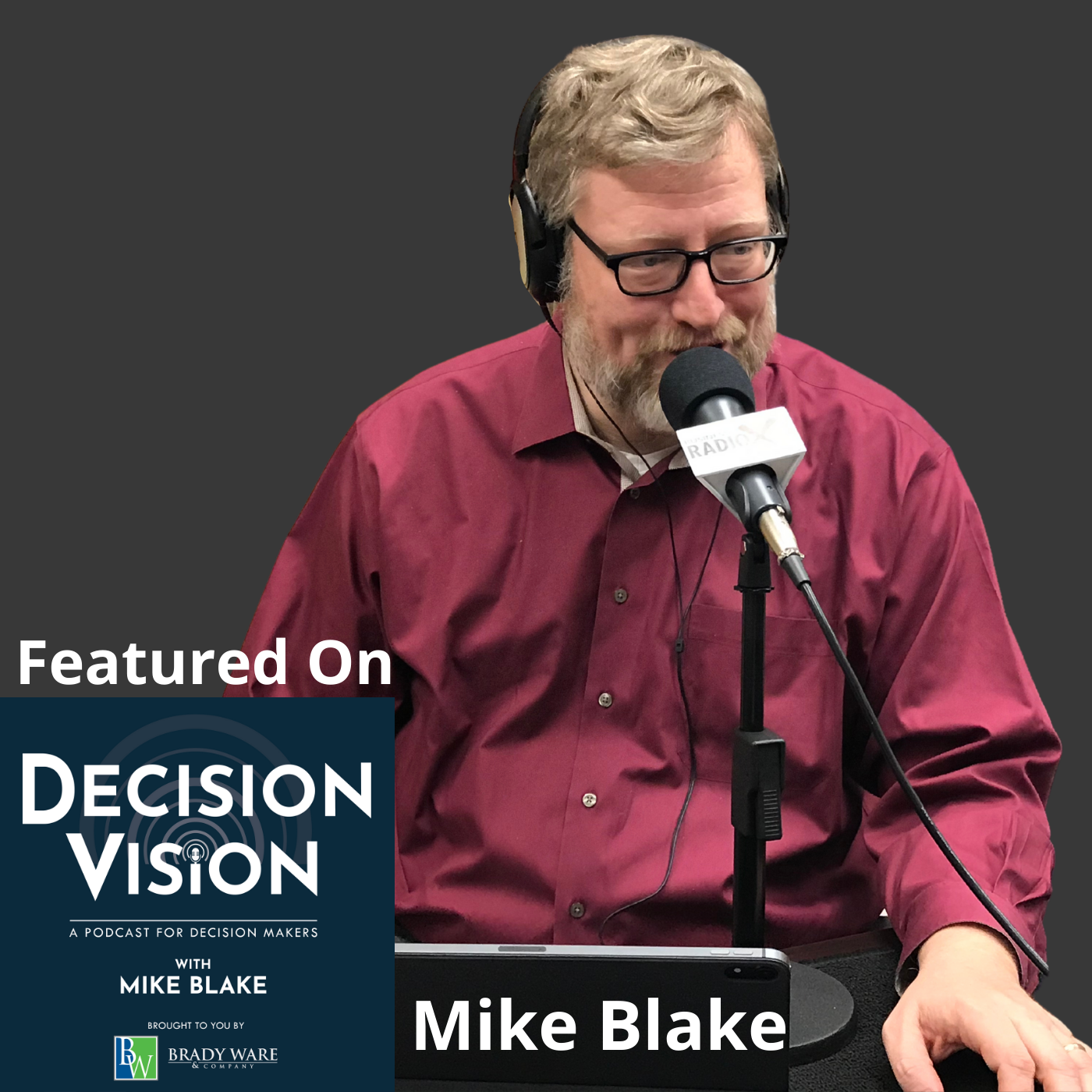
Mike Blake, Brady Ware & Company

Mike Blake, Host of the “Decision Vision” podcast series

Michael Blake is the host of the Decision Vision podcast series and a Director of Brady Ware & Company. Mike specializes in the valuation of intellectual property-driven firms, such as software firms, aerospace firms, and professional services firms, most frequently in the capacity as a transaction advisor, helping clients obtain great outcomes from complex transaction opportunities. He is also a specialist in the appraisal of intellectual properties as stand-alone assets, such as software, trade secrets, and patents.

Mike has been a full-time business appraiser for 13 years with public accounting firms, boutique business appraisal firms, and an owner of his own firm. Prior to that, he spent 8 years in venture capital and investment banking, including transactions in the U.S., Israel, Russia, Ukraine, and Belarus.

LinkedIn | Facebook | Twitter | Instagram

Brady Ware & Company

Brady Ware & Company is a regional full-service accounting and advisory firm which helps businesses and entrepreneurs make visions a reality. Brady Ware services clients nationally from its offices in Alpharetta, GA; Columbus and Dayton, OH; and Richmond, IN. The firm is growth-minded, committed to the regions in which they operate, and most importantly, they make significant investments in their people and service offerings to meet the changing financial needs of those they are privileged to serve. The firm is dedicated to providing results that make a difference for its clients.

Decision Vision Podcast Series

Decision Vision is a podcast covering topics and issues facing small business owners and connecting them with solutions from leading experts. This series is presented by Brady Ware & Company. If you are a decision-maker for a small business, we’d love to hear from you. Contact us at decisionvision@bradyware.com and make sure to listen to every Thursday to the Decision Vision podcast.

Past episodes of Decision Vision can be found at decisionvisionpodcast.com. Decision Vision is produced and broadcast by the North Fulton studio of Business RadioX®.

Connect with Brady Ware & Company:

Website | LinkedIn | Facebook | Twitter | Instagram

TRANSCRIPT

Intro: [00:00:01] Welcome to Decision Vision, a podcast series focusing on critical business decisions. Brought to you by Brady Ware & Company. Brady Ware is a regional, full-service, accounting and advisory firm that helps businesses and entrepreneurs make visions a reality.

Mike Blake: [00:00:22] Welcome to Decision Vision, a podcast giving you, the listener, clear vision to make great decisions. In each episode, we discuss the process of decision-making on a different topic from the business owners’ or executives’ perspective. We aren’t necessarily telling you what to do, but we can put you in a position to make an informed decision on your own and understand when you might need help along the way.

Mike Blake: [00:00:43] My name is Mike Blake, and I’m your host for today’s program. I’m the managing partner of the Strategic Valuation and Advisory Services practice for Brady Ware & Company, a full-service accounting firm based in Dayton, Ohio, with offices in Dayton; Columbus, Ohio; Richmond, Indiana; and Alpharetta, Georgia. The SAVAS practice specializes in providing fact-based strategic and risk management advice to clients that are buying, selling, or growing the value of companies and intellectual property. Brady Ware is sponsoring this podcast, which is being recorded in Atlanta for social distancing protocols.

Mike Blake: [00:01:16] If you’d like to engage with me on social media with my Chart of the day and other content, I’m on LinkedIn as myself and @Unblakeable on Facebook, Twitter, Clubhouse, and Instagram. I also recently launched a new LinkedIn group called Unblakeable’s Group That Doesn’t Suck, so please join that as well if you’d like to engage. If you like this podcast, please subscribe on your favorite podcast aggregator, and please consider leaving a review of the podcast as well.

Mike Blake: [00:01:43] Today’s topic is, should I interview my customers? And according to data from Price Intel, most software as a service companies do fewer than 10 customer interviews per month, which is surprising given that most SaaS companies have thousands, if not millions of customers. And, you know, as data becomes increasingly important, and it’s been this way for a while, you know, data has been gold for the last 20 years now. But as we develop greater analytic capability, as we develop greater AI and as we move kind of philosophically to a more evidence-based management approach, society-wide, I think this notion of interviewing customers becomes more acute.

Mike Blake: [00:02:31] And, of course, one of the more, I guess maybe it’s not important, it’s not the right word, but certainly better-known tools for understanding customer satisfaction is something called the net promoter score. And generally, that’s best achieved or understood through customer interviews, although I suppose you could do those two online surveys and so forth. But clearly, you get more – you get richer data when you actually talk to people as opposed to asking them to click on buttons on a website.

Mike Blake: [00:03:05] And so, I hope you’ll agree. I’m a data junkie as it is, and I have someone coming on today that’s a fellow data junkie. So, this is going to be data junkie to data junkie action here. And for the other data junkies out there, I think you’re going to like the show and certainly hope that you will.

Mike Blake: [00:03:20] And, joining us today is Carolyn Kopf, who is founder and managing partner of CEK & Partners, a market research, branding, and digital communications firm. Carolyn is passionate about delivering strategic insights that transform brands. Clients benefit from her team’s ability to mine data and extract gems to find insights that truly differentiate their brands. She guides and positions them to reach the next level. She holds an MBA in international business – sorry, international business.

Mike Blake: [00:03:50] Carolyn Kopf started her career on Madison Avenue in New York and has worked at top 10 global agencies in Europe and the Asia Pacific markets. Carolyn is the founder and leader of CEK & Partners, a 20-person firm of experts across market research, branding, and digital marketing communications fields.

Mike Blake: [00:04:08] As a woman-owned firm, CEK delivers work that enables brands to build awareness, establish thought leadership, and generate demand to drive business growth. CEK & Partners innovation workshops have generated new product concepts for Fortune 50 companies. Each concept is expected to generate a minimum of $300 million in annual revenue. CEK has generated $600 million in annual in aggregate revenue for its clients over the 13 years of its operation and has completed over 1200 engagements and counting.

Carolyn Kopf: [00:04:39] Thank you for that introduction. I appreciate it. I’m really honored and excited to be here with another data junkie.

Mike Blake: [00:04:47] Yes. Well, thank you for coming. So, welcome to the program. So, why are people excited, or why are people saying the best practices now includes interviewing customers?

Carolyn Kopf: [00:05:03] Well, I think really best practices, if we take it higher to what you’ve said, it’s really gathering insights, you know, and there’s so many great wonderful techniques that are effective. And, speaking with customers is just one of those techniques. But certainly, whether it’s surveys, whether it’s online bulletin boards, whether it’s focus groups, or whether it’s in-depth interviews, there are so many great ways to capture insights about what customers are thinking, how they’re behaving, and how that has changed over the past couple of years.

Mike Blake: [00:05:42] So, when is the right time to interview customers?

Carolyn Kopf: [00:05:47] You know, there’s usually critical junctures where you want to understand the latest attitudes, beliefs, and behaviors. Those critical junctures could be anything from you’re getting ready to launch and develop a new product, and you want to understand market viability for a product concept. Well, in that case, you might want to speak with, not only customers but prospective customers who haven’t purchased from you before or even lost customers to understand where that fits in with their needs. So, there’s, you know, doing – you have a new marketing campaign, you want to understand customer sentiment and be prepared. Any time you’re making an investment and you’re going out into the market, you want to make sure that you’re informed.

Mike Blake: [00:06:43] So, I want to ask you about talking about prospective customers because one of the big buzzwords around Atlanta with startups, and I know you don’t do a ton of work with startups, but you’re certainly familiar with what they do. One of the buzzwords around startups is a notion called customer discovery, right? Investors want to know what conversations have you had with prospective customers and, you know, you do interviews with people for a living, so I’m curious. I think you have unique insight to this.

Mike Blake: [00:07:14] I think when prospective customers are involved, I think there’s a predisposition psychologically to want to tell the interviewer what you think they want to hear. Right? You want to be – people want to be positive. There’s a natural predisposition, maybe to not be entirely honest but rather be encouraging. Right? Because there’s no cost to that, the interviewee of doing so.

Mike Blake: [00:07:39] As an interviewer, how do you cut through that? Is it interviewing technique? Is it structuring the questions correctly? Is it something that has to do with the post-interview data analytics? Or, is this something that’s just sort of have to live with in terms of whether or not prospective customers are willing to be truthful to you and tell you, “Nah, I don’t want to buy it. Your baby’s ugly. Get out of here.” Because I don’t think that happens as often as it does when the actual purchase decision is put in front of them.

Carolyn Kopf: [00:08:09] Yeah. I think that’s a really great question and a really strategic one. Thank you for asking that. I think what’s really important is stepping back from the actual conversations and thinking through the design of the research. All of our studies are custom-designed. So, we think through, does a study have to – we call it blind – should it be blind where the participant does not know who’s sponsoring the study? And that way, they’re not going to try to please anyone. And, that becomes especially important again with the design of the study. They’ve chosen a third-party partner again to help be that objective voice. They’re not going to, you know, lead the conversation. So, there’s really those three pieces of an experienced moderator, having a blind study and then having a third-party moderator.

Mike Blake: [00:09:08] So, do you – is best practice is that you simply try to interview as many customers as you possibly can? Or, is there a way to – do you work out sample sizes using the math, the math that’s out there that tells you how many customers you interview to get to achieve a certain confidence level? See, I told you, analytics people, you’d be happy with the geekiness here. Do you go that deep? Do you get – do you go – do you go that deep with something like this or?

Carolyn Kopf: [00:09:36] You might not be too happy with this answer. But when we do what’s called qualitative research and we’re having discussions with customers, it’s not going to be statistically significant. It will be directional. But certainly, we want to understand and think through the sample.

Carolyn Kopf: [00:09:54] So if a customer, if a client wants to speak to customers, it’s important to understand what is the lens that they want to. Is it a certain position, a certain title within a department of a company? Is it a certain size of the company? Is it a certain industry segment? What if it’s all three of those things? Then, all of a sudden it’s “Okay. Well, we want to speak only with manufacturers and a director level or above, and we want to hear from companies across three revenue ranges, you know, less than a billion, 1 to 2 billion and 2 billion plus.” I’m just, you know, shooting from the hip here. All of a sudden that determines how many people you need to recruit, right? If there’s quotas for a company size, you want to – at a minimum, we recommend five and always an odd number. So, it’s kind of that tiebreaker, if you will.

Mike Blake: [00:11:00] Yep. So, let me ask this, and you have had this conversation before, but I think our listeners will benefit. Why wouldn’t you strive for some sort of statistical significance? Is it – I don’t want to lead the witness here, so I’m going to leave that open-ended. Why would you not try for a statistically significant sample?

Carolyn Kopf: [00:11:21] Well, I think part of it is you have to remember that when you have discussions, if it’s in-depth interviews or focus groups, you’re not having someone answer every question. You’re not forcing them. You must answer this question. It’s a discussion, and there might be some questions that you skipped because someone’s not comfortable or they don’t have the expertise to answer the questions. So, you’re really from one conversation to another. You might serve up, you know, 10 out of 15 of the questions, and not to mention just the sheer number of people you would have to speak to.

Carolyn Kopf: [00:12:00] Today, we find that we really want to deliver insights faster to meet the demands of our clients and to move through hundreds of interviews. It would be very doable, but it’s just not necessary. Not to mention you start to identify themes after you’ve spoken with three to five people. So, you’ll just start to see those same themes, even if you spoke to 20 people. So, let’s just call it at five per segment, if you will, but you could have, you know, 10 segments in that case. You might be speaking to 50 people.

Mike Blake: [00:12:37] And, I had a thought of a point that you just brought up is that, you know, just because you’re talking to somebody doesn’t mean that they’ll answer all the questions, which means that if you wanted to have a statistically significant sample, you have to factor in the fact that not all the questions will be answered, which means your sample size is even greater, which means more expense, more time and like – and as you said at the end of the day, you may not gain that much more insight from a statistically significant sample.

Carolyn Kopf: [00:13:05] Well, we find a lot of – absolutely. I agree with you. We find that the best – you know, you can complement these discussions with doing quantitative studies. So, you might have, you know, 15, 20, 30 in-depth conversations, get some very good directional insights and findings. And depending on how much rigor and how much you’re investing in a product launch or a marketing campaign or a rebranding, it might warrant saying, “Okay. We’ve got some great directional insights. Let’s take those and craft an online survey and get those statistically significant insights with a larger population.” So, certainly, they work hand-in-hand, depending on the rigor that’s needed.

Mike Blake: [00:13:51] So, you spoke about a magic number five, which I find fascinating. I don’t do what you do for a living. That’s lower than I would have imagined. How do you select the five? Who are the lucky five?

Carolyn Kopf: [00:14:04] Well, keep in mind that, you know, we could have eight segments that we want to speak to. Right? So, and five within each of those segments. So, all of a sudden you’ve got 40 people that you’re speaking with but the characteristics of the five. So, it could be, you know, much of it is making sure that the people match and get through that filter and qualify to speak with you. So, certainly consumer interviews, you’re going to find those people faster. But when you start talking about B2B studies, you’re working from a much smaller universe. So at that point, really, it’s just a matter of who meets the qualifications and the specs of the participant and are they available within the window of the study.

Mike Blake: [00:15:02] So, when you make that selection, I’m curious about something, I’m kind of going off-script here, but I know that it’s common to compensate survey participants generally to participate in the survey. Do you find that’s also the case with customers? Do you have to budget for customers being willing to talk to you, to being compensated for their time, to talk to you about their own experience with you?

Carolyn Kopf: [00:15:33] You know, that’s interesting because there are different types of customers. We really bucket it into three types of customers. One is the lost customers. They’re no longer – they’re no longer your customer. There’s your current customer who should be willing to speak with you without being paid. And, of course, there’s your prospective customer who is you’re going to need to incent them to speak with you. So, that’s really the rule of thumb.

Mike Blake: [00:15:59] Interesting. We hadn’t even talked about customers who have left. And, how – do you do that a lot? And if so, how do you find that? Because there’s a saying, I’m sure you’re familiar with, that, you know, a happy customer will tell nobody, but an unhappy customer will tell 9000 people. So, I wonder, are people who are unhappy actually more willing to participate because they just can’t wait to unload on the company that pissed them off basically?

Carolyn Kopf: [00:16:29] Well, keep in mind if past customers, especially when we talk about B2B, they may not be unhappy. It could be that the project sponsor changed companies and say they went with another vendor or another relationship. It could be that their budgets were cut and they had to eliminate a partnership and consolidate. So, a lost customer in the B2B world may not be unhappy, but rather, you know, when we do speak with lost customers, it’s really valuable when you’re positioning the brand. Because remember when you position a brand, you want it to be any positioning that you articulate. You want it to be defendable, ownable, and true.

Carolyn Kopf: [00:17:17] So, if you get that 360 of your current customers, your lost customers, and your prospective customers, all of a sudden you know if it’s dependable or true. Because if you’re thinking one thing, but people have left because that’s not the case, it really helps to ground work in the defendable and true piece, at least in the B2B world.

Carolyn Kopf: [00:17:42] Absolutely, I agree. In the consumer world, a lost customer is probably someone who’s grumpy and didn’t love something, whether it was, I’m thinking about things that happened today with, you know, return policies, with everything being online or not being able to get a hold of someone on the phone. All of a sudden, there are different reasons why someone might not be happy.

Carolyn Kopf: [00:18:10] But I think absolutely it’s important to understand when you talk about that net promoter score. What are – what is the percentage of detractors, neutrals, and promoters? Because certainly if someone’s neutral to negative, there’s a chance you can recover that relationship with, I don’t know, a free trial or, you know, a 10% discount, something to get them to come back. But if it’s a true detractor that’s on the scale of NPS, down at the one or two’s, that’s just – just let them go and focus on your happy customers who are promoting and those who are neutral that you can recover and really bring them along.

Mike Blake: [00:18:59] So, who should perform the interview? Should it – leaving aside an outside firm for a second, we’ll get to that. But many firms, I’m sure, in-house this process, and if they do, who should do that? Should it be somebody in the marketing department? Should it be somebody on the direct service or provider team in the case of professional services, maybe a dedicated group entirely whose job it is to interview customers? If it’s an internal agent that’s going to be doing that, who should that be?

Carolyn Kopf: [00:19:33] You know, it really depends on the context. So, for example, if you’re talking net promoter score and you’re speaking with lost customers, you want someone from the customer insights team or someone even from customer service who’s trained in having conversations with lost customers and helping to bring them back to sign up for free month trial or whatever the business model might be. But certainly, many customers have those insight teams. They’re going to have the experienced moderators that know how to navigate conversations, know how to navigate tricky situations in a customer-friendly manner. So, certainly, we recommend someone with experience handling them.

Mike Blake: [00:20:21] So, when is it a good idea to have an outside firm as opposed to the firm, the company itself, interview the customers?

Carolyn Kopf: [00:20:30] Well, I think there’s a couple of reasons. One could be a company or a corporation. Their customer insights team is small and they need to expand capacity and expertise with an outside party. That’s one scenario. Another scenario is a company doesn’t have insights in-house, and they could lean on marketing or product marketing but maybe there’s not the expertise, so it’s really a risk and it would make sense to bring in a third party to either design the study, you know, do the comprehensive. And then, I guess the last point would just be making sure that no one’s leading the answers because certainly you want the insights to be helpful and true in the sense of making decisions versus what someone wants them to be.

Mike Blake: [00:21:32] Right. Don’t – you know, I think Brady Ware is great, don’t you agree? Right? Not exactly an honest interview question.

Carolyn Kopf: [00:21:40] I know you had a great experience with it. So, how would you rate it on a scale from 1 to 10?

Mike Blake: [00:21:45] How much do you love us?

Carolyn Kopf: [00:21:47] Exactly. And so all of a sudden, you know, people might not realize they do that. It’s just their natural, optimistic, bubbly selves. And, it may not be intentional. So, it takes out that, you know, to have that experience and that fresh, neutral perspective.

Mike Blake: [00:22:05] And, you know, you mentioned the word training. And, I want to bring something up because I don’t think this is always appreciated, but conducting interviews is a skill. It’s not easy to conduct a useful interview, is it? You don’t just walk up and just do that for the most part, do you?

Carolyn Kopf: [00:22:26] No, you don’t. I mean, experienced moderators. I mean, it starts with the design of the questions. You know, what is the order of the questions? Certainly, you want to make sure that you start out not revealing anything if you’re looking to get awareness of a particular topic or a particular brand, and then potentially reveal the sponsor if it’s relevant later in the conversation. So, it’s really that design, not only of the flow but the actual design of the questions themselves so that they don’t lead.

Mike Blake: [00:23:06] Now, what is the benefit of conducting customer interviews versus sending out a survey? Someone might say, “Could not that accomplish the same thing faster, more cheaply, more efficient.” Why go the extra mile, the extra hassle, the expense for doing the interview?

Carolyn Kopf: [00:23:24] Well, certainly I think that there’s different reasons to do in-depth interviews over a survey. One, the in-depth interviews, you’re going to get more rich context. You’re having a discussion. You can listen for certain things and you don’t hear what you’re expecting to hear. You can probe on topic areas and go deeper into the conversation so you really can guide the discussion and each one will be a little bit unique.

Carolyn Kopf: [00:23:52] With a survey, for the most part, you’re going to have closed-loop questions or, you know, they’re not going to be open-ended, and someone has to choose from six answers. And one of those answers could be, I don’t want to answer it, or, you know, I don’t know or not applicable. So, you’re really limiting. You’re getting very great information, but you’re not getting deep context.

Mike Blake: [00:24:24] So, is there an ideal length for how long an interview should take? And, I got to imagine at some point there’s got to be a limit to how much time you can get from somebody. So, in your mind, is there an ideal time limit on an interview?

Carolyn Kopf: [00:24:41] Absolutely. I think there’s really three types of interviews. There are interviews that feel like a survey where you might ask someone, I don’t know, 15 questions in 15 minutes. It’s like, “Are you aware of this?” Yes, no. Right? It’s not a conversation. You can do that in 15 minutes.

Carolyn Kopf: [00:25:00] If you want to have a conversation and really go deeper, I would suggest 30 minutes. Potentially, you could do 45. It’s just going to be harder and more expensive. The 60-minute interviews are really going to be around usability. Right? So, you want to share something on the screen and get feedback.

Carolyn Kopf: [00:25:23] So, there’s certainly different techniques that are going to be appropriate for the different amount of time. We find that really a 30-minute in-depth interview, that’s a conversation, is a tried and true. If you’re doing usability., you’re going to want a minimum of 60 minutes.

Mike Blake: [00:25:41] What are the – this may be an unfair question, but I’m going to ask it anyway, and that is, what are the most important questions to ask customers, and for the purposes of this question, let’s say current customers versus prospects or lost customers. What are the kinds of the most important questions? Or, if you want to replace important with common, that’s fine too.

Carolyn Kopf: [00:26:05] You know, it really comes back to the learning objective because, remember, each study is going to be custom-designed to fulfill the needs and objectives of the client. So, if a client is seeking to understand awareness of their organization, you’d start with asking questions around, how familiar are you with a company? Tell me, what are they known for? And you might end the survey with how are they different, better or special, compared to the competitors? Those are very common questions with awareness and trying to understand how to position or reposition a company within the world.

Mike Blake: [00:26:48] So let’s – to me, I think a common application of a customer interview is to gauge customer satisfaction and maybe detect likeliness to become an ex-customer related to net promoter, I guess. Do you think that interviews that are more structured in nature, the yes-no, or rate this one to five versus unstructured, open-ended, which format of questions do you think works better for that kind of purpose, or is a mix of the two ideal?

Carolyn Kopf: [00:27:24] It’s really a mix of the two. So, you ask, you know, on a scale from, you know, typically net promoter, we do that through a quantitative study. It’s an online that comes through a text message on the phone and email. But you could ask in a conversation for someone to rate a product attribute on a scale from zero to five, zero to 10, whatever it is, and then ask them, “Why did you rate that a 10?” And then, they explain their ratings. So, that’s how I would use a mix of questions. And that’s, you know, both regardless of the type of study you’re doing.

Mike Blake: [00:28:08] And I think the advanced class in terms of data analytics, which I candidly can’t, I don’t know how to do, is analyzing the results of those unstructured answers. So, I’m curious, how do you do it? Are there tools that you put together that are like language analysis tools that help you do that? Or, how do you approach those free-range answers to try to aggregate them and pull a cohesive story out of them?

Carolyn Kopf: [00:28:39] Yeah. That’s a really great question. I have never been asked that. I love that because unstructured data is hard for some people, right? You know, data ana – you know, people work with their Excel sheet, Tableau, these different platforms. But really with unstructured data, we’re looking for themes. Right? So, it’s not, you know, you certainly want to compare conversation to conversation to identify theme. Once you identify those themes, you’ll pull some verbatim ones to bring color to the findings document. So, a verbatim would be a direct quote from a customer, prospective customer, lost customer that represents the overall story that’s been heard, for sure.

Mike Blake: [00:29:31] So, I’d love it – Give me an example of when a client of yours, maybe, you know, that hired you to find out something from – it could be current customers, prospects, lost customers, doesn’t matter. And, maybe the client thought that I already know what the answer is going to come back but maybe you came back and surprise them where the data sort of – you didn’t surprise them, the data surprised them, and the responses surprised them. Can you think of a time when that happened?

Carolyn Kopf: [00:30:00] Yeah. I mean, I think there’s a couple of instances. I mean, especially when you talk about doing an AAU study, attitudes, awareness and usage. Right? A customer does that to establish a baseline and monitor their brand’s performance and how it’s perceived in the marketplace with its customers as well as against its competitors. And so, you’ll know you’ll rate brand attributes as far as how the brand behaves, you know. Do people think that it’s fun to interact with the brand? Do they think that the brand customer service or communication is friendly or welcoming whatever the situation may be?

Carolyn Kopf: [00:30:42] And so, a lot of times there might be things that aren’t even a hypothesis that comes back of, “Oh, wow. We didn’t realize that we weren’t considered a friendly brand. We thought everyone was really warm and welcoming. Gosh. You know, but compared to our competitors, they might be doing a better job.” So, things that weren’t maybe on the radar, especially when you compare it against the competitors.

Carolyn Kopf: [00:31:11] Another example would be in message testing that you find out that, you know, you think you’re messaging is resonating or you have some new messaging that you want to launch, whether it’s for a TV or radio campaign or, and you test it and you hear from people that, “Wow. I can’t believe the brand’s talking to me in that manner. It’s rude. It’s making me feel bad. It’s fear-based.” And so, things that, again, weren’t even on the radar to expect to come back surprise – you know, the data surprises all of us, and the importance of that is the value of the data. Right?

Carolyn Kopf: [00:32:03] It’s a small investment compared to, you know, the marketing and advertising campaign creative, the production, the media buys. I mean, when you look at it and compared it to those budgets, it’s probably a rounding error. So, it makes sense to certainly get that pulse of, “Oh, yeah. This is resonating,” or, “Oh, wow. We should really talk to our team and train against this because it’s not coming through right to our customers.”

Mike Blake: [00:32:36] And, you know, those surprises can, as you said, you know, they can be so instructive and the business you’re in, to me, from my perspective I should say, the business that you’re in from my perspective is really the insurance business. Because for a small amount of a relatively small investment compared to the overall investment of introducing a new product service company launch, whatever, right, you can find out if you need to course correct or even bail out before you make the really big investment.

Carolyn Kopf: [00:33:09] Absolutely. Especially when you’re talking about proof of concept, you’re trying to figure out what price point, what products and features should be the top three that are communicated in the marketing that are going to be most, you know, interesting and compelling to the customer in a software solution, for example. I mean, you don’t want to put 15 product features when really there’s three that are going to compel and motivate the buyer to sign up.

Mike Blake: [00:33:41] I remember when at the outset of COVID, Apple had a very short-lived campaign where they were doing these TV and video advertisements, basically showing people having lots of fun and smiling while they’re all in quarantine and using their Apple devices and so forth. And, I sensed it and there was tremendous backlash because basically, while millions of people who can’t be sequestered were forced to put their lives on the line in service to the rest of the economy, and also just sort of completely missing the point that the pandemic was serious and it wasn’t just a vacation to go home and play on your iPad. You know, I think that was a place where Apple really missed the mark, and I suspect they thought that for sure. They really understood what everybody was going for.

Mike Blake: [00:34:29] But that to me, that was a classic case where they would have done very well to have stepped outside of their office and hired somebody like you to kind of test that message and give them sort of a reality check because it truly was disastrous. Your Apple can withstand that, but nevertheless, it was a disastrous campaign that the kind of study that you’re talking about, you know, talking to customers would have avoided.

Carolyn Kopf: [00:34:56] Yeah. And, I think that what’s important here is when you talk about, you know, smaller companies, startup companies, you know, these mid-sized companies, it matters. You know, if they have a misstep, it can mean market share points for them in the millions of dollars or more. So, I think that’s a great reminder about just taking the time and being thoughtful to hear from people before you tell them what you think they want to hear.

Mike Blake: [00:35:29] So, we’re recording this in a period of a lot of uncertainty in terms of, you know, meeting in person, return to office, et cetera, et cetera. Does it impact how you earn to interview or the efficacy of interviews to conduct them virtually or remotely versus in person? And if so, what adjustments have you had to make in terms of technique or approach to close that effectiveness gap?

Carolyn Kopf: [00:36:01] You know, we’ve always done in-depth interviews over the phone, right, because we might have, you know, 20 interviews, but we’re speaking with people around the country. So, it’s not cost-effective to fly to California and then fly to Texas and then over to New York and then to South Carolina. So, those would always traditionally be done over the phone.

Carolyn Kopf: [00:36:21] The primary difference is, you know, we’re now using Zoom. So, it’s almost better because you get to see the people and it’s easier to record. You’re not, you know, jury-rigging some handheld recorder or whatever techniques people use, you know, 10 years ago. And, everyone’s comfortable for the most part on Zoom. You know, there are a few exceptions, but really Zoom or similar platforms, whether it’s a WebEx or a Teams, they’re great for in-depth interviews.

Carolyn Kopf: [00:37:00] Certainly. I think the biggest change has been in-person focus groups, right, where those have gone virtual. Certainly, there are plenty of current focus groups behind the glass that are still occurring. But I think that there are definitely some efficiencies and comfort level with virtual focus groups and that saves people money. You don’t have to fly to California to conduct focus groups. You can do them online if there’s a speed or budget constraint for a company.

Mike Blake: [00:37:33] You know, you bring the whole Zoom thing up and it’s funny. You know, we’ve had the telephone for about 145 years and we’ve had video calling available for roughly 60. And it was really a niche, fringy product nobody wanted to deal with it, except for real tech heads until the pandemic hit. And then, all of a sudden, because there’s a virus out there, for some reason now we don’t want to do phone stuff anymore. Everything has to be on video. And, it’s strange because nothing changed about the core technology or even the use case. It’s just for whatever reason because we’re all in our – for our time, we’re all in our homes, all of a sudden we had to do video. Really strange. Somebody’s got to be writing psychology papers on that.

Carolyn Kopf: [00:38:17] It’s been a great tool and I’m surprised we haven’t, like you said, used it more often. I think it just wasn’t mainstream or it wasn’t a platform that was an easy subscription. Whereas, now it’s just part of your tech stack.

Mike Blake: [00:38:35] So, you mentioned something I want to, I did want to make sure to touch upon. It sounds like that it is a practice of yours, at least sometimes, to record interviews. And if that – is that in your mind a best practice as a blanket or are there some cases where it’s more important to record an interview than others?

Carolyn Kopf: [00:38:55] You know, I think that recording the interview has value for transcription. Right? So, you can really focus on speaking and listening to the participant in the study, and you can go back and, you know, if you’re allowed, I mean, there’s different parameters depending on the study design, you can go back and cut a video if it’s a Zoom and show a minute clip of, you know, 10 customers what they said, depending on if it’s, you know, the parameters. Again, sometimes it’s confidential and it’s blind and people aren’t supposed to know who’s participating. But again, there is that opportunity at the right design. But there’s also the opportunity to transcribe the interview so you have those notes so that you can pull the verbatim. I mean, you can certainly try to type as fast as you can to get those verbatims, and that’s certainly possible. But relying on the videos is just a great, again to use your word, insurance policy that you have the notes and all the information to do the analysis.

Mike Blake: [00:40:07] And, I’m guessing, I know some attorneys feel this way when they do when they take depositions that being able to capture the body language can sometimes be very material to what you glean from that interview.

Carolyn Kopf: [00:40:25] Certainly. I mean, we’re not putting anyone under the spotlight where we’re grilling them.

Mike Blake: [00:40:29] No, I understand. I understand. You know, waterboarding anybody. But nevertheless, I mean, you can a question that may make somebody feel uncomfortable or more comfortable, and, you know, but I’m only speculating. You know, whether it’s a deposition or a conversation, right, body language is meaningful.

Carolyn Kopf: [00:40:47] Yeah. And I think that that is interesting, but that’s not the core of the in-depth interviews. But, yeah.

Mike Blake: [00:40:55] You don’t make, like, little notes saying, well, this person has shifted in their seat a little bit or looked flustered on an interview question, number nine.

Carolyn Kopf: [00:41:04] No.

Mike Blake: [00:41:05] All right.

Carolyn Kopf: [00:41:05] I think it’ll come through someone hums and haws, and most people will say, “You know what? I just don’t have the expertise to talk about that particular question.” And, it’s very different with the in-depth interviews. You know, it might be different with a focus group where you’re asking someone, “What do you think about this package design?” And they’re, you know, trying for all their might to rip something open and, you know, jabbing at it with scissors. All of a sudden, someone’s body language of, gosh, they can’t open this package, it’s not designed or consumer-friendly, that absolutely matters.

Carolyn Kopf: [00:41:42] And, there are certainly in-depth interviews that may be more ethnographic in nature, where you can send someone a product and say, “All right. I want you to work with this product and use the product, and then we’re going to have a conversation around it.” And at that point, they may share the product. And, that’s where body language would be important, for sure. So, I think you make a very good point.

Carolyn Kopf: [00:42:06] And, again, it just comes down to what you’re trying to learn. And, is it conversation, is it ethnographic where you’re really trying to learn how someone uses something in their home or office? So many variables.

Mike Blake: [00:42:21] I’m talking with Carolyn Kopf, and the topic is, should I interview my customers? A couple of questions I wanted to get through here, make sure that we cover. One, is there any value to interviewing a customer more than once? Maybe, not in the same study, but maybe you come back to that same customer a year later, two years later. Is there a, you know, maybe influences? I don’t know. I’m sort of spitballing. You’re the expert. I’m not. But I’m speculating that there could be a case in which interviewing the same customer over time might yield interesting sort of quasi-time series data. Or, is that just not a thing?

Carolyn Kopf: [00:43:09] No. I mean, I don’t know that it’s a thing. Again, it comes back to what you’re trying to monitor. So, if you’re doing an online study where you’re establishing a baseline on perceptions of a certain brand, of course, you’re going to want to redo that study in a year or 18 months or two years. You may not send it to the exact same body of people. There might be some overlap, but certainly, you start to see how perceptions change.

Carolyn Kopf: [00:43:42] Also, when you talk about the NPS surveys, again, it’s more that you’re repeating to your customer base, right, of, okay, it’s been six months since they received this appliance and they’ve installed it and used it and we asked them how everything was going or how the delivery experience was, you know, a week after they received it. But now, we want to go back and ask them how the experience is with the product.

Carolyn Kopf: [00:44:13] You know, the same with a software, right? So, “Oh, how was it to sign up? Was it easy to sign up and implement the software?” You might ask them that. And then six months later, “How happy are you with the software now that you’ve been using it for six months?”

Carolyn Kopf: [00:44:30] So, absolutely. there are reasons to do follow-up whether it’s monitoring perceptions or following up with an appropriate series of questions as they get more familiar with your product or solution.

Mike Blake: [00:44:46] Carolyn, this has been a great conversation. I want to be respectful of your time. There are probably questions that somebody wished we would have covered or maybe would have wished we spent more time on going into more detail. If somebody has a question about interviewing customers, can they contact you to follow up? And if so, what’s the best way to do that?

Carolyn Kopf: [00:45:05] Absolutely. I think the easiest way to find us and all of our contact information is online, at our website, which is cekpartners.com. So, you’ll find all our social handles there, as well as a contact form and a phone number.

Mike Blake: [00:45:24] That’s going to wrap it up for today’s program. I’d like to thank Carolyn Kopf so much for sharing her expertise with us.

Mike Blake: [00:45:30] We’ll be exploring a new topic each week, so please tune in so that when you’re faced with your next business decision, you have clear vision when making it. If you enjoy these podcasts, please consider leaving a review with your favorite podcast aggregator. It helps people find us that we can help them.

Mike Blake: [00:45:46] If you would like to engage with me on social media with my Chart of the Day and other content, I’m on LinkedIn as myself and @Unblakeable on Facebook, Twitter, Clubhouse, and Instagram. Also, check out my new LinkedIn group called Unblakeable’s Group That Doesn’t Suck. Once again, this is Mike Blake. Our sponsor is Brady Ware & Company. And this has been the Decision Vision podcast.


Tagged With: Brady Ware & Company, Carolyn Kopf, CEK & Partners, Customer interviews, Decision Vision, interviewing customers, market research, Mike Blake

Julie Keyes, Poised for Exit Podcast

February 17, 2022 by John Ray

Julie Keyes, Poised for Exit Podcast
North Fulton Studio
Julie Keyes, Poised for Exit Podcast
Loading
00:00 /
RSS Feed
Share
Link
Embed

Download file

Julie Keyes, Poised for Exit PodcastJulie Keyes, Poised for Exit Podcast

My friend Julie Keyes is an exit planning expert based in the Twin Cities area. In an episode titled “Your Price is Too Low,” Julie interviewed me on her Poised for Exit podcast about pricing for professional services providers. We chatted about why I use the word “journey,” imposter syndrome, conducting value conversations with clients, why it’s vital to offer options, and much more. The Price and Value Journey is presented by John Ray and produced by the North Fulton studio of Business RadioX®.

TRANSCRIPT

John Ray: [00:00:00] Hello, I’m John Ray on the Price and Value Journey. I was honored to be invited to join my friend, Julie Keyes, on her Poised for Exit Podcast to chat about pricing for professional services providers. We chatted about why I use the word journey in the Price and Value Journey. We talked about imposter syndrome, conducting value conversations with clients, why it’s vital to offer options and more. I’m grateful to Julie for inviting me on her show. Now, here’s our conversation.

Julie Keyes: [00:00:32] Ladies and gentlemen, we are here today with John Ray, who is a consultant, speaker and radio host of RadioX. John, welcome to Poised for Exit.

John Ray: [00:00:43] Hey, Julie. It’s great to be here and I’m just so honored to be on your show. I’ve listened to it a lot, and you’ve got great guests, and I’m delighted and humbled to be part of that pantheon you’ve had. So, congratulations on that.

Julie Keyes: [00:00:55] Well. Thank you. Well, I have to say likewise, you’ve had a lot of really great content on your show too, and I hope to get into some of that today because our listeners are really going to be interested in what you have to say because so many of us, of the people who are in our listening audience would want to know and hear a lot of the advice that you’re going to dispense for us today. So, thank you for being on the show. And it took us a while to get you here. You’re a busy guy, and I’m a busy gal, and oh my gosh. But thank you for your patience.

John Ray: [00:01:26] Absolutely.

Julie Keyes: [00:01:26] And yeah. So, I’m really looking forward to this interview. Thanks for joining us today. Let’s just jump right in. I’d like to talk with you about the work that you do in pricing and helping professionals price their services because I know that there are a lot of advisors out there who are not pricing properly regardless of their discipline. And I’m sure you see it all the time because it’s the work that you do. So, how did you get into that and why?

John Ray: [00:01:53] Well, because I wasn’t doing it right, right?

Julie Keyes: [00:01:57] I’m sure, yeah.

John Ray: [00:01:58] I mean, I’ve got a whole drawer full of t-shirts about mistakes in pricing. And you know, I did not learn pricing, and pricing strategies, and value and how to discern value. I didn’t learn any of that in business education and my career. You know, the last statistic I saw, it was like, I believe it was five percent of business schools in this country actually have a course, a course, any course on pricing.

Julie Keyes: [00:02:34] Wow.

John Ray: [00:02:34] So, if you’re educated, come out with your MBA, you don’t have great education on pricing or maybe any. So, you learn the wrong thing. You learn to do market surveys, or you just do it by the seat of your pants or what have you, and you went, “That’s wrong.” And so, I made a lot of those mistakes and I had to fix that. And so, I had to do a lot of this work on my own. And I saw this in my clients. And I was so passionate about it after a time. It’s like, “I see this over and over and over again. I want to help in this regard.”

Julie Keyes: [00:03:19] And that is — boy, you hit the nail on the head there. When I think about pricing and conversations that I’ve had – and it’s not my specialty right – but I have made some recommendations to clients that they need to adjust their pricing. And so many times you ask, “When was the last time you had a pricing adjustment?” and they’ll say, “Oh, three years ago. Four years ago.” Yeah.

John Ray: [00:03:42] Yeah.

Julie Keyes: [00:03:42] And I think, you know, with the way things are now, I think we really need to be cognizant of that. But it’s amazing to me that the schools aren’t actually teaching it. So, what are they teaching? Are they teaching people to just follow the competition around and price according to what they’re doing?

John Ray: [00:03:56] Well, to be fair, I mean, this is a relatively newer discipline, not how to price, but the philosophy behind it because so much of pricing is really tied up in behavioral economics. And that’s a relatively new field, just a few decades old. And so, you really have to get into behavioral economics to properly price, right. And so, I think that’s the issue of it all. But what’s at stake here is that pricing is the fastest way to change your bottomline. Now, this is an accounting fact. They teach you that in accounting. You know, it’s faster than improving your marketing or getting more clients or anything. This is an accounting fact. It’s not up for argument. So, if you can just work on your pricing, you will dramatically change the trajectory of your business.

Julie Keyes: [00:04:59] And probably have more fun and work fewer hours too, right?

John Ray: [00:05:03] Getting the whole idea

Julie Keyes: [00:05:05] And we’re going to get to a good story in a little bit about that. I know we are. So, I know that the name of your show is The Price and Value Journey, and I love that. But speak to me about journey. Why did you call it The Price and Value Journey?

John Ray: [00:05:20] Well, I guess there’s three elements to that. Price is obviously one. Value, let’s get to that real quick. So, this is about value that is perceived by our clients, right? This is not about value that we perceive. It’s not about what we think we’re worth, even though we’re worth a lot, right? You’re worth a lot, I’m worth a lot. Our listeners, the work they do is fantastic worth. It’s what our clients perceive, and how we get to that, and how we can price relative to the value that they perceive.

And then, journey is that we’re on a journey of trying to get this right. I mean, give yourself grace because the most common thing that happens when I work with a client on their practice and their pricing is, “Wow, I can’t believe I did that,” and as we talk and they learn, they just beat themselves up. “I don’t know how I’m going to do all this.” Well, here’s the point – it’s a journey, okay. You’re not going to fix all this today, or tomorrow, or next week or even next year. It takes some time to work these things through. And so, give yourself grace.

And pricing is an art; it’s not a science. So, that’s the other piece of it. You can’t look up in the book and find out all the answers. You have to do some trial and error and testing to get from here to there. And so, that’s a journey.

Julie Keyes: [00:06:54] And I love that you said you’ve got to give yourself permission because I think that we, as advisors, at least, when I first started exit planning six or seven years ago, I just thought that I had to get it right right out of the gate. And like you said, it takes a while. You have to figure out. I don’t know. It is definitely a journey. I guess that’s why I wanted to ask you about it because I don’t think that a lot of people who are pricing professional services view it that way. I think that they feel pressured to make sure that they get it right. And unfortunately, I think a lot of them are still charging by the hour. And I know you don’t believe in that, either. Neither do I. That could be another whole show, John, right?

John Ray: [00:07:34] How long is this show, Julie?

Julie Keyes: [00:07:38] Yeah, yeah.

John Ray: [00:07:39] Well, yeah. Well, I mean, you know, a couple of things there. I mean, yeah, pricing by the hour, I call it a red flag of poor pricing. You know, if you’re pricing by the hour, your price is too low. That’s just by definition. And again, there’s a whole explanation behind that, and we can address that some other time. But you know, the other thing is, is that to get from here to there – and by here, I mean struggling and stuck in your practice, and a lot of people are struggling and stuck, or they’re working too hard for too little money, and that’s kind of struggling and stuck to. And if any of those things describe you, pricing is probably a problem. But to get from here to there, it takes a shift in mindset. It takes a lot of deep perspective change about where value is, and how value is perceived, and how you look at your practice and how the clients look at your practice. And that takes some time. It takes some adjustment.

Julie Keyes: [00:08:47] It does. And self-awareness, I would think, would be a part of that conversation too, right? Figuring out like, why do I feel like I’m not worth a certain amount of money or why do I? And is that in line with what the client would really want or expect, right?

John Ray: [00:09:05] Oh boy. I think I heard the imposter syndrome get flopped up on the desk, yeah?

John Ray: [00:09:11] Yeah. That’s what we’re talking about, right?

Julie Keyes: [00:09:13] Yeah. Yeah, yeah, absolutely. Yeah. And I bet you deal with that all the time,

John Ray: [00:09:18] All the time. And you know, that’s a case where you’re spending with your own wallet. Nobody would pay that, right? Well, what you’re really saying is you don’t think you would because you don’t trust yourself. And I know that you, whoever you is, I know you do great work, but it’s not about you, it’s about what the client perceives.

Julie Keyes: [00:09:45] Yes.

John Ray: [00:09:45] So, let’s let the client decide how to spend the money instead of you.

Julie Keyes: [00:09:49] How do you figure that out?

John Ray: [00:09:50] Yeah.

Julie Keyes: [00:09:51] Sorry.

John Ray: [00:09:51] No, no. Instead of you selling to your own wallet is one way to put it.

Julie Keyes: [00:09:57] Yeah, that’s a cool concept. I mean, it’s a good way to look at it, [but how do you figure out what the client is actually perceiving? How do you determine that?

John Ray: [00:10:07] So, that’s a value conversation. And that’s not a term I came up with. It’s not a concept I came up with. You know, there’s some great work out there by people like Ron Baker who talk about having a value conversation with clients. And what that is is diving into their hopes, dreams, aspirations, all the intangibles that are behind the reason they picked up the phone to call you to begin with. See, when somebody calls Julie, lets say — can I use you as an example?

Julie Keyes: [00:10:42] Sure.

John Ray: [00:10:43] When when they call Julie to look for help with their exit planning, what are they looking for? There’s more to it than just the request, the tactic that they’re wanting help with, right? They’ve got a strategy. They want to exit their business in five years. Their spouse is all after them saying, “You’re spending way too much time in this business. You need to get out. It’s destroying your health,” or some other reason or set of reasons. Those are values. Those are client values. And so, what that means is it’s more what’s at stake when you counsel a client is more than just, “Oh, let’s do an exit plan,” right?

Julie Keyes: [00:11:32] Oh, yeah, yeah.

John Ray: [00:11:33] It’s about getting that person to a place where they’ve got a happier home life, their spouse, they can reconnect with their spouse, their health is better. Those are priceless values. And so, you price relative to just the plan, not just the things, the tactics that you help them with and the strategies you help them with, but the big picture intangibles that mean so much to them that are behind the request.

Julie Keyes: [00:12:03] Well, and don’t you also help your clients determine if and when pricing packages or levels make sense, so they’re not just quoting one price, but they’ve got different offerings at different levels. Let’s talk about that for a second.

John Ray: [00:12:19] Yeah, thank you. So, yeah. So, options are powerful. And there’s a reason why, you know, the car companies, for example, have a small compact car, they have a medium kind of offering, and then they have luxury offering. I mean, there’s a reason why there’s small, medium and large. The dominant one-

Julie Keyes: [00:12:46] Just like at the Dairy Queen, yeah.

John Ray: [00:12:48] Yeah, there are choices. Exactly, there are choices. And what that’s a nod to is the fact that we have different values for different products and services. So, let’s take coffee, for example. I mean, I’m a cheapskate when it comes to coffee, so I would prefer just to come to your office and drink your coffee. But if I have to, I’ll go get the dollar coffee at the gas station right? Then, there are some people that they want the Starbucks. They’re going to sit in line for the Starbucks. And then, the most expensive cup of coffee in the United States is $75. It’s served once a year in one sitting in one party, and it’s sold out. And these are people that highly value coffee. They think coffee is like wine.

Julie Keyes: [00:13:36] Wow.

Julie Keyes: [00:13:37] More power to them. I mean-

John Ray: [00:13:38] Sure, yeah,

Julie Keyes: [00:13:39] I’m not criticizing. It just shows different values. So-

John Ray: [00:13:42] Of course.

John Ray: [00:13:44] If you can offer different options for your services, then you’re more likely to hit people more how they might value you. And I promise you, your prices will go up by definition because most people are pricing based on the basic. Their price is not based on the dollar cup of coffee, and not on the premium.

Julie Keyes: [00:14:07] Right. And I think, like you said before, I think that people really do value the ability to make a choice, right?

John Ray: [00:14:19] Absolutely.

Julie Keyes: [00:14:19] And I saw on a show not too long ago where they were talking about how to place items on a menu at a restaurant, and the things that they want you to buy that are in the middle of the road, so to speak, is going to be right in the middle, right where your your line of vision is. So, beware the middle of the menu.

John Ray: [00:14:39] Yeah. Yeah, they’ve got a lot of little tricks on those restaurant menus, for sure.

Julie Keyes: [00:14:45] Well, we to have our own tactics, don’t we, John?

John Ray: [00:14:48] Absolutely. Absolutely.

Julie Keyes: [00:14:50] Yeah. So, let’s talk about a client or two. Could you share a story about not necessarily — well, you talked about struggling and stuck. So, you took them from struggling and stuck to happy and not working all the time.

John Ray: [00:15:08] Well, let’s talk about — I mean, a number I could point to, and some of them are humorous, some of them are sad actually, but let’s talk about some specific numbers because we were just talking about options. So, I worked with a consultant who I won’t mention what they do, but they had their thing, and it was kind of a one-time thing that they did for busy professionals, and they charged $800 for it. That was the only option. Well, you could look at it from the outside and see there was a lot more value than $800 to it. And once we got through talking through all that, what we decided was his base offering should be $1500, not $800. And we built on options from there. And it’s a good, better, best model.

Julie Keyes: [00:16:09] Of course.

John Ray: [00:16:10] Right?

Julie Keyes: [00:16:10] Got it.

John Ray: [00:16:11] So, better has a little bit more than good, and best has a little bit more than better, and best is you’re like premium velvet rope option. So, we got good to $1500, we got better at $3300 for his thing, and then best I can only get him to $5000. I told him it ought to be $10,000. But we could get him to $5000, and I figure we’ve done good enough job there.

Julie Keyes: [00:16:43] Wow.

John Ray: [00:16:43] Well, the first time he went and offered this, he called me back, and he was so excited. The client he offered those options to pick the middle option, which means that’s at $3300 versus $800. So, the better option. And that’s obviously about four times more revenue than he has received.

Julie Keyes: [00:17:12] He had to be cartwheeling then.

John Ray: [00:17:14] He was pretty happy, right?

Julie Keyes: [00:17:16] Right.

John Ray: [00:17:17] Think about this now[. There’s there’s a couple of things here. That’s three fewer leads he’s got to worry about converting.

Julie Keyes: [00:17:24] Oh, exactly. Yes.

John Ray: [00:17:26] So, suddenly, he’s got a lot more time on his hands to better serve that client. And here’s the most important part for me because I get this all the time from people about you’re just trying to ring people out, you know, ring clients out. That’s not the point here. The point is that’s serving clients better. The client picked what they wanted, so they received much more value than what he had been selling before.

Julie Keyes: [00:17:52] Exactly.

John Ray: [00:17:53] Yeah. So, they picked that because they saw value in it. And so, the client was better off. The consultant was better off.

Julie Keyes: [00:18:01] Everybody wins.

John Ray: [00:18:02] Everybody wins. That’s the whole idea here.

Julie Keyes: [00:18:04] Yeah. And that’s really the way things can be more sustainable, right, is if everybody is going to win. So, well, one thing I wanted to touch on really quick that you talked about in one of your recent shows was on consistency. And so, let’s briefly discuss consistency. Obviously, we could go on for that personal life, business life. We could go on for a long time about that. But as it relates to your work, let’s talk about that for a little bit.

John Ray: [00:18:35] Sure. So, consistency, I mean, everybody intellectually agrees that consistency is important. You know, it’s another thing to be consistent in a way that you’re building trust with clients. So, you know, there’s a lot of aspects to this. One is to be consistent about all the right things that clients care about. You know, not about maybe what you think is important, but what the client thinks is important. So, it’s about understanding what their values are, right? I mean, if you’re not delivering that report they’re looking for every month, but you haven’t asked about what report they’re looking for, you know, that’s kind of on you. You’ve got to figure that out, so you can be consistent about the things that are important to them in their minds.

You know, consistency is one of those things that sometimes I think we as professional services providers, particularly smaller firms, certainly solopreneurs have a problem delegating, right? So, if you don’t have a VA, go get a VA. Spend the money. I’m sorry. Go spend the money and get a VA that will help you be consistent, and you can download some of this too, right? They can help you with that.

Julie Keyes: [00:19:57] Yes.

John Ray: [00:19:57] Or if you’ve got a VA, and they’re not doing the job, get another one. Or maybe you need to reposition your people if you’ve got employees, but they can help the overall consistency of the firm and how it delivers what it delivers. So, this is where automation can help you. This is where systems can help you. This is where having a operations manual can help you. I dare say that most professional services practices that are small solopreneurs and medium or small firms do not have an operations manual.

Julie Keyes: [00:20:38] So, if something happened to them, there’s no way anybody could continue the business because they wouldn’t know what to do. Yeah, yeah.

John Ray: [00:20:45] Well, that is certainly true, but the fact that you haven’t done that means you haven’t sit and thought about your process very much. And just like how writing helps you clarify your thoughts about something, you know about this because you do a lot of writing, if you do an operations manual and a process flow, it helps you think more clearly about what’s going on in your practice and how things happen, right? And you can remove some of those frictions that make you inconsistent.

Julie Keyes: [00:21:17] Great advice. Great advice. I’m going to do that myself. I have some processes documented but some, I don’t. And much of that I was forced to do when I hired my first VA. And so, for those of you out there who don’t have a VA, this will force you to articulate your processes in writing, for sure.

John Ray: [00:21:38] There you go.

Julie Keyes: [00:21:38] So, give us a couple action items, John. We could keep going, but we got to wrap up. So, what are a couple of things that our listeners could do right away that would make a difference?

John Ray: [00:21:48] Go raise your price. So-

Julie Keyes: [00:21:48] Easy, raise your price.

John Ray: [00:21:53] Well, here’s how I’ll make it easy. I mean, if you haven’t raised your prices in — certainly, the person you described, the situation you described where they didn’t raise their prices in three or four years, I mean, look what’s happening with inflation. Raise your prices, please. So, you don’t have to go out and raise your price by 50 percent tomorrow, but raise your price. And in a one-percent price increase, nobody will even notice. I mean, they won’t care. But just go raise your price. And do it for new clients. Just do it for new clients that you get. You don’t have to worry even about your legacy book, necessarily, although you need to get into that, but raise your pricing for new clients. Start thinking about options. How can I deliver options? What’s my good, and better and best? And why am I delivering the best that I’ve got the velvet rope treatment for every client? Why am I doing that? Because if you’re doing that, you’ve got nice clients and good clients, but they’re not really paying you for the velvet rope treatment, but you’re giving it to them.

Julie Keyes: [00:23:13] Yes.

John Ray: [00:23:14] So, develop options in your practice.

Julie Keyes: [00:23:18] Wonderful advice. What’s the best way for our listeners to reach you? Because I’m sure they’re going to want to learn more?

John Ray: [00:23:24] Sure, folks can go to my website, johnray.co. You can email me John@JohnRay.co. If you want to listen to my show on The Price and Value Journey, you can go to priceandvaluejourney.com to see the show archive and of course, on your favorite podcast app, as the old saying goes.

Julie Keyes: [00:23:53] Fantastic. And we will have all of that in the show notes, John. Thank you so much for being on the show today. Wonderful advice. I can’t wait to hear what our listeners have to say about it. And for you, our listeners, you will be able to find this, of course, and all our other episodes on the Poised for Exit website available for download at any time. Thanks for joining us, and please join us again next time.

John Ray: [00:24:15] There you have it. I’d like to thank Julie Keyes so much for her kind invitation to join her as a guest on Poised for Exit. If your professional services practice has a bent toward assisting business owners with exit planning or you’re actually one of those business owners looking ahead to an exit, you need to know Julie and subscribe to her podcast. One thing I love about her is that she’s been a founder and operator of several companies, and she’s actually been through her own business exit. In other words, she’s got hands on expertise and experience to bring to the table for her exit planning clients.

I’m a subscriber and a regular listener to her show, and it’s terrific. You can find the show on your preferred podcast app, of course, but if you go to PoisedForExit.com, you’ll find not only past editions of the show, but a ton of great resources, including Julie’s book also titled Poised for Exit. There’s a ton of resources and information about Julie’s work at her website, KeyeStrategies.com. That’s KeyeStrategies.com. If you want to get in touch with Julie directly, email her at Julie@KeyeStrategies.com. Again, that’s KeyeStrategies.com. Thanks again to Julie for having me on her show. And thank you for listening to this edition of The Price and Value Journey.


Julie Keyes, Founder and President, KeyeStrategies, and Host of Poised for Exit

Julie Keyes
Julie Keyes, Founder and President, KeyeStrategies, and Host of Poised for Exit.

Julie Keyes is the founder and owner of KeyeStrategies, LLC in Minneapolis, MN, specializing in exit and transition consulting for business owners of lower middle-market companies. Julie has been an entrepreneur most of her life. As the founder and operator of several companies, she understands owner motivations and the balancing act they require to work both ‘in’ and ‘on’ the business.

Julie is a Certified Exit Planning Advisor and Value Growth Advisor. She works with business owners who seek to understand and maximize their exit and critical transition options. She founded the Exit Planning Institute Twin Cities Metro Area Chapter in 2016, serving as president until 2020, and is a faculty member for their CEPA program. In addition, Julie was awarded EPI’s 2017 “Leader of Year”.

Julie’s first book, Poised for Exit, helps owners of privately held companies navigate the process of business exit. Her weekly podcast, of the same name, provides content relevant to business owners and advisors alike and can be found on all major podcast platforms.

LinkedIn | Twitter | Poised for Exit


About The Price and Value Journey

The title of this show describes the journey all professional services providers are on:  building a services practice by seeking to convince the world of the value we offer, helping clients achieve the outcomes they desire, and trying to do all that at pricing which reflects the value we deliver.

If you feel like you’re working too hard for too little money in your solo or small firm practice, this show is for you. Even if you’re reasonably happy with your practice, you’ll hear ways to improve both your bottom line as well as the mindset you bring to your business.

The show is produced by the North Fulton studio of Business RadioX® and can be found on all the major podcast apps. The complete show archive is here.

John Ray, Host of The Price and Value Journey

John Ray The Price and Value Journey
John Ray, Host of “The Price and Value Journey”

John Ray is the host of The Price and Value Journey.

John owns Ray Business Advisors, a business advisory practice. John’s services include advising solopreneur and small professional services firms on their pricing. John is passionate about the power of pricing for business owners, as changing pricing is the fastest way to change the profitability of a business. His clients are professionals who are selling their “grey matter,” such as attorneys, CPAs, accountants and bookkeepers, consultants, marketing professionals, and other professional services practitioners.

In his other business, John is a Studio Owner, Producer, and Show Host with Business RadioX®, and works with business owners who want to do their own podcast. As a veteran B2B services provider, John’s special sauce is coaching B2B professionals to use a podcast to build relationships in a non-salesy way which translate into revenue.

John is the host of North Fulton Business Radio, Minneapolis-St. Paul Business Radio, Nashville Business Radio, Alpharetta Tech Talk, and Business Leaders Radio. house shows which feature a wide range of business leaders and companies. John has hosted and/or produced over 1,100 podcast episodes.

Connect with John Ray:

Website | LinkedIn | Twitter

Business RadioX®:  LinkedIn | Twitter | Facebook | Instagram

Tagged With: exit planning, imposter syndrome, John Ray, Julie Keyes, KeyeStrategies, offering options, options, Poised for Exit, Price and Value Journey, pricing, professional services, professional services providers, solopreneurs, value, value conversation

Peter Carpenter, Thoroughbred Design Group

February 16, 2022 by John Ray

Thoroughbred Design Group
North Fulton Business Radio
Peter Carpenter, Thoroughbred Design Group
Loading
00:00 /
RSS Feed
Share
Link
Embed

Download file

Thoroughbred Design Group

Peter Carpenter, Thoroughbred Design Group (North Fulton Business Radio, Episode 433)

Peter Carpenter, Owner and Creative Director at Thoroughbred Design Group, was in the studio with host John Ray to discuss branding and design. He talked about how to create impactful branding, how he works with schools and school systems to take the seed of their ideas to branding which connects with the community, the unique branding challenges of educational institutions, his work with the FoCAL Center, his thoughts on work and life balance, and much more. North Fulton Business Radio is broadcast from the North Fulton studio of Business RadioX® inside Renasant Bank in Alpharetta.

Thoroughbred Design Group

Thoroughbred Design Group is a creative agency headquartered in Alpharetta, GA.Thoroughbred Design Group

They provide award-winning graphic design for their clients, and help take their marketing efforts to the next level.

Whether your needs range from direct mail and advertisement or identity development and annual report design, Thoroughbred Design Group will provide creative options to satisfy the most discriminating tastes. Working together with their clients, they produce winning results.

Company website | LinkedIn | Facebook | Instagram

Peter Carpenter, Creative Director, Thoroughbred Design Group

Peter Carpenter, Creative Director, Thoroughbred Design Group

Peter Carpenter is the owner and creative director at Thoroughbred Design Group. His dream of building a branding and creative agency stems back to high school when he worked for the various industry-related businesses in Milwaukee, Wisconsin.

His time spent at an ad agency fueled his fire. Looking over the shoulders of art directors and photographers as they designed ads for Harley-Davidson and seeing the finished work of art in print was his Disney World! Peter worked for 8 years after college in corporate and small agency settings when in 1998 decided to break out on his own!

Thoroughbred Design Group had designed for almost every industry and collected several national awards for their work. Peter has 2 daughters. One in the marketing field and the other recently graduated from Georgia! Go Dawgs! She is about to enter some post-graduate education in order to become a nurse anesthetist.

In his free time, Peter enjoys music, good company, and football!

LinkedIn 

Questions and Topics in this Interview:

  • FoCAL Center opening (design of various elements to help brand and market the grand opening)
  • Supply chain issues related to Covid
  • Focus on the educational industry as we grow.
  • Embrace eNewsletter and Social Media presence for TDG – Engage/Inform/have fun!
  • Work/Life Balance – Continuing to hone the ideal balance
  • Branding and visual development of the Wellness Program within the Forsyth County school system.

North Fulton Business Radio is hosted by John Ray and broadcast and produced from the North Fulton studio of Business RadioX® inside Renasant Bank in Alpharetta. You can find the full archive of shows by following this link. The show is available on all the major podcast apps, including Apple Podcasts, Spotify, Google, Amazon, iHeart Radio, Stitcher, TuneIn, and others.

RenasantBank


Renasant Bank has humble roots, starting in 1904 as a $100,000 bank in a Lee County, Mississippi, bakery. Since then, Renasant has grown to become one of the Southeast’s strongest financial institutions with over $13 billion in assets and more than 190 banking, lending, wealth management and financial services offices in Mississippi, Alabama, Tennessee, Georgia and Florida. All of Renasant’s success stems from each of their banker’s commitment to investing in their communities as a way of better understanding the people they serve. At Renasant Bank, they understand you because they work and live alongside you every day.
 

Special thanks to A&S Culinary Concepts for their support of this edition of North Fulton Business Radio. A&S Culinary Concepts, based in Johns Creek, is an award-winning culinary studio, celebrated for corporate catering, corporate team building, Big Green Egg Boot Camps, and private group events. They also provide oven-ready, cooked from scratch meals to go they call “Let Us Cook for You.” To see their menus and events, go to their website or call 678-336-9196.


 

Tagged With: A&S Culinary Concepts, ad agency, Branding, branding and marketing, FoCAL Center, marketing, North Fulton Business Radio, Peter Carpenter, renasant bank, Thoroughbred Design Group

John Coleman, Author of HBR Guide to Crafting Your Purpose

February 16, 2022 by John Ray

John Coleman
Business Beat
John Coleman, Author of HBR Guide to Crafting Your Purpose
Loading
00:00 /
RSS Feed
Share
Link
Embed

Download file

John Coleman

Frazier & Deeter’s Business Beat: John Coleman, Author of HBR Guide to Crafting Your Purpose

John Coleman, author of HBR Guide to Crafting Your Purpose and Managing Partner at Sovereign’s Capital, discussed with host Roger Lusby his firm’s work investing in redemptive companies. John also covered themes from his new book, including why finding purpose runs deeper than just the “hero’s journey,” the elements of a life that build meaning, why relationships are a cornerstone of purpose, the role of purpose in the workplace, and much more. Business Beat is presented by Alpharetta CPA firm Frazier & Deeter.

John Coleman, Author of HBR Guide to Crafting Your Purpose

John Coleman, Author of HBR Guide to Crafting Your Purpose

John Coleman is an investor, writer, and public speaker. A frequent contributor to Harvard Business Review, John and his work have been featured in Forbes, the Washington Post, the New York Times, the Financial Times, and the Los Angeles Times among other publications. He previously published Passion & Purpose (HBP, 2011) and How to Argue Like Jesus (Crossway, 2009). A frequent public speaker, John has addressed hundreds of audiences on college campuses, at conferences, and for corporations and non-profits.

In January 2022, John published HBR Guide to Crafting Your Purpose. John debunks three misconceptions about purpose at work: that purpose is found, that you have only one, and that it remains the same over time. Packed with tips and advice for how you can cultivate more meaning in your life and at work, this book teaches you how to endow everything you do with purpose each day.

John is a Managing Partner at Sovereign’s Capital, which invests in public equities, private equity, and venture capital. He has prior experience at McKinsey & Company, Invesco, and Bridgewater Associates, among others. He’s active in the community, with current or prior experience on the boards of Berry College, the DeKalb County School System, the Georgia Student Finance Commission, the Georgia Charter Schools Association, and the Georgia Independent College Association. He’s been recognized as a Term Member at the Council on Foreign Relations, a Presidential Leadership Scholar, and as one of both Georgia Trend’s and the Atlanta Business Chronicle’s “40 Under 40.”

John is a summa cum laude graduate of Berry College, where he was the student commencement speaker. He’s an MBA graduate with High Distinction from the Harvard Business School, where he was Class Day Speaker and a Dean’s Award Winner. And he’s an MPA graduate of the Harvard Kennedy School, where he was a George Fellow and a Zuckerman Fellow.

John lives in Atlanta with his wife Jackie, their four young children, and a menagerie of small animals, including a bearded dragon affectionately named “Bruce Willis.”

John’s Website | LinkedIn

Sovereign’s Capital

Sovereign’s Capital provides capital and strategic partnership to values-driven, market-leading companies and funds with potential for outsized returns for all stakeholders.

Sovereign’s has four main practices: early-stage venture capital, lower middle-market private equity, fund of funds, and public markets.

Sovereign’s is distinct in its capacity to match values-motivated entrepreneurs with aligned investors, its ability to hold investments long term, its willingness to customize solutions to owner needs, and the excellence with which it executes through disciplined strategic, operational, and financial partnership.

Company website | LinkedIn

Frazier & Deeter

The Alpharetta office of Frazier & Deeter is home to a thriving CPA tax practice, a growing advisory practice and an Employee Benefit Plan Services group. CPAs and advisors in the Frazier & Deeter Alpharetta office serve clients across North Georgia and around the country with services such as personal tax planning, estate planning, business tax planning, business tax compliance, state and local tax planning, financial statement reviews, financial statement audits, employee benefit plan audits, internal audit outsourcing, cyber security, data privacy, SOX and other regulatory compliance, mergers and acquisitions and more. Alpharetta CPAs serve clients ranging from business owners and executives to large corporations.

Roger Lusby, Partner in Charge of Alpharetta office, Frazier & Deeter
Roger Lusby, Partner in Charge of the Alpharetta office of Frazier & Deeter

Roger Lusby, host of Frazier & Deeter’s Business Beat, is an Alpharetta CPA and Alpharetta Office Managing Partner for Frazier & Deeter. He is also a member of the Tax Department in charge of coordinating tax and accounting services for our clientele. His responsibilities include a review of a variety of tax returns with an emphasis in the individual, estate, and corporate areas. Client assistance is also provided in the areas of financial planning, executive compensation and stock option planning, estate and succession planning, international planning (FBAR, SFOP), health care, real estate, manufacturing, technology, and service companies.

You can find Frazier & Deeter on social media:

LinkedIn | Facebook | Twitter

An episode archive of Frazier & Deeter’s Business Beat can be found here.


Tagged With: Business Beat, finding purpose, Frazier and Deeter, HBR Guide to Crafting Your Purpose, John Coleman, purpose, redemptive companies, redemptive investing, Roger Lusby, Sovereign's Capital

First Generation Entrepreneurs, with Randy Gerber, Gerber Clarity

February 16, 2022 by John Ray

First Generation Entrepreneurs with Randy Gerber from Gerber Clarity
Inspiring Women PodCast with Betty Collins
First Generation Entrepreneurs, with Randy Gerber, Gerber Clarity
Loading
00:00 /
RSS Feed
Share
Link
Embed

Download file

First Generation Entrepreneurs with Randy Gerber from Gerber Clarity

First Generation Entrepreneurs, with Randy Gerber, Gerber Clarity (Inspiring Women, Episode 41)

First generation entrepreneurs, says Randy Gerber, are the world’s leaders and creators. Randy joined host Betty Collins to discuss how to grow a business with purpose, the unique financial planning needs of first generation entrepreneurs, and much more. Inspiring Women is presented by Brady Ware & Company.

Betty’s Show Notes

This episode is going to be about a topic that I love.

The importance of the marketplace in our country and small businesses. Small business is so important. It’s so important to our economy that it needs to work and work well. Owning and running a successful small business is knowing what you do, finding your purpose, living out your “why.”

I can’t think of a better person to talk to than Randy Gerber, and his company, Gerber Clarity, catch his optimism about the marketplace and what he sees about this coming year.

Randy and his team work primarily with first-generation entrepreneurs. Part of the reason is that first-generation entrepreneurs are optimistic, cup half full, people to begin with. They help them understand how to grow their business with purpose. We talk a bit about his book, The Integrated Entrepreneur: Achieving Happiness in Relationships, Business & Life.

The book came about from his realization of how difficult it is to be “the new guy” in any given market. He recognized that if he was going to really work with these first-generation entrepreneurs, he had to help them with things other than traditional financial planning because they have unique needs and unique perspectives. This realization and experience helped him write the book.

I ask Randy what’s the biggest misconception that business owners have about growing their business?

In my experience, it’s they think they need to grow too quickly, and particularly if the question is rephrased, is what are the biggest misconceptions for small businesses or emerging businesses? I am just convinced that businesses grow too quickly.

How should business owners grow with purpose?

If you could sit down and really understand how you want to live your life. What do you want to do? How do you want to do it? What do you want to do? Who do you want to do it with? Want-based questions versus need-based questions. That will give you a clear map.

What are the top three things that women should be considering or putting in place with their business today? Realignment (not resignation), double-down and become outcome-oriented. Randy talks about what he has learned about being a leader during times of uncertainty with his business, and what he wants business leaders to know?

I think that you really have to be super as a leader, be super cognizant of your culture during times of duress. And one of the things that I’ve preached to our clients all the time, whether you are male, female, doesn’t matter, if you’re a first generation entrepreneur, you’re a unique breed, to begin with. You’re willing to accept variability risk volatility.

Entrepreneurs’ Organization is the world’s only peer-to-peer network exclusively for entrepreneurs. EO helps transform the lives of those who transform the world. Randy talks about his work and time with EO.

This is THE podcast that advances women toward economic, social, and political achievement. Hosted by Betty Collins, CPA, and Director at Brady Ware and Company. Betty also serves as the Committee Chair for Empowering Women, and Director of the Brady Ware Women Initiative. Each episode is presented by Brady Ware and Company, committed to empowering women to go their distance in the workplace and at home.

For more information, go to the Resources page at Brady Ware and Company.

Remember to follow this podcast on Apple Podcasts and Google Podcasts.  And forward our podcast along to other Inspiring Women in your life.

TRANSCRIPT

[00:00:00] Betty Collins
Well, this podcast is going to be about something that I love, which is the importance of the marketplace in our country and the small businesses, when those employers, you know, can have employees. That means there’s households taken care of and those households have provision. And then that, you know, forms our communities. So small business is so important that it works and that it works well and there’s more than just provision as well, right? There’s it’s it’s finding what you do, finding your purpose, finding living out that why and I can’t think of a better person than Randy Gerber with his company, Gerber clarity. I mean, he is an optimistic person and loves the marketplace. And the last time we were together, he was so optimistic about twenty twenty two and what we’re going to go into, and I think we need to hear more optimism out there. So I wanted to really have a time with him where we could talk about, Hey, let’s be optimistic. Let’s look at what the opportunities are out there for small business owners, because that’s who he works with. And he really is about living out his why. And he’s really about leading with great passion. And he works hand in hand with those clients and understands not just their business, but what do they want out of life, and he puts a holistic approach to things. So Randy, welcome to my podcast. I’m so glad that you’re here today, and I’d love for you just to talk that 30 seconds to a minute about about your company and the Gerber team.

[00:01:32] Randy Gerber
Sure. Well, first of all, Betty, thank you for having me. I’m flattered by the introduction and super happy to be here. And yes, I am very optimistic about 2022. Our team we work exclusively with and I really did try to say primarily used to stay exclusively. We have a few exceptions now, but with first generation entrepreneurs. And part of the reason why is, you know, first generation entrepreneurs in my experience, which you know, spans 30 years now, are optimistic cup half full people to begin with. And we really helped them understand how to grow their business with purpose. And obviously, that word purpose can be defined several ways, and we do define that several ways deliberately. So it’s fun. It’s exciting. It’s it’s the baseline of of America, as you said, and these are people that are moving the needle for us every single day.

[00:02:31] Betty Collins
Yeah. And in and what I don’t think people, you know, they underestimate that small business owner and what it means and people think that business is all like Apple or big. And that’s really a small segment in our marketplace. And so those that first generation that goes and takes the risk, yay to them, right? It’s always

[00:02:53] Randy Gerber
Good. And you know, we’re living in a period of time right now of of great opportunity. I mean, you know, this is really, truly the fourth industrial revolution we’re living in right now with the amount of innovation and change that’s happening. And you know, I think a year ago, people kept saying, you still hear it, but people look the same when COVID hit or COVID induced this. And I really been thinking about this a lot lately that I don’t I think COVID just just it actually exposed the fundamental issues that have been out there in our economy and our society have been lingering for a while. We needed a catalyst. So. So COVID was a catalyst. And so I think that that, you know, the amount of people are willing we were changed, was induced upon us, was forced upon us because of COVID and we all got comfortable to some degree with change. And so you’re you’re seeing people make tons of changes. And one of those dynamics is investment and innovation, which is that it’s staggering what’s happening right now and exciting. And I think it’s going to be it’s going to be very, you know, great for our country and our society. And in fact, I think that a lot of the social issues that we have will get solved via innovation and change as well versus government and politics. And it’s going to take a little time, but there’s just so much happening right now. It’s it’s impressive, right?

[00:04:29] Betty Collins
And you don’t want to miss the opportunity. You don’t want to miss what you can seize right now. And you know, people ask me all the time, what’s a great client for you, one who’s engaged and if there is an engagement is so prevalent everywhere right now, people are engaged on what’s going on and what should they be doing. And that makes your in my job as professionals so much easier when you have that. But we don’t want them to miss opportunity. But you’ve done some amazing things and one of them is you wrote a. Look, can you give us some insight on why you wrote the book and let’s do a plug for it’s the integrated entrepreneur achieving happiness in relationships, business and life. Can you talk a little bit about that?

[00:05:12] Randy Gerber
Sure. Yeah, I wish I had a really exciting story to why I wrote the book. I should. I should fabricate one. But the the truth of the matter is that when I made the, you know, when I started my business back in 1991, I was doing general financial planning for anybody. And the distinction? I’m not from Columbus. So I had to really work hard just to make introductions with people and cold call and et cetera. And so anybody was a client. And then, you know, in 2000, 2001, 2002 really had for a whole bunch of reasons that from having our first child to 911 to market crash that really examined who I wanted to work with as clients, and I realized I had a real affinity of working with entrepreneurs. And then after a few months of consideration, it was not just entrepreneurs, people who start the businesses. And and so, you know, the recognition was that if I’m going to really work with these first generation entrepreneurs, I have to help them with things other than traditional financial planning because they have unique needs and unique perspectives. And so and this is, you know, like people kind of forget this, but you know, back in, oh, one, 102, two 03, Google wasn’t quite so prevalent back then and the amount of content and research available on first.

[00:06:38] Randy Gerber
If you if you were spending the time to research first-generation entrepreneurs, there just wasn’t much content out there. And so, you know, I became committed in my head to that marketplace and said, Well, look, if I’m going to understand these people and I’m going to help them grow their biggest asset, I really need to understand them. So we ended up. I decided, you know, naively, I suppose, to the best vehicle to do the research and organize it as a book. And so, you know, started to outline the chapters of what I wanted to talk about. And it is primarily relationships with, you know, your parents, your siblings, your children, your friends, your employees, et cetera. And and we hired a woman out of Houston to do all the research. She actually was a child therapist, research expert. And so we felt like she had the background to do the research. And so she did. And we, you know, interviewed a ton of our clients and she interviewed a ton of people. And so we started and we started paying attention, you know, asking once we had a series of questions that we wanted answered.

[00:07:48] Randy Gerber
We started paying attention more and more in society itself. The I mean, the good news, bad news. I don’t know which one it is still, but we started the book in 05 and I finished it last year in 2021. So and and with the exception of about three or four year period in there, I did work on it all the time. From what I mean by that is I was evolving my thoughts and being more refined and what we were writing. So I do feel that it’s a, you know, reasonably long period of time, a thought. So it wasn’t like we wrote the book in six months and published it at all was, you know, and you know, we went back and some of the things I wrote in 06, 07 08 we modified and I’m using that word deliberately modified. So it wasn’t abandoned the change, but rather modify and refine some of our thinking. And so as I reread it after it was in print form and an actual book, I feel really good that what was written is how we feel today, and there’s really no changes to it. But it was an accident. It’s a long story.

[00:08:51] Betty Collins
Well, no, it’s I mean, to write a book. I look at anyone that does that with a lot of admiration. I know what it’s like to try to write a podcast, and I and I, you know, go I whine and and cry over that, you know, let alone writing a book and going through that process and getting your thoughts down. So and then someone edit and change it, and it’s a process. But I it’s a great, great something for someone to read. The integrated entrepreneur achieving happiness in relationships, business in life. You should check that out by Randy Gerber. So let’s let’s talk a little bit about, you know, businesses in general. But what’s the biggest misconception that business owners have about growing their business?

[00:09:34] Randy Gerber
In my experience, it’s they think they need to grow too quickly, and particularly if the questions rephrase is what are the biggest misconceptions for small businesses or emerging businesses? I am just convinced that businesses grow too quickly and the I was asked. Recently by a CPA firm, which I thought was really an interesting question, he said, yeah, what percentage of your clients are lucky and what percentage of your clients are strategic? And I thought about it for a second and thought, You know what? That’s a wrong question. Um, the question is, what percentage of my clients are permanent grinders? What percentage of my clients are lucky and what percentage are strategic? And I think the answer to that is that in the beginning, everybody is a grinder because you have to be. And in that in that grinding process, I think entrepreneurs, the misconception is they have to grow very quickly to have to chase revenue. And I think and then there’s, you know, there’s certain certain entrepreneurs that get lucky for sure that the right place right time for a whole variety of reasons and their business propels because they’re lucky.

[00:10:49] Randy Gerber
But the ones who really, really figured it out are the ones that they can transition to strategic thinking. And so they really begin to understand that, hey, we we need to grow properly. We need to grow the right rate. We need to grow profitably as quickly as possible. And so to me, that’s the biggest misconception. And I think there’s, you know, when people are starting businesses or early in stages in business, they actually they seek counsel from lots of folks. But in my experience, not the right people. They’re not talking to folks who literally had done it themselves, whether they were successful or not. They talked to business community business leaders, but it is such a unique, a unique journey to be to start a business from scratch. And then, you know, get it to a point where it’s sustainable that there’s very few people have done it and you really need when you’re in that stage, you need to identify those folks and try to get. In my experience, most first generation entrepreneurs are very happy to help others who are in that same, you know, on that same journey.

[00:11:55] Betty Collins
Absolutely. I find that all the time and you and really you should be connecting those people together with your client because it can be so beneficial, so beneficial. But one of the things when we talk about the misconceptions and growing your business, I like that you use the word purpose a lot. So you know, how should how should business owners grow with purpose?

[00:12:18] Randy Gerber
Yeah, I mean, in my I’m going to answer this question very literally. And of course, I need to disclose I’m a, you know, I’m completely biased in my answer. And so and it is rooted in my experience. So it may not be for everybody as my point, but I really, you know, in our experience, what we’ve figured out is if you could sit down and really understand how you want to live your life, you know what? What do you want to do? How do you want to do it? Where do you want to do? Who do you want to do it with? And you can be vulnerable and honest with yourself. You get, you know, we can. Then you know, we know what that’s going to cost you. We know it’s going to cost you, whatever, $10000 a month or $20000 a month in 2022 dollars. And once you understand what the economic needs are of the way you want to live your life and these are all very much this is an important distinction. Want based questions versus need based questions? I think all of us are are able to or most of us are able to make adjustments in our lives if we need to. But but you know, again, first generation entrepreneurs being optimistic and and cup half full, you know, the question is really good in how do you want to live your life when you understand that we can, we can identify what that cost looks like and then we can say, OK, this is what you want, then you need your business to look like this, whatever, whatever that is, $20 million of sales, 12 percent net income that that we can craft, that looks like.

[00:13:48] Randy Gerber
So now you have a clear map of, OK, I need to get from point A to point B and then the purpose part of it gets into because, you know, if if you’re I mean, if you’re single, no kids, that’s a little different. In our experience that people like that are generally wrapped up in the business, that’s it. We have a few of those clients and that’s good. And you know, eventually most folks end up wanting to have a partner, get married, have children. And so the purpose question gets much more, much more relevant because now you, you know, people want to have, you know, most people, I think, want to have a happy marriage and they want to they want to be in an apparent relationship with their children that they enjoy and they want their kids to respect and enjoy them.

[00:14:34] Randy Gerber
So when you start thinking about that, you know, time becomes part of the equation. So. So you know, what’s your relationship with the business at that stage? And that’s really where we can help our clients understand what needs to happen economically, you know, from a from a pure math perspective, then also, how do you evolve your relationship with the business to be happy and peaceful and be present and positive for your spouse and your children and your friends and your parents, et cetera, et cetera? And again, based on how you want to live your life, in my opinion, my experience, I think if you’re willing just to work your rear end off and just really. Grind it out, you can be financially successful, you might be miserable, like miserable, miserable, but you’ll you’ll you’ll achieve financial success. And I think most successful, we define in our client base successful entrepreneurs as people that, first and foremost, are happy at peace. Secondly, they are leaders in their their existing market space. And third, they’re financially successful. And so, you know, I do feel that entrepreneurs that are enlightened that way, it really the purpose question becomes very relevant, right?

[00:15:49] Betty Collins
It definitely does. I mean, I’m a person who loves to go to Naples, Florida, and I love to live someone else’s life for that seven to eight days, right? But I certainly would never want to work that hard to have to live that life. And so I think it’s really important that you understand it, even though they’re all driving boats to dinner because they go from their yacht club over to here. But but you have to really know what that would mean to have that life and and and the purpose thing is so behind it. So that’s really, really good, right? We just had a phone go off. So we’re OK. So so let me take us a little bit further because this is about inspiring women and women. Business owners are the ones who are starting more new businesses than anyone and pushing forward. But in terms of innovation, because you are, you are so correct right now is a time for a lot of innovation and people are really pursuing it. What are the what are the top three things that women should be considering or putting in place with their business today?

[00:16:56] Randy Gerber
Excuse me. You know, so I think, you know, from my vantage point, I think women entrepreneurs have always been empathetic to the needs, the unique needs of women. I think it became much more pronounced during COVID. I mean, the last I looked, which is probably been a few months that six million women left the workforce through COVID, primarily due to childcare issues. And you know, now what we don’t know is how many left permanently, how many left temporarily, how many left and a part time basis. But you know, one of the things that is more important than ever is flexibility. You know, the press right now is calling the the mass exodus of people leaving their jobs a great resignation. And I think that what’s going to change and in fact, this podcast inspired me to write an article on this topic. It isn’t the great resignation. It’s a great realignment. And I think that people are really aligning where they want to be and how they want to go, where they want to work, how they want to work, what they want to do. You know, all that, et cetera, et cetera, with women entrepreneurs, specifically the number one. I think it’s, you know, double down on your values and your company because because in this alignment, you want to find people who are aligned with you.

[00:18:29] Randy Gerber
And in my my opinion and more importantly, my experience direct experience that people want to find homes where they’re working. And, you know, we were able to do that where we had folks that were aligned with our values at a reasonable level. And when COVID hit and people ask those deeper questions, we realized they weren’t as aligned as we hoped. And they’re not here anymore. And we’re. But we were able to find replacements that very much were aligned at a very deep rooted level with our values. And so I think it’s not necessarily an innovation, but I think it’s a practice that every entrepreneur needs to drill down on it and women specifically understanding that they have. There’s a unique problem that women face in the workforce and particularly in small businesses, because you don’t have the luxury of extra bodies to help do the work. And so the innovation I think that has to happen is really focus on outcome oriented results versus time based solutions. So what I’m saying is, you know, invest in your systems and very clearly and there’s, you know, there’s lots of these technology solutions out there, such as Salesforce as one example that was unattainable for small businesses five years ago in terms of cost.

[00:19:54] Randy Gerber
That is very affordable today, relatively speaking. And so I think investing in systems to transition your business to be outcome oriented versus time oriented is an enormous and it sounds simple, but it’s not. Yeah. And when you like, you know, our whole pay, our whole pay. Systems based on hours, right, 40 hours a week, you make an hourly rate, you work so many hours. You know all that it’s hours oriented and that outcome oriented. So it’s a massive shift in thinking. And I think along with this and the great realignment, and we definitely have evaluated ourselves as, you know, who are you serving as a, you know, in a business? Who exactly are your customers? And more importantly, who are your best customers? And how do you double down and making them, you know, really making that relationship even stronger? So I know that I’m seeing this with our client base across the board, that the technology solutions are out there and they’re staggering. And so, you know, from an innovation perspective is really figure out what is available and strategically, what’s the best, you know, what are we, you know, what do we execute? What are we initiate? What do we adopt technologically to make us more efficient and make it a better business?

[00:21:08] Betty Collins
Yeah, I mean, and you just said a lot. I’m going to recap two things that really stick out, though I love the realignment, not resignation. Love that. And I wish. I mean, that’s how we need to be thinking, you know, because resignation immediately is negative, right? And realignment is, no, we have opportunity. And second, we double, you know, doubling down women, business owners double down because time is one of those things that they struggle with. And so becoming that outcome oriented. But boy, what a massive shift. We could do a whole podcast on that right, for sure.

[00:21:48] Randy Gerber
So we just picked up a we just picked up a really great new employee. It’s interesting, you know, and and she was with a nice company here in town that grew exponentially. And, you know, I just got lost in the shuffle and I don’t I don’t identify with this company anymore. And she literally she got referred to us and we interviewed her and two weeks later, she’s starting, you know, and it’s just and we did we did her a normal interview process, which is extensive and just actually she’s itching to get here. And I’m excited, you know, so I really think it is a realignment, not a resignation, right?

[00:22:23] Betty Collins
And you also are looking at I mean, the employers who are looking at flexibility is first and foremost because that’s what people are looking for are not having the shortages. You know, some some industries are just having shortages and it’s going to take its time. But but flexibility is really huge in that and you probably were with her. But there is that lost in the shuffle business, especially when you aren’t connected because you’re not going into an office and it’s big and all of that.

[00:22:51] Randy Gerber
So, you know, it’s interesting. The flexibility is even more complicated because when you say flexibility, that means different things to different people. And I’m really beginning to see now that, yeah, my team wants flexibility, but my team wants other people on the team that are committed to the cause we’re on. And so, so with with that in mind, it’s not unlimited flexibility. And there’s definitely one of the one of the challenges small businesses have is that, you know, the perception that working for Google and Apple and all these big, huge tech companies, there’s, you know, it’s vacation every day on Google campus and it’s it’s ultimate flexibility. You can come and do what you want to do and you want to do it. None of it’s true, but that’s a perception, right? And and so small businesses specifically get get whacked with that. And I think in this alignment that you really, really need to have your team want the same type of flexibility, right? Because it’s different. Different people have different dynamics. And we had two employees that, you know, were willing pre-COVID. You know what their, you know, worked hard they’re supposed to do.

[00:23:56] Randy Gerber
Covid came along and they both really did didn’t want to work more than 35 hours a week, but they wanted all the benefits of full time. And sure, you know, but they just didn’t want to work that much anymore. And that’s not the flexibility that we needed. And so we’ve really we’ve been we’ve certainly continued to add more and more flexibility to our relationship with folks. And when I say I work only 35 hours a week, they it was a time, but they weren’t concerned about their outcomes, either. They they, you know, they they were only going to work so much time and the outcomes didn’t matter to them. And so, you know, and now today we have we replaced those folks with full time. We also have more permanent part time people who definitely want flexibility, but they’re very outcome oriented. Mm hmm. Right. So when you’re building your team, you’ve got to have like minded people around that term of flexibility and wanting, you know, great results for your customers, right?

[00:24:50] Betty Collins
The outcome is the bottom line. And in many respects, and what I tell my team is your flexibility is right in there, but it cannot cost chaos to the team.

[00:25:02] Randy Gerber
That’s that’s a great way to

[00:25:03] Betty Collins
Articulate, you know, and so how do we make that work? How do we make that work? And so we talk about that through quite a bit because there just needs sometimes to be this flexibility. But the outcome has to be the same. The chaos cannot. There for the client or your peer, so. Right. But let’s go into the question. Everyone asked this question a lot and we always need it, and I heard you refer to you and you started your business in ninety one, then you went through nine eleven, then you went through 08 nine time period. And now we’re in a pandemic time period. But what have you learned about being a leader during times of uncertainty in your business or, you know, the world in general and and want business leaders to know what from your perspective?

[00:25:48] Randy Gerber
I think that it. Um, in hindsight, in hindsight, when I think about the leadership and particularly as an entrepreneur, particularly, you know, I view the shareholder as the fiduciary of the business, right? And I think that it’s really making sure that the culture is current. And I see I see too many people entrepreneurs who who get sloppy with the culture let go of it. I mean, admittedly, we we start we struggled a little bit during during COVID, where I lost sight of the culture for a period of time and it gets hijacked. And I think that I think that you really have to be super as a leader, be super cognizant of that culture during times of duress. And one of the things that I’ve preached to our clients all the time male, female doesn’t matter is again, if you’re a first generation entrepreneur, you’re a unique breed. To begin with. You’re you’re willing to accept variability risk volatility. Uncertainty unknown. You’re OK with it. And in fact, some people embrace it, right? Ninety nine percent of the people out there do not. And so, so, so even though you might be okay with it, you have to, from a cultural perspective, really be thoughtful around providing certainty and safety to your, your, your team, your company. And so I think during times of difficulty, times of uncertainties doubling down on your culture to provide that certainty and safety to your employees the best you can.

[00:27:43] Betty Collins
Yes. And I think that’s where there’s there’s a tremendous amount of people love and being at home and they’re in their sweats with a nice shirt on for a Zoom call. And they love not having the stress of the morning with kids or the pickup and on and on. But they are missing a culture and an atmosphere by by being secluded. Now, culture is more than just being in your office, but I think that’s where you can easily lose sight or we have lost sight in this pandemic. And and then when you don’t own something and are connected and you’re not going to be engaged, it’s kind of like when you when you use a rental car, you never wash it because you don’t own it. You return it, right? So culture is kind of that same thing when it’s not kind of we own this. This is who we are. I’m engaged with this and and I think it’s really easy to lose culture right now with the disconnect of not having community, but just my opinion. Maybe it’s because I like being in the office too, and that helps me be with my, you know, my people, is what I call it. So. But but leading during these times is so important and the advisors like you and myself getting our clients through this is so crucial to to the the stability of the country. I just look at it that way. So but but I know that you’ve had a lot of success with that, and I will tell you if if I worked for Gerber, I would go to work because you have the coolest office I’ve ever seen. I love your office in your view. It’s very, very good there. But you had so many takeaways today, so many great questions. But what would you want to leave the audience with? You know you’re you’re so optimistic. You really see, twenty twenty two is an amazing year and we’re going to have some opportunities. What would you want to leave my audience with today?

[00:29:41] Randy Gerber
You know, I think this is one of these unique times in the world, in America where you know the old adage make hay when the sun shine, and I think it’s time to make some hay. And I think this is I think this is a really unique opportunity. I’m not going to say it once in a lifetime that could be too aggressive, but I really do believe that we’re living in unusual times and this is a time you can improve the foundation of your business. Really, really engage your customers and clients, improve your product. If you’re a manufacturer or something and and really just just get the best people on your team because because I mean, that’s a I guess the number one is work hard to get the best people on your team because they’re out there and they’re available and people want to associate with greatness. I mean, there’s all sorts of proof around this that the reason why a person goes to work for the company, first and foremost, the mission the company’s on the mission, the company is on a line with them. Number two is the quality the people they work with. They want to work with great people. And a great great people and work with great people, and so the third is the respect they get from the company and their manager and forth as compensation, and those top three things are in play right now in a way that we just may never see. And so I think embrace it as a short answer.

[00:31:09] Betty Collins
No, that’s great. And if you’re an entrepreneur out there and you’re struggling with what he just talked about, I would replay that and write it down because because that that can just make or break how you’re going to navigate through all the opportunity that’s there. So but the last thing I would like to bring this up. You know, you volunteer for the Columbus chapter of entrepreneurs, organizations. You want to just do a plug for them.

[00:31:36] Randy Gerber
Yes. You know, you know, it’s one of the best things that I have ever done personally and professionally. It’s, you know, being an entrepreneur is a very lonely thing. It’s a lonely place. There’s not many out there. You know, it was a group of all entrepreneurs, and Columbus chapter has somewhere in the 80 to 90 member range. And it’s super interesting, exciting people. And I think it’s just a great way to really get your arms around where you’re going and why you’re going and with really great people around you.

[00:32:08] Betty Collins
Yeah, it sounds. It sounds like a cool organization. Everybody should be involved in something, especially if you’re a professional adviser to business owners. You should be in something that connects you to to your community, for sure. Randy, we just want to thank you for being here today. You know, you’re a busy guy. You took the time to be here and and give us your insight. And to my audience again, I would check out the book The Integrated Entrepreneur Achieving Happiness and Relationships, Business and life. Learn from somebody who has a lot of success and that would be randy. So again, thank you for being here and come to my podcast the next time.

[00:32:44] Randy Gerber
Thank you for having me. I really appreciate it. It’s been fun.

Automated transcription by Sonix www.sonix.ai

Tagged With: Business & Life, First Generation Entrepreneurs, Gerber Clarity, small business, The Integrated Entrepreneur: Achieving Happiness in Relationships

Julie Zweig, MD

February 16, 2022 by John Ray

Julie Zweig, MD
North Fulton Business Radio
Julie Zweig, MD
Loading
00:00 /
RSS Feed
Share
Link
Embed

Download file

Julie Zweig, MD

Julie Zweig, MD (North Fulton Business Radio, Episode 432)

Julie Zweig, MD joined host John Ray to discuss her specialties of sleep issues, hormone optimization, wellness, functional medicine, and allergies. Dr. Zweig left a large practice after twenty-one years to open her own practice so she could spend more time with her patients, enabling her to utilize all her areas of expertise and offer more integrated answers for her patients’ health issues. Dr. Zweig discussed the dangers of sleep apnea, how allergies and the gut are related, what functional medicine is, and much more. North Fulton Business Radio is broadcast from the North Fulton studio of Business RadioX® inside Renasant Bank in Alpharetta.

Julie Zweig, MD

Julie Zweig, MD, Integrative Sleep & ENT

Julie Zweig, a physician in Alpharetta, is Board Certified in both Ear Nose and Throat Surgery and Sleep Medicine. She also has advanced training in aesthetics, hormone optimization, and Functional Medicine. Dr. Zweig had been practicing with a large group for over 21 years but has recently started her own solo practice.

Dr. Zweig grew up right here in Atlanta Georgia. She received her undergraduate degree from the University of Pennsylvania in Philadelphia, her Medical Degree from Emory University, and her Specialty training at the Eye and Ear Institute in Pittsburgh Pennsylvania. Dr. Zweig enjoys spending quality time with her husband David and has three children. When she is not with her patients, Dr. Zweig loves to hike with her two very energetic Standard Poodles. She also loves Horseback riding and traveling. Unfortunately, she just lost the last of her 15 chickens.

Dr. Zweig is one of only a few Integrative Sleep and ENT physicians in the entire country, and to her knowledge, the only one in the southeast.

Company website | LinkedIn | Facebook | Instagram

Questions and Topics in this Interview:

  • Why did you leave your big practice that you were with for 21 years?
  • Tell us a little bit about your practice and what you offer?
  • Tell us why you got interested in Sleep Medicine
  • How does it work when a patient comes in to see you for snoring or a sleep problem?
  • How do you treat Snoring and Sleep Problems?
  • I understand you have expertise in hormone optimization. Why Hormones… what are they? How do they help with sleep?
  • Can you explain what Functional Medicine is and how it related to Sleep and ENT?
  • What happens during a Wellness appointment?
  • There are quite a few Ear nose and throat and sleep physicians in the area as well as functional medicine doctors. Can you tell us how you are unique?
  • How can people find out more about your practice, both the more traditional side as well as the Wellness side

North Fulton Business Radio is hosted by John Ray and broadcast and produced from the North Fulton studio of Business RadioX® inside Renasant Bank in Alpharetta. You can find the full archive of shows by following this link. The show is available on all the major podcast apps, including Apple Podcasts, Spotify, Google, Amazon, iHeart Radio, Stitcher, TuneIn, and others.

RenasantBank


Renasant Bank has humble roots, starting in 1904 as a $100,000 bank in a Lee County, Mississippi, bakery. Since then, Renasant has grown to become one of the Southeast’s strongest financial institutions with over $13 billion in assets and more than 190 banking, lending, wealth management and financial services offices in Mississippi, Alabama, Tennessee, Georgia and Florida. All of Renasant’s success stems from each of their banker’s commitment to investing in their communities as a way of better understanding the people they serve. At Renasant Bank, they understand you because they work and live alongside you every day.


Special thanks to A&S Culinary Concepts for their support of this edition of North Fulton Business Radio. A&S Culinary Concepts, based in Johns Creek, is an award-winning culinary studio, celebrated for corporate catering, corporate team building, Big Green Egg Boot Camps, and private group events. They also provide oven-ready, cooked from scratch meals to go they call “Let Us Cook for You.” To see their menus and events, go to their website or call 678-336-9196.

 

Tagged With: A&S Culinary Concepts, CPAP machine, Dr. Julie Zweig, ENT, functional medicine, John Ray, Julie Zweig MD, North Fulton Business Radio, renasant bank, sleep apnea, wellness

Golden Retrievers, the Need for Approval, and Pricing

February 16, 2022 by John Ray

Golden Retrievers, The Need for Approval, and Pricing
North Fulton Studio
Golden Retrievers, the Need for Approval, and Pricing
Loading
00:00 /
RSS Feed
Share
Link
Embed

Download file

Golden Retrivers, The Need for Approval, and PricingGolden Retrievers, the Need for Approval, and Pricing

The need for approval is hardwired in all of us as humans. You might call it a “golden retriever tendency,” and unless we’re always aware of it, it can get mixed up–to our detriment–with how we approach pricing and the clients we accept. The Price and Value Journey is presented by John Ray and produced by the North Fulton studio of Business RadioX®.

TRANSCRIPT

John Ray: [00:00:00] And hello again, everyone. I’m John Ray on The Price and Value Journey. My wife and I have a Golden Retriever who is in constant need of chest rubs. Yes, chest rubs. I’m convinced he’s got an alarm clock in his head, which measures intervals between pettings because he’ll appear seemingly out of nowhere ready for his fix.

John Ray: [00:00:24] I won’t even get into the Dachshund in our home who has an advanced case of separation anxiety. We’ve got a cat, on the other hand, who, while happy to be part of the tribe, is quick to go her own way. She’s okay to be petted and she likes to play, but only on her terms and in her good time. She receives enough contact from us to be a satisfied cat.

John Ray: [00:00:50] If you’re a professional services provider, one of your most vulnerable acts is to price your services. There are moments like when you slide that proposal across the table that it feels like you’ve got a price tag right on your forehead. Will this person with the shopping cart stop, pick you up, and take you home? Or will they just leave you laying there?

John Ray: [00:01:16] The need for approval is hardwired in us humans. We are all seeking validation for who we are and what we do. As professional services providers, we often let that need for approval overpower our good sense when it comes to pricing and the clients we take on. We’ll take on clients at a low price because the subconscious need we have to scratch the itch of affirmation can be overwhelming.

John Ray: [00:01:45] To be successful in professional services, you must become comfortable with the idea that you’re not the best fit for everyone who comes your way. You must almost thrive on a certain number of rejections because, you know, if you’re communicating your value well, that those rejections are a sign that your pricing is where it should be.

John Ray: [00:02:09] You must internalize the idea that sending a poor fit client on to someone else is better both for that client and for you. Their needs will be better handled by someone else, and you won’t have a piece of business which will exasperate you in time. You must be self-aware enough to know when your hardwired need for affirmation is getting in the way of running a successful practice.

John Ray: [00:02:36] If our Golden Retriever was a professional services provider with his own firm, he’d price his services so that none of his proposals ever got rejected. He’d have a lot of clients and would carry an aura of success, but he’d be pricing too low, working too hard for too little money, and probably wouldn’t even know it. If he did understand what he was doing, he would still be happy because his need for affirmation would be fulfilled.

John Ray: [00:03:04] Our cat, on the other hand, wouldn’t have as many clients. The clients she did have, however, would be great fits for her service capabilities. They’d be paying fees which reflect the value she delivers, and all concerned would be content. In practice, we’d all rather be the cat, right? But to get there, we must be cognizant of our innate Golden Retriever tendencies which constrain our professional services practice.

John Ray: [00:03:37] I’m John Ray on The Price and Value Journey. If you’d like to know more, go to johnray.co. Or get in touch with me directly, john@johnray.co.


About The Price and Value Journey

The title of this show describes the journey all professional services providers are on:  building a services practice by seeking to convince the world of the value we offer, helping clients achieve the outcomes they desire, and trying to do all that at pricing which reflects the value we deliver.

If you feel like you’re working too hard for too little money in your solo or small firm practice, this show is for you. Even if you’re reasonably happy with your practice, you’ll hear ways to improve both your bottom line as well as the mindset you bring to your business.

The show is produced by the North Fulton studio of Business RadioX® and can be found on all the major podcast apps. The complete show archive is here.

John Ray, Host of The Price and Value Journey

John Ray The Price and Value Journey
John Ray, Host of “The Price and Value Journey”

John Ray is the host of The Price and Value Journey.

John owns Ray Business Advisors, a business advisory practice. John’s services include advising solopreneur and small professional services firms on their pricing. John is passionate about the power of pricing for business owners, as changing pricing is the fastest way to change the profitability of a business. His clients are professionals who are selling their “grey matter,” such as attorneys, CPAs, accountants and bookkeepers, consultants, marketing professionals, and other professional services practitioners.

In his other business, John is a Studio Owner, Producer, and Show Host with Business RadioX®, and works with business owners who want to do their own podcast. As a veteran B2B services provider, John’s special sauce is coaching B2B professionals to use a podcast to build relationships in a non-salesy way which translate into revenue.

John is the host of North Fulton Business Radio, Minneapolis-St. Paul Business Radio, Nashville Business Radio, Alpharetta Tech Talk, and Business Leaders Radio. house shows which feature a wide range of business leaders and companies. John has hosted and/or produced over 1,100 podcast episodes.

Connect with John Ray:

Website | LinkedIn | Twitter

Business RadioX®:  LinkedIn | Twitter | Facebook | Instagram

Tagged With: approval, John Ray, Price and Value Journey, pricing, professional services, professional services providers, solopreneurs, value

Michael Horwitz, Transworld Business Advisors of Atlanta, Nancy Pridgen, Pridgen Bassett Law, and Dr. Jaeson Courseault, Trif3cta Sports Medicine

February 15, 2022 by John Ray

Dr. Jaeson Courseault
Family Business Radio
Michael Horwitz, Transworld Business Advisors of Atlanta, Nancy Pridgen, Pridgen Bassett Law, and Dr. Jaeson Courseault, Trif3cta Sports Medicine
Loading
00:00 /
RSS Feed
Share
Link
Embed

Download file

Dr. Jaeson Courseault

Michael Horwitz, Transworld Business Advisors of Atlanta, Nancy Pridgen, Pridgen Bassett Law, and Dr. Jaeson Courseault, Trif3cta Sports Medicine (Family Business Radio, Episode 29)

Financial and physical health is the focus of this episode of Family Business Radio. Michael Horwitz with Transworld Business Advisors of Atlanta discussed the need for clean books and sound preparation in advance to prepare for a sale. Nancy Pridgen of Pridgen Bassett Law discussed ERISA law and employment issues, including mask mandates. Dr. Jaeson Courseault with Lifehope Medical described his holistic approach to healthcare with his practice of non-surgical orthopedic medicine, prevention and wellness, and helping his patients get better by looking at all the factors that may be impacting their health. He describes his ideal patient as people who are active or want to be active who need help doing so.

All three guests reflected on the ways a client can identify the red or green flags that signal they may need a business broker, an ERISA attorney, or a holistic doctor.

In Anthony’s closing comments, he echos the guidance that the best time to reach out to a financial advisor is when major changes are occurring. Family Business Radio is underwritten and brought to you by Anthony Chen with Lighthouse Financial Network.

Michael Horwitz, Business Broker and M&A Advisor, Transworld Business Advisors of Atlanta

Michael Horwitz, Business Broker and M&A Advisor, Transworld Business Advisors of Atlanta

Transworld Business Advisors is the world leader in the marketing and sales of small and lower-middle market businesses. Whether you represent an acquisition-minded corporation or are personally interested in owning your own company, Transworld offers the professional services that successfully bring buyers and sellers together.

Michael is a Business Broker and M&A Advisor with Transworld Business Advisors of Atlanta. He has been helping people buy and sell small and lower-middle businesses for over 5 years. His years of experience run the gamut from senior management roles in Fortune 500 corporations to leadership positions with venture capital-backed high-tech enterprises. Michael also brings small business knowledge through his seven years of owning an independent bicycle shop.

Michael has been in the north Atlanta area for over 25 years now. He grew up in Cleveland, OH, and received his undergrad degree from Case Western Reserve University. After ten years in the workforce, he went back to receive his MBA from Capital University in Columbus, OH. Michael is an avid cyclist, kayaker and backpacker.

Company website | LinkedIn

Nancy Pridgen, Attorney and Managing Member, Pridgen Bassett Law

Nancy Pridgen, Attorney and Managing Member, Pridgen Bassett Law

Pridgen Bassett Law is a boutique law firm situated in beautiful historic downtown Roswell, Georgia, but its attorneys handle ERISA and employment disputes literally across the nation.

Pridgen Bassett Law’s attorneys combine some 40+ years of litigation experience to offer legal strategies and solutions tailored to each client’s unique situation. Clients include employees and employers, private and public businesses, and ERISA plan sponsors and fiduciaries. Pridgen Bassett Law equips clients with cutting-edge ERISA and employment law strategies and a wide range of legal options and offers modern answers for modern benefits and employment issues.

Pridgen Bassett Law attorneys have spent many years at Alston & Bird and King & Spalding representing sophisticated top-tier clients in complex ERISA litigation and employment matters. Pridgen Bassett Law was created to make that experience accessible to a wider range of clients. ERISA and employment matters require knowledge and experience.

Employees, executives, businesses, plan sponsors, and fiduciaries should have access to that resource — no matter the size of the matter or the size of the business. Pridgen Bassett Law is that resource.

Company website | LinkedIn | Facebook

Dr. Jaeson Courseault, Trif3cta Sports Medicine, A Lifehope Company

Dr. Jaeson Courseault, Trif3cta Sports Medicine, A Lifehope Company

Lifehope Trif3cta Sports Medicine provides non-operative sports orthopedic services for patients with muscle, bone, or joint pain. The practice also has a mobile component that will go to the patient’s home or other location.

Lifehope specializes in regenerative injections like PRP (platelet-rich plasma) injections, umbilical product injections, Amniotic fluid injections, cortisone injections, and hyaluronic acid injections.  They also provide COVID testing, either in-house or at your location for personal use or group testing,  with results in 10 minutes.

Their goal is to make you feel better as safely and as quickly as possible in the comfort of their brand new office or their State-of-the-Art Mercedes Benz Sprinter converted to a mini medical office, which is sterilized after each visit. They also offer IV hydration therapy and other recovery treatments.

They are proud to provide a safe, modern-day, high-quality level of care, medical experience, and commitment to all of their patients, as trusted by professional athletes.

As an Atlanta native, Dr. Jaeson Courseault received his Bachelor of Science degree in Psychology Pre-Med from Morehouse College on a full academic scholarship. While at Morehouse he played cornerback for their football team and graduated with Summa Cum Laude honors. With roots in New Orleans, LA, he went to medical school at Tulane University and completed a Family Medicine Residency at LSU.

He completed his fellowship specialty training in Sports Medicine in Waco, TX. For the past 5 years, he served as Team Physician for several high schools, 2 junior colleges, and Baylor University Men’s Basketball Team and Track/Cross Country Teams. Dr. Jaeson Courseault left his practice in Texas and returned to Georgia in October 2020 to serve his home community.

After such an awesome experience in Waco, TX he decided that it was time to be closer to family. He enjoys golfing and spending time with his wife Brittany and his baby daughter Xoé. His Christian faith drives his love for people through medicine. Part of his daily prayer is that his patients see the high level of care that he has for his patients. He prides himself in having an excellent bedside manner.

Company website | LinkedIn| Facebook | Instagram

Anthony Chen, Host of Family Business Radio

Anthony Chen, Lighthouse Financial, and Host of “Family Business Radio”

This show is sponsored and brought to you by Anthony Chen with Lighthouse Financial Network. Securities and advisory services offered through Royal Alliance Associates, Inc. (RAA), member FINRA/SIPC. RAA is separately owned and other entities and/or marketing names, products or services referenced here are independent of RAA. The main office address is 575 Broadhollow Rd. Melville, NY 11747. You can reach Anthony at 631-465-9090 ext 5075 or by email at anthonychen@lfnllc.com.

Anthony Chen started his career in financial services with MetLife in Buffalo, NY in 2008. Born and raised in Elmhurst, Queens, he considers himself a full-blooded New Yorker while now enjoying his Atlanta, GA home. Specializing in family businesses and their owners, Anthony works to protect what is most important to them. From preserving to creating wealth, Anthony partners with CPAs and attorneys to help address all of the concerns and help clients achieve their goals. By using a combination of financial products ranging from life, disability, and long term care insurance to many investment options through Royal Alliance. Anthony looks to be the eyes and ears for his client’s financial foundation. In his spare time, Anthony is an avid long-distance runner.

The complete show archive of “Family Business Radio” can be found at familybusinessradioshow.com.

Tagged With: Anthony Chen, business broker, ERISA Law, Family Business Radio, Jaeson Courseault, Lifehope Trif3cta Sports Medicine, Lighthouse Financial Network, M&A Advisor, Michael Horowitz, Nancy Pridgen, orthopedic medicine, Pridgen Bassett Law, sports medicine, Transworld Business Advisors of Atlanta

Renasant Roots Entrepreneurial Success Series, with Antonio Henson, Renasant Bank, Mia Martin, Modern Creatif, and Trenton Carson, TC Productions

February 14, 2022 by John Ray

Renasant Roots
North Fulton Business Radio
Renasant Roots Entrepreneurial Success Series, with Antonio Henson, Renasant Bank, Mia Martin, Modern Creatif, and Trenton Carson, TC Productions
Loading
00:00 /
RSS Feed
Share
Link
Embed

Download file

Renasant Roots

Renasant Roots Entrepreneurial Success Series, with Antonio Henson, Renasant Bank, Mia Martin, Modern Creatif, and Trenton Carson, TC Productions (North Fulton Business Radio, Episode 431)

The Renasant Roots Entrepreneurial Success Series is a capacity-building program designed to assist small business owners with business development, marketing, networking, and many other benefits. Two participants in the most recent Atlanta-based cohort, Mia Martin of Modern Creatif and Trenton Carson of TC Productions, joined Antonio Henson of Renasant to discuss how the program came to be, their experience with it, the benefits they have realized, and much more. North Fulton Business Radio is broadcast from the North Fulton studio of Business RadioX® inside Renasant Bank in Alpharetta.

Renasant Roots Entrepreneurial Success Series

Renasant Bank is proud to introduce the Renasant Roots Entrepreneurial Success Series to the Atlanta market. The capacity building workshop is a four-week program customized to help small business owners sharpen their business development skills and fill gaps in their knowledge and experience to make their enterprises stronger. Renasant Roots was created in partnership with the Birmingham Business Resource Center four years ago.

With the program having great success in the Birmingham market, Renasant’s Birmingham team and the BBRC are sharing the Renasant Roots template with the Atlanta Renasant team to share with small business owners in Atlanta. “We are excited to bring the Renasant Roots program to the Atlanta market. After watching the success and growth of the program in Birmingham, we decided that it would be a great opportunity to share these business resources with the Atlanta community as well,” said Zennie Lynch, Atlanta Market President. “In addition to the skills development and powerful information these participants will receive, they will also be provided with a small business development grant of $2,500 when they complete the program.”

The workshop will focus on business development and planning, marketing and branding, accounting principles and tax preparation, funding options, and resource development. Speakers for the sessions will be provided by Invest Atlanta, Access to Capital for Entrepreneurs, LiftFund, and Atlanta Black Chambers.

There is no cost to participate in the program other than committing 10 hours over five weeks. 10 participants will be selected through an application process.

Company website | LinkedIn | Facebook

Antonio Henson, MBA, First Vice President – Community Lending Relationship Director, Renasant Bank

Antonio Henson, MBA, First VP- Community Lending Relationship Director, Renasant Bank

Antonio Henson has over twenty years of experience in business and banking. He has facilitated training sessions for staff aimed at enhancing product & credit knowledge and regulatory procedures.

Antonio has structured project financing designed to spur neighborhood revitalization efforts in the low-income communities throughout the State of New Jersey and Metro Atlanta. This action involved community outreach and working with elected officials, government agencies, quasi-public agencies and the private sector to promote revitalization and commercial development.

He has provided expertise and assistance to various community-based organizations, to assist them with meeting the financial needs of their respective organizations.

LinkedIn

Mia Martin, CEO, Modern Creatif

Mia Martin, CEO, Modern Creatif

Modern Créatif was founded in 2013 by Mia D. Martin because of her passion to educate and help professionals position themselves as subject matter experts with their professional brands and businesses. Mia worked in sales and marketing for a Fortune 10 Consumer Package Goods company for 14 years. During her professional career, she developed hundreds of employees throughout the country and managed thousands of retail and wholesale relationships.

Mia is passionate about taking her professional experiences and transferring it to her clients through effective strategy development for marketing, branding, and professional presentation.

Modern Créatif takes pride in not just providing deliverables but also effective education and strategy development. To date, Modern Créatif has served hundreds of Atlanta entrepreneurs and entrepreneurs throughout the country. Modern Créatif is passionate about workforce development in Atlanta and has provided free online training resources through our free Agency Academy. We have also developed educational resources for Access to Capital for Entrepreneurs to service the NPU-V and developing businesses.

Our Mission is to provide premium-level services that empower entrepreneurs to best represent their business and brand.

Mia has worked with SBDC UGA at GSU, SCORE, the Women’s Entrepreneurial Opportunity Project, General Assembly, Atlanta Business League, 21st Century Leaders, The Network of Executive Women, The Commerce Club-Marketing Club, Georgia Power Supplier Diversity Council, and more to help educate entrepreneurs and professionals on Professional Presentation, and Branding and Marketing Strategy as a strategist and professional speaker.

Mia is a proud member of the Harvard Business Review Advisory Council and a board member for the Kettering Executive Network.

Company website | LinkedIn | Facebook

Trenton Carson, President, TC Productions

Trenton Carson, President, TC Productions

TC Productions Video Production Company is a full-service video production company that partners with marketing executives and business owners. They develop and execute highly customized video marketing campaigns focused on driving leads, awareness, brand loyalty and retention. Their focus is in Branding, Marketing and Testimonial video production.

The two areas their company specialize in:

They produce videos specifically for your intended audience – Video Production.
They get those videos in front of your intended audience – Video Marketing.

They have helped their clients:

*Build brand awareness and establish an influencing presence online
*Effectively use video as a tool in their marketing strategy
*Create evergreen content that enhances their marketing message
*Become comfortable with the growing demand the market has for videos

What they learned:
Stories are in everything you do. Your brand and the story it tells impacts people, what they believe, how they feel, and the decisions they make. The combination of visuals and sound evokes emotions more effectively than text alone. If you want to draw your viewers in, connect with them emotionally, and move them to take the next step, working with TC Productions to produce your next video will make you the company hero.

Company website | LinkedIn | Facebook | Instagram

Questions and Topics in this Interview:

  • Antonio Henson
  • Renasant Roots and how it started
  • Mia Martin and Modern Creatif
  • Trenton Carson and TC Productions
  • Applications for the next Cohort

North Fulton Business Radio is hosted by John Ray, and broadcast and produced from the North Fulton studio of Business RadioX® inside Renasant Bank in Alpharetta. You can find the full archive of shows by following this link. The show is available on all the major podcast apps, including Apple Podcasts, Spotify, Google, Amazon, iHeart Radio, Stitcher, TuneIn, and others.

RenasantBank


Renasant Bank has humble roots, starting in 1904 as a $100,000 bank in a Lee County, Mississippi, bakery. Since then, Renasant has grown to become one of the Southeast’s strongest financial institutions with over $13 billion in assets and more than 190 banking, lending, wealth management and financial services offices in Mississippi, Alabama, Tennessee, Georgia and Florida. All of Renasant’s success stems from each of their banker’s commitment to investing in their communities as a way of better understanding the people they serve. At Renasant Bank, they understand you because they work and live alongside you every day.


Special thanks to A&S Culinary Concepts for their support of this edition of North Fulton Business Radio. A&S Culinary Concepts, based in Johns Creek, is an award-winning culinary studio, celebrated for corporate catering, corporate team building, Big Green Egg Boot Camps, and private group events. They also provide oven-ready, cooked from scratch meals to go they call “Let Us Cook for You.” To see their menus and events, go to their website or call 678-336-9196.
 

Tagged With: Antonio Henson, digital marketing, Mia Martin, Modern Creatif, renasant bank, Renasant Roots, Renasant Roots Entrepreneurial Success Series, TC Productions, Trenton Carson, video production

  • « Previous Page
  • 1
  • …
  • 153
  • 154
  • 155
  • 156
  • 157
  • …
  • 277
  • Next Page »

Business RadioX ® Network


Our Most Recent Episode

CONNECT WITH US

  • Email
  • Facebook
  • LinkedIn
  • Twitter
  • YouTube

Our Mission

We help local business leaders get the word out about the important work they’re doing to serve their market, their community, and their profession.

We support and celebrate business by sharing positive business stories that traditional media ignores. Some media leans left. Some media leans right. We lean business.

Sponsor a Show

Build Relationships and Grow Your Business. Click here for more details.

Partner With Us

Discover More Here

Terms and Conditions
Privacy Policy

Connect with us

Want to keep up with the latest in pro-business news across the network? Follow us on social media for the latest stories!
  • Email
  • Facebook
  • Google+
  • LinkedIn
  • Twitter
  • YouTube

Business RadioX® Headquarters
1000 Abernathy Rd. NE
Building 400, Suite L-10
Sandy Springs, GA 30328

© 2026 Business RadioX ® · Rainmaker Platform

BRXStudioCoversLA

Wait! Don’t Miss an Episode of LA Business Radio

BRXStudioCoversDENVER

Wait! Don’t Miss an Episode of Denver Business Radio

BRXStudioCoversPENSACOLA

Wait! Don’t Miss an Episode of Pensacola Business Radio

BRXStudioCoversBIRMINGHAM

Wait! Don’t Miss an Episode of Birmingham Business Radio

BRXStudioCoversTALLAHASSEE

Wait! Don’t Miss an Episode of Tallahassee Business Radio

BRXStudioCoversRALEIGH

Wait! Don’t Miss an Episode of Raleigh Business Radio

BRXStudioCoversRICHMONDNoWhite

Wait! Don’t Miss an Episode of Richmond Business Radio

BRXStudioCoversNASHVILLENoWhite

Wait! Don’t Miss an Episode of Nashville Business Radio

BRXStudioCoversDETROIT

Wait! Don’t Miss an Episode of Detroit Business Radio

BRXStudioCoversSTLOUIS

Wait! Don’t Miss an Episode of St. Louis Business Radio

BRXStudioCoversCOLUMBUS-small

Wait! Don’t Miss an Episode of Columbus Business Radio

Coachthecoach-08-08

Wait! Don’t Miss an Episode of Coach the Coach

BRXStudioCoversBAYAREA

Wait! Don’t Miss an Episode of Bay Area Business Radio

BRXStudioCoversCHICAGO

Wait! Don’t Miss an Episode of Chicago Business Radio

Wait! Don’t Miss an Episode of Atlanta Business Radio