
Business RadioX ®

  • Home
  • Business RadioX ® Communities
    • Southeast
      • Alabama
        • Birmingham
      • Florida
        • Orlando
        • Pensacola
        • South Florida
        • Tampa
        • Tallahassee
      • Georgia
        • Atlanta
        • Cherokee
        • Forsyth
        • Greater Perimeter
        • Gwinnett
        • North Fulton
        • North Georgia
        • Northeast Georgia
        • Rome
        • Savannah
      • Louisiana
        • New Orleans
      • North Carolina
        • Charlotte
        • Raleigh
      • Tennessee
        • Chattanooga
        • Nashville
      • Virginia
        • Richmond
    • South Central
      • Arkansas
        • Northwest Arkansas
    • Midwest
      • Illinois
        • Chicago
      • Michigan
        • Detroit
      • Minnesota
        • Minneapolis St. Paul
      • Missouri
        • St. Louis
      • Ohio
        • Cleveland
        • Columbus
        • Dayton
    • Southwest
      • Arizona
        • Phoenix
        • Tucson
        • Valley
      • Texas
        • Austin
        • Dallas
        • Houston
    • West
      • California
        • Bay Area
        • LA
        • Pasadena
      • Colorado
        • Denver
      • Hawaii
        • Oahu
  • FAQs
  • About Us
    • Our Mission
    • Our Audience
    • Why It Works
    • What People Are Saying
    • BRX in the News
  • Resources
    • BRX Pro Tips
    • B2B Marketing: The 4Rs
    • High Velocity Selling Habits
    • Why Most B2B Media Strategies Fail
    • 9 Reasons To Sponsor A Business RadioX ® Show
  • Partner With Us
  • Veteran Business RadioX ®

Decision Vision Episode 140: How Do I Select an Attorney? – An Interview with Juliana Neelbauer, Drew Eckl & Farnham, and Jackie Hutter, The Hutter Group

October 28, 2021 by John Ray

Attorney
Decision Vision
Decision Vision Episode 140: How Do I Select an Attorney? - An Interview with Juliana Neelbauer, Drew Eckl & Farnham, and Jackie Hutter, The Hutter Group
Loading
00:00 /
RSS Feed
Share
Link
Embed

Download file

Attorney

Decision Vision Episode 140:  How do I Select an Attorney? – An Interview with Juliana Neelbauer, Drew Eckl & Farnham, and Jackie Hutter, The Hutter Group

Two seasoned business attorneys joined host Mike Blake to discuss factors one should consider when choosing an attorney. Juliana Neelbauer and Jackie Hutter addressed how to find the right fit, setting expectations for the engagement, why the heavily promoted website ratings you see are misleading, why an Ivy League law degree doesn’t guarantee you’ll receive the counsel you’re looking for, and much more. Decision Vision is presented by Brady Ware & Company.

Juliana Neelbauer, Senior Attorney, Drew Eckl & Farnham

attorney
Juliana Neelbauer, Senior Attorney, Drew Eckl & Farnham

Juliana Neelbauer is a senior attorney who is the outside general counsel for companies that are product- or SaaS-centered, or IP-driven and that work with data and sensitive information in highly regulated industries. Her practice leverages her insights in cybersecurity, data management and analytics, government contracting, fintech, consumer-web, enterprise-software, health care delivery, medical products, supply chain, film, and political action sectors. She handles the full lifecycle of her clients’ needs including venture capital or private equity rounds, subsidiary formation, contract or governmental compliance, licensing, international transactions, and mergers and acquisitions. She is known as an attorney who brings an operator’s mindset, a technologist’s know-how, and an executive’s strategy to her client’s legal concerns.

Prior to joining Drew Eckl & Farnham’s Atlanta office, Juliana was the chief operating officer of Ad Hoc LLC. Ad Hoc is a Maryland-based mid-market federal contracting company that builds custom web portals that deliver government services to millions of Americans. Juliana oversaw the scaling of Ad Hoc from a 2-person small business to a 90-employee mid-market prime contractor with a 10x increase in revenues within a 14-month period.

Juliana started her career in software and business operations, founded two high-growth companies, and has overseen the scaling of many startups and mid-market companies in the tech industry before building a technology-focused law firm in the DC-metro area. She was born in Decatur and after more than 18 years away from the State, she was happy to return with her husband and daughter in 2017 to build the Drew Eckl & Farnham technology law practice in Georgia.

LinkedIn | Twitter

Drew Eckl & Farnham

Drew Eckl & Farnham is a full-service law firm that offers deep litigation experience, strategic corporate and transactional counsel, and practical legal advice to companies, individuals and families. Their approach to practicing law is to resolve each new legal matter as expeditiously and efficiently as possible. They strive to propose a legal strategy that directly correlates with the risks involved.

Powered by their diversity, innovation, and commitment to the communities in which they work, Drew Eckl & Farnham has grown to more than 100 attorneys in Atlanta, Albany and Brunswick, Georgia and serves local and national clients throughout the Southeast.

Company website

Jackie Hutter, Principal, The Hutter Group, LLC

Attorney
Jackie Hutter, Principal, The Hutter Group

Jackie Hutter has been recognized for each of the last 8 years for her innovative insights in creating value from IP Strategy with the peer-awarded Top Global IP Strategist by Intellectual Asset Magazine. Ms. Hutter’s IP Strategy clients have been varied, and include a Fortune 500 consumer hardware company, a large alternative energy company, several funded medical device ventures and dozens of startup companies with diverse technology offerings.

From 2011-2015, Ms. Hutter also served as the CEO of a startup battery-related company, which has provided her with a unique vantage point among her experienced colleagues about what it means to work with counsel to generate the critical IP necessary to prevent competitors from “knocking off” the innovator’s technology. Her experience extends beyond the IP realm: she frequently handles contracts and related matters for her clients, especially those relevant to clients’ IP rights.

LinkedIn

The Hutter Group, LLC

The Hutter Group, LLC is an IP and legal strategy consultancy. As Principal, Ms. Hutter advises C-Level executives on how to create and enhance return on innovation investment.

They apply decades of experience in IP and business to identify the right IP strategy for your company. They don’t just dive into the technical aspects of your innovative product or technology to generate a patent application for you. Instead, they start with understanding your customers and how your competitors will react to your success. Their goal is to make it cheaper for someone who desires access to your innovation and customers to go through you than around you.

As IP Strategy consultants, they make their living helping you attain your business goals by providing IP solutions that allow you to achieve your desired revenue or exit. Only then do they start down the patent path.

In short, they won’t tell you to spend money on IP just because you can, but because you should.

Company website

Mike Blake, Brady Ware & Company

Mike Blake, Host of the “Decision Vision” podcast series

Michael Blake is the host of the Decision Vision podcast series and a Director of Brady Ware & Company. Mike specializes in the valuation of intellectual property-driven firms, such as software firms, aerospace firms, and professional services firms, most frequently in the capacity as a transaction advisor, helping clients obtain great outcomes from complex transaction opportunities. He is also a specialist in the appraisal of intellectual properties as stand-alone assets, such as software, trade secrets, and patents.

Mike has been a full-time business appraiser for 13 years with public accounting firms, boutique business appraisal firms, and an owner of his own firm. Prior to that, he spent 8 years in venture capital and investment banking, including transactions in the U.S., Israel, Russia, Ukraine, and Belarus.

LinkedIn | Facebook | Twitter | Instagram

Brady Ware & Company

Brady Ware & Company is a regional full-service accounting and advisory firm which helps businesses and entrepreneurs make visions a reality. Brady Ware services clients nationally from its offices in Alpharetta, GA; Columbus and Dayton, OH; and Richmond, IN. The firm is growth-minded, committed to the regions in which they operate, and most importantly, they make significant investments in their people and service offerings to meet the changing financial needs of those they are privileged to serve. The firm is dedicated to providing results that make a difference for its clients.

Decision Vision Podcast Series

Decision Vision is a podcast covering topics and issues facing small business owners and connecting them with solutions from leading experts. This series is presented by Brady Ware & Company. If you are a decision-maker for a small business, we’d love to hear from you. Contact us at decisionvision@bradyware.com and make sure to listen to every Thursday to the Decision Vision podcast.

Past episodes of Decision Vision can be found at decisionvisionpodcast.com. Decision Vision is produced and broadcast by the North Fulton studio of Business RadioX®.

Connect with Brady Ware & Company:

Website | LinkedIn | Facebook | Twitter | Instagram

TRANSCRIPT

Intro: [00:00:03] Welcome to Decision Vision, a podcast series focusing on critical business decisions. Brought to you by Brady Ware and Company. Brady Ware is a regional, full-service, accounting and advisory firm that helps businesses and entrepreneurs make visions a reality.

Mike Blake: [00:00:22] Welcome to Decision Vision, a podcast giving you, the listener, clear vision to make great decisions. In each episode, we discuss the process of decision making on a different topic from the business owners’ or executives’ perspective. We aren’t necessarily telling you what to do, but we can put you in a position to make an informed decision on your own and understand where you might need help along the way.

Mike Blake: [00:00:43] My name is Mike Blake, and I’m your host for today’s program. I’m a director at Brady Ware & Company, a full- service accounting firm based in Dayton, Ohio, with offices in Dayton; Columbus, Ohio; Richmond, Indiana; and Alpharetta, Georgia. My practice specializes in providing fact-based strategic and risk management advice to clients that are buying, selling, or growing the value of companies and their intellectual property. Brady Ware is sponsoring this podcast, which is being recorded in Atlanta per social distancing protocols.

Mike Blake: [00:01:13] If you would like to engage with me on social media with my Chart of the Day and other content, I’m on LinkedIn as myself and @unblakeable on Facebook, Twitter, Clubhouse, and Instagram. If you like this podcast, please subscribe on your favorite podcast aggregator, and please consider leaving a review of the podcast as well.

Mike Blake: [00:01:33] So, with this podcast, we’re taking a little bit of a different take on Decision Vision. The overwhelming majority of the Decision Vision podcast topics are framed as a binary, should I do X or should I not do X? Or should I do X versus should I do Y? And some time ago, in an idle moment, it occurred to me that that’s not the only kind of decision that you, the audience, are faced with.

Mike Blake: [00:02:03] You may make a decision to proceed, but then there’s another kind of decision where you then must select. You make a decision that, yes, I’m going to eat out. You arrive at the restaurant and then you are generally presented with the menu. Although, now I guess a lot of them give you a QR code and you have to squint on your phone, which I hate, and I hope that goes away.

Mike Blake: [00:02:24] But I’m going to kind of test out a series of these topics because I do think there’s some value to them for, what I call, sort of a second order decision. You know, we’ve decided to do X, how do we proceed? Because that how do we proceed, typically, involves, again, a choice among various alternatives of how to proceed.

Mike Blake: [00:02:46] And so, today’s podcast topic is actually sort of going Back to the Future, if you will, and you’ll understand why in a second as I introduce our guests. But today’s topic is, How do I select an attorney? And most of us, at some point in our lives, are going to have interactions with and rely upon the advice provided by legal counsel. And that advice may be in a transaction, maybe in contract law, employment law, intellectual property law, you name it. There’s a law out there and there’s an attorney out there who wants to be your advisor and provide that advice.

Mike Blake: [00:03:27] And it occurs to me that it’s not all that easy to select an attorney, not for lack of them. There’s certainly an ample supply of attorneys in the United States who are, again, happy to become your advisor and counselor. But you can be overwhelmed with those choices. And unless you kind of have a legal background or you hang out in the legal community, how do you make an informed decision as to the right person, or the right firm, or some combination of the two to represent you?

Mike Blake: [00:04:05] And, you know, because attorneys provide such critical advice, it’s important that that’s a decision that you make correctly because bad advice or a bad relationship with an attorney that causes you, maybe, to not listen to their advice and not act on their advice can undermine what might have been a good decision to retain legal counsel in the first place.

Mike Blake: [00:04:30] So, we’re having sort of a panel discussion today or a tag team, if you will. And we have two guests today, both of whom are alumni of the Decision Vision podcast. In no particular order other than looking at them on the screen, first is Juliana Neelbauer, who is Senior Associate at Drew Eckl & Farnham, which is a law firm here in Atlanta. They’re a full-service law firm that offers deep litigation expertise, strategic corporate and transactional counsel, practical legal advice to companies, individuals, and families.

Mike Blake: [00:05:03] Juliana focuses her practice on virtual general counsel for for-profit, nonprofit, charitable trade organizations, and high net worth individuals and families, which hail from consumer technology, commercial technology, healthcare, industrial supply chain – boy, that’s a mess – finance, government contracting, and political action industries.

Mike Blake: [00:05:23] Also joining me today – talking about Back to the Future – is the host/victim from the Inaugural Podcast. I think back to, like, Star Trek when they had Christopher Pike as the captain, Jackie Hutter was the first guest ever on the podcast to talk about should I get a patent. And incredibly enough, she’s agreed to come back on.

Mike Blake: [00:05:48] And Jackie has been helping innovators capture the value of their ventures at the Hutter Group since 2008. During this time, and probably not coincidentally, Jackie has been named by her peers as a Top Global IP Strategist for I don’t know how many years now. I don’t know, it’s got to be at least a decade. Every time I open up LinkedIn, she’s named like another top IP something or other.

Mike Blake: [00:06:09] For several years, Jackie took a break from the law as CEO of a startup technology company where she experienced entrepreneurship from the inside, which gives her a unique perspective among patent experts. Prior to striking out on her own, Jackie was a senior intellectual property lawyer at Georgia Pacific and a shareholder at an Atlanta intellectual property law firm.

Mike Blake: [00:06:31] She started her non-legal career as a research scientist in the innovation group of a hair and skin product company. She lives in the Decatur area in a groovy mid-century house with her husband. Far too many pets, and we may hear one of the dogs barking in the background today for no extra charge. And she has two daughters in college. Juliana and Jackie, welcome back to the program.

Jackie Hutter: [00:06:52] Thank you.

Juliana Neelbauer: [00:06:54] So glad to be here.

Mike Blake: [00:06:59] So, here’s a question I want to jump in, and we could almost talk an hour on this one topic, but we’ll just sort of see how this goes. My question is, how do people end up with bad lawyers or at least lawyers that are a bad fit for them? As I said, there’s no shortage of lawyers out there. There’s no shortage of information. You can find out about them, whether they wanted to be found out or not. But, nevertheless, we all encounter scenarios in which we have clients, contacts, friends that are frankly unhappy with their legal counsel, and sometimes they feel trapped in that relationship. In your mind seeing it from the semi-inside, how does that happen?

Jackie Hutter: [00:07:42] Well, I thought about this on the way to drop my daughter’s really awful car at the car mechanic this morning. And the reason why people end up with bad lawyers is the same reason why so many people end up with bad mechanics. They just don’t know what they’re looking for. And, usually, you know, the good news is, it doesn’t really matter because it’s a pretty simple thing. It doesn’t take a whole lot of skill. It takes some skills. It take some expertise. But it doesn’t take a whole lot of expertise.

Jackie Hutter: [00:08:16] But in the case of my auto mechanic – who I adore, by the way – I learned about him from a very dear friend who was himself a car mechanic. And he doesn’t fix his own cars anymore and he happened upon this gentleman’s business. But, importantly, my good friend who introduced me to this car mechanic collects vintage cars. He has a Jensen, and he doesn’t take his Jensen to our car mechanic because he knows that our car mechanic is not qualified to fix a Jensen.

Jackie Hutter: [00:08:52] And my point there is that, sometimes you need a skillset that is really, really hard to find. And not only do you not know what the general skillset is for something but, again, it won’t matter. But if you need something very, very specialized and you don’t know, and you’re likely not going to know, you’re not going to know whether the guy on the other side of the counter knows how to fix that or not, because it’s probably pretty likely that they’re going to say, “Oh, yeah. I can fix this.”

Jackie Hutter: [00:09:24] And when you end up with a with a Jensen, if you will, that’s currently worth $100,000 and then they screw up the wiring on that, it is not worth $100,000 anymore. You’re going to be pretty upset but the damage done and did.

Jackie Hutter: [00:09:41] Now, I think it’s just the nature of the specialty. You could talk about that with any number of other specialties. Doctors, sometimes you just have a broken bone and it’s pretty easy. But sometimes it’s something more serious. And you hope and you should expect that the doctor, he or she, is going to recognize that they are really qualified to do what needs to be done. But a lot of times they don’t.

Mike Blake: [00:10:14] So, in your case, you benefited in your mechanic story. You benefited from the adage that if you want to catch a jewel thief, hire a jewel thief.

Jackie Hutter: [00:10:23] Yes.

Mike Blake: [00:10:24] And, actually, I’m going to come back to that because I do think there are resources that at least purport to sort of be that higher jewel thief to catch a jewel thief. We’ll get there. Juliana, anything that you want to add to that discussion?

Juliana Neelbauer: [00:10:37] Of course, I have something I want to add to that. I’m a lawyer, I love to talk. But, also, because, quite frankly, the reason why I am sitting in this seat and in this role in life, the reason why I went back to law school, was because I personally felt this pain of how do you find the right lawyer and then having a lawyer that you’re not really happy with. And after having that experience in my own businesses, I regretfully shared it with some other technology company owners and discovered, “Oh, I shouldn’t be embarrassed about this. We’re all suffering this fate or a large number of us are.”

Juliana Neelbauer: [00:11:16] And I thought at the time, “Well, this is just a market inefficiency or a gap that needs to be filled.” And so, perhaps foolishly, I left the tech industry, and went back to law school, and put up a shingle, and started serving my management consulting clients with legal services as an attorney in my own firm. And I’m still doing it, so I guess it’s a good sign. And I was trying to solve some of that problem.

Juliana Neelbauer: [00:11:45] But to Jackie’s point, being an industry specialist and who could also provide legal specialty for that industry so that I had deep understanding of your transactions, of your business models, but also of the law that you needed to then overlay on top of that.

Juliana Neelbauer: [00:12:02] But, in addition to all of that, I think it comes down to, now that I’ve been in the seat for a while and I see it from the other side, I think that the client has just given very limited education about the different types of lawyers that are out there, what they can actually do for you. And so, the expectations that they bring versus the expectations, quite frankly, that the lawyer has when you are starting an engagement, the time is rarely spent to truly vet that those are aligned because, yeah, you need a specialist.

Juliana Neelbauer: [00:12:42] But sometimes I find in my practice, half of my clients I would guess, come to me because of my IP/specifically technology industry or product driven experience. And so, they initially come to me with an IP related question, a licensing question, a commercialization question, and that’s all they really want. But then, very quickly, we discover that all of the other aspects of their business that an outside general counsel can provide maybe are even more of what I end up doing for them over time than what they initially came for me as a specialist for.

Juliana Neelbauer: [00:13:17] And so, I think we have to put it on the lawyers that we don’t do a great job of making sure that our clients understand what we really can do. And that’s also outcomes, to Jackie’s point, like, I think people expect that by hiring a lawyer and making that investment, there should be almost like a guarantee and an outcome that’s better than what they could have had on their own. And in many cases, that is the case. But, you know, what is that spectrum of possibility and then also what is the style of communication and working styles like every other human being.

Juliana Neelbauer: [00:13:55] Your lawyer is a part of your team. It’s like hiring a co-founder. And if you don’t think of it that way, if you think of your lawyer as just sort of another vendor that you’re plugging in and out, you’re probably not getting the most value out of them. But you could be. It’s an inefficient relationship. But, also, you’re much more likely to have that feeling of dissatisfaction because you’re not giving them as much information, they’re not giving you as much. And if your communication styles aren’t aligned, what you want delivered to you is not expressed clearly. And then, if they don’t express to you how they’re going to deliver the work so that it’s most useful to you, I think you’re going to be pretty unhappy or, at least, not thrilled.

Jackie Hutter: [00:14:37] And I just have a quick follow up to what Juliana said. The question is, is your lawyer solving a problem or is this lawyer solving your problems? And a lot of lawyers like to solve problems and get their joy, get their pay for solving problems. But they may have very little to do with what your real problems are as a business.

Juliana Neelbauer: [00:15:02] That’s an excellent point. I think Jackie, by the way, I mean, giving her a shoutout, I love sharing this time with her because I refer a lot of clients to her, because I know that she’s not just going to solve a patent problem, but the client specific one. And that is a huge distinction, and so I’m a better lawyer to my client and they’re happier with me when I refer them to someone like Jackie. And I had the gumption to do that as well.

Jackie Hutter: [00:15:29] Right back at you. Right back at you.

Mike Blake: [00:15:31] So, Juliana, you mentioned something in passing, I actually think it warrants a little bit of expansion. So, if you don’t mind, I’d like to pause a bit on that. And I’d love Jackie to comment as well. You talked about a scenario under which maybe an attorney is brought into the team for an initial task. And then, that task develops into a relationship. And, therefore, the spectrum of problems that the attorney is going to address will become broader and the relationship will become deeper.

Mike Blake: [00:16:06] And it strikes me that maybe that is perhaps an example of best practices of how to hire an attorney, to try to figure out a model of, instead of just sort of like a mail order bride kind of thing where you’re getting married sight unseen, can you have a date or two to see if you actually like each other before you really kind of dive in and commit to a massive relationship? Does that make any sense?

Juliana Neelbauer: [00:16:35] It does. And that is almost always the way it starts. Maybe two clients, three, who come to me and said, “You’re going to be our outside general counsel immediately and you’re going to handle everything.” It’s usually a discrete project. Now, the reason why I think that is, is partly fee fear. And that’s a whole another reason, which is the 800 pound gorilla in the room for why people are unhappy with their lawyers. And we definitely need to talk about that some more.

Juliana Neelbauer: [00:17:04] And I think in those cases where it was the case, it was because also critically, I was referred. Or in effect, they knew my work quality, and my work product was going to be good, and they had their expectations set as far as how that would be delivered from another attorney or another professional who could speak to that. Or they actually observed my work product because they saw me in action in a different context, either through mentoring at university or teaching at a university, collaborating with someone else’s project where I wasn’t their counsel and then they wanted me as their counsel.

Juliana Neelbauer: [00:17:38] And so, again, when we live in this world where it’s very difficult to evaluate lawyers or even just assemble the collection of those who are available in a specialty so that you can begin to search them properly, I think it’s really important that you look for folks who you can observe their skill, their expectation of how they want to work, how you want to work with them, and their working style. You know, how they deliver work and how they communicate ahead of time, if possible.

Juliana Neelbauer: [00:18:10] And I know most of the time you have an urgent fire and now we’ve actually got to hire a lawyer. And so, there’s a rush and you don’t have that. And so, in that case, even more, I would say if it’s an attorney who is referred by another attorney, that’s a very good sign, in my opinion.

Jackie Hutter: [00:18:26] What I’d like to say is, it’s just as important for me to love my clients. And I had spent a lot of time, and I’ve actually worked very hard at making sure that the folks who are going to work with me, it’s going to be a good fit. Because if it’s not a good fit, they’re not going to be happy and I’m not going to be happy.

Jackie Hutter: [00:18:46] So, I’ve created an intake system where I get to know people. I make sure that they’re the right people for my practice because I have a very bespoke, different type of practice. But the reason I learn that is through, you know, real, not very comfortable experiences. I woke up as an equity partner in a law firm where I was being paid hundreds of dollars an hour and more money than I’ve ever made in more than 15 years ago when I left that position.

Jackie Hutter: [00:19:18] And I woke up one day and I said, “I have nothing in common with my clients. We don’t really click. And yet they were paying me ridiculous amounts of money, and neither of us liked each other.” And that’s no shade on them, that’s no shade on me, but it was not a good fit from that standpoint. And, yet, because I was working at a law firm with massive overhead, associates reporting to me, all the stuff that goes along with that, my business model did not allow me to say, “You know what? You need to go somewhere else because this is not a good fit.” And that creates unhappy clients, unhappy lawyers, and it becomes a cycle that’s really, really difficult to extricate yourself from.

Mike Blake: [00:20:08] So, I want to stick on that point, too, because I think that’s really important. I don’t know if it’s right or wrong, but I can say as a matter of my practice, I do make clients in a way sell themselves to me. I make them jump through hoops to make sure that I think it’s a good fit. It’s sort of a life’s too short thing. And I also don’t want to have a bad outcome because there’s just a bad fit. I don’t want that on my record basically, right? And I suspect that both of you do the same thing in some fashion or another.

Mike Blake: [00:20:41] And to somebody listening now, going back to the topic how do you choose a lawyer, is it a red flag if I’m a client and I call an attorney up and I say, “Hey, I need this done. They say, “Ok, I’ll send over an engagement letter.” No conversation. No hoops to jump through. No prequalification. Not even any hint of a client acceptance process if you’re a larger firm. Is that in itself a red flag? Like, “Geez, really?”

Juliana Neelbauer: [00:21:10] Yeah, 100 percent. Like, I’m going to go back and say it again because I think it’s worth repeating, you know, it’s like hiring a co-founder. It’s like hiring another C-suite operator of your company. And so, to Jackie’s point, yeah, you got to get along. And in her case, love her clients, which is why I love referring mine to her. But, also, you’re going to be in the trenches.

Juliana Neelbauer: [00:21:33] By the way, my clients and I joke that when they hire me, they expect me not only to live a long time, but to outlive them, because they don’t want to have to go find another lawyer if I die before them. So, I’ve got to be a lawyer forever and I’ve got to do it longer than they’re going to be alive. And so, you know, as a result, like this is a long term relationship.

Juliana Neelbauer: [00:21:53] I have many clients now that has exits from companies. Some had companies that didn’t work out. And I will stick with those founders in different contexts for years and years and years. And so, is that worth an extra hour, an extra 30 minutes of discussion upfront? I think so. I don’t know about you. I wouldn’t want to get married to somebody – going back to your analogy, Mike – that I hadn’t had at least a 30 minute worthy conversation. When you don’t do that, both sides are treating this like a purely transactional relationship. And that is the fiction. This is a deep relationship over time.

Jackie Hutter: [00:22:32] So, to Juliana’s point, I tell clients and any potential new client, that contacts me, I make sure that in our initial call, I say, “You know what? You’re not going to hear this from any other lawyer I know.” Maybe Julianna, because I have done an intake with her. I say, “I will always tell you the truth, even though you don’t want to hear the truth. And I will always treat your money like it’s my money. And if that’s not, if that’s not something you want, if you want somebody to say yes to you all the time, somebody who makes you comfortable -” which is, effectively, what I was required to do when I was an equity partner at a law firm, I couldn’t make my clients uncomfortable because – oh, my gosh – if they’re uncomfortable, if I cause them any kind of like, “I think maybe we should try something different,” they might go down the street to another expensive law firm.

Jackie Hutter: [00:23:23] Because in actuality, there was really no competitive differentiation between what I was doing and any number of expensive law firms that also existed in the city – I have a federal practice. I’m a patent lawyer – but throughout the country.

Mike Blake: [00:23:39] So, let me change gears here. If you look at most law firm websites and the bios, this is changing a little bit, I think, to be fair. But it hasn’t changed enough, in my view. An attorney’s academic credentials are very much front and center. And I’d like to get both of your viewpoints, how important should the brand name of the school – you never know if that person graduated top or bottom of their class – how much should the name of the school matter in terms of selecting who an attorney is going to be?

Jackie Hutter: [00:24:17] You’re asking somebody who went to a fourth tier law school in another city that had the same name of a law school here in Atlanta that wasn’t accredited. My resume went into the circular file of every law firm that I applied to. And I was at the top of my class. I had all kinds of rewards or whatever. And bottom line is, I went to a really good school for where I lived in Chicago, but nobody knew it outside.

Jackie Hutter: [00:24:46] And I was fortunate enough to get brought in to a very prestigious law firm, working with a very prestigious lawyer/litigator at the time. And everything is history in that regard. But I can say that some of the least talented lawyers I have ever worked with and worked directly with went to some of the best law schools, unquestionably.

Jackie Hutter: [00:25:09] But how do you know that from the outside? At the end of the day, where you went school, often, is an infinity game. At least there’s some perspective. There’s some assumption that somebody else has done the filtering. And you have to worry about fewer things. But that requires you to have absolute confidence that the filtering was done correctly. And that’s irrational, if you ask me.

Juliana Neelbauer: [00:25:38] Thank you for saying that, Jackie. A hundred percent. Well, it’s a filter. But is that filter relevant to why you’re hiring the attorney? So, I went to, I’ll say, an upper mid-tier law school, University of Maryland School of Law. And I went to an Ivy League undergrad. And neither of those degrees are framed on my wall in my office because that’s how much I think they matter to my practice of law, by the way.

Juliana Neelbauer: [00:26:05] But I do agree that they do create an efficiency and a filter for those who need to quickly sort through a thousand lawyers. And it matters too. And why would that matter? If you are in the middle of a high stakes, a federal appeal, and the people who are going to determine the outcome of your issue, your problem, are people who care about that, it could be a useful tool to consider putting in the quiver or a useful arrow to put in the quiver to have an attorney who’s got a storied degree or background.

Juliana Neelbauer: [00:26:43] If you need someone to write your IP commercialization agreement for a specific type of software, I think a much better filter is whether that person understands that software or software in general, or commercialization of software in the world or commercialization at all in the jurisdictions where you’re looking at, or if they’ve ever had to think about the commercialization of a patent, in Jackie’s case, and how that actually plays into your business plan.

Juliana Neelbauer: [00:27:11] And so, I think it is perfectly relevant and reasonable if you’re looking to use the appellate system to change the law for your industry to try to get somebody who’s got the credentials that a federal judge would appreciate, who’s going to help adjudicate and determine the outcome of your appeal. But in most other cases, I think industry experience, I think the ability to mesh with you and your perspective as far as how legal services are going to be prioritized and delivered communicates well with you, has good rapport, and has just the raw skill to do the work is much more important.

Jackie Hutter: [00:27:49] And I would say from the standpoint of the business, you know, an entrepreneur that needs real world guidance in a way that somebody who’s a large corporation may not need that kind of guidance, you’re much more likely to find somebody with real world experience that went to a “lower tier law school” than went to one of the Ivies that may have had a job before, may have gone to school at night.

Jackie Hutter: [00:28:16] Because you’re not going to get somebody who went to GSU versus here in Atlanta if somebody went to Georgia State at night versus somebody who went to Emory. And you want them to to give you practical advice. And the reason why they went to GSU, Georgia State, at night was because they were working in a laboratory during the day to feed their family. In the patent world, that’s a big deal. Somebody who has actually got practical science experience so their law degree isn’t as “premier” as going to Emory. But the reasons they went to the lower tier school or indicative of their expertise as you need in context.

Mike Blake: [00:28:54] So, Juliana alluded to an image which I want to touch upon – so it’s great you’re basically doing my job for me – and that is starting off with a list of a thousand lawyers. And one way one might get a list of a thousand lawyers might be to look at the Martindale-Hubbell website ratings, that sort of thing. And I assume that’s still a thing. I actually didn’t look for this podcast, but I suspect it’s still out there. So, from people or industry insiders, definitionally industry insiders, how useful are those?

Juliana Neelbauer: [00:29:34] How many referrals have you gotten from those kind of sources, Jackie?

Jackie Hutter: [00:29:37] I don’t. A lot of them are business models of the folks that do the books. I was a Super Lawyer one year. I had no clue why I was named a Super Lawyer. But they sent me a solicitation, “Send us X number of dollars so you can have your pretty picture in the magazine that comes out every year.”

Mike Blake: [00:30:03] So, I want to come back to that.

Jackie Hutter: [00:30:06] There’s some criteria for reaching that point. But I actually don’t know what it is. Now, on my top IP global IP strategies or whatever, they do solicit an advertisement for me every year for several thousand dollars. I have never advertised and that has not affected my ability to be named every year. So, you know, it’s kind of a black box as far as I understand.

Juliana Neelbauer: [00:30:35] I would say I have the same experience. I mean, maybe I get like a spam email here, and I’m not sure if it’s a spam email with a referral from some of these places. But, honestly, that is not any part of my marketing or my business development pipeline at all. And so, if I was out in the world trying to find a lawyer – that’s either the Jackie or the Julianna or someone similar who I felt like would be a good fit – and I could bet they were quality, I think it’s kind of logical to go to your industry events. You could go to the legal committee or related industry events, but those are kind of adjacent. Those tend to be both people who care a lot about effecting legal protocol for your industry or are marketing themselves to other lawyers.

Juliana Neelbauer: [00:31:26] But if you go to the actual industry events or blogs and see which lawyers are actually engaged with your industry, and are present in it, and interacting with it, and accepted and embraced by it, I think you can get your hundred person list or even a five person list, and that five person list is going to probably be a lot more representative of who is doing the real work related to what you need done than the opposite.

Juliana Neelbauer: [00:31:52] I mean, if you just go to a podcast digest and put in patent law Georgia, Jackie Hutter’s podcast is going to come up and you’ll be able to listen to her work product, in effect, by listening to her talk about the specific issues that you care about. I think it’s a much better way to create a list.

Jackie Hutter: [00:32:12] And the neighborhood list serve, like so many of us have these days. And people ask, “I need an estate lawyer. Who would you hire?” I’m pretty sure that when I, as somebody who the neighbors know, is a senior lawyer says, “Yeah. I have used this person. And even though I’m not an estate lawyer, I like what they do.” I know nothing about estates and trust law, but I know somebody who’s handling my stuff, my things that are important to me, and I feel they’re doing a good job. The likelihood that they’re going to also do a good job for you is probably better. Not always the case, but I at least know who I would and wouldn’t recommend.

Jackie Hutter: [00:32:54] Because when I recommend somebody, my reputation is on the line. I consider my reputation to be on the line. Even though I don’t make any money from that but, still, people rely on me for my expertise, and it’s meaningful to me. So, I would ask people who are in the business who have gone farther along than you, and maybe had an exit or maybe had a situation, and they were happy with the result.

Jackie Hutter: [00:33:21] And, you know, Mike, you always like to say, what business result are you seeking to obtain from whatever decision you’re making? And so, look around for other people who have been through the entire process and see what their result was and whether or not they were happy with that.

Juliana Neelbauer: [00:33:40] Can we highlight that, what Jackie just said in particular. The part about it’s her reputation on the line, Mike, you said the same thing about taking in a client and that you want it to be a good relationship because, quite frankly, it’s going to hurt your reputation if it goes sideways. This is so important.

Juliana Neelbauer: [00:33:58] It’s not just, you know, reinforcing existing networks or cronyism to talk to other lawyers, or your accountants, or your wealth managers, or your community entity, or industry group leaders about who they like because they have that real world experience. And it’s their reputation on the line if they refer you to somebody who you’re going have a bad experience with.

Juliana Neelbauer: [00:34:21] And oh, by the way, for Jackie and I under certain jurisdiction interpretations of our ethical rules under the bar, when we refer someone to another service provider, particularly another lawyer, in some cases we can be liable for malpractice performed by that secondary attorney. Now, not in all cases, but in some cases you can. So, there’s that thin risk added on top of our reputational concern that all lawyers feel every time we make a referral to any other third party service provider for our clients. And I don’t know about you, I take that very seriously because you can’t control that other person’s actions. So, you’ve got to know from experience they’re going to do a good job.

Jackie Hutter: [00:35:03] I’m always very careful also telling somebody how I know somebody. I have worked with this person or they have actual knowledge of the work they’ve done or I met them and they seem like they know how to do it. But I’m not going to necessarily push into any real degree of knowledge about whether I know that they’re trustworthy or not.

Jackie Hutter: [00:35:27] And maybe that comes from the fact where I grew up. I’m from Miami, back in the bad old days, and everybody wanted to steal your money. So, what it was or do something else that was not good because, you know, it’s Miami watch Miami Vice, it’s actually worse in Miami Vice. It wasn’t as pretty. But in any event, you created your own networks and those weren’t who you went to church with or who you went to school with or anything, because you couldn’t trust anybody in an environment like that unless you really knew them.

Jackie Hutter: [00:36:01] And so, we created these very diverse networks of people, and the focal point of creating those networks was the canoe that they were trustworthy. And the reason they were part of your network is because they had been vetted by somebody else you trusted. And I treat every referral I have today like that. And I cannot attest to that. I’m absolutely honest and straightforward about that.

Mike Blake: [00:36:30] So, you touched on something that I need to make sure that I cover today. A big negligence for me as a podcaster if I don’t. And I’m probably going to put you ladies in the hot seat, but I know you can handle it. What is a Georgia Super Lawyer? What does that mean? If I’m a client and I see that somebody is a Georgia Super Lawyer or Super Lawyer someplace in their bio, and they shout it out on LinkedIn, I mean, does that say, “Man, I got to hire that person.” Do I have a cape?

Jackie Hutter: [00:37:03] This is a much funnier question than it was a year ago, because there’s now a guy who’s got a set of billboards – have you seen these, Juliana? At least they’re up on 85 on my way. Next time you’re going to go down the highway from your house, look at this. I’m sorry, we’re going sideways.

Jackie Hutter: [00:37:21] There’s a bunch of billboards by a lawyer who says he is the superlawyer.com, which is not a Super Lawyer, TM. Because a Super Lawyer is a trademark of the company. So, this guy, it’s like, how could he be the superlawyer.com but he’s not a Super Lawyer, TM. So, that’s indicative of the fact, it’s like, “You don’t know. I don’t know. Who knows?” It sounds like a trademark infringement suit to me.

Jackie Hutter: [00:37:56] But bottom line is, like I had alluded to before, I was a Super Lawyer. I have lots of friends who are Super Lawyers. You know, there’s some filtering mechanism that they get you. Juliana, you have more information on that.

Juliana Neelbauer: [00:38:12] Yeah. So, our firm looked into it, because there was, actually, a women’s law group said, “We should make sure that the women and the folks who are represented through the diversity committee are also participating in whatever it needs to be done to ensure that they can be nominated, if their own networks are not deep enough to nominate them.” And so, we looked into it.

Juliana Neelbauer: [00:38:34] And for Super Lawyers, unlike some others, you do have to create an account to nominate somebody so that you can get into their marketing pipeline as a lawyer. And it is only other lawyers nominate lawyers. You have to have multiple other lawyers nominate you and they can’t be from your firm. Maybe one or two, but you can’t. And as a nominator, you can’t just nominate everyone in your firm. For every person that you want to nominate in your firm, you have to nominate either one or two or two or three other lawyers.

Juliana Neelbauer: [00:39:04] And so, what is your motivation? I mean, there isn’t a lot of disincentive, again, to not just nominate a bunch of other people. Except for the fact that, again, if you do so, you’re on the record in some level and potentially there’s some liability there. But since this is through a pipeline and it’s not directly referring to a client, that’s less of a risk. I would say, there are some where it definitely feels much more pay to play.

Juliana Neelbauer: [00:39:28] Super Lawyers does, in fact, have a process where a certain number of other lawyers, more than two, have to nominate you and they can’t be from your firm. So, there’s less of an incentive to just nominate your own team. And so, that is not a perfect filter. It’s better. It is a filter, I think. I think it has some value.

Juliana Neelbauer: [00:39:50] Because, again, I just have a feeling from my experience that our jobs are hard. It’s very easy to make mistakes in the job that requires as a baseline you can perfect. Because think about it, if we aren’t perfect, that could lead to very bad outcomes for our client. And so, almost every lawyer could wince about thinking about moments in life and in practice where they haven’t been perfect. And often that happens in the context of performing in front of another lawyer who observed you being imperfect.

Juliana Neelbauer: [00:40:24] And so, to get another lawyer to want to say, “Yeah, this person is super” – and, oh, by the way, lawyers are very competitive – I think actually there’s some value to that. But beyond that, I think to my point, it is not a deep filter. It is a filter.

Jackie Hutter: [00:40:45] So, I don’t have a marketing budget and I haven’t been nominated for being a Super Lawyer since I was in a law firm. And the referrals that I get, typically, are from my own clients who are happy with what I do. So, presumably they think I’m a Super Lawyer, but it’s not in the context of some magazine that gets floated and it becomes marketing collateral that’s distributed, you know, in all kinds of press releases and stuff every year.

Jackie Hutter: [00:41:15] But more power to anybody whose name is Super Lawyer. Like, I have dear friends who were Super Lawyers. No shade on them. But if I was choosing a lawyer, you know, it wouldn’t be because they were a Super Lawyer.

Juliana Neelbauer: [00:41:26] That might be a great filter question when you’re interviewing a lawyer going to some of how do we workshop, your real question here, Mike. One of the questions that you could ask is, what percentage of your existing clients are referrals from your other clients?

Jackie Hutter: [00:41:42] That’s a good question.

Juliana Neelbauer: [00:41:43] And just even if they’re a young lawyer and they just haven’t had enough time to have it be that high of a percentage, it would be very informative for me as a potential client to hear that answer and how they address it.

Mike Blake: [00:41:54] I think that’s a fair question that probably has different degrees of relevance depending on what area of law. It’s probably okay if you’re seeking a personal injury attorney, it may be okay that you saw them on the side of a bus, because just the nature of that business or DUI kind of thing. I know that’s not your world. But you’re right, it does sound to me intuitive that a very fair question to ask is, where do most of your referrals come from?

Jackie Hutter: [00:42:25] So, Mike, you brought up the bus side, and this is something that’s very passionate about this. And I tend to drop a lot of criticisms to my fellow attorneys at times as you think you know. And this is not just buses, this is not just billboards, but this is any swag that you get. If your potential lawyer takes you to lunch, and gives you some swag, and takes you to baseball games or whatever, and you’re not a real client who’s delivering revenue to them now, recognize those billboards don’t pay for themselves. That swag doesn’t pay for themselves.

Jackie Hutter: [00:43:04] So, it’s a loss leader for them where they’re going to get that money back somehow, whether they’re going to beat it out of your hide or out of every client’s collective hide. But from my perspective, any time I see a law firm that is spending huge budgets on marketing in a way that does not result in substantive content for a client that lets them learn something to drive better decisions, that’s like a television commercial watching a primetime TV show.

Mike Blake: [00:43:43] Is it fair for a client to ask an attorney for specific references? Somebody that they could call and ask a client or previous client how happy they were with their work?

Jackie Hutter: [00:43:53] Absolutely. And a couple of years ago, there’s a very famous attorney – of course, I won’t say their name – who was a contact of mine. And asked that attorney for referrals, they were in the startup world and wanted to see whether they were a good patent expert, because they’re in all the startup shows. They’re everywhere. So, you know, it’s like you would think this would be the person that you would hire to do your startup patent work for you, very senior person in town.

Jackie Hutter: [00:44:22] And this patent person told my contact that it would be impossible to give the names of other clients that they had worked for because that would be a violation of attorney-client privilege. And I had never heard anything like that before. And I said, “Well, if they don’t want to introduce you to their existing clients and to satisfy clients, you, by then, can take a negative inference on that and assume that there are none.”

Mike Blake: [00:44:51] [Inaudible].

Juliana Neelbauer: [00:44:52] Oh, okay. Okay. Okay. I’m going to weigh in on that. So, I agree with everything Jackie said up to the very last inference there being such a broad brush. There are certain types of practice areas where the client that might be related to what you’re doing, in fact, might be needing some confidentiality because there’s an active litigation matter. And just the fact that they’ve hired this attorney, this fancy, well-known attorney could be very bad for their business

Jackie Hutter: [00:45:18] But in the patent world, your name is public record on the pad.

Juliana Neelbauer: [00:45:24] Yeah. So, I just don’t want that to be painted across all law. But not every single client, if they only have three clients or four in your industry, and they’re all new, and it’s a litigation attorney and a litigator, and so you need a reference. They should be able to give you some client reference or multiple, even if they can’t give you one that might be directly related your industry right now. And then, also, it’s information. You now know breaking into your industry is a more recent experience for that attorney because they aren’t currently in active litigation right now. And that usually means they’ve only had that kind of client for the last two-and-a-half years max. So, there are other attorneys that might have more experience in your industry. Maybe you should look around.

Mike Blake: [00:46:16] We are talking with Jackie Hutter and Julianna Neelbauer. And the topic is, How do I choose a lawyer? In the financial world, there’s often public record when people sort of have marks against them, whether it’s an official censure by an accrediting organization or a complaint filed with a regulatory agency. Is there anything similar that pertains to the legal profession where I could do my own background check and see if there have been any complaints filed, say, with the Bar Association or if there’s been a censure or anything just to at least do that that basic level of due diligence?

Juliana Neelbauer: [00:47:00] Yes. In fact, unlike other industries, there’s at least three places that you can search to see if your attorney has been subject to an unhappy client outcome. One of them is the the court system itself, where they can file a malpractice claim against the attorney. Another one is a grievance proceeding with the bar association. And if you’re not sure how to search for that, you can even call the bar association and they have clerks that will help you look that up. That’s a second resource for that.

Juliana Neelbauer: [00:47:28] And the bar one for the grievance is nice, because even if it doesn’t rise to a level where the client can afford to file a claim in court against their attorney, or it doesn’t rise level where they could show damages easily where they could file a claim in court, if they still have a legitimate ethical grievance with their attorney, they can file a grievance with the Bar Association.

Juliana Neelbauer: [00:47:48] And then, third is the Better Business Bureau. I mean, again, this is where I come back to, you know, we are vendors, we’re partners in your business, but we are running our own operations here. And so, you could certainly have consumers file unhappiness-es with the Better Business Bureau too. And Jackie are there others?

Jackie Hutter: [00:48:10] Yeah. But while practically speaking, however – and I have recent experience on this – we had an outside counsel for two of my clients. One was an entrepreneur, a small business. And another one is a fairly large company, well-known company. And outside counsel was doing work for us under my management. And who knows? Maybe he has a health issue, maybe he has a drinking problem, who knows? Because for a lot of lawyers, especially when you have time dependent things like litigation or you have dates, you expect your lawyer to report stuff to you and to give you the information, and, of course, respond, but also respond in a timely manner.

Jackie Hutter: [00:48:53] And in this case, we found out because no news was not good news in this case. And what ended up happening is, there was a clear pattern in retrospect that this lawyer was not maintaining ethical standards. Yeah, it was likely malpractice. But for both of these clients, the decision was just like, “Let’s just find somebody else and move on and mitigate the damage here.” Because I was managing things, we found that before there was real damage.

Jackie Hutter: [00:49:25] But what the effect was just, basically, let this guy off because he did things. It didn’t make sense for us to make a complaint, you know, because there really was no damage because we were able to stop that damage. But this guy is just going to go ahead and continue to whatever other health problem he has or drinking problem or whatever, whatever reason he’s not maintaining ethical standards.

Jackie Hutter: [00:49:51] And is he the equivalent of letting somebody drive a car without all his faculties? Maybe. But he’s not going to hit my client. He’s not going to hit me anymore. It’s an awful thing. But what do you do? And so, relatively speaking, just like with medical malpractice, there’s very few complaints made where there should be.

Juliana Neelbauer: [00:50:13] Although there are kind of legal industry gossip sources, too, that you could go to. Some of them are not very journalistic at all and potentially are defamatory. Others are, maybe, a little bit more balanced like Above the Law. Which, by the way, if you search for Jackie on Above the Law, all you’ll find is positive stuff about her.

Jackie Hutter: [00:50:40] Wait. Am I on Above the Law at all? I didn’t know I’m in Above the Law.

Juliana Neelbauer: [00:50:42] You are. You’re an IP Dealmaker listed on there in an article for winning an award as an IP dealmaker at the IP Dealmakers Forum.

Jackie Hutter: [00:50:51] That was a trivia contest.

Juliana Neelbauer: [00:50:54] Yeah. But you still get a plug. You get a plug on there. So, if you want to kind of see what might not have been filed, but it’s sort of like gossip – and it’s usually about a firm, not necessarily a specific attorney, unless a specific attorney does something very untoward – that is another source you could go to.

Juliana Neelbauer: [00:51:13] And Law 360 covers the industry, but it is more, I would say, always positive generally and not necessarily so much gossip. But it’s sort of like, again, dating and hiring anybody in your C-suite. It’s not always easy to know unless, again, you had this referred to you by one or more people in the field or people in your industry. And this is why I go back to, like, watch this person in action as much as you can, hear them in action, read them in action as much as you can.

Mike Blake: [00:51:45] We’re running overtime here, but if you can bear with me, I have a couple more questions I’d love to get through because I think they’re important. And one of them is, how would you advise somebody who’s retaining counsel but there’s a disconnect between either the reputation or just the general feeling between an attorney and the firm for whom they work? It could be a situation, maybe you like the attorney, but maybe you don’t love the firm so much. Or maybe it’s the opposite. Maybe you don’t love the attorney, but the firm has a reputation of being the “BEST FIRM IN TOWN, TM.” Do you try to reconcile those things? Do you run screaming if those two things are not aligned, you just sort of shuffle the deck and start over? Do you prioritize one or the other? How do you address that mentally?

Juliana Neelbauer: [00:52:41] Again, this relationship is really between you and the attorney for the long term. In my experience, the firm can make that relationship more or less fun based upon administratively, like how easy they make it to work without attorney or difficult. If that attorney is not empowered, unfortunately by their colleagues that they might work for, to work directly with you, and their colleagues are going to insert themselves in your work, and you don’t like those colleagues, you, as a client, have a lot of power to request who you want to work with and make that demand. And say, “I only want to work with so-and-so,” or “Not that person.”

Juliana Neelbauer: [00:53:21] And I had a client whose business model was in ESG space, and she was a female founder who was helping to fund other female founders. So, shoutout to EnrichHER and Dr. Roshawnna Novellus for what she has done and her success. And I’ve had clients in that space who come to me like her or others who have said, “I really want all of the attorneys who work on my project to meet diversity standards of the Mansfield Requirements -” which is a diversity standard, “-to represent my company.” And so, in some cases, “I want only female attorneys” or “I only want people who represent that on my case.” And in some cases, you can have quite a bit of power to get that outcome if the firm is willing to accommodate that and if it’s a legal request for you to make.

Jackie Hutter: [00:54:09] And then, also, if you’ve been assigned an attorney that you just don’t feel is the right fit for you, and if you like the managing attorney, I have no qualms with telling my primary IP or outside LP counsel, “No. I don’t want that person working on my stuff.” Or, “I just did not feel that they really were passionate about,” “They didn’t get me,” that kind of stuff, that’s not happening anymore and we need to find somebody else.

Juliana Neelbauer: [00:54:39] And, in fact, the bar rules make it very difficult, if not impossible, for a firm to place a non-compete so that the attorney can’t work with a specific client. Because it is so important in our judicial system and our justice system for the client to have that choice of who is going to represent them. And so, to Jackie’s point, you have the right to ask for counsel that you request, and need, and want. And if you don’t feel like you’ve got good representation, you have the right to request representation that you want.

Mike Blake: [00:55:17] So, ladies, we’re sort of out of time, but I know we didn’t get to all the questions that I wanted to. And there are probably other questions that we cover, but maybe somebody, a listener, would like to go into more depth or, hey, maybe somebody who listen to this wants to hire one or both of you guys, can they contact you for more information? And if so, what’s the best way to do that?

Jackie Hutter: [00:55:43] Well, for me, I’m at jackiehutter@gmail. And I also have a podcast, Winning with Patents (and IP), that’s now entering its second season. And I write a lot on LinkedIn, so look for me on LinkedIn. And if I sound like somebody you think might be fun and create value for you to work with, I’d love to hear from you.

Juliana Neelbauer: [00:56:05] Similar to Jackie, I’m pretty prolific on LinkedIn. I’m on Instagram. I’m on Twitter. I’m getting off of most of the Facebook products and may wind down my Instagram presence soon. But for the time being, I’m cemented there. So, you certainly can reach out to me there, neelbauerj – that last name is so long. You certainly are welcome to look at the show notes to get that email address. But neelbauerj@deflaw, D-E-F-L-A-W, .com is my email address. And I’m certainly always interested to talk to new potential clients, especially those that have heard me or seen me speak or write. And so, you know, seeing that work product, if this feels like a good communication style, I’m very interested in speaking with you.

Mike Blake: [00:56:53] That’s going to wrap it up for today’s program. I’d like to thank Jackie Hutter and Juliana Neelbauer so much for sharing their expertise with us.

Mike Blake: [00:57:01] We’ll be exploring a new topic each week, so please tune in so that when you’re faced with your next business decision, you have clear vision when making it. If you enjoy these podcasts, please consider leaving a review with your favorite podcasts aggregator. It helps people find us that we can help them. If you like to engage with me on social media with my Chart of the Day and other content, I’m on LinkedIn as myself and @unblakeable on Facebook, Twitter, Clubhouse, and Instagram. Once again, this is Mike Blake. Our sponsor is Brady Ware and Company. And this has been the Decision Vision podcast.


Tagged With: attorneys, Brady Ware & Company, business attorney, choosing an attorney, Decision Vision podcast, Drew Eckl & Farnham, Jackie Hutter, Juliana Neelbauer, Lawyers, Mike Blake, The Hutter Group

Workplace MVP: Wendi Safstrom, SHRM Foundation

October 28, 2021 by John Ray

Wendi Safstrom, SHRM Foundation
Minneapolis St. Paul Studio
Workplace MVP: Wendi Safstrom, SHRM Foundation
Loading
00:00 /
RSS Feed
Share
Link
Embed

Download file

Wendi Safstrom, SHRM Foundation

Workplace MVP:  Wendi Safstrom, SHRM Foundation

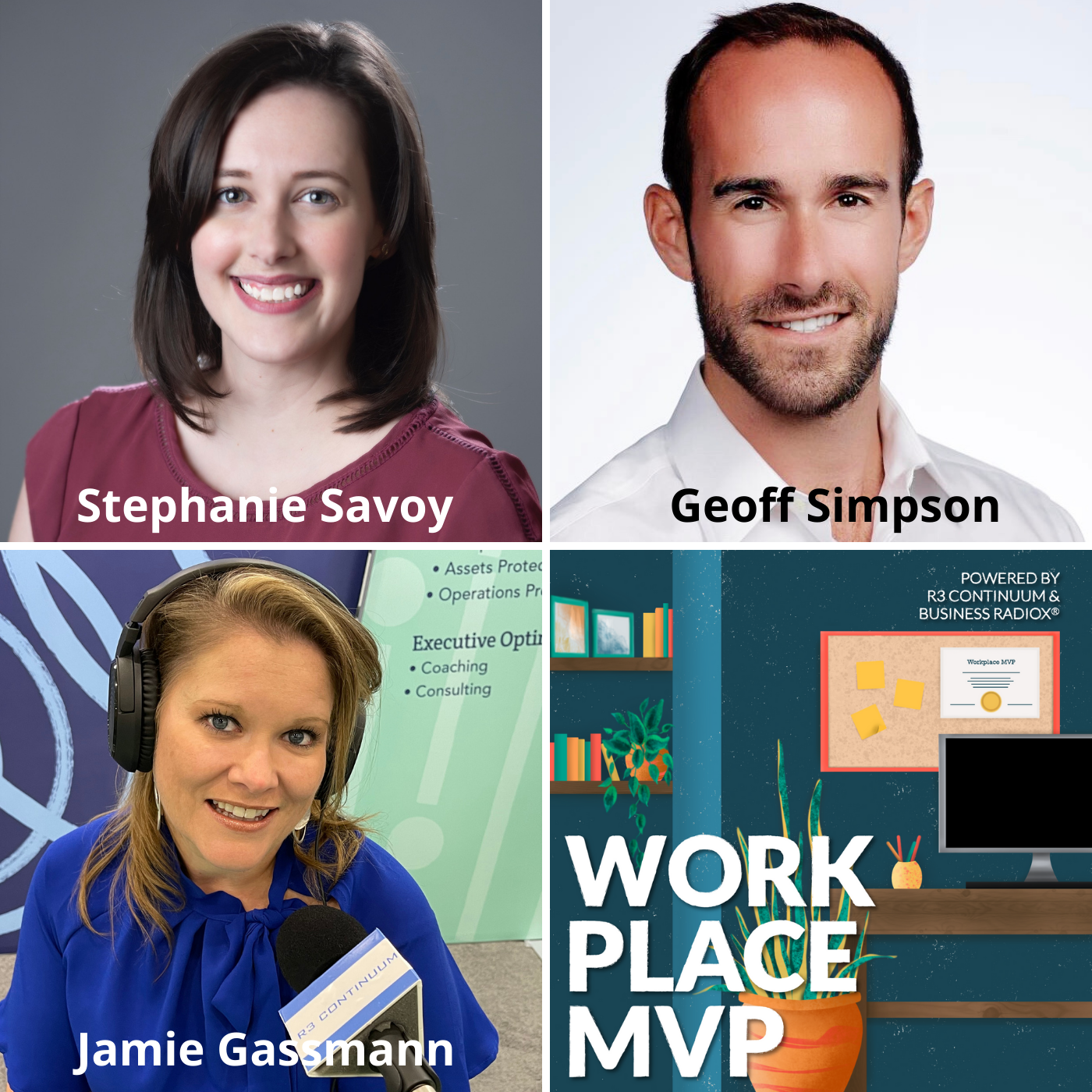
In this conversation with host Jamie Gassmann, SHRM Foundation Executive Director Wendi Safstrom observed that a failure to support employees’ mental health not only weighs on the employees themselves but also weighs heavily on an organization’s bottom line. With that factor in mind, Wendi outlined several new initiatives of the SHRM Foundation, including an in-person summit which included participants across the organizational structure, including CEOs. She discussed issues which have made mental health and wellness a top priority for the foundation, the research they are drawing on, the costs of an organization doing nothing, and much more. Workplace MVP is underwritten and presented by R3 Continuum and produced by the Minneapolis-St.Paul Studio of Business RadioX®.

SHRM Foundation

The SHRM Foundation’s mission is to mobilize the power of HR and activate the generosity of donors to lead positive social change impacting all things work. The Foundation is committed to elevating and empowering HR as a social force through its innovative solutions to workplace inclusion challenges, programming designed to inspire and empower the next generation of HR leaders, and awarding scholarships and professional development grants to educate and develop students and HR professionals.  The SHRM Foundation is a 501(c)(3) philanthropic arm of the Society for Human Resource Management.

Company website | LinkedIn

Wendi Safstrom, Executive Director, SHRM Foundation

Wendi Safstrom, Executive Director, SHRM Foundation

Wendi Safstrom is a senior non-profit leader committed to serving the public through philanthropic program management, cultivating strategic partnerships and managing and developing high-performing teams. She has both association and nonprofit management experience including; national program development and administration, membership strategy, marketing and product development, grant management, development and donor stewardship, and leading cross-functional teams. Safstrom currently serves as Executive Director for the Society for Human Resource Management Foundation (SHRM Foundation), where she leads the development and implementation of SHRM Foundation’s programmatic, development, and marketing and communication strategies in support of SHRM Foundation’s new mission and vision, creating growth plans and ensuring alignment with SHRM goals.

Prior to assuming the role at SHRM Foundation, Safstrom served as Vice President at the National Restaurant Association and National Restaurant Association Educational Foundation, where she led the development and implementation of their Foundation’s most recent five-year strategic plan, and was responsible for all Foundation programming, including workforce development initiatives, scholarship and event management, community relations and engagement initiatives. The NRAEF’s philanthropic programming supported a number of audiences including high school youth, veterans transitioning from service to civilian work and life, opportunity youth and incumbent workers. Of particular note, she led the implementation of the restaurant industry’s premier high school career and technical education program, growing the program to over 2,000 public high schools, engaging over 150,000 students annually, nationwide. In 2016, she served as lead project director for the development of a $10 million contract awarded by the U.S. Department of Labor to develop the hospitality industry’s first apprenticeship program, and was instrumental in the Foundation’s reorganization and relocation of operations from Chicago, Illinois to Washington, D.C., transforming the staff and culture.

Safstrom has also held human resource management roles with the Leo Burnett Company and Hyatt Hotels Corporation in Chicago, Illinois. She has a BS in Business Administration from the Eli Broad School of Business at Michigan State University and was recognized as a member of the 2014 “Power 20” by Restaurant Business Magazine as a leader in philanthropy within the restaurant industry.

LinkedIn

R3 Continuum

R3 Continuum is a global leader in workplace behavioral health and security solutions. R3c helps ensure the psychological and physical safety of organizations and their people in today’s ever-changing and often unpredictable world. Through their continuum of tailored solutions, including evaluations, crisis response, executive optimization, protective services, and more, they help organizations maintain and cultivate a workplace of wellbeing so that their people can thrive. Learn more about R3c at www.r3c.com.

Company website | LinkedIn | Facebook | Twitter

About Workplace MVP

Every day, around the world, organizations of all sizes face disruptive events and situations. Within those workplaces are everyday heroes in human resources, risk management, security, business continuity, and the C-suite. They don’t call themselves heroes though. On the contrary, they simply show up every day, laboring for the well-being of employees in their care, readying the workplace for and planning responses to disruption. This show, Workplace MVP, confers on these heroes the designation they deserve, Workplace MVP (Most Valuable Professionals), and gives them the forum to tell their story. As you hear their experiences, you will learn first-hand, real life approaches to readying the workplace, responses to crisis situations, and overcoming challenges of disruption. Visit our show archive here.

Workplace MVP Host Jamie Gassmann

Jamie Gassmann, Host, “Workplace MVP”

In addition to serving as the host to the Workplace MVP podcast, Jamie Gassmann is the Director of Marketing at R3 Continuum (R3c). Collectively, she has more than fourteen years of marketing experience. Across her tenure, she has experience working in and with various industries including banking, real estate, retail, crisis management, insurance, business continuity, and more. She holds a Bachelor of Science Degree in Mass Communications with special interest in Advertising and Public Relations and a Master of Business Administration from Paseka School of Business, Minnesota State University.

TRANSCRIPT

Intro: [00:00:04] Broadcasting from the Business RadioX Studios, it’s time for Workplace MVP. Workplace MVP is brought to you by R3 Continuum, a global leader in workplace behavioral health and security solutions. Now, here’s your host, Jamie Gassmann.

Jamie Gassmann: [00:00:25] Hi, everyone. Your host, Jamie Gassman here, and welcome to this episode of Workplace MVP. So, I just saw a statistic the other day that indicated that $23 billion dollars is spent annually in the United States from the loss of work productivity as a result of depression alone. Depression also contributes to 200 million lost workdays annually around the world. Now, imagine the other common mental health diagnoses that employees may be dealing with, like anxiety or bipolar disorder, and what the loss of productivity and workdays might look like with all of them combined.

Jamie Gassmann: [00:01:02] A focus on mental health in the workplace has become more of a priority to employers and employees over the last year. But there’s still a stigma that workplaces are facing when it comes to talking about or offering mental health support in the workplace. How can employers ensure they’re offering the right level of mental health and wellness support? And, how can they ensure they are reducing, if not eliminating, the lingering presence of stigma?

Jamie Gassmann: [00:01:27] The Society of Human Resource Professionals, also known as SHRM, is on a mission to help employers create better workplace wellness through their SHRM Foundation. And, with us today to share the great work SHRM Foundation is doing to better workplace mental health and to offer best practice advice for our employers and listeners of Workplace MVP is SHRM Foundation President, Wendi Safstrom. Welcome to the show, Wendi.

Wendi Safstrom: [00:01:53] Thank you. Thanks so much for having us today.

Jamie Gassmann: [00:01:56] So, let’s start off. Can you walk us through your career journey and how you kind of – the path you took to getting to the position you’re in today?

Wendi Safstrom: [00:02:06] Sure, absolutely. And, thanks for asking. So, I have been with SHRM Foundation for just over four and a half years, and I have the great pleasure of working with the CEO and President of SHRM, Johnny C. Taylor, Jr.

Wendi Safstrom: [00:02:18] And, over the last couple of years, we’ve really morphed the work we do, our purpose, vision, and mission. And, again, I’m just really honored and proud to be representing the foundation today, and I’m really excited to be in this particular role when you talk about my professional journey because I was an H.R. professional way back. Back in the day, right after I graduated from school, from college, I had different recruiting and H.R. roles with the Leo Burnett Company, a large advertising agency in Chicago, and with Hyatt Hotels, their corporate offices in Chicago as well.

Wendi Safstrom: [00:02:51] Fast forward, about 20 years later, now, really, what I would consider an association and nonprofit lead, right? So, I’ve got experience in National Program Development Administration, membership strategy, marketing and product development, grant management, all the kinds of things you have to do to fundraise, to actually feel your work, and really focusing on leading cross-functional teams. And, this position is really the perfect blend of supporting an industry for which I have, or profession I should say, a deep respect and affinity for in a nonprofit role, so we can really help H.R. professionals lead positive social change in the workplace. And, really excited to be talking with you about workplace mental health and wellness today.

Jamie Gassmann: [00:03:37] Absolutely. It’s such an important topic right now, especially after the last year and a half that we’ve been navigating, especially for workplaces and leaders themselves trying to figure out how to help support those employees. So, with that in mind, you know, talk me, tell me a little bit about the SHRM Foundation, you know, some of the different types of work that you do and then particularly some of the work that you’re focused around with mental health and wellbeing.

Wendi Safstrom: [00:04:03] Sure. Just really quickly, sure. We’re the SHRM Foundation. We’re the 501(c)(3) philanthropic affiliate of the Society for Human Resource Management, SHRM. And, SHRM is the world’s largest professional society for H.R. We engage about 300,000 members and by extension over 115 million employees in countries around the world every single day.

Wendi Safstrom: [00:04:24] So, our platform to affect change is tremendous and we’re here to leverage that opportunity. Our mission at the foundation is, as I mentioned, to mobilize the power that H.R. professionals have and really help them activate positive social change and help them lead positive social change, impacting all things work. And, we think that, perhaps more so now than ever before, it’s so important to realize or help realize our shared vision, which we share with SHRM of that being a world of work that works for all. And, when we talk about the foundation at a very high level, we often refer to our work and kind of four pillars of work and we have programming tools and resources to support each of those pillars of work, and all of this information is available on our SHRM Foundation website, which I’m sure will show some of the resources at the end of the podcast.

Wendi Safstrom: [00:05:14] So, I think one of the most effective but least utilized solutions to addressing gaps in diversity, equity and inclusion strategies is hiring and retaining workers who may not be the standard that businesses consider when they’re seeking talent due to biases or uninformed misconceptions or perceptions. So, through our Building an Inclusive Workplace Initiative or our untapped pools of talent programming, we help H.R. professionals develop and provide equitable opportunities for employment and provide them a pathway by which they can create inclusive cultures and workplaces for those valuable members of untapped pools of talent, veterans, individuals with criminal records, individuals with disabilities, older workers, opportunity youth, who bring tremendous potential to workplaces but are often overlooked.

Wendi Safstrom: [00:06:05] And, a newer initiative for the foundation in partnership with our SHRM membership team is a targeted focus on supporting emerging professionals, so the H.R. professionals of the future. And, in our role as a professional society, we care and should care about the development of that next gen of H.R. professionals. So, we help activate student professional networks. We provide scholarships and opportunities for students who are considering and are pursuing H.R. to connect with working H.R. professionals in the event, or they hope that they continue their journey, their professional journey with SHRM.

Wendi Safstrom: [00:06:41] And then, really, the two areas of focus that have emerged over the last year are linked to upskilling and reskilling that helps prepare people not only for the future of work but helps prepare people who have been displaced to get them back into the workforce, and that all lends itself truly to the primary focus why we’re here today, which is workplace mental health and wellness.

Wendi Safstrom: [00:07:03] And, the statistics that you mentioned are staggering in terms of the impact that workplace mental health and/or lack of support and the stigma – with stigma comes silence – the impact that it has on businesses and their bottom lines. There is a tremendous need, if now, so if not now, probably moreso ever than before for these strategies, evidence-based tools, resources, especially in the wake of the pandemic, times of social unrest, and really economic instability. So, in a nutshell, that’s what the foundation does, and workplace mental health and wellness is at the top of our priority list.

Jamie Gassmann: [00:07:44] Yeah. A lot of amazing work. Some areas, obviously, that you kind of drawing out concepts and thinking that maybe, you know, H.R. leaders or business leaders haven’t thought of before or maybe haven’t, you know, maybe bold enough or brave enough or even considered going into looking into those areas for workers and helping workers. So, that’s great. So, you know, with talking about this, this mental health, I mean, there’s a core focus and a purpose for the foundation around that. Can you talk a little bit about what that looks like and what you’re working towards with that enhanced focus?

Wendi Safstrom: [00:08:22] Sure. Our shared purpose again in alignment with SHRM is really to elevate H.R., and we talk about elevating H.R., we’re talking about elevating the professional knowledge and skills that H.R. professionals have and practice every single day. We’re talking about elevating the profession of H.R. and the thoughts and attitudes and stereotypes people may have of what it means to work in H.R. or what it means to have H.R. serve as a business leader in which they are. They’re in positions to really affect change in the workplace. And, you know, we’re long past the day where H.R. was thought of as the payroll and paper processing, you know, we’re going to hire and fire people. Those are long gone.

Wendi Safstrom: [00:09:05] And, if there were ever a time for excellence when it comes to H.R., it’s now. And, in fact, the need for H.R. professionals has continued to grow nearly twice the average growth rate for all other occupations so there’s a need. And, this workplace mental health and wellness, this was an issue even prior to COVID and everything that’s happened over the last year, year-and-a-half.

Wendi Safstrom: [00:09:27] Mental illness and mental wellness continue to be an issue that H.R. professionals, together with other members of the C-suite or their CEO and leadership need to come together and make a commitment to affect cultural change within their organizations. So, really, we’re elevating H.R. and their knowledge skills, competencies related to workplace mental health wellness, and we’re elevating those kinds of positions so that they are viewed in the same lens that other members of the C-suite are if they’re not there already.

Jamie Gassmann: [00:09:57] Yeah. Now, fantastic, because they really are kind of the eyes and ears to culturally how people are feeling. I mean, sometimes I, you know, as a leader myself, find that my employees might be and not at a fault of my own or in a fault of another leader is just H.R. is kind of like that person they can go to for that, you know, different level of support than what they might be able to obtain from their actual leaders. So, they really do have eyes and ears into people’s wellbeing at a different level than other organizational leaders might.

Wendi Safstrom: [00:10:30] Yes.

Jamie Gassmann: [00:10:31] And so, to help kind of further expand your foundation’s focus on workplace mental health, you recently held a workplace mental health summit in New York. And, I believe if I’ve got my information correct, it was like the first of its kind that you had created just specifically this year. Can you share with us what were some of the main topics that you covered, you know, based on what you were seeing within the workplace that’s become more common?

Wendi Safstrom: [00:10:55] Yeah. Actually, it was the first, not only the first summit of this kind for organization addressing workplace mental health and wellness, but it was in-person and we had every COVID protocol you can imagine in place. I think it was a tremendous opportunity for subject matter experts, scientists, psychologists, CEOs, CHROs, philanthropists, policymakers, other business leaders, because it’s going to take all of us, truly, to affect change in work as it relates to workplace mental health and wellness. It can be implemented and impacted by H.R. professionals, but it’s going to take a village, so to speak, and all those kinds of people working together to make things happen.

Wendi Safstrom: [00:11:36] And, you know, we held this meeting despite the odds because we recognized the status quo would not do. We had speakers. We had, I think, 33 panelists in different speaking roles and covering different topics that were very passionate and knowledgeable about the topics that they brought to the table as it relates to workplace mental health and wellness.

Wendi Safstrom: [00:11:57] There’s a phrase that I’ve picked up somewhere, so now I’ve continued to use it, which is we’ve admired the problem, right? We understand that there is an issue. The statistics are staggering in terms of impact on people and business and communities. And so, rather than focus on talking to one another and telling one another what an issue and a challenge we have, we framed the topic of workplace mental health and wellness and then we started to move into that deep and what can be often crowded or complicated space of mental health and mental illness right out of the gate, right? So, we were really focused on discussions around what’s working ideas in terms of strategies and tactics in terms of attitudes, thoughts, perceptions, and tools that H.R. professionals could be using or should be using to affect change within their organizations.

Wendi Safstrom: [00:12:47] Some of the speakers we had, Dr. Arthur Evans was the CEO of the American Psychological Association. His topic was really focusing on that, a psychologically healthy workplace. Amazing, amazing dialogue. With other psychologists who brought that kind of scientific and clinical perspective to the table, but made it real and relevant to the working professionals who are in the audience.

Wendi Safstrom: [00:13:11] We had the Honorable Patrick J. Kennedy. He’s a former congressman from Rhode Island, and his whole focus was talking about there is no health without mental health and different kinds of strategies that we can, as that village, really help advance this national priority of mental health.

Wendi Safstrom: [00:13:29] And, we had an amazing speaker, Dr. Nadine Burke Harris, and she’s the California surgeon general. She brought some insights to the table with regard to adverse childhood experiences and its impact on the workplace, not only today but in the future, and the impact of trauma that is compounded certainly by what’s been going on over the last year and a half.

Wendi Safstrom: [00:13:51] So, lots of different perspectives, lots of topics. We landed on kind of a six-point plan or outcomes that were going to be activating and putting into motion here in the next couple of weeks.

Jamie Gassmann: [00:14:02] Wow. Sounds like a great event. Lots of great information and takeaways.

Wendi Safstrom: [00:14:06] Lots of good energy. And, I’ve, you know, rarely been to a summit where people stay the whole time and they’re taking notes the whole time and that was really neat to see, people at all levels and all different kinds of, representing different kinds of organizations.

Jamie Gassmann: [00:14:21] Oh, fantastic. So, you know, you kind of mentioned status quo. So, you know, some experts also say that employers can no longer afford the status quo of mental health support. So, share with me a little bit about your thoughts on this.

Wendi Safstrom: [00:14:36] Sure. So, we often say that the cost of doing nothing about or continuing to do what we’re doing, which is likely most often nothing, right, about workplace mental health and wellness is significantly higher than investing in evidence-based prevention and treatment. And, we know that failure to support employees’ mental health not only weighs on the employees themselves but it also weighs heavily on an organization’s bottom line. And, some of the statistics that you mentioned are truly staggering, the loss of productivity. The fact that depression alone costs people workdays. So, not only are the individual workers at risk, you’re putting the business at risk. The businesses go out of business that impacts the individual workers themselves and their communities.

Wendi Safstrom: [00:15:24] We do know in terms of why you can’t afford to do this. By investing in workplace mental health and wellness, you’re increasing retention and recruitment. You’re adding to your recruitment strategies or your talent management strategies. You’re increasing productivity. You’re helping lower absenteeism. You’re lowering the costs related to disability and medical-related costs for your medical plans, and you’re also reducing employee-related risks and other types of liabilities.

Wendi Safstrom: [00:15:56] And so, for every dollar invested in good mental health, promoting good mental health, providing the tools and resources, every dollar invested has a $3 to $5 return. So, in terms of no longer afford, I think we can help businesses become not only more successful perhaps by really making investments in these critical solutions as opposed to continuing with that status quo and continuing to pretend that it’s not an issue or a problem.

Jamie Gassmann: [00:16:25] Yeah. They need to look at it as more of an investment into their organization as opposed to a cost.

Wendi Safstrom: [00:16:32] Exactly.

Jamie Gassmann: [00:16:32] Which is probably what they maybe still kind of so changing that thinking around that might help them. So, if an H.R. leader was going to put that into context, do you have recommendations for how they might, you know, proactively go to leadership and change some of that thinking from it as a cost to and it’s an investment into the organization?

Wendi Safstrom: [00:16:58] Yeah. I think that there are – we were just on another call with folks talking about more tactical solutions for like EAPs and having addressing stigma and having a communication, making it okay to talk about workplace mental health and wellness and organizations if employers are struggling. We talked about the importance of investing in training managers. So, managers, I think more so than H.R. professionals, are the folks that see folks every day. And so, training managers not to be psychologists or psychiatrists or social workers but to train managers to understand the signs when employees are struggling so that they can head off issues at the earliest stage possible.

Wendi Safstrom: [00:17:38] But I think that leaders and managers should embrace, really, four qualities, I think. They include awareness. We talked a little bit about this at the summit. They include awareness, vulnerability, empathy. We talk a lot about empathy and humility here at SHRM, and compassion. I think that those are really critical qualities for business leaders in order to care for people who are in crisis and to really set the stage for business recovery as we’re headed in that direction.

Wendi Safstrom: [00:18:07] And, I think managers can start that by creating a space to get a better awareness of what’s going on in and around them. I think managers can be, should be bold in exhibiting vulnerability and lowering their own guard, and confront what’s unfolding, and understanding and acknowledging that employees are indeed struggling. And, they should be demonstrating empathy to really better tap into the emotions that others are feeling.

Wendi Safstrom: [00:18:37] So, it’s tools and resources and training, but it’s also affecting change within your culture, making it okay and having leaders and managers really practice what they’ve been preaching, if you will.

Jamie Gassmann: [00:18:49] Yeah, absolutely. And, looking at employees and, you know, this kind of thinking around the next generation of employees and their expectations of employers, you know, we see a lot in just different areas that employees are expecting more from their employer in the types of support and mental health options that they have and kind of having that mixture of multichannel approaches. What are some of your thoughts around the changes that you’re seeing with generations coming into the workforce versus previous generations?

Wendi Safstrom: [00:19:25] One of the advantages that we have at the foundation in working with SHRM as the broader enterprise is tapping into this tremendous expertise we have in our very own research division within SHRM, and they have uncovered some really interesting data that kind of goes along the lines that you would anticipate. But it really does provide that qualitative, excuse me, quantitative evidence so that we can plan more effectively. So, that research does find, right, the younger generations or younger workers, I should say, do expect more out of their employers and that includes that in the area of workplace mental health and wellness. It’s one thing to have health benefits that relate to physical health, but mental health is incredibly important as well.

Wendi Safstrom: [00:20:09] And, the research that we’ve gotten from SHRM shows that Americans who are older millennials, perhaps 35% of them, are more likely to indicate that they feel comfortable discussing their mental health at work as compared to baby boomers or traditionalists at 21% percent. Working Americans who are Gen Z or younger millennials or 30% are more likely to indicate that since the start of COVID, they feel more comfortable talking about their mental health at work than before the pandemic. But you compare that to Gen X, myself, or even baby boomers and traditionalists that hovers around 15% to 8%. So, that’s a big gap in terms of wanting to access expecting benefits when it comes to choosing an employer because employees are in a position now to choose their employer as much as employers are in a position to opt to hire employees. And, that is just another layer of why it’s so important that you can manage a multigenerational workforce because of the attitudes and the perceptions in their approaches, even amongst the different generations that exist in the workforce.

Jamie Gassmann: [00:21:23] Yeah. So interesting, you know. And, speaking of research, so, you know, also from your research, the work the foundation has done, you’ve identified benefits to employers when they’re investing in workplace mental health and wellness. Can you talk to some of those benefits that, you know, trickle down from putting focus on this?

Wendi Safstrom: [00:21:42] Yeah, and I touched on some of that, but it’s kind of lends itself to that business case again, right? The cost of doing nothing as opposed to making the investments in mental health strategies in affecting and changing our culture are much higher if you’re doing nothing. So, some of the benefits employers can expect by investing in those strategies are really, like I said, in lockstep with the business case and it helps increase retention, helps improve recruitment, which all comes at a cost to the organization. And, as I mentioned, it lowers absenteeism and medical costs and reduces employer-related risks and other potential liabilities. Those all factor into the cost of doing business when it comes to employees or labor.

Wendi Safstrom: [00:22:28] It’s great news for businesses, but I think that focusing on the business benefits. Yes, there is a business case for investments in these strategies and paying attention to the issues at hand, but the point is that it’s also the right thing to do. Your employees, they’re struggling. They said that they’re struggling, they’re suffering. And, the events of the past two years have left a lot of people traumatized, fearful, angry. Some of them are grieving.

Wendi Safstrom: [00:22:59] And, SHRM’s research says that a recent study of American workers shows 76% of those people think companies should do more to support the mental health of their workforce. So, all of those points to cost savings, yes, from a business case perspective, but also lend themselves to taking good care of an organization’s most valuable resource, which are its employees.

Jamie Gassmann: [00:23:25] Absolutely. Wow, staggering. The 76% are looking for them to do more.

Wendi Safstrom: [00:23:29] Exactly.

Jamie Gassmann: [00:23:30] Yeah. So, you know, and obviously like on the flip side of that, in terms of the impact to the organization when they aren’t doing more, we can say, you know, there’s more turnover, but there’s other impact and factors that come into play when they’re not doing more. Can you speak a little bit to that in terms of the impact to the organization when they are like status quo, everything’s fine here. What –

Wendi Safstrom: [00:23:57] Nothing to see. Moving right along…

Jamie Gassmann: [00:23:59] Nothing to see. Let’s just keep going. What are some of the impacts from a negative perspective that they could be experiencing?

Wendi Safstrom: [00:24:05] As you say, it’s the exact opposite, increased productivity versus the loss in productivity. An increase in medical costs, an increase in retention rates. If they’re not investing, those are the things that they will see. And, I do think because of the shift in mindset on the next generation of folks who are entering the workforce, as baby boomers begin to retire and Gen X and millennials kind of move along their professional careers, people are expecting and anticipating to receive that kind of support. They’re wanting to work in cultures that prioritize workplace mental health and wellness. And, I think employers will have an increasingly difficult time, not only retaining employees but recruiting them, because employees are considering not only their salary, right, but it’s a total comp package and that includes benefits, and they’re looking for benefits linked to good physical health and increasingly important, as all the data shows, benefits linked to supporting good mental health. So, if we don’t do anything, I think it’s going to be more difficult to both hire and retain top talent.

Jamie Gassmann: [00:25:13] Yeah. And, I think too that trickles down to hiring or not hiring but obtaining, you know, implementing new clients and retaining clients because that customer experience starts to be degraded when you’ve got employees who are not happy and satisfied as well.

Wendi Safstrom: [00:25:28] Or leaving or getting sick. It gets to the point where they can’t cope and that’s when the lost productivity to your point comes into play. That’s when lost days in terms of work comes into play. So, absolutely.

Jamie Gassmann: [00:25:41] Yeah, interesting. And, obviously looking at turnover this last year, we’ve been experiencing what they’re calling the great resignation where employees are voluntarily leaving jobs. And, I’ve even seen in some stats where they’re leaving and not having another job lined up. They’re just deciding I’m done. You think there’s a correlation between the great resignation and mental health within employees.

Wendi Safstrom: [00:26:07] Yeah. And, I think a lot of factors are contributing to that great resignation. I think to your point, people are leaving jobs without plans for another because they feel that this is a moment for them to make a personal professional change, right? And, there’s not necessarily anything we can do directly about that. But that is just a factor, including, as you mentioned, better compensation.

Wendi Safstrom: [00:26:31] We’re seeing astronomical salaries in some instances for people to leave an organization and go work for another organization doing similar and often even dissimilar but related work. People are leaving in anticipation of better work-life balance, maybe better benefits, perhaps people see opportunities for career advancement in different organization. And, I think that the remote work, there are pluses and minuses, right, to remote work versus in an office. And, I think organizations have to decide what kind of culture they want to be. I think people are making assumptions that remote work is better than in-office culture, or in-office companies require folks to work in office, and so they may be looking for organizations specifically to go work for that offer those kinds of opportunities.

Wendi Safstrom: [00:27:20] And, the research again shows that workers will opt to look for another job if they don’t feel they have that mental health support in addition to the physical health in the workplace and, 53%, excuse me, my researchers would correct me. Fifty-three percent of working Americans have said they’re likely or very likely to leave their current job to resign if they were offered a new job with significantly better mental health benefits and 47% of converse are unlikely or very unlikely to leave for better mental health benefits, but that’s going to be on the rise and, again, gives organizations a competitive edge when it comes to talent if they’re investing in these types of solutions.

Jamie Gassmann: [00:28:05] Interesting. So definitely something that needs to be not just status quos sweep under the rug but focused on as an organization because the impact, if you’re not feeling it right now, it’s eventually going to come.

Wendi Safstrom: [00:28:16] It’ll catch up. Yeah, absolutely.

Jamie Gassmann: [00:28:18] Interesting. We’re going to take a moment to hear from our show sponsor. Workplace MVP is sponsored by R3 Continuum. R3 Continuum is a global leader in providing expert, reliable, responsive, and tailored behavioral health disruption and violent solutions to promote workplace wellbeing and performance in the face of an ever-changing and often unpredictable world. Learn more about how R3 Continuum can tailor a solution for your organization’s unique challenges by visiting r3c.com today.

Jamie Gassmann: [00:28:52] Now, diving in a little bit into the foundation itself, so SHRM Foundation is offering a new Workplace Mental Health Ally Certificate. Can you tell us more about that certificate and what, you know, individuals need to do in order to achieve that?

Wendi Safstrom: [00:29:07] Sure. We actually launched – our President and CEO, John C. Taylor, Jr., announced the launch of our new Workplace Mental Health Certificate at our annual conference that I mentioned that took place in August to September. We kind of moved it from June to later in the year. And, when he announced the fact that we had a solution on-hand at SHRM Foundation, you could hear an audible gasp from the audience, which really surprised me, but gave me reason for hope, because people, that’s just an indicator, anecdotal indicator of how important this kind of training and access to this kind of training is to those H.R. folks.

Wendi Safstrom: [00:29:47] The certificate itself was developed in partnership with an organization called Psych Hub, which is, really, as they define themselves, and I would tend to agree, the world’s most comprehensive multimedia platform for mental health education. And, again, we worked with SHRM, some of the instructional designers at Psych Hub, and the foundation to really create and craft this training specifically for H.R. professionals and people managers.

Wendi Safstrom: [00:30:15] It’s an online learning program that is comprised of a series of eight multimedia courses. They cover things like mental health, common mental health conditions, issues linked to substance abuse and suicide, safety planning, diversity bias and equity and its links to mental health and the impact on one’s mental health, and, I think, most importantly, communication skills. And, after the H.R. folks complete all eight hours, the intent is that they have more knowledge and skills to really develop that empathy and support for the mental health and wellness of employees and their colleagues and themselves really in the workplace.

Wendi Safstrom: [00:30:59] And, they get a certificate at the end, another addition to your professional portfolio. The cost is $99 per user and actually a portion of that cost is donated back to the foundation, which allows us to continue doing the work we do. And, again, all of this is on our website or www workplacementalheath@shrm.org and I encourage you to check it out.

Jamie Gassmann: [00:31:25] Awesome. And, you also are offering awards to workplaces.

Wendi Safstrom: [00:31:29] Yes.

Jamie Gassmann: [00:31:29] And, I’m going to – hopefully I say this word name correctly. It’s the Tharseo award there.

Wendi Safstrom: [00:31:35] Tharseo. Trust me [inaudible]

Jamie Gassmann: [00:31:36] Tharseo. Okay. Close. And, I should have asked you beforehand how to pronounce that.

Wendi Safstrom: [00:31:42] No, no, that’s okay. Trust me.

Jamie Gassmann: [00:31:43] And, you’re recognizing leaders who are boldly changing their workplace. So, some of the things we’ve talked about already on the show today about, you know, it really does take change management. You know, now you offer this award for those workplaces who, you know, are doing that. And so, talk to me a little bit about some of the recipients you’ve had, some of the work, and maybe some of the case examples of how they achieved that award.

Wendi Safstrom: [00:32:08] Sure. We were busy last Monday. We had this. We had our workplace mental health and wellness summit from 7:00 in the morning until about 3:30. And then, we continued into our Tharseo Awards and that’s what you just described here. We recognize a CEO, a CHRO, and an individual who is involved in policy related to all things work.

Wendi Safstrom: [00:32:32] At this awards program we had, Arianna Huffington had a sit-on-down dialogue with Johnny C. Taylor Jr. I’m talking about the importance of wellness. So, we continued the thread of the discussion that we had at the summit into the actual awards program itself. And, I think you’ll find this interesting. Tharseo is really derived from the Greek word, meaning courageous, confident, and bold. And, the awards themselves were inspired by and made possible by contribution from Ram Charan, who in the H.R. space he is certainly a legendary businessman. He’s an author and speaker.

Wendi Safstrom: [00:33:09] And, we identified the recipients through the awards through quite an extensive process. You cannot nominate yourself. We had an independent group of jurors who really evaluated each of the candidates, and they were evaluated on qualitative and quantitative measures. And, the criteria we were looking for was looking for actions and attitudes, and implementation linked to innovation and overall impact on the company and the global workforce and how the two really need to work together. So, the Policy Transformer of the Year was Bobby Scott from Virginia, US congressman from Virginia. And, our Ram Charam Human Resource Innovation Award was Gloria Chen. She is the Chief People Officer and Executive Vice President and Employee Experience at Adobe. She has a really interesting background. Prior to becoming and assuming the CHRO, for lack of a better word kind of catch-all phrase, in Adobe, she spent 20 years in leading strategy at Adobe. So, she was part of crafting that culture as she was in charge of strategy and she’s made that transition to H.R. and she’s seeing where all of those pieces fit together. So, neat background. I encourage you to check out our website and see her bio.

Wendi Safstrom: [00:34:24] And then, our CEO of the Year was Ajay Banga, excuse me. He’s the Executive Chairman and immediate former CEO of MasterCard, and he’s an amazing, amazing man. He does work all over the world. He truly puts H.R. and the function, the profession, right up there with that of the CFO, the CMO, and the C-suite, understanding the connectivity between working with people and doing good business as it relates to people and employees equates to successful businesses and to businesses being successful in terms of a financial return.

Wendi Safstrom: [00:35:02] So, all three of them were recognized. Congressman Scott was called away to Washington, but we had a great opportunity to engage with Ajay and Gloria at the Awards themselves.

Jamie Gassmann: [00:35:13] Wonderful. And, what a great honor to be recognized for making that change within your work, your organization, but also being able to speak to the benefits that they’ve seen from that change. That’s amazing.

Wendi Safstrom: [00:35:26] Yeah.

Jamie Gassmann: [00:35:26] So, looking at leaders and those H.R. leaders or C-suite leaders or other business leaders that might be listening to this episode, what advice would you give to them for what they should be focused on when it comes to mental health in the workplace?

Wendi Safstrom: [00:35:42] Just underpinning of that, it can no longer be ignored. That’s admiring the problem. We know it’s an issue and it lends itself to a financial success, continued financial success, and that it really starts from the top. It’s got to be a commitment from the CEO. I hate the phrase trickle down, but truly it’s got to permeate throughout the organization.

Wendi Safstrom: [00:36:01] We know that mental health issues in the workplace, it’s not a new thing. I mean, we were dealing with and managing through mental health and mental illness prior to COVID, the pandemic, and the issues linked to social justice and other kinds of unrest. But it’s really magnified the challenges that employers are facing. And, now so more than perhaps ever before, mental ill, not necessarily mental illness, which is diagnosed and treated like things like schizophrenia or being bipolar, but things like suicide, depression are really, if not, being experienced by the employees by themselves, but people within their sphere of care.

Wendi Safstrom: [00:36:44] So, I just would suggest they create a supportive culture that includes empathy, as I mentioned before, and really arming not only your H.R. professionals but those first-line supervisors and managers first with the tools and the tools to recognize and communicate when they see issues and provide support to their employees. That’s going to be vital to really building these better workplaces, and we’re going to continue to build on our partnerships. The 33 speakers we had at our summit, we access them all through partnerships and talking to people smarter than us. In this particular space, we bring the voice of the employer together, but we’re going to continue to build on those partnerships to shape further opportunities so that leaders and employers will be ready hopefully and able to provide this culture of support.

Jamie Gassmann: [00:37:35] Wonderful. And, looking at the foundation itself, you know, what are some of the accomplishments that the foundation has received with focusing on mental health and wellness in the workplace?

Wendi Safstrom: [00:37:46] Yeah. So, we really launched an initiative. We realized that workplace mental health and wellness was going to become, would be exacerbated in 2020. And, yes, there’s return-to-work conversation and there are H.R. folks dealing with furloughs and layoffs. But we really felt strongly, back in April really of last year, that workplace mental health and wellness was going to be a challenge.

Wendi Safstrom: [00:38:10] And so, what we launched was this initiative and that’s been really carefully designed to accelerate the movement, not only to provide training and create cultures that are conducive to good mental health and workplaces but to really eliminate the stigma, right, of mental health in the workplace and what it means and to help individuals foster that culture where mental health can be discussed openly and organizations can build a more complete approach to employee wellness. So, we’re doing three things and we’re working. These are continued things in motion if you will. One of them certainly being the summit that we just had last Monday. We’ll be acting on the outcomes from that summit and continuing the conversation with another follow-up summit into 2022.

Wendi Safstrom: [00:38:58] We’ve developed a platform for thought leadership or research that really supports mental health and wellness in the workplace so that we can create that portfolio of resources that are things like the Mental Health Ally Certificate and other evidence-based programming, including additional training modules and educational resources, so we can continue to curate and build on the resources that we’ve already established in our mental health and wellness hub.

Wendi Safstrom: [00:39:24] So, the summit was a great moment for us to really convene subject matter experts. The worst thing I think you can do is attend a great meeting where there’s phenomenal dialogue. Leave the meeting, everybody goes back to their places of work and nothing gets done. And so, I think what I’m most proud of at the foundation to date with regard to this topic is the execution of that summit and our commitment to making things happen after the summit itself.

Jamie Gassmann: [00:39:50] Wonderful, and it sounds like a lot of great resources, great information, and great work that you’re doing overall. And, looking at that, you know, with our listeners, if they wanted to get more information on how they can take advantage of the information and tools and resources from the foundation or from SHRM overall, or if they just want to get a hold of you to get, you know, to get insights or information from you, how would they be able to do that?

Wendi Safstrom: [00:40:19] A couple of different ways. You can go to the shrmfoundation.org website and that you’ll find information about each of those pillars of work that I described at the very beginning of our conversation. If you’re interested in most specifically about our workplace mental health and wellness, you can go to workplacementalhealth, all kind of one word, .shrm.org, and certainly staff. We’ve got a team on the foundation, I think seven of us including me, and feel free to reach out to any of the team that’s listed on our website. If they’re not managing workplace mental health and wellness, the individual you reach out to, perhaps directly we’ll find the people to help you get to where it is you need to go. And, again, really appreciate the opportunity to be here with you today.

Jamie Gassmann: [00:41:04] Well, thank you. It’s was a privilege to be able to have the opportunity to connect with you, Wendi, and to celebrate you and the great work that you’re doing with the foundation, but also to celebrate the great work the foundation is doing as well. So, really appreciate you being a part of our show.

Wendi Safstrom: [00:41:21] Thank you.

Jamie Gassmann: [00:41:22] Yeah. And, we also want to thank our show sponsor, R3 Continuum, for supporting the Workplace MVP podcast and, to our listeners, thank you for tuning in. If you’ve not already done so, make sure to subscribe so you get our most recent episodes and other resources. You can also follow our show on LinkedIn, Facebook, and Twitter at Workplace MVP. If you are a Workplace MVP or know someone who is, share with us. We’d like to have them on the show. Email us at info@workplace-mvp.com. Thank you all for joining us and have a great rest of your day.


Tagged With: employee mental health, Jamie Gassmann, mental health, Mental Health Support, R3 Continuum, SHRM Foundation, Wendi Safstrom, workplace mental health, Workplace MVP, workplace wellness

2021 NextGen Connects Mentor Match Program

October 27, 2021 by John Ray

NextGen Connects
North Fulton Studio
2021 NextGen Connects Mentor Match Program
Loading
00:00 /
RSS Feed
Share
Link
Embed

Download file

NextGen Connects

2021 NextGen Connects Mentor Match Program (GNFCC 400 Insider, Episode 68)

The 2021 NextGen Connects Mentor Match Program initiated by the Greater North Fulton Chamber of Commerce is the focus of this episode, featuring two pairs of mentors and mentees, Lisa Tilt and Tori Kerlin, as well as Geoff Smith and Tukker Penrod. Over the year as mentors and mentees have met, the program has produced amazing results and collaboration not just for the mentees, but the mentors as well. The GNFCC 400 Insider is presented by the Greater North Fulton Chamber of Commerce and produced by the North Fulton studio of Business RadioX®.

Geoff Smith, Branch Manager, Assurance Financial

Geoff Smith, Branch Manager, Assurance Financial

Geoff Smith is the branch manager for the new Roswell branch of Assurance Financial working with Real Estate agents and homebuyers to help them get happily to their closing table. Geoff is an authority on the latest economic development trends shaping the Atlanta Metro area. His interviews reveal an inside perspective at how things get done in the ATL.

Geoff is an active member of his community serving on the Board of Directors of the Greater North Fulton Chamber of Commerce, as well as holding the position of chairman for the Chamber’s Education Committee. He is also Secretary of the Roswell Youth Baseball Association and coaches his sons in football, baseball and basketball. Geoff enjoys golf, camping and traveling with his wife and two sons. He is a graduate of the University of Georgia.

Company website | LinkedIn

Tukker Penrod, Outreach Fundraising Coordinator in Georgia, The Younique Foundation

Tukker Penrod, Outreach Fundraising Coordinator in Georgia, The Younique Foundation

A longtime friend of and advocate for The Younique Foundation, Tukker Penrod joined the staff when The Younique Foundation expanded to Georgia for its East Coast presence. Tukker is a mentee in the first of the NextGen Connects Mentor Match Program.

Company website | LinkedIn


Lisa Tilt, Founder and CEO, Full Tilt Consulting

Lisa Tilt, Founder and CEO, Full Tilt Consulting

Lisa Tilt is the Founder and CEO of Full Tilt Consulting.

Full Tilt Consulting was born from the idea that a marketing firm can be both big picture and roll-up-the-sleeves tactical, strategic but approachable, and level-field collaborative to the degree that the best idea always wins, no matter where it originates. Its team of senior-level marketing, communications, and digital experts is always in pursuit of accomplishing great work that achieves outstanding results while enjoying each other’s company. This formula has propelled Full Tilt and its clients forward since 2006.

Full Tilt provides counsel and custom marketing programs to a robust roster of clients in a variety of fields. Through constructive partnerships, they determine where clients are in their business life cycle, identify their goals, and create plans to capitalize on opportunities and solve challenges through communications.

Company website | LinkedIn

Tori Kerlin, Communications Coordinator, GNFCC

Tori Kerlin, Communications Coordinator, GNFCC

Tori Kerlin is the Communications Coordinator of GNFCC and is a mentee in the first of the NextGen Connects Mentor Match Program.

She has a bachelor’s in Public Relations from Georgia Southern University.

LinkedIn

About GNFCC and “The GNFCC 400 Insider”

Kali Boatright
Kali Boatright, President and CEO of GNFCC

“The GNFCC 400 Insider” is presented by the Greater North Fulton Chamber of Commerce (GNFCC) and is hosted by Kali Boatright, President and CEO of GNFCC. The Greater North Fulton Chamber of Commerce is a private, non-profit, member-driven organization comprised of over 1400 business enterprises, civic organizations, educational institutions and individuals.  Their service area includes Alpharetta, Johns Creek, Milton, Mountain Park, Roswell and Sandy Springs. GNFCC is the leading voice on economic development, business growth and quality of life issues in North Fulton County.

The GNFCC promotes the interests of our members by assuming a leadership role in making North Fulton an excellent place to work, live, play and stay. They provide one voice for all local businesses to influence decision makers, recommend legislation, and protect the valuable resources that make North Fulton a popular place to live.

For more information on GNFCC and its North Fulton County service area, follow this link or call (770) 993-8806. For more information on other GNFCC events such as this North Fulton Mayors Appreciation Lunch, follow this link.

For the complete show archive of “The GNFCC 400 Insider,” go to GNFCC400Insider.com. “The GNFCC 400 Insider” is produced by John Ray and the North Fulton studio of Business RadioX®.

Tagged With: Assurance Financial, Full Tilt Consulting, Geoff Smith, GNFCC 400 Insider, Lisa Tilt, mentoring, Nextgen Connects Mentor Match Program, The Younique Foundation, Tori Kerlin, Tukker Penrod

Frank Fennell, Klosebuy

October 26, 2021 by John Ray

klosebuy
North Fulton Business Radio
Frank Fennell, Klosebuy
Loading
00:00 /
RSS Feed
Share
Link
Embed

Download file

klosebuy

Frank Fennell, Klosebuy (North Fulton Business Radio, Episode 404)

CEO Frank Fennell joined host John Ray to share the Klosebuy platform, which helps businesses get local exposure and develop loyal customers. The app also helps consumers “shop local.”  North Fulton Business Radio is broadcast from the North Fulton studio of Business RadioX® inside Renasant Bank in Alpharetta.

Klosebuy

Klosebuy is for every size business and doesn’t require hardware, setup, integration, or waiting!

The moment you subscribe, their location-based technology geolocates your business and is searchable by consumers using both the web and mobile app. You can begin creating your own digital advertisements & loyalty rewards right away. Tell your existing customers you are a klosebuy business and they can view your exclusive advertisements and rewards. Klosebuy will reward your customers for joining and following your business.

Easily create, monitor, and edit your web and mobile promotions while keeping your content fresh. Award klosebuy points for customers to redeem at your business or through the klosebuy online sweepstakes.

Create unlimited digital offers, discounts, coupons, advertisements, or general event information, and deliver them instantly to your customers and klosebuy members. Within minutes, create multiple advertisements for today or schedule them to be activated anytime in the future.

Klosebuy’s easy-to-use back-office steps you through the process of creating and managing your advertisements.

Company website | Facebook | Twitter

Frank Fennell, President & CEO, Klosebuy

Frank Fennell, President & CEO, Klosebuy

Frank Fennell is President & CEO of Klosebuy, an award-winning all-in-one digital engagement and loyalty platform that helps businesses acquire new customers, engage existing customers, and build sales.

Prior to founding Klosebuy, Frank Founded Fennell Promotions in 1992 serving clients such as Coke, Pepsi, Dr. Pepper, Ferguson’s, York, Nabisco, Colgate-Palmolive, Whirlpool, Keebler, Gibson Guitar, Nabisco, Graybar, Kroger, A&P, Vons, and hundreds more. Frank ran Fennell Promotions for 23 years until the company was acquired by one of the nation’s largest loyalty firms.

LinkedIn

Questions and Topics Discussed in this Episode

  • What is Klosebuy?
  • So Klosebuy can help small businesses compete where the big players have dominated, tell us how this is possible?
  • You’re telling us when the community starts using this App the businesses then have access to the community not just their customers, tell me how that works?
  • Well, moving on to growing the business, tell me a little about how you plan to scale Klosebuy?
  • Tell me a little more on how Channel Partners can create loyalty with their clients by helping grow their business and prosper as well? Do you have an example?
  • Let’s change the subject to the end-users, why Klosebuy?
  • Can the user control which business they interact with, can you give an example?
  • Your background is in loyalty, so tell us a little about how this part works for the consumer and the business owner?
  • Can a business sign up for Klosebuy today?

North Fulton Business Radio is hosted by John Ray, and broadcast and produced from the North Fulton studio of Business RadioX® inside Renasant Bank in Alpharetta. You can find the full archive of shows by following this link. The show is available on all the major podcast apps, including Apple Podcasts, Spotify, Google, Amazon, iHeart Radio, Stitcher, TuneIn, and others.
RenasantBank


Renasant Bank has humble roots, starting in 1904 as a $100,000 bank in a Lee County, Mississippi, bakery. Since then, Renasant has grown to become one of the Southeast’s strongest financial institutions with over $13 billion in assets and more than 190 banking, lending, wealth management and financial services offices in Mississippi, Alabama, Tennessee, Georgia and Florida. All of Renasant’s success stems from each of their banker’s commitment to investing in their communities as a way of better understanding the people they serve. At Renasant Bank, they understand you because they work and live alongside you every day.


Special thanks to A&S Culinary Concepts for their support of this edition of North Fulton Business Radio. A&S Culinary Concepts, based in Johns Creek, is an award-winning culinary studio, celebrated for corporate catering, corporate team building, Big Green Egg Boot Camps, and private group events. They also provide oven-ready, cooked from scratch meals to go they call “Let Us Cook for You.” To see their menus and events, go to their website or call 678-336-9196.

Tagged With: Frank Fennell, klosebuy, loyalty program, online advertising, Shop Local, sweepstakes

Ofer Yourvexel, Pepperi

October 26, 2021 by John Ray

Pepperi
Business Leaders Radio
Ofer Yourvexel, Pepperi
Loading
00:00 /
RSS Feed
Share
Link
Embed

Download file

Pepperi

Ofer Yourvexel, Pepperi

On this edition of Business Leaders Radio with host John Ray, Pepperi Co-Founder and CEO Ofer Yourvexel discussed his company’s work with medium to large consumer packaged goods, health & beauty, and other brands, and the success of the Pepperi platform in supporting and driving B2B sales both online and in-store. Yourvexel shared why Pepperi’s mobile component is so vital for the success of their customers, the flexibility of the platform, and much more. Business Leaders Radio is produced virtually from the Business RadioX® studios in Atlanta.

Pepperi

Pepperi is an omnichannel platform for both online and in-store B2B sales and retail execution. With over 1000 customers in more than 65 countries, Pepperi provides consumer goods and brand manufacturers, distributors, and wholesalers with a comprehensive solution to increase sales figures, reduce inefficient processes and speed up operations.

Combining sales force automation, retail execution, route accounting and B2B eCommerce in an integrated out-of-the-box solution, their customers rely on Pepperi to plan, execute and analyze their B2B omnichannel sales:

• Online/offline order taking made easy with e-catalogs, trade promotions and full customer data

• Retail execution app for in-store auditing, merchandising and replenishment

• Direct Store Delivery and van sales powered by a route accounting app for iOS and Android mobile devices

• Web and mobile B2B eCommerce enables buyers to order anytime from anywhere

• Central management streamlines omnichannel operations across customer touchpoints

Pepperi’s enterprise-grade platform integrates seamlessly with ERPs such as SAP Business One, SAP Business ByDesign, Oracle, Microsoft Dynamics, Microsoft Nav, NetSuite, and many others, making data fully accessible to field reps and buyers on all devices, on and offline.

Company website | LinkedIn | Twitter

Ofer Yourvexel, CEO & Co-Founder, Pepperi

Ofer Yourvexel, CEO & Co-Founder, Pepperi

Ofer has 25 years of experience in international marketing, sales, business development, and management.

He was formerly an executive in multiple Nasdaq companies such as Jacada (JCDA) and Amdocs (DOX).

LinkedIn


Questions and Topics

  • Tell us about your solution
  • Who are your customers?
  • Why do B2B brands and wholesalers need your solution if they can sell D2C (direct to consumer) or on marketplaces?
  • We see a lot of M&A in the CPG industry, especially in the Food and beverage. How does it impact you and F&B companies?
  • Tell us about your most successful implementation
  • Who are your competitors?
  • What’s the role of mobile in B2B sales?
  • Any crazy customer requirements you ever implemented?


Business Leaders Radio is hosted by John Ray and produced virtually from the North Fulton studio of Business RadioX® in Alpharetta.  The show can be found on all the major podcast apps and a full archive can be found here.

Renasant Bank has humble roots, starting in 1904 as a $100,000 bank in a Lee County, Mississippi, bakery. Since then, Renasant has grown to become one of the Southeast’s strongest financial institutions with over $13 billion in assets and more than 190 banking, lending, wealth management and financial services offices in Mississippi, Alabama, Tennessee, Georgia and Florida. All of Renasant’s success stems from each of their banker’s commitment to investing in their communities as a way of better understanding the people they serve. At Renasant Bank, they understand you because they work and live alongside you every day.

Tagged With: b2b sales, Business Leaders Radio, consumer packaged goods, CPG, eCommerce, John Ray, Ofer Yourvexel, Pepperi, renasant bank

Brandon Wheeless, ALUX Properties

October 26, 2021 by John Ray

Brandon Wheeless, ALUX Properties
North Fulton Business Radio
Brandon Wheeless, ALUX Properties
Loading
00:00 /
RSS Feed
Share
Link
Embed

Download file

Brandon Wheeless, ALUX Properties

Brandon Wheeless, ALUX Properties (North Fulton Business Radio, Episode 403)

Blending healthcare with lifestyle and fitness is the unique concept behind The Bailey, a first-of-its-kind mixed use development coming to Alpharetta. ALUX Properties is the company behind The Bailey, and ALUX Chairman & CEO Brandon Wheeless joined host John Ray to share details of this exciting new development, his entrepreneurial journey, other ALUX projects, and much more. North Fulton Business Radio is broadcast from the North Fulton studio of Business RadioX® inside Renasant Bank in Alpharetta.

The Bailey

A beautiful, tech-centric wellness center.

A jaw-dropping medical rehab facility.

Exquisite hospitality suites. The Bailey will exhibit elite aesthetics, capture human physiology, incorporate current environmental principles, and tie it all within the context of luxury.

The Bailey will redefine the look, feel, and meaning of “country clubs” everywhere.

Website

ALUX Properties

ALUX is a development company that designs residential and commercial spaces that utilize innovative technological solutions to enhance their client’s experience.

They are solidifying our brand to become a leading name in the residential and commercial real estate development industry – trusted for innovative design, superior quality, and unmatched reliability. Through continued collaboration of industry experts from conception to completion, they deliver quality and dynamic projects that will undoubtedly meet and exceed the needs of their clients.

They offer a comprehensive range of development and management services that include Residential and Commercial Development, Construction Management, Consulting, and Property Management.
Company website

Brandon Wheeless, CEO and Chairman, ALUX Properties

Brandon Wheeless, CEO and Chairman, ALUX Properties

The mastermind and driving force behind The Bailey development is Brandon Wheeless, a U.S. Armed Forces Veteran who is the founder, CEO and Chairman of Atlanta-based ALUX Properties, a global luxury design, building and management firm. Leveraging innovative technological solutions, the company is committed to enhancing quality of life – one project at a time – and serving as a trusted source for cutting-edge design, superior quality and unmatched reliability in the real estate sector.

Over the past decade, Wheeless has honed his expertise in commercial real estate and construction developing an array of industrial, office, retail, institutional and mixed-use structures. He began his career in project management while serving in the U.S. Navy, and later the U.S. Army, from 2006 to 2017, piloting ambitious logistical operations for personnel and equipment movement to stations and bases around the world – including managing a fleet of 750 vehicles.

Following his PMP accreditation and acquisition certifications, the Army appointed him to execute several infrastructure building projects for local and international bases. These ground-up, large-scale developments ranged in budget size from $2 million to over $2.7 billion. Wheeless takes projects from conception to ribbon-cutting, incorporating forward-thinking energy efficiency and environmental remediation initiatives along the way. He founded ALUX Properties in 2017.

In addition to his professional accomplishments, Wheeless is a former NCAA Division I basketball player who graduated magna cum laude from Norfolk State University, where he played an integral role on the 2012 championship basketball team.

With his impressive background and achievements in sports, military, and business ventures – all of which demand the utmost in discipline and skill – Wheeless is uniquely positioned to bring his latest dream to life with The Bailey, a first-of-its-kind, multi-use regional development with a tech-centric focus on lifestyle-meets-health features. As the son of an award-winning chef, his passion for creating a world-class hospitality destination like The Bailey comes naturally.

LinkedIn | Instagram

Questions and Topics Discussed in this Episode

  • Share with us your plans for The Bailey, the first-of-its-kind wellness development coming to Alpharetta
  • What are some of your goals for The Bailey and ALUX Properties?
  • Tell us about your experience as a developer
  • What have been some of the challenges and most rewarding aspects of taking on a project of this magnitude?
  • ALUX Properties also opened Aria Spirits – what can you tell us about this recent development and what makes it unique?
  • Is there any advice you could give to business leaders in the area or perhaps something you wish you had known while starting out?
  • Where can we find out more information on The Bailey?

North Fulton Business Radio is hosted by John Ray, and broadcast and produced from the North Fulton studio of Business RadioX® inside Renasant Bank in Alpharetta. You can find the full archive of shows by following this link. The show is available on all the major podcast apps, including Apple Podcasts, Spotify, Google, Amazon, iHeart Radio, Stitcher, TuneIn, and others.

RenasantBank


Renasant Bank has humble roots, starting in 1904 as a $100,000 bank in a Lee County, Mississippi, bakery. Since then, Renasant has grown to become one of the Southeast’s strongest financial institutions with over $13 billion in assets and more than 190 banking, lending, wealth management and financial services offices in Mississippi, Alabama, Tennessee, Georgia and Florida. All of Renasant’s success stems from each of their banker’s commitment to investing in their communities as a way of better understanding the people they serve. At Renasant Bank, they understand you because they work and live alongside you every day.


Special thanks to A&S Culinary Concepts for their support of this edition of North Fulton Business Radio. A&S Culinary Concepts, based in Johns Creek, is an award-winning culinary studio, celebrated for corporate catering, corporate team building, Big Green Egg Boot Camps, and private group events. They also provide oven-ready, cooked from scratch meals to go they call “Let Us Cook for You.” To see their menus and events, go to their website or call 678-336-9196.

Tagged With: Alpharetta, ALUX Properties, Brandon Wheeless, commercial real estate, healthcare club, John Ray, mixed use development, North Fulton Business Radio, real estate development, The Bailey, wellness

Bryan Clayton, GreenPal

October 25, 2021 by John Ray

GreenPal
Nashville Business Radio
Bryan Clayton, GreenPal
Loading
00:00 /
RSS Feed
Share
Link
Embed

Download file

GreenPalBryan Clayton, GreenPal (Nashville Business Radio, Episode 35)

Bryan Clayton enjoyed an accomplished entrepreneurial journey in landscaping, which included a successful exit. What he learned from that experience led to his founding GreenPal, and he joined host John Ray to share the company’s beginnings, how growth has been entirely bootstrapped, the problems the app solves for both lawn care providers and customers, the company’s expansion nationally, what lies ahead, and more. Nashville Business Radio is produced virtually from the Nashville studio of Business RadioX®.

GreenPal

How can you save time and money on your lawn care? Why is it so far hard to find a reliable lawn care service? GreenPal

The good news is GreenPal has you covered. How does it work? GreenPal saves you time and money on your lawn maintenance and grass cutting needs by auditioning the best lawn care companies nearby so you don’t have to.

GreenPal is super easy to use to get your grass cut. Just enter a few details about where your lawn is located and what day you want your grass cut, and the app sends the word out to reviewed affordable grass cutting services and lawn maintenance companies nearby you. Then you can compare your free grass cutting quotes and yard maintenance reviews and hire a lawn care service for next-day yard mowing in a snap.

Stop wasting time calling around for free lawn maintenance estimates and use GreenPal to get your yard mowed or grass cut at an affordable lawn maintenance price. You’ll get the best lawn care service quotes near you and a great-looking yard without making a phone call. Technology is awesome!

Company website | Facebook

Bryan Clayton, Co-founder and CEO, GreenPal

Bryan Clayton, Co-founder and CEO, GreenPal

Bryan Clayton is CEO and co-founder of GreenPal, an online marketplace that connects homeowners with local lawn care professionals. GreenPal has been called the “Uber for lawn care” by Entrepreneur magazine and has over 200,000 active users completing thousands of transactions per day.

Before starting this company, Bryan Clayton founded and built Peachtree Inc. one of the largest landscaping companies in the state of Tennessee. Peachtree grew to over $10 million a year in annual revenue before it was acquired by Lusa holdings in 2013.

Bryan‘s interest and expertise are related to entrepreneurialism, small business growth, marketing, and bootstrapping businesses from zero revenue to profitability and exit.

LinkedIn

Nashville Business Radio is hosted by John Ray and produced virtually from the Nashville studio of Business RadioX®.  You can find the full archive of shows by following this link. The show is available on all the major podcast apps, including Apple Podcasts, Spotify, Google, Amazon, iHeart Radio, Stitcher, TuneIn, and others.
Tagged With: bootstrapping, Bryan Clayton, GreenPal, landscaping, landscaping company, lawn care, Nashville, Nashville Business Radio, small business growth, Tennessee

Tom Limoli, Limoli & Associates

October 25, 2021 by John Ray

Tom Limoli, Limoli & Associates
Dental Business Radio
Tom Limoli, Limoli & Associates
Loading
00:00 /
RSS Feed
Share
Link
Embed

Download file

Tom Limoli, Limoli & Associates

Tom Limoli, Limoli & Associates (Dental Business Radio, Episode 26)

If you’re a dental practice which accepts dental insurance, then, like it or not, you have financial partners in your business:  the insurance companies. Tom Limoli joined host Patrick O’Rourke on this episode to detail the mistakes he sees practices making in handling dental insurance, mistakes which result in administrative burdens and costs which undermine the entire practice. Dental Business Radio is underwritten and presented by Practice Quotient: PPO Negotiations & Analysis and produced by the North Fulton studio of Business RadioX®.

Limoli & Associates

For almost half a century, Limoli and Associates / Atlanta Dental Consultants has served all facets of the dental benefits industry by streamlining and simplifying the global reimbursement process. The overall mission being to make the delivery of dentistry more affordable through information, education, consultation and service.

Their time proven, simplified, no-nonsense approach to the execution, management delivery of third-party reimbursement benefits has been implemented in thousands of both clinical and administrative operations across the country.

Website | Facebook

Tom Limoli, Limoli & Associates

Tom Limoli, Limoli & Associates

Tom Limoli, Jr. is the prevailing expert on proper coding and administration of dental insurance benefit claims. He serves as president of Limoli and Associates/Atlanta Dental Consultants, Inc., a company that over the past quarter century has assisted dental offices in streamlining the insurance reimbursement process. Mr. Limoli’s no-nonsense approach to the management of third-party reimbursement has been implemented in thousands of dental practices across the country.

Mr. Limoli received his Bachelor of Science in Criminal Justice from Valdosta State University. Following his work with the U.S. Treasury Department’s Federal Law Enforcement Training Center, Mr. Limoli has actively investigated fraudulent claims for the insurance industry, as well as numerous other third-party fiduciaries. He is a licensed private investigator and a member of the American Association of Dental Consultants, the National Association of Dental Plans, the National Speakers Association, the National Health Care Anti-Fraud Association, and is a past president of the Academy of Dental Management Consultants.

Mr. Limoli is the editor of Dental Insurance Today, a monthly publication that addresses third-party reimbursement in the dental office. He is the author of Dental Insurance and Reimbursement Coding and Claim Submission, and co-author of Fee-for-Service Dentistry with a Managed-Care Component.

LinkedIn

About Dental Business Radio

Patrick O'Rourke
Patrick O’Rourke, Host of “Dental Business Radio”

Dental Business Radio covers the business side of dentistry. Host Patrick O’Rourke and his guests cover industry trends, insights, success stories, and more in this wide-ranging show. The show’s guests include successful doctors across the spectrum of dental practice providers, as well as trusted advisors and noted industry participants. Dental Business Radio is underwritten and presented by Practice Quotient and produced by the North Fulton studio of Business RadioX®. The show can be found on all the major podcast apps and a complete show archive is here.


Practice Quotient

Dental Business Radio is sponsored by Practice Quotient. Practice Quotient, Inc. serves as a bridge between the payor and provider communities. Their clients include general dentist and dental specialty practices across the nation of all sizes, from completely fee-for-service-only to active network participation with every dental plan possible. They work with independent practices, emerging multi-practice entities, and various large ownership entities in the dental space. Their PPO negotiations and analysis projects evaluate the merits of the various in-network participation contract options specific to your Practice’s patient acquisition strategy. There is no one-size-fits-all solution.

Connect with Practice Quotient

Website | LinkedIn | Facebook | Twitter

Tagged With: dental insurance, dental insurance benefits, dental insurance reimbursement, dental practice billing, dental practice management, Limoli and Associates, Patrick O'Rourke, PPO Negotiations & Analysis, Practice Quotient, Tom Limoli

Peter Rosen, HR Strategies & Solutions

October 22, 2021 by John Ray

HR Strategies & Solutions
North Fulton Business Radio
Peter Rosen, HR Strategies & Solutions
Loading
00:00 /
RSS Feed
Share
Link
Embed

Download file

HR Strategies & Solutions

Peter Rosen, HR Strategies & Solutions (North Fulton Business Radio, Episode 402)

With experience as both an employment attorney and a senior human resources officer for multiple companies, Peter Rosen brings a seasoned perspective to his HR consulting advisory for business and non-profit clients. Peter joined host John Ray to discuss his work at HR Strategies & Solutions, which includes HR advisory, organizational design and effectiveness reviews, investigation of employee complaints, and more.  North Fulton Business Radio is broadcast from the North Fulton studio of Business RadioX® inside Renasant Bank in Alpharetta.

HR Strategies & Solutions

HR Strategies & Solutions (HRSAS) is a boutique consultancy firm addressing the unmet HR and organizational needs of start-ups to large organizations. Let’s work together to revolutionize the way your business handles HR.

HRSAS provides HR leadership and expertise. They enable growth, improve efficiency, and prevent problems. From HR strategy development to HR recruitment, they do it all.

Their clients recognize the importance of having a strong culture resulting in an aligned, motivated, and engaged workforce. They are committed from the very top to “Doing the Right Thing” and to “Doing Things Right”.

Website | LinkedIn

Peter Rosen, President, HR Strategies & Solutions

Known for his ability to quickly build trust and credibility with his clients and colleagues, Peter Rosen, a thoughtful and practical human resources executive and consultant, has a unique capacity to understand and assimilate into a variety of corporate cultures at different stages of the corporate lifecycle.

With over 25 years of experience in both domestic and international companies, he is able to tailor his approach to specific HR situations and translate his larger corporate experience into start-up and growing environments. His contagious enthusiasm and optimism make working with him a pleasurable experience. Peter’s easy-going manner and hands-on approach help him connect with people, understand their needs, and gain buy-in for strategies that strengthen both organizations and individuals. Peter uses a practical, business-focused approach to HR issues based on both theory and experience.

He has built human resources capability and the infrastructure to support it in a variety of environments, from start-ups to Fortune 500 companies in the financial services, consumer products, technology, healthcare, and staffing industries.

He has held strategic roles in established companies like The Coca-Cola Company, SmithKline Beecham Clinical Laboratories, Norrell Corporation, Alexander and Alexander, Capital One Financial Services and TeamStaff.

As the founder and owner of a boutique human resources consulting firm, he now focuses on helping growing companies establish and implement HR infrastructure and works with their senior executives on strategic HR issues. An expert in strategic planning, employee relations, independent investigations of employee complaints, executive coaching, business development, culture building, and team building, Peter has made significant contributions to companies throughout his career and has enhanced both individual and team effectiveness.

He has developed and executed strategic human resources action plans, improved executive teams’ communication and performance, led the successful integration of acquisitions, worked collaboratively with dozens of labor unions, designed and gained acceptance for new departmental organizational structures, created and implemented new benefits programs, and successfully led change initiatives.

Peter’s reputation is one of integrity, trust, innovation, and common sense, backed up by solid experience, a strong educational background, sound business judgment, and self-awareness. He possesses a Bachelor of Science in Industrial and Labor Relations from Cornell University and a J.D. from St. John’s University School of Law with an emphasis on employment law.

Peter is a member of the New York and Georgia Bars and is certified in the Marshall Goldsmith Executive Coaching Process, the Prosci Change Management Process and Tools, and the Myers-Briggs Type Indicator.

LinkedIn

Questions and Topics Discussed in this Episode

  • Benefits of retaining an experienced HR advisor for small to mid-size companies.
  • Benefits of conducting an organizational design and effectiveness review for small and mid-size organizations.
  • Benefits of bringing in an independent and experienced HR professional to investigate internal employee complaints.
  • The role of a well-crafted company handbook.

North Fulton Business Radio is hosted by John Ray, and broadcast and produced from the North Fulton studio of Business RadioX® inside Renasant Bank in Alpharetta. You can find the full archive of shows by following this link. The show is available on all the major podcast apps, including Apple Podcasts, Spotify, Google, Amazon, iHeart Radio, Stitcher, TuneIn, and others.
RenasantBank


Renasant Bank has humble roots, starting in 1904 as a $100,000 bank in a Lee County, Mississippi, bakery. Since then, Renasant has grown to become one of the Southeast’s strongest financial institutions with over $13 billion in assets and more than 190 banking, lending, wealth management and financial services offices in Mississippi, Alabama, Tennessee, Georgia and Florida. All of Renasant’s success stems from each of their banker’s commitment to investing in their communities as a way of better understanding the people they serve. At Renasant Bank, they understand you because they work and live alongside you every day.


Special thanks to A&S Culinary Concepts for their support of this edition of North Fulton Business Radio. A&S Culinary Concepts, based in Johns Creek, is an award-winning culinary studio, celebrated for corporate catering, corporate team building, Big Green Egg Boot Camps, and private group events. They also provide oven-ready, cooked from scratch meals to go they call “Let Us Cook for You.” To see their menus and events, go to their website or call 678-336-9196.


Tagged With: hr advisory, HR Consultant, HR consulting, HR Strategies & Solutions, Human Resources, Human Resources Consulting, John Ray, North Fulton Business Radio, organizational design, Peter Rosen

  • « Previous Page
  • 1
  • …
  • 168
  • 169
  • 170
  • 171
  • 172
  • …
  • 277
  • Next Page »

Business RadioX ® Network


Our Most Recent Episode

CONNECT WITH US

  • Email
  • Facebook
  • LinkedIn
  • Twitter
  • YouTube

Our Mission

We help local business leaders get the word out about the important work they’re doing to serve their market, their community, and their profession.

We support and celebrate business by sharing positive business stories that traditional media ignores. Some media leans left. Some media leans right. We lean business.

Sponsor a Show

Build Relationships and Grow Your Business. Click here for more details.

Partner With Us

Discover More Here

Terms and Conditions
Privacy Policy

Connect with us

Want to keep up with the latest in pro-business news across the network? Follow us on social media for the latest stories!
  • Email
  • Facebook
  • Google+
  • LinkedIn
  • Twitter
  • YouTube

Business RadioX® Headquarters
1000 Abernathy Rd. NE
Building 400, Suite L-10
Sandy Springs, GA 30328

© 2026 Business RadioX ® · Rainmaker Platform

BRXStudioCoversLA

Wait! Don’t Miss an Episode of LA Business Radio

BRXStudioCoversDENVER

Wait! Don’t Miss an Episode of Denver Business Radio

BRXStudioCoversPENSACOLA

Wait! Don’t Miss an Episode of Pensacola Business Radio

BRXStudioCoversBIRMINGHAM

Wait! Don’t Miss an Episode of Birmingham Business Radio

BRXStudioCoversTALLAHASSEE

Wait! Don’t Miss an Episode of Tallahassee Business Radio

BRXStudioCoversRALEIGH

Wait! Don’t Miss an Episode of Raleigh Business Radio

BRXStudioCoversRICHMONDNoWhite

Wait! Don’t Miss an Episode of Richmond Business Radio

BRXStudioCoversNASHVILLENoWhite

Wait! Don’t Miss an Episode of Nashville Business Radio

BRXStudioCoversDETROIT

Wait! Don’t Miss an Episode of Detroit Business Radio

BRXStudioCoversSTLOUIS

Wait! Don’t Miss an Episode of St. Louis Business Radio

BRXStudioCoversCOLUMBUS-small

Wait! Don’t Miss an Episode of Columbus Business Radio

Coachthecoach-08-08

Wait! Don’t Miss an Episode of Coach the Coach

BRXStudioCoversBAYAREA

Wait! Don’t Miss an Episode of Bay Area Business Radio

BRXStudioCoversCHICAGO

Wait! Don’t Miss an Episode of Chicago Business Radio

Wait! Don’t Miss an Episode of Atlanta Business Radio