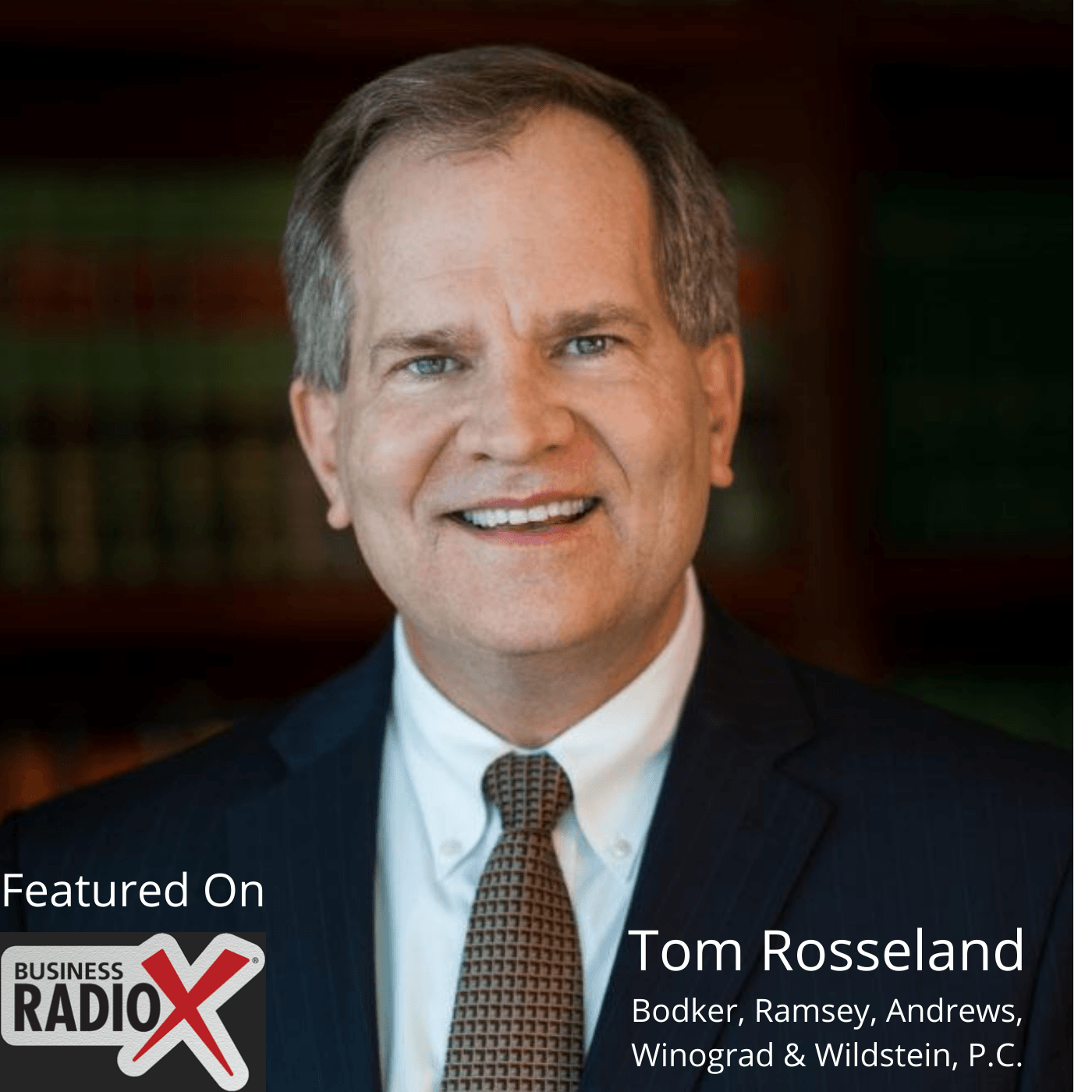

Decision Vision Episode 76: Should I Pursue a Workout for my Business? – An Interview with Tom Rosseland, Bodker, Ramsey, Andrews, Winograd & Wildstein, P.C.
What is a business workout and when is it a good option for struggling businesses in this economic climate? Tom Rosseland joins host Mike Blake to discuss workouts, working with creditors, bankruptcy, and more. “Decision Vision” is presented by Brady Ware & Company.
Bodker, Ramsey, Andrews, Winograd & Wildstein, P.C.
Bodker, Ramsey, Andrews, Winograd & Wildstein, P.C. was founded in 1986 by law school classmates who shared a common approach for practicing law and a passion for providing clients with creative solutions to their legal needs. Although the firm retains its collegial culture from those origins, it has grown by selectively adding attorneys who excel in their respective areas of expertise. Today, Bodker, Ramsey, Andrews, Winograd & Wildstein is a full-service law firm that handles a variety of complex legal matters covering a wide range of practice areas and industries.
Thomas Rosseland, Principal
Michael Blake, Brady Ware & Company

Michael Blake is Host of the “Decision Vision” podcast series and a Director of Brady Ware & Company. Mike specializes in the valuation of intellectual property-driven firms, such as software firms, aerospace firms and professional services firms, most frequently in the capacity as a transaction advisor, helping clients obtain great outcomes from complex transaction opportunities. He is also a specialist in the appraisal of intellectual properties as stand-alone assets, such as software, trade secrets, and patents.
Mike has been a full-time business appraiser for 13 years with public accounting firms, boutique business appraisal firms, and an owner of his own firm. Prior to that, he spent 8 years in venture capital and investment banking, including transactions in the U.S., Israel, Russia, Ukraine, and Belarus.
Brady Ware & Company
Brady Ware & Company is a regional full-service accounting and advisory firm which helps businesses and entrepreneurs make visions a reality. Brady Ware services clients nationally from its offices in Alpharetta, GA; Columbus and Dayton, OH; and Richmond, IN. The firm is growth minded, committed to the regions in which they operate, and most importantly, they make significant investments in their people and service offerings to meet the changing financial needs of those they are privileged to serve. The firm is dedicated to providing results that make a difference for its clients.
Decision Vision Podcast Series
“Decision Vision” is a podcast covering topics and issues facing small business owners and connecting them with solutions from leading experts. This series is presented by Brady Ware & Company. If you are a decision maker for a small business, we’d love to hear from you. Contact us at decisionvision@bradyware.com and make sure to listen to every Thursday to the “Decision Vision” podcast.
Past episodes of “Decision Vision” can be found at decisionvisionpodcast.com. “Decision Vision” is produced and broadcast by the North Fulton studio of Business RadioX®.
Visit Brady Ware & Company on social media:
LinkedIn: https://www.linkedin.com/company/brady-ware/
Facebook: https://www.facebook.com/bradywareCPAs/
Twitter: https://twitter.com/BradyWare
Instagram: https://www.instagram.com/bradywarecompany/
Show Transcript
Intro: [00:00:02] Welcome to Decision Vision, a podcast series focusing on critical business decisions. Brought to you by Brady Ware & Company. Brady Ware is a regional full-service accounting advisory firm that helps businesses and entrepreneurs make visions a reality.
Mike Blake: [00:00:21] Welcome to Decision Vision, a podcast giving you, the listener, clear vision to make great decisions. In each episode, we discuss the process of decision making on a different topic from the business owner’s or executive’s perspective. We aren’t necessarily telling you what to do, but we can put you in a position to make an informed decision on your own and understand when you might need help along the way.
Mike Blake: [00:00:40] My name is Mike Blake and I’m your host for today’s program. I’m a director at Brady Ware & Company, a full-service accounting firm based in Dayton, Ohio. With offices in Dayton, Columbus, Ohio, Richmond, Indiana, and Alpharetta, Georgia. Brady Ware is sponsoring this podcast, which is being recorded in Atlanta for social, distancing protocols. If you like this podcast, please subscribe on your favorite podcast aggregator. And please consider leaving a review of the podcast as well.
Mike Blake: [00:01:07] So the topic we’re going to discuss today is, should I pursue a workout for my business. And by workout, I don’t mean go to the gym and make your business buff somehow. I’m not sure how that would go, but there’s probably a business coach out there that adopts that kind of branding, I suppose.
Mike Blake: [00:01:26] But rather, frankly, kind of the other side. And a workout is, in case you don’t know, a workout is a process where you reach a point where you can’t pay all of your bills in full on time. And it’s sort of – and we’ll get into the proper definition in a minute with our guest, who’s the expert. But it’s sort of this in-between land, if you will, of financial health and solvency on the one end of the spectrum. And the other spectrum, some sort of reorganization or liquidation.
Mike Blake: [00:02:05] And unfortunately – excuse me – I suspect that this is a topic that is particularly appropriate and timely and relevant. We think as we record this in mid-June, that we think we’re coming to something that approximates a recovery. But the fact of the matter is that, you know, life is going to go on, but it’s not necessarily going to go on for everybody in terms of businesses. And it’s not going to go on for everybody at least the way that they had hoped to or wanted to. And a workout is a process where you try to kind of work things out. I think that’s probably the best way to describe it.
Mike Blake: [00:02:53] And, you know, I’ve assisted clients in a tangential way. I don’t want to position myself as an expert here on this because I am not. But, you know, I have ridden a shotgun sidecar with some clients on a workout process and it’s tough. And it’s tough because nobody likes it when you tell them that you can’t pay them. Nobody is going to welcome that with open arms necessarily. And some of those conversations can be very unpleasant indeed. And, you know, a few people, I think, frankly, like telling somebody that, “I can’t meet my commitment to you,” especially a financial commitment. And it really tests, frankly, it’s going to test your own commitment to your own business in a lot of ways.
Mike Blake: [00:03:42] But there are right ways to do a workout. There’s a wrong way to do a workout. And then, maybe a point where a workout is not appropriate, right? You may be thinking you have to enter a workout too soon and there are ways you can avoid that. And there are, on the other end of the spectrum, you know, a workout is just going to be too little, too late. And you need to look at things that are more – options that are more drastic.
Mike Blake: [00:04:06] And so, helping us with this as our guest today is my dear friend, Tom Rosseland, who is with a law firm called Bodker, Ramsey, Andrews, Winograd and Wildstein. I always feel badly for anybody whose name comes after the first two because nobody ever says the final names after the first two. For example, my firm was Brady Ware and Schoenfeld. Nobody ever says Brady Ware and Schoenfeld. And I’m sure, Schoenfeld is or was a very nice person, very capable. But for whatever reason, they sort of got screwed. So to Mr.’s Andrews, Winograd, and Wildstein, I’m sorry about that. But you ought to work it out with your own partners on that.
Mike Blake: [00:04:47] But Tom represents domestic and international clients in a variety of industries and practices in the international, corporate, employment, and business litigation areas. Tom has worked with and successfully handled a wide array of complex legal matters for individual and corporate clients. He extensively works with chief financial officers for many businesses. And he also supports the sea level community, both professionally and personally, as a mentor and as a networking resource. I’m happy to personally attest to that.
Mike Blake: [00:05:18] Tom is also the host and moderator of the International Business Radio Program on probusinesschannel.com. I did not know that. He’s been holding out on me. And serves as chair of the International Section of the Atlanta Bar Association. Early in his career, Tom has served as in-house counsel for ExxonMobil. Born as a first generation American to a Swedish mother and Norwegian father, Tom now serves as the honorary consuls for both the Kingdom of Sweden and Kingdom of Norway in Georgia.
Mike Blake: [00:05:47] Tom, thank you so much for coming on the program. I’m tempted to try to do this in Swedish, but I’m not going to. So, I’m just going to say welcome and thank you so much.
Tom Rosseland: [00:05:56] Thank you so much, Mike, for having me on the program. I’m excited to talk about the subject matters that are probably going to be of consequence in the months ahead. And so, feel free to far away with what you think might be relevant to our audience
Mike Blake: [00:06:09] So, here’s a question I’ve always wanted to ask you and I never had. It has nothing to do with the topic whatsoever. Is there ever a conflict of being the honorary consul for both Sweden and Norway? Do they ever get, like, mad they think you’re, like, pro-Norway and pro – because those two countries have a long history of smash and grab violence.
Tom Rosseland: [00:06:31] You’re right about the history. But, you know, thankfully, Norway gets to award the peace prize every year in Oslo. And there is actually a very cordial relationship now between the two governments. So, Norway got its independence in 1905. And I think that the good feelings that have come out of that are the current vibe. So, in fact, the opportunity to be the consul for Norway came after I was already appointed by Sweden.
Tom Rosseland: [00:06:58] And the offer was related by my contact at the embassy, the Swedish Embassy in Washington. She said, “Would you be interested in being a candidate?” Because the Norwegians had reached out to her. And I asked the same question you asked, which wouldn’t that be a conflict. And, basically, she indicated that there was such a – they have such overlapping interests and do so many things together that, in fact, that would not be a problem whatsoever. And in fact, she had already gotten approval from the Ministry of Foreign Affairs in Sweden, in Stockholm to, you know, if I could work out with the Norwegians, go for it. So that’s a good question, but no problems these days.
Mike Blake: [00:07:33] All right. So, let’s clean up the mess I’ve already made describing what a workout is. So, what is a workout? Was I even close in my definition of the introduction?
Tom Rosseland: [00:07:46] No. It’s very good. You nailed it. I think, there’s a whole range of issues that come out with workouts. And a workout can be – essentially, it’s an alternative to bankruptcy. And in many ways, the idea is that you get to an end point that is acceptable to both parties. But it’s a process. And that’s the point I want to emphasize, that it’s so important that you come to it with eyes wide open. And to your point, Mike, that there are going to be uncomfortable conversations because no one likes to come back to a creditor or a counterparty that you owe money to and start talking about why you can’t pay them in full or you can’t pay them on time.
Tom Rosseland: [00:08:21] But I think that the most important thing you can do earlier in the process is to be mindful of the moving parts. Being aware of what are the administrative requirements of that agreement or the contract. Getting things mapped out. And being proactive and being candid. I think the most important thing people come to the table with is their credibility. And the way to maintain that is to go ahead and be forthright and to be, you know, be entirely candid about what is going on.
Tom Rosseland: [00:08:50] There are other ways that this can be played, where if a workout comes into play and there’s already distress in the relationship, and there’s already some level of, you can call it, recrimination, or just a dispute that’s in the offing, there are other tactics that we can use to come to the same end point. It’s just it depends on where you are in the cycle. I think that the earlier you can identify the issue and call the question, the better off you are in many, many regards. And if you want to just-
Tom Rosseland: [00:09:21] So, what’s the difference? I mean, I think everybody struggles to pay bills at some point. What is that tipping point where you’re not just struggling to pay bills, but you need to sort of take more dramatic action and start making kind of really hard and uncomfortable choices? What does that tipping point of that inflection point look like?
Tom Rosseland: [00:09:46] I think just based on your own historical experience, you know, we can talk about it from the perspective of a business owner and operator. Or somebody who has, you know, a high net worth individual who has a lot of obligations that are guarantee obligations. It’s basically the same conversation or the same approach. But I think the tipping point, Mike, would be when you are no longer able to carry on as you are used to doing and expecting to do.
Tom Rosseland: [00:10:11] So, if you are now in a different place that is making you stay up at night. And it’s different than what it has felt like in the past. Your gut is telling you something that you need to be listening to. And I think it’s at that point where you need to go ahead. And it may even be before your bills are at that point of being out of sorts or being out of order or not being paid. I think that certainly will – you know, that will call the question when you’re not paying or being able to pay. But if you can think ahead and put wishful thinking aside and just say, “Where things currently are for me and my business, I’ve not been there before. And I’m looking at a wall of debt or obligations that are coming due. I need to figure out what my Plan B is.” That’s the time where you’ve hit the tipping point. I think that’s the easiest answer – almost straightforward answer.
Mike Blake: [00:11:06] Now, is there a – I’m thinking, you know, is there a difference between, you know, I’m probably going to pay bills a little bit late, but they’re still going to get their money. I guess what you’re describing is that you’re looking ahead and you’re just seeing an avalanche. And it’s not just that I’m going to be a few days late paying some bills, but, you know, probably many bills are going to wind up going into delinquency, I guess, if I don’t get ahead of that. Is that a reasonable way to think about the decision?
Tom Rosseland: [00:11:44] It’s a reasonable way to approach the decision. And also it touches upon the touching – sorry – the tipping point, Mike, where if you got a handful of obligations, you know, maybe rent obligations or things like that where with the current environment that we’re having, a lot of, you know, landlords are expressing some leniency or willingness to defer payments. That’s one thing. But when you actually have a stream of payment obligations to various of your vendors and your creditors that are coming due that are systemically, from your perspective, going to be a problem to manage. That’s where I think you have to have that bigger conversation.
Tom Rosseland: [00:12:21] So, there’s just a, you know, a one off. You know, there may be a glitch where you’ve had a customer file bankruptcy on you or something where your cash flow is being affected by – you know, due to no fault of your own. But it is something you expect to surmount in the next few months. That’s one set of issues and opportunities and conversations. There’s another one where you’re looking at just a broader picture that may be driven by economic factors beyond your control.
Mike Blake: [00:12:51] You know, let’s drill down on that, because I think there’s potentially a really important point there. Are all workouts created equal in terms of the conversation? What I mean by that is, are creditors going to react differently if they perceive that the reason for the workout is something that is clearly an act of God. Say a pandemic, we know that would never happen, right? Or murder moments versus, you know, simply you didn’t manage your business very well. It’s clear that you just sort of screwed up or you were cavalier. Do creditors want to hear the reason for the workout? Or do they immediately sort of generally say, “Well, my money is at stake? I really don’t care about the answer.” And now we kind of move forward.
Tom Rosseland: [00:13:53] That’s an excellent point. I do think that they care to know how you got there to the extent that helps them to understand your perspective about how you expect to get out. So, I think they are interested in learning about the entrance point, you know, to your problems and how long that’s been going on. You know, nobody wants to just have their shoulder cried upon as the basis for a negotiation or discussion.
Tom Rosseland: [00:14:18] I think, though, you do get sympathies with creditors where if you were, you know, again, if you had a good payment history or a good working relationship. And that really is the driver of this conversation. You have a “relationship” with that creditor. And something comes up that’s untoward and unexpected, you will get sympathy, especially if, you know, you’ve been doing all the right things and then something, you know, comes your way.
Tom Rosseland: [00:14:42] But if you were, basically, sideswiped by an economic event such as what we’re dealing with right now, that’s one thing. You know, they understand. We’re all sharing some version of those pain points. It’s a question then of what are you going to articulate as an approach to get out of that ditch, so to speak? And what can you help them to map out with you? So, how can you get them to support the vision and then move forward from there? If that is something that you have that opportunity to create a relationship.
Tom Rosseland: [00:15:16] It’s really hard to create a relationship with a creditor that you’ve had antagonisms with. You know, if there’s been operational issues that have, you know, resulted in a lot of friction in the past, you know, that goodwill factor is not really there. So, in that situation, very often these kinds of things – we joked about agreements, right? The best agreements are the ones that are written up and that you never have to look at. And that means you’ve got a great relationship.
Tom Rosseland: [00:15:41] But then if something goes south, everyone starts pulling out the papers and looking at the finer points in the documentation. And more and more attention will be focused on the fire points in the documentation, the more your sideways in terms of that relationship. So, I think if you got a good relationship, very often creditors are willing to sort of look aside or not really focus on the language of the agreements. If you don’t have that goodwill, you’re going to be starting to look at a bunch of paper and legal terms that will come into the conversation.
Mike Blake: [00:16:14] I’m glad you brought that up, too, because there is this concept out there, I believe, of a technical default. Which I understand means that, yeah, you’re still paying your bills, but maybe you’re required to have some sort of interest coverage ratio or certain financial metrics you’re supposed to meet. So you’re still meeting your cash payment obligation. But on the other hand, you’re not maintaining a level of a financially measured health as, maybe, your loan covenant or other covenants dictate. Is there a difference there too?
Tom Rosseland: [00:16:49] Yeah. Absolutely, Mike. I mean, those situations where you are maybe servicing the obligation. But there are other events of technical default. There may be a covenant that you’re not complying with. It could be anything from insurance coverages to other duties that come into the relationship. And that’s when you start getting into the creditor, you know, your counterparty saying, you know, “We reserve all rights.” You know, so we are talking to you, but, you know, we reserve all our rights. And technically, this is to notify you.
Tom Rosseland: [00:17:20] So if a creditor wanted to keep its options open and still work with you, they will send out a notice saying that, you know, under the provisions of that agreement, you are technically in default. And that that creditor reserves rights to pursue relief for that default. But at this point, any conversations will not be a waiver of those rights. Does that make any sense?
Mike Blake: [00:17:44] Yes, it does. So, in that vein, I’d like to get back and I’d like to get into another, I think, potentially very important technical definition, which is, the difference between a workout in a Chapter 11 restructuring. We know Chapter 7 is game over. Sell everything off and let people figure out how much they’re going to get out of that. But Chapter 11 sounds to me like a workout. It sounds to me like it has a number of things in common with a workout. Are they the same thing or are there important distinctions between a workout in a Chapter 11 reorganization?
Tom Rosseland: [00:18:23] Yes. That’s a great question. The bankruptcy process in and of itself – and I cut my teeth when I started practicing law dealing with credit issues and the bankruptcy for a number of years. And I’m very familiar with that area. So, the bankruptcy provisions or the code Chapter 11 is basically, as you said, a reorganization for a business. The problems with a Chapter 11 are the costs. They’re very expensive. There is the administrative oversight by the court. They also have the bankruptcy trustee. It’s either a court appointed trustee or the U.S. Trustees Office that they directly work for the government. You have a lot of reporting requirements in a bankruptcy. You are court supervised.
Tom Rosseland: [00:19:05] So, any action that you would propose to do in a bankruptcy is going to be overseen by somebody, whether it’s by the judge or by a trustee. But there is going to be a heavy level of reporting and accountability. And a creditor also may not necessarily appreciate having you in bankruptcy, because there is this thing called the automatic stay. Which basically prevents a creditor from unilaterally taking action to collect on a debt without the blessings or permission of the court. So the outcomes of a Chapter 11 could very, very much be the same, perhaps, as a workout.
Tom Rosseland: [00:19:44] So, for instance, in a Chapter 11, you can actually have a company that restructures itself and recapitalizes itself and moves on. That’s what we would call a successful Chapter 11. You have also things called a liquidating Chapter 11, which is that bankruptcy, essentially, is a sale of assets that’s court supervised with the doors open, the lights are still on. So, you don’t have, you know, a garage sale. You don’t have a fire sale. But you basically end up having creditors getting assets of the company for distribution. Or a purchaser would sell those assets – I’m sorry. A purchaser would buy those assets. And creditors would get a portion of those proceeds of the sale.
Tom Rosseland: [00:20:23] A workout is out of court. It’s meant to be a nonjudicial proceeding. It’s meant to be consensual. There is no oversight process. There are things such as what they call an assignment for benefit of creditors, which has some level of supervision or reporting to a court. But typically, a workout is meant to be an independent thing that you were doing yourself with the creditors involved without other party’s supervision. Other than the relationships you have with the creditors or whatever deal you can structure under the circumstances.
Mike Blake: [00:21:06] So, you bring up an interesting distinction, which I think, is one of the most important things is that, when you declare bankruptcy, you are limiting the choices of your creditors, at least, temporarily their ability to act and influence. And therefore, it seems like that’s a much more aggressive posture to take than initiating a workout initially, right? In a way, I guess there’s sort of a graduated series of events, potentially, where I could certainly see a scenario under which you might start with a workout and then go into bankruptcy if the workout is not effective. But on the other hand, if you declare bankruptcy and then you say, “Oh, never mind. Let’s go back to a workout scenario.” That’s probably a lot harder to do since a bankruptcy basically slams a door in your creditor’s face. Is that fair?
Tom Rosseland: [00:22:10] That’s an excellent point, Mike, which is, you know, filing a bankruptcy is sort of, very often, is the last option that you want to pursue. And so, for me, when I advise clients in terms of their range of options, typically, the end of the line is a bankruptcy. There are cases that where it’s very clear based on the nature of the obligations, and how much debt there is, and how big the business is, and what its prospects are, that you might come in knowing you’re a big enough company with enough assets and enough of a runway to actually have successful outcome.
Tom Rosseland: [00:22:43] And you can get what they call debtor in possession financing if you have your financing sources lined up. You know what the problems are. You’re trying to go into sort of a one off event that occurred. You have a pathway and a game plan. You can file a Chapter 11 and actually get a good outcome if you think far enough ahead.
Tom Rosseland: [00:23:00] They even have bankruptcies that are called prepackaged in a Chapter 11, which is you’ve already talked with your creditors. You’ve already worked things out with them. And, you know, there are things you can do in a bankruptcy that you can’t do anywhere else. Like in a bankruptcy sales, you know, you can sell certain assets with the permission of the court, what they call free and clear liens and encumbrances. So, there are certain things where, you know, if a creditor is wanting to accomplish even something in the nature of a workout, they might just say, we need you to do this, that or the other, which may include a bankruptcy filing and the sale of those assets free and clear just to clean title up to those.
Tom Rosseland: [00:23:35] But to your point, Mike, very often typically, for me, when I go and make a recommendation to a client about a bankruptcy, that is the last straw. Because you typically have a very heavy-handed supervision, as we’ve talked about. And there are tremendous amounts of administrative costs with professional fees and reporting requirements. You have a monthly budget, you have monthly expenses, and all that. It takes a lot of time and it’s a distraction to the process.
Mike Blake: [00:24:02] So going back to the idea of a workout, I think, you know, if you have the runway and the wherewithal to sit down and think about your strategy is and you can work it out with those creditors, that creditor, or those creditors outside of bankruptcy, by far is preferable. But not always. There are times when it’s apparent evidence, self-evident that you need to do something more than a workout. I don’t know if that answers the question.
Mike Blake: [00:24:31] No, it does. So, let’s fast forward a little bit or advance the ball a little bit, you know, I’m a client and I’ve decided that I want to or I need to place myself or start having workout conversations. I walk into your office and say, “Tom, you know, I’m in financial trouble. I don’t think it rises to the level of bankruptcy yet. But I need to, frankly, work things out with my creditors.” What are the immediate things that I need to put on my to-do list? What are you telling me to do as my advisor?
Tom Rosseland: [00:25:04] Yeah. Thanks for that. That’s exactly right. You know, when people come in, very often – and I have to share this, that I’ve seen it again and again -very often by the time people come my way, they are already what we call in the bunker. They already almost have a siege mentality. They are so, whatever, beaten up or downtrodden. And they’ve gone so far down negative alleyways with their creditors that very often they come to me, unfortunately, later in the game than they should.
Tom Rosseland: [00:25:30] But if I have the opportunity to help somebody even if it’s not a blank slate, but at least it’s certainly where there is an opportunity to make a difference, I would ask them to come in. And before they even come in, you know, give me one to two-page summary, chronological summary of how they got to where they are. And keep it short and keep it succinct and concise. And then also, what’s their thought process about how they would propose to move on. What would be the thing that they would need to accomplish to turn things around?
Tom Rosseland: [00:26:04] Now, if they realized that it’s too late in the game and their business is just, so to speak, done for, if there is no obvious opportunity based on market conditions or where they are, then we can look at other things that would at least buy time, would at least perhaps defer the obligation. So, in that situation, I can work with them and then be more focused on if we can’t get a resolution in terms of getting you right sized, then what we can at least talk about is mitigating your exposure. What can we do to mitigate your risks and your exposure with your creditors in a way that gives you a meaningful outcome?
Tom Rosseland: [00:26:42] And then, that becomes a conversation focused on enlightened self-interest with your creditors. How can you show them to their satisfaction that they have an incentive or a reason to play ball and that they will do better by working with you rather than, you know, than the alternatives. And one of those alternatives I’ve seen is, you know, worst case, you come to a creditor. And again, it depends how far down the road this thing has gone. But if it’s pretty far off the rails already, you know, the creditor might say, “Well, I’m not really liking what you’re telling me. I’m not buying it.”
Tom Rosseland: [00:27:14] And that comes down to them wanting to see your financial information. So, they will likely ask for some detailed financial information. And then, it’s up to you whether you want to sort of tip your hand. Because they’re going to look for what assets you’ve got. And if there’s a personal guarantee involved. You know, there’s all kinds of ways to skin this thing and to consider it. They may want more information than you’re comfortable in sharing and, maybe, where you actually have access to resources, you know, that are not really your family. It’s not your money in your bank account, but you have a father-in-law or a mother-in-law, or some relative who could actually help but they’re not really on the line for any of this.
Tom Rosseland: [00:27:56] So, you know, there are times where, you know, it’s appropriate to poor mouth yourself, even though you might be in a situation where if you know there’s an opportunity to be had, you might be able to tap those additional lines of credit – informal lines of credit, to see if you can turn things around the creditor. But I think that creditor is going to be very focused on what you got. And they may want to have a lot more access to information than you’re willing to share under the circumstances.
Mike Blake: [00:28:25] So it sounds like then one of the key items on that to-do list is have your financial documentation in order, right? And that may include some sort of forecast or projections as well. Because at some point they want to know what you’re planning to pay them back is. Do you think creditors care – this is a blatantly self-serving question but it needs to be asked anyway. In your experience, do creditors care if you’re working with, say, a CPA to put that information together? Will that help?
Tom Rosseland: [00:29:03] I think, in certain situations, you know, in terms of – you know, it depends on whether you are actually having a good faith negotiation with a creditor or you’re doing some version of a blind man’s bluff. I think that in many situations, working with an accounting firm and getting a financial professional involved to look at the numbers of the business is very helpful to the process. Especially, if the accounting firm with a financial professional can translate things in a way that’s meaningful to a creditor that they would want to focus on.
Tom Rosseland: [00:29:35] So, I think there are absolutely appropriate times, actually, that professionals help with that process. And to me, you know, I’ve done this long enough to appreciate that when people come in and they want to schedule a meeting with me, I make it as a matter of course now. I request that they actually, before the meeting, email me confidentially that short summary of what’s going on. Because if they can’t bother to even sit down and put pencil to paper and help me with that thought process before they come into the office, they’re not really invested in their own success. And I need somebody who’s actually going to show that they have skin in the game.
Tom Rosseland: [00:30:09] And going back to your point, Mike, I think having professionals involved is great. You know, the one thing that would come into play is if you’re coming to a creditor and saying, you know, I’m broke, they might just want to know, “Well, how did you get a really good firm, you know, such as Brady Ware to do those things?” But that’s that time and that place. But I think there’s absolutely a role for financial professionals in this process.
Mike Blake: [00:30:37] That leads into another question, which is, in that adviser conversation – there’s actually a broader issue, which is, if I’m the company owner or I’m the executive that sort of somehow in-charge of this for my company, it’s got to be really tempting to see if I can find somebody else to just sort of have and take care of it. And we’ll get to this in a second. But, you know, the conversations are not pleasant. They are humbling. They’re humiliating. They may get heated, frankly.
Mike Blake: [00:31:13] And so, the temptation would be to hand it off to a subordinate. The temptation would be, “Okay. Tom, I just need a workout. Here are my creditor’s phone numbers and emails. Here are my financial documents. Here’s my CPA’s phone number. Go make it happen. And then, come back to me when you have the plan set up.” Sounds great. Is that a realistic process?
Tom Rosseland: [00:31:39] Wow. That’s a fabulous question/observation. And they’re all different reasons for doing it different ways. I’ll say for the most part, offshoring and offloading that process to other folks is not necessarily – there are certain times where it is a good idea. But I think in general, you need to have the stakeholders, the chief executive, or certainly the sea level people in the business at least involved in some fashion. And to offload it raises its own challenges.
Tom Rosseland: [00:32:10] I will say that, for instance, what I typically recommend to a business owner or manager is that, you know what? Let’s not lawyer it up. Let’s go ahead and let me help you with the conversation. So, let me give you some guideposts and some discussion points. Let’s go in and see what we can accomplish and whether it’s the owner, or the manager, or some senior person who has a relationship with that creditor who actually starts trying to make things happen.
Tom Rosseland: [00:32:37] Because for them to lawyer it up on the front end, I’m gonna be stuck dealing with the creditor’s attorney. Because typically a creditor is going to get their attorney involved once I am reaching out on behalf of my client to the business – the creditor, they’re going to say, “Okay. Fine. You got a lawyer, I’m going to get a lawyer.” And then, the ethical rules are that the lawyers can’t talk directly to the opposing party. They actually have to go through the opposing party’s attorney. So, it becomes another layer of communications that may be appropriate under the circumstances.
Tom Rosseland: [00:33:11] But I typically are not the one. Unless my client who owes the money is aggrieved. They were clearly taken advantage of. And there is a reason to raise my hand as an attorney and say, “Hey, we’ve got a problem here, Houston.” I’m going to go and try and help the client, you know, work that conversation through. And then, I will eventually appear on the scene if necessary. But that’s the typical way I’d recommend it.
Tom Rosseland: [00:33:37] Now, getting a third-party financial professionals, again, it depends on how big a mess it is. And if, in fact, the manager/ owner of the business that’s in distress has lost all credibility with that creditor, then it certainly makes sense to bring in financial professionals who can help with that conversation or even the attorneys, because nobody else is gonna be listening. That party who owes the obligation is persona non grata. Then we have to find other ways to have that conversation. I don’t know if that answers the question.
Mike Blake: [00:34:14] No, it does. So, now we’ve been talking a lot about – we’ve been using examples that heavily involved banks because that’s sort of the classical workout posture. But a workout may involve other creditors as well, right? You know, it’s not just for breakfast anymore. And not necessarily just for banks, right?
Tom Rosseland: [00:34:31] Absolutely. Now, there are – you name it. There are so-called private banks. There are a lot of investors, you know, who even though they may not have documented the relationship as an equity investment. It’s a loan. But there is a lot of money out there that’s non-bank money that clearly plays into this process. And everyone has different motivations. So when we talk about workouts or restructurings, that’s not really the banks. Very often it’s actually quite the opposite.
Mike Blake: [00:35:04] What about landlords?
Tom Rosseland: [00:35:08] So, yeah, landlords are – almost any creditor, including your landlord, you know, is somebody you could work with if done with a proper approach and come to a resolution. So, absolutely. The universe of creditors includes everything from landlords to trade creditors to vendors, you name it, they are all non-bank. And quite often it’s those things, those trade creditors and vendors that come in, you know, crash land on your deck that are insisting on getting paid. And, you know, that becomes your pressure point. So, very often the banking process is the last thing that comes into play. And that may be triggered because then you are in violation of covenants. Or you are not able to pay a certain loan with that bank based on these other creditor issues. So, they may come into the mix, but that’s not always where it starts. It goes any number of directions.
Mike Blake: [00:36:06] So, I want to ask this then, you know, once you kind of start these conversations, how do you manage – can you manage emotions in the scenario?You described, you know, with a lot of depth – and I think this is important – is, you know, most people, frankly, if they’re not sociopathic when they walk in, they feel badly that they’re defaulting on obligations. And they feel like they are a failure. Their business is failing to some extent. And you know, you’re going into a situation where the outcome of the phone call is that you’re going to be disappointing somebody. How do you manage the emotions of that conversation so that it doesn’t spiral out of control and the emotions don’t dominate the conversation as opposed to a more constructive problem-solving posture?
Tom Rosseland: [00:37:13] That is, again, just spot on. For me, having done this long enough, you know, my role is not only to be an advocate, but also actually be an adviser who manages the process in a positive way, in a proactive way, and also trying to take the emotion out of it. So, when I communicate with my clients about how do we respond to a creditor, how do we go in and have a communication with the creditor. I always tell them to be aware.
Tom Rosseland: [00:37:42] Really, your audience, think about this. So, they go south and it becomes a litigation matter. Then very often the communications, the correspondence, and the documents are being exchanged. It will become an exhibit in a court related matter. And so, for me, when I’m looking at the audience, it’s not just the creditor who may end up being asked or second guess who did the right thing or the wrong thing in the moment with regard to the debt at issue and what the process would look like from an equitable perspective or a legal perspective. So, that allows me to actually help the client think in a different way. They may want to shout at the moon or howl at the moon, all those things, vent, you know, scream in a quiet place, and all those things.
Tom Rosseland: [00:38:29] But to get them to a place where they’re in a better situation or a clearer posture, my goal is to sort of take the emotion out of it. And it requires a lot of empathy on my part. So, I think when clients understand that I’m in their shoes and I’m actually thinking for them and very much concerned about it, and then, I’m very tactically aware of what’s going on in the moment. If I know where the traps are, the booby traps, and where they would likely get into some significant exposure, they know I’m taking that on. They can almost transfer some of that stress and they still have the financial part of it. But they understand that I’m thinking, you know, that process through for them. And I’m their advocate, then they become a lot more clear headed that they can get out of the bunker and start helping me to envision the best pathway to have either an outcome that’s acceptable or at least a conversation or a pathway that is more productive than it would otherwise be.
Mike Blake: [00:39:29] So, you know, we pick up the phone, you and I, I come to your office, we have a speaker phone on, the door closed, we start making these phone calls that we didn’t want to have, but we got to make them. At the end of the day, a workout seems to me with what you’re really doing is you’re going on a campaign to ask people for something financial who have no obligation given to you. What are the most common concessions you see or the most common asks you see on behalf of creditors in exchange for agreeing to a workout program or a workout concession, whatever the proper term of art is? What should I expect that to give up in order to get what I want from my creditors?
Tom Rosseland: [00:40:19] So, I think, you know, the typical creditor doesn’t want to leave any money on the table. They need to be convinced that it’s in their own self-interest to deal. So I’ve had situations where I’ve reached out to creditors, bank and non-bank creditors, and have said that my client is in financial straits. Here’s where we are, how we got there, here’s what we’re asking you to help us with.
Tom Rosseland: [00:40:41] And then very often, you know the things, Mike, that the creditor will be asking for would be asking for financial statements. They may want a sworn financial statement, where basically you’re under oath saying this is a true and correct summary of your financial condition. They may want to be asking, if they’re really, really focused on things, they may want to know about what your assets are and where, if any, transfers have occurred. If a creditor is really, really into it, full tilt, they’re going to go and do their own search of real estate records, you know, just to see if there has been any transfers, interfamily transfers of real or commercial property just to see if your poor mouthing yourself.
Tom Rosseland: [00:41:24] You know, I think that the problem is it depends on how much the creditor already thinks it knows you. So, the creditor thinks that you are a high net worth individual or that your company is doing very, very well. They’re going to, basically, have a disconnect saying how did all this money go away? Why are we here? What can you share with me that actually gives me, the creditor, comfort to know you’re not playing a game with me? Because that happens a lot, unfortunately.
Tom Rosseland: [00:41:54] I mean, I will never willingly or knowingly be a party to any of those things, but it happens. So, I think the creditor has to actually be assured that you are actually speaking a truth that they can appreciate. And I think what a creditor would want to know is either you’ve got a legitimate story to tell or you don’t. And I think that’s where it comes to – very often I will say to a creditor, you know, “If we can’t work this out, my client may have to file bankruptcy.” And you will get less than the bankruptcy versus what we’re trying to do under the circumstances.
Tom Rosseland: [00:42:31] And I tell my clients that I represent in that situation, “Be aware.” Be prepared for the possibility that that creditor might say, “Well, you know what? I’ll take my chances. You know, file your bankruptcy.” Because then I know I’ll get a full disclosure. Again, that goes back to the whole idea in bankruptcy. You do have a whole variety of tools a creditor has to get discovery as a matter of course that would require less work or more work if this were a non-bankruptcy situation. There’s a litigation matter, for instance, right? There’s a lawsuit. Then the creditor has actually, you know, do what they called discovery. You have to actually seek a production of documents and financial information. And in bankruptcy, it’s almost as a matter of course that you as the debtor in bankruptcy have to disclose a variety of information without that much effort on the part of a creditor to actually have that required of you to stay in the bankruptcy proceeding. I don’t know if that answers the question.
Mike Blake: [00:43:27] Well, it does, especially, the informational side. Now, I want to approach this from the financial side too. In my experience, if I asked for a workout, a creditor is going then ask for something in return to compensate me for foregoing something financially and, frankly, for what you just described. By initiating a workout, I have now just inflicted a series of expenses upon my creditor that they would rather have not spent. Whether it’s legal fees, accounting fees, investigation, all that sort of thing.
Mike Blake: [00:44:05] So, in addition to the informational burden, can I expect to be asked to make concessions in terms of it could be governance and oversight, maybe a board seat. Could it be stricter lending covenants going forward? Could it be an increase in interest rate? Could it be some sort of equity positions such as warrants thing? All of the above. None of the above. What can that look like on the financial side?
Tom Rosseland: [00:44:32] The range of options could be, to your point, all the above or any of the above in terms of what a creditor could ask for. So, you’re basically asking a creditor to do is go outside the terms of the document. The contract provides for this, that, and the other. You know what that script looks like. You know what the creditor can do under the circumstances. You’re trying to convince the creditor that it’s in their best interest to come to a different outcome than what they would otherwise have expected. And to show them that that is actually the best pathway for that creditor under the circumstances.
Tom Rosseland: [00:45:04] So, I think it would very well – could very well be where a creditor would ask for more oversight, more financial reporting, a change in the covenants where there may be a trigger point. They may defer the debt and renegotiation of the debt. And so, very often what they’ll do is they’ll defer, extend, renegotiate the debt. But their new version of reality is going to be a stricter one, which is you crossed – we move that, whatever, trip wire. And we moved it down, you know, a few yards or a field down the way. But next time you hit it, you know, we’re going to come at you for more.
Tom Rosseland: [00:45:42] They might ask, for instance, for not only personal guarantees. They might ask for collateral. They might say what you got, what you got in terms of real estate, what you got in terms of bank accounts. So, they may want to have a position where they’re not going to be behind. That they will actually be in a better place and better prepared to collect on that debt if you still can’t service it. So, that’s for situations where it’s very important to talk to your attorney to confirm that you, as the person owing that debt, are not digging a hole that is a worse outcome for you down the road than what you’re currently dealing with as the waterfront of issues. If that makes sense.
Mike Blake: [00:46:24] So, you know, in your experience, I think one of the big kind of very high level questions is whether it’s worth entering a workout scenario at all from a perspective of – is this one of these things where once you enter a workout, you’re very unlikely to ever come out? Or, you know, is it possible that more companies than maybe the average person thinks, if they do get creditors that are willing to plan and be constructive in the conversation? You know, do a lot of companies actually successfully exit the workout process and are able to put that behind them and ultimately thrive?
Tom Rosseland: [00:47:06] That is, as in everything else, entirely dependent on, you know, the nature of the business, the nature of whatever dysfunction or the interruption that occurred that caused these problems to take place. What’s the vision looking like? It’s a leadership question. I think a creditor wants to know – this is sort of like it’s the same thing where it’s an irony. But in bankruptcies, Chapter 11, bankruptcy is the big ones. Very often the management team that’s putting the company into bankruptcy seeks to get compensation or bonuses, retention bonuses just to stay on board and keep the ship – you know, keep the lights on and keep the ship running. And very often creditors shake their heads like, “Let me get this straight. You’re the management team that brought the company to the brink of bankruptcy. And now, you’re asking to get special compensation and consideration for continuing to run the show.”
Tom Rosseland: [00:48:00] And so, I think that’s the same mindset or questions that come into play as like, you know, if you’re trying to get a creditor to think differently about you, then you need to have a story about why you’re going to be able to do better than what you’ve currently done. So they want to know, a creditor wants to know who’s a management team, who are you bringing in.
Tom Rosseland: [00:48:18] So, maybe, Mike, to your point, one of the things that could change the conversation is like, you know, we don’t trust your management because you have failed to do this, that, or the other. But if you bring in somebody who actually – and again, it all depends on what the resources are, and what the lay of the land is, and what the business environment looks like for that particular company. But if you were just to say, “You know what? We’re bringing in somebody else, you know, who is an expert in this area to help us come to a better place.” And that person has a track record that might make a difference. They just need to know that you’re shifting the conversation. And if you’re not shifting conversation, how is it that you’re going to have a better outcome than what you’ve already got in hand?
Mike Blake: [00:49:01] You know, I picked something up out of that response I want to go back and highlight. You don’t necessarily have to comment, but you’re welcome to if you want to. And that is that, at the end of the day, whether or not you emerged from the workout is heavily dependent upon whether or not you fixed the conditions that led you to the workout in the first place. If you’ve got a lousy airplane and you get more runway, the airplane still isn’t going to fly. It just has a longer runway to crash on. And so, at the end of the day, if you don’t remediate the fundamental issue, then you’re going to be right back where you started.
Tom Rosseland: [00:49:42] And the thing about workouts, too, is the client, we hope, is at a structural disadvantage. What I mean by that is creditors are in workout conversations all the time. It’s part of their job description. They’d rather not be there. But that’s what they do for a living. A borrower, you hope, has never been in a workout scenario before. And so, from an experiential standpoint, the client or the borrower is actually taking a knife to a gunfight. The people with whom they’re negotiating have likely seen it all before three different times.
Mike Blake: [00:50:21] But your client, for example, is fumbling around in the dark with a blindfold on for a flashlight that has no batteries left in it. And I think that makes a big difference in terms of what you’re able to secure from this. And then, the creditors are making a decision too. If I allow this company to continue the pay at the rate they’re going, there’s not going to be any liquidation value either. So, maybe we’re better off kind of stopping the music and taking our chances and getting in line at this point. Because if we wait, it just means there’s going to be less available when we go to the buffet to sort of get our serving, right?
Tom Rosseland: [00:51:10] Right. Yeah. You nailed it.
Mike Blake: [00:51:15] So we’re running out of time. We’re really getting through a fraction of the questions I had, which is typical. But that’s a good thing. But what I want to make sure w hit on before we get out is, you know, what are the specific – no. This is not the question I want to ask. The question I want to ask is, at a time like this, do borrowers maybe have a little bit more leverage than in a time, say, 90 days ago we thought everybody was hunky dory, roaring economy, et cetera, et cetera? There’s this saying that, if you owe a thousand dollars and can’t pay, you’re in trouble. If you owe a million dollars and can’t pay, the bank is in trouble. Is there a sense in your part that maybe there is more leverage on the part of a borrower because creditors maybe want to go the extra mile to just sort of keep things from going into delinquency? Is that a fair statement?
Tom Rosseland: [00:52:12] Yeah. And, you know, we talked about bankers and lenders, you know, the bankers have what they call the special assets department, which is basically foreclose on the assets. And then, they’re stuck with disposing or managing or administering those assets to make lemonade out of those lemons. And I think, Mike, to your point, how the current environment colors the conversation, absolutely. Right now, the fact that you, as a business operator, are in distress and you actually have problems should come as no surprise to the vast majority of creditors, bankers, lenders, and landlords that you’re talking to.
Tom Rosseland: [00:52:50] Then that comes back to the idea of, “Okay. So, we understand maybe you got here because of a lot of other reasons than even your own conduct.” But how are you going back to the storytelling? How are you going to articulate a vision of like, “Okay. So, what do you need to do to get to a better place? And what do you want from me as a creditor? And how can I help you or what would that look like?” And then, you know, it might be one of those things where right now commercial landlords are looking at a lot of things that are not as rosy as it was just a few months ago in terms of their forecasting, in terms of rents to be collected. And occupancy levels for – and I’m not looking at, you know, real estate. There are many other aspects like this.
Tom Rosseland: [00:53:29] But I think to your point, you know, this is a new opportunity to have a conversation. So, if you’re not a repeat workout candidate and this is your first rodeo or, hopefully, one of the first rodeos, you actually have a much better opportunity to dig yourself out of a hole if you can come up with a game plan that is viable and actually holds water. So, yeah, I think, you know, we’re all in a different place than we were just a few months ago. That gives you a lot more latitude with a lot less excuses than you would otherwise have to if this were just a flush economy and everybody’s doing well, arguably, and you’re not. Then how did you get here? I think that now is a different concept. What does well look like and how did you get here are two questions now that are more easily answered than they were just a few months ago. So, that maybe is the relevant point.
Mike Blake: [00:54:31] Yeah. So, Tom, lots of other things we can ask and maybe some people may have other questions about, unfortunately, bankruptcy or something else that’s related to this. How can they contact you if they want to, maybe, go right to the horse’s mouth and get some questions answered?
Tom Rosseland: [00:54:47] Sure. So they can email me at Tom Rosseland, so it’s Tom Rosseland, R-O-S-S-E-L-A-N-D. And my email address is trosseland, T-R-O-S-S-E-L-A-N-D,@brawwlaw. I’ll spell that, B-R-A-W-W-L-A-W.com. Or they can call me at 404-351-1615, extension 107. And I am always available. So glad to help out any way I can.
Tom Rosseland: [00:55:17] But, for me, the differentiator is being invested in the outcome and actually helping a client see their way through this process. And it is a process. But I think there is more opportunity for a good outcome now, believe it or not, than it would have been just a few months ago considering, you know, where we’re all in this conversation together. So, I think there’s many stuff happening. There’s things that can be done. And, you know, my job is to be resourceful. So, thank you for the opportunity, Mike. This is great. I hope I covered some of the areas you wanted to address.
Mike Blake: [00:55:52] Yeah. I know that we did. So, that’s gonna wrap it up for today’s program. I’d like to thank Tom Rosseland of Bodker Ramsey so much for joining us and sharing his expertise with us. We’ll be exploring a new topic each week. So please tune in so that when you’re faced with your next executive decision, you have clear vision when making it. If you enjoy these podcasts, please consider leaving a review with your favorite podcast aggregator. It helps people find us that we can help them. Once again, this is Mike Blake. Our sponsors, Brady Ware & Company. And this has been the Decision Vision podcast.