Business RadioX ®

  • Home
  • Business RadioX ® Communities
    • Southeast
      • Alabama
        • Birmingham
      • Florida
        • Orlando
        • Pensacola
        • South Florida
        • Tampa
        • Tallahassee
      • Georgia
        • Atlanta
        • Cherokee
        • Forsyth
        • Greater Perimeter
        • Gwinnett
        • North Fulton
        • North Georgia
        • Northeast Georgia
        • Rome
        • Savannah
      • Louisiana
        • New Orleans
      • North Carolina
        • Charlotte
        • Raleigh
      • Tennessee
        • Chattanooga
        • Nashville
      • Virginia
        • Richmond
    • South Central
      • Arkansas
        • Northwest Arkansas
    • Midwest
      • Illinois
        • Chicago
      • Michigan
        • Detroit
      • Minnesota
        • Minneapolis St. Paul
      • Missouri
        • St. Louis
      • Ohio
        • Cleveland
        • Columbus
        • Dayton
    • Southwest
      • Arizona
        • Phoenix
        • Tucson
        • Valley
      • Texas
        • Austin
        • Dallas
        • Houston
    • West
      • California
        • Bay Area
        • LA
        • Pasadena
      • Colorado
        • Denver
      • Hawaii
        • Oahu
  • FAQs
  • About Us
    • Our Mission
    • Our Audience
    • Why It Works
    • What People Are Saying
    • BRX in the News
  • Resources
    • BRX Pro Tips
    • B2B Marketing: The 4Rs
    • High Velocity Selling Habits
    • Why Most B2B Media Strategies Fail
    • 9 Reasons To Sponsor A Business RadioX ® Show
  • Partner With Us
  • Veteran Business RadioX ®

Search Results for: marketing matters

Cary Matthews, Adam Marshall, and Jonathan Bill on Guiding Family Businesses

September 17, 2025 by John Ray

Cary Matthews, Adam Marshall, and Jonathan Bill on Guiding Family Businesses, on Family Business Radio with host Anthony Chen
Family Business Radio
Cary Matthews, Adam Marshall, and Jonathan Bill on Guiding Family Businesses
Loading
00:00 /
RSS Feed
Share
Link
Embed

Download file

Cary Matthews, Adam Marshall, and Jonathan Bill on Guiding Family Businesses, on Family Business Radio with host Anthony Chen

Cary Matthews, Adam Marshall, and Jonathan Bill on Guiding Family Businesses (Family Business Radio, Episode 68)

On this episode of Family Business Radio, host Anthony Chen sits down with three leaders who specialize in helping family businesses grow, plan, and prepare for the future. Cary Matthews of Opal Partners Group draws on his Fortune 50 and small business background to help companies clarify their identity, strategy, and culture. Adam Marshall of Lorium Law explains how his firm combines technical excellence with a human approach to risk management, transactions, and succession planning. Jonathan Bill of SBS Accounting and Advisors shares how his firm frees entrepreneurs from back-office burdens, delivering accurate books, timely financials, and proactive guidance. Together, they show how strategy, law, and financial discipline intersect to build strong family business legacies.

Family Business Radio is underwritten and brought to you by Anthony Chen with Lighthouse Financial Network. The show is produced by John Ray and the North Fulton affiliate of Business RadioX®.

Key Takeaways from This Episode

  • Cary Matthews emphasizes clarity on identity and culture as the foundation of strategy.
  • Adam Marshall shifted from “big law” to client-centered legal practice to focus on relationships and assisting clients in making informed choices.
  • Jonathan Bill sees accurate, timely financials as essential for growth, lending, and exit planning.
  • Strategic planning, legal foresight, and sound bookkeeping intersect in family business success.
  • Host Anthony Chen emphasizes that beyond dollars and cents, family businesses need clarity of purpose and must tie financial planning to personal meaning and legacy.

Topics Discussed in this Episode

00:00 Introduction to Family Business Radio
00:47 Cary Matthews’ Journey from COO to Business Strategist
02:14 The Importance of Organizational Structure
04:05 Common Challenges in Small Businesses
08:36 The Role of Strategy in Business Growth
12:01 Introducing Adam Marshall and His Legal Journey
14:52 Building Client Relationships in Law
18:50 The Importance of Risk Management and Pragmatism
25:21 The Importance of Foundational Documents
26:56 Preparing for Business Exits
28:20 Family Business Transitions
32:03 Introducing Jonathan Bill
32:10 The Origin Story of SBS Accounting
36:30 Unique Aspects of SBS Accounting
45:54 Legacy and Business Values
50:43 Anthony’s Financial Corner

Cary Matthews, Opal Partners Group

Cary Matthews, Opal Partners Group, on Family Business Radio with host Anthony Chen
Cary Matthews, Opal Partners Group

Cary Matthews is the Managing Partner of Opal Partners Group, LLC (OPG), where he helps small business owners and leadership teams get unstuck, achieve their goals, and build businesses they enjoy. As a strategy coach and fractional executive, he draws on more than two decades of experience leading operational improvement and growth in small businesses.

Before founding OPG, Cary served as COO and EVP of Operations for several Atlanta-area companies, overseeing project management, support services, accounting, HR, engineering, and logistics. His leadership produced measurable results, including reducing invoicing time by 80%, boosting gross profit by 10% while managing a 30% increase in sales, and cutting training development costs by 30%. Earlier in his career, Cary worked for Fortune 100 companies and a start-up, experiences that built the foundation for his passion and expertise in small business leadership.

Cary holds a Bachelor of Electrical Engineering and an MBA from Auburn University.

Website | LinkedIn

Adam Marshall, Lorium Law

Adam Marshall, Lorium Law, on Family Business Radio with host Anthony Chen
Adam Marshall, Lorium Law

Adam Marshall focuses his practice on matters dealing with corporations, with an emphasis on corporate restructuring, bankruptcy, and distressed M&A. Adam has represented debtors, creditors, corporations, lenders, funds, and buyers and sellers of assets in numerous industries, including retail, food service, real estate, healthcare, automotive, energy, and financial services.

Further, Adam counsels business owners/C-level executives on general corporate matters, including structuring, financing, operational needs, and liquidity events/strategies. Adam began his career as an attorney with several national and international law firms, including White & Case and Greenberg Traurig, working in the restructuring and distressed M&A practice areas.

He has practiced law since 1999 and lived in Florida for 21 years, until recently relocating to the Atlanta area with his wife Stefanie and two sons, Joshua (Duke ’23) and Alexander (University of Michigan LSA Honors ‘26).

Website | LinkedIn

Jonathan Bill, SBS Accounting

Jonathan Bill, SBS Accounting, on Family Business Radio with host Anthony Chen
Jonathan Bill, SBS Accounting

Jonathan Bill owns SBS Accounting & Advisors. Jonathan grew up in a small business and seeing his dad struggle to start a new business is what gave him his heart to help entrepreneurs. As a result, Jonathan started his company in 2006 with a passion to free and empower small businesses—”free” by taking their back-office responsibilities off their plate and “empower” by providing them with the key metrics and coaching in order to meet their goals. Since 2006, Jonathan and his companies have had the privilege of bringing this transformation to hundreds of organizations.

Outside of work, Jonathan enjoys spending time with his family and ministering in his church in the area of music.

Website | LinkedIn

Anthony Chen, Host of Family Business Radio

Anthony Chen, Host of Family Business Radio

Family Business Radio is sponsored and brought to you by Anthony Chen with Lighthouse Financial Network. Securities and advisory services are offered through OSAIC, member FINRA/SIPC. RAA is separately owned, and other entities and/or marketing names, products, or services referenced here are independent of OSAIC. The main office address is 575 Broadhollow Rd., Melville, NY 11747. You can reach Anthony at 631-465-9090, ext. 5075, or by email at anthonychen@lfnllc.com.

Anthony Chen started his career in financial services with MetLife in Buffalo, NY, in 2008. Born and raised in Elmhurst, Queens, he considers himself a full-blooded New Yorker while now enjoying his Atlanta, GA, home. Specializing in family businesses and their owners, Anthony works to protect what is most important to them. From preserving to creating wealth, Anthony partners with CPAs and attorneys to help address all of the concerns and help clients achieve their goals. By using a combination of financial products ranging from life, disability, and long-term care insurance to many investment options through Royal Alliance, Anthony looks to be the eyes and ears for his client’s financial foundation. In his spare time, Anthony is an avid long-distance runner.

Follow this link to access the complete show archive of Family Business Radio.

Tagged With: Accounting, accounting services, Adam Marshall, Anthony Chen, bookkeeper, Bookkeeping, building legacy, business law, Cary Matthews, exit planning, Family Business Radio, family business strategy, family business succession, financial advisor, financial clarity, fractional COO, Jonathan Bill, legal risk management, Lorium Law, M&A law, Opal Partners Group, SBS Accounting and Advisors, small business coaching, strategic planning

AI, Value, and Pricing with Mark Stiving, Impact Pricing

September 17, 2025 by John Ray

AI, Value, and Pricing with Mark Stiving, Impact Pricing, on The Price and Value Journey podcast with host John Ray
North Fulton Studio
AI, Value, and Pricing with Mark Stiving, Impact Pricing
Loading
00:00 /
RSS Feed
Share
Link
Embed

Download file

AI, Value, and Pricing with Mark Stiving, Impact Pricing, on The Price and Value Journey podcast with host John Ray

AI, Value, and Pricing with Mark Stiving, Impact Pricing (The Price and Value Journey, Episode 147)

There’s a lot of noise on AI, but what are the practical implications it holds for those of us offering expertise? In this episode of The Price and Value Journey, Dr. Mark Stiving, founder of Impact Pricing, joins host John Ray to explore how AI is reshaping the way professional service providers think about value, pricing, and the work we deliver.

Mark brings decades of pricing expertise, authoring books such as Impact Pricing, Win Keep Grow, and Instant Profits: How to Raise Prices Without Losing Customers, and hosting the long-running Impact Pricing Podcast. We dive into the real implications of AI for expert-service pros:

  • Why AI isn’t as threatening—or as magical—as it first appears.
  • How it can streamline workflows and spark faster thinking, but why judgment and frameworks still matter most.
  • The danger of lowering prices just because AI helps you work faster.
  • How to use AI as a tool for diagnosing client problems without abdicating your role in uncovering value.

If you’ve been wrestling with questions about how AI intersects with your practice, pricing, and client conversations, this conversation will give you insight and practical direction.

The Price and Value Journey is presented by John Ray and produced by North Fulton Business Radio, LLC, an affiliate of the Business RadioX® podcast network.

Key Takeaways You Can Use from This Episode

  • Don’t confuse AI’s polished output with true thinking. Use it to brainstorm and speed up ideas, not to make decisions for you.
  • Look for repetitive or “rote” tasks in your workflow that AI can automate so you can focus on client-facing, high-value work.
  • Never lower your prices just because AI makes you more efficient. Faster delivery does not diminish client-perceived value.
  • AI can help you generate lists of client problems or examples, but you must apply your expertise and frameworks to evaluate what matters.
  • Strong frameworks and mental models are what allow professionals to filter AI’s output into usable insights.
  • The core pricing principle remains unchanged: buyers trade money for value, and it’s your job to uncover what “value” means to each client.

Topics Discussed in this Episode

0:00 Introduction and Guest Introduction
01:14 Discussing AI and Its Impact on Professional Services
03:25 AI’s Role in Enhancing Productivity
06:56 The Importance of Frameworks in AI Utilization
13:18 Understanding Value in Business
15:13 Using AI to Diagnose Client-Perceived Value
21:19 Personal and Professional Implications of AI
25:18 The Power of AI Conversations
26:24 Investing Time in AI for Small Firms
27:17 AI’s Impact on Productivity and Ideation
29:04 AI and Pricing Models
32:09 AI’s Role in Professional Services
38:28 Adoption and Learning Curve of AI
47:38 Future of AI in Professional Services
50:08 Final Thoughts and Advice

Mark Stiving, PhD, Impact Pricing

Mark Stiving, PhD, Impact Pricing

Mark Stiving, PhD, is a recognized authority on pricing and buyer behavior. With a rare ability to translate complex concepts into clear, actionable insights, he has become a trusted advisor to companies seeking to capture more of the value they create.

Over the past 25 years, Mark has consulted, trained, and coached hundreds of organizations, from Cisco and Procter & Gamble to Splunk and CrowdStrike. He also works closely with private equity firms and their portfolio companies, helping them price, package, and sell value in ways that increase profits and drive growth.

An award-winning speaker and prolific author, Mark is the host of the Impact Pricing podcast and a frequent guest on industry shows. He has written several influential books, including Impact Pricing, Win Keep Grow, Selling Value, and his latest release, Instant Profits: How to Raise Prices Without Losing Customers.

Website | LinkedIn | YouTube

John Ray, Host of The Price and Value Journey

John Ray, Author of The Generosity Mindset and Host of The Price and Value Journey

John Ray is the host of The Price and Value Journey.

John owns Ray Business Advisors, a business advisory practice. John’s services include business coaching and advisory work, as well as advising solopreneurs and small professional services firms on their pricing. John is passionate about the power of pricing for business owners, as changing pricing is the fastest way to change the profitability of a business. His clients are professionals who are selling their expertise, such as attorneys, CPAs, accountants and bookkeepers, consultants, coaches, marketing professionals, and other professional services practitioners.

John is a podcast show host and the owner of North Fulton Business Radio, LLC, an affiliate of Business RadioX®. John and his team work with B2B professionals to create and conduct their podcast using The Generosity Mindset® Method: building and deepening relationships in a non-salesy way that translates into revenue for their business.

John is also the host of North Fulton Business Radio. With over 900 shows and having featured over 1,300 guests, North Fulton Business Radio is the longest-running podcast in the North Fulton area, covering business in its region like no one else.

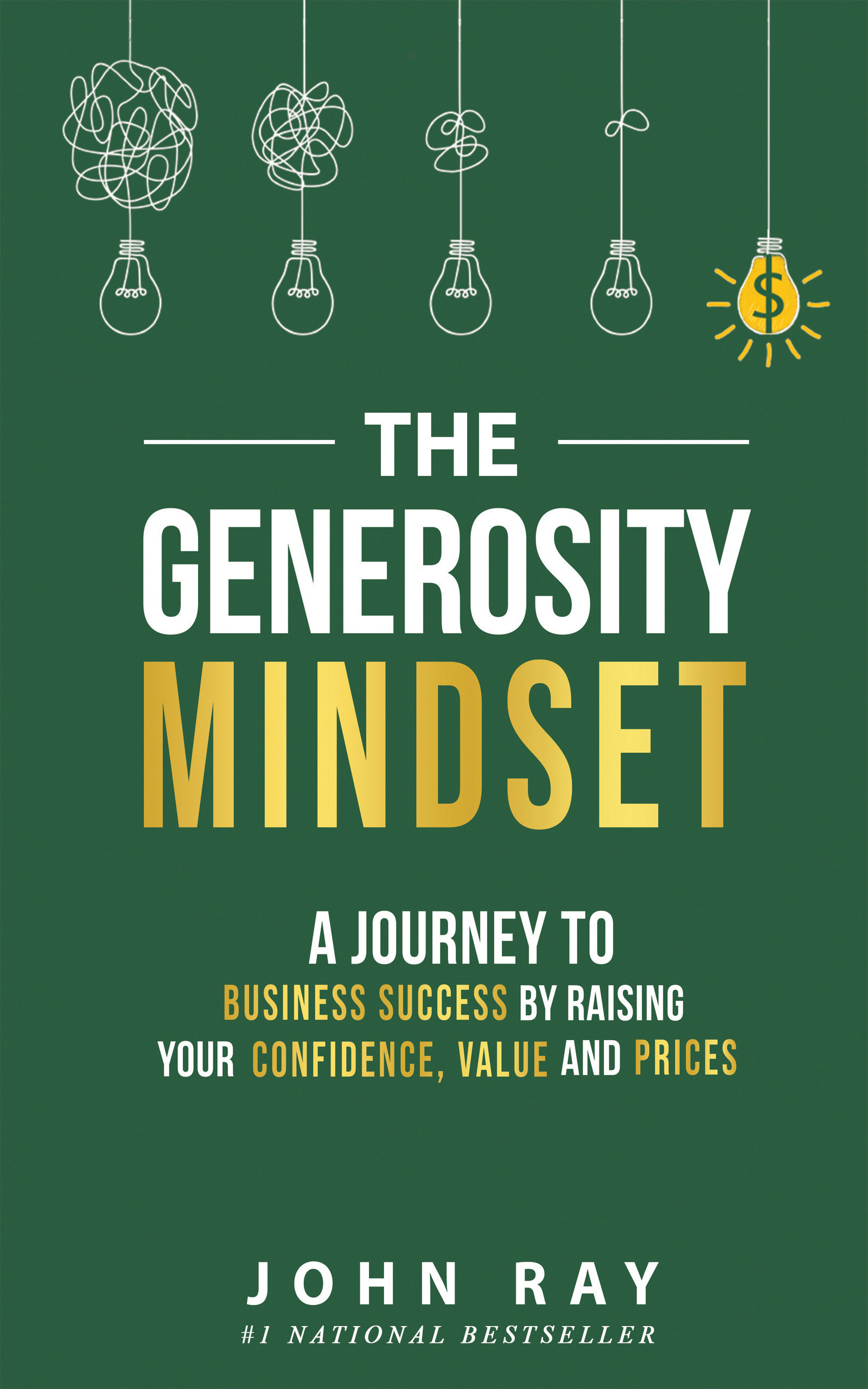
John’s book, The Generosity Mindset: A Journey to Business Success by Raising Your Confidence, Value, and Prices

John Ray at Barnes & Noble with his book, The Generosity MindsetJohn Ray is the author of the five-star rated book The Generosity Mindset: A Journey to Business Success by Raising Your Confidence, Value, and Prices, praised by readers for its practical insights on raising confidence, value, and prices.

If you are a professional services provider, your goal is to do transformative work for clients you love working with and get paid commensurate with the value you deliver to them. While negative mindsets can inhibit your growth, adopting a different mindset, The Generosity Mindset®, can replace those self-limiting beliefs. The Generosity Mindset enables you to diagnose and communicate the value you deliver to clients and, in turn, more effectively price to receive a portion of that value.

Whether you’re a consultant, coach, marketing or branding professional, business advisor, attorney, CPA, or work in virtually any other professional services discipline, your content and technical expertise are not proprietary. What’s unique, though, is your experience and how you synthesize and deliver your knowledge. What’s special is your demeanor or the way you deal with your best-fit clients. What’s invaluable is how you deliver outstanding value by guiding people through massive changes in their personal lives and in their businesses that bring them to a place they never thought possible.

Your combination of these elements is unique in your industry. There lies your value, but it’s not the value you see. It’s the value your best-fit customers see in you.

If pricing your value feels uncomfortable or unfamiliar to you, this book will teach you why putting a price on the value your clients perceive and identify serves both them and you, and you’ll learn the factors involved in getting your price right.

The book is available at all major physical and online book retailers worldwide. Follow this link for further details.

Connect with John Ray:

Website | LinkedIn | Twitter

Business RadioX®:  LinkedIn | Twitter | Facebook | Instagram

Tagged With: AI, AI and pricing, AI and workflows, AI in professional services, attorneys, client value, coaches, consultants, cpa's, diagnosing value, expert service pros, fractional executives, Impact Pricing, John Ray, Mark Stiving, pricing frameworks, pricing mistakes, pricing models, pricing strategy, productivity, productivity tools, professional service providers, The Generosity Mindset, The Price and Value Journey, value based pricing

FrontHouz: Solving Hospitality’s Staffing Shortage with Tech & the Gig Economy

September 2, 2025 by Jacob Lapera

Atlanta Business Radio
FrontHouz: Solving Hospitality’s Staffing Shortage with Tech & the Gig Economy
Loading
00:00 /
RSS Feed
Share
Link
Embed

Download file

In this episode of Atlanta Business Radio, host Lee Kantor sits down with Starr Douglas, Founder & CEO of an AI-powered staffing platform transforming the hospitality industry. Starr shares why the hourly labor market is broken, why hospitality was the right place to start, and how flexibility—not just pay—is key to solving staffing shortages. She also opens up about bold risks, customer insights, and what she’s optimizing for as a founder.

Starr Douglas is the founder and CEO of FrontHouz, an AI-powered on-demand staffing platform that connects hospitality venues with vetted front-of-house professionals, like bartenders and servers.

A Georgia Tech graduate based in Atlanta, she is passionate about using technology to innovate the future of work in hospitality.

FrontHouz addresses the hospitality industry’s persistent staffing shortages by tapping into the gig economy, helping restaurants, stadiums, and event venues find qualified staff quickly.

Connect with Starr on LinkedIn.

What You’ll Learn In This Episode

  • The hourly labor market is broken — and flexibility is the missing piece
  • Hospitality was the right first move, and it’s proving to work
  • Customers can’t live without quick, reliable staffing
  • Staffing shortages aren’t just about pay — flexibility matters too

Transcript-iconThis transcript is machine transcribed by Sonix.


TRANSCRIPT

Intro: Broadcasting live from the Business RadioX studio in Atlanta, Georgia. It’s time for Atlanta Business Radio, brought to you by Kennesaw State University’s Executive MBA program, the accelerated degree program for working professionals looking to advance their career and enhance their leadership skills. And now, here’s your host.

Lee Kantor: Lee Kantor here, another episode of Atlanta Business Radio. And this is going to be a good one. But before we get started, it’s important to recognize our sponsor, CSU’s executive MBA program. Without them, we couldn’t be sharing these important stories. Today on the show, we have Starr Douglas, who is the Founder and CEO of Fronthouz. Welcome.

Starr Douglas: Thanks, Lee. Happy to be here.

Lee Kantor: Well, I’m excited to learn what you’re up to. Tell us about front House? How are you serving folks?

Starr Douglas: Yeah. So Fronthouz is the future of hospitality staffing. Our platform sources vets and uses AI to train hospitality professionals so that restaurants, restaurant managers can push a button and receive a fully trained, fully vetted staff member on demand.

Lee Kantor: And then what types of skills do you specialize in?

Starr Douglas: So we’re in the front of house in restaurants and event venues. So when I say the front of house, think guest facing roles like bartenders, servers, hosts, skilled positions of that nature.

Lee Kantor: So since they’re customer facing, how do you help train them so that they understand kind of the nuances of each of the specific places they’re going to go to work at?

Starr Douglas: Yeah. So every single restaurant or venue that we onboard our step one is to take a professional 360 degree virtual tour of their space, and we build this tour. Think of like one of those virtual tours you see when you’re Your online touring, some sort of real estate property, but we put that together. We label all those table numbers, and then we bring this to the top of the basically to do list for workers to study before they get there, so they can walk around, view all the table numbers, learn the access points. You know, this is table one. That’s table 19. This is the cabinet where the coghlan’s glasses live. So that’s step one. And then we collect training documents, think menus cocktail build sheets like ingredient lists, steps of service, any other information that’s used to train in-house staff that goes into our portal. And we use AI to analyze these documents and generate quizzes, assessments, any sort of knowledge check to make sure that the staff they’re studying and they’re comprehending this material.

Lee Kantor: So then the staff enters there for the first time. They kind of have the lay of the land a little bit.

Starr Douglas: Yeah, yeah. For the most part, it’s not a completely perfect process, but what we see happen most of the time is these workers will show up day one. They’ll have a very general understanding of the table numbers and the layout and the menu, how to upsell, how to make the drinks. But then through repetition and continuously picking up shifts at the same location, they’re able to really become just like an extension of the staff.

Lee Kantor: So it’s not or is it meant for the person who, okay, I got I need, you know, I’m triaging this bad situation and I got to put two bodies here for just a shift and that’s it. Is it for that or is it for somebody that. Okay, maybe I can get somebody in here and then they can eventually be more of a solution that will last a while, not just for this one problem I’m having today.

Starr Douglas: Yeah. So there are many different business cases on the the venue side. And we refer to all of our businesses as venues. So venues can have many different reasons to, to using us. Maybe it’s somebody calls out, maybe somebody no shows. Maybe they just they can’t find anybody who’s qualified to work at their specific location. Um, so in the amount that they use us, it could be every day. It could be a few times a week, a few times a month. It really depends on the business. But we’ve built this platform for the workforce because the hourly labor market is very different. It’s a very different landscape now post Covid, especially in hospitality. All these restaurant workers in 2020, they lost their jobs. And you know, they they now have a lack of job security, uh, knowing what could happen at any point in time. So Covid happened, they lost their jobs. And all of a sudden, where are they going to turn to because they still need to pay their bills. So we found that the vast majority of these, the workforce they entered, the freelance economy, the gig economy, and they started driving for DoorDash and delivering for Instacart companies like that. And the workers really enjoyed the freedom and the flexibility that those platforms offered. But at the same time, they knew that restaurants paid 2 to 3 times more on average. So we really took all the benefits of the freelance economy, applied it back to restaurants, and gave workers that freedom, the flexibility that they desire. And we pay them within, on average, 10s of clocking out. So we’ve built a solution for the workforce first, knowing that if we can optimize for them and build a solution that attracts the best workers, the best venues have no choice but to follow.

Lee Kantor: So. But it is a two sided marketplace.

Starr Douglas: Yes.

Lee Kantor: And then you just started first by optimizing for the worker.

Starr Douglas: Yes. We believe that by obsessing over the workers experience, we can create a very sustainable, long term solution that just delivers what the workforce wants. And then in turn, once. Once you’ve made the workforce happy, it becomes much easier to serve the business as well.

Lee Kantor: So now is your relationship with the worker just primarily they’re an app user, or are you kind of a temp agency? Um, that are helping them get gigs?

Starr Douglas: So we we actually have banned the word temp from our vocabulary at our platform. We are very far removed from the concept of temp labor, especially because of all the vetting that goes into, um, being an approved user on the platform. Um, I would say that the experience for the workers more on the the former, uh, of the two that you mentioned. So they’re a user of the app. There’s somebody who regularly logs in, sees what shifts, what gigs are available, and then they have 100% freedom and control to select any shift that they want to work.

Lee Kantor: But what if the person wants to hire them? The venue? And what if they want to hire them? Is that cool?

Starr Douglas: Yeah, we don’t charge any fees for that. The business is more than welcome, but we’ve what we’ve found by surveying our workers is that 92% of them say no amount of money, no full time job offer, whatever convinced them to return to full time W2 work because it’s just not how they want to work or live their lives anymore.

Lee Kantor: Now, what percent of the workforce wants that level of freedom compared to the percent that wants kind of more security in a full time or quote unquote, security in a full time job?

Starr Douglas: So looking at the general hourly workforce, it’s estimated that by 2027, 50% of the US workforce will in at least some capacity, be freelance. 91% of freelancers across the board say that no amount of money would convince them to return to a full time job. So it’s not just hospitality, Even though this is really a perfect use case for it. So our workers, we’ve surveyed them in 92% say they don’t want a full time W2 job anymore.

Lee Kantor: And the driver behind that is the freedom element.

Starr Douglas: The freedom, the fact that they don’t have any overbearing manager. Nobody’s setting their schedule. They get to to choose when they work, what shifts they want, and they are fully their own boss and they get to clock out, um, and get paid within seconds in full.

Lee Kantor: Now, um, so tell us about kind of the early days, the genesis of the idea. Like, how did this come to you?

Starr Douglas: Well, I lived the the problem from both sides. I was a bartender, but I eventually was also a bar manager and beverage director. And I experienced the pain as the worker, you know, wanting to have more flexibility, wanting the particular schedule that I wanted. And I, I was always very independent. I wanted to do my own thing and not be micromanaged. And I also loved the concept of going and bartending at a dozens of different places across the city. And that’s what I had done in college. So that was very appealing to me and my other coworkers around me at the time. But then when I was a manager and director. Wow. It was such a crazy period, especially during and post Covid. I couldn’t keep staff behind my bar to save my life. I kept losing them to DoorDash and Uber and I figured, well, why couldn’t I do something about this? You know, every day I was told by the the owners or the operators that this is just the way it’s always been. Turnover is just something that you have to live with and figure out a way around and just suffer those costs. And I figured with all the new technology out these days, why not make something that could change that? So I was actually finishing up my last year at Georgia Tech at the time, and I was sitting in class and I was in between, uh, going to two different jobs.

Starr Douglas: I had just come from my day job. I was about to leave for my night job. I was pretty busy at the time, and I was just sitting there dreading what I was about to walk into because I was supposed to be managing the bar, but I knew that I was going to have to bartend because I wouldn’t have staff. And there was a guy sitting in front of me, and he had his laptop open and I could see what he was doing. I was actually pretty tuned in to what he was typing, and he was searching on Google how to find and book a bartender for some sort of party. And I was just thinking in my head like, man, if only it was that simple. And then I thought, well, why couldn’t it be? Why couldn’t I create a platform as intuitive and as easy to use as a DoorDash or an Uber and instead bring all those benefits to restaurant workers? So that was the genesis.

Lee Kantor: So then did you were you went to Georgia Tech? Did you know how to code and build the platform?

Starr Douglas: Uh, yes. I studied computer science and Business Administration at Georgia Tech, but the platform was built by my CTO.

Lee Kantor: So you found a kind of a partner early on?

Starr Douglas: Yeah. A wonderful technical partner. I’ve always been more focused on the business side, you know, being there in the weeds.

Lee Kantor: The front of the house.

Starr Douglas: Yeah, exactly. I love being in there and and making sure that the customer experience, when I say customer, I mean the venues and the workers making sure that it is smooth, it’s flawless. And, you know, there’s so many things that you have to account for when you’re dealing with humans and automating, uh, human scenarios and things that can happen in life. So being out there in the field and just spending time with our different stakeholders and optimizing our operations, that’s really been, uh, one of my areas strategy, growth, business development and product strategy, helping guide, you know, take that feedback and then guide where we’re going to go on our technological roadmap.

Lee Kantor: So, uh, I would imagine you build some, um, minimum viable product first and then, uh, kind of tested it with a venue.

Starr Douglas: Yes. And in the very early days, it was me I was going around and I was seeing what it took for me to learn those training documents up front. And then I’d go and I’d work the shift. I’d go bartend, I’d go serve, I’d host. And it was a ton of learning and a ton of great relationships built along the way.

Lee Kantor: So did you, um, what was it like when you, you know, left it out into the wild? Um, like, did you I’m sure you had some venues that agreed to pilot, and then you were looking for people to be kind of the guinea pigs to go through the training and start working.

Starr Douglas: Yeah, yeah. And we always thought that it would be more difficult to bring on the worker side, but it ended up being the easiest part because the workforce is so ready for this. So what we did was we put out some some ads and we were able to bring workers into our application funnel. And from there, you know, they’re they’re jumping through a lot of hoops to be a part of the platform. Work experience verification, professional reference checks, identity verification, skills based tests, personality assessments, virtual interviews, the whole nine yards. So we can really get a good sense of who they are, their experience, their personality, which are both so equally important in the front of house. So we get these workers onto the platform and then just let them loose and see what breaks, see what we need to do to fix it. And what was really interesting was that we didn’t spend a ton of time nor money on marketing or these ads, but we ended up pretty soon, or pretty early on, having a wait list of over 20,000 workers who wanted to work through us.

Lee Kantor: Now are they? Does each one of them have to go through all of those checks and take all those assessments? Because that cost has to be, um, kind of substantial? I would imagine.

Starr Douglas: Every single one of them has to take the same testing, all the application requirements. Um, we’re we pride ourselves on adding more friction intentionally to our registration because we, we really want the best, the best workers who are willing to stick it out, knowing that there are rewards if they do and they do a great job. Um, as far as cost, all of that is actually automated. Thanks to our incredible CTO. We have a very robust technology stack, and our software automates the entire registration process from start to finish.

Lee Kantor: So there’s no fee for the worker.

Starr Douglas: For the worker, no, there is no fee to them.

Lee Kantor: So when 20,000 people on board, all of those costs are just absorbed by the platform.

Starr Douglas: So the only cost that we incur at this moment is for identity verification. It’s about a dollar and that’s per person. But the workers don’t pay any pay anything to apply. And the only fees come out of subscription fees for the venue side. And then actual shifts worked. But again, that’s all being charged to the to the venue. Workers keep 100% of what they earn, and there’s no fee for them to join front House or apply.

Lee Kantor: Right. So the venue is the one that’s paying the bill, as they should for the worker they need.

Starr Douglas: Yes, correct.

Lee Kantor: And then, um, so you didn’t have a problem getting workers. The so was it more talk about kind of educating the um, the venues in order to try this? The, the need sounds kind of desperate. So I don’t know how much education it would take. I just I guess they would have to believe you know, your promise. But, um, was once you started getting some success there, then I would imagine it probably quickly. Word of mouth spread.

Starr Douglas: Yeah. Word of mouth has been a huge driver for us in referrals. The venue side to get them to trust us. We it was an interesting scenario. We had to do a lot manually at first to have confidence in our numbers. So what I mean by that we have a we’ve averaged a 99% shift fulfillment rate. We filled 99% shifts successfully to date. And across all those shifts, our average star rating for our workforce is 4.95 out of five. So we needed to build that up and, you know, reach, scale and optimize our operations. And we made some really great early partners who were trusting of us. But now it’s at a point where our numbers are very strong and we know them very well. We track our data in the most intense way you can possibly imagine. And, um, just leveraging those numbers and our past success, it’s pretty easy to at least get a company to to try us out, to see it for themselves. And once they do, you know, it’s it’s pretty much a no brainer. It works. It works really well.

Lee Kantor: Now, now those numbers sound like they’d be better than what they were getting with kind of their traditional hiring.

Starr Douglas: Yeah, the traditional hiring process, especially for hospitality, which is really the only industry that I can speak to, um, specifically to this, but the average cost to, uh, well, to turn over an employee is roughly about $6,000 in hospitality and especially the post Covid world. So many restaurant owners and managers, they’re getting stood up on interviews. And I was reading something the other day. There were 25 interviews scheduled. Only two of them showed up and only one of them was even a possible candidate to be hired. So it’s it’s weeks, if not months of spinning wheels and spending money and, uh, you know, churning out dollars through, indeed, ads and just kind of seeing what you get. And at that point, when you finally find somebody who’s decent enough to to take the job, then they’re turning around and quitting in in days, if not weeks.

Lee Kantor: So, Ken, venues just kind of, um, outsource all their employees to you. Has that happened?

Starr Douglas: It’s possible. Uh, Atlanta Falcons and Atlanta United, they’re one of the examples of companies that do that. They’re more events driven. They do have full service dining facilities on site at their training camps. Um, so we do 100% of their staffing in the front of house at the Atlanta Falcons training camp in Flowery Branch, for instance.

Lee Kantor: But could a restaurant or a bar do that?

Starr Douglas: They don’t have a bar, they don’t really encourage the football, right?

Lee Kantor: I know they don’t, but could just a random, you know, in the city, just some restaurant or bar, could they just say, you know what, let’s let front of the house be our kind of. They’re the ones hiring now.

Starr Douglas: Absolutely.

Lee Kantor: But that hasn’t happened yet.

Starr Douglas: It has, it has, but I will. I’ll keep those stories for another time. We we could really get into the weeds on that one.

Lee Kantor: Um, because of it’s such a problem. And you have a solution. Like, why wouldn’t people just want to solve the problem?

Starr Douglas: Yeah, I get it. Well, something that we that is a really great scenario. We run into a lot of our, our companies we work with have good culture. You know, we have the best workers. So we really try to partner with the best venues, the ones that, um, are very inclusive and welcoming. And, you know, most of the time when you factor in that great culture and high volume means you’re making really great money in the front of house. And the the great problem we run into when it comes to why wouldn’t they just use us for 100% of their staff? Is a lot of these companies will have at least a small base team of core people who sometimes have been there for years, and that is, well, number one, it’s great for them, but it’s helpful for our staff as well because they have a big support network around them. So even if somebody’s coming in for their first shift, they haven’t been there before. And you know, they’ve studied online, they can still go up to somebody who’s been there for years and just, you know, tag team with them, stand side by side with them and, you know, learn the ropes together.

Lee Kantor: Right. So that’s kind of optimal on both sides. So you have somebody who’s there been there done that has some history. Um, so the new people can go to them to understand maybe some of the subtleties.

Starr Douglas: Exactly.

Lee Kantor: Now is there is the growth map include kind of back of the house. Are you like going to start expanding into like chefs and sous chefs and, and folks behind, uh, you know, in the back.

Starr Douglas: Potentially once we’ve proven ourselves in the front of house, you know, we have a long way to go. It’s a massive market and a lot of growth in our future in front of us. So right now we’re staying very specialized, very focused on the front of house, because by staying this level of specialized, we’re able to maintain quality control, unparalleled quality control on both the venue and the worker side.

Lee Kantor: Now, is this bootstrapped or did you get funding?

Starr Douglas: We’ve raised, uh, one round that is closed and we’re closing our second funding round right now.

Lee Kantor: And your work is primarily in the metro Atlanta area?

Starr Douglas: Yes. Atlanta was our home market. It’s our first market ever. But we recently have done soft launches in Buffalo, New York and Orlando, Endo, and we have worked with events companies in major cities nationwide. So we’ve piloted this, especially on the worker side in over 16 markets east to west coast.

Lee Kantor: So when you got the 20,000 they were coming from, it wasn’t all Atlanta based or.

Starr Douglas: That was actually all Atlanta based.

Lee Kantor: There’s that many folks out there.

Starr Douglas: Yeah, plenty, plenty of people wanting to work this way. And the Atlanta hospitality ecosystem is absolutely massive. The population density of workers out here, it’s one of the the biggest metros in the country for hospitality workers.

Lee Kantor: So about how much is that universe.

Starr Douglas: In the.

Lee Kantor: Metro Atlanta of in. Yeah. The I’m just trying to get a handle on 20 is 20,000 out of a million. 20,000 out of what.

Starr Douglas: Oh in the seven figures, I believe. Last time I checked, in the past couple of months, Atlanta was the number six largest metro hub for Hospitality workers.

Lee Kantor: Wow. That’s amazing. So that I mean, that could be part time. That’s not like full. That’s not how they’re making necessarily their full livelihood. But they might be doing it like you were doing it like in the evenings or something like that.

Starr Douglas: Yeah, exactly. And I mean, when you think about it, hospitality is is 10% of our GDP. They’re the massive or the market for this is just absolutely massive. Um, where we can go across the country, there are virtually no limits, especially when you go back to what you asked a moment ago about expanding into the back of house or other sectors or verticals within hospitality, because we’re still very focused on our lane right now of the front of house. But, you know, there’s a very large door open for the other areas.

Lee Kantor: So what do you need more of? How can we help you? You need more venues. You need more workers. It doesn’t sound like you need more workers, but what do you need more of money?

Starr Douglas: Uh, so the number one thing that we are building out right now is, is the the venue side? You know, there are so many restaurants and event venues in Atlanta really well across the country that are struggling with staffing. And it’s because they’re looking for their workers in an outdated way. And the more that we can bring awareness to this new style of working, you know, the better these businesses will be, the more money they’ll save. I’ll give you an example. Uh, those companies who use us for 100% of their staffing, they’re saving 10% on their labor costs by doing so. And and their managers aren’t turning over as much because they’re not having to deal with that massive, major stressor of finding staff and filling last minute needs. And just it’s incredibly stressful. It’s, um, to date, it’s been the number one biggest pain point of managers finding staff and retaining them. So if we can take that off their plate, not only are we saving the money, but we’re saving them stress and all these other ancillary benefits that just make everybody’s lives easier. So all that to say, we’re hoping to help as many businesses in the Atlanta area and beyond.

Lee Kantor: And if somebody wants to learn more, what is the website? What’s the best way to connect?

Starr Douglas: Yeah, absolutely. So our website is WW House. House is spelled h o u z. So f r o n t h o u z.com. And you can also feel free to connect with me on LinkedIn as well. Star Douglas Starr is with two R’s. Or if you’d like to email us, you can also find us at info at House comm.

Lee Kantor: Well, star, thank you so much for sharing your story today. You’re doing such important work and we appreciate you.

Starr Douglas: Thank you so much, Lee. It was a pleasure.

Lee Kantor: All right. This is Lee Kantor. We’ll see you all next time on Atlanta Business Radio.

Building Trust in Restoration: How 1-800 Packout Supports Customers in Crisis

September 2, 2025 by angishields

FMR-Keith-McBride-Feature
Franchise Marketing Radio
Building Trust in Restoration: How 1-800 Packout Supports Customers in Crisis
Loading
00:00 /
RSS Feed
Share
Link
Embed

Download file

In this episode of Franchise Marketing Radio, Lee Kantor interviews Keith McBride, a former corporate executive turned franchisee with 1-800 Packouts. Keith shares his journey from business development to owning a restoration franchise in Philadelphia, detailing how his team helps customers recover from fire, flood, or storm damage. He discusses the challenges of starting a local business, the importance of empathy, building referral partnerships, and managing operational growth. Keith’s story highlights the value of community engagement, strong systems, and compassionate service in building a successful restoration business.

1-800-Packouts-logo

Keith-McBride1-800 Packouts is a content focused restoration company and national franchise. The NW Philadelphia location is the first in Pennsylvania and Keith McBride is excited to be supporting his home town where he was raised and has lived for the past 25 years.

This location supports all of Bucks and Montogomery counties along with Philadelphia and the entire metro area.

When disaster strikes in Bucks and Montgomery Counties, trust 1-800 Packouts to make your recovery process smoother and less stressful. We’re proud to be part of this community, offering expert services in packing, cleaning, and storing your cherished belongings after water, fire, or mold damage.

We handle everything with care, making sure your items are returned in top condition. Our team works closely with local insurance companies and contractors, so you can focus on rebuilding your life while we take care of the rest. With our personalized service and commitment to excellence, you can feel confident that your home and possessions are in the best hands.

Call 1-800 Packouts today and let us help restore what matters most to you, right here at home.

Follow 1-800 Packouts on LinkedIn and Facebook.

Transcript-iconThis transcript is machine transcribed by Sonix.


TRANSCRIPT

Intro: Coming to you live from the Business RadioX studio. It’s Franchise Marketing Radio.

Lee Kantor: Lee Kantor here. Another episode of Franchise Marketing Radio. And this is gonna be a good one. Today on the show we have Keith McBride, who is a franchisee with 1-800 Packouts. Welcome.

Keith McBride: Thank you.

Lee Kantor: Well, I’m excited to learn what you’re up to. Uh, for folks who aren’t familiar, can you talk a little bit about 1-800 Packouts? How you serving, folks?

Keith McBride: Sure. So 1-800 Packouts. We are in the restoration business. So if you have a fire or a flood in your house or a storm damage, what we do is, you know, you need to have, you know, the water taken out off the rug. You need to get the walls potentially cut and the furniture and the things in the house are typically in the way. So what our franchise does is we go and we take the stuff out of the house, we bring it back to our warehouse, we evaluate it, we clean it, we deodorize it, we store it. And then when construction is completed on the home or business, we bring everything back to the customer. Like, you know, like brand new. If there’s issues with any of the content, then we can work with the insurance company. We can create what they call non salvage lists and help the customer get what they should get based on their policies.

Lee Kantor: So what’s your backstory? How’d you get involved in this line of work?

Keith McBride: So I, I came from the corporate world. I worked for a cable manufacturer. So we were a supplier for cable companies and telcos, set top boxes, cable modems, fiber optics, things like that. I had been in the service organization for years, and the last about ten years. I was a senior director of business development and operations, and what that entailed was, was driving business. And in the last six years that I was there, we were able to drive business from 25 million to almost $200 million. This was a global organization, so we were servicing North America, South America, Europe, Africa, Asia and the Pacific Islands. And we grew that business. Really a lot of it was internal. A little bit was through acquisition, but most of it was through internal. So in that what I, what I learned, I learned how to basically drive and grow a business from that background.

Lee Kantor: So I’m assuming you left corporate and then you were kind of on your own.

Keith McBride: Yeah, I, I left I, I had been helping grow a global organization and helping folks across the globe. I really wanted to start focusing on a community where I grew up in Northeast Philadelphia. I went to school in Philadelphia. In fact, I think only two years of my life, I didn’t live in the Philadelphia region. I now live just outside of Philadelphia in Bucks County. I’d been there for 25 years, raised my family there, and I really wanted to start giving back to the community and helping the community and getting into this franchise allowed me to really help and support my neighbors, my kid’s friends, their neighbors, their parents, and and the other folks in the community that really helped me become who I am and allowed me to raise my kids here.

Lee Kantor: So let’s talk a little bit about the journey to this particular franchise. Were you looking at lots of options? Did you think, oh, I can be. Maybe I’ll just, you know, be a a consultant or I’ll, you know, keep doing what I’m doing in the industry but still be based here. Like, like what were you looking at as options prior to signing on with one 800 Paco?

Keith McBride: I took a little bit of a pause, so when I left that company, I’d been there almost 20 years. I left the company. I needed a break to kind of reevaluate what I wanted to do. So I took a summer off. I looked into, you know, potentially creating a it was a hobby that I have. I like to make beer. I actually started looking into potentially starting a brewery in the area. And I realized that the market really wasn’t wasn’t going to be in a good spot for me to do something like that. So then I started evaluating, well, do I want to get back to the corporate world? Um, do I want to stay in the industry, out of the industry? And I started working with a business coach, really kind of digging into, you know, I knew the cable world really well. But what did I really like about about what I did and what I like to, like growing and driving business. I like the challenge. You know, something was always coming up that was new. And that’s really the driver of what I liked. I looked at about ten franchises when I first started, and I very quickly got it down to three. So I really started looking at those three, you know, looking at the franchise agreements, talking with other franchisees in the area, visiting some folks, looking at, you know, different market conditions. What I would have to do in the local Philadelphia area to get, you know, did I need office space, did I need warehouse space, um, and things like that. And then I really narrowed it down to two. And then, uh, after about 2 or 3 more weeks of, you know, serious due diligence, I narrowed it down to to one 800 pack outs and move forward with them about two years ago.

Lee Kantor: Now, when you made that decision, um, what was kind of the the the thing that that kind of closed the deal for you? What was the the one 800 pack outs? Uh, you know, what kind of was the thing that said, okay, this is the one for me. Like just everything aligned or 80% aligned. Like, you know, these are big decisions. Obviously, your life would have been in a different direction if you chose the other one. Um, so what kind of made the difference?

Speaker4: Uh, yeah. So what I did was I, you know, there were there.

Keith McBride: Were certain check marks I was trying to hit. One was, you know, local. I’d been on, you know, on the global side for so long, uh, taking long flights, you know, sitting in board meetings, kind of growing, uh, large companies and providing support to them. I knew I wanted to support my community, so that was one of the things that was really important. And that’s one thing that I really like, about 100 pack outs is it allows me to help literally my neighbors, uh, when they’re when they’re in a time of need. Um, I also was really impressed with one 800 pack outs, the systems that they had in place, kind of a marriage of of systems and structure and then opportunity. Um, and what I mean by that is they have the tools, they have everything that you need to be successful, uh, from project tracking tools to financial tools and quoting, um, inventory tracking, you know, the things that you need to do your business. Uh, but there’s also a lot of opportunity in that. I could talk to the other owners. I visited a few of the other owners. Um, you know, there wasn’t anything that was hidden there. It was all all wide open. And I still continue to to use that owner infrastructure. Um, you know, a lot of owners have been in it a lot longer than me, so I’m able to kind of pick their brains and and find out some of those details. So I really like the culture, um, and the tool set and, you know, coming from the corporate side of things, you know, I was used to, you know, fairly structured, um, and, you know, they have those tools that that help you drive what you need. But there’s also like just a ton of opportunity out there. And I think the Philadelphia market, um, it’s not oversaturated with pack out companies or content companies. Um, so I thought it was a very good opportunity to be able to drive that, you know, right here in my hometown.

Lee Kantor: Now, you mentioned the importance of local. One of the, um, usually one of the drivers of business in local is you have to kind of go out and, uh, you know, be like a politician and shake some hands, right? You got to meet some people and build kind of that, uh, pipeline for business where they think of you. Um, was that something that you looked forward to doing, or is it do they have systems at one 800 pack outs? That makes that easy?

Keith McBride: I, um, so my prior job, part of what I did in the prior job was business development. So I was accustomed to having the introduction. So I, you know, we had a sales team and they would pull me in and I, you know, I would get introduced to the customer. I would go through the services of the things that we did. A lot of times it was after getting off a plane and staying in a hotel. Um, it’s actually exciting to do it in this local area. Um, I joined a whole ton of networking groups. I’ve, I’ve met a ton of people that way. And sometimes, you know, you find referral sources in the strangest of, of locations, things you would never think or people that you would never think could drive business toward you. Uh, you drive business toward you. Uh, one 800 pack outs provides a a lot of marketing support. Uh, they provide different campaigns. They provide content that I can provide when I go to these networking meetings. You know, I can shake hands. I obviously have the logo, um, and everything, and it’s hard to see, you know, the one 800 pack out logos. So all of that was there and in place for me. All of that marketing materials there in place. The expertise about, you know, in the past we had marketing departments that would do it in the corporate world. Now I had to do all that on my own. So, you know, the marketing team, you know, you do email campaigns, do you do mailing campaigns? Do you just, you know, shake hands and kiss babies? Um, and I think the answer to all that is all, you know, all of the above. And I do like doing a lot of that. I, you know, the networking meetings, the lunches, uh, and growing the local network, um, was definitely supported by 100 scouts. And it’s something that that I drive and I love doing.

Lee Kantor: Now, in your work, um, I’m sure people are contacting you when they’re in crisis because something bad has happened that they need you. Right? Um, are there referral sources, like, are you working with insurance companies? Do you have like, partnerships with, um, you know, kind of the first line people so that they, you know, where they don’t do the part you do, but you don’t do the part they do. So are there kind of referral partners for you in this model.

Keith McBride: And that’s a big part of. Building that trust. Um, so you think about I’ll stick with waters a little bit easier. I’ll stick with water. So buy a pipe bursts in your house. You’re not calling the content guy saying, hey, my couch might get wet. You’re calling the plumber. Plumber goes, stops the water. Plumber looks around and says, wow, there’s a lot of water in this living room. You need to have this taken care of. I have a, you know, water mitigation company. Now, the water mitigation company walks in and looks at it and says, wow, there’s a lot of stuff here. We need to get Keith. We need to get one 800 scouts out there. So yeah, you have to build the relationships with the water mitigation, um, also with the plumbers. And then, you know, it’s funny, the first job, it’s the first time you’re going to be talking to, uh, an insurance adjuster and an insurance agent. So I think it’s really important to have relationships with the insurance companies as well. I want to be known as a trusted source, someone that’s fair. Um, so building the insurance relationship, while they don’t always directly send you business, it’s good to get a reputation. Reputation from the insurance that, you know, I’m a good, reliable source. They can trust my pricing. Um, and that’s something that I have been growing, so. Yeah. Insurance adjusters, insurance agents, um, water mitigation, you know, fire, uh, you know, storm, um, people who support storm rebuilds, you know, all of that. You were driving. And as you grow like I’m less than two months in or two years in. So as I grow, I’m continuing to find new sources. And, yeah, you drive a lot of that, um, myself as the owner. And then, um, I have a business development person. He helps drive a lot of that activity as well.

Lee Kantor: But is that something that when you get the franchise, that one 800 Packhouse has relationships with certain insurance companies, so they kind of open the door for you? Or is this something that in every local market you got to kind of make your own friends?

Keith McBride: It’s a mix. So the Weidner Pack Outs has what they call third party administrators. So they have a lot of insurance companies will work through a third party to kind of mitigate all of the different vendors that they’re going to need to support different disasters that that they may get from a claim standpoint. So, one 800 Packhouse has a relationship with a lot of the third party administrators. They help us navigate. There’s a lot of paperwork. There’s a lot of things that you have to have in place insurance, certifications, things like that. They help us navigate all of that. Um, and then there’s different insurance companies that support different parts of the country. Um, so some of it is local. And then you have like State Farm and Allstate, some others are national so that there’s some relationship there. And then the local folks, that’s something that I would have to drive and I, I, I put together and put on the hat and run around and shake hands.

Lee Kantor: But they give you kind of what you need in order to give whatever that partner is, what they need. So they make it easy for you to to make friends.

Keith McBride: Yeah. And there’s also a lot of training. Like I didn’t have I didn’t work in, in this industry, you know, prior to two years ago, um, I didn’t know the insurance industry. I didn’t didn’t understand the restoration. So there was a lot of training that came involved to to get you up to speed. Like, I have the business side of it. I know how to run a business. I didn’t know a whole lot about restoration, and I didn’t know a whole lot about pack outs and insurance. So, um, they really helped kind of bridge that gap to get me to the point where I could become an expert in those areas and have the intelligent conversation with the water mitigation company and with the insurance, and know all the steps and what you need to do, what you can and what you can’t do in that space.

Lee Kantor: Right? Because you’re you’re your client is so vulnerable. I mean, they’re really looking at you to problem solve here in an area that they have no clue.

Keith McBride: Yeah. Empathy is really important. Uh, when working with the customer, um, they’re typically when I, when I see them the first time, they’re typically stressed out. They had, you know, their, their hot water heater burst or they had a, you know, a pipe up upstairs burst First in their whole entire, you know, first floor and basement or, uh, you know, dripping. Um, so they’re they’re fairly stressed out. Um, and that’s an understatement. So, you know, part of what I have to do is and they’re working with the plumber and they’re working with rebuild and insurance. And like, all these people are all kind of in the house. Um, so I think the important job for me at that point is to let the customer know that, you know, we have them taken care of. Uh, we verify the coverage, make sure everything is good, kind of keep them calm. I always let them know that you know the content. We’re going to make the content portion of this claim as easy as as possible. Um, you know, I work with the insurance. I do everything through that. A lot of times the customer doesn’t even need to see the bill. Um, if they don’t want to see it, I, you know, I deal with it directly. So, yeah, having that empathy for the customer, knowing where they’re coming from, uh, staying in touch with them after, like, you know, we’re taking their stuff and you think the rest of the house, they’re ripping up the rug, they’re ripping out the walls, and then they’re going to rebuild them.

Keith McBride: But their stuff, they wanted to come back the way it was before this, before this event happened. Um, so that’s that’s super, you know, and I’m not just throwing it out and then giving them new things. So, you know, that that’s really important. I have to build trust and rapport with the customer within, you know, 5 minutes or 10 minutes of meeting them, um, or I’m not going to get hired to do that. And, uh, when I did support quite a bit of training around that, how to do that, understanding the fact that, that, you know, everybody’s going to be stressed out, everybody’s home, um, is going to be different. Every little thing that they have is a treasure for them. Um, and it’s really important to understand, uh, that that part of the, um, that part of the process. And then the best thing and one of the things I love about the job is typically when we’re bringing those stuff back, they’re happy their house is back to normal, their stuff is coming back. Uh, they’re usually very, very happy when they get all their stuff back. So it’s it’s a very fulfilling portion of the job.

Lee Kantor: Yeah. Can you talk about maybe that first time that you went in there, got the stuff and then returned it? What was that like?

Keith McBride: Well, scary. I mean, when you when you first jump into something like this, you really don’t feel like you know what you’re doing. Um, because you don’t really know what you’re doing. So you’re driving to the estimate, and, you know, I’m calling, you know, my franchise coach and saying, I don’t know what I’m doing. Help me out here. Um, and they said, all right, you’ve had the training, you know, calm down a little bit. And they were right. You know, I was trained and I was ready. It’s just the first, you know, the first out. Um, but, yeah, meeting the customer. I think that the empathy, um, I was excited because it was very different from what I had done in the past. I was meeting, you know, a customer that had a multi-million dollar company, um, or, you know, they were part of a multi-million dollar company. And we were trying to to provide them services to, to do a new fiber build or something like that, where now we’re working with a customer who’s stressed out. They have, you know, wet basement and we’re trying to get all their stuff for them.

Keith McBride: So, you know, that I think the empathy part of it was fairly easy to bring on, um, because you’re there and you can see it and you can like, you know, depending on the water loss, you can smell it. You can see the issues and and letting them know that that you can you can help them is really good and it’s very fulfilling. Um, and then yeah, bringing it back is like I said, it’s the best part because they’re getting their stuff back. They’re super happy. They’re, you know, they’ve gone through this trial of, you know, a couple of weeks to a couple of months of their house being in turmoil and their stuff not being there. And now they’re getting it all back and they just feel really good. And that yeah, that first one felt like that. And and they all really feel like that. Most of them do feel really good as you’re bringing them back. Um, as we, you know, we do more and more and more of these.

Lee Kantor: Now, is your business primarily residential?

Keith McBride: A big part of it is residential right now. Um, I’m looking to expand into other areas. Property management. Um, where where, um, people own, you know, apartment complexes and things like that. We’re starting to get some work in there. Um, on the commercial side, there’s there’s definitely opportunity in the commercial space. It’s just very different on the commercial side. A lot of times, um, large offices have space to move a lot of that stuff, and we can help and we can support in that. Um, but it’s something that I haven’t started to branch into just yet.

Lee Kantor: Now, when you get the franchise, is it something that you have to have kind of warehouse space to, to put all this stuff and to, uh, you know, fix it up like there’s a, there’s some overhead component to this business.

Keith McBride: Yeah, there’s definitely a lot of overhead. Um, yeah, I had to get I have almost, uh, almost 10,000ft² of warehouse space. The good thing is I have good clear height. Um, so we we store everything in seven foot 7.5ft tall, uh, wooden vaults. And, you know, I want to be able to stack them. So luckily, I have I have room to stack two high. Um, so I got about slightly more than about 18 foot of clearance. I needed 15, so that helps a lot. Um, and then growth is, you know, it’s a challenge once you run out of the space, either you have too much space, you don’t have enough space. So, you know, as you start getting close, you have to start brainstorming on, you know, you have a lease for a certain amount of time. What do you do with the space? Do you partner with some other groups? Um, and that’s part of the problem solving. It’s part of what I, what I love about what I’m doing is just trying to figure out, um, you know, the growth strategy. And I think that’s, you know, it’s a good problem to have. It’s better than the warehouse being completely empty, which it is not.

Lee Kantor: Now, how often does something happen where your services are needed? Like, is this kind of a seasonal thing?

Keith McBride: A little, tiny bit. Um, it’s I had always assumed before starting that it would be, uh, storm related that everything is related to storms. And there’s a little bit of truth to that. Like we, you know, in the Philadelphia region, um, in the spring, early summer, we tend to get really bad thunderstorms and wind. Um, you get some tree damage. So, you know, we get a little bit of a spike not right after the storm. Usually about 5 or 6 days after the storm. Uh, where we’re helping people, where trees may have, you know, fallen, fallen and ruined an attic or something like that. Um, I haven’t seen really a whole lot. You get a little bit of frozen pipes in the winter. Um, but a lot of it is just, you know, in Philly, you’ll have old homes, and, you know, the sewer pipes are old and they may start falling apart.

Lee Kantor: So it’s just like random pipe breaking.

Keith McBride: A lot of it is random, but it’s also like this time of year for whatever. I guess it’s it’s the very end of the summer and kids are going back to school. It tends to be slow, and I haven’t quite figured out why. There’s like a three week period right around the start of school where it’s slow. Um, and then it picks up again in September in like July was a crazy July for us. So, um, yeah, some of it’s weather related. Some of it’s just random. Um.

Lee Kantor: But you don’t get you don’t get the stuff like in the, in California where they know they’re going to have wildfires every year and that’s going to affect and have smoke damage and things like that.

Keith McBride: Yeah. Not in this area. I mean, you get you get Fires. But not like that. Not where it’s, you know, this mass event. Um, I know that, you know, the folks that were out there were very busy at the beginning of the year, um, where they were doing five and six jobs a day, which is insane. Um, but yeah, in this area, you know, you might get a hurricane. The last big hurricane, um, that we had here. I know directly affected us was hurricane Sandy. That was 12 or 13 years ago. Um, so, you know, we don’t get a ton of that, but, yeah, the windstorms we’re starting to get tornados, believe it or not. This is not an area that’s prone for tornadoes, but we do get them every once in a while here. But it’s more around just, you know, the house and things breaking or backups, you know, sewer clogs or things like that. Um, you know, like I said, it’s a mixture of homes that, you know, could be 2 or 300 years old. Some of the homes here, um, a lot of Philadelphia expanded over the last hundred, 150 years. So there’s a there’s a lot of homes with some old, old plumbing, um, and then even some new stuff. We, I tend to see, like old homes that have issues and then brand new homes. You know, the fitting was was bad and it broke after a year or two. So we get we get things like that too. Um, a little bit of weather related.

Lee Kantor: So what’s it been? You said it’s been about two years. Is it what you imagined? Like? How’s it going?

Keith McBride: It’s good. Well, so one of the things I did in the past, and, you know, pat myself on the back, I was pretty good at forecasting. Uh, at the corporate level. Um, I it’s really hard to forecast your first year, which was last year, but this year I forecasted and I’m, I’m doing well. I’m looking to hit I’m either going to hit or slightly exceed what I had forecasted for this year. So that’s really good. Um, my costs are a little bit lower. My cost of goods sold is a little bit lower. So like ultimately the bottom line is probably a little bit better. And it’s projected to do better than I had projected in in November or December when I put my forecast together. So I’m very happy about that. Um, my growth in the last 2 or 3 months has been really, really good. So, you know, really excited about that and driving that and pushing that. Uh, I’ve gotten to the point where I have a team like, you know, when you first start, you don’t have enough work to really have a dedicated team. So I was going out and doing a lot of this work. Now I have a team that does that, which allows me to really focus on on driving the business, putting the relationships in place, um, to be strategic with some of our partners, some of our referral sources. Um, starting to look at, at how do we become more efficient. And then also growth growth, growth, growth is is where we’re at right now.

Lee Kantor: So now are you seeing kind of the fruits of your labor when it comes to the referral sources that now they’re starting to come in with some rhythm.

Keith McBride: Yes. Yeah, it rhythm is probably not. It’s a weird because because it’s um.

Lee Kantor: It’s sporadic. I mean, it’s hard like it happens when it happens.

Keith McBride: Yes, it happens when it happens. I have a calendar behind me that, you know, all the jobs that we have on there are kind of I have them listed on there and you may have like 1 or 2 jobs for next week. But if the calendar is full and you get a call, then you can’t respond to it. So a lot of what we do, it’s almost like being in the fire department where you’re sitting waiting for the fire, and then once the bell rings, everybody runs out and takes care of it. Um, but yeah, what what happens is we had, you know, you start with one referral source and then you may have 2 or 3. Um, in the last 3 or 4 months, we’ve more than doubled the number that we’ve had. And then it’s more opportunities to get that call. And that’s what we’re that’s what we’re driving and we’re expanding those relationships as well. Some of them are franchised locations, some of them aren’t. Um, and you know, our space, if they don’t do content, it’s real easy to have the conversation. Now, they may have another solution for it, but if we can get in and show them that our process can really help them help their customer, and we’re going to make them look better, then that’s typically, you know, if I can get a little bit of money, if I can make you look better and I can help your customer, why not try us? And then they try us and they like what we’re doing. And then word starts getting out. So I think we’re at that point where the word’s getting out. Uh, we’re obviously we’re driving a lot of that activity. Um, and we’re seeing that momentum.

Lee Kantor: Yeah. And you’re doing a good enough job where they’re saying, hey, I trust this guy. Let me. He’s my guy now.

Keith McBride: Yeah, exactly.

Lee Kantor: Now, did you get one territory or how does it work? You, when you were decided to pull the trigger with one 800 packhouse, was there something where you were like, should I get one, two, three? Like, are you doing this as this is my thing? Or is are you trying to build A18 hundred Packout empire?

Keith McBride: Uh, I’d love to have A18 hundred pack of Empire. I’m very methodical. I’m a little bit, um. I’m a little bit. I’m conservative for sure. Um, and how I. And how I build out things. So I want to make sure that we have everything that we need, uh, that it’s the right model, that we’re not going crazy on cost. You know, I could have bought a 50,000 square foot warehouse, but I’d probably be out of money right now. So, you know, you start out small, you make sure that it’s working, you get your processes all refined and then you start to grow. And that’s that’s where I’m at now. I have everything, I have everything set the way it needs to be. We have a really good product. We have a really good process. Um, everybody’s trained the way they need. And then now, as I’m starting to add people, we have a training process on how we do it. Um, we’re starting to add, you know, more referral sources. So we’re starting to get more of that. I bought one territory. Um, and I think this area is really good for for what I’m doing. And I think I probably will expand as, as demand requires is what I’ll definitely do.

Lee Kantor: Right. So you’re you’re just looking for organic growth.

Keith McBride: Yes. Yeah. At this point, organic. Like I haven’t hit everything that I need in my territory. It’s a pretty big territory. It’s two two counties and part of Northeast Philadelphia is my official, um, territory. And, you know, we’ve done a decent job. We’re probably 50%, um, uh, penetration into the territory. So we still have room to continue into the territory. Um, but then once that happens and we’re successfully providing the support and, and the work in those areas, then we’ll start to expand. And it’s probably sometime next year, I would guess is when we’ll start doing that.

Lee Kantor: So it sounds like kind of the metric that matters for you is just keep expanding those referral sources, just get more and more and just serve the heck out of them. And it seems like you’re unstoppable.

Keith McBride: Yep. That’s the goal.

Lee Kantor: And then you feel well taken care of by the one 800 Packhouse folks.

Keith McBride: Yes. Yeah, they’re very supportive. Um, I’ve had a few folks come here. I’ve had, uh, our brand president was here just a couple of months ago. Um, and and it’s funny, he was one of the ones that said, hey, you really need a salesperson. He was looking at, uh, what I had on my calendar. He could see there’s kind of a cyclical where, you know, it was really busy, and then I wasn’t busy, and then I’m busy. And he’s like, the reason that’s happening is because when you’re busy, you’re in the business instead of working on the business. So getting a salesperson and it’s kind of a guy that wears a whole lot of hats. He does sales, he does operations, does a whole lot of things for me, but it allows us to one of us is always pushing and driving and, you know, bringing the in the coffee and the donuts and, and bring, you know, talking to folks about referrals and then, you know, driving those networking meetings, you know, if I can’t make it, he goes, if he can’t make it, I go. Um, and that’s really helping drive kind of the steady, uh, referral sources growing and and the business and and. Yeah, that that helps a lot.

Lee Kantor: So was it hard to identify that right person and get them on board?

Keith McBride: I got lucky, I knew them. I had been working with them through, um, another channel. And, you know, things just happen to work out. And he decided to come over and, you know, I asked him to come over and he decided to come over. And so it’s working out really well. Um, I had prior to that been looking around and it it is difficult to find the right person and the right role. Um, but I got really lucky and, you know, very happy that that he came over and started helping me there.

Lee Kantor: And if somebody wants to learn more and connect with you and, uh, you know, maybe they’re either a referral source or somebody who needs your services. What’s the website? What’s the best way to connect?

Keith McBride: Yeah. One 800 pack out website. Um, if you go to if you click on Pennsylvania in there, I’m the only phone number on there, which is great. So you can click on that and get a hold of me. Um, yeah. It’s probably the easiest way.

Lee Kantor: Good stuff. Well, Keith, congratulations on all the success you’re doing. Important work. We appreciate you.

Keith McBride: Thank you. Lee.

Lee Kantor: All right, this Lee Kantor. We’ll see you all next time on Franchise Marketing Radio.


Tagged With: 1-800 Packouts

Fintech South 2025: Natalie Hogg with Method Q

September 2, 2025 by angishields

ABR-Natalie-Hogg-Fintech-South-2025-Feature
Atlanta Business Radio
Fintech South 2025: Natalie Hogg with Method Q
Loading
00:00 /
RSS Feed
Share
Link
Embed

Download file

Fintech-South-2025-MethodQ-Banner

Fintech-South-TAG

Natalie-Hogg-Fintech-South-2025Innovation runs in Natalie Hogg’s family. Her grandfather is credited with inventing direct deposit, and she carries that same drive to transform established systems.

At Method Q, we have developed a proprietary framework that applies scientific principles to marketing strategy and execution. This methodology enables our clients to achieve predictable growth through evidence-based decision making rather than guesswork.

Natalie’s expertise spans demand generation, growth marketing, and fractional CMO services across multiple industries including fintech, SaaS, and technology. She regularly speaks at conferences and moderate panels, focusing on creating valuable conversations and elevating the insights of industry leaders.

Her passion lies in building platforms that showcase executive expertise and drives meaningful business discussions. When not working with clients, Natalie enjoys playing piano, guitar, and banjo.

Beyond Method Q, Natalie serves on the National Board for StandUp for Kids as Marketing Chair, where she contributes to strategic initiatives supporting youth experiencing homelessness.

Connect with Natalie on LinkedIn.

Transcript-iconThis transcript is machine transcribed by Sonix.


TRANSCRIPT

Intro: Broadcasting live from Fintech South 2025 at the Woodruff Arts Center in Atlanta, Georgia. It’s time for Atlanta Business Radio. Now. Here’s your host.

Lee Kantor: Lee Kantor here broadcasting live from Fintech South 2025. So excited to be talking to my next guest, Natalie Hogg with Method Q. Welcome.

Natalie Hogg: Hi. Thanks for having me.

Lee Kantor: Well, I’m excited to learn what you’re up to. Tell us about Method Q.

Natalie Hogg: So Method Q is a marketing agency here in Atlanta that specializes in fintech and cybersecurity. We apply the scientific method to marketing, and which is a fun little background that I have on putting the creativity and analytics together to make a very practical business case for your investments.

Lee Kantor: So what’s your backstory? How did you get involved in this line of work?

Natalie Hogg: Um, so my granddad actually is credited with inventing direct deposit. So I think I was a summit.

Lee Kantor: Born into.

Natalie Hogg: The into fintech. Yeah, whether I knew it or not at the time. Um, and, uh, my, my father owned a business growing up. So I think I just come from a group of entrepreneurs. So I always wanted to start my own business, um, and have the option to solve problems and travel the world. And that’s what I get to do today.

Lee Kantor: So tell us about kind of the scientific method when it comes to marketing, which has some people think is is part art and part science.

Natalie Hogg: It definitely is a combination of the both. So, you know, you’ve got seven steps in the scientific method. We start with a hypothesis. So, you know, in order to reach a hypothesis you need to know the business value. So what’s your revenue goal. What are you trying to achieve. Um, both from the founder or the CEO perspective and also the revenue perspective of the CFO. And it’s backwards math all the way. So then you understand where the specific parts of that roadmap and the buying journey that you can take a bet on, put the hypothesis together and, um, run it as a marketing campaign, knowing that those leading and lagging indicators are whether you you continue or pivot along the way. So very data driven.

Lee Kantor: So how does that kind of drill down to the tactics?

Natalie Hogg: Yeah. So the tactics would be I mean if you think about a leading indicator, it’d be, you know, something as simple as website impressions or clicks on your LinkedIn posts and all of those things drive to buying behavior these days. What’s really driving by driving buying behavior is AI use. So if you think about, you know, the ChatGPT conversation someone’s having before they even land on your website. Um, so all of these things are driven by content and, and really interesting problem focused content. Um, there’s a lot of noise out there with AI. At the same time, people are using AI to do all their research. So you have to find the balance between what’s really, really valuable, what’s driving decisions, and how are you being relevant to someone at the time when they actually need to make a change out of the status quo?

Lee Kantor: And who is the ideal client for method two?

Natalie Hogg: Uh, we work with companies between, uh, pre revenue all the way to $50 million in revenue. The sweet spot is really 10 to 50 million. Usually companies that either have not yet built their marketing engine and need support building it. We can also help place talent as they need and grow and expand beyond outsourcing. But then also we are a great augmented team to help. And I love mentoring, so I love to see marketing teams and marketing team members get promotions after working with us by setting them up for success with the right infrastructure to scale.

Lee Kantor: So when you’re, um, like, what’s a challenge that one of your companies has?

Natalie Hogg: Uh, typically they’ve invested in marketing with the different tactics. They’re being told what they should be doing. They’re frustrated because it’s not working and they don’t even know how to measure it. So we come in with that hypothesis really clearly articulating very logical steps. Usually engineers like us because we have that engineer mindset when it comes to marketing. Um, but we still have that creativity to push through that is, is a little less tangible. Um, and so we usually solve that frustration in the beginning with a clear path and then clear, clearly articulating the leading and lagging indicators on whether we continue to do something, what we’re testing, why it’s working, why it’s not working, what we’re going to do about it.

Lee Kantor: So there is there consumer like, would one of your clients be a bank and their their target is more consumers or I need more business clients. Like like what is it like you know, you know where the rubber hits the road.

Natalie Hogg: Great question. So we have several clients here at fintechs. Al tag is actually one of them. Um, so we’re grateful to to be part of their marketing journey. Um, we also work with mostly B2B, uh, financial technology SaaS companies or services companies in the cybersecurity space. Um, so usually it’s a long sales cycle cycle, enterprise driven. Um, and then tag is, you know, the unique exception where we know the industry really well. Um, but we’re trying to drive community.

Lee Kantor: And then how do you define community?

Natalie Hogg: Um, for me, it’s an interactive community. Um, that there’s value on both sides of the chain. So, um, fintech, in Atlanta has a history that is really awesome. We drive most of the transactions in the world and we have for quite a long time. And so the more that we we drive, innovation in Atlanta and Atlanta in itself is attracting more and more talent from all over the world. Revenue of businesses is increasing. And the mayor, as he said yesterday, Atlanta is a group project. I believe fintech is part of that.

Lee Kantor: Now, when you’re working with a tag, are you just counting the number of new members, like what is the metric that matters? Because a lot of times people kind of we call them cos metrics in our business where the number sounds good, but it may not really be connected to what the outcome they desire is.

Natalie Hogg: Yeah, I’d say and there’s two different ways to measure success with working with Tag. It would be obviously members and ongoing members. We want to retain members and then to get value out of it over years worth of time on our journey to 2030. Um, because you should attend the gala coming up soon. You’ll learn a lot more about 2030. And there’s some videos circulating right now about the the vision there and otherwise. It’s obviously attendees at events. Tag puts on several events a year, both their societies and their, um, their main work of business. And so, um, getting people to attend and participate and great speakers on stage is another measure of success.

Lee Kantor: So then I’m just confused and in terms of, okay, uh, the metric that matters is, is kind of nebulous to me. I’m not understanding it clearly about what is the like. Do you have a kind of, um, KPI that you’re saying, okay, this is how we’re judging whether this is working or not? Or is it kind of is this where the art comes in, where it’s kind of a gray area and it seems like it’s working?

Natalie Hogg: No, I’d say there’s always, unfortunately, a little bit of gray area in marketing because people don’t tell you how they intend to buy or participate. Um, but with Tag, it’s specifically the amount of people that have registered for an event, the amount of people that actually attend. The amount of people that open or return to an email or social post. Those indicators of active engagement. So you go from unaware to aware. The activity of engagement, of attending an event, or interacting with email or social. Tells us that they’re more likely to become a member, a sponsor, or an attendee at an upcoming event.

Lee Kantor: And then do you target those specific constituents like members? Is there an order of priority, or is that something that you’re that kind of is a moving target?

Natalie Hogg: Um, it’s definitely a moving target depending on the goals of the organization right now by 2030. Our goal is to attract more members from outside of Georgia. So more of a southeast play, um, and even global. So we would start tracking, uh, not only just members and event attendees based in Atlanta, but the other demographics associated with it, with where they’re from, the diversity of the the industry and where they come from.

Lee Kantor: So when you decide that that’s the objective. Like say, let’s just talk about the one that we want to expand. Technology Association of Georgia to be more southeast as a region. How does that kind of drill down to what is the tactic we’re going to use to get to that objective? Is that just by testing?

Natalie Hogg: Um, there’s a lot of testing that has to go out at the beginning of something that hasn’t been done before, but there’s a lot of data that tells us what hypothesis might work. So we know we need to, uh, get Larry out in the market and more spaces outside of Georgia. Um, connect with more organizations that we can partner with and expand our message to and make sure that we’re bringing in the community of wonderful, innovative speakers who can pour into the community of fintech Atlanta, um, in Atlanta, and all of our partners within the space.

Lee Kantor: So now, uh, the Fintech South event has been going on for quite some time now. How do you recommend kind of squeezing the most juice out of an event like this from a marketing standpoint?

Natalie Hogg: Well, if you’re attending and you’re interested in sponsoring, I think you you want to get on stage and speak, but you want to make sure you’re speaking about something that’s relevant to the industry and understand what your goals are coming in. Are you looking to recruit talent? Are you looking to find new business and make sure that your messaging and who you send to the event is aligned with that? And you set certain KPIs because there’s a dollar amount that goes with sponsoring an event. So, you know, I like to say at the high level of all the metrics we track, for every dollar you want to get 10 to $20 out of it in revenue for every dollar you spend in marketing. So if you think about that and apply what you’re looking to achieve here, I think there’s several paths to being part of this community. It’s either being heard, sharing your point of view, and raising awareness, or connecting with the community to find the upcoming talent. There is a shortage in talent in fintech right now, and I think that there’s a lot of value in making sure you’re part of the community, whether you’re looking to recruit now or in the future.

Lee Kantor: Because at some point, if you’re want to grow, you’re going to need to recruit.

Natalie Hogg: Yes people. Usually if if you’re growing a business, people help you grow the business. You know, people mixed with AI potentially in the future.

Lee Kantor: So you have any thoughts on how to leverage AI in marketing?

Natalie Hogg: Absolutely. Like I said, people are using AI to to go down their own buying journey, and they’re being prompted with questions that they should be asking throughout their buying journey. Um, so what used to be a lot of the old playbook and marketing isn’t working anymore. So I think a lot of marketers are going to be struggling. Um, I’m seeing that. Um, so you have to be on top of the way people change, the way that they learn information every day. And things like ChatGPT perplexity. Um, just like in the past with Instagram and TikTok influence how people consume information. So you have to change the way that you’re putting information out there. Um, so where you’re trying to used to rank for SEO, now you need to be ranking for EO AI content. So usually that’s in the form of a Q&A. Um, so something simple you could do is just change your headlines on your blog to be more addressing direct questions and answers related to specific pain points, because people are getting more specific in their research with AI.

Lee Kantor: Do you still believe in the power of brand?

Natalie Hogg: Oh, absolutely. Especially these days. People buy from people and people buy from brands they trust. So I think a lot of people moved away from brand, um, from a PE driven mindset of the spreadsheet tells the numbers of how many leads you get and the demand gen machine. Now you can’t have dimension without good brand.

Lee Kantor: So how do you recommend somebody kind of leveraging their brand? Because brand brand to me is going to happen whether you’re being proactive about it or not.

Natalie Hogg: Yes. And if you’re not proactive at it, you’re not in charge of your brand and who you are and how you’re showing up. Um, So it’s all about consistency. And it really is important to define that brand personality and the people that are representing that brand and make sure it’s aligning to who you’re selling to. So typically, you know, there’s you need to have that in-house brand of what what makes people excited to work there. You need to make sure that it resonates with the people that are looking to buy from you. So you need to be asking a lot of questions and understand people that don’t want to buy from you, and why that is as part of your brand.

Lee Kantor: So if somebody wants to learn more, uh, what is the best way to connect with you or somebody on the team? That method.

Natalie Hogg: Um, I am I’m very active on LinkedIn, so follow me. Natalie Hogg on LinkedIn, the CEO of method Q or go to method Q. Com.

Lee Kantor: Well, Natalie, thank you so much for sharing your story today. Don’t touch important work and we appreciate you.

Natalie Hogg: Thanks for your time. And I love the tough questions.


Tagged With: Fintech South 2025, Method Q

Michael Cross, Briskin, Cross & Sanford, on Women Leaders

August 25, 2025 by John Ray

Michael Cross, Briskin, Cross & Sanford, LIVE from the 2025 GNFCC BOLD Women’s Leadership Summit, on North Fulton Business Radio with host John Ray
North Fulton Business Radio
Michael Cross, Briskin, Cross & Sanford, on Women Leaders
Loading
00:00 /
RSS Feed
Share
Link
Embed

Download file

Michael Cross, Briskin, Cross & Sanford, LIVE from the 2025 GNFCC BOLD Women’s Leadership Summit, on North Fulton Business Radio with host John Ray

Michael Cross, Briskin, Cross & Sanford, LIVE from the 2025 GNFCC BOLD Women’s Leadership Summit (North Fulton Business Radio, Episode 896)

Michael Cross, partner at Briskin, Cross & Sanford, joined host John Ray live from the 2025 GNFCC BOLD Women’s Leadership Summit to highlight his firm’s sponsorship of the event and their long-standing support for the Greater North Fulton Chamber of Commerce.

Michael shared the history of the Alpharetta-based law firm, which has served the North Fulton community for over 30 years with business law, real estate, and dispute resolution services. He emphasized the importance of sound agreements for business partners, drawing from his own experience to stress how planning ahead prevents conflict.

He also reflected on why the firm values its Chamber membership, how supporting events like the Women in Leadership Summit helps both their clients and their team, and why he personally enjoys learning from the many accomplished women who lead and participate in the summit. Beyond his legal work, Michael offered a glimpse into his creative side, discussing his passion for singing, songwriting, and even leading the Crossroads Vocal Band.

This interview was originally broadcast live from the 2025 GNFCC BOLD Women’s Leadership Summit held on August 12, 2025, at The Commons at Phase in Alpharetta, Georgia. John Ray Co. and North Fulton Business Radio were the Media Sponsors for this year’s Summit.

Topics Discussed in this Episode

0:00 Introduction and Event Overview
00:39 Meet Michael Cross from Briskin, Cross & Sanford, LLC
01:48 The Importance of Proper Business Paperwork
03:36 Sponsorship and Community Involvement
04:45 Michael’s Musical Hobby and Innovative Legal Thinking
07:10 Conclusion and Appreciation

Michael Cross, Partner, Briskin, Cross & Sanford, LLC

Michael D. Cross, Jr., is a partner at Briskin, Cross & Sanford, LLC, in Alpharetta, Georgia, where he has practiced since 1999. His legal work centers on business transactions, mergers and acquisitions, employment law, commercial real estate, and nonprofit corporation law. Michael also assists clients with matters such as partnership and LLC law, franchise issues, and the formation of tax-exempt organizations.

In addition to his law practice, Michael is a frequent writer and speaker on business law topics and has served as an adjunct professor at Reinhardt University. He has held influential roles in multiple civic and economic development boards, including the Greater North Fulton Chamber of Commerce and Alpharetta’s Downtown Development Authority. Michael’s educational background includes a J.D. from Emory University, an LL.M. in Taxation from the University of Alabama, and a B.A. from Anderson University.

LinkedIn | BCS Website

2025 GNFCC BOLD Women’s Leadership Summit

The 2025 GNFCC BOLD Women’s Leadership Summit was held on Tuesday, August 12, 2025, at The Commons at Phase in Alpharetta, Georgia.

The mission of BOLD—Businesswomen Organizing for Leadership and Development—is to connect businesswomen to build outstanding networks and spheres of influence, to collaborate with each other and with partner organizations to develop their businesses, and to celebrate and recognize the women of North Fulton.

Website

Greater North Fulton Chamber of Commerce (GNFCC)

The Greater North Fulton Chamber of Commerce is a private, non-profit, member-driven organization comprised of over 1,400 business enterprises, civic organizations, educational institutions, and individuals. Their service area includes Alpharetta, Johns Creek, Milton, Mountain Park, Roswell, and Sandy Springs. GNFCC is the leading voice on economic development, business growth, and quality of life issues in North Fulton County.

As a five-star accredited chamber, GNFCC’s vision is to be the premier organization driving member and community success across the region, and they are dedicated to pursuing this vision based on the guiding principles of advocacy, inclusivity, and operational excellence.

GNFCC promotes the interests of their members by assuming a leadership role in making North Fulton an excellent place to work, live, play, and stay. They provide one voice for all local businesses to influence decision-makers, recommend legislation, and protect the valuable resources that make North Fulton a popular place to live.

For more information on GNFCC and its North Fulton County service area, follow this link or call (770) 993-8806. For more information on other GNFCC events, follow this link.

Connect with GNFCC:  Website | LinkedIn | Facebook | Instagram

About North Fulton Business Radio and host John Ray

With over 890 episodes and having featured over 1,300 guests, North Fulton Business Radio is the longest-running podcast in the North Fulton area, covering business in our community like no one else. We are the undisputed “Voice of Business” in North Fulton!

The show invites a diverse range of business, non-profit, and community leaders to share their significant contributions to their market, community, and profession. There’s no discrimination based on company size, and there’s never any “pay to play.” North Fulton Business Radio supports and celebrates businesses by sharing positive stories that traditional media ignore. Some media lean left. Some media lean right. We lean business.

John Ray, host of  North Fulton Business Radio, and Owner, Ray Business Advisors
John Ray, host of North Fulton Business Radio and Owner, Ray Business Advisors

John Ray is the host of North Fulton Business Radio. John and the team at North Fulton Business Radio, LLC, an affiliate of Business RadioX®, produce the show, and it is recorded inside Renasant Bank in Alpharetta.

The studio address is 275 South Main Street, Alpharetta, GA 30009.

You can find the full archive of shows by following this link. The show is available on all the major podcast apps, including Apple Podcasts, Spotify, Google, Amazon, iHeart Radio, and many others.

John Ray, The Generosity MindsetJohn Ray also operates his own business advisory practice. John’s services include advising solopreneurs and small professional services firms on their value, their positioning and business development, and their pricing. His clients are professionals who are selling their expertise, such as consultants, coaches, attorneys, CPAs, accountants, bookkeepers, marketing professionals, and other professional services practitioners.

John is the national bestselling author of The Generosity Mindset: A Journey to Business Success by Raising Your Confidence, Value, and Prices.

Renasant Bank supports North Fulton Business Radio

Renasant BankRenasant Bank has humble roots, starting in 1904 as a $100,000 bank in a Lee County, Mississippi, bakery. Since then, Renasant has become one of the Southeast’s strongest financial institutions, with over $17 billion in assets and more than 180 banking, lending, wealth management, and financial services offices throughout the region. All of Renasant’s success stems from each banker’s commitment to investing in their communities as a way to better understand the people they serve. At Renasant Bank, they understand you because they work and live alongside you every day.

Website | LinkedIn | Facebook | Instagram | X (Twitter) | YouTube

Beyond Computer Solutions supports North Fulton Business Radio

If you’re a law firm, medical practice, or manufacturer, there’s one headline you would rather not make: “Local Business Pays Thousands in Ransom After Cyberattack.” That’s where Beyond Computer Solutions comes in. They help organizations like yours stay out of the news and in business with managed IT and cybersecurity services designed for industries where compliance and reputation matter most.

Whether they serve as your complete IT department or simply support your internal team, these professionals are well-versed in HIPAA, secure document access, written security policies, and other essential aspects that ensure your safety and well-being. Best of all, it starts with a complimentary security assessment.

Website | LinkedIn | Facebook | YouTube

Tagged With: 2025 GNFCC BOLD Women in Leadership Summit, Alpharetta business, Alpharetta law firm, Beyond Computer Solutions, Briskin Cross & Sanford, business law, community leadership, dispute resolution, GNFCC, Greater North Fulton Chamber of Commerce, John Ray, legal services, Michael Cross, North Fulton Business Radio, real estate law, renasant bank, Sponsorship, Women in Business, Women in Leadership

Richard W. Smith on Moving from Price Taker to Price Setter

August 20, 2025 by John Ray

Richard W. Smith on Moving from Price Taker to Price Setter, on The Price and Value Journey podcast with host John Ray
North Fulton Studio
Richard W. Smith on Moving from Price Taker to Price Setter
Loading
00:00 /
RSS Feed
Share
Link
Embed

Download file

Richard W. Smith on Moving from Price Taker to Price Setter, on The Price and Value Journey podcast with host John Ray

Richard W. Smith on Moving from Price Taker to Price Setter (The Price and Value Journey, Episode 144)

In this episode of The Price and Value Journey with host John Ray, Richard W. Smith explains how professional service providers can stop undervaluing themselves and make the shift from being price takers to price setters. Drawing on decades of experience guiding law firms and other professionals, Richard shows how confusing professional value with commercial value often leads to underpricing, overwork, and the wrong client relationships.

He unpacks why professionals should avoid pricing their own work, how commercial imposter syndrome can quietly erode profitability, and why saying yes to the wrong opportunities is a silent killer of margin. Richard also offers practical advice for navigating RFPs and tenders, developing an ideal client persona, and asking budget questions early in the conversation.

You will hear how to build more balanced client relationships, strengthen your pricing confidence, and free yourself to focus on the clients and opportunities that matter most.

The Price and Value Journey is presented by John Ray and produced by North Fulton Business Radio, LLC, an affiliate of the Business RadioX® podcast network.

Key Takeaways You Can Use from This Episode

  • A reminder that your professional expertise is not the same as the commercial value clients look for.
  • Why getting an outside perspective on your pricing can help you avoid undervaluing your work.
  • How saying “no” to the wrong clients or matters can protect your profitability.
  • What to keep in mind when responding to RFPs and tenders, including the importance of identifying the true decision-maker.
  • Why asking about client budgets early is a fair and useful way to qualify opportunities.
  • How to think about AI as a tool to free up more time for building client trust and relationships

Topics Discussed in this Episode

00:00 Introduction to Richard W. Smith, GSJ Consulting
02:15 Understanding Business Drivers
03:27 Professional vs. Commercial Value
06:09 Pricing Strategies and Challenges
07:24 Commercial Imposter Syndrome
09:40 Navigating Client Relationships
11:40 The RFP Process
15:57 Ideal Client Persona
21:11 Long Sales Cycles and Immediate Wins
22:40 Balancing Short- and Long-Cycle Strategies
23:39 Educating Clients on Your Services
25:21 The Role of AI in Business Development
28:51 The ‘No’ Strategy: Avoiding Bad Fits
35:19 Tailoring Proposals and Maintaining Pricing Integrity
39:28 Advice for Small Firms on Business Development
44:29 Conclusion and Additional Resources

Richard W. Smith, GSJ Consulting

Richard W. Smith, GSJ Consulting

Richard W. Smith is a highly experienced business development strategist and pricing consultant, specializing in growth strategies and client acquisition for professional services firms.

Based in Sydney, Australia, Richard is the Director of GSJ Consulting, a boutique agency he founded in June 2023. At GSJ Consulting, he works closely with clients to design and implement practical, results-driven plans for sustainable revenue growth, focusing on areas such as pricing strategy, business development audits, client targeting, bid and tender management, onboarding, and account management coaching. His approach is defined by a philosophy of “Acquire–Retain–Grow,” and he is recognized for his ability to help firms transition from price-takers to price-setters and secure millions in additional profit through tailored solutions.

Richard’s professional journey includes significant roles in prominent law firms and consulting agencies. He has served as Associate Director of Business Development at Sparke Helmore Lawyers and held leadership roles in business development and marketing at Hicksons Lawyers, DLA Piper, Herbert Geer, DLA Phillips Fox, and Linklaters. With over 30 years of experience supporting tender and bid submissions across private and government sectors, Richard also leads BidWizard-AU, assisting clients in preparing compelling proposals to win high-value contracts.

Richard is a graduate of the University of Westminster (LLB, Law) and is known for his collaborative style, innovation in legal marketing, and commitment to delivering actionable, sustainable growth for his clients.

Website | LinkedIn

John Ray, Host of The Price and Value Journey

John Ray, Author of The Generosity Mindset and Host of The Price and Value Journey

John Ray is the host of The Price and Value Journey.

John owns Ray Business Advisors, a business advisory practice. John’s services include business coaching and advisory work, as well as advising solopreneurs and small professional services firms on their pricing. John is passionate about the power of pricing for business owners, as changing pricing is the fastest way to change the profitability of a business. His clients are professionals who are selling their expertise, such as attorneys, CPAs, accountants and bookkeepers, consultants, coaches, marketing professionals, and other professional services practitioners.

In his other business, John is a podcast show host, strategist, and the owner of North Fulton Business Radio, LLC, an affiliate of Business RadioX®. John and his team work with B2B professionals to create and conduct their podcast using The Generosity Mindset® Method: building and deepening relationships in a non-salesy way that translates into revenue for their business.

John is also the host of North Fulton Business Radio. With over 880 shows and having featured over 1,300 guests, North Fulton Business Radio is the longest-running podcast in the North Fulton area, covering business in its region like no one else.

John’s book, The Generosity Mindset: A Journey to Business Success by Raising Your Confidence, Value, and Prices

The Generosity Mindset, by John RayJohn is the #1 national best-selling author of The Generosity Mindset: A Journey to Business Success by Raising Your Confidence, Value, and Prices.

If you are a professional services provider, your goal is to do transformative work for clients you love working with and get paid commensurate with the value you deliver to them. While negative mindsets can inhibit your growth, adopting a different mindset, The Generosity Mindset®, can replace those self-limiting beliefs. The Generosity Mindset enables you to diagnose and communicate the value you deliver to clients and, in turn, more effectively price to receive a portion of that value.

Whether you’re a consultant, coach, marketing or branding professional, business advisor, attorney, CPA, or work in virtually any other professional services discipline, your content and technical expertise are not proprietary. What’s unique, though, is your experience and how you synthesize and deliver your knowledge. What’s special is your demeanor or the way you deal with your best-fit clients. What’s invaluable is how you deliver outstanding value by guiding people through massive changes in their personal lives and in their businesses that bring them to a place they never thought possible.

Your combination of these elements is unique in your industry. There lies your value, but it’s not the value you see. It’s the value your best-fit customers see in you.

If pricing your value feels uncomfortable or unfamiliar to you, this book will teach you why putting a price on the value your clients perceive and identify serves both them and you, and you’ll learn the factors involved in getting your price right.

The book is available at all major physical and online book retailers worldwide. Follow this link for further details.

Connect with John Ray:

Website | LinkedIn | Twitter

Business RadioX®:  LinkedIn | Twitter | Facebook | Instagram

Tagged With: Business Development, client acquisition, commercial imposter syndrome, commercial value, GSJ Consulting, ideal client persona, imposter syndrome, John Ray, law firm business development, price taker vs price setter, pricing consultant, procurement, professional services profitability, professional services strategy, professional value, request for proposals, RFP, Richard W. Smith, saying no strategy, small law firms, tenders, The Price and Value Journey

Nurse Practitioners: Filling the Gaps in American Healthcare

August 12, 2025 by angishields

TechTalk-NPHub-Feature
Tech Talk
Nurse Practitioners: Filling the Gaps in American Healthcare
Loading
00:00 /
RSS Feed
Share
Link
Embed

Download file

Nurse Practitioners: Filling the Gaps in American Healthcare

In this episode of Tech Talk, Joey Kline interviews Krish Chopra, CEO and founder of NPHub, an Atlanta-based startup focused on healthcare innovation. Krish shares his journey from corporate sales to entrepreneurship, discusses the challenges of scaling NPHub, and highlights the company’s mission to address the primary care shortage by supporting nurse practitioners through clinical placements and job matching.

Krish-ChopraKrish Chopra is a serial entrepreneur, investor, and the founder & CEO of NPHub, the leading platform for Nurse Practitioners to secure clinical placements and land their ideal jobs.

Since 2017, NPHub has helped over 10,000 NP students complete their rotations and now powers the first AI-driven job board built exclusively for NPs—bringing transparency and efficiency to a fragmented hiring market.

A three-time Inc. 5000 CEO and Inc. 30 Under 30 honoree, Krish has bootstrapped multiple ventures and leads a global team of over 70 across 10 countries. He’s also the author of NP Jumpstart, a guide that helps Nurse Practitioners grow and market their own practices.

A first-generation Indian-American and University of Michigan alum, Krish is passionate about solving systemic bottlenecks in healthcare and creating platforms that empower overlooked communities. He’s currently based in Atlanta.

Connect with Krish on LinkedIn.

Episode Highlights

  • Healthcare innovation and its importance in the U.S. healthcare system.
  • The role of nurse practitioners (NPs) in addressing physician shortages.
  • Challenges faced by healthcare providers, including long wait times and lack of access.
  • The mission of NP Hub to improve healthcare accessibility through support for NPs.
  • The entrepreneurial journey of Krish Chopra and his transition from corporate sales to founding NP Hub.
  • The business model of NP Hub as a two-sided marketplace for clinical placements and job matching.
  • The significance of maintaining company culture and leadership during growth.
  • The fundraising process and challenges faced by early-stage companies in Atlanta.
  • Differences between nurse practitioners and physician assistants in terms of training and approach to patient care.
  • The potential for technology-driven solutions to enhance patient care and address workforce shortages in healthcare.

Transcript-iconThis transcript is machine transcribed by Sonix


TRANSCRIPT

Intro: Coming to you live from Atlanta, Georgia. It’s time for another episode of Tech Talk with your host, Joey Klein.

Joey Kline: Welcome. Welcome to another Tech Talk. I think that this is actually the first one that we have done all summer. We’ve been a little bit dormant. So thanks everyone for tuning in. We’ve got a really great conversation that is going to focus on the healthcare world today. Local Atlanta early stage company and NPHub CEO and founder Krish Chopra. How are you doing, Krish?

Krish Chopra: I’m doing well, man. Thank you so much for having me here today.

Joey Kline: Yeah, absolutely. Looking forward to chat about this. So before we started rolling here, you mentioned that you were from New York. And I always like to understand how people get to where they got to. So give me the story of New York to Atlanta and whatever was in between, if anything.

Krish Chopra: So the story I always tell is. I was born and raised in New York City. Right. Born in Queens, Brooklyn. Been tons of times just exploring and loving New York. When I went to undergrad, I applied to Michigan, got in one of the better schools I got into, and so I wanted to go. And after Michigan, I had a decision to make of where do you go? You know, where am I going to sort of put down roots. And you know how a lot of people in college, they sort of think of, I’m going to go kind of start my life and become who I want to be in New York or LA or the Bay. The the issue was, I’m from New York, and so I didn’t have that luxury. Right. You go back and you have a family. You have a, you know, friends pressure and and for me to get the chance to restart. I was I was in Atlanta for a training program, um, right out of undergrad for six months. Like the city. Enough. And what I loved about it was also the cost of living. And so when I was in New York working for a couple of years, I moved back to Atlanta to start my company because my burn would last longer. Yeah, I only had a certain amount of money saved up and I needed to figure it out. And so in New York, that might have lasted 3 or 4 months, but in Atlanta it lasted six. Seven. And so that was critical, you know.

Joey Kline: So did you go straight from undergrad to entrepreneur?

Krish Chopra: No no no, no. I always I refer to myself as sort of like a, um, uh, what’s the word I’m looking for, like a converted entrepreneur. There’s some people that are born and bred and that’s kind of, you know, they never had a job. They had a, you know, newspaper selling business as a kid. That was not me. Yeah, I was in corporate sales out of undergrad for two years and from 22 to 24. Sounds about right. And moved down at that point to start my company. And the main reason why was in corporate America, I was very much a cog in a wheel. And what in the nicest way possible, what I did didn’t make a difference every day. So if I didn’t show up, it didn’t matter. And so nothing hurt. More like, you know, psychologically speaking of like, you know, I was a as a seller, I was ranked 17th out of a thousand sellers. Yeah. When I was, when I left my last six months in. Not bad and no one had asked me to stay. They didn’t backfill the role. And so if you’re a good seller and they’re not doing that, then you really have to think about what’s the whole point of this. And so starting a company was really just a matter of finding a place to fit in.

Joey Kline: Yeah, I hear that. And I think your point is a I, I, I have you heard the saying like there are two kinds of people in this world. People who think there are two kinds of people in this world. Everyone else. To some degree that is true. But when it comes to entrepreneurs, I really do think that they typically fall into two buckets. One are those that could never take orders, needed autonomy, couldn’t deal with authority. Um, from day one. Right. And they had the paper route, whatever it was, and it was just a foregone conclusion that I could never work for the the man, quote unquote. And then there are others that come to it almost because they have to either they have to because they just find the corporate world insufferable. They have to because they have an idea and they can’t shake it, whatever it is. Um, and there’s nothing wrong with either one of those, right? Most people get to the same place. You sound very much like you were in the second bucket 100%.

Krish Chopra: Because I didn’t fit into corporate America. Uh, the way I talk, the way I communicate, I’m very much. Let’s get it done. We don’t have to say it the best way possible. We don’t have to politic this. We just need to. What’s the actual answer? What’s the best thing to move forward here? And I felt like I had a ceiling in corporate America. Like I would maybe I would get a promotion, maybe. And I would camp out there because I didn’t play the game, I didn’t know how to play the game. And even now, that’s not part of my repertoire, if that makes sense.

Joey Kline: Yeah, yeah. Well. And do you ever wonder and we’re gonna, we’re gonna want to ask this question, then just double back to what NP hub does. Because anyone listening, I want them to just know right off the bat. But okay, you’re growing your company, right? And right now you are very far from being a large, stodgy corporate institution. Okay, but I imagine that you have high goals for your organization. Okay. You want to grow it? I’m sure, as big as it can get. Right. So do you ever get look. Sometimes as the organization grows, the founder’s vision and the founder’s personality gets stamped out a little bit. And so I’m curious, do you ever wonder to yourself, like, okay, if I make this thing, what? As big as I think it should be. Is it going to turn into something that I don’t want it to?

Krish Chopra: Yeah. You’re hitting the nail on the head. I think about that all the time, especially recently. So we just completed a series investment and I was ready for what that entailed. But I think once you receive it and then you really understand, hey, these are the growth objectives. This is the investors behind you. And this is a company that they can’t. You know it’s a minority round. And so I’m still in the majority owner. It’s still a matter of managing on what good looks like from their sort of playbook and their sort of concepts here. I think about it nonstop lately, and I think the only answer. It’s a work in progress. Um, the biggest answer I have is making sure you spot correct the behaviors you don’t want. Like you might have friction between the business unit and product, and that shouldn’t exist at this level. Like you kind of intuitively know it and I feel it. And so you have to nip that in the you have to nip in the bud. You have to continue to make sure that the people managing the people now, they’re the ones that get the culture you want. And so it’s the it’s it’s your executive team. It’s your senior leadership team. And it’s your management management team as well, like the managers in the org. So if they follow it, that’s the best way to make sure that the new person being hired, who I might not have a lot of FaceTime with, they have they know from osmosis and even though it gets diluted down, is never going to be perfect. Instead of it being like 10% of what you want, it’s maybe closer to 67 to 80. And you can live with that.

Joey Kline: Yeah. Look, again, there’s only so much that you can do because you’ll drive yourself nuts with everything else that you have to do. Of course.

Krish Chopra: That that’s.

Joey Kline: True. Yeah. Um, okay, let’s let’s get back to, uh, value proposition, mission product. Um, let’s put it out there. What y’all do? What problem y’all are trying to solve.

Krish Chopra: So NP hub, we’re trying to save healthcare in the US. We all know healthcare is broken. We all know that. We go to the we go. We have to wait months to go get an appointment. We don’t have price transparency. And in a lot of ways, you can’t even get in front of providers and in many cases in many parts of the country. So that we’re solving for that by enabling nurse practitioners this incredible sort of provider group that’s spun up over the since the last, like 60 or 70 years, it’s grown in droves. So the fast growing profession in the US, they lack resources, they lack support, and we’re trying to solve for that. And we’re doing that by providing them clinical placements. So that way they can graduate and become great providers. So they get great education. And then we’re helping them get their first and second and third fourth jobs. And so it’s all about alignment where you’re creating this transparency between the candidates, these graduates, these nurse practitioners and market and employers who want to connect with them. They want to hire the right people. And so how do you put them together in a way where there’s less noise in the system and you’re hiring better fits in both sides, like you’re you’re finding a better job if you’re a candidate and you’re finding a better employee if you’re an employer. And so that you have longevity. And that’s what we’re solving for.

Joey Kline: Okay. So I can also imagine you in, in a, in a pitch starting out saying we’re going to save healthcare, which is obviously an extremely lofty, ambitious statement that that gets someone’s attention. Mhm. Um, so look, I think anyone listening, even if they don’t know the ins and outs that, you know, we’re spending 17% Plus, you know, about all of our GDP on healthcare right now. Could say just from an anecdotal experience. Yes. You know, healthcare as is, generally benefits the top 10% of the income ladder. And for everyone below that, you know, leaves quite a bit to be desired. Um, and even for the top ten, right. A bit to be desired. So what why does the focus on the nurse practitioner save healthcare?

Krish Chopra: So when you think about healthcare, think about the entry point of healthcare. We’re seeing primary care physicians and there’s simply not enough of them. And so, you know, for for the multitude of reasons of why that is the case, by the I think it’s 2035 or 2037, there’s going to be a shortage of 160,000 primary care physicians. And so how is the US, the United States, filling this void while they’re filling this void with this new type of provider in market, which are nurse practitioners and physician assistants? And I don’t mean to say that there are new type of provider, but relative to what a physician and the history of what physicians are, you know. Going back hundreds of years. And so you have these new providers and. They’re really becoming the entry point and even in many cases, specialization. The entry point of healthcare. And when we are talking about how do we get appointments faster, how do we not wait three months, how do we see a provider for more than five minutes and not feel like where you are? You know, you we all know that feeling of going.

Joey Kline: Where you’re just a number.

Krish Chopra: You’re a number, you’re you’re in, you’re out. You didn’t catch your name. They didn’t ask you the second question. They said, what are you feeling today? Okay. Got it. Here’s your medicine. You’re out. That’s not health care. It’s a transaction. And I think nurse practitioners, physician assistants, they fit this model, um, in there where they’re actually caring for their patients. And that’s what we need, I think, in the US.

Joey Kline: Okay. So you’re saying because we are going to have a shortage of primary care internist. Another to synonym for those out there um that nurse practitioners pays lower barrier to actually become one. I mean, just from a number of years that it takes to actually get into it. Cost years. Um, you know, the medical school. Um. Uh, gantlet is not a cheap, uh, or easy one or for the faint of heart. So, uh, it I’m I’m putting words in your mouth. You’re gonna tell me if I’m correct or not? Basically, you have another form of practitioner provider that maybe doesn’t fill all healthcare needs, but gets us up 50, 60% of the way there. Of what an internist, um, primary care physician would do. And if we’re better able to get those folks trained, staffed and distributed, that then helps, um, stem the problem of not enough internists in the market.

Krish Chopra: Exactly. Accessibility is the number one concept we’re trying to solve for, because once you solve accessibility, Then you can move into every other topic, right? So 100% exactly what you said. I have this belief that healthcare should be run where your entry point. Right. Like if I’m sick or you’re sick and you know your child is sick and you have to go to urgent care and you know, you have the flu, you know, you have a cold, you don’t need to necessarily see someone with eight years of post-graduate experience. It’s okay to see a nurse practitioner, a physician assistant. And in certain cases it gets escalated up where the physician in my mind becomes this floor general. Sure. And they’re available. They’re available as needed. And now you’re prioritizing the time for the physician to see complex cases that might be out of scope for the nurse practitioner or PA. But I’ll tell you, from everything I’ve seen over the last seven years of building this company, the number many, especially primary care providers, especially mental health providers, the fastest growing profession. Yeah, for healthcare, for inside healthcare, right now, they’re able to accomplish 60, 70, 80%. And in most cases that’s good for us, the patients.

Joey Kline: Yeah, it almost feels like it kind of feels like this is what granted, it’s a much smaller band of the human body of healthcare, but it’s almost like going to the dentist, right? I mean, like you primarily see the dentist at the end of your appointment or if something is really, really complex and, you know, the front line assistant cannot take care of it, but much of their time is spent strategically on more complex issues than the, um, traditional work of dentistry.

Krish Chopra: I think it’s a really fair analogy. Um, a fair analogy.

Joey Kline: There. Sure, there might be some, you know, crudeness around the edges there, but that was what came to mind initially.

Krish Chopra: And I think it makes sense. Right. When we go to a physician or sorry, we’re going to a practice, the first person you see is usually the Ma who’s kind of doing some of the basics, right, taking or charting, maybe capturing your blood pressure, that absolutely still should be done. And again this is about best use of of time. Best. Most efficient use of time. And for whatever reason it is, there just aren’t enough residency slots for physicians. Yep. And so until that fixes, we, you know, us as patients, us in the in the US. We can’t wait for that that that to occur. That’s right. Right. There’s the you know, we were talking about this before the podcast started. There’s politics involved with that. There is, uh, regulations, nuances. It’s politicized. That is not the game we’re in. We’re in the game of this is the problem. We’re trying to solve the problem of accessibility.

Joey Kline: Yeah. People’s health cannot wait for the government to, you know, get out of its own way.

Krish Chopra: That is the best statement so far.

Joey Kline: Yeah.

Krish Chopra: Yeah.

Joey Kline: Do you have a healthcare background?

Krish Chopra: I do not know. Okay. I’m not smart.

Joey Kline: Enough. Yeah. Okay. So how did this come to you?

Krish Chopra: Um, so my very first successful company I started. Successful? Meaning that it didn’t fall apart in three months. Sure. Um, was a similar business where we were working with medical schools, typically schools in the Caribbean or national medical schools in the Caribbean. We were one of the first companies to go to the Philippines and source medical students there, and we brought them to the US for clinical education so they could apply to residency in the US, or they could take that education and go back to their own countries and uh, usually, um, get better, better paying jobs or, you know, more prestigious clinical placements. Yep. We did that for about three years. And in that time we started having nurse practitioners reach out to us randomly. And my entire thesis was, there’s no way us educated nurse practitioners have this problem. It must be a one off, two off. And so for a period of time, we didn’t listen to them and we didn’t listen to the market. Like any, you know, young entrepreneur always misses. And that was that was us. And so eventually one student turned to 500 to 120. And then we realized this nurse practitioner gap is bigger. There were no other competitors in the field, meaning that from a if these students are my medical company, my first company, if these students didn’t work with us, they had alternatives. There’s ten other companies like us for these nurse practitioners. If these students didn’t use us, they didn’t graduate. And so you had the ability to have a larger impact. And then you had the second is there was no one else in the field. So we got to innovate. Yeah. And so I got to build we got to build a platform, build the technology to enable scale. And we would never have been able to do that in a proven sort of like third generation older school dynamic in the medical space of what we were in.

Joey Kline: Sure. That’s the it is the unintended consequence of being in business and learning something that you didn’t set out to to figure out.

Krish Chopra: Mm, 100%.

Joey Kline: Um, okay. So is your direct client, the healthcare system, the practice? How does the product actually work?

Krish Chopra: So we have this overarching platform and we have a we have different products involved. And so on. Our first product, we work with students and we work with universities, and we have in the network of clinical placements that these students or schools will come to us, will provide that for their students. Or at the end of the day, we’re helping the students graduate, whether we’re through the university or student directly. Now that’s product number one. And so in that model, your customers, it’s a marketplace, right. So you ask Airbnb who their customer is. They’re going to say both right. Is it the host or the visitor. Well you need both to survive. So in that model the clinical sites which are the clinics, the hospitals, those are our, our our they’re part of our network. And then we have the universities and the students, and they’re part of our sort of client base on the hiring platform, similar model. We have candidates and then we have employers. And so employers are the people we are, you know, reaching out to and communicating that we have this platform that no one else in the country has. We have this data on, on, on quality control that no one else can provide. That’s what we’re doing there.

Joey Kline: Okay. But okay. So yes, I understand you are. You are a classic two sided marketplace. But how do you actually get paid?

Krish Chopra: Um, on product one that we mentioned, the marketplace, the clinical placement marketplace, it’s students or universities. Okay. And on the hiring platform, it’s employers.

Joey Kline: Okay. That’s what I figured but wanted to clarify okay. All right. So you mentioned earlier that you just raised your series A obviously a really big milestone for any organization. What what happens next? Is it about market reach? Is it about new products? All the above. What’s the plan?

Krish Chopra: It is. It’s really everything, right? You know, you’re sort of supposed to amplify every single thing you’re doing. Yeah, I can tell you that to date, we’ve spent so much time getting our process on working with students directly down, and we are excellent at that. That is what got us to scale. And so the next phase of growth for us is now saying, hey, we worked with these students and we’ve helped thousands of them. Closer to I think actually, we’ve just crossed the 11,000 milestone in terms of students. Now, the next play for us is to really move and speak more with universities, speak more with these employers. Focus on this B2B segment of this because most people, university students, would agree that we all believe it should be accountable to the university on providing clinical placements. And we’re seeing some of that legislation, some of that market, um, uh, sentiment change now around that, where schools want to provide this. It’s a differentiating concept for them. Right? Some schools don’t provide it. Some schools do provide it. The schools that do provider often see of higher tier. And then the second part of it is quality control for when we’re graduating nearly we have 400,000 nurse practitioners right now in school. At any given time there’s about 120,000. There’s 40,000 graduates every single year. These 40,000 quality control now becomes a major, major concern for many of these programs because these students want to be successful and these universities want these students to be of high quality. Mhm.

Joey Kline: Mhm. Okay. Um I you’re a sales guy. I’m a sales guy. I’m always curious in the sales process of how you actually get this out there. Are you, is this an inside sale outside sale kind of model. Is it all, um, you know, internet marketing? I mean, what’s our. Are you hiring a bunch of salespeople to go and make the enterprise sale? Or are you able to pretty easily convert, you know, marketing leads into sales without the help of a large team.

Krish Chopra: So we have a we have a sales team in place. Okay. And so we have two different types. What internally we refer to as the B2C function and the B2B function. So the B2C which is working with the students directly, we have an internal sales team in place there. And they are phenomenal at what they do which is getting to the student, solving their anxiety, solving their concerns, and asking them the appropriate questions to direct them to the best placement possible. And we have AI supporting that effort as well on the B2B function that’s scaling up currently. You’re exactly right. We’re hiring sales reps. A lot of this can be done inside, but it’s less inside outside sales. It’s more of enterprise sales. Sure. And so in many cases it’s zoom. But if you need to be on site, then we’ll get our butts on site.

Joey Kline: Yeah, it depends how big the deal is. Depends how complex the organization is.

Krish Chopra: Exactly. And it depends on what is expected of us from that particular client. Yeah.

Joey Kline: Yeah, I hear that. So, um. And I imagine that you’re so right now, are you national?

Krish Chopra: Yes. We operate, I believe, in 46 of the 50 states. Okay. Um, there’s a few. We’re just not in Hawaii.

Joey Kline: Alaska still, you know, pretty, pretty good count. Mhm. Um, and what was okay had had you ever done a large fundraising round for any of your previous organizations?

Krish Chopra: I have not. This was the first.

Joey Kline: Okay, so I’m curious to hear about what that was like along with, you know, that small job of actually running the company. You’re choosing your words carefully.

Krish Chopra: Brutal was the answer. So we started the fundraising officially in September of last year. Okay. Uh, we we there’s a lot of stages to a fundraising process, and I think a lot of folks focus a lot on getting the term sheet right, which is essentially less of the signal of, hey, we want to partner with you and more of a signal of, we don’t want to get rid of you yet. That makes sense, right? And so if it’s an early step into the investor dynamic investor relationship. And so the first part of this was getting better at how do you secure the term sheet. How are you saying the right things and getting the investors interested and communicating your value proposition effectively. That took time. And so we were under a term with a, um, a, uh, a growth equity company. Uh, at the start of this year, we were expecting to close in January. And towards the end of this, the deal saw the deal started to fall apart. Yeah. And that happens in occasion. And so end of January, the deal started to fall apart. And so we went back to market in February. I’m a big fan of you know, you hit in the face.

Krish Chopra: You don’t, you know, go wallow for a month. You go back out there and pick yourself back up and so confidently, uh, you know, luckily we were able to secure two additional term sheets by, um, by the end of March. And so we had a good turnaround time. And so in those two term sheets, we then we also hired a banker to support us in this effort. And that’s one of the biggest, biggest things I can tell any entrepreneur who is raising their series A, if you should be working with the banker because they are the only representative on your side, that really helps you filter and helps you navigate the dynamic with the investor. And so the investors, they are cutting deals on a 24 over seven basis. They are excellent at cutting a deal. Yep. Entrepreneurs are excellent at running a business. There’s a gap there. And in in a lot of entrepreneurs think they should just go do it themselves. And even many VCs and private equity will tell you, oh no, no, you guys can handle it yourself or you’re fine. But it’s because it’s asymmetric information.

Joey Kline: Of.

Krish Chopra: Course. And so that was a big difference on the on the second time around. In addition to that, we our business was in a really good place. We were continuing our growth trajectory. Everything was working well. And nothing creates more confidence in a fundraising process when you are hitting your numbers during fundraising.

Joey Kline: You are the first person to ever come on here and talk about hiring a banker.

Krish Chopra: I know this is a get in trouble.

Joey Kline: No, no, not not at all. I just I find it interesting because look like To erase middlemen. Obviously that’s not, you know, the. Look, I’m an intermediary. Intermediary? I’m a middleman. Okay. Um, many of us exist for a reason. To enable a transaction, to know both sides. Um, and what you’re saying makes a lot of sense. I have just never had anyone come on and actually talk about that part of it. A lot of people talk about. And this was maybe a little bit more, you know, kind of 5 to 10 years ago. But how hard it is to raise money in Atlanta, that’s changed. But it’s not it’s still not amazing, but it’s changed for sure. Um, but yeah, a lot of it focused on having to go to the northeast and the West Coast, um, as opposed to the actual mechanics of doing it in The Help. It was just interesting. You know.

Krish Chopra: I will tell you that we and I got a lot more success with investors from the northeast, and I think Atlanta has an emerging. Scene and emerging tech scene. So you have, you know, a couple of great conferences. Venture Atlanta, we were a presenter of Venture one a couple years ago. Really helped us along. Um, get out there more. But fundamentally in Atlanta you have more private equity than you do venture. Sure. And so you do have this problem of of people not investing at your stage of series A, and you find that more in the northeast, in the West Coast. And, um, we certainly did. And we eventually, um, um, partnered up with, uh, Edison Partners. They’re Nashville based. Yeah. But funny funny enough, the the lead investor with us, one of the partners there, the we had great rapport, but she was from Boston.

Joey Kline: Yeah. I wonder if I wonder if part of it. It’s interesting because we have an amazing talent scene. Okay.

Krish Chopra: 100%.

Joey Kline: Right. But the level of talent we have, the fundraising or at least the the breadth of fundraising opportunities available and different stages available has not caught up with. I think, where we are from a talent stage, and I’m wondering if part of this has to do with the fact that a lot of the people who have made a massive amount of money that can either, you know, that can be an LP or they can start a fund themselves. There are starting to be more of them who made it in technology in Atlanta, but a lot of them did not make their money in technology. A lot of them made their money in real estate or C-suite gigs at, you know, large fortune 500. And it’s just a very, very different type of investor. I just don’t think that that mindset is not there among those who have the funds to kickstart something like that.

Krish Chopra: So I agree with you 100%. These fundraising rounds develop in reverse, Right. Which is kind of weird. Um, you would think that you would have the you would have organizations funding a series C and D, because those are much lower risk, but it’s not actually how it works. What ends up happening is you have, you know, folks that might have worked at like calendly at the snap, at, um, snap, snap nurse, I mean. Um, and other other, other bigger companies. I made it in from the tech scene in the, in the southeast. They do well and they start angel investing. And you have a fantastic angel investing scene in Atlanta. Totally fantastic.

Joey Kline: Right. It’s like if you’re under a million or like 1 million to 3 million.

Krish Chopra: You have access because you have rise point and that rise point, rise out of the Emory. Um, out of out of Emory B-School over there you have, um, the tech village.

Joey Kline: You have to overline guys.

Krish Chopra: Overline guys, you have um, ATC you have so many opportunities there for sure. Um, uh, tech tech Square Ventures, I think as well. Um, anyhow, and so as you kind of go up and rounds. You know, you go to your series A, series B, etc., that that pool gets smaller. Yeah. And because you have a lot of, uh, I can’t tell you this is the exact reason I can tell you. My inclination on why it occurs is you have less risk appetite in Atlanta, and because you have less risk appetite. You have much you have depressed valuations. I agree. So we got term sheets and we got interest from Atlanta based investors. They were just not understanding the vision of what we want to build here. And they’re seeing us as point A to point B and we’re like well hold on. If we just do point B and see where we are, we’re going to continue to scale up. And that is where for us, at least, we we stopped. We didn’t get the traction or adaptability. I hear that. Yeah.

Joey Kline: Did you wrestle with raising versus not versus just funding from operations? Yeah.

Krish Chopra: For years we didn’t fundraise. We started officially. This company started in 2017. Okay. Um, we raised in 2025, so for seven I should know this. But what’s called seven years? Almost purely seven. Um, I think we bootstrapped this thing from the very beginning.

Joey Kline: But was it because you could or because you were on principle, dedicated to that or both?

Krish Chopra: We did it because that’s how we want it to grow. Okay. Um, I think there’s two, two issues there or two sort of sub points there. So point A is I wanted to be in control. Um, I think, you know, from even the stories of just not fitting in. Um, you know, for my younger days, it was about being able to make the decisions we wanted to make. Even if they were mistakes, even if it was prioritizing the wrong things. That was the call we want. I wanted to make. Then the second call. Inside of that was it took me a long time to realize we were on to something big. Um, I would argue between 2017 and 2020, 2021. It was still this idea of like, maybe I’m going to be a lifestyle entrepreneur. Maybe it’s it’s going to cap out a growth. It was only until 2022 where we started to realize it was actually almost an inflection point of where we we grew so much, we needed more experienced professionals. It couldn’t just be these junior folks on our team that worked really hard. We needed to know a good looks, like myself included. And so I hired a seasoned operator that essentially fixed all the issues I created over as we grew. Um, fast forward a little bit. Then I hired a experienced CTO, and all of a sudden it’s like, wait, with this team in place. Sky’s the limit. We can do anything we want. And, um, those two folks were sort of like the catalyst for for me to realize, all right, these guys are top tier and they’re putting their time here. They’re not doing that. So we can have a fun game doing that so we can do something amazing and build something memorable. And that was.

Joey Kline: It. Well, I think as as the years have gone by, I have realized that all you are and by extension, all your company is, is the sum of the quality of the people around you. Mhm. Um, and it goes for your friendships and your professional relationships. Um, to that end, I would love to get your take on culture and leadership. Um, you know, one of the things that we talked about at the beginning is your fear of your company turning into something that you don’t recognize or that you didn’t want it to. And that part of the way you avoid that is, you know, you hire the right people, you test them, they understand the mission. So, you know, you’re still at the point where I imagine that you are intimately involved with every hire that comes through your door. What do you look for? How do you make sure that a relative stranger. Let’s be honest. Is going to be the right fit for your team?

Krish Chopra: So I am not involved in every hire any longer. Okay. Um, we’ve gotten to the point now where I’m involved with many of the senior hires. So they’re coming at a management level or above. Sure. Uh, I will have some interaction. Um, I usually final round interview or something like that. The biggest thing is making sure we know why we’re hiring. Are we hiring this person? Because, you know, the current person in the role isn’t, um, isn’t doing as well anymore. Um, are we hiring because the business needs it? Have we explored an alternative to hiring? Because when you add new headcount, it is great and awful at the same time. It’s great because you’re bringing someone new in, and every new hire brings a new energy to the company. And especially in that first month, I can I can visualize the moment for some of the best people we’ve ever hired. And, you know, in the first month, if this person is going to be great because no one ever starts off good and turns great, they start off great and they stay great, or they start off bad and they say bad. That’s generally rule of thumb. Um, and if they’re in the middle, you are settling. And that is a rule of thumb. Um, are we someone that I truly believe in? And so it’s you train the methodology and then you you train the methodology to the management team on how to hire effectively. And we use something called the print survey okay. Which is a shortcut on understanding people’s motivations. And so it’s very similar to the Enneagram. It’s sort of like um, the corporate version of that. And so everyone’s assigned these two numbers. And so I’ll give you a quick example. If you’re hiring a sales rep, you want them to be very numbers oriented, right? They want to hit a target.

Krish Chopra: That is what, you know, a great sales rep looks and feels like. And so there’s a print associated with that. And that’s referred to as it’s a it’s a print three. And so a print three. You want that person if they’re in sales to exhibit that behavior, that’s their motivation. Because you know that’s how you’re going to shortcut getting to know them. Because in a long enough horizon, you don’t need a system to tell you how to get one of your team members motivated or how to push them forward. But in the short time horizon, when you don’t know them really well, having a framework really does help and it helps you move faster. And I would argue more importantly, than getting every strategy right or or being the best company. It’s about moving quickly and iterating fast. That is a Herald did. Maybe that’s the wrong word. That is an underrated point of view, and it’s an underrated statement. And I think that for us, we we we have taught our team this methodology on hiring. We’ve established what good hires sort of need to think and feel like, you know, so if you’re in a finance function, you probably want someone to be very detail oriented. You don’t want them to be like me who is not detail oriented. My finance person will tell you that I am the most unorganized person he’s probably worked with. And Rogers. If he’s listening to this, he will probably nod his head along to this right now, because I am. I’m not meant for that. Yeah, right. I’m meant for the you know, we go talk to a customer, you know. That’s right. That’s what it.

Joey Kline: Is. Yeah. From a sales perspective. Um, and you just brought up talking to customer. Right. Do you have you had problems letting go of the sales process?

Krish Chopra: I don’t know, do I? How honest would I be here? Right.

Joey Kline: Um, or have you even been able to.

Krish Chopra: Yes. Yeah, yeah. So by by trade, I’m a sales person and marketer. That’s how I see myself. And, you know, at some point I did, uh.

Joey Kline: That’s typically what most founders are starting.

Krish Chopra: Sales realized. I can’t do every single sale. They switched over to marketing. How do I do sales at scale and and then eventually now. And I don’t do either. As much as I’d like to. And need to. Um. So, have I had trouble letting go? Yes. Absolutely. 100%. Um, on the sales side. I have let go of it. 95% of it. At least that’s what I believe to be true. Uh, um, the remaining is is really. I get tied in on our messaging to our customers. Anyone would tell you there’s there’s always the right way of speaking to the customer. And it’s in my head, unfortunately. And, you know, it’s hard for me to say, hey, this is how you should do it. It’s it’s easy for me to say when I hear it. Like, that’s not how you do it, if that makes sense. Sure.

Joey Kline: Um, but this is like the Supreme Court on pornography. I know it when I see it.

Krish Chopra: Exactly. And so, uh. Oh, that’s a great line. Oh, I want to take it. I want I need it. Thank you.

Joey Kline: Steal shamelessly.

Krish Chopra: Appreciate it. Yeah. So sales I have let go. Quite a bit. Marketing in a work in progress right now. Um, we happen to have we. We’ve developed an incredible sales manager at the organization. And this guy knows what to do. And so because we have great talent, I can let go more. We have a fantastic marketer on the team, someone I’ve known half my life because we have him. I can let him go. And so it it’s less about for me what I realized over time. It’s less like I need to let go. It’s I need to bring in the person I trust who knows it better than I do. Sure.

Joey Kline: Right. Who’s who’s got the ability, wherewithal and clout to be able to tell you? I got it, bro.

Krish Chopra: Yes. And I tell the team all the time if I’m too involved, like there’s a saying, I actually stole this, I think, from, uh, Alex Hermosa. He says, um, use this use if useful. And so I’ll send a message. I send a message out to my CTO today, and I’m like, hey, this is an opportunity for us to do A, B, and C. And I told him, look, look, hey, I’m nothing was wrong here. Just use it for useful. And that is something I find myself doing a lot more of now, where I don’t want to get too overly involved, because just by virtue of me having a question about it, it creates stress in the organization.

Joey Kline: Sure. Good to see you. Yeah.

Krish Chopra: And that’s a pro that’s hard to adjust.

Joey Kline: I get that, but I think being look at it’s never fully going to go away. Right. But being cognizant of it and being present and understanding I don’t know probably half the battle.

Krish Chopra: Hopefully I hope.

Joey Kline: So.

Krish Chopra: Well, we’ll find out a couple of years with the scoreboard. Unfortunately for us, runs in, uh. Uh, it is a lagging indicator. Yeah, yeah. And so we’ll see. We’ll see how this plays out.

Joey Kline: Um, I’d love to learn more about your experience with Venture Atlanta because that is, you know, again, we look, we we criticized or at least commented, um, uh, openly and bluntly on the fundraising scene in Atlanta Venture Atlanta seems like it has just been an unmatched success in a city of ours that, um, you know, punches above its waist class and talent probably punches below its weight, class and access to funding. And so I’d be curious just. I mean, tell me about how you got involved, what you think of it, what’s what it’s meant to the company.

Krish Chopra: So it’s funny you’re saying this because we actually did. I actually recently wrote an article for them, kind of post the series A because I wanted to give them the I wanted people to see the success story of a normal series, a company. Yeah. You know, like, I’m not of the opinion we’re doing anything super special. We have a great business, we have great people on our team. We’re doing something very cool, but we are one of thousands of companies doing this every day right now. Right. These startup companies that are getting scale and so Venture Atlanta meant a lot to us because I was very I was I don’t want to say invisible. I felt the company and I were invisible to the, uh, to the investment market. Mm. Um. Eh. Because you have. We haven’t raised so people didn’t know about us. And then B, we’re in this weird niche, which is. Are we in healthcare? We in edtech? Are we in healthcare tech? Okay. Wait. Nurse practitioners. What do they do? I went to a room of investors in Atlanta. You had 20 partners of different firms and maybe maybe 15. And I went up, down in this kind of front of this room and I asked everyone like, hey, so who here knows what a nurse practitioner does? Two out of 15 or 18 people raise their hand. That is what you have here. Now, I have asked that same question to a group in, um, in Chicago. And guess what? 15 out of 15 raised their hand. And so you think that that was a frustrating experience for me. And so Venture Atlanta helped us get out to market and share the story of what we’re doing. It also because we were selected as a as a presenter, that obviously helps the most as a growth stage company. Yeah. And so being a presenter there, they they help coach you on how to pitch in this three minute format, which is a incredibly short format. But you do figure out how to distill down your ideas quickly. And so that was very helpful.

Joey Kline: Save healthcare. What else is.

Krish Chopra: There? Save healthcare. This is how we’re doing it. This is why it matters. These are why nurse practitioners are okay.

Joey Kline: I’m going to be vulnerable here and hopefully, um, answer the questions for some listening. Can you describe the difference between a nurse practitioner and a physician’s assistant specifically?

Krish Chopra: Um, I can do my best. So nurse practitioner physician assistants overlap in a lot of in a lot of ways. Um, and many times when employers are hiring, they’ll hire an NP or interchangeably. Nurses are advanced nurse practitioners or advanced practice nurses. So they’re nurses usually have worked for a couple of years. Think of the MBA type of format. Right. They’ve worked. Um, and they go back to school. They’re going back to school while they’re working full time.

Joey Kline: Okay. So nurse is different from nurse practitioner. Yeah. The practitioner is again the the MBA of the traditional.

Krish Chopra: It is the graduate. Yeah. Advanced practice version of the nurse. And so the nurse. You know, we’ve all heard the horror stories. Nurses are working in the hospital, especially during Covid. They hated working there. They went back to school in droves. They go back to school for two years, usually three years sometimes. And they become a nurse practitioner, nurse nurses on average. They are generally the providers of care, but they are not providing the instruction of care. They are receiving the instruction. They are, they are providing it. Nurse practitioners are giving the orders. I see okay, very similar to the physician model there. The difference is nurses are trained in the nursing methodology. Physician assistants are trained in the physician methodology. And that is just a different way of it is like two ways of skinning a cat, two ways of is that like saying two ways getting a cat?

Joey Kline: Yeah. I mean, that’s that’s the saying I don’t really understand where skinning a cat came from. But yes, that’s the that’s that is the idea. If you think about it.

Krish Chopra: But there’s multiple ways to get to the same end goal, right? Sure. And then there’s a nursing model and there’s a health care model. I would be remiss I would be inaccurate if I’m telling you exactly what the difference is there.

Joey Kline: But that’s that’s.

Krish Chopra: Helpful. At a high level, I believe. Nurse practitioners come from a more empathetic approach to come with a more of a they need more time with the patient. They like to educate and bring the patient along. The assistants are more than the medical model.

Joey Kline: I think what was what was the most helpful, at least for me, there was the differentiation between the nurse and the nurse practitioner. One is essentially the follower of orders. The other is the more highly educated, more specialized giver of orders.

Krish Chopra: Correct. And you have the same specialization with nurse practitioners that any other provider has, right? So you have psych mental health nurse practitioners. You have family nurse practitioners, you have acute care nurse practitioners. You have, um, you know, down the gamut, uh, women’s health nurse practitioners, pediatric nurse practitioners, Similarly styled. And so you have all of that specialization that occurs is just occurring under the nursing model of education. Do you.

Joey Kline: Okay. Obviously, you are extraordinarily entrenched in the health care world right now. Okay. And part of that, I imagine, is because you have a passion for it. Part of it is because you have happened upon this product that, um, is being well received in that world. Do you think that you will? It’s kind of a ridiculous question to ask an entrepreneur, I understand, but like, do you think you’re always going to be in healthcare? No. No. Okay.

Krish Chopra: Straight.

Joey Kline: No, no.

Krish Chopra: Okay. Nurses remind me a lot of teachers. Yeah, right. They are overworked, underpaid, underappreciated market. That is what gravitated me to nurse practitioners. Um, that that notion of underappreciated, overworked. Overlooked. That is what I gravitate towards. And I cannot tell you why that is. The joke I make is, you know, I grew up in Mets fan and you all know how the Mets suck. And so like, that’s like, you know, the underdogs.

Joey Kline: That’s a good line.

Krish Chopra: I like that, you know. But like, I can’t tell you exactly why why I gravitate towards it. But that’s what I do. And so um, any opportunity where it exists, that scenario exists where we’re overlooking a population group. I think there’s a lot of opportunity in business there to, to to do good work. Right. Because I’m not the type where I’ve never. I’ve never been obsessed about the money or the return on investment or the exit number. I’ve been obsessive. Is this work? Is this work I’m doing? Does it matter? Are we doing something that actually makes the difference?

Joey Kline: Well, look, you and I kind of talked about this. It’s like we have precious few years on this earth. We have even fewer precious few, um, productive and healthy years.

Krish Chopra: And good.

Joey Kline: Point. If you have the ability to really do something that means something to you. Then grab it.

Krish Chopra: Agreed. And I think that hopefully everything we’re doing at NP hub continues to go well. And then it gives me the opportunity to go do it again with less focus around the business model. Yeah, right. Because when I started NP hub, if we didn’t do well, I didn’t.

Joey Kline: You know, I didn’t.

Krish Chopra: Like yeah, I didn’t eat and I didn’t come from a well-to-do family. It was literally my money or no money. If that makes sense. And so, um, you know, and, and a 100% if there’s an opportunity to do this again down the line at the moment and I will carry out. I’m 35, uh, without kids right now. Yeah. Um, I want to do it one more time.

Joey Kline: I hear that.

Krish Chopra: One. Yeah.

Joey Kline: Yeah. Um, I think it’s hard to hear about these people that are like. I just want to get to this number and, like, my mid 40s and then retired. I’m like. And do what?

Krish Chopra: I made that joke. Look. I’m guilty. I’ve been making that joke lately. Mike, what are you gonna do after. If I said I’m retiring, I’m done.

Joey Kline: Um, did I just describe you?

Krish Chopra: You know, you literally just did. Yeah. And, you know, it’s funny. My my wife literally rolled her eyes. The hardest I’ve ever seen. Whenever I say the statement because she’s like, okay, after a year, what are you gonna do? Like, like I love, I love the I love the grind. I love the chaos. Yeah I do I, I might not I’m not openly admit it, but I love it.

Joey Kline: I’m not saying like you work just because that’s what you’re supposed to do. Right. But just to then, I don’t know, like go play golf and have lunch and not use your mind. I don’t know, dude.

Krish Chopra: I know, I mean, it’s the same thing. Don’t you hear? There’s some stat. I’m probably butchering this one, but there’s a stat out there where you are. You know what happens to people that end up retiring? Um, and within a few years, it’s like they deteriorate further.

Joey Kline: Yes. Yeah. I don’t know what the number is, but I know what you’re talking about.

Krish Chopra: That is going. That happens, I think, at any point of view. Like if I, if I take a break for five years. I do believe I will get worse. Yeah. Maybe it’s, you know, absurd. But that’s that’s what I think.

Joey Kline: Um. All right. So for for those listening out there who, uh, either want to be part of the mission to save health healthcare or want to learn more about your product and services, how do they find you?

Krish Chopra: Well, they go to NPB.com, NPB.com.

Joey Kline: And Krish. Your first name starts with a K. Your last name starts with a C if you want to look him up online. Chris, thank you very much for coming here and sharing your story. Really appreciate.

Krish Chopra: It. Thank you so much. It was so much fun.

Joey Kline: Sure thing.


Tagged With: NPHub

From Street Eats to Strategic Branding: Lessons in Entrepreneurship

August 7, 2025 by angishields

CBRX-8525-Feature
Cherokee Business Radio
From Street Eats to Strategic Branding: Lessons in Entrepreneurship
Loading
00:00 /
RSS Feed
Share
Link
Embed

Download file

CBRX-8525-banner

Brought to you by Diesel David and Main Street Warriors

CherokeeSponsorImageDieselDavidMSW

In this episode of Cherokee Business Radio, Joshua Kornitsky interviews Laura and Eric Hart, owners of Gaston Street Eats, about their transition from corporate jobs to running a thriving food truck and catering business focused on corporate events and community impact. They discuss their journey, menu development, leadership programs for young employees, and community outreach. Joshua also talks with Christy Renee Stehle, a brand storyteller and coach, who shares insights on authentic storytelling, personal growth, and building meaningful connections in business. The episode highlights entrepreneurship, community service, and the power of purposeful communication.

Laura-Ann-Hart-headshotLaura Ann Hart is the founder and president of Gaston Street Eats Co., home to two of Georgia’s most beloved food trucks—Gaston Street Eats and The Cheezy Truck. With a strong background in food service, hospitality, and brand development, Laura brings a passion for bold Southern flavors and meaningful community connection to everything she does.

Under her leadership, Laura’s company has earned a reputation not just for its crave-worthy menus, but also for its service-driven mission—feeding corporate teams, schools, nonprofits, and public safety departments across North Georgia. In 2025 alone, Gaston Street Eats Co. fed more than 60,000 people across the state of Georgia.

This impact was recognized with two major honors: the Top 25 Small Business of the Year Award from the Cobb Chamber of Commerce and the “Community Champion” Award from the Tommy Nobis Center.

Operating from a 2,100-square-foot commercial kitchen, Laura leads a talented team that manages catering, private events, and large-scale food service operations. Her attention to detail, commitment to quality, and heart for service have earned lasting partnerships and a growing client base.

What sets Laura apart is her ability to blend creativity with operational excellence. She oversees logistics, menu development, team leadership, and strategic growth—all while staying rooted in her core values of gratitude, integrity, and purpose. Gaston-Street-Eats-logo

Laura is a proud resident of Cobb County and actively supports causes that uplift local families and first responders. Her personal ties to law enforcement and her belief in servant leadership continue to inspire her to give back through food and fellowship.

Whether she’s planning a major event or personally thanking a client, Laura leads with humility, heart, and vision. Her entrepreneurial spirit and community-first mindset continue to drive the success of her company—one meal, one relationship, and one moment of kindness at a time.

Connect with Laura on LinkedIn.

Eric-Hart-headshotEric Hart is the Co-Founder | Operations Director of Gaston Street Eats Co.

Eric brings over 25 years of corporate hospitality experience and has been hands-on in every aspect of our business since day one.

He leads our operations, logistics, and food service— making sure each event runs smoothly and exceeds expectations.

Follow Gaston Street Eats on Facebook.

Christy-Renee-Stehle-headshotChristy Renee Stehle is a dynamic speaker, coach and consultant who specializes in helping organizations stand out and scale through the power of magnetic storytelling and presence.

From chronic illness and spending 5 years traveling across 35 countries to helping organizations find clarity, structure, and consistency of their brand, Christy is a wealth of wisdom and a catalyst for change.

Connect with Christy on LinkedIn and Facebook.

Transcript-iconThis transcript is machine transcribed by Sonix.


TRANSCRIPT

Intro: Broadcasting live from the Business RadioX studios in Woodstock, Georgia. It’s time for Cherokee Business Radio. Now, here’s your host.

Joshua Kornitsky: Welcome back. This is your host of Cherokee Business Radio Joshua Kornitsky. Professional EOS implementer. And today’s episode is brought to you in part by our community partner program, the Business RadioX Main Street Warriors defending capitalism, promoting small business, and supporting our local community. For more information, go to Main Street Warriors and a special note of thanks to our title sponsor for the Cherokee chapter of Main Street Warriors Diesel David, Inc.. Please go check them out at diesel.david.com. Well welcome back. We’re happy to have everybody join us today. It’s another exciting episode and I am thrilled to introduce Laura and Eric Hart, the owners of Gaston Street Eats. Good morning Laura, Eric.

Erik Hart: Good morning.

Laura Ann Hart: Good morning.

Joshua Kornitsky: How are you guys doing today?

Laura Ann Hart: We’re doing good. It’s awesome. Yeah, we’re excited to be here.

Joshua Kornitsky: I’m happy to have you guys here, and I think. I hope y’all have fun. So tell me, what is Gaston Street Eats?

Laura Ann Hart: We are a food truck and catering company that literally goes almost all over Georgia.

Joshua Kornitsky: Um, okay.

Laura Ann Hart: We have diverse menus. We are very inclusive for dietary restrictions. Do you want to jump in?

Erik Hart: No. You’re doing a great job.

Laura Ann Hart: We just. We have a lot of fun with our business.

Joshua Kornitsky: Well, that sounds great. What? What brought you to the land of of catering and food trucks.

Laura Ann Hart: Oh, by way of a restaurant.

Joshua Kornitsky: Okay.

Laura Ann Hart: Brought us this way. The short. The really short short version on that was we. My husband came home one day from corporate America and said, I can’t do it anymore.

Erik Hart: I was done.

Laura Ann Hart: And I’m like, you’re kidding, right?

Erik Hart: No, it was dead serious.

Laura Ann Hart: So he said, I’m I’m done. You’re going to end up burying me if I don’t get rid of this level of stress. And of course, we go into restaurants, right? With that stress.

Joshua Kornitsky: Sure. There’s no stress.

Laura Ann Hart: There. Of course not.

Joshua Kornitsky: So low effort, high margin.

Erik Hart: Absolutely. Yeah. Staff always shows up on time remotely.

Joshua Kornitsky: No problems.

Erik Hart: At all.

Laura Ann Hart: Yeah. So we spent he spent the next two years with me. I had a marketing company at the time. Okay. And then one day I said we were sitting across a table going over some marketing, uh, ads, and I said, baby, it’s time.

Erik Hart: It was actually the best two years of my life. I got to sit around, drink coffee, and help. That’s awesome. It was. It was awesome.

Laura Ann Hart: But I. I said, honey, it’s time you got to go do something.

Erik Hart: I was stressing her out.

Laura Ann Hart: Yeah, he was.

Joshua Kornitsky: But you weren’t stressed anymore. No, no. He wasn’t.

Erik Hart: It was unplugged.

Joshua Kornitsky: It’s the great. It’s the great balancing of the scales.

Laura Ann Hart: So, um, he’s. We saw a franchise on Shark Tank getting started, so we jumped in. Submitted our application for Tom and key. And the next thing I know, we’re building a restaurant.

Joshua Kornitsky: Wow.

Laura Ann Hart: And got it built in six months. Opened the doors. We thought this was going to be fabulous.

Erik Hart: Oh, yeah. Ten stores inside of 2 or 3 years.

Laura Ann Hart: That was our.

Erik Hart: Goal. That was.

Joshua Kornitsky: And what was the approximate date on this 2013? Okay.

Laura Ann Hart: So, um, 2014 is when we opened. Yeah. Somewhere in there. Yeah. Signed the papers in 2013. Opened in 2014. And it was great for the first two years. Right. And then, of course, you realize grilled cheese and a restaurant is not really a good concept.

Erik Hart: It was more of a novelty than.

Joshua Kornitsky: Absolutely to tell you that my family enjoyed it. Yes.

Laura Ann Hart: Yeah. I mean, it was great. The food was excellent, but it’s not sustainable. Okay, so.

Erik Hart: We lost the Shark tank bubble, right? Is when things started to go downhill a little bit.

Laura Ann Hart: So the next couple of years we we struggled along literally. Um, and we were. Intuitive enough. I think is the word I’m looking for. When we wrote our franchise agreement, we said we could open a food truck anytime.

Joshua Kornitsky: Okay.

Laura Ann Hart: So that was already in our contract. So literally we found a truck.

Erik Hart: In Kennesaw.

Laura Ann Hart: In Kennesaw in December, wrote the insurance policy in the parking lot of Home Depot and drove that sucker back to the store.

Joshua Kornitsky: Okay.

Laura Ann Hart: And then got it launched, uh, four months later. Of course, it ended up with a ton of stuff. But anyways, jumping forward, we that’s where our first exposure with the food truck came. Right. And it got to a point that the truck was outpacing the restaurant. The truck was supporting the restaurant.

Joshua Kornitsky: Really?

Laura Ann Hart: So we’re like, okay, something’s going on here. Well, of course, Covid hits and we had a tough decision. What are we going to do? Are we going to stay with the restaurant or are we going to go food truck only? And the part I, I kind of jumped over is that in 2020 we decided to launch. We were having such great success with the truck. We decided to launch our own brand, Gaston, the Southern Comfort Truck. Okay, so we had that one running during Covid and then 2021, we closed the restaurant, kept the space, converted it to a commercial kitchen, and launched the cheesy truck.

Joshua Kornitsky: Okay, so now there’s two trucks.

Laura Ann Hart: There’s two trucks, and then we’re in the process of building a third. And honestly, Eric and I are developmentally where I’m thinking we need to go coffee and dessert. He’s thinking we need to go more burgers and what have you.

Erik Hart: But we’re negotiating.

Laura Ann Hart: We’re negotiating.

Joshua Kornitsky: Okay. Well, the good news is, I think that there’s room for both. There is. And who knows?

Laura Ann Hart: Maybe I need to get another.

Joshua Kornitsky: Truck right down the road. There’s your solution. It is. You don’t have to pick one. Pick both. Um, as as an old boss of mine. You say all it takes is money.

Laura Ann Hart: Absolutely.

Joshua Kornitsky: So. So it sounds like it’s been quite a journey. Is this has all come together. And did either of you have food truck experience when you jumped off that cliff?

Laura Ann Hart: No no no no no no no.

Erik Hart: We learned this business the hard way.

Laura Ann Hart: And our first event was with, um. It’s called The Grove now, but at the time it was Piney Grove Church. They changed their name and a very good friend of ours, uh, Pastor Dallas White, he brought us out for that was our very first event. And we totally we did. But who better than with a pastor? Because when it was all over, he goes, we need to pray.

Joshua Kornitsky: So. Well, there you go.

Laura Ann Hart: He got us together and did this little huddle and prayed for our business and for it, and we figured it out. We did a lot of trial and error, but we got it.

Joshua Kornitsky: It’s amazing that people always, always have to learn from messing up. But that’s that’s how we as humans are. If it all came easy, there’d be 30 trucks on every corner. And for a brief period of time, there were. But it turned out it was a pretty hard business to get into.

Erik Hart: Yeah, most trucks don’t make it very long.

Joshua Kornitsky: And I imagine that that the, um, the process of designing and settling on your menus probably was that same trial and error. Or did you already know from the restaurant experience? What was a good mover?

Erik Hart: Well, the cheesy truck was an easy solution because we just, you know, modified the recipes from what we were doing before and we just continued to execute at a very high level with great ingredients. And that set the foundation for the menu on the cheesy truck. Now, Gaston was more of a love of food that Laura and I share. Go ahead.

Laura Ann Hart: No you won’t. Um, the thing with Gaston was we have a little bed in breakfast in Savannah called, uh, the Gastonia.

Joshua Kornitsky: Okay.

Laura Ann Hart: And Eric and I would go there once, twice a year, just, you know, to get away for a couple of days. And, of course, we would eat our way through Savannah. Who doesn’t when you’re down there? I mean, there’s the food is just amazing. So it was a combination of things that we really liked. And then, honestly, it was from a very dear friend of ours, Melissa Bailey, who was with Remax here in, uh, canton. She’s in canton, right. Um, at the time, she worked for.

Erik Hart: Cisco.

Laura Ann Hart: Cisco. And so she got us with a chef with chef Tom, which I think he’s local as well. Yes. And I, we put everything on paper and said, here you go, chef. Tom, this is what we want. Help us build this menu. He goes got it. Came back to us a month later. Down at the Cisco Kitchen and said let’s go through everything. And then gosh, two weeks later he met with Eric and then they built the recipes. So it was, I think, the beautiful thing about this whole thing that we’ve put together. Everywhere you look, there was a piece of community.

Joshua Kornitsky: Well, and I want to.

Laura Ann Hart: Get.

Joshua Kornitsky: To that, and I want to get to that, because you had shared with me that that just in the last year you guys had received a couple of awards. We did. So share those with us because I have some questions.

Laura Ann Hart: Sure. Um, 2023, we got, um, cob chamber, uh, top three business to watch because we were just coming on the scene with the new with the new concept and what have you. And then last this year for 2025, we got the top 25 businesses in Cobb County.

Joshua Kornitsky: That’s fantastic.

Laura Ann Hart: And then Tommy Nobis, uh, honored us with, uh, the Community champion award for this year.

Joshua Kornitsky: So yeah, that speaks.

Laura Ann Hart: Very.

Joshua Kornitsky: Humbling of, of of the way that you’re working and the types of things that you’re doing. And, and I want to talk more about that. But I want to clarify one thing because when you say food truck, I’m not sure that everybody understands there are more than one type of food truck business. Right. And, and are you the show up at the concert and the fair type of food truck or how where does your business come from? And I’ll circle back on community, but I feel like it’s important to clarify that.

Laura Ann Hart: That’s a great question. Here’s the the wonderful thing about the food truck industry. You can run it any way you want, right? But I know me. I’m a control freak, hands down. I do not want to sit on a curb and wait. Wait for someone to arrive. I can’t, I can’t do it.

Joshua Kornitsky: The ice cream man model.

Laura Ann Hart: Absolutely. And the thing is that that’s not such a great model. Especially if you are supporting staff in family and obligations. So what we did was we kind of flipped it a little bit and went commercial in a sense with corporate catering. Um, you hire me for employee appreciation anniversary celebrations, birthdays in 80, 85% of our business. Is that.

Joshua Kornitsky: Wow. So it’s much more predictable. Absolutely. You know.

Laura Ann Hart: Before we go out, how many people were serving what your menu is? Everything’s done. We’re ready. And that has allowed us to grow.

Erik Hart: And on the business side, it also helps us control costs.

Joshua Kornitsky: Yes. Well, sure. Because you you had mentioned in passing that your that your dietary, uh, fulfillment aspect. I’m trying to find the right way to say that, but that you’re very accommodating to different needs of the people that are getting food from you. Isn’t that.

Laura Ann Hart: Yes. That’s really big for us. Whether you’re eating on the Gaston truck or you’re eating on the cheesy truck. We want you. And I think it’s one of our taglines. We feed everyone, okay. We really, really can. Um, gluten free, vegan, vegetarian meat eaters, baby. You know, kids. I mean, we’ve got something for you and whatever. Yeah. We modify menus for no pork, no. No meat, no meat. I mean, we can do this on both Gaston and Cheesy. Everybody should be able to enjoy a food truck experience.

Joshua Kornitsky: So, I mean, I think that that’s incredibly, um, cognizant of of who you’re serving, right. Because a lot of, uh, just thinking in a generic food services, uh, thought process, you know, restaurants are often this is what we have, right? Uh, and to take that consideration on the front end, I think is fantastic and again, kind of speaks to your community service because you’re serving everybody in the community.

Laura Ann Hart: Yeah. What? It would be terrible if you were an employee at one of these companies. And we show up for your employee appreciation and there’s nothing for you.

Joshua Kornitsky: You’re not appreciated.

Laura Ann Hart: Yeah, exactly. You’re not appreciated. There’s nothing for you to eat. So it is one of those questions we do ask our clients. Is there something we need to know? We’ve got one right now where we’ve got to pull all the shellfish off Gaston for their menu, and we’re just replacing it with different items.

Joshua Kornitsky: It’s great that you’ve got that flexibility.

Laura Ann Hart: Yeah.

Joshua Kornitsky: Um, so if you’re comfortable, who are some of the types of businesses you serve? And because you’re 85% leaning in in that direction, I want anybody that’s listening to know, you know what what size organizations can you help? What types of businesses are you typically working with?

Laura Ann Hart: We work with all kinds of businesses. We have, you know.

Erik Hart: Manufacturing sector, retail sector, homebuilders, you name it, we’ve been there. Movie sets. Um, we’ve done a lot of stuff for Netflix. Um, Universal Studios.

Joshua Kornitsky: Oh, so not not mom and pop or not.

Erik Hart: Oh, no no, no.

Laura Ann Hart: Well we do we do what we do, mom and pop too. I think the thing is, um, there’s so much diversity with what we do because of the. And this is where Eric is just really, really excels from his previous experience. He’s the director of operations. He understands that speed of service.

Joshua Kornitsky: Right.

Laura Ann Hart: We don’t want you waiting an hour in line. I want you to fellowship, enjoy your friends, talk with your coworkers, have time to eat your lunch or dinner.

Erik Hart: And yeah, everything we do as far as menu development, truck layout, staffing, training, everything is geared towards executing those menus as quickly as possible so that if we have, you know, 200 people to feed, we can get it done. And that’s, you know, that’s that’s one of our selling points when we’re dealing with these larger clients.

Joshua Kornitsky: Sure. And that makes perfect sense because it’s it’s going to let them know that bringing you in for an hour and a half on site, that you’re going to feed everybody, rather than just having everybody waiting to take their stuff back to their desk.

Laura Ann Hart: Yeah, there’s nothing worse.

Joshua Kornitsky: It’s a waste of effort, time, and that if you’re doing it for goodwill, you lose the goodwill that you’re at. You do. So I think that what you’re the the the very operational approach, the very strategic approach to something that is often a passion project with less of a business sense versus you guys approaching it like a business is, is pretty remarkable, and it’s making a pretty big difference. But this allows me to kind of open the door and come back, because you are looking at this as a business, what does it mean? How do you help your employees kind of look towards the future and be prepared, because obviously you must have pretty rigorous training in order to be able to sustain what you’re doing.

Laura Ann Hart: Yes. Eric. Eric and I, um, the people that come to us are in a very particular stage of their life. They are going there in college, coming out, you know, trying to finish up college. They’re in between. I don’t know if I’m going to go to college. I’m not sure. They’re they’re young. That seems to be what we attract. So very early on, we decided that, you know what? One of the ways that we can give back to this, these kids, I call them kids. They’re just amazing young men and women. The way we can give back is by pouring into them. And so we developed a leadership development program about five years ago.

Erik Hart: While we were still Tom. And we did that program.

Joshua Kornitsky: Pretty remarkable for the type of business you’re in. It’s not can’t be very common.

Erik Hart: It’s all about talent development. Even though we’re only going to get them for 2 or 3 years if we’re lucky. Yep. We’re striving to make sure that they have the tools necessary not only to perform well for us, but to perform in life. And that’s why we we do this quote unquote book club. And we do a book about every, what, 6 to 8 weeks. And, um, we then have a meeting regarding, uh, the discussion points, if you will. And it’s amazing to sit back and watch the eyes, you know, light up as they find that nugget in that discussion to apply it to their own lives. And and in doing so, we get a better team. They work.

Joshua Kornitsky: Absolutely.

Erik Hart: Fantastic with each other, and we’re making a little bit of difference in their lives.

Joshua Kornitsky: Well, and I think that in this kind of circles, this back around, pardon me to the fact that you are so dedicated to the community, you’re actually helping build the community, which is a pretty cool approach for for a business to have. What are some of the other community outreaches that that you’ve done?

Laura Ann Hart: We we were truly, truly and I mean blessed to be able we were we used to have a program where we were doing it once a quarter. It’s what we could afford. Sure. And then we moved into once a month. Um, we’ve been able to do some form of what we call it is a giveback. Okay. And it’s everywhere from we’ll go and feed the police department. We’ll feed fire. We’ll feed, um, Calvary children’s home.

Erik Hart: It wasn’t Calvary our first giveback.

Laura Ann Hart: It was our very first one. So, um, there’s different things that we’re able to do now that we involved our involve our team with where. Here’s the thing if we want. And it was a friend of mine, Michael Everhart, and he’s local as well. Gosh. Everybody’s local. And he had said that if you take care of your backyard and I take care of my backyard. We’ll have a really great community to live in. So this is just taking care of our backyard. Um, by having these things, it’s also teaches our staff about servant leadership, where they can go and take care of their backyard eventually.

Joshua Kornitsky: Resonates very strongly with me. Well, I commend you both because you’re doing something that. Excuse me again. Uh, you’re doing something really remarkable where you’re not just bringing a wonderful product into the marketplace and making it available to people. You’re also really in really working to both improve the community and the people in it. And I, as someone who works with all different sized businesses, that’s a wonderful, wonderful thing to see. And I happen to live in this community. So, so it matters a lot to me. Thank you. That’s fantastic. Well, what let me let me round out by just asking what’s the right size. So if someone’s hearing this and they’re like, yeah, these these folks are great. Their menu, uh, resonates because I’ll be able to feed everybody regardless of their needs. Right. If they want to reach out. What? What makes the most sense? What? What size organization. How many people is is a good fit for you guys to serve?

Laura Ann Hart: Well, I used to think it was anything over 50, but in the last month or so I’ve had people who’s booking me for 20 people. Okay, so I really think it depends on what your goal is. We’ve got a couple events coming up where we’re feeding 400. Well, we fed 150 on Sunday. We fed 225 on Saturday. It just really depends on your occasion.

Erik Hart: And.

Laura Ann Hart: When we have and how you want to celebrate.

Erik Hart: And when we have bigger events, we can just bring both trucks to the same place so we can really accommodate.

Joshua Kornitsky: So that makes sense.

Laura Ann Hart: Yeah, absolutely. And I think the key is, is we stop it accordingly. And that’s all Eric. He’s just I can’t say enough about the operation and I may handle all the other stuff. But if he wasn’t putting together the plan for us to be successful on the ground. This wouldn’t work. So we know with the larger events.

Erik Hart: I have a lot of support. So thank.

Laura Ann Hart: You. You’re welcome. Uh, well, we’ll have 4 or 5 extra. I mean, we’ll bring the extra team again. I don’t want you 400 people. I don’t want you standing in line an hour. So.

Joshua Kornitsky: So it’s. It’s funny. I had a guest on a few months back, uh, a guy named John Basford, who’s a wonderful coach and teacher and speaker, and I just read an email from him this morning. Backstory. My wife is an operation strategist. That’s what she does. Uh, and in this email that he sent today, it said that marketing may be the rock star, but operations make sure the mic works.

Laura Ann Hart: Absolutely.

Joshua Kornitsky: And I really liked how I like that, how that translated. And it seemed really appropriate here. Well, uh, Eric and Laura, what’s the best way for people to reach you?

Laura Ann Hart: Go ahead, call Laura.

Erik Hart: Yeah.

Laura Ann Hart: Actually we just. And I. And I’m so excited about this. Um, we’ve got so many changes happening this year. We’re investing in infrastructure, investing in our SEO, and we just had websites redone. Um, so honestly, website you could go to Gaston Street, Pets.com or the Cheesy Truck. Com or you can just call me and.

Joshua Kornitsky: And what’s the number?

Laura Ann Hart: My number is (678) 986-9234. Or you can Google grilled cheese truck and we’ll pop up now. There you go.

Joshua Kornitsky: So yeah I will. Obviously we’ll have all of this on our site to to make sure that people know how to get Ahold of you. But I’m glad you shared that with us. Well, Laura and Eric Hart, the owners of Gaston Street Eats, thank you so much for sharing your incredible story with us. Uh, I’ve got another guest here in the studio. I hope you have the ability to to stay with us, because I think you’ll find her, uh, incredible and fascinating. So good morning. It’s my incredible pleasure to introduce Christy Renee Stehle, a magnetic brand storyteller, a strategist, a speaker and a coach. Good morning Kristie.

Christy Renee Stehle: Good morning.

Joshua Kornitsky: I’m so happy to have you here. I had the chance to to first meet you at a Kennesaw State family business event where you were on the panel and, and was drawn directly to this, the brand storytelling. Uh, it just blew me away. But tell us a little bit about what you do and how you help folks.

Christy Renee Stehle: Yes, well, I’m a speaker and coach, and I really help brands tell their story to grow their loyal client base, which is incredibly important today in the disrupted market that we’re dealing with humanity, our personal connection, our connection to community is, believe it or not, more valued than it’s ever been in this world of AI. And so I find people having a hard time understanding, well, how do I articulate that humanity from behind a digital screen? Sure. And that’s really where I come in.

Joshua Kornitsky: Well, okay. So that’s pretty incredible. What kind of brought you there?

Christy Renee Stehle: You know, believe it or not, I was reflecting on this last night. I had a speech impediment growing up. Really? And I was taken out of school. I was taken out of class to go under the stairs in this converted janitor’s closet and learn how to just sound normal. And having this training where okay, your mouth shape, your tongue placement, it really developed my ear for language. I started to notice more. I started to be more interested in reading in words and communication. And I think that this is also why I have such a good ear for language I’m able to hear. I’m able to form my mouth, and I think that really helps in the articulating of the invisible essence that comes through when somebody shows up. You know, I always say that our energy tells our story before we open our mouth. And, you know, so I’m able to feel that I’m able to sense that and then I’m able to articulate it for others.

Joshua Kornitsky: So it sounds like overcoming the speech impediment was the key to unlocking your superpower of of enhanced perception.

Christy Renee Stehle: And isn’t it interesting how the pain becomes the power?

Joshua Kornitsky: Well, there’s a wonderful line. I’m a big movie guy, so you’ll hear me quote movies all the time. Uh, the line from the movie was simply that the pain will continue until the learning is complete. Uh, and I’ll tell anybody that wants to know the name of the movie, but I don’t want to pollute the discussion with getting off on a movie conversation. So what is it you do to help those you help?

Christy Renee Stehle: There’s a lot that goes into it, to be honest with you. At this stage of my business, I do a lot more than I would recommend that anybody does. Um, but I am very dynamic. I, you know, you guys met me at two different Kennesaw State University events, and it just seems that everybody needs this right now. Whether you’re an event organizer wanting to put together really transformational event, whether you’re an organization scaling and saying, you know, maybe we’ve just merged, there’s a lot of that going on right now. Seven brands going under one umbrella brand. How can we be consistent? And so there are certain patterns that run through whether I’m helping large scale organizations or entrepreneurs. It really still is that okay. We’re going to document very strategically your communication guidelines. So every time you show up you’re being consistent. You know what to say.

Joshua Kornitsky: And to that idea.

Christy Renee Stehle: There’s there’s actually a lot of, uh, strategy behind the format of storytelling. And a lot of times people think, you know, I’m just going to show up and tell my brand story, or how do I even do that? Maybe I’m putting it on an about page of a website, or how do you tell a story in a short amount of time. So there really is structure to that. And I help people develop patterns and and communicate that.

Joshua Kornitsky: And that’s what I really wanted to understand. So what are some of the misconceptions that people have when they come to you. And they’re like, okay, well, you know, my dad started the business and I graduated college and I picked up the business, and that’s the story, you know. What are the misconceptions that people have? How do you help them understand and elicit from them at a high level where their story is?

Christy Renee Stehle: Yeah, I think the biggest misconception is that I can’t tell a story because I don’t have enough time. So I just need to be very direct. I need to focus on our product, our benefits, our features. And that’s really the old way of doing things right now. People need that. Like I said, that humanity, that essence and emotion is actually what triggers memory in the brain. So if you’re able to communicate with emotion Motion. While you’re earning their time and attention, you’re earning their trust. And I was just talking with another local business, and, uh, we were laughing about how, you know, today’s market, you have to tell a compelling story online to even get them to have any interest in giving you their time and attention and showing up to a brick and mortar.

Joshua Kornitsky: I have to imagine that there are statistics somewhere about how long that attention span is that you have to capture them.

Christy Renee Stehle: Do you remember, uh, years ago, we heard that we have an attention span shorter than a goldfish.

Joshua Kornitsky: That I have.

Christy Renee Stehle: That that was years ago. For us, it is half that today.

Joshua Kornitsky: And half a goldfish.

Christy Renee Stehle: It’s half a goldfish. Wow. Which is pretty sad. And if that so, it translates into if we if everything else remain the same and we’re just talking about attention span, we would have to work twice as hard to capture and retain that attention. But everything has not remained the same.

Joshua Kornitsky: Sure. No, the content is tripling, is constant.

Christy Renee Stehle: Volume has tripled year over year in the last three years.

Joshua Kornitsky: That’s an AI and the content length has reduced probably by a factor of three, I would guess.

Christy Renee Stehle: Yes, and very interesting. I’m seeing long form content coming back. We’re on the flip side of that. So you see things like Substack where people are having long form content. You’re seeing Instagram Reels went from 90s. They’re now allowing two minutes. Tick tock. That’s good news. Would allow up to ten minutes. So people are giving attention more. But two things that are worthy and that is very important. How do you communicate your value in the first few seconds to get people to buy in, to get people to watch longer form content?

Joshua Kornitsky: So I’m going to ask a question that that is an oversimplification, right? But is it as is it formulaic or does it have to be tailored when you work with your clients. Is there a a b c d e? And we have a successful story. Or do you have to work with them and elicit from them. Sort of the the origin and the development and understand it as an arc.

Christy Renee Stehle: Both both are absolutely true. There is a formulaic structure to it. But in order for me to get that data that goes into the structure, we need to have a conversation. And I laugh a lot. People think, wow, Christie, you did such a great job. You articulated it so well. This is so amazing. Like you, you did it. You know, you gave me all of those data points, and then I just helped put it in that structure.

Joshua Kornitsky: I understand that completely because oftentimes the the genius is in the room and it’s their genius. You’re just helping them. Get it out.

Christy Renee Stehle: We all have blind spots when it comes to our unique gifts. And for brands, it tends to be, I don’t know our value. I don’t know how to articulate our value, what makes us different? And in a very short conversation, we’re able to see, you know, an amazing example as an automotive company in our local community who takes care of their customers as if they were a trusted advisor. They are the chick fil A of automotive and they could not see that. Like, wait a minute. Every automotive place is trying to scam us. You’re taking care of us. That’s your unique distinguishing. And we replace their elevator pitch in 15 minutes flat.

Joshua Kornitsky: Wow. And has it resonated?

Christy Renee Stehle: Oh, yes. Oh, yes. You can see I actually put it on my my Instagram account, I featured them. I was so taken with their story that now I’m featuring them and referring them. And here I am talking about it on a radio show.

Joshua Kornitsky: So because you dropped it, what? How do how do people find you on Instagram?

Christy Renee Stehle: As Christy sees it, it is my it is my legacy account from when I traveled the world, my perspective, and as a brand advisor, I would I would really recommend being the same on every platform. And I’m breaking my own rules, but I cannot. I’m not ready to let it go.

Joshua Kornitsky: Okay, so you wait. You traveled the world?

Christy Renee Stehle: Yes I did.

Joshua Kornitsky: Um, did you learn anything in that little adventure?

Christy Renee Stehle: Oh my gosh. Yes. Well, in 2015, I overcame chronic illness and realized that health is our greatest wealth and time is our most valuable resource. So I heard a parable. You may know the one it says, imagine you have $86,400 deposited into your bank account every day. Okay, you have to use it or you lose it the next day. Nothing transfers over. You can’t get that money back. You have to use it all. Well, it goes on to say, surprise, we have 86,400 seconds in a day, and if you don’t use it, you will lose it. And I can remember standing on my front porch in Florida feeling better than I had felt in years. For the first time, I had full body chills. And I remember thinking, you know what? I’m not. I’m losing it. I’m not using it. Right? So I sold my house and everything I owned, and I traveled for five years across 35 countries. Holy cow. So I’ve learned quite a few things in that time. The most important being do the things that make you feel alive. Don’t get stuck and communicating with others.

Christy Renee Stehle: That’s really where I started to refine this skill of communicating with energy. The amount of times I’ve been in a country where maybe I know, thank you as my only word, and I’ve studied for that and been able to communicate and get my needs met no matter what, is something I’ve started to take for granted. And I was in Montreal a couple of weeks ago, and I was with one of my friends, and now I don’t speak French at all. I have maybe five words. I leverage them very well during my time, but I did not know how to ask. Wait, where’s a wine shop? So I was able to have that conversation with a cashier. She spoke no English, I spoke no French, and my friend was just standing here. And as I turned around after I found out, okay, there’s a wine in the complex of five minutes down the road. She looked at me and she’s like, that’s very impressive of both of you. How did you do that? It’s like, well, just a little bit of this and a little bit of that.

Joshua Kornitsky: That’s, well, you find a way to communicate that. Absolutely. That’s fantastic. And I think you just answered the next thing that I was going to ask you, which is what drives you, what is why are you so passionate about what you do? It sounds to me like the the ticking seconds are a piece of that. What else? What else gets you excited about the work you do?

Christy Renee Stehle: Yes. Well, definitely. Like you said, I’m excited about using my time here on Earth in a very fulfilling way. But that also comes down to connection, you know, and and community, which I know we’ve talked about earlier and, you know, at the end of five years traveling abroad, being in a different city or country every week, it all started to feel as amazing as that experience was. It all started to feel a bit empty, and I really was craving connection and community at a level of these. People have seen me grow through different stages of life. Right there, here. There’s a certain realness to that. And so I came home to Marietta, Georgia, a place that none of us ever thought I would return in a.

Joshua Kornitsky: After a 35 country tour. I, I would think it’d be the last place on my mind.

Christy Renee Stehle: Well, every hero’s journey.

Joshua Kornitsky: Comes.

Christy Renee Stehle: Home. Comes home. And I really felt very called to share everything that I have learned with my community. And just as we were talking about earlier, you know, when you do take care of your backyard, when you do invest in your community, well, our communities determine the quality of our lives. And I’ve seen countries like Cambodia just wrecked by tragedy, that tragedy, and have absolutely nothing. And they’re the happiest people. They’re the most grateful, they’re the happiest, and they have these very rich communities. And so that’s what really started to change in my mind of like, wait a minute. We I kind of grew up with everything and I don’t feel this appreciate it. I don’t feel this grateful, and it really started to shift my mind into what really matters.

Joshua Kornitsky: Well, and it sounds like I mean, obviously we all have to eat, we all have to pay our bills. But it sounds like this is more than about money for you.

Christy Renee Stehle: Absolutely. I have made a lot of money in my life and I’ve been broken my life. And at the end of it, yes, profit does help get your message out there. Obviously, we have to take care of ourselves. It’s a big part of that. But it’s not the driving factor and fulfillment and connection and community. And, you know.

Joshua Kornitsky: There’s there’s a whole lot more to it than money.

Christy Renee Stehle: There is.

Joshua Kornitsky: That’s fantastic. Well, Christi, what’s next? Where are you? Still traveling? Um, are you working around the world? What are you doing?

Christy Renee Stehle: Well, immediately next, on August 22nd, I will be the opening keynote speaker at the Kennesaw Business Association Super Women’s Conference. Wonderful. So I will be talking about how to leverage what I call magnetic presence for impossible growth, to be able to increase your status and your importance and your fulfillment in life. And after that, I am off to Vegas. I did just win a very prestigious award, but I’m sure it is still, um, having me a little like, wow, did that really just happen? But I won the 2025 Smart Meetings Best of Stage award. I am in the Life Changers category, across from four time Olympian athletes and keynote speakers and some global head of events. And I’m heading to Vegas for the VIP party to get to celebrate.

Joshua Kornitsky: And speaking for watching, uh, the folks in the room, it. I can tell you that you definitely seem to inspire, myself included. Uh, it is really a joy to have you here, and you deserve that award. Congratulations.

Christy Renee Stehle: You so much.

Joshua Kornitsky: Thank you. Um, if people want to understand better the value of what you offer, whether as a speaker or as a storyteller or as a coach, how do people reach you?

Christy Renee Stehle: Well, I am on all the social media platforms, but the easiest way to find me since I am breaking my own rules. There is my website christy.com. You can learn about my speaking, my coaching, all of the past case studies that I’ve done and see really yourself in some of the organizations that I’ve worked with, you know, I’ve worked with Claire’s, who went from bankruptcy to 51% growth in a single year while I helped them develop a new voice for a new generation. So I’ve got a lot of stories and companies that I’ve worked with on my website. You can check it out.

Joshua Kornitsky: That’s fantastic. And is that part of when when you have a speaking engagement, obviously they probably ask you to talk about certain things, but I have to believe that must be part of your overall story, those that you’ve helped.

Christy Renee Stehle: Well, of course, of course, of course.

Joshua Kornitsky: It’s just I’m privy because you shared some of them with me that, that, um, it is the stories that you tell that truly empower people to get to know you better. Uh, and, and I would encourage you if you would. Is there one more you could share with us.

Christy Renee Stehle: Well, yes. And before I do, you know, on that, um, I think the true gift of strategic storytelling is selling, telling a story that your audience feels seen and understood in hearing that story. And I think that that really is the goal. And so, yes, I do talk about the successes that I have, but sometimes I can get plugged into an energy of a room and just start talking about great transformation. And, um, sometimes that takes on a different form. But yes, I have worked with LTL freight as well. They were my favorite company to work with, and the rest of my team was always like, Christie, this is a great company. Why are you excited about this? This is so boring. But I love them because they had what I call alignment internal and external alignment. So that just means that they do what they say they they do, they take care of that. But it’s a radical concept today. They take care of their employees, they take care of their customers. And because of that, telling their brand story was very fun. You know, they.

Joshua Kornitsky: Had.

Christy Renee Stehle: It was versus some of the other companies that would come through and not really have that data. They don’t have ways that they’re doing good. And they would just say, well, we we do good in the community. Um, do you can I have some examples, please. And specificity is always the key. Um, so I think that, you know, leave with that little nugget when you’re trying to.

Joshua Kornitsky: Tell.

Christy Renee Stehle: There’s, there’s a nugget. There’s there’s a nugget here. Yes. I think that it’s very easy. One of the biggest mistakes is I see generic messaging all of the time. Well, we make.

Joshua Kornitsky: An appeal to all.

Christy Renee Stehle: People. And when you’re, when you. Yeah, when you speak, when you try to speak to everybody, you’re heard by no one.

Joshua Kornitsky: That that’s a great closure. Thank you Christie. So I mean, just a wonderful, wonderful show today. Thank you again, Christie Renee Steely magnetic storyteller, strategist, speaker and coach. Thank you again. Laura and Eric Hart, the owners of Gaston Street Eats. Um, just a great show. Thank you guys all for being here, for giving your time and sharing your knowledge and experience. My name is Joshua Kornitsky. I am the host of Cherokee Business Radio. I’m also a professional implementer of the EOS system, and I just want to remind everybody that today’s episode was brought to you in part by the Community Partner Program, the Business RadioX Main Street Warriors Defending Capitalism, promoting small business, and supporting our local community. For more information, go to Main Street Warriors and a special note of thanks to our title sponsor for the Cherokee chapter of Main Street Warriors Diesel David, Inc.. Please go check them out at diesel. David. Thank you guys again for joining me here today. Thank you for listening. We’ll see you next time.
 

  • « Previous Page
  • 1
  • …
  • 9
  • 10
  • 11
  • 12
  • 13
  • …
  • 65
  • Next Page »

Business RadioX ® Network


Our Most Recent Episode

CONNECT WITH US

  • Email
  • Facebook
  • LinkedIn
  • Twitter
  • YouTube

Our Mission

We help local business leaders get the word out about the important work they’re doing to serve their market, their community, and their profession.

We support and celebrate business by sharing positive business stories that traditional media ignores. Some media leans left. Some media leans right. We lean business.

Sponsor a Show

Build Relationships and Grow Your Business. Click here for more details.

Partner With Us

Discover More Here

Terms and Conditions
Privacy Policy

Connect with us

Want to keep up with the latest in pro-business news across the network? Follow us on social media for the latest stories!
  • Email
  • Facebook
  • Google+
  • LinkedIn
  • Twitter
  • YouTube

Business RadioX® Headquarters
1000 Abernathy Rd. NE
Building 400, Suite L-10
Sandy Springs, GA 30328

© 2025 Business RadioX ® · Rainmaker Platform

BRXStudioCoversLA

Wait! Don’t Miss an Episode of LA Business Radio

BRXStudioCoversDENVER

Wait! Don’t Miss an Episode of Denver Business Radio

BRXStudioCoversPENSACOLA

Wait! Don’t Miss an Episode of Pensacola Business Radio

BRXStudioCoversBIRMINGHAM

Wait! Don’t Miss an Episode of Birmingham Business Radio

BRXStudioCoversTALLAHASSEE

Wait! Don’t Miss an Episode of Tallahassee Business Radio

BRXStudioCoversRALEIGH

Wait! Don’t Miss an Episode of Raleigh Business Radio

BRXStudioCoversRICHMONDNoWhite

Wait! Don’t Miss an Episode of Richmond Business Radio

BRXStudioCoversNASHVILLENoWhite

Wait! Don’t Miss an Episode of Nashville Business Radio

BRXStudioCoversDETROIT

Wait! Don’t Miss an Episode of Detroit Business Radio

BRXStudioCoversSTLOUIS

Wait! Don’t Miss an Episode of St. Louis Business Radio

BRXStudioCoversCOLUMBUS-small

Wait! Don’t Miss an Episode of Columbus Business Radio

Coachthecoach-08-08

Wait! Don’t Miss an Episode of Coach the Coach

BRXStudioCoversBAYAREA

Wait! Don’t Miss an Episode of Bay Area Business Radio

BRXStudioCoversCHICAGO

Wait! Don’t Miss an Episode of Chicago Business Radio

Wait! Don’t Miss an Episode of Atlanta Business Radio