
Business RadioX ®

  • Home
  • Business RadioX ® Communities
    • Southeast
      • Alabama
        • Birmingham
      • Florida
        • Orlando
        • Pensacola
        • South Florida
        • Tampa
        • Tallahassee
      • Georgia
        • Atlanta
        • Cherokee
        • Forsyth
        • Greater Perimeter
        • Gwinnett
        • North Fulton
        • North Georgia
        • Northeast Georgia
        • Rome
        • Savannah
      • Louisiana
        • New Orleans
      • North Carolina
        • Charlotte
        • Raleigh
      • Tennessee
        • Chattanooga
        • Nashville
      • Virginia
        • Richmond
    • South Central
      • Arkansas
        • Northwest Arkansas
    • Midwest
      • Illinois
        • Chicago
      • Michigan
        • Detroit
      • Minnesota
        • Minneapolis St. Paul
      • Missouri
        • St. Louis
      • Ohio
        • Cleveland
        • Columbus
        • Dayton
    • Southwest
      • Arizona
        • Phoenix
        • Tucson
        • Valley
      • Texas
        • Austin
        • Dallas
        • Houston
    • West
      • California
        • Bay Area
        • LA
        • Pasadena
      • Colorado
        • Denver
      • Hawaii
        • Oahu
  • FAQs
  • About Us
    • Our Mission
    • Our Audience
    • Why It Works
    • What People Are Saying
    • BRX in the News
  • Resources
    • BRX Pro Tips
    • B2B Marketing: The 4Rs
    • High Velocity Selling Habits
    • Why Most B2B Media Strategies Fail
    • 9 Reasons To Sponsor A Business RadioX ® Show
  • Partner With Us
  • Veteran Business RadioX ®

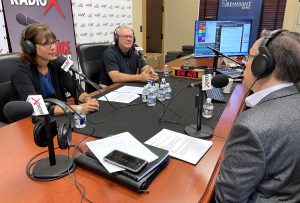
Diana Murphy, Diana Murphy Coaching, and Bill McDermott, The Profitability Coach

August 22, 2022 by John Ray

Diana Murphy and Bill McDermott
North Fulton Studio
Diana Murphy, Diana Murphy Coaching, and Bill McDermott, The Profitability Coach
Loading
00:00 /
RSS Feed
Share
Link
Embed

Download file

Diana Murphy

Diana Murphy, Diana Murphy Coaching, and Bill McDermott, The Profitability Coach (The Exit Exchange, Episode 16)

On this episode of The Exit Exchange, Diana Murphy and Bill McDermott each shared how they help business owners achieve successful exits. Bill noted that the difficult part of getting clients to sell their businesses is not necessarily the lack of understanding of what needs to be done, but the mental block of getting them to take that first step. He offered an example of a recent engagement where breaking through that inertia was critical to the desired client outcome. Diana discussed how she focuses on the business owner’s thoughts and feelings to better understand their concerns and worries. She notes that many times, spouses or other family members can influence the business owner’s decisions without them even realizing it. By taking the time to ask specific questions and really listen to the answers, she noted, advisors can help uncover these hidden issues and create a faster process. Diana and Bill also shared why they are members of XPX Atlanta.

This episode of The Exit Exchange was hosted by John Ray and David Shavzin and was produced in the North Fulton studio of Business RadioX® in Alpharetta.

Diana Murphy, Owner, Diana Murphy Coaching

Diana Murphy, Owner, Diana Murphy Coaching

Diana Murphy Coaching serves successful business owners when they need support during challenging transitions. Diana serves owners in big growth when they are thinking about selling and also during personal transitions that are affecting the business.

Diana Murphy is a life and mindset coach for the business owner/expert advisor/solopreneur.  She helps business owners grow to reach their business goals while they take brilliant care of their health and life. Diana coaches her clients to achieve their life and business goals by learning how to handle the obstacles that are inevitable along the way.

Company website | LinkedIn | Facebook | Instagram |

Bill McDermott, The Profitability Coach, Founder and CEO, McDermott Financial Solutions

Bill McDermott, The Profitability Coach, Founder and CEO, McDermott Financial Solutions

Bill McDermott is the Founder and CEO of McDermott Financial Solutions. McDermott Financial helps business owners improve cash flow and profitability, find financing, break through barriers to expansion and financially prepare to exit their business. When business owners want to increase their profitability, they don’t have the expertise to know where to start or what to do. Bill leverages his knowledge and relationships from 32 years as a banker to identify the hurdles getting in the way and create a plan to deliver profitability they never thought possible.

Bill currently serves as Treasurer for the Atlanta Executive Forum and has held previous positions as a board member for the Kennesaw State University Entrepreneurship Center and Gwinnett Habitat for Humanity and Treasurer for CEO NetWeavers. Bill is a graduate of Wake Forest University and he and his wife, Martha have called Atlanta home for over 40 years. Outside of work, Bill enjoys golf, traveling, and gardening.

Company website | LinkedIn | Instagram | Twitter
 

The Exit Planning Exchange Atlanta

The Exit Planning Exchange Atlanta (XPX) is a diverse group of professionals with a common goal: working collaboratively to assist business owners with a sale or business transition. XPX Atlanta is an association of advisors who provide professionalism, principles, and education to the heart of the middle market. Our members work with business owners through all stages of the private company life cycle: business value growth, business value transfer, and owner life and legacy. Our Vision: To fundamentally changing the trajectory of exit planning services in the Southeast United States. XPX Atlanta delivers a collaborative-based networking exchange with broad representation of exit planning competencies. Learn more about XPX Atlanta and why you should consider joining our community: https://exitplanningexchange.com/atlanta.

The Exit Exchange is produced by John Ray in the North Fulton studio of Business RadioX® in Alpharetta. The show archive can be found at xpxatlantaradio.com.

John Ray and Business RadioX are Platinum Sponsors of XPX Atlanta.

Tagged With: Bill McDermott, David Shavzin, diana murphy, diana murphy coaching, exit planning, exit planning advisors, Exit Planning Exchange, The Exit Exchange, The Exit Planning Exchange Atlanta, The Profitability Coach, XPX Atlanta

Celebrating 500 Episodes of North Fulton Business Radio: John Ray, Stone Payton, Bill McDermott, and Anthony Chen

August 18, 2022 by John Ray

North Fulton Business Radio
Celebrating 500 Episodes of North Fulton Business Radio: John Ray, Stone Payton, Bill McDermott, and Anthony Chen
Loading
00:00 /
RSS Feed
Share
Link
Embed

Download file

Celebrating 500 Episodes of North Fulton Business Radio: John Ray, Stone Payton, Bill McDermott, and Anthony Chen (North Fulton Business Radio, Episode 500)

Business RadioX® North Fulton Studio Partner John Ray, Stone Payton of Business RadioX, Bill McDermott, host of ProfitSense, and Anthony Chen, host of Family Business Radio, were in studio to celebrate 500 episodes of North Fulton Business Radio. Stone and John talked about the Business RadioX philosophy of serving first and the rewards which come from being a Studio Partner with the network. Anthony and Bill talked about their own shows, why they started a show with Business RadioX, and how their shows have moved the needle in their respective businesses. John offered thanks to his team, his Business RadioX colleagues, the show hosts he’s privileged to work with, and the North Fulton business community.

North Fulton Business Radio is broadcast from the North Fulton studio of Business RadioX® inside Renasant Bank in Alpharetta.

John Ray, Business RadioX® North Fulton Studio Partner and Ray Business Advisors

John Ray The Price and Value Journey
John Ray, Business RadioX North Fulton and Ray Business Advisors

John is a Studio Owner, Producer, and Show Host with Business RadioX®, and works with business owners who want to do their own podcast. As a veteran B2B services provider, John enjoys coaching B2B professionals to use a podcast to build relationships in a non-salesy way which translates into revenue.

John is the host of North Fulton Business Radio, Minneapolis-St. Paul Business Radio, Alpharetta Tech Talk, and Business Leaders Radio. house shows which feature a wide range of business leaders and companies. John has hosted and/or produced over 1,500 podcast episodes.

John also owns Ray Business Advisors, a business advisory practice. John’s services include advising solopreneur and small professional services firms on their pricing. John is passionate about the power of pricing for business owners, as changing pricing is the fastest way to change the profitability of a business. His clients are professionals who are selling their “grey matter,” such as attorneys, CPAs, accountants and bookkeepers, consultants, marketing professionals, and other professional services practitioners.

John Ray is the host of The Price and Value Journey, a podcast aimed at solo and small firm professional services providers. The show covers pricing, business development, and other key aspects of building a professional services practice, as well as interviews with industry leaders.

LinkedIn

Stone Payton, Business RadioX and Cherokee Business Radio

Stone Payton, Business RadioX and Cherokee Business Radio

For over 30 years, Stone Payton has been helping organizations and the people who lead them drive their business strategies more effectively.

Mr. Payton literally wrote the book on SPEED®: Never Fry Bacon in the Nude: And Other Lessons from the Quick & The Dead, and has dedicated his entire career to helping others produce better results in less time.

LinkedIn


Bill McDermott, Host of ProfitSense

Bill McDermott, Host of “ProfitSense”

Bill McDermott is The Profitability Coach and Founder and CEO of McDermott Financial Solutions. McDermott Financial helps business owners improve cash flow and profitability, find financing, break through barriers to expansion and financially prepare to exit their business. When business owners want to increase their profitability, they don’t have the expertise to know where to start or what to do. Bill leverages his knowledge and relationships from 32 years as a banker to identify the hurdles getting in the way and create a plan to deliver profitability they never thought possible.

Bill currently serves as Treasurer for the Atlanta Executive Forum and has held previous positions as a board member for the Kennesaw State University Entrepreneurship Center and Gwinnett Habitat for Humanity and Treasurer for CEO NetWeavers. Bill is a graduate of Wake Forest University and he and his wife Martha have called Atlanta home for over 40 years. Outside of work, Bill enjoys golf, traveling, and gardening.

The ProfitSense show archive can be found at profitsenseradio.com.

Company website | LinkedIn

Anthony Chen, Host of Family Business Radio

AAnthony Chen, Host of “Family Business Radio”

Anthony Chen is Investment Advisor Representative at Lighthouse Financial Network. Securities and advisory services are offered through Royal Alliance Associates, Inc. (RAA), member FINRA/SIPC. RAA is separately owned and other entities and/or marketing names, products, or services referenced here are independent of RAA.

Anthony Chen started his career in financial services with MetLife in Buffalo, NY in 2008. Born and raised in Elmhurst, Queens, he considers himself a full-blooded New Yorker while now enjoying his Atlanta, GA home. Specializing in family businesses and their owners, Anthony works to protect what is most important to them. From preserving to creating wealth, Anthony partners with CPAs and attorneys to help address all of the concerns and help clients achieve their goals. By using a combination of financial products ranging from life, disability, and long-term care insurance to many investment options through Royal Alliance. Anthony looks to be the eyes and ears for his client’s financial foundation. In his spare time, Anthony is an avid long-distance runner.

The complete show archive of Family Business Radio can be found at familybusinessradioshow.com.

Company website | LinkedIn

North Fulton Business Radio is hosted by John Ray and broadcast and produced from the North Fulton studio of Business RadioX® inside Renasant Bank in Alpharetta. You can find the full archive of shows by following this link. The show is available on all the major podcast apps, including Apple Podcasts, Spotify, Google, Amazon, iHeart Radio, Stitcher, TuneIn, and others.


RenasantBank


Renasant Bank has humble roots, starting in 1904 as a $100,000 bank in a Lee County, Mississippi, bakery. Since then, Renasant has grown to become one of the Southeast’s strongest financial institutions with over $13 billion in assets and more than 190 banking, lending, wealth management and financial services offices in Mississippi, Alabama, Tennessee, Georgia and Florida. All of Renasant’s success stems from each of their banker’s commitment to investing in their communities as a way of better understanding the people they serve. At Renasant Bank, they understand you because they work and live alongside you every day.


Special thanks to A&S Culinary Concepts for their support of this edition of North Fulton Business Radio. A&S Culinary Concepts, based in Johns Creek, is an award-winning culinary studio, celebrated for corporate catering, corporate team building, Big Green Egg Boot Camps, and private group events. They also provide oven-ready, cooked-from-scratch meals to go they call “Let Us Cook for You.” To see their menus and events, go to their website or call 678-336-9196.

TRANSCRIPT

Intro: Live from the Business RadioX Studio inside Renasant Bank, the bank that specializes in understanding you, it’s time for North Fulton Business Radio.

John Ray: And hello again, everyone. Welcome to another edition of North Fulton Business Radio. I’m John Ray. And, folks, we are broadcasting from inside Renasant Bank in beautiful Alpharetta. And if you’re looking for a bank that’s big enough to handle pretty much any need you can throw at them as a business, but small enough to deliver their service in a personal way, I recommend Renasant Bank. And I know of what I speak because I’ve used their services before and they do great work. So, go to renasantbank.com, and find their local office and give them a call. I think you’ll be glad you did. Renasant Bank. Understanding you. Member FDIC.

John Ray: And, folks, if you hear fireworks in the background, we’re celebrating a special episode today. This is episode number 500 of North Fulton Business Radio and we’re excited about that. And I’ve got three fantastic guests, I would say guests but they’re actually great colleagues of mine and associates of mine who I value their relationship immensely. And the first guy I want to introduce is Stone Payton, and Stone is with the Business RadioX Network and also Cherokee Business Radio. Stone.

Stone Payton: Well, good afternoon, sir. Thanks for having me. What a fantastic way to celebrate your – am I allowed to say? – 500th episode of North Fulton Business Radio. Fantastic.

John Ray: I know it. You knew I was old, but you didn’t know I was that old, right? So, yeah, this is pretty exciting. I was telling somebody this morning that if I hadn’t counted them, I wouldn’t think myself I had gotten to 500. But I surprised myself here on this one. So, it’s pretty cool. Pretty cool.

Stone Payton: So, what kind of folks have you interviewed? What kind of businesses have you had come through here over those 500 episodes? A little bit of everything I suspect.

John Ray: A little bit of everything. So, I’ve had a whole lot of attorneys, a whole lot of CPAs, a whole lot of the usual suspects, but I’ve had some unusual guest over time. I think the most interesting guest I had was a professional mermaid.

Stone Payton: Oh, my.

John Ray: Yeah. She didn’t come all mermaid it out, though. But a great business and she apparently does events and her thing is water safety. So, she uses her skills to holding her breath underwater to demonstrate water safety, and she does that as a mermaid. So, it was pretty – yeah. So, as you know because you have been involved in Business RadioX much longer than I have, we celebrate everybody. And it doesn’t matter how big they are or small they are, we celebrate them.

Stone Payton: And so many such interesting stories. And what I love about our format and the way you’ve chosen to conduct the shows that you do here, you really get to know the person behind the business, the why behind the business, where they’re trying to take it, what they feel like they’ve learned, and you get to know the person. That’s part of what makes it so special, I think.

John Ray: Absolutely. Absolutely. Yeah. I mean, people love the opportunity to talk about their own business because they don’t get that opportunity, and that’s what we provide. So, I mean, it’s pretty gratifying, but you know that better than I do, right?

Stone Payton: Well, I’ve been doing it. I was speaking with one of our guests earlier, Bill McDermott, who we’ll get a chance to visit with some more here in a few moments, when I started this, when I met Lee Kantor, I had black hair. So, I mean, this has been some minutes.

John Ray: It’s been a minute, yeah.

Stone Payton: It has. But Lee advised me early on, he said, “Cast a wide net.” We want to live into that mission of supporting and celebrating local business and community leaders. There will be people who come through the studio that do fit the profile or at least qualified to be potential clients for the Business RadioX system. And for those folks, we will be able to help them help others and grow their business and give them a very substantial return on their investment, whatever that might look like for them.

Stone Payton: So, I don’t know that I necessarily immediately believed that. Because I came from the world of sales and marketing, I was all about targeting your ideal profile client. It turns out, like on so many things, Lee was right. And doing that, I think, has given us what I feel like – I know I’m a little biased – a pretty well deserved reputation in all of the communities that we serve that we’re the real deal. We’re serious about living into that mission. And, oh, by the way, if you want to grow your business, particularly if you’re in the professional services B2B space and you want to own your backyard, you ought to at least sit down and talk to us.

John Ray: Yeah. Well, that’s the thing, we tell our show hosts that if you make it about others and you make it about the tribe you want to serve, the tribe will serve you back, right? Well, what you’re describing is we really do the same thing, but we eat our own cooking. And that’s how we build studios at the local level is we start by serving first and we just serve the market. And guess what? The market serves us back.

Stone Payton: I am so excited about and challenged by that part of our mission, because we’re in 37 markets now, we continue to grow. I feel great about that. I feel great about the work that we’re doing in all of those communities. And, boy, is it moving to slow for me. We can’t get to all the people we should be getting to. We can’t get to all the stories we should be sharing. There are so many communities. I mean, they’re not all going to have a John Ray, okay?

Stone Payton: But there’s going to be somebody there that can do a really good job with the benefit of these tools, these resources, the magic of this platform with that heart of service, that mindset, genuinely wanting to invest in their local community. There are so many other communities that we can and should be serving.

Stone Payton: So, that’s what gets me up every morning, is trying to figure out, you know, where can we place the next one? How can we help them get up and running? So, yeah, anybody out there that has a cousin in Dallas or Houston or San Diego or Pittsburgh, or some of these markets where we’re not, how about reaching out? We’d love to talk to them.

John Ray: Absolutely. Absolutely. And you’ve got a great support system with you, and Lee, and Abbe, and the other great folks that are in our network.

Stone Payton: Well, you had a good support system until about a-year-and-a-half, two years ago. Then, Lee’s wife, Abbe Kantor, retired from Coca-Cola – a little company some of you may have heard of.

John Ray: A small little out of the way beverage company. Yeah.

Stone Payton: Now, we’ve got some brains over there at HQ. So, we are really well-equipped to help you run your own studio and, certainly, to help you execute on your own show if you’re that kind of client. But, yeah, I think we get better and better. But, yes, you know what I think the secret sauce is? I think it is John Ray, Karen Nowitcki, Mike Sammond, Beau Henderson. We got Roger Manis up in Rome. We’ve got all these folks around the country that there’s a great deal of overlap in the value system, or they wouldn’t be part of the team anyway.

Stone Payton: And so, you have that consistent mindset value system approach, but then, also, we’ve given them the latitude – thank goodness – to sort of do things their own way and then they return the learning to the organization. And we all benefit when Karen discovers something or when you find something that’s really serving a client. So, yeah, I feel so blessed to be a part of it.

John Ray: Yeah. And that’s the pretty cool part of what we do because we’re not a franchise organization where, you know, there’s some wisdom from on high that comes down, right? I mean, everybody’s pretty collaborative on sharing what they know.

Stone Payton: Oh, very much so. We’ve gone to great lengths to date to avoid the F word, franchising. And there’s some reasons for that. Some of it’s just, you know, there’s expense and regulation and discipline and rigor that just doesn’t suit me and Lee.

Stone Payton: But, also, we wanted people to have that latitude, but we get a lot of the same benefits because there are so many repeatable processes, transferable tools, best practices. And our crowd, by definition, the folks that are attracted to us, are the kind of folks who, they’re not just willing, they’re compelled to share what we’re learning. So, I love this about our crowd.

Stone Payton: And I’ll tell you where else we learn so much, is from our clients. I mean, anything that you’ve seen at HQ share with the rest of the group, we learned it from either someone else in the group and/or a client. It wasn’t me or Lee, I’ll tell you that.

John Ray: Well, speaking of clients, we’ve got a couple in the studio.

Stone Payton: Well, let’s tee them up. We’ve got Anthony Chen here with us. Good afternoon, sir. How are you?

Anthony Chen: Hi. Good afternoon. I’m doing well. Thank you for having me. It’s an honor and privilege to be part of the 500th episode.

Stone Payton: Yeah. We’re delighted to have you. And we have Bill McDermott, who I mentioned a moment ago. Good to see you again, man.

Bill McDermott: Well, it’s great to see you as well. And excited about 500th episode of North Fulton Business RadioX.

Stone Payton: So, I’ll ask you first, Bill, and I’ll come back to you, Anthony, because I’d love to hear from you both on this. What was the genesis, the catalyst, how did you kind of come into our circle here at Business RadioX?

Bill McDermott: Well, there’s a saying that goes, “Luck is where opportunity and preparation intersect.” And so, my grandfather was an editor for The Chicago Daily News. He was a great storyteller, and I think I inherited that storyteller gene. At the same time, I had the opportunity to be a guest on John’s show and we talked, and I think he even invited me back after the first time, so that was encouraging.

Stone Payton: There’s a win.

Bill McDermott: Yeah, there you go. And so, he said, “You know, Bill, you really ought to consider your own show.” And I thought about it and I said, “Well, let’s talk more.” And so, three years ago, ProfitSense, profitsenseradio.com, was born out of the opportunity that John Ray presented me in my preparation and inheriting that storyteller gene from my grandfather.

Stone Payton: So, what kind of folks are you interviewing? Is there a guest profile, a certain kind of story that you try to share?

Bill McDermott: Yeah. So, ProfitSense is born out of I believe every business owner is a hero. And that hero has a story. And along the way, that hero meets several guides that advise them in their business journey. And so, ProfitSense is really about telling business owner’s stories and telling the stories of the professionals that advise them in order for them to successfully run the business. The idea is really to inspire those who are slugging it out in corporate America, there’s really a better way, and I’m proof of that.

Bill McDermott: And secondly, these business owners need a source of inspiration. Can we share information with them to inspire them to go above and beyond what they’re already doing? So, it’s very much a pay it forward idea, which I think is very consistent with the mission that Business RadioX has. And as a professional services advisor myself, the way it started and the way that it has turned out has really been interesting and incredibly beneficial.

Stone Payton: So, I got to ask you, because I feel like I am absolutely unqualified to do this properly, and it’s a skillset or a discipline that I need to cultivate because I certainly appreciate and admire and thirst for good quality counsel on a number of fronts, because there’s just so much I don’t know. That’s why all the questions come to me so easily. How do you go about interviewing, engaging, speaking with someone that you think you might want to bring on to give you counsel? And how do you know what advice to follow and what advice to leave alone?

Bill McDermott: Yeah. That’s a great question.

Stone Payton: You know, hey, it took me a minute to get it out, but I thought that was fantastic.

Bill McDermott: I did, too. So, my first two guests were actually existing clients of mine, people that I had worked with. They each had their own entrepreneurial story. One was a successful IT CEO who sold their business. The second one is a very successful entrepreneur in the manufacturing space who had built his business over time. And the idea really was to tell those stories of those business owners of how they were successful. And in promoting them and promoting their businesses, it was a great opportunity to pay it forward.

Bill McDermott: The inspiration then came to have a business owner, and a business owner that maybe I’d like to get to know better, and an advisor like a banker or a CPA or an attorney all in the room. And the dynamics of building those relationships have really morphed into them doing business with each other. And the byproduct, which was a pleasant surprise, is some of those business owners have actually engaged me in a meaningful dialogue and have become clients of mine.

Stone Payton: What a fantastic format for a show. And if and when you seek counsel, you’re talking to a group of people that it goes beyond know, like, and trust. I mean, we’ve heard that. But I mean, you’ve really gotten to know these people.

Bill McDermott: So, it’s really interesting, during COVID, I worked with a very successful architectural firm. When COVID hit, architectural business in some sectors really stopped. And, unfortunately, this owner had brought on a very successful professional, but all of a sudden was faced with having to lay that person off and wanted to do it right. And dealing with terminations, dealing with benefits issues can be very complex.

Bill McDermott: By the way, this architect was on the show and an ERISA benefits attorney was also on the show. So, this architect calls me and says, “Hey, Bill, do you know anybody, you know, an attorney?” I said, “Do you remember Nancy?” “Oh, yeah.” And so, Nancy and Bill got together, and Nancy was able to help Bill navigate those waters. And another professional relationship was built because they had originally met on the show. It’s all about relationships, and I know you know that.

Stone Payton: Well, I continue to learn and relearn that every day and have that reaffirmed. And I do find that at least in my business and personal life, it is about relationships. Anthony, I’m sorry you have to follow that act because that was incredibly articulately eloquent.

Anthony Chen: That’s going to be really hard, but I’m going to try.

Bill McDermott: Well, you save the best for last, I’m just saying right now.

Stone Payton: But I’d love to hear a little bit about your backstory. What compelled you to get involved with Business RadioX and some of what you’ve been experiencing in hosting your show, man?

Anthony Chen: Oh, similar story with Bill’s in terms of luck and chance. Having moved down to Georgia here from New York, we started all over, knowing absolutely nobody. And I figured, “All right. There’s got to be a way to really market myself, not just being an advisor, but a small business advocate.” And then, by chance, running into you and being a guest on John’s show, and all at the same time, the firm’s broker dealer were kind of opening their doors.

Anthony Chen: Well, to go back a little back in time, several years ago, we weren’t even allowed to have LinkedIn profiles. Talking about really being in a dinosaur age when it comes to social media. But then, when they started opening up a little bit more and realizing, “Hey, our advisors kind of need to market themselves, they need to be in the 21st century,” and they kind of loose – well, not fully loose, but allowed advisors to, “Hey, if you want to have kind of a YouTube channel or a podcast as a way to differentiate yourself in the market, we’re going to run a couple of tests with certain advisors.” And I thought, “All of this happening at the same time, someone’s dropping some hints for me, I should probably jump on that.”

Stone Payton: Yeah. So, the universe was conspiring to help you out a little.

Anthony Chen: In a way, yes.

John Ray: So, you’re clearly enjoying it. What are you finding the most rewarding? What are you enjoying the most about hosting your own Business RadioX show, you think?

Anthony Chen: Seconding with what Bill mentioned, it’s being that advocate for the business. Kind of the concept running the idea with John was giving the business owners an opportunity to kind of share their backstory. Because I’ve kind of got a little bit about my story, and my parents story, and how they got here and how they kind of achieved their American dream. But we don’t get to see much of that really highlighted in the news. It’s always negativity. And I want to be able to change that tune.

Anthony Chen: And if I’m going to be talking about being an advocate for a small business, I need to walk the walk and give them the opportunity to share how they started, whether it’s one major life event or after 10, 20 years of 9:00 to 5:00 of corporate. There’s got to be a better way of doing this and making that leap and giving them a voice as the first half of the program.

Anthony Chen: And the second half would be kind of sharing a highlight of what does it actually look like running a business behind the scenes. Because for those who haven’t made that leap yet, they see kind of a brick and mortar store or a shop and think, “Oh, they’re very successful. They’ve got bags of money raining from the skies.” And most people kind of heard this pitch before. And reality, any of us who have been in business for a while, we know the first three years is really more invoices than bags of money coming from the skies. But this is really building at that culture and a community of small business owners really coming together.

Anthony Chen: And, again, seconding what Bill mentioned, is, sometimes just after the show was done, someone would ask, “Hey, do you know someone who does this and that?” And just last show or last week, someone was having an issue in terms of getting a contractor specifically for concrete. And right away, Sam, the banker said, “Oh, I got like two or three people for you. And I think John might have already also made an introduction.” So, here’s really building a community of not just giving them a voice, but letting them know, “Hey, there’s resources out there and I’m not alone.”

Stone Payton: Don’t you just love being the guy who knows the guy? And I think being involved with Business RadioX helps you do that. So, John, so far we’ve established that your entire business model is built largely on luck.

John Ray: That’s right. That’s what I’m hearing.

Stone Payton: And it’s working beautifully anyway. So, you’re in the studio most of the time, much of the time when these folks are doing their show or you’re on some of these shows.

John Ray: Oh, yeah.

Stone Payton: So, from the cheap seats, talk about each of the shows and what you’ve seen and what you’ve observed in watching these guys do their thing in this context.

John Ray: Yeah. Well, again, Bill has ProfitSense – let’s shout it out here, profitsenseradio.com.

Bill McDermott: Thank you.

John Ray: Yeah. And then, Anthony has Family Business Radio, family businessradioshow.com, I think is it. So, we’ll have a link in the show page, folks. And I think what both of them do is they’ve selected the tribe they want to serve and they serve the tribe. And I mean, they make it about the guest, and that’s why they’ve been successful because everybody likes to tell their own story. It’s funny how that works. It’s a human thing. We all like telling our own story. And they make it about the guest and they make the guest comfortable to be able to do that.

John Ray: And both of them have a way of interviewing a guest where it’s non-threatening. They’re not coming at it like 60 Minutes or The New York Times. They’re about celebrating the great work that the business leaders they feature on their shows do.

Stone Payton: Well, let me ask you about that and, again, I’d like to hear from both of you. I’ll start with you, Anthony. Do you find that at least initially, sometimes guests, while they might be excited and really appreciative of the opportunity to come on and share their story and promote their work, do you find that maybe sometimes they’re a little bit nervous when they first come in? And if so, what kind of things do you do to mitigate that?

Anthony Chen: Oh, in the beginning, especially for those who are for the very first time putting the voice on air or even doing a podcast, “Oh, I’m not so sure about this all.” “Just come here experiencing it.” And after it’s all done, the whole, “Wow. Did I do okay?” I was like, “Well, you did perfectly fine. No one noticed.” And I kind of had my own trepidation as well when I was first on the podcast as a guest and then became on the other side doing the interview. It’s just the public can’t tell. I remember my first two, I was shaking in my boots. But everyone was, “Oh, no. You did great.” “Okay. Great. Don’t let them see me sweat.”

Stone Payton: So, Bill, do you think is it something about the mechanics that you employ? Is it more about heart and mindset, your ability to kind of set people at ease?

Bill McDermott: So, I think a lot of it, for me, my background was in banking prior to being a business guy.

Stone Payton: I’m sorry.

Bill McDermott: I know. But bankers develop the ability to ask questions because they’re constantly interviewing people for loans. And so, the power is in the question. I think it’s also important, to what Anthony was saying, those questions need to be rooted in curiosity. I also think if you can figure out a way to interject humor at the beginning of an interview, humor always has a way of disarming people, making them comfortable. If you can talk about some of their accomplishments, the things that they’ve done, their successes. Anybody that I’ve found that is maybe a little bit nervous to start once you get into the conversation after about 30 seconds, maybe a minute, it’s just two people talking back and forth.

Stone Payton: Yeah. Well, it just occurred to me – and maybe it’s been accentuated by hanging out with John Ray and using this platform – in your line of work, you guys are professional facilitators. You’re not necessarily radio personalities. I guess you could be if you wanted to be. I mean, this is your skillset as a financial advisor. Right, Anthony, you have to really be good at facilitating a conversation and uncovering what folks really need and want.

Anthony Chen: Yeah. Even before that, looking back at my childhood, even on a nerdier side of things, most people, when they listen in or learn a bit more about me, they are surprised that I’m a natural introvert.

Stone Payton: What?

Anthony Chen: Yeah. I just go, “Whoa, you got a voice for me?” Getting back to your original question, how I even got into even thinking about podcasting and kind of the skillset, believe it or not, for listeners just finding out about me now, is that, I used to be what they would call a DM or Dungeon Master for Dungeons and Dragons. Who would have thought a tabletop game would have prepared oneself for being a professional, I guess, podcaster and being a facilitator. So, from that, I became a financial advisor and now doing podcasting is a surprise. Or in this case, more luck on my end than John’s luck on being successful.

Stone Payton: That seems to be a theme here.

John Ray: Yeah, absolutely.

Bill McDermott: I will jump in and say, one of the things I remember starting is John was great at giving me a structure and a framework to work with, also guiding me to the pro business tips, which are on the North Fulton Business Radio website. I think the combination of the structure and the framework, how he went about asking his questions, I think, again, really helped me get started.

Bill McDermott: And so, for someone who might be thinking about doing a show, well, it’s got a great framework. John is a great radio show host to work with. Business RadioX has the Pro Tips, which you can listen to that are on the show page. And the rest of it is up, but I think there’s a lot of resources that can help someone who is interested in getting started.

Stone Payton: Yeah. Okay. John, 500 episodes, that’s just for that show, North Fulton Business Radio. You have other shows within North Fulton Business Radio. Sometimes you have multiple guests, is that accurate? But you don’t have 500 clients. So, I mean, this must be bigger than just about you going out and getting a handful of clients. Can you speak to that a little bit, the thinking behind that? Or you’re just not very good at selling your work or what’s the deal?

John Ray: I’m good at hitting a button. No. You know what? Here’s the deal. So, we were talking about this before we came on the air. My story is similar to yours. You talked about you liked the idea so much, you bought into the company, in this case, the network. It was the same deal for me.

John Ray: I mean, you know, Mike Sammond was the guy who started this studio. And I was his sidekick. And, you know, we were having fun doing great work. And he decided, “You know, I really can’t spend the time in North Fulton that I need to spend to develop the studio.” And he said, “John, you’re going to take it over or we’re going to have to shut it down.” Well, you know, I had a decision to make, so I did the same thing.

John Ray: I mean, it worked so well for me and my brand and gave me the opportunity to network and build my basic business, my business advisory practice, that I was like, “Why not? I’ll take it over.” And I made a business out of it, right? And I’m really a professional services business development guy. I found having a mic is the most elegant, nonthreatening, easiest way to build your business if you’re in the professional services world that I think there is. And so, I got a taste of that and decided, “Hey, I’m going to get in the business of doing that and helping other people.”

Stone Payton: But in all of these cases, I think you’re probably pretty hard pressed to hear John Ray on the mic talking a lot about John Ray or Bill. It’s a little different than just having the mic. Part of it is the approach –

John Ray: The mindset. Yeah. No question. So, I mean, people that come in as guests on this show, they don’t know that I have another business. Most of them, they think I just do this show and that’s what I do, and that’s fine. And then, some of them say – which is typical in the studio – “Well, this has been such a great experience, how can I help you?” “Well, you know, here’s what we do.” And so, you create reciprocity with people in the studio that’s pretty cool.

Stone Payton: Well, it’s back to what Bill was talking about. It’s all built on a foundation of real relationship, genuine trust. You’ve chosen, and it sounds like these two gentlemen have, too, to cast a net that’s a bit wider than just the folks you’re hoping to do business with necessarily. Because you genuinely – like I try to do over in Cherokee with my little studio in Woodstock – do want to support and celebrate the local business and community leaders. And you don’t need or want 500 clients.

John Ray: Correct.

Stone Payton: Well, I’m not going to tell you who you want to work with. Who do you want to work with? I mean, I know two of them are right here.

John Ray: Two of them are right here.

Stone Payton: But how would you describe the folks you really want to work with in this capacity?

John Ray: Well, I want to answer that question, but I want to underline what you said. If you are constantly about yourself, even if you’re trying not to make it look that way, people smell that. And that’s why I think it’s so important to have a studio where you’re serving everybody, the whole market. And even the folks that will never be able to pay you back, but all they can do is say good things about you, that’s worth it.

John Ray: And so, being the voice of business in North Fulton or in Sandy Springs or Gwinnett, where Mike is, or what have you, that’s priceless. So, it’s really important to be that.

John Ray: But I’m always happy to answer your second question, which is the kind of people I love to work with. The kind of people I love to work with, are professional services people that can’t figure out how to move the needle in their business. Maybe sometimes they’ve hit a lull. They built it as far as they can build it. And, you know, they want to build it further. Or sometimes they’re doing okay, but they’d like a little more elegant, nonthreatening way to build relationships as opposed to, you know, work in the networking floors or whatever.

John Ray: And, again, this is my background is a professional services. I’m not going to tell you how many years, but I could share that with you privately. You and I would have the similar number. So, you know, I love working with professional services people. I’ve done it a long time. And I’ve never found another way to build a business that’s so elegant and has clear ROI is this way of doing it.

Stone Payton: So, this halo that John wears around town, have you guys found that you also have a little bit of that reputation, that standing within the ecosystem you’re trying to serve?

Bill McDermott: Well, some of that runs downhill, but we still aspire a lot to be more like John Ray. You know, before we leave that point that you made about relationships, my experience, first is I’ve found people have to get to know each other and like each other before they try each other.

Bill McDermott: And so, my relationship with John is we kind of knew each other, and then we found we had a lot in common, and so we started liking each other. And then, he extended the invitation and I tried it. Now, I trust it. And actually gotten to the point of, you know, try, trust, then refer. I have referred him, you know, opportunities for other people that I think would be great show hosts.

Bill McDermott: And I think the other thing happens during the show with being the show host and the guest, I get to know these people. They like me, maybe I like them. And so, those opportunities to try, trust, and then refer are the natural evolution of those relationships. And those relationships all go at different speeds and at different ways in different times. But they do follow the progression in this show, and the interviewing opportunity really gives us an opportunity to know and like people, which then leads to try and trust.

Stone Payton: Yeah. Is that consistent with your experience, Anthony? I think I know the answer is yes, but say more.

Anthony Chen: Yeah, absolutely. It also gives us an opportunity to kind of showcase that we walk the walk. We don’t just talk about, “Oh, we’re here for small business. We’re here for small business.” But, no, we’re invested in building that culture around us.

Anthony Chen: And kind of seconding not just what Bill said, but I also observed and kind of why I lean towards John and really trusting him in helping me start this whole journey of doing podcasting, because I would observe what people’s actions are as opposed to what they say. And kind of what John impresses me most was by his actions on, I think it was my first evening event at the North Fulton Chamber that we met, and here is nobody, a new guy from New York, and he gave me, like, ten minutes of his time. And at the time, I didn’t even know how big John Ray was.

Anthony Chen: And then, on top of all, here’s a guy who was always showing up almost every single Wednesday morning at the Chamber’s pro meeting. When he’s so big, I think he doesn’t even need to show up anymore. But here he is always committing, giving back to the small business community, when at the time he’s grown to the point where he really doesn’t have to kind of hang with a small fry down here in the valley of the hill. And so, when you’re really looking at John and everyone on the show and the people that he works with, I’m thinking, “Yeah. This is my tribe. I belong here.”

Stone Payton: So, let’s talk about me some more since my mic is still on. So, my day job is I own 40 percent of the Business RadioX Network, and a big part of my job really is finding other – I don’t know that we can find a John Ray, but someone like a John Ray to run studios and other communities.

Stone Payton: But also, my wife, Holly and I, we moved to Woodstock a little over a year ago. And it was interesting to compare the two different experiences because I had quite a bit of experience executing at the studio, the Atlanta Business Radio Studio. And it is a great way to meet hard to reach people, to build those relationships, to capture and distribute really authentic, compelling, relevant content. I mean, it’s a content factory, so it really does grease the skids for all of those efforts.

Stone Payton: One of the things that I loved about being involved with Atlanta Business Radio was because of this platform and the framing, it really was pretty darn easy to meet hard to reach people and get a chance to build relationships with folks that, in other contexts, you know, it might be a really long, hard road.

Stone Payton: Then, when I went out to Woodstock, the dynamic is a little different, right? So, if you are a resident of Woodstock or just driving through Woodstock and you want to have a cup of coffee with the mayor or the president of the local bank, all you got to do is ask. You don’t need a radio show to do that. But in Woodstock – and I grew up in a small town as well – we have what I call the sweet tea barrier. Those of us who have been raised in a small town, we’re all very cordial and all that, you know, “You all come over and have some sweet tea sometime,” you say that when people walk by your front porch. But we’re pretty good at keeping people at arm’s length.

Stone Payton: Where, having this platform in little Woodstock, Georgia, it goes well beyond having a cup of coffee with someone or you get past the weather and the kids really quick, and you really do get to know the person. And without having to wag your own tail very much, they get to know you and you establish a great deal of credibility.

Stone Payton: I don’t know if surprised is the right word, but one of the things that feels very good about executing on this business model and capitalizing on this platform in a community like Woodstock is it’s a way to break through that sweet tea barrier in a small town and build substantive relationships with the folks that you really want to get to know better and want to serve.

John Ray: Yeah, absolutely. Absolutely. Yeah. I mean, I think people are polite. They’re very polite. And they’ll let you in at one level. But if you want to take it to another level where you’re wanting to maybe do business, but at least try to be helpful, it helps to get to a point where you have – again, I keep using the word nonthreatening – a nonthreatening place to get to know each other. And when you have somebody on a show, you’ve given them something of tremendous value, and they appreciate that and remember that.

Stone Payton: Well, I think both of you mentioned this a little while ago. I can’t tell you how many times it’s got to be an overwhelming percentage at a time when someone will come through to one of our studios where I’m involved, and almost the first question out of their mouth is, “This was great. Thank you so much. What can I do for you?” I mean, that’s human nature. And that should be the case because we have genuinely reached out and served those folks.

Stone Payton: Okay. So, there’s luck. It’s fun. It’s good. It’s right and just and true. It checks all those boxes. Is it producing meaningful business results? Are you getting some sort of return, whether it be financial or goodwill or market? I don’t know, I’ll ask you both. I’ll start with you, Anthony. Do you feel like it’s having a positive impact on your business?

Anthony Chen: For being the financial guy here, I wouldn’t keep doing it if it wasn’t. Right there, that’s the short answer of it all. But the longer answer, absolutely, this definitely shortens the length of time in terms of building that relationship. And being the new guy here on the block three years ago coming from New York, people don’t know me from anyone else. And if I’m going to find a way to differentiate myself as being the go-to guy when it comes to family business and understanding it, what better way other than using this platform to highlight and give service to other people.

Stone Payton: If I didn’t already own 40 percent of this company, I’d write you a check, John.

John Ray: You still can any time you want to, man.

Stone Payton: All right. Bill, impact on your business, man.

Bill McDermott: Yeah. Impact, certainly in terms of building relationships, the emotional currency, certainly financial as well. And in being a former banker, I’m interested in the ROI, too. So, I will tell you, the North Fulton Business RadioX show that I do has become the linchpin of my marketing plan. And the reason it’s still –

Stone Payton: Are you recording this?

John Ray: I hope I hit the button when we started this.

Bill McDermott: I can say it again. No. The reason it has is because, first, it’s building relationships. Those relationships for me have become clients. I would say my hit rate probably for every eight guests I may have on my show, I’ll usually get a client. So, do the math, that’s maybe 12 clients a year. And so, when I look at my ROI of the cumulative effect of that business, you know, it’s hugely rewarding. So, it is a great way to build relationships, but it’s also financially rewarding as well. And it’s financially rewarding for my guests because they have the opportunity to do business together, too.

Stone Payton: John’s chest is sticking so far out over the edge of this conference table right now. Well, congratulations, man.

John Ray: Well, that’s the whole point, right? I mean, because what we tell people is it’s about hard dollar ROI. I mean, at the end of the day, you start with service. And if you serve first, you’ll create hard dollar ROI. And I think that’s what we’ve done here. And these two guys have done a tremendous job at that.

John Ray: I remember Bill asking me – I don’t know if you remember this, Bill – because you asked me, “What’s my biggest risk?” And I said, “Your biggest risk is having too much fun, and you think you’re a radio star. And you start having people on the show that really don’t help you in your business. I mean, people that feel good and maybe give you a warm feeling sometimes that you had this famous book author on your show, but they really aren’t going to help you move the needle in your business.”

Bill McDermott: And that’s a great point. I don’t remember saying that, but I am a big believer in that concept. And I think the reason for that, John was very helpful in helping me be strategic about inviting specific people.

Bill McDermott: For example, I do a fair amount of business exit planning right now, because the baby boomer generation is retiring, they’re exiting their businesses. So, the opportunity to have a show that maybe has a CPA on it that talks about taxes and the taxable impact of a business sale, having an attorney on the show that can talk about the structure of the letter of intent, the asset purchase agreement, is it a stock sale, is it an asset sale. And then, also that business owner, they’re also listening and understanding, “Okay. I haven’t thought about these things because I’ve had my head down running my business.” And so, the power of that dynamic and what’s going on is incredibly valuable.

Stone Payton: So, John, what’s next, man? You’re going to Disney World? What’s on the horizon?

John Ray: Dr. Ray always wants to go to Disney World, my wife. She always wants to go to Disney World, that’s for sure. Well, you know what? We can’t look ahead. I can’t look ahead without looking back first and just saying thank you. So, we talked about Mike Sammond – Mike, I love you. You’re the guy that kind of got everything going here. And we got hooked up somehow, I don’t remember how, but we got hooked up and we had a great relationship. And then, you abandoned me, and so I had to do something. I’m just kidding.

John Ray: But he wanted to spend 100 percent of his time in Gwinnett, and he’s done fantastic job in Gwinnett. But he’s the one that planted the flag here, and so I just got to come along for the ride for a couple of years and then take it over from there.

John Ray: But then, to the network, Lee, you, Stone, Abbe, you all just been tremendous support. And, you know, we couldn’t have gotten this far without you, and that’s for sure. And then, I’ve got a great team behind me. See, everybody sees John Ray, but I’ve got a fantastic team. So, Arlia, Mildred, Angi, Heather, you all do fantastic work. John couldn’t do it without you. Thank you. I appreciate you. So, I have to say, I have to look back before we look forward.

Stone Payton: Fair enough. Well, it’s absolutely been our pleasure to be a part of this. And I hope it’ll just continue to grow. And I look forward to watching your stories unfold, Bill and Anthony. I can’t tell you how rewarding it is to watch what you guys are doing to flourish and help you build your own business, and we get to come along for the ride with the great work these guys are doing.

John Ray: That’s right. And that’s the other thing I have to say, is, without clients like Anthony, Bill, I could go on and on, Roger Lusby, Frazier & Deeter, Mike Blake, Brady Ware, Dr. Jim Morrow, Stuart Oberman, Patrick O’Rourke, Dental Business Radio. I mean, I could go –

Stone Payton: Maybe he does have 500. Wow. You just rattled those off.

John Ray: Yeah. And the great folks at R3 Continuum in Minneapolis, that are just delights to work with. They’re the ones that create opportunity for us to grow and expand because of the business they do with us and it’s just a delight to work with them. I’m blessed, man. I can’t complain. I wake up every morning and I’m excited.

Stone Payton: As you should be. Well, hey, I didn’t tell you everything I know, but I don’t want to wrap before we make sure that our listeners know how to reach out and have a conversation with you guys, if they’d like to speak with you or someone on your team. So, I’ll start with you, Anthony. Whatever you think is appropriate, LinkedIn, email, phone number, that kind of thing, what’s the best way for someone to reach out and connect with you, man?

Anthony Chen: Yeah. Definitely. Either my email or LinkedIn. It’s simply just my full name, Anthony Chen. The last name is spelled C-H-E-N. Or you can reach me at my email, which is also my full name, just anthonychen@lfnllc.com.

Stone Payton: Well, thanks so much for coming in and sharing your story, man. It’s a delight to see you in person again. And I’m already loving hearing your show, but it’s fun to catch up and have you join us and join us in celebrating John’s 500th. I just don’t have that work ethic, so it’s just a little bit beyond me, but maybe one of these days. All right. Bill, let’s leave them with some coordinates. What’s the best way to reach out to you, man?

Bill McDermott: Yeah. Call me at 770-597-3136. You can also hit me on my email, which is bill@theprofitabilitycoach.net. My website is theprofitabilitycoach.net. And LinkedIn, I’m Bill Jay McDermott. So, a bunch of ways.

John Ray: Terrific. Wow. And, Stone, for the folks over in Cherokee that might be listening, tell them how they can get in touch with you, buddy. We got to let you shout that out.

Stone Payton: All right. Well, you can have a peek at a little bit of our work at cherokeebusinessradio.com. We’re very excited about a new program that we have that’s enabling us to provide more programming for some of these underserved populations, veterans, minorities, nonprofits, and youth. It’s called Main Street Warriors program. And so, go check us out at mainstreetwarriors.org. And, yeah, text me, give me a call. Come and have a beer with me under the elm tree behind Reformation, my direct line is 770-335-2050. Or you can reach me at stone – that’s S-T-O-N-E – @businessradiox.com.

John Ray: Stone Payton with Business RadioX and Cherokee Business Radio, Anthony Chen with Lighthouse Financial and Family Business Radio, and Bill McDermott, the host of ProfitSense and The Profitability Coach, thanks to all of you for joining me today and honoring me with your presence to celebrate. This has been the best way I could think to celebrate.

Stone Payton: My pleasure, man.

Bill McDermott: Great, John. Thank you.

Anthony Chen: Thank you.

John Ray: Thanks to each of you. Hey, folks, just speaking of celebrating something, if you are looking for a great team building event – and, for me, that involves one that does not involve broken ankles and mosquito bites, okay? – I’m referring you to a&sculinaryconcepts.com. So, yeah, they’re an award winning culinary studio and they do corporate catering. But Executive Chef Andrew Traub has developed a team building activity in his culinary studio that is fantastic. So, if you’re looking for something unique for your team, go to a&sculinaryconcepts.com to learn more. Or just pick up the phone and call Andrew, 678-336-9196 and tell him that we sent you.

John Ray: And, folks, just a quick reminder that we are at show number 500, but we’re heading to 1,000, that’s our next stop. And we have only gotten this far because of your support. And if you would do me a favor and share the show, like you’ve always done. So, if you’ve heard something here on this show that makes you think, “Hey, I want to share that with somebody,” please do that. And do that for any of our shows. We are here to celebrate business, as you’ve heard. We’re the voice of business in North Fulton, and we want to celebrate the great work of business leaders like Bill, like Anthony, like Stone. That’s what we’re all about here on North Fulton Business Radio.

John Ray: So, for my guests, Stone Payton, Anthony Chen, and Bill McDermott, I’m John Ray. Join us next time here on North Fulton Business Radio.


Tagged With: Anthony Chen, b2b podcasting, Bill McDermott, Family Business Radio, John Ray, Lighthouse Financial Network, North Fulton Business Radio, podcasting, Price and Value Journey, ProfitSense with Bill McDermott, ray business advisors, Stone Payton, The Price and Value Journey, The Profitability Coach

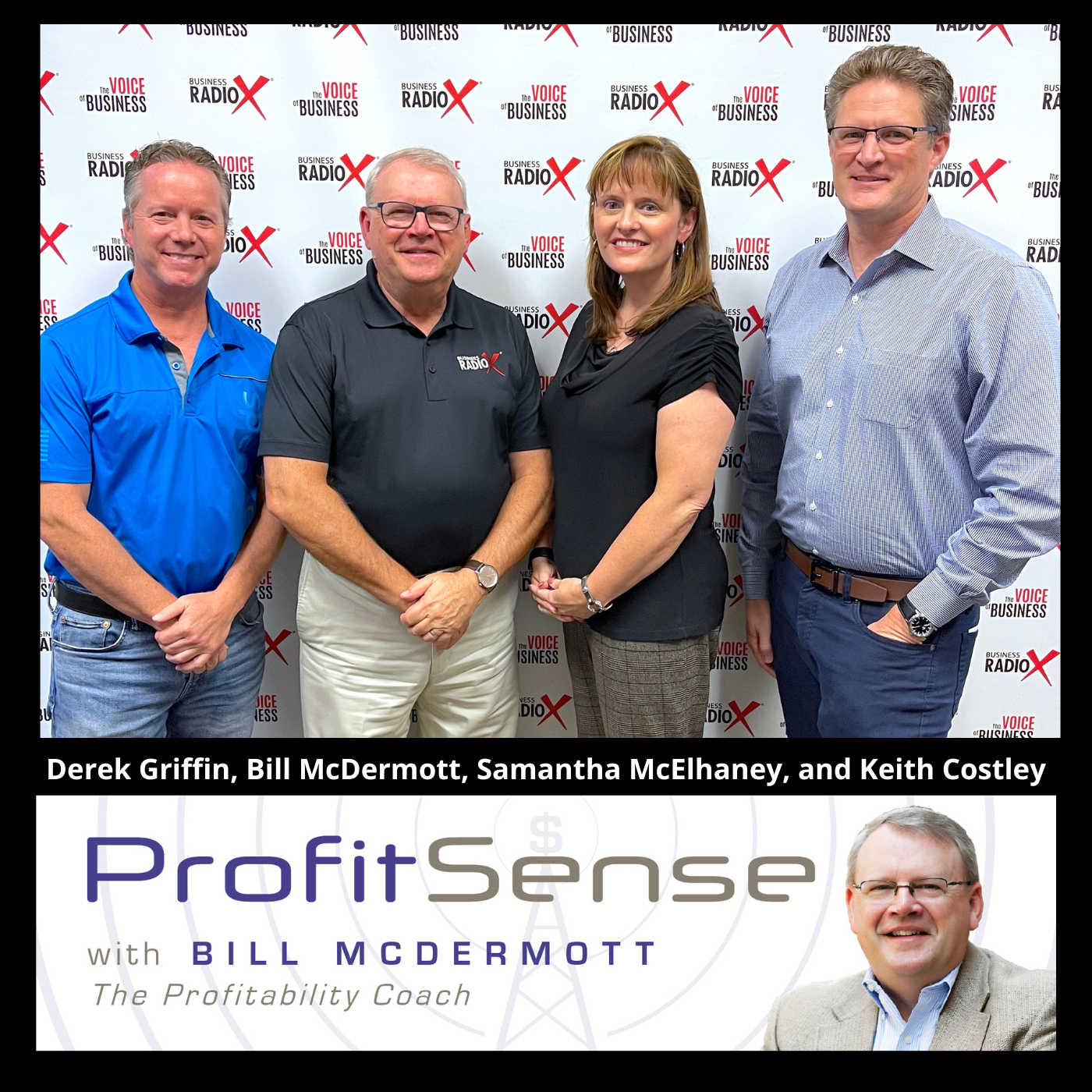
Samantha McElhaney, SouthState Bank, Keith Costley, Keck & Wood, Inc., and Derek Griffin, Speartek

August 15, 2022 by John Ray

Speartek Samantha McElhaney
North Fulton Studio
Samantha McElhaney, SouthState Bank, Keith Costley, Keck & Wood, Inc., and Derek Griffin, Speartek
Loading
00:00 /
RSS Feed
Share
Link
Embed

Download file

Speartek

Samantha McElhaney, SouthState Bank, Keith Costley, Keck & Wood, Inc., and Derek Griffin, Speartek (ProfitSense with Bill McDermott, Episode 35)

Host Bill McDermott was joined by three accomplished business leaders on this edition of ProfitSense. Banker Samantha McElhaney discussed what business owners need to be focused on now, what to look for in choosing an advisor, as well as how she uses her extensive network to assist her clients. Keith Costley shared how his engineering consulting firm develops and retains talent, how collaboration with clients has been so crucial to their success, and his firm’s succession planning process. Derek Griffin talked about how his firm helps gift and home decor firms, industrial products companies, distributors, and other B2B companies with website and e-commerce solutions for their marketing needs.

Bill closed the show with a commentary on the four components of getting a business ready to sell for its maximum value.

ProfitSense with Bill McDermott is produced and broadcast by the North Fulton Studio of Business RadioX® in Alpharetta.

SouthState Bank

SouthState is one of the leading regional banks in the Southeast – serving more than one million customers via 275+ locations in Florida, Alabama, Georgia, the Carolinas, and Virginia. They offer robust banking solutions, including consumer banking, mortgage, small business banking, commercial banking and wealth management.

SouthState bankers care about their customers and each other – and it shows. They are proud to have earned awards for their banking solutions, service, and workplace environment. For the past three years, they’ve been ranked on Forbes’ 100 Best Banks in America and have earned top workplace honors several years running. This is banking at its best. This is banking forward.

Member FDIC and Equal Housing Lender.

Website | LinkedIn |Facebook

Samantha McElhaney, Commercial Relationship Advisor, SouthState Bank

Samantha McElhaney, Commercial Relationship Advisor, SouthState Bank

Samantha McElhaney is a Commercial Relationship Advisor with SouthState Bank.

She is a single mom of twins at the University of Alabama and the University of South Carolina, respectively. She has been in financial services for 28 years this September and currently holds the position of Commercial Banking Advisor in Greater GA.

She loves Lighthouses because they provide hope in the darkness/storms of life and admits she is extremely hard on herself. She leads and participated in small groups at North Point Community Church and Woodstock City Church because her faith is extremely important to her personally and professionally.

And her favorite time of the year – college football season is about to start, so bring on Fall, food, and “fandemonium”.

LinkedIn

Keck & Wood, Inc

Keck & Wood, Inc., founded in 1954, provides professional civil engineering, landscape architecture, and land surveying services to clients throughout the southeast. The company has 65 employees in four offices. Duluth and Fayetteville, GA as well as Rock Hill and North Charleston, SC. Our clients include city and county governments, utility companies, state agencies, education institutions, and private developers.

Company website | Facebook | LinkedIn

Keith Costley, President & CEO, Keck & Wood, Inc.

Keith Costley, President & CEO, Keck & Wood, Inc.

Keith Costley is the President and CEO of Keck & Wood, Inc., a 65-person civil engineering firm headquartered in Duluth, GA. He graduated from Vanderbilt University with a civil engineering degree in 1994 and has become licensed as a Professional Engineer in GA, SC, and NC.

He joined the firm as a Project Manager in their Rock Hill, SC office in 2000 and has steadily progressed his career by becoming the office leader in 2012 and then the President and CEO in 2017.

LinkedIn

Speartek

Speartek is a technology company that builds online business solutions for product-based businesses that sell primarily in Business to Business environments. Yes, that online solution is a website but it is so much more than that because it enables the client to do business with their clients in a much more automated and efficient manner. Clients are typically manufacturers or product importers that well either wholesale to retailers or through a distribution channel. B2B selling is significantly more complex than selling to consumers and many of these client websites are integrated into accounting or ERP systems so that data is exchanged automatically, reducing the administrative costs and time in managing orders. With B2B as a primary focus for the past 20 years, the experience that Speartek delivers coupled with a platform built for B2B is an incredibly valuable combination.

Website | LinkedIn | Facebook | Instagram

Derek Griffin, President, Speartek

Derek Griffin, President, Spearktek

Derek Griffin has spent 22 years as the leader of Speartek, a niche B2B eCommerce solution provider. His background includes being a CPA in public accounting for 7 years as well as a CFO for a $20M manufacturing company. That financial experience and understanding of how a business needs to operate has been tremendously valuable in what Speartek delivers for its clients. Derek has lived in the Atlanta area since 1992, is married and has 2 children. Outside of work, his interests are mountain biking and hiking national parks (up to 30!), live music, and college sports.

LinkedIn

About ProfitSense and Your Host, Bill McDermott

Bill McDermott
Bill McDermott

ProfitSense with Bill McDermott dives into the stories behind some of Atlanta’s successful businesses and business owners and the professionals that advise them. This show helps local business leaders get the word out about the important work they’re doing to serve their market, their community, and their profession. The show is presented by McDermott Financial Solutions. McDermott Financial helps business owners improve cash flow and profitability, find financing, break through barriers to expansion, and financially prepare to exit their business. The show archive can be found at profitsenseradio.com.

Bill McDermott is the Founder and CEO of McDermott Financial Solutions. When business owners want to increase their profitability, they don’t have the expertise to know where to start or what to do. Bill leverages his knowledge and relationships from 32 years as a banker to identify the hurdles getting in the way and create a plan to deliver profitability they never thought possible.

Bill currently serves as Treasurer for the Atlanta Executive Forum and has held previous positions as a board member for the Kennesaw State University Entrepreneurship Center and Gwinnett Habitat for Humanity and Treasurer for CEO NetWeavers. Bill is a graduate of Wake Forest University and he and his wife, Martha have called Atlanta home for over 40 years. Outside of work, Bill enjoys golf, traveling, and gardening.

Connect with Bill on LinkedIn and Twitter and follow McDermott Financial Solutions on LinkedIn.

Tagged With: B2B, banking, Bill McDermott, derek griffin, engineering, Keck & Wood, Keith Costley, ProfitSense, ProfitSense with Bill McDermott, Samantha McElhaney, SouthState Bank, Spearktek, The Profitability Coach

Three Things You Must Know About Key Performance Indicators, with Bill McDermott, Host of ProfitSense

August 1, 2022 by John Ray

Key Performance Indicators
North Fulton Studio
Three Things You Must Know About Key Performance Indicators, with Bill McDermott, Host of ProfitSense
Loading
00:00 /
RSS Feed
Share
Link
Embed

Download file

Key Performance Indicators

Three Things You Must Know About Key Performance Indicators, with Bill McDermott, Host of ProfitSense

In this commentary from a recent episode of ProfitSense, Bill explains three important aspects of key performance indicators, what they are, and how to measure them.

ProfitSense with Bill McDermott is produced and broadcast by the North Fulton Studio of Business RadioX® in Alpharetta.

Bill’s commentary was taken from this episode of ProfitSense.

About ProfitSense and Your Host, Bill McDermott

Bill McDermott
Bill McDermott

ProfitSense with Bill McDermott dives into the stories behind some of Atlanta’s successful businesses and owners and the professionals that advise them. This show helps local business leaders get the word out about the important work they’re doing to serve their market, their community, and their profession. The show is presented by McDermott Financial Solutions. McDermott Financial helps business owners improve cash flow and profitability, find financing, break through barriers to expansion and financially prepare to exit their business. The show archive can be found at profitsenseradio.com.

Bill McDermott is the Founder and CEO of McDermott Financial Solutions. When business owners want to increase their profitability, they don’t have the expertise to know where to start or what to do. Bill leverages his knowledge and relationships from 32 years as a banker to identify the hurdles getting in the way and create a plan to deliver profitability they never thought possible.

Bill currently serves as Treasurer for the Atlanta Executive Forum and has held previous positions as a board member for the Kennesaw State University Entrepreneurship Center and Gwinnett Habitat for Humanity and Treasurer for CEO NetWeavers. Bill is a graduate of Wake Forest University and he and his wife, Martha have called Atlanta home for over 40 years. Outside of work, Bill enjoys golf, traveling, and gardening.

Connect with Bill on LinkedIn and Twitter and follow McDermott Financial Solutions on LinkedIn.

Tagged With: Bill McDermott, Key Performance Indicators, KPI’s, Leverage, metrics, net profit margin, profit, ProfitSense with Bill McDermott, revenue, The Profitability Coach

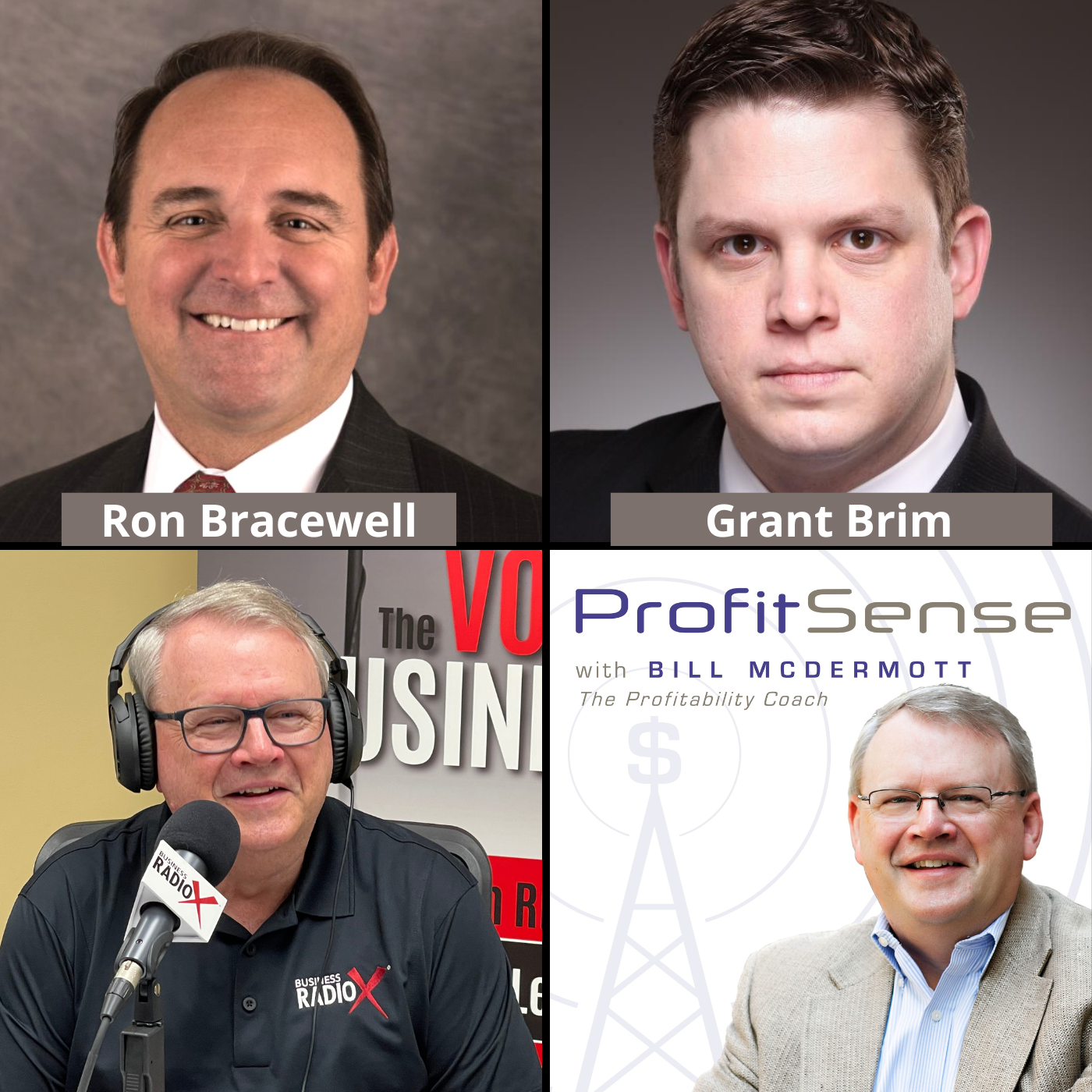
Ron Bracewell, BatesCarter, and Grant Brim, Brim Law, LLC

July 14, 2022 by John Ray

BatesCarter
North Fulton Studio
Ron Bracewell, BatesCarter, and Grant Brim, Brim Law, LLC
Loading
00:00 /
RSS Feed
Share
Link
Embed

Download file

BatesCarter

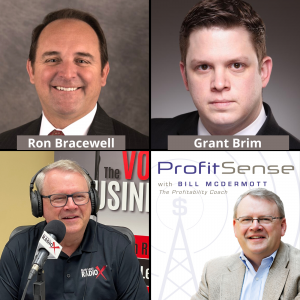
Ron Bracewell, BatesCarter, and Grant Brim, Brim Law, LLC (ProfitSense with Bill McDermott, Episode 34)

Host Bill McDermott was joined by two superb guests on this edition of ProfitSense. Ron Bracewell of BatesCarter discussed business valuation from his perspective as a CPA. Ron covered how a valuation can be used in planning an exit, issues a business owner needs to consider in getting a valuation, and more. Business attorney Grant Brim also joined the show to discuss various legal problems he’s seeing among small businesses today, including trademark infringement. Finally, Bill closed with a commentary on key performance indicators.

ProfitSense with Bill McDermott is produced and broadcast by the North Fulton Studio of Business RadioX® in Alpharetta.

BatesCarter

BatesCarter is a full-service firm founded in 1962, offering traditional accounting, tax and audit services, enhanced with a range of advisory, valuation and consulting services. Their clients are closely held businesses, not-for-profit organizations, government entities and individuals.

They are uniquely experienced and trained to assist clients at every stage of growth, helping them reach their goals and build value, now and in the future. Just like their clients, they are business people, sharing the same challenges and facing the same decisions their clients do. They know that the financial decisions their clients make today will shape their future.

For that reason, they are dedicated to doing their very best every day. As trusted advisors they know that their clients rely on them for timely, relevant guidance. They look forward to exceeding expectations. Always.

Company website | Facebook | LinkedIn

Ron Bracewell, CPA, APV, Managing Partner, BatesCarter

Ron Bracewell, CPA, APV, Managing Partner, BatesCarter

Ron Bracewell is a CPA with nearly 40 years experience in a variety of areas of public accounting including audit, tax and consulting. He is also Accredited in Business Valuation (ABV) recognizing his substantial experience and knowledge in valuations of closely held businesses.

In addition to his technical responsibilities to his clients, he is the Managing Partner of BatesCarter attending to its administrative and strategic needs. Much of Ron’s time is devoted to his clients’ business transfer challenges including estate, gift and valuation consulting for succession planning as well as M&A consulting for sales of entire companies or controlling interests.

Ron and his wife, Susan, just celebrated their 35th anniversary and are the proud parents of 3 sons. They are also blessed with 2 grandsons. Over his career, he has held a variety of leadership positions in community, religious, and business organizations.

When not working or volunteering, he enjoys golf, guitar, and of course, grandchildren!

LinkedIn

Brim Law, LLC

Brim Law represents businesses throughout the state of Georgia as their outsourced in-house counsel. The firm’s services cover a variety of issues, including consultation and document preparation, employment relationships, vendor agreements, general contract review, asset purchases, mergers, and brand protection, to name a few.

Brim Law strives to provide the highest quality legal representation to each and every client. The firm works closely with its clients to answer their questions, explain their rights and obligations, and ultimately to protect their interests.

Company website | Facebook | LinkedIn

Grant Brim, Founder, Brim Law, LLC

Grant Brim, Founder, Brim Law, LLC

Grant Brim is a business attorney in Roswell, and the founder of Brim Law, LLC. Grant has been in practice for fifteen years and started his firm in 2011. After graduating from Georgia State University Law School in 2007, Grant practiced primarily as a litigator for several years. His litigation experience informs his work daily as he understands the mistakes and pitfalls that can expose companies to unforeseen and costly liabilities. Over the years, Grant’s practice evolved from litigating business disputes to helping prevent them in the first place.

His legal services are geared towards helping clients navigate the often treacherous legal landscape that comes with running a business. Grant is focused on providing quality representation to his clients. He appreciates the opportunity to develop relationships with his clients that will endure over the life of their businesses. Grant’s goal is to be a trusted advisor for his clients for the myriad of legal issues that small and medium size businesses face.

Grant has lived in Roswell since 2009 with his beautiful wife and best friend, Elina, and their son, Nathan.

LinkedIn

About ProfitSense and Your Host, Bill McDermott

Bill McDermott
Bill McDermott

ProfitSense with Bill McDermott dives into the stories behind some of Atlanta’s successful businesses and business owners and the professionals that advise them. This show helps local business leaders get the word out about the important work they’re doing to serve their market, their community, and their profession. The show is presented by McDermott Financial Solutions. McDermott Financial helps business owners improve cash flow and profitability, find financing, break through barriers to expansion, and financially prepare to exit their business. The show archive can be found at profitsenseradio.com.

Bill McDermott is the Founder and CEO of McDermott Financial Solutions. When business owners want to increase their profitability, they don’t have the expertise to know where to start or what to do. Bill leverages his knowledge and relationships from 32 years as a banker to identify the hurdles getting in the way and create a plan to deliver profitability they never thought possible.

Bill currently serves as Treasurer for the Atlanta Executive Forum and has held previous positions as a board member for the Kennesaw State University Entrepreneurship Center and Gwinnett Habitat for Humanity and Treasurer for CEO NetWeavers. Bill is a graduate of Wake Forest University and he and his wife, Martha have called Atlanta home for over 40 years. Outside of work, Bill enjoys golf, traveling, and gardening.

Connect with Bill on LinkedIn and Twitter and follow McDermott Financial Solutions on LinkedIn.

Tagged With: attorney, BatesCarter, Bill McDermott, Brim Law, business valuation, CPa, ProfitSense with Bill McDermott, Ron Bracewell, The Profitability Coach

One of the Most-Googled Financial Questions, with Bill McDermott, Host of ProfitSense

June 29, 2022 by John Ray

Financial Questions
North Fulton Studio
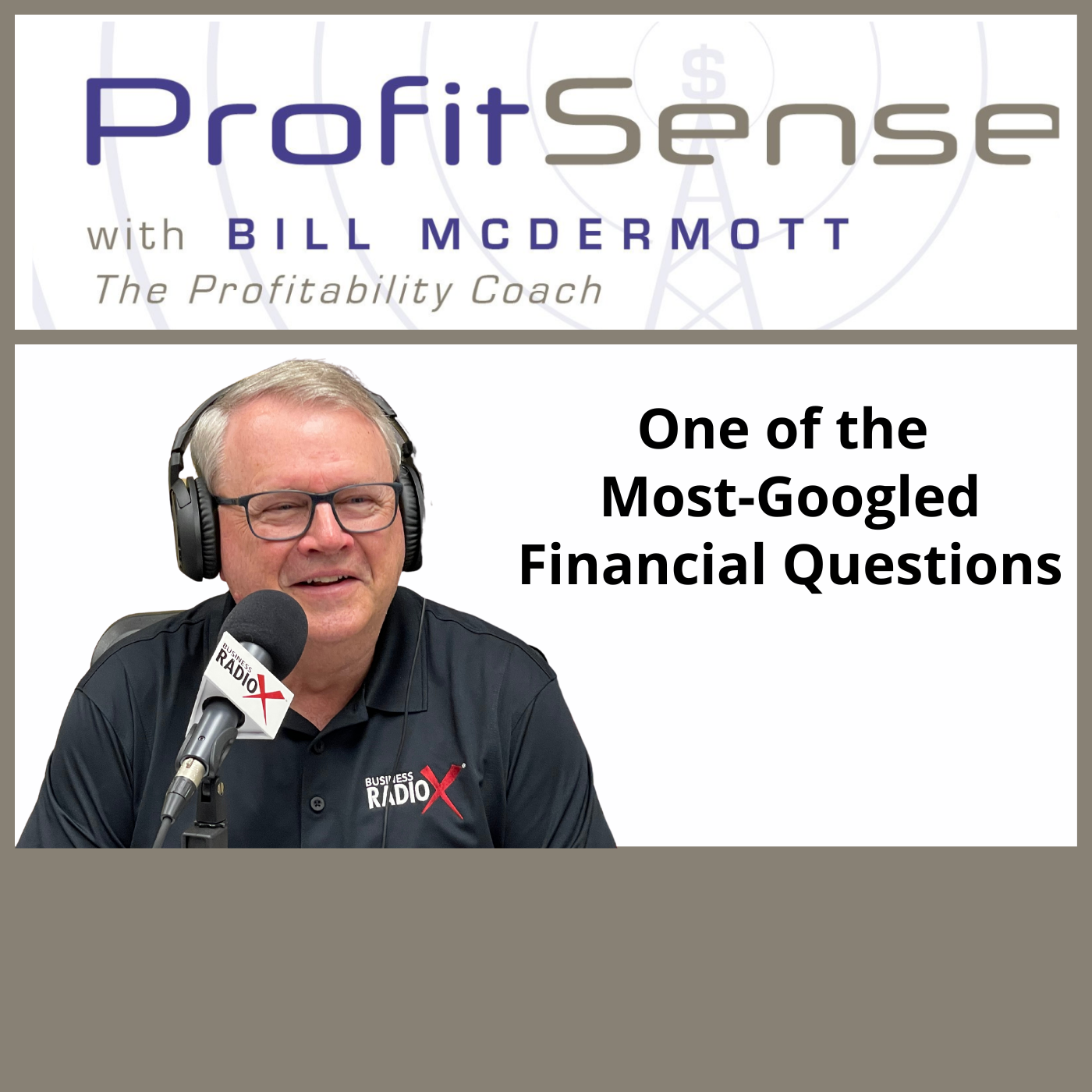
One of the Most-Googled Financial Questions, with Bill McDermott, Host of ProfitSense
Loading
00:00 /
RSS Feed
Share
Link
Embed

Download file

Financial Questions

One of the Most-Googled Financial Questions, with Bill McDermott, Host of ProfitSense

In this commentary from a recent episode of ProfitSense, Bill notes that one of the most often searched financial questions is about insurance and estate planning. He lays out the kinds of insurance a business owner should be concerned with both personally and for the business.

ProfitSense with Bill McDermott is produced and broadcast by the North Fulton Studio of Business RadioX® in Alpharetta.

Bill’s commentary was taken from this episode of ProfitSense.

About ProfitSense and Your Host, Bill McDermott

Bill McDermott
Bill McDermott

ProfitSense with Bill McDermott dives into the stories behind some of Atlanta’s successful businesses and owners and the professionals that advise them. This show helps local business leaders get the word out about the important work they’re doing to serve their market, their community, and their profession. The show is presented by McDermott Financial Solutions. McDermott Financial helps business owners improve cash flow and profitability, find financing, break through barriers to expansion and financially prepare to exit their business. The show archive can be found at profitsenseradio.com.

Bill McDermott is the Founder and CEO of McDermott Financial Solutions. When business owners want to increase their profitability, they don’t have the expertise to know where to start or what to do. Bill leverages his knowledge and relationships from 32 years as a banker to identify the hurdles getting in the way and create a plan to deliver profitability they never thought possible.

Bill currently serves as Treasurer for the Atlanta Executive Forum and has held previous positions as a board member for the Kennesaw State University Entrepreneurship Center and Gwinnett Habitat for Humanity and Treasurer for CEO NetWeavers. Bill is a graduate of Wake Forest University and he and his wife, Martha have called Atlanta home for over 40 years. Outside of work, Bill enjoys golf, traveling, and gardening.

Connect with Bill on LinkedIn and Twitter and follow McDermott Financial Solutions on LinkedIn.

Tagged With: Bill McDermott, business insurance, disability insurance, estate plan, Financial questions, life insurance, ProfitSense with Bill McDermott, umbrella policy

The Financial Side of a Professional Services Firm: An Interview with Profitability Coach Bill McDermott

June 7, 2022 by John Ray

Profitability Coach Bill McDermott
North Fulton Studio
The Financial Side of a Professional Services Firm: An Interview with Profitability Coach Bill McDermott
Loading
00:00 /
RSS Feed
Share
Link
Embed

Download file

The Profitability Coach

The Financial Side of a Professional Services Firm: An Interview with Profitability Coach Bill McDermott

Profitability Coach Bill McDermott, who works with law firms, engineering firms, consulting firms, and other professional services practices, joined host John Ray to discuss the financial side of a professional services firm. Bill discussed why he started his practice and how it has developed, when to take on debt, the biggest financial mistakes he sees, buying hard assets such as real estate, planning for an exit, and much more.

The Price and Value Journey is presented by John Ray and produced by the North Fulton studio of Business RadioX®.

 Bill McDermott, The Profitability Coach

Bill McDermott, The Profitability Coach

Bill has worked with hundreds of business owners. They are good people with their hearts in the right place. What they don’t have is the perspective to see the blind spots in their business. Knowing which levers to pull and when to pull them can lead to a thriving and profitable business.

He loves to help business owners have the business they want by becoming better financial managers.

Bill McDermott graduated from Wake Forest University and launched a career in banking that spanned 32 years. He first started out as the “repo man” as part of Wachovia Bank’s management training program before locating to Atlanta to work for Peachtree Bank, which later became SunTrust. There, he distinguished himself as a great producer of loans and deposits for the bank, climbing the ranks to ultimately become a Group Vice President in the Commercial Banking division. In 2001, Bill’s group won the SunTrust Cup for being the highest performing commercial banking group in the company.

Over the next 8 years, Bill worked in community banking, becoming a top producer for IronStone Bank and later helping to double Embassy National Bank’s initial capital in loan production within 15 months. However, in early 2009 as the Great Recession was rapidly altering the economy, Bill’s position as Chief Commercial Lender was eliminated.

As Bill searched for what was “next”, he realized that he had a desire to share the treasure trove of knowledge of banking and financial acumen he had built. Bill combined his sales success from his banking/insurance experience with his deep financial/analytical skills and launched McDermott Financial Solutions in April 2009. His purpose quickly became “making business owners better financial managers”. Over the past 11 years, he has served over 200 clients by delivering results-oriented insights, helping to take them from financial confusion to financial clarity.

Bill currently sits on the board of directors for Pinnacle Bank. He also hosts a monthly podcast, ProfitSense, which features stories of successful business owners and the professionals that advise them. When Bill is not working, you can find him on the golf course, gardening, spending time with his family, and leading a small group at his local church.

Website | LinkedIn | Instagram


TRANSCRIPT

John Ray: [00:00:00] And hello again. I’m John Ray on the Price and Value Journey. And I want to welcome Bill McDermott to the show. Bill is here to chat about the financial side of a professional services firm.

John Ray: [00:00:13] Just a little background on Bill. Bill is the founder and CEO of McDermott Financial Solutions. He serves as a profitability coach to his clients, which include a lot of professional services firms. When business owners want to increase their profitability and they don’t have the expertise to know where to start or what to do, Bill leverages his talents, his knowledge, and his relationships from 32 years as a banker – somehow he made 32 years. I’m going to have to ask him how he did that – to identify the hurdles that get in the way, and create a plan to deliver profitability that his clients never thought possible.

John Ray: [00:00:57] Bill also serves as a treasurer for the Atlanta Executive Forum. He’s previously held positions as a board member for the Kennesaw State University Entrepreneurship Center and the Gwinnett Habitat for Humanity Chapter. And he has been treasurer for CEO Netweavers. He’s a graduate of Wake Forest University – go, Demon Deacons. And he and his wife, Martha, are just about to celebrate anniversary number 45. Congratulations on that, Bill. And I have to plug his podcast, ProfitSense with Bill McDermott, coming up on three years, right, Bill?

Bill McDermott: [00:01:36] It is. And it’s a pleasure to be here, John. Thanks so much for having me.

John Ray: [00:01:40] Absolutely. So, I want to give a little background on you. You spent three decades as a banker, how –

Bill McDermott: [00:01:54] How did I survive?

John Ray: [00:01:55] Well, you could certainly answer that question. But, I guess, how did you come to the choice of the practice that you started?

Bill McDermott: [00:02:05] Yeah. That’s a great question. I’ll give you the short version of a longer story. So, it was April of 2009, we had just entered The Great Recession, we were in a banking crisis. And the CEO of the bank that I was working for at the time walked in my office – it was actually on my wife’s birthday – and he said, “Bill, you’re doing a great job, but we’ve got to cut cost. You were the last one in, so you’re the first one out. We’re eliminating your position.” And I was done.

Bill McDermott: [00:02:36] And so, we had two daughters in college. I had to figure out a way to earn an income. So, first thing I did was pray. And I said, “Okay. You’ve closed the door. Open a window, and would you mind putting a little neon around it for me so I can see it?” But all kidding aside, in 32 years of banking, I saw that business owners were usually great salespeople or great operations people. Where they struggled was in the area of financial management. They didn’t learn it in school. And when you’re the owner of the business, there’s no on-the-job training because the buck stops with you.

Bill McDermott: [00:03:16] So, part of my why is, because I saw business owners struggle with financial management, I said, “Can I launch a business leveraging my expertise and knowledge in banking and help business owners become better financial managers?” So, the business started with that in mind. And my goal is to really, hopefully, leave a legacy of making business owners better financial managers in their business.

John Ray: [00:03:41] And you just celebrated a business anniversary, speaking of anniversary.

Bill McDermott: [00:03:45] Yeah. So, April was 13 years, and still going strong.

John Ray: [00:03:51] Congratulations.

Bill McDermott: [00:03:53] Yeah. Thank you so much.

John Ray: [00:03:54] That’s awesome. I think a lot of professional services practitioners, they get into business and then they pivot along the way, not pandemic related pivot, but their business morphs naturally. Yours has morphed along the way. Why don’t you explain that and kind of the decision points around that.

Bill McDermott: [00:04:17] Yeah. So, when you’re in the middle of a banking crisis, a lot of businesses are losing money. And so, I actually started negotiating workout plans on behalf of the business owner with their bank. You know, who better to negotiate a problem loan? A banker with another banker.

Bill McDermott: [00:04:37] And so, I successfully did that for several years. I had one client that I actually worked with for three years. We started with $16 million in debt, worked that down to a million. And, actually, the bank drew a line in the sand and said we’re not renewing anymore. Forced us into bankruptcy. And the bank eventually settled for $0.10 on the dollar, so we got $1,000,000 for $100,000 and, basically, negotiated out. So, that’s really how I started.

Bill McDermott: [00:05:10] When you negotiate a problem for a business owner, you become on the team because you two have been through it together. And so, what then happened is I had business owners asking me to come out and sit with them and go through their monthly financials. Well, I’m not the sharpest tool in the shed, but pretty soon I figured out, you know, a monthly meeting going over financial performance with the business owner, I’m coaching them how to be better.

Bill McDermott: [00:05:45] And so, what morphed is, is doing workout loans, actually became a practice where I’m coaching business owners on how to be better financial managers. And then, probably sandwiched between that is I have some of my clients want to leverage my banking expertise, and so I would help them find financing if they were buying a building, if they were getting a large piece of equipment, maybe that business owner who thinks they need a line of credit.

Bill McDermott: [00:06:12] By the way, best time to borrow money from a bank is when you don’t need it. Anyway, that’s maybe even another podcast for another day. We’ll go there.

John Ray: [00:06:20] When you don’t need to hire Bill McDermott, right? I mean, you get the folks that really need that financing, right?

Bill McDermott: [00:06:28] Yeah, exactly. And so, from workouts to financing, and then to the profitability coach. And that’s kind of been my path.

John Ray: [00:06:38] Wow. So, let’s describe for folks that don’t know what does a profitability coach do. You say you look at financials every month, but there’s more to it than that.

Bill McDermott: [00:06:47] Yeah. There really is. So, I’m going to start by saying that a profitability coach, first, speaks the language of business. Warren Buffett was quoted as saying, “Accounting is the language of business. And you, as a business owner, not only need to learn how to speak it, but how to become fluent.” And that language actually comes out in the form of reports, balance sheet, profit and loss statement, cash flow statement.

Bill McDermott: [00:07:17] Where I help a business owner is, most business owners understand their profit and loss statement. They generally don’t look at their balance sheet. And they hardly ever look at their cash flow statement. And so, what a profitability coach does is analyzes the trends in the business, helping that business owner see those trends, asking questions about what might be driving those trends, and then helping them make decisions.

Bill McDermott: [00:07:43] But probably the biggest thing, John, is, if you own your own business, you’re not accountable to anybody. And so, part of what a profitability coach really does, or any business coach for that matter, is holds that business owner accountable for, not only the dreams that they have, because those dreams usually convert to goals and those goals convert to plans, but somewhere along the way – it’s kind of like, you know, all of us want to lose weight January 1. And so, the gyms and the exercise places fill up for about two weeks. But after about the first two weeks they’re done. Well, nobody’s holding them accountable – part of what a profitability coach does is, not only help them become better financial managers, but holds them accountable to what their dreams and their plans and their goals are.

John Ray: [00:08:31] So, really, it sounds like your knowledge of the financials, how to read the financials, and the business owners knowledge of the business, and what’s going on day-to-day meet, essentially, right?

Bill McDermott: [00:08:44] That’s exactly right. Because, you know, part of that three decades in banking, I literally looked at thousands of financial statements because I had to look at financial statements to determine whether that business owner could borrow money or not. And so, the ability to interpret those financials helped me become trained in helping that business owner.

Bill McDermott: [00:09:05] So, you’re absolutely right. Generally, if a business wants to improve, there are really about five things that they need to look at. There’s either a people aspect of their business, there’s a strategy aspect, there’s an execution issue, there’s a process issue, or there’s a money issue. And so, people, process, strategy, execution, and cash are usually things that business owners need to pay attention to in order to be successful.

John Ray: [00:09:37] So, for those that don’t know, what’s the difference between a profitability coach and a fractional CFO? And when do you bring these different roles in? Or are they different?

Bill McDermott: [00:09:51] They’re absolutely different. So, right now, I have a very successful client who has basically managed the financial aspect of their business for 30 years. He still wants to keep me as a coach, but he doesn’t want to do financial management anymore, so he has hired a part time CFO to come in and run the business.

Bill McDermott: [00:10:15] Because having someone fulltime, first, it’s not that big a job and he doesn’t want to pay $200,000 a year, whatever a CFO gets these days. So, you want to hire a part time CFO if you just don’t want to have to be involved in the financial management of the business. You want a part-time CFO. Or if you want to do that yourself, you can. But, again, you better be able to speak the language.

Bill McDermott: [00:10:45] Now, actually, I will tell you, I coach a lot of business owners that have a part-time CFO and, primarily, a lot of that CFO role is about accounting. They make sure that they have all the debits and credits entered into QuickBooks or whatever accounting software is used. They’re able to generate the reports. But, generally, everything that that part-time CFO does is really about the past, because accounting is accounting for the past. It doesn’t really have much to do with the present or the future.

Bill McDermott: [00:11:18] So, kind of where they leave off is where I pick up. And we start talking about what are your goals for this year or this quarter, and where are you in relation to getting those goals accomplished. And, basically, working together with them, holding them accountable to what they want to do for the future, not necessarily focusing on the past.

Bill McDermott: [00:11:42] So, you can have both, but there is a difference. Most of the time, the part-time CFO is directly responsible, involved with financial management. But that CFO doesn’t really hold the business owner accountable to what their goals and dreams are. And so, that’s really what I’ve been doing as a profitability coach, helping them achieve their goals and dreams and become more profitable.

John Ray: [00:12:04] Do you find you can be in those cases a little more, maybe direct is the word, with the business owner, more of their mother-in-law -maybe that’s a bad metaphor – but you can be a little tougher when needed?

Bill McDermott: [00:12:20] I think part of it. And you said direct. I’ve had a few clients call me blunt, which I can be more than direct at times, and I’m working on that. But, no. I think, yeah, if someone is paying you to give advice then, by golly, they should take it.

Bill McDermott: [00:12:45] And I did give a lot of free advice when I was in banking because as I was looking at the financial statement, especially if I had to decline someone, I said, “Look, you, as the business owner, made $100,000 in profit, but you took out 75,000 in distributions. So, you only have a fourth of what you made available to handle the growth of the firm and pay back a loan if you choose to borrow.” And so, just little things like that are the things that I’ve done. But, yeah, sometimes you do have to be direct. And, again, if I’m holding someone accountable by being nice, I’m not really helping them.

John Ray: [00:13:28] Yeah, for sure. So, this show is designed for solo, small firm, to some degree, medium sized firm professional services providers, let’s talk about the needs here. I mean, at what point do you think a solo firm, a solopreneur, needs to hire a profitability coach?

Bill McDermott: [00:13:56] That’s a great question. And I want to be respectful, there are a lot of people out there that believe in doing it themselves. That is a totally valid way. But it’s interesting, there’s a guy by the name of Doug Tatum, Tatum CFO, who wrote a book titled No Man’s Land. And that book was really about his experience as being a CFO where growing companies fail. And he talks about the five M’s.

Bill McDermott: [00:14:27] John, so to your question, when do you feel like you should hire a profitability coach, one of the M’s that he mentioned is momentum. If your business has lost momentum, if your rate of sales is either decreasing, flat, or not increasing in proportion to what you’re expecting, you might want to hire a coach.

Bill McDermott: [00:14:47] Another thing is marketing. Marketing is the number one weakness in a growing firm. And so, if you’re not properly identifying your brand, to your point, about value, if you’re not sure of your value in the marketplace, you might need some help there. So, momentum marketing, management. Growing firms, growth, it makes businesses more complex. And so, you may have management issues that you need to address.

Bill McDermott: [00:15:21] Fourth, M is money. You know, when you’re growing, as you know, growth always requires cash. And if you have this big crazy number in accounts receivable and you’re complaining about a low bank account, well, by golly, then get on the phone and collect some of those past dues.

Bill McDermott: [00:15:38] So, marketing, momentum, management, money – I’m trying to remember what the fifth one was and it escapes me right now. But, in essence, I would think that you would hire a coach if you find yourself not hitting on all cylinders in some of those things.

John Ray: [00:15:54] Right. Right. So, I’m curious, it sounds like – you just answered the question I was about to ask – the biggest mistake solopreneurs make is not hiring outside help fast enough.

Bill McDermott: [00:16:12] Yeah. And so, part of my questions, because I want to be sure that the particular person that I’m talking to is really interested, and so I might ask them, “Look, if you’re in your car and you’re lost, do you keep driving or do you stop and ask for directions?” And the people that are probably going to keep driving kind of identify themselves as “I’m kind of a do it yourself-er. By golly, I don’t really need to stop and ask for help.” But those that ask for help, I want to help them.

Bill McDermott: [00:16:51] So, I worked with a professional services practice for about three years. When I started with that practice, a lot of their receivables were reimbursements from insurance companies. And what I saw was a huge amount of accounts receivable, and a lot of them were 60 or 90 days outstanding. Insurance companies are horrible at paying claims. You know, they’re paid to hold on to their money, not pay it back to the service providers. And so, we were able to devise a plan where she had a person in her practice that was accountable for making sure those receivables were collected.

Bill McDermott: [00:17:34] Well, then this practice also had a scheduler, and this firm had three locations, had 27 professional providers, but they weren’t maximizing their schedule. And so, there was a lot of holes, a lot of time that was billable time that was lost. And so, together we kind of crafted a scheme that, not only helped collections, but also helped increase appointments.

Bill McDermott: [00:18:03] And by the way, also talking about can we increase rates for reimbursements to the insurance companies, and the answer is yes, because a one percent increase in your price is about an eight to a ten percent increase in your bottom line. So, talking about Price Value Journey, a lot of that is just learning that raising prices is an immediate direct hit to your bottom line.

Bill McDermott: [00:18:29] But long story short, we were able to increase the revenue over a two year period of time in this professional practice 64 percent, so it’s about 32 percent a year. And we took about $100,000 out of the accounts receivable, put that into cash. So, not only did they have more profit, but they also had more cash to boot. So, this firm had been limping along for a year. I was introduced to them by their CPA. We were able to come in and help them. And they’re continuing to thrive to this day.

John Ray: [00:19:05] So, you brought up pricing, so forgive me but I can’t help going down that road. Let’s do that. I mean, my contention is, is that the biggest problem financial or professional services providers have is their pricing. Do you agree with that?

Bill McDermott: [00:19:27] A hundred percent. And I’ll tell a personal story. When I started my business 13 years ago, I’m figuring what do I charge. And, of course, when you first start, you’re not even sure you know what your value proposition is. And so, I said, “Okay. I’m going to start at this rate.” And by the way, it was an hourly rate. And so, by setting an hourly rate, I unintentionally got to the point where I was perceived as a commodity because I’m paid by the hour. There’s no value there.

Bill McDermott: [00:20:04] And by the way, my experience is, I, actually, in the first three years, tripled my hourly rate because the first rate that I thought it was worth was woefully low. And so, I had to work to the point where I had to find somebody to tell me that my rates were too high before I knew that I was right where I should be to begin with.

Bill McDermott: [00:20:31] But the other thing is, I read a really good book that, basically, introduced me to the concept of value-based pricing. So, to kind of use that example of the professional services practice I talked about, I mean, the amount of money that that firm paid me was probably about, I’m going to say, half of the profit that I delivered. So, essentially, if you think about it, they covered their cost and I gave them 100 percent return on their investment.

Bill McDermott: [00:21:15] So, the whole concept of value-based pricing was a total shift for me, John. And believe me, I have not arrived on this journey. I’m still learning. But switching from an hourly rate to a fixed fee, and doing that pricing in relation to the value that you’re delivering to your client makes sense. I can think of another story.

John Ray: [00:21:44] Yeah. Please.

Bill McDermott: [00:21:45] So, early on, I was involved in a loan negotiation with the bank, and it was a big loan. And so, I want to say the loan was about $2 million. And so, I said, “Okay. If I can deliver a discount of 20 percent, $400,000, what amount would you be willing to pay?” “Five percent.” So, $20,000. So, we got into the negotiation with the bank, it took me an-hour-and-a-half. And I successfully negotiated $20,000 of fees for 90 minutes worth of work. So, I don’t know what that comes out to for an hourly rate. But I delivered the value and got paid a percentage.

Bill McDermott: [00:22:41] And so, the concept in my practice that I’ve implemented, but I’m still figuring out is, price based on the value that you’re creating for your client. Don’t price on an hourly rate, if you can. Now, there are some practices that are comfortable with hourly pricing, and I’m not saying they shouldn’t do that, but they might be leaving money on the table that could be theirs instead of someone else’s.

John Ray: [00:23:11] You said when you were talking about that first example that when you were pricing hourly, you were regarded as a commodity. Explain more on that. Say more on that.

Bill McDermott: [00:23:26] Yeah. So, I think I’m going to use an analogy and, hopefully, explain in the meantime. Everybody shops at Walmart. Walmart struggles with customer service because they’re so big. But you know that you can go into Walmart and you can get the lowest price. And if there’s no supply chain disruption, they’ll have it in stock. But, still, Walmart doesn’t really add value because there’s no one there to help you. And if you wait in the checkout line, you’re probably going to wait a long time.

Bill McDermott: [00:24:09] Versus Ace Hardware. I go into Ace Hardware. Ace Hardware has everything. And when you walk in the front door, there’s someone there at the door that’s going to greet you and says, “Sir, what can I help you with?” And I say, “I need a 20 pound bag of birdseed.” Takes me right to the aisle right where the birdseed is and say, “Look. You got three choices. These are the prices. Clients ask for this one the most.” And I get service. There’s value. Because I don’t want to wander the aisles of Ace Hardware trying to find it. I want to be created by someone who knows where it is, knows what they’re talking about. And I can get through the checkout line quickly. So, there’s value in going to Ace Hardware that I don’t think you get at Walmart, in my personal opinion.

Bill McDermott: [00:25:00] So, what I had to figure out is if I couldn’t describe my value to someone – and believe me, describing my value, that’s on me – if I can’t accurately describe the value that I’m delivering to my clients, I default to a commodity. Because if I’m not Ace Hardware, they’re going to see me as Walmart. And they’re going to say, “Well, this is his price. Is it worth it to me to pay that?” It’s the difference between looking at it as a cost versus an investment, too, John.

John Ray: [00:25:35] Yeah. No, that makes sense. And just to be clear – and I probably should have let folks know this at the top of the show – so the professional services can be a big category, but you work with engineering firms, architectural firms, psychiatric related firms.

Bill McDermott: [00:25:59] Marketing agencies.

John Ray: [00:26:03] Attorneys, legal practices, what are some of the others? Have I mentioned most of them there?

Bill McDermott: [00:26:08] Most of them. I’ve got, certainly, a different aspects. I have, actually, three engineering firms. One is mechanical engineering, one of them is civil engineering, and then I also have one that’s environmental engineering. Several different attorney firms, some that work in the employee benefits arena, some of that are litigators. I’ve worked with a few CPA practices. I’ve worked with a couple of marketing agencies. I’ve done work with one of the top interior designers in the southeast. And so, yeah, professional services, generally, those professional services providers are great technicians at their craft, but they really struggle with the business aspect.

Bill McDermott: [00:27:03] But my practice is I’ve worked with solopreneur. I’ve worked with firms that are anywhere from ten people to, I’d say, 50 people. Probably, the largest firm I’ve worked with is a large contracting firm in Northwest Atlanta that has about 400 people. But, yeah, I really love professional services firms because, generally, they’re great technicians, they’re great at their craft. But when they were going to school, nobody taught them business. You know, business is not an undergraduate requirement to get your degree. And, certainly, if you don’t learn it in school, then you either got to learn it somewhere along the way or have a coach to come in and help you learn it.

John Ray: [00:27:55] Now, you’ve talked quite extensively here about the importance of pricing. And we both know that professional services firms, they don’t have inventory, they don’t have a lot of the same kind of capital expenditures, maybe any, that a lot of other firms have. When you talk to your clients, are you focused mostly around pricing or are there other aspects of the income statement that you hone in on?

Bill McDermott: [00:28:29] So, we’re focusing almost entirely on revenue because revenue is the largest number. And so, any percentage increase in revenue creates the biggest change. And so, one of the things that I would say, if you’re a solopreneur out there or look at what I call a revenue multiplier, some people call it a labor multiplier – so an architectural practice that I’m working with right now, they have a bill rate but then they also have a pay rate for engineering work that needs to be done.

Bill McDermott: [00:29:07] And so, that bill rate, of course, incorporates that engineering cost associated with it. But the gross profit is basically what’s left. And so, the higher that you can charge your bill rate against that pay rate that you’re paying out the engineering costs, the higher your gross profit is going to be.

Bill McDermott: [00:29:28] So, what we focus on, if you have an engineering cost for an architect that’s maybe $100, and you can bill that client $150, then your revenue or your labor multiplier is 1.5, if I’m doing the math right, because 150 divided by 100 is 1.5. And so, can you drive that multiplier up? Can you get it to 1.6 or can you get it to 2?

Bill McDermott: [00:29:55] And so, for this particular architectural firm, we’ve actually gone from about a 2.3 revenue multiplier in two years. Right now, we’re north of 3. And so, what that means in terms of gross profit is their gross profit was running probably in the mid-60s. It’s now up into the mid-80s, John. So, the incremental gross profit is falling right down to their bottom line. They’re well on their way through April of making probably two-thirds of the profit that they made last year.

John Ray: [00:30:32] Wow. Now, there’s some value right there that you deliver. Wow. What a great story. So, we talked about solopreneurs, now let’s talk about small, medium-sized professional services firms. They get to a certain size, what are some of the financial mistakes that you see that firms like this make that are common?

Bill McDermott: [00:30:58] Gosh. Let me think about that a minute. I think, first, customer concentrations can be a little bit risky. I do have a particular firm that I work with that is heavily concentrated in one particular client, makes up about 30 percent of their business. My rule of thumb, going back to my banking days, is probably to the extent that you can, limit your concentrations to maybe 15 percent of your total revenue to any one client. So, certainly, revenue concentrations.

Bill McDermott: [00:31:37] Other mistakes would be probably some mindset issues. A lot of business owners are willing to accept mediocre performance. When in reality, they have some self-limiting beliefs that are holding them back. And so, I can certainly expand on that.

Bill McDermott: [00:32:04] But, you know, a quick story is I had a client that I worked with who was in the engineering practice business. He didn’t really feel that he could deliver the value that he really did. And we got through that to the point where he was willing to, first, educate himself on the benefits of value-based pricing, implement it, and then reap the results. So, probably some of it is self-inflicted.

Bill McDermott: [00:32:39] You know, when I started my business, I didn’t know how much to charge. I had some self-limiting beliefs about what I was worth. And so, I would say that would be an item.

Bill McDermott: [00:32:49] And then, I would say, growing a business is really all about people and processes. And so, where I think some solopreneurs or small to medium-sized firms make some mistakes is they either have the wrong people. And when I say wrong, I’m talking about people that don’t really share the company’s core values or core focus, or that person is in the wrong seat. They’re not playing to that person’s strength.

Bill McDermott: [00:33:21] Probably the other thing, in addition to that wrong people, is documented processes. If you want to be an effective and an efficient organization, you’ve got to have documented processes. Because if you have 15 people in your billing department and each of those 15 people has a different way that they do billing, you got problems. And so, documented processes. And if they are documented, you need to inspect what you expect, which means making sure that the processes are being followed. So, those would be the three things that really stick out.

John Ray: [00:34:01] Let’s talk about debt. I mean, when should a firm as they grow start to take on debt? You say it’s when they don’t need it. Say more on that and what you counsel business owners.

Bill McDermott: [00:34:17] So, get a line of credit. There are people who basically believe that I don’t want to have any personal debt in my consumer, in my personal household, the way they run their household. But running a business and running a household are two different things. So, for a line of credit, I would say one month’s revenue is a good rule of thumb. So, if you’ve got a $3 million company that’s a $250,000 line of credit. Don’t base it based on last year’s revenue. Base it on this year’s revenue. So, that would be one thing.

Bill McDermott: [00:35:00] And, generally, year-end financials are in by January or February. Most banks are going to want to see a full fiscal year and then the most recent interim in order to approve a line.

Bill McDermott: [00:35:16] But I would say that I have another business that I work with that does steel fabrication for construction. They have done a great job of purchasing equipment that has technology associated with it that reduces their overall labor costs. They still have people working in their plant, but they have invested in equipment and technology to improve their operating performance. And so, borrowing for a piece of equipment where you find that you can increase your profit margin because of efficiency doing that.

Bill McDermott: [00:35:58] Right now, I’ve got three clients that are either building a building or buying a building. Rent is pretty expensive. A lot of times, depending on the requirements that you have on your building, you might need special electrical requirements. You might have special ceiling requirements, zoning requirements, things like that. But, you know, borrowing money to buy your own building versus paying rent every month is valid.

Bill McDermott: [00:36:31] Probably the most interesting thing right now is us, baby boomers, we’re getting ready to retire. And I’ve got three clients that I’m working with right now that are in various stages of exiting. And, of course, on my last podcast, we had a gentleman who is in the process of ownership transition. We had a banker who came on and spoke about financing those transactions. So, finding a financing source for your business to sell it or buy it is something that is very much top of mind for business owners right now, especially if you’re a baby boomer.

John Ray: [00:37:13] Yeah, for sure. So, if you’re a professional services firm, does having hard assets, like real estate, owning your own building, the building you’re operating in, or any other building for that matter, that’s maybe an investment, I mean, is that a good way to use excess cash flow?

Bill McDermott: [00:37:34] So, that’s a great question. I’ll try to answer it in a concise way. So, I have a client who, just on the operating performance of his business alone, earns a 22 percent net income. I’m going to say that real estate on an annual basis does not increase 22 percent. So, does it make sense for him to invest in an asset that is maybe going to appreciate even though he’s building equity in it versus investing in his business?

Bill McDermott: [00:38:09] So, investing in real estate might be a good diversification play because that way he or she doesn’t have all of their eggs in their company basket. So, it’s a little bit personal choice in my view, John. And I’m a big believer in diversifying your assets. And, generally, the stock of the closely held business that that solopreneur or small to medium-sized business owner has is the 800 pound gorilla on their personal financial statement. So, diversifying away from that and buying a building certainly makes sense.

Bill McDermott: [00:38:49] But if you’re looking at it strictly from numbers, rates of return, providing cash flow, you know, we went through a real estate crisis in 2009, real estate values dropped 30 percent. But on the flip side, real estate has been a great asset to own for a long, long period of time.

John Ray: [00:39:09] So, as we wind down here – Bill, this has been great – I want to get to exit planning, because you’ve started to do some exit planning work for clients. And we could do a whole show on exit planning for professional services firms. But give us the CliffsNotes version, if you will. I mean, folks that are thinking about exiting their firm, what are some of the things that they need to do to prepare their professional services practice for a change, for an exit?

Bill McDermott: [00:39:44] Yeah. So, for the solopreneur, it is a challenge primarily because, generally, a business owner buyer is not willing to pay for what is between that solopreneur’s ears. And so, it is commonly said that in exit planning, the value of a business is the value minus the business owner’s contribution to that value. So, if I were a solopreneur and, basically, all of the intellectual property was in my head, it’s going to be very, very hard to transfer that value to a potential purchaser. It can be done but there are some challenges.

Bill McDermott: [00:40:31] But building transferable value is important. That transferable value is basically having a solid management team that can take the business after the business owner exits. Having reliable financial statements because they’re paying a multiple of what the value of the business is based on those financial statements. So, having reliable financial statements is important.

Bill McDermott: [00:40:58] Back to an earlier comment, making sure that your revenue is not concentrated in any one or two places. So, frankly, it’s all about building transferable value. It’s also about having a growth plan that a business owner purchaser could buy into. So, those would be the aspects, primarily.

John Ray: [00:41:19] Got it. Well, Bill, this has been great. And I can’t imagine there aren’t some folks listening to this conversation wouldn’t want to get in touch, so let’s tell them how they can do that.

Bill McDermott: [00:41:32] Yeah. Well, first, it’s been a delight to be with you. This has been a great opportunity for me as well. And so, thanks for having me. They can reach me at bill@theprofitabilitycoach.net. Or they can call me on my mobile number, which is 770-597-3136. And our website is theprofitabilitycoach.net.

John Ray: [00:41:55] That’s easy to remember, folks. Terrific. Bill McDermott, thanks so much again for coming on the show.

Bill McDermott: [00:42:01] Thanks for having me, John.

John Ray: [00:42:02] Absolutely. Hey, folks, just a quick reminder, if you want to see past episodes of this series or check them out, you can go to pricevaluejourney.com. We would be honored – I’d be honored – if you would subscribe to the show on your favorite podcast app and you won’t miss an episode that way. If you’d like to get in touch with me directly, ask questions, or give some suggestions on topics that we ought to cover here, feel free. My email is john@johnray.co. Thank you for joining us.


About The Price and Value Journey

The title of this show describes the journey all professional services providers are on:  building a services practice by seeking to convince the world of the value we offer, helping clients achieve the outcomes they desire, and trying to do all that at pricing which reflects the value we deliver.

If you feel like you’re working too hard for too little money in your solo or small firm practice, this show is for you. Even if you’re reasonably happy with your practice, you’ll hear ways to improve both your bottom line as well as the mindset you bring to your business.

The show is produced by the North Fulton studio of Business RadioX® and can be found on all the major podcast apps. The complete show archive is here.

John Ray, Host of The Price and Value Journey

John Ray The Price and Value Journey
John Ray, Host of “The Price and Value Journey”

John Ray is the host of The Price and Value Journey.

John owns Ray Business Advisors, a business advisory practice. John’s services include advising solopreneur and small professional services firms on their pricing. John is passionate about the power of pricing for business owners, as changing pricing is the fastest way to change the profitability of a business. His clients are professionals who are selling their “grey matter,” such as attorneys, CPAs, accountants and bookkeepers, consultants, marketing professionals, and other professional services practitioners.

In his other business, John a Studio Owner, Producer, and Show Host with Business RadioX®, and works with business owners who want to do their own podcast. As a veteran B2B services provider, John’s special sauce is coaching B2B professionals to use a podcast to build relationships in a non-salesy way which translate into revenue.

John is the host of North Fulton Business Radio, Minneapolis-St. Paul Business Radio, Nashville Business Radio, Alpharetta Tech Talk, and Business Leaders Radio. house shows that feature a wide range of business leaders and companies. John has hosted and/or produced over 1,100 podcast episodes.

Connect with John Ray:

Website | LinkedIn | Twitter

Business RadioX®:  LinkedIn | Twitter | Facebook | Instagram

Tagged With: banking, Bill McDermott, business coaching, John Ray, Price and Value Journey, pricing, professional services, professional services firm, professional services providers, solopreneurs, The Price and Value Journey, The Profitability Coach, value, value pricing

Should a Business Owner Pursue Profitability Over Profit? – with Bill McDermott, Host of ProfitSense

June 6, 2022 by John Ray

Profitability
North Fulton Studio
Should a Business Owner Pursue Profitability Over Profit? - with Bill McDermott, Host of ProfitSense
Loading
00:00 /
RSS Feed
Share
Link
Embed

Download file

Profitability

Should a Business Owner Pursue Profitability Over Profit? – with Bill McDermott, Host of ProfitSense

In this commentary from a recent episode of ProfitSense, Bill demonstrates the crucial differences between profitability and profit and why it should matter to a business owner.

ProfitSense with Bill McDermott is produced and broadcast by the North Fulton Studio of Business RadioX® in Alpharetta.

Bill’s commentary was taken from this episode of ProfitSense.

About ProfitSense and Your Host, Bill McDermott

Bill McDermott
Bill McDermott

ProfitSense with Bill McDermott dives into the stories behind some of Atlanta’s successful businesses and owners and the professionals that advise them. This show helps local business leaders get the word out about the important work they’re doing to serve their market, their community, and their profession. The show is presented by McDermott Financial Solutions. McDermott Financial helps business owners improve cash flow and profitability, find financing, break through barriers to expansion and financially prepare to exit their business. The show archive can be found at profitsenseradio.com.

Bill McDermott is the Founder and CEO of McDermott Financial Solutions. When business owners want to increase their profitability, they don’t have the expertise to know where to start or what to do. Bill leverages his knowledge and relationships from 32 years as a banker to identify the hurdles getting in the way and create a plan to deliver profitability they never thought possible.

Bill currently serves as Treasurer for the Atlanta Executive Forum and has held previous positions as a board member for the Kennesaw State University Entrepreneurship Center and Gwinnett Habitat for Humanity and Treasurer for CEO NetWeavers. Bill is a graduate of Wake Forest University and he and his wife, Martha have called Atlanta home for over 40 years. Outside of work, Bill enjoys golf, traveling, and gardening.

Connect with Bill on LinkedIn and Twitter and follow McDermott Financial Solutions on LinkedIn.

Tagged With: Bill McDermott, Business Owners, profits, profits vs. profitability, ProfitSense, The Profitability Coach

Vi Bean, SinglePoint Acquisitions Group, and Ryan Hammock, Pinnacle Bank

May 12, 2022 by John Ray

Pinnacle Bank
North Fulton Studio
Vi Bean, SinglePoint Acquisitions Group, and Ryan Hammock, Pinnacle Bank
Loading
00:00 /
RSS Feed
Share
Link
Embed

Download file

Pinnacle Bank

Vi Bean, SinglePoint Acquisitions Group and Ryan Hammock, Pinnacle Bank (ProfitSense with Bill McDermott, Episode 32)

On this edition of ProfitSense with Bill McDermott, Bill was joined by Vi Bean, CEO of SinglePoint Acquisitions Group, and Ryan Hammock, VP at Pinnacle Bank. Vi talked about SinglePoint’s mission and his experience in fielding offers to buy his business. He and Bill talked about the issues involved such as reconciling the perceived value of the company with both seller and the buyer, selling to insiders, and operating in a niche market. Ryan Hammock talked with Bill about how Pinnacle Bank serves the middle market, his work helping businesses owners sell their companies, the considerations in funding a business acquisition, the importance of a business owner’s “why,” and much more.

ProfitSense with Bill McDermott is produced and broadcast by the North Fulton Studio of Business RadioX® in Alpharetta.

SinglePoint Acquisitions Group

SinglePoint Acquisitions Group is a Land Management and Right of Way Consultant Group to the utility industry across the Southeastern US. They also provide land surveying in support of these activities.
They provide clients with a concise and seamless management approach to property and easement acquisitions. They are a multidisciplinary team that also provides engineering, environmental, appraisal, and legal services through third-party providers for capital and O&M projects.
SinglePoint Acquisitions Group was founded in 2007 by Louis V (Vi) Bean, III. Vi has over 36 years of experience in the Energy, Real Estate and Utility industries.

Company website | LinkedIn | Facebook

Vi Bean, Founder and CEO, SinglePoint Acquisitions Group

Vi Bean, Founder and CEO, SinglePoint Acquisitions Group

Louis V (Vi) Bean, III is the Founder and CEO of SinglePoint Acquisitions Group. He has over 36 years of experience in the Right of Way profession. He is an International Right of Way Association Member (since 1985). He was the President of the IRWA Georgia Chapter 22 in 2000 and earned the title Professional of the Year for the Chapter in 2000, 2010, and 2011.

In 2007, he started SinglePoint Acquisitions Group to provide right of way and land acquisitions to utility companies in the southeast United States and now has over 50 employees. In 2019, SinglePoint Acquisitions started a survey group to complement the acquisition services.

He currently holds Real Estate Brokerage licenses in Georgia and Florida.

LinkedIn

Pinnacle Bank

Chartered in 1934, Pinnacle Bank has 24 locations in more than 15 counties of Northeast Georgia. Pinnacle is a locally owned, independent community bank and offers a wide range of financial services.

Headquartered in Elberton, GA, they believe our consumer and business banking services and experts can inform and inspire their customers, leading to personal and business growth and wealth.

One of the ways a community bank can help people is to give them more security in financial planning and navigating economic headwinds like inflation. Financial planning is vital for anyone, no matter the stage of life. We all need to take into consideration financial goals and budgeting. And depending on where someone is in life, they should consider insurance, estate planning, college planning, retirement planning and business planning. These decisions are something Pinnacle Bank is happy to help with. Whether an overview or a detailed conversation with one of our experts, that’s what makes their day.

Company website | LinkedIn | Facebook | Twitter

Ryan Hammock, Senior Vice President – Middle Market Manager, Pinnacle Bank

Ryan Hammock, Senior Vice President – Middle Market Manager, Pinnacle Bank

Ryan Hammock is a native of Chestnut Mountain (Hall County), Georgia, and has lived in the Clarke & Oconee County area for the past 14 years. Growing up on a 4th Generation farm, Ryan graduated from Johnson High School in Oakwood Georgia before completing his B.B.A. in Marketing from The University of North Georgia in Dahlonega Georgia followed by his MBA from The Terry College of Business at The University of Georgia.

Before joining Pinnacle Bank in 2019, Ryan spent nearly 16 years with Wachovia Bank/Wells Fargo Bank. From 2015  to 2019 he led the Wells Fargo Commercial Banking Teams for Northeast Georgia and for Middle & South Georgia.

LinkedIn

About ProfitSense and Your Host, Bill McDermott

Bill McDermott
Bill McDermott

ProfitSense with Bill McDermott dives into the stories behind some of Atlanta’s successful businesses and business owners and the professionals that advise them. This show helps local business leaders get the word out about the important work they’re doing to serve their market, their community, and their profession. The show is presented by McDermott Financial Solutions. McDermott Financial helps business owners improve cash flow and profitability, find financing, break through barriers to expansion, and financially prepare to exit their business. The show archive can be found at profitsenseradio.com.

Bill McDermott is the Founder and CEO of McDermott Financial Solutions. When business owners want to increase their profitability, they don’t have the expertise to know where to start or what to do. Bill leverages his knowledge and relationships from 32 years as a banker to identify the hurdles getting in the way and create a plan to deliver profitability they never thought possible.

Bill currently serves as Treasurer for the Atlanta Executive Forum and has held previous positions as a board member for the Kennesaw State University Entrepreneurship Center and Gwinnett Habitat for Humanity and Treasurer for CEO NetWeavers. Bill is a graduate of Wake Forest University and he and his wife, Martha have called Atlanta home for over 40 years. Outside of work, Bill enjoys golf, traveling, and gardening.

Connect with Bill on LinkedIn and Twitter and follow McDermott Financial Solutions on LinkedIn.

Tagged With: Bill McDermott, business acquisition, land aquisitions, Pinnacle bank, ProfitSense with Bill McDermott, Right of Way, Ryan Hammock, SinglePoint Acquisitions Group, Vi Bean

  • « Previous Page
  • 1
  • …
  • 7
  • 8
  • 9
  • 10
  • 11
  • …
  • 13
  • Next Page »

Business RadioX ® Network


Our Most Recent Episode

CONNECT WITH US

  • Email
  • Facebook
  • LinkedIn
  • Twitter
  • YouTube

Our Mission

We help local business leaders get the word out about the important work they’re doing to serve their market, their community, and their profession.

We support and celebrate business by sharing positive business stories that traditional media ignores. Some media leans left. Some media leans right. We lean business.

Sponsor a Show

Build Relationships and Grow Your Business. Click here for more details.

Partner With Us

Discover More Here

Terms and Conditions
Privacy Policy

Connect with us

Want to keep up with the latest in pro-business news across the network? Follow us on social media for the latest stories!
  • Email
  • Facebook
  • Google+
  • LinkedIn
  • Twitter
  • YouTube

Business RadioX® Headquarters
1000 Abernathy Rd. NE
Building 400, Suite L-10
Sandy Springs, GA 30328

© 2025 Business RadioX ® · Rainmaker Platform

BRXStudioCoversLA

Wait! Don’t Miss an Episode of LA Business Radio

BRXStudioCoversDENVER

Wait! Don’t Miss an Episode of Denver Business Radio

BRXStudioCoversPENSACOLA

Wait! Don’t Miss an Episode of Pensacola Business Radio

BRXStudioCoversBIRMINGHAM

Wait! Don’t Miss an Episode of Birmingham Business Radio

BRXStudioCoversTALLAHASSEE

Wait! Don’t Miss an Episode of Tallahassee Business Radio

BRXStudioCoversRALEIGH

Wait! Don’t Miss an Episode of Raleigh Business Radio

BRXStudioCoversRICHMONDNoWhite

Wait! Don’t Miss an Episode of Richmond Business Radio

BRXStudioCoversNASHVILLENoWhite

Wait! Don’t Miss an Episode of Nashville Business Radio

BRXStudioCoversDETROIT

Wait! Don’t Miss an Episode of Detroit Business Radio

BRXStudioCoversSTLOUIS

Wait! Don’t Miss an Episode of St. Louis Business Radio

BRXStudioCoversCOLUMBUS-small

Wait! Don’t Miss an Episode of Columbus Business Radio

Coachthecoach-08-08

Wait! Don’t Miss an Episode of Coach the Coach

BRXStudioCoversBAYAREA

Wait! Don’t Miss an Episode of Bay Area Business Radio

BRXStudioCoversCHICAGO

Wait! Don’t Miss an Episode of Chicago Business Radio

Wait! Don’t Miss an Episode of Atlanta Business Radio