Business RadioX ®

  • Home
  • Business RadioX ® Communities
    • Southeast
      • Alabama
        • Birmingham
      • Florida
        • Orlando
        • Pensacola
        • South Florida
        • Tampa
        • Tallahassee
      • Georgia
        • Atlanta
        • Cherokee
        • Forsyth
        • Greater Perimeter
        • Gwinnett
        • North Fulton
        • North Georgia
        • Northeast Georgia
        • Rome
        • Savannah
      • Louisiana
        • New Orleans
      • North Carolina
        • Charlotte
        • Raleigh
      • Tennessee
        • Chattanooga
        • Nashville
      • Virginia
        • Richmond
    • South Central
      • Arkansas
        • Northwest Arkansas
    • Midwest
      • Illinois
        • Chicago
      • Michigan
        • Detroit
      • Minnesota
        • Minneapolis St. Paul
      • Missouri
        • St. Louis
      • Ohio
        • Cleveland
        • Columbus
        • Dayton
    • Southwest
      • Arizona
        • Phoenix
        • Tucson
        • Valley
      • Texas
        • Austin
        • Dallas
        • Houston
    • West
      • California
        • Bay Area
        • LA
        • Pasadena
      • Colorado
        • Denver
      • Hawaii
        • Oahu
  • FAQs
  • About Us
    • Our Mission
    • Our Audience
    • Why It Works
    • What People Are Saying
    • BRX in the News
  • Resources
    • BRX Pro Tips
    • B2B Marketing: The 4Rs
    • High Velocity Selling Habits
    • Why Most B2B Media Strategies Fail
    • 9 Reasons To Sponsor A Business RadioX ® Show
  • Partner With Us
  • Veteran Business RadioX ®

Decision Vision Episode 128: Should I Take More Risk? – An Interview with Amanda Setili, Setili & Associates, LLC

August 6, 2021 by John Ray

Amanda Setili
Decision Vision
Decision Vision Episode 128: Should I Take More Risk? - An Interview with Amanda Setili, Setili & Associates, LLC
Loading
00:00 /
RSS Feed
Share
Link
Embed

Download file

Amanda Setili

Decision Vision Episode 128:  Should I Take More Risk? – An Interview with Amanda Setili, Setili & Associates, LLC

Do you think you understand risk? Whether you do or not, your understanding of risk and how it applies to your business is sure to deepen if you listen to Amanda Setili. Amanda joined host Mike Blake to consider what risk is, if and how we should take risks professionally and personally, the consequences of taking risks, and many other questions. In her words, “To be able to deal with uncertainty effectively and manage risks effectively is probably the number one thing that companies do to succeed in a fast-changing world.” Decision Vision is presented by Brady Ware & Company.

Setili & Associates, LLC

Setili & Associates provides experienced strategic and management consulting to Fortune 500 and growing companies, to generate profits, improve performance, and drive growth.

Clients call Setili when they would like to:

  • Develop and launch innovative new products, services, and platforms
  • Increase margins, and identify and expand profitable segments
  • Gain top service rankings and create differentiated customer experiences that drive loyalty and word of mouth
  • Enter new channels and make existing channels more productive
  • Develop new business models and expand into new markets
  • Achieve greater organizational performance and commitment

Company website | LinkedIn | Facebook | Twitter

Amanda Setili, President, Setili & Associates, LLC
Amanda Setili
Amanda Setili, President, Setili & Associates, LLC

Amanda Setili is president of strategy consulting firm Setili & Associates. An internationally acclaimed expert on strategic agility®, she gives her clients—including Cardinal Health, Coca-Cola, Delta Air Lines, The Home Depot, UPS and Walmart—unbiased and laser-clear advice on how to respond quickly and intelligently to a changing marketplace.

Setili has advised organizations in industries as diverse as consumer and industrial products, financial services, technology, non-profit, and retail. Her work has taken her throughout North America, Europe and Asia.

Before starting Setili & Associates, she served as director of marketing for Global Food Exchange, consulted for McKinsey & Company (where she planted seeds that became the firm’s Kuala Lumpur office), served as chief operating officer of Malaysia’s leading Internet services company, and developed products and optimized manufacturing operations for Kimberly-Clark.

Setili is author of Fearless Growth: The New Rules to Stay Competitive, Foster Innovation, and Dominate Your Markets(Career Press, 2017) and The Agility Advantage, How to Identify and Act On Opportunities in a Fast-Changing World (Jossey-Bass, 2014). Setili served as an adjunct professor at Emory’s Goizueta Business School, is a member of the Marshall Goldsmith 100 coaches program and the Million Dollar Consulting Hall of Fame.

She earned her degree in chemical engineering from Vanderbilt, and her MBA, with distinction, from the Harvard Business School. She is past president and board chair of the Harvard Business School Club of Atlanta.

LinkedIn

Mike Blake, Brady Ware & Company

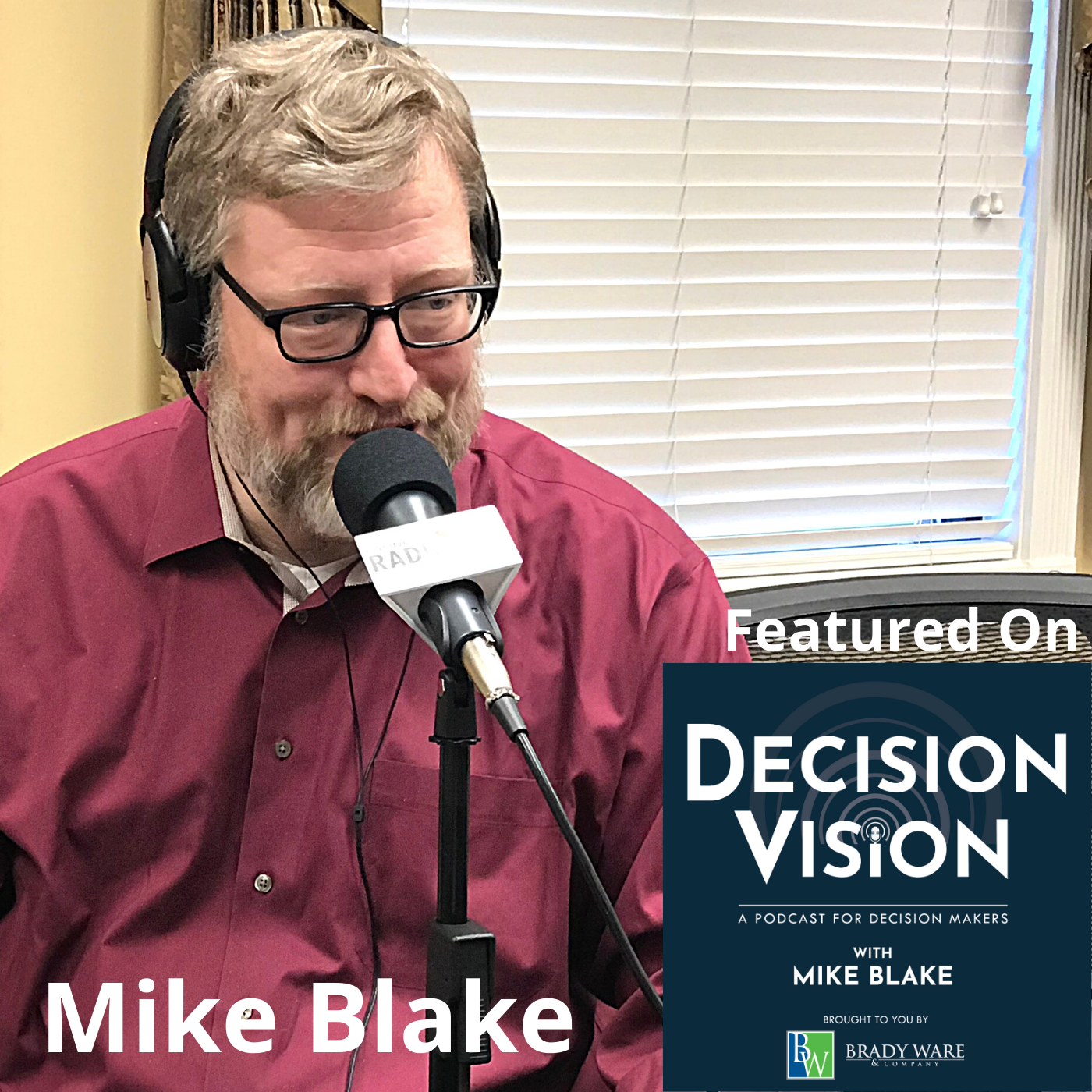
Mike Blake, Host of the “Decision Vision” podcast series

Michael Blake is the host of the Decision Vision podcast series and a Director of Brady Ware & Company. Mike specializes in the valuation of intellectual property-driven firms, such as software firms, aerospace firms, and professional services firms, most frequently in the capacity as a transaction advisor, helping clients obtain great outcomes from complex transaction opportunities. He is also a specialist in the appraisal of intellectual properties as stand-alone assets, such as software, trade secrets, and patents.

Mike has been a full-time business appraiser for 13 years with public accounting firms, boutique business appraisal firms, and an owner of his own firm. Prior to that, he spent 8 years in venture capital and investment banking, including transactions in the U.S., Israel, Russia, Ukraine, and Belarus.

LinkedIn | Facebook | Twitter | Instagram

Brady Ware & Company

Brady Ware & Company is a regional full-service accounting and advisory firm which helps businesses and entrepreneurs make visions a reality. Brady Ware services clients nationally from its offices in Alpharetta, GA; Columbus and Dayton, OH; and Richmond, IN. The firm is growth-minded, committed to the regions in which they operate, and most importantly, they make significant investments in their people and service offerings to meet the changing financial needs of those they are privileged to serve. The firm is dedicated to providing results that make a difference for its clients.

Decision Vision Podcast Series

Decision Vision is a podcast covering topics and issues facing small business owners and connecting them with solutions from leading experts. This series is presented by Brady Ware & Company. If you are a decision-maker for a small business, we’d love to hear from you. Contact us at decisionvision@bradyware.com and make sure to listen to every Thursday to the Decision Vision podcast.

Past episodes of Decision Vision can be found at decisionvisionpodcast.com. Decision Vision is produced and broadcast by the North Fulton studio of Business RadioX®.

Connect with Brady Ware & Company:

Website | LinkedIn | Facebook | Twitter | Instagram

TRANSCRIPT

Intro: [00:00:01] Welcome to Decision Vision, a podcast series focusing on critical business decisions. Brought to you by Brady Ware & Company. Brady Ware is a regional full service accounting and advisory firm that helps businesses and entrepreneurs make visions a reality.

Mike Blake: [00:00:21] Welcome to Decision Vision, a podcast giving you, the listener, clear vision to make great decisions. In each episode, we discuss the process of decision making on a different topic from the business owners’ or executives’ perspective. We aren’t necessarily telling you what to do, but we can put you in a position to make an informed decision on your own and understand when you might need help along the way.

Mike Blake: [00:00:41] My name is Mike Blake, and I’m your host for today’s program. I’m a director at Brady Ware & Company, a full service accounting firm based in Dayton, Ohio, with offices in Dayton; Columbus, Ohio; Richmond, Indiana; and Alpharetta, Georgia. Brady Ware is sponsoring this podcast, which is being recorded in Atlanta per social distancing protocols. If you’d like to engage with me on social media with my Chart of the Day and other content, I’m on LinkedIn as myself and @unblakeable on Facebook, Twitter, Clubhouse, and Instagram. If you like this podcast, please subscribe on your favorite podcast aggregator, and please consider leaving a review of the podcast as well.

Mike Blake: [00:01:19] So, today’s topic is a topic I’m very excited about, because it’s a topic that I, frankly, do a lot of thinking about and is central to what I purport to do for a living. And that topic is, Should I take more risk? And the reason I’m so intrigued by this topic is because, frankly, I think risk gets a bad rap. I think it gets a bad rap because it’s misunderstood. And I think it gets a bad rap, frankly, because it’s not very sexy. And it gets a bad rap because it’s not very visible, it’s not very high profile.

Mike Blake: [00:02:01] But when you think about risk in business and, I think, in life, risk is an overarching and underlying variable that impacts or should impact every decision that we make. And risk is often viewed negatively. We think of risk as something that is always to be avoided. Conversely, we admire the people who are risk takers.

Mike Blake: [00:02:35] As somebody who has traveled abroad quite a bit, I’m frequently asked in my travels, “What is it that makes Americans different from everybody else?” And I think there’s really one thing that makes Americans different from everybody else, and that is that we treat the entrepreneur as a folk hero. There’s no other society that I’ve been to, that I’ve studied, that does it quite the same way that we do. And I think we treat the entrepreneur as a folk hero because we admire their willingness to take risk. And by and large, in our economy, we are okay with rewarding people handsomely who take risks and benefit from that risk paying off, basically.

Mike Blake: [00:02:35] But at the same time, risk is one of these things that I think is highly underappreciated. And on that same token, I’m asked pretty frequently, actually, you know, “How do I improve the value of my business in the short term?” Thinking of selling or I want to make it a better asset to leave to my children or to somebody else, how do I make it more valuable? And the answer that I think most people expect are, “Well, make your company more profitable or find a way to make it grow.” And those things are fine as far as they go, except those things are a lot easier said than done. It’s not that easy to grow a company. It’s not that easy to make a company more profitable. Those are hard things to do.

Mike Blake: [00:04:17] But the thing you almost never hear somebody saying, is my stock answer, is, “Well, figure out a way to de-risk the business. Take what you’ve got and make it more reliable, more resilient, more predictable.” And that in and of itself is going to make the company more valuable. And I would argue and I think I could show you the math to do this for an audio, so I’m not going to inflict that upon you. But I can very easily illustrate with math that if you can decrease the risk by, say, two percent, you will improve the value of your company more than if you increase growth or profitability by two percent. But, again, it’s not sexy.

Mike Blake: [00:05:02] The chief risk officer never appears on Bloomberg television, has never profiled in The Wall Street Journal, at least very rarely. In spite of the fact that we are currently involved in emerging from – I call this – a trans-pandemic period, I think that’s probably still out, we’re still in this this pandemic period where our nature, our very relationship with risk and the nature of risk in our society and our lives, is just different and I think irreversibly so.

Mike Blake: [00:05:33] And so, when our current guest comes on – and we had a conversation earlier and she wanted to talk about risk, I just jumped at the opportunity because I think it’s so important and it’s really not given its due. And so, it’s my pleasure to introduce Amanda Setili, who is president of strategy consulting firm Setili and Associates. Setili and Associates provides experience, strategic, and management consulting to Fortune 500 and growing companies that generate profits, improve performance, and drive growth.

Mike Blake: [00:06:05] An internationally acclaimed expert on strategic agility, she gives her clients, including Cardinal Health, Coca-Cola, Delta Airlines, the Home Depot, UPS, and Walmart- you might have heard of them – unbiassed and laser clear advice on how to respond quickly and intelligently to a changing marketplace. Amanda is also author of Fearless Growth: The New Rules to Stay Competitive, Foster Innovation, and Dominate Share Markets; and the Agility Advantage: How to Identify Opportunities and Act on Opportunities in a Fast-Changing World.

Mike Blake: [00:06:36] Amanda served as an adjunct professor at Emory’s Goizueta Business School, is a member of the Marshall Goldsmith 100 Coaches Program and the Million Dollar Consulting Hall of Fame. Amanda earned her degree in chemical engineering from Vanderbilt and her MBA with distinction from the Harvard Business School. She is past president and board chair of the Harvard Business School Club of Atlanta. Amanda Setili, welcome to the program.

Amanda Setili: [00:07:00] Thanks so much, Mike. It’s a pleasure to be here.

Mike Blake: [00:07:04] So, Amanda, I want to lead off because, you know, we haven’t known each other that long. But the thing that struck me from our first conversation is, you and I are kindred spirits, I think, in one regard in that we really find risk fascinating and conversations about risk to be very impactful. And I’d love to hear your take. You’ve heard mine in my opening monologue. But I’d love to hear your take on why risk interests you. Why is it important? Why do people need to understand it better?

Amanda Setili: [00:07:37] Two main reasons. One is, I work mainly with big companies. And big companies do what they do very well and very consistently. So, they’ve been historically good at managing risk, but they’re really bad at taking a risk of entering into a new market or learning something new, building new capabilities, dealing with the changes that are coming at them so fast in the market today. Just in terms of the way customer behaviors are changing fast, the way competition is changing fast, the way competition can come out of nowhere, which they’re used to be able to do as easily.

Amanda Setili: [00:08:14] And the unwillingness to take risks, whether either because of trying to make sure to make quarterly earnings promises that they’ve made, or fear of having to lay people off, or fear of not being able to build new capabilities fast enough. That fear of the risks hold so many companies back from being successful. And you can see tragedies of large companies who just lose their way and don’t adapt quickly enough to the market change.

Mike Blake: [00:08:47] Yeah. And that’s really interesting, we both can probably name numerous examples, but the one that comes to mind – of which I only learned fairly recently, but it’s such a shocking story – many people don’t realize that Kodak had invented compact flash storage many years before it actually became widely available in the marketplace. But they were so afraid to risk disrupting their own industry, they wound up eventually being effectively consumed by the digital photography market, that they had every opportunity to dominate by virtue of patent protection. And that, to me, is an object lesson of how a company killed itself by not taking enough risk.

Amanda Setili: [00:09:34] Absolutely. It’s like the perfect story to illustrate that exact point, because they did invent digital photography, but they were so intent on protecting their film category that they just couldn’t step into that territory.

Amanda Setili: [00:09:49] So, I said I was going to tell you two things and I didn’t tell you the second one. The second reason, I think is important and interesting, is, because most companies don’t do a good job at managing risk. They do a good job at seeing the risk, but they don’t do a good job at managing the risk. They flee from risk without just saying, “There’s steps we can take to manage this.”

Amanda Setili: [00:10:11] So, one of the stories that I think is illustrative of this is, back when Elon Musk first started Tesla, he said, “There’s only a 50/50 chance that I’ll be successful.” But what he did was he said, “So, why would I not be successful? Maybe people will have range anxiety, so I’ll build a car that instead of only can go 80 miles on a battery, can go 350. I’ll build these superchargers going up every major highway corridor.” He said, “Why else would they be worried? They will be worried about safety, so I’ll win the top safety ratings. Why else would they be worried? They’d be worried about resale value.”

Amanda Setili: [00:10:48] So, he even, for a time, promised to buy their Tesla back for a price pegged to the price of a certain Mercedes model. So, he just said, “Okay. It’s risky. There’s only a 50 percent chance of success. Figure out what the risks are and address each of them very explicitly.” And that’s why he’s been quite successful.

Mike Blake: [00:11:10] I love that Elon Musk story. I hadn’t heard it before. But I think it’s brilliant and a couple of business geeks like us, I think, can appreciate sort of the subtle genius and that buy back part. Because they’re basically then selling a car with a built-in protective put. I mean, it’s just classic hedging.

Mike Blake: [00:11:32] So, I want to come back to this, but before I go too far off the deep end with you, even though it’s really tempting to do so, I want to make sure that everybody understands, our listeners understand, when we say risk, what exactly does that mean? So, if I could maybe, please, ask you to give your definition of risk.

Amanda Setili: [00:11:52] My definition is just that you have uncertainty about the outcome. That’s all it is. There’s many different sources of risk. But the bottom line is you’re not sure it’s going to work.

Mike Blake: [00:12:03] Now, I love that definition. And for what it’s worth coming from me, I mean, to me, that definition shows why you’re an expert on risk. Because I think when most people hear the word risk, they automatically think of the definition of risk being that risk is the possibility that something will go wrong. But you said it differently and I think correctly, which is, it’s simply the risk that something will go differently than how you anticipated. And that’s a massive distinction, isn’t it?

Amanda Setili: [00:12:37] Right. Because there’s always an upside too. So, there are things that are uncertainty about the outcome that are actually on the positive side. And if you don’t recognize what might happen better than what you expect, you’re never prepared to take advantage of your good luck.

Mike Blake: [00:12:57] So, you said something in the opening question, which, again, I just think is so smart that I want to make sure that we hit on, and that is that, you described many companies as failing to manage risk because instead they avoid risk. And there’s a subtle but important distinction there I’d love you to go into, if you would. And that is, why is avoiding risk not the same as managing risk?

Amanda Setili: [00:13:29] Well, they’re completely different. So, avoiding risk is, “Oh, I don’t know what’s going to happen. I’m afraid. I better not do anything.” Managing risk is, “Oh, I don’t know what’s going to happen. What could affect what might happen?” List those things out and then say, “What can we do to manage each of these? What can we do to make it more likely that the good thing is going to happen and less likely that the bad thing is going to happen?” And then, be very explicit about assigning each of those risk to somebody who can make sure that that risk is managed well.

Amanda Setili: [00:14:07] So, for example, you’re launching a new product. What could go wrong? The market fails to understand it. Our call center gets overwhelmed with calls. The sales force is incapable of selling it or is hesitant to sell it because it cannibalizes another product. Just list these things out and then say, “So, what are we going to do about each of them? And who’s in charge of managing that risk? If we’re worried about the call center being overwhelmed, can we get some backup capacity lined up? If we’re worried about the sales people being unwilling to sell it because it cannibalizes something else, give them some kind of override on their commission?”

Amanda Setili: [00:14:48] All of these things could be managed. And at the same time, when you talked about, you know, uncertainty about the outcome can also be on the upside, what if this goes even better than we expect? Do we have our suppliers organized to be able to sell us more supply than what we thought? Do we have the ability to expand geographically faster than what we were anticipating? Do we have the ability to make the biggest PR buzz out of anybody that likes our product that we didn’t expect to like it? You know, there’s all kinds of things that can go right. And if you plan for them, you get to jump on it and take advantage of them.

Mike Blake: [00:15:27] So, you have a great pedigree working with brand name companies. And, clearly, the subject comes up when you’re working with them. Why, in your mind, do large companies struggle so much with risk management? Is it something that’s cultural? Is it a misalignment of economic incentives or some sort of pathology? What, in your mind, kind of drives that?

Amanda Setili: [00:15:52] Two things. One is the incentives usually incent you to do the same thing that you did last year plus five or ten percent. And if you don’t do that, you’re in big trouble, you don’t make your bonus or you might get fired or whatever. And if you do way better than that, it’s not necessarily as big of an advantage. So, the incentives tend to be very much disincenting taking risks. The second thing is they’re just sloppy. They’re not disciplined about how they think about risk and how they manage it.

Mike Blake: [00:16:32] So, what, in your mind, when you work with companies like that and you present them with the case that they should be taking on more risk than they are, how do you position that argument? Or what does that argument typically look like that a given entity, person, organization should take on additional risk?

Amanda Setili: [00:16:53] Well, first of all, we find ways to manage it where it’s not all that risky. So, understand the market better. Maybe make a small experiment before you make a big experiment. Play several different small bits at once, which is a hedging strategy. Isolate the risk into a certain area of the company where it can’t damage the other areas of the company. So, there’s a lot of things that we can do to manage risk that’s on the plus side on the kind of way to get them to kind of emotionally accept the risk more. It’s often a case of saying, “If you don’t do this, you’re going to be left in the dust.” I mean, they know that, but sometimes they have to be reminded.

Mike Blake: [00:17:45] One of the basic concepts of behavioral finance is the concept or the construct that humans seem to be hardwired against taking risk. And in particular, they’re hardwired to avoid loss or with this notion of loss aversion. Which, I know you know what this means, but our listeners may not. It means that people miss more on a dollar that they actively lose than they do on a dollar that is an opportunity missed. And that sort of creates this perception of risk asymmetry. Have you encountered that as well? And if so, how do you get people to confront that and look at risk in a more clinical way?

Amanda Setili: [00:18:38] Well, first of all, you do want to make sure you don’t lose anything that you can’t afford to lose. So, you don’t want to get in a position where you can’t pay your mortgage. So, there’s a certain level of risk that you just can’t afford to take and so be very explicit about that. But then, I think, thinking about expected value, which is the percent chance that something’s going to happen, times of value that would come to you if it did happen is pretty helpful. And just being very explicit about there is an upside here. The upside is worth it. There’s some downside. But if you look at the expected value, it’s probably a favorable thing to do. And if you don’t do it, you’re going to be in a slow decline.

Mike Blake: [00:19:29] So, it leads nicely to my next question and we’ve touched upon this a little bit with the Kodak story, but I’d like to make this part of the discussion explicit. And that is, so what if people don’t take enough risk? What are the consequences of not taking enough risk?

Amanda Setili: [00:19:49] Well, you mentioned people, and so I think that it would be interesting to take this out of a corporate context and just into a human being context. You take risk when you decide to ask somebody on a date. You take risk when you decide to get married. You know, 50 percent of marriages end in divorce, do you say, “I better not do that because mine might be one of the 50 percent?” Or do you say, “This is my chance for a wonderful life with this wonderful person, I’m going to go for it even with the risk.” What’s was your question exactly?

Mike Blake: [00:20:25] What do you miss out on when you’re not taking enough risk?

Amanda Setili: [00:20:31] A lot of stuff. You have fewer experiences. Fewer experiences or opportunity to grow your business. Fewer opportunities to fully live your life. You name it. You miss out on a lot if you’re too risk averse.

Mike Blake: [00:20:49] So, another question I wanted to cover is, you know, there are varying degrees of risk and you talked about you never want to bet your mortgage or put anything on the line you can’t afford to lose. And, of course, that’s a relative construct. But the question I’d like to ask you to engage with is, is high risk always bad? Is something that’s high risk always something that you should walk away from? Or are there cases in which, you know, something that’s high risk may actually be sensible?

Amanda Setili: [00:21:30] Well, if you just look at investments, for instance, you tend to have a higher return for the higher risk. So, it’s definitely not always bad. You also never would achieve anything truly remarkable and knock it out of the park if you didn’t take risks. Because we would have never gone to the moon if we didn’t accept some risk, for instance. So, high risk is certainly not always bad. But high risk without managing the risk is probably always bad. So, high risk without considering the consequences, mitigating what you can mitigate, taking into account how can we reduce the risk that we see, that is bad.

Mike Blake: [00:22:15] And, you know, that sounds like there’s an important distinction to be made there, if I can semi-put words in your mouth. It seems to me that a risk taker is somebody who takes risks but manages it, can be contrasted with someone who’s reckless that also takes risks. But they don’t manage it and maybe they don’t even fully understand the risks that they’re taking.

Amanda Setili: [00:22:39] That’s exactly it. They don’t understand or don’t think about it. And that probably happens more often when the risk is long term and the benefit is short term. So, if I eat a piece of cake with ice cream every single day, my risk is that I’m going to become obese, and I’m going to have diabetes, and I’m going to die early. But people don’t take that into consideration when they serve themselves that extra helping of dessert.

Mike Blake: [00:23:09] Well, that’s true. And that’s interesting, because, you know, there’s another element. I typically think of risk in terms of two dimensions. One dimension is, what is the likelihood of a bad outcome? And then, B, how bad is that bad outcome? Or what is the distribution of bad outcomes look like and how bad can it go? But a third dimension to that, actually, is the timing of risk. And some risks are accretive over a long period of time and some are instantaneous. And I guess that’s something that also is an important part of the discussion and maybe even gets back to your Fortune 500 clients, where you talk about incentives. Can there be perverse incentives to take risk because the negative impact of the risk may not manifest itself for years after that person’s tenure at the company has long since ended.

Amanda Setili: [00:24:14] That’s exactly right. So, you know, if I’m in a job, I’m the president of a division, and I’m being incented based on this quarter’s results or this year’s results, I don’t want to risk anything for something that’s going to happen after I retire in a few years. Why would I want to do that? So, that’s the kind of thing you need to watch out for when you’re managing a company. But, also, some of the benefits occur way down the line. Well, I guess that’s the same thing that I’m saying, is that, in companies, often the cost is now and the benefit is later.

Mike Blake: [00:24:52] Well, you know, and I think that’s really important. And I have a hypothesis that one of the reasons that private equity and venture capital struggles is because their return thresholds have become much more compressed. And this notion that most venture and private equity funds have a ten year lifespan. That may very well just not be enough time for companies to mature to the point where they can generate a return. And indeed, there’s data out there to suggest that as you approach a 20 year time horizon for a company, that’s when you kind of optimize your risk adjusted return.

Mike Blake: [00:25:31] But on the other hand, if your bonuses are calculated year-to-year or you’re only going to be in that fund for five years or whatever the circumstances are, it probably motivates not industry perverse behavior, for example, to try to harvest companies before they’re fully baked, which is not doing the investors any favors. And that’s just an illustration of that mismatch between the risk and return time horizons.

Amanda Setili: [00:25:59] Right. So, public companies, I think, have even more of a problem with short term thinking because they have to deliver on their earnings expectations every single quarter, and they get really dinged by Wall Street if they don’t do that. Whereas, at least with a private equity firm, if you say we’re shooting for a five year horizon, at least in years one, two and three, you can let it go negative on EBITDA, if that’s the right thing to do, for instance. Because you know that it’s going to pay off in the five years. So, if private equity firms can stay a little bit flexible of what’s the right period of time for this investment to turn positive, then they can protect themselves from that.

Amanda Setili: [00:26:45] But you look at somebody like Amazon, Amazon didn’t make money for years and years and years. They just kept investing. And I’ll never forget that way back in about 2001, I was talking with one of my classmates from Harvard Business School who was way up in the chain at Amazon working closely with Jeff Bezos. And somebody in the crowd said, “When will you guys stop losing money?” And she said, “Well, it only costs us $4 to acquire a new customer. When would you stop?” I just thought that’s a really, really smart way of putting it. Because if it’s only $4 to acquire a new customer, keep doing it until you have everybody in the world using Amazon. And then, you’ve cornered the market, which is kind of what they did.

Mike Blake: [00:27:33] Well, I hadn’t heard that story, but you’re right. I mean, the logic there is very hard to escape, isn’t it?

Amanda Setili: [00:27:39] Yes.

Mike Blake: [00:27:40] So, let’s say that somebody listening to this is starting to ask themselves, “Hey, I wonder if our company is taking enough risk.” What are some signs that a company should be taking more risk or at least should consider taking on more risk than it currently is? What are the warning signs?

Amanda Setili: [00:28:04] If you’ve got a lot of change in your market and you haven’t done anything about it is one of the key things that I look at. If you haven’t invested in any innovation is another thing. Innovation can be product innovation, but it can also be systems integration, process innovation. Even simple stuff like changing the script that your call center is typically a sign that you’re not taking enough risk. If you’re not talking about where do we need to take more risk. And if you don’t have discipline systems for managing risk, that probably means you’re not taking enough risk because you don’t have it in your DNA of how do we think about risk?

Amanda Setili: [00:28:51] You know, because the world is changing fast, the companies that can deal with uncertainty effectively, that’s a huge competitive advantage. To be able to deal with uncertainty effectively and manage risk effectively is probably the number one thing that companies can do to succeed in a fast changing world.

Mike Blake: [00:29:14] I’m absorbing that statement. I think you’re right. And my perspective is one of corporate finance. And I refer to the law of gravity and finance, which says that, high return only accompanies high risk. And if you generate a high return from something that you thought was low risk, you probably just got lucky. And you misevaluated the risk as being lower than it actually was.

Mike Blake: [00:29:46] And I think what you’re describing is fairly closely connected with that. You know, if you want to outperform, then you must do something different from what the rest of the market is doing. Otherwise, you just simply fall into the trap of reversion to the mean. I mean, you might have temporary day-to-day, month-to-month, even year-to-year variability or noise, if you will. But the ending in the long run, you cannot possibly outperform everybody else if all you do is what everybody else is doing.

Amanda Setili: [00:30:23] Exactly.

Mike Blake: [00:30:27] In your mind, is all risk created equal? Or are there different kind of flavors of risk, if you will?

Amanda Setili: [00:30:37] Yeah. There’s definitely different flavors. One major flavor is, are we capable of doing this? Another major flavor is, how are other entities or other people going to respond to what I’m doing? Another is, just what are the consequences of what I’m going to do? So, I think, yeah, there’s a number of different categories that you can think about and each can be managed.

Mike Blake: [00:31:04] So, in your mind, do you have a distinction of what a good risk is versus a bad risk? Is there such a thing as good versus bad risk?

Amanda Setili: [00:31:14] A good risk is something that you can at least name, and that you at least have either some kind of plan to reduce it or manage it. Or, at minimum, monitor it so that you can respond and you have a plan for how to respond if it starts going going badly. A bad risk is the risk you don’t even know is there.

Mike Blake: [00:31:39] The famous unknown unknowns, right?

Amanda Setili: [00:31:42] Yeah. Right.

Mike Blake: [00:31:44] Because those bad risks are almost kind of like open-ended liabilities. There may be no limit to how bad that outcome could be.

Amanda Setili: [00:31:57] Right. Or it’s something that maybe you sort of think might happen, but you don’t really think it’s going to happen, so you don’t worry about it. Like, pandemics, which we all knew. I had a friend at the CDC who, ten years ago said, “We’re way overdue for a pandemic, a worldwide pandemic.” I just go, “Yeah. Yeah. It probably won’t happen.” And here we are.

Mike Blake: [00:32:19] Here we are. So, here’s a question I want to ask you, I hope you’ll agree it’s an interesting one. And that is that, if you take a risk and it doesn’t produce a positive outcome, does that mean that the act of taking the risk was automatically bad?

Amanda Setili: [00:32:46] Definitely not. I mean, there’s some really good speakers on this topic, they’re often professional poker players. And they say, “You know, you calculate your odds and you place your bet. Of course, you don’t always win because the odds were not 100 percent that you were going to win. So, of course, you know that you’re not always going to win. But don’t let the evidence from your failures teach you that you made a bad decision in the first place.”

Mike Blake: [00:33:17] Yeah. And that last point, I think, is so important because, again, it ties back to psychology, at least the things I’ve read. I’m no expert in psychology. But, again, we as people seem to be hardwired to very clearly remember our losses and failures. Whereas, we don’t dwell as much or remember or even place as much value in our successes. And in that regard, it can dissuade people just because you have one bad outcome. It can dissuade people from doing more of the right thing.

Amanda Setili: [00:33:52] I think that’s really true. I think people learn from their failures and that can be kind of bad. Because, oftentimes, when you fail, you think, “Oh, that was because of something that I did that I made a bad decision.” And when you succeed, unfortunately, you often think, “Oh, I got lucky. It wasn’t because of what I did. I just got lucky.” So, yeah, I think that no matter what you do, you’re being trained every day. And you’re training your employees every day. And, often, you’re training them things that you really shouldn’t be training them.

Mike Blake: [00:34:27] Oh, you know what? That’s interesting. What are some examples of things that somebody might be inadvertently training their employees themselves be too risk averse?

Amanda Setili: [00:34:39] A typical one is, you start a new venture within your company because you think that you need to enter a new market or something. And you assign somebody to manage that, they try their hardest. But, you know, it’s hard. Stuff goes wrong. They fail and they either get switched into a different department, or demoted, or even maybe fired, or at least not rewarded very well. But maybe they should have been rewarded well because maybe they did everything that they could have possibly done to make that successful. And the outcome was uncertain and the outcome didn’t go their way. But once you said a couple of examples like that, boy, people are watching. Nobody wants to go near a project like that anymore.

Mike Blake: [00:35:26] Yeah. You know what? That’s really interesting. And I wonder if we’ll ever get to a point where American businesses – and it may not be unique to America, but something I can comment on intelligently – actually celebrate failures? Because, first of all, failures are great teachers, number one. And number two, because the nature of risk that things just aren’t always going to go your way. And I’m curious if you agree with us or not, really, in order for risk management to really take hold and to really make an impact, you almost have to do it a lot. You have to accumulate enough of a sample size so that the impact of the risk management becomes pronounced. And you can actually attribute performance to something other than simple dumb luck of a small sample size.

Amanda Setili: [00:36:28] Right. Right.

Mike Blake: [00:36:30] And on that, I’m curious if you have an opinion on this. On that note, that brings to mind the archetypal Google, now Alphabet, approach to new projects where they like to fail fast. And our conversations made me start to wonder about that particular approach. I think many people idolize Google for the fail fast approach. It’s gutsy. It’s splashy. It’s high profile and everything else. But on the other hand, I wonder if, actually, that could be kind of a perverse or unhealthy form of risk aversion because you may not be writing things out as much as you should.

Amanda Setili: [00:37:18] So, what I think is important is being very clear about what you need to learn from each experiment that you run, and what metrics you’re going to be watching, what behaviors you’re going to be watching, what you’re really wanting out of it. And fail fast, part of it is really good, which is saying, if something isn’t going well and it’s not going to turn around, it’s not going to do any better. Kill it right away, and document what you learned from it, and then try something else.

Amanda Setili: [00:37:51] Because sometimes, especially big companies, they’re slow anyway. It’s a long time between getting the management team together. They just don’t make decisions fast. So, they let this thing linger because they don’t want to embarrass the person who runs it or they don’t want to have to go back to Wall Street and say, “We told you this is going to be successful, but it wasn’t.” So, they let these things linger hoping that they’ll turn around and continuing to pour not quite enough money into them to make them successful, maybe. And so, because there’s a stigma against failure, they don’t let things fail.

Amanda Setili: [00:38:28] So, I think, actually the concept of fast failure is healthy for Google. And I like the fact that they just keep putting different stuff out there and seeing if it flies. And if it doesn’t, they kill it. You know, Facebook is famous for that, too. They do A/B testing, hundreds of different A/B tests every day. And they let almost anybody – I don’t know about almost anybody – but there’s a lot of people who have the decision rights to be able to conduct A/B tests and to learn from them very, very, very quickly.

Mike Blake: [00:38:59] We’re talking with Amanda Setili. And the topic is, Should I take on more risk? You know, we’re both talking kind of a good game here about risk, if you will. I wonder if you’d be willing to share with the audience an instance in which you took a pretty significant risk. And, you know, whether that was a success or a failure, the impact of taking that risk and the lessons that you learned from doing that for yourself or your own company.

Amanda Setili: [00:39:28] You really got me thinking with that one. I guess, that writing my first book was kind of a risk because I invested a lot of time for many months doing that and I didn’t know if this was really important to do, so that was a risk and it did pay off.

Amanda Setili: [00:39:44] I don’t know if I’ve told you, Mike, that my husband and I are really, really into kiteboarding. And in July in kiteboarding, we tend to only get wind when there’s a thunderstorm. So, we’re always watching the radar and trying to figure it out. And, you know, back in March, April, or May, when we get more wind, we might say, “Oh, we’re going to pack up the kites and go home if the lightning is within 20 miles.” And then, it gets to July and you’re, like, desperate for wind. There’s been no wind for seven days or whatever you’ve been waiting for wind. And there’s wind, but the lightning is within ten miles and you go, “Well, maybe I’ll just go out there for a little while.” So, that’s an example.

Mike Blake: [00:40:32] Well, you know, that’s an interesting story and actually is illustrative, I think, of a dimension of risk where, you know, the same risk is there. But because your perceived return was higher, you then determine that it was a risk that was worth taking. I do think there’s a business application to that, is that, higher risk is okay as long as you’re being adequately compensated with the potential upside of taking that risk alongside with, of course, management of downside as well. And in your case, that upside manifested itself with, I think, relative scarcity, because the downside was that if you didn’t take the risk, you might have just missed out on your entire kiteboarding season and have to wait another year.

Amanda Setili: [00:41:24] That’s right.

Mike Blake: [00:41:30] Now, a common approach to managing risk and finances where I live is this concept called diversification. I’m sure you’re familiar with it, too. Can diversification as a risk management tool be applied outside of the direct investment world?

Amanda Setili: [00:41:51] Well, yeah. We do that all the time, where, you know, you are trying to enter a new market, let’s say. And instead of just doing it one way, you might run three to five different experiments. We’ll try different things in different markets. We’ll try different ways of going to market. We’ll try different sales pitches for this product. So, I think that diversification, in that sense, is just trying different things and being very systematic about what you try and what you need to learn from your trials.

Mike Blake: [00:42:27] So, Amanda, we’re running out of time, and this is a topic that, frankly, we could do a whole semester on risk. Maybe we should. But there are probably questions that I didn’t get to or questions that somebody would have liked us to go deeper into but we didn’t. And if that’s so, can people contact you with additional questions about this topic? And if so, what’s the best way for them to do that?

Amanda Setili: [00:42:50] So, you can certainly email me at amanda@setili.com, S-E-T-I-L-I. And reach out to me on LinkedIn. I’ve got a weekly newsletter there which you can subscribe to, which I address issues like this. And, actually, I think both of my books have a chapter on managing uncertainty, and how it’s so important, and how people who don’t accept uncertainty are probably not going to do very well. So, get a hold of those and you might be able to get some additional insight. Connect with me on LinkedIn and my website.

Mike Blake: [00:43:29] Do you want to give us the website domain?

Amanda Setili: [00:43:34] The website is just setili.com, S-E-T-I-L-I.com. There’s lots of information there, and videos, and other podcasts, and things like that.

Mike Blake: [00:43:44] Very good. Well, that’s going to wrap it up for today’s program. I’d like to thank Amanda Setili so much for sharing her expertise with us.

Mike Blake: [00:43:52] We’ll be exploring a new topic each week, so please tune in so that when you’re faced with your next business decision, you have clear vision when making it. If you enjoy these podcasts, please consider leaving a review with your favorite podcast aggregator. It helps people find us that we can help them. If you’d like to engage with me on social media with my Chart of the Day and other content, I’m on LinkedIn as myself and @unblakeable on Facebook, Twitter, Clubhouse, and Instagram. Once again, this is Mike Blake. Our sponsor is Brady Ware & Company. And this has been the Decision Vision podcast.
 

Tagged With: Amanda Setili, Brady Ware & Company, Decision Vision, Fearless Growth, manage risk, Mike Blake, risk, risk advisory, risk advisory services, Settili & Associates, The Agility Advantage

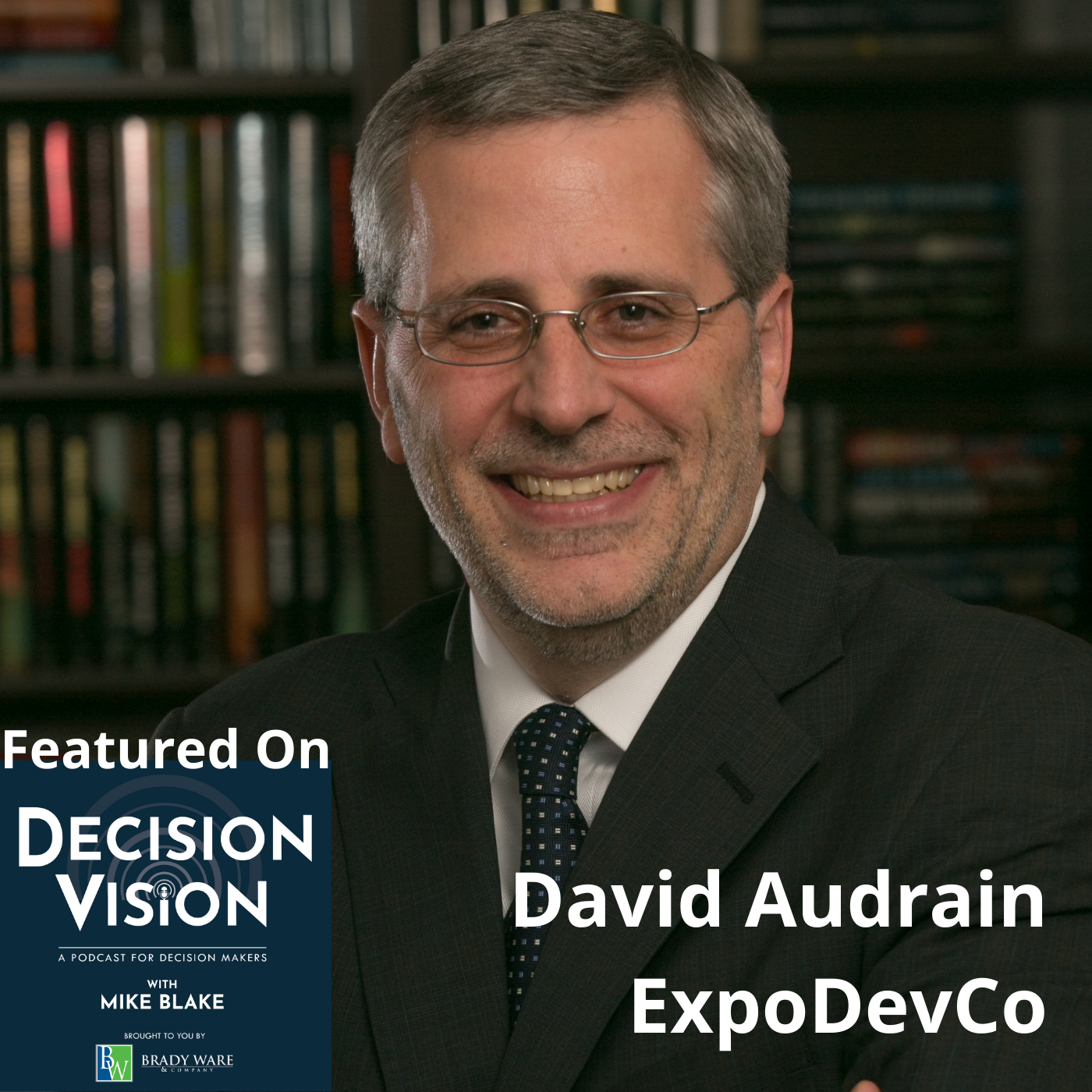
Decision Vision Episode 127: Should I Diversify My Company’s Revenue? – An Interview with David Audrain, Exposition Development Company

July 29, 2021 by John Ray

David Audrain
Decision Vision
Decision Vision Episode 127: Should I Diversify My Company's Revenue? - An Interview with David Audrain, Exposition Development Company
Loading
00:00 /
RSS Feed
Share
Link
Embed

Download file

David Audrain

Decision Vision Episode 127:  Should I Diversify My Company’s Revenue? – An Interview with David Audrain, Exposition Development Company

For many businesses, diversifying revenue sources became an urgent choice because of the pandemic. ExpoDevCo’s David Audrain says his company expanded its revenue mix well before the pandemic, not just to increase revenue, but as a risk-management strategy. Hear his conversation with host Mike Blake about how and why ExpoDevCo diversified, how well it worked, particularly during the pandemic, and what they’ve learned. Decision Vision is presented by Brady Ware & Company.

Exposition Development Company (ExpoDevCo)

ExpoDevCo develops, builds, and launches successful expositions and events. Founded in 2012 by David Audrain and Stephanie Everett, Exposition Development Company, Inc. (ExpoDevCo) is a show development company designed to produce a platform for partnerships with other show organizers and associations to strategically grow existing events as well as launch new events.

Company website | LinkedIn | Facebook 

David Audrain, CEO & Partner, ExpoDevCo

David Audrain, CEO & Partner, ExpoDevCo

David is CEO & Partner of ExpoDevCo, producing trade shows and conferences across North America. Previously, David was: President of Clarion Events North America; President of Messe Frankfurt NA; COO of ConvExx (producer of the SEMA Show); and held senior positions at Advanstar, Hanley Wood, Miller Freeman, and the Texas Restaurant Association.

As of January 1, 2016, ExpoDevCo became the management company for SISO (the Society of Independent Show Organizers), and David serves as CEO of SISO.

Over his more than 28 year career in the exhibition industry, David has managed numerous shows across multiple industries, including eight Top-200 shows in North America. David is also a strong advocate for the industry, having served as Chairman of both SISO and IAEE, and on many other Boards and Committees.

LinkedIn

Mike Blake, Brady Ware & Company

Mike Blake, Host of the “Decision Vision” podcast series

Michael Blake is the host of the Decision Vision podcast series and a Director of Brady Ware & Company. Mike specializes in the valuation of intellectual property-driven firms, such as software firms, aerospace firms, and professional services firms, most frequently in the capacity as a transaction advisor, helping clients obtain great outcomes from complex transaction opportunities. He is also a specialist in the appraisal of intellectual properties as stand-alone assets, such as software, trade secrets, and patents.

Mike has been a full-time business appraiser for 13 years with public accounting firms, boutique business appraisal firms, and an owner of his own firm. Prior to that, he spent 8 years in venture capital and investment banking, including transactions in the U.S., Israel, Russia, Ukraine, and Belarus.

LinkedIn | Facebook | Twitter | Instagram

Brady Ware & Company

Brady Ware & Company is a regional full-service accounting and advisory firm which helps businesses and entrepreneurs make visions a reality. Brady Ware services clients nationally from its offices in Alpharetta, GA; Columbus and Dayton, OH; and Richmond, IN. The firm is growth-minded, committed to the regions in which they operate, and most importantly, they make significant investments in their people and service offerings to meet the changing financial needs of those they are privileged to serve. The firm is dedicated to providing results that make a difference for its clients.

Decision Vision Podcast Series

Decision Vision is a podcast covering topics and issues facing small business owners and connecting them with solutions from leading experts. This series is presented by Brady Ware & Company. If you are a decision-maker for a small business, we’d love to hear from you. Contact us at decisionvision@bradyware.com and make sure to listen to every Thursday to the Decision Vision podcast.

Past episodes of Decision Vision can be found at decisionvisionpodcast.com. Decision Vision is produced and broadcast by the North Fulton studio of Business RadioX®.

Connect with Brady Ware & Company:

Website | LinkedIn | Facebook | Twitter | Instagram</a

TRANSCRIPT

Intro: [00:00:01] Welcome to Decision Vision, a podcast series focusing on critical business decisions. Brought to you by Brady Ware & Company. Brady Ware is a regional full service accounting and advisory firm that helps businesses and entrepreneurs make visions a reality.

Mike Blake: [00:00:24] Welcome to Decision Vision, a podcast giving you, the listener, clear vision to make great decisions. In each episode, we discuss the process of decision making on a different topic from the business owners’ or executives’ perspective. We aren’t necessarily telling you what to do, but we can put you in a position to make an informed decision on your own and understand when you might need help along the way.

Mike Blake: [00:00:43] My name is Mike Blake, and I’m your host for today’s program. I’m a director at Brady Ware & Company, a full service accounting firm based in Dayton, Ohio, with offices in Dayton; Columbus, Ohio; Richmond, Indiana; and Alpharetta, Georgia. Brady Ware is sponsoring this podcast, which is being recorded in Atlanta per social distancing protocols. If you would like to engage with me on social media with my Chart of the Day and other content, I’m on LinkedIn as myself and @unblakeable on Facebook, Twitter, Clubhouse, and Instagram. If you like this podcast, please subscribe on your favorite podcast aggregator, and please consider leaving a review of the podcast as well.

Mike Blake: [00:01:17] Today’s topic is, Should I diversify my company’s revenue? And, you know, I’m not sure if this is COVID driven or not, but it’s an interesting topic because I find more companies are asking this question. Certainly, I see more being written about this as to diversify a company’s revenue stream. And I think it’s important because it offers an alternative path to growth. We normally think of growth as occurring through two paths. One is by increasing sales and activity and what it is that you already do or by making an acquisition. And those are both fine.

Mike Blake: [00:02:02] The challenges by simply focusing on increasing your activity and what you already do, that’s a lot easier said than done. Do you sell harder? Do you work more? Do you make more investments? Is there even room in the market to buy more of what you’re selling? And on the other end of the spectrum, there’s acquisition which is expensive, time consuming, and is fraught with its own risks as well.

Mike Blake: [00:02:32] And so, you know, diversifying revenue, I think, is a little bit of a halfway house between the two, if you will, where you gain the benefits as if perhaps you made an acquisition. But you’re creating that new revenue stream on your own. And, you know, one place I think that we see this in pretty sharp relief is in the restaurant and hospitality industry. In those two particular industries, of course, during the coronavirus, their core operations were sharply curtailed or, frankly, entirely shut down. And those companies, I know, had to seek and find alternative revenue streams in order to survive. It simply wasn’t going to work. They simply were not going to survive otherwise.

Mike Blake: [00:03:20] And I think many other companies, whether through survival or simply once something is proven, people are going to copy it. I think a lot of other companies now, whether it’s in accounting or law or retail or whatnot, are also looking for alternative revenue streams, if you will. And so, I suspect that a lot of our listeners, if they’re not asking this question yet, they will be, either as a result of listening to this podcast or they will on their own accord in the next year or so. Because I do think that this is the next big trend in business, is diversifying company revenue by adding new sources of revenue.

Mike Blake: [00:04:03] And joining us today to help us explore this is David Audrain, who is CEO and partner of Exposition Development Company, Incorporated or ExpoDevCo. David is CEO and partner producing trade shows and conferences across North America. Previously, David was President of Clarion Events North America, President of Messe Frankfurt North America, Chief Operating Officer of ConvExx which is the producer of the SEMA Show, and held senior positions at Advanstar, Hanley Wood, Miller Friedman, and the Texas Restaurant Association. As of January 1st, 2016, ExpoDevCo became the management company for SISO, the Society of Independent Show Organizers, where David serves as Chief Executive Officer.

Mike Blake: [00:04:45] Offers more than 28 year career in the exhibition industry, David has managed numerous shows across multiple industries, including eight top 200 shows in North America. David is also a strong advocate for the industry, having served as Chairman of both SISO, and the IAEE, and on many other boards and committees. Founded in 2012 by David Audrain and Stephanie Everett, Expedition Development Company, Inc. is a show development company designed to produce platform for partnerships with other show organizers and associations through strategically grow existing events, as well as launch new events. David, welcome to the program.

David Audrain: [00:05:20] Hi, Mike. It’s a pleasure to be here.

Mike Blake: [00:05:22] So, David, we’ve had this conversation off air, but, of course, we’ll bring it on air, so to speak. What was it that prompted you to start considering alternative revenue sources? And about when did that take place?

David Audrain: [00:05:37] Well, we started our company in January of 2012, and had been running several businesses in the industry for decades before that. So, we love the exhibition business. I say, I’ve been in it almost 30 years now. And it’s a high volume, high margin business when it works well. But as COVID just showed us for the last year-and-a-half, it doesn’t always work well. So, when we started it, we were not overly heavily capitalized. So, we had to be careful how we were utilizing our capital as we got it started.

David Audrain: [00:06:16] And when you start shows in particular, there is a fairly long ramp up period, a year or more in many cases, of getting a show running before it actually happens. And so, there’s a lot of overhead and staff costs leading into that. So, we started at the beginning thinking of ways to minimize our risk. And that meant that not just launching our own shows, but taking on management of other people shows, other association shows. And we even looked at providing sales agency services, which we had done for other international shows around the world in the past, as well as now managing a couple of associations.

Mike Blake: [00:06:59] And so, why consider new revenue streams as opposed to simply doubling down on the existing ones? Why not go that direction?

David Audrain: [00:07:09] Well, certainly, any time we can launch a new show or expand our show – I mean, any of our existing shows – that’s certainly optimal. And that’s what we try to do. But if we take a show that is creating X revenue right now and we can increase that revenue stream, that’s a very high margin business for us and it’s terrific. But it’s all your eggs in one basket. You know, if anything happens to that show – we had to cancel five events last year because of COVID – then you lose the whole basket.

David Audrain: [00:07:41] So, providing different revenue streams, frankly, enabled us to survive COVID. Again, you know, ten years ago, we didn’t plan for COVID. Nobody could have. But we knew that we needed to have different ways to generate revenue that wouldn’t put us all at risk all at one time. Because some things don’t work. We’ve launched conferences and events that we’ve had to cancel. And that can be a very expensive process for us.

Mike Blake: [00:08:07] So, as much as anything, although it was, of course, trying to see growth, but it sounds like, also, maybe even more importantly, the need to add additional sources of revenue is also a risk management strategy and a way to build resiliency into the company.

David Audrain: [00:08:23] It was very much a risk management strategy. And it was very much for the the purpose of providing us with potential different streams for cash flow and to minimize some of the risk. Say, if we launch a show, we’re all in. We are responsible for that entire risk of expense in running that event or conference. If we are running one for somebody else, we have cash flow benefit coming through and we’re not at risk of anything happening to that event. So, it minimizes our risk and it improves our cash flow.

Mike Blake: [00:09:00] So, you know what I’d love to ask you, I understand that diversifying your revenue sources was a decision that was made and started to be implemented before coronavirus. But, of course, coronavirus hit. You could argue it’s still here. I call this the trans-pandemic period, not post-pandemic. But my point is that, once coronavirus hit, how important was the fact you’d made that decision earlier to ensuring that your company would, frankly, be able to survive coronavirus?

David Audrain: [00:09:33] It was key, to be honest with you. We’re a small business, 15 employees. We were scheduled to run 11 events last year, several of which we owned or were partners in. Some of which we managed for others, you know, more than half, we managed for others. We had to cancel all of those. But two-and-a- half, we got through two in the beginning, first quarter. And we were halfway through a third before COVID shut us down. And we were also lucky or somewhat good planning, in that, we had event cancellation insurance on most of our event or all of our events that we had.

David Audrain: [00:10:12] So, we had, obviously, some results from that as well. But we didn’t have to lay off any employees. We were able to continue throughout the year. We, obviously, were impacted. Obviously, we lost revenue and lost profits for the year, but we had sufficient revenue and sufficient resources to be able to maintain our business. And, now, we’re rolling events out again this year.

Mike Blake: [00:10:36] So, you know, it’s hard to find positives in something like a global pandemic, although some were there. And I kind of wonder – and you tell me if I’m just way off base – was it perhaps, maybe not a blessing in disguise, but at least you’re presented, maybe, perhaps with the opportunity to then redeploy resources within your firm to develop those, whether it had been secondary revenue sources, if you will, have now become primary. And I wonder if as a result of that, you emerged actually a stronger company.

David Audrain: [00:11:18] I wish I could say that was the case. The challenge in our industry in particular was, when we had the lockdown in March of last year, we were all hopeful this would be a few weeks, we’d all be through it. So, in our industry in particular, we started just postponing things. So, we had shows in April that we postponed to June, we had shows in May that we postponed to July, that sort of thing. And so, we ended up doing twice as much work, sometimes three times as much work, because we’d been planning for events for a year. And, at some period, whether we were a month out, a week out – I had to cancel one event, we were a week out at the end of March that we’d been planning for a year up in Boston. And we started off by postponing it, and then re-postponing it, and then eventually canceling it. And then, we had to cancel it again the beginning of this year.

David Audrain: [00:12:11] So, there was an awful lot of work that went into those and took up an awful lot of our staff’s time. And in the end, in most cases, we didn’t get anything out of it at all. So, we had to ensure that we utilized our resources appropriately to continue managing the clients we had, where we were managing their events or managing the associations. And, in fact, for us, in the association we run is actually the association for our industry, we ended up having to do five times as much work just helping all the rest of our industry through this crisis.

Mike Blake: [00:12:47] That’s fascinating. And it shows my lack of knowledge of your industry. It hadn’t occurred to me that, in effect, you sort of have this rolling blackout, if you will, within your industry, that there’s a hope that the pandemic would be measured in weeks as opposed to months in its duration. And, therefore, all your resources or many of your resources were, in effect, occupied by continuing to reset those events. It wasn’t just simply a one cancellation and move on. And it seems to me that made your job about ten times harder.

David Audrain: [00:13:23] It did. The last year-and-a-half has not been fun.

Mike Blake: [00:13:27] Yeah. I can imagine. So, you ultimately chose a number of additional revenue sources or streams that you implemented. Were there others that you considered and decided not to implement? And the ones you have were sort of the winners of that internal evaluation process? And if so, among your ideas, how did you select the ones that you ultimately went through with? What was the decision process to choose those particular additional revenue sources as opposed to other possibilities?

David Audrain: [00:14:03] Well, I say in our industry, we run trade shows, conferences for the most part. And I say, I run an association. But there’s some basic legs to our industry. When you produce an event, you have to produce content, you have to produce revenue, and you have to produce attendees. So, it’s all about sales, marketing, and operations on that.

David Audrain: [00:14:25] For events that we own, we handle everything. And we have to basically underwrite everything and we’re at risk for everything. If we manage an event for somebody else, for an association or another company, then we don’t have the financial risk and we have better cash flow that comes in. But we may end up with a higher volume of work actually having to do things for them that take longer than if we were just doing them for ourselves. So, we have to take that into account as it goes forward.

David Audrain: [00:14:57] Obviously, also, from our own business perspective, when we build an event of our own, we’re building equity, we’re building value. If we’re simply doing work for hire, for another entity, then there’s no intrinsic value that we’re building long term. It basically is good cash flow, good revenue. It keeps the lights on. It pays the bills. So, ideally, we would focus exclusively on our own shows and our own events because we want to build value.

David Audrain: [00:15:24] But, again, risk mitigation, cash flow, doing things, things for others. What we looked at was some of the aspects like, for example, we’ve had an opportunity to take on just doing sales work for other people. That doesn’t interest us as much, because it takes an awful lot of time and resources, a lot more risky. And the end result isn’t necessarily beneficial to us. So, we’ve turned down some of that work over the years.

David Audrain: [00:15:49] We looked at doing sales agency work, which we’ve done for Mr. Frankfurt, actually, for years running that. And there were shows where, again, the investment for us to do that sales agency work for a show that might be a year away, again, was not good business for us to potentially or possibly end up with revenue a year from now. So, we turned that down and stopped doing that work as it went through.

David Audrain: [00:16:14] So, we looked at many aspects, and for the most part, we’ve really focused on our own events and management work where we take on a substantial enough role. But there’s good value to us in being able to generate the income from it.

Mike Blake: [00:16:32] So, it sounds like you focused on things that were, at least, pretty close to the kinds of work that you’re already doing.

David Audrain: [00:16:40] Yes. Very much it’s stuff that we have a good team, we have the resources, we have the knowledge. It makes sense. What we haven’t tried to do is go into other areas that, frankly, are not areas we have that expertise built up in already.

Mike Blake: [00:16:56] So, when you are establishing or when you established the new revenue sources, was there a lot of upfront investment required on your part or were they things that were natural extensions and, maybe, they didn’t require a whole lot of investment?

David Audrain: [00:17:12] It depended a little bit on what it involved. For example, if we take on managing another show for a client, as we’ve done several times, we do have to invest in staff to add on that. We don’t sit around with staff with extra capacity twiddling their thumbs, waiting for things to do. So, we do have to hire appropriately to support that new event, whether it’s one of our own in new launches or if it’s a client’s show that we have to take on. So, that’s a commitment and that’s a resource that goes forward.

David Audrain: [00:17:48] And, for example, we had looked at doing the sales agency work. We had invested in hiring somebody years ago to do that. And we gave it six months to see how it worked. And it wasn’t generating enough revenue to justify continuing. So, we dropped that business stream that we were looking at for that very reason.

Mike Blake: [00:18:13] So, in making those investments, were there risks involved that were concerning to you? What were the downsides in your mind or the potential downsides that would make the addition of those revenue sources not viable potentially?

David Audrain: [00:18:31] Well, as the example I just gave, the sales agency is an easy one because it just didn’t generate enough revenue to justify the investment and the time with the staffing levels and so forth to do it. On the flip side, for the events that we do manage successfully for others, the downside risk is that the amount of work is more, because we have to estimate our fees. We have to agree in advance of what those fees are going to be. And in some cases, there may be revenue share fees. In which case, we’re at risk to some degree of our own ability to succeed, just like with our own shows.

David Audrain: [00:19:11] And in those cases, again, it’s a matter of we’re investing, we’re committed. If we have to hire staff and take our own time, my partner and my time, to run the event and run the team, then, obviously, we have to make sure that it’s going to generate enough revenue to, not only cover those costs of that staff, but also to provide a profit to make it worthwhile. We don’t need any more hobbies. So, obviously, we know enough about how we run our business and how we run shows and conferences to be able to estimate that time. But we’re not perfect, so sometimes that can be off. But for the most part, we have been successful with it.

Mike Blake: [00:19:55] I really like that statement, we don’t need any more hobbies. Of the revenue sources or streams that you’ve added, as you look back now as we record this in mid-2021, have they all been successful? Have they been as successful as you’d hoped?

David Audrain: [00:20:13] No. For sure they haven’t been. You know, over, say, the last ten years, we’ve tried a few things that have not worked. We’ve had some failures that were all on us. We made a small acquisition of a conference that didn’t pan out for us, and we invested a bunch of money in it, and that didn’t work. And that’s an example of why we have the diverse revenue streams. Because knowing that we had cash flow coming in and secure revenues from fee income or these other sources, enabled us to take a few gambles, so to speak, on either making small acquisitions or launching new events where there was a risk. And some of those risks have not panned out. And we’ve lost money on those efforts.

David Audrain: [00:21:01] But that is, if they do work and we just wrapped up, as we record – just last night, I wrapped up one small show that we own in the manufacturing industry – and it’s not a golden goose laying egg yet, but it’s a profitable event. And taking the time and risk to invest in that is something we were able to do because we had confidence that we could generate enough revenue from our other sources to be able to pay the staff and cover our costs and, hopefully, make money each year.

Mike Blake: [00:21:34] You know, that’s really interesting. That’s an angle of this question I candidly had not thought of, which is, not only do additional revenue streams allow or reduce the risk of the company, but they actually can put you in a position to take other risks that you otherwise would not have felt comfortable doing.

David Audrain: [00:21:56] To be honest with you, that’s the primary reason we do it. You know, there’s an easy way to reduce our risk, and that’s to lower the overhead of the cost of the company and do fewer things with fewer people. But that doesn’t enable us to grow. What we want to do is, obviously, like most businesses, we want to grow. And the best way to do that is to take some risks. In our case and our business, launch new shows, or conferences, or businesses, or invest in others as partnerships as we’ve done as joint ventures.

David Audrain: [00:22:29] But in order to do that, we have to have some confidence that we have enough revenue and income each year to be able to afford those risks because they don’t all pan out or far from it. You know, it is a risky business. It may not be as risky as the restaurant business, but it’s still a risky business. Not all shows succeed. Not all conferences succeed. And failures can be very expensive, to be honest with you.

Mike Blake: [00:22:55] So, I’m curious, as you add these new revenue sources, did you have to add staff or, particularly during coronavirus, were you able to redeploy your existing staff to support those additional revenues?

David Audrain: [00:23:13] As I said a little bit before, typically, we don’t have a lot of spare capacity. It’s not like a factory where you’ve got a machine that’s being used eight hours a day, so use it for 10 or 12. Pretty much our staff objective, we start asking them to work an extra set of hours every night, as most would. So, what we can do is, we can reallocate responsibilities so that we can focus people. We’ve got marketing teams, for example, and operations teams, they’re experts and they can focus on multiple projects at once. So, we can have the multitask across multiple events, multiple conferences, and so forth.

David Audrain: [00:23:55] But if we take on a new show or we launch a new event, we almost always have to bring on new resources, which, obviously, is a cash commitment. It’s, obviously, a time commitment for management to train and bring them up to speed. It expands the requirements of managers to actually have more people to manage.

Mike Blake: [00:24:15] And was there any kind of risk, or concern, or maybe even an impact that as you added revenue sources that might change the culture or the tenor of the company somehow? It seems to me like, if one doesn’t handle that exactly properly, it may actually confuse some of the people that are already there as they start to wonder, “Well, what business are we really in? And what’s my future here? Am I going to be needed? Is the company going to switch business models?” Things of that nature. Was that ever a concern? And if so, how did you address it?

David Audrain: [00:24:51] I don’t think it caused concern because we were very communicative to our team from the beginning. And, obviously, ten years ago, we started with no team. We started from scratch. And as we hired people and brought them onboard under the team, we were very open with them about our model, and our goals, and how we were planning to move forward. So, there were very few surprises with our team as we went forward.

David Audrain: [00:25:17] We were also somewhat lucky in that we had structured a business model from the beginning to be a completely cloud based infrastructure and home office based team. So, our entire team actually is spread out over five states and they’ve worked from home since the beginning, which meant that that was the only thing we didn’t have to change when COVID hit last year. So, we were already in that model going forward. And so, that side of it has not been an issue. I say, I think our communication with the team has been good from the start.

Mike Blake: [00:25:56] So, may I ask you of the revenue sources or streams you’ve added, which one has been the most successful and why do you think it’s been the most successful?

David Audrain: [00:26:05] Certainly the management fees that we generate from managing shows and events and the associations for other customers is, certainly, the majority of our non-internal revenue. Because it’s our primary focus and it’s been the most valuable to us because it’s what we do, it’s what we know, and it’s the expertise we have for our own events that we run. It’s just that we’re doing it for somebody else. And in some cases, it’s turned into virtual partnerships, for example, where we may not be true equity partners, but we may have revenue share deals in place.

David Audrain: [00:26:45] We’ve been running one particular portfolio for many, many years. And it’s an ongoing partnership, effectively, with the client. We’re invested in it. We have the expertise. We deliver the complete management of the events. The client is very happy with us. We’re very happy with the results. And it’s an ongoing long term relationship.

Mike Blake: [00:27:09] So, I’m curious, have the new revenue sources added complexity to your business and made it harder to manage? And if so, how have you addressed that?

David Audrain: [00:27:20] It does add complexity. A simple example, if we launch our own event, we make all the decisions internally. We generate everything. We’re responsible for everything. And we just do it. If we are running an event for somebody else, then we have to first make all the decisions of what we think should be done, or what steps need to be done, or the processes that need to be gone through to actually sell the space, market event, provide the operations, logistics, et cetera.

David Audrain: [00:27:57] But we then have to, in most cases, liaise with the client that actually owns the event as to why we think that needs to be done, and they may not agree with us. So, there’s an awful lot more communication and decision making time involved than if we were just doing it for ourselves. So, we have to factor that in when we are estimating our time, resources, and costs in actually providing those services. Because the time and resources to do it for somebody else are higher than if we were just doing it for ourselves.

Mike Blake: [00:28:33] We’re talking with David Audrain of Exposition Development Company, Inc. And the topic is, Should I diversify my company’s revenue? Have the new revenue sources impacted at all how you conduct your primary business?

David Audrain: [00:28:47] The biggest challenge we’ve come across is, obviously, if we make a commitment to do something for a client, then we’re going to live up to that commitment and we’re going to do whatever we need to do to make that happen. There have been times where maybe our own events have ended up taking the second seat to the client’s events because we can’t tell the client, “Sorry. We’re busy this week. We have to do another show that’s ours.” Whereas, we can tell our own team, “Hey, we’ve got to get this done before we do our own event.”

David Audrain: [00:29:21] So, we have to be very cautious and careful not to affect negatively our own events. And that we pay attention to as we’re developing the plan for the clients’ events, as we’re developing, frankly, our proposals for the clients to ensure that we have dedicated resources that are not going to be pulled in two different directions.

Mike Blake: [00:29:42] And I suppose that speaks to the ongoing complexity or the additional complexity that additional revenue streams, in effect, you’re serving two masters, if you will. Whereas, you only had to serve one.

Mike Blake: [00:30:00] David, this has been a very good a good conversation. I think, you know, I’ve learned a lot. I think our listeners have learned a lot. There may be topics that either we didn’t cover or that our listeners wish that we would have covered more. Would you be willing to take a question from somebody? And if so, what’s the best way for somebody to contact you for more information?

David Audrain: [00:30:20] I’m certainly happy to. The easiest way is to email me. And I’m sure you’ll put it on the website when you post this, but david@expodevco.com is my email address and I’d be happy to respond to people.

Mike Blake: [00:30:36] Well, thank you. That’s going to wrap it up for today’s program, I’d like to thank David Audrain so much for sharing his expertise with us.

Mike Blake: [00:30:43] We’ll be exploring a new topic each week, so please tune in so that when you’re faced with your next business decision, you have clear vision when making it. If you enjoy these podcasts, please consider leaving a review with your favorite podcast aggregator. It helps people find us that we can help them. If you’d like to engage with me on social media with my Chart of the Day and other content, I’m on LinkedIn as myself and @unblakeable on Facebook, Twitter, Clubhouse, and Instagram. Once again, this is Mike Blake. Our sponsor is Brady Ware & Company. And this has been the Decision Vision podcast.

 

Tagged With: Brady Ware & Company, David Audrain, ExpoDevCo, Exposition Development Company, IAEE, Mike Blake, revenue diversification, SISO

Decision Vision Episode 126: How Do I Choose a Manufacturer? – An Interview with Susan Dudas, My Day Screen

July 22, 2021 by John Ray

choose a manufacturer
Decision Vision
Decision Vision Episode 126: How Do I Choose a Manufacturer? - An Interview with Susan Dudas, My Day Screen
Loading
00:00 /
RSS Feed
Share
Link
Embed

Download file

My Day Screen

Decision Vision Episode 126: How Do I Choose a Manufacturer? – An Interview with Susan Dudas, My Day Screen

Inspired by her husband’s skin cancer diagnosis to create line of natural sunscreen products, Susan Dudas was confronted by the dilemma of how to choose a manufacturer for her products. Susan joined host Mike Blake to share what she’s learned from her experiences, including how to search for the right manufacturer, the types of questions to ask, managing the relationship, product liability, and much more. Decision Vision is presented by Brady Ware & Company.

Make2Give LLC dba My Day Screen

After her husband was diagnosed with skin cancer in 2018 and a search for natural, mineral sunscreen was unfulfilled, Founder Susan Dudas decided to create a mineral sunscreen brand that offers products she would want to wear daily. She launched the My Day Screen™ brand in October 2020.

My Day Screen™ offers natural, mineral sunscreen products that feel and look good on your skin. My Day Screen™ is defined by four pillars:
1. Plant-based, natural ingredients.
2. Holistic Light Protection – protection against UVA, UVB and Blue Light.
3. Eco-friendly packaging; and
4. Donation of $2 to nonprofits on every qualifying sale. My Day Screen™ products are sold online at www.mydayscreen.com and on Amazon.

Company website | Facebook | Twitter | Instagram

Susan Dudas, Founder, Make2Give, LLC

My Day Screen
Susan Dudas, Founder, Make2Give, LLC

For over 20 years, Susan Dudas has served as a business consultant to multinational companies in a variety of industries. Susan designed and facilitated organization effectiveness initiatives for her domestic and international clients. She’s also an entrepreneur, having co-founded and operated a mobility transportation company, co-founded two charter schools for low-income students, and founded the My Day Screen natural sunscreen brand.

Susan is also an avid volunteer and supporter of non-profit organizations that help foster care youth, homeless youth, and adoptive families. After her husband was diagnosed with skin cancer in 2018, and a search for natural mineral sunscreen was unfulfilled, Susan decided to create a mineral sunscreen brand that offers products she would want to wear daily. She launched the My Day Screen brand in October 2020. My Day Screen products are sold online at www.mydayscreen.com and on Amazon.

LinkedIn

Mike Blake, Brady Ware & Company

Mike Blake, Host of the “Decision Vision” podcast series

Michael Blake is the host of the Decision Vision podcast series and a Director of Brady Ware & Company. Mike specializes in the valuation of intellectual property-driven firms, such as software firms, aerospace firms, and professional services firms, most frequently in the capacity as a transaction advisor, helping clients obtain great outcomes from complex transaction opportunities. He is also a specialist in the appraisal of intellectual properties as stand-alone assets, such as software, trade secrets, and patents.

Mike has been a full-time business appraiser for 13 years with public accounting firms, boutique business appraisal firms, and an owner of his own firm. Prior to that, he spent 8 years in venture capital and investment banking, including transactions in the U.S., Israel, Russia, Ukraine, and Belarus.

LinkedIn | Facebook | Twitter | Instagram

Brady Ware & Company

Brady Ware & Company is a regional full-service accounting and advisory firm which helps businesses and entrepreneurs make visions a reality. Brady Ware services clients nationally from its offices in Alpharetta, GA; Columbus and Dayton, OH; and Richmond, IN. The firm is growth-minded, committed to the regions in which they operate, and most importantly, they make significant investments in their people and service offerings to meet the changing financial needs of those they are privileged to serve. The firm is dedicated to providing results that make a difference for its clients.

Decision Vision Podcast Series

Decision Vision is a podcast covering topics and issues facing small business owners and connecting them with solutions from leading experts. This series is presented by Brady Ware & Company. If you are a decision-maker for a small business, we’d love to hear from you. Contact us at decisionvision@bradyware.com and make sure to listen to every Thursday to the Decision Vision podcast.

Past episodes of Decision Vision can be found at decisionvisionpodcast.com. Decision Vision is produced and broadcast by the North Fulton studio of Business RadioX®.

Connect with Brady Ware & Company:

Website | LinkedIn | Facebook | Twitter | Instagram

TRANSCRIPT

Intro: [00:00:02] Welcome to Decision Vision, a podcast series focusing on critical business decisions. Brought to you by Brady Ware & Company. Brady Ware is a regional full service accounting and advisory firm that helps businesses and entrepreneurs make visions a reality.

Mike Blake: [00:00:22] Welcome to Decision Vision, a podcast giving you, the listener, clear vision to make great decisions. In each episode, we discuss the process of decision making on a different topic from the business owners’ or executives’ perspective. We aren’t necessarily telling you what to do, but we can put you in a position to make an informed decision on your own and understand when you might need help along the way.

Mike Blake: [00:00:42] My name is Mike Blake, and I’m your host for today’s program. I’m a director at Brady Ware & Company, a full service accounting firm based in Dayton, Ohio, with offices in Dayton; Columbus, Ohio; Richmond, Indiana; and Alpharetta, Georgia. Brady Ware is sponsoring this podcast, which is being recorded in Atlanta per social distancing protocols. If you like to engage with me on social media with my Chart of the Day and other content, I’m on LinkedIn as myself and @unblakeable on Facebook, Twitter, Clubhouse, and Instagram. If you like this podcast, please subscribe on your favorite podcast aggregator and please consider leaving a review of the podcast as well.

Mike Blake: [00:01:16] So, today’s topic is, How do I choose a manufacturer? And I’m particularly excited about this topic for two reasons. Number one, I’m not a manufacturing guy. I don’t know anything about it. I’m a professional services guy, and most of my clients are in the tech space. And so, I do a little bit of work with manufacturing clients, but I’m certainly not going to sit here and try to be any kind of expert in it.

Mike Blake: [00:01:43] I’m also excited because this is an experiment or, I think, more likely the start of an evolution of the program. Throughout the first 125 episodes or so, our decision content has been positioned as a binary question, should I do X? Should I fire my client? Should I sue my partner? Should I have a business partner? Should I raise angel capital? And so, forth.

Mike Blake: [00:02:14] And with this topic, we’re going in a different direction because there’s another kind of choice that we really haven’t addressed and, I think, will be helpful to the listeners that we do address that in various cases, which is not a choice to act or not act, but rather a choice that is borne out of selection. Many decisions that we have to make as business people or executives are of a nature where it’s not that we’re deciding whether to do something or not. But we’re deciding, maybe, on the right way to do something or the right path, the right advisor, the right resource, the right company, the right model. All kinds of decisions which, again, are not binary. They’re simply choices.

Mike Blake: [00:02:59] And so, today’s topic is, How do I choose a manufacturer? Which would be sort of the maiden voyage of this new kind of topic. And I hope you’ll like it as much as I think that we’re all going to find enjoyable. And joining us today is Susan Dudas, who is founder of Make2Give LLC, which does business as My Day Screen.

Mike Blake: [00:03:20] For over 20 years, Susan Dudas has served as a business consultant to multinational companies in a variety of industries. Susan designed and facilitated organization effectiveness initiatives for her domestic and international clients. She’s also an entrepreneur, having co-founded and operated a mobility transportation company, co-founded two charter schools for low income students, and founded the My Day Screen natural sunscreen brand. Susan is also an avid volunteer and supporter of non-profit organizations that help foster care youth, homeless youth, and adoptive families.

Mike Blake: [00:03:53] After her husband was diagnosed with skin cancer in 2018, and a search for natural mineral sunscreen was unfulfilled, Susan decided to create a mineral sunscreen brand that offers products she would want to wear daily. She launched the My Day Screen brand in October 2020. My Day Screen products are sold online at www.mydayscreen.com and on Amazon. Susan, welcome to the program.

Susan Dudas: [00:04:18] Great to be here, Mike. Thanks a lot for having me.

Mike Blake: [00:04:21] So, My Day Screen, was that the first time that you ever had to select a manufacturing company?

Susan Dudas: [00:04:32] Actually, it was. It was. I was in manufacturing prior to this. I’ve also been involved in education and consulting. But this was really my first venture into having to seriously select a manufacturer.

Mike Blake: [00:04:48] And how much did your background consulted with manufacturers? Did that help you a lot? Or do you find that there’s a big difference of advising on the choice, maybe advising how to work with them versus actually making the choice yourself?

Susan Dudas: [00:05:03] It really did help me in the preparation. Early on in my career, I was an H.R. Manager in a production plant. It was a clean plant, circuit board design and assembly. So, I was aware of quality. I was aware of a lot of the compliance. So, there were a lot of things that were top of mind as I was going through this process. But that was a very different process than formulating and manufacturing mineral sunscreen. So, I would say it helped in terms of framing the kinds of questions that I needed to have and what I need to be aware of. But it didn’t prepare me for the world that I was entering.

Mike Blake: [00:05:43] So, I’m always interested in kind of the language of business because every industry, I think, has, if not their own language, certainly their own dialect. If you’re somebody like me that’s used to communicating with people like accountants or attorneys, is that different? Is the way that you communicate different from communicating with, say, manufacturers?

Susan Dudas: [00:06:06] It’s same in many ways. I mean, you’re talking about deliverables with service providers, you’re talking about your goals, what you want to accomplish. You’re going to have a contract. You’re going to have service agreements. You’re going to talk about that. You’re going to talk about compliance. But it’s different in many ways because, most likely, you’re talking about a finished product. You’re talking about a tangible product. You also are able to negotiate your terms with manufacturers, which maybe not so much so with service providers, the fixed fees. So, yeah, you’re definitely having different conversations about quality, about shipping, about the product design, different conversations.

Mike Blake: [00:06:50] So, once you decided that you need to define a manufacturer for My Day Screen, what was the first step? How did you find or identify potential candidates to become your manufacturer?

Susan Dudas: [00:07:02] I love this question because it’s my natural nature to prepare, and that served me well. Because, absolutely, the first step in any advice I would give to someone, maybe on the doorstep of this process, is to prepare. Because the more that you know going into these conversations while you’re looking for manufactures, the better you’re going to be positioned. Because if you think about it, they’re going to ask you questions. So, why not have those questions prepared ahead of time? It gives you an advantage.

Susan Dudas: [00:07:35] And for instance, the very first question that I learned I had to ask myself was, do I have a design? And in my case, it was a formulation, so I didn’t have a formulation. So, if the answer is yes to that, you’re going to go down one path. If the answer is no to that, you’re going to go down maybe a couple of different paths. So, I can elaborate on that if you like me to.

Mike Blake: [00:08:00] I want to come back to that part. But what I what I like to sort of stand for the segment and clarify, you know, is finding a list of potential manufacturing candidates as simple as doing a Google search? Or are there specific places that you went to sort of look to give yourself a leg up on the search?

Susan Dudas: [00:08:22] Sure. Sure. Obviously, I did the Google search and I Thomasnet, and that got me nowhere. I mean, it gave me names. But in my particular case, mineral sunscreen is a subset of the sunscreen market. So, I was looking for specific manufacturers that manufactured mineral sunscreen, and a lot of them don’t. And a lot of beauty manufacturers don’t even get into sunscreens because it’s an over-the-counter drug.

Susan Dudas: [00:08:51] So, where I found that I got the most mileage was to look within the industry, our industry of indie beauty, within the beauty community, and there’s directories within that. I also talked to people. Now, within the beauty industry, sunscreen included, we don’t talk about who we use as manufacturers. We hold our kids close, but we hold our manufacturer’s names closer. So, we just don’t discuss this. However, you can get enough information from your peers in this peer group – and I did – that was able to open some doors and at least get me started. And along the way, I was much more fruitful to talk within the industry than to just do a general online search.

Mike Blake: [00:09:36] So, that’s interesting. I’m going to go off the script a little bit, but I think that’s a really interesting observation I would not have expected. Why do you suppose that people keep the identity of their manufacturer such a secret? For example, I wouldn’t keep my CPA a secret. I wouldn’t keep my lawyer a secret. But I guess manufacturing is a different animal. So, why do you think that that’s such important and sensitive information that people are reluctant to reveal it?

Susan Dudas: [00:10:07] Well, I can’t speak across industries. But within the beauty industry, you don’t see patented formulations. We are over-the-counter drug, FDA regulated, we have to put all of our ingredients out there. So, we publish our ingredients list and it’s required, which is a wonderful thing, that transparency is beautiful. So, that takes some of the mystique away of what’s in this. I guess, you don’t see a lot of patents within the beauty industry. They might patent a process or a function within a formulation, but you’re not going to see that. So, you don’t have those protections there around. “Oh, what are they using?” Because we publish that.

Susan Dudas: [00:10:51] So, there are protections then about who’s going to make it. Because you’re going to see a lot of similarities and formulations, so who is making it? That might change up your raw materials. That might do things a little bit different. Process might be a little different. So, that’s the way I look at it, is, we’re an open book in terms of our ingredients. So, we do protect our manufacturers because we don’t want some pirating. We don’t want someone to necessarily mimic our formulation.

Mike Blake: [00:11:24] Interesting. So, the fact that you’re in an FDA regulated sector and the fact that your value proposition is using all natural mineral products, do those two features make it more difficult for you to find a manufacturer?

Susan Dudas: [00:11:45] Absolutely. Absolutely. Yes. Because a lot of people don’t want to touch OTC, over-the-counter. There’s a variety of costs involved. There’s testing. The facilities we look for are FDA regulated. We want to get current good manufacturing process certifications with our manufacturers. So, there’s a lot of hoops to jump through for manufacturers that manufacture over-the-counter products, over-the-counter drugs, and some of the beauty products. If you’re making eyelashes, you necessarily want to go through the pain of having to get the FDA auditing and regulating you on a regular basis.

Mike Blake: [00:12:30] And, you know, the natural part is kind of intriguing, too, because in a way – I’m probably totally off on this – I almost wonder if it’s like kosher rules. I wonder if a manufacturer kind of has to have a certain outlook or a certain culture, if you will, to properly apply manufacturing processes with all natural products or inputs as opposed to another manufacturer that really just doesn’t care. “Just give me the formulation and I’ll do it.” Am I making more of that than it is? Or does it take a special kind of manufacturer, a special kind of owner, and a plant manager to do that effectively and kind of stay true to what you want to accomplish?

Susan Dudas: [00:13:16] Yes. No, I think you’re right on point, Mike. Especially when you talk about organics, because there is a certification process with organics. So, when you have naturals, you have the organics. Now, natural, there’s not a certification process for naturals, but you do want to find a manufacturer or I want to find a manufacturer that embraces that. They understand it. And maybe from the sourcing standpoint, you want that manufacturer to source those raw materials that are totally aligned with your brand and where you’re taking it, and they are natural. And I was very, very careful about that.

Mike Blake: [00:13:58] Of course, we hold the worst of the coronavirus pandemic. We’re in this trans-pandemic phase right now. I don’t know if you’re still active in maybe finding alternative manufacturers, but even if you’re not, I mean, how do you suppose that the coronavirus has changed the way we even search for manufacturers? Maybe the way the questions you ask, the due diligence. Of course, we’re all familiar with the supply chain disruptions that have been prevalent in every place, from semiconductors to porkchops, basically. Does that change, do you think, in any way the approach or at least tweak the approach in trying to find the right manufacturer?

Susan Dudas: [00:14:41] I would think that anyone that lived through COVID – in my case, I was trying to launch during COVID – I would think would have a very different perspective and more careful perspective on preparation when it comes to the manufacturing process, preparation in terms of, you mentioned, supply chains disruption. Initially when things were shutting down in March of 2020, everyone was trying to gobble up components, you know, their packaging components. It felt like almost a free for all of what can you get, when can you get it, and how can you secure it.

Susan Dudas: [00:15:24] Interestingly, we were not only competing against other beauty manufacturers, but we were competing against our own manufacturers who were completely changing their lines over to manufacture hand sanitizer, because that’s where the margins where. Everyone wanted hand sanitizer. So, obviously, not only impacted our lead times and our ability to get the attention of our manufacturer, but it also impacted the supply chain components. Trying to get bottles and pumps at a time when everyone was trying to fill bottles with hand sanitizer was a real challenge.

Susan Dudas: [00:16:06] So, you know, my take away from that is, I really can expect longer lead times. It is definitely impacting lead times. I need to be prepared. I need to keep track of my inventory. Especially in my business, because I can’t turn on the faucet tomorrow. There’s a lot of testing with over-the-counter drugs. It takes a good year – for me anyway – to bring a product to market because of all the testing involved. So, with a long lead times with the manufacturers that I think just will be there, I really sense will continue to be there post-COVID, that you have to really be more careful with your planning.

Mike Blake: [00:16:50] And I haven’t thought about what you just described, that all up and down the supply chain you’d be fighting not just for the resources for the manufactured product, but the packaging as well. In your case, the dispensing packaging. Did you have any recourse? I mean, do manufacturers make any commitment they’re going to allocate X amount of production with you? Or do they have more or less complete power in terms of where you are in the queue?

Susan Dudas: [00:17:19] I think it’s also where you fit in the food chain, right? As a small indie startup, they have MOQs, Minimum Order Quantities. And as a startup, my quantities are going to be small relative to their larger customers that can keep their lines going for a long time. So, it depends on where you are in, like I say, the food chain as to how much negotiating power you have. I realized that having heated conversations about lead times were getting me nowhere. Because I suspect that every time they picked up the phone, they were having those very similar conversations with their other customers.

Susan Dudas: [00:18:01] And manufacturers were at low capacity. At some point, they were below 50 percent in terms of their ability to operate. So, it wasn’t just their lines. They were cleaning all the time. In particular clean industries that are going to be shut down for cleaning. They have protocols they had to have in place. And to your earlier point, I think some of those protocols will continue on because of just good manufacturing practices. But, yeah, it was definitely more challenging, and I think those things will continue on. And I realized that as a small startup, I didn’t have a lot of leverage.

Mike Blake: [00:18:45] So, you and I were having a conversation yesterday in preparing for this one, in which I learned a lot just having a preliminary. And one of the things that came up that I’d love you to talk about a little bit is, the role of the manufacturer often is not, I guess, just, “Hey, make me some stuff.” They provide other services. Many of them, it sounds like, provide many other services to help move the product from idea into production. And can you talk about what some of those are and how you’ve availed yourself of some of those support services?

Susan Dudas: [00:19:25] Sure. The first question, I need to ask myself and anyone, again, about ready to embark upon this journey is, do you have a design? Now, that’s critical. So, that’s going to determine which direction you go. If you already have a design, then you’re going to look for a contract manufacturer. If you don’t have a design, then you have some questions to ask yourself. Do I want a custom design? Do I want my manufacturer to do some R&D, create my design, a custom design, and make it? Or is it so special that you need to find a specialist to create your design or formulation and then come back to manufacture and have them make it?

Susan Dudas: [00:20:06] Or are you such that you just want to get your product to market, you’ve got a phenomenal marketing distribution strategy and you’ll do private label? Meaning, I don’t need to own this design. I just need you to make it. Pull some stock design off the shelf, make it for me. I’ll put my fabulous label or packaging on it and away I go.

Susan Dudas: [00:20:33] So, upfront, the design question and the ownership, which is closely coupled to that, is really, really critical. It was critical for me. I wanted custom formulation and I went through that process. So, I found a great manufacturer that had a phenomenal R&D team and we worked together to create some great products.

Mike Blake: [00:21:03] Now, since you’re an Amazon seller and my wife is an Amazon seller. She’s been on the program before, I think it was episode 49. And one of the things that is always on your mind, especially with Amazon, I think, is product liability. And I understand from my conversations with Cordelia, anything that’s FDA regulated, Amazon, some justification watches like a hawk, and they have low to zero tolerance policies for mess ups. And, again, one of the things you and I were talking about that I haven’t thought about before was handling liability. If a product is bad and then gets released into the wild and then hurts the customer, it’s going to move back up the supply chain or somebody else has to take responsibility.

Mike Blake: [00:21:53] And the question I’d like to ask you is, if something goes wrong, is it going to be somebody like you that’s actually ultimately paying the manufacturer? Or does the manufacturer have responsibility, where if they do something wrong that they’re the ones that pay the price as opposed to you, or is it shared, or some entirely different kind of model?

Susan Dudas: [00:22:14] So, I do want to look for shared responsibility. And I have walked away from contracts. As we discussed yesterday and prepped for this show, I have walked away from manufacturers that were not willing to look at a shared responsibility. And those things that they control, I believe they should have responsibility for. If they use the wrong ingredients or they use the wrong processes, and they’re out of compliance, there needs to be some liability capability and a risk falls on that. If I take ownership of the product and I mishandle it, placed it in conditions that are going to affect its effectiveness, then I should have a liability.

Susan Dudas: [00:23:00] So, I look for shared responsibility and I’m willing to spend the money for attorneys to make sure that we get that right. And as I said, I walked away from very much one sided risk contracts, where the burden is on me and not on that manufacturer. It was so important, because something is going to happen. There’s going to be some type of claim. It’s going to happen. So, you really need to negotiate that upfront before you become a partner or married to a manufacturer.

Mike Blake: [00:23:40] So, at the start of our conversation, you emphasized pretty heavily the need to be prepared. What does that look like? How do you prepare for a conversation with a manufacturer, particularly for the first one?

Susan Dudas: [00:23:53] Right. Yeah. I think it’s easy as anticipating what you think they’re going to ask you. So, they’re going to ask you, do you have the design? I went over that. They’re going to ask you what capabilities does this design require? You need to know that. Do you need extruding? Do you need molding? Do you need clean manufacturing for printed circuit board design or if you’re manufacturing food. Is it stamping? Is it an assembly line? Is it batch? So, you need to know that, what those capabilities are that are required. And then, you need to know what else you want them to do for you.

Susan Dudas: [00:24:37] One of your questions before, they do an array. Many manufacturers can offer an array of functions, filling, labeling, packaging, testing if required. Some of them do fulfillment. Some will do a full turnkey. I mean, they’ll offer marketing services and design your packaging for you. I’m not sure I’d recommend that. You’re not their core business. So, knowing what you need from the manufacturer is really key.

Susan Dudas: [00:25:12] A couple of things that are really important, know what your costs are, what are your target costs. Go into that conversation knowing what’s your retail costs, what margins you need to get, and then you’re talking to them about that per unit target cost. That’s going to weed out some manufacturers right there. Quantities, your MOQs, that’s going to weed out some manufacturers. If you’re a startup and their MOQ is, maybe, 100,000 and you’re like, “No. I can’t order 100,000 for my initial order.” Well then, you need to walk somewhere else.

Susan Dudas: [00:25:45] And then, of course, you want to know about lead times. Given your particular design, your product, how long is it going to take, not only for that first order, but how long is it going to take for successive orders so that you can plan for your inventory so that you’re not out of stock at a very important critical time, maybe in the year, the selling cycle. And then, the contract, knowing what you need to have in a contract, is it ownership, is it liability? The compliance.

Mike Blake: [00:26:16] That’s good. So, let’s say we’ve identified some manufacturers. We’ve done our homework. Who do you contact? Is it a plant manager? Is it the owner? What’s the title of the job function? The person you need to talk to that can have that conversation and represent the manufacturer to you so that you don’t have to have the same conversation three or four times?

Susan Dudas: [00:26:43] I think it depends on the size of the manufacturer. My experience has been sales reps, account managers typically are your initial contact. That’s typically who you’re going to have that rapport with. Most manufacturers in the sides I’ve dealt with have had that function within the organization. So, you’re dealing with a sales organization, an account manager function. But I wouldn’t stop there as you move through. That’s going to be your initial.

Susan Dudas: [00:27:12] But as you move through the relationship, and you’re vetting, and you’re narrowing down your list, you really want to start having additional conversations up the hierarchy. And here’s why, as I mentioned before, you’re going to have problems. You’re going to run into problems, whether they’re external problems or internal manufacturing problems. And you really don’t want that first conversation that you’re having the escalated conversation. You don’t really want that first conversation with that director of engineering or director of operations to be a heated discussion. You want to have some relationship points in the bank so that if you’re negotiating with them, it’s not your first time discussion.

Mike Blake: [00:28:06] So, as you then move into that process, what are you looking for from, I guess, how the manufacturer’s present themselves? How are you vetting them then to make sure that they can do what they say that they can do?

Susan Dudas: [00:28:23] I use a spreadsheet, so I list my options along the left hand side and I list my criterion across the top and I just start keeping track, whether it’s a rating number or check mark – I’ve done both. But I keep my spreadsheet. And as I talk to manufacture and move through the process, I’m seeing how many checks I have or how their score is. That’s how I really vet and move through. And, obviously, you can prioritize those. If their costs are too high, off the list. Or if they’re quantities are the threshold, quantities are too high, off the list. So, I think it’s keeping that spreadsheet, continuing those conversations. As I said, the contract that was key for me. I actually vetted down to a few on a couple of occasions. And I was surprised and saddened that I had to remove them from the list.

Mike Blake: [00:29:28] Do you ever have an opportunity to talk to some of the manufacturers or other customers, get kind of a testimony or review?

Susan Dudas: [00:29:36] I have not. Not in my industry. We just don’t really talk about the manufacturers. Maybe I’m in the wrong circles. Maybe I got to get in better circles. But, no. In terms of references, I have. But that’s very, very, very few because they keep their customers very, very close. In fact, very rarely would they release a customer name. Maybe at a trade show or something, I might have a little bit of exposure to that. But, typically, it’s a good manufacturer that does not release their customers names. They’re very careful about that.

Mike Blake: [00:30:21] And in your process, did you make any site visits? Did you actually go there and walk the floor?

Susan Dudas: [00:30:26] Absolutely. Absolutely. That’s a key criterion for me. And I’ve done it twice. Typically two visits for the ones that I’m seriously considering. Two visits, because the first visit your eyes are wide open. It’s a good exchange. They’re on their best behavior. After that, you’re going to have a lot of questions. As you go back and you get those questions answered, you definitely see things differently, hopefully not too differently, but it’s a deeper dive that second time. I would clearly recommend that.

Mike Blake: [00:31:06] And when you walk the floor, I’m curious, what are some of the things that you’re looking for?

Susan Dudas: [00:31:11] Well, I’m looking for quality. I’m asking about maintenance of their equipment, asking about their testing procedures. I love seeing their testing room. Sometimes they leave you out of there if they have anything that’s proprietary going on. But, typically they don’t. Their customers names are not visible. But I love going into their labs and their testing facilities to see that I’m looking for safety. Safety, not only employee safety precautions, but product safety, people wearing nets, their shoes covered, what kind of environment does that look like. So, eyes wide open. And am I being introduced to different people in the different organizations, touch points that I would have if I was a customer of them.

Mike Blake: [00:32:08] Now, over the course of your selection process, did you find yourself developing a relationship with the manufacturers management? A chance to really talk with them and see how much they really seemed to care about you or your idea? Did that ever factor into your decision or no?

Susan Dudas: [00:32:30] Yes, it did. It was important for me to meet the R&D manager because we were looking at custom manufacturing. I wasn’t pulling a stock formulation off the shelf. I wanted something custom. I wanted to be right there. I wanted to show them samples of what I was looking for. And I wanted them to see it. I wanted them to try it. I want to touch it, put it on, tell them what I liked about it and didn’t. That was the R&D director – that was really important – because he was overseeing the customization, the formulation process. So, that was critical.

Susan Dudas: [00:33:07] I did not meet and I have a regret that I didn’t meet the sales executive, the sales director. Because we had had some conversations during COVID that were not always pleasant with lead times and such. And this is something I would recommend to your audience, as I mentioned before, you really don’t want that first conversation to be that heated conversation. So, the extent that on your visits or even post-visit that you can make contact with the head of sales or head of account management, other leaders, I would recommend that build some rapport, it could be helpful in your negotiations.

Mike Blake: [00:33:51] So, in your particular search, how long did it take you to find a manufacturer from the time you said, “Hey, I need to find a manufacturer,” to the time when you said, “Okay. I’ve got one, and they’re going to be my primary source.”

Susan Dudas: [00:34:05] About six months.

Mike Blake: [00:34:07] And do you think that’s typical? Do you think that it takes most people that amount of time in your experience?

Susan Dudas: [00:34:13] I think the question, it depends. I hate to say that, but it really does depend on the complexity of your product. It depends on the industry that you’re in. It depends on the amount of labor you put into the search. If you still got your day job and you can only do this at certain hours, it might prolong your search. But I think that’s probably a good standard. And, also, it depends if you’re going to private label, just pull a stock item off the shelf or design off the shelf and you’re going to label that yourself. That’s going to be a rather quick process. Most of that time is going to be around, you know, getting your packaging ready and making sure that your contract is in place.

Mike Blake: [00:35:01] And in your search, how many manufacturers did you talk to before finally settling on one?

Susan Dudas: [00:35:07] Oh, wow. At least 20.

Mike Blake: [00:35:10] Really, 20?

Susan Dudas: [00:35:11] Oh, my gosh, yes. At least 20.

Mike Blake: [00:35:14] Yes. And I assume just calling them up or emailing them and having your initial conversations. I’m sure you didn’t visit all 20. Your probably narrowed —

Susan Dudas: [00:35:23] No, I did not. That first call, because I knew what to ask, “Do you manufacture mineral sunscreen?” “Sorry. We don’t do over-the-counter drugs.” Or, “No. We don’t do mineral. We’ll do chemical,” which is very different. So, I was able to eliminate maybe 40 percent just with those first two questions. And then, after that, we get into the MOQs and locations and lead times. And in my industry, the demand is greater than the supply of manufactures. So, there’s long lead times.

Mike Blake: [00:36:08] We’re talking with Susan Dudas, founder of Make2Give LLC, which is also known as My Day Screen. And the topic is, How do I choose a manufacturer? So, I’m curious also, did you only consider domestic manufacturers or were you inclined to explore, perhaps, foreign manufacturing?

Susan Dudas: [00:36:28] Yeah. I love that question. I was only looking for domestic, not only the made in America, but just very practical. I mean, that was primarily why I wanted the products made in America. But, also, I think about the time zone, that was very much a consideration for me. As well as you think you take possession of product, you’ve got the whole shipping. Do they store it then? Or do they bring it back here then I have to find storage over here? It was actually something I didn’t put a lot of thought into international, but I’m aware that there would be a lot of considerations if you’re considering that. Fortunately, I was able to find a great manufacturer that we could arrive on a lot of the terms within the contract, and have had great success with them.

Mike Blake: [00:37:21] So, do you have or have you given thought to having backup manufacturers in case the first one, for whatever reason, isn’t able to fulfill an order, you get shoved to the back of the queue because you’re the small fry in the pile? Have you thought about or maybe do you even have a backup manufacturer? And if so, how many do you have? And what do those agreements look like?

Susan Dudas: [00:37:46] Right. I would say, just in general, that’s really wonderful. That’s where the spreadsheet helps out as you’re narrowing down your choices. You’re looking at those that meet most of your criteria that could be considered a backup. I think that’s critically important because you don’t want to be caught with not having inventory. Or if they have a problem, maybe they’ve got some compliance issues that come up. That wasn’t my case. But, you know, if they have some audit issues or something comes up, you need a backup. You really don’t want to keep your customers hanging or your employees hanging as well.

Susan Dudas: [00:38:28] So, in my case, in my situation, I am looking for another manufacturer for a very specific process and product, because my current manufacturer does not use that particular process. And I don’t have a good sense from the industry state on this, but you’re not going to find a manufacturer necessarily that’s going to be able to do all of your line, the current and future line. There might be some processes that they’re not able to do. So, that’s the situation and so I am looking for another manufacturer. And it is very, very challenging. Quite honestly, I think it’s because of the demand and supply. It’s hard to get their attention, hard to get them to reply back on the phone. So, it is a challenge.

Mike Blake: [00:39:21] And, you know, finding the first manufacturer is hard enough. I’m guessing the second manufacturer where you’re basically saying, “Hey, I basically just need you on standby, but I’m not necessarily sending you a lot of business right now.” Not as exciting a conversation from their perspective, if we’re honest about it.

Susan Dudas: [00:39:38] That’s very true. Very true. Or this other product that I want to manufacture, maybe, it’s not going to have the yield, the volume, that would be exciting. So, absolutely to your point, yes.

Mike Blake: [00:39:54] Susan, this has been a great conversation. I want to be respectful of your time and we’re running out of time. If there’s somebody in our audience that wants to ask you a question that we didn’t discuss, somebody who wants to go deeper into something that we did, would you be willing to kind of take their question? And if so, what’s the best way for them to contact you?

Susan Dudas: [00:40:16] Oh, I’d absolutely love to help. Anybody that’s been through this journey knows it’s not an easy one. So, I’d like to make it easier for someone else. I can be reached at dudas, D-U-D-A-S, @mydayscreen, S-C-R-E-E-N, .com. That’s dudas@mydayscreen.com.

Mike Blake: [00:40:38] Well, thank you, Susan.

Susan Dudas: [00:40:39] Thank you, Mike.

Mike Blake: [00:40:39] That’s going to wrap it up for this program. I’d like to thank Susan Dudas so much for sharing her expertise with us.

Mike Blake: [00:40:45] We’ll be exploring a new topic each week, so please tune in so that when you’re faced with your next business decision, you have clear vision when making it. If you enjoy these podcasts, please consider leaving a review with your favorite podcast aggregator. It helps people find us that we can help them. If you like to engage with me on social media with my Chart of the Day and other content, I’m on LinkedIn as myself and @unblakeable on Facebook, Twitter, Clubhouse, and Instagram. Once again, this is Mike Blake. Our sponsor is Brady Ware & Company. And this has been the Decision Vision podcast.
 

Tagged With: Brady Ware & Company, choose a manufacturer, contract manufacturing, Decision Vision podcast, Make2Give, Manufacturing, Mike Blake, My Day Screen, outsourced manufacturing, Susan Dudas

The Backstory of Luring Employees Back to Work, with Mike Blake, Brady Ware & Company

July 19, 2021 by John Ray

Brady Ware
North Fulton Studio
The Backstory of Luring Employees Back to Work, with Mike Blake, Brady Ware & Company
Loading
00:00 /
RSS Feed
Share
Link
Embed

Download file

Brady Ware

The Backstory of Luring Employees Back to Work, with Mike Blake, Brady Ware & Company

Mike Blake: [00:00:00] Are we going to lure people back to work? Are we going to force them back to work? So, the topic of the day now is, people are not coming back to the workforce. And that’s the chart that I have from the St. Louis Federal Reserve on Unemployment Level and Job Openings. It shows that the number of job openings exceeds the number of unemployed people in the United States. Why are people not taking them?

Mike Blake: [00:00:30] Well, before I go directly and answer that question, this chart is really important, and if you look at no other chart and look at this one – and it also is from the St. Louis Federal Reserve and it’s the Labor Force Participation Rate. And the labor force participation rate means the percentage of adult Americans who are working, or available to work, want to work, or in the labor force – you’ll notice that the American labor force has been declining since 2000, particularly since, say, late 2008, 2009. And it recovered a bit, I think a statistical noise. Really dropped during the COVID pandemic, and has come back a little bit.

Mike Blake: [00:01:22] And I say that because it provides some useful framework around understanding the nature of unemployment and the nature of people pursuing jobs. And that is, that we have been running up against a shortage of workers for two decades now. We haven’t noticed it, for whatever reason, because we’ve had enough people, more or less, to take jobs. But that gravy train may have come to an end, but we’ll see. Like I said, economics is a slow science.

Mike Blake: [00:01:55] And, frankly, I don’t know the story yet. I don’t know whether unemployment benefits are too high and people are kicking back on the extra 300 bucks a month. You know, I cannot imagine that myself. I can’t imagine $1,200 being meaningful enough to me that I would simply stop working and be on welfare. But I acknowledge I’m not everybody. I just don’t know a portion of the population that is.

Mike Blake: [00:02:23] And I do think people have awakened, and changed priorities, and are willing to give up income for a different lifestyle. I think, you know, there’s nothing like 600,000 people dying over the course of 18 months to remind people how short and precious life is. I do think that people have discovered they’d rather live on less and would rather have more of what they expect their lives to be from a personal perspective and spiritual perspective.

Mike Blake, Brady Ware & Company

Michael Blake is the host of the Decision Vision podcast series and a Director of Brady Ware & Company. Mike specializes in the valuation of intellectual property-driven firms, such as software firms, aerospace firms, and professional services firms, most frequently in the capacity as a transaction advisor, helping clients obtain great outcomes from complex transaction opportunities. He is also a specialist in the appraisal of intellectual properties as stand-alone assets, such as software, trade secrets, and patents.

Mike has been a full-time business appraiser for 13 years with public accounting firms, boutique business appraisal firms, and an owner of his own firm. Prior to that, he spent 8 years in venture capital and investment banking, including transactions in the U.S., Israel, Russia, Ukraine, and Belarus.

LinkedIn | Facebook | Twitter | Instagram

You can find the complete Decision Vision interview here. 


The “One Minute Interview” series is produced by John Ray and in the North Fulton studio of Business RadioX® in Alpharetta. You can find the full archive of shows by following this link.

Renasant Bank has humble roots, starting in 1904 as a $100,000 bank in a Lee County, Mississippi, bakery. Since then, Renasant has grown to become one of the Southeast’s strongest financial institutions with over $13 billion in assets and more than 190 banking, lending, wealth management and financial services offices in Mississippi, Alabama, Tennessee, Georgia and Florida. All of Renasant’s success stems from each of their banker’s commitment to investing in their communities as a way of better understanding the people they serve. At Renasant Bank, they understand you because they work and live alongside you every day.

Tagged With: Brady Ware & Company, employees, unemployment benefits

Chris Miller, North Fulton Wills, and Andrew Walker, Brady, Ware & Company

July 16, 2021 by John Ray

North Fulton Wills
Family Business Radio
Chris Miller, North Fulton Wills, and Andrew Walker, Brady, Ware & Company
Loading
00:00 /
RSS Feed
Share
Link
Embed

Download file

North Fulton Wills

Chris Miller of North Fulton Wills and Andrew Walker with Brady, Ware & Company (Family Business Radio, Episode 22)

Both Chris Miller of North Fulton Wills in law and Andrew Walker in accounting with Brady, Ware & Company developed a passion for their respective disciplines starting in high school. They shared how they enjoy using their expertise to serve individuals, families, and businesses with host Anthony Chen. Chris Miller discussed probate and what happens when a business owner passes away, either with or without proper planning. Andrew expounded on the current state of the construction industry, prices, the impact of the pandemic on business, and much more. Family Business Radio is underwritten and brought to you by Anthony Chen with Lighthouse Financial Network.

Chris Miller, Owner, The Law Offices of J. Christopher Miller

J Christopher Miller, Owner at Law Offices of J. Christopher Miller, PC (North Fulton Wills)

The Law Offices of J. Christopher Miller, known in the community as North Fulton Wills, is a team of three attorneys and a highly skilled office manager. Its mission is to provide capable legal representation in a welcoming atmosphere.

Whether guiding clients in starting their business, helping form special needs trusts, or helping surviving spouses and family members through the grief of losing a loved one, they are there for their clients every step of the way.

North Fulton Wills helps guide clients throughout their decision-making process and walk them step by step through often difficult decisions. The ultimate goal is to make sure that all clients understand how their documents will carry out their wishes.

J. Christopher Miller focuses his time in the areas of trusts and estates, taxation, and business law. His experience with all angles of estate administration informs his common-sense style of practicing law and helps him to form estate plans that suit each client’s situation.  Chris has helped to broker reasonable settlements in a number of intra-family disputes and has successfully guided clients through estate tax filings and audits.

Chris enjoys his work in the special needs community, regularly discussing the use of Special Needs Trusts at the seasonal conferences of the Down Syndrome Association of Atlanta.   He also serves on the faculty of several CLE seminars regarding Georgia’s probate code and its Limited Liability Company (LLC) Act.  He uses his experience in counseling small businesses as a basis for workshops on drafting strong, flexible Operating Agreements for use in a variety of family business and commercial situations.  In 2014, he wrote a chapter titled “Asset Protection Planning” for a guidebook written for physicians and healthcare professionals.

Chris resides in Johns Creek with his wife, Sharon, and a 7-year-old daughter.

Chris has been recognized as one of Georgia Trend’s Legal Elite in the field of Taxes, Estates, and Trusts both in 2009 and in 2014.

Chris was also voted best attorney in the North Fulton Family Life 2014 “Best of life” contest.

Company website | LinkedIn

Andrew Walker, CPA, MBA, Brady Ware & Company

Andrew Walker, CPA, MBA, Brady Ware & Company

Brady Ware & Company has guided clients through complex financial and tax issues since the early 50s. They combine unparalleled tax, audit, and advisory expertise with industry-specific knowledge. And they work with you collaboratively and efficiently to create the custom financial solutions that fit your needs. Brady Ware’s solutions keep you compliant, minimize your tax burden, improve operations, and free up the capital your business needs to grow.

Andrew joined Brady Ware in 2012 and has over 10 years of experience in public accounting and private industry.

Andrew specializes in audit, review, and advisory services for small to medium sized construction companies, contractors and EPC’s looking to grow and increase profitability.

Company website | LinkedIn

Anthony Chen, Host of Family Business Radio

family owned craft breweries
Anthony Chen

This show is sponsored and brought to you by Anthony Chen with Lighthouse Financial Network. Securities and advisory services offered through Royal Alliance Associates, Inc. (RAA), member FINRA/SIPC. RAA is separately owned and other entities and/or marketing names, products or services referenced here are independent of RAA. The main office address is 575 Broadhollow Rd. Melville, NY 11747. You can reach Anthony at 631-465-9090 ext 5075 or by email at anthonychen@lfnllc.com.

Anthony Chen started his career in financial services with MetLife in Buffalo, NY in 2008. Born and raised in Elmhurst, Queens, he considers himself a full-blooded New Yorker while now enjoying his Atlanta, GA home. Specializing in family businesses and their owners, Anthony works to protect what is most important to them. From preserving to creating wealth, Anthony partners with CPAs and attorneys to help address all of the concerns and help clients achieve their goals. By using a combination of financial products ranging from life, disability, and long term care insurance to many investment options through Royal Alliance. Anthony looks to be the eyes and ears for his client’s financial foundation. In his spare time, Anthony is an avid long-distance runner.

The complete show archive of “Family Business Radio” can be found at familybusinessradioshow.com.

Tagged With: Andrew Walker, Anthony Chen, Brady Ware & Company, estate planning, Family Business Radio, J Christopher Miller, North Fulton Wills, wills and estates

Decision Vision Episode 125:  Should I Take Over the Family Business? – An Interview with Dan Erling, Accountants One, Inc.

July 16, 2021 by John Ray

Accountants One
Decision Vision
Decision Vision Episode 125:  Should I Take Over the Family Business? - An Interview with Dan Erling, Accountants One, Inc.
Loading
00:00 /
RSS Feed
Share
Link
Embed

Download file

Accountants One

Decision Vision Episode 125:  Should I Take Over the Family Business? – An Interview with Dan Erling, Accountants One, Inc.

Dan Erling became CEO of Accountants One suddenly when his father died in 2010. As the sales director, Dan was embedded in the business but without a plan to take over. He and host Mike Blake chart the course of Accountants One from that point, and Dan shares his insights on what it takes to inherit a business, lucky breaks, things he would have done differently, how the business eventually flourished, and much more. Decision Vision is presented by Brady Ware & Company.

Accountants One, Inc.

Accountants One is a full-service accounting and finance recruiting firm specializing in direct hire and contract placements.Accountants One

Since 1973, they have been recognized as industry experts who align as trusted staffing partners with the organizations we serve. Their relationship-driven focus consistently leads to the highest rate of placement success in the industry. Headquartered in Atlanta, Georgia, Accountants One has the infrastructure in place to serve clients across the Southeast.

The CEO of Accountants One, Dan Erling, wrote the book on hiring – literally.  The book is called MATCH: A Systematic, Sane Process for Hiring the Right Person Every Time. The book details uniqueness of our approach.

Key points include:
Recognizing that a great hire is 75% culture fit, 25% skill fit. What this means for you: they get to know you and the unique culture of your company. They find candidates who not only have the right skills, they are also the right fit for your department and company.

Finding the right person requires a coordinated project management team. What this means for you: evaluating stacks of resumes, interviewing candidates, testing them, checking references, preparing them, following up – they utilize an entire team to work on your job order.

Understanding that mis-hire can cost a company up to 15 times their salary. What this means for you: they’re objective. They get to know you, and they know their candidates. They’ve interviewed thousands of people. They’re not fooled by someone who is great at interviewing but doesn’t have what it takes to work for your company. They have the highest success rate in the industry for a reason: they have the tools to match candidates with clients.

Working a consistent, proven process ensures success. What this means for you: the right process allows them to move forward methodically and ensures that all the angles are covered, so by the time the candidate gets to you, there are no surprises. No one ‘slips through the cracks.’

Developing meaningful long-term relationships with both clients and candidates makes the difference. What this means for you: They invest in getting to know you so that they can understand the intangibles – those qualities that go beyond an email or job write-up. They are your partner. They are with you for the long haul.  They develop the same deep relationships with our candidates; they have access to excellent people who work with them exclusively and confidentially on their job search.

Company website | LinkedIn | MATCH

Dan Erling, President, Accountants One

Dan Erling is the President of Accountants One. He is in the Georgia Association of Personnel Services (GAPS) Million Dollar Hall of Fame and was recognized as one of Atlanta’s Up and Comers by the Atlanta Business Chronicle. Under Dan’s leadership, Accountants One was named one of Atlanta’s Best Places to Work. Dan is the creator of the Search for the South’s Funniest Accountant. This combination fundraiser/stereotype debunker has become an annual favorite in the accounting community – consistently bringing in over 800 people to cheer for Funny Accountants. Through the Search Accountants One has helped raise over a quarter of a million dollars for Junior Achievement of Georgia.

He earned a Bachelor of Science in Mathematics from Georgia State University and his Masters from Emory University. Before joining Accountants One, Dan was an inner-city math teacher for 8 years. In 1996, he was named the Academic Achievement Incentive Teacher of the Year for Middle Schools. In 1998, Dan had the opportunity to join his father, Bert Erling, at Accountants One. This followed several summers of working as an IT Project Manager for the firm. While Dan unexpectedly lost his dad on May 2, 2010, he considered the opportunity to work with his dad as one of the highlights of his life.

Dan’s wife, Michelle, is an art educator and painter (she painted the two pieces that hang in the lobby of the main office). He has two sons that he is very proud of. Dan’s personal interests include abstract art and music. While dedicated to working a recruiting desk, Dan spends a great deal of time consulting with companies on Hiring Best Practices. The result of this work led to his book: MATCH, A Systematic, Sane Process for Hiring the Right Person Every Time. The book was published in December 2010 by Wiley Publishing and is available wherever books and ebooks are sold. You can learn more about Dan’s philosophy of hiring as well as read his blog by visiting www.danerling.com.

Dan is on the board of Junior Achievement of Georgia. Through this non-profit, he is able to be part of making a difference in the lives of children. Something that remains incredibly important to him. Dan is also on the board of the Georgia State Panther Athletic Committee. As a Georgia State University alum, he is incredibly proud of what is going on with Panther Sports. The impact of the sports community on the downtown area also inspires him. The opportunity to serve people and bring value in an authentic way continues to motivate and inspire Dan every day. He truly loves his job.

LinkedIn

Mike Blake, Brady Ware & Company

Mike Blake, Host of the “Decision Vision” podcast series

Michael Blake is the host of the Decision Vision podcast series and a Director of Brady Ware & Company. Mike specializes in the valuation of intellectual property-driven firms, such as software firms, aerospace firms, and professional services firms, most frequently in the capacity as a transaction advisor, helping clients obtain great outcomes from complex transaction opportunities. He is also a specialist in the appraisal of intellectual properties as stand-alone assets, such as software, trade secrets, and patents.

Mike has been a full-time business appraiser for 13 years with public accounting firms, boutique business appraisal firms, and an owner of his own firm. Prior to that, he spent 8 years in venture capital and investment banking, including transactions in the U.S., Israel, Russia, Ukraine, and Belarus.

LinkedIn | Facebook | Twitter | Instagram

Brady Ware & Company

Brady Ware & Company is a regional full-service accounting and advisory firm which helps businesses and entrepreneurs make visions a reality. Brady Ware services clients nationally from its offices in Alpharetta, GA; Columbus and Dayton, OH; and Richmond, IN. The firm is growth-minded, committed to the regions in which they operate, and most importantly, they make significant investments in their people and service offerings to meet the changing financial needs of those they are privileged to serve. The firm is dedicated to providing results that make a difference for its clients.

Decision Vision Podcast Series

Decision Vision is a podcast covering topics and issues facing small business owners and connecting them with solutions from leading experts. This series is presented by Brady Ware & Company. If you are a decision-maker for a small business, we’d love to hear from you. Contact us at decisionvision@bradyware.com and make sure to listen to every Thursday to the Decision Vision podcast.

Past episodes of Decision Vision can be found at decisionvisionpodcast.com. Decision Vision is produced and broadcast by the North Fulton studio of Business RadioX®.

Connect with Brady Ware & Company:

Website | LinkedIn | Facebook | Twitter | Instagram

TRANSCRIPT

Intro: [00:00:01] Welcome to Decision Vision, a podcast series focusing on critical business decisions. Brought to you by Brady Ware & Company. Brady Ware is a regional full service accounting and advisory firm that helps businesses and entrepreneurs make visions a reality.

Mike Blake: [00:00:21] Welcome to Decision Vision, a podcast giving you, the listener, clear vision to make great decisions. In each episode, we discuss the process of decision making on a different topic from the business owners’ or executives’ perspective. We aren’t necessarily telling you what to do, but we can put you in a position to make an informed decision on your own and understand when you might need help along the way.

Mike Blake: [00:00:42] My name is Mike Blake and I’m your host for today’s program. I’m a director at Brady Ware & Company, a full service accounting firm based in Dayton, Ohio, with offices in Dayton; Columbus, Ohio; Richmond, Indiana; and Alpharetta, Georgia. Brady Ware is sponsoring this podcast, which is being recorded in Atlanta per social distancing protocols. If you would like to engage with me in social media with my Chart of the Day and other content, I’m on LinkedIn as myself and @unblakeable on Facebook, Twitter, Clubhouse, and Instagram. If you like this podcast, please subscribe on your favorite podcast aggregator and please consider leaving a review of the podcast as well.

Mike Blake: [00:01:18] So, today’s topic is, Should I take over the family business? And before I get into this, I apologize for publishing this a day later than we normally do. Just some, frankly, scheduling difficulties. Now, that everybody is allowed to go back on vacation, I took for granted the fact that people basically had nothing better to do – literally, nothing better to do than to come on my podcast. And I got into a habit of not being aggressive enough in scheduling. And so, this is coming out a day later than we normally do. I would normally just blame it on technical difficulties, but I’m just going to own it and say I got into some bad habits. But this should be the only one that gets published late. It’s only a day late, so I’m sure everybody survived.

Mike Blake: [00:02:02] But today’s topic is, Should I take over the family business? And, you know, this topic is kind of interesting from a timing standpoint. About 15 years ago, we read all over the place that there was going to be a massive wave of baby boomers handing off their businesses to Generation X and – gasp – millennials. And we thought for sure that that was going to happen. And everybody said business brokers, M&A people, investment bankers, they’re going to make a killing. Business appraisers – like myself – are going to make a killing. There was going to be this massive transfer of wealth.

Mike Blake: [00:02:45] And kind of something interesting happened was really that nothing happened. I mean, it’s still happening on an ad hoc basis. But this wave of businesses that are being transferred just really has not happened 15 years later. And I think that’s happening for a lot of reasons. I think it’s happening, one, because people had a lot of ground to make up after the wealth they lost in the ’08, ’09 recession. And I think the other thing that’s happened is because healthcare and nutrition have become so good, is that a lot of people, frankly, have a lot of juice, they have a lot of gas left in the tank at age 65. And they don’t necessarily want to go off into the sunset unless their health just starts to prevent it.

Mike Blake: [00:03:33] But the reality is – and I’m a big advocate for this – you know, this notion of retiring at 65, if you want to do it, can do it, great. But our healthcare technology and nutrition is able to keep people viable for much longer. And that’s happening with businesses. And so, the transfer of a business from one generation to another, I think, is still a very special event and it’s an important event. It’s an important event because, you know, companies that are multigenerational, they’re hard to come by because they’re hard to do. And the track record of multigenerational businesses, frankly, is not all that awesome.

Mike Blake: [00:04:17] There’s a term called shirtsleeves to shirtsleeves, that wealth that’s transferred in generation one is 90 percent gone on average by generation three. And so, the numbers are really stacked against generational wealth really being successful. And that’s why when I see a scenario under which generational transfer is somewhat successful, I think that’s something to be highlighted because there are probably lessons that we can learn from it.

Mike Blake: [00:04:49] And joining us today is a friend of mine who I’ve known a lot of years before he took over his company, actually, is Dan Erling of Accountants One, which is a full service accounting and finance recruiting firm specializing in direct hiring and contract placements. Since 1973, they have been recognized as industry experts who aligns trust and staffing partners with the organizations they serve. Their relationship driven focus consistently leads to the highest rate of placement success in the industry.

Mike Blake: [00:05:21] Headquartered in Atlanta, Georgia, Accountants One has the infrastructure in place to serve clients across the southeast. Dan Erling is the President of Accountants One. He is the Georgia Association of Personnel Services Million Dollar Hall of Fame, and was recognized as one of Atlanta’s Up and Comers by the Atlanta Business Chronicle. Under Dan’s leadership, Accountants One was named one of Atlanta’s best places to work.

Mike Blake: [00:05:44] And I can see that. The things I observe him doing with his company are so fascinating, and groundbreaking, and authentic. I’m not surprised. In fact, I steal a lot of his ideas.

Mike Blake: [00:05:56] Dan is the creator for the Search for the Souths Funniest Accountant. This combination fundraiser stereotype debunker has become an annual favorite in the accounting community, consistently bringing in over 800 people to cheer for funny accountants. So, the Search for Accountants One has helped raise over a-quarter-of-a-million dollars for junior achievement of Georgia.

Mike Blake: [00:06:16] I’ve got to do that one year. I’m not technically an accountant, but I’m sort of accounting adjacent. And the funny thing is, by the way, for those of you who are listening, you think accountants to be funny. Well, Bob Newhart started as an accountant, actually. He was a CPA before he moved over into that. Bob Newhart, even today, is still a laugh. I mean, when he’s on the Big Bang Theory, I sit up and take notice.

Mike Blake: [00:06:37] Dan wrote the book on hiring, literally. The book is called Match: A Systematic, Sane Process for Hiring the Right Person Every Time. The book details the uniqueness of their approach. And, finally, Dan is a member with me of the Swedish American Chamber of Commerce. I think he’s a Swedish descent. I am not. I’m just an interloper, but I like meatballs. Dan, welcome to the program.

Dan Erling: [00:06:58] Oh, my gosh. Thank you so much. What an honor to be here today. I feel very, very lucky to be talking with one of Atlanta’s cultural icons, the legend, Mike Blake.

Mike Blake: [00:07:15] Well, we’ll change your mind halfway through the podcast.

Dan Erling: [00:07:17] All right. You got it.

Mike Blake: [00:07:17] But I don’t think you’re too much of a flight risk. So, Accountants One was founded in 1973. I didn’t realize it was that old. Tell me the origin story. What’s the lore of the history of Accountants One?

Dan Erling: [00:07:33] All right. Quick story, my dad’s a jazz musician. He has me, he says, “Boy, I need to do something where I can make money.” And so, he becomes an accountant. Rides up the org chart, really works for mostly the same company as he went from senior accountant to regional controller. And then, said, “You know, I really am an entrepreneur at heart. I am that jazz musician.” So, when I was in high school, he bought a two person bookkeeping search firm, started doing controller searches, and ran it for years. So, there’s your origin story of Accountants One.

Mike Blake: [00:08:22] And I forgot that your father was a jazz musician. I can see that. Typically jazz musician is not the fast way to wealth. What did he play? Was it saxophone?

Dan Erling: [00:08:34] No. His stand up bass. He was a bass player.

Mike Blake: [00:08:36] Stand up bass, okay. The upright bass. Yeah. And bass players don’t make a lot in any event.

Dan Erling: [00:08:42] Oh. No. No.

Mike Blake: [00:08:43] Unless you’re Getty Lee of Rush. That’s pretty much the only one I think so.

Dan Erling: [00:08:48] That’s a good one. Sure.

Mike Blake: [00:08:48] When did you start to work in the business?

Dan Erling: [00:08:50] All right. So, in my previous life, I’ve had two jobs. I was an inner city math teacher. I was the middle school teacher of the year at APS, and loved the kids, loved that experience. I was there for eight years. But along the way, I recognized that I belonged in an entrepreneurial world, and was working summers with my dad at the three person recruiting staffing firm.

Dan Erling: [00:09:24] And one summer, when I knew it was starting to become time where I went out and established myself, I went to him and said, “Hey, Dad. You know, I’d like to join you. Can I come to Accountants One next year after I finish this group of children I had promised that I would come back?” And he said, “Yeah. But there’ll be no nepotism here.”

Dan Erling: [00:09:49] And so, in 1998 with a two year old and a four year old, I joined Accountants One. And I’ve been here ever since. It’s been a great experience. And I quickly became our top sales guy. And, now, I’m very lucky that I’m the CEO.

Mike Blake: [00:10:13] I’m fascinated by the transition. I can see why you’d be a teacher who would resonate with kids and, of course, that explains your junior achievement.

Dan Erling: [00:10:21] Yes. Oh, absolutely. I still want to give back, especially we’ve created a fund or a nonprofit to serve inner city youth. Yes.

Mike Blake: [00:10:32] I mean, that’s a big change, from APS into accounting and recruiting firm. What was it that you saw from outside and said, “You know what? I want to do that. I want to drop what I’m doing,” that clearly had a lot of meaning for you. You’re clearly very dedicated, I can tell by your voice. I just don’t know how you’re wired. What did you see from afar that made you want to get involved in that?

Dan Erling: [00:11:01] I’ve never looked at sales as trying to control people. I don’t like the manipulative aspect of sales. But I did think, “You know, if I can sell inner city kids on math and coming in here and being excited about doing math and that’s fulfilling, what can I do from a sales standpoint in terms of bringing value to people as they change jobs?” And so, it was that sales aspect and the best use of sales in terms of motivating people and helping them to achieve more and bringing true value that motivated me.

Mike Blake: [00:11:53] So, I’m going to go off the script here because I think that’s so fascinating. I speculate – and you tell me if I’m wrong – I think when you’re going to teach math to kids in APS, unless they’re unusually motivated, I mean, isn’t there a sales job in there somewhere, too, to get them engaged and get one to do the work and do hard things and grow nerve endings?

Dan Erling: [00:12:16] Yeah. Oh, this job is a lot easier than the job at APS. I mean, selling math to inner city kids, that’s a lifetime achievement. And I really, really respect teachers and always want to give back, because trying to make that happen is not only so important for our society, but it’s also so difficult and hard to do on a day to day basis. So, bless those teachers that do it. I only did it for eight years.

Mike Blake: [00:12:50] Now, most people I know who do what you do, that is recruiting and accounting, have an accounting background, I think, anyway. Is that accurate? And if so, was it hard for you to kind of get in and learn the vocabulary? Or maybe being an outsider made it easy? I don’t know. You tell me.

Dan Erling: [00:13:08] So, we’re about half and half. We’ve got Big Four CPAs on the team and we’ve got people who really never did accounting or finance. But in my case, I grew up with it, listening to my dad, understanding what he did. And, you know, if you do this long enough – I mean, you do not want me to do your books, but we probably can have a pretty deep conversation about mergers and acquisitions, and we play CFOs all the time – you learn about how it all fits together, even though you’re probably not an expert in doing.

Mike Blake: [00:13:52] So, how long did you work in the business until you started to have thoughts of, “You know what? I’d like to make a go of this when it’s my dad’s time to hang them up and move on?”

Dan Erling: [00:14:05] All right. So, I thought a lot about this interview, and I decided that if people were going to get value out of this, I needed to come clean and to tell the real story. So, I hope that I don’t later on regret anything that I’m about to say. Because if I can be of help to anybody that’s listening to this, I would be delighted.

Dan Erling: [00:14:34] So, the answer to your question as to how did I make that decision was, I absolutely did not. And if I can help anybody to be prepared for that decision, then I would feel great. And I’d be delighted to talk to anybody who’s in this space. So, in 2010, I became the CEO for the worst reason, and that is that my dad passed away. I mean, he was mowing the grass, he had a heart attack, and the paramedic said he was dead in 30 seconds.

Dan Erling: [00:15:12] So, I went from sales manager to CEO in a day. With, we had just landed a major, major account, which had a hundred contractors. And my dad was working with a bank on how to figure that out. And this is 2010, which, things were upside down economically, we just had a collapse, the banks were falling apart, they were trying to figure out how to hold themselves together. And I wound up inheriting the company at just the worst time that one could ask for.

Mike Blake: [00:16:01] And so, I want to come back to that, because I knew part of that story, I didn’t know he literally just passing away mowing the lawn. With the reason I should never mow my lawn again.

Dan Erling: [00:16:16] It’s a great reason to not mow your lawn, definitely love that.

Mike Blake: [00:16:19] Especially in the Atlanta heat. But if you’d had to do over differently, what might you have done in terms of planning? Or what did you wish might have been done in advance that would have saved headaches down the road?

Dan Erling: [00:16:37] So, the timing for this was perfect, because what I am doing right now is what I wish that I would have done back then with my dad, which is clarifying everything. It is working with a lawyer. It is working with a CPA firm. It is discussing how the transaction should happen, the tax implications, getting people that are much smarter than I. And right now, I’m working with a financial coach. My goal is that, by the end of the year – and we’re in a transition right now. Let me explain that in a moment, because I think this is important. It’s important to do it now and it’s important to do it in three years because the company will be in a much different spot.

Dan Erling: [00:17:35] But I have set a goal of delivering to my financial coach, my CPA firm, my lawyer, and key people on the Accounts One team so that they’re hearing what exactly our wishes are, how things are going to be turned over if I happen to pass away mowing my grass. This is what I wish that my dad and I would have done. I wish we would have been more disciplined to have gone through that process so that we had a documentation in place. So that it was clear, instead of me inheriting all of these problems, all of these questions on top of the stress of losing your dad.

Dan Erling: [00:18:26] And I just wanted to add that, we also have plans for doing this in three more years, because if your company is growing – I mean, if my company wasn’t growing, I probably would be fine for a ten year plan. But we’ve already put into place some things where we know where we are now. We’re going to have to relook at this again in three years as the company changes.

Mike Blake: [00:18:55] So, knowing that story, I kind of reorganized my thoughts here a little bit. Was it clear that you would be the one taking it over when that happened? In other words, was there anybody else in the company who thought, “I mean, Dan’s great, but he’s just in sales. And I’m the one who has been here for 30 years or something. I really should be running the firm. I should be the obvious successor. I’ve been the number two.” Frankly, were there other pretenders to the throne?

Dan Erling: [00:19:30] No. No.

Mike Blake: [00:19:33] Good. That made it easier then.

Dan Erling: [00:19:33] Well, in this case, because nobody would have wanted that responsibility. And I told you, I was going to tell the truth. My dad was an awesome businessman. He died at the wrong spot. Again, I went into this saying I’m going to share some things that are embarrassing. But if somebody can learn from them, I’m fine with it. Because I’m just going to say my dad was a guru businessman. I love my dad. He was an excellent dad and a great business partner. But because of the time that he died, and he was the sole owner of the company, he had some real estate that was underwater because of 2010 – it didn’t have anything to do with him – that was connected to the business.

Dan Erling: [00:20:38] So, what I wound up inheriting – isn’t this a wonderful inheritance? – is a major debt. Because it’s just like concrete galoshes here that are pulling you down. But I think it is funny, the one disagreement that my dad and I ever had in business was, “I don’t want to be an owner of property. If you want to do it, go ahead.” We did not think through the fact that if he died, what was going to happen was if those buildings were underwater, they would start to sink the company. My lawyer, my wonderful lawyer said, “Dan, you should declare bankruptcy.”

Mike Blake: [00:21:22] No kidding.

Dan Erling: [00:21:23] “Because this isn’t your fault. This is just the way things are. It’s tied to those buildings.” So, the answer to your question is, nobody else would have been crazy enough to have wanted to inherit that organization at that time.

Dan Erling: [00:21:41] Which, by the way, I’m going to throw this out here right now, my dad would be incredibly proud of us. In fact, I would say that I was very honored – I’m going to say this because I want you to know where we started. And I’m a modest person, I won the award for Most Admired CEO in Atlanta in Accounting through the Atlanta Business Chronicle. And I say that because I want you to know where we’ve come from, to where we’ve gone to, and how proud my dad would be of that change.

Dan Erling: [00:22:22] I don’t know many scenarios that could have been worse than the one that I’m painting. And if you fight through them, then you can make it. But we would have been so much better off if we would have had more planning in place for the loss of my dad.

Mike Blake: [00:22:43] So, that brings me to something I really want to get into with you, and that is that, I suspect and other clients I’ve advised, they feel sort of a push and pull of how much do you want to keep out of respect for the traditions of the firm? And how much do you want to make change, because I’m younger, I’m closer to the younger generation, I have new ideas that maybe the older generation was either reluctant to implement or really didn’t even think about? Did you have that tug of war? And if so, how did you make peace with that?

Dan Erling: [00:23:24] I think that it is critical that best idea wins whether you’re the son of the owner or not. And I think that that’s the rule of our firm. And I think that as a leader in the firm, whether you’re the CEO or not, that it is imperative in a family business to make it clear that the one rule of the business is that even the son or the daughter can be fired if they’re not good at their job. And if that’s not in place, then you wind up with a weaker organization that can be dragged down by dumb ideas that are owned by somebody who has clout because they’re a family member versus a great idea that brings value regardless of who you are.

Mike Blake: [00:24:28] So, I just thought of the question I should have asked, so I’m going to ask it now, which is, you paint a pretty bleak picture of the business when you had it fall in your lap for better or worse, right?

Dan Erling: [00:24:41] Right.

Mike Blake: [00:24:44] Why did you take it over? Was there an alternative of declaring bankruptcy, trying to sell it, doing something else with it? Why did you take it over? What was in your decision calculus to get you to that point?

Dan Erling: [00:24:57] There’s two reasons. Number one, I love the job. Now, in fairness to me, I was the sales manager. That was the responsibility that I wanted. I had two kids that I wanted to spend time with. I didn’t want to be the CEO. So, I love the job. I just didn’t have all of that responsibility. That was my dad’s thing. So, there was never any reluctance in terms of loving the job.

Dan Erling: [00:25:29] And then, the thing that really motivated me to want to keep it going was the people that this organization serves. And as I looked at myself and the others, I knew it was the right thing to do to keep it going. So, passion for the job and then love of people motivated me to keep it going. And, gosh, there’s very few people that were here then that aren’t here now.

Mike Blake: [00:26:05] So, what were some of the changes that you’ve made as a result of you taking this over and running it? Did you resist making changes? First of all, was it hard to make changes?

Dan Erling: [00:26:25] Well, especially when you didn’t have any money, yes, yes. It’s a lot easier to make changes when you’ve got some money in the bank. It’s so much easier, because you can afford to make mistakes, too, right? That is one of the benefits of having some money in the bank. But, I mean, this was a wonderful, flexible job that had great earning potential and the ability to be flexible, to match with my my schedule as I was taking care of my family.

Dan Erling: [00:27:04] What happened after I became the CEO was, I realized that in order to scale it up, it needed more processes. So, we added a COO, we added structure to the organization, we added a controller, we have a director of recruitment now. So, a lot of structural changes. The biggest change would be the addition of a COO. That was our first executive that wasn’t a salesperson.

Dan Erling: [00:27:36] And the impact that Tom Kapish, our COO, has had on the organization has been huge. And he’s been just a great partner. And the reason that over the past five years, we’ve increased three fold. We’re now up to 40 people on the team. All of that has to do with Tom in some of the structures that he’s put into place. But then, also, just adding great people to support the organization as a whole.

Dan Erling: [00:28:06] I’ll give you one one cool thing that we’ve added to the organization as you’ve had to get more sophisticated. Back in the day, when we would get a job, it would be a nice siloed recruiter working on that role. Now, we have a whole project management system, where multiple people, you have marketing, and sourcing, and a junior recruiter, and a senior recruiter, how all of those people are interconnected. We have daily scrum meetings on our searches so that we can identify where we are. That was unheard of in 2010, it wasn’t because we were unsophisticated. It was just a simple system of an individual recruiter being able to meet the needs of multiple clients. We’ve come a long way because of the growth.

Mike Blake: [00:29:12] So, you know, again, going back to the circumstances under which you literally inherited the company, did you have any kind of mental fights with yourself in terms of, you know, can I do this? Should I do this? Because I think you were so unprepared for it mentally. How could you have been otherwise? Was it hard to mentally wrap your head around the magnitude of the responsibility you are now taking on and the learning curve that you had in front of you?

Dan Erling: [00:29:47] You know, I think I’m not a very smart person, which helps a lot in situations like this. You have no idea what you’re getting yourself into. So, I think that was one of my strengths. If I would have known what I was doing, I would never have done it. But it did. I will tell you this, I now am such a better business leader because of all of the lessons that were learned through this and embracing those lessons. And I’m just going to say, wonderful team that I could rely on when things got really tough, wonderful family situation.

Dan Erling: [00:30:33] My wife was very, very supportive. I, to this day, remember her saying, “Well, the worst thing that could happen is we would lose the house and we’d have to move into some kind of an apartment somewhere, but we’d still be together.” When your wife says that, man, that gives you all of the intestinal fortitude needed to go fight the battle the next day.

Dan Erling: [00:30:57] And I learned a lot about deep breathing exercises. I’m serious, that saved my butt. So many times I’m like, I’ve got the bank calling me. I’ve got clients calling me. I’ve got problems. All of these things, what do you work on? I learned how to do some deep breathing exercises that would get me through that and then emerge from that exercise and know, “Okay. Let’s just go solve this one problem.”

Mike Blake: [00:31:35] So, when you took over the business, did you feel like it was your business right away? Or did you go through any kind of period where you felt like, you know, “I’m sort of a caretaker.” And if there was that sort of transition, how long did it take for you to really feel like the business was yours?

Dan Erling: [00:31:56] It took me five years to rid myself of the debt. After the five years, I felt it was mine. Because I knew how to read a financial, kind of, when I inherited the business. I sure do know how to read a financial now. And just big shoutout to my CPA firm who really came in. CPA firms are so much help in cases like this. This guy just really, really helped me to organize myself and run the business from an accounting standpoint.

Mike Blake: [00:32:37] So, you know, you mentioned that you changed some things, the team oriented process. What about things like branding? And actually more to the point, here’s the right question to ask, how long did it take for people to get comfortable looking at you as the face of Accountants One CEO and not kind of referencing your father?

Dan Erling: [00:33:04] Yeah. That’s a good one. I hope this doesn’t sound like I’m bragging, but I was the sales leader of the organization already.

Mike Blake: [00:33:18] That probably helped a lot.

Dan Erling: [00:33:19] It helped a lot. Exactly. Because I’m not a one dimensional sales CEO by any means. Meaning that, some CEOs, it’s all about sales. For us, it’s about many things. And sales is critical. I mean, you can’t run a business without sales. But coming out of the loss of my dad, sales was the most important thing. That was the thing that was going to keep our payroll running. It was going to keep us moving forward. So, the fact that I was an expert in sales really helped with that transition from my dad being the CEO to me now being a CEO, because I knew what buttons to push on the sales side.

Mike Blake: [00:34:17] Yeah. And I don’t want to use the term – it sounds lucky, but that’s not quite the right term. I think that somewhere along the line there is just a good match that you happen to be what your company needed most because it was underwater from a debt standpoint. Revenue is the most important thing. That wouldn’t be the case in every scenario. If you’ve been a manufacturing company, operations might have been much more paramount. Or in some other area, like if you’re running a software company, it’s writing code or might be writing code that’s paramount.

Mike Blake: [00:34:59] And I don’t know if this is by design or by fate or maybe just a subconscious match, but it sounds like, I mean, a lot of ways you have the right skillset in the right place at the right time. Whereas, maybe if you’ve been a CEO as opposed to a market facing person, it might have been a much more difficult path.

Dan Erling: [00:35:20] So, you said it. I’m going to just agree with you wholeheartedly. Complete luck.

Mike Blake: [00:35:27] That’s why you’re my favorite guest, but thank you.

Dan Erling: [00:35:30] But luck, I can’t believe how lucky we were. So many times, there could have been things that happened that would have taken us down. I have no idea how we made it through. There was several lucky things that all came together. But, you know, I talked to a lot of people in business that have been through tough times. Luck matters. I think Jim Collins talks about this all the time, the fortitude of luck. And I happen to be the right guy with the right amount of energy to get us through. And we’ve become an incredibly strong true organization now because of what we’ve been through.

Mike Blake: [00:36:18] You know, I like that. And I’ve been a big proponent of the role of luck in business as well. In fact, Scientific American published a great blog about two years ago that talked about an Italian research paper that talks about the role of luck in business and economic outcomes. That doesn’t absolve you of the responsibility to try to manufacture a better outcome. But the reality is, is that, who you’re born to may give you a head start or not. The country you’re born in, are you born in a stable economy that respects the rule of law and capitalism versus – I don’t know – Somalia, the war zone. There’s luck involved in that. You can’t deny there’s luck involved in that.

Dan Erling: [00:37:06] So, I really like the fact that you acknowledge that because I think, candidly, it shows a lot of self-awareness. And I think that’s probably a big reason why you’ve become the – not to suck up to you but that’s documented – admired CEO that you are is an acknowledgement that it’s really not about you and your brilliance. And, you know, by sheer force of will, with my bare hands, like Paul Bunyan, I took the thing. I think that humility of the limitations of all our abilities, you know, I think that probably played a big role.

Dan Erling: [00:37:44] Thank you.

Mike Blake: [00:37:47] Let me ask you this, I mean, you know, since your father had run that business – I’m doing the math in my head – 37 years, were there any clients, were there any people resources that simply couldn’t accept you as the new CEO and decided that they needed to change their relationship with the firm?

Dan Erling: [00:38:10] You know, you asked earlier what changes we made at Accountants One. One change that we never have made is this is a relationship driven firm. And so, the good thing, again, probably in the luck category, is that, we still have clients today that I knew when I was in high school because of the way my dad treated his clients and his candidates. So, I don’t think we lost a single client during that transition. Because most of my friends, they watched me grow up. So, that was the benefit of my dad, and that is still the culture. And the thing that we talk about all the time, we still have Bert’s office here, we still remember Bert, we still talk about the way he did business.

Dan Erling: [00:39:06] We’ve just added some levels of sophistication in how we deal with people, but we never forget that this is the people business. This is about connecting individuals and making a difference in their lives. And that was what my dad brought every day. And I was just lucky enough to be around. And so, when it came time to me inheriting those relationships, it was really easy because I knew him and they were my friends.

Mike Blake: [00:39:35] So, I mean, first of all, it’s really cool you still actually maintain his office.

Dan Erling: [00:39:39] Oh, yeah.

Mike Blake: [00:39:40] That’s great. You know, I think it’s helpful. I’ve been to other offices where they’ve maintained the founder’s office even after he’s left, either retirement or passing away. And I think that’s important to sort of maintain that continuity. That’s a good decision for what it’s worth.

Dan Erling: [00:39:59] Thank you.

Mike Blake: [00:40:06] You said something a couple of times, and I’m going to go back and I’m going to offer an alternative viewpoint, because you said that you’d done no preparation, you weren’t prepared to take over the business. But as you described your experience leading up to it, I actually disagree with you. You may not have had, “In case my dad dies of a heart attack, mowing the lawn, break glass plan.” Number one, I’m sure he made good on his promise that he was not going to be easy on you because you’re his kid. But number two, because he gave you the role or because you assumed the role that you did, you are getting on the job training for that role. You probably just didn’t necessarily realize it as such at that point.

Dan Erling: [00:40:51] I’m going to agree with you. I am not going to be a difficult host. I’m going to agree with you whole heartedly and say you are right. And probably the most important thing is, preparing you for – look, I’ve seen a lot of companies where the son inherits the company and is a terrible leader. Gosh, I didn’t mean to paint myself as different than that. But I’m just going to say, I think that the thing that my dad taught me day to day the important parts of business.

Dan Erling: [00:41:31] And, certainly, my message to anybody listening is, work with an organization like Brady Ware, work with professionals like Mike, to help prepare. Because it’s already hard enough when that inheritance happens, so the documentation, the tax implications, how the entity moves through the loss, and how that succession planning works, it’s so important to talk through with professionals and it will just make the job easier. So, even somebody who is prepared as I was in the nuts and bolts of the business, I had a very difficult time working through that because those pieces, the documentation, the clarity was not there. Does that make sense? Did I make my point well?

Mike Blake: [00:42:29] Yeah. It does. It does. And a much different outcome, I mean, they don’t really have mailrooms anymore, but if they did, if you’ve been working in the mailroom just to give you a job, you really would not have had any preparation and probably a different outcome.

Dan Erling: [00:42:49] We’re talking with Dan Erling, who is President of Accountants One. And the topic is, Should I take over the family business? And I want to ask you something about your title. Because I noticed that it’s not CEO. I noticed that it’s not managing partner, whatever, grand poobah. Is your dad still the CEO in your mind and you’re president? Or am I getting too psychological here?

Dan Erling: [00:43:15] I think, yes. I think I’m the president and the CEO. And I think Bert would be extremely, extremely proud that I’m wearing that.

Mike Blake: [00:43:26] So, given what you’ve learned, I know you’re doing some long term strategic planning, so good for you. And your firm, obviously, will, of course, benefit from that. In your strategic planning, are you thinking now about your children potentially being involved in the family business and paving the way or a path for them to assume your role as owner, co-owners, what have you, when that time comes?

Dan Erling: [00:43:54] That’s a great question. My philosophy with my kids was to allow them the space to make their own decisions. And they’ve both done just an exceptional job, one is a nuclear engineer and the other one is an underwater welder. And so, I don’t see them coming back, which is fine. I love them dearly, and I just wish them the best, and want them to establish themselves as they want to define themselves. So, I’ve never given them any pressure and never have I expected them to want to be part of the organization.

Mike Blake: [00:44:48] Dan, this has been a great conversation, but I want to be respectful of your time. In case somebody wants to ask a question that we didn’t ask or go deeper on something that we did, would you be willing to make yourself available if they want to follow up with you? And if so, what’s the best way for them to contact you?

Dan Erling: [00:45:05] Probably the best way to get in touch with me is through LinkedIn, and it’s just Dan Erling. I enjoy the LinkedIn format and I will certainly respond. And I would be delighted to start conversations there. Or you can reach me at dan@accountantsone.com or call me at the office, 770-395-6969.

Mike Blake: [00:45:30] Thank you, Dan. That’s going to wrap it up for today’s program. And I’d like to thank Dan Erling so much for sharing his expertise with us today.

Mike Blake: [00:45:37] We’ll be exploring a new topic each week, so please tune in so that when you’re faced with your next business decision, you have clear vision when making it. If you enjoy these podcasts, please consider leaving a review with your favorite podcast aggregator. It helps people find us that we can help them. If you would like to engage with me on social media with my Chart of the Day and other content, I’m on LinkedIn as myself and @unblakeable on Facebook, Twitter, Clubhouse, and Instagram. Once again, this is Mike Blake. Our sponsor is Brady Ware & Company. And this has been the Decision Vision podcast.
 

Tagged With: Accountants One, Brady Ware & Company, Dan Erling, Family Business, family business transition, family run business, MATCH: A Systematic Sane Process for Hiring the Right Person Every Time, Mike Blake

Developing Resilience: How to Bounce Back from Challenges and Changes – An Interview with Dr. Farideh Bagne, Magnolia By The Lakes

July 14, 2021 by John Ray

Farideh-Bagne-Inspiring-Women
Inspiring Women PodCast with Betty Collins
Developing Resilience: How to Bounce Back from Challenges and Changes - An Interview with Dr. Farideh Bagne, Magnolia By The Lakes
Loading
00:00 /
RSS Feed
Share
Link
Embed

Download file

Farideh-Bagne-Inspiring-Women

Developing Resilience – How to Bounce Back from Challenges and Changes, An Interview with Dr. Farideh Bagne, Magnolia By The Lakes (Inspiring Women, Episode 34)

After successfully selling the largest privately-owned conglomerate of cancer centers in the United States, Dr. Farideh Bagne wasn’t done. In this interview with host Betty Collins, Dr. Bagne discussed a unique senior living concept she has developed: a winterless senior resort complex for states with harsh winter. Dr. Bagne discussed the challenges she has faced and overcome in her entrepreneurial journey, balancing life as a business owner and mother, and much more. Inspiring Women is presented by Brady Ware & Company.

Betty’s Show Notes

I speak with Farideh R. Bagne, Ph.D.,JD. She’s one of the most brilliant, successful and hardworking people that I’ve ever met. She has an amazing story, with some great insight on resilience. And she’s built this really cool bridge at Magnolia by the Lakes, the gold standard of senior living, a luxury Independent and Assisted Senior Village on the shores of Cass Lake, overlooking Sylvan Lakes in Oakland County Michigan. I think you’re going to want to hear about the story about this for sure.

As Dr. Bagne states…

You know that thing when you look challenge in the eye and you don’t blink and you even have a smile on your face. That’s what we’re going to talk about. So don’t miss out. My advice to you again is, number one, belief in yourself and do not have a defeatist attitude. Always remember that race, national origin, gender had nothing to do with business, science, medicine or whatever endeavor you are planning to do. It is not what others think of you. It is what you think of yourself. And with that attitude, believe that you should have that axiom of your life that truly everything happens for the best. And at the moment that disaster happens. You don’t know what the best is, but believe that somehow it will be and will become one of the best events of your life unless you follow these three acts and you’ll really become successful throughout your life.

Coming up on July 30th is the 7th annual Brady Ware Women’s Leadership Conference.  Each year, 100% of the proceeds go to support women initiatives through non profit organizations within Ohio. This year our supporting non profits are the Better Business Bureau and the Women’s Small Business Accelerator.

Many months ago when we began planning for this year’s conference, we felt it best to err on the side of safety, so this year’s conference will be held virtually. While this may not be the most ideal situation, it does allow for us to offer participants speakers that are nationally recognized as well as locally recognized women leaders.

We’re excited to be able to present keynote speaker, Peggy Klaus, author of ‘Brag! How to toot your own horn without blowing it’. We’ll start the morning with a lively discussion with a panel of women business owners and leaders.

And to add to the excitement of the day, you’ll be able to network, visit exhibitor tables and win wonderful prizes throughout the day!

I would like to personally invite you to join us on July 30th. Just go to Columbus Women’s Leadership and complete a simple form. We’ll do all the rest!

Don’t miss this opportunity to expand your knowledge! Register now!

Hope to see you there!

This is THE podcast that advances women toward economic, social and political achievement. Hosted by Betty Collins, CPA, and Director at Brady Ware and Company. Betty also serves as the Committee Chair for Empowering Women, and Director of the Brady Ware Women Initiative. Each episode is presented by Brady Ware and Company, committed to empowering women to go their distance in the workplace and at home.

For more information, go to the Resources page at Brady Ware and Company.

Remember to follow this podcast on Apple Podcasts and Google Podcasts.  And forward our podcast along to other Inspiring Women in your life.

TRANSCRIPT

[00:00:00] Betty Collins
So, today, we’re going to talk about developing resilience. And developing resilience, how do you bounce back from challenges and change? And my guest today is very familiar with this topic. She had to live it to have the success that she has. So, developing resilience is key to having success in your life at all levels in circumstances. For me, personally, resilience is the ability to recover from those difficulties and those everyday life challenges.

[00:00:32] Betty Collins
Certainly, 2020 was that, and 2021 is going to be probably that. But prior to 2020 and after, it will still be needed, because life isn’t a matter of if, it’s a matter of when. So, resilience, to me, when I try to define it, is looking at challenges in the eye and not blinking. But some days, it takes everything you have to not blink. It depends on how bad you want to overcome the challenge. And are you willing to look at that challenge in the eye and not blink?

[00:01:02] Betty Collins
It’s very hard to do, right? But this is my life every day as a leader, whether I’m doing accounting or podcasting or whatever it is. But what makes you a leader is that people will follow. So, they need leaders in people in business. You need to be resilient and completely confident in it. And by the way, when you can blink with a smile on your face, it’s even better. So, let me encourage you to be resilient for something that’s worth it, that’s impactful and it makes a difference.

[00:01:32] Betty Collins
Too many times, we’re resilient, giving it all for nothing. Instead, be resilient for a world who need you, like your family, your business, partners, your employees or causes. So, today, this is a first. The podcast is going to be sponsored by ICS Tax, and I’m honored- I’ll start that over. And I’m very honored to introduce to you, Michelle Mackerdichian of ICS Tax. We partner together on all kinds of issues. There’s a lot of aspects to tax.

[00:02:07] Betty Collins
And so, they do some things that are very unique and very good, and they do a fantastic job. And it’s been great to work with the firm, especially her. From the beginning of knowing her, it was really more than business. We just have similar personalities and we’re interested- just connected in the same things. And it was not long after knowing Michelle, that she talked about our guests with such awe. So, Michelle, tell us a little bit about ICS Tax and then introduce our special guest, who will tell her story.

[00:02:42] Michelle Mackerdichian
Thank you so much, Betty, for the beautiful introduction. You are an inspiration for all women, and it has been an absolute pleasure working with you and your team ay Brady Ware. ICS Tax is a specialty tax consulting firm that provides innovative tax planning strategies. We collaborate with tax payers and their tax professionals to identify credits and incentives that reduce tax liabilities and increase profitability. Our services include cost aggregation studies, mixed asset reviews, R&D tax credit and green building tax incentives.

[00:03:16] Michelle Mackerdichian
We serve business owners in numerous industries, including construction and real estate, manufacturing, hotels and lodging, retail and numerous others. Our team brings decades of combined industry experience, assuring great depth of knowledge and expertise. We have offices across the nation with two in Ohio. I work in our Columbus office and our president, Alex Bagne, office is in Cleveland. Today, Betty Collins will be interviewing our president’s mother, Dr. Bagne, who is someone all of us here at ICS have the greatest admiration and respect for. Dr. Farideh R. Bagne is one of the most brilliant, successful and hardworking people I know.

[00:04:00] Michelle Mackerdichian
She founded and operated the largest, privately-owned conglomerate of cancer centers in the United States, which included seven radiation oncology centers in Oakland, McCombe, and throughout counties in Michigan. Ditched into radiation oncology, Dr. Bagne also owned and operated gynecological, oncology surgery, internal medicine and medical oncology clinics. She is indeed a true visionary. After selling all of the medical centers to Century 21st Oncology, a publicly-traded company, Dr. Bagne created a unique concept in senior living, a winterless senior resort complex for states with harsh winter.

[00:04:43] Michelle Mackerdichian
Dr. Bagne’s background is just as impressive. She received her bachelor’s degree with high honors in physics and mathematics at Michigan State University and her Master’s and Doctorate degrees in nuclear physics from the University of Pennsylvania. Dr. Bagne was the first and only female recipient of the National Institute of Health Scholarship in radiological [INAUDIBLE] University. She also has a law degree with magna cum laude from Wayne State University, and is a licensed attorney in the state of Michigan.

[00:05:16] Michelle Mackerdichian
She has been a professor at Duke Medical Center, Dartmouth Medical School, Medical College of Ohio and Wayne State Medical School. Not only is Dr. Bagne highly accomplished and successful, she has a wonderful and close-knit family; two sons, two daughters-in-law and seven grandchildren, whom she is extremely proud of.

[00:05:34] Betty Collins
Thank you, Michelle, and most certainly, thank you and welcome, Dr. Bagne. It’s such a pleasure to have you in here. Going to hear your story, get some perspective and certainly, tie developing resilience. How does it fit into all this? I’m pretty sure that resilience is in your DNA, so let’s get started. So first again, welcome. Could you tell our audience a little background about you and your education, your degrees, family, a simple overview of your career?

[00:06:06] Farideh Bagne
First of all, Betty and Michelle, thank you for inviting me to participate in your wonderful podcast. And I’m truly honored to be on this program. I will be happy to respond to any questions you have and also, go over my past career, present career, as well as my educational background. I received in my bachelor’s degree in two years from Michigan State University and followed that by a Master’s degree and Ph.D. through a scholarship. And after that, it is rather a funny story.

[00:06:53] Farideh Bagne
I was at the University of Pennsylvania Physics Department. It’s a very large physics department, and I was the only female and my first name is not really masculine or feminine. Farideh could be either one because it’s a sort of unfamiliar name. And when I applied to NIH- actually, the chairman of the department applied for me. They didn’t know I was a female, so they accepted me as the first recipient and they were very surprised when they found out that I was a female.

[00:07:33] Farideh Bagne
And so, I got my Ph.D. and I received my scholarship and did my residency at Thomas Jefferson University. And then I started my career at Dartmouth Medical School and I became the director there. And after that, I went to Duke University and did the same. Now, you may wonder why I received also, a law degree and why I’m a licensed attorney. Well, what happened was that after I was about 32, 33 years old and I was a full professor at the Medical College of Ohio, and I felt I couldn’t go any further.

[00:08:27] Farideh Bagne
So, what should I be doing? And at that time, I was the acting director of the therapeutic radiology department at the medical college, and a priest came home, we had treated for cancer, and he asked to meet with me. And I met with him and he said, “I’m a poor priest. I don’t have that much money. You’ve done an excellent job. Because of my birthday, my family and my parishioners have given me $300. And I would like to give this to you, to the department, to medical college and the hospital, and I would like to have- for you to buy a large crystal ball and then routinely fill it up with candies.”

[00:09:24] Farideh Bagne
Now, at the time, at the hospital, there would not be any coffee, any candy, cookies, anything, for cancer patients or for the loved ones that would bring them. And so, he thought that that would be a good idea. So, I took his check, went to meet with the president of the hospital and explained to him. And he looked at me and said, “What? We’re not going to spend money on candies and cookies for people.” But he did take the check.

[00:10:02] Farideh Bagne
So, at that time, I decided that really working in the academics is not what I want to do. And at that point, I decided to go to law school. And so, during daytime I worked at my routine job and at night, I would go to law school at Wayne State University, and that’s how I got my law degree. And also then, I passed the bar exam, and I have been a licensed attorney ever since.

[00:10:42] Betty Collins
Wow, what a background. My goodness. And I’m glad that you could have some insight to say, “I’m not going to do this because you can’t even buy candy and cookies for people- someone asking and sacrificing and giving us money for that.” I’m glad you saw bigger than that but … What an impressive background and education. I’m a little overwhelmed. In reading about you, you’ve been a business owner and built a very successful businesses. In fact, more than one. But you also have a wonderful family as I’ve met your son. How did you manage family and careers, without sacrificing either?

[00:11:25] Farideh Bagne
Well, this is very interesting because when I started going to law school, both my sons were teenagers. And first of all, I asked their permission to go to law school and they both said, “That’s okay.” And every time I went to law school, I learned something. Obviously, being in physics and mathematics and sciences, I had no idea about the law. And so, everything I learned was interesting to me. So, when I would come home, I would sit down and tell them about what I’d learned and discussed it with my sons.

[00:12:14] Farideh Bagne
And the interesting part is that both of them have gone and have gotten their law degrees, and they both are licensed attorneys. But it’s not so much the time you spend with your children, it is the quality that you spend with them and the quality of time you give them and the respect that they give to your kids. And whatever I always did, I asked permission from my kids to make sure that it was okay with them.

[00:12:55] Farideh Bagne
And that respect and that feeling of importance made them part of the whole success of me, and just as much as I am proud of their success, they are proud of my success. And that is what I would like to instill in the young mothers and young fathers, for that matter, that respect your kids and don’t treat them as little pets. Treat them as little adults and always get permission with them, discuss what you’re doing and listen to what they have to say.

[00:13:41] Betty Collins
That is phenomenal advice. And that’s a great way, I guess, of how you did balance all of that going on. And the fact that they both became attorneys, that’s pretty cool show that you had a lot of influence and a great relationship over the years, as you guys shared in all of that. So, that’s phenomenal. You started cancer centers. What motivated you to do that? And how did resilience play a role in that?

[00:14:12] Farideh Bagne
Well, the resilience is very important in this case because I live in, and I still do, in Michigan and I was the director at Medical College of Ohio, which is in Toledo, Ohio. So, every day, I had to travel back and forth and then at night, I would be going to law school. And the resilience was that every time I would become tired or discouraged or felt like there was too much pressure on me, I always looked forward.

[00:14:57] Farideh Bagne
In other words, I always look at any obstacle in life as a temporary obstacle that you jump over it. You go through it and you don’t let it block your progress towards the future. And I had a lot of those, first of all, having two teenagers at home. And we always had homemade food, so I had to cook during the weekend and make sure that we always had fresh fruit and fresh food and never buy frozen dinners. At the same time, making sure that I am there at 7:30 in the morning at my work, because the president of the hospital had a rule that you had to live in Ohio in order to practice and to actually work at the medical college.

[00:16:06] Farideh Bagne
And I didn’t want to move to Toledo, so I explained to him what I was doing and he said, “If you’re late one time, then you have to move to Toledo.” So, that was our bet. And regardless of how bad the weather was or what was going on, I was the first person that would be in the conference room. Every morning, we had a patient review conference. I was there before anybody else, just to make sure that I could live in Michigan and I could have my sons go to the schools they had been going all along.

[00:16:51] Betty Collins
Well, that takes a lot of resilience for certain, as I’m just hearing you. You played a role in these cancer centers. You played a role in building businesses, raising kids and on your terms of, “I’m going to live in Michigan.” But you were there and on time, so they never had a reason to to back you in a corner, I guess. That’s awesome. So, you had your cancer centers and you sold them. And then what- but then you started a very unique senior community after you sold your practices. Again, how did resilience play a role in your starting something all over again when really, you probably could be spending a lot of time on a beach, you know?

[00:17:34] Farideh Bagne
Yes. Well, what happened was that when I sold my cancer centers and all my practice in 2007, it was end of 2007, they had a non- compete agreement with me that I could not practice, I could not own, I could not operate, I could not be on the board. I had- I could not have anything to do with any field of medicine. The only thing I could do was to be a consultant for them. And here I was, trying to figure out, what am I going to do with the rest of my life.

[00:18:17] Farideh Bagne
Yes, I had plenty of money, but what am I going to be doing? And at the time, my sons were gone, they had their own life. And I guess all my life, I had worked, I had gone to school, I had 12 to 16 hours a day doing something else. What was I going to do? So, I decided, well, during the time that I had my cancer centers, I came to respect and love seniors a great deal, particularly for their patience, for their experience and for somewhat, their innocence, compared to the younger people that look at others with a lot of suspicion and- it’s a different world.

[00:19:15] Farideh Bagne
And so, I thought, “Well, if I can’t do anything in medicine, nobody prohibits me from having a senior facility. And that’s when, this was again, in 2007, I started looking around and at first, I started in Michigan. And the standard I had set for myself was I would want to create a place that I, myself, would go. Just the same way that when I started the cancer centers, at the time, there were only two types of cancer centers.

[00:20:02] Farideh Bagne
One were the hospitals that had their radiation therapy in the basement of the hospital, next to the morgue, next to the kitchen or they used little cobalt machines in a tiny little clinics. And at the time, I decided that, I don’t want to have either one of these. I want to create something new to bring in the medical school experience, quality assurance and knowledge of the staff, and combine it with the ease of having a clinic which has windows and doors, and you can park right in front. And that’s how I started building freestanding clinics.

[00:20:48] Farideh Bagne
And now, if you go anywhere, you will see that hospitals all have freestanding cancer centers. They no longer have them in the basement. They no longer have these little cobalt machines. They all have very sophisticated linear accelerators and they all are in freestanding, beautiful clinics. And so, I thought the same thing about the- any incentives that I wanted to have somewhere that if I had to go, I would feel good about it. So, I started in Michigan and I didn’t like anything that I saw here.

[00:21:31] Farideh Bagne
And also at the time, I was, as I mentioned, a consultant for 21st Century Oncology and their headquarters in Fort Myers, Florida. And so, I bought a condo in Naples, Florida. It was a beautiful condo on the Gulf of Mexico, and I get to know a lot of these residents that were there and the majority of them were seniors. And when I would talk with them, “Why did you leave Michigan, New York, Wisconsin, Pennsylvania to come here?” Every one of them would say, “Look at the weather. Look at that beautiful water. Look at the sunset.”

[00:22:20] Farideh Bagne
And at the same time, the next day, they would complain about the fact that they miss their loved ones back at home. They miss the Christmas trees. They they miss the snow and the fireplace. So, I started thinking that the only way that you can be extremely successful in building a senior community is number one, not to have the winter weather affecting the seniors. Number two, have water; to be on the body of the water. And number three, have a beautiful sunset. So, I started looking in Michigan where to find all of that.

[00:23:07] Farideh Bagne
Of course, northern Michigan has beautiful lakes, but it’s very, very cold, and not many people would move up north to go to a senior community. So, I live in Bloomfield Hills and I looked at Birmingham’s Bloomfield Hills area. There are no lakes there. As a matter of fact, it was with Alex, my son, that we were driving around and there was this tiny little town, they call it the city of Keego Harbor, with a population of 3000 that was sitting on two lakes.

[00:23:45] Farideh Bagne
Cass Lake, which is the largest and deepest lake in southeast Michigan, with beautiful sunset and Sylvan Lake, which a beautiful, calm lake that has sunrise every morning. Beautiful. And so, I decided, “Well, that’s where I want to be.” But then I looked around, there are all these little fishing cottages and vacation cottages and little stores. How am I going to find enough property to have my senior community?

[00:24:26] Farideh Bagne
At that time, I knew the mayor of Keego Harbor, Mayor Sidney Rubin, who was a visionary himself. And I talked to him and said, “Well, what do I do?” He said, “Well, just sit tight,” and as you say, “Be resilient and to start buying.” So, I built an office, three-story that two story of it was just dirt, floor, and then the third story was my office, overlooking both lakes. And I was just watching what’s going to happen.

[00:25:05] Farideh Bagne
Well, unfortunately, as well as fortunately for Magnolia, the recession hit in 2008 and everybody was selling. So, I would be just looking around and I had a real estate agent that I said, “Any time you see anything in Keego Harbor, let me know,” and we would buy it. My other son, Stephon, was also an attorney, he’s a partner at Clark Hill law firm. He then would go and we’d just pay the asking price and we buy it. So, I got enough land in Keego Harbor.

[00:25:49] Farideh Bagne
However, there is a major road that belongs to the county, it’s called Cass Lake Road that runs between Cass Lake and Sylvan Lake, and the properties I had bought were on both sides of that street, that road. So, I went back to the mayor and say, “Mayor Rubin, what do I do?” He said, “Well, why don’t you put a bridge over it?” And I said, “How am I going to build a bridge over this?”

[00:26:19] Betty Collins
It’s a great idea.

[00:26:21] Farideh Bagne
And we’ll go to the county. So, I went to the county and I said, “I would like to put a covered bridge over Cass Lake Road, between the two giant parcels. Now, they both were giant because I had bought all these little cottages, businesses, etc., and by the way, that took many years. Now, we’re talking, I started in 2007, this is 2013.

[00:26:54] Betty Collins
Wow.

[00:26:54] Farideh Bagne
And anyway, with my son Stephon as my attorney, we went back and forth and it cost me a million dollars to put a temperature- controlled, beautiful, private bridge between the two parcels and then they started building. And so, Magnolia North, which is the assisted living, was built and completed in 2015- 2014, 2015, and then in end of 2017, we built a five-story building for Magnolia South independent living. So now, we are the only private group that has a major bridge over a major road that is not open to the public.

[00:27:57] Betty Collins
I love it. I love it.

[00:27:59] Farideh Bagne
So, here we are with the most beautiful views in Michigan for our seniors that can enjoy life in the autumn of their lives.

[00:28:12] Betty Collins
Well, I just can’t help but hear resilience through this whole story; from how you raised your kids, how you got your education, how you changed how cancer centers are are put together, built and seen, to now- I love Naples Beach, Florida, I will tell you. But to be at a senior place like that in Michigan, and I will have to come and see it because it just sounds amazing.

[00:28:41] Farideh Bagne
Definitely.

[00:28:41] Betty Collins
I definitely want to come there. So, you have shown and defied- defined resilience your entire career, and I love that. Plus, just the impact that people are having. I want to cross that bridge. I definitely want to do that, so. But looking back and it’s our last question, looking back, I can see where the resilience with the mayor, he was definitely helpful, and you had to weigh time. It wasn’t instant and it was probably a lot of- more money than you thought. But what advice would you give my audience on developing resilience?

[00:29:19] Farideh Bagne
My advice to your audience is number one, believe in yourself and do not have defeatist attitude. Always remember that race, national origin, gender have nothing to do with business, science, medicine or whatever endeavor you are planning to do. It is not what others think of you. It is what you think of yourself. And with that attitude, believe that, and you should have that axiom of your life, that truly, everything happens for the best.

[00:30:06] Farideh Bagne
And at the moment that disaster happens, you don’t know what the best is, but believe that somehow, it will be and will become one of the best events of your life. And if you follow these three axioms, you’ll really become successful throughout your life. That is my advice to particularly, the young people.

[00:30:35] Betty Collins
Great advice. And I’m a young 57, so I’ll still take that advice, so. But again, resilience is looking those challenges in the eyes and not blinking. We’ve obviously heard that from an amazing lady today. And sometimes, you may not have that in you to do it, but you just, how bad you want to overcome and challenge and how are you- how much are you willing to look that challenge in the eye and not blink and make it happen? Because it’s definitely was worth it for this wonderful woman example.

[00:31:11] Betty Collins
Especially for those people who got to enjoy the senior center that- or the senior retirement community that they’re in now, as well as those cancer centers, and then raising two fine young men who I know one of them who is impacting their world as well. So, I thank you for spending time with us today. You’ve given us a lot to think about. Great story; I always loved the story. And I would have never had this opportunity to meet with you if it was not for Michelle and of course, ICS Tax. So, I want her to close out the podcast with just something about ICS and then I’ll close with my saying. So, go ahead, Michelle.

[00:31:50] Michelle Mackerdichian
Thank you so much, Betty. ICS Tax loves being part of the Women’s Inspiring podcast today, as well as partnering with Brady Ware.

[00:31:59] Betty Collins
Well, we thank you guys for just being a great partner with us as well. So, I’m Betty Collins and so glad that you joined us today. Inspiring Women, it’s what I do and I will leave you with this; being strong speaks of strength, but being courageous speaks to having a will to do more and overcome.

Betty Collins, CPA, Brady Ware & Company and Host of the Inspiring Women Podcast

Betty Collins is the Office Lead for Brady Ware’s Columbus office and a Shareholder in the firm. Betty joined Brady Ware & Company in 2012 through a merger with Nipps, Brown, Collins & Associates. She started her career in public accounting in 1988. Betty is co-leader of the Long Term Care service team, which helps providers of services to Individuals with Intellectual and Developmental Disabilities and nursing centers establish effective operational models that also maximize available funding. She consults with other small businesses, helping them prosper with advice on general operations management, cash flow optimization, and tax minimization strategies.

In addition, Betty serves on the Board of Directors for Brady Ware and Company. She leads Brady Ware’s Women’s Initiative, a program designed to empower female employees, allowing them to tap into unique resources and unleash their full potential.  Betty helps her colleagues create a work/life balance while inspiring them to set and reach personal and professional goals. The Women’s Initiative promotes women-to-women business relationships for clients and holds an annual conference that supports women business owners, women leaders, and other women who want to succeed. Betty actively participates in women-oriented conferences through speaking engagements and board activity.

Betty is a member of the National Association of Women Business Owners (NAWBO) and she is the President-elect for the Columbus Chapter. Brady Ware also partners with the Women’s Small Business Accelerator (WSBA), an organization designed to help female business owners develop and implement a strong business strategy through education and mentorship, and Betty participates in their mentor match program. She is passionate about WSBA because she believes in their acceleration program and matching women with the right advisors to help them achieve their business ownership goals. Betty supports the WSBA and NAWBO because these organizations deliver resources that help other women-owned and managed businesses thrive.

Betty is a graduate of Mount Vernon Nazarene College, a member of the American Institute of Certified Public Accountants, and a member of the Ohio Society of Certified Public Accountants. Betty is also the Board Chairwoman for the Gahanna Area Chamber of Commerce, and she serves on the Board of the Community Improvement Corporation of Gahanna as Treasurer.

Inspiring Women Podcast Series

This is THE podcast that advances women toward economic, social and political achievement. The show is hosted by Betty Collins, CPA; Betty is a Director at Brady Ware & Company. Betty also serves as the Committee Chair for Empowering Women, and Director of the Brady Ware Women Initiative. Each episode is presented by Brady Ware & Company, committed to empowering women to go their distance in the workplace and at home. For more information, go to the Resources page at Brady Ware & Company.

Remember to follow this podcast on Apple Podcasts and Google Podcasts. And forward our podcast along to other Inspiring Women in your life.

The complete Inspiring Women show archive can be found here.

Tagged With: Betty Collins, Brady Ware & Company, Brady Ware Women's Leadership Conference, Columbus Women’s Leadership, Developing Resilience, Farideh Bagne, Magnolia by the Lakes, senior living, senior living community

Decision Vision Episode 124: Should I Get my Old Job Back? – An Interview with Owen Sizemore, Brady Ware & Company

July 8, 2021 by John Ray

Decision Vision
Decision Vision
Decision Vision Episode 124: Should I Get my Old Job Back? - An Interview with Owen Sizemore, Brady Ware & Company
Loading
00:00 /
RSS Feed
Share
Link
Embed

Download file

Owen Sizemore

Decision Vision Episode 124:  Should I Get my Old Job Back? – An Interview with Owen Sizemore, Brady Ware & Company

Should you return to a former employer? Brady Ware’s Owen Sizemore talked with host Mike Blake about his career and the decision points along the way which led him to leave and then return to Brady Ware, how he negotiated a return, the importance of not burning bridges, and much more. Decision Vision is presented by Brady Ware & Company.

Owen Sizemore, CPA, CVA, MBA, Brady Ware & Company

Owen provides business valuation, litigation support, and financial due diligence services across a variety of industries, with a specialty focus on breweries and distilleries. He performs business valuations for tax purposes, litigation support, and mergers and acquisitions. He also has experience in performing purchase price allocations and valuations of complex securities.

Owen is a member of the American Institute of Certified Public Accountants and the National Association of Certified Valuators and Analysts. Along with being a licensed CPA, he’s also a Certified Valuation Analyst. He obtained his B.S. in Accounting from the University of Northern Colorado and his MBA in finance from Xavier University.

Connect with Owen on LinkedIn.

Mike Blake, Brady Ware & Company

Mike Blake, Host of the “Decision Vision” podcast series

Michael Blake is the host of the Decision Vision podcast series and a Director of Brady Ware & Company. Mike specializes in the valuation of intellectual property-driven firms, such as software firms, aerospace firms, and professional services firms, most frequently in the capacity as a transaction advisor, helping clients obtain great outcomes from complex transaction opportunities. He is also a specialist in the appraisal of intellectual properties as stand-alone assets, such as software, trade secrets, and patents.

Mike has been a full-time business appraiser for 13 years with public accounting firms, boutique business appraisal firms, and an owner of his own firm. Prior to that, he spent 8 years in venture capital and investment banking, including transactions in the U.S., Israel, Russia, Ukraine, and Belarus.

LinkedIn | Facebook | Twitter | Instagram

Brady Ware & Company

Brady Ware & Company is a regional full-service accounting and advisory firm which helps businesses and entrepreneurs make visions a reality. Brady Ware services clients nationally from its offices in Alpharetta, GA; Columbus and Dayton, OH; and Richmond, IN. The firm is growth-minded, committed to the regions in which they operate, and most importantly, they make significant investments in their people and service offerings to meet the changing financial needs of those they are privileged to serve. The firm is dedicated to providing results that make a difference for its clients.

Decision Vision Podcast Series

Decision Vision is a podcast covering topics and issues facing small business owners and connecting them with solutions from leading experts. This series is presented by Brady Ware & Company. If you are a decision-maker for a small business, we’d love to hear from you. Contact us at decisionvision@bradyware.com and make sure to listen to every Thursday to the Decision Vision podcast.

Past episodes of Decision Vision can be found at decisionvisionpodcast.com. Decision Vision is produced and broadcast by the North Fulton studio of Business RadioX®.

Connect with Brady Ware & Company:

Website | LinkedIn | Facebook | Twitter | Instagram

TRANSCRIPT

Intro: [00:00:02] Welcome to Decision Vision, a podcast series focusing on critical business decisions. Brought to you by Brady Ware & Company. Brady Ware is a regional full service accounting and advisory firm that helps businesses and entrepreneurs make visions a reality.

Mike Blake: [00:00:22] Welcome to Decision Vision, a podcast giving you, the listener, clear vision to make great decisions. In each episode, we discuss the process of decision making on a different topic from the business owners’ or executives’ perspective. We aren’t necessarily telling you what to do, but we can put you in a position to make an informed decision on your own and understand when you might need help along the way.

Mike Blake: [00:00:40] My name is Mike Blake, and I’m your host for today’s program. I’m a director at Brady Ware & Company, a full service accounting firm based in Dayton, Ohio, with offices in Dayton; Columbus, Ohio; Richmond, Indiana; and Alpharetta, Georgia. If you like to engage with me on social media with my Chart of the Day and other content, I’m on LinkedIn as myself and @unblakeable on Facebook, Twitter, Clubhouse, and Instagram. If you like this podcast, please subscribe on your favorite podcast aggregator, and please consider leaving a review of the podcast as well.

Mike Blake: [00:01:10] Before we get into this week’s conversation, I want to mention that a colleague of mine, Betty Collins, who is a partner with Brady Ware and host of her own podcast, Inspiring Women, is helping to lead the Eighth Annual Brady Ware Women’s Leadership Conference. Like most things, it’s staying virtual this year. But on July 30th, if you like this podcast and the topics discussed, I suspect you will like their discussion points for that conference. Several speakers including two national voices, and the Governor of Ohio, Mike DeWine, are on the agenda. Please check out www.columbuswomensleadership.com. It may seem local to Ohio, but the content is worthwhile nationally.

Mike Blake: [00:01:45] Now, on with this week’s Decision Vision. Today’s topic is, Should I get my old job back? And I’ve been in the public accounting industry for – golly – in some fashion, I’ve been in it for, I guess, something like 10 to 12 years. So, it shows I’m not a very good accountant because I can’t count that high. And one thing I’ve noticed is, there’s a lot of kind of shuffling of talent.

Mike Blake: [00:02:16] And in particular, I’ve noticed there are a lot of folks that work for an accounting firm for some period of time. They leave, going off to find, at least, what they think are greener pastures, and then come back after a period. And I’m sure that happens a lot in other industries as well. Accounting is the one that I happen to see it. And it made me curious about the decision process to leave a job and then come back to it.

Mike Blake: [00:02:43] I’ve never done that. Not because I think it’s good or bad, just simply the circumstances really didn’t dictate it. And as people are re-entering the workforce here, as we record this podcast on July 7, 2021, people may be thinking about getting old jobs back, whether they were furloughed, whether they took a leave of absence, whether they quit altogether because of environmental circumstances dictated by the pandemic. Or maybe they simply left because, again, they saw greener pastures elsewhere.

Mike Blake: [00:03:16] So, you know, I don’t have data to support this, but my instinct tells me this is a decision that, if you’re not facing yourself, you probably know somebody that’s considering the decision. And maybe you can turn them onto this podcast.

Mike Blake: [00:03:30] And joining us today is Owen Sizemore, who is a Certified Valuation Analyst and managing the Valuation Services Group here at Brady Ware. And he’s a boomerang employee. He was with us for a while, left – and we’ll talk about that story – and has come back. And we are delighted to have him back. And I’m equally delighted to have him on the program. Owen Sizemore, welcome to Decision Vision.

Owen Sizemore: [00:03:54] Thanks for having me, Mike.

Mike Blake: [00:03:56] So, let’s start with kind of where you are today. Tell the listeners about your current role at Brady Ware, please.

Owen Sizemore: [00:04:06] Yeah. So, I am a Manager in the Valuation and Litigation Support Practice at Brady Ware, which basically means I take on valuation engagements for a variety of purposes, transactions, tax, litigation support, like I mentioned. And then, I also do some due diligence work as well, merger and acquisition due diligence. That’s a smaller part of my practice, and I anticipate that getting smaller as time goes on. But it’s worth mentioning that I do get into some of that work currently.

Mike Blake: [00:04:40] So, before you came to Brady Ware, what were you doing?

Owen Sizemore: [00:04:45] Is that the first time or the second time?

Mike Blake: [00:04:48] Oh, good question. Let’s go first time.

Owen Sizemore: [00:04:52] So, first time – Mike, you’ve probably heard me say this way too many times, but I always tell people – I’m recovering auditor and CPA. So, before I came to Brady Ware the first time, I was mainly an auditor for another public accounting firm. And that’s where I spent pretty much my whole civilian professional career was as an auditor. I did a little bit of valuation work and due diligence work along the way. I wanted to get into it full time and that’s why I came to Brady Ware.

Mike Blake: [00:05:26] So, I’m curious – I’m going off script a little bit – what was it on audit that you didn’t like or what was it about moving into specialty services like valuation that attracted you?

Owen Sizemore: [00:05:39] Well, as far as what I didn’t like about auditing was that I didn’t like the relationship that it created with your clients. It was difficult to feel like you’re adding value to them because audit is a compliance engagement for – let’s say compliance engagement. And so, I enjoyed the investigative nature of it, but I didn’t like everything around it. I didn’t like that it felt like our clients were put out by us being there. And because they’re put out by us being there, it’s really hard to engage with them on bigger picture stuff.

Owen Sizemore: [00:06:25] And it was also hard to engage with them on bigger picture stuff because you’re just down in the weeds in an audit trying to get the numbers right, that you’re looking at historical information that’s it’s really hard to talk about the future with your client. So, that’s the reason I didn’t like auditing.

Owen Sizemore: [00:06:41] And I like valuation for very similar reasons. You know, it’s forward thinking. You can get into big picture conversations with your client about where they’re going. But I also like the quantitative nature of it as well. And you don’t quite get that in auditing.

Mike Blake: [00:06:59] So, when you first came to Brady Ware, how long were you at the company the first time around?

Owen Sizemore: [00:07:06] I was at Brady Ware for almost a year. Well, I’ll say, a year and a couple months.

Mike Blake: [00:07:13] Okay. And so, what led you to start contemplating a change? What prompted that thought process of your internal conversation?

Owen Sizemore: [00:07:22] There were a handful of things that went into it. I do think it’s important to mention that the job that I left Brady Ware for was actually a job I interviewed for before I came to Brady Ware the first time. And so, ultimately, I decided to come to Brady Ware as opposed to going to Ernst and Young. So, it was always on my mind. And I had never had Big Four experience. I simply didn’t have the grades or the professional wherewithal to value an opportunity at a Big Four accounting firm right out of school like most young graduates do. And so, it was an experience I never got. It was an opportunity I knew was out there because I’d interviewed for it. So, it was kind of in the back of my mind.

Owen Sizemore: [00:08:14] But as far as what happened to Brady Ware specifically, you know, people had a hard time separating me as a CPA from the rest of the traditional CPA group. And so, even though all I did was valuation work or at least that’s all I was supposed to do, when business season rolled around, there was this pressure to behave and follow a similar schedule as the tax not all people were following. Which, as you know, valuation work, it comes and goes. You very well may find yourself extremely busy in the middle of the summer when the tax and audit folks at a CPA firm aren’t doing much.

Owen Sizemore: [00:09:05] And what was kind of the defining moment was, I had a networking event that I set up with a financial planner here in town. And I think it was maybe April 5th, so I went to this networking meeting. And at the time, the valuation group, honestly, was pretty slow. So, I go to this networking event, come back the next day. And one of the partners here asked where I had been and I said, “Well, I had a networking event.” And he said to me, “No more networking events during busy season.”

Owen Sizemore: [00:09:43] And I didn’t respond to that very well, to be honest with you. Because, again, busy season shouldn’t be something that necessarily drives the schedule of valuation people. What drives their schedule is the inflow and outflow of work. And on average, valuation people will bill as much hours or even more than their audit and tax colleagues over the span of a year. It just comes at different times. And so, I was pretty frustrated that there was this expectation to work like I’m a CPA, even though I’m not doing CPA work during that traditional business season time of the year.

Owen Sizemore: [00:10:27] And then, of course, what happened was after regular business season was over, we got very busy on the valuation side. I was working Saturdays and summer, which, again, that in and of itself not a problem. I’m happy to work 60 hours a week, 70 hours a week if I have to. But to be expected to work busy season with everyone else and then deal with the highs and lows of valuation work was not going to work for me.

Owen Sizemore: [00:10:58] And so, I had that Ernst and Young opportunity in the back of my mind and I thought, “Well, if I’m going to be expected to work this hard all the time, and I never got that Big Four experience, I might as well pursue that and see where it goes.” And at least I’ll know either way that it was a good move or a bad move. But at least I’ll put that question to rest in my mind. So, that’s pretty much why I left.

Mike Blake: [00:11:24] Okay. So then, you made the move and you were there at EY for some period of time. What made you realize or made you start to think that maybe that wasn’t the right move to make?

Owen Sizemore: [00:11:36] That’s a good question. There’s a number of things leading up to it. One, culturally, those big organizations are just different. They’re good. They’re not bad. They just are. And the best example of it I can offer is, when I walk down a hallway and I pass a coworker that I might not know at all, I may barely know, or if I do know, I always smile and and greet them and say hi, and going about my business. I certainly don’t try to pull someone into small talk conversation, but I feel like it’s just a nice thing to to acknowledge someone as you pass by them.

Owen Sizemore: [00:12:19] Well, I would do that at EY and you could tell people were – I don’t know want to say it but I’ll put it out – really didn’t know how to respond to it. And, again, I’m just trying to trying to offer a small example of the sort of tense culture in those big places. So, culturally, it wasn’t a great fit.

Owen Sizemore: [00:12:45] But probably the bigger issue for me was that I had some good ideas on how to do business development. And they worked in the middle market. I think they were easily scalable and they involved relationships with big law firms. And coming from the middle market and sort of being out of town – because I had to change locations, change cities to go to EY – I did not have the relationships with the big law firms in town, but I knew that some of the partners that Ernst and Young did.

Owen Sizemore: [00:13:22] And so, I presented this business development idea to them and just said, “Look, I just need an introduction. You can be a part of it. You can or you don’t have to be. It’s up to you. But if you can just give me an introduction, I’ll run with it. And I think it’ll work.” And that business development idea was not warmly received.

Owen Sizemore: [00:13:45] And I come from a place in the middle market when you have a senior accountant, or a senior associate, or a manager, or pretty much any level employee, that is excited and comes up with ideas about business development and networking. My experience had been that partners were they loved it. They wanted to get behind it. They were glad that somebody was thinking about that.

Owen Sizemore: [00:14:07] Whereas, that wasn’t the case at EY. You really got this feeling that they just wanted you to put your head down and do the work. And, you know, “We’ll make you a partner someday if we think you’re worthy of it. And we’re not going to get behind your own initiatives and the efforts you’re trying to take control of with your career and make it happen. We’ll do it for you if we if we want you to have it.” That that’s that’s the takeaway I got from it.

Owen Sizemore: [00:14:33] So, there’s that. Culturally, I just wasn’t a big fit. And then, it was exciting to work on big M&A deals with big companies. But, again, just the sheer size of those organizations in EY, there wasn’t really, I’ll say, a personal connection with your colleagues, really, and your clients. And it just wasn’t a good fit for me all around on those fronts.

Mike Blake: [00:15:03] So, how long did it take for you to come to realize that that wasn’t something you could fix, that you have to probably make another change?

Owen Sizemore: [00:15:15] Probably about five or six months into it.

Mike Blake: [00:15:19] So, pretty quickly.

Owen Sizemore: [00:15:21] Yeah. Pretty quickly. And at the five or six month mark, I knew that it was not going to be a long term thing. And, initially, my plan was, whatever you do, you always have to do it for a year. Or at least that’s what I’ve been told by people, that you should always stick around at whatever job you have for a year. So, that was the plan, once the year passed up, I would start looking to make a move.

Mike Blake: [00:15:48] So, you ultimately came back to Brady Ware, which is awesome. But did you think about moving to another firm first as opposed to coming back to Brady Ware? And if so, what made you choose trying to come back as opposed to moving on to another firm?

Owen Sizemore: [00:16:08] So, I knew that the first place I was going to look was Brady Ware, but I wasn’t sure if an opportunity would be there. So, I had some other firms in mind. But Brady Ware was going to be my first choice for a lot of reasons. But namely because even though we had to do some work on figuring out my schedule and my schedule expectations, at least in this area of the country, it’s difficult to find a firm the size of Brady Ware with a dedicated valuation partner. And even a dedicated valuation team. They’re just few and far between. So, I knew Brady Ware was going to be my first choice. And if that didn’t work, I was kind of throwing throwing rocks out there just to see what would happen.

Mike Blake: [00:17:02] Okay. Now, I mean, you had some very specific reasons for why you left Brady Ware in the first place. Did you have concerns about those things, basically, starting up again? And if so, how did you convince yourself that either of those concerns would go away or the second time around you’d be able to work through them?

Owen Sizemore: [00:17:23] Well, I knew that in order for me to come back, it was going to be a conversation that I had to address, first and foremost, with the managing partner of the firm. So, that was it. I knew that the people in charge of my schedule are the people in charge, period. And I had to get their buy in and it had to be very clear on what the expectations for my schedule would be before I would come back.

Mike Blake: [00:17:53] You know, did you have a sense before you even started the conversation that Brady Ware will be receptive to your return?

Owen Sizemore: [00:18:06] Well, I felt like I hadn’t burned any bridges that I was aware of. And I won’t say I didn’t know how the conversation was going to go for sure. But I recognized and I didn’t think that I burned bridges, recognizing that Brady Ware does have a valuation team, and at least they talked about taking valuation practice seriously prior to me leaving. It seemed like something that we could come to an agreement on. I’ll say, I was fairly hopeful that we could work it out.

Mike Blake: [00:18:52] Okay. And how did you initiate the conversation? Did you contact the managing partner directly? Did you go through a go between? How did you do that?

Owen Sizemore: [00:19:02] No. I contacted the managing partner directly. If I remember correctly, I think I texted him and said, “Hey, it’s Owen. Would you entertain a conversation about me coming back to Brady Ware?” And he said absolutely. And so, we set a date and time to meet for some drinks and we just sort of sat down and hashed it all out.

Mike Blake: [00:19:33] So, it sounds like it was a fairly quick. I think there’s a great object lesson there. It’s so important when you leave a place to leave it well and not burn any bridges, whether it’s leaving the door open to coming back. In my scenario, a place I worked for a number of years, they still refer me work because I didn’t burn bridges. And, you know, even if you’re leaving in a scenario where you’re kind of irritated, there’s no substitute for leaving classy. There’s no reason to just close doors prematurely.

Owen Sizemore: [00:20:10] Yeah. I totally agree with you. Even if you leave just flat out angry, you got to remember that you might be mad at the decision makers who were in charge at the time you left, but you may have had great relationships with the next generation. And whether you meet or not, you may burn bridges with the next generation that you had previously had good relationships with if you leave in so bad of a way. So, it’s best to just put angry aside and do your best to be polite, be helpful, transition your projects in the most efficient and complete way possible, and put it behind you in a way that you’ll feel good about.

Mike Blake: [00:20:58] So, I’m curious, you’re at E&Y for about five months before you realized it wasn’t the fit you thought it was going to be. So, I don’t remember the actual timeline, but it was probably less than a year that actually you’re there. Was it hard to tell them that you were going back?

Owen Sizemore: [00:21:18] Yeah. It was. Because – I think his title was managing director – it was the same guy that I had that, really, I interviewed with him the first time. And then, when I had respectfully just turned it down, I didn’t get off of the job. But my communications with him in the first time I interviewed was I felt like things went good, just sit tight. And then, of course, the initial opportunity at Brady Ware came out sight. I had to respectfully remove myself from being considered.

Owen Sizemore: [00:21:55] And then, the second time around, it was with that same individual. But the second time was a little bit different because there wasn’t an actual job posting. I just reached out to him and I invited him to breakfast. And told him that if there was a need that I’d love to explore that opportunity that I passed up on. So, it was a pretty informal process actually making the change from Brady Ware to E&Y. And his individual, I think, kind of opened some doors that weren’t formally open for me to come.

Owen Sizemore: [00:22:34] So, it was tough. It was tough to tell them that I was leaving because I felt like I certainly wouldn’t have been there if it wasn’t for him. And I think he kind of went out of his way to give me the opportunity. And I hated to let him down. And he was supportive about it. It wasn’t mean or disrespectful or anything, but I acknowledged that I got that job because of him. He worked that he worked on getting it for me and then I had turned and leave relatively quickly. So, that was tough.

Mike Blake: [00:23:11] I wonder if he sensed at all that it wasn’t a good fit and that maybe he wasn’t totally surprised. Or do you just not have enough contact with your pulse in this situation to really know that?

Owen Sizemore: [00:23:24] Mike, I honestly don’t know. I don’t know. But I wrote a hand thank you. I handwrote an apology letter/thank you later for giving me an opportunity, and apologized it didn’t work out. I never really heard from him after that. But it’s accounting, it’s Big Four. You see these people come and go all the time. So, there was probably really no skin off his back, I’m sure. But, yeah, it was tough to acknowledge to myself that I got someone to help me do something and turn around and left pretty quickly.

Mike Blake: [00:24:04] So, looking back on it now, you’ve been back at Brady Ware for some time – I think a-year-and-a-half or close to it, was it the right decision to come back?

Owen Sizemore: [00:24:13] It absolutely was. Obviously, if you’re not a fit for a place culturally, you shouldn’t be there regardless of where you end up going. But it was tough leaving Brady Ware the first time around. And I will say, you know, the process of coming back was pretty painless. I told the managing partner about the issues I was having and why I left, and he was very supportive that we’d be able to figure these things out. And no regrets. It’s been great ever since. It’s where I belong. And unless something crazy happens, it’s where I’m going to stay.

Mike Blake: [00:25:01] So, those issues that you have the first time around, it sounds like they’ve been effectively cleared up and taken off your guns.

Owen Sizemore: [00:25:12] Absolutely. Yeah. No. There’s never been any inkling that those issues are still out there. And I will say – and this is a me thing – knowing that my colleagues are here on Saturdays, sometimes I come in on Saturdays just as a show of solidarity, but that’s a choice on my part and I’m happy to do it. I don’t know, if you see people working hard, you certainly don’t want to ignore the fact that your colleagues are having a tough time, even though you’re not going to ask them to work Saturdays for you in the summer on your valuation work. But at the same time, I think they appreciate that I show up.

Owen Sizemore: [00:25:53] And I think one Saturday this busy season, I brought breakfast for everyone. So, it’s important for people to know that you support them, even though you might not be right there in the fray with them.

Mike Blake: [00:26:10] You know, I think I that’s astute. I don’t come in on Saturdays. I mean, I hardly come in the office of all. But one thing I’ve always tried to do whenever I’ve worked with a CPA firm is, at least on a big tax deadline day, like April 15th, I’ll make sure that I’m in the office and I typically extend my schedule. So that if somebody – I’m not touching a tax return – need help by stuffing envelopes and stuff, or just taking stuff down to the post office, or an extra pair of hands to make myself available.

Mike Blake: [00:26:41] Now, frankly, people are smart enough to just not engage me. And I think part of that is because I don’t know the processes. So, it takes more time to teach me than it would for me to actually be a participant. But I do think there’s an appreciation if you’re not [inaudible] but that you’re you’re at least making some effort to be there in the trenches during crunch time. I think there is something to that.

Owen Sizemore: [00:27:07] Absolutely.

Mike Blake: [00:27:10] So, looking back on it, what lessons do you think you learned from the whole experience? What are some things that you think are key takeaways that if somebody were coming to you and say, “Look, I’m thinking of getting my old job back at some place.” What might you tell them?

Owen Sizemore: [00:27:26] Well, I’d say, one, you’ve got to be direct on addressing the issues that you had and the things that drove you to leave the first time. That’s one, because don’t go into it blind, don’t go into it assuming that everything’s going to be okay. Find who’s in charge, whoever has the ability to address those issues on your behalf, and make sure they’re addressed. Because if my experience the second time around was the same as it was the first time, this wouldn’t be working. So, that’s important.

Owen Sizemore: [00:28:05] And then, two, don’t be afraid to communicate, even if that means going over somebody’s head. When the managing partner and I had a conversation about me coming back and I told him what was going on, one of the first things he said was, “Why didn’t you tell tell me this the first time? Why didn’t you let me know this was happening?” And I said, “Well, I kind of felt like I was going over someone’s head. And I’ve always been telling you just don’t do that.” And while that is a carryover from a military career, but I had this idea that you just don’t go over people’s head. And if I had let go, let go of that and just tried to address it with somebody that could do something about it, probably I may have never left.

Mike Blake: [00:28:56] That’s a really tough spot to be in. I can empathize that you want to respect the chain of command. It’s a big move politically to go over somebody’s head, because once you do that, you better kind of get what you want or it’s going to come back on know you that way. So, I can see how that part of the decision process would be hard. I think for anybody that would be hard.

Owen Sizemore: [00:29:29] Yeah. If you’re going to go over someone’s head, it better be over something that if it does get fixed, you’re leaving, because you may need to for that anyways.

Mike Blake: [00:29:40] That’s a good point.

Owen Sizemore: [00:29:40] And it’s definitely a last resort move. But I wish I wish I had done it because it might have changed things. Another thing I’ve learned is, again, the importance of not burning bridges. Because up until the time I left Brady Ware, Brady Ware was my fourth accounting firm. I kind of worked at places one to two years, three in one case, and then would change firms just to try a new out and see if there’s new clients, new opportunities. And so Brady Ware was the fourth firm I had worked at.

Owen Sizemore: [00:30:23] And aside from this whole scheduling thing, it was my favorite one. I love the fact that they empowered me do valuation work. I love that they were serious about the valuation practice. And so, it was a good thing that I didn’t burn that bridge because, I didn’t realize it at the time, but if I had burned it, I wouldn’t be able to come back and I would have regretted that.

Mike Blake: [00:30:53] So, this is, I think, a very useful conversation. Some of our listeners may have questions that I would have asked or may want to go deeper on something, if somebody wants advice on whether or not they should get their old job back, can people contact you for advice? And if so, what’s the best way to do that?

Owen Sizemore: [00:31:11] Absolutely. My email is great or, honestly, they can call my office phone. But I’d say my email is probably a better bet, and that is osizemore, so O-S-I-Z-E-M-O-R-E, @bradyware.com.

Mike Blake: [00:31:35] Very good. That’s going to wrap it up for today’s program. I’d like to thank Owen Sizemore so much for sharing his expertise with us.

Mike Blake: [00:31:42] We’ll be exploring a new topic each week, so please tune it so that when you’re faced with your next business decision, you have clear vision when making it. If you enjoy this podcast, please consider leaving a review with your favorite podcast aggregator. It helps people find us so that we can help them. If you’d like to engage with me on social media with my Chart of the Day and other content, I’m on LinkedIn as myself and @unblakeable on Facebook, Twitter, Clubhouse, and Instagram. Once again, this is Mike Blake. Our sponsor is Brady Ware & Company. And this has been the Decision Vision podcast.



Tagged With: Brady Ware & Company, employees, Mike Blake, Owen Sizemore, Return to old job

Decision Vision Episode 123: Now What? 10 Decisions to Make in a Trans-Pandemic World

July 1, 2021 by John Ray

Brady Ware
Decision Vision
Decision Vision Episode 123: Now What? 10 Decisions to Make in a Trans-Pandemic World
Loading
00:00 /
RSS Feed
Share
Link
Embed

Download file

Brady WareDecision Vision Episode 123: Now What? 10 Decisions to Make in a Trans-Pandemic World

We’ve endured a pandemic, social and political upheaval, and economic uncertainty. Now what? Decision Vision host Mike Blake takes up the challenge of answering that question, presenting ten major decisions which must be confronted in a “trans-pandemic” world. You may not agree with all of Mike’s conclusions, but you’re guaranteed to be challenged.  A link to the accompanying slide deck is included below. Decision Vision is presented by Brady Ware & Company.

Click here to download Slide Deck (PowerPoint)

Mike Blake, Brady Ware & Company

Mike Blake, Host of the “Decision Vision” podcast series

Michael Blake is the host of the Decision Vision podcast series and a Director of Brady Ware & Company. Mike specializes in the valuation of intellectual property-driven firms, such as software firms, aerospace firms, and professional services firms, most frequently in the capacity as a transaction advisor, helping clients obtain great outcomes from complex transaction opportunities. He is also a specialist in the appraisal of intellectual properties as stand-alone assets, such as software, trade secrets, and patents.

Mike has been a full-time business appraiser for 13 years with public accounting firms, boutique business appraisal firms, and an owner of his own firm. Prior to that, he spent 8 years in venture capital and investment banking, including transactions in the U.S., Israel, Russia, Ukraine, and Belarus.

LinkedIn | Facebook | Twitter | Instagram

Brady Ware & Company

Brady Ware & Company is a regional full-service accounting and advisory firm which helps businesses and entrepreneurs make visions a reality. Brady Ware services clients nationally from its offices in Alpharetta, GA; Columbus and Dayton, OH; and Richmond, IN. The firm is growth-minded, committed to the regions in which they operate, and most importantly, they make significant investments in their people and service offerings to meet the changing financial needs of those they are privileged to serve. The firm is dedicated to providing results that make a difference for its clients.

Decision Vision Podcast Series

Decision Vision is a podcast covering topics and issues facing small business owners and connecting them with solutions from leading experts. This series is presented by Brady Ware & Company. If you are a decision-maker for a small business, we’d love to hear from you. Contact us at decisionvision@bradyware.com and make sure to listen to every Thursday to the Decision Vision podcast.

Past episodes of Decision Vision can be found at decisionvisionpodcast.com. Decision Vision is produced and broadcast by the North Fulton studio of Business RadioX®.

Connect with Brady Ware & Company:

Website | LinkedIn | Facebook | Twitter | Instagram

TRANSCRIPT

Intro: [00:00:01] Welcome to Decision Vision, a podcast series focusing on critical business decisions. Brought to you by Brady Ware & Company. Brady Ware is a regional full service accounting and advisory firm that helps businesses and entrepreneurs make visions a reality.

Mike Blake: [00:00:21] Welcome to Decision Vision, a podcast giving you, the listener, clear vision to make great decisions. In each episode, we discuss the process of decision making on a different topic from the business owners’ or executives’ perspective. We aren’t necessarily telling you what to do, but we can put you in a position to make an informed decision on your own and understand when you might need help along the way.

Mike Blake: [00:00:40] My name is Mike Blake, and I’m your host for today’s program. I’m a director at Brady Ware & Company, a full service accounting firm based in Dayton, Ohio, with offices in Dayton; Columbus, Ohio; Richmond, Indiana; and Alpharetta, Georgia. Brady Ware is sponsoring this podcast, which is being recorded in Atlanta per social distancing protocols. If you like to engage with me on social media with my Chart of the Day and other content, I’m on LinkedIn as myself, and @unblakeable on Facebook, Twitter, Clubhouse, and Instagram. If you like this podcast, please subscribe on your favorite podcast aggregator, and please consider leaving a review of the podcast as well.

Mike Blake: [00:01:16] So, today’s topic is, Ten Decisions to be Made in a Trans-Pandemic World. And today is an experiment. I’m doing something that I have never done before, either on this podcast or another podcast. And I’m making, I guess some people call it, the guru format, in which I don’t have a guest today. But rather I’m going to talk about a topic flying solo.

Mike Blake: [00:01:43] And, also, by the way, this is going to be cross-posted on my brand new YouTube channel, it’s so new this is going to be the first piece of content that goes on it. If you do a search for Unblakeable, then you can find the YouTube channel, please subscribe and follow all that good stuff.

Mike Blake: [00:02:00] And I’m making a presentation here that I’ve already done twice that has been met with a lot of positive feedback. And since the nature of the podcast is, in fact, about decision making and the topic is making decisions in a trans-pandemic world, I think it’s appropriate to do this here. So, we’ll see what happens. If you guys like it, we’ll do it more. If you guys hate it, then this will probably be the last time we ever do it, unless we really find something compelling that would want us to go against the collective wisdom. So, I hope you like it.

Mike Blake: [00:02:42] So, joining us for today’s program is me. I have been the host of the Decision Vision podcast since March of 2019. This is, I believe, podcast recording number 126. We are up to, roughly, 23 million cumulative downloads, and that number still blows me away, and I can’t thank you enough for that. A lot of people don’t know, my day job at Brady Ware is I’m one of the Managers of the Business Valuation and Strategic Advisory Practice. I don’t talk about that a lot because I don’t want this podcast to simply be an infomercial. I don’t want to do it. You guys don’t want to listen to it. But since I have to introduce somebody and I’m the person on the podcast, that’s the introduction.

Mike Blake: [00:03:28] So, I’m going to move over now to the slide presentation. And for those of you who are viewing from YouTube, you should now be able to see the actual presentation. And I use the term trans-pandemic because I think that term is useful. It’s not necessarily my trying to be clever. But, you know, as I record this, on June 29, 2021, we’re not in the pandemic anymore, particularly if we’ve been vaccinated, but we’re certainly not out of it. I think only the most optimistic people think that we’ve left the pandemic behind. But I do think that we’re in an optimistic scenario relative to a year ago and that we can at least see the end of the forest even if we haven’t made it out of the woods yet.

Mike Blake: [00:04:22] And I think in a way that actually makes decision-making more difficult, because when you’re in that trans-pandemic or trans anything stage, everything is so fluid. The environment in which we make a decision today may very well not be at all the same as the environment that we faced three months from now when and if that’s the point in which we are then in a post-pandemic world.

Mike Blake: [00:04:50] And so, this is my attempt to try to make sense of some of the things that have gone on really over the past 18 months now – it’s hard to believe it’s been 18 months – since the pandemic hit the United States and most of the rest of the world. And, you know, at the end of the day, it’s just my take on the decisions that have to be made and you may agree or disagree. In fact, many of you will probably disagree quite strongly. But if at least I make you think about it or I present you with some new information, hopefully, you will find that helpful regardless of whether you agree with the conclusions.

Mike Blake: [00:05:27] So, some disclaimers I always add on any presentation that I do, at the end of the day, if you act in any of these things it’s your own risk. I assume that my audience is comprised of grown ups and capable of making your own decisions. Of course, I’m speaking in generalities. There are going to be entire college courses that will be taught simply around the history of the pandemic in the United States or the Western world or China. That’s going to happen. That’s outside the scope of a one hour monologue here. So, it means that if you make a decision based on something I present here, you don’t get to sue me in case things don’t pan out.

Mike Blake: [00:06:10] You know, the nature of decisions, too, is you can you can make the right decision. That doesn’t mean you’re guaranteed success. Nothing in here should be construed as a legal opinion of any kind. I’m not a lawyer. I’ve never been to law school. The closest I’ve ever come is that I’m a really big fan of Boston Legal because I’m in the tank for William Shatner, but that’s about it. And, by the way, as a special bonus and absolutely no additional cost to you, if you find any spelling or grammar mistakes in this presentation, you may keep them.

Mike Blake: [00:06:42] So, last year was a pretty fun year, wasn’t it? You know, we had a global pandemic. We had political upheaval on an unprecedented scale, at least, in most of our lifetimes. We have initiated a conversation about race that is unlike anything we’ve seen, I think, since the 1960s, which predates me, I was born in 1970. Did anybody forget about murder hornets? You know, that was going to be a thing for a while, but I don’t think that turned out to be the big thing that was supposed to be. But, you know, they were coming.

Mike Blake: [00:07:18] And then, if things couldn’t get any worse, Tom Brady wins a seventh Super Bowl. So, I guess it goes to show the more things change, the more they stay the same. I say this actually as a Patriots fan. I think it’s great that Tom Brady won a seventh Super Bowl. But I understand if you’re the rest of the league and you’re tired of Tom Brady being scorched earth on the NFL since 2000, I understand if you’re getting tired of it. And definitely in the ATL, people are tired of it. Not only did he orchestrate the greatest comeback in Super Bowl history against the Falcons, but then he comes here two years later and wins the Super Bowl in Atlanta. It’s fair to say most people in Atlanta have had enough of one Tom Brady.

Mike Blake: [00:08:04] But, you know, the world has changed, right? And so, now, we have a lot of decisions that we have to make. Some of them are urgent, some of them are not as urgent, but they’re all important. And I love Yogi Berra despite being a Red Sox fan. But I mean, you’ve got to appreciate the wisdom. And, you know, I think actually a lot of us feel this way. You know, when you come to a fork in the road, take it. I mean, the environment is just so uncertain right now that, I mean, what do you do? And, again, I’m really not telling people what to do, but I am telling people the decisions I think people have to make one way or the other.

Mike Blake: [00:08:47] So, today’s outline I’m presenting in the form of a mind map. I’ve recently become familiar with mind maps and I’ve come to like that much more than outlines. I built this using an app called SimpleMind on the Mac. I think it’s also available for PC. And one of the things I love about mind maps is their nonlinear. You can think, and articulate, and organize your thoughts in a nonlinear way. Whereas, in an outline, you’re forced to do so, which implies some kind of priority of decisions.

Mike Blake: [00:09:18] And I’m not placing any priority decision except that a linear element or linear characteristic of time forces me to only cover one topic at a time. But I think these are all, frankly, of equal importance and they mainly differ as to whether or not they’re important on a micro level, i.e. your own particular circumstances and priorities, and they’re important from a broader social perspective. We have decisions that we have to make as a society collectively.

Mike Blake: [00:09:50] So, the big question everybody’s asking right now is, Do we continue to work from anywhere? We don’t know. I mean, companies are bringing people back to the office. They’ve planned to bring people back to the office. They’ve then reversed decision to bring people back to the office. You know, there is no best practices. You know, we didn’t have the Internet back when we had the Spanish flu. So, you either worked on location or you didn’t work, that’s all there was to it. We just don’t know what best practices are.

Mike Blake: [00:10:24] And if you’re looking at this on video, you can see this chart that I’ve put up that was posted by Erik Samdahl and the title is “When Will U.S. Workers Return to the Office? Over 50 Percent of Employers Have A Plan.” When you look at the chart, you can see very clearly when the items are ranging from we’re already returning to the workplace to haven’t decided yet which is 17 percent, you know, 14 percent don’t know. And when you look at this chart, it’s pretty much even, all the choices are even all the way around.

Mike Blake: [00:11:01] That means that best practices have not emerged yet. And that makes things difficult. We just don’t know what best practices are. And they’re probably going to vary by industry. They’re going to vary by location. They’re going to vary by company culture. And they’re going to vary by company size.

Mike Blake: [00:11:18] But one thing that we do know, and there’s an emerging picture here, I happen to have a chart up and if you’re listening on the podcast, it’s called “Productivity Better Be Top of Mind in a Post-Pandemic Hybrid Work World.” This is from Forbes magazine. But the chart clearly shows that when you’re looking month by month, employee productivity is up significantly relative to where it had been the prior year. Now, that’s converging. The latter half of ’19 and the latter half of 2020 are sort of converging a little bit, because, I think, we are actually seeing the leading edge of a digital transformation at that time. It was just sort of got overshadowed by the pandemic.

Mike Blake: [00:12:05] But, you know, the overall data is pretty clear that people do appear to be more productive working from some place outside of the office. But it is complex. According to this chart “Succeeding With Remote Work” from gallup.com, workers are more productive, but they’re also more stressed. They’re also more worried. And so, that speaks to whether or not whether work from home is truly a long term viable solution. I don’t think we’re going to know the answer to that until schools reopen en masse and daycare comes back.

Mike Blake: [00:12:49] I suspect, but I do not know that much of the stress revolves around having to juggle childcare and, in some cases, elder care with managing your normal daily life. Because the infrastructure that we’ve had that enables us, women mostly, to work simply was taken away from us. And I can tell you, as a person who works from home and was engaged in, frankly, household chores and did participate in home schooling, even though I did less than my wife, even that amount added to a significant level of stress and did make things hard. And like I said, I didn’t even do the lion’s share. I participated where where I could and where Cordelia thought that I wouldn’t hopelessly screw things up.

Mike Blake: [00:13:38] But the fact of the matter is, is that, people are stressed to be in this environment. So, we’ll see what happens once kids go back to school. I think that’s going to be a major inflection point going forward.

Mike Blake: [00:13:55] So, the second decision we have to make is, Are we going to continue to rely on video conferencing? You know, I’ve stepped out now to a few in-person meetings, a few lunches, where either the restaurants are basically empty or eating outside that sort of thing. I’m still being very cautious even though I’m vaccinated, because I don’t want to be patient zero that they find out, “Oh, the vaccine wasn’t as resistant to the Delta variant,” or whatever. Frankly, I like somebody else to have that on. So, I’m still being careful. But with all the talk of Zoom fatigue, we still need to figure out whether or not we want to have these meetings.

Mike Blake: [00:14:41] Now, an interesting chart from an article called “Open Mike” from the National Institutes of Health shows how people participate in Zoom meetings compared to in-person meetings. And the data shows that people on Zoom seem to be a little bit less inclined to contribute to a discussion. They seem to be a little less inclined to voice opinions. They seem to be less inclined to be responsive to feedback, less inclined to communicate opinions, and much less inclined to maintain an attention span of any kind. This is a sample size of nearly 3,300 people.

Mike Blake: [00:15:21] So, I do think that there are some statistical umph to this. Now, I think this because we’re going to need to see more best practices emerge. And except for contributing to discussion and attention span, these other issues, these other worsenings, if you will, are not terribly strong. So, they could just well be statistical noise, frankly. But there does appear to be a pretty significant reduction in contributions and attention spans. Now, you might say, “Well, great. Less contributions mean less meaning with a bunch of hot air.” You could certainly take that position. But the point is, is that, Zoom and video conferencing in general, I think, is still a work in progress in terms of getting people to participate.

Mike Blake: [00:16:14] And the only thing I can tell you that I’ve learned is that, whenever I host a meeting, I require everybody to have their cameras turned on. And if you don’t have a camera, you can’t be in the meeting. And if you’re that important to the meeting, we reschedule. Because the camera is the way that I can tell if you’re engaged, paying attention. I get feedback from the audience. And I do think that by having a non-camera Zoom meeting, frankly, defeats the purpose and allows for suboptimal participation. But that’s just me.

Mike Blake: [00:16:51] Now, the thing to keep in mind is that, this is not necessarily a new phenomenon. There is an interesting survey that was published by the Harvard Business Review that talks about “What Are Employees Doing During a Conference Call?4 This is not a Zoom call. This is just oldy timey telephone conference calls. And for those of you here, you can see on the chart that 65 percent of people are doing other work, 63 percent of people are sending an email, 55 percent are eating or making food, 25 percent are playing video games, even six percent are taking another phone call, which is awesome.

Mike Blake: [00:17:29] So, you know, struggling with attention span during a Zoom call is really not a new phenomenon. And maybe this even calls in the question whether my my camera requirement is useful. I think it is because, again, if I can see people, I at least have some shot of telling if they’re engaged or not. But the point is that, you know, this is not a new phenomenon. It’s just newly visible.

Mike Blake: [00:18:03] And then, you look at the next chart, which is, What are people doing during virtual meetings? That’s a 2020 study by Kathy Morris, “Survey: Most People Are Distracted During Virtual Meetings.” You know, 60 percent, checking emails; 50 percent, cell phone texting; 52 percent, multitasking, i.e. doing other work; 45 percent, snacking, i.e. eating or making food. My point is, is that, what people are doing during virtual meetings have been doing roughly the same thing in roughly the same amounts as on a conference call.

Mike Blake: [00:18:43] Except, it appears that there does appear to be a slightly lower percentage of people that are doing something other than participating if they’re on a virtual meeting. The other work tops out at 65 percent. Here, it tops out at 55. So, there may actually be an additional benefit to a Zoom call. Again, I think it has to do with whether you have the camera on or not. So, something to keep in mind.

Mike Blake: [00:19:12] But it does also seem clear that virtual is costing money. You know, people do like to be sold to in person, at least in a lot of industries. I work in tech and I think it’s different. I think a lot of people have no interest in meeting me in person. I have not met over two-thirds of my clients in person ever. But, again, I’m in tech. I work a lot with millennials and Gen Y, you know, their comfort zone is virtual relationships. That suits me just fine. It saves me travel time and so forth.

Mike Blake: [00:19:43] But this chart from Oxford Economics, which is from an article called “The Return on Investment of U.S. Business Travel,” shows that, you know, manufacturers think they’re losing as much as 35 to 40 percent of their customers because they can’t meet them in person. And an education professional services, I think it’s around a third. Finance and real estate is around 20 to 25 percent.

Mike Blake: [00:20:07] So, you know, people do feel like there’s a loss in revenue because they don’t have that touch. And whether that’s visiting a client in their office, whether it’s taking them out to dinner or for cocktails, or going to shoot golf, or go for Tim Scones, or whatever it is that you do. You know, people do seem to lose that. So, you know, I have a feeling that people are going to go back, at least, in terms of reestablishing their sales vitality.

Mike Blake: [00:20:39] Now, the next question is a high level economics question, and I’m phrasing it as, Are we firing the Fed? You know, it’s intriguing to look at Bitcoin’s adoption curve and you can see on the chart here. These are charts that were tweeted out by Dan Held, who I guess is a big Bitcoin guy. I really don’t know who he is. But this is given to me by somebody else who does know a lot about Bitcoin. And if the chart is to be believed, then Bitcoin is somewhere between an outright novelty and on its way to becoming an established store of value, that’s what SOV means. And MOE on the chart means medium of exchange, meaning that it’s real money, basically.

Mike Blake: [00:21:35] And, you know, I don’t think that it’s a coincidence that Bitcoin is gaining traction in the middle of a pandemic. Because we’re breaking some laws right now that most people who have an economics background, like me, thinks should never be allowed to happen.

Mike Blake: [00:21:55] And so, the first issue is, we have to figure out what is the real deal with inflation. And I’m publishing a couple of charts here from The Wall Street Journal. It comes from an article called, “Rising Inflation Looks Less Severe Using Pre- Pandemic Comparisons.” And, you know, at a high level, I think actually that title is an apt analysis. And I’d remind everybody that economics is a slow science. It takes us six months to figure out if we’re in a recession or if we’re out of it. It takes us, in some cases, a year or more to figure out if monetary policy is having any impact whatsoever. It’s just a slow science. And this is why I think the Fed prudently is moving very, very slowly.

Mike Blake: [00:22:49] And the way that I read these charts is that, for the most part, the inflation we are seeing is likely simply a dead cat bounce where there had been so much deflation in sectors prior to the pandemic that we’re simply seeing a snap back into some kind of morality. And I’ve seen the memes all over the place. People want to get all over the government because lumber prices suddenly went up, and they did. And then, two weeks later, they suddenly went down again.

Mike Blake: [00:23:21] And however you want to view economic policy and the results thereof, anybody who’s honest and knowledgeable about economics will tell you that it takes months for real cause and effect to be plausibly established. And everything else, frankly, is simply statistical noise. So, there could be inflation that’s out there that’s lurking. I’m not saying there’s not. There could well be. Certainly, neoclassical economics would suggest that there should be.

Mike Blake: [00:23:56] But I’m simply advising people not to jump to conclusions because, quite frankly, simply, we don’t know yet how much of this is due to pent up demand, how much is due to too many dollars chasing too few goods and services, to short term supply chain problems in food, including labor. We just don’t know. And the way the Fed is behaving, where they said they’re going to steady the course until 2023, they are telegraphing to you that they don’t know either. And so, they’d rather not act rather than risk making the problem worse.

Mike Blake: [00:24:37] Now, the thing that’s confusing and why a lot of folks are sounding the alarm on inflation is because of this chart. It’s called “Annual Inflation” from inflationdata.com. Look it up yourself. It’s a busy chart, but it’s a cool chart because if you look in the orangish bands, those are indicative of when there’s been a significantly expansionary monetary policy, quantitative easing one, two, and three. And then, cash being flushed into the system during coronavirus. And the thing that jumps out with this chart is that, quantitative easing did help ameliorate and, in some cases, prevent deflation. And I think what we learned is that, we had massive deflationary pressures that we didn’t appreciate.

Mike Blake: [00:25:37] Ben Bernanke and the Fed did the right thing. Somebody deserves a Nobel Prize in economics for this because you’re not supposed to be able to do that. Had we not done that, there’s no doubt in my mind we would have entered a true economic depression. So, we did learn our lessons from history.

Mike Blake: [00:25:56] But there is a lot of fear, myself included, that we are going to experience hyperinflation. And it really hasn’t happened. It’s sort of peaked at around four percent or so. You know, that’s more than we’re used to. But there have been lots of years that we’ve seen more than four percent inflation. And so, the only time it’s even gotten up to five is right now in the trans-pandemic period, where there’s a combination of loose monetary policy and unprecedented social welfare spending. But even then, you know, the short term inflation rate is five percent. And, you know, we saw that regularly in the late 1980s and early 1990s, which until the first Gulf War and, some would argue, the Bush tax hikes, we were seeing a pretty strong economy back then.

Mike Blake: [00:26:52] So, again, draw your own conclusions. This is my observation. But, again, I simply caution not to have a knee jerk reaction on what’s happening in the economy, because, again, economics is just a slow science. And, you know, it’s not supposed to happen that as our debt to GDP ratio increases – and it’s well over now 100 percent – that interest rates are supposed to go down. But that’s what’s happening. And so, what happens is that people like me and those who are much stronger than I in the field of economics, it’s time for us to rethink what we thought we knew about economics.

Mike Blake: [00:27:38] Because, you know, the largest laboratory in the world is simply not producing the results that we thought that we were going to get. And maybe we need to give modern monetary theory a close look. Maybe there are other theories that need to be addressed that we have discarded, need to revisit, or somebody suggested and we haven’t paid enough attention to. But the one thing that I can tell you for certain is that, the macroeconomic forces and the data are not behaving the way that neoclassical economics and even monetarists economics, that have been the mainstay of American economic policy since the 1930s, at least, they’re just not behaving the way they’re supposed to.

Mike Blake: [00:28:24] The next question is a fun one, Are we going to require vaccination? The interesting thing is – according to a chart that I’ve got, “Vaccines: Low Trust in Vaccination ‘A Global Crisis'”. This is from the BBC – for all of the pushback and the reporting on vaccinophobia in the United States, there are large sections of the world that don’t trust the vaccines, even to the level that we do.

Mike Blake: [00:29:02] According to this chart, East Asia which has pandemics all the time, Western Europe and Eastern Europe that are highly educated populations, at least in Western Europe, certainly, strong health care systems, their trust in the vaccine is even less. Which may explain how, in spite of centralized medicine architectures in Western Europe, they are lagging far behind in vaccinating the population behind the United States. So, it’s just kind of interesting to note that, you know, for all the bad rap we give ourselves, we’re by far not the worst in the world at this. But vaccines are special.

Mike Blake: [00:29:47] And the two charts I’ve put up here, one is called, About Three in Five Voters Would Support COVID-19 Vaccination Card Requirement, and another is called, More Americans Now See Very High Preventive Health Benefits From Measles Vaccine. As we see a contrast in the chart, is that, Americans support measles, mumps, rubella vaccines for children to attend school. But they’re not nearly as supportive of requiring a coronavirus vaccine. I don’t have a ready explanation for that. I don’t have a firm explanation. I suspect a lot of it is because children are typically vaccinated against their will and Americans are not. And so, most children probably don’t even remember when they are vaccinated. I certainly don’t. I just have a chart that says that I was. And so, it’s not a big deal. There was never really even a choice for them.

Mike Blake: [00:30:48] But in terms of being an adult, you know, we do have a choice. And some of us are afraid of vaccines. A lot of us are afraid of needles. You know, it’s been documented that medical experiments have been conducted by the United States Government against sections of the population. The document, in fact, the U.S. Government doesn’t deny it. But, nevertheless, it is interesting how we trust certain kinds of vaccines, but we don’t trust the vaccine that is right in front of us that is the key to conquering the current pandemic.

Mike Blake: [00:31:29] The next question is, Are we canceling for good? You know, I’m putting up a couple of charts from the same source, “Cancel Culture and American Politics” by a person named Phil Ebersole. And what I find really interesting, in this culture where we no longer debate, we now cancel people. And we do that because I think there’s a lot of psychological “advice” about removing toxic people from one’s circles. And it’s gotten easier to do. It’s gotten easier to remove people. You just unfriend them. And I wonder how healthy that really is. I wonder how healthy it is to only hang around with people that never upset you, that never challenge you, that never make you feel uncomfortable.

Mike Blake: [00:32:31] And, you know, interestingly, there’s a large section of the population that feels like they cannot express their political opinions. And interestingly enough, the more liberal one is, it appears the more comfortable that you are sharing your political opinion, and that could mean a lot of things. It could mean that as a liberal, you feel like you’re somehow supported in society, maybe by the so-called liberal media. Maybe if you’re more liberal, you just don’t give a darn what other people think. You just sort of say it and that’s what it is. You know, I can only speculate as to what’s driving that. But even liberals – not all – the large portion of the population, 23 percent, still feel like voicing their political opinions puts them in some kind of jeopardy.

Mike Blake: [00:33:31] And then, the second chart blows me away, where a significant share of Americans support firing donors to one party or the other. Just outright firing them. They didn’t do anything, didn’t express an opinion, might be a model worker. It doesn’t matter. You made a donation, you’re out. I think that’s extremely dangerous. I think it makes our political climate much worse rather than better. But we’re going to have to decide as a society, are we going to rely and cancel as a way to resolve our differences? I hope not. I think there are long term consequences to that, that we can only begin to imagine today that will affect us in a generation if we do go that direction.

Mike Blake: [00:34:27] The next chart is from a book called, “Facebook Hate Speech Removal per Quarter in 2020.” This is from Statista. And Facebook has now gotten involved, gotten in the business of removing hate speech. And I have friends that claim that they’ve been banned, they’ve been muted, they’ve had their accounts suspended because maybe they cursed or they cursed out somebody or something. Well, not something I would necessarily do. It doesn’t seem like it rises to the level of hate speech. But Facebook is clearly now getting involved. And I know there’s a segment of the population that wants social media to be held accountable for the things that people say.

Mike Blake: [00:35:16] I don’t know about that. For years we’ve said, if you don’t like what’s on TV, change the channel. And I think I generally agree with that, except where children are involved. And then, parents do need something to do. You know, am I that comfortable with Facebook intervening with us? I don’t know. It’s not censorship because only a government can commit an act of censorship. Facebook simply would call it selecting editorial content. Just like sending a letter to the editor of The New York Times. They don’t publish every letter that they receive. And, you know, I just don’t know.

Mike Blake: [00:36:03] I think that having lived in places where free speech has been and is suppressed, I think it’s very dangerous for free speech to be suppressed, no matter what the source is, whether it’s public or private. But, again, as a society, we have to decide that.

Mike Blake: [00:36:22] And, you know, this next chart really asks a question, Have we done all the canceling we’re going to do anyway? This chart responds to the question, how many people do you have in your friendship circle that support the candidate who is not the person for whom you would vote, basically? And, you know, most people are now saying that most of their close friends only support the candidates that they do. And I don’t know what to make of that. Should I be concerned? I mean, on one hand, it’s natural for people of a like disposition and an ideological outlook to hang out with one another.

Mike Blake: [00:37:07] But the background of what we’ve just talked about in terms of canceling, I can’t help but wonder, you know, is this simply more cancelling that’s going on, and we’re missing opportunities to learn through each other? You know, there’s a concept in philosophy called dialectical materialism. It’s actually Marxist in nature. And the notion of dialectical materialism is that, advancement only comes through conflict. There’s something called thesis that’s confronted by antithesis. And then, when they collide, they manufacture a synthesis, which is something better that results to the conflict of the two. And I think by cancelling, we’re missing out on that.

Mike Blake: [00:38:00] The next topic is, Are we going to be prepared for the next COVID? This chart that I have, “Viral Outbreaks: Past Encounters,” from Health Analytics, shows very clearly the viral outbreaks of a major nature are becoming more common and not less. I don’t know why that is. I don’t know if it’s related to climate change. I don’t know if it’s related to increased travel. I don’t know if it’s related to dumb luck. I have no idea.

Mike Blake: [00:38:30] But the data is very clear that we’re seeing, or at least we’re in a period right now of more frequent, significant viral outbreaks. It seems inevitable that another outbreak is going to threaten us again. And when they threaten us, the next chart – from “Pandemics in History, Assessing Their Costs” – shows that the cost of these pandemics is significant. I think that’s a function of our economy simply being more developed. But, nevertheless, enduring a pandemic carries with it a very significant financial cost.

Mike Blake: [00:39:11] Now, you notice the coronavirus is not on this chart. But never fear, because it is calculated now. I reviewed data from a paper called, “The Impacts of the Coronavirus on the Economy of the United States, Economics of Disasters and Climate Change,” and the estimated cost of coronavirus by the time we’re all said and done is between $3.2 and 4.8 trillion, which represents somewhere between 15 to 22 percent of the gross domestic product of the United States. That’s a big number. That’s a very big number.

Mike Blake: [00:39:51] And as you can see, for those who can see on the chart, you can see the footnote here that says, “The U.S. National Academy of Medicine estimates it committing an incremental 4.5 billion annually to be used primarily for strengthening national public health systems, funding research and development, and financing global coordination contingency efforts would significantly reduce the severity of future outbreaks.” So, you know, investing four-and-a-half billion annually – to use round numbers – 4.5 trillion, the breakeven point is, if you get one pandemic in a thousand years, you breakeven. To me, that seems like that’s a worthwhile investment. A pretty good insurance policy. But we’ll see. We will see.

Mike Blake: [00:40:41] Another question we’re going to have to address now is, Are we going to take mental illness seriously? Mental illness, frankly, I don’t think has been taken all that seriously in the United States up until very recently. You could discriminate against people for it. You can make fun of them. Generally speaking, the availability of mental health care is generally inadequate. Health insurance policies are paltry covering it. And even when it is, it’s hard to find a psychiatrist or a therapist that will actually take health insurance. There are a lot of issues with it.

Mike Blake: [00:41:21] But I do think that having to live with the invisible stalker of a global pandemic and the ensuing lockdown has greatly restrained our freedom of movement and our freedom of activity, frankly, our freedom of pursuit of happiness. For a lot of us, we could basically work all we want. But in terms of having fun, forget it. It should not be surprising that it’s taken a toll on people’s mental health.

Mike Blake: [00:41:49] And from this chart from Statista, Pandemic Causes Spike in Anxiety and Depression, the differences between January through June of 2019 through December of 2020 show a significant increase – really, a massive increase of symptoms of anxiety disorder, depressive disorder, or combined anxiety or depressive disorder. Perhaps as much as 42 percent of the population of the United States has exhibited some symptoms of anxiety or depressive disorder. That is a massive cost being borne by society. And right now, we’re generally deciding we’re willing to live with it. And I guess that’s the decision we’re going to make as a society, are we going to live with it? Are we going to say, you know, we can’t afford everything and you have to try alternative methods to address your mental anxiety.

Mike Blake: [00:42:58] But before we make that decision, we need to look at this chart, “Measuring the Lifetime Costs of Serious Mental Illness and the Mitigating Effects of Educational Attainment” by Seth Seabury, et al. And the chart shows that, when people have a serious mental illness, particularly before age 25, their life expectancy goes down, their quality of life goes down, their ability to function without being classified as disabled goes down, and their years work goes down. Which leads to increased medical spending and decreased lifetime earnings, which means people are not contributing as much economically into the tax base, Medicare, Medicaid, all that stuff.

Mike Blake: [00:43:51] So, it’s not just a human cost, but there is a measurable economic cost. And if we don’t pay attention to this, it’s going to get worse and that cost is going to become more painful and more visible. We have to decide if the benefits outweigh the costs or not. Benefits, meaning not paying as much attention to mental health.

Mike Blake: [00:44:17] And the interesting thing, as we can see on the next chart, you know, it’s not about money. Our health expenditure per capita is higher than just about everybody else. Number two is about 25 percent less in terms of health spending per capita than the United States. Now, granted, this is 2015 data for the most part, some is 2013. But I think it’s changed that much in the last six years. This is not so much throwing money at the problem as is being thoughtful about how to solve the problem and deploying the money that we are spending in a more meaningful and impactful manner.

Mike Blake: [00:45:02] Do we still want delivery? So, e-commerce boomed during COVID, obviously. A lot of stores were closed. And the chart that I’m showing is from “X’MAS 2020: Is Your E-commerce Startup Ready for the Biggest Delivery Season?” And we can see that during the pandemic, at least as of July of last year, e-commerce transactions were up massively. Sports equipment were up 83.4 percent. That’s why you can’t get a Peloton. Supermarket e-commerce transactions, Instacart, curbside services, up 66.5 percent. Even home furnishing is up 42 percent. Banking and insurance media, we’ve all learned not to go back to the movie theater. We’re watching Netflix instead. We’re used to getting things at home now, but do we want to?

Mike Blake: [00:46:02] Now, the dirty secret is, we are paying more for this as much as the companies try to hide the incremental cost of delivery from us. It’s very much there, and it’s going to get worse. The chart I have up in front of me now is, “The Hidden Cost of Food Delivery,” from TechCrunch. And even outside of the service charges, the tips, delivery services for food and, I think, for everything else – but I have a chart here for food – is that, delivery companies are marking up the entrees themselves. The same meals simply costs more to buy the meal itself, to have it delivered, for even delivery fee, than in the restaurant. And according to the chart, that could be as high as 40.5 percent. And we’ve seen this also with Instacart, they mark their stuff up all the time for groceries, Costco delivery. That all happens.

Mike Blake: [00:47:05] Do people want to pick up at the store? I don’t know really how much people want to pick up, you know, engage, or enjoy, or utilize, I guess, curbside pickup. According to the “2020 Holiday Outlook” from PwC, you know, home delivery pretty much stayed the same. People are not picking up orders in-store actually as much as they used to, but they’re picking up the order outside the store. But only 35 percent as opposed to 23 percent. I think the jury is still out. And I love pickup. I know a lot of people, they like the experience of going to the store and looking around and seeing stuff. And, you know, I do think that part is here to stay. A part of the shopping experience is here to stay.

Mike Blake: [00:47:55] Now, an interesting question that comes out of all of this is, when, ultimately, do the DoorDash’s of the world actually become profitable? It stunned me to learn that these companies are not profitable and they’re not even really close. And the question I have is, when large portions of the population are forced to be at home, and when many restaurants have either shut down, or they’re shut down in-house eating opportunities or in-house dining, if DoorDash can’t be profitable now, when is it going to be? And what are the circumstances under which it’s going to be profitable?

Mike Blake: [00:48:39] Probably that’s going to be – and I read this in a recent Wall Street Journal order – when one or more competitors drop out of the market and they can raise their delivery prices. That’s what’s going to happen. One of these guys is going to get tired of burning through millions and millions of dollars of venture capital. And they’re going to fall out of the market. Prices will then reach a true market clearing price. That’s when they’ll be profitable. But it is going to be a bloodbath in the industry until that happens.

Mike Blake: [00:49:13] The next question is, Are we going to act on race? So, the protests that started nationwide in wake of the George Floyd murder in 2020, starting in Minneapolis, they had an impact on a lot of people. They, of course, had an impact on people of color. I think, at least for a time, they made an impact on white people like me. And the chart I have here is, “Support for Black Lives Matter Surged During Protest, But Is Waning Among White Americans.” And I guess that’s not surprising. There is a certain sense of urgency. You know, people of color were protesting all over the place. They were visibly upset as we interact with them on a commercial and a friendly basis.

Mike Blake: [00:50:11] But as time goes on and the case is, basically, now over. The perpetrator has now been sentenced to jail. So, I’m not sure there’s much more to do after that for that particular incident. But the issue still remains. And so, the question is, Are we going to have another conversation about race like we had in the 1960s? Or are we going to go back to the way things were, circa end of 2019? And I present for your consideration this graph, this info graphic, “The Pandemic’s Racial Disparity” from Statista. COVID deaths to people of color, particularly Black people, was just out of sight. They were more than double the rates of deaths among White people.

Mike Blake: [00:51:12] And, to me, it’s hard to look at that and think, “Well, we don’t have a race problem that needs to be addressed.” Why are people of color dying at such a higher rate? And is that a problem that we want to solve? Some of us are going to argue that’s not a problem that we should solve. The government should solve that. People of color should solve themselves. Okay, and I’ll just leave it there. But it is a problem that’s going to have to be addressed. And if it’s not, again, there are far reaching consequences. There’s only so long that a minority group is going to suffer with this. It’s not going to be indefinite.

Mike Blake: [00:52:02] And, finally, Are we going to lure people back to work or are we going to force them back to work? So, the topic of the day now is, people are not coming back to the workforce. And that’s the chart that I have from the St. Louis Federal Reserve on unemployment level and job openings shows that the number of job openings exceeds the number of unemployed people in the United States. Why are people not taking them?

Mike Blake: [00:52:37] Well, before I go directly to answer that question, this chart is really important. And if you look at no other chart, look at this one. And it also is from the St. Louis Federal Reserve, and it’s the labor force participation rate. And the labor force participation rate means the percentage of adult Americans who are working, or available to work, want to work, or in the labor force. And you’ll notice that the American labor force has been declining since 2000.

Mike Blake: [00:53:13] And I would argue it probably would have started declining before then, except I think people hung on in the workforce during the dotcom boom because they were getting their stock options. And during the Y2K remediation effort, because people who wanted to retire were the only people who knew enough COBOL to fix it, basically. And they got scads of money to work another year or two to fix Y2K vulnerable systems.

Mike Blake: [00:53:40] But since then, labor force participation has been dropping, particularly since, say, late 2008, 2009. And recovered a bit, I think, in statistical noise. Really dropped during the COVID pandemic, and has come back a little bit. And I say that because it provides, I think, a useful framework around understanding the nature of unemployment and the nature of people pursuing jobs. And that is that, we have been running up against a shortage of workers for two decades now. We haven’t noticed it for whatever reason, because we’ve had enough people, more or less, to take jobs. But that gravy train may have come to an end. But we’ll see, like I said, economics is a slow science.

Mike Blake: [00:54:40] And, frankly, I don’t know the story yet. I don’t know whether unemployment benefits are too high and people are kicking back in the extra 300 bucks a month. You know, I cannot imagine that myself. I can’t imagine $1,200 being meaningful enough to me that I would simply stop working and be on welfare. But I acknowledge I’m not everybody. I just don’t know a portion of the population that is. And I do think people have awakened and changed priorities and are willing to give up income for a different lifestyle. I think, you know, there’s nothing like 600,000 people dying over the course of 18 months to remind people how short and precious life is.

Mike Blake: [00:55:25] And I do think that people have discovered, you know, they’d rather live on less and would rather have more of what they expect their lives to be from a personal perspective, spiritual perspective. And, unfortunately, I mean, this is going to remain purely an ideological argument, we’re not going know until two to three months passed after states reduce unemployment benefits, which is happening now. We’re not going to know until schools reopen and a lot of kids are going to go back to – people aren’t going to like when I say this, but I mean, the schools are our form of nationalized daycare, like it or not. We do have nationalized daycare. We simply use it as an educational instrument. And, ideologically, we never pay for it if we call it daycare. So, we call it grade school. And then, more of the population will be vaccinated.

Mike Blake: [00:56:26] So, with that, that concludes my presentation on Ten Decisions to be Made in a Trans-Pandemic World. And as I’ve said before, if you like the content that we put on here, let me know. Let me know if you like this. And if you want more of it, follow me on LinkedIn for the Chart of the Day. You may have noticed I’m kind of into charts. And, you know, with that, I think we’re going to be able to wrap it up for today’s program. I’d like to thank you all for listening. And please let me know what you think of this format. If you like it, we’ll do more of it. If you hate it, then we’ll probably stop doing it.

Mike Blake: [00:57:08] We’ll be exploring a new topic each week, whether I’m doing it or with somebody else, so please tune in so that when you’re faced with your next business decision, you have clear vision when making it. If you enjoy these podcasts, please consider leaving a review with your favorite podcast aggregator. It helps people find us that we can help them. If you like to engage with me on social media with my Chart of the Day and other content, I’m on LinkedIn as myself and @unblakeable on Facebook, Twitter, Clubhouse, and Instagram. Once again, this is Mike Blake. Our sponsor is Brady Ware & Company. And this has been the Decision Vision podcast.

 

Tagged With: Brady Ware & Company, Mike Blake, pandemic

  • « Previous Page
  • 1
  • …
  • 5
  • 6
  • 7
  • 8
  • 9
  • …
  • 15
  • Next Page »

Business RadioX ® Network


Our Most Recent Episode

CONNECT WITH US

  • Email
  • Facebook
  • LinkedIn
  • Twitter
  • YouTube

Our Mission

We help local business leaders get the word out about the important work they’re doing to serve their market, their community, and their profession.

We support and celebrate business by sharing positive business stories that traditional media ignores. Some media leans left. Some media leans right. We lean business.

Sponsor a Show

Build Relationships and Grow Your Business. Click here for more details.

Partner With Us

Discover More Here

Terms and Conditions
Privacy Policy

Connect with us

Want to keep up with the latest in pro-business news across the network? Follow us on social media for the latest stories!
  • Email
  • Facebook
  • Google+
  • LinkedIn
  • Twitter
  • YouTube

Business RadioX® Headquarters
1000 Abernathy Rd. NE
Building 400, Suite L-10
Sandy Springs, GA 30328

© 2025 Business RadioX ® · Rainmaker Platform

BRXStudioCoversLA

Wait! Don’t Miss an Episode of LA Business Radio

BRXStudioCoversDENVER

Wait! Don’t Miss an Episode of Denver Business Radio

BRXStudioCoversPENSACOLA

Wait! Don’t Miss an Episode of Pensacola Business Radio

BRXStudioCoversBIRMINGHAM

Wait! Don’t Miss an Episode of Birmingham Business Radio

BRXStudioCoversTALLAHASSEE

Wait! Don’t Miss an Episode of Tallahassee Business Radio

BRXStudioCoversRALEIGH

Wait! Don’t Miss an Episode of Raleigh Business Radio

BRXStudioCoversRICHMONDNoWhite

Wait! Don’t Miss an Episode of Richmond Business Radio

BRXStudioCoversNASHVILLENoWhite

Wait! Don’t Miss an Episode of Nashville Business Radio

BRXStudioCoversDETROIT

Wait! Don’t Miss an Episode of Detroit Business Radio

BRXStudioCoversSTLOUIS

Wait! Don’t Miss an Episode of St. Louis Business Radio

BRXStudioCoversCOLUMBUS-small

Wait! Don’t Miss an Episode of Columbus Business Radio

Coachthecoach-08-08

Wait! Don’t Miss an Episode of Coach the Coach

BRXStudioCoversBAYAREA

Wait! Don’t Miss an Episode of Bay Area Business Radio

BRXStudioCoversCHICAGO

Wait! Don’t Miss an Episode of Chicago Business Radio

Wait! Don’t Miss an Episode of Atlanta Business Radio