Business RadioX ®

  • Home
  • Business RadioX ® Communities
    • Southeast
      • Alabama
        • Birmingham
      • Florida
        • Orlando
        • Pensacola
        • South Florida
        • Tampa
        • Tallahassee
      • Georgia
        • Atlanta
        • Cherokee
        • Forsyth
        • Greater Perimeter
        • Gwinnett
        • North Fulton
        • North Georgia
        • Northeast Georgia
        • Rome
        • Savannah
      • Louisiana
        • New Orleans
      • North Carolina
        • Charlotte
        • Raleigh
      • Tennessee
        • Chattanooga
        • Nashville
      • Virginia
        • Richmond
    • South Central
      • Arkansas
        • Northwest Arkansas
    • Midwest
      • Illinois
        • Chicago
      • Michigan
        • Detroit
      • Minnesota
        • Minneapolis St. Paul
      • Missouri
        • St. Louis
      • Ohio
        • Cleveland
        • Columbus
        • Dayton
    • Southwest
      • Arizona
        • Phoenix
        • Tucson
        • Valley
      • Texas
        • Austin
        • Dallas
        • Houston
    • West
      • California
        • Bay Area
        • LA
        • Pasadena
      • Colorado
        • Denver
      • Hawaii
        • Oahu
  • FAQs
  • About Us
    • Our Mission
    • Our Audience
    • Why It Works
    • What People Are Saying
    • BRX in the News
  • Resources
    • BRX Pro Tips
    • B2B Marketing: The 4Rs
    • High Velocity Selling Habits
    • Why Most B2B Media Strategies Fail
    • 9 Reasons To Sponsor A Business RadioX ® Show
  • Partner With Us
  • Veteran Business RadioX ®

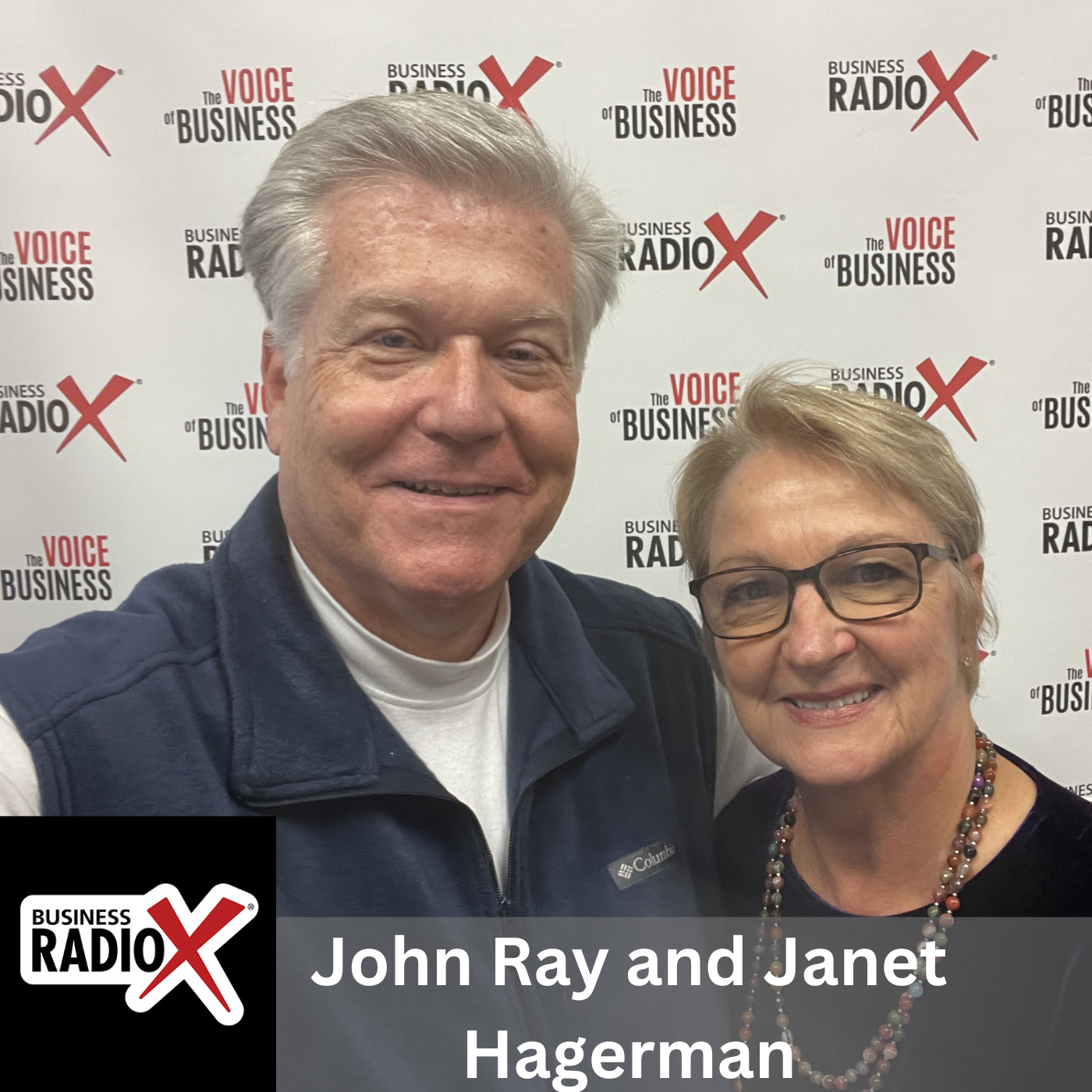
Managing DSO Hygiene for Patient Care, Profitability, and Scalability, with Janet Hagerman, Fractional Chief Hygiene Officer

January 29, 2024 by John Ray

Janet Hagerman, Fractional Chief Hygiene Officer
North Fulton Business Radio
Managing DSO Hygiene for Patient Care, Profitability, and Scalability, with Janet Hagerman, Fractional Chief Hygiene Officer
Loading
00:00 /
RSS Feed
Share
Link
Embed

Download file

Janet Hagerman, Fractional Chief Hygiene Officer

Managing DSO Hygiene for Patient Care, Profitability, and Scalability, with Janet Hagerman, Fractional Chief Hygiene Officer (North Fulton Business Radio, Episode 741)

On this episode of North Fulton Business Radio, host John Ray chats with Fractional Chief Hygiene Officer Janet Hagerman, who consults with Dental Service Organizations (DSOs). Janet discusses her role and explains the significance of effective hygiene departments for DSOs. She touches on the challenges DSOs face due to a lack of structures, high turnover, and low case acceptance rates. She emphasizes the role communication plays in addressing these issues, and the necessity of having congruent company and department visions. The episode concludes with Janet sharing her success stories and the sweet spots in her client base.

North Fulton Business Radio is hosted by John Ray and broadcast and produced from the North Fulton studio of Business RadioX® inside Renasant Bank in Alpharetta.

Janet Hagerman, Fractional Chief Hygiene Officer
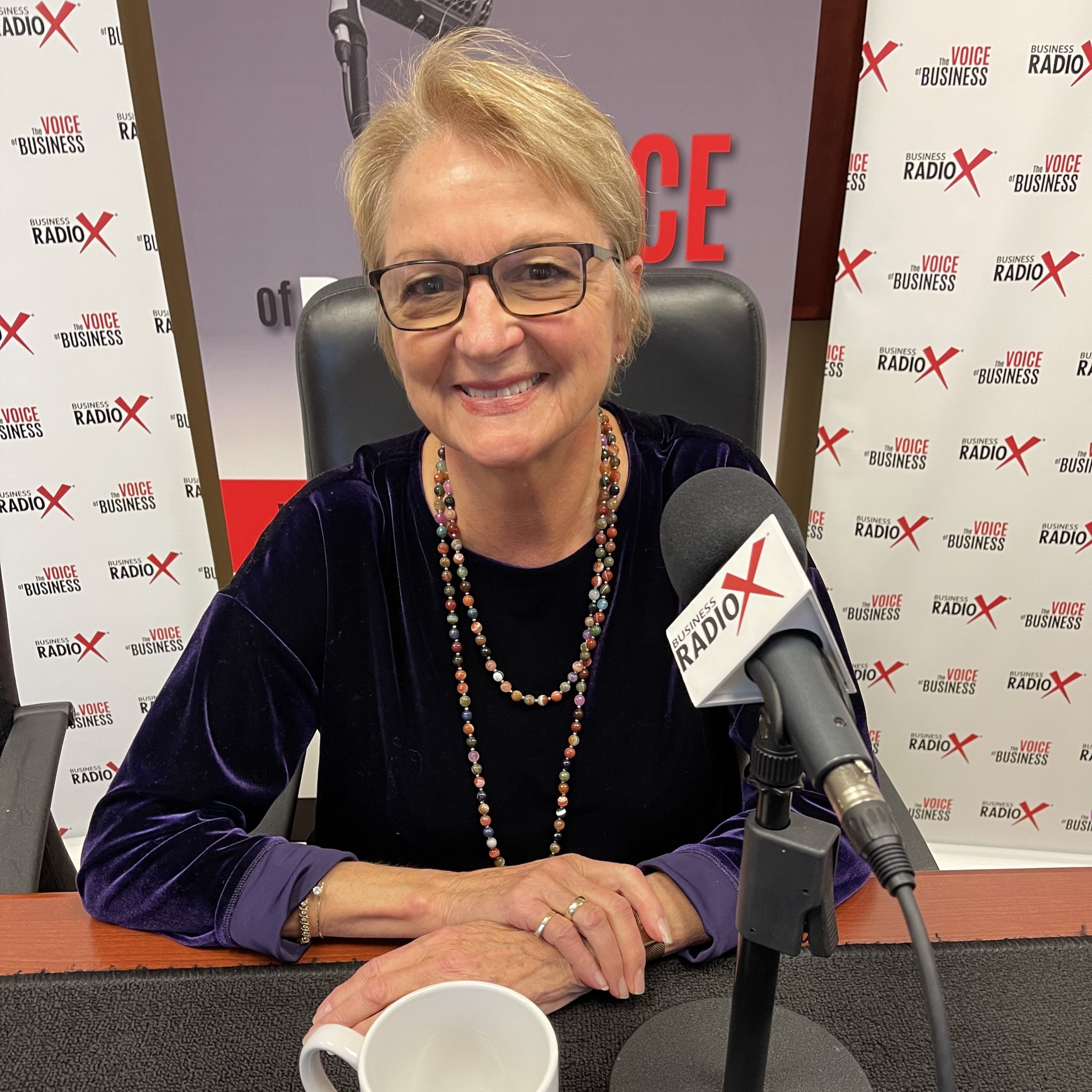
Janet Hagerman, Fractional Chief Hygiene Officer

Fractional Chief Hygiene Officer Janet Hagerman trains emerging DSOs to develop a profitable hygiene department positioned for same-store growth and acquisition scalability with consistent and profitable patient-centered systems. As badly as emerging DSOs need a game plan for growth, it’s often just not in the budget. As a fractional CHO, Janet utilizes her past DSO experience to teach DSOs how to create a hygiene department that is profitable, consistent, and scalable.

Janet is an international speaker, author, and consultant. A Medical College of Georgia graduate, Janet’s experience includes over 30 years of clinical and coaching experience with both solo and small to large group practices, and leadership as a corporate Director of Dental Hygiene, managing 100+ practices.

As a DSO Director of Hygiene, Janet created the hygiene department from the ground up, organizing best-in-class teams, creating scalable systems and profitable protocols, and cultivating a culture of enthusiastic, loyal support. She learned (sometimes the hard way) how to integrate the foundational hygiene department building blocks with the overall operational company structure. She introduced the clinical advisory board, which fosters dentist-hygienist collaboration. She learned and implemented strategies to increase patient treatment case acceptance, thus increasing production and revenue. Ultimately, she figured out how to create the foundational building blocks to produce a highly functioning DSO hygiene department, and now helps emerging DSOs do the same.

Website | LinkedIn

Topics Discussed in this Interview

00:04 Introduction to the Show
01:12 Introduction to Janet Hagerman
01:27 Exploring the Role of a Fractional Chief Hygiene Officer
05:05 The Importance of a Hygiene Department in Dentistry
06:04 The Challenges in the Dental Industry
08:19 The Role of Hygienists in Case Acceptance
12:05 The Impact of a Good Hygiene Department
26:24 The Importance of Metrics in Dentistry
32:53 The Success Stories of Janet Hagerman
35:26 Conclusion and Contact Information


North Fulton Business Radio is hosted by John Ray and broadcast and produced from the North Fulton studio of Business RadioX® inside Renasant Bank in Alpharetta. You can find the full archive of shows by following this link. The show is available on all the major podcast apps, including Apple Podcasts, Spotify, Google, Amazon, iHeart Radio, and many others.
RenasantBank


Renasant Bank has humble roots, starting in 1904 as a $100,000 bank in a Lee County, Mississippi, bakery. Since then, Renasant has become one of the Southeast’s strongest financial institutions, with over $13 billion in assets and more than 190 banking, lending, wealth management, and financial services offices in Mississippi, Alabama, Tennessee, Georgia, and Florida. All of Renasant’s success stems from each of their banker’s commitment to investing in their communities as a way of better understanding the people they serve. At Renasant Bank, they understand you because they work and live alongside you every day.
Tagged With: dental hygiene, dental service organizations, dentistry, DSO, fractional chief hygiene officer, hygiene department, Janet Hagerman, John Ray, metrics, North Fulton Business Radio

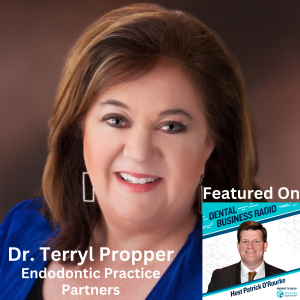
Dr. Terryl Propper, Endodontic Practice Partners

March 1, 2023 by John Ray

Terryl Propper
Dental Business Radio
Dr. Terryl Propper, Endodontic Practice Partners
Loading
00:00 /
RSS Feed
Share
Link
Embed

Download file

Terryl Propper

Dr. Terryl Propper, Endodontic Practice Partners (Dental Business Radio, Episode 40)

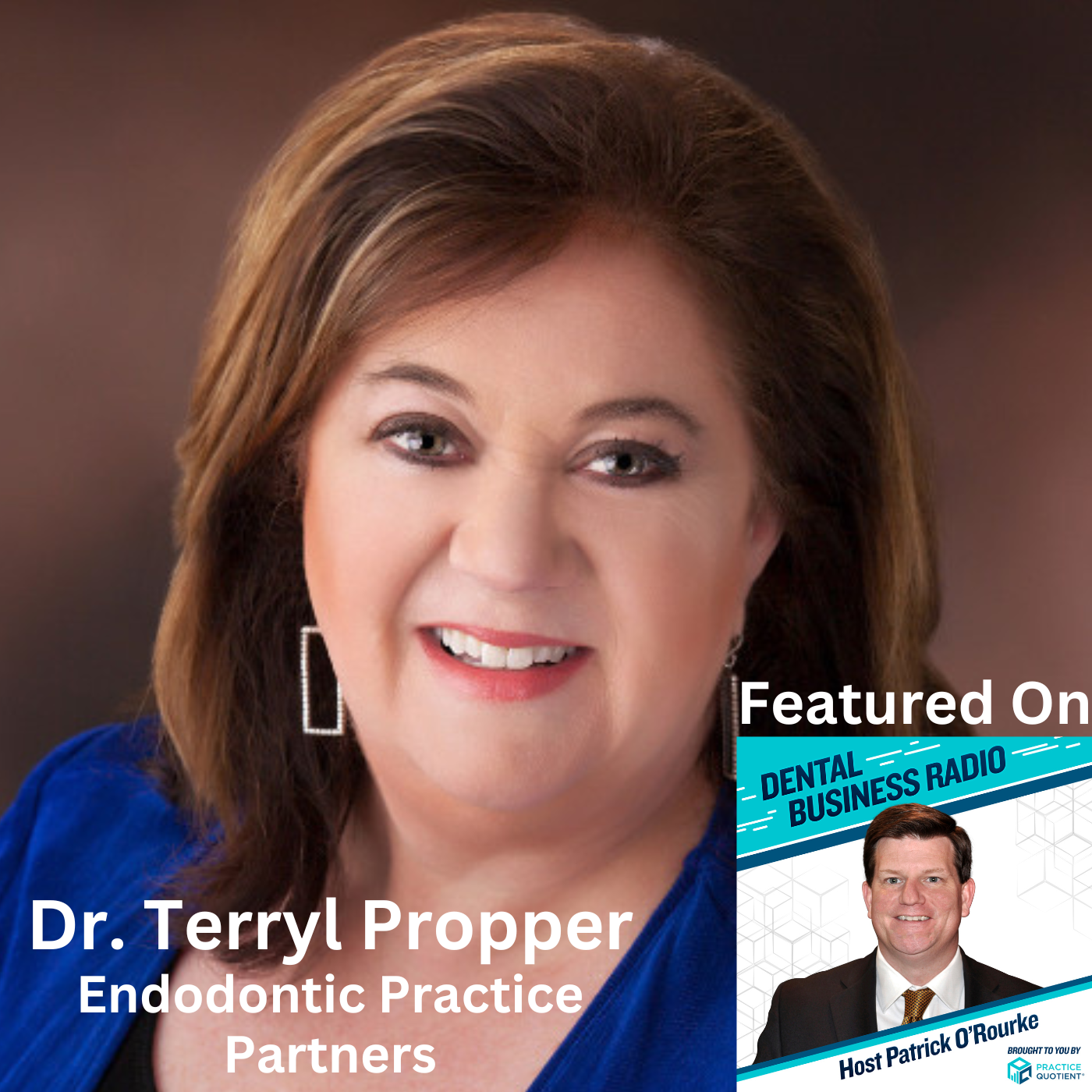
Dr Terryl Propper, Chief Dental Officer and Co-Founder of Endodontic Practice Partners, joined host Patrick O’Rourke to discuss EPP and its work. They are one of the first specialty dental support organizations for endodontists, run by endodontists, in the United States. Dr. Propper talked about how the company was founded, their doctors, the scope of their services, the focus on clinical care and bringing expertise and resources to an endodontic practice, and more.

Dental Business Radio is underwritten and presented by Practice Quotient: PPO Negotiations & Analysis and produced by the North Fulton studio of Business RadioX®.

Endodontic Practice Partners

EPP partners with endodontists empowering them to achieve their goals within their practices.

EPP provides specialized and expert business resources to meet the unique needs of each of our endodontic partner practices. The founders have a combined 60 years of clinical and operational experience in dentistry and are dedicated to creating a nationwide partnership of leading endodontic practices by providing shared resources and infrastructure to help practices grow and succeed.

Their approach is to understand your vision for your practice and provide the resources and support to achieve it.

You know your practice and your market: what’s best for your patients, how to provide excellent service to your referral sources, and the opportunities that exist to grow. Having the time, bandwidth, and capital to improve on each can be difficult. This is where EPP helps.

EPP prioritizes relationships and trusted connections that are necessary for a endodontic business to grow and prosper, especially in today’s competitive and evolving healthcare landscape. They understand the value of sincere and loyal relationships, because they know what it takes to be a successful endodontist and business leader. They created a company built on integrity, quality, compassion, and putting the patient first.

Company website | LinkedIn | Facebook

Dr. Terryl Propper, Chief Dental Officer, Co-Founder, Endodontic Practice Partners

Dr. Terryl Propper, Chief Dental Officer, Co-Founder, Endodontic Practice Partners

Dr. Propper has a diverse background in all aspects of the dental industry. She practiced with Endodontic Associates of Nashville for 30 years, and was CEO and managing partner of a 3-location group practice with eight doctors.

She was an ADA Hillenbrand Fellowship finalist, assistant director of marketing for the ADA, a member of the ADA speaker’s bureau, a proven change agent and past president of the American Association of Endodontists. She is the immediate past president of the Tennessee Dental Association.

LinkedIn

About Dental Business Radio

Patrick O'Rourke
Patrick O’Rourke, Host of “Dental Business Radio”

Dental Business Radio covers the business side of dentistry. Host Patrick O’Rourke and his guests cover industry trends, insights, success stories, and more in this wide-ranging show. The show’s guests include successful doctors across the spectrum of dental practice providers, as well as trusted advisors and noted industry participants. Dental Business Radio is underwritten and presented by Practice Quotient and produced by the North Fulton studio of Business RadioX®. The show can be found on all the major podcast apps and a complete show archive is here.


Practice Quotient

Dental Business Radio is sponsored by Practice Quotient. Practice Quotient, Inc. serves as a bridge between the payor and provider communities. Their clients include general dentist and dental specialty practices across the nation of all sizes, from completely fee-for-service-only to active network participation with every dental plan possible. They work with independent practices, emerging multi-practice entities, and various large ownership entities in the dental space. Their PPO negotiations and analysis projects evaluate the merits of the various in-network participation contract options specific to your Practice’s patient acquisition strategy. There is no one-size-fits-all solution.

Connect with Practice Quotient

Website | LinkedIn | Facebook | Twitter

TRANSCRIPT

Intro: [00:00:02] Live from the Business RadioX Studio in Atlanta. It’s time for Dental Business Radio, brought to you by Practice Quotient. Practice Quotient bridges the gap between the provider and payer communities. Now, here’s your host, Patrick O’Rourke.

Patrick O’Rourke: [00:00:21] Hi there, friends of the dental business community. This is your host, Patrick O’Rourke, Founder and CEO of Practice Quotient, PPO Analysis and Negotiation and National Public Speaker. You can find out more at www.patrickorourke.me. O’Rourke is spelled O-R-O-U-R-K-E for those of you who don’t have Irish friends.

Now, I am very excited today to chat with Dr. Terryl Propper out of Nashville, Tennessee, one of my favorite cities. And anybody who’s ever been there actually, I would imagine. Terryl, how are you?

Terryl Propper: [00:00:58] Doing great today, Patrick. Thank you.

Patrick O’Rourke: [00:01:01] Excellent. Excellent. So, Terryl, you are in a unique position where you are part of one of the only Endodontic DSO type organizations that’s very fast growing, I would imagine. So I would like you to introduce yourself to the audience and let’s get your background first and then how you came to be involved with the organization.

Terryl Propper: [00:01:38] Sure. Well, I am originally from New Orleans and went to college in New Orleans. I went to dental school in Memphis, the University of Tennessee. And I went to graduate school at UNC Chapel Hill, and received my Master’s in Science in Endodontics. I joined a practice here in Nashville. I’ve been the American Dental Association Assistant Director of Marketing is in my background. I’ve been president of the American Association of Endodontists. I’ve been president of the Tennessee Dental Association. And I was CEO and Managing Partner of a 3 location, 8 doctor endodontic group here in Nashville that’s 60 years old. So one of the premier endodontic practices in Nashville, Tennessee.

After being with that practice for 30 years, I decided to retire in January of 2019. I planned on opening a boutique consulting firm that did marketing for specialty dental practices. And during the time that I was looking to set up an office, I was called from our CEO, Sam Hutchinson, who’s got an MBA from Vanderbilt and worked in the medical field in mergers and acquisitions. And we sat down and talked about forming a company specifically for endodontists, run by endodontists, founded by myself and Sam Hutchinson and our COO. And we went to private equity firms, and they were very interested. We got several officers. We picked one and we got started.

Patrick O’Rourke: [00:03:18] Okay. How long ago was that?

Terryl Propper: [00:03:22] It was in 2019, and we’ve doubled our size each year. We’re across the United States. We’d like to think of ourselves as a specialty support organization because we only serve the endodontic field. We’re exclusive at this time to just endodontists.

Patrick O’Rourke: [00:03:45] And so you’ve doubled in size. If you’re based out of Nashville, is that growth primarily in the South or Southeastern United States? I’m just curious.

Terryl Propper: [00:04:00] No, we’re in Washington State. We’re in Oregon, Michigan, Massachusetts, Tennessee, Georgia, Florida. We’re across the different time zones. We’re not on the West Coast at this time. We appeal to a specific endodontist, mid age, 48 is our average age. And we like to think that we’re unique in the field because we are exclusive to endodontists. We haven’t diversified into other specialties. And we’re very endodontic-focused forward, I would say. Very focused on the doctor and patient and referral and happy doctors send other happy doctors. So that’s our focus.

Patrick O’Rourke: [00:04:53] I like it. So just for John Ray. With me, as always, is DJ John Ray on the mix tables over there. Endo is root canal so specialists that do root canals. So when she was talking about how she got her dental degree and then she did a residency is for root canals. So just for John Ray and maybe any of our other listeners that aren’t familiar.

Terryl Propper: [00:05:22] Right. Our primary focus is saving teeth through trauma or cavities or cracks or a variety of other reasons that you might need a root canal. Pain is a big driver, but endodontist also do surgical procedures, root end procedures to save a tooth and bleaching and a number of other scope of services that are within our specialty, mini [inaudible] implants. And so it’s a narrow field, it’s a narrow specialty, but there are a lot of components within the specialty.

Patrick O’Rourke: [00:05:59] Indeed. Endodontist to me, when you need a root canal, baby, you need a root canal, and it doesn’t matter. I remember the last time I needed a root canal, which was quite a while ago, but nothing else mattered until I got into that chair.

Terryl Propper: [00:06:16] Pain is a good motivator. Pain is an excellent motivator. Yes.

Patrick O’Rourke: [00:06:21] Yeah. So I’m just curious, what draws — is there any common draw for somebody who’s getting your dental degree and then, you know, you could be, I think the draw for a pediatric specialist is obvious, right? I like it. So they’re going to be pedo and oral surgeons have probably some reasons why they’re going into it. Is there any common specific thing that usually draws folks into this specialty?

Terryl Propper: [00:06:53] Well, I think there are a couple of things. You get great satisfaction in a patient coming in, in pain, and a patient leaving out of pain or within a day or so, they’ll be out of pain. It’s also a referral-based specialty where the majority of our patients come from family dentists that refer to specialists that they trust. And so that’s a big driver. Another driver could be that you see a patient once or twice for a root canal. You don’t follow them their entire lives as you do when you’re a general dentist.

I was a general dentist first. That gave me a lot of really good background to become a specialist. But I think an advantage of being a specialist is you only do one thing and you do it really, really well. You’re an expert in your field. So general dentists are taught to do root canals, but the expertise is really after you’ve done a residency and you become a specialist because there’s a lot of variation in teeth, there’s a lot of variation in people. And so being an expert and only doing one thing really makes you good at what you do.

Patrick O’Rourke: [00:08:10] That makes sense. That makes a lot of sense. Is there more endodontists today than there were ten years ago or less?

Terryl Propper: [00:08:22] Actually, it’s about the same. There have been a few new programs. About 204 residents graduate from endodontic programs across the United States, including military programs. And that’s been relatively stable. Maybe there have been just a few new programs that have opened, but basically it’s relatively the same.

Patrick O’Rourke: [00:08:46] Got you. And as far as is there — is it a male dominated field?

Terryl Propper: [00:08:55] Well, quite frankly, it’s been a very heavily male dominated field until maybe the last, I would say eight years, where most of the dental school classes are 50-50 female, male. And now, most of the endodontic programs are about 50-50. And so way more females in the whole dental world as a whole. In my graduating class, I had 150 students. And out of the 150, we had 8 females. So it’s quite different than it was when I graduated.

I’ve been out a long time. I’ve practiced for 40 years. And I love seeing the trend. I love seeing where it’s going. And women in the field have made a difference in the workplace and the marketplace, and they bring different things to a practice that a male can’t bring. And I just think it’s fabulous that we’re seeing more women in leadership, more women at the board table, more women in dental administration and dental politics. So it’s a wide-open field for women who want to be active in their organizations.

Patrick O’Rourke: [00:10:11] Absolutely. And so, you know, maybe you don’t use the word, but do you feel like maybe help blaze that trail a little bit because you were one of the first ones to?

Terryl Propper: [00:10:25] Well, as far as I know, Patrick, I am the sole female in the C-suite in the endodontic focused support organizations in the marketplace. And it’s a unique place to be because it gives you the opportunity to be a role model for the younger female dentists that are coming up. And I don’t want to brag on myself, but I’m very proud of the fact that I was the first female president of the Tennessee Dental Association in 153 years. So there were two females that followed me, but I was fortunately in the right place to be the first female and to set the stage for others that followed me.

Patrick O’Rourke: [00:11:16] That’s awesome. That really is an accomplishment. You are a trailblazer. You’re the female Daniel Boone.

Terryl Propper: [00:11:24] Maybe Annie Oakley.

Patrick O’Rourke: [00:11:25] Annie Oakley. I’ll buy that. Yeah, absolutely. So that feels good. And then right after you, there’s a couple more. And so do you think that as there’s been more and more females in leadership and in dentistry in general, how has the market as a whole, because this what we’re in is kind of, it’s a niche, right? I call it this little niche business when I explain my own business, but I’m like, look, you’re not going to get it, it’s a niche, the dental niche, if you will, here. How have — I know that there’s some DSOs that have responded to women, allowing them to for benefits, maternity leave, et cetera. But how about the market as a whole when it comes to, I don’t know, all of the things that you need in order to perform high level dentistry, and bringing a high-level caliber of care and deliver the best possible patient outcomes? How has all of the other participants within on that journey also responded to this, well, I’d say relatively new trend, but relatively?

Terryl Propper: [00:12:52] Well, you know, women as a whole are more active in business. You’re seeing more women in CEO positions. You’re seeing more women at the board table. You’re seeing more women get involved at the grassroots level. And I think that, quite frankly, in the specialty of dentistry, it could become women dominated in the next ten years. But certainly, women have every opportunity to be as successful as they want to be, to own their own practices. So much of the drive toward the support organizations and recruiting residents to enter these support organizations is the fact that student debt has just spiraled out of control. So the students are looking for an instant paycheck.

And so many of the support organizations in the market are recruiting heavily dental school graduates and residency graduates and endodontist. Especially, a specialty like endodontics that has a very low number of residents that are graduating each year, it’s a very competitive market. And so we have to be — Endodontic Practice Partners or EPP have to be at the top of our game to attract the brightest and the best residents. And we feel like that’s exactly where we are.

Patrick O’Rourke: [00:14:18] So let’s say that I am the brightest and the best. I can’t say I’ve ever been accused of that, but let’s just say for the sake of conversation here. And you find me the residency program and I want to go hang out at the pool or do whatever it is that young Patrick O’Rourke likes to do. And you guys say, hey, listen, Pat, you need to think about joining EPP, and this is why we’re awesome. What would you tell me?

Terryl Propper: [00:14:53] Well, this is exactly what I tell you, because I tell it to residents every time I talk to them. What you’re joining is a private practice, an endodontic private practice, well-established, state of the art, well-respected in the community, reputable and people that you want to go to dinner with, people that you will like, staffs that are established, processes that are in place, and you will be entering a private practice. It just so happens that that private practice is supported on the management and business side by EPP.

So you treat the patients the way you want to treat them. You treatment plan the way you want to treatment plan. You use the instrumentation that you’re comfortable with. You provide the top patient care you can give. We want the patient to have a good experience. We want the staff to have a good experience and we want the patient to leave happy. We want the referring dentist to be happy. But most of all, we want the staff and endodontists to be happy. So we’re about clinical care, but we’re also about building in efficiencies in practices that the practitioner might not see or might not have time or resources to pay attention to. So those are the things we bring to the practice, expertise and resources.

Patrick O’Rourke: [00:16:18] Well, you know, let’s say I’m from a small town. And I’m like, you know, I just hang my shingle right out there and I’m just going to say I do root canals and I know all the people in town. My family’s lived there for a couple of generations, you know. But what’s in it for you guys?

Terryl Propper: [00:16:41] Well, I’m not sure what question you’re asking, Patrick. But I think what you’re asking is, is there still a place for someone to open their own practice and be successful? Yes. There’s always a place for that, but we can bring resources and business acumen to even a solo practitioner who’s just getting started. In fact, we love offices like that because we can help mold the direction the practice is going to in the beginning.

I think that some people have a general misconception about a dental support organization. When it’s applied to a specialty, it’s a different beast than it is when it’s applied to a general practice. And I think that a lot of people equate a general practice DSO with a specialty services organization like ours, because we’re focused keenly on the endodontist and endodontic experience.

Patrick O’Rourke: [00:17:50] And so, yeah, I’m just sort of playing devil’s advocate a little bit. I’m real familiar with the specialties. Amos, I’ll be speaking to Amos in San Diego Plug. If you don’t get enough of my compelling rhetoric today and you happen to be in the oral surgery space. And I’ll say, and I’ve had several folks on the show, is that not all DSOs and or specialty organizations are the same. Sometimes they kind of get lumped in a bucket, but they’re not all the same. There’s different focuses, different niches, different methodologies, different strategies, both internal and external.

And so what I see sometimes when I’m out at a committee or out at a convention or something, is that, and I call them the kids, right. And I’m not that old, but the kids. There’s a bunch of folks that are like, hey, you guys should come talk to us, right? And you guys need to come work for us. And so I know that a lot of those kids listen to the show. and so they may get kind of pitched out, you know, by the time they’re talking to the fourth or the fifth booth, right, and they just want to go to the pool and get a tan or relax.

And so I guess what I’m trying to say, is there any catches? Because if it was me and I was walking around, I would just be like, all right, so I heard this, we’re doctor-centric. I do hear that. Now, what’s in it for me is that I don’t have to worry about business part, right? Because I don’t know much about business. I just graduated, right. And I got all of this debt. Have I ever hired anybody and managed anybody? No. And I don’t know how painful that’s going to be until I actually do it. I get it.

I think that there’s probably something that you guys are going to tell the best and the brightest Pat that why he needs to come to EPP. And then am I starting my own practice? Are you putting the best and the brightest and you’re saying, hey, Pat, do you want to go to DC or do you want to go to Atlanta or do you want to go to Nashville? Like, how does it work? And because I really don’t know, because I’m not the best and the brightest usually.

Terryl Propper: [00:20:11] So it works both ways. The majority of the time, we place new residents in established practices, well-established practices in demographic areas and locales where people are going to want to live. Because when we select practices that we partner with, we select practices in growing areas where people are going to want to live because that’s where the endodontic market is.

And I think that one component that we offer is not only the business support, but we offer the ability for the senior doctor or the other doctors in the group to mentor a new practitioner because, you know, you learn a lot in your residency, but what you really learn when you really learn is when you’re in practice. That’s why they call it practice, because you practice a lot on people. And so oftentimes, a new resident needs some mentorship, needs some guidance clinically or communication wise or working with referring doctors. Sometimes there’s challenges and the older, more mature doctor can impart wisdom upon some of the new graduates.

Patrick O’Rourke: [00:21:29] Amen to that. I think everybody can serve. You know, I’m a big believer in Napoleon Hill, the mastermind alliance. You know, in order to attain wisdom, you really need to access different perspectives from folks, you know?

Terryl Propper: [00:21:46] Right. It’s very lonesome. It’s very lonesome to practice by yourself, especially in a field like endodontics. It’s very tedious. We use a microscope. We use a 3D imaging to diagnose and treatment plan. And it’s helpful to have someone else to confer with, to look at a case with. And we have a very, very high success rate with the residents that we’ve brought in to our practices. The residents have an opportunity to buy into the practice as a partner. They buy into our holding company. They have stock in the company. So they’re actually owners in the company, as are all of our doctors that affiliate with us. So it’s not the big bad wolf company telling our doctors how they’re going to practice. It’s our doctors deciding how they want to practice on their terms with some guidance from EPP.

Patrick O’Rourke: [00:22:44] Got you. And then they don’t have to worry about managing people for the most part.

[00:22:49] Right. Because all support organizations provide HR services, payroll services, accounts payable, rev cycle, insurance verification, IT, HR, benefit packages. Most of the support organizations do in general, the same kind of, provide the same kind of services. But it’s who the people are that are in the management team, what the attitude is, what the vision is, what the core values are of the company that make a difference in the whole culture of the company and its culture that you’re really selling. Here’s three companies. We all have a different culture, we all have a different approach, we all have a different strategy, and we all have a similar endpoint. But it’s how are you going to get there and who are you going to get there with?

Patrick O’Rourke: [00:23:46] That’s excellent. I like how you put that. You just nailed it.

Terryl Propper: [00:23:53] It’s really the truth. I mean, you can go out look for a car. All the cars are going to get you where you’re going, but which bells and whistles do you want and what kind of comfort do you want? So it’s similar with a specialty support organization like ours. There’s competition in the market. We’re one of the youngest companies in the market, but we’re going to be very successful because of the people that are in our management, in our C-suite.

We have expertise. We’re approachable. We’re down to earth. We don’t try to be somebody that we’re not. We’re transparent. We want our doctors to be happy because happy doctors refer their friends, right? And it’s about growth. We want to grow the practices. We want to grow the company. We want to provide opportunities for the new doctors. We want to provide professional development for the more mature doctors. We want to educate the staff. So we have a lot of goals that we want to reach, and we have tremendous cooperation from our partners. So, you know, we’re a young company, we’re growing quickly, and I think we provide a tremendous service.

Patrick O’Rourke: [00:25:09] I like that. So different cars can get you different places. A Yugo, for example, at one time.

Terryl Propper: [00:25:19] Right.

Patrick O’Rourke: [00:25:20] And a phantom Rolls-Royce.

Terryl Propper: [00:25:22] Right.

Patrick O’Rourke: [00:25:22] Well, technically, you’re going to get you from A to B, but it’s going to be a totally different experience.

Terryl Propper: [00:25:27] That’s correct.

Patrick O’Rourke: [00:25:29] You know.

Terryl Propper: [00:25:31] Another thing, Patrick, is EPP keeps the same culture. So if we come in and we partner with the practice, it’s still the name of the practice. It doesn’t take on EPP. In fact, we’re almost like a silent partner, providing practice management, consulting services, and business services. So it retains the culture of the doctor that built it from scratch. It takes a long time to build a successful andodontic practice. And certainly, we want our doctors to maintain their touch and their personal attention to the practice, what they formed and raised. And this is their baby. And we want that baby to remain their baby. We just want to help them be more efficient with their business practices. That’s the main focus of our company.

Patrick O’Rourke: [00:26:31] Got you. So if I may put this into my own words.

Terryl Propper: [00:26:35] Okay.

Patrick O’Rourke: [00:26:36] All right. So let’s say that I’m an established endo provider. The product really is the docs, it is the providers. And it’s incumbent. And they have relationships and roots in their communities within their professional circles and probably within their civic circles as well, their business and civic communities, depending on how involved they are. And so you’re looking for somebody that’s mid-career, that wants to grow, right? But they still want to — if it was my name on there, Patrick O’Rourke, O’Rourke Endo, it’s still going to be O’Rourke Endo. If I’m doing well, you guys want to throw a little bit of gasoline on the bonfire?

Terryl Propper: [00:27:29] Right. We want to help the practice grow. You know, it’s hard when you’re an endodontist, you’re on a schedule every day for 8 hours. You don’t have — you have a family to go home to and things like marketing. So marketing is something that, you know, it promotes business for the practice, but it also gets your name out of the community. It also can be community supportive. It can bring in employees that have heard that you’re a good place to work.

But marketing is one thing that we provide, and we do very well at it. And it’s something that most endodontist don’t do, mainly because it’s a pain driven specialty and patients come in on their own. But in competitive markets, a good marketing plan and a strategic marketing plan can really make a big difference in the success of a practice and practices that do little to no marketing will fall by the wayside if a practice that does great marketing is able to get a foothold in the community. So, yes, to your question, O’Rourke Endodontics is going to be more successful if they partner with EPP than if they stay on their own because of resources and expertise.

Patrick O’Rourke: [00:28:51] With O’Rourke Endodontics beyond the goodyear blimp, that would be cool. Maybe. Maybe. It’s just, you never know, right?

Terryl Propper: [00:29:01] You know, the sky’s the limit. If you dream it, we will try to make it happen. That is a lofty goal, but, you know.

Patrick O’Rourke: [00:29:10] All right. Well, we will start with one of those planes at the beach that has a sign on.

Terryl Propper: [00:29:16] That we could do with the trailer behind it. Yeah.

Patrick O’Rourke: [00:29:19] I’ll buy that. Listen. That’s it. You got to start somewhere.

Terryl Propper: [00:29:24] Right.

Patrick O’Rourke: [00:29:25] I’ve been watching. Again, I’m a neutral observer. You know, I have clients that are — most of our clients are probably establish, very kind of higher end practices, if you will, or just by the very nature of our business, which is we have to go convince all of my colleagues at the insurance companies that they need to pay them a little bit more fairly. Hi, guys. I know you’re listening. It’s great to have you here. And, you know, I don’t think that’s a surprise to anybody that they’re not in a huge hurry to do that.

So one of the things I hear from our established specialists is they’re like, I can’t get another resident in here because there’s the folks at the schools. You guys are probably one of them. And, you know, like, it’s just the competition is so stiff to get residents and to get somebody to go into the more traditional partnership track like that has been done in the oral surgery and the endo world for what decades.

And so, you know, me personally, I’m like, look, you should — why fight city hall? What do I tell, let’s say Dr. John Ray, which would make his mama really proud? Dr. John Ray, you know, he’s got John Ray Endodontics over there and he’s like, I can’t get a resident in here, and I’m trying to retire, go fishing, but I don’t want to give up my practice either. I want to come in here and blah, blah, blah. And he wants to mentor and do all that stuff because he’s a good dude, right?

What do I tell? Let’s say Dr. John Ray is my client. And this conversation happens to me and to my team. So I tell Dr. John Ray, how do I facilitate an introduction to you guys? I mean, like, listen, John, instead of fighting the current here and trying to swim upstream, why don’t you at least have a conversation with them? Maybe they could do some of those things for you too, A, find a resident, right? I’m assuming. And as long as he’s in a desirable place and not like Port-au-Prince, Haiti, or something. That’s why he vacations —

Terryl Propper: [00:31:49] There’s nothing wrong with Haiti.

Patrick O’Rourke: [00:31:50] Oh, I like it Haiti.

Terryl Propper: [00:31:51] Great.

Patrick O’Rourke: [00:31:54] It was the first thing that popped into my mind, though. Some people want to go to Atlanta, live in Buckhead. They want to go to New York, Miami, Los Angeles, San Diego, but they don’t want to go to, I don’t know —

Terryl Propper: [00:32:10] Don’t say it, Patrick. We get the drift.

Patrick O’Rourke: [00:32:12] Yeah.

Terryl Propper: [00:32:13] So, you know, we have a director of recruiting and mentorship with EPP. And if there’s a partner doctor who might be interested in hearing what we have to say, then you can reach us on our website at endopracticepartners.com. It’s hard for a graduating resident unless they have an endodontist that they’ve known, that they’ve planned to go in with, or someone that they have a family friend in their community. It’s difficult for a solo endodontist to find associates now, but it’s still possible. There are a lot of people competing, a lot of companies competing for endodontists.

And you know, the residents can come out, they can get signing bonuses and incentives to join companies, companies like ours. It just depends what the resident is looking for, how much debt they’re in, where they want to live, how they want to practice. But for your friend, Dr. John, what I would say is I think it’s good to explore the market and see what’s available. You would think that a company like ours would attract an older clientele, but it doesn’t. There are a lot of endodontists that still want to grow their practices, but they’re confined by resources or time.

We have a lot of practices that want to open second offices. We have some de novos that we’re starting from scratch. We have group practices, solo practices. We have senior doctors. We have young doctors. We’ve helped all of them in different ways. Every practice is unique. And what I can say about our company is I think we try to personalize the services we provide to the practice we partner with so we don’t have one size that fits all because one size can’t possibly fit every endodontist.

So this endodontist needs marketing, we provide that. This endodontist has accounts receivable problem, we provide that. This office wants to recruit a new associate, we provide that. This office has high staff turnover, we try to do whatever we can to maintain staff, to incentivize them or to attract new staff or train the staff. So every practice is different.

So Dr. John’s looking for an associate. Then he needs to put out all the fillers he can and all the different venues he can. But we would be happy to talk to somebody like Dr. John to see how we might be able to help.

Patrick O’Rourke: [00:34:57] Got You.

Terryl Propper: [00:34:57] And certainly, there’s no fee for consultation. We’re happy to talk to anybody at any time.

Patrick O’Rourke: [00:35:04] Well, that’s good. I charge for consultations, and so does John, actually. So you got us beat.

Terryl Propper: [00:35:13] There you go.

Patrick O’Rourke: [00:35:13] So as we talk about the market, I see and have in my mind witnessed and observed a shift. I feel like it started with the general dentist market. And then it got into the specialist market of consolidation, of centralizing operations, if you will. And I have my own opinions, but, you know, I could just interview myself. So I would like to hear your opinion on where do you see the endo market? And by the endo market, I mean, the actual provider community itself. Where do you see that going over the course of the next five years or maybe even this decade, the roaring twenties?

Terryl Propper: [00:36:04] Well, here’s what I see. So I’m a student of the dental marketplace. I was president of the American Association of Endodontists in 2016. Consolidation in the medical field has been around for years. We have consolidation in oral surgery, in orthodontics, and pediatric dentistry, and those are fairly new market. The first company came to market in 2018. And now, it’s 2023 and there are approximately five companies in the market. It’s a very small slice of the pie, but it’s a very —

Patrick O’Rourke: [00:36:40] Important part, particularly if you need a root canal.

Terryl Propper: [00:36:44] It is. And I think what people are learning in the market is the value of consolidation, the value of strength in numbers, the value of being able to go to an insurance company and say we have however many endodontist and inflation is hitting everyone. Food is more expensive. Gas is more expensive. Cars are more expensive. Education is more expensive and dental services are more expensive.

But Patrick, not to challenge you, but dental insurance benefits have not kept up with the cost of doing business, the cost of inflation, the cost of supplies. They just haven’t kept up. And so I think that consolidation is probably going to force insurance companies to take another look at the fees they’re paying. Most patients have a benefit of 1000 to 1500 dollars a year. I graduated in 1982. I don’t think that benefit has gone up. You would know better than I do, but I think consolidation will have an effect on payer rates.

And I think that’s one thing that we can do for our practices. And we’ve already seen the needle move in in a positive direction on that. But I think that consolidation will be here to stay over the next decade. And there’s always a place for a private practitioner. There’s always a place for fee for service. My mantra is there’s always a place for someone that cares about their patients, that does excellent work and has some semblance of community and ethics and professionalism. They’ll always survive. They may take longer to build their practice, but there’s always a place for people like that. So this model isn’t for everybody. But I think in 2023, with what’s going on in the economy, joining a company like EPP diversifies your risk and allows you to be part of a bigger group that you wouldn’t have had the opportunity to be part of sitting in your office in Buckhead.

Patrick O’Rourke: [00:39:09] And very likely have annual meetings and nice places like the Conrad maybe.

Terryl Propper: [00:39:18] Well, actually, I am out scouting today for a nice hotel for our annual meeting, which will be in November here in Nashville. The American Association of Endondontists was supposed to meet here in 2020 and the annual meeting was canceled due to COVID. So we have a lot of people who’ve never been to Nashville, and I think it’s a great place for us to have our annual meeting in the fall.

Patrick O’Rourke: [00:39:45] Yeah, shout out to Conrad and Nashville as a whole. If you have not been there, highly, highly recommend it. It’s really one of America’s treasures. Well, you know, you did say something. And I’m just going to reiterate this fact for all of my friends and colleagues on the other side of the aisle and the insurance industry. I feel I’m not going to paint everybody with a brush, but there’s certainly this decade rates are coming down or not up and the cost of doing business, you just heard it, is going up. And so, you keep squeezing, keep squeezing. And then this is kind of what happens.

And that could be one of the pivotal and primary reasons why folks jump into a larger practice is because they feel like they have no chance and they’re getting squeezed by the larger insurance companies who are also consolidating. Whether that’s fair or not, this is very true. And so, you know, you and I are on that same side of the fence from the insurance industry, but all of my clients are providers. So I try to be as neutral as possible, but we represent the provider community. Does that make sense?

And so sometimes I’m defending the insurance industry, but I feel like I’m trying to — we’re a bridge between the provider and the payer communities because the provider community speak Japanese and the payer communities speak Portuguese, and we’re fluent in both. But the more that folks come on here and they kind of express the pain that they are seeing in their own practices, especially with inflation and especially with all of the improvements that you guys had to make with COVID and the whole staffing shortage of people just disappearing beats me. But you know, I can’t get a pizza delivered to my house when there’s 20 kids about to burn the place down if we don’t feed them. That’s a problem.

Terryl Propper: [00:41:47] No, staffing is the problem. Staffing is a problem across the United States, and that’s one thing we focused on. All of our practices are looking for stable staff. I don’t know where everybody went after COVID, but we are able to recruit good staff. And, you know, there’s a lot of things, there’s a lot of moving parts in the dental marketplace now. There’s just a lot of things changing in the marketplace.

And one thing that I say to endodontists that I talked to is, you know, you need to be aware of the changes that are going on. You can’t practice like you did in 1982 because the market will pass you by. And I think that’s one of the attractions to companies like ours is we’re on top of things. We understand the market. We see where things are going. We understand how you can negotiate better supply rates and better equipment rates and better insurance rates. When you have numbers and when you are across the United States, it’s all very important to the bottom line. It’s also very important to provide the top equipment and the most recent technology and education. And everything cost money these days. Nothing’s free and we try to do what we can to make all of our practices just as high-end and topnotch technologically, educationally, and patient-friendly as possible.

Patrick O’Rourke: [00:43:29] Amen. So one more time, Dr. Terryl Propper, I’d like to thank you very much for being on our show. It is an honor. If our listeners out there in dental business land would like to reach somebody at, well, it wouldn’t be you, right? It would be who at Endodontic Practice Partners would they want to reach out? Is there a 1800 awesome endo or something?

Terryl Propper: [00:43:57] Well, you know, since your listeners have heard from me and they see my picture, I think you’re perfectly welcome to reach out to me personally. It’s Dr. Terryl Propper. My phone number 615-422-6702. Or you can reach out online to endodonticpracticepartners@eppendo.com. I almost gave the name of my practice that I had been with for 30 years. I almost forgot and gave them the plug, but happy to talk. If you call, I may refer you to somebody in our development department. Alex Nulty is our senior director of Development. But certainly, you can start with me and then I can get you to the right person that can answer the question.

Patrick O’Rourke: [00:44:46] That’s terrific. Terryl, again, thank you so much.

Terryl Propper: [00:44:50] Thank you.

Patrick O’Rourke: [00:44:51] And this is your host. All of our listeners, thank you, guys, for listening. As a reminder, the show’s sponsored by me. That’s right. So if you like the content, great. You can always hit me up at info@practicequotient.com or check me out at patrickorourke.me. I’m in Instagram somewhere too. If you didn’t like the show, please take it up with our sponsors. And thank you very much for your time. Until next time. This is Patrick O’Rourke.


Tagged With: Dental Business Radio, dental practice providers, Dr. Terryl Propper, DSO, endodontic partnership organization, Endodontic Practice Partners, endodontists, endodonty, Patrick O'Rourke, Practice Quotient

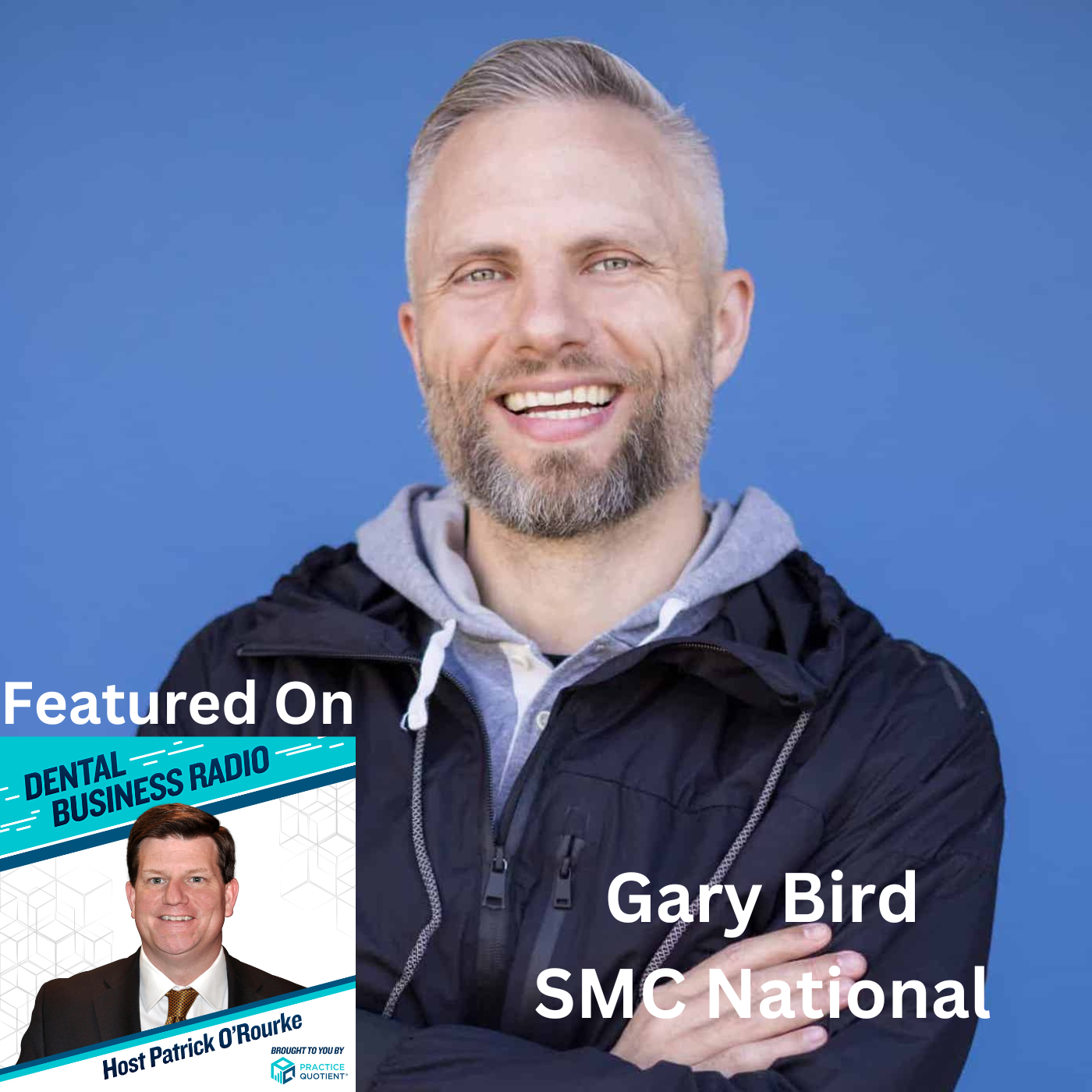
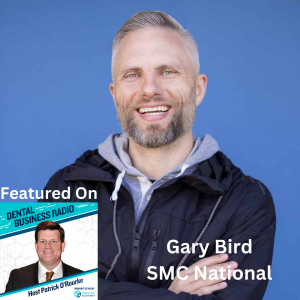
Gary Bird, SMC National

January 4, 2023 by John Ray

Gary Bird
Dental Business Radio
Gary Bird, SMC National
Loading
00:00 /
RSS Feed
Share
Link
Embed

Download file

Gary Bird

Gary Bird, SMC National (Dental Business Radio, Episode 38)

Gary Bird, Entrepreneur, Founder & CEO of SMC National, and host Patrick O’Rourke discussed marketing and business culture. Gary talked extensively about being a leader, building culture as a leader, and then talked specifics about dental marketing. The conversation also covered the cost of marketing, cost per acquisition, how SMC measures the patient journey, the need for “top of funnel” data, how they diagnose and address the practice issues in the patient journey, the nuances of structuring the practice, and much more.

Dental Business Radio is underwritten and presented by Practice Quotient: PPO Negotiations & Analysis and produced by the North Fulton studio of Business RadioX®.

SMC National

SMC uses clear, actionable data to give your dental group or DSO a predictable stream of new patients that can be adjusted monthly to meet your needs.

The team at SMC is composed of thoughtfully selected professionals who have a strong work ethic and embody their company’s core values. You’ve never met a team like theirs, and they can promise that you won’t find one as dedicated and committed to growth anywhere else.

Company website | LinkedIn | Facebook | Instagram

Gary Bird, Entrepreneur, Founder & CEO of SMC National

Gary Bird, Entrepreneur, Founder & CEO of SMC National

Gary runs a marketing company called SMC National and loves to share everything he’s learned while growing his agency from nothing to $20M in revenue.  He is committed to helping driven marketing entrepreneurs build on his success. Gary will show you how to make it BIG — by always giving more.

When Gary isn’t working, he dedicates his energy to serving his family and his church. He loves spending time with those he cares about most and helping fellow members of his church community to thrive.

LinkedIn

About Dental Business Radio

Patrick O'Rourke
Patrick O’Rourke, Host of “Dental Business Radio”

Dental Business Radio covers the business side of dentistry. Host Patrick O’Rourke and his guests cover industry trends, insights, success stories, and more in this wide-ranging show. The show’s guests include successful doctors across the spectrum of dental practice providers, as well as trusted advisors and noted industry participants. Dental Business Radio is underwritten and presented by Practice Quotient and produced by the North Fulton studio of Business RadioX®. The show can be found on all the major podcast apps and a complete show archive is here.


Practice Quotient

Dental Business Radio is sponsored by Practice Quotient. Practice Quotient, Inc. serves as a bridge between the payor and provider communities. Their clients include general dentist and dental specialty practices across the nation of all sizes, from completely fee-for-service-only to active network participation with every dental plan possible. They work with independent practices, emerging multi-practice entities, and various large ownership entities in the dental space. Their PPO negotiations and analysis projects evaluate the merits of the various in-network participation contract options specific to your Practice’s patient acquisition strategy. There is no one-size-fits-all solution.

Connect with Practice Quotient

Website | LinkedIn | Facebook | Twitter

Tagged With: Culture, dental business, Dental Business Radio, DSO, Gary Bird, insurance, Leadership, marketing, Patrick O'Rourke, Practice Quotient, SMC National

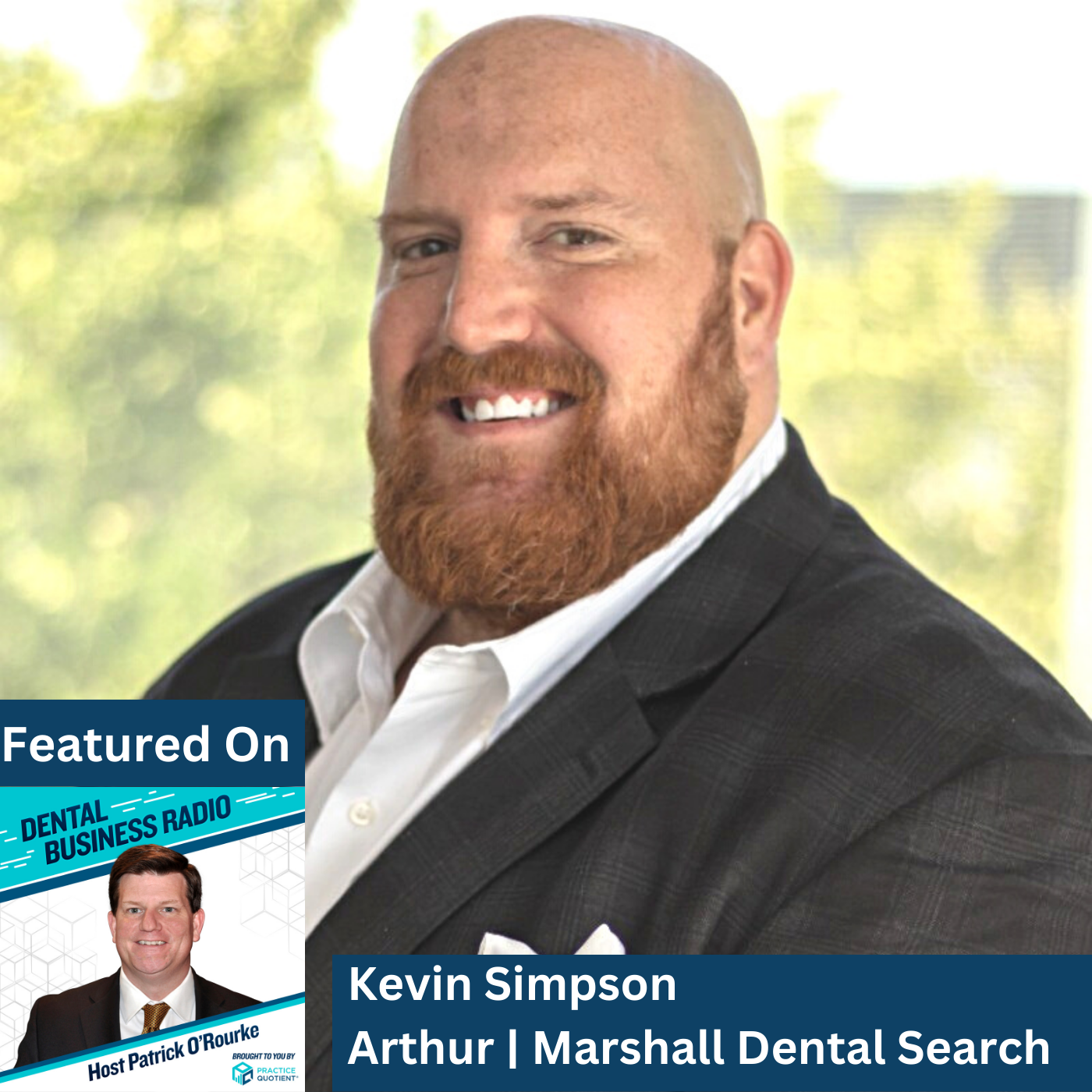
Kevin Simpson, ARTHUR | MARSHALL Dental Search

November 17, 2022 by John Ray

Arthur Marshall
Dental Business Radio
Kevin Simpson, ARTHUR | MARSHALL Dental Search
Loading
00:00 /
RSS Feed
Share
Link
Embed

Download file

 Arthur Marshall

Kevin Simpson, ARTHUR | MARSHALL Dental Search (Dental Business Radio, Episode 35)

Kevin Simpson, Chief Operating Officer for ARTHUR | MARSHALL Dental Search, joined host Patrick O’Rourke for a conversation about the dental search field. They discussed what’s in demand, why it’s so hard to hire associates, the impact of COVID on hiring, the advantages of working your network, ways to stay competitive, and much more.

Dental Business Radio is underwritten and presented by Practice Quotient: PPO Negotiations & Analysis and produced by the North Fulton studio of Business RadioX®.

ARTHUR | MARSHALL Dental Search

Since its inception in 2002, the ARTHUR | MARSHALL Recruitment team has served as the conduit for thousands of successful employment relationships between dental practices, DSOs, hospitals, physician practices, clinics, and physicians across the country.

They have a passion for providing their clients with superior candidates who are prequalified matches for the position. They know the challenges faced by dental organizations when recruiting top-tier talent, as well as the challenges candidates face when searching for new opportunities. They know that every employment opportunity has specialized criteria, and every professional has specific needs.

Whether you’re an employer searching for the right candidate, or a physician looking for a new opportunity, the Arthur | Marshall recruitment team is dedicated to building your success.

Company website | LinkedIn | Facebook

Kevin Simpson, Chief Operating Officer, ARTHUR | MARSHALL Dental Search

Kevin Simpson, Chief Operating Officer, ARTHUR | MARSHALL Dental Search

Mr. Simpson joined ARTHUR | MARSHALL after a decade as a highly awarded recruiter at two national recruiting firms. He was also the owner of a physician practice revenue consulting firm. With well over 300 dental, physician, and executive placements managed, Kevin has a deep-rooted understanding of recruitment and people. He is ethically driven, results-oriented and brings a wealth of industry knowledge to build, develop, and mentor teams as they implement comprehensive strategies in support of company goals and objectives.

Kevin has a genuine passion for maximizing value to clients. He feels his success lies in his ability to be empathetic to his client’s needs while being knowledgeable and skilled enough to assist his clients in finding creative solutions to attract providers in an increasingly competitive market. His experience in Recruiting as well as Business Development has given him a unique set of skills that ultimately transfer to clients, employees, and candidates alike.

As both a former recruiter and marketer (and leader of both), Kevin’s promotion to COO was a natural fit. He understands the uniqueness of each role and how important each side of the team is to the success of the company and its clients. His leadership style as COO is to drive the company forward not as the “Star Player” but rather as an offensive lineman removing the obstacles from the team’s path, allowing others to make the plays and receive the glory. Since taking on his new role, Arthur Marshall has grown nearly 230%, and client satisfaction is at an all-time high.

Kevin is a devoted husband to Brittany and father to three beautiful children. In his free time, Kevin enjoys family trips, hunting, and all levels of football. He played minor league football for ten years and held many accolades for his performance as an offensive lineman. Kevin was a captain for The Texas Bullets and won a national title in 2016. He also won game MVP honors as the team’s most influential leader. Most recently, Kevin was nominated for induction into the 2020 Minor League Football Hall of Fame. A valued mentor once said his greatest asset was his indomitable will to succeed. This trait has proven to be invaluable time after time.

LinkedIn

About Dental Business Radio

Patrick O'Rourke
Patrick O’Rourke, Host of “Dental Business Radio”

Dental Business Radio covers the business side of dentistry. Host Patrick O’Rourke and his guests cover industry trends, insights, success stories, and more in this wide-ranging show. The show’s guests include successful doctors across the spectrum of dental practice providers, as well as trusted advisors and noted industry participants. Dental Business Radio is underwritten and presented by Practice Quotient and produced by the North Fulton studio of Business RadioX®. The show can be found on all the major podcast apps and a complete show archive is here.


Practice Quotient

Dental Business Radio is sponsored by Practice Quotient. Practice Quotient, Inc. serves as a bridge between the payor and provider communities. Their clients include general dentist and dental specialty practices across the nation of all sizes, from completely fee-for-service-only to active network participation with every dental plan possible. They work with independent practices, emerging multi-practice entities, and various large ownership entities in the dental space. Their PPO negotiations and analysis projects evaluate the merits of the various in-network participation contract options specific to your Practice’s patient acquisition strategy. There is no one-size-fits-all solution.

Connect with Practice Quotient

Website | LinkedIn | Facebook | Twitter

Tagged With: Arthur Marshall, Dental Business Radio, Dental recruiting, dentistry, DSO, Kevin Simpson, Patrick O'Rourke, physician recruitment, Practice Quotient, recruiting firm

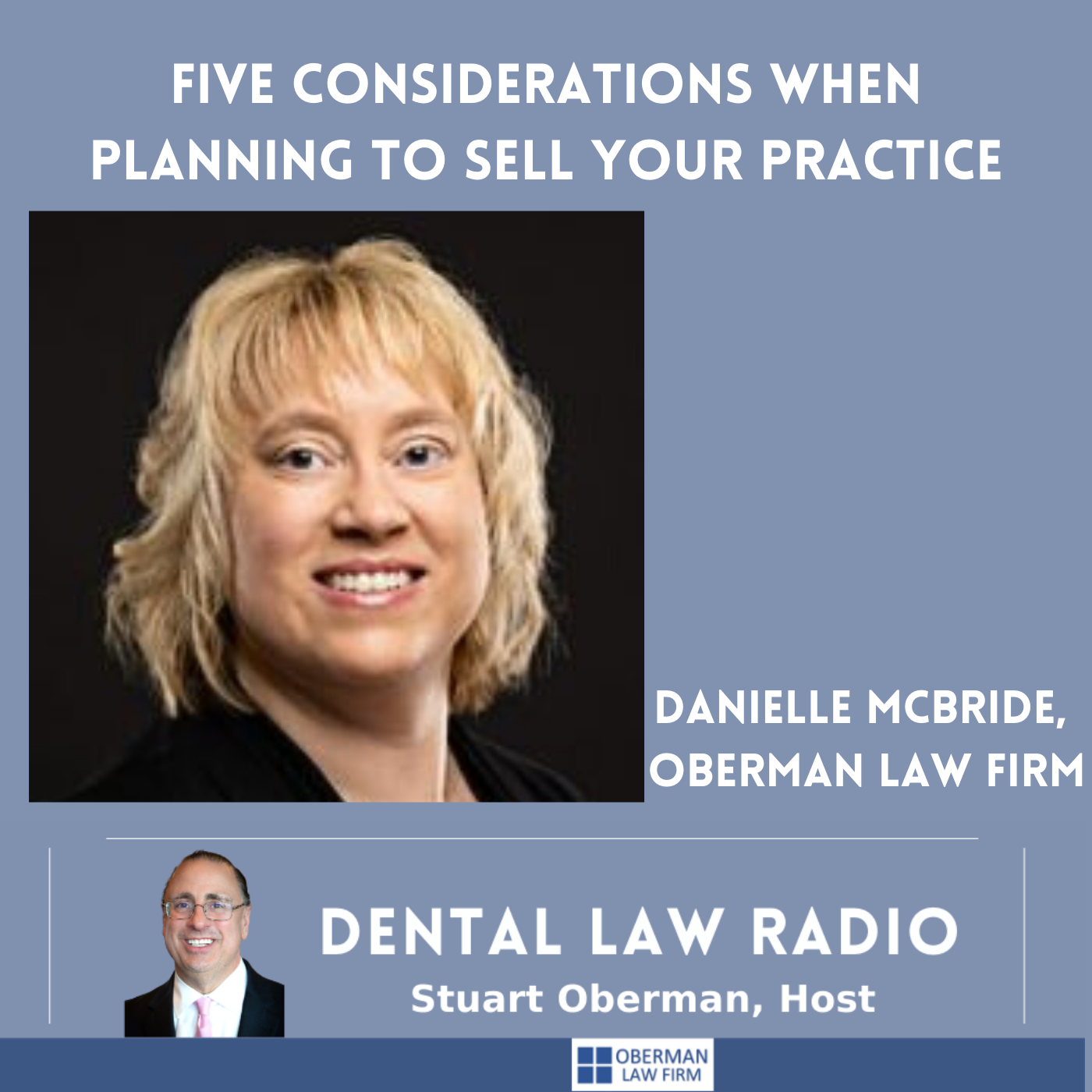
Five Considerations When Planning to Sell Your Practice, with Danielle McBride, Oberman Law Firm

January 21, 2022 by John Ray

Selling a Practice
Dental Law Radio
Five Considerations When Planning to Sell Your Practice, with Danielle McBride, Oberman Law Firm
Loading
00:00 /
RSS Feed
Share
Link
Embed

Download file

Sell a Practice

Five Considerations When Planning to Sell Your Practice, with Danielle McBride, Oberman Law Firm (Dental Law Radio, Episode 31)

Whether your exit plans are near term or down the road, this episode of Dental Law Radio is must listening. Danielle McBride joined host Stuart Oberman to discuss major considerations for any dental practice owner who plans to sell. Preparing for the due diligence a buyer will conduct is particularly vital. Danielle also discussed expenses which negatively impact profitability and therefore valuation, the lease, staffing, patient credits, and much more. Dental Law Radio is underwritten and presented by Oberman Law Firm and produced by the North Fulton studio of Business RadioX®.

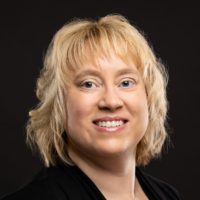
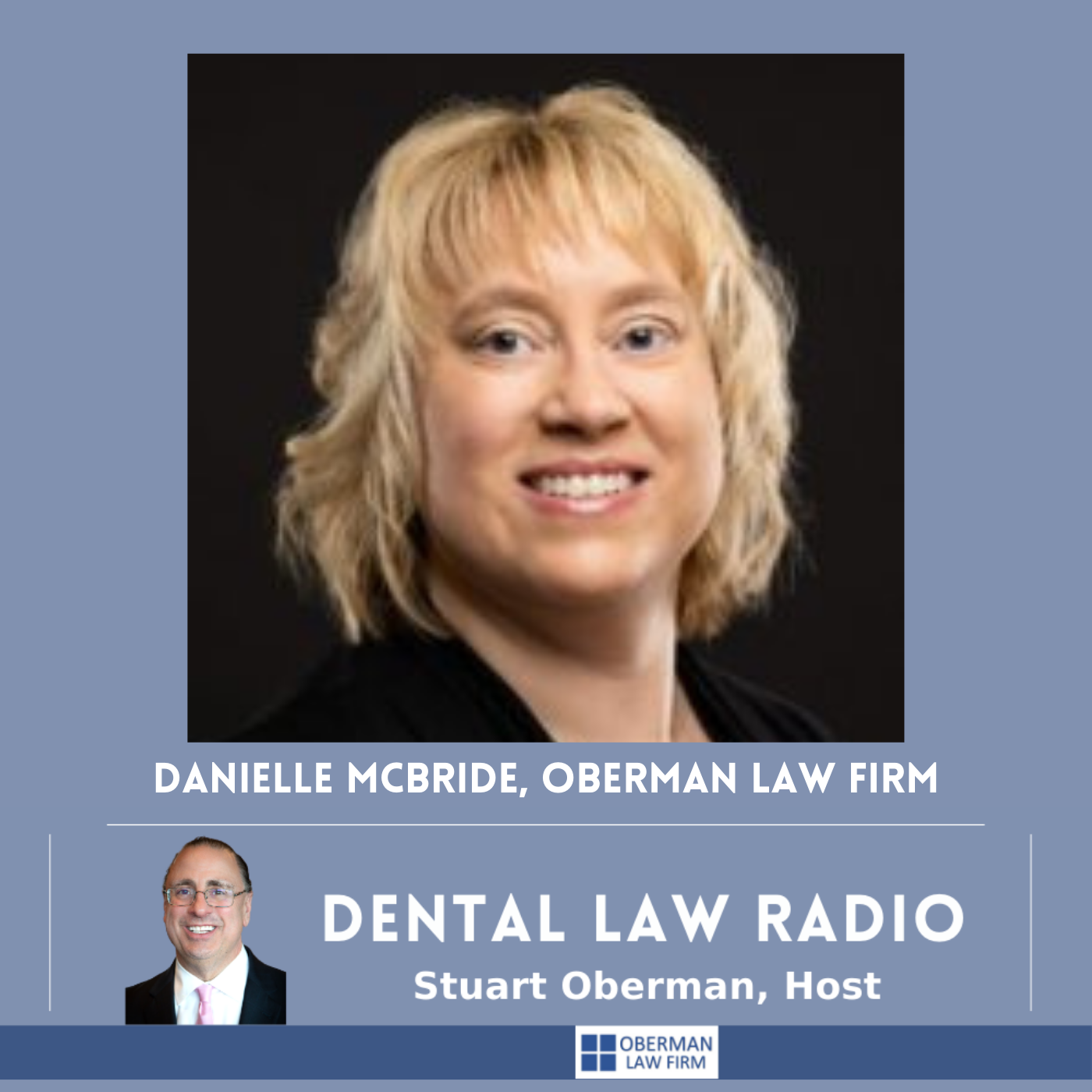
Danielle McBride, Partner, Oberman Law Firm

Danielle McBride
Danielle McBride, Partner, Oberman Law Firm

Danielle McBride has been practicing law for over 21 years, and her primary focus is representing healthcare clients on a local, regional, and national basis. Ms. McBride regularly consults with clients regarding simple to complex healthcare transitions, including mergers and acquisitions, employment law, governmental compliance, tax strategies, practice valuations, DSO formation and structures, employee compensation, associate and partnership contracts, joint ventures, and partnership buy-in/buy-outs.

In addition, Ms. McBride brings a wealth of knowledge and experience preparing practice valuations for clients, as well as formulating simple to complex tax strategies, and entity formations.

Ms. McBride holds a Bachelor of Arts in Sociology/Criminology from The Ohio State University, a Juris Doctor (J.D.) from Ohio Northern University Pettit College of Law, and a Master of Laws (LL.M.) in Taxation from Case Western Reserve University.

LinkedIn

TRANSCRIPT

Intro: [00:00:02] Broadcasting from the Business RadioX studios in Atlanta, it’s time for Dental Law Radio. Dental Law Radio is brought to you by Oberman Law Firm, a leading dental-centric law firm serving dental clients on a local, regional and national basis. Now, here’s your host Stuart Oberman.

Stuart Oberman: [00:00:26] Welcome, ladies and gentlemen, to Dental Law Radio. Unbelievable guest speaker today, unbelievable on the podcast, Danielle McBride, partner in Oberman Law Firm. And little brief background, Danielle’s been practicing for about 21 years. Specialty market is dental law, mergers, acquisitions, tax, compliance. And we’re going to drill down on a couple of things today. I know that Danielle has probably done a couple of hundred transactions, if not thousands, in her illustrious career. And I know she’s going to have a lot of insight into this.

Stuart Oberman: [00:01:00] But I get this question, what do I need to consider when preparing for sale? So, what I want to do is Danielle, I want to leverage some of your experience here and expertise, and I want to run through about five things to consider when preparing your practice, we’re talking to a dentist for sale. So, let’s run through a couple of things. It’s sort of reoccurring theme – our doctors get into trouble, they’re not prepared. Number one, give me a number one. What’s the number one issue we see in preparing for practice sales that are sometimes problematic?

Danielle McBride: [00:01:41] Sure. So, number one is the due diligence in getting that in order. And that means understanding the business and your numbers, cash flow or profitability for the practice, what you sometimes hear in DSO languages, EBITA. And that’s the key to practice valuation and practice transition. You need to know your numbers, your discretionary expenses, those add backs in the practice. You need to take a look at your biggest expenses like staff, supplies, laboratory expenses. Knowing fee increases. What’s your fee schedule? We get questions for fee schedule, and when’s the last time you increased fees on things? And that’s a key thing right now with inflation.

Danielle McBride: [00:02:33] You want to also make sure that you’re not letting those fee increases lapse and not doing something from year to year as well to kind of keep up with things. Marketing, website, social media stuff, patient numbers, active patients, new patients, PPOs and referring doctors if you’re a specialist. All of those are due diligence items that are going to be requested by buyers, whether they’re private parties, individual dentist buyers, or whether they’re DSO transactions. And the DSO transactions, they’re much heavier on the due diligence. They will ask for every piece of paper you could possibly come up with in this transaction.

Stuart Oberman: [00:03:13] Plus.

Danielle McBride: [00:03:14] So, you know. So, getting those things in order ahead is key.

Stuart Oberman: [00:03:20] I got a question. So, profitability and EBITDAs. So, look, our doctors run a lot of stuff through their practice that they shouldn’t, and they get into trouble and it affects their numbers. What are some of the things that you see? Before we jump to number two, what are some of the things that you see doctors running through practices that they really need to clean up to get their numbers in order?

Danielle McBride: [00:03:46] Sure. A lot of it is things like running office expenses and personal expenses through the practice. And so, it’s easy to see.

Stuart Oberman: [00:03:56] That never happens.

Danielle McBride: [00:03:57] Yeah, yeah, never happens. They don’t go to Home Depot and buy toilet paper and paper towels for the office and home. So, a lot of times, they’re running things like that through the practice, and they don’t separate the receipts out. And so, it’s getting lumped into categories like office expenses or promotional expenses, things like sponsoring some of your kids’ events, and you write it off through practice promotion. That’s greedy when a buyer-

Stuart Oberman: [00:04:24] Pay your children, right? How do they pay their children?

Danielle McBride: [00:04:25] What’s that?

Stuart Oberman: [00:04:25] How do they pay their children?

Danielle McBride: [00:04:29] A lot of them pay their children. Put your kids on the payroll. You should be putting them on the payroll as soon as they’re old enough, maybe six or seven years old. Have them reaching the lower filing cabinets or modeling for the website, have them mow the lawn for the practice, and get them IRA contributions.

Stuart Oberman: [00:04:49] That’s good. Wow.

Danielle McBride: [00:04:50] Yeah. So, kids on the payroll. There’s a lot of spouses on the payroll too. And sometimes, they’re paid. Sometimes, they’re underpaid. Sometimes, they’re overpaid. And those are things that go into profitability on the practice as well and you don’t necessarily. Those are the easy things to see. The harder things are when they’re running all this stuff through office expense, and they’re like, “Yeah, yeah, $50,000 of it is just me running personal expenses through.” Well, that’s hard for a buyer to accept that. Okay, well, the profitability is really $100,000 higher than what’s showing up when I’m looking at your typical add backs. Your practice promotion expense – auto, car, meals, travel, continuing ed, staff or family on the payroll, those sort of things, those are all pretty easy to see. It’s the other things that really need cleaned up sometimes because it’s going to be hard to explain to that buyer unless you start showing them all your credit card statements.

Stuart Oberman: [00:05:55] I know you made a best friend out of all of the underpaid spouse managers.

Danielle McBride: [00:06:01] Yeah.

Stuart Oberman: [00:06:02] You just became an absolute cult hero, I can tell you that. Well, that’s good. That’s definitely good stuff that affects the profitability. And we also have seen some audits from state and federal on expenditures that are never good like that. So, give me a number two. Give me a number two on things to consider.

Danielle McBride: [00:06:24] Number two-

Stuart Oberman: [00:06:24] Yeah.

Danielle McBride: [00:06:25] … is the lease. Everyone always forgets about the lease and waits till the last minute. So, if you’re preparing for a transaction, get your lease out. Look at what the terms are, find out if you’ve got to get consent from your landlord to sell, find out what happens if you have a personal guarantee on that lease. If you’re going to assign the lease, if it’s a third-party landlord, make sure that you’ve got under control your lease. You want to make sure that you know what the terms are. If you’re up for a renewal and you’re thinking about selling your practice, there are lots of things that you could try to work into that lease with the landlord to try and prepare for a practice sale. Perhaps even getting something into the lease saying that you don’t need their consent to sell to transition the lease to that buyer if you’re selling your practice. I’ve run across lots of leases over my years with third-party landlords and it can be a real headache. And that is the single biggest reason I get a transaction delayed is that, “Oh my god, we don’t have the lease assignment from the third-party landlord.”

Stuart Oberman: [00:07:40] Now, are you seeing — we’re seeing this a little bit coming west to east? Are you seeing that if – which a landlord does not have to do – end the lease early, that they want a percentage of the sale to do that. We’re seeing some interesting numbers coming through that.

Danielle McBride: [00:08:01] Yeah, I’ve seen some. It has been more of a West Coast issue that I’ve seen this in. Midwest and Northeast, I haven’t seen a lot of that with a percentage of the sales. In New York, I have had a few transactions where we’ve had to try and buy the landlord, and essentially pay them something in order to get a seller out of a lease. But I had a transaction like that.

Stuart Oberman: [00:08:24] That’s called legal bribery.

Danielle McBride: [00:08:25] Yeah. Yeah, it is. The New York leases, they’re a lot of fun, let me tell you.

Stuart Oberman: [00:08:33] Wow! I mean, what usually starts in the West comes East. So, I think we’ll be seeing that eventually. But well, number three. That was a great number two. We had cash flow number one, and lease number two. And what are we looking at, maybe the third issue?

Danielle McBride: [00:08:50] Number three is staffing, goodwill transition, patient retention issues. So, you want to be able to transition the practice well. And some of the key things are not just the doctor transitioning to the new doctor, but also staffing and patient retention. And so, a lot of times, the goodwill transition is a key component. And sometimes, that’s where you see negotiations kind of get a little stuck from time to time. Is it the buyer wants to make sure that the seller and the staff are going to contribute to the transition, and make sure that the patients can be retained, that there’s going to be an introductory letter, or a letter to referral sources if it’s a specialty practice? Introductions maybe with the top 5-10 referral sources. Making sure that the staff is going to stay in the transaction, and that you’re not going to lose, and have a bunch of staff turnover right at the transition date. And now, you’re trying to retain patients, but you’ve got all new faces in there.

Stuart Oberman: [00:09:58] What about associate issues?

Danielle McBride: [00:10:01] Associate issues as well. That’s another key thing in staffing is that if you’ve got an employment agreement or you have associates working in the practice, and you didn’t have an employment agreement with them, and there are no restrictive covenants, your buyers are going to be coming in, and they’re going to be asking for those associates to sign contracts. And if you didn’t have one before, you’ve got nothing to actually assign, which means a new negotiation with that associate and potentially with the buyer. And if they’re a key producer in the practice, especially in these big DSO transactions, they’re offering this money for the transaction based on key production numbers. And if you’ve got an associate that is not going to stay with the practice or that you can’t enforce a covenant not to compete for in order to prevent them from competing with the buyer, then you’re going to have some things you’re going to have to negotiate, and it could really create some problems.

Stuart Oberman: [00:10:57] Now, question for you, when you do your practice evaluations, and you do a great job on that, does the associate not staying affect the value of the practice when you’re asked to evaluate what that practice is worth?

Danielle McBride: [00:11:14] Sometimes. It depends on the circumstances.

Stuart Oberman: [00:11:17] That’s a great legal answer.

Danielle McBride: [00:11:19] Yeah.

Stuart Oberman: [00:11:21] That’s a typical answer, “Well, it depends.”

Danielle McBride: [00:11:23] It really depends on facts and circumstances.

Stuart Oberman: [00:11:24] Yeah.

Danielle McBride: [00:11:24] Yeah. And the key is going to be whether or not the practice can find a replacement and associate easily, or whether or not the practice owner or the other doctors working in the practice are able to pick up that profitability, or to pick up that production from that doctor who’s not going to stay.

Stuart Oberman: [00:11:40] Staff, staff, staff. Wow! Let’s look at the number four. Give me the number four.

Danielle McBride: [00:11:48] Number four, equipment, assets and curb appeal. And a little bit of this is about allocations as well. You’ve got goodwill, and you’ve got tangible assets in the practice. And so, one of the things, if you’re thinking about putting your practice on the market, there are some practices out there that maybe they haven’t updated with newer equipment, or they’ve thought about refreshing their waiting room, or adding a CERAC machine, or adding a major piece of equipment, and they haven’t done it yet.

Stuart Oberman: [00:12:21] Pick it up at 179 deduction, right?

Danielle McBride: [00:12:24] Yeah, you can get the 179 deduction, so you can buy it and you can write it off all in the same year. And in part, it’s a seller problem; in part, it’s a buyer problem. And so, there’s a little bit of a fine line you walk between whether or not you go ahead and make some of those improvements to make the practice more attractive to a buyer, or you say, “I don’t want to invest in a lot of super new technology and go into debt just to be able to make the practice. I’ll take that into account when I value the practice. I’m going to look at what the equipment is and how much it’s valued there. If the practice is not – say they don’t have electronic records, everything still on paper in boxes, and computer systems haven’t been upgraded, there are some minimum requirements for computer systems to be upgraded that most buyers are going to ask.

Danielle McBride: [00:13:21] And so, those are things that are going to go into negotiating the ultimate purchase price that a buyer is going to be willing to pay. Now, some of it, it’s a seller’s problem. Some of it, it’s a buyer’s problem. If you want to be super fancy and buy all the latest and greatest technology, buyer, go ahead. That doesn’t mean I don’t have a practice that’s fully capable of supporting you working in it, and you can make whatever changes you want to make on your dime, but there are some things that a seller might want to do just to make things a little more attractive for a buyer.

Stuart Oberman: [00:13:53] And then, it’s — yeah. I mean, we had Dr. Richard Madow on a couple of episodes ago. He had a good talk about doctors buying equipment and profitability and doesn’t need that. And that was interesting analogy, and how that just compared to what you said regarding [crosstalk].

Danielle McBride: [00:14:18] Sure. Don’t go into debt to make it-.

Stuart Oberman: [00:14:19] Yeah.

Danielle McBride: [00:14:19] Don’t go into debt to make it appealable-

Stuart Oberman: [00:14:21] That’s a good-

Danielle McBride: [00:14:21] … or attractive to a buyer, but there are some things that you could do, especially if you’re looking at a year or two out from a practice sale and making a few revisions here or there. You can write these things off, 179, depreciation, deductions, bonus depreciation, et cetera, so.

Stuart Oberman: [00:14:40] Yeah, I mean, that is practical, practical advice, which a lot of times, I think doctors are missing from the advisor standpoint. Let’s talk about the last, number five. And this get a little sticky in the contract areas also. It’s, you know-

Danielle McBride: [00:15:01] Yes.

Stuart Oberman: [00:15:01] This is where, sort of, the rubber hits the road. And talk about number five on some of these.

Danielle McBride: [00:15:08] So, number five is my accounts receivable, prepaid accounts, patient credits and treatment in progress.

Stuart Oberman: [00:15:17] Yeah.

Danielle McBride: [00:15:17] Now, there is no one size fits all on any of those. And often, they wait until the last minute to look at these, “Oh, I’ll get you this. Oh, I’ll get you this report. Oh, I’ll look and see,” or they run the report, and they don’t pay attention to it.

Stuart Oberman: [00:15:33] Famous last words.

Danielle McBride: [00:15:35] Yeah. I mean, patient credits, in particular, your accounts receivable aging, you may have things that are sitting on the report if you haven’t cleaned up your collections, if you haven’t cleaned up your patient credits, those are all things that can go into the ultimate purchase price if someone’s going to purchase your accounts receivable and take over the practice. And then, your prepaid accounts. And it can vary based on specialty. Obviously, in orthodontic practices, you’ve got long-term contracts with payments that may have been paid in full, contracts paid in full at the start of treatment but you’ve got a buyer that’s doing — say, you had a bunch of patients pay right before the closing, you got all the money, but the buyer is going to get — seller got all the money, but buyer’s now going to have to do all of the work to finish those patients.

Danielle McBride: [00:16:27] And so, there, oftentimes, has to be some sort of adjustment to price or proration on prepaid contracts. And there can be other specialties as well or even general practices that maybe do some particular restorative type work or something that will have treatment in progress and prepaid treatment that is long-term patient treatment planning, where you’ve got courses of treatment that lasts for multiple appointments over a longer period of time, with maybe episodes of healing required in between, and you’ve got someone who’s got a $10,000 case that’s being paid on a monthly basis because that’s the arrangement they entered into with the doctor there, and their treatment is maybe a quarter of the way done, you’ve got to actually think about those things. And oftentimes, we add exhibits to the contract that will list patient credits, patient refunds having to be made prior to closing, prepaid cases being prorated between buyer and seller.

Stuart Oberman: [00:17:36] Do you have to do-

Danielle McBride: [00:17:36] Thinking of progress list being done.

Stuart Oberman: [00:17:38] Do you have to give special consideration in contracts when you have that seller who’s leaving, and and you’ve got open cases, or what happens if you got a hundred patients come back from faulty work-

Danielle McBride: [00:17:53] Right.

Stuart Oberman: [00:17:53] … what happens with that?

Danielle McBride: [00:17:57] Right. And that’s where we have provisions in our contracts that usually deal with what happens if there’s defective work or rework, and can the buyer — as a seller, you don’t want the buyer to just say, “Well, I have to redo all of this work. And now, you owe me this money,” and it goes on indefinitely. There are time limitations that should be put in their requirements. There are parameters that should be set. And this is all based on the facts and circumstances of the practice. You may have some practices where this isn’t a problem because you don’t have patients that are not paying when they receive their treatment.

Stuart Oberman: [00:18:31] Danielle, great stuff about the patient credits. One thing in redos, one thing I want to do is I want you elaborate a little bit more on the contract side as far as what happens when you’ve got a doctor that maybe is selling sticking around for a year or two. I mean, you mentioned earlier about limits in contracts and redos. Elaborate just a little bit more on that contract provision, what should be on there to limit the seller’s liabilities going forward?

Danielle McBride: [00:19:03] Sure. I mean, the seller should limit the liability going forward based on some parameters for patients. You can’t just have patients who have not been seen in the practice for the last year coming in to have rework done or having the buyer not consult you about rework before they agree to retreat a patient and then charge you for the fee to redo the work on that patient. Sometimes, I see caps or limits set.

Danielle McBride: [00:19:34] I mean, generally speaking, accounts receivable, patient credits, they all should be reviewed and wrapped up in your records. Your accounts receivable and credit should be cleaned up prior to a sale. You want to make sure that you don’t have long outstanding credits there. Maybe there are patients that you don’t even have in the practice any longer. A lot of practices are in the habit of not cleaning those up on an annual basis. So, clean those patient credits up because you’re going to have to pay them off. Generally, a buyer will ask for them to be paid off prior to closing. The DSOs, also, take that into account when they’re factoring in expenses to be paid and credits if they’re going to be assumed. You don’t want to be giving the buyer money that’s never going to come in.

Stuart Oberman: [00:20:26] Yeah. Well, it’s interesting, for 50 DSOs, you’ll have 50 ways of calculating all of this. That’s amazing.

Danielle McBride: [00:20:32] Yes.

Stuart Oberman: [00:20:33] Well, that is five great things to consider when you’re preparing your practice for sale. And all these are, obviously, a moving target. As the transition takes place, I mean, these are just moving targets and just constant adjustments. Well. Danielle, amazing, amazing stuff as always. Just, again, five topics that our doctors just have to consider on any transaction.

Stuart Oberman: [00:21:00] Also, honestly, this can be applied to any business listeners also on what they’re looking at, whether it’s just AR or cash flows, profitability. So, really, everything you’ve talked about today and in previous podcasts, I mean, any business owner really could use. So, amazing stuff.

Stuart Oberman: [00:21:19] Well, great job, Danielle. Thank you very much. And as always, amazing knowledge. And we really enjoyed having you on the podcast today. And I know our listeners did, so. Well, with that, we will call it a day as s we say. If you have any questions, please feel free to give us a call, 770-886-2400. Danielle, how do they get in touch with you if they want to send you an email or request some information?

Danielle McBride: [00:21:47] They can send me an email. They can call the corporate number. They can also send me an email at danielle@obermanlaw.com.

Stuart Oberman: [00:21:55] Good, good. Yeah, number’s 770-886-2400. My name is Stuart Oberman. It is Stuart@obermanlaw.com. Thank you for listening, and we appreciate it, and have a fantastic day.


About Dental Law Radio

Hosted by Stuart Oberman, a nationally recognized authority in dental law, Dental Law Radio covers legal, business, and other operating issues and topics of vital concern to dentists and dental practice owners. The show is produced by the North Fulton studio of Business RadioX® and can be found on all the major podcast apps. The complete show archive is here.

Stuart Oberman, Oberman Law Firm

Stuart Oberman
Stuart Oberman, host of “Dental Law Radio”

Stuart Oberman is the founder and President of Oberman Law Firm. Mr. Oberman graduated from Urbana University and received his law degree from John Marshall Law School. Mr. Oberman has been practicing law for over 25 years, and before going into private practice, Mr. Oberman was in-house counsel for a Fortune 500 Company. Mr. Oberman is widely regarded as the go-to attorney in the area of Dental Law, which includes DSO formation, corporate business structures, mergers and acquisitions, regulatory compliance, advertising regulations, HIPAA, Compliance, and employment law regulations that affect dental practices.

In addition, Mr. Oberman’s expertise in the health care industry includes advising clients in the complex regulatory landscape as it relates to telehealth and telemedicine, including compliance of corporate structures, third-party reimbursement, contract negotiations, technology, health care fraud and abuse law (Anti-Kickback Statute and the State Law), professional liability risk management, federal and state regulations.

As the long-term care industry evolves, Mr. Oberman has the knowledge and experience to guide clients in the long-term care sector with respect to corporate and regulatory matters, assisted living facilities, continuing care retirement communities (CCRCs). In addition, Mr. Oberman’s practice also focuses on health care facility acquisitions and other changes of ownership, as well as related licensure and Medicare/Medicaid certification matters, CCRC registrations, long-term care/skilled nursing facility management, operating agreements, assisted living licensure matters, and health care joint ventures.

In addition to his expertise in the health care industry, Mr. Oberman has a nationwide practice that focuses on all facets of contractual disputes, including corporate governance, fiduciary duty, trade secrets, unfair competition, covenants not to compete, trademark and copyright infringement, fraud, and deceptive trade practices, and other business-related matters. Mr. Oberman also represents clients throughout the United States in a wide range of practice areas, including mergers & acquisitions, partnership agreements, commercial real estate, entity formation, employment law, commercial leasing, intellectual property, and HIPAA/OSHA compliance.

Mr. Oberman is a national lecturer and has published articles in the U.S. and Canada.

LinkedIn

Oberman Law Firm

Oberman Law Firm has a long history of civic service, noted national, regional, and local clients, and stands among the Southeast’s eminent and fast-growing full-service law firms. Oberman Law Firm’s areas of practice include Business Planning, Commercial & Technology Transactions, Corporate, Employment & Labor, Estate Planning, Health Care, Intellectual Property, Litigation, Privacy & Data Security, and Real Estate.

By meeting their client’s goals and becoming a trusted partner and advocate for our clients, their attorneys are recognized as legal go-getters who provide value-added service. Their attorneys understand that in a rapidly changing legal market, clients have new expectations, constantly evolving choices, and operate in an environment of heightened reputational and commercial risk.

Oberman Law Firm’s strength is its ability to solve complex legal problems by collaborating across borders and practice areas.

Connect with Oberman Law Firm:

Company website | LinkedIn | Twitter

Tagged With: Danielle McBride, Dental Practice, dental practices, DSO, Oberman Law Firm, selling a dental practice, Selling a Practice, Stuart Oberman

Keys to a Smooth Practice Transition, with Danielle McBride, Oberman Law Firm

January 7, 2022 by John Ray

Oberman Law Firm
Dental Law Radio
Keys to a Smooth Practice Transition, with Danielle McBride, Oberman Law Firm
Loading
00:00 /
RSS Feed
Share
Link
Embed

Download file

Oberman Law Firm

Keys to a Smooth Practice Transition, with Danielle McBride, Oberman Law Firm (Dental Law Radio, Episode 30)

Danielle McBride, Partner at Oberman Law Firm, talks with host Stuart Oberman about the elements needed for a successful and smooth sale of a dental practice. Danielle discusses ingredients like having the best advisors in the dental industry, detailed financials, quality of earnings, and much more. Dental Law Radio is underwritten and presented by Oberman Law Firm and produced by the North Fulton studio of Business RadioX®.


Danielle McBride, Partner, Oberman Law Firm

Danielle McBride
Danielle McBride, Partner, Oberman Law Firm

Danielle McBride has been practicing law for over 21 years, and her primary focus is representing healthcare clients on a local, regional, and national basis. Ms. McBride regularly consults with clients regarding simple to complex healthcare transitions, including mergers and acquisitions, employment law, governmental compliance, tax strategies, practice valuations, DSO formation and structures, employee compensation, associate and partnership contracts, joint ventures, and partnership buy-in/buy-outs.

In addition, Ms. McBride brings a wealth of knowledge and experience preparing practice valuations for clients, as well as formulating simple to complex tax strategies, and entity formations.

Ms. McBride holds a Bachelor of Arts in Sociology/Criminology from The Ohio State University, a Juris Doctor (J.D.) from Ohio Northern University Pettit College of Law, and a Master of Laws (LL.M.) in Taxation from Case Western Reserve University.

LinkedIn

TRANSCRIPT

Intro: [00:00:02] Broadcasting from the Business RadioX Studios in Atlanta, it’s time for Dental Law Radio. Dental Law Radio is brought to you by Oberman Law Firm, a leading dental-centric law firm serving dental clients on a local, regional, and national basis. Now, here’s your host, Stuart Oberman.

Stuart Oberman: [00:00:26] Welcome everyone to Dental Law Radio. We have a very, very special guest today, Danielle McBride, Partner in Oberman Law Firm. And a little background on Danielle – she’s very busy right now – Danielle has been practicing for 21 years and her primary focus is health care transactions, mergers, acquisitions on a local, regional, and national basis. Big, big in M&A transactions, employment law compliance, tax strategies – as you heard on a previous podcast. And we’re going to have some subsequent podcasts that Danielle is going to join us on – practice valuations, DSO formation. Lord, everything is DSO. Everything is scaling nowadays.

Stuart Oberman: [00:01:13] A little education background on Danielle, she graduated from Ohio Northern University with her law degree. And she has a Masters in Taxation from Case Western University. And we are absolutely delighted to have you in the studio, as we say, Danielle. And I know today you’re going to talk about keys to ensure a smooth practice transition, and you could maybe elaborate on this. It is an amazing market. It is a hot market like I’ve never seen in my years of practicing. Valuations are out the roof. Private equity is throwing money at transactions.

Stuart Oberman: [00:01:58] But there’s a lot of misconceptions about what it takes to have a smooth transition, and I really want to drill down on your expertise. You’ve been doing this for over 21 years, and I want to hear what you have to say and your thoughts all the way from due diligence to leveraging advisors. So, give me your thoughts on some matters regarding what it takes to have a smooth transition, as we say.

Danielle McBride: [00:02:29] Well, thanks, Stuart, for having me on the podcast. And, yeah, this is Keys to a Smooth Practice Transition. I kind of call this my ABCs. A is for advisors. One of the best things that you can do for yourself is to surround yourself with the best advisors you can. And they should be specialized, you know, professionals in this area, in the dental industry.

Danielle McBride: [00:02:57] Leverage your advisors that have the experience in these transactions. I mean, there are dental specific lawyers like us. There are dental accountants. There are dental finance lenders. There are dental brokers. All of these people, all of these advisors have a ton of experience. This may be your one and only transaction, buying a practice or selling a practice or merging going in with a DSO. We’ve done hundreds, if not thousands, of these transactions, these advisors have.

Danielle McBride: [00:03:29] So, you know, it’s important to get those specialized professionals to work with you. And they’re out there. And if you have at least one of those advisors, they can help you find others. If you’re in need of a dental specific lender, if you’re a buyer of a practice, if you’re in need of a dental specific accountant, there are lots of other financial business and consultants that have specialized knowledge in the dental field. And that’s my A, you know, my ABCs.

Danielle McBride: [00:04:04] The second is your business. You’ve got to know your business. And it’s important whether you’re looking to sell to a third party or to a DSO in these transactions. Knowing your business, knowing the numbers, having the data that’s going to be requested through all of the due diligence is going to be one of the most important things that you do in these transactions.

Stuart Oberman: [00:04:25] I got a question for you. I got a question for you. You do valuations. We hear –

Danielle McBride: [00:04:30] Yes. I do practice valuations. And so, one of the keys in those valuations is profitability in the practice transition.

Stuart Oberman: [00:04:37] We hear this all the time, “Know your numbers,” what does that mean? When someone says, “Well, I got to know my numbers.”

Danielle McBride: [00:04:47] Know your numbers.

Stuart Oberman: [00:04:48] What does that mean? I mean, our guys, it doesn’t seem like they understand that a lot of times.

Danielle McBride: [00:04:55] Yeah. So, knowing your numbers means a couple of different things. One is being able to get the data on new patients, and insurance plans, and how much of your practice is PPO plans versus fee for service. Those kind of numbers are important. But the key numbers are profitability.

Danielle McBride: [00:05:17] Or sometimes in these DSO transactions you hear being thrown around EBITDA, E-B-I-T-D-A, Earnings Before Income Taxes, Depreciation, and Amortization. It’s essentially, not just the net income, it’s profitability, it’s the cash flow in the practice. You got to look beyond W-2 compensation or net profit. It’s that plus add back. Discretionary expenses, I like to call them. The perks that the doctor runs through the practice.

Danielle McBride: [00:05:49] It can also be things like family on the payroll, if they’re being paid more or less than what would be fair salary for someone doing the work that they’re doing in the practice. It can also be rent. You know, looking at fair rent and whether you’re paying yourself above or below what fair market rent is on a piece of property or your office building that you also own along with the practice.

Stuart Oberman: [00:06:13] Is your specific profit margin? You hear like, “Well, you should be netting out 20 percent profit or 40 percent profit.” Is there a magic number that’s sort of advisable for those things?

Danielle McBride: [00:06:26] Well, it varies based on the specific type of practice. So, your general dental practice might be running an overhead of 60, 61 percent, 40 percent profitability. And that 40 percent of profitability is your W-2 income, your profit, your discretionary add backs, adjustments for paying yourself high rent on your building, non-recurring expenses, if you hired a consultant to come in one year, those sort of things. It’s going to vary if you’re an oral surgeon or if you’re an orthodontist or a pediatric dentist. There are different percentages for those different specialties.

Stuart Oberman: [00:07:11] Huh? Now, I know we do a lot of DSO transactions as a firm, so if they’re getting ready to sell their practice, how should they prepare due diligence? Should they say, “Hey, Danielle. I’m ready to sell my practice. I know there’s a lot of due diligence on the DSO side. Can you send me a due diligence checklist so I can start preparing for this?” How do they prepare for due diligence, which will wear them out a lot of times?

Danielle McBride: [00:07:42] Yeah. It’s going to wear them out and you’re going to get asked for stuff over and over again.

Stuart Oberman: [00:07:46] The same stuff.

Danielle McBride: [00:07:46] You’re going to send them all of your quarter one, quarter two, quarter three, quarter four financial statements and tax returns. And every insurance provider you take in the practice. Some of the banks even ask for monthly profit and loss statements for the year, especially after COVID.

Danielle McBride: [00:08:13] COVID kind of changed things from a financial perspective. From the lender’s perspective, it used to be that you could get away with sending them the years worth of financial statements and tax returns. And then, we had COVID and then they wanted to see month by month. So, we wanted to see every month of 2019, and every month of 2020, and every month of 2021 so far.

Danielle McBride: [00:08:36] So, having the ability to get at least quarterly financial statements is an important part of the due diligence. And then, they’re just going to ask you for every business insurance, every business license, every license for every staff member and doctor in the office. They’re going to ask for balance sheets.

Danielle McBride: [00:08:56] And if there are liens on the practice, which is often one thing that people forget. So, if you had an SBA loan, for instance – a lot of people had this. I just had this with a transaction – SBA EIDL Loans, you can pay those off. My client actually got an email from the SBA saying, “This is your authorization to file a UCC termination on the lien that we have on your practice.” And we needed to get that termination statement filed to clear it for the lender so that the buyer’s lender would actually fund the transaction. So, there are things like that.

Stuart Oberman: [00:09:36] Do you see a lot of PPP problems right now? Loans are not being authorized to pay back and items are being withheld on the transaction?

Danielle McBride: [00:09:48] I did earlier in the year. So many of the PPP loans have finally gotten forgiven. That that problem has started to get a little bit easier to deal with. Usually, it’s some document references on the PPP loans and that it’s been forgiven and some sort of proof to the lenders or the buyer that it’s actually been forgiven.

Danielle McBride: [00:10:12] But I did have to do a lot of escrows. And back in 2021, I first started doing transactions again after COVID opened back up and the lenders started lending again. I was having to escrow funds for PPP because the guidance came out from the IRS saying that you had to escrow the amount of the PPP loan with the bank. And the banks were like, “We don’t know how to do this.” So, you know, I was actually escrowing funds into attorney escrow accounts and holding it because the bank wasn’t prepared to do it.

Stuart Oberman: [00:10:44] Wow. So, do you recommend from an expedient standpoint smooth transaction that we have sort of a due diligence checklist, whether it’s us or whomever, provide that due diligence checklist information to whoever the adviser is and then put that information – we’ll call it a data room? And then, this way the seller or the buyer can get in there and start plucking that information. Is that something that you thought?

Danielle McBride: [00:11:16] A lot of times, if you’re working with these bigger DSOs, they will do exactly that. They’ll have some sort of service where you’re uploading your documents and they will have a checklist that they have to go through. Because a lot of the private equity lenders, they’ve got checklists and they want to see each and every one of those items checked off before they will give the green light to fund the transaction.

Stuart Oberman: [00:11:36] Now, some of these bigger deals, we hear the term quality of earnings. Quality of earnings, what does that mean? Because a lot of the buyers on the corporate side will spend a lot of money on quality of earnings. Our doctors, I don’t think, really understand what that means and how that affects their practice.

Danielle McBride: [00:11:58] Well, I think the quality of earnings is really going back to the profitability in the EBITDA of the practice and the better the cash flow is. It’s sort of like when you hear the old adage, “Okay. Well, what is my practice worth as a percentage of collections?” And everybody says, “Oh, it should be 75 percent of collections or 65 percent of collections.” Well, that’s great.

Danielle McBride: [00:12:19] But if you have two $1 million practices and one has a 65 percent overhead and the other one has a 50 percent overhead, they’re both not worth 65 percent of gross revenues. One has a better quality of earnings. One has a better cash flow. One has higher profitability. And the practice is going to support that buyer and provide a higher profit ratio for that buyer, that DSO, that corporate purchaser.

Danielle McBride: [00:12:53] And especially for a private party, too, I mean, that’s what you want to look for, a practice that has a better cash flow, higher profitability. And you can clearly see that in the tax returns. That’s another thing, too, that a lot of sellers have to think about this. A lot of them have been aggressive with their deductions, but they’ve also maybe been a little lax about putting the documentation together and being clear on that. And so, sometimes when you get a practice like that where they’re just running a ton of things through the practice, you got to sometimes do a little bit clean up because the buyer is going to ask those questions and they’re going to want to see, “Well, where is the cash flow?”

Stuart Oberman: [00:13:30] That never happens. You mean doctors are running their personal stuff through the practices? Are you kidding me?

Danielle McBride: [00:13:34] That never happens, right?

Stuart Oberman: [00:13:39] Are you saying the house payment, and the kids, and the trip – wow. Well, they call this add backs. Is that what they call those?

Danielle McBride: [00:13:51] Add backs. I like to refer to them as discretionary expenses.

Stuart Oberman: [00:13:55] Or having their six year old child, son or daughter, make $10,000 a year –

Danielle McBride: [00:14:02] Yeah. They model for the website. They got to pay them something.

Stuart Oberman: [00:14:05] Or the flyer for the office. Wow. That’s a lot of stuff. And this could be a conversation for hours and hours and hours. Well, I think that if our doctors take this information, figure out when they’re going to sell, how they’re going to sell, who their advisors are, what do they need to do to get prepared, I think this is great advice. How do they reach you if they have any questions on the sale, the due diligence?

Danielle McBride: [00:14:38] They can reach out to Oberman Law Firm at 770-886-2400. My email is danielle@obermanlaw.com. And you can go on our website, too, obermanlaw.com for information. There’s some blog posts and lots of information about the practice on there. And, yeah, reach out. Give us a call. We’ll help you. The other key to a smooth transition is not waiting until the last minute to plan for it.

Stuart Oberman: [00:15:11] Well, that never happens either, huh? Well, I know you’re a regular contributor to the firm’s newsletter, Advisor Insights. Great information coming in there. And I know in a previous podcasts, you had a great, great information on tax. I know you got some other podcasts that you’ll be on the air for. Amazing. Danielle, thank you. Thank you so much.

Stuart Oberman: [00:15:36] Ladies and gentlemen, thanks for joining us on Dental Law Radio. If you have any questions, please feel free to give us a call, 770-886-2400. And email me directly, stuart@obermanlaw.com.

Stuart Oberman: [00:15:49] Guys, ladies and gentlemen, thank you very, very much. Danielle, thank you again. Amazing job as always. We rely on you a lot on the acquisition, and tax side, and general guidance on compliance. So, thanks everyone and have a great day.


About Dental Law Radio

Hosted by Stuart Oberman, a nationally recognized authority in dental law, Dental Law Radio covers legal, business, and other operating issues and topics of vital concern to dentists and dental practice owners. The show is produced by the North Fulton studio of Business RadioX® and can be found on all the major podcast apps. The complete show archive is here.

Stuart Oberman, Oberman Law Firm

Stuart Oberman
Stuart Oberman, host of “Dental Law Radio”

Stuart Oberman is the founder and President of Oberman Law Firm. Mr. Oberman graduated from Urbana University and received his law degree from John Marshall Law School. Mr. Oberman has been practicing law for over 25 years, and before going into private practice, Mr. Oberman was in-house counsel for a Fortune 500 Company. Mr. Oberman is widely regarded as the go-to attorney in the area of Dental Law, which includes DSO formation, corporate business structures, mergers and acquisitions, regulatory compliance, advertising regulations, HIPAA, Compliance, and employment law regulations that affect dental practices.

In addition, Mr. Oberman’s expertise in the health care industry includes advising clients in the complex regulatory landscape as it relates to telehealth and telemedicine, including compliance of corporate structures, third-party reimbursement, contract negotiations, technology, health care fraud and abuse law (Anti-Kickback Statute and the State Law), professional liability risk management, federal and state regulations.

As the long-term care industry evolves, Mr. Oberman has the knowledge and experience to guide clients in the long-term care sector with respect to corporate and regulatory matters, assisted living facilities, continuing care retirement communities (CCRCs). In addition, Mr. Oberman’s practice also focuses on health care facility acquisitions and other changes of ownership, as well as related licensure and Medicare/Medicaid certification matters, CCRC registrations, long-term care/skilled nursing facility management, operating agreements, assisted living licensure matters, and health care joint ventures.

In addition to his expertise in the health care industry, Mr. Oberman has a nationwide practice that focuses on all facets of contractual disputes, including corporate governance, fiduciary duty, trade secrets, unfair competition, covenants not to compete, trademark and copyright infringement, fraud, and deceptive trade practices, and other business-related matters. Mr. Oberman also represents clients throughout the United States in a wide range of practice areas, including mergers & acquisitions, partnership agreements, commercial real estate, entity formation, employment law, commercial leasing, intellectual property, and HIPAA/OSHA compliance.

Mr. Oberman is a national lecturer and has published articles in the U.S. and Canada.

LinkedIn

Oberman Law Firm

Oberman Law Firm has a long history of civic service, noted national, regional, and local clients, and stands among the Southeast’s eminent and fast-growing full-service law firms. Oberman Law Firm’s areas of practice include Business Planning, Commercial & Technology Transactions, Corporate, Employment & Labor, Estate Planning, Health Care, Intellectual Property, Litigation, Privacy & Data Security, and Real Estate.

By meeting their client’s goals and becoming a trusted partner and advocate for our clients, their attorneys are recognized as legal go-getters who provide value-added service. Their attorneys understand that in a rapidly changing legal market, clients have new expectations, constantly evolving choices, and operate in an environment of heightened reputational and commercial risk.

Oberman Law Firm’s strength is its ability to solve complex legal problems by collaborating across borders and practice areas.

Connect with Oberman Law Firm:

Company website | LinkedIn | Twitter

Tagged With: Danielle McBride, Dental Practice, dental practice management, dental practices, DSO, due diligence, Oberman Law Firm, selling a dental practice, Stuart Oberman

Growing Your Practice Through Effective Leadership, with Eric Morin, Tower Leadership

September 10, 2021 by John Ray

EricMorinDLREpisode19Album
Dental Law Radio
Growing Your Practice Through Effective Leadership, with Eric Morin, Tower Leadership
Loading
00:00 /
RSS Feed
Share
Link
Embed

Download file

EricMorinDLREpisode19Album

Growing Your Practice Through Effective Leadership, with Eric Morin, Tower Leadership (Dental Law Radio, Episode 19)

In a few years, Eric Morin argues, few dental practices will have less than $1 million in revenues. In this era of consolidation, what enables a practice to acquire other practices and scale effectively? In this conversation with host Stuart Oberman, Eric argues that the answer gets down to great employees, and he discusses the management and leadership fundamentals needed to attract those people. Dental Law Radio is underwritten and presented by Oberman Law Firm and produced by the North Fulton studio of Business RadioX®.

Eric Morin, Founder and CEO, Tower Leadership

Eric J. Morin, Founder and CEO of Tower Leadership, is an MBA and an experienced successful financial and business consultant, Eric truly is an innovative thought leader and powerful dynamic speaker. His words compel you to grow your business, live optimally, and make a transformative impact on this world.

For over a decade, Eric J. Morin has left a successful track record in the dental consulting industry. Hundreds of Dental Practices are now thriving in wealth, work environment, and community impact.

Eric founded Tower Leadership with the sole purpose of keeping dentistry in the hands of dentists by equipping them with the knowledge and tools they need to run a flourishing practice where everyone on the team benefits.

Connect with Eric on LinkedIn.

DLR-2021-08-2710.52.58 DLR-2021-08-2711.22.04

TRANSCRIPT

Transcript
Intro: [00:00:02] Broadcasting from the Business RadioX Studios in Atlanta, it’s time for Dental Law Radio. Dental Law Radio is brought to you by Oberman Law Firm, a leading dental-centric law firm serving dental clients on a local, regional, and national basis. Now, here’s your host, Stuart Oberman.

Stuart Oberman: [00:00:26] Welcome, everyone, to Dental Law Radio. Usually, I’m given a couple items on a podcast, but today we’ve got an extraordinary special guest in the studio, Eric Morin, Tower Leadership. And the reason why I wanted to talk to Eric – and he and I have done some projects and clients along the way for many years now. And I know Eric has clients all the way from Washington to probably Maine, probably to Florida, and probably some internationals. Who knows? – I wanted to really get Eric’s sort of feedback, if you will, what’s going on in the industry, where things are at. I know he’s got the the pulse of the industry and what’s going on at the practices, whether you have one practice or, I think, we’re working on a project now that we’re probably going to get him to about 30 practices at some point, if we can keep him on track, keep him on track.

Eric Morin: [00:01:23] It’s a big one.

Stuart Oberman: [00:01:23] But I think, really, Eric, you did a great job getting your guys through COVID-19. I know that was a very difficult spot. And I know that you and I did a seminar together that we had to go to a very remote location in a winery because no one else with houses. And you were on the forefront of a lot of areas, and I know that if your doctors listened to you when you were giving advice in March and April, they were well on the way to succeed. But I wanted to get, you know, your conversational sauce.

Stuart Oberman: [00:01:58] We’re going to cover a couple of things today, because you’re right on the front on this. You’re way out in front of this. Everyone’s scaling, scaling, scaling. You know, the questions we have are, how do you keep associates without giving up equity? One other area we want to take a look at is where are we at on the change of the business environment as we sort of revisit COVID, if you will, and all this coming with that. We’re seeing things that are already going into the first quarter of 2022.

Stuart Oberman: [00:02:33] So then, we want to take a look at, you know, leadership. And I’ve heard you talk and I take notes when you talk and implement when you say things. And God forgive me, but you introduced me to the sigmoid curve. I couldn’t even spell sigmoid curve until I actually listened to you talk when we were giving a little seminar.

Stuart Oberman: [00:02:57] But great to be here. Thank you, my friend. You are amazing in what you do. And I will tell you and I’ll tell listeners, every time you speak and every time I hear you, I learn something. Whether it’s one thing or a handful, I learn something. So, I want to talk about, really, what Tower Leadership is doing. Then, I want to get into some very specific industry topics that I know you’re out in front of. But tell us a little about Tower Leadership and what you guys do.

Eric Morin: [00:03:24] Well, first, thank you for having me. I’m glad to be here today. This is a lot of fun. I’ve been looking forward to it. As you said, you and I have worked on a lot of projects together, a lot of conversations. We’ve dealt with a lot of clients. You know, we really experienced a lot of issues together. This is a great time to have this conversation. There are so many changes. And then, all this thing called the Delta variant comes out.

Eric Morin: [00:03:48] So, just when we think that everything is settled and we can get back to business as usual, winter comes again. We don’t know. There’s uncertainty. And I think that’s business as a whole is there’s always uncertainty in the marketplace, and I think preparing for that. And then, what do you do when that happens?

Eric Morin: [00:04:04] And I think that’s one of the conversations you had brought up, which is when COVID happens. I think in the show we’ll talk through that is what were the differences during that time? Because one of the things I’m seeing now is, when we go back and we look at the time period, some people say we won’t count 2020 and some people say 2020 was a great launching point.

Stuart Oberman: [00:04:26] Best year they ever had.

Eric Morin: [00:04:27] That’s right. So, what was the difference? I think it’s really important in this podcast to identify those things. As a company, Tower Leadership, I’ve been in the consulting dental space for approximately 20 years. I’m married to a dentist. And I was consulting for companies outside of dental. And then, she said, “Will you help me start a dental practice?” I always tell people that my best asset was that I didn’t know anything about dental. And so, I just started growing and scaling this dental practice and hiring doctors. And I thought that was normal until someone told me it wasn’t.

Eric Morin: [00:05:01] But then, my career, I ended up getting investment licenses so that I could see also the investments that doctors were making. Tower Leadership came from this idea of, after all my years of experience, you can have great management systems, you can have great training, you can have all these things in place. But if you don’t have great leadership within the business, and leadership encompasses a lot of things, and there’s certainly some great things you need in management and leadership.

Eric Morin: [00:05:31] But the idea of Tower Leadership was, let’s create a business that shows doctors that if you invest, if you grow and you scale, yes, you can have all the financial rewards, but you can also impact a lot of people, too. And as idealist as that sounds, we’ve been able to do that. And it’s a fun pursuit of passion. And we get to see the changes in our clients lives, which is a lot of fun.

Stuart Oberman: [00:05:54] So, one of the big things now is, our doctors are sort of in a quandary where they really don’t want to give up leadership or ownership, but they don’t want to work 80 hours a week. So, the question is, in today’s tight market, tight, tight associate market – and we get this question all the time. And I know you get the question. You had a big conference on this recently – how do you keep associates in today’s world where you’re only as good as your last paycheck and your last patient without giving up equity? That’s probably a 17 day topic in a four year span. But, you know, how do our doctors do that? And what are you seeing on that side? You know, how do you keep these associates without giving up equity? That’s a loaded question.

Eric Morin: [00:06:50] You’re right. I mean, we could sit here and talk about this for a long time. I think it’s very important for people to know that a lot of times that associates feel that that’s being successful. But let’s unwind it a little bit more. The idea of ownership – and a lot of it actually, believe it or not, and all the conversations, I mean, I’ve had conversations with thousands of associates – it’s always that, “I want to be able to have a say in the practice. I want to be able to have leadership.” That’s the hard part to get over, right? Because you could give somebody equity.

Eric Morin: [00:07:19] Let’s just say that you gave up 30 percent or even 40 percent or 50 percent of your practice. But if someone’s whole goal is to be able to have a leadership conversation, to be able to contribute, and they’re not able to do that, of course, then they still won’t be happy. So, I think the first thing it goes down to is, what does the person ultimately want?

Eric Morin: [00:07:38] Because I think the marketplace in the past had said to this person, let’s take an associate, highly educated, highly competitive. Dentists tend to be competitive people by nature. And we say, “Here’s what I want you to do. I want you to come in. I’m going to figure out how to pay you as little as possible. I’m going to give no say on my dental practice.” And I love it if you just stay a really, really long time and no equity. I mean, none of us would go into that conversation to go, “This sounds like a win-win long term.””

Stuart Oberman: [00:08:04] It happens every day.

Eric Morin: [00:08:05] And so, I think that if you look, this is not what happens in other industries, by the way. This is kind of a way, a paradigm, that was in the dental market space for so long. And so, I will tell you that before we even get to a financial model or talk through those types of models, I think it’s more important to say, can this person contribute to the practice? Are they allowed to contribute? Because these are intelligent people.

Eric Morin: [00:08:30] And by the way, if doctors want to pull back, I might want to pull on that part of their skill set and have them be part of the practice as far as the ability to contribute to a leadership team or contribute to the management of the practice. So, it’s really important that we talk about that first in that component because they want to be part. They want to feel like they’re part of something. Don’t we all, though? I mean, don’t we all want to feel like we’re part of something? And I think the way we’ve treated associates in the past is wrong, I’ll say that first.

Eric Morin: [00:09:04] The other part is, what does it mean to get ownership? I think we have to unwind that. What does that actually even mean? Equity. What is equity? Equity, first of all, until you sell it, it’s just something filed with the state. I mean, it doesn’t really mean anything. You can say, “Well, it means distributional equity. So, I get some distributions.” But I think what do those distribute – distributions?

Stuart Oberman: [00:09:30] You’re the financial guy. You’re asking a lawyer?

Eric Morin: [00:09:30] I know, right. I think one of those distributions will be long term. So, I think it’s one of those mean long term. And I think it’s creating an asset. You know, what we have found is, by allowing someone to be part of a leadership team, to have some say in what’s happening in the practice, and then by giving them an asset, showing them that they could have a multimillion dollar asset without having equity, then they say, “Okay. Hold on. Let me get this right. So, I could work four days a week, not deal with H.R., not have to do with marketing, not deal with all the headaches and complexities, and I could have a multimillion dollar asset?” The answer is yes.

Eric Morin: [00:10:16] And so, actually, believe it or not, I’ve had partnership agreements that the partners have unwound the agreement to do a deferred compensation or some type of other program, because they see clearly financially. I’ve had people take that type of an arrangement and put it in front of their lawyers, their accountants, their financial advisers, and they have come back and said, “Wow, this is pretty amazing. And it’s actually better financially.”

Eric Morin: [00:10:44] So, what happens is, when the associates end up in dental school, they tell them the natural progression is you’re going to get out, you’re going to work for a few years. Oftentimes and nowadays, it’s for corporate for years. And then, they’re going to go buy a dental practice. But even that market’s changing, isn’t it? I mean, we’re starting to see the complexities. And I’m shifting a little bit here, but as the marketplace changes, the complexity around owning a dental practice is getting much harder.

Stuart Oberman: [00:11:11] It’s getting harder. Individual, not when you got numbers on DSOs.

Eric Morin: [00:11:15] It is. Even in the last ten years, Stuart, I mean, we got to think about –

Stuart Oberman: [00:11:21] And days.

Eric Morin: [00:11:21] Right. So, we think about this and say, even five years ago. I argue that five years from now, there’ll be very few practices that are operating under a million dollars in revenue. Independent dentists that are thriving outside of, maybe, a small boutique type cosmetic firm. And if you look at the medical space, you’ll see the same thing. I mean, in the medical space, you’ve got dermatologists and you’ve got plastic surgeons. And for the most part, they stayed out of groups. But the vast majority of medicine, you know, MDs are now all part of groups.

Eric Morin: [00:12:00] So, when we look at the marketplace and the way it’s shifting, we say even the people who might have bought a practice, it’s going to cost you a lot more to get into them because – and we’re seeing this and you’re seeing this, too – it might cost you $2 or $3 million now to get into a practice where it would have cost you 400. And then, you’ve got to have the business acumen to be able to compete in that space.

Eric Morin: [00:12:19] So, when we’re retaining associates, what we have to think about first is the environment. Are we providing a world class environment? Are we providing a place where they can thrive? Can their career grow? Can they be excited? All those traditional things in any other industry we will look at. Let’s say you and I started to create another firm, we would want to take care of our C-suite, our top players.

Stuart Oberman: [00:12:44] We don’t sleep as it is.

Eric Morin: [00:12:47] [Inaudible]. What a side note. So, I think that we can keep unwinding this. The truth is that, no matter where you are, this marketplace is changing. And I actually think there’s a lot of it that’s good news. And the marketplace is changing and we can kick and scream, but it is. And I think that the more we adapt to that marketplace, the more we can thrive. I think if you look at large corporations, or private equity, or DSOs, or however you want to call it in this space, they are not handing over equity to these practices. And I think that people have been telling people for a long time that you need to hand over equity.

Eric Morin: [00:13:29] But in the case that you had mentioned from coast to coast, I was working with a doctor recently. And if he had given up half his practice, he would have taken a 50 percent pay cut. But that pay cut literally would have made it so he could not pay his bills, literally. And so, I sat down with the associate. I said, “Do you care about this doctor?” And the associate said, “Yeah. I’m just trying to take care of my family, but I also want him to be taken care of.” I said, “Well, if we do this deal long term, this is going to fall apart.”

Eric Morin: [00:14:03] And so, we would do the math with the associate. And we were able to put a really good agreement in place where the associate had a long term asset. Also, had some leadership say in the practice, was able to thrive. And this was a few years back, actually. And, now, I mean, they are just just doing so well together. So, I love to see that you do not have to just hand over equity. That is a paradigm that is changing. It will continue to change. And I think it’s really important in this marketplace.

Eric Morin: [00:14:37] Maybe you do want to sell back. Maybe you want a partner. I’m not saying you never should. I’m just saying that if that is not your game plan, you should not be forced into that game plan, or strategic direction maybe is a better way to say that. I think you have to think through why you’re doing this, and who it benefits, and what your long term vision is.

Stuart Oberman: [00:14:55] Does this go hand in hand when a doctor says to you, “I want to get out of the chair.” Does that go hand in hand on or is that a before conversation that would get to the associates? Is it, “I want to get out of the chair, how do you figure it out? Then, what do I need to do with an associate?” Is that a first conversation when when a doctor says that to you? How do we get out of the chair?

Eric Morin: [00:15:19] I have to tell you, this is like my happy place. Can we make this show five hours? We got to like [inaudible]. We can do this for a long time.

Stuart Oberman: [00:15:27] How do I get out of the chair? How do I get out of the chair? How many times have you heard that, how do I get out of the chair?

Eric Morin: [00:15:33] So, here’s a thought, so what happens is, is just like any other position. Sometimes we put a square peg in a round hole. Look, we oftentimes will bring in this associate that does not meet the business model. It does not meet the vision. For instance, the person who says this doctor does not want to give up equity long term, wants to build a team, wants to do some type of other business or economic model to provide an asset for the associate. And this associate walks in, stomps their feet and says, “No. I will not do anything but take ownership.” So, the doctor says, “Okay. Fine. I’ll hire many. How many?” They’ll change their mind.

Eric Morin: [00:16:16] That’s your hiring process. There’s a thought process between selection and recruitment. Selection is that you’ve sort so many candidates coming into the position that you can pick the right person and select them. We always want to select people. So, if you have multiple candidates, you get to select. Recruiting is almost that last minute thing where you’re like, we really need a body or we really need an associate right now, so we just put whoever comes into that position, we just say, “We’re going to hire you. We’ve seen this with front desk.”

Stuart Oberman: [00:16:49] Is that more prevalent in today’s market because they can’t find good associates or they’re just filling bodies?

Eric Morin: [00:16:55] See, I would push back against can’t find good associates. It’s interesting, the reason I say that is because the doctors who have built an amazing environment to work in, doctors hang out with doctors. I don’t know how many times someone has said to me, I’ve recruited two or three people from my class to come work for this doctor, because if you create an amazing environment to work where somebody can do well, can take care of their family, and have an asset, it’s going to attract other people.

Stuart Oberman: [00:17:27] Build it and they will come.

Eric Morin: [00:17:28] Yeah. Sometimes I say to people, it’s like the harsh truth. But sometimes when someone says, “I can’t find anyone.” I say, “It’s you.” And that’s kind of a harsh truth. And let me kind of back that up.

Stuart Oberman: [00:17:42] It’s true, though.

Eric Morin: [00:17:43] Sometimes it’s like I have not built the environment to attract people. Someone said to me this one time, Stuart, this person said to me, “You can’t find any good people in Atlanta.” I was like, “Wow. An entire city. I’m sure it’s the entire city.”

Stuart Oberman: [00:18:00] You can’t find one person out of six million.

Eric Morin: [00:18:02] That’s right. So, I pushed back and and said, “Well, let’s talk about the environment.” We’ve always had this idea that dental is different, but it’s not different. The business acumen, the business principles always apply is you’ve got to create an environment. No matter who you are, every study shows, people still don’t come to work for money. We say, “Well, yes, they do.” Somebody can always pay them more. There’s still all these other intangibles that you have to make it a place that’s great to work.

Eric Morin: [00:18:32] Now, obviously, somebody wants to get paid their value. They want to have the ability to increase their income. All those things are true. And I’ll give you an example of what I mean by that. There is a young doctor. She is one of the most amazing doctors that I’ve ever had the pleasure to spend time with. She took a job out of GPR residency. And what she did was she went up to Indiana. She gets up there. She gets a practice who’s going to pay her more money. And it ends up being a really bad environment for her to work in. And we’ve had a business relationship.

Eric Morin: [00:19:10] And she says, “Hey, Eric. I need some help. I’m in this practice. They pay me a lot of money, but I’m so miserable.” And here’s here’s the thing, going back to my earlier point, “They will not let me have any say. They will not let me contribute. They tell me just to shut up and see patients.”

Eric Morin: [00:19:24] And what happened was she quit there, is now working for one of my clients. She is running the entire location. This entire location she runs. She’s learning advanced procedures. And the doctor there, he goes, “She’s a unicorn. I don’t know if I’d ever find another one of her.” And yet this other doctor had her. Now, the other doctor that lost her is probably saying, “It was her. You know, you can’t find good people.”

Stuart Oberman: [00:19:49] Has an attitude. Lack clinical skills.

Eric Morin: [00:19:50] Right. All these things. It was like, “No. It was you.” And so, I do think it’s important that we all look at our business and say, “Do we have the environment to attract top talent?” All businesses have to do that. Can we attract top talent? Would they want to stay here? Do they have a say? And by the way, that’s not just doctors, it’s your entire team. Hygiene is no different, right? We are in a tough, tough market to find hygienists. Hygienists talk to hygienists. If you had a great place to work, other hygienists will say, “You got to come work for here.” So, that’s just something to consider.

Eric Morin: [00:20:26] So, yes, at Tower Leadership, we’re a financial firm in many ways and we do plans around retaining associates. But I would still argue that if you don’t have the foundations of strong business management, then it’s not going to work anyhow.

Stuart Oberman: [00:20:47] That’s why there’s one practice or 20. It’s all the same.

Eric Morin: [00:20:49] That’s right. And I say management leadership, one thing I’ll say on the show that I think it’s important. Sometimes you scroll through LinkedIn and I see some amazing post by Stuart Oberman, so I’m scrolling through.

Stuart Oberman: [00:21:04] I got good people. I got good people. I got much smarter people than me, I could tell you that.

Eric Morin: [00:21:09] Well, they’re doing great. It’s looking good. So, as I’m scrolling through, I always see these posts that pop up. And they’ll say something to the idea of, “Leadership is when you care. Management is just a number.” And it’s silly because it’s not true. Look, all great businesses need leadership and management. Management doesn’t mean that you don’t care? You have to have strong management because you can be a great leader. But if you have bad management, then the company is going to fall apart. You can train people, but if you don’t have a way to have standard operating procedures, you cannot continue to manage the business to grow. So, you do need both.

Eric Morin: [00:21:54] By the way, if you just have management but no leadership, that’s not good either. So, I think it’s important to understand, you have to have strong leadership within a business, the visionaries, the the visionary leader, the people that are driving the show and looking at direction and inspiring people. But I think there’s another side that says, “Do I have strong management?” And by the way, I think associates play a crucial role in both of those.

Stuart Oberman: [00:22:19] So, you know, it’s amazing what’s changed in the last three years, maybe 36 hours, we got scaling, we got corporate coming in, and we’ve got DSOs, we’ve got growth, we got no growth, we got COVID. I would say with COVID, it’s got to be something else. If it’s COVID today, it’s Delta tomorrow, and it’s something else down the road.

Eric Morin: [00:22:42] The Foxtrot variant.

Stuart Oberman: [00:22:44] Yeah. It just keeps going. So, from a practice standpoint, how do our doctors adapt to the change in this new business environment? And it changes, like, everyday it seems like.

Eric Morin: [00:23:02] Three words, access to capital. I’m serious. Let me tell you what I mean by that, you can look at business over business over business outside of dental as well. And you and I talked about this actually during COVID. I said, you got to have access to capital. One of the things that the federal government provided was access to capital. Had that not happened, then what would have happened? Have we not have PPP and EIDL, what would have happened to the dental market space?

Eric Morin: [00:23:32] And so, I think when we look at the future, first of all, one of the ways we insulate ourselves from those types of things is access to capital.

Stuart Oberman: [00:23:40] And what does that mean? Access to capital, what does that mean?

Eric Morin: [00:23:42] It means that either you have credit lines you can pull from. It means that you might be able to have money in the bank. You have access to be able to borrow money.

Stuart Oberman: [00:23:54] Is that what they call good debt?

Eric Morin: [00:23:56] Here’s what I always tell people, there’s two things you cannot get when you need them, credit lines and insurance. Okay? So, those things are really cheap and you could get it really easy when you don’t need them. The second you need them, they’re gone. Also, you’re about to go to bankruptcy and you’re like, “Can we get a lot of credit?” NO. It’s not happening. You get diagnosed with something, you can’t get insurance.

Eric Morin: [00:24:15] So, I think it’s important for us to know that, as businesses, we have to start projecting. We have business winters. One of the things I said before – COVID now – I certainly did not know it was going to be COVID, but I was telling people, “Listen, this is a great economic time.” Take 2021, we would argue that 2021 – I think everybody can see – it’s a great business year. We can talk about all the reasons why, and that’s maybe for another show. But it’s a great economic year for most businesses. So then, are you taking that money and are you making sure that you have capital?

Eric Morin: [00:24:45] Let’s play this Delta variant, or something changes, or the economy changes. We saw the dental marketplace change in 2008, 2009, 2010. People are doing procedures now that they weren’t doing before. They’re getting checks from the government. So, what happens if you had a 20 percent drop in revenue, I’m just saying, play that scenario out. In business, we call that pessimistic modeling. Hey, what if we weren’t to grow at this rate? Well, what if something was to happen? Do we have the ability to pay our bills for some period of time? Do we have the ability to get capital? And maybe that’s capital for expansion. It doesn’t have to be a negative thing. It doesn’t necessarily need to be something that’s going down.

Eric Morin: [00:25:22] But you always have to have access to capital. Businesses go under because they don’t have access to capital, which is the whole saying cash is king. And so, I would argue that businesses have to have that. So, the first primary thing I would say is – by the way, this is like a business school 101 – profitability doesn’t keep the lights on. Cash flow does. Do you have enough cash flow to get through or the ability to get capital to get through a difficult time? I think it’s very important that any business owner assess that at any given time.

Stuart Oberman: [00:25:54] Wow. So, the practices that want to scale, how do they get access to capital?

Eric Morin: [00:26:04] Wow. This is just so exciting. So, we can, first of all, say, right now for a dentist to get leverage – otherwise known as debt – it’s not that hard, right? I mean, as long as your financials are in pretty good order, you can go to a bank and get a loan and buy another practice, as long as the financials make sense. They’ll look at your personal, obviously, financial statement and see if you are a good, qualified buyer. But that’s only to a certain point, right?

Eric Morin: [00:26:35] There’s going to be at some point where the banks go, “We have taken enough of risk here.” And then, we start to get to the point where we go into getting capital that’s outside of a bank, which that could be bringing another partner, it could be mergers and acquisitions, it could be pulling in private equity. And that’s a good thing for you to look at in your long term vision.

Eric Morin: [00:27:00] If you have a dental practice, and let’s just play the scenario that you’re two locations and you say, “I really love to go to 30 million.” You and I were talking about this process of moving drastically. And so, we’ve seen that. But what happens is, is you have to say, what is my plan for getting capital in the future? When the banks cut me off – and they will at some point –

Stuart Oberman: [00:27:22] They will.

Eric Morin: [00:27:23] .. you have to say, “What is my plan -” you can’t wait and then start making phone calls. You have to think now – “at the point at which the banks cut me off?” So, let’s just say it was a certain revenue, or four locations, or whatever that is in your head. And by the way, your banker can help you with that. And you can –

Stuart Oberman: [00:27:41] I’m going to allow you to purchase one practice a year.

Eric Morin: [00:27:44] See. So, that’s something I wasn’t aware of. And so, I think it’s important to get that information. And then, if that’s the case, then, what is my – going back to number one thing – access to capital? What is my next step to get capital? If I can no longer get any more capital, how else will I get it? Do I want to bring in an equity partner?

Eric Morin: [00:28:07] Because there isn’t an old saying and I love this saying. When I heard it, I thought it was brilliant. Some people will say partnerships don’t work. It’s just not true. They just have to be running in the same direction. And so, do I want to own 20 percent of a watermelon or 100 percent of a grape? Depending on what your long term strategy is, it might make sense to earn 20 percent of a watermelon. You know, everyone’s situation is different.

Eric Morin: [00:28:32] But if you’re trying to become a large dental group, I think you have to understand, in business, the number one thing is, what’s my vision? Where am I going? What do I want long term? How does this impact my family? What does this do to my legacy? I think you have to write all those things out first.

Eric Morin: [00:28:48] I’ll tell you a story. Years ago – I want to say about seven years ago – I had a group come to me.

Stuart Oberman: [00:28:55] When we were young.

Eric Morin: [00:28:59] I had a group come to me, they had nine locations, has four partners. And they had flown up to see me and I sat down with them and I asked them that same question. I said, “Where are we going? What are we trying to get accomplished?” And they said, “We want to be a $100 million dental practice. And we heard you were the guy to get us there.” And I looked at them and I just said, “Why? Why do you want to be $100 million? What does that do? Why do you want that?” And their answer was, “I don’t know. It sounded good.” It sounds like a good round number.

Stuart Oberman: [00:29:33] I heard it at a seminar.

Eric Morin: [00:29:33] That’s right. I heard it at a seminar. It’s not like we couldn’t do that. So, I said, “Let’s talk through that more.” And it’s interesting, because I told them, “If I was a bank -” sometimes when I’m speaking to a doctor or any business, I would say, “Let’s play that I’m your investor. Explain to me why I should give you money.” “-if you came to me and said you were trying to grow, but you don’t know why, you just had no reason, and you didn’t have an economic model, I probably won’t give you the money.” So, believe it or not, it took about four hours to finally get to their why.

Stuart Oberman: [00:30:08] I believe it.

Eric Morin: [00:30:08] And then, when we got there, here’s what they said, “We want one location with 24 hours.” I thought, “We should have figured that out eight locations ago.” So, we just wasted time and money and energy.

Stuart Oberman: [00:30:18] Or four hours ago.

Eric Morin: [00:30:19] And interestingly enough, you know, part of the story is one of the partners was actually diagnosed with a heavy disease at the time. And I thought, “Gosh. You guys have spent so much time in the wrong direction. So, I think that the first part is always, where are we going and why?” And one of the reasons why I try to get people at the dental chair is, I think that some people love dentistry. Stay in the chair if you want to. But have the ability to pull back. Have the ability to spend time with your family and do the things you want to, which is one of the reasons why we start a business.

Stuart Oberman: [00:30:54] So, you talk about this a lot and this could probably interject into every scenario you just mentioned, leadership. You guys talk about that a lot. You groom it. You touch base on it. You figure out how to get better at it. How much of a role does leadership play in a successful practice, whether it’s one or 20 practices? And you talked about this a lot during COVID. How leadership, really, will take you through the storm and put you on top of the mountain. So, tell me about leadership and doctors and what you see what they don’t do. I know that’s a whole day’s conversation.

Eric Morin: [00:31:37] No. There’s this old saying, you find out who your friends are during the difficult times. And I think that we also saw what people were made up from a leadership standpoint during the difficult times.

Stuart Oberman: [00:31:54] And we’re not out of there yet.

Eric Morin: [00:31:56] Right. But I think what I was saying during that time is – and we have doctors that send everybody home. And when I say we, I mean the industry. Doctors not even communicate with their team for 45 days. And I said, “These people are scared.” By the way, they’re going to start looking for a job because if you don’t take care of them now – and by the way, that’s what’s happened for a lot of people, because it was a great time for people to reflect and say, “Is this where I want to work long term? Does this person actually care about me?” During that time, people were scared. Everybody was scared.

Eric Morin: [00:32:26] And I said doctors play a huge role in this. It doesn’t matter whether you’re a medical doctor or not. Not just within your own team. But what do you look like in your community? Are you communicating with your community? Are you communicating with your team? Are you talking them through it? I mean, our team started working, you know, 20 hour days just to support teams. We had team members on the phone and started having financial conversations with them. We worked through each doctor. I think we spent so much time working through that time. But so many people in that time were attracted. And that was the worst thing they could have done. I said, you know, “This is a time when they need you.”

Stuart Oberman: [00:32:58] I remember you talking about that.

Eric Morin: [00:32:59] They need you. They need their leader at this point to look at them and say, “We’re going to be okay. We’re going to make it through. I’m going to make sure we’re all taken care of.” And sometimes that didn’t happen. And we see in a lot of practices what the consequences of that, you know, ended up being. As the marketplace, by the way, let’s look at hygienists again, as it becomes more competitive, they’re like, “Do I want to work here long term?” And so, I think leadership, this is one of those ones where we have to get outside of dental marketplace and just look at business. Great business leaders attract great people, and it is difficult.

Eric Morin: [00:33:40] I want to give some knowledge-ment to the fact that, being in a chair all day long, and seeing patients all day long, and trying to lead, and trying to manage is very, very difficult. Which is why you need to lead and build an amazing team. Because you can’t do it all. But building a leadership team and building a team around you, but to get them there – one of the things I was just saying to you before we went on air was one of the reasons we do this large leadership retreat every year. And one of the reasons I do it is when they say, “Well, Eric, I don’t communicate like you communicate. So, would you tell my team what you just said.”

Stuart Oberman: [00:34:13] You send them an email.

Eric Morin: [00:34:16] That’s right. And the other thing is, “But I want to get the team inspired on my why.” When I say my why, I mean your why as a doctor, why are you there? What’s the purpose? What are you trying to get accomplished? How do you impact their lives? I think that you have to get the team to understand why they should care. Because if it’s like, I think, we get to this place where we’re always like, “Well, I’ll just pay them more money. I’ll just pay them more money.” Somebody can always pay them more. So, why should they follow you? We see it all the time.

Eric Morin: [00:34:41] One of the things I’ve done at Tower is, I’ve brought people on and I’ve asked them to come on for like, literally, a 30, 40 percent pay cut from what they were getting paid. And I’ll tell you why. That wasn’t to cut anyone out of money, by the way. It was to say, “Are you willing to commit to the vision that’s here? And if you are, actually, you’re income will increase. But I want you to buy into the vision of what Tower is trying to do.” So, the same thing I would say, is, if people aren’t inspired by you as a leader and they don’t see you as a leader or somebody they want to follow, people will take a pay cut just to be with a great leader, to be with a great organization.

Eric Morin: [00:35:14] You might say, “Well, Eric. I don’t have time to do all that.” “Okay. Then, bring in somebody who can.” If we’re trying to go to 5 locations, 10 locations, 20, you can’t do that without great leadership. You can’t do that without great management. And so, why I think it’s so crucial is, business is littered with stories of great leaders and poor leaders. And we work on leadership, and we inspire, and motivate, and drive people towards a direction. And that sounds idealistic. I know it’s like, “That sounds idealism,” but it’s just true.

Stuart Oberman: [00:35:48] It’s true though.

Eric Morin: [00:35:48] And it’s like, how much time in the last 12 months have you spent on growing your leadership skills and leadership teams, inspiring people? And I think that’s got to be a focus if you’re going to, especially if you’re going to grow and you’re going to compete in this market. Because what I am seeing is a lot of DSOs that are private equity. They’re not focused on leadership. And it gives you a competitive place in this market. I mean, it really does. It allows you to differentiate yourself. I’m not saying DSOs don’t care. That’s not what I said. But I’m saying that, if it’s all about money, you get what you measure. And if they’re focused just on money, well, then I’m telling you, they’re going to take their eye off of leadership. And that’s a place where you can dominate and attract top talent.

Stuart Oberman: [00:36:29] Amazing. Amazing. You know, again, I don’t even know where to start. I think we’ve been just about 45 minutes. I’m trying to think how much I could take back myself and say, “Okay. Here’s my office.” But as usual, it’s amazing conversation. I was looking over and trying to figure out what do we even call this. I mean, we’ve touched on so many things, but we’ll come up with a great name. So, tell me what you got going on. Do you got some events coming up? Where are you going to be at? When you sell out Phillips is what I want to know.

Eric Morin: [00:37:06] Well, we haven’t sold out our September and October foundation.

Stuart Oberman: [00:37:09] [Inaudible] Phillips.

Eric Morin: [00:37:12] We’re blessed to have some amazing doctors. We get to work with some of the best in the industry. And work with some of the best people to team up with, like yourself.

Stuart Oberman: [00:37:21] You know, you do work with the best. I mean, I could tell. We’ll also hear the guys that we work with together are at a different level. You know, the clients [inaudible]. They’re at a different level. They got a whole separate different vision where they’re going. And at times, they’re a little bit hard to corral in. Sometimes I just wanted to get to Marietta, not necessarily Nebraska.

Eric Morin: [00:37:47] I just give you the difficult stuff, Stuart. You know, you and I worked on some really complex stuff together and some great things. And that’s why it’s such an honor to work with you as well, because I know that the clients that have these sophisticated issues, the clients that need help, and need great guidance. I know you take care of them, which is why you and I have worked together on so many of these cases.

Stuart Oberman: [00:38:09] It’s like, “Why is Eric calling me at 8:30? I’m taking that call. There’s got to be a reason.”

Eric Morin: [00:38:13] I think I called you on Sunday once a week. Don’t call Stuart on Sunday.

Stuart Oberman: [00:38:18] It’s not to watch cable TV, I could tell you that. So, tell us what next event is coming up. What is it? Tell us about it?

Eric Morin: [00:38:24] What we do is an introductory – two days initially – as to what we do. And what we do is, we talk about the financial. So, it’s financial and its leadership and its management. Which is, what do I need to do if I want to build an organization that grows and scales? If I want to pull back from the chair, how do I have a business that runs without me? What does this mean financially? How do I make investments? One of the things that’s missing in this industry is people don’t know where to invest the practice. We talk about where to invest, what’s the ROI, where’s the best place to put money, how does that pay off debt. All those two days worth of concept.

Eric Morin: [00:39:00] So, we do those once a quarter. We’ve actually sold out September so we’ve added some more. And we get this leadership retreat we’re doing in November. And it’s a large, large event. We have practices from all over the country. And it’s really about that message, which is, how do we get our teams inspired? If we’re going to build scalable businesses, how do we get our teams inspired, motivated, and ready to tackle head on 2022?

Stuart Oberman: [00:39:28] If anyone got any questions, how do you get hold of you?

Eric Morin: [00:39:31] Towerleadership.com. I think it’s the best place. We’ve got a lot of information. And then, right there who wants to send email, info@towerleadership.com. And our team is ready and waiting. We’ll be more than happy to help you. They are excited to talk to you and excited to help. And, really, you know, we see the spectrum, as you know, and so it doesn’t matter where you are, it doesn’t matter if you’re just beginning this journey and you’re questioning what do I need a buyer or investor do.

Eric Morin: [00:40:00] I mean, a doctor years ago had said to me, they gave me their pro forma going into a practice. And I said, “Who gave this to you? It’s wrong. Trust me. We’re going to move all this around.” He had seven options, these seven options are going to be gone in 12 months. He said, “No way.” They were.

Eric Morin: [00:40:17] Even on the frontend or the person who’s trying to go, “We’re working with a lot of organizations that are going to 3, 4, 5, 10, 20, 30 locations.” So, no matter where someone’s at, no matter what the complexity is, we can coach you through how, where, and why.

Stuart Oberman: [00:40:36] Get there. Fantastic. Fantastic. Fantastic. I can’t even begin to write down any information. I’m going to have to listen to this myself and figure out where I’m at.

Eric Morin: [00:40:45] I appreciate the honor to be your guest, sir. This has been a great time. I literally think we could go for 18 hours nonstop. And this has been such a pleasure to be here. I really do. It means a lot. I’m glad to be part of it.

Stuart Oberman: [00:40:58] My pleasure. My pleasure. Thank you. I sure appreciate it. Eric Morin, Tower Leadership. It’s always a pleasure.

Eric Morin: [00:41:03] Thank you, sir.

Stuart Oberman: [00:41:05] For those that want to reach out Dental Law Radio, my name is Stuart Oberman. Reach us at stuart@obermanlaw.com. Thank you for listening. Please listen to this podcast multiple times because you will pick up multiple bits of information every time you do. Have a great day and we’ll talk to you soon.

About Dental Law Radio

Hosted by Stuart Oberman, a nationally recognized authority in dental law, Dental Law Radio covers legal, business, and other operating issues and topics of vital concern to dentists and dental practice owners. The show is produced by the North Fulton studio of Business RadioX® and can be found on all the major podcast apps. The complete show archive is here.

Stuart Oberman, Oberman Law Firm

Oberman Law Firm
Stuart Oberman, host of “Dental Law Radio”

Stuart Oberman is the founder and President of Oberman Law Firm. Mr. Oberman graduated from Urbana University and received his law degree from John Marshall Law School. Mr. Oberman has been practicing law for over 25 years, and before going into private practice, Mr. Oberman was in-house counsel for a Fortune 500 Company. Mr. Oberman is widely regarded as the go-to attorney in the area of Dental Law, which includes DSO formation, corporate business structures, mergers and acquisitions, regulatory compliance, advertising regulations, HIPAA, Compliance, and employment law regulations that affect dental practices.

In addition, Mr. Oberman’s expertise in the health care industry includes advising clients in the complex regulatory landscape as it relates to telehealth and telemedicine, including compliance of corporate structures, third-party reimbursement, contract negotiations, technology, health care fraud and abuse law (Anti-Kickback Statute and the State Law), professional liability risk management, federal and state regulations.

As the long-term care industry evolves, Mr. Oberman has the knowledge and experience to guide clients in the long-term care sector with respect to corporate and regulatory matters, assisted living facilities, continuing care retirement communities (CCRCs). In addition, Mr. Oberman’s practice also focuses on health care facility acquisitions and other changes of ownership, as well as related licensure and Medicare/Medicaid certification matters, CCRC registrations, long-term care/skilled nursing facility management, operating agreements, assisted living licensure matters, and health care joint ventures.

In addition to his expertise in the health care industry, Mr. Oberman has a nationwide practice that focuses on all facets of contractual disputes, including corporate governance, fiduciary duty, trade secrets, unfair competition, covenants not to compete, trademark and copyright infringement, fraud, and deceptive trade practices, and other business-related matters. Mr. Oberman also represents clients throughout the United States in a wide range of practice areas, including mergers & acquisitions, partnership agreements, commercial real estate, entity formation, employment law, commercial leasing, intellectual property, and HIPAA/OSHA compliance.

Mr. Oberman is a national lecturer and has published articles in the U.S. and Canada.

LinkedIn

Oberman Law Firm

Oberman Law Firm has a long history of civic service, noted national, regional, and local clients, and stands among the Southeast’s eminent and fast-growing full-service law firms. Oberman Law Firm’s areas of practice include Business Planning, Commercial & Technology Transactions, Corporate, Employment & Labor, Estate Planning, Health Care, Intellectual Property, Litigation, Privacy & Data Security, and Real Estate.

By meeting their client’s goals and becoming a trusted partner and advocate for our clients, their attorneys are recognized as legal go-getters who provide value-added service. Their attorneys understand that in a rapidly changing legal market, clients have new expectations, constantly evolving choices, and operate in an environment of heightened reputational and commercial risk.

Oberman Law Firm’s strength is its ability to solve complex legal problems by collaborating across borders and practice areas.

Connect with Oberman Law Firm:

Company website | LinkedIn | Twitter

Tagged With: dental law, Dental Practice, dental practice acquisitions, DSO, Eric Morin, Leadership, Oberman Law Firm, scaling the business, Stuart Oberman, Tower Leadership

DSOs and Governmental Investigations

June 4, 2021 by John Ray

DSOs
Dental Law Radio
DSOs and Governmental Investigations
Loading
00:00 /
RSS Feed
Share
Link
Embed

Download file

DSO

DSOs and Governmental Investigations (Dental Law Radio, Episode 7)

As DSOs grow and scale, they are coming under serious federal government scrutiny, in part because some have developed a reputation of being non-compliant. Host Stuart Oberman offers eight compliance-related matters you must get right to scale your DSO successfully and without regulatory setbacks. Dental Law Radio is underwritten and presented by Oberman Law Firm and produced by the North Fulton studio of Business RadioX®.


TRANSCRIPT

Intro: [00:00:02] Broadcasting from the Business RadioX Studios in Atlanta, it’s time for Dental Law Radio. Dental Law Radio is brought to you by Oberman Law Firm, a leading dental-centric law firm serving dental clients on a local, regional, and national basis. Now, here’s your host, Stuart Oberman.

Stuart Oberman: [00:00:25] Hello everyone, and welcome to the show. I want to talk about one of the hottest topics in the industry today, DSOs. I can’t tell you how many calls we get as a firm, how do we grow? How do we scale? How do we get to five practices? How do we get to ten? How do we get to 20? Now, I got 20 practices, how am I going to sell? What’s my multiples? What’s my EBITDA? What’s the calculations?

Stuart Oberman: [00:00:51] But what we’re not hearing a lot about, which is a lot of undertow right now, is DSOs are coming under serious governmental scrutiny. And what’s happened is that, as DSOs grow – now, we’ve got to say what DSOs are. So, I’m going to say the middle market where you have a doctor that owns maybe five to ten practices, that’s a middle market. And they want to grow to be the grandfathers, if you will, of the DSOs.

Stuart Oberman: [00:01:21] So, the DSOs c, if you will. So, what’s happened is that we are seeing an enormous uptick in regulatory investigations, especially those that accept Medicaid and all other state and federal health care programs. So, what’s happened is that, as the governmental payers, state and federal, start auditing the payments to the practices. The OIG, Office of Inspector General, who you never, ever want to get a letter from, is also investigating these particular matters.

Stuart Oberman: [00:02:06] And what’s happening is that we’re seeing a lot of issues regarding Anti-Kickback Statute, improper payments, improper billing, coding. And as the OIG and HHS combined forces for regulatory matters, it’s made it clear that DSOs are, in fact, a target. If you have not discussed with your counsel or advisors how and what the regulatory issues are and what OIG is looking for, then I would suggest that you have a strong conversation over lunch yesterday.

Stuart Oberman: [00:02:45] So, what’s happening is that, as governmental regulatory matters are being investigated further and further by OIG, HHS, we’re seeing more and more companies, DSOs, if you will, enter into what we call CIAs. Now, that doesn’t mean it’s a criminal agency. It stands for Corporate Integrity Agreements. Again, if you are a DSO, if you are a doctor that owns multiple practices, if you are a doctor that has Medicaid or receives other state or federal health care reimbursement, I would strongly suggest you understand what the OIG does, how it tracks with it’s fellow agency, HHS, and what the CIA is, a Corporate Integrity Agreement.

Stuart Oberman: [00:03:40] So, what’s happened is that, as private equity becomes more and more prevalent. They used to say the most expensive thing to get is money. But, now, it’s the cheapest thing to get. So, there’s a huge upswing right now in Medicaid spending for dentistry. And what we’re seeing is that it’s starting to draw a lot of fire. So, what do we do? How do we do it? This conversation is probably a 90 minute conversation, if not a day long compliance conversation. But I want to run through maybe about eight things that we need to take a look at if you are, in fact, a DSO or if you are a doctor looking to scale a DSO.

Stuart Oberman: [00:04:29] So, if you have one practice, you better get your house in order as far as payments go, coding goes. Because as practices grow, they get sloppier with compliance. So, what’s happened is that, again, the first thing we got to realize is that the government is looking hard at DSOs. It’s coming under scrutiny. A DSO has to build a culture of compliance. It’s got to start from the top down.

Stuart Oberman: [00:05:02] So, what does that look like? So, you have to have – third topic – an effective compliance program to begin with in order to implement the policies and procedures that focus on both the quality of care in adherence to governmental regulations. That is a tall task.

Stuart Oberman: [00:05:25] The fourth thing we want to take a look at is – without a doubt, I don’t care if you got one practice or 800 – you have to have a chief compliance officer. And that doesn’t mean that is your front desk person. It doesn’t mean that is your hygienist who moonlights as your office manager, as your front desk, as your consultant. You have to have a chief compliance officer. There’s absolutely no way that as a doctor, you will know what the proper coding is, what the correct procedures are for payment, what the OIG is looking at as far as guidance goes, as far as what the hot buttons are as far as audits go.

Stuart Oberman: [00:06:21] So, how do you do this? So, a lot of DSOs – again, I’m going to use, you know, our DSOs between 2 to 20 practices and maybe even 30 – they have to have a training program for policies and procedures in place. And they can’t do it once. They have to have a continuous review, training, and compliance program.

Stuart Oberman: [00:06:46] Now, I will say that the large-scale DSOs really have a good overall compliance program. But what happens is, that’s a lot of trial and error, that is a lot of missteps along the way. And our middle market guys have got to learn the trials and errors. So, again, this is an ongoing process. You cannot have a one meeting for sterilization and not know what in the world is required for compliance on the payment side, which is critical.

Stuart Oberman: [00:07:28] So, the next part is that – number six – you’ve got to respond to a compliance issue timely. So, when the government says we need this, we need that, you can’t get around to it whenever you need it or whenever you feel like it. We run into so many problems where our doctors do not promptly get under control the particular letter and issues that they’re concerned about. So, how do you have a system for compliance? This is where your chief compliance officer has to come into play.

Stuart Oberman: [00:08:08] If you get a notice that OIG is now sending you I love you letter and they have a probably seven or eight page non-compliance issue, and now they’re clawing back millions of dollars, how do you respond to that? Do you give it to your front desk? Do you give it to your hygienist? Do you give to your spouse who may be your office manager? So, you’ve got to have a system in place. You can never, ever delay a governmental notice.

Stuart Oberman: [00:08:40] So, one thing that has to be a balance is that – this is number seven – all compliance programs have to be designed to ensure quality and medical necessity. So, when your audit occurs and they want to claw back millions of dollars because they’re going back five years. They’re going to want to know where is your proof, where is your documentation, where is your quality of service, where is your code, and is there a medical necessity. That is absolutely critical to your defense. They’re also going to take a look at potentially your vendor relationships. If you’ve never heard of AKS, Anti-Kickback Statute, I would strongly recommend you have a meeting yesterday with your corporate attorney.

Stuart Oberman: [00:09:45] These are just some basic things that we’re looking at. Congress is even getting involved in this, which is never a good thing. Where they’ve made it clear that they are looking at DSOs as a corporate structure. And they are looking at the compliance issue, the reimbursement issue, the quality of care issue, the medical necessity issue very, very, very closely. And when Congress comes out and says this, you know there’s a problem.

Stuart Oberman: [00:10:20] So, the last thing you want to do – and I’ll say this is number eight and probably the final topic on this. Again, I could talk, probably, for hours and days on this particular compliance topic – you have to understand AKS, Anti-Kickback Statute, and you have to understand on the compliance side, audit side, OIG side, HHS side, the safe harbor provisions.

Stuart Oberman: [00:10:45] So, now, you’re thinking, what in the world is AKS and how does that apply to my DSO? Because all I do is I treat kids all day long and I’m looking forward to maximize my revenue through aggressive coding, aggressive treatment. And how does that even come into play with my vendors, my treatment, my care, my coding, my revenue? So, you’ve got to understand all these things.

Stuart Oberman: [00:11:19] And, again, what we’re seeing is that as our offices and doctors scale, this is the last thing they’re worried about is compliance, which this should absolutely be the first. Because if you get an audit and you’re trying to scale, and scale hard and, all of a sudden, you get a nice letter from OIG that says you owe a couple million dollars and you think you’re going to be growing, your practice just stopped dead in its tracks. Because you will spend months and years trying to get this squared away and thousands and thousands and thousands of dollars on attorneys fees, costs, trying to deal with this.

Stuart Oberman: [00:12:03] So, again, we’re getting a lot, a lot of calls all the time, how do I scale how do I grow, what do I need to do, and everything. It’s revenue based. But one of the key issues is revenue is great. And what’s my multiple? That’s great. But my question is, how in the world are you going to scale? Because when you do a transition – and I had a chance to talk about this probably about a month or two ago for the American Health Law Association, I did a speech on due diligence on acquisitions. And this was a huge topic because if you are in the midst of a governmental investigation and you’re trying to even remotely sell your practice, you’re dead in the water.

Stuart Oberman: [00:12:53] Because they’re going to want to know everything about what your risk is, whether or not you’re under a CIA, Corporate Integrity Agreement, what the terms are, and you’re, essentially, going to be untouchable. So, this one particular area could set you back for years and millions of dollars. That’s the last thing you want to do.

Stuart Oberman: [00:13:14] So, again, I could talk for forever on this topic, but this is becoming a hot topic. It’s been hot for a while. It’s getting even hotter as the markets scale. There’s more money than ever flowing into private equity. Compliance is getting sloppy and Congress got its antennas up. Because any time there’s money involved, Congress has got its ears up.

Stuart Oberman: [00:13:38] So, hopefully, this has been a little bit of a refresher if you’re familiar with this. And, hopefully, this has been an eye opening podcast if you’re looking to scale or you have scaled and you’re looking to sell, and then what’s the next steps. So, I’d like to thank everyone for joining us and we’re going to continue talking about our hottest topics in the dental industry. We want everyone have a fantastic day. Thank you.

 

About Dental Law Radio

Hosted by Stuart Oberman, a nationally recognized authority in dental law, Dental Law Radio covers legal, business, and other operating issues and topics of vital concern to dentists and dental practice owners. The show is produced by the North Fulton studio of Business RadioX® and can be found on all the major podcast apps. The complete show archive is here.

Stuart Oberman, Oberman Law Firm

Oberman Law Firm
Stuart Oberman, host of “Dental Law Radio”

Stuart Oberman is the founder and President of Oberman Law Firm. Mr. Oberman graduated from Urbana University and received his law degree from John Marshall Law School. Mr. Oberman has been practicing law for over 25 years, and before going into private practice, Mr. Oberman was in-house counsel for a Fortune 500 Company. Mr. Oberman is widely regarded as the go-to attorney in the area of Dental Law, which includes DSO formation, corporate business structures, mergers and acquisitions, regulatory compliance, advertising regulations, HIPAA, Compliance, and employment law regulations that affect dental practices.


In addition, Mr. Oberman’s expertise in the health care industry includes advising clients in the complex regulatory landscape as it relates to telehealth and telemedicine, including compliance of corporate structures, third-party reimbursement, contract negotiations, technology, health care fraud and abuse law (Anti-Kickback Statute and the State Law), professional liability risk management, federal and state regulations.

As the long-term care industry evolves, Mr. Oberman has the knowledge and experience to guide clients in the long-term care sector with respect to corporate and regulatory matters, assisted living facilities, continuing care retirement communities (CCRCs). In addition, Mr. Oberman’s practice also focuses on health care facility acquisitions and other changes of ownership, as well as related licensure and Medicare/Medicaid certification matters, CCRC registrations, long-term care/skilled nursing facility management, operating agreements, assisted living licensure matters, and health care joint ventures.

In addition to his expertise in the health care industry, Mr. Oberman has a nationwide practice that focuses on all facets of contractual disputes, including corporate governance, fiduciary duty, trade secrets, unfair competition, covenants not to compete, trademark and copyright infringement, fraud, and deceptive trade practices, and other business-related matters. Mr. Oberman also represents clients throughout the United States in a wide range of practice areas, including mergers & acquisitions, partnership agreements, commercial real estate, entity formation, employment law, commercial leasing, intellectual property, and HIPAA/OSHA compliance.

Mr. Oberman is a national lecturer and has published articles in the U.S. and Canada.

LinkedIn

Oberman Law Firm

Oberman Law Firm has a long history of civic service, noted national, regional, and local clients, and stands among the Southeast’s eminent and fast-growing full-service law firms. Oberman Law Firm’s areas of practice include Business Planning, Commercial & Technology Transactions, Corporate, Employment & Labor, Estate Planning, Health Care, Intellectual Property, Litigation, Privacy & Data Security, and Real Estate.

By meeting their client’s goals and becoming a trusted partner and advocate for our clients, their attorneys are recognized as legal go-getters who provide value-added service. Their attorneys understand that in a rapidly changing legal market, clients have new expectations, constantly evolving choices, and operate in an environment of heightened reputational and commercial risk.

Oberman Law Firm’s strength is its ability to solve complex legal problems by collaborating across borders and practice areas.

Connect with Oberman Law Firm:

Company website | LinkedIn | Twitter

Tagged With: Dental Law Radio, dental service organization, DSO, Oberman Law Firm, Stuart Oberman

Josh Roland, OneDigital, and Stuart Oberman, Oberman Law Firm

March 22, 2021 by John Ray

StuartObermanJoshRolandDBRAlbum
Dental Business Radio
Josh Roland, OneDigital, and Stuart Oberman, Oberman Law Firm
Loading
00:00 /
RSS Feed
Share
Link
Embed

Download file

Josh-Roland-OneDigital-and-Stuart-Oberman-Oberman-Law-Firm

Josh Roland, OneDigital, and Stuart Oberman, Oberman Law Firm (“Dental Business Radio” Episode 16)

Josh Roland of OneDigital joined host Patrick O’Rourke to discuss trends in dental plans offered as an employee benefit, and the costs of those plans companies bear. Stuart Oberman of Oberman Law Firm also appeared on the show to discuss dental practice valuations, the importance of knowing your numbers, and much more. “Dental Business Radio” is underwritten and presented by Practice Quotient: PPO Negotiations & Analysis and produced by the North Fulton studio of Business RadioX®.

OneDigital

OneDigital is the nation’s leading strategic advisory firm focused on driving business growth for employers of all sizes. Combining people and technology, OneDigital offers employers a sophisticated combination of strategic benefit advisory services, analytics, compliance support, human resources management tools and comprehensive insurance offerings.

Headquartered in Atlanta, OneDigital’s more than 2,000 employee benefits and human resource strategists serve the needs of over 50,000 employers across the nation. OneDigital has been named to the Inc. 5000 List of America’s fastest-growing companies every year since 2007, one of only 12 companies to do so.

Currently listed as 18th on Business Insurance’s 2019 list of 100 Largest U.S. Brokers, OneDigital’s experience offers a fresh thinking and strategic perspective that will improve all aspects of plan design and performance.

Josh Roland, Principal, OneDigital

Josh Roland, OneDigital

Josh Roland is a principal at OneDigital, a national team of experienced, local employee benefits advisors who create greater value for employers and inspire individuals to become more engaged health care consumers. Josh also serves the role as the Georgia Practice Leader for Large Group Ancillary Benefits consulting.

Josh has over 15 years of experience in the insurance industry. Prior to joining OneDigital in 2017, he served as partner and ancillary benefits practice leader of a regional insurance brokerage, in addition to a wealth of expertise and experience in sales and account management.

Josh received a bachelor’s degree in business administration and finance from the University of Georgia. He is licensed to sell all group life and health in Alabama, Florida, Georgia, North Carolina, South Carolina, and Tennessee.

Connect with Josh on LinkedIn.

Oberman Law Firm

The Oberman Law Firm is dedicated to making positive, lasting change in our communities. We understand that the combination of community leadership, volunteerism and pro bono can create a significant ripple effect in the communities in which we work and live. Together, these elements allow us to produce positive changes in our communities.

Stuart Oberman, Founder and President, Oberman Law Firm

Stuart Oberman
Stuart Oberman, Oberman Law Firm

Stuart Oberman is the founder and President of Oberman Law Firm. Mr. Oberman graduated from Urbana University and received his law degree from John Marshall Law School. Mr. Oberman has been practicing law for over 25 years, and before going into private practice, Mr. Oberman was in-house counsel for a Fortune 500 Company. Mr. Oberman is widely regarded as the go-to attorney in the area of Dental Law, which includes DSO formation, corporate business structures, mergers and acquisitions, regulatory compliance, advertising regulations, HIPAA, Compliance, and employment law regulations that affect dental practices.

In addition, Mr. Oberman’s expertise in the health care industry includes advising clients in the complex regulatory landscape as it relates to telehealth and telemedicine, including compliance of corporate structures, third-party reimbursement, contract negotiations, technology, health care fraud and abuse law (Anti-Kickback Statute and the State Law), professional liability risk management, federal and state regulations.

As the long-term care industry evolves, Mr. Oberman has the knowledge and experience to guide clients in the long-term care sector with respect to corporate and regulatory matters, assisted living facilities, continuing care retirement communities (CCRCs). In addition, Mr. Oberman’s practice also focuses on health care facility acquisitions and other changes of ownership, as well as related licensure and Medicare/Medicaid certification matters, CCRC registrations, long-term care/skilled nursing facility management, operating agreements, assisted living licensure matters, and health care joint ventures.

In addition to his expertise in the health care industry, Mr. Oberman has a nationwide practice that focuses on all facets of contractual disputes, including corporate governance, fiduciary duty, trade secrets, unfair competition, covenants not to compete, trademark and copyright infringement, fraud, and deceptive trade practices, and other business-related matters. Mr. Oberman also represents clients throughout the United States in a wide range of practice areas, including mergers & acquisitions, partnership agreements, commercial real estate, entity formation, employment law, commercial leasing, intellectual property, and HIPAA/OSHA compliance.

Mr. Oberman is a national lecturer and has published articles in the U.S. and Canada. In addition, Mr. Oberman had been the recipient of the Martindale-Hubbell Client Distinction Award, which is based on client review ratings in the categories of communications ability, responsiveness, and quality of service. Less than 1% of the 900,000+ attorneys listed on martindale.com and lawyers.com have been accorded this honor of distinction.

Connect with Stuart Oberman on LinkedIn.

About Dental Business Radio

Patrick O’Rourke, Host, “Dental Business Radio”

“Dental Business Radio” covers the business side of dentistry. Host Patrick O’Rourke and his guests cover industry trends, insights, success stories, and more in this wide-ranging show. The show’s guests will include successful doctors across the spectrum of dental practice providers, as well as trusted advisors and noted industry participants. “Dental Business Radio” is underwritten and presented by Practice Quotient and produced by the North Fulton studio of Business RadioX®.


Practice Quotient

“Dental Business Radio” is sponsored by Practice Quotient. Practice Quotient, Inc. serves as a bridge between the payor and provider communities. Their clients include general dentist and dental specialty practices across the nation of all sizes, from completely fee-for-service-only to active network participation with every dental plan possible. They work with independent practices, emerging multi-practice entities, and various large ownership entities in the dental space. Their PPO negotiations and analysis projects evaluate the merits of the various in-network participation contract options specific to your Practice’s patient acquisition strategy. There is no one-size-fits-all solution.

Connect with Practice Quotient:

Website | LinkedIn | Facebook | Twitter

Tagged With: dental law, DSO, dso formation, Employee Benefit Consulting, employee benefits, healthcare law, Josh Roland, Oberman Law Firm, OneDigital, Patrick O'Rourke, PPO Negotiations & Analysis, Practice Quotient, Stuart Oberman

  • 1
  • 2
  • Next Page »

Business RadioX ® Network


Our Most Recent Episode

CONNECT WITH US

  • Email
  • Facebook
  • LinkedIn
  • Twitter
  • YouTube

Our Mission

We help local business leaders get the word out about the important work they’re doing to serve their market, their community, and their profession.

We support and celebrate business by sharing positive business stories that traditional media ignores. Some media leans left. Some media leans right. We lean business.

Sponsor a Show

Build Relationships and Grow Your Business. Click here for more details.

Partner With Us

Discover More Here

Terms and Conditions
Privacy Policy

Connect with us

Want to keep up with the latest in pro-business news across the network? Follow us on social media for the latest stories!
  • Email
  • Facebook
  • Google+
  • LinkedIn
  • Twitter
  • YouTube

Business RadioX® Headquarters
1000 Abernathy Rd. NE
Building 400, Suite L-10
Sandy Springs, GA 30328

© 2025 Business RadioX ® · Rainmaker Platform

BRXStudioCoversLA

Wait! Don’t Miss an Episode of LA Business Radio

BRXStudioCoversDENVER

Wait! Don’t Miss an Episode of Denver Business Radio

BRXStudioCoversPENSACOLA

Wait! Don’t Miss an Episode of Pensacola Business Radio

BRXStudioCoversBIRMINGHAM

Wait! Don’t Miss an Episode of Birmingham Business Radio

BRXStudioCoversTALLAHASSEE

Wait! Don’t Miss an Episode of Tallahassee Business Radio

BRXStudioCoversRALEIGH

Wait! Don’t Miss an Episode of Raleigh Business Radio

BRXStudioCoversRICHMONDNoWhite

Wait! Don’t Miss an Episode of Richmond Business Radio

BRXStudioCoversNASHVILLENoWhite

Wait! Don’t Miss an Episode of Nashville Business Radio

BRXStudioCoversDETROIT

Wait! Don’t Miss an Episode of Detroit Business Radio

BRXStudioCoversSTLOUIS

Wait! Don’t Miss an Episode of St. Louis Business Radio

BRXStudioCoversCOLUMBUS-small

Wait! Don’t Miss an Episode of Columbus Business Radio

Coachthecoach-08-08

Wait! Don’t Miss an Episode of Coach the Coach

BRXStudioCoversBAYAREA

Wait! Don’t Miss an Episode of Bay Area Business Radio

BRXStudioCoversCHICAGO

Wait! Don’t Miss an Episode of Chicago Business Radio

Wait! Don’t Miss an Episode of Atlanta Business Radio