Business RadioX ®

  • Home
  • Business RadioX ® Communities
    • Southeast
      • Alabama
        • Birmingham
      • Florida
        • Orlando
        • Pensacola
        • South Florida
        • Tampa
        • Tallahassee
      • Georgia
        • Atlanta
        • Cherokee
        • Forsyth
        • Greater Perimeter
        • Gwinnett
        • North Fulton
        • North Georgia
        • Northeast Georgia
        • Rome
        • Savannah
      • Louisiana
        • New Orleans
      • North Carolina
        • Charlotte
        • Raleigh
      • Tennessee
        • Chattanooga
        • Nashville
      • Virginia
        • Richmond
    • South Central
      • Arkansas
        • Northwest Arkansas
    • Midwest
      • Illinois
        • Chicago
      • Michigan
        • Detroit
      • Minnesota
        • Minneapolis St. Paul
      • Missouri
        • St. Louis
      • Ohio
        • Cleveland
        • Columbus
        • Dayton
    • Southwest
      • Arizona
        • Phoenix
        • Tucson
        • Valley
      • Texas
        • Austin
        • Dallas
        • Houston
    • West
      • California
        • Bay Area
        • LA
        • Pasadena
      • Colorado
        • Denver
      • Hawaii
        • Oahu
  • FAQs
  • About Us
    • Our Mission
    • Our Audience
    • Why It Works
    • What People Are Saying
    • BRX in the News
  • Resources
    • BRX Pro Tips
    • B2B Marketing: The 4Rs
    • High Velocity Selling Habits
    • Why Most B2B Media Strategies Fail
    • 9 Reasons To Sponsor A Business RadioX ® Show
  • Partner With Us
  • Veteran Business RadioX ®

The Great Awareness, “The 5 Pillars of a GREAT Life” : Pillar 3 – REST – with Brian Peart

September 17, 2022 by Amanda Pearch

Forsyth Studio
Forsyth Studio
The Great Awareness, “The 5 Pillars of a GREAT Life” : Pillar 3 – REST – with Brian Peart
Loading
00:00 /
RSS Feed
Share
Link
Embed

Download file

The-Great-Awareness-Banner


Note from Brian:

Welcome to “The Great Awareness” podcast, focused on helping
Christians make sense of this world we are in. The goal is to encourage, but never at the expense of truth. We will take the truth found in Scripture and apply it to the real spiritual battles going on today. Ignoring pre-conceived beliefs, we will look at, actions-what is really going on, then use this truth of Scripture to accurately discern the times and how to respond.


Jesus said in John 8:32

“You will know the truth and the truth will set you free”.
This is what we are going to attempt to do with each podcast, get to the truth, so we can live as we have been called.


SUBSCRIBE wherever you get your Podcasts to enjoy all past and future episodes

#TheGreatAwareness

Broadcasted LIVE from the Forsyth Business RadioX Studio

 Produced by Amanda Pearch

Tagged With: amanda pearch, Brandywine Printing Inc, brian peart, faith, Leadership, spiritual, The Great Awareness

Erica Seagrave with MJS Consultants

September 15, 2022 by Karen

Erica-Seagrave-with-MJS-Consultants-feature
Phoenix Business Radio
Erica Seagrave with MJS Consultants
Loading
00:00 /
RSS Feed
Share
Link
Embed

Download file

Erica-Seagrave-with-MJS-Consultants

Erica Seagrave with MJS Consultants

Erica-Seagrave-Phoenix-Business-RadioOwning a small business can be difficult to navigate. Erica Seagrave knows firsthand the challenges that arise unexpectedly, as a former owner and CEO of a medical services company. Along her journey, she realized the benefits of having a business mentor to optimize strategic growth, efficiency, and leadership potential.

As a strategic business consultant and leadership coach, Erica experiences with clients include but are not limited to: rebranding to capture a wider audience through effective marketing, exploring innovative business strategies, developing employees, improving C-Suite leadership skills, and increasing revenue and profit.

When clients or organizations partner with Erica, they are able to identify best practices for engaging the challenges unique to their industry and business. The next step is acting as a guide to identify the necessary action steps so leaders have the tools to address challenges on their own.

Erica is genuinely passionate about her clients’ professional and personal growth. She feels it is very fulfilling to be a part of a team to help them maximize their potential and profit in today’s challenging businesses atmosphere.

In 2003 Erica founded a medical services business and ran it successfully for 16 years. After she sold the company in 2018, she realized she is genuinely passionate about serving others and enjoys supporting people with personal and professional growth.

She has been involved with various aspects of teaching, mentoring, and advising for the past 30 years. She becomes energized by coaching and motivating people to discover their full potential and gets inspired by learning from others just as much as she enjoys guiding them.

She is structure, organized, disciplined, innovative, efficient, and compassionate. She has a keen eye for detail and the ability to look at organizations and strategize as to how they can operate more effectively and efficiently.

In addition to serving others, she believes it is important to find balance in life. As much as she loves to work and provide guidance to others and help them grow, she takes time every day for herself. She loves hiking and being outdoors as well as spending time with family and friends.

Connect with Erica on LinkedIn and Instagram.

Tagged With: business coaching, Leadership, Maximize Your Efficiency, Maximize Your Potential, Strategic Growth

The Great Awareness, “The 5 Pillars of a GREAT Life” : Pillar 2 – Loving Others – with Brian Peart

September 12, 2022 by Mike

Forsyth Studio
Forsyth Studio
The Great Awareness, “The 5 Pillars of a GREAT Life” : Pillar 2 - Loving Others - with Brian Peart
Loading
00:00 /
RSS Feed
Share
Link
Embed

Download file

The-Great-Awareness-Banner


Note from Brian:

Welcome to “The Great Awareness” podcast, focused on helping
Christians make sense of this world we are in. The goal is to encourage, but never at the expense of truth. We will take the truth found in Scripture and apply it to the real spiritual battles going on today. Ignoring pre-conceived beliefs, we will look at, actions-what is really going on, then use this truth of Scripture to accurately discern the times and how to respond.


Jesus said in John 8:32

“You will know the truth and the truth will set you free”.
This is what we are going to attempt to do with each podcast, get to the truth, so we can live as we have been called.


SUBSCRIBE wherever you get your Podcasts to enjoy all past and future episodes

#TheGreatAwareness

Broadcasted LIVE from the Forsyth Business RadioX Studio

 Produced by Amanda Pearch

Tagged With: 5 Pillars, amanda pearch, Brandywine Printing, brian peart, Derek Brooks, Leadership, service, spiritual care, The Great Awareness

LIVE from the GNFCC Grand Opening Celebration: Andy Kalajian, Fort Leadership and Sales Consulting

August 30, 2022 by John Ray

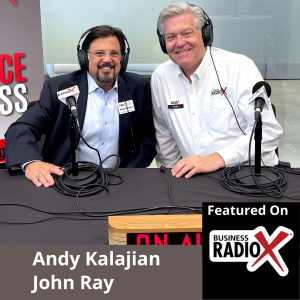
Andy Kalajian
North Fulton Business Radio
LIVE from the GNFCC Grand Opening Celebration: Andy Kalajian, Fort Leadership and Sales Consulting
Loading
00:00 /
RSS Feed
Share
Link
Embed

Download file

Andy Kalajian

LIVE from the GNFCC Grand Opening Celebration: Andy Kalajian, Fort Leadership and Sales Consulting (North Fulton Business Radio, Episode 508)

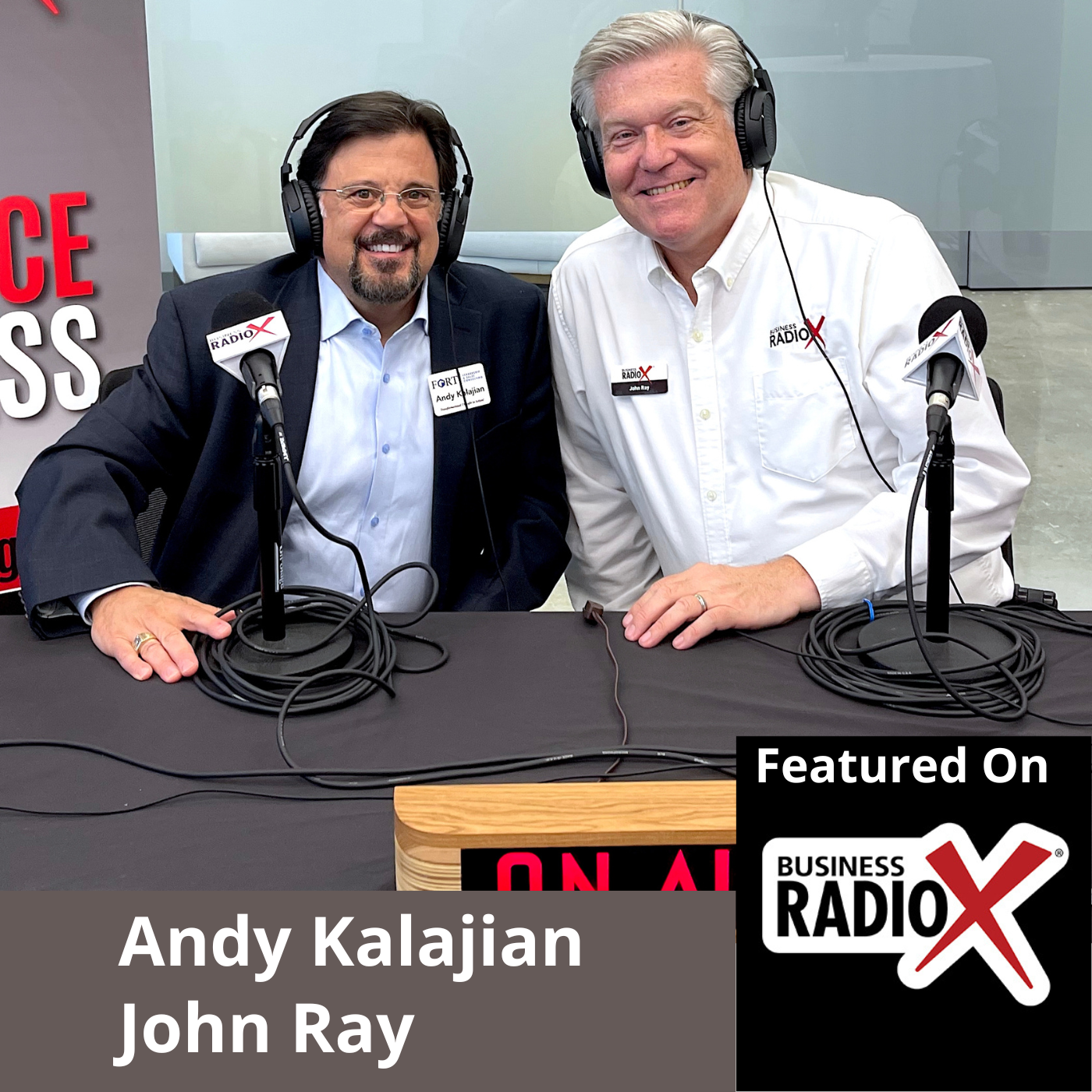
Andy Kalajian, founder of Fort Leadership and Sales Consulting is deeply involved in GNFCC as a Chamber Diplomat, a Chairman’s Circle member, and several other capacities. Andy sat down with host John Ray during the GNFCC Grand Opening Celebration to talk about Fort Leadership, Andy’s approach to sales and relationships, why he’s so involved with GNFCC, and much more.

This show was originally broadcast live from the Grand Opening celebration and ribbon cutting of the new offices of the Greater North Fulton Chamber of Commerce at the 10000 Building at Avalon in Alpharetta, Georgia, on August 18, 2022.

North Fulton Business Radio is produced and broadcast by the North Fulton studio of Business RadioX® inside Renasant Bank in Alpharetta.

Fort Leadership and Sales Consulting

Fort Leadership and Sales Consulting, LLC is a Professional and Personal Development company that creates healthy corporate cultures by developing the personal and professional leadership capacity of the person. Fort Leadership and Sales Consulting, LLC believes that a healthy Corporate Culture benefits the business leader and the employee alike, and it enhances the customer experience.

The culture on the inside of a company is what the customer experiences on the outside of the company. That is the customer experience. But if this is true, why do so many employees feel that their corporate culture is not where it needs to be? Why do some employees describe their corporate culture as dysfunctional or even toxic? How does this dysfunction impact the customer experience? Furthermore, why do some business leaders when asked “how many employees work for you?” respond by saying, “about 1/2”!
Demographic studies indicate that in 5 years up to 75% of the employees will be millennials. That means that for a business leader to be able to attract and retain the best talent from the biggest pool of talent, the business leader must have a healthy corporate culture.

But if a healthy corporate culture is what the employer and the employee are looking for, what does a healthy corporate culture look like? How is a healthy corporate culture created? The answer is Leadership! Fort Leadership and Sales Consulting creates healthy corporate cultures through Leadership Development. Leadership development is all about Character. After all, when we talk about corporate culture, what we are really talking about is corporate character. Corporations are made up of people. And people bring their character to work. So, it only stands to reason that when a collection of people brings their collective characters to work, a corporate character or a corporate culture is created.

Fort Leadership and Sales Consulting, LLC is creating healthy corporate cultures.

Company website | LinkedIn | Instagram

Andy Kalajian, Founder, Fort Leadership & Sales Consulting

Andy Kalajian, Founder, Fort Leadership & Sales Consulting

Andy Kalajian has been a highly sought-after public speaker for more than 25 years. He has received public acclaim for his brand, EnTheos, Latin for Spirit Within and predecessor to the word Enthusiasm. Andy enthusiastically delivers powerful talks and lessons steeped in wisdom literature and their practical application to busy lifestyles. His tagline, transformational thought in action, serves as a reminder to the participant that one can, indeed, permanently change the destiny of their life by changing the nature of their thoughts and actions. 

Andy was born and raised in Detroit, Michigan. As a young boy he discovered his passion for serving others in medicine and his gift for public speaking. At the age of 12, Andy, at the urging of his father, began to earn his own way as a Golf Caddy. His sense of adventure also led him, along with his father, to the Boy Scouts of America where he achieved the Rank of Eagle Scout. In High School, Andy was fed books from his mother, Think and Grow Rich by Napoleon Hill and How to Win Friends and Influence People by Dale Carnegie

While a golf caddy, Andy was awarded the prestigious Evans Scholarship, a full academic and leadership scholarship, to study at Michigan State University, where he earned a Bachelor of Science degree in Medical Technology. In 1985, he coupled his lifelong passion for medicine and serving people with his gift of enthusiastic speaking and moved to Atlanta to begin his career in Medical Sales. 

As a young professional, Andy’s Mom continued to fuel his desire for wisdom literature from authors/speakers Zig Ziglar, Earl Nightingale, Les Brown, Stephen Covey, and John Maxwell. Andy applied the character traits instilled in him from the Boy Scouts and the leadership skills taught to him by John Maxwell, Stephen Covey, and others to enjoy over 30 years in an award-winning medical sales career. It was during this time that Andy was asked to speak to groups as small as 4 or 5 and as large as 500+ all over the US and Puerto Rico. 

Andy is very involved in the lives of his two children, Mallory and Drew. For 12 years they were engaging in monthly adventures with the YMCA Adventure Guides program where Andy volunteered in several leadership positions including Nation Chief. Andy and his wife, Sherrie, have four adult children and are active members of Pastor Andy Stanley’s congregation at North Point Community Church in Alpharetta, Georgia.

Andy enjoys time invested with his wife Sherrie, his family, and his friends. He still has a voracious appetite for reading the wisdom literature and the biographies of the American Founders. He enjoys weightlifting, aerobics, golf, and hiking the outdoors. Andy continues to have a passion for speaking, coaching, and training others to lead a life of significance.     

LinkedIn

Questions and Topics in this Interview:

  • How Fort Leadership got its name
  • Andy’s path to leadership
  • Andy’s sales career
  • How he motivates sales professionals
  • Andy’s involvement with GNFCC
  • Advice for engaging in groups like GNFCC

North Fulton Business Radio is hosted by John Ray and broadcast and produced from the North Fulton studio of Business RadioX® inside Renasant Bank in Alpharetta. You can find the full archive of shows by following this link. The show is available on all the major podcast apps, including Apple Podcasts, Spotify, Google, Amazon, iHeart Radio, Stitcher, TuneIn, and others.

RenasantBank


Renasant Bank has humble roots, starting in 1904 as a $100,000 bank in a Lee County, Mississippi, bakery. Since then, Renasant has grown to become one of the Southeast’s strongest financial institutions with over $13 billion in assets and more than 190 banking, lending, wealth management and financial services offices in Mississippi, Alabama, Tennessee, Georgia and Florida. All of Renasant’s success stems from each of their banker’s commitment to investing in their communities as a way of better understanding the people they serve. At Renasant Bank, they understand you because they work and live alongside you every day.


Special thanks to A&S Culinary Concepts for their support of this edition of North Fulton Business Radio. A&S Culinary Concepts, based in Johns Creek, is an award-winning culinary studio, celebrated for corporate catering, corporate team building, Big Green Egg Boot Camps, and private group events. They also provide oven-ready, cooked-from-scratch meals to go they call “Let Us Cook for You.” To see their menus and events, go to their website or call 678-336-9196.

Tagged With: Andy Kalajian, Avalon, Fort Leadership and Sales Consulting, GNFCC, Greater North Fulton Chamber of Commerce, Leadership, North Fulton Business Radio, renasant bank, Sales, sales consulting

“Stewarding Family Wealth” featuring Melissa Libby of Melissa Libby & Associates with Host Randy Brunson

August 1, 2022 by Amanda Pearch

“Stewarding Family Wealth” featuring Melissa Libby, owner of Melissa Libby & Associates,

with Host Randy Brunson


Melissa Libby 

Melissa Libby & Associates is a public relations agency based in Atlanta, Georgia with local and national clients in the food, beverage and retail industries.  She and team specialize in media communications, event planning, community outreach and social media. Specialties include: communications strategy, creative problem solving for increased business revenues, product launches, publicity, crisis messaging.


Randy Brunson is the President of Centurion Advisory Group. He studied engineering and marketing at UT Chattanooga. Randy currently holds the Accredited Investment Fiduciary (AIF®) and CKA designation and makes it a priority to stay on top of his knowledge in the financial industry through continuing professional educational opportunities and reading.  Randy has completed studies in qualified plan design, estate planning and business transition planning and he enjoys speaking and writing on these topics.
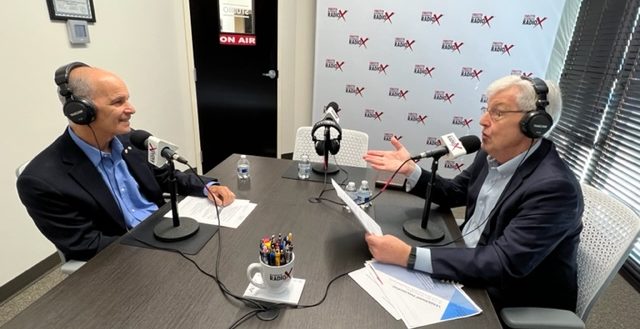
 

Stewarding Family Wealth is presented by

 

Broadcasted LIVE from the Forsyth Business RadioX Studio in Cumming, Georgia

 Produced by Amanda Pearch

Tagged With: amanda pearch, business, centurion advisory group, Leadership, Melissa Libby, Melissa Libby & Associates, planning, Public Relations, randy brunson, stewarding family wealth, wealth management

Decision Vision Episode 177: Should I Resist? – An Interview with Lee Ellis, Leading with Honor

July 21, 2022 by John Ray

Lee Ellis
Decision Vision
Decision Vision Episode 177: Should I Resist? - An Interview with Lee Ellis, Leading with Honor
Loading
00:00 /
RSS Feed
Share
Link
Embed

Download file

Lee Ellis

Decision Vision Episode 177: Should I Resist? – An Interview with Lee Ellis, Leading with Honor

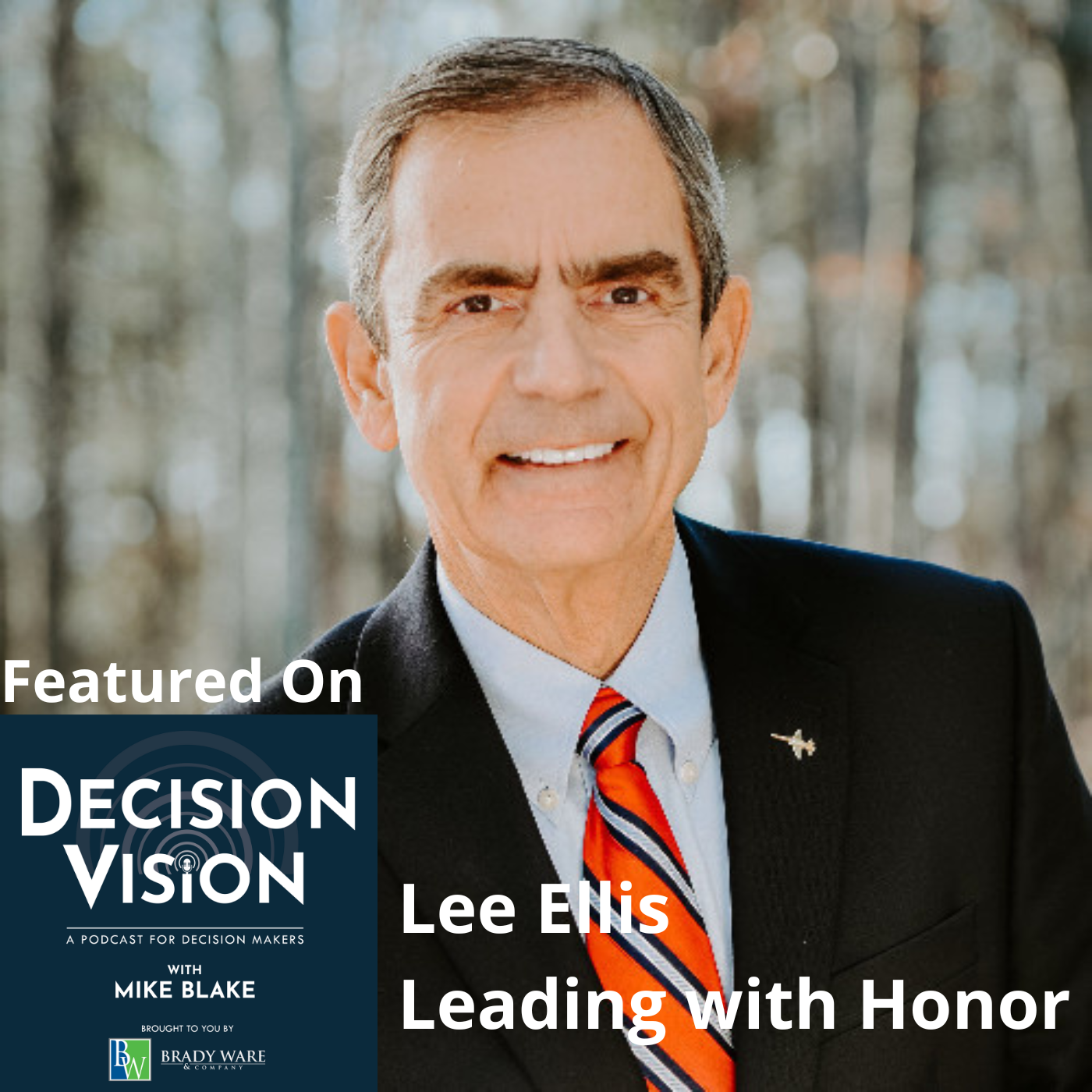
Lee Ellis, a decorated veteran of the Vietnam War and President of Leading with Honor, was Mike Blake’s guest on this episode of Decision Vision. From his harrowing experience as a prisoner of war and his military career, Lee brings a wealth of wisdom to the question of resistance. He and Mike talked about his POW experience, the code of honor he adheres to that guided his actions, how resistance looks in business, the role of resistance in effective leadership, ethical considerations, and much more.

Decision Vision is presented by Brady Ware & Company and produced by the North Fulton studio of Business RadioX®.

Leading with Honor, Leadership Freedom LLC

Leadership Freedom LLC is the original consulting, coaching, and training organization founded by Lee Ellis.

The goal isn’t perfect leadership, but it’s agreeing that we all want to authentically lead with honor. Leading With Honor helps leaders grow in character, courage, and commitment and learn new skills based on their natural behavior that will help them develop the next generation in the areas of responsibility, accountability, and resilience.

Their leadership development training methods are based on principles learned in some of the most challenging circumstances of POW life. They also have more than 25 years of experience in the research, development, and deployment of leadership resources including behavioral assessments.

In 2017, they made the transition from Leadership Freedom LLC to the new organizational name, Leading with Honor®, to further emphasize the importance of training leaders in character, courage, and commitment

Company website | LinkedIn | Facebook

Lee Ellis, Founder and President, Leading with Honor

Lee Ellis, President, Leading with Honor

Lee Ellis is President and founder of Leading with Honor®, a leadership and team development training and coaching company, and FreedomStar Media®, a publishing company that provides leadership resources and training. A popular media personality and high-profile human performance expert, Lee focuses on organizational integrity, operational effectiveness, and personal accountability for enterprise, government, and not-for-profit leaders.

His prior experience was as a founding partner and senior vice president of a leadership assessment and human capital management consulting company headquartered in Atlanta, GA. For over 20 years, he has served as an executive coach and a corporate coach in the areas of hiring, team building, leadership, human performance development, and succession planning. His approach to maximizing leadership performance has been implemented by Fortune 500 clients, senior executives, and C-Level leaders in telecommunications, healthcare, insurance, energy, IT, automotive, military, and not-for-profit sectors.

As the Director of Career/Life Pathways from 1990 – 1998, Lee led the development team that researched, developed, and validated Career Direct®, a vocational assessment package and two personality assessments with software applications. From 1998 – 2008, he was responsible for product development of three more behavioral and leadership assessments as well as the launch and Internet deployment of these resources. Most recently, he has developed and released his latest assessment tool, the Leadership Behavior DNA® Discovery Process (formerly N8Traits® Profile). In total, these assessments have been used worldwide by more than 200,000 individuals and are the instrument of choice in many organizations, including Fortune 500 companies and nationally recognized not-for-profits. Lee’s point of view on maximizing leadership performance and organizational leadership during crisis is framed by his extensive research and experience in the assessment of human behavior.

A prolific writer, blogger and thought leader, Lee’s latest book is entitled Leadership Behavior DNA: Discovering Natural Talent and Managing Differences. His last two award-winning books, Leading with Honor®: Leadership Lessons from the Hanoi Hilton and Engage with Honor™: Building a Culture of Courageous Accountability, share his POW experiences and the leadership principles that helped him and his compatriots resist, survive, and return with honor. Additionally, Lee co-authored three books and workbooks on career planning. He is a nationally-recognized Certified Speaking Professional* (CSP), Certified Virtual Presenter (CVP), and expert on the subjects of leadership and performance, team building, mentoring, and career planning. Some of his appearances include interviews on networks such as CNN, CBS This Morning, C-SPAN, ABC World News, Fox News Channel, plus hundreds of engagements in various industry sectors throughout the world.

Lee holds a B.A. degree in History from the University of Georgia and a M.S. degree in Counseling and Human Development from Troy University in Alabama. He is a graduate of the Armed Forces Staff College and the Air War College. Lee supervised, educated, and trained officers for the last 17 years of his Air Force career. He served as the Vice Commandant of the Squadron Officer School, the Air Force’s leadership school for captains. He completed his Air Force career as Professor of Aerospace Studies and Commander of Air Force ROTC at the University of Georgia. More recently he has developed and presented leadership curricula in numerous organizations including Fortune 500 companies, and major sectors of the Department of the Defense focusing on management performance, leadership accountability and principle-based management strategies.

A native of Commerce, Georgia, Lee graduated from the University of Georgia in 1965 and began a career in the Air Force. During the Vietnam War, Lee’s aircraft was shot down over enemy territory and he was held as a POW in various prisons in the Hanoi area for over five years. As a military officer, his experiences as a POW piqued his interest in leadership performance in difficult situations, leading to further research and academic pursuit in the area of measuring and optimizing human performance and leadership effectiveness.

After repatriation, he returned to flying duties with increasing positions of leadership. Rising to the rank of colonel before retirement, Lee’s assignments included duty as a pilot, flight instructor, staff officer, chief of flight standardization and evaluation, flying squadron commander, and supervisor in higher education. He was awarded two Silver Stars, the Legion of Merit, the Bronze Star with Valor device, the Purple Heart, the Air Medal with eight Oak Leaf Clusters, and the Prisoner of War Medal for his service in Vietnam. In addition, he was awarded four Air Force Commendation Medals and four Meritorious Service Medals for performance excellence. Lee is also a 2014 inductee into the Georgia Military Veterans Hall of Fame and the 2015 DAR Medal of Honor Recipient for a lifetime of patriotic service as a military officer and spokesman for leading with honor.

Lee and his wife Mary have four grown children and six grandchildren. They reside in the metro area of Atlanta, GA.

LinkedIn

Mike Blake, Brady Ware & Company

Mike Blake, Host of the “Decision Vision” podcast series

Michael Blake is the host of the Decision Vision podcast series and a Director of Brady Ware & Company. Mike specializes in the valuation of intellectual property-driven firms, such as software firms, aerospace firms, and professional services firms, most frequently in the capacity as a transaction advisor, helping clients obtain great outcomes from complex transaction opportunities. He is also a specialist in the appraisal of intellectual properties as stand-alone assets, such as software, trade secrets, and patents.

Mike has been a full-time business appraiser for 13 years with public accounting firms, boutique business appraisal firms, and an owner of his own firm. Prior to that, he spent 8 years in venture capital and investment banking, including transactions in the U.S., Israel, Russia, Ukraine, and Belarus.

LinkedIn | Facebook | Twitter | Instagram

Brady Ware & Company

Brady Ware & Company is a regional full-service accounting and advisory firm which helps businesses and entrepreneurs make visions a reality. Brady Ware services clients nationally from its offices in Alpharetta, GA; Columbus and Dayton, OH; and Richmond, IN. The firm is growth-minded, committed to the regions in which they operate, and most importantly, they make significant investments in their people and service offerings to meet the changing financial needs of those they are privileged to serve. The firm is dedicated to providing results that make a difference for its clients.

Decision Vision Podcast Series

Decision Vision is a podcast covering topics and issues facing small business owners and connecting them with solutions from leading experts. This series is presented by Brady Ware & Company. If you are a decision-maker for a small business, we’d love to hear from you. Contact us at decisionvision@bradyware.com and make sure to listen to every Thursday to the Decision Vision podcast.

Past episodes of Decision Vision can be found at decisionvisionpodcast.com. Decision Vision is produced by John Ray and the North Fulton studio of Business RadioX®.

Connect with Brady Ware & Company:

Website | LinkedIn | Facebook | Twitter | Instagram

TRANSCRIPT

Intro: [00:00:01] Welcome to Decision Vision, a podcast series focusing on critical business decisions. Brought to you by Brady Ware & Company. Brady Ware is a regional, full-service accounting and advisory firm that helps businesses and entrepreneurs make visions a reality.

Mike Blake: [00:00:21] Welcome to Decision Vision, a podcast giving you, the listener, clear vision to make great decisions. In each episode, we discuss the process of decision making on a different topic from the business owners’ or executives’ perspective. We aren’t necessarily telling you what to do, but we can put you in a position to make an informed decision on your own and understand when you might need help along the way.

Mike Blake: [00:00:43] My name is Mike Blake, and I’m your host for today’s program. I’m the managing partner of Brady Ware Arpeggio, a data-driven management consultancy which brings clarity to owners and managers of unique businesses facing unique strategic decisions. Our parent, Brady Ware & Company, is sponsoring this podcast. Brady Ware is a public accounting firm with offices in Dayton, Ohio; Alpharetta, Georgia; Columbus, Ohio; and Richmond, Indiana.

Mike Blake: [00:01:07] If you would like to engage with me on social media with my Chart of the Day and other content, I’m on LinkedIn as myself and @unblakeable on Facebook, Twitter, and Instagram. I also host a LinkedIn Group called Unblakeable’s Group That Doesn’t Suck, so please join that as well if you’d like to engage.

Mike Blake: [00:01:24] Today’s topic is, Should I resist? And what does that mean? Well, in my 52 trips around the sun, we are in an unprecedented time of social and economic upheaval. Certainly, I think you have to go back to the 1970s – and I was only a kid then and didn’t care about that stuff – to encounter anything like this. And interestingly enough, that’s going to be a recurring theme for today’s show, as a matter of fact.

Mike Blake: [00:02:01] But now we’re put in a position of resisting toxic relationships. We’re in a position of resisting toxic employers. We’re always in a position at some point of resisting people who want to manipulate us into doing or accepting bad things. And we could apply this, of course, to the political arena, which seems to be becoming more polarized by the day. And I don’t know what the solution is there. We’re certainly seeing it in business as people – as we have covered many times in the show – have redefined their relationship with work and, frankly, with a lot of the rest of the world.

Mike Blake: [00:02:55] And there’s even a decision as to whether or not we’re going to resist COVID or how we’re going to resist COVID. Are we going to resist it by being vaccinated? The resistance, are we going to resist vaccination mandates? And some people are doing that, in many cases at great personal cost to them, in some cases the cost of their lives. So, the resistance there, while some of us may disagree with it – I happen to disagree with it. I don’t think that that’s a trivial exercise – I think that one of the things, as I kind of reflect upon our society right now and our country, is not that it’s a good or bad place, but I do think it’s an angry place. It’s a much angrier place that I can ever remember.

Mike Blake: [00:03:51] And the first president that I can remember was Ronald Reagan. And whether you voted for him or not – and I’m certainly not one of these guys that lionizes him or really almost any president, every president that I’ve grown up with has been flawed in some way – and whether you agree with the politics or not, the one thing that he was, I think, always was a positive voice. And our political landscape has changed, where negative voices are being heard more. There’s an economic argument for negative voices. Negativity right now, I think you can argue, sells. And there’s a resistance that I think is required to just resist to avoid being overwhelmed by that sense of pervasive anger and negativity.

Mike Blake: [00:04:50] And so, I’ve wanted to do this show for a long time. This is not a new phenomenon. But not everybody can talk to this authoritatively. But I think I found the right guy who can talk about resistance authoritatively, and I think that you’re going to agree. This will probably be the longest introduction I’ve made of a guest, and too bad because he’s earned it.

Mike Blake: [00:05:16] Joining us today is Lee Ellis, who is President and Founder of Leading With Honor, a leadership and team development, training, and coaching company; and Freedom Star Media, a publishing company that provides leadership resources and training.

Mike Blake: [00:05:30] For over 20 years, Lee has served as an executive coach and a corporate coach in the areas of hiring, team building, leadership, human performance development, and succession planning. His approach to maximizing leadership performance has been implemented by Fortune 500 clients, senior executives, and C-level leaders in telecommunications, health care, insurance, energy, I.T., automotive, military, and not-for-profit sectors.

Mike Blake: [00:05:55] Lee and his wife, Mary, have four grown children and six grandchildren, and they reside in the Metro Area of Atlanta. During the Vietnam War, Lee’s aircraft was shot down over enemy territory, and he was held as a prisoner of war in various prisons in the Hanoi area for over five years. He was awarded two Silver Stars, the Legion of Merit, the Bronze Star with Valor Device, the Purple Heart, the Air Medal with eight oak leaf clusters, and the Prisoner of War Medal for his service in Vietnam. In addition, he was awarded four Air Force Commendation Medals and four Meritorious Service Medals for Performance Excellence. And by the way, after being released, he went back into active service.

Mike Blake: [00:06:34] Leadership Freedom is the original consulting, coaching, and training organization founded by Lee Ellis in 2017. Since then, they’re making the transition from Leadership Freedom to the new organizational name, which you now know as Leading With Honor. First, Lee Ellis, thank you for your service to our country and welcome to the Decision Vision podcast. It’s an honor to have you.

Lee Ellis: [00:06:55] Thank you, Mike. Great to be with you. And I always enjoy hearing what you have to say about things. I’ve seen you on several interviews on our CEO Netweavers, and I admire your wisdom. So, good to be with you.

Mike Blake: [00:07:09] Well, I appreciate that. So, you have, I think, the ultimate perspective of resistance. And we talked about you were in the same prison camp as the late Senator John McCain, correct?

Lee Ellis: [00:07:25] Yes.

Mike Blake: [00:07:26] Right. So, I just can’t imagine, it’s even hard to formulate the questions even though I have them written down. You’re shot down. You’re over enemy territory. You’re taken into custody. And you’re put in a position where you’re in prison as a hostile, as an enemy combatant. And my question, I guess, is, in that moment, how do you decide that it’s worth resisting?

Mike Blake: [00:07:58] Because your captors didn’t just want you to be there. They weren’t just feeding you for their health or, certainly, not even yours necessarily. But they wanted you to do things for them. And you had to make a conscious decision to resist that, decide it’s worth to do so at great personal suffering. How do you come to a point where it’s worth doing that, where it’s worth resisting?

Lee Ellis: [00:08:23] Well, we had memorized, actually, the code of conduct, which I think it’s about six articles in ROTC at the University of Georgia, it’s where I memorized that. And those six articles describe what is the role of a person who’s been captured as a prisoner of war. Basically, you commit to serving your country honorably, not sharing anything with the enemy that you shouldn’t other than your name, rank, service number, date of birth, and things that are very generic are okay. But anything that would have to do with military intelligence, and especially making oral or written comments that would be harmful to your country and its allies. That’s right there in there.

Lee Ellis: [00:09:09] So, those six articles were the foundation of what I really wanted to stand for and stand by. I had committed to that when I took the oath. So, my goal is to live up to that. And so, that’s how I resisted. I said no. They asked me to share this, I said no. They said fill out this, I said no. And of course, that was a battle. And sometimes I got tortured out of it.

Lee Ellis: [00:09:37] And, eventually, I did give them something, but it was nothing of value to them. I remember I had to fill out a three page biography one time and I resisted, and eventually I gave in and said, “Yes. I’ll do it.” And I want you to know that I was in leg irons and handcuffs and blindfolded on the filthy floor in the torture room, and I cried like a baby because I was so ashamed. I felt like the lowest scum that had ever worn the uniform of the United States. Well, I gave them nothing that was true of any value except my father’s first and last name. But I still felt like I wasn’t tough enough to beat them. And that was my disappointment.

Lee Ellis: [00:10:18] Well, when I get back to my cell, I found out the other guys had been through similar things, and some lasted longer than I did, and some didn’t last as long as I did. So, that helped. But it was still a pretty big shocker that I wasn’t tough enough. But that was our commitment right upfront, and that got reinforced by our leadership.

Mike Blake: [00:10:38] So, I’m curious, I want to kind of unpack some of this because I can see many angles in terms of determining that you’re going to resist. And I’m not saying this is true, but just one path to saying you’re going to resist is, “Well, they’re the enemy. And I don’t like these guys. They’re not treating me and my comrades very well, so I’m not going to help them.” Another path is, “Well, I signed an oath where I made a personal commitment to my country, to my government, to the people I’m trying to protect, and it says Lee Ellis on it, and, by golly, that’s going to be my path to resistance.”

Mike Blake: [00:11:18] Or it could be something entirely different. Maybe you’re just resisting because – I don’t want to say just – it could be as simple and as foundational that you’re with a group of other guys that are resisting as well, and you don’t want to be the guy, the weak bat in the lineup, so to speak. Was it any one of those things that dominated? Was it a combination of three? Am I totally missing it and there’s something else? What’s the calculus like?

Lee Ellis: [00:11:42] I think those are the main points that influence us all. First of all, because you might not be able to see another person for a week or a month, in some cases it was six months to a year, although we did have covert communication, but it might be weeks and months before you actually was able to talk to somebody and you might be that isolated. So, you had to stand on your own footing, so to speak, your own foundation. And that’s where that code of conduct came in and your commitment to it.

Lee Ellis: [00:12:15] And then, the other thing, I think, just generally knowing that you are up against an enemy, the Communists, and they were working with the Russians and the Chinese. Actually, they were almost the hand of the Russians and Chinese pushing against the U.S. And so, the Communists all kind of work together. So, wanting to resist them was a big part of it too. And then, some of it was just personal pride, “I’m the good guy. You’re the bad guy. I don’t want to give in to you.”

Mike Blake: [00:12:45] Well, and that’s what I want to ask you about next, when you were in the moment, did you think of yourself as a resister or did you think of yourself as something else, good guy versus bad guy or something else?

Lee Ellis: [00:13:00] We saw it as duty. Our duty is to resist the enemy. And so, yes, I saw myself as a resister. But it was a piece of pride that the line was drawn. And when they stepped over the line, I was going to push back.

Mike Blake: [00:13:23] So, in the movies, they talk about people being given training to resist torture, interrogation, and so forth. I mean, is that true? Is that a thing? Were you given that sort of training? And if so, did you find the training helpful in practice?

Lee Ellis: [00:13:39] Yeah, it was helpful. Absolutely, it was helpful. In fact, I was thinking about that this past week. I was thinking about I’ve been blessed with a nature that I can tolerate things without getting too panicky. And so, they put me in a little box about the size you put a pig in. And I was cramped up like this and left me in there for 30 or 40 minutes in the dark, where I couldn’t even move my elbows out or move my head up. Well, a lot of people would panic with that. And I just said, “Okay. I’m hanging in here.”

Mike Blake: [00:14:16] “I’m doing this now.”

Lee Ellis: [00:14:16] And then, they put me in another vertical, it was like a locker in a gym. You walk in, you hang up the clothes. Well, they locked me up in there for a day or so. And I had to stand up, it’s about a-day-and-a-half and I just think about things to think about. And I could hear there was a guy down the hall from me crying, and I’m thinking, “Well, I’m not going to cry yet.”

Lee Ellis: [00:14:45] So, you know, I think as an air crew member, you’ve gone through both psychological and physical screening and you have a pretty strong ego. It takes a lot of confidence to fly a fighter. And I think the average age and the POWs was [inaudible], the long term guys was like 30, 31. And I just turned 24, so that’s why I was a kid there. But, you know, we were not 18 year olds or 19 year olds. We’d been out on our own. We’d been to a lot of training. I’d been through survival school, the one you just mentioned. I’ve been through water survival training. I’ve been through jungle survival training. So, all that builds you up and prepares you to be ready for very difficult situations.

Mike Blake: [00:15:35] So, you know, if you haven’t been there, I just don’t think you can imagine it, obviously. But you’re in a scenario under which, I mean, at some level, it has to be terrifying. You just don’t know what they’re going to do.

Lee Ellis: [00:15:52] Oh, yeah. Oh, yeah.

Mike Blake: [00:15:53] And your power is limited, to put it mildly. That’s sort of the whole point.

Lee Ellis: [00:15:59] I got a story about being terrified, if I can jump in here.

Mike Blake: [00:16:03] Please. I want to hear you and they want to hear you. Go.

Lee Ellis: [00:16:05] When I got to the first English speaker on the way to Hanoi, it was a holding camp. It’s a bamboo prison. They put you in leg irons and handcuffs or rope tied until they got enough of you there, four or five or six in a truck, and then take you on to Hanoi. And so, they had this one arm interrogator there who spoke very broken English. And I can’t remember, we all have names for all these guys, and I can’t remember his name now.

Lee Ellis: [00:16:33] But he asked me a question about the kind of airplane I was flying and where I was based out of. Well, he asked me what kind of airplane I was flying, and I wouldn’t tell him. But I saw he had my checklist over there behind him on the table. They’d picked it up when I jumped out of the airplane. And I said, “I’ll give you name, rank, service number, date of birth, answer no more questions.” And he just started screaming at me and he yelled at the guard behind me.

Lee Ellis: [00:17:04] There were a couple of guards there. And that guard – I’ve shoot rifles and shotguns – I heard him crank in a bullet, and he yelled at the guy, and the guy put it right up to the side of my head. He said, “You answer or I kill you now.” Well, I just got captured. I didn’t know whether he was truthful and honest and would. Later, I learned he probably wouldn’t have. But then, I didn’t know.

Lee Ellis: [00:17:31] So, I told him I was flying an F-4 Phantom. Well, he had my checklist there, so I didn’t really give him any. So, I answered three or four questions but I didn’t give him anything that was not obvious already or that he didn’t already know. I didn’t give him anything else. And so, I really felt bad about that. But I really didn’t feel like I had a choice. I was scared, by the way.

Mike Blake: [00:17:55] I mean, there’d be something wrong with you if you weren’t. So, when you’re in that situation – and that’s really a perfect example – at any point, they can just decide to put a bullet in you. There’s no recourse. That’s just it. How do you conceive of ways to resist when the power dynamic is so against you?

Lee Ellis: [00:18:18] I think you have to evaluate that. I make these kind of decisions all the time. I have to evaluate, is this worth me resisting? I have business partners. I have friends. I have clients. And I have to decide if this is worth me taking a stand. And most of the time it’s not, but sometimes it is. And so, if they say, “Well, I’m out of here.” Well, okay.

Lee Ellis: [00:18:53] Once you’ve been a POW for five-and-a-half years, you don’t worry about a lot of things that most people worry about day to day. When I came home, I never worried about getting promoted again. I just said, “I’m going to do my job. I’m going to do the very best I can. I will be the person I want to be. And if I get promoted, fine. And if I don’t, hey, that’s okay. I’m home. I’m better off than I was locked up, up there.”

Mike Blake: [00:19:21] So, in the moment as you think about, I guess, we would now almost call them microaggressions, if you will, even resisting the simplest, it must have been very frustrating to your captors because you’re resisting to comply with, even what to them, must have seemed like the simplest comment, the simplest task. In that moment, do you think of the consequences of resisting or do you have to kind of put that aside to give you the mettle to resist?

Lee Ellis: [00:19:51] Well, I think, Mike, the biggest issue here that we’re talking around is really character, honor, integrity. I think that’s where we need to clarify is what is my character, what I believe has integrity, what I believe is honorable. And then, at what level I’m willing to sacrifice for that, and how much risk am I willing to take. I mean, I battle this all the time because I’m a pretty opinionated person. And I see stuff on social media that I just want to jump in there. And I have to coach myself it’s not worth it right now. You’ll have another time at another level. This is not going to matter to hill of beans what you say in that social media. And they’re just cranking you up to respond.

Lee Ellis: [00:20:43] And so, one approach to this issue, from the higher level of character and integrity where you can sit down and talk with others who are on the other side and let’s work through this. I mean, our country was founded basically with two parties, because I think we need two parties, we need accountability. So, if one party holds the other one accountable to our Constitution and our values, then I think that’s a good thing. It helps keep us in line.

Lee Ellis: [00:21:11] Just like my wife and I, we kind of help keep each other in line. My business partners, my managing director, we sit down and talk about it. And I’ll say, “Well, I think we should do this.” And he said, “Well, I think that’s not a good idea.” And I say, “Well, tell me why.” And we analyze it. And, really, it’s a day to day battle for honor and character and integrity. And you’ve got to evaluate what is the risk versus reward, and is there a better place for me to play this battle.

Mike Blake: [00:21:43] Let me ask you this and I’m going to go off script here, because I don’t know you that well, but I’ve interacted with you enough to know that you’re a very positive guy. And I don’t know if you were brought in to the Hanoi Hilton that way or not, but you certainly emerged that way, or at least that’s the finished product that I’ve seen. Does positivity make you a more effective resister? Does it make you more effective than negativity?

Lee Ellis: [00:22:09] Absolutely, man. Absolutely. It does. You got to focus on the positive and be able to identify the negatives that creep in around you and how are you going to handle them in a positive way. Because I can get very negative, by the way. My personality is I don’t mind arguing. Because if I’m off base, I want you to show me the logic and I’ll get on your side, so I don’t mind that, and I can get a little critical. But the reality is, that doesn’t work very well for very long. And so, for me, I have to coach myself how can I take a positive approach to this where I show respect for the other person.

Lee Ellis: [00:22:54] Here’s the bottom line, the truth is every human being wants to be loved and cared for. They want to be accepted. In coaching leaders, I talk about, yes, you have to accomplish the mission. You have to get results. But you also have to connect with your people. You have to acknowledge their existence. You have to accept them for who they are. You have to affirm them on specifics. And you have to show them that you appreciate having them on your team.

Lee Ellis: [00:23:22] And when you do that, you know what’s going to happen? They’re going to believe in themselves, and they’re going to perform better, and they’re going to stay with you longer, and they’re going to grow more. Because now they’re less insecure and they’re more secure and they’re going to perform more healthily and more effectively. So, as a leader, I coach myself, I coach other leaders. Men, it’s probably hard for you. It is for a lot of us. But when you do it and intentional about it, it builds the culture that you want to be in.

Mike Blake: [00:23:57] Does it make a difference that you’re resisting in a group versus an individual?

Lee Ellis: [00:24:03] Oh, yeah.

Mike Blake: [00:24:04] The guy standing in front of the tank in Tiananmen Square in ’89 versus a whole group of protesters. And I guess maybe that’s why they separated you in the prison system.

Lee Ellis: [00:24:13] Yeah, it does. Camaraderie and teamwork and collaboration, that feeling of I’m not in this alone, it’s huge. That’s why we would take great risks to have that covert communication. And I was a good risk taker, so I would reach out to guys in solitary confinement. Now, I had people protecting me by watching, we called it clearing. They’d be looking through the cracks in the doors and listen out the back for a guard coming. And when the guard came, [coughs], they do like that or they’d bump the wall with their elbow. And we’d all do like this and act like we’re just snoozing there.

Lee Ellis: [00:24:50] But, yeah, it’s critical to be connected to others. You don’t want to fight this battle alone. Fighter pilots, we don’t ever want to fight alone.

Mike Blake: [00:25:02] Now, one of the issues of resisting – and we see this unfolding in Russia and Ukraine right now – is that when you resist, it’s not necessarily just you that suffers the consequences of your resistance, but others around you that may not want you to resist necessarily, that they can suffer. We’re seeing in Russia and Ukraine, if you are resisting the propaganda, the party line, or if you’re a soldier and you refuse to fight, it’s not just you that gets shot, but your family’s going to suffer. And that’s how they maintain leverage. That’s their system, unfortunately. You must have recognized also that there were sort of consequences to others, and this happens in business too. How do you think about that? How do you reconcile those things? Can you reconcile them?

Lee Ellis: [00:25:56] Going back to what I said earlier, you always have to evaluate what is the gain versus the loss. And sometimes the gain is good, what you want, but the loss may be greater. And so, you just have to back up and keep your mouth shut and wait until another time and another situation, maybe more evidence builds up or more people see the world the way you do. So, I think you have to evaluate that all the time.

Lee Ellis: [00:26:25] And going back to the community and the group, you know, I feel like I’m very confident about myself. But I know myself well enough that sometimes what I think is right and wise, it’s off a step. So, you got to have mentors, friends. And my wife, for instance, is one of those, in certain areas she say, “I don’t really think about that.” But I have business mentors that I reach out to when I’m going to make a decision where I know I’m too emotionally connected that I’m afraid I can’t make a wise decision, and I’ll say, “Let me run this by you and you tell me how you see it.” And then, I’ll sit there and listen. I’m not giving up my decision to them. I just want to hear is there something I’m missing that I need to know. So, I think that’s so important.

Mike Blake: [00:27:17] So, I want to pivot a little bit more to a more direct connection with business here. And you’re not just a former POW, I mean, you’re a successful, highly influential leadership trainer. So, I’d like to switch and talk about that a little bit. I’d like to start with, first of all, have you seen cases where, in fact, there are employees that do try to resist things that are happening in a company? And if so, what do companies do to try to break that resistance? If I’m thinking of resisting something in my company, for example, what are some tactics you see that management tries to implement to break that resistance?

Lee Ellis: [00:28:06] Well, that’s a little bit of a difficult one for me, because here’s what happens, most of the time, really good leaders bring me in. Bad leaders don’t ever bring in a leadership consultant. And so, most of the leaders I’ve worked with have been really good leaders that would listen, and they cared about their people, they’re mission focused but they cared about their people. So, I don’t have a lot of experience, and I’m sure I’ll think of something here in a minute.

Lee Ellis: [00:28:34] But I think life is that way. You have to constantly evaluate the risk versus reward in light of your character and your life purpose and your mission. And that’s why I say sometimes you’ve got to be able to discuss that with somebody else. Don’t do that just by yourself in secret. You’ve got to have somebody who can look at it slightly different, give you some feedback and discuss it, and take it around. And then, you make your decision about what you’re going to do.

Lee Ellis: [00:29:10] I think that really good companies, they realize that people are important and they listen to them. I was saying about this the other day, creativity in the POW Camp came from the bottom up. It didn’t come from a top down. Strategy comes from the top down. Creativity and innovation and practical fixes and money savers come from the bottom up. And so, leaders have to learn to build a culture where you can set the boundaries and the culture, and then let your people operate, let them go after it. And you have to really re-communicate those boundaries periodically. But it’s so much better because you’re going to have people take ownership and responsibility and be accountable at the lower levels, and that makes for a much better organization and work environment.

Mike Blake: [00:30:05] So, let me phrase the question a different way, because your point about good leadership teams is well taken. But for most people we report to somebody else. It’s rare. There are some people that don’t report to anybody else. You’re a sole proprietor and maybe you’ve raised no outside capital. Maybe you have no obligations to anybody else. But that’s sort of rare. But even successful leadership of companies may have boards to which they need to report. And there’s a resistance that may need to arise against an aggressive board, for example. Or there’s a resistance against a market trend. Or maybe there’s a resistance, for example, to manage quarterly earnings. Or there’s a resistance to “cut costs” that’s going to hurt people in your organization.

Mike Blake: [00:31:05] So, I think my last question was phrased badly. That’s a long preamble to reconstitute the question, in that, would you agree that good leaders are actually good resisters because they often have a lot of things they need to resist?

Lee Ellis: [00:31:21] Yes. I think so. But I think listening is a powerful way to actually resist.

Mike Blake: [00:31:27] Tell me more about that.

Lee Ellis: [00:31:30] Instead of just stomping your fist and saying, “No. We’re not doing that. Get out of here.” It tells you if they’re resisting that there’s something they don’t see that you see. They don’t understand and so clarifying over and over. You know, for all his good and bad, Jack Welch at G.E. used to say, “Everywhere I go, I preach the same sermon.” And he was saying over and over again what their mission was from the high levels and that sort of thing.

Lee Ellis: [00:32:01] As a leader, you have to continually clarify and re-clarify your mission, the boundaries of it, what your expectations are, and those kind of things. And when you come out with a new idea or change or you’re meeting resistance, then you probably need to listen to them and hear their reasons for resisting and then help them see why we can’t do that. And I think they’ll respect that. And they’re much more likely to fold up and stay with you for a while and support you. And then, you may reach a point and say, “Well, this is what we’re going to do, so you have a choice. You can join us and work with us or you can go somewhere else.”

Mike Blake: [00:32:47] So, in a collective resistance – and you sort of hinted at this at the start of the conversation – some people seem to have an endless capacity for resistance and others don’t. And I would imagine a fact of life is that people who are initially committed to the resistance are simply going to get broken. It simply just becomes too difficult and that individual just cannot summon the wherewithal to continue the resistance against the adverse consequences, call it the pressure that they’re facing.

Mike Blake: [00:33:30] I have two questions based on that. The first question is, I think everybody sort of feels like they’re reaching their breaking point. I’m sure that must have happened to you at some point. You might have felt like you’re reaching a breaking point. How do you see yourself to saying, “I’m reaching a breaking point, but I’m going to bend and not break”? How do you do that?

Lee Ellis: [00:33:50] Well, I think you have to sort it out in your head. And so, I thought of something while you were talking there and then I’ll come back to that, this will fit into it. When you go to someone who’s putting something on you and they’re your boss and you don’t like it, then I think you owe it to them to go sit down and talk to them and tell them why you don’t like it, why you don’t think it’s good for the company, or if it’s unethical.

Lee Ellis: [00:34:19] See, this could be a big issue here if they want you to do something that’s unethical. And you’ve got to evaluate that and have that discussion with them. And they say, “No. This is okay. We have to do this. We have to tell a lie. We have to make up stuff and put it out there,” which that’s happening a lot nowadays. Then, you have to decide.

Lee Ellis: [00:34:41] For me, the decision is, is it ethical, is it honorable? And if it’s not dishonorable and it’s not unethical, then I’m probably going to say, “Hey, this is your decision. If it works, great. I’m going to do it. I’m going to give it all I got. But if it fails, you take ownership. I’m going to do my best, but I don’t think it’s going to work.” But I’m going to do my best, you might even have to say that. You just say, “It’s ethical. It is your responsibility. If you want to decide to do that, I will support you. I’ll do my best.”

Lee Ellis: [00:35:17] And then, you’ve helped them the best way you can and now it’s the leader’s responsibility. If it fails, they can come back to you and say, “Hey, this was your fault. I told you it wasn’t a good idea but I’ve done my best to make it happen and it didn’t work.”

Lee Ellis: [00:35:34] I think that’s very important, and I do that. I’ve gone to leaders and said, “I don’t think it’s a good idea. I think we ought to do this.” And they said, “Well, I think we ought to do this.” And I said, “Well, you’re the boss. Yes, sir. We’re going to go do it. I’m going to do it to the very best of my ability, because it’s not illegal, it’s not unethical. And you’re the boss and you own this decision.”

Mike Blake: [00:35:59] And I think what you’re really getting at is, everybody sort of has has a line, at least most people have a line that you’re not going to cross. And in many of our professions, we have rules, regulations, or just professional standards that try to give clarity to that line.

Mike Blake: [00:36:19] But what I want to get to – and this may be an unfair question. If it is, we’ll just move on – I’m close to the Ukraine situation because I lived there for a couple of years. I spent a lot of time in that part of the world. I still have friends that have either fled or they’re now serving in Ukrainian military. And one of the issues they’re now facing is collaborators. You know, the Russians have come in. There’s new management in town. And the Russians, as is widely known, when they say you’re under new management by the Russians, that is not good news. They’re not a kinder, gentler management.

Mike Blake: [00:37:01] And I think about the people that have chosen to collaborate, they’re faced with a horrible choice. And some people are breaking. Some people may be welcoming them. Maybe they want the Russians all along. But at least some subset of them just looked around and said, “You know what? My resistance makes no difference if I’m dead and my family’s dead, so I may as well play along. I may as well ‘work within the system.'” And I’m sure that sentiment must have come up among at least some POWs. How do you react to that? How do you combat that kind of mentality? Or is it unfair to call it a rationalization?

Lee Ellis: [00:37:49] Well, I think we did not have to face a decision where our family was going to be involved. But we did have faced decisions – the leaders did – where their people were going to be tortured or whatever. And so, I think we all knew what the effort was to do your very best. And some people are tougher than others. Some people could draw that. Some people could go five days. Some people could go five hours. And some people couldn’t go much more than five minutes. That’s just the way human beings are different.

Lee Ellis: [00:38:29] And so, our leaders learned to accept that. And they knew if the person had done their best and was committed to that, then whatever that came out, they were going to be okay with. So, there are some people, if you’re talking about killing your family, that would be a little bit different than other decisions. If I thought it’s going to kill my family, the first thing I’d do is I would retreat and get with some more people and get an army together and go back and defend and whatever, you know.

Lee Ellis: [00:38:59] But I think you’ve got to measure – I keep going back risk versus reward – what is at risk and what’s the reward if we come through this? What’s the right thing to do here? And how much risk do we have to take it?

Lee Ellis: [00:39:20] And going back to the one where I tell somebody I don’t think we ought to do this and they decide to do it, I’m going to support them 100 percent. But if that happens a lot, I’m probably going to start looking for a new job somewhere else. I’m going to be leaving. And I think good people are going to leave. I mean, it always showed, bad leaders, they run all the good people off. And the poor performers hang around because they’re afraid they can’t get a job somewhere else. Now, that may be changing with young people today because they don’t care. “Mom and dad will take care of me. If I don’t make it, I’ll just go home live with mom and dad for a while.”

Mike Blake: [00:39:57] Yeah. There may be some of that. So, I want to bring it back to sort of a different kind of discussion, but I had a thought and I’d love to hear your reaction to it. Is there a connection between resistance and radicalization? And I’m not even sure what I mean by that, but going back to my introductory remarks where America has become an angry place. And I have a theory that one of the reasons it’s become an angry place is that radicalization and resistance are being confused. They’re being confounded with one another. Do you have to be a radical to be a resister, I guess? Or when you’re a resister, does that automatically make you a radical?

Lee Ellis: [00:40:55] Well, I think that’s the natural reaction. Yes. I think what we need are people that can rise above that. You know, I’ve been thinking for five or six years because I pay attention to a lot of this stuff, how good it would be to get some senior leaders from all areas together – we changed our brand, our company is still Leadership Freedom, but we changed our brand to Leading With Honor in 2012 when the book came out – if we could have an honor group come together from all parties all around the country to talk about what does honor look like, and how does it serve our country right now, how can we disagree and work together, and sit down and listen to each other and focus on certain things.

Lee Ellis: [00:41:46] And that would be a great idea, I know a lot of people, CEOs and generals and admirals and these kind of people, but I hadn’t had time to do that. But what’s happening is that we’ve been radicalized primarily through social media. If we didn’t have social media – I don’t know if you’ve seen that movie about the social dilemma about the tech, Silicon Valley. And they’ve got a lot of these programmers on there who got paid to build programs that would make a lot of money. And they talk about when we did this, we did not write this to divide the country.

Lee Ellis: [00:42:26] But now, if we don’t change something, we’re going to be in a civil war within 30 years because this is going to continue to multiply and divide us, because the more we can separate people into groups, the more money we make. “You like this? I got other people coming in.” And so, the truth is, if we don’t somehow learn to sit down and work through the important issues, the radical is going to increase.

Lee Ellis: [00:42:56] Now, here’s the other truth. You know I can prove to you if I had to indirectly, that Russia and China appointed millions, if not billions, into social media and other places to divide us. They’re funding different organizations to. They don’t care. They just want to divide us. Obviously, they would like for the socialists to take over. But they just want to divide us and that opens it up for the socialists to take over. And whether it’s race, gender, politics, anything they can do to divide us.

Lee Ellis: [00:43:35] I have a friend here in Atlanta who was a KGB agent who defected. He’s a brilliant guy who grew up in East Germany. He said, “You know, growing up in East Germany, I just hated the West because they were so evil and the U.S. was the most evil because that’s what I was taught. That’s what I heard on the radio. That’s what I saw on T.V.”

Lee Ellis: [00:43:56] And that’s the people in Russia and Communist countries, they control the media and the message. In Hanoi, we had propaganda three times a day, morning, noon, and night. The people in Vietnam, even if you work in the rice field, they had a speaker that would blast the propaganda to you over the rice fields. It was incredible how propaganda is intended.

Lee Ellis: [00:44:22] In the schools, they were taught certain things. I was talking to a young fellow who’s a guard, English speaker though – most of them were English speaker – he spoke a little bit, and we were talking about something. He said, “Yeah. World War II, Japan surrendered when Russia declared war on them. Within five days, Russia saved us. Russia won World War II.” Because that’s what he’d been taught. Well, Russia didn’t join the war until after we dropped the big bombs over there. And Japan was ready to surrender. But he had never been taught that.

Lee Ellis: [00:44:56] See, it’s all how you share that information and get people over to your side. And the bottom line, all of this is power. What’s going on right now is all about power. I want to be more in charge politically, financially, whatever it is. I want to be more. I want more power.

Mike Blake: [00:45:18] You know, that reminds me of my first couple of apartments, my first one in Minsk, and then in Kiev a couple of years later, they are both Soviet built apartments. And in those old Soviet apartments, they always had a radio built into the kitchen. And you could not turn the radio off, you could turn the volume down. But the only way to turn it off is to rip the damn thing out of the wall.

Lee Ellis: [00:45:43] That’s what they do in Communist countries.

Mike Blake: [00:45:45] It was fascinating that it went even to that level.

Lee Ellis: [00:45:48] Yeah. Yeah.

Mike Blake: [00:45:50] I’m talking with Lee Ellis. And the topic is, Should I resist? So, you mentioned something that I think is maybe an interesting connection. I don’t know, maybe it’s totally dumb. But it seems to me there’s actually potentially a connection between communication and resistance. And I think there are two dimensions to that. One dimension is, as you talked about before with your fellow POWs, your ability to communicate to create sort of a cohesive strength –

Lee Ellis: [00:46:24] Essentials.

Mike Blake: [00:46:25] Yeah. But, also, I think the opportunity to communicate with your oppressor, for lack of a better term – there’s a better word than that, I just can’t think of it right now – the person who wants to make you resist, the opportunity to communicate with them and have some constructive communication of some kind probably tends to defuse resistance a little bit.

Lee Ellis: [00:46:51] Probably what?

Mike Blake: [00:46:52] It tends to defuse resistance a little bit, make it less, make you want to resist less if you can actually have a conversation. For example, you probably couldn’t even talk to most of your captors, at least not initially, unless you learn Vietnamese from them.

Lee Ellis: [00:47:06] Yeah, sometimes. But what it really was for us, they did not understand the subtleties of the English language. So, we would pull their chain a little bit if we could. We just tried to outsmart them. Even in those conversations, we were generally trying to outsmart them. Now, if you had just been tortured and you were suffering, they would use the good guy, bad guy.

Lee Ellis: [00:47:37] So, the bad guy is threatening you. You know, “We’ll do this and kill you. We’re going to wear you out. We’ll blah, blah, blah.” And then, the good guy comes in and said, “Oh, I’m so sorry they’re doing this to you. Just fill out these two pages, I’ll get them off your back,” you know, that kind of thing. And so, we were always alert for that sort of thing. And most of our communications were either we were telling them the way we saw the world or we were laying some groundwork to pull their chain later.

Mike Blake: [00:48:12] Lee, this has been a great conversation, but I got to be respectful of your time, even though I could do this for another three hours but that’s not fair to you. There’s a very good chance we didn’t get to questions that our listeners would have liked us to cover, or we didn’t stand up long enough. If somebody wants to contact you for more information about your leadership services or your perspectives on leadership, what’s the best way to do so?

Lee Ellis: [00:48:34] Just go to leadingwithhonor.com, and we have a place there where they can just check in and we’ll follow up directly right there.

Lee Ellis: [00:48:40] I want to say one more thing in closing out. We have an honor code we developed in 2014. It’s free. It’s a nice, colorful graphic, one page. It has seven articles on it. I’ll send you one, and you could put it out there on your website if you want to.

Lee Ellis: [00:49:01] But when you battle with that honor code to be the person that you think you ought to be and others ought to be, it’s probably one of the most helpful things. Like the code of conduct was for the POWs, the honor code can be that for us. And when we work to be the honorable person, then it takes away a lot. It gives us the ability to fight off a lot of this temptation to be sarcastic and demonizing of others, and helps us to see what’s a respectful, honorable thing to do here. I may not like you, but I need to be able to show you respect, because being disrespectful is probably not going to help at all, and it’s just not who I am. I need to fight to be the person I am to treat others with respect.

Mike Blake: [00:49:51] Well, I can’t any better than that, so I’m not going to try. That’s going to wrap it up for today’s program. And I’d like to thank Lee Ellis so much for sharing his expertise with us.

Mike Blake: [00:50:01] We will be exploring a new topic each week, so please tune in so that when you’re faced with your next business decision, you have clear vision when making it. If you enjoy these podcasts, please consider leaving a review with your favorite podcast aggregator. It helps people find us so that we can help them.

Mike Blake: [00:50:15] If you would like to engage with me on social media with my Chart of the Day and other content, I’m on LinkedIn as myself and @unblakeable on Facebook, Twitter, and Instagram. Also, check out my LinkedIn Group called Unblakeable’s Group That Doesn’t Suck. Once again, this is Mike Blake. Our sponsor is Brady Ware & Company. And this has been the Decision Vision podcast.


Tagged With: Brady Ware & Company, Brady Ware Arpeggio, Decision Vision, Leadership, Leadership Freedom, Leading With Honor, Lee Ellis, Mike Blake, prisoner of war, resist, resistance, survival training, Vietnam veterans

Growing Culture and Consciousness Has No Finishline E24

July 13, 2022 by Karen

Growing-Culture-and-Consciousness-Has-No-Finishline-feature
Phoenix Business Radio
Growing Culture and Consciousness Has No Finishline E24
Loading
00:00 /
RSS Feed
Share
Link
Embed

Download file

Growing-Culture-and-Consciousness-Has-No-Finishline

Growing Culture and Consciousness Has No Finishline E24

This conversion of culture and conscious business was so fluid that you would have thought that Kindra and her two guests, Adam and Thomas, had known each other and talked for years.

This was the first time we have done a live stream where the guests could listen and post questions on the Culture Crush Business Podcast- and it was awesome! Thank you to all of the listeners that chimed in and posted questions in the chat. Thank you to Phoenix Business RadioX and Conscious Capitalism Arizona Chapter for sharing it out. They were great questions that we went over toward the end of the show.

This conversation dove into many stories and examples of the actions and importance for growing a conscious business- even if it seems a little backwards sometimes. For example, Adam discussed how Goodmans Interior Structures no longer requires their office staff to come into the office to work. This might seem a little backwards for a company that builds and sells office furniture. Instead, they are assessing and redesigning the office into a place where employees want to come into the office. They took into consideration what the employees said and wanted and are putting it into action. This conscious business move will help grow and support the needs of the employees, and therefore the overall culture of the company.

This conversation is a great one to listen to if you are a leader trying to improve your company culture and wanting to learn more about conscious capitalism and how it can help influence and support the change you are trying to make in your company. According to Thomas, “Consciousness has no finish line” which means we can always learn and add to our growth and our tool box.

When it comes to helping companies grow in conscious ways, Thomas is the man for the job. He has supported the growth of various Conscious Capitalism chapters as well as helped over 800 leaders in his program on developing their conscious journey. He gives away a few of these tips in the podcast conversation with Adam as well.

Thank you to our sponsor, the Conscious Capitalism Arizona Chapter, for seeing the value in this conversation of conscious capitalism, culture, and these two amazing gentlemen.

Conscious Capitalism Arizona Chapter (CCAZ) is a nonprofit organization whose purpose, in partnership with Conscious Capitalism Inc (CCI), is to build a movement of business leaders improving the practice and perception of capitalism to elevate humanity so that billions of people flourish, leading lives infused with passion, purpose, love and creativity; a world of freedom, harmony, prosperity, and compassion.

All in all that means CCAZ is elevating humanity through business. CB-Journey-logo

CBJourney is a movement with the purpose to accelerate the upgrade or ofganizations towards a more conscious business ecosystem.

We have over 800 certified Conscious Capitalist Consultants in 21 countries, we celebrate our accomplishements though the podcast Capitalista Consciente and the books published, and we grouw our community with our programs for Consultants, leaders and Board of Directors.

Thomas-Eckschmid-Culture-CrushThomas Eckschmidt is the father of Gabriela, husband of Ana Maria and an enthusiast of conscious capitalism. This is the journey forward, but we can share from the “obituary” too:

Thomas is former farmer, engineer University of Sao Paulo who holds an Executive MBA in finance from Business School São Paulo / University of Toronto, Brazil. His corporate journey included work in twenty different countries before he launched a successful entrepreneurial career that includes 12 business awards, 4 patents filed, and 21 books published, Amazon best Seller and also one published by Harvard: Conscious Capitalism Field Guide – coauthored with Raj Sisodia.

A strong believer that business leaders and organizations can do well by doing good, Thomas has been promoting Conscious Capitalism since 2010. He launched a Conscious Capitalism chapter in Brazil and Peru and supported the launch of chapters in other countries.

Thomas teaches Conscious Capitalism classes in major business schools and in Corporate Governance programs. He also runs workshops that teaches the fundamentals of Conscious Capitalism and certifies consultants and Bard of Directors. TEDx Speaker with 400k views.

Thomas is the cofounder and CEO of CBJ Conscious Business Journey a global network with the purpose to accelerate the upgrade of organizations towards a more conscious business ecosystem. CBJ has certified 800+ Conscious Capitalist Consultants in 21 countries and is an international program based on the Conscious Capitalism Field Guide and Fundamentals of Conscious Capitalism. He also cofounded the first conscious capitalism consultant network (Conscious Business Network) to support organizations interested in upgrading themselves.

Thomas also works as a trusted adviser to help organizations implement conscious practices. He cofounded a few conscious businesses along the way, was a B-Corp certified entrepreneur and he also serves on the boards of several different companies.

Connect with Thomas on LinkedIn, Facebook and Instagram.

Goodmans-Logo-Tangerine

Goodmans is a 68-year-old, third-generation office furniture distributor in Arizona and New Mexico. Goodmans was the first benefit corporation in Arizona.

Adam-Goodman-Culture-CrushAdam Goodman, president and CEO of Goodmans Interior Structures, is the third generation to lead the family business.

Under Adam’s leadership, Goodmans has developed many innovative programs to give back to the community. These programs include Office Chair Hockey, Goodmans Eye for the Good Guy, AIM to Make a Difference, Rooted in Good, GoodInc, GoodART, GoodTHREADS and more. In 2009, Goodmans won the first-ever ACE Award for Community Impact and in 2011 Goodmans became the third certified B Corp in Arizona.

In 2012, Goodmans won the overall Impact Company of the Year Award from the Phoenix Chamber of Commerce. In 2013, Goodmans was the Better Business Bureau’s Ethics Award winner for Arizona and then Goodmans was honored with the BBB’s International Torch Award for Ethics. In 2014 Goodmans was named to the Game Changers 500 list as one of the top 500 companies in the world using business as a force for social change.

In 2015 Goodmans became the first Benefit Corporation (B Corp) registered in the State of Arizona and in 2018 Goodmans was recognized as the Top Social Responsibility Company among the Arizona Republic’s Top Companies awardees. That same year, Adam was honored with the Greater Phoenix Economic Council’s Community Impact Award.

Adam has held leadership positions with the Jewish Community Center of Greater Phoenix, Phoenix Country Day School, Young Presidents Organization, Conscious Capitalism, Independent Newsmedia, Arizona Center for Investigative Reporting, the Jewish Federation, the Jewish Community Relations Council, Greater Phoenix Leadership, the Phoenix Symphony, CEO’s Against Cancer, Banner Health Foundation, University of Arizona Cancer Center, the State of Arizona Secretary of State’s Commerce Council, First Place AZ, Greater Phoenix Economic Council, ASU Herberger Institute Dean’s Creativity Council, WP Carey School of Business Economic Club of Phoenix, the National Dealer Alliance and the Herman Miller Certified Dealer Network.

Adam has a bachelor’s degree in business administration from University of Texas at Austin. He resides in Paradise Valley with his wife Stephanie and their three children.

Follow Goodmans on LinkedIn, Facebook, Twitter and Instagram.

About Culture Crush

Culture is not just a tag word to be thrown around. It is not something you throw in job descriptions to draw people to applying for jobs within a company.

According to Marcus Buckingham and Ashely Goodall in their book Nine Lies About Work, “Culture is the tenants of how we behave. It’s like a family creed. This is how we operate and treat each other in the family.”CultaureCrushKindraBanner2

As a growing company- Culture Crush Business Podcast is THE culture improvement resource that supports companies and leaders.  Our Mission is to improve company cultures so people WANT to go to work. Employees and leaders should like where they work and we think this is possible.

Within the company: Culture Crush has Vetted Resources and Partnerships with the right people and resources that can help improve your company culture.

On this podcast:  We focus on everything surrounding businesses with good company culture. We will talk with company leaders to learn about real-life experiences, tips, and best practices for creating a healthy work environment where employees are finding joy and satisfaction in their work while also striving and growing within the company.  We also find the companies that offer resources to help improve company culture and showcase them on the show to share their tips and tricks for growing culture.

About the Host

ABHOUTHOSTHEADSHOT

Kindra Maples  is spartan racer, past animal trainer, previous magician’s assistant, and has a weakness for Oreo cookie shakes. Her journey working with people actually started working with animals as a teenager (don’t worry we won’t go that far back for her bio).

She worked for over 15 years in the zoo industry working with animals and the public. Her passion of working with animals shifted into working with people in education, operations and leadership roles. From there her passion of leadership and helping people develop has continued to grow.

Then came the opportunity for leading  the Culture Crush Business Podcast and she jumped on it. Leadership, growth, and strong company cultures are all areas that Kindra is interested in diving into further.

Shout Outs

We want to thank a few people for their behind the scenes effort in helping this relaunch to come to life. James Johnson with Tailored Penguin Media Company LLC.– It is a small, but powerful video production company with a goal to deliver the very best by articulating the vision of your brand in a visually creative way. Gordon Murray with Flash PhotoVideo, LLC. -Flash Gordon has been photographing since high school and evolving since then with new products that will equip, encourage, engage, and enable. Renee Blundon with Renee Blundon Design – She is not only one of the best free divers (that’s not how she helped with the podcast) but she is great with graphics design and taking the direction for the vision that you have while also adding creative ideas to bring to your vision to life.

These are just a few of the folks that supported the relaunch of the podcast. If you would like to be part of the Culture Crush team or would like to support underwriting the show- please reach out: info@culturecrushbusiness.com

Tagged With: Capitalismo Consciente, Capitalista Consciente, CBActivator, CBJourney, Certification, Conscious Business, Conscious Capitalism, Consious Capitalist, DIRTT, Field Guide, Herman Miller, Knoll, Leadership, Office Furniture, workplace

Simon Says Lets Talk Business 2.0: Tim Turner of Satisfeed & Mark McKenzie of Docqmax Digital Printing join Host Gary Zermuehlen of Sandler Training, Simon INC

July 11, 2022 by Amanda Pearch

Forsyth Studio
Forsyth Studio
Simon Says Lets Talk Business 2.0: Tim Turner of Satisfeed & Mark McKenzie of Docqmax Digital Printing join Host Gary Zermuehlen of Sandler Training, Simon INC
Loading
00:00 /
RSS Feed
Share
Link
Embed

Download file

Tim Turner | Founder of Satisfeed, Mark McKenzie | Docqmax Digital Printing

and Host Gary Zermuehlen | Sales Coach and Trainer at Sandler Training, Simon INC


Tim Turner is the, Founder and CEO of Satisfeed Food Pantry.

SATISFEED is a community food pantry. They start with food because we know hunger interferes with healing (Maslow’s Hierarchy of Needs). Ultimately, they will build Community Service Center(s) and provide wraparound services to feed our guests Physically, Financially, Socially, Emotionally, Relationally, and Spiritually. Visit satisfeed.org to learn more and how to contribute.

Mark McKenzie Partner & Business Developer at Docqumaz Digital Printing

They are in the business of printing. As a second-generation family-owned business they do everything with the purpose of improving service for customers, making the company more profitable, while improving the standard of living of their employees.
Their team takes pride in the fact that the products they create help to
make businesses more successful.

Host Gary Z is a Sales Trainer & Coach at Sandler Training, Simon Inc.
Companies depend on sales force development. Gary and team equip sales professionals to drive sales revenue higher, uncover significantly more business opportunities, shorten their selling cycles, and protect their gross profit margins. Using a powerful combination of consulting, sales training, they help their client community to achieve goals and overcome challenges.


Stay tuned for “Sales 1, 2, 3… with Gary Z” at the end of each episode. Listen to the LIVE boradcast on businessradiox.com/forsyth-studo OR SUBSCRIBE to “Simon Says, Lets Talk Business 2.0” on any podcasting platform.  Series proudly presented by Sandler Training, Simon Inc.

Simon-Says-Forsyth-banner.png


Broadcasted LIVE from the Forsyth Business RadioX Studio in Cumming, Georgia

 Produced by Amanda Pearch
Tagged With: al simon, amanda pearch, Business Coalc, Cumming, digital marketing, Docqumaz Digital Printing, Forsyth, Gary Zermuehlen, Leadership, Mark McKenzie, nonprofits, print, Sales, Sandler Training, Satisfeed Food Pantry, service, Simon Inc, Tim Turner, train, Trustegrity

The Great Awareness, “Living in Distressed Times” Ep: 2 with Brian Peart

June 13, 2022 by Amanda Pearch

Forsyth Studio
Forsyth Studio
The Great Awareness, "Living in Distressed Times" Ep: 2 with Brian Peart
Loading
00:00 /
RSS Feed
Share
Link
Embed

Download file

The-Great-Awareness-Banner


Note from Brian:

Welcome to “The Great Awareness” podcast, focused on helping
Christians make sense of this world we are in. The goal is to encourage, but never at the expense of truth. We will take the truth found in Scripture and apply it to the real spiritual battles going on today. Ignoring pre-conceived beliefs, we will look at
actions-what is really going on, then use this truth of Scripture to accurately discern the times and how to respond.

Jesus said in John 8:32

“You will know the truth and the truth will set you free”.
This is what we are going to attempt to do with each podcast, get to the truth, so we can live as we have been called.


SUBSCRIBE wherever you get your Podcasts to enjoy all episodes

#TheGreatAwareness


Purpose Driven Podcasts by Amanda Pearch
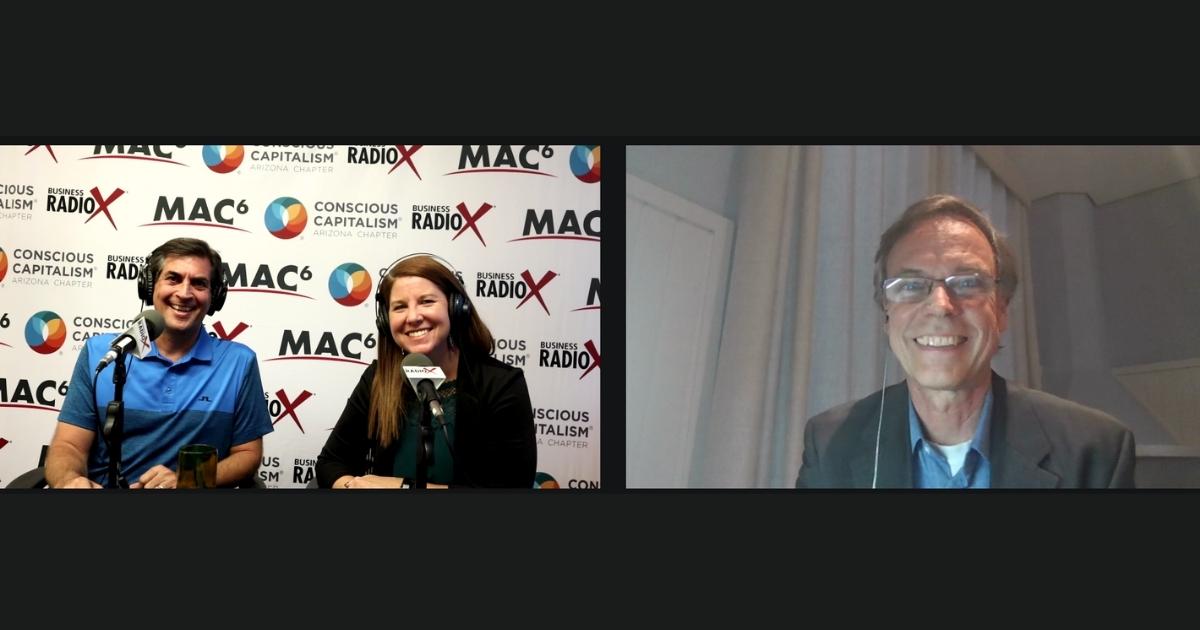
Tagged With: amanda pearch, brian peart, Christianity, faith, Leadership, spiritual, spirituality, The Great Awareness

  • « Previous Page
  • 1
  • …
  • 9
  • 10
  • 11
  • 12
  • 13
  • …
  • 50
  • Next Page »

Business RadioX ® Network


Our Most Recent Episode

CONNECT WITH US

  • Email
  • Facebook
  • LinkedIn
  • Twitter
  • YouTube

Our Mission

We help local business leaders get the word out about the important work they’re doing to serve their market, their community, and their profession.

We support and celebrate business by sharing positive business stories that traditional media ignores. Some media leans left. Some media leans right. We lean business.

Sponsor a Show

Build Relationships and Grow Your Business. Click here for more details.

Partner With Us

Discover More Here

Terms and Conditions
Privacy Policy

Connect with us

Want to keep up with the latest in pro-business news across the network? Follow us on social media for the latest stories!
  • Email
  • Facebook
  • Google+
  • LinkedIn
  • Twitter
  • YouTube

Business RadioX® Headquarters
1000 Abernathy Rd. NE
Building 400, Suite L-10
Sandy Springs, GA 30328

© 2025 Business RadioX ® · Rainmaker Platform

BRXStudioCoversLA

Wait! Don’t Miss an Episode of LA Business Radio

BRXStudioCoversDENVER

Wait! Don’t Miss an Episode of Denver Business Radio

BRXStudioCoversPENSACOLA

Wait! Don’t Miss an Episode of Pensacola Business Radio

BRXStudioCoversBIRMINGHAM

Wait! Don’t Miss an Episode of Birmingham Business Radio

BRXStudioCoversTALLAHASSEE

Wait! Don’t Miss an Episode of Tallahassee Business Radio

BRXStudioCoversRALEIGH

Wait! Don’t Miss an Episode of Raleigh Business Radio

BRXStudioCoversRICHMONDNoWhite

Wait! Don’t Miss an Episode of Richmond Business Radio

BRXStudioCoversNASHVILLENoWhite

Wait! Don’t Miss an Episode of Nashville Business Radio

BRXStudioCoversDETROIT

Wait! Don’t Miss an Episode of Detroit Business Radio

BRXStudioCoversSTLOUIS

Wait! Don’t Miss an Episode of St. Louis Business Radio

BRXStudioCoversCOLUMBUS-small

Wait! Don’t Miss an Episode of Columbus Business Radio

Coachthecoach-08-08

Wait! Don’t Miss an Episode of Coach the Coach


BRXStudioCoversBAYAREA

Wait! Don’t Miss an Episode of Bay Area Business Radio

BRXStudioCoversCHICAGO

Wait! Don’t Miss an Episode of Chicago Business Radio

Wait! Don’t Miss an Episode of Atlanta Business Radio