Business RadioX ®

  • Home
  • Business RadioX ® Communities
    • Southeast
      • Alabama
        • Birmingham
      • Florida
        • Orlando
        • Pensacola
        • South Florida
        • Tampa
        • Tallahassee
      • Georgia
        • Atlanta
        • Cherokee
        • Forsyth
        • Greater Perimeter
        • Gwinnett
        • North Fulton
        • North Georgia
        • Northeast Georgia
        • Rome
        • Savannah
      • Louisiana
        • New Orleans
      • North Carolina
        • Charlotte
        • Raleigh
      • Tennessee
        • Chattanooga
        • Nashville
      • Virginia
        • Richmond
    • South Central
      • Arkansas
        • Northwest Arkansas
    • Midwest
      • Illinois
        • Chicago
      • Michigan
        • Detroit
      • Minnesota
        • Minneapolis St. Paul
      • Missouri
        • St. Louis
      • Ohio
        • Cleveland
        • Columbus
        • Dayton
    • Southwest
      • Arizona
        • Phoenix
        • Tucson
        • Valley
      • Texas
        • Austin
        • Dallas
        • Houston
    • West
      • California
        • Bay Area
        • LA
        • Pasadena
      • Colorado
        • Denver
      • Hawaii
        • Oahu
  • FAQs
  • About Us
    • Our Mission
    • Our Audience
    • Why It Works
    • What People Are Saying
    • BRX in the News
  • Resources
    • BRX Pro Tips
    • B2B Marketing: The 4Rs
    • High Velocity Selling Habits
    • Why Most B2B Media Strategies Fail
    • 9 Reasons To Sponsor A Business RadioX ® Show
  • Partner With Us
  • Veteran Business RadioX ®

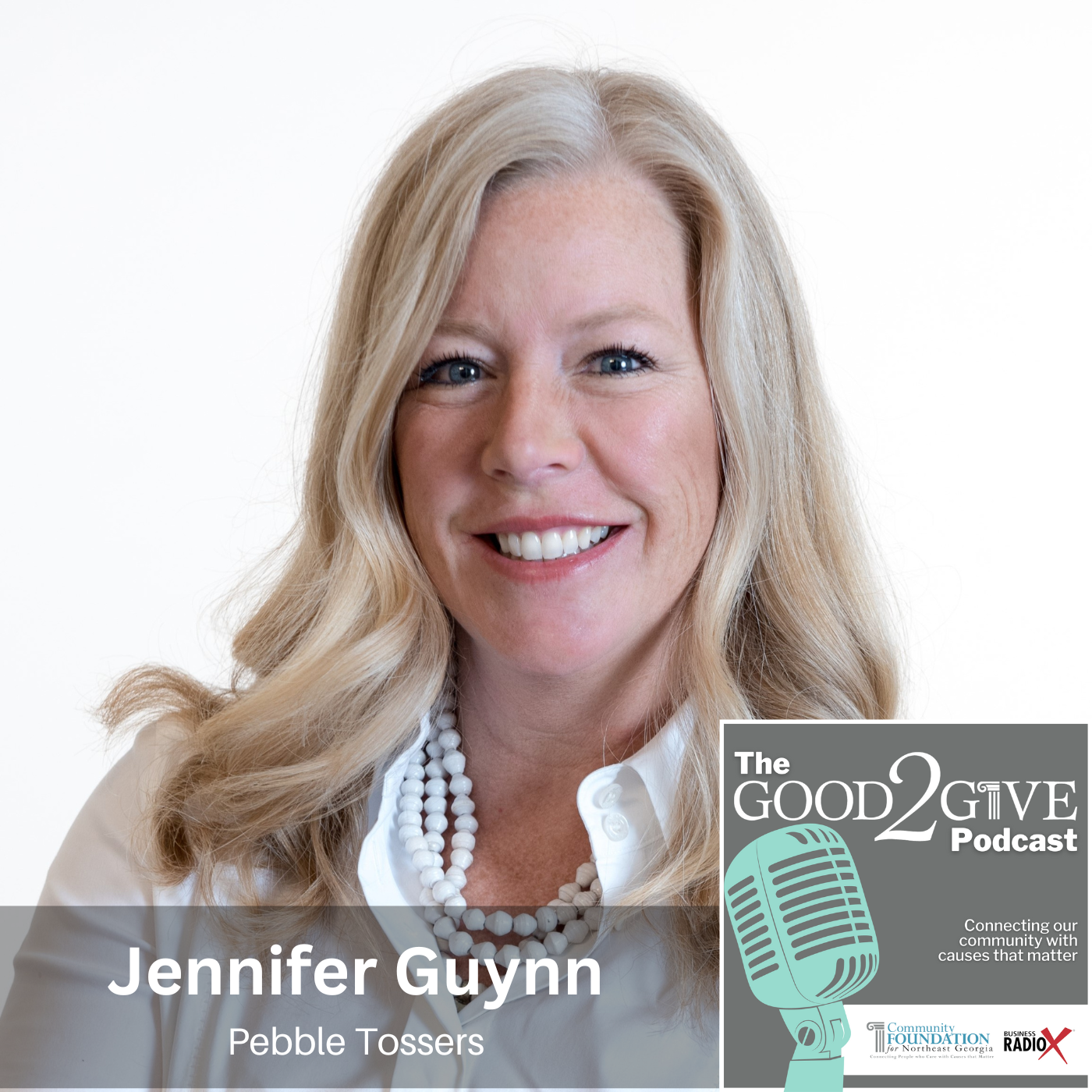
Empowering Youth Through Service, with Jennifer Guynn, Pebble Tossers

September 23, 2024 by John Ray

Empowering Youth Through Service, with Jennifer Guynn, Pebble Tossers, on the Good2Give Podcast
Good2Give Podcast
Empowering Youth Through Service, with Jennifer Guynn, Pebble Tossers
Loading
00:00 /
RSS Feed
Share
Link
Embed

Download file

Empowering Youth Through Service, with Jennifer Guynn, Pebble Tossers, on the Good2Give Podcast

Empowering Youth Through Service, with Jennifer Guynn, Pebble Tossers (Good2Give Podcast, Episode 12)

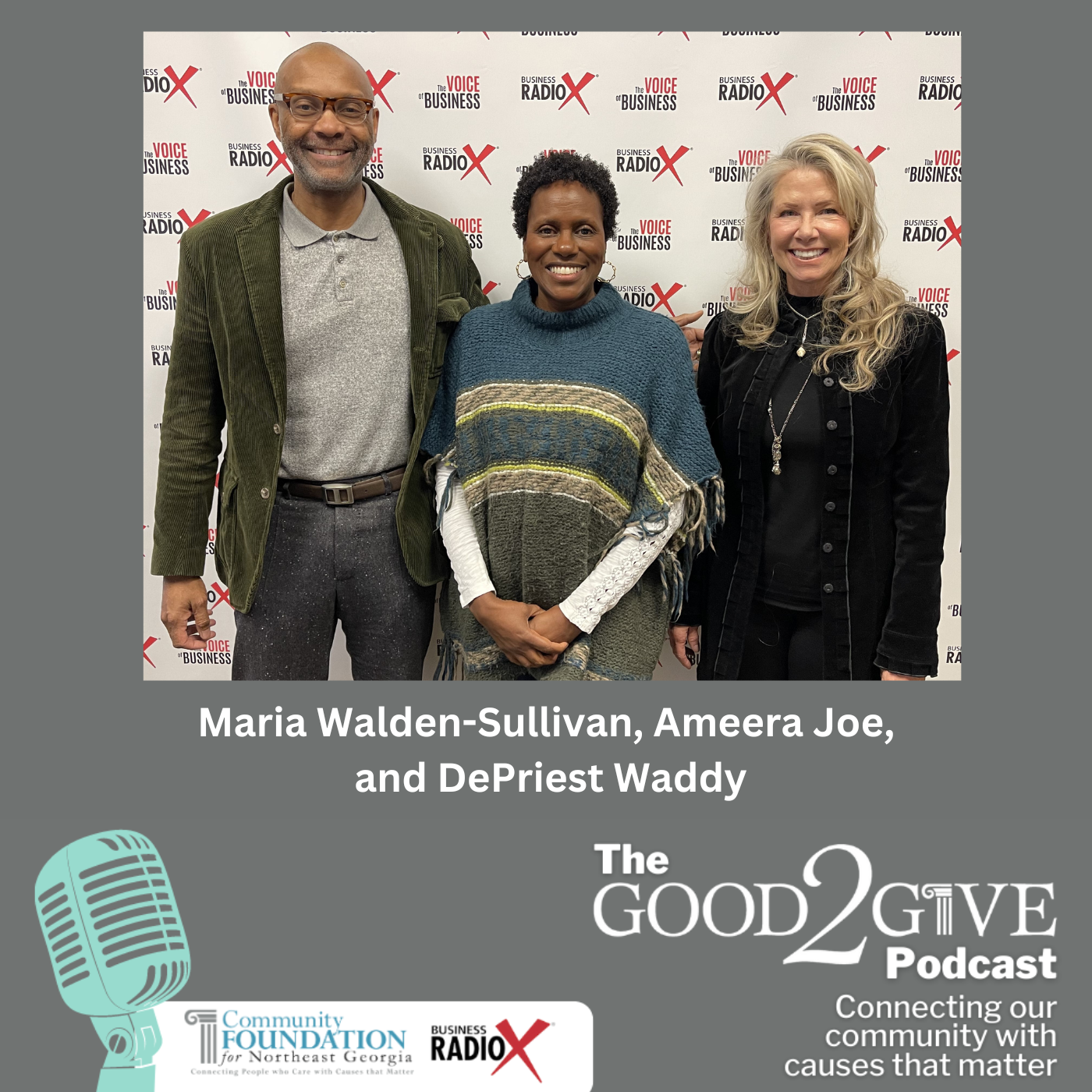
In this episode of the Good2Give Podcast, hosts Maria Walden and DePriest Waddy from the Community Foundation for Northeast Georgia interview Jennifer Guynn, the founder and executive director of Pebble Tossers. Jen shares the origins and mission of Pebble Tossers, a nonprofit organization dedicated to empowering youth through community service and leadership development. The discussion covers the impact of involving children in service projects, the organization’s structure, and the diverse range of cause areas they focus on, including the environment, homelessness, and social justice. They also explore potential partnerships, fundraising strategies, and upcoming events. The episode emphasizes the importance of instilling a sense of responsibility and civic engagement from a young age, as well as how community involvement can shape future leaders.

The Good2Give Podcast is presented by the Community Foundation for Northeast Georgia. The show is produced by John Ray and the North Fulton affiliate of Business RadioX®. You can find the full archive of shows by following this link.

Jennifer Guynn, Co-Founder and Executive Director, Pebble Tossers

As Co-founder and Executive Director of Pebble Tossers, Jen lives a life of service. She serves as a State Commissioner for Georgia Serves, the State Commission for Service and Volunteerism, and is Chair of the Service and Development Committee.

She is a 21/64 Certified Philanthropic Advisor, a mentor at Cristo Rey Atlanta Jesuit High School, and has been named a Titan CEO as one of the 2023 Georgia Titan 100 award winners.

She is an Atlanta native, serves on various boards and committees throughout Atlanta, and is married with three adult kids and three rescue dogs (and two rescue granddogs).

LinkedIn

Pebble Tossers

Pebble Tossers is an organization dedicated to empowering youth through volunteerism and community service, creating meaningful pathways for young individuals to engage in impactful projects. The organization focuses on various key areas, including citizenship and social justice, where it educates youth about their role in driving change. It also addresses the needs of vulnerable communities, supports those experiencing homelessness, and promotes environmental stewardship by encouraging sustainable practices among families. Additionally, Pebble Tossers emphasizes the importance of arts and culture, global awareness, education and literacy, as well as support for the elderly and animal welfare.
Through its initiatives, Pebble Tossers provides resources for service-learning, including workshops and toolkits, while encouraging family involvement through membership options. By participating in these programs, youth not only contribute to their communities but also develop valuable leadership skills that shape them into future leaders. The organization fosters a sense of responsibility and compassion in young individuals, empowering them to make a positive difference in the world around them.

Website | LinkedIn | Instagram | Facebook | X (Twitter)

Topics Discussed in this Episode

00:00 Introduction to the Good2Give Podcast
00:21 Meet Jen Guynn, Pebble Tossers
01:02 The Mission of Pebble Tossers
03:03 The Importance of Youth Service
04:59 Diverse Cause Areas and Projects
06:57 Engaging Families in Service
12:24 Operational Insights and Partnerships
22:54 Upcoming Events and Fundraising
29:51 Closing Remarks and Contact Information

About the Good2Give Podcast

The Good2Give Podcast celebrates the work of donors, nonprofits, and the causes they care about. DePriest Waddy and Maria Walden-Sullivan are the show’s hosts, and the Community Foundation for Northeast Georgia is the presenting sponsor.

The Good2Give Podcast is produced by John Ray and the North Fulton studio of Business RadioX®. You can find the full archive of shows by following this link. You can also find the show on all the major podcast apps, including Apple Podcasts, Spotify, and many others.

Community Foundation of Northeast Georgia

At the Community Foundation for Northeast Georgia, everything they do centers around one purpose: improving the world through the power of philanthropy.
On a fundamental level, they do that through managing funds held in trust, donated by individuals, organizations, and businesses. Most funds are donor-advised funds, similar to savings accounts. These funds are pooled for investment purposes, and their income is used to make grants for a wide variety of charitable purposes.

But the Foundation’s goals extend far beyond managing funds. They desire to strengthen the communities they serve in Gwinnett, Northeast Georgia, and beyond by providing leadership, addressing community needs, and assisting individuals and organizations with their charitable giving.

Connect with CFNEG:
Website | Facebook | LinkedIn | Twitter | Instagram
Tagged With: Community Foundation, community foundation for ne georgia, community service, DePriest Waddy, Jennifer Guynn, leadership development, Maria Walden, nonprofits, Pebble Tossers, philanthrophy, Youth, youth in service

Ameera Joe, Intersect Director, North Point Community Church

January 18, 2024 by John Ray

Ameera Joe, Intersect Director, North Point Community Church
Good2Give Podcast
Ameera Joe, Intersect Director, North Point Community Church
Loading
00:00 /
RSS Feed
Share
Link
Embed

Download file

Ameera Joe, Intersect Director, North Point Community Church

Ameera Joe, Intersect Director, North Point Community Church (Good2Give Podcast, Episode 8)

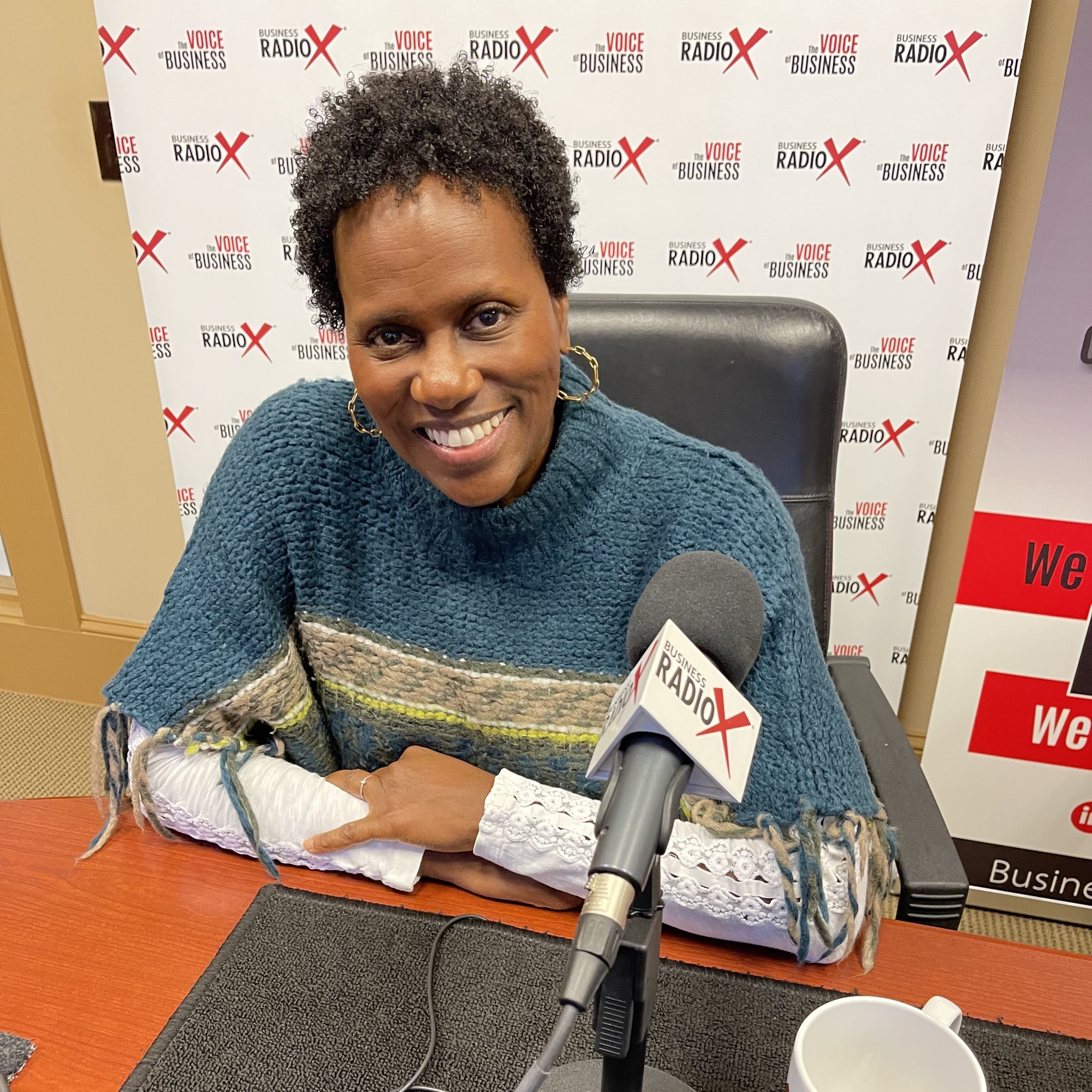
On this episode of the Good2Give Podcast, Maria Walden-Sullivan and DePriest Waddy welcomed guest Ameera Joe, Intersect Director, North Point Community Church in Alpharetta. Their discussion revolved around how their organizations actively engage in their respective communities, assist nonprofits, and encourage philanthropy. Ameera shared the mission of Intersect, its global reach, and their “Be Rich” campaign, which endeavors to raise funds and generate service opportunities. Maria, DePriest, and Ameera also discussed mentorship programs, the importance of community engagement, fostering a culture of generosity and service, and how both organizations work towards making a positive difference in the world.

The Good2Give Podcast is presented by the Community Foundation for Northeast Georgia and is produced by the North Fulton studio of Business RadioX®. You can find the full archive of shows by following this link.

Ameera Joe, Intersect Director, North Point Community Church

Ameera Joe, Intersect Director, North Point Community Church

Ameera Joe is the Intersect Director at North Point Community Church.

At North Point Community Church, they know life doesn’t come with instructions. They know you want to get it right. They want to help.

They’ve been helping people navigate the complexities of relationships, parenting, finances, and faith for more than 25 years.

Start by joining them this Sunday in person or online, connecting with them to obtain useful resources for your life, and/or connecting with others by joining a group.

Don’t settle for just good enough. They’d love to help you find the purpose and the life-giving relationships you were made for.

Website | Twitter | Instagram | Facebook | LinkedIn

Topics Discussed in This Interview:

00:00 Introduction and Welcome
00:26 Introducing the Guest and Their Role
01:08 Discussing the Role of North Point Community Church
02:37 Sharing Personal Experiences and Stories
03:42 Discussing the Importance of Community and Inclusion
05:20 Exploring the Outreach and Impact of North Point Community Church
09:58 Discussing the Mentoring Program in Schools
16:36 Comparing the Work of North Point Community Church and the Community Foundation for NE Georgia
19:06 The Importance of Vetting Nonprofits
20:23 The Role of Trust in Philanthropy
22:18 Protecting Nonprofits in Crisis Situations
23:58 Educating the Community on Donor Advised Funds
25:15 Providing Resources to Nonprofits
27:27 The Importance of Connecting For-Profit and Nonprofit Sectors
31:01 The Be Rich Campaign: Rich in Good Deeds
33:57 Creating a Mindset of Service from a Young Age
36:01 The Power of Collaboration in Philanthropy
37:54 Closing Thoughts: The Impact of Philanthropy


About the Good2Give Podcast

The Good2Give Podcast celebrates the work of donors, nonprofits, and the causes they care about. DePriest Waddy and Maria Walden-Sullivan are the show’s hosts, and the Community Foundation for Northeast Georgia is the presenting sponsor.

The Good2Give Podcast is produced by the North Fulton studio of Business RadioX®. You can find the full archive of shows by following this link. You can also find the show on all the major podcast apps, including Apple Podcasts, Spotify, and many others.

Community Foundation of Northeast Georgia

At the Community Foundation for Northeast Georgia, everything they do centers around one purpose: improving the world through the power of philanthropy.

On a fundamental level, they do that through managing funds held in trust, donated by individuals, organizations, and businesses. Most funds are donor-advised funds, similar to savings accounts. These funds are pooled for investment purposes, and their income is used to make grants for a wide variety of charitable purposes.

But the Foundation’s goals extend far beyond managing funds. They desire to strengthen the communities they serve in Gwinnett, Northeast Georgia, and beyond by providing leadership, addressing community needs, and assisting individuals and organizations with their charitable giving.

Connect with CFNEG:
Website | Facebook | LinkedIn | Twitter | Instagram
Tagged With: Ameera Joe, Community Foundation, DePriest Waddy, donor advised funds, intersect ministry, Maria Walden-Sullivan, nonprofits, North Point Community Church, philanthrophy, The Community Foundation for Northeast Georgia

Rachel Ewald, Foster Care Support Foundation

December 22, 2023 by John Ray

Good2Give Podcast
Good2Give Podcast
Rachel Ewald, Foster Care Support Foundation
Loading
00:00 /
RSS Feed
Share
Link
Embed

Download file

Rachel Ewald, Foster Care Support Foundation (Good2Give Podcast, Episode 7)

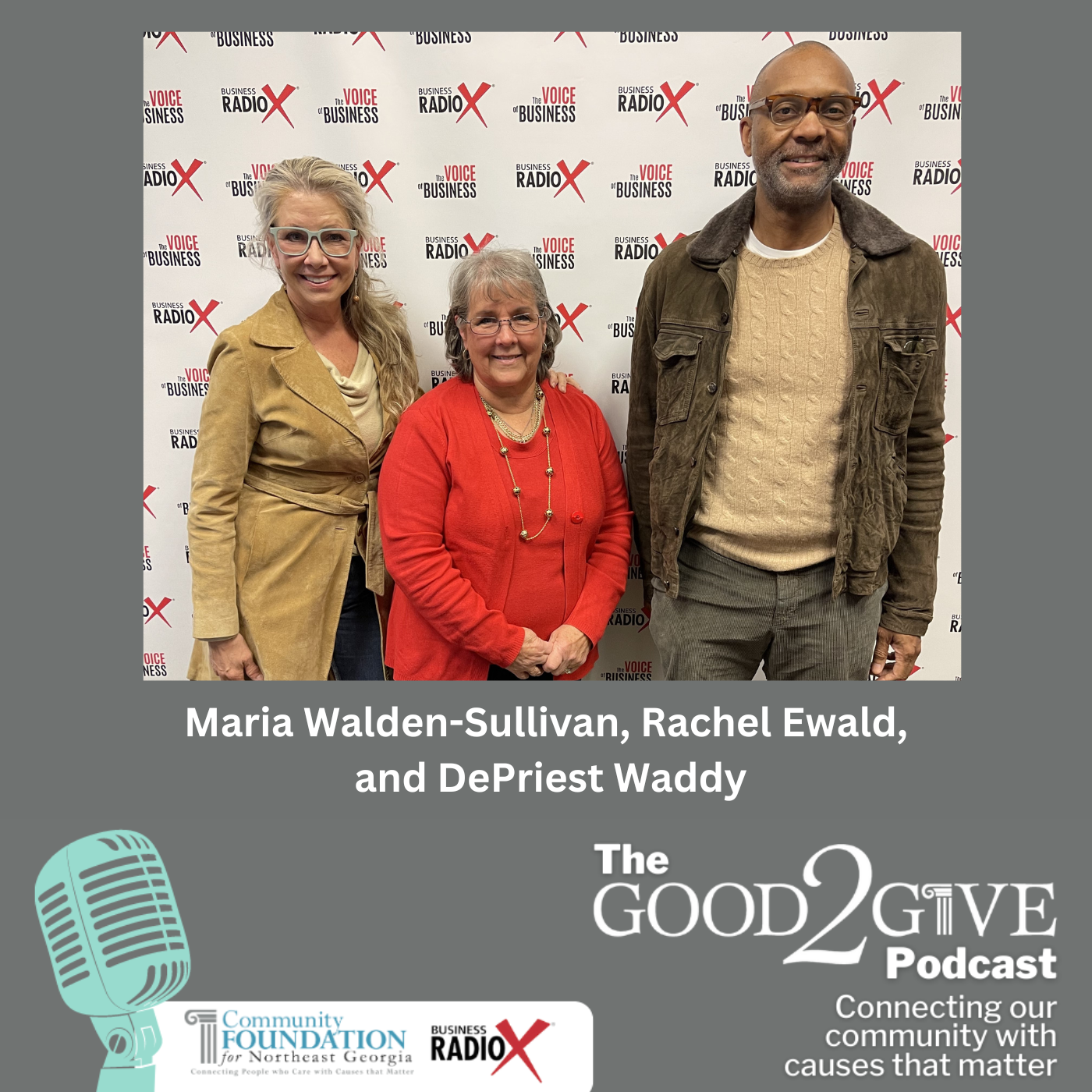
On this episode of Good2Give, Maria Walden-Sullivan and co-host DePriest Waddy, both from the Community Foundation for Northeast Georgia, discussed the critical work of the Foster Care Support Foundation with its founder, Rachel Ewald. The organization, operating out of Roswell, Georgia, provides essentials like clothing, toys, and infant equipment to foster care children and those who care for them, filling a significant gap in resources. Rachel shared the struggle of grandparents who unexpectedly become caregivers, the need for community involvement, the difficulties of fundraising, and volunteer opportunities. Maria and DePriest also touched on the wider role the Community Foundation for Northeast Georgia plays in shaping philanthropic journeys.

The Good2Give Podcast is presented by the Community Foundation for Northeast Georgia and is produced by the North Fulton studio of Business RadioX®. You can find the full archive of shows by following this link.

Rachel Ewald, Foster Care Support Foundation

Rachel Ewald, Foster Care Support Foundation

Rachel Ewald is the Founder and Executive Director for the Foster Care Support Foundation.

Foster Care Support Foundation serves a vital and growing need throughout Georgia by providing free clothing, infant equipment, and developmental toys to thousands of children in foster and relative care.

They serve basic-care (costs reimbursed $0 to base per diem) foster children residing in Georgia’s foster homes, administered by the Division of Family and Children Services (DFCS) and children housed by private agencies.

They also serve abandoned, court-placed, and DFCS-placed grandparents raising grandchildren and parents caring for relative’s children for a limited time. About 75% of the 4500 children served are now raised by grandparents without the biological parents’ involvement due to drugs, abuse, neglect, or abandonment. Most of the relative caregivers receive no stipend to help raise the children.

They partner with Georgia’s DFCS for child referral and verification, along with Kinship Care, school counselors, and faith-based organizations.

Foster Care Support Foundation is a 501(c)3 non-profit, public charity organization.

Website | Instagram | Facebook | X (Twitter) | YouTube

Topics Discussed in This Interview:

00:00 Introduction and Welcoming Rachel Ewald
00:44 Introducing the Foster Care Support Foundation
01:54 The Challenges of Foster Care
03:27 The Impact of Foster Care on Children
04:17 The Role of Foster Parents and Relatives
06:12 The Financial Struggles of Foster Care
08:37 The Foster Care Support Foundation’s Christmas Initiative
17:28 The Foster Care Support Foundation’s Year-Round Program
18:37 The Challenges of Running the Foster Care Support Foundation
25:17 The Foster Care Support Foundation’s Resale Shop


About the Good2Give Podcast

The Good2Give Podcast celebrates the work of donors, nonprofits, and the causes they care about. DePriest Waddy and Maria Walden-Sullivan are the show’s hosts, and the Community Foundation for Northeast Georgia is the presenting sponsor.

The Good2Give Podcast is produced by the North Fulton studio of Business RadioX®. You can find the full archive of shows by following this link. You can also find the show on all the major podcast apps, including Apple Podcasts, Spotify, and many others.

Community Foundation of Northeast Georgia

At the Community Foundation for Northeast Georgia, everything they do centers around one purpose: improving the world through the power of philanthropy.

On a fundamental level, they do that through managing funds held in trust, donated by individuals, organizations, and businesses. Most funds are donor-advised funds, similar to savings accounts. These funds are pooled for investment purposes, and their income is used to make grants for a wide variety of charitable purposes.

But the Foundation’s goals extend far beyond managing funds. They desire to strengthen the communities they serve in Gwinnett, Northeast Georgia, and beyond by providing leadership, addressing community needs, and assisting individuals and organizations with their charitable giving.

Connect with CFNEG:
Website | Facebook | LinkedIn | Twitter | Instagram
Tagged With: Caregivers, charitable giving, DePriest Waddy, DFCS, donor advised funds, foster care, foster care support foundation, foster children, Good2Give, Good2Give Podcast, Maria Walden-Sullivan, philanthrophy, rachel ewald, The Community Foundation for Northeast Georgia

Alpharetta Rotary Foundation

July 20, 2023 by John Ray

Alpharetta Rotary Foundation
Good2Give Podcast
Alpharetta Rotary Foundation
Loading
00:00 /
RSS Feed
Share
Link
Embed

Download file

Alpharetta Rotary Foundation

Alpharetta Rotary Foundation (Good2Give Podcast, Episode 2)

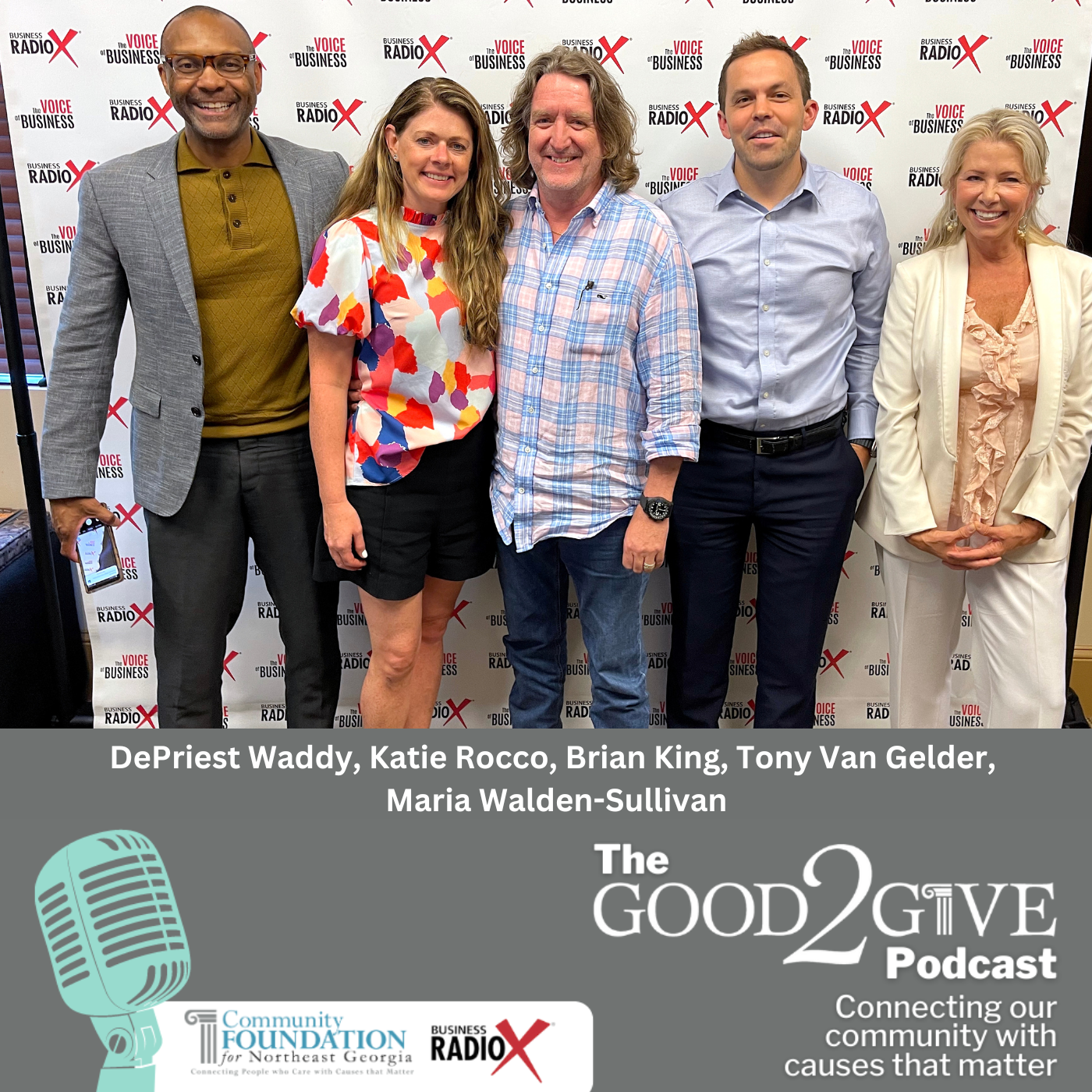
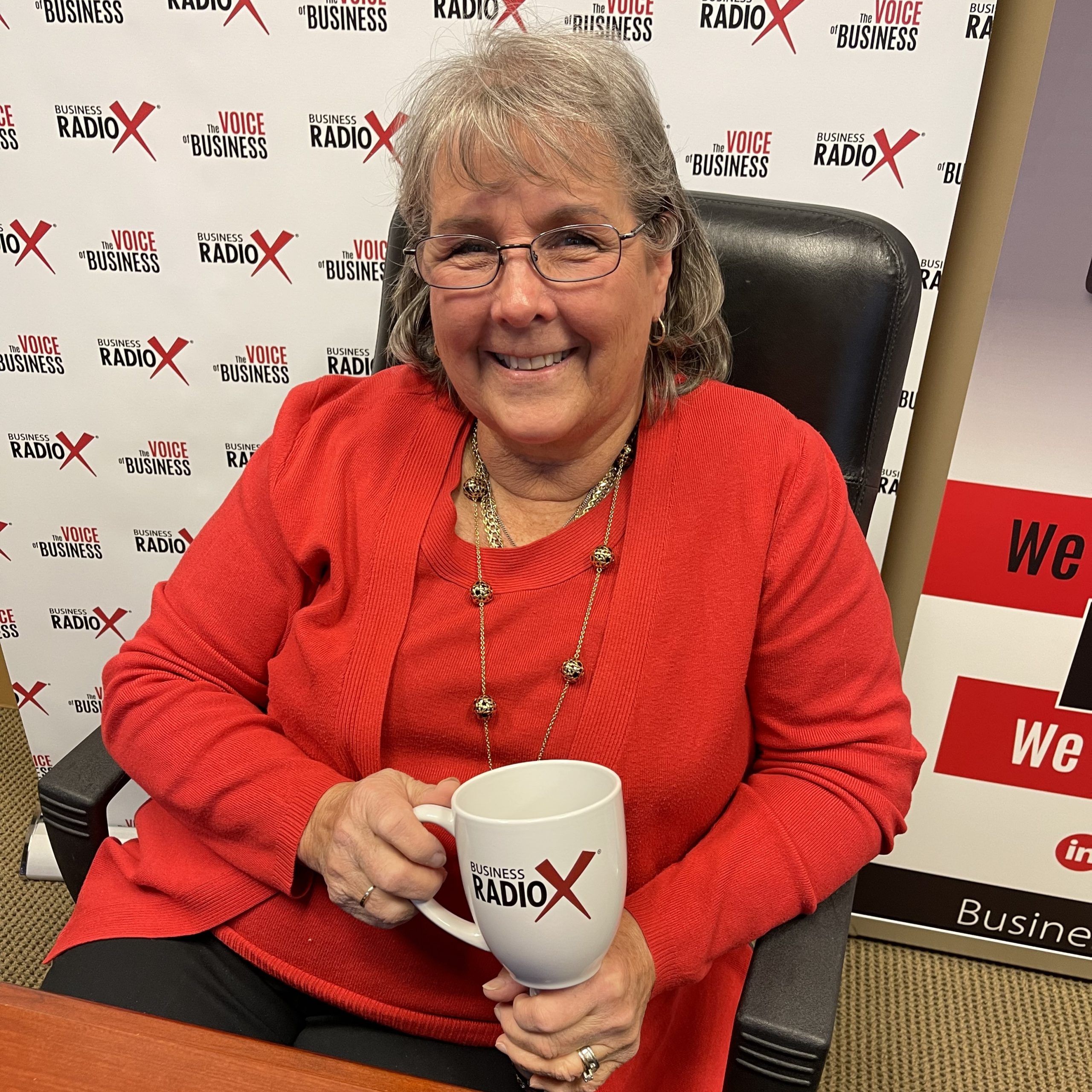
Leaders from the Alpharetta Rotary Foundation joined the Good2Give Podcast to talk about the work of the Alpharetta Rotary Club, the formation of its affiliated Foundation, and their relationship with the Community Foundation of Northeast Georgia. Guests were Brian King, Foundation Chairperson Elect, Katie Rocco, Foundation Director and Immediate Past President of Alpharetta Rotary, and club member Tony Van Gelder with Van Gelder Financial.  The team discussed the growth of the Alpharetta Rotary, why Alpharetta Rotary created a foundation, and why a nonprofit would partner with a community foundation. They covered several of the projects they’ve worked on, both local and international. Tony added remarks on donor-advised funds and their benefits.

The Good2Give Podcast is presented by the Community Foundation for Northeast Georgia and is produced by the North Fulton studio of Business RadioX®. You can find the full archive of shows by following this link. The show is available on all the major podcast apps, including Apple Podcasts, Spotify, Google, Amazon, iHeart Radio, Stitcher, TuneIn, and others.

Alpharetta Rotary Foundation

The Alpharetta Rotary Foundation was formed in 2020 to be the philanthropic partner of the Alpharetta Rotary Club and the greater North Fulton Community.

They promote social welfare in the City of Alpharetta, and the North Fulton County community by supporting and participating in numerous community, vocational, and international service projects, and by making grants to organizations that qualify.

Website

Brian King, Chairperson Elect, Alpharetta Rotary Foundation, and President, Engineering 303, LLC

Brian King, Chairperson Elect, Alpharetta Rotary Foundation, and President, Engineering 303, LLC

Brian King founded E303 in 2011. He serves as the President and Principal Engineer and provides technical review of engineering projects and oversees all aspects of business and project management. He has completed Levels 1 -4 of the Rosgen Natural Channel Design courses and serves as the primary designer on all stream restoration projects. Dave Rosgen has peer reviewed many of Brian’s stream restoration designs, including multiple mitigation banking projects in Texas. Brian is considered one of the preeminent stream restoration designers in the country. He has designed stream projects in Georgia, Alabama, North Carolina, Texas, and Virginia.

Brian holds a degree in Geo Surveying from the Dublin Institute of Technology and a BS in Civil Engineering Technology from Southern Polytechnic State University (now Kennesaw State University). He is licensed as a Professional Engineer in Georgia, Alabama, Colorado, Maryland, Oklahoma, North Carolina, Texas, Virginia, and West Virginia.

Company website | LinkedIn

Katie Rocco, Director, Alpharetta Rotary Foundation and Realtor, The Rocco Team, Keller Williams North Atlanta

Katie Rocco, Director, Alpharetta Rotary Foundation and Realtor, The Rocco Team, Keller Williams North Atlanta

Katie Rocco and The Rocco Team are highly skilled Realtors, committed to excellence in all they do.

They specialize in helping Home buyers, Home Sellers & Investors build wealth through a customized real estate experience, from start to finish. Their business is built on our treasured relationships & because of their trustworthiness & integrity, clients & their referrals utilize the Rocco Team’s proficiency for the industry time & time again.

Their legacy is making home dreams come true & they strive to exceed expectations in all they do.

Website | LinkedIn

Tony Van Gelder, CFP, Owner & Financial Advisor, Van Gelder Financial

Tony Van Gelder, CFP, Owner & Financial Advisor, Van Gelder Financial

Van Gelder Financial (VGF) is an Atlanta based financial services firm which was launched in 1988 with the objective to offer outstanding financial planning and advice to clients.

Tony has always had a passion for personal finance and spent the first 10 years of his professional career within corporate finance for the medical industry.  His career path gave him the opportunity to work in America, Asia, and Australia where he gained valuable experience in understanding how finance impacts various cultures and the international business community.

Tony is a Certified Financial Planner™ (CFP®) and holds Series 7 and 66 securities designations.  Tony also maintains his life insurance license across various states.  He graduated with a B.S. in Finance and Operations Management from Indiana University and received his Masters in Business Administration (MBA) from Macquarie University in Sydney, Australia.

Tony, along with his wife and two sons currently live in Atlanta, GA where he is now the owner and lead advisor for Van Gelder Financial. In his spare time Tony enjoys golfing, reading, and teaching his boys the love of sports.

Company website | LinkedIn

About the Good2Give Podcast

The Good2Give Podcast celebrates the work of donors, nonprofits, and the causes they care about. The hosts of the show are DePriest Waddy and Maria Walden-Sullivan, and the show series is presented by the Community Foundation for Northeast Georgia.

The Good2Give Podcast is produced by the North Fulton studio of Business RadioX®. You can find the full archive of shows by following this link. You can also find the show on all the major podcast apps, including Apple Podcasts, Spotify, and many others.

Community Foundation of Northeast Georgia

At the Community Foundation for Northeast Georgia, everything they do centers around one purpose – improving the world through the power of philanthropy.

On a fundamental level, they do that through managing funds held in trust, donated by individuals, organizations, and businesses. Most funds are donor-advised funds, similar to savings accounts. These funds are pooled for investment purposes and their income is used to make grants for a wide variety of charitable purposes.

But the Foundation’s goals expand far beyond managing funds. They desire to strengthen the communities they serve in Gwinnett, Northeast Georgia, and beyond by providing leadership, addressing community needs, and assisting individuals and organizations with their charitable giving.

Connect with CFNEG:
Website | Facebook | LinkedIn | Twitter | Instagram
Tagged With: Alpharetta Rotary, Alpharetta Rotary Foundation, Brian King, cfneg, charitable giving, Community Foundation of Northeast Georgia, DAF, donor advised funds, Engineering 303, Katie Rocco, Keller Williams, Maria Walden-Sullivan, nonprofit fundraising, philanthrophy, The Rocco Team, Tony Van Gelder, Van Gelder Financial

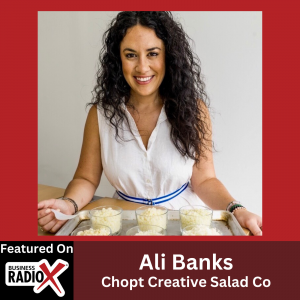
Ali Banks, Chopt Creative Salad Company

May 23, 2023 by John Ray

Ali Banks, Chopt Creative Salad Co
North Fulton Business Radio
Ali Banks, Chopt Creative Salad Company
Loading
00:00 /
RSS Feed
Share
Link
Embed

Download file

Ali Banks, Chopt Creative Salad Co

Ali Banks, Chopt Creative Salad Company (North Fulton Business Radio, Episode 663)

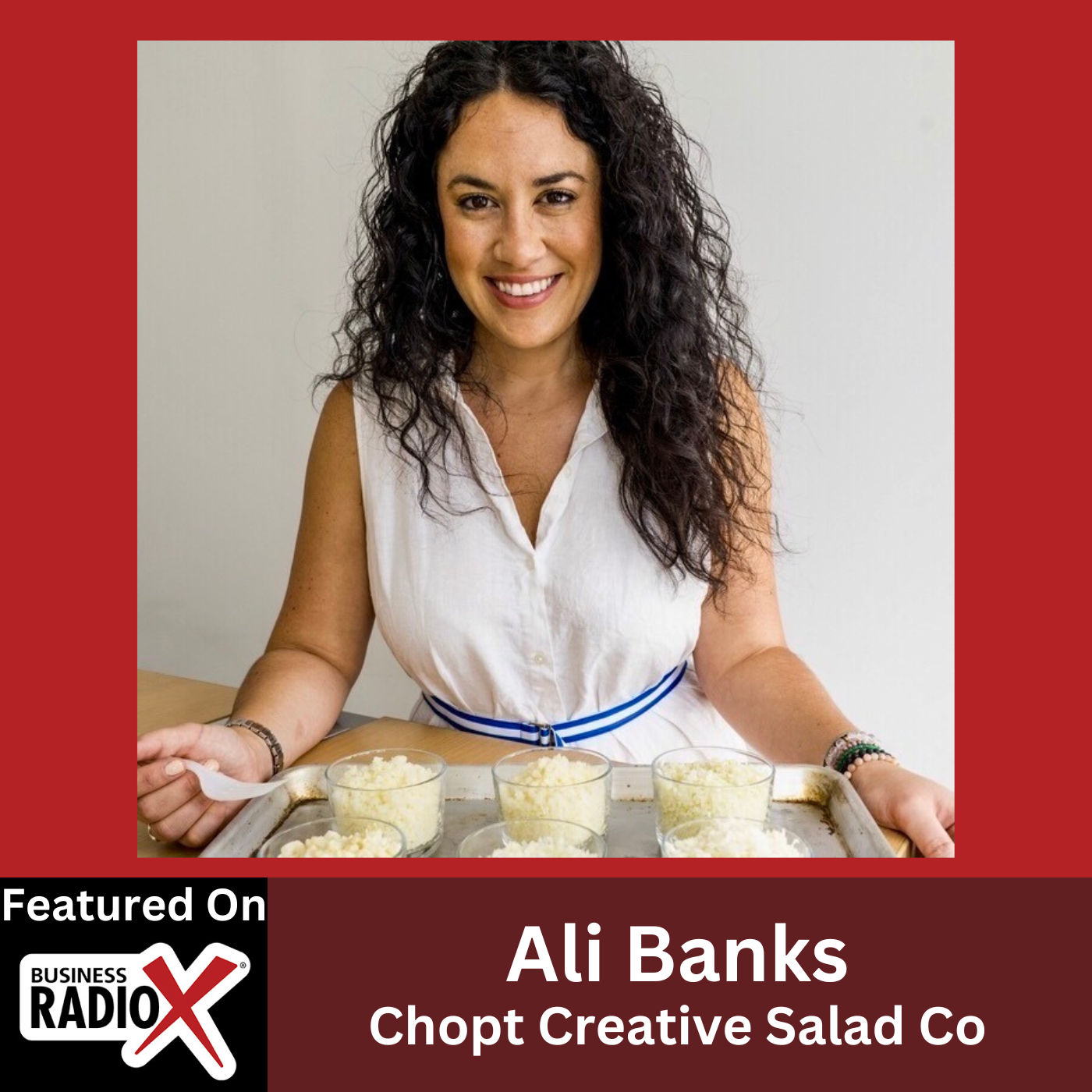
Ali Banks, Vice President of Culinary at Chopt Creative Salad Company, joined host John Ray on this episode of North Fulton Business Radio. She discussed how Chopt got started, their exciting and creative menu items, local suppliers, how Chopt Gives supports the Atlanta community, and much more.

North Fulton Business Radio is broadcast from the North Fulton studio of Business RadioX® inside Renasant Bank in Alpharetta.

Chopt Creative Salad Company

Founded in 2001 by college friends Tony Shure and Colin McCabe, Chopt Creative Salad Company is the creator and leader of the premium salad segment, and has expanded from its original location in New York City’s Union Square to include 73 locations in New York City, Washington, D.C., Virginia, Connecticut, suburban Westchester, New York, New Jersey, suburban Maryland, North Carolina, Georgia, Tennessee, and Alabama.

Chopt is a fast-growing company with a core team of great people and tremendous opportunities opening up as Chopt and its team continue to expand. Aiming to change the future of fast food, Chopt pushes the boundaries of what a salad can be with its core menu of 14 Classics, 3 rotating Seasonal Specials, 25 homemade, small-batch dressings, and limited-time-only “Super Seasonals” that feature local produce-only at its peak.

Expanding its “Better Tastes Better” philosophy beyond its restaurant walls, Chopt also partners with non-profit Wellness in the Schools to bring healthy lunches to New York City public schools.

Website | Facebook | Instagram | Twitter | LinkedIn
Ali Banks, VP of Culinary, Chopt Creative Salad Company

Ali Banks, VP of Culinary, Chopt Creative Salad Co

Ali Banks is an adventurer and a creative at heart, with a background that includes studying Urban Design and Architecture at NYU and spending several years overseeing development and construction projects in New York City, formal culinary education in Paris, time well spent mastering the finer points of whole-animal butchery and Alaskan salmon fishing, helping others unleash their inner-chef as a Resident Chef for Sur La Table and working through key growth initiatives for one of the leading wine and cheese purveyors in Chicago.

Now, she spends her time as Vice President of Culinary at Founders Table Restaurant Group – overseeing the Food & Beverage departments for both Chopt Creative Salad Co. and Dos Toros Taqueria. She is always excited to share her passion for all things edible — including the people and places that make them such an integral part of a life well-lived.

LinkedIn

Questions and Topics in this Interview:

  • How did Chopt get started?
  • Where can people find Chopt in Atlanta?
  • What is Chopt Gives and how do they support the Atlanta community?
  • What is the Summer VIP Challenge?
  • How does Chopt keep things fresh with artisan partners around the world and local Georgia partnerships?
  • What makes Chopt different?

North Fulton Business Radio is hosted by John Ray and broadcast and produced from the North Fulton studio of Business RadioX® inside Renasant Bank in Alpharetta. You can find the full archive of shows by following this link. The show is available on all the major podcast apps, including Apple Podcasts, Spotify, Google, Amazon, iHeart Radio, Stitcher, TuneIn, and others.

RenasantBank


Renasant Bank has humble roots, starting in 1904 as a $100,000 bank in a Lee County, Mississippi, bakery. Since then, Renasant has become one of the Southeast’s strongest financial institutions with over $13 billion in assets and more than 190 banking, lending, wealth management, and financial services offices in Mississippi, Alabama, Tennessee, Georgia, and Florida. All of Renasant’s success stems from each of their banker’s commitment to investing in their communities as a way of better understanding the people they serve. At Renasant Bank, they understand you because they work and live alongside you every day.

Since 2000, Office Angels® has been restoring joy to the life of small business owners, enabling them to focus on what they do best. At the same time, we honor and support at-home experts who wish to continue working on an as-needed basis. Not a temp firm or a placement service, Office Angels matches a business owner’s support needs with Angels who have the talent and experience necessary to handle work that is essential to creating and maintaining a successful small business. Need help with administrative tasks, bookkeeping, marketing, presentations, workshops, speaking engagements, and more? Visit us at https://officeangels.us/.

Tagged With: Ali Banks, artisan, Chopt Creative Salad Co, Chopt Gives, Creative Salads, John Ray, Local Farms, North Fulton Business Radio X, North Fulton Radio, Office Angels, philanthrophy, renasant bank

Philanthropy in 2020 and Beyond

December 20, 2020 by Mike

Gwinnett Studio
Gwinnett Studio
Philanthropy in 2020 and Beyond
Loading
00:00 /
RSS Feed
Share
Link
Embed

Download file

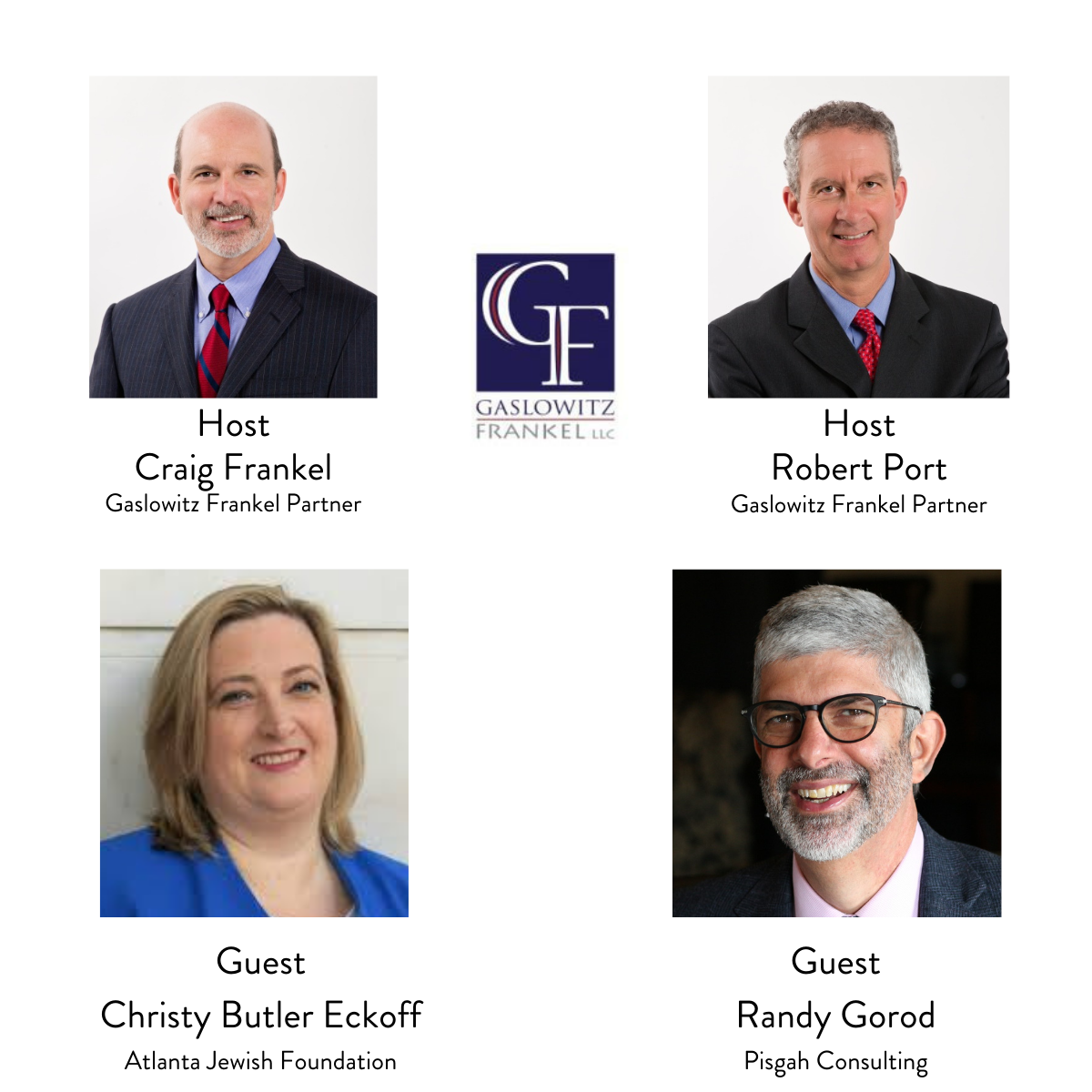
Christy Butler Eckoff/Atlanta Jewish Foundation

Christy Butler Eckoff is the Chief Foundation Officer and Managing Director of the Atlanta Jewish Foundation. Christy is an expert on charitable estate planning, gift planning, asset-based giving, laws surrounding nonprofits, private foundations, supporting organizations, donor-advised funds, and nonprofit taxation.

Previously, Christy served as managing director, philanthropic counsel at the Community Foundation for Greater Atlanta and served as senior director of gift planning at Georgia State University. She previously practiced tax and fiduciary law. She is past-president of the Georgia Planned Giving Council, past-president of the Association of Fundraising
Professionals (AFP) Greater Atlanta chapter and a member of the Junior League of Atlanta.

Christy was a board member of AdNet (the Advancement Network for Community Foundations) and is currently on the board of the Atlanta Estate Planning Council, the National Association of Charitable Gift Planners (CGP), and the Association of Fundraising Professionals National PAC board. Christy co-leads the National Standards for Gift Planning Success task force of CGP.

Randy Gorod/Pisgah Consulting

Randy Gorod is the President & CEO of Pisgah Consulting. He has had a long and diverse career serving in the non-profit sector. He worked with Young Judaea and at Camp Judaea for over three years. After graduate school, he returned to Atlanta to work at Congregation Etz Chaim as its Youth Director and Executive Director for nine years. His development experience began at Etz Chaim and continued at the Jewish Federation of
Greater Atlanta where he helped lead the Community Campaign for Caring for three years and to its highest annual level of over $18 million in one year. He moved to Emory University to be part of the university’s $1.6 billion comprehensive campaign and worked through the campaign completion, nearly six years. After helping The Jewish Agency for
Israel work on a better development process for almost two years, he left to form Pisgah Consulting.
At Pisgah Consulting, he has worked with organizations like Hillel International, ORT Atlanta, local Hillels, the Center for the Visually Impaired and others. Pisgah Consulting offers non-profits the opportunity to focus on core competencies by building strong development operations, plans and staff.

CLICK HERE to watch the Zoom video of this episode.

About Gaslowitz Frankel:

Gaslowitz Frankel is an experienced trial practice firm specializing in all aspects of complex fiduciary litigation throughout Georgia and the Southeast. With a focus on representing individuals, companies, banks, and fiduciaries in dispute involving wills, estates, trusts, guardianships, businesses, and securities law, their experienced and highly qualified litigation attorneys have tremendous credentials and a proven history of success.

If you would like to watch past episodes of “Wealth Matters”, please visit their You Tube Channel.

Remember to tune in HERE on the 4th Wednesday of every month at 8:30 AM to listen live to their show!

Facebook: https://www.facebook.com/EstateDispute
Twitter: https://twitter.com/EstateDispute
LinkedIn: https://www.linkedin.com/company/estatedispute

GF-Radioshow-Wealth-Matters-1500x1500

Tagged With: asset planning, asset protection, asset protection law firm, Atlanta Jewish Foundation, business podcast, business radio, Business RadioX, Christy Butler Eckoff, craig frankel, estate disputes, estate planning, estate planning law firm, estate protection, fiduciary law firm, Gaslowitz Frankel, philanthrophy, pisgah consulting, Radiox, randy gorod, Robert Port, Wealth Matters, wealth matters podcast, WEALTH MATTERS RADIO, wealth protection

Decision Vision Episode 19: How Should I Engage in Philanthropy?, An Interview with Chris Gabriel

June 13, 2019 by John Ray

Decision Vision
Decision Vision
Decision Vision Episode 19: How Should I Engage in Philanthropy?, An Interview with Chris Gabriel
Loading
00:00 /
RSS Feed
Share
Link
Embed

Download file

“Decision Vision” Host Mike Blake and Chris Gabriel

How Should I Engage in Philanthropy?

Most everyone would agree that it’s good to give back. But what’s the best way to give? Can giving become enabling or even toxic? Chris Gabriel has performed extensive research on philanthropy and individuals who are heavily philanthropic. He shares his insights with Host Mike Blake on this edition of “Decision Vision,” presented by Brady Ware.

Chris Gabriel, Age of Generosity, LLC and the Generosity Project

Chris Gabriel

Chris Gabriel runs a wealth management practice for a major investment firm. He also has more than 25 years of experience serving charitable organizations and their donors as a development director, as a nonprofit finance and fundraising consultant, and as a guide for successful charitable givers.  He has participated in the gift process from every vantage point as a staffer, board member, consultant, and financial advisor.

His process focuses on “philanthropic enabling” which seeks to maximize the value and benefits of charitable contributions for everyone involved. His mission is helping successful people to be even more generous and generous people to be even more successful.

Chris is an honors graduate of Yale College and earned his master’s degree from Oxford University. He also is the founder of Age of Generosity, LLC and of The Generosity Project, a nonprofit seeking to promote giving as an essential virtue of a life well lived. Chris is writing a set of books and building a giving consulting platform, both of which are scheduled to launch in 2020.

Michael Blake, Brady Ware & Company

Mike Blake, Host of “Decision Vision”

Michael Blake is Host of the “Decision Vision” podcast series and a Director of Brady Ware & Company. Mike specializes in the valuation of intellectual property-driven firms, such as software firms, aerospace firms and professional services firms, most frequently in the capacity as a transaction advisor, helping clients obtain great outcomes from complex transaction opportunities. He is also a specialist in the appraisal of intellectual properties as stand-alone assets, such as software, trade secrets, and patents.

Mike has been a full-time business appraiser for 13 years with public accounting firms, boutique business appraisal firms, and an owner of his own firm. Prior to that, he spent 8 years in venture capital and investment banking, including transactions in the U.S., Israel, Russia, Ukraine, and Belarus.

Brady Ware & Company

Brady Ware & Company is a regional full-service accounting and advisory firm which helps businesses and entrepreneurs make visions a reality. Brady Ware services clients nationally from its offices in Alpharetta, GA; Columbus and Dayton, OH; and Richmond, IN. The firm is growth minded, committed to the regions in which they operate, and most importantly, they make significant investments in their people and service offerings to meet the changing financial needs of those they are privileged to serve. The firm is dedicated to providing results that make a difference for its clients.

Decision Vision Podcast Series

“Decision Vision” is a podcast covering topics and issues facing small business owners and connecting them with solutions from leading experts. This series is presented by Brady Ware & Company. If you are a decision maker for a small business, we’d love to hear from you. Contact us at decisionvision@bradyware.com and make sure to listen to every Thursday to the “Decision Vision” podcast. Past episodes of “Decision Vision” can be found here. “Decision Vision” is produced and broadcast by Business RadioX®.

Visit Brady Ware & Company on social media:

LinkedIn:  https://www.linkedin.com/company/brady-ware/

Facebook: https://www.facebook.com/bradywareCPAs/

Twitter: https://twitter.com/BradyWare

Instagram: https://www.instagram.com/bradywarecompany/

Show Transcript

Intro: [00:00:01] Welcome to this Decision Vision, a podcast series focusing on critical business decisions, brought to you by Brady Ware & Company. Brady Ware is a regional, full-service, accounting and advisory that helps businesses and entrepreneurs make vision a reality.

Mike Blake: [00:00:20] And welcome back to Decision Vision, a podcast giving you, the listener, clear vision to make great decisions. In each episode, we discuss the process of making decision on a different topic. Rather than making recommendations because everyone’s circumstances are different, we talk to subject matter experts about how they would recommend thinking about that decision.

Mike Blake: [00:00:38] My name is Mike Blake, and I am your host for today’s program. I’m a Director at Brady Ware & Company, a full-service accounting firm based in Dayton, Ohio, with offices in Dayton; Columbus, Ohio; Richmond, Indiana; and Alpharetta, Georgia, which is where we are recording today. Brady Ware is sponsoring this podcast. If you like this podcast please subscribe on your favorite podcast aggregator, and please also consider leaving a review of the podcast as well.

Mike Blake: [00:01:02] And today, we’re going to be talking about philanthropy and, specifically, the decision as to whether or not you should engage in philanthropy or not engage in philanthropy. And in some respect, maybe that sounds like a loaded question. Of course, you should engage in philanthropy. We should all be interested in giving back to our communities, sending the elevator back down, whatever cliché you want to use. Who doesn’t like a good philanthropist? Who doesn’t like someone that’s going to be throwing $100 bills around or $1000 checks around, always going to be the life of the party? But when you get into philanthropy, it’s really not that simple. And philanthropy not done well can be not just not impactful but, in some cases, can actually be harmful.

Mike Blake: [00:01:51] One of the things I’ve done a lot of in the last few years, I’ve studied dynastic wealth, which means that wealth that has survived for a number of generations. And what a lot of people may not realize is that being rich actually is hard. It’s just hard in a different way. You have trouble paying your light bill, your cable bill, but then managing wealth responsibly is not easy, and it’s a skill set.

Mike Blake: [00:02:19] And there are wealthy families whose names that you would know – the Vanderbilt’s come to mind – that have literally philanthropies themselves into the ground. It’s that they’re very generous. And, of course, their names are on many buildings in New York. Their name is on Vanderbilt University and so forth. But as Anderson Cooper, who is a sixth generation Vanderbilt, has said, “There ain’t no trust fund waiting for me.” And 150 years ago, that would be unthinkable. And so, this is a complex topic that I hope as you, as the listeners, a little bit different than what we normally talk about, but one that I think is very important.

Mike Blake: [00:03:02] And joining us today is my very good friend, Chris Gabriel, and somebody who I’ve known for a number of years, longer than we would care to admit. Neither of us had gray hair, that’s how long we’ve known each other. And he’s been a student of philanthropy for as long as I have known him, and is starting to break out of his shell, and systematize the way that he shares his knowledge.

Mike Blake: [00:03:29] He runs a wealth management practice for a major investment firm that has more than 25 years of experience serving charitable organizations and their donors as a development director, as a nonprofit finance and fundraising consultant, and as a guide for successful charitable givers. He has participated in the gift process from every vantage point as a staff, or a board member consultant, and financial advisor.

Mike Blake: [00:03:52] His process focuses on philanthropic enabling, which seeks to maximize the value and benefits of charitable contributions for everyone involved. His mission is helping successful people to be even more generous and generous people to be even more successful.

Mike Blake: [00:04:07] Chris is an honors graduate of Yale College and earned his Master’s Degree from Oxford University. He is also the Founder of Age of Generosity LLC and the Generosity Project, a nonprofit seeking to promote giving as an essential virtue of a life well lived. Chris is writing a set of books and building a giving consulting platform, both of which are scheduled to launch in 2020. I’m going to hold you to that. Chris, thank you so much for coming on the program.

Chris Gabriel: [00:04:33] Thank you, Mike. It’s such a pleasure to be here.

Mike Blake: [00:04:36] So, what led you to start down the path of becoming an effective student of philanthropy.

Chris Gabriel: [00:04:44] Would you believe, midlife crisis?

Mike Blake: [00:04:47] I believe midlife crisis is responsible for a lot of things. I’ve seen people buy motorcycles, sports cars, and-

Chris Gabriel: [00:04:52] Yeah. It seemed more positive and less expensive than the proverbial red sports car. But in all seriousness, I was noodling over my career, and personal life, and other things that were important to me a few years back. And I was at that crossroads in life that the others have described as a transition from success to significance. And in thinking that through, I came to a realization of really four things that mattered to me – my spiritual life, my family and friends, my professional work, and my community service. And I wanted to be more deliberate and intentional about how to align those different forces together.

Chris Gabriel: [00:05:34] And in thinking that through, I recognized that the unifying thread through all those different areas and experiences at all stages of my life had been generosity, people who had been generous to me, generous acts that I had witnessed, or participated in, or benefited from. It really sparked a curiosity that’s led down a journey of getting to know more about the topic, talking with inspiring people, and really immersing myself in what I found to be a very worthwhile and enjoyable effort. So, that’s what brings us here this afternoon.

Mike Blake: [00:06:11] So, we’re in a society of greed is good. There’s a certain zeitgeist right now, I think, of sort of every person for themselves to a certain extent. And I won’t turn this into an NPR interview. I’ve already said zeitgeist. I don’t want to do that because that does sound like NPR. I don’t want to go in that direction. But in a culture that fosters and glorifies, really, self-reliance, and you earn what you get, you keep what you earn, et cetera, et cetera; in spite of all those kind of external forces, why do people give? And why do people give a lot?

Chris Gabriel: [00:06:54] Yeah, it’s a great question. And there’s a lot of different ways that you could approach it. I’ll start with what you might think of as an unusual source. So, Adam Smith is well-known as the protocapitalist, the founder of classical economics.

Mike Blake: [00:07:09] Of course.

Chris Gabriel: [00:07:09] He was actually a professor of moral philosophy. And while his very large difficult-to-read, coffee-table-sized book, Wealth of Nations, it gets most of the press. I think his best work is a much thinner volume called Theory of Moral Sentiments. And that book starts out by saying, essentially, as an observation of human nature and the human character, that there’s something about giving and altruism that just seems to be hardwired into who we are. These were his observations about the human condition. And we seemed to get pleasure from the success of others, and even more pleasure from participating in that success.

Chris Gabriel: [00:07:44] And it turns out, if you look across the spectrum of research on the topic, there’s almost unanimous agreement on that topic. One of the inspirations for my own understanding is a fellow by the name of James Doty, who is a Professor of Neurosurgery at Stanford. He also founded an organization called the Center for Compassion and Altruism Research and Education. The founding benefactor of which is the Dalai Lama, interesting friends.

Chris Gabriel: [00:08:14] And what Dr. Doty has realized in all of his work as a physician, so healing physical illness, there were bigger illnesses in play that were illnesses more of the spirit. And he felt compelled to travel down that path and see where it led. And what he discovered is a whole lot of research around the notion that giving is both psychologically and physiologically essential to health. It’s on par with exercise and your ideal body weight.

Chris Gabriel: [00:08:46] And there’s a whole system of physiological processes that relate to our sympathetic and parasympathetic nervous systems, if you want to get into the technical side of it. That mean that giving is rewarding to us in very selfish ways, and that our human evolution is designed to reward compassionate altruistic behavior.

Mike Blake: [00:09:09] So, it’s a dopamine rush at the end of the day, right?

Chris Gabriel: [00:09:12] Even as simple as in a smile. There’s a whole article in Psychology Today about how a simple smile triggers this whole cascade of effects, physiological effects in terms of neurotransmitters and activity in the brain. And not only does that benefit the person who receives the generous act of a smile, but it benefits the person who smiles as well, and there’s this virtuous cycle. So, again, even its most fundamental level, there’s something about generosity that’s worthwhile.

Mike Blake: [00:09:42] So, in your writings, I’ve had the privilege of seeing, I think before most people have, you linked giving with wisdom. Talk through that connection.

Chris Gabriel: [00:09:53] So, my working definition of wisdom is that it is — understanding that exists at the intersection of moral truth and practical experience. And there’s something about wisdom that really is fundamental to success in life. We live in a society that prizes knowledge and prizes achievement.

Chris Gabriel: [00:10:12] But the ancients may have one up on us here. They taught their children wisdom. They were concerned with helping them to make good decisions about how to live. And I think we missed out on a lot of that in terms of our education and a lot of our cultural milestones and markers. And generosity was at the center of that set of constant texts around successful living, whether you call that virtue, or wisdom, or anything else.

Chris Gabriel: [00:10:42] And what’s interesting, to connect Dr. Doty’s work and there are millions literally. If you Google generosity science, there’s over 38 million hits. There’s a ton of research done. And what that research suggests, essentially, is the guys in the white lab coats, the scientists, and the ladies in the white robes, the sages, all agree that this is something that’s meaningful and worthwhile.

Chris Gabriel: [00:11:06] If you want to use an example of how that type of wisdom intersects in real life, think of something really big and important that’s happened in our society in the course of the last couple of generations. Let’s think about the Civil Rights Movement. So, the Civil Rights Movement recognized that there was something unjust about racial inequality. And that sense of injustice drove people to organize around overcoming that great wrong in our society.

Chris Gabriel: [00:11:35] But at the same time, there was a sense of love that drove the behavior of the people that were protesting and advocating for change. And that love, which was generous on their part, really drove a constructive outcome from what might have been a very destructive set of forces in society. And there’s a wonderful sermon from Dr. Martin Luther King called Loving Your Enemies.

Mike Blake: [00:11:58] I’m familiar with that.

Chris Gabriel: [00:12:00] He preached in 1957 that summarizes this whole concept really brilliantly. And that, to me, is the definition of generosity and wisdom. It’s a good outcome. It’s a practical outcome. We improved society and humanity in the process, but it was really based on the sense of something fundamentally generous happening on the part of the people that were forwarding that change.

Mike Blake: [00:12:22] So, to that end, and I suspect this is not a random connection, you’ve developed something called the WISE Giving Framework. Can you walk us through it at high level? I mean, it’s a very detailed framework. So, we don’t have time but, at a high level, what is the WISE Framework?

Chris Gabriel: [00:12:39] Sure. And it’s a great question. So, you think about the nature of generosity, and the working title of one of the books I’m producing is called Transformational Generosity. And the idea of that transformation is that it’s this incredibly virtuous 360-degree cycle of positive change that happens when people give, and when they give wisely and well. And I think we’ll talk some more about what that means.

Chris Gabriel: [00:13:05] But the notion of constructive giving boils down to an appreciation of the internal benefits and the external benefits that are involved. And those benefits, again, if they’re done well produce positive change on the part of the giver, on the part of the receiver. And then, by extension is that effect ripples out into community and into society as a whole. You have all of these positive effects that are produced.

Chris Gabriel: [00:13:32] So, the WISE giving process, WISE is an acronym, and you know me well enough to know I’m a sucker for acronyms and alliteration.

Mike Blake: [00:13:38] Who doesn’t love a good acronym?

Chris Gabriel: [00:13:39] I can’t help myself. So WISE is well-grounded, inspired, satisfying, and effective. And those four components reflect that dynamic of internal and external benefits. Inspired and satisfying, things that relate to us and the benefits that we get from giving. Well-grounded and effective, looking outward to the beneficiaries of the giving and making sure that those gifts have the kind of impact that we want them to have. And so, the process aligns a set of different forces and factors together to help produce those good outcomes, back to the philanthropic enabling that you referenced at the outset.

Mike Blake: [00:14:16] So, I mean, why have a plan? It seems like one of the easiest thing is in the world to do is to just give money away, right?

Chris Gabriel: [00:14:23] Sure.

Mike Blake: [00:14:23] It’s not like nobody is going to take it. In most cases, you walk into, really, anything, it doesn’t have to be a nonprofit, “Hey, you want a thousand bucks?” “Sure.” So, why does there need to be a planning process around something that, at least, on a very fundamental level seems like a lot of the easiest thing in the world?

Chris Gabriel: [00:14:45] Yeah, it’s a great question. And on the one hand, you certainly don’t want to overthink it. There should be no paralysis by analysis when it comes to giving. But on the other hand, like every other aspect of life, better inputs lead to better outputs. And the more time and effort you put into a project or a decision, the more likely that there is going to be a good outcome for that decision.

Chris Gabriel: [00:15:05] I’ll give you a concrete example because I think it helps to illustrate the point. And it’s one of my favorites that I’ve come across in the generosity journey that I’ve been on. There is an entrepreneur in California, a Chinese-American named Kenneth Yang. And he’s founded a very successful tea company. And having gone back and forth to China for years in developing and promoting his business, he became very troubled by the plight of disabled Chinese orphans who are put in institutions, have very little in the way of support, and opportunities, and prospects. And this disturbed him.

Chris Gabriel: [00:15:42] And he reached a milestone in his life personally and professionally where he felt he needed to do something about that. And so, it became something of an existential crisis. Am I going to fold up my business, or sell it, or do something else? Am I going to dedicate myself full time to this effort about which I feel really passionate? Interwoven with all of that was, his favorite pastime was photography, really passionate, very capable photographer.

Chris Gabriel: [00:16:06] And so, as he’s thinking through all of these different issues and potential decisions, he seeks counsel from a wise guide. And the advice that he ends up getting and the conclusion that he arrives at is wonderfully powerful. He realized that his business was a platform and created its own opportunities.

Chris Gabriel: [00:16:26] And so, he started traveling back to China more intentionally and taking pictures of the smiling faces of the children that he was coming across in these different residences that he was going to visit. And then, he put those pictures on the packets of his tea, and described the circumstances by which the photos were taken, and the opportunity there was to support this great need that he had found. And he created a foundation to help serve that effort and raised millions of dollars which then got funneled back to the care of the children he was so concerned about.

Chris Gabriel: [00:16:58] So, he created this amazing dynamic. And I referenced the word power before one of my touchstones in this set of processes around giving is the idea of powerful giving, which is if you can imagine Venn Diagram, there’s opportunity, passion, and impact. And the things that we’re really passionate about, the things that we have an opportunity to pursue, and the pursuits that have the potential for impact. You align all those together, that’s really where the best giving happens. And I think Mr. Yang’s example is a great one.

Mike Blake: [00:17:28] So, I’d like to go off the script a little bit and follow up on something because I think you touched on something that is really important, which is the notion of a business as a platform. In my own work and study, as I’ve been studying dynastic wealth and sustain multigenerational wealth, one common theme I’ve noticed is that the business is the platform that supports that family and sustains it. And I think by extension, the business sustains giving because it’s the income generator.

Mike Blake: [00:18:02] And I’m curious if you think there’s a correlation between families that maintain kind of that family enterprise versus selling out, which is what the Vanderbilt stood, for example, made themselves more liquid, which means it’s easier to give your stuff away and screw it up, as opposed to having the platform business. Do you think there’s a connection between the ability to sustain philanthropy over the longer term if there’s that enterprise level engine, or am I just making this up, and I’m just sleep deprived on a Friday?

Chris Gabriel: [00:18:35] I think your intuition is correct. So, I work with a lot of entrepreneurs, and the goal is to help navigate through the various challenges and opportunities that they have when it comes to their businesses, and their families, and their communities. And giving can and should be at the center of that. And what’s interesting about giving, and we may talk more about this, but my work is focused not just on financial giving. That’s certainly an important piece of it, but there’s actually five types of giving.

Chris Gabriel: [00:19:05] There’s possessional giving, which is money and stuff. There is personal giving, which is time and talent. There is social giving, which is everything from hospitality and manners to civic duty. There is emotional giving, which starts to get more personal. It’s about connectivity, and vulnerability, and really being supportive of folks with whom you are close. And then, lastly, relational giving, which, in essence, is the sum of all the others. And that’s where the rubber meets the road in our lives.

Chris Gabriel: [00:19:30] We are defined, to a very large degree, by our relationships, and the quality of our life is determined by those relationships. And so, to get to an answer to your question, if you think about generosity across all those different dimensions, and then you look at what makes success in a family — and this is something that I’ve been thinking and working on a lot about lately with a colleague. We’ve been developing a set of constructs and processes around wealth and success.

Chris Gabriel: [00:19:56] And our appreciation has stemmed from the fact that wealth success has both a family and a financial component to it. And the family component’s really about relationships. And, of course, the financial component is about resources. And when you look at where success comes in — and by the way, success is almost unbelievably rare. The shirtsleeves-to-shirtsleeves phenomenon that we hear about is alive and well. 90% of wealthy families don’t make it past the third generation in terms of intact functioning family or finances.

Chris Gabriel: [00:20:32] And I think families that have businesses have a purpose, and a purpose that fosters relational connectivity and resource generation. And that is a great recipe for success, provided that the business is run well and provided that the relationships in the family survive the pressures of having the business. But I do think, in cases where I’ve seen where family wealth is sustained across generations — and I can think of several examples. One family, in particular, that’s into their sixth generation now and is still quite successful. There was a family business at the center of that.

Mike Blake: [00:21:04] And it underscores a fact that people don’t like to talk about, but there’s ample data to support this, the family unit is an economic unit. We don’t want to think about that necessarily, but economics does factor into that in many complicated ways.

Chris Gabriel: [00:21:23] Sure.

Mike Blake: [00:21:24] So, it’s hard to separate that. And, actually, that segues very nicely into my next question, which is, is it fair to categorize a will as a form of giving?

Chris Gabriel: [00:21:37] I think it is. Based on what I just shared, a will is a legal document that transfers assets. And, of course, it focuses on physical assets, possessions. But at the same time, it embeds values, and relationships, and other essential aspects of the family, and is a mechanism by which all of those different things are passed from one generation to another. So, certainly, families that do wealth transfer well and do legacy well have built into those mechanics. A lot of other elements that relate to values, and priorities, and purpose, and meaning.

Chris Gabriel: [00:22:18] And I had a friend, when I was describing some of this a few years back, who leaned back and thoughtfully said, “Well, what you’re really describing is operating at the intersection of money and meaning.” I said, “Yeah, that’s exactly right. I think I’m going to write that down. That’s really good.” And so, a will is a document that represents that, an intersection of money and meaning, and the values, and the relationships, and all the other aspects of the family. So, it is a form of giving. And then, that kind of estate planning, if it’s done wisely and well, I think can produce very good outcomes, or it can instill a lot of discord and division within a family if it’s not done well.

Mike Blake: [00:22:55] So, let’s talk about maybe potential, maybe downsides or pitfalls. What are some cases where giving can go bad, or what are the risks associated with giving?

Chris Gabriel: [00:23:13] That’s a great question. So, I’m a cheerleader for giving, and I think it’s good. And I’ve used the expression already, “If it’s done wisely and well.” In fact, Adam Smith makes this point later in the same book I referenced earlier. It, perhaps, is the human virtue of which there can be no excess if it’s done well. You can have too much of almost anything, but you can’t be too generous if you’re going about it the right way.

Chris Gabriel: [00:23:39] And so, what is the right way? If there is a formula, if we could reduce giving to a formula, I’d suggest it would be something along the lines of consider-it attitude, plus carrying action, equals a positive generous outcome. And so, where things go wrong is in those dynamics. If your attitude is not considerate, if your actions are not caring, and that’s two-way because there is a reciprocity in the giving dynamic. There is a giver and a receiver. And it’s a two-way process. And so, both the giver and receiver have responsibility in terms of what happens with the gift in the end.

Chris Gabriel: [00:24:13] And, in general, a poor attitude will lead towards a gift that doesn’t have the kind of meaning that it could have and benefit psychologically to either or both parties. And uncaring actions typically will lead to a result that suboptimal in terms of impact or, sort of, physical outcome. And there are lots of dynamics you can point to where those are real issues.

Chris Gabriel: [00:24:39] I’ll call your listeners’ attention to one particular book on this topic, which is really powerful. It’s by a local Atlantan, named Bob Lupton, and he wrote a book called Toxic Charity. And after decades spent assisting the poorest people in our community, he came to the conclusion that more harm than good was done out of a lot of well-meaning support, which robbed people of dignity and effective opportunity in the name of providing them with some kind of support. And a lot of times, that did more good for the people giving than people receiving. So, there is a lot of research out there on this topic.

Mike Blake: [00:25:14] So, that’s interesting. And it brings to mind something that I know you and I both wrestle with because we are both parents. And I have a teenager. Are either of your kids a teenager yet?

Chris Gabriel: [00:25:25] Yes.

Mike Blake: [00:25:25] Yes, okay. So-

Chris Gabriel: [00:25:26] Joyfully.

Mike Blake: [00:25:27] Yeah. So, that’s where most of my gray hair came from. And as parents, we are givers, right? And one of the things that I know you’re mindful of, and I’m mindful of, is where is the line between generosity and enabling, right? And enabling, actually, is a selfish act because what you’re really doing is you’re bribing somebody to make a problem staring you in the face to go away. That needs to be solved with some process that is much more difficult, right.

Mike Blake: [00:26:01] That, to me, strikes as very similar to that toxic charity that you’re describing where the road to hell is paved with the best of intentions, right? And there’s this line between charity and enabling. And even charities, if something’s not structured correctly, not just individuals, organizations, can be harmed with too much too fast, right?

Chris Gabriel: [00:26:30] Again, very thoughtful and insightful question. One of the great insights that I’ve taken away from all this work is positivity. And it relates very much to this point. There’s other research on this topic that I’m drawing on here that makes the point that if you look at what produces good outcomes in a charitable community development context, they almost always involve coming into this situation with a sense of positivity and optimism.

Chris Gabriel: [00:27:09] In other words, asking the question, “What is right here?” rather than “What is wrong?” If you’re showing up in this situation saying, “Everything here is horribly broken. You’re clearly terribly messed up. And I’m here to help you fix it,” that is a totally different dynamic than coming in and saying, “Thank you so much for the opportunity to be engaged with you. What is it that you want and need? And what is it that is going right in your life? And how can we help build on that?”

Chris Gabriel: [00:27:14] There’s a bunch of research that’s just come out of Harvard. Even in the most intractable problems that we have in the world, like systemic poverty, that point out that international aid efforts that focus on creating opportunity in a society have far greater success than ones that focus in on whatever the pathologies and difficulties are. So, to your question about parenthood, I’m totally guilty of exactly what you described, by the way, that-

Mike Blake: [00:28:01] We all are.

Chris Gabriel: [00:28:02] … enabling mindset because it’s just easier – let’s face it – to get that immediate issue out of the way because I’ve got other things to do. And I see myself, at times, robbing my kids of an opportunity to build their own sense of dignity, and self-confidence, and self-reliance just because it’s convenient for me at that particular moment. And I think we run into a lot of those same issues when we try to do good, and the most thoughtful people in that world are folks that recognize those challenges and look to approach their efforts in ways that get past them.

Mike Blake: [00:28:37] Now, I’m going to go off the script again because this topic begs kind of another question. And a very practical and unusual example, you may remember the ALS Ice Bucket Challenge-

Chris Gabriel: [00:28:51] Absolutely.

Mike Blake: [00:28:51] … of three or four years ago. And that raised roughly $120 million, which was something like what the ALS Association of United States raises over a 12-year period basically, right? And they were faced with an interesting problem that, all of a sudden, they had more money than they had the capacity to manage. And for them, it created a real problem because, (1), they received a lot of money, they have obviously a very important mission to battle that disease, and they’re extremely high profile. All right. Everybody knew what the ALS Ice Bucket. They didn’t even know what ALS was, right, people were dumping buckets of ice over their head. And I did it, but it was thoroughly physically traumatic.

Mike Blake: [00:29:40] But there’s need to be planning ideally on the side of the recipient too that if this windfall comes, right, we got to be prepared to use it and use it responsibly. Now, thankfully, the ALS Association, on the fly, I think, they figured it out and everything. I’ve read about them is that they handled it very well, what they have, and used it, put in endowments, they funded a lot of research. But even that’s a challenge, right? Even a firehose of generosity is still a firehose.

Chris Gabriel: [00:30:15] So, parenting comes to mind again, although I’ll use a business example first. Having been around a lot of businesses and entrepreneurs through the years, one of my observations is the number one cause of business failure is failure. And the number two cause is success. It is certainly possible to grow too fast to take on too much and to being unable to digest even good fortune. And charities are no different and, certainly, have those same kinds of risks.

Chris Gabriel: [00:30:48] And so, back to your question about planning, particularly, for people in society who have more in the way of resources and do have more in the way of potential impact, that set of responsibilities that goes along with that is really important because if you’re not careful about where you give your money and how you give it, then, again, you can end up messing up a good organization by being too generous, by giving it too much in a way that it’s not prepared and doesn’t have a good strategy or plan in place about how to manage it.

Chris Gabriel: [00:31:15] So, there is definitely a reciprocity that goes into good giving. Back to that concept of philanthropic enabling again, having a conversation and a real dialogue where everyone around the table is trying to achieve a positive outcome and figuring out what resources can be brought to bear, what challenges can those resources be applied towards, and what are the outcomes that we’re seeking, and what’s the strategy that’s in place to make that happen. That’s where you see the best giving.

Mike Blake: [00:31:40] Now, I want to shift gears a little bit. There’s a conversation that we had I think around corporate philanthropy and Warren Buffett. I call him Warren, He says, “Who the hell are you?” or “Why are you in my office?” But Warren Buffett has written about philanthropy at the corporate level, and whether or not it’s appropriate. And his position if you read his essays has been, “Look, it’s not my job to use this company as a platform to make any kind of social statement, or an economic statement, or a philosophical statement. My job is to build shareholder value, period, end of discussion.”

Mike Blake: [00:32:22] I’m curious if that’s something that’s ever kind of crossed your path in terms of the conversations you’ve had with your entrepreneurial clients. Where does that line — where do you think the optimal line is, or how do you how do you set that line between? As somebody of means, and you’re a steward of shareholder money, where do you think that line is in terms of supporting philanthropy through a corporate entity versus, “We’ll we’ll just declare a lot of dividends that people can give to whatever they want to”? Does that make any sense?

Chris Gabriel: [00:32:56] Oh, totally.

Mike Blake: [00:32:56] So, how do you kind of talk through that?

Chris Gabriel: [00:32:58] That’s a great question. And you’re illuminating a real debate. And it’s a debate between two different models of corporate purpose and structure. And there’s the shareholder model and there’s the stakeholder model. And the shareholder model is along the lines of what you described Mr. Buffett is advocating. And at the end of the day, it’s a simple job that we have as corporate stewards. It’s to make money. And what the owners of our companies do with that money is up to them.

Chris Gabriel: [00:33:24] The stakeholder model has a more complex view of corporate structure and behavior and recognizes that corporations are, in fact, engaged in various ways with various groups from owners, of course, but also employees, and managers, the communities in which they operate, society as a whole. And there’s an interplay potentially between those different elements that’s important to consider. And it fits into that framework better than it does the shareholder framework.

Chris Gabriel: [00:33:57] My personal view is while I’m as capitalist as they come or, at least, believe in the virtues and benefits of capitalism. I think, at least, there should be a balance, if not more of an appreciation for the stakeholder model. And I think it’s good business, as well as being something that’s an extension of values even.

Chris Gabriel: [00:34:22] From a legal standpoint, if you think about the way corporations are treated under the law, in areas like free speech, for instance. Corporations are imagined to be like people. And in the same way that people get all of the benefits that I had described earlier from generosity, companies can as well. And I think that thoughtful stewards of corporate resources can make good decisions about how to apply those in service to needs in their community, they can have a very positive impact on the company, as well as on the community.

Chris Gabriel: [00:34:48] However, I think you can go awry there as in other areas. And there are some trends right now that I think are not so constructive. And this is editorializing, but there are some institutional investors that are getting on their soapboxes and telling companies, “Not only do we want you to do all these things in the name of stakeholder value, but we want to tell you what you should be doing.” And that I find more troubling. So, there is a balance to strike, I would say. But it’s a great question in there. I don’t think there’s an easy answer or necessarily one that fits all enterprises. It’s certainly something that if I were in management, I would want to think through.

Mike Blake: [00:35:22] A great example of that is the Koch Brothers, right? Regardless of what you think of their political outlook, they are very clear that they’re in a certain social political camp, and they’re not afraid of using their wealth, their power, their enterprise to support that. And I think it’s an open question as to what impact that’s had on their business, right. To some people, I’m sure they’re cheering them right along, right. That’s great. What do the Koch Brothers sell? You sell carpet. Okay. I’m going to buy as much carpet as I possibly can.

Mike Blake: [00:35:58] But there are others that are strongly philosophically opposed to their political viewpoint, would prefer they be defeated rather than advanced. And it probably cost them some customers. And there’s probably no way or, at least, nobody’s really cared to take a look to see kind of what the net is, but we see examples of that struggle happening right in front of us in real time. And for us, as citizens — at least, for myself. I don’t want to lump you into this. As a citizen who is a voter, I’m not really all that interested in what Koch Brothers do or do not do per se, but it clearly has an impact. And I’m not a shareholder either.

Chris Gabriel: [00:36:44] Right.

Mike Blake: [00:36:44] Right? And it raises some very interesting questions about that web between individual philosophy enterprise and society that we’ll never solve.

Chris Gabriel: [00:36:57] And there are cynics out there that will argue that any giving by very wealthy donors is inherently suspect and corrupt. If you want to take it all the way into a Marxist framework. Marx believed that giving, in general, was immoral because it was the ill-gotten fruits of the proletariat labor that the bourgeoisie unjustly accumulated, and then doled back out to them. It was a form of oppression.

Chris Gabriel: [00:37:29] You actually prompted me to do this in one of our many conversations over libations. In the interest of really exploring the challenges to the giving paradigm, there is a section in in one of the books that will be coming out looking to the most intractable opponents of a generosity framework and, sort of, gauging the ideas that I’m developing and promoting against their philosophy, one of which is Marx.

Chris Gabriel: [00:38:03] At the one extreme end of the spectrum, to Marxist communitarianism, if you will. And at the other end of the spectrum is extreme individualism in the form of Ayn Rand. And I think they both get humanity and human nature wrong. And there’s something in between. Again, back to Adam Smith about us that just is naturally generous.

Chris Gabriel: [00:38:20] And so, applying that in the context that you described, I think it is interesting that many of the famous philanthropists distinguished between their businesses and their giving. And that trend has continued up to the present day with with folks like Bill Gates. And, again, a cynic might say that it’s not very difficult to give away vast amounts of money if you have vast amounts of money.

Chris Gabriel: [00:38:47] One friend with whom I had a conversation along these lines early on in my process just shook his head and said, “Look, this is really waste management. Let’s be honest. We give all these people all these accolades because they’re so generous. But in reality, they’d never spend a tiny fraction of the money they have. They could light it on fire, they could throw it in the ocean, or they could give it away. We applaud them for giving it away and maybe so, but it’s not any great sacrifice. And it’s really no act of nobility on their part.”

Chris Gabriel: [00:39:13] I don’t share that view entirely. In fact, a couple of the billionaires that I’ve interviewed have made the point, because I’ve asked them, “How would you rate the difficulty of giving money away versus making it?” and they’ve said, “It’s, in many respects, more difficult to give it away wisely and well than it is to make it in the first place.” And so, I think, you rightly point out that there’s a lot of complexity to this and a lot of challenges involved in giving in and being a responsible steward of the assets that you’ve been given.

Mike Blake: [00:39:44] So, you mentioned Bill Gates I want to. I want to address that because Bill Gates is such an interesting guy in that 20 years ago, for a lot of us, he was a laughing stock, even seen as a somewhat sinister figure because he was the guy that foisted Windows 98 on us, right. As if he was the guy who wrote the code. And he was the guy that was crushing this plucky little company in Cupertino called Apple. And they were so mean. And anything that was innovative, they’d buy up and crush. That was the narrative for Bill Gates, right?

Chris Gabriel: [00:40:24] And Lotus and my beloved Word Perfect-

Mike Blake: [00:40:27] There you go.

Chris Gabriel: [00:40:27] … all went the way of the dinosaur.

Mike Blake: [00:40:31] And if you’re a gamer, Halo, that was supposed to be a Mac-only platform. A lot of people blame the destruction of the Mac as a gaming platform on buying Bungie and Halo, right. right.

Mike Blake: [00:40:44] Fast forward now, I’m not sure I can name a more famous philanthropist of our time, right. And, really, in my own opinion, I think, deservedly, his reputation has been rehabilitated, and he’s successfully changed the narrative. And he’s come out – you know this, but the audience may not – that he’s basically pledged to give away 99% of his wealth. That is his mission is that before he and Melinda go to the great windows machine in the sky that they’re going to give away 99% of their wealth. And not only are they going to do that, but they are encouraging other billionaires – and Warren Buffett has signed on with this and a few others have – to also give away the bulk of their assets because, as your friend noted, what are you going to do with it? Are you going to build yourself a solid gold pyramid when you go or freeze your head like Walt Disney and hope you can be resuscitated? So, I’m curious in that. How does that movement mesh, or is it described at all by your WISE framework?

Chris Gabriel: [00:41:55] Yeah, it’s a great question. And part of what’s interesting about that, if you look into where that idea came from, it actually had very humble origins. And one of the things I’d like to overcome in my work is the misperception that generosity is narrowly defined as the province of only the very wealthy in terms of professional generosity, or only the saintly in terms of personal generosity. If I’m not Mother Teresa, then what good is what I do? What kind of impact is it going to have?

Chris Gabriel: [00:42:32] And as a case in point, if you actually look at the origins of the billionaires giving pledge, Gates himself credits an organization called Bolder Giving, which was a group started by a husband and wife that was designed to be a platform to celebrate extraordinary acts of generosity on the part of everyday, normal people like us. And they defined generosity in terms of time and talent, as well as treasure. And they found stories, and posted them, and celebrated them. And it grew into something of a mini movement. And there are school teachers, and college students, and retirees, and folks from all walks of life, every age and stage.

Chris Gabriel: [00:43:14] And Gates said that he read an account of this group and the work that they were doing, and that was the inspiration for him to say, “If I’m not doing at least as much as these folks, then shame on me.” And I think a lot of his peers felt the same once they were presented with the opportunity.

Chris Gabriel: [00:43:32] And back to the idea of generosity having its selfish benefits as well, David Rubenstein who founded the Carlyle Group, and is one of the billionaires I’ve interviewed, he’s so rich that he bought the — and so generous that he bought one of the few existing copies of the Magna Carta on a whim, so that he could donate it to America, and then built the building to put it in where it now resides in the National Archives. So, yeah, it’s nice if you can do that.

Chris Gabriel: [00:44:00] I asked him about the giving pledge, in particular, and he said he was already very much inclined along these lines and was doing the same thing, but was happy to sort of sign on as a public participant. But the point that he made was even more blunt. He said, “Look. if you’ve got several billion dollars, and you’re 70 years old, and you don’t know what you’re going to do with it, that’s not only a problem for society, that’s a problem for you. That is going to cause you a great deal of grief.” And back to the idea of family and wealth success, if you haven’t thought that clearly through, then you’re going to be creating a whole lot of heartache and headache for people that are close to you.

Mike Blake: [00:44:40] We’re running a little a little long, but there’s a couple more questions I’ve got to get in here because I feel like I won’t have done the topic justice. To that point that you just made, I mean, do some people think of wealth almost like a ticking time bomb that you got to do something with it? And particularly, maybe the longer you hang onto it, that’s when the ravens or the vultures in the family starts circling, and you see more agendas kind of pop up; whereas, if you’ve already said, “Hey, look, guys, this is already gone. Don’t worry about it.” Is that something you see, or is that something I’m just making up?

Chris Gabriel: [00:45:19] No, I think it’s very real. Look, money is a tool. It’s the meta tool. It’s the tools by which we acquire all other tools.

Mike Blake: [00:45:26] It’s a power tool.

Chris Gabriel: [00:45:27] It’s a power tool. So, it’s extraordinarily important. And it is central to our lives. And great spiritual and philosophical teachings focus on it for a reason. At the same time, like any other form of technology or tool, it can be used for good or bad. A hammer is great if I want to build a house. It’s not so good. If I hit you in the head with it. And money is the same way. And the way in which money is used for ill is when people prioritize it above other values and above other people. And that kind of corruption is easy to fall prey to. And you see that happen in families all the time and in other parts of our society.

Chris Gabriel: [00:46:07] So, these are very real challenges. And part of what I’ve discovered in the course of the research I’ve done, coming back again to this idea of wealth success, the common denominator among families that beat those odds and actually survive in terms of relationships and resources are families that are generous. And there are families that are generous both internally and externally. They treat each other well, and they treat the people around them well. And as an expression of that generosity, they are very active and committed to causes in their communities.

Chris Gabriel: [00:46:39] And so, there’s something very healthy about all of these forces and how they work together in people’s lives. That is one of the reasons why I’m such a tireless advocate for giving. I think it truly is an essential virtue of a life well lived, and it’s an antidote for much of what ails our society and our lives. And everyone, again, from the scientists to the sages draws the same conclusion.

Mike Blake: [00:47:06] Again, this is one of these topics we could easily open a bottle of 18-year-old and just sort of do this three hours or so.

Chris Gabriel: [00:47:14] Can we do that?

Mike Blake: [00:47:15] Oh, it’s tempting, but we can’t do that. We’ve got to be respectful of your time and that of others. If somebody within the earshot of this podcast would like to learn more about generosity, and how to structure it, and how to be generous in a way that is mutually beneficial and kind of meets that WISE framework, can they contact you to find out more?

Chris Gabriel: [00:47:42] Absolutely.

Mike Blake: [00:47:42] How do they do that?

Chris Gabriel: [00:47:43] I’d welcome any correspondence. In fact, I’m looking for great stories about generosity. I love being connected to people who are interested in being effectively generous and working with the types of charitable and nonprofit organizations to help them be more effective in engaging with their constituents and supporters.

Chris Gabriel: [00:48:03] As we’re preparing this platform of generosity to launch at some point, our public-facing side of that is not yet up, but I’d encourage people and welcome email correspondence to my personal email address, which is ccgabriel2@mindspring.com, flash from the past, and would love to hear from folks.

Chris Gabriel: [00:48:25] And for a final thought, since a lot of your listeners, I imagine, are successful executives, and entrepreneurs, and business people, or on a trajectory that’s going to lead them in that direction, I will put in a plug for effective use of community capital, and say from a very practical sense, the best giving gets done with appreciated assets. And those appreciated assets, if there are interests in a business that you own or help to start, are often the best ways.

Chris Gabriel: [00:48:55] And we get back to that idea of the three things that matter to an entrepreneur. It’s the business, it’s their family, and it’s their community, in many cases. And coming up with ways to balance all those out and, in essence, redirect community capital away from Uncle Sam and towards causes that you really care about, that’s one of my favorite things to do. So, if there’s any opportunity along those lines in the part of any of your listeners, I would love to hear from them.

Mike Blake: [00:49:18] All right. Well, I think that’s going to wrap it up for today’s program, a program that has ranged from Karl Marx to Adam Smith. You don’t see that every day, I’ll tell you that right now, and certainly not on this podcast. But I would like to thank Chris Gabriel so much for joining us and sharing his expertise with us. This has just been a heck of an intellectual exercise and a lot of information. I don’t think you can find anywhere else. So, thank you so much for joining us.

Chris Gabriel: [00:49:43] My pleasure. Thank you, Mike.

Mike Blake: [00:49:44] We’ll be exploring a new topic each week. So, please tune in, so that when you’re faced with your next business decision, you have clear vision when making it. If you enjoy this podcast, please consider leaving a review with your favorite podcast aggregator. It helps people find us, so that we can help them. Once again, this is Mike Blake. Our sponsor is Brady Ware & Company, and this has been the Decision Vision Podcast.


Tagged With: Corporate Philanthropy, Dayton accounting, Dayton business advisory, Dayton CPA, Dayton CPA firm, dopimine rush, emotional giving, financial giving, generosity, giving, giving back, giving to charities, Michael Blake, Mike Blake, personal giving, philanthrophy, philanthropists, planned giving, relational giving, responsible giving, social giving, The Generosity Project, Toxic Charity, Transformational Generosity

Randy Redner with Community Foundation for Northeast Georgia

October 29, 2015 by Mike

Gwinnett Business Radio
Randy Redner with Community Foundation for Northeast Georgia
Loading
00:00 /
RSS Feed
Share
Link
Embed

Download file

Mike Sammond, Randy Redner, Steven Julian

Randy Redner/Community Foundation for Northeast Georgia

For more than three decades, the Community Foundation for Northeast Georgia has worked in partnership with donors to donate close to $60 million to the charitable causes that matter most to the community.

Rather than giving haphazardly to every donation request, they help people learn where the real needs are and which non-profits are directly addressing those needs. Instead of giving in a rush at year-end for tax purposes, they offer tools that allow you to invest your resources now and give more purposefully when you’re ready. And if you want to leave a legacy that reaches far beyond your lifetime, they can help with that too.

They make giving easy, with a powerful return on investment for the community. In short, they connect people who care with causes that matter.

CLICK HERE to watch the video of this show on YouTube.

Tagged With: donors, giving to charities, Non-Profits, philanthrophy, philanthropists, randy redner

Why You Should Include Planned Giving in Your Estate Plan

November 19, 2014 by Mike

Gwinnett Studio
Gwinnett Studio
Why You Should Include Planned Giving in Your Estate Plan
Loading
00:00 /
RSS Feed
Share
Link
Embed

Download file

Craig Frankel, Adam Gaslowitz
Craig Frankel, Alicia Philipp, Phyllis Silverstein, Adam Gaslowitz

What is “planned giving”? What is the philanthropic landscape in Atlanta today and what is the state of philanthropy in our community? How does creating a planned giving program help the family with their estate plan and family relationships?

If you ever ask yourself these or similar questions, this episode of “Wealth Matters” – the radio show where we discuss the opportunities and challenges of preserving and managing wealth – is for you! During this episode of “Wealth Matters”, attorneys Adam Gaslowitz and Craig Frankel discuss why you should include planned giving in your estate plan with guests Phyllis Silvertein and Alicia Philipp.

Alicia Philipp/Community Foundation for Greater Atlanta

Alicia Philipp is president of The Community Foundation for Greater Atlanta, one of the largest and fastest growing philanthropic service organizations in the country. The Community Foundation strengthens the 23-county metro Atlanta region by providing quality services to donors and innovative leadership on community issues. Philipp has led the Foundation’s grantmaking, fundraising and collaborative initiatives with donors, nonprofits and community leaders for the past 37 years. Under her leadership, The Community Foundation has grown from $7 million in assets in 1977 to more than $929 million in total assets today.

In 2013, The Community Foundation distributed more than $134 million representing 5,800 grants to approximately 2,100 nonprofits locally, nationally and internationally – making 2013 one of the largest years in the Foundation’s history for grantmaking. Named to Georgia Trend’s “100 Most Influential Georgians” list, Philipp has also been named one of the “100 Most Influential Atlantans” by the Atlanta Business Chronicle, one of 175 “Emory History Makers” by Emory University and has received the Georgia State University Distinguished Alumni Award. Her local, regional and national leadership responsibilities include previous service as a board member of the Council on Foundations, the Southeastern Council of Foundations, Independent Sector and the National Center on Family Philanthropy. Philipp received a bachelor’s degree from Emory University and a master’s in business administration from Georgia State University. 

Phone: 404-588-3189
Email: aphilipp@cfgreateratlanta.org

Phyliss Silverstein/Wells Fargo

FullSizeRender (1)Phyllis Silverstein is a Philanthropic Specialist for Wells Fargo Philanthropic Services. Phyllis helps individuals and multi-generational families achieve their charitable objectives through the creation and management of private foundations, charitable trusts and other charitable planning strategies. She also advises nonprofit organizations in the areas of annual development, planned giving/endowment, governance and management. Phyllis is responsible for involving all aspects of the Wells Fargo Private Bank in the awareness and importance of philanthropy for our clients and our community. Phyllis strives to create value for clients by helping them understand and maximize the impact their philanthropy has on current and future needs.

Prior to joining Wells Fargo, Phyllis was the Vice President of Planned Giving & Endowment for the Jewish Federation of Greater Atlanta for 8 years where she developed a comprehensive endowment program involving donors, professional advisors and community organizations. In total, Phyllis has over 28 years of professional fundraising experience and holds a BA from Florida Atlantic University and a Certificate in Financial Planning from the University of Georgia.

Phyllis is a Past President and Board member of the Georgia Planned Giving Council as well as a member of the National PPP (Partnership for Philanthropic Planning). She is an active volunteer for a variety of local organizations including a women’s empowerment foundation, middle school PTSA and lacrosse youth sports.

Phone: 404-238-0444
Email: Phyllis.Silverstein@wellsfargo.com

About Gaslowitz Frankel:

Gaslowitz Frankel LLC is an experienced trial practice firm specializing in all aspects of complex fiduciary litigation, representing individuals, companies, banks, and fiduciaries in will, trust, and estate disputes; investor and financial advisor disputes; shareholder/partnership disputes; contract disputes; complex commercial disputes; and appeals.


To view all episodes of “Wealth Matters,” visit this Pinterest board – click here

To watch the video introduction of our hosts – click here

To watch the video of this show – click here

Remember to come back and listen live every 4th Wednesday of the month at 8:30 am!

And follow us on Twitter for news and updates on the show – click here to follow @EstateDispute

Thank you for your support! Feel free to share this episode with your friends and colleagues.

IMG_3103

Tagged With: craig frankel, estate charities, estate plan, Gaslowitz Frankel, giving, money, philanthrophy, phylis silverstein, phyllis silverstein, planned giving, the community foundation, wealth, Wealth Matters, Wells Fargo, wells fargo charities, wells fargo grants, wells fargo philanthropy

Business RadioX ® Network


Our Most Recent Episode

CONNECT WITH US

  • Email
  • Facebook
  • LinkedIn
  • Twitter
  • YouTube

Our Mission

We help local business leaders get the word out about the important work they’re doing to serve their market, their community, and their profession.

We support and celebrate business by sharing positive business stories that traditional media ignores. Some media leans left. Some media leans right. We lean business.

Sponsor a Show

Build Relationships and Grow Your Business. Click here for more details.

Partner With Us

Discover More Here

Terms and Conditions
Privacy Policy

Connect with us

Want to keep up with the latest in pro-business news across the network? Follow us on social media for the latest stories!
  • Email
  • Facebook
  • Google+
  • LinkedIn
  • Twitter
  • YouTube

Business RadioX® Headquarters
1000 Abernathy Rd. NE
Building 400, Suite L-10
Sandy Springs, GA 30328

© 2025 Business RadioX ® · Rainmaker Platform

BRXStudioCoversLA

Wait! Don’t Miss an Episode of LA Business Radio

BRXStudioCoversDENVER

Wait! Don’t Miss an Episode of Denver Business Radio

BRXStudioCoversPENSACOLA

Wait! Don’t Miss an Episode of Pensacola Business Radio

BRXStudioCoversBIRMINGHAM

Wait! Don’t Miss an Episode of Birmingham Business Radio

BRXStudioCoversTALLAHASSEE

Wait! Don’t Miss an Episode of Tallahassee Business Radio

BRXStudioCoversRALEIGH

Wait! Don’t Miss an Episode of Raleigh Business Radio

BRXStudioCoversRICHMONDNoWhite

Wait! Don’t Miss an Episode of Richmond Business Radio

BRXStudioCoversNASHVILLENoWhite

Wait! Don’t Miss an Episode of Nashville Business Radio

BRXStudioCoversDETROIT

Wait! Don’t Miss an Episode of Detroit Business Radio

BRXStudioCoversSTLOUIS

Wait! Don’t Miss an Episode of St. Louis Business Radio

BRXStudioCoversCOLUMBUS-small

Wait! Don’t Miss an Episode of Columbus Business Radio

Coachthecoach-08-08

Wait! Don’t Miss an Episode of Coach the Coach

BRXStudioCoversBAYAREA

Wait! Don’t Miss an Episode of Bay Area Business Radio

BRXStudioCoversCHICAGO

Wait! Don’t Miss an Episode of Chicago Business Radio

Wait! Don’t Miss an Episode of Atlanta Business Radio