
Decision Vision Episode 128: Should I Take More Risk? – An Interview with Amanda Setili, Setili & Associates, LLC
Do you think you understand risk? Whether you do or not, your understanding of risk and how it applies to your business is sure to deepen if you listen to Amanda Setili. Amanda joined host Mike Blake to consider what risk is, if and how we should take risks professionally and personally, the consequences of taking risks, and many other questions. In her words, “To be able to deal with uncertainty effectively and manage risks effectively is probably the number one thing that companies do to succeed in a fast-changing world.” Decision Vision is presented by Brady Ware & Company.
Setili & Associates, LLC
Setili & Associates provides experienced strategic and management consulting to Fortune 500 and growing companies, to generate profits, improve performance, and drive growth.
Clients call Setili when they would like to:
- Develop and launch innovative new products, services, and platforms
- Increase margins, and identify and expand profitable segments
- Gain top service rankings and create differentiated customer experiences that drive loyalty and word of mouth
- Enter new channels and make existing channels more productive
- Develop new business models and expand into new markets
- Achieve greater organizational performance and commitment
Company website | LinkedIn | Facebook | Twitter
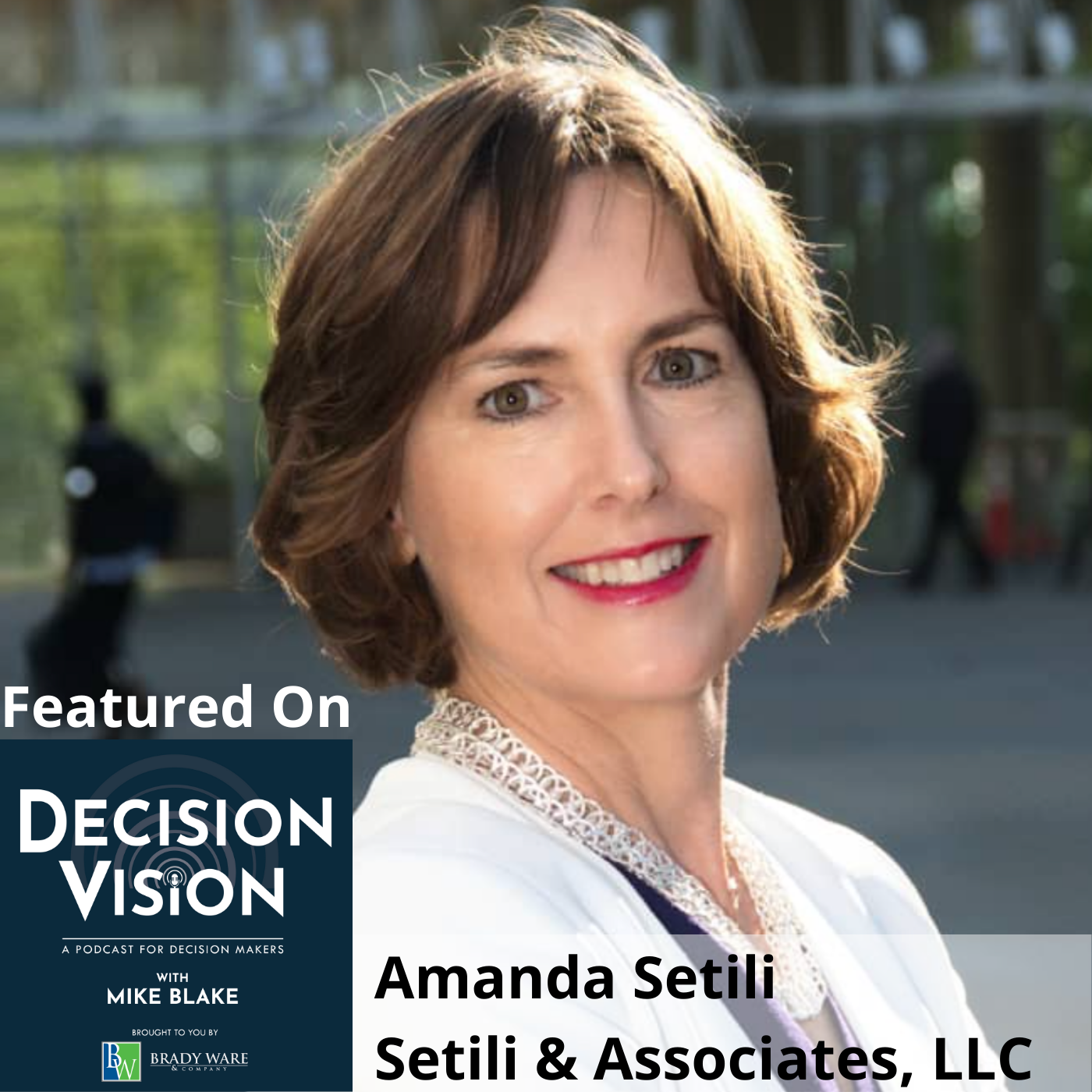
Amanda Setili, President, Setili & Associates, LLC
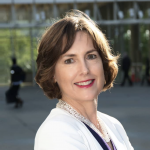
Amanda Setili is president of strategy consulting firm Setili & Associates. An internationally acclaimed expert on strategic agility®, she gives her clients—including Cardinal Health, Coca-Cola, Delta Air Lines, The Home Depot, UPS and Walmart—unbiased and laser-clear advice on how to respond quickly and intelligently to a changing marketplace.
Setili has advised organizations in industries as diverse as consumer and industrial products, financial services, technology, non-profit, and retail. Her work has taken her throughout North America, Europe and Asia.
Before starting Setili & Associates, she served as director of marketing for Global Food Exchange, consulted for McKinsey & Company (where she planted seeds that became the firm’s Kuala Lumpur office), served as chief operating officer of Malaysia’s leading Internet services company, and developed products and optimized manufacturing operations for Kimberly-Clark.
Setili is author of Fearless Growth: The New Rules to Stay Competitive, Foster Innovation, and Dominate Your Markets(Career Press, 2017) and The Agility Advantage, How to Identify and Act On Opportunities in a Fast-Changing World (Jossey-Bass, 2014). Setili served as an adjunct professor at Emory’s Goizueta Business School, is a member of the Marshall Goldsmith 100 coaches program and the Million Dollar Consulting Hall of Fame.
She earned her degree in chemical engineering from Vanderbilt, and her MBA, with distinction, from the Harvard Business School. She is past president and board chair of the Harvard Business School Club of Atlanta.
Mike Blake, Brady Ware & Company

Michael Blake is the host of the Decision Vision podcast series and a Director of Brady Ware & Company. Mike specializes in the valuation of intellectual property-driven firms, such as software firms, aerospace firms, and professional services firms, most frequently in the capacity as a transaction advisor, helping clients obtain great outcomes from complex transaction opportunities. He is also a specialist in the appraisal of intellectual properties as stand-alone assets, such as software, trade secrets, and patents.
Mike has been a full-time business appraiser for 13 years with public accounting firms, boutique business appraisal firms, and an owner of his own firm. Prior to that, he spent 8 years in venture capital and investment banking, including transactions in the U.S., Israel, Russia, Ukraine, and Belarus.
LinkedIn | Facebook | Twitter | Instagram
Brady Ware & Company
Brady Ware & Company is a regional full-service accounting and advisory firm which helps businesses and entrepreneurs make visions a reality. Brady Ware services clients nationally from its offices in Alpharetta, GA; Columbus and Dayton, OH; and Richmond, IN. The firm is growth-minded, committed to the regions in which they operate, and most importantly, they make significant investments in their people and service offerings to meet the changing financial needs of those they are privileged to serve. The firm is dedicated to providing results that make a difference for its clients.
Decision Vision Podcast Series
Decision Vision is a podcast covering topics and issues facing small business owners and connecting them with solutions from leading experts. This series is presented by Brady Ware & Company. If you are a decision-maker for a small business, we’d love to hear from you. Contact us at decisionvision@bradyware.com and make sure to listen to every Thursday to the Decision Vision podcast.
Past episodes of Decision Vision can be found at decisionvisionpodcast.com. Decision Vision is produced and broadcast by the North Fulton studio of Business RadioX®.
Connect with Brady Ware & Company:
Website | LinkedIn | Facebook | Twitter | Instagram
TRANSCRIPT
Intro: [00:00:01] Welcome to Decision Vision, a podcast series focusing on critical business decisions. Brought to you by Brady Ware & Company. Brady Ware is a regional full service accounting and advisory firm that helps businesses and entrepreneurs make visions a reality.
Mike Blake: [00:00:21] Welcome to Decision Vision, a podcast giving you, the listener, clear vision to make great decisions. In each episode, we discuss the process of decision making on a different topic from the business owners’ or executives’ perspective. We aren’t necessarily telling you what to do, but we can put you in a position to make an informed decision on your own and understand when you might need help along the way.
Mike Blake: [00:00:41] My name is Mike Blake, and I’m your host for today’s program. I’m a director at Brady Ware & Company, a full service accounting firm based in Dayton, Ohio, with offices in Dayton; Columbus, Ohio; Richmond, Indiana; and Alpharetta, Georgia. Brady Ware is sponsoring this podcast, which is being recorded in Atlanta per social distancing protocols. If you’d like to engage with me on social media with my Chart of the Day and other content, I’m on LinkedIn as myself and @unblakeable on Facebook, Twitter, Clubhouse, and Instagram. If you like this podcast, please subscribe on your favorite podcast aggregator, and please consider leaving a review of the podcast as well.
Mike Blake: [00:01:19] So, today’s topic is a topic I’m very excited about, because it’s a topic that I, frankly, do a lot of thinking about and is central to what I purport to do for a living. And that topic is, Should I take more risk? And the reason I’m so intrigued by this topic is because, frankly, I think risk gets a bad rap. I think it gets a bad rap because it’s misunderstood. And I think it gets a bad rap, frankly, because it’s not very sexy. And it gets a bad rap because it’s not very visible, it’s not very high profile.
Mike Blake: [00:02:01] But when you think about risk in business and, I think, in life, risk is an overarching and underlying variable that impacts or should impact every decision that we make. And risk is often viewed negatively. We think of risk as something that is always to be avoided. Conversely, we admire the people who are risk takers.
Mike Blake: [00:02:35] As somebody who has traveled abroad quite a bit, I’m frequently asked in my travels, “What is it that makes Americans different from everybody else?” And I think there’s really one thing that makes Americans different from everybody else, and that is that we treat the entrepreneur as a folk hero. There’s no other society that I’ve been to, that I’ve studied, that does it quite the same way that we do. And I think we treat the entrepreneur as a folk hero because we admire their willingness to take risk. And by and large, in our economy, we are okay with rewarding people handsomely who take risks and benefit from that risk paying off, basically.
Mike Blake: [00:02:35] But at the same time, risk is one of these things that I think is highly underappreciated. And on that same token, I’m asked pretty frequently, actually, you know, “How do I improve the value of my business in the short term?” Thinking of selling or I want to make it a better asset to leave to my children or to somebody else, how do I make it more valuable? And the answer that I think most people expect are, “Well, make your company more profitable or find a way to make it grow.” And those things are fine as far as they go, except those things are a lot easier said than done. It’s not that easy to grow a company. It’s not that easy to make a company more profitable. Those are hard things to do.
Mike Blake: [00:04:17] But the thing you almost never hear somebody saying, is my stock answer, is, “Well, figure out a way to de-risk the business. Take what you’ve got and make it more reliable, more resilient, more predictable.” And that in and of itself is going to make the company more valuable. And I would argue and I think I could show you the math to do this for an audio, so I’m not going to inflict that upon you. But I can very easily illustrate with math that if you can decrease the risk by, say, two percent, you will improve the value of your company more than if you increase growth or profitability by two percent. But, again, it’s not sexy.
Mike Blake: [00:05:02] The chief risk officer never appears on Bloomberg television, has never profiled in The Wall Street Journal, at least very rarely. In spite of the fact that we are currently involved in emerging from – I call this – a trans-pandemic period, I think that’s probably still out, we’re still in this this pandemic period where our nature, our very relationship with risk and the nature of risk in our society and our lives, is just different and I think irreversibly so.
Mike Blake: [00:05:33] And so, when our current guest comes on – and we had a conversation earlier and she wanted to talk about risk, I just jumped at the opportunity because I think it’s so important and it’s really not given its due. And so, it’s my pleasure to introduce Amanda Setili, who is president of strategy consulting firm Setili and Associates. Setili and Associates provides experience, strategic, and management consulting to Fortune 500 and growing companies that generate profits, improve performance, and drive growth.
Mike Blake: [00:06:05] An internationally acclaimed expert on strategic agility, she gives her clients, including Cardinal Health, Coca-Cola, Delta Airlines, the Home Depot, UPS, and Walmart- you might have heard of them – unbiassed and laser clear advice on how to respond quickly and intelligently to a changing marketplace. Amanda is also author of Fearless Growth: The New Rules to Stay Competitive, Foster Innovation, and Dominate Share Markets; and the Agility Advantage: How to Identify Opportunities and Act on Opportunities in a Fast-Changing World.
Mike Blake: [00:06:36] Amanda served as an adjunct professor at Emory’s Goizueta Business School, is a member of the Marshall Goldsmith 100 Coaches Program and the Million Dollar Consulting Hall of Fame. Amanda earned her degree in chemical engineering from Vanderbilt and her MBA with distinction from the Harvard Business School. She is past president and board chair of the Harvard Business School Club of Atlanta. Amanda Setili, welcome to the program.
Amanda Setili: [00:07:00] Thanks so much, Mike. It’s a pleasure to be here.
Mike Blake: [00:07:04] So, Amanda, I want to lead off because, you know, we haven’t known each other that long. But the thing that struck me from our first conversation is, you and I are kindred spirits, I think, in one regard in that we really find risk fascinating and conversations about risk to be very impactful. And I’d love to hear your take. You’ve heard mine in my opening monologue. But I’d love to hear your take on why risk interests you. Why is it important? Why do people need to understand it better?
Amanda Setili: [00:07:37] Two main reasons. One is, I work mainly with big companies. And big companies do what they do very well and very consistently. So, they’ve been historically good at managing risk, but they’re really bad at taking a risk of entering into a new market or learning something new, building new capabilities, dealing with the changes that are coming at them so fast in the market today. Just in terms of the way customer behaviors are changing fast, the way competition is changing fast, the way competition can come out of nowhere, which they’re used to be able to do as easily.
Amanda Setili: [00:08:14] And the unwillingness to take risks, whether either because of trying to make sure to make quarterly earnings promises that they’ve made, or fear of having to lay people off, or fear of not being able to build new capabilities fast enough. That fear of the risks hold so many companies back from being successful. And you can see tragedies of large companies who just lose their way and don’t adapt quickly enough to the market change.
Mike Blake: [00:08:47] Yeah. And that’s really interesting, we both can probably name numerous examples, but the one that comes to mind – of which I only learned fairly recently, but it’s such a shocking story – many people don’t realize that Kodak had invented compact flash storage many years before it actually became widely available in the marketplace. But they were so afraid to risk disrupting their own industry, they wound up eventually being effectively consumed by the digital photography market, that they had every opportunity to dominate by virtue of patent protection. And that, to me, is an object lesson of how a company killed itself by not taking enough risk.
Amanda Setili: [00:09:34] Absolutely. It’s like the perfect story to illustrate that exact point, because they did invent digital photography, but they were so intent on protecting their film category that they just couldn’t step into that territory.
Amanda Setili: [00:09:49] So, I said I was going to tell you two things and I didn’t tell you the second one. The second reason, I think is important and interesting, is, because most companies don’t do a good job at managing risk. They do a good job at seeing the risk, but they don’t do a good job at managing the risk. They flee from risk without just saying, “There’s steps we can take to manage this.”
Amanda Setili: [00:10:11] So, one of the stories that I think is illustrative of this is, back when Elon Musk first started Tesla, he said, “There’s only a 50/50 chance that I’ll be successful.” But what he did was he said, “So, why would I not be successful? Maybe people will have range anxiety, so I’ll build a car that instead of only can go 80 miles on a battery, can go 350. I’ll build these superchargers going up every major highway corridor.” He said, “Why else would they be worried? They will be worried about safety, so I’ll win the top safety ratings. Why else would they be worried? They’d be worried about resale value.”
Amanda Setili: [00:10:48] So, he even, for a time, promised to buy their Tesla back for a price pegged to the price of a certain Mercedes model. So, he just said, “Okay. It’s risky. There’s only a 50 percent chance of success. Figure out what the risks are and address each of them very explicitly.” And that’s why he’s been quite successful.
Mike Blake: [00:11:10] I love that Elon Musk story. I hadn’t heard it before. But I think it’s brilliant and a couple of business geeks like us, I think, can appreciate sort of the subtle genius and that buy back part. Because they’re basically then selling a car with a built-in protective put. I mean, it’s just classic hedging.
Mike Blake: [00:11:32] So, I want to come back to this, but before I go too far off the deep end with you, even though it’s really tempting to do so, I want to make sure that everybody understands, our listeners understand, when we say risk, what exactly does that mean? So, if I could maybe, please, ask you to give your definition of risk.
Amanda Setili: [00:11:52] My definition is just that you have uncertainty about the outcome. That’s all it is. There’s many different sources of risk. But the bottom line is you’re not sure it’s going to work.
Mike Blake: [00:12:03] Now, I love that definition. And for what it’s worth coming from me, I mean, to me, that definition shows why you’re an expert on risk. Because I think when most people hear the word risk, they automatically think of the definition of risk being that risk is the possibility that something will go wrong. But you said it differently and I think correctly, which is, it’s simply the risk that something will go differently than how you anticipated. And that’s a massive distinction, isn’t it?
Amanda Setili: [00:12:37] Right. Because there’s always an upside too. So, there are things that are uncertainty about the outcome that are actually on the positive side. And if you don’t recognize what might happen better than what you expect, you’re never prepared to take advantage of your good luck.
Mike Blake: [00:12:57] So, you said something in the opening question, which, again, I just think is so smart that I want to make sure that we hit on, and that is that, you described many companies as failing to manage risk because instead they avoid risk. And there’s a subtle but important distinction there I’d love you to go into, if you would. And that is, why is avoiding risk not the same as managing risk?
Amanda Setili: [00:13:29] Well, they’re completely different. So, avoiding risk is, “Oh, I don’t know what’s going to happen. I’m afraid. I better not do anything.” Managing risk is, “Oh, I don’t know what’s going to happen. What could affect what might happen?” List those things out and then say, “What can we do to manage each of these? What can we do to make it more likely that the good thing is going to happen and less likely that the bad thing is going to happen?” And then, be very explicit about assigning each of those risk to somebody who can make sure that that risk is managed well.
Amanda Setili: [00:14:07] So, for example, you’re launching a new product. What could go wrong? The market fails to understand it. Our call center gets overwhelmed with calls. The sales force is incapable of selling it or is hesitant to sell it because it cannibalizes another product. Just list these things out and then say, “So, what are we going to do about each of them? And who’s in charge of managing that risk? If we’re worried about the call center being overwhelmed, can we get some backup capacity lined up? If we’re worried about the sales people being unwilling to sell it because it cannibalizes something else, give them some kind of override on their commission?”
Amanda Setili: [00:14:48] All of these things could be managed. And at the same time, when you talked about, you know, uncertainty about the outcome can also be on the upside, what if this goes even better than we expect? Do we have our suppliers organized to be able to sell us more supply than what we thought? Do we have the ability to expand geographically faster than what we were anticipating? Do we have the ability to make the biggest PR buzz out of anybody that likes our product that we didn’t expect to like it? You know, there’s all kinds of things that can go right. And if you plan for them, you get to jump on it and take advantage of them.
Mike Blake: [00:15:27] So, you have a great pedigree working with brand name companies. And, clearly, the subject comes up when you’re working with them. Why, in your mind, do large companies struggle so much with risk management? Is it something that’s cultural? Is it a misalignment of economic incentives or some sort of pathology? What, in your mind, kind of drives that?
Amanda Setili: [00:15:52] Two things. One is the incentives usually incent you to do the same thing that you did last year plus five or ten percent. And if you don’t do that, you’re in big trouble, you don’t make your bonus or you might get fired or whatever. And if you do way better than that, it’s not necessarily as big of an advantage. So, the incentives tend to be very much disincenting taking risks. The second thing is they’re just sloppy. They’re not disciplined about how they think about risk and how they manage it.
Mike Blake: [00:16:32] So, what, in your mind, when you work with companies like that and you present them with the case that they should be taking on more risk than they are, how do you position that argument? Or what does that argument typically look like that a given entity, person, organization should take on additional risk?
Amanda Setili: [00:16:53] Well, first of all, we find ways to manage it where it’s not all that risky. So, understand the market better. Maybe make a small experiment before you make a big experiment. Play several different small bits at once, which is a hedging strategy. Isolate the risk into a certain area of the company where it can’t damage the other areas of the company. So, there’s a lot of things that we can do to manage risk that’s on the plus side on the kind of way to get them to kind of emotionally accept the risk more. It’s often a case of saying, “If you don’t do this, you’re going to be left in the dust.” I mean, they know that, but sometimes they have to be reminded.
Mike Blake: [00:17:45] One of the basic concepts of behavioral finance is the concept or the construct that humans seem to be hardwired against taking risk. And in particular, they’re hardwired to avoid loss or with this notion of loss aversion. Which, I know you know what this means, but our listeners may not. It means that people miss more on a dollar that they actively lose than they do on a dollar that is an opportunity missed. And that sort of creates this perception of risk asymmetry. Have you encountered that as well? And if so, how do you get people to confront that and look at risk in a more clinical way?
Amanda Setili: [00:18:38] Well, first of all, you do want to make sure you don’t lose anything that you can’t afford to lose. So, you don’t want to get in a position where you can’t pay your mortgage. So, there’s a certain level of risk that you just can’t afford to take and so be very explicit about that. But then, I think, thinking about expected value, which is the percent chance that something’s going to happen, times of value that would come to you if it did happen is pretty helpful. And just being very explicit about there is an upside here. The upside is worth it. There’s some downside. But if you look at the expected value, it’s probably a favorable thing to do. And if you don’t do it, you’re going to be in a slow decline.
Mike Blake: [00:19:29] So, it leads nicely to my next question and we’ve touched upon this a little bit with the Kodak story, but I’d like to make this part of the discussion explicit. And that is, so what if people don’t take enough risk? What are the consequences of not taking enough risk?
Amanda Setili: [00:19:49] Well, you mentioned people, and so I think that it would be interesting to take this out of a corporate context and just into a human being context. You take risk when you decide to ask somebody on a date. You take risk when you decide to get married. You know, 50 percent of marriages end in divorce, do you say, “I better not do that because mine might be one of the 50 percent?” Or do you say, “This is my chance for a wonderful life with this wonderful person, I’m going to go for it even with the risk.” What’s was your question exactly?
Mike Blake: [00:20:25] What do you miss out on when you’re not taking enough risk?
Amanda Setili: [00:20:31] A lot of stuff. You have fewer experiences. Fewer experiences or opportunity to grow your business. Fewer opportunities to fully live your life. You name it. You miss out on a lot if you’re too risk averse.
Mike Blake: [00:20:49] So, another question I wanted to cover is, you know, there are varying degrees of risk and you talked about you never want to bet your mortgage or put anything on the line you can’t afford to lose. And, of course, that’s a relative construct. But the question I’d like to ask you to engage with is, is high risk always bad? Is something that’s high risk always something that you should walk away from? Or are there cases in which, you know, something that’s high risk may actually be sensible?
Amanda Setili: [00:21:30] Well, if you just look at investments, for instance, you tend to have a higher return for the higher risk. So, it’s definitely not always bad. You also never would achieve anything truly remarkable and knock it out of the park if you didn’t take risks. Because we would have never gone to the moon if we didn’t accept some risk, for instance. So, high risk is certainly not always bad. But high risk without managing the risk is probably always bad. So, high risk without considering the consequences, mitigating what you can mitigate, taking into account how can we reduce the risk that we see, that is bad.
Mike Blake: [00:22:15] And, you know, that sounds like there’s an important distinction to be made there, if I can semi-put words in your mouth. It seems to me that a risk taker is somebody who takes risks but manages it, can be contrasted with someone who’s reckless that also takes risks. But they don’t manage it and maybe they don’t even fully understand the risks that they’re taking.
Amanda Setili: [00:22:39] That’s exactly it. They don’t understand or don’t think about it. And that probably happens more often when the risk is long term and the benefit is short term. So, if I eat a piece of cake with ice cream every single day, my risk is that I’m going to become obese, and I’m going to have diabetes, and I’m going to die early. But people don’t take that into consideration when they serve themselves that extra helping of dessert.
Mike Blake: [00:23:09] Well, that’s true. And that’s interesting, because, you know, there’s another element. I typically think of risk in terms of two dimensions. One dimension is, what is the likelihood of a bad outcome? And then, B, how bad is that bad outcome? Or what is the distribution of bad outcomes look like and how bad can it go? But a third dimension to that, actually, is the timing of risk. And some risks are accretive over a long period of time and some are instantaneous. And I guess that’s something that also is an important part of the discussion and maybe even gets back to your Fortune 500 clients, where you talk about incentives. Can there be perverse incentives to take risk because the negative impact of the risk may not manifest itself for years after that person’s tenure at the company has long since ended.
Amanda Setili: [00:24:14] That’s exactly right. So, you know, if I’m in a job, I’m the president of a division, and I’m being incented based on this quarter’s results or this year’s results, I don’t want to risk anything for something that’s going to happen after I retire in a few years. Why would I want to do that? So, that’s the kind of thing you need to watch out for when you’re managing a company. But, also, some of the benefits occur way down the line. Well, I guess that’s the same thing that I’m saying, is that, in companies, often the cost is now and the benefit is later.
Mike Blake: [00:24:52] Well, you know, and I think that’s really important. And I have a hypothesis that one of the reasons that private equity and venture capital struggles is because their return thresholds have become much more compressed. And this notion that most venture and private equity funds have a ten year lifespan. That may very well just not be enough time for companies to mature to the point where they can generate a return. And indeed, there’s data out there to suggest that as you approach a 20 year time horizon for a company, that’s when you kind of optimize your risk adjusted return.
Mike Blake: [00:25:31] But on the other hand, if your bonuses are calculated year-to-year or you’re only going to be in that fund for five years or whatever the circumstances are, it probably motivates not industry perverse behavior, for example, to try to harvest companies before they’re fully baked, which is not doing the investors any favors. And that’s just an illustration of that mismatch between the risk and return time horizons.
Amanda Setili: [00:25:59] Right. So, public companies, I think, have even more of a problem with short term thinking because they have to deliver on their earnings expectations every single quarter, and they get really dinged by Wall Street if they don’t do that. Whereas, at least with a private equity firm, if you say we’re shooting for a five year horizon, at least in years one, two and three, you can let it go negative on EBITDA, if that’s the right thing to do, for instance. Because you know that it’s going to pay off in the five years. So, if private equity firms can stay a little bit flexible of what’s the right period of time for this investment to turn positive, then they can protect themselves from that.
Amanda Setili: [00:26:45] But you look at somebody like Amazon, Amazon didn’t make money for years and years and years. They just kept investing. And I’ll never forget that way back in about 2001, I was talking with one of my classmates from Harvard Business School who was way up in the chain at Amazon working closely with Jeff Bezos. And somebody in the crowd said, “When will you guys stop losing money?” And she said, “Well, it only costs us $4 to acquire a new customer. When would you stop?” I just thought that’s a really, really smart way of putting it. Because if it’s only $4 to acquire a new customer, keep doing it until you have everybody in the world using Amazon. And then, you’ve cornered the market, which is kind of what they did.
Mike Blake: [00:27:33] Well, I hadn’t heard that story, but you’re right. I mean, the logic there is very hard to escape, isn’t it?
Amanda Setili: [00:27:39] Yes.
Mike Blake: [00:27:40] So, let’s say that somebody listening to this is starting to ask themselves, “Hey, I wonder if our company is taking enough risk.” What are some signs that a company should be taking more risk or at least should consider taking on more risk than it currently is? What are the warning signs?
Amanda Setili: [00:28:04] If you’ve got a lot of change in your market and you haven’t done anything about it is one of the key things that I look at. If you haven’t invested in any innovation is another thing. Innovation can be product innovation, but it can also be systems integration, process innovation. Even simple stuff like changing the script that your call center is typically a sign that you’re not taking enough risk. If you’re not talking about where do we need to take more risk. And if you don’t have discipline systems for managing risk, that probably means you’re not taking enough risk because you don’t have it in your DNA of how do we think about risk?
Amanda Setili: [00:28:51] You know, because the world is changing fast, the companies that can deal with uncertainty effectively, that’s a huge competitive advantage. To be able to deal with uncertainty effectively and manage risk effectively is probably the number one thing that companies can do to succeed in a fast changing world.
Mike Blake: [00:29:14] I’m absorbing that statement. I think you’re right. And my perspective is one of corporate finance. And I refer to the law of gravity and finance, which says that, high return only accompanies high risk. And if you generate a high return from something that you thought was low risk, you probably just got lucky. And you misevaluated the risk as being lower than it actually was.
Mike Blake: [00:29:46] And I think what you’re describing is fairly closely connected with that. You know, if you want to outperform, then you must do something different from what the rest of the market is doing. Otherwise, you just simply fall into the trap of reversion to the mean. I mean, you might have temporary day-to-day, month-to-month, even year-to-year variability or noise, if you will. But the ending in the long run, you cannot possibly outperform everybody else if all you do is what everybody else is doing.
Amanda Setili: [00:30:23] Exactly.
Mike Blake: [00:30:27] In your mind, is all risk created equal? Or are there different kind of flavors of risk, if you will?
Amanda Setili: [00:30:37] Yeah. There’s definitely different flavors. One major flavor is, are we capable of doing this? Another major flavor is, how are other entities or other people going to respond to what I’m doing? Another is, just what are the consequences of what I’m going to do? So, I think, yeah, there’s a number of different categories that you can think about and each can be managed.
Mike Blake: [00:31:04] So, in your mind, do you have a distinction of what a good risk is versus a bad risk? Is there such a thing as good versus bad risk?
Amanda Setili: [00:31:14] A good risk is something that you can at least name, and that you at least have either some kind of plan to reduce it or manage it. Or, at minimum, monitor it so that you can respond and you have a plan for how to respond if it starts going going badly. A bad risk is the risk you don’t even know is there.
Mike Blake: [00:31:39] The famous unknown unknowns, right?
Amanda Setili: [00:31:42] Yeah. Right.
Mike Blake: [00:31:44] Because those bad risks are almost kind of like open-ended liabilities. There may be no limit to how bad that outcome could be.
Amanda Setili: [00:31:57] Right. Or it’s something that maybe you sort of think might happen, but you don’t really think it’s going to happen, so you don’t worry about it. Like, pandemics, which we all knew. I had a friend at the CDC who, ten years ago said, “We’re way overdue for a pandemic, a worldwide pandemic.” I just go, “Yeah. Yeah. It probably won’t happen.” And here we are.
Mike Blake: [00:32:19] Here we are. So, here’s a question I want to ask you, I hope you’ll agree it’s an interesting one. And that is that, if you take a risk and it doesn’t produce a positive outcome, does that mean that the act of taking the risk was automatically bad?
Amanda Setili: [00:32:46] Definitely not. I mean, there’s some really good speakers on this topic, they’re often professional poker players. And they say, “You know, you calculate your odds and you place your bet. Of course, you don’t always win because the odds were not 100 percent that you were going to win. So, of course, you know that you’re not always going to win. But don’t let the evidence from your failures teach you that you made a bad decision in the first place.”
Mike Blake: [00:33:17] Yeah. And that last point, I think, is so important because, again, it ties back to psychology, at least the things I’ve read. I’m no expert in psychology. But, again, we as people seem to be hardwired to very clearly remember our losses and failures. Whereas, we don’t dwell as much or remember or even place as much value in our successes. And in that regard, it can dissuade people just because you have one bad outcome. It can dissuade people from doing more of the right thing.
Amanda Setili: [00:33:52] I think that’s really true. I think people learn from their failures and that can be kind of bad. Because, oftentimes, when you fail, you think, “Oh, that was because of something that I did that I made a bad decision.” And when you succeed, unfortunately, you often think, “Oh, I got lucky. It wasn’t because of what I did. I just got lucky.” So, yeah, I think that no matter what you do, you’re being trained every day. And you’re training your employees every day. And, often, you’re training them things that you really shouldn’t be training them.
Mike Blake: [00:34:27] Oh, you know what? That’s interesting. What are some examples of things that somebody might be inadvertently training their employees themselves be too risk averse?
Amanda Setili: [00:34:39] A typical one is, you start a new venture within your company because you think that you need to enter a new market or something. And you assign somebody to manage that, they try their hardest. But, you know, it’s hard. Stuff goes wrong. They fail and they either get switched into a different department, or demoted, or even maybe fired, or at least not rewarded very well. But maybe they should have been rewarded well because maybe they did everything that they could have possibly done to make that successful. And the outcome was uncertain and the outcome didn’t go their way. But once you said a couple of examples like that, boy, people are watching. Nobody wants to go near a project like that anymore.
Mike Blake: [00:35:26] Yeah. You know what? That’s really interesting. And I wonder if we’ll ever get to a point where American businesses – and it may not be unique to America, but something I can comment on intelligently – actually celebrate failures? Because, first of all, failures are great teachers, number one. And number two, because the nature of risk that things just aren’t always going to go your way. And I’m curious if you agree with us or not, really, in order for risk management to really take hold and to really make an impact, you almost have to do it a lot. You have to accumulate enough of a sample size so that the impact of the risk management becomes pronounced. And you can actually attribute performance to something other than simple dumb luck of a small sample size.
Amanda Setili: [00:36:28] Right. Right.
Mike Blake: [00:36:30] And on that, I’m curious if you have an opinion on this. On that note, that brings to mind the archetypal Google, now Alphabet, approach to new projects where they like to fail fast. And our conversations made me start to wonder about that particular approach. I think many people idolize Google for the fail fast approach. It’s gutsy. It’s splashy. It’s high profile and everything else. But on the other hand, I wonder if, actually, that could be kind of a perverse or unhealthy form of risk aversion because you may not be writing things out as much as you should.
Amanda Setili: [00:37:18] So, what I think is important is being very clear about what you need to learn from each experiment that you run, and what metrics you’re going to be watching, what behaviors you’re going to be watching, what you’re really wanting out of it. And fail fast, part of it is really good, which is saying, if something isn’t going well and it’s not going to turn around, it’s not going to do any better. Kill it right away, and document what you learned from it, and then try something else.
Amanda Setili: [00:37:51] Because sometimes, especially big companies, they’re slow anyway. It’s a long time between getting the management team together. They just don’t make decisions fast. So, they let this thing linger because they don’t want to embarrass the person who runs it or they don’t want to have to go back to Wall Street and say, “We told you this is going to be successful, but it wasn’t.” So, they let these things linger hoping that they’ll turn around and continuing to pour not quite enough money into them to make them successful, maybe. And so, because there’s a stigma against failure, they don’t let things fail.
Amanda Setili: [00:38:28] So, I think, actually the concept of fast failure is healthy for Google. And I like the fact that they just keep putting different stuff out there and seeing if it flies. And if it doesn’t, they kill it. You know, Facebook is famous for that, too. They do A/B testing, hundreds of different A/B tests every day. And they let almost anybody – I don’t know about almost anybody – but there’s a lot of people who have the decision rights to be able to conduct A/B tests and to learn from them very, very, very quickly.
Mike Blake: [00:38:59] We’re talking with Amanda Setili. And the topic is, Should I take on more risk? You know, we’re both talking kind of a good game here about risk, if you will. I wonder if you’d be willing to share with the audience an instance in which you took a pretty significant risk. And, you know, whether that was a success or a failure, the impact of taking that risk and the lessons that you learned from doing that for yourself or your own company.
Amanda Setili: [00:39:28] You really got me thinking with that one. I guess, that writing my first book was kind of a risk because I invested a lot of time for many months doing that and I didn’t know if this was really important to do, so that was a risk and it did pay off.
Amanda Setili: [00:39:44] I don’t know if I’ve told you, Mike, that my husband and I are really, really into kiteboarding. And in July in kiteboarding, we tend to only get wind when there’s a thunderstorm. So, we’re always watching the radar and trying to figure it out. And, you know, back in March, April, or May, when we get more wind, we might say, “Oh, we’re going to pack up the kites and go home if the lightning is within 20 miles.” And then, it gets to July and you’re, like, desperate for wind. There’s been no wind for seven days or whatever you’ve been waiting for wind. And there’s wind, but the lightning is within ten miles and you go, “Well, maybe I’ll just go out there for a little while.” So, that’s an example.
Mike Blake: [00:40:32] Well, you know, that’s an interesting story and actually is illustrative, I think, of a dimension of risk where, you know, the same risk is there. But because your perceived return was higher, you then determine that it was a risk that was worth taking. I do think there’s a business application to that, is that, higher risk is okay as long as you’re being adequately compensated with the potential upside of taking that risk alongside with, of course, management of downside as well. And in your case, that upside manifested itself with, I think, relative scarcity, because the downside was that if you didn’t take the risk, you might have just missed out on your entire kiteboarding season and have to wait another year.
Amanda Setili: [00:41:24] That’s right.
Mike Blake: [00:41:30] Now, a common approach to managing risk and finances where I live is this concept called diversification. I’m sure you’re familiar with it, too. Can diversification as a risk management tool be applied outside of the direct investment world?
Amanda Setili: [00:41:51] Well, yeah. We do that all the time, where, you know, you are trying to enter a new market, let’s say. And instead of just doing it one way, you might run three to five different experiments. We’ll try different things in different markets. We’ll try different ways of going to market. We’ll try different sales pitches for this product. So, I think that diversification, in that sense, is just trying different things and being very systematic about what you try and what you need to learn from your trials.
Mike Blake: [00:42:27] So, Amanda, we’re running out of time, and this is a topic that, frankly, we could do a whole semester on risk. Maybe we should. But there are probably questions that I didn’t get to or questions that somebody would have liked us to go deeper into but we didn’t. And if that’s so, can people contact you with additional questions about this topic? And if so, what’s the best way for them to do that?
Amanda Setili: [00:42:50] So, you can certainly email me at amanda@setili.com, S-E-T-I-L-I. And reach out to me on LinkedIn. I’ve got a weekly newsletter there which you can subscribe to, which I address issues like this. And, actually, I think both of my books have a chapter on managing uncertainty, and how it’s so important, and how people who don’t accept uncertainty are probably not going to do very well. So, get a hold of those and you might be able to get some additional insight. Connect with me on LinkedIn and my website.
Mike Blake: [00:43:29] Do you want to give us the website domain?
Amanda Setili: [00:43:34] The website is just setili.com, S-E-T-I-L-I.com. There’s lots of information there, and videos, and other podcasts, and things like that.
Mike Blake: [00:43:44] Very good. Well, that’s going to wrap it up for today’s program. I’d like to thank Amanda Setili so much for sharing her expertise with us.
Mike Blake: [00:43:52] We’ll be exploring a new topic each week, so please tune in so that when you’re faced with your next business decision, you have clear vision when making it. If you enjoy these podcasts, please consider leaving a review with your favorite podcast aggregator. It helps people find us that we can help them. If you’d like to engage with me on social media with my Chart of the Day and other content, I’m on LinkedIn as myself and @unblakeable on Facebook, Twitter, Clubhouse, and Instagram. Once again, this is Mike Blake. Our sponsor is Brady Ware & Company. And this has been the Decision Vision podcast.