Business RadioX ®

  • Home
  • Business RadioX ® Communities
    • Southeast
      • Alabama
        • Birmingham
      • Florida
        • Orlando
        • Pensacola
        • South Florida
        • Tampa
        • Tallahassee
      • Georgia
        • Atlanta
        • Cherokee
        • Forsyth
        • Greater Perimeter
        • Gwinnett
        • North Fulton
        • North Georgia
        • Northeast Georgia
        • Rome
        • Savannah
      • Louisiana
        • New Orleans
      • North Carolina
        • Charlotte
        • Raleigh
      • Tennessee
        • Chattanooga
        • Nashville
      • Virginia
        • Richmond
    • South Central
      • Arkansas
        • Northwest Arkansas
    • Midwest
      • Illinois
        • Chicago
      • Michigan
        • Detroit
      • Minnesota
        • Minneapolis St. Paul
      • Missouri
        • St. Louis
      • Ohio
        • Cleveland
        • Columbus
        • Dayton
    • Southwest
      • Arizona
        • Phoenix
        • Tucson
        • Valley
      • Texas
        • Austin
        • Dallas
        • Houston
    • West
      • California
        • Bay Area
        • LA
        • Pasadena
      • Colorado
        • Denver
      • Hawaii
        • Oahu
  • FAQs
  • About Us
    • Our Mission
    • Our Audience
    • Why It Works
    • What People Are Saying
    • BRX in the News
  • Resources
    • BRX Pro Tips
    • B2B Marketing: The 4Rs
    • High Velocity Selling Habits
    • Why Most B2B Media Strategies Fail
    • 9 Reasons To Sponsor A Business RadioX ® Show
  • Partner With Us
  • Veteran Business RadioX ®

Search Results for: marketing matters

Decision Vision Episode 142: What Should I Do After Graduating High School? – An Interview with Joseph Lambert, Joseph’s Junk Removal

November 11, 2021 by John Ray

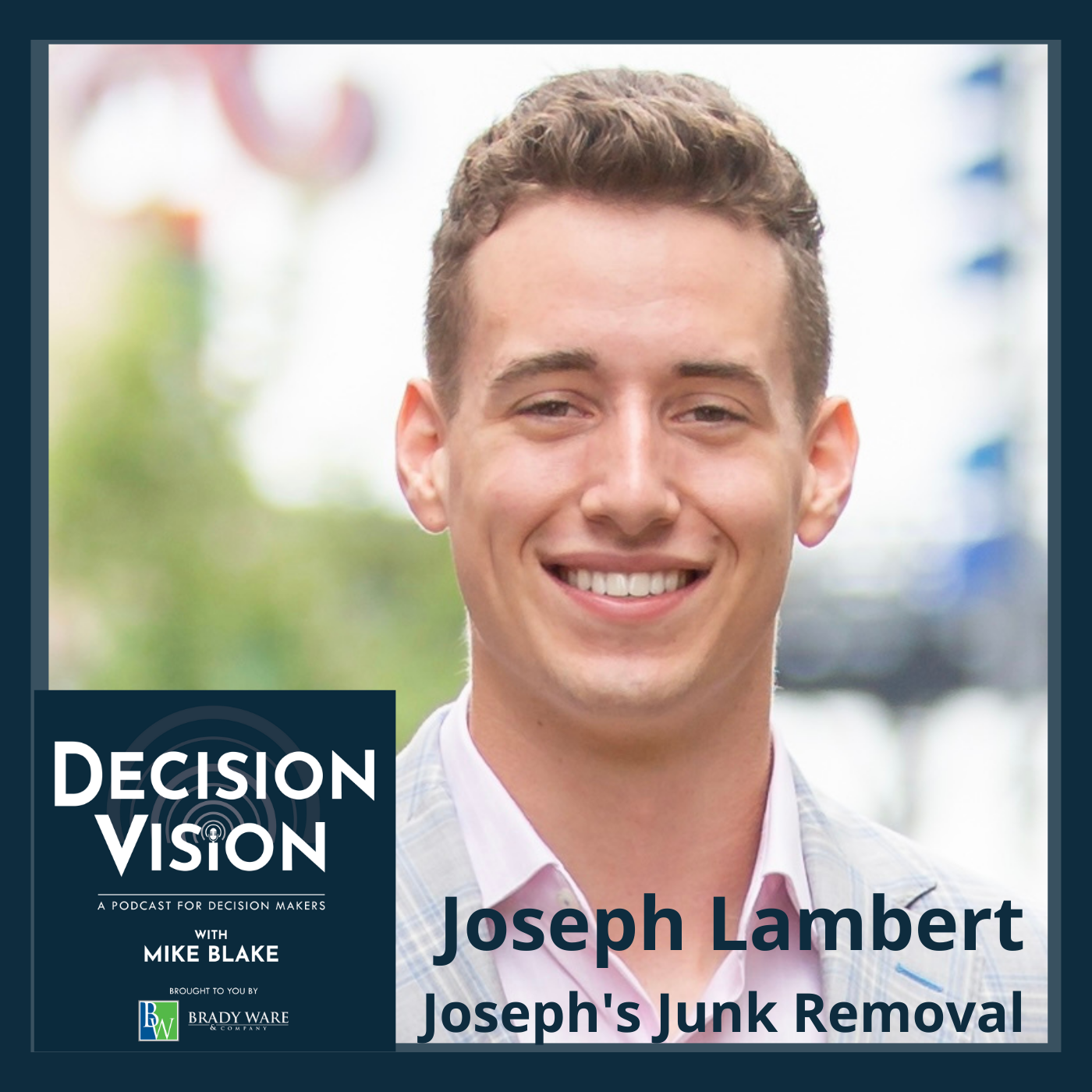
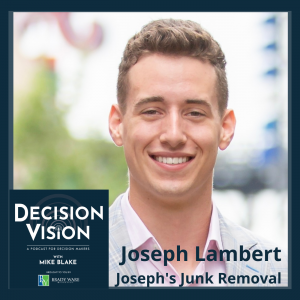
Joseph Lambert
Decision Vision
Decision Vision Episode 142: What Should I Do After Graduating High School? - An Interview with Joseph Lambert, Joseph's Junk Removal
Loading
00:00 /
RSS Feed
Share
Link
Embed

Download file

Joseph Lambert

Decision Vision Episode 142:  What Should I Do After Graduating High School? – An Interview with Joseph Lambert, Joseph’s Junk Removal

As a senior in high school, Joseph Lambert started his junk removal business with a rented truck and hasn’t looked back. Now 20 years old, Joseph is in a unique position for this conversation with host Mike Blake on options for young people after high school. They discussed why college may not be a given anymore, Joseph’s path in his business and the lessons he’s learned, why Joseph believes undergraduate business degrees are a “waste of time,” how young people should figure out their own direction, and much more. Decision Vision is presented by Brady Ware & Company.

Joseph’s Junk Removal

Joseph’s Junk Removal is a customer service company specializing in junk removal.

Serving the Atlanta area, the Joseph’s Junk Removal Team is on a mission to help people “Clear clutter, relieve stress, and live cleaner lives.”

Company website | LinkedIn | Facebook

Joseph Lambert, Owner, Joseph’s Junk Removal

Joseph Lambert, Owner, Joseph’s Junk Removal

Joseph’s Junk Removal’s story really starts when Joseph was 12 years old. As his parents were finalizing their divorce, Joseph realized the challenge ahead for his mom as she would try to provide for him and his four younger siblings. In an effort to help, Joseph started mowing lawns and working in construction to cover his own expenses. As a result, Joseph was able to release some of the burden off his family and discovered a hunger for growing a business in the meantime.

As mowing lawns grew, Joseph partnered with a friend who was older and could drive. The business model was simple: Joseph handled customer service, marketing, and scheduling. Sam handled the transportation.

At age 17, Joseph made $1600 in 4 hours by removing a bunch of junk for a landscaping client. He couldn’t believe it! After completing the job, Joseph researched the junk removal industry and was blown away by the margins, simple process, and scalability potential. From this point on, he focused on junk removal.

By senior year of high school, Joseph’s junk hauling business “Highschoolers Hauling Junk” was growing rapidly. As he juggled work, football, and baseball, Joseph put classes on the back burner. Consequently, he ended up failing a crucial class necessary to earn a diploma. As a result, he stayed in high school an extra semester (while all his friends went off to college) to finish the class.

While Joseph finished the class, the junk removal business (now called “Joseph’s Junk Removal”) was booming! By now, he was convinced of the immense potential in junk removal. After a full power-point presentation, Joseph got the greenlight from his family to pursue it full-time after graduation.
Less than 2 years after Joseph “officially” graduated high school, Joseph’s Junk Removal has grown to 25+ employees and 5 trucks. In that time span, Joseph and his team have fallen on their faces a lot. Lessons have been learned (some the hard way). But ultimately, every challenge the team has faced has made them stronger and more equipped to conquer the future.

LinkedIn

Mike Blake, Brady Ware & Company

Mike Blake, Host of the “Decision Vision” podcast series

Michael Blake is the host of the Decision Vision podcast series and a Director of Brady Ware & Company. Mike specializes in the valuation of intellectual property-driven firms, such as software firms, aerospace firms, and professional services firms, most frequently in the capacity as a transaction advisor, helping clients obtain great outcomes from complex transaction opportunities. He is also a specialist in the appraisal of intellectual properties as stand-alone assets, such as software, trade secrets, and patents.

Mike has been a full-time business appraiser for 13 years with public accounting firms, boutique business appraisal firms, and an owner of his own firm. Prior to that, he spent 8 years in venture capital and investment banking, including transactions in the U.S., Israel, Russia, Ukraine, and Belarus.

LinkedIn | Facebook | Twitter | Instagram

Brady Ware & Company

Brady Ware & Company is a regional full-service accounting and advisory firm which helps businesses and entrepreneurs make visions a reality. Brady Ware services clients nationally from its offices in Alpharetta, GA; Columbus and Dayton, OH; and Richmond, IN. The firm is growth-minded, committed to the regions in which they operate, and most importantly, they make significant investments in their people and service offerings to meet the changing financial needs of those they are privileged to serve. The firm is dedicated to providing results that make a difference for its clients.

Decision Vision Podcast Series

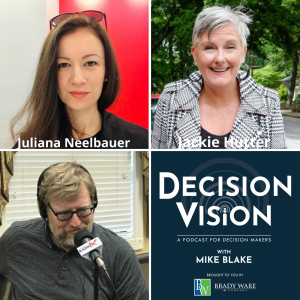
Decision Vision is a podcast covering topics and issues facing small business owners and connecting them with solutions from leading experts. This series is presented by Brady Ware & Company. If you are a decision-maker for a small business, we’d love to hear from you. Contact us at decisionvision@bradyware.com and make sure to listen to every Thursday to the Decision Vision podcast.

Past episodes of Decision Vision can be found at decisionvisionpodcast.com. Decision Vision is produced and broadcast by the North Fulton studio of Business RadioX®.

Connect with Brady Ware & Company:

Website | LinkedIn | Facebook | Twitter | Instagram

TRANSCRIPT

Intro: [00:00:02] Welcome to Decision Vision, a podcast series focusing on critical business decisions. Brought to you by Brady Ware & Company. Brady Ware is a regional full-service accounting and advisory firm that helps businesses and entrepreneurs make visions a reality.

Mike Blake: [00:00:21] Welcome to Decision Vision, a podcast giving you, the listener, clear vision to make great decisions. In each episode, we discuss the process of decision making on a different topic from the business owners’ or executives’ perspective. We aren’t necessarily telling you what to do, but we can put you in a position to make an informed decision on your own and understand when you might need help along the way.

Mike Blake: [00:00:43] My name is Mike Blake, and I’m your host for today’s program. I’m a director at Brady Ware and Company, a full- service accounting firm based in Dayton, Ohio, with offices in Dayton; Columbus, Ohio; Richmond, Indiana; and Alpharetta, Georgia. My practice specializes in providing fact-based strategic and risk management advice to clients that are buying, selling, or growing the value of companies and intellectual property. Brady Ware is sponsoring this podcast, which is being recorded in Atlanta per social distancing protocols.

Mike Blake: [00:01:13] If you would like to engage with me on social media with my Chart of the Day and other content, I am on LinkedIn as myself and @unblakeable on Facebook, Twitter, Clubhouse, and Instagram. If you like this podcast, please subscribe on your favorite podcast aggregator and please consider leaving a review of the podcast as well.

Mike Blake: [00:01:32] So, today’s topic is different from what we normally cover, but I think it’s applicable. And I think the story that leads to the topic is so compelling. I think you, in our audience, are going to enjoy and, frankly, be inspired by hearing it.

Mike Blake: [00:01:53] But the topic is, What should I do after graduating high school? And you might be thinking, “Well, this is a show about executive business decision making. Why are we talking about the decision process for what an 18 year old kid should be doing with their life?”

Mike Blake: [00:02:14] And here’s my answer to it. The first answer is, it turns out that some number of listeners out there are actually in high school or high school age or younger, believe it or not. And I know this because they contact me. In fact, I will tell you that as a father of a 19 year old son, I have about as little street cred as you could possibly imagine. I can’t even do the white man’s overbite well.

Mike Blake: [00:02:43] But when he heard that I had a podcast that’s up at 30 million downloads and counting, all of a sudden for a brief moment, there is a glimmer of admiration and respect in his eyes, and I’m not sure I’ll ever see it again. But he is telling me that his friends are listening to the program as well. And they say that they look forward to it, and they enjoy it, and they feel like it speaks to them because, in many cases, this is the first time a lot of them are being privy to business kind of conversations as adults rather than as teenagers.

Mike Blake: [00:03:23] So, you know, to those of you who are in that demographic, you’re, of course, welcome. We love the fact that you’re listening. We love the fact that you’re taking an interest in business and becoming a better decision maker. And if you’re of that age, you are going to face one of the most important decisions of your life, almost unfairly so in terms of what you do with your life going forward.

Mike Blake: [00:03:48] You may choose to go to college, and I’m becoming increasingly convinced that asking 18 year olds to make decisions as to whether or not they should be taking on a quarter of a million dollars of debt, I’m not sure that’s a position we should be putting kids in. I think there needs to be a different model.

Mike Blake: [00:04:10] And we’re not going to talk about this explicitly today, but you may choose to risk your life serving our country. You know, the military has obviously been a route for upward mobility for many people. I have two cousins of whom I’m just tremendously proud that have had distinguished military careers where they’ve really just accomplished things that I’m not sure they would have necessarily accomplished had the military not given them those opportunities. And maybe we’ll cover the military separately in a different episode. We did do one with Jason Jones on the hiring side, should I hire people with a military background?

Mike Blake: [00:04:46] But the fact of the matter is, whether you’re not at age 18, life is going to force some pretty heavy decisions upon you. And I hope that the conversation we have today will at least add a different perspective than you may be getting from whatever advisors that you have. I think, also, that the show is going to be useful because parents are making an executive decision, if you will, or helping their children make an executive decision. Should I go to college? Should I undertake the enormous financial obligation that college entails? Or should I do something else?

Mike Blake: [00:05:31] And it’s tough. I can tell you as a parent, again, of a 19 year old who has chosen not to go to college at least for the time being, it is a very heavy decision. And as parents where many of us are for executives, not all of us, of course, but many of us grew up in a generation – I’m Gen X – where college was something you just didn’t even think about. If you had the opportunity to go, you just went. That’s all there was to it.

Mike Blake: [00:06:01] But the world has changed. The economics of college have changed. The psychology of the American teen has changed. The environment, of course, has changed in every way imaginable. The nature of the labor forces – we’ve gone into a lot of detail over several episodes – has changed. So, even though this is a little bit off the wall from what we normally talk about, I do believe that many of you will find that it holds relevance, if not today, then at some point down the line when you reach a later life stage.

Mike Blake: [00:06:40] So, with that as a preamble, I hope I’ve convinced you to hang in there and continue listening because I do think we have an excellent program lined up. And joining us today to talk about this might be our youngest guest ever, if not the youngest, probably in the top three – and that’s a good thing, by the way – is Joseph Lambert of Joseph’s Junk Removal.

Mike Blake: [00:07:04] And as I said, he has a story that I think just sets the table so nicely. I cannot possibly do justice to it, so I’m going to break from tradition here. And I’m going to just welcome Joseph to the program, and ask Joseph to talk about his background and how did he get from his first job as a kid, as a young teenager or adolescent, into being the founder and CEO of Joseph’s Junk Removal. Joseph, welcome to the program.

Joseph Lambert: [00:07:35] Hey, man. Thanks so much for having me on. I just can’t echo enough about how important this topic is, which you already laid out. Because, you know, for kids coming out of high school at 18 years old, 17 years old, they’re oftentimes forced to make the decision on what the next four or five years of their life looks like. And that’s a lot of time. And I’m a firm believer in time is the most valuable currency we have. So, there’s just a lot that goes into that decision.

Joseph Lambert: [00:08:04] So, whether you’re actually in the midst of making that decision for yourself right now, whether you’re a parent, or whether you’re somebody who is involved in somebody’s life who is going through that decision, this is a topic that can really apply to everybody because everybody either has to make that decision or can help somebody else make that decision.

Joseph Lambert: [00:08:23] But as far as my story goes, so I grew up in Atlanta, Georgia. Oldest of five kids. Really was very blessed growing up with two loving parents. But at 12 years old, my parents got a divorce, and it just shook our family, created a lot of challenges. Probably one of the most immediate challenges was my mom had to go from a stay at home mom to being in the workforce to put food on the table.

Joseph Lambert: [00:08:51] So, for me at 12 years old, I just was trying to figure out ways to help. And one of the clear pathways that I saw was just go out and earn money and cover your own expenses. So, I started mowing lawns for neighbors. I also started working in construction with a friend. So, I was doing everything I could just to earn as much money as possible just to lighten the burden on my mom.

Joseph Lambert: [00:09:18] So, that was kind of what got me kick started into working, you know, kind of the idea of entrepreneurship. And, really, it caught my attention. Like even at a young age, I loved it. I was, you know, seeking every opportunity to grow and get more clients. I remember it was such a big deal for me just to order business cards. And I spent so long even designing it. We didn’t have any lawn equipment, so I had to go out and actually buy all my own lawn equipment. So, there was like these lessons that I learned really early on that I think we’re super helpful.

Joseph Lambert: [00:09:48] And then, as I grew a little bit older, you know, I saved up. I bought a truck when I was 16 years old and I went from just kind of doing things that were within reach in the neighborhood and sometimes going around with some friends to be able to drive and get to a lot bigger client base.

Joseph Lambert: [00:10:09] And then, when I was a little bit older in high school, I ended up having a landscaping client who asked me to haul away some items out of her home. And I, really, at that point had not been exposed to the junk removal industry, but ended up doing that job for her and really hit a grand slam with it. I made about 1,600 bucks in four hours. So, at that moment, the junk removal industry just really caught my attention. I was like, “Wow. I need to look into this a little bit more.” Because landscaping had frustrated me up to that point because there was just so many moving parts and it was hard to replicate the process over and over and scale it.

Joseph Lambert: [00:10:49] But with junk removal, I saw a perfect pathway to just replicating that process and scaling it rather quickly. So, like even at the time I saw, you know, how this could go from one truck to four trucks to ten trucks. So, anyways, I started moving into the junk removal side of things kind of around senior year high school. So, in the meantime, I’m working a lot in senior year of high school. I’m playing football and baseball. And those are my two loves working and playing sports. And really put school on the backburner.

Joseph Lambert: [00:11:23] So, what ended up happening was, I ended up actually failing a class in my senior high school that I needed to graduate. And it ended up being a huge blessing in disguise because I had to stay home what would have been my first semester, my freshman year of college. And I had to finish that class so I could get my diploma. But in the meantime, I was working full time, 50 plus hours a week doing junk removal. And the beauty of it was, I was really able to give all my effort into the junk business at the time. And in the course of a couple of months, made around $50,000. And I was like, “Whoa. Okay. This is even better than I thought.”

Joseph Lambert: [00:12:03] So, you know, I was never really opposed to going to college. I just really wanted to run super hard after whatever my best opportunity was. And after doing junk removal for a semester full time, I realized, “Wow. This is a great opportunity. I don’t want to pass this up.” So, I discussed it with my family. I even made a PowerPoint presentation. It was like, “This is why this is the best option and I will happily go to college. I’m not trying to go against the grain. But I need to run hard after this because this is an awesome opportunity.” So, they saw the numbers, they saw the track record, and were totally supportive of it. So, anyways, that was January of 2020 that I’m doing this with them.

Joseph Lambert: [00:12:43] So, I go all in on the junk business after getting my diploma that spring, and then COVID hits. And, unfortunately, a ton of businesses suffered during COVID, but we were super blessed to actually really thrive because everybody was now at home staring at all the junk in their basement and in their closet that they didn’t want. So, my phone was ringing off the hook. And I went from just me driving around in a truck and trailer.

Joseph Lambert: [00:13:12] At one point we had four big U-Haul, 26 foot moving trucks that we parked in a Walmart parking lot, and I was stuffing them with every college and high school buddy I could find. And we were going all over Atlanta just hauling junk for people. It wasn’t perfect. And quite honestly, we really weren’t profitable for all of 2020. But, you know, there was a lot of lessons learned.

Joseph Lambert: [00:13:36] And, ultimately, we grew at such a fast rate that I realized, you know, we have a lot of potential here. This is legit. And I also proved myself that the revenue was there. And I just had to figure out how to make the revenue profitable. So, basically, we went from doing about $15,000 me by myself in January, to that July, we were doing about over 60,000 in revenue. And I’m doing this all at 18 years old. Like, I didn’t even know it was possible to make $60,000 in a month at that age.

Joseph Lambert: [00:14:09] So, anyways, I recognized at the time that what we were doing was not profitable, so I basically tore the business back down. We returned all the rental trucks, and we started buying our own trucks. And doing a bunch of other things to basically run our business in a way that would actually make money and make money long term. So, that kind of brings us to where we are now about a year later, so we don’t have any rental trucks now. We buy all brand new trucks. You know, we’ve transformed our team, transformed all of our processes, our web presence, and everything. But, man, it has been a tremendous learning experience. There’s nothing like the school of hard knocks. So, super thankful to be where I am today.

Mike Blake: [00:14:49] I think about what I would have done if I’d had $60,000 a month at your age. And I probably would have landed in jail somehow. So, whatever I would have done, it would not have been constructive. So, good for you. I mean, I think that’s a differentiator. Clearly, you have the maturity to kind of handle that and realize the responsibility that comes with that kind of money. And presumably now you have employees that are depending on you for their livelihood and so forth. And really just a remarkable responsibility to take on.

Mike Blake: [00:15:32] Gosh, there’s so many questions that’s coming out of this, so I got to sort of take a deep breath here and go back into my own script here. You started the business. You chose to do it. You’re sticking with it. Do you agree with me or not agree with me – either one is fine. I’m not going to, like, stop the program or anything – it seems to me that college isn’t the obvious path that it once was, right? I think times have changed. And do you find, like among your peers, it’s not just sort of college or bust anymore. It’s still like graduation and then maybe college, maybe later, or just something else?

Joseph Lambert: [00:16:11] Yeah. That’s an interesting question, and I’d love to dive into that one. So, I went to a small Christian school and I had a super close knit group of guys in high school. And what I thought was so cool is, you know, everybody before us, everybody went to college before our grade. And our grade was the first one where we really broke that mold. I think the majority of everybody still went to college. But there was probably at least five or six guys who did not go to college. So, I was one of them. There was another guy who actually started a landscaping company, and still doing so right now and running it rather successfully. And there was a couple of other guys who did the same thing.

Joseph Lambert: [00:16:52] So, I don’t by any means think college is a bad option when it’s used properly. I think what’s hard for me nowadays is, you know, I think for so many kids, college is the only option. I grew up around Kennesaw State University. So, even when I wasn’t in college, I knew a lot of guys that were students there, and there was a lot of guys who had tremendous potential who really didn’t need to go to college, but they just weren’t presented with anything else. So, my goal is to really speak into a lot of young high school guys and say, “Hey, there is other options. You just need to do what’s best for you once you’ve seen all there is to offer.”

Mike Blake: [00:17:33] So, if you could, what are your peers doing that chose not to go to college? What other paths have they taken? Are any entrepreneurs like you? Are they going to trade school or they’re doing something else?

Joseph Lambert: [00:17:47] Yeah. So, there’s a couple of them and they’re not all successful, by the way. So, there’s me. I’ve got my buddy who runs a landscaping business who’s doing great. I’ve got another buddy who went to trade school to be a welder. So, I don’t think he’s finished school yet. But, you know, as soon as he gets out of school, he’s going to have his choice of jobs and be employed for the rest of his life. There’s some other guys who just kind of aren’t going anywhere in life, who I think kind of tried and followed suit. They didn’t really want to go to school, so they thought they can make it without it, but really don’t have any direction. And it’s not for a lack of skill, it’s for lack of effort. There’s one or two other guys who were working for other people, but still knocking out of the park.

Joseph Lambert: [00:18:36] So, you don’t have to necessarily go out and be an entrepreneur to start doing business to be successful outside of college. And this kind of is getting into another topic. But I think the key is just having a plan and a goal regardless of what you’re going to do. So, if you’re going to college to be a doctor, let’s make a plan. What kind of doctor are you going to be? Let’s go for it and let’s work at it with all of our might. If you’re going to get a job, well, go work for somebody where there’s a runway, where you can really move up and learn things and get better. If you’re going to start a business, let’s make a plan. Let’s do it. But don’t hover in that ground like I don’t know what I want to do. That should never be the path.

Mike Blake: [00:19:17] So, let me ask this, how much do the economics of college do you think play into the decision now of people of your age, your generation? And I want to contrast that with my generation where, you know, you just went to college and it was just assumed that it would be a good investment, even if you didn’t necessarily get a practical major, even if you’re a literature major or basket weaving or whatever, right? If you have a degree, that was going to set you up. And I kind of look at the landscape today, and I think that conversation has changed. But you’re kind of in it at that age group. What do you see?

Joseph Lambert: [00:19:58] Yeah. So, I think we need to look more long term. Let’s look at this as a ten year decision, not as a four year and five year decision. Or not even like a now decision, that’s a really bad idea. So, let’s look at the ten year college decision. If you’re going to college to be a doctor, a lawyer, an engineer, first of all, you’re not going to get into any of those fields without going to college first. And due to the compensation for those type of jobs, it makes sense to go to college and possibly take on some debt to get to that end goal of having that position.

Joseph Lambert: [00:20:33] However, if you’re going for a business management degree, I would say you’re wasting your time and your money royally, because you can go and work for somebody and learn how they manage or learn how they don’t manage well. And then, you can move up and do it yourself. So, it just really depends on what you’re going for, I think.

Mike Blake: [00:20:53] So, I want to pause on that because I think you bring up a very interesting point about undergraduate business administration degrees. And while I don’t totally agree with your statement, I’m certainly very sympathetic to it. And I think there’s a lot to agree with there. But have you ever taken online courses, the Udemys of the world, for example, or others to find the education if you needed any or training that it didn’t make sense to go get a degree for?

Joseph Lambert: [00:21:28] I have. I have.

Mike Blake: [00:21:29] How was it? How is your experience with that?

Joseph Lambert: [00:21:33] So, my general experience with learning is, it depends on what kind of class you’re taking. So, I’m not a big fan of big overview courses that are just going to inform like large – I don’t know, I just feel like they’re not giving you a whole lot of content to actually use practically. Nevertheless, I have to learn a tremendous amount for my job today. So, the approach I take is, I think, just a lot more efficient in the sense that, when I learn something, I go learn everything there is to know about what I need to use it for. Versus, going and learning a bunch of information that I may never use.

Joseph Lambert: [00:22:13] So, take for example, if you’re starting a business, “Okay. In order to start a business, I’m going to need you to know how QuickBooks work. I’m going to need to know how accounting works.” So, go take three accounting classes, I think that’s a brilliant use of your time. But do you need to go to college for four years to figure that out? I don’t think so.

Mike Blake: [00:22:34] So, you bring up what I think is an interesting distinction, and I’m curious if you agree. And I see this in my son and his peer group too. They are much less interested in being – what we would call – educated, and are much more interested in being trained. And the difference being, education implies a well-rounded renaissance person kind of education. You have a lot of kind of required core courses because the institution wants you to be a well-rounded education individual.

Mike Blake: [00:23:06] But he tells, “Look. This is great, but I don’t want to learn French. I don’t plan on doing business in France or Quebec. And by the time I’m rich, I’ll just hire a translator.” But they are interested in, “Hey, here’s something that I can learn how to do.” It could be graphic design. It could be using a software package or accounting, for example. I can learn about and then walk right out of the video and then start to apply in something that actually matters to me materially. Does that sort of sync up with your thought process as well? Or am I way off base?

Joseph Lambert: [00:23:43] Totally. And I think there’s older guys who would, I think, agree with my standpoint. And I fall back on what Warren Buffett talks about. I mean, we all know Warren Buffett is brilliant, but he’s said multiple times like, “I’m really not that well-rounded of a person. I just picked one thing and became the best at it and learned everything there was to know about it. And that’s why I’m super successful.” So, I apply the same thing with junk removal. Like, I’m not trying to learn every business there is out there. I’m just trying to be the best junk removal business owner out there. And if I’m the best at it, then my business will be the most successful.

Joseph Lambert: [00:24:25] So, I take that general approach to learning in general. I’m not just out there to learn as much, I guess, content as possible. But what can I just zero in on and be the best at it? And I think there’s a lot of, you know, kids today who were, I think, trending towards that direction.

Mike Blake: [00:24:45] Well, yeah. And, frankly, I’m very sympathetic to it. You just cannot look at education anymore, unless you’re just independently wealthy already. Most people cannot, and I think should not, look at education as something that you do for its own sake, but has to be analyzed as a business investment. Otherwise, it kind of gets you into trouble. And we’re seeing millions of people that, I think, didn’t take that approach and, now, they’re experiencing real financial difficulty. And that’s prompting a very fundamental question right now about how education should be financed. But that’s a separate issue.

Mike Blake: [00:25:25] There’s a question I want to make sure to ask you, and that is, putting aside how it impacted your business, because you said that the pandemic was probably a net positive, I wonder if the pandemic and the way the job market now has shaped up after the pandemic, does that provide more opportunities to high school graduates than the world looked like before the pandemic? Because we have a general labor shortage. There’s shortage of everything. And there’s disruption. And my own personal belief is, wherever there’s disruption, there’s opportunity. Is this providing an opportunity because employers and customers are having to think about or having to rethink what they think qualifies other people to work with them or be their providers?

Joseph Lambert: [00:26:28] Absolutely. I mean, you hit the nail on the head because there is tremendous desperation right now. I mean, even in my own business, we’re having trouble with staffing, like everybody else is. So, there are opportunities for young individuals that previously just weren’t available to them simply because of their age. So, I truly think it is a golden opportunity right now to really go get some awesome experience that probably wasn’t available before and probably won’t be available in years to come.

Mike Blake: [00:26:57] So, did you have any kind of opportunity to dip your toe in the business? I mean, you had your business, obviously. But what I mean is, some schools will have business classes, some schools will have an entrepreneurial club, something like that. Did your school have anything like that? And if so, how did that help you or not help you?

Joseph Lambert: [00:27:20] Yeah. So, there’s kind of a two part answer to that question. First of all, we did have a business law class, which I think was helpful in that class. Actually, we had an entrepreneurship project where we had to start a business on paper. I was sitting next to my buddy, Sam, who now runs the landscaping business I told you about earlier, and he was about a-year-and-a-half older than me. So, after, like, making this landscaping business on paper, we looked at each other and was like, “Why don’t we actually do this?” So, sure enough, we started it. I was 15, he was 16. He had a car, I didn’t. So, we ran a business together at 15 and 16. You know, I was great at marketing and talking to people, and he had the car and could work circles around anybody. So, we were a great team for about a year. So, that was helpful.

Joseph Lambert: [00:28:14] But I think the biggest benefit I’ve had in my life kind of in that realm would just be some awesome mentors. So, I had a mentor in high school who was a Georgia Tech grad entrepreneur at the time, who was incredibly influential in my life. I mean, we pick up any call. We talk through every business idea. I had talked through his own business ideas. So, he taught me a lot about how to think as an entrepreneur and as a business owner.

Joseph Lambert: [00:28:39] And then, more recently started meeting with a new mentor of mine a little over a year ago, who’s the president of Thrive: Senior Living, a large senior living company, I guess, on the whole East Coast.

Joseph Lambert: [00:28:55] So, anyways, learning from those two guys has been tremendous. Probably the best way to describe it is just they’ve turned years into months just by sharing all their experience. So, that’s been incredibly helpful.

Mike Blake: [00:29:10] You know, I’m glad you brought that up because I wanted to have this discussion about mentors. Even though mentors have been getting a lot of attention, I think, and well deserved, I still think they’re a little underrated. I haven’t had many mentors in my career just the way things turned out. But early in my career, I did. And you know, they laid the groundwork for some things that still impact me and impact the way that I work, you know, almost 30 years later.

Mike Blake: [00:29:41] Tell me a little bit more about your mentors. How did you find them? How did they find you? And what do you think was it about you or what you’re doing that made them want to invest their time and energy in your success?

Joseph Lambert: [00:29:54] Oh, okay. Yeah, great question. So, first of all, my whole philosophy was, number one, I can learn something from anybody. And number two, I’m going to go and ask every successful person I know out to breakfast, coffee, or lunch. So, really, all throughout high school, I was constantly asking guys, “Hey, would you go grab lunch with me? Would you go grab breakfast with me? I don’t care what time it is. Just, can I get an hour of your time?” And very few of those – really, only two of those ended up actually being mentors. A lot of them we met for breakfast or lunch once or twice, and that was it.

Joseph Lambert: [00:30:31] But I think I learned a tremendous amount from each of them. And, also, I learned how to ask questions, how to ask about their story. And I think just to garner little bits and pieces from each one of them that kind of built who I am today. And these guys, like when you get the good ones, their time is incredibly valuable. So, like, they really have to be sought out and pursued. They’re not going to come knock on your door, especially a young guy.

Joseph Lambert: [00:30:57] But I think the reason why the two main guys ended up really being willing to invest in me is, they saw I was hungry, number one, because I continue to pursue them. And then, number two, direct application. So, the latest one, something he said he appreciated later on was he was like, “You know, a lot of times you apply stuff that we talk about in, like, three hours or less.” And I was like, “Yeah. That’s one of my goals, actually.”

Joseph Lambert: [00:31:26] So, one thing for these guys is because their time is so valuable, they want to know that they’re using it effectively. So, if they’re sharing things with you and then you go right away and apply it and they know they’re impacting things, man, they just want to keep feeding that. So, yeah, I think just really seeking these guys out, asking their story, asking for their advice on things. And then, when they tell you something, not just letting go in one ear and out the other, but going and doing it.

Mike Blake: [00:31:54] And, you know, I speculate that this is actually a benefit of youth. I think that there’s more enthusiasm to mentor people as young as you are versus people that are somewhat older. You know, I’m 51, nobody is going to mentor me. They’re like, “You should be the mentoring person.” But I do think that if I’m approached, somebody like you that is focused, is very young, is clearly focused on being a high achiever, that’s an easy person to say yes to because you can just imagine kind of what the trajectory looks like over a 30 year or 50 year period with that mentoring.

Mike Blake: [00:32:43] And I would just point out to the audience that while it may seem daunting to get mentors, on the same token, I do think that people like me in terms of age and seniority, we are actually more inclined to mentor people that are younger because we see a bigger impact, and the youth in itself is inspiring.

Joseph Lambert: [00:33:04] Yeah. If I could add one more thing too, one of my rules that I hope to live out the rest of my life is, always be learning from people 30 years or older than you. And, for me, I didn’t start out just trying to go find mentors. I just wanted to learn from guys, even if it was one breakfast or lunch. So, I started really small just trying to learn from those small bits. And then, a couple of them ended up turning into these long term relationships.

Joseph Lambert: [00:33:31] So, you know, to any of our listeners who say, “Hey, I would love a mentor.” I wouldn’t start out with that being your goal. Just start asking successful people in whatever area of life, whether it be as a business person, a husband, a father, whatever it looks like, ask them out, ask them how they do it. And then, maybe that will turn into a long term relationship.

Mike Blake: [00:33:53] So, another question I want to ask – and this may reveal my curmudgeonly-ness, but that’s okay. If it is, you can smack me down. That’s okay. I won’t take offense. But it’s been commented on quite a bit, and I think I see this, that it’s harder for young people to be focused and really concentrated on a goal today simply because, I think, there are more opportunities for distraction. And assuming you agree with that, you seem to have managed to avoid that. You’re clearly a very focused person. You have specific goals in mind. You sound like no nonsense. If this is not contributing to my goal, I’m not interested – which I think is fantastic.

Mike Blake: [00:34:49] Is that true? And how did you come by that? And is there any lesson from that that you can impart on our audience, either as parents to help our children with, or, again, people maybe slightly younger than you in terms of how to gain that focus that seems to be serving you so well?

Joseph Lambert: [00:35:07] Yeah. So, I think what it really starts with is defining your priorities or your roles in life. So, for me, I have three real roles. Number one is my family, so spending time with them. Number two is just being a part of my church. And number three is running my business. So, really, I look throughout the course of my life if my task throughout the day don’t fall into one of those three buckets, then it’s really not important. So, I’m going to make sure I do those three things really, really, really well. And then, everything else is secondary. So, nothing that’s contributing to that I’m not going to worry about it.

Joseph Lambert: [00:35:49] So, I think that’s where you’ve got to start because there’s so many things that are competing for our time and attention that sometimes it’s hard to decide what’s actually important. So, once you figure out what’s actually important, I think that’ll help people filter through what that actually looks like. Then, you can get to the point of actually setting goals for those specific roles that you have.

Joseph Lambert: [00:36:11] So, a goal for me with my family is, I’ve got four younger siblings who all play sports. And my goal was to not miss any of their games. So, like for this fall semester, I think I only missed one game for each sibling. And one time it was because I was at another cousin’s game and the other time I was doing a church serving opportunity. So, I think setting those specific goals for those roles is really helpful.

Joseph Lambert: [00:36:41] And then, I don’t think expecting perfection either. You know, as humans were all fallen and we’re all going to fail at some point. So, just the important part is learning from those failures and putting the things in place to not let it happen again. So, knowing what those roles are, setting the goals for those roles, and then not expecting perfection, necessarily.

Mike Blake: [00:37:07] I’m curious about something, and that is that, you’re now in a position of authority and you’re in a position now where there are people that want to sell stuff to you as a B2B business. You’re a business owner, the executive decision maker. Now, I’m not going to ask your specific age, but you’re in your late teens or early 20s. You’re not that far removed from socially having to refer to everybody as Mr. and Miss and Mrs. and so forth. And now you’re not only a peer relationship, but in some cases you’re in a position of authority over people who might be significantly older than you.

Joseph Lambert: [00:37:49] And I’m curious, is that a hard transition to make? And do you ever feel like you have to struggle with commanding the respect that you deserve because people look at your age and then assume certain things?

Joseph Lambert: [00:38:06] Yeah. I would say it’s always a challenge, but I’m going to start with the assumption on my end that I don’t think anybody owes me anything. So, I don’t necessarily expect respect from anybody if I haven’t already earned it. So, I think this depends on what setting. And there’s certainly still people in my life that I call Mr. and Mrs. just because that’s what I’ve called them for the last decade.

Joseph Lambert: [00:38:30] But in regards to people that I have authority over from a professional standpoint, I’ll go ahead and tell you, “I’m 20. I’ve got somebody on my staff who’s 40 and somebody who’s 60.” So, that right there is two times and three times my age. And I think that standpoint, we respect each other for the different roles we’re at in the company.

Joseph Lambert: [00:38:53] But then, again, something I emphasize to my team all the time is, we’re all in this together. We just have different roles. So, your role may be truck team member. Your role may be customer care representative. And my role may be chief decision maker. But we’re all here to make this company successful and earn a paycheck. And the question is, how do we do this best together? You know, I’m not trying to let my ego or their ego get in the way of what we actually need to do to get things done.

Mike Blake: [00:39:26] So, when you chose the entrepreneurial path, were you looking at all at other entrepreneurs who’ve been very successful despite not going to college either, they didn’t go right away, or they dropped out early? You know, one of my favorites is Dave Thomas, who founded Wendy’s. You know, he had a high school education and, obviously, built a very successful restaurant business. There’s, of course, a Bill Gates’, the Mark Zuckerbergs that that dropped out of college and so forth. Were people like that at all a role model to you? Or were they just in such a different world that it didn’t really connect?

Joseph Lambert: [00:40:09] I mean, I would say, yes. You know, we’ve all heard about the guy who started Microsoft. I can’t –

Mike Blake: [00:40:16] Bill Gates.

Joseph Lambert: [00:40:18] Bill Gates’ of the world and so many other guys who didn’t go to college or dropped out of college. So, I think them setting a precedent helped me realize this is possible. But, you know, I also really relied on people around me. I was asking them like, “Hey, do you think this is a good idea? Let’s talk through this.” I wasn’t trying to trust my very young and undeveloped brain to make all the decisions or at least inform all the decisions.

Mike Blake: [00:40:46] So, we hear frequently – and I’m not sure how good this advice is, but it’s certainly out there – that whatever you do in business, you should have a passion for it. Not everybody necessarily agrees with that, but that’s certainly a widely held view. And my question is really two part, one, in getting into your business, did you have a passion for junk removal? Do you feel like like God put you on this planet to do that in service to your fellowmen? Or is it more of a means to an end? But if you did that, how does somebody at your age figure out what they’re even passionate about? That’s so rare when you have so little life experience to, I think, even begin to answer that question intelligently.

Joseph Lambert: [00:41:39] Yeah. Well, first of all, let me start by saying this is still something I’m learning, and I don’t think I’ll ever fully figure it out. But I think the key to what you just said is, what is it that you’re passionate about? And it, I think is very rarely going to be the industry you’re in. It could be a variety of different things. So, what I start by asking people – because we’ve discussed this question a bit – what gets you excited? That’s a good start to figure out what you’re passionate about.

Joseph Lambert: [00:42:09] So, for me, personally, I’m passionate about people. I love conversation. I love teaching. I love just caring for people. So, one of my favorite things to do with my team is, you know, I do one on ones with a couple leaders on my team. So, what that means is, we meet at 6:00 a.m. at Starbucks. We have a little agenda we go through. We’re going through books together and we’re just learning and we’re talking about life. That is what I’m truly passionate about. So, my business is a vehicle for me to do that as well as many other things.

Joseph Lambert: [00:42:46] But I think the flip side of this question is, a lot of people can bar themselves off from some great opportunities because on the outset they don’t feel like they’re passionate about it. But what they’re probably really not telling themselves is it’s just not comfortable what they’re doing. There’s a big difference in being comfortable and being passionate. Because you may be passionate about something or you may not be passionate, but it may be really uncomfortable. And if we’re going to really be successful or high achieving in any way, shape, or form, you have to be really okay doing really uncomfortable stuff.

Joseph Lambert: [00:43:22] So, for me, like when I was just me and a truck with one other guy, like, I didn’t fully articulate that “Oh. I’m passionate about people.” I just thought, you know, junk removal is a great opportunity and it’ll lead to my next opportunity. So, that’s kind of really the thought train that it looked like for me. But I think definitely thinking about what you’re passionate about is good, but it definitely should not be the governing factor in your decision.

Mike Blake: [00:43:54] We’re talking with Joseph Lambert of Joseph’s Junk Removal. And the topic is, What should I do after graduating high school? And so, I want to flip the conversation a little bit because I do suspect that there are parents who are listening to this conversation. And, frankly, they’re probably blown away by you, Joseph. I know I am. I feel like I need to retire right now and sort of get the heck out of your way.

Joseph Lambert: [00:44:23] But as a parent – actually, I’m going to phrase this a little bit differently. So, you originally went to work because you had to supplement your income for your mom, who’s now became a single working mom. How, if at all, was she supportive of you in preparing you for this path? I know you said she was supportive of your decision. And I don’t know what your relationship with your father was after. But I’m just going to ask this very generically, you know, as a parent, were your parents able to kind of help encourage you, prepare you for this path? And whether that’s the case or not, if another parent would ask you for advice, how could a parent be constructive in helping their child who might be considering taking this path?

Joseph Lambert: [00:45:14] Yeah. So, first of all, they were very supportive. And I think what they were telling me the whole time was, you need to have a plan, we need to think this through, but it’s not like there’s a path that you have to take. So, what they didn’t want to see was they didn’t want to see Joseph just going kind of, you know, scatterbrain into life with no idea what he’s doing. But as long as I had a plan and it was realistic, they were going to come behind me completely.

Joseph Lambert: [00:45:43] And I think that is what a lot of parents, I would encourage them to do for their kids today. Encourage the process, not the results. So, the results may be get a job, go to college, start a business. Really, the results don’t matter. Because every kid is different. Every kid has different hopes and dreams and passions. But if you can encourage certain processes in them, like time management, like goal setting, like social skills, communication skills, writing skills, self-discipline, all those together. Encourage those processes, that’s what’s going to create the kind of person who can be successful in whatever they’re doing.

Joseph Lambert: [00:46:25] And, by the way, success is so much broader than anything financially. It could be, you know, they’re just super successful as a stay at home mom. Like, there are some awesome stay at home moms I know who are amazing at it. So, it can take a variety of different forms but I think setting those processes and encouraging those versus the results would probably be my biggest two cents.

Mike Blake: [00:46:53] Now, in the time we have left, we haven’t really talked about one potential decision path here, and that is trade school. And I know that’s not a path that you’ve taken, but I’m curious if you have a view as to the value of trade school as an alternative to starting a business, getting a job, or going to college. Are you a fan of that? Not a fan? How do you see your peers kind of looking at trade school? What’s your general impression of that path?

Joseph Lambert: [00:47:30] I think it’s an absolutely phenomenal option. So, quick stat for you here, the majority of HVAC technicians right now are in their 50s. So, over the next ten years, if we follow current trends for every ten HVAC technicians that retire, you’re going to have one technician coming into the workspace. So, right there, there is just tremendous opportunity because salaries are going to go up and there’s going to be a ton of demand for just things to get fixed.

Joseph Lambert: [00:48:03] So, whether it be HVAC, welding, plumbing, or a variety of other industries, I think there is tremendous potential to do it and really just provide a great living for your family and just a great foundation. Because there are certain things that are always going to have to be done, welding, fixing your air conditioner, I don’t think robots are taking over those roles anytime soon.

Joseph Lambert: [00:48:25] So, honestly, if we even look at these three options, going to college, getting a job, or starting a business, and we look at, ideally, which category would consume the most people, I would love to see more people going into the trades than any others, because there’s just so much opportunity there and it’s stuff that’s always going to be needed. So, I would definitely encourage anybody that’s considering it to go for it.

Mike Blake: [00:48:54] Yeah. I would agree with you. I don’t see those roles being roboticized anytime soon. And when you look at or analyze the expense of a trade education or trade training versus the tuition, the ROI is much more obvious, isn’t it?

Joseph Lambert: [00:49:14] Oh, totally.

Mike Blake: [00:49:18] So, I’ll follow this up a little bit before we let you go, because I do want to give this at least a little bit of its fair due, thinking about kids who are – I shouldn’t say kids – thinking about young adults that are graduating and they’re going to go directly into the labor force, how important is it in your mind that they take the kind of job where they can learn something, observe something that they’ll take with them through the rest of their lives, as opposed to just getting a job for the sake of having a job?

Joseph Lambert: [00:49:57] I think it’s incredibly important. So, let’s put it this way, whatever job you get from 18 to 22, 23 years old, from a financial standpoint, it’s more or less available. Because you’re really not going to make that much money anyways. So, you’re just figuring out a way to put food on the table and gas in your car. So, whatever else you’re getting from that role is really going to be what’s important, whether it be you’re learning something, whether it be you’re developing a reputation with a company, or just in the work field in general, that’s what’s going to have the lasting effect, not the actual money you earn in that time.

Joseph Lambert: [00:50:36] So, you know, I would even go as far as to say, if you’ve got two opportunities and you’ve got one that you know is a great opportunity from the perspective of a learning opportunity but maybe less pay versus a little bit higher pay for not as much as learning opportunity, I take the one with the learning opportunity and less pay, because that’s going to set you up much better for the next 10 to 20 years than with the other option.

Mike Blake: [00:51:00] Now, you are in a position – I don’t want to say fortunate – but I think you are in something of a minority position where you had a really clear idea of what you wanted to do when you graduated. Not everybody your age, I think, has that or even thinks that they have it. And so, if somebody is in that situation, where do you think they’re better off kind of waiting until they do figure out or – that’s the wrong question.

Mike Blake: [00:51:30] What in your mind is a good environment for people to help them figure that out? Is it school of some kind? Is it getting a job until you figure it out, see how the work world works? Is it traveling the globe in a backpack and meeting Sherpas in Nepal? Is it something else? In your mind, if you’re not there yet, what’s the best way to use that time constructively until you do figure out what direction you want to pursue?

Joseph Lambert: [00:51:58] Yeah. Great question. Using the time constructively, like you just said, is the key to that. Because everybody has something sitting in front of them that they can either choose to go about in a very mediocre way or they can absolutely crush it and do it with everything they got. So, I think the key is just whatever’s in front of you, do it to the best of your ability and try to be the best at it, regardless of what that is. And then, on top of that, always be thinking ten years down the road.

Joseph Lambert: [00:52:25] So, even when I graduated high school, I was thinking far enough down the road to see this could be something big. But I didn’t know it was going to be something big. I didn’t know that I wasn’t going to find a better idea three months down the road and go with that. So, it wasn’t like I knew from the get-go I’m going to do junk removal for the next five years. I mean, I still don’t know that. I’m two years into it. But I think the key is just really crushing what’s in front of you and then having the end goal in mind. And, usually, you’re going to figure stuff out in between there that you had no idea about before that’s going to, I think, inform your path as you go.

Mike Blake: [00:53:05] Joseph, this has been a really a fantastic conversation. You’ve got so much wisdom to share here, really candidly, beyond your years. I’m not sucking up to you. I just think it’s really a fascinating, really profound conversation that I’m really glad we decided to do this podcast and I’m grateful that you decided to come on. There are definitely topics that we could have explored but didn’t or maybe questions we could have gotten into more depth but didn’t, if somebody wants to follow up and maybe ask you, either as a parent or as a graduating young adult, to follow up on something regarding this conversation, can they do so? And if so, what’s the best way to contact you?

Joseph Lambert: [00:53:49] Yeah. Absolutely. So, you can just email me joseph@josephsjunkremoval.com. But, actually, I started using the Marco Polo app recently, and I absolutely love it. So, if you are interested in – I guess, videoing me through there is the new thing now – just search, put my email in there, joseph@josephsjunkremoval.com, I’d love to chat with you. You know, let’s talk.

Mike Blake: [00:54:18] That’s going to wrap it up for today’s program. I’d like to thank Joseph Lambert so much for sharing his expertise with us.

Mike Blake: [00:54:25] We’ll be exploring a new topic each week, so please tune in so that when you’re faced with your next business decision, you have clear vision when making it. If you enjoy these podcasts, please consider leaving a review with your favorite podcast aggregator. It helps people find us that we can help them. If you would like to engage with me on social media with my Chart of the Day and other content, I’m on LinkedIn as myself and @unblakeable on Facebook, Twitter, Clubhouse, and Instagram. Once again, this is Mike Blake. Our sponsor is Brady Ware and Company. And this has been the Decision Vision podcast.




Tagged With: Brady Ware & Company, Decision Vision podcast, high school, Joseph Lambert, Joseph's Junk Removal, Mike Blake, starting a business, young entrepreneur

Gary Decker With Win Moves Coaching

November 4, 2021 by Jacob Lapera

WinMovesCoaching
Coach The Coach
Gary Decker With Win Moves Coaching
Loading
00:00 /
RSS Feed
Share
Link
Embed

Download file

GaryDeckerGary K. Decker is a Certified Professional Leadership Coach and the President of Win Moves Coaching. He has empowered business teams and leaders throughout his accomplished career across Finance, IT, HR, Legal, Communications, R&D, Supply Chain, Sales, and Marketing.

Gary helps business owners, leaders, teams, and team members navigate opportunities that allow them to thrive. He helps good leaders be great! Win Moves Coaching offers one-on-one, team, and peer group coaching programs in four primary focus areas: leadership, success, agility, and purpose.

Connect with Gary on LinkedIn and follow Win Moves Coaching on Facebook.

What You’ll Learn In This Episode

  • Leaders dealing with the great resignation
  • Job changers finding they need to do
  • Help people with change
  • Three most important attributes of a leader in 2021

This transcript is machine transcribed by Sonix

TRANSCRIPT

Intro: [00:00:02] Broadcasting live from the Business RadioX Studios in Atlanta, Georgia. It’s time for Coach the Coach radio brought to you by the Business RadioX Ambassador Program, the no cost business development strategy for coaches who want to spend more time serving local business clients and less time selling them. Go to brxambassador.com to learn more. Now, here’s your host.

Lee Kantor: [00:00:32] Lee Kantor here, another episode of Coach the Coach Radio, and this is going to be a good one today on the show, we have Gary Decker and he is with win moves coaching. Welcome, Gary.

Gary Decker: [00:00:43] Thanks, Lee. So glad to be here.

Lee Kantor: [00:00:44] Well, I’m excited to learn what you’re up to. Tell us a little bit about when moves coaching. How are you serving, folks?

Gary Decker: [00:00:50] So my focus as a leadership coach is helping good leaders be great. We all have challenges, we all have opportunities, and I just help people sort through that and find their vision and their mission and their purpose.

Lee Kantor: [00:01:08] Now what’s your back story? How how did you get involved in leadership coaching?

Gary Decker: [00:01:12] So I have a I have a long corporate career. I have more than thirty five years in leading and developing teams all around the world in a variety of functions in. I started my career in finance. I was a CPA at one point in my career. I then moved on to leadership roles in I.T. and in HR. And I’ve really worked to, as I said, develop teams and leaders all across a whole variety of functions and locations and geographies. So I’ve been coaching, it’s been part of my life and my DNA for that entire time from my first days in public accounting. Over time, I got involved with some organizations that do certifications and do training, and I ultimately got my professional certification in coaching and then went into it full time. I dabbled part time and had had side hustle going on in coaching for a long time, but I went full time into my business in early 2020.

Lee Kantor: [00:02:18] Now, can we talk a little bit about how when you were a CPA? Yeah. So obviously you were as a young person saying, I’m going to be a CPA at some point and you were going to choose that path. What attracted you to that? And then at what point did you say, You know what? I think there’s more to me than this, and I’m going to kind of branch out a little bit.

Gary Decker: [00:02:40] Yeah, it’s a great question. I went into a public accounting because I knew that it would expose me to a wide variety of clients and give me exposure to business and and and professionals that I didn’t have as a young person. And it’s exactly what happened. I had I had major clients each quarter of the year. I had a different major client and a variety of industries. All kinds of things. I’m a continuous learner have been since day one and I and I just loved that exposure. And when I realized that coaching was for me, was literally the first week of public accounting, when they sat down and said, OK, well, this is our this is our counseling process. We evaluate you after each job that you do, you have a discussion with your supervisor and then it goes up up the chain, so to speak, and we give you feedback. And then I got to do that with people that were assigned to me as a leader on different engagements. And it just really resonated to me the ability to get feedback, to act on feedback, to give feedback and help people develop and grow. And I’ve just taken that in every role that I’ve had ever since.

Lee Kantor: [00:03:58] And then you’ve been able to kind of expand the breadth of your knowledge so you can serve people in a variety of roles, not just finance and accounting.

Gary Decker: [00:04:06] Absolutely. When I went into leadership in the IT organization, we were in the midst of rolling out major system projects all over the world. So we were putting together teams, a very intensive effort of evaluating talent, internal talent, consultative talent and assessing them. And we had to build a very flexible environment to do that. So that’s where I created a career coach and counsel in my organization at the time. And that’s when the coaching that I got exposed to the coaching certification programs and it really it really took off and I got some. I replaced some of my letters, if you will, with with new coaching certification letters.

Lee Kantor: [00:04:47] And I would think just from a foundational standpoint, having that finance background really helps you in no matter what area you’re helping a client with, because you, it always goes back to the numbers at some point.

Gary Decker: [00:05:01] Absolutely. It’s the foundation of everything and and to be able to talk with a leader now and have that basic understanding of really all components of their business, it’s really, really helpful.

Lee Kantor: [00:05:14] Now what are you seeing in the marketplace? You’re hearing a lot about this period of time. We’re in this transition out of the pandemic, hopefully as soon as possible. And there’s this great I think they’re calling it the great resignation happening. A lot of people are reevaluating their priorities, changing careers or just pulling the ripcord and just saying, Look, I’m going to hit pause and I’m going to just regroup here a little bit. Are you seeing that? Is that accurate in the in the markets you’re dealing with? And how are the leaders kind of handling this kind of if it’s true, this kind of great resignation?

Gary Decker: [00:05:48] Yeah. Or. Great reshuffle, there’s a few buzzwords out there about it. It’s definitely happening, I see it a lot. And I guess what I’d say is good leaders that I see or leaders that are effective, I shouldn’t say good or bad, but leaders that are effective are listening to their people and really, really trying to get input and feedback and adapt and find new models of working, find ways to give feedback to people in a more effective way, I think. I think employees, from my experience, what I’m seeing is that most people that are leaving a job or a company are doing so because they’re not feeling connected, they’re not feeling heard. So the leaders that are less effective are unfortunately kind of holding on to the old way and waiting kind of waiting for it to come back. I’ve actually even heard leaders say things like, well, once once the the assistance money runs out and people really need a job, they’ll come running back. And I find that an interesting approach for a leader to be hiring desperate.

Lee Kantor: [00:07:00] Right? That speaks to their culture, I would think.

Gary Decker: [00:07:04] I think so, too, I think. I think it speaks to a lot. Leaders are really being challenged in this time to think about how they can influence and and give feedback to employees in a way that’s not, you know, foundation on face time and control and things like that. So it’s definitely a time of everybody’s learning this new dance, so to speak.

Lee Kantor: [00:07:29] And you know, there’s a saying that people don’t quit jobs, they quit. Bosses, are you seeing this kind of at the heart of that as well?

Gary Decker: [00:07:38] Absolutely. Absolutely. And I’m seeing the opposite. I’m seeing I talked to leaders and ask them about this kind of thing and the impact. I’ve gone to different organizations and and you look around and there’s there’s like no impact there. People are running around doing their jobs, happy to do their jobs. Those were the people that were like that before anything changed. Those were people that were sensitive and empathetic to their employees before anyone heard the word pandemic. So it’s without a doubt it’s it’s that type of leader that is continuing to be successful.

Lee Kantor: [00:08:18] It’s one of those moments, I guess, in time where you know, where they say the when the tide goes down, then you can see who’s wearing their bathing suit or not. This is a time where you’re seeing whose company culture and their people are really kind of practicing what they preach when they say their people are the most important asset. I mean, the the numbers or the numbers. If a bunch of people in your firm are quitting or have had enough, that might speak to what’s going on kind of as part of the culture of your organization?

Gary Decker: [00:08:48] Absolutely, absolutely. Yeah, that great Warren Buffett quote. You don’t know who’s skinny dipping until the tide goes out, and without a doubt that’s that’s happening. And you see it. And some leaders are having a real hard time identifying that and valuing that. So I love working with those kinds of leaders and helping them broaden their, you know, their vision and and think through some more flexible approaches.

Lee Kantor: [00:09:15] So now let’s talk about the leader. Like, say, something has occurred all of a sudden there. The turnover is extremely high. All of a sudden they’re seeing a lot of turnover where maybe historically, for whatever reason, they hadn’t been seeing this degree. Maybe there were symptoms, but maybe not to the degree that it is today. What is some advice you can give that leader to say, Hey, you know, we’re going to have to triage this right now, but here you’re going to have to kind of lay some foundational groundwork in order to really get through this.

Gary Decker: [00:09:43] Yeah. Well, one of the key things as a coach, I don’t typically give advice, so to speak, unless you know, the door is open and we do coaching where I will try to pull out from that person, what it is that they see and what they see as opportunities. And and sometimes I see many leaders will kind of knee jerk to, oh, I guess I have to pay more money. And yeah, that’s part of it. There’s a competitive component in compensation, but I’ll try and ask them and get them to think through. Are there other things that may be? Would be valuable to people, things I’ve seen creativity around the hours that they’re asking people to work, sharing roles in some cases where that might work. Thinking about other ways to provide development opportunities for employees. But I really try to get the leaders to to kind of think that through themselves, if they’re stuck in, there’s nothing I can do. And I’ve seen this as well. There are organizations that just can’t hack it.

Lee Kantor: [00:10:57] And then but so I mean, obviously, they’re going to kind of self all self author their destiny, but you’re going to be kind of hopefully opening their mind and maybe asking questions that open their mind to have them go down some productive path.

Gary Decker: [00:11:13] Absolutely. Absolutely. Try. And you know, I work a lot with people’s mindset and why are they stuck with that feeling? And you know, sometimes there’s a bad past experience that there’s no guarantee that that’s going to happen again. Or there’s a judgment that they’re kind of putting on top of their employees. And again, with empathy is a big part of this. And we learned a lot in in the depths of like when people in many companies had the opportunity to work remote and we all literally saw into each other’s living rooms and saw what was going on in people’s lives. We could. We had the chance to be more empathetic and and when when leaders can adapt to that and take that on and really see the really seek the ways that their employees want to be and have flexibility, that’s where that’s where it pays off.

Lee Kantor: [00:12:14] Now are you seeing this remote work? You know, obviously there was a need for it to be, OK, this is how it is now. This is the new reality that we’re living in. And now, as the pandemic is kind of waning a little bit and people are getting more comfortable of being face to face again. All of that, I trust my employees to be remote. Everything’s great as a remote is now kind of morphing into some hybrid version of remote. Because the workers obviously love remote, the leaders may not love the remote as much or feel like ultimately that’s the way to go. So now they’re kind of trying to have it both ways. How are you seeing that kind of evolve as we get through this pandemic?

Gary Decker: [00:12:57] Yeah, I think I think for the most part, and there’s always exceptions, but for the most part, employers that are not allowing some kind of flexibility are struggling to find people or will be continue to struggle to keep people. Most of the people that I interact with want some version of flexibility and and they’re frustrated by the fact that we prove that it could work. We prove that most organizations were more profitable, more more efficient in their operations. People were unshackled from having to commute and to, you know, do their hair, fancy or whatever you want to. You want to say people felt a lot of freedom and flexibility from that, and they’re demanding that in in the large part and leaders again, to my view, in my experience, effective leaders are are adjusting to that. Now do you see others? There are, I think there are some pride issues and some other non organizational matters that come into play.

Lee Kantor: [00:14:07] Now, one of the benefits of a remote workforce was that your workforce can be anywhere, right? Once you switch to some sort of a hybrid where you have to come into the office some of the time, you can’t be anywhere anymore, like you can’t have an employee, you know, a thousand miles away and then popping in on a Friday meeting on a weekly. I guess you could, but I mean, I don’t know how sustainable that is over time. But are you seeing that by saying that it’s hybrid? You’re basically saying that you’re you’re not, you know, then the world’s not your oyster when it comes to talent anymore, it’s still localized.

Gary Decker: [00:14:40] Yeah, absolutely. It’s exactly right. And I know some employees and some organizations struggle because of folks that moved away and or came up with some alternative arrangement, and now they’re stuck with the decision. Do I let them stay that way or do I force them back? And again, that’s not a that’s not a one size fits all answer, either. And and the leaders that I speak with, I asked them outright, well, what would be the downside of letting them stay where they are? And sometimes there’s an answer that makes sense. Oftentimes there’s not.

Lee Kantor: [00:15:23] And then so this is kind of a case by case basis for every organization, right? They’re going to just have to figure this out in the best way that they can. I mean, and it’s going to be interesting from the employee standpoint. I mean, in this probably contributes to this great reshuffling or resignation is the fact that, hey, I like living in my hometown with my immediate family and just being remote and getting my job done rather than living in this high priced city that I’m struggling and barely making it. And so my quality of life is not as great. So why can’t I have it both ways and each organization is going to have to answer that question?

Gary Decker: [00:16:02] Yeah. And it’s not just like, by the way, it’s not just like, Oh, this is cool. It’s usually because they’re getting help with child care, right? Or or they’re helping take care of an elderly parent or sibling. Or, you know, there’s people found. You know, that’s I don’t know. Maybe, dare I say, one of the upsides of pandemic is we all found out what’s important for us to care for. Right?

Lee Kantor: [00:16:27] And so now are you seeing any trends of how this is going to play out or is this literally a case by case basis in every organization is going to just kind of navigate it the way that works for that organization for good or for bad?

Gary Decker: [00:16:41] Well, I think the trend is, yeah, it’s a big case by case. From what I’m seeing is there’s without a doubt more of a general push to get back to in-person as much as possible. There is, you know, there’s still questions out there. There’s still, you know, the vaccine for young people is just starting. So I think there’s a lot of of still some hesitancy to push real hard on it. And a couple of organizations, I don’t I don’t personally work with any, but a couple I’ve read about forced everybody back and then said, you know, they pulled back from that. So I think we’re still very much in a transition and maybe through this winter, that’s going to continue, but it’s going to be interesting. You know, I talk about what’s new in twenty twenty two. It’s going to be interesting to see how that plays out. I really do think from what I’m seeing is the war for the best talent is going to require people to allow some version of flexibility.

Lee Kantor: [00:17:42] Yeah, I mean, just the fact that so many people were willing to quit with nothing as a backup plan just shows you how important this is. They’re not they’re not compromising when it comes to this quality of life that they were enjoying for so long.

Gary Decker: [00:17:57] Absolutely, absolutely. And they and again, as I said earlier, they need to. The child care question is huge the the pressures on the child care industry to staff and be ready for this or are there’s a lot of challenges there as well. So there’s there’s not a foundation for folks that they can rely on like they’re there was previously.

Lee Kantor: [00:18:17] Now when you’re working with a firm, is there a typical point of entry? Like, are they asking you to come in to solve some kind of urgent thing right away and then that expands? Or is it kind of it can come from anywhere? The way that an organization engages with you?

Gary Decker: [00:18:34] Yeah. So typically so as I as I describe, my ideal client is someone or an organization, either a person or an organization that knows they have a particular challenge. And they come to me and we talk about it and we we develop a plan of action around that challenge. It’s communication or leadership or something like that talent. But my my favorite is working with folks that don’t kind of sense they have any challenge, and we discover together that there are things there that that they don’t necessarily have addressed, or we start in one direction and uncover very common uncover that there’s something else that we need to we need to talk about.

Lee Kantor: [00:19:19] And then the way you deliver your services is a primarily one on one or is a group coaching you do workshops.

Gary Decker: [00:19:25] It’s all of the above. It’s primarily one on one, but I also do workshops and group work as well.

Lee Kantor: [00:19:31] And then it’s industry agnostic because of your background.

Gary Decker: [00:19:35] Yeah, absolutely. You know, and and I I market myself as a leadership coach, to be quite honest. And you know, it’s a little secret. Don’t tell anybody, but really anyone’s a leader, someone who has a direction that they want to go in and wants to get there. So I work with folks in all kinds of backgrounds and all kinds of situations.

Lee Kantor: [00:19:57] Now is it primarily senior leadership or are you seeing some organizations kind of have this coaching trickle down to middle management or below?

Gary Decker: [00:20:06] Good ones do. I mean, it’s the good. Organizations are seeing that, you know, in all honesty, we all could use a coach, I have a coach, we all could benefit. You know, the best, the best athletes in sports all have multiple coaches, right? We all can benefit from somebody outside of our day to day that can help us see something we don’t see and improve upon it. So good organizations are offering. I’ve I’ve worked with some organizations that offer this as a perk to their employees. One of the challenges there is that sometimes the leaders have a kind of a vested interest or a thought how they want to apply that that’s not how it works. If it’s really a benefit or a perk, the employee is going to get the benefit that the employee wants to get, not at the direction of the leader.

Lee Kantor: [00:20:55] And sometimes that coaching is going to reveal maybe this isn’t a good fit for the employee. Absolutely. So that’s part of the the unintended consequence of that.

Gary Decker: [00:21:05] Yeah. No, that gets a little tricky sometimes. Yes.

Lee Kantor: [00:21:10] Well, and ultimately, that is good for the organization because you want best fit, you know, just like you want best fit clients, you want best fit employees.

Gary Decker: [00:21:18] Absolutely. It’s funny. I I always practice that as a leader in in my corporate work. When, you know, other managers would be like, Oh no, I think, you know, I think Susie’s out looking for another job. I would approach that differently. I would I would say, Well, I think that’s probably good because at the end of the day and I had this at various points of my career where I had opportunities, I had to look side by side at what I’m doing now versus what I could be doing. And I want people that are sitting in in my organization that want to be there, right? And so to your point, if they if they don’t want you for whatever reason, I’m going to help them get to where they want to go.

Lee Kantor: [00:22:00] Right, that’s your job. I mean,

Gary Decker: [00:22:03] And it’s healthy, you know, right? It’s not good for the organization if they’re in the wrong place, right?

Lee Kantor: [00:22:08] And yeah, it’s an interesting time. Well, congratulations on all the success. If there’s an organization out there that wants to learn more about your practice or get on your calendar, is there a website?

Gary Decker: [00:22:19] Absolutely. Win moves, coaching, win moves, coaching and just contact me there and I’d be more than happy. I always do free consultation, and it doesn’t make sense to go anywhere unless we agree we’re a good fit for each other.

Lee Kantor: [00:22:36] Well, Gary, thank you so much for sharing your story. You’re doing important work and we appreciate you.

Gary Decker: [00:22:41] Ali, thank you so much. I really appreciate your time and and and I hope you have a great day.

Lee Kantor: [00:22:47] All right, this is Lee Kantor. We’ll see you all next time on Coach the Coach radio.

Tagged With: Gary Decker, Win Moves Coaching

Decision Vision Episode 140: How Do I Select an Attorney? – An Interview with Juliana Neelbauer, Drew Eckl & Farnham, and Jackie Hutter, The Hutter Group

October 28, 2021 by John Ray

Attorney
Decision Vision
Decision Vision Episode 140: How Do I Select an Attorney? - An Interview with Juliana Neelbauer, Drew Eckl & Farnham, and Jackie Hutter, The Hutter Group
Loading
00:00 /
RSS Feed
Share
Link
Embed

Download file

Attorney

Decision Vision Episode 140:  How do I Select an Attorney? – An Interview with Juliana Neelbauer, Drew Eckl & Farnham, and Jackie Hutter, The Hutter Group

Two seasoned business attorneys joined host Mike Blake to discuss factors one should consider when choosing an attorney. Juliana Neelbauer and Jackie Hutter addressed how to find the right fit, setting expectations for the engagement, why the heavily promoted website ratings you see are misleading, why an Ivy League law degree doesn’t guarantee you’ll receive the counsel you’re looking for, and much more. Decision Vision is presented by Brady Ware & Company.

Juliana Neelbauer, Senior Attorney, Drew Eckl & Farnham

attorney
Juliana Neelbauer, Senior Attorney, Drew Eckl & Farnham

Juliana Neelbauer is a senior attorney who is the outside general counsel for companies that are product- or SaaS-centered, or IP-driven and that work with data and sensitive information in highly regulated industries. Her practice leverages her insights in cybersecurity, data management and analytics, government contracting, fintech, consumer-web, enterprise-software, health care delivery, medical products, supply chain, film, and political action sectors. She handles the full lifecycle of her clients’ needs including venture capital or private equity rounds, subsidiary formation, contract or governmental compliance, licensing, international transactions, and mergers and acquisitions. She is known as an attorney who brings an operator’s mindset, a technologist’s know-how, and an executive’s strategy to her client’s legal concerns.

Prior to joining Drew Eckl & Farnham’s Atlanta office, Juliana was the chief operating officer of Ad Hoc LLC. Ad Hoc is a Maryland-based mid-market federal contracting company that builds custom web portals that deliver government services to millions of Americans. Juliana oversaw the scaling of Ad Hoc from a 2-person small business to a 90-employee mid-market prime contractor with a 10x increase in revenues within a 14-month period.

Juliana started her career in software and business operations, founded two high-growth companies, and has overseen the scaling of many startups and mid-market companies in the tech industry before building a technology-focused law firm in the DC-metro area. She was born in Decatur and after more than 18 years away from the State, she was happy to return with her husband and daughter in 2017 to build the Drew Eckl & Farnham technology law practice in Georgia.

LinkedIn | Twitter

Drew Eckl & Farnham

Drew Eckl & Farnham is a full-service law firm that offers deep litigation experience, strategic corporate and transactional counsel, and practical legal advice to companies, individuals and families. Their approach to practicing law is to resolve each new legal matter as expeditiously and efficiently as possible. They strive to propose a legal strategy that directly correlates with the risks involved.

Powered by their diversity, innovation, and commitment to the communities in which they work, Drew Eckl & Farnham has grown to more than 100 attorneys in Atlanta, Albany and Brunswick, Georgia and serves local and national clients throughout the Southeast.

Company website

Jackie Hutter, Principal, The Hutter Group, LLC

Attorney
Jackie Hutter, Principal, The Hutter Group

Jackie Hutter has been recognized for each of the last 8 years for her innovative insights in creating value from IP Strategy with the peer-awarded Top Global IP Strategist by Intellectual Asset Magazine. Ms. Hutter’s IP Strategy clients have been varied, and include a Fortune 500 consumer hardware company, a large alternative energy company, several funded medical device ventures and dozens of startup companies with diverse technology offerings.

From 2011-2015, Ms. Hutter also served as the CEO of a startup battery-related company, which has provided her with a unique vantage point among her experienced colleagues about what it means to work with counsel to generate the critical IP necessary to prevent competitors from “knocking off” the innovator’s technology. Her experience extends beyond the IP realm: she frequently handles contracts and related matters for her clients, especially those relevant to clients’ IP rights.

LinkedIn

The Hutter Group, LLC

The Hutter Group, LLC is an IP and legal strategy consultancy. As Principal, Ms. Hutter advises C-Level executives on how to create and enhance return on innovation investment.

They apply decades of experience in IP and business to identify the right IP strategy for your company. They don’t just dive into the technical aspects of your innovative product or technology to generate a patent application for you. Instead, they start with understanding your customers and how your competitors will react to your success. Their goal is to make it cheaper for someone who desires access to your innovation and customers to go through you than around you.

As IP Strategy consultants, they make their living helping you attain your business goals by providing IP solutions that allow you to achieve your desired revenue or exit. Only then do they start down the patent path.

In short, they won’t tell you to spend money on IP just because you can, but because you should.

Company website

Mike Blake, Brady Ware & Company

Mike Blake, Host of the “Decision Vision” podcast series

Michael Blake is the host of the Decision Vision podcast series and a Director of Brady Ware & Company. Mike specializes in the valuation of intellectual property-driven firms, such as software firms, aerospace firms, and professional services firms, most frequently in the capacity as a transaction advisor, helping clients obtain great outcomes from complex transaction opportunities. He is also a specialist in the appraisal of intellectual properties as stand-alone assets, such as software, trade secrets, and patents.

Mike has been a full-time business appraiser for 13 years with public accounting firms, boutique business appraisal firms, and an owner of his own firm. Prior to that, he spent 8 years in venture capital and investment banking, including transactions in the U.S., Israel, Russia, Ukraine, and Belarus.

LinkedIn | Facebook | Twitter | Instagram

Brady Ware & Company

Brady Ware & Company is a regional full-service accounting and advisory firm which helps businesses and entrepreneurs make visions a reality. Brady Ware services clients nationally from its offices in Alpharetta, GA; Columbus and Dayton, OH; and Richmond, IN. The firm is growth-minded, committed to the regions in which they operate, and most importantly, they make significant investments in their people and service offerings to meet the changing financial needs of those they are privileged to serve. The firm is dedicated to providing results that make a difference for its clients.

Decision Vision Podcast Series

Decision Vision is a podcast covering topics and issues facing small business owners and connecting them with solutions from leading experts. This series is presented by Brady Ware & Company. If you are a decision-maker for a small business, we’d love to hear from you. Contact us at decisionvision@bradyware.com and make sure to listen to every Thursday to the Decision Vision podcast.

Past episodes of Decision Vision can be found at decisionvisionpodcast.com. Decision Vision is produced and broadcast by the North Fulton studio of Business RadioX®.

Connect with Brady Ware & Company:

Website | LinkedIn | Facebook | Twitter | Instagram

TRANSCRIPT

Intro: [00:00:03] Welcome to Decision Vision, a podcast series focusing on critical business decisions. Brought to you by Brady Ware and Company. Brady Ware is a regional, full-service, accounting and advisory firm that helps businesses and entrepreneurs make visions a reality.

Mike Blake: [00:00:22] Welcome to Decision Vision, a podcast giving you, the listener, clear vision to make great decisions. In each episode, we discuss the process of decision making on a different topic from the business owners’ or executives’ perspective. We aren’t necessarily telling you what to do, but we can put you in a position to make an informed decision on your own and understand where you might need help along the way.

Mike Blake: [00:00:43] My name is Mike Blake, and I’m your host for today’s program. I’m a director at Brady Ware & Company, a full- service accounting firm based in Dayton, Ohio, with offices in Dayton; Columbus, Ohio; Richmond, Indiana; and Alpharetta, Georgia. My practice specializes in providing fact-based strategic and risk management advice to clients that are buying, selling, or growing the value of companies and their intellectual property. Brady Ware is sponsoring this podcast, which is being recorded in Atlanta per social distancing protocols.

Mike Blake: [00:01:13] If you would like to engage with me on social media with my Chart of the Day and other content, I’m on LinkedIn as myself and @unblakeable on Facebook, Twitter, Clubhouse, and Instagram. If you like this podcast, please subscribe on your favorite podcast aggregator, and please consider leaving a review of the podcast as well.

Mike Blake: [00:01:33] So, with this podcast, we’re taking a little bit of a different take on Decision Vision. The overwhelming majority of the Decision Vision podcast topics are framed as a binary, should I do X or should I not do X? Or should I do X versus should I do Y? And some time ago, in an idle moment, it occurred to me that that’s not the only kind of decision that you, the audience, are faced with.

Mike Blake: [00:02:03] You may make a decision to proceed, but then there’s another kind of decision where you then must select. You make a decision that, yes, I’m going to eat out. You arrive at the restaurant and then you are generally presented with the menu. Although, now I guess a lot of them give you a QR code and you have to squint on your phone, which I hate, and I hope that goes away.

Mike Blake: [00:02:24] But I’m going to kind of test out a series of these topics because I do think there’s some value to them for, what I call, sort of a second order decision. You know, we’ve decided to do X, how do we proceed? Because that how do we proceed, typically, involves, again, a choice among various alternatives of how to proceed.

Mike Blake: [00:02:46] And so, today’s podcast topic is actually sort of going Back to the Future, if you will, and you’ll understand why in a second as I introduce our guests. But today’s topic is, How do I select an attorney? And most of us, at some point in our lives, are going to have interactions with and rely upon the advice provided by legal counsel. And that advice may be in a transaction, maybe in contract law, employment law, intellectual property law, you name it. There’s a law out there and there’s an attorney out there who wants to be your advisor and provide that advice.

Mike Blake: [00:03:27] And it occurs to me that it’s not all that easy to select an attorney, not for lack of them. There’s certainly an ample supply of attorneys in the United States who are, again, happy to become your advisor and counselor. But you can be overwhelmed with those choices. And unless you kind of have a legal background or you hang out in the legal community, how do you make an informed decision as to the right person, or the right firm, or some combination of the two to represent you?

Mike Blake: [00:04:05] And, you know, because attorneys provide such critical advice, it’s important that that’s a decision that you make correctly because bad advice or a bad relationship with an attorney that causes you, maybe, to not listen to their advice and not act on their advice can undermine what might have been a good decision to retain legal counsel in the first place.

Mike Blake: [00:04:30] So, we’re having sort of a panel discussion today or a tag team, if you will. And we have two guests today, both of whom are alumni of the Decision Vision podcast. In no particular order other than looking at them on the screen, first is Juliana Neelbauer, who is Senior Associate at Drew Eckl & Farnham, which is a law firm here in Atlanta. They’re a full-service law firm that offers deep litigation expertise, strategic corporate and transactional counsel, practical legal advice to companies, individuals, and families.

Mike Blake: [00:05:03] Juliana focuses her practice on virtual general counsel for for-profit, nonprofit, charitable trade organizations, and high net worth individuals and families, which hail from consumer technology, commercial technology, healthcare, industrial supply chain – boy, that’s a mess – finance, government contracting, and political action industries.

Mike Blake: [00:05:23] Also joining me today – talking about Back to the Future – is the host/victim from the Inaugural Podcast. I think back to, like, Star Trek when they had Christopher Pike as the captain, Jackie Hutter was the first guest ever on the podcast to talk about should I get a patent. And incredibly enough, she’s agreed to come back on.

Mike Blake: [00:05:48] And Jackie has been helping innovators capture the value of their ventures at the Hutter Group since 2008. During this time, and probably not coincidentally, Jackie has been named by her peers as a Top Global IP Strategist for I don’t know how many years now. I don’t know, it’s got to be at least a decade. Every time I open up LinkedIn, she’s named like another top IP something or other.

Mike Blake: [00:06:09] For several years, Jackie took a break from the law as CEO of a startup technology company where she experienced entrepreneurship from the inside, which gives her a unique perspective among patent experts. Prior to striking out on her own, Jackie was a senior intellectual property lawyer at Georgia Pacific and a shareholder at an Atlanta intellectual property law firm.

Mike Blake: [00:06:31] She started her non-legal career as a research scientist in the innovation group of a hair and skin product company. She lives in the Decatur area in a groovy mid-century house with her husband. Far too many pets, and we may hear one of the dogs barking in the background today for no extra charge. And she has two daughters in college. Juliana and Jackie, welcome back to the program.

Jackie Hutter: [00:06:52] Thank you.

Juliana Neelbauer: [00:06:54] So glad to be here.

Mike Blake: [00:06:59] So, here’s a question I want to jump in, and we could almost talk an hour on this one topic, but we’ll just sort of see how this goes. My question is, how do people end up with bad lawyers or at least lawyers that are a bad fit for them? As I said, there’s no shortage of lawyers out there. There’s no shortage of information. You can find out about them, whether they wanted to be found out or not. But, nevertheless, we all encounter scenarios in which we have clients, contacts, friends that are frankly unhappy with their legal counsel, and sometimes they feel trapped in that relationship. In your mind seeing it from the semi-inside, how does that happen?

Jackie Hutter: [00:07:42] Well, I thought about this on the way to drop my daughter’s really awful car at the car mechanic this morning. And the reason why people end up with bad lawyers is the same reason why so many people end up with bad mechanics. They just don’t know what they’re looking for. And, usually, you know, the good news is, it doesn’t really matter because it’s a pretty simple thing. It doesn’t take a whole lot of skill. It takes some skills. It take some expertise. But it doesn’t take a whole lot of expertise.

Jackie Hutter: [00:08:16] But in the case of my auto mechanic – who I adore, by the way – I learned about him from a very dear friend who was himself a car mechanic. And he doesn’t fix his own cars anymore and he happened upon this gentleman’s business. But, importantly, my good friend who introduced me to this car mechanic collects vintage cars. He has a Jensen, and he doesn’t take his Jensen to our car mechanic because he knows that our car mechanic is not qualified to fix a Jensen.

Jackie Hutter: [00:08:52] And my point there is that, sometimes you need a skillset that is really, really hard to find. And not only do you not know what the general skillset is for something but, again, it won’t matter. But if you need something very, very specialized and you don’t know, and you’re likely not going to know, you’re not going to know whether the guy on the other side of the counter knows how to fix that or not, because it’s probably pretty likely that they’re going to say, “Oh, yeah. I can fix this.”

Jackie Hutter: [00:09:24] And when you end up with a with a Jensen, if you will, that’s currently worth $100,000 and then they screw up the wiring on that, it is not worth $100,000 anymore. You’re going to be pretty upset but the damage done and did.

Jackie Hutter: [00:09:41] Now, I think it’s just the nature of the specialty. You could talk about that with any number of other specialties. Doctors, sometimes you just have a broken bone and it’s pretty easy. But sometimes it’s something more serious. And you hope and you should expect that the doctor, he or she, is going to recognize that they are really qualified to do what needs to be done. But a lot of times they don’t.

Mike Blake: [00:10:14] So, in your case, you benefited in your mechanic story. You benefited from the adage that if you want to catch a jewel thief, hire a jewel thief.

Jackie Hutter: [00:10:23] Yes.

Mike Blake: [00:10:24] And, actually, I’m going to come back to that because I do think there are resources that at least purport to sort of be that higher jewel thief to catch a jewel thief. We’ll get there. Juliana, anything that you want to add to that discussion?

Juliana Neelbauer: [00:10:37] Of course, I have something I want to add to that. I’m a lawyer, I love to talk. But, also, because, quite frankly, the reason why I am sitting in this seat and in this role in life, the reason why I went back to law school, was because I personally felt this pain of how do you find the right lawyer and then having a lawyer that you’re not really happy with. And after having that experience in my own businesses, I regretfully shared it with some other technology company owners and discovered, “Oh, I shouldn’t be embarrassed about this. We’re all suffering this fate or a large number of us are.”

Juliana Neelbauer: [00:11:16] And I thought at the time, “Well, this is just a market inefficiency or a gap that needs to be filled.” And so, perhaps foolishly, I left the tech industry, and went back to law school, and put up a shingle, and started serving my management consulting clients with legal services as an attorney in my own firm. And I’m still doing it, so I guess it’s a good sign. And I was trying to solve some of that problem.

Juliana Neelbauer: [00:11:45] But to Jackie’s point, being an industry specialist and who could also provide legal specialty for that industry so that I had deep understanding of your transactions, of your business models, but also of the law that you needed to then overlay on top of that.

Juliana Neelbauer: [00:12:02] But, in addition to all of that, I think it comes down to, now that I’ve been in the seat for a while and I see it from the other side, I think that the client has just given very limited education about the different types of lawyers that are out there, what they can actually do for you. And so, the expectations that they bring versus the expectations, quite frankly, that the lawyer has when you are starting an engagement, the time is rarely spent to truly vet that those are aligned because, yeah, you need a specialist.

Juliana Neelbauer: [00:12:42] But sometimes I find in my practice, half of my clients I would guess, come to me because of my IP/specifically technology industry or product driven experience. And so, they initially come to me with an IP related question, a licensing question, a commercialization question, and that’s all they really want. But then, very quickly, we discover that all of the other aspects of their business that an outside general counsel can provide maybe are even more of what I end up doing for them over time than what they initially came for me as a specialist for.

Juliana Neelbauer: [00:13:17] And so, I think we have to put it on the lawyers that we don’t do a great job of making sure that our clients understand what we really can do. And that’s also outcomes, to Jackie’s point, like, I think people expect that by hiring a lawyer and making that investment, there should be almost like a guarantee and an outcome that’s better than what they could have had on their own. And in many cases, that is the case. But, you know, what is that spectrum of possibility and then also what is the style of communication and working styles like every other human being.

Juliana Neelbauer: [00:13:55] Your lawyer is a part of your team. It’s like hiring a co-founder. And if you don’t think of it that way, if you think of your lawyer as just sort of another vendor that you’re plugging in and out, you’re probably not getting the most value out of them. But you could be. It’s an inefficient relationship. But, also, you’re much more likely to have that feeling of dissatisfaction because you’re not giving them as much information, they’re not giving you as much. And if your communication styles aren’t aligned, what you want delivered to you is not expressed clearly. And then, if they don’t express to you how they’re going to deliver the work so that it’s most useful to you, I think you’re going to be pretty unhappy or, at least, not thrilled.

Jackie Hutter: [00:14:37] And I just have a quick follow up to what Juliana said. The question is, is your lawyer solving a problem or is this lawyer solving your problems? And a lot of lawyers like to solve problems and get their joy, get their pay for solving problems. But they may have very little to do with what your real problems are as a business.

Juliana Neelbauer: [00:15:02] That’s an excellent point. I think Jackie, by the way, I mean, giving her a shoutout, I love sharing this time with her because I refer a lot of clients to her, because I know that she’s not just going to solve a patent problem, but the client specific one. And that is a huge distinction, and so I’m a better lawyer to my client and they’re happier with me when I refer them to someone like Jackie. And I had the gumption to do that as well.

Jackie Hutter: [00:15:29] Right back at you. Right back at you.

Mike Blake: [00:15:31] So, Juliana, you mentioned something in passing, I actually think it warrants a little bit of expansion. So, if you don’t mind, I’d like to pause a bit on that. And I’d love Jackie to comment as well. You talked about a scenario under which maybe an attorney is brought into the team for an initial task. And then, that task develops into a relationship. And, therefore, the spectrum of problems that the attorney is going to address will become broader and the relationship will become deeper.

Mike Blake: [00:16:06] And it strikes me that maybe that is perhaps an example of best practices of how to hire an attorney, to try to figure out a model of, instead of just sort of like a mail order bride kind of thing where you’re getting married sight unseen, can you have a date or two to see if you actually like each other before you really kind of dive in and commit to a massive relationship? Does that make any sense?

Juliana Neelbauer: [00:16:35] It does. And that is almost always the way it starts. Maybe two clients, three, who come to me and said, “You’re going to be our outside general counsel immediately and you’re going to handle everything.” It’s usually a discrete project. Now, the reason why I think that is, is partly fee fear. And that’s a whole another reason, which is the 800 pound gorilla in the room for why people are unhappy with their lawyers. And we definitely need to talk about that some more.

Juliana Neelbauer: [00:17:04] And I think in those cases where it was the case, it was because also critically, I was referred. Or in effect, they knew my work quality, and my work product was going to be good, and they had their expectations set as far as how that would be delivered from another attorney or another professional who could speak to that. Or they actually observed my work product because they saw me in action in a different context, either through mentoring at university or teaching at a university, collaborating with someone else’s project where I wasn’t their counsel and then they wanted me as their counsel.

Juliana Neelbauer: [00:17:38] And so, again, when we live in this world where it’s very difficult to evaluate lawyers or even just assemble the collection of those who are available in a specialty so that you can begin to search them properly, I think it’s really important that you look for folks who you can observe their skill, their expectation of how they want to work, how you want to work with them, and their working style. You know, how they deliver work and how they communicate ahead of time, if possible.

Juliana Neelbauer: [00:18:10] And I know most of the time you have an urgent fire and now we’ve actually got to hire a lawyer. And so, there’s a rush and you don’t have that. And so, in that case, even more, I would say if it’s an attorney who is referred by another attorney, that’s a very good sign, in my opinion.

Jackie Hutter: [00:18:26] What I’d like to say is, it’s just as important for me to love my clients. And I had spent a lot of time, and I’ve actually worked very hard at making sure that the folks who are going to work with me, it’s going to be a good fit. Because if it’s not a good fit, they’re not going to be happy and I’m not going to be happy.

Jackie Hutter: [00:18:46] So, I’ve created an intake system where I get to know people. I make sure that they’re the right people for my practice because I have a very bespoke, different type of practice. But the reason I learn that is through, you know, real, not very comfortable experiences. I woke up as an equity partner in a law firm where I was being paid hundreds of dollars an hour and more money than I’ve ever made in more than 15 years ago when I left that position.

Jackie Hutter: [00:19:18] And I woke up one day and I said, “I have nothing in common with my clients. We don’t really click. And yet they were paying me ridiculous amounts of money, and neither of us liked each other.” And that’s no shade on them, that’s no shade on me, but it was not a good fit from that standpoint. And, yet, because I was working at a law firm with massive overhead, associates reporting to me, all the stuff that goes along with that, my business model did not allow me to say, “You know what? You need to go somewhere else because this is not a good fit.” And that creates unhappy clients, unhappy lawyers, and it becomes a cycle that’s really, really difficult to extricate yourself from.

Mike Blake: [00:20:08] So, I want to stick on that point, too, because I think that’s really important. I don’t know if it’s right or wrong, but I can say as a matter of my practice, I do make clients in a way sell themselves to me. I make them jump through hoops to make sure that I think it’s a good fit. It’s sort of a life’s too short thing. And I also don’t want to have a bad outcome because there’s just a bad fit. I don’t want that on my record basically, right? And I suspect that both of you do the same thing in some fashion or another.

Mike Blake: [00:20:41] And to somebody listening now, going back to the topic how do you choose a lawyer, is it a red flag if I’m a client and I call an attorney up and I say, “Hey, I need this done. They say, “Ok, I’ll send over an engagement letter.” No conversation. No hoops to jump through. No prequalification. Not even any hint of a client acceptance process if you’re a larger firm. Is that in itself a red flag? Like, “Geez, really?”

Juliana Neelbauer: [00:21:10] Yeah, 100 percent. Like, I’m going to go back and say it again because I think it’s worth repeating, you know, it’s like hiring a co-founder. It’s like hiring another C-suite operator of your company. And so, to Jackie’s point, yeah, you got to get along. And in her case, love her clients, which is why I love referring mine to her. But, also, you’re going to be in the trenches.

Juliana Neelbauer: [00:21:33] By the way, my clients and I joke that when they hire me, they expect me not only to live a long time, but to outlive them, because they don’t want to have to go find another lawyer if I die before them. So, I’ve got to be a lawyer forever and I’ve got to do it longer than they’re going to be alive. And so, you know, as a result, like this is a long term relationship.

Juliana Neelbauer: [00:21:53] I have many clients now that has exits from companies. Some had companies that didn’t work out. And I will stick with those founders in different contexts for years and years and years. And so, is that worth an extra hour, an extra 30 minutes of discussion upfront? I think so. I don’t know about you. I wouldn’t want to get married to somebody – going back to your analogy, Mike – that I hadn’t had at least a 30 minute worthy conversation. When you don’t do that, both sides are treating this like a purely transactional relationship. And that is the fiction. This is a deep relationship over time.

Jackie Hutter: [00:22:32] So, to Juliana’s point, I tell clients and any potential new client, that contacts me, I make sure that in our initial call, I say, “You know what? You’re not going to hear this from any other lawyer I know.” Maybe Julianna, because I have done an intake with her. I say, “I will always tell you the truth, even though you don’t want to hear the truth. And I will always treat your money like it’s my money. And if that’s not, if that’s not something you want, if you want somebody to say yes to you all the time, somebody who makes you comfortable -” which is, effectively, what I was required to do when I was an equity partner at a law firm, I couldn’t make my clients uncomfortable because – oh, my gosh – if they’re uncomfortable, if I cause them any kind of like, “I think maybe we should try something different,” they might go down the street to another expensive law firm.

Jackie Hutter: [00:23:23] Because in actuality, there was really no competitive differentiation between what I was doing and any number of expensive law firms that also existed in the city – I have a federal practice. I’m a patent lawyer – but throughout the country.

Mike Blake: [00:23:39] So, let me change gears here. If you look at most law firm websites and the bios, this is changing a little bit, I think, to be fair. But it hasn’t changed enough, in my view. An attorney’s academic credentials are very much front and center. And I’d like to get both of your viewpoints, how important should the brand name of the school – you never know if that person graduated top or bottom of their class – how much should the name of the school matter in terms of selecting who an attorney is going to be?

Jackie Hutter: [00:24:17] You’re asking somebody who went to a fourth tier law school in another city that had the same name of a law school here in Atlanta that wasn’t accredited. My resume went into the circular file of every law firm that I applied to. And I was at the top of my class. I had all kinds of rewards or whatever. And bottom line is, I went to a really good school for where I lived in Chicago, but nobody knew it outside.

Jackie Hutter: [00:24:46] And I was fortunate enough to get brought in to a very prestigious law firm, working with a very prestigious lawyer/litigator at the time. And everything is history in that regard. But I can say that some of the least talented lawyers I have ever worked with and worked directly with went to some of the best law schools, unquestionably.

Jackie Hutter: [00:25:09] But how do you know that from the outside? At the end of the day, where you went school, often, is an infinity game. At least there’s some perspective. There’s some assumption that somebody else has done the filtering. And you have to worry about fewer things. But that requires you to have absolute confidence that the filtering was done correctly. And that’s irrational, if you ask me.

Juliana Neelbauer: [00:25:38] Thank you for saying that, Jackie. A hundred percent. Well, it’s a filter. But is that filter relevant to why you’re hiring the attorney? So, I went to, I’ll say, an upper mid-tier law school, University of Maryland School of Law. And I went to an Ivy League undergrad. And neither of those degrees are framed on my wall in my office because that’s how much I think they matter to my practice of law, by the way.

Juliana Neelbauer: [00:26:05] But I do agree that they do create an efficiency and a filter for those who need to quickly sort through a thousand lawyers. And it matters too. And why would that matter? If you are in the middle of a high stakes, a federal appeal, and the people who are going to determine the outcome of your issue, your problem, are people who care about that, it could be a useful tool to consider putting in the quiver or a useful arrow to put in the quiver to have an attorney who’s got a storied degree or background.

Juliana Neelbauer: [00:26:43] If you need someone to write your IP commercialization agreement for a specific type of software, I think a much better filter is whether that person understands that software or software in general, or commercialization of software in the world or commercialization at all in the jurisdictions where you’re looking at, or if they’ve ever had to think about the commercialization of a patent, in Jackie’s case, and how that actually plays into your business plan.

Juliana Neelbauer: [00:27:11] And so, I think it is perfectly relevant and reasonable if you’re looking to use the appellate system to change the law for your industry to try to get somebody who’s got the credentials that a federal judge would appreciate, who’s going to help adjudicate and determine the outcome of your appeal. But in most other cases, I think industry experience, I think the ability to mesh with you and your perspective as far as how legal services are going to be prioritized and delivered communicates well with you, has good rapport, and has just the raw skill to do the work is much more important.

Jackie Hutter: [00:27:49] And I would say from the standpoint of the business, you know, an entrepreneur that needs real world guidance in a way that somebody who’s a large corporation may not need that kind of guidance, you’re much more likely to find somebody with real world experience that went to a “lower tier law school” than went to one of the Ivies that may have had a job before, may have gone to school at night.

Jackie Hutter: [00:28:16] Because you’re not going to get somebody who went to GSU versus here in Atlanta if somebody went to Georgia State at night versus somebody who went to Emory. And you want them to to give you practical advice. And the reason why they went to GSU, Georgia State, at night was because they were working in a laboratory during the day to feed their family. In the patent world, that’s a big deal. Somebody who has actually got practical science experience so their law degree isn’t as “premier” as going to Emory. But the reasons they went to the lower tier school or indicative of their expertise as you need in context.

Mike Blake: [00:28:54] So, Juliana alluded to an image which I want to touch upon – so it’s great you’re basically doing my job for me – and that is starting off with a list of a thousand lawyers. And one way one might get a list of a thousand lawyers might be to look at the Martindale-Hubbell website ratings, that sort of thing. And I assume that’s still a thing. I actually didn’t look for this podcast, but I suspect it’s still out there. So, from people or industry insiders, definitionally industry insiders, how useful are those?

Juliana Neelbauer: [00:29:34] How many referrals have you gotten from those kind of sources, Jackie?

Jackie Hutter: [00:29:37] I don’t. A lot of them are business models of the folks that do the books. I was a Super Lawyer one year. I had no clue why I was named a Super Lawyer. But they sent me a solicitation, “Send us X number of dollars so you can have your pretty picture in the magazine that comes out every year.”

Mike Blake: [00:30:03] So, I want to come back to that.

Jackie Hutter: [00:30:06] There’s some criteria for reaching that point. But I actually don’t know what it is. Now, on my top IP global IP strategies or whatever, they do solicit an advertisement for me every year for several thousand dollars. I have never advertised and that has not affected my ability to be named every year. So, you know, it’s kind of a black box as far as I understand.

Juliana Neelbauer: [00:30:35] I would say I have the same experience. I mean, maybe I get like a spam email here, and I’m not sure if it’s a spam email with a referral from some of these places. But, honestly, that is not any part of my marketing or my business development pipeline at all. And so, if I was out in the world trying to find a lawyer – that’s either the Jackie or the Julianna or someone similar who I felt like would be a good fit – and I could bet they were quality, I think it’s kind of logical to go to your industry events. You could go to the legal committee or related industry events, but those are kind of adjacent. Those tend to be both people who care a lot about effecting legal protocol for your industry or are marketing themselves to other lawyers.

Juliana Neelbauer: [00:31:26] But if you go to the actual industry events or blogs and see which lawyers are actually engaged with your industry, and are present in it, and interacting with it, and accepted and embraced by it, I think you can get your hundred person list or even a five person list, and that five person list is going to probably be a lot more representative of who is doing the real work related to what you need done than the opposite.

Juliana Neelbauer: [00:31:52] I mean, if you just go to a podcast digest and put in patent law Georgia, Jackie Hutter’s podcast is going to come up and you’ll be able to listen to her work product, in effect, by listening to her talk about the specific issues that you care about. I think it’s a much better way to create a list.

Jackie Hutter: [00:32:12] And the neighborhood list serve, like so many of us have these days. And people ask, “I need an estate lawyer. Who would you hire?” I’m pretty sure that when I, as somebody who the neighbors know, is a senior lawyer says, “Yeah. I have used this person. And even though I’m not an estate lawyer, I like what they do.” I know nothing about estates and trust law, but I know somebody who’s handling my stuff, my things that are important to me, and I feel they’re doing a good job. The likelihood that they’re going to also do a good job for you is probably better. Not always the case, but I at least know who I would and wouldn’t recommend.

Jackie Hutter: [00:32:54] Because when I recommend somebody, my reputation is on the line. I consider my reputation to be on the line. Even though I don’t make any money from that but, still, people rely on me for my expertise, and it’s meaningful to me. So, I would ask people who are in the business who have gone farther along than you, and maybe had an exit or maybe had a situation, and they were happy with the result.

Jackie Hutter: [00:33:21] And, you know, Mike, you always like to say, what business result are you seeking to obtain from whatever decision you’re making? And so, look around for other people who have been through the entire process and see what their result was and whether or not they were happy with that.

Juliana Neelbauer: [00:33:40] Can we highlight that, what Jackie just said in particular. The part about it’s her reputation on the line, Mike, you said the same thing about taking in a client and that you want it to be a good relationship because, quite frankly, it’s going to hurt your reputation if it goes sideways. This is so important.

Juliana Neelbauer: [00:33:58] It’s not just, you know, reinforcing existing networks or cronyism to talk to other lawyers, or your accountants, or your wealth managers, or your community entity, or industry group leaders about who they like because they have that real world experience. And it’s their reputation on the line if they refer you to somebody who you’re going have a bad experience with.

Juliana Neelbauer: [00:34:21] And oh, by the way, for Jackie and I under certain jurisdiction interpretations of our ethical rules under the bar, when we refer someone to another service provider, particularly another lawyer, in some cases we can be liable for malpractice performed by that secondary attorney. Now, not in all cases, but in some cases you can. So, there’s that thin risk added on top of our reputational concern that all lawyers feel every time we make a referral to any other third party service provider for our clients. And I don’t know about you, I take that very seriously because you can’t control that other person’s actions. So, you’ve got to know from experience they’re going to do a good job.

Jackie Hutter: [00:35:03] I’m always very careful also telling somebody how I know somebody. I have worked with this person or they have actual knowledge of the work they’ve done or I met them and they seem like they know how to do it. But I’m not going to necessarily push into any real degree of knowledge about whether I know that they’re trustworthy or not.

Jackie Hutter: [00:35:27] And maybe that comes from the fact where I grew up. I’m from Miami, back in the bad old days, and everybody wanted to steal your money. So, what it was or do something else that was not good because, you know, it’s Miami watch Miami Vice, it’s actually worse in Miami Vice. It wasn’t as pretty. But in any event, you created your own networks and those weren’t who you went to church with or who you went to school with or anything, because you couldn’t trust anybody in an environment like that unless you really knew them.

Jackie Hutter: [00:36:01] And so, we created these very diverse networks of people, and the focal point of creating those networks was the canoe that they were trustworthy. And the reason they were part of your network is because they had been vetted by somebody else you trusted. And I treat every referral I have today like that. And I cannot attest to that. I’m absolutely honest and straightforward about that.

Mike Blake: [00:36:30] So, you touched on something that I need to make sure that I cover today. A big negligence for me as a podcaster if I don’t. And I’m probably going to put you ladies in the hot seat, but I know you can handle it. What is a Georgia Super Lawyer? What does that mean? If I’m a client and I see that somebody is a Georgia Super Lawyer or Super Lawyer someplace in their bio, and they shout it out on LinkedIn, I mean, does that say, “Man, I got to hire that person.” Do I have a cape?

Jackie Hutter: [00:37:03] This is a much funnier question than it was a year ago, because there’s now a guy who’s got a set of billboards – have you seen these, Juliana? At least they’re up on 85 on my way. Next time you’re going to go down the highway from your house, look at this. I’m sorry, we’re going sideways.

Jackie Hutter: [00:37:21] There’s a bunch of billboards by a lawyer who says he is the superlawyer.com, which is not a Super Lawyer, TM. Because a Super Lawyer is a trademark of the company. So, this guy, it’s like, how could he be the superlawyer.com but he’s not a Super Lawyer, TM. So, that’s indicative of the fact, it’s like, “You don’t know. I don’t know. Who knows?” It sounds like a trademark infringement suit to me.

Jackie Hutter: [00:37:56] But bottom line is, like I had alluded to before, I was a Super Lawyer. I have lots of friends who are Super Lawyers. You know, there’s some filtering mechanism that they get you. Juliana, you have more information on that.

Juliana Neelbauer: [00:38:12] Yeah. So, our firm looked into it, because there was, actually, a women’s law group said, “We should make sure that the women and the folks who are represented through the diversity committee are also participating in whatever it needs to be done to ensure that they can be nominated, if their own networks are not deep enough to nominate them.” And so, we looked into it.

Juliana Neelbauer: [00:38:34] And for Super Lawyers, unlike some others, you do have to create an account to nominate somebody so that you can get into their marketing pipeline as a lawyer. And it is only other lawyers nominate lawyers. You have to have multiple other lawyers nominate you and they can’t be from your firm. Maybe one or two, but you can’t. And as a nominator, you can’t just nominate everyone in your firm. For every person that you want to nominate in your firm, you have to nominate either one or two or two or three other lawyers.

Juliana Neelbauer: [00:39:04] And so, what is your motivation? I mean, there isn’t a lot of disincentive, again, to not just nominate a bunch of other people. Except for the fact that, again, if you do so, you’re on the record in some level and potentially there’s some liability there. But since this is through a pipeline and it’s not directly referring to a client, that’s less of a risk. I would say, there are some where it definitely feels much more pay to play.

Juliana Neelbauer: [00:39:28] Super Lawyers does, in fact, have a process where a certain number of other lawyers, more than two, have to nominate you and they can’t be from your firm. So, there’s less of an incentive to just nominate your own team. And so, that is not a perfect filter. It’s better. It is a filter, I think. I think it has some value.

Juliana Neelbauer: [00:39:50] Because, again, I just have a feeling from my experience that our jobs are hard. It’s very easy to make mistakes in the job that requires as a baseline you can perfect. Because think about it, if we aren’t perfect, that could lead to very bad outcomes for our client. And so, almost every lawyer could wince about thinking about moments in life and in practice where they haven’t been perfect. And often that happens in the context of performing in front of another lawyer who observed you being imperfect.

Juliana Neelbauer: [00:40:24] And so, to get another lawyer to want to say, “Yeah, this person is super” – and, oh, by the way, lawyers are very competitive – I think actually there’s some value to that. But beyond that, I think to my point, it is not a deep filter. It is a filter.

Jackie Hutter: [00:40:45] So, I don’t have a marketing budget and I haven’t been nominated for being a Super Lawyer since I was in a law firm. And the referrals that I get, typically, are from my own clients who are happy with what I do. So, presumably they think I’m a Super Lawyer, but it’s not in the context of some magazine that gets floated and it becomes marketing collateral that’s distributed, you know, in all kinds of press releases and stuff every year.

Jackie Hutter: [00:41:15] But more power to anybody whose name is Super Lawyer. Like, I have dear friends who were Super Lawyers. No shade on them. But if I was choosing a lawyer, you know, it wouldn’t be because they were a Super Lawyer.

Juliana Neelbauer: [00:41:26] That might be a great filter question when you’re interviewing a lawyer going to some of how do we workshop, your real question here, Mike. One of the questions that you could ask is, what percentage of your existing clients are referrals from your other clients?

Jackie Hutter: [00:41:42] That’s a good question.

Juliana Neelbauer: [00:41:43] And just even if they’re a young lawyer and they just haven’t had enough time to have it be that high of a percentage, it would be very informative for me as a potential client to hear that answer and how they address it.

Mike Blake: [00:41:54] I think that’s a fair question that probably has different degrees of relevance depending on what area of law. It’s probably okay if you’re seeking a personal injury attorney, it may be okay that you saw them on the side of a bus, because just the nature of that business or DUI kind of thing. I know that’s not your world. But you’re right, it does sound to me intuitive that a very fair question to ask is, where do most of your referrals come from?

Jackie Hutter: [00:42:25] So, Mike, you brought up the bus side, and this is something that’s very passionate about this. And I tend to drop a lot of criticisms to my fellow attorneys at times as you think you know. And this is not just buses, this is not just billboards, but this is any swag that you get. If your potential lawyer takes you to lunch, and gives you some swag, and takes you to baseball games or whatever, and you’re not a real client who’s delivering revenue to them now, recognize those billboards don’t pay for themselves. That swag doesn’t pay for themselves.

Jackie Hutter: [00:43:04] So, it’s a loss leader for them where they’re going to get that money back somehow, whether they’re going to beat it out of your hide or out of every client’s collective hide. But from my perspective, any time I see a law firm that is spending huge budgets on marketing in a way that does not result in substantive content for a client that lets them learn something to drive better decisions, that’s like a television commercial watching a primetime TV show.

Mike Blake: [00:43:43] Is it fair for a client to ask an attorney for specific references? Somebody that they could call and ask a client or previous client how happy they were with their work?

Jackie Hutter: [00:43:53] Absolutely. And a couple of years ago, there’s a very famous attorney – of course, I won’t say their name – who was a contact of mine. And asked that attorney for referrals, they were in the startup world and wanted to see whether they were a good patent expert, because they’re in all the startup shows. They’re everywhere. So, you know, it’s like you would think this would be the person that you would hire to do your startup patent work for you, very senior person in town.

Jackie Hutter: [00:44:22] And this patent person told my contact that it would be impossible to give the names of other clients that they had worked for because that would be a violation of attorney-client privilege. And I had never heard anything like that before. And I said, “Well, if they don’t want to introduce you to their existing clients and to satisfy clients, you, by then, can take a negative inference on that and assume that there are none.”

Mike Blake: [00:44:51] [Inaudible].

Juliana Neelbauer: [00:44:52] Oh, okay. Okay. Okay. I’m going to weigh in on that. So, I agree with everything Jackie said up to the very last inference there being such a broad brush. There are certain types of practice areas where the client that might be related to what you’re doing, in fact, might be needing some confidentiality because there’s an active litigation matter. And just the fact that they’ve hired this attorney, this fancy, well-known attorney could be very bad for their business

Jackie Hutter: [00:45:18] But in the patent world, your name is public record on the pad.

Juliana Neelbauer: [00:45:24] Yeah. So, I just don’t want that to be painted across all law. But not every single client, if they only have three clients or four in your industry, and they’re all new, and it’s a litigation attorney and a litigator, and so you need a reference. They should be able to give you some client reference or multiple, even if they can’t give you one that might be directly related your industry right now. And then, also, it’s information. You now know breaking into your industry is a more recent experience for that attorney because they aren’t currently in active litigation right now. And that usually means they’ve only had that kind of client for the last two-and-a-half years max. So, there are other attorneys that might have more experience in your industry. Maybe you should look around.

Mike Blake: [00:46:16] We are talking with Jackie Hutter and Julianna Neelbauer. And the topic is, How do I choose a lawyer? In the financial world, there’s often public record when people sort of have marks against them, whether it’s an official censure by an accrediting organization or a complaint filed with a regulatory agency. Is there anything similar that pertains to the legal profession where I could do my own background check and see if there have been any complaints filed, say, with the Bar Association or if there’s been a censure or anything just to at least do that that basic level of due diligence?

Juliana Neelbauer: [00:47:00] Yes. In fact, unlike other industries, there’s at least three places that you can search to see if your attorney has been subject to an unhappy client outcome. One of them is the the court system itself, where they can file a malpractice claim against the attorney. Another one is a grievance proceeding with the bar association. And if you’re not sure how to search for that, you can even call the bar association and they have clerks that will help you look that up. That’s a second resource for that.

Juliana Neelbauer: [00:47:28] And the bar one for the grievance is nice, because even if it doesn’t rise to a level where the client can afford to file a claim in court against their attorney, or it doesn’t rise level where they could show damages easily where they could file a claim in court, if they still have a legitimate ethical grievance with their attorney, they can file a grievance with the Bar Association.

Juliana Neelbauer: [00:47:48] And then, third is the Better Business Bureau. I mean, again, this is where I come back to, you know, we are vendors, we’re partners in your business, but we are running our own operations here. And so, you could certainly have consumers file unhappiness-es with the Better Business Bureau too. And Jackie are there others?

Jackie Hutter: [00:48:10] Yeah. But while practically speaking, however – and I have recent experience on this – we had an outside counsel for two of my clients. One was an entrepreneur, a small business. And another one is a fairly large company, well-known company. And outside counsel was doing work for us under my management. And who knows? Maybe he has a health issue, maybe he has a drinking problem, who knows? Because for a lot of lawyers, especially when you have time dependent things like litigation or you have dates, you expect your lawyer to report stuff to you and to give you the information, and, of course, respond, but also respond in a timely manner.

Jackie Hutter: [00:48:53] And in this case, we found out because no news was not good news in this case. And what ended up happening is, there was a clear pattern in retrospect that this lawyer was not maintaining ethical standards. Yeah, it was likely malpractice. But for both of these clients, the decision was just like, “Let’s just find somebody else and move on and mitigate the damage here.” Because I was managing things, we found that before there was real damage.

Jackie Hutter: [00:49:25] But what the effect was just, basically, let this guy off because he did things. It didn’t make sense for us to make a complaint, you know, because there really was no damage because we were able to stop that damage. But this guy is just going to go ahead and continue to whatever other health problem he has or drinking problem or whatever, whatever reason he’s not maintaining ethical standards.

Jackie Hutter: [00:49:51] And is he the equivalent of letting somebody drive a car without all his faculties? Maybe. But he’s not going to hit my client. He’s not going to hit me anymore. It’s an awful thing. But what do you do? And so, relatively speaking, just like with medical malpractice, there’s very few complaints made where there should be.

Juliana Neelbauer: [00:50:13] Although there are kind of legal industry gossip sources, too, that you could go to. Some of them are not very journalistic at all and potentially are defamatory. Others are, maybe, a little bit more balanced like Above the Law. Which, by the way, if you search for Jackie on Above the Law, all you’ll find is positive stuff about her.

Jackie Hutter: [00:50:40] Wait. Am I on Above the Law at all? I didn’t know I’m in Above the Law.

Juliana Neelbauer: [00:50:42] You are. You’re an IP Dealmaker listed on there in an article for winning an award as an IP dealmaker at the IP Dealmakers Forum.

Jackie Hutter: [00:50:51] That was a trivia contest.

Juliana Neelbauer: [00:50:54] Yeah. But you still get a plug. You get a plug on there. So, if you want to kind of see what might not have been filed, but it’s sort of like gossip – and it’s usually about a firm, not necessarily a specific attorney, unless a specific attorney does something very untoward – that is another source you could go to.

Juliana Neelbauer: [00:51:13] And Law 360 covers the industry, but it is more, I would say, always positive generally and not necessarily so much gossip. But it’s sort of like, again, dating and hiring anybody in your C-suite. It’s not always easy to know unless, again, you had this referred to you by one or more people in the field or people in your industry. And this is why I go back to, like, watch this person in action as much as you can, hear them in action, read them in action as much as you can.

Mike Blake: [00:51:45] We’re running overtime here, but if you can bear with me, I have a couple more questions I’d love to get through because I think they’re important. And one of them is, how would you advise somebody who’s retaining counsel but there’s a disconnect between either the reputation or just the general feeling between an attorney and the firm for whom they work? It could be a situation, maybe you like the attorney, but maybe you don’t love the firm so much. Or maybe it’s the opposite. Maybe you don’t love the attorney, but the firm has a reputation of being the “BEST FIRM IN TOWN, TM.” Do you try to reconcile those things? Do you run screaming if those two things are not aligned, you just sort of shuffle the deck and start over? Do you prioritize one or the other? How do you address that mentally?

Juliana Neelbauer: [00:52:41] Again, this relationship is really between you and the attorney for the long term. In my experience, the firm can make that relationship more or less fun based upon administratively, like how easy they make it to work without attorney or difficult. If that attorney is not empowered, unfortunately by their colleagues that they might work for, to work directly with you, and their colleagues are going to insert themselves in your work, and you don’t like those colleagues, you, as a client, have a lot of power to request who you want to work with and make that demand. And say, “I only want to work with so-and-so,” or “Not that person.”

Juliana Neelbauer: [00:53:21] And I had a client whose business model was in ESG space, and she was a female founder who was helping to fund other female founders. So, shoutout to EnrichHER and Dr. Roshawnna Novellus for what she has done and her success. And I’ve had clients in that space who come to me like her or others who have said, “I really want all of the attorneys who work on my project to meet diversity standards of the Mansfield Requirements -” which is a diversity standard, “-to represent my company.” And so, in some cases, “I want only female attorneys” or “I only want people who represent that on my case.” And in some cases, you can have quite a bit of power to get that outcome if the firm is willing to accommodate that and if it’s a legal request for you to make.

Jackie Hutter: [00:54:09] And then, also, if you’ve been assigned an attorney that you just don’t feel is the right fit for you, and if you like the managing attorney, I have no qualms with telling my primary IP or outside LP counsel, “No. I don’t want that person working on my stuff.” Or, “I just did not feel that they really were passionate about,” “They didn’t get me,” that kind of stuff, that’s not happening anymore and we need to find somebody else.

Juliana Neelbauer: [00:54:39] And, in fact, the bar rules make it very difficult, if not impossible, for a firm to place a non-compete so that the attorney can’t work with a specific client. Because it is so important in our judicial system and our justice system for the client to have that choice of who is going to represent them. And so, to Jackie’s point, you have the right to ask for counsel that you request, and need, and want. And if you don’t feel like you’ve got good representation, you have the right to request representation that you want.

Mike Blake: [00:55:17] So, ladies, we’re sort of out of time, but I know we didn’t get to all the questions that I wanted to. And there are probably other questions that we cover, but maybe somebody, a listener, would like to go into more depth or, hey, maybe somebody who listen to this wants to hire one or both of you guys, can they contact you for more information? And if so, what’s the best way to do that?

Jackie Hutter: [00:55:43] Well, for me, I’m at jackiehutter@gmail. And I also have a podcast, Winning with Patents (and IP), that’s now entering its second season. And I write a lot on LinkedIn, so look for me on LinkedIn. And if I sound like somebody you think might be fun and create value for you to work with, I’d love to hear from you.

Juliana Neelbauer: [00:56:05] Similar to Jackie, I’m pretty prolific on LinkedIn. I’m on Instagram. I’m on Twitter. I’m getting off of most of the Facebook products and may wind down my Instagram presence soon. But for the time being, I’m cemented there. So, you certainly can reach out to me there, neelbauerj – that last name is so long. You certainly are welcome to look at the show notes to get that email address. But neelbauerj@deflaw, D-E-F-L-A-W, .com is my email address. And I’m certainly always interested to talk to new potential clients, especially those that have heard me or seen me speak or write. And so, you know, seeing that work product, if this feels like a good communication style, I’m very interested in speaking with you.

Mike Blake: [00:56:53] That’s going to wrap it up for today’s program. I’d like to thank Jackie Hutter and Juliana Neelbauer so much for sharing their expertise with us.

Mike Blake: [00:57:01] We’ll be exploring a new topic each week, so please tune in so that when you’re faced with your next business decision, you have clear vision when making it. If you enjoy these podcasts, please consider leaving a review with your favorite podcasts aggregator. It helps people find us that we can help them. If you like to engage with me on social media with my Chart of the Day and other content, I’m on LinkedIn as myself and @unblakeable on Facebook, Twitter, Clubhouse, and Instagram. Once again, this is Mike Blake. Our sponsor is Brady Ware and Company. And this has been the Decision Vision podcast.
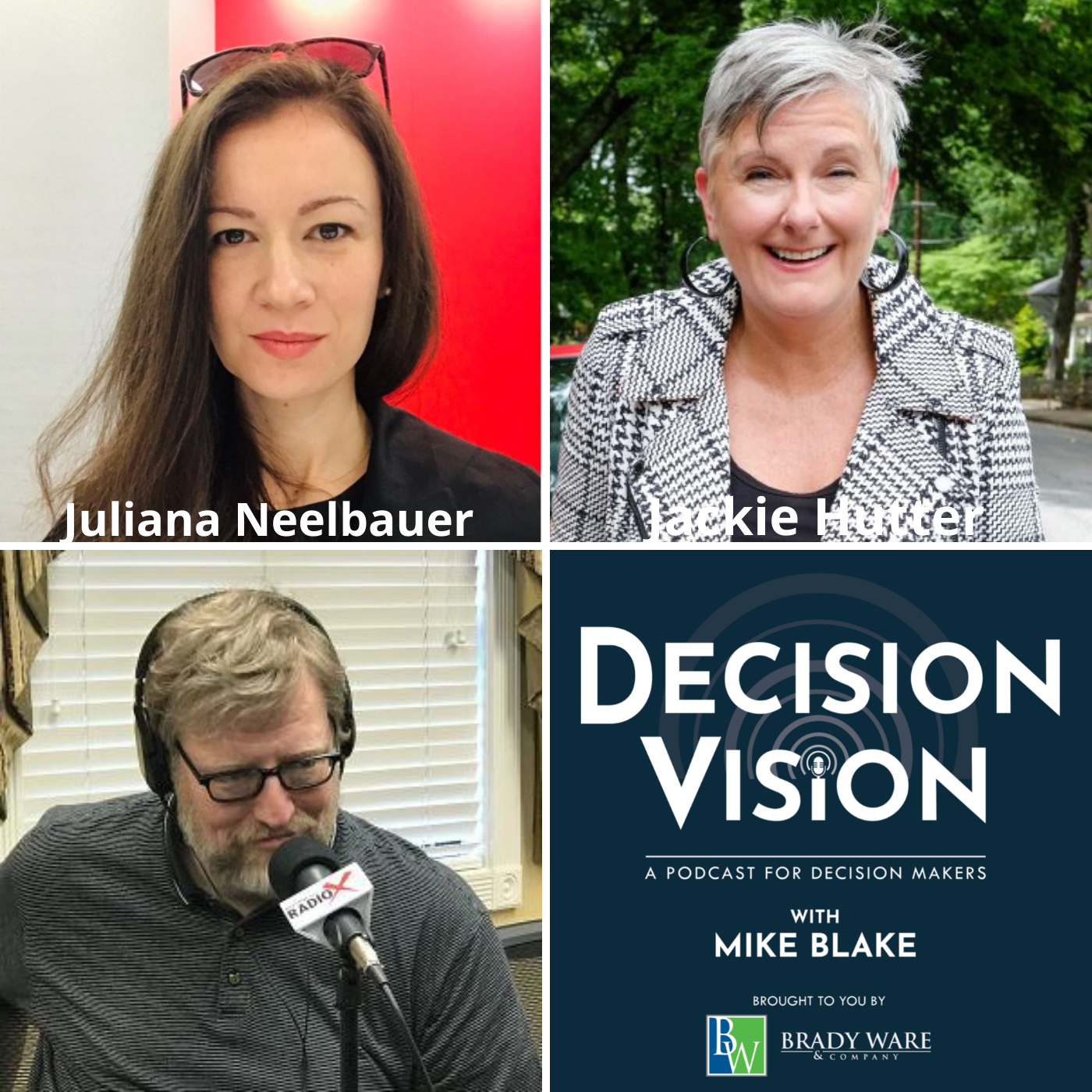
 

Tagged With: attorneys, Brady Ware & Company, business attorney, choosing an attorney, Decision Vision podcast, Drew Eckl & Farnham, Jackie Hutter, Juliana Neelbauer, Lawyers, Mike Blake, The Hutter Group

Dental Associate Contracts

October 22, 2021 by John Ray

DentalAssociateContractsDLREpisode22Album
Dental Law Radio
Dental Associate Contracts
Loading
00:00 /
RSS Feed
Share
Link
Embed

Download file

DentalAssociateContractsDLREpisode22Album

Dental Associate Contracts (Dental Law Radio, Episode 22)

What are some of the key provisions in effective dental associate contracts? What form of non-compete is permissible and defendable? If you’re fresh out of dental school or even a seasoned dentist working for a practice, what are some vital stipulations you should have in any contract to protect yourself in case you leave that practice? Stuart Oberman answers these questions and much more in this episode. Dental Law Radio is underwritten and presented by Oberman Law Firm and produced by the North Fulton studio of Business RadioX®.


TRANSCRIPT

Intro: [00:00:02] Broadcasting from the Business RadioX Studios in Atlanta, it’s time for Dental Law Radio. Dental Law Radio is brought to you by Oberman Law Firm, a leading dental-centric law firm serving dental clients on a local, regional, and national basis. Now, here’s your host, Stuart Oberman.

Stuart Oberman: [00:00:25] Hello everyone and welcome to Dental Law Radio. We’re going to talk about something so near and dear to our hearts if you own a dental practice or if you are a general dentist working for a practice, dental associate contracts. I think what we’re going to discuss today can really apply whether you are a student in dental school – which I personally have the great honor of speaking at, and it’s amazing what the process is in dental school to get to that finish line – and whether you’re a small practice, large practice, whether you’re scaling, whether you have ten practices, 20 practices, one practice. Conceptually, it’s going to be all the same.

Stuart Oberman: [00:01:12] There’s a couple of points that, really, we could spend a whole day on this, but we only have a little bit of time. So, I’m going to touch on some highlights, especially some new regulatory matters regarding independent contractor status. So, the first thing we want to take a look at, you know, when you’re coming into a practice, what is your status, you’re hiring or you’re going into a practice as an employee or even a contractor, or you an associate dentist. One thing you got to consider is the Internal Revenue Service. Are you an independent contractor or are you an employee?

Stuart Oberman: [00:01:44] Now, I believe on some previous podcast, we talked about some regulatory matters regarding independent contractors and how everyone, State and Federal, is cracking down on that. So, again, it’s a key because, if you’re coming in as an employee, your contract will be totally different than if you’re an associate – I mean – excuse me – if you are independent contractor. We’re getting into tax issues. We’re getting into 1099 issues. So, I think we need to take a strong look at data as to what the relationship is. We see contracts that are actually geared towards independent contractor, but yet the wording is all of the contracts as employee, which is a disaster if you are a practice owner.

Stuart Oberman: [00:02:25] So, now, I think, number two – we want to look at a couple of things. Again, I could talk probably an hour on each topic here, but we want to drill this down to very specifics. So, you’ve got to look at your schedule locations. What are the number of days are you going to work? What dental office are you going to work at? If you work for a large group or if you own some practices, where are your associates going to work at? And then, what’s the work schedule? Is it weekdays, weekends, emergency calls? Who’s going to handle, you know, after hours? Who’s going to work on Fridays? Where are those Saturday and Sunday appointments coming in?

Stuart Oberman: [00:03:01] I think all these things are critical because if it’s not explained fully what the expectation is, as far as date, time, and locations, then you run into some issues regarding non-competes.

Stuart Oberman: [00:03:16] Now, we’re going to get into the benefit issues a little bit as to malpractice insurance. One, are you covered under your employer’s coverage? Two, if you are an independent contractor, do you have your own coverage? And then, if you have your own coverage, is it going to cover the practice that you are working in? So, I would never touch a patient with less than a million dollars in coverage. Never.

Stuart Oberman: [00:03:43] What are your deductibles? One thing that comes into play is that, on the risk management side, we will have to put out patient fires. And the first thing I’ll ask our doctors is, what is your deductible? So, if you turn in a malpractice claim – which is a whole another topic – and your deductible is 5,000 but you can resolve a case for 3,000, get it resolved. Do not turn in a malpractice claim. And if you do get it resolved – for goodness sakes – get a release signed before you issue a check.

Stuart Oberman: [00:04:22] So, now, we will look at item number four, duties of an owner and associate, what are their responsibilities? It should be specifically lined out what your responsibility is, what the owner’s responsibility is, staff, billing, collections. Let me say this as far as billing goes, I don’t care whether you work for yourself, own a practice, or you work for a group, or you work for a doctor that owns one practice, you are responsible for your own billing. If billing is fraudulent, if billing is incorrect, if billing is grossly overstated, you have bought that problem. You cannot delegate that problem to a staff member that you work with.

Stuart Oberman: [00:05:08] Next, number five, I would say, would be compensation, which is all over the map. If you’re going to work for a group, you’re going to be around 30, 31 percent. If you’re going to work for an owner, depending on what it is, relationship, you’re going to be around 35 to 40 percent collections. There’s a growing trend to do away with production. We haven’t seen that number in a while.

Stuart Oberman: [00:05:33] Are you working at a flat fee? Do you have a basis? Do you have an upside? Are you looking at 35 percent or the greater of that base pay? So, on a reconciliation, we run into a lot of problems on the associates side, where the doctors who own the practice or group are not reconciling on a monthly basis. If your last days at the end of the month, that should be reconciled, probably within five days, I would say. Sometimes, it’s going 30, 60 days on a reconciliation and that is never good because you don’t know where your numbers are at. So, again, compensation is a huge issue. That’s a whole another day topic.

Stuart Oberman: [00:06:18] But going up to number six, these are items that we see a lot that are excluded. And these are essentially what are the business related expenses. Who’s paying for your license fees? Who’s paying for your associate memberships? Automobile expenses? Are you a 1099? Are you an employee? What’s the entertainment? You’re going to be expected to bring in business.

Stuart Oberman: [00:06:46] Even on the dental side, marketing never stops. I would say that entertainment can be, you know, events. It could be fundraisers, promotional expenses, continuing education. I will tell you that a simple seminar for a general practitioner is a lot different than it is for an oral surgeon who’s doing implants. I think you need to have a defined number as to who is going to pay for the expenses and for how much. Malpractice insurance, are you going to pay that? Health insurance, who is going to be responsible for that? Disability and life insurance?

Stuart Oberman: [00:07:30] These are all basic things that should be absolutely listed in your expense portion of your contract. Again, the more you put in your contract, the less speculation, and the less you will have to call me down the road.

Stuart Oberman: [00:07:48] Charts, a question we get was, “Well, you know, I was with Dr. Smith for ten years and I have an established patient base. I look forward to taking those with me when I leave.” You’re absolutely wrong. Your patients do not go with you when you leave. Your patients will stay with the practice. That is a practice ownership.

Stuart Oberman: [00:08:07] Now, the question is, what do you advertise when you leave? How much do you advertise when you leave? Are you able to advertise when you leave? And if so, does that affect your non-compete? Those are all valid questions. It depends on your agreement.

Stuart Oberman: [00:08:20] We’re going to jump into another section, but one area you want to make sure you have access to is, if a malpractice claim is filed or a board complaint is filed when you leave that practice, you must have stipulated in your contract that you have access to those records to defend the lawsuit and to defend the board complaint. Rule of thumb is you take no charts with you, take no information with you. You take nothing with you except your instruments.

Stuart Oberman: [00:08:53] Number eight, noncompete. I get this question all the time, is my noncompete enforceable as a general rule? Yes. General rule, yes. Now, there are some states where that is not true. You’ve got to look at your specifics on each state. So, the question is, well, what’s fair and reasonable? It’s got to be geographically non- restrictive. It’s got to be fair, reasonable. I will tell you there’s some locations where a 60 mile noncompete is extremely reasonable, where a five mile noncompete is not.

Stuart Oberman: [00:09:31] I know on our contracts that we draft as a firm, we try to push the limit, honestly. I want a noncompete this 10 or 15 miles from my doctor, my owners. Now, when I’m on the other side of the fence and I get an associate, I want a three to five mile radius. So then, you get a question of is it air miles or is it as the crow flies, as we say? Or is it by Google Maps? That is a huge difference because sometimes a practice that you’re looking to buy or you’re looking to move to is within two blocks of your restriction. So, you’ve got to specify, is it air miles as the crow flies or is it a Google Drive Maps. Critical.

Stuart Oberman: [00:10:17] So, again, you want to look at the specific time period. What’s your time period on the noncompete? What’s your geographic area? Is it fair and reasonable? Again, depending on your location, two years, ten miles, maybe unreasonable. Depending on the practice that you’re at, three years, 30 miles, 50 miles, 60 miles may very well be reasonable. We have some clients that, for a variety of reasons, their patient base is 60 miles. So, if they have associates come in, we’re going to draft a 60 mile noncompete radius. Critical, critical, critical.

Stuart Oberman: [00:10:52] Again, going forward, number nine, confidentiality and trade secrets. All information in a practice is deemed confidential. For those practice owners, I would urge you to have every employee that you employ, including all independent contractors, including staff members, including associates, including hygienists, everyone signs a nondisclosure agreement. Everyone signs a nondisclosure agreement.

Stuart Oberman: [00:11:27] Trade secrets, I will tell you the first thing that will leave will be your patient base data. That is all ownership interest in the practice. That information belongs to the practice owner. Work for hire. That’s a whole different world as far as trade secrets go.

Stuart Oberman: [00:11:50] So, let’s take a look at retreatment, number ten. There are some dentists that are better than others. There are some that are a disaster. If you hire a disaster, what are you going to do when that doctor leaves and you have retreatment, redo, after retreatment, after redo for years to follow? Who is responsible for that? For the most part, you’re going to take care of that patient and you’re going to absorb that cost. But that can be thousands and thousands and thousands of dollars later. This is one of the reasons in our Asset Purchase Agreements on the buyer side, we put down the owners responsible for what they do prior to the sale.

Stuart Oberman: [00:12:43] So, let’s take a look at number 11 – and we get this question a lot – associates right to buy in. It’s amazing to me that when we talk to our dental students that are getting their first job, they have not even discussed this matter with the owner. They’ve not even met the team members, the staff members, they have absolutely no idea what the culture is in that practice and they already want to be an owner. They already want to be a buy in partner within a year.

Stuart Oberman: [00:13:19] My strong recommendation is that there is absolutely no discussion whatsoever upfront regarding a buy in. Unless that is a relationship that you’ve known that doctor for years, you have filled in every now and then. But there is nothing worse that will kill a good rollover relationship before you even step one foot into the practice or before you have one hand in someone’s mouth is ownership. If it is a good fit, it will take its course naturally. A lot of our associates are misled, “Well, you know, we’ll have you buy in for a couple of years.” That never happens, unfortunately.

Stuart Oberman: [00:14:06] So, I think you’ve got to gauge the relationship. Now, there’s nothing wrong in there of putting in a contract that you have the first right refusal should the doctor sell the practice. But I think is it a gross mistake to get in there and say, “I want in my contract valuations, buy in options. I want to know what your EBITDA is. I want to know what your numbers are. And I want to buy it within a year and here is the price.” I would throw that out the window and not worry about that.

Stuart Oberman: [00:14:35] So, you know, again, this is a very, very short segment on associate contracts. There are times, you know, we could speak on this for hours at a time. But I think if you look at what we’ve discussed in, you know, these 11 topics, I feel certain that you will take a look at your contract.

Stuart Oberman: [00:14:53] And let me say this about a contract, so do not get contracts off the internet. Do not use what your buddy did. Do not use what your brother-in-law did with his associates. It is ever evolving. Employment laws change. Circumstances change. An interesting part on our side, as a firm, we had dental clients probably in about 30 states or so. And we happen to see different trends, different things coming east, coming west, going north, going south. So, things change, wording changes, relationships change, laws change.

Stuart Oberman: [00:15:32] So, we see contracts that are used over and over and over for five to ten years. And those are absolutely a recipe for disaster, as I often say. So, do not go on the internet, do not download one, do not cut and paste one, because it is so different for each practice.

Stuart Oberman: [00:15:53] That is going to conclude our segment on dental associate contracts. And if you have any questions, any concerns, please feel free to give us a call, 770-886-2400, Oberman Law Firm. And if you want to email me, please feel free to email me, stuart, S-T-U-A-R-T, @obermanlaw.com. Thank you for joining our segment. And we’ll have much more to follow in future podcasts. Have a great day.


About Dental Law Radio

Hosted by Stuart Oberman, a nationally recognized authority in dental law, Dental Law Radio covers legal, business, and other operating issues and topics of vital concern to dentists and dental practice owners. The show is produced by the North Fulton studio of Business RadioX® and can be found on all the major podcast apps. The complete show archive is here.

Stuart Oberman, Oberman Law Firm

Oberman Law Firm
Stuart Oberman, host of “Dental Law Radio”

Stuart Oberman is the founder and President of Oberman Law Firm. Mr. Oberman graduated from Urbana University and received his law degree from John Marshall Law School. Mr. Oberman has been practicing law for over 25 years, and before going into private practice, Mr. Oberman was in-house counsel for a Fortune 500 Company. Mr. Oberman is widely regarded as the go-to attorney in the area of Dental Law, which includes DSO formation, corporate business structures, mergers and acquisitions, regulatory compliance, advertising regulations, HIPAA, Compliance, and employment law regulations that affect dental practices.

In addition, Mr. Oberman’s expertise in the health care industry includes advising clients in the complex regulatory landscape as it relates to telehealth and telemedicine, including compliance of corporate structures, third-party reimbursement, contract negotiations, technology, health care fraud and abuse law (Anti-Kickback Statute and the State Law), professional liability risk management, federal and state regulations.

As the long-term care industry evolves, Mr. Oberman has the knowledge and experience to guide clients in the long-term care sector with respect to corporate and regulatory matters, assisted living facilities, continuing care retirement communities (CCRCs). In addition, Mr. Oberman’s practice also focuses on health care facility acquisitions and other changes of ownership, as well as related licensure and Medicare/Medicaid certification matters, CCRC registrations, long-term care/skilled nursing facility management, operating agreements, assisted living licensure matters, and health care joint ventures.

In addition to his expertise in the health care industry, Mr. Oberman has a nationwide practice that focuses on all facets of contractual disputes, including corporate governance, fiduciary duty, trade secrets, unfair competition, covenants not to compete, trademark and copyright infringement, fraud, and deceptive trade practices, and other business-related matters. Mr. Oberman also represents clients throughout the United States in a wide range of practice areas, including mergers & acquisitions, partnership agreements, commercial real estate, entity formation, employment law, commercial leasing, intellectual property, and HIPAA/OSHA compliance.

Mr. Oberman is a national lecturer and has published articles in the U.S. and Canada.

LinkedIn

Oberman Law Firm

Oberman Law Firm has a long history of civic service, noted national, regional, and local clients, and stands among the Southeast’s eminent and fast-growing full-service law firms. Oberman Law Firm’s areas of practice include Business Planning, Commercial & Technology Transactions, Corporate, Employment & Labor, Estate Planning, Health Care, Intellectual Property, Litigation, Privacy & Data Security, and Real Estate.

By meeting their client’s goals and becoming a trusted partner and advocate for our clients, their attorneys are recognized as legal go-getters who provide value-added service. Their attorneys understand that in a rapidly changing legal market, clients have new expectations, constantly evolving choices, and operate in an environment of heightened reputational and commercial risk.

Oberman Law Firm’s strength is its ability to solve complex legal problems by collaborating across borders and practice areas.

Connect with Oberman Law Firm:

Company website | LinkedIn | Twitter

Tagged With: Dental Associate Contracts, Dental Law Radio, non-compete agreement, Oberman Law Firm, Stuart Oberman

Kendrick Jones from Summit Funding Advisors and Tamara Lewis from Pink Pearl Hero

October 20, 2021 by Kelly Payton

Cherokee Business Radio
Kendrick Jones from Summit Funding Advisors and Tamara Lewis from Pink Pearl Hero
Loading
00:00 /
RSS Feed
Share
Link
Embed

Download file

This Episode was brought to you by

The Innovation SpotAlma Coffee


Kendrick JonesKendrick Jones, Mortgage Lender with Summit Funding Advisors

Kendrick has lived in Cobb county her whole life (currently barely live in Cobb – just across the county line!), and she’s always loved Cherokee County and Woodstock. Kendrick had originally planned to teach economics as a career, but in graduate school realized she wanted to be face to face helping people’s personal economics! She has now been in the mortgage industry since 2017, and takes her love for learning and teaching to smoothly transition her clients through the loan process, with as much guidance as they seek.

Summit Funding AdvisorsConnect with Kendrick on LinkedIn and Facebook


Tammy LewisTamara Lewis, VP of Pink Pearl Hero

Tamara (Tammy) Lewis, MPH Regional Vice President, Primerica Pink Pearl Hero, Non Profit Founder, CEO of 1DopePlanner Tammy (Brown) Lewis, hails from the mighty “ Show Me State” of St. Louis, MO! This wife and a mother of two beautiful girls, visions herself as a “Servant Leader” to her community in any work-capacity that she has been in.

Tammy started her career as a Health Educator, carrying on various roles in the community sector, research and development, as well as the corporate setting, in pharmaceuticals. Her pharmaceutical roles have varied from Sales Representative, Regional Field Trainer and District Business Manager. She has a total of twelve (12) years experience in pharmaceuticals from Pfizer Pharmaceuticals and Novo Nordisk combined.  In the most recent years, Tammy took a 360 career change from corporate America and jumped into the world of finance and entrepreneurship as a Regional Vice President, in Primerica. Her focus is to help people get on “The Right Side of Wealth” and put a financial game plan in place to help people succeed at the money game.

A life changing diagnosis of breast cancer, has birthed two new passions. She is the the Founder of Pink Pearl Hero Non Profit that focuses on Self Awareness Self Love, and Self Care for all women while advocating for breast cancer awareness and women’s empowerment. Due to limitations during her breast cancer journey she create a digital planner, 1dopeplanner that integrates digital and paper planning in one platform that allows people to be more productive. With a continuous focus on community service, she is also a member of Delta Sigma Theta Sorority, Inc. and Girl Scouts of America.

Pink Pearl HeroConnect with Tammy on LinkedIn and Facebook


This transcript is machine transcribed by Sonix


TRANSCRIPT

Speaker1: [00:00:07] Broadcasting live from the Business RadioX Studios in Woodstock, Georgia. It’s time for Cherokee Business Radio. Now here’s your host.

Speaker2: [00:00:23] Welcome to Cherokee Business RadioX Stone Payton here with you this morning, and today’s episode is brought to you, in part by Alma Coffey, sustainably grown, veteran owned and direct trade, which of course means from seed to cup, there are no middlemen. Please go check them out at my alma coffee and go visit their Roastery Cafe at thirty four point forty eight Holly Springs Parkway in Canton. As for Harry or the brains of the outfit Letitia and tell them that Stone sent you. You guys are in for a real treat this morning. First up on Cherokee Business Radio, please join me in welcoming to the broadcast with Pink Pearl hero. Miss Tami Lewis, good morning.

Speaker3: [00:01:09] Good morning. How are

Speaker2: [00:01:11] You? I am doing well, so delighted that we’re finally getting a chance to do this show. You and I at one networking event, fundraising something or another will point at each other very quickly and we’ve got to get together. We’ve got to do that thing right, right? And now we’re finally getting a chance to to do it. Pink Pearl Hero Mission Purpose. Tell us a little bit about this organization.

Speaker3: [00:01:35] Yeah, so this was actually placed. So it’s I always call it Pink Pearl Heroes, part of my Jonah moment. It was not in my vision at all. It was something that just kind of happened. But so little history about it, how it really started. So in July of 2018, I actually was preparing for my first 5K. Well, it actually was a 10k. I thought it was a 5K. I found out 30 days before. Oh, it’s a 10k. So the peach tree here. So the whole time I thought it was a 5K and I was training for this race and I would go back and forth from St. Louis to Atlanta because I was working and one day I was running in my pearls and this kind of had the pearl started. And this couple, this older couple stopped me in mid run and said, Are you running in your pearls? I’m like, Yeah. And they were like, That’s really classy. I’m like, That’s me. And so the kind of like that’s where the pro came from. But then 30 days later, I get diagnosed with breast cancer, so I was at my healthiest of my life, ran a 10k that I thought was a 5K, and 30 days later, I get diagnosed with breast cancer and my whole life changed. And during that process, I was going back and forth. I mean, so we went from, you know, the mammogram. We went from the ultrasounds to the biopsies to the like, the MRIs. And we, you know, finally found out that it was on my left breast and I had to get a mastectomy.

Speaker3: [00:03:02] So as I was going back and forth, I would stay up late at night because of the type of surgery I had. I had a what’s called a. I had the double mastectomy and I had a lattice CMOs Dorsey with reconstruction surgery. So I had a genius plastic surgeon. But the surgery, you know, I wanted to know more about it. So just like everybody else in the U.S., what do we do? We go Google it. So I went to Google to see what the surgery was going to look like, what it was going to be about and when I would go on Google and I would see women, but I never saw women who look like me. And I was like, well, you know, if if breast cancer really affects women of color, mainly black women, like we have higher death rates than other women, I did not know that. Yeah, we have higher death rates and other women, and a lot of it is because we’re finding out later and there’s more aggressive types. But because I didn’t see me, I’m like, Somebody needs to start talking about it. And you know, there’s, you know, some celebrities, they were talking about it, but I never saw the common woman. And I hate to say common cause I don’t consider myself common, but you know what I’m saying? And so I was like, You know what? Somebody needs to talk about it, and I had a moment. It was like at three o’clock in the moment, this is in the morning.

Speaker3: [00:04:14] This is where I get all my great ideas. I get 3:00 in the morning, of course, and I was like, You used to be a health educator. So I used to be a health educator. And my first project as a health educator was the breast cancer and cervical project in St. Louis. And I’m like, Why are you waiting on someone? This is your background. Why don’t you do it? And so I was like, But I struggle like, what am I going to do, what I’m going to talk about and I’m going to start this organization? What’s the name going to be? Yeah, we’ll put pink in it. And then, of course, that’s where the Pearl came in. And then the hero came in. Because the National Institutes of Health actually had a study about the hero syndrome for women about how we take care of everyone else, and then they looked at it by race. But women as a whole because we take care of everybody else. I mean, that’s just we’re just nurturers by nature. But we always put ourselves last. And when I found out about my breast cancer, this was my second time rescheduling my, well, woman exam because I got busy and I had something else to do. So I was like, Oh, I’ll just reschedule it. So, I mean, it was all divine timing. It happened when it was supposed to happen, but that visit was supposed to happen like months, you know, before that. So. And that’s how that’s how it started. It started right from there.

Speaker2: [00:05:29] So talk about the screening, how important is screening and is that a yearly thing twice a year?

Speaker3: [00:05:37] So, you know, women in general should do their monthly breast self-exams and there’s, you know, great resources. You know, now that we have more technology, you know, women can go online and see videos of how to, you know, actually do a proper breast self-exam. But I mean, you know, we need to start teaching our younger girls how to do it. You know, I actually did a a workshop for one of the Girl Scout troops and we were talking about breast cancer, and I asked him how many of them knew how to do a breast self-exam, and no one knew. I’m like, OK, so there’s problem number one. Yeah, we got to start earlier and then women over 40, that’s when we’re supposed to start to get our mammograms. So I got diagnosed when I was 44 and that was my first mammogram, so I was already four years behind. So, yeah, at 40, that’s when the mammograms are supposed to start happening.

Speaker2: [00:06:29] And if this kind of thing is identified early, the earlier we know the the better.

Speaker3: [00:06:35] Yes. So the type of breast cancer I had was ductal carcinoma, so I had ductal breast cancer and I was I’m just a little aggressive. I mean, people who know me know that I’m pretty aggressive. I was like, we were doing this guns blazing because I’m only doing this one time. But the earlier that you can find out, the higher you know your your mortality rates are so right. So I mean, early detection is always key. It’s always key.

Speaker2: [00:07:02] Now are there aspects to, I don’t know, lifestyle diet that can impact this? Or do we know yet?

Speaker3: [00:07:09] So so I actually did get genetic testing done because I have two daughters, and so I wanted to make sure I didn’t have the BRCA gene. So that’s the gene that’s a carrier for our marker, for breast cancer. And if I did, then we knew how to take care of them so they can be a little bit more aggressive. And all my genetic testing came back negative for all cancers, which like, would they test me for everything? So which led me to know that it is environmental, that it had to be something that I ingested? Put it on me. I mean, I’m learning some things that are going on in the in St. Louis. It’s called Cold Water Creek. You can kind of look it up that there’s a higher rate in the county I lived in actually has the second highest rate of cancer and actually breast cancer in the U.S. and I’ve lived there twice. Like in high school and then again when my husband and I built a home there. So. And it was during the exposure period. So now I’m trying to figure out, hmm, I wonder. But I mean, that’s just one isolated incidents. But I mean, a lot of it is, you know, lifestyle and environment as well.

Speaker2: [00:08:21] So Pink Pearl Hero, is this an organization? Is this a group of do you have like Margarita Mondays? You get together and raise money with drinks?

Speaker3: [00:08:29] We actually did have a pink drink for one of mine.

Speaker2: [00:08:32] It’s fantastic.

Speaker3: [00:08:33] So we I’m really just now coming out and. Putting the plan together to get some things done, because I just got done in December, like with all my surgeries and procedures. Oh wow. So I had in total five surgeries and did 28 radiation treatments once it was all said and done. And so now I’m like getting back up to speed where I’m like, OK, so now we got to, you know, put some action to, you know, what we said we’re going to do. So right now, it’s our it’s our nonprofit. And I was I knew I wanted to give back my story as part of that just to, you know, you know, talk to women about, Hey, so you look perfectly healthy, but you never know what’s going on, you know, deep down. And one of the things that we decided to do, I went back and I said, what were some of the things that made me happy during the process? And I had a couple of girlfriends that would send me like a box, just a box of stuff, funny stuff, gift cards, self-care, things. And I was like, Well, what if we do a hero box? And in the hero box, because I’m big on women’s empowerment, that the like big ticket item comes from a woman’s own business. And so that way I can still support women. I can support breast cancer. And so throughout this the pandemic, I’ve been meeting with women who have their own businesses, and in my mind, I’m like, So how can I help her and how can she help me help breast cancer survivors at the same time? So I’ve met some phenomenal women, got some great ideas of items and content to put inside the hero box, and it checks off the box of all the things that I want to do.

Speaker2: [00:10:14] I wish you’d have been in the studio last week or actually, we have another episode this afternoon at the women in business, and so they’re always in here talking about their business side. But some of these folks, I think you already know, but that would be it might be fun to have you plug into that sneak back in

Speaker3: [00:10:29] If you let me.

Speaker2: [00:10:30] So speaking of business and work, what kind of impact and how do you integrate the the two?

Speaker3: [00:10:39] So so again, my background is actually health care. And I was in the health care industry and I was in the pharmaceutical industry as well for about 14 years. And so I just I mean, like I read research different. I look at, you know, like chlorophyl, like how does chlorophyl help? So bringing all those things to the table? But then when it comes to the the business aspect, my personal story is what I use because I’m a broker partnering with my husband in financial services. And I mean, I did a total 360. I always tell people I went from selling legal drugs to selling money. That’s me legal, legal. Anyway, so.

Speaker2: [00:11:21] So what kind of what kind of broker?

Speaker3: [00:11:22] What what’s the work? So so I’m in a broker and financial services, so I do investments, life insurance, those types of things. And I help people, you know, build their own businesses. So I have a team of agents as well. But my personal story is where I kind of wrap all that in because when I did get diagnosed and you know, a lot of people don’t want to think about death, but I actually did. I had to think about it because I had, you know, we have children and, you know, I told my husband, I said, Look, if anything happens to me, you guys are financially OK. I know we don’t want to have that conversation, but we’re financially OK. And you know, my thing is, if you’re fighting and you’re especially if you have children or someone you want to build a legacy for, why would your death like, stop that and people don’t want to have those tough conversations. But I knew I already had those things in place, and I talked to women all the time. I’m like, If my story doesn’t impact you enough to say I ran a 10k and 30 days later I got diagnosed with breast cancer and we we had no idea how severe it was at that point. But then, you know, the other thing is the type of life insurance that I have that it has, like a terminal illness benefit in it. So I had access to money. So then the other part of my brain is, well, if it’s more terminal, you got access to money and you can go find the cure. So if it’s in Sweden, if it’s in Mexico, you have access to money to go find the cure.

Speaker3: [00:12:43] So mindset wise, I mean, I’ve talked to some other, you know, breast cancer survivors, and the financial part is the biggest part of that. It’s the biggest part because it’s like, how am I going to pay the bills? How am I going to keep money coming in? How am I going to, you know, still be able to have health care, those things? And that was never the finance part was never an issue. And the business that we have, we have a business that has passive income. So I did not have to work. I just like chose to work and it worked when I wanted to, you know, going through radiation the first week, I was like, Oh, this is a piece of cake. The second week I was like, Oh, this is different, you know? And by the third and fourth going into the fifth week, you know, your your body starts to change. And what I found out is radiation is the equivalence. And this is what the nurse was telling me. It’s like if you were outside on the beach and you just laid out there for twenty four hours with no sons. That’s what a dose of radiation is. And I call it the Benjamin Button effect, too, because I was just like, I look a lot younger now than I did. I don’t recommend that for people to do that, but I think a lot of that’s just mindset. And then just, you know, the the love of of life and just loving life right now. So but having those things in place because one in eight women will get breast cancer in their lifetime.

Speaker2: [00:14:04] Wow. So part of your work all along was somewhat dedicated to bringing peace of mind to to professionals and families, but even more so now. Yes. And a dimension to it. So how can I don’t know what the right term is, layperson? How can you know the middle aged guy, right? Be supportive of the people who are going through this or in general, just knowing that it is a that it is something that needs that people need help with. And when you find out, you know, cousin Lacey or your sister in law has breast cancer, what is the best set of responses to something like that?

Speaker3: [00:14:45] So ironically, and I’m a true believer in you have not because you ask not. And one day I was like, You know what? I really need a guy that I can talk to who understands breast cancer. And that’s where one of my board members. His name is Latrell. His mother actually died from stage four breast cancer, and then two months later, he gets diagnosed with Hodgkin’s lymphoma. So he had to go through chemo. So he, like, really understands cancer. And so he’s one of he’s the only male that’s on my on my board, not by design, but I did, you know, want him on the board to get a male perspective on how do you support a woman who does have breast cancer? And it’s, you know, I think most people think, Oh, yeah, your wife know it could be your mom, it could be your sister, your cousin, a coworker, a friend. And how do you do that? You know, I think some of that and those are the conversations that he and I did a like a zoom during when we were all like on lockdown lockdown and we just had conversations. And he and I need to do that again. I actually need to call them because a lot of people, men and women like tuned in and asked questions like, How do you how do you support a woman? I think, you know, a lot of it is is really understanding that she’s going to have highs and lows and that she’s not going crazy.

Speaker3: [00:16:07] She’s just having highs and lows because like every day, anytime you have a new surgery, it’s like a different you and you got to get used to the different you, especially if you’re going through like reconstruction. I mean, breast cancer is a little different because for a woman, that’s her femininity, and now she she’s a different woman. And if she has reconstructive surgery, she’s a different woman. Every surgery. And it’s that. And then also just if you know, you know, if you know a woman, I mean, especially a woman who’s important in your life, I mean, just ask her, look, you know, not too much information or TMI, but did you do your breast self-exam this month? I’m going to take you out to dinner, I don’t know. But but having those conversations because, you know, I tell people, I said, the one thing that there is no vaccine for right now is breast cancer, right? And it is real and the rates. I haven’t seen the most recent data, but the rates are going up of. Undiagnosed accounts, because a lot of women aren’t going to get their mammograms because they’re not going into the clinics or the health centers or the hospitals because of where we are right now. Oh man, yeah,

Speaker2: [00:17:21] I hadn’t thought about that. So there’s this, there’s the education component. And then there is we’re also trying to fund new research so that we can find some mitigating a cure that that kind of thing. And so have you got some? I know it’s a year round thing for you. Yeah, I find that we one of the things that I love about being able to do something like this is we can talk to folks who lead causes. In my experience has been, you know, for them, the cause is a year round thing, right? But there’s a lot of attention around it here in this culture in October. So there’s some there’s some stuff happening this month, next month, I would think that we ought to pay some special attention to foods or some upcoming.

Speaker3: [00:18:08] So I actually did a walk last Saturday, so it was kind of like a kind of impromptu walk, but I was like, I got to start somewhere. And I had a great group of people that were there who supported. I’m going to do like a mini walk. Actually, I’ll take that back. I did a the sister strut in St. Louis because St. Louis is where I’m from. I always go back there and I did a they did a parade this year because of COVID, but normally they do like a walk and a 5k. So a 5K is on my radar because you know of the running and running actually was my therapy during the whole process. Like my doctors would say, can you please like hold off, maybe for another week before you start? Because that was always my question when can I go back and run? When can I go run? When can I get on the trails? Because I knew if I was on the trail, that means I was progressing. And then it also helped, like with the with the mentors. So for us, the things that are in the horizon are a 5K.

Speaker3: [00:19:06] So we got to look, look at that. Also, a golf tournament has come up and, you know, working with different women in business and just different business partners and not just women. But there’s also some men with businesses that want to support our cause as well. So we’ve been looking at doing like silent fundraisers. And so we want to do something every month, not just in October, because everybody doesn’t rush to get mammograms in October like they’re on sale or something. But that’s that’s one of the definitely things that we want to do is to do something every month and to get these hero boxes out. So the hero box. My thought process has been that I want to make sure that a survivor is getting what I what we, you know, raise funds for. And so I’ve strategically targeted actually for hospitals that have cancer centers to work with the nurse navigators because I loved my nurse navigator here at Kenneth St. and we still like I still see her at the grocery store as kind of fun.

Speaker2: [00:20:10] What’s I’m forgive me, nurse navigator to say a little something about that.

Speaker3: [00:20:14] So a nurse navigator, which I never knew was in existence until I had breast cancer, is literally a nurse who navigates you through the process. And she and I, Lisa and I still talk to this day and like, I’ll call her, email her and say, Hey, I need this, or or can I come into the office and you know, and talk to you, and what do you think about this? But she helped me through the whole process, like she was one of the people that I saw after my surgery. And I was like, How did I mean? I guess she remembered, You know, she has my chart. Of course, I was like, How did you remember my surgery yesterday? But they navigate you through the process.

Speaker2: [00:20:48] Talk about a hero.

Speaker3: [00:20:49] Yeah. Yeah. And so we want to do something special for them to you because that I mean, just I mean, just imagine, you know, I mean, women, you know, kind of when we’re PMC, we’re always like this. Just imagine adding, you know, a new issue or a new part of your life with breast cancer and then having to work with multiple different women all the time, every day. Yeah. So we want to do something special for them, but we want to make sure that they physically have the boxes so they can give the boxes out to the women that are going through their process.

Speaker2: [00:21:24] So what do you need more of now? You need you need people involved. You need money, you need ideas. What? What do you need the most right now?

Speaker3: [00:21:32] So we need all the above, OK? People also ideas, you know? So you know, when I especially like when I’m talking with people, I’m always thinking, how can I incorporate their business into the box like I was talking to Chelsea? So Chelsea was on last week.

Speaker2: [00:21:49] For those of you who have not heard last week’s women in business, Lori Kennedy with Alpha Omega Automotive hosts that show. Last week we had Chelsea winners. We had her sister in law, Jessica. Yeah, and we had Ramona long and all man, it was fantastic. Lori does such a great job hosting that show, but part of. Our secret sauce is she has great guests. Right, right. You knew what you were talking about, Chelsea.

Speaker3: [00:22:11] So yeah, so Chelsea and I were talking and Chelsea had a friend who lost her battle from breast cancer. So she was one who walked with us and she brought her family. And it was so exciting. And we were talking about, you know, like, I don’t know how we got on the subject of gutter cleaning or roofing. And I’m like, Well, those things. I mean, they still have to happen regardless of breast cancer is here or not. So maybe we can figure something out. You just you mean you just never know. So I’m always trying to put the puzzle pieces together to make it fit.

Speaker2: [00:22:40] So people in general, and I would say in my experience, particularly entrepreneurs, people have built their own businesses. They we, I think, seek out how can we help folks? And so and it’s not always about, you know, how can I get, you know, the big red X out there some more. That’s not what it’s about. I mean, we really. And I guarantee you that Chelsea, winners of the world they genuinely want.

Speaker3: [00:23:03] She does. She really

Speaker2: [00:23:04] Does help. So there is a role and maybe people can even have a hand in crafting that role and supporting your efforts here. But I think I think the businesses in this community in particular will want to rally around the work that you’re doing. What was it like setting up a nonprofit was that is that a bear? Is that or you had to have a navy? Is there a nonprofit set up navigator somewhere? So there

Speaker3: [00:23:32] Is. So I actually have and, you know, so all of this. It happened so seamlessly, and that’s how I knew it was divine. Yeah, because so I have a girlfriend named Nicole, who her business is non-profits. That is her business,

Speaker2: [00:23:49] But she’ll help you set one

Speaker3: [00:23:50] Up, set it up. She did all of it, and I met her like a maybe like a week or two before I had my surgery because I was like, Yep, this is what I want to do. And a week before the surgery, I know for sure I was like, This is what I want to do. I want to set up the nonprofit. This is what it’s going to be. How much is it going to cost and can we get it done? And we did all the paperwork right before I had my surgery because I just wanted to lock that in place and that was in 2018. So there is a nonprofit navigator.

Speaker2: [00:24:19] Now that’s good to know.

Speaker3: [00:24:20] Right? And she set the whole thing up. So but that’s her business. That is that is her business.

Speaker2: [00:24:25] So what’s next for you? First of all, I will tell you what I think needs to be next. I want you to come back on another show and I want to learn more about your business life. But with respect to this work and in this world, what’s what’s next for you? Where are you going to be putting your energy over the next few months, you think?

Speaker3: [00:24:44] So right now, the energy is all in our business. So because we’re still expanding, OK? And as well as incorporating and getting these boxes out, that’s my hero boxes. And so the other part of the the hero box vision is especially now because of the world we live in and people know survivors or know people going through breast cancer. It’s like, how can I still touch them and let them know I’m caring, I care about them. So we’re actually looking at how do we turn this into a subscription? So if you have somebody who’s in California who’s going through breast cancer, you just want to send them something like, how do you send them a subscription box every month just to let them know that you’re thinking about them? So we’re trying to figure that part out. But as of right now, I just have my for like my four cities I’m working with. But if there’s another city, if there’s somebody else who says, Hey, I work at a hospital that has a breast cancer center and we would love to, you know, talk to you about these hero boxes. I’m always open to have that conversation.

Speaker2: [00:25:47] All right. So let’s make sure that we make that as easy as possible. If our listeners would like to have a conversation with you or someone on your team about this. Let’s get some coordinates. What’s the best way for for them to connect with you?

Speaker3: [00:25:59] So we are on social media, so we’re on Facebook as well as Instagram at Pink Pearl Hero, such as at Pink Pearl Hero. Nothing else fancy just pink pearl hero. But we’re on Instagram and Facebook as well.

Speaker2: [00:26:12] Well, I think that’s the best marketing, right? Just simple, straightforward. Nothing complicated to reach out. Well, thank you for the work that you’re doing. Please keep up the good work. Thank you. We want to continue to follow your story, if and as appropriate, consider this platform at your disposal. If you want to come in and do a special episode, maybe highlighting some folks who have taken a real active role in these hero boxes. Or if you want to promote an upcoming event, just we see each other, a lot of that business. But just Hey Stone, I need some studio time and we’ll just we’ll just we’ll make it happen. Quite sincere about. Have you come in and and you and your husband both if you’re in business together, if you want to talk about your. That’d be great about your work, but thank you for what you’re doing. And let’s also put some thought into I don’t know what it would be, but I really like the idea of Business RadioX both Business RadioX Corporate and Cherokee Business Business Radio having some active role in this iRobot’s thing. So maybe we’ll get a chance to hear some more about it. Hey, how about hanging out with us while we visit with our next guest?

Speaker3: [00:27:18] I would love to you love.

Speaker2: [00:27:20] All right, y’all ready for the headliner? She’s been very patient. She’s been taking notes, she’s been nodding. She’s been smiling. Please join me in welcoming to the show with summit funding advisors. Miss Kendrick Jones. How are you?

Speaker4: [00:27:34] I’m good. Thanks so much for having me here. Yeah.

Speaker2: [00:27:36] So what you learn in that last segment?

Speaker4: [00:27:40] Some inspiration.

Speaker2: [00:27:42] Go get your mammogram early and often.

Speaker4: [00:27:45] Right, I know if I yeah, fortunately, I do like annual checkups, but Eric always gets on me on Are you doing the monthly?

Speaker2: [00:27:55] But no, it’s important work. And I mean, we can all be reminded of disciplines that we should be exercising, and I’m delighted that we’re trying to get the word out about it. It was really

Speaker4: [00:28:04] Great hearing about

Speaker2: [00:28:04] That. Yeah, and you’re right. She and her work are very inspiring. Summit funding advisors. You guys are loaning money to strangers, right? What do you do? Or is that another mortgage advisor that says that in our in our group? I don’t know. I always thought that was a funny, funny line.

Speaker4: [00:28:23] No, I mean, you know, by the time that we’re closing the loan, they’re definitely not a stranger, no

Speaker2: [00:28:28] Stranger than they are

Speaker4: [00:28:29] All in each other’s lives.

Speaker2: [00:28:31] So what’s what’s what’s the back story on that? How did you get in that line of work?

Speaker4: [00:28:36] So actually, I I really started my background is finance and economics, and I thought I wanted to be a professor. I thought I’d teach and I love education.

Speaker2: [00:28:48] But you like money better? No kidding.

Speaker4: [00:28:50] Go ahead. No, no. I like I like education. I went to Emory and started a PhD program there a few years ago and realized, You know what? This isn’t. It’s not exactly the type of education that I thought I was getting into. And I miss people. I want to be helping them with their own personal economics and working with the one on one, seeing them face to face. And so I was I was trying to figure out how I wanted to help people get their money lives on track. I was like, Do I do I need be CPA? Do I need to be a money coach? What do I need to do here? And a lot of my family is in real estate. My my in-laws, they actually own a real estate brokerage. My husband’s a realtor and my father in law told me one day while I was trying to figure all that out. What you need to do is be a mortgage lender. Like, yeah, that’s exactly what I need to do. Because I cared a lot about mortgage debt was one of the things I was interested in in economics overall. And, you know, so just helping people talking to them about their credit and helping them get into a home, I mean, it’s the biggest purchase they’re ever going to make. Right? And so, you know, they need someone that’s really going to guide them through that and educate them. That’s that’s kind of a. A way that I go about it is focusing on education and. You know, making it a smooth process, making it transparent so that they know what’s going on, they know why things are going on because, you know, a lot of people really aren’t walk through that in their home buying process. So so I go about it from an education perspective and also, you know, with all of my with my referral partners as well, the business partners that I work with, I care about offering them opportunities for education as well.

Speaker2: [00:30:44] So the term navigator came up a couple of times in the last in our last segment. And I think maybe we all need a navigator in just about every area of our of our lives. Talk about a big or at least my perception as a layperson, this big hairy monster of borrowing money to to not purchase. Well, I guess purchase are a huge asset. I mean, that’s scary to me. I don’t think I’m the only one that that it scares. So you’re working with the individual, but I want to hear more about you mentioned the term referral partners. So these are other professional advisors that are that are have specialized knowledge and expertize and some other aspect of the process.

Speaker4: [00:31:28] Yep, yep. Either they have. So, you know, maybe your realtor or something that that works on homeowners insurance. You know, anybody that works on houses. So like someone that could help help someone after the fact when they’ve gone into the home?

Speaker2: [00:31:45] Right. And you want them to say to me, Oh, you got to get with Kendrick? Is that like, like, if I’m a client of theirs, you want them to tell me, OK, Stone, it’s time that you started talking with Kendrick, because that’s the deal.

Speaker4: [00:31:59] Yeah, yeah. And really just as soon as someone wants to. Once you start looking into the process, once they start having questions, you know, that’s what I want to be there for them to answer any of their questions, whether it’s a good time to be working with them or not. You know, I I want to be here to be that educator for them.

Speaker2: [00:32:20] Well, sure. So if I’m working with my real already trust my realtor, right, I’ve already made that decision. So if I, you know it’s not my my sister in law doesn’t work in the lending business, which might be where my I don’t know. Maybe you don’t call your sister on any claims, but I’m going to ask, you know, I’m going to ask, I’m going to ask the realtor, who should I be working? Or maybe they’ll even say, Look, given what you’re trying to do, get out of this house and into this one and blah blah blah, you’ve got to get with Kendrick. That’s the so, so do your.

Speaker4: [00:32:48] Yeah, go ahead. Oh, I was just going to say, Yeah, I mean, the the realtors that I work with, they they know my process, right? I know the level of communication that I provide and that transparency I talked about throughout the process. And for them personally, they want that as they’re going through it, trying to be another navigator for the client, right? And so they know. If we’re working with Kendrick, I know I’m going to be able to do my job better and well and do it more easily. I’m going to get more communication about what’s going on and I know this is going to be smoother for me. So, you know, that’s that’s why. That’s how those relationships really get built is that they want the process simpler for them to as well as the.

Speaker2: [00:33:36] Yeah. Makes perfect sense to me

Speaker4: [00:33:38] Because nobody, you know, I tell other loan officers this sometimes, you know, if we ever get to talking about it, you know? Sometimes I hear other loan officers like getting frustrated about what borrowers don’t know or what they’re not understanding in the process, and I’m like, you know, that’s that’s what we’re there for. We’re supposed to be the ones navigating, like you said, taking them through that. Helping them understand, educating them. They don’t, you know, they’re not taught how to be our clients. We’re there for them.

Speaker2: [00:34:12] I love it, so it’s a moving target there, like a lot of the like, the supply and demand of what’s out there, the interest rates, I mean, these things are always in flux right there. They’re going to be different next month, next year or so. I mean, unless unless that is your profession, you’ve got to find somebody that you that you’d know and like and trust. How do how does one? Cultivate, you know, in my work, I cultivate enough trust that people are willing to answer some questions, but I don’t know if I could cultivate enough trust for them to tell me about their money. I mean, how and next time we have you on the show, we’ll ask you about that because I know you’re a financial adviser, but I can only imagine. I really can’t imagine what it must take to create that level of trust that people are willing to say, Well, I make this much and I owe that much. And I. How in the world do you do that?

Speaker4: [00:35:07] You know, it’s surprisingly easier than because, you know, if someone doesn’t know about it and they know that they need to ask someone questions, right? I mean there, fortunately, they’re willing to tell me whatever I need to know to help them, because because you know, it’ll start off with a question from them or, you know, them needing information. And so then I have to ask the right questions in order to diagnose and answer their question. And so, you know, I think people can tell that that’s that I’m just trying to help them. So, so yeah, fortunately, it is easier than than you might think.

Speaker2: [00:35:48] So what what do you find the most rewarding? What do you enjoy the most about the work?

Speaker4: [00:35:58] When? I mean, I will give first time home buyer some credit that they they tend to be really, really grateful when they’re going into their first home and, you know, they don’t know anything about it, and it’s a lot of times they’re surprised about what’s actually an option for them. So that that’s really gratifying to be able to help them out or or also even not just directly with the clients, but in helping other referral partners get further in their business. That’s something that feels really good to when, like just yesterday I was having a having a Zoom call with a realtor that I work with and was giving him some tips for his listings, actually. So, you know, nothing that I’m actually going to get going to get any business out of. He’s a listing agent on them, but I was just giving him some tips from a lender’s perspective about some things he was doing there. We were talking about it and he was like, Oh my gosh, I just. And there was there was like a light bulb that turned on. And so just, you know, little times like that where I can tell I just really helped someone either either get into a house or build their business, that feels great.

Speaker2: [00:37:14] Well, I’m not surprised to discover that you’re kind of wired that way. You and I, the way we met is we get up early for me. I don’t know about you, but a little bit early for this meeting that we do on Thursday mornings over at the circuit wipeout and the Y stands for young and I don’t know why they let me in, but so far they haven’t kicked me out. But the whole vibe in that room is it’s not like you’re trading favors. It’s more you’re getting to know each other a little bit. If you’ve got some insight on someone’s business, great, but you might just as easily be talking about something else. But I got I got to say the people in that room, I do know, like and trust every one of them that especially the one, you know, the ones that I see over, you know, it’s just a it’s a good group of people that I feel like I have confidence in and they’re going to help me. And it’s not like a quid pro quo, you know, OK, now I helped you now, and you need to buy my thing.

Speaker4: [00:38:19] Yeah. And that’s why why I was like the only networking thing that I’m really, really consistent with. You know, it’s just all about building relationships. Yeah, building friendships. And that goes back to, I think the first thing I said here of by the end of the loan process, we’re going to be friends. We’re going to know a lot about each other. And and, you know, with all of my clients, I want to keep it that way to keep in touch with everyone. You know, they’re they’re a part of my circle at that point.

Speaker2: [00:38:47] Yeah. All right. So let’s get tactical for a few moments. Let’s say that I am beginning, I’m not. I am in utopia now. I live right on the edge of town, but I’m just making this up. I mean, I just love everything about living here. The business community, the people, the everything is marvelous. But let’s just pretend that Holly and I are getting ready to explore buying a different home. And let’s just say we don’t have Tammy Lewis pockets, right? We just haven’t gotten there yet or not. But no, what if we’re if we’re like a year out? Is that too early to reach out to somebody like you or and or are there some things we ought to be thinking about and doing or not doing in terms of, I don’t know, buying a car or getting a credit card, getting, you know, getting a financial statement together, like what are some things we and I may be picking the wrong timeframe, but you get the nature of the question. Are there some stuff we ought to be doing a year out, 18 months out that would really help us down the line?

Speaker4: [00:39:42] Yeah. Well, it’s going to depend on the person and on, you know, are they self-employed or are they are they a salaried employees at kind of a simpler deal? I mean, I always feel like as soon as you’ve got a question, then it’s time to reach out because because let’s go ahead and answer your question and based on what your, you know, what’s going on in your life, maybe there are some things that you do start paying attention to, whether it’s 12 to 18 months out. Or maybe we can say. You know, you’re fine where things are at. Well, it’s talking six months, and I’ll still probably keep in touch even more often than that. But yeah, because I I hate to just give a kind of one size fits all answer for that

Speaker2: [00:40:30] Because there’s no such thing. That’s why we need someone like you, right?

Speaker4: [00:40:34] Yeah, yeah. But as far as things to as far as things to focus on, you know, if you’re already kind of trying to do that yourself. Obviously, credit matters. So, you know, working on credit score and, you know, and that’s something else that can someone can reach out about individually if they have a specific question about their credit. But you know, how how high is the utilization on your credit cards? Are you paying everything consistently? Because that’s that’s kind of step one is looking at the credit

Speaker2: [00:41:08] When the credit score and I don’t want to get too technical here, but it’s my understanding accurate that that it’s if you’ve got X amount available to you, there’s some threshold percentage like if you keep it under this, like they don’t want you to have a fifteen thousand dollars worth of credit and owe fourteen thousand of it.

Speaker4: [00:41:28] Yeah, yeah. So that general rule of thumb is like, you know, if you’ve got a revolving line of credit like a credit card, if you’ve say you’ve got $10000 on that line of credit, the rule of thumb is that you don’t want utilization to go over 30 percent. And I actually usually tell people even lower, like if they’re really trying to aggressively work on it, I even go like 10 percent.

Speaker2: [00:41:53] But you don’t want to get rid of the capacity either, right? Like if you if you just get rid of all of it, then you’ve totally negated it right? Is that

Speaker4: [00:41:59] Right? Right? Yeah. Yeah, because part of your

Speaker2: [00:42:01] Welcome to credit report radio brought to you by now?

Speaker4: [00:42:04] Well, the thing is, a lot of people don’t know about this. So I think it’s great for me to be able to get it out because I get these questions all the time. And actually, I just got a Facebook group started. Oh yeah, OK. What did we call it? Jones? I think it’s Jones Team Home Buyers Club. I’ll have to double check and let you know. Ok. We literally just just started creating it because what I’m going to do is, you know, any any clients that aren’t quite at that stage where they’re ready to move forward yet. But you know, we’ve talked, I’ve answered questions and they’re working on something, whether it’s their credit or saving up for down payment or whatever it is. Go ahead and have them join that Facebook group because I’m going to be putting out videos, hopefully once a week with just little tidbits like this so that people can know, yeah, yeah, can can know these kind of things. But going back to the credit stuff? Yeah, I mean, part of the calculation is that is that how long you’ve had a credit line open. So if you close an account that’s automatically going to

Speaker2: [00:43:16] Lower your average time. I didn’t even think about that. I didn’t do so good math class. But but I get what you’re saying makes sense to me.

Speaker4: [00:43:23] Yeah, so so you know, if not necessarily a great idea to close a credit account, you know, if you’re not using a credit card. But but going back to the utilization part, though, something that I always like to point out to people, you know, with that 30 percent rule or, you know, if I tell them 10 percent or whatever, I always say. Don’t ever even let the balance get above what that percentage is that you’re going for because a lot of people think, well, you know, I I pay it off every month, so it’s fine. Well. The balance that it gets up to, depending on when during the month, the credits, like the credit card company, for instance, depending on when in the month they actually report your balance to the credit bureaus, you might have paid that whole thing off, but they’re still reporting a really large balance and a large utilization. That’s what percentage. Yeah, right? And so that’s going to affect it. So I say never even let it get above that, right? So that’s that’s one thing a lot of people don’t.

Speaker2: [00:44:30] So part of the is the landscape very different or our conversations like this different. If Holly and I are looking at buying a little investment house. I don’t know. Well, my brother and I, you know, we have these genius ideas late at night over a couple of fingers of Scotch. So he likes to do the bike riding in the mountains, and I live close to all these bike riding trails. And so we were talking about, Well, let’s buy a little house. Let’s make it like really bike rider friendly, you know? Anyway, if we were to do

Speaker4: [00:45:02] Like a mountain bike,

Speaker2: [00:45:03] Oh, you are OK. So I mean, we both have houses and all but like if we were to go in together and we wanted to get, are the rules different? Is the landscape different or are we asking different questions? Are we are we working with a different kind of lone source? What what is that like?

Speaker4: [00:45:17] So as far as lone source goes, I mean, generally any mortgage lender will do any residential mortgage loan. Ok. So, you know, so any? Any home that’s going to be lived in, it’s not commercial and it’s not like an apartment. Ok, so whether that’s going to be someone’s primary home that they’re living in, whether that’s going to be a vacation home, whether it’s a home, that they’re buying it because it’s an investment, we would handle all of those, all right. And also whether it’s a purchase or refinance. But yeah, the landscape does change a little bit based on what the goal is with the purchase or the refinance. You know, there are going to be different rules based on based on what the end goal of the house is.

Speaker2: [00:46:08] So are they generally tighter or looser or just different?

Speaker4: [00:46:14] In some ways, just different guidelines? And, you know, like how much down payment you have to put down and stuff like that that will be tighter for an investment property. Ok.

Speaker2: [00:46:24] But Rusty can afford it. He has a real job.

Speaker4: [00:46:30] I mean, you have to think it comes back to risk for the lender. Yeah. So, you know, when something is a higher interest rate or if something requires more of a down payment, or if you know, like if if there are more guidelines and more documents to be checked based on someone’s application, it all has to do with that level of risk. Right. That we see, you know, because we in the end, what we’re checking to make sure of is we want to lend you this money. We want to do it, but we got to make sure that you’re going to pay the bill and that the House is going to be taken care of

Speaker2: [00:47:10] Because there is some scar tissue in some folders somewhere over the years, right? Absolutely. All right. So what do you need the most right now? You’re looking for more referral partners, more end user clients or you’re like, no mass enough already. Things are crazy.

Speaker4: [00:47:30] You know, actually probably some different kind of referral partners I am really trying to focus on. You know, like I talked about on education, but also on just. Appreciating my clients and my referral partners, and like I said, my husband’s a realtor too. And you know, we’re trying to work on different ideas, so so you know, like with Jamie, our ideas needed. I could go for ideas too, because we’re, you know, we’re working on putting like event calendars in place to to get more involved with the community. Like I said, she’ll show our clients and other people that we work with some appreciation. And so that that’s something I’m working on right now and I’m excited to get working on in the wintertime because, you know, real estate does slow down a little bit in the winter. So it.

Speaker2: [00:48:28] Remind me to tell you about this hero box idea.

Speaker3: [00:48:32] So, so ironically, some over here right now. Yes. So I also have a private Facebook group called Women of Wealth Women, Empowering Women, where we talk about wealth, women and Wealth. And so I wanted to do this series on what the things that women, well, people in general do for like New Year’s resolutions. Yeah, buying a house, refinancing those types. So I’m writing my notes and I’m like, Wait a minute, I don’t have anyone in the group who does mortgages that I know about. And so I want to and now I do. I’m like, Shoot, I’m going to be your new partner here in your real partner because. And even with my own personal business, I mean, mortgages is not my in my lane, right? So but and women want to know more about that. So you and I need to talk now.

Speaker4: [00:49:21] Yeah, I mean, I was thinking that too while you were talking. And I bet some folks would love to help out with that.

Speaker3: [00:49:29] Thank you.

Speaker2: [00:49:29] Yeah, yeah. Well, I know some folks out there in listening audience are going to want to connect with you and learn more as well. What’s the best way for them to do that

Speaker4: [00:49:39] So people can reach out to me directly? And let me let me put my Facebook page. Sure. So Kendrick Jones, mortgage adviser. People can look at that on Facebook or probably even Google that and I should come up. Or if people want to reach out to me directly, they can call me at four zero four eight six one one one seven one. It’s myself. So that’s a lot of times phones the best way to get in touch with me, but I’ll I’ll check Facebook too.

Speaker2: [00:50:12] Well, thank you so much for coming in the studio. It’s been an absolute

Speaker4: [00:50:16] So much for having me.

Speaker2: [00:50:17] Yeah, this is fun stuff, huh?

Speaker4: [00:50:19] Yeah, it is. And I’m so glad that I got to be here with him.

Speaker2: [00:50:22] Yes. Everybody wins, everybody. Derrick Business RadioX. All right. This is Stone Payton for our guest today, Tami Lewis and Kendrick Jones and everyone here at the Business RadioX family saying, we’ll see you next time on Cherokee Business Radio.

Tagged With: Pink Pearl Hero, Summit Funding Advisors

Bob Spiel With Spiel Consulting

October 18, 2021 by Jacob Lapera

Coach The Coach
Coach The Coach
Bob Spiel With Spiel Consulting
Loading
00:00 /
RSS Feed
Share
Link
Embed

Download file

For over 30 years, Bob Spiel’s passion has been developing inspired leaders while building high-performance teams. His firm, Spiel & Associates, transforms general and specialty dental practices by building leaders at all levels.

In his 15 years of consulting and speaking, Bob has seen time and time again that leadership can be taught and teams reborn – what it takes is genuine desire, the willingness to be coached, and an unwavering commitment to personal and team growth.

Throughout his career, he’s been called “Mr. Team”. Bob had the opportunity to take on tough, turn-around situations as an operations director for two Fortune 500 companies, leading teams of over 400 employees while creating world class systems and cultures. Later, as a hospital and Surgical Center CEO, he led the transformation of two near-bankrupt entities, bringing them back to profitability.

He is the author of Flip Your Focus – Igniting People, Profits and Performance through Upside-down Leadership.

Connect with Bob on LinkedIn.

What You’ll Learn In This Episode

  • Turning your career into a calling
  • Finding your “sweet spot” as a coach
  • Having an abundance mindset
  • Mentally managing the risk of failure
  • Small business leadership — coaching your clients to compete against who they were yesterday
  • Transforming your job as a small business leader
  • Building high-performance teams with your clients and for you

This transcript is machine transcribed by Sonix

TRANSCRIPT

Intro: [00:00:02] Broadcasting live from the Business RadioX Studios in Atlanta, Georgia. It’s time for Coach the Coach radio brought to you by the Business RadioX Ambassador Program, the no cost business development strategy for coaches who want to spend more time serving local business clients and less time selling them. Go to brxambassador.com To learn more. Now, here’s your host.

Lee Kantor: [00:00:33] Lee Kantor here, another episode of Coach the Coach Radio, and this is going to be a good one today on the show, we have Bob Spiel with Spiel Consulting. Welcome, Bob.

Bob Spiel: [00:00:42] Thanks, Lee. Great to be with you.

Lee Kantor: [00:00:44] Well, I’m excited to learn about your practice. Tell us about spell consulting. How are you serving, folks?

Bob Spiel: [00:00:49] Well, Spiel Consulting is a health care management firm that specifically targets non-hospital settings. Okay. I’ve been a hospital in surgical center CEO, so I made a decision about 15 years ago to leave that in the rearview mirror, and we try to teach practices and practice leaders how to do more and less time with less stress. So they’ve got they’ve got more of life when the day is over and more life inside them.

Lee Kantor: [00:01:20] So now, based on your background, what kind of drew you to this side of the equation?

Bob Spiel: [00:01:27] Great question. My I’ve got an MBA and I’ve loved through my whole career solving problems. Actually, what drew me to this side of the equation to become a coach was based upon an experience I had about 15 years ago and I got fired as a hospital CEO. I was looking for my next CEO gig and you know, my son Adam, who is now 38 years old. He was younger then, but still very, very wise. He approached me early and he said, You know, dad, have you ever thought about working for yourself? And my instant reply to him was, no, I can’t do that. And about a month later, he came back to me, says Dad, have you thought anything more about what we talked about and I said about what he said, Well, do you think he could work for yourself? And I said, Adam, that’s not me. Now, just as a quick aside, all the while I’m looking for my next gig, I’m getting calls from doctors in the area saying, Hey, I understand you’re looking for work right now, but I’ve got a problem in. Could you help me come solve it? And I thought, Yeah, this is a great diversion.

Bob Spiel: [00:02:39] I think it’ll be fun. It’ll get my head into something else, so I mind looking for my real gig. And that kept growing while I’m thinking, OK, I need to find my next position. Finally, Adam came up to me and maybe three or four months in this whole search, and he said, Dad, why don’t you think about working for yourself? And again, there’s this limiting belief leave saying, Man, I can’t do that. I work for somebody else. And he said, Well, listen, dad, you’re an independent thinker. And if you can just find the intersection of your knowledge, your experience and your passion, that’s your sweet spot. And if you stay there and you play there, you no longer have a job, you have a calling. And money finds you. About 15 years ago, and he was spot on in every regard. I left behind the thought of ever working for somebody else. I’ve now reached the point where I realized I’m unemployable. But you know, it’s just been a blast helping clients have hope. How strategies find answers and get their life back.

Lee Kantor: [00:03:57] So now when you kind of as a CEO, some people would think, well, you were your own boss, like you were in charge, you were making decisions. But you felt that because of the ecosystem and health care that it’s hard even as a CEO to be someone that is kind of controlling their own destiny.

Bob Spiel: [00:04:15] Absolutely, yeah, especially in the health care type setting the CEO pardon the expression is actually a monkey on a chain. Now, a CEO of a health care entity is not controlling their destiny whatsoever because they either have a board that they’re answering to or a group of doctors that they’re answering to. And one little secret inside this hospital CEO group that I was a part of is that before you accept your position, you negotiate a really healthy severance package because typically boards and doctors have this kind of Alice in Wonderland off with your head mentality. So unless you’ve got a really sweet package or parachute, it’s hard to to execute within your position because every other month they want to fire you. Um, so no, as a CEO in that type of entity, you’re not in control, I’ve even got a good friend who’s the CEO of a public entity. He’s not in control because he’s got a board and he has stock analysts that he has to answer to. Like a good friend of mine said, who is also a coach and has done so for his whole career, he said, You know, Bob, you can make a living working for somebody else, but you only make a life working for yourself. And that’s also true.

Lee Kantor: [00:05:40] So now was that kind of the mindset shift that you needed was that you were having a career that by every kind of measure from the outside looks extremely successful and you were just not getting fulfilled. It just wasn’t filling you up that you felt that there was more out there that you buy controlling your own destiny, that you can be more you can help more people and make more of an impact.

Bob Spiel: [00:06:09] Yes. And you know, anybody who’s who’s launched in this type of profession understands there’s some real white white knuckle moments as you begin this whole venture because, you know, at first it can be pretty lean. But what I found with his his advice, knowledge, experience, passion, stay there. I did, and it became extremely fulfilling. It is absolutely fulfilling today, and I’d have to say that, you know, I don’t view my job at all as a job. It’s a calling and 90 percent of the time. I love what I do. The rest of the 10 percent is when I’m on a plane.

Lee Kantor: [00:06:57] Well, I don’t think anything would be 100 percent, but I guess we all aspire for that.

Bob Spiel: [00:07:01] That’s correct. Yeah.

Lee Kantor: [00:07:03] Now talk about kind of some of the logistics, how when you were kind of at first when these people were coming to you for advice, were you charging them or were you just being a friend like, well, here this one I would do or and then at some point it moved into a there was some sort of a financial transaction.

Bob Spiel: [00:07:21] I charged him up front, but what I charge was very, very modest compared to today’s rates, you know, and still today, there are times that I’ll pitch in and listen to somebody for an hour and give them some free advice and and kind of believe in the philosophy. If you cast your bread on the waters, it comes back to you. But I think Lee, the best thing I did was once I determine that this is where I really wanted to go. I had two other things that I had to overcome. One was the fear of failure. And the fear of failure really was huge in my mind, because when you’re in a successful career and then you kind of get bucked off the horse as I did, you really wonder man, is this going to happen again? And if it does, what do I do? I read a great book again. My son Adam referred to me called Outwitting the Devil by Napoleon Hill, the, you know, the grandfather of all the success literature out there from the 1920s. A fascinating book that was actually published like 50 years after his death. But what that book taught me was that every one of the self-made men or women of his day and age had experienced profound failure before they had experienced tremendous success. So I realized, you know what? That’s just part of the deal. And if you fail, you’re going to learn from it and you’re going to pick up and keep moving on. And so that was the last piece of the paradigm that had to be cemented in place after that. Then I went out and found a mentor, somebody who is doing this actively and could teach me some of the ropes and allow me to learn his model, which I’ve since evolved multiple times over that. But it just gave the confidence and the kind of I’m not really creative, but I am a great person at following a template and then building off of that. And that’s what I did.

Lee Kantor: [00:09:27] And then was that person in health care. Were they in just executive coaching? So was in your same industry?

Bob Spiel: [00:09:32] Well, yeah, same industry. Although I’d have to say that he was in broader than me because he was coaching lawyers and CPAs and, you know, a lot of other entities that kind of had the same vibe to them of highly educated professionals that never learned how to run a business or lead a team.

Lee Kantor: [00:09:57] And and then where do you see your niche?

Bob Spiel: [00:10:01] My niece is is exactly that it’s teaching in particular dentists, dental specialists and then early health care entities how to run a business, lead their team and get their life back.

Lee Kantor: [00:10:16] So these are kind of more emerging like there or they they could be or they mega, you know, like,

Bob Spiel: [00:10:24] No, no, I don’t. I’ve had some experience with the Megas. I really love the small practices, the solo practice owner up to, you know, four or five six operators within a within an entity just because it’s faster to turn that ship than it is to take a huge operation. Huge operations take up a lot of time and can be highly change resistant where if you can develop the trust of a leader or leadership team, it’s amazing how quickly you can transform things. And that gives me a real rush every time I see things that we’ve put in place make a difference quickly. And it’s not startups. It’s not large guys. One of the best things that I that I experienced early, probably eight nine years ago, was sitting in a meeting and I heard a fascinating consultant to the actual credit union and banking industry. Her name is Roxanne Emmerich, and she took us through an exercise to figure out who your ideal client was or is. And I’d been at the game long enough that I had, you know, a book of business that I could really start to parse through. And the first thing that she asked us was look at those clients that give you energy and those that take it away. I’ve now call those energy suckers. And look at those that give you energy and then go through and look at they’re not their demographic trends, but their social geographic trends. Meaning how old are they? Which is demographic. But where do they live? What’s their background? What do they do in their off hours? Do they have faith? What are their hobbies? All these other fascinating ancillary things about them? And when did they become your client? What was the type of problem you were solving, et cetera? And I worked through that, and it became one of the most clarifying moments of my entire career as a coach because I determined who my I knew my sweet spot. Now I knew who my target audience was, and I’ll always remember the comments she made at the end of this presentation, she said. Marketing is knowing who you don’t want to talk to.

Lee Kantor: [00:12:49] Yeah, something I’ve been telling folks is back in the day, ABC was always be closing. And then as you get older and more mature in your in your work, it becomes always be curating your. Yes, you’re picking the right ones, the perfect fits and taking and spending less time on the ones that you know you may have forced into the funnel back in the day. But as you get older, yeah, it’s like, I just want to work with people I want to work with, and then I know I can solve their problem rather than force people into my machine. There’s lots of other machines out there. It’s that abundance mentality, I think.

Bob Spiel: [00:13:28] Mhm. Absolutely. There’s more than enough for all of us and find those clients that you can develop a very high trust level with that fit your sweet spot and that gives you energy. And when that happens, it’s magic. And it’s a really fulfilling experience to work with them. And, you know, it’s not abnormal for a client after one of these engagements to, you know, pull me aside and say, Hey Bob, I love you. And thanks for your work,

Lee Kantor: [00:14:02] You probably weren’t getting a lot of that earlier in your career.

Bob Spiel: [00:14:06] No, I wasn’t. Not at all. In fact, it was the exact opposite. It was the. What have you done for me recently? You know, type mentality that private coaching is a totally different environment.

Lee Kantor: [00:14:22] Well, it feels I mean, I didn’t know you back in the day, but it feels like there’s a lightness to you and that there’s kind of weight off your shoulders that maybe you’re living a life now. That is easier in a lot of ways.

Bob Spiel: [00:14:35] I’ve never worked more hours. And my wife has some reservations about that, although I’ve learned how to stack my schedule so that I’ve got, you know, some pretty good, free time, but, you know, I’ve never had more fun in my whole career.

Lee Kantor: [00:14:51] Yeah, that’s really coming through. Now talk a little bit about your firm is called Spiel Consulting, how are you kind of drawing the lines between coaching, consulting or is there a blurring the lines like where your work is kind of some consulting, where you’re actually kind of rolling up your sleeves and helping them solve problems? Or is it more coaching? That’s more, you know, consultative and you’re just kind of letting them solve the problem and you’re just kind of helping guide them.

Bob Spiel: [00:15:17] Yeah, actually, it’s even in the consulting realm of things. It’s more of the latter than the former because what I found over the years is as a good friend of mine, Katherine Mitel once said that people will fight an idea that’s given to them, but they will defend to the death, something that they have developed on their own. So I try even in a consultative status, to try to first find out where are the answers in the room and actually to help facilitate that. I play a lot of games with my clients when I’m on site. I was on site with two clients just last week in a consulting mode, but in the afternoon we had team training meetings with both of them. And often I tee up where I’m hoping to take them to with again because I found that adults learn best if they’re on their feet. And if you can have some very wise but also insightful ways to get them to play together, you can not only see how the group shows up, but you can then create a common context for where you’re trying to take them next and how you’re pulling the answers out of them. So it’s a very blurred line to answer your question.

Lee Kantor: [00:16:43] Now, can you give some advice for that leader that’s struggling? Is there anything they could be doing on their own right now, some low hanging fruit that you would recommend maybe an activity or just kind of a mindset shift exercise that can help them maybe see what they got right now and maybe some baby steps to improve something?

Bob Spiel: [00:17:05] Yes, please. First and foremost, I’d say grab my book. I wrote a book five years ago called Flip Your Focus, Transforming People Profits and Passion through upside down leadership, which is my leadership philosophy. It’s real simple. It’s the idea that my job as a leader is to work myself out of a job, and I do so by shifting my mindset from everybody here to see that I succeed to. I’m here to see that they succeed. And then there are three simple behaviors that I teach actively to my clients, and the first is clearly set expectations. The second is create a culture of participation. And the third is to show genuine appreciation. So if a leader honestly wants to change tomorrow, just how they show up and what they’re doing. Begin to catch your people doing stuff well and telling them, thank you. Sincerely and the best thank you have three components, not only what did they do, but why it matters to you and how it made you feel when you saw them do it. That’s the easiest way to begin to transform the leadership. There are other things as well. Clarity seems to be something that’s missing so much in business, whether it’s large or small, being clear about how everybody plugs in and what their piece of the puzzle is. I borrowed from Stephen Covey, who’s a hero of mine and was one of the guys that I learned how to think about business some 40 years ago. This idea of roles, goals and expectations. And so I actively teach clients to work through those type of exercises to know what the roles, goals, expectations and then metrics are for your team members. And if you can’t define them as their leader, then chances are they have no clue exactly what you’re wanting from them. So those are just some ideas.

Lee Kantor: [00:19:12] Well, I appreciate you sharing that. Is there like what’s the pain that your next client is having right now? What are some of the symptoms that they say they it’s going to get them thinking, I better call Bob on this team?

Bob Spiel: [00:19:27] Mm hmm. Well, hearkening back to this whole exercise about who is your ideal client, what I learned, my ideal client is somebody who’s been in business for five to 10 years and they’re stuck. What that means, Leigh, is they’ve succeeded in spite of themselves. But now they’ve kind of painted themselves into a corner and they don’t know where to go next. Typically, what that tells me is that they’ve got. Deliberate approach in their practice, what they do resonates with patients, but they’ve never really worked through what are their systems and what are their communication strategies and how do they lead. And so that’s where I plug in and help them work through those three things.

Lee Kantor: [00:20:15] But when you say stuck, a lot of people don’t have the self-awareness that they’re stuck like. It might be. Is there some symptom that, hey, revenue hasn’t moved in a period of time or, hey, I’m losing a lot of people like, are there some some breadcrumbs that are kind of a trigger to, you know, someone leading a practice that says, Hey, we might be in trouble, there might be a, you know, an iceberg ahead, but you know, I’m seeing some clues, but I’m not sure.

Bob Spiel: [00:20:42] Mm hmm. Mm hmm. Yeah, it’s even easier than the other two, although the other two you mentioned are perfect to look at turnover, to look at what are your numbers telling you? But the biggest metric that I found is burnout.

Lee Kantor: [00:20:55] So the leader is just like kind of at the end of their rope, like, why am I doing this kind of thing?

Bob Spiel: [00:21:01] Exactly, yeah. The phrase in dentistry, but often in small businesses, you feel like you’re on a hamster wheel, you’re running and running and running and you’re not getting anywhere. And that’s the biggest telltale sign right there that they’re stuck and that they could use help. Then there’s, you know, the next big hurdle after that is to say, OK, now if I’m stuck, how can I afford the help? But just like I was talking to a client yesterday during a call in a comment she made to me was, you know, Bob, there’s a scary juncture that you have as a business owner when you realize that you’re stuck and you realize you need the help, you think, Man, I just can’t afford the money to make it happen. But she said the best thing that I ever did was hire you. This is somebody who 50 percent at her practice the first year she was with me, and now she’s 100 percent of her practice this year. And before that, she was flatlined, you know, for three years. So that’s a big mental gap that has to be closed. Just like for me, it was, you know, I can’t work for myself. There’s this mentality that takes place while I know I’m stuck, I can’t pay for that. That’s a limiting belief that needs to be actively challenged. And then just, you know, put to the side because when somebody’s stuck, they succeeded. And now they don’t know where to go next. That’s when they need to bring in a coach and that coach is going to pay for his or herself. Hands down,

Lee Kantor: [00:22:45] Right? And it was just like you went through the first thing or one of the first things you did was find an expert. Yeah. To help guide you, to give you structure and to give you kind of a direction and say, OK, now I can take this and now I can, you know, put my secret sauce to this and take it to a new level. I mean, there’s no shame in that. That’s no, there’s not. That’s not a weakness. That’s a strength.

Bob Spiel: [00:23:07] Yeah, it is. And you know, and I paid him about the same amount that one of my clients will pay me in year one. And it was worth every penny is absolutely worth every penny because it set my feet on the path with the confidence and the competence to jump into this. And after that, then you know, you start to find yourself just meeting people and finding opportunities, becoming a part of established networks and finding additional mentors that can continue to take you further and further and further.

Lee Kantor: [00:23:42] Well, Bob, congratulations on all the success you’re doing. Important work and we appreciate you. Is there a website people can go to to learn more about your practice and maybe get it on your calendar?

Bob Spiel: [00:23:53] Absolutely. Yeah, my website is spiel consulting and it’s spelled S’s and Sam P like in Peter IBL consulting all one word. Or, you know, I’m also happy to be able to have them reach out to me. They can text me, which is probably the best way to get in touch with me. Just at two 00 eight five two zero six nine zero zero and I’d be happy to. Talk to anybody who’d like to talk to me.

Lee Kantor: [00:24:23] Well, Bob, thank you again for sharing your story.

Bob Spiel: [00:24:25] Okay, thank you, Lee. Great to be with you.

Lee Kantor: [00:24:28] All right, this is Lee Kantor. We’ll see you next time on Coach the Coach radio.

Tagged With: Bob Spiel, Spiel Consulting

Elizabeth Carter With Elizabeth L. Carter, Esq., LLC

October 12, 2021 by Jacob Lapera

Chicago Business Radio
Elizabeth Carter With Elizabeth L. Carter, Esq., LLC
Loading
00:00 /
RSS Feed
Share
Link
Embed

Download file

Firmspace-sponsor-banner

Elizabeth Carter, Esq., is a crowdfunding securities attorney who represents investment companies, small businesses, nonprofits, cooperatives, and other social enterprises with the legal strategy and compliance of raising capital from both accredited and non-accredited investors.

Her most recent work includes assisting a driver-owned ride-share cooperative with its $1.07 million crowdfunding debt offer to both accredited and non-accredited investors through Regulation Crowdfunding.

She is currently Of Counsel to Cutting Edge Counsel, a community capital securities law firm where she further provides securities legal services to businesses, funds, and cooperatives, including the provision of securities legal services to a cooperatively-owned investment fund that conducted a $2 million crowdfunding offer to accredited investors through SEC Rule 506(c).

Similarly in this role, she assisted a consumer cooperative with the amendment of its by-laws and articles of incorporation in order to prepare for its upcoming capital raise from non-member investors.

Elizabeth’s prior work includes the legal representation of entrepreneurs, property owners, small businesses, nonprofits and government agencies in various community economic development initiatives including drafting a joint venture agreement on behalf of a minority-owned redevelopment entity in order to promote inclusionary development; serving as general counsel to a limited-equity housing cooperative with over two hundred affordable housing units for seniors, and persons of low income; assisting a community development nonprofit with the selling of real estate for the development of affordable housing; representing a government agency with property tax lien issues in order to assist in the removal of blighted properties; reviewing, drafting, and negotiating commercial real estate contracts on behalf of a small businesses; and helping to prevent a tax lien foreclosure on behalf of a low-income property owner through the negotiation and drafting of a third-party investor real estate agreement.

She also served as Special Counsel in the Department of Economic and Housing Development of the City of Newark where she was lead counsel on a $8.1 mill affordable housing cooperative project and authored the City’s amended tax abatement ordinance which provides tax incentives for inclusionary development by women, racial minorities, and cooperatives.

Elizabeth also founded and served as Lead Counsel & Executive Director of the Urban Cooperative Enterprise Legal Center, Inc. (@ucelc), a 501c3 nonprofit organization with a mission to create and support cooperative enterprises within marginalized communities in order to promote local sustainability.

Currently, Elizabeth is on the Board of Directors of the Co-op Ed Center, and serves on a number of Advisory Boards including the Advisory Boards of Seaway, A Division of Self-Help Federal Credit Union; National Public Housing Museum; and the Lawndale Christian Community Development Corporation of Chicago.

She also serves as Director of Community Planning and Economic Development of the 20th Ward Ald. Jeanette Taylor’s office in Chicago, IL and is a Visiting Professor at the University of Illinois Chicago School of Law.

Elizabeth graduated from the University of Michigan with honors, double majoring in African American studies + political.

Follow Elizabeth on Facebook and LinkedIn.

What You’ll Learn In This Episode

  • A legal fund to support Black-owned small businesses
  • How legal fund help support businesses
  • How businesses and individuals contribute to the fund with a tax-deductible contribution

This transcript is machine transcribed by Sonix

TRANSCRIPT

Intro: [00:00:04] Broadcasting live from the Business RadioX studio in Chicago, Illinois, it’s time for Chicago Business Radio brought to you by Firm Space, your private sanctuary for productivity and growth. To learn more, go to FirmSpace.com. Now here’s your host.

Max Kantor: [00:00:21] Hey everybody, and welcome to Chicago Business Radio. I’m your host, Max Cantor, and we have a great show for you all today. But first, as a reminder, our show is sponsored by firm space without firm space. We couldn’t be sharing these important stories that we do. So let’s jump right in. On today’s show, we have the managing attorney of Elizabeth L. Carter, Esq., LLC. Please welcome to the show, Elizabeth L. Carter. Welcome to the show, Elizabeth.

Elizabeth L. Carter: [00:00:50] Thank you. Thank you for having me. Lovely intro.

Max Kantor: [00:00:52] Oh, thank you. I’m excited to have you on. So let’s jump right into things. How are you serving, folks?

Elizabeth L. Carter: [00:00:58] Oh, well, yeah, that’s a good question. A loaded question. But I’ll say today, and at this moment, I, as you mentioned, I manage a law practice called Elizabeth L. Carter Esq. LLC, which is a crowdfunding securities law firm with the intent of providing legal strategy and compliance surrounding the offer of security. So if you’re a business owner that looking to raise capital from investors, I will help with the legal strategy around that, as well as making sure that it’s legal and compliant with both federal and state law and my firm specifically focus on underrepresented founders. So or businesses to nonprofit so namely black owned Afro-Latin own because of the limited and insufficient resources for these businesses, including legal. So I want it to be accessible to the community that otherwise wouldn’t be served.

Max Kantor: [00:01:46] Definitely. Now you talk about raising capital or crowd funding. I know all about crowdfunding, like for Kickstarter. What’s the type of crowdfunding that you’re specifically doing?

Elizabeth L. Carter: [00:01:57] Yeah. So Kickstarter is what you would call rewards based crowdfunding and go fund me. That’s what you would call a donation base. And then the type of crowdfunding that I’m specifically referencing, especially when it comes to the legal strategy. The law part of it are called investment crowdfunding, so rewards is similar to donation and that donation service the easiest donation is Hey, I have a business. Can you all just support me and you get nothing in return? You just helping it, helping me out? You want to see this project come off the ground and you all want to see a great asset in the community. Help me out and donate rewards is similar, except that rewards is saying, hey, in exchange, there is a small token of appreciation, so to speak, right? But you have to be careful because some states have found what they would deem as a rewards crowdfunding and actual investment crowdfunding offer and the states. The regular regulations there or the securities office there will harp down and say, Hey, actually, you’re selling a security. And so what makes the security rewards different is that although the rewards are saying you get something in return, it’s not so expensive or so valuable to be deemed as a security. So a security is any time someone’s giving you money with an expectation over time and passively give you money. So it’s a difference max that you and I decide to go on business together. We’re co officers. I don’t know. Maybe you’re the CEO, I’m the CFO or something. We’re both working actively in the business, but we have money in the business as well. In other words, we invest it, but that’s different from a security because we’re actively involved in the company. However, if Max, you have a company, you say, Hey, Elizabeth, I’m raising funds, can you help me out? And in return, you get a share of the profits, you get a share of the company’s ownership.

Elizabeth L. Carter: [00:03:39] And I don’t do anything else but just give you money, and I walk away and live my life and I rely on your expertize that’s called a security. So the SEC, which is the Securities Exchange Commission, the federal agency, as well as the state or state relevant ones there they call it, I don’t know, Illinois Securities Office or something. And what they do is they want to protect my step, that passive investor, they want to make sure that max and this example that you’re going to do the right thing and make sure that you’re not defrauding Elizabeth when she’s giving your money because she doesn’t know what’s going on because she’s passive, right? So that’s the difference. So when the rewards come into play, what happened in that particular example that I mentioned earlier is that I think it was a motorcycle that they were raising funds or funds for and say, Hey, if you give me money in exchange, we’ll give you a motorcycle, right? Once you develop them it to manufacture these motorcycles. The state security regulators said, Hey, that’s actually a very valuable asset to see the return because they gave you four thousand and in return they received a motorcycle that was worth five thousand. So they actually received something on top of that money that they gave you. So those nuances are very important because people just don’t know, and they can be engaging in something that gets them in trouble unless they have a lawyer or a securities lawyer, someone that’s competent in capital raising that can help guide them there.

Max Kantor: [00:04:56] Yeah, for sure. And you explain that beautifully. Very well said. And. I got to tell you, you said that if we went into business together and I’d be the CEO and you’d be the CFO. No, no, no, I would not be the CEO. No way. Not after that explanation. Not me. So, but hearing you explain everything, I’m curious how do investors get their money back?

Elizabeth L. Carter: [00:05:17] Well, it could honestly, any investments rescue, which is which is always sort of the general, OK, time Typekit your money here. There’s a risk you can lose it all. However, you or whoever’s raising the funds should actually go more specific and say, Well, why is it particularly risky to invest? I don’t know in the cannabis business and in a state like, I don’t know, let’s see New Jersey, New Jersey that has to legalize cannabis. Yet as far as regulation, well, it’s really risky because you may have a lot of fee fees and criminal penalties, and all your money can be lost because a state may say that wasn’t a valid contract. So so these things need to be disclosed. And so the idea, though, is that it should be written down on paper and your investment documents, how this founder or this business owner is going to return your money. They should do the analysis. They should hire a financial adviser or accountant. You can do some projections, especially if they’re a startup with no revenue, right or even if they have some revenue. There’s there’s calculations, there’s formulas to kind of predict what the outcome financially would be. And and so you should do that now. Some, especially in crowdfunding, I should say, especially, I think even the VC world venture capital, there isn’t a lot of that due diligence happening in terms of literally calculations in numbers. Sometimes I think in the venture capital world, they do have a lot of resources and software to kind of predict these things, but it’s almost like going to the doctors and the doctor, the medical doctor.

Elizabeth L. Carter: [00:06:48] He’s practiced, I don’t know, 40 years. He can look at a lump on your phone for him and say, Oh, I know exactly what that is versus a new doctor. I have to go back research. Do some look into the books? Is it a mole? Is it this? And so that’s sort of the venture capital investor versus the crowdfunding invested. The venture capital investor is more of an expert because this is what they do. They have again, they have courses for it, right? You go to you’re your financial advisor, whereas the crowd fund investors, your neighbor, it’s your friend, it’s your customer who isn’t necessarily an investor by trade but want to support you. And so you want to make sure you disclosing everything in layman’s terms that they can understand because they may not understand how they’re getting their money back. So part of this, you doing your work, putting it down and doing your your due diligence and say, this is how I project and how I predict. And then you can also say, Listen, I don’t know. I don’t know how I’m going to give it back. So long as you say that and the investor is OK with that, then you’re fine. As far as legally, you’re fine because you’re disclosing that fact. You know what I mean? You’re disclosing? Well, I don’t know exactly, but I can tell you that I’m going to work hard and people believe in you. And so long as you say I do, I mean, of course, you’re going to put in better words. But basically the gist is saying, I haven’t done the numbers and you will see it because there’s nothing in your disclosure documents that show that you got the numbers right.

Elizabeth L. Carter: [00:08:03] And so you’ll see a lot of that, too. In these documents, they may say well up on the discretion of the manager or the CEO, and that doesn’t tell the investor anything. It doesn’t tell you if you’re going to get dividends next month or on a quarterly basis or a year, just says whenever the CEO deems it worthy or deems it feasible to do that. And there’s nothing wrong with that, but it doesn’t give you a lot of insight. So all that long way of saying it really just depends on what the business owner has, what kind of homework they have done, and what kind of financial analysis they’ve done themselves to say, OK, this is how I’m going to return money. In addition to the financial returns, going back to the risk factors like going back to the cannabis example. Part of that is even if you had a small business model and you know exactly going to make a million dollars next year and you laid it all out financially or in the mathematically and everything is on point a, it’s not guaranteed because of a prediction, but also the idea that it’s an illegal enterprise that none of that matters, right? And so that’s also something to consider. What are some other non-financial risks that can actually make affect the investment so that the investor may or may not receive their funds may lose all their investment, right?

Max Kantor: [00:09:12] So, yeah, definitely. So I’m I want to know, how does your legal fund help support these businesses that come to you? Because as we were talking, you know, there’s all these complex laws regulations. It’s difficult. It’s hard, especially if you’re a small business. There’s a lot of stuff you might not know. So how does your legal fund help support these people who come to you?

Elizabeth L. Carter: [00:09:35] Yes, I’m glad you brought that up. So I’m super excited about this fund because it solves a problem even within a solution. So let me explain what I mean. Crowdfunding was designed to be a solution for a problem, and the capital raising will, in other words, before the Jobs Act of 2012, which is what instituted and made legal, this raising capital from nationally from both accredited investors so accredited, meaning you make over 200 K a year over one million dollars a net worth as an individual. And then as well as nine accredited investors, those basically the 90 percent of the country, right? Those who don’t make that much and don’t have that network that. Accidents were allowed, and then the amendment in 2015 allowed for non-accredited investors to get involved on a national scale. In general, advertising so you can just publicly advertise these things, of course there’s restrictions we have to go into that, but it changed the game a bit in terms of investing, whereas before that was really relegated to wealthy individual people that, you know, because it was much more costly to try to reach out to a noncredit investor that you don’t know than it was for a credit, invest that you do know. And so crowdfunding was designed to democratize capital raising to say, Hey, small business is a do not have the type of funds or the type of revenue to pay hundreds of thousand dollars a year to register their business with the SEC like like IPO or public companies do now, right? So one, it helps with that.

Elizabeth L. Carter: [00:11:04] So there’s exemptions where that is do not have to register so long. They follow these particular rules, right? Then the other side is OK. In addition to that, it opened up the floodgates in terms of where they can get their money from now. They can literally reach out to their customers and reach out to their supporters and members and followers on Instagram to say, Hey, I’m raising funds. You want to support as little as as much as you want five dollars, one hundred dollars, so it makes it more accessible. However, there’s still a cost to raising capital so that business owner, it looks easier now and it is easier, I should say. But there’s still that compliance or that we just got on talking about right there. So those drafting those documents, the investment documents, the risk factors, making sure that you’re laying out all the particulars so that you can say that you’re not misrepresenting any investor, what your business can do, right, that costs and that’s the legal compliance, let alone the accounting that comes with it, let alone the marketing that comes with it. So there’s this upfront pre-seed cost that that is there, that a lot of lot many founders, particularly black and letting founders just do not have because of generational wealth just didn’t pass down the same way. So friends and family is what I’m speaking about his friends and family around.

Elizabeth L. Carter: [00:12:12] It’s a term of art within a capital raising space that basically means historically was you can literally go to your grandfather, you’re your heir to the throne. You can say, Hey, I need five k one hundred k for my idea. Please, Grandma, give it to me. Oh, here you go. Right? We have an extra cash to give it and invest in our grandson, our son or daughter. And usually a son, a white male right. And usually in that in back in the day. And so now moving forward in the modern age, it’s still they still use that now the the friends and family may not be literally your friends and family, but they’re your network. There’s their wealthy, other wealthy Silicon Valley investors or people that are around you in that space, but underrepresented, marginalized and people of color just do not have that same network. And so even within the community, they can’t pool that much amount of capital together in order to even even raise the crowd funding. So I say that’s to say my fund is designed to help offset those costs, particularly the legal costs, by subsidizing and calling on our community collectively and say, Hey, this public is my friends. Let’s help these black owned businesses to raise capital sustainably and legally, because otherwise people just go in without their legal legal shell and put themselves at risk.

Max Kantor: [00:13:23] So how much money are you looking to raise through the fund?

Elizabeth L. Carter: [00:13:28] As much as possible, so I can give you an example of how much it costs legal, just legal, so on average, I mean. So there’s regulation crowdfunding, which is probably the the most accessible and the one that that has the least amount you can raise in a year. Right now, it’s up to five million to go through a Portal Regulation crowdfunding portal to do so that on average costs about twenty thousand legally to do and competent counsel. So what I did is I was engaging in this practice. I decided I knew that I couldn’t compare my firm to sort of the typical securities law firms, especially where I have a mission to be accessible to those who just don’t have that type of funding for the most part, right? And so I decided to do my own analysis of my own sort of internal pricing and say, OK, what will it cost my firm to do this and so on? Or for that particular offer, the chief is about around 10 K, right? So you think 10K per founder, we have over 50 applicants, so we really won’t need to raise as much as possible knowing that we probably won’t raise the entire book. But I think as much as as much as we can, we’ll definitely do a whole lot to help subsidize and subsidize can be hard. It can be take a thousand dollars whatever we can do to help the founders sustainably do so. Yeah, because we also do other things that partner with other organizations like the nonprofit that I have as a fiscal sponsor. Again, if you’re if anyone’s interested in donating, you also can get a tax deduction. But that particular nonprofit, we’ve done work in the past where they subsidize literally half the cost of whatever the client needed right to do their work. So I’ve done that already. The fun is just doing it and going more deeper into it and try to help many more as possible.

Max Kantor: [00:15:14] So to help as many as possible and to raise as much money as possible, how can local businesses or and or the community help? How can our listeners help you in the fund?

Elizabeth L. Carter: [00:15:25] Yes, I’m really just share the so you go to the website WW w e l c e Ask.com Legal Fund. All one word. Share that for a while we have we were featured in Black Newscom Black Enterprise. Com Share that article firmwide. We have a press release. You can contact me at info at ELCA to get that and really spread that around. And then also, of course, donating, right? Like I said, you can donate directly to the law firm through that website, or you can donate through our fiscal sponsors, which are typically for large and I say, larger, more than twenty five dollars, right, that they’re they’re willing to accept on behalf of the fund. And there you can receive a tax deduction or deductible ability on your donation. So really just sharing far and wide and I’ve had people do that and really have great feedback. Even this podcast, you guys just illustrating and showing you on your website helps a lot. And then, of course, the money, right? You just donate the cash. They’ll be very helpful.

Max Kantor: [00:16:27] Well, what you’re doing is super important and it’s super valuable to the community. And I have to ask you and you’re probably this answer. There’s so many different ways you can answer it, but what for you is the most rewarding part of this fund?

Elizabeth L. Carter: [00:16:42] Oh, I’ve had I love the application process. Part of the application process was for them to send a video to just explain who they are. Illustrate and show I wanted the people to see a real face around, like, what does this business owner looks like? What I mean? We had investment funds. People who are interested create investment funds. We have, you know, someone who invented something called a dental wig and she has a patent like these are very investable, but businesses that that anyone would want to invest in. These are businesses that are viable, that have great plans. So one of them, I’ve seen them work. I’ve been I’ve been in touch with them before, so I’m seeing them from afar that they’re raising funds of their own. And so that’s the most rewarding is seeing how hard people work, seeing how valuable their ideas are and their businesses are, and being able to contribute and support them. The best way that I can do not only the legal but bringing on my community and the community abroad to say we all need to support you and just backing them. Because one thing one of my motivation is for even becoming a crowdfunding securities lawyer, whereas before I was more of a broader development lawyer. Real estate development. But one reason why I decided to be sort of in the finance business for a securities world was I will see so many talented entrepreneurs and they will reach a plateau. And that plateau was they actually needed capital to grow and to sustain, and they didn’t have it. And so this is really the most rewarding part of seeing that the need is there and to illustrate to the rest of the world the need is really there and that we need the support and the resources. And so just sharing that and just sharing the burden, I so to speak that it’s not just on one person or one firm or one fund, but all of us can be part of the solution.

Max Kantor: [00:18:24] Definitely. It’s so awesome hearing you talk about it and all the stories. I’m sure you’re going to have and that you have had already as your fund continues to grow and all the businesses that you help now and in the future, it’s really exciting work that you’re doing. And before we wrap up, what was that website again for people if they want to donate to your fund?

Elizabeth L. Carter: [00:18:44] Oh yeah. So w w w dot e l c e s q slash legal fund. All one word word l a l f you and b gotcha.

Max Kantor: [00:18:59] Well, Elizabeth, thank you so much for being on the show today. You’re really doing important work and we appreciate all you do for the community.

Elizabeth L. Carter: [00:19:06] Thank you so much, man. I really appreciate you having me on,

Max Kantor: [00:19:08] Of course, and thanks to all of you for listening. Once again, this episode was sponsored by firm SpaceX, and we will see you next time.

Intro: [00:19:17] This episode is Chicago. Business Radio has been brought to you by firm SpaceX, your private sanctuary for productivity and growth. To learn more, go to Firme Space.com.

Tagged With: Elizabeth L. Carter

Alina Lee, Your Ad Attorney

October 7, 2021 by John Ray

Your Ad Attorney
North Fulton Business Radio
Alina Lee, Your Ad Attorney
Loading
00:00 /
RSS Feed
Share
Link
Embed

Download file

Your Ad Attorney

Alina Lee, Your Ad Attorney (North Fulton Business Radio, Episode 396)

Alina Lee, Founder of Your Ad Attorney, raises numerous legal pitfalls which small business owners may confront with their marketing, yet most never consider. You’ll be glad you listened to Alina’s conversation with host John Ray, as she covered the legal risks of social media, why legal review of marketing materials could save major expense and big headaches later, the “must have” for working with an agency or outside contractors like designers or copywriters, and much more. North Fulton Business Radio is broadcast from the North Fulton studio of Business RadioX® inside Renasant Bank in Alpharetta.

Your Ad Attorney

Proactive compliance with consumer and business laws is the best protection from marketing risks and liabilities.

You’ll find Your Ad Attorney’s approach to marketing legal services avoids typical legal hurdles and makes better business sense for every size business.

Alina Lee is the founder of Your Ad Attorney, which advises businesses on how to minimize legal risk. Based in Atlanta, she serves clients across the country. She provides day-to-day general counsel services for your business.  She offers drafting and negotiating custom contracts and service agreements, legal counseling to bring new products and services to market, intellectual property licensing and counseling for copyrights, trademarks, and publicity rights.
Your Ad Attorney will review websites, marketing materials, and consumer communications for legal compliance, help you prepare your business for sale, and more!

Company website | LinkedIn | Twitter | Facebook 

Alina Lee, Founder, Your Ad Attorney, LLC

Alina Lee, Founder, Your Ad Attorney, LLC

Alina Lee is the founding partner of Your Ad Attorney, LLC.  She is a marketing law and business transactions attorney who helps marketing agencies and companies with marketing departments protect their reputation through providing legal drafting and review for their marketing materials.

Prior to starting her law firm, Your Ad Attorney, LLC, she was Senior Corporate Counsel at Mailchimp, a profitable tech company with millions of customers worldwide. At Mailchimp, she was the primary attorney who led legal matters for the partnerships department and marketing department. Alina was also the primary attorney over all major marketing initiatives and managed the company’s trademark portfolio.
Alina graduated from Vanderbilt University Law School and the University of Georgia.
LinkedIn


Questions and Topics

  • What are some things business leaders should know about legal pitfalls with their marketing?
  • What are the differences between trademarks, copyrights, and publicity rights?
  • How do you know who owns what intellectual property? What if you have an agency or independent contractors handling your copywriting and photography?
  • What are things to watch out for when working with talent for photos, audio, and video marketing?
  • Can the fine print or disclosures “fix” potentially misleading marketing claims?
  • What are some legal risks with social media advertising and celebrity endorsers?
  • What are some pointers for contracts with major customers and vendors?,

North Fulton Business Radio is hosted by John Ray, and broadcast and produced from the North Fulton studio of Business RadioX® inside Renasant Bank in Alpharetta. You can find the full archive of shows by following this link. The show is available on all the major podcast apps, including Apple Podcasts, Spotify, Google, Amazon, iHeart Radio, Stitcher, TuneIn, and others.

RenasantBank


Renasant Bank has humble roots, starting in 1904 as a $100,000 bank in a Lee County, Mississippi, bakery. Since then, Renasant has grown to become one of the Southeast’s strongest financial institutions with over $13 billion in assets and more than 190 banking, lending, wealth management and financial services offices in Mississippi, Alabama, Tennessee, Georgia and Florida. All of Renasant’s success stems from each of their banker’s commitment to investing in their communities as a way of better understanding the people they serve. At Renasant Bank, they understand you because they work and live alongside you every day.


Special thanks to A&S Culinary Concepts for their support of this edition of North Fulton Business Radio. A&S Culinary Concepts, based in Johns Creek, is an award-winning culinary studio, celebrated for corporate catering, corporate team building, Big Green Egg Boot Camps, and private group events. They also provide oven-ready, cooked from scratch meals to go they call “Let Us Cook for You.” To see their menus and events, go to their website or call 678-336-9196.

Tagged With: Alina Lee, contracts, copyrights, Intellectual Property Law, John Ray, marketing, North Fulton Business Radio, publicity rights, trademark registration, Your Ad Attorney

Workplace MVP: Rosana Preston, Rosedale Transport

October 7, 2021 by John Ray

Rosedale Transport
Minneapolis St. Paul Studio
Workplace MVP: Rosana Preston, Rosedale Transport
Loading
00:00 /
RSS Feed
Share
Link
Embed

Download file

Rosedale Transport

Workplace MVP:  Rosana Preston, Rosedale Transport

Rosana Preston, Director of HR and Administration for Rosedale Transport, has decades of experience in trucking yet makes responding to changing times a priority. In this conversation with Workplace MVP host Jamie Gassmann, she cites other fundamental principles for her work and for Rosedale corporately, including a culture of transparency, respect in the workplace, consistency, and a sense of fun. As Rosana says, “You’re never too big that you can’t listen. You have to keep your finger on the pulse of what’s important to people.” Workplace MVP is underwritten and presented by R3 Continuum and produced by the Minneapolis-St.Paul Studio of Business RadioX®.

Rosedale Transport (The Rosedale Group)

The Rosedale Group is a privately held, family-owned Canadian company. Opening its door with a fleet of one truck and two customers, today Rosedale has grown to 15 terminals with a fleet of 40 straight trucks, 500 tractors, and 1300 trailers that are operated and supported by over 800 employees.

Rosedale’s growth was based on quality service, competitive rates, and the strength of its people. These factors remain to this day why customers choose Rosedale.

For years, Mississauga, Montreal, and Ottawa were their only terminals. That evolved to include London, Barrie, Quebec City, Granby, and Dalton, Georgia. In 2001, Rosedale expanded into Western Canada with terminals now in Winnipeg, Saskatoon, Regina, Edmonton, Calgary, and Vancouver.

Over their long history in transportation, they have steadily improved their people resources, technology, equipment, and terminal network. Rosedale continues to offer quality service to its customers and is committed to getting the job done, and done right.

Company website

Rosana Preston, Director, Human Resources & Administration at Rosedale Transport

Rosana Preston, Director, Human Resources & Administration at Rosedale Transport

Rosana Preston has been with Rosedale Transport since 1991. She began her career in trucking in the safety department, moved into training and development, and eventually into HR and Administration at Rosedale.

Her priority is to create a respectful workplace that encourages growth and psychological safety.

Rosana is the 2020 HR Leader of the Year from Trucking HR Canada, celebrating her 50 years in the trucking industry.

LinkedIn

R3 Continuum

R3 Continuum is a global leader in workplace behavioral health and security solutions. R3c helps ensure the psychological and physical safety of organizations and their people in today’s ever-changing and often unpredictable world. Through their continuum of tailored solutions, including evaluations, crisis response, executive optimization, protective services, and more, they help organizations maintain and cultivate a workplace of wellbeing so that their people can thrive. Learn more about R3c at www.r3c.com.

Company website | LinkedIn | Facebook | Twitter

About Workplace MVP

Every day, around the world, organizations of all sizes face disruptive events and situations. Within those workplaces are everyday heroes in human resources, risk management, security, business continuity, and the C-suite. They don’t call themselves heroes though. On the contrary, they simply show up every day, laboring for the well-being of employees in their care, readying the workplace for and planning responses to disruption. This show, Workplace MVP, confers on these heroes the designation they deserve, Workplace MVP (Most Valuable Professionals), and gives them the forum to tell their story. As you hear their experiences, you will learn first-hand, real life approaches to readying the workplace, responses to crisis situations, and overcoming challenges of disruption. Visit our show archive here.

Workplace MVP Host Jamie Gassmann

In addition to serving as the host to the Workplace MVP podcast, Jamie Gassmann is the Director of Marketing at R3 Continuum (R3c). Collectively, she has more than fourteen years of marketing experience. Across her tenure, she has experience working in and with various industries including banking, real estate, retail, crisis management, insurance, business continuity, and more. She holds a Bachelor of Science Degree in Mass Communications with special interest in Advertising and Public Relations and a Master of Business Administration from Paseka School of Business, Minnesota State University.

TRANSCRIPT

Intro: [00:00:04] Broadcasting from the Business RadioX Studios, it’s time for Workplace MVP. Workplace MVP is brought to you by R3 Continuum, a global leader in workplace behavioral health and security solutions. Now, here’s your host, Jamie Gassmann.

Jamie Gassmann: [00:00:25] Hi, everyone. Your host, Jamie Gassmann, here and welcome to this episode of Workplace MVP. When a crisis event happens, whether it is a large scale or small scale incident, the effects of the event tend to put things into perspective, leading us to reflect on our current lives and reevaluate what matters most. Over the last year with the COVID-19 pandemic, many of us have done just that. And as a result, it is leading to a dramatic increase in resignations and what is now being referred to as the great resignation.

Jamie Gassmann: [00:01:01] In April and June alone, the Department of Labor recorded a record of four million people resigned their jobs in each month. And this level resignation, coupled with a shortage of job seekers, has workplaces looking to strengthen cultures and create a work experience for their employees where they have no need to leave. What are the secrets to keeping that strong work experience that no one wants to leave?

Jamie Gassmann: [00:01:25] And with us today to share best practices for how they have been able to create a great work experience for employees is Workplace MVP Rosana Preston, Director of HR and Administration for Rosedale Transport. Welcome to the show, Rosanna.

Rosana Preston: [00:01:42] Thank you. It’s a pleasure to be here.

Jamie Gassmann: [00:01:44] So, let’s start off, walk us through your career journey and how you came into your position as Director of HR and Administration at Rosedale Transport.

Rosana Preston: [00:01:54] Well, I was kind of just trying to figure out what I wanted to do with my life, and I got a job at a nearby transportation company. And I was very fortunate in that I met many different mentors that afforded me the opportunity to move through, learn, and grow. So, my all things trucking passion started with me working for the safety department, the recruiting department, the administration, getting involved in training and development, and then moving into management.

Rosana Preston: [00:02:32] As my career continued to progress, again, I remained able to continue to grow and kept me so involved in the trucking industry with mentors and support. I moved forward and I have been able to continue my career in HR and administration as a director for Rosedale. And focus on a goal, my own goal, to be committed to creating a respectful workplace, one that encourages personal and professional growth and is psychologically safe for everyone.

Jamie Gassmann: [00:03:11] Fabulous. So, tell us a little bit about Rosedale Transport. How many employees do you have? Obviously, it does transportation like trucking. So, talk to us about, you know, where your drivers are transporting to and just kind of give us a little bit of background.

Rosana Preston: [00:03:27] I can. About 52 years ago, two gentlemen and one truck decided to start a trucking company. They had a vision. While we celebrated our 50th anniversary with a huge, huge party, that vision turned into what Rosedale is today. Predominantly, we specialized in floor covering. The transportation of floor covering represents about 60 to 70 percent of our business. The rest is general freight. We have a terminal location in Dalton, Georgia, which everyone knows is the carpet capital. So, two men and one truck grew to 15 locations across Canada, one in the U.S., and about 800 employees and 1,700 pieces of equipment.

Jamie Gassmann: [00:04:17] Wow. All from two men and a truck.

Rosana Preston: [00:04:21] Two men and truck, that’s how it all started.

Jamie Gassmann: [00:04:23] Fabulous. So, on a previous call that you and I had had, you shared that the organization has had a very strong retention history. So, can you share with us and kind of elaborate a little bit on what your retention history looks like.

Rosana Preston: [00:04:38] Absolutely. So, when we talk about retention in the trucking industry, it generally focuses with drivers because that is one of the biggest problems. I’m proud and happy to say that when I look at the company’s retention from zero to one year, we’re running at 77.3 percent. From zero to 30 years, we’re running at 85 percent. I believe our retention numbers are high because we’re a good company to work for and we’re a people company.

Rosana Preston: [00:05:09] As far as the staff – we talked a little bit about that – there’s many, many people across our organization that have received their 25 year watches, like myself, for over 30 years. And I guess we kind of joke anybody under ten years is a newbie. And, again, that speaks for the company and people just don’t leave.

Jamie Gassmann: [00:05:33] Yeah. So, obviously, are you looking at this year coming out of COVID and having organizations with this great resignation, are you seeing any impact on that or is your retention still staying strong?

Rosana Preston: [00:05:47] Our retention is still staying strong. During COVID, unfortunately, the economy and every company, I think, took a bit of a hit. And for the first time in our history, we had to lay off some employees on the operating side of the company. Most of them have been brought back.

Jamie Gassmann: [00:06:08] Great. Great. So, what do you feel is really helping to create this work environment that employees want to stay at, especially your truck drivers? I mean, you see a lot of articles that there’s hiring issues with truck drivers and even in the trucking industry in general. So, what do you think is helping with your work environment that’s making that difference?

Rosana Preston: [00:06:31] I think being visible, being honest, transparent, and down to earth has created an environment that promotes that kind of retention. Over the years, we have kept our focus on staying current. And we’re not a one size fits all type of organization. We stay current and try and know what is important to our people. And I believe those are some of the facts that promote retention.

Jamie Gassmann: [00:07:03] Yeah. So, by staying current, what types of things do you do to make sure that you’re staying current with them? Are you out having conversations with the staff? Are you doing team surveys? What are some of the things that you’re monitoring that help you to know that you’re hitting that mark?

Rosana Preston: [00:07:20] I think, first of all, staying in touch with the times. You know, today’s worker is a lot different than someone 30 years ago. We all know that today people are looking for that work-life balance. The days of people working from sunup to sundown are gone. People don’t want to do that anymore. And there’s been a lot of corporations that at one time demanded that type of time from their employees. They’re not around anymore.

Rosana Preston: [00:07:51] So, understanding the culture, understanding how people have changed, that is learning that we have to stay on top of. And not just hunker down and think, “Well, that was the way it was 40 years ago.” Because that’s not the way it is today. So, we’ve kept that focus on staying current and listening to the people, being visible. Kind of establishing that comfort where someone sees you, they’re not shy to come up and say, “Hi, How are you doing?” whether it’s the president, the vice president, or any one of the directors I mean, no one is reluctant to come and say hello, that’s for sure.

Jamie Gassmann: [00:08:31] Yeah. That’s fantastic. And you mentioned culture a couple of times. You know, why is that so important in relation to retention in your opinion?

Rosana Preston: [00:08:41] Well, we spend a lot of time at work. Sometimes we see the people that we work with more than we might see a family member. Liking what you do and where you do it makes it all the better. If you have all the other factors that work for you, such as salary, opportunities to grow, you like where you work, and you feel like you’re a part of the organization, why would you leave? I mean, other than, of course, if someone got transferred or there’s some extenuating circumstances. But why look for greener grass when your grass is already green?

Jamie Gassmann: [00:09:20] That’s a great point. And a lot of people do that, they’ll seek that greener grass. I know in my own career I’ve seen people that will leave, you know, when you’ve got things that are pretty good. And then, I, generally, see them come back, which is interesting. Do you sometimes see that in your own work environment?

Rosana Preston: [00:09:37] Oh, very much so. I mean, we have one gentleman, unfortunately, he knows that if there’s a spot open, we’ll bring him back. But he left for greener pastures. And sometimes I find people are not always honest about the job that they’re presenting, and someone leaves, and they get to their other place, and it’s not quite what they thought it was. And then, they either stay there or try and come back. We have a lot of people that we’ve rehired.

Jamie Gassmann: [00:10:06] Yeah. Interesting. And I know you’ve previously shared when you talk about the culture that you’ve built, which sounds like an amazing environment for those employees with that visibility to leadership and kind of transparency and comfort. You built that culture within the main terminal, but you’ve been able to replicate that across all the other terminals and also replicate that with your drivers that are out on the road. So, can you share a little bit about what were some of the ways that you’ve been able to kind of maintain that culture across the entire organization and all areas that employees might be working?

Rosana Preston: [00:10:48] Sure. One of the things is consistency, the same message throughout the organization. Whether you’re in Winnipeg, Montreal, or Toronto, it’s the same message. It’s the same company. We promote an inclusive management style. And respect in the workplace is paramount here. Again, so it’s the same message that transcends all the locations.

Rosana Preston: [00:11:15] One of the things we like to do a lot is have fun. And pre-COVID, I think, I was explaining to you, we celebrated everything that we possibly could. So, head office would send out a call to action that we’re going to be celebrating these days. But then, how that location is decided to celebrate it was up to them. They know what their people like. They know which day would be the best day to celebrate. And we allowed the managers and their cheerleaders were able to run with creativity, food choices, decorations. Everything was left up to them. If we were having food truck in Mississauga, that necessarily didn’t mean Montreal was going to have one. They might have done something different.

Rosana Preston: [00:12:04] Our marketing team always helped by sending all the branches out material. We probably have bought more baseball caps – I don’t know what – the Toronto Blue Jays. And we have them distributed throughout the organization. And, of course, that’s good advertising for us as well. We change them up because you can’t have the same hat two years in a row. So, different locations know what works best for them.

Rosana Preston: [00:12:34] And, of course – and, again, pre-COVID. I’m hoping we can get back to this – we always had chocolate at all of the stations, the office, the warehouse, the dispatch area. Chocolates for Valentine’s Day, Easter, Halloween. There’s just something that starts off your day when you walk in and you can put your hand in a bowl and take some chocolate and away you go.

Rosana Preston: [00:12:58] So, we would definitely want to get back to that. We might do it a little different. All the candy will be wrapped and so on. We’ll figure it out. But it certainly won’t stop us from celebrating in the future.

Jamie Gassmann: [00:13:09] Yeah. It’s amazing what chocolate can do for a work environment, right?

Rosana Preston: [00:13:13] Chocolate, and I’ll tell you one of the most popular was the ice cream truck. It was really funny. It was only going to be here in Mississauga until about 3:00 or 3:30. City drivers had gotten stuck in traffic or whatever, and they were calling and saying, “Hold the ice cream truck. I’ll be there. I’m going to be a-half-an-hour away.” So, a little thing like the ice cream truck was the highlight of everybody’s day.

Jamie Gassmann: [00:13:40] Yeah. And, you know, it breaks a little bit of business as usual and gives you something fun to look forward to. That’s fantastic.

Rosana Preston: [00:13:47] Absolutely. Absolutely.

Jamie Gassmann: [00:13:47] So, in addition to some of the fun that you’ve kind of created within that culture, you also talked a lot about some of the incentives that you’ve established. So, how did you identify what’s the right fit for the incentives? And how did that help in driving motivation and employee engagement and involvement in achieving those?

Rosana Preston: [00:14:10] We have two incentives that surround dollars, money. And one of them is a years of service bonus. And what that one is that, the years of service, every employee receives $150 every year, accumulates to a maximum of $3,000. So, a 30 year employee like myself, I look forward to getting a $3,000 bonus check just because that’s the seniority that I have. We give that bonus out at Christmas time. And a few years ago, someone questioned, was that the right time during the holiday season. So, we asked our employees, “Do you like getting your years of service bonus at the holiday season? Would you like to get it at a different time?” Overwhelmingly, everybody liked it during the holiday season. So, that’s one bonus.

Rosana Preston: [00:15:03] And the second one is a profit sharing bonus. And based on the profitability of the organization, everyone top down, bottom up, it doesn’t matter how you say it, part-time, full-time receives an annual profit sharing portion. And, again, that is something that everybody looks forward to. I’ve been here 30 years, we haven’t missed a year yet. And it’s inclusive of all employees.

Jamie Gassmann: [00:15:32] Yeah. I like that you’ve kind of got that balance of a personal type bonus as well as a team incentive bonus. You’re kind of meeting both areas of what, typically, would drive some of that motivation from employees and balance.

Jamie Gassmann: [00:15:48] So, in looking at your drivers, I know you mentioned early on that one of your objectives is to make sure that the full work environment has that psychological safety. And you talked about how you extend the culture a little bit into your drivers. But how do you extend some of that psychological safety when they’re out on the road? Because I imagine some of your drivers are probably out, you know, for the full week, they’re long road drivers. So, how are you supporting them when they’re not actually in the terminal?

Rosana Preston: [00:16:20] So, we have the city drivers and the highway drivers. Most of our highway drivers are home a minimum of twice a week. So, they don’t have runs that take them away for weeks on end, like some other carriers do. So, communication is key, and we use different forms of communication.

Rosana Preston: [00:16:42] Our line haul team, which works closely with the highway drivers, is responsible to make sure that they pass on information. We use satellite messaging. We use emails to their home. That’s something new we started a couple of years ago, sending emails out to their homes so that they can receive communications, share them with their wife, and so on. There’s always posters, events, and we try and make sure that there’s enough lead time so that everybody can see what’s going on and what’s new.

Rosana Preston: [00:17:18] We take into consideration all of our shift workers too. Like, we have people that work midnights and afternoons and so on. So, we have to make sure that the highway drivers and people on different shifts are never excluded from anything that’s going on.

Jamie Gassmann: [00:17:35] Yeah. Perfect. And I imagine, you know, receiving that information at home helps them to push that communication to their spouses or significant others if they are getting a little busy in transporting goods.

Rosana Preston: [00:17:49] Absolutely. Absolutely. Sometimes we have to put up a notice to say, “Please make sure you check your home email when you go home tonight because there’s a message from us.” But, yeah, we do find a way to communicate, that’s for sure.

Jamie Gassmann: [00:18:03] Yeah. Fantastic. So, we’re going to take a word from our sponsor real quick. So, Workplace MVP is sponsored by R3 Continuum. R3 Continuum is a global leader in providing expert, reliable, responsive, and tailored behavioral health crisis and violent solutions to promote workplace wellbeing and performance in the face of an ever changing and often unpredictable world. Learn more about how R3 Continuum can tailor a solution for your organization’s unique challenges by visiting r3c.com today.

Jamie Gassmann: [00:18:37] So, over the last year when you were navigating the pandemic, what were some of the things that you implemented that helped to maintain your work culture, especially as you had employees that moved to remote?

Rosana Preston: [00:18:49] Well, the first thing that we did was take a look at what we could change and to help promote that safety. For example, we implemented changes to longstanding procedures such as a driver will go to a customer, get paperwork, sign the paperwork, there’s an exchange of pens and paperwork and so on. So, we took a look at those things. And to lower the risk, we changed those policies that have been ingrained for years and years. We told them they don’t have to get signatures anymore. Just make sure you write down the name of the person that received the goods or that you picked up from.

Rosana Preston: [00:19:34] We formed a team across the country with individuals from all of the locations to assist with questions, and deal with concerns, and help with communication. We created a hotline for employees to reach, either by phone, because our cell phone numbers were posted, or by email, they could reach the hotline by email, again, if they had any concerns.

Rosana Preston: [00:20:01] We continue to provide personal protective equipment for all the employees. That includes canisters for the highway drivers to keep with them. When the canister is empty, they bring it back, they get a new one. So, they can wipe down where they’ve been, wiped down their trucks, and so on. We provide daily kits for the city drivers. They pick up their bills, they pick up their kit, away they go, again, to wipe down, gloves if they need them, and so on. So, we continue to do that.

Rosana Preston: [00:20:32] We’re transparent. We always let employees know. And we’re very fortunate, we have very few cases of COVID, but we did have some. And we were very transparent about it. We let all the employees in that facility know that there had been an outbreak – I don’t know that that’s an outbreak. Probably the wrong word – one individual had COVID and then we got the terminal fogged or we did whatever corrective measures we had to add and make sure, again, that it was safe.

Rosana Preston: [00:21:05] So, as an essential service, most of our employees worked from the facility. We had very few that worked remote. We did have a couple and we made sure that we always passed on through communication anything that was important to them.

Jamie Gassmann: [00:21:22] Yeah. So, were those remote employees ones that requested to work remote or were they in positions that it felt like it was, you know, more necessary that they be in a remote setting?

Rosana Preston: [00:21:34] A little bit of both. Some people were very nervous of COVID or had elderly parents at home. They felt like they might want to work from home, and we were able to facilitate that.

Jamie Gassmann: [00:21:47] Yeah. Very great. That’s always nice to be able to offer that option. So, now, everyone’s back. Obviously, you continue to work as essential workers and in the office. How are the employees now? I mean, it sounds like you still have some of the PPE procedures in place.

Rosana Preston: [00:22:09] Yes.

Jamie Gassmann: [00:22:10] You know, have things kind of started to go back to that new normalcy? Or how are the employees at this particular point with some of the COVID, if the cases have risen or things of that nature, in your area?

Rosana Preston: [00:22:24] We took a position that until the branch is heard differently from head office, everything stayed the same. So, all COVID protocols stayed in place. We still wear masks unless you’re in your own office. We wear masks as we travel through the building. We stay six feet apart. So, we have not stopped any of the COVID protocols. And we still, as I say, continue to supply all the branches from head office we could get out of here, the personal protective equipment for the people.

Jamie Gassmann: [00:23:01] Awesome. Yeah. And so, obviously, Rosedale Group is a private organization. So, some of the things that we talked about is, in your opinion, do you feel you’re at more of an advantage in creating this work environment with different incentive programs and different fun activities than maybe a larger organization might be that is a little bit more matrixed or siloed. What are some of your thoughts around that?

Rosana Preston: [00:23:32] Well, I think there’s definitely an advantage to being privately owned. But more than that, it’s the mindset of ownership. And we’re privately owned and we’re a flat organization. We don’t have a lot of red tape to go through. The management team is small. It’s a case of, you know, two doors down and walking down to see the president and saying, “What do you think about this? How if we do this?” And the same with our VP and GM and our sales manager.

Rosana Preston: [00:24:06] So, we’re privately owned and families involved in running the company. And I guess we’re blessed because we have very similar mindsets. And we’re all for, as I said, celebrating. We’re all for listening to the people. So, it’s very easy to navigate through those things. I mean, we don’t always agree. And I don’t want to create that big lie. But it’s easy. There isn’t a lot of us. We talk about it, pros and cons. We try it. More importantly, we’re not afraid to say, “Well, we won’t be trying that one anymore.” Sometimes things don’t work and you have to remember that you’re human and you just move on to the next thing.

Jamie Gassmann: [00:24:51] Yeah. And so, from a larger organization and knowing that they might have a little bit more red tape to go through or kind of more layers that they have to consider when making a decision, what are some of the things, from your opinion, that they could do in some of those maybe departments or sections of their organization that could help to instill that strong work culture?

Rosana Preston: [00:25:15] Well, I think you’re never too big that you can’t listen. You can’t pay attention. You can’t have empathy. And, I mean, we’re in business to make money, of course. But we also employ 800 people. So, you have to keep your finger on the pulse of what’s important to people. There’s no point in putting a procedure in place or a policy and it has no merit, it has no place in your organization.

Rosana Preston: [00:25:56] And we talked about that a little bit at the beginning, keeping focus on what’s new, what’s important, what’s changed, the different age demographics. You know, we have drivers that have come to us, there’s five of them just in this location, and they’ve crested 65 and they’re not ready to retire, but they know they can’t work five days a week. Well, that’s easy. You just go and you talk to ownership and say, “So-and-so has been with us 30 years. He’d like to go down to a four day workweek.”

Rosana Preston: [00:26:28] Why would you say no if the person can still do the job, still valuable to the organization from many perspectives, then, yeah. Okay. You can work four days a week. You can maybe take Wednesday off, so work Monday, Tuesday, take a break, work Thursday, Friday, move on. Again, we’re non-union. We can do a lot of those things and we, certainly, try to do our best.

Jamie Gassmann: [00:26:51] Yeah. Creating a flexible environment to meet that employee where they’re at. And I got to imagine they appreciate that so much, especially, if, like, it’s a temporary thing, they’re going to remember that.

Rosana Preston: [00:27:04] Yes. Absolutely. And, again, that holds true, like, if you have a line haul driver. And, again, this has happened. The highway driver, maybe his wife’s having surgery, so he asks if he can stay more local for a little while, maybe only do Toronto, Montreal. That way, he’ll be home for sure. And, again, you can do those things, but you have to listen and you have to balance running an organization, being profitable with the needs of the people as well as the company.

Jamie Gassmann: [00:27:33] Yeah. And that’s that whole creating that culture of transparency where the employee feels comfortable bringing that to you.

Rosana Preston: [00:27:42] Absolutely.

Jamie Gassmann: [00:27:44] So, in your opinion, just looking at what they are calling the great resignation, why do you think so many people are making career changes and moves at this particular point, from your opinion?

Rosana Preston: [00:27:58] Well, I can give you a real life example. Recently, I’d say within the last 18 months to two years, we’ve had four individuals leave the same place of employment in our industry and apply for positions at Rosedale. And we hired them all and they’re great. They have fit into our organization. They like it. They stop me sometimes in the lunchroom and tell me how much they like it here.

Rosana Preston: [00:28:30] Why didn’t four people all leave the same company? So, of course, I’m going to ask. And I found out that, basically, the years that they had there took a secondary place to how they were feeling. They didn’t like to come to work. There was broken promises. There was a lack of empathy and caring. And they were no longer happy. So, it didn’t matter that some of them had four, five, six, eight years vested. Things deteriorated for whatever reasons. And the people started to feel that and they they left.

Rosana Preston: [00:29:08] And one of the gals, she said, “If I get this job at Rosedale, great. But it isn’t going to make a difference. I’m still leaving my place of employment and I will find another job.” Fortunately, it worked out, she came to Rosedale. So, there’s an example where four people all left one company because people stopped listening, people stopped caring, and broken promises, as I said.

Jamie Gassmann: [00:29:33] Yeah. They lost that people focus.

[00:29:36] Absolutely. Absolutely.

Jamie Gassmann: [00:29:37] So crucial. So, if you could provide advice to the leaders that are listening to our show right now for what you found works in ensuring strong retention, what would that be?

Rosana Preston: [00:29:49] Well, I think you have to believe in yourself. If you believe in yourself, if you have confidence within yourself, then other people are going to believe in you as well. I find being transparent is really key. We all make mistakes, admit it, and regroup, and move forward. We’re all human and we should never act or feel as if we’re on a pedestal. I think for HR leaders, you have to stay current. You can draw on your experience, but don’t let that experience rule how you view things or rule your judgment.

Rosana Preston: [00:30:31] People are complicated, and I think you have to be careful that you avoid a rush to judgment. What works well for one person may not be the formula for another. Never stop listening. Never stop listening. And you need to build trust and have a passion for what you do. I think you have to make sure that your actions mirror your words. People say, “Oh, we have an open door. We do this. We do that.” But if it’s not real, people understand that very quickly and they don’t have any faith in you or your organization. You can do the organization a disservice. And I think those are the the important things to me.

Rosana Preston: [00:31:19] Everyone knows – I’d like to think everyone knows – if they come to me for an answer, they’re going to get an answer. It may not be the answer they were looking for, but it will be an answer. And I think that is really important. If you say you’re going to get back to somebody, get back to them.

Jamie Gassmann: [00:31:39] Yeah, absolutely. I love that advice. That’s great advice to leave our listeners with. So, if somebody listening does want to get a hold of you and learn a little bit more or just, you know, connect with you, how can they do that?

Rosana Preston: [00:31:54] Well, I would suspect email is probably the easiest. Would you agree?

Jamie Gassmann: [00:32:00] Email, yeah. Or if you’re on LinkedIn. I know some of our guests are on LinkedIn. But email can also be a great way. Absolutely.

Rosana Preston: [00:32:06] Yeah. Linkedin is fine. I don’t seem to check that as often as I should. I promise I’ll get better. But my email is R-O-S like Sam-A-N like Norman-A-P as in Peter@rosedale.ca, R-O-S-E-D-A-L-E.ca. So, it’s rosanap@rosedale.ca.

Jamie Gassmann: [00:32:32] Oh, thank you so much for joining us today, Rosanna, and being on our show, and for letting us celebrate you, and sharing your stories, and great advice with our listeners. We appreciate you, and I’m sure your organization and staff do as well.

Rosana Preston: [00:32:47] Thank you. It was certainly my pleasure. I enjoyed it and it was great. Yeah, absolutely great. Thank you.

Jamie Gassmann: [00:32:54] Yes. Absolutely. And we also want to thank our show sponsor, R3 Continuum, for supporting the Workplace MVP podcast. And to our listeners, thank you for tuning in. If you’ve not already done so, make sure to subscribe so you get our most recent episodes and other resources. And you can also follow our show on LinkedIn, Facebook, and Twitter at Workplace MVP. If you are a workplace MVP or know someone who is, please let us know. Email us at info@workplace-mvp.com. And thank you all for joining us and have a great rest of your day.

Tagged With: Human Resources, Jamie Gassmann, R3 Continuum, Rosana Preston, Rosedale Transport, The Rosedale Group, trucking, trucking industry, Workplace MVP

  • « Previous Page
  • 1
  • …
  • 42
  • 43
  • 44
  • 45
  • 46
  • …
  • 68
  • Next Page »

Business RadioX ® Network


Our Most Recent Episode

CONNECT WITH US

  • Email
  • Facebook
  • LinkedIn
  • Twitter
  • YouTube

Our Mission

We help local business leaders get the word out about the important work they’re doing to serve their market, their community, and their profession.

We support and celebrate business by sharing positive business stories that traditional media ignores. Some media leans left. Some media leans right. We lean business.

Sponsor a Show

Build Relationships and Grow Your Business. Click here for more details.

Partner With Us

Discover More Here

Terms and Conditions
Privacy Policy

Connect with us

Want to keep up with the latest in pro-business news across the network? Follow us on social media for the latest stories!
  • Email
  • Facebook
  • Google+
  • LinkedIn
  • Twitter
  • YouTube

Business RadioX® Headquarters
1000 Abernathy Rd. NE
Building 400, Suite L-10
Sandy Springs, GA 30328

© 2026 Business RadioX ® · Rainmaker Platform

BRXStudioCoversLA

Wait! Don’t Miss an Episode of LA Business Radio

BRXStudioCoversDENVER

Wait! Don’t Miss an Episode of Denver Business Radio

BRXStudioCoversPENSACOLA

Wait! Don’t Miss an Episode of Pensacola Business Radio

BRXStudioCoversBIRMINGHAM

Wait! Don’t Miss an Episode of Birmingham Business Radio

BRXStudioCoversTALLAHASSEE

Wait! Don’t Miss an Episode of Tallahassee Business Radio

BRXStudioCoversRALEIGH

Wait! Don’t Miss an Episode of Raleigh Business Radio

BRXStudioCoversRICHMONDNoWhite

Wait! Don’t Miss an Episode of Richmond Business Radio

BRXStudioCoversNASHVILLENoWhite

Wait! Don’t Miss an Episode of Nashville Business Radio

BRXStudioCoversDETROIT

Wait! Don’t Miss an Episode of Detroit Business Radio

BRXStudioCoversSTLOUIS

Wait! Don’t Miss an Episode of St. Louis Business Radio

BRXStudioCoversCOLUMBUS-small

Wait! Don’t Miss an Episode of Columbus Business Radio

Coachthecoach-08-08

Wait! Don’t Miss an Episode of Coach the Coach

BRXStudioCoversBAYAREA

Wait! Don’t Miss an Episode of Bay Area Business Radio

BRXStudioCoversCHICAGO

Wait! Don’t Miss an Episode of Chicago Business Radio

Wait! Don’t Miss an Episode of Atlanta Business Radio