Business RadioX ®

  • Home
  • Business RadioX ® Communities
    • Southeast
      • Alabama
        • Birmingham
      • Florida
        • Orlando
        • Pensacola
        • South Florida
        • Tampa
        • Tallahassee
      • Georgia
        • Atlanta
        • Cherokee
        • Forsyth
        • Greater Perimeter
        • Gwinnett
        • North Fulton
        • North Georgia
        • Northeast Georgia
        • Rome
        • Savannah
      • Louisiana
        • New Orleans
      • North Carolina
        • Charlotte
        • Raleigh
      • Tennessee
        • Chattanooga
        • Nashville
      • Virginia
        • Richmond
    • South Central
      • Arkansas
        • Northwest Arkansas
    • Midwest
      • Illinois
        • Chicago
      • Michigan
        • Detroit
      • Minnesota
        • Minneapolis St. Paul
      • Missouri
        • St. Louis
      • Ohio
        • Cleveland
        • Columbus
        • Dayton
    • Southwest
      • Arizona
        • Phoenix
        • Tucson
        • Valley
      • Texas
        • Austin
        • Dallas
        • Houston
    • West
      • California
        • Bay Area
        • LA
        • Pasadena
      • Colorado
        • Denver
      • Hawaii
        • Oahu
  • FAQs
  • About Us
    • Our Mission
    • Our Audience
    • Why It Works
    • What People Are Saying
    • BRX in the News
  • Resources
    • BRX Pro Tips
    • B2B Marketing: The 4Rs
    • High Velocity Selling Habits
    • Why Most B2B Media Strategies Fail
    • 9 Reasons To Sponsor A Business RadioX ® Show
  • Partner With Us
  • Veteran Business RadioX ®

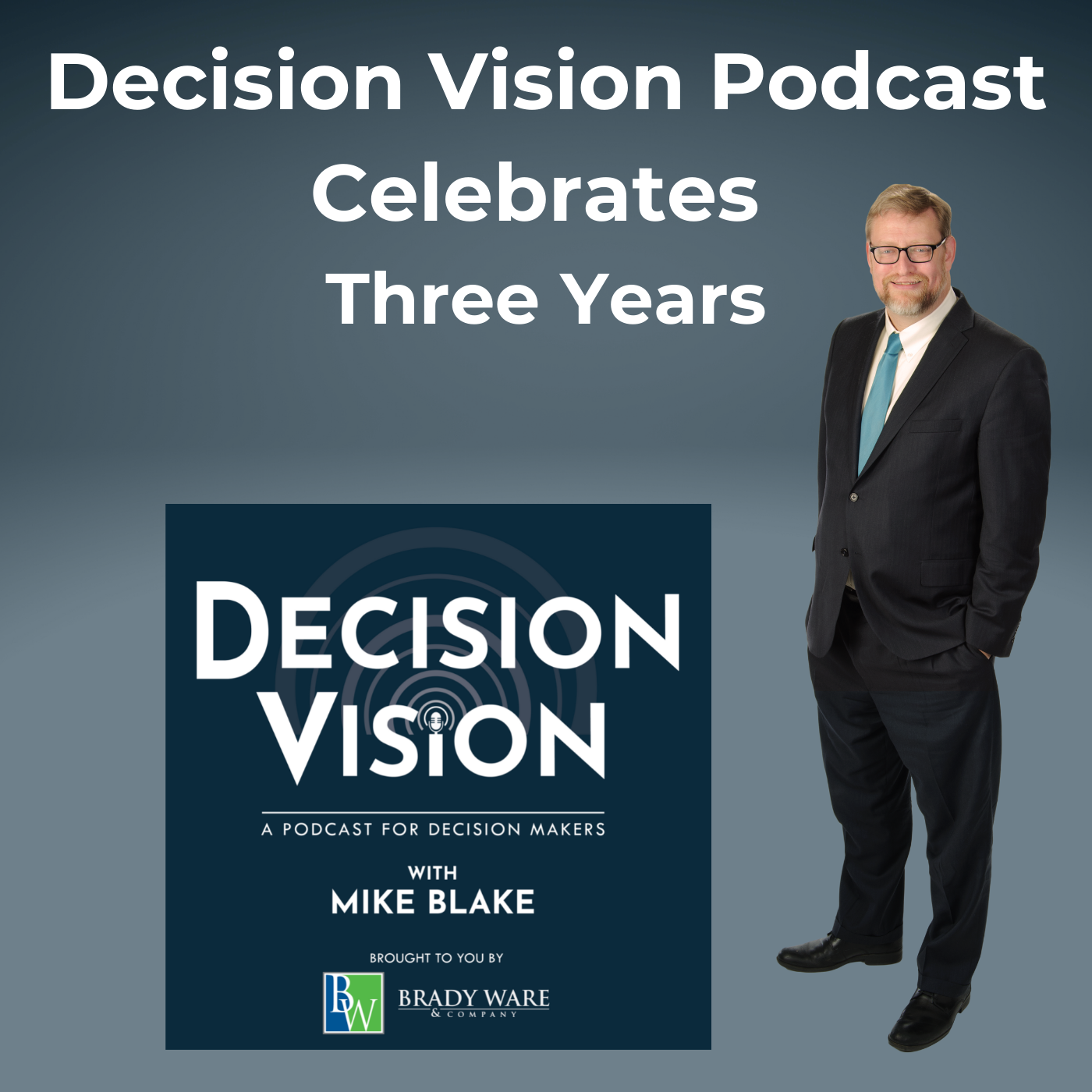
Decision Vision Episode 157: Celebrating Three Years

February 24, 2022 by John Ray

Decision Vision
Decision Vision
Decision Vision Episode 157: Celebrating Three Years
Loading
00:00 /
RSS Feed
Share
Link
Embed

Download file

Decision Vision Podcast

Decision Vision Episode 157: Celebrating Three Years

Host Mike Blake took time to reflect and celebrate three years of the Decision Vision podcast by expressing his gratitude to Brady Ware, producer John Ray and his Business RadioX® team, the fantastic guests, and all the listeners. Mike also shared exciting news about a new professional direction. Decision Vision is presented by Brady Ware & Company and produced by the North Fulton studio of Business RadioX®.

Mike Blake, Brady Ware & Company

Mike Blake, Host of the “Decision Vision” podcast series

Michael Blake is the host of the Decision Vision podcast series and a Director of Brady Ware & Company. Mike specializes in the valuation of intellectual property-driven firms, such as software firms, aerospace firms, and professional services firms, most frequently in the capacity as a transaction advisor, helping clients obtain great outcomes from complex transaction opportunities. He is also a specialist in the appraisal of intellectual properties as stand-alone assets, such as software, trade secrets, and patents.

Mike has been a full-time business appraiser for 13 years with public accounting firms, boutique business appraisal firms, and an owner of his own firm. Prior to that, he spent 8 years in venture capital and investment banking, including transactions in the U.S., Israel, Russia, Ukraine, and Belarus.

LinkedIn | Facebook | Twitter | Instagram

Brady Ware & Company

Brady Ware & Company is a regional full-service accounting and advisory firm which helps businesses and entrepreneurs make visions a reality. Brady Ware services clients nationally from its offices in Alpharetta, GA; Columbus and Dayton, OH; and Richmond, IN. The firm is growth-minded, committed to the regions in which they operate, and most importantly, they make significant investments in their people and service offerings to meet the changing financial needs of those they are privileged to serve. The firm is dedicated to providing results that make a difference for its clients.

Decision Vision Podcast Series

Decision Vision is a podcast covering topics and issues facing small business owners and connecting them with solutions from leading experts. This series is presented by Brady Ware & Company. If you are a decision-maker for a small business, we’d love to hear from you. Contact us at decisionvision@bradyware.com and make sure to listen to every Thursday to the Decision Vision podcast.

Past episodes of Decision Vision can be found at decisionvisionpodcast.com. Decision Vision is produced by John Ray and the North Fulton studio of Business RadioX®.

Connect with Brady Ware & Company:

Website | LinkedIn | Facebook | Twitter | Instagram

TRANSCRIPT

Intro: [00:00:02] Welcome to Decision Vision, a podcast series focusing on critical business decisions. Brought to you by Brady Ware & Company. Brady Ware is a regional, full-service, accounting and advisory firm that helps businesses and entrepreneurs make visions a reality.

Mike Blake: [00:00:21] And welcome to Decision Vision. This is Mike Blake, your host, and our sponsor is Brady Ware & Company. This is going to be a different show, a short show. And, really, a thank you show.

Mike Blake: [00:00:34] So, we are celebrating our third anniversary of the Decision Vision podcast with the show. And, you know, something like, I don’t even know what number of episodes this is, like 155 or something. It’s a crazy number. And, you know, I just – I think it’s a good time to pause. I don’t want to – I don’t want to do this as sort of in passing because it deserves more than an in passing mention. It deserves its own airtime.

Mike Blake: [00:01:01] And, three years is a long time for a show to be on, especially a weekly show. We have now lasted officially as long as the Star Trek original series did. I don’t know that we’re going to have Decision Vision Con anytime soon, but, you know, good things can happen after only three years, and it’s hard to believe we launched this back in March of 1999. And, you know, where do we even begin, right? So much has changed since then.

Mike Blake: [00:01:30] And before we get into some perspective on that, I want to make sure to thank everybody that needs to be thanked and there are a lot of them. First, I’d like to thank Brady Ware & Company who has supported this podcast. They have supported my investing time into it. They have supported it by listening to it and directing people to listen to it. They’ve supported it financially at not an insignificant expense. Putting on a show like this, even though I do it for free, technically is still not cheap, and you can tell the difference between this show and a show that’s done in somebody’s basement, which leads me to the second group I want to thank which is the folks at Business RadioX, and John Ray and his team have been just tremendous partners with this. And it’s not just about turning on the microphone and recording things. And they’ve certainly done that, but, you know, they’ve done some editing. They’ve made me sound much smarter than I’ve sounded. They’ve saved shows because we’ve had guests that have come on and then say things that they regret. And in order to not have the show be deleted, they’ve managed to sort of edit it and make it sound natural. Some people get in front of a microphone and they’re terrified and it’s like a hostage tape. And then, there are other people that sort of forget they’re behind a microphone. It’s like they’ve had a couple of belts of scotch before they start going.

Mike Blake: [00:02:52] And John and his team helped kind of save the day and keep the show, for lack of a better term, the way that it needs to be. You know, they do all our scheduling. In some cases, they’ve handed us guests, especially when we’ve had some show holes. And, you know, sometimes it does have a little bit behind the scenes. Like even on The Tonight Show, they get guests that cancel at the last second, and all of a sudden you’re left without a show. And believe me, we don’t rise to that level. We don’t think we rise to that level. So, there are days that we kind of scramble for guests, but we also have a high standard that we don’t want to put a show on unless it’s something that we’ll be proud of. And they’ve been great at getting us guests, and they’ve been great at just letting people know that shows are up and that the show is out there and publicizing it.

Mike Blake: [00:03:40] And, I’m under no false illusions. I don’t think so. You know, we stopped counting at 30 million downloads about six months ago. I don’t know what that number is. Maybe, it’s 30 million and one, I don’t know. But the point is we would not have reached that without our partners at Business RadioX. And if you’re thinking – this is not a paid – they’re not giving us a break. They’re not giving us any kind of promotional credit. But if you’re thinking of doing a podcast for realzies and you’re thinking of doing it from a business perspective and attracting clients and representing your company and yourself well, your company and personal brands well, you know, I cannot speak highly enough of them as a partner. So, I want to make sure to thank them.

Mike Blake: [00:04:21] I want to thank our guests who have put in well over combined 150 hours of their time to share their talent and expertise with us. Some podcasts, some radio shows are just a person talking into a microphone. This isn’t that kind of show. I’m not that interesting. I would get hoarse after ten minutes. I get boring after five. So, thank God that we have the guests to do that. And I think that’s been a good format. It makes you really – it makes you appreciate the people that are on, for example, talk radio. And, without getting political for a second, you can appreciate the talent of people who can just talk into a microphone and be interesting for three hours. That is not easy to do. It’s hard to do it for three minutes, do it three hours day after day. I don’t know how they do it, and so thank goodness for the guests who are willing to come on, sometimes twice. I don’t know how we convinced them to come back. I mean, once they’ve never [inaudibly] never listened to the program but after having been through the experience, once they’re willing to come back. And, you know, I can’t thank you enough.

Mike Blake: [00:05:28] And then, finally, of course, you guys, as listeners, whether you listen once or twice or you’re a regular Decision Vision junkie, you know, you know who you are. I appreciate your social media comments. I appreciate your emails that you send to me privately. I appreciate your reviews and your constructive feedback. You know, we try to – my hope is that whenever the last show of this thing is, I don’t know if that’s going to be tomorrow or five years from now, I hope our last show is the best one we’ve ever done because each one is a little bit better than the one prior to that. And the feedback you give us, the energy you give us is what keeps us going. And, you know, it is not easy to put on a show like this on this kind of schedule, and I’m not asking for any kind of recognition or anything. I just want to acknowledge the fact that your feedback, your energy are what give me and us the energy to keep doing this and keep doing it at what I think is a high-level show that we can be proud of. You know, if there’s no listeners, then it’s just me talking into a microphone and paying somebody a lot of money to record me talking into a microphone and that doesn’t make any sense. So, thank you for letting us know that you’re having an impact. No, we’re having an impact on you.

Mike Blake: [00:06:41] So, in the last three years, we started this and we were, pre-COVID, we hadn’t gone into any Greek letters yet. And now, we’ve gone through three of them so far. I turned 50 during this period and I have the gray hair to prove it. I was [inaudible] on the other side of 50 when we started this. We survived murder hornets. Cryptocurrency has now risen to the level where it warrants multiple Super Bowl ads. The University of Georgia won the Football Championship for the first time in 41 years. I didn’t think that’s going to happen, and I was glad to be wrong. And, Matt Stafford of all people won the Super Bowl. I don’t think a lot of people thought that was going to happen. And Tom Brady retired, or at least they say he did. There’s now rumblings he may actually come back already, so we may be in a Brett Favre situation, but that’s a – but for many people, the long national nightmare is at least over and somebody else gets to be the GOAT in football terms.

Mike Blake: [00:07:41] But, you know, and it’s just been – it’s been a wild ride. It’s been a great, you know, a great three years. And we’ve got a lot more shows coming up. We’re going to come back and revisit topics that we’ve already visited. We’re going to continue to take topics on that are hard. We’re going to continue to take topics on that are thought-provoking, that may be emotionally provoking, that may provoke a very strong reaction in the negative.

Mike Blake: [00:08:07] But that’s how you make good decisions. You make good decisions by putting all the facts out there, all the feelings, all the views out there, and giving them all, visibility in the cold light of day. Letting those ideas go to war. The ideas, not the people, go to war and figuring out what is the best path forward. And that’s really what the Decision Vision is all about. It’s a show about ideas not telling you that you should do X, you should do Y, but rather here’s what we think you need to know in order to make an informed decision based on whatever circumstances or environmental conditions you’re confronting and serve as your constraints.

Mike Blake: [00:08:50] And then, finally, I’ll tease something. We’re not formally announcing it yet, but I feel like you guys have been on the journey enough where you guys deserve some inside baseball. So, my group will be spinning off, actually has technically spun off. We just haven’t announced it yet from Brady Ware. So, there’ll be a company called Brady Ware Arpeggio, which is the – Arpeggio’s the old name of my sole proprietorship. That’s the legal name. It’ll be known to the market as Brady Ware Strategic Valuation and Advisory Services, which I think is a very apt name, and we’re going to talk about – we’ll have a show as to why we chose to do a spin-off. That was a material decision why are we doing that. But once again, I’m going to be put in the position of running a company. I’ll be a material shareholder. And it’s both exhilarating and terrifying at the same time. And I think that’s probably about right. If it doesn’t scare you a little bit, you’re not taking it seriously enough. And if it’s not exciting you, why are you doing it? But that’s just me talking.

Mike Blake: [00:09:54] So, that’s sort of a state of the show. You may have been looking forward to content, but unless you’ve listened to every one of those 154 shows, and if you have, kudos to you. I haven’t. I don’t think my mother has either. But if you have, great. But for the majority of you that haven’t, there’s plenty of back catalog content that you can go enjoy and we will be back next week with a brand new show, brand new topic.

Mike Blake: [00:10:21] And, again, I just want to – I’ll just – I’ll finish like I started. You know, thank you for this opportunity to serve you, to be a focal point for your ideas, to help you think about things, to help you become a better decision-maker. I enjoy it. I find it personally enriching, and it’s an enormous compliment to me that anyone thinks that what I have to say is of value and the fact that as many of you do not just once but repeatedly. You know, at the end of the day, I think that’s what life is all about is making an impact and you’re showing me that this show is. And thank you so much. So, have a great week. Take care. And we’ll be back at you next week.
 

Tagged With: Brady Ware & Company, Business RadioX, Decision Vision, John Ray, Mike Blake

Decision Vision Episode 156: Should I Interview My Customers? – An Interview with Carolyn Kopf, C.E.K. & Partners

February 17, 2022 by John Ray

Carolyn Kopf
Decision Vision
Decision Vision Episode 156: Should I Interview My Customers? - An Interview with Carolyn Kopf, C.E.K. & Partners
Loading
00:00 /
RSS Feed
Share
Link
Embed

Download file

Carolyn Kopf

Decision Vision Episode 156: Should I Interview My Customers? – An Interview with Carolyn Kopf, C.E.K. & Partners

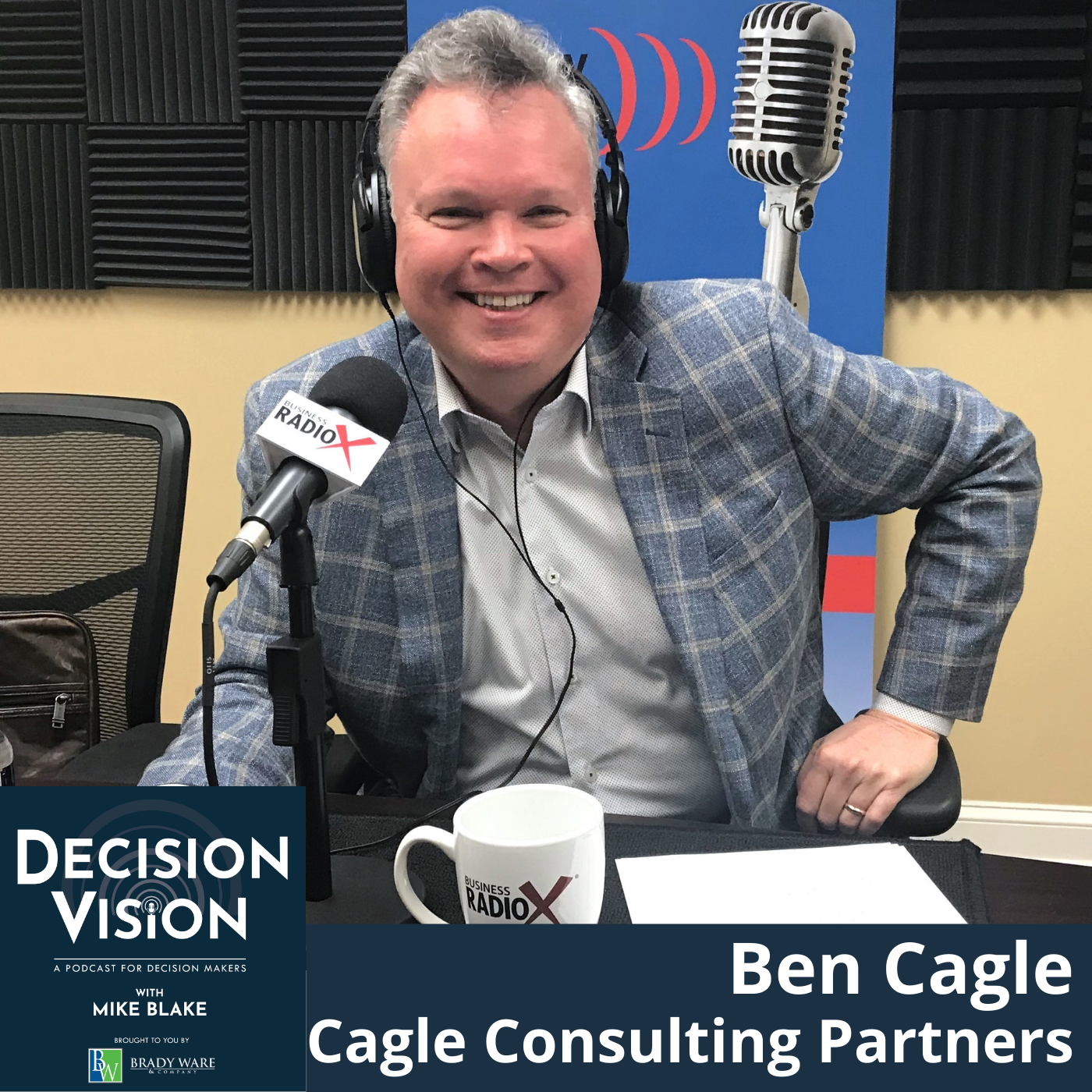
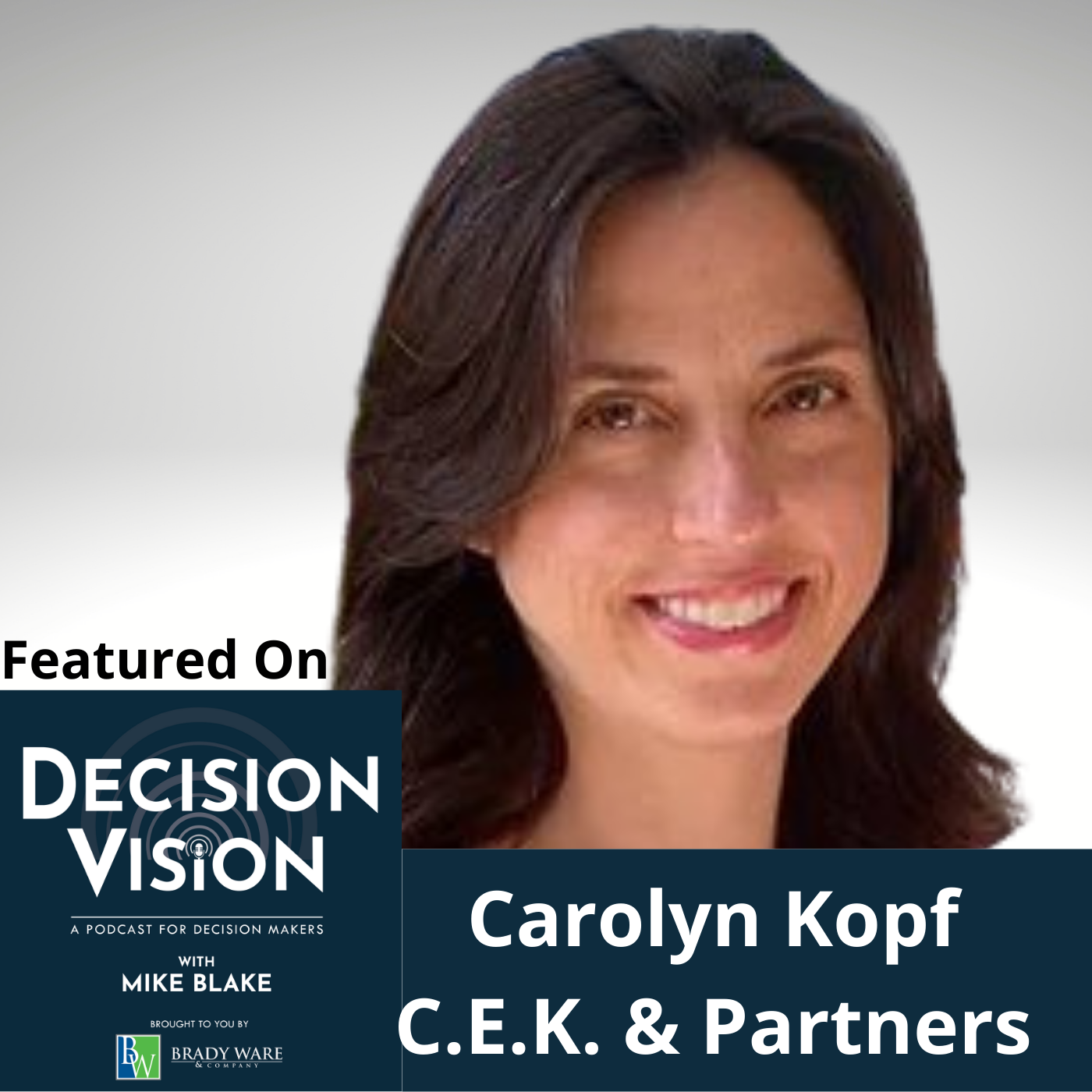
Carolyn Kopf, Founder and Managing Partner at C.E.K. & Partners, joined host Mike Blake in a conversation on how to interview customers, whether they be individuals or businesses. She covered how her firm’s studies are designed, the role of statistical significance, compensation, when a company would hire a firm like C.E.K, unexpected results, how the pandemic affected their work, and much more. Decision Vision is presented by Brady Ware & Company.

Carolyn Kopf, Founder and Managing Partner, C.E.K. & Partners

Carolyn Kopf, Founder and Managing Partner, C.E.K. & Partners

Carolyn Kopf started her career on Madison Ave in NYC and has worked at top global agencies in Europe and APAC. Today, she is the founder and managing partner of C.E.K. & Partners, a firm that provides expertise across market research, branding and digital marketing communications.

As a woman-owned firm, C.E.K. delivers work that enables companies to make more informed decisions, build awareness, establish thought leadership and generate demand to drive business growth.

Industry Focus:
–Financial services, fintech and payments
–Manufacturing (e.g., flooring, cosmetics, furniture, lighting)
–Sustainability and socially responsible/purpose-driven brands
–Healthcare, hospital systems, health plans and employee benefits
–Emerging technology and cybersecurity solutions
–Placemaking
–Retail

Their clients have included some of the most recognizable brands, and their innovation workshops have generated new product concepts for Fortune 50 companies. Each concept is expected to generate a minimum of $300 million in annual revenue. Carolyn’s curiosity and love of research led to her being awarded a patent (#7,333,635) by the USTPO for a next-generation identity authentication method to be used by financial institutions.

Company website | LinkedIn | Facebook

Mike Blake, Brady Ware & Company

Mike Blake, Host of the “Decision Vision” podcast series

Michael Blake is the host of the Decision Vision podcast series and a Director of Brady Ware & Company. Mike specializes in the valuation of intellectual property-driven firms, such as software firms, aerospace firms, and professional services firms, most frequently in the capacity as a transaction advisor, helping clients obtain great outcomes from complex transaction opportunities. He is also a specialist in the appraisal of intellectual properties as stand-alone assets, such as software, trade secrets, and patents.

Mike has been a full-time business appraiser for 13 years with public accounting firms, boutique business appraisal firms, and an owner of his own firm. Prior to that, he spent 8 years in venture capital and investment banking, including transactions in the U.S., Israel, Russia, Ukraine, and Belarus.

LinkedIn | Facebook | Twitter | Instagram

Brady Ware & Company

Brady Ware & Company is a regional full-service accounting and advisory firm which helps businesses and entrepreneurs make visions a reality. Brady Ware services clients nationally from its offices in Alpharetta, GA; Columbus and Dayton, OH; and Richmond, IN. The firm is growth-minded, committed to the regions in which they operate, and most importantly, they make significant investments in their people and service offerings to meet the changing financial needs of those they are privileged to serve. The firm is dedicated to providing results that make a difference for its clients.

Decision Vision Podcast Series

Decision Vision is a podcast covering topics and issues facing small business owners and connecting them with solutions from leading experts. This series is presented by Brady Ware & Company. If you are a decision-maker for a small business, we’d love to hear from you. Contact us at decisionvision@bradyware.com and make sure to listen to every Thursday to the Decision Vision podcast.

Past episodes of Decision Vision can be found at decisionvisionpodcast.com. Decision Vision is produced and broadcast by the North Fulton studio of Business RadioX®.

Connect with Brady Ware & Company:

Website | LinkedIn | Facebook | Twitter | Instagram

TRANSCRIPT

Intro: [00:00:01] Welcome to Decision Vision, a podcast series focusing on critical business decisions. Brought to you by Brady Ware & Company. Brady Ware is a regional, full-service, accounting and advisory firm that helps businesses and entrepreneurs make visions a reality.

Mike Blake: [00:00:22] Welcome to Decision Vision, a podcast giving you, the listener, clear vision to make great decisions. In each episode, we discuss the process of decision-making on a different topic from the business owners’ or executives’ perspective. We aren’t necessarily telling you what to do, but we can put you in a position to make an informed decision on your own and understand when you might need help along the way.

Mike Blake: [00:00:43] My name is Mike Blake, and I’m your host for today’s program. I’m the managing partner of the Strategic Valuation and Advisory Services practice for Brady Ware & Company, a full-service accounting firm based in Dayton, Ohio, with offices in Dayton; Columbus, Ohio; Richmond, Indiana; and Alpharetta, Georgia. The SAVAS practice specializes in providing fact-based strategic and risk management advice to clients that are buying, selling, or growing the value of companies and intellectual property. Brady Ware is sponsoring this podcast, which is being recorded in Atlanta for social distancing protocols.

Mike Blake: [00:01:16] If you’d like to engage with me on social media with my Chart of the day and other content, I’m on LinkedIn as myself and @Unblakeable on Facebook, Twitter, Clubhouse, and Instagram. I also recently launched a new LinkedIn group called Unblakeable’s Group That Doesn’t Suck, so please join that as well if you’d like to engage. If you like this podcast, please subscribe on your favorite podcast aggregator, and please consider leaving a review of the podcast as well.

Mike Blake: [00:01:43] Today’s topic is, should I interview my customers? And according to data from Price Intel, most software as a service companies do fewer than 10 customer interviews per month, which is surprising given that most SaaS companies have thousands, if not millions of customers. And, you know, as data becomes increasingly important, and it’s been this way for a while, you know, data has been gold for the last 20 years now. But as we develop greater analytic capability, as we develop greater AI and as we move kind of philosophically to a more evidence-based management approach, society-wide, I think this notion of interviewing customers becomes more acute.

Mike Blake: [00:02:31] And, of course, one of the more, I guess maybe it’s not important, it’s not the right word, but certainly better-known tools for understanding customer satisfaction is something called the net promoter score. And generally, that’s best achieved or understood through customer interviews, although I suppose you could do those two online surveys and so forth. But clearly, you get more – you get richer data when you actually talk to people as opposed to asking them to click on buttons on a website.

Mike Blake: [00:03:05] And so, I hope you’ll agree. I’m a data junkie as it is, and I have someone coming on today that’s a fellow data junkie. So, this is going to be data junkie to data junkie action here. And for the other data junkies out there, I think you’re going to like the show and certainly hope that you will.

Mike Blake: [00:03:20] And, joining us today is Carolyn Kopf, who is founder and managing partner of CEK & Partners, a market research, branding, and digital communications firm. Carolyn is passionate about delivering strategic insights that transform brands. Clients benefit from her team’s ability to mine data and extract gems to find insights that truly differentiate their brands. She guides and positions them to reach the next level. She holds an MBA in international business – sorry, international business.

Mike Blake: [00:03:50] Carolyn Kopf started her career on Madison Avenue in New York and has worked at top 10 global agencies in Europe and the Asia Pacific markets. Carolyn is the founder and leader of CEK & Partners, a 20-person firm of experts across market research, branding, and digital marketing communications fields.

Mike Blake: [00:04:08] As a woman-owned firm, CEK delivers work that enables brands to build awareness, establish thought leadership, and generate demand to drive business growth. CEK & Partners innovation workshops have generated new product concepts for Fortune 50 companies. Each concept is expected to generate a minimum of $300 million in annual revenue. CEK has generated $600 million in annual in aggregate revenue for its clients over the 13 years of its operation and has completed over 1200 engagements and counting.

Carolyn Kopf: [00:04:39] Thank you for that introduction. I appreciate it. I’m really honored and excited to be here with another data junkie.

Mike Blake: [00:04:47] Yes. Well, thank you for coming. So, welcome to the program. So, why are people excited, or why are people saying the best practices now includes interviewing customers?

Carolyn Kopf: [00:05:03] Well, I think really best practices, if we take it higher to what you’ve said, it’s really gathering insights, you know, and there’s so many great wonderful techniques that are effective. And, speaking with customers is just one of those techniques. But certainly, whether it’s surveys, whether it’s online bulletin boards, whether it’s focus groups, or whether it’s in-depth interviews, there are so many great ways to capture insights about what customers are thinking, how they’re behaving, and how that has changed over the past couple of years.

Mike Blake: [00:05:42] So, when is the right time to interview customers?

Carolyn Kopf: [00:05:47] You know, there’s usually critical junctures where you want to understand the latest attitudes, beliefs, and behaviors. Those critical junctures could be anything from you’re getting ready to launch and develop a new product, and you want to understand market viability for a product concept. Well, in that case, you might want to speak with, not only customers but prospective customers who haven’t purchased from you before or even lost customers to understand where that fits in with their needs. So, there’s, you know, doing – you have a new marketing campaign, you want to understand customer sentiment and be prepared. Any time you’re making an investment and you’re going out into the market, you want to make sure that you’re informed.

Mike Blake: [00:06:43] So, I want to ask you about talking about prospective customers because one of the big buzzwords around Atlanta with startups, and I know you don’t do a ton of work with startups, but you’re certainly familiar with what they do. One of the buzzwords around startups is a notion called customer discovery, right? Investors want to know what conversations have you had with prospective customers and, you know, you do interviews with people for a living, so I’m curious. I think you have unique insight to this.

Mike Blake: [00:07:14] I think when prospective customers are involved, I think there’s a predisposition psychologically to want to tell the interviewer what you think they want to hear. Right? You want to be – people want to be positive. There’s a natural predisposition, maybe to not be entirely honest but rather be encouraging. Right? Because there’s no cost to that, the interviewee of doing so.

Mike Blake: [00:07:39] As an interviewer, how do you cut through that? Is it interviewing technique? Is it structuring the questions correctly? Is it something that has to do with the post-interview data analytics? Or, is this something that’s just sort of have to live with in terms of whether or not prospective customers are willing to be truthful to you and tell you, “Nah, I don’t want to buy it. Your baby’s ugly. Get out of here.” Because I don’t think that happens as often as it does when the actual purchase decision is put in front of them.

Carolyn Kopf: [00:08:09] Yeah. I think that’s a really great question and a really strategic one. Thank you for asking that. I think what’s really important is stepping back from the actual conversations and thinking through the design of the research. All of our studies are custom-designed. So, we think through, does a study have to – we call it blind – should it be blind where the participant does not know who’s sponsoring the study? And that way, they’re not going to try to please anyone. And, that becomes especially important again with the design of the study. They’ve chosen a third-party partner again to help be that objective voice. They’re not going to, you know, lead the conversation. So, there’s really those three pieces of an experienced moderator, having a blind study and then having a third-party moderator.

Mike Blake: [00:09:08] So, do you – is best practice is that you simply try to interview as many customers as you possibly can? Or, is there a way to – do you work out sample sizes using the math, the math that’s out there that tells you how many customers you interview to get to achieve a certain confidence level? See, I told you, analytics people, you’d be happy with the geekiness here. Do you go that deep? Do you get – do you go – do you go that deep with something like this or?

Carolyn Kopf: [00:09:36] You might not be too happy with this answer. But when we do what’s called qualitative research and we’re having discussions with customers, it’s not going to be statistically significant. It will be directional. But certainly, we want to understand and think through the sample.

Carolyn Kopf: [00:09:54] So if a customer, if a client wants to speak to customers, it’s important to understand what is the lens that they want to. Is it a certain position, a certain title within a department of a company? Is it a certain size of the company? Is it a certain industry segment? What if it’s all three of those things? Then, all of a sudden it’s “Okay. Well, we want to speak only with manufacturers and a director level or above, and we want to hear from companies across three revenue ranges, you know, less than a billion, 1 to 2 billion and 2 billion plus.” I’m just, you know, shooting from the hip here. All of a sudden that determines how many people you need to recruit, right? If there’s quotas for a company size, you want to – at a minimum, we recommend five and always an odd number. So, it’s kind of that tiebreaker, if you will.

Mike Blake: [00:11:00] Yep. So, let me ask this, and you have had this conversation before, but I think our listeners will benefit. Why wouldn’t you strive for some sort of statistical significance? Is it – I don’t want to lead the witness here, so I’m going to leave that open-ended. Why would you not try for a statistically significant sample?

Carolyn Kopf: [00:11:21] Well, I think part of it is you have to remember that when you have discussions, if it’s in-depth interviews or focus groups, you’re not having someone answer every question. You’re not forcing them. You must answer this question. It’s a discussion, and there might be some questions that you skipped because someone’s not comfortable or they don’t have the expertise to answer the questions. So, you’re really from one conversation to another. You might serve up, you know, 10 out of 15 of the questions, and not to mention just the sheer number of people you would have to speak to.

Carolyn Kopf: [00:12:00] Today, we find that we really want to deliver insights faster to meet the demands of our clients and to move through hundreds of interviews. It would be very doable, but it’s just not necessary. Not to mention you start to identify themes after you’ve spoken with three to five people. So, you’ll just start to see those same themes, even if you spoke to 20 people. So, let’s just call it at five per segment, if you will, but you could have, you know, 10 segments in that case. You might be speaking to 50 people.

Mike Blake: [00:12:37] And, I had a thought of a point that you just brought up is that, you know, just because you’re talking to somebody doesn’t mean that they’ll answer all the questions, which means that if you wanted to have a statistically significant sample, you have to factor in the fact that not all the questions will be answered, which means your sample size is even greater, which means more expense, more time and like – and as you said at the end of the day, you may not gain that much more insight from a statistically significant sample.

Carolyn Kopf: [00:13:05] Well, we find a lot of – absolutely. I agree with you. We find that the best – you know, you can complement these discussions with doing quantitative studies. So, you might have, you know, 15, 20, 30 in-depth conversations, get some very good directional insights and findings. And depending on how much rigor and how much you’re investing in a product launch or a marketing campaign or a rebranding, it might warrant saying, “Okay. We’ve got some great directional insights. Let’s take those and craft an online survey and get those statistically significant insights with a larger population.” So, certainly, they work hand-in-hand, depending on the rigor that’s needed.

Mike Blake: [00:13:51] So, you spoke about a magic number five, which I find fascinating. I don’t do what you do for a living. That’s lower than I would have imagined. How do you select the five? Who are the lucky five?

Carolyn Kopf: [00:14:04] Well, keep in mind that, you know, we could have eight segments that we want to speak to. Right? So, and five within each of those segments. So, all of a sudden you’ve got 40 people that you’re speaking with but the characteristics of the five. So, it could be, you know, much of it is making sure that the people match and get through that filter and qualify to speak with you. So, certainly consumer interviews, you’re going to find those people faster. But when you start talking about B2B studies, you’re working from a much smaller universe. So at that point, really, it’s just a matter of who meets the qualifications and the specs of the participant and are they available within the window of the study.

Mike Blake: [00:15:02] So, when you make that selection, I’m curious about something, I’m kind of going off-script here, but I know that it’s common to compensate survey participants generally to participate in the survey. Do you find that’s also the case with customers? Do you have to budget for customers being willing to talk to you, to being compensated for their time, to talk to you about their own experience with you?

Carolyn Kopf: [00:15:33] You know, that’s interesting because there are different types of customers. We really bucket it into three types of customers. One is the lost customers. They’re no longer – they’re no longer your customer. There’s your current customer who should be willing to speak with you without being paid. And, of course, there’s your prospective customer who is you’re going to need to incent them to speak with you. So, that’s really the rule of thumb.

Mike Blake: [00:15:59] Interesting. We hadn’t even talked about customers who have left. And, how – do you do that a lot? And if so, how do you find that? Because there’s a saying, I’m sure you’re familiar with, that, you know, a happy customer will tell nobody, but an unhappy customer will tell 9000 people. So, I wonder, are people who are unhappy actually more willing to participate because they just can’t wait to unload on the company that pissed them off basically?

Carolyn Kopf: [00:16:29] Well, keep in mind if past customers, especially when we talk about B2B, they may not be unhappy. It could be that the project sponsor changed companies and say they went with another vendor or another relationship. It could be that their budgets were cut and they had to eliminate a partnership and consolidate. So, a lost customer in the B2B world may not be unhappy, but rather, you know, when we do speak with lost customers, it’s really valuable when you’re positioning the brand. Because remember when you position a brand, you want it to be any positioning that you articulate. You want it to be defendable, ownable, and true.

Carolyn Kopf: [00:17:17] So, if you get that 360 of your current customers, your lost customers, and your prospective customers, all of a sudden you know if it’s dependable or true. Because if you’re thinking one thing, but people have left because that’s not the case, it really helps to ground work in the defendable and true piece, at least in the B2B world.

Carolyn Kopf: [00:17:42] Absolutely, I agree. In the consumer world, a lost customer is probably someone who’s grumpy and didn’t love something, whether it was, I’m thinking about things that happened today with, you know, return policies, with everything being online or not being able to get a hold of someone on the phone. All of a sudden, there are different reasons why someone might not be happy.

Carolyn Kopf: [00:18:10] But I think absolutely it’s important to understand when you talk about that net promoter score. What are – what is the percentage of detractors, neutrals, and promoters? Because certainly if someone’s neutral to negative, there’s a chance you can recover that relationship with, I don’t know, a free trial or, you know, a 10% discount, something to get them to come back. But if it’s a true detractor that’s on the scale of NPS, down at the one or two’s, that’s just – just let them go and focus on your happy customers who are promoting and those who are neutral that you can recover and really bring them along.

Mike Blake: [00:18:59] So, who should perform the interview? Should it – leaving aside an outside firm for a second, we’ll get to that. But many firms, I’m sure, in-house this process, and if they do, who should do that? Should it be somebody in the marketing department? Should it be somebody on the direct service or provider team in the case of professional services, maybe a dedicated group entirely whose job it is to interview customers? If it’s an internal agent that’s going to be doing that, who should that be?

Carolyn Kopf: [00:19:33] You know, it really depends on the context. So, for example, if you’re talking net promoter score and you’re speaking with lost customers, you want someone from the customer insights team or someone even from customer service who’s trained in having conversations with lost customers and helping to bring them back to sign up for free month trial or whatever the business model might be. But certainly, many customers have those insight teams. They’re going to have the experienced moderators that know how to navigate conversations, know how to navigate tricky situations in a customer-friendly manner. So, certainly, we recommend someone with experience handling them.

Mike Blake: [00:20:21] So, when is it a good idea to have an outside firm as opposed to the firm, the company itself, interview the customers?

Carolyn Kopf: [00:20:30] Well, I think there’s a couple of reasons. One could be a company or a corporation. Their customer insights team is small and they need to expand capacity and expertise with an outside party. That’s one scenario. Another scenario is a company doesn’t have insights in-house, and they could lean on marketing or product marketing but maybe there’s not the expertise, so it’s really a risk and it would make sense to bring in a third party to either design the study, you know, do the comprehensive. And then, I guess the last point would just be making sure that no one’s leading the answers because certainly you want the insights to be helpful and true in the sense of making decisions versus what someone wants them to be.

Mike Blake: [00:21:32] Right. Don’t – you know, I think Brady Ware is great, don’t you agree? Right? Not exactly an honest interview question.

Carolyn Kopf: [00:21:40] I know you had a great experience with it. So, how would you rate it on a scale from 1 to 10?

Mike Blake: [00:21:45] How much do you love us?

Carolyn Kopf: [00:21:47] Exactly. And so all of a sudden, you know, people might not realize they do that. It’s just their natural, optimistic, bubbly selves. And, it may not be intentional. So, it takes out that, you know, to have that experience and that fresh, neutral perspective.

Mike Blake: [00:22:05] And, you know, you mentioned the word training. And, I want to bring something up because I don’t think this is always appreciated, but conducting interviews is a skill. It’s not easy to conduct a useful interview, is it? You don’t just walk up and just do that for the most part, do you?

Carolyn Kopf: [00:22:26] No, you don’t. I mean, experienced moderators. I mean, it starts with the design of the questions. You know, what is the order of the questions? Certainly, you want to make sure that you start out not revealing anything if you’re looking to get awareness of a particular topic or a particular brand, and then potentially reveal the sponsor if it’s relevant later in the conversation. So, it’s really that design, not only of the flow but the actual design of the questions themselves so that they don’t lead.

Mike Blake: [00:23:06] Now, what is the benefit of conducting customer interviews versus sending out a survey? Someone might say, “Could not that accomplish the same thing faster, more cheaply, more efficient.” Why go the extra mile, the extra hassle, the expense for doing the interview?

Carolyn Kopf: [00:23:24] Well, certainly I think that there’s different reasons to do in-depth interviews over a survey. One, the in-depth interviews, you’re going to get more rich context. You’re having a discussion. You can listen for certain things and you don’t hear what you’re expecting to hear. You can probe on topic areas and go deeper into the conversation so you really can guide the discussion and each one will be a little bit unique.

Carolyn Kopf: [00:23:52] With a survey, for the most part, you’re going to have closed-loop questions or, you know, they’re not going to be open-ended, and someone has to choose from six answers. And one of those answers could be, I don’t want to answer it, or, you know, I don’t know or not applicable. So, you’re really limiting. You’re getting very great information, but you’re not getting deep context.

Mike Blake: [00:24:24] So, is there an ideal length for how long an interview should take? And, I got to imagine at some point there’s got to be a limit to how much time you can get from somebody. So, in your mind, is there an ideal time limit on an interview?

Carolyn Kopf: [00:24:41] Absolutely. I think there’s really three types of interviews. There are interviews that feel like a survey where you might ask someone, I don’t know, 15 questions in 15 minutes. It’s like, “Are you aware of this?” Yes, no. Right? It’s not a conversation. You can do that in 15 minutes.

Carolyn Kopf: [00:25:00] If you want to have a conversation and really go deeper, I would suggest 30 minutes. Potentially, you could do 45. It’s just going to be harder and more expensive. The 60-minute interviews are really going to be around usability. Right? So, you want to share something on the screen and get feedback.

Carolyn Kopf: [00:25:23] So, there’s certainly different techniques that are going to be appropriate for the different amount of time. We find that really a 30-minute in-depth interview, that’s a conversation, is a tried and true. If you’re doing usability., you’re going to want a minimum of 60 minutes.

Mike Blake: [00:25:41] What are the – this may be an unfair question, but I’m going to ask it anyway, and that is, what are the most important questions to ask customers, and for the purposes of this question, let’s say current customers versus prospects or lost customers. What are the kinds of the most important questions? Or, if you want to replace important with common, that’s fine too.

Carolyn Kopf: [00:26:05] You know, it really comes back to the learning objective because, remember, each study is going to be custom-designed to fulfill the needs and objectives of the client. So, if a client is seeking to understand awareness of their organization, you’d start with asking questions around, how familiar are you with a company? Tell me, what are they known for? And you might end the survey with how are they different, better or special, compared to the competitors? Those are very common questions with awareness and trying to understand how to position or reposition a company within the world.

Mike Blake: [00:26:48] So let’s – to me, I think a common application of a customer interview is to gauge customer satisfaction and maybe detect likeliness to become an ex-customer related to net promoter, I guess. Do you think that interviews that are more structured in nature, the yes-no, or rate this one to five versus unstructured, open-ended, which format of questions do you think works better for that kind of purpose, or is a mix of the two ideal?

Carolyn Kopf: [00:27:24] It’s really a mix of the two. So, you ask, you know, on a scale from, you know, typically net promoter, we do that through a quantitative study. It’s an online that comes through a text message on the phone and email. But you could ask in a conversation for someone to rate a product attribute on a scale from zero to five, zero to 10, whatever it is, and then ask them, “Why did you rate that a 10?” And then, they explain their ratings. So, that’s how I would use a mix of questions. And that’s, you know, both regardless of the type of study you’re doing.

Mike Blake: [00:28:08] And I think the advanced class in terms of data analytics, which I candidly can’t, I don’t know how to do, is analyzing the results of those unstructured answers. So, I’m curious, how do you do it? Are there tools that you put together that are like language analysis tools that help you do that? Or, how do you approach those free-range answers to try to aggregate them and pull a cohesive story out of them?

Carolyn Kopf: [00:28:39] Yeah. That’s a really great question. I have never been asked that. I love that because unstructured data is hard for some people, right? You know, data ana – you know, people work with their Excel sheet, Tableau, these different platforms. But really with unstructured data, we’re looking for themes. Right? So, it’s not, you know, you certainly want to compare conversation to conversation to identify theme. Once you identify those themes, you’ll pull some verbatim ones to bring color to the findings document. So, a verbatim would be a direct quote from a customer, prospective customer, lost customer that represents the overall story that’s been heard, for sure.

Mike Blake: [00:29:31] So, I’d love it – Give me an example of when a client of yours, maybe, you know, that hired you to find out something from – it could be current customers, prospects, lost customers, doesn’t matter. And, maybe the client thought that I already know what the answer is going to come back but maybe you came back and surprise them where the data sort of – you didn’t surprise them, the data surprised them, and the responses surprised them. Can you think of a time when that happened?

Carolyn Kopf: [00:30:00] Yeah. I mean, I think there’s a couple of instances. I mean, especially when you talk about doing an AAU study, attitudes, awareness and usage. Right? A customer does that to establish a baseline and monitor their brand’s performance and how it’s perceived in the marketplace with its customers as well as against its competitors. And so, you’ll know you’ll rate brand attributes as far as how the brand behaves, you know. Do people think that it’s fun to interact with the brand? Do they think that the brand customer service or communication is friendly or welcoming whatever the situation may be?

Carolyn Kopf: [00:30:42] And so, a lot of times there might be things that aren’t even a hypothesis that comes back of, “Oh, wow. We didn’t realize that we weren’t considered a friendly brand. We thought everyone was really warm and welcoming. Gosh. You know, but compared to our competitors, they might be doing a better job.” So, things that weren’t maybe on the radar, especially when you compare it against the competitors.

Carolyn Kopf: [00:31:11] Another example would be in message testing that you find out that, you know, you think you’re messaging is resonating or you have some new messaging that you want to launch, whether it’s for a TV or radio campaign or, and you test it and you hear from people that, “Wow. I can’t believe the brand’s talking to me in that manner. It’s rude. It’s making me feel bad. It’s fear-based.” And so, things that, again, weren’t even on the radar to expect to come back surprise – you know, the data surprises all of us, and the importance of that is the value of the data. Right?

Carolyn Kopf: [00:32:03] It’s a small investment compared to, you know, the marketing and advertising campaign creative, the production, the media buys. I mean, when you look at it and compared it to those budgets, it’s probably a rounding error. So, it makes sense to certainly get that pulse of, “Oh, yeah. This is resonating,” or, “Oh, wow. We should really talk to our team and train against this because it’s not coming through right to our customers.”

Mike Blake: [00:32:36] And, you know, those surprises can, as you said, you know, they can be so instructive and the business you’re in, to me, from my perspective I should say, the business that you’re in from my perspective is really the insurance business. Because for a small amount of a relatively small investment compared to the overall investment of introducing a new product service company launch, whatever, right, you can find out if you need to course correct or even bail out before you make the really big investment.

Carolyn Kopf: [00:33:09] Absolutely. Especially when you’re talking about proof of concept, you’re trying to figure out what price point, what products and features should be the top three that are communicated in the marketing that are going to be most, you know, interesting and compelling to the customer in a software solution, for example. I mean, you don’t want to put 15 product features when really there’s three that are going to compel and motivate the buyer to sign up.

Mike Blake: [00:33:41] I remember when at the outset of COVID, Apple had a very short-lived campaign where they were doing these TV and video advertisements, basically showing people having lots of fun and smiling while they’re all in quarantine and using their Apple devices and so forth. And, I sensed it and there was tremendous backlash because basically, while millions of people who can’t be sequestered were forced to put their lives on the line in service to the rest of the economy, and also just sort of completely missing the point that the pandemic was serious and it wasn’t just a vacation to go home and play on your iPad. You know, I think that was a place where Apple really missed the mark, and I suspect they thought that for sure. They really understood what everybody was going for.

Mike Blake: [00:34:29] But that to me, that was a classic case where they would have done very well to have stepped outside of their office and hired somebody like you to kind of test that message and give them sort of a reality check because it truly was disastrous. Your Apple can withstand that, but nevertheless, it was a disastrous campaign that the kind of study that you’re talking about, you know, talking to customers would have avoided.

Carolyn Kopf: [00:34:56] Yeah. And, I think that what’s important here is when you talk about, you know, smaller companies, startup companies, you know, these mid-sized companies, it matters. You know, if they have a misstep, it can mean market share points for them in the millions of dollars or more. So, I think that’s a great reminder about just taking the time and being thoughtful to hear from people before you tell them what you think they want to hear.

Mike Blake: [00:35:29] So, we’re recording this in a period of a lot of uncertainty in terms of, you know, meeting in person, return to office, et cetera, et cetera. Does it impact how you earn to interview or the efficacy of interviews to conduct them virtually or remotely versus in person? And if so, what adjustments have you had to make in terms of technique or approach to close that effectiveness gap?

Carolyn Kopf: [00:36:01] You know, we’ve always done in-depth interviews over the phone, right, because we might have, you know, 20 interviews, but we’re speaking with people around the country. So, it’s not cost-effective to fly to California and then fly to Texas and then over to New York and then to South Carolina. So, those would always traditionally be done over the phone.

Carolyn Kopf: [00:36:21] The primary difference is, you know, we’re now using Zoom. So, it’s almost better because you get to see the people and it’s easier to record. You’re not, you know, jury-rigging some handheld recorder or whatever techniques people use, you know, 10 years ago. And, everyone’s comfortable for the most part on Zoom. You know, there are a few exceptions, but really Zoom or similar platforms, whether it’s a WebEx or a Teams, they’re great for in-depth interviews.

Carolyn Kopf: [00:37:00] Certainly. I think the biggest change has been in-person focus groups, right, where those have gone virtual. Certainly, there are plenty of current focus groups behind the glass that are still occurring. But I think that there are definitely some efficiencies and comfort level with virtual focus groups and that saves people money. You don’t have to fly to California to conduct focus groups. You can do them online if there’s a speed or budget constraint for a company.

Mike Blake: [00:37:33] You know, you bring the whole Zoom thing up and it’s funny. You know, we’ve had the telephone for about 145 years and we’ve had video calling available for roughly 60. And it was really a niche, fringy product nobody wanted to deal with it, except for real tech heads until the pandemic hit. And then, all of a sudden, because there’s a virus out there, for some reason now we don’t want to do phone stuff anymore. Everything has to be on video. And, it’s strange because nothing changed about the core technology or even the use case. It’s just for whatever reason because we’re all in our – for our time, we’re all in our homes, all of a sudden we had to do video. Really strange. Somebody’s got to be writing psychology papers on that.

Carolyn Kopf: [00:38:17] It’s been a great tool and I’m surprised we haven’t, like you said, used it more often. I think it just wasn’t mainstream or it wasn’t a platform that was an easy subscription. Whereas, now it’s just part of your tech stack.

Mike Blake: [00:38:35] So, you mentioned something I want to, I did want to make sure to touch upon. It sounds like that it is a practice of yours, at least sometimes, to record interviews. And if that – is that in your mind a best practice as a blanket or are there some cases where it’s more important to record an interview than others?

Carolyn Kopf: [00:38:55] You know, I think that recording the interview has value for transcription. Right? So, you can really focus on speaking and listening to the participant in the study, and you can go back and, you know, if you’re allowed, I mean, there’s different parameters depending on the study design, you can go back and cut a video if it’s a Zoom and show a minute clip of, you know, 10 customers what they said, depending on if it’s, you know, the parameters. Again, sometimes it’s confidential and it’s blind and people aren’t supposed to know who’s participating. But again, there is that opportunity at the right design. But there’s also the opportunity to transcribe the interview so you have those notes so that you can pull the verbatim. I mean, you can certainly try to type as fast as you can to get those verbatims, and that’s certainly possible. But relying on the videos is just a great, again to use your word, insurance policy that you have the notes and all the information to do the analysis.

Mike Blake: [00:40:07] And, I’m guessing, I know some attorneys feel this way when they do when they take depositions that being able to capture the body language can sometimes be very material to what you glean from that interview.

Carolyn Kopf: [00:40:25] Certainly. I mean, we’re not putting anyone under the spotlight where we’re grilling them.

Mike Blake: [00:40:29] No, I understand. I understand. You know, waterboarding anybody. But nevertheless, I mean, you can a question that may make somebody feel uncomfortable or more comfortable, and, you know, but I’m only speculating. You know, whether it’s a deposition or a conversation, right, body language is meaningful.

Carolyn Kopf: [00:40:47] Yeah. And I think that that is interesting, but that’s not the core of the in-depth interviews. But, yeah.

Mike Blake: [00:40:55] You don’t make, like, little notes saying, well, this person has shifted in their seat a little bit or looked flustered on an interview question, number nine.

Carolyn Kopf: [00:41:04] No.

Mike Blake: [00:41:05] All right.

Carolyn Kopf: [00:41:05] I think it’ll come through someone hums and haws, and most people will say, “You know what? I just don’t have the expertise to talk about that particular question.” And, it’s very different with the in-depth interviews. You know, it might be different with a focus group where you’re asking someone, “What do you think about this package design?” And they’re, you know, trying for all their might to rip something open and, you know, jabbing at it with scissors. All of a sudden, someone’s body language of, gosh, they can’t open this package, it’s not designed or consumer-friendly, that absolutely matters.

Carolyn Kopf: [00:41:42] And, there are certainly in-depth interviews that may be more ethnographic in nature, where you can send someone a product and say, “All right. I want you to work with this product and use the product, and then we’re going to have a conversation around it.” And at that point, they may share the product. And, that’s where body language would be important, for sure. So, I think you make a very good point.

Carolyn Kopf: [00:42:06] And, again, it just comes down to what you’re trying to learn. And, is it conversation, is it ethnographic where you’re really trying to learn how someone uses something in their home or office? So many variables.

Mike Blake: [00:42:21] I’m talking with Carolyn Kopf, and the topic is, should I interview my customers? A couple of questions I wanted to get through here, make sure that we cover. One, is there any value to interviewing a customer more than once? Maybe, not in the same study, but maybe you come back to that same customer a year later, two years later. Is there a, you know, maybe influences? I don’t know. I’m sort of spitballing. You’re the expert. I’m not. But I’m speculating that there could be a case in which interviewing the same customer over time might yield interesting sort of quasi-time series data. Or, is that just not a thing?

Carolyn Kopf: [00:43:09] No. I mean, I don’t know that it’s a thing. Again, it comes back to what you’re trying to monitor. So, if you’re doing an online study where you’re establishing a baseline on perceptions of a certain brand, of course, you’re going to want to redo that study in a year or 18 months or two years. You may not send it to the exact same body of people. There might be some overlap, but certainly, you start to see how perceptions change.

Carolyn Kopf: [00:43:42] Also, when you talk about the NPS surveys, again, it’s more that you’re repeating to your customer base, right, of, okay, it’s been six months since they received this appliance and they’ve installed it and used it and we asked them how everything was going or how the delivery experience was, you know, a week after they received it. But now, we want to go back and ask them how the experience is with the product.

Carolyn Kopf: [00:44:13] You know, the same with a software, right? So, “Oh, how was it to sign up? Was it easy to sign up and implement the software?” You might ask them that. And then six months later, “How happy are you with the software now that you’ve been using it for six months?”

Carolyn Kopf: [00:44:30] So, absolutely. there are reasons to do follow-up whether it’s monitoring perceptions or following up with an appropriate series of questions as they get more familiar with your product or solution.

Mike Blake: [00:44:46] Carolyn, this has been a great conversation. I want to be respectful of your time. There are probably questions that somebody wished we would have covered or maybe would have wished we spent more time on going into more detail. If somebody has a question about interviewing customers, can they contact you to follow up? And if so, what’s the best way to do that?

Carolyn Kopf: [00:45:05] Absolutely. I think the easiest way to find us and all of our contact information is online, at our website, which is cekpartners.com. So, you’ll find all our social handles there, as well as a contact form and a phone number.

Mike Blake: [00:45:24] That’s going to wrap it up for today’s program. I’d like to thank Carolyn Kopf so much for sharing her expertise with us.

Mike Blake: [00:45:30] We’ll be exploring a new topic each week, so please tune in so that when you’re faced with your next business decision, you have clear vision when making it. If you enjoy these podcasts, please consider leaving a review with your favorite podcast aggregator. It helps people find us that we can help them.

Mike Blake: [00:45:46] If you would like to engage with me on social media with my Chart of the Day and other content, I’m on LinkedIn as myself and @Unblakeable on Facebook, Twitter, Clubhouse, and Instagram. Also, check out my new LinkedIn group called Unblakeable’s Group That Doesn’t Suck. Once again, this is Mike Blake. Our sponsor is Brady Ware & Company. And this has been the Decision Vision podcast.


Tagged With: Brady Ware & Company, Carolyn Kopf, CEK & Partners, Customer interviews, Decision Vision, interviewing customers, market research, Mike Blake

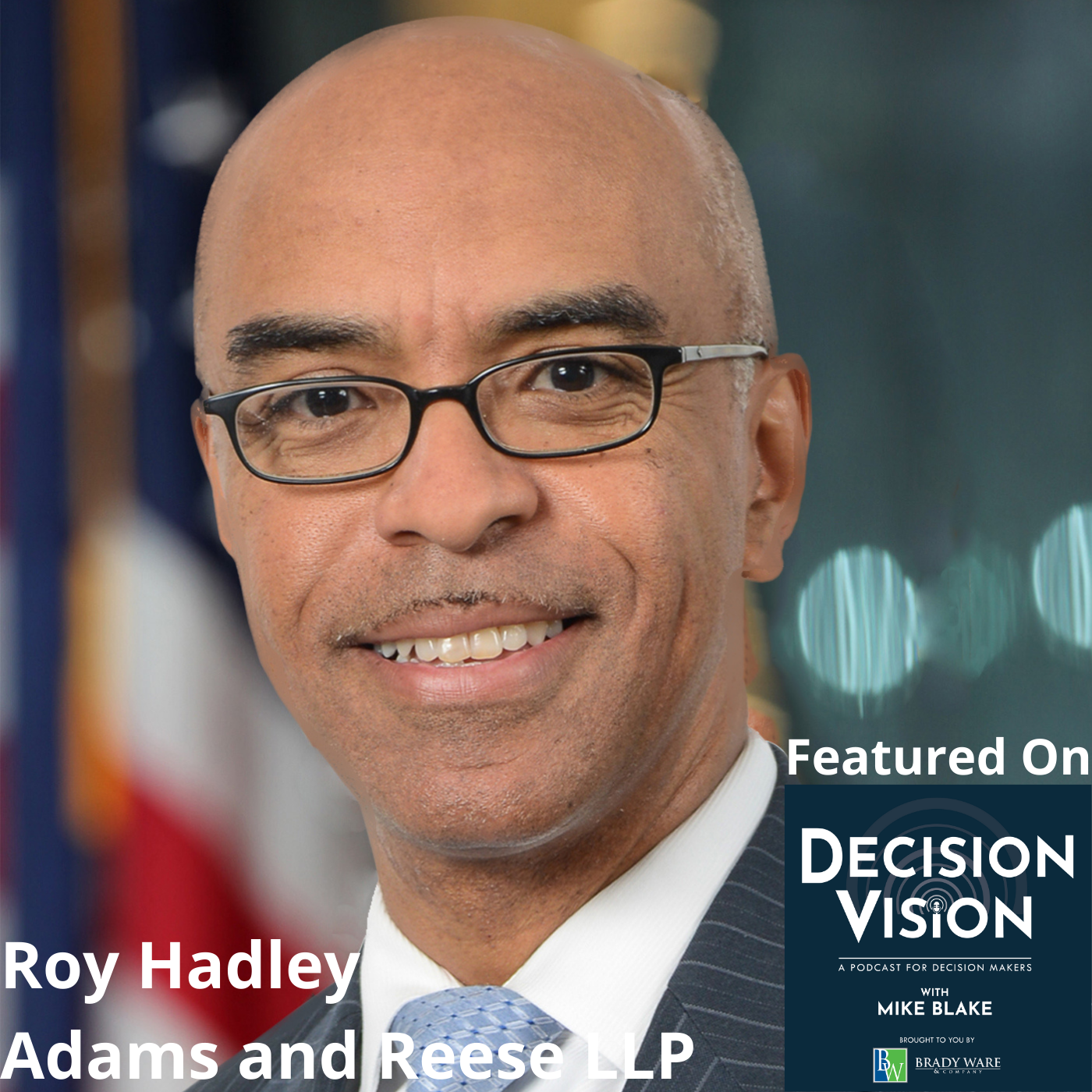
Decision Vision Episode 153: Should I Provide My Services Pro Bono? – An Interview with Roy Hadley, Adams and Reese LLP

January 27, 2022 by John Ray

Roy Hadley
Decision Vision
Decision Vision Episode 153: Should I Provide My Services Pro Bono? - An Interview with Roy Hadley, Adams and Reese LLP
Loading
00:00 /
RSS Feed
Share
Link
Embed

Download file

Roy Hadley

Decision Vision Episode 153:  Should I Provide My Services Pro Bono? – An Interview with Roy Hadley, Adams and Reese LLP

Arguably no other industry institutionalizes pro bono work like the legal profession does. With that in mind, host Mike Blake welcomed Roy Hadley with Adams and Reese, LLP, winner of the firm’s Pro Bono Lawyer of the Year for 2021, for an in-depth conversation on pro bono work. Roy explained why pro bono work is so important in the legal profession and to him personally, how such work presents an opportunity to grow, the risks of pro bono work, and much more. Decision Vision is presented by Brady Ware & Company.

Adams and Reese LLP

Study their experience and credentials to understand why they belong on your shortlist. Get to know them as people, and you’ll recognize their dedication to client service. At Adams and Reese, they take things personally. Their people are connected – to each other, to clients, their families, and their communities.

The firm’s industry-focused practice groups of attorneys and advisors are strategically organized throughout the southern U.S. and Washington, DC. Adams and Reese professionals are known as practical and personal advisors and advocates who tailor their approach and counsel to the specific needs of each situation and client. Many on their team have years of on-the-job experience within the industries that they serve as executives, professionals, and in-house counsel.

Taking a hands-on, personal approach to every issue, challenge, and opportunity our clients face, Adams and Reese lawyers and advisors are skilled and ready to help clients achieve their goals and make their lives easier.

Company website | LinkedIn

Roy Hadley, Attorney, Adams and Reese LLP

Roy Hadley, Attorney, Adams and Reese LLP

For more than 30 years, Roy has been a trusted advisor to high-growth businesses, governments, and family/closely held businesses. Roy’s practice, which is international in scope, includes advising clients worldwide on complex corporate transactions, particularly those involving technology, cybersecurity, life sciences, economic development, telecommunications, outsourcing, and intellectual property.

With a nod to our increasingly digital world, Roy provides guidance to a wide array of governments, governmental entities, and companies (and their boards) on issues related to data security and privacy.

Roy’s work as independent counsel on cybersecurity matters helps governmental officials and corporate boards understand and mitigate legal and operational risks and exposures to protect themselves and the companies/governments they serve. He also helps clients to respond to and recover from attacks should an event happen.

Roy’s business experience includes serving as vice president, general counsel, and corporate secretary of a wireless communications company, as vice president, general counsel and chief privacy officer for an international travel services and technology company and as in-house counsel for a pair of telecommunications corporations. Roy also served as special counsel to the president of the American Bar Association and as special assistant attorney general for the State of Georgia.

Roy also counsels clients on business matters affected by personal and family dynamics, including business succession planning, legacy planning, family governance and intergenerational issues. He focuses on helping closely held businesses and families protect their interests and achieve their goals in times of transition or crisis.

A frequent speaker, lecturer and author, Roy has writings that have appeared on USAToday.com, FOXNews.com, Compliance Week, Healthcare Risk Management, Inside Counsel, Homeland Security Today, National Law Review, Sports Page Weekly, Law 360 and many other publications. He has also appeared on Georgia Public Broadcasting, TAG Radio, WXIA-TV (Tech Edge) and WUPA-TV (Focus Atlanta).

Roy was the 2021 recipient of the Pro Bono Lawyer of the Year for Adams and Reese, LLP.

LinkedIn

Mike Blake, Brady Ware & Company

Mike Blake, Host of the “Decision Vision” podcast series

Michael Blake is the host of the Decision Vision podcast series and a Director of Brady Ware & Company. Mike specializes in the valuation of intellectual property-driven firms, such as software firms, aerospace firms, and professional services firms, most frequently in the capacity as a transaction advisor, helping clients obtain great outcomes from complex transaction opportunities. He is also a specialist in the appraisal of intellectual properties as stand-alone assets, such as software, trade secrets, and patents.

Mike has been a full-time business appraiser for 13 years with public accounting firms, boutique business appraisal firms, and an owner of his own firm. Prior to that, he spent 8 years in venture capital and investment banking, including transactions in the U.S., Israel, Russia, Ukraine, and Belarus.

LinkedIn | Facebook | Twitter | Instagram

Brady Ware & Company

Brady Ware & Company is a regional full-service accounting and advisory firm which helps businesses and entrepreneurs make visions a reality. Brady Ware services clients nationally from its offices in Alpharetta, GA; Columbus and Dayton, OH; and Richmond, IN. The firm is growth-minded, committed to the regions in which they operate, and most importantly, they make significant investments in their people and service offerings to meet the changing financial needs of those they are privileged to serve. The firm is dedicated to providing results that make a difference for its clients.

Decision Vision Podcast Series

Decision Vision is a podcast covering topics and issues facing small business owners and connecting them with solutions from leading experts. This series is presented by Brady Ware & Company. If you are a decision-maker for a small business, we’d love to hear from you. Contact us at decisionvision@bradyware.com and make sure to listen to every Thursday to the Decision Vision podcast.

Past episodes of Decision Vision can be found at decisionvisionpodcast.com. Decision Vision is produced and broadcast by the North Fulton studio of Business RadioX®.

Connect with Brady Ware & Company:

Website | LinkedIn | Facebook | Twitter | Instagram

TRANSCRIPT

Intro: [00:00:02] Welcome to Decision Vision, a podcast series focusing on critical business decisions. Brought to you by Brady Ware & Company. Brady Ware is a regional, full-service, accounting and advisory firm that helps businesses and entrepreneurs make visions a reality.

Mike Blake: [00:00:22] Welcome to Decision Vision, a podcast giving you, the listener, clear vision to make great decisions. In each episode, we discuss the process of decision-making on a different topic from the business owners’ or executives’ perspective. We aren’t necessarily telling you what to do, but we can put you in a position to make an informed decision on your own and understand when you might need help along the way.

Mike Blake: [00:00:43] My name is Mike Blake, and I’m your host for today’s program. I’m a director at Brady Ware & Company, a full-service accounting firm based in Dayton, Ohio, with offices in Dayton; Columbus, Ohio; Richmond, Indiana; and Alpharetta, Georgia. My practice specializes in providing fact-based strategic and risk management advice to clients that are buying, selling, or growing the value of companies and their intellectual property. Brady Ware is sponsoring this podcast, which is being recorded in Atlanta for social distancing protocols.

Mike Blake: [00:01:14] If you would like to engage with me on social media with my Chart of the Day and other content, I’m on LinkedIn as myself and @unblakeable on Facebook, Twitter, Clubhouse, and Instagram. I also recently launched a new LinkedIn group called Unblakeable’s Group That Doesn’t Suck. We just topped 100 members, by the way, so people are getting into this thing. So, please join in with that as well if you would like to engage. If you like this podcast, please subscribe on your favorite podcast aggregator, and please consider leaving a review of the podcast as well.

Mike Blake: [00:01:45] So, today’s topic is Should I Provide My Services Pro Bono? And, according to Esquire Deposition Solutions, and I don’t think it has anything to do with the magazine, nine out of 10 lawyers provide some sort of pro bono service every year. And, according to data on Statista, many firms’ attorneys average over 100 hours per year, which when you consider that the hourly billing rates might be easily $500 at the partner level and for the bulge bracket firms can be over a thousand, that’s a significant investment that firms are making in pro bono work.

Mike Blake: [00:02:26] And I want to talk about this topic because, you know, as we move through this, again I keep calling it the trans-pandemic period, I don’t know when we’re going to get to the post-pandemic period, but we’re certainly trans, and we have this great realignment and great resignation, great this and great that. You know, one of the things that we’re seeing in our society, of course, is the fact that people’s priorities are simply changing. And I’ll share with you sort of a little anecdote from this morning.

Mike Blake: [00:02:57] A guy that I used to work for many years ago texted me because he saw on my Facebook page that I posted something about the Celtics taking the Sacramento Kings behind the woodshed and beating him by 56 yesterday. And if you don’t follow basketball, that’s a big number. And, I posted something on the website and said – and it actually turned out they won by 52, and my friend was giving me the business said, “Hey, you’re a valuation guy. You’re not allowed to get math wrong.” I said, “Dude, if I’m off duty, I’m not responsible for your math, my math, or anybody else’s.” So, you know, I just can’t be on all the time. You know, I just can’t do that. So, he kindly corrected me and gave me the business by text today.

Mike Blake: [00:03:43] But it’s sort of emblematic of the fact that everybody, I think, is searching for something different in what they’re doing. And, one of the things they search for is, we all search for, I think, or most of us search for, is some kind of meaning in what we do. And, the thing that’s fascinating and why I have this particular guest and one of the reasons I have this particular guest on, is, first of all, he’s great. We could talk about anything for an hour and you would enjoy it. But this is a business podcast, so we’ll try to stick to business as much as we can.

Mike Blake: [00:04:15] But what makes this interesting is that the legal profession, despite having, you know, sort of the meme style reputation of being greedy and self-serving and running the meter on the billable hour, when you really sort of take a step back and take a deep breath and look at it in the cold, hard light of day, I don’t know that there’s another profession out there that institutionalizes volunteer work and giving away their expertise and services like the legal profession does. I know the accounting profession doesn’t do that. The business appraisal profession, sure as hell, doesn’t do that. You know, we have to sort of make that up on our own.

Mike Blake: [00:04:55] So, you know, I think it’s important to recognize the contribution of the legal profession makes to this, and I think provides an example for, you know, I think what many other companies and industries can and should consider following, again, as we as re-evaluate the intersection of commerce and society.

Mike Blake: [00:05:21] And, joining us today is a long-time friend of mine, Roy Hadley. We’re just talking before the program – oops. Sorry, my watch wasn’t turned off. I thought I had the device turned on.

Roy Hadley: [00:05:35] Technology, technology.

Mike Blake: [00:05:35] Yeah. Exactly. I’m sure Apple is not listening. So, anyway, joining us today is not Siri, but indeed it’s Roy Hadley, who is a business lawyer and technology cybersecurity and privacy evangelist with Adams and Reese, which is headquartered in New Orleans but has a fairly substantial office here in Atlanta.

Mike Blake: [00:05:58] Roy is a lawyer and trusted adviser to businesses, governments, and families worldwide. He’s an attorney out of the Atlanta office and is a member of the corporate and security team with a nod to the interconnected world where he consults clients globally on complex business issues, particularly those involving technology, communications, cybersecurity, life sciences, economic development, and trade, and he regularly assists with matters involving data security and risk mitigation. He was named a cybersecurity visionary by USBE Magazine, was named one of Georgia’s most powerful and influential lawyers, and recognized by The Legal 500 for his work in middle markets M&A. He represented the City of Atlanta as it confronted a massive ransomware attack in 2018. I couldn’t believe it’s only been four years ago since that happened. It seems like it was 10 years ago, but, boy, time flies.

Mike Blake: [00:06:54] Roy was named a Georgia trailblazer by the Daily Report and a game-changer by Information Security by Hub Magazine. He recently received Adams and Reese’s Pro Bono Lawyer of the Year Award for 2021, which is what prompted my inviting Roy to this conversation. But I think, perhaps most importantly, as we record this podcast here on January 26, 2022, Roy holds both his bachelor’s degrees and law degree from the National College Football Champion, University of Georgia. Boy, you guys [inaudible]

Roy Hadley: [00:07:29] Bulldogs. Bulldogs.

Mike Blake: [00:07:31] I’m just going to let you have – I’m going let you have it. If you want to start –

Roy Hadley: [00:07:35] Let me have that moment. Yeah. You do have to let me have that moment. You know, it’s been, what, 41 years coming? I deserve that moment.

Mike Blake: [00:07:43] You know, 41 years and I’m not – look, I’m not a college football fan. I’ve said, look, we already have pro football up in the North. We just paid our players over the table. That’s [inaudible]. But, you know, having moved down here almost 20 years ago, about 19 years ago, you know, I don’t have, no pun intended, I have a dog in the fight. But it was remarkable just how many years Georgia would come within a game of winning that national championship and just something – it would, you know, in the 20 – in the early 2000s, it would be a bonehead loss to a bad team six games in, right, that would derail their season. Right?

Roy Hadley: [00:08:25] Right.

Mike Blake: [00:08:26] And then, they keep running into the buzz saw known as Nick Saban, obviously, and the University of Alabama Juggernaut.

Roy Hadley: [00:08:33] Right.

Mike Blake: [00:08:34] And, I didn’t think there was a chance in hell Georgia was going to win that game after the way they lost to Alabama. So, don’t take my betting advice, but –

Roy Hadley: [00:08:42] Right.

Mike Blake: [00:08:42] But I’m just so happy for University of Georgia fans who have just been suffering and have just been tortured for so long –

Roy Hadley: [00:08:53] It’s our moment. Right?

Mike Blake: [00:08:53] And they haven’t come up on top. It’s just brought this really nice vibe, really, to the entire state. Even Georgia Tech fans, I think, are giving you the nod, which is a real sign of social unity, I think.

Roy Hadley: [00:09:05] It’s out of 41 years in the making.

Mike Blake: [00:09:10] Yes. So, Roy, thanks for coming onto the program. It’s awesome to see you again, and congratulations on your Pro Bono Lawyer of the Year Award, among the other things. And, you know, by the way, in full disclosure, I could have read off all of Roy’s accomplishments and achievements and expertise, but we’d use the entire hour doing that. So, I would just invite you to look at his LinkedIn page and look at the other credentials.

Mike Blake: [00:09:36] But let’s dig in, let’s dig in here. As I said in the introduction, the legal my impression is, and correct me if I’m wrong, please. But my impression is the legal profession, interestingly, has a special relationship with pro bono work, right? And so, I want to talk about that in a minute. But before we do that, since pro bono is a Latin term and not all of us have watched The Exorcist. What does pro bono work mean? And is there a distinction between that and a more genericized term of, say, volunteering?

Roy Hadley: [00:10:13] Right. So, you know, great questions, and I’ll start it off by saying, you know, pro bono has been kind of, you know, whether you call it pro bono or you call it something else, it has always been kind of ingrained in the legal profession. You know, the lawyers have always said it is a profession despite what a lot of people think. Lawyers think of the legal profession as a profession. And, as such, you know, part of that profession is giving back to society. And, for us, what that means a lot of times is doing what we call pro bono work, and that work is really doing it for free, pro bono. And, that’s really what, you know, kind of underpins it.

Roy Hadley: [00:11:02] You know, you see it all the time. Firms have pro bono requirements. We’ll get into that a little bit later. But, also, you know, courts. A lot of times when defendants don’t have, you know, money to pay for their defense, courts will appoint lawyers, and sometimes they’re paid, sometimes they’re not. A lot of times you will see lawyers that will take up the case of indigent defendants, lawyers that will take up death penalty cases.

Roy Hadley: [00:11:30] You see the Innocence Projects that go on throughout the country. A lot of times those lawyers aren’t paid, you know, and that even goes back to when kids are in law school, because a lot of the projects they are doing pro bono, they’re doing it for free, with the thought that that same mentality kind of permeates throughout their careers.

Roy Hadley: [00:11:54] And so, it’s almost ingrained in us that part of the profession is giving back. And in some bar, state bar associations, actually require pro bono work. So, you know, it’s just one of those things that I hold near and dear to my heart because, at the end of the day, people always ask me, “Well, what do you do?” You know, you read my resume and I do a lot of technology-focused stuff. But what I tell people at my core is I help people solve problems. And, you know, you can help clients solve problems and you get paid for it and you’re happy. They’re happy. Good stuff comes out of that. But a lot of times when you do pro bono work, you’re helping people that can’t afford your services.

Roy Hadley: [00:12:40] And so, you know, it’s things that are near and dear to them that really make a difference at the end of the day. Things like keeping them from getting evicted. Things like helping them pay hospital bills. Things like, you know, custody matters. Things like – you know, in my case, what I did a lot this year was helping with COVID relief and things like that. And so, things that really impact the daily lives of people is really what a lot of the pro bono work that lawyers do accomplishes. And so, it really does make a difference, and you can see that difference at the end of the day and impacting people’s lives directly.

Mike Blake: [00:13:25] And, you know, it’s so important because at least, you know, I think so. I’m not a lawyer but I’m a citizen, and I take, I think, my civic duty, you know, very seriously. And as a citizen, you know, we’re very proud of a system that is designed to be transparent and it’s designed to give you some kind of equal representation in front of the law, right? And, look, the law is complex and it’s not – although you’re allowed to represent yourself, it’s certainly not designed to encourage that, right?

Mike Blake: [00:14:01] But, you know, the legal system is not perfect and you’re talking about whether the legal system is just or not as a separate podcast altogether and really something philosophers really need to tackle and other jurists that I’m just not qualified to. But I can say this, without the opportunity for representation, the legal system simply has no chance of being successful.

Roy Hadley: [00:14:32] Right.

Mike Blake: [00:14:33] And, you know, the people that often need representation most are the ones that can least afford to pay for it.

Roy Hadley: [00:14:41] Right. And, not getting – and that’s a great point, but not getting too philosophical here because you say it will leave some of these questions for the philosophers. But our whole system, the American system, you know the Constitution, the Bill of Rights, and all of that we all hold dearly whether you’re a Republican, Democrat, Libertarian, it really doesn’t matter. These ideals that we have, you said, hold dearly, and those ideals are predicated really on the Rule of Law.

Roy Hadley: [00:15:11] And so, it’s that Rule of Law that underpins really everything that we do in this country. You know, it’s one of those foundational elements that we have to really nurture and protect. And as lawyers, we feel a special sense of duty and a special sense of obligation because we are lawyers to help nurture and protect and uphold that Rule of Law. But, kind of inherent in all of that is, like you said, making sure that it is just that it is fair that everyone has access to proper representation whether they can afford, you know, a lawyer, you know charges, I don’t – but, you know, charges a thousand dollars an hour, or they can only afford one that costs $10 an hour, or in some cases, afford one that costs zero dollars an hour.

Roy Hadley: [00:16:08] And so, I think that’s why you see lawyers really, you know, kind of embrace this whole thing about service and pro bono and giving back legal services to the community and those most in need of them for free because it is a foundational element of our whole system, of our republic, of our, you know, democratic ideals, that Rule of Law. And so, you know, I hold it dear and we all hold it dear. And, I think it’s it’s one of those things that, regardless of profession, we all love to hold dear.

Mike Blake: [00:16:46] Yeah. And I think, you know, the best example of that was, you know, very early on in our history, John Adams was famous for representing the soldiers in the Boston Massacre, right? Not necessarily because he believed in their case, but because he believed that everybody, even if you think they’re dead, guilty bad guys, the legal system to have credibility. Everybody is entitled to representation and they’re entitled to, as I think as you guys like to say, vigorous advocacy in front of the court, right?

Mike Blake: [00:17:15] So. I’m curious about something in the mechanics. You know, you mentioned about a court appointing a lawyer. And I have this in my head and this may be totally wrong. Does the court have the power to, in effect, draft an attorney to work on a case?

Roy Hadley: [00:17:35] Yeah. In some cases, in some matters, I would say yes, they do. And so, you know, a court can appoint an attorney, whether that attorney wants to or not, in some matters, to actually represent somebody in that case. And you’ll see it a lot of times, especially in smaller communities where, you know, as part of being a member of the bar, you have to sign up and register, and the court will rotate it and appoint different members of the bar to represent certain, you know, clients, whether they’re indigent or just need special assistance.

Roy Hadley: [00:18:13] Now the thing I’ll tell you, though, is that, you know, we have 50 states and each state has its own rules regarding lawyers. Each state has its own rules regarding pro bono, regarding the ability to assign cases. And within those states, you have different bar, circuit and bars and jurisdictions, and so each one will have something totally kind of different. That said, though, again, kind of going back to one of those foundational elements of the bar being that you will give back.

Roy Hadley: [00:18:46] And so, you know, you see firms. I mean, my firm, Adams and Reese, we have a pro bono requirement for lawyers. You know, you have to work a certain number of hours a year. I think it’s 50 per lawyer that you have to work in pro bono service. And there are lots of different ways you can do it, you know. And when you look at it a lot of times early in my career, I know I did some work where people were having trouble getting their wages paid or, you know, improper withholdings from employers, and, you know, a lot of times we’ll sit back in what I call our ivory towers, our gilded towers, and say it really doesn’t make a big difference.

Roy Hadley: [00:19:30] But, you know, if you’re making the minimum wage or you’re making $8 an hour and somebody is erroneously withholding a dollar from you, or if somebody is not paying you for your 40 hours for you, they’re not paying you overtime, that has a tremendous impact on your daily life. It may be the difference, and I’m not overstating this. It may be the difference between you being evicted because you couldn’t pay your rent. It may be the difference between you not having transportation because you couldn’t pay your insurance. Or, it may be the difference between you not being able to eat or feed your child that day.

Roy Hadley: [00:20:12] You know, these sorts of things that we sometimes take can literally be that impactful in people’s lives, and I think that’s really what drives at home for me the importance of it, because when you see somebody that you have helped in a very, you know, impactful way, then, and that person is genuinely appreciative, that gets to you. You know, if you don’t feel some sense of humbleness around the ability to help and the opportunity to help, then you know, I’m not quite sure about you, because it is impactful in ways that, you know, you just don’t see every day in what we do working with clients.

Mike Blake: [00:21:00] Yeah. And, you know, in a lot of cases, you are somebody in your stead is what’s standing in the way of an injustice, right? It’s one thing. You know, if you’re going to be evicted because you’re unable to pay your rent, that’s one scenario, again, I don’t want to go deep into that, that’s philosophical, right? But it’s another if a landlord just decides to kick you out because they got an offer to buy the building, for example. They’re going to make some good money on that sale and they’re banking on the fact that you cannot defend yourself legally, right?

Mike Blake: [00:21:38] To me, that’s the thing that’s got to be that must be impeded, that, you know, I don’t think any of us want to live in a society or very few of us want to live in a society where that is simply allowed, right. And it’s people doing that pro bono work that makes sure that at least if something bad is going to befall somebody, it’s going to befall somebody within the concept of what we, as a society, have decided as a just outcome as opposed to simple, frankly, just outright bullying. I don’t like bullies.

Roy Hadley: [00:22:18] You’re right. I don’t think any of us do, you know. And, it’s interesting because a lot of times, you know, most times people aren’t asking for anything special. You know, they’re just asking to be treated within the rules that are there, the laws that are there.

Mike Blake: [00:22:36] Right.

Roy Hadley: [00:22:36] And so, a lot of times, what you’ll find is people either don’t know how to navigate the system, don’t know what the rules are, don’t know what the opportunities are. And so, a lot of times it’s not that, like you said, somebody can’t pay their rent or doesn’t want to pay their rent, it’s that the landlord is doing something. Or, it said, you know, somebody is trying to get Social Security benefits for a kid because the mother or the father passed but the parents weren’t married, and they don’t know how to navigate that Social Security System to help get those benefits for the child. And, it’s not that the child is trying to get something they’re not entitled to. It said they just don’t know how to navigate the system to get something that they are entitled to.

Roy Hadley: [00:23:24] And so, that’s where, you know, we help. That’s where lawyers can help. And quite honestly, you know, that’s where a lot of other professions can help, you know. Because you start talking. I’m going to pick on you, you and your accounting friends there might – you know, accountants aren’t dumb. And so, accountants can navigate.

Mike Blake: [00:23:48] We like to think so. But, yeah.

Roy Hadley: [00:23:50] Right. You know.

Mike Blake: [00:23:52] That’s what the website says.

Roy Hadley: [00:23:54] Right. And so, you know, there are a lot of things that accountants could do to help this, you know, help people on a pro bono basis. And, you know, I think it’s just not institutionalized again in the way that historically it has been for lawyers. And, in some ways, us lawyers think that we are the guardians of the republic, the guardians of democracy, the guardians of the Rule of Law. You know, we like to think that and in a lot of ways we are because, again, kind of going back to what we first said, our country is built upon the Rule of Law. And so, we have to respect that, nurture it, protect it, and make sure that it’s fairly applied to everybody.

Mike Blake: [00:24:41] So, you bring up a great point. And I’ll say the following, it’s going to sound defensive, but it’s really not intended to be and I’ll prove with what I’ll say next.

Roy Hadley: [00:24:52] There you go.

Mike Blake: [00:24:52] I’ve offered a number of times to attorneys that, look, if you need somebody to ride shotgun with you on a pro bono matter, there’s a valuation issue, or it could be eminent domain. But, you know, it’s a tiny business. It could be a convenience store. It could be a pop-up store, whatever. They’re not going to pay somebody like me 10 or 12 grand to appraise the business. Right? But there are damages involved, right? I’ll be happy to ride shotgun with you, or I’ll have somebody on my staff ride shotgun and help you work through the numbers that matter. And in 18 years of doing this, I’ve never been taken up on it.

Roy Hadley: [00:25:26] Really?

Mike Blake: [00:25:27] Yeah. So, as I say this, and I’m going to put you on the spot a little bit, but I think you’re going to appreciate it. Let’s you and I have an offline conversation, figure out how we can partner our two firms to help you, if there are financial issues that are involved in any of the matters that you guys are working on, if you need a partner to ride shotgun, let’s do that.

Roy Hadley: [00:25:51] Okay. Absolutely. Take done. Done. We will absolutely have that.

Mike Blake: [00:25:55] We would like to do that because you did mention it. You know, you guys have the institutionalized knowledge, right? And the reality is that these matters come to lawyers first. It’s why guys like me suck up to guys like you because guys like you have the – really are the gateway to the engagements because lawyers are the planners and accountants are the historians, which means we can base it, “Oh, man. Well, you should have done this.”

Roy Hadley: [00:26:27] Right.

Mike Blake: [00:26:27] You know, that doesn’t – great. Right? So. you know, nobody comes to us sort of initially with the legal matter, but many of these legal – you know, many of these legal matters involve, you know, finances and that’s something that we can do. And there are opportunities for partnerships where we can kind of piggyback on what you guys are seeing. And I think other firms and other practitioners would love to lend a helping hand. We really would.

Roy Hadley: [00:26:56] Absolutely. And, a lot of times they’re not complex issues. You know, they’re not complex valuation issues. They may be calculating wage an hour, you know, issues. There may be calculating rent and back rent, you know penalties, or with back taxes, trying to help calculate and negotiate with the IRS, you know. There are lots of things. And so, people always say, “Oh, I don’t have time,” because people envision this really complex thing. And sometimes they are complex. But most times they go to the other end of the spectrum and are simple matters, especially simple to somebody who does numbers, you know works with numbers all day long. So, I will absolutely take you up on it.

Roy Hadley: [00:27:44] And, it kind of pivots me to one of the things that, you know, when we talk about pro bono with lawyers is people also tend to think if you’re a lawyer, you can do anything regarding the law. And, you know, kind of like in our normal practice, you kind of stay in your lane and you have to stay in your lane. And so, even with pro bono, we kind of stay in our lane, and part of staying in our lane means that a lot of times we’ll need help from somebody like you on those little things, those number-crunching things that are outside of our lane. And so, it’s – you know, I take that offer very seriously and I will absolutely take it up, take you up on it.

Mike Blake: [00:28:26] At a minimum, take it up with me. Like I said, 18 years, nobody’s ever pulled the trigger.

Roy Hadley: [00:28:30] All right.

Mike Blake: [00:28:31] I can’t commit my entire firm, but I can commit my practice for sure, and I think I can convince my firm to do something with it. So –

Roy Hadley: [00:28:39] Wait. I heard you earlier say the firm, you know, as lawyers hear these things.

Mike Blake: [00:28:45] Well, yeah. Well, that’s why I need to walk that back. So, I don’t have the authority. As far as to go, they’re not the managing partner of the firm.

Roy Hadley: [00:28:54] Right, right, right.

Roy Hadley: [00:28:55] [Inaudible] within my group that we can do it. And I think that I can get people in my firm to do it, whether formally or informally, but –

Roy Hadley: [00:29:01] I’m messing with you.

Mike Blake: [00:29:03] But I do want to have that conversation sort of institution to institution.

Roy Hadley: [00:29:08] Absolutely.

Roy Hadley: [00:29:09] And I think we’ll be receptive to it, just knowing the people involved. So –

Roy Hadley: [00:29:12] Right.

Mike Blake: [00:29:16] Now, you have a 50-hour minimum. I don’t think they gave you the award for doing 50 hours.

Roy Hadley: [00:29:22] [Inaudible] No.

Mike Blake: [00:29:24] That would be, that would be awkward.

Roy Hadley: [00:29:26] Right.

Mike Blake: [00:29:26] So, obviously, this is something you’re doing more and more of because you truly believe in it.

Roy Hadley: [00:29:32] Right.

Mike Blake: [00:29:32] Why? What is it that drives you maybe, you know, more on sort of the edge of the bell curve to do a lot of this?

Roy Hadley: [00:29:39] Right. So, this year, you know, I was well over 200 hours in terms of pro bono work. And a lot and what – and I’ll describe a little bit of what I did. You know, we had a client that was giving out pandemic relief funds, loans, grants [inaudible]. And so, part of that was it took legal work to effectuate the loans and things like that. And so, let’s just say, for example, it’s a $10,000 loan, takes two or three hours of legal work to do. Then, you know, at my standard rate of $50 an hour, just kidding, but at most, you know, it could be a thousand to $1500 in legal fees. So, all of a sudden that $10,000 loan is 8000 or 8500, you know. But if you could get that whole 10,000 to them, then now that business can pay rent, now that business can pay employees, now that business can buy PPE, supplies, and things like that. Now, they can pay the light bill. Now, they can stay open and keep functioning, which is the whole purpose.

Roy Hadley: [00:30:52] And so, you know, I’m a business lawyer. I’m a corporate lawyer, you know, close loans, do deals all day, every day. And so, the ability to do that for these companies, and, again, these are small companies. These are a lot of times sole proprietorships. These are companies that maybe have two or three or four employees that really aren’t the big companies that have the ability to kind of withstand business dropping 50 or 70% because of COVID. These are small operators. And so, the ability to help them by getting all of the monies that we’re trying to get to them can be very impactful.

Roy Hadley: [00:31:35] I mean, you know, when you close some of these loans and you talk to the people, they are genuinely appreciative of those funds. And so, you know, and they will make a difference, and they did make a difference. They kept a lot of these businesses afloat. Again, it was the difference between their doors being open and their doors being closed. And so, you know, if you can, as a lawyer, help effectuate that, I mean, it really warms your heart.

Mike Blake: [00:32:04] And, you know, again, my firm has a minimum requirement, but they are very supportive and I was genuinely appreciative of that support that said, “Hey, go do this. This is a good thing. This is a great thing. Go do this.” Because despite the fact that we too were impacted by COVID and those sorts of things, we still will support these types of endeavors by our lawyers to make a difference in the communities we serve. And I’ve put some emphasis on that word because we really do look at communities where we are as not as the communities that we operate in but as the communities we serve.

Roy Hadley: [00:32:51] And so, you know, here in Atlanta, as you mentioned, the mothership, as I call it, is in New Orleans, but we’re all across the south in terms of our footprint. But in each of those communities, we really do make a special effort to serve the community. And, you know, when people think about, and I know I’m going on on a tangent here, but when people think about pro bono, you know, we tend to think of the legal work that we’re doing. But also inherent in our commitment to the community, legal profession’s commitment, is that you see service to the community in other ways. You see lawyers on the United Way board. You see lawyers on the Red Cross board. You see lawyers on the Community Thief board. You see lawyers, you know, on the food kitchen board, you know.

Roy Hadley: [00:33:46] And so, you see lawyers that not only are doing pro bono work in the truest sense, but you also see lawyers that are out in the community serving on these boards, bringing expertise to these boards of these organizations that also serve the community. And so, you know, all of those nonprofit boards are going to be unpaid, but that’s okay because, again, that’s giving back to the community.

Roy Hadley: [00:34:16] And so, I would challenge all businesses, all business leaders to make a special effort to, you know, push your people because these are going to be people that have special expertise. These are going to be young people. Sometimes they have a lot of time, more time, you know, that can really get in there and serve the community, not necessarily in pro bono like, you know, we have originally defined it, but in terms of giving back to the community, by giving back to other organizations that serve the community. And I think that’s something that also we should really highlight and talk about for the listeners to make sure they understand there are many, many ways that even if you’re not a lawyer, you can serve in the spirit of pro bono service.

Mike Blake: [00:35:08] So, I want to posit something to you, and I’d appreciate your reaction to it. Can’t you also make the case that there is in your profession, and I think I think mine, and as I sort of think through this conversation, I want to interject because I need to be fair. For all I know, there’s a ton of pro bono work that’s going on in my profession, in my company, I just don’t know about it, right? But I do know it’s not institutionalized. We don’t have an award for pro bono, right?

Roy Hadley: [00:35:41] Right.

Mike Blake: [00:35:42] And there are probably opportunities to make it more efficient by aggregating it. So, I do want to get that out there. But that having been said, can you also make a case that the pro bono work could be a great opportunity for somebody that doesn’t have a lot of experience yet to kind of cut their teeth on certain kinds of matters? You know, it could be a first chance to cut your teeth in litigation or, in my world, serving as a consulting or even potentially a testifying expert. Or, you know, in some cases, just sort of getting out of the office and rolling up your sleeves and getting into real world, real life, real business issues where you have to provide, you have to get into really, the very real scenario of providing a client with advice under extreme duress. And, you know, there’s no – I don’t think there’s any class in the world you can take that, would ever prepare you for that. You just have to get in. You just have to get in there, right? So, can we argue that there is a professional development aspect to pro bono work in the way that we’re describing that is also very helpful?

Roy Hadley: [00:36:58] Absolutely. You know, again, you know, the requirement here at this firm and most firms is not, you know, no requirement for young lawyers, 50 hours for senior lawyers. It’s for every lawyer, which means that young lawyers have to get out and do something. Now, what we do here in the legal profession is, again, we try to kind of stay in your lane. But if you are volunteering, say you’re a young lawyer and you are going into something you don’t have the expertise on, you know, you get a senior lawyer that does will help you navigate whatever that is. But it is an excellent opportunity, as you said, to learn new areas.

Roy Hadley: [00:37:42] You know, back – I’ve always been a corporate lawyer, but a lot of my pro bono cases when I was very young dealt with wage and hour issues, dealt with Social Security issues, dealt with evictions, you know, nothing within the lane that I was in. But because I did those things, I did learn about those types of areas of the law. But more importantly, and I think this is one of the things that is kind of underpinning your statement, is I learn how to work with clients. I learn how to interact with people. I learn how to listen and understand the issues and the problems, and then come up with real-world solutions and not just theoretical kind of book solutions.

Roy Hadley: [00:38:30] You know, it’s one thing kind of to do a law exam and come up with a solution to a question, but it’s a whole another thing when you’re out in the real world. And, like most issues, things aren’t cut and dry. They’re not black. They’re not white. They’re shades of gray and those shades of gray shift, you know, depending upon who you’re talking to and what they’re saying. And so, in any profession, you’re going to be a better fill-in-the-blank if you have experience, you know, working with those nuances and those shades of gray that are constantly shifting on you.

Roy Hadley: [00:39:08] And so, pro bono work is a fantastic opportunity to get out there and learn a new area of the law, you know, to roll your sleeves up, to get some, as you said, that real-world experience, and quite frankly, for the legal profession, we encourage that. We encourage you to say, “Okay. I’m going to go volunteer for the Atlanta Volunteer Lawyers for the Arts and learn about contracts and that sort of thing.” Or, “I’m going to volunteer for Legal Aid and learn about helping to defend somebody in, you know, or help them navigate through certain parts of the system, whether it’s child support or those sorts of things.” You know, it may be a corporate lawyer going to Legal Aid. We don’t have those kinds of prohibitions.

Roy Hadley: [00:39:58] So, it’s a great, great opportunity and it’s a great opportunity for old lawyers, you know, like myself that have been practicing for a long time to get out there and do something different, learn a new area of the law, and quite honestly, like you said, get out of the office and, you know, actually look somebody in the eye, sit across the table from them, sometimes go and take them to lunch and break bread with them, and really understand the issues. Because most times kind of like any corporate matter, again it’s not just black and white. You’re going to need to be able to navigate those nuances and nothing like real-world experience to help you navigate those nuances.

Mike Blake: [00:40:45] And, another word that comes to mind that I think is so important, and I almost hate to bring it up because one of my fears, I’m afraid this word is going to become viewed as a buzzword and it really shouldn’t, it really needs to stick, and that is that I think the pro bono work you’re describing helps you develop and strengthen your empathy muscle.

Roy Hadley: [00:41:06] Absolutely.

Mike Blake: [00:41:09] The kinds of cases you’re in, and I’ve only done a fraction of what you’ve done mainly through my old office hours, people sort of wander in, right. But, you know, they come in and the circumstances that sort of that got them there, right, in a paid scenario. You guys are in – I forget if you’re in Class A or Class B office space, but the fact of the matter is, I don’t want to get into – there’s a segue here. People are not wandering into your office most likely who are minimum wage people about to be evicted coming into the marble office, right, and reception room, saying, I need a lawyer. Right?

Roy Hadley: [00:41:46] Right.

Mike Blake: [00:41:47] And it sort of goes the reverse, right? So, unless you really make a concerted effort, you never encounter that. It’s very easy for people in our position that in fact we want to really isolate ourselves and never connect with that.

Mike Blake: [00:42:02] So, that’s a long preamble to the segue, which is if somebody – how do you – how do those opportunities to serve come your way? Right? Because they’re not calling. I don’t think – they’re not coming into your office. How do they find Adams and Reese? How do they find Roy Hadley to get the help they need?

Roy Hadley: [00:42:22] Right. So, you know, I’ll preface my whole statement here in response by your original premise of the empathy. And I think that’s important to kind of underscore here because one of my favorite sayings is, I complained that I had no shoes until I saw the man with no feet. Right? And so, you really have to always put things in perspective. And, you know, before you got on this kind of video here we’re talking and, you know, I’m always happy because I always try to keep things in perspective. And that perspective is that I’m fortunate. I’m blessed. You know, I am in a good place. Not everybody is as fortunate, right?

Roy Hadley: [00:43:13] And so, you have to remember that that a lot of times people’s circumstance is not of their choosing, you know, kind of dictates where they’re going in life and how they’re getting there. And you always have to be cognizant of that, that not everybody graduated from high school. Not everybody had the opportunity to go to college. Not everybody had the opportunity to go to grad school or to law school. And those are opportunities that are generally afforded to you, not by your own choosing, but by your circumstance. And so, I keep that filter in mind when trying to talk to people and help people. Everybody is not as blessed or as fortunate as we are, and so we just have to be cognizant, cognizant of that.

Roy Hadley: [00:44:06] Now, to get it back to the second part of your question, most times, yes, you’re right. To be quite honest, most people couldn’t get past security to come up to our office, right?

Mike Blake: [00:44:17] There. Fair.

Roy Hadley: [00:44:19] Speaking plainly. Right? What we do is we partner with, you know, institutions that are on the ground out in the community. So, you know, you’re talking about institutions like the United Way. You’re talking about institutions like, you know, Homeless Task Forces. You’re talking about the food banks. You’re talking about shelters. You’re talking about, you know, places like that, the Volunteer Lawyers for the Arts, you know, and those types of institutions that have their feet out and hands out in the community are going to be the frontline and then we partner with them. Legal Aid is another great example of an organization that has offices and people that are out in the community, you know talking to people that are accessible to people. They come in, they identify the need, and then we partner with them to address those needs.

Roy Hadley: [00:45:19] I was talking to – I had a good friend who was in the legal business, but he also had gotten into the restaurant business, and he and some other restaurant owners found it kind of a fund for their employees that, you know, if – the restaurant owner has put into the fund every month and employees could contribute whatever they want it too [inaudible]. And then, let’s say you then have rent money for a month or you were short on your rent or you’re short on your insurance payment, the fund would loan you the money or give you the money. But, you know, that fund also would help people who needed legal assistance.

Roy Hadley: [00:45:59] And so, you partner with those types of organizations, and that’s really how we do it. And that’s going to be the most efficient way because a lot of times, you know, issues can be resolved without even involving a lawyer, you know by somebody that has much more specialized practical expertise on it to say, “Hey, you need to take this form, fill it out and take it to this office there, you know, at this address, or we can take it for you.”

Roy Hadley: [00:46:27] And so, you know, those types of organizations will filter out, address a lot of things, you know, quickly and more practically, and then give the others to us, funnel them to us, and then we handle those through those organizations. And, we found that’s the most efficient and practical way to do it. And so, you know, if somebody needs help, go to those frontline organizations. And then, if they need more specific help, those organizations can get them to us to address the needs.

Mike Blake: [00:47:02] I’m talking with Roy Hadley and the topic is, Should I Provide My Services Pro Bono? So, I want to address a question that I think is important any time – because any time we talk professional services, the elephant in the room is always, what’s the liability? And, it’s unfortunate, but that’s just a fact of professional life. We have to protect ourselves or we can’t be in business very long.

Roy Hadley: [00:47:27] Right.

Mike Blake: [00:47:29] How, if at all, are there any kind of protections in place to ensure that you’re not taking disproportionate risk by taking on a pro bono case? Do you effectively have – and for example, you said, you know, pro bono is a great way to learn about a part of the law where you don’t have necessarily that much exposure, which to me means that – that means it’s going to be higher risk that something could go sideways. Are there structures in place to kind of help you manage the risk to make sure that when you’re trying to do a good thing, you’re not the good Samaritan that gets sued because you didn’t change the guy’s tire right on the side of the road? You know what I’m trying to get to?

Roy Hadley: [00:48:17] Right. Right. Absolutely. So, that’s a great question, and I can only address it from the legal standpoint, the legal law firm, you know, lawyer standpoint. I can’t really speak to other professions that might do volunteer work of this ilk. In the legal sense, you know, I talked about staying in your lane earlier, and what that means is that even if you are taking on a matter that you may not have expertise in, you get somebody at your firm who can help guide you, you know, just like they would in any other matter. You know, you use that matter as a teaching opportunity, as an opportunity to grow. So, from a staffing standpoint, we’ll always make sure that there is somebody on that matter that can provide general overall guidance.

Roy Hadley: [00:49:10] So, you may be a young corporate lawyer, you know, cutting your teeth in a pro bono litigation matter, but we’ll make sure we have a litigation senior lawyer, partner or senior associate that knows that area that can help guide you so that you don’t make those missteps. Because, you know, not only is it a legal exposure, but, again, you have to remember there’s a live person on the other end of the matter that it really impacts their lives. And so, you know, we will staff it the same way we staff a paid matter in terms of, you know, we may have a young lawyer working on it, but there’s going to be a more senior lawyer that actually knows how to do it and knows, you know, what needs to be done to oversee that young lawyer. So, we’ll always staff pro bono matters that way.

Roy Hadley: [00:50:01] We actually have a pro bono partner. And so, all pro bono matters at the firm have to be approved by this part. Part of that process is making sure that we’re putting the right staffing on the matter so that we have the right expertise on the matter.

Roy Hadley: [00:50:19] Now, the second part of it is pro bono is so ingrained in the legal culture of law firms that our professional liability insurance also covers pro bono matters. So, if a firm just happens to screw up something, you know, inadvertently, their professional liability coverage, generally speaking, will cover those types of matters also. But again, that’s just because pro bono is so ingrained in what we do as a profession that it is generally speaking covered under most firms’ and lawyers’ liability policies. But again, you go back to that first part of it and that is, you staff it no differently than you would staff a regular paid matter. You know, if a regular paid matter came in and that young – you wanted to put a young lawyer on it or that young lawyer wanted to be on it, you would have a senior lawyer supervising them, be no different than that for a pro bono matter.

Roy Hadley: [00:51:24] So, you know, again, it’s just one of those things that it’s just inherent in us. But pro bono doesn’t mean no expertise. You know, pro bono doesn’t mean shoddy work. You know, we’re going to perform the work at the same level and the same standard that we would paid work. We’re just not getting paid for it.

Mike Blake: [00:51:48] Yeah. And do you have a couple more minutes or do you have a hard stop?

Roy Hadley: [00:51:52] Absolutely. Absolutely.

Mike Blake: [00:51:52] Okay.

Mike Blake: [00:51:53] There’s one –

Roy Hadley: [00:51:54] I’m billing you for this, by the way, but –

Mike Blake: [00:51:59] Okay. That rolling sound you heard, that’s the meter, right?

Roy Hadley: [00:52:03] That’s right. That’s right.

Mike Blake: [00:52:06] Yeah. But the two questions I want to make sure that we got through, and then I’ll let you go. But one, you segued so nicely and I have to ask you, which is, how do you gear yourself up to give a pro bono client the same level of care and attention that are paying client is giving you? Because, you know – and we’ve both done pro bono work. You’ve done more than I have. But one of the things you learn pretty quickly in professional services is that a, quote-unquote, free or very low fee case can easily become as complicated and as frustrating and as emotionally challenging as the big bulge bracket case. In fact, in many ways, those are going to be hard cases for a lot of reasons we are not going to go into it but we both know.

Mike Blake: [00:52:59] When you recognize that, you know, there’s never going to be a billable moment at the end of this thing or in the middle of this thing, how do you stay focused and make sure that you don’t fall into the mental trap? “Ah, well, you know, they’re not paying anything so they can always take a back seat.” Or, you know, “I don’t have to treat this as the same due care.” How do you maintain that mindset, that professional mindset that no matter who you are, how much you’re paying me, you’re getting the same, the very best fastball the Roy Hadley has to throw?

Roy Hadley: [00:53:32] Right. So, you know, and that’s a great question because human nature would probably be “You know, okay, I’ve got to do this or do that.” And what you do is, you know, it all comes down to prioritizing and time management. And I’ll start with the time management in the sense, as a – you know, it’s easier for me because I’m a senior lawyer, and when I look at something, I can pretty much tell what it’s going to be, right? I can say, “Ooh, this is going to be complex.” “So this is going to be a simple thing.” You know, they always shift on. You know, we’re talking about those shades of gray shifting on you earlier. They always shift on you.

Roy Hadley: [00:54:11] But you know, just like a regular matter, you look at it, you assess it, you figure out on the front end what it’s going to be. And then, you know, just like a regular matter, you try to avoid that thing kind of going down the yellow brick road on you. You try to avoid scope creep, you know.

Roy Hadley: [00:54:31] And so, if you are, let’s just say, working on a rent issue, right, and you’ve been tasked with working on a rent issue, then, you know, you don’t want to go down to the scope creep. “Yeah. But, you know, my child’s father hasn’t been paying his child support. You know, can you help me on that?” Well, I can steer you to somewhere that can, you know, and it may come back around to me, but that’s not within the scope of what we’re trying to do.

Roy Hadley: [00:55:05] And so, you know, the empathy part of you wants to help. But just like a regular matter, you have to kind of set those guardrails to make sure you don’t get that scope creep, you know. And then, you just set that into your daily schedule and you just say, “Okay. On Wednesday, I have to do X and I’m going to allot two hours for that.” And you get X done and that X may be a paying client. That X may be a pro bono matter.

Roy Hadley: [00:55:36] But then, you know, just like anything else, an emergency may come up and you may have to push things down on the priority scale. And so, that’s when the professionalism that you kind of mentioned comes into play of knowing how much something is going to take, how much time it’s going to take, where it’s going to fall in the priority scale for that day. If they’re about to be evicted tomorrow, you know, then that’s going to be a priority one. If they just got the eviction notice and the eviction hearing is in a month, okay, that may not be priority one for today. You know, that may be priority three or four.

Roy Hadley: [00:56:18] And so, you just kind of mold it into your daily schedule and what you have to do and what you’re doing to make sure [inaudible] that client proper representation within the realm of everything that you’re doing.

Mike Blake: [00:56:35] Roy, this has been a great conversation. I’ve only gone through, I think, about half the questions I prepared. But I need to let other people benefit from your expertise and your empathy, so we’ll leave it at this. There are probably questions that our listeners would have liked us to cover either at all or in greater depth. If somebody wants to follow up on this and ask about pro bono work and how to get involved in that and how to do it right, can they contact you, and if so, what’s the best way for them to do that?

Roy Hadley: [00:57:06] So, the easiest way to do it would just be absolutely you can contact me. Absolutely. The easiest way is just shoot me an email and that’s going to be roy, R-O-Y, dot hadley, H-A-D as in David, L-E-Y, @arlaw, A as in Robert – A is an apple, R as in Robert, law.com. So, it’s roy.hadley@arlaw.com.

Roy Hadley: [00:57:31] And, you know, always happy to help. Love talking about this thing and the original question, you know, should you be doing pro bono? Regardless of what field you’re in, the answer is absolutely yes, you know, in terms of whatever kind of that pro bono looks like, whether it is doing legal work, doing accounting work, or whether – you know, it doesn’t have to be that complicated. It can be going down and serving at the soup kitchen. It can be going down to the food bank and helping get food in and segregating it and passing it out.

Roy Hadley: [00:58:11] It can be, you know – I took my daughters down over Christmas. We went down to an organization down in downtown Atlanta, had kind of a thing for homeless people, so we served meals to them. We had care packages for them. We gave haircuts to people. We gave manicures. We had medical facilities. We had shower facilities. And so, we just served. And, you know, my daughters and my wife and I passed out food for five or six hours that day. And, you know, it’s that spirit of giving that whether you define it as pro bono or volunteering or just a day of service, whatever that spirit of giving is and how it manifests in you, it should be done in my opinion. Again, whether you call it pro bono or whether you call it something else.

Mike Blake: [00:59:08] Well, thank you for all that you and your family do and service to our community, and I think I’d be remiss – I’d love to give you an opportunity to share with your Twitter handle because I know you’re pretty active on the platform. So, if you’d like to give out your Twitter handle on the podcast, here’s your opportunity to do that as well.

Roy Hadley: [00:59:24] Okay. Yeah. You’re putting me on the spot because, you know, it’s kind of like your home, you know your phone numbers. You don’t say them that often. But it’s GovCyberPrep. So, G-O-V, cyber, C-Y-B-E-R, prep, dot – what is the end of Twitter? Dot? I think –

Mike Blake: [00:59:42] There’s nothing. It’s nothing. That’s just it.

Roy Hadley: [00:59:44] Right. It’s just @GovCyberPrep.

Mike Blake: [00:59:48] Yup.

Roy Hadley: [00:59:48] And also, I do a lot of LinkedIn. And so, you know, you just search for me, Roy Hadley, on LinkedIn. And a lot of times it’s related to cybersecurity, but a lot of times it’s just related to life and what we’re doing in life and how we should be approaching it. So, you know, I welcome you to follow me and what I do there also.

Mike Blake: [01:00:10] That’s going to wrap it up for today’s program. I’d like to thank Roy Hadley so much for sharing his expertise with us.

Roy Hadley: [01:00:17] Pleasure is mine.

Mike Blake: [01:00:17] We’ll be exploring a new topic each week, so please tune in so that when you’re faced with your next business decision, you have clear vision when making it. If you enjoy these podcasts, please consider leaving a review with your favorite podcast aggregator. It helps people find us that we can help them.

Mike Blake: [01:00:33] If you would like to engage with me on social media with my Chart of the Day and other content, I’m on LinkedIn as myself and @unblakeable on Facebook, Twitter, Clubhouse, and Instagram. Also, check out my new LinkedIn group called Unblakeable’s Group That Doesn’t Suck. Once again, this is Mike Blake. Our sponsor is Brady Ware & Company. And this has been the Decision Vision podcast.


Tagged With: Adams and Reese LLP, Brady Ware & Company, community service, Decision Vision, Decision Vision podcast, Mike Blake, Pro Bono Legal, pro bono work, Roy Hadley

Decision Vision Episode 152: Should I Become a Consultant or Freelancer? – An Interview with Ben Cagle, Cagle Consulting Partners

January 20, 2022 by John Ray

Cagle Consulting Partners
Decision Vision
Decision Vision Episode 152: Should I Become a Consultant or Freelancer? - An Interview with Ben Cagle, Cagle Consulting Partners
Loading
00:00 /
RSS Feed
Share
Link
Embed

Download file

Cagle Consulting Partners

Decision Vision Episode 152:  Should I Become a Consultant or Freelancer? – An Interview with Ben Cagle, Cagle Consulting Partners

With corporate employment in constant flux, executives tired of the corporate life often set up their own independent consulting practice. Host Mike Blake spoke with Ben Cagle, managing partner of Cagle Consulting Partners, about the process of becoming an independent consultant or freelancer. Ben discussed his journey, how to get that first client, networking and marketing, the challenges unique to consulting, and much more. Decision Vision is presented by Brady Ware & Company.

Cagle Consulting Partners

Cagle Consulting Partners (CCP) is an Advisory Firm focused on helping clients: • Accelerate Revenue Growth • Respond to Rapidly Changing Markets • Building/Scaling Organizations • Sell into Large Global Customers. CCP currently serves large Global Enterprises (IBM, Cisco, SAS), Mid-Market Firms, and diverse Technology Start-Up clients in Artificial Intelligence, Data Analytics, Cybersecurity, IoT, and Blockchain.
Company website | LinkedIn

Ben Cagle, Managing Partner, Cagle Consulting Partners

Ben Cagle
Ben Cagle, Managing Partner, Cagle Consulting Partners

Ben Cagle is Managing Partner of Cagle Consulting Partners (CCP), an Advisory Firm focused on helping clients:
• Accelerate Revenue Growth
• Respond to Rapidly Changing Markets
• Building/Scaling Organizations
• Selling to Large Global Customers.

CCP currently serves large Global Enterprises (IBM, Cisco, SAS), Mid-Market Firms, and diverse Technology Start-Up clients in Artificial Intelligence, Data Analytics, Cybersecurity, IoT, and Blockchain.

Prior to founding CCP, Ben served as a Division President for a Global 100 Enterprise. Ben had P&L responsibility for a global business unit (several $ hundred million in revenue) and was on the core team leading an industry consolidation initiative (with McKinsey & Company).

Transitioning from “industry” into global management consulting, Ben served in various Consulting Partner, Practice/Industry Leader, Solution Innovation, Marketing, and Thought Leadership roles. Ben’s global enterprise consulting leadership experience includes positions at HP Enterprise (formerly EDS), DXC Technology (formerly CSC Consulting), and Hitachi Consulting with clients across four continents.

Ben also has led various NASDAQ, VC-backed Software/SaaS, and entrepreneurial companies focused on Advanced Data Analytics, Market Insights, and Brand/Marketing Strategy targeting multiple industries.

Ben is an Alpharetta, Ga. native and currently resides in Alpharetta with his wife, Sara. He graduated of the Georgia Institute of Technology, is active in various Technology and Start-up organizations, and currently serves as the Chairman of Tech400 (sponsored by the Greater North Fulton Chamber of Commerce).

LinkedIn

Mike Blake, Brady Ware & Company

Mike Blake, Host of the “Decision Vision” podcast series

Michael Blake is the host of the Decision Vision podcast series and a Director of Brady Ware & Company. Mike specializes in the valuation of intellectual property-driven firms, such as software firms, aerospace firms, and professional services firms, most frequently in the capacity as a transaction advisor, helping clients obtain great outcomes from complex transaction opportunities. He is also a specialist in the appraisal of intellectual properties as stand-alone assets, such as software, trade secrets, and patents.

Mike has been a full-time business appraiser for 13 years with public accounting firms, boutique business appraisal firms, and an owner of his own firm. Prior to that, he spent 8 years in venture capital and investment banking, including transactions in the U.S., Israel, Russia, Ukraine, and Belarus.

LinkedIn | Facebook | Twitter | Instagram

Brady Ware & Company

Brady Ware & Company is a regional full-service accounting and advisory firm which helps businesses and entrepreneurs make visions a reality. Brady Ware services clients nationally from its offices in Alpharetta, GA; Columbus and Dayton, OH; and Richmond, IN. The firm is growth-minded, committed to the regions in which they operate, and most importantly, they make significant investments in their people and service offerings to meet the changing financial needs of those they are privileged to serve. The firm is dedicated to providing results that make a difference for its clients.

Decision Vision Podcast Series

Decision Vision is a podcast covering topics and issues facing small business owners and connecting them with solutions from leading experts. This series is presented by Brady Ware & Company. If you are a decision-maker for a small business, we’d love to hear from you. Contact us at decisionvision@bradyware.com and make sure to listen to every Thursday to the Decision Vision podcast.

Past episodes of Decision Vision can be found at decisionvisionpodcast.com. Decision Vision is produced and broadcast by the North Fulton studio of Business RadioX®.

Connect with Brady Ware & Company:

Website | LinkedIn | Facebook | Twitter | Instagram

TRANSCRIPT

Intro: [00:00:02] Welcome to Decision Vision, a podcast series focusing on critical business decisions. Brought to you by Brady Ware & Company. Brady Ware is a regional, full-service, accounting and advisory firm that helps businesses and entrepreneurs make visions a reality.

Mike Blake: [00:00:23] Welcome to Decision Vision, a podcast giving you, the listener, clear vision to make great decisions. In each episode, we discuss the process of decision making on a different topic from the business owners’ or executives’ perspective. We aren’t necessarily telling you what to do, but we can put you in a position to make an informed decision on your own and understand when you might need help along the way.

Mike Blake: [00:00:45] My name is Mike Blake, and I’m your host for today’s program. I’m a director at Brady Ware & Company, a full-service accounting firm based in Dayton, Ohio, with offices in Dayton; Columbus, Ohio; Richmond, Indiana; and Alpharetta, Georgia. My practice specializes in providing fact-based strategic and risk management advice to clients that are buying, selling, or growing the value of companies and intellectual property. Brady Ware is sponsoring this podcast, which is being recorded in Atlanta per social distancing protocols.

Mike Blake: [00:01:14] If you would like to engage with me on social media with my Chart of the Day and other content, I’m on LinkedIn as myself and @unblakeable on Facebook, Twitter, Clubhouse, and Instagram. I also recently launched a new LinkedIn group called A Group That Doesn’t Suck, so please join that as well if you would like to engage. If you like this podcast, please subscribe on your favorite podcast aggregator and please consider leaving a review of the podcast as well.

Mike Blake: [00:01:41] Today’s topic is, Should I become a consultant or freelancer? And it’s an interesting topic, as we record this on January 18, 2022 as we continue through this trans-pandemic period that we’re in, we are seeing society reorganize in many facets in real time. And one of the areas that I don’t think any of us are truly prepared for was the way the labor market is reorganizing.

Mike Blake: [00:02:18] And we’ve had a couple of shows late last year, probably in the 120s or so, I think this is recording number 151 or two or something, but, you know, we’ve had conversations about how to find or tap into underutilized, underexplored labor pools. And the reasons for that are that we are experiencing an unprecedented labor supply shock that we have not seen since World War II.

Mike Blake: [00:02:48] And that labor supply shock has occurred for a number of reasons including – in whatever order you want to place – that we’re two-and-a-half million immigrants short of where we would have been had we continued the policies that have been in place before, say, 2016. And that’s according to data from the Cato Institute. The Cato Institute is a conservative think tank. So, don’t go all up on Blake is a communist kind of thing.

Mike Blake: [00:03:19] We have seen between three to four million people retire that we were not expecting to retire, and that’s data that comes from the Kansas City and St. Louis Federal Reserve. Again, they may be communists, but take it up with them, not with me. And that’s been because of a combination of people being let go, and they probably don’t have great prospects for reentering the labor force. It’s because of people’s portfolios suddenly becoming a lot more valuable because they had invested in Apple and Netflix and, therefore, can afford to retire, and people that just don’t want to deal with a COVID work environment.

Mike Blake: [00:03:59] On top of that, we’ve had something on the order of 400,000 to 450,000 people simply die or be disabled by coronavirus that were of working age in the United States. And we don’t know how many people who have exited the workforce because for lack of day care and elder care. And the estimates I’ve seen have placed those numbers in the millions. So, the point is you take that many people out of the labor force in an 18 month period, you’re going to find that it’s hard to find workers.

Mike Blake: [00:04:35] And on top of all that, we’re finding that the script has flipped in what we’ve called the gig economy. I mean, the gig economy has been around for a while. It’s been around, as long as I can remember in my professional life, since around 2000 or 2005, when startups were relying on gig workers to help bootstrap their startups and run an ultra lien. And everything was about Elance and Fiverr and now Upwork and other places. But that was always considered sort of a fringe area of the labor market.

Mike Blake: [00:05:17] And then, we saw the second wave of gig economy in terms of delivery and transportation, Uber, Lyft, Amazon drivers, to a lesser extent, delivery services like Instacart but that really didn’t take hold until we all didn’t feel comfortable leaving our homes anymore.

Mike Blake: [00:05:38] But what’s happened now is that the script has flipped a little bit and that I think there is a perception for many of us that if you’re in the gig economy, you’re kind of there because you got relegated. You didn’t get picked to go work for a big company or you had unique life circumstances that simply wouldn’t let you work out of the home. But, frankly, we felt sorry for a lot of people that were in the gig economy because we had the sense or the stigma, perhaps, for being fair about it. We had the sense that people in the gig economy because they were forced there, not because that was a matter of choice.

Mike Blake: [00:06:23] And that’s now changing as we enter a phase in the economy that I have not seen in my adult lifetime. I don’t know if this happened in the early 80s. I was a dumb ass teenager then, so I don’t know. But I have not seen a period in my life where labor had this much power in the labor market in the United States. I cannot remember when that’s ever happened. Even during the dotcom boom, it was really nothing like this.

Mike Blake: [00:06:54] And for a combination of factors of wanting to work from home, from liking the flexibility of working from home, work life balance, in some cases better pay, in some cases, I would argue, better stability rather than less than in a gig economy than working in a J-O-B, job. Lots of people are making the switch to becoming consultants and freelancers, often for the companies where they quit their jobs to take that role in the first place. And that’s not new, but it’s more pervasive, because I think companies are more desperate to keep that talent so they’re kind of saying, “Well, whatever kind of keeps you in the seat, we’re going to be willing to do.”

Mike Blake: [00:07:32] And so, that made me think that this is a neat topic to visit at this point in time. Because whether you’re a decision maker thinking about entering the gig economy as a freelancer yourself, it could be as a side hustle, it could be as a fulltime thing, or whether it’s an employer wondering if your employees are thinking about becoming gig workers, whether they would prefer to become gig workers, maybe the gig work model is better for you as a company. I think that it has relevance and warrants a discussion of the topic that I’m not sure that it really has had since we launched the Decision Vision podcast, and I hope you’ll agree. If not, then you’ll probably have already turned off and listening to another podcast.

Mike Blake: [00:08:19] But with that long preamble – probably the longest I’ve ever had – today’s topic is, Should I become a consultant or freelancer? And according to the data from MBO Partners and presented by Visual Capitalist, gig workers are now contributing $1.2 trillion in revenue to the U.S. economy. That’s a little bit north of five percent, maybe six percent doing the math in my head. And according to Statista, millennial gig economy statistics show that 44 percent of millennials freelance.

Mike Blake: [00:08:55] And, you know, as I sit here, I’m now 51, I have to realize that millennials aren’t just pimply video game playing teenagers anymore. They’re serious people and serious jobs that are executives and owning companies, and some of them have become my clients. And, you know, now we get to make fun of the Gen Y or whatever the hell is behind them. But that generation has largely embraced the gig economy by choice. And so, again, it just underscores the fact – or my belief anyway – that this is a topic that is well worth talking about in the decision of whether to enter the gig economy or not.

Mike Blake: [00:09:36] And joining us today is somebody who is no stranger to the gig economy – I think, we’re going to find from many angles – Ben Cagle, who is Managing Partner of Cagle Consulting Partners, CCP, an advisory firm focused on helping clients accelerate revenue growth, respond to rapidly changing markets – I bet you’re busy doing that – building and scaling organizations, and selling into large global customers. CCP serves large global enterprises, IBM, Cisco, and SAS; mid-market firms, and diverse technology startup clients, and artificial intelligence, data analytics, cybersecurity, Internet of Things, and blockchain.

Mike Blake: [00:10:19] Prior to founding CCP, Ben served as a division president for a Global 100 Enterprise. He had P&L responsibility for a global business unit of several hundred million dollars of revenue. And was on the core team leading an industry consolidation initiative with McKinsey and Company. Transitioning from industry into global management consulting, Ben served in various consulting partner, practice, industry leader, solution innovation, marketing, and thought leadership roles.

Mike Blake: [00:10:49] Ben’s global enterprise consulting leadership experience includes positions at HP Enterprise, formerly EDS, DXC Technology, and Hitachi Consulting with clients across four continents. Ben has also led various Nasdaq Venture Capital backed software and SAS and entrepreneurial companies focused on advanced data analytics, market insights, and brand marketing strategy targeting multiple industries.

Mike Blake: [00:11:17] Ben is an Alpharetta, Georgia native – I knew there was one out there – and currently resides in Alpharetta with his wife, Sarah. He graduated from the Georgia Institute of Technology, is active in various technology and startup organizations, and currently serves as the chairman of Tech 400, sponsored by the Greater North Fulton Chamber of Commerce, and it goes on and on. Look at his LinkedIn profile, he’s done a bunch of stuff. Ben Cagle, welcome to the program. Thanks for coming on the show.

Ben Cagle: [00:11:47] Yeah. Thanks, Mike. And thanks for cutting my LinkedIn profile short on that intro. I appreciate it.

Mike Blake: [00:11:52] The beauty of copy and paste, maybe. So, you know before we get started, it’s bizarre that you and I have not talked more. You know, I spent a lot of time in the startup community with Startup Lounge, and I know you’re familiar with it and I’m familiar with your name. But this will probably represent the longest conversation you and I have ever had up until this point.

Ben Cagle: [00:12:17] Well, that’s because alcohol is not currently involved. But, virtually, we can take care of that. But, no, I look forward to it. I loved your intro. It was a bit lengthy, but I’ll give you grief about that later. But disruption has been a theme of my career and a theme of how I’ve had to create value for different clients and different opportunities. So, I really look forward to your setup. I really enjoyed the conversation.

Mike Blake: [00:12:37] Good. Well, like I said, it was a record. Most don’t go that far, but, you know, it is just a fascinating topic. And when we get into society evolution questions, I just find them so fascinating. And my favorite field of economics has always been labor economics. I’m not sure why, but just the relationship between workers work and society is really interesting. And it’s interesting because I think every time we think we understand, we find out just how little we understand.

Ben Cagle: [00:13:10] Yeah. And it’s interesting how it’s changed and how each industry is cascading at different maturity curves and everything else around that, so a lot going on. But, you know, I entered the workforce in the 80s – yes, I’m that old – and the expectation, I think, at that time – we read several articles – I was really at the edge of the baby boomers, the last year, maybe in the next generation past baby boomers, 35 year career, one employer. Three years after I graduated undergrad, they then said it was radical you may have three jobs in your career. Then, it turned five years, it was 12 jobs, maybe.

Ben Cagle: [00:13:50] So, you can see how that change in that expectation, that loyalty to the global enterprise. All the disruption you talked about has changed. And just going through all of that and, even getting a 401K where you’re accountable for your retirement versus all the baby boomers that are punched out before us, had the free ride with the pensions, all those changes I’ve cascaded. I call it surfing through those changes and had to really respond to industries, you know, disappearing, new ones emerging, and then how do you manage your career through that, which led me to starting my own consulting practice.

Mike Blake: [00:14:25] You know, it’ll be fascinating to see how my sons enter the economy. I’m a Gen-Xer. My oldest son will be 20 in April. My father had two jobs in his professional career after the Air Force. I’m on job, I think nine since college, maybe ten, I’m not sure. And my sons may have 30 over the course of their career. And the definition of a job may change. It’ll be really fascinating to see how that all kind of works.

Mike Blake: [00:14:59] So, Ben, you’ve done all these things. In a lot of ways, many people would say that you had to achieve the brass ring several times over. You sort of made it to the top of the pile. You made it to the top of the food chain. And then, you gave it up to go into consulting and freelancing. So, what I’d really like to understand and I think my listeners would find fascinating is, I’d love you just to tell me about the origin story. How did Ben Cagle, corporate chieftain venture capitalists turned into Ben Cagle, freelancer Fiverr?

Ben Cagle: [00:15:36] Well, my wife is still asking that same question.

Mike Blake: [00:15:41] Should we get her on? That’ll make for some good podcast.

Ben Cagle: [00:15:44] This will be a support group meeting if we do that. Now, if I may, I look at my career, not just by jobs, but by chapters. And there’s been four chapters to my career that kind of sets up what I’m in now, the fourth chapter, which is having my own consulting company. So, I, hopefully, won’t belabor the point. But let me just tell you that runway and the themes of that disruption that I previously mentioned.

Ben Cagle: [00:16:08] I got out of Georgia Tech, got into industry, Global 100 company, started in sales. They trained me supply chain all the way through operations. And, eventually, the industry itself was disrupted. And the industry is we sold paper to newspapers- yes, I am that old. Remember our newspaper, you used to get ink on your fingers. There was actually a product, not a digital product.

Ben Cagle: [00:16:36] But what happened is, during that change, we knew the world was changing. Our customers were consolidating. All the media companies were consolidating. We knew this thing called the internet was going to take off. I’m in my late 20s, early 30s saying, “Okay. I know that in 15 years I’m going to be obsolete, what do I do with my career?”

Ben Cagle: [00:16:54] So, at that time, I was very fortunate. We did a McKinsey study, reorg, and I knew that I had to get into technology if I was going to be sustainable in my career and to keep having value. So, with the industry, in the paper industry, I was able to be the division president, traveled the world, global clients. Did that, enjoyed that lifestyle, and enjoyed the ego strokes that came with that, but knew I was going to have transition.

Ben Cagle: [00:17:19] At that time, a company called EDS, their technology, they were looking at people that had business experience, not even technology experience. I don’t even know how to do a PowerPoint or anything like that. But they brought me in. I led some practices learn global consulting. I was recruited over to another company, CSC. So, the first chapter was industry. The second chapter was big consulting. So, again, big business, big systems, all the ERP, the enterprise resource planning, the internet bubble. We consulted right through that, advised several large companies.

Ben Cagle: [00:17:53] Third chapter of my career – and this is a key theme here, and I think this is what’s happening with the great resignation – people said, “Screw it. I’m tired of the corporate reorgs.” I was tired of climbing the ladder, building an organization. Someone made a decision, sold the business, shut the business, didn’t fund it. New CEO comes in with a new strategy every two years. So, at that time, I entered the third chapter, which was working with Nasdaq, traded data analytics companies or venture software, leveraging my industry experience and PNL experience into different smaller companies.

Ben Cagle: [00:18:27] You know, Mike, I only had, like, $2 million of revenue. Others had 120 that were Nasdaq traded. I had thousands of employees across two continents. So, that was the third chapter is managing these small businesses. And then, the fourth chapter was my own business.

Ben Cagle: [00:18:44] And the reason I decided was, “You know what? I’m tired of other influences determine my future. I’m tired of not being able to navigate and be totally accountable for my own success.” So, I did everything wrong when I started my consulting business. I had no clients. I had three ideas. And I really jumped out of it because I just left another position and the decision was, for me at that time – Mike, and this is PC, you know, pre-COVID – I said, “I had a decision to make. I’m in my 50s, do I want to do three more turns of the crank finding jobs every two to three years? Or do I want to do my own thing and really ride this into retirement or really create a new future?” And I made the decision, “I’m going to take accountability. I’m going to create my own future.”

Ben Cagle: [00:19:35] And to do that, I started out with, again, typically, someone in their 50s that punches out of corporate, they always go and sell themselves back. They do consulting or freelance work for their previous employer. That’s the standard model for someone in the 50s. Now, we’ll talk about younger people, different skill sets, how they’re freelancing versus consulting in just a minute. But that was my decision. And I really started with a three layer cake.

Ben Cagle: [00:20:04] I started with saying, “Okay. I’ve led venture capital software companies, let me play with startups.” And that’s where, Mike, I started hanging around all the incubators and accelerators in Atlanta, I think there’s 35 at last count. And just started kind of building relationships and learning.

Ben Cagle: [00:20:19] Second layer of the cake, mid-sized companies, five to 150 million. And then, I said, “What’s their problem? How can I add value? What would someone pay me for?” And that’s the problems of growing revenue, scaling organizations, applying disruption, and helping them just really think through their business strategy, and then execute that strategy.

Ben Cagle: [00:20:40] And then, I was very fortunate, kind of the third layer, the top layer of the cake with the Global 100 companies, I actually was recruited by a firm that actually provides senior level executives back to IBM, Cisco, and SAS, training their sales reps how to have the executive conversation with the CEO, CFO, line of business leaders.

Ben Cagle: [00:20:59] So, that’s kind of the three levels of my consulting business, startups, mid-sized companies – and really, I’ve done breweries. I’ve done software development in India, all that tech stuff, all of these services stuff. And then, still staying in touch with the global enterprises and even their innovation groups. Because – guess what? – they want to know about the startups and create value there. So, there’s a method to the madness of that three layer cake and then solving the three major problems of revenue scaling, responding to change, and innovation.

Ben Cagle: [00:21:31] So, Mike, thank you for letting me kind of share that, but that’s really what led me to building this business. The other thing is, it was kind of a lifestyle. But more importantly, I wanted to kind of say, “You know what? As I got older, I could either ramp it up or ramp it back.

Ben Cagle: [00:21:45] The other thing is cable partners, I called it that because I didn’t want the headache of having a payroll. So, I work with 15 different partner firms, some of them are three person, single entrepreneurs, freelancers. Some, actually, they have 100 employees. And if I need to assemble a team to deliver value, whether it’s tech or strategy or whatnot, I can do that. It’s really relationships together to deliver value for clients. So, that’s my long rambling.

Ben Cagle: [00:22:16] So, Mike, as I was telling that story, which themes head of your disruption of the gig economy 2.0, what were you thinking about as I was telling that story?

Mike Blake: [00:22:27] Well, the thing that struck me, probably because I just happen to violently agree with it so it must mean we’re both geniuses, is, you talked about or you touched upon what effectively is the myth of stable employment. You talked about being tired of somebody else making a decision for you.

Mike Blake: [00:22:47] And I remember years ago, I was a sole practitioner – I still consider myself sort of a sole practitioner within my firm and certainly my comp plan does, so I think that all agrees – I remember giving a talk. I was at the Kettering group, I think. And back then, they had a lot of executives in transition, that was sort of their thing, not that much anymore. But I started the talk by asking the question, “How many of you guys are in transition, guys and ladies in transition?” Two-thirds of them raised their hands.

Mike Blake: [00:23:18] I said, “Okay. Keep your hands up. And then, all of you who think that you are let go because of a bad thing that you did, keep your hands up.” And everybody’s hand went down. And it has everything to do with what you just talked about, acquisitions happen, strategic priorities change, economies happen, somebody has a bad day.

Ben Cagle: [00:23:48] Well, yeah. Perfect. I’ve been on the giving and the receiving side of a reduction in force.

Mike Blake: [00:23:55] So have I.

Ben Cagle: [00:23:56] And like the Nasdaq traded company, that was, again, about $120 million, we came in as a leadership team. We were about eight weeks with not making payroll. So, we had to get rid of about 20 percent of the workforce immediately, and you had to basically navigate a quick strategy, whipsaw. And I’m kind of a relationship guy. You know, I’m a spiritual guy. I was really having problems with that.

Ben Cagle: [00:24:20] But it’s kind of like the old, when you’re in that leadership position – so I understand it – it’s kind of like being a submarine commander. When you’re sub’s head in the front with a torpedo and you have to close all the doors, and you know the front sailors in the first section that got torpedoed are going to drown. But if you don’t do that, everyone’s going to die. So, that’s been in that kind of situation. So, I’ve been on the giving side of that.

Ben Cagle: [00:24:43] The other thing is, you know, I was hired by Hitachi Consulting, recruited by the CEO of the consulting group, working for the COO. They said they were going to be there five more years. I had three years to make my goal and build the business we were talking about. So, it was a senior level executive. They were throwing money at me. And three months after I joined them, the CEO was shut. The COO was shut. So, all these long term people that promised me the world, basically six months later, they took the top 15 of us and shut us all.

Ben Cagle: [00:25:14] So, that’s when I said, “Mad as hell. I’m not going to take anymore. I’m pissed.” And I’ve always said I’m smarter than everyone else and go prove it, you know, if you’re that pompous. And I said this to myself, “You’re that pompous. Go make it happen.” So, that’s how I got into consulting and just loved it. And I have no regrets going back.

Mike Blake: [00:25:34] And I think there’s a lot to the notion that when you have income coming from ten spots as opposed to one, it’s just basic diversification. One consultant decides they don’t need you anymore, for whatever reason. You still got the other nine. Not as big a deal.

Ben Cagle: [00:25:54] Let me tell you the best piece of career advice I got was from my landscaper, true story. So, between senior level executive, they always get rid of you, and then they send you a severance, and then you use that severance to look for your next role. Sometimes that could be a year gap, two year gap as you’re jumping. My Chapter three of my career, different leadership roles.

Ben Cagle: [00:26:20] So, he noticed I was home again, working for home yet again. “Hey, Ben. You’re between jobs.” “Yeah. Thanks, Al. I really appreciate you rubbing my nose in it.” And I said, “Well, at least I don’t have it like you do.” And he goes, “What do you mean?” I go, “Well, at least I have opportunities, and I’ve got the logos behind me, and I was doing all the corporate stuff.” He goes, “Well, Ben, that’s all great. You know I’ve got 140 customers, if three of them fire me, that just means I go home early.”

Ben Cagle: [00:26:48] So, I’m going, “Damn. I missed it again. That was just genius.” And really, Mike, I will be honest that informed my portfolio approach to I’m working with startups. They don’t always have money. So, I do some sweat equity, some for fee, retainer-based, fractional COO or CRO, whatever. But my portfolio, that middle tier of the cake working with those mid-sized companies, sometimes that’s a three month gig, sometimes I check in once a quarter. And then, the training that I do working with IBM, Cisco, or SAS, or the innovation group, the chief innovation officer that I work with, that comes and goes.

Ben Cagle: [00:27:25] So, you’re right, I’m managing a portfolio of interest, of revenue models, and everything else, but it’s my hand to play. It’s my cards. I lay three cards down. I’m playing draw poker. I pick three up. And that’s what I’ve enjoyed about it and being able to navigate those different ecosystems of relationships, which is key for freelancers or anything else. I’m sure we’re going to touch on that in terms of what’s success or how do you drive success. But that’s been the most fun part.

Ben Cagle: [00:27:50] And meeting, quite frankly, guys like you and some of the other professionals that turn into being, you know, referral networks, hub and spoke advisors. It’s just really cool. You meet wicked smart people with the same values. You don’t have to deal with the assholes. And you just run your business and run it the way you want to.

Mike Blake: [00:28:11] So, I think a question everybody is asking – and you sort of touched on this and you said you did everything wrong – everybody wonders how do you get your first client. That’s so scary. Now, you, obviously, have some exposure to sales, but not every consultant who goes out there has a background in sales. Talk about the story of getting that first client. You hang out the shingle Ben Cagle and Associates, or Partners, or whatever, Cagle Capital Partners and Consulting Partners, how do you get that first client?

Ben Cagle: [00:28:48] Yeah. It was a referral. I think it took me six months. In my first year – and this is not making fun of people or saying it’s derogatory – I think I made 30,000 in revenue. And there’s nothing wrong with making 30,000 revenue, but that was a little bit below my expectations, and I had two daughters in college at the time.

Ben Cagle: [00:29:09] But I remember that first retainer I got was from a technology company and it was part of my networking. So, I mentioned the three layers of the cake, I was networking and just going to events with startups down around Georgia Tech. I had a friend from Georgia Tech refer me to the startup, got a referral, and just started telling my story, and that was the connection. So, networking and referrals, key, key, key pipeline for driving any kind of freelance or consulting business pipeline.

Ben Cagle: [00:29:42] It’s not the only channel to drive revenue or get clients but, obviously, your first one’s going to come from that or, like I mentioned, a previous employer, or if you’ve got another partner in your practice, or other freelancers that can refer you in. So, that referral network, that’s key. If you don’t have that, if you haven’t built it, it’s going to take time.

Ben Cagle: [00:30:03] Someone advised me – Mike, I’m curious to hear your point of view – if you’re starting ground level cold, it takes about almost four to five years to build your network where it feeds your business. In addition to doing other marketing, doing thought leadership like you’re doing here with your blog, there’s other things to really get your marketing, your awareness, your interest out there besides networking. But you can’t avoid it. You’ve got to be out there talking to people and getting that referral network going.

Mike Blake: [00:30:32] Yeah. It definitely takes time, which is one of the things I’m harping on all of my team who are much younger than I am. I’m always pushing them to build networks. I only got serious about my network when I was about 35. And I kind of wonder because I was always the quant geek, I was the math geek they shoved in the closet someplace and never like to talk to human beings because I was the Greek letter guy. And that was fun. It was fun to have everybody talk about how smart you were.

Mike Blake: [00:31:03] But then, I realized what immense damage that did to my career that I had no network. And when, all of a sudden, I needed to learn how to sell, I think it took me a year to sell my first engagement period, which is a really small one. And then, it did take about five years before the flywheel started going, and I didn’t have to be always doing sales all the time for the phone to ring and emails to come in and so forth.

Ben Cagle: [00:31:35] Right. Exactly. I mean, for a lot of people in their 20s and 30s that are either getting started, I was talking to one lady, she worked with start ups. She’s 29. She’s already feeling obsolete because she doesn’t know where her next opportunity is coming from. She hasn’t worked on our network. She really hasn’t thought about her core competencies, poor English, what she’s really good at. And she hasn’t thought about either her own consulting, what’s the problem she’s solving, or anything else?

Ben Cagle: [00:32:04] You know, if you’re an engineer, you can do software coding. There’s enough websites now to keep you busy. My daughters are in their 20s, they’ve got a friend, she’s a financial analyst, great MBA, and she’s literally traveling the world. It’s like we play Where’s Waldo? It’s like Where’s Michelle this week? Because she is working anywhere in the world she wants to doing her financial analysis. Those are discrete mathematical engineering skills. And I think there’s kind of a hierarchy. Those are easy to quantify, easy to validate, easy to use all the technology out there.

Ben Cagle: [00:32:37] However, the more senior you are, the more vague you get. If you’re creative, you definitely need channel partnerships. You definitely need referral networks, alliance partners, that can really get you in the opportunities around that. So, really, I look at your skillset, your experience set, your tenure, which industries you played in. And then, of course, what scenarios have you been in? Were you in a high growth mode or a mature dying industry?

Ben Cagle: [00:33:05] All of those five or six kind of vertical lines when I do career coaching informally, I look at all those and say, “What are you really unable to? How can we wrap you, package you, and then how do we get you to market to meet the needs and create value where someone will pay you for it?

Mike Blake: [00:33:21] So, I don’t think it’s so much of a choice. I think it’s a spectrum. When you’re a consultant, the spectrum of lifestyle versus I want to kill it. One is, I want to have a certain lifestyle, and maybe it’s a 30 to 45 hour week kind of gig and that supports a certain lifestyle, if you will. And then, there’s a 75, I want to build the next McKinsey, Bain, Boston Consulting kind of thing. Where do you think you kind of were on that slider when you started and what went into your decision to go that direction?

Ben Cagle: [00:34:00] Yeah. Let’s be honest here, I think what you were implying, Mike, when you said, “Hey, it’s going to take you a while to win your first client,” cash is king. Cash is oxygen. Cash flow, if you don’t have cash flow or savings or investments that you’re willing to give up to fund this runway – and I think you said a year before you hit your first revenue, I would second that motion – I think it takes you three to five years to ramp up. So, this is going to be a long haul building this. Potentially, again, unless you have specific skills, very discreet.

Ben Cagle: [00:34:36] So, to me, my goal was, within three years, I’m going to be making X per month. I wanted to have revenue on all three layers of my cake, my startups and mid-sized enterprise. And I wanted to build a network. I had a networking goal, because I knew that the people, that connective tissue, was what was going to make me successful. And that’s what I evaluated on.

Ben Cagle: [00:34:58] The other thing is, you know, continuous learning and those kinds of things. So, I had a revenue goal, yeah, but I had other goals around relationship goals, exposure, or acquiring clients with specific problems, size of clients. And then, building my network of not only just getting into clients, but also how I deliver that value. So, that’s the way I thought about it. Some people get into it saying, “Hey, look, I’ve got three friends. We’re going to start billing. We’re going to do website development and we’re going to get out there and just knock it out and just lock arms and get it done.”

Ben Cagle: [00:35:34] But mine was all about virtual. I wanted to be leveraged. I wanted to market. If I need to resell, like if I needed a graphic designer, I would mark them up and I get 20 percent. They would do the work. I would be like general contractor. So, that virtual firm was my model and I’ve been very fortunate that we’d be able to pull that off. And I’ve had resources from India, Belarus brought in and, again, I love the virtual economy.

Ben Cagle: [00:35:58] I love COVID – I hate to say this – I’m picking up clients well outside of Atlanta, in Dallas, New York, Chicago just because, like this, you know, we’re talking on Zoom right now, you’re recording the audio. But I can add value to any client through any distance. I can collaborate with them. I can have deliverables. I can be part of their management groups without leaving the comfort of my home office. So, to me, that was the other dimension.

Ben Cagle: [00:36:27] I thought I had to be geographically based when I started five, six years ago. This has really opened my eyes to this leverage model and bringing in other freelancers or other consultants to assemble them to, again, deliver value for the client. But you have to be very intentional about the problems you saw, of the clients you go after, and the way you’re going to deliver that value, whether it’s your own skills and unique knowledge, or they’ll be tangible deliverables or products around that.

Mike Blake: [00:36:54] Isn’t it funny how we’ve had the telephone since the 1870s, I think, it was invented, right? So, we’ve had the telephone for 145 years. For 60 of those, we’ve had video conferencing available. AT&T showing it off the world’s fair. We’ve had video conferencing as long as we’ve wanted it. And nobody wanted it for a number of reasons. At first, it was because the frame rate was like two frames a second. And then, for other reasons we didn’t want it.

Mike Blake: [00:37:26] And now in the pandemic era, we can’t get away from it. I have people asking for permission to get on an old timey phone call because they’re afraid I’m going to think less of them that I’m going to put them on Zoom. And I want to see the innovation diffusion curve for video conferencing. I’m going to go back and do the research on that because that’s going to be a weirdly shaped curve.

Ben Cagle: [00:37:49] Yeah. And, again, now that we’ve all gotten comfortable, it’s like, I’m not wearing pants right now in this frame. I just have a shirt on for the show.

Mike Blake: [00:37:57] Well, thank you for that.

Ben Cagle: [00:37:58] Yeah. Yeah. Kidding, of course. But it’s funny how, to your point, the more has change. I mean, again, I deal with IBM, who calls on Goldman Sachs. They call them Royal Dutch Shell over in the E.U. They’re having to sell their consulting services virtually. You know how they measure relationships? If you know you’re really close with a client – and I just confirmed this with another mentee of mine who’s about 32 who’s in sales for tech sales – if you’ve got a text relationship, that’s like the ultimate. If you can text that CIO, Chief Information Officer, you’ve got permission. They’ve already got you identified in their address book when you pop up.

Ben Cagle: [00:38:42] When you can actually be on the Zoom call or the WebEx call and text them to get feedback on what’s going on, not even do chat, that’s when you know you’ve made it.

Ben Cagle: [00:38:52] So, everything has been inverted from a relationship, “Hey, let’s go get a cup of coffee in the cafeteria. Tell me about your kids and then I’ll find out what’s really going on.” You know, walking the halls, elevator pitch – remember all those terms? – they’re now obsolete. To now, the relationship, if you’ve got the highest relationship with a C level of a Global 500, if you’re texting back and forth weekends and all that, boy, you know you’ve made it.

Ben Cagle: [00:39:19] The other thing is, I found using Zoom and WebEx, people going, “How do you build a relationship?” And I said, “Hey, just cut the meeting short to 20 minutes and give them ten minutes back in their schedule, because everyone has 12 hours of Zoom now.” Give them back ten minutes and say, “Hey, Bill, by the way, or Barbara, before we break up, do you mind? I’ve got an idea I want to run by you that I think might help you guys, or may create value or, solve a problem.” And that’s the way you have to do it. And then, ask either for permission or get to text as soon as possible. And that’s how you know you’ve really made it from a sales and development standpoint.

Ben Cagle: [00:39:58] So, isn’t it weird the way that you used to avoid text because there was no interaction, there was no voice inflection. But now that’s become the gold standard of relationship.

Mike Blake: [00:40:07] Oh, it’s fascinating and probably warrants its own podcast in some fashion. I’ve met in person fewer than 25 percent of my clients, and that number goes down every year. They don’t want to see me, and there’s nothing to even look at if it’s a tech company.

Ben Cagle: [00:40:24] Yeah. They don’t want to deal with me. Occasionally, if we’re local and say, “Hey, let’s grab a beer or grab coffee,” there’s some social element to it. But when COVID hit, I hosted a virtual happy hour. Everyone got their drinks and we brought people in, literally, from four countries and, I guess, really, five time zones just trying to get social interaction, talking about how people are responding differently to COVID and everything else. So, that social element, that emotion, that need is still there.

Ben Cagle: [00:40:55] But you’re right, from a business to business standpoint, people don’t want to see you. They don’t want to invest the time. They don’t want to put a collared shirt or dress pants on.

Mike Blake: [00:41:08] So, thinking back when you started as a consultant, what was the scariest part? Or was there a scary part of it? And if so, what was the scariest part of that process? And how did you overcome that fear?

Ben Cagle: [00:41:24] Again, I’ll show my age here, but remember the Indiana Jones movie when he had to step out on faith and walk across an abyss of a hidden bridge and he didn’t know it was there? That’s what it was like is taking that first step saying, “I don’t know what’s going to handle.” Now, again, keep in mind, I had two daughters, no scholarships, out-of-state tuition. So, I had my highest cash flow outflow with zero income coming in, so that’s pressure.

Ben Cagle: [00:41:54] And if you’re measuring your security by your 401K, your investments, your cash flow, your savings, you might want to rethink when your kids are in college and starting your own consulting business. So, that was the scariest point to me is not knowing the financial insecurity, knowing that I may be betting part of my retirement savings on the fact that I’m betting on myself that I can build this business and be successful. That was the scariest part to me.

Mike Blake: [00:42:19] So, I’m happy to geek out on Indiana Jones and The Last Crusade, that was a great movie. So, what helped Indiana Jones overcome his fear was that his father had been shot and he was dying. What helped you overcome your fear? What is it that got you to take that first step off the cliff?

Ben Cagle: [00:42:40] Yeah. Well, I think what happened was it wasn’t a greater fear of going back into another job. It was, I think, my pissed factor. I was so mad. It exceeded my fear factor and it made me more determined just to go for it. So, if you’re doing a two-by-two matrix of pissed versus scared, I was more pissed than I was scared and going for it.

Ben Cagle: [00:43:01] And the other thing was I knew the world was changing rapidly. I had to adjust from selling paper to newspaper publishers, to implementing SAP ERP implementations to Toyota North America, to basically doing e-commerce for banking in Europe. I understood how change was happening and I thought I could capitalize on it. And I was betting on that. So, that was my big trade off. And I’m a very rational person and I’ve got a weird sense of humor. But that was the trade off, it’s like, “Damn it. I’m going to go do it. There’s a market opportunity, I believe I can capture it. And I think I can create a better future than I can going back into corporate or trying to get another leadership position that has a two year, three year runway.”

Ben Cagle: [00:43:49] And we haven’t proven that theory yet. But touch wood with God’s will and a little bit of more persistence and great network partners, we’re on our way. I’m feeling pretty good about it.

Mike Blake: [00:44:03] So, one thing that I think keeps people from becoming a freelancer or consultant is the matter of health insurance. You know, I had a sole practitioner shop for a while and one of the first lessons I learned as a sole practitioner is that the best insurance you can buy on the open market is more expensive and worse than the worst health insurance you’re going to get through almost any company. That’s what I learned anyway.

Ben Cagle: [00:44:34] Well, again, you’ve been talking to my wife doing background. She complained about our insurance, she still does. But just the two of us now, the kids finally got married and got off the payroll – well, partially off the payroll. So, we’re paying $1,400 or $1,500 a month in insurance with a high deductible and it covers catastrophic events. But beyond that, we get a free COVID shot and that’s about it. So, I think that was the biggest learning financially for me is health care. I’ve got my overhead. I knew that.

Ben Cagle: [00:45:09] But getting comfortable with that and, of course, all the tax implications of making sure that, “Hey, look how much money I’m making” versus making sure, especially if you come out of corporate you’re used to all those withholdings made for you, be very intentional about that, or for using retirement savings early penalties, the true cost of money, make sure you understand that before you make the leap to go there.

Mike Blake: [00:45:32] What’s a skillset that you’ve had to evolve or develop since moving out on your own?

Ben Cagle: [00:45:41] It’s not personal discipline but – and this is what a lot of people have trouble with – structuring your day. It is saying that I’m going to go to this networking event back in the day or I’m going to work on my LinkedIn profile. It’s allocating that working on the business versus in the business – you’ve heard that.

Ben Cagle: [00:46:02] When you first start – and, again, I mentioned that fear of having a high cash outflow and not much coming in – I thought I had to be, you know, constant business development, finding that, versus being smart about laying the foundation, and LinkedIn, using media like you’re using smart channels like RadioX and some other things you’re doing with your blogs. Being really intentional around that because that’s the foundation that will feed you and serve you later.

Ben Cagle: [00:46:28] So, that’s the biggest skill of work on the business versus in the business and really get used to adding structure and discipline. You know, no boss is going to tell you what to do. No company is going to set up mandatory conference calls. It is a blank slate and you’ve got to add that structure. I knew that but you really have to be intentional around that. And that was really a muscle I kind of had developed being part of corporate, but really had to be intentional around structure, work on versus in the business.

Mike Blake: [00:47:01] I’m talking with Ben Cagle of Cagle Consulting Partners – got it right instead of five tries this time. And the topic is, Should I become a consultant or freelancer? That’s the benefit of podcasting, more forgiving medium.

Mike Blake: [00:47:21] So, let me ask you this, who shouldn’t become a consultant? I want to take the flip side of this. Not everybody’s cut out to be through everything, right? There’s no amount of practicing I could ever do and become a successful ballet dancer. I should not become a ballet dancer. What kind of personality or what kind of personal situation, probably, maybe doesn’t prohibit, but at least puts you at a serious disadvantage to become a consultant or freelancer?

Ben Cagle: [00:47:49] Let’s go for kind of seniority level from a career standpoint and then work our way down. So, arrogant former CXOs should not be consultants, because they write their book that was basically their swan song. They promote their book and they add zero value. And, eventually, I’ve seen the tale of their growth curve goes off about eight to nine months, because no one wants to work with them because they’re arrogant and they think they own the world. And they’re doing it for ego versus really adding client value. So, that’s kind of one.

Ben Cagle: [00:48:27] On the other side of it, if you’re not comfortable with understanding problems, asking questions, interacting with people, that’s kind of like Consulting 101, doing discovery on what the problem you’re solving is, or what the requirements of the job spec they want to hire you for are. If you’re not comfortable with those interpersonal skills, and leading that, and thinking ahead, and you’re not a structured thinker, probably not a good idea to be a consultant. So, that’s kind of a skillset personality continuum. But those are kind of some of the people I’ve seen have tried and failed.

Ben Cagle: [00:49:00] You know, you can be very shy but be very analytical or very technical. And if you’ve got the right, either partnership or channel partners, or you kind of contract with a company that places you, you can do really well. But if you’re out on your own, I’m going to be dealing with clients. You’ve got to find it. You got to find the client, kill the client, skin the client, eat the client. You have to do, you know, all the delivery all the way through. You better make sure that you have confidence in yourself. You have great communication skills. And you’re not talking about yourself all the time. You’re spending at least, you know, 70 percent letting the client talk versus you.

Ben Cagle: [00:49:38] That’s what I meant about the arrogance, I’ve seen a lot of people just talk their way past opportunities because they were trying to prove how smart they were. So, kind of lessons learned there. That’s the pragmatic. Mike, what are your thoughts? What dimensions do you think about when you think about people consulting who are successful or not?

Mike Blake: [00:49:56] I think it’s coming to grips with the fact that having to sell becomes part of the job description. You know, if you have a particular skillset, that’s great. But if nobody knows about it, if nobody understands how that fits and how that addresses a need that they have, I think it’s very difficult for a consultant to succeed in that way.

Ben Cagle: [00:50:24] Excuse me for interrupting, the one question I’ve asked people that want to get in consulting, do you think sales is dirty? Is it beneath you? Is it sleazy? That perception will tell you if you’re ready for it. If you think sales is really helping people finding problems, how are you going to help them solve their problems, then, odds are you’ll be more successful as a consultant.

Ben Cagle: [00:50:53] But if you think you’ve got a sale and ask for the order, and I hate talking about money, they’re just trying to take advantage of me, if you kind of come in with that attitude, boy, keep your day job. Update your LinkedIn profile and, hopefully, find a good place or a staffing firm or a good recruiter because you’re going to need it. I agree with what you said there, Mike, yeah.

Mike Blake: [00:51:17] You know, the transition at the end of the day is, you might find yourself moving from being a cost center to a profit center. And that can be a difficult transition, because when we say somebody is a cost center, there’s an implication that you’re kind of a dead weight. And you’re not a dead weight, but you are a weight that has to be carried by the profit center.

Mike Blake: [00:51:45] And when I give advice for the few people who ask me for advice about their careers, always position yourself to be a profit center. If you’re a profit center, then you’re never going to be unemployed a day in your life. And that’s what consultants have to do. And if you particularly, as I did, come from a technical field, finance and business valuation, I can be the greatest spreadsheet jockey in the world. But if I can’t go out there and get clients, it just doesn’t matter. And what you find is the people who can sell make more and they have more job stability.

Ben Cagle: [00:52:27] Yeah. Absolutely. And just having that knowledge going in, I think, that’s like a yes/no primary screen question you should ask around that. Can you represent? And, again, not tell what you do but understand and relate to that person you’re sitting across the Zoom call on about what their issues are and how you’re relevant to them.

Ben Cagle: [00:52:48] So, I’ve been on both the buy side and the sell side of consulting, so I’ve had that advantage. And even today, I get sold constantly. They’re trying to sell me services for my own firm or people are trying for me to hire them or partner with them. It’s amazing how they push the play button and talk about themselves and really don’t understand the situation they’re going into. And if you don’t have that awareness, that EQ and IQ, boy, you’re not going to be successful as a consultant. So, you really got to have that radar going.

Mike Blake: [00:53:20] Yeah. It’s hard. Ben, this has been a great conversation. We’re running up against the hour that I asked of you for time. I know we haven’t gotten every question I wanted. We got off our script pretty quickly, but that’s okay. But there are probably questions that our listeners wish that I would have asked or we’d stayed on a little bit longer. If somebody wants to follow up on this conversation with you for some advice, can they do so? And if so, what’s the best way for them to do that?

Ben Cagle: [00:53:46] Yeah, Mike, we’re pretty casual about it. And thank you for this opportunity, I really enjoyed the conversation. Thank you for reaching out and, again, giving me the opportunity to be on your blog. And if they care to reach me, they can reach me directly through email at ben, B-E-N,@cagle, C-A-G-L-E, partners.com, ben@caglepartners.com. Or through my website Cagle, C-A-G-L-E, Partners, caglepartners.com.

Ben Cagle: [00:54:10] And, again, I coach people. Part of my values when I founded my firm is I want to help other people advance. If I can help them and create value for them, odds are, eventually, it’s like karma. It will eventually come back, if not from that person, someone else. Don’t mind helping people. Love to have a conversation anyway at all. I can get perspective or help people along the way. I would be glad to do that. Email or hit my website.

Mike Blake: [00:54:35] Well, that’s going to wrap it up for today’s program. I’d like to thank Ben Cagle so much for sharing his expertise with us.

Mike Blake: [00:54:41] We’ll be exploring a new topic each week, so please tune in so that when you’re faced with your next business decision, you have clear vision when making it. If you enjoy these podcasts, please consider leaving a review with your favorite podcast aggregator. It helps people find us so that we can help them.

Mike Blake: [00:54:58] If you would like to engage with me on social media with my Chart of the Day and other content, I’m on LinkedIn as myself and @unblakeable on Facebook, Twitter, Clubhouse, and Instagram. Also, check out my new LinkedIn group called A Group That Doesn’t Suck. Once again, this is Mike Blake. Our sponsor is Brady Ware & Company. And this has been the Decision Vision podcast.


Tagged With: Ben Cagle, Brady Ware & Company, Cagle Consulting Partners, Consultant, consulting, Decision Vision, Freelance, freelancer, freelancing, how to start freelancing, independent consulting, independent consulting career, Mike Blake

Decision Vision Episode 150: Should I Pivot? – An Interview with Jocelyn Brady, Brain Coach

January 6, 2022 by John Ray

Jocelyn Brady
Decision Vision
Decision Vision Episode 150: Should I Pivot? - An Interview with Jocelyn Brady, Brain Coach
Loading
00:00 /
RSS Feed
Share
Link
Embed

Download file

Jocelyn Brady

Decision Vision Episode 150:  Should I Pivot? – An Interview with Jocelyn Brady, Brain Coach

When Jocelyn Brady began to be bored and even resented the projects she was working on in her business, she recognized an itch she needed to investigate. Then came the pandemic, which caused its own disruption, and Jocelyn pivoted away from writing and content creation to working as a Brain Coach. In this conversation with host Mike Blake, Jocelyn describes what it is like to have a successful company and yet be unfulfilled, the impact of Covid on her trajectory, her mixed feelings about the word “coach,” and much more. Decision Vision is presented by Brady Ware & Company.

Jocelyn Brady, Brain Coach, Speaker & Chief Play Scientist

Jocelyn Brady, Brain Coach, Speaker & Chief Play Scientist

Jocelyn Brady is a writer, speaker, and professional brain jostler who thrives at the intersection of comedy, storytelling and unraveling the mysteries of the human brain. When she’s not being the Bill Nye of the brain (as the creator and host of her series Tiny Tips, the Internet’s favorite way to Brain), Jocelyn applies her certified Brain Coaching chops to help creative visionaries tap their brains’ greatest potential.

In her past life—as an award-winning copywriter, Creative Director, and agency CEO—Jocelyn led narrative strategy and international storytelling training for some of the world’s biggest brands. She also produced and co-hosted Party Time, a standup comedy and storytelling show featuring talent who went on to write or perform for Conan, Colbert, and Comedy Central. All while managing to keep her two cats and houseplants alive.

Jocelyn’s first book, tentatively titled Your Brain is a Magical Asshat, is slated for publication next year.

Website | LinkedIn | Twitter | Tiny Tips Series

Mike Blake, Brady Ware & Company

Mike Blake, Host of the “Decision Vision” podcast series

Michael Blake is the host of the Decision Vision podcast series and a Director of Brady Ware & Company. Mike specializes in the valuation of intellectual property-driven firms, such as software firms, aerospace firms, and professional services firms, most frequently in the capacity as a transaction advisor, helping clients obtain great outcomes from complex transaction opportunities. He is also a specialist in the appraisal of intellectual properties as stand-alone assets, such as software, trade secrets, and patents.

Mike has been a full-time business appraiser for 13 years with public accounting firms, boutique business appraisal firms, and an owner of his own firm. Prior to that, he spent 8 years in venture capital and investment banking, including transactions in the U.S., Israel, Russia, Ukraine, and Belarus.

LinkedIn | Facebook | Twitter | Instagram

Brady Ware & Company

Brady Ware & Company is a regional full-service accounting and advisory firm which helps businesses and entrepreneurs make visions a reality. Brady Ware services clients nationally from its offices in Alpharetta, GA; Columbus and Dayton, OH; and Richmond, IN. The firm is growth-minded, committed to the regions in which they operate, and most importantly, they make significant investments in their people and service offerings to meet the changing financial needs of those they are privileged to serve. The firm is dedicated to providing results that make a difference for its clients.

Decision Vision Podcast Series

Decision Vision is a podcast covering topics and issues facing small business owners and connecting them with solutions from leading experts. This series is presented by Brady Ware & Company. If you are a decision-maker for a small business, we’d love to hear from you. Contact us at decisionvision@bradyware.com and make sure to listen to every Thursday to the Decision Vision podcast.

Past episodes of Decision Vision can be found at decisionvisionpodcast.com. Decision Vision is produced and broadcast by the North Fulton studio of Business RadioX®.

Connect with Brady Ware & Company:

Website | LinkedIn | Facebook | Twitter | Instagram

TRANSCRIPT

Intro: [00:00:02] Welcome to Decision Vision, a podcast series focusing on critical business decisions. Brought to you by Brady Ware & Company. Brady Ware is a regional full-service accounting and advisory firm that helps businesses and entrepreneurs make visions a reality.

Mike Blake: [00:00:22] Welcome to Decision Vision, a podcast giving you, the listener, clear vision to make great decisions. In each episode, we discuss the process of decision making on a different topic from the business owners’ or executives’ perspective. We aren’t necessarily telling you what to do, but we can put you in a position to make an informed decision on your own and understand when you might need help along the way.

Mike Blake: [00:00:42] My name is Mike Blake, and I’m your host for today’s program. I’m a director at Brady Ware & Company, a full-service accounting firm based in Dayton, Ohio, with offices in Dayton; Columbus, Ohio; Richmond, Indiana; and Alpharetta, Georgia. My practice specializes in providing fact-based strategic and risk management advice to clients that are buying, selling, or growing the value of companies and their intellectual property. Brady Ware is sponsoring this podcast, which is being recorded in Atlanta per social distancing protocols.

Mike Blake: [00:01:08] If you would like to engage with me on social media with my Chart of the Day and other content, I’m on LinkedIn as myself and @unblakeable on Facebook, Twitter, Clubhouse, and Instagram. I also recently launched a new LinkedIn Group called A Group That Doesn’t Suck, so please join that as well if you would like to engage. If you like this podcast, please subscribe on your favorite podcast aggregator, and please consider leaving a review of the podcast as well.

Mike Blake: [00:01:32] Today’s topic is, Should I pivot? And we’ve done this topic before, probably about a-year-and-a-half ago. But as you know, if you’ve been a long time listener, I don’t mind revisiting a topic every once in a while, because certain topics, I think, just lend themselves well to different angles, different approaches. And something like a pivot, also, in my experience is a deeply personal experience. And so, everybody is going to come to a pivot, is going to experience a pivot, is going to engage with it, embrace it or not in their own unique way. And so, it’s one of those kind of evergreen topics that I don’t think we’ll ever get to a point where nobody ever pivots anymore.

Mike Blake: [00:02:17] And, also, frankly, from a very practical perspective, now that we’re recording podcast 140 something or whatever, like 148, I guess, or 149, the reality is that most people don’t go back and listen to a lot of the back catalog. We’re not Led Zeppelin. People aren’t going back to the initial records and trying to find the original recording. So, if you’re like most people and you’re relatively new to the podcast, statistically speaking, this will be a topic that we actually haven’t covered before. And if you want to hear more about it, then you can go back into the deep tracks in the archives somewhere around the double digit episodes. So, I hope you’re going to find this topic and this conversation as engaging as I anticipate that it will be.

Mike Blake: [00:03:02] You know, pivots are interesting because there are some very famous ones I don’t think people necessarily realized. Cornelius Vanderbilt – yes, that Vanderbilt family – initially started out with steamships. He actually started out with river barges around the island of Manhattan, and they are basically providing cut rate ferry service across the Hudson and East Rivers. And in doing so, got a lot of people killed because they used rickety boats. But that’s how they charge less for what they did. They eventually did pivot into steamships, which presumably were safer. I don’t know. I don’t have any data on that. And then, eventually railroads.

Mike Blake: [00:03:45] William Wrigley, whom you may know from Wrigley’s Gum – I don’t chew gum because it rip out all my dental work. But for those of you who do have good teeth, you may know of Wrigley – they originally were a baking powder company. Twitter, of all things, launched as a podcast directory. Yelp began as an automated email service. And YouTube, believe it or not, was once a dating site. So, we have Tinder now and we have all the others, but YouTube actually was not the YouTube that we know of today.

Mike Blake: [00:04:13] And, you know, I find it also an interesting topic because I find myself at odds intellectually with the investment community on one particular topic, and that is, Should you bet the jockey or the horse? And what that means to those of you who aren’t necessarily speaking Silicon Valley, it means that do you place the bet on the management of a startup or do you place your bet on the basic idea of the startup? And most investors will tell you that they bet the jockey, they bet the management team, over the actual idea figuring that a management team will actually figure it out.

Mike Blake: [00:04:55] The data – and this is empirically studied. This is actually a fairly old study, but still very good. It was published in the Journal of Finance back in 2011 – called it Do You Bet the Jockey or the Horse? And the empirical study determined that, in fact, the companies that generated the most value in their IPOs were the ones that had kept the fundamental idea, more or less start to finish, but actually had switched management teams.

Mike Blake: [00:05:21] And the reason behind that, I think, is that – again, probably torching this analogy beyond where it needs to go – if you have a slow horse, the best jockey in the world is not going to win the race of the slow horse. They may prevent you from coming in last. They may prevent you from having the horse fall over, break its leg, and you have to shoot it right down the track. But even a great management team can’t take a slow horse and win the Kentucky Derby. However, if you have the fastest horse, an average jockey might win that race because you actually have the fastest horse.

Mike Blake: [00:05:54] So, I think that there’s something to that. So, finding the right idea, finding the right business model, this highlights how important that is. Because if you don’t have the right business, you don’t have the right model – and the data says this. It’s not just Mike Blake talking into a microphone on the internet – the data suggests that there’s only so far a mediocre business concept will take you.

Mike Blake: [00:06:20] And I don’t care if you’re going to have the best management team in the world, and you can dig up Jack Welch and Steve Jobs and everybody else that you might have idolized, Warren Buffett, you’re only going to take that so far. And I guess that’s why I find pivots so interesting, because a pivot is truly an existential decision. I think it is one of the most important decisions that are made in business and probably one that is not as appreciated as much as it should be.

Mike Blake: [00:06:49] So, fortunately, coming on to join us somebody who is either sort of at the later stages or fresh off a pivot, she’ll tell us exactly where she is on it. But joining us is Jocelyn Brady, who is the Creative Brain Jostler and Brainutainer. She is a writer, speaker, and professional brain jostler who thrives at the intersection of comedy storytelling and unraveling the mysteries of the human brain. When she’s not being the Bill Nye of the brain as the creator and a host of her series, Tiny Tips, The Internet’s Favorite Way to Brain, Jocelyn applies her certified brain coaching chops to help creative visionaries tap their brain’s greatest potential.

Mike Blake: [00:07:30] In her past life as an award-winning copywriter, creative director and agency CEO, Jocelyn led narrative strategy and international storytelling training for some of the world’s biggest brands. She also produced and co-hosted Party Time, a stand-up comedy and storytelling show featuring talent who went on to write or perform for Conan O’Brien, Stephen Colbert, and Comedy Central. All while managing to keep her two cats and houseplants alive. And I have seen at least one of the cats and one of the plants, so we do have proof of life for at least one of each. Jocelyn Brady, welcome to the program.

Jocelyn Brady: [00:08:03] Thank you so much.

Mike Blake: [00:08:05] Oh, and before you jump in, I forgot to mention and this is really important, because you’re doing something that I’m struggling to do myself. Jocelyn’s first book tentatively titled, Your Brain is a Magical Ass Hat, is slated for publication next year. Jocelyn, again, welcome to the program and congratulations on writing a book. I’m struggling to do that, but it’s hard to do that in crayon.

Jocelyn Brady: [00:08:28] Oh, man. It’s hard to even think about or talk about writing a book, let alone actually doing it. But, yeah, I highly recommend joining other people coaching program or other people who are doing it. Just like getting some of that accountability, that’s the biggest thing is just creating that structure. Stick with it.

Mike Blake: [00:08:48] So, we have you here to talk about pivots. And as I like to do on the show, just in case somebody was listening who really doesn’t know what a pivot is, when you hear the term pivot, what does that mean to you?

Jocelyn Brady: [00:09:01] I imagine the basketball move like, “Okay. We were going to go this way and now we go this way.” I know nothing about basketball, but people do pivot.

Mike Blake: [00:09:11] They’re doing great. Yeah.

Jocelyn Brady: [00:09:14] Yeah. It’s just changing course, right? Deciding to move in a new direction, and it could be sudden.

Mike Blake: [00:09:20] So, what did your company originally set out to do?

Jocelyn Brady: [00:09:24] Well, when I started in 2008, all I wanted to do was make a living writing. And, you know, it was literally starting with can I earn enough to eat a sandwich today? And then, it started just growing really quickly. I didn’t have any business experiences in my 20s. I didn’t have a plan. I just thought, “I’m good at writing. I’ll figure it out.” And I got into copywriting. And one thing led to another. More clients were coming my way. I accidentally had more work than I could handle, so I hired a team.

Jocelyn Brady: [00:10:02] So, a team of writers and that grew into, not just content development or copywriting, but also then developing the brand voices and narrative strategy. And overseeing their most important projects, like what is the CEO saying in their annual meeting to shareholders? Or, what are you putting in your video scripts? And even overseeing a Super Bowl ad for a big company. And so, we were developing that tone of voice and then training the teams on how to be better storytellers. And like I said, it didn’t really set out with any grand plan or dream or vision. It was just, I just want to make a living writing.

Mike Blake: [00:10:42] And sandwiches. You wanted sandwiches.

Jocelyn Brady: [00:10:45] I wanted sandwiches to feed myself, I guess.

Mike Blake: [00:10:48] Yeah. And your cats wanted kibbles or Fancy Feast, whatever you feed them. We feed our children, it seems to keep them happy. So, you started this thing and it sounds like it was pretty successful. If anything, maybe so successful that in itself provided a challenge. What were some signs that things in this company weren’t meeting your expectations?

Jocelyn Brady: [00:11:15] I started to get bored. I started to almost resent the projects that were coming in. And I knew that’s not a good place to be. You don’t want to resent work coming in or pass that along to the clients themselves. It’s just a horrible way to approach something and to work with people. So, I think it was just the itch, like it’s not fulfilling. And a lot of times when you start something, you grow up or you excel, and you become now a manager of people, and you’re doing less of the thing that you started doing.

Jocelyn Brady: [00:11:53] It’s like a story as old as time in any company or large corporations, especially. You’re really good at a skill and then you get promoted and you’re like, “Wait a minute. Now, I’m just doing completely different things.” Making sure the business is functioning, and that we have good cash flow, and are the people doing their jobs, and how do we manage when people are out or leave or get vengeful or nobody’s gotten vegetable. You got to prepare for all the scenarios. So, I think that was the main thing is just feeling misaligned with what I was doing.

Mike Blake: [00:12:28] You know, it’s interesting you bring that up, because I think that one of the most underappreciated differentiators of a Bill Gates, of a Sarah Blakely, of a Steve Jobs, and Mark Zuckerberg is that, in addition to all the things that people know they brought to the table, their innovation, their energy, their messaging, and so forth, their vision, but also the skillset and the desire to run and thrive in a startup as well as in a Fortune 100 company. That is not easy to do because you’re not just scaling a person, you have to scale yourself.

Mike Blake: [00:13:15] And not to go all self-help guru here because I’m not it, but not many people can make that journey or want to make that journey. Because, when you’re running Apple, it’s not the same thing as writing code, and being in there, and designing the products and everything. Which I suspect was probably the case with Steve Wozniak why he sort of took a less prominent ride. I don’t know, Stevie. I call him Stevie. He calls me who the hell are you? But I suspect that’s kind of what happened, you know, listening to his interviews, reading what he writes, he would not have had any fun and probably not a lot of success running that kind of company.

Mike Blake: [00:13:54] And it sounds like a little bit of that may apply to you, too, that you started to get far away from what you were doing because of the way the company is growing and somebody had to run it.

Jocelyn Brady: [00:14:03] Yeah. Yeah. And I mean, there’s still things that I did love. So, the more I was doing the workshops, I realized that I really loved interacting with people, coming up with ideas on the fly, helping people pull out the creative ideas, and just that live interaction. And you never know really what’s going to happen.

Jocelyn Brady: [00:14:29] And I still love writing, obviously. I’m working on a book and I’m also working on a really big network project. But I take those few and far between because now I realize, if I’m working on a project or I’m outsourcing my writing skills, I have to absolutely love this project. That became very clear. And on the other side of that is, I love spending my time just working directly with people and things where you’re not sitting alone banging your head against the wall going, “Oh, help. Just be here writing.” So, even when we had a pretty significant team, everybody was working remotely. We rarely got together, so it can be lonely even as part of a team.

Mike Blake: [00:15:11] I would argue sometimes it’s lonelier, because, to me, one of the biggest challenges of leadership is to sort of get out there and put a smile on your face when it’s the last thing that you want to do. And when you’re responsible for the care and feeding of a team that has entrusted you to become the platform of their careers and, in some cases, their life satisfaction, that is a very lonely place to be.

Jocelyn Brady: [00:15:41] Yeah. And it could be really scary. And it’s really helpful to connect with other entrepreneurs and people running businesses because you just simply can’t relate to what it’s like, to feel responsible for, not just yourself, but all the other people who are looking up to you like, “What’s happening next?”

Jocelyn Brady: [00:16:03] And let alone – I’m sure we’ll get more into this – COVID, as for many of us, was like, “Oh, everybody is going to hell.” And that’s when all my big contracts vanished. So, the ones I didn’t want were no longer a problem. But it was terrifying because I now had to let my team go. I had to tell them, you know, “There’s no more work. And I would love to keep you around, but I can’t pay you.”

Mike Blake: [00:16:33] I’ve never had to let a whole team go, but I have let people go in my career. But I got to imagine that conversation or series of conversations – I don’t know whether you did it in a group or you did it individually. I’m sure you didn’t do it like that button CEO did it over Zoom and calling people thieves on the way out. I’m sure you didn’t do it that way – that’s got to be the hardest conversation, one of the top five you’ll ever have in your life.

Jocelyn Brady: [00:17:07] Yeah. It’s like a divorce, right? It’s just not working out between us. There’s a lot of emotion. And I got to say, with my longtime assistant, she was five or six years this one, and I absolutely loved her and I knew that she wanted to get more into filmmaking. She’d been doing, but she really wanted to move to L.A. and try it for real. And I really wanted for her to do that. So, when this came around, I think for both of us, it was like the best breakup I could ever imagine because it was sad and we were really emotional, but also really glad for each other. She decided to go to L.A.

Jocelyn Brady: [00:17:52] She just got a role – I think I’m allowed to talk about it now – Haley Joel Osment is in it, James Franco – wait. Sorry. The other Franco directed it, Alison Brie. So, anyway, I couldn’t imagine a better outcome. And I think when you have people’s best interest in mind and you’ll be as vulnerable as you can and say what’s really happening, that’s really, really scary and can be really hard to do. And I think it takes a lot of practice. I don’t think a lot of us are well-versed or trained to do that.

Jocelyn Brady: [00:18:27] Especially in a business setting, there’s this idea you need to be professional and you can’t say emotional things. But, to me, that is crucial and really important for human development, relationships, behavior, all of it.

Mike Blake: [00:18:45] Yeah. And I think it’s rapidly becoming best practices too. You know, the world has changed, obviously. It’s an open question to what extent we’ll go back to in 2019. It’s not going to be 100 percent, I think we all know that.

Mike Blake: [00:19:02] So, your pivot story, it sounds like that COVID accelerated a pivot that might have happened anyway because you really weren’t loving what you were doing. Is that fair?

Jocelyn Brady: [00:19:13] Yeah. Exactly. It had been on my mind for a year and I’d been talking to my team about making transitions. And, yeah, that came along and I was like, “Well, I guess decision made. You’re doing it now.”

Mike Blake: [00:19:28] So, COVID happens. You let your team go. What do you do the next day?

Jocelyn Brady: [00:19:38] Cry a lot, you know, mixed feelings. I was really excited about a new direction, but also terrified. And it’s so difficult to have built something up and then it’s completely gone, in a sense, where it’s starting over. It’s just me again. I have nothing. I have enough to sort of buy a few months, thankfully. But other than that, it’s like, “What am I doing?”

Jocelyn Brady: [00:20:10] And that’s not entirely true, because I did have the four years prior or 2016 or 2017, I got certified as a brain coach. But it’s something I sort of kept secret, because as someone who works with words, I couldn’t wrap my head around how to love the word coach. I hated it. I hate the word coach. The baggage I feel it comes with, it seems so phony. I just had all these unhealthy attachments to the meaning of the word, the meaning I was making.

Jocelyn Brady: [00:20:37] And at the same time, I was still doing it, still coaching people in private for four years. It was just now I got to, “If you really want to be doing this, own it. If you really want to be speaking, tell people you are a speaker. Go out there and speak. Go do the thing. You’ve got nothing to lose now. You got everything to gain.” Because, otherwise, we’ll just be moving with the cats into the crawl space and hope the new landlord doesn’t know or the owner doesn’t know.

Mike Blake: [00:21:10] So, I’m going to ask you sort of a semi-unfair question, but I feel like I want to ask it anyway. COVID gave you kind of the jolt, if you will, sort of forced the pivot on you. Do you think if the pandemic hadn’t happened, you would have made a pivot like this anyway?

Jocelyn Brady: [00:21:29] I’d like to think so. I think eventually I would have. Definitely, I do know that once I decide I’m doing something with full conviction, I’ll do it. But I definitely think it would have taken me longer. I would have had feelings about not wanting to let my team go. And so, if they don’t want to come with me on the new ride, then that would have been the end of that anyway. So, yeah, it’s always hard to say. And you never know what you’re like until really confronted with the situation.

Mike Blake: [00:22:07] That’s true. That’s entirely fair. So, I have to get back to something because I do think it’s a polarizing word, and that is the word coach. And I’d love to hear your perspective on it. My view of the word has changed over the years, but I don’t want to suck all the air out of the room. Tell me why you have such a negative relationship with that word.

Jocelyn Brady: [00:22:36] I think I did not have a lot of exposure to coaches or to good coaches in business, life coaching, whatever the case. Not counting basketball coaches, which, as we’ve established, I know nothing about. But when it comes to that mindset, and direction, achieving goals and that sort of thing – I don’t necessarily want to badmouth some of the big hitters that we see. But it’s easy. It’s easy to shoot arrows at the people standing out in front – I just did not like what I saw. I did not like this feeling that you have to look a certain way, you have to look kind of polished and perfect, and you have to come across it’s always positive and optimistic. And there’s a ton of value in that.

Jocelyn Brady: [00:23:25] But let’s get real. Sometimes life sucks and that’s okay. Let’s deal with the full spectrum of the human experience. And it just felt like there’s a lot of charade out there, and a veneer, and just not authentic sales driven behavior at the expense, a lot of the time, of people’s real mental health that can be damaged in the process.

Mike Blake: [00:23:55] I think there’s something to that. So, we’re segueing into kind of the different part of the conversation, which is fine. But I think in fairness, when I first started running across coaches – I’m a little bit older than you are – I started running across coaches about 15,20 years ago. I didn’t find very many of them to be particularly impressive. I didn’t find many of them to be people like saying, “Oh. Well, this person is worth paying 200 bucks an hour instead of the people who I do respect and are giving me lots of awesome advice for free.” I didn’t see a lot of that.

Mike Blake: [00:24:32] And I do think that there still remain coaches that, you know, sort of come from the school of those who can’t do teach. And we’ve actually had a podcast and I had my professional coach on, and we went through some of that – and maybe I’ll revisit that topic as well. But I don’t think that you’re being unfair. I mean, coaching is largely unregulated. The certifications are very disparate. You know, what does one mean versus another? How meaningful are they at all, et cetera? And, candidly, the quality of coaches is quite variable.

Mike Blake: [00:25:15] So, I don’t think you’re necessarily painting them with a broad brush. I think just the reality of life is that, if you see a pattern over and over and over again, that’s going to be the pattern that is associated with you. At some point stereotypes do come from someplace. They weren’t just made up. They occurred because enough people observed enough behaviors that they start to become an easy way to characterize people rightly or wrongly.

Jocelyn Brady: [00:25:46] Yeah. And I think we haven’t seen or been exposed to it’s like a self-fulfilling prophecy to you think it’s going to be a certain way. And then, you just start seeing it that way and you start looking for those types of people. And that’s kind of all we saw. Like white bread coaches, it’s just sort of the same message. One might be a foot taller than the other. That’s about the only difference. They all just seemed the same.

Jocelyn Brady: [00:26:15] The big discussion that’s been coming up in the last year plus – it’s been coming up a lot longer than that – who are we representing? Who are we putting out there? The diversity and thinking backgrounds, ethnicity, behaviors, we need to see more of that. And I do see that happening, and maybe it’s because I got more into it so I started looking at who else was out there who didn’t have the huge reach and the number one spot on YouTube, et cetera.

Mike Blake: [00:26:46] And I think the numbers also support it. Putting coaching aside for a second, we both know everybody listening to this knows about the great resignation, the great job hop, whatever you want to call it. And I think money is a big, big part of that. Let’s be real, money matters. More money, you have more sandwiches you can buy, and better sandwiches like wheat bread.

Mike Blake: [00:27:16] But this is also sort of the great reckoning with authenticity. You know, being in an organization where you just don’t fit and you try to make yourself fit because you feel like you have to. And I’ve been through that scenario. It is wearing. It is draining. It beats on you constantly. And, now, that people have an opportunity where labor has leverage for the first time in our economy in a very, very long time, you’re seeing just people vote with their feet.

Mike Blake: [00:27:48] My job, for example, as an employer is not so much to give people jobs. It never was. But as much as it is to provide solutions for my clients, it’s also to provide the right platform for my people to thrive, ultimately, maybe with us, maybe someplace else. They’re not going to retire with me, statistically speaking. I know that and they know that, and that’s okay.

Mike Blake: [00:28:14] But I do think that authenticity piece is real. And I think coaching is becoming more respected because, I think, coaches are now embracing and understanding for that need for authenticity. It’s no longer about turning yourself into the template that the market wants. But, rather, understanding what your own template is and bending the rest of the world around to your will.

Jocelyn Brady: [00:28:43] Yeah. Putting yourself out. It’s the whole light attracts light thing. Just put who you really are out there and then you will attract the type of people that you will probably work well with. If you’re putting out some phony shit, it’s not going to be fruitful for anybody. It’s probably a lot more damaging.

Jocelyn Brady: [00:29:07] You know something? It really drove me nuts, too, when I was doing a lot of these storytelling workshops in particular. I would see how people in office settings where it seemed there’s so much fear-based leadership, because if the leaders themselves aren’t courageous enough to put themselves out there and to be vulnerable and to say what’s really on their minds, you have to have some filtering and compassionate communication skills are good in this.

Jocelyn Brady: [00:29:40] I was just hearing about – what is it? – radical candor and sort of some people hating on it. I was like, “Yeah.” There’s a line to walk or balance. But be you. And if you’re not happy, you need to find a way to express that. And if that can’t be resolved, you need to get out because it’s just going to cause everyone to suffer.

Mike Blake: [00:30:04] And because of that – and believe it or not, audience, this actually does relate to the actual topic – this is actually what we’re seeing is a great pivot. Lots of people are pivoting their lives because they’ve been forced to reckon with things in their lives, personal or professional or both. There’s nothing like being in lockdown with your family for a while to find out if you actually like them or not. I mean, that will send a very clear signal as to what your relationship really looks like.

Mike Blake: [00:30:36] So, I’m curious – I think you have a really interesting answer for this. No pressure – when you decide that you’re going to pivot or the pivot happened, what was the hardest thing for you to leave behind?

Jocelyn Brady: [00:30:52] The first thing that pops in my head is money. Just going ahead, a regular –

Mike Blake: [00:30:57] Money is a thing.

Jocelyn Brady: [00:30:58] The least interesting answer I can think of. It’s knowing I have reliable income. So, I empathize a lot with people who are afraid to leave a job because that’s all you know and that’s what you need. You’ve got to pay the bills. So, that’s one thing. And I think it’s also a form of your identity in a story you had about yourself and what you’re doing in the world, and what you mean to people, what you bring, what kind of value you have. And now you’re at the reckoning, you’re at ground zero, and you have to decide what of those things are still true and what do you want to be true.

Mike Blake: [00:31:37] When you pivoted, did you have any kind of template? Was there somebody that you knew that had done something similar? Or was there an example of a company, individual, or organization that made a successful pivot that made you think, “Okay. There are lessons I can take from this thing.” Or, maybe mentors that helped you along the way?

Jocelyn Brady: [00:31:58] So, when I was first getting up the nerve to put myself out there as brain coach speaker, I found a coach who was previously a copywriter and transitioned, made the pivot to become a creative director. And I thought she’s going to understand what it’s like, not just making a transition, but also we have very similar backgrounds, and to just understand this world. So, working with her was instrumental in just having that empathy and also a really good coach. So, that gave me even more confidence of like, “Okay. I found a good coach and it’s continuing to change my perception.” Also, now I’m putting myself out there, so this is working.

Jocelyn Brady: [00:32:52] Her name is Hilary Weiss. She comes to mind immediately. And then, as far as what I was doing exactly, I felt like it was a bit nebulous. Jeff Chrysler is one of my favorite humans. He is a writer. He started as a lawyer and then he decided to become a stand-up comedian. And then, he got into behavioral science. And he now works in a company, quite a big one that I’m losing the name of – J.P. Morgan. And so, people like that who didn’t follow a linear path. Because it’s very difficult if you don’t have a blueprint. You’ve got to make it up as you go. And it’s just nice to see other people who’ve done that.

Mike Blake: [00:33:41] Now, I asked you earlier about what you had to let go in order to pivot. I wanted to ask the flip side of that, what did you take with you? What was valuable that you made sure from your previous experience you’re going to take with you to that next journey?

Jocelyn Brady: [00:33:58] On the very tactical, level writing skills. Everybody needs them. Storytelling and writing skills, because no matter what you do, no matter where you go, you’re going to have to learn how to communicate it and tell a good story. And so, that is lifelong. And it’s always going to be a part of what I do and who I am. And I think the courage to step out into unknown places.

Jocelyn Brady: [00:34:31] I grew up on an active volcano. When I was seven, my house burned down. We were homeless. And so, I think from an early age, after my parents split, this is a very early age of learning resilience or rebuilding and having a perspective that things can disappear. Nothing will last forever. But you will be okay or you’ll be dead. And maybe you’re still okay when you’re dead. But you will figure it out.

Jocelyn Brady: [00:35:02] I love that quote by Oscar Wilde, it’s like, “All of us are in the gutter, it’s just some of us are looking up at the stars.” And I think that it’s like you still have somewhere to go and keep going in that direction. There’s no rush or race or anything. And it’s important to kind of watch your step sometimes. But I love that notion of just keep looking up at the stars.

Mike Blake: [00:35:28] So, I know my listeners are going to kill me if I don’t ask this question. Where was this volcano that you grew up on?

Jocelyn Brady: [00:35:36] Oh, yeah. The Big Island of Hawai’i. And I haven’t been back since 2018. There was another eruption that displaced my dad again, so he moved to Maui to a town called Haiku, which is great because he’s been writing haiku for longer than I’ve been alive. Yeah, that’s my upbringing.

Mike Blake: [00:35:56] Okay. Interesting. We sort of forget that Hawai’i basically is a chain of volcanoes.

Jocelyn Brady: [00:36:03] Yeah. There’s five on the Big Island alone. And then, you know, I just read they discovered a new one they hadn’t known about before further up in the atoll. I forgot, it’s like three quarters of the size of the Big Island. That’s one volcano. It’s the most massive volcano they’ve ever discovered on Earth. It’s long dead, but they’ve just found it under the sea.

Mike Blake: [00:36:25] I was going to ask, it’s probably not above water. It must still be below sea level then.

Jocelyn Brady: [00:36:28] It’s an ancient fossil volcano.

Mike Blake: [00:36:35] I mean, do you consider yourself having pivoted or are you still in the process of doing that?

Jocelyn Brady: [00:36:45] That’s a great question. I think my answer is yes. Because I think there’s a part of me that wanted to erase and eliminate everything that came before. And it’s like I’m never touching words or writing or doing outsourcing. And then, this project came along. It’s actually currently writing about a women’s sports team. I don’t want to say too much. So, I said yes to it because I couldn’t not say no. It was too cool. It was too exciting. And I knew I would do a good job at it.

Jocelyn Brady: [00:37:25] So, while I said I’m never taking on another writing project, this came in. I think you’re always in motion. So, the pivot could be kind of like you go back over here for a bit. And you look over here and it’s a new direction, but there’s some things that I’ll still take with me.

Mike Blake: [00:37:46] Are there new skills that you’ve had to learn maybe that you weren’t expecting or maybe you didn’t expect to have to study so much in order to make this pivot to where you’re going now?

Jocelyn Brady: [00:37:56] Oh, man. Marketing yourself. I used to just be the person telling other people what to do. And, now, I’m going to put my own face out there. I think you may have found me from the Tiny Tips video. I think that might have been something on LinkedIn. So, I started figuring it out. Like, “All right. Well, no one’s going to know what you do if you don’t tell them. Hello? So, put yourself out there.” And that’s been a learning curve.

Jocelyn Brady: [00:38:25] And, really, it’s more time consuming than I thought it might be. Let alone, as you know, creating a podcast or video, and just the editing, and the production. And there’s a lot more involved than I think you might imagine at first. It’s not just make this cool little thing and put it out there. No. Being more strategic and thoughtful about the kinds of stuff I’m putting out there and when.

Jocelyn Brady: [00:38:48] So, I’m actually working on a full content plan, which it’s just hilarious to me that I did not do that for myself, but I spent, like, 13 years doing that or helping other people do that. So, I think it’s applying stuff that you might know, but now you have to do it to yourself if you’re in that position of marketing yourself.

Mike Blake: [00:39:07] We’re talking with Jocelyn Brady, Creative Brain Jostler and Brainutainer. And the topic is, Should I pivot? You know, that’s really interesting. I think a lot of us, as we kind of move along in life in our professional lives, particularly if we ever strike out on our own, we do confront the fact that we’re going to find out if everything we’ve been telling other people to do actually works.

Mike Blake: [00:39:39] I have my own single shingle for about three years or so. And that was the narrative I basically told people, “How is it?” And what we’re going to find out, if any of the advice I’ve been giving people the last ten years or so is any good at all, right? And, fortunately, it turned out that it was reasonable. But to be perfectly candid, it was a little disconcerting to sort of confront that because I did sort of internalize, rightly or wrongly, this is not just about me, but this is actually about how I have held myself out as an adviser to other people and still doing that.

Mike Blake: [00:40:18] And if I can’t even make a go of a sole practitioner, then I’m really going to have to take a step back and reevaluate myself. Probably go get a PhD and Old Norse or something and just make a living out of reading Viking sagas or something. That was sort of the fallback plan B. My wife was happy I didn’t go there. So, I can totally see how it’s jarring when, all of a sudden, you’re looking around, “Who am I going to tell to do this? Oh, nobody. It’s me.”

Jocelyn Brady: [00:40:48] Yeah. Yeah. “Oh, God. Is my advice to myself good? Can I live up to my own standards?”

Mike Blake: [00:40:58] So, where is the business? How would you characterize the business now? Tell our listeners about exactly kind of what you do and why you love it. And has it been a good move for you since you did it?

Jocelyn Brady: [00:41:15] Yeah. So, I started with just stepping into one-on-one brain coaching, and putting myself out there for that and seeing how I could make that work. And it worked. And it’s not that I couldn’t believe it, it was just like, “Wow. Fast.” And the reason I love that is – what I like to say is – helping you create what you most want before you die. No big deal. So that, to me, I couldn’t think of anything cooler than helping people create that thing, whatever it is to them.

Jocelyn Brady: [00:41:51] Some people, it’s one person always wanted to start an art gallery, and she did that. One person who wanted to write a children’s book, and she did that. Another person wanted to quit his job, make a pivot into a totally new career and make six figures, so he did that. And it spans the gamut from really personal, sometimes it’s more nebulous. Like, “I just want to have more fun in my life and have a better relationship with my kids, because my business is going really well.” And then, it’s the flip side of, “I’m just starting my business and I want to figure it out and make it work.” That is extremely fulfilling.

Jocelyn Brady: [00:42:32] And then, in the next year, I’m going harder on really speaking in workshops. So, back to doing some more workshops again – I love them – around storytelling, but also around perspective and communication skills and play creativity.

Jocelyn Brady: [00:42:52] And I picked up some speaking gigs this year. I got to speak at the 3 Percent Conference, and – oh, man – it’s so much fun. Basically, it’s a show up and talk story, and sometimes interactive, sometimes more interactive than others. And it’s like going out and being a stand-up comedian without having to put on all the work. Or you don’t have to go to the open mics every single night and no one expects you to be funny. It’s great.

Jocelyn Brady: [00:43:19] As you read in my intro, I absolutely love stand-up comedians. I hosted them. I never did it myself, but they have the most amazing work ethic and are just incredible students and minds. And so, I feel if I can tap some of that in some of the work that I do that I’m also really fulfilled with that.

Mike Blake: [00:43:42] You could do stand-up comedy, I think.

Jocelyn Brady: [00:43:45] You know, I was thinking about if open mics are a regular thing for a while, I might go check them out. I think it’s really good to put in the reps and to feel. A friend of mine actually just challenged me last week. He said, “I will go do another stand-up set if you do it.” And I was like, “Okay. I’m ready to go flail around.”

Mike Blake: [00:44:09] Jocelyn, we’re sort of running out of time here. I want to be respectful of your time. There are probably topics that we might have covered that our listeners wish we would have done so, but didn’t. Or maybe they would have liked us to go deeper on something that we did talk about. If somebody wants to follow up with you for more information, can they do so? And if so, what’s the best way to do that?

Jocelyn Brady: [00:44:31] Yeah. jocelynbrady.com. jocelthem, J-O-C-E-L-T-H-E-M, like them, not you, not us, on Instagram and YouTube. Also, what else do I got for you? LinkedIn, Jocelyn Brady.

Mike Blake: [00:44:48] Well, that’s going to wrap it up for today’s program. I’d like to thank Jocelyn Brady so much for sharing her expertise with us.

Mike Blake: [00:44:54] We’ll be exploring a new topic each week, so please tune in so that when you’re faced with your next business decision, you have clear vision when making it. If you enjoy these podcasts, please consider leaving a review with your favorite podcast aggregator. It helps people find us that we can help them. If you would like to engage with me on social media with my Chart of the Day and other content, I’m on LinkedIn as myself and @unblakeable on Facebook, Twitter, Clubhouse, and Instagram. Also, check out my new LinkedIn Group called A Group That Doesn’t Suck. Once again, this is Mike Blake. Our sponsor is Brady Ware & Company. And this has been the Decision Vision podcast.


Tagged With: Brady Ware & Company, Brain Coach, career pivot, career strategy, coaching industry, Decision Vision, Jocelyn Brady, Mike Blake, pivoting your business, Scribe Story Studios, storytelling

Decision Vision Episode 149: Should I Become More Extroverted? – An Interview with Ray Abram, TechCXO and author of Connect Like a Boss

December 30, 2021 by John Ray

Ray Abram
Decision Vision
Decision Vision Episode 149: Should I Become More Extroverted? - An Interview with Ray Abram, TechCXO and author of Connect Like a Boss
Loading
00:00 /
RSS Feed
Share
Link
Embed

Download file

Ray Abram

Decision Vision Episode 149:  Should I Become More Extroverted? – An Interview with Ray Abram, TechCXO and author of Connect Like a Boss

If connections and the quality of one’s network are a vital aspect of success in business, then how do introverts succeed? Should they become more extroverted? Joining host Mike Blake, Ray Abram of TechCXO and author of Connect Like a Boss discussed misconceptions about introverts, what it means to be an introvert in business, the impact of a digitally transformed world, managing introverts, and much more. Decision Vision is presented by Brady Ware & Company.

Ray Abram, CISSP, PMP, CSM, Senior Consultant at TechCXO

Ray Abram, CISSP, PMP, CSM, Senior Consultant at TechCXO

TechCXO provides companies with on-demand executives. TechCXO was founded on the premise that high potential companies can greatly benefit from proven, interim executives who they otherwise may not be able to access due to cost, availability, or because they do not necessarily need them full time. Our purpose is to provide the best executive talent available… on demand.

Ray Abrams knows what it’s like to overcome introversion and lack of confidence. As a self-proclaimed super-shy kid, he has risen out of mediocrity to find the success he previously only dreamed about.

For decades, Ray, a graduate of Hampton University in Virginia moved from job to job never finding the level of success he sought. Until one day he read an article on LinkedIn that said over 80% of jobs and opportunities come through people that we know. Eureka! Ray then began amassing a wealth of knowledge on how to build what he calls a “Circle of Success”.

He has since used that knowledge to not only change his life, but put countless others on the path to realizing their dreams through the people that they are connected with.

In his first book, Connect Like a Boss, Ray shares his fascinating experience on the strategies he used to become the best version of himself and fill his contact list with the people who could help him get what he wanted out of life. He is uniquely qualified in the fundamentals of identifying goals, working a room, and building long-term connections with intention. His mastery of these fundamentals can help your group triumph in this time-crunched, disconnected world.

Ray Abram’s message about the Seven Steps to Building Lasting Business Relationships, based on the science of building intentional friendships, resonates with diverse audiences at every level. He helps executives and entrepreneurs learn the art of prioritizing, categorizing, aligning, and pinging their contacts to maximize the value of their personal relationships in an efficient. effective way. Ray has delivered his networking and relationship strategy experience to such companies as Viacom, AT&T, Coca-Cola, and Cox Media, to name a few.

Personal website | Company website | LinkedIn

Mike Blake, Brady Ware & Company

Mike Blake, Host of the “Decision Vision” podcast series

Michael Blake is the host of the Decision Vision podcast series and a Director of Brady Ware & Company. Mike specializes in the valuation of intellectual property-driven firms, such as software firms, aerospace firms, and professional services firms, most frequently in the capacity as a transaction advisor, helping clients obtain great outcomes from complex transaction opportunities. He is also a specialist in the appraisal of intellectual properties as stand-alone assets, such as software, trade secrets, and patents.

Mike has been a full-time business appraiser for 13 years with public accounting firms, boutique business appraisal firms, and an owner of his own firm. Prior to that, he spent 8 years in venture capital and investment banking, including transactions in the U.S., Israel, Russia, Ukraine, and Belarus.

LinkedIn | Facebook | Twitter | Instagram

Brady Ware & Company

Brady Ware & Company is a regional full-service accounting and advisory firm which helps businesses and entrepreneurs make visions a reality. Brady Ware services clients nationally from its offices in Alpharetta, GA; Columbus and Dayton, OH; and Richmond, IN. The firm is growth-minded, committed to the regions in which they operate, and most importantly, they make significant investments in their people and service offerings to meet the changing financial needs of those they are privileged to serve. The firm is dedicated to providing results that make a difference for its clients.

Decision Vision Podcast Series

Decision Vision is a podcast covering topics and issues facing small business owners and connecting them with solutions from leading experts. This series is presented by Brady Ware & Company. If you are a decision-maker for a small business, we’d love to hear from you. Contact us at decisionvision@bradyware.com and make sure to listen to every Thursday to the Decision Vision podcast.

Past episodes of Decision Vision can be found at decisionvisionpodcast.com. Decision Vision is produced and broadcast by the North Fulton studio of Business RadioX®.

Connect with Brady Ware & Company:

Website | LinkedIn | Facebook | Twitter | Instagram

TRANSCRIPT

Intro: [00:00:02] Welcome to Decision Vision, a podcast series focusing on critical business decisions. Brought to you by Brady Ware & Company. Brady Ware is a regional full-service accounting and advisory firm that helps businesses and entrepreneurs make visions a reality.

Mike Blake: [00:00:21] Welcome to Decision Vision, a podcast giving you, the listener, clear vision to make great decisions. In each episode, we discuss the process of decision making on a different topic from the business owners’ or executives’ perspective. We aren’t necessarily telling you what to do, but we can put you in a position to make an informed decision on your own and understand when you might need help along the way.

Mike Blake: [00:00:44] My name is Mike Blake, and I’m your host for today’s program. I’m a director at Brady Ware & Company, a full-service accounting firm based in Dayton, Ohio, with offices in Dayton; Columbus, Ohio; Richmond, Indiana; and Alpharetta, Georgia. My practice specializes in providing fact-based strategic and risk management advice to clients that are buying, selling, or growing the value of companies and intellectual property.

Mike Blake: [00:01:08] And by the way, as an aside, now that the new college football rankings have come out, it looks like at some point the University of Georgia and University of Cincinnati will be playing in football. So, that’s going to be an interesting clash between our two offices.

Mike Blake: [00:01:21] Brady Ware is sponsoring this podcast, which is being recorded in Atlanta per social distancing protocols. If you would like to engage with me on social media with my Chart of the Day and other content, I’m on LinkedIn as myself and @unblakeable on Facebook, Twitter, Clubhouse, and Instagram. I also recently launched a new LinkedIn Group called A Group That Doesn’t Suck, so please join that as well if you would like to engage. If you like this podcast, please subscribe on your favorite podcast aggregator and please consider leaving a review of the podcast as well.

Mike Blake: [00:01:55] Today’s topic is, Should I become more extroverted? The reputation of introverts is that they or we are aloof, or awkward, or loners, nerdy, unfriendly, shy, strange, withdrawn, probably other things. And an academic study found that extroverts are 25 percent more likely to be in a high earning job than those who are less outgoing. According to elegantthemes.com, high profile introverts include Bill Gates, Elon Musk, and Warren Buffett.

Mike Blake: [00:02:29] And it’s estimated that introverts make up between 25 to 40 percent of the population. I wonder if that’s even understating the number of introverts, because I’ll bet you a lot of introverts don’t respond to the surveys. They probably don’t answer the phone. But anyway, I guess that’s the sort of selection of survivorship bias there.

Mike Blake: [00:02:50] And I’m interested in this topic because I’m an introvert. I’m not the big outgoing guy, for sure. And I work in a pretty introverted industry in accounting. And the joke is, you can tell if an accountant is extroverted because they’re looking at your shoes when they talk to you.

Mike Blake: [00:03:13] And I can tell you for sure that my wife’s biggest fear with me is not that I’ll cheat on her or anything like that. First of all, I don’t have the time management skills. She knows that for sure. There’s no way I could lead a second life. But her biggest fear is that I’ll be selected for the Mars mission because being put into a spaceship by myself for two years and there’s no real time communication, there’s 20 minutes in between transmissions, I’m like, “In, baby. Sign me up.” Except they don’t need an old fat guys to the Mars mission, so it’s unfortunate. I’m not likely to be a candidate for that.

Mike Blake: [00:03:48] So, this should be an interesting conversation. Joining us today to help us with this is Ray Abram of TechCXO. Ray knows what it’s like to overcome introversion and lack of confidence. As a self-proclaimed super shy kid, he has risen out of mediocrity to find the success he previously only dreamed about. For decades, Ray, a graduate of Hampton University in Virginia, moved from job to job, never finding the level of success he sought. Until one day, he read an article on LinkedIn that said over 80 percent of jobs and opportunities came through people that we know.

Mike Blake: [00:04:23] Eureka. Ray then began amassing a wealth of knowledge on how to build – what he calls – a circle of success. He has since used that knowledge to, not only change his life, but put countless others on the path to realizing their dreams through the people that they are connected with. In his first book, Connect Like a Boss, Ray shares his fascinating experience and the strategies he used to become the best version of himself and fill his contact list with the people who could help him get what he wanted out of life.

Mike Blake: [00:04:52] He is uniquely qualified in the fundamentals of identifying goals, working a room, and building long term connections with intention. His mastery of these fundamentals can help your group triumph in this time crunched disconnected world. Ray’s message about the seven steps to building lasting business relationships based on the science of building intentional friendships resonates with diverse audiences at every level. He helps executives and entrepreneurs learn the art of prioritizing, categorizing, aligning, and pinging their contexts to maximize the value of their personal relationships in an efficient, effective way.

Mike Blake: [00:05:29] Ray has delivered his networking and relationship strategy experience to such companies as Viacom, AT&T, Coca-Cola and Cox Media, to name a few. Ray, welcome to the program.

Ray Abram: [00:05:40] Thank you. Thank you very much, Michael.

Mike Blake: [00:05:43] So, I mean, doesn’t this sort of set up for some kind of bar joke? Two introverts are going to talk to each other over a podcast? I wonder if our listeners are thinking that there’s just going to be 30 minutes of dead air or the occasional cough. So, we have some work to do. But I think a lot of people misunderstand introverts. And so, I’m going to actually start with that.

Mike Blake: [00:06:10] You know, I am an introvert. My passions tend to be introverted. You’re not going to see me posting pictures on social media with me at a party of, like, 20 people. Never going to happen. Not intentionally, anyway. How are introverts like us most misunderstood?

Ray Abram: [00:06:29] Well, I think the biggest thing that people misunderstand about introverts is – you actually summed it up. I wish I could have had some of that preview because I think you summed it up – people think introverts are nerdy and arrogant. I think that’s really kind of the biggest misunderstanding. I’ve had that all my life as an introvert, is, people assume because I’m kind of standoffish or I’m standing to myself that I don’t want to be involved with them, that I think I’m better than them. And that’s a huge misunderstanding that limits introverts.

Mike Blake: [00:07:10] So, what was that moment that said, “You know what? I’m too much of an introvert.” Or maybe that’s not a fair question, we’re going to come back to that. But you decided that that was being a barrier to your own success.

Ray Abram: [00:07:26] Yeah. It was that last layoff. Part of being in technology and consulting, particularly, or contracting, every year or so, the company says, “Okay. It’s October, it’s fourth quarter, we got to let some people go.” And I always seem to be on the let go side. And we know we have to keep some people and let some people go. And then, it would always take me, you know, months to find something new.

Ray Abram: [00:07:55] And it occurred to me that in all these times it happened, I could always blame somebody else. But it occurred to me that I was the common denominator. And so, once that it happened that one last time I said, “I do not want this to happen again and so I need to fix my ability to connect with people.”

Mike Blake: [00:08:18] Now, I wish I had that excuse. The last time I got fired from a job was about 25 years ago. I was fired because I flat out sucked at it. It didn’t matter if I was an introvert or extrovert, I sucked at it and I was glad when they fired me. It was a bad match from day one. We could go off on a tangent, but I won’t.

Mike Blake: [00:08:39] So, when you were fired from that job, why do you think it was because you’re an introvert that led to that? What was it about being an introvert that puts you in the firing line do you think?

Ray Abram: [00:08:49] It’s just the connection. I think people hire and keep people that they like. It’s unfortunate. I mean, it would be great if the world was fair. But people look out for their friends. And I wasn’t good at making friends. I wasn’t seen as a guy that, “But we can’t let Ray go. Everybody loves Ray.” While I’m a very nice guy and very personable, I do my job, I wasn’t good at building that connection that would make a manager as they’re going through the list, “I got to let 20 people go. I can’t let Ray go.” So, I wasn’t good at that.

Mike Blake: [00:09:30] I wonder if there’s a demographic that people who are introverts are more likely to listen to podcasts? I’ll bet you they are. But let’s say for a second that somebody listening to this podcast and they’re trying to self-diagnose, am I an introvert? And more importantly, am I an introvert to the degree that it’s starting to get in the way of my success? What are some signs that I can make as a self-diagnosis to start taking stock and say, “Hey, this is something that maybe I need to take a look at changing or adapting my environment to?”

Ray Abram: [00:10:10] It really comes down to happiness. There’s nothing wrong with being an introvert if you’re happy. I think you mentioned, if they put you on a space capsule for two years, you never have to talk to anybody, you’d be ecstatic. However, if you’re suffering because you’re not getting invited, I think the thing, too, with introverts is that we crave to be invited. We just don’t want to go. So, as a human being, you crave connection.

Ray Abram: [00:10:42] And so, that kind of feeling like you’re not fitting in, feeling like you’re in bad relationships because you feel like nobody else will even be bothered with you. And so, you become unhappy and it feeds on itself. And then, that unhappiness kind of you get the schleprock effect, then you start to push people away. So, you don’t get what you want in life because you aren’t good at connecting with people. And that leads to unhappiness, if that makes sense.

Mike Blake: [00:11:20] And you bring up kind of you want to be invited, but you don’t want to go. There’s a certain level of empowerment that comes with that, too, isn’t there? I mean, you’d rather be in the position of saying, “I appreciate it, but I’m going to sort of hang back.” As opposed to not being invited at all. You wind up in exactly the same space, but the path by which you get there makes the difference, doesn’t it?

Ray Abram: [00:11:46] It absolutely does. Because when you look at social media, that made it even worse. It was already that FOMO was a thing back when we were kids. However, now, it’s really in your face and you look and you see your “friends” are out having a good time and enjoying themselves and nobody thought to call you. Or it was the event of the year and you didn’t even know about it. And that can lead to FOMO, for lack of a better word. But you still may not go even if you knew. But that feeling of not being invited is hurtful.

Mike Blake: [00:12:24] And it’s not just FOMO, it’s actually just MO, right? You’re missing out. It’s not just fear of missing out, you’re actually missing out because you’re not plugged into the network that makes you aware of those things. And there’s only a certain amount by which people will go that far out of their way to make sure that you’re plugged in. You got to kind of meet people part of the way, if not halfway, maybe at least a quarter of the way.

Mike Blake: [00:12:52] So, your personal experience was about losing jobs, but now you’re sort of more on the top of the org chart, if you will. So, you’re not going to lose jobs anymore because of your introversion. From where you sit now, where does the introversion/extroversion divide kind of play into how you conduct yourself and how you gain success in your professional life?

Ray Abram: [00:13:18] Wow. This question comes up a lot, how do I become more extroverted? And so, that’s the one thing I do want to clear up is that, it’s not about becoming extroverted. It’s about understanding your natural tendencies. Like, I’m lefthanded. When I was little, everybody wanted me to write righthanded. There’s just certain things we have natural tendencies to, but you adapt and you say – for me, it’s about understanding – “I don’t like large crowds. I don’t like speaking up when I’m in a group of 20 or 30 people. But I do very well with one-on-one.” So, it’s about staying in touch with people one-on-one or two-on-one, you know, having lunches, calling, coffees.

Ray Abram: [00:14:08] So, I just had to do different things that helped me leverage my introversion. But I just have to do it differently. I can’t get 20 people together because then I feel uncomfortable.

Mike Blake: [00:14:20] So, you bring up a point I want to make sure that I hit today, and this is as good a time as any because it’s a nice segue. I don’t think that you’re saying like introverts need help per se. This term is used elsewhere in life, but you’re born that way. That doesn’t necessarily mean you need to change fundamentally who you are. But I think what you’re saying is that you need to recognize that about yourself. And then, kind of like a coach, put yourself in a position to be successful.

Ray Abram: [00:14:50] Yes. That’s absolutely right. So, you have to train differently. Use a sports analogy, you just have to exercise differently to work on the parts that you need to work on. And so, being an introvert, I know that I don’t like a lot of crowds, but I do very well in small groups and have good conversations.

Ray Abram: [00:15:16] And, also, there’s another thing I want to make sure we touch on, too, is that there’s a difference between introversion and shyness. And those two terms get conflated quite a bit. Introversion is about you live in your head, you have conversations with yourself. Shyness is more a fear. It’s more about fear and shame. I’m afraid of what’s going to happen if people find this secret out about me. Or you have this feeling, “I’m going to trip over my feet or my trip over my words.” And so, the shyness is something that you can fix. But introversion is something that you cannot and it doesn’t need to be fixed.

Mike Blake: [00:15:59] Talk to me about how digital transformation has changed the world of the introvert. My personal experience is, I think it’s been great. We’re now in a situation where I can politely turn down a hug because I can plausibly say that it may lead to a lethal disease being transmitted. But I think it might be a two edged sword, talk about how digital transformation may be helping, but also maybe hurting introverts.

Ray Abram: [00:16:36] Yeah. To your point, it’s a crutch. It’s a crutch. And as you know with crutches, they help you walk. However, they don’t do anything for strengthening your legs. You have to have the PT. You have to have that physical training to strengthen that muscle. If you use this digital world, it’s easy. However, it doesn’t help you because it’s a physical world and you do have to be around people at some point.

Ray Abram: [00:17:14] And hiding behind a screen, just to me, doesn’t lead to a fulfilled life. There’s pieces that are missing. The senses that we have that are greater than our eyes and our ears, I mean, when you are with someone, you actually experience them physically, electrically. And that electrical charge, you need that. And so, if you’re just in here behind the screen all the time, it doesn’t help you live a fulfilled life. If that makes sense.

Mike Blake: [00:17:51] You know, I’m curious how you’d react to this. I think that the most important concept that is coming out of coronavirus and the digitally transformed world that it’s created is intentionality. You can’t manage by walking around anymore. You can’t bump into the water – I think the water cooler is a little overrated. I’m kind of like, “What are you standing around the water cooler for? Get back to work.”

Mike Blake: [00:18:24] But in the same token, to manage our teams to develop relationships, when people say you can’t develop relationships digitally, I think that goes too far. But where I do agree is that it needs to be more intentional. There needs to be more process to it because the default setting now is everybody’s a hermit. And so, now, you have to make a special effort to kind of come out of your cave, come out of your shell a little bit. And I think that’s maybe the other edge of the sword that’s working against introverts.

Mike Blake: [00:19:01] It was bad enough when I had to make the effort to wade into the lunchroom and sit down with ten other people. Or it was bad enough when I had to go to networking meetings of 58 people. But, now, I’ve got to go out of my way to set up Zooms and to call people. And go out of my way to make that contact. And people aren’t going to come to me. Out of sight, out of mind, I do think is a very real thing. I do think that’s the price that introverts are paying and we really have to be mindful of because, otherwise, we can truly fall off the face of the Earth as far as people are concerned.

Ray Abram: [00:19:37] You’re absolutely right. And, no, if you don’t call people to just say hello, very few people will call you. When you think about it, every call you get is somebody wanting something or it’s business. Very few people in today’s world just call each other just to say hello. And so, you as an introvert, have to do that intentionally. Schedule it and say, “I need to call three people.” What I recommend to my clients is call three people every day just to say hello. It keeps you in the loop.

Ray Abram: [00:20:15] I want to make a point about the digital transformation – and I think this is going to be helpful for introverts – kind of where our worlds are going to merge is this concept of the metaverse. It’s this always on goggles, avatars, people walking around in digital real estate. I don’t know how that’s going to look. I know it’ll be weird, but it will be that place where you just put your goggles on and you can physically or mentally walk into a room full of people and have discussions.

Mike Blake: [00:20:51] You talked about doing three phone calls a day, I want to follow up on that. What are other tools have you incorporated in your own life to, maybe, minimize the negative effects of introversion?

Ray Abram: [00:21:07] Yeah. So, one of the challenges or one of the things that kind of makes you introverted is, you believe things that aren’t true. You know, sometimes we suffer from mind reading, like, already thinking about what the person is going to think. So, the one question I ask myself – this helped me a lot – was, why do I believe that to be true? And so, instead of seeing the worst thing possible scenario, by asking why do I believe it’s true, when I ask myself that, the answer comes back usually it’s probably not true. And so, it frees me. That’s been a big help for me.

Mike Blake: [00:21:49] We tend to idolize extroverts for some reason. Why do you think that is?

Ray Abram: [00:21:59] It’s interesting, we actually had a shift and society did that to us. I was reading this a book called Quiet by Susan Cain, and she talks about a study that was done – well, not even a study, but just historically, introverts used to be revered.

Mike Blake: [00:22:19] Scholars.

Ray Abram: [00:22:19] Right. It was the Andy Griffiths of the world, the Abraham Lincolns, who were introverted thinkers. That was the ideal man who’s quiet and strong. But when people started moving into the cities, they called it the cult of personality, where having a outgoing personality became important. And so, schools were encouraged to teach kids, if you didn’t play with others well or you didn’t like to play with others, your parents were called into the office. You know, “There’s a problem with Ray. He doesn’t like to stand in front of the class and write on the board.” So, society has kind of put it on us to be the extroverted ideal, but it’s not anything that is natural.

Mike Blake: [00:23:15] You know, that’s interesting. I’m going to put that on my reading list. Actually, I’ve got new Kindle credits I got to spend. I’m curious, did they mention whether or not the advent of television has anything to do with that as well? I’ll bet you that it does.

Ray Abram: [00:23:32] Oh, I’m sure it does. Television has a lot to do with everything. There’s a YouTube video, I think it’s the history of America or the American era, and they kind of talk about how Sigmund Freud’s nephew kind of helped create society with advertising campaigns, and got women to smoke, and created eating bacon and eggs for breakfast. It’s amazing. And they used television to push a lot of this stuff to us. And so, society is largely influenced by television.

Mike Blake: [00:24:13] You know, I think back to the 1960 election, that was the first one that have televised debates. And neither you or I are old enough to remember that, but we know the story behind it. And John Kennedy prevailed in that election when Nixon was clearly the more qualified person to be president, right? And I would even argue if John Kennedy had Dwight Eisenhower’s personality – I think Eisenhower is kind of an introvert – I’m not sure Kennedy wins that election, necessarily. And I think that’s an illustration of how TV kind of elevated the sense of this extroverted, effervescent kind of charisma that we seem to gravitate to because I think it just makes it more ubiquitous and more visible, I guess.

Ray Abram: [00:25:01] Yeah. Yeah. Those people are seen as winners. They’re people who are extroverted. Again, it’s the cult of personality that people who have outgoing personality. This is the thing, I think before the cult of personality, a quiet man was seen as very trustworthy and somebody that you want to work with and do business with. But after the cult of personality, the quiet man is seen as something suspicious. Why is he so quiet? What’s he hiding? And so, it’s just a mind shift against quiet people.

Mike Blake: [00:25:37] And that brings up a question I want to talk to you about, because I want to talk sales a little bit. And we think of the stereotypical salesperson as a slap on the back, shake your hand, bro hug kind of person, whatever the younger salespeople do. I don’t know. I’m a million years old now. But that’s sort of the quintessential salesperson, right? And I know when I grew up, when I had my first job in finance, I was the number cruncher. They’re never putting me in front of, like, real people that might have paid us money or not. Just crunch the numbers, we’re good.

Mike Blake: [00:26:25] But I kind of wonder now if the pendulum is kind of swinging back towards introverts, because we’re just so bombarded now with being sold to all the damn time. And now YouTube influencers have become a thing, and YouTube influencers are, basically – let’s face it – they’re selling 24/7. They’re selling themselves, but they’re selling.

Mike Blake: [00:26:49] And I wonder if the pendulum is sort of swinging back to the introvert that’s just saying, “You know, here’s what I got. Love to tell you more about it. But that’s it. I’m not going to chase you down. I’m not going to hunt you down. Maybe I’ll do one follow up phone call. I’m not going to try to take you on a three day Bahama vacation or anything.” Do you agree, is the pendulum kind of swinging back our way in terms of preferred sales style?

Ray Abram: [00:27:17] Yeah. It’s swinging back to authenticity. So, I don’t know if it’s an introvert/extrovert thing, but it’s about authenticity and trust, and being trustworthy. And so, people are, to your point, inundated. And everybody’s lying and extra in marketing. And marketing have gotten so good at selling you stuff that when you see someone who is just authentic, and to your point, not trying to overdo it or overstate what they’re selling, then it’s moving more toward authenticity, as opposed to whether it’s introverted or extroverted.

Mike Blake: [00:27:59] You know, that’s a great point. I’m glad you corrected me on that because – and this shows my own bias – as an introvert, I will admit that I have an inherent distrust and bias against people who are extroverted. It doesn’t mean I don’t get along with them – and I want to get back to that in a second. It doesn’t mean that I discriminate against them, or maybe I do. But people who are extroverted, to me, seem a little not normal, because they operate in a mental space that I cannot conceive living in.

Mike Blake: [00:28:42] And so, I do think that now that we have this discussion, we’re uncovering, I guess, a deep and ugly part of myself. One of many we discover on the Decision Vision podcast. But I wonder if other introverts sort of maybe distrust extroverts? Maybe it’s jealousy. Maybe we see extroverts that get all the good stuff.

Ray Abram: [00:29:02] That’s part of it.

Mike Blake: [00:29:03] Maybe that’s part of it, too.

Ray Abram: [00:29:05] That is part of it. There is a jealousy. It goes back to I want to be invited. I want to be included. I want to be accepted. All human beings want love. We crave love. I think introverts are afraid of too much love. It’s just like hunger. You need to be accepted, and extroverts appear to be accepted wherever they go as soon as they walk in the room. And introverts stand back and go, “Oh, I wish everybody wanted my -” you know what I mean? It’s just an interesting dynamic with introversion.

Mike Blake: [00:29:48] So, we touched on this before, but I want to come back to it explicitly because I think it’s very important. And that’s how social media impacts introverts and impacts kind of the dynamic, if you will, between introversion and extroversion. Do you have an opinion as to whether or not social media is more helpful or more harmful to introverts and extroverts? Isn’t it a mixed bag? Is it even a fair question to ask?

Ray Abram: [00:30:15] Yes. It’s a good question. I think it’s a fair question. I don’t know if it’s more harmful to one personality type than the other. I do think it comes down to what you’re using it for. There’s risk of addiction. And I think we’ve mentioned it before, just kind of instead of going out and experiencing life, I will just look at my screen and let life happen around me. And so, you kind of miss out on having a full life just by watching as opposed to ever participating.

Mike Blake: [00:31:02] I think in my view – and, again, feel free to disagree. I’m probably wrong – one of the things that makes introverts introverts is that we’re inside our heads. And we’re really good at creating narratives inside our heads. It goes back to what you said, “Wait a second. What evidence do I have that any of this that I’m inventing for myself is true?” But social media, I do think, is sort of a conveyor belt that’s just constantly feeding stuff that feeds our internal narrative that may not necessarily be positive or helpful.

Ray Abram: [00:31:40] You’re right. And, also, I think introverts tend to observe social media. One of the challenges I’ve had, even as I try to promote my business, is doing videos, the lives and the reels, and I put that camera on. If you only knew how many times I’ve held my phone up ready to do my live and I just can’t do it. I can’t. I don’t know what to say. And so, I just turn it off. But the whole conversation is here, I just can’t get it out.

Ray Abram: [00:32:13] Well, extroverts, I think, are the opposite, always they’re live. You see it on your phone all the time. Such and such is live, such and such is live. And I’m like, I can’t do that. So, I don’t know if it’s harmful to answer your question, but I think there is a different way in the way introverts and extroverts experience social media.

Mike Blake: [00:32:33] Yeah. I’m right there with you. I have broken so many promises to do video. I really could run for office. I’d be a great politician. Because I know it’d be great for my business, but I can’t bring myself to do it. The few times I’ve done it, I sound like I’m in a hostage tape. I swear to God. And, you know, it’s going to do more harm than good.

Mike Blake: [00:32:59] On the other hand, my wife, she looks to me like, “Why can’t you just do this?” And like, “Well, why can’t you just fly a 747?” That’s what a pilot would say. But she can sit down behind her computer, turn the camera on, and just start talking. And I’m working off some questions here, but you and I are having a recorded conversation by microphone, I can do that. But, man, there’s just something about video and talking into the camera that is just so different. Maybe it’s the absence of feedback or something. But even if I have a script, again, hostage tape kind of thing. I blink three times if you want to be freed, sort of thing.

Ray Abram: [00:33:37] It is because we’re inside of our head. You’re already having a whole conversation inside of your head. And, also, there’s this fear of saying the wrong thing or saying something stupid. That’s what happens to me. I know that as soon as I start talking, I’m going to say something stupid or something not right. And introverts do have kind of more of a need to be right. We’d rather be right. We don’t like to trial and error. We sit back and think about things for a while and then do it. And you probably experienced this, if somebody says something rude to you and you get the perfect response, like, ten minutes later or after you get in the car.

Mike Blake: [00:34:21] It’s like that Seinfeld episode.

Ray Abram: [00:34:24] Exactly. You get in the car and you go, “Mama,” you know. So, that’s part of just our personality.

Mike Blake: [00:34:36] So, now, you’re in a position of business leadership. You must have given some thought to this. You know, if you’re leading a team, running a shop or company that’s got a bunch of introverts in it, what can you do to give introverts a platform to unlock their full potential? How can a company, how can a leader, meet them halfway or more than halfway so they get a chance to fully contribute?

Ray Abram: [00:35:04] Yeah. I think that’s really just making people feel accepted. But it is tricky. It’s tricky because introverts do like to be on their own. So, you have to – how can I say it? – encourage. You have to encourage participation without insisting on it. It is kind of a fine line because, as introverts, even on a conference call, even on a Zoom call, I hate when I’m called out. “Ray, what do you think about that?”

Mike Blake: [00:35:41] Right. If I knew what to say, I already would have told you.

Ray Abram: [00:35:43] I would have told you.

Mike Blake: [00:35:44] I wasn’t holding back.

Ray Abram: [00:35:47] Right. I don’t have anything to say. So, it comes down to just making sure that people feel that they’re safe. Because that’s really what limits you, is you don’t feel safe to talk in this open forum. Because, again, to your point, you’re already imagining somebody is going to start laughing or they’re going to say, “What a jerk?” And why is that true? So, you have to make sure people feel safe, and included, and encouraged to participate.

Mike Blake: [00:36:19] I’m talking with Ray Abram. And the topic is, Should I become more extroverted? We’re running out of time. I know you got another place to be. But I want to come back to what you just said because I think, again, it really just gets back to intentionality. I think one of the things I’m learning from this conversation, is, extroverts benefit and like bumping into each other. Things happen because they bump into each other.

Mike Blake: [00:36:47] Introverts still have contributions to make. But introverts have to be much more intentional about making them and probably their peers who are less introverted need to be a bit more intentional about drawing it out of them or giving them the platform, or, as you call it, the safe space in order to do so.

Ray Abram: [00:37:08] Yes. That’s absolutely right. And it’s not easy. Introverts and extroverts in a team together, they need to work together, but it is challenging just because of the way people communicate. But as a manager, understanding the types of, “If I could, I would give everybody a psychological test,” so you know where people are. Because many people that you think are introverted are not and vice versa. And so, you kind of got to understand this personality type in order to manage it effectively.

Mike Blake: [00:37:45] Does it surprise you at all when people put out the names of introverts who are big time leaders, the Bill Gates of the world, the Warren Buffetts of the world? I don’t know where they get Elon Musk. Calling Elon Musk an introvert is a little bit of a stretch to me. But I don’t know him, so maybe he’s totally different. But the guy smoking a joint on a video, to me, is not an introvert.

Ray Abram: [00:38:07] He’s not shy. He’s not shy.

Mike Blake: [00:38:09] He’s not shy, and maybe that’s it. So, does it surprise you at all that the founder of Microsoft, the founder of Berkshire Hathaway is, in fact, an introvert?

Ray Abram: [00:38:22] Not at all. Because you spend quiet time thinking, you know, thinking before you act, thinking before you speak. So, just the fact that these guys are successful, and particularly when you think about what they’re doing in technology and managing money, Warren Buffett talks about he reads four hours a day or something. I think Bill Gates takes a week away, locks himself in a room with books and notebooks. So, they’ve learned how to make it work for them.

Ray Abram: [00:38:58] And so, I think if we take anything away from this interview is, understand your personality type and figure out how to make it work for you. Not try to become another type of personality because that’s very difficult, if not impossible.

Mike Blake: [00:39:16] Yeah. That, to me, sounds like a recipe for disaster.

Ray Abram: [00:39:19] Yeah, yeah, yeah. Because you’ll be uncomfortable. You’ll be miserable. And you’ll put yourself into a box. It’s like trying to write righthanded or change the hand to write with. It’s just very difficult and you’re going to feel uncomfortable. The key to introversion or overcoming it – if that’s the right word – is being comfortable in your own skin. And so, when you understand this is my personality, it’s not anything wrong with me. This is not limiting. I’m not sick. It’s just this is the type of personality I have. I can still be very successful, I think, is the empowering lesson.

Mike Blake: [00:40:05] Ray, this has been a great conversation, but we’re running out of time. If there are questions that I either didn’t ask and our audience wish I had or wish that we would have talked more or gone into more depth about a particular question, can they emerge from their introversion and reach out to you for more information? And if so, what’s the best way to do that?

Ray Abram: [00:40:27] Yeah. So, you can follow me on Instagram at ray_abram. You know, feel free to DM me. On Facebook, I’m Coach Ray Abram. And my website is rayabram.com. You know, there’s a contact form, we can set up a call if you want to just jump on a quick call, and I’ll help you out.

Mike Blake: [00:40:49] Well, that’s going to wrap it up for today’s program. And I’d like to thank Ray Abrams so much for sharing his expertise with us.

Mike Blake: [00:40:55] We’ll be exploring a new topic each week, so please tune in so that when you’re faced with your next business decision, you have clear vision when making it. If you enjoy these podcasts, please consider leaving a review with your favorite podcast aggregator. It helps people find us so that we can help them. If you would like to engage with me on social media with my Chart of the Day and other content, I’m on LinkedIn as myself and @unblakeable on Facebook, Twitter, Clubhouse, and Instagram. Also, check out my new LinkedIn Group called A Group That Doesn’t Suck. Once again, this is Mike Blake. Our sponsor is Brady Ware & Company. And this has been the Decision Vision podcast.


Tagged With: Brady Ware & Company, Connect Like a Boss, Decision Vision, extroversion, introversion, introverts, Mike Blake, networking, networking for introverts, Ray Abram, self confidence, spray and pray, Tech CXO

Decision Vision Episode 148:  Should I Adopt Lean Management? – An Interview with Cedric Brown, CMB Global Partners

December 23, 2021 by John Ray

CMB Global Partners
Decision Vision
Decision Vision Episode 148:  Should I Adopt Lean Management? - An Interview with Cedric Brown, CMB Global Partners
Loading
00:00 /
RSS Feed
Share
Link
Embed

Download file

Lean Management

Decision Vision Episode 148:  Should I Adopt Lean Management? – An Interview with Cedric Brown, CMB Global Partners

Cedric Brown, Founder and CEO of CMB Global Partners, is a leading expert in lean management. Cedric joined host Mike Blake to discuss the origins of lean management, its core principles, signs a company may benefit from lean management, why and how lean management engages every aspect of the organization, and much more. Decision Vision is presented by Brady Ware & Company.

CMB Global Partners

Founded in 2013, CMB Global Partners connects clients to the best Lean and Six Sigma experts in the world.

They offer a blended learning model including boot camps, simulations online roadmaps, and hands-on consulting proven to drive significant sustainable business impact. Whether you are starting the journey or need to accelerate your transformation contact them today to learn about exciting new products and services they are developing with their global partners to accelerate your Lean Journey.

Company website | LinkedIn

Cedric Brown, Founder and CEO, CMB Global Partners

Cedric Brown, Founder and CEO, CMB Global Partners

Cedric Brown is the Founder and CEO of CMB Global Partners. He is an experienced business transformation leader with a track record of transforming value streams, business units and companies utilizing Lean Six Sigma principles and methodologies.

Cedric was trained and mentored by the original team from Japan that worked directly with Taiichi Ohno, the architect of the Toyota Production System. He has proven experience in design and implementation of an enterprise-wide lean program including full employee engagement through lean boot camps and kaizens.

He was trained and mentored by George Eckes, the number one Six Sigma consultant who helped Jack Welch – GE implement six sigma. Cedric was featured best master black belt in his book “Making Six Sigma Last – Bridging the Cultural Gap.

Cedric has also provided consulting for clients in the automotive, health care, electronics, and clothing industries.

He learned the strategy deployment methodology directly from the architect of the Danaher Business System (DBS) and is fluent in the methodology responsible for driving industry-leading shareholder values.

Cedric has a degree from Georgia Tech and lives in Atlanta.

LinkedIn

Mike Blake, Brady Ware & Company

Mike Blake, Host of the “Decision Vision” podcast series

Michael Blake is the host of the Decision Vision podcast series and a Director of Brady Ware & Company. Mike specializes in the valuation of intellectual property-driven firms, such as software firms, aerospace firms, and professional services firms, most frequently in the capacity as a transaction advisor, helping clients obtain great outcomes from complex transaction opportunities. He is also a specialist in the appraisal of intellectual properties as stand-alone assets, such as software, trade secrets, and patents.

Mike has been a full-time business appraiser for 13 years with public accounting firms, boutique business appraisal firms, and an owner of his own firm. Prior to that, he spent 8 years in venture capital and investment banking, including transactions in the U.S., Israel, Russia, Ukraine, and Belarus.

LinkedIn | Facebook | Twitter | Instagram

Brady Ware & Company

Brady Ware & Company is a regional full-service accounting and advisory firm which helps businesses and entrepreneurs make visions a reality. Brady Ware services clients nationally from its offices in Alpharetta, GA; Columbus and Dayton, OH; and Richmond, IN. The firm is growth-minded, committed to the regions in which they operate, and most importantly, they make significant investments in their people and service offerings to meet the changing financial needs of those they are privileged to serve. The firm is dedicated to providing results that make a difference for its clients.

Decision Vision Podcast Series

Decision Vision is a podcast covering topics and issues facing small business owners and connecting them with solutions from leading experts. This series is presented by Brady Ware & Company. If you are a decision-maker for a small business, we’d love to hear from you. Contact us at decisionvision@bradyware.com and make sure to listen to every Thursday to the Decision Vision podcast.

Past episodes of Decision Vision can be found at decisionvisionpodcast.com. Decision Vision is produced and broadcast by the North Fulton studio of Business RadioX®.

Connect with Brady Ware & Company:

Website | LinkedIn | Facebook | Twitter | Instagram

TRANSCRIPT

Intro: [00:00:02] Welcome to Decision Vision, a podcast series focusing on critical business decisions. Brought to you by Brady Ware & Company. Brady Ware is a regional full-service accounting and advisory firm that helps businesses and entrepreneurs make visions a reality.

Mike Blake: [00:00:22] Welcome to Decision Vision, a podcast giving you, the listener, clear vision to make great decisions. In each episode, we discuss the process of decision making on a different topic from the business owners’ or executives’ perspective. We aren’t necessarily telling you what to do, but we can put you in a position to make an informed decision on your own and understand when you might need help along the way.

Mike Blake: [00:00:44] My name is Mike Blake, and I’m your host for today’s program. I’m a director at Brady Ware & Company, a full-service accounting firm based in Dayton, Ohio, with offices in Dayton; Columbus, Ohio; Richmond, Indiana; and Alpharetta, Georgia. My practice specializes in providing fact-based strategic and risk management advice to clients that are buying, selling, or growing the value of companies and their intellectual property. Brady Ware is sponsoring this podcast, which is being recorded in Atlanta per social distancing protocols.

Mike Blake: [00:01:15] If you would like to engage with me on social media with my Chart of the Day and other content, I’m on LinkedIn as myself and at @unblakeable on Facebook, Twitter, Clubhouse, and Instagram. I also recently launched a new LinkedIn group called A Group That Doesn’t Suck, so please join that as well if you would like to engage. If you like this podcast, please subscribe on your favorite podcast aggregator and please consider leaving a review of the podcast as well.

Mike Blake: [00:01:42] So, today’s topic is, Should I adopt lean management? And I find this topic so fascinating, because it’s so far afield from what I normally do. Although, I have a feeling it’s probably close and I think I just don’t know what I’m doing. But lean management is something that’s often associated with manufacturing. And at least as a close relative, if not the exact same thing, as GE’s famous Six Sigma program and so forth. And our guest is going to talk about exactly what it is.

Mike Blake: [00:02:18] But, you know, the concept of lean management, I think, is seductive in many ways. And that it’s a philosophy that suggests that the tools for one’s success as a profitable business and operation lie firmly within the grasp of the business and not necessarily hoping for a market to turn, or for a customer to suddenly like you, or to suddenly be mentioned by a YouTube influencer, or something like that. And, you know, for anybody that is successful and runs their business successfully, there’s something that’s intoxicating about the concept that you have the power to improve things on your own within kind of a closed system.

Mike Blake: [00:03:06] So, here are some statistics from a website called WingMen.com regarding the impact on companies that successfully implement lean management programs. They meet their delivery targets or increase their ability to meet their delivery targets by 26 percent. They improve their inventory turnover by 33 percent. They enjoy improved labor productivity by 25 percent. They reduce scrap by 26 percent. And they improve their space efficiency by 33 percent.

Mike Blake: [00:03:46] Now, those numbers may or may not seem like a lot, but when you think about how manufacturing tolerances are often made or broken by percentage points or fractions of a percent, those kinds of impacts are just out of this world. The lean management, as we’re going to discover, I think, is not easy. It’s much easier to say than do it. And like I said, I am wholly unqualified to talk about it beyond what I’ve just said over the last 90 seconds or so.

Mike Blake: [00:04:19] So, fortunately, we have a guest who is qualified to talk about it. And that guest today is Cedric Brown, who is Founder and CEO of CMB Lean Partners. CMB connects clients to the best Lean and Six Sigma experts in the world. They offer a blended learning model including boot camps, simulations, online roadmaps, and hands on consulting proven to drive significant sustainable business impact. Whether you are starting the journey or need to accelerate your transformation, contact them to learn about exciting new products and services they are developing with their global partners to accelerate your lean journey.

Mike Blake: [00:04:59] Cedric is an experienced business transformation leader with a track record of transforming value streams, business units, and companies utilizing Lean Six Sigma principles and methodologies. Now, here’s some of the cool stuff. Cedric was trained and mentored by the original team from Japan that worked directly with Taiichi Ohno, the architect of the Toyota production system, is proven experience and design and implementation of an enterprise wide lean program, including full employee engagement through lean boot camps and Kaizens.

Mike Blake: [00:05:35] Cedric is also a Six Sigma deployment expert and was trained and mentored by George Eckes, the number one Six Sigma consultant, who helped a guy named Jack Welch of GE implement Six Sigma, featured Best Master Black Belt in his book Making Six Sigma Last: Bridging the Cultural Gap. He also provided consulting for clients in the automotive, healthcare, electronics, and clothing industries. We could go on and on, but I think you get the story. Cedric knows what he’s talking about. Cedric, welcome to the Decision Vision podcast.

Cedric Brown: [00:06:10] Thank you, Mike.

Mike Blake: [00:06:14] So, lean, I think, can mean different things to a lot of people. To me, it means the fact that I’ve lost 45 pounds this year. But I don’t think that’s what we’re talking about from a business standpoint. So, when you’re talking about lean principles in business, how do you define that?

Cedric Brown: [00:06:36] Good question. To talk about that, I have to give you a little backstory about the origins of the word lean in a business context. In 1988, John Krafcik was an engineer who was working on his thesis, and it was a very interesting study that he was conducting. The name of his thesis was Comparative Analysis of Performance Indicators in World Auto Plants. And so, he was studying what was going on in the automotive industry in 1988. This is before the word lean was coined, before books about Toyota and things like that as part of his study.

Cedric Brown: [00:07:29] And he found some interesting things as he went about his study. He had to do something called a regression analysis, and this is where you have to set up different factors in order to test statistically to see what was really driving impact. So, it was of great interest to a lot of people.

Cedric Brown: [00:07:49] In one particular case, he set up a parameter that he recognized when he walked into the different facilities, and he worked with the 37 largest plants around the world, and with all of the suppliers of those plants, and all of the processes inside those plants. And what he noticed was something unique as soon as he walked in. Some of those plants were what he categorized in his study as buffered, which mean they had extra buffers of inventory parts, people, equipment to buffer against virtually anything that could happen. It’s the way plants run.

Cedric Brown: [00:08:33] How do you keep from shutting down? Well, you have buffers there just in case. In case of quality problems, let’s say you may have a production stoppage of some kind, or a supplier that didn’t deliver, or a setup that took too long, or somebody that didn’t show up for work. So, he recognized that they had buffers to cover all of those.

Cedric Brown: [00:08:59] Contrasting that, there were other plants that he would go into, and he didn’t see those buffers. So, he came up with those two categories as possible tests for one of the key factors or key performance indicators of the performance of these major plants. And what had happened recently was everybody was discussing how impactful the Japanese automotive manufacturers were and the progress they had made in competing with Chrysler, Ford, and GM over that past three decades, how they had made a lot of ground.

Cedric Brown: [00:09:44] And they ran a study where Toyota and GM did a joint venture – what they called the NUMMI experiment – where Toyota took one of GM’s plants with the UAW, the same equipment, the same processes, and they put in their system. So, this was a part of the research that John was doing also. Well, fast forward to the end of his study, and what he found was the main predictor of performance was whether it was a process plant that had buffered resources or one that had unbuffered resources.

Cedric Brown: [00:10:25] And so, he found that the plants that were unbuffered were 38.7 percent more productive. And this was in 1988 and this is measuring the hours that it takes to produce an automobile. That they were 38.7 percent more productive than the plants that had the buffer.

Cedric Brown: [00:10:47] Well, of course, unbuffered is not a good term, so he was looking for the right word. Hence, lean was coined at that point. And what it really stood for was describing these operations that could get more results with less resources. That’s the beginning of the term lean. So, when people say lean, when they’re informed, that’s what they’re talking about.

Cedric Brown: [00:11:16] Now, his thesis advisor, James Womack, went on to write two books about John’s paper. One of them was Toyota: The Machine That Changed the World. And the second one was Lean Thinking, where he really described this as a way of thinking as you get into businesses. And it’s evolved since then into being a total business transformation system. So, when you say what is lean, that’s my two minute answer. My 30 second answer is, it’s getting more done with less resources required.

Mike Blake: [00:11:55] And so, let’s kind of dive right into it. Are there a set of core guiding principles of lean management that kind of make up that thought system?

Cedric Brown: [00:12:09] Yes. Yeah. There is a set of principles. You know, John was doing a passage study, he was looking at the data to find what was driving performance. But transforming a company into a lean company requires a whole business system. So, there are some principles that underlie what we call the data lean business system. The first one is that it has to be strategic and led from the top. So, the CEO, the CFO, the executive team has to be involved because the beginning of becoming lean is to decide where do you want to use this new strategic advantage that you’re about to create. It needs to be focused on your strategy.

Cedric Brown: [00:12:56] The second key principle involves people. One of the things that’s been found in more studies of lean companies is really about the people that are doing the work that made the biggest difference, and that showed up in John’s study also. The best ideas come from those that are closest to the process is one of the key principles. And you’re really investing in your people and appreciating asset as opposed to a depreciating asset. And you’re transforming how they think as one of the key principles of lean.

Cedric Brown: [00:13:36] There’s two more principles. The third one involves process focus. Everything that happens in any business, Mike, happens through a process. Now, there are formal processes and there are informal processes, but nothing happens unless there’s a process involved. And what’s happened over time is, processes have evolved and lean starts to get back into what’s really going on inside that process and standardizing them by taking out the waste.

Cedric Brown: [00:14:12] And that brings me to the fourth principle, which is to create a performance culture that’s focused on continuous improvement. Now, the way lean goes about driving continuous improvement is really unique. And that Taiichi Ohno, the father of the Toyota Production System, categorized seven types of waste. One has been added since his death. But he categorized these types of waste, and the way he did that is he visited Ford. And at that time, Ford was nine times more productive than Toyota. But what he recognized is they weren’t working nine times faster. So, he determined that Toyota must be wasting something, and that was the genesis of these waste.

Cedric Brown: [00:15:06] And that principle around continuous improvement focuses on the way you improve is by removing the waste. It’s counterintuitive because, as an engineer early in my career, I focused on improving the value add process, make the machine run faster. But lean focuses on the nine value added activities the waste, the muda, the Japanese word for waste, and removing that. And when you do, everything else speeds up. So, those are the four principles of lean.

Mike Blake: [00:15:44] So, let me ask a question that, I think, to me, it’s a subtle point – it may not be but I think it’s very important. I think if we’re not educated about the lean philosophy, when we think of lean, we think of cost slashing. Slashing and burning, people got to get fired, slashing budgets, and telling people you have less resources to work with, figure out a way to make it happen anyway. And I think that’s actually unfair. And tell me if I’m wrong, my impression of lean to the extent that I’ve studied is more like, if you do things differently, you’re just going to find you’re not going to need those budgets to begin with.

Cedric Brown: [00:16:33] That’s what we find with lean. Lots of people think that’s what’s meant by lean. You know, it’s about being anorexic as opposed to having just what you need, having not enough. And that’s a misnomer. Actually, the benefits of lean comes in kind of many ways other than just the cost. Delighted customers, because lean is so focused on the processes that deliver the value for the customers, the customers end up delighted, whether it’s better quality, shorter lead times, better cost, better service. So, that delights the customers.

Cedric Brown: [00:17:14] Another byproduct is when we talked about those people and investing in the people that generate the ideas in the company, lean creates another benefit as engaged employees. Everybody’s trying to drive up their employee engagement scores, and they usually end up with something where the employees say, “Our department is great. That other departments not so good.” Well, lean cuts through that stuff. And it really breaks the mold when it comes to employee engagement and driving up those numbers.

Cedric Brown: [00:17:47] And then, I think one of the biggest things is rewarded shareholders. Lean generates like a super return on the investment in a way that the shareholders are rewarded and ready to invest in the company again. So, that’s a misnomer that lean is, you know, about cutting, cutting, cutting, getting to the cost. Some do it that way, but it’s not the way that it’s supposed to be done. That doesn’t really follow the lean principles.

Cedric Brown: [00:18:19] When you’re lead times go from weeks to days, when you improve your productivity by 50 percent the first year and then 50 percent the year after that, and then you see even more gains, you’re working capital requirements go down 80, 90 percent. Your scrap is cut 50 percent year one. Defects are cut 50 percent year one. Throughput is cut about 90 percent in year one. That gives you a very powerful competitive edge on your competition and really rewards your three key stakeholders: your employees, your customers, and your shareholders.

Mike Blake: [00:19:04] So, I’m really glad that you mentioned that because I think that this is an important part that’s overlooked by lean. And two philosophies I have in business, which have served me well. Nobody’s invited me to take over their Fortune 100 company, but nevertheless, I think two things that have served me well. One, you know, speed is a sneaky, powerful man. Customers like it if you deliver stuff on time or even faster than they are expecting it. And as long as you’re not sacrificing quality, it’s not shoddy. That really makes a big difference.

Mike Blake: [00:19:51] I can tell you, we win a lot of business just because of the fact that we can deliver faster. It might be the exact same pride. We may even charge more for it. But because we can get that report in their hands two weeks earlier than the other guy, that’s a major competitive driver.

Mike Blake: [00:20:11] And then, the other part you talked about in terms of employee engagement, employees aren’t dumb. They understand when their time and effort is being wasted. And workers generally want to work. They don’t want to sit around watching the paint dry or watching the clock move until lunch, until everything else. They want to be engaged in productive and prove their value. And waste, in many ways in my experience, can be very cancerous, especially if it feels like nobody else kind of who’s directing those employees cares about waste, cares about listening to suggestions on how to reduce it. It creates a toxic culture of its own, even at the micro level, when you send a message, often by accident, that waste is just okay.

Cedric Brown: [00:21:12] We see that a lot. And you’re right, the companies that can really compress that lead time have a competitive edge that they can use in more than one way. They could charge more for that premium service or they could put pressure on their competition and take market share away. And this is what we see over and over, regardless of the industry, regardless of the type of company, that’s what we see companies doing once they understand the competitive edge that they gain from lean deployments.

Mike Blake: [00:21:48] Now, are there other non-financial benefits or non-monetary, if you will, benefits that adopting a lean philosophy or successfully implementing a lean philosophy offers other than employee engagement and speed of delivery to customers?

Cedric Brown: [00:22:06] Well, when you start a lean process, you’re basically going to transform everything about the business. Every process is touched. Every employee is engaged in a lean deployment, in a lean company. For companies that are at the beginning of their journey, that doesn’t happen right away, but it spreads really, really fast. As they start to get involved in the culture, it really starts to shift.

Cedric Brown: [00:22:31] So, that’s the big change, is, once you start to change the culture, then everything else starts to move faster. The company gets in a position where it knows how to satisfy customers better than their competitors can.

Mike Blake: [00:22:54] Now, obviously, we’re still exiting – I’m not sure where we are in this pandemic. We’re in this pandemic thing, in your mind, has that changed company’s relationships with or perceptions of lean? Does lean become more important because of the way that the labor market has obviously changed, I think in a very secular way – in my own opinion. You may disagree and that’s fine. Or does lean take a backseat because there’s just so much disruption you don’t even know what lean looks like? Or maybe both those things are at play? Or maybe something else, right? But how does the pandemic impact our relationship or perception of lean philosophy?

Cedric Brown: [00:23:43] Well, one of the things that happens during the pandemic and things like that is, it creates an economic crisis. And when there’s an economic crisis, whether it’s local or global to the executives of a company, it creates really demand for a lean transformation.

Cedric Brown: [00:24:06] Let’s take the pandemic. What companies found when they weren’t able to come into the office was many companies didn’t have good solid processes. So, they had to start building those and putting those in place. You know, when you could walk over to somebody’s office and ask them something, that was the informal process. What they found was, all of those informal processes really didn’t function well when we were all working remote. So, it created a demand to start to build out some processes and figure out how are we going to flow these things around when we can’t walk around and talk to each other?

Cedric Brown: [00:24:50] It’s interesting, earlier I mentioned the book Lean Thinking, and copies and sales of that book increases any time there’s a big economic crisis. Actually, it was published during a period where the economy was roaring. Nobody was really interested in reading it. And as soon as it came upon a recession, it went on to the New York Times bestseller list. The authors and the publishers have kind of given up on it. They’re like, “Well, we thought people will be interested, but they’re not.” And without any publication, the publisher said it was unprecedented, “It hit the New York Times list because the demand that’s created whenever we have an economic crisis, whether it’s driven by natural sources or pandemics, it creates a heightened demand.”

Cedric Brown: [00:25:43] Specifically for us, what we found is, of course, we couldn’t do our boot camps. But the demand for our master classes peaked as people wanted to learn more and be able to work remote. And we were able to help some companies to keep their deployments going and help others to get started during that period.

Mike Blake: [00:26:05] You know, that’s so interesting about human psychology. And it makes you wonder – and maybe you may have an answer to this or at least some thoughts on this – why do we only care about lean when the outside environment is tough? Wouldn’t it be so much easier to adopt lean in a non-crisis footing when times are good, sales are coming through, are easy? Why do we wait until there’s a bad economy to really focus on lean?

Cedric Brown: [00:26:38] That’s very perplexing to me personally. Now, I have a unique perspective in that I learned lean early in my career. And, you know, I learned it by being the turnaround guy inside the companies I was working on, and I became seen as that, and people thought I had a magic formula. But I was just deploying lean and learning how to do it better and better.

Cedric Brown: [00:27:05] But it perplexes me because all of the studies, the study in 1988 said it was 38.7 percent more productive. And then, in 2018, McKinsey, they have access to new technologies now where they can look at the stock performance, the economic profit, the return, the shareholders of all of the companies in their portfolio and use their artificial intelligence models to determine what systems are winning and what are the companies doing. Similar to what John did in his first study, but on a much grander scale.

Cedric Brown: [00:27:47] And in 2018, this study came back and said the same thing, except the numbers and the gaps between the buffered and unbuffered, if I could use those terms, was even bigger this time around. Because the companies that are deploying lean have learned how to do it. And they’re not out telling their competition, “Hey, you should try this.” They’re actually taking market share.

Cedric Brown: [00:28:09] Now, it’s interesting, we’re seeing the demand for lean grow a lot. So, while a lot of companies don’t get it, more and more companies are starting to get it each year.

Mike Blake: [00:28:25] And as kind of a follow up, we have this environment that I have not seen in my lifetime – I’m 51 – where we have, in many industries, just flat out shortages of labor. For a lot of reasons, not the least of which is that overnight or almost overnight, our society has simply changed its relationship with work. That’s not something you can fix. I’m not even sure it’s a problem to be solved. It’s just an environmental condition. And I’m curious, does lean become more attractive, maybe even more compulsory, because it is just simply no longer realistic to go out and get some more bodies to do stuff? You just got to make do with what you have because it ain’t available. It’s not out there.

Cedric Brown: [00:29:18] Yeah. You know, they say necessity is the mother of invention, right? And I think that’s what we’re seeing. Actually, Taiichi Ohno will tell you that’s how he discovered lean himself. They didn’t use that term. They called it just in time and Toyota Production System, but it was out of need. They had a need and he had to go and search.

Cedric Brown: [00:29:45] So, you know, business leaders are really smart and what we’re finding is, it’s not that they don’t get it. It’s the logic of the systems they’re using. The mass production buffered systems, the logic that applies there is what’s losing, not their competence in how to execute it. So, as soon as they get it, they quickly start to look in a different direction. It’s kind of like cognitive dissonance or something like that where our minds are set up in a way that, especially in corporate America, where bigger batches just sounds like it’s going to be better. And working in departmental silos just sound like it’s going to give me scale.

Cedric Brown: [00:30:40] But what we find is, when we start breaking that down with the tools that we use, things like value stream maps, we start to find where those problems are and it kind of melts away that layer of doubt that people have and they start to buy in.

Cedric Brown: [00:31:00] One of the things we do is, you mentioned our boot camps earlier, and leaders asked me, “Well, what do we learn to change in the boot camps?” “Well, you learn to change your mind because we give you a real world scenario. And you can experiment.” And with me, when I’m leading it as your sensei, you can decide to make the batch bigger or smaller. Either way, you’re going to learn. And the object there is to gain knowledge.

Cedric Brown: [00:31:31] And so, I let them do it either way. I’ve got a baseline that they’re trying to hit and turn the business around. But if they want to experiment with larger batches, we’ll do that and they’ll learn from it. So, they get to do things they can’t do inside their company kind of practicing with live ammo, if you will. This is a way to come in experiment, try some things. And, typically, when they leave, I’ll get notes and, wow, that was mind changing.

Cedric Brown: [00:32:01] And so, we’ve been working on this boot camp for years to get it right where you can learn by doing, but not in your own process. So, we simulate the real world. And then, at the end of that, we assimilate it into your processes. And that’s the best tool I’ve found for leaders to really get it because these leaders are really smart. But somewhere along the way, we all learned that bigger batches and department silos can solve the problems, and they can’t.

Mike Blake: [00:32:38] Yeah. I mean, we can fool ourselves into thinking that economies of scale is always important. But you can create diseconomies of scope when you do that. That offsets it.

Cedric Brown: [00:32:55] Yeah. You know, John, in that first study I was talking about, he was really surprised that the economies of scale, with those buffered systems, that it could not perform the lean system. And I think just intuition tells you it won’t, but it does every time.

Mike Blake: [00:33:17] So, what are some signs that a company that is underperforming is underperforming because they’re not lean enough? What are some signs that a company kind of needs to really consider adopting lean as a way for it to to reach its full potential?

Cedric Brown: [00:33:34] Oh, good question. Usually, what will happen is, these processes we talked about earlier have evolved in companies. And companies are quick to automate. And so, what they end up doing is automating the waste. In lean, we have a simple philosophy, eliminate, then automate. And whether you’re automating the transfer of information or the product moving, it doesn’t matter. We should take out the waste when we first get started on that.

Cedric Brown: [00:34:11] So, one of the things that helps to identify a company that’s really primed and ready for lean is when the processes that they’ve relied on so much that’s got them to the point where they are today just can’t keep up anymore. The customer demands are going up. The shareholder demands are going up. The employee demands are going up. And these same processes, they’re overwhelmed. They can’t scale up to keep up anymore. So, we end up working harder and harder, faster and faster, without the results to show for it. That’s some of the indicators that it’s time for lean.

Cedric Brown: [00:34:55] The other thing is, all the performance numbers, they start to flatline. So, you get an organization that’s burnt out and the performance indicators that are flatlined, and that’s how you know, it’s time to do something different. And that usually creates the need to start looking for a better way.

Mike Blake: [00:35:16] So, I think it’s natural to associate adopting lean philosophy to manufacturing companies. That would be the natural association. Of course, it’s associated with Toyota and GE, really, the big Korean and Japanese manufacturers and so forth. But can it be applied to my industry? Can lean principles be applied to professional services, for example?

Cedric Brown: [00:35:46] Well, yes. Absolutely. Every company runs on processes. If there’s a process, there’s an opportunity to use lean. So, it doesn’t just go into manufacturing companies. And what happened, what drove some of that was, remember, John didn’t call it lean manufacturing. Matter of fact, he went out of his way not to call it that. And his mentor actually called it lean thinking. And Taiichi Ohno called it a lean production system. By the way, Deming also called it a system.

Cedric Brown: [00:36:27] But when it got branded as lean manufacturing, a couple of things happened. One, it broke one of the principles that it should be led from the top. Since it’s a manufacturing thing, the C-level suite started to delegate it, usually to somebody in operations and typically as far down in operations as they possibly could. So, that starts to cause a problem. And then, the other thing that happened there is, when you call it lean manufacturing and you’re not a manufacturer, of course, you’re wondering why somebody talking to me about lean manufacturing when I’m not a manufacturing company, I’m a service company.

Cedric Brown: [00:37:12] So, it would have had a better name if it had been called lean processes or lean thinking. And it’s evolved now into being called in most companies that are really transforming a business system – Danaher comes to mind. They call it the Danaher Business System. As in the Danaher Business Transformation System is kind of what I call it. So, it applies to service industries as much as it applies to manufacturing industries. And part of what drives people to not realize that is the name lean manufacturing. It should be something different.

Mike Blake: [00:37:52] So, what you’re saying is when I read the book, The Goal, about three years ago, even though I’m in professional services, I didn’t waste my time.

Cedric Brown: [00:38:00] No, you did not waste your time. Just substitute service everywhere they put manufacturing and you’ve got it. You know, service processes, what we find, have even greater opportunities than manufacturing processes. In manufacturing, they at least think about it in the context of a process. In services, in many cases, what we find is they’ve been patchworked together, super glued when you do M&A, and that’s what you get. And so, when we go in and we do a value stream on product innovation or order to delivery of a service, we find lots and lots of things that we’re doing that has no value to the customer. And that meets the definition of being waste at that point.

Mike Blake: [00:38:51] So, I’m glad you said that. I speculate that services are slow to adopt this because services don’t have the same constraints as manufacturing. With manufacturing, at some point, you’re constrained by your capital. And you can’t just build a new factory, right? Ask the semiconductor companies how long it takes to build a new factory, right? You can’t even necessarily buy a new machine and install it. At some point, the machines have a rated capacity and have only so many hours a year of operation, it got to be maintained, that sort of thing.

Mike Blake: [00:39:35] Services, I think, can be more forgiving of being un-lean because, one, they’re full of creative types like me that think we’re being really cool rebels by shunning process. And I will admit to having gone through that early in my career, and it was painful to change that. But also, second, that our response – and, I think, now we’re seeing the fruits of this – is, “Well, just work more hours.” We have lousy processes. We’ve still got to get this out to clients. So, just work 90 hours a week and we’ll pay you a big bonus.

Mike Blake: [00:40:13] And I think we’re now reaching a point in our economy where there are just a lot fewer people that are willing to do that. It doesn’t matter how much you pay them. And so, that safety valve that we’ve enjoyed and services where we’ve sold a culture that burnout is king, we’re starting to learn it on the labor side. We’re going to have the same constraints as people that have physical capital constraints.

Cedric Brown: [00:40:39] Yes. You’re spot on with that. A lean system, it really has three components. Mike, three distinct components. The first component is what we call working on the business. It’s where the vision and strategy and culture all kind of intersect to define where are we going, who do we want to be, and how do we win. And we have tools for that, strategy deployment comes to mind, value streams come to mind, QFD comes to mind. Then, there’s the in the business work that we do, and that’s the work that the customers are really showing up to pay for. That’s what they value. That’s what they want from us.

Cedric Brown: [00:41:33] And the transformation work we do there, whether it’s a service or a product is what the customer is willing to pay for, and that’s where the frontline work really happens. And then, there’s a whole set of work that’s all about how we improve. So, we’ve got on the business work, we’ve got in the business work, and we’ve got Kaizen work – Kaizen is a Japanese term that means good change, change for the better. And when you hear about all the tools we use, which are a lot of fun to use, especially in service processes, when creative types find out about these tools, they get really excited about them.

Cedric Brown: [00:42:14] But we have a portfolio, a whole set of tools that are designed for different kinds of challenges that we take on. It’s interesting that the tools we use in manufacturing, for example, we have one for quick changeovers. When we apply that to accounting, where they have to close the books, we use the exact same methodology and processes. We document the current state. We find out everything that needs to be, that could be external that’s currently internal and move them out. We lay out the internal processes in a way. We eliminate the things that the customer doesn’t really care about. So, we follow the exact same steps. And once the office personnel get a hold of that, it’s a catalyst for change at that point.

Cedric Brown: [00:43:09] So, I think we’re going to find that more and more service businesses as they get turned on the lean and start working on the business, in the business, and improve what we call their Kaizen cadence, the pace of good change, everybody gets excited and work is different at that point. The burnout goes away. These problems can be solved. And the tools are there to solve them. We just need to learn the tools.

Mike Blake: [00:43:38] I’m talking with Cedric Brown. And the topic is, Should I adopt lean management? One question I want to make sure that we cover is, I think companies do fail to go lean. Adopting lean is not easy. If it were, they would need people like you as much, right? When companies fail to really adopt lean, they fail to make that part of their company, what are the most typical reasons that a move to adopt lean fails?

Cedric Brown: [00:44:17] What are the typical reasons? Well, I’ll take you back to the principles. The number one reason is one of the first principles, it needs to be tied to the strategy and led from the top. And so, when we don’t do that, it will definitely fail.

Mike Blake: [00:44:34] So, you can’t just say, “You guys all be lean, but I’m going to do it and I’m doing it up here.”

Cedric Brown: [00:44:39] The resources and everything follow the leader. And so, you can say one thing and do another thing, and they’re going to follow what you do. So, it’s important that the leaders engage. And earlier, I was mentioning the three types of work. Well, the executive suite gets a whole new set of tools. The strategy of deployment is really a neat tool to organize all these things they’ve been trying to get done. And it’s like I said, that intersection between the mission, the vision, the strategy, and what we do day in and day out. So, they get a whole new set of tools to work with and they get excited when they get turned on to those.

Mike Blake: [00:45:22] Is there something a company needs to do to prepare itself for going lean? Let me be very granular here, somebody wants to go lean. They’re going to bring you or somebody from your network, your association, to help them do that. Is there a groundwork that a company needs to do, needs to put down, before somebody like you can come in and help them achieve that goal? Or can you just sort of walk in? Maybe it’s a disaster area. Maybe it’s not. And then, over time, you can eventually get where you need to go.

Cedric Brown: [00:46:01] Well, I’m glad you asked that question, because unlike other things where you’ve got to do a lot of groundwork to get started, what you really need to do with lean is you have to have a basic understanding of it. And then, you’ll get excited about what lean can do for you and how to deploy it. And so, that’s why our boot camp, it sells out because when you come in there, now, you can get the basis for what’s possible without practicing right away in your own process.

Cedric Brown: [00:46:39] But we’ve got a process that we walk through once the leaders understand what the big picture looks like. And so, we start with the strategy. We select what we call a strategic value stream. That’s really important that we identify those value streams and select a value stream, or two, or three, or four to transform, depending on the size and scale of the company. And so, the next step there would be to map that current state.

Cedric Brown: [00:47:11] Now, what you learn in the boot camp is what that map would look like in the process that we’re involved in. So, when you go into mapping it and everybody’s been through the boot camp, they’re really anxious to see their own current state map. And then, what we do as your sensei, we design the future state for you. Before we introduced the boot camp, people really couldn’t see what this future state would do or how it would work, so they would resist it.

Cedric Brown: [00:47:42] Now, what we find is, they want to move faster than they really should. So, we put a cadence on it. What kind of pace should we move at in order to move from that current state to the future state? And that’s a series of Kaizen events that are paced where you’re learning the tools, you’re driving the change, and you’re getting the benefit along the way. And so, that’s how we recommend companies that want to become lean. There is no report to prepare or clean it up before somebody comes over to clean it up. We just start right there at the front end. And from there, we follow the process.

Mike Blake: [00:48:27] Cedric, I’m afraid we’re out of time, and it’s really a shame because I’m really enjoying this conversation. I’m learning so much. This is not in my field of expertise. But I’m sure there are questions that our listeners wished that I would have asked or maybe I’d stayed on longer to probe more deeply. If somebody wants to contact you with a question to continue this conversation, get some advice, are they welcome to do so? And if so, what’s the best way for them to contact you?

Cedric Brown: [00:48:58] Absolutely. They’re welcome to contact me. I love talking about this, especially with people who are interested. My email, cedric – C-E-D-R-I-C – .brown – like the color – @leanjourney.com is the easiest way to contact me. I’m also on LinkedIn, and I’ll be glad to connect with anybody who would like to connect with me on LinkedIn. Or you can visit our website and find out about our portfolio of products that help you to learn faster, and engage deeper, and sustain longer.

Mike Blake: [00:49:35] That’s going to wrap it up for today’s program. I’d like to thank Cedric Brown so much for sharing his expertise with us.

Mike Blake: [00:49:42] We’ll be exploring a new topic each week, so please tune in so that when you’re faced with your next business decision, you have clear vision when making it. If you enjoy these podcasts, please consider leaving a review with your favorite podcast aggregator. It helps people find us that we can help them.

Mike Blake: [00:49:59] If you would like to engage with me on social media with my Chart of the Day and other content, I’m on LinkedIn as myself and @unblakeable on Facebook, Twitter, Clubhouse, and Instagram. Also, check out my new LinkedIn group called A Group That Doesn’t Suck. Once again, this is Mike Blake. Our sponsor is Brady Ware & Company. And this has been the Decision Vision podcast.


Tagged With: Brady Ware & Company, Cedric Brown, CMB Global Partners, Decision Vision, Lean culture, Lean Journey, Mike Blake, Six Sigma

Decision Vision Episode 146:  Should I Hold a Corporate Retreat? – An Interview with Jared Kleinert, Offsite

December 9, 2021 by John Ray

Offsite
Decision Vision
Decision Vision Episode 146:  Should I Hold a Corporate Retreat? - An Interview with Jared Kleinert, Offsite
Loading
00:00 /
RSS Feed
Share
Link
Embed

Download file

Offsite

Decision Vision Episode 146:  Should I Hold a Corporate Retreat? – An Interview with Jared Kleinert, Offsite

Amid seismic shifts in the labor market and the ways people work, Jared Kleinert, Co-Founder and CEO of Offsite, joined host Mike Blake to consider what it means to have a corporate retreat in today’s world. Jared’s company, Offsite, creates retreats which engage employees and create measurable ROI for the companies they work for. Jared and Mike discuss what makes a great retreat, how often companies should have a retreat, work vs. fun retreats, and much more. Decision Vision is presented by Brady Ware & Company.

Offsite

With Offsite, you don’t need to be an event planner to execute a transformational retreat.

Whether you’re the Co-Founder, Chief of Staff, Head of People, Executive Assistant, or another leader at your company, Offsite is here to help you bring out the best in your team.

Planning a team retreat? Offsite saves you time, money, and stress. They help you choose the perfect venue, plan an agenda that engages your employees, and generate measurable ROI on your Offsites. All in one place.

Company website | LinkedIn

Jared Kleinert, Co-Founder and CEO, Offsite

Jared Kleinert, Co-Founder and CEO, Offsite

Jared Kleinert is the Co-Founder/CEO of Offsite, which helps you plan the perfect team retreat. Previously, he was one of the first 10 employees at 15Five, a leading B2B SaaS company powering over 40,000 teams to bring out the best in their people. Jared is also a TED speaker, award-winning author, and USA Today’s “Most Connected Millennial” who has personally facilitated Offsites for Fortune 1000 global executive teams, started companies ranging from a marketing consulting firm to a series of high-end summits for entrepreneurs, and more. To learn about Offsite, please visit www.joinoffsite.com.

LinkedIn

Mike Blake, Brady Ware & Company

Mike Blake, Host of the “Decision Vision” podcast series

Michael Blake is the host of the Decision Vision podcast series and a Director of Brady Ware & Company. Mike specializes in the valuation of intellectual property-driven firms, such as software firms, aerospace firms, and professional services firms, most frequently in the capacity as a transaction advisor, helping clients obtain great outcomes from complex transaction opportunities. He is also a specialist in the appraisal of intellectual properties as stand-alone assets, such as software, trade secrets, and patents.

Mike has been a full-time business appraiser for 13 years with public accounting firms, boutique business appraisal firms, and an owner of his own firm. Prior to that, he spent 8 years in venture capital and investment banking, including transactions in the U.S., Israel, Russia, Ukraine, and Belarus.

LinkedIn | Facebook | Twitter | Instagram

Brady Ware & Company

Brady Ware & Company is a regional full-service accounting and advisory firm which helps businesses and entrepreneurs make visions a reality. Brady Ware services clients nationally from its offices in Alpharetta, GA; Columbus and Dayton, OH; and Richmond, IN. The firm is growth-minded, committed to the regions in which they operate, and most importantly, they make significant investments in their people and service offerings to meet the changing financial needs of those they are privileged to serve. The firm is dedicated to providing results that make a difference for its clients.

Decision Vision Podcast Series

Decision Vision is a podcast covering topics and issues facing small business owners and connecting them with solutions from leading experts. This series is presented by Brady Ware & Company. If you are a decision-maker for a small business, we’d love to hear from you. Contact us at decisionvision@bradyware.com and make sure to listen to every Thursday to the Decision Vision podcast.

Past episodes of Decision Vision can be found at decisionvisionpodcast.com. Decision Vision is produced and broadcast by the North Fulton studio of Business RadioX®.

Connect with Brady Ware & Company:

Website | LinkedIn | Facebook | Twitter | Instagram

TRANSCRIPT

Intro: [00:00:02] Welcome to Decision Vision, a podcast series focusing on critical business decisions. Brought to you by Brady Ware & Company. Brady Ware is a regional full-service accounting and advisory firm that helps businesses and entrepreneurs make visions a reality.

Mike Blake: [00:00:22] Welcome to Decision Vision, a podcast giving you, the listener, clear vision to make great decisions. In each episode, we discuss the process of decision making on a different topic from the business owners’ or executives’ perspective. We aren’t necessarily telling you what to do, but we can put you in a position to make an informed decision on your own and understand when you might need help along the way.

Mike Blake: [00:00:44] My name is Mike Blake, and I’m your host for today’s program. I’m a director at Brady Ware and Company, a full-service accounting firm based in Dayton, Ohio, with offices in Dayton; Columbus, Ohio; Richmond, Indiana; and Alpharetta, Georgia. My practice specializes in providing fact-based strategic and risk management advice to clients that are buying, selling, or growing the value of companies and their intellectual property. Brady Ware is sponsoring this podcast, which is being recorded in Atlanta per social distancing protocols.

Mike Blake: [00:01:13] If you would like to engage with me on social media with my Chart of the Day and other content, I’m on LinkedIn as myself and @unblakeable on Facebook, Twitter, Clubhouse, and Instagram. I also recently launched a new LinkedIn group called A Group That Doesn’t Suck, so please join that as well if you would like to engage. If you like this podcast, please subscribe on your favorite podcast aggregator and please consider leaving a review of the podcast as well.

Mike Blake: [00:01:39] Today’s topic is, Should I hold a corporate retreat? And the timing of this is very interesting because, up until very recently for the last year-and-a-half, almost two years, having a corporate retreat was probably a preposterous question. Or if you did hold a corporate retreat, it would look pretty weird with a bunch of people on Zoom meetings, I’m guessing, or Zoom screens or whatnot. But, of course, now as the Delta variant subsides, and who knows what variant is coming past that in our trans-pandemic period, corporate retreats are back on the menu again.

Mike Blake: [00:02:15] And, boy, do companies have a lot to talk about. Since the last time companies have done their retreats, this thing called digital transformation has happened, we’ve seen a seismic, I think, fundamental shift in how labor and society relate to one another in our country and in our economy. And the very nature of leadership and the very nature of what we even think is productivity is being at least reevaluated, if not outright being called into question.

Mike Blake: [00:02:50] Interestingly, corporate retreats can have a bad rep. For example, there is a story in allbusiness.com that spoke of – and it’s in 2008 – while the Great Recession was underway and after immediately receiving bailout money, AIG executives spent over $400,000 on a corporate retreat hosted at the luxurious St. Regis Resort and Spa in Monarch Beach, California, it was reported that the executives treated themselves to over $150,000 in food alone in only one week. That’s a lot of avocado tacos, man.

Mike Blake: [00:03:27] And I do think that there’s a little bit of branding to overcome and, first of all, talk about. I don’t know that you could be much more tone deaf than that. But, nevertheless, I do think that, to some extent, corporate retreats do bear some of that stigma that they’re not necessarily as productive. They can be more of a boondoggle. And so, it’s important to get that right.

Mike Blake: [00:03:54] Now, in fairness, I’ve been on some corporate retreats which have been fantastic. And it’s something that I need to do for my group, I think, sooner rather than later. So, I plan to learn a lot from this conversation. And as I often do with the Decision Vision podcast, really, is simply disguised mooching to get some free advice under the auspices of giving somebody some publicity.

Mike Blake: [00:04:20] So, I like to welcome back to the podcast Jared Kleinert. He came back on, I think, he’s one of the first 30 or 40 people who came on the podcast, so it’s fun to have him back. And he has a new venture, he is Cofounder and CEO of a company called Offsite, which helps you plan the perfect team retreat. Previously, Jared was one of the first ten employees of 15Five, a leading B2B SaaS company, powering over 40,000 teams to bring out the best in their people.

Mike Blake: [00:04:52] Jared is also a TED speaker, award-winning author, and USA Today’s Most Connected Millennial, who has personally facilitated offsites for Fortune 1000 global executive teams, started companies ranging from a marketing consulting firm to a series of high end summits for entrepreneurs, and more. To learn about Offsite, visit www.joinoffsite.com. They are the easiest way to plan, manage, and follow up after team retreats and other offsite meetings. They help you choose the perfect venue, offer a detailed agenda that will increase employee engagement, and generate measurable return on investment from your offsites all in one place.

Mike Blake: [00:05:30] And their clients include some of the hottest seed and Series A venture backed startups, Inc. 5000 companies, Y Combinator backed teams, venture capital firms. They’re crushing it as we would expect from Jared because he’s a crush it kind of guy. He’s a power hitter. Jared Kleinert, welcome back to the program.

Jared Kleinert: [00:05:51] Thanks for having me back.

Mike Blake: [00:05:53] So, we talked a little bit before we started the program, I mean, you’re doing well, obviously. It seems like every day you’re posting about a new client and a new success story with offsite retreats – I presume offsite retreats. So, congratulations for your success there.

Jared Kleinert: [00:06:13] Thank you.

Mike Blake: [00:06:15] So, let’s start off, you know, and I do think this is important here. It probably seems obvious to a lot of people. But in light of the AIG anecdote that I spoke of at the start of this discussion, I don’t necessarily know that it’s obvious to everybody. So, what is exactly a corporate retreat?

Jared Kleinert: [00:06:34] The way I view it is, the future of work is changing very rapidly. I don’t think anyone would argue that the workforce is decentralizing, just like finance and many other industries, and this has been the trend for the last ten years. When I was at 15Five, I was one of the first ten employees and we were a remote-first company. I was an unpaid intern from South Florida working for this company in Silicon Valley, then I got on payroll. But, you know, team members were zooming in from all over the place and we got to reconnect once a quarter during these offsites.

Jared Kleinert: [00:07:19] And more and more companies have gone remote or hybrid since. The pandemic has pushed us five or ten years into the future, so much so that now Facebook is rebranded to Meta, and Dropbox is creating metaverse stuff now. And so, the future of work is changing very rapidly. And the companies over the last ten years that have built the best remote-first or hybrid company cultures have relied on these things called offsites or team retreats in order to bring their team together, build trust and intimacy, potentially do some strategic planning such as OKRs on a quarterly basis.

Jared Kleinert: [00:08:01] You know, there’s different types of offsites, even internally for your team. And regardless of how you run your offsites, it’s important more now than ever to get everyone together in-person when 330 plus days of the year we’re at home or we’re working from wherever we want, and we might be lonely, we might be disengaged, we might be looking for other job opportunities.

Jared Kleinert: [00:08:27] And so, what used to be something that the most well-funded startups in Silicon Valley are doing is now becoming essential for any remote-first company to do. And not just to do it once a year, but to do it, perhaps, quarterly, I would argue, to have different types of offsites for the entire team once a year and all-hands meeting, executive team meetings, a sales team meeting, perhaps some client facing offsites where you’re treating your most valuable clients to an overnight stay or two nights.

Jared Kleinert: [00:09:00] We haven’t gone into the corporate retreats that you started with as far as stereotyping, like golf outings and doing a lot of enterprise stuff quite yet. We’ve been working with fast growing startups and Inc. 5000, primarily. But there is a huge opportunity to go into corporate as well to take the offsites that are already happening and just make them more transformational, make them higher ROI than, maybe, what the tone deaf story you shared is.

Jared Kleinert: [00:09:31] So, yeah, it’s something that companies have been doing for a while. It’s only increasing in terms of urgency as systems are breaking when companies have been forced to go remote. And it was already hard to run a company now to run a remote-first company and keep people engaged and performing is really hard. So, offsites are one tool in the remote-first company toolkit that a CEO can bring out to re-engage their team.

Mike Blake: [00:10:00] So, I mean, I get the name of your company is Offsite, but companies have held retreats onsite. Let me rephrase the question this way, I mean, clearly you believe that offsite retreats are more effective, at least I think so or you wouldn’t be doing this. If that’s the case, why is it more effective to have retreats offsite versus on? Or am I putting words in your mouth? Maybe I’m saying that’s not true.

Jared Kleinert: [00:10:30] I don’t think it matters where you do your retreat, necessarily. The fact is that more companies are giving up their offices or their sites now more than ever. Or they’re giving up their big headquarters.

Mike Blake: [00:10:42] There’s no site to have it on.

Jared Kleinert: [00:10:44] Yeah. There are smaller regional sites, and so it may very well be that you need to actually bring everyone onsite. But, now, your workforce has left one city and they’ve gone to other cities, other countries. A lot of our clients that were signing on have team members that have been hired in the last two years and haven’t met their colleagues. And so, the place you have your offsite is less important.

Jared Kleinert: [00:11:09] To me, it’s more about having the intention to get everyone together, making the financial investment, but also really the investment of everyone’s time, collective billable hours, creating an agenda that engenders trust and intimacy, and then leveraging that trust and intimacy to accomplish your business goals. And, again, that could be learning and development, that could be simply getting some Facetime with each other if you haven’t seen each other ever, and that could lead to more trust or better cross department collaboration. It could be strategic planning. It could be thanking your clients. Again, there’s a million reasons to have an offsite, but it’s building trust and intimacy and then leveraging that for your business goals.

Jared Kleinert: [00:11:59] And the last time I was on your show, you know, we were talking about Meeting of the Minds, which is my other company. And it’s basically what we’re doing, is, we’re doing a meeting of the minds for other companies now. And so, I’ve been doing this for a while. My cofounder, Keir, owns a bunch of hotels, and so he’s approaching this from a hospitality angle, you know, taking care of the where we’re doing these offsites and making sure hotels can understand the needs of startups and other clients that we’re serving. And we’re just going for it because there’s a need of the market and, you know, we want to solve it.

Mike Blake: [00:12:33] So, sometimes everybody can go on the retreat. Sometimes everybody can’t because it’s just a matter of logistics and finances. In my case, my team is four people, soon to be six, when we have a retreat, we’re all going on. But if you have a company of 30 people, it may not be practical to have a 30 person retreat. It may not be desirable to have a 30 person retreat. But I can also see how that can be a very kind of delicate question to pick who gets on the retreat and who doesn’t, because somebody who’s not picked can read a lot of things into the fact they’re not being picked.

Mike Blake: [00:13:14] That’s a long preamble to the question being, how do you pick who’s going on the retreat? And then, to the extent that you can comment, how do you communicate that to the people that you’re not inviting on that retreat?

Jared Kleinert: [00:13:32] So, the way we think about it, we’re working with the person planning the offsite. And for the size companies and teams that we’re working with, typically, the teams are anywhere from 10 to 500 people right now. And the companies tend to, you know, 1,000 people right now, although we’re quickly exploring working with teams within larger enterprise companies. And the team leader is deciding the objective for the offsite. It could be an all-hands meeting, which means everyone at the company or as many people as possible. And we’re sort of actively planning all-hands meetings for 40 person companies, 100 person companies, and more.

Jared Kleinert: [00:14:23] Then, we’re looking at executive team meetings where it’s typically 8 to 12 people and that’s a C-suite. There is also team meetings for certain departments, so sales teams may want to have their own offsites, engineering teams may want to have their own offsites.

Jared Kleinert: [00:14:42] And so, that’s how we’ve approached it. As we’re evolving our company, we’re starting to talk to higher level people leaders within companies, people that are chief culture officers, chiefs of staff, maybe it’s a co-founder as well. But then, they’re establishing a cadence for offsites where they want to have a regular executive team meeting once a quarter. You know, give the ability for certain departments to have regular offsites and then also have an annual all-hands meeting. So, really the budget that was previously put towards offices, you could argue, being reinvested in these offsites, at least for a lot of VC funded tech companies. And that’s kind of where we’re starting. And so, it’s really up to whoever is planning the offsite.

Jared Kleinert: [00:15:39] One of the first things that we do when we bring on a new client is we give the planner of that offsite a customizable feedback form to actually send to the team. And in that feedback form, we’re getting the basics of travel preferences, blackout dates, if they have personal things like weddings or they’re going on maternity leave and they can’t attend. We ask for dietary preferences, other travel sensitivities. And so, you know, occasionally there are people that can’t make these offsites, but we do encourage the planners of these offsites to think inclusively about who’s attending.

Jared Kleinert: [00:16:19] And then, also, all the details that would make a more inclusive experience from your menu and catering to traveling to locations that are LGBTQ friendly, if you have members of your team that are part of that community. And just thinking holistically about your team, their needs, and what is the best environment for your team. That’s today.

Jared Kleinert: [00:16:43] We’ve also started exploring what hybrid offsites look like, where you have 80 percent of your staff in-person and 20 percent remote, and what are the AV needs that you’re going to need from your meeting space.

Jared Kleinert: [00:16:55] One of our investors is the co-founder and CEO of Convene, which is like a multibillion dollar Wheeler competitor, and they have hybrid solutions that they’re playing around with. I mean, I think in ten years we’ll be doing offsites in the Metaverse as well and doing virtual offsites. We’ll see.

Mike Blake: [00:17:15] So, what about timing? Is it better to hold a retreat during the work week or over a weekend?

Jared Kleinert: [00:17:23] Most of our clients are doing the work week, because to ask people to leave their families during weekends poses all sorts of challenges around child care, around their personal lives, and taking them away from family. And so, I would say 80 percent of our clients are during the week. And then, maybe some client facing offsites, like we have some consulting firms that are hiring us and then looking to do sort of high ticket conferences for a smaller group of clients, they may do a weekend. But some of the programming is inclusive of significant others and spouses and kids, so we can help with that too.

Mike Blake: [00:18:06] Now, do you have a view on whether or not you should hold a retreat in a place that is, I guess for lack of a better term, fun? A lot a lot of conferences, for example, happen in places like Vegas, Orlando, and so forth. Lots of fun things to do, but you can also make the argument there’s a lot of distractions. Versus a place that’s maybe more mundane, which might be a more dedicated conference center or event center that allows you to be more focused. But then, again, it’s not as fun to be in that place. What’s your view in terms of which kind of venue is more suitable for a productive retreat?

Jared Kleinert: [00:18:44] It could be another non-answer, but it really depends on the objectives of the offsite. And so, if you are doing strategic planning where you need everyone’s full undivided attention, perhaps you choose a more secluded environment where you are coming in to work, you get some flex time to workout, call family, take a nap, but otherwise you are there to get things done. Right now, a lot of companies are doing more team building oriented offsites, and so they want to do more “fun”. And then, you may choose cities, environments that lead to more fun.

Jared Kleinert: [00:19:31] There’s also an element of this that is employer marketing. And what I mean by that is, companies are looking to have offsites and capture photography, videography, increased employer net promoter scores from these offsites, and maybe use the offsites to then ask their team to introduce them to more high quality candidates for roles. And so, if you’re going to host an offsite with some of that intent, then you may want to choose a place like Miami, which is, notable, or Vegas, or something like that, or Austin. So, it really depends.

Jared Kleinert: [00:20:13] But we’re also learning, so at the end of the day, we’re building software to automate a lot of the offsite planning process. We are still in the early days, so we’re doing white glove concierge service. But in a matter of months – maybe by the time this comes out – we might have MVP software out there and then over time, we’ll be able to learn what people are really looking for. Are they looking for more secluded environments? Are they looking for more urban environments? And we’ll probably be able to track based on the type of offsite they’re planning, and the team size, what environment is best for them. So, who knows, maybe there’s like an AI component to this as well that we can build out.

Mike Blake: [00:20:55] I’m sure that there is.

Jared Kleinert: [00:20:55] I mean, this is like inning number one in terms of this company, I’m hoping. So, we can have another rendezvous in ten years and see how it turned out.

Mike Blake: [00:21:07] Yeah. Well, I don’t think we’ll need that long. So, in terms of best practices, how much runway do you need to give yourself? And I understand, I guess, it’s going to vary depending on the size of the organization. But assuming that’s not a huge retreat, mega conference kind of thing, how long does it take to plan a retreat? How much advanced planning or how much time lead time do you need to to put on a good retreat?

Jared Kleinert: [00:21:38] If you’re planning for six people, like yourself, you can do that in three weeks. If you’re looking to do more of what our clients are doing, you know, the 10 to 50 person offsites, I would ideally hope that you’re giving yourself 90 days. And part of it is the planning, you know, the farther out you plan, the better rates you’re going to get with hotels and other vendors, the better agenda you’ll be able to create because you’ll have more intention around it. You’ll be able to assign reading materials to your team and pre-work so that they show up to the offsite already thinking about what you want to discuss. And then, you can use the offsite for high level decision making, high level planning things like that, versus actually having to play catch up once you’re there.

Jared Kleinert: [00:22:30] But, also, there’s an element of giving your team or your clients something to look forward to. And just the anticipation of going to an offsite is valuable in it of itself. And so, in a perfect world, you’re giving yourself three to six months of runway. And by doing that, you’re saving money, you’re actually engaging your team, starting to have those back and forth conversations. Ideally, you’re creating a cadence of these offsites so that you’re building anticipation three to six months out. You have this peak transformational experience. And then, it starts to taper down, and right when it’s about to go back to normal, bam, you have another offsite that everyone’s invited to.

Jared Kleinert: [00:23:13] And, again, it goes back to inclusivity as well. You know, people are busy and so the more advanced notice you give people, especially if you’re looking at an executive team or sort of high level VPs, then the more likely you will get full attendance.

Mike Blake: [00:23:27] So, many retreats, not all – but I think many. I don’t know if it’s a majority or not, you can tell me – have an external facilitator for at least part of the retreat. What are the arguments for that? Why do companies hire external people to to kind of run the content portion of their retreats?

Jared Kleinert: [00:23:50] Yeah. So, I mean, we take the approach of not mandating external speakers or facilitators. I do personally think it’s a great idea. The benefits of outside facilitation are, (1) just being able to stay on time, (2) being able to stay on task, (3) there is an opportunity cost of having someone else on the team lead the session.

Jared Kleinert: [00:24:20] So, if it’s not an outside facilitator, then it’s probably the team leader, which could be a CEO, it could be a department head. And that person can certainly facilitate and also offer their opinions, help influence the decisions being made. But it requires a lot of skill to do that. And a lot of CEOs, a lot of department leaders, don’t necessarily have facilitative skills on par with their other decision making skills or team leadership or overall leadership skills. And so, those are some of the positives.

Jared Kleinert: [00:25:01] You know, another one would be that you don’t want any offsites to fall into a category of having negative experiences. And so, you want to have heated debates and conversations that lead to positive outcomes, but you don’t want to risk having those lead to negative outcomes. And so, a skillful facilitator can sense when the conversation is getting heated, sort of step in, reorient the room, refocus everyone. And if you’re looking at the biggest investment in these offsites, there is a financial investment that you’re making.

Jared Kleinert: [00:25:38] But I would argue the biggest investment is everyone’s time. Especially the larger the offsite, the larger the company, you’re looking at anywhere from 20 to 40 billable hours per person, if it’s like two to five days and then you multiply that times ten people or times 25, 50, 100, you’re talking about thousands of billable hours for these high tech startups that are paying premium salaries. You’re talking about hundreds of thousands of dollars of billable hours. And so, it makes sense to pay an outside facilitator a few thousand dollars a day to make sure everyone stays on track.

Jared Kleinert: [00:26:17] So, the negatives of outside facilitation could be the added cost. It could also be that you’re bringing in someone from outside of the team. And so, if you already have a team that hasn’t seen each other in two years and then you’re integrating this other person for your offsite, then that could take the energy that people should be investing in each other. And they may be sort of working with a facilitator a little more than they should with their other team members. And so, I think a skillful facilitator would know when to actually lead sessions and then when to go to their room and let the team have fun at dinner as opposed to going with the team and having dinner and enjoying nice tequila or something like that.

Mike Blake: [00:27:03] How do you choose the right facilitator? I got to imagine facilitators are differentiated. Each has a different skillset, different background, different capability set. How do you choose the right facilitator? What do you consider in making that choice?

Jared Kleinert: [00:27:25] So, many of our clients actually haven’t chosen facilitators yet, but I think it’s because we haven’t placed options in front of them. Part of this software that we’re building is a vetted marketplace of facilitators. And so, I think simply having a vetted group of facilitators and speakers versus the Wild West of the National Speakers Association or Google to go find anyone that says professional speaker or facilitator will be helpful right then and there.

Jared Kleinert: [00:28:03] Additionally, companies have different operating systems for how they run their business. So, there’s a book called Traction, and they have an EOS system that a lot of companies follow and there are facilitators specifically trained in that modality, you could say. And then, there’s other facilitators that are trained in the way that YPO runs their meetings or EO runs their meetings. So, that’s one way of looking at facilitation, is, how do you run your company and who has experience in that.

Jared Kleinert: [00:28:37] Two is a relationship oriented approach. And so, I’ve definitely heard of facilitators sticking with startups over the life cycle, especially with an executive team, where it’s more intimate because there’s already trust that’s there.

Mike Blake: [00:28:59] Right. And they’re going to build institutional knowledge too.

Jared Kleinert: [00:29:02] Correct. Third, could be to look at the specific objectives you have for your offsite and what facilitators match that. So, if you are doing something related to, like if you’re running a board meeting for a nonprofit or a Fortune 1000, are you bringing in someone with experience there?

Jared Kleinert: [00:29:25] For example, I used to work with Keith Frazee back in my teens. And before I worked with him, I got to shadow him for a few days in Los Angeles. And I got to sit in on a state board meeting for the March of Dimes, which is a nonprofit. And Keith was brought in as an outside facilitator. They brought him in because he had been an outside facilitator for a lot of Fortune 500 companies and was a C-suite executive himself previously. So, he had a lot of social proof and a lot of previous experience with similar stage and sized organizations.

Jared Kleinert: [00:30:05] So, it all comes down to a relationship and social proof. It’s the extent offsite can shorten that cycle of vetting someone, I think, we’ll be able to help our clients.

Mike Blake: [00:30:18] So, when you plan a retreat, in your mind, is there an optimal length of a retreat? Is there a minimum size or sort of a sweet spot of duration for a retreat to be effective?

Jared Kleinert: [00:30:33] It can be effective with two days, one night, if you’re mindful of your agenda. I would say the average that we’re working with is a three day, two night. And then, the longest I would recommend is a one week offsite. I’ve heard horror stories of companies bringing, like, an entire engineering team together for two weeks, keeping them away from family. But that’s only doable if you have a really young team that’s more college kids.

Mike Blake: [00:31:07] That’s bizarre.

Jared Kleinert: [00:31:07] There are some companies that have international teams that are only doing one all-hands a year, and they might stretch it to five, six days, and then have optional weekend stays that they’re willing to pay for. So, that is one strategy to have. Maybe five days of work time as your max and then have optional hangouts before or after, which would typically fall on a weekend. So, that would probably be the max I would recommend.

Mike Blake: [00:31:37] What are the most common goals that retreats are trying to accomplish? Or if you want, you could reframe this as one of the most realistic goals that a retreat can accomplish. Take your pick on how you want to answer that.

Jared Kleinert: [00:31:51] Yeah. At least right now, I mean, we’re recording this in late 2021, I imagine this will be true for early 2022 as well, is that, for a lot of the companies that we’re working with, they’re newly remote and/or they’re fast growing and they’ve doubled, tripled their headcount over the last two years during the pandemic. And so, their biggest need, they keep saying, is team building.

Jared Kleinert: [00:32:21] When they say team building, it could be as simple as making friends at work, and that will lead to actually retaining your top talent longer. Because on the days that they feel lonely or isolated, they’ll be able to reach out to a friend, maybe, in another department, or they’ll be able to make jokes and slack, and then that makes for a more fun organization.

Jared Kleinert: [00:32:46] Sometimes you have issues between departments because one group is getting more budget, or hiring more people, or the sales team is promising too much, and the customer success gets mad at them or engineering and gets mad at them, sales has a quota so they need the other teams to understand what they’re doing. So, cross department collaboration is a big hot button issue or a big place companies want to invest.

Jared Kleinert: [00:33:16] It could be that we’re just all in these Zoom screens, and even having two or three days in-person with someone gives you enough of a relationship if properly facilitated, where you can really trust the team leader, the CEO, with your career for the next six months to a year or possibly longer. And so, I would say team building is the word or phrase. But it really goes down to employee engagement, retention, also, innovation. You know, if you’re considering some of the benefits, potentially, of an office environment, it’s the water cooler talk, it’s people bumping into each other, having side conversations, going to lunch. And we lose a lot of that in Zoom. And you know, you could try and recreate it in Slack or in all the other myriads of virtual spaces that have been created.

Jared Kleinert: [00:34:11] But, now, offsites are your chance to really facilitate those environments and those conversations and, possibly, get some of those idea generating sessions or planning sessions where you can then go back home and get to work on the things that you came up with.

Mike Blake: [00:34:30] What about for post M&A integration? One of the most important reasons that, I think, mergers fail is because of the integration phase. Are retreats ever used to try to help mesh new teams from two different companies that suddenly need to work together? And if so, is that an effective way to address it?

Jared Kleinert: [00:34:51] It sounds like a great reason to use an offsite. And that’s why I’m excited about this company is because there are so many use cases for offsites and many that haven’t even been introduced to the market or haven’t been created, like a metaverse offsite. Or if you have a 1,000 person company and 20 people want to go work remotely because you can work from anywhere, and why not go work in Tulum on the beach, we can help you maybe facilitate that.

Jared Kleinert: [00:35:22] Anecdotally, my former employer, 15Five, did acquire a business during the pandemic and had to integrate about 50 employees, from my understanding. And almost all those people stayed at the company after the acquisition and many have been slotted into leadership roles. And so, I know that they’ve been desperately waiting to have an all-hands meeting to better integrate the team. And then, I believe they’ve had executive offsites to address sort of the highest level integrations. But, yeah, I mean that is a great use case for an offsite.

Mike Blake: [00:36:02] So, in your mind, has the pandemic changed or maybe even sharpened the use case for retreats? Are they more important now than maybe they had been previously?

Jared Kleinert: [00:36:14] Yeah. I wouldn’t have started this company or maybe not this soon had it not been for the pandemic. I mean, who knows? All the pieces were there with my 15Five experience, my Meeting of the Minds experience, being a facilitator occasionally for executive offsites, I already had the relationship with my cofounder. But, definitely, as the pandemic went on, I realized this would become more and more of an issue in that our way of working would never really be the same.

Jared Kleinert: [00:36:46] I was actually looking back to when our last recording was, and it was, it looks like, July 2020. And so, we were really only a few months into the pandemic. And, yeah, who knows, in an alternate universe, if we really did contain the pandemic in three to six months, maybe I wouldn’t have started Offsite. Maybe I would have started it in 2022. But because the whole playbook on work has been thrown out the window by force, we’ve all gone remote.

Jared Kleinert: [00:37:20] Now, tools like Notion to run your sort of internal documents, tools like Asana for project management, Slack for asynchronous communication, these have all become necessities, just like office space would be your in-person team necessity. And so, my hope is that Offsite becomes part of that tech stack for running a remote first company. And there’s a couple of competitors that have the same thesis, and we’ll see how we stack up.

Mike Blake: [00:37:52] Why do retreats go bad? You know, I don’t know if you’ve been on bad retreats, but I have. I’m sure you’ve heard horror stories of retreats with the best of intentions that wind up being disasters. Why do bad things happen to good people trying to do retreats?

Jared Kleinert: [00:38:09] Yeah. I think there’s only a few things you can truly control. The first is, who you bring to the offsite. So, in Meeting of the Minds, it would be curating a diverse group of high integrity entrepreneurs and individuals. If it’s a team retreat, then let’s assume you’ve already gotten high integrity individuals to work at your company. Now, it’s about making sure that they have advance notice to come to an offsite, that you’re thinking about all their travel needs. Some people might be anxious to be around others after the pandemic. Some people may have more travel sensitivities than others, or dietary preferences.

Jared Kleinert: [00:38:50] I mean, I show up to the Atlanta Airport an hour before my flight, and it’s like part of my personality to show up with as little extra time as possible.

Mike Blake: [00:38:59] You like to live dangerously, man.

Jared Kleinert: [00:39:00] Yeah. I’m 6’2″ and white, and I don’t feel a sense of danger when I travel. Typically, I travel pretty easily. But that’s not true of everyone. And so, we have to be mindful of that. We have to plan accordingly. And so, if you carry the right people, give them advance notice, and then you set up an agenda that’s intentional, that’s really all you can control. And so, high level agenda planning always start by building trust and intimacy upfront.

Jared Kleinert: [00:39:36] So, you have your travel in day, typically. Leave some flex time for if flights are delayed or there’s border issues right now. Have your first night be something that is welcoming, inviting, people can make friends quickly, get to know everyone. I would even continue building the trust and intimacy on the second day or your first full day with different icebreakers. There’s different activities. Some can be done with an outside facilitator. Some could be self- facilitated. Then, get into the business stuff, you know, day two afternoon, first full day, and that’s where you start doing your high level decision making, strategic planning, training.

Jared Kleinert: [00:40:24] And so, the way you structure your agenda is something you can control. And then, getting the basics right, like having enough breaks. If you need to do AV stuff, make sure ahead of time that your meeting space can accommodate that. Get your catering right. But there is a chance that the hotel can screw that up. There’s a chance caterers can screw that up. Airlines can screw up. COVID can make for all these wonky policies that are ever changing. So, really, you just got to get the people right and you got to get the agenda and facilitation right, in my personal opinion, and that’s all you can control.

Jared Kleinert: [00:41:06] And we’ve had clients, like Canadians coming into the U.S. and have had border issues. And so, they showed up six hours late and then they went to the this beautiful massive Airbnb, and then the power went out, and it took two or three hours to get on. But they still had an incredible time and, like, post on social media that it was the highlight of their year, because they had the right people there and they were able to do the right things with their time together.

Mike Blake: [00:41:33] When you started to answer that question, you started down a path which I thought was really interesting, so I want to push down that path a little bit, which was, you thought it was important that the participants have integrity. And I can see where that has a lot of meaning. There’s integrity in terms of how you interact with people. There’s integrity in terms of the seriousness with which you just take the exercise and you’re not getting drunk and you’re in your minibar and whatnot, and you’re you’re ready to sort of do your thing. And, you know, I think that’s really important.

Mike Blake: [00:42:14] And to that point – and correct me if I’m wrong – if that’s the case, then a lot of the ingredients that are required for a successful retreat are actually in place or not in place long before you ever even think of having one. The matter of culture, the matter even how you hire.

Jared Kleinert: [00:42:38] Correct. Yeah. And maybe we’re choosing clients that have great cultures already and that we’re just elevating those, and I’m sure there’s a case to be made for that. But you’re absolutely right, if you’re building an amazing remote-first company, you should start with how you hire, the diversity of your hiring pools, your ability to compensate those people, and your onboarding practices. And then, maybe part of onboarding is having an offsite, and that could be another use case. Or learning and development or training could also be, you know, added to offsites. But, yes, a lot of ingredients could or should be there already.

Jared Kleinert: [00:43:22] But then, if you’re planning an offsite, you don’t want to take any of these things at service level. You set the intention that we are here to work or we’re here to have fun. If you’re setting the intention to have fun, set some ground rules. Like, no sleeping with colleagues or don’t get crazy drunk, have some drinks, have a good time, but don’t do anything stupid.

Mike Blake: [00:43:47] We’d rather not have to bail you out.

Jared Kleinert: [00:43:49] Yeah. Maybe get some event insurance, and that’s something that we’re looking to help broker in the future through our marketplace, just for the what ifs. And then, you know, at the beginning of each day, remind people why you’re here and thank them for being here. You have an intention of gratitude, end each day on a high note. So that if things got testy during any given session that you remind them that we’re here for a positive reason and that we want to end on a high note. And sort of engineer ending on a high note by having awards or by having your sort of most spectacular, unique shared experience on, like, the last night. And then, everyone flies out the final day.

Jared Kleinert: [00:44:34] So, you’re right that, hopefully, you have a company already where you’ve hired great people and you just let the great people be great. But you can also go above and beyond for the specific purpose of an offsite and remind people to represent the company in the best way. If you’re going to a major city, you could set the ground rules of go see your friends, go see your family if they happen to be here. Or we’re here on company dollars for a specific purpose, so hang out with your colleagues, not with your friends. I would set the rules.

Mike Blake: [00:45:08] That actually segues nicely into my next question, which is, my experience is that most successful retreats have some mix of work and play. And the mixtures and formulas may be different, but it’s not 100 percent one or the other. And so, my question is this, is that, are you aware of any best practices that have evolved or are revolving around ensuring that the retreat doesn’t just become, basically, a boondoggle. And a boondoggle can be immensely damaging, not least of which in that it may be very hard to get budgeting for retreat number two if number one sort of declines into having to bail people out in a wet T-shirt contest, all that stuff. So, what are the best practices to ensure that the retreat stays on mission?

Jared Kleinert: [00:46:02] So, at least for us, we’re just not interested in serving any boondoggles as clients, and so that’s clearly outline on our website and our marketing materials. As we build software, essentially, you will have this onboarding click a few buttons to tell us team size, budget, objectives of your offsite. And then, based on your answers, you’ll be able to launch into a venue selection experience similar to Airbnb, a vetted marketplace of hotels, meeting spaces, places like convene that are equipped for your meetings and hybrid needs and AV needs, et cetera.

Jared Kleinert: [00:46:48] Then, we have an agenda builder we’re building, so you can start with one of our agenda templates. And at the beginning, we’re not going to even give you the opportunity to build your own agenda. Like, you have to choose one of our templates to start with, because we’ve done the hard work of thinking what is the best and optimal way to have different types of offsites. And so, based on how long you’re offsite is, based on your meeting type, maybe based on your facilitation type, if it’s EOS system versus YPO versus the Keith Frazee system – I’m kind of just making this up. But you pick a template and then you start from there, and you can customize like Squarespace or something else.

Jared Kleinert: [00:47:31] But we’re trying to do the hard work for clients that they never have a boondoggle. In the future, maybe some large company decides to have a boondoggle through offsite. But then, hopefully, at least we’re giving them quality vendors. We’re making it clear that here are the rules that your sort of team leader set for this offsite. They’ve also gotten insurance so that it doesn’t fall off the company if anyone does something stupid.

Jared Kleinert: [00:48:04] So, I’m sure if they fully run this company long enough and we become large enough that bad things will happen, just like Airbnb, there are horror stories of people staying in Airbnbs, and that’s probably going to happen if we are successful enough. But it’s definitely our goal to create the best offsites possible, and that will happen through how we create agendas, how we pre-vet and pre-negotiate with vendors through even having diverse vendors on our platform, like diverse speakers, and facilitators, and photographers, videographers. By educating team leaders on how to facilitate if they want to do it themselves. These are all the things that we’re going to be thinking about over the next decade plus so that, hopefully, the average offsite is just better.

Mike Blake: [00:48:57] We are talking with Jared Kleinert and the topic is, Should I host a company retreat? Is there an ideal time of year to have a retreat?

Jared Kleinert: [00:49:08] I would argue once a quarter is. I mean, there’s a lot of companies planning, like, January offsites to kick the year off. Certainly, a few December to celebrate the year. So, I would encourage companies to think about the lifecycle of their business and how they operate. And if you have a quarterly system of planning, then maybe you want to have your offsites mirror that, at least for your executive team or for department leaders. If you’re doing an all-hands, you may want to consider when you can have the most attendance.

Jared Kleinert: [00:49:48] I guess I don’t have a clear answer. And over time, our AI and our analytics will best determine that. I mean, we’re looking at a lot of all-hands meetings in Q2 2022. I guess probably avoiding summer, if kids are out of school is going to make some sense. And then, avoiding major holidays for an all-hands meeting. But it’s also going to come down to, like, where your team lives. And if we’re dealing with truly international teams, different places have different seasons, so if you say you want to go somewhere warm, what does that mean?

Jared Kleinert: [00:50:22] We’re going to come into all these geographical challenges as well, which I’m excited about. It’s really based on how you run your company, and what you want to celebrate, what you want to plan for. If you’re doing an offsite around integrating a new team from an M&A, then you probably want to do it right after the M&A stock. And that may happen in January or June, you know, we don’t know.

Mike Blake: [00:50:48] Should employees or should people who are going to participate in the retreat be involved in planning the retreat itself?

Jared Kleinert: [00:50:58] Yes, with a caveat. I think one route our clients are taking that we encourage is the top down approach, the team leader knows the dates, knows where they want to have the offsite because they have a certain vision for it. They know that everyone’s going to get a private room versus maybe shared accommodations to save on costs. And then, they are integrating their team in the planning process by asking, certainly, for their dietary preferences, sensitivities. And then, maybe select questions, like what would make this a great offsite for you? Or, what’s an idea you have to improve company? Or, can you give us an employer net promoter score rating now, and then after the offsite, we’ll do that again.

Jared Kleinert: [00:51:53] If team leaders don’t have strong opinions about where, when, and even some details, like should it just be team members or should it also be significant others and kids that are invited, then some of those questions we would roll into an intake form and invite the team to sort of vote on that or have a say in it. And so, yes, you should include your team with at least one pre-offsite feedback form. The specific questions you ask can lead to how much, say, they have, which could potentially influence where, when, and sort of how the offsite will happen. Or it could just simply be we’re going to get your travel needs right, we’re going to get your diet right. And then, maybe be inspired by something that someone says.

Mike Blake: [00:52:48] Jared, I know we’ve got a little bit of a hard stop with you, so I want to be respectful of your time. I know we didn’t get to all the questions that I had prepared, and there probably ones that our audience would have wished we would have covered or maybe ones we might have covered in more depth. If somebody wants to contact you to ask for advice or more information on whether or not to host a retreat, can they do so? And if so, what’s the best way to contact you?

Jared Kleinert: [00:53:17] Sure. You can go to joinoffsite.com. And then, jared@joinffsite.com is my email related to this business.

Mike Blake: [00:53:29] Well, that’s going to wrap it up for today’s program. I’d like to thank Jared Kleinert so much for sharing his expertise with us.

Mike Blake: [00:53:36] We’ll be exploring a new topic each week, so please tune in so that when you’re faced with your next business decision, you have clear vision when making it. If you enjoy these podcasts, please consider leaving a review with your favorite podcast aggregator. It helps people find us that we can help them. If you’d like to engage with me on social media with my Chart of the Day and other content, I’m on LinkedIn as myself and @unblakeable on Facebook, Twitter, Clubhouse, and Instagram. Also check out my new LinkedIn Group called A Group That Doesn’t Suck. Once again, this is Mike Blake. And our sponsor is Brady Ware and Company. And this has been the Decision Vision podcast.


Tagged With: Brady Ware & Company, corporate retreats, Decision Vision, Jared Kleinert, leadership retreats, Mike Blake, Offsite, retreats

Decision Vision Episode 145:  Should I Start a Foundation? – An Interview with Chris Yadon, The Younique Foundation

December 2, 2021 by John Ray

The Younique Foundation
Decision Vision
Decision Vision Episode 145:  Should I Start a Foundation? - An Interview with Chris Yadon, The Younique Foundation
Loading
00:00 /
RSS Feed
Share
Link
Embed

Download file

The Younique Foundation

Decision Vision Episode 145:  Should I Start a Foundation? – An Interview with Chris Yadon, The Younique Foundation

What is a foundation, how do you start one, and what are the essential bases to cover from the outset? Chris Yadon, Executive Director of The Younique Foundation, and host Mike Blake dive into the details of effectively creating and running a foundation, funding, giving out money, governance, and much more. Decision Vision is presented by Brady Ware & Company.

The Younique Foundation

The Younique Foundation aims to inspire hope in women who were sexually abused as children or adolescents by providing healing services through educational retreats, support groups, and online resources.

They educate and empower parents and caregivers to protect children from sexual abuse through community and online resources.

They advocate for open discussions about sexual abuse through community dialogue and social awareness.

The Younique Foundation exists for the purpose of helping adult, female survivors of child sexual abuse navigate their healing journeys. We provide a range of free services, including:

  • Depression
  • Anxiety
  • Eating disorders
  • Suicidal thoughts
  • Insomnia
  • Panic attacks
  • Addictions and addictive behaviors
  • Unhealthy relationships
  • Chronic pain
  • Learning difficulties

Company website | LinkedIn | Facebook | Twitter | Instagram

Chris Yadon, Executive Director, The Younique Foundation

The Younique Foundation
Chris Yadon, Executive Director, The Younique Foundation

Chris Yadon joined The Younique Foundation as Executive Director in 2015. Chris is responsible for executive leadership, effective stewardship of financial resources, planning, fundraising, and reporting at The Younique Foundation.

He has previously held leadership positions in the start-up, tech, and nonprofit industries. He brings a valuable skillset to the organization and is deeply committed to addressing the epidemic of child sexual abuse. Chris plays a vital role as a spokesperson for The Younique Foundation. He is a sought-after local speaker and has also been invited to present nationally and internationally.

His expertise centers on heightening awareness to the epidemic of child sexual abuse, as well as educating the public on best practices for prevention and the healing services available to survivors. Chris has been featured across several media platforms where he is often requested to contribute as an industry thought leader and expert.

Chris considers his family as his greatest accomplishment. He is the grateful father of six children: three boys and three girls. He and his wife, Christy, have been married for 22 years.

LinkedIn

Mike Blake, Brady Ware & Company

Mike Blake, Host of the “Decision Vision” podcast series

Michael Blake is the host of the Decision Vision podcast series and a Director of Brady Ware & Company. Mike specializes in the valuation of intellectual property-driven firms, such as software firms, aerospace firms, and professional services firms, most frequently in the capacity as a transaction advisor, helping clients obtain great outcomes from complex transaction opportunities. He is also a specialist in the appraisal of intellectual properties as stand-alone assets, such as software, trade secrets, and patents.

Mike has been a full-time business appraiser for 13 years with public accounting firms, boutique business appraisal firms, and an owner of his own firm. Prior to that, he spent 8 years in venture capital and investment banking, including transactions in the U.S., Israel, Russia, Ukraine, and Belarus.

LinkedIn | Facebook | Twitter | Instagram

Brady Ware & Company

Brady Ware & Company is a regional full-service accounting and advisory firm which helps businesses and entrepreneurs make visions a reality. Brady Ware services clients nationally from its offices in Alpharetta, GA; Columbus and Dayton, OH; and Richmond, IN. The firm is growth-minded, committed to the regions in which they operate, and most importantly, they make significant investments in their people and service offerings to meet the changing financial needs of those they are privileged to serve. The firm is dedicated to providing results that make a difference for its clients.

Decision Vision Podcast Series

Decision Vision is a podcast covering topics and issues facing small business owners and connecting them with solutions from leading experts. This series is presented by Brady Ware & Company. If you are a decision-maker for a small business, we’d love to hear from you. Contact us at decisionvision@bradyware.com and make sure to listen to every Thursday to the Decision Vision podcast.

Past episodes of Decision Vision can be found at decisionvisionpodcast.com. Decision Vision is produced and broadcast by the North Fulton studio of Business RadioX®.

Connect with Brady Ware & Company:

Website | LinkedIn | Facebook | Twitter | Instagram

TRANSCRIPT

Intro: [00:00:02] Welcome to Decision Vision, a podcast series focusing on critical business decisions. Brought to you by Brady Ware & Company. Brady Ware is a regional full-service accounting and advisory firm that helps businesses and entrepreneurs make visions a reality.

Mike Blake: [00:00:21] Welcome to Decision Vision, a podcast giving you the listener clear vision to make great decisions. In each episode, we discuss the process of decision making on a different topic from the business owners or executives perspective. We aren’t necessarily telling you what to do, but we can put you in a position to make an informed decision on your own and understand when you might need help along the way.

Mike Blake: [00:00:43] My name is Mike Blake, and I’m your host for today’s program. I’m a director at Brady Ware & Company, a full-service accounting firm based in Dayton, Ohio, with offices in Dayton; Columbus, Ohio; Richmond, Indiana; and Alpharetta, Georgia. My practice specializes in providing fact based strategic and risk management advice to clients that are buying, selling or growing the value of companies and intellectual property. Brady Ware is sponsoring this podcast, which is being recorded in Atlanta for social distancing protocols.

Mike Blake: [00:01:12] If you would like to engage with me on social media with my Chart of the Day and other content, I’m on LinkedIn as myself and @unblakeable on Facebook, Twitter, Clubhouse, and Instagram. I also recently launched a new LinkedIn group called A Group That Doesn’t Suck, so please join that as well if you would like to engage. If you like this podcast, please subscribe on your favorite podcast aggregator and please consider leaving a review of the podcast as well.

Mike Blake: [00:01:41] Today’s topic is, Should I start a foundation? According to statistics published by Foundation Stats, in 2015 there are 86,000 foundations representing $712 billion dollars in assets. They fund philanthropic projects, scientific research, on real estate, and even make business investments.

Chris Yadon: [00:02:04] And, we haven’t covered foundations at all on this program. And, as we get to episode 140, whatever it is, I think it’s high time we do so because after you hear those statistics, you come to recognize that they represent – foundations represent a significant economic force for good, for change, for social development in our society.

Chris Yadon: [00:02:30] And, I’m confident at least by sheer luck there are at least some individuals that have the wherewithal to either start foundations themselves or significantly fund foundations that are within the sound of the voice of this podcast. And, I think many of us aspire one day to maybe be achieving a level of wealth and success where we can start a foundation. And, we may very well discover during the course of today’s conversation that it isn’t – that you don’t necessarily have to be a gazillionaire to start a foundation, and I think we’re going to learn that today.

Mike Blake: [00:03:11] Authorized by the IRS as a charitable foundation in 2015, The Younique Foundation inspires hope in women who are sexually abused as children or adolescents by providing healing services through retreats, support groups and online resources. They educate and empower parents and caregivers to protect children from sexual abuse through community and online resources. They advocate for open discussions about sexual abuse through community dialogue and social awareness.

Mike Blake: [00:03:38] And, joining us today to talk about Younique, as well as to talk about foundation creation in general, is Chris Yadon, who joined The Younique Foundation as executive director in 2015. Chris is responsible for the executive leadership, effective stewardship of financial resources, planning, fundraising and reporting at The Younique foundation. He has previously held leadership positions in the startup technology and nonprofit industries. He brings a valuable skill set to the organization and is deeply committed to addressing the epidemic of child sexual abuse.

Mike Blake: [00:04:12] Chris plays an important role as a spokesperson for The Younique Foundation. He is a sought after local speaker and has also been invited to present nationally and internationally. And, thanks to being here, you can put podcasts on his on his checklist.

Mike Blake: [00:04:27] His expertise centers on heightening awareness to the epidemic of child sexual abuse, as well as educating the public on best practices for prevention and the healing services available to survivors. Chris has been featured across several media platforms where he is often requested to contribute as an industry thought leader and expert.

Mike Blake: [00:04:45] Chris considers his family as his greatest accomplishment. He is the grateful father of six children, three boys and three girls. He and his wife, Kristy, have been married for 22 years.

Chris Yadon: [00:04:56] Well done, Chris Yadon. Welcome to the program.

Chris Yadon: [00:04:59] It’s so good to be here with you, Mike.

Mike Blake: [00:05:02] So, Chris, let’s start off with a very basic question, but I think it’s important because I’m not sure everybody knows the answer to this question that’s listening to this podcast. I’m not sure that I know the answer to the question correctly if I’m being perfectly honest. And, that is what is a foundation? When we hear the word foundation, what should we be thinking of?

Chris Yadon: [00:05:22] Yeah. That’s an interesting question because foundation can mean many things. There are public charities that use the word foundation. There are private foundations that use the word foundation. There are corporate foundations that use the word foundation. So, the word foundation in and of itself doesn’t necessarily designate a certain type of entity. For example, we’re called The Younique foundation. We’re actually a public charity. I would say, though, it’s most commonly used to describe a certain type of entity, which is a private foundation.

Mike Blake: [00:06:02] Now, that leads nicely to the next question, which is, as I was researching for this podcast, it seems like there are actually different types of structures of foundations. So, you mentioned that perhaps most of us think of a of a private foundation. But if you’re familiar with them, what are the other types of foundations that fit into this category?

Chris Yadon: [00:06:23] Yeah. So, you’ll – the two biggest type that you’ll see are the private foundations that are often associated with the family and the family’s wealth. So, The Bill and Melinda Gates Foundation is an example.

Chris Yadon: [00:06:38] But you’ll also see foundation often used with corporate foundations. So, Chick-Fil-A would have a corporate foundation.

Chris Yadon: [00:06:47] So, those are the two most common type of private foundations. But, again, kind of like I mentioned at the beginning, even some public charities like ours use the term foundation occasionally in their names.

Mike Blake: [00:07:03] And, interestingly, you know, for good or ill, and I’m sure I certainly don’t want to open a debate on this issue, but, you know, foundations can also be used as or have been used in the past as frankly tax reduction structures. And, again, I’m not going to debate as to whether or not that’s good or bad with the policy should be.

Mike Blake: [00:07:26] But interestingly enough, I learned that when Henry Ford passed away that he gave most of the shares of the Ford Motor Company to a foundation, a family foundation. Or, actually, yes, before you passed away. And then, ultimately one of the Ford family maintained control of that foundation to the board. But then the chairman resigned, I think it was Henry Ford Jr. resigned after some relatively minor dispute with the board but he sort of got as mad as hell and he wouldn’t take it anymore. That sort of thing. And then, in doing so, lost control of the Ford family fortune. They are only worth a fraction of what they’re worth actually have been say in the 1950s until he did that. But, you know, and Henry Ford was known for among other things. He just saw avoiding taxes as a a patriotic duty. It went beyond just financial. It was – he just thought that the government had no right to take his money into discussion. That’s why he created the foundation.

Mike Blake: [00:08:32] But, you know, back in the day, it wasn’t that easy to create a foundation that would effectively be a tax avoidance scheme. And, the second of that loophole was passed through by Ford Jr. The Ford family lost that a lot of that wealth. Now, they’re still holding on to the Detroit Lions. I’m not sure if that’s a good or bad. We’ll let other people decide. Maybe, the second prize is holding on to two Detroit Lions, but kind of interesting how a foundation and the governance of a foundation actually altered the course of the Ford family fortune.

Chris Yadon: [00:09:07] Yeah, you know, and it brings up a really important thing for us to acknowledge around private foundations is they almost always have a dual purpose. Most foundations genuinely want to do good, but it’s not just about doing good. It’s about doing good business as well and protecting their assets and ensuring that those assets can live in some level of perpetuity.

Chris Yadon: [00:09:32] And so, yes, there are tax advantages. They’re highly regulated because of that. As opposed to a public charity, public charities are more scrutinized by the public because of the type of structure that they are, whereas a private foundation has more regulatory requirements and more scrutiny from governing bodies.

Chris Yadon: [00:09:56] So, they both have their purpose. And, when you when you look at a private foundation, anybody should look at that private foundation and understand that they are dual purpose. They’re protecting assets for the family, dealing with the tax implications of those assets while also doing good by giving to public charities like ours.

Mike Blake: [00:10:19] And, you know, if my memory serves you are, if not one of the founders, maybe the founder of The Younique foundation, correct?

Chris Yadon: [00:10:29] Well, I was the first employee. I’ll give the founder credit where it belongs and that’s to our two founding board members that infused a significant amount of wealth into what we did. But me, along with those two, started on day one and and we fundamentally were grappling with some of these decisions on day one. Should we be a corporate foundation? Should we be a private foundation? Should we be a public charity? Ultimately, we landed on public charity for very clear and specific reasons, but all things were on the table when we first considered it.

Mike Blake: [00:11:03] So, I don’t want to get too much in your business and ask unfair questions, but to the extent that you’re able to disclose it, can you talk a little bit about the calculus of reaching that decision on the structure that you have and what those considerations were and why it was that ultimately led you to your current structure?

Chris Yadon: [00:11:24] Yeah. So, a couple of things. First of all, we knew we wanted to provide direct services to those people that we wanted to serve. Typically, private foundations, most of them do not provide direct services. There’s a particular type of private foundation that does, but most don’t. And so, that that was the first point. But even with that point, we still had an option to stay a private foundation.

Chris Yadon: [00:11:53] But for us, we knew the topic of sexual abuse was so broad and had penetrated so deeply into our country, into our communities and even internationally worldwide that we needed broad-based support from the public. And, you generally don’t get broad-based public support as a private foundation. It’s almost always funded by a small handful of individuals, whereas, we needed combined funding both from high networth individuals, including our founders, as well as the general public pitching in to help address our issue that we wanted to address.

Mike Blake: [00:12:33] Oh, that’s interesting. So, if I can read back to you what I think I heard, foundations tend to be kind of, if you will, kind of more closed entities, like a more closely held entity, perhaps within a single family. They don’t need outside support. They don’t want outside support. They don’t want outside influence, probably. Whereas, a public charity recognizes that it needs resources that can leverage beyond what the founders are able to provide on their own.

Chris Yadon: [00:13:00] That’s correct. You just nailed it. And, those those private foundations hold things closely because most of the money they give away is generated by investment returns from the assets that they’ve placed into the foundation. So, they want to manage those closely as a family or a small group, rather than having the public weigh in on how those should be managed or dealt with.

Mike Blake: [00:13:28] And, those assets might become more commonly thought of as an endowment, I guess.

Chris Yadon: [00:13:33] Yeah. There’s many different vehicles they use, but endowments are certainly one.

Mike Blake: [00:13:39] Okay. So, when you guys started Younique, what made you feel like you had to start your own entity versus throwing your considerable resource and influence behind an existing entity? Because I know you’re not the only foundation that addresses this problem. Don’t get me wrong. I’m glad you’re doing it, and the more the merrier as far as I’m concerned. But clearly, at some point, somebody asked a question why do we have to do this ourselves and have our own infrastructure? Why don’t we find a really good, if there is one, a really good entity and write them, you know, support them financially?

Chris Yadon: [00:14:16] Yeah. It’s a great question, and you might find me speaking out of both sides of my mouth here for a minute. I am a huge advocate of individuals that have wealth of finding existing causes rather than starting their own. There’s way too many nonprofits that exist already and many of those nonprofits are really struggling. But the few that are actually having impact, they always need more resource. So, I’d always recommend to a person of wealth to find a high quality nonprofit that can prove that they’re having impact and shovel their resources into those causes that they feel like they can get behind.

Chris Yadon: [00:15:02] But we didn’t do that. And, here’s the simple reason. The topic of sexual abuse was being addressed by many other nonprofits. But there is a very specific segment of sexual abuse survivors that was not being addressed effectively, and that was adult survivors who were sexually abused as children that were dealing with posttraumatic stress. They don’t really have resources outside of going to an individual therapist.

Chris Yadon: [00:15:28] There’s a lot of non-profits and resources in communities that help children who are being abused. There’s a lot of resources that help women who are currently going through domestic violence, including sexual violence. But there were very few resources for adult women who are sexually abused as children. They didn’t have options, and we felt strongly because of the size of that demographic there need to be a champion in that area. And, we decided we needed to be the one to lead that effort.

Mike Blake: [00:16:00] So, in that regard, it sounds very much like, very much like a business decision. Should I start a business or should I invest in other businesses that already exist?

Chris Yadon: [00:16:12] Yeah, identical thinking. I mean, the nuances are different, but the strategic thinking behind it is identical. I’ve spent much of my career in for profit startups, so I know both sides. I know both the nonprofit and for profit sides when it comes to early stage investing. And, it’s remarkably similar.

Mike Blake: [00:16:36] And, you know, I wonder if that’s why there seemed to be a lot of technology, entrepreneurs that are drawn to foundations, right, and affect it. It’s a startup, but a startup with a different ultimate bottom line.

Chris Yadon: [00:16:50] Yeah. Absolutely. You know, if you go to Maslow’s Hierarchy of Needs, you know, the one that was added after the fact was really based on this principle of when everything in my world has been met and I’ve reached self-actualization, what happens? Well, I turn around and give back.

Chris Yadon: [00:17:15] And so, for people that are have high networth, have been successful in their careers, where their needs have been met up and down, it’s no wonder they have a desire to give back and they’re intelligent people and they often feel like they can do it better than the next person. And, in some cases that’s true. And, in some cases, it would be better for them to jump in as an investor in these causes that are already doing good.

Mike Blake: [00:17:44] So, how does one – let’s say somebody is now checking off the boxes and they think they found an unmet niche that they need to start something as opposed to backing something that exists. At a high level, can you describe the process of starting a foundation?

Chris Yadon: [00:18:02] Yeah. Step one, and I would strongly discourage anybody from skipping this step, secure top-notch legal counsel and top-notch accounting counsel. Those are the two critical pieces. And, you specifically want to look for practices that specialize in nonprofit work. If you have those and the start of a board, meaning the core of that board of directors that’s going to start this, you have what you need to start having the strategic discussions of what’s next. But I wouldn’t even take a single step without engaging that legal and financial counsel.

Mike Blake: [00:18:49] Now, you make an emphasis on top-notch. Can I infer that there’s a story that you’re aware of where somebody didn’t use top-notch counsel and they got burned by it?

Chris Yadon: [00:19:01] Well, everybody has a friend or an uncle or a college roommate that, you know, is an accountant or an attorney. But their practice may not be in nonprofit.

Mike Blake: [00:19:14] Yeah.

Chris Yadon: [00:19:14] And, they know enough and can do enough to get you registered. But they’re not going to be there to warn you of the problems that are coming if you don’t set up your entity right and start your governance on day one in the right way. And, I’ve seen many nonprofits get into all sorts of trouble when they rely on their uncle that’s a tax accountant for mom and pop stores on main street who has zero experience in nonprofit and they are their tax advice for their nonprofit. It just doesn’t work. It may work if the nonprofit stays small with little to no impact but the moment they start growing, they’ll be in a mess if they don’t do it right on day one.

Mike Blake: [00:20:06] Especially since, and correct me if I’m wrong, I think registering the foundation is the easy part. I mean, that’s the part where almost anybody can kind of look up the rules. And, that’s probably what that tax accountant did was look at the rules and then just set it up, right? It’s about setting up the right way where you don’t create liability for the foundation founders, board of directors and that sort of thing, right?

Chris Yadon: [00:20:30] Yeah. You got it. Yeah. It’s pretty simple to get it through and and approved by the IRS. Even nonprofessionals do it often and people think that that’s enough. And, frankly, it’s not pretty to them to spend money on legal or spend money on accounting, but I can’t emphasize enough how critical it is. They won’t feel the pain of it till two or three, if they do it wrong, but they will feel the pain of it if they get it wrong.

Mike Blake: [00:21:01] So, what are some of those risks when one starts a foundation, and certainly this is something you’ve you’ve given a lot of thought to, I’m sure, and probably is on your mind daily. What are the risks associated with starting a foundation?

Chris Yadon: [00:21:15] Yeah. I’ll just give you one example. Charitable solicitation laws. Every state, there’s variances and differences in how you solicit funds. And, you know, for a small nonprofit that’s invisible, there’s probably not going to be too many regulatory bodies that care. But like I said, if someone’s aspirational in wanting to have a nonprofit that actually has significant impact on growth and influence, those regulatory bodies are going to watch and keep an eye on them.

Chris Yadon: [00:21:51] So, if I don’t have good counsel to help me know that I’ve got to register in in these 50 states if I’m going to solicit funds and to know how to register, I can get in all sorts of hot water with the way I solicit funds from donors, you know, then I’ve spent money that I’m getting, you know getting scrutiny on, and I don’t have recourse and will cause me all sorts of problems. So, there’s one simple example of what I’m talking about.

Mike Blake: [00:22:27] And, donors to foundations really don’t like their money being spent on lawyers to clean up compliance, right?

Chris Yadon: [00:22:35] That’s right.

Mike Blake: [00:22:36] That’s not what they’re in it for.

Chris Yadon: [00:22:37] They want their money to be spent effectively on programs, and they want a high percentage of it to be focused on programs.

Mike Blake: [00:22:46] So, we’ve touched a little bit on how you fund a foundation, so I’d like to switch to the other side now in terms of how foundations grant or give money. Are there any restrictions on the kinds of activities that a foundation can fund or entities that a foundation can give money to?

Chris Yadon: [00:23:06] Yeah. I mean, generally speaking, private foundations are going to give to 501(c)(3) public charities. That’s going to be the most common. They typically have a requirement to give 5% of whatever their net or their egg is that they’re investing.

Chris Yadon: [00:23:28] So, I have 100 million, you know, I’m going to be required to give 5 million a year. Now, obviously, that 100 million is, we hope growing and grows at a pace that not only meets that 5 million but exceeds it so that the net gets bigger over time. But there is a requirement to give a certain percentage. There are more detailed requirements and how it’s given and documented, but those those are the highest level basics that govern giving.

Mike Blake: [00:24:07] That’s interesting. I did not know about the 5% rule. And so, that has interesting implications for investment policy, right? Generally speaking, I mean, you can’t get in anywhere – you can’t sniff 5% on risk-free assets like you could in the good old days, right? So, you’ve got to be – you’ve got to apply some intellectual horsepower on how are you going to have a portfolio that generates at least 5% a year.

Chris Yadon: [00:24:35] Yeah. For most private foundations, they have an investment practice. It doesn’t necessarily have to be a large one, but obviously depending on the size of the funds that they have, it can dictate how involved that strategy is. But no, it’s not – they’re not just sitting on their hands when it comes to their investment strategy.

Mike Blake: [00:24:59] And, is that 5% measured on a year-to-year basis? Or is there a provision where say, if you have a bad year and you’re trying to preserve capital that you can catch up the next year? How does that work?

Chris Yadon: [00:25:11] Yeah. You’re getting into an area where I’m not as solid in my expertise. As a public charity, we interact with private foundations heavily, so I know a lot of the regulatory areas around them. But that particular question, I don’t want to mislead somebody on because I’m not sure I know the answer to that one.

Mike Blake: [00:25:31] All right. Fair enough. So, our audience can google it. I’m sure it’s out there.

Mike Blake: [00:25:38] So, are there best practices in terms of governance for a foundation to maximize the likelihood that it will be successful?

Chris Yadon: [00:25:52] Yeah, so.

Mike Blake: [00:25:52] What are they?

Chris Yadon: [00:25:53] Yeah. Specific to the giving portion of it, the most important thing that is emerging and growing right now is the role of private foundations in helping charities effectively partner with other community organizations. So, you’re seeing a lot more in private foundations, where they’re funding grants that encourage partnerships across intersectional areas of nonprofits.

Chris Yadon: [00:26:26] I’ll give you a great example of this. We work closely with a group called Stand Together. They work to eradicate poverty and they do so by enlarging and strengthening public charities that they work with. So, they actually apply good business practices in training as well as their giving strategy to encourage these nonprofits to scale and grow effectively, as well as partner with other charities that are working to eradicate poverty. So, you’re seeing – rather than them just kind of sit back and hand out checks, you’re seeing them get more involved strategically with their giving and using their giving to influence public charity strategy. And, I would consider that an emerging best practice.

Chris Yadon: [00:27:15] A couple others at the highest level, obviously good scrutiny and reporting from the charity itself is critical for foundations to ensure that their money is being used effectively. Being clear about what type or what stage a charity is when they invest. If it’s early stage, they know they’re investing and may not get a quote-unquote return on that investment because they’re investing in early stage to get a charity ready to have impact. But later stage charities, they’re looking for actual tangible numbers on, you know, for every dollar they gave, what type of impact did it actually have on the people that they served. So, you know, good, clear direction on when they give to a charity, what the actual strategic goal of that gift is.

Mike Blake: [00:28:10] Now, I’ve served on a few nonprofit boards and in my time. And, one of the things I’ve noticed as an emerging trend is foundations are looking for charities to become a little bit more self-sustainable that they don’t want to sort of be a constant, for lack of a better term, sort of a welfare check forever. But rather they’d like their money to be this something that cedes a program that somehow can at least offset some of its expenses with organic revenue, if not be self-sustaining entirely. Is that something you’re seeing as well? And, if so, why have foundations kind of moved in that direction?

Chris Yadon: [00:28:53] Yeah. It comes in several different flavors. So, there are certain charities based on the people they serve that can actually start businesses within that charity that then return revenue that allows it to perpetuate itself. That is definitely appealing to private foundations.

Chris Yadon: [00:29:15] Where there are charities that don’t have that opportunity or luxury, there’s still a principle here that charities are looking for and that is what else is that public, or sorry, the private foundations are looking for, and that is what is that charity doing to have recurring or stable revenue. So, the emergence of the $5 monthly donor is a great example of that.

Chris Yadon: [00:29:41] So, a small public charity, a private foundation is going to be interested to know, hey, how much money is coming from, you know, Joe public and how many of those are on a recurring basis? How many supporters do you have out there that are giving to your charity $5 a month? It very much becomes a recurring revenue source. And, private foundations are looking at that and whether those charities are growing that particular revenue stream to ensure that that charity is sustainable beyond just the large checks that private foundations tend to write.

Mike Blake: [00:30:20] Now, at the outset of this conversation, you alluded to the fact that foundations are subject to some oversight, which makes sense. Can you talk a little bit, again at a high level, it’s not fair to ask you to be too detailed and you’re not that kind of expert, I don’t think. But at a high level, what kind of oversight are foundations subject to themselves?

Chris Yadon: [00:30:46] Yeah. So, private foundations are subject to specifically dealings with related parties. That’s the biggest one. So, you know, they’re looking to see, “Hey, is this person using the private foundation basically to funnel money into their business interests?” And, that’s going to cause a private foundation a lot of problems.

Chris Yadon: [00:31:20] So, that’s the biggest one, and nothing else is really even close to it. What I would say, are the other ones that may be not as close but pop up or definitely how much are they giving? Who are they giving to? Just making sure all those boxes checked. But the self-dealing aspect of the oversight is by far the most critical piece of it.

Mike Blake: [00:31:48] Now, is anyone allowed to start a foundation? Could I just decide I’m going to start a foundation or are there certain criteria that one has to meet before one is allowed to start one?

Chris Yadon: [00:31:59] Yeah. I mean, technically, yes, Anybody can can start one. Generally speaking, though, the biggest rule of thumb is that there is a $5 million or more that’s put into that private foundation as a starting point. Obviously, many are much larger than that. But that, you know, as you talk to people that define best practices in the space tend to put around 5 million and give or take a little bit as as that starting point.

Mike Blake: [00:32:32] And, do foundations have owners per se, you know, somebody that can say this is my foundation or this foundation belongs to me or to this entity, to this vehicle, whatever? Is there a concept of ownership in a foundation structure?

Chris Yadon: [00:32:49] Not ownership in the business sense. I mean, definitely governance. And, when you’re looking at a private foundation, that governance is more similar to ownership, though it’s still not technically ownership. When you get to a public charity, it is very far away from ownership. It is governed by a board that has a certain number of board members that represent the public and that board provides that governance or decision-making and there’s no ownership power over it.

Chris Yadon: [00:33:22] So, it depends a little bit whether it’s a charity or a private foundation, but neither of them technically would have owners. And, the further away or the closer you get to a public charity, the further away you get from ownership principles.

Mike Blake: [00:33:37] So, how much flexibility or leeway do foundations have in terms of setting their own governance rules? Do they have a lot of latitude in terms of how they structure it? Or are there fairly rigid rules to which most foundations must adhere?

Chris Yadon: [00:33:56] Yeah. When you talk about the public charity side of it, there are pretty significant rules set by the IRS in the code that govern what we do. You know, in terms of governance around strategy or strategic thinking, there’s a lot of flexibility. But when it comes to finance and legal, you’re going to see a lot more structure and regulation. And, though I’m not as familiar with that in private foundations, I believe it’s substantially similar.

Mike Blake: [00:34:36] Now, you mentioned the distinction between a foundation and a public charity. Are there instances in which a foundation decides it would be better off as a public charity? And, if so, are you aware if there’s a mechanism to convert it as opposed to, say, having to shut down the foundation and start all over again with a brand new public charity?

Chris Yadon: [00:34:57] Yeah. So, the in-between between the two is referred to as a private operating foundation and those are private foundations that actually deliver services. That would be the bridge structure in terms of how to go through that transition. It’s not something I have gone through or even heard of someone go through. Typically, once someone starts their one or the other, you very rarely see any shifting from one to the other. It’s an early stage decision that people tend to stick with.

Mike Blake: [00:35:36] I guess that falls into the category of foundations hiring good legal and accounting counsel.

Chris Yadon: [00:35:43] That’s right.

Mike Blake: [00:35:43] They make sure that they’re making the right decisions so they don’t have to change it down the road.

Chris Yadon: [00:35:47] That’s right.

Chris Yadon: [00:35:48] Although, frankly, I’ve not heard of an operating foundation. So, that’s a useful piece of information because it sounds like technically you actually can sort of have your cake and eat it too. If you want to be both on the funding side and the operational side, there is a vehicle available with which to do that.

Chris Yadon: [00:36:06] Yeah. What you give up is public charities have less government scrutiny and regulation because the government relies on the public to provide that. So, your exchange there is you get some of the control you want of a private foundation but what you give up is you have someone looking over your shoulder more so than you would as a public charity.

Mike Blake: [00:36:33] Now, what about an unhappy scenario in which a foundation is not, for whatever reason not working out and the founders, I guess I’m not sure what the term of art would be, but I guess the people in charge decide that it’s time to just dissolve it or close it or whatever. Again, this certainly reflects my ignorance. I don’t even know what the term of art is. But, you know, is there a way to, in effect, terminate a foundation?

Chris Yadon: [00:37:00] There is, and it’s much more complex than I could effectively describe. But what I – the general principle is the funds of that entity are distributed into like entities or entities that are public charities. So, that’s the process that it would go through as it dissolves is – I don’t know of any process, and there may be an expert that knows more than me on this, where those assets end up in an individual’s hands. I think that’s counter to everything about the donation process and the donation structure would be ripe for abuse. And so, those funds will then get distributed to other private foundations or public charities if there was a dissolution.

Mike Blake: [00:37:58] Yeah. And, I would have to imagine if there were a way, if there were some legal mechanism by which funds might be returned to the initial guarantors that there would probably be significant tax penalties, as well as very unpleasant conversations with the IRS itself. Pleasant, expensive and – sorry, unpleasant and expensive and protracted conversations with the IRS.

Chris Yadon: [00:38:25] No doubt about it.

Mike Blake: [00:38:29] Can a foundation be transferred, and I guess this kind of gets into what you’re talking about a little bit, but I want to be clear. As an alternative to terminating a foundation, could you simply find another foundation, for example, that wants to take on that mission, take over the governance, et cetera? Is that an avenue that’s available?

Chris Yadon: [00:38:54] Yeah. Definitely. On the public charity side, it is. I wouldn’t say mergers are super common, but they are common enough that they happen, you know, happen on a regular basis. On the private foundation, I’m not sure if that’s a merger process or how that dissolution would occur. That’s an area I don’t know as much about.

Mike Blake: [00:39:19] Okay. We’re talking with Chris Yadon of The Younique Foundation and the topic is, should I start a foundation? A lot is made about how much principles of foundations and charities are paid, right? That’s a common, I guess, an easy target in some respects for the press. You know, CEO of Charity X makes Y number of dollars. Are there restrictions on how much foundations can pay, can compensate their employees, their board, et cetera?

Chris Yadon: [00:39:54] There are, but it’s very loose and is subject to a lot of loopholes. Here’s what I would take, you know, as a takeaway for people that hear things like that. A well-run nonprofit, whether it’s a private foundation or charity, is a business. And, it has to be run like a business. And, you’re competing, whoever you’re going to have as your executive, you’re competing with every other business that’s out there. Because running a charity is very similar, if it’s done right, to running any other business. Ninety-five percent of it is the same.

Chris Yadon: [00:40:44] So, charities, if they want top-notch leadership, they have to pay, not market rate, but they can’t be a tenth of a market. So, if you have an extremely large charity, that’s a multibillion-dollar charity, if they want the type of person that can run that charity, it’s the same type of person that can run a multibillion-dollar corporation and you’re not going to get that person for $100,000.

Mike Blake: [00:41:15] Right.

Chris Yadon: [00:41:15] You’re just not. And so, sometimes there’s an education that needs to happen of the public of what’s acceptable and that the market does govern it. And, you know, what donors should be concerned about is when it’s excessive. You know, when you see a brand new startup paying a million dollar salary to a CEO, something else is going on there.

Mike Blake: [00:41:43] Yeah, you know, and I think that public education is a really good point because, again, you’re the expert, you actually run and have been involved in these organizations much more than I have. But my own experience is that either a foundation or a charitable organization for that matter of any level of competence is run very much like a business. And, frankly, I think they often have to do more with less.

Mike Blake: [00:42:12] But there’s a notion out there that I’m not sure where it came with, but there’s this assumption that that if you work for a nonprofit, then they sort of have their own romper room and everybody sort of sits on cushy, bouncy chairs and everything else, and they have six-hour workdays and 28-hour work weeks and so forth. But, you know, most charities that I’m aware of, certainly anyone with which I’ve been associated, they work as hard and are under as much stress and strain as any startup and maybe more because the revenue models are so much more restricted.

Mike Blake: [00:42:47] It’s easier – it’s a lot easier to raise money when your goal is to make profit than to raise money when your goal is not to make profit. And, I guess that’s just a long winded way of agreeing with you.

Mike Blake: [00:42:57] But again, having served as a board member, this image of executive directors and board members just sort of taking money in and then living off of their largesse. You know, that’s very much the exception rather than the rule.

Chris Yadon: [00:43:15] Yeah. You’re spot on. And, I couldn’t have said it any better.

Mike Blake: [00:43:22] Chris, we’re running out of time, and I want to let you get back to kind of the rest of your day. But I do have two more questions I want to get to if we can. And, one is as a foundation, are there restrictions on funding sources?

Mike Blake: [00:43:38] For example, let’s say there’s a foreign funding source and you’re not entirely familiar with it, but they want to write you a $50 million check. As as a foundation manager or foundation board, do you have any obligation to kind of verify what the nature of that funding is, where that money came from and so forth, to make sure it’s not from a criminal source or a foreign terrorist agency or something like that or some form of money laundering, for example?

Chris Yadon: [00:44:08] Yeah. Great question. So,the governance here is more governed by ethics, business ethics. So, is there – can I accept a $50 million gift from an anonymous source that I’ve never met? The technical answer is yes. But I do have a responsibility, an ethical responsibility to scrutinize where my funding has come from, just like you would any business partnership with an investor. You know, when someone invests with you, they become part of your family, whether that’s a for profit or a nonprofit. And, you want to make sure that your family is ethical and healthy and helpful. So, yes, there is an ethical responsibility.

Chris Yadon: [00:45:00] Depending on the type of gift it is, there are some regulations that govern giving. For example, as a public charity, if someone gives you more than 2% two of your five-year operating expenses, that only up to 2% can be counted as a public gift and the other goes into a different calculation that you have to keep balanced as a public charity. So, I use that as a as a quick example. It’s referred to as the one-third test, to give you a sense of what types of regulations there are. So, balance and where funds come in is part of regulation.

Chris Yadon: [00:45:47] But in terms of who you do business with, it’s important that any charity, just like any business, scrutinize their partners from an ethical perspective.

Mike Blake: [00:45:58] Right. Just as we have a client acceptance process in our accounting firm, it’s probably a good idea to have a funding acceptance process of some kind within. Just because if nothing else, I mean, even if you put ethics aside for a second, even though I wouldn’t advise that, if you accept money from someplace and then it turns out to come from a very bad source, that can be a foundation-ending event.

Chris Yadon: [00:46:27] Yes. And, you know, the fact that you brought up a process is perfect. We have two, we have our grant making process where we do that scrutiny on any grants we receive and then we have a partnership process for any significant partnerships that we ask and answer certain types of ethics questions.

Mike Blake: [00:46:49] Chris, this has been a neat conversation. Again, I want to be respectful of your time and you’ve been so generous with your time today. If there are topics that we didn’t cover in as much depth as one of our listeners would have liked or other questions I didn’t think of to ask you but they would have wished I’d asked, can they contact you to extend this conversation or expand the conversation? And, if so, what’s the best way to do so?

Chris Yadon: [00:47:12] Sure. I’d be happy to visit with them. Best way to get a hold of me is through my email. I’m imagining you put them in the show notes, but it’s C Yadon spelled Y-A as an apple -D-O-N, @youniquefoundation.org.

Mike Blake: [00:47:30] And that’s Y-O-U-N-I-Q-U-E.

Chris Yadon: [00:47:35] Correct.

Mike Blake: [00:47:35] That’s going to wrap it up for today’s program, and I’d like to thank Chris Yadon so much for sharing his expertise with us.

Mike Blake: [00:47:41] We’ll be exploring a new topic each week, so please tune in so that when you’re faced with your next business decision, you have clear vision when making it. If you enjoy these podcasts, please consider leaving a review with your favorite podcast aggregator. It helps people find us that we can help them. If you’d like to engage with me on social media with my Chart of the Day and other content, I’m on LinkedIn as myself and @unblackeable on Facebook, Twitter, Clubhouse, and Instagram. Also, check out my new LinkedIn group called A Group That Doesn’t Suck. Once again, this is Mike Blake. Our sponsor is Brady Ware & Company. And, this has been the Decision Vision podcast.


Tagged With: 501(c)(3), Brady Ware & Company, Chris Yadon, Decision Vision, foundation, foundations, managing a foundation, Mike Blake, nonprofits, The Younique Foundation

  • « Previous Page
  • 1
  • 2
  • 3
  • 4
  • 5
  • …
  • 8
  • Next Page »

Business RadioX ® Network


Our Most Recent Episode

CONNECT WITH US

  • Email
  • Facebook
  • LinkedIn
  • Twitter
  • YouTube

Our Mission

We help local business leaders get the word out about the important work they’re doing to serve their market, their community, and their profession.

We support and celebrate business by sharing positive business stories that traditional media ignores. Some media leans left. Some media leans right. We lean business.

Sponsor a Show

Build Relationships and Grow Your Business. Click here for more details.

Partner With Us

Discover More Here

Terms and Conditions
Privacy Policy

Connect with us

Want to keep up with the latest in pro-business news across the network? Follow us on social media for the latest stories!
  • Email
  • Facebook
  • Google+
  • LinkedIn
  • Twitter
  • YouTube

Business RadioX® Headquarters
1000 Abernathy Rd. NE
Building 400, Suite L-10
Sandy Springs, GA 30328

© 2025 Business RadioX ® · Rainmaker Platform

BRXStudioCoversLA

Wait! Don’t Miss an Episode of LA Business Radio

BRXStudioCoversDENVER

Wait! Don’t Miss an Episode of Denver Business Radio

BRXStudioCoversPENSACOLA

Wait! Don’t Miss an Episode of Pensacola Business Radio

BRXStudioCoversBIRMINGHAM

Wait! Don’t Miss an Episode of Birmingham Business Radio

BRXStudioCoversTALLAHASSEE

Wait! Don’t Miss an Episode of Tallahassee Business Radio

BRXStudioCoversRALEIGH

Wait! Don’t Miss an Episode of Raleigh Business Radio

BRXStudioCoversRICHMONDNoWhite

Wait! Don’t Miss an Episode of Richmond Business Radio

BRXStudioCoversNASHVILLENoWhite

Wait! Don’t Miss an Episode of Nashville Business Radio

BRXStudioCoversDETROIT

Wait! Don’t Miss an Episode of Detroit Business Radio

BRXStudioCoversSTLOUIS

Wait! Don’t Miss an Episode of St. Louis Business Radio

BRXStudioCoversCOLUMBUS-small

Wait! Don’t Miss an Episode of Columbus Business Radio

Coachthecoach-08-08

Wait! Don’t Miss an Episode of Coach the Coach

BRXStudioCoversBAYAREA

Wait! Don’t Miss an Episode of Bay Area Business Radio

BRXStudioCoversCHICAGO

Wait! Don’t Miss an Episode of Chicago Business Radio

Wait! Don’t Miss an Episode of Atlanta Business Radio