Business RadioX ®

  • Home
  • Business RadioX ® Communities
    • Southeast
      • Alabama
        • Birmingham
      • Florida
        • Orlando
        • Pensacola
        • South Florida
        • Tampa
        • Tallahassee
      • Georgia
        • Atlanta
        • Cherokee
        • Forsyth
        • Greater Perimeter
        • Gwinnett
        • North Fulton
        • North Georgia
        • Northeast Georgia
        • Rome
        • Savannah
      • Louisiana
        • New Orleans
      • North Carolina
        • Charlotte
        • Raleigh
      • Tennessee
        • Chattanooga
        • Nashville
      • Virginia
        • Richmond
    • South Central
      • Arkansas
        • Northwest Arkansas
    • Midwest
      • Illinois
        • Chicago
      • Michigan
        • Detroit
      • Minnesota
        • Minneapolis St. Paul
      • Missouri
        • St. Louis
      • Ohio
        • Cleveland
        • Columbus
        • Dayton
    • Southwest
      • Arizona
        • Phoenix
        • Tucson
        • Valley
      • Texas
        • Austin
        • Dallas
        • Houston
    • West
      • California
        • Bay Area
        • LA
        • Pasadena
      • Colorado
        • Denver
      • Hawaii
        • Oahu
  • FAQs
  • About Us
    • Our Mission
    • Our Audience
    • Why It Works
    • What People Are Saying
    • BRX in the News
  • Resources
    • BRX Pro Tips
    • B2B Marketing: The 4Rs
    • High Velocity Selling Habits
    • Why Most B2B Media Strategies Fail
    • 9 Reasons To Sponsor A Business RadioX ® Show
  • Partner With Us
  • Veteran Business RadioX ®

You Don’t Know What You Don’t Know E19

September 10, 2020 by Karen

You-Dont-Know-What-You-Dont-Know-E19
Phoenix Business Radio
You Don't Know What You Don't Know E19
Loading
00:00 /
RSS Feed
Share
Link
Embed

Download file

You-Dont-Know-What-You-Dont-Know-E191

You Don’t Know What You Don’t Know E19

Tune in to hear Alison Claerhout and Tom Goodman discuss valuable business tips and what they’re doing differently than other business leaders and why.

Claerhout and Goodman are passionate about what they are doing, but more importantly how they are doing it to make sure that they are the best they can possibly be in their field. If you are trying to grow or improve your business, you won’t want to miss this episode.

Arizone-Tile-and-Stone-logo

Arizona Tile & Stone Specialist is a family owned and operated company that has been serving the Phoenix Valley since 2001. They offer tile and grout cleaning and sealing services, and their specialty lies with restoring natural stone surfaces such as Travertine, Marble, Slate, Granite, Flagstone, and Limestone. Through honing and polishing with state of the art diamond pads, their highly skilled technicians can bring your flooring, counter tops, showers, and pavers back to life, and for a fraction of the cost to remove and replace.

Alison-Claerhout-on-Tycoons-of-Small-Biz

Before becoming owner of Arizona Tile & Stone Specialist, Alison Claerhout served as the Director of Philanthropy for a bio-tech non-profit that restored sight to more than 8,000 people each year through corneal transplantation.

Responsible for fund development and community education, she chaired multiple non-profit boards, organized outreach campaigns, and managed a team of staff and volunteers, in conjunction with community partners, to bring awareness of eye, organ and tissue donation throughout the state of Michigan.

Claerhout holds a master’s degree in Administration and a bachelor’s degree in Integrative Public Relations, both from Central Michigan University. Her fields of specialty include marketing, event planning, management, and process improvement. Vistage is an organization that Austin Peterson and his current guests are members of. Vistage is not affiliated with Backbone Financial, YourFuture Planning Partners, or Lincoln Financial Advisors Corp. CRN-3232551-090820A

Blue-Vistage-Logo-with-Tagline

Vistage is the world’s largest CEO executive coaching and peer advisory board organization, with over 24,000 members worldwide. Executives join Vistage groups to connect with other high-performing presidents & CEOs to help them become better leaders and accelerate their company’s growth and profitability.

Vistage members do three things differently compared with other CEOs and business leaders:
1. They step away from their day-to-day duties on a regular basis to think about and focus on their business, rather than work in their business. They get out of the weeds and are able to focus on strategy.
2. They connect with other leaders in like roles and share learnings to help each other make important, more informed decisions. They become better decision-makers and are more confident in the decisions they make.
3. They are constantly looking for outside perspectives for new and innovative ideas to bring into their businesses.

Vistage peer advisory boards work: a D&B study showed that Vistage member companies grew on average 2.2x faster than did other similarly-sized companies.

Tom-Goodman-on-Tycoons-of-Small-BizBefore becoming a Vistage CEO Chair, Tom Goodman founded and led two technology companies that spearheaded commercialization and business development for clients ranging from start-ups to Fortune 500 companies; frequently he embedded with the clients’ executive teams to develop and implement successful growth strategies for business, technology and manufacturing.

Prior to focusing on his passion for developing executives and their businesses, Goodman performed in a wide range of roles from R&D, product & process engineering and manufacturing, to sales & marketing and management. He was worked extensively developing international businesses and markets, particularly in Asia.

Goodman holds Master’s and Bachelor’s Degrees in science and engineering. His fields of specialty include business consulting, international business, product development, strategic development and technology. Vistage is an organization that Austin Peterson and his current guests are members of. Vistage is not affiliated with Backbone Financial, YourFuture Planning Partners, or Lincoln Financial Advisors Corp. CRN-3232551-090820B

Connect  with Tom on LinkedIn.

About the Show

Tycoons of Small Biz spotlights the true backbone of the American economy, the true tycoons of business in America… the owners, founders and CEO’s of small businesses. Join hosts,  Austin L Peterson, Landon Mance and the featured tycoons LIVE every Tuesday at 1 pm, right here on Business RadioX and your favorite podcast platform.

About Your Hosts

Autsin-Peterson-on-Phoenix-Business-RadioXAustin Peterson is a Comprehensive Financial Planner and owner of Backbone Financial in Scottsdale, AZ. Austin is a registered rep and investment advisor representative with Lincoln Financial Advisors. Prior to joining Lincoln Financial Advisors, Austin worked in a variety of roles in the financial services industry.

He began his career in financial services in the year 2000 as a personal financial advisor with Independent Capital Management in Santa Ana, CA. Austin then joined Pacific Life Insurance Company as an internal wholesaler for their variable annuity and mutual fund products. After Pacific Life, Austin formed his own financial planning company in Southern California that he built and ran for 6 years and eventually sold when he moved his family to Salt Lake City to pursue his MBA.

After he completed his MBA, Austin joined Crump Life Insurance where he filled a couple of different sales roles and eventually a management role throughout the five years he was with Crump. Most recently before joining Lincoln Financial Advisors in February 2015, Austin spent 2 years as a life insurance field wholesaler with Symetra Life Insurance Company. Austin is a Certified Financial Planner Professional and Chartered Life Underwriter.

Austin and his wife of 21 years, Robin, have two children, AJ (19) and Ella (16) and they reside in Gilbert, Arizona. He is a graduate of California State University, Fullerton with a Bachelor of Arts in French and of Brigham Young University’s Marriott School of Management with a Master of Business Administration with an emphasis in sales and entrepreneurship.

Connect with Austin on LinkedIn, Facebook, Twitter, and Instagram.

LandonHeadshot01Landon Mance is a Financial Planner and founder of YourFuture Planning Partners out of Las Vegas, Nevada. His firm came to life in 2020 after operating as Mance Wealth Management since 2015 when Landon broke off from a major bank and started his own “shop.”

Landon comes from a family of successful entrepreneurs and has a passion and excitement for serving the business community. This passion is what brought about the growth of YourFuture Planning Partners to help business owners and their families. At YourFuture, we believe small business owners’ personal and business goals are intertwined, so we work with our clients to design a financial plan to support all aspects of their lives.

In 2019, Landon obtained the Certified Exit Planning Advisor (CEPA) designation through the Exit Planning Institute. With this certification, YourFuture Planning Partners assists business owners through an ownership transition while focusing on a positive outcome for their employees and meeting the business owner’s goals. Landon is also a member of the Business Intelligence Institute (BII) which is a collaborative group that shares tools, resources and personnel, and offers advanced level training and technical support to specifically serve business owners. Your-Future-Planning-Partners-logo

Landon enjoys spending time with his beautiful wife, stepson, and new baby twins. He grew up in sunny San Diego and loves visiting his family, playing a round of golf with friends, and many other outdoor activities. Landon tries make a difference in the lives of children in Las Vegas as a part of the leadership team for a local non-profit. He regularly visits the children that we work with to remind himself of why it’s so important to, “be the change that you wish to see in the world.”

Landon received his B.S. from California State University Long Beach in business marketing and gets the rest of his education through the school of hard knocks via his business owner clients.

Connect with Landon on LinkedIn.

About The Tycoons of Small Biz Sponsor

Whether you’re an established local company, or a brand new start-up, you can count on GBS to be a part of your family.

We’re not just any benefits consulting firm, we’re GBS. We have nearly 30 years of experience in group benefits, a strong sense of purpose and it shows.

Austin Peterson and Landon Mance are registered representatives of Lincoln Financial Advisors Corp. Securities and investment advisory services offered through Lincoln Financial Advisors Corp., a broker/dealer (member SIPC) and registered investment advisor. Insurance offered through Lincoln affiliates and other fine companies. Backbone Financial and Your Future Planning Partners are marketing names for business conducted through Lincoln Financial Advisors Corp. CRN-3232551-090820 

Lincoln Financial Advisors Corp. and its representatives do not provide legal or tax advice. You may want to consult a legal or tax advisor regarding any legal or tax information as it relates to your personal circumstances.

The content presented is for informational and educational purposes. The information covered and posted are views and opinions of the guests and not necessarily those of Lincoln Financial Advisors Corp.

Business RadioX® is a separate entity not affiliated with Lincoln Financial Advisors Corp. 

Tagged With: executive coaching, grout color sealing, grout sealing, honing, Leadership, marble polishing, peer advisory, tile and grout cleaning, tile cleaning, travertine polishing

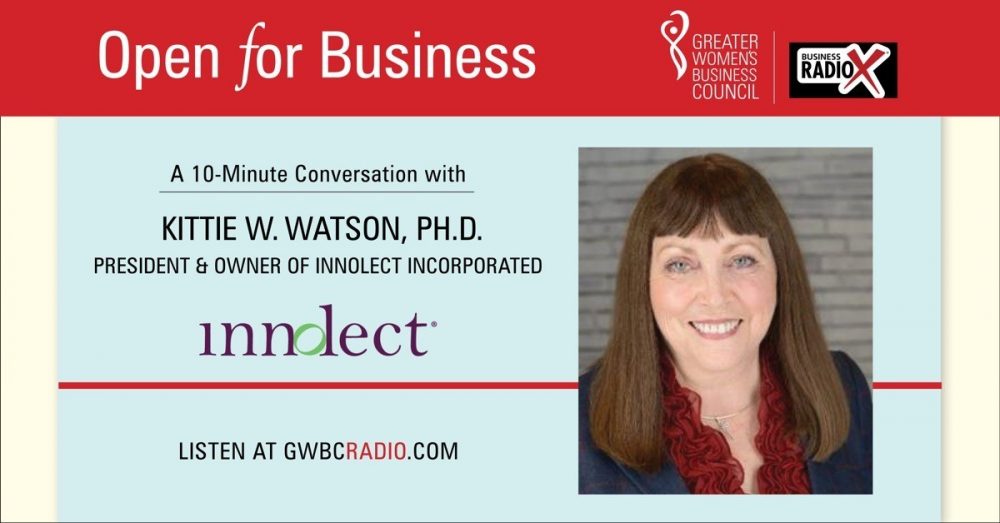
GWBC Radio: Kittie Watson with Innolect

April 21, 2020 by angishields

Innolect-logo
GWBC Radio
GWBC Radio: Kittie Watson with Innolect
Loading
00:00 /
RSS Feed
Share
Link
Embed

Download file

Open-For-Business-Innolect

Kittie-Watson-InnolectKittie Watson is the President and founder of Innolect, and has a passion for “Growing the Leader in Everyone.” With a deep appreciation for the challenges faced by executives in high-stakes settings, she focuses on mission-critical business needs. Her expertise in transformational change, strategic communication, talent development, executive assessment and coaching is valued by Fortune 500 and diverse companies such as Bayer, Entergy, Cricket, Pfizer, Zoetis, Carolina’s Healthcare, Compass and Southern Company.

Kittie designs fresh ways to grow capability and increase ROI within leaders, teams and workplaces. Integrating her personal values and work practices, she encourages clients to build strong, vibrant leadership pipelines by partnering with nonprofit organizations. Focused on creating more inclusive cultures, she quickly sizes up the crux of tough situations and provides leaders with powerful solutions that payoff for themselves and significant stakeholders.

As one of the first and youngest female chairpersons at Tulane University, Kittie is among the top 25 most prolific women writers in communication. She has authored or co-authored 15 books, numerous articles, and been featured on ABC’s 20/20. When not supporting clients, Kittie is an advocate for social justice issues, visualizes a universe of possibilities through watercolor paintings and kayaks/hikes to relax.

Follow Innolect on LinkedIn, Facebook and Twitter.

TRANSCRIPT

Intro: [00:00:04] Broadcasting live from the Business RadioC Studios in Atlanta, Georgia, it’s time for GWBC Radio, conversations to grow your business. Now, here’s your host, Roz Lewis.

Lee Kantor: [00:00:26] Lee Kantor in for Roz Lewis today. And today on GWBC Radio, we have a great guest. We have Kittie Watson. And she is with a firm called Innolect. Welcome, Kittie.

Kittie Watson: [00:00:37] Thank you so much, Lee. I appreciate being here.

Lee Kantor: [00:00:40] Well, before we get to far into things, tell us a little bit about Innolect. How are you serving folks?

Kittie Watson: [00:00:46] Well, we are an organization development and executive development leadership consulting firm. And so, what I usually say is that we grow the leader in everyone. And what we’re doing now is really helping leaders think about how do they navigate the organizational white-water that they find themselves in, so that they can keep their talent engaged and motivated during this time of uncertainty.

Lee Kantor: [00:01:13] Now, that’s an interesting topic about leadership specifically. Do you mind talking about leadership just in general like from a macro standpoint?

Kittie Watson: [00:01:24] Not at all. How would you like me to begin?

Lee Kantor: [00:01:26] Okay.

Kittie Watson: [00:01:26] I need some direction to go into that.

Lee Kantor: [00:01:26] Okay. Here we go. Do you believe that everyone can be a leader? Or is that something some people are born with leadership skills and other people are not? Or is it something that you can take somebody, and then make them a leader or demonstrate leadership?

Kittie Watson: [00:01:45] We really believe that every person in an organization can demonstrate leadership skills. There are some that are groomed for more executive leadership for the whole organization, but whether you’re a team member or a part of an executive team, leaders can grow, and learn, and become their best selves. We really work to help people become very authentic in how they lead, so that people want to follow.

Lee Kantor: [00:02:13] So, there’s some skills that you can just kind of plus up. If I just threw a person in front of you, you’d be able to kind of work with them within their kind of personality and their traits, and then kind of plus up their leadership skills if you give them certain tools?

Kittie Watson: [00:02:31] Well, we do do a lot of executive coaching. And so, in those cases, we identify what a person needs to work on based on working with their manager or something that they’ve seen themselves. So, today, for example, I was talking to a leader that really wants to develop his executive presence, especially now during the coronavirus crisis. And what does he need to do to show up and to be authentic with them? And we talked about his need to be vulnerable, and to demonstrate courage, to be the whole person he needs to be, and to tell the truth. So there are some characteristics, especially now, that leaders can show, and we can help leaders develop those skills through the executive coaching process now.

Lee Kantor: [00:03:15] So, a leader doesn’t necessarily have to come prepared with all the answers. That’s what I’m hearing you saying. They can be vulnerable, and be authentic, and say, “Look, this is a tough time for everybody.”

Kittie Watson: [00:03:30] Definitely. I think more than anything right now, one of the great coaches that we talk about sometimes is Lou Holtz, who worked with the Notre Dame football team, winning football team. And one of the things that he said is that leaders, in particular, with their employees that the employees need to know they can trust you, they need to know that you care about them, and that you’re committed to working for excellence. That’s even during this time of uncertainty. Our employees need to know that we are there for them, but that we’re moving toward another goal, that we are going to ride this wave. And sometimes, we call it a rogue wave, something really unexpected, and that’s what people are experiencing right now. So, leaders have some important role to play during this time.

Lee Kantor: [00:04:21] Now, do you see some mistakes that organizations make when it comes to leaderships time and time again that you’re like, “Oh, here we go again”?

Kittie Watson: [00:04:30] Well, the biggest mistake is that when people are promoted from technical roles into management leadership roles, where they have the technical skills, but they don’t have the people skills. Often, we are working with leaders to help them develop the skills needed that are going to help them manage and lead. You can be really good at something technically but not know how to work with people in such a way that they want to give their best selves to work.

Lee Kantor: [00:05:01] Now, when you’re doing your coaching, and you’re working with this leader or budding leader, how do you kind of coach them up when it comes to listening?

Kittie Watson: [00:05:14] Well, listening, it’s really an area of our expertise, and it’s one that I’ve done a lot of research. And I taught at Tulane University for 20 years, actually. I was Chair of the Department of Communication. And I think the biggest thing with listening is to be aware as a leader of some of your irritating listening habits. We have developed these listening habits over years and, often, are unaware that what we might be doing to pose our employees down or to make them feel as though their ideas and contributions aren’t valued. So, for example, a leader might have an irritating listening habit of interrupting an employee when he or she is giving ideas, or he or she might immediately say something, “Yes, but we’ve done that before.” So, we can do things as leaders that would give the impression that we’re not really caring or listening to our employees.

Lee Kantor: [00:06:07] Now, where does kind of corporate culture fit into this? Does that come before the leadership or does leadership kind of drive the culture?

Kittie Watson: [00:06:16] Well, many organizations might start with a foundation that they have, that has their vision, mission and values, but it’s how it’s operationalized that becomes a culture. So, departments within an organization can have their own cultures based on the leader that’s in it. So, the leader is aligned with the organization’s values and mission, will have specific kinds of expectations that they have of their employees and themselves. And it might be inclusive behaviors, for example. It might be how we treat each other with respect. It might be how we operate and include others in a team environment and how we work as a team. All of those are part of the culture, and the leader demonstrates that and guides the team. And we really believe leaders are guides. They guide employees where they need to go for the organization to be successful.

Lee Kantor: [00:07:14] Now, when you’re working with maybe a C-suite that kind of all looks the same, how do you open their mind to the benefits of inclusion, diversity, and that everybody kind of opening up kind of a wider net maybe for your talent and your executive pool?

Kittie Watson: [00:07:32] Well, I think, when I think of an executive team, I don’t think of them as all looking the same. There is more diversity now than there has been. There still needs to be more, but in addition to the diversity that we can see, there’s so many aspects of diversity that we don’t see in the way that people think or even disabilities that a person might have. So, what we do is really begin to look at a person’s strengths and build on those strengths, so that we can then get other people that have some different strengths, so that they can move toward the goals that they’re trying to achieve.

Lee Kantor: [00:08:08] So, you like to work from the strengths outward rather than kind of work on the weaknesses first?

Kittie Watson: [00:08:15] Well, and leaders, especially in the executive team, the reason that they’ve gotten to that level is because of their ability to perform, and they have used particular strengths to get there. So, if you begin to forget about how you got there, you may not be able to maximize the benefits that you’ve acquired to the years. At the same time, we do believe that leaders continue to develop and grow. And many times in organizations, we’re looking at what we call horizontal development, and we’re trying to add a skill set. So, negotiation, or influence, or something to that effect.

Kittie Watson: [00:08:53] What we do often with leaders, especially in the C-suite, is to help them think about expanding the capacity to grow and learn. And this is more vertical development. So, it’s a person’s ability to think more strategically. It’s a person’s ability to have higher emotional intelligence, to look further out into the future. Those that are more developed with their leadership and abilities are able to look further out, make connections among things within the organizations, and not just within their own areas of expertise.

Lee Kantor: [00:09:29] So, how do you kind of get a baseline of where the leader is at and to know which areas to work on? Are they saying, “Look, I want to be better at negotiation,” or is the board saying this person has to get better at negotiation? Like how do you kind of know what area to pursue?

Kittie Watson: [00:09:46] Well, we have a number of assessment tools and ways that we look at that. I mean, some of it is individual assessment or maybe a 360-assessment where the board is involved, their peers are involved, and even their direct reports give them feedback that they might not have gotten on their own. Sometimes, it’s difficult, even when we ask for feedback, for people that work for us or with us to be as candid and direct as we might want them to be. In addition to that, our company is certified in dozens of assessment tools and instruments, and some that allow the leader to look at him or herself differently. And then, based on those that data that we get, we’re able to create an individual development plan and work in partnership with others in the organization.

Lee Kantor: [00:10:38] Now, is there kind of a timeline or a usual amount of time where the leader starts seeing kind of results that they can actually see that don’t maybe necessarily feel good, but it’s like this is really improving part of my bottom line?

Kittie Watson: [00:10:57] Well, the research shows that executive coaching, when done right, definitely pays for itself. And some of that, the payback is through retention of key people. It’s through reducing that kind of turnover. But what you’re asking about is, do you see something immediately? In some cases, yes. So, if you’re working with a leader and identifying something that they’ve never seen before, a blind spot, they can immediately see it. It may take some time to change the habit that they’ve had and have developed and reinforced through years of being who they are as a just an individual.

Kittie Watson: [00:11:36] What we find, though, because of using a business development plan focused on that individual, that you move toward the results that you want to achieve, and then you put in the practices and reinforcement that are going to allow that person to be successful over time. We also know that it’s not just the coach that makes that leader more successful, it’s the people around him or her. In particular, Lee, that their manager, or the board, or someone that has them accountability, as an accountability partner with them to help them see themselves more effectively.

Lee Kantor: [00:12:16] Now, during this crisis, is your firm proactively reaching out to your clients and saying, “Hey, let’s brainstorm,” at least discuss some ways that you’re dealing with this, and maybe there’s ways that you can help them kind of deal with this?

Kittie Watson: [00:12:33] We definitely are. And because we can operate effectively virtually, not only are we continuing our executive coaching practices and working with leaders around the United States and actually the globe with our coaching, but we’re also doing more with webinars, and group meetings, and facilitating those meetings in ways that engage people. We’re helping leaders right now think about the best ways to ensure that they’re keeping people connected, especially those that haven’t worked in a virtual environment before.

Kittie Watson: [00:13:10] So, there are many of our clients that have worked more virtually and others that have always expected the employees to be at their desk every day. And that’s very different than what we’re experiencing now. So, in the next couple of weeks, for example, we are facilitating some webinars that some organizations have requested of us. And one of those is around authentic leadership and navigating organization whitewater. So, we look at the whitewater. If you’ve gone rafting before, there are different classes of rapids. And for many organizations, this is the highest class of rapid any of us in the United States have ever seen before. And so, what do we do to keep our employees engaged, to keep them in the boat basically, so that they are not checking out on us? And we need to give them new tools, new strategies, new ways of really operating. So, we’re working with our senior leaders and leadership teams to begin to think about how they engage differently within a virtual workplace.

Lee Kantor: [00:14:21] Now, let’s talk a little bit about GWBC. Why is it important for you to be involved with that group? And what has that group done to help you and your team succeed?

Kittie Watson: [00:14:33] Well, the Greater Women’s Business Council has been a wonderful place for me to not only learn but also to grow. And I served on the board of the Greater Women’s Business Council for a number of years and won a number of awards through the service. But I think it’s by giving back that you get even more. So, by serving on the board, by serving on committees, GWBC allows you to work with other women business leaders that are in the same boat, that is because we’re talking about water. And we understand what each other is going through right now with operating very differently having our worlds, in many cases, turned upside down.

Kittie Watson: [00:15:16] And so, GWBC is doing all that it can to provide the resources and information that will allow us to navigate successfully through these uncertain times. So, it may be through radio programs like this, or it may be through providing information from the Small Business Administration on the Payroll Protection Act. But what GWBC does is to operate as a resource for women-owned businesses, not only to support each other, but to actually provide the information to help us be most successful.

Lee Kantor: [00:15:53] And it’s a good lesson for a young kind of maybe new business leaders to think about joining and being part of because, like you said, you have this sense of community and support. But also, there’s opportunities for yourself to demonstrate leadership skills by volunteering and being active as a member that can help you in your career as you go forward.

Kittie Watson: [00:16:17] Yeah. And one of the things that the BBC has done, and I have served in this role on several years, is we have a mentoring program. And that mentoring program is for new business owners to help them be successful. And it’s a wonderful opportunity to learn some things that maybe you didn’t have in your education process, to hear about best practices that other companies are using, and to learn from people that have gone through a similar journey to you. So, GWBC offers that through the women in the community. And that allows you to think differently, to explore other options, to be exposed to new tools and resources that we might not have thought of on our own.

Lee Kantor: [00:17:05] You mentioned earlier that the situation we’re in is kind of like a rogue wave. And as you mentioned, just the situation itself is a rogue wave. And then, if you couple that with an organization that’s never had to deal with remote workers, now, you’re really piling on a lot of stress and a lot of variables that they’ve never dealt with before. I’m sure you’ve got your work cut out for you when you’re trying to help these firms kind of weather the storm here.

Kittie Watson: [00:17:32] Well, it’s hard. And part of it is that even though we have heard that people say, “Bring your whole self to work,” there’s no other time like that right now where you’re having a conference call and there’s children and dogs and things in the background, right? Each person is navigating so many different things right now, whether it’s a young family, whether they live alone. And so, there’s isolation. Each of us, as a leader, needs to think about employees uniquely and what their unique needs might be during this time, so that we, as a leader, can be more of that servant leader to them and be able to help them move through this process for success when they come out the other end.

Kittie Watson: [00:18:22] It’s what we do now that’s going to provide the foundation for us to actually weather this and to come back stronger than we were before. And I believe that it’s all of our communities, and it’s GWBC, it’s a greater community of how we respond to the needs of all the people that are hurting right now. If we can do that, that we will learn some things that we can apply for the future.

Lee Kantor: [00:18:53] Amen to that. That is some great advice and wise words. Well, Kittie Watson, thank you so much for sharing your story today. If somebody wanted to learn more about Innolect, is there a website that we can share?

Kittie Watson: [00:19:05] Definitely. Our website is innolectinc.com. And that’s I-N-N-O-L-E-C-T-I-N-C dot com. And on the website, you will find different post, and information, and so many things that we’re writing right now to help organizations and to help leaders help their employees. And we hope that that can be a resource that people can use as they come out to the other side of what we’re going through right now.

Lee Kantor: [00:19:38] Well, congratulations on all your success. And thank you so much for sharing your story today.

Kittie Watson: [00:19:43] Thank you, Lee. I appreciate having the opportunity with you today.

Lee Kantor: [00:19:47] All right, this is Lee Kantor. We will see you next time on GWBC Radio.

About Your Host

Roz-Lewis-GWBCRoz Lewis is President & CEO – Greater Women’s Business Council (GWBC®), a regional partner organization of the Women’s Business Enterprise National Council (WBENC) and a member of the WBENC Board of Directors.

Previous career roles at Delta Air Lines included Flight Attendant, In-Flight Supervisor and Program Manager, Corporate Supplier Diversity.

During her career she has received numerous awards and accolades. Most notable: Atlanta Business Chronicle’s 2018 Diversity & Inclusion award; 2017 inducted into the WBE Hall of Fame by the American Institute of Diversity and Commerce and 2010 – Women Out Front Award from Georgia Tech University.

She has written and been featured in articles on GWBC® and supplier diversity for Forbes Magazine SE, Minority Business Enterprise, The Atlanta Tribune, WE- USA, Minorities and Women in Business magazines. Her quotes are published in The Girls Guide to Building a Million Dollar Business book by Susan Wilson Solovic and Guide Coaching by Ellen M. Dotts, Monique A. Honaman and Stacy L. Sollenberger. Recently, she appeared on Atlanta Business Chronicle’s BIZ on 11Alive, WXIA to talk about the importance of mentoring for women.

In 2010, Lewis was invited to the White House for Council on Women and Girls Entrepreneur Conference for the announcement of the Small Business Administration (SBA) new Women Owned Small Business Rule approved by Congress. In 2014, she was invited to the White House to participate in sessions on small business priorities and the Affordable Care Act.

Roz Lewis received her BS degree from Florida International University, Miami, FL and has the following training/certifications: Certified Purchasing Managers (CPM); Certified Professional in Supplier Diversity (CPSD), Institute for Supply Management (ISM)of Supplier Diversity and Procurement: Diversity Leadership Academy of Atlanta (DLAA), Negotiations, Supply Management Strategies and Analytical Purchasing.

Connect with Roz on LinkedIn.

About GWBC

The Greater Women’s Business Council (GWBC®) is at the forefront of redefining women business enterprises (WBEs). An increasing focus on supplier diversity means major corporations are viewing our WBEs as innovative, flexible and competitive solutions. The number of women-owned businesses is rising to reflect an increasingly diverse consumer base of women making a majority of buying decision for herself, her family and her business. GWBC-Logo

GWBC® has partnered with dozens of major companies who are committed to providing a sustainable foundation through our guiding principles to bring education, training and the standardization of national certification to women businesses in Georgia, North Carolina and South Carolina.

Tagged With: executive coaching, financial services, Healthcare, leadership development, Manufacturing, team development

Soumaya Khalifa, Khalifa Consulting

February 25, 2020 by John Ray

Soumaya Khalifa, Khalifa Consulting
North Fulton Business Radio
Soumaya Khalifa, Khalifa Consulting
Loading
00:00 /
RSS Feed
Share
Link
Embed

Download file

Soumaya Khalifa, Khalifa Consulting
John Ray and Soumaya Khalifa

North Fulton Business Radio, Episode 198: Soumaya Khalifa, Khalifa Consulting, Inc.

On this edition of “North Fulton Business Radio,” Soumaya Khalifa, President and  Founder of Khalifa Consulting, Inc. discusses her firm’s work in cultural and diversity training for businesses and executives, why diversity matters, her work as a leader in the Atlanta Muslim community, and much more. “North Fulton Business Radio” is hosted by John Ray and is broadcast from the North Fulton Business RadioX® studio inside Renasant Bank in Alpharetta.

Soumaya Khalifa, Khalifa Consulting, Inc.

Soumaya Khalifa, Khalifa Consulting

Soumaya Khalifa founded Khalifa Consulting, a strategic intercultural and leadership consulting firm, in 2007. Her career spans more than 25 years in human resources, management, business management and ownership, non-profit and entrepreneurship. Khalifa Consulting specializes in helping executives and organizations succeed when doing business across cultures by providing them the most relevant, practical and up to date cross cultural coaching and training. In addition, Khalifa Consulting offers training and coaching on global virtual teams. Soumaya and team apply this work to a broad range of clients, from large established national and global organizations to startups.

Prior to founding Khalifa Consulting, Soumaya served in several leadership roles in U.S.-based Fortune 100 companies in human resources, leadership development and diversity and inclusion. An alumnus of the University of Houston and Georgia State University, Soumaya is a board member of the Society of Intercultural Education, Training and Research (SIETAR) and the Atlanta Interfaith Broadcasters (AIB). She is also an adjunct professor at Emory University Center for Continuing Education and at the Federal Executive Institute. Soumaya is the author of Diversophy Egypt and has contributed to several publications.

For more information visit the Khalfia Consulting website, or call 678-523-5080.

Soumaya Khalifa, Khalifa Consulting

North Fulton Business Radio” is broadcast from the North Fulton studio of Business RadioX®, located inside Renasant Bank in Alpharetta. You can find the full archive of shows by following this link.

Renasant Bank has humble roots, starting in 1904 as a $100,000 bank in a Lee County, Mississippi, bakery. Since then, Renasant has grown to become one of the Southeast’s strongest financial institutions with over $13 billion in assets and more than 190 banking, lending, wealth management and financial services offices in Mississippi, Alabama, Tennessee, Georgia and Florida. All of Renasant’s success stems from each of their banker’s commitment to investing in their communities as a way of better understanding the people they serve. At Renasant Bank, they understand you because they work and live alongside you every day.

Tagged With: consulting, diversity, diversity and inclusion, executive coaching, intercultural training, Khalifa Consulting, Muslim-owned businesses, North Fulton Business Radio, Soumaya Khalifa, Study Abroad in Egypt

Brian Wood with MARS Coaching Shawn Snyder with Looking Forward Consulting E4

January 17, 2020 by Karen

Brian Wood with MARS Coaching Shawn Snyder with Looking Forward Consulting E4
Phoenix Business Radio
Brian Wood with MARS Coaching Shawn Snyder with Looking Forward Consulting E4
Loading
00:00 /
RSS Feed
Share
Link
Embed

Download file

Brian Wood with MARS Coaching Shawn Snyder with Looking Forward Consulting E4

Brian Wood with MARS Coaching Shawn Snyder with Looking Forward Consulting E4

MARS Coaching is passionate about supporting continuous personal growth and organizational development. MARS continues to support major corporations, professional sports organizations and municipalities. They provide confidential, professional and discreet executive coaching, online learning resources and leadership assessments with customized summaries and action plans. MARS Coaching can accommodate the learning and development needs of any organization with the emphasis on leadership, communication, organizational culture and social styles.

Brian-Wood-Mars-CoachingBrian Wood is a previous Chairman of The Board for the Tempe Chamber of Commerce. With 30 years of experience at American Airlines and Waste Management, he combines a corporate perspective with his background as an athlete and a certified professional coach to provide clients with unique support and guidance toward the next level of greatness.

Brian was certified as a professional coach (leadership, success and transition) through the Institute for Professional Excellence in Coaching. He uses a model that identifies the mindset and energy that is constructive while attacking the opportunities to convert catabolic thinking. Brian is enthusiastic about helping people find their passion, leverage their gifts while identifying and achieving their definition of success.

He is also an executive coach with the American Express Leadership Academy – hosted by the ASU Lodestar Center for Philanthropy and nonprofit innovation.

Additionally, Brian is :

* A mentor with New Pathways for Youth
* A Certified Player Agent with FIBA, the NBA and WNBA Players Associations
* A Certified Leadership Circle Profile practitioner
* A graduate of Valley Leadership
* An international Speaker
* Co-author of bestselling book – “Journey of Riches”
* Featured in the upcoming movie “Adversity”

Originally, from NJ, Brian earned his BA in Communications from William Paterson University and earned his MBA in 2014 from the University of Phoenix. He loves travel, community involvement, adventure, generating positive influence and “the experience” of life. Also loves spending time with his wife Vivian and kids – and watching them compete in sports and life.

Connect with Brian on LinkedIn, Twitter and Instagram, and follow MARS Coaching on Facebook.

LogoLookingforwardconsultingMay30

Looking Forward Consulting is trusted by many of the worlds most successful companies to help them solve their toughest challenges through improving employee performance and leadership skills. We specialize in leadership development, employee training, learning gamification, workforce assessment, leadership coaching, and organizational development. Our proven processes will help our client’s accomplish their business objectives.

Shawn-Snyder-on-Phoenix-Business-RadioXShawn Snyder is an accomplished organizational development expert with a proven ability to develop and implement training strategies as well as organizational change initiatives. He is recognized as an expert in human performance and developing tomorrow’s leaders. He has also led multi-million dollar change initiatives for Fortune 500 companies.

Shawn is an accomplished speaker and innovator. He has traveled the world inspiring leaders at all levels. He has helped many organizations drive higher sales, increase employee morale, and reduce employee turnover. Innovation and technology are a cornerstone to Shawn’s success with clients. Shawn has several apps available in market that enable interaction with learners in new and different ways.

Connect with Shawn on LinkedIn.

About the Show

Kelly Lorenzen started the “Collaborative Connections” show to bring her clients and favorite charities together to meet each other, connect and collaborate in life and business.  She hopes to build a stronger community one show at a time. KLM Consulting

About Our Sponsor

KLM Consulting is a business concierge and project management firm. They help small business owners and non-profits build, brand and brag about their businesses. 

About Your Host

Kelly-Lorenzen-on-Phoenix-Business-RadioXKelly Lorenzen, CEO of KLM Consulting, is an award-winning entrepreneur with over 15 years of business-ownership experience. She is also a certified project management professional.

Kelly’s expertise is in business development, customer service, marketing, and sales.

Connect with Kelly on LinkedIn, and follow KLM Consulting on Facebook.

Tagged With: Custom learning solutions, development, Executive Coach Brian Wood of MARS Coaching, executive coaching, International speaker, Leadership, leadership development, leadership training, learning, optimal results, organizational development, Personal/Organizational Development and Leadership Training, Professional transition and success coach for current/former professional athletes, strategic planning, training

MARKETING MATTERS WITH RYAN SAUERS: Nate McMichael with Cutting Edge Painting and John Miller with Sterling Seacrest Partners

September 12, 2019 by Garrett Ervin

Gwinnett Studio
Gwinnett Studio
MARKETING MATTERS WITH RYAN SAUERS: Nate McMichael with Cutting Edge Painting and John Miller with Sterling Seacrest Partners
Loading
00:00 /
RSS Feed
Share
Link
Embed

Download file

Nate McMichael, Jane Bishop, Ryan Sauers, John Miller

Nate McMichael/Cutting Edge Painting 

The goal at Cutting Edge Painting is to build trust in their customers by successfully meeting and exceeding all expectations in their provided services. Cutting Edge Painting’s vision is to consistently grow and improve on products and services while seeking out opportunities to give back to the community. Delivering a great paint job to customers is just a part of what Cutting Edge hopes to accomplish day in and day out. To provide a service that is honest, reassuring, and of high quality is the greater goal. The truth is, peace of mind starts with quality and quality starts with character. By choosing high character people to work alongside, they believe they can provide an all-inclusive service that is second to none.

John Miller/Sterling Seacrest Partners

At Sterling Seacrest, they are here to serve as your risk advisors first, and insurance broker second. They have a highly skilled team ready to collaborate with your business to position you to reach your goals. They believe in a customer centric, highly collaborative process that results in uniquely tailored insurance and consulting solutions. Sterling Seacrest Partners does what they do, to let you focus on what you do.

Jane Bishop/Take the Next Step

Jane Bishop, is CEO of Take the Next Step which emerged out of her passion to help others “go for their It.” She helps small business owners and entrepreneurs strengthen and align with their inner core for success by using her coaching and training skills. When you work with Jane you will experience accomplishing your “it” and be a greater influence to those around you. Jane uses her E4U system to help clients get to the core faster to create and execute a plan for effectiveness. Jane is also a professional speaker and published author. Curious? Reach out and book a complimentary session and see where that leads.

Ryan Sauers/President of Sauers Consulting Strategies

Ryan T. Sauers has spent 25 years leading and/or consulting with visual communications and marketing related organizations. Ryan is President/Owner of the consulting firm, Sauers Consulting Strategies; Our Town Gwinnett Magazine (2 monthly magazines); and its parent company End Resultz Media.

Key areas of focus of the consulting firm include: sales training, marketing strategy, personal branding, leadership development, and organizational change.

Sauers is a frequent national speaker and columnist. He has been recognized as one of the top 80 CMO’s in the world and achieved the top designation of  Certified Marketing Executive through Sales and Marketing Executives International.

Sauers is an adjunct university professor teaching leadership, marketing, and communication courses to current and aspiring leaders. Ryan is a Certified Myers Briggs, DiSC, and Emotional Intelligence Practitioner.

Ryan is working on his Doctoral degree in Organizational Leadership and is host of the radio show Marketing Matters. Sauers is author of the best-selling books Everyone is in Sales and Would You Buy from You?   More info at: RyanSauers.com or OurTownGwinnett.com.

Show Overview

Marketing Matters with Ryan Sauers is a radio show presented by Athens Orthopedic Clinic and The Heart of What Matters. The show discusses topics as they relate to marketing, communications, sales, leadership and more. Host Ryan Sauers, a best-selling author and national speaker, discusses how these topics play a role in every aspect of our lives. Each episode shares tangible nuggets of information that listeners can easily understand and apply to their everyday life, whether personal or business. The show challenges listeners’ current state of thinking so they can grow to new heights and see new opportunities in business or life: which is rapidly changing, multi-generational, and noisy in nature.


Tagged With: customer centric, customer service, Cutting Edge Painting, executive coaching, insurance broker, insurance consulting, Leadership, marketing, marketing matters with ryan sauers, Nate McMichael, Ryan Sauers, Sales, Sterling Seacrest Partners, tailored insurance, take the next step, the heart of what matters

Martin Chan with Earth to Atlanta and Jason Neu with Action Coach

September 11, 2019 by Garrett Ervin

Gwinnett Business Radio
Martin Chan with Earth to Atlanta and Jason Neu with Action Coach
Loading
00:00 /
RSS Feed
Share
Link
Embed

Download file

Martin Chan and Jason Neu

Martin Chan/Earth to Atlanta

Earth to Atlanta Team is a Palmer House Properties real estate team made up of individuals with marketing and production backgrounds to help sell properties. Buyers also benefit from having access to off-market properties that can be anywhere from 10% to 20% under market price. #earthtoatlanta #palmerhouseproperties #realestateinvestment #atlantarealestate #realestatemarketing

Jason Neu/Action Coach

“Hi, I’m Coach Jason, and since 2002, I have helped hundreds of business owners and executives to achieve their goals and take their business to the next level. My expertise is in helping good business to scale up. That means double and triple digit growth in profitability, improved cash flow, better systems, and stronger teams…and more fun. Is that what you’re looking for? If so, let’s have a chat!”

For more information visit Action Coach

Tagged With: Earth to Atlanta, eastside medical center, executive coaching, Gwinnett Business Radio, improved cash flow, Martin Chan, Mike Sammond, Palmer House Properties, profitablility, real estate, real estate investment, real estate marketing, sonesta gwinnett place, subaru of gwinnett

MARKETING MATTERS WITH RYAN SAUERS: Ronnie Brown with Wells Fargo Advisors and Rennie Curran with Game Changer Coaching

August 8, 2019 by Garrett Ervin

Gwinnett Studio
Gwinnett Studio
MARKETING MATTERS WITH RYAN SAUERS: Ronnie Brown with Wells Fargo Advisors and Rennie Curran with Game Changer Coaching
Loading
00:00 /
RSS Feed
Share
Link
Embed

Download file

Ryan Sauers, Ronnie Brown, Rennie Curran, Jane Bishop

Ronnie Brown/Wells Fargo Advisors

Former NFL running back Ronnie Brown is currently a Financial Professional. “As a former professional athlete, I always felt like I wanted to do more. Knowing my story and being able to fulfill a goal of mine, I knew that I wanted to help other individuals. I am able to do that from a financial prospective that can lead to comfortable, less stressful lifestyle by appropriately planning.”

Rennie Curran/Game Changer Coaching

Rennie Curran is a former award-winning professional athlete, keynote speaker, author, and the CEO of Game Changer Coaching. Rennie delivers powerful keynote presentations, workshops, and one-on-one coaching on topics such as leadership, team-building, overcoming adversity, and high performance. His talks are informative, engaging, and full of entertainment. Clients include the Coca Cola Companies, Axa Advisors, The University of Georgia, Chick-Fil-A, Gwinnett County Schools, and many more.

Jane Bishop/Take the Next Step

Jane Bishop, is CEO of Take the Next Step which emerged out of her passion to help others “go for their It.” She helps small business owners and entrepreneurs strengthen and align with their inner core for success by using her coaching and training skills. When you work with Jane you will experience accomplishing your “it” and be a greater influence to those around you. Jane uses her E4U system to help clients get to the core faster to create and execute a plan for effectiveness. Jane is also a professional speaker and published author. Curious? Reach out and book a complimentary session and see where that leads.

Ryan Sauers/President of Sauers Consulting Strategies

Ryan T. Sauers has spent 25 years leading and/or consulting with visual communications and marketing related organizations. Ryan is President/Owner of the consulting firm, Sauers Consulting Strategies; Our Town Gwinnett Magazine (2 monthly magazines); and its parent company End Resultz Media.

Key areas of focus of the consulting firm include: sales training, marketing strategy, personal branding, leadership development, and organizational change.

Sauers is a frequent national speaker and columnist. He has been recognized as one of the top 80 CMO’s in the world and achieved the top designation of  Certified Marketing Executive through Sales and Marketing Executives International.

Sauers is an adjunct university professor teaching leadership, marketing, and communication courses to current and aspiring leaders. Ryan is a Certified Myers Briggs, DiSC, and Emotional Intelligence Practitioner.

Ryan is working on his Doctoral degree in Organizational Leadership and is host of the radio show Marketing Matters. Sauers is author of the best-selling books Everyone is in Sales and Would You Buy from You?   More info at: RyanSauers.com or OurTownGwinnett.com.

Show Overview

Marketing Matters with Ryan Sauers is a radio show discussing topics as they relate to marketing, communications, sales, leadership and more. Host Ryan Sauers, a best-selling author and national speaker, discusses how these topics play a role in every aspect of our lives. Each episode shares tangible nuggets of information that listeners can easily understand and apply to their everyday life, whether personal or business. The show challenges listeners’ current state of thinking so they can grow to new heights and see new opportunities in business, which is rapidly changing, multi-generational. and noisy in nature.

CLICK HERE to watch the video of this episode.

Tagged With: consulting, consulting strategies, executive coaching, game changer coaching, Game Changer GA, keynote speaker, marketing, marketing matters with ryan sauers, one on one coaching, professional athlete, public speaking, Rennie Curran, Ronnie Brown, Ryan Sauers, Sales, take the next step, Wells Fargo

Decision Vision Episode 26: Should Our Company Get Help with Leadership? – An Interview with Bob Turknett, Lyn Turknett, and Tino Mantella, Turknett Leadership Group

August 1, 2019 by John Ray

Decision Vision
Decision Vision
Decision Vision Episode 26: Should Our Company Get Help with Leadership? - An Interview with Bob Turknett, Lyn Turknett, and Tino Mantella, Turknett Leadership Group
Loading
00:00 /
RSS Feed
Share
Link
Embed

Download file

Mike Blake, Tino Mantella, Lyn Turknett, and Bob Turknett

Should Our Company Get Help with Leadership?

What are the qualities of a great leader? How do you recognize deficient leadership? How do you fix it? Bob Turknett, Lyn Turknett, and Tino Mantella of Turknett Leadership Group answer these questions and much more in an insightful and wide-ranging interview with “Decision Vision” host Michael Blake.

Overview of Turknett Leadership Group

With over 30 years’ experience, Turknett Leadership Group (TLG) is a nationally recognized leader in providing character-based leadership and organization development. TLG specializes in executive coaching and development at the individual and team level. Using the Leadership Character Model™, TLG has helped thousands of individuals become highly functioning, thriving leaders and has helped build teams that balance respect and responsibility with a foundation built upon integrity. Our goal always: organizations operating with complete integrity, optimized processes, and maximum financial success.

The firm has specialized in executive coaching since 1987, before the word coaching was common parlance. They combine scientific rigor with an unmatched ability to partner with our clients for deep sustainable growth and change. The founders at the firm are thought leaders and have lifted up character-based leadership through the Georgia Leadership Character Awards since 2003. These awards are now presented in partnership with the Greenleaf Center for Servant Leadership.

Turknett Leadership Group is committed to collaborating with the Gwinnett County Board of Commissioners to create a customized leadership development program that meets or exceeds any county specific needs. They are also confident in their ability to do so, as this is what we have done successfully with thousands of organizations, agencies, individuals, and teams for the last 30 years.

Leadership is their expertise. Turknett Leadership Group is the premiere resource for executive coaching, leadership and team development, talent assessment, culture change, succession management, and business focused engagement surveys. TLG has built a reputation for results and exceeding client expectations by creating high-performing teams for long term business success.

Details of our programs and client testimonials can be found at www.turknett.com.

Dr. Robert (Bob) Turknett, Co-Founder and Co-Chair

Bob Turknett

Bob Turknett served as CEO of Turknett Leadership Group for twenty four years, and now serves as co-chairman and senior consultant. Bob is a licensed psychologist, a trusted advisor to CEOs and boards, and a pioneer in CEO Coaching. He is often heard saying that he really loves coaching the top person because “it enables him to get his arms around the entire organization,” creating a high probability for real change. Bob has served as an executive coach to more than 1,000 executives in more than 100 companies.


Carolyn N. (Lyn) Turknett, Co-Founder and Co-Chair

Lyn Turknett

Lyn Turknett as President of Turknett Leadership Group for twenty four years, and now serves as co-chairman and senior consultant. The focus of her work is character in leadership, cultural assessment and change, and executive team development. Ms. Turknett’s consulting engagements have included leadership and executive team development, organization assessment and change, and individual feedback and coaching. She is particularly interested in helping teams at all levels improve effectiveness and working relationships, and in helping organizations maximize intellectual capital and create cultures that support innovation and initiative.

Tino Mantella, President and CEO

Tino Mantella

Tino Mantella became President and CEO of Turknett Leadership Group on October 29th, 2018. TLG is one of the nation’s top leadership development companies, driven by its proprietary Leadership Character model and grounded in science. TLG has supported hundreds of CEOs and their teams over the last 32 years Founders; Dr. Robert (Bob) Turknett and Carolyn Turknett will remain engaged and committed to the company’s mission..

Mantella brings over 30 years of experience leading some of the nation’s largest and most distinguished not-for-profit organizations including the YMCA of Metropolitan Chicago, the National Arthritis Foundation, and the Technology Association of Georgia.

Michael Blake, Brady Ware & Company

Mike Blake, Host of “Decision Vision”

Michael Blake is Host of the “Decision Vision” podcast series and a Director of Brady Ware & Company. Mike specializes in the valuation of intellectual property-driven firms, such as software firms, aerospace firms and professional services firms, most frequently in the capacity as a transaction advisor, helping clients obtain great outcomes from complex transaction opportunities. He is also a specialist in the appraisal of intellectual properties as stand-alone assets, such as software, trade secrets, and patents.

Mike has been a full-time business appraiser for 13 years with public accounting firms, boutique business appraisal firms, and an owner of his own firm. Prior to that, he spent 8 years in venture capital and investment banking, including transactions in the U.S., Israel, Russia, Ukraine, and Belarus.

Brady Ware & Company

Brady Ware & Company is a regional full-service accounting and advisory firm which helps businesses and entrepreneurs make visions a reality. Brady Ware services clients nationally from its offices in Alpharetta, GA; Columbus and Dayton, OH; and Richmond, IN. The firm is growth minded, committed to the regions in which they operate, and most importantly, they make significant investments in their people and service offerings to meet the changing financial needs of those they are privileged to serve. The firm is dedicated to providing results that make a difference for its clients.

Decision Vision Podcast Series

“Decision Vision” is a podcast covering topics and issues facing small business owners and connecting them with solutions from leading experts. This series is presented by Brady Ware & Company. If you are a decision maker for a small business, we’d love to hear from you. Contact us at decisionvision@bradyware.com and make sure to listen to every Thursday to the “Decision Vision” podcast. Past episodes of “Decision Vision” can be found here. “Decision Vision” is produced and broadcast by the North Fulton studio of Business RadioX®.

Visit Brady Ware & Company on social media:

LinkedIn:  https://www.linkedin.com/company/brady-ware/

Facebook: https://www.facebook.com/bradywareCPAs/

Twitter: https://twitter.com/BradyWare

Instagram: https://www.instagram.com/bradywarecompany/

Show Transcript

Intro: [00:00:01] Welcome to Decision Vision, a podcast series focusing on critical business decisions, brought to you by Brady Ware & Company. Brady Ware is a regional, full-service, accounting and advisory firm that helps businesses and entrepreneurs make visions a reality.

Michael Blake: [00:00:20] And welcome back to another episode of Decision Vision, a podcast giving you, the listener, clear vision to make great decisions. In each episode, we discuss the process of decision making on a different topic. But rather than making recommendations because everyone’s circumstances are different, we talk to subject matter experts about how they would recommend thinking about that decision.

Michael Blake: [00:00:39] My name is Mike Blake, and I’m your host for today’s program. I’m a Director at Brady Ware & Company, a full-service accounting firm based in Dayton, Ohio, with offices in Dayton; Columbus, Ohio; Richmond, Indiana; and Alpharetta, Georgia, which is where we’re recording today. Brady Ware is sponsoring this podcast. If you like this podcast, please subscribe and your favorite podcast aggregator. And please also consider leaving a review of the podcast as well.

Michael Blake: [00:01:03] And today, we’re going to talk about leadership. And not just leadership, but how do you recognize if you have the kind of leadership you need in your organization? How do you recognize if it’s deficient? And how drastic steps do you need to take and can you take in order to to fix it? And I’ve worked with organizations ranging from startups to larger organizations. And probably. the only organization that does not need leadership is a startup with one person in it. And even then, you can make an argument that there are opportunities for leadership even outside of the sole practitionership.

Michael Blake: [00:01:44] Now, those of you who’ve been with the podcast for a while or maybe know me personally know that I play in a rock band, which is basically a relatively safe midlife crisis outlet. Certainly, safer than a motorcycle and cheaper than a Ferrari, which I can’t afford anyway. But one of the things you notice in the band is that you have lead instruments that are up front all the time, right. If you’re Elton John, there’s a lead piano all the time. If you’re Van Halen, there’s a lead guitar pretty much all the time. And then, there are instruments that you don’t necessarily recognize unless they’re exceptional, right. Very few people really notice the drummer of the band unless it’s Rush on Neil Peart going on, right. They don’t necessarily notice the bass player unless the bass player happens to be a front man. Again, Rush with Geddy Lee. But that kind of shows you the nature of the band they have.

Michael Blake: [00:02:37] And over the years, I’ve come to think of leadership kind of being as one of those things that at one end of the spectrum, I think we recognize great leaders and great leadership readily. And then, there’s another end of the spectrum, like sometimes instruments in a band, where, sometimes, the best thing you can do is you know you’re doing a good job, and nobody knows that you’re there, right. You don’t remember, “Boy, that drummer kept a great beat the entire time.” But if they go off beat, everything can come to a crash very quickly.

Michael Blake: [00:03:11] And leadership can sometimes be like that. We kind of take it for granted almost that we assume that it’s going to be there, and we often don’t think about it until it sort of pops its head up and say, “Boy, that’s just outstanding leadership, sort of a Mozart one in ten million kind of thing,” or it’s “Boy, we lack leadership here. We don’t have emotional intelligence.” And when you’re in a badly-led organization, if you can just watch about that organization, it’s uncomfortable. It’s bad to be in, it’s not comfortable to to even watch.

Michael Blake: [00:03:47] And today, joining us, because I don’t know anything about leadership other than what I try to do in my my day-to-day activities, but fortunately, we are joined by three people who know an awful lot about it. And we’re going to try to squeeze as much knowledge out of them as we can over the next 35 minutes or so. So, we’re talking to Lyn Turknett, Bob Turknett, and new kid on the block, Tino Mantella of the Turknett Leadership Group.

Michael Blake: [00:04:12] With over 30 years pof experience, Turknett Leadership Group is a nationally recognized leader in providing character-based leadership and organization development. They specialize in executive coaching and development, the individual and team level, using the leadership character models and capitalization trademarks, and nobody else can steal that. They have helped thousands of individuals become highly functioning, thriving leaders, and to help build teams with balanced respect and responsibility with a foundation built upon integrity. Their goal is always organizations operating with complete integrity, optimized processes, and maximum financial success.

Michael Blake: [00:04:48] The firm has specialized in executive coaching since 1987, before the word coaching was common parlance. I agree with that. They combine scientific rigor with an unmatched ability to partner with their clients for deep, sustainable growth and change. The founders are thought leaders and have lifted up character-based leadership through the Georgia Leadership Character Awards since 2003, which, by the way, I am a proud three-time nominee. I still have the plaques hung up my office. It’s the only thing that I, actually, bothered to hang up. These awards are now presented in partnership with the Greenleaf Center for Servant Leadership.

Michael Blake: [00:05:23] It goes on, and on, and on. I could tell a lot more things about the organization, but that means I’m not asking questions, and they’re not answering them. So, I’m going to cut to the chase and I’m going to welcome Lyn, Bob, and Tino to the program. Thanks so much for coming on today.

Lyn Turnkett: [00:05:36] Great to be here.

Bob Turnkett: [00:05:36] Thanks for having us.

Tino Mantella: [00:05:36] Thank you.

Michael Blake: [00:05:38] So, let me lead off. Leading off with this. I mean, is leadership important? Do you agree to some extent that it can sometimes be taken for granted, but, boy, when it’s not there, you sure do miss it?

Bob Turnkett: [00:05:52] I’d like to address that just in a general way first. And then, they may have some comments. But, for me, a driving force in terms of leadership is how important it is for bringing out the best in others. With every client I see, I try to always plant the seed and get them to think about viewing themselves as trying to bring out the best in every person and help every person become the best leader and the best person they can be. And if you think about it, and if we’ve all had that as an underlying philosophy in all of our interactions, what a great organization it would be and what a great world we have.

Lyn Turnkett: [00:06:29] Yeah, it’s interesting. I was just reading a piece from Extreme Leadership yesterday. And it’s about the SEALs, the Navy SEALs. And one of the first stories is about boat race that’s a part of their last training. And one boat keeps coming in ahead in the race every time. And there is one guy who’s the leader on a boat that keeps coming in last. So, the guy who wrote the book and who’s the guy, whatever his title is, says, “Let’s just switch. We’ll switch the leaders.”

Lyn Turnkett: [00:07:05] Interestingly, the boat that was coming in last came in first in the next race. It was all about the inspiration, the way that person helped align the team, helped them feel good about the goal, helped them take small steps together. But that guy who was in the boat who was losing had no thought that it was his leadership causing that. It was, as you said, an unrecognized factor. I love the idea of the drummer in the band keeping the pace and being in the background, but helping align the band.

Tino Mantella: [00:07:44] So, I’ll just add a couple of comments because I think when your listeners are thinking about leadership, they probably are thinking about the CEO or the C suite. And the interesting phenomenon now that’s always been there, but it’s been magnified in the last decade, is that leaders could be at any level of the organization. And going back to your first point, Michael, it could be that one person because they have to lead in a lot of different ways. I mean, they have to lead in respect to convincing people that their product or service is viable, for example.

Tino Mantella: [00:08:19] But we like to — I think that companies today are saying every low level — in fact, we get a lot of calls now around the director level. A few clicks down saying, “We want all those people to be leaders.” So, every person or organization, if you’re being fully functional and optimizing your results, you’re going to want to make sure that every person sees themselves as a leader. And that’s really different in some ways between a manager, and somebody that’s taking ownership, and feels like they’re really part of the company, and helping to drive it forward.

Michael Blake: [00:08:52] So, let’s go to that. Tino, you and I have a long history collaborating in the startup world. And you know this as much about as I do, if not more.

Tino Mantella: [00:09:01] I’m not sure about that part.

Michael Blake: [00:09:01] I think it can be tempting to think, “Wow! I don’t run a thousand-person organization. I run a team of four,” right. How much room is there leadership there? But you sort of touched upon it. Even in a group that’s small, does leadership become important? Maybe it’s even more important because you’re more exposed. What do you think about that?

Tino Mantella: [00:09:23] Well, I’ll start with that one because we – Lyn, and I, and a couple other people at Turknett – worked with a group of 15 women entrepreneurs as part of a city program. And the focus of Lyn’s program was on leadership. And what we found is in a lot of these entrepreneurial companies, they’re thinking about – you know this, Michael –  first, the market, product, finance. And one thing that gets put on the sideline is, “How am I going to work with people? And how am I going to bring them all together? And how is everyone in this small group going to be willing to take on more than one set of job skills? Because, frankly, if there’s three people, you don’t have a lot of specificity here. You’re going to be doing it all.

Tino Mantella: [00:10:08] And so I don’t know if it’s more or less important. The founders, who have a lot more experience on this and seeing it from that side, might have a judgment on that, but it’s certainly as important in a four-person company as it is in a thousand-person company, I would say.

Bob Turnkett: [00:10:23] And in terms of the women, we do have Women in Leadership Program every month, and we have about 50 or 60 attendees and a speaker every month. And the women and, sometimes, men, who are the speakers tell their story of leadership, and  you can just see from the reaction of the audience there that those stories are very inspiring, and very powerful, and how important leadership really is in terms of-

Bob Turnkett: [00:10:49] I mean, when I go away from that, I feel like this is the best thing I’ve ever experienced. I go away from it every month feeling like, “This is the best one yet.” So, there is something really special and unique about leadership when it’s working well and when people can tell stories about the leadership, where it’s done in the right ways and the best ways.

Michael Blake: [00:11:05] Now, I’m curious, do those individuals, do you think they feel that great because they suddenly recognize they’re in a leadership vacuum, and, now, they have tools to fix it? Or do they sense that in themselves, all of a sudden, they realize they have the skills and the tool set to create that leadership influence themselves, or some mix of the two?

Bob Turnkett: [00:11:28] I think both, but Lyn may have an idea.

Lyn Turnkett: [00:11:30] I’d say the latter. I think they recognize — I think what Tino said about leadership being broader now, I think it’s always been very broad, but I think, particularly, in companies now, it’s broad. One of the things we say is leadership is a choice, not a position. And there are always opportunities for choosing to lead.

Lyn Turnkett: [00:11:55] There’s a definition I like too that says, “Leadership is about going first in a new direction and being followed.” So, anytime you see something that needs to be done, a problem that needs to be solved, and you figure out how to move forward and how to get other people to move along with you, you’re exercising leadership. You are leading.

Lyn Turnkett: [00:12:17] And I think to Bob’s point about why hearing other people talk about it is so inspiring is that it does, to your point, make you feel, “Oh, my goodness. I could do that. I do that every day. I did that in high school. That could be me. I could do more. I could take more ownership. I can lead.”
Michael Blake: [00:12:38] So, I’m going to skip ahead to a question because it segues better here then. Is it your view that everybody can be a leader? It’s not just something that you’re born with and that’s it, but it’s a set of skills that you can develop, or, clearly, I know it’s it’s a mindset based on your character model, but you expand upon that.

Bob Turnkett: [00:12:55] And everybody is a leader, whether they really accept the idea or think about it that way or not because you’re a leader as a parent, you’re a leader yourself. I mean, if you think about our leadership character model, which we can discuss in a minute, to be able to — if you think about that in terms of all the qualities are involved in the leadership character model, you’ve got to lead yourself first. And no matter whether you’re on your own by yourself or with the group of people, all those qualities are critical and important in terms of who you are, and how you present yourself, and how to be.

Lyn Turnkett: [00:13:31] I think also once people reach adulthood, there are probably some qualities of personality that may help some people move more strongly. Certainly, we know they affect whether people are chosen for leadership roles. But I think to Bob’s point, everybody leads. Everybody usually don’t think about those times that you do, but everybody leads. And certainly, we believe that leadership isn’t simply a gift that a few people have. It’s something that everybody exercises and that everybody can get better at with effort, self-awareness, and work.

Michael Blake: [00:14:11] Okay. So, what are some symptoms of deficient leadership? If I’m in an organization, right, and like you said, with the two boats, right, sometimes you don’t know it’s deficient until you realize you came in last, and the only thing that changed was the leader, right. What are some symptoms of deficient leadership? What, as a leader, should I be looking for?

Bob Turnkett: [00:14:33] I started writing that down. And after I got to a hundred, I stopped.

Michael Blake: [00:14:37] Okay. Let’s take the top few.

Bob Turnkett: [00:14:40] Some of them are infighting, political behavior, chaos, silos, constant drama, low productivity, poor results, always reactive, low morale your best people leave, high absenteeism, and it goes on, and on, and on from there.

Tino Mantella: [00:15:01] I think Bob covered a lot in those statements. I, probably, am more of the practitioner in a group just given my background. The YMCA had 4500 employees. And it was interesting because our work was full of such passion of wanting to help people and make a difference. And some people rose to the occasion and some different. I don’t think it was because they had these innate skills where one would stand apart from the others, but it’s more the things that Turknett Group works with people on and groups on, and that is taking accountability, taking ownership, being able to work with people, good communication skills, the kinds of things that are required to get people excited.

Tino Mantella: [00:15:48] And from my own experience, I mean, I’ve had great experiences, I feel like, of bringing people through the ranks and others where it’s like, “Oh man, maybe I should have done this a different way,” because it’s always about, are you getting them motivated? Do they understand what the vision is, what the mission is, what the direction is? Are you leading and are they following or are they leaving? As Bob said, there’s a lot of different reasons. If you lose your best people for whatever reason that is, you’re going to have to take a hit. And we hear all the time, like a company recently contacted us and said, “Look, we’ve gone through four CEOs in the last two years. What does that mean?”

Michael Blake: [00:16:24] Yikes.

Tino Mantella: [00:16:24] Yeah, yikes. So, that means that they’re looking at turnover at all parts of the rank because nobody knows if their job’s secure, et cetera, et, cetera. So. it’s having confidence in leadership, but it’s not just the CEO again.

Michael Blake: [00:16:41] So, there are a lot of symptoms out there. So, let’s go to some of the causes. What do you see in all the work that you’ve done? And also Tino, your view as a practitioner, I think, is very important here. What do you see as the most common or obvious causes of deficient leadership that maybe a listener can, if they have the wherewithal to be self-aware and self-examining, maybe they’ll press pause for a second after your answer and take an inventory of those qualities are in themselves or others with whom they work.

Tino Mantella: [00:17:14] Well, I start with that one just because I think that the Turknetts talk a lot and people that work with us on the coaching side talk about blind spots. And to me, it’s like you know what you know, and you don’t know a lot, and you don’t see that you’re missing the boat. And also, there’s an ego piece to this I see. I think I’m a better performer when I leave my ego at the doorstep, then I’m open to people giving me comments. And that’s really hard for some people, and it’s been hard for me over certain times of my career to be able to embrace that.

Tino Mantella: [00:17:49] So, I feel like if you have a mentor, if you have someone, your spouse, as Bob’s often said and Lyn have said, someone that can give you real — my spouse doesn’t have make trouble giving me feedback. But anyways, real feedback where you have that sort of place where people can say, “You know what, you’re missing that,” they don’t feel like their heads are going to get chopped off for something they’re going to say. So, that’s a real practitioner answer, but I’ll leave it to the experts.

Bob Turnkett: [00:18:17] I would like to just frame it, and then Lyn can comment, but I’d like to just frame in terms of if you think about leaders who are too passive or leaders who are too aggressive, and you’ve got problems in both areas. Leaders who are too passive abdicate. They are too nice. They don’t want to do certain things because they don’t want to impose. So, they hang back, and they don’t communicate, they don’t get feedback, they don’t do setting goals with people. They don’t do all the things they need to be doing.

Bob Turnkett: [00:18:39] And then, a leader who’s too aggressive tends — and then, what happens, at first, when a great tension gets created, interestingly, it bubbles up. And then, there’s explosions in the organization and all kinds of chaos. And that leader who’s too aggressive also creates tension, but in a different kind of way. It’s i because of fear. People are afraid. So, if people shut down, you don’t get the best from them and all the side effects could go home. Hundreds more side effects there in terms of that as well. So, those are two kind of categories I see.

Bob Turnkett: [00:19:07] And then on the aggressive side, that’s probably been the — when we first started doing this 30 years ago, many of the CEOs that I worked with were in that highly aggressive side, and very command and control, very top down, and thought that was the best way. And so, it was a real convincing job for me and worked for me to help get them to see that they get more of their goals met and more of what they wanted if they could balance that with the both respect and responsibility that they needed to do.

Lyn Turnkett: [00:19:35] Yeah, absolutely.

Michael Blake: [00:19:37] There’s two tips. I’ll let you finish, but I want to interject something because it’s interesting you sort of time date that, right. And I wonder if kind of the movies of the time kind of you reflect that or somehow influence that, right. Greed is good. Wall Street, Gordon Gekko and the leader of the night. And we’ll get into this. We’ll get into this. But what we idolize is leadership in the 1980s being a really take charge, super testosterone kind of deal where baby boomers were leading people like me, Gen-Xers, right. That doesn’t play well anymore, does it?

Bob Turnkett: [00:20:12] No. And so, I see the way — you’re going back to the autocratic, and that’s very top down, and almost a bully kind of leader to the — I call it parental, but it’s really benevolent autocrat, but parental, kind of still the parents. I slap your wrist. I spank you when you misbehave, but I don’t do it often, but I do it periodically. So, it keeps you in line. So, it’s still a fear way of doing it, so you get the same side effects, or very similar side effects, or to a partnership model, which is what it’s moving toward. And there are many leaders that we can point to today who really work hard in that part partnership model and do a good job of it.

Bob Turnkett: [00:20:48] But it’s easy still for the person who’s doing the partnership, when the stress happens or there’s crisis or conflict, they tend to revert to the parental style thinking that they have to do that when they don’t recognize that’s the worst thing they can do because they’ve got did what they got to do, is work even harder and develop more flexibility, agility, and adaptability to be able to solve the problems that are in front of them. And that’s not easy.

Michael Blake: [00:21:09] So, Lyn, coming back to you, what about causes you see as being your most frequent causes of deficient leadership?

Lyn Turnkett: [00:21:17] I’d say a lot of that is the opposite of what people need. I was just thinking, Tino was talking about self-awareness, getting feedback, and I was thinking. Center for Creative Leadership a while back. They had 67 competencies. They found four. And I think these are not just were important then. They may be even more important now. And those were self-awareness. And so, a lack of self-awareness and a lack of understanding, that’s EQ, that’s emotional intelligence, not understanding how you’re coming across to other people, not getting feedback, and not being able to adapt. That’s huge.

Lyn Turnkett: [00:21:56] Learning agility was another one. To Bob’s point then, if you can’t figure out what’s wrong, if you can’t in a complex organization, which many people are working in right now, if you can’t figure out how to be partnering later, work across organizations, work with people outside the organization, learn quickly, you can’t lead. There’s also typical things like arrogance, which is a big derailer.

Michael Blake: [00:22:28] It used to be number one.

Lyn Turnkett: [00:22:29] Yeah, perfectionism, that’s a big derailer. People who are overly perfectionist with themselves and with other people are not inspiring. And they, also, obviously, move very, very slowly. We could go on and on on this too.

Michael Blake: [00:22:44] Well, the thing that strikes me, though, is I think all of those things have a common thread. I think a lot of it to me, I’m going to put my Dr. Phil hat here, but it does, I think, boil that down to a fundamental insecurity, right. And to me, it sounds like what that creates is a feedback loop because if you lead an organization that is in fear, right?

Lyn Turnkett: [00:23:03] Yes.

Michael Blake: [00:23:03] And where dissent, where if not self-awareness, then making somebody also where is punished, then you’ve got no shot. You’re going to have to have an outside intervention, I think, which gets to the next question then that I wanted to ask, which is, is deficiency in leadership something that can be self-fixing, self-healing, or more often than not, does it get to a point where there’s got to be kind of a grownup that comes in or an advisor that comes in, and helps ride the ship and hits the reset button?

Bob Turnkett: [00:23:38] I’ll make one comment. If they could fix it, they probably would have already. It wouldn’t be happening if they really knew how to fix it. And if there was a textbook or something that they could just read that would fix it, that would help, but there’s usually not something there because it’s got to change something that’s a part of them, who they are, and what they’re about. And that’s what leadership — that’s the most important part of leadership is you can teach skills, and all kinds of different things, and tactics it can do. But it’s who they are and what they’re about. So, their attitudes, and beliefs, their assumptions, all that’s really critical, and that has to be gotten at by somebody helping that person get at it, or they could possibly get it by reading, but it would take some in-depth kind of personal work on their part to do that.

Tino Mantella: [00:24:24] Michael, when I took over TAG, it was right after the tech bust. You remember that. It was 2004. And the interesting thing, and people have talked about this for ages, but the best time to take over organization is when it’s in crisis because, then, they actually listen, and they’re open to ideas more. So, to the point, I think Bob was spot on. But what I would add from my experience and from seeing others is the best time to — there is a great opportunity to have someone be most aware after they’ve failed at something. And they’re going to be open because it’s like, “I lost my job. We lost money, whatever it is, it didn’t work. Somebody has got to help me.”

Tino Mantella: [00:25:08] If you go along, and you’re in a pretty good place, and to use the TAG, if I came in to TAG, and everything was robust, everybody was getting investments in your area, then there wouldn’t have been that sort of opportunity for me to come in and say, “Here’s what I think we need to do,” because at that time, people were pretty arm weary in terms of what they were trying to do. So, they were very open. So, from my experience, people sometimes need to have that not-so-great experience to be open. And I don’t know what Bob and Lyn would say, but there’s probably not too many people that haven’t, somewhere in their career, had something that didn’t go the way they wanted to make it go.

Bob Turnkett: [00:25:48] Whatever they can, whatever happens to make us more vulnerable makes us more open. And certainly crisis, and hardships, and things that really are adverse, certainly, will help us become more vulnerable. And that’s one of the things that many leaders struggle with, and they need to be more vulnerable and more open. But it’s very, very hard for leaders to do that.

Michael Blake: [00:26:08] It almost sounds like going through the five stages of grief, right? You have a failing organization. You go through the denial, the bargaining. I forgot the other states, but at the end of the day, there’s acceptance. And at some point you’re sort of out of options, and you’ve got to be willing to change. And with leadership, it’s just a deeply personal exercise, too. It’s really hard to blame lack of leadership on somebody else. It really is.

Bob Turnkett: [00:26:35] Right, absolutely.

Michael Blake: [00:26:37] So, there’s a question I want to make sure that I get in because I think it’s very timely. For a long time, and still today, companies address the customer experience. But now, we’re hearing more of a term called the employee experience. I mean, is that a real thing or is it just sort of a buzzword that we had on Bloomberg Radio for a couple of weeks and it’s going to go away?

Bob Turnkett: [00:27:01] Lyn, you did the right work on that.

Lyn Turnkett: [00:27:01] Yeah.  I think it’s a real thing. Some of it, I will tell you, will go away. Any of us who’ve worked in this arena for decades now that the business cycle influences things like that. We’re in a time right now where getting talent is really tough. People are paying a lot attention to their culture. They’re paying a lot of attention to employ experience at every level when they first come to the website, and think they might apply for a job, to the time that they exit the organization.

Lyn Turnkett: [00:27:34] But I do think that one of the things I believe is that as technology increases, as organizations become more AI-infused, people become more important. People coming to the table, knowing that they are valued in the organization, using their brains in the organization, feeling excited to be there is even more important than it is in a factory where you put in the same widget every day.

Lyn Turnkett: [00:28:08] Now, people have to pay attention to that. I think in order for the performance of the organization to be great. So, I think, from that standpoint, even though it will diminish when the business cycle is down a little bit, I think it’s going to stay important.

Tino Mantella: [00:28:23] Michael, when I was — in all the organizations I really run, say, five years or later, we always talk, and I was trained, and I was passionate about the customer being the center of the circle, the customer, the customer. We will do anything, including sometimes ask staff to do something beyond what they want to do because it was the customer-centered circle.

Tino Mantella: [00:28:52] That just doesn’t work anymore because of what Lyn said. And I would add to that, and you already mentioned it, Michael, the generations coming up, they’ll just say, “Yeah, I’m not going to do that.” They’re not going to focus on it. And let’s not take it. Millennials have been probably much maligned over the last many years. But part of it is they really want work/life balance, and they have other opportunities now because the retention rates are so low, and they’re like, “Yeah, I need to go work with my charity tonight,” or whatever.

Tino Mantella: [00:29:23] So, trying to run with command and control or trying to run with customer being the center of the circle and putting employees at a different level below that, you can try as hard as you want, but it’s going to be very difficult because people are going to push back now more than I might say that 10 years ago, whatever job I had, it’s like, “Yes, you’re right. We will do that. We will follow those. We will march to the sound of the guns,” or whatever, but it doesn’t happen now.

Bob Turnkett: [00:29:51] And decades ago, there were some people who stood out in the employee experience area. They weren’t calling it that, but like Horst Schulze, the Ritz Carlton. I remember him giving many presentations, and the employees were really empowered to do things that even today, most employees still aren’t empowered to do. So, he was so much of a forerunner of the employee experience. But I do think, as Lyn said, it will probably fade to some degree, and then reappear in some other form, but certainly without the employee feeling highly valued and doing everything you can to create that.

Bob Turnkett: [00:30:29] I just had a CEO that I was working with yesterday who just lost three people. She’s trying to hire another top level person. And she said that the competition for talent is so strong. She said, “And the way we do things, we go through this interview process that takes a couple of months or more, sometimes three months.” And she said, “I’m just losing people. The best ones there are, they say, ‘I just can’t wait. I got these offers. After one month, I got these two offers. I got to take one of them.'” So, we are in a time when the talent shortage is really making a big difference in our culture.

Michael Blake: [00:31:06] It’s definitely time where labor has a bit more power than we saw 10 years ago.

Bob Turnkett: [00:31:11] Absolutely.

Michael Blake: [00:31:12] So, here’s another question I want to make sure that we cover, and that is, can introverts be leaders? I think many people look at, or if they consider themselves an introvert, they feel like, at a minimum, they’re starting 30 meters behind in a 100-meter dash.

Bob Turnkett: [00:31:29] I have a quick story I just tell and other things, but I had a person I was working with who was the CEO of a large architectural engineering firm. And he scored on the Myers-Briggs type indicator — most people are familiar with this business kind of a profile. And he scored high on introversion, about as far as you can go. And then, when he did a 360 where he’s evaluated by all the people around him, he came out with almost all fives, almost all top scorers from like 40 different people on presentation, formal presentation, all kinds of presentation.

Bob Turnkett: [00:32:04] And I said, “Wow, look at this!” And their comments, there were like 20 or 30 comments. They were all just outstanding kind of comments. I said, “How do you explain this being — you talk about yourself as being an introvert?” He said, “Well, when I was 14 or 15, I decided I want to be a CEO.” So, he said, “I just started paying attention to what CEOs did, how they carried themselves, how they went about things.” And he said, “I’m the kind of person that would like to, if you go to a party or a gathering, get one person, and go off in a corner, and just talk to that person.” He said, “But you won’t see me doing that.” He said, “You’ll see me going into a room with 300 people.” And before that night, he was probably touching in some way or talking with everyone of the 300 people. He said, “Because that’s how important that goal was to me.”

Bob Turnkett: [00:32:46] So, it proved to me that if the goal is very important, we can learn anything. We can change and learn pretty much whatever we want to learn if that goal is that if we had that kind of passion.

Lyn Turnkett: [00:32:57] Also, data from the Myers Briggs shows that introverts are as represented based on how many there are in upper management as extroverts.

Bob Turnkett: [00:33:08] Yeah.

Tino Mantella: [00:33:08] I would just add that part of it is when we talked about awareness  that if you’re a great offensive coach, using a football analogy, then you have to find a good defensive coach to take care of the other side. And I think if you’re really aware and you say, “Okay, here’s my skill sets,” then the great CEOs will look for those balance to make sure. Maybe they don’t like to be out every night at meetings, but they want to have somebody that’s representing them, it doesn’t have to be the CEO. But I think awareness does a lot because it’s, again, not ego, but it’s like, “I’m not that good at that. I need to find somebody really strong at that.” So, it provides that balance.

Michael Blake: [00:33:52] Well, good. I’m glad I’m not hopeless. So, I’ll share a personal story. My wife has one great fear with me, and that is that she fears I’m going to be picked for a Mars mission because I’m such an introvert. She feels that my dream job would be stuck in a tin can one hundred million miles away from humanity for six months where I can’t even have a live phone conversation. Now, I’m too fat near-sighted to do that, but that’s her greatest fear. But I’m glad for somebody like me, there’s even hope.

Bob Turnkett: [00:34:20] That reminds me of the woman I was working with, and she was talking about her husband. She said, “I just wish…” He was highly introverted, and he didn’t talk much with her, and she really wanted to communication. She said, “I just really wish I could get inside his brain, and just walk around in there to see what is going on, because I just can’t quite figure out what’s going on with him.”

Michael Blake: [00:34:37] That’s right. That’s right. Sometimes, it’s a boardwalk. Sometimes, it’s a house of horrors. So, Tino, I’m going to direct this question at you first, and then let’s you guys jump in, but I did have this question with you in mind. Because you have led so many different types of organizations – for-profit, not-for-profit, large organizations, smaller organizations with different missions – does your leadership style have to change based on the kind of organization you have or are there leadership principles that are timeless and ought to work everywhere?

Tino Mantella: [00:35:09] So, I’d say your leadership knowledge and skill sets don’t have to change, but what you have to understand that isn’t always easy is what culture you’re inheriting. And as, I think, Peter Drucker said, “Culture eats strategy for breakfast.” And I’ve seen that many times in organizations that I’ve been involved with and organizations that we’ve worked with.

Tino Mantella: [00:35:35] And so, when you go into an organization, something that worked phenomenally at one will not work at all in another because the culture is different, and they’re not going to embrace it. So, I can give lots of stories about what I’ve seen where it’s just you go in with the same roadmap, or Gantt chart, or operating plan.

Tino Mantella: [00:35:58] I’ll give you one example. Young company I’ve worked with, and I came in full of fire and brimstone saying, “Okay, we’re gonna do operating plan, performance standards, NPR scores.” And they looked at me like I had three heads because they’re a bunch of entrepreneurs that just want to do what they’re doing. So, you have to take your time, pace it, make sure you have the right people, and not do it your way, as Bob and Lyn said. Sometimes you have to be flexible enough to say, “Let me stop, and listen, and see what you need.”

Tino Mantella: [00:36:34] So, I think the core skill for me has been you can use some of the principles that you’ve always used to build organizations, but you can’t always use the same techniques because the cultures are different. Lyn is an expert in culture and Bob as well.

Lyn Turnkett: [00:36:55] Well, that just reminds me, we talked to earlier about what derails people. And I think, sometimes, success could derail people, too much success. And to your point about not being adaptive, I was thinking, I was listening to your podcast that reminded me of the story of Ron Johnson at JC Penney. He had been dramatically successful at Target. Then, went to Apple and was dramatically successful in building their stores. And then, went to JC Penney.

Lyn Turnkett: [00:37:25] And this was a podcast about decision making, but it talked about the fact that he thought he knew all the answers there. He came up immediately with a strategic plan. And there was a lot written at the time about he cutting all of their brands. He didn’t ask people who are there what they thought. He stopped all the sales. He thought what he did at Apple was going to fly here, and he was the guy who could do it. So, to that point, you’ve got know what you’re moving into. And in my opinion, also, you’ve got to know that no matter who you are, you can’t be the only brain in the room.

Michael Blake: [00:38:03] I’ve stolen a technique or question from a guy named Tom Keene. He does the morning show for Bloomberg Radio. And when he interviews people, he’ll take a position. He’s a very smart guy. He’s a CFA charter holder and an economist in his own right. But he’ll often ask, “What have I got wrong?” He doesn’t end the question for validation. He ends the question asking for what are the holes. So, he’s inviting people to criticize.

Michael Blake: [00:38:31] And I think that is so smart. I’ve stolen it because I don’t need people to tell me why my idea is great. I already think it’s great. I wouldn’t have suggested it. But that question as a journalist is, “What have I got wrong?” It creates such a constructive conversation. Just that opening can make the hugest difference and being willing to be wrong. And as Bill Gates is famous for saying, “Success as a lousy teacher.” Exactly to your point, because it may reinforce maybe something that you don’t need to have reinforced necessarily.

Lyn Turnkett: [00:39:04] Right.

Bob Turnkett: [00:39:05] And that success is a lousy teacher is kind of another problem in terms of the way — we talk about in our company the levels of leadership or the stages of growth. Robert Keegan at Harvard did the same on stages of growth. And so, most people in organizations, they’re in the stage 3 to 4. But when you get to stage 4, you’re really doing pretty well in most aspects of leadership, most aspects of leading a team, et cetera, et cetera.

Bob Turnkett: [00:39:31] So, you’re really pretty. You’re really very good, but what happens is that you get a little cocky. And I don’t mean in a real negative way, but you’ve self-assured to the point where you don’t think you need to learn anymore, or you need to grow anymore. And then, that’s where the success tends to then delude you into thinking you’re really that good. And then, to be able to move to a level five, you’ve got to be able to then kind of put yourself back in the position of learning from everybody around you and really being able to do that.

Michael Blake: [00:39:58] Is there more vulnerable a point in life than when you think you have it all figured out? I’m not sure that there is, right?

Bob Turnkett: [00:40:06] That’s right.

Lyn Turnkett: [00:40:06] Yeah.

Michael Blake: [00:40:06] That’s when you’re whistling. You’re looking for the clouds. And that’s where the manhole is right under your right foot, right?

Bob Turnkett: [00:40:13] Yeah.

Michael Blake: [00:40:13] So-

Tino Mantella: [00:40:13] We’re all a work in process, all of us.

Michael Blake: [00:40:15] We sure are. My goal is that my last assignment I ever do in my life is my best one. Just a little bit  than the one before that. So, I’m going to ask you for some free consulting here while I have you captive on the microphone here. And that is that I have this notion — As you know, I work for an accounting firm. And accounting firms have a reputation of being a certain way. And I don’t think I have to explain what that certain way is. But one thing that accounting firms have is we have this notion of busy season where we got to get stuff out by April 15th, and September 15th, October 15th, or the world simply ends, vanishes.

Michael Blake: [00:40:53] And that’s a very tough time for everybody. Morale can really drag during that time. It’s working 60 hours a week filling out people’s tax returns. I get it. I thank God I don’t have to do it. But I look at Silicon Valley, and there are people there that are technical, and they’re working, by all accounts, 90 hours a week or more to the point that they offer free food and dry cleaning. Literally, you can’t drag these people out of their offices.

Michael Blake: [00:41:25] Is it just something that’s native to technology, or is it fair to ask the question that I’ve been asking, and people are looking going, “He’s a witch”? Is there something we could learn from Silicon Valley that instead of making people like they’re on this forced march, but they just love doing what they do and have a sense of purpose that big problem is dragging them out of the office, or is that just a dumb idea? What have I got wrong?

Lyn Turnkett: [00:41:53] I think most of the time when people are working like that because they want to, and I don’t really have a great answer here, but I think, often, it’s because, to your point, they are so excited about what they are doing. They love what they’re doing. Often, if it’s a startup, they’ve got some piece of the action, they expect it to — they have a sense of ownership, and there is purpose and drive in that.

Lyn Turnkett: [00:42:20] I don’t know if you can have an accounting firm where people are that excited about — maybe you could. And that’d be an interesting thing is to look at the places where people don’t talk like that, and the places where they do-

Tino Mantella: [00:42:34] That might be our next research project.

Lyn Turnkett: [00:42:35] Yeah.

Michael Blake: [00:42:35] Would that be cool?

Lyn Turnkett: [00:42:36] Yeah. Yeah.

Tino Mantella: [00:42:37] I do think, though, you’re on to something with technologists researchers, people that can work more independently. Although, if technologists are listening in this, they’d say that they can’t do that anymore. The days of shoving a pizza under the door and seeing what happens in that room that nobody knows what’s going on are gone.

Tino Mantella: [00:42:58] CIOS that I know and I know many are talking about the importance of communication, and teaming, and being involved, but I do think that when I ran the Arthritis Foundation, you see the researchers, and you see that that the technologists that are really involved with a project that they’re working on science, that most people have no idea what it is. And they’re not solving — they’re not curing cancer. They’re just moving like an inch, but they’ll work 90 hours a week because it’s their personal passion to make that happen.

Tino Mantella: [00:43:29] So, I think leaders, they are trying to figure out, with every person, what is that thing? Although, we also want to respect that most people aren’t going to want to work 40 hours, 50 hours a week, I’d say. So, it’s kind of that balance. But I do think there’s certain positions that probably lend themselves more to that.

Bob Turnkett: [00:43:48] I think a good book to read would be American Icon. And it’s about Alan Mulally, who was CEO of Ford, brought in to Ford to be the CEO. And this is many years ago. But the book chronicles what he did and helped create in Ford transformation of a culture that was in real trouble to one that probably was one of the best in the world and did it through really empowering people, through creating teams in people.

Bob Turnkett: [00:44:18] If you read — Lyn and I got to hear him speak. He was given an award in New York from the Chief Executive Magazine. And you can just tell the combination of humility and also toughness, those two. It was really, really powerful with him. And he helped get the whole culture motivated in a way that very, very few companies have ever done. So, it’s very possible to do it. It’s just harder with certain areas than others, but definitely a lot of the same tenets apply.

Michael Blake: [00:44:51] So, you’ve given us a lot of time already, and I want to be be respectful of that. So, I just got a couple more questions. And one of those last two shots that I’ve got is, what advice can you give the company, somebody that’s listening right now, and they’re sensing a leadership deficiency, either with themselves or the organization? What’s a piece of advice you could give them in terms of what they should be thinking about in terms of addressing a leadership deficiency of some kind?

Bob Turnkett: [00:45:19] We can send them our leadership character model. Just kidding.

Lyn Turnkett: [00:45:21] Sure, read a book. Read our book.

Michael Blake: [00:45:24] Yeah, read their book. Go to their website, and your new podcast, which you just started as well.

Bob Turnkett: [00:45:28] Right. That’s right. Yeah

Lyn Turnkett: [00:45:30] Yeah, I would say this is a bit self-serving, but any way you can get feedback is really helpful. Have somebody assess things, come in with an outside perspective can often be very, very helpful. Your your question, “What have I got wrong?” is great. If you’re a leader, ask people that. We have a forum we’d be happy to share with people. That, just, is something you could give people are working with you. And one of the questions is, how can I support you better? And often, that question sparks a good conversation. But if things are really not going well, it is probably going to pay to get some outside help.

Bob Turnkett: [00:46:15] And in the days in today, while we do work with situations where nobody wants us to come in to help them because of a deficiency, much  of our work and most of our work is probably with companies that are doing well that want to get even better. And, also, they’re facing so much more complexity that everything is changing and so dynamic, it’s just difficult to keep up. So, they’re doing their — well, as Robert Kagan said in his book, In Over Our Heads, we’re all in over our heads. With with the mental and moral complexities of our culture and our businesses, we’re all in our heads. So, everybody needs outside help. Probably every individual, but also, for sure, every company, every organization.

Tino Mantella: [00:46:58] This individual does not, for sure. I know I told the thing. I was talking to Bob one day, and I was writing like a little blog, and I said, “I’ve never had a coach.” And Bob came over and said, “Didn’t you play all kinds of sports and do all these other things?” And I’m like, “Oh, yeah, I’ve had a lot of coaches.” And then, you start to be aware of it.

Tino Mantella: [00:47:19] A couple of points here. The best tennis players we, now, are watching on Wimbledon, Nadal, and all, and Serena Williams, they all have coaches. Every good leader has a coach, whether it’s in sports. And so, I think, now — and I had breakfast with the gentleman a couple of days ago, he said, “I think this next generation coming up is actually going to be even more open to having coaches because,” he said, “my kids play baseball.” He goes, “They have a pitching coach. They have a batting coach. They have an outfielder coach, whatever it is. So, they’re really used to having people that can bring them along.” And I think that’s a good thing.

Lyn Turnkett: [00:47:59] Right, great.

Bob Turnkett: [00:48:01] And I’m a real advocate of women in leadership. And there is two women, both have the first name, Frances. One is Frances Hesselbein, who is probably one of the best leaders. And she transformed the Girl Scouts. And then, Drucker, Peter Drucker had her come and run the Drucker Foundation. And the other is Frances Kinne, who is in Jacksonville, Florida, and kind of there. And she’s 102, and she’s still going strong. Just went to a board meeting just a few few days ago. And so, again, she’s — Everybody wants her. She was on 40 something boards at one time. Everybody wanted her as part of their business because she is just so inspiring. So, when you have that kind of inspiration, that kind of a feeling within an organization, it makes a huge difference.

Michael Blake: [00:48:46] There’s a lot more we could cover. And it’s tempting to try to make this a two-parter, but I’m going to resist the temptation. But there’s a lot more that people can talk about. I am sure there’s a lot of leadership — I know there are a lot of leadership topics that we have not been able to touch upon today that a listener is interested in having addressed. Can they contact you for more information, get some advice, or maybe it makes sense to bring in somebody like you guys? And if so, what’s the best way to contact you?

Tino Mantella: [00:49:13] I think you can just go to our website, turknett.com, or contact us. I’ll give my cell phone, 678-984-8528. You can call any of us. We’re really responsive, and we’re happy to help. And even if it’s just to spend some time talking about what the issue is, I think, we can be helpful in that regard.

Bob Turnkett: [00:49:35] Even to direct somebody to somebody else who might help them when they’re intervening. So, yeah, we’d be glad to.

Michael Blake: [00:49:41] Very good. So, that’s going to wrap it up for today’s program. I’d like to thank Lyn Turknett, Bob Turknett, and Tino Mantella so much for joining us today and sharing their expertise with us.

Michael Blake: [00:49:53] We’ll be exploring a new topic each week, so please tune in, so that when you’re faced with your next business decision, you have clear vision when making it. If you enjoyed this podcast, please consider leaving a review with your favorite podcast aggregator. It helps people find us, so that we can help them. Once again, this is Mike Blake. Our sponsor is Brady Ware & Company. And this has been the Decision Vision Podcast.

Tagged With: Dayton accounting, Dayton business advisory, Dayton CPA, Dayton CPA firm, deficient leadership, deficit leadership, Dr. Robert Turknett, Drucker Foundation, emotional intelligence, Employee Engagement, employee experience, executive coaching, Frances Hesselbein, Frances Kinne, Georgia Leadership Character Awards, Horst Schulze, Leadership, Leadership Character model, leadership development, leadership for startups, learning agility, Lyn Turknett, Michael Blake, Mike Blake, Navy SEALs, passive leadership, perfectionism, Peter Drucker, President of Turknett Leadership Group, Ritz-Carlton, self-awareness, talent acquisition, Tino Mantella, turknett leadership, Turknett Leadership Character Award, Turknett Leadership Group

E30 Change Management with Julia Steel and Renee Campisi

May 20, 2019 by Karen

PROJECT-MANAGEMENT-OFFICE-HOURS-Author-Julia-Steel-and-Nimble-Giants-Consulting-President-Renee-Campisi
Phoenix Business Radio
E30 Change Management with Julia Steel and Renee Campisi
Loading
00:00 / 59:22
RSS Feed
Share
Link
Embed

Download fileDuration: 59:22

PROJECT-MANAGEMENT-OFFICE-HOURS-Author-Julia-Steel-and-Nimble-Giants-Consulting-President-Renee-Campisi1

E30 Change Management with Julia Steel and Renee Campisi

Have your struggled with Change Management? In this episode of Project Management Office Hours we have an in-depth discussion with Julia Steel and Renee Campisi on Change Management and Agile for Business.

We often look at Change Management on a per project basis rather than looking at Change as an overall initiative. How are we working within organizations with Managers and Leaders to prepare for change? Julia shares insights from her book, “Buy-in: How to Lead Change, Build Commitment and Inspire People.”

Listen to hear Julia describe the 3 C’s, Confidence, Clout and Courage to lead to successful Change. Renee shares her story which has grown to founding Nimble Giants. Listen to hear her discuss Agile for Business and the experiences that have helped shape her work. She provides great insights with stories, tips and tools which help organizations and leaders implement change.Think of “Change Fitness”, just as athletes need to practice and exercise to improve within their sport of choice we need to practice Change to improve.

Tune in for upcoming shows with Project Management leaders and subscribe to the podcast on Apple Podcast, iHeartRadio, Spotify, Stitcher, Spreaker or your favorite podcast platform! Our next show will be June 6th at 11:00am PST with Steve Fullmer and Darrel Gardner. Thanks to our sponsors PM Master Prep and THE PMO SQUAD. PM Master Prep is offering 20% off all services by using code PMOJOE at checkout on www.pmmasterprep.com.

Julia-Seel-on-Phoenix-Business-RadioXJulia Steel is on a mission to help individuals, teams and organisations supercharge progress, navigate change and deliver results that matter. JuliaSteelLogow60h60white

She is an international speaker, author, facilitator, and coach, offering programs that help you focus on, implement and achieve strategic change.

Julia is the author of “Buy-in: How to Lead Change, Build Commitment and Inspire People,” is a graduate of Stanford University’s Executive LEAD program and knows that enrolling the right people, at the right time, is crucial to your success.

Connect with Julia on LinkedIn, Facebook, Twitter and Instagram.

NimbleGiantsConsultingnobackground1

Nimble Giants will work with you to figure out exactly what services your business needs to run more efficiently and productively using an agile for business approach. Once that is established, they will work with you to figure out how you can grow your business from where it is now to where you dream of taking it.

Renee-Campisi-on-Phoenix-Business-RadioXRenee Campisi is leveraging her 20+ years of Process, Technology, Operations, Leadership and Change Management experience to bring her clients Nimble Giants Consulting. Renee’s business consulting services are focused on helping her clients unlock additional potential within their teams as well as operate in a strong, flexible and swift manner to remain competitive in today’s ever-changing landscape.

Renee first began her career at Accenture in Process and Technology Consulting for Fortune 100 companies. She credits her passion for business and leadership approach to spending her formative business years at Accenture where she practiced client partnership, consultative solutioning, innovation, technical leadership and project adoption.

Six years later, Renee left Accenture to operationalize a Joint Venture Partnership Program for a Phoenix based startup. This entrepreneurial experience helped round out Renee’s corporate business experience and provided her with a deep appreciation of the commitment and determination needed to succeed as a business owner.

After successfully expanding the Phoenix based entrepreneur’s Partnership Program across the US, Renee returned to her Process and Technology roots where she lead Professional Services for Pearson Education’s School Systems Business Unit. Here she strengthened her Program and Change Management experience and furthered her Operational Leadership and Business Partner Acumen.

After five rewarding years with Pearson, Renee was asked to design and implement an Operations Department for Neudesic, a highly successful and innovative Systems Integrator and Consulting Services Company with 12 offices across the US. Here Renee designed and implemented Business Capabilities focused on Business Performance Analysis and Advisement, Resource Deployment, Internal Process and Systems Development, Strategic Initiative Management, Financial Projections and Capacity Planning.

Currently, Renee is engaged with a Fortune 500 Company headquartered in downtown Phoenix where she is helping her client revolutionize how data driven innovation project work get accomplished using the skills she’s acquired through the years while helping the change she is implementing last.

Connect with Renee on LinkedIn.

ABOUT THE PROJECT MANAGEMENT OFFICE HOURS SERIES

Project Management Office Hours is intended to provide Project Management professionals a place to drop in and discuss Success Stories, Best Practices, and Lessons Learned.  Project Management Consultant Joy Gumz has shared with us, “Operations keep the lights on, strategy provides the light at the end of the tunnel, but project management is the train engine that moves the organization forward.”  

Each of us has a unique story to tell, but collectively we share a message that organizations who embrace Project Management Best Practices perform better than those which don’t.  Organizations which align Projects to Strategy perform better.  Organizations with Engage Executive Sponsors deliver better results.  Organizations which measure Project Management performance outperform those which don’t.

During our Project Management Office Hours, we hear directly from Industry leaders how to make an impact in our profession. How we, collectively, will Advance Project Management Best Practices, One Listener at a time! 

Project Management Office Hours is powered by The PMO SQUAD 

ABOUT YOUR HOST

Joe Pusz started THE PMO SQUAD to bring real world PMO Leadership experience to the consulting space and to advocate for Project Management through his blog PMOJOE.com. The old saying is “Do what you love and you’ll never work a day in your life.” Following this mindset Joe left Corporate America in 2013 to start THE PMO SQUAD and work with fellow Natural Born Project Managers to advance Project Management Best Practices.

THE PMO SQUAD focuses exclusively on PMO and Project Management consulting. Corporate America is full of Accidental Project Managers running projects who haven’t been trained to be PMs. To help solve this problem THE PMO SQUAD is on the Leading Edge with PMO As a Service. PMO As a Service allows our clients to focus on their respective core competencies while THE PMO SQUAD delivers Project Management expertise. Contact Joe at 678-591-7868. Follow The PMO Squad on LinkedIn, Twitter and Facebook.

ABOUT OUR SPONSOR

PM Master PrepTM is simply the worlds best PMP® Exam Preparation licensing system. There is no other product available to businesses and independent trainers that can offer the same premium courseware along with the rich feature set of our online exam simulator and study resources.

Our Courseware has been designed to be shorter, easier to learn for students, and easier to teach for instructors. Your students will learn faster, retain more and will pass the PMP exam!

PMMPLogo-01

Tagged With: Consultant, COO, Data Driven Innovation, data science, Digital Deployment, emotional intelligence, entrepreneur, executive coaching, Fortune 100, Fortune 50, Fortune 500, GE CAP, GE Change Acceleration Process, leader, Leadership, Management Consultant, Operational Excellence, Operations Expert, President, Process Expert, project management, Prosci, Servant Leadership, speaker, Technologist, woman owned business

  • « Previous Page
  • 1
  • …
  • 3
  • 4
  • 5
  • 6
  • 7
  • Next Page »

Business RadioX ® Network


Our Most Recent Episode

CONNECT WITH US

  • Email
  • Facebook
  • LinkedIn
  • Twitter
  • YouTube

Our Mission

We help local business leaders get the word out about the important work they’re doing to serve their market, their community, and their profession.

We support and celebrate business by sharing positive business stories that traditional media ignores. Some media leans left. Some media leans right. We lean business.

Sponsor a Show

Build Relationships and Grow Your Business. Click here for more details.

Partner With Us

Discover More Here

Terms and Conditions
Privacy Policy

Connect with us

Want to keep up with the latest in pro-business news across the network? Follow us on social media for the latest stories!
  • Email
  • Facebook
  • Google+
  • LinkedIn
  • Twitter
  • YouTube

Business RadioX® Headquarters
1000 Abernathy Rd. NE
Building 400, Suite L-10
Sandy Springs, GA 30328

© 2026 Business RadioX ® · Rainmaker Platform

BRXStudioCoversLA

Wait! Don’t Miss an Episode of LA Business Radio

BRXStudioCoversDENVER

Wait! Don’t Miss an Episode of Denver Business Radio

BRXStudioCoversPENSACOLA

Wait! Don’t Miss an Episode of Pensacola Business Radio

BRXStudioCoversBIRMINGHAM

Wait! Don’t Miss an Episode of Birmingham Business Radio

BRXStudioCoversTALLAHASSEE

Wait! Don’t Miss an Episode of Tallahassee Business Radio

BRXStudioCoversRALEIGH

Wait! Don’t Miss an Episode of Raleigh Business Radio

BRXStudioCoversRICHMONDNoWhite

Wait! Don’t Miss an Episode of Richmond Business Radio

BRXStudioCoversNASHVILLENoWhite

Wait! Don’t Miss an Episode of Nashville Business Radio

BRXStudioCoversDETROIT

Wait! Don’t Miss an Episode of Detroit Business Radio

BRXStudioCoversSTLOUIS

Wait! Don’t Miss an Episode of St. Louis Business Radio

BRXStudioCoversCOLUMBUS-small

Wait! Don’t Miss an Episode of Columbus Business Radio

Coachthecoach-08-08

Wait! Don’t Miss an Episode of Coach the Coach

BRXStudioCoversBAYAREA

Wait! Don’t Miss an Episode of Bay Area Business Radio

BRXStudioCoversCHICAGO

Wait! Don’t Miss an Episode of Chicago Business Radio

Wait! Don’t Miss an Episode of Atlanta Business Radio