Business RadioX ®

  • Home
  • Business RadioX ® Communities
    • Southeast
      • Alabama
        • Birmingham
      • Florida
        • Orlando
        • Pensacola
        • South Florida
        • Tampa
        • Tallahassee
      • Georgia
        • Atlanta
        • Cherokee
        • Forsyth
        • Greater Perimeter
        • Gwinnett
        • North Fulton
        • North Georgia
        • Northeast Georgia
        • Rome
        • Savannah
      • Louisiana
        • New Orleans
      • North Carolina
        • Charlotte
        • Raleigh
      • Tennessee
        • Chattanooga
        • Nashville
      • Virginia
        • Richmond
    • South Central
      • Arkansas
        • Northwest Arkansas
    • Midwest
      • Illinois
        • Chicago
      • Michigan
        • Detroit
      • Minnesota
        • Minneapolis St. Paul
      • Missouri
        • St. Louis
      • Ohio
        • Cleveland
        • Columbus
        • Dayton
    • Southwest
      • Arizona
        • Phoenix
        • Tucson
        • Valley
      • Texas
        • Austin
        • Dallas
        • Houston
    • West
      • California
        • Bay Area
        • LA
        • Pasadena
      • Colorado
        • Denver
      • Hawaii
        • Oahu
  • FAQs
  • About Us
    • Our Mission
    • Our Audience
    • Why It Works
    • What People Are Saying
    • BRX in the News
  • Resources
    • BRX Pro Tips
    • B2B Marketing: The 4Rs
    • High Velocity Selling Habits
    • Why Most B2B Media Strategies Fail
    • 9 Reasons To Sponsor A Business RadioX ® Show
  • Partner With Us
  • Veteran Business RadioX ®

Finding Purpose and Joy in Business and Life, with Shane Jackson

May 7, 2025 by John Ray

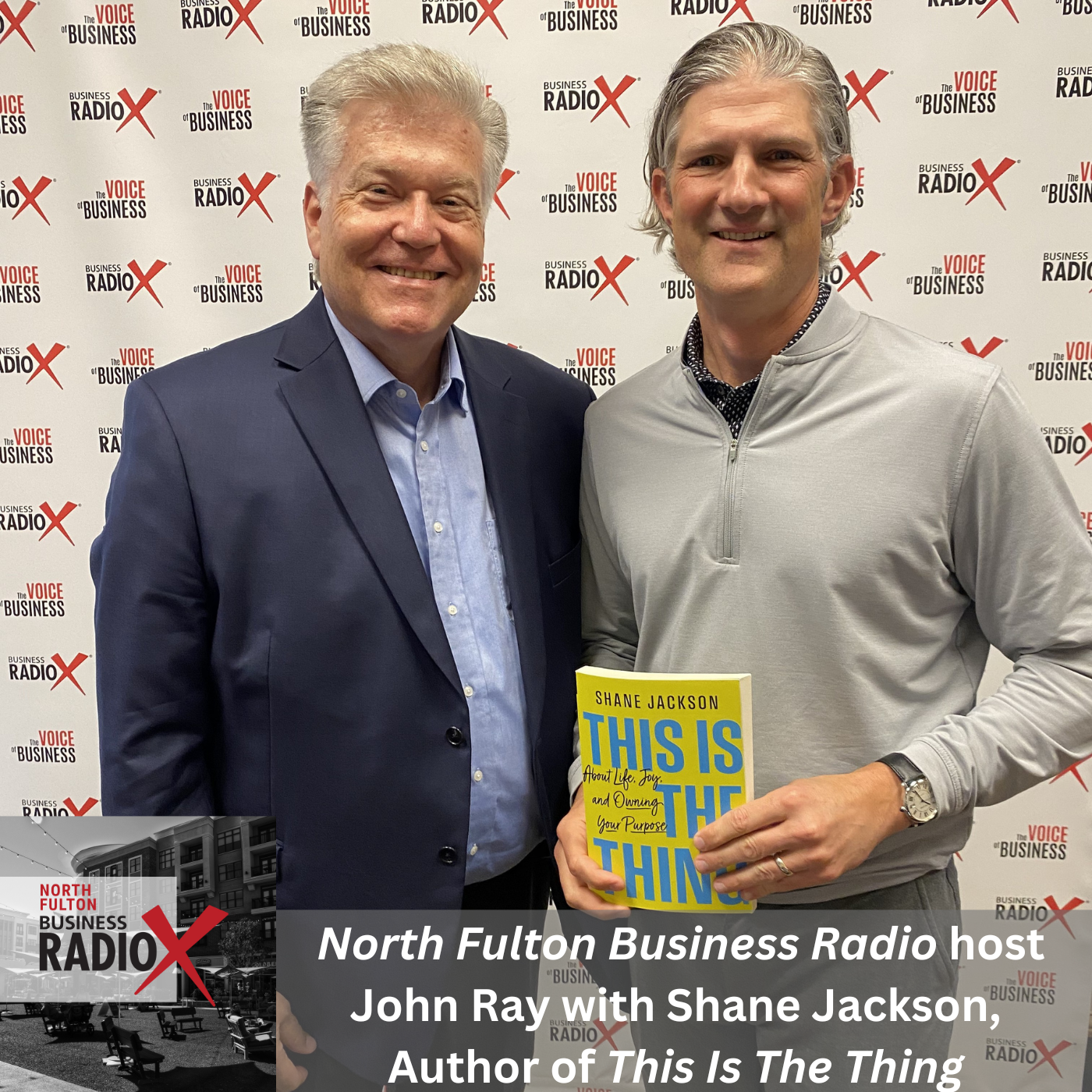
Finding Purpose and Joy in Business and Life with Shane Jackson, Author of This Is The Thing, on North Fulton Business Radio with host John Ray
North Fulton Business Radio
Finding Purpose and Joy in Business and Life, with Shane Jackson
Loading
00:00 /
RSS Feed
Share
Link
Embed

Download file

Finding Purpose and Joy in Business and Life with Shane Jackson, Author of This Is The Thing, on North Fulton Business Radio with host John Ray

Finding Purpose and Joy in Business and Life, with Shane Jackson (North Fulton Business Radio, Episode 870)

In this episode of North Fulton Business Radio, host John Ray talks with Shane Jackson, President of Jackson Healthcare and author of This Is the Thing About Life: Joy and Owning Your Purpose. Shane shares how personal reflection, faith, and a desire to serve others have shaped both his leadership style and his approach to life.

He opens up about what it means to live with purpose, why joy is a discipline rather than a fleeting emotion, and how his family’s legacy influenced the book. Shane also discusses the power of asking better questions, the difference between success and significance, and how to lead a life that aligns with your values—personally and professionally.

Whether you are a leader, entrepreneur, or simply someone seeking more profound meaning in your work, this conversation offers clarity, encouragement, and practical wisdom.

John Ray is the host of North Fulton Business Radio. The show is produced by John Ray and North Fulton Business Radio, LLC, an affiliate of Business RadioX®, and is recorded inside Renasant Bank in Alpharetta.

Shane Jackson, President, Jackson Healthcare, and Author of This Is the Thing: About Life, Joy, and Owning Your Purpose

Share Jackson
Shane Jackson

Shane Jackson is President of Jackson Healthcare, the parent company of more than 20 healthcare workforce services businesses that serve over 20 million patients each year. Championing its mission of improving the delivery of patient care and the lives of everyone it touches, he has led the organization through growth that has landed it on the Forbes® list of America’s Largest Private Companies; placement on the 100 Best Companies to Work For® and Best Workplaces in Health Care™ lists by Fortune®; a spot on the Companies that Care list by PEOPLE®; and nearly a decade of Great Place To Work® certification.

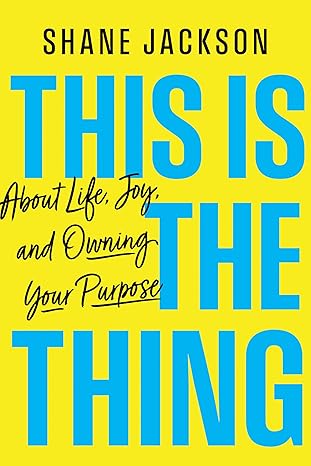
Shane is the author of two books: This Is the Thing: About Life, Joy, and Owning Your Purpose (2025) and Fostering Culture: A Leader’s Guide to Purposefully Shaping Culture (originally published in 2018 with a second edition in 2024). He has written for Fast Company and Forbes on the topics of leadership, workplace culture, and living and leading with intention. He also publishes insights on his own platform and is a frequent keynote speaker at conferences and events across the country.
In addition to the business he leads at Jackson Healthcare, Shane champions the organization’s LoveLifts community impact platform that focuses on improving access to healthcare and the well-being of young people. Under his leadership, LoveLifts partners with more than 450 nonprofit organizations annually, making a positive impact in local and global communities.

In 2024, Shane was named an Ernst & Young Entrepreneur Of The Year® National finalist, in addition to being selected as a winner in the program’s Southeast region. He also has been recognized multiple years on Staffing Industry Analysts’ Staffing 100, a list of the top North American leaders shaping the industry and influencing the workforce solutions ecosystem.

Shane serves on the boards of 3DE and King’s Ridge Christian School and is vice chair of the leader-led goBeyondProfit business initiative that promotes the belief that giving back is good for business. He earned an MBA from Emory University and a Bachelor of Business Administration degree from Harding University.

Website | LinkedIn

Topics Discussed in this Episode

00:00 Introduction and Welcome to North Fulton Business Radio
00:27 Guest Introduction: Shane Jackson
01:52 Jackson Healthcare Overview
03:03 Reflecting on the Pandemic
05:08 Discussing Shane’s New Book, This Is the Thing
08:10 Purpose and Personal Journey
20:13 The Concept of Legacy
22:13 Rethinking Legacy and Impact
23:27 Family History and Its Influence
24:43 The Power of Education and Generational Change
26:48 Creating Ripples of Influence
27:35 Purpose and Leadership
31:09 The Importance of Relationships and Community
34:34 Reflections on the Book’s Impact
37:28 Practical Daily Changes for a Purposeful Life
40:45 Conclusion and Final Thoughts

About North Fulton Business Radio and host John Ray

With over 860 shows and having featured over 1,300 guests, North Fulton Business Radio is the longest-running podcast in the North Fulton area, covering business in our community like no one else. We are the undisputed “Voice of Business” in North Fulton!

The show invites a diverse range of business, non-profit, and community leaders to share their significant contributions to their market, community, and profession. There’s no discrimination based on company size, and there’s never any “pay to play.” North Fulton Business Radio supports and celebrates businesses by sharing positive stories that traditional media ignore. Some media lean left. Some media lean right. We lean business.

John Ray, host of  North Fulton Business Radio, and Owner, Ray Business Advisors

John Ray is the host of North Fulton Business Radio. The show is produced by John Ray and North Fulton Business Radio, LLC, an affiliate of Business RadioX®, and recorded inside Renasant Bank in Alpharetta.

The studio address is 275 South Main Street, Alpharetta, GA 30009.

You can find the full archive of shows by following this link. The show is available on all the major podcast apps, including Apple Podcasts, Spotify, Google, Amazon, iHeart Radio, and many others.
John Ray, The Generosity MindsetJohn Ray also operates his own business advisory practice. John’s services include advising solopreneurs and small professional services firms on their value, their positioning and business development, and their pricing. His clients are professionals who are selling their expertise, such as consultants, coaches, attorneys, CPAs, accountants and bookkeepers, marketing professionals, and other professional services practitioners.

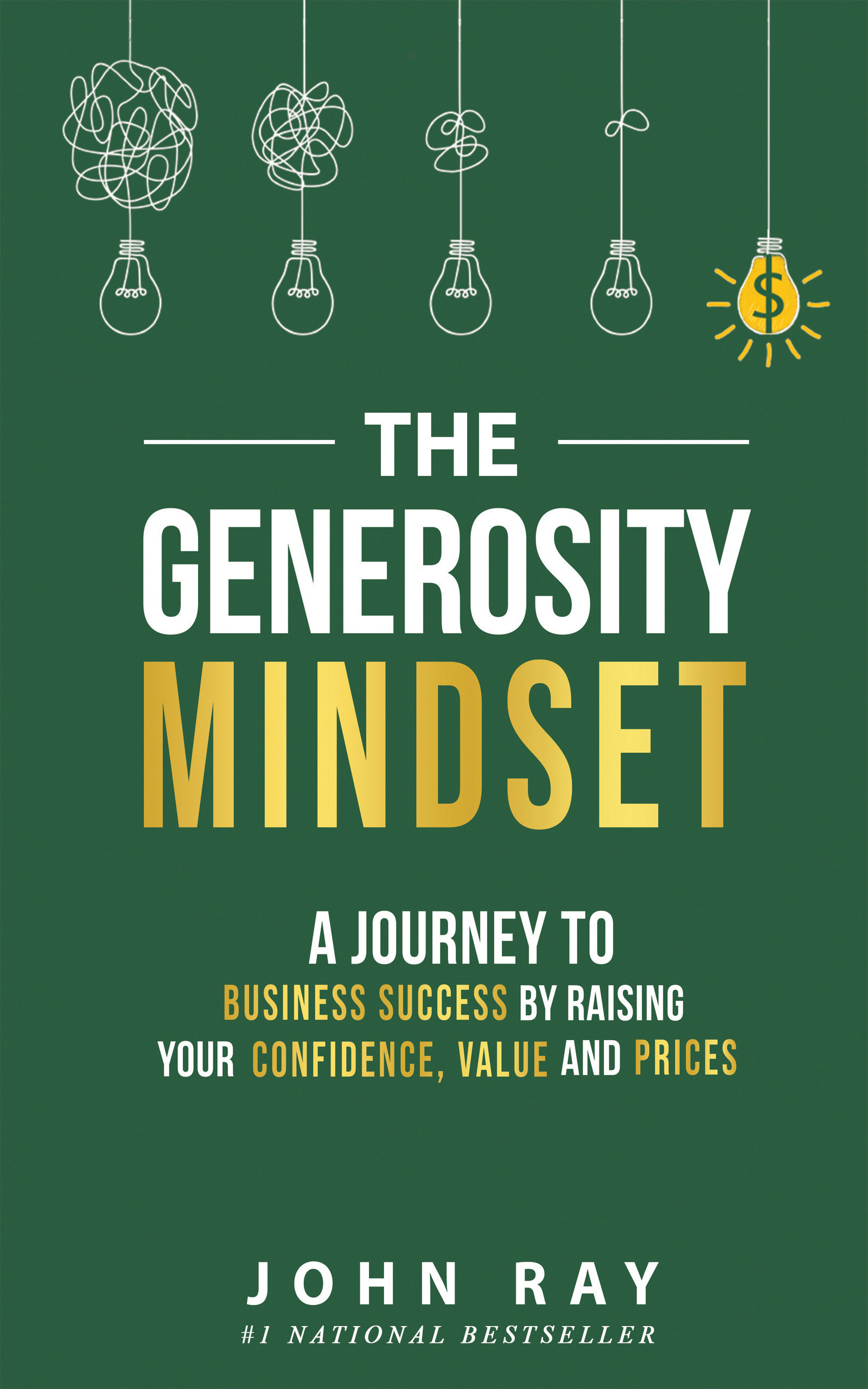
John is the national bestselling author of The Generosity Mindset: A Journey to Business Success by Raising Your Confidence, Value, and Prices.
Tagged With: Author, influence, Jackson Healthcare, John Ray, joy, legacy, North Fulton Business Radio, purpose, purposeful life, Shane Jackson, success

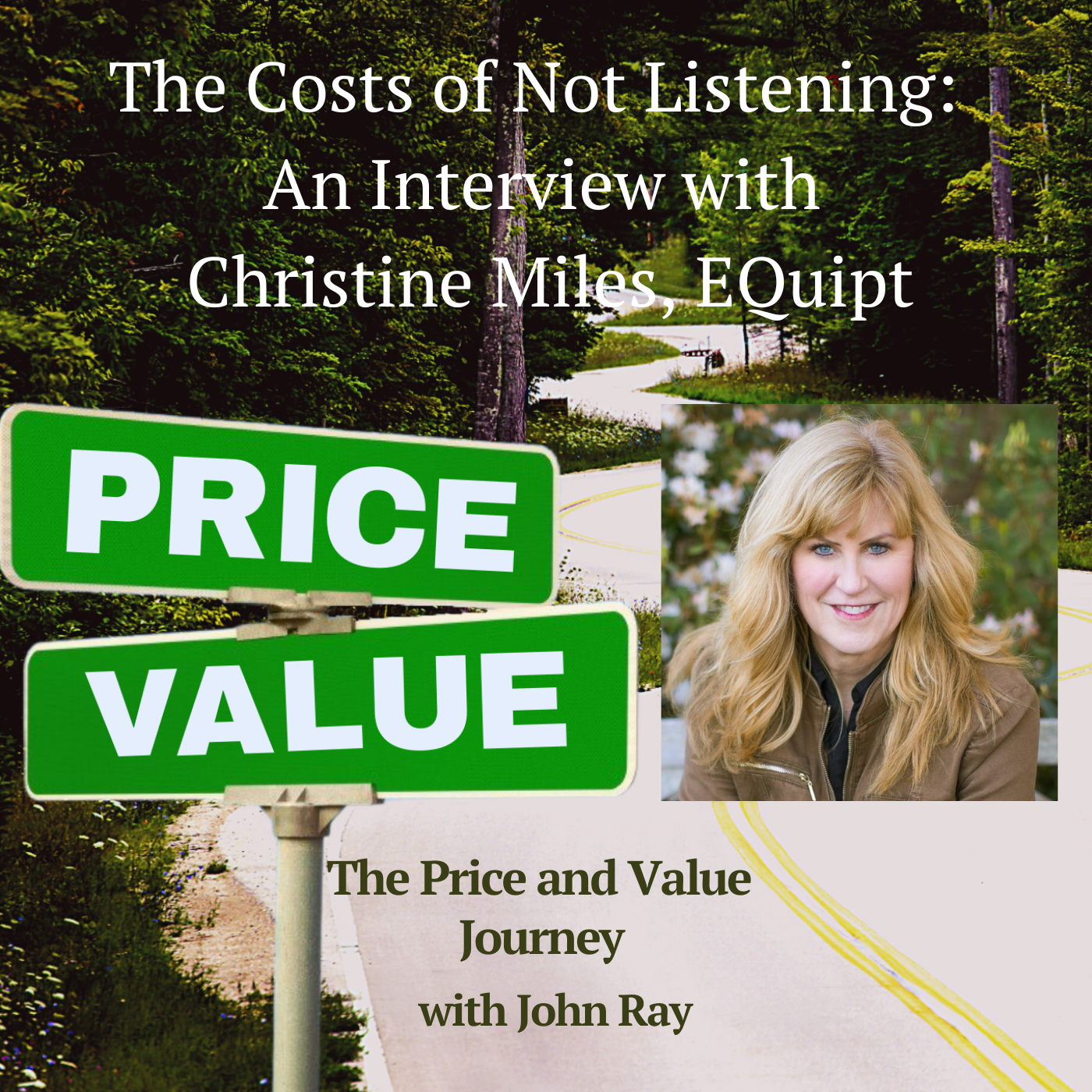
The Costs of Not Listening: An Interview with Christine Miles, EQuipt

April 12, 2023 by John Ray

Christine Miles
North Fulton Studio
The Costs of Not Listening: An Interview with Christine Miles, EQuipt
Loading
00:00 /
RSS Feed
Share
Link
Embed

Download file

Christine Miles

The Costs of Not Listening: An Interview with Christine Miles, EQuipt

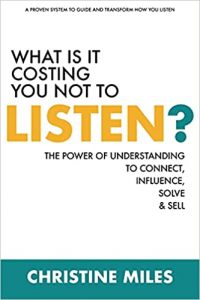
Christine Miles, author of What Is It Costing You Not to Listen?  joined host John Ray to discuss the art and skill of listening. Christine described why she’s so passionate about listening, why listening must be learned, why professional services providers don’t actually listen, and the role of curiosity. Christine and John also discussed the six most powerful questions that get results, the steps on what she calls The Listening Path™, how to effectively use silence, and much more.

The Price and Value Journey is presented by John Ray and produced by the North Fulton studio of Business RadioX®.

EQuipt

EQuipt is a training and consulting company that helps organizations grow sales, develop people, and create cultures of understanding. The Listening Path™ is a transformational system on listening to understand, that has been taught at various Fortune 100 corporations, universities, law firms, and privately-held companies nationwide.

The Listening Path™ will help you Strengthen customer relationships, Increase in-person and virtual communication effectiveness, Reduce costs, Gain trust, Increase collaboration, Fuel productivity, Optimize client solutions, Develop a culture of empathy, Promote psychological safety, Shorten sales cycles, and Improve prospecting and sales efforts.

Website |LinkedIn | Facebook | Instagram | Twitter

Christine Miles, Founder and CEO, EQuipt

Christine Miles, Founder and CEO, EQuipt

Christine Miles is an author, professional keynote speaker, consultant, executive coach, thought leader, and entrepreneur. She is the Founder and CEO of EQuipt, a training and consulting company that helps leadership teams grow sales, develop people, and create cultures of understanding. She developed The Listening Path™, a transformational workshop on listening to understand, which has been taught at various Fortune 100 corporations, universities, law firms, and privately held companies.

She is the author of What Is It Costing You Not to Listen?

What Is It Costing You Not to Listen? will encourage you to examine how you are listening. You’ll discover that not only are many of the problems in your life due to not listening effectively, but listening helps to solve most problems. Christine Miles is a longtime expert in educating individuals and organizations on how to listen in ways that transform how they lead, sell, influence, and succeed in every aspect of life. Following the steps of her breakthrough Listening Path™ will provide you with a critical key to your success – understanding.

Through Christine’s game-changing approach to listening, you will learn to:

• Hear what is said and not said
• Identify your listening persona and realize when it is unhelpful
• Soothe your subconscious so you can listen differently
• Listen with intent to gather others’ stories
• Replace interfering direct questions with just six questions
• Mini-reflect to speed up the listening process without getting lost
• Affirm to create alignment, break down walls, and solve problems

In business, listening is good for the bottom line. It creates trust between coworkers so they can solve problems better, get things done, manage conflict, stay engaged, and empower one another. In personal relationships, listening is an act of love that communicates to people they are important to you.

LinkedIn

TRANSCRIPT

John Ray: [00:00:00] And hello again, I’m John Ray on the Price and Value Journey. And I’m delighted to welcome Christine Miles. Christine is an expert on the thing that us, professional services providers, probably have the biggest problem with, it’s listening.

John Ray: [00:00:20] Christine is an author. She’s a professional keynote speaker, consultant, executive coach, thought leader, entrepreneur. She’s done it all. She’s the founder and CEO of EQuipt. And through her company, she helps leadership teams, individuals – we’ll get into her precise work – gross sales, develop their people, all through helping improve their listening skills.

John Ray: [00:00:49] And, Christine, you’re already amazing. I’m just putting that out there because I’ve already, you know, gotten familiar with your work, which is why I wanted you to be on the Price and Value Journey. So, thank you for joining us.

Christine Miles: [00:01:04] Well, it’s my absolute pleasure. I’ll try to meet those very kind words.

John Ray: [00:01:10] Well, for way of introduction, what did I miss that people need to know about you and your work?

Christine Miles: [00:01:19] Yes. So, the work we do, the foundation of the house is really how to listen in – what we call – a transformational way. So, really listen to understand and to discover the meaning of the message, the insight in the conversation. And that is the foundation of the house. There’s a lot of aspects of communication we touch.

Christine Miles: [00:01:40] Listening really teaches you more than you think. It tells you a lot about how to tell versus how to understand. And it also builds what we call your emotional skills. So, when you learn to listen in a different way, you learn to listen to yourself, you learn to listen to others. And that’s the foundation of emotional intelligence, which is, you know, self-awareness and other awareness. And we know that that’s really what makes great companies great. That’s what makes good people really great at what they do or that is that EQ difference.

Christine Miles: [00:02:12] I always say, we’re throwing a ball and you’re chasing it to get in shape rather than just telling you to go for a run. So, there’s a lot of things that it elevates when you learn to listen differently.

John Ray: [00:02:23] One of the things that I find interesting about this topic, and every time I post about it like on LinkedIn or wherever, I get all these comments about, “Yeah. You’re so right, John. And, yeah, we’ve got to listen and so forth.” And we all agree that we’ve got to listen better. And then, here comes the person that’s got the cliche about two ears and one mouth and blah, blah, blah. So, talk about why. I mean, to me, this is lip service in a way, right?

Christine Miles: [00:02:57] It’s frustrating to me as well. But I try to remind myself it’s nobody’s fault and here’s why. Because we’re told to listen from a young age and we are very rarely taught. So, we do equate hearing with listening rather than listening, as you said in your intro, is a skill. It is in fact a skill. So, it’s not like walking where you just have your legs and then, without any problems, you learn to walk. You don’t learn to listen just because you have two ears. It is something that needs to be developed.

Christine Miles: [00:03:31] And so, the problem is nobody knows how really. The majority of us don’t know how. We don’t know what good looks like. We don’t know how to do it. Because we’ve been winging it and we think we’re better than we are sometimes. Or if we’re not as good as we think we should be, we don’t really know how to fix it.

John Ray: [00:03:48] Yeah. No, that makes sense. And it seems to me – and you’re the expert, so this is a question – we’re taught to have the answers, right? The kid in class, it’s like, “Oh. I’ve got the answer,” you know, with their hands raised. So, we’re taught to project, we’re taught to speak up, we’re castigated for not speaking up. And we’re never really taught listening.

Christine Miles: [00:04:21] And then, take that into business life, what do we tell employees? “Don’t come to their manager with problems. Come to them with solutions.” And I say, “No. Come to me with the root cause of the problem so that we can figure out the best solution.” But we’re expecting people to just have the right answers. And then, we’re solving a lot of problems that aren’t really the problem and wasting a lot of time and resources. And it does start very young.

Christine Miles: [00:04:47] It’s funny, we were at a school a few weeks ago piloting something, and I asked the teachers do they teach listening. And this is a private school in the Philadelphia area. They’re very well known and recognized. And the teachers try to teach it. And they said what happens is the kids, when the teacher asks a question, everybody raises their hand. And let’s just say little Johnny is the one that’s answering, all the other kids their hands are still up. And they go, “No, put your hands down while Johnny’s talking.” And I’m thinking, This is just 40 years later in a meeting where everybody wants to just talk, just waiting their turn.

Christine Miles: [00:05:22] So, while it’s the right idea, again, it’s behaviorally-based rather than brain-based. Because listening is really happening or not happening in our brains. And the brain is the greatest enemy of listening. So, unless we learn how to manage our subconscious brain that is in overdrive and telling us to do everything but listen, we’re just white knuckling our way through it. We’re waiting our turn, but we’re not really certain how to change it. And that leads us to wanting to provide answers to solve problems, because that’s what we’re trained to do. And then, it interferes with the most important part, which is let me understand before I try to solve.

John Ray: [00:06:03] I want to dig into that a little more, but before we do, I don’t want to get too far away from your work without asking you why you’re so passionate about this particular topic. You know, I’ve heard some of this story before, but I think it’s important for our listeners to hear it in full.

Christine Miles: [00:06:24] Well, I appreciate that. So, we all have a reason why we do what we do. We don’t always know what that reason is. My reason came to me pretty early in life because I learned to listen differently. I can remember as early as five when I had moments of, like, paying attention to things that were different. A big part of that was my mother. She had mental health issues that she came by very honestly. She had lost her mother from childbirth. Her mother died from childbirth. So, she was set up for a lot of pain.

Christine Miles: [00:06:58] And what I saw was a woman who was very warm and loving and charismatic. She lit up the room. But underneath the surface was this real dark pain that most people didn’t see. So, I learned to see that what’s happening on the surface isn’t happening below the surface. And that was part of my role in the family, is to understand that, attend to that. I mean, while there was burden in that, trust me, the therapist and I still talk about it. There was also a great gift, which was I learned to listen differently and understand things that most people didn’t understand at a very young age.

Christine Miles: [00:07:33] And that was obvious to me. It became more and more obvious over the years, but as early as high school. And anything I was succeeding in, it wasn’t because of my natural talents and abilities, whether that was on the athletic field or academically or anything I did in my career, it was because, fundamentally, I was able to listen in a different and more compelling way.

Christine Miles: [00:07:54] And then, as I studied psychology and I went into my career, I also saw that not listening was why families were failing, relationships were failing, businesses were failing, teams were failing, projects were failing. The very thing that made me succeed is often the threat to why things weren’t working.

Christine Miles: [00:08:12] And so, what I’ve done over the course of my career is try to help others learn to understand, and listen, and solve problems through understanding versus throwing resources at it or throwing more telling at it. And that’s evolved to really creating a common language and provide people the tools that calm that brain down – what I was taught as a kid, basically – and deconstruct it so that it could be replicated more simply and easily.

John Ray: [00:08:43] So, let’s get back to that. You mentioned the subconscious and how just the way we’re wired really holds us back when it comes to listening.

Christine Miles: [00:08:57] The subconscious brain is a super power. It’s emotional. We know now from the neuroscience that that’s how people buy. They buy emotionally. We know this as service consultants. We go in and they buy us before they buy what we do. That’s an emotional decision, which is also why listening is so, so very important when you go in as a professional services company.

Christine Miles: [00:09:24] But it’s also that, you know, our own brains are emotional, and so we want to make the sale. So, we go into a prospect, and what are we thinking about? We’re thinking about what do I need to say. How do I need to convince them. What do I have to offer them. And our emotional brains are in overdrive. We’re thinking about what we’re going to say, how we’re going to respond, how we’re going to advise them, all of the things that are the opposite of listening. And so, that’s one of the problems.

Christine Miles: [00:09:51] The second is, the more knowledge and experience you have, the more likely you are to not listen. Because you’ve seen the problem so many times, you know what the solution is and you build a solution to solve that problem. So, we tend to go in and start selling way too soon and problem solving way too soon.

John Ray: [00:10:09] Yeah. And we think we’re being helpful because we’re bringing our experience and knowledge to the table. That’s what clients want after all, right? And that’s not all they want, though. They want to be heard.

Christine Miles: [00:10:22] Well, sometimes the person rushing to the solve is the prospect. I told a story about this in my book. In 2007, I started my own executive coaching practice and I was in denial that I’d been in sales my entire career at this point. So, I’m out on my first sales call. It’s a pretty big meeting. And I’m sitting with the CEO and he says, “I want training for my executive team.” Well, I was in the training business for many years at this point, and I’m thinking, “Training for what?” Like, I had no idea what he wanted.

Christine Miles: [00:10:54] And so, I kept going, “Take me back. Tell me more.” And trying to lasso him back. And he’s like, “Well, can you just put a proposal together for me? And here’s a marketing packet that somebody else gave me.” And I was thinking, “Oh, crap. I don’t have this marketing packet. This is my first sales call.” And I just was like, “I don’t have that. Is that helpful to you?” He goes, “Well, not particularly.” And I go, “Okay.” But I had to keep lassoing him back because he wanted the solution, he wanted the answer.

Christine Miles: [00:11:23] So, sometimes it’s us and sometimes it’s them. And it’s a sales trap. I made a very big sale that day. And I still work with that CEO now at a second company that he started. And so, part of it was because I didn’t know what he needed. And my naivety even more so slowed me down to slow him down. And I really uncovered what the real need was rather than just throwing what he wanted me to throw at it, which is was right in my wheelhouse, but it wasn’t going to be helpful. So, it’s a big trap both what we do and what the prospect does. So, we have to be really careful and slow down to listen differently.

John Ray: [00:12:02] So, let’s talk about how we do that. You talk about the listening path. It’s on the wall behind you. I could see it. And what you mean by that are tools. You have to have tools in the tool kit, as it were. Right?

Christine Miles: [00:12:18] That’s right. So, the problem and the name of my book is called, What Is It Costing You Not To Listen? Because you can’t solve a problem you don’t know you have. And so, as we talked about, we’re set up not to know how to listen and know what good listening looks like. So, sometimes we have to first analyze what’s it costing us? How did we lost the sales? What’s happening to our relationship?

Christine Miles: [00:12:41] The solution is the listening path, and that’s the path to understanding. And the metaphor is you wouldn’t go hiking in the woods for three weeks backpacking without any tools or supplies in your backpack. And yet that’s exactly how we go into conversations. We go in unprepared to really know how to understand. And so, we provide those tools to keep you on the main path. Because when you’re listening, you’re always listening to a story. When you’re going in to talk to a client or a prospect, they’re telling you a story.

Christine Miles: [00:13:12] Here’s the problem. People are terrible storytellers. We are wired to listen to stories, to learn from stories. But we’re not wired to be great storytellers. There’s a few that have stood out in history that have made their mark, Lincoln being an example of that. But most of us really are terrible at it. So, because of being bad storytellers, we disorient the listener right off the bat. And if the listener doesn’t know where they are in the story, they’re going to struggle to figure out where to take the client, the prospect, or partner.

Christine Miles: [00:13:46] So, that’s part of what the tools do. They help you understand where you are in the story, how to stay on the main path, and how to be the guide to get the person to where you need them to go.

John Ray: [00:13:58] Now, you talk a lot about identifying your listening persona. Is that part of the listening path and part of success on that path?

Christine Miles: [00:14:10] It is. And so, one of the things – and I think this will resonate with you – is that we’re taught about listening is it’s really important to be curious and to ask really good questions. So, I have a team of executive coaches that are certified, and one of the things they go through is they go through how to ask really good questions when they’re trained. And the problem is, when you have to think of really good questions, what are you doing? You’re thinking rather than listening. And when you’re asking questions, that shapes the story because my questions are going to shape the story you tell.

Christine Miles: [00:14:46] So, there’s two listening personas when you’re on this listening path. One is The Curious Detective and one is The Defense Attorney. And think about it. Defense attorneys put people on the witness stand. They ask questions to shape the story that they need the person to tell to make their case.

Christine Miles: [00:15:03] Now, let’s take that into sales. You go in with your prospects or clients, you have an idea about how to help them. You go in and ask them very specific questions. And what are you doing? You’re shaping the story that they might tell you rather than getting the story, curiously letting it unfold so that you can drive value and uncover the real problems so that you can answer things that nobody else is answering. So, questions can force you into that defense attorney rather than the curious detective.

Christine Miles: [00:15:36] And one of the tools on the listening path is what we call the compass, which are the six most powerful questions. And, initially, when we teach people how to listen transformationally, these are the only questions you’re allowed to ask. Take all other questions off the table. And these six alone get you further than any specific diagnostic questions on the path.

John Ray: [00:16:00] Okay, So, you set it up here. Let’s talk about the six questions. I’m just going to say my personal favorite on there that I use is Tell me more.

Christine Miles: [00:16:11] You use that already? Yeah. So, tell me more.

John Ray: [00:16:15] Tell me more. Yeah.

Christine Miles: [00:16:16] Why does that work for you? Tell me more.

John Ray: [00:16:20] It works particularly when I don’t know what’s been said. And I don’t know, like, where that’s coming from, how to define what we’re talking about. I don’t want to say I don’t understand because I don’t want to crush somebody across the table from me. But that’s one that I use quite frequently.

Christine Miles: [00:16:46] And do they tell you more?

John Ray: [00:16:47] Oh, absolutely. Absolutely.

Christine Miles: [00:16:49] Isn’t that amazing. Tell me more begets they tell you more.

John Ray: [00:16:52] It always works. Yeah.

Christine Miles: [00:16:54] It always works. And so, I’ll run through the list so we can talk about any one of them if you like. So, I’m glad you’re already using that. And I’m not surprised you’re also doing a radio show. So, these are the most powerful questions journalists, interviewers, and therapists use, by the way, hostage negotiators.

Christine Miles: [00:17:13] So, it’s take me back to the beginning, tell me more, how does that make you feel, then what happened or what happened next, hm – which is the non-verbal prompt of tell me more, or it sounds like you feel. So, there’s two feeling questions and four situational questions all open-ended. You can use them as often as you like and in anywhere you like. And if you only use those questions when you’re talking with someone, you will not shape the story and more of the story will come out than you’ve ever gotten before.

Christine Miles: [00:17:47] Because you just said it, when I say tell me more, I don’t even have to admit that I don’t understand. They just tell me more and then more opens up and I get more of the story. See, ignorance is bliss. Whenever I’m confused or whenever I’m not clear, then I know I’m in the right space because that means they’re not being a good storyteller. And I better lens back to figure out what’s going on.

John Ray: [00:18:13] Yeah. And that takes some humility to get in that posture, right? I mean, because you can write these six questions down, you can memorize them, so forth – six responses, I mean. You can memorize them, what have you, but then you get in the heat of the moment and it goes out the window unless you’ve got the right mindset.

Christine Miles: [00:18:48] So, a couple things. It’s counter to all the training we’ve had because what we’re trained to do from a young age, not just in business, we are trained to show up and be smart, show that we’re smart, and questions are a way to show that we’re smart and that we know what we’re talking about and what we’re doing. So, it’s counterintuitive. So, it’s a bad habit, if you will.

Christine Miles: [00:19:14] And so, we have to unwind that. And the way you unwind that is first you have to have the right tool and then you have to have the right practice. So, several years ago now, we were doing a sales kickoff and the head of the organization got up to introduce us.

Christine Miles: [00:19:30] And he said he just heard a Navy SEAL speaking – because it was at a large company offsite. And the Navy SEAL said, “Look, most people think they’re going to rise to the level that they need to in a crisis based on adrenaline and all the things that are going off. You know, we’re going to lift the car off of somebody. We’re going to be the hero. When, in fact, what we rise to is the level of competence and training that we have in crisis.”

Christine Miles: [00:19:55] That’s why we practice as athletes. That’s why we practice whatever we’re doing, because you need to be able to do it under pressure. So, that’s why when you use these questions in real life all the time, then when you’re in that sales meeting or that client meeting, it’s more natural. You’ve already unwound kind of what you’ve been doing all these years.

Christine Miles: [00:20:17] We have people that take those questions, plop them down, we have mouse pads. They just set them down at the meeting to remind them. It also helps relax the brain. You don’t need to think about how you’re going to respond. You don’t need to worry about what you’re going to say next because the questions are a sedative for your subconscious so that that tool does the work for you.

John Ray: [00:20:39] I love that point. And I love the metaphor you use with it, that it’s a sedative. Because your subconscious is in overdrive and you don’t even necessarily know it. And you need to go ahead and inject that overdriven subconscious with a sedative, and you’ve given us the tools to do that.

Christine Miles: [00:21:05] Yeah. And the other thing is, if we take it back to the path metaphor, so you’re on the Appalachian Trail and you’re hiking and there’s a main path, but there’s also a lot of little side routes. And conversations are exactly that. There’s the main path and then there’s all these little side trails. What happens with very specific questions is we go off into the woods and we get lost often because we’re deep into an area we don’t need to be.

Christine Miles: [00:21:33] What those six questions do is they get you back to the main path, to the story. Because people, when you give them the room become a storyteller. This is how you become the guide as the listener. When you guide them on the main path, they’ll stay on the main path. If you take them down a side trail near a ravine, they’re going to fall off if they follow you.

Christine Miles: [00:21:57] So, the questions calm the brain and keep you on the main path to getting that story. And, really, once you get that, you know how to help them in a more compelling way than just giving them a solution. You drive value for your customers.

John Ray: [00:22:14] That’s a magic word for me, is value. My ears perk up when I hear that word, as it does for our listeners. But talk a little bit, if you will, about the reflecting. You talk about many reflections to speed up the listening process, and that concept is a little confusing to me, so talk about that.

Christine Miles: [00:22:50] Well, first of all, let me take a step back. So, great listening is about proficiency, how well you do it, and efficiency. So, I believe in both. People think I’m very patient. Don’t mistake my understanding for patience. I want to get things done really quickly. I want you to feel good about getting things done quickly. And I know how to help get that story out of you faster so we can get there more quickly.

Christine Miles: [00:23:20] It is a slow down to speed up, though. So, I learned this in sports. I chased any ball that would let me chase it. But field hockey was my sport of choice. And one of the things I learned is that if you could run down the field of speed – I was a defender and everybody was faster than me, everybody – I knew how to cut off the angle. Based on your pace, I could figure it out. If you took a pullback, if you took a little hitch step and then sped up again, I was done. I was done because I couldn’t change pace that way. Part of being in a conversation is you need to know how to change pace. When do I need to pull the ball back a little bit so then I could speed up again.

Christine Miles: [00:24:02] And when you do that, again, it changes the dynamics of the conversation. So, you’re getting into this reflecting tool. So, there’s six main tools on the listing path. And the first five are kind of the science and the sixth one is the art.

Christine Miles: [00:24:19] So, we talked about the compass as one of the tools. And really the map to the story is the main tool. Where am I in the woods? Where am I in the conversation? What’s the path to the story? That’s one of the tools.

Christine Miles: [00:24:33] And then, there’s something called the flashlight. And the flashlight is really when you’re hearing the story, once you think you’ve gotten it, how are you shining a light on what was said and highlighting what you heard. That’s what we call the flashlight. That’s a powerful thing. Tell me the story you just told me. I’m going to tell you the story you just told me, that’s the flashlight. Does that make sense?

John Ray: [00:24:56] Yeah. Yeah.

Christine Miles: [00:24:57] So, I’ll say the most powerful story you can tell someone is their own. There is nothing like a client or prospect talking to you for 30 minutes and you go, “Hold on. Before we go any further, let me make sure I understand.” And then, I tell you the story you just told me at a high level in 30 to 90 seconds. You’re going to feel like I really was paying attention. And you’re going to go, “Well, that’s right but that’s not quite right. Nope, you got me here but not here.” And there’s a different dialogue that opens up as a result of taking out that flashlight.

John Ray: [00:25:32] And this gets at where you talk about affirming to create alignment, break down walls, et cetera.

Christine Miles: [00:25:43] That’s right. So, the flashlight highlights the story. To affirm it, you have to make sure you didn’t contaminate the story. So, these two tools work hand in hand all the time. And by the way, these are the most underutilized tools. We tend to listen and say, “Yeah. I understand.” And when somebody says I understand to me, I never feel less understood.

John Ray: [00:26:10] In a way sometimes that can be insulting, too, right?

Christine Miles: [00:26:15] I don’t know what you understand. My question is really, “Tell me more. What do you understand? I want to hear this.” Because the words I understand do not convey understanding. Understanding is, “You know, John, what I hear is important to you and your listeners is how do you drive value in the sale? How do you make sure that your customers really feel listened to, understood, so that your solutions or your listener solutions can really be the game changing and you can make a big difference for your clients. Do I get you? Do I understand?” Probably closer, right?

Christine Miles: [00:26:50] So, we call that the water filter where affirming means let me make sure I didn’t contaminate your story by what’s going off in my brain. So, once I use that flashlight, shine a light on the story, I’m going to ask you and I’ll use these very specific words. I’m going to say, “Do I get you?” That’s a prompt to say do I get you and your story, not just the story, not just your situation, but do I get you as well as your situation.

John Ray: [00:27:25] Wow. I love that. That is powerful. And that’s a good segue, I’ve got a few specific situations maybe we can talk about that services providers run into. And one of those is when you’re trying to have a value conversation, how do you know when it’s time to pivot? You’re doing the best you can in trying to understand where that client sees value, both tangible and intangible value, how do you know when it’s time to pivot?

Christine Miles: [00:28:10] So, this is when you know it’s time to pivot. We call that earning the right. Have I earned the right to start to tell you what I think to sell you my solution? What happens is we tend to go forward right away. We come in offering the solution. Maybe our prospect or client says, “Tell me the solution.”

Christine Miles: [00:28:30] Here’s what always happened to me, I started my career, I have a background in psychology as a therapist. I was a home-based family therapist at 22. So, I went into people’s houses at 22, knocking on their doors saying, “I’m Christine. I’ll be your family therapist.” They pretty much had that look on their face, so it was terrifying. Fortunately, I was mentored and trained through a world renowned facility. I ultimately got certified.

John Ray: [00:28:58] But you were also brave, though. I mean, so you had courage to do that.

Christine Miles: [00:29:05] I did. I did. It’s really how I wanted to make a difference at the time. Here’s what’s fascinating, is that, I was the youngest person on my team. Most people were in their 30s – which seemed old at the time – and they had social work and experience. But I stood out more because I didn’t know anything and I went in and listened. And they said I had this uncanny ability to join – they called it joining – with the families. And all I did was go in and do the very things that I’m talking to you about.

Christine Miles: [00:29:40] That’s how I built credibility. I wasn’t going in and saying I know your situation. I was going in and saying tell me about your situation, tell me about your kids, tell me what’s going on, let me understand you. The therapist taught me how to do exactly what you’re talking about, which is how do you shift it then from understanding to telling? And that’s about earning the right. Most people go in and just start telling versus earning that right first.

Christine Miles: [00:30:08] So, the pivot happens after you use the flashlight in the water filter. So, you highlight. You shine a light on the story. You say, “Do I get you?” And one of three things is going to happen in that conversation. Your client is going to say, “Yeah. You get me.” Or they’re going to say, “You get me,” and they’re going to start telling you more.” Or they’re going to say, “Yes. You absolutely get me.”

Christine Miles: [00:30:34] So, the first one is what we call in the sales world an urban dictionary, where the client says yes but they really mean no. That happens all the time. Your spouses do that to you. Your friends do that to you. Your colleagues do that to you. You’re walking down the hall and you say, “Hey, how are you doing today, John?” And you’re like, “I’m great.” You just got the urban dictionary often because people aren’t always doing great. They’re going, “I’m not so great. I just had a fight with my wife or something’s going on.” But we don’t share that.

Christine Miles: [00:31:07] In our sales conversations, that happens all the time. We ask somebody, “Did I get you?” And they don’t tell you the truth. So, you got to watch for that. “You know what? I don’t know. That doesn’t sound like I really got you. Tell me more.” And once we’re certain and people will then go, “Well, as a matter of fact, what you missed was blah, blah, blah, blah, blah.” So, we have to challenge that moment where we hear the, “Yeah. I get you.”

Christine Miles: [00:31:38] Once we’ve affirmed and really solidly confirmed that we’ve affirmed right, then we can start to tell. Then, we can start to say, “You know what? Now that I really understand, let me tell you what I think. Is that okay?” And then, they’re ready to listen in a different way because you’ve already understood them.

John Ray: [00:32:00] Got it. Yeah. That’s very helpful. But you mentioned a live situation that fits this particular question, which is the client that wants to rush to what your solution is, and you’re trying to slow them down, you’re trying to use the tools that you teach. How do you slow down that freight train?

Christine Miles: [00:32:33] Well, you have to have an awareness, first of all. This is also what the tools do, when you know where you are in the story, you know where you need to go. So, there’s four milestones on the map, the path to understanding, there’s the beginning. It’s just like a movie. So, picture a movie now. There’s the beginning of the movie, there’s the struggle, there’s the tipping point, and there’s the new beginning or the ending.

Christine Miles: [00:33:01] So, as salespeople, as providers who want to be helpful, by the way, I believe most people go in because they want to be helpful. Yeah, we need to make money, but we want to help and make a difference. I might start at the tipping point, “I already know what your solution is. Let me tell you how to get you to the end or new beginning of your story.” Or our customer or prospect can do that, “I need help. I’m at a tipping point. Tell me what you would do if you were me. And take me to the new beginning.”

Christine Miles: [00:33:29] The way to do that is one of those compass questions is it’s click bait. I have help. I need a problem. If you don’t understand what the problem is and you haven’t spent some time, it is click bait.

Christine Miles: [00:33:40] You just went into a rabbit hole on your phone of all the things you shouldn’t be looking at because you clicked where the customer is, rather than saying, “Hold on a second. Let’s slow down. Take me back to where this started.” That’s where the compass gets you back to the beginning of the story, take me back.

Christine Miles: [00:33:58] And I’ll tell you again where I really profoundly learned this. So, being a therapist so young, by the time I was 28, I had a pretty decent amount of experience. Even though I was doing organizational work at the time, I always saw clients. And so, I say, “How do you want me to help?” And they go, “Well, I want you to help me solve this,” or my marriage, or this or that. And I go, “Okay, how would you like me to help? Well, just tell me what I should do. Tell me this.”

Christine Miles: [00:34:22] And debris on the wall, lots of experience and go, “Okay. Well, this is what I think you should do.” You know what they would do?

John Ray: [00:34:30] Tell me.

Christine Miles: [00:34:32] They’d argue. “I can’t do that. I can’t leave my husband. I can’t do that. I can’t this.” People don’t like to be told what to do even if they’re the ones telling you to tell them. It’s a sales trap. It’s a sales trap. So, even if you think you understand them at that moment, even if you think you know the answer, don’t fall for it. Don’t click bait.

Christine Miles: [00:34:57] Take a step back. Slow them down. Because getting giving them a no is how you also get them to yes. And if you force them to slow down, you’re forcing them to take a hitch step so that they can get down the field faster. We need to be the guide. When they say we need to control the conversation, kind of control it by talking rather than insisting that others talk so that we can listen and understand before we move forward to the new beginning.

John Ray: [00:35:27] So, let’s say we’ve got a situation where we’ve allowed a prospective client to become a client and we think there’s something hidden. This happens, like, all the time, right? Because just like you said, people don’t want to fess up. But those things that they don’t want to talk about may be the most important part of the engagement because you’ve got to understand those to be able to really solve their problems. So, how do you have that conversation after the fact?

Christine Miles: [00:36:11] So, there’s two things here. So, the first is – and I believe this is a big part of this problem – is that most times when we’re selling, we don’t ask people about their feelings. We do not ask, “How does that make you feel?” Because in business, we think that’s an intrusive question. When, in fact, it’s one of the most powerful things we can find out is how people are feeling. I’m undaunted by asking somebody how they feel because I started to do it when I was five. So, I’ve never not asked a CEO, a chairman of the board in any situation how they feel. It’s just part of my nomenclature. It needs to become part of ours. If you do that earlier, you won’t be in that situation as often. I can promise you that.

Christine Miles: [00:37:02] And there’s two questions on the compass, How does that make you feel and It sounds like you felt. So, we have to get over ourselves and realize we need to ask about the feelings. That will unlock a lot of what you’re talking about so you don’t find as many surprises.

Christine Miles: [00:37:16] The second thing is, let’s just say it happens anyway because there’s shame and there’s embarrassment sometimes with what’s going on. And we have to feel comfortable to talk about that. So, it’s never too late to go back. And I’ll give you another therapy story from back in the day that makes the sales point.

Christine Miles: [00:37:36] So, when I stopped working as a therapist fulltime, I went into the world of employee assistance programming and I was running the organizational development side of the business. As I said, I was always seeing clients, more the high profile ones. And I had a buyer from a home shopping network that we worked with that was in a pretty big job. We had eight sessions. So, they put her with me, you know, eight sessions to try to help her.

Christine Miles: [00:38:02] So, she came in and said, “I’m having marital problems. My husband’s laying on the couch. He doesn’t want to come in. I’m frustrated. I’m not happy.” And I said, “Well, your husband doesn’t come in. We can still work on the marriage even if you’re here.” And, boom, we went off. So, now, I’m already engaged with her as a client.

Christine Miles: [00:38:17] Guess what she told me on session four? On session four, she says to me, “I have something to tell you, Christine, that I didn’t tell you yet.” “Oh, okay. Well, have at it.” She said, “Well, I’m having an affair with our neighbor who’s our best friend. Like, we do everything together. My husband’s best friend and my best friend. And the husband and I are having an affair.”

Christine Miles: [00:38:42] I got four sessions in on eight sessions and went, “Oh, no.” [Inaudible]. No judgment. But that would have really been helpful for me to know in session one, right? Whose fault was that? It was mine because I didn’t dig enough what else is happening, take me back, tell me more. I went forward too much. I started solving too much.

Christine Miles: [00:39:03] But at that moment I just said, “All right. Take me back. Let’s go back. How did that start? Where did that begin? How is that impacting your marriage?” And then, we started over on the path because I missed a big part of the beginning of the movie. So, I had to go back to the beginning to understand how that was impacting, why that happened. So, it’s never too late to go back, but it’s important that we go back once we hear that.

John Ray: [00:39:30] Yeah. I love that. One final thing, just something that’s really tactical. How do you feel about the use of silence? So, for example, someone says, “That’s too expensive.” And you’re silent. And silence abhors a vacuum, or whatever that saying is. So, is that the way to respond? Or should we say tell me more? How do you feel about silence, I guess?

Christine Miles: [00:40:10] Well, again, my sales training was [inaudible] based on how I was trained as a therapist at 22. Because eventually I worked in-patient and we worked via one way mirrors. So, sometimes I had 20 people behind a mirror and a lead therapist calling in and saying, “You have to say this to the family.” Or in a very compelling story, one time they made me sit on my hands for an entire session because the family wasn’t talking. And I had to sit there and learn how to be silent until they started talking. And it’s powerful. There’s a quote that the CIA says, “Silence sucks the truth out.”

John Ray: [00:40:44] Oh, I like that.

Christine Miles: [00:40:46] Silence is a very powerful tool. It’s also a listening inhibitor. Because people are afraid of it. It’s uncomfortable. We tend to fill the space. So, it takes some practice to get good at knowing how and when to be silent. So, it takes a comfort level. So, it won’t be the most natural thing for those who aren’t comfortable with it. But if you can practice your way to success, that’s a very powerful tool as far as listening. Even when you’re not asking a bomb question like that, sometimes it’s just you stop talking and I don’t feel the need to ask you another. I just wait and then you’ll start talking more.

Christine Miles: [00:41:24] So, I feel it’s a very important tool. I also feel interrupting is a very important tool. It’s very important to be able to interrupt people. Most people don’t think that means you’re being a good listener, but it is one of the most powerful things you can do as a listener. The only way and only reason you’re allowed to understand is – pardon me – interrupt is to understand and not to tell.

Christine Miles: [00:41:49] So, John, I could interrupt you and say, “Hold on. Hold on. Let me make sure I get you.” And then, slow you down and interrupt for that because I think you’re getting lost deep in the woods. But if I interrupt to just start talking, totally different matter. Silence and interrupting are very, very important. If you’re not comfortable with silence, the tell me more, take me back, how does that make you feel are going to get you there as well.

John Ray: [00:42:19] Wow. This has been powerful. Christine Miles, you’re terrific. And thank you so much for the work you do and how you’re sharing it with the world. I want to make sure that we shoutout properly where folks can find you. Certainly, your book – which is one of my favorite book titles in a long time – What Is It Costing You Not To Listen? If that’s not a compelling title, I don’t know what is. But give everyone directions on how they can learn more about you and your work.

Christine Miles: [00:43:00] Sure. I appreciate the comment on the book title because I went against a lot of advice to title it that. Because, again, most people want to title it The Solution. And I’m like, “You can’t solve a problem you don’t know you have.” So, the book can be found on all the major outlets, Amazon. And in any form that you want it because I’ve learned people want their book the way they want it, audio, Kindle, hardback, softback.

Christine Miles: [00:43:27] They can find me @cmileslistens. My contact information is also in the book, by the way, and that includes my cell phone. And they can find us on EQuipt, that’s E-Q-U-I-P as in Paul-T as in Tom, -people.com.

John Ray: [00:43:43] Terrific. Christine Miles, thank you again for coming on. I appreciate you. And I know our listeners are going to just love this. So, thank you.

Christine Miles: [00:43:52] My pleasure. Thank you.

John Ray: [00:43:54] Absolutely. Hey, folks, just as we wrap it up, if you want to know more about this podcast series, you want to see the show archive, of course, you can go to your favorite podcast app, Price Value Journey would be the search term to be able to find this series on your favorite app. You can also go to pricevaluejourney.com and find the show archive there, a link to the show archive there.

John Ray: [00:44:20] You can also find information on my book that’s going to be released later this year called The Price and Value Journey – imagine that – The Price and Value –

Christine Miles: [00:44:30] Congratulations.

John Ray: [00:44:30] Yeah. The Price And Value Journey: Raising Your Confidence, Your Value, and Your Prices Using the Generosity Mindset Method. If you want to know more and get updates as they happen on that book and when it’s coming, you can sign up there.

John Ray: [00:44:48] So, for my guest, Christine Miles, I’m John Ray. Thank you again for joining us on The Price and Value Journey.


About The Price and Value Journey

The title of this show describes the journey all professional services providers are on:  building a services practice by seeking to convince the world of the value we offer, helping clients achieve the outcomes they desire, and trying to do all that at pricing which reflects the value we deliver.

If you feel like you’re working too hard for too little money in your solo or small firm practice, this show is for you. Even if you’re reasonably happy with your practice, you’ll hear ways to improve both your bottom line as well as the mindset you bring to your business.

The show is produced by the North Fulton studio of Business RadioX® and can be found on all the major podcast apps. The complete show archive is here.

John Ray, Host of The Price and Value Journey

John Ray The Price and Value Journey
John Ray, Host of “The Price and Value Journey”

John Ray is the host of The Price and Value Journey.

John owns Ray Business Advisors, a business advisory practice. John’s services include advising solopreneur and small professional services firms on their pricing. John is passionate about the power of pricing for business owners, as changing pricing is the fastest way to change the profitability of a business. His clients are professionals who are selling their “grey matter,” such as attorneys, CPAs, accountants and bookkeepers, consultants, marketing professionals, and other professional services practitioners.

In his other business, John is a Studio Owner, Producer, and Show Host with Business RadioX®, and works with business owners who want to do their own podcast. As a veteran B2B services provider, John’s special sauce is coaching B2B professionals to use a podcast to build relationships in a non-salesy way which translate into revenue.

John is the host of North Fulton Business Radio, Minneapolis-St. Paul Business Radio, Alpharetta Tech Talk, and Business Leaders Radio. house shows which feature a wide range of business leaders and companies. John has hosted and/or produced over 1,700 podcast episodes.

Coming in 2023:  A New Book!

John’s working on a book that will be released in 2023:  The Price and Value Journey: Raise Your Confidence, Your Value, and Your Prices Using The Generosity Mindset. The book covers topics like value and adopting a mindset of value, pricing your services more effectively, proposals, and essential elements of growing your business. For more information or to sign up to receive updates on the book release, go to pricevaluejourney.com.

Connect with John Ray:

Website | LinkedIn | Twitter

Business RadioX®:  LinkedIn | Twitter | Facebook | Instagram

Tagged With: Christine Miles, connect, emotional intelligence, EQquipt, influence, John Ray, listening, listening skills, Price and Value Journey, pricing, professional services, professional services providers, Sell, solopreneurs, Solve, The Listening Path, value, value pricing

Decision Vision Episode 172: Should I Align My Company with a Political Position? – An Interview with Peter Baron, Carabiner Communications

June 9, 2022 by John Ray

Peter Baron
Decision Vision
Decision Vision Episode 172: Should I Align My Company with a Political Position? - An Interview with Peter Baron, Carabiner Communications
Loading
00:00 /
RSS Feed
Share
Link
Embed

Download file

Peter Baron

Decision Vision Episode 172: Should I Align My Company with a Political Position? – An Interview with Peter Baron, Carabiner Communications

If a company chooses to align with a political position, how does it impact revenue? Do consumers care more about their products than their politics? Peter Baron, CEO of Carabiner Communications, and host Mike Blake come to some interesting thoughts on this topic while considering examples of companies that have taken strong political positions such as Nike, Disney, and others. They discuss the kinds of influence companies engage in, what might factor into a board’s decision to take a position, the role of diversity on a board, the impact of “easy outrage,” and much more.

Decision Vision is presented by Brady Ware & Company and produced by the North Fulton studio of Business RadioX®.

Carabiner Communications

Carabiner Communications is a leading full-spectrum marketing and public relations firm. Founded in 2004, Carabiner Communications has a proven history of helping companies tell their most engaging stories and navigate a path to success. As their name implies, the agency helps B2B tech and healthcare organizations get connected to their targeted audiences and the influencers who have their ear.

The Carabiner team is comprised of experienced professionals whose services include messaging and branding, content development and marketing, public relations, lead generation, and more. They are known for being strategic, cost-effective, and always ready to partner with great companies to drive sales.

Company website | LinkedIn |Twitter

Peter Baron, CEO, Carabiner Communications

Peter Baron, CEO, Carabiner Communications

Although Peter began his career with a large PR agency in NYC, he ultimately found his way to the warm and sunny South and made it home. True to our agency name, he is one connected guy—some folks think he knows pretty much everyone in the Atlanta tech community. Peter is typically the Carabiner you’ll run into at conferences and networking events, where he’s friendly, open, and loves to talk about the latest technology trends or his large family.

While Peter drives agency direction and business development for Carabiner, he also consults frequently on accounts and offers high-level campaign strategy. He loves to brainstorm! Peter enjoys the great outdoors, including hiking, kayaking, and camping.

Fun fact: You may not realize it since he dropped the accent years ago, but Peter is from “across the pond”— he’s an expatriate of the U.K.

LinkedIn

Mike Blake, Brady Ware & Company

Mike Blake, Host of the “Decision Vision” podcast series

Michael Blake is the host of the Decision Vision podcast series and a Director of Brady Ware & Company. Mike specializes in the valuation of intellectual property-driven firms, such as software firms, aerospace firms, and professional services firms, most frequently in the capacity as a transaction advisor, helping clients obtain great outcomes from complex transaction opportunities. He is also a specialist in the appraisal of intellectual properties as stand-alone assets, such as software, trade secrets, and patents.

Mike has been a full-time business appraiser for 13 years with public accounting firms, boutique business appraisal firms, and an owner of his own firm. Prior to that, he spent 8 years in venture capital and investment banking, including transactions in the U.S., Israel, Russia, Ukraine, and Belarus.

LinkedIn | Facebook | Twitter | Instagram

Brady Ware & Company

Brady Ware & Company is a regional full-service accounting and advisory firm which helps businesses and entrepreneurs make visions a reality. Brady Ware services clients nationally from its offices in Alpharetta, GA; Columbus and Dayton, OH; and Richmond, IN. The firm is growth-minded, committed to the regions in which they operate, and most importantly, they make significant investments in their people and service offerings to meet the changing financial needs of those they are privileged to serve. The firm is dedicated to providing results that make a difference for its clients.

Decision Vision Podcast Series

Decision Vision is a podcast covering topics and issues facing small business owners and connecting them with solutions from leading experts. This series is presented by Brady Ware & Company. If you are a decision-maker for a small business, we’d love to hear from you. Contact us at decisionvision@bradyware.com and make sure to listen to every Thursday to the Decision Vision podcast.

Past episodes of Decision Vision can be found at decisionvisionpodcast.com. Decision Vision is produced by John Ray and the North Fulton studio of Business RadioX®.

Connect with Brady Ware & Company:

Website | LinkedIn | Facebook | Twitter | Instagram

TRANSCRIPT

Intro: [00:00:01] Welcome to Decision Vision, a podcast series focusing on critical business decisions. Brought to you by Brady Ware & Company. Brady Ware is a regional, full-service accounting and advisory firm that helps businesses and entrepreneurs make visions a reality.

Mike Blake: [00:00:22] Welcome to Decision Vision, a podcast giving you, the listener, clear vision to make great decisions. In each episode, we discuss the process of decision making in a different topic from the business owners’ or executives’ perspective. We aren’t necessarily telling you what to do, but we can put you in a position to make an informed decision on your own and understand when you might need help along the way.

Mike Blake: [00:00:44] My name is Mike Blake and I’m your host for today’s program. I am the managing partner of Brady Ware Arpeggio, a data-driven management consultancy which brings clarity to owners and managers of unique businesses facing unique strategic decisions. Our parent, Brady Ware & Company, is sponsoring this podcast. Brady Ware is a public accounting firm with offices in Dayton, Ohio; Alpharetta, Georgia; Columbus, Ohio; and Richmond, Indiana.

Mike Blake: [00:01:08] If you’d like to engage with me on social media with my Chart of the Day and other content, I’m on LinkedIn as myself and @unblakeable on Facebook, Twitter, Clubhouse, and Instagram. I also host a LinkedIn Group called Unblakeable’s Group That Doesn’t Suck, so please join that as well if you would like to engage.

Mike Blake: [00:01:26] Today’s topic feels extremely timely, and I wish I could tell you that on May 31st I had the foresight that the topic was going to be so timely as it is, but I can’t. Sometimes just things work out. I don’t want to use the word luck, because given where we are, that’s not a term I’m very comfortable with.

Mike Blake: [00:01:51] But the topic today is, Should I align my company with a political position? And whether you find yourself on the left or the right of the political spectrum, I think few people would argue that we are in an unusually fractured political environment, which is spilling over into the social environment. And as a result, competing ideologies are now competing for whatever power, influence, resources they can muster in order to ensure the outcome of a society that they deem ideal, or at least as close to ideal as is humanly possible.

Mike Blake: [00:02:43] And I’m old enough to remember apartheid in the movement against American companies, or rather the social movement that were protesting companies that would continue to do business with South Africa, because people felt that in doing so, you are propping up the apartheid government there. And, of course, in the late ’80s, early ’90s, the apartheid government went away. South Africa is now what it is today. But that’s an early example of social activism, at least in my memory. Social activism, putting pressure on companies to take a specific position.

Mike Blake: [00:03:24] And, now, in recent history and, frankly, as current events, we see quite a bit of that. There was a fairly extraordinary step of Nike deciding to go all in with Colin Kaepernick. A move that I thought was risky. I still think it was risky. But it did work out for them. It turns out the 100 people or so that burned Nike shoes on YouTube were probably about the only 100 customers they lost. And their stock price has gone through the roof ever since. And one of the object lessons there is you have to be careful just because you see somebody on the media saying something or doing something, that doesn’t mean that there’s a critical mass of support behind it.

Mike Blake: [00:04:11] And more recently, we have seen the fight between the government of the State of Georgia and Disney. And, now, and we’ve seen it with companies lining up on two sides of the Russia-Ukraine war. Most now, I think companies, some of them somewhat belatedly, and even perhaps begrudgingly, are choosing to withdraw from Russia as a show of support for the Ukrainians in that particular war.

Mike Blake: [00:04:43] And now that we find ourselves in the wake of the Texas school shootings and the Buffalo hate crime shootings, the next battleground clearly is going to be gun control. And then, later this year, it’s a drop dead certainty that abortion is going to be a position that consumers are, frankly, just going to demand that companies take a position on.

Mike Blake: [00:05:11] I remember in college, Peter Elich, a practicing Catholic, was very supportive of anti-abortion causes. And that did hurt for a long time Domino’s position in the college market, which tend to skew more liberal.

Mike Blake: [00:05:31] But the point is that, to my mind anyway, this notion of companies that are going to be asked to take a public political position, and not only take a public position, but actually act on it, possibly to the short term apparent detriment to their businesses, I think, is something that is likely here to stay, at least for the medium term. And that means that as business owners, as business decision makers, and advisors, we’re going to be in a position of making that decision, like it or not, and helping other people make that decision.

Mike Blake: [00:06:04] And so, joining us today to help us understand at least his perspective on this, and I think his perspective is quite valuable and learned, is Peter Baron, who is CEO of Carabiner Communications, which is a leading full-spectrum marketing and public relations firm.

Mike Blake: [00:06:19] Founded in 2004, they have a proven history of helping companies tell their most engaging stories and navigate a path to success. As their name implies, the agency helps B2B tech and health care organizations get connected to their targeted audiences and the influencers who have their ear. The Carabiner team is comprised of experienced professionals, whose services include messaging and branding, content development and marketing, public relations, lead generation and more. They are known for being strategic, cost effective and always ready to partner with great companies to drive sales.

Mike Blake: [00:06:50] Although Peter began his career with a large public relations agency in New York City, he ultimately found his way to the warm and sunny South and made it home. True to the agency name, he is one connected guy. Some folks think – and I’m one of them – he knows pretty much everyone in the Atlanta tech community. And as an aside, they like him. A lot of people like that, they don’t necessarily like them. That’s an important distinction. Peter is typically the Carabiner you run into at conferences and networking events where he’s friendly, open, and loves to talk about the latest technology trends or his large family.

Mike Blake: [00:07:24] While Peter drives agency direction and business development for Carabiner, he also consults frequently on accounts and offers high level campaign strategy. He loves to brainstorm – and I can attest to that. He also enjoys the great outdoors, including hiking, kayaking, and camping, great places for brainstorming. And fun fact, he may not realize it, since he dropped the accent years ago, but Peter is from across the pond and he’s an expatriate of the United Kingdom. Your Majesty, Peter Baron, welcome to the Decision Vision podcast – or Your Excellency.

Peter Baron: [00:07:54] Thank you. Thank you. It’s so good to be here. Thanks, Mike.

Mike Blake: [00:07:58] So, great to see you again. And thanks for coming on to talk about, frankly, what I think is a very difficult topic. And I imagine if you’re not getting questions about it now, you’re going to quite a bit. Businesses seem to be more willing to align themselves with political causes, I think, than they have in the past. Do you agree with that observation? If so, why do you think that is?

Peter Baron: [00:08:25] I think so. It’s certainly more visible than it has. But I think the thing to realize is not necessarily because of PR guys like me. And I’ve been doing this since 1985, so it’s been a few years. And I think back to my education and the things that we were taught. It led to sort of a discipline in the boardroom or at least in the corporate communications team where these kinds of things have been discussed and thrashed around for a long time because what, ultimately, I think you’re trying to do as a business is either try to control your business environment or operate well within an environment.

Peter Baron: [00:09:08] So, the fact that this topic has come up and the companies might be feeling more pressure is interesting. But over the arc of time, I think you see that companies have tried to stay ahead of this curve and you know that they’re working pretty hard right now to figure out what they want to do. And so, when the pressure comes publicly, it’s not unanticipated would be my thought.

Mike Blake: [00:09:37] So, one question I have is, just because we observe something doesn’t necessarily make it true. But are companies in actuality becoming more active in the political discourse in our country? Or have they been all along realistically and it’s simply becoming more visible than it has been?

Peter Baron: [00:10:00] I think they’ve probably been involved all along. I made a couple of notes in preparing for the show, and it’s interesting to quantify some things. But if you think about being aligned or involved with political causes, there are a number of ways to do that. One is publicly through your messaging and how you get involved. Another is what you do behind the scenes with your dollars.

Peter Baron: [00:10:24] So, lobbying, for instance. And when you look at lobbying, I wanted to see what was going on in terms of increasing dollars. So, in 2021, the total lobbying spending in the United States amounted to $3.73 billion. And this was an increase from the three-and-a-half billion the year before.

Peter Baron: [00:10:49] And the leaders in terms of spending were the National Association of Realtors, which is fascinating. I mean, this is kind of an interesting time to buy and sell homes. The next group was the U.S. Chamber of Commerce. The next is the Pharmaceutical Research and Manufacturers of America. And then, the last one was the American Hospital Association.

Peter Baron: [00:11:14] So, you know, spending a good bit of money. Pfizer spent 10.9 million on lobbying in 2020. I mean, you could argue at a time when companies that were producing a COVID vaccine didn’t really need to spend a lot of money. They were making a lot of money. But, yeah, they’re still applying their dollars in the halls of Congress or, perhaps, even on a state level. So, that’s, to me, evidence of how businesses really play in the political spectrum.

Peter Baron: [00:11:48] But I know our show is probably more about what we’re seeing in the news right now. So, the public pressure to play, I think, realistically they’re being pretty sophisticated players.

Mike Blake: [00:12:01] Well, you know, I do think those two things are linked. I agree with you, they’ve been playing all along through lobbying. And lobbying, to me, is kind of interesting. Nobody likes lobbyists unless they’re lobbying for something that you care about and agree with. And lobbying is also quite opaque. I’m sure it’s happened, I just can’t remember, but I can remember the last time a specific company – a trade association, yes, like the NRA, sure – has been taken to task over their lobbying activity. I don’t think, for whatever reason, it’s not considered a part of the brand or maybe it’s just simply on some level expected once your company achieves a certain critical mass.

Mike Blake: [00:12:53] But beyond that now, what are you seeing companies considering as actions they might take to go beyond simple lobbying? And I’ll put campaign donations in sort of the same bucket because they’re not quite as visible. What steps are they considering taking now?

Peter Baron: [00:13:11] Lobbying and donations, of course, are the first two things that you see. But activism and encouraging their workforce to do something. This is not a particularly charged example, but you’ve got a lot of companies that like to steer their employees into doing things. Like Habitat for Humanity, Home Depot, doing these crews where they go out and help build homes. I think that’s more of a grassroots effort. There are lots of companies doing that.

Peter Baron: [00:13:48] Many of them are forced into doing things with compliance. So, you look at environmental, social, and governmental ESG, compliance requirements in the construction space. And I’m not an expert there, but I read a little bit about it recently. But there were a lot of requirements for LEED buildings. These are buildings that are built using standards that indicate that the materials are sourced reasonably locally and that sustainable methods are being used. A lot of those things have been now encoded into regulation on the state level, county level, but also on the federal level too.

Peter Baron: [00:14:27] So, in terms of actions that companies are taking, some of them are not voluntary, they’re compliance oriented. And I guess if a company doesn’t like the requirements, then you have to circle back to the lobbying and say, “Well, what you’re asking for me to do here on a lawsuit is an opportunity.” And there are certainly a lot of actions taken into the legal sphere.

Peter Baron: [00:14:55] Boards, you do find board members being involved. It used to be that the board members were encouraged to be on the symphony board just to get some public exposure or to be good citizens in their communities. But, now, board members are bringing their influence to bear, and other organizations too. I’m not sure they’re on political campaign committees.

Peter Baron: [00:15:19] But I guess it was in 2010, the Supreme Court said the companies could make direct investments in presidential elections. When a company takes a decision like that, that’s going to be an interesting discussion in the boardroom, who do you decide to pick? And maybe there’s a majority owner, but can you imagine it as sort of a diversely held public corporation if one of those is going to endorse a political candidate or not. That’ll be a fascinating discussion.

Mike Blake: [00:15:55] Yeah. And I want to come back to that, because I do think that’s an interesting part of the discussion. But before I do, you used a word, which I think is critically important, I want to kind of go back to and drill down on, which is influence. I speculate, but I don’t know – I don’t have the data to support this. I don’t know the data exists – that at least some of these politically oriented activities are intended to simply gain influence in government rather than embrace, or espouse, or promote a particular political position.

Mike Blake: [00:16:31] Indeed, I think I’ve seen a number of instances where the same company has made campaign donations to the two opposing candidates in the same election. In some respect, that tells me that they don’t really care who wins. They just want to make sure that whoever wins is going to take their phone call.

Peter Baron: [00:16:51] Yeah. It’s kind of a funny fact now that Trump has come and gone. But prior to Trump running for president, 50 percent of his donations went to the Democrat Party and the other 52 Republican. I mean, that kind of underlines your point in kind of a highly public funny way. I do think that, yes, maintaining a business environment is one of the sort of top responsibilities for any of these big businesses.

Peter Baron: [00:17:24] But as you were reading the introduction to the show, you talked about unique businesses. And I think a lot of our discussion so far has involved big businesses, highly public. But when you talked about unique businesses, I thought, well, if I’m driving along the road going somewhere, I’m usually in traffic with vans that belong to plumbers, and electricians, and dry cleaners, and legitimate businesses that are beholden to their customers. And they wake up every day trying to find parts so they can fix things, or source products so they can sell them and install them, and trying to do good work and try to hire people. And, you know, we never know or ask what causes they’re supporting.

Peter Baron: [00:18:12] So, part of the discussion that’s interesting is, what part of our economy, which is mostly small businesses, even care about this and what level does it become? Do you have the luxury, for instance, of trying to be somebody that’s being a leader in this space?

Mike Blake: [00:18:30] Now, that circles back nicely, I think, to the question about the boardroom is that, how do you suppose – maybe you’ve been in those discussions. I have not – those discussions go? Is it a CEO, or is it a board member, or a member of the executive team and says, “Hey, our company has an obligation to take this particular stance.”

Mike Blake: [00:18:57] And it seems to me there are really two questions to be answered. Number one is, do we want to take and spend shareholder capital on any stance at all? And then, B, you’re going to pick a side. How do you do that? What are the implications? How do you even broach that? I mean, just that conversation internally, unless you’re really sure that everybody is just aligned, that has the capacity to destroy a management team in about a-half-an-hour, doesn’t it?

Peter Baron: [00:19:28] That does. And you should have a board that has diverse opinions where they can speak openly and debate with one another but, hopefully, reach a consensus at some point. One thing that I’ve observed over time is that, large corporations spend a good bit of time and money on risk evaluation. And this information is regularly discussed in board meetings. And so, this sort of climate – unless you’re brand new to a board – if you’ve been on a board for a number of years, every meeting, you’ve got this sort of evaluation of risk and the climate that they’re involved in. And so, their comments are always going to be made inside of that sort of soup mixture.

Peter Baron: [00:20:18] So, the question I would have is, given that you understand what the primary risk factors are for your business – let’s say you’re Georgia-Pacific and you’re still generating electricity from coal fired plants, or you’re Home Depot and you’re sourcing wood from places like the Amazon – all of these sort of hot button issues, you’re aware of these things from a risk standpoint, and you probably persist in doing them. So, the energy companies that are still getting oil out of fracking operations even though they’re highly unpopular.

Peter Baron: [00:20:55] So, it seems like the business’s persist in doing things the way that they’re currently set up until the point becomes not as big of a risk for them to make a change. Does that sound cynical? I think that’s part of the evaluation that the board is almost required to make, is, when is the right time for us to leave this sort of maybe older, dirtier way of doing things or a way that’s marginalizing a group of people? Is now the right time for us to do that without breaking the company? And there might be some people out there that say, “I don’t care if it breaks the company. Let’s go ahead and do it anyway.”

Mike Blake: [00:21:37] So, you mentioned something else in passing, I think is quite interesting, I want to come back to that. And you talked about wanting boards to be diverse and bring diverse opinions to the table. And I hadn’t thought of this angle before, but now I’m thinking about it. And that is that, I wonder if companies that are willing to take strong political positions – I’m going to use Disney for a moment because Disney is an example where they’re just flat out entering into open conflict with the Florida government. And they’ve basically said, “We’ll go toe to toe. We can match you dollar for dollar in court. And probably can out market you.”

Mike Blake: [00:22:24] I wonder if that suggests that Disney’s board may not be all that diverse. If they are able to take such a strong position that they’re willing to openly confront and, in some respects, I guess, really defy the wishes of the government of their host state, it seems implausible to me that it’s possible to get a truly independent and diverse board in full alignment over such a strong, risky position.

Peter Baron: [00:22:58] That’s interesting. As you were speaking, I wondered that it would be interesting to look at the composition of the Disney board. You can argue – and this is sort of coming from my perspective as an immigrant somewhat. I’ve lived in the United States for a long time. I lived in the West. I lived in the South – I wonder how many people on the Disney board are actually from the South? Do any of them have ties to Florida other than perhaps living there fairly recently?

Peter Baron: [00:23:32] But this is a complete guess on my part, but as a sort of leading entity in the entertainment business, that there are probably more folks from the West Coast generalities – so forgive me if I’m way off here – where positions that they have seen, and growing up with, and become accustomed to, and things that this is natural, everybody should think and feel this way, are not the thoughts and feelings in the positions of a board in Kissimmee, Florida.

Peter Baron: [00:24:12] You get up to that sort of northern part, I mean, Orlando is a big city, but it’s a long way from Miami. I don’t know how far it is from Tallahassee, but Florida is an interesting state as they’re finding out. So, I wonder from a diversity standpoint if the board isn’t more reflective of a non-Florida State mentality – that’s maybe an obvious thing, right? They’re obviously not.

Mike Blake: [00:24:43] I bet you a lot of them come from California. You know, a typical entertainment company.

Peter Baron: [00:24:48] Yeah. That’s kind of what I was implying there. And California does look at the world differently, but California is invading the rest of the country.

Mike Blake: [00:25:00] Well, that’s certainly one position, right? That some are interpreting that California’s, in fact, either they’re invading or they’re using their economic power to promulgate certain viewpoints, I guess. But the fact that they’ve taken the extraordinary step of openly defying a strong Florida Government that, right now, may very well be currently led by somebody who may be the Republican nominee in 2024. And I’m not advocating one way or the other. This isn’t the forum for it. But I do have a curiosity of what the process was and how hard it was to achieve the kind of consensus at the upper levels of that company required to take a combative stand out to that extent.

Peter Baron: [00:25:58] Like you said, I think that’s probably right. There probably was a unanimity – is that the right way to say that? – in terms of thought and philosophy with regards to wanting to take this on like they did.

Mike Blake: [00:26:13] So, I’m going to ask you a very unfair question, because you’re not a sociologist but I know this is something you think about. In your mind, do you have a view as to the social implications of corporations aligning themselves politically like this? Is it in your mind something that can be distorting to society, something that can be helpful, or maybe you haven’t even sorted it through yet. But what do you think are the implications?

Peter Baron: [00:26:44] Yeah. I do have a thought or two. They tend not to be political but social. So, like, I don’t have any TOMS shoes, but I like the fact that TOMS gives a pair of shoes away when somebody buys a pair of shoes. And I think that’s really cool. And there are others that do it with socks or other materials as well. And when you look and you read about some of these companies – I know Zappos is involved with social causes, too – you realize that they’re coming from places where the leadership of the company has genuine concerns and they tend to be apolitical, but wanting to address a broad need, sometimes overseas, sometimes domestically.

Peter Baron: [00:27:34] When you look at a political stance that a company has taken and does that have a social impact? I’ve done a little bit of reading and I’m sort of trying to remember myself, I can’t see that it’s had a sort of overly negative impact.

Peter Baron: [00:27:55] You look at companies, again, not political, but you look at somebody like Chick-fil-A who is probably making decisions from a religious philosophy. Opening their store six days a week instead of seven. They’re the number five fast food company rising in sales all the time. And yet there have been periods through the last few years where there have been boycotts because of the thoughts and beliefs and opinions, or perceived thoughts and opinions, of their leadership. It hasn’t seemed to have affected their growth.

Peter Baron: [00:28:37] There might be people that won’t eat there and never will. But to your point in the opening with Colin Kaepernick and Nike, maybe the 100 people that burned their shoes were the only people that stopped doing business with them. So, I wouldn’t imagine that companies taking political stances in terms of helping or entering their business tends not to be that dramatic.

Peter Baron: [00:29:05] And if you’ve got a second, I found a quote here, this is from a McKinsey report. It’s talking about this is a professor at Northwestern University, Kellogg School of Management noted that in 2019, taking a political stance can be good for business. However, to be successful, the key is for companies to know who they are, and who their core shareholders are, and what those stakeholders believe in. The article goes on to note that we live in an era of easy outrage. But King said that when consumers threaten to boycott a brand, the company’s reputation will generally be affected more than its finances. In that light, it also seems to evolve into an era of great forgiveness.

Peter Baron: [00:29:53] That’s the quote I was trying to find. It’s not only the quote, but it does seem interesting that when people are making decisions about where to spend their money, it doesn’t really seem to make that big of a difference.

Mike Blake: [00:30:03] Yeah. I’ve seen similar data. The Economist had a good article, I’m going to say about three years ago, that basically showed that, for the most part, boycotts don’t work. And the reason they don’t work – I’ll get into the finance geek part of this – it actually boils down to game theory. Because as someone who says they’re going to participate in a boycott, you gain the social approval as if you were actually behaving that way. But because there’s no way to actually check upon your actual behavior, you can still do as you did, but would you still achieve the same sort of social approval or social capital?

Mike Blake: [00:30:47] So, at that point, what is the cost of cheating? What is the likelihood of being caught and basically outed? And so, effectively, there isn’t really no evidence that boycotts impact a company one way or the other.

Mike Blake: [00:31:07] And I suspect, also, to the extent that people are so extreme, that they’ll modify their purchasing decisions. Let’s take Disney. Lots of people have gotten on T.V. and said, “Well, I’ll never go to Disney World again. I’m never going to watch Snow White,” everything else, “we’re boycotting.” But I think our political spectrum is a bell curve. For everybody who says they’re no longer going to do that again, there’s another person on the other side who says, “I’m going to make it a point to make sure that Disney gets all my money at every single opportunity to reward them for the position that they took.”

Mike Blake: [00:31:41] And then, there’s the 99.5 percent of the rest of the population that may express an opinion. But at the end of the day, as economists say, they express their reveal preferences, don’t believe what people say, believe what they spend their money on.

Peter Baron: [00:31:56] Right. Yeah. Those are great points. I mean, you made the Nike analogy earlier. I found a number, Nike’s overall brand value increased by $6 billion after its decision to feature Colin Kaepernick. And that’s an old number. So, businesses are in business to make money. And so, this climate that we’re in with this – what was the quote I used? – easy outrage. What’s making the easy outrage possible? People always had the same temperament or similar temperament to what we have now. But I think we’re in kind of a middle of a movement, almost, where we realize that things can be done for good.

Peter Baron: [00:32:45] Obviously, with the social changes that came in the early days of the pandemic with racial issues, movements were formed and noise made and good changes made. And I think people were encouraged by that. And sort of we’re told, you can’t be seen as being thoughtful about this. You have to be seen as making statements.

Mike Blake: [00:33:14] And the ones that were like, “Well, hold on a minute. I really need to think this through. I need to know how I feel about this.” Like, “Well, you’re part of the problem.” You really need to hurry and make up your mind. And if you’re not making up your mind, actually they tell you which side you’re on. That’s a little bit of the problem we have with this.

Mike Blake: [00:33:37] I really love that term easy outrage. I agree with you, it’s something that social media has enabled because, now, if you’re outraged about something, it used to be kind of hard to find somebody that was just as outraged about it as you are even more. Where, now, 1,000 people having the same outrage, and maybe the only 1,000 people that are truly outraged about it, are only a click away. And they’re an amplification chamber, basically.

Peter Baron: [00:34:08] I think in the climate we’re in, though, it’s going to have a season. Because I think being considerate and thoughtful is valued more highly. And because we’re on a timeline as things go forward and as you look back, you know, you try to learn the lessons of history. And it’s hard to be running at ten all the time.

Mike Blake: [00:34:39] Yeah. I mean, that’s not the topic of the conversation, but I’m going to interject it anyway. I know people that appear to have an endless capacity for outrage. I have the capacity to be outraged for about three things in any one given point in time. And one of those is usually being frustrated with one of my sports teams screwing something up. And it takes a lot of energy.

Mike Blake: [00:35:08] But, now, coming back to the actual topic, I do wonder – and maybe this is too cynical, but there’s data to back this up – if outrage sells.

Peter Baron: [00:35:20] Good question.

Mike Blake: [00:35:20] And my support for that is that The Economist, again – every time I mention that I should be getting some kind of royalty, but anyway – they published a great article about two years ago that outlined the case that the more outrage a media outlet generates, the more profitable they are. And they’re more profitable because people who are outraged are going to spend more time in the place that feeds their outrage, because, in fact, it’s a dopamine manipulation when somebody sort of satisfying your outrage, there’s a hormonal reaction.

Mike Blake: [00:36:01] And, second, when those people self-identify – this gets into your neck of the woods, Peter – is, what a great way to identify your customer avatar. They’re screaming at you all the time saying this is the one thing that I care about. As opposed to the olden days where 50 percent of advertising was wasted. In an outrage environment now, in the right kind of medium, you’re getting 90 percent efficiency in your advertising dollars now.

Peter Baron: [00:36:34] Yeah. I totally agree. I mean, if you look at some of the billionaires that make investments politically, several of them are from this industry that really makes a lot of money from fanning the outrage. So, you’ve got Rupert Murdoch with the Fox Group and you’ve got Michael Bloomberg. There’s a number that directly benefit from people tuning in and persisting to tune in.

Mike Blake: [00:37:14] Elon Musk is another.

Peter Baron: [00:37:17] Yeah. Yeah. The whole Twitter thing. I mean, it’s a platform for people to listen to thoughts and opinions all the time. And a confession, a number of years ago, probably – probably 20 years ago – I would be driving around a lot in the car to meetings and would listen to AM radio. And I found it very stimulating and interesting, but also enraging. And then, I realized that it was sort of coloring my thoughts and opinions of people. So, I couldn’t almost enter a room without trying to figure out who was what.

Peter Baron: [00:37:54] And I decided that that’s not the way I want to be. I like people and I want to sort of treat them for who they really are. And I stopped listening to it. And then, I realized, “Boy, my life is so much happier now.” Plus, I’m not listening to as many commercials. And then, I thought, “Okay. Yeah. That’s the whole deal, right?” They want to keep me on the line to have me listening to commercials. And so, that’s the moneymaker for all of this. Let me engage these people so that they’ll keep coming and I can keep putting commercials in front of them and making money.

Peter Baron: [00:38:32] But having said that, I think, for instance, if you look at the right hand side of the spectrum on the left, both of those, I think, have kind of shot all their bullets and they’re declining audiences. People are just sick of it. Especially when the war in Ukraine started, people wanted to find other sources for information. And I did. I’d be looking to the German, the French, the British streaming broadcasts. I even was looking at Al-Jazeera just to try and figure out where’s the real information here. Completely didn’t even consider the sort of two main U.S. sources of information. And I think a lot of people are either getting to that point or have gotten to that point.

Peter Baron: [00:39:23] What does that say for audience loss, losing customers? That too much of the same thing all the time, milking it, milking it until you’ve lost the trust of your customers. To me, that’s not doing your business a favor.

Mike Blake: [00:39:39] So, in your mind, when companies are choosing to align with some political position, do you think that that’s being led top down that the company executives are in effect thinking, “Because we have this resource, because we have this audience, and because we have this money, we have an obligation to do something.” Or do you think that it’s more being led, “Our customers who align with us expect us to do something and, therefore, we have to take a position where our customers will start to be confused with our why.”

Peter Baron: [00:40:20] I’ve got two answers. One of them is Koch Industries, and the other is a quote from Unilever. So, Koch Industries – that’s not Coca Cola – K-O-C-H, they own Georgia-Pacific and several others. I know they’re at least $15 billion, maybe be a lot more. Their political involvement is really driven by the ideology of the two brothers that own this immensely huge private company. I know there’s probably a lot of people that work at Georgia-Pacific that don’t side with the views of their owners.

Mike Blake: [00:41:05] I know someone who quit Georgia-Pacific over it.

Peter Baron: [00:41:07] Yeah. Yeah. And, actually, we were doing work for them when Koch bought them. And there were a lot of people that were not happy with sort of leanings of the Koch brothers and others that were. So, some corporations make their decisions based on the very top level. This is kind of their ideology and they’re going to use their resource pool to take care of it.

Peter Baron: [00:41:29] But then, you look at the other side of the coin, there’s a quote from Paul Polman, the CEO of Unilever. He said, “I go on a lot of home visits or I go around with shoppers, and I seldom met a consumer who buys our wonderful Knorr products, or Lipton, or OMO, or Skippy because they like our strategy. And so, our business is a very simple one of getting the right products to the right place and of the right quality and the right price all the time.” I thought it was fascinating given that this guy is kind of well-known for making comments about social causes that, really, what they’re about as a company. And he’s going on home visits. How many CEOs actually go to see somebody that buys Skippy Peanut Butter?

Mike Blake: [00:42:21] Well, I would argue that’s probably why they’ve enjoyed success. But, you know, that says a really interesting thing. And that at the end of the day, consumers have a problem they’ve got to solve. And if the company is solving that problem well and better than a readily available alternative, then perhaps a lot of customers will just sort of turn a blind eye or, frankly, just will override it, saying, “Yeah. I don’t love the fact that the Koch brothers presumably are contributing heavily to Republican candidates.”

Mike Blake: [00:43:03] But on the other hand, “They have the best flying at the best price, they can have it on my jobsite in two days. I have a business to run.” And I wonder if what we’re discovering here is that when businesses take a political position, they are expressing a high level of confidence in their market power that they aren’t going to alienate customers. Because it is hard for them to switch. It would be more painful for them to switch than it would be to continue to pay money that they know may ultimately be directed at a cause to which they are opposed.

Peter Baron: [00:43:43] I think that’s a good summation. In fact, if you were to try and look for an example of a company that really suffered because of taking the political position, it might be hard to find more.

Mike Blake: [00:43:55] And I was going to ask about that. I know that there are small companies that might have. There is a restaurant in town, I’m sure that you know it, over there near 285 and 75, and I’m not going to call them out by name, but they’re very well known in the business community. We’ve all had breakfast there.

Peter Baron: [00:44:18] Oh, okay.

Mike Blake: [00:44:19] And then, shortly before the 2020 election, they decided they were going to go all in for Donald Trump. And a lot of people, some people you and I both know that have been longtime patrons, long time cheerleaders just said – I’m going to assume for the moment they actually did what they said they did – “I’m never going back there again.” Again, did it hurt or did it also encourage people who were supporters of Donald Trump to say, “Okay. We got to rally around this restaurant and reward them for taking this position because it’s costing them business.”

Mike Blake: [00:44:55] And absent a very expensive survey, there’s really no practical way to know that. But I do know they’re still operating. And when you go there, there’s still a lot of people in the restaurant.

Peter Baron: [00:45:05] Okay. I was going to ask, are they still in business?

Mike Blake: [00:45:07] They are. They are in a state that voted blue last election.

Peter Baron: [00:45:15] Well, and hanging on through COVID, too, is pretty remarkable achievement.

Mike Blake: [00:45:20] Yep, very much so.

Peter Baron: [00:45:22] And especially a test when you’re taking a political statement like that.

Mike Blake: [00:45:26] Yep. Yeah.

Peter Baron: [00:45:27] So, the examples may be visible with smaller companies. But with bigger ones, take your Disney example, a global brand, nobody in France or England or Germany or Japan is going to even know about the stance that they’re taking with Florida. They’re just going to want to tune in and continue to enjoy the content. And they’re going to continue to pump out that’s why they have a relationship with Disney.

Mike Blake: [00:45:57] Well, you know, maybe something to this would be fun to research to see if anybody has done a paper on this. But I think Disney has a certain amount of monopoly power. You know, they’re the preeminent brand in amusement parks, with all due respect to Six Flags. I think the Disney brand has a greater mystique to it. And the fact that they own so many entertainment properties from Mickey Mouse to Star Wars. And I think they own Marvel. I think they do.

Peter Baron: [00:46:29] They do. Good for them, because Marvel has been a gold mine.

Mike Blake: [00:46:33] Yeah. Yeah. So, I do think that they own Marvel. And, of course, they own ESPN, which means they own a lot of the sports franchises. I wonder if part of that conversation – and this can be painful for some people here – Disney says, “You know what? They’re going to be mad. They’re going to go away for a while. But, eventually, their kids are going to say, ‘I want to watch Star Wars. I want to watch Marvel.'” And as a parent, there’s a limit to how long you’re willing to sort of allow that to go on for some people. I know I wouldn’t be that committed. I’m like, “Okay. Here’s Luke Skywalker. Go.”

Peter Baron: [00:47:16] Yeah. I totally agree. And when you watch that content, it doesn’t come with a warning. By the way, this is the stand that they took in 2022 in Florida. It’s just not going to linger. So, taking the long view is really important. I think some people wonder why, sort of jumping on the bandwagon too late on some issues.

Peter Baron: [00:47:47] When you think about Walmart – and this may date the show – but the last week or so, Walmart apologized because they were going to be selling merchandise around Juneteenth. And so, they took the merchandise away and apologized that they’d done this. And then, there’s a variety of comments that are made after the fact. Some of them saying, “Well, they should have kept it in there, because there’s probably a lot of people in the United States that don’t even know what Juneteenth is.” And they’re bringing visibility to this. And others saying, “Well, they’re kind of exploiting this opportunity to respectfully celebrate this day by commercializing it.”

Peter Baron: [00:48:32] So, they sort of damned if they did and if they didn’t. But, nonetheless, here’s this global corporation that felt like they made a misstep and had to pull back and apologize. It’s fascinating.

Mike Blake: [00:48:45] I’m glad you mentioned that, because I do wonder if in some cases, at least some cases, many companies, like it or not, are taking a political position. Even through an action, you’re taking a political position. And Walmart probably caused that problem. But you’re the PR expert. I’m not. If they never broached the topic at all, they probably would have been better off than had they done what they did, which is have a false start. Because nobody would have had the conversation. But now that they did, their position, either way they go, they’re going to be viewed as heroes by somebody and bad people by somebody else.

Peter Baron: [00:49:35] Right. And this is a company that probably worked really hard. And this probably wasn’t a board level decision. The apology was. But getting the items designed and manufactured, that was done at sort of product management level. They probably have a pretty reasonably diverse board now. And that discussion to pull the products and apologize went through that forum, I would think. And you can second guess it now, but they made the decision. It probably made clear sense.

Peter Baron: [00:50:11] And I think to err on the side – and probably this is where they went risk management – of being respectful and not seen as leveraging something, there are a lot of sensitivities about is probably the right place to be. The comments about, “Well, most people don’t know what it is. Thanks for helping us with publicizing this.” They could have hoped for that, but probably wouldn’t have gotten enough of that to make it worth it.

Mike Blake: [00:50:39] I’m talking with Peter Baron. And the topic is, Should I align my company with a political position? And by the way, Walmart, I’m sure if you want Peter’s help to resolve those issues in the future, he’d be glad to take your call or email. So, give him a shout if you’re listening out there in Bentonville, Arkansas.

Mike Blake: [00:50:59] You mentioned something in passing. I want to make sure that I didn’t skip over because I do think it’s important. And that is, in your view, is the timing of taking a political position an important factor in the decision? Being an early adopter, if you will, versus a latecomer. One’s a riskier position, the other possibly perceived as being a bandwagon jumper. What’s your view on that? If a client is asking you, “Hey, should we take this position early or late?” What do you think would be more likely to advise?

Peter Baron: [00:51:34] Yeah. I like that question. I think it’s really, really a tough one. So, through the lens of history, you know, people are buying Mercedes-Benz despite decisions they made during World War II. Same with Mitsubishi and other Japanese brands, we love them now, right?

Peter Baron: [00:51:55] So, you can make political decisions and throw your support in certain directions, and probably regret it, but do okay in the end if you can survive as a business. And I think what we’ve decided through our conversations are, many political decisions that are made that are existential for corporations, they may affect profit. But if you’re taking the long view, then it’s a different discussion.

Peter Baron: [00:52:29] I think that’s my advice is, take a long view. Have a hard look at your customers. Drive like the Unilever guy over to the customers and find out how they’re enjoying the Skippy Peanut Butter and what’s their life like. And realize your position with them. You’re a supplier of a vessel that you screw the top off of and they put a knife into and spread it on bread. That’s who you are. Don’t get ahead of yourself.

Peter Baron: [00:53:02] And, you know, don’t feel like you’ve got this right to change the world. So, you certainly have clout and the ability to do some things. But be careful about how you view yourself in the world. It’s a timeline that you should really be considering getting into early, getting into late. I have done enough research to know if that really hurts or helps. Publicity-wise, yeah, getting in early is obviously better for publicity.

Mike Blake: [00:53:38] Peter, this has been a great conversation. I have a bunch of questions that I could have asked, but we’ve had such a thoughtful conversation, we just don’t have the time. So, I’m sure there are questions that either our listeners wish we would have covered or wish we would have covered more than we did. If somebody wants to contact you for advice on this question, can they do so? And if so, what’s the best way for them to contact you?

Peter Baron: [00:53:59] Yeah. The best way is probably email, which is pbaron, B-A-R-O-N, @carabinercomms, which is C-A-R-A-B-I-N-E-R-C-O-M-M-S, .com.

Mike Blake: [00:54:14] That’s going to wrap it up for today’s program. I’d like to thank Peter Baron so much for sharing his expertise with us.

Mike Blake: [00:54:20] We will be exploring a new topic each week, so please tune in so that when you’re faced with your next business decision, you have clear vision when making it. If you enjoy these podcasts, please consider leaving a review with your favorite podcast aggregator. It helps people find us that we can help them.

Mike Blake: [00:54:37] If you would like to engage with me on social media with my Chart of the Day and other content, I’m on LinkedIn as myself and @unblakeable on Facebook, Twitter, Clubhouse, and Instagram. Also, check out my LinkedIn Group called Unblakeable’s Group That Doesn’t Suck. Once again, this is Mike Blake. Our sponsor is Brady Ware & Company. And this has been the Decision Vision podcast.


Tagged With: activism, board diversity, Brady Ware & Company, Carabiner Communications, Decision Vision, influence, Mike Blake, Peter Baron, political activism, political lobbying

Inspiring Women, Episode 24:  Strategies For Success Using Your Own Leadership Style

August 13, 2020 by John Ray

Betty Collins, Brady Ware
Inspiring Women PodCast with Betty Collins
Inspiring Women, Episode 24:  Strategies For Success Using Your Own Leadership Style
Loading
00:00 /
RSS Feed
Share
Link
Embed

Download file

Betty Collins, Brady Ware
Betty Collins, Brady Ware & Company

Inspiring Women, Episode 24:  Strategies For Success Using Your Own Leadership Style

As host Betty Collins explains, successful leadership requires a mix of knowing your values, understanding your strengths, and defining your uniqueness. This edition of “Inspiring Women” is presented by Brady Ware & Company.

Betty’s Show Notes

What does successful leadership look like? There’s so many definitions out there, but we’re well aware we’re desperate for good leadership.

When you look at successful leadership, you look at people who are pretty open and honest; good communication skills; they connect with that team member; they encourage personal and professional growth; they don’t just think that they are the only ones that should be learning and doing.

They make others better around them for sure, keeping that positive attitude. Nothing worse than working for a downer, right?

They teach employees instead of giving orders. It’s a huge, huge mindset. Some people just don’t have that ability, but that’s a successful leader. That’s what they look like.

But what about your own style in your leadership? Not everyone should be doing it the same. If you’re going to be a good leader, and you’re trying to be somebody else, you’re probably not going to be effective. You’ve got to find your style in the midst of all of it.

You’ve got to know your values. They’re traits upon which your reputation is built. They affect how you will consciously and subconsciously lead.

You’ve got to know what your strengths are. Chances are, you’re a leader because you have those certain strengths. A lot of times those strengths, too, are your weaknesses, so you have to be careful, but leverage them.

You’ve got to define your uniqueness. What sets you apart? Why are you so special?

What are your true-to-the-core motivations? In fact, what would people say you’re motivated by? When you’re figuring out your style, find out your motivation. Then, you’ve got to observe the leaders and peers around you. Who do you admire right now? Who do you look up to? But you’ve got to be you at the same time. It’s not that impossible.

Successful leadership is all about influence. It’s having followers and getting it done. But doing it on your terms, with your style, is even better. It’s the only way to do it.

Betty Collins, CPA, Brady Ware & Company and Host of the “Inspiring Women” Podcast

Betty Collins, Brady Ware & Company

Betty Collins is the Office Lead for Brady Ware’s Columbus office and a Shareholder in the firm. Betty joined Brady Ware & Company in 2012 through a merger with Nipps, Brown, Collins & Associates. She started her career in public accounting in 1988. Betty is co-leader of the Long Term Care service team, which helps providers of services to Individuals with Intellectual and Developmental Disabilities and nursing centers establish effective operational models that also maximize available funding. She consults with other small businesses, helping them prosper with advice on general operations management, cash flow optimization, and tax minimization strategies.

In addition, Betty serves on the Board of Directors for Brady Ware and Company. She leads Brady Ware’s Women’s Initiative, a program designed to empower female employees, allowing them to tap into unique resources and unleash their full potential.  Betty helps her colleagues create a work/life balance while inspiring them to set and reach personal and professional goals. The Women’s Initiative promotes women-to-women business relationships for clients and holds an annual conference that supports women business owners, women leaders, and other women who want to succeed. Betty actively participates in women-oriented conferences through speaking engagements and board activity.

Betty is a member of the National Association of Women Business Owners (NAWBO) and she is the President-elect for the Columbus Chapter. Brady Ware also partners with the Women’s Small Business Accelerator (WSBA), an organization designed to help female business owners develop and implement a strong business strategy through education and mentorship, and Betty participates in their mentor match program. She is passionate about WSBA because she believes in their acceleration program and matching women with the right advisors to help them achieve their business ownership goals. Betty supports the WSBA and NAWBO because these organizations deliver resources that help other women-owned and managed businesses thrive.

Betty is a graduate of Mount Vernon Nazarene College, a member of the American Institute of Certified Public Accountants, and a member of the Ohio Society of Certified Public Accountants. Betty is also the Board Chairwoman for the Gahanna Area Chamber of Commerce, and she serves on the Board of the Community Improvement Corporation of Gahanna as Treasurer.

“Inspiring Women” Podcast Series

“Inspiring Women” is THE podcast that advances women toward economic, social and political achievement. The show is hosted by Betty Collins, CPA, and presented by Brady Ware and Company. Brady Ware is committed to empowering women to go their distance in the workplace and at home. Other episodes of “Inspiring Women” can be found here.

Show Transcript

Betty Collins: Today, we’re going to talk about strategies for success with your own leadership style. What does successful leadership look like? There’s so many definitions out there, but we’re well aware we’re desperate for good leadership. When you look at successful leadership, you look at people who are pretty open and honest; good communication skills; they connect with that team member; they encourage personal and professional growth; they don’t just think that they are the only ones that should be learning and doing. They make others better around them for sure, keeping that positive attitude. Nothing worse than working for a downer, right? They teach employees instead of giving orders. It’s a huge, huge mindset. Some people just don’t have that ability, but that’s a successful leader. That’s what they look like.

Betty Collins: Chances are they’re going to set clear goals with their employees, definitely expectations. People would rather know, “I’ve got to run up the hill today,’ rather than, “Well, let’s just see where we’re going to go.” Running up the hill doesn’t sound fun to me, but at least it’s clear, and I got it, and I know that’s what’s expected. Chances are they’re going to ask for feedback, as they are leader. That’s not always easy to take because you’re always going to have somebody with an opinion. A successful leader definitely looks like they’re open to new ideas. They understand their own motivation. By the way, the others around you know, probably, what you’re motivated by, so you’d better be careful with it. Good, successful leadership, they focus on impact, not just for themselves, but the whole team. They go even further. It’s about the whole organization.

Betty Collins: Those are things that successful leadership looks like, but what about your own style in your leadership? Not everyone should be doing it the same. If you’re going to being a good leader, and you’re trying to be somebody else, you’re probably not going to be effective. You’ve got to find your style in the midst of all of it. You’ve got to know your personality traits, right? I live in a very technical world at Brady Ware. It’s generally not a personable world, where I live. That happens to be something that is my strength. I can relate to people. I can talk with people. I have to be taking that style of leadership and applying it. It sets me apart. You’ve got to know a little bit about your personality. I’m not a technical person. If you had me sit in front of a computer all day, I’d be pretty tired. But, you know what? Accounting needs technicians, and entrepreneurs need advisors. Those are two very different things. So, as I understand who I am and what I’m best at, I really fit in that nice ‘entrepreneurs need advisors’ category. When you’re finding your style, you’ve got to understand those things.

Betty Collins: You’ve got to know your values. They affect how you will consciously and subconsciously lead. In my prior firm, I had a partner for many years who valued work flexibility. Well, his work flexibility … He would come in, 9:00, 9:30-ish, in that timeframe, because he enjoyed breakfast with his kids and driving them to school. Great. For the people who wanted to come in at 7:00 and leave by 4:00, he didn’t have the same respect for them, necessarily. He didn’t really value flex time because he didn’t hesitate to sit, while they were packing up their bags and even walk out to the door with them and to their car. Values are really important. No matter what you say … I love flex time … Not that that’s a value necessarily, but it’s my example. You only really enjoy flex time if you allow the others around you; you really don’t only believe it for yourself. He didn’t believe it for the employees that were there.

Betty Collins: Values, they’re traits upon which your reputation is built. I had another situation, where always talked about church, and faith, and family. That’s great, and his reputation was very, very much like that. But the close circle around him also knew that he was having an affair. So, everything that he was talking about, all those traits his reputation was built on, meant nothing. You’ve got to know your values. You can gauge someone’s personality and understand how that person thinks when you understand what they value. You really do. If my past person would have understood that the people who came in at 7:00, who wanted to leave by 3:00 because they also had families, if he would have understood they also were thinking just like him; his was just morning time, and theirs were evening. You’ve got to know that.

Betty Collins: Core values, the real core stuff – respect, impact, being authentic, courage, and integrity – those are the things that you take and put that into your style. How other ways do you find your style? Well, you’ve got to know what your strengths are. You’ve really got to look back, and go, “These are my strengths.” By the way, I would get a second opinion to make sure that those are really your strengths, because when you’re trying to find your own style, I’m going to lead completely different than my partner since 1995. We just are two very, very different people.

Betty Collins: His strengths are details, and his strengths are making sure, and driving, and all those things. My strengths were totally talking with people. “Where do you think we are? How do you think we can do this?” I just had a different approach. That was my strength. I could listen. He was more of a telling guy. There’s a time for both of those things, but you’ve got to know those strengths, and, again, get a second, maybe third opinion to make sure they really are your strength. There’s nothing worse than seeing a leader think they know how to do something, and they think it’s really good, and it’s not.

Betty Collins: Chances are, you’re a leader because you have those certain strengths. A lot of times those strengths, too, are your weaknesses, so you have to be careful. What I found at Brady Ware, truly, was as I began to really like that, hey, I’m not this technical crazy person. I’m really about entrepreneurship and advising. I’m really a personable person. I realized, too, that I started uptapping different strengths within me that have helped me be a better CPA, and they’ve helped me be a better business advisor. You’re going to have to look in … I really went through the book of, “What’s You’re Why?” by Simon Sinek. That totally changed my entire way I started doing business, how I started treating people, how I started leading. I took the “know your why” thing, which most accountants would not, and I applied that to: hey, these are my these are my characteristics and strengths that I could use and totally set myself apart.

Betty Collins: So, know those strengths, but know your weaknesses and leverage them. What does that mean? Well, when you know your weaknesses, they will affect your leadership style. Don’t be stubborn and prideful and go, “I’ve got this!” Instead, be transparent. It speaks volumes to your team, speaks volumes to your company. By the way, the people already know this about you, that you have these weaknesses … So, overcome them, great, or just realize you’re not going to and make sure you have a team member who can compensate that around you. That’s finding your style. It’s okay that you’re not going to do this part of the leadership because it’s probably not going to go well.

Betty Collins: You’ve got to define your uniqueness. What sets you apart? Why are you so special? There’s three tough questions that I think you have to really answer honestly. First one, what do I really do for the people around me? I’ll say it again. What do I really do for the people around me? I had to really think about that. So, what do I do for my team as I’m leading it? Because I kind of have a team within Brady Ware. What am I genuinely passionate about? For sure, the client experience; for sure, small business. I have to take that and go, “Okay, boom …” How does what I do and what am I passionate about- how do you combine that to make a fantastic difference to another person, or another client, or the peers in your office? How do you do that?

Betty Collins: I came across this formula, which I think is hilarious. What I’m just saying can be wrapped up beautifully like this: My brilliance – what I do – plus my passion is your gain. How does that sound? I read that, and went, “That’s perfect!” Really, when you’re defining your uniqueness, it isn’t just that, “Hey, I’m just loud and I talk too much.” I’m not talking about that uniqueness. I’m talking about what sets you apart to add to your success when you’re trying to be a leader, and you’re trying to do it with your own style. What do you do, and what are you passion about, and how are you going to combine those to really have impact? Again, my brilliance plus my passion is your gain. I love it.

Betty Collins: When you’re talking about your own style, you’ve got to come up with a few things. What are your true-to-the-core motivations? In fact, what would people say you’re motivated by? My children, this Mother’s Day, decided to give me a coffee cup, or actually, it was for was my birthday, that was huge. It’s probably, honestly, a half a gallon. On the outside of it, it says, “More.” So, I would say, easily, that my true-to-the-core motivation, according to my children, is I always want more. They got me this big cup; they think they’re so funny.

Betty Collins: Those around you think they probably know what your motivation is, but I would tell you, motivation is the reason behind all of your actions. It’s behind every desire, thought, needs. Hopefully, you can relate to this example. I’m working with a new training client at the gym, and they tell me they want to burn fat, and they want to lose weight. I ask immediately, why? The first answer is usually something like this: “Oh, because I want to be healthy. I want to look better.” So, I continue on. I want to know, why are they really motivated to be here, and that’s a really generic answer. So, I continue on, and I say, “So, why do you want to be healthy and look better?” At this point, they usually get a little embarrassed because, well, why wouldn’t I want to look better? So, at this point, I sit back in my chair, I take a breath, and I try to make them comfortable, but I’m going to dig deeper. I’m going to get to that. “What motivated you to come all the way to the gym, set an appointment with me, and you want to dedicate all this time to losing weight?” Again, I’m not letting them off the hook.

Betty Collins: After some squirming and a few more attempts to brush me off, the truth usually comes out. They might want to lose some fat, but it could be that they haven’t been asked out in a long time. They haven’t had some intimacy. They want to be more attractive. Their parent recently died of obesity that’s related to disease; or maybe they want to have a baby and they have to be healthier. I know, for me, I went through a weight loss this year, and I did have to dig down. I had to get a better reason than I’ve got to get on a diet; I can’t do this. Part of my reasoning, really, at the end of the day, was twofold. I have a grandson who I want to keep up with, and I have 10 more years to work. I’m very healthy, and I have so many people around me who are not. I have this gift, so, I’m motivated to take care of it.

Betty Collins: What are your true-to-the-core motivations? I mean, not just weight loss – everybody can do that – but in business, as you want to be that successful leader, as you want to do it with your own style, you really have to ask what those motivations are, and you have to keep digging deeper til you get to the real ones. Then, the people around you that you’re leading, probably, will follow differently. So, keep asking why til get to the truth. I’ve got to make money. Okay, why do you have to make money?

Betty Collins: Honestly, probably, one of the biggest time periods of my career in accounting was when I had the motivation to put my children through college. I did not work harder than those years because I wanted them to have that experience, and I didn’t have a lot of time. So, you’ve got to get to that. My core motivation- I rose up, and I became much more of a leader. I needed people to follow me to be successful. It’s just a point I want- when you’re figuring out your style, find out your motivation. Then, you’ve got to observe the leaders and peers around you. I mean, who do you admire right now? Who do you look up to? But you’ve got to be you at the same time. It’s not that impossible.

Betty Collins: Strategies to bring success and style together- we’re talking about leading success, whatever you put your success in. Then, I want to do it on my terms. By the way, if you think, “I’m really not a leader,” you are. We all lead. You’ve got to do continual assessment of where you are. Disengagement and stagnant? Man, game over, if there’s no new players or plays, right? I would tell you, a continual assessment is key to success. Try something different. Don’t do the norm. Is this part of your style now? You should maybe try these things. You’ve got to pay attention to the people around you that you’re trying to lead and not just be talking and telling. You’ve got to provide purpose and sense of belonging.

Betty Collins: One of the things I really emphasize with the team that I work with is not so much: did we get this done? Did we meet the deadline? It’s did the client get served? That’s a different purpose. Strategies to bring that success and style together … Also, you’ve got to try sometimes just some radical transparency. I’m not telling you to tell your story and divulge everything, but secrecy can really create a basis of mistrust. When you just put enough cards on the table just to get by instead of just putting it all out there, it can do a lot of mistrust and confusion.

Betty Collins: Then, another thing we don’t see a lot today – this is not of the norm – is what can I do for you? What can I do for you to make this day easier? What can I do for you to make sure this gets done? I’m not an admin person, but if I need to do admin work to make it easier to get where we need to go, I’m going to do it. Then, you’ve got to create a safe place. Those are different things that you don’t see a lot when you’re talking about your style, and leadership, and success, because those are more things about you giving than, “This is my team, and I’m going to run this, and I’m going to lead.” So, think about those things.

Betty Collins: Another strategy is just honest feedback from you. If you’ve got to have those conversations in your head, it’s okay. Maybe from your team, from your peers, certainly from mentors. Feedback is huge. Another strategy is recognize signs of poor leadership strategy. What does that mean? If nobody on your team has criticized you about one of your ideas in the past month, you probably don’t have any ideas. You really need to think about that. You maybe need to spend more time planning your own career progression than theirs. Their career is theirs; yours is yours. Poor leadership generally is trying to direct somebody so that they are doing what you want them to do. Poor signs of leadership: you haven’t had at least three completely non-work-related conversations with your team members. When’s the last time you heard about the kids and another things?

Betty Collins: I had this client who, part of their leadership strategy – he was the CFO – is how you approach people. I went into his office, and it said, “Before we talk business, I want to do these things. Ask me about my wife and my kids.” That was a top priority for him. That’s a good sign of someone who’s successful. Your team members, if they’re afraid to fail and live in fear, you’ve got some work to do. You’ve got some poor leadership strategy that’s not happening. I would tell you to recognize those signs and look around.

Betty Collins: You know what? You don’t know everything. In fact, you don’t know what you don’t know. When you want to succeed, one of the strategies – you especially want to succeed with your style, right? – ask yourself, how is this working? If you’re drawing a blank, it’s probably not working. I had somebody who was so funny; they kept talking about wanting to be a spiritual person. He’s Muslim, and he was reading the Koran. I said, “So, why aren’t you spiritual? You’re reading the Koran,” and he said, “I don’t know.” I said, “Well, is it working for you?” He goes, “It really isn’t.” I said, “You might want to read something else, you know?” The strategy comes back to how is it working? You really assess that and say, “I’ve got to do something different.” We all know what the definition of insanity is, right? You keep doing the same things over.

Betty Collins: Here’s one of the things that you have to … If you feel like you’re not being taken serious, what’s the strategy? Well, here’s what I would tell you. If you don’t want to end up at the circus, stop acting like a clown. Two great examples of this is Susan Boyle. Love her voice. She was on America’s Got Talent with Simon. I remember watching that, when she came out on stage. She looked completely- she didn’t own the stage. She came out just goofy. She had no presence. She mumbled around. Of course, the judges are all looking … We don’t know what’s reality TV and what isn’t. Then, she sang. Wow. I mean, everyone was mesmerized. For her- there’s a lot of singers. It takes beyond just being talented.

Betty Collins: Now, you see her, it’s nothing like that. She went through a whole thing. It was a big appearance, and her demeanor, and how she talked, and unfortunately … I don’t know why I always remember her coming out like that. Then you look at how far she came because she got the right direction; she got the right guidance. So, if you want to be taken seriously, sometimes you have to do that. Obviously, she did that. She also won a million dollars, and she’s probably beyond. But I will just never forget, how would anyone take her seriously? Now, when she sang, they took her seriously.

Betty Collins: Then I think of another singer, Aretha Franklin, who’s really my favorite. I watched her sing to President Obama, and her stage presence, her talent was like she was 20; yet she’s in her 70s. She had a lifetime of experience and she showed it. It was a completely different thing. I hadn’t really seen any clips of her, or I haven’t been that interested in her. Now, of course, everything’s on YouTube and Facebook. So, my first seeing of her really singing like that, I was like, wow. I don’t have a bad impression or anything, but I took her seriously because she owned the stage from the time she got on there.

Betty Collins: So, if you want to be taken seriously as a leader, even if you have … Susan Boyle’s style was just to kind of be goofy and come out and do her thing and then, she just figured singing would be enough. Now, in her case, it was because she was beyond talented. Successful leadership, at the end of the day, it’s all about influence. It’s having followers and getting it done but doing it on your terms with your style is even better. It’s the only way to do it.

Tagged With: Betty Collins, Brady Ware, Brady Ware & Company, influence, Inspiring Women, Inspiring Women podcast, Inspiring Women with Betty Collins, Leadership, strengths, successful leadership, uniqueness, values

Inspiring Women, Episode 16: Becoming a Woman of Influence

December 11, 2019 by John Ray

Betty Collins, Brady Ware
Inspiring Women PodCast with Betty Collins
Inspiring Women, Episode 16: Becoming a Woman of Influence
Loading
00:00 /
RSS Feed
Share
Link
Embed

Download file


Betty Collins, Brady Ware
Betty Collins, Brady Ware & Company

Inspiring Women, Episode 16:  Becoming a Woman of Influence

Influence is merely the capability to have an effect on the character, development or behavior of something. Do you want to be that woman of influence? Host Betty Collins discusses what it takes to expand your influence on this edition of “Inspiring Women,” presented by Brady Ware & Company.

Betty Collins, CPA, Brady Ware & Company and Host of the “Inspiring Women” Podcast

Betty Collins, Brady WareBetty Collins is the Office Lead for Brady Ware’s Columbus office and a Shareholder in the firm. Betty joined Brady Ware & Company in 2012 through a merger with Nipps, Brown, Collins & Associates. She started her career in public accounting in 1988. Betty is co-leader of the Long Term Care service team, which helps providers of services to Individuals with Intellectual and Developmental Disabilities and nursing centers establish effective operational models that also maximize available funding. She consults with other small businesses, helping them prosper with advice on general operations management, cash flow optimization, and tax minimization strategies.

In addition, Betty serves on the Board of Directors for Brady Ware and Company. She leads Brady Ware’s Women’s Initiative, a program designed to empower female employees, allowing them to tap into unique resources and unleash their full potential.  Betty helps her colleagues create a work/life balance while inspiring them to set and reach personal and professional goals. The Women’s Initiative promotes women-to-women business relationships for clients and holds an annual conference that supports women business owners, women leaders, and other women who want to succeed. Betty actively participates in women-oriented conferences through speaking engagements and board activity.

Betty is a member of the National Association of Women Business Owners (NAWBO) and she is the President-elect for the Columbus Chapter. Brady Ware also partners with the Women’s Small Business Accelerator (WSBA), an organization designed to help female business owners develop and implement a strong business strategy through education and mentorship, and Betty participates in their mentor match program. She is passionate about WSBA because she believes in their acceleration program and matching women with the right advisors to help them achieve their business ownership goals. Betty supports the WSBA and NAWBO because these organizations deliver resources that help other women-owned and managed businesses thrive.

Betty is a graduate of Mount Vernon Nazarene College, a member of the American Institute of Certified Public Accountants, and a member of the Ohio Society of Certified Public Accountants. Betty is also the Board Chairwoman for the Gahanna Area Chamber of Commerce, and she serves on the Board of the Community Improvement Corporation of Gahanna as Treasurer.

“Inspiring Women” Podcast Series

“Inspiring Women” is THE podcast that advances women toward economic, social and political achievement. The show is hosted by Betty Collins, CPA, and presented by Brady Ware and Company. Brady Ware is committed to empowering women to go their distance in the workplace and at home. Other episodes of “Inspiring Women” can be found here.

Show Transcript

Betty Collins: [00:00:00] Today, becoming a person of influence … In fact, today, because this is Inspired Women, I’m going to say becoming a woman of influence, right? I’m going to start with this. I love a certain movie, and I bet I’ve watched this a hundred times; I’m not kidding. My husband will come home and can’t believe I still have this on, but it’s “Two Week Notice,” with Sandra Bullock, who plays Lucy Kelson, and Hugh Grant, who plays George Wade. Sandra Bullock is an activist and she is a “cause” – I’m putting that in quotes – per Hugh Grant in the movie.

Betty Collins: [00:00:32] He says that, at some point. She is very passionate about architecture and preserving historical buildings that have meaning. They’ve been in the community forever. How dare you take this down? Right? On the other hand, he’s a developer, and he tears down buildings, and he puts up new ones that are nothing like the historical buildings, of course, that she loves. He’s that big corporate America; she works for all these legal aid things and does all the good work. They are night and day. He grew up wealthy. She grew up poor. I mean, they have nothing in common, really.

Betty Collins: [00:01:08] Needless to say, her method is that she would protest, and take her protesters, and they would stand in front of buildings when they were trying to tear them down. For a while, it would work, and all three people that she had protesting with her … Then they would take them, and she would go into jail, and her parents would bail her out. One of those times, the parents were- they were coming, of course, out of the building- or out of jail, actually. The parents had paid her bail, and she looked at her parents and said, “Did they tear the building down?” They didn’t say yes. They didn’t have to. She just looked at her parents and said, “I’m just not getting through.” They said, “Let’s just go to dinner …” She goes, “No. I gotta go home and think about this one.” That line stayed with me – “I’m just not getting through.” In other words, she wasn’t influencing anything.

Betty Collins: [00:02:03] How many times have you had that passion, something in your heart and soul, right? And you have no results? You have that “I’m not getting through.” In reality, no influence. Influence can be applied to many things. Maybe you to influence and have a following. Maybe you want to push an agenda, be impactful. You have a passion. You have a cause, like Lucy Kelson. Today, we’re going to talk about becoming that person of influence.

Betty Collins: [00:02:31] Influence is merely … It’s the capability to have an effect on the character, development, or behavior of something. Do you want to be that woman of influence? I hope so. We’re counting on you, actually. The movie is not real life, of course it’s not. It’s not. It’s fictional. But Sandra Bullock acted out and was determined to have influence about historical buildings. She really wanted the community center where she grew up to stay intact. But she had enough insight in that moment, when she saw her parents look that they had torn down another building, that it was not working, so she changed the way or the approach to influence her agenda of historic preservation.

Betty Collins: [00:03:18] I don’t know what your historic preservation issue is, but I’m sure there’s something out there that you would like to have more influence on. Well, the approach was very uncomfortable, and she had a mindset change to her method to her madness. Instead of having her and three people go protest, she ends up approaching Hugh Grant, as George Wade; the rich kid, the playboy, the guy who’s kind of everything she can’t stand. She ends up working for the guy who’s tearing down the buildings. Now, it’s a movie, and I get that, and I would call … But if that was real life, and you decided, “I’m going to now get in and get with that person,” like I talked in my last podcast – the decision maker, the person who makes things happen – that’s exactly what she did. It was bold. It was tenacious. She wasn’t comfortable. Confidence- she was confident in her passion, but it took a lot of … She’d be courageous now.

Betty Collins: [00:04:18] Okay, it’s a movie, but it could be real if you applied it to your situation. How are you going to change your mindset? How are you going to change your method? Are you going to do something a little more bold and tenacious to make it happen? Of course, Lucy Kelson did that. More on Lucy Kelson later. But before we continue, I want to think about the influence you have now or that you would like to have. Are you just not getting through to some aspect of your life or a situation, maybe in your family, with your kids? You know how that is. Bosses, customers, the career path. Think on it. Don’t just listen to my podcast, but really think on it. Define it, put it on the table, write it down, and then say it out loud. “I want to influence …” and make some change to becoming that influencer, so you get through where you need to.

Betty Collins: [00:05:12] To influence others, in other words, it’s not really optional to do these things, and it’s a lot. So, listen closely and get the transcript on these next few things, because this is not for the weak; it is not for the weary. You must go beyond general expectations, and you must reach for limits above the norm. You must have total confidence in yourself and what you are attempting to achieve, but you also have to be courageous. It’s one thing to be confident, but to stand up in the room and say what you need to say, that takes courage. You’ve got to provide words and wisdom to others who are seeking to obtain it. Then, you have to understand the impact, yourself, of maybe that historical preservation/community center staying. I don’t know. Show others that these things can be realized. Again, this is not for the weak, and it is not for the weary.

Betty Collins: [00:06:07] I’m going to give you some tips on how do I get through? How do I become that woman of influence? Well, first, you’ve got to focus on resonating with the audience. You’ve got to know the person or the group you’re trying to influence. I think, in the movie, that’s what she was doing. “I’ve got to get to know George Wade, and who he is, and get beside him …” Of course she got … It’s a movie, so it’s kind of … Go watch it, and you’ll see what I’m talking about. In her case, she said, That’s what I got to do. It’s no longer enough. I got to get to know this person and figure it out.”

Betty Collins, Brady Ware: [00:06:40] Begin with your audience and create generosity for them. I know that when I speak publicly, if I don’t get to know that audience, I will not connect, I will not resonate, and they will be on their phones. You have to benefit. You have to give them some kind of positive experience. That’s really just called you’ve got to make a resignation. Here’s a great quote, when you’re figuring out that audience or that person of who you’re trying to get to. “If you talk to someone about themselves, they’ll listen for hours.” I’m going to say that again: “If you talk to someone about themselves, they’ll listen for hours.” People will immediately like you, if you show interest in them first. We don’t do that well, often, today.

Betty Collins: [00:07:27] You’ve got to learn about who they are, what they are, what they dislike, what their favorite sports are. Make yourself more likable, and maybe you’ll gain some trust. I have a great example that. I was interviewing a very large client, and I really wanted this client. I went in there not really having any ability to resonate with this person. The more I tried to sell myself, and sell my company, and talk about myself and all those things, the interview was over before it started. Fortunately, I was perceiving that. I had good perception.

Betty Collins: [00:08:12] Then, I realized I just need to wind this down. She’s not interested. I saw two pictures on her desk, and one of them was … It looked like a place I had gone to. So, I said, “Hey, do you travel a lot?” She goes, “We love to travel. We live to travel.” I said, “Oh, is that St. Lucia? She goes, “It is.” Completely different conversation. We talked travel for 10 minutes, and we talked about everywhere we had been. She talked about all over, and it was personal for her, because it was with her husband, and her children, and a lifetime of those things. I was able to now resonate with that audience. I made a connection. Then, at the end, she said, “Get me the contract, and let’s get started.” It was the most bizarre thing I’ve ever …

Betty Collins, Brady Ware: [00:09:01] But I learned from that, that first thing, I went in … I try to do this now. I look around the room. What is the audience? Even if it’s one person, what is in their office? What are they – what resonates with them? If you want to influence, you’ve got to resonate. You got to know your stuff. If you want to be an influential person, you’ve got to know your stuff, and you’ve got to be incredible.

Betty Collins: [00:09:23] Lucy Kelson, played by Sandra Bullock, knew her stuff about historical preservation. She just did. She could go on, and on, and on about it. Now, Hugh Grant didn’t hear her, but she knew her stuff. She gained knowledge. She knew her research. When it really came to the moment where she could actually work for somebody like him and be there, he then began to go, “She knows. She’s credible. She might be a liberal, and I’m a conservative. She might be frugal, and I’m excessive,” but she knew her stuff; she had credibility; that took her a long way, and it kind of- she gained some authority because of that.

Betty Collins: [00:09:58] It’s funny, in the movie, now, he can’t make a decision without her. Everything is what she thinks, right? But knowing and research, you have to do that. You have to know, if you want to be an influencer, and it doesn’t matter what it is. If you want to help someone at your church, and you want them to know the Bible; if you don’t know it, it means nothing that you’re trying to help them. If you are in a situation where you’re trying to help someone sell something, and you’ve never sold anything in your whole life; doesn’t help. You’ve got to know your stuff to be credible.

Betty Collins, Brady Ware: [00:10:27] It’s our nature to listen to those who know more. It also is our nature to not listen to people who know more. Sometimes, the smartest person in the room is “the expert,” and they get attention because you’re stuck with them, because they’re expert. You don’t want to be in that but know your stuff and be credible.

Betty Collins: [00:10:47] Build your strategy and process first. To become influential, you’ve got to be intentional. I’m sure you’ve heard that. But those who plan, influence; those who think first, influence; those who are paralyzed by the plan, don’t influence, by the way, so don’t get too wrapped up in that, because if the plan sits on a shelf and collects dust, it means nothing. In order to have a real plan, you’ve got to think it through, but then you’ve got to go, “Here’s how I’m going to process this,” and then you will influence.

Betty Collins: [00:11:16] I know in Brady Ware, with our women’s initiative, I really did sit back and go, “What is the purpose? What is the mission? How do I want this to go? What is it I really want to achieve at the end of the day?” Then, I began executing things in pieces, and in five years, Brady Ware can’t believe how we’ve grown this to what it is. But it took a lot of that. Now, I’m pretty influential in Brady Ware, when I go in and say, “I think we should do this for women.” A lot of times, it’s just a given, because I’ve done my homework, I know my stuff, and I have a credible reputation. But then, I build a strategy, and I continue to change the strategy.

Betty Collins, Brady Ware: [00:11:53] The other piece is you’ve got to find your unique voice, when you want to influence. You can be the norm. You can be like everybody. You can be a copy, or you can be original. You’ve probably heard that. The key difference between influencers who make it and those who don’t is really not about how hard you work. That’s good stuff. It may not be that you are the big producer … People wear that badge of honor and thump their chest – “I’m the biggest! I’m the best! I’m doing all this!” – but it doesn’t mean that they are always going to be heard. In fact, sometimes people don’t want to hear about how hard you work and how good you are. They will be inspired by you, if you have a unique voice or method in how you communicate or how you do something.

Betty Collins: [00:12:38] There’s a funny part in the movie. It’s the envelope part of the movie. Now, of course, Hugh Grant can’t make one decision without Sandra Bullock. She knows her stuff. She’s credible. She’s on it. She’s gained his trust. On and on … So ,he brings her these two envelopes, and she’s like, “These are the same envelopes. I don’t know what the debate is?” He’s describing it to her, and she’s still going, “I don’t know what the debate is? They’re both not made with recycled paper, so I wouldn’t buy either of them.”

Betty Collins: [00:13:07] Then she goes, and she licks the envelopes, and see how they seal. He goes, “What are you doing?” And she goes, “Well, you’ve got to see if they seal well,” and she’s licking to see how they taste. He was like, “I’ve asked a hundred people this same question, and you’re the only one who came up with this answer.” That stuck with me, because I just think about these things. I don’t know why … She just had a unique way of helping him make decisions or getting him to where he needed to go. Again, it’s a movie, but the principle is there. Never underestimate the uniqueness of how you leverage; your voice will be heard differently, versus just, “I work hard, so I should be heard,” or, “I’m the biggest producer, I should be heard.” Those are things that are out there.

Betty Collins: [00:13:48] You’ve got to be consistent, period. To create trust and connection, you’ve got to be consistent. Deviation is okay, but consistent rules the day. I’m sure you’ve heard this – if you want to be influenced … You want to be the influencer, and not be influenced. Not that that’s bad but being authentic and building trust; you’ve got to be the real deal. People can read through that. It’s critical to stay that way. It’s critical to be transparent. People want to connect with people who are the real deal and are trustworthy. I see that in all levels and positions at Brady Ware. When you have somebody who just- you know that they are going to be authentic, and you can trust them, you’ll deal with them a lot more, you’ll use them a lot more, and you’ll probably support them when they need it a lot more.

Betty Collins, Brady Ware: [00:14:37] Another thing I didn’t … As I was doing my research for this podcast today, focusing on the metrics that matter … It seems like all I hear about right now are metrics and measuring, but influencers having impact need to measure metrics, and they need to measure the right ones. My good friend, Sheri Jones, she has a company, Measurement Resources, that measures outcomes. She has convinced me, over and over, it’s important, and it’s valuable, because I see results with it. But, at times, as an influencer, you think if you are dealing with metrics like ‘I have this many employees, and my company’s bigger, and now I’ve gotten to this revenue; my office is now the corner, and it’s the biggest; or my LinkedIn connections have hit 1,500; or, hey, I make more money …’

Betty Collins: [00:15:27] Those are all good metrics and things to shoot for. But you probably will have better results as an influencer if you focus on two things. Engagement; engagement with employees, engagement with customers, people that totally … You’re engaged and, no matter what, there’s a strength in that. So, engagement is huge. You can do all you want for employees; if they aren’t engaged and own it, and they’re … It’s not nearly as effective. So, measuring engagement is proven to be something that’s huge. It’s not just that I saw five people and have five contacts; It’s did I engage with them? Did I make a connection with them? Going again back to I knew my audience, and I was able to talk about St. Lucia, and it all came to full circle. That’s engagement; not talking about what I do, and how hard I work, and what we can do for you.

Betty Collins: [00:16:20] Then, the return on your investment. There are things that you can do in any organization, where you might put a lot of metrics on volume and sales. If it’s the wrong sale, and you don’t make any money, it doesn’t matter. So, measure what is bringing back to you. I can make this much money on these things, so obviously, it’s adding to my cash, or paying off my debt, or it’s I now have reinvestment money. People who are pretty influential measure those things that matter. The two metrics are engagement, and the other one is return on investment.

Betty Collins: [00:16:59] You’ve got to be vulnerable but smart. Opening up about your struggles and fears; some people do that better than others, but it’s tough. Doing so, though, helps you connect to that audience. It definitely humanizes you, because we all are. I’m not saying that you need to tell your life story every day. Please don’t. The difficulties you share could be really relatable to that person. You never know. It also can be real negative, if you overdo it.

Betty Collins: [00:16:59] In the movie, Hugh Grant, who is more of a playboy, not over-serious, successful, living on his dad’s money, but yet, he’s influential because he’s successful. Of course, the activist of Sandra Bullock’s very harsh about him. Then, in this one moment in the movie, they’re in her favorite place, and they’re talking about expectations, and they’re going on and on. Then Hugh Grant just says, “Or maybe no one having any expectations at all …”

Betty Collins: [00:17:59] She understood, in that moment, because her parents had such high- that his parents probably had such low, so no wonder he didn’t get it. He didn’t get what she was totally driven with, right? I just found that an interesting line, because she heard him, and, at that point in the movie – again, this is not real – but she listened to him differently. She treated him differently, because she saw something in him. For her, for parents, or anyone around you to not have expectations of you was very, very foreign to her, because that was all her parents were about. So, she heard, and it changed her view – again, influence.

Betty Collins: [00:18:42] Don’t take shortcuts when you’re trying to be an influencer. In fact, it might put you three steps forward, two steps back. You can’t do it faster and easier. It has to be at a pace that works. Don’t put your reputation at risk. Definitely don’t do that. To become an influencer, you probably have built a lot of authority and trust that we’ve talked about. Do not lose that investment by going rogue or just dipping into something that you shouldn’t. In this movie, both characters were so opposite, but they really never compromised who they were, at the end; they just didn’t. She loved historical buildings, and he loved new ones, and there was nothing wrong with either side. They didn’t ever put their reputation at risk, because that’s who they are and it’s what they did.

Betty Collins: [00:19:28] Lastly, but not leastly, it’s not about you. When you’re trying to influence, it cannot be about you. It may be about you, in the end; it might be somebody you’re trying to influence to build a bigger company or influence your family to be a better- all those things. But it really is about the person. It’s less about you, and it’s more about cheering on the cause, or cheering on the people that you’re trying to influence. Becoming a woman of influence is not for the weary. It is not just for the strong, either. I’ve seen all kinds of women in all kinds of positions in all stages of life influence.

Betty Collins: [00:20:01] These are just a few quotes that I found. I always love to find quotes, and so I’m out there googling, but I thought some of them were interesting. “If you’re going to influence, associate yourself with people of good quality, for it’s better to be alone than in bad company.” Two, “You can be much more influential if people are not aware of your influence.” Again, I go back to my friend Caroline Worley, who’s such a master at being political savvy and such a master at influence and using it for the good. She was fantastic. “Influence is like a savings account. The less you use, the more you got.” Let that sink in. And, “The ability to influence people without irritating them is probably the best skill that you can ever learn.”.

Betty Collins: [00:20:45] So, today I’ve said a lot. Get the transcript. Get my notes, because there’s a lot there that you need to dig into. Influencing, becoming that person of influence is something that you can do. It takes work, and it takes intentionality, but it would be worth it in the end of whatever that you’re trying to accomplish. I’m Betty Collins. Thank you for listening today.

Tagged With: CPa, CPA firm, Dayton accounting, Dayton business advisory, Dayton CPA, Dayton CPA firm, influence, Influencers, Inspiring Women, Inspiring Women podcast, woman owned business, women entrepreneurs, Women in Business, women of influence, women-owned businesses

Inspiring Women, Episode 10: Leadership Without a Title (An Interview with Janet Smith Meeks, Part 2)

June 3, 2019 by John Ray

Inspiring Women PodCast with Betty Collins
Inspiring Women, Episode 10: Leadership Without a Title (An Interview with Janet Smith Meeks, Part 2)
Loading
00:00 /
RSS Feed
Share
Link
Embed

Download file

Janet Smith Meeks with Betty Collins, Host of “Inspiring Women”

Betty’s Show Notes

Leading without a title: it’s tough, it’s risky, it’s not always as efficient as leading with a title. And sometimes you feel like you’re running uphill because you’re often seen as having no authority. But leadership goes beyond the CEO or the shareholder or owner, but they are not the only person in the organization who matters.

And even though I have a title now, I still lead without a title. It takes trust. People want to follow you when they can trust you. Trust is earned and developed over time, it’s not easy, and it requires a focus on helping, serving, consistency, and a genuine concern for the job and the people you are responsible for. It takes a lot of time and effort to build all that and to learn to look for opportunity.

Join me as I talk with Janet Smith Meeks about this other type of leadership in part two of our two-part interview.

Janet Smith Meeks, Healthcare Alignment Advisors

Janet Smith Meeks

Janet Smith Meeks has devoted nearly four decades of her professional life to the healthcare and financial services industries. As a C-suite executive and corporate director, she has vast experience in finance, strategy, operations, marketing, business development and leadership effectiveness.

Janet has served in executive roles for four nationally known healthcare systems, including Trinity Health (the second largest Catholic Healthcare system in the nation) and the prestigious Vanderbilt University Medical Center. Janet spent nine years as president of Mount Carmel St. Ann’s Hospital in Westerville, Ohio where she led the organization to peak performance through applying the key ingredients of Gracious Leadership.

As co-founder and CEO of Healthcare Alignment Advisors, Janet uses her experience to guide C-suite executives across multiple industries in strategies that are designed to optimize corporate performance within a positive work environment.

Janet is the author of Gracious Leadership: Lead Like You’ve Never Led Before.

“Inspiring Women” Podcast Series

Betty Collins, CPA, Host of “Inspiring Women”

“Inspiring Women” is THE podcast that advances women toward economic, social and political achievement. The show is hosted by Betty Collins, CPA, and presented by Brady Ware and Company. Brady Ware is committed to empowering women to go their distance in the workplace and at home. Past episodes of “Inspiring Women” can be found here.

Show Transcript

Betty: [00:00:28] Leading, it doesn’t take a title. Leadership is such a hot topic in today’s world. We have tremendous amounts of leadership areas – between our homes, our businesses, at school, the community, and, dare I say, politics. People are looking for leaders.

Betty: [00:00:47] Leadership, to me, is simple. It’s pure influence. You don’t have to have a title to do that. Sometimes, the title obviously makes it easier. It’s why I’m doing a podcast about this topic. This is part two on leading. Today, we’re going to talk about leading, no title needed.

Betty: [00:01:07] I just want to give you a quick summary of my last podcast, in case you didn’t get to listen to it; I would challenge you to listen to it. Really, we talked about leadership being influence. It starts with you.

Betty: [00:01:18] You have to own when you lead. Your mindset has to be open to many types of different change, and circumstances; you have to be willing to look at things totally different sometimes. The most important thing is you’ve got to show up every day when you lead. Yesterday is over.

Betty: [00:01:36] Be responsible with your time. We also talked a lot about that. When you do finally get to have a title where you can influence, be responsible. Make sure you’re using it for the good. Then we ended with Janet Meeks. She’s the author of “Gracious Leadership.” You will really love her interview today. You’re going to just really get into it.

Betty: [00:01:55] Leading without a title, it can be really tough. It’s risky. It’s not as efficient, sometimes. You feel like you’re running uphill. You are perceived, really, as having no authority. It takes a lot of depth of commitment. Leadership goes beyond the CEO. It goes be beyond the shareholder, or the owner. They are necessary, by all means. We have to have somebody there, but they’re not the only people in the organization that lead.

Betty: [00:02:24] Many years ago, I was not the owner. This was before I was the owner. I was the employee, and I absolutely led without a title. It frustrated some of the owners within that organization, because I was treated like an owner by my peers. I had the respect, and it paid off for me. Even today, as the owner, there are times I still lead from behind, without the title. Then, eventually, I had a lot of reward because of that hard work. I get to lead my office. I serve on the board of directors. I direct a women’s initiative at Brady Ware.

Betty: [00:03:02] I didn’t always have the titles, but I have them now. I guarantee you, I’m still leading without a title. What does it take to do that? Well, it takes trust. If you’re going to lead without a title, it will take trust. It’s the simple truth. People simply want to follow you, when they can trust you. Trust is earned, and it’s developed over time, and it is not easy.

Betty: [00:03:27] To be trusted, there’s just some real minimums. You have things that you have to do to be trusted. First, you have to do what you say you’re going to do. If you say it, then you better do it. You have to focus on helping, and serving. You certainly have to be consistent. Nobody likes a leader who is not consistent, and they never know where they’re coming from. You have to genuinely care about the people, and what it is you’re doing.

Betty: [00:03:56] Who do you trust in life, right now, and why? Is that you? Do you act that way?  Believe me, it takes a lot of time and effort to build that. Never underestimate that. When you’re leading without a title, trust is the core to what you’re doing. It also takes a lot of patience to lead without a title.

Betty: [00:04:15] I came across a really great quote from [00:04:18] Robin S. Sharma. I [00:04:22] like this visual that he kind of gives. “I want you to think about a farmer in a field, totally barren; acres and acres of it. Then I want you to picture it totally, totally full of beautiful high, growing, green corn stalks. Think of those two pictures. All it is is that the farmer has patience, and he trusts the process. He just has the faith, and the deep understanding that through daily efforts, the harvest is going to come. Then, one day, almost out of nowhere, there it is, and you have this field full of good, really good corn to pick.” Let’s take that quote to your world. Patience, trusting your process, and knowing that through daily effort, the harvest is going to come.

Betty: [00:05:15] For the listener today who is the leader with the title, start thinking about those leaders in your company that don’t have a title. You know who they knowledge, and hopefully you’ll do something about it. In order to lead without a title – trust, patience … You have to be the solution, and not the victim. You have to look for the opportunity, if morale is down, culture’s tanked, piles of work are overwhelming, turnovers keep happening … The employee from hell sits next to you. In fact, if you were the title- had the title of HR Director, you would probably ask them to be alumni, the first day you were on. Clients expect way too much. Some of the clients owners think are great, and they’re really not. They should also become alumni. Does this sound familiar to you? By the way, every business, every organization has these issues.

Betty: [00:06:06] The difference is how those who lead handle it, title or not. Be the solution, and not the victim, and look for that opportunity. When people are negative, be positive. When the work piles are high, figure out how to prioritize them. Look for opportunity. You’ve got to observe your surroundings to see that opportunity, so that you – you – can save the day.

Betty: [00:06:31] Here’s a quote I found: “Sometimes, saving the day is pretty uncomfortable.  Sometimes, being the leader without the title, when there’s a titled person right next to you, isn’t real comfortable, but the more you leave your comfort zone, the bigger your comfort zone becomes”

Betty: [00:06:46] In order to lead without a title, you have to have the mindset of a leader. Remember, great leaders talk about vision and ideas, not others. Having that mindset, when you’re leading without a title, of a true leader – it’s a choice every day. You have to choose to be your best. If you really believe what you’re doing matters, and if you really have purpose, and a vision of the future, then that choice is easier.

Betty: [00:07:13] Those are key things that you have to have. [00:07:16] You have to truly … It matters in a vision. [00:07:18] I really have that in my life. I really believe in the marketplace, the business world, the economy, and that accounting has a role to play in that. The success of the marketplace then ensures that the employees that work there have provision for their households; those households, or communities in which we work, and all play, so it matters what I do. It matters what my peers do. That’s a key component, when you want to make the choice to be the best every day. Then I have a vision of what that marketplace can look like, and you’ve got to be able to perceive, or show that, and influence those around you.

Betty: [00:07:56] To be a leader without a title, it takes ability. You’ve got to be able to create value. It’s what leaders do, title or nothing. There’s nothing worse than being busy at something, and working hard for really very little value. Let me put it to you this way, why would you paint a car, overhaul its entire interior, put a new stereo system in, if there wasn’t an engine in the car? The car really has no value, and everything you’re doing around it has no value. Doesn’t matter that it’s got cleaned-up paint look, right? If you can’t create value, you probably should walk away from the organization you work for, or volunteer for.

Betty: [00:08:39] If you aren’t perceived as value, maybe you should consider that, or you create the value, and you seize the opportunity. If you’re so good that they can’t ignore you … If they do, maybe they need to- maybe you need to reconsider things, but if you’re so good that they can’t ignore you, that influence will continue to go on, and you will lead, because you’re not just good; you’re probably really great at what you do. Take time to make sure that your game is not just good, but great, and add that value.

Betty: [00:09:11] Leaving without a title, you’ve got to put people first. My team is led by my tax manager, Loranί, who decided for ’19 that our mission and tagline would be, “People, purpose, and process.” Accounting is not exactly real motivating – spreadsheets, software, the new rules, the new laws – but the people it affects, and the process, how it gets done, can be inspiring, because you can see, again, what we do matters. The people getting it done, and the process, then, to get it done is crucial.

Betty: [00:09:47] You’ve got to give credit where credit is due. There is nothing like a leader who takes all the glory. You know who those are. Most importantly about it, don’t get trapped into the mindset that you give up your influence as that leader without a title, because you just don’t think you have any. Putting people first – huge, huge deal.

Betty: [00:10:12] I searched the internet to find examples of leaders that were behind the scenes. There’s plenty of them, but the one that really caught my eye was a janitor of a school, middle school, at that, with about 900 kids. Imagine the mess every day. The janitor, Mr. Eugene, as the students called him, was given a standing ovation by the kids, and the teachers of the school for his service; service of a thankless job.

Betty: [00:10:38] He did it with such grace. He did it by greeting kids every morning, by high five, by bumping the fist; always smiling, and not complaining. If a mess needed cleaned up, he just did it. He accepted this award so humbly. I cannot imagine those kids, as I watched them stand and cheer him on, and high five with him, I cannot imagine that they will never not stop talking about Mr. Eugene in their middle school. He was the janitor. This is how he conducted his life.

Betty: [00:11:12] I end with this thought: become the leader you want. You may just be surprised at the results, not just on your professional life, but on your personal life, as well. Never get trapped up in thinking you can’t lead without a title, and have influence. Leading with a title – use it responsibly. Leading without a title – it takes courage, and perseverance, which can result in such fulfillment, and reward.

Betty: [00:11:41] The last podcast, I interviewed Janet Meeks, who is the author of “Gracious Leadership.” You want to stay tuned for another interview with her. It’s really going to be good. It’s going to blow you away.

Betty: [00:11:51] Today we’ve been talking about leadership without a title. It’s my privilege today to have someone who truly is an amazing leader. Janet Smith Meeks has devoted nearly four decades of her professional life to healthcare, and financial-services industries. She is an amazing executive, and director, and she wrote a really, really great book, “Gracious Leadership: Lead Like You’ve Never Led Before.” I’ve read this book. and it really is just impactful with such simple things. It’s amazing what the power of those simple things can create in leadership.

Betty: [00:12:26] I’m just so thrilled to have you here today, Janet. We’re going to just talk a little bit about leadership from your perspective. Leaders without a title – the podcast is a tougher one, because leading without a title can be harder. Really, to me, leadership is influence. Janet, I’ve got a couple of questions about leading without a title. Leaders without a title, obviously, must lead through influence. Would you share an example of how you led through influence earlier in your career, when you didn’t have the C-suite title?

Janet Smith Meeks: [00:13:01] Absolutely, Betty. For the overwhelming majority of my career, I was not in a line function with a lot of employees. I was in a staff function, such as leading strategic planning, or marketing, where I definitely had employees, but I didn’t have the 1,900 employees that I was blessed to follow when I was at St. Anne’s.

Janet Smith Meeks: [00:13:23] You take me back to my early days at my first employer, which was Bank of Mississippi, now BancorpSouth. I was a management trainee, and then immediately after that was named the administrative officer, and was an assistant for Mr. Patterson.

Janet Smith Meeks: [00:13:42] Mr. Patterson asked me if I would coordinate the bank’s responsibility associated with a 10k run call the Gumtree Run. It had about 2,000 runners. That may not sound like a big responsibility, but to a 24-year-old kid, it was a big deal.

Janet Smith Meeks: [00:14:03] It was important, because it was my responsibility to make sure that we had every intersection covered with a guard, who was trained to know when to be there, what to do, when they can leave. I was barely known in the bank, but I had to start building relationships with people, getting to know them, being kind in my conversations with them, which, by the way, was the only way I knew how to be, but, then, asking them for their help.

Janet Smith Meeks: [00:14:32] We did that. We were able to successfully staff this race for several years without incident. The main thing, after the event was over, was taking time to celebrate, and to thank them, and to give those volunteers the credit for the great work they had done. Yes, I had organized it – Mr. Patterson knew that – but we wanted to give to the praise to the people who were on the front line, really making it matter.

Betty: [00:14:59] That’s one of the key things is giving the right people the right credit. A bad leader takes all the credit, when they really-

Janet Smith Meeks: [00:15:07] Always.

Betty: [00:15:08] -when you’re only as good as your team.

Janet Smith Meeks: [00:15:09] The bad leader takes the credit when things go well. When they don’t go well, they point the fingers at others.

Betty: [00:15:16] Right. You led a large hospital for almost a decade. Please share some examples of the employees who led without that title.

Janet Smith Meeks: [00:15:26] I think of two or three examples. First of all, let’s talk about environmental-services employees, where they all have exactly the same title; maybe they’re an Environmental Tech I. Even within a group of 10 or 20 housekeepers, leaders will emerge. They can emerge either as naysayers, who are going to want to take the group into a dark place, or they can emerge as positive forces that can help to unify the team, and provide value to the organization.

Janet Smith Meeks: [00:16:03] It happened every time, and thankfully, most of the leaders that we had, the informal leaders, wanted to help. What I see that they do is that if a manager needs some extra work to be done, a good leader without a title would raise his or her hand and say, “I want to do it.” A good leader without a title, if some negative information was being spread, would choose to take a positive stance, and to help his or her colleagues see the reality of what is being discussed; not to immediately go to a place of negativity.

Janet Smith Meeks: [00:16:44] Nurses … We have lots of front-line nurses, but it’s within the ranks of those nurses that the clinical manager, or the charge nurse will emerge. How we identify the next rising leader within nursing would be to see who, from our front-line nurses, has asked to have stretch assignments; has gone above and beyond the call of duty; has been a positive influence in conversations with his or her colleagues.

Janet Smith Meeks: [00:17:17] I think it’s really important for people without a title to really think of it this way: “I don’t have a title yet, but how I show up, and the work that I’m doing every day can actually position me well to have that title that I would want to have one of these days.”

Janet Smith Meeks: [00:17:38] Then, really, there’s a third category that I would like to mention, because I think all too often people miss out on the power of the individuals in these positions. Those are the executive assistants to the C-suite leaders. Although they might not have a title that has the word chief in it, like Chief Executive Officer, the Executive Assistants command a lot of control within organizations. They are the gatekeepers to the executives. They know what’s going on. I would say it’s always a wise thing to befriend the Executive Assistants within any organization. They’re very important people.

Betty: [00:18:21] Good advice. Great advice, in fact. Well, our last podcast, you shared some lessons of leadership that you learned outside of your workplace. Can you talk about any examples where leaders outside of that workplace, they didn’t have that fancy title, but they had a maximum impact?

Janet Smith Meeks: [00:18:38] I think of a couple of examples, Betty. One takes me all the way back to kindergarten, where one of the teachers, Mr. E.O. White, a very precious man, sat with me at the table. I was writing my “N”s backwards. Instead of telling me, “You’re doing that incorrectly,” he sat down with me, and guided my hand, and showed me how to write the “N” the right way.

Janet Smith Meeks: [00:19:09] That really struck me, and I have held on to that moment, that memory, forever, because it helped me to understand that instead of telling our employees what you’re doing wrong, it’s our responsibility to show them what they need to do to get it right.

Betty: [00:19:28] Very good.

Janet Smith Meeks: [00:19:29] That was really impactful at the age of four, or five. Then, probably not surprising to you, the other two individuals who, outside the workplace, have had the most impact on my life are my parents. I shared a bit last week about my father, and the stance that he took, and the courage that he displayed in the midst of the 1960s.

Janet Smith Meeks: [00:19:51] Another comment about my father: he was a very busy attorney, and would be all over the country representing his clients, but I don’t ever remember a single time when he missed one of my basketball games. That meant a lot to me. It showed me he cared, and it showed me how much, frankly, that he loved me. He was also the first person, after the game was over, who wanted to go home, and debrief every play of the game.

Betty: [00:20:18] Sure.

Janet Smith Meeks: [00:20:19] My mother, in a slightly different way. She never graduated college. She did attend college, but she was a bank teller, and she was very much a community volunteer. She was the president of the PTA. It was my mother, who role-modeled kindness, consideration, and thoughtfulness that has really helped to shape and form me into the person that I am today. I really think, at the end of the day, that although they don’t have titles, per se, as we would view them in the workplace, there probably is no more important title than mother, or father.

Betty: [00:20:57] Right. That influence is so needed in your life, as a child; as an adult child, it still is. In corporate America, of course, we always hear it’s better with  more, or with less. What can leaders do without a title to create more value to the organization, and also to grow professionally?

Janet Smith Meeks: [00:21:15] I think there’s a ton of potential for leaders without a title to grow professionally, and to add more value to the organizations. I mentioned earlier that they need to ask for stretch assignments. I don’t know why it is that we are so timid about volunteering to do something that we’ve never done before, other than the fear of failure.

Janet Smith Meeks: [00:21:39] I think in organizations where they view failures as learning opportunities, and I’ve heard it said, “If you’re gonna fail, fail fast, and then get up, and go again,” but to take on stretch assignments, and to do them well; then to make it clear to your supervisor that, “I really enjoyed this. I’m so glad you were pleased with the results. Please keep me in mind if you have other stretch assignments …”  That truly can pave the way for a potential promotion at some point in time.

Janet Smith Meeks: [00:22:10] Then, I think that being a positive force among your co-workers is always going to be extremely valuable, because it helps you to establish your personal brand. You want the leaders of the organization to see you as an optimistic positive can-do person, as opposed to potentially being categorized as a naysayer, or a complainer. Very, very important. I think it’s important that we realize the less time we spend complaining, the more time we have to add value to the organization.

Janet Smith Meeks: [00:22:44] Then, lastly, I think that, as a leader without a title, it’s really important for you to have the courage that if you see a concern, or a problem that, rather than grousing about it with your peers, with your colleagues, have the courage to go forward, and share that legitimate concern with your supervisor. I believe that when leaders are so open, and welcoming to hearing complaints, and viewing them as gifts, or opportunities to serve that we can have more transparency within organizations, and perform at a higher level.

Janet Smith Meeks: [00:23:23] I think it’s important for employees to understand that we, as leaders, can only fix what we know is broken. If we don’t know about a problem, then, to us, it may not exist. I think that having that courage to speak up is really important.

Janet Smith Meeks: [00:23:39] Then, I think that, in summary, you just need to prove your value to your organization by doing what you do in the best manner possible, every day. Then, look for opportunities to become empowered as your leaders trust you. Ask for more opportunity, and then that will give you the potential to be all that you were created to be, and hopefully, to have a promotion down the road.

Betty: [00:24:06] Well, Janet, it has been such a pleasure asking you questions, and just hearing your perspective on leadership, whether there’s a title or not. It’s why I think your book, “Gracious Leadership,” is having success. It’s no doubt that you’ve led like you’ve never led before, and you’ll continue to lead like you’ve never led before. It’s just who you are. We are grateful today for your time, and we would love to direct people to your website. What would that be?

Janet Smith Meeks: [00:24:33] The website is www.GraciousLeadershipbook.com. I do invite you to go to the website, scroll down to the bottom of any page, and sign up for the free Gracious Leader blog. By the way, I just learned that the book is now in 44 states across our nation-

Betty: [00:24:54] Very nice.

Janet Smith Meeks: [00:24:54] -so, it’s continuing to have a big impact, and, for that, I have been extraordinarily humbled.

Betty: [00:25:00] Well, we are glad that you had this passion, and you have lived it out, because we are in a time where we really need leadership; that’s for sure. Thank you, again, and have a great day everyone.

Tagged With: Dayton accounting, Dayton business advisory, Dayton CPA, Dayton CPA firm, gracious leadership, Healthcare Alignment Advisors, healthcare leadership, influence, influencer, Inspiring Women, Leadership, leadership attributes, leadership examples, leadership insights, leadership without a title, patience, trust, trusted leadership, trusting the process

Inspiring Women, Episode 9: Leadership With a Title (An Interview with Janet Smith Meeks, Part 1)

June 3, 2019 by John Ray

Inspiring Women PodCast with Betty Collins
Inspiring Women, Episode 9: Leadership With a Title (An Interview with Janet Smith Meeks, Part 1)
Loading
00:00 /
RSS Feed
Share
Link
Embed

Download file

Janet Smith Meeks with Betty Collins, Host of “Inspiring Women”

Betty’s Show Notes

Everywhere today you see people are looking for great leadership. When you’re a leader, you can influence. You can change your world around you. You can impact people in your life and organizations. You can be part of success because of your leadership and influence. And you can use that title responsibly for yourself as well as for others.

Leadership, influence, AND the title are all one package deal.

One of the people who I love, I’ve heard speak, and read her book on leadership, is Janet Smith Meeks. She is so passionate about how we can lead. She wrote a book called Gracious Leadership. You should check it out. It’s really good. She lives it. She wants to change the world for the good. She’s a leader because she influences those around her.

And I’m am so thrilled to have interviewed her for this episode. This episode is part one of my two part interview with her.

Janet Smith Meeks, Healthcare Alignment Advisors

Janet Smith Meeks

Janet Smith Meeks has devoted nearly four decades of her professional life to the healthcare and financial services industries. As a C-suite executive and corporate director, she has vast experience in finance, strategy, operations, marketing, business development and leadership effectiveness.

Janet has served in executive roles for four nationally known healthcare systems, including Trinity Health (the second largest Catholic Healthcare system in the nation) and the prestigious Vanderbilt University Medical Center. Janet spent nine years as president of Mount Carmel St. Ann’s Hospital in Westerville, Ohio where she led the organization to peak performance through applying the key ingredients of Gracious Leadership.

As co-founder and CEO of Healthcare Alignment Advisors, Janet uses her experience to guide C-suite executives across multiple industries in strategies that are designed to optimize corporate performance within a positive work environment.

Janet is the author of Gracious Leadership: Lead Like You’ve Never Led Before.

“Inspiring Women” Podcast Series

“Inspiring Women” is THE podcast that advances women toward economic, social and political achievement. The show is hosted by Betty Collins, CPA, and presented by Brady Ware and Company. Brady Ware is committed to empowering women to go their distance in the workplace and at home. Past episodes of “Inspiring Women” can be found here.

Show Transcript

Betty : [00:00:00] Leadership, it takes more than a title. This podcast, along with a million other podcasts, is about leadership because it’s just a really hot topic. It’s something that is so needed everywhere. Leadership takes more than a title. Maybe you’re fortunate enough to have that title in your life …

Betty : [00:00:20] Everywhere today, you see people are looking for great leadership. It can be in your home, your business, nonprofits you volunteer for. It can be politically, for sure, schools, education, et cetera, et cetera. Just great leadership is needed. Great leadership, to me, it engages, and influences the followers to just develop, be better … It’s all positive. Again, you don’t have to have that title to be an effective leader, but that is for part two of this series.

Betty : [00:00:53] Are you a leader with a title? Maybe you’re striving to become that leader, and get the promotion, and the title, and all the perks/headaches that go with it. Maybe you’re frustrated, as a leader, and you’re just not getting that engagement. You’re just not influencing. Maybe you’re striving to get a promotion, and you continue to be overlooked. Maybe you’re also just looking for a good leader, someone that you can follow.

Betty : [00:01:19] I just want to take all of those scenarios, and I want to share you my insights today on leadership. I’ve led, and I’ve followed, and I’ve done both at the same time; we all have, but it’s more than that title, and that perk. When you’re a leader, you can influence. You can change your world around you. You can impact people in your life, and organizations. You can be part of success, because of your leadership, and influence, and you can use that title responsibly, for yourself, as well as others.

Betty : [00:01:49] Leadership, it gives you more than a title. It gives you a authority, it gives you that … You can lead organizations, and people. It’s guidance, it’s directions, it’s even control, which we, of course, all like. It’s about being intentional. It’s really about engagement. To me, at the end of the day, leadership is nothing more than influencing. It’s why you don’t have to have that title, but again, that’s for part two of this podcast.

Betty : [00:02:16] Think about who’s been an exceptional leader in your life – any part of it, any area of it, any age. Who led, and you followed? Who’s come into your mind right now, because I’m sure there’s people in your life that you’re thinking about? Who also was that leader with the title, who really had a negative impact, and you never want to be that person?

Betty : [00:02:40] I’ve been fortunate enough to have great leadership all around me, and I’ve experienced, I’ll call it, the dark side, as well. I’m going to start with those people we have in our lives that have influenced us, but they’re from afar, right? You’ve never met them.

Betty : [00:02:57] One of those influencers, for me, back in the young age, as I was getting out of college, was President Ronald Reagan. I never met him. We never had coffee. He never had me come to the White House. By the way, this is not a political podcast; I want you to know that … He influenced those around him, and you could see it.

Betty : [00:03:16] I recently watched a documentary of his first big meeting with international leaders. They knew his title. They knew what his job was, but they really didn’t have much to say to him. He wasn’t really respected that day. In fact, he remembers leaning over, looking at people going, “Hey, I’m Ron,” and they still just … There was no connection. There was no engagement. He certainly left there with no influence.

Betty : [00:03:42] The next time he met, the next time – again, they knew his job, and they knew his title – but it was different, because this time, he didn’t have to say who he was. He didn’t have to introduce himself. He was the focus. It was all completely different, because he had gained tremendous respect because of the success, and results he was having as the president, and it was just different,  and he was an influencer.

Betty : [00:04:10] Of course, we always like presidents, once they’re out of office, but, why did I like him? He was optimistic. He always used humor. He was respectful, but he was a driver of the agenda of the day. That agenda, for him, was conservatism, and it was the American people. He also had a lot of … He was a Conservative, but he was respected by many Liberals, and it was a very united country at that time, with a lot of success. I think of him today, and I still watch things about him … You just feel better.

Betty : [00:04:41] You all have those people in your life that you look, from a distance, and from afar, but really, what I want to focus on is who has been around me. Most of my career, of course, has been focused in business, as a CPA, and I had … I had one major job outside of accounting. I worked in food service. I was the Director of Food Service for a college campus.

Betty : [00:05:03] I worked for a man by the name of Austin Swallow. He influences me to this day. I haven’t seen him probably in 10 years. He influences me because his very core was what drove everything. That was his faith, and his ethics, and what he believed. There was never any compromise for that. He didn’t beat it on you. He didn’t shout it from the mountain top. He did none of those things. He just lived it, and you knew it was there. Family was more important to him because he always emphasized – those moments never come back.

Betty : [00:05:33] In business, we had a hard job feeding college kids food, where you had to make it for a thousand, so it was never real rewarding. When it was hard, you stayed the course. If you didn’t do your job, you owned it, and you always took whatever it is for that customer.

Betty : [00:05:46] He lost a big account, and he knew for a while that it was going to end, but he still led. He did his job, he fulfilled his obligation. He finished to the end with pride, and walked away that day, already knowing, for about 60 days, he had been fired. He never had any regrets about it. He let me fail. He did those type of things.

Betty : [00:06:07] I was in a company, where I was the only woman. There were about 30 people, totally, in the company. He made sure I developed, and had success, and I climbed the ladder there very quickly at a very young age. He valued his employees. He had a lot of loyalty because of it. He always talked to me about executive presence. He always would say, “If you want to be taken seriously, you gotta act accordingly.” Those four years of working with him, as a leader, watching him, influenced me in these last 30.

Betty : [00:06:35] I’ve also seen the dark side, but I don’t want to focus on that today. I really want to focus on the good side.  Which are you? Which do you want to be? Who is influencing you right now? Is it good? Is it positive? Who are you influencing right now? Is it good, and is it positive?

Betty : [00:06:53] Leadership, it starts with you. It absolutely starts with you. Here’s a great thing I came across. I don’t know where I found this, I just have it in my notes, and I’m not sure what I got it from, but it’s really good. “Great leaders talk about vision, and ideas. Average leaders talk about things, and small leaders talk about others.” Then, “Those who lead them talk with them, and they all join in, and they tell others.” Three very different … Great, average, and small.

Betty : [00:07:23] Take it a step further. What positive qualities of leadership do you appreciate? Are you doing that? In what ways are you a leader? Who has been the leader with the title that influenced you the most, and why? I would challenge you, after this podcast, or think about that, as you’re struggling through leading, or you’re struggling with a leader, or you want to be a better one.

Betty : [00:07:42] You got to think differently. Mindset, you’ve got to have that in all roles, and positions in your organization, or your family, or at the school board. It doesn’t matter. They’re all important, and they serve a reason. You have a mindset that thinks differently when you’re a good leader.

Betty : [00:07:58] True leaders do not create more followers. It’s kind of easier to have followers than it is to create more leaders. If you’re really good in your job, in your career, in your company, you will have it. You will have a legacy one day, because you created leaders to come behind you. If you’re fortunate enough to get at the top, then you have you have an obligation to send the elevator down. Not my statement, but it’s a good one.

Betty : [00:08:23] In the mindset of a leader, all things are possible. In the mindset of an expert, a few things are possible. I say those two sentences because, sometimes, your talents as an expert, or a technician, or a really good hair salon … You can make someone look really good. Doesn’t mean you can be a leader. Leaders, probably you’re not going to be the technical expert. In the mindset of a leader, you understand what you’re good at, and what others are good at.

Betty : [00:08:55] We all start out as an original, and a lot of times, we just become a copy. Instead of transforming, we settle for conforming, and nobody is inspired when you conform. Instead, they all become leaders that they don’t have. If you’re frustrated with what’s happening around you, it’s time for change on your part. If you think, and renew your mind, you will change the way you feel, and you will change your behavior.

Betty : [00:09:20] Here’s another thing about a great leader. They show up every day. They don’t look at the past, and say, “Look what I built.” They don’t look at the past, and go, “But I did this yesterday.” You’ve got to show up every day. The title, ‘What you did in the past as a leader,’ probably is not enough; it doesn’t sustain.

Betty : [00:09:37] Truly, if you’re not at the table, then your perspective is never going to be heard, so you’ve got to be there. Decisions are made by those who show up. You can come to the table, and you have to either eat, or you’re going to be on the menu. I want you to think about that. I’ll say it one more time, for those of you who’re slow: when you come to the table, you either eat, or you’re on the menu.

Betty : [00:09:58] Another thing you have to realize: leadership and influence is never a straight line. You’re going to go from all over, to all over, and back again. Three steps forward, and it’s two steps back, and upstairs … You’re going to do all those different ways. It’s like that famous guy, Forrest Gump. “Life is like a box of chocolates.” You never know what you’re going to be, and who you’re going to affect as a leader. You’re never going to know what the circumstance is. You’re never going to control all that. Showing up every day is really important, and going forward is never- is never easier, sometimes, and going bigger is never easier, most of the time, right?

Betty : [00:10:35] Ways that you can lead, and you can influence … You have the title. I would tell you to use it wisely. You’re lucky enough that you have it. You’ve got to leverage your super power, which is you. I leverage my uniqueness. I am not your average CPA type of a person. I’m more of a personal person. I’m more of a common sense … I am more of a layman terms, let’s get it on the table. I use that. Please do not misunderstand me. Do not let your uniqueness be an excuse for you to act inappropriately, or drive people crazy. Use it so that you can influence.

Betty : [00:11:16] Sometimes, you just got to … As a leader, if you’re going to really lead and influence, you’ve got to invest your time differently. Do you know that there are 1,440 minutes in a day, and there are 10,080 of them in a week? You got to look at your time as an absolute asset, not a liability. People do not email or call me after 5:00, because I don’t pick up, and I don’t answer, unless it’s really, really crucial. It’s very few and far between.

Betty : [00:11:43] I used to be in business with somebody, who had a building, where we had our practice there. He would get a little frustrated with me not being available after hours. I said, “Unless the building is burning down … Oh, wait, you own the building …” You’ve got to set that time. Your time is an asset.

Betty : [00:12:01] You’ve got to look at the way you lead, and influence. A lot of times, people don’t want to let go. Just because you work harder, and you work, and you work doesn’t mean you will lead, and influence. You’ll just be tired. Time is really important. You’ve got to cultivate some resilience within yourself, and within your people, but that’s an entire podcast I wish I had time for.

Betty : [00:12:25] Then, you’ve got to be creative. You’ve got to have some unscheduled time, when you lead, because sometimes, you just got to sit back. I do that on my motorcycle. I do that at the spa. I get those times where I truly, truly, truly step back. Again, leadership starts with you. It’s a mindset that you have to really, really cultivate, and you’ve got to show up every day.

Betty : [00:12:47] Most importantly, lead responsibly with your title, so that those results will influence, and you’ll have engagement that will fulfill your role as that leader. The success of who you are leading is counting on you to do that. I have about 150 people that count on me as a shareholder, and a leader in my company.

Betty : [00:13:08] Today, leadership, influence, and the title – they all come together. One of the people that I love, that I’ve heard talk about, and I’ve read her book on leadership is Janet Meeks. She is so passionate about how we can lead. She wrote a book called, “Gracious Leadership.” You should check it out. It’s really good. She lives it. She wants to change the world for the good. She’s a leader, because she influences those around her, and I’m going to interview her next, so stay tuned.

Betty : [00:13:39] Today, we’ve been talking about leadership with a title. Of course, the next podcast coming will be Leadership Without a Title. Either way you can lead, and it’s my privilege today to have someone who truly is an amazing leader.

Betty : [00:13:56] Janet Smith Meeks has devoted nearly four decades of her professional life to healthcare, and financial-services industries. She is an amazing executive, and a director, and she wrote a really, really great book, “Gracious Leadership: Lead Like You’ve Never Led Before.” I’ve read this book, and it really is just impactful, with such simple things. It’s amazing what the power of those simple things can create in leadership.

Betty: [00:14:24] I’m just so thrilled to have you here today, Janet. We’re going to just talk a little bit about leadership from your perspective. As you know the podcast, I talk about Ronald Reagan being one of my favorite leaders in my lifetime. I would like you to share your thoughts about Reagan, and any particular leadership attributes he possessed that you believe are more important for today’s leaders.

Janet Smith Meeks: [00:14:50] Thank you so much, Betty, for the opportunity to be with you today. It’s so ironic that Ronald Reagan is also one of my favorite leaders, over the course of time. I think Reagan was so impactful, and so memorable because he was known to be the Great Communicator. I believe that the people of America, especially at that time, and now, also, are clamoring for a glimpse of what optimistic leadership looks like.

Janet Smith Meeks: [00:15:21] Reagan frankly said that he was not necessarily a great communicator, but he had the opportunity to communicate great things. In fact, in his campaign for presidency in 1980, there were five simple words that he called his platform – family, work, neighborhoods, freedom, and peace. He was just such an optimistic person that people wanted to follow him. They wanted to hear what he had to say.

Janet Smith Meeks: [00:15:54] I’ll share one funny story about Reagan. In 1981, when he was shot, he tried to walk into the hospital, and his feet buckled, as he was unable to take himself into the facility. He was aided by being put on a gurney, and then was taken into surgery. Quoting Churchill, Reagan said that, “There’s nothing so exhilarated as to be shot at without effect.”

Janet Smith Meeks: [00:16:21] Then, to his wife, he said, “Honey, I’m so sorry. I forgot to duck.” To the doctors, he said, “I just hope you’re Republicans,” to which one of the doctors replied, “Today, Mr. President, we’re all Republicans,” which I think spoke to the unity that this man with his optimism, and his wonderful ability to use humor made him someone that we all wanted to follow.

Betty: [00:16:46] Absolutely. Those are reasons, too, I really respected him, and looked up to him. Even when you talk in your book – it’s titled “Gracious Leadership” – that does not mean you’re nice all the time, and roll over. Reagan could be as tough as he could be as loving, and led. It all mixes together, but he had those skills, for sure.

Janet Smith Meeks: [00:17:08] You’re right, Betty, and I think sometimes people will believe that you have to be a tough leader, or you’re a kind, soft leader, but just as you said, you can be both. You can be tough, and kind; you can be compassionate, and require accountability, and in so doing, you show respect.

Betty: [00:17:24] Right. Sometimes, we learn a lot about leadership outside of our workplace. We only think leadership is in the workplace. Would you share an individual who impacted your leadership convictions, and some lessons that you learned from that person?

Janet Smith Meeks: [00:17:42] Two people come to my mind. One would be my high school basketball coach. Listen, if this coach said, “Jump off the bridge,” I would have said, “Yes, sir, what side?” He encouraged us, and expected us to be our very best. As well as we may have played, he always wanted more. It’s probably not a surprise that, our senior year, we went 24-0 before we ever lost a game.

Janet Smith Meeks: [00:18:07] What I learned from him is that you can encourage people to give their best without screaming at them. He taught us the importance of having a game plan, so that we all were united to work on behalf of the greater good. He all taught us the importance of continuous self-improvement, as we would shoot that one hundredth free shot of the day, perhaps, or run those terribly tiring drills, where we’d have to run the lines of the basketball court.

Janet Smith Meeks: [00:18:37] The other person who comes to my mind is my father. I talk about this quite a bit in “Gracious Leadership,” but my dad was a unique individual; an attorney who, in the 1960s, in the heart of Mississippi, found it to be his calling to advocate for equal rights for all people. He actually was the attorney who told the local school board that the schools had to be integrated, when the federal mandate was issued.

Janet Smith Meeks: [00:19:09] My dad actually was one of a couple of people who escorted the first black child, African-American, Debra Lewis safely to her desk at Carthage Elementary School. He found himself to have become an enemy target of the KKK. They threatened his life. They threatened the lives of my brother, my mother, and myself, and he had to meet regularly with the FBI.

Janet Smith Meeks: [00:19:32] Here’s the most important lesson he taught my brother, and me, two lessons. First of all, every person, regardless of how they are different from us, every person is supposed to be respected. Secondly, he taught us that you always, as a leader, do what is right, even and especially when it’s not popular, and regardless of the cost. I will forever be grateful for those important lessons of leadership that I learned both from my dad, and from my coach.

Betty: [00:20:03] Thank you so much for sharing such a personal story about your father. That was just- that was just great. Why don’t you share with us a little about the most impactful leader from within the workplace, and the lessons that you learned from that individual?

Janet Smith Meeks: [00:20:22] Betty, my favorite professional mentor ever is a gentleman whose name is Aubrey Patterson. He retired several years ago, as the chairman of the board, and the chief executive officer of BancorpSouth, a financial conglomerate that transcends eight states in the southeastern part of our nation.

Janet Smith Meeks: [00:20:39] I was a management trainee; green management trainee, right after having finished my MBA program at Ole Miss, and had the good fortune of being assigned to work for Mr. Patterson. From the very beginning, he put me in situations where clearly I had never been before.

Janet Smith Meeks: [00:20:58] He taught me how to become comfortable being uncomfortable. He gave me stretch assignments. He gave me a little guidance, and then he gave me free rein to go figure it out. Then, I would bring back the work product to him; he could give me some hints about how to improve it, always in a kind spirit. Then, he would assign me the next big stretch assignment.

Janet Smith Meeks: [00:21:22] It was really a continuous learning journey, and it’s one that really helped to mold, and shape my leadership philosophies, because I made it my practice to identify high-potential employees, and to give them stretch assignments, so they could start building more and more confidence, as they broadened their skill sets.

Janet Smith Meeks: [00:21:42] The other thing about Mr. Patterson … This man is absolutely brilliant; so highly well-regarded. He’s won so many incredible awards, including having served as the chairman of the American Bankers Association, several years ago.

Janet Smith Meeks: [00:21:57] He was so compassionate. He was the first one from our bank to show up at the hospital, when I was experiencing a significant health concern related to my first baby. After I left the bank, and went to work for the medical center, Mr. Patterson was the first one always to congratulate me on the birth of my second, and third babies. To have a brilliant business man, who is so, savvy, so effective, so results-oriented, but who also has a kind heart, and he’s not afraid to share that heart by showing his employees how much he cares about them, that stuck with me.

Betty: [00:22:46] Hopefully, Janet, we all have a Mr. Patterson in our career at some point, and take it a step further. We, then, will make sure that we are that Mr. Patterson to someone; make sure that it goes on, because that’s the leadership that people need, in leadership, that they need to see demonstrated in front of them.

Janet Smith Meeks: [00:23:04] You know, Betty, one other comment I have to tell you. When I was writing “Gracious Leadership,” and clearly Mr. Patterson is one of the four professional mentors whom I highlight within the book, it gave me such great joy to reach out to him, and to tell him what his leadership had meant to me, and that I wanted to showcase that leadership within this book that aspiring leaders would be reading, hopefully, for generations to come; to help him see the incredible ripple effect that his leadership has had, and will have for generations to follow.

Betty: [00:23:41] Wonderful. Now, we’ve talked about the good side, so we probably need to talk about the bad, or the dark side, as I call it. There are those leaders out there that probably shouldn’t be leaders, or they’re influencers, and probably are influencing in a negative way.

Betty: [00:23:57] Can you tell us a little bit about that person, or that leader in your life; somebody that just really had an impact, negatively, but probably you used it for the better of what you’re not going to be, right? If you can talk about that?

Janet Smith Meeks: [00:24:13] You’re right, Betty. We certainly learn how to lead from those positive mentors, and we learn how not to lead from those who don’t quite reach the bar. Betty, two people come to my mind. Interestingly, both of them possess the same leadership liability. Each of them was a bully.

Janet Smith Meeks: [00:24:33] I had been recruited to a particular organization, and, of course, during the interview process, everything’s beautiful, all is cool. This is a little piece of heaven. Not so much, once I arrived on the job, and realized that, although this was not an individual to whom I reported directly, I had a close working relationship with the individual.

Janet Smith Meeks: [00:24:58] That person reigned with fear, and terror. It was so pervasive that employees, and leaders throughout the organization literally would fly under the radar for fear that they might get their heads “lopped off.” That was not a culture where I felt at home. To be candid with you, I jokingly tell people I stayed there two years, three months, four days, two hours, and 22 minutes. In other words, it was not a place where I felt that I was going to be able to be all that I was created to be, so I made a conscious decision to leave, when another opportunity presented.

Janet Smith Meeks: [00:25:42] Now, the other example was an individual to whom I reported. This person came into the organization, and was a bully from day one. It was always a little bit scary when I would look at the phone in my office, and see the individual’s cellphone number pop up. I never knew if it was going to be a pleasant conversation, or one that was not so much.

Janet Smith Meeks: [00:26:08] I began to study this individual, and to try to determine what was it that caused the person to have an eruption. There was one time that there was a very unpleasant conversation, and I thought to myself, “I don’t have to put up with this. I’ll leave.” Then, frankly, I did some more reflection and decided I love what I do. I love the people with whom I work. I feel I’m called to serve in this organization. I’ve got to figure out how to work with this person.

Janet Smith Meeks: [00:26:43] I did study the individual’s habits, and what I’ve figured out is that if anyone ever was tentative in how they replied to this individual’s questions during presentations, that’s when the individual was like a shark going in for the strike.  The lesson I took away from that is that, although I always prided myself on being very well-prepared, I needed to double down, and be more prepared than I had ever been.

Janet Smith Meeks: [00:27:12] Furthermore, I needed to try to anticipate the questions the person might ask me, and then answer those questions before the individual had a chance to pose them. Then, when the individual would push back on me, I was armed with facts, and could respectfully push back, which gave the individual boundaries. Thankfully over the course of time, this person changed, at least in the relationship with me, changed from being a bully to actually being an advocate, and a cheerleader for the work that I was doing.

Betty: [00:27:44] Interesting two choices. You chose to leave, because sometimes, that’s what you do. It’s not worth it. Then, secondly, you chose to stay because it mattered. That’s great. We’re going to end today with just one quick, quick thing. “Gracious Leadership” is your book; wonderful book, I’ve read it. Why the word  ‘gracious?’

Janet Smith Meeks: [00:28:03] When I had retired from my full-time role as president of St. Anne’s Hospital in the summer of 2015, I became very contemplative about different leadership lessons I had learned throughout my life – either from my parents, from my mentors, or from my own professional journey. From time to time, I would jot down my thoughts about each of those particular leadership attributes.

Janet Smith Meeks: [00:28:25] Then, in early 2016, I was asked by [00:28:29] Weld [00:28:30] and by the Ross Leadership Institute if I would make a presentation on a leadership topic of my choice. I pulled out my file; I spread out that list of leadership attributes, which, by that time, had grown to around a dozen. Honestly, as I looked at the words on those pieces of paper, the word ‘gracious’ came to my mind.

Janet Smith Meeks: [00:28:51] I know that sometimes people may think “Gracious Leadership” sounds like it’s soft stuff. There’s a whole chapter in the book dedicated to refute that proposition. You can be kind, and respectful, and take your team to peak performance.

Janet Smith Meeks: [00:29:08] Let me give you an example. One of the kindest things a leader may ever do is to tell an employee who is not a good fit in the organization that it’s better for them to leave, and to share that information with them in a kind way, so that they will not have ill feelings towards you, but they will understand that, frankly, you’re watching out for the best interests of the organization, and for them.

Janet Smith Meeks: [00:29:30] Gracious was a word that I thought was appropriate, also, given the state of affairs throughout our country in 2016-17-18, and even now. We know that 30 percent of leaders are toxic, and that a recent Gallup survey has shown that,  around the world, we lose $7 trillion per year in lost productivity attributed to employee disengagement. Most of the time, that comes from having had a bad boss.

Betty: [00:30:04] Well, I cannot thank you enough for taking time today to be here. I would challenge anyone who is listening today buy the book, “Gracious Leadership.” Also, you can find Janet; she has a website. Can you give us your information on that?

Janet Smith Meeks: [00:30:18] It’s www.graciousleadershipbook.com, and by all means, visit the website, and scroll down to the bottom of any page, and join in the free leadership blog. The Gracious Leadership blog that I send out about once a month.

Betty: [00:30:37] It’s excellent. Again, thank you. Leader with the title, leader without a title – either way you can lead.

Tagged With: Dayton accounting, Dayton business advisory, Dayton CPA, Dayton CPA firm, finding a mentor, gracious leadership, Healthcare Alignment Advisors, healthcare leadership, humor in leadership, influence, influencer, Inspiring Women, Leadership, leadership attributes, leadership examples, leadership in healthcare, leadership insights, mentorship

Lisa McGuire with Open Window Marketing and Paul Purcell with InfoQuest

January 8, 2019 by John Ray

North Fulton Business Radio
Lisa McGuire with Open Window Marketing and Paul Purcell with InfoQuest
Loading
00:00 /
RSS Feed
Share
Link
Embed

Download file


John Ray, Lisa McGuire, and Paul Purcell

Lisa McGuire with Open Window Marketing

Many business owners struggle with achieving the vision for their company. They aren’t sure how they should handle marketing and become frustrated when they can’t find the right clients.  Open Window Marketing accelerates the company vision by creating a strategy and message that engages your ideal customer and builds a loyal following for the long term. The business owner can grow their company, maximize their marketing spend, and get closer to making their vision a reality.

Open Window Marketing offers marketing strategy sessions, marketing coaching, keynote speaking and copywriting. They are also a StoryBrand Certified Guide. Lisa McGuire has earned eight different Communicator Awards of Excellence and Awards of Distinction and was asked to present at a national conference on “Developing Your Unique Brand” as a result of her work.

Paul Purcell with InfoQuest

InfoQuest is a terrorism and natural disaster preparedness consulting firm.  Over the past 20 years, InfoQuest has trained thousands of Law Enforcement, Fire, EMS, and private-sector corporate executives in emergency readiness, mitigation, and continuity of operations.

Paul Purcell is a security analyst and Terrorism and natural disaster preparedness trainer with over 25 years experience. His specialties include enhanced family preparedness training for first responders, COOP and business continuity planning, pandemic influenza planning, active shooter and workplace violence prevention, disaster-related tabletop exercise (TTX) creation and facilitation, and preparedness presentations. Paul is also a keynote speaker on these topics.


Tagged With: COOP, copywriting, customer messaging, develop influence, disaster planning, disaster preparedness, disaster preparedness training, disaster-related tabletop exercise, fire drills, first responders, influence, InfoQuest, Lisa McGuire, marketing Alpharetta, natural disaster preparedness, Open Window Marketing, pandemic influenza planning, security analyst, spray and pray, stop the bleed, StoryBrand Certified Guide, tabletop exercise, terrorism preparedness, trust, trust building, value to client

Will Humility Take Your Leadership to the Next Level?

January 14, 2013 by angishields

Global Leader Radio
Global Leader Radio
Will Humility Take Your Leadership to the Next Level?
Loading
00:00 /
RSS Feed
Share
Link
Embed

Download file

In this edition of Global Leader Radio, we discuss ideas that can appear counterintuitive to traditional thoughts of leadership, yet can increase your ability to influence! Jeremie Kubicek joined host Alvin C. Miles to explain a humble approach to increasing your ability to lead. Be prepared to shift your paradigms of leadership!

Here are seven takeaways from our discussion:

  1. Leverage your influence to impact others.
  2. “Humble leaders helps promote a cause, not looks for applause”.
  3. Relationships are more important than opportunities.

  4. Focus on finding “people of peace”.

  5. Start with “DNA”, progress to the “Skeleton”, then to the “Skin”, not “Skin” to “Skeleton” to “DNA”!

  6. What are you 1) trying to prove 2) trying to hide and 3) afraid of losing?

  7. Write a “lessons learned” at the end of each year.
  8. Being “abnormally imbalanced” on principles increases your “overall balance”.

Listen to Jeremie as he and Alvin unpack these takeaways. Then add Jeremie’s ideas to your leadership toolkit. Leadership IS a conversation!

Jeremie Kubicek / CEO, GiANT Impact

Jeremie Kubicek, President and CEO of GiANT Impact and Co-Founder of the GiANT companies, is an entrepreneur who has built world-class brands and events to serve influencers around the world. He is also an author of the national best-selling book, Leadership is Dead: How Influence is Reviving It.

Kubicek is passionate about helping leaders grow so they can serve others. His drive to liberate and awaken leaders is evident in the work of GiANT with the Chick-fil-A LeaderCast and LeaderTour’s, as well as in the Catalyst movement.

Today the GiANT Companies includes GiANT Partners, GiANT Capital, and GiANT Experiences. With offices in Atlanta and Oklahoma City, GiANT is tens of thousands of leaders around the world. As a relationship company, GiANT is focused on helping leaders and their organizations grow. Kubicek and his wife, Kelly, have three kids and live in Johns Creek, GA. He enjoys writing, connecting with leaders and creating programs that influence leaders. You can read more at www.JeremieKubicek.com.

 

Contact Jeremie: (877) 225-3311, jeremiekubicek.com


Which Book Has Most Impacted Your Leadership Ability?

Jeremie:

Tagged With: GiANT Companies, GiANT impact, GiANT Leadership, global leadership, God, humility, impact, influence, Kennesaw State University, KSU EMBA, KSU EMBA Program, KSU Executive MBA, Leadercast, Leadership, love, masters degree, Pride, Servant Leadership, teaming, values

Business RadioX ® Network


Our Most Recent Episode

CONNECT WITH US

  • Email
  • Facebook
  • LinkedIn
  • Twitter
  • YouTube

Our Mission

We help local business leaders get the word out about the important work they’re doing to serve their market, their community, and their profession.

We support and celebrate business by sharing positive business stories that traditional media ignores. Some media leans left. Some media leans right. We lean business.


Sponsor a Show

Build Relationships and Grow Your Business. Click here for more details.

Partner With Us

Discover More Here

Terms and Conditions
Privacy Policy

Connect with us

Want to keep up with the latest in pro-business news across the network? Follow us on social media for the latest stories!
  • Email
  • Facebook
  • Google+
  • LinkedIn
  • Twitter
  • YouTube

Business RadioX® Headquarters
1000 Abernathy Rd. NE
Building 400, Suite L-10
Sandy Springs, GA 30328

© 2025 Business RadioX ® · Rainmaker Platform

BRXStudioCoversLA

Wait! Don’t Miss an Episode of LA Business Radio

BRXStudioCoversDENVER

Wait! Don’t Miss an Episode of Denver Business Radio

BRXStudioCoversPENSACOLA

Wait! Don’t Miss an Episode of Pensacola Business Radio

BRXStudioCoversBIRMINGHAM

Wait! Don’t Miss an Episode of Birmingham Business Radio

BRXStudioCoversTALLAHASSEE

Wait! Don’t Miss an Episode of Tallahassee Business Radio

BRXStudioCoversRALEIGH

Wait! Don’t Miss an Episode of Raleigh Business Radio

BRXStudioCoversRICHMONDNoWhite

Wait! Don’t Miss an Episode of Richmond Business Radio

BRXStudioCoversNASHVILLENoWhite

Wait! Don’t Miss an Episode of Nashville Business Radio

BRXStudioCoversDETROIT

Wait! Don’t Miss an Episode of Detroit Business Radio

BRXStudioCoversSTLOUIS

Wait! Don’t Miss an Episode of St. Louis Business Radio

BRXStudioCoversCOLUMBUS-small

Wait! Don’t Miss an Episode of Columbus Business Radio

Coachthecoach-08-08

Wait! Don’t Miss an Episode of Coach the Coach

BRXStudioCoversBAYAREA

Wait! Don’t Miss an Episode of Bay Area Business Radio

BRXStudioCoversCHICAGO

Wait! Don’t Miss an Episode of Chicago Business Radio

Wait! Don’t Miss an Episode of Atlanta Business Radio