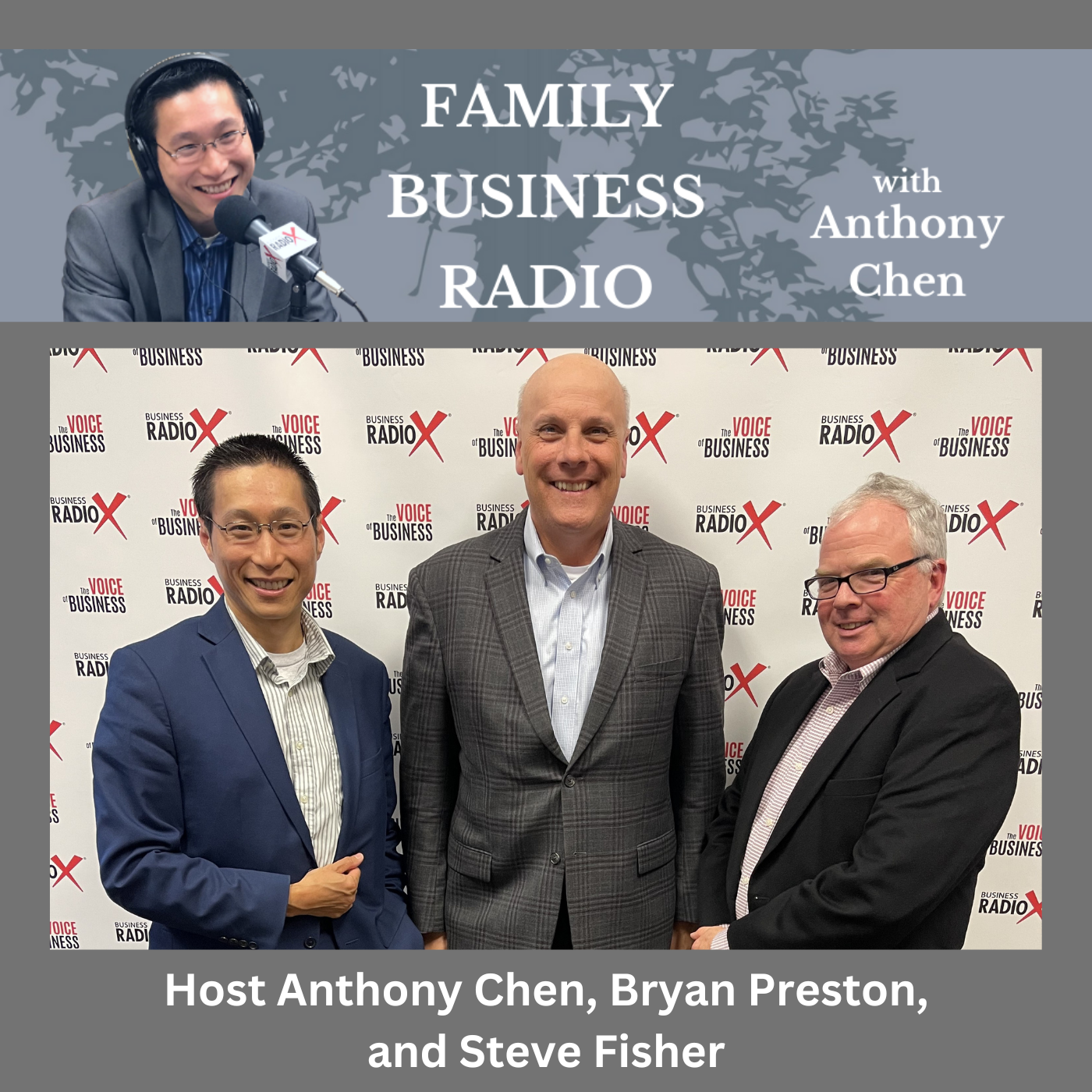


Andrew Clarke and Ron Nocera of Sync-Up Business Services, and Kriston Sellier of id8, on Building Stronger Businesses Through Financial Clarity, Strategic Branding, and Long-Term Vision (Family Business Radio, Episode 74)
In this episode of Family Business Radio, host Anthony Chen welcomes Andrew Clarke and Ron Nocera of Sync-Up Business Services, along with Kriston Sellier of id8, for a conversation about what it really takes to build a stronger business.
Andrew and Ron explain why their work goes far beyond bookkeeping. They discuss how small business owners often know their craft but lack the financial visibility needed to make sound decisions, plan for taxes, and prepare for growth or succession. Their approach begins with understanding the owner’s goals, then using that end game to shape the financial story of the business.
Kriston shares her journey from agency setbacks and challenging lessons to building id8 into a research-driven branding and marketing firm. She explains why effective marketing is not about random tactics or making things look good. It starts with research, customer insight, business goals, and a clear understanding of what truly differentiates a company in the marketplace. She also offers examples of how the right positioning helped clients increase enrollment, stand out in crowded industries, and become more attractive to buyers.
Across both conversations, a common thread emerges: business owners need more than transactions, reports, or surface-level tactics. They need clarity, strategy, and partners who can help them align decisions with where they want the business to go.
In his closing commentary, Anthony Chen reflects on that theme by noting that retirement and long-term planning are not just about numbers. They are about purpose. He points to the guests as examples of people who have found meaningful work that serves others, and he leaves listeners with a simple but timely reminder: there is still hope.
Family Business Radio is underwritten and brought to you by Anthony Chen with Lighthouse Financial Network. The show is produced by John Ray and the North Fulton affiliate of Business RadioX®.
Key Takeaways from This Episode
- Andrew Clarke explains why many small business owners understand their trade but not the financial mechanics required to run a healthy business.
- Sync-Up Business Services begins with the owner’s goals, because growth, succession, franchising, and selling all require different financial decisions.
- Ron Nocera shares how a late-career pivot led him from corporate IT into business development and relationship-building for Sync-Up.
- Kriston Sellier describes id8’s research-first process, which relies on stakeholder interviews, customer insight, and competitive context before creative work begins.
- Sellier makes the case that branding and marketing should be tied to business goals, not disconnected tactics like a new website, ads, or logo alone.
- The conversation highlights how better positioning and better financial clarity can both increase business value and support a stronger long-term outcome.
Topics Discussed in this Episode
00:00 Anthony Chen introduces Andrew Clarke and Ron Nocera of Sync-Up Business Services
00:52 Andrew Clarke on retirement, re-engagement, and helping small business owners
03:06 Why Sync-Up moved beyond bookkeeping to broader business advisory services
04:20 Ron Nocera’s path from corporate IT into business development and relationship-building
05:01 A home healthcare client story: revenue growth without owner pay or healthy margins
08:12 Why understanding the owner’s end game shapes the financial strategy
11:06 Common business owner mistakes: weak planning, tax surprises, and poor visibility
15:00 A brewery example of messy books, tax planning, and finding hidden opportunity
18:13 Advice for corporate professionals thinking about starting a business
24:00 Kriston Sellier of id8 joins the conversation
24:20 Kriston’s path from speech pathology to graphic design, branding, and entrepreneurship
25:48 The betrayal that pushed Kriston to start her own firm
31:10 Why id8 begins with research, interviews, and customer insight
34:21 id8’s differentiator: strategy first, before creative execution
36:23 The Harben case: uncovering a hidden story that set the company apart
40:51 The biggest branding mistake, starting with tactics instead of business goals
42:22 A client success story: stronger positioning, higher EBITDA, and buyer interest
48:41 The end-game question: what each guest hopes their work ultimately accomplishes
Andrew Clarke and Ron Nocera, Sync-Up Business Services

Andrew Clarke and Ron Nocera are the core of the Sync-Up Business Services team, a firm that helps small business owners go beyond basic bookkeeping to gain clearer financial visibility, stronger operational insight, and better long-term decision-making. Andrew brings the perspective of a seasoned business owner who has started, operated, and learned from multiple businesses across several industries. Ron brings more than 30 years of corporate IT experience and now focuses on business development and relationship-building. Together, they help clients understand the story behind their numbers, align financial decisions with business goals, and build healthier, more valuable companies.

Sync-Up Business Services works with small business owners who need more than clean books. The firm provides advisory, consulting, and financial support designed to help clients understand their operations, improve profitability, plan better, and make smarter decisions for growth, succession, or eventual exit. Sync-Up operates on the principle that financials should serve a purpose beyond merely reporting the past. They should help owners see what is really happening in the business and what needs to change.
Website | Andrew Clarke LinkedIn | Ron Nocera LinkedIn
Kriston Sellier, Founder & President, id8

Kriston Sellier is the Founder and President of id8, an award-winning branding and marketing agency based in Marietta, Georgia. She launched the firm in 2000 after building experience at IBM, where she worked on brand development and e-business initiatives for clients including The New York Times, Kodak, and the U.S. Virgin Islands Department of Tourism. At id8, Kriston leads with a research-first philosophy, helping businesses uncover what truly sets them apart and translate that into stronger positioning, clearer messaging, and measurable growth. Under her leadership, id8 has earned multiple national design awards and recognition as a Cobb Chamber Top 25 Small Business of the Year. Kriston holds a degree in Graphic Design from Illinois State University and has also completed advanced study and executive training through the University of Cincinnati, Dartmouth College, and Babson College.
id8 is an award-winning branding and marketing agency in Marietta, Georgia, focused on helping small and mid-sized businesses grow through research-driven strategy and creative execution. The firm is known for going deeper than surface-level design, using market research and business insight to shape branding, messaging, websites, campaigns, and other marketing initiatives that solve real business problems. id8 serves clients across industries and is especially valued for its senior-level involvement, agility, and straightforward client communication. Its client roster includes organizations such as the Georgia Department of Labor, Visit Marietta, Atlanta North School, the City of Atlanta Jazz Festival, Kistler, and Hartsfield-Jackson International Airport.
Anthony Chen, Host of Family Business Radio

Family Business Radio is sponsored and brought to you by Anthony Chen with Lighthouse Financial Network. Securities and advisory services are offered through OSAIC, member FINRA/SIPC. RAA is separately owned, and other entities and/or marketing names, products, or services referenced here are independent of OSAIC. The main office address is 575 Broadhollow Rd., Melville, NY 11747. You can reach Anthony at 631-465-9090, ext. 5075, or by email at anthonychen@lfnllc.com.
Anthony Chen started his career in financial services with MetLife in Buffalo, NY, in 2008. Born and raised in Elmhurst, Queens, he considers himself a full-blooded New Yorker while now enjoying his Atlanta, GA, home. Specializing in family businesses and their owners, Anthony works to protect what is most important to them. From preserving to creating wealth, Anthony partners with CPAs and attorneys to help address all of the concerns and help clients achieve their goals. By using a combination of financial products ranging from life, disability, and long-term care insurance to many investment options through Royal Alliance, Anthony looks to be the eyes and ears for his client’s financial foundation. In his spare time, Anthony is an avid long-distance runner.
Follow this link to access the complete show archive of Family Business Radio.