
Business RadioX ®

  • Home
  • Business RadioX ® Communities
    • Southeast
      • Alabama
        • Birmingham
      • Florida
        • Orlando
        • Pensacola
        • South Florida
        • Tampa
        • Tallahassee
      • Georgia
        • Atlanta
        • Cherokee
        • Forsyth
        • Greater Perimeter
        • Gwinnett
        • North Fulton
        • North Georgia
        • Northeast Georgia
        • Rome
        • Savannah
      • Louisiana
        • New Orleans
      • North Carolina
        • Charlotte
        • Raleigh
      • Tennessee
        • Chattanooga
        • Nashville
      • Virginia
        • Richmond
    • South Central
      • Arkansas
        • Northwest Arkansas
    • Midwest
      • Illinois
        • Chicago
      • Michigan
        • Detroit
      • Minnesota
        • Minneapolis St. Paul
      • Missouri
        • St. Louis
      • Ohio
        • Cleveland
        • Columbus
        • Dayton
    • Southwest
      • Arizona
        • Phoenix
        • Tucson
        • Valley
      • Texas
        • Austin
        • Dallas
        • Houston
    • West
      • California
        • Bay Area
        • LA
        • Pasadena
      • Colorado
        • Denver
      • Hawaii
        • Oahu
  • FAQs
  • About Us
    • Our Mission
    • Our Audience
    • Why It Works
    • What People Are Saying
    • BRX in the News
  • Resources
    • BRX Pro Tips
    • B2B Marketing: The 4Rs
    • High Velocity Selling Habits
    • Why Most B2B Media Strategies Fail
    • 9 Reasons To Sponsor A Business RadioX ® Show
  • Partner With Us
  • Veteran Business RadioX ®

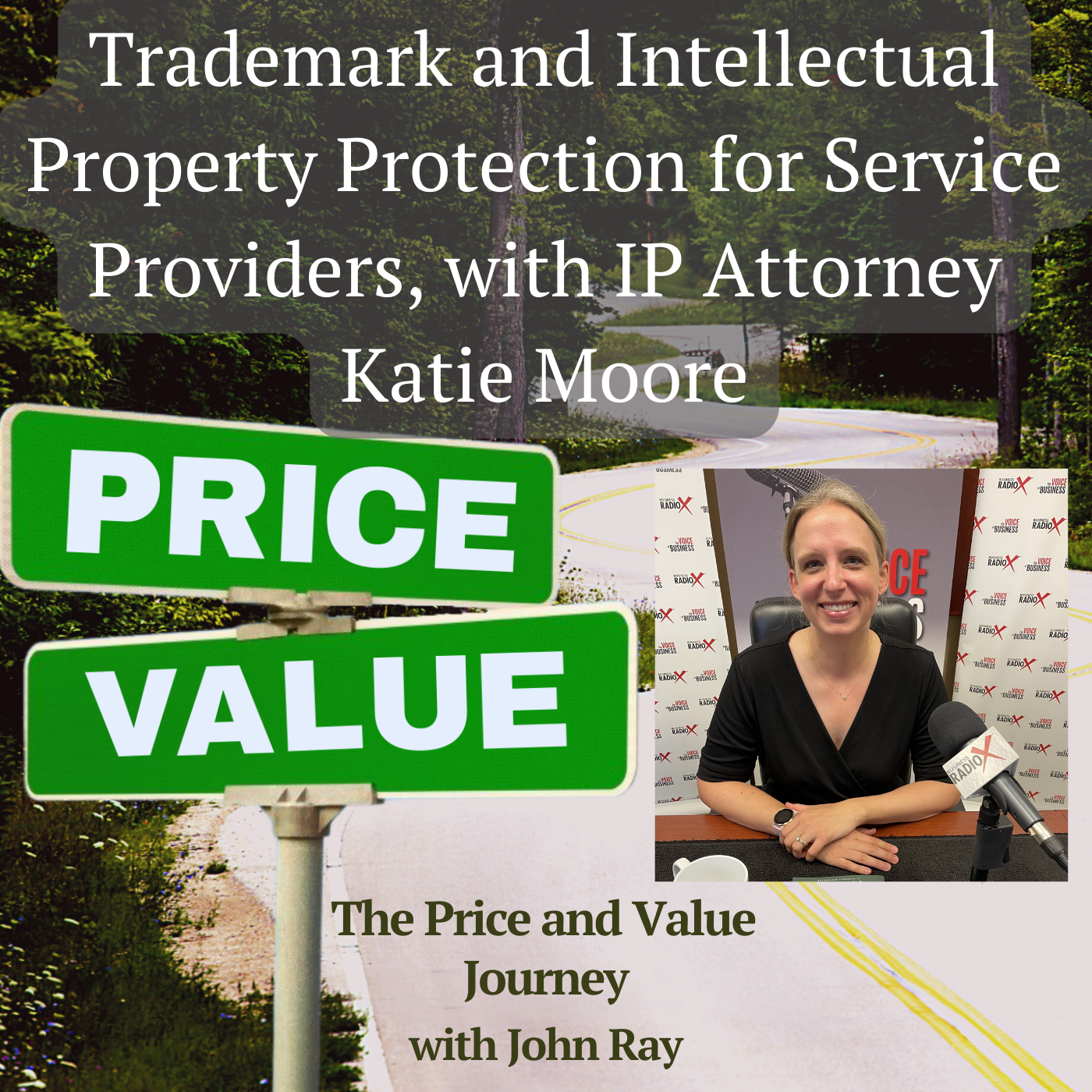
Trademark and Intellectual Property Protection for Service Providers, with Trademark Attorney Katie Moore

July 17, 2024 by John Ray

Trademark and Intellectual Property Protection for Service Providers, with Trademark Attorney Katie Moore, Katherine Moore Law, LLC
North Fulton Studio
Trademark and Intellectual Property Protection for Service Providers, with Trademark Attorney Katie Moore
Loading
00:00 /
RSS Feed
Share
Link
Embed

Download file

Trademark and Intellectual Property Protection for Service Providers, with Trademark Attorney Katie Moore, Katherine Moore Law, LLC

Trademark and Intellectual Property Protection for Service Providers, with Trademark Attorney Katie Moore, Katherine Moore Law LLC (The Price and Value Journey, Episode 109)

In this episode of The Price and Value Journey, host John Ray discusses the importance and process of protecting intellectual property with trademark attorney Katie Moore from Katherine Moore Law LLC. They cover the distinctions and value of trademarks and copyrights and emphasize the significance of protecting intellectual property for service providers. Katie explains the steps involved in obtaining a trademark, from initial consultations to federal applications, and addresses common misconceptions about protectable intellectual property. She also highlights the business and legal returns of investing in trademark protection and provides practical advice on using and maintaining trademarks effectively. Additionally, John shares insights from his own experience of trademarking “The Generosity Mindset,” offering a real-world example of the considerations and benefits involved.

The Price and Value Journey is presented by John Ray and produced by the North Fulton studio of Business RadioX®.

Katie Moore, Founder, Katherine Moore Law, LLC

Katie Moore, Katherine Moore Law, LLC

Katie Moore is the founder and principal attorney of Katherine Moore Law, LLC, a business law firm specializing in trademark and intellectual property matters. With a focus on helping business owners protect and grow their enterprises, Katie expertly guides clients through legal requirements and practices related to intellectual property.

As a trademark attorney, Katie assists clients in safeguarding their brand identities and creative assets. Her services include trademark searches, applications, and enforcement, as well as other aspects of intellectual property protection. Katie’s passion lies in empowering businesses to establish and maintain strong legal foundations for their brands and innovations.

Katie’s approach to law is characterized by her dedication to providing personalized attention and tailored solutions to each client’s unique needs.

Website | LinkedIn

Topics Discussed in this Interview

00:00 Introduction and Book Announcement
00:15 Engaging a Trademark Attorney
01:26 Meet Katie Moore: Trademark Attorney
02:53 Understanding Trademarks for Service Providers
04:36 The Generosity Mindset: A Case Study
07:43 Trademark Application Process
08:52 Legal and Business Considerations
10:08 Classes and Categories in Trademarking
11:25 Intent to Use and Timing
22:22 Intellectual Property Types
31:47 Protecting Your Trademark
33:54 Conclusion and Contact Information

About The Price and Value Journey

The title of this show describes the journey all professional service providers are on:  building a services practice by seeking to convince the world of the value we offer, helping clients achieve the outcomes they desire, and trying to do all that at pricing that reflects the value we deliver.

If you feel like you’re working too hard for too little money in your solo or small firm practice, this show is for you. Even if you’re reasonably happy with your practice, you’ll hear ways to improve both your bottom line and the mindset you bring to your business.

The show is hosted and produced by John Ray and the North Fulton studio of Business RadioX®. The show can also be found on all the major podcast apps. The complete show archive is here.

John Ray, Host of The Price and Value Journey

John Ray, Author of The Generosity Mindset and Host of "The Price and Value Journey"
John Ray, Author of The Generosity Mindset and Host of The Price and Value Journey

John Ray is the host of The Price and Value Journey.

John owns Ray Business Advisors, a business advisory practice. John’s services include business coaching and advisory work, as well as advising solopreneurs and small professional services firms on their pricing. John is passionate about the power of pricing for business owners, as changing pricing is the fastest way to change the profitability of a business. His clients are professionals who are selling their expertise, such as attorneys, CPAs, accountants and bookkeepers, consultants, coaches, marketing professionals, and other professional services practitioners.

In his other business, John is a Show Host and Producer and owns the North Fulton (Georgia) studio of Business RadioX®. John and his team work with B2B professionals to create and conduct their own podcast using The Generosity Mindset™ Method:  building and deepening relationships in a non-salesy way that translates into revenue for their business.

John is also the host of North Fulton Business Radio. With over 780 shows and having featured over 1,200 guests, North Fulton Business Radio is the longest-running podcast in the North Fulton area, covering business in its region like no one else.

John’s book, The Generosity Mindset: A Journey to Business Success by Raising Your Confidence, Value, and Prices
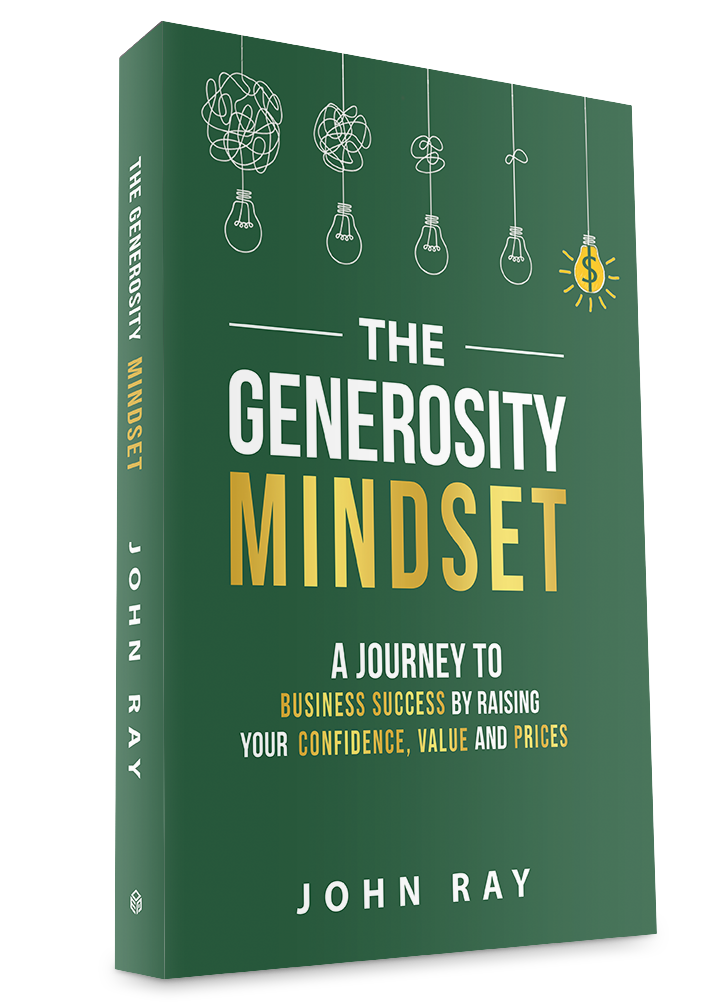
The Generosity Mindset, by John RayJohn is the #1 national best-selling author of The Generosity Mindset: A Journey to Business Success by Raising Your Confidence, Value, and Prices.

If you are a professional services provider, your goal is to do transformative work for clients you love working with and get paid commensurate with the value you deliver to those clients. While negative mindsets can inhibit your growth, adopting a different mindset, The Generosity Mindset™, can replace those self-limiting beliefs. The Generosity Mindset enables you to diagnose and communicate the value you deliver to clients and, in turn, more effectively price to receive a portion of that value.

Whether you’re a consultant, coach, marketing or branding professional, business advisor, attorney, CPA, or work in virtually any other professional services discipline, your content and technical expertise are not proprietary. What’s unique, though, is your experience and how you synthesize and deliver your knowledge. What’s special is your demeanor or the way you deal with your best-fit clients. What’s invaluable is how you deliver great value by guiding people through massive changes in their personal lives and in their businesses that bring them to a place they never thought possible.

The combination of all these elements is quite different for you compared to any other service provider in your industry. Therein lies your value, but it’s not the value you see. It’s the value your best-fit customers see in you.

If pricing your value feels uncomfortable or unfamiliar to you, this book will teach you why putting a price on the value your clients perceive and identify serves both them and you, and you’ll learn the factors involved in getting your price right.

The book is available at all major physical and online book retailers worldwide. Follow this link for further details.


Connect with John Ray:

Website | LinkedIn | Twitter

Business RadioX®:  LinkedIn | Twitter | Facebook | Instagram

Tagged With: intellectual property, Intellectual Property Law, John Ray, Katherine Moore Law LLC, Katie Moore, The Generosity Mindset, The Price and Value Journey, trademark law, trademarks

Alina Lee, Your Ad Attorney

October 7, 2021 by John Ray

Your Ad Attorney
North Fulton Business Radio
Alina Lee, Your Ad Attorney
Loading
00:00 /
RSS Feed
Share
Link
Embed

Download file

Your Ad Attorney

Alina Lee, Your Ad Attorney (North Fulton Business Radio, Episode 396)

Alina Lee, Founder of Your Ad Attorney, raises numerous legal pitfalls which small business owners may confront with their marketing, yet most never consider. You’ll be glad you listened to Alina’s conversation with host John Ray, as she covered the legal risks of social media, why legal review of marketing materials could save major expense and big headaches later, the “must have” for working with an agency or outside contractors like designers or copywriters, and much more. North Fulton Business Radio is broadcast from the North Fulton studio of Business RadioX® inside Renasant Bank in Alpharetta.

Your Ad Attorney

Proactive compliance with consumer and business laws is the best protection from marketing risks and liabilities.

You’ll find Your Ad Attorney’s approach to marketing legal services avoids typical legal hurdles and makes better business sense for every size business.

Alina Lee is the founder of Your Ad Attorney, which advises businesses on how to minimize legal risk. Based in Atlanta, she serves clients across the country. She provides day-to-day general counsel services for your business.  She offers drafting and negotiating custom contracts and service agreements, legal counseling to bring new products and services to market, intellectual property licensing and counseling for copyrights, trademarks, and publicity rights.
Your Ad Attorney will review websites, marketing materials, and consumer communications for legal compliance, help you prepare your business for sale, and more!

Company website | LinkedIn | Twitter | Facebook 

Alina Lee, Founder, Your Ad Attorney, LLC

Alina Lee, Founder, Your Ad Attorney, LLC

Alina Lee is the founding partner of Your Ad Attorney, LLC.  She is a marketing law and business transactions attorney who helps marketing agencies and companies with marketing departments protect their reputation through providing legal drafting and review for their marketing materials.

Prior to starting her law firm, Your Ad Attorney, LLC, she was Senior Corporate Counsel at Mailchimp, a profitable tech company with millions of customers worldwide. At Mailchimp, she was the primary attorney who led legal matters for the partnerships department and marketing department. Alina was also the primary attorney over all major marketing initiatives and managed the company’s trademark portfolio.
Alina graduated from Vanderbilt University Law School and the University of Georgia.
LinkedIn


Questions and Topics

  • What are some things business leaders should know about legal pitfalls with their marketing?
  • What are the differences between trademarks, copyrights, and publicity rights?
  • How do you know who owns what intellectual property? What if you have an agency or independent contractors handling your copywriting and photography?
  • What are things to watch out for when working with talent for photos, audio, and video marketing?
  • Can the fine print or disclosures “fix” potentially misleading marketing claims?
  • What are some legal risks with social media advertising and celebrity endorsers?
  • What are some pointers for contracts with major customers and vendors?,

North Fulton Business Radio is hosted by John Ray, and broadcast and produced from the North Fulton studio of Business RadioX® inside Renasant Bank in Alpharetta. You can find the full archive of shows by following this link. The show is available on all the major podcast apps, including Apple Podcasts, Spotify, Google, Amazon, iHeart Radio, Stitcher, TuneIn, and others.

RenasantBank


Renasant Bank has humble roots, starting in 1904 as a $100,000 bank in a Lee County, Mississippi, bakery. Since then, Renasant has grown to become one of the Southeast’s strongest financial institutions with over $13 billion in assets and more than 190 banking, lending, wealth management and financial services offices in Mississippi, Alabama, Tennessee, Georgia and Florida. All of Renasant’s success stems from each of their banker’s commitment to investing in their communities as a way of better understanding the people they serve. At Renasant Bank, they understand you because they work and live alongside you every day.


Special thanks to A&S Culinary Concepts for their support of this edition of North Fulton Business Radio. A&S Culinary Concepts, based in Johns Creek, is an award-winning culinary studio, celebrated for corporate catering, corporate team building, Big Green Egg Boot Camps, and private group events. They also provide oven-ready, cooked from scratch meals to go they call “Let Us Cook for You.” To see their menus and events, go to their website or call 678-336-9196.

Tagged With: Alina Lee, contracts, copyrights, Intellectual Property Law, John Ray, marketing, North Fulton Business Radio, publicity rights, trademark registration, Your Ad Attorney

Paul Knowlton, Ubercounsel

March 30, 2020 by John Ray

Paul Knowlton, Ubercounsel
North Fulton Business Radio
Paul Knowlton, Ubercounsel
Loading
00:00 /
RSS Feed
Share
Link
Embed

Download file

Paul Knowlton, Ubercounsel

“North Fulton Business Radio,” Episode 205:  Paul Knowlton, Ubercounsel

Paul Knowlton, Ubercounsel, joins “North Fulton Business Radio” to discuss how he combines his legal expertise with his pastoral care and counseling experience to better serve his clients, the spirituality of business ownership, and much more. It’s a fascinating, thought provoking discussion. The host of “North Fulton Business Radio” is John Ray and the show is broadcast from the North Fulton Business RadioX® studio based in Alpharetta.

Paul Knowlton, Ubercounsel: The Firm of Paul Knowlton, J.D., M.Div.

Ubercounsel, the Law Firm of Paul Knowlton, J.D., M.Div., is more than a law firm. It’s an extension of the founder as a person; a highly trusted and skilled attorney-counselor whose counsel and action are fueled by compassion. Other firms have vision statements, Ubercounsel has a soul.

Drawing from the unique combination of the founder’s legal, business, and pastoral counseling successes, the firm presently offers six categories of services:

First Step: Evaluating and crafting your action plan
Family Care: Protecting your personal and financial objectives
Business Law & Consulting: Legal and executive experience helping you succeed
Conflict & Dispute Resolution: Skilled assistance getting to your best resolution
Pastoral Care & Counseling: A holistic posture to helping you see and go deeper
Professional Development & Coaching: Supporting your growth on the journey

About Paul Knowlton:

Paul Knowlton Ubercounsel
Paul Knowlton, Ubercounsel

Prior to law school Paul’s corporate roles include being a construction superintendent with Ryland Homes and a forensic engineer with Georgia Pacific. During law school he clerked for and joined an intellectual property boutique, also becoming a patent attorney, that was soon acquired by Kilpatrick Stockton. At Kilpatrick and later at his first firm, he built a successful intellectual property prosecution and litigation track record. Paul initiated, co-founded and was the managing member of a successful IP boutique and then later the director of another. After successfully serving as the CEO of a large human services agency, he most recently launched his second firm Ubercounsel and received an appointment at Mercer University.

In addition to being licensed in GA and the 11th Circuit, a registered patent attorney, a Henning trained mediator and arbitrator, a Martindale Hubbell Distinguished attorney, and Georgia Trend Legal Elite, in 2014 he earned his Master of Divinity with a concentration in pastoral care and counseling. An active leader of the State Bar of Georgia’s Attorney Wellness and Lawyer Assistance Program committees, he offers solutions to the stresses of professional life.

What is Paul’s back story, and particularly why does he have a passion for family care, pastoral counseling, and professional development?

The son of an immigrant Hispanic mother and federally convicted father, Paul was placed in foster care as were all his siblings. From a very early age he has the lived experience of the relentless stresses, anxieties, and fears that push so many of us to irreconcilable despair.

Turning inwardly as a young adult to develop the skills to recover, redirect, and wildly prosper after a brutal beginning, he is an attorney-counselor who is authentically and creditably a friend on the journey.

You can find out more at the Ubercounsel website, or call 404-245-0957.


North Fulton Business Radio” is broadcast from the North Fulton studio of Business RadioX®, located inside Renasant Bank in Alpharetta. You can find the full archive of shows by following this link.

Renasant Bank has humble roots, starting in 1904 as a $100,000 bank in a Lee County, Mississippi, bakery. Since then, Renasant has grown to become one of the Southeast’s strongest financial institutions with over $13 billion in assets and more than 190 banking, lending, wealth management and financial services offices in Mississippi, Alabama, Tennessee, Georgia and Florida. All of Renasant’s success stems from each of their banker’s commitment to investing in their communities as a way of better understanding the people they serve. At Renasant Bank, they understand you because they work and live alongside you every day.

Tagged With: business coaching, conflict resolution, counseling, dispute resolution, family care, Family Law, foster care, Intellectual Property Law, Kilpatrick Stockton, Law Firm of Paul Knowlton, Mercer University, North Fulton Business Radio, pastoral care, Paul Knowlton, Ubercounsel

Katie Sparks, Herbert Legal Group, and Bill McDermott, McDermott Financial Solutions

June 4, 2019 by John Ray

North Fulton Business Radio
Katie Sparks, Herbert Legal Group, and Bill McDermott, McDermott Financial Solutions
Loading
00:00 /
RSS Feed
Share
Link
Embed

Download file

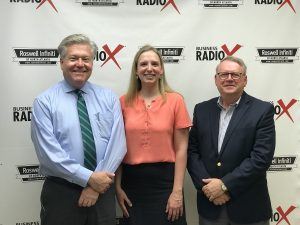
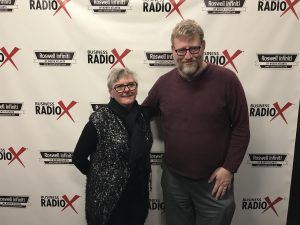
Host John Ray, Katie Sparks, and Bill McDermott

Katie Sparks, Herbert Legal Group

Katie Sparks, Herbert Legal Group

Katie Sparks is an attorney with Herbert Legal Group in Roswell. Her practice includes all aspects of business and corporate law. She has a particular interest in trademark law and enjoys helping her clients to develop and protect their valuable brands.

Katherine is a graduate of the University of Georgia where she graduated with a double major in History and French. She earned her law degree from The Catholic University of America in Washington, DC.

Katherine is a member of the Alpharetta Business Association and Roswell Attorney Project. She is mother to a young daughter and in her spare time enjoys reading, cooking and traveling.

Bill McDermott, McDermott Financial Solutions

Bill McDermott, McDermott Financial Services

Bill McDermott is the founder and CEO of McDermott Financial Solutions. As a “recovering” banker of 32 years, Bill got to see first hand thousands of companies struggle with all kinds of issues pertaining to people, process, strategy, execution and money. Less than 10% of all companies were really hitting on all cylinders.  These days, he’s known as The Profitability Coach℠.  He helps business owners make Profits on Purpose℠ by putting the building blocks in place for financial success.  By utilizing EOS, Bill helps leadership teams to get on the same page and crystallize their vision, gain more Traction to execute on that vision and become a more healthy cohesive team.

“North Fulton Business Radio” is broadcast from the North Fulton studio of Business RadioX®, located inside Renasant Bank in Alpharetta. Renasant Bank has humble roots, starting in 1904 as a $100,000 bank in a Lee County, Mississippi, bakery. Since then, Renasant has grown to become one of the Southeast’s strongest financial institutions with approximately $12.9 billion in assets and more than 190 banking, lending, wealth management and financial services offices in Mississippi, Alabama, Tennessee, Georgia and Florida. All of Renasant’s success stems from each of their banker’s commitment to investing in their communities as a way of better understanding the people they serve. At Renasant Bank, they understand you because they work and live alongside you every day.

Tagged With: execution, Herbert Legal Group, improving cash flow, intellectual property, Intellectual Property Law, intellectual property protection, Katherine Sparks, Katie Sparks, Leadership, legal services, McDermott Financial Solutions, profitability, profitability coach, Profits on Purpose, recovering banker, strategy, The Profitability Coach, trademark, trademark law, trademarks

FRAZIER & DEETER’S BUSINESS BEAT: Dan Kent, Kent & Risley, LLC, on Intellectual Property Litigation

March 19, 2019 by John Ray

Business Beat
Business Beat
FRAZIER & DEETER’S BUSINESS BEAT: Dan Kent, Kent & Risley, LLC, on Intellectual Property Litigation
Loading
00:00 /
RSS Feed
Share
Link
Embed

Download file

Roger Lusby, Colette Varco, and Dan Kent on “Business Beat” presented by Alpharetta CPA firm Frazier & Deeter

Show Summary

How do you protect your technology? What are the various pros and cons of patents and trade secrets? How do you gauge the damages of patent infringement vs. the cost of litigation to recoup those damages? What are some interesting cases arising out of key word advertising on Google? Those questions and more are answered in this week’s edition of “Business Beat.” “Business Beat” is presented by Alpharetta CPA firm Frazier & Deeter.

Dan Kent, Kent & Risley, LLC

Dan Kent

Dan Kent is a Founding Partner of Kent & Risley, LLC. Kent & Risley is a law firm that protects technology by enforcing technology rights in the form of patents, trademarks, copyrights, trade secrets and by contract.  Kent & Risley also protects and defends against the wrongful assertion of alleged technology rights and advises clients about how best to protect technology and to build a valuable portfolio of patents, copyrights, trademarks, and trade secrets (also known as intellectual property rights). For more information, go to https://www.kentrisley.com/.


Frazier & Deeter

The Alpharetta office of Frazier & Deeter is home to a thriving CPA tax practice and Employee Benefit Plan Services group. CPAs and advisors in the Frazier & Deeter Alpharetta office serve clients across North Georgia and around the country with services such as personal tax planning, estate planning, business tax planning, business tax compliance, state and local tax planning, financial statement reviews, financial statement audits, employee benefit plan audits, internal audit outsourcing, cyber security, data privacy, SOX and other regulatory compliance, mergers and acquisitions and more. Alpharetta CPA professionals serve clients ranging from business owners and executives to large corporations.

Roger Lusby, host of Frazier & Deeter’s Business Beat, is the Alpharetta Office Managing Partner for Frazier & Deeter.

LinkedIn: https://www.linkedin.com/company/frazier-&-deeter-llc/
Facebook: https://www.facebook.com/FrazierDeeter
Twitter: https://twitter.com/frazierdeeter

Past episodes of Frazier & Deeter’s “Business Beat”

Tagged With: copyright, copyright law, cost of litigation, Dan Kent, Frazier & Deeter's Business Beat, Frazier Deeter, google, Google AdWords, Google search, injunction, intellectual property, Intellectual Property Law, intellectual property protection, Kent & Risley, Kent & Risley LLC, keyword advertising, keyword search, NDA, Non-Disclosure Agreement, patent infringement, patent law, patent litigation, Patents, registered copyright, Roger Lusby, Steve Risley, trade secrets, trademark, trademark law

Decision Vision Episode 1: Should I Get a Patent? – An Interview with Jackie Hutter, The Hutter Group

February 7, 2019 by John Ray

Decision Vision
Decision Vision
Decision Vision Episode 1: Should I Get a Patent? - An Interview with Jackie Hutter, The Hutter Group
Loading
00:00 /
RSS Feed
Share
Link
Embed

Download file

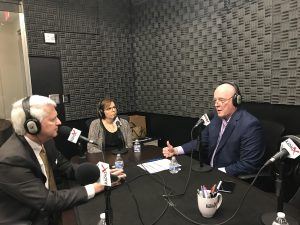
Jackie Hutter and Michael Blake


Should I Get a Patent?

Michael Blake, Director of Brady Ware & Company and Host of the Decision Vision podcast, interviews Jackie Hutter on when it may be best to forego the patent process, the steps in a patent process and the cost, how an entrepreneur should select and manage their patent attorney, and other key topics related to patents.

Jackie Hutter, The Hutter Group

The Hutter Group enables start ups and small companies to generate and deploy intellectual property that can enhance revenue and exit goals. While working with innovators to obtain meaningful patent protection that “makes it cheaper to go through you than around you,” we work with our clients to identify IP Strategies that are meaningful to their businesses, with the objective of creating IP that is aligned with real value.

Jackie Hutter has been recognized for each of the last 8 years for her innovative insights in creating value from IP Strategy with the peer-awarded Top Global IP Strategist by Intellectual Asset Magazine. Ms. Hutter’s IP Strategy clients have been varied, and include a Fortune 500 consumer hardware company, a large alternative energy company, several funded medical device ventures and dozens of startup companies with diverse technology offerings. From 2011-2015, Ms. Hutter also served as a the CEO of a startup battery-related company, which has provided her with a unique vantage point among her experienced colleagues about what it means to work with counsel to generate the critical IP necessary to prevent competitors from “knocking off” the innovator’s technology. Her experience extends beyond the IP realm: she frequently handles contracts and related matters for her clients, especially those relevant to clients’ IP rights.

Michael Blake, Brady Ware & Company

Michael Blake is Host of the Decision Vision podcast series and a Director of Brady Ware & Company. Mike specializes in the valuation of intellectual property-driven firms, such as software firms, aerospace firms and professional services firms, most frequently in the capacity as a transaction advisor, helping clients obtain great outcomes from complex transaction opportunities. Mike is also a specialist in the appraisal of intellectual properties as stand-alone assets, such as software, trade secrets, and patents.

He has been a full-time business appraiser for 13 years with public accounting firms, boutique business appraisal firms, and an owner of his own firm. Prior to that, he spent 8 years in venture capital and investment banking, including transactions in the U.S., Israel, Russia, Ukraine, and Belarus.

Brady Ware & Company

Brady Ware & Company is a regional full-service accounting and advisory firm which helps businesses and entrepreneurs make visions a reality. Brady Ware services clients nationally from its offices in Alpharetta, GA; Columbus and Dayton, OH; and Richmond, IN. The firm is growth minded, committed to the regions in which they operate, and most importantly, they make significant investments in their people and service offerings to meet the changing financial needs of those they are privileged to serve. The firm is dedicated to providing results that make a difference for its clients.

Decision Vision Podcast Series

Decision Vision is a podcast covering topics and issues facing small business owners and connecting them with solutions from leading experts. This series is presented by Brady Ware & Company. If you are a decision maker for a small business, we’d love to hear from you. Contact us at decisionvision@bradyware.com and make sure to listen to every Thursday to the Decision Vision podcast. Past episodes of Decision Vision can be found here. Decision Vision is produced and broadcast by Business RadioX®.

Visit Brady Ware & Company on social media:

LinkedIn: https://www.linkedin.com/company/brady-ware/

Facebook: https://www.facebook.com/bradywareCPAs/

Twitter: https://twitter.com/BradyWare

Instagram: https://www.instagram.com/bradywarecompany/

Show Transcript:

Intro: [00:00:02] Welcome to Decision Vision, a podcast series focusing on critical business decisions brought to you by Brady Ware & Company. Brady Ware is a regional, full-service accounting and advisory firm that helps businesses and entrepreneurs make visions a reality.

Michael Blake: [00:00:23] Welcome to Decision Vision, a podcast giving you, the listener, clear vision to make great decisions. In each episode, we’ll be covering a key topic to discuss the process of decision making rather than making recommendations because everyone’s circumstances are different. We’ll talk to subject matter experts about how they would recommend thinking about that decision. And then, you can make that decision on your own.

Michael Blake: [00:00:44] My name is Mike Blake, and I’m your host for today’s program. I’m a Director at Brady Ware & Company, a full-service accounting firm based in Dayton, Ohio, with offices in Dayton, Columbus, Ohio, Richmond, Indiana, and Alpharetta, Georgia, which is where we are recording today. Brady Ware is also sponsoring this podcast. If you like this podcast, please subscribe on iTunes, and please consider leaving a review of the podcast as well.

Michael Blake: [00:01:07] So, today we’re going to be talking about — We’re going to be talking about patents. And patents are increasingly important. There’s a lot of data out there that suggests that, in the last 30 years or so, most of the value that’s being created in our economy consists of intellectual property. Now, the accounting world is actually only very slowly catching up to this. A lot of intellectual property does not show up on a balance sheet. In fact, some of the benefits of having intellectual property is that nobody knows it’s there at all. And that’s one of the things, I think, we’ll be talking about today.

Michael Blake: [00:01:41] But one of the things that I’ve learned over the years I’ve been, myself, working with advisors, and entrepreneurs, and business people is that some patents are great, some patents aren’t great. Sometimes, they are all cracked up to be. Sometimes, there are better ways to accomplish protecting your intellectual property. But I’m not an attorney. I don’t know anymore about patents than I just said over the last 35 seconds or so. So, in order to not commit malpractice and be sued because I do not have the bar, we’re going to bring on a subject matter expert to talk to us today.

Michael Blake: [00:02:12] Joining me today is my dear friend and colleague, Jackie Hutter. Jackie has been helping innovators capture the value of their ventures at The Hutter Group since 2008. During this time, and probably not coincidentally, Jackie has been named by her peers as a Top Global Intellectual Property Strategist. For several years, Jackie took a break from the law as CEO of a startup technology company where she experienced entrepreneurship from the inside, which gives her a unique perspective among patent experts.

Michael Blake: [00:02:42] Prior to striking out on her own, she was a Senior Intellectual Property Lawyer at Georgia Pacific and a shareholder at an Atlanta intellectual property law firm. She started her non-legal career as a research scientist in an innovation group of a hair and skin product company. I didn’t know that. Jackie lives in the Decatur area in a groovy, mid-century house with her husband, teen daughters, and far too many pets. Again, joining us today is Jackie Hunter.

Jackie Hutter: [00:03:08] Thank you, Mike.

Michael Blake: [00:03:09] Thanks for coming today. And how many pets do you actually have now?

Jackie Hutter: [00:03:12] Oh, gosh. We have three very large dogs, including one that’s just emerging from puppyhood that requires me to walk him about six miles every day.

Michael Blake: [00:03:22] That’s why he looks so fit.

Jackie Hutter: [00:03:24] Well, thank you for that. We work hard. And then, three cats.

Michael Blake: [00:03:28] So, how far — I mean, what is the line between having too many pets and being the cat lady from The Simpsons?

Jackie Hutter: [00:03:34] Having a husband.

Michael Blake: [00:03:39] All right. Well, you heard it here, folks. You heard it here, folks. If you have too many pets, and you want to not be clinically insane, be married. That is apparently the line.

Michael Blake: [00:03:47] So, Jackie, thanks for coming on today. I’m really looking forward to this conversation. And you and I have had patent discussions forever, as long as we’ve known each other. I do a lot of work with entrepreneurs, many of whom think they want to have patents, and you sort of help talk them off the ledge, or maybe they should have patents, and you’re like, “God, why don’t they have a patent? They need to talk to me,” like, “Stop.” But let’s kind of build a foundation here. I’m not sure everybody understands what exactly a patent is. So, talk about what is a patent and how do patents work?

Jackie Hutter: [00:04:17] Well, patents are confusing because, quite frankly, lawyers make it too complicated. It’s really a simple framework in that a patent sets out the property lines of what you want to own. And when you file a patent application, you are setting out, laying a marker, if you will, into the world that, “I have come up with this, I have invented this, and I want to own it.” And so, that’s a very important part of the process that people don’t spend enough time on. But, generally, folks will think, “I need a patent,” and not really understand why they need it and why it creates value for them.

Jackie Hutter: [00:04:59] And because there are so many people who write about patents and who actually obtain patents for a living, there’s a lot of junk that’s out there that prevents people from really understanding. But, at the end of the day, a patent is something that protects something you’ve brought — that should protect something you’ve brought to a customer, and that customer will pay for it. And in order to retain that customer — In other words, to get them to be able to continue buying from you as long as you want them to, you need to consider whether or not it makes sense to draft a — obtain a patent that actually covers that stuff. And if it doesn’t, then patents are irrelevant to you.

Michael Blake: [00:05:47] So, just having a patent for the sake of a patent doesn’t sound like a great idea.

Jackie Hutter: [00:05:51] Well, if you like to have really pretty things on your wall. For a lot of people, the objective is, “Hey, I got a patent.” And, sometimes, they don’t even think about what the value is, or they assume there’s value, and they never really care or have to figure out what that value is. Certainly, for patent attorneys, the goal is to get patents because if they didn’t, they wouldn’t be in business. But the ultimate goal if you’re doing this the right way is because you have a validated customer, somebody wants to buy what you’re selling to them. And in order to continue to hold that customer and realize that value, you should have a patent. You don’t have to have a patent, but you should have a patent.

Michael Blake: [00:06:38] Okay. So, let’s say you sold me. I want to get a patent. And, for the moment, let’s leave a side value. Maybe, I do just want something pretty on my wall, and it’s cheaper than a Warhol.

Jackie Hutter: [00:06:51] Maybe not.

Michael Blake: [00:06:52] Maybe not. We’ll talk about that later, right. But I decided I want it, how do you go about that? Can I just go down to Washington and say, “Hey, give me a patent.” How does that work?

Jackie Hutter: [00:07:01] Well, it’s a very arcane process, even for patent experts like me. I’ve been doing this for far more years than I like to admit. And the details are just way too complex. Now, if anybody is a DIYer, there are plenty of books out there that purport to tell you how to do it, and I have seen some patents that have been generated that way. Usually, they’re not worth anything, not even the paper that they’re written off, but that’s just the nature of the business. Although there are some exceptions, but they’re very, very, very extremely rare. So, then, what you have to do is you have to hire a patent expert. It’s kind of like, “the fox guarding the hen house,” as a mentor of mine used to say. When you ask a patent attorney if you need a patent, the answer is probably going to be yes.

Michael Blake: [00:07:52] Of course, you need a patent.

Jackie Hutter: [00:07:56] And that made-

Michael Blake: [00:07:56] I got to get paid.

Jackie Hutter: [00:07:57] Yes, well-

Michael Blake: [00:07:59] I don’t know if you need a patent, but I need a patent.

Jackie Hutter: [00:08:01] Well, you said it, I didn’t, or maybe I did. But what typically happens in that process – and I know this is the way the training is – we say to our clients, “What did you invent?” And this is what my retainer is going to be. And most of the time, the vast majority of time, that gets things off in the wrong direction because when you’ve talked about what you’ve invented, you’re talking about what has happened in the past.

Jackie Hutter: [00:08:32] But if patents are to have value for you in your business strategy, as part of your business strategy, you need to be looking at the future and understanding why this patent is going to have meaning for you at some point in the future. And that’s with respect for my clients, with respect to potential sales and potential customers in the future.

Jackie Hutter: [00:08:53] So, by starting with, “What did you invent?” and starting writing about the past is where most patent applications and, actually, granted patents go awry, but it’s just the nature of the business. I take a different approach, a very different approach actually. When clients come to me, I use a gate. I will not take any client who has not been able to demonstrate or will not be able to demonstrate to me that they know who their customer is, why the customer cares, and why the customer will write a check in the future.

Jackie Hutter: [00:09:31] And when they do that, and only if they can do that, we talk about why it matters for them in the future to have this protection. And very often, it won’t be relevant. So, I say, “No, you don’t need a patent. Let’s go ahead and work on another type of intellectual property that might give you even more value than a patent.”

Michael Blake: [00:09:52] I think that’s great. I’m going to go off the script here because, I think, it’s a sign of a great professional that makes a client work a little bit to hire you. And I like to think I do the same thing in my practice where you don’t want to do an unnecessary operation, right. You got to live with yourself. And, at the end of the day, the client’s going to wise up and realize you took out their appendix when it’s perfectly healthy, right. And they’re going to be mad. It’s going to harm your reputation. And Atlanta is a big small town, right. So, I think that’s really important that you go through that process, and you challenge the client to think, “Do you really need a patent?” as opposed to, “Are you looking for something really pretty to put on the wall?”

Jackie Hutter: [00:10:36] Well, for professionals like us who had gone to school for a long time and been doing it for even longer, it’s really easy to make it complicated. And it’s hard to make something simple when it really is hard. And therefore, it has become, or not even become, I think it’s always been this way in the patent world that folks just want to hand stuff over to somebody else because it’s uncomfortable and difficult to learn something new, especially when you’re professional does not take the time or have the skill to be able to explain it to you in a way that’s meaningful to you.

Jackie Hutter: [00:11:13] And, actually, that’s sometimes the hardest part of my practice is to figure out the right way to talk to this person, this client, this potential client because you have to meet the client where they are and to be able to communicate to them in a way that’s meaningful for them. So, that has — I have actually fired clients and, I think, I’ve had my clients have fired me because I require them to do the work. At the end of the day, a patent is a business document. It’s not a legal document. It’s not a technical document. It’s something that sets out your business plans, and you have to be able to execute on those business plans. That’s why I write patent applications with my clients the way I do.

Michael Blake: [00:11:54] If you haven’t been fired, and you have never fired a client, you’re not really doing your job as an advisor because that means you’re just rolling over every time, and that’s not a good advisor, right? So-

Jackie Hutter: [00:12:06] Yeah, but it pays well, right?

Michael Blake: [00:12:08] In the short term, it does. So, they talk to you. Let’s say they’ve now convince you that a patent is the right thing, and you agree, they’re going to take you on. What happens then?

Jackie Hutter: [00:12:19] Well, what I’ll do is first figure out what the lay of the land is. Usually, we all. And that’s very different than what other folks do. People, just generally, clients will say to me, “I’ve done a patent search.” Well, usually, a patent — Well, not usually. The vast majority of times, clients really have no idea what a patent search entails. It is really a specialized process. So, that, you do need to have somebody who’s trained. You don’t necessarily need a lawyer. But the traditional way of doing searches is quite binary. Actually, that’s right. You can’t have quite binary. It is binary. And it’s either, are you patentable or you’re not patentable?

Jackie Hutter: [00:12:57] So, when you say, “Is something patentable?” you have defined what you’re going to patent. That is, again, looking backward, not looking forward. So, the approach I take with clients is I say, “I don’t know what we should patent. Help me understand your business better. I will go out and look to see what others have done and what the patent world looks like.” I don’t want to say landscape. I don’t want to use existing words because it really is a graze. It’s just trying to collect information and develop a frame of reference for moving forward.

Jackie Hutter: [00:13:36] And what’s interesting in there, especially since I work with early stage, smaller companies that are seeking to create patents that are meaningful to others, to get others to potentially write a check for the rights to practice or own that technology is you really have to patent for other people, and use the language, use the framework, use the context that the folks that you want to get their attention are going to be interested in.

Jackie Hutter: [00:14:07] If you look very different from them, they’re not going to want to buy you, right. They’re not going be interested. That’s just basic human nature, whether it’s patents or not. But, also, from the standpoint of companies that don’t file hundreds or thousands of patents a year, which seem to get all the noise is about all these large companies that are filing an enormous number of patents a year, those are not most of the people getting patents. Most people getting patents are much smaller companies, and they’re getting them Wednesdays ad Tuesdays.

Jackie Hutter: [00:14:41] Those folks don’t know their patent attorneys, as well as the people themselves, they’re not experts in getting patents. So, by going out looking at the existing patent literature and figuring out what other characterizations, what other language, what other definitions the experts have used, you can shortcut. You could not only make your patent look more similar to the people whose attention you want to get, you can also shortcut the drafting process and get a less expensive and higher quality work product because of that.

Michael Blake: [00:15:12] I’m sorry, go ahead.

Jackie Hutter: [00:15:13] No.

Michael Blake: [00:15:13] So, that front-end work, then, really makes a big difference?

Jackie Hutter: [00:15:19] Absolutely. And that’s one of the biggest problems with patents in the way that I learned how to do them, as well as the way that most folks do them today is that it’s a “File it and see what happens.” Well, that’s like going to battle without having any planning associated with it, right We know what happens from that. You’re fighting battles, and you don’t have a strategy to win, or even if you can win.

Jackie Hutter: [00:15:49] So, by setting up the groundwork in advance, it’s more work, and it can be challenging for the client to be pushed in this direction, especially for technical people. Business people get this. Marketing people get this. When I sit down with a technical person, they typically want to talk to another technical expert, and they get into a siloed conversation that ends up looking like a technical diagram, right, a technical document.

Jackie Hutter: [00:16:17] And to say to them, “I don’t care what your technology is. I want to know why it matters, and why it was so hard, and why nobody has done this before because you’ve been working on this for X number of months, X number of years, and it took you this long. We need to make sure that story is told to the patent office, so that the patent office is not going to say, ‘Looks like everything else that comes in.'” I don’t want to fight that battle on the back end. I want to make sure I’ve strategized, so I don’t have to fight a battle I know that’s going to happen.

Michael Blake: [00:16:46] I bet a big challenge of that too as an inventor has internalized that story so much that they find it hard to expressly articulate.

Jackie Hutter: [00:16:53] Absolutely. Everything is obvious in hindsight, even to the inventors sometimes. And I love to get to innovators before they have actually, hopefully, started their innovation journey or in the middle of the innovation journey because what I say to them is, “As a former research chemist, so often, nothing comes together until everything comes together.” And you’re struggling, you have that pain, you don’t know how you’re ever going to get through this block that you have. And then, you’re through that block, and everything’s going swimmingly. It’s the absence of pain. You have this feeling that, yeah, it was hard, but you can’t very often re-articulate it.

Jackie Hutter: [00:17:36] So, if I can get to folks before that that they get through that process, and everything is going swimmingly, I can get them to think about, “Hey, this is really hard. This is something I need to write down for Jackie, because Jackie said this is important to the story.” And for a lot of my clients, and this is where a lot of the noise comes about patents, you say, “You cannot patent this,” or “It’s really hard to patent that because of what the Supreme Court has done.” And I can’t change what that is. And there are many people who spend an inordinate amount of time trying to pull out threads from something that is frankly unintelligible because the rules are — There really are no rules these days that can’t be articulated to a client in a way that can help them plan and strategize. In other words, it’s left up to the lawyers and, hopefully, it’ll all work out.

Jackie Hutter: [00:18:29] Well, there is one rule that has been made by the courts that is clear and unambiguous in the realm of software technology, all this stuff where all the noise is out of Silicon Valley and here, actually, in various areas. Attorneys will say, “Well, let’s just try and see what happens.” Well, that’s the wrong approach because the courts have been extremely clear that, yes, you may not really be patentable, unless you can show more. Well, you know how to show more. You show more by telling a story, and why it was so hard, and why it’s meaningful.

Jackie Hutter: [00:19:08] So, especially for my clients that are in the software-related areas, I have several of those, we work really hard to be able to articulate that story in our patent application, which is very different from what they’ve done before, unquestionably, and it’s very different from other folks. They haven’t gotten it — The patent attorneys who do this every day haven’t gotten the message that you have to tell a story.

Michael Blake: [00:19:32] What you’re describing, try and see what happens, it’s like when I ask my teenage son to ask his mother a question. Then, he yells up the flight of stairs. It’s like, “Well, I could have yelled. I’m not that old yet.” And you don’t necessarily need to be a lawyer to sort of try something and see what happens.

Jackie Hutter: [00:19:51] But, also, there’s no accountability. There’s so many ways to blame other things, other externalities than your skills and abilities as a patent attorney on why something doesn’t work out. Even attorneys I really respect, they just seem to just shrug their shoulders sometimes and say, “Hey. Who knew? You never know what’s going to happen when it gets in the patent office.” Well, I know that’s not the case because while I can’t guarantee a patent is going to grant for any of my clients, by doing it this way, we consistently get broad patents out of the patent office in a very accelerated framework. But, again, we do the work, the hard work, on the front end, which effectively lays the groundwork for getting something through the office in the way we want it to get.

Michael Blake: [00:20:37] So, let’s drill down then. Let’s say we’ve sorted it. So, actually, there’s a bullet point that, I think, needs to be made here is that getting somebody like you involved early in the innovation process really helps. It sounds like it’s harder if I just say, “Hey, I just gave birth to an innovation. Let’s go patent it.” If you think that a patent is on the table, prepare for that along the process. Is that right?

Jackie Hutter: [00:21:01] I would not say if a patent is on the table. I would say that if you’re a company that’s bringing innovative technology to a customer to solve a long unmet need that you’re investing time, effort, and resources in that, then you need to bring somebody like me in at an early stage to, at least, lay the framework for what you need to know, what you need to be looking for. Waiting to the end is typically too late. It’s not always too late, but if you’ve already made all of your decisions, it’s kind of hard to go back if you’ve made the wrong decision.

Jackie Hutter: [00:21:41] And so, having that knowledge from the front end can be invaluable. And to that point, I’ve got clients that I’ve been working with on an ongoing basis, and they know to call me. One of the reasons why they’ll call me, and I’m not with them every day, but they know how important this is to their business strategy is, we’re going to go out and talk to a customer. And this customer does X. And we want to have, at least, a short meaningful patent application on file before we go talk to these folks because they know that, because I’ve trained them, they won’t to have a patent application on file today, so that if it works, they’ll be arguing in six months about how much their already-filed IP is going to be licensed for as opposed to arguing about who owns what was successful.

Michael Blake: [00:22:29] So, we’ve gone through that process. Now, are we close then to filing an application, telling the government that we’d like a patent. How does that-

Jackie Hutter: [00:22:38] So, you file the application, and you might want to talk about costs. We can come back to that, but we got the patent application on file. The typical process is to file the slow boat through Alexander — Is it? Arlington to get the patent. And it could be anywhere from two, to four, to five years based upon the technology. And, for my clients, that’s not an appropriate timeline for most cases. Some cases, we do file during that because it’s for non-leading-edge stuff but what I had incredible success for.

Jackie Hutter: [00:23:15] And unfortunately, it doesn’t seem to be in the toolbox of a lot of attorneys out there. I don’t know why. But there is an accelerated process. You pay a little bit extra on the front end to file a patent application. It goes in a special lane, if you will, in the patent office. And we have consistently begin the examinations within about six months. And if we do the front-end work correctly, we get allowances in less than a year. That is incredibly meaningful for early-stage companies, small companies that are looking to accelerate the value.

Jackie Hutter: [00:23:48] For larger companies where patents really aren’t meaningful because they’re not going out of business if they screw up their patents or don’t get a patent, then the longer path is fine. But specifically, for my clients, we do that. The examination process is back and forth. It’s like the patent examiner says, “You’re not patentable.” We say, “Yes, I am patentable.” And what often happens is that the attorney is incentivized to get an allowance. And so, they’ll amend the claims. And if they’re not absolutely talking very closely to the business team of the client, what happens far too often is that the client is left with a patent that doesn’t cover their product or anybody else’s product for that matter because you’ve got a patent, but you don’t have valuable patent, and the attorney has done exactly what you hired him to do.

Michael Blake: [00:24:39] Yeah, which is to get a patent. Okay.

Jackie Hutter: [00:24:42] Get a patent. Yeah.

Michael Blake: [00:24:42] So, good. So, I think that covers the process. And you touched upon this. It’s important. It’s a business decision. Can you talk about a range of what we’re talking about in terms of fees to obtain a patent?

Jackie Hutter: [00:24:56] Sure. I basically manage outside counsel a day. And that’s a big change than what I used to do because there’s really no transparency to legal fees if you’re not talking to a bunch of people. It’s to consult. Yeah, I’m a consultant. I see a lot of stuff, and I’m able to make assessments in that regard. Most of them cost far more than they need to cost. Typically, these days, I’m seeing — I’m not involved because I can keep these costs down and do it in a different way. Typically, what you’re looking at from outside counsel at a smaller firm, specialized firm, you’re looking anywhere from $8000 to $15,000 on the filing. For large firms that have different business models, you’re looking at double that. There are good attorneys, excellent attorneys at small firms, and there are lousy attorneys at big firms.

Michael Blake: [00:25:49] Same way the CPA works.

Jackie Hutter: [00:25:50] Yeah. And so, cost shouldn’t really be a driver. You should be hiring the attorney, not the law firm, but it’s the same way in your business, right. So, a lot of people immediately gravitate to a named brand firm.

Michael Blake: [00:26:03] Nobody gets fired for hiring Dentons, right?

Jackie Hutter: [00:26:06] Exactly, exactly.

Michael Blake: [00:26:08] Unless it bankrupts them. That’s a separate discussion. So, a patent is obvious. It’s a complicated process, not to be taken lightly. When do you find yourself talking people out of a patent? What are the kinds of things they say to you that sort of trigger, “You know, I don’t think a patent is right for you.” What does that look like?

Jackie Hutter: [00:26:28] So, in-and-out products. I think one of your guests today may be talking about in-and-out products. Nice business models, but they have a finite-

Michael Blake: [00:26:35] What’s an in-and-out product? I’m not familiar with that term.

Jackie Hutter: [00:26:36] Something that’s got maybe a six-month timeline, one-year timeline. I like to use the example of the endcaps in Target. Products-

Michael Blake: [00:26:45] The Snuggies.

Jackie Hutter: [00:26:46] Actually, Snuggies is a great story. Actually, I use that example. I probably could have got a patent on a Snuggie, believe it or not. It seems so obvious, but there’s a story there, right. So, you probably could have gotten something if it had been skillfully done. But there’s only a limited number of people that are going to buy a Snuggie.

Michael Blake: [00:27:06] I mean, it came and went, right?

Jackie Hutter: [00:27:08] Yeah. And also-

Michael Blake: [00:27:09] So, you don’t need 20 years of protection for a Snuggie.

Jackie Hutter: [00:27:11] But, also – and this is another aspect of that – really is Walmart going to slot to two shelf spaces for completely Snuggie? It ain’t going to happen, right. So, in that environment, patents really aren’t meaningful.

Jackie Hutter: [00:27:27] The other situation, and I use this example for folks that have products, Kim Cracks, whatever you want to call them, I ask people to walk through Tuesday Morning, which I effectively think about as the Island of Misfit Toys. You walk through Tuesday morning, and what I see is people’s 401(k)’s that had been totally evacuated because somebody convinced them that they could make a zillion dollars on their new way of doing X, Y, or Z. And the people who got that product to market, the people who patented that product, got paid. And this poor person had to sell. The only way they could make any revenue, which was far less than they invested, unquestionably, is to get it to be sold into a place like Tuesday Morning.

Michael Blake: [00:28:16] It’s like the gold rush, right?

Jackie Hutter: [00:28:17] Yeah.

Michael Blake: [00:28:18] You made money selling the axes, and the shovels, and the sifting pans but not actually digging for gold.

Jackie Hutter: [00:28:22] Great example, great example. So, I want people to realize that that’s not a real outcome, a probable outcome, for when you have just a better idea. You think, it’s a better idea.

Michael Blake: [00:28:34] Now, what about the argument that because when you obtain a patent, you’re also sort of opening the kimono, right. Is there an argument to be made that, instead, trying to protect something as a trade secret just by virtue of keeping something secret?

Jackie Hutter: [00:28:48] Yes and no. It depends on how you do it.

Michael Blake: [00:28:53] Okay.

Jackie Hutter: [00:28:53] The kimono only needs to be opened. That is a real legal term, opening the kimono, but it actually falls apart when I talk about this.

Michael Blake: [00:29:01] That’s a term of art?

Jackie Hutter: [00:29:02] Open the kimono, yeah, absolutely.

Michael Blake: [00:29:05] I have no idea.

Jackie Hutter: [00:29:05] Yes, absolutely. Yeah, it goes back to the old days when it was all men. But in any event, you only have to open the kimono if your claims are related to the goods, if you will. So, if you strategically define your claims in a way that doesn’t require the secret sauce to be disclosed, then there’s less probability that that’s the problem.

Jackie Hutter: [00:29:36] So, when I talk about my software clients, my software-related clients, we’re not claiming the algorithm. Why would you do that? Because there are probably 62 other ways to do the same thing with a different algorithm, but that’s not what we’re talking about here. If you claim the algorithm or the process, you have to disclose how you do the process.

Jackie Hutter: [00:29:54] But if you’re claiming something different – For example, what the customers buy, a product – the technology enables that claimed product. The technology does not lead that product. So, you have different — The legal requirements don’t change. But because you’re setting up the question to be different, very often, what I find is that the issue of trade secret disclosure is much different when you strategically define the claims in a way that’s actually more meaningful in the long run.

Michael Blake: [00:30:29] So, as we wrap up here, I would like to invite you to maybe share a little bit of a case study. Is there a patent success story you can think of that you could share?

Jackie Hutter: [00:30:40] I have, well, a couple of recent ones, but one that I had — And they’re a little bit different. So, I’ll briefly talk about both of them. First one is a medical-related client, detection client of mine that I’ve been working with for a few years now. They came to me very early. And they have been doing some really tough research on a condition, a medical condition that if you catch it before at the right time, it doesn’t become chronic. But if you don’t catch it, then the patient suffers for the rest of their lives.

Jackie Hutter: [00:31:15] And the problem there was you have to be able to detect it, and so that you can diagnose it, but the detection was very difficult because it has to be done fairly continuously. So, you can’t have a person come into the medical imaging office once a week. It’s just not feasible in most cases. So, they’ve developed a way to diagnose it on a regular basis. Ostensibly, there’s prior already out there, but why would they be working on it if the problem has been solved? That’s a big deal for innovators. Just think about you’ve got all these people working really hard on something, that means the problem is not solved. And that was the case here.

Jackie Hutter: [00:31:53] And they’ve got some really keen insights, amazingly smart people. They’re great technologists, great entrepreneurs. And it’s been a collaborative process. It’s always a collaborative process. And we were able to get them two patents within just shy of a year and a half. And after a year of really having cracked the code on this particular innovation, they obtained very substantial licensing revenue, a license agreement from a company that makes a medical device that has kind of been a moribund market.

Jackie Hutter: [00:32:29] And my client’s technology allows more sales to be had of an existing medical device that was pretty much a flat market. And they’re thrilled. And, also, importantly this revenue is not investor revenue. They didn’t have to give up any of the company to get this revenue. But they were very strategic. It was all about customer discovery, what the customer needed, why the problem existed, and the continuous collaboration with me to make sure our patents covered that.

Jackie Hutter: [00:32:55] The second example, and this is a quick example, but it’s a fun example because it tells me that I’m doing things right, I’ve been working with a startup technology company, actually, since the day they were they were founded: the CTO, a PhD, and a CEO. And we’ve been strategically working to generate IP protection. It turns out patents are very important in this space. We can tell that because there’s lots of patents in this space. It’s got a pretty obvious signal. And they have been getting the attention of the established companies in this market because of the patents because patents are technology-virtue signaling, right. I’ve got patents. I’m doing something different. So, that differentiates them from the other startups out there. But, also, that client is now going through Series A. And I found out that there was a bidding war between two VCs over the term sheet. And I found out the reason that-

Michael Blake: [00:33:52] Is it an Atlanta company?

Jackie Hutter: [00:33:53] It’s an Atlanta company, yes.

Michael Blake: [00:33:55] Two VCs bidding over an Atlanta company?

Jackie Hutter: [00:33:55] Yes, exactly, exactly. They were Atlanta VCs.

Michael Blake: [00:33:58] That’s urban legend.

Jackie Hutter: [00:33:59] Yes. It’s this truth. But how I found out about it was because the losing VC asked for my name, and they’re hiring me for one of their portfolio companies-

Michael Blake: [00:34:09] That’s good.

Jackie Hutter: [00:34:10] … which is great. But in this case, IP didn’t drive all the value. The technology and the validated business model for my client absolutely did that. But augmenting that with IP that actually covers what the customer cares about was a definite, definite plus to that valuation.

Michael Blake: [00:34:32] So, Jackie, I’d like to get a concluding thought out of you, kind of a 30-second sound bite. Most important to think about when deciding whether or not to get a patent, what do you think that is?

Jackie Hutter: [00:34:46] So. patents really matter. When they matter, they matter a lot. And being able to understand when and when that isn’t. And if it is, how to go about getting what you need in order to grow that company value, either in revenue or an exit, is the crucial first step to any patenting process.

Michael Blake: [00:35:13] Well, this is great. So, how do our listeners find you? I’m sure they’ve listened to us for the last, whatever, half an hour or so. They’ve fallen in love with you, as they should. How do they find you if they want to ask from ask you for more information?

Jackie Hutter: [00:35:24] Well, they can see me driving around Atlanta in my red Mustang convertible with the license plate that says, “I’m a lawyer,” or they can find me online at The Hutter Group. That’s H-U-T-T-E-R group.com. And more preferably look for my writings out there. I’ve been blogging for over 10 years – actually, 11 years now – about these topics. I’m passionate about them. And more importantly, I’m passionate about people learning about the patent process and why it matters before they come and talk to any patent expert, me or anybody else for that matter.

Michael Blake: [00:35:59] All right, terrific. Well, that’s all the time we have for today’s episode. So, we’re going to wrap up today’s program. I’d like to thank Jackie, again, for coming on, Jackie Hutter, for joining us and sharing her expertise with us. I think we’ve learned a lot, and there’s a lot to sort of unpack. So, the nice thing about podcasts, you can pause, rewind, play again. We’ll have a transcript posted as well. I have show notes posted.

Michael Blake: [00:36:21] Next week, we’ll be exploring a new topic. So, please tune in so that when you’re faced to making your next business decision, you have clear vision when making it. Once again, this is Mike Blake. Our sponsor is Brady Ware & Company, and this has been the Decision Vision Podcast.

Tagged With: customer discovery, Dayton accounting, Dayton business advisory, Dayton CPA, Dayton CPA firm, Decision Vision, Decision Vision podcast, Decision Vision podcast series, global patents, Intellectual Property Law, intellectual property protection, Invention, Inventions, IP law, ip protection, Jackie Hutter, Michael Blake, Mike Blake, patent application, patent attorney, patent law, patent search, patent value, patented invention, patented technology, Patents, Technology, The Hutter Group, US Patent Office

John Monahon with Trusted Counsel and Mark Aurand with DAMA Healthy Green Solutions

December 13, 2018 by Mike

Gwinnett Business Radio
John Monahon with Trusted Counsel and Mark Aurand with DAMA Healthy Green Solutions
Loading
00:00 /
RSS Feed
Share
Link
Embed

Download file

Steven Julian, John Monahon, Mark Aurand, Mike Sammond

John Monahon/Trusted Counsel

Trusted Counsel is a corporate and intellectual property law firm dedicated to serving the unique needs of companies and investors. Trusted Counsel focuses is to guide and empower clients with exceptional legal counsel, knowledge, and tools that lead to practical, informed business decisions.


Mark Aurand/DAMA Healthy Green Solutions

Mark Aurand is a independent dealer for Vollara, a 35-year old company that specializes in high-tech healthy living technologies with environmental friendly green solution products specifically designed to help meet the needs and problems of their customers, both at home and business. Such as energized alkaline drinking LivingWater that raises the pH and allows you to drink high alkaline filtered water. FreshAir machines remove and eliminate viruses, bacteria, staff, MRSA, mold, mildew, pet and smoke odors on fabric and hard surfaces as well as in the air up to 99.9% in a 3000 sq. ft. area. They have LaundryPure that saves you money because you do not have to use hot water or detergents. They have SteadyPower that attaches to your electrical box and provides whole home protection against lighting strikes, surges, along with removing line noise filtration and reducing your carbon emissions through the power factor correction. SafeHearth is a portable heater that has a tip over, auto lock, & high temp shut off safety features. The heater is output rated at 3400 BTU/5100 BTU and it also cleans & sanitizes the air similar to the FreshAir units.

Tagged With: DAMA Healthy Green Solutions, FreshAir, green living, healthy living technologies, intellectual property, Intellectual Property Law, Law, Legal, legal counsel, LvingWater, Mark Aurand, Mike Sammond, Proactive Payroll, SafeHearth, sonesta gwinnett place atlanta, SteadyPower, steven julian, subaru of gwinnett, Trusted Counsel

Intellectual Property, Film, Music and Sound Production, and Theater

November 4, 2014 by angishields

Midtown Business Radio
Intellectual Property, Film, Music and Sound Production, and Theater
Loading
00:00 /
RSS Feed
Share
Link
Embed

Download file

John Seay

Intellectual Property, Film, Music and Sound Production, and Theater

Today’s show focused on the entertainment industry.  I sat down with experts in Intellectual property, film, music and sound production, and theater.  John Seay, from The Seay Firm LLC is an attorney who focuses his practice on the entertainment space.  He talked about how in reality he’s a small business attorney whose major client base comes from the entertainment sector.  He serves many small business owners in matters of intellectual property and issues such as trademarks, copyrights, and more.  John is a practiced musician who’s been known to perform in the Atlanta area.  And, he’s been honored to fulfill his role as legal counsel for the Wilson Pickett estate–making him particularly proud being a fellow Alabama native.  John shared some excellent advice for artists who are producing work in print and media with regard to protecting the intellectual property they produce–including things they can do without the help of an attorney that will give them additional recourse in the case of infringement by another party.

John brought along guests Marcus Blackwell, of Make Music Count, and Philip Justman, of Saiah Arts International.  Make Music Count is an innovative curriculum for improving understanding of mathematics in young students using music instruction on a keyboard.  His approach has proven to be highly effective in children in the Georgia schools where his curriculum is being employed as an after-school offering.  Philip Justman joined us to talk about his work at Saiah Arts International, a theater production he has with his wife, Marium Khalid.  They provide a cutting edge, immersive theater experience.  They place great focus on story telling and character development in their productions, which may take their intimate audience through a half mile to a mile of walking through an outdoor set in the elements as they follow the cast moving through an expansive set in the elements.

Chris Ethridge, of Blue Dusk Promotions came by to talk about the recent release of their motion picture, “Attack of the Morningside Monster“, a thriller-horror film.  Chris shared a little about the plot of the story along with some of the well-known acting talent they were able to include in the making of the film, including: Nicholas Brendon, Tiffany Shepis, Robert Pralgo, Catherine Taber and Amber Chaney.  The movie, which is available in several video-on-demand outlets, is also going into distribution on DVD/Blueray and has shown popularity with audiences abroad as well.

Our producer, Krista Berutti introduced us to music and sound production specialist, Greg Shearer, of Street Level Sound.  StreetLevelSound adds Floor and Decor to the growing client list as well as the new credits in the TV shows “Revenge,” “Keeping Up With The Kardasians,” and “Storage Wars.” Another recent new agency client was BBDO of New York!  They also have worked for such clients as AT&T, BMW, Dell, Kellogg’s, Lysol, Conoco Oil, Quaker Steak and Lube, Unocal, Dannon, Kraft, Aetna Insurance, Hard Rock Hotels and Casinos, HIghmark BCBS, TrueValue, Disney, and others. Street Level Sound has worked with agencies including, Leo Burnett, GSD&M, 22 Squared, and Mullen. StreetLevel has also contributed to network shows like “Veronica Mars,” and “10 Things I Hate About You,” Showtime’s “Sleeper Cell,” and regularly to Harpo Productions. The company does great sound design and audio post too!  Greg discussed his work  in the sound and  music production space along with his long-time experience in the recording industry and how those combined experiences make Street Level Sound a popular choice for advertisers and movie/TV productions.

Special Guests:

John Seay, of The Seay Firm LLC  Twitter 16x16  Facebook  Linkedin  feed logo

The Seay Firm LLC

  • JD, University of Georgia School of Law
  • Former Tour Manager, Saddle Creek Records
  • Author of Multiple Published Articles on Entertainment Law and Other Legal Topics
  • Legal Counsel for the Wilson Pickett Estate

Marcus Blackwell, CEO of Make Music Count  Twitter 16x16  Facebook  Linkedin  youtube logo  flickr

Make Music Count

  • BS, Mathematics, Morehouse College
  • Former Modeling Analyst, GE Energy
  • Trained Pianist in Jazz/Classical and Self-taught in Gospel Music
  • Music Director, Elizabeth Baptist Church

Chris Ethridge, Co-founder of Blue Dusk Productions Linkedin  Facebook  Twitter

Attack of the Morningside Monster

  • Director, “Attack of the Morningside Monster” Motion Picture
  • Senior Software Engineer, Insight Catastrophe Group
  • BS Computer Science, James Madison University

Greg Shearer, of Street Level Sound  Facebook  Linkedin

Street Level Sound

  • DMA, Composition, Northwestern University
  • Bachelor of Music, Guitar Performance, Indiana University
  • Nominated for Emmy for work on Oprah Winfrey Specials
  • Multiple-winner of Addy and AIR awards


Philip Justman, Co-founder of Saiah Arts International  Facebook  Twitter 16x16  Linkedin

Saiah Arts International

  • 20 major awards within 3 years Including: Best Theatrical Show 2012, 2013 and 2014, the Inspiration Award from the City of Prague, and the prestigious Creativity and Arts Impact Award from Emory University.

Tagged With: copyright law, CW Hall, film, greg shearer, horror film, intellectual property, Intellectual Property Law, low-budget film, make music count, marcus blackwell, marium khalid, mathematic instruction, Midtown Business Radio, motion picture, music production, musical instruction, musical score, performing art, play, recording studio, registered copyright, saiah arts international, sound production, street level sound, The Attack of the Morningside Monster, the goat farm, The Seay Firm LLC, theater, thriller film, trademark, trademark law, voice over, wilson picket estate, wilson pickett

Business RadioX ® Network


Our Most Recent Episode

CONNECT WITH US

  • Email
  • Facebook
  • LinkedIn
  • Twitter
  • YouTube

Our Mission

We help local business leaders get the word out about the important work they’re doing to serve their market, their community, and their profession.

We support and celebrate business by sharing positive business stories that traditional media ignores. Some media leans left. Some media leans right. We lean business.

Sponsor a Show

Build Relationships and Grow Your Business. Click here for more details.

Partner With Us

Discover More Here

Terms and Conditions
Privacy Policy

Connect with us

Want to keep up with the latest in pro-business news across the network? Follow us on social media for the latest stories!
  • Email
  • Facebook
  • Google+
  • LinkedIn
  • Twitter
  • YouTube

Business RadioX® Headquarters
1000 Abernathy Rd. NE
Building 400, Suite L-10
Sandy Springs, GA 30328

© 2025 Business RadioX ® · Rainmaker Platform

BRXStudioCoversLA

Wait! Don’t Miss an Episode of LA Business Radio

BRXStudioCoversDENVER

Wait! Don’t Miss an Episode of Denver Business Radio

BRXStudioCoversPENSACOLA

Wait! Don’t Miss an Episode of Pensacola Business Radio

BRXStudioCoversBIRMINGHAM

Wait! Don’t Miss an Episode of Birmingham Business Radio

BRXStudioCoversTALLAHASSEE

Wait! Don’t Miss an Episode of Tallahassee Business Radio

BRXStudioCoversRALEIGH

Wait! Don’t Miss an Episode of Raleigh Business Radio

BRXStudioCoversRICHMONDNoWhite

Wait! Don’t Miss an Episode of Richmond Business Radio

BRXStudioCoversNASHVILLENoWhite

Wait! Don’t Miss an Episode of Nashville Business Radio

BRXStudioCoversDETROIT

Wait! Don’t Miss an Episode of Detroit Business Radio

BRXStudioCoversSTLOUIS

Wait! Don’t Miss an Episode of St. Louis Business Radio

BRXStudioCoversCOLUMBUS-small

Wait! Don’t Miss an Episode of Columbus Business Radio

Coachthecoach-08-08

Wait! Don’t Miss an Episode of Coach the Coach

BRXStudioCoversBAYAREA

Wait! Don’t Miss an Episode of Bay Area Business Radio

BRXStudioCoversCHICAGO

Wait! Don’t Miss an Episode of Chicago Business Radio

Wait! Don’t Miss an Episode of Atlanta Business Radio