
Business RadioX ®

  • Home
  • Business RadioX ® Communities
    • Southeast
      • Alabama
        • Birmingham
      • Florida
        • Orlando
        • Pensacola
        • South Florida
        • Tampa
        • Tallahassee
      • Georgia
        • Atlanta
        • Cherokee
        • Forsyth
        • Greater Perimeter
        • Gwinnett
        • North Fulton
        • North Georgia
        • Northeast Georgia
        • Rome
        • Savannah
      • Louisiana
        • New Orleans
      • North Carolina
        • Charlotte
        • Raleigh
      • Tennessee
        • Chattanooga
        • Nashville
      • Virginia
        • Richmond
    • South Central
      • Arkansas
        • Northwest Arkansas
    • Midwest
      • Illinois
        • Chicago
      • Michigan
        • Detroit
      • Minnesota
        • Minneapolis St. Paul
      • Missouri
        • St. Louis
      • Ohio
        • Cleveland
        • Columbus
        • Dayton
    • Southwest
      • Arizona
        • Phoenix
        • Tucson
        • Valley
      • Texas
        • Austin
        • Dallas
        • Houston
    • West
      • California
        • Bay Area
        • LA
        • Pasadena
      • Colorado
        • Denver
      • Hawaii
        • Oahu
  • FAQs
  • About Us
    • Our Mission
    • Our Audience
    • Why It Works
    • What People Are Saying
    • BRX in the News
  • Resources
    • BRX Pro Tips
    • B2B Marketing: The 4Rs
    • High Velocity Selling Habits
    • Why Most B2B Media Strategies Fail
    • 9 Reasons To Sponsor A Business RadioX ® Show
  • Partner With Us
  • Veteran Business RadioX ®

R3 Continuum Playbook: Executive Wellbeing

June 17, 2021 by John Ray

Executive Wellbeing
Minneapolis St. Paul Studio
R3 Continuum Playbook: Executive Wellbeing
Loading
00:00 /
RSS Feed
Share
Link
Embed

Download file

Executive Wellbeing

R3 Continuum Playbook: Executive Wellbeing

Laurie Sigalos, Director of Strategic Solutions at R3 Continuum, outlines ten ways leaders can address individual and collective stress in the workplace and make executive wellbeing a priority. The R3 Continuum Playbook is presented by R3 Continuum and is produced by the Minneapolis-St.Paul Studio of Business RadioX®. R3 Continuum is the underwriter of Workplace MVP, the show which celebrates heroes in the workplace.

TRANSCRIPT

Intro: [00:00:00] Broadcasting from the Business RadioX studios, here is your R3 Continuum Playbook. Brought to you by Workplace MVP sponsor, R3 Continuum, a global leader in workplace behavioral health, crisis and security solutions.

Laurie Sigalos: [00:00:13] Hello. I’m Laurie Sigalos, Director of Strategic Solutions at R3 Continuum. Today, we’ll be talking about executive wellness and what organizations should be mindful of while professionally and personally supporting their executives and employees. This past year and a half has certainly been challenging, especially with the demands placed upon us in conjunction with work-life balance.

Laurie Sigalos: [00:00:39] As a result of the pandemic, executives and their employees have experienced the miasma of cumulative stress. Given the circumstances and necessity of a predominantly virtual world, we have witnessed increased professional and personal isolation, decreased socialization, and increasing concerns for the overall wellness and behavioral health of executives, as well as their highly valued workforce. We’ve also experienced heightened anxiety, depression and an increase in substance use. As we transition back to in person workplaces and educational settings, we must prepare for what comes next in the workplace and with our families. The importance of well-being and self-care should truly be a priority for everyone.

Laurie Sigalos: [00:01:23] Now, I would like to spend time to impart 10 strategic solutions and practical approaches to help resolve these challenges. Executive wellness has gained increased attention in recent years. Executives are more cognizant and mindful of their own well-being while arduously seeking out effective strategies to increase resilience and cultivate healthier lifestyles. With this in mind, here are some helpful tips for executives to consider on both the professional and personal level. This is not an exhaustive list; however, we have seen a variety of actionable methods, which have been very helpful in our extensive work with executives around COVID-19 and the unprecedented adversity during the past few years.

Laurie Sigalos: [00:02:09] Number one: Make a commitment to always begin with positive intent. Take actions to model and support good conduct. Challenge yourselves as executives and senior leaders to have ownership of a healthy, thriving organizational culture physically, cognitively, emotionally and behaviorally. Be accountable for the results. Be open. Genuinely address concerns from an empathic stance.

Laurie Sigalos: [00:02:36] Number two: Destigmatize behavioral health issues in the workplace. Make the connection between culture of empathy and acceptance. The bottom line here – companies with high engagement have increased employee retention, are more profitable, have higher customer loyalty and much lower attrition.

Laurie Sigalos: [00:02:55] Number three: Implement coaching programs to augment senior leadership skills as they foster integrity and accountability. Continue to be flexible with time-off for executives and their teams, allowing them to take time as needed, rather than adhering to set dates and amounts of days each year for self-care purposes.

Laurie Sigalos: [00:03:14] Number four: Have a mutual, respectful set of attitudes, norms and beliefs amongst the executives when it comes to well-being. Emphasize preventative well-being screening for executives and their employees. Encourage and endorse prevention programs that enhance individual health and well-being on a holistic level, addressing both physical and behavioral health.

Laurie Sigalos: [00:03:36] Number five: Pilot behavioral health solutions first in full subsets of your leadership, and use the benefits they experience to get buy-in from the C-suite. Proactively cultivate an environment of well-being with diversity, equity and inclusion. Talk openly about the importance of behavioral health and wellness. Encourage executive leadership to model self-care.

Laurie Sigalos: [00:03:59] Number six: Use a concierge approach with expert providers who are accustomed to accommodating executive schedules, little private access services. Ensure privacy and confidentiality. Continue to offer virtual support options, such as telephonic secure video conferencing and email or text support.

Laurie Sigalos: [00:04:19] Number seven: Make all behavioral health offerings, including those at the executive level, visible to the organization. They can certainly go a long way towards creating a culture of well-being and inclusion. Train executives on the link between well-being and individual business performance to obtain engagement. Proactively increase behavioral health literacy and awareness with training curated specifically to your culture.

Laurie Sigalos: [00:04:44] Number eight: Amplify utilization with innovative performance programming to support executives during the most challenging times. Have a comprehensive plan in place to facilitate linkage to top-gear resources for issues that arch.

Laurie Sigalos: [00:04:59] Number nine: Focus on awareness and early intervention to facilitate a connection to expert resources sooner. In an effort to mitigate potential behavioral health crises, select external partners willing to tailor solutions to your organization’s specific needs with providers who have extensive experience with diversity, equity and inclusion.

Laurie Sigalos: [00:05:20] Number ten: Finally, communicate. Research indicates a lack of communication often results in feeling undervalued, uninformed or out of the loop. Communicate often, showing appreciation for employees’ efforts, addressing challenges and celebrating successes. Employees who are engaged and feel part of the organization are much less likely to feel burnout. The well-being and supportive presence of executives has the potential to be a competitive advantage. Enhance executive well-being by implementing a trickle-down approach with the assistance of education, support and consultative resources. Remember, we must care for ourselves in order to care for others.

Laurie Sigalos: [00:06:03] I hope you have found these tips to be helpful as you move forward with the renewed determination to be more mindful of well-being, caring for yourself and others. If you’re interested in additional information for yourself or colleagues, please feel free to reach out to us at wwww.r3c.com or email us at info@r3c.com. As experts in behavioral health and workplace solutions, my colleagues and I would be happy to have discussions with you regarding any current or anticipated challenges you may encounter. Thank you so much for your time. I hope you have a great day.


Show Underwriter

R3 Continuum (R3c) is a global leader in workplace behavioral health and security solutions. R3c helps ensure the psychological and physical safety of organizations and their people in today’s ever-changing and often unpredictable world. Through their continuum of tailored solutions, including evaluations, crisis response, executive optimization, protective services, and more, they help organizations maintain and cultivate a workplace of wellbeing so that their people can thrive. Learn more about R3c at www.r3c.com.

R3 Continuum is the underwriter of Workplace MVP, a show which celebrates the everyday heroes–Workplace Most Valuable Professionals–in human resources, risk management, security, business continuity, and the C-suite who resolutely labor for the well-being of employees in their care, readying the workplace for and planning responses to disruption.

Connect with R3 Continuum:  Website | LinkedIn | Facebook | Twitter

Tagged With: Executive wellbeing, Laurie Sigalos, R3 Continuum

Decision Vision Episode 121: Should I Pitch on Shark Tank? – An Interview with Katy Mallory and Lou Childs, SlumberPod

June 17, 2021 by John Ray

SlumberPod
Decision Vision
Decision Vision Episode 121: Should I Pitch on Shark Tank? - An Interview with Katy Mallory and Lou Childs, SlumberPod
Loading
00:00 /
RSS Feed
Share
Link
Embed

Download file

SlumberPod

Decision Vision Episode 121:  Should I Pitch on Shark Tank? – An Interview with Katy Mallory and Lou Childs, SlumberPod

Mother-daughter duo and Shark Tank contestants Katy Mallory and Lou Childs talked with host Mike Blake about why and how they invented the SlumberPod and what makes them a great business team. They also offered a behind the scenes perspective on the popular business reality television show, including what it takes to get on the show and how they prepared for their appearance. Decision Vision is presented by Brady Ware & Company.

SlumberPod

The idea for SlumberPod started in December 2014 when Katy and her husband and baby were visiting Katy’s mother (Lou) for the winter holidays. Because it was a packed house, the three had to share a room. The baby woke up two nights in a row—seeing her parents across the room—and refused to go back to sleep. Sleep-deprived and frustrated, Katy and her family went home a day early. Thing was … their baby was rarely a bad sleeper at home.

Katy scoured the internet for something she could bring on trips to provide her baby a private, dark place to sleep. When she didn’t find anything that fit the bill, she (like many others) resorted to homemade solutions to provide a visual barrier between her and her baby. The homemade solution worked but wasn’t safe, especially private or easy to set up.

While Katy was on maternity leave with twins in the spring of 2016, she and Lou decided it was time to create a safe, easy and portable solution to help make vacations more restful and fun for everyone—and SlumberPod was born!

They’ve had a ton of support and encouragement by way of friends and family, product designers, fellow entrepreneurs, advisors, and are proud to bring SlumberPod to market.

Between the two of them, Katy and Lou have nine children and lots of experience traveling with them.

Company website | Katy Mallory LinkedIn | Lou Childs LinkedIn

(You can find a clip of Katy and Lou’s Shark Tank pitch here.)

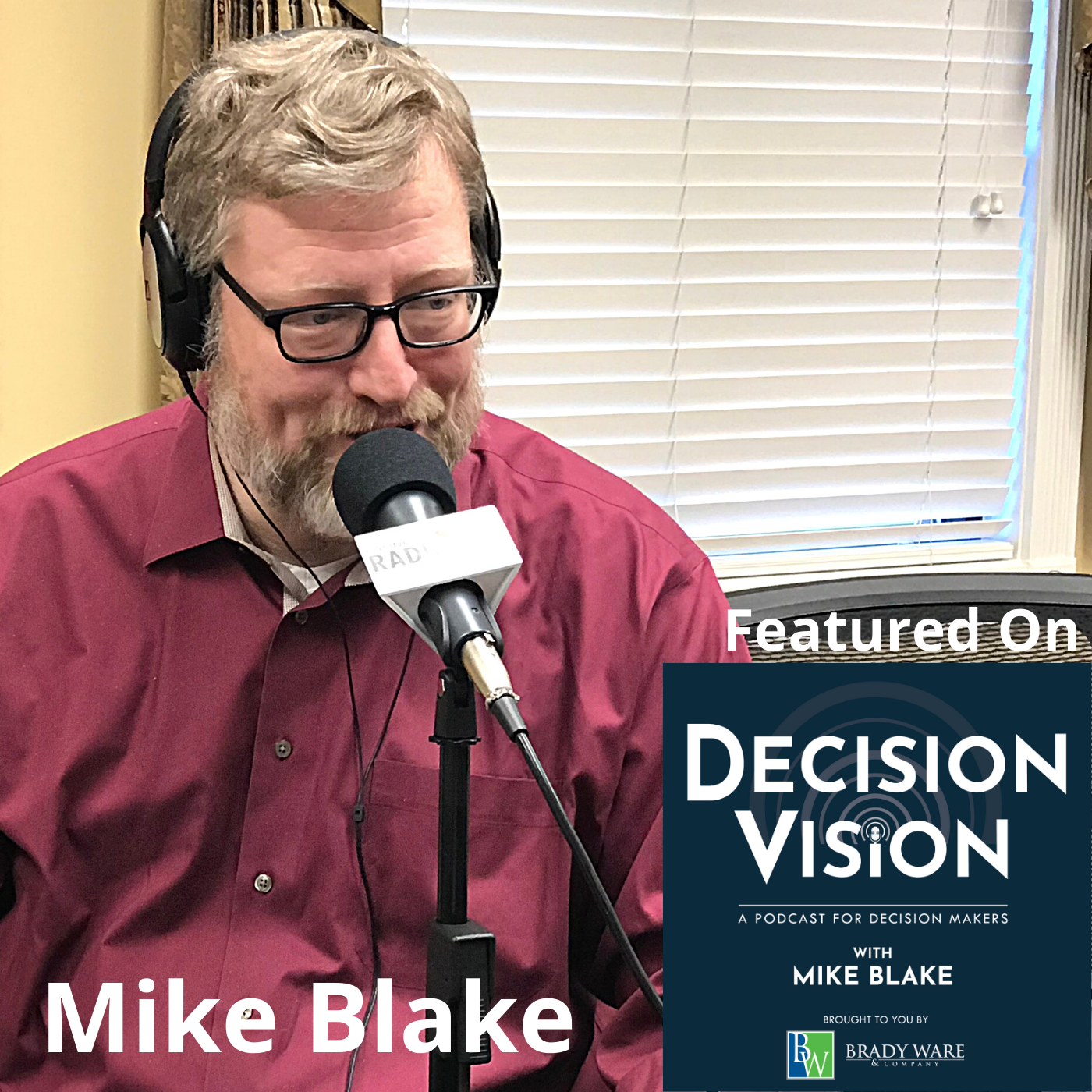
Mike Blake, Brady Ware & Company

Mike Blake, Host of the “Decision Vision” podcast series

Michael Blake is the host of the Decision Vision podcast series and a Director of Brady Ware & Company. Mike specializes in the valuation of intellectual property-driven firms, such as software firms, aerospace firms, and professional services firms, most frequently in the capacity as a transaction advisor, helping clients obtain great outcomes from complex transaction opportunities. He is also a specialist in the appraisal of intellectual properties as stand-alone assets, such as software, trade secrets, and patents.

Mike has been a full-time business appraiser for 13 years with public accounting firms, boutique business appraisal firms, and an owner of his own firm. Prior to that, he spent 8 years in venture capital and investment banking, including transactions in the U.S., Israel, Russia, Ukraine, and Belarus.

LinkedIn | Facebook | Twitter | Instagram

Brady Ware & Company

Brady Ware & Company is a regional full-service accounting and advisory firm which helps businesses and entrepreneurs make visions a reality. Brady Ware services clients nationally from its offices in Alpharetta, GA; Columbus and Dayton, OH; and Richmond, IN. The firm is growth-minded, committed to the regions in which they operate, and most importantly, they make significant investments in their people and service offerings to meet the changing financial needs of those they are privileged to serve. The firm is dedicated to providing results that make a difference for its clients.

Decision Vision Podcast Series

Decision Vision is a podcast covering topics and issues facing small business owners and connecting them with solutions from leading experts. This series is presented by Brady Ware & Company. If you are a decision-maker for a small business, we’d love to hear from you. Contact us at decisionvision@bradyware.com and make sure to listen to every Thursday to the Decision Vision podcast.

Past episodes of Decision Vision can be found at decisionvisionpodcast.com. Decision Vision is produced and broadcast by the North Fulton studio of Business RadioX®.

Connect with Brady Ware & Company:

Website | LinkedIn | Facebook | Twitter | Instagram

TRANSCRIPT

Intro: [00:00:02] Welcome to Decision Vision, a podcast series focusing on critical business decisions. Brought to you by Brady Ware & Company. Brady Ware is a regional, full-service accounting and advisory firm that helps businesses and entrepreneurs make vision a reality.

Mike Blake: [00:00:21] Welcome to Decision Vision, a podcast giving you, the listener, a clear vision to make great decisions. In each episode, we discuss the process of decision making on a different topic from the business owners’ or executives’ perspective. We aren’t necessarily telling you what to do, but we can put you in a position to make an informed decision on your own and understand when you might need help along the way.

Mike Blake: [00:00:39] My name is Mike Blake, and I’m your host for today’s program. I’m a director at Brady Ware & Company, a full-service accounting firm based in Dayton, Ohio, with offices in Dayton; Columbus, Ohio; Richmond, Indiana; and Alpharetta, Georgia. Brady Ware are sponsoring this podcast, which is being recorded in Atlanta per social distancing protocols. If you like to engage with me on social media with my chart of the day and other content, I’m on LinkedIn as myself and @unblakeable on Facebook, Twitter, Clubhouse and Instagram. If you like this podcast, please subscribe to your favorite podcast aggregator and please consider leaving a review of the podcast as well.

Mike Blake: [00:01:13] Today’s topic is, should I pitch on Shark Tank? And this is a cool episode to do for a lot of reasons. Obviously, Shark Tank is a fascinating phenomenon. It’s an attempt to put the American entrepreneurial dream on stage in a microcosm in sort of a miniaturized format. And I’m going to speak very vaguely about that because I’ve actually never watched the show start to finish. Maybe I watched five minutes or so, and I’ve watched the recording of the pitch of our guests that are coming on today.

Mike Blake: [00:01:51] But searching around, I looked it up, and Shark Tank has been around since 2009, which is a remarkable run for a television show and a remarkable run for a television show of the type that it is. But I think one of the things that really gives it its legs, if you will, is the fact that it does encapsulate something that we, as Americans, really romanticize, which is the one big shot, right? It’s Hollywood meets Silicon Valley. And just as entertainers want to be discovered, so do entrepreneurs want to be discovered.

Mike Blake: [00:02:30] And it’s an interesting form in the respect that most companies that get funded with venture capital are either software-based or they’re trying to cure a disease, for the most part. And neither of those things is bad, I’m not going to criticize either one, but the fact of the matter is, then, if you have a business where somebody has, for example, a consumer product, as we’re going to talk about today, the channels to go find that investment are frankly less clear. And so, it’s a fascinating phenomenon.

Mike Blake: [00:03:10] And our guests are a couple of folks I’ve known for a number of years. They’ve come to my office hours back in the days when we had office hours in person. I think I’m going to resume those back in August or so. And they ultimately took it all the way, which is just fantastic. And they’re such nice, humble people. You never know that they’ve produced the success that they have, but you’re going to feel the same way after you hear them. As I do, you’re going to be thrilled for every bit of success that they have.

Mike Blake: [00:03:46] And joining us today are Kate Mallory and Lou Childs, who are a mother-daughter team, who are co-founders of SlumberPod. They appeared on Shark Tank in 2020 – this is last year – and received an investment offer. And I’m putting it that way for a reason because I know a little bit about how the show works and we’ll learn more about that. But SlumberPod is the first portable privacy sleep nook that allows babies to sleep in their safe and familiar play yard or travel crib with room to sit up or stand up inside.

Mike Blake: [00:04:12] The patent-pending SlumberPod solves the age-old problem of getting a good night’s sleep while sharing a room with your little one. And I’ve been there. We’ve had two little ones, and we had some bloodshot eyes in those days. Babies and toddlers can easily nap in bright or distracting conditions approved for indoor use only.

Mike Blake: [00:04:28] Now, the other interesting thing is this is almost, really, if we’re honest about it, a kind of a side gig. Katy is also Director of Internal Communications, and Sales and Marketing at Cox Automotive here in Atlanta, and Lou is an adjunct professor of marketing at La Grange College. Kate and Lou, welcome to the program.

Lou Childs: [00:04:47] Thank you, Mike.

Kate Mallory: [00:04:49] Thank you, Mike.

Lou Childs: [00:04:49] So good to be here.

Mike Blake: [00:04:51] Yeah. And thanks for coming on. I know you have a lot of demands on your time. And also, I’m sure a lot of people want to talk to you because you’re, now, big stars. So, for the audience that has not heard of SlumberPod, what exactly is it beyond what I said? And how did you come up with the idea?

Kate Mallory: [00:05:12] Sure. So, you talked a little bit about the challenge we solve for, and that is the story of our product’s inception. So, my husband, Dan – who Mike happens to know, which is how Mike and I originally met – and I were visiting my mom for Christmas – what would that be – seven years ago? And our daughter, who was a great sleeper at home in her own private room with blackout shades, she slept so well at home, but we had to share a room at my mom’s house because it was filled with a lot of other family members, and there were blinds on the windows, but they didn’t really keep out the flood light that was right outside the window. And our daughter kept waking up, and seeing us across the room, and not being able to go back to sleep. So, we were thinking this would be a magical time of being together with family with our year-and-a-half-old daughter, and it turned out to be anything but that because we were miserable, and sleep-deprived, and we ended up going home a day early because we slept for two or three hours a night for those two nights that we were there.

Kate Mallory: [00:06:19] And as we were leaving and swearing off traveling any time soon, my mom said, “Gosh, there’s got to be something out there that you could buy that would help with this problem. Surely, you’re not the only one who deals with this.” So, I looked online for some kind of privacy barrier that goes over a crib, or a pack and play, or a play yard, and I couldn’t find anything. So, for a little while, when we finally were comfortable traveling again, we started bringing to cheap camera tripods with us, and a sheet, and ponytail holders or twist ties to attach the sheet to the tripods. And that created a temporary wall that kept our daughter from being able to see us and hotel rooms, but it didn’t solve for keeping her entire sleeping space dark. So, light was coming in through the shades or the curtains. She was still up at 5:30 or 6:00 in the morning. If she had to take a nap, it wasn’t dark in there. We were still tiptoeing around, looking at our phones under our covers or hiding in the bathroom. So, that certainly helped, but it was cumbersome to set up. It didn’t solve all the problems.

Kate Mallory: [00:07:27] So, flash forward to summer of 2016, when I was on maternity leave with twins, my mom very generously offered to spend a few months with us, helping us get on our feet as a family of five. And it was during that time that she said, “Katy, we’ve got this time together. You and I are both really industrious. We’re going to be watching these babies take naps. Why don’t we get serious about inventing a solution?” And so, we did. We filed for an LLC, I believe, in June 2016. And that’s when we got really serious about making what is now known today as SlumberPod.

Mike Blake: [00:08:03] Now, the other neat part of this, and I could make it a second show, but we won’t get into that today, but I mean, the dynamic mother-daughter working together. Mothers and daughters don’t always necessarily get along that well that you can start an entrepreneurial company together and be successful. And I know I’m going off the script here, but I think that’s okay. I am curious as to what is it about your relationship that’s made you be able to work together so successfully?

Lou Childs: [00:08:32] That is a really great question. And Katy and I have had what we found out now to be a unique mother-daughter relationship in that we have always gotten along. Katy’s a little bit of an old soul. So, in her teenage years, there weren’t a lot of rebellion. I’m also a pretty open person. I don’t typically overreact when something happens. I try and understand things from everybody’s point of view. So, she felt real good about bringing me issues, or problems or things that we talked through. So, we actually are really good friends.

Lou Childs: [00:09:21] I felt no, I guess, hesitation in getting a business together, because we know each other’s strengths and weaknesses. We know how each other reacts under stress or when the chips are down. And we both are really resilient. We have a lot of energy. We’re very determined. We do speak our mind, but we do so in a way that is respectful and loving. So, I can only think of maybe one time when maybe I was tired or Katy was that we just had to say, “Okay, we we need to go to bed, and we’ll reconvene on this topic tomorrow.” Otherwise, we talk things through really well. It’s been a great journey together, honestly. And the wonderful thing is I thought we were close before, but we’re really close now. So, it’s been a blessing.

Kate Mallory: [00:10:22] I was just about to say that that I feel incredibly fortunate that I get even more time with my mom than my siblings because of this business and what we’ve started together. And I have to brag on my mom too because one could think like, “Oh, what’s your mom going to bring to the table? She’s getting closer to retirement age.” And that could be nothing further from the truth. She’s one of the most technologically savvy people I know. She is a problem solver. She’s like, “Oh, the code needs to be updated on the website. I can do that, or I can implement this new piece of software, or I’ll research which review platforms will work the best and which integrate with our other systems the best.” She’s a dynamo.

Lou Childs: [00:11:03] Thank you. I enjoy it.

Mike Blake: [00:11:04] Well, I have a feeling I’ll get a lot of emails from people asking for your email address, Lou because people will want to be adopted. So, good for you, guys.

Intro: [00:11:13] What’s with more at this point?

Mike Blake: [00:11:16] So, what gave you the idea? I mean, you went through that process, what was a leap from starting the business and developing the product? Why go on Shark Tank? I mean, I haven’t really seen the show, but you probably have. And I know that not every entrepreneur’s experience on the show is awesome. What motivated you to think about that and try that?

Lou Childs: [00:11:42] So, first off, getting on the show is like a needle in a haystack. So, 40,000 people apply every year.

Mike Blake: [00:11:51] 40,000, wow!

Lou Childs: [00:11:53] Yes, every year. So, when we realized when we went on Amazon and after the first five months of being on the market, we had $150,000 in sales and we said, “Why not? We’re crazy. We really do love to have a lot of fun.” As those of you who have seen our pitch can see that we’re in pink pajamas with shark slippers. But we just said, “Hey, what the heck? We’ve got Delta miles. Let’s pick a spot and go stand in line and be in the casting call.” And that’s exactly what we did.

Lou Childs: [00:12:36] Katy is so good at public speaking. I’m a great sidekick and I’m a lot of fun. Of course, during the pitch, I forget my lines and the producers thought that was hilarious. But I think we’re endearing. I think that people kind of feel once they get to know us that they want to be our friend. So, it was easy. It was easy to just say, “Hey, what have we got to lose? We’ve got a great story, and let’s go have some fun.” And that’s what we did. And I think it really paid off that we had that attitude.

Kate Mallory: [00:13:16] My mom mentioned, Mike, that we had some sales, and I wanted to expand on that a little bit because from watching the show, which I think we both seen every single episode over the last 11 years, we’ve seen that when companies have no revenue or their only revenue is Kickstarter or Indiegogo campaigns, they really get the the ninth degree from the Sharks because the Sharks don’t feel like there’s enough to go on to feel confident investing. So, having that revenue and not just $5000 of revenue, but I think when we applied, what would you say, mom, it was more than $200,000 or $150,000 or something like that when we first applied? And then, by the time we recorded, we had $600,000 or $650,000 in revenue in just a couple of months. So, that made us feel confident.

Kate Mallory: [00:14:10] Of course, there is the exception of The Comfy, which is a brand that Barbara Corcoran invested in that was pre-revenue, but she just really felt like those entrepreneurs were magnetic and she went out on a limb and invested in them. But historically, that’s not the case.

Mike Blake: [00:14:27] And what’s interesting about that is in Atlanta, and really I think throughout the southeast among entrepreneurs, there’s a frustration among many entrepreneurs that angel investors really want companies that already have revenue, right? And I think, somehow, that a lot of them think that they’re kind of being picked on or the south is just a lousy place for investment. And what you’re talking about on Shark Tank, and those are very accomplished investors, right, they know what they’re talking about, it’s interesting that even they, when they’re on television and it’s as much entertainment and for them, brand building as it is making an actual investment, they’re still wanting to see that there’s some sort of customer validation out there.

Kate Mallory: [00:15:09] Absolutely. And another little disclaimer is that we had two private investors invest in us before we even had, really, a minimum viable product. And that is a result of maybe personality, but also some some privilege and connections as well. So, that helped us get off the ground because it is really challenging, especially with a product that has a pretty high manufacturing cost to do all the safety testing, and the marketing, and the market research and the product development. So, I feel where we feel for entrepreneurs who can’t get that seed money to get started. And we look forward to being able to get back.

Mike Blake: [00:15:48] It really is tough to get that money. And you’re right, those connections really help because I think – well, you tell me, but in my experience, when I’ve seen those pre-revenue investments happen, as much as anything that I think the investor is doing it because they want to just give you a chance to succeed. And then, if they get their money back, they’re thrilled, but they’re not looking at it like they’re JPMorgan saying, “I’m going to make a gazillion dollars out of this,” right? And that’s just the kind of way that capital works. Silicon Valley is an exception. It’s just that, right? You can get a few million dollars for a vaporware kind of thing but, man, it’s exception rather than a rule. You guys built it. You built it the right way. And I think you were clearly acknowledged for that.

Lou Childs: [00:16:36] Thank you.

Kate Mallory: [00:16:37] Thank you.

Mike Blake: [00:16:38] So, I’ve got to ask you because I did watch your pitch, I actually watched it a couple of times. And you had them rolling in the aisles when you were showing them kind of how people were trying to create dark spaces for their kids, right? And the canopy that you’re putting on the playpen with the jumper cables, and then that poor woman was trying to put tin foil over the window. I mean, it was just hilarious. Did you make those up, or are those kind of urban legends, or did you actually hear of somebody you know, somebody who actually tried to do those things?

Kate Mallory: [00:17:15] Seriously, people try, or do, have done those things. The jumper cable I’ve only heard once. But seriously, somebody did tell us that. I’m in a lot of mom groups, so that I can monitor for people mentioning SlumberPod. And I’ve seen people say, “Hey, I don’t want to buy a SlumberPod. It’s really expensive. What do I do?” And you’d be surprised how many people say, “Oh, we just drape a blanket over the pack and play,” which that doesn’t sound safe, or “We bring trash bags and we tape them to the windows,” or “We ask for a wheelchair-compliant hotel room,” which that’s kind of sketchy, “big enough to set up the pack and play inside. And then, we go down to the lobby in the night to use the bathroom.” So, the stories are are wild.

Lou Childs: [00:17:58] Oh wow!

Kate Mallory: [00:17:59] It really is crazy. And one little aside about the lady who was on Shark Tank with us, she actually was a customer, and we’d never met her, but she was such an enthusiast of our product that we invited her to come on the show with us.

Lou Childs: [00:18:12] And her son sleeps – and still does to this day, and he’s over three years old – he slept in a SlumberPod every night and every nap. So, I mean, even that day, he had napped in SlumberPod. But we filmed mid or late afternoon – I can’t remember exactly what time – and for him to be put inside a SlumberPod at a time when it wasn’t nap time, and who are all these people, and what are all these lights, of course, he was upset, he couldn’t figure it out, but the the pack and play was might. So, his little cries were a lot louder on TV than they were in reality.

Lou Childs: [00:18:55] But yeah, I mean, it was a challenge to keep going, but you’re given one take. So, we were in front of them almost an hour. And then, of course, they edited it down to seven minutes that you see on TV, but there were also a lot more laughter that you missed. So, one of the things that people that watched our episode missed was Laurie and Robert got inside a SlumberPod together and were talking about how dark it was. And Katy said something about this being an HR violation, and everybody just howled. So, we had a lot of fun taping that shed.

Mike Blake: [00:19:37] Well, you know, and I think it shows because I cannot – I mean, I did not realize it for first seven minutes of video. I guess it makes sense, but for seven minutes of video, you had an hour of actual material. I mean, I’d pay money into a Kickstarter to get whatever didn’t make the edit. I mean, that’s just got to be hilarious. And then, you have a crying child, which given what you’ve described, is predictable, right? It would have been surprising if you didn’t have a crying child in the background kind of in retrospect. And I’m curious, did you have that plan? Did you sort of think about, “Okay, what if he’s screaming his head off during the entire thing? How are we going to handle it? Or do we push through it?” Or was that was that just something that just came up and you had to deal with?

Lou Childs: [00:20:28] We thought about it, but didn’t really think that it would be a big deal if he whimpered or made some noise. I guess I didn’t realize that. Like Robert said, “Those are real tears. Damn it.” I didn’t realize that he would get that upset, but I think we handled it pretty well. Elizabeth, his mom was right there with them, scooped him right up, settled him down. I think he was just perplexed by the whole situation, but you just have to keep on going and no harm.

Kate Mallory: [00:21:12] That brings us to another key takeaway about the experience, especially for your listeners who might be interested in applying, is that being entertaining is critically important. So, if you go out there, and you’re low energy, and you’re boring, they might not take your episode to television because they record well more than how many they need. And we know people who went all the way out there, bought all the things for their set, taped it, and then it never ended up showing. So, while that crying baby may have hurt some of our ability to sell product, some people say, “Oh, that’s kind of scary. I don’t want my baby in that,” it certainly helped us make it to television because entertainment level is key.

Mike Blake: [00:22:00] Well, I think it’s just authenticity too. I mean, if you’re a parent for more than 10 seconds, you just realize that crying babies are a part of life. And sometimes, as a cause, you can address. And sometimes, there just isn’t. A baby just sometimes going to cry, and that’s just what there is to it, right? So, let’s walk it back a little bit. I’m really curious about what the process is. After you sent in an application, they tell you somehow, “Congratulations, we’d like you to be on Shark Tank, or go through some process,” what is that like? Were there are a lot of phases? What were the phases like? What did you have to do? How long did that? Can you to take us kind of through that timeline?

Kate Mallory: [00:22:42] Sure. So, some of it we’re under NDA about, of course, but we can still tell you quite a bit about what the experience was like. So, right now, I believe you can only apply for Shark Tank through video submissions, they might bring back the live auditions at some point, but we have the choice of submitting a video or doing a live audition. And we thought that we would have more of a chance of moving forward if we did the live audition because if we could really capture their hearts and minds in that one-minute opportunity, that would be much more telling than if a company re-records their pitched 300 times in order to get the perfect cut. So, that was one thing that we did.

Kate Mallory: [00:23:25] And it took, I don’t know, two weeks or so to hear back with, “Hey, you’re proceeding to the next step,” but with every step, they want you to submit either some paperwork or some other materials that tell more of your story. And then, of course, you’ve also got all the background checks and things like that that go along with it because they want to make sure that they’re investing their time and resources in people who don’t have criminal records or who haven’t been sketchy in some other way in the past.

Kate Mallory: [00:23:54] But the whole process took about four months from interviewing or auditioning, to being flown out there, but they do record for several months. We happened to be one of the first companies of that season to go out and interview. But you’re assigned producers, who were incredibly helpful in helping us put together like a storyline for our pitch. And since my mom and I are marketers by background, we blended their recommendations with some things that we thought would work well. But overall, it was a really neat experience.

Kate Mallory: [00:24:31] But to be honest, we kept asking ourselves, “When is this going to fall apart?” because certainly with how many people apply for this opportunity every year, are we really going to make it all the way to the end? And even once we taped, we had to say, “Okay, let’s not get too excited because it’s possible that it won’t end up happening, and they could pull us off the air at any point in time.” And with that, we had a lot of nondisclosures we had to sign. In fact, that’s a funny story that my mom could share real quick, if we have a second.

Mike Blake: [00:25:05] Yeah, please.

Lou Childs: [00:25:05] So, one of the steps in the process along the way, you have to send additional videos, but we had to script our pitch. And so I happened to be on an anniversary cruise with my husband, and the next video was due. So, in the NDA, it says you can’t tell anybody that you have gone beyond the casting call. So, I had not told my husband that we were doing this-

Mike Blake: [00:25:36] Wow!

Lou Childs: [00:25:36] … and we were on our way. I love my husband, but he can’t keep a secret. So, I mean that it would be on the next billboard in downtown Atlanta if I mentioned it. So, I had to send him on an excursion while Katy and I taped a Zoom call of us doing this pitch together. And then, we go out and we film in June. So, we still don’t know, are we going to be on the show or not. So, season 11 started that night during the season premiere. I said, “Oh, Tripp, let’s watch the season premiere. Shark Tank is going to be on.” The intro video has me and Katie running out of the set with our pink pajamas on. So, I’m looking at Tripp, and he’s looking at the TV, and then he looks at me, and he’s mad at first, and he’s like, “Oh, my God. You’re going to be on Shark Tank.” So, that’s how he found out.

Mike Blake: [00:26:39] That is funny. So, you must have had to go so far as to tell him you’re flying out to California and make up something like this.

Lou Childs: [00:26:48] I did. And I made up a story.

Mike Blake: [00:26:50] How did you sound, you think?

Kate Mallory: [00:26:50] But to meet with investors. We were going to meet with investors, which we were.

Mike Blake: [00:26:55] Okay. Well, that’s true.

Lou Childs: [00:26:55] I think I told him I was going to a conference.

Kate Mallory: [00:26:58] Oh, yeah. Yeah, maybe that. I told some people I was going to meet with investors.

Lou Childs: [00:27:03] There was a little bit of a white lie.

Mike Blake: [00:27:03] That is a howl. So, okay. So, this brings me then to a very natural question because I know that you’re – as I recall watching the video, you received two offers to invest in the company, right? You selected one because you liked it better. Was it by Lorie Greiner? Is that who? Who was it, the one you ultimately selected?

Lou Childs: [00:27:25] Barbara is the one we selected.

Mike Blake: [00:27:25] Barbara, that’s right. Barbara. See, I don’t watch the show.

Lou Childs: [00:27:29] And [crosstalk] gave us a licensing deal after he called it Slumber Prison.

Mike Blake: [00:27:38] Well, look, I would imagine they also have a specific persona they want to perpetuate to stay on the program. I wonder if they’re a little different in person than they are kind of on TV.

Lou Childs: [00:27:50] I loved it. It was funny.

Mike Blake: [00:27:50] So, even – I mean, I would have thought that after you’d agreed to accept an investment that you would have thought you’d still be on TV. But even then, there’s no guarantee, I guess.

Kate Mallory: [00:28:03] There is none.

Mike Blake: [00:28:05] So, now, from what I read, the investment part, the offer part is a little bit theatrical, right? Because it’s not a binding commitment to make an investment. Really just sort of as an effect. In my world, we just call that a letter of interest. Basically, a letter of intent. And then, they had to kind of do what they were going to do to be comfortable with the investment. So, are you under NDA for that or can you talk about what that process was like after offer to ultimately getting a deal done?

Kate Mallory: [00:28:37] So, actually, you have picked great timing for recording this podcast because we were under NDA until, I think, last month on how that all panned out. As you alluded to, Mike, what happens on TV, there’s more to it than what you see. And it’s true that when we went out there and presented that not one of those sharks knew anything about our company. So, they had blank pieces of paper. They don’t get a lineup of who’s going to come out there. And everything that we shared, we represented ourselves accurately. We memorized our answers, we had flash cards, we decided in advance who would answer which questions. We really worked hard to be buttoned up and got some good help in order to do that.

Kate Mallory: [00:29:25] But after that, that’s when the due diligence starts. And we worked with somebody from Barbara’s team, a guy named Mike Stevens, who was really lovely. And he met with us, at least, once a week for several months to go over any questions that he had to get our feedback on things. He requested documents, meeting notes, and financial projections and things like that. And he told us that while we were one of the most buttoned-up pair of entrepreneurs that he’d ever met, and he was very impressed by us, and Barbara was very impressed by us, and how they expected that we had a really bright future, ultimately, they decided not to move forward with investing in us because they hoped that we were already on retail shelves.

Kate Mallory: [00:30:11] We never said we were. We were one hundred percent honest and saying we’re on Amazon and on our own website, but we’re in discussions with retailers, but that was their rationale. So, they backed out, but that meant that we got all the exposure and didn’t have to give away any additional equity. And we didn’t need the money at that point. We were cash positive. So, really, it worked out the best way it could. I suspect that it’s something like 30 percent or less of the deals that go through on TV end up going through in real life because of the things that I just mentioned, but it’s sure still was a wonderful experience that we feel was worthwhile.

Mike Blake: [00:30:53] You know, and you bring up an interesting point that I don’t think is appreciated as investors are not infallible. And investors, when they get excited about a story, they can sometimes fill in gaps that they don’t realize they’re filling in gaps, right? And then, they hear, for example, that you’re selling $150,000 of product, and they therefore assume that either you’re already on store shelves or you have that in your plan. They just didn’t bother to ask that question.

Lou Childs: [00:31:23] No, they did. They did ask that question. So, that’s an even more fascinating part of it. And the other funny thing, for people who do watch the show that are listening, is you hear different reasons for why they want to not move forward. And sometimes, “We wish you were only online because the margins are better.” And other times, it’s “We wish you were in with retailers.” So, which is it? Because certainly, our online sales do really well for us, especially those on our website but-

Kate Mallory: [00:31:23] It might that the investors have a certain number that they strive to go through with and a certain percentage. And they say yes on TV knowing that a certain percentage of them are going to turn to nets.

Lou Childs: [00:32:10] Cast a wide net.

Mike Blake: [00:32:12] Yeah. Well, I think that’s interesting in terms of the inside baseball because I think if you’re not paying attention, you think that that’s an actual deal that’s happening in real time. And it’s a little bit of a deal, it’s happening, but not the deal, deal with the capital deals happening.

Lou Childs: [00:32:30] My only regret is that we didn’t get to go on Barbara’s trips because I really think she is an amazing businesswoman and such fun to be around. If you follow her on social, she is a hoot. And I would have loved to have gotten to know her personally.

Mike Blake: [00:32:50] Now, did you have a patent? Or I guess, you have a patent pending? Was your patent pending by the time you’re on Shark Tank?

Kate Mallory: [00:32:57] We were patent pending by that point. We filed for a provisional patent in the fall of 2016, and we converted that to a utility patent application about a year later. If you could believe it, we actually are still pending. We’ve had my numerous-

Mike Blake: [00:33:17] I believe it.

Kate Mallory: [00:33:17] … request for additional extensions. They call them RCEs. What does an RCE stand for? I should know this as an inventor but office actions, and appeals, and things like that. But we’re still working through that, but are confident that we’ll be able to come up with a few explanations for our claims that will allow us to be unique enough to receive that patent. But that’s something that definitely creates a little bit of stress and anxiety for us because we want our product to have that intellectual property protection, and it really is a moat that is hard to dig without it.

Mike Blake: [00:34:00] We’re talking with Katy Mallory and Lou Childs from SlumberPod. And the topic is, should I pitch on on Shark Tank? So, you weren’t allowed to tell anybody about the outcome until the thing actually was on air? How hard was that?

Lou Childs: [00:34:18] It was especially hard after we were in that intro video and people started coming up to me who watch Shark Tank and say, “I saw you on the Internet radio. You’re going to be on Shark Tank.” And I was like, “Oh, I don’t know for sure.” And we were so scared. But it was not hard to tell the outcome because that was easy to keep a secret because people know you can’t share that. But once the cat was a little bit out of the bag, it was really hard to hold back talking just about being on the show in general.

Kate Mallory: [00:34:58] I am-

Mike Blake: [00:34:59] [Crosstalk].

Kate Mallory: [00:34:59] Go ahead, Mike.

Mike Blake: [00:35:00] No, please go ahead.

Kate Mallory: [00:35:02] I was going to say I’m such an open book, it was hard to keep a secret because I just share everything. I think I had a co-worker asked me what I’d done lately, and I was like, “Oh, we just went to California. My mom and I did. And that was fun.” And I wasn’t even thinking. And he said, “What were you doing in California?” I said, “Oh, we were meeting with some investors.” And he said, “You weren’t on Shark Tank, were you?” And I was like, “Ah.” I wasn’t-

Mike Blake: [00:35:26] Why on earth would you say that?

Kate Mallory: [00:35:28] Yeah, I wasn’t expecting to get asked that. But I was really relieved, like my mom, once we showed up on that promo and then eventually got an air date because then we could talk about it a lot more. But it was tough to maintain or keep the excitement inside. And that is a memory that will hold on to forever how much fun everything was.

Lou Childs: [00:35:54] We’re in groups with other entrepreneurs. We’re in a Facebook group with – how many are in there? Like 40, Katy? – that are baby products. And several of those companies have applied and been on Shark Tank. So, it’s really fun to watch other people’s journeys. I have actually encouraged several people that I know that are entrepreneurs, and a couple of them are in the pipeline right now. So, I think it’s fun to be on this side and be a cheerleader for other people who are going through the same process. Now, we can’t help them because of the NDA process where we’re not allowed to be a part of whatever they’re doing, but I certainly encourage people to just go do it. Why not?

Kate Mallory: [00:36:49] I do have to add, though, that there’s been one time where somebody called me and was asking about going on the show, and I had to be very diplomatic but say, “I don’t think it’s going to be successful for you.” It’s a company that had no revenue, a Kickstarter campaign that didn’t end up meeting its goal. And she said, “Well, what if somebody just really believes in me?” And I said, “Well, there’s about a one percent chance of that, maybe five percent. And I don’t want to discourage you, but maybe this isn’t the right timing. Maybe you need to try again with a smaller goal on one of those fundraising things. And then, get product in people’s hands. But otherwise, I’m just afraid you’re going to get torn apart. And I hate to tell you that, but that’s also, I think why you called was to get my honest take.”

Lou Childs: [00:37:38] Yeah, good point.

Mike Blake: [00:37:40] Look at you now. You’re having office hours of your own.

Kate Mallory: [00:37:42] Hilarious. But she said, “Well, maybe another investor will see me on the show, and call, and want to invest even if I don’t get a deal on the show.” And it doesn’t often work like that, unfortunately. But most of the companies we talked to, we’re able to encourage them, especially if they have revenue, to go for it.

Mike Blake: [00:38:04] Yeah. The reality is that getting somebody to invest in a startup is hard, and it’s supposed to be hard, right? There’s just a lot more ideas out there and companies than there are dollars to fund them. There’s a scarcity. And for what it’s worth, I think, not only to think about the company, but I think you gave them good advice is that there’s always a chance you can get something funded. Bad deals get funded all the time. Is that a good thing or not? Who’s to say? But if you hang around long enough, you may run into that one person that finishes your sentences, and they just totally get it. You don’t have to explain. The next thing you know, you got $100,000 or a quarter of a million dollars in the bank.

Mike Blake: [00:38:46] You’ve mentioned a couple of times along the way that you had people help prep you for the Shark Tank experience. You can mention names or not, it doesn’t matter to me, but I’m just curious, what kinds of advices? What advice were you seeking? How did you work with them?

Lou Childs: [00:39:05] One of the things that they really require a lot of due diligence on are financials. So, we worked with a contract CFO to do projections and just help us with all of our financials. We also took the opportunity to get our books cleaned up because, boy, were they a mess and we didn’t know it. So, it was really a great wakeup call for us on the financial side, which is not one of Katy and my strong suits. So, it was really great timing for us to have that happen. Katy, what else can you think of?

Kate Mallory: [00:39:49] I was going to just add that that contract CFO, we literally asked her to pull about 20 different numbers out, so that when they said, “What’s your-” We know our landing costs but other margin numbers, we had all those memorized. And I wouldn’t have trusted myself to go and look at the spreadsheets and make those calculations myself. So, yeah, that was a huge, huge, huge help, I’d say for Shark Tank, those were the biggest pieces. And there, obviously, had been a lot of other vendor partners along the way who helped us with things like product development and manufacturing as well, because it takes a village, especially for a small company.

Mike Blake: [00:40:27] I think that what you talk about, as you described the financials, I think that’s so underrated. Accounting is just not sexy. I get it. I’m doing this. I’m a partner with a CPA firm. Accounting is not sexy, but boy, when you don’t have it right, you miss it. And I do think and this is underappreciated, “When people ask me what can I do to make my company more saleable?” have great accounting records, haven’t be bulletproof, have financials somebody can look at and they just know that they’re right and that you know they’re right. It gives you a lot of confidence. So, I did not expect you to spend so much time describing working on that, but I’m glad that you did. And I am very confident that’s why you received that comment that your “So buttoned up.”

Lou Childs: [00:41:16] I believe you’re right, because we had it all clean. And anything they ask us, we had an answer for whether it was during the taping or during due diligence.

Kate Mallory: [00:41:28] The only numbers thing I was really worried about was having to do math on the fly for our evaluation because I know that a lot of times, we went in asking for $400,000 in exchange for 20 percent of our company, and I was afraid they would ask, like, “Hey, we’ll do $400,000 , but I want 30 percent of your company,” and that I would have to then calculate what that made our valuation. And I’m a journalist by background. I am so comfortable looking at graphic design and writing articles, but oh, I would not have done well in accounting classes or finance classes. So, that terrified me and actually almost brought with me a little index card that had a cheat sheet of if they say this and this and it means this. But I ended up leaving it in our trailer at the last minute thinking they probably wouldn’t like me relying on something that was in my pocket. So, that was another reason why I was thrilled that they offered us our original request because I didn’t have to do the math.

Mike Blake: [00:42:33] Yeah, it was interesting. I think the comment was that they thought you were selling yourselves too short.

Lou Childs: [00:42:40] Yes, they spent a lot of time telling us that we really didn’t need an investor, but then Barbara’s comment was, “I’m going to take advantage of you.”

Mike Blake: [00:42:50] Yeah, and you know what? I think too. I think to an extent, that may have been right. So when did the program air, and when did you learn that you were going to be on Shark Tank?

Lou Childs: [00:43:07] That’s an interesting story, and dovetails with what Katy said earlier about some companies never make it to TV. So, we were originally slated for very early November. So, they give you two or three weeks in advance of your air date. And because we were on the intro video, we kind of suspected that we were going to air, but most entrepreneurs don’t have any idea until they get that email three weeks in advance that says, “Okay, here’s your air date, and you can start talking about it.”

Lou Childs: [00:43:43] So, we got that email, and we immediately started blasting social media that we were going to be on Shark Tank. Well, about five days later, we get another email saying, “Oops, no. Your date has changed. You are now the first.” I think, was it Sunday night then or Friday night? I can’t remember. Anyway, the first week of January 2020. And come to find out, one of the companies that was slated to be in our episode was ditched.

Mike Blake: [00:44:16] Oh, really?

Lou Childs: [00:44:16] So, it was replaced by another company and those people never aired.

Kate Mallory: [00:44:21] And the episode – so we tried out in February, early February. We recorded in early-ish June, was going to air in November, but then got pushed out to early January. So, more than six months past after we recorded. But we also know a company that recorded our same day, and she ended up finding out her episode wasn’t going to air. But then, during COVID, they pulled some of those cut segments out of the archives, and she did end up airing about a year and a half later after recording. So, you never know what’s going to happen.

Mike Blake: [00:44:55] That’s TV, I guess.

Lou Childs: [00:44:56] But we had the luxury that a lot of Shark Tank entrepreneurs don’t have in knowing for many weeks that we were going to be on Shark Tank. So, we started promoting it when they told us in late October, all the way through to January. We really felt that that boosted our November and December sales on top of it being holidays. People were like, “Well, when they get on Shark Tank, their inventory is going to sell out. So, we better order it now.”

Mike Blake: [00:45:33] So, now, you’ve had some distance. I don’t want to have you reveal proprietary data, but where is the company now? And how much did your Shark Tank experience impact your success?

Kate Mallory: [00:45:48] That’s a great question. So, we don’t know for sure. I’ll start with the latter part of the question. So, we don’t know for sure what our sales would have been like if we had aired in November, but we have a feeling they would have been a little bit higher following our appearance because that was in advance of Thanksgiving and other winter holiday travel. So, with the new air date, that was after people had bought Christmas gifts, Hanukkah gifts, then doing all their traveling. And so, with less money available, had already done their traveling, they probably thought to themselves, like, “Oh, I’m going to earmark this for a later date, but I might not purchase right now.” Our website traffic was up like 20x, but sales were only, I don’t know, two and a half or three times more than usual for that day and a half or two days following the show.

Kate Mallory: [00:46:42] So, I took off work. We cleared our calendars, so that we could answer any social media questions and the barrage of emails that would come in, and we didn’t get as much of that as we expected at that time, which felt a little disappointing in the moment. But we now recognize that it’s all about the long tail. It’s not just about how you’re going to do immediately following your airing. So, we are able to have “As seen on Shark Tank,” on our website. It mentions it on our Amazon listing where members of these, I don’t want to say elite, but exclusive communities of people who were on Shark Tank where we can share best practices and network, and you’re only in because of that opportunity.

Kate Mallory: [00:47:29] So, even with it not being quite the sales boom that we expected, we recognized that it all worked out really well. And we went on after – let’s see, when we recorded, we’d done about $600,000 in sales, mostly in that calendar year. And then, we ended up almost – let’s see, we did $1.5 million for the back half the year.

Mike Blake: [00:47:56] Okay.

Kate Mallory: [00:47:56] So, we did really well. And then, we doubled that in 2020. And then we’re looking like we’ll probably double that again this year.

Lou Childs: [00:48:04] Or more.

Mike Blake: [00:48:05] I would think so, especially now that people are going back to traveling if you’re able to grow when travel is at a standstill.

Lou Childs: [00:48:12] That’s right.

Mike Blake: [00:48:13] Right. I mean, now, the gloves are off. Well good for you guys. Ladies, this has been, really, just a fun talk. Learned a lot of things I did not expect to learn today. And other people may want to kind of get your advice, maybe a thing about Shark Tank or a similar program like, I don’t know, Dragons Den or whatever it is. If they want to get your advice like you’ve been able kind enough to give out, can they contact you? And if so, what’s the best way to do that?

Lou Childs: [00:48:42] I think the easiest way for people to remember how to get in touch with us is just to email our customer service. It’s contact@slumberpod.com. And then, our customer service team can forward it either to me or Katy. And we’ll get back to them as soon as possible.

Mike Blake: [00:49:02] All right. So, just mention to them that you heard them on the Decision Vision Podcast. They know that you’re not Riff-Raff trying to get in. And I’m sure they’ll be happy to take care of you. So, this is awesome.

Mike Blake: [00:49:14] That’s going to wrap it up for today’s program. I’d like to thank Katy Mallory and Lou Childs so much for joining us and sharing their expertise with us. We’ll be exploring a topic each week, so please tune in, so that when you’re faced with your next business decision, you have clear vision when making it. If you enjoy this podcast, please consider leaving a review of your favorite podcast aggregator. It helps people find us, so that we can help them. If you like to engage with me on social media, with my chart of the day and other content, I’m on LinkedIn as myself and @unblakeable on Facebook, Twitter, Clubhouse and Instagram. Once again, this is Mike Blake. Our sponsor is Brady Ware & Company. And this has been the Decision Vision Podcast.


Tagged With: Brady Ware & Company, Katy Mallory, Lou Childs, Mike Blake, Shark Tank, SlumberPod

Dana Neiger, Hive; Bianca Rayner, Succentrix Business Advisors; and Douglas Young, Indie Green Festival

June 16, 2021 by John Ray

Hive
Family Business Radio
Dana Neiger, Hive; Bianca Rayner, Succentrix Business Advisors; and Douglas Young, Indie Green Festival
Loading
00:00 /
RSS Feed
Share
Link
Embed

Download file

Hive

Dana Neiger, Hive, Bianca Rayner, Succentrix Business Advisors, and Douglas Young, Indie Green Festival (Family Business Radio, Episode 21)

With a theme of forging their own paths, Dana Neiger of Hive, Bianca Rayner of Succentrix Business Advisors, and Douglas Young of Indie Green Festival talked with host Anthony Chen about how and why they chose to start their businesses. “Family Business Radio” is underwritten and brought to you by Anthony Chen with Lighthouse Financial Network.

Dana Neiger, CHRO/CoFounder, Hive Talent Acquisition Firm

Hive
Dana Neiger, CHRO/CoFounder, Hive Talent Acquisition Firm

HIVE Talent Acquisition firm is a certified WOSB (Women-Owned Small Business), government contractor, and minority-owned company located in Sandy Springs, GA. They deliver quality recruitment/staffing services, assisting business owners and companies of any size in retaining and training their staff, and provide HR solutions to both companies and candidates.

Hive removes the stress of HR from their clients – all while maintaining a 90% retention rate, an 85% hiring satisfaction rate, and a 53% diversity rate.
HIVE leverages AI (Artificial Intelligence) in its process to attract top-tier talent.  As one of 5 staffing companies in the world to have access to the AI platforms that they use in our everyday practices, they are different from any run-of-the-mill staffing agency.
They work with all their clients to craft solid, measurable and successful hiring plans that work the first time. Their clients appreciate Hive’s ability to meet their needs by offering customizable strategies that equal long-term success and not just a “quick fill.”

Whether Hive creates DEI Strategies, updates policies and procedures (hello compliance), supports with government contracts, figures out why a team isn’t buying in or helps terminate staff, they are there for their clients.

Company website | LinkedIn

Bianca Rayner, Senior Vice President Financial Performance Management, Succentrix Business Advisors

Bianca Rayner, Senior Vice President Financial Performance Management, Succentrix Business Advisors

“Exciting” may not be the first word that comes to mind when considering your accounting needs, but the team at Succentrix Business Advisors of Gwinnett aims to change that. They view accounting differently than most – they focus on establishing effective processes to reduce cost, so their clients can realize sustainable profits.  The streamlined approach to accounting, bookkeeping, and tax services help their clients become better business owners.

The founders have a combined 40+ years of senior leadership experience, influencing the future of business operations and finances for Fortune 500 companies.  Their passion is to help small business owners be knowledgeable about the financial performance of their business.

As an experienced accounting firm, Succentrix Advisors of Gwinnett offers Expertise, Responsiveness, Proactive Strategic Advice, Real-Time financial results.

Company website | LinkedIn

Douglas Young, Owner, Indie Green Festival

Douglas Young, Owner, Indie Green Festival

Douglas Young began his entrepreneurial journey in Alabama when he created the Black Heritage Extravaganza to showcase black culture and black-owned businesses in one event.  His approach to business is to create events that reflect his own style and talents.

Now based in Atlanta, Douglas has started the Indie Green Festivals which have been held in Duluth, Norcross, Atlanta and East Point.  He also owns Freeze Cream USA which he started six years ago and chose the unorthodox path of pitching the idea to a gas station to share space with them, and it blossomed from there.

Indie Green is now organizing the first-ever Carry Your Own Water Walk, based on the proverb ” Once you carry your own water you will learn the value of every drop.”  The walk is focused on self-care awareness, community, and supporting small businesses while promoting a healthier lifestyle and environmentally friendly decisions. The Walk is scheduled for August 21st in Norcross, Georgia.

Indie Green Facebook | Freeze Cream website | Carry Your Own Water Facebook

Anthony Chen, Host of “Family Business Radio”

family owned craft breweries
Anthony Chen

This show is sponsored and brought to you by Anthony Chen with Lighthouse Financial Network. Securities and advisory services offered through Royal Alliance Associates, Inc. (RAA), member FINRA/SIPC. RAA is separately owned and other entities and/or marketing names, products or services referenced here are independent of RAA. The main office address is 575 Broadhollow Rd. Melville, NY 11747. You can reach Anthony at 631-465-9090 ext 5075 or by email at anthonychen@lfnllc.com.

Anthony Chen started his career in financial services with MetLife in Buffalo, NY in 2008. Born and raised in Elmhurst, Queens, he considers himself a full-blooded New Yorker while now enjoying his Atlanta, GA home. Specializing in family businesses and their owners, Anthony works to protect what is most important to them. From preserving to creating wealth, Anthony partners with CPAs and attorneys to help address all of the concerns and help clients achieve their goals. By using a combination of financial products ranging from life, disability, and long term care insurance to many investment options through Royal Alliance. Anthony looks to be the eyes and ears for his client’s financial foundation. In his spare time, Anthony is an avid long-distance runner.

The complete show archive of “Family Business Radio” can be found at familybusinessradioshow.com.

Tagged With: Anthony Chen, Bianca Rayner, Dana Neiger, Douglas Young, Hive, IndieGreen Festival, Lighthouse Financial Network, Succentrix Business Advisors

How To Lead In Uncertain Times – An Interview with Author Janet Meeks (Inspiring Women, Episode 33)

June 15, 2021 by John Ray

Janet-Meeks-Inspiring-Women-Album
Inspiring Women PodCast with Betty Collins
How To Lead In Uncertain Times - An Interview with Author Janet Meeks (Inspiring Women, Episode 33)
Loading
00:00 /
RSS Feed
Share
Link
Embed

Download file

Janet-Meeks-Inspiring-Women-Album

How To Lead In Uncertain Times – An Interview with Author Janet Meeks (Inspiring Women, Episode 33)

Janet Meeks joins host Betty Collins to discuss what she means by gracious leadership, and how gracious leaders foster an environment of respect and engagement. In turn, their team members are motivated and productive because they see themselves doing meaningful work. “Inspiring Women” is presented by Brady Ware & Company.

Betty’s Show Notes

I speak with Janet Meeks. Janet is the author of Gracious Leadership, Lead Like You’ve Never Led Before. You will love getting the perspective from her because she has lived it, she’s experienced it, and her amazing journey as a leader.

She’s going to talk from her book, which is such a simple read. Yet there are some very important basics in there. What should we expect from our leaders? There’s an expectation we should have.

As Janet mentions…

I also believe that leaders need to be secure enough to understand they don’t have all the answers and that leaders who try to hoard getting the results accomplished are really holding back the organization they need to trust their employees who are subject matter experts and free them, let them lie in the war, if you will, and be all they were created today so they can play at the top of their game. And then that leaves time and room for the person with the big title to be able to take on those difficult tasks that perhaps someone and other levels of the organization cannot.

Coming up on July 30th is the 7th annual Brady Ware Women’s Leadership Conference.  Each year, 100% of the proceeds go to support women initiatives through non profit organizations within Ohio. This year our supporting non profits are the Better Business Bureau and the Women’s Small Business Accelerator

Many months ago when we began planning for this year’s conference, we felt it best to err on the side of safety, so this year’s conference will be held virtually. While this may not be the most ideal situation, it does allow for us to offer participants speakers that are nationally recognized as well as locally recognized women leaders.
We’re excited to be able to present keynote speaker, Peggy Klaus, author of ‘Brag! How to toot your own horn without blowing it’. We’ll start the morning with a lively discussion with a panel of women business owners and leaders.
And to add to the excitement of the day, you’ll be able to network, visit exhibitor tables and win wonderful prizes throughout the day!
I would like to personally invite you to join us on July 30th.  Early bird registration ends on June 15th, so I encourage you to sign up now!  Just go to Columbus Women’s Leadership and complete a simple form. We’ll do all the rest!
Don’t miss this opportunity to expand your knowledge! Register now!  ColumbusWomen’s Leadership. Hope to see you there!

This is THE podcast that advances women toward economic, social and political achievement. Hosted by Betty Collins, CPA, and Director at Brady Ware and Company. Betty also serves as the Committee Chair for Empowering Women, and Director of the Brady Ware Women Initiative. Each episode is presented by Brady Ware and Company, committed to empowering women to go their distance in the workplace and at home.

For more information, go to the Resources page at Brady Ware and Company.

Remember to follow this podcast on Apple Podcasts and Google Podcasts.  And forward our podcast along to other Inspiring Women in your life.

TRANSCRIPT

[00:00:00] Betty Collins
So, today, we’re going to talk about how to lead in uncertain times. If anybody believes that today, 2020 and 2021 are uncertain times, then you’re just- you’re totally not in the- living in the surroundings, or seeing how things are going, that’s for sure. And so- but even before 2020, and even after 2021, we need people to be able to lead, whether it’s in our communities, in our country, in our companies, in our homes. And the good times are just as important as the uncertain times.

[00:00:37] Betty Collins
So, the guest today is going to talk with us. She just has such insight on this because she’s lived it, so. But leadership today has a huge vacuum and it’s really lacking, certainly in our country, businesses, corporate America, communities and homes. And whether, again, you’re in good or easy times or hard or tough, it’s just not optional. In fact, I’m a believer that in the good times is when we don’t lead well enough because we just don’t- we’re not on our game maybe as much, because it is good times. So, you don’t have to worry. This is not going to be a podcast on COVID or politics or negative.

[00:01:19] Betty Collins
The good news is that we’re going to talk about how to just navigate through it, and what are some things that can help us? So, we’re going to have a discussion and dialogue with someone who knows and lead, and has been through different things, whether it’s been corporate America or in her community. So, today, we’re going to hear from a gracious leader, Janet Meeks, and you will leave inspired with insight on how to lead, for sure. I was really fortunate to meet this amazing woman when she had her book come out a few years ago.

[00:01:53] Betty Collins
And she’s been on my podcast as well in the past, because her book was so good, I thought it was great for people to hear. And of course, I’ve read it, my company- the women in my company have read it. I would encourage you; you can listen to it as well as read it and go back to that podcast. It was a really good one. But it’s Gracious Leadership; Lead Like You’ve Never Led Before. And you can find her resume and bio attached to this website.

[00:02:20] Betty Collins
I don’t want to take the time to read a lot because it’s a huge, because she just has a really, really- has had an amazing journey, for certain. And her credentials and experience, they’re just the real deal. So, welcome, Janet, to my podcast. My audience is really fortunate to have you today. And so, let’s just get started. So, welcome, and why don’t you just tell the audience a little bit who you are, get that quick overview of your career. Nothing’s quick, but I think it’s important for my listeners just to get a feel for who you are.

[00:02:55] Janet Meeks
Well, thank you so much, Betty. It is such a joy to be with you today. And I appreciate the opportunity to share with you and with those who listen to your podcast. Let me think about my career for a second, and I guess I would have to take you back to the 1960s and early 70s. I grew up in a town of 3,000 people and I played basketball. And in these small communities, basketball was certainly, a focal point for everything we did. And little did I know at the time that I was learning so much about leadership from playing that sport.

[00:03:29] Janet Meeks
As a matter of fact, I wanted to be a coach and my father, in his infinite wisdom, encouraged me, instead of becoming a coach, that I should pursue a degree in finance. And if my father told me to jump off the bridge, believe you, me, I would have said, “Which side shall I go?”

[00:03:47] Betty Collins
Do you go?

And so- yeah, exactly. So, I got a BBA and an MBA in finance. Then I started out in the banking industry and was there for about five years and absolutely loved banking. But it was a life-changing event that caused me to take a detour in my career progression. I won’t go into the details of it; I think we probably talked about that in the earlier podcast when I was your guest. But I had a baby and that baby was born and died on the same day. And it was just the most unnerving, distressing crisis moment; the deepest valley of my life.

[00:04:28] Janet Meeks
And when I was in the hospital following the death of the baby, recovering from the delivery, the employees there, who did not know me from the next patient, really surrounded me with love and care and concern. And something about that experience led me to believe that I needed to depart banking and to enter the field of health care. And only four months after the death of my baby, I was offered an opportunity to join the senior leadership team of the largest medical center in the nation, outside a metropolitan area, and to report directly to the CEO, and I was only 27 years old.

[00:05:08] Betty Collins
That’s fantastic.

[00:05:10] Janet Meeks
So, over the course, it was amazing. And I think if I realized how daunting a task that was at the time, it probably would have scared me to death. But my naivete helped me in that case, and I just dove right in. So, I have had the pleasure of working for four major healthcare systems over about 40 years and traditionally, was responsible for marketing, strategy, planning, business development and so forth. And I loved leading those disciplines.

[00:05:38] Janet Meeks
But I’ve also been told along the way that I should strive to lead a hospital, primarily because I have always enjoyed working with doctors and also, because I’ve always had a keen sense of appreciation for the value brought forth by every employee, regardless of their role. So, in 2004, I was recruited to Columbus, Ohio, to join the Mount Carmel Health System and to be their senior VP of corporate development.

[00:06:06] Janet Meeks
And I, at the time, decided to take a risk. I told the CEO that if I accepted the opportunity of senior VP of corporate development, I would do my best to help to refine and build upon that division. But I also wanted him to promise me that one of these days, as opportunities might present, that I could actually lead one of the Mount Carmel hospitals, and he said yes. And so, about 18 months after I arrived in Columbus, I was given the opportunity to lead St. Anne’s, and that was 2006.

[00:06:41] Janet Meeks
So, there were 700 doctors, about 2,000 employees and 300 volunteers. And the irony is that there were 3,000 people on my campus that I was responsible for leading. There were 3,00- people who had lived in my home town. And at the end of the day, what I actually got to do, as the leader of that hospital, was to be a coach, to make sure we had a solid game plan, to ensure that the discipline was practiced so that we could execute our game plan and and have happy patients, happy employees and engaged physicians.

[00:07:22] Janet Meeks
It was my responsibility to be the cheerleader for the team and to offer praise for great performances, but also, to give the constructive feedback when the performance could be better. So, that’s a quick overview of my career from banking to health care. But at the end of the day, I believe a lot of what we do as leaders is to coach.

[00:07:42] Betty Collins
Well, you’re definitely respected. Everyone that knows you or talks about you talks well and you’re definitely- have walked your talk when it comes to leadership and the principles that you believe.

[00:07:58] Janet Meeks
And thank you. Thank you.

[00:07:58] Betty Collins
So, when I met you, you had authored a book, Gracious Leadership; Lead Like You’ve Never Led Before. Just a great book. Why did you write the book, and then give me an update on how it’s gone.

[00:08:14] Janet Meeks
Well, thank you so much. It seems like yesterday I was sitting at the island in my kitchen, writing the transcript for that book, but three years have passed by pretty quickly. Betty, I announced in January of 2015 that I was going to be retiring later that summer. And that was a big decision for me. And so, I found myself over the course of the month between the announcement and the actual retirement, truly becoming contemplative about different lessons of leadership I had learned along the way.

[00:08:47] Janet Meeks
And so, I would jot down my thoughts on a piece of paper and put those notes into a file, and they just stayed there in my desk. And then in early 2016, I was approached by two different leadership institutes, and both of them asked me if I would make a presentation on a leadership topic of my choice. And so, the first thing I did was pull out that file with those notes within it, just to review my thoughts on leadership. And when I laid out those notes across my desk, and I looked at and contemplated, pondered those values, really, the words that rose to the top of my mind were gracious leadership.

And so, I made these two presentations and totally independent, one or the other, the feedback I was given was, “Janet, when are you going to write the book?” And so, I started thinking about it. And lo and behold, in 2016, in the late- in that year and then in 2017, it was almost like Pandora’s box just burst wide open with this proliferation of examples of toxic leadership. And I’m talking about leaders in the political thing, I’m talking about leaders in organizations of all types. This is when the Me Too movement really started building some steam and we started learning about workplace hostility and bullying in the workplace.

[00:10:16] Janet Meeks
And what I saw every day, everywhere I turned, was that we were given so many examples of bad leaders that I thought, “Well, wait, where are the examples of the good leaders?” And so, I decided that I had to own the responsibility to produce some playbook, if you will, so that aspiring leaders could know, and very easy-to-implement simple steps, some actions that they could take, in order to lead in a better way, in a respectful way. And that’s why I wrote the book. And so, you’re right, it was released in the early ’18. And I’m so humbled, and also excited to tell you that Gracious Leadership has now made it into all 50 states and Canada.

[00:11:08] Janet Meeks
And it’s been so gratifying for me to meet people all over our country and beyond, who are just starving to learn more about how to be a respectful leader. And so, I’ve been spending, pre-COVID, I spent a good bit of time making keynote presentations about Gracious Leadership to senior leadership teams and middle managers at healthcare systems and other organizations throughout the country, even as far away as Alaska. And the book, even in the COVID era, continues to penetrate the leadership circles.

[00:11:46] Janet Meeks
I know that in Nashville, as an example, the American College of Healthcare executives have actually used the book as part of its curriculum for its Physician Leadership Academy. Other organizations are incorporating it into their mentorship training. And so, the book, in its own way, just continues to plant seeds. And I can’t wait to see how those seeds will blossom into beautiful flowers of respectful leadership that, hopefully, will last for many decades to come.

[00:12:17] Betty Collins
Oh, that’s a great way. That’s a great update. And that’s just so encouraging. I know I had the women in Brady Ware read this book, or bought it for them if they chose to read it, especially our managers and senior managers. And I had a woman come to me and said, “This has totally changed the way I think.” She just, really- it was simple, she said it was really simple, but it was eye-opening. So, it, definitely, has been impactful.

[00:12:46] Janet Meeks
Well, I’m so glad to hear that, betty. I think simple things are easier to implement, and also, it’s easier to sustain them if it’s not difficult or complex.

[00:12:55] Betty Collins
Well, that was a great, just inner dose of who you are, your career, the book that you’ve written. So, I want to really get into some of the details of that, gracious is a gentle word, right? Leadership, it’s just gentle, and so it sounds peaceful and easy. I want you to expand on why you chose ‘gracious’ and what it means, because I think that’s what sets this book apart when you read the title.

[00:13:25] Janet Meeks
Thank you for that question, Betty. That is certainly one that has been posed to me on multiple occasions, to the point that there is a chapter in the book entitled, “Gracious leadership, is it soft stuff?” And, of course, the answer is no. If you look at the definition of gracious, one of the definitions is that, it means you’re kind. But I want to tell you that we should be challenged to use the words gracious and leadership as one thought. Leadership, to me, is about getting the right results achieved, and gracious is how we achieve those results. So, gracious leadership is about being both kind and tough.

[00:14:14] Janet Meeks
A leader is truly kind if they’re tough enough to have a conversation in a soulful manner with an employee, to say, “Hey, you’re not meeting the mark, and here are the opportunities for you to improve.” A gracious leader is kind when he or she is crystal clear about accountabilities, about what goals are to be achieved, what are the expectations. And that same leader is tough enough to help the employee understand that they get off course, but again, kind enough to give positive feedback and affirmation when the employee achieves the right results. So, I think that gracious leadership is not at all about, necessarily, being gentle, it’s about being kind, compassionate and tough, so that we, as leaders, are ensuring that the right results are generated.

[00:15:16] Betty Collins
I think that’s what stood out to me a lot in this book, and in your stories of when you had that toughness combined with kindness, because that was the right thing to do and lead, either the team or the person to where you needed them to be. And that just stayed with me. But today, Janet, it’s such a tough environment. It just seems to be everywhere, and it’s overwhelming. So, what I want you to share with the audience, especially as we all lead something somewhere, we’re not all followers. We’re more leaders than we are followers. But I would love for you to share a tough time that seemed hopeless to you pertaining to leadership, and how did you navigate through it?

Wow, that’s a great question. And how many times have I lost sleep over this particular situation? I won’t describe. I mentioned earlier that I always had the dream of wanting to lead a hospital, and I was given the opportunity in 2006 to go to St. Anne’s, and to do the leader of that campus. I did not know everything I would be inheriting as the new leader of that organization. I’m an eternal optimist, I believe that we can always do better, and we can achieve more together as a team than we can alone.

[00:16:45] Janet Meeks
But when I arrived at St. Anne’s, here’s what I found; the hospital had the worst patient satisfaction in all of Central Ohio. In fact, that was plastered as a headline in the Columbus Dispatch. Quality was so inconsistent that I was almost afraid to get my mail every day, because it was full of letters from angry patients and family members. The financial performance was not good at all, and because my predecessor had been released from the organization, and oh, by the way, he was beloved. So, I inherited employees, many of whom were broken-hearted, and even angry, because they wanted their old leader, not a new leader.

[00:17:35] Janet Meeks
And many of the doctors were disenchanted. The culture was deemed by many of the employees to be healthy, but it was not. And it’s like, “Oh, my goodness, where do you start? There’s so many problems to solve.” So, as leaders, especially as top A leaders, we have this inclination to want to just dive right in and start changing things, and that would have been the wrong thing to do. One of the lessons I have learned throughout my career is that sometimes you have to slow down first before you can speed up.

[00:18:11] Janet Meeks
So, I had to learn that the most important thing I could do as the new leader of that campus, was to slow down and build relationships of trust with doctors, with employees, not only of the leadership and management level, but even with the janitors and the dietary employees. I made it part of my leadership mantra to start listening to them, and to ask them questions, and to get their feedback. In my book, I talk about the importance of three powerful questions. Number one, what one thing can we do to make your work life better? Number two, what one thing can we do to make the customer experience better?

[00:18:59] Janet Meeks
And number three, it’s open-ended, what in the world do you want to talk about? What would you like to share? And Betty, I found that, over the course of time, that when employees realized that I was sincere in wanting to understand their opinions and I valued their feedback, it was magical. I, then, found that we had an opportunity to create an exciting vision for the growth and development of St. Anne’s. It had traditionally been known as a wonderful place to have a baby, but this hospital had the potential to grow into a regional medical center.

[00:19:38] Janet Meeks
And so, creating an exciting vision that employees could get excited about, buy into, and most importantly, to understand how they could help to realize that vision, was also a key aspect of getting out of that hopeless situation. I’ll also tell you, Betty, that it was important to get the right people on the bus. I had to make sure that we had leaders and employees who were excited about where we were going, and that if there were people there who were like, “No, we don’t want to change, we don’t want to go with a new vision. What we had 20 years ago was just fine.” Well, we had to liberate some of those employees, and encourage them to go be happy somewhere else, as opposed to being unhappy and slowing down.

[00:20:25] Betty Collins
Very nicely said. Nicely said.

[00:20:27] Janet Meeks
And so, then, from there, it just went into putting disciplines into place, that didn’t sound like discipline. It was being clear about goals, teaching our managers to apologize if we disappointed a patient or a family member, teaching our employees the importance of systematic, sincere praise. And so, that’s really the scenario; it was a struggling community hospital that just had so many problems, and we were able to effect a cultural turnaround, a financial turnaround, and an operational turnaround. And I always have given the credit to that team of loyal employees at St. Ann’s who believed in the art of possibility, and that we could become a place where physicians wanted to practice, patients wanted to come for care, and employees wanted to work.

[00:21:22] Betty Collins
You really answered my next question, so I’m going to move on to the next one. Because you’ve talked, really, about where does a leader start? And you gave so many good ideas of, where do you start to navigate that team? So, I want to spend my last two questions, because I think this is important. What should we expect from leadership in our lives? Sometimes, and I say this, I became the leader I didn’t have, and that’s called leading without a tail, it can be very dangerous. It can be very heartbreaking, and it’s a lot harder, by the way. But sometimes you become that. So, what should we expect from the leadership? And I’m not talking about just the president of the United States, or- what should we expect?

[00:22:12] Janet Meeks
Oh, Betty, without exception, and this applies to any leader in any role, whether they have a formal title or not, they should be 100 percent uncompromisingly honest and truthful. And I’ll just continue to go along the line of what I’m thinking, leaders must show respect. I’ve been in organizations where respect was only shown to other people who had big titles, and that is just not okay. Every person who is a member of the team, regardless of their title, has value to bring forth, and should be fully respected for what they do, and for who they are.

I also believe that leaders need to be secure enough to understand they don’t have all the answers. And that leaders who try to hoard getting the results accomplished are really holding back the organization, they need to trust their employees who are subject matter experts, and free them, let them fly and soar, if you will, and be all they were created to be, so they can play at the top of their game. And then that leaves time and room for the person with the big title to be able to take on those difficult tasks, that perhaps someone in other levels of the organization cannot.

[00:23:47] Janet Meeks
And then I just think that, lastly, for this question, leaders have got to be humble, to understand and to admit that we’re all going to make mistakes. Leaders make mistakes, too. It’s just that as a leader, we need to know and to communicate to our staff, and to live the reality that if we make a mistake, what did we learn from it, and how can we improve from that from that situation?

[00:24:18] Betty Collins
Thank you very much, those were great. We just need to have some expectations that are different, instead of just accepting sometimes. And I love that, really good.

[00:24:28] Janet Meeks
Well, it’s a sad commentary, Betty, that we have to say, that leaders should be uncompromisingly honest. But you have said earlier, and we say in leadership, in organizations of all types, that that’s not the case today. But we’ve got to get there.

[00:24:47] Betty Collins
Right, we have to. We have to. So, let me ask you this last thing to get there, we want to get there. Give us a simple take-away that we can all think about, that possibly could lead to the change that we need.

[00:25:01] Janet Meeks
I believe that any person can be, and probably is, a leader, any person. It doesn’t require a fancy title to be a leader. Mothers are leaders, teachers are leaders, staff accountants are leaders, nurses, bank tellers, housekeepers. Regardless of the role of the individual, I think that if we will just own responsibility, first, to lead by example, and to do the work we are to do, as best as we possibly can, to give it our very best. Once you lead by example, then, all of a sudden, you realize that you have the opportunity to lead by influence.

[00:25:52] Janet Meeks
And that others will want to follow you. And whether or not you’re looking for a formal promotion in life, you may have a greater likelihood of getting one if, in fact, you’ve been a leader within your original roles. I was thinking about my career, and I have to tell you, the hardest job that I’ve ever been given has not been in a healthcare system or a bank, or even in consulting. The most difficult and challenging job, and the most gratifying has been that of mother. And I have the joy of- I feel like I’ve been promoted, because I have two daughters, who now are both wonderful mothers, and each of them is successful in her own respective rights. And they, certainly, are gracious leaders. So, I think that anybody can lead, we just have to understand that we have to own the responsibility for giving it our best every day.

[00:26:56] Betty Collins
Well-said, Janet, that’s just a great way to end our time together. I really love it when you said, maybe I’m putting your words in the way I hear them, but when you lead by example, you lead by it, you become an influencer.

[00:27:13] Janet Meeks
Exactly.

[00:27:14] Betty Collins
Those two things together, that’s a great- thank you for sharing that with me. And I’ve read your book, and I’ve talked to you, and that that’s my ‘aha’ moment for this moment. But I do want to thank you, because you’re busy, and you’re willing to come on my podcast, and share your perspective. I’m truly grateful, my audience will be better because of it. But I would like them to be able to know, where can they buy the book? Where can they find that? Are you on Amazon? What’s the best way to do it?

[00:27:45] Janet Meeks
There are several places where they can find the book. I encourage your listeners to visit my website, graciousleadershipbook.com, and they can buy the book there. They also can sign up at the bottom of any of the pages, they can sign up for the free Gracious Leadership newsletter, that about once a month, I send out a blog with whatever is on my mind, and I do my best to make those inspirational, or just to continue to talk about different aspects of leadership. So, graciousleadershipbook.com. The book is available on Amazon, and it’s in hardback, Kindle and an audio book. And then on social media, you can find me on Facebook, on LinkedIn, and on Twitter. The Twitter handle is @agraciousleader.

[00:28:41] Betty Collins
Well, we, also, will have attached to this, of course, your bio and those links, so that our listeners can definitely tap into becoming a gracious leader, for sure. But one last thing, I always love to ask this; what podcast or book would you recommend? And then we will sign off.

Janet Meeks
I really am enjoying Brené Brown, and her series about Unlocking Us. And her particular podcast with an interview of Dolly Parton, and it was about songtelling. And, really, this particular podcast was about love, empathy and the power of truth. And I would encourage your listeners to check it out, because Dolly Parton, truly, is an incredible person, and an amazing business woman, that I think I, personally, was inspired by that, and I think your listeners would be too.

[00:29:39] Betty Collins
Well, I will check that out. I love her, she’s really good, Brené Brown, for sure. Well, thank you again, Janet.

[00:29:47] Betty Collins
I’m Betty Collins, and so glad you joined me today. Inspiring women, it’s what I do. I leave you with this; being strong speaks of strength, but being courageous speaks to having a will to do more and overcome.

Betty Collins, CPA, Brady Ware & Company and Host of the “Inspiring Women” Podcast

Betty Collins is the Office Lead for Brady Ware’s Columbus office and a Shareholder in the firm. Betty joined Brady Ware & Company in 2012 through a merger with Nipps, Brown, Collins & Associates. She started her career in public accounting in 1988. Betty is co-leader of the Long Term Care service team, which helps providers of services to Individuals with Intellectual and Developmental Disabilities and nursing centers establish effective operational models that also maximize available funding. She consults with other small businesses, helping them prosper with advice on general operations management, cash flow optimization, and tax minimization strategies.

In addition, Betty serves on the Board of Directors for Brady Ware and Company. She leads Brady Ware’s Women’s Initiative, a program designed to empower female employees, allowing them to tap into unique resources and unleash their full potential.  Betty helps her colleagues create a work/life balance while inspiring them to set and reach personal and professional goals. The Women’s Initiative promotes women-to-women business relationships for clients and holds an annual conference that supports women business owners, women leaders, and other women who want to succeed. Betty actively participates in women-oriented conferences through speaking engagements and board activity.

Betty is a member of the National Association of Women Business Owners (NAWBO) and she is the President-elect for the Columbus Chapter. Brady Ware also partners with the Women’s Small Business Accelerator (WSBA), an organization designed to help female business owners develop and implement a strong business strategy through education and mentorship, and Betty participates in their mentor match program. She is passionate about WSBA because she believes in their acceleration program and matching women with the right advisors to help them achieve their business ownership goals. Betty supports the WSBA and NAWBO because these organizations deliver resources that help other women-owned and managed businesses thrive.

Betty is a graduate of Mount Vernon Nazarene College, a member of the American Institute of Certified Public Accountants, and a member of the Ohio Society of Certified Public Accountants. Betty is also the Board Chairwoman for the Gahanna Area Chamber of Commerce, and she serves on the Board of the Community Improvement Corporation of Gahanna as Treasurer.

“Inspiring Women” Podcast Series

This is THE podcast that advances women toward economic, social and political achievement. The show is hosted by Betty Collins, CPA; Betty is a Director at Brady Ware & Company. Betty also serves as the Committee Chair for Empowering Women, and Director of the Brady Ware Women Initiative. Each episode is presented by Brady Ware & Company, committed to empowering women to go their distance in the workplace and at home. For more information, go to the Resources page at Brady Ware & Company.

Remember to follow this podcast on Apple Podcasts and Google Podcasts. And forward our podcast along to other Inspiring Women in your life.

The complete “Inspiring Women” show archive can be found here.

Tagged With: Columbus Women’s Leadership, gracious leadership, Janet Meeks, Lead Like You’ve Never Led Before, Leadership

Frazier & Deeter’s Business Beat: Jackie Cannizzo, C5 Georgia Youth Foundation

June 15, 2021 by John Ray

C5 Georgia Youth Foundation
Business Beat
Frazier & Deeter's Business Beat: Jackie Cannizzo, C5 Georgia Youth Foundation
Loading
00:00 /
RSS Feed
Share
Link
Embed

Download file

C5 Georgia Youth Foundation

Frazier & Deeter’s Business Beat: Jackie Cannizzo, C5 Georgia Youth Foundation

C5 Georgia Youth Foundation aims to open windows of opportunity for high promise teens who come from under-resourced communities. Executive Director Jackie Cannizzo joined Business Beat to share the success stories of the leadership camps they operate for underserved youth. Host Roger Lusby was also joined by Donna Beatty, CPA, a Partner with Frazier & Deeter who also serves as Board Chair of C5 Georgia. Business Beat is presented by Alpharetta CPA firm Frazier & Deeter.

C5 Georgia Youth Foundation

C5 Georgia is a 5-year leadership development program designed by PhDs and youth development experts to serve under-resourced middle and high school youth.

C5’s mission is to change the odds of success for high potential teens from under-resourced communities by inspiring them to pursue personal success while preparing them for leadership roles in college, work, and their communities.

Their curriculum centers on experiential learning activities that empower youth to develop life skills and become C5 Leaders.

C5 offers year-round programming in Leadership, College and Career Readiness, Community Service, and Social Awareness.

Company website | LinkedIn

Jackie Cannizzo, Executive Director, C5 Georgia Youth Foundation

C5 Georgia Youth Foundation
Jackie Cannizzo, Executive Director, C5 Georgia Youth Foundation

In 2017, Jackie Cannizzo became executive director of C5 Georgia Youth Foundation, a nonprofit dedicated to empowering teens from under-resourced communities. Jackie specializes in nonprofit management, event planning, business development, sports marketing, new business, leadership development, fundraising, activation, and the game of golf.

Other projects include the launch of Dare to Golf, a program dedicated to helping women in business use golf to advance their careers, and helping PGA Junior League Golf go national.

Jackie is also the Founder and President of the Esther Cannizzo Junior Golf Foundation and is a board member of Purple Heart Homes Metro Atlanta.

LinkedIn

Frazier & Deeter

The Alpharetta office of Frazier & Deeter is home to a thriving CPA tax practice, a growing advisory practice and an Employee Benefit Plan Services group. CPAs and advisors in the Frazier & Deeter Alpharetta office serve clients across North Georgia and around the country with services such as personal tax planning, estate planning, business tax planning, business tax compliance, state and local tax planning, financial statement reviews, financial statement audits, employee benefit plan audits, internal audit outsourcing, cyber security, data privacy, SOX and other regulatory compliance, mergers and acquisitions and more. Alpharetta CPAs serve clients ranging from business owners and executives to large corporations.

Roger Lusby, Partner in Charge of Alpharetta office, Frazier & Deeter

Roger Lusby, host of Frazier & Deeter’s Business Beat, is an Alpharetta CPA and Alpharetta Office Managing Partner for Frazier & Deeter. He is also a member of the Tax Department in charge of coordinating tax and accounting services for our clientele. His responsibilities include a review of a variety of tax returns with an emphasis in the individual, estate, and corporate areas. Client assistance is also provided in the areas of financial planning, executive compensation and stock option planning, estate and succession planning, international planning (FBAR, SFOP), health care, real estate, manufacturing, technology, and service companies.

You can find Frazier & Deeter on social media:

LinkedIn | Facebook | Twitter

An episode archive of Frazier & Deeter’s Business Beat can be found here.


Tagged With: C5 Georgia Youth Foundation, Donna Beatty, Frazier and Deeter, Jackie Cannizzo, leadership skills, Roger Lusby, under-resourced communities, youth leadership

Pete Steege, B2B Clarity

June 11, 2021 by John Ray

Pete Steege
Minneapolis St. Paul Business Radio
Pete Steege, B2B Clarity
Loading
00:00 /
RSS Feed
Share
Link
Embed

Download file

Pete Steege

Pete Steege, B2B Clarity (Minneapolis-St. Paul Business Radio, Episode 10)

Pete Steege helps B2B companies create the organizational mindset necessary to implement marketing strategies which generate discernable ROI. In this conversation with host John Ray, Pete discussed why marketing is particularly difficult for B2B companies, what it means to “rightsize marketing,” his top three marketing recommendations for B2B CEOs, and much more. Minneapolis-St. Paul Business Radio is produced virtually by the Minneapolis St. Paul studio of Business RadioX®.

Pete Steege, B2B Clarity

Pete Steege
Pete Steege, Founder and President, B2B Clarity Marketing

B2B Clarity founder Pete Steege has over 30 years of marketing experience with a wide range of B2B technology and manufacturing businesses, from 50-person Silicon Valley startups to Fortune 100 firms. Coupled with extensive global experience in North America, Europe and Asia, Pete brings breadth of perspective and fresh ideas to your world. Pete is a proven marketing strategist and industry-recognized content leader that can help you untangle your marketing program and get it working to grow revenue.

LinkedIn | Twitter

Questions and Topics in this Interview

  • Pete’s career journey
  • Why did you start B2B Clarity?
  • Why is marketing so hard for B2B businesses?
  • What does it mean to “rightsize marketing”?
  • What are the top 3 marketing recommendations you have for B2B CEOs?
  • How much should a business spend on marketing?
  • How do B2B businesses get more sales leads from marketing?
  • Some of the B2B sectors on which he particularly focuses
  • What services do you offer to help CEOs make their marketing work?

Minneapolis-St. Paul Business Radio is hosted by John Ray and produced virtually from the Minneapolis St. Paul studio of Business RadioX® .  You can find the full archive of shows by following this link. The show is available on all the major podcast apps, including Apple Podcasts, Spotify, Google, Amazon, iHeart Radio, Stitcher, TuneIn, and others.
Tagged With: B2B Clarity, B2B Clarity Marketing, B2B marketing, marketing, Minneapolis St Paul Business Radio, Pete Steege, rightsize marketing

What Dental Practices Need to Know About the Paycheck Protection Program (PPP) and Employee Retention Credits (ERC), with Aprio Partners Justin Elanjian and Adam McDowell

June 11, 2021 by John Ray

Aprio
Nashville Business Radio
What Dental Practices Need to Know About the Paycheck Protection Program (PPP) and Employee Retention Credits (ERC), with Aprio Partners Justin Elanjian and Adam McDowell
Loading
00:00 /
RSS Feed
Share
Link
Embed

Download file

Aprio

What Dental Practices Need to Know About the Paycheck Protection Program (PPP) and Employee Retention Credits (ERC), with Aprio Partners Justin Elanjian and Adam McDowell (Nashville Business Radio, Episode 18)

Aprio Partners Justin Elanjian and Adam McDowell joined host John Ray to discuss how dental practices need to address the intricacies of PPP and ERC to maximize potential eligibility. They also discussed special cash flow considerations dental practices should contemplate for 2021. Nashville Business Radio is produced virtually from the Nashville studio of Business RadioX®.

Aprio, LLP

Aprio is a premier full-service, CPA-led business advisory firm that advises clients and associates on how to achieve what’s next.

AprioAprio’s associates work as integrated teams across advisory, assurance, tax, outsourced accounting solutions and private client services, bringing the best thinking and personal commitment to each client. Across practices, Aprio brings together proven expertise, deep understanding, and strategic foresight for industries including Manufacturing and Distribution; Non-Profit and Education; Professional Services; Real Estate and Construction; Retail, Franchise and Hospitality; and Technology and Blockchain.

Headquartered in Atlanta, Georgia, Aprio has grown to over 700+ team members. To serve clients wherever life or business may take them, Aprio’s teams speak more than 30 languages and work with clients in over 50 countries.

Company Website | LinkedIn | Facebook | Twitter

Justin Elanjian, CPA, Partner-in-Charge, PPP & ERC Services, Aprio, LLP

Aprio
Justin Elanjian, Aprio

Justin Elanjian, CPA, is the Partner-in-Charge of Aprio’s Paycheck Protection Program (PPP) & Employee Retention Credit (ERC) Services. As a national PPP expert, prominent speaker and strategic business advisor, Justin helps both lenders and borrowers navigate the complexities of the PPP.

He helps his clients realize benefits from other stimulus package programs, such as the ERC, and is committed to strengthening his clients’ balance sheets and helping them achieve what’s next.

Justin also leads a team of more than 50 professionals who share his passion for helping businesses maximize their liquidity by leveraging the benefits of these COVID legislative programs.

LinkedIn

Adam McDowell, Adam McDowell, CPA, MBA, Aprio, LLP

Adam McDowell, Aprio

Adam works with a variety of small to mid-sized businesses and my clients include owners of dental practices, veterinary clinics and residential construction companies. He speaks with his clients regularly to help them establish goals and monitor their progress. He makes sure personal financial goals like saving for college and retirement don’t get lost in the shuffle of running their businesses.

The majority of his days are spent advising clients on how to improve business operations, increase profitability and manage risk. He is always looking for innovative tax planning strategies to help his clients save money. He serves clients as a coach and focus on how lessons learned can be applied to advance the business.

His clients rely on him for:

  • Forecasting and predictive analysis
  • Cash conservation and cash flow management
  • Tax strategies that fully leverage tax credits and incentives to maximize profitability
  • Leveraging available credit

LinkedIn

Questions and Topics in This Interview

  • Employee Retention Credit Eligibility
  • Employee Retention Credit Maximization
  • Paycheck Protection Program Forgiveness
  • Paycheck Protection Program & ERC alignment
  • Dental Practice cash flow management

“Nashville Business Radio” is hosted by John Ray and produced virtually from the Nashville studio of Business RadioX®.  You can find the full archive of shows by following this link. The show is available on all the major podcast apps, including Apple Podcasts, Spotify, Google, Amazon, iHeart Radio, Stitcher, TuneIn, and others.

Tagged With: Adam McDowell, Aprio, employee retention credits, ERC, ERTC, Justin Elanjian, Nashville Business Radio, Paycheck Protection Program, PPP

Overview of Potential Employer Violations

June 11, 2021 by John Ray

employer violations
Dental Law Radio
Overview of Potential Employer Violations
Loading
00:00 /
RSS Feed
Share
Link
Embed

Download file

employer violations

Overview of Potential Employer Violations (Dental Law Radio, Episode 8)

Does your employee manual have a cell phone use policy? What about a social media policy? Do you realize that an increasing number of employees and employment candidates are secretly recording conversations with employers? If your answer to any of these questions is “no,” then you’d better listen to this episode as host Stuart Oberman addressed potential employer violations in these questions and more. Dental Law Radio is underwritten and presented by Oberman Law Firm and produced by the North Fulton studio of Business RadioX®.

TRANSCRIPT

Intro: [00:00:02] Broadcasting from the Business RadioX studios in Atlanta, it’s time for Dental Law Radio. Dental Law Radio is brought to you by Oberman Law Firm, a leading dental-centric law firm serving dental clients on a local, regional and national basis. Now here’s your host, Stuart Oberman.

Stuart Oberman: [00:00:27] Hello, everyone, and welcome. Today’s topic, employer violations, one of the biggest areas that we see problems with in our dental practices day in and day out is employer violations. And what’s happening is employees are getting smart. With the advent of the Internet, they are well aware of compliance issues, what our dental practice owners are and are not allowed to do and where are the pitfalls. And what’s happening is this is evolving so quickly that I just want to run through some basic, basic things that from an employment law standpoint, where do our owners need to be as far as common problems?

Stuart Oberman: [00:01:19] So, one of the most obvious things that we’re seeing is that potential employment candidates are now recording conversations during interviews. So, what’s happening is, is that you have to be very, very, very careful and trained as to the questions you are asking people you are now hiring. I don’t care whether it is a hygienist, your front desk, your office manager, your chief operating officer, your technology person, it doesn’t matter. So, when you interview potential candidates, you have to have a list of questions that you know are in compliance with state and federal law, specifically with federal law. You also should be prepared that you have to have a list of questions that you cannot ask and you cannot go down.

Stuart Oberman: [00:02:27] So, an issue comes up, well, what happens if a candidate opens that door? I always say that if you have to ask whether or not it is correct or not, or I should ask that question or not, it probably is not a question you want to answer, because there’s nothing worse than having a candidate come back to you and say, “Well, you know, I didn’t get the job. I certainly appreciate your time. But the questions that you’re asking me are now in violation of state and federal law. And I think you should be reported.” How are you going to respond to that?

Stuart Oberman: [00:03:05] Also, this is sort of jumping off topic, but what you have to be careful of is that employees, existing employees, are now recording your conversations one on one, whether it’s in staff meetings, whether it’s in huddles, whether it is in disciplinary matters. You have to be very, very careful what you say, how you say it, and who is witnessing what you are saying. I would stress out, always have a particular person in there with you, whether it’d be your office manager or consultant, whoever you choose, to be in the interview with you. And I would be very careful who you’re training to do your interviews.

Stuart Oberman: [00:03:52] So, one thing that we were seeing a little bit of scrutiny of, also, we’ve got a little bit of guidance from the National Labor Relations Board, is that not allowing employees to discuss their pay with co-workers. This is a hot topic because everyone wants to know what everyone else is paid. Obviously, if you are a small company, and you’re overpaying one employee and underpaying another, and all of a sudden, employees find out what their pay structure is, that becomes sort of a mutiny, if you will. And then, the worse part is, is that if you are knowingly has something in writing regarding this particular matter.

Stuart Oberman: [00:04:30] So, there is ways to curtail certain conduct, certain speech, if you will. But if you have a blanket policy in your employee manual that says you are prohibited from discussing pay with your fellow employees, and if you do, you’re going to be fired, I would urge you to have your counsel take a look at that, because that may be in violation of state and federal law and maybe outside the guidance of the National Labor Relations Board. So, you have to be very, very careful.

Stuart Oberman: [00:04:59] So, on a side note, again, going off topic for a second, one of our clients actually owns a couple of dental practices, and they purchased a system of employee manuals that are about five volumes. Well, after I picked myself off the floor when I heard that, there is no way in the world that a dental practice or multiple dental practices are going to, in any way, comply with five volumes of internal regulations. I will tell you this. If you have that many employee manuals, I would shred every manual, and I would get something smaller, condensed, that is thorough, because if you got that kind of manual, that kind of broad compliance that you are complying with, I think you’re asking yourself for trouble.

Stuart Oberman: [00:05:59] Another area is failing to pay overtime. Big, big issues are coming out now. Fair Labor Standards Act. The federal government is part of Labor issuing guidance on this and has has done so in January. There’s a big push now to scrutinize employee versus contractor. This is go back to the IRS rules, I think, from 1987, I believe, where they sent out 20 guidelines, time, place and manner. So, you’ve got to take a look at what’s going on.

Stuart Oberman: [00:06:29] Also, you’ve got to take a look at whether or not you are still conducting working interviews, which are an absolute no-no. If you have a candidate is actually working through a working interview and they’re injured, or you do not to renew their contract, if you will, after a couple of days, or a couple of weeks, or a couple of months of working, you probably have the Department of Labor issues where they’re going to be eligible for unemployment. So, you’ve got to really take a look at that.

Stuart Oberman: [00:07:00] Again, you got to take a look at your end of the contract, you got to take a look how you’re paying your associates, how you’re paying your how hygienists. Are they 1099s? W2s? I think most of CPAs are going to say err on the side of caution, put them under W2. If they are under a 1099, I would urge you to pay their entity and not them directly. We’ve had auditors that have basically said to us in audits that if we are paying an entity and not an individual on a 1099, we wouldn’t be sitting here.

Stuart Oberman: [00:07:33] One thing under this world of of social media, if you will, is that disciplining an employee for complaining about their work on social media. Can you curtail that speech? Yes. Is it a tricky path? Yes. Are you allowed to have regulations? Yes, but it is a very, very fine line as to what social media conduct you can curtail. First and foremost, every employee that you have, I don’t care how long they’ve been there, who they are, they need a nondisclosure agreement because what happens is, is that on the social media part, when you got an employee who leaves, or fired, or discharged, they’re going straight on social media. They’re going to talk about what you do, how you do it, all the good, the bad and the ugly in the practice. There’s not a thing you can do about it, potentially, if you don’t have a nondisclosure agreement.

Stuart Oberman: [00:08:28] So, there’s three things you really need – social media policy, cell phone policy, and internet policy. So, you can curtail certain conduct, you can curtail certain speech if it is detrimental to the practice. Again, you’ve got to be very, very careful what that compliance looks like. And in today’s world, you have to have a policy and procedures for anti-discrimination and anti-hostile working environment. That’s got to be in writing. That has to be outlines as to how that takes place, what the procedures are if it’s violated, whether it is a probationary matter, whether it is a regulatory matter, whether it is a immediate termination.

Stuart Oberman: [00:09:14] So, you’ve got to look at all those things as far as a hostile work environment. And that’s a moving target. So, I would urge you to take a look at your employee manuals, and that has to be in there.

Stuart Oberman: [00:09:28] So, let me tell you one other thing that I think that is becoming critical in today’s cell phone texting world. So, most employees, at some point in their employment career, will be texting you as a practice owner or supervisor, whoever may be listening to the podcast, something about the work, the workplace, what they’re doing, what other people are doing, and you’re going to have some confidential information on your employees cell phone and text messages about your practice.

Stuart Oberman: [00:10:08] So, my question to you is, what happens if that employee is fired or leaves? Where is that information going to go? If you are an employee and it’s on your cell phone, what happens if that employee is fired, and all of a sudden, you’ve got discussions on that particular employee cell phone regarding workers, pay, compliance issues? That’s going public. So, how do you prevent that? Again, non-disclosure agreements.

Stuart Oberman: [00:10:45] Also, one recommendation would be to have a cell phone information destruction policy that if that employee leaves, you, in writing from the employee, certify that they will destroy your information on their cell phone. So, there’s a push right now in technology and employment issues that an employer mandates an app that they create, is installed on an employee’s cell phone. And when that employee is discharged, fired, quits, resigns, whatever it is, that that program will destroy all the information regarding your practice on that employee cell phone.

Stuart Oberman: [00:11:37] I’m going to tell you from a practical standpoint, if I’m an employee, there’s no way you’re putting an app on my cell phone. It’s not going to happen. It’s just not going to happen. So, there needs to be some policy procedure in place that will certify the destruction, specifically with a non-disclosure agreement. Things are shifted by accident to third parties that are potentially detrimental to your practice.

Stuart Oberman: [00:12:07] So, those couple of things are a very, very brief overview to a very complex issue regarding employment law, but I think if you could take the six or seven things, apply them, take a look at what your policies are, take a look what’s your internal operations are, take a look at what you have employee manual-wise, do you have the nondisclosures? Do you have the cell phone, social media, Internet policies? Do you have the employee cell phone destruction data information? How do you have that? Do you have a policy and procedures in place that your employees have to return to you within 48 hours of their termination, quit, resignation, everything that they have that belongs to you? Because I will tell you, if it gets into wrong hands, there’s a lot of governmental regulations that come into play here, and there’s a lot of potential exposure.

Stuart Oberman: [00:12:58] Again, hot topics where we had an employer issues, employee, all this really come about in the last year or two as technology is becoming more and more used in a dental field, as employees are becoming more and more technology savvy, if you will, they understand what’s going on. So, our doctors are going to understand what’s going on now to be one step ahead of that.

Stuart Oberman: [00:13:19] So, again, simple steps, simple things. Take a look at it, take a look where you’re at, policy procedures, take a look at where you need to go implement it, talk to your counsel. If you haven’t talked to your counsel or advisors about this, I would strongly recommend that you do ASAP, because what happens is if you delay, time goes on and things never get better as time goes on. So, hopefully this has helped. And we’ll look forward to seeing you in our next podcast. Have a great day.


About Dental Law Radio

Hosted by Stuart Oberman, a nationally recognized authority in dental law, Dental Law Radio covers legal, business, and other operating issues and topics of vital concern to dentists and dental practice owners. The show is produced by the North Fulton studio of Business RadioX® and can be found on all the major podcast apps. The complete show archive is here.

Stuart Oberman, Oberman Law Firm

Oberman Law Firm
Stuart Oberman, host of “Dental Law Radio”

Stuart Oberman is the founder and President of Oberman Law Firm. Mr. Oberman graduated from Urbana University and received his law degree from John Marshall Law School. Mr. Oberman has been practicing law for over 25 years, and before going into private practice, Mr. Oberman was in-house counsel for a Fortune 500 Company. Mr. Oberman is widely regarded as the go-to attorney in the area of Dental Law, which includes DSO formation, corporate business structures, mergers and acquisitions, regulatory compliance, advertising regulations, HIPAA, Compliance, and employment law regulations that affect dental practices.

In addition, Mr. Oberman’s expertise in the health care industry includes advising clients in the complex regulatory landscape as it relates to telehealth and telemedicine, including compliance of corporate structures, third-party reimbursement, contract negotiations, technology, health care fraud and abuse law (Anti-Kickback Statute and the State Law), professional liability risk management, federal and state regulations.

As the long-term care industry evolves, Mr. Oberman has the knowledge and experience to guide clients in the long-term care sector with respect to corporate and regulatory matters, assisted living facilities, continuing care retirement communities (CCRCs). In addition, Mr. Oberman’s practice also focuses on health care facility acquisitions and other changes of ownership, as well as related licensure and Medicare/Medicaid certification matters, CCRC registrations, long-term care/skilled nursing facility management, operating agreements, assisted living licensure matters, and health care joint ventures.

In addition to his expertise in the health care industry, Mr. Oberman has a nationwide practice that focuses on all facets of contractual disputes, including corporate governance, fiduciary duty, trade secrets, unfair competition, covenants not to compete, trademark and copyright infringement, fraud, and deceptive trade practices, and other business-related matters. Mr. Oberman also represents clients throughout the United States in a wide range of practice areas, including mergers & acquisitions, partnership agreements, commercial real estate, entity formation, employment law, commercial leasing, intellectual property, and HIPAA/OSHA compliance.

Mr. Oberman is a national lecturer and has published articles in the U.S. and Canada.

LinkedIn

Oberman Law Firm

Oberman Law Firm has a long history of civic service, noted national, regional, and local clients, and stands among the Southeast’s eminent and fast-growing full-service law firms. Oberman Law Firm’s areas of practice include Business Planning, Commercial & Technology Transactions, Corporate, Employment & Labor, Estate Planning, Health Care, Intellectual Property, Litigation, Privacy & Data Security, and Real Estate.

By meeting their client’s goals and becoming a trusted partner and advocate for our clients, their attorneys are recognized as legal go-getters who provide value-added service. Their attorneys understand that in a rapidly changing legal market, clients have new expectations, constantly evolving choices, and operate in an environment of heightened reputational and commercial risk.

Oberman Law Firm’s strength is its ability to solve complex legal problems by collaborating across borders and practice areas.

Connect with Oberman Law Firm:

Company website | LinkedIn | Twitter

Tagged With: employee handbook, employer violations, Oberman Law Firm, Stuart Oberman

Young Bebus, VR Business Brokers

June 10, 2021 by John Ray

Young Bebus
Minneapolis St. Paul Business Radio
Young Bebus, VR Business Brokers
Loading
00:00 /
RSS Feed
Share
Link
Embed

Download file

VR Business Brokers

Young Bebus, VR Business Brokers (Minneapolis-St. Paul Business Radio, Episode 9)

Finding she loved the mergers and acquisition side of business, Young Bebus leapt from healthcare operations into owning her own business brokerage. In a conversation with host John Ray, Young discussed the market for businesses today, why the hard part of selling a business goes deeper than just receiving the letter of intent, what buyers need to think about in purchasing a business. and much more. Minneapolis-St. Paul Business Radio is produced virtually by the Minneapolis St. Paul studio of Business RadioX®.

VR Business Brokers

VR has been the industry leader for over 35 years. It has set the highest quality standards in the industry, provides the most extensive training program for its’ intermediaries, maintains the largest national database of sold businesses to assist in business valuations, and has been rated the number one Business Brokerage in the world.

VR was founded in 1979 to fill the void for quality service that existed between the Real Estate Industry and Investment Banking Representation to buyers and sellers of main street, upper main street and middle-market businesses that had remained under-serviced.

VR has always been light years ahead of its industry, and continues to pave the path that others continue to follow. VR’s continual drive to improve and achieve has led to the creation of several divisions designed to meet the rapidly changing needs of its’ business clients around the world. The past few years has seen the highly successful deployment of VR.

VR’s components of its’ success are the strength, professionalism and commitment of VR’s Network of Intermediaries working diligently with every client, not as business brokers merely trying to make a sale, but rather as advocates providing a comprehensive consultative approach to each and every business transaction. You will find that VR provides you with exactly the same level of service and professional resources that a large institutional client receives from the finest investment bank.

VR continues to be the leading force within the industry as it moves into the future, always developing new and innovative practices of buying and selling businesses, protecting client interests, and refining the level of services every small and mid-size business owner should expect to receive.
Company website | LinkedIn  | Facebook

Young Bebus, Managing Broker, VR Business Brokers

Young Bebus, Managing Broker, VR Business Brokers

Young Bebus, Principal Broker, BCA (Business Certified Appraiser), CM&AP (Certified M&A Professional) Young Bebus brings combined over 20 years of experience in M&A, valuation, real estate, management, operations, marketing, consulting while holding various positions as director, regional director, and healthcare operations COO in Corporate America and as a small business owner.

She holds her MBA from Carlson School of Management, Business Certified Appraiser designation from ISBA (International Society of Business Appraisers), and CM&AP (Certified Mergers and Acquisitions Professional) designation from Coles College of Business, (EDLI) Executive Leadership Certification from Erickson School of Business, Minnesota Real Estate Broker, and is a Member of IBBA (International Business Brokers’ Association), M&A Source, ISBA (International Society of Business Appraisers), Chamber of Commerce.

Young is named as one of 2020 Top Women in Finance Honorees by Finance & Commerce and teaching Business Start-up course for SCORE South Metro, MN.

Young’s areas of expertise include business appraisal, M&A, exit plan and growth strategy, health care services and products, senior long-term and assisted living facilities, information technology, and contractor services.

LinkedIn

Questions and Topics in this Interview

  • The trend in business sales and M&A space
  • You were in healthcare operations. What got you into this line of work?
  • Why do owners seek out the business brokers, M&A advisors FAQs by business owners
  • How is VR different and what can the company offer?
  • How does VR handle business sales and the process?

Minneapolis-St. Paul Business Radio is hosted by John Ray and produced virtually from the Minneapolis St. Paul studio of Business RadioX® .  You can find the full archive of shows by following this link. The show is available on all the major podcast apps, including Apple Podcasts, Spotify, Google, Amazon, iHeart Radio, Stitcher, TuneIn, and others.

Tagged With: business broker, business brokerage, buying a business, M&A, mergers & acquisitions, selling a business, VR Business Brokers, Young Bebus

  • « Previous Page
  • 1
  • …
  • 189
  • 190
  • 191
  • 192
  • 193
  • …
  • 276
  • Next Page »

Business RadioX ® Network


Our Most Recent Episode

CONNECT WITH US

  • Email
  • Facebook
  • LinkedIn
  • Twitter
  • YouTube

Our Mission

We help local business leaders get the word out about the important work they’re doing to serve their market, their community, and their profession.

We support and celebrate business by sharing positive business stories that traditional media ignores. Some media leans left. Some media leans right. We lean business.


Sponsor a Show

Build Relationships and Grow Your Business. Click here for more details.

Partner With Us

Discover More Here

Terms and Conditions
Privacy Policy

Connect with us

Want to keep up with the latest in pro-business news across the network? Follow us on social media for the latest stories!
  • Email
  • Facebook
  • Google+
  • LinkedIn
  • Twitter
  • YouTube

Business RadioX® Headquarters
1000 Abernathy Rd. NE
Building 400, Suite L-10
Sandy Springs, GA 30328

© 2025 Business RadioX ® · Rainmaker Platform

BRXStudioCoversLA

Wait! Don’t Miss an Episode of LA Business Radio

BRXStudioCoversDENVER

Wait! Don’t Miss an Episode of Denver Business Radio

BRXStudioCoversPENSACOLA

Wait! Don’t Miss an Episode of Pensacola Business Radio

BRXStudioCoversBIRMINGHAM

Wait! Don’t Miss an Episode of Birmingham Business Radio

BRXStudioCoversTALLAHASSEE

Wait! Don’t Miss an Episode of Tallahassee Business Radio

BRXStudioCoversRALEIGH

Wait! Don’t Miss an Episode of Raleigh Business Radio

BRXStudioCoversRICHMONDNoWhite

Wait! Don’t Miss an Episode of Richmond Business Radio

BRXStudioCoversNASHVILLENoWhite

Wait! Don’t Miss an Episode of Nashville Business Radio

BRXStudioCoversDETROIT

Wait! Don’t Miss an Episode of Detroit Business Radio

BRXStudioCoversSTLOUIS

Wait! Don’t Miss an Episode of St. Louis Business Radio

BRXStudioCoversCOLUMBUS-small

Wait! Don’t Miss an Episode of Columbus Business Radio

Coachthecoach-08-08

Wait! Don’t Miss an Episode of Coach the Coach

BRXStudioCoversBAYAREA

Wait! Don’t Miss an Episode of Bay Area Business Radio

BRXStudioCoversCHICAGO

Wait! Don’t Miss an Episode of Chicago Business Radio

Wait! Don’t Miss an Episode of Atlanta Business Radio