Business RadioX ®

  • Home
  • Business RadioX ® Communities
    • Southeast
      • Alabama
        • Birmingham
      • Florida
        • Orlando
        • Pensacola
        • South Florida
        • Tampa
        • Tallahassee
      • Georgia
        • Atlanta
        • Cherokee
        • Forsyth
        • Greater Perimeter
        • Gwinnett
        • North Fulton
        • North Georgia
        • Northeast Georgia
        • Rome
        • Savannah
      • Louisiana
        • New Orleans
      • North Carolina
        • Charlotte
        • Raleigh
      • Tennessee
        • Chattanooga
        • Nashville
      • Virginia
        • Richmond
    • South Central
      • Arkansas
        • Northwest Arkansas
    • Midwest
      • Illinois
        • Chicago
      • Michigan
        • Detroit
      • Minnesota
        • Minneapolis St. Paul
      • Missouri
        • St. Louis
      • Ohio
        • Cleveland
        • Columbus
        • Dayton
    • Southwest
      • Arizona
        • Phoenix
        • Tucson
        • Valley
      • Texas
        • Austin
        • Dallas
        • Houston
    • West
      • California
        • Bay Area
        • LA
        • Pasadena
      • Colorado
        • Denver
      • Hawaii
        • Oahu
  • FAQs
  • About Us
    • Our Mission
    • Our Audience
    • Why It Works
    • What People Are Saying
    • BRX in the News
  • Resources
    • BRX Pro Tips
    • B2B Marketing: The 4Rs
    • High Velocity Selling Habits
    • Why Most B2B Media Strategies Fail
    • 9 Reasons To Sponsor A Business RadioX ® Show
  • Partner With Us
  • Veteran Business RadioX ®

Search Results for: marketing matters

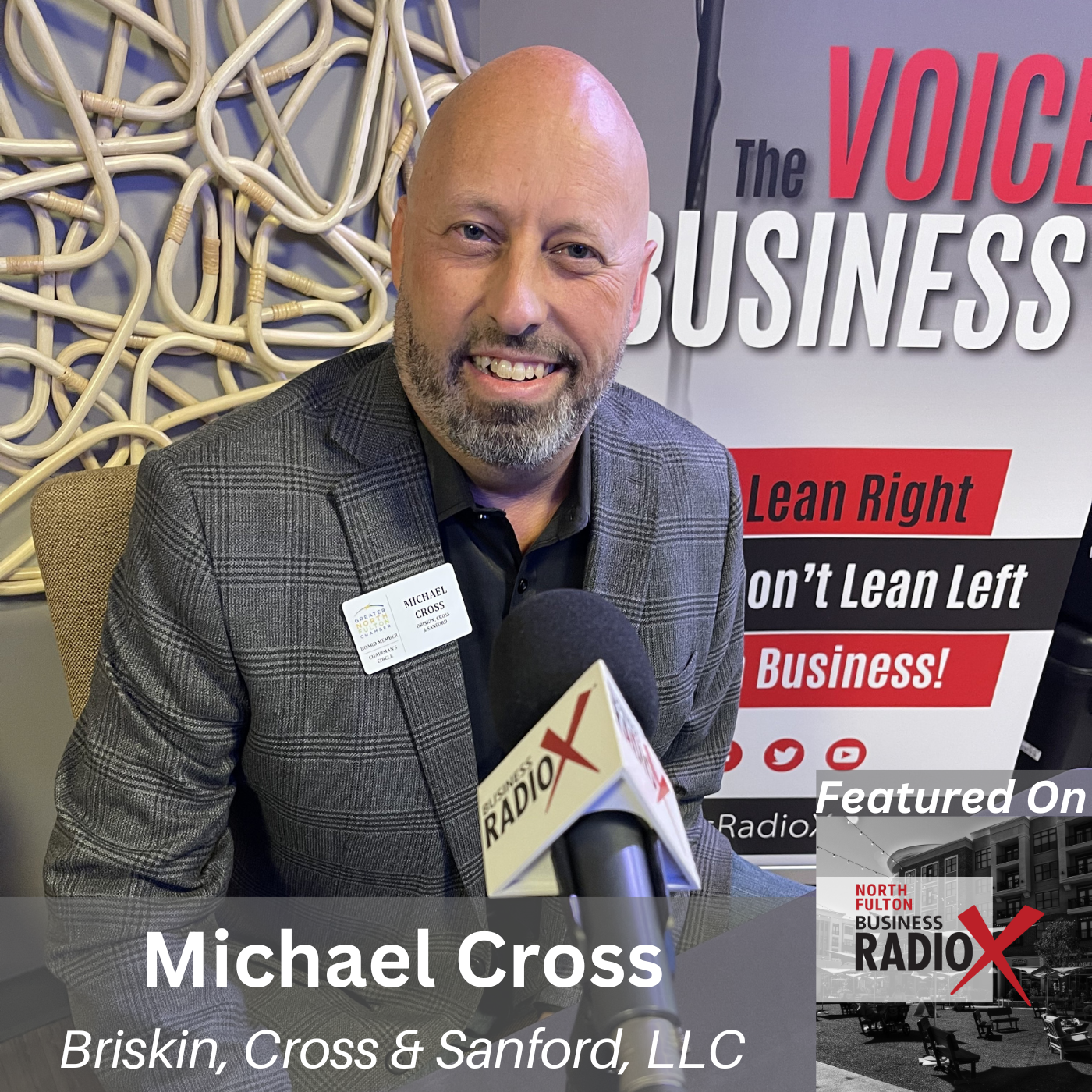
Michael Cross, Briskin, Cross & Sanford, on Women Leaders

August 25, 2025 by John Ray

Michael Cross, Briskin, Cross & Sanford, LIVE from the 2025 GNFCC BOLD Women’s Leadership Summit, on North Fulton Business Radio with host John Ray
North Fulton Business Radio
Michael Cross, Briskin, Cross & Sanford, on Women Leaders
Loading
00:00 /
RSS Feed
Share
Link
Embed

Download file

Michael Cross, Briskin, Cross & Sanford, LIVE from the 2025 GNFCC BOLD Women’s Leadership Summit, on North Fulton Business Radio with host John Ray

Michael Cross, Briskin, Cross & Sanford, LIVE from the 2025 GNFCC BOLD Women’s Leadership Summit (North Fulton Business Radio, Episode 896)

Michael Cross, partner at Briskin, Cross & Sanford, joined host John Ray live from the 2025 GNFCC BOLD Women’s Leadership Summit to highlight his firm’s sponsorship of the event and their long-standing support for the Greater North Fulton Chamber of Commerce.

Michael shared the history of the Alpharetta-based law firm, which has served the North Fulton community for over 30 years with business law, real estate, and dispute resolution services. He emphasized the importance of sound agreements for business partners, drawing from his own experience to stress how planning ahead prevents conflict.

He also reflected on why the firm values its Chamber membership, how supporting events like the Women in Leadership Summit helps both their clients and their team, and why he personally enjoys learning from the many accomplished women who lead and participate in the summit. Beyond his legal work, Michael offered a glimpse into his creative side, discussing his passion for singing, songwriting, and even leading the Crossroads Vocal Band.

This interview was originally broadcast live from the 2025 GNFCC BOLD Women’s Leadership Summit held on August 12, 2025, at The Commons at Phase in Alpharetta, Georgia. John Ray Co. and North Fulton Business Radio were the Media Sponsors for this year’s Summit.

Topics Discussed in this Episode

0:00 Introduction and Event Overview
00:39 Meet Michael Cross from Briskin, Cross & Sanford, LLC
01:48 The Importance of Proper Business Paperwork
03:36 Sponsorship and Community Involvement
04:45 Michael’s Musical Hobby and Innovative Legal Thinking
07:10 Conclusion and Appreciation

Michael Cross, Partner, Briskin, Cross & Sanford, LLC

Michael D. Cross, Jr., is a partner at Briskin, Cross & Sanford, LLC, in Alpharetta, Georgia, where he has practiced since 1999. His legal work centers on business transactions, mergers and acquisitions, employment law, commercial real estate, and nonprofit corporation law. Michael also assists clients with matters such as partnership and LLC law, franchise issues, and the formation of tax-exempt organizations.

In addition to his law practice, Michael is a frequent writer and speaker on business law topics and has served as an adjunct professor at Reinhardt University. He has held influential roles in multiple civic and economic development boards, including the Greater North Fulton Chamber of Commerce and Alpharetta’s Downtown Development Authority. Michael’s educational background includes a J.D. from Emory University, an LL.M. in Taxation from the University of Alabama, and a B.A. from Anderson University.

LinkedIn | BCS Website

2025 GNFCC BOLD Women’s Leadership Summit

The 2025 GNFCC BOLD Women’s Leadership Summit was held on Tuesday, August 12, 2025, at The Commons at Phase in Alpharetta, Georgia.

The mission of BOLD—Businesswomen Organizing for Leadership and Development—is to connect businesswomen to build outstanding networks and spheres of influence, to collaborate with each other and with partner organizations to develop their businesses, and to celebrate and recognize the women of North Fulton.

Website

Greater North Fulton Chamber of Commerce (GNFCC)

The Greater North Fulton Chamber of Commerce is a private, non-profit, member-driven organization comprised of over 1,400 business enterprises, civic organizations, educational institutions, and individuals. Their service area includes Alpharetta, Johns Creek, Milton, Mountain Park, Roswell, and Sandy Springs. GNFCC is the leading voice on economic development, business growth, and quality of life issues in North Fulton County.
As a five-star accredited chamber, GNFCC’s vision is to be the premier organization driving member and community success across the region, and they are dedicated to pursuing this vision based on the guiding principles of advocacy, inclusivity, and operational excellence.

GNFCC promotes the interests of their members by assuming a leadership role in making North Fulton an excellent place to work, live, play, and stay. They provide one voice for all local businesses to influence decision-makers, recommend legislation, and protect the valuable resources that make North Fulton a popular place to live.

For more information on GNFCC and its North Fulton County service area, follow this link or call (770) 993-8806. For more information on other GNFCC events, follow this link.

Connect with GNFCC:  Website | LinkedIn | Facebook | Instagram

About North Fulton Business Radio and host John Ray

With over 890 episodes and having featured over 1,300 guests, North Fulton Business Radio is the longest-running podcast in the North Fulton area, covering business in our community like no one else. We are the undisputed “Voice of Business” in North Fulton!

The show invites a diverse range of business, non-profit, and community leaders to share their significant contributions to their market, community, and profession. There’s no discrimination based on company size, and there’s never any “pay to play.” North Fulton Business Radio supports and celebrates businesses by sharing positive stories that traditional media ignore. Some media lean left. Some media lean right. We lean business.

John Ray, host of  North Fulton Business Radio, and Owner, Ray Business Advisors
John Ray, host of North Fulton Business Radio and Owner, Ray Business Advisors

John Ray is the host of North Fulton Business Radio. John and the team at North Fulton Business Radio, LLC, an affiliate of Business RadioX®, produce the show, and it is recorded inside Renasant Bank in Alpharetta.

The studio address is 275 South Main Street, Alpharetta, GA 30009.

You can find the full archive of shows by following this link. The show is available on all the major podcast apps, including Apple Podcasts, Spotify, Google, Amazon, iHeart Radio, and many others.
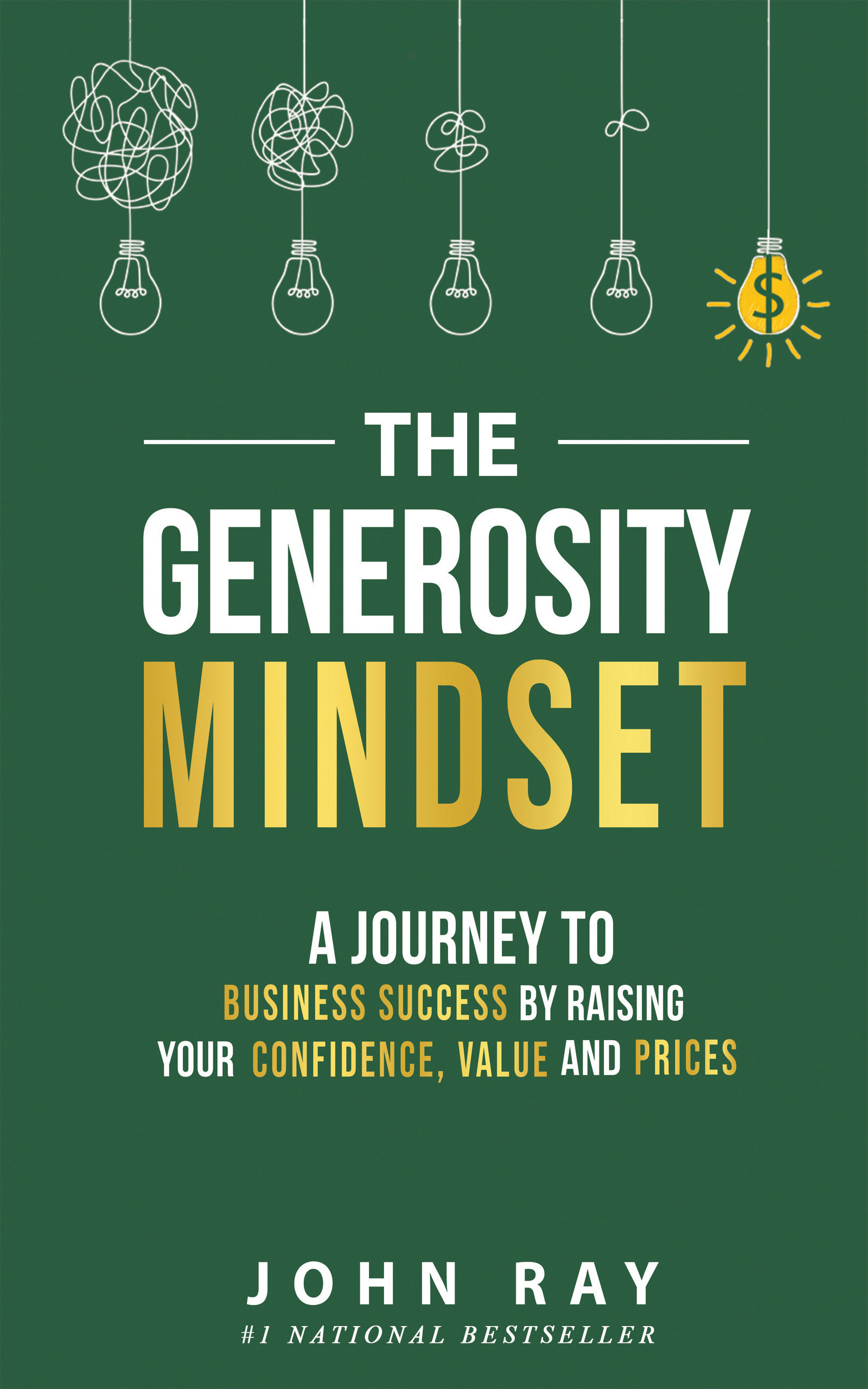
John Ray, The Generosity MindsetJohn Ray also operates his own business advisory practice. John’s services include advising solopreneurs and small professional services firms on their value, their positioning and business development, and their pricing. His clients are professionals who are selling their expertise, such as consultants, coaches, attorneys, CPAs, accountants, bookkeepers, marketing professionals, and other professional services practitioners.

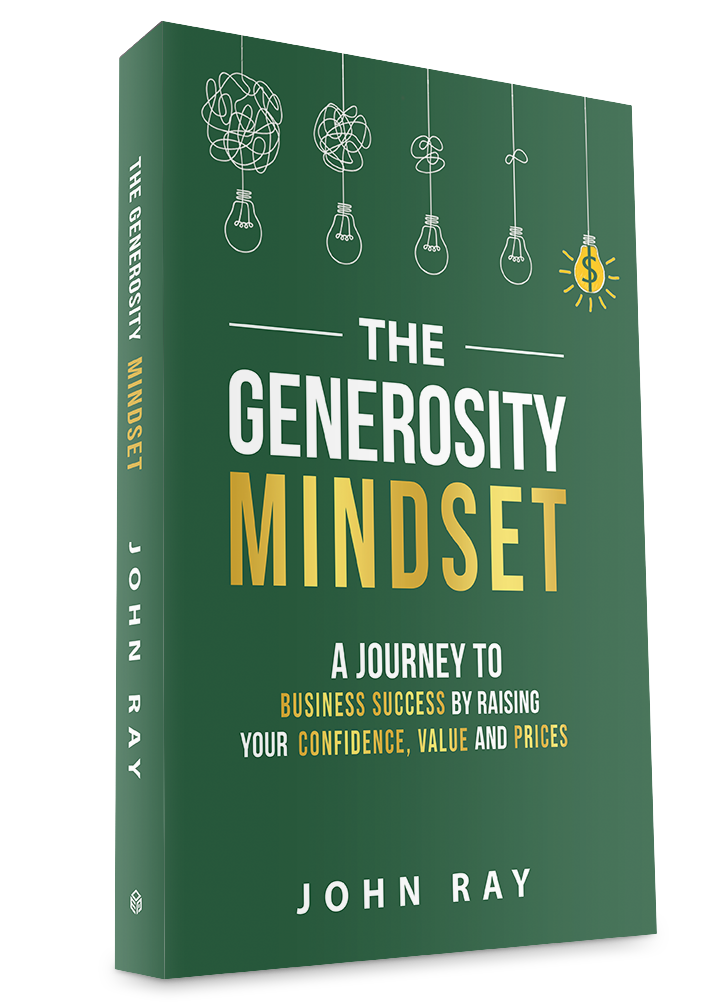
John is the national bestselling author of The Generosity Mindset: A Journey to Business Success by Raising Your Confidence, Value, and Prices.

Renasant Bank supports North Fulton Business Radio

Renasant BankRenasant Bank has humble roots, starting in 1904 as a $100,000 bank in a Lee County, Mississippi, bakery. Since then, Renasant has become one of the Southeast’s strongest financial institutions, with over $17 billion in assets and more than 180 banking, lending, wealth management, and financial services offices throughout the region. All of Renasant’s success stems from each banker’s commitment to investing in their communities as a way to better understand the people they serve. At Renasant Bank, they understand you because they work and live alongside you every day.

Website | LinkedIn | Facebook | Instagram | X (Twitter) | YouTube

Beyond Computer Solutions supports North Fulton Business Radio

If you’re a law firm, medical practice, or manufacturer, there’s one headline you would rather not make: “Local Business Pays Thousands in Ransom After Cyberattack.” That’s where Beyond Computer Solutions comes in. They help organizations like yours stay out of the news and in business with managed IT and cybersecurity services designed for industries where compliance and reputation matter most.

Whether they serve as your complete IT department or simply support your internal team, these professionals are well-versed in HIPAA, secure document access, written security policies, and other essential aspects that ensure your safety and well-being. Best of all, it starts with a complimentary security assessment.
Website | LinkedIn | Facebook | YouTube

Tagged With: 2025 GNFCC BOLD Women in Leadership Summit, Alpharetta business, Alpharetta law firm, Beyond Computer Solutions, Briskin Cross & Sanford, business law, community leadership, dispute resolution, GNFCC, Greater North Fulton Chamber of Commerce, John Ray, legal services, Michael Cross, North Fulton Business Radio, real estate law, renasant bank, Sponsorship, Women in Business, Women in Leadership

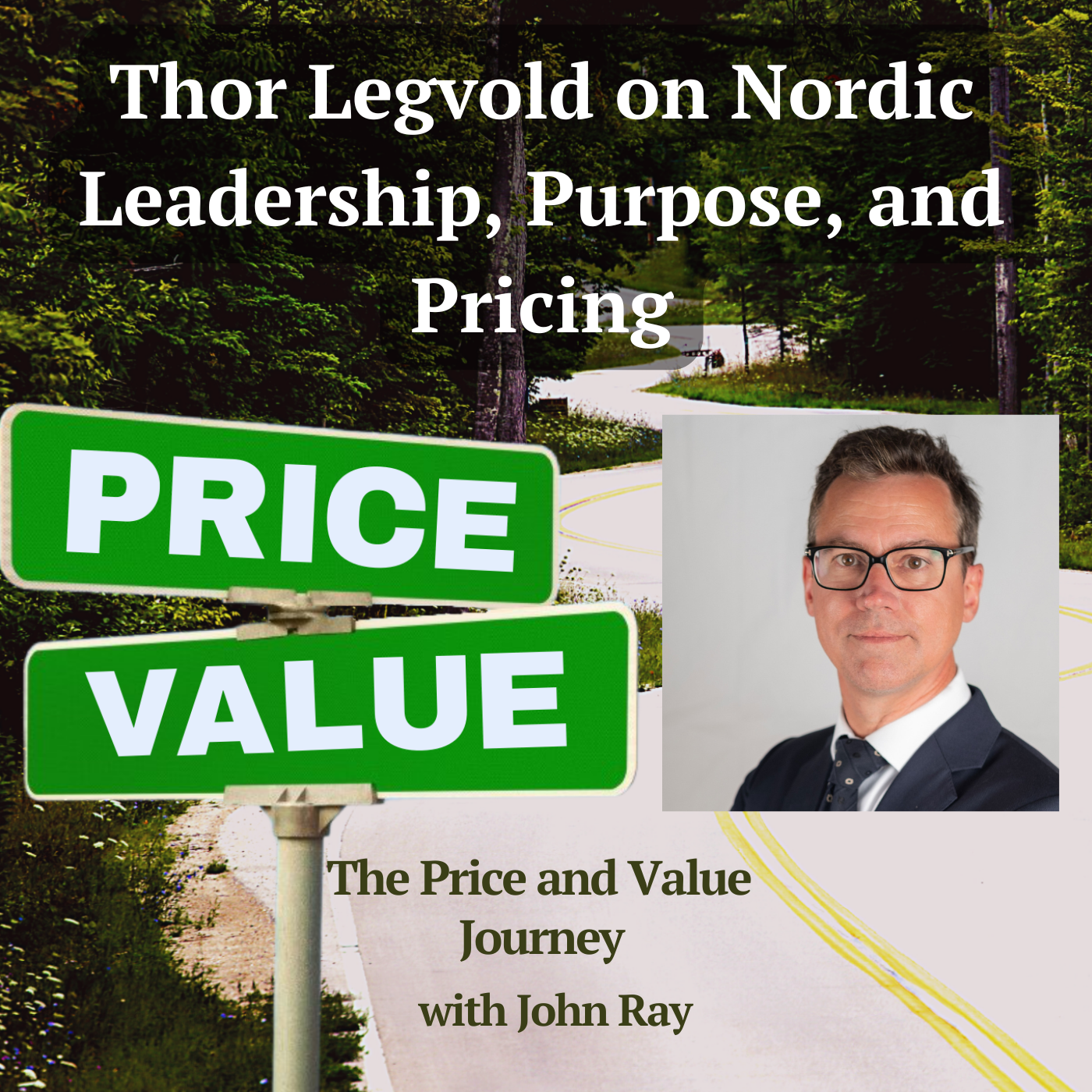
Richard W. Smith on Moving from Price Taker to Price Setter

August 20, 2025 by John Ray

Richard W. Smith on Moving from Price Taker to Price Setter, on The Price and Value Journey podcast with host John Ray
North Fulton Studio
Richard W. Smith on Moving from Price Taker to Price Setter
Loading
00:00 /
RSS Feed
Share
Link
Embed

Download file

Richard W. Smith on Moving from Price Taker to Price Setter, on The Price and Value Journey podcast with host John Ray

Richard W. Smith on Moving from Price Taker to Price Setter (The Price and Value Journey, Episode 144)

In this episode of The Price and Value Journey with host John Ray, Richard W. Smith explains how professional service providers can stop undervaluing themselves and make the shift from being price takers to price setters. Drawing on decades of experience guiding law firms and other professionals, Richard shows how confusing professional value with commercial value often leads to underpricing, overwork, and the wrong client relationships.

He unpacks why professionals should avoid pricing their own work, how commercial imposter syndrome can quietly erode profitability, and why saying yes to the wrong opportunities is a silent killer of margin. Richard also offers practical advice for navigating RFPs and tenders, developing an ideal client persona, and asking budget questions early in the conversation.

You will hear how to build more balanced client relationships, strengthen your pricing confidence, and free yourself to focus on the clients and opportunities that matter most.

The Price and Value Journey is presented by John Ray and produced by North Fulton Business Radio, LLC, an affiliate of the Business RadioX® podcast network.

Key Takeaways You Can Use from This Episode

  • A reminder that your professional expertise is not the same as the commercial value clients look for.
  • Why getting an outside perspective on your pricing can help you avoid undervaluing your work.
  • How saying “no” to the wrong clients or matters can protect your profitability.
  • What to keep in mind when responding to RFPs and tenders, including the importance of identifying the true decision-maker.
  • Why asking about client budgets early is a fair and useful way to qualify opportunities.
  • How to think about AI as a tool to free up more time for building client trust and relationships

Topics Discussed in this Episode

00:00 Introduction to Richard W. Smith, GSJ Consulting
02:15 Understanding Business Drivers
03:27 Professional vs. Commercial Value
06:09 Pricing Strategies and Challenges
07:24 Commercial Imposter Syndrome
09:40 Navigating Client Relationships
11:40 The RFP Process
15:57 Ideal Client Persona
21:11 Long Sales Cycles and Immediate Wins
22:40 Balancing Short- and Long-Cycle Strategies
23:39 Educating Clients on Your Services
25:21 The Role of AI in Business Development
28:51 The ‘No’ Strategy: Avoiding Bad Fits
35:19 Tailoring Proposals and Maintaining Pricing Integrity
39:28 Advice for Small Firms on Business Development
44:29 Conclusion and Additional Resources

Richard W. Smith, GSJ Consulting

Richard W. Smith, GSJ Consulting

Richard W. Smith is a highly experienced business development strategist and pricing consultant, specializing in growth strategies and client acquisition for professional services firms.

Based in Sydney, Australia, Richard is the Director of GSJ Consulting, a boutique agency he founded in June 2023. At GSJ Consulting, he works closely with clients to design and implement practical, results-driven plans for sustainable revenue growth, focusing on areas such as pricing strategy, business development audits, client targeting, bid and tender management, onboarding, and account management coaching. His approach is defined by a philosophy of “Acquire–Retain–Grow,” and he is recognized for his ability to help firms transition from price-takers to price-setters and secure millions in additional profit through tailored solutions.

Richard’s professional journey includes significant roles in prominent law firms and consulting agencies. He has served as Associate Director of Business Development at Sparke Helmore Lawyers and held leadership roles in business development and marketing at Hicksons Lawyers, DLA Piper, Herbert Geer, DLA Phillips Fox, and Linklaters. With over 30 years of experience supporting tender and bid submissions across private and government sectors, Richard also leads BidWizard-AU, assisting clients in preparing compelling proposals to win high-value contracts.

Richard is a graduate of the University of Westminster (LLB, Law) and is known for his collaborative style, innovation in legal marketing, and commitment to delivering actionable, sustainable growth for his clients.

Website | LinkedIn

John Ray, Host of The Price and Value Journey

John Ray, Author of The Generosity Mindset and Host of The Price and Value Journey

John Ray is the host of The Price and Value Journey.

John owns Ray Business Advisors, a business advisory practice. John’s services include business coaching and advisory work, as well as advising solopreneurs and small professional services firms on their pricing. John is passionate about the power of pricing for business owners, as changing pricing is the fastest way to change the profitability of a business. His clients are professionals who are selling their expertise, such as attorneys, CPAs, accountants and bookkeepers, consultants, coaches, marketing professionals, and other professional services practitioners.

In his other business, John is a podcast show host, strategist, and the owner of North Fulton Business Radio, LLC, an affiliate of Business RadioX®. John and his team work with B2B professionals to create and conduct their podcast using The Generosity Mindset® Method: building and deepening relationships in a non-salesy way that translates into revenue for their business.

John is also the host of North Fulton Business Radio. With over 880 shows and having featured over 1,300 guests, North Fulton Business Radio is the longest-running podcast in the North Fulton area, covering business in its region like no one else.

John’s book, The Generosity Mindset: A Journey to Business Success by Raising Your Confidence, Value, and Prices

The Generosity Mindset, by John RayJohn is the #1 national best-selling author of The Generosity Mindset: A Journey to Business Success by Raising Your Confidence, Value, and Prices.

If you are a professional services provider, your goal is to do transformative work for clients you love working with and get paid commensurate with the value you deliver to them. While negative mindsets can inhibit your growth, adopting a different mindset, The Generosity Mindset®, can replace those self-limiting beliefs. The Generosity Mindset enables you to diagnose and communicate the value you deliver to clients and, in turn, more effectively price to receive a portion of that value.

Whether you’re a consultant, coach, marketing or branding professional, business advisor, attorney, CPA, or work in virtually any other professional services discipline, your content and technical expertise are not proprietary. What’s unique, though, is your experience and how you synthesize and deliver your knowledge. What’s special is your demeanor or the way you deal with your best-fit clients. What’s invaluable is how you deliver outstanding value by guiding people through massive changes in their personal lives and in their businesses that bring them to a place they never thought possible.

Your combination of these elements is unique in your industry. There lies your value, but it’s not the value you see. It’s the value your best-fit customers see in you.

If pricing your value feels uncomfortable or unfamiliar to you, this book will teach you why putting a price on the value your clients perceive and identify serves both them and you, and you’ll learn the factors involved in getting your price right.

The book is available at all major physical and online book retailers worldwide. Follow this link for further details.

Connect with John Ray:

Website | LinkedIn | Twitter

Business RadioX®:  LinkedIn | Twitter | Facebook | Instagram

Tagged With: Business Development, client acquisition, commercial imposter syndrome, commercial value, GSJ Consulting, ideal client persona, imposter syndrome, John Ray, law firm business development, price taker vs price setter, pricing consultant, procurement, professional services profitability, professional services strategy, professional value, request for proposals, RFP, Richard W. Smith, saying no strategy, small law firms, tenders, The Price and Value Journey

Nurse Practitioners: Filling the Gaps in American Healthcare

August 12, 2025 by angishields

TechTalk-NPHub-Feature
Tech Talk
Nurse Practitioners: Filling the Gaps in American Healthcare
Loading
00:00 /
RSS Feed
Share
Link
Embed

Download file

Nurse Practitioners: Filling the Gaps in American Healthcare

In this episode of Tech Talk, Joey Kline interviews Krish Chopra, CEO and founder of NPHub, an Atlanta-based startup focused on healthcare innovation. Krish shares his journey from corporate sales to entrepreneurship, discusses the challenges of scaling NPHub, and highlights the company’s mission to address the primary care shortage by supporting nurse practitioners through clinical placements and job matching.

Krish-ChopraKrish Chopra is a serial entrepreneur, investor, and the founder & CEO of NPHub, the leading platform for Nurse Practitioners to secure clinical placements and land their ideal jobs.

Since 2017, NPHub has helped over 10,000 NP students complete their rotations and now powers the first AI-driven job board built exclusively for NPs—bringing transparency and efficiency to a fragmented hiring market.

A three-time Inc. 5000 CEO and Inc. 30 Under 30 honoree, Krish has bootstrapped multiple ventures and leads a global team of over 70 across 10 countries. He’s also the author of NP Jumpstart, a guide that helps Nurse Practitioners grow and market their own practices.

A first-generation Indian-American and University of Michigan alum, Krish is passionate about solving systemic bottlenecks in healthcare and creating platforms that empower overlooked communities. He’s currently based in Atlanta.

Connect with Krish on LinkedIn.

Episode Highlights

  • Healthcare innovation and its importance in the U.S. healthcare system.
  • The role of nurse practitioners (NPs) in addressing physician shortages.
  • Challenges faced by healthcare providers, including long wait times and lack of access.
  • The mission of NP Hub to improve healthcare accessibility through support for NPs.
  • The entrepreneurial journey of Krish Chopra and his transition from corporate sales to founding NP Hub.
  • The business model of NP Hub as a two-sided marketplace for clinical placements and job matching.
  • The significance of maintaining company culture and leadership during growth.
  • The fundraising process and challenges faced by early-stage companies in Atlanta.
  • Differences between nurse practitioners and physician assistants in terms of training and approach to patient care.
  • The potential for technology-driven solutions to enhance patient care and address workforce shortages in healthcare.

Transcript-iconThis transcript is machine transcribed by Sonix


TRANSCRIPT

Intro: Coming to you live from Atlanta, Georgia. It’s time for another episode of Tech Talk with your host, Joey Klein.

Joey Kline: Welcome. Welcome to another Tech Talk. I think that this is actually the first one that we have done all summer. We’ve been a little bit dormant. So thanks everyone for tuning in. We’ve got a really great conversation that is going to focus on the healthcare world today. Local Atlanta early stage company and NPHub CEO and founder Krish Chopra. How are you doing, Krish?

Krish Chopra: I’m doing well, man. Thank you so much for having me here today.

Joey Kline: Yeah, absolutely. Looking forward to chat about this. So before we started rolling here, you mentioned that you were from New York. And I always like to understand how people get to where they got to. So give me the story of New York to Atlanta and whatever was in between, if anything.

Krish Chopra: So the story I always tell is. I was born and raised in New York City. Right. Born in Queens, Brooklyn. Been tons of times just exploring and loving New York. When I went to undergrad, I applied to Michigan, got in one of the better schools I got into, and so I wanted to go. And after Michigan, I had a decision to make of where do you go? You know, where am I going to sort of put down roots. And you know how a lot of people in college, they sort of think of, I’m going to go kind of start my life and become who I want to be in New York or LA or the Bay. The the issue was, I’m from New York, and so I didn’t have that luxury. Right. You go back and you have a family. You have a, you know, friends pressure and and for me to get the chance to restart. I was I was in Atlanta for a training program, um, right out of undergrad for six months. Like the city. Enough. And what I loved about it was also the cost of living. And so when I was in New York working for a couple of years, I moved back to Atlanta to start my company because my burn would last longer. Yeah, I only had a certain amount of money saved up and I needed to figure it out. And so in New York, that might have lasted 3 or 4 months, but in Atlanta it lasted six. Seven. And so that was critical, you know.

Joey Kline: So did you go straight from undergrad to entrepreneur?

Krish Chopra: No no no, no. I always I refer to myself as sort of like a, um, uh, what’s the word I’m looking for, like a converted entrepreneur. There’s some people that are born and bred and that’s kind of, you know, they never had a job. They had a, you know, newspaper selling business as a kid. That was not me. Yeah, I was in corporate sales out of undergrad for two years and from 22 to 24. Sounds about right. And moved down at that point to start my company. And the main reason why was in corporate America, I was very much a cog in a wheel. And what in the nicest way possible, what I did didn’t make a difference every day. So if I didn’t show up, it didn’t matter. And so nothing hurt. More like, you know, psychologically speaking of like, you know, I was a as a seller, I was ranked 17th out of a thousand sellers. Yeah. When I was, when I left my last six months in. Not bad and no one had asked me to stay. They didn’t backfill the role. And so if you’re a good seller and they’re not doing that, then you really have to think about what’s the whole point of this. And so starting a company was really just a matter of finding a place to fit in.

Joey Kline: Yeah, I hear that. And I think your point is a I, I, I have you heard the saying like there are two kinds of people in this world. People who think there are two kinds of people in this world. Everyone else. To some degree that is true. But when it comes to entrepreneurs, I really do think that they typically fall into two buckets. One are those that could never take orders, needed autonomy, couldn’t deal with authority. Um, from day one. Right. And they had the paper route, whatever it was, and it was just a foregone conclusion that I could never work for the the man, quote unquote. And then there are others that come to it almost because they have to either they have to because they just find the corporate world insufferable. They have to because they have an idea and they can’t shake it, whatever it is. Um, and there’s nothing wrong with either one of those, right? Most people get to the same place. You sound very much like you were in the second bucket 100%.

Krish Chopra: Because I didn’t fit into corporate America. Uh, the way I talk, the way I communicate, I’m very much. Let’s get it done. We don’t have to say it the best way possible. We don’t have to politic this. We just need to. What’s the actual answer? What’s the best thing to move forward here? And I felt like I had a ceiling in corporate America. Like I would maybe I would get a promotion, maybe. And I would camp out there because I didn’t play the game, I didn’t know how to play the game. And even now, that’s not part of my repertoire, if that makes sense.

Joey Kline: Yeah, yeah. Well. And do you ever wonder and we’re gonna, we’re gonna want to ask this question, then just double back to what NP hub does. Because anyone listening, I want them to just know right off the bat. But okay, you’re growing your company, right? And right now you are very far from being a large, stodgy corporate institution. Okay, but I imagine that you have high goals for your organization. Okay. You want to grow it? I’m sure, as big as it can get. Right. So do you ever get look. Sometimes as the organization grows, the founder’s vision and the founder’s personality gets stamped out a little bit. And so I’m curious, do you ever wonder to yourself, like, okay, if I make this thing, what? As big as I think it should be. Is it going to turn into something that I don’t want it to?

Krish Chopra: Yeah. You’re hitting the nail on the head. I think about that all the time, especially recently. So we just completed a series investment and I was ready for what that entailed. But I think once you receive it and then you really understand, hey, these are the growth objectives. This is the investors behind you. And this is a company that they can’t. You know it’s a minority round. And so I’m still in the majority owner. It’s still a matter of managing on what good looks like from their sort of playbook and their sort of concepts here. I think about it nonstop lately, and I think the only answer. It’s a work in progress. Um, the biggest answer I have is making sure you spot correct the behaviors you don’t want. Like you might have friction between the business unit and product, and that shouldn’t exist at this level. Like you kind of intuitively know it and I feel it. And so you have to nip that in the you have to nip in the bud. You have to continue to make sure that the people managing the people now, they’re the ones that get the culture you want. And so it’s the it’s it’s your executive team. It’s your senior leadership team. And it’s your management management team as well, like the managers in the org. So if they follow it, that’s the best way to make sure that the new person being hired, who I might not have a lot of FaceTime with, they have they know from osmosis and even though it gets diluted down, is never going to be perfect. Instead of it being like 10% of what you want, it’s maybe closer to 67 to 80. And you can live with that.

Joey Kline: Yeah. Look, again, there’s only so much that you can do because you’ll drive yourself nuts with everything else that you have to do. Of course.

Krish Chopra: That that’s.

Joey Kline: True. Yeah. Um, okay, let’s let’s get back to, uh, value proposition, mission product. Um, let’s put it out there. What y’all do? What problem y’all are trying to solve.

Krish Chopra: So NP hub, we’re trying to save healthcare in the US. We all know healthcare is broken. We all know that. We go to the we go. We have to wait months to go get an appointment. We don’t have price transparency. And in a lot of ways, you can’t even get in front of providers and in many cases in many parts of the country. So that we’re solving for that by enabling nurse practitioners this incredible sort of provider group that’s spun up over the since the last, like 60 or 70 years, it’s grown in droves. So the fast growing profession in the US, they lack resources, they lack support, and we’re trying to solve for that. And we’re doing that by providing them clinical placements. So that way they can graduate and become great providers. So they get great education. And then we’re helping them get their first and second and third fourth jobs. And so it’s all about alignment where you’re creating this transparency between the candidates, these graduates, these nurse practitioners and market and employers who want to connect with them. They want to hire the right people. And so how do you put them together in a way where there’s less noise in the system and you’re hiring better fits in both sides, like you’re you’re finding a better job if you’re a candidate and you’re finding a better employee if you’re an employer. And so that you have longevity. And that’s what we’re solving for.

Joey Kline: Okay. So I can also imagine you in, in a, in a pitch starting out saying we’re going to save healthcare, which is obviously an extremely lofty, ambitious statement that that gets someone’s attention. Mhm. Um, so look, I think anyone listening, even if they don’t know the ins and outs that, you know, we’re spending 17% Plus, you know, about all of our GDP on healthcare right now. Could say just from an anecdotal experience. Yes. You know, healthcare as is, generally benefits the top 10% of the income ladder. And for everyone below that, you know, leaves quite a bit to be desired. Um, and even for the top ten, right. A bit to be desired. So what why does the focus on the nurse practitioner save healthcare?

Krish Chopra: So when you think about healthcare, think about the entry point of healthcare. We’re seeing primary care physicians and there’s simply not enough of them. And so, you know, for for the multitude of reasons of why that is the case, by the I think it’s 2035 or 2037, there’s going to be a shortage of 160,000 primary care physicians. And so how is the US, the United States, filling this void while they’re filling this void with this new type of provider in market, which are nurse practitioners and physician assistants? And I don’t mean to say that there are new type of provider, but relative to what a physician and the history of what physicians are, you know. Going back hundreds of years. And so you have these new providers and. They’re really becoming the entry point and even in many cases, specialization. The entry point of healthcare. And when we are talking about how do we get appointments faster, how do we not wait three months, how do we see a provider for more than five minutes and not feel like where you are? You know, you we all know that feeling of going.

Joey Kline: Where you’re just a number.

Krish Chopra: You’re a number, you’re you’re in, you’re out. You didn’t catch your name. They didn’t ask you the second question. They said, what are you feeling today? Okay. Got it. Here’s your medicine. You’re out. That’s not health care. It’s a transaction. And I think nurse practitioners, physician assistants, they fit this model, um, in there where they’re actually caring for their patients. And that’s what we need, I think, in the US.

Joey Kline: Okay. So you’re saying because we are going to have a shortage of primary care internist. Another to synonym for those out there um that nurse practitioners pays lower barrier to actually become one. I mean, just from a number of years that it takes to actually get into it. Cost years. Um, you know, the medical school. Um. Uh, gantlet is not a cheap, uh, or easy one or for the faint of heart. So, uh, it I’m I’m putting words in your mouth. You’re gonna tell me if I’m correct or not? Basically, you have another form of practitioner provider that maybe doesn’t fill all healthcare needs, but gets us up 50, 60% of the way there. Of what an internist, um, primary care physician would do. And if we’re better able to get those folks trained, staffed and distributed, that then helps, um, stem the problem of not enough internists in the market.

Krish Chopra: Exactly. Accessibility is the number one concept we’re trying to solve for, because once you solve accessibility, Then you can move into every other topic, right? So 100% exactly what you said. I have this belief that healthcare should be run where your entry point. Right. Like if I’m sick or you’re sick and you know your child is sick and you have to go to urgent care and you know, you have the flu, you know, you have a cold, you don’t need to necessarily see someone with eight years of post-graduate experience. It’s okay to see a nurse practitioner, a physician assistant. And in certain cases it gets escalated up where the physician in my mind becomes this floor general. Sure. And they’re available. They’re available as needed. And now you’re prioritizing the time for the physician to see complex cases that might be out of scope for the nurse practitioner or PA. But I’ll tell you, from everything I’ve seen over the last seven years of building this company, the number many, especially primary care providers, especially mental health providers, the fastest growing profession. Yeah, for healthcare, for inside healthcare, right now, they’re able to accomplish 60, 70, 80%. And in most cases that’s good for us, the patients.

Joey Kline: Yeah, it almost feels like it kind of feels like this is what granted, it’s a much smaller band of the human body of healthcare, but it’s almost like going to the dentist, right? I mean, like you primarily see the dentist at the end of your appointment or if something is really, really complex and, you know, the front line assistant cannot take care of it, but much of their time is spent strategically on more complex issues than the, um, traditional work of dentistry.

Krish Chopra: I think it’s a really fair analogy. Um, a fair analogy.

Joey Kline: There. Sure, there might be some, you know, crudeness around the edges there, but that was what came to mind initially.

Krish Chopra: And I think it makes sense. Right. When we go to a physician or sorry, we’re going to a practice, the first person you see is usually the Ma who’s kind of doing some of the basics, right, taking or charting, maybe capturing your blood pressure, that absolutely still should be done. And again this is about best use of of time. Best. Most efficient use of time. And for whatever reason it is, there just aren’t enough residency slots for physicians. Yep. And so until that fixes, we, you know, us as patients, us in the in the US. We can’t wait for that that that to occur. That’s right. Right. There’s the you know, we were talking about this before the podcast started. There’s politics involved with that. There is, uh, regulations, nuances. It’s politicized. That is not the game we’re in. We’re in the game of this is the problem. We’re trying to solve the problem of accessibility.

Joey Kline: Yeah. People’s health cannot wait for the government to, you know, get out of its own way.

Krish Chopra: That is the best statement so far.

Joey Kline: Yeah.

Krish Chopra: Yeah.

Joey Kline: Do you have a healthcare background?

Krish Chopra: I do not know. Okay. I’m not smart.

Joey Kline: Enough. Yeah. Okay. So how did this come to you?

Krish Chopra: Um, so my very first successful company I started. Successful? Meaning that it didn’t fall apart in three months. Sure. Um, was a similar business where we were working with medical schools, typically schools in the Caribbean or national medical schools in the Caribbean. We were one of the first companies to go to the Philippines and source medical students there, and we brought them to the US for clinical education so they could apply to residency in the US, or they could take that education and go back to their own countries and uh, usually, um, get better, better paying jobs or, you know, more prestigious clinical placements. Yep. We did that for about three years. And in that time we started having nurse practitioners reach out to us randomly. And my entire thesis was, there’s no way us educated nurse practitioners have this problem. It must be a one off, two off. And so for a period of time, we didn’t listen to them and we didn’t listen to the market. Like any, you know, young entrepreneur always misses. And that was that was us. And so eventually one student turned to 500 to 120. And then we realized this nurse practitioner gap is bigger. There were no other competitors in the field, meaning that from a if these students are my medical company, my first company, if these students didn’t work with us, they had alternatives. There’s ten other companies like us for these nurse practitioners. If these students didn’t use us, they didn’t graduate. And so you had the ability to have a larger impact. And then you had the second is there was no one else in the field. So we got to innovate. Yeah. And so I got to build we got to build a platform, build the technology to enable scale. And we would never have been able to do that in a proven sort of like third generation older school dynamic in the medical space of what we were in.

Joey Kline: Sure. That’s the it is the unintended consequence of being in business and learning something that you didn’t set out to to figure out.

Krish Chopra: Mm, 100%.

Joey Kline: Um, okay. So is your direct client, the healthcare system, the practice? How does the product actually work?

Krish Chopra: So we have this overarching platform and we have a we have different products involved. And so on. Our first product, we work with students and we work with universities, and we have in the network of clinical placements that these students or schools will come to us, will provide that for their students. Or at the end of the day, we’re helping the students graduate, whether we’re through the university or student directly. Now that’s product number one. And so in that model, your customers, it’s a marketplace, right. So you ask Airbnb who their customer is. They’re going to say both right. Is it the host or the visitor. Well you need both to survive. So in that model the clinical sites which are the clinics, the hospitals, those are our, our our they’re part of our network. And then we have the universities and the students, and they’re part of our sort of client base on the hiring platform, similar model. We have candidates and then we have employers. And so employers are the people we are, you know, reaching out to and communicating that we have this platform that no one else in the country has. We have this data on, on, on quality control that no one else can provide. That’s what we’re doing there.

Joey Kline: Okay. But okay. So yes, I understand you are. You are a classic two sided marketplace. But how do you actually get paid?

Krish Chopra: Um, on product one that we mentioned, the marketplace, the clinical placement marketplace, it’s students or universities. Okay. And on the hiring platform, it’s employers.

Joey Kline: Okay. That’s what I figured but wanted to clarify okay. All right. So you mentioned earlier that you just raised your series A obviously a really big milestone for any organization. What what happens next? Is it about market reach? Is it about new products? All the above. What’s the plan?

Krish Chopra: It is. It’s really everything, right? You know, you’re sort of supposed to amplify every single thing you’re doing. Yeah, I can tell you that to date, we’ve spent so much time getting our process on working with students directly down, and we are excellent at that. That is what got us to scale. And so the next phase of growth for us is now saying, hey, we worked with these students and we’ve helped thousands of them. Closer to I think actually, we’ve just crossed the 11,000 milestone in terms of students. Now, the next play for us is to really move and speak more with universities, speak more with these employers. Focus on this B2B segment of this because most people, university students, would agree that we all believe it should be accountable to the university on providing clinical placements. And we’re seeing some of that legislation, some of that market, um, uh, sentiment change now around that, where schools want to provide this. It’s a differentiating concept for them. Right? Some schools don’t provide it. Some schools do provide it. The schools that do provider often see of higher tier. And then the second part of it is quality control for when we’re graduating nearly we have 400,000 nurse practitioners right now in school. At any given time there’s about 120,000. There’s 40,000 graduates every single year. These 40,000 quality control now becomes a major, major concern for many of these programs because these students want to be successful and these universities want these students to be of high quality. Mhm.

Joey Kline: Mhm. Okay. Um I you’re a sales guy. I’m a sales guy. I’m always curious in the sales process of how you actually get this out there. Are you, is this an inside sale outside sale kind of model. Is it all, um, you know, internet marketing? I mean, what’s our. Are you hiring a bunch of salespeople to go and make the enterprise sale? Or are you able to pretty easily convert, you know, marketing leads into sales without the help of a large team.

Krish Chopra: So we have a we have a sales team in place. Okay. And so we have two different types. What internally we refer to as the B2C function and the B2B function. So the B2C which is working with the students directly, we have an internal sales team in place there. And they are phenomenal at what they do which is getting to the student, solving their anxiety, solving their concerns, and asking them the appropriate questions to direct them to the best placement possible. And we have AI supporting that effort as well on the B2B function that’s scaling up currently. You’re exactly right. We’re hiring sales reps. A lot of this can be done inside, but it’s less inside outside sales. It’s more of enterprise sales. Sure. And so in many cases it’s zoom. But if you need to be on site, then we’ll get our butts on site.

Joey Kline: Yeah, it depends how big the deal is. Depends how complex the organization is.

Krish Chopra: Exactly. And it depends on what is expected of us from that particular client. Yeah.

Joey Kline: Yeah, I hear that. So, um. And I imagine that you’re so right now, are you national?

Krish Chopra: Yes. We operate, I believe, in 46 of the 50 states. Okay. Um, there’s a few. We’re just not in Hawaii.

Joey Kline: Alaska still, you know, pretty, pretty good count. Mhm. Um, and what was okay had had you ever done a large fundraising round for any of your previous organizations?

Krish Chopra: I have not. This was the first.

Joey Kline: Okay, so I’m curious to hear about what that was like along with, you know, that small job of actually running the company. You’re choosing your words carefully.

Krish Chopra: Brutal was the answer. So we started the fundraising officially in September of last year. Okay. Uh, we we there’s a lot of stages to a fundraising process, and I think a lot of folks focus a lot on getting the term sheet right, which is essentially less of the signal of, hey, we want to partner with you and more of a signal of, we don’t want to get rid of you yet. That makes sense, right? And so if it’s an early step into the investor dynamic investor relationship. And so the first part of this was getting better at how do you secure the term sheet. How are you saying the right things and getting the investors interested and communicating your value proposition effectively. That took time. And so we were under a term with a, um, a, uh, a growth equity company. Uh, at the start of this year, we were expecting to close in January. And towards the end of this, the deal saw the deal started to fall apart. Yeah. And that happens in occasion. And so end of January, the deal started to fall apart. And so we went back to market in February. I’m a big fan of you know, you hit in the face.

Krish Chopra: You don’t, you know, go wallow for a month. You go back out there and pick yourself back up and so confidently, uh, you know, luckily we were able to secure two additional term sheets by, um, by the end of March. And so we had a good turnaround time. And so in those two term sheets, we then we also hired a banker to support us in this effort. And that’s one of the biggest, biggest things I can tell any entrepreneur who is raising their series A, if you should be working with the banker because they are the only representative on your side, that really helps you filter and helps you navigate the dynamic with the investor. And so the investors, they are cutting deals on a 24 over seven basis. They are excellent at cutting a deal. Yep. Entrepreneurs are excellent at running a business. There’s a gap there. And in in a lot of entrepreneurs think they should just go do it themselves. And even many VCs and private equity will tell you, oh no, no, you guys can handle it yourself or you’re fine. But it’s because it’s asymmetric information.

Joey Kline: Of.

Krish Chopra: Course. And so that was a big difference on the on the second time around. In addition to that, we our business was in a really good place. We were continuing our growth trajectory. Everything was working well. And nothing creates more confidence in a fundraising process when you are hitting your numbers during fundraising.

Joey Kline: You are the first person to ever come on here and talk about hiring a banker.

Krish Chopra: I know this is a get in trouble.

Joey Kline: No, no, not not at all. I just I find it interesting because look like To erase middlemen. Obviously that’s not, you know, the. Look, I’m an intermediary. Intermediary? I’m a middleman. Okay. Um, many of us exist for a reason. To enable a transaction, to know both sides. Um, and what you’re saying makes a lot of sense. I have just never had anyone come on and actually talk about that part of it. A lot of people talk about. And this was maybe a little bit more, you know, kind of 5 to 10 years ago. But how hard it is to raise money in Atlanta, that’s changed. But it’s not it’s still not amazing, but it’s changed for sure. Um, but yeah, a lot of it focused on having to go to the northeast and the West Coast, um, as opposed to the actual mechanics of doing it in The Help. It was just interesting. You know.

Krish Chopra: I will tell you that we and I got a lot more success with investors from the northeast, and I think Atlanta has an emerging. Scene and emerging tech scene. So you have, you know, a couple of great conferences. Venture Atlanta, we were a presenter of Venture one a couple years ago. Really helped us along. Um, get out there more. But fundamentally in Atlanta you have more private equity than you do venture. Sure. And so you do have this problem of of people not investing at your stage of series A, and you find that more in the northeast, in the West Coast. And, um, we certainly did. And we eventually, um, um, partnered up with, uh, Edison Partners. They’re Nashville based. Yeah. But funny funny enough, the the lead investor with us, one of the partners there, the we had great rapport, but she was from Boston.

Joey Kline: Yeah. I wonder if I wonder if part of it. It’s interesting because we have an amazing talent scene. Okay.

Krish Chopra: 100%.

Joey Kline: Right. But the level of talent we have, the fundraising or at least the the breadth of fundraising opportunities available and different stages available has not caught up with. I think, where we are from a talent stage, and I’m wondering if part of this has to do with the fact that a lot of the people who have made a massive amount of money that can either, you know, that can be an LP or they can start a fund themselves. There are starting to be more of them who made it in technology in Atlanta, but a lot of them did not make their money in technology. A lot of them made their money in real estate or C-suite gigs at, you know, large fortune 500. And it’s just a very, very different type of investor. I just don’t think that that mindset is not there among those who have the funds to kickstart something like that.

Krish Chopra: So I agree with you 100%. These fundraising rounds develop in reverse, Right. Which is kind of weird. Um, you would think that you would have the you would have organizations funding a series C and D, because those are much lower risk, but it’s not actually how it works. What ends up happening is you have, you know, folks that might have worked at like calendly at the snap, at, um, snap, snap nurse, I mean. Um, and other other, other bigger companies. I made it in from the tech scene in the, in the southeast. They do well and they start angel investing. And you have a fantastic angel investing scene in Atlanta. Totally fantastic.

Joey Kline: Right. It’s like if you’re under a million or like 1 million to 3 million.

Krish Chopra: You have access because you have rise point and that rise point, rise out of the Emory. Um, out of out of Emory B-School over there you have, um, the tech village.

Joey Kline: You have to overline guys.

Krish Chopra: Overline guys, you have um, ATC you have so many opportunities there for sure. Um, uh, tech tech Square Ventures, I think as well. Um, anyhow, and so as you kind of go up and rounds. You know, you go to your series A, series B, etc., that that pool gets smaller. Yeah. And because you have a lot of, uh, I can’t tell you this is the exact reason I can tell you. My inclination on why it occurs is you have less risk appetite in Atlanta, and because you have less risk appetite. You have much you have depressed valuations. I agree. So we got term sheets and we got interest from Atlanta based investors. They were just not understanding the vision of what we want to build here. And they’re seeing us as point A to point B and we’re like well hold on. If we just do point B and see where we are, we’re going to continue to scale up. And that is where for us, at least, we we stopped. We didn’t get the traction or adaptability. I hear that. Yeah.

Joey Kline: Did you wrestle with raising versus not versus just funding from operations? Yeah.

Krish Chopra: For years we didn’t fundraise. We started officially. This company started in 2017. Okay. Um, we raised in 2025, so for seven I should know this. But what’s called seven years? Almost purely seven. Um, I think we bootstrapped this thing from the very beginning.

Joey Kline: But was it because you could or because you were on principle, dedicated to that or both?

Krish Chopra: We did it because that’s how we want it to grow. Okay. Um, I think there’s two, two issues there or two sort of sub points there. So point A is I wanted to be in control. Um, I think, you know, from even the stories of just not fitting in. Um, you know, for my younger days, it was about being able to make the decisions we wanted to make. Even if they were mistakes, even if it was prioritizing the wrong things. That was the call we want. I wanted to make. Then the second call. Inside of that was it took me a long time to realize we were on to something big. Um, I would argue between 2017 and 2020, 2021. It was still this idea of like, maybe I’m going to be a lifestyle entrepreneur. Maybe it’s it’s going to cap out a growth. It was only until 2022 where we started to realize it was actually almost an inflection point of where we we grew so much, we needed more experienced professionals. It couldn’t just be these junior folks on our team that worked really hard. We needed to know a good looks, like myself included. And so I hired a seasoned operator that essentially fixed all the issues I created over as we grew. Um, fast forward a little bit. Then I hired a experienced CTO, and all of a sudden it’s like, wait, with this team in place. Sky’s the limit. We can do anything we want. And, um, those two folks were sort of like the catalyst for for me to realize, all right, these guys are top tier and they’re putting their time here. They’re not doing that. So we can have a fun game doing that so we can do something amazing and build something memorable. And that was.

Joey Kline: It. Well, I think as as the years have gone by, I have realized that all you are and by extension, all your company is, is the sum of the quality of the people around you. Mhm. Um, and it goes for your friendships and your professional relationships. Um, to that end, I would love to get your take on culture and leadership. Um, you know, one of the things that we talked about at the beginning is your fear of your company turning into something that you don’t recognize or that you didn’t want it to. And that part of the way you avoid that is, you know, you hire the right people, you test them, they understand the mission. So, you know, you’re still at the point where I imagine that you are intimately involved with every hire that comes through your door. What do you look for? How do you make sure that a relative stranger. Let’s be honest. Is going to be the right fit for your team?

Krish Chopra: So I am not involved in every hire any longer. Okay. Um, we’ve gotten to the point now where I’m involved with many of the senior hires. So they’re coming at a management level or above. Sure. Uh, I will have some interaction. Um, I usually final round interview or something like that. The biggest thing is making sure we know why we’re hiring. Are we hiring this person? Because, you know, the current person in the role isn’t, um, isn’t doing as well anymore. Um, are we hiring because the business needs it? Have we explored an alternative to hiring? Because when you add new headcount, it is great and awful at the same time. It’s great because you’re bringing someone new in, and every new hire brings a new energy to the company. And especially in that first month, I can I can visualize the moment for some of the best people we’ve ever hired. And, you know, in the first month, if this person is going to be great because no one ever starts off good and turns great, they start off great and they stay great, or they start off bad and they say bad. That’s generally rule of thumb. Um, and if they’re in the middle, you are settling. And that is a rule of thumb. Um, are we someone that I truly believe in? And so it’s you train the methodology and then you you train the methodology to the management team on how to hire effectively. And we use something called the print survey okay. Which is a shortcut on understanding people’s motivations. And so it’s very similar to the Enneagram. It’s sort of like um, the corporate version of that. And so everyone’s assigned these two numbers. And so I’ll give you a quick example. If you’re hiring a sales rep, you want them to be very numbers oriented, right? They want to hit a target.

Krish Chopra: That is what, you know, a great sales rep looks and feels like. And so there’s a print associated with that. And that’s referred to as it’s a it’s a print three. And so a print three. You want that person if they’re in sales to exhibit that behavior, that’s their motivation. Because you know that’s how you’re going to shortcut getting to know them. Because in a long enough horizon, you don’t need a system to tell you how to get one of your team members motivated or how to push them forward. But in the short time horizon, when you don’t know them really well, having a framework really does help and it helps you move faster. And I would argue more importantly, than getting every strategy right or or being the best company. It’s about moving quickly and iterating fast. That is a Herald did. Maybe that’s the wrong word. That is an underrated point of view, and it’s an underrated statement. And I think that for us, we we we have taught our team this methodology on hiring. We’ve established what good hires sort of need to think and feel like, you know, so if you’re in a finance function, you probably want someone to be very detail oriented. You don’t want them to be like me who is not detail oriented. My finance person will tell you that I am the most unorganized person he’s probably worked with. And Rogers. If he’s listening to this, he will probably nod his head along to this right now, because I am. I’m not meant for that. Yeah, right. I’m meant for the you know, we go talk to a customer, you know. That’s right. That’s what it.

Joey Kline: Is. Yeah. From a sales perspective. Um, and you just brought up talking to customer. Right. Do you have you had problems letting go of the sales process?

Krish Chopra: I don’t know, do I? How honest would I be here? Right.

Joey Kline: Um, or have you even been able to.

Krish Chopra: Yes. Yeah, yeah. So by by trade, I’m a sales person and marketer. That’s how I see myself. And, you know, at some point I did, uh.

Joey Kline: That’s typically what most founders are starting.

Krish Chopra: Sales realized. I can’t do every single sale. They switched over to marketing. How do I do sales at scale and and then eventually now. And I don’t do either. As much as I’d like to. And need to. Um. So, have I had trouble letting go? Yes. Absolutely. 100%. Um, on the sales side. I have let go of it. 95% of it. At least that’s what I believe to be true. Uh, um, the remaining is is really. I get tied in on our messaging to our customers. Anyone would tell you there’s there’s always the right way of speaking to the customer. And it’s in my head, unfortunately. And, you know, it’s hard for me to say, hey, this is how you should do it. It’s it’s easy for me to say when I hear it. Like, that’s not how you do it, if that makes sense. Sure.

Joey Kline: Um, but this is like the Supreme Court on pornography. I know it when I see it.

Krish Chopra: Exactly. And so, uh. Oh, that’s a great line. Oh, I want to take it. I want I need it. Thank you.

Joey Kline: Steal shamelessly.

Krish Chopra: Appreciate it. Yeah. So sales I have let go. Quite a bit. Marketing in a work in progress right now. Um, we happen to have we. We’ve developed an incredible sales manager at the organization. And this guy knows what to do. And so because we have great talent, I can let go more. We have a fantastic marketer on the team, someone I’ve known half my life because we have him. I can let him go. And so it it’s less about for me what I realized over time. It’s less like I need to let go. It’s I need to bring in the person I trust who knows it better than I do. Sure.

Joey Kline: Right. Who’s who’s got the ability, wherewithal and clout to be able to tell you? I got it, bro.

Krish Chopra: Yes. And I tell the team all the time if I’m too involved, like there’s a saying, I actually stole this, I think, from, uh, Alex Hermosa. He says, um, use this use if useful. And so I’ll send a message. I send a message out to my CTO today, and I’m like, hey, this is an opportunity for us to do A, B, and C. And I told him, look, look, hey, I’m nothing was wrong here. Just use it for useful. And that is something I find myself doing a lot more of now, where I don’t want to get too overly involved, because just by virtue of me having a question about it, it creates stress in the organization.

Joey Kline: Sure. Good to see you. Yeah.

Krish Chopra: And that’s a pro that’s hard to adjust.

Joey Kline: I get that, but I think being look at it’s never fully going to go away. Right. But being cognizant of it and being present and understanding I don’t know probably half the battle.

Krish Chopra: Hopefully I hope.

Joey Kline: So.

Krish Chopra: Well, we’ll find out a couple of years with the scoreboard. Unfortunately for us, runs in, uh. Uh, it is a lagging indicator. Yeah, yeah. And so we’ll see. We’ll see how this plays out.

Joey Kline: Um, I’d love to learn more about your experience with Venture Atlanta because that is, you know, again, we look, we we criticized or at least commented, um, uh, openly and bluntly on the fundraising scene in Atlanta Venture Atlanta seems like it has just been an unmatched success in a city of ours that, um, you know, punches above its waist class and talent probably punches below its weight, class and access to funding. And so I’d be curious just. I mean, tell me about how you got involved, what you think of it, what’s what it’s meant to the company.

Krish Chopra: So it’s funny you’re saying this because we actually did. I actually recently wrote an article for them, kind of post the series A because I wanted to give them the I wanted people to see the success story of a normal series, a company. Yeah. You know, like, I’m not of the opinion we’re doing anything super special. We have a great business, we have great people on our team. We’re doing something very cool, but we are one of thousands of companies doing this every day right now. Right. These startup companies that are getting scale and so Venture Atlanta meant a lot to us because I was very I was I don’t want to say invisible. I felt the company and I were invisible to the, uh, to the investment market. Mm. Um. Eh. Because you have. We haven’t raised so people didn’t know about us. And then B, we’re in this weird niche, which is. Are we in healthcare? We in edtech? Are we in healthcare tech? Okay. Wait. Nurse practitioners. What do they do? I went to a room of investors in Atlanta. You had 20 partners of different firms and maybe maybe 15. And I went up, down in this kind of front of this room and I asked everyone like, hey, so who here knows what a nurse practitioner does? Two out of 15 or 18 people raise their hand. That is what you have here. Now, I have asked that same question to a group in, um, in Chicago. And guess what? 15 out of 15 raised their hand. And so you think that that was a frustrating experience for me. And so Venture Atlanta helped us get out to market and share the story of what we’re doing. It also because we were selected as a as a presenter, that obviously helps the most as a growth stage company. Yeah. And so being a presenter there, they they help coach you on how to pitch in this three minute format, which is a incredibly short format. But you do figure out how to distill down your ideas quickly. And so that was very helpful.

Joey Kline: Save healthcare. What else is.

Krish Chopra: There? Save healthcare. This is how we’re doing it. This is why it matters. These are why nurse practitioners are okay.

Joey Kline: I’m going to be vulnerable here and hopefully, um, answer the questions for some listening. Can you describe the difference between a nurse practitioner and a physician’s assistant specifically?

Krish Chopra: Um, I can do my best. So nurse practitioner physician assistants overlap in a lot of in a lot of ways. Um, and many times when employers are hiring, they’ll hire an NP or interchangeably. Nurses are advanced nurse practitioners or advanced practice nurses. So they’re nurses usually have worked for a couple of years. Think of the MBA type of format. Right. They’ve worked. Um, and they go back to school. They’re going back to school while they’re working full time.

Joey Kline: Okay. So nurse is different from nurse practitioner. Yeah. The practitioner is again the the MBA of the traditional.

Krish Chopra: It is the graduate. Yeah. Advanced practice version of the nurse. And so the nurse. You know, we’ve all heard the horror stories. Nurses are working in the hospital, especially during Covid. They hated working there. They went back to school in droves. They go back to school for two years, usually three years sometimes. And they become a nurse practitioner, nurse nurses on average. They are generally the providers of care, but they are not providing the instruction of care. They are receiving the instruction. They are, they are providing it. Nurse practitioners are giving the orders. I see okay, very similar to the physician model there. The difference is nurses are trained in the nursing methodology. Physician assistants are trained in the physician methodology. And that is just a different way of it is like two ways of skinning a cat, two ways of is that like saying two ways getting a cat?

Joey Kline: Yeah. I mean, that’s that’s the saying I don’t really understand where skinning a cat came from. But yes, that’s the that’s that is the idea. If you think about it.

Krish Chopra: But there’s multiple ways to get to the same end goal, right? Sure. And then there’s a nursing model and there’s a health care model. I would be remiss I would be inaccurate if I’m telling you exactly what the difference is there.

Joey Kline: But that’s that’s.

Krish Chopra: Helpful. At a high level, I believe. Nurse practitioners come from a more empathetic approach to come with a more of a they need more time with the patient. They like to educate and bring the patient along. The assistants are more than the medical model.

Joey Kline: I think what was what was the most helpful, at least for me, there was the differentiation between the nurse and the nurse practitioner. One is essentially the follower of orders. The other is the more highly educated, more specialized giver of orders.

Krish Chopra: Correct. And you have the same specialization with nurse practitioners that any other provider has, right? So you have psych mental health nurse practitioners. You have family nurse practitioners, you have acute care nurse practitioners. You have, um, you know, down the gamut, uh, women’s health nurse practitioners, pediatric nurse practitioners, Similarly styled. And so you have all of that specialization that occurs is just occurring under the nursing model of education. Do you.

Joey Kline: Okay. Obviously, you are extraordinarily entrenched in the health care world right now. Okay. And part of that, I imagine, is because you have a passion for it. Part of it is because you have happened upon this product that, um, is being well received in that world. Do you think that you will? It’s kind of a ridiculous question to ask an entrepreneur, I understand, but like, do you think you’re always going to be in healthcare? No. No. Okay.

Krish Chopra: Straight.

Joey Kline: No, no.

Krish Chopra: Okay. Nurses remind me a lot of teachers. Yeah, right. They are overworked, underpaid, underappreciated market. That is what gravitated me to nurse practitioners. Um, that that notion of underappreciated, overworked. Overlooked. That is what I gravitate towards. And I cannot tell you why that is. The joke I make is, you know, I grew up in Mets fan and you all know how the Mets suck. And so like, that’s like, you know, the underdogs.

Joey Kline: That’s a good line.

Krish Chopra: I like that, you know. But like, I can’t tell you exactly why why I gravitate towards it. But that’s what I do. And so um, any opportunity where it exists, that scenario exists where we’re overlooking a population group. I think there’s a lot of opportunity in business there to, to to do good work. Right. Because I’m not the type where I’ve never. I’ve never been obsessed about the money or the return on investment or the exit number. I’ve been obsessive. Is this work? Is this work I’m doing? Does it matter? Are we doing something that actually makes the difference?

Joey Kline: Well, look, you and I kind of talked about this. It’s like we have precious few years on this earth. We have even fewer precious few, um, productive and healthy years.

Krish Chopra: And good.

Joey Kline: Point. If you have the ability to really do something that means something to you. Then grab it.

Krish Chopra: Agreed. And I think that hopefully everything we’re doing at NP hub continues to go well. And then it gives me the opportunity to go do it again with less focus around the business model. Yeah, right. Because when I started NP hub, if we didn’t do well, I didn’t.

Joey Kline: You know, I didn’t.

Krish Chopra: Like yeah, I didn’t eat and I didn’t come from a well-to-do family. It was literally my money or no money. If that makes sense. And so, um, you know, and, and a 100% if there’s an opportunity to do this again down the line at the moment and I will carry out. I’m 35, uh, without kids right now. Yeah. Um, I want to do it one more time.

Joey Kline: I hear that.

Krish Chopra: One. Yeah.

Joey Kline: Yeah. Um, I think it’s hard to hear about these people that are like. I just want to get to this number and, like, my mid 40s and then retired. I’m like. And do what?

Krish Chopra: I made that joke. Look. I’m guilty. I’ve been making that joke lately. Mike, what are you gonna do after. If I said I’m retiring, I’m done.

Joey Kline: Um, did I just describe you?

Krish Chopra: You know, you literally just did. Yeah. And, you know, it’s funny. My my wife literally rolled her eyes. The hardest I’ve ever seen. Whenever I say the statement because she’s like, okay, after a year, what are you gonna do? Like, like I love, I love the I love the grind. I love the chaos. Yeah I do I, I might not I’m not openly admit it, but I love it.

Joey Kline: I’m not saying like you work just because that’s what you’re supposed to do. Right. But just to then, I don’t know, like go play golf and have lunch and not use your mind. I don’t know, dude.

Krish Chopra: I know, I mean, it’s the same thing. Don’t you hear? There’s some stat. I’m probably butchering this one, but there’s a stat out there where you are. You know what happens to people that end up retiring? Um, and within a few years, it’s like they deteriorate further.

Joey Kline: Yes. Yeah. I don’t know what the number is, but I know what you’re talking about.

Krish Chopra: That is going. That happens, I think, at any point of view. Like if I, if I take a break for five years. I do believe I will get worse. Yeah. Maybe it’s, you know, absurd. But that’s that’s what I think.

Joey Kline: Um. All right. So for for those listening out there who, uh, either want to be part of the mission to save health healthcare or want to learn more about your product and services, how do they find you?

Krish Chopra: Well, they go to NPB.com, NPB.com.

Joey Kline: And Krish. Your first name starts with a K. Your last name starts with a C if you want to look him up online. Chris, thank you very much for coming here and sharing your story. Really appreciate.

Krish Chopra: It. Thank you so much. It was so much fun.

Joey Kline: Sure thing.


Tagged With: NPHub

From Street Eats to Strategic Branding: Lessons in Entrepreneurship

August 7, 2025 by angishields

CBRX-8525-Feature
Cherokee Business Radio
From Street Eats to Strategic Branding: Lessons in Entrepreneurship
Loading
00:00 /
RSS Feed
Share
Link
Embed

Download file

CBRX-8525-banner

Brought to you by Diesel David and Main Street Warriors

CherokeeSponsorImageDieselDavidMSW

In this episode of Cherokee Business Radio, Joshua Kornitsky interviews Laura and Eric Hart, owners of Gaston Street Eats, about their transition from corporate jobs to running a thriving food truck and catering business focused on corporate events and community impact. They discuss their journey, menu development, leadership programs for young employees, and community outreach. Joshua also talks with Christy Renee Stehle, a brand storyteller and coach, who shares insights on authentic storytelling, personal growth, and building meaningful connections in business. The episode highlights entrepreneurship, community service, and the power of purposeful communication.

Laura-Ann-Hart-headshotLaura Ann Hart is the founder and president of Gaston Street Eats Co., home to two of Georgia’s most beloved food trucks—Gaston Street Eats and The Cheezy Truck. With a strong background in food service, hospitality, and brand development, Laura brings a passion for bold Southern flavors and meaningful community connection to everything she does.

Under her leadership, Laura’s company has earned a reputation not just for its crave-worthy menus, but also for its service-driven mission—feeding corporate teams, schools, nonprofits, and public safety departments across North Georgia. In 2025 alone, Gaston Street Eats Co. fed more than 60,000 people across the state of Georgia.

This impact was recognized with two major honors: the Top 25 Small Business of the Year Award from the Cobb Chamber of Commerce and the “Community Champion” Award from the Tommy Nobis Center.

Operating from a 2,100-square-foot commercial kitchen, Laura leads a talented team that manages catering, private events, and large-scale food service operations. Her attention to detail, commitment to quality, and heart for service have earned lasting partnerships and a growing client base.

What sets Laura apart is her ability to blend creativity with operational excellence. She oversees logistics, menu development, team leadership, and strategic growth—all while staying rooted in her core values of gratitude, integrity, and purpose. Gaston-Street-Eats-logo

Laura is a proud resident of Cobb County and actively supports causes that uplift local families and first responders. Her personal ties to law enforcement and her belief in servant leadership continue to inspire her to give back through food and fellowship.

Whether she’s planning a major event or personally thanking a client, Laura leads with humility, heart, and vision. Her entrepreneurial spirit and community-first mindset continue to drive the success of her company—one meal, one relationship, and one moment of kindness at a time.

Connect with Laura on LinkedIn.

Eric-Hart-headshotEric Hart is the Co-Founder | Operations Director of Gaston Street Eats Co.

Eric brings over 25 years of corporate hospitality experience and has been hands-on in every aspect of our business since day one.

He leads our operations, logistics, and food service— making sure each event runs smoothly and exceeds expectations.

Follow Gaston Street Eats on Facebook.

Christy-Renee-Stehle-headshotChristy Renee Stehle is a dynamic speaker, coach and consultant who specializes in helping organizations stand out and scale through the power of magnetic storytelling and presence.

From chronic illness and spending 5 years traveling across 35 countries to helping organizations find clarity, structure, and consistency of their brand, Christy is a wealth of wisdom and a catalyst for change.

Connect with Christy on LinkedIn and Facebook.

Transcript-iconThis transcript is machine transcribed by Sonix.


TRANSCRIPT

Intro: Broadcasting live from the Business RadioX studios in Woodstock, Georgia. It’s time for Cherokee Business Radio. Now, here’s your host.

Joshua Kornitsky: Welcome back. This is your host of Cherokee Business Radio Joshua Kornitsky. Professional EOS implementer. And today’s episode is brought to you in part by our community partner program, the Business RadioX Main Street Warriors defending capitalism, promoting small business, and supporting our local community. For more information, go to Main Street Warriors and a special note of thanks to our title sponsor for the Cherokee chapter of Main Street Warriors Diesel David, Inc.. Please go check them out at diesel.david.com. Well welcome back. We’re happy to have everybody join us today. It’s another exciting episode and I am thrilled to introduce Laura and Eric Hart, the owners of Gaston Street Eats. Good morning Laura, Eric.

Erik Hart: Good morning.

Laura Ann Hart: Good morning.

Joshua Kornitsky: How are you guys doing today?

Laura Ann Hart: We’re doing good. It’s awesome. Yeah, we’re excited to be here.

Joshua Kornitsky: I’m happy to have you guys here, and I think. I hope y’all have fun. So tell me, what is Gaston Street Eats?

Laura Ann Hart: We are a food truck and catering company that literally goes almost all over Georgia.

Joshua Kornitsky: Um, okay.

Laura Ann Hart: We have diverse menus. We are very inclusive for dietary restrictions. Do you want to jump in?

Erik Hart: No. You’re doing a great job.

Laura Ann Hart: We just. We have a lot of fun with our business.

Joshua Kornitsky: Well, that sounds great. What? What brought you to the land of of catering and food trucks.

Laura Ann Hart: Oh, by way of a restaurant.

Joshua Kornitsky: Okay.

Laura Ann Hart: Brought us this way. The short. The really short short version on that was we. My husband came home one day from corporate America and said, I can’t do it anymore.

Erik Hart: I was done.

Laura Ann Hart: And I’m like, you’re kidding, right?

Erik Hart: No, it was dead serious.

Laura Ann Hart: So he said, I’m I’m done. You’re going to end up burying me if I don’t get rid of this level of stress. And of course, we go into restaurants, right? With that stress.

Joshua Kornitsky: Sure. There’s no stress.

Laura Ann Hart: There. Of course not.

Joshua Kornitsky: So low effort, high margin.

Erik Hart: Absolutely. Yeah. Staff always shows up on time remotely.

Joshua Kornitsky: No problems.

Erik Hart: At all.

Laura Ann Hart: Yeah. So we spent he spent the next two years with me. I had a marketing company at the time. Okay. And then one day I said we were sitting across a table going over some marketing, uh, ads, and I said, baby, it’s time.

Erik Hart: It was actually the best two years of my life. I got to sit around, drink coffee, and help. That’s awesome. It was. It was awesome.

Laura Ann Hart: But I. I said, honey, it’s time you got to go do something.

Erik Hart: I was stressing her out.

Laura Ann Hart: Yeah, he was.

Joshua Kornitsky: But you weren’t stressed anymore. No, no. He wasn’t.

Erik Hart: It was unplugged.

Joshua Kornitsky: It’s the great. It’s the great balancing of the scales.

Laura Ann Hart: So, um, he’s. We saw a franchise on Shark Tank getting started, so we jumped in. Submitted our application for Tom and key. And the next thing I know, we’re building a restaurant.

Joshua Kornitsky: Wow.

Laura Ann Hart: And got it built in six months. Opened the doors. We thought this was going to be fabulous.

Erik Hart: Oh, yeah. Ten stores inside of 2 or 3 years.

Laura Ann Hart: That was our.

Erik Hart: Goal. That was.

Joshua Kornitsky: And what was the approximate date on this 2013? Okay.

Laura Ann Hart: So, um, 2014 is when we opened. Yeah. Somewhere in there. Yeah. Signed the papers in 2013. Opened in 2014. And it was great for the first two years. Right. And then, of course, you realize grilled cheese and a restaurant is not really a good concept.

Erik Hart: It was more of a novelty than.

Joshua Kornitsky: Absolutely to tell you that my family enjoyed it. Yes.

Laura Ann Hart: Yeah. I mean, it was great. The food was excellent, but it’s not sustainable. Okay, so.

Erik Hart: We lost the Shark tank bubble, right? Is when things started to go downhill a little bit.

Laura Ann Hart: So the next couple of years we we struggled along literally. Um, and we were. Intuitive enough. I think is the word I’m looking for. When we wrote our franchise agreement, we said we could open a food truck anytime.

Joshua Kornitsky: Okay.

Laura Ann Hart: So that was already in our contract. So literally we found a truck.

Erik Hart: In Kennesaw.

Laura Ann Hart: In Kennesaw in December, wrote the insurance policy in the parking lot of Home Depot and drove that sucker back to the store.

Joshua Kornitsky: Okay.

Laura Ann Hart: And then got it launched, uh, four months later. Of course, it ended up with a ton of stuff. But anyways, jumping forward, we that’s where our first exposure with the food truck came. Right. And it got to a point that the truck was outpacing the restaurant. The truck was supporting the restaurant.

Joshua Kornitsky: Really?

Laura Ann Hart: So we’re like, okay, something’s going on here. Well, of course, Covid hits and we had a tough decision. What are we going to do? Are we going to stay with the restaurant or are we going to go food truck only? And the part I, I kind of jumped over is that in 2020 we decided to launch. We were having such great success with the truck. We decided to launch our own brand, Gaston, the Southern Comfort Truck. Okay, so we had that one running during Covid and then 2021, we closed the restaurant, kept the space, converted it to a commercial kitchen, and launched the cheesy truck.

Joshua Kornitsky: Okay, so now there’s two trucks.

Laura Ann Hart: There’s two trucks, and then we’re in the process of building a third. And honestly, Eric and I are developmentally where I’m thinking we need to go coffee and dessert. He’s thinking we need to go more burgers and what have you.

Erik Hart: But we’re negotiating.

Laura Ann Hart: We’re negotiating.

Joshua Kornitsky: Okay. Well, the good news is, I think that there’s room for both. There is. And who knows?

Laura Ann Hart: Maybe I need to get another.

Joshua Kornitsky: Truck right down the road. There’s your solution. It is. You don’t have to pick one. Pick both. Um, as as an old boss of mine. You say all it takes is money.

Laura Ann Hart: Absolutely.

Joshua Kornitsky: So. So it sounds like it’s been quite a journey. Is this has all come together. And did either of you have food truck experience when you jumped off that cliff?

Laura Ann Hart: No no no no no no no.

Erik Hart: We learned this business the hard way.

Laura Ann Hart: And our first event was with, um. It’s called The Grove now, but at the time it was Piney Grove Church. They changed their name and a very good friend of ours, uh, Pastor Dallas White, he brought us out for that was our very first event. And we totally we did. But who better than with a pastor? Because when it was all over, he goes, we need to pray.

Joshua Kornitsky: So. Well, there you go.

Laura Ann Hart: He got us together and did this little huddle and prayed for our business and for it, and we figured it out. We did a lot of trial and error, but we got it.

Joshua Kornitsky: It’s amazing that people always, always have to learn from messing up. But that’s that’s how we as humans are. If it all came easy, there’d be 30 trucks on every corner. And for a brief period of time, there were. But it turned out it was a pretty hard business to get into.

Erik Hart: Yeah, most trucks don’t make it very long.

Joshua Kornitsky: And I imagine that that the, um, the process of designing and settling on your menus probably was that same trial and error. Or did you already know from the restaurant experience? What was a good mover?

Erik Hart: Well, the cheesy truck was an easy solution because we just, you know, modified the recipes from what we were doing before and we just continued to execute at a very high level with great ingredients. And that set the foundation for the menu on the cheesy truck. Now, Gaston was more of a love of food that Laura and I share. Go ahead.

Laura Ann Hart: No you won’t. Um, the thing with Gaston was we have a little bed in breakfast in Savannah called, uh, the Gastonia.

Joshua Kornitsky: Okay.

Laura Ann Hart: And Eric and I would go there once, twice a year, just, you know, to get away for a couple of days. And, of course, we would eat our way through Savannah. Who doesn’t when you’re down there? I mean, there’s the food is just amazing. So it was a combination of things that we really liked. And then, honestly, it was from a very dear friend of ours, Melissa Bailey, who was with Remax here in, uh, canton. She’s in canton, right. Um, at the time, she worked for.

Erik Hart: Cisco.

Laura Ann Hart: Cisco. And so she got us with a chef with chef Tom, which I think he’s local as well. Yes. And I, we put everything on paper and said, here you go, chef. Tom, this is what we want. Help us build this menu. He goes got it. Came back to us a month later. Down at the Cisco Kitchen and said let’s go through everything. And then gosh, two weeks later he met with Eric and then they built the recipes. So it was, I think, the beautiful thing about this whole thing that we’ve put together. Everywhere you look, there was a piece of community.

Joshua Kornitsky: Well, and I want to.

Laura Ann Hart: Get.

Joshua Kornitsky: To that, and I want to get to that, because you had shared with me that that just in the last year you guys had received a couple of awards. We did. So share those with us because I have some questions.

Laura Ann Hart: Sure. Um, 2023, we got, um, cob chamber, uh, top three business to watch because we were just coming on the scene with the new with the new concept and what have you. And then last this year for 2025, we got the top 25 businesses in Cobb County.

Joshua Kornitsky: That’s fantastic.

Laura Ann Hart: And then Tommy Nobis, uh, honored us with, uh, the Community champion award for this year.

Joshua Kornitsky: So yeah, that speaks.

Laura Ann Hart: Very.

Joshua Kornitsky: Humbling of, of of the way that you’re working and the types of things that you’re doing. And, and I want to talk more about that. But I want to clarify one thing because when you say food truck, I’m not sure that everybody understands there are more than one type of food truck business. Right. And, and are you the show up at the concert and the fair type of food truck or how where does your business come from? And I’ll circle back on community, but I feel like it’s important to clarify that.

Laura Ann Hart: That’s a great question. Here’s the the wonderful thing about the food truck industry. You can run it any way you want, right? But I know me. I’m a control freak, hands down. I do not want to sit on a curb and wait. Wait for someone to arrive. I can’t, I can’t do it.

Joshua Kornitsky: The ice cream man model.

Laura Ann Hart: Absolutely. And the thing is that that’s not such a great model. Especially if you are supporting staff in family and obligations. So what we did was we kind of flipped it a little bit and went commercial in a sense with corporate catering. Um, you hire me for employee appreciation anniversary celebrations, birthdays in 80, 85% of our business. Is that.

Joshua Kornitsky: Wow. So it’s much more predictable. Absolutely. You know.

Laura Ann Hart: Before we go out, how many people were serving what your menu is? Everything’s done. We’re ready. And that has allowed us to grow.

Erik Hart: And on the business side, it also helps us control costs.

Joshua Kornitsky: Yes. Well, sure. Because you you had mentioned in passing that your that your dietary, uh, fulfillment aspect. I’m trying to find the right way to say that, but that you’re very accommodating to different needs of the people that are getting food from you. Isn’t that.

Laura Ann Hart: Yes. That’s really big for us. Whether you’re eating on the Gaston truck or you’re eating on the cheesy truck. We want you. And I think it’s one of our taglines. We feed everyone, okay. We really, really can. Um, gluten free, vegan, vegetarian meat eaters, baby. You know, kids. I mean, we’ve got something for you and whatever. Yeah. We modify menus for no pork, no. No meat, no meat. I mean, we can do this on both Gaston and Cheesy. Everybody should be able to enjoy a food truck experience.

Joshua Kornitsky: So, I mean, I think that that’s incredibly, um, cognizant of of who you’re serving, right. Because a lot of, uh, just thinking in a generic food services, uh, thought process, you know, restaurants are often this is what we have, right? Uh, and to take that consideration on the front end, I think is fantastic and again, kind of speaks to your community service because you’re serving everybody in the community.

Laura Ann Hart: Yeah. What? It would be terrible if you were an employee at one of these companies. And we show up for your employee appreciation and there’s nothing for you.

Joshua Kornitsky: You’re not appreciated.

Laura Ann Hart: Yeah, exactly. You’re not appreciated. There’s nothing for you to eat. So it is one of those questions we do ask our clients. Is there something we need to know? We’ve got one right now where we’ve got to pull all the shellfish off Gaston for their menu, and we’re just replacing it with different items.

Joshua Kornitsky: It’s great that you’ve got that flexibility.

Laura Ann Hart: Yeah.

Joshua Kornitsky: Um, so if you’re comfortable, who are some of the types of businesses you serve? And because you’re 85% leaning in in that direction, I want anybody that’s listening to know, you know what what size organizations can you help? What types of businesses are you typically working with?

Laura Ann Hart: We work with all kinds of businesses. We have, you know.

Erik Hart: Manufacturing sector, retail sector, homebuilders, you name it, we’ve been there. Movie sets. Um, we’ve done a lot of stuff for Netflix. Um, Universal Studios.

Joshua Kornitsky: Oh, so not not mom and pop or not.

Erik Hart: Oh, no no, no.

Laura Ann Hart: Well we do we do what we do, mom and pop too. I think the thing is, um, there’s so much diversity with what we do because of the. And this is where Eric is just really, really excels from his previous experience. He’s the director of operations. He understands that speed of service.

Joshua Kornitsky: Right.

Laura Ann Hart: We don’t want you waiting an hour in line. I want you to fellowship, enjoy your friends, talk with your coworkers, have time to eat your lunch or dinner.

Erik Hart: And yeah, everything we do as far as menu development, truck layout, staffing, training, everything is geared towards executing those menus as quickly as possible so that if we have, you know, 200 people to feed, we can get it done. And that’s, you know, that’s that’s one of our selling points when we’re dealing with these larger clients.

Joshua Kornitsky: Sure. And that makes perfect sense because it’s it’s going to let them know that bringing you in for an hour and a half on site, that you’re going to feed everybody, rather than just having everybody waiting to take their stuff back to their desk.

Laura Ann Hart: Yeah, there’s nothing worse.

Joshua Kornitsky: It’s a waste of effort, time, and that if you’re doing it for goodwill, you lose the goodwill that you’re at. You do. So I think that what you’re the the the very operational approach, the very strategic approach to something that is often a passion project with less of a business sense versus you guys approaching it like a business is, is pretty remarkable, and it’s making a pretty big difference. But this allows me to kind of open the door and come back, because you are looking at this as a business, what does it mean? How do you help your employees kind of look towards the future and be prepared, because obviously you must have pretty rigorous training in order to be able to sustain what you’re doing.

Laura Ann Hart: Yes. Eric. Eric and I, um, the people that come to us are in a very particular stage of their life. They are going there in college, coming out, you know, trying to finish up college. They’re in between. I don’t know if I’m going to go to college. I’m not sure. They’re they’re young. That seems to be what we attract. So very early on, we decided that, you know what? One of the ways that we can give back to this, these kids, I call them kids. They’re just amazing young men and women. The way we can give back is by pouring into them. And so we developed a leadership development program about five years ago.

Erik Hart: While we were still Tom. And we did that program.

Joshua Kornitsky: Pretty remarkable for the type of business you’re in. It’s not can’t be very common.

Erik Hart: It’s all about talent development. Even though we’re only going to get them for 2 or 3 years if we’re lucky. Yep. We’re striving to make sure that they have the tools necessary not only to perform well for us, but to perform in life. And that’s why we we do this quote unquote book club. And we do a book about every, what, 6 to 8 weeks. And, um, we then have a meeting regarding, uh, the discussion points, if you will. And it’s amazing to sit back and watch the eyes, you know, light up as they find that nugget in that discussion to apply it to their own lives. And and in doing so, we get a better team. They work.

Joshua Kornitsky: Absolutely.

Erik Hart: Fantastic with each other, and we’re making a little bit of difference in their lives.

Joshua Kornitsky: Well, and I think that in this kind of circles, this back around, pardon me to the fact that you are so dedicated to the community, you’re actually helping build the community, which is a pretty cool approach for for a business to have. What are some of the other community outreaches that that you’ve done?

Laura Ann Hart: We we were truly, truly and I mean blessed to be able we were we used to have a program where we were doing it once a quarter. It’s what we could afford. Sure. And then we moved into once a month. Um, we’ve been able to do some form of what we call it is a giveback. Okay. And it’s everywhere from we’ll go and feed the police department. We’ll feed fire. We’ll feed, um, Calvary children’s home.

Erik Hart: It wasn’t Calvary our first giveback.

Laura Ann Hart: It was our very first one. So, um, there’s different things that we’re able to do now that we involved our involve our team with where. Here’s the thing if we want. And it was a friend of mine, Michael Everhart, and he’s local as well. Gosh. Everybody’s local. And he had said that if you take care of your backyard and I take care of my backyard. We’ll have a really great community to live in. So this is just taking care of our backyard. Um, by having these things, it’s also teaches our staff about servant leadership, where they can go and take care of their backyard eventually.

Joshua Kornitsky: Resonates very strongly with me. Well, I commend you both because you’re doing something that. Excuse me again. Uh, you’re doing something really remarkable where you’re not just bringing a wonderful product into the marketplace and making it available to people. You’re also really in really working to both improve the community and the people in it. And I, as someone who works with all different sized businesses, that’s a wonderful, wonderful thing to see. And I happen to live in this community. So, so it matters a lot to me. Thank you. That’s fantastic. Well, what let me let me round out by just asking what’s the right size. So if someone’s hearing this and they’re like, yeah, these these folks are great. Their menu, uh, resonates because I’ll be able to feed everybody regardless of their needs. Right. If they want to reach out. What? What makes the most sense? What? What size organization. How many people is is a good fit for you guys to serve?

Laura Ann Hart: Well, I used to think it was anything over 50, but in the last month or so I’ve had people who’s booking me for 20 people. Okay, so I really think it depends on what your goal is. We’ve got a couple events coming up where we’re feeding 400. Well, we fed 150 on Sunday. We fed 225 on Saturday. It just really depends on your occasion.

Erik Hart: And.

Laura Ann Hart: When we have and how you want to celebrate.

Erik Hart: And when we have bigger events, we can just bring both trucks to the same place so we can really accommodate.

Joshua Kornitsky: So that makes sense.

Laura Ann Hart: Yeah, absolutely. And I think the key is, is we stop it accordingly. And that’s all Eric. He’s just I can’t say enough about the operation and I may handle all the other stuff. But if he wasn’t putting together the plan for us to be successful on the ground. This wouldn’t work. So we know with the larger events.

Erik Hart: I have a lot of support. So thank.

Laura Ann Hart: You. You’re welcome. Uh, well, we’ll have 4 or 5 extra. I mean, we’ll bring the extra team again. I don’t want you 400 people. I don’t want you standing in line an hour. So.

Joshua Kornitsky: So it’s. It’s funny. I had a guest on a few months back, uh, a guy named John Basford, who’s a wonderful coach and teacher and speaker, and I just read an email from him this morning. Backstory. My wife is an operation strategist. That’s what she does. Uh, and in this email that he sent today, it said that marketing may be the rock star, but operations make sure the mic works.

Laura Ann Hart: Absolutely.

Joshua Kornitsky: And I really liked how I like that, how that translated. And it seemed really appropriate here. Well, uh, Eric and Laura, what’s the best way for people to reach you?

Laura Ann Hart: Go ahead, call Laura.

Erik Hart: Yeah.

Laura Ann Hart: Actually we just. And I. And I’m so excited about this. Um, we’ve got so many changes happening this year. We’re investing in infrastructure, investing in our SEO, and we just had websites redone. Um, so honestly, website you could go to Gaston Street, Pets.com or the Cheesy Truck. Com or you can just call me and.

Joshua Kornitsky: And what’s the number?

Laura Ann Hart: My number is (678) 986-9234. Or you can Google grilled cheese truck and we’ll pop up now. There you go.

Joshua Kornitsky: So yeah I will. Obviously we’ll have all of this on our site to to make sure that people know how to get Ahold of you. But I’m glad you shared that with us. Well, Laura and Eric Hart, the owners of Gaston Street Eats, thank you so much for sharing your incredible story with us. Uh, I’ve got another guest here in the studio. I hope you have the ability to to stay with us, because I think you’ll find her, uh, incredible and fascinating. So good morning. It’s my incredible pleasure to introduce Christy Renee Stehle, a magnetic brand storyteller, a strategist, a speaker and a coach. Good morning Kristie.

Christy Renee Stehle: Good morning.

Joshua Kornitsky: I’m so happy to have you here. I had the chance to to first meet you at a Kennesaw State family business event where you were on the panel and, and was drawn directly to this, the brand storytelling. Uh, it just blew me away. But tell us a little bit about what you do and how you help folks.

Christy Renee Stehle: Yes, well, I’m a speaker and coach, and I really help brands tell their story to grow their loyal client base, which is incredibly important today in the disrupted market that we’re dealing with humanity, our personal connection, our connection to community is, believe it or not, more valued than it’s ever been in this world of AI. And so I find people having a hard time understanding, well, how do I articulate that humanity from behind a digital screen? Sure. And that’s really where I come in.

Joshua Kornitsky: Well, okay. So that’s pretty incredible. What kind of brought you there?

Christy Renee Stehle: You know, believe it or not, I was reflecting on this last night. I had a speech impediment growing up. Really? And I was taken out of school. I was taken out of class to go under the stairs in this converted janitor’s closet and learn how to just sound normal. And having this training where okay, your mouth shape, your tongue placement, it really developed my ear for language. I started to notice more. I started to be more interested in reading in words and communication. And I think that this is also why I have such a good ear for language I’m able to hear. I’m able to form my mouth, and I think that really helps in the articulating of the invisible essence that comes through when somebody shows up. You know, I always say that our energy tells our story before we open our mouth. And, you know, so I’m able to feel that I’m able to sense that and then I’m able to articulate it for others.

Joshua Kornitsky: So it sounds like overcoming the speech impediment was the key to unlocking your superpower of of enhanced perception.

Christy Renee Stehle: And isn’t it interesting how the pain becomes the power?

Joshua Kornitsky: Well, there’s a wonderful line. I’m a big movie guy, so you’ll hear me quote movies all the time. Uh, the line from the movie was simply that the pain will continue until the learning is complete. Uh, and I’ll tell anybody that wants to know the name of the movie, but I don’t want to pollute the discussion with getting off on a movie conversation. So what is it you do to help those you help?

Christy Renee Stehle: There’s a lot that goes into it, to be honest with you. At this stage of my business, I do a lot more than I would recommend that anybody does. Um, but I am very dynamic. I, you know, you guys met me at two different Kennesaw State University events, and it just seems that everybody needs this right now. Whether you’re an event organizer wanting to put together really transformational event, whether you’re an organization scaling and saying, you know, maybe we’ve just merged, there’s a lot of that going on right now. Seven brands going under one umbrella brand. How can we be consistent? And so there are certain patterns that run through whether I’m helping large scale organizations or entrepreneurs. It really still is that okay. We’re going to document very strategically your communication guidelines. So every time you show up you’re being consistent. You know what to say.

Joshua Kornitsky: And to that idea.

Christy Renee Stehle: There’s there’s actually a lot of, uh, strategy behind the format of storytelling. And a lot of times people think, you know, I’m just going to show up and tell my brand story, or how do I even do that? Maybe I’m putting it on an about page of a website, or how do you tell a story in a short amount of time. So there really is structure to that. And I help people develop patterns and and communicate that.

Joshua Kornitsky: And that’s what I really wanted to understand. So what are some of the misconceptions that people have when they come to you. And they’re like, okay, well, you know, my dad started the business and I graduated college and I picked up the business, and that’s the story, you know. What are the misconceptions that people have? How do you help them understand and elicit from them at a high level where their story is?

Christy Renee Stehle: Yeah, I think the biggest misconception is that I can’t tell a story because I don’t have enough time. So I just need to be very direct. I need to focus on our product, our benefits, our features. And that’s really the old way of doing things right now. People need that. Like I said, that humanity, that essence and emotion is actually what triggers memory in the brain. So if you’re able to communicate with emotion Motion. While you’re earning their time and attention, you’re earning their trust. And I was just talking with another local business, and, uh, we were laughing about how, you know, today’s market, you have to tell a compelling story online to even get them to have any interest in giving you their time and attention and showing up to a brick and mortar.

Joshua Kornitsky: I have to imagine that there are statistics somewhere about how long that attention span is that you have to capture them.

Christy Renee Stehle: Do you remember, uh, years ago, we heard that we have an attention span shorter than a goldfish.

Joshua Kornitsky: That I have.

Christy Renee Stehle: That that was years ago. For us, it is half that today.

Joshua Kornitsky: And half a goldfish.

Christy Renee Stehle: It’s half a goldfish. Wow. Which is pretty sad. And if that so, it translates into if we if everything else remain the same and we’re just talking about attention span, we would have to work twice as hard to capture and retain that attention. But everything has not remained the same.

Joshua Kornitsky: Sure. No, the content is tripling, is constant.

Christy Renee Stehle: Volume has tripled year over year in the last three years.

Joshua Kornitsky: That’s an AI and the content length has reduced probably by a factor of three, I would guess.

Christy Renee Stehle: Yes, and very interesting. I’m seeing long form content coming back. We’re on the flip side of that. So you see things like Substack where people are having long form content. You’re seeing Instagram Reels went from 90s. They’re now allowing two minutes. Tick tock. That’s good news. Would allow up to ten minutes. So people are giving attention more. But two things that are worthy and that is very important. How do you communicate your value in the first few seconds to get people to buy in, to get people to watch longer form content?

Joshua Kornitsky: So I’m going to ask a question that that is an oversimplification, right? But is it as is it formulaic or does it have to be tailored when you work with your clients. Is there a a b c d e? And we have a successful story. Or do you have to work with them and elicit from them. Sort of the the origin and the development and understand it as an arc.

Christy Renee Stehle: Both both are absolutely true. There is a formulaic structure to it. But in order for me to get that data that goes into the structure, we need to have a conversation. And I laugh a lot. People think, wow, Christie, you did such a great job. You articulated it so well. This is so amazing. Like you, you did it. You know, you gave me all of those data points, and then I just helped put it in that structure.

Joshua Kornitsky: I understand that completely because oftentimes the the genius is in the room and it’s their genius. You’re just helping them. Get it out.

Christy Renee Stehle: We all have blind spots when it comes to our unique gifts. And for brands, it tends to be, I don’t know our value. I don’t know how to articulate our value, what makes us different? And in a very short conversation, we’re able to see, you know, an amazing example as an automotive company in our local community who takes care of their customers as if they were a trusted advisor. They are the chick fil A of automotive and they could not see that. Like, wait a minute. Every automotive place is trying to scam us. You’re taking care of us. That’s your unique distinguishing. And we replace their elevator pitch in 15 minutes flat.

Joshua Kornitsky: Wow. And has it resonated?

Christy Renee Stehle: Oh, yes. Oh, yes. You can see I actually put it on my my Instagram account, I featured them. I was so taken with their story that now I’m featuring them and referring them. And here I am talking about it on a radio show.

Joshua Kornitsky: So because you dropped it, what? How do how do people find you on Instagram?

Christy Renee Stehle: As Christy sees it, it is my it is my legacy account from when I traveled the world, my perspective, and as a brand advisor, I would I would really recommend being the same on every platform. And I’m breaking my own rules, but I cannot. I’m not ready to let it go.

Joshua Kornitsky: Okay, so you wait. You traveled the world?

Christy Renee Stehle: Yes I did.

Joshua Kornitsky: Um, did you learn anything in that little adventure?

Christy Renee Stehle: Oh my gosh. Yes. Well, in 2015, I overcame chronic illness and realized that health is our greatest wealth and time is our most valuable resource. So I heard a parable. You may know the one it says, imagine you have $86,400 deposited into your bank account every day. Okay, you have to use it or you lose it the next day. Nothing transfers over. You can’t get that money back. You have to use it all. Well, it goes on to say, surprise, we have 86,400 seconds in a day, and if you don’t use it, you will lose it. And I can remember standing on my front porch in Florida feeling better than I had felt in years. For the first time, I had full body chills. And I remember thinking, you know what? I’m not. I’m losing it. I’m not using it. Right? So I sold my house and everything I owned, and I traveled for five years across 35 countries. Holy cow. So I’ve learned quite a few things in that time. The most important being do the things that make you feel alive. Don’t get stuck and communicating with others.

Christy Renee Stehle: That’s really where I started to refine this skill of communicating with energy. The amount of times I’ve been in a country where maybe I know, thank you as my only word, and I’ve studied for that and been able to communicate and get my needs met no matter what, is something I’ve started to take for granted. And I was in Montreal a couple of weeks ago, and I was with one of my friends, and now I don’t speak French at all. I have maybe five words. I leverage them very well during my time, but I did not know how to ask. Wait, where’s a wine shop? So I was able to have that conversation with a cashier. She spoke no English, I spoke no French, and my friend was just standing here. And as I turned around after I found out, okay, there’s a wine in the complex of five minutes down the road. She looked at me and she’s like, that’s very impressive of both of you. How did you do that? It’s like, well, just a little bit of this and a little bit of that.

Joshua Kornitsky: That’s, well, you find a way to communicate that. Absolutely. That’s fantastic. And I think you just answered the next thing that I was going to ask you, which is what drives you, what is why are you so passionate about what you do? It sounds to me like the the ticking seconds are a piece of that. What else? What else gets you excited about the work you do?

Christy Renee Stehle: Yes. Well, definitely. Like you said, I’m excited about using my time here on Earth in a very fulfilling way. But that also comes down to connection, you know, and and community, which I know we’ve talked about earlier and, you know, at the end of five years traveling abroad, being in a different city or country every week, it all started to feel as amazing as that experience was. It all started to feel a bit empty, and I really was craving connection and community at a level of these. People have seen me grow through different stages of life. Right there, here. There’s a certain realness to that. And so I came home to Marietta, Georgia, a place that none of us ever thought I would return in a.

Joshua Kornitsky: After a 35 country tour. I, I would think it’d be the last place on my mind.

Christy Renee Stehle: Well, every hero’s journey.

Joshua Kornitsky: Comes.

Christy Renee Stehle: Home. Comes home. And I really felt very called to share everything that I have learned with my community. And just as we were talking about earlier, you know, when you do take care of your backyard, when you do invest in your community, well, our communities determine the quality of our lives. And I’ve seen countries like Cambodia just wrecked by tragedy, that tragedy, and have absolutely nothing. And they’re the happiest people. They’re the most grateful, they’re the happiest, and they have these very rich communities. And so that’s what really started to change in my mind of like, wait a minute. We I kind of grew up with everything and I don’t feel this appreciate it. I don’t feel this grateful, and it really started to shift my mind into what really matters.

Joshua Kornitsky: Well, and it sounds like I mean, obviously we all have to eat, we all have to pay our bills. But it sounds like this is more than about money for you.

Christy Renee Stehle: Absolutely. I have made a lot of money in my life and I’ve been broken my life. And at the end of it, yes, profit does help get your message out there. Obviously, we have to take care of ourselves. It’s a big part of that. But it’s not the driving factor and fulfillment and connection and community. And, you know.

Joshua Kornitsky: There’s there’s a whole lot more to it than money.

Christy Renee Stehle: There is.

Joshua Kornitsky: That’s fantastic. Well, Christi, what’s next? Where are you? Still traveling? Um, are you working around the world? What are you doing?

Christy Renee Stehle: Well, immediately next, on August 22nd, I will be the opening keynote speaker at the Kennesaw Business Association Super Women’s Conference. Wonderful. So I will be talking about how to leverage what I call magnetic presence for impossible growth, to be able to increase your status and your importance and your fulfillment in life. And after that, I am off to Vegas. I did just win a very prestigious award, but I’m sure it is still, um, having me a little like, wow, did that really just happen? But I won the 2025 Smart Meetings Best of Stage award. I am in the Life Changers category, across from four time Olympian athletes and keynote speakers and some global head of events. And I’m heading to Vegas for the VIP party to get to celebrate.

Joshua Kornitsky: And speaking for watching, uh, the folks in the room, it. I can tell you that you definitely seem to inspire, myself included. Uh, it is really a joy to have you here, and you deserve that award. Congratulations.

Christy Renee Stehle: You so much.

Joshua Kornitsky: Thank you. Um, if people want to understand better the value of what you offer, whether as a speaker or as a storyteller or as a coach, how do people reach you?

Christy Renee Stehle: Well, I am on all the social media platforms, but the easiest way to find me since I am breaking my own rules. There is my website christy.com. You can learn about my speaking, my coaching, all of the past case studies that I’ve done and see really yourself in some of the organizations that I’ve worked with, you know, I’ve worked with Claire’s, who went from bankruptcy to 51% growth in a single year while I helped them develop a new voice for a new generation. So I’ve got a lot of stories and companies that I’ve worked with on my website. You can check it out.

Joshua Kornitsky: That’s fantastic. And is that part of when when you have a speaking engagement, obviously they probably ask you to talk about certain things, but I have to believe that must be part of your overall story, those that you’ve helped.

Christy Renee Stehle: Well, of course, of course, of course.

Joshua Kornitsky: It’s just I’m privy because you shared some of them with me that, that, um, it is the stories that you tell that truly empower people to get to know you better. Uh, and, and I would encourage you if you would. Is there one more you could share with us.

Christy Renee Stehle: Well, yes. And before I do, you know, on that, um, I think the true gift of strategic storytelling is selling, telling a story that your audience feels seen and understood in hearing that story. And I think that that really is the goal. And so, yes, I do talk about the successes that I have, but sometimes I can get plugged into an energy of a room and just start talking about great transformation. And, um, sometimes that takes on a different form. But yes, I have worked with LTL freight as well. They were my favorite company to work with, and the rest of my team was always like, Christie, this is a great company. Why are you excited about this? This is so boring. But I love them because they had what I call alignment internal and external alignment. So that just means that they do what they say they they do, they take care of that. But it’s a radical concept today. They take care of their employees, they take care of their customers. And because of that, telling their brand story was very fun. You know, they.

Joshua Kornitsky: Had.

Christy Renee Stehle: It was versus some of the other companies that would come through and not really have that data. They don’t have ways that they’re doing good. And they would just say, well, we we do good in the community. Um, do you can I have some examples, please. And specificity is always the key. Um, so I think that, you know, leave with that little nugget when you’re trying to.

Joshua Kornitsky: Tell.

Christy Renee Stehle: There’s, there’s a nugget. There’s there’s a nugget here. Yes. I think that it’s very easy. One of the biggest mistakes is I see generic messaging all of the time. Well, we make.

Joshua Kornitsky: An appeal to all.

Christy Renee Stehle: People. And when you’re, when you. Yeah, when you speak, when you try to speak to everybody, you’re heard by no one.

Joshua Kornitsky: That that’s a great closure. Thank you Christie. So I mean, just a wonderful, wonderful show today. Thank you again, Christie Renee Steely magnetic storyteller, strategist, speaker and coach. Thank you again. Laura and Eric Hart, the owners of Gaston Street Eats. Um, just a great show. Thank you guys all for being here, for giving your time and sharing your knowledge and experience. My name is Joshua Kornitsky. I am the host of Cherokee Business Radio. I’m also a professional implementer of the EOS system, and I just want to remind everybody that today’s episode was brought to you in part by the Community Partner Program, the Business RadioX Main Street Warriors Defending Capitalism, promoting small business, and supporting our local community. For more information, go to Main Street Warriors and a special note of thanks to our title sponsor for the Cherokee chapter of Main Street Warriors Diesel David, Inc.. Please go check them out at diesel. David. Thank you guys again for joining me here today. Thank you for listening. We’ll see you next time.


Thor Legvold on Nordic Leadership, Purpose, and Pricing

August 6, 2025 by John Ray

Thor Legvold on Nordic Leadership, Purpose, and Pricing, on The Price and Value Journey podcast with John Ray
North Fulton Studio
Thor Legvold on Nordic Leadership, Purpose, and Pricing
Loading
00:00 /
RSS Feed
Share
Link
Embed

Download file

Thor Legvold on Nordic Leadership, Purpose, and Pricing, on The Price and Value Journey podcast with John Ray

Thor Legvold on Nordic Leadership, Purpose, and Pricing (The Price and Value Journey, Episode 141)

In this episode of The Price and Value Journey, Thor Legvold joins host John Ray to talk about how the way we lead ourselves, our clients, and our firms shapes how others understand our value. Drawing from the Nordic leadership model, Thor explains how values like trust, purpose, and shared responsibility are not soft concepts. They’re strategic levers that affect how we build businesses, lead people, and price our services.

The conversation underscores the close connection between pricing and values. When your firm is clear on its purpose and leads with integrity, pricing becomes less about what the market will bear and more about what your work is worth.

Topics covered include:

  • The core ideas behind Nordic leadership
  • Why purpose and values must inform business decisions
  • How solo and small-firm professionals can reset when they’ve burned out or hit a wall
  • Why empowerment matters, both internally and in client work
  • How to price with purpose, not apology

This episode is particularly aimed at professionals who struggle to balance their values with the need to charge appropriately for their work. It’s not a tradeoff; on the contrary, it’s a path forward.

The Price and Value Journey is presented by John Ray and produced by North Fulton Business Radio, LLC, an affiliate of the Business RadioX® podcast network.

Key Takeaways You Can Use from This Episode

  • Nordic leadership works. Values like empowerment and purpose drive real business results.
  • Purpose guides everything. It shapes decisions, culture, and how others perceive your value.
  • Feeling lost? Return to your values. Burnout or transition is a cue to recenter on what truly matters.
  • Empowerment means ownership. Don’t just assign tasks; delegate real responsibility.
  • Co-create with clients. Better outcomes come from collaboration, not prescriptions.
  • Purpose supports premium pricing. Clients pay more when they believe in your “why.”
  • Culture is your leadership in action. Your behavior sets the tone more than your policies.
  • Your legacy extends beyond visibility. Trust that your impact reaches further than you can see.

Topics Discussed in this Episode

00:00 Introduction and Welcome to The Price and Value Journey
00:09 Exploring Leadership and Value Perception
00:25 Guest Introduction: Tor Legvold
00:32 Understanding Nordic Leadership
03:08 Nordic Leadership Principles
07:33 Applying Nordic Leadership in the US
10:48 Purpose and Values in Professional Services
14:50 Recalculating: Navigating Career Transitions
19:41 Balancing Purpose and Practicality
23:07 Purpose-Driven Organizations and Integrity
29:36 The Power of Integrity in Business
30:29 Empowerment and Delegation in Nordic Leadership
34:53 Collaborative Client Relationships
37:14 Building Strong Company Culture
44:11 Values and Purpose-Driven Business
52:01 Balancing Premium Pricing with Purpose
55:09 Conclusion and Contact Information

Thor Legvold, Legvold Consulting

Thor Legvold, Legvold Consulting

Thor Legvold empowers organizations to navigate leadership challenges, cross-cultural collaboration, and post-merger integration through proven Nordic leadership principles. With global expertise in organizational psychology, Thor ensures leadership alignment, cultural synergy, and long-term growth. Whether serving as an executive coach or leading full-scale integrations, he helps clients build resilient teams and drive effective outcomes in dynamic environments.

Legvold leads with integrity, collaboration, sustainability, and a global mindset. Thor’s work is grounded in trust, honesty, and respect for human dignity, empowering people and teams to achieve lasting impact. By embracing a systems-oriented approach, he designs solutions that honor interconnected ecosystems and prioritize balance and inclusivity. With a passion for cross-cultural engagement, Thor helps leaders and organizations innovate and thrive in a connected world.

In over twenty years of consulting for businesses and organizations, he’s had the opportunity to work across a wide range of industries, including tech, finance, entertainment, industrial/manufacturing, and retail, as well as the public sector. Thor has extensive experience successfully working with entrepreneurs and startups, family businesses, AI organizations and companies ranging from midsize to Fortune 500. Wherever people are involved, Thor has a proven track record of delivering value.

Website | LinkedIn

John Ray, Host of The Price and Value Journey

John Ray, Author of The Generosity Mindset and Host of The Price and Value Journey

John Ray is the host of The Price and Value Journey.

John owns Ray Business Advisors, a business advisory practice. John’s services include business coaching and advisory work, as well as advising solopreneurs and small professional services firms on their pricing. John is passionate about the power of pricing for business owners, as changing pricing is the fastest way to change the profitability of a business. His clients are professionals who are selling their expertise, such as attorneys, CPAs, accountants and bookkeepers, consultants, coaches, marketing professionals, and other professional services practitioners.

In his other business, John is a podcast show host, strategist, and the owner of North Fulton Business Radio, LLC, an affiliate of Business RadioX®. John and his team work with B2B professionals to create and conduct their podcast using The Generosity Mindset® Method: building and deepening relationships in a non-salesy way that translates into revenue for their business.

John is also the host of North Fulton Business Radio. With over 880 shows and having featured over 1,300 guests, North Fulton Business Radio is the longest-running podcast in the North Fulton area, covering business in its region like no one else.

John’s book, The Generosity Mindset: A Journey to Business Success by Raising Your Confidence, Value, and Prices

The Generosity Mindset, by John RayJohn is the #1 national best-selling author of The Generosity Mindset: A Journey to Business Success by Raising Your Confidence, Value, and Prices.

If you are a professional services provider, your goal is to do transformative work for clients you love working with and get paid commensurate with the value you deliver to them. While negative mindsets can inhibit your growth, adopting a different mindset, The Generosity Mindset®, can replace those self-limiting beliefs. The Generosity Mindset enables you to diagnose and communicate the value you deliver to clients and, in turn, more effectively price to receive a portion of that value.

Whether you’re a consultant, coach, marketing or branding professional, business advisor, attorney, CPA, or work in virtually any other professional services discipline, your content and technical expertise are not proprietary. What’s unique, though, is your experience and how you synthesize and deliver your knowledge. What’s special is your demeanor or the way you deal with your best-fit clients. What’s invaluable is how you deliver outstanding value by guiding people through massive changes in their personal lives and in their businesses that bring them to a place they never thought possible.

Your combination of these elements is unique in your industry. There lies your value, but it’s not the value you see. It’s the value your best-fit customers see in you.

If pricing your value feels uncomfortable or unfamiliar to you, this book will teach you why putting a price on the value your clients perceive and identify serves both them and you, and you’ll learn the factors involved in getting your price right.

The book is available at all major physical and online book retailers worldwide. Follow this link for further details.

Connect with John Ray:

Website | LinkedIn | Twitter

Business RadioX®:  LinkedIn | Twitter | Facebook | Instagram

Tagged With: Culture, Delegation, empowerment, John Ray, Leadership, Legvold Consulting, Nordic leadership, premium pricing, pricing, professional services, purpose, purpose-driven, The Price and Value Journey, Thor Legvold, values

SEO vs AIO: Why Your Content Isn’t Hitting and the New Truths About Digital Visibility

August 4, 2025 by angishields

Women in Motion
Women in Motion
SEO vs AIO: Why Your Content Isn’t Hitting and the New Truths About Digital Visibility
Loading
00:00 /
RSS Feed
Share
Link
Embed

Download file

In this episode of Women in Motion, Lee Kantor and Renita Manley, joined by SEO experts Mindy Weinstein and Heather Schallert, explore how artificial intelligence is transforming search engine optimization. The discussion offers actionable strategies for businesses to adapt their digital marketing, optimize content for AI-driven platforms, and boost LinkedIn engagement. They give practical tips on structuring content, leveraging schema markup, and repurposing material to stay visible and competitive in an evolving digital landscape.

Mindy-Weinstein-HeadshotMindy Weinstein, PhD, is a leading expert in marketing and has been named as one of the top women in the industry globally. Founder of the firm Market MindShift, she has trained thousands of professionals from organizations of all sizes, including Facebook, The Weather Channel, and World Fuel Services.

Mindy is the author of the book, “The Power of Scarcity: Leveraging Urgency and Demand to Influence Customer Decisions” (McGraw Hill 2022). She is a TEDx speaker and has been quoted in The Washington Post, NASDAQ, Yahoo News, Bloomberg and more.

Mindy is a marketing instructor at University of Denver, as well as a program leader for The Wharton School at the University of Pennsylvania and Columbia Business School.

Connect with Mindy on LinkedIn.

Heather-SchallertHeather Schallert is the co-owner of a boutique digital marketing agency – Digital Nova – www.TheDigitalNova.com –  specializing in B2B, SaaS, fintech, education, communications, and emerging niche markets. With expertise across SEO, GEO (Generative Engine Optimization), UX, and digital communications, Heather helps brands thrive where search visibility, AI fluency, and audience experience intersect.

As a seasoned CMO with over 25 years of experience, Heather has driven transformational growth strategies for startups and enterprise brands alike: particularly in high-stakes, high-complexity sectors such as finance, education, AI, and technology. Her work bridges the technical and the human: search engines, machines, and decision-makers all understand her clients better because of the ecosystems she builds.

A recognized UX and communications expert, Heather doesn’t just optimize for algorithms—she architects digital experiences that engage users, earn trust, and inspire action. She’s known for turning websites into high-performance environments where content strategy, design, and search optimization work in unison.

From structured data and schema markup to semantic architecture and AI-first content frameworks, Heather fuses creative clarity with technical precision to build digital platforms that rank, resonate, and convert: both in search engines and in AI-powered discovery environments.

Often described as an “execution assassin” by long-time clients, Heather delivers the impact of a multi-person growth team: bringing unmatched focus, tactical fluency, and measurable ROI.

Her core capabilities include:

  • Growth hacking
  • AI Overview & LLM visibility strategy
  • Semantic SEO and topical authority systems
  • UX-led content and conversion frameworks
  • Structured markup and schema optimization for AI discovery
  • Brand voice and communications strategy aligned with search intent

A proud Colorado native with a love for the outdoors (and dogs), Heather brings energy, precision, and bold thinking to every partnership. She works with brands ready to lead, not just rank: those seeking to claim visibility, build trust in AI interfaces, and win the next generation of digital attention.

Connect with Heather on LinkedIn.

Episode Highlights

  • The impact of artificial intelligence (AI) on search engine optimization (SEO) strategies.
  • Changes in consumer behavior regarding online research and content visibility.
  • The decline in traffic from traditional search engines due to AI-generated content.
  • The importance of adapting SEO strategies to include AI optimization (AIO).
  • The role of content structure and machine readability in SEO effectiveness.
  • The significance of schema markup and structured data for AI interpretation.
  • Diversification of content formats to enhance digital visibility across platforms.
  • Strategies for improving engagement and visibility on LinkedIn.
  • The importance of early engagement with posts to maximize reach on social media.
  • The evolving terminology and concepts in the SEO and AI landscape, including generative engine optimization (GEO).

Music Provided by M PATH MUSIC

Transcript-iconThis transcript is machine transcribed by Sonix


TRANSCRIPT

Intro: Broadcasting live from the Business RadioX studios, it’s time for Women in Motion. Brought to you by WBEC-West to join Forces Succeed Together. Now here’s your host.

Lee Kantor: Lee Kantor here with Renita Manley. Another episode of Women in Motion. And this is going to be a good one. But before we get started, it’s important to recognize our sponsor, WEBEC-West. Without them, we couldn’t be sharing these important conversations. And today’s show is especially interesting for folks who have a business or are involved in business, because we’re going to be talking about search engine optimization in the age of artificial intelligence. Renita, what a show you’ve put together today. This is going to be a good one.

Renita Manley: Thanks, Lee. Thanks, Lee. It’s something that I’ve been thinking about working, so I’ll just jump right into it. In today’s episode, it is all about digital visibility, and our guests are going to be breaking down why your content might not be hitting like you’re used to. So what’s changed behind the scenes and new tips on how to get seen? They’ll cover what still works, what’s not working as much as you’re used to, and what everybody what everybody needs to know about SEO, AIO, and suppressed algorithms.

Lee Kantor: All right, so today on the show we have Heather Schallert with Digital Nova and Mindy Weinstein with Market Mineshift. Welcome.

Mindy Weinstein: Yeah. Thank you.

Heather Schallert: Thank you. Excited to be here.

Lee Kantor: Renee? Will you have a kick off question to get this conversation started?

Renita Manley: I do, I want to I want to know why does it seem like nobody’s content is being seen anymore? No matter how much SEO you’re using is just not being seen. What’s going on?

Mindy Weinstein: I can start with.

Mindy Weinstein: Yeah. Heather. Go ahead.

Heather Schallert: Oh. Go ahead. Mindy. You’re good.

Mindy Weinstein: I was going to say it’s interesting because I have had a lot of these conversations with clients, too. Even one today, because that is a pain point for people. And so the game has changed. So what’s happening now is people are going to basically all the different eyes to research before they even get to your website, or even start to go on a search engine to look for something. In the past, our behavior was we need a product, we need a service. We’re going to go to Google. I mean, we say Google it. We’re going to Google it, but not so much anymore. And so now we have to look at the AI engines and how can we show up in those, which I know is what today is all about. But Heather, I’ll kick it to you because I’m sure you’re going to have some great things.

Heather Schallert: Yeah, I agree with that. Uh, it’s really AI agents are just intercepting audience attention before they click now, and they’re also participating in the discussion from an omnichannel perspective. So people will go using AI agents to do their initial research. They’ll bounce on over to Google. They’ll enter via a paid ad, look at a few things that go back, do more research on AI. And so it’s becoming a very complex partner in the way that you scope out your pain points and figure out the solutions you need for your business. And we really need to, you know, make sure as marketers that we are talking and involving a genetic AI as much as we can in our client solution sets, and presenting it in a way where it really resonates and becomes top of mind.

Lee Kantor: Now, is there a behavior shift that’s actually you can see kind of numbers associated with it because it feels that way from a, you know, a business owner who sees traffic where you’re not getting as much traffic or I’m not or people in general aren’t getting as much traffic from the usual suspects that they were getting previously. Has the behavior changed to the amount where people are going on to AI to answer questions, rather than going on Google to look for websites that might have the answers.

Heather Schallert: Definitely. We’ve seen anywhere between a 30 to 34% decline, and most of it’s caused by Google’s own AI engine. And that’s the AI generated answers, and they’re just appearing above the search results now. Um, so, you know, whereas you used to be really top of mind organically, if you’re on the first page of Google Now, you’re really only top of mind organically if you’re in the first four results, because the first top three are those generative AI results. Uh, if you’re in an actual LLM agent too, and not using Google directly or synergistically, uh, you know, you’re kind of bypassing Google altogether. And so you need to really dig into, um, you know, how people are searching nowadays as well as their overall attention spans. I mean, in March in 2024, to put it in perspective, only had a 2.6% decline in March of 2025. People are seeing between 30 to 34%.

Renita Manley: That’s a lot. Yeah, I wonder that. Mindy, that’s so much what I was going to ask. Sorry. Seems like I might have cut you off just right now. But what is what’s what’s the value now in SEO? Or is when I think about the first three results, they’re always paid sponsored results. So what? Where is this? How is this blending together? The the page sponsored results. Seo and then, um, I know, but before you answer that, just please finish what you’re about to say.

Mindy Weinstein: Oh my goodness. But it actually aligns with what you just asked me. So it’s a twofer. I’ll give you two for this one. Now, I was just going to tack on what Heather was saying, because a lot of the stats that we’re seeing, like in terms of let’s talk about Google specifically, is the Google search page. I mean, 70% of people aren’t going past the top third of the page, which goes to what Heather was saying with the AIO or the AI overviews is what Google is calling it. And then with what you’re asking, Renita, with the paid search. And so what has really changed, and the conversations I’m now having with clients is one, I mean, it’s no longer like, oh, we got to be in the top page of Google or the top ten of a particular keyword. It’s you got to at least be in the top three. Otherwise, no one’s going to really look down and scroll and see you. But even more so than that, and this is I’m going to say something I know that’s probably driving me nuts is like, well, what if I do show up in the AI overview? But then Google gave my answer and then no one’s going to go to my site, because that’s been an issue too.

Mindy Weinstein: And so to your point, what we’re doing and really looking at it is that it’s frustrating. It’s changed. But things do change, especially in our world. I feel like it changes all the time is that we focus on like, okay, well, how do we get into the top position for the ads that we’re running? So we want to be in the top three for the the keywords that we’re bidding on. How do we get in the top three organically? And then how do we snag that position where we’re a source in the AI overview? So you’re stacking all these different things, but I know we’re going to get into a little bit more like, how do you show up and all of that. But I do want to at least give some reassurance is that if you’ve already been doing SEO and optimizing and following all the right things, you’re not starting from scratch. So don’t think you’re starting from scratch with like, now I’ve got to do something completely different. It’s just you’re going to have to tweak some of the things you are doing, just like minor changes. So just to give some hope right away. So listeners aren’t like, I’m done, I’m out. They know just stick around.

Lee Kantor: So content is still important. Creating original content is not going away just because the answers are being given to the user in a slightly different manner.

Heather Schallert: That’s correct. I’d say it’s probably more important than ever. Not only that, you’re creating content on your own website, but then you’re spreading your content throughout any kind of viable website and sourcing. In addition to that, it’s really how you create content now and how you position it for AI agents. Um, it’s interesting to me. I completely agree with you. I don’t think it’s taking away from SEO. I think AIO really piggybacks on traditional SEO. You still need crawl pages, you still need data. You still need a ton of links. Um, but I platforms rely on really structured executable content with clear semantics and source attribution. That’s where it changes a little bit and where AI optimization really steps in. So it’s not so much about keyword density as it used to be. Now it’s more about being machine usable. Uh, the way that I agents parse and look at data is different than traditional Googlebot. And so we really need to make sure that we’re positioning your brand as a subject matter expert. And that spans all of your marketing channels. That’s, you know, uh, having the integrations between your paid search and your SEO, SEO and your AI optimization is really front and standard now in the way that you’re going to register with those agents at the end of the day.

Mindy Weinstein: Yeah, no. And I, I love that because here’s the thing with it too. The question about content is that we so you have to understand to like think about I, I was like, you know because we call them I bot. So think of them in your head as little robots. So there’s all these little robots out there getting all this information. And so they’re getting your information to you. So you want to be able to control some of that narrative, which means you really got to be like mindful of the content you’re creating. And as Heather just mentioned, it’s the way you structure it. So for me, I feel like with AI, AI optimization, it’s very content driven and it’s actually very PR driven, which goes to what Heather was saying. You have to have your content other places, because if you stop and look at some of the sources that are cited in I search results, a lot of times they are like news publications or these other things. And so you have to show up in multiple places. But if you are able to understand who you’re trying to target your customer, you know what questions they’re asking. And you set up your content in a way like conversational. You have your question, you answer it. You don’t do the old school SEO, or you’re going to answer it in like 3000 words, when you could have really said it and just, you know, a paragraph. And so it’s a lot of that is what we’re looking at, but it’s still very much content driven because that’s what the AI bots are going out there to get. They need content.

Renita Manley: Pretty cool. So I think we we did kind of jump right into this. So if there is any VB or small business owner out there listening, can you kind of break down the difference between SEO and AIO and how each of them are working differently.

Mindy Weinstein: Yeah. So I can start with that. Um, so with SEO, I mean, just in basic terms, I mean, you’re optimizing for search engines, you know, so you’re thinking of Google and being and there’s and there are other ones too, besides besides Google. I mean, there’s a lot out there, but you’re optimizing it. So you show up in those traditional search results for IO, which it does have a lot of different acronyms. So we’re using IO, which is artificial intelligence optimization, which actually can be even more encompassing because a lot of times it even encompasses like how you go about doing your tasks in marketing to or in our world. There’s also geo. So if you hear geo, someone say that they’re not talking about location, they’re talking about generative engine optimization. So just understand that the the big difference between, um, between them is you still are creating content. But as Heather alluded, there’s something that it does. It’s going to sound very technical, but it’s actually not that hard. But there’s markup that you do when you’re code for, like if you have an article you put on your page or on your website or in the back end, you’re like being very particular on like marking what the title is, marking that it is an article marking who the author is.

Mindy Weinstein: And so what that does is that just helps those AI bots even more understand what’s on your page. And that’s been important for SEO too. But the other thing that’s a little bit different for IO, and I think Heather even mentioned this too, is you have to be very intentional to on your sources you’re citing, you need to be authoritative. You also need to be more concise in terms of do address. Either the phrase someone might search on either one. So if it’s a prompt on ChatGPT, let’s say, and then you would need to have a very concise and direct answer. So it could be bullet points, it could be a little it could be a little paragraph. But you have to get to the point. So think of it opposite. If you were in school doing a research paper where you’re like building it up, you know, getting to your main point, your main point goes to the top now. So that’s just a little bit. But there is so much crossover, which I know I’m sure Heather has a lot to. There’s just there’s a lot.

Heather Schallert: Definitely. And I think you you need to have a really profound SEO strategy to do well in Chennai. Results. Uh, and just as you were talking about Mindy, it’s really that schema markup, that structured data markup. And that’s simply because the way LLM engines read things, they don’t prefer HTML as a markup source. Um, they can read what’s called a Json-ld language in two x to ten x. The amount of time, um, from a crawl budget perspective is they can traditional HTML or markup. So what that really means is, you know, you need to look at the different AI engines that your audiences are using to different audiences, different B2B markets in particular really rely on ChatGPT versus like cloud. Um, and those platforms citations, they prefer different areas to. So for instance, ChatGPT really relies heavily on sources that are similar to like Wikipedia, not Wikipedia specifically, but really sources that define things that really like lean into. This is what this is. This is what it does for you. Here’s the outcome. Whereas perplexity and things like that really lean into like Reddit and really modern time sourcing, like crowdsourcing, so to speak. Um, Google over reviews also really site and lean into YouTube, LinkedIn and Quora. So it’s kind of like where is your audience? Where do they want to be found, and where do their ideal demographics stand and what tools are they using? And then how do you link that all together and speak to the engines in a way that’s really profoundly easy for them to understand. It’s like making a cliff note version of all of your customer information and putting it forth quickly.

Lee Kantor: Mindy.

Mindy Weinstein: I love the cliff note part. Just to add on that too. Um, because I’m actually a 100% agreement because, I mean, that’s. Yeah. Right on. But I wanted to just say to that as you’re thinking about content, because a lot of, you know, what we’re talking about is text, you know, like written or typed content, but you want to have different formats because one, I mean, we know that users and learners, we we learn in different ways. Some of us love videos, some of us love more visuals, but some of the different platforms that are out there prefer different ones. Like, Claude really likes images, so you want to make sure that if you’re putting content out there on your website, like have a nice image that goes with it, maybe it’s a nice graphic that explains the concept that you’re trying to discuss on that blog, and then also do videos, because we know perplexity really leans into videos too. And so I mean with everything Heather saying with the, the sources and what they prefer 100%. And then just think about how can you take something you’ve already created. So if it’s an article landing page to spin it into. Now a great video and also great graphic because that’s just going to help you too.

Lee Kantor: And then how do you how do you put this on the page. Like what is your website now becoming. It sounds like it has to be so much more robust than maybe it had to be before. I.

Heather Schallert: I don’t think it’s necessarily more robust. I think you just in the actual code itself, you are defining everything to the LMS. Um, and so in addition to just writing really good content and now making sure that it is in, in LMS format that LMS really like. So those questions, those answers, those how to step one through five, um, you know, very concise questions and answers that uh, that you can see diversified through multiple platforms. The next step to that is just making sure that you’re writing the correct code on your website, and putting that in the header of your website for every single page. Um, you write it differently and you optimize it differently depending on the engines that you’re trying to speak to, and you track it differently. So that’s where you kind of need, you know, an SEO partner to help break the house down to, to do that. But it’s not that difficult at all. Um, and I think the main takeaway is really in addition to putting that special code on your site and really talking to your audience as well as you can, it’s that diversification, like Mindy was saying. So you wanted to diversify your presence across all platforms, and you want to diversify your content across all content pieces and then really lean into what works, because you’ll see that you’ll start generating AI results with a certain platform a lot more. You’ll resonate with ChatGPT or perplexity more, um, it really lean into what you do. Well, after you’ve realized, you know what the perfect platform is for your audience.

Mindy Weinstein: Yeah.

Renita Manley: And just so, like, uh. Oh. I’m sorry. Me.

Mindy Weinstein: Sorry. No. Go. Go ahead.

Renita Manley: Okay. Because I have, like, a thousand questions going through my head. So, Heather, while you were talking, I was thinking, so should I be building out a frequently asked questions portion on my website? Um, but I don’t know if I understood what you were saying. And then. And then when you said build your content across various platforms, it made me go on to like, um, my follow up question, which was going to be about LinkedIn. I know a lot of our small business owners and VBS are on LinkedIn, and I know for sure if they’re listening to this, they’re like, how can I get more people to see my content on LinkedIn? But then I just read something that said, LinkedIn is about to shift their algorithms so that we now see old content first. I’m all over the place. I’m sorry. Let’s go.

Mindy Weinstein: I mean, I can I can take some of those questions and then, Heather, if you want to take it from there. Um, but I’ll answer your FAQ question. So with that, the way that we handle that is instead of having like a dedicated FAQ section of your website, we prefer that if it’s a landing page. So let’s say it’s a service page. You have your service oriented company. Or if you sell products on that particular product page or the service page to have frequently asked questions there. And that actually is really, really important. That is one of the things that we do when we’re going through our client’s websites and setting it up. Even better for I is we do the frequently asked questions. That’s one of the biggest things. But I also wanted to just add to like when we’re talking about, you know, the code and the back end, I know that can get really overwhelming. But if you’re using, let’s say so, it’s a CMS, a content management system. So if you’re using one of those and it’s WordPress or Wix is another common one, or Shopify. A lot of them have built in features where you can add that code very easily.

Mindy Weinstein: But to Heather’s point, you still always should have a professional like just kind of help you at least get going. But it doesn’t have to be as scary or overwhelming. I actually feel like with this approach now with what we’re talking about with AI, to me it’s a little I know it’s going to sound really weird. It’s it’s easier because now in the past with SEO, you’re like trying to come up with all these different topics to put on your website because you got this keyword and that keyword and oh my gosh, how many times can I possibly talk about, you know, fill in the blank, right? Well, at least with this approach, it’s like, okay, I’m going to hunker down on this particular topic because this is what my business is about. I’m going to write a really great article that shows my expertise, that gives that answer. But then I’m also going to take this topic and I’m going to make this video about it. So to me it’s better because now I’m not trying to think of all these different things, um, that I have to to write about. Because after a while you run out of ideas sometimes.

Heather Schallert: Totally. I agree with that. And it’s it’s more than just FAQs. There’s about 19 different segments and different types of content that you can put on a single piece of content. So FAQs at the bottom of a resource is always great. Um, how you get those FAQs, just go look at what people are googling. Really. Um, those that’s what Google’s pulling it in, because that’s what people are asking. Uh, in terms of, you know, any kind of product and service, the natural inclination is to just semantically go through what your brain would go through, because that’s what the LLM agents are thinking. They’re thinking, I’m solving this problem for the person that’s utilizing my service. When I give them the answer, what is the next relevant question that they’re probably going to ask? Answer that in your content. So it’s probably is how does this work for you? Okay I’m going to get it. How do you onboard it. How do you set this up? What’s the best way to X, y, z? And whether that’s a bullet point list or one, two, three or a diagram or a video, just think naturally what your client would want to see to have all their questions answered. That’s what llms want to. And then you just put really good markup on it.

Lee Kantor: Now, when it comes to some of the like, you mentioned the trickier things, or at least it feels intimidating from a layperson. I mean, you guys deal with this all the time, so this seems second nature to you, but can you lean on AI to help you in this area? Can you say, hey, I, uh can you, you know, go through my website and tell me what would I should what more content should I put on here so that it makes me more visible in the world of AI? Or can you tell me what types of markups or codes I should be doing in the back end in order for you to, you know, make my site more visible?

Mindy Weinstein: That’s a good question. Um, and I can tell you. Oh, I hate this answer, even though I’m going to tell you it anyway. It depends what you’re doing. So if you’re trying to use it to get that code, which is the markup code we’re talking about, um, I’m not sure whether your experience, but our experience is using, let’s say, ChatGPT for that or even Gemini. It’s a lot of times not accurate. So it just it doesn’t do it correctly. So I wouldn’t use it for that. What you can use the different AI platforms for. Let’s say that you wanted some help because of all the things we’re talking about like okay, well what what do I need to include on my website that’s not there? That’s a great topic. I mean, you can use it for that and even give it some competitors to look at, to put you down the right path and even help you create an outline of something you might put on your site. But I would still, at the end of the day, recommend, like writing it yourself, doing the video yourself. Um, well, I mean, there are some cool video programs though. That’s a whole side note, so I’m not going to go off on that right the second, but I would just be careful on the the schema or the code part we’re talking about, because that doesn’t always work the best.

Lee Kantor: So what would you do to recommend for the biz out there listening to kind of get a sense of where they’re at like to. Is there a way to audit a website or a way to kind of know what needs what work needs to be done? Like, where should I be spending more of my time when it comes to content creation? Because creating content, you know, that can be a rabbit hole just unto itself. Like all of a sudden now all I’m doing is creating content. I’m not, you know, doing my work and selling things. I it seems like it never ends.

Heather Schallert: I think it’s helpful if you’re going to do your own legwork to go into the top three AI engines and ask them about your brand and what they know about it, and ask them about your competitors. From there, you’ll be able to see kind of where you stand right now from a digital footprint perspective, whether they’re able to really go into detail about your brand versus your competitors, and you’ll almost be able to stack your brand versus your competitors in just an order of how much attention the AI bots give them. Um, from that point on, there are a ton of tools you can use from the markup perspective. Schema.org is a free tool. It has schema data on it. It shows you how to build it. They have schema data for everything from office to FAQs to little call out statistical sections. Um, that’ll help you write the code itself. If you if you can’t, you know, work with an agency that can help you do that. Um, and it also has an AI testing tool, a schema markup testing tool in it, where you can go in and utilize that to make sure that you’re writing it correctly. Um, if you want to branch out from that, there’s a ton of amazing tools to look at your brand and the questions that are going into your brand of where you stand with eyes. Um, scrunch eye is one of them. Peck eye. Semrush has its own version of this. Uh, Ahrefs is coming out with a new version of how it tracks AI bots. Um, really, it’s just, I think leaning into, you know, looking at what what is kind of your, your budget and your resources for utilizing AI. And then, um, just working backwards. You can even ask the tools, what they prefer, what they lean into. Um, and if they don’t understand a concept, ask them why. Ask them how they’re built. They’ll tell you it’s really interesting.

Mindy Weinstein: And they’re so polite to I don’t know why. They’ll just keep in my head, like, if you like. I feel like when you use the different like I was on ChatGPT like it compliments you like, oh, that’s really good. Like you feel affirmed after going on there. Um, yes. To what Heather said. And then, um, some other things, because that is actually usually what I recommend is to check what is being said about your brand, and it’s also a good opportunity for you to make sure the narrative is correct. If you’re like, well, that’s not right, you can see where the source is coming from. Maybe it is something on your website you didn’t realize it was still there, and it’s older and that needs to be updated, or it’s something you were quoted in a long time ago that may need to be updated. You could reach out to that source. And so it’s a good idea for sure to do that. And then also and this is because we talked about questions earlier. So there are really good tools for that. So you can use a tool called also Asked.

Mindy Weinstein: It actually pulls from Google’s people also ask section. But a lot of times those questions are very similar to what would show up in the chat prompt. So that’s a really great one. And same with answer the public. That one pulls from a lot of different resources as well, but it’s a good one. So those would just help you really come up with more of the topical matter. So when we’re talking about the questions and things, but just know if you’re listening to this like, and you’re overwhelmed, like, there are so many things you can do, but just start with what would actually generate business for you. Because I even sometimes get all excited and want to put everything out there. But really, what’s going to make sense to bring in customers and clients like that’s what you’re going to focus on first. You know, also what people ask you when they call, like, I mean, all of us being business owners, you know, we’re in sales too. We know what people are asking us. And so, you know, start looking for that and see what’s coming up in the prompts.

Renita Manley: This is this is so much information. I know for sure that I’ll be going back and listening to this again. I want to I want to get clarification about one thought, and then I want to go back to that LinkedIn question, because still are we listening? Probably are going to click on this link from LinkedIn. Uh, so clarification what I’m hearing you all say is and please correct me if I’m wrong, we bees or small business owners can now, um, focus on specific content, but you just kind of want to regurgitate that content in different ways for different platforms. Uh, like top ten and an image top ten and a blog post top ten in a video format. That was just my example. Um, is that is that what I’m hearing? And then once. Yeah.

Mindy Weinstein: Oh, sorry. As I say, I don’t use regurgitate. I use repurpose, but repurpose.

Renita Manley: Repurpose.

Mindy Weinstein: Regurgitate works well too. All right. Continue on.

Renita Manley: Okay. And then, um, well, you can address that part first, and then I’ll get to the LinkedIn question next. That’ll be my final question because we’re we’re in deep right now.

Mindy Weinstein: Yeah. So I mean I do like I do recommend um, repurposing content because again, that is to me like just going back and being like in the marketing brain again, going back to like, how do people want content? Well, we consume content different ways. So yeah, if you come up with something and it’s, you know, list of ten tips on x, y, z. And that’s your nice blog that you wrote with this great authoritative direct information. So not fluff like you are. You’re giving your expertise. Yes, create a video that talks about it and maybe it doesn’t get into all ten topics. Maybe you do a one that’s like the top ones. You know, the top two of those or however you want to do it, but it just allows you to take the concept or the topic and put it into those different formats that people like, and also the AI bots like. And actually still Google likes because we do still have that. I know we’re not talking about Google in terms of it still being a search engine, but there’s still a lot of people just going there as well. So we’re we’re checking all our boxes.

Heather Schallert: Absolutely. Um, the other thing too, I think that it feels really overwhelming. You’re like, what content do I work with? What do I start with? Start with your top performers. Start with the ones that have always done the best for you and take another lens with them and say, how do I take these five pages, these five landing pages, these five articles, whatever that content is for you? And how do I make it outshine all the articles that compete with it directly? Just focus on those five. Go into the AI bots themselves. Ask them about those five and ask them how they can create them. You know, make them better. Look at your competitors. And the other thing to do a lot of testing, it’s it’s really like a brave new world. It reminds me so much of SEO in like 2000, 2002. Um, you know, it’s a pioneering time. They don’t have complex algorithms. You’re not trying to beat them. You can really experiment with formatting and schema and answer design, and you’ll be able to gain an early edge if you embrace it. Uh, they follow clear patterns. You’ll be able to see what works and just duplicate that against your next highest performing content piece.

Renita Manley: He’s got it, got it. And then, um, a couple of tips on how can our ribs get their content more visible on LinkedIn, which I think that’s our favorite platform to use. Like, what can they do to make sure a post is being seen? Um, you know, week one, not week four.

Mindy Weinstein: Um, I can talk to that first. So we’ve been playing because again, you even mentioned, like it’s an algorithm, all these different algorithms that you have to put up with. And so LinkedIn, um, they are regularly updating their algorithm to. But one of the things and this is very tactical, um, but we’ve been experimenting with this is before you post on LinkedIn, spend about 5 to 10 minutes interacting with other people, commenting, liking, but spend 5 to 10 minutes doing that. So you’re almost like warming up your presence and then post. And we’ve actually seen an increase with that. And, um, there’s some I mean, it’s, you know, some of these things are just like, how is that a thing? But it works. And so that’s one of the like little tidbits that we have. And I’m sure Heather has more to.

Heather Schallert: Yeah. And I think always using LinkedIn and synergy with your website. So if your website’s talking about your LinkedIn, post to it. If your LinkedIn is talking to your website, think back to it. I would say the three takeaways from LinkedIn is start with a really bold statement, a statistic, or an open ended question that will link that’ll link in LMS right away. It’s synergistic with Google. It’s great for audiences, use a lot of like line breaks. Make it pretty, make it easy to scan the content and have a really strong call to action and delineation of why this matters. Rather, get to the meat and potatoes of it, site your benefits, site your pain points. Um, and then think about publishing when your audience scrolls, you know, Tuesday to Thursday between 8 to 10 a.m., make sure that you’re looking at your time zones. Avoid weekends, um, and boost your comments in addition to what Mindy was saying. The warmup we’ve tested that as well. It’s incredibly useful. Boost your comments, not just your likes. Uh, LinkedIn heavily rewards comment activity, especially within the first 90 minutes. So, you know, get your team involved, get people really generating that buzz around what you’re posting so that it can saturate and get farther in the algorithm.

Mindy Weinstein: I love what you just said, because that is one of the things we say to like, get. Yeah, get your team. Or even if you don’t have a team, get your sister and your your neighbor. Just like, hey, I just posted, can you go on there? Um, because yeah, that does make a difference. You need that immediate lift.

Heather Schallert: And you can tag in other people. Ask other people in the industry, ask subject matter experts what they think. They might not reply to you, but it’ll definitely, you know, get more eyes on what you’re talking about.

Lee Kantor: Now, what is kind of the. Maybe this is the dirty little secret when it comes to these third party platforms like LinkedIn or Facebook or Instagram. If you have, you know, x number of followers in any one of these platforms, if you just do a post, just a generic post, what percent are actually seeing that without you boosting or doing any of these little magic tricks that you’re talking about here? Like what? What what’s the reality behind that? Because, um, I think a lot of people are going to be shocked that that number is extremely low. But, Mindy, why don’t you kind of chime in on this?

Mindy Weinstein: Yeah, it’s it’s low. Yeah it is. Well it depends. Okay. Again. No, I give you another answer that it depends, but it’s okay because I’m gonna give you more information. But because this is something that like we have different clients and it’s that some of them, you know, they might have tens of thousands of followers. Why? Another one has a couple thousand for their business, but the couple thousand gets more engagement because it really does matter. Um, to Heather’s point, we’re talking about LinkedIn is are people engaging? And it has to be, let’s say, even for Instagram, it’s more than just liking something. It has to be that people are saving your content, even LinkedIn, to that. They’re saving it because it had really great stuff. So they’re going to save it for later. And so the more that that starts to happen, then those different platforms. So whether it’s Instagram or LinkedIn, they start to put you in front of more people. But if you’re posting content and you’re just not getting any kind of interactions, even if you have 100,000 followers, you’re not going to be in front of all of those people, because those algorithms recognize what you’re putting out there just must not be overly engaging. So you have to take those steps. And with that, just to make it more tangible, if you’re like, how do I create something that someone would save? Well, let’s say that I’m just going to go something really random, but let’s say you have this great, um, business where you create custom cookies that people use for their businesses. So it’s like branded and all of that. Well, you could put some really nice layout and example of what a client did and something that’s really creative and even put in the post. You know, save this for future inspiration. And so you’re almost telling the person like you are supposed to say this. And so you’ll get more people doing things like that, but all of those things, and they’re all the little things that make your reach bigger for your followers.

Heather Schallert: Definitely. It’s really low. Um, I would say on a LinkedIn personal profile, 5% of people on average would see it. A company page is almost like a half percent to 2%. Um, but it’s all about engagement. It is that first 30 minutes to 90 minutes, uh, because LinkedIn works with what’s called throttle distribution to test engagement. So be unique. Be funny. Be strong. Stand out. When you do that post. Be devoted to staying on LinkedIn for 30 minutes to an hour, interacting with that post, interacting with questions, interacting with people. You can also tag in additional information into your post. So maybe 20 minutes in, you know. Put a checklist that’ll help people solve that problem. Put a link to a video that will help people understand the questions that they’re asking about what you proposed for. You know, get it going and get it and nurturing the audience.

Lee Kantor: Or is it good mojo to just post on your feed and then take that same post and then post it into maybe specific groups within you know, that your members of. Or is that like something not to do?

Heather Schallert: Um, I don’t think it’s it’s a not to do it. I think you want to speak specifically to the groups more tactfully. In fact, I would almost say reverse that. I would get the buzz going on the groups first. Um, just kind of tiny little snippets about what you’re going to post on your personal or on your company profile, and then really bring the whole conversation together on your main profile, whether that’s your personal or your your company, and then boost it, you know, tag other people and use all those engagement tactics that we were talking about.

Lee Kantor: Now, Renita, we were talking at the very start of this. We were kind of throwing out some of the jargon in the in the space. Do you want to get into having a conversation and defining some of those words?

Renita Manley: Well, I guess I will say she brought up. Well, we got into SEO, we got into AIO. Before we start recording, I brought up, um, another acronym. Not sure if it’s related to this. Um, but it’s maybe one of the new hobbies acronyms AGI, AGI or something like that. Can you elaborate on that?

Mindy Weinstein: Heather had a good one. I don’t use that one I use. I’ve been going back and forth between IO and Geo. So Geo is again, that’s generative engine optimization. I feel like we can’t like right now it’s. There hasn’t been a consensus on like, what are we going to call this? But it’ll be interesting. But Heather had a really good explanation of I remember of the other.

Heather Schallert: Yeah, I think it’s just all keywords. People are just trying to name the same thing. Agi technically stands for artificial general intelligence, and it’s a type of AI that can perform any intellectual task, uh, any human can do. So it’s not limited to Llms in particular, but, um, you know, I just call it SEO for LLM engines. Obviously.

Mindy Weinstein: That’s a good way to put it to.

Lee Kantor: Um, so if somebody wants to learn more about each of your businesses. Heather. Uh, digital Nova. What? What is the website? What’s the best way to connect?

Heather Schallert: Yeah. So our website is the Digital nova.com. Um, you can also check out my LinkedIn. I’m sure it’ll be in the show notes. Um, and we have a lot of information both on our LinkedIn’s, uh, my co-owner and myself, uh, Caitlin Garcia, and on our website, too. So, uh, we also do a lot of free audits and kind of initial consultations for free. So if you have interest in any of this or any follow up questions, we’d love to help you guys grow.

Lee Kantor: Now, what’s your ideal client profile like? Who is the ideal client for your firm?

Heather Schallert: You know, honestly, we just like clients that are really excited about growth. It’s not so much a size, um, we like smaller to medium size clients. We do have some really strong, amazing enterprise clients that we love. Uh, but people that are really going to lean into it, honestly. At the end of the day, it’s just working with a team that that believes in rapid growth, uh, and supports those visions with you together. So it’s really about, you know, people that are going to collaborate more than size for us.

Lee Kantor: And, Mindy, what’s the best way to connect with you and and learn about you and Mark Minecraft.

Mindy Weinstein: Yeah. So well, two things. Um, our website is market mind shift. Com so that’s market mind shift.com. I have a background in psychology. So that’s why you got the mind part in there. But I also did um because I talk a lot about the subject that we were discussing today at conferences. And so I have a lot of resources available and that you can download for free. So um, some just like how to’s, some checklists, like helpful tools and, um, really easy way to get it. Just go to my resources dot I so my resources I and that’ll take you right there. And so that would be the best way. And then of course, I’m on. I’m on LinkedIn as well. I think LinkedIn is my favorite platform. So you can always find me there.

Lee Kantor: And your ideal client, what’s the ideal client for you?

Mindy Weinstein: Yeah, yeah. So, um, it’s interesting, Heather, because when I was wondering, like, what’s your answer? Because we do have certain industries that we have a lot of clients like we have a lot of e-commerce and retail clients. We actually have a lot in the education space. Um, we have a lot of software related clients. But really, when it comes down to it, it’s we look at it as a good match. Like, do you have a team that’s excited about this, that we’re going to be able to be part of your team, but we tend to work more with like midsize companies and some enterprise clients. Those are the main focus that we have. But I also personally just do a ton of training. So that’s also just another thing. And for that it’s any any anyone who wants to learn. Um, I’ve been a professor for a while too, so you can see I’m a talker, so I will teach you things.

Lee Kantor: Well, thank you both for sharing your story today. You’re both doing such important work and we appreciate you.

Mindy Weinstein: Thank you for having you.

Heather Schallert: It’s been a great conversation.

Mindy Weinstein: Yeah, it’s been fun.

Lee Kantor: Renita, any last words before we wrap?

Renita Manley: Yeah. Mindy. Heather, thank you so much. I really did learn a lot. I learned a lot. Every time I had these, um, I’m hosting a new podcast episode, but this episode, I learned a lot. So thank you both so much for sharing all that information. Um, to all our listeners out there, we do have a couple of events coming up. Um, I want to encourage everybody to check our feedback vest events calendar for our Colorado VBS. We have on August 14th a forum event, so check that out. Mastering Mergers and Acquisitions, I believe, is the name for that August 14th Colorado Forum event. And then on August 22nd, we have before Summer slips away. That’s going to be hosted by our Orange County Forum. So go check that one out. I believe our CEO and president, Doctor Pam, might be attending that event just to kind of meet with some on the ground and see what’s going on with all out there in California. So just go check our website. Um, Rebecca Hyphen west.com for more information and go up to the events tab. So I hope that all was accurate.

Lee Kantor: All right Renita. Well thank you everybody for doing this. This was so important for everybody listening. This thing’s changing so fast, and we all need all the help we can get. Uh, this is Lee Kantor for Renita Manley. We will see you all next time on Women in Motion.

Speaker7: Come on down. Hey!


Justin Abrams with Aryo Consulting Group

July 30, 2025 by angishields

HBR-Justin-Abrams-Feature
Houston Business Radio
Justin Abrams with Aryo Consulting Group
Loading
00:00 /
RSS Feed
Share
Link
Embed

Download file

Aryo-color-logo

Justin-AbramsJustin Abrams is the founder and CEO of Aryo Consulting Group, a strategic consulting firm that serves as the unbiased growth engine for small and mid-sized businesses.

Specializing in increasing total enterprise value, Justin helps clients cut unnecessary marketing spend while implementing smart, scalable acquisition models—all without sacrificing EBITDA margins.

In his conversation with Trisha Stetzel, Justin shared his philosophy on building sustainable, long-term growth rooted in strategy, automation, and efficiency. Influenced by his father’s military background, Justin brings a structured, mission-driven approach to business problem-solving.

He discussed how AI and automation can be used to eliminate routine tasks, improve profitability, and empower small business owners to focus on what matters most. His commitment to organic growth and operational excellence makes him a trusted advisor to companies aiming to scale with purpose.

Connect with Justin on LinkedIn.

Transcript-iconThis transcript is machine transcribed by Sonix


TRANSCRIPT

Intro: Broadcasting live from the Business RadioX studios in Houston, Texas. It’s time for Houston Business Radio. Now, here’s your host.

Trisha Stetzel: Hello, Houston. Trisha Stetzel here bringing you another episode of Houston Business Radio. My guest today is a game changer in the world of small business consulting. Justin Abrams is the founder and CEO of Aryo Consulting Group, known as the McKinsey for Small Business based in Boston. ACG delivers strategy, growth and optimization without the corporate price tag. Justin’s firm helps has helped over 300 businesses, including Pfizer, Sony and Bayer. Grow smarter, often without spending a dime on ads. Instead, they leverage organic strategies like Reddit, local SEO, and community driven content to generate leads that stick. Also, Justin I know don’t get read yet because I’m not finished. Recognized as a top consulting firm by clutch and among other works, top 1% expert vetted teams Justin and ACG bring clarity, innovation and results to founders who are ready to scale with purpose. He’s here today to talk business leadership and why small businesses deserve world class strategy, and he’s got the playbook to back it up. Justin, welcome to the show.

Justin Abrams: Trisha, that was amazing. That was the nicest intro I’ve ever heard about myself. I really appreciate it.

Trisha Stetzel: Yeah, absolutely. I’m so excited to have you on the show. We were just, uh, riffing before we started recording, and it’s been a few months since we’ve gotten together, so I’m really excited that we have this opportunity today together. So first, I’d like to start with tell us more a little bit about Justin and how you got into the consulting business in the first place.

Justin Abrams: Yeah, so Aria was really started out of necessity during the pandemic. A lot of my friends and family, uh, needed advice. They had small businesses and things had changed so drastically, um, that it really just became more of a how do I help my friends and family rather than how do I build a business? As this started to grow and I realized, like, these solutions, uh, were practical takes just about everyone in this space. Uh, it was really it started to kind of fester my mind. Like, maybe I should start a business out of this, like, I. I thought it was at the right time. There was a lot of need for for kind of an updating in your systems and kind of going, as we’ve always done, started to change. So, uh, tried to get a few clients, got really lucky and started getting some of the larger clients as well. Sony was one of our first clients and it just kind of grew from there. Uh, really again, organically. Like, I was not expecting to start a business. Uh, and then, you know, five years later, I’m extremely thrilled to be here with this business.

Trisha Stetzel: Wow. That’s amazing. You know, I think that happens often. We get we start doing something that we love for others who need the skill or the service that we can provide, and then we decide to open a business. So let’s talk about that. Let’s talk about these small businesses and um, how you’re able to take this, these big business ideas and apply it to smaller businesses through, um, different strategies and things that people may not have top of mind.

Justin Abrams: Yeah. Well, I think the biggest thing with the small businesses is that they start to get really content based on their revenue as that business owner sees for their lifestyle. So if they’re making around $1 million a year, they look at their their annual salary and their take home pay and they start to say, this is great. I don’t need to really work any harder. I don’t I don’t want to work 80 hours a week anymore. And they take their foot off the gas a bit. Um, which is totally understandable. There’s nothing wrong with that. Um, but the thing that I start to get worried about is like a there’s a exit plan that’s going to happen. So if you’re a 40 to 50 year old business owner and you’re, you know, you have the lifestyle that you want, your kids are starting to grow up. So you want to spend more time with them. That’s excellent. But someone’s going to have to take this over. And so you need to think kind of a longer term approach of what is this look like in 15 years when I want to go sell it is it’s still going to be a 1 to $1.2 million business. Like that’s great. But that’s not maybe a nest egg that people are comfortable with. I mean, $1 million today is not the same as it was ten years ago.

Justin Abrams: Uh, so so it’s really a question of like looking almost to the future, like a financial advisor and saying, where do we really need to get to? And what does that take? Um, that’s the first thing. Uh, and then the other thing is just so, so many businesses, all they know is their business. So they’re experts that they’re one thing. But because we’ve had 300 plus clients, I can tell you I have this case study experience over so many various examples and saying like, because so many people come to me, they’re like, all right, let’s start doing TikTok ads. I see those are going off. I’m like, all right, we run the test. Like, I can tell you exactly how much you should spend. Or I think it’s a bad idea to run TikTok ads for, you know, x, y, z business. So it’s a really good way for them to bounce ideas off of me. And I can tell them, real world, this is working or not working. Um, and just really, I try to think of us as like a primary care physician. They come to us consistently, they ask us their other, they tell us their problems, and I help diagnose it and then get them on their way to to growth.

Trisha Stetzel: Yeah, I love that. So I want to go back to the first thing that you talked about, which is exit strategy. And, you know, beginning with the end in mind is so important. But yet, as you do, I see a lot of businesses out there that aren’t thinking about the end. They’re only thinking about where they’re at right now, and it feels they get to a position where they feel good and they’re like, well, I’m just going to stay here for a little while, not thinking about someday. You don’t want to just let your business go. You want you either want to leave a legacy and pass it down. If you have a family business, right, or you want it to be bankable and something that you can actually sell for a profit, I think that’s so important. And then to your second point around, we’re all experts in one space as we should be, right? As small business owners, we should focus on the thing that we’re really good at and then ask Justin for advice on the things that we’re not very good at, so that you can help us with that direction. Can you talk about. I’d love to talk a little bit about marketing because you you brought up TikTok, and I think this is really important. And we see a lot of business owners buying ads on LinkedIn or Facebook or TikTok or wherever they’re spending their money. Um, how much should a small business be spending on marketing, generally speaking? And why should they be spending money on marketing?

Justin Abrams: Great question. And okay, the first answer is that they should be spending as much as they can. That will actually work, because if I am making $1 million a year in my business and I’m spending $50,000 on ads, if they’re if that’s what’s getting me to that million dollars. Then by all means, do that. What I find most small businesses is they’re spending 50,000. There may be only making 100,000 off of that. And then if they’re actually thinking about what’s their actual margin, they’re oftentimes net negative. I come into at least half of my companies that I come into. I realize they’re really not making a profit on their marketing. So I really try to dial it down to start maybe a few percentage. And then once we see where we’re actually getting the profit from, and maybe we funnel some of that money into a different strategy, um, then we can really grow if it’s working. If you’re getting A5X return on your investments, let’s keep spending more. That’s great. But most people are not even getting a 1 to 1. Or maybe they’re getting a 2 to 1 and that isn’t really reproducible.

Trisha Stetzel: Mhm. Okay. So they need to come talk to Justin. Uh. All right. Um, when we’re talking about growth in these businesses and, you know, whether it’s through marketing or other things that we’re doing, um, you know, we we talk about double digits in growth every year or annually. You’re saying we should grow by 20% annually. Let’s talk more about that.

Justin Abrams: Yeah. So this is a really hard thing for people to wrap their mind around. Um, I would say it’s really a question of inflation. Number one, so if you’re not growing at least by maybe 5 or 6% a year, you’re actually losing money due to inflation, especially some industries. It’s even worse. Um, a lot of the, the employer based where you have high costs on employees benefits are going up five, 6% a year. Salaries are maybe going up 7 or 8% depending on this face. Or maybe you can’t hire. And so now you have to really struggle and pay more. So it’s easily a 6 or 7% growth that you need to have. But then you need to look at your business and realize there’s a lot of consolidation on all of these businesses. I think 100,000 baby boomers a day retire. Those people that are retiring are selling their business, and those people that are buying them are young, hungry, scrappy. They’re trying to combine all of these businesses, cut costs, maybe consolidate the CRM, consolidate the back end. And so they’re looking when I speak to them, they’re always looking at 20%. So if you’re not going at at least 15 to 20%, it’s going to be very difficult for you to compete with them because they’re coming in hard and fast and and consolidating where you can actually see that growth. So definitely want that 15 to 20%.

Trisha Stetzel: Yeah. That’s awesome Justin. So, uh, I know that there are some folks out there who are already interested in having a conversation with you. So what is the best way to get in contact with you, Justin?

Justin Abrams: Yeah. So our websites are wired for consulting group. Com. You can find us online. You can follow us on LinkedIn. My name is Justin Abrams on LinkedIn. I’m based in Boston. Uh, they can definitely reach out. And I love to talk to every small business owner I can. Even if we’re not going to work with them. I love to bounce ideas off of them and vice versa.

Trisha Stetzel: Fantastic. Thanks, Justin. Let’s talk about you. Talk about financial engineering to grow your business. Tell me more about that.

Justin Abrams: Yeah. So I think it’s a misunderstood part of business, uh, that you can actually put very little amount of money down, similar to buying a home but actually buying a similar business. So if you’re an HVAC company in Houston and, you know, and I’ll just take a step back and say a lot of the private equity guys, they’re already doing this. But if you’re a HVAC guy in Houston, you might already know the best guy near you and have a good relationship and a good rapport. And he’d much rather sell his business to you than to sell to some New York private equity. Guy’s just not even going to care. So you have this relationship, you have this knowledge, you know, his business inside and out. And, yeah, maybe 65. He wants to retire. So what you can do is if they’re if they’re growing and you want to look at their books, you can then buy their business. Put about 5 to 10% down. You’ve now potentially doubled your revenue. And you just have a small monthly fee that you have to pay off every year. But not only do you now have a great situation where you just have like basically a loan because you’re a larger business. The larger the business, the higher value you you have. So if it’s a $1 million business, you might have a lower multiple than a two or a $3 million business. So you’ve basically it’s like a two, a one plus one equals three. In a lot of ways it’s a great way to grow your business.

Trisha Stetzel: Wow. That’s a fantastic idea. And I know in the Houston area, there are a lot of small business owners that are ready to retire. I heard you say that there’s a very large number of baby boomers that are retiring on a daily basis, and I know a lot of those must be part of the millions of people who are here in the Houston area. So, Justin, as a as a consultant and in that space, it you’re open to work to not working with anybody but having a conversation with anybody. And I think that’s fantastic that you’re open to just let’s have a conversation and see where it goes. Why? What is the biggest reason why people engage with you to help them with their business.

Justin Abrams: I would say the largest one is really people are stuck. They’ve hit a plateau on their sales and they are realizing that they need to do something. Something needs to change.

Trisha Stetzel: So how do they what’s the first step with the folks that who. So you’re going to have a conversation with them. And I think that’s fantastic. What’s usually the first step that you take with your brand new clients?

Justin Abrams: Yeah, I like to just look under the hood, see what’s going on. Where’s the marketing? Where’s the spending? Tell me a little bit about the organization, the employees. Why have you felt it’s slowing down? It’s slowing down because a new competitor is in town. Is it slowing down because, uh, maybe maybe just sales have not been so great in that area. Maybe there’s, uh, people leaving that area. Is it macro related? Is it something that you did? Um. You know what? What is the. I want to hear what you think, and then I can do my own research, but which will not cloud it. But I just want to understand what is your reason for for coming to me. And what are your thoughts? Um.

Trisha Stetzel: I love that. And no judgment. Right. It’s just kind of where you are. And why are you stuck? And then you’re going to go do your homework so that you can bring back some really great information for them. Um, I happen to know that your dad was a veteran. So can we talk about can we talk about that just a little bit?

Justin Abrams: Sure. Yeah. My dad was a major in the Army. He was in there for 15 years. He just missed out on Vietnam. But, um, you know, definitely kind of the just. He was obsessed with the Army. He was stationed all over the world, Germany for a number of years. Um, and he had that kind of Cold War, Uh, Easter, eastern Germany. Kind of stationing. Um, he never literally thought he was going to be in the military his whole life. Um, like, was ready to be a general, like in his mind. Um, he hit 39 or 40, maybe. And he ended up getting set up with, uh, at the time, a woman turned out to be my mom. Uh, you know, so he he ended up leaving. But 15 amazing years and, uh, you know, he’s he’s the kind of person that I look, just I just look at him like he’s lived a life far better than anything I’m doing. I wish I could give back as much as him, but, uh, this is maybe a small percentage of what I can do.

Trisha Stetzel: Yeah, I, I love that. And, you know, we all have a little bit of space to give back, and we’re going to do it in our own way. And I can see that kindness through even our conversation today. So the I want to ask how his story has really impacted you. And I hear part of it where you want to be able to give back. But what is the impact that your father’s story has on you as a grown person today?

Justin Abrams: You know, I think part of it is really strategically thinking, you know, he when he was working and, and leading hundreds of of people or thousands of people, it’s really a question of like, how do I strategically make everyone in this battalion better? And what’s the what’s the long term plan? He’s still to this day, as you know, strategy games and stuff that he’s always I mean, he beats me in chess every time I play and it’s very frustrating. So I think it’s it’s just a way to think through the, the way that I think through businesses. A lot of the way that he thinks through through military strategy, um, and using that kind of knowledge has been really helpful. Um, so yeah, that’s certainly one way. And I think just his idea of giving back. Like, I could go to the large conglomerates and try to sell our services. But to me, it’s not something I enjoy. And personally, I don’t think, uh, you get to reward as much.

Trisha Stetzel: Yeah. Well, and, you know, being able to take this big business idea and bring it to smaller businesses, I think is so important. And that’s a huge give back to the community to be able to provide that type of knowledge, innovation and strategy to provide back to these smaller businesses. So as we get to the back end of our conversation, I’d love to hear more about some of these tools that you’re utilizing with your smaller businesses so that you can help with cost savings, um, and how you’re able to help utilize those with your clients.

Justin Abrams: Yeah. I mean, we use a ton of different tools, um, that really are. It really depends on the type of clients, but a lot of them are utilizing just modern AI workflows. So things like inbound, um, text and messages, we can automate a lot of that stuff. You know, I have a client right now. They’re getting about 30 or 40 inbound requests a day. It’s just too much for one human to manage. Um, and a lot of them are very basic questions. Can you give me an idea? Can you tell me the pricing? What are, you know, what are your thoughts on x, Y, and Z? So it’s it’s something that a human could do, but it’s almost a waste of that humanness because they’re behind their desk now answering questions. It’s not it’s not right. So I try to really push what can be basically like not human work, like robotic type of monotonous work that we’ve had to use humans. But now we can put your humans onto the things that make you money, which is sales, customer relationships, outreach, uh, conferences. Like, I talked to a sales guy the other day. I said, take the number of conferences that you’re going to and triple it. We can automate all the nonsense and the proposals and all that stuff. Let’s get you in front of the right people. That’s what matters.

Trisha Stetzel: I saw you light up when you started talking about AI and automation, so I’d like to dig around in there for just a minute, because I know there are a lot of people listening today that may still be a little afraid of A.I. and when we’re talking about AI, we’re not just talking about chat bots, we’re talking about other ways of automation, like what Justin was talking about being able to answer questions to your audience, having an automated FAQ. Basically, if we want to bring it down to a lower level. So talk to me about AI and why our small business owners should be embracing it instead of running away from it.

Justin Abrams: So the beautiful thing about small businesses in comparison to the large businesses is large businesses cannot afford to make a mistake at all. They do not. Pfizer cannot have a chatbot on their site that accidentally gives you the wrong dosage. Something, God forbid, happens. And there’s a, you know, something horrible happens, right? That is something that by nature, AI is going to make that mistake at scale with millions of patients. It’s going to do that. So they can’t really embrace it in the same way that small business that maybe gets 20 or 30 messages a month, you know, that’s not a big deal. If you if you say, uh, yeah, that was our chatbot. I’m sorry we gave you the wrong quote for plumbing. You know, plumbing contract. It’s no big deal. So that’s the beautiful thing that I see AI being able to bridge that gap and also really cutting some of the costs. So now you don’t have a person responding to every message. You can have them doing other more valuable things. I don’t see it as cutting employment at all. I see it as being able to move like humans into the right part of the business to grow it. And that’s again, that’s just something that if you’re at JP Morgan, you can’t have a chat bot doing it all or it’s just too much, too many mistakes. So it’s a huge benefit and I think you can be shy of it. You can be afraid. Um, but why not embrace it and start slow?

Trisha Stetzel: Yeah. And go learn a little bit, even if it’s helping you with your calendar or maybe an FAQ forward facing or something that answers your phones. It’s such a time saver. And then you can put the right people in the right places doing the right things that they’re good at, right? Uh, instead of the things that they’re not so good at. All right. So here’s my last question for you. Well, it’s not really a question, but a statement. Tell me your favorite story. It can be a client story or your favorite Justin story.

Justin Abrams: Oh, this is a great question. So I think, uh, I think my favorite story is really on. Um, I have a local landscaper. He is in a similar position to a lot of your, uh, your listeners, um, they’re doing a little under $1 million a year. Um, in similar fashion to what we were talking about before. His father had a their rival, but they were really rival landscaping company as well. And he passed away. And that is a big catalyst of these of the the best small businesses is just an untimely death. So he had to take over. Now he has two companies and he has to take it over, Figure out all the systems, how to grow it. For a year he did that, and he then looked at his annual profit and loss. That. All right, I’m spending way too much. So what? All we did, we came in, spent about a month looking at everything, testing a few things, and we realized he was spending about $40,000 a year on marketing and making -$10,000. It was actually losing him. Customers. I don’t know how, but he was losing him money. So the first thing we did, I just said, let’s let’s just cut it all.

Justin Abrams: You’re not making any money from it. Let’s just cut it all. His profit has doubled this year. Just by just just cutting those things off. We’re running some SEO. We’re running some local community groups. Yes, but there’s no cost to that other than some some minor ongoing maintenance. And it’s totally changed now. I say this is like some great thing I did. The trust that he has to do to just turn off the faucet. That’s something that’s very hard to do. I say most most of my clients wouldn’t have the faith in me. So I think it’s when I say, like, what’s the most impressive? I always say having that faith, believing that I know what’s best. That’s I mean, I don’t trust anyone. I understand. It’s like it’s a hard it’s a dog eat dog world, and I understand, but that’s one of the things where I found a customer really believes in me. Even though, you know, I don’t know anything about landscaping, but I can look at the books and kind of tell him how to do it.

Trisha Stetzel: Because you have the experience and expertise in business, and that’s what’s most important. Thank you for sharing that. I, uh, what a great story about a family owned business by accident. Yeah. And, you know, unfortunate situation, but we find ourselves in those kinds of positions quite often, where we have aging parents or grandparents that own businesses, and the person who’s receiving that business just doesn’t know anything about them. So thank you for being there right along and helping this gentleman grow his profit by twice. Uh, just from cutting off something that he’s spending too much money on. Right. And not getting a return. Fantastic. This has been a wonderful, absolute amazing, uh, discussion today. Justin, I really appreciate you joining me.

Justin Abrams: Oh, thank you for having me. Trish, this is great.

Trisha Stetzel: All right. One more time. Justin, how can people connect with you?

Justin Abrams: Uh, yeah. So the website is ro r y o.com. Mario, by the way, stands for Safe Travels in Japanese. So if you have any issues, you need some safe traveling expertise. I’m your guy and we’re on LinkedIn. You can find me on Twitter, Instagram, all the socials.

Trisha Stetzel: Awesome. And I think I found Justin on LinkedIn. I think we’re connected. So if you can’t find him, come, come find me and I’ll connect you with Justin. Thank you again for being with me today. This has been amazing and, uh, can’t wait to have our next conversation together.

Justin Abrams: Excited to do it. Thanks, Trisha.

Trisha Stetzel: That’s all the time we have for today. If you found value in this conversation and I had with Justin, share it with a fellow entrepreneur, veteran or a Houston leader ready to grow. Be sure to follow, rate, and review the show. It helps us reach more bold business minds just like yours and your business. Your leadership and your legacy are built one intentional step at a time. So stay inspired, stay focused, and keep building the business and the life you deserve.


Tagged With: Aryo Consulting Group

Donald Farrey on Eliminating Debt and Budgeting

July 21, 2025 by John Ray

Donald Farrey, Don the Money Man, LLC, on North Fulton Business Radio with host John Ray
North Fulton Business Radio
Donald Farrey on Eliminating Debt and Budgeting
Loading
00:00 /
RSS Feed
Share
Link
Embed

Download file

Donald Farrey, Don the Money Man, LLC, on North Fulton Business Radio with host John Ray

Donald Farrey on Eliminating Debt and Budgeting (North Fulton Business Radio, Episode 887)

Donald Farrey, a CPA and a Dave Ramsey Preferred Financial Coach, joins North Fulton Business Radio host John Ray to share how he helps high-income individuals and couples get out of debt, stay on top of their money, and stop living paycheck to paycheck, even when that paycheck is a big one.

After a long career in finance and real estate, a cancer diagnosis led Don to rethink his path. He now focuses on helping others avoid the stress and confusion that often come with money. In this episode, he explains how practical tools like the EveryDollar app and proven methods like the debt snowball can make a real difference.

Don also talks about common financial blind spots, how money can create tension in relationships, and why budgeting doesn’t mean giving up fun. If you’ve ever wondered why your income doesn’t seem to stretch as far as it should, this episode is for you.

John Ray is the host of North Fulton Business Radio. The show is produced by John Ray and North Fulton Business Radio, LLC, an affiliate of Business RadioX®, and is recorded inside Renasant Bank in Alpharetta.

Key Takeaways from this Episode

  • Don Farrey works primarily with high-income individuals and couples to eliminate financial stress, reduce debt, and build a better future.
  • As a Dave Ramsey Preferred Financial Coach, Don uses proven tools like the debt snowball and EveryDollar budgeting app to help clients gain control.
  • Budgeting isn’t about depriving yourself; it’s about spending intentionally on what matters most.
  • Don emphasizes communication between couples as the foundation for financial success in marriage.
  • He helps clients identify and plan for “total cost of ownership” and avoid the cultural trap of keeping up with the Joneses.
  • Emergency funds and intentional planning protect against inevitable disruptions like job loss or illness.
  • Accountability is critical. Most people don’t need more information; they need a partner to help them follow through.

Topics Discussed in this Episode

00:00 Introduction and Welcome to North Fulton Business Radio
00:35 Meet “Don the Money Man”
00:57 The Benefits of Renasant Bank
02:21 Don’s Financial Coaching Philosophy
05:00 Dave Ramsey’s Financial Principles
11:00 Budgeting Tips and Tools
13:01 Prioritizing Meaningful Experiences
14:09 Personal Stories and Financial Wisdom
16:14 The Problem with Excessive Spending
16:36 Marriage and Money: Navigating Financial Stress
17:24 Effective Budgeting and Communication
20:31 Planning for the Unexpected
23:01 When to Seek Financial Coaching
26:16 Success Stories and Practical Tips
29:42 Contacting Don the Money Man
31:10 Closing Remarks and Additional Resources

Donald Farrey, Don the Money Man, LLC

Donald Farrey is a CPA and Dave Ramsey Preferred Financial Coach who, after a distinguished career in real estate finance, transitioned to his true calling following his retirement in 2024 due to illness. Motivated by a lifelong passion for financial empowerment, he now dedicates his expertise to guiding individuals and families out of financial distress, equipping them with tools for lasting financial health.

With decades of hands-on experience in cost reduction, mortgages, purchasing vehicles, insurance decisions, and navigating special needs situations, Donald brings a wealth of practical knowledge to his coaching. His deep understanding of the unique challenges clients face allows him to offer tailored, compassionate guidance that supports confident financial decision-making and long-term security.

Website | LinkedIn

Renasant Bank supports North Fulton Business Radio

Renasant BankRenasant Bank has humble roots, starting in 1904 as a $100,000 bank in a Lee County, Mississippi, bakery. Since then, Renasant has become one of the Southeast’s strongest financial institutions, with over $17 billion in assets and more than 180 banking, lending, wealth management, and financial services offices throughout the region. All of Renasant’s success stems from each banker’s commitment to investing in their communities as a way to better understand the people they serve. At Renasant Bank, they understand you because they work and live alongside you every day.

Website | LinkedIn | Facebook | Instagram | X (Twitter) | YouTube

Beyond Computer Solutions supports North Fulton Business Radio

If you’re a law firm, medical practice, or manufacturer, there’s one headline you don’t want to make: “Local Business Pays Thousands in Ransom After Cyberattack.” That’s where Beyond Computer Solutions comes in. They help organizations like yours stay out of the news and in business with managed IT and cybersecurity services designed for industries where compliance and reputation matter most.

Whether they serve as your complete IT department or simply support your internal team, they are well-versed in HIPAA, secure document access, written security policies, and other essential aspects that ensure your safety and well-being. Best of all, it starts with a complimentary security assessment.

Website | LinkedIn | Facebook | YouTube

About North Fulton Business Radio and host John Ray

With over 880 episodes and having featured over 1,300 guests, North Fulton Business Radio is the longest-running podcast in the North Fulton area, covering business in our community like no one else. We are the undisputed “Voice of Business” in North Fulton!

The show invites a diverse range of business, non-profit, and community leaders to share their significant contributions to their market, community, and profession. There’s no discrimination based on company size, and there’s never any “pay to play.” North Fulton Business Radio supports and celebrates businesses by sharing positive stories that traditional media ignore. Some media lean left. Some media lean right. We lean business.

John Ray, host of  North Fulton Business Radio, and Owner, Ray Business Advisors
John Ray, host of North Fulton Business Radio and Owner, Ray Business Advisors

John Ray is the host of North Fulton Business Radio. John and the team at North Fulton Business Radio, LLC, an affiliate of Business RadioX®, produce the show, and it is recorded inside Renasant Bank in Alpharetta.

The studio address is 275 South Main Street, Alpharetta, GA 30009.

You can find the full archive of shows by following this link. The show is available on all the major podcast apps, including Apple Podcasts, Spotify, Google, Amazon, iHeart Radio, and many others.

John Ray, The Generosity MindsetJohn Ray also operates his own business advisory practice. John’s services include advising solopreneurs and small professional services firms on their value, their positioning and business development, and their pricing. His clients are professionals who are selling their expertise, such as consultants, coaches, attorneys, CPAs, accountants, bookkeepers, marketing professionals, and other professional services practitioners.

John is the national bestselling author of The Generosity Mindset: A Journey to Business Success by Raising Your Confidence, Value, and Prices.

Tagged With: budgeting, dave ramsey, Dave Ramsey coach, Donald Farrey, financial coaching, financial stress, John Ray, North Fulton Business Radio, personal finance

How to Fix a Broken Sales Process with Dean Nolley

July 21, 2025 by John Ray

How to Fix a Broken Sales Process with Dean Nolley, on North Fulton Business Radio with host John Ray
North Fulton Business Radio
How to Fix a Broken Sales Process with Dean Nolley
Loading
00:00 /
RSS Feed
Share
Link
Embed

Download file

How to Fix a Broken Sales Process with Dean Nolley, on North Fulton Business Radio with host John Ray

How to Fix a Broken Sales Process with Dean Nolley (North Fulton Business Radio, Episode 886)

Many business owners know something is off in their sales, but they wait until growth stalls or declines before seeking help. By then, the problems have usually deepened. In this episode of North Fulton Business Radio, host John Ray sits down with Dean Nolley, founder of Sales Growth Imagination, to explore how companies can rebuild their sales process before it’s too late.

Dean shares the patterns he sees across B2B companies of all sizes: missing sales structure, underused CRMs, founder bottlenecks, and a lack of meaningful sales activity tracking. He explains why a solid sales process is not just a set of steps but a system that connects strategy, people, and technology in a way that supports long-term growth.

Dean also breaks down what makes a sales process repeatable, how to make CRM dashboards actually useful, and how to shift from reactive fixes to proactive leadership. Whether you’re doing all the selling yourself or struggling to scale a sales team, Dean offers a roadmap grounded in experience, not theory.

John Ray is the host of North Fulton Business Radio. The show is produced by John Ray and North Fulton Business Radio, LLC, an affiliate of Business RadioX®, and is recorded inside Renasant Bank in Alpharetta.

Key Takeaways from this Episode

  • Most companies wait too long to address sales issues, often after growth has already stalled or reversed.
  • A missing or undocumented sales process is one of the most common and costly problems.
  • Founders who stay in the sales role too long become a bottleneck for growth and scalability.
  • Many businesses have CRMs in place but fail to use them effectively, especially for forecasting and accountability.
  • The right sales process connects strategy, people, and tools in a way that drives consistent results.
  • A repeatable sales system makes onboarding new reps faster and reduces dependency on individual talent.
  • Tracking lead indicators—early-stage activities—is essential for long-term revenue health.
  • A working CRM should reflect what matters most to owners, whether that’s gross margin, deal velocity, or pipeline strength.
  • Dean’s approach involves hands-on implementation, not just advice—he builds systems that last beyond his engagement.
  • Fixing sales is not about chasing quick wins. It’s about laying the groundwork for sustainable, confident growth.

Topics Discussed in this Episode

00:00 Introduction and Welcome
01:47 Meet Dean Nolley: Sales Growth Expert
02:48 Dean’s Journey: From Kodak to Sales Consulting
06:27 Common Sales Challenges and Solutions
11:03 The Importance of CRM and Sales Processes
19:53 Hiring and Managing Sales Teams
26:18 Success Stories and Client Testimonials
31:19 Closing Remarks and Additional Resources

Dean Nolley, Sales Growth Imagination

Dean Nolley, Sales Growth Imagination

Dean Nolley is a senior sales leader with more than 30 years of experience driving business growth and profitability. He has an impressive record of scaling up sales teams and improving revenue for organizations of all sizes.

With his collaborative approach, Dean structures partnerships for mutual success and a shared sense of accomplishment. His experience includes corporate leadership, a Silicon Valley start-up, and multiple VC/PE-backed portfolio companies, while starting and successfully selling his own company, Digital Imagination.

Thus, Dean is walking down memory lane with supporting small businesses, as he has successfully walked the walk as a small business founder and owner. Dean has certifications in OMG (Objective Management Group), CSL (Certified Sales Leader), and AI Certified (Business Transformation, AI in the Sales Process, and AI Sales Tools).

Website | LinkedIn

Renasant Bank supports North Fulton Business Radio

Renasant BankRenasant Bank has humble roots, starting in 1904 as a $100,000 bank in a Lee County, Mississippi, bakery. Since then, Renasant has become one of the Southeast’s strongest financial institutions, with over $17 billion in assets and more than 180 banking, lending, wealth management, and financial services offices throughout the region. All of Renasant’s success stems from each banker’s commitment to investing in their communities as a way to better understand the people they serve. At Renasant Bank, they understand you because they work and live alongside you every day.

Website | LinkedIn | Facebook | Instagram | X (Twitter) | YouTube

Beyond Computer Solutions supports North Fulton Business Radio

If you’re a law firm, medical practice, or manufacturer, there’s one headline you don’t want to make: “Local Business Pays Thousands in Ransom After Cyberattack.” That’s where Beyond Computer Solutions comes in. They help organizations like yours stay out of the news and in business with managed IT and cybersecurity services designed for industries where compliance and reputation matter most.

Whether they serve as your complete IT department or simply support your internal team, they are well-versed in HIPAA, secure document access, written security policies, and other essential aspects that ensure your safety and well-being. Best of all, it starts with a complimentary security assessment.

Website | LinkedIn | Facebook | YouTube

About North Fulton Business Radio and host John Ray

With over 880 episodes and having featured over 1,300 guests, North Fulton Business Radio is the longest-running podcast in the North Fulton area, covering business in our community like no one else. We are the undisputed “Voice of Business” in North Fulton!

The show invites a diverse range of business, non-profit, and community leaders to share their significant contributions to their market, community, and profession. There’s no discrimination based on company size, and there’s never any “pay to play.” North Fulton Business Radio supports and celebrates businesses by sharing positive stories that traditional media ignore. Some media lean left. Some media lean right. We lean business.

John Ray, host of  North Fulton Business Radio, and Owner, Ray Business Advisors
John Ray, host of North Fulton Business Radio and Owner, Ray Business Advisors

John Ray is the host of North Fulton Business Radio. John and the team at North Fulton Business Radio, LLC, an affiliate of Business RadioX®, produce the show, and it is recorded inside Renasant Bank in Alpharetta.

The studio address is 275 South Main Street, Alpharetta, GA 30009.

You can find the full archive of shows by following this link. The show is available on all the major podcast apps, including Apple Podcasts, Spotify, Google, Amazon, iHeart Radio, and many others.

John Ray, The Generosity MindsetJohn Ray also operates his own business advisory practice. John’s services include advising solopreneurs and small professional services firms on their value, their positioning and business development, and their pricing. His clients are professionals who are selling their expertise, such as consultants, coaches, attorneys, CPAs, accountants, bookkeepers, marketing professionals, and other professional services practitioners.

John is the national bestselling author of The Generosity Mindset: A Journey to Business Success by Raising Your Confidence, Value, and Prices.

Tagged With: crm, CRM system, Dean Nolley, John Ray, North Fulton Business Radio, Sales, sales consulting, sales process, Sales Process Engineering, sales processes, sales teams

  • « Previous Page
  • 1
  • …
  • 12
  • 13
  • 14
  • 15
  • 16
  • …
  • 67
  • Next Page »

Business RadioX ® Network


Our Most Recent Episode

CONNECT WITH US

  • Email
  • Facebook
  • LinkedIn
  • Twitter
  • YouTube

Our Mission

We help local business leaders get the word out about the important work they’re doing to serve their market, their community, and their profession.

We support and celebrate business by sharing positive business stories that traditional media ignores. Some media leans left. Some media leans right. We lean business.

Sponsor a Show

Build Relationships and Grow Your Business. Click here for more details.

Partner With Us

Discover More Here

Terms and Conditions
Privacy Policy

Connect with us

Want to keep up with the latest in pro-business news across the network? Follow us on social media for the latest stories!
  • Email
  • Facebook
  • Google+
  • LinkedIn
  • Twitter
  • YouTube

Business RadioX® Headquarters
1000 Abernathy Rd. NE
Building 400, Suite L-10
Sandy Springs, GA 30328

© 2026 Business RadioX ® · Rainmaker Platform

BRXStudioCoversLA

Wait! Don’t Miss an Episode of LA Business Radio

BRXStudioCoversDENVER

Wait! Don’t Miss an Episode of Denver Business Radio

BRXStudioCoversPENSACOLA

Wait! Don’t Miss an Episode of Pensacola Business Radio

BRXStudioCoversBIRMINGHAM

Wait! Don’t Miss an Episode of Birmingham Business Radio

BRXStudioCoversTALLAHASSEE

Wait! Don’t Miss an Episode of Tallahassee Business Radio

BRXStudioCoversRALEIGH

Wait! Don’t Miss an Episode of Raleigh Business Radio

BRXStudioCoversRICHMONDNoWhite

Wait! Don’t Miss an Episode of Richmond Business Radio

BRXStudioCoversNASHVILLENoWhite

Wait! Don’t Miss an Episode of Nashville Business Radio

BRXStudioCoversDETROIT

Wait! Don’t Miss an Episode of Detroit Business Radio

BRXStudioCoversSTLOUIS

Wait! Don’t Miss an Episode of St. Louis Business Radio

BRXStudioCoversCOLUMBUS-small

Wait! Don’t Miss an Episode of Columbus Business Radio

Coachthecoach-08-08

Wait! Don’t Miss an Episode of Coach the Coach

BRXStudioCoversBAYAREA

Wait! Don’t Miss an Episode of Bay Area Business Radio

BRXStudioCoversCHICAGO

Wait! Don’t Miss an Episode of Chicago Business Radio

Wait! Don’t Miss an Episode of Atlanta Business Radio